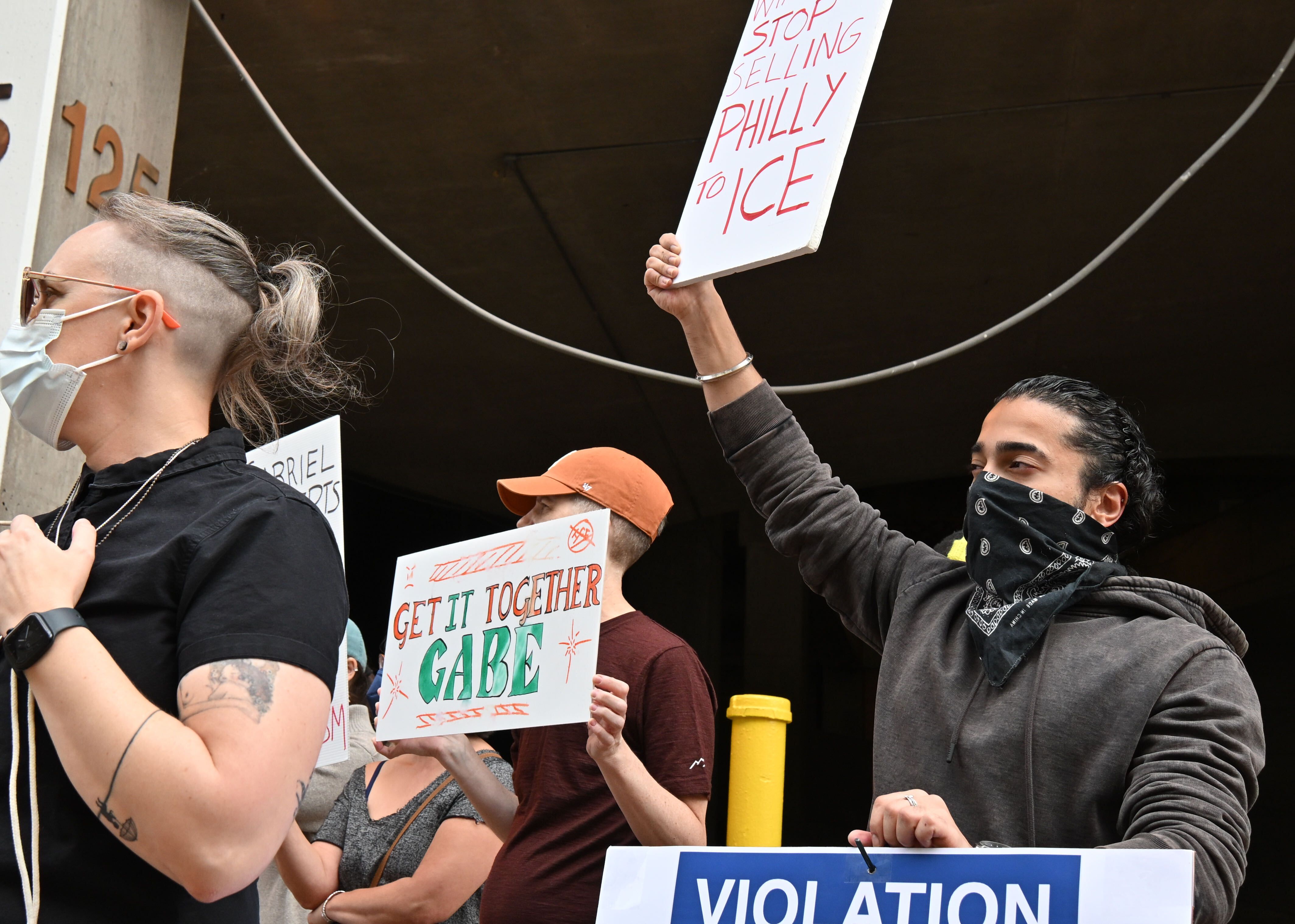
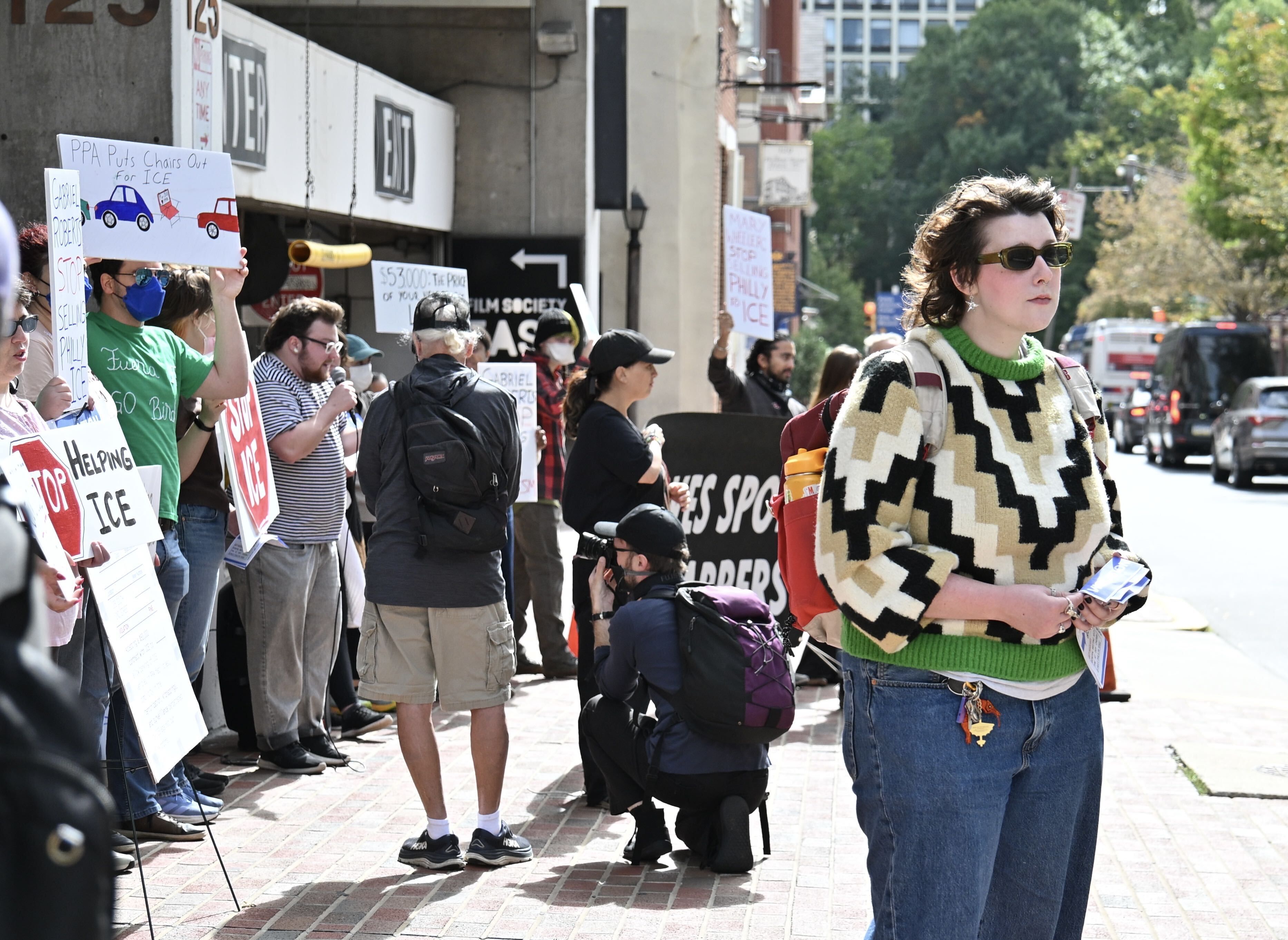
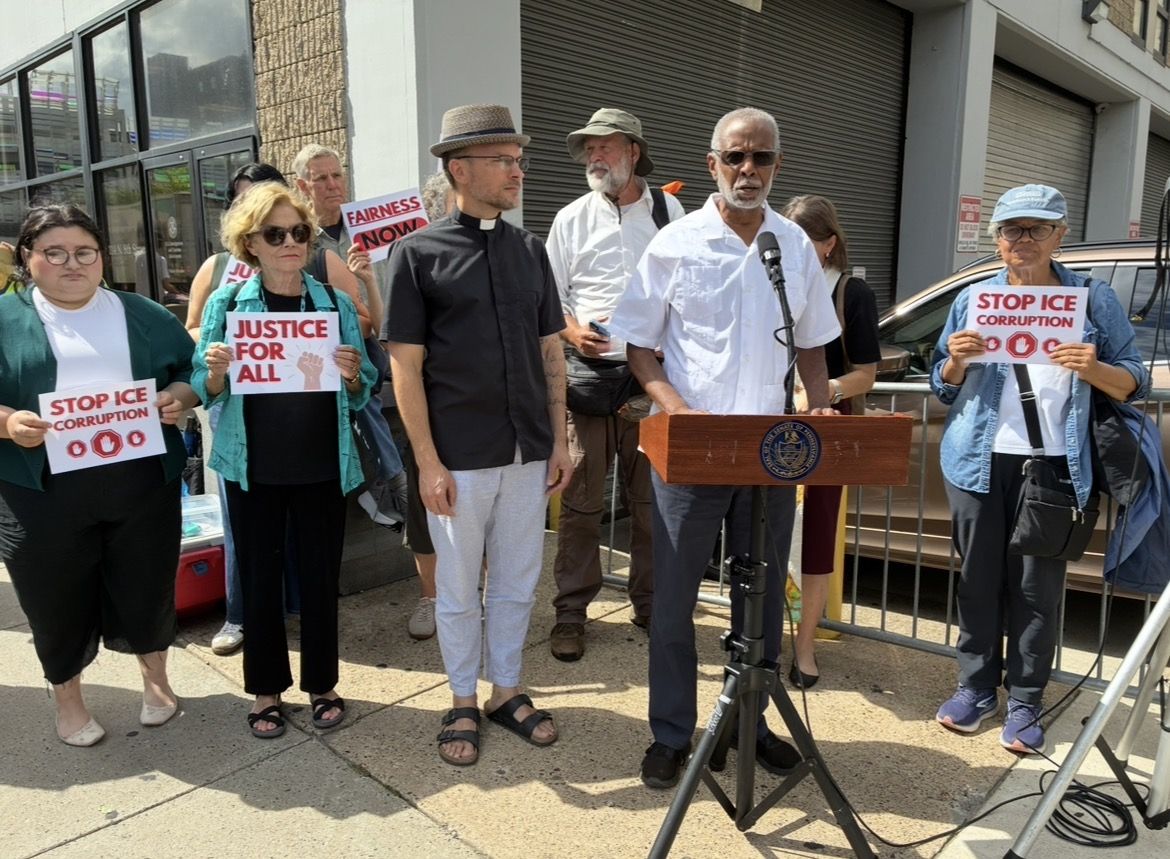
About two dozen No ICE Philly activists gathered Saturday outside a parking garage in Old City, demanding the Philadelphia Parking Authority end an arrangement with Immigration and Customs Enforcement.
At issue are 16 parking passes at the federally owned garage on Second Street, which is managed by the PPA. The group sang protest songs, held signs, and passed out informational flyers that resembled oversized PPA parking tickets.
“Who doesn’t know what these things look like, you know?” said one activist handing out flyers.
Group organizer Jay Bergen said the rally is meant to pressure the PPA — and to let people know that ICE is using the parking garage.
“It’s scary that you could be parking downtown, and unbeknownst to you, parking next to an ICE agent,” Bergen said.
Bergen, a 34-year old pastor at the Germantown Mennonite Church, pointed to public records showing a $53,520 contract that allows “for parking of government vehicles for ICE Homeland Security investigations” at the garage.
That contract was set to expire at the end of September, but another one, beginning in October and running through at least next September, gives Department of Homeland Security “16 leased parking spaces,” records show. ICE is part of DHS.
PPA spokesperson Martin O’Rourke declined to comment on the contracts.
An activist holds “violations” resembling PPA parking tickets to pass out to people, while a crowd gathers to demand the PPA stop leasing parking spaces to ICE.Brett Sholtis
Bergen said the group opposes ICE for “kidnappings” of immigrants and others, including people who have lived legally in the community for decades. One recent example is a 30-year-old nurse from Delaware County, who was arrested while taking her son to Disneyland.
Bergen said most people detained by ICE did nothing wrong. Some had minor lapses in paperwork or had been convicted of summary or misdemeanor crimes.
“Their goal is terror. It’s not public safety in any meaningful way,” Bergen said.
The local ICE field office did not respond to a request for comment Saturday.
At the rally, protester Akarsh Balaji said that the amount of money PPA makes on the contracts is “less than what they spend every year on salt to de-ice the streets.”
Balaji said he’s seen ICE harass his Puerto Rican neighbors in West Kensington. Puerto Ricans are Americans — so is Balaji, who is of Indian ethnicity — but that doesn’t seem to matter, he said.
“Nobody should have to live in fear, or be told that they’re harmful to society,” Balaji said.
Balaji said he got involved with the group in February after feeling a need to do something, “and be part of a movement that is so much bigger than I was.”
“We want to make it as difficult as possible for ICE to do its job,” Bergen said.
In Philly, ICE has faced obstacles from residents and elected officials. In April, the city adopted some of the nation’s most aggressive polices aimed at restricting ICE. The legislation took effect in July but the federal Department of Justice sued the city over some of its directives.
Bergen said ICE has changed its tactics since early this year, when its Operation Metro Surge in Minnesota — and the killings, captured on video, of U.S. citizens Renee Nicole Good and Alex Pretti — led to overwhelming public opposition to the agency.
“But the fear has not gone down. I heard this week about someone whose mother is afraid to go to doctor’s appointments, because she’s afraid ICE might grab her,” Bergen said.
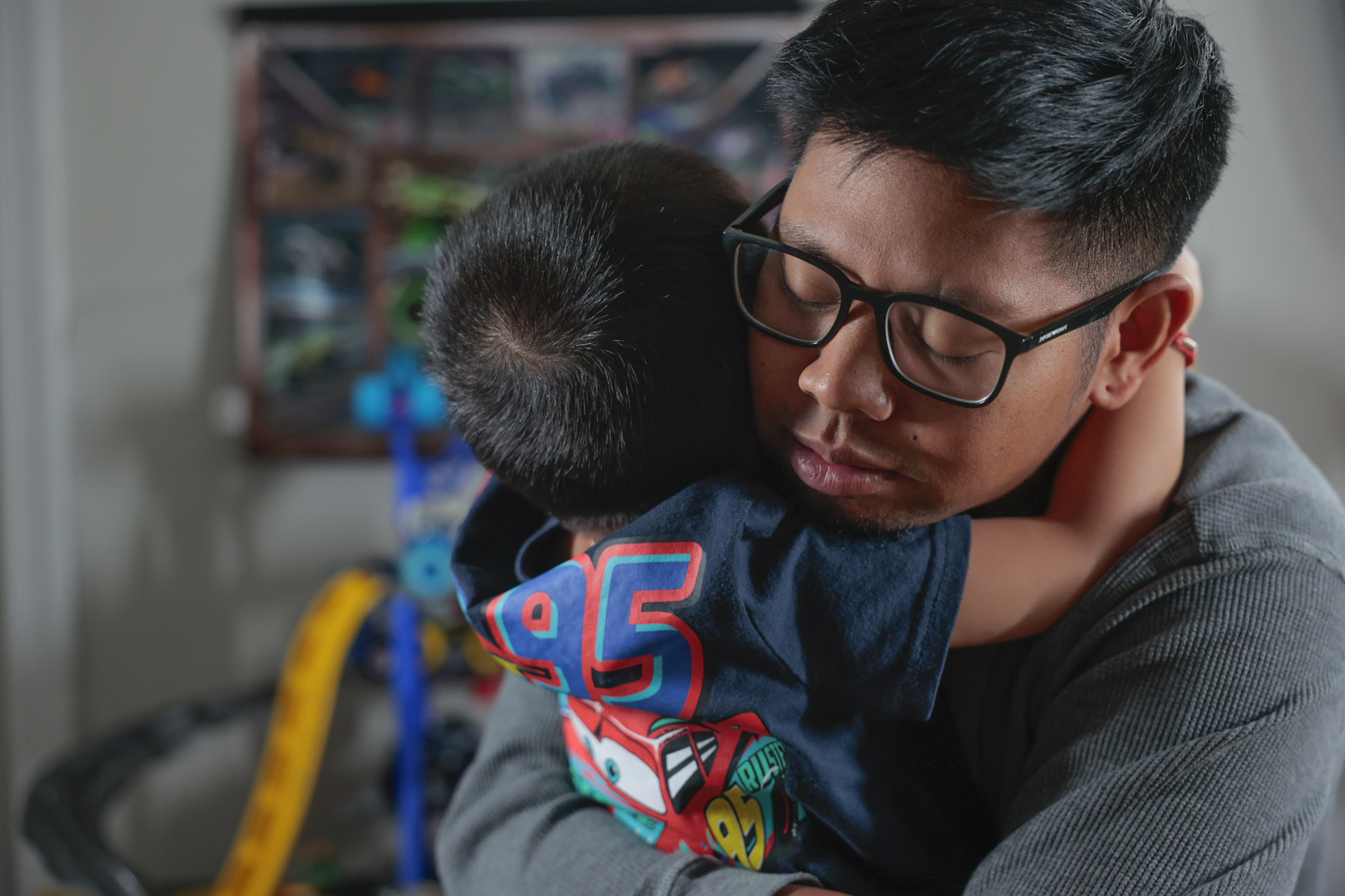
Delaware County nurse Monica Ryadi and her husband couldn’t wait to take their 3-year-old son to Disneyland, so he could meet his adored Cars movie characters — Lightning McQueen, Tow Mater, and the rest.
They didn’t get there.
The family had barely stepped off the plane at Los Angeles International Airport on Sept. 15 when they were surrounded by four or five men in street clothes who said they were ICE agents, flashed a badge, and snapped Ryadi into handcuffs.
When her husband protested, the officers threatened to arrest him and send their toddler, Luca, to child-protective services, the couple said in court filings. One officer told Ryadi she was here illegally and, “I don’t care if you are the president of the United States or a congresswoman like Ilhan Omar,” court records say.
Ryadi, 30, said she kept insisting that she was a legal immigrant.
And that’s true.
She has lived in the U.S. since she was 9, brought to this country by her parents when they fled religious persecution in Indonesia.
They entered on legal visas in 2005, and five years later were officially granted what’s called “Withholding of Removal.” That’s where an Immigration Court judge agrees that deporting someone to their homeland could get them hurt or killed.
It’s similar to asylum, the key difference being the federal government retains the right to deport someone if it can find a third country willing to take them. Withholding does not include a path to citizenship.
Traditionally, people who gained that relief were left alone.
Now that’s changed, as the Trump administration takes a new, hard view — seeing those who have Withholding, even those who have lived here for decades, as candidates for deportation. Some immigrants are held in ICE detention for months while the administration tries to find a foreign government to accept them.
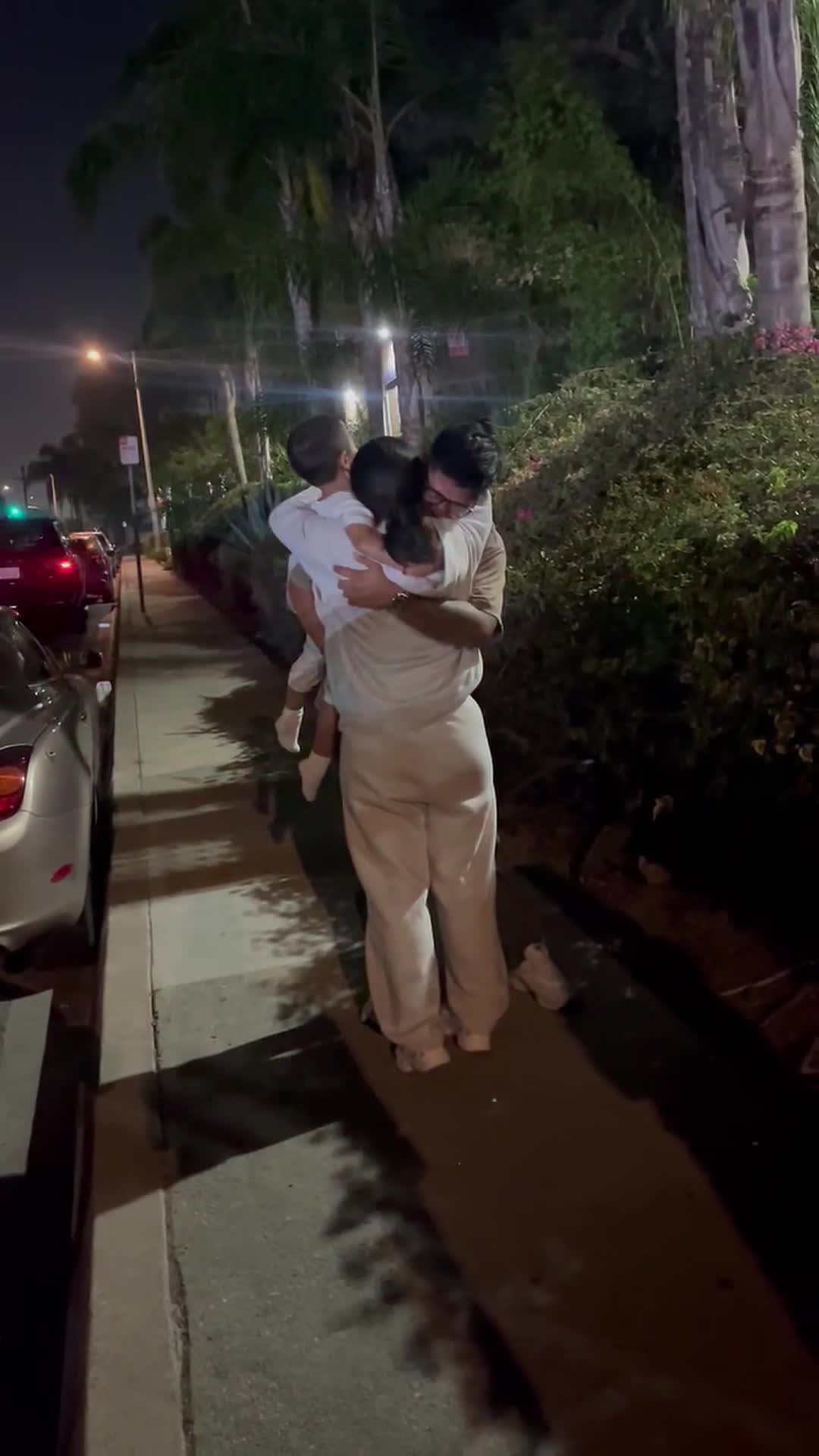
On Tuesday, after 15 days in custody at the Adelanto ICE Processing Center in California, Ryadi was ordered freed by a U.S. magistrate judge. Her husband and son flew to her immediately, and the family reunited that night, at the same Los Angeles hotel they booked when they planned to visit Disneyland.
“It’s a lot of emotions,” Ryadi said in an interview after her release. “I am still terrified, I’m still living under fear.”
At the same time, she said, “I can’t stop thinking about the other women that are in there.”
Video: A Delco nurse arrested by ICE reunites with her family
The Department of Homeland Security said in a statement that Ryadi was “an illegal alien” taken into custody “during a targeted enforcement operation at Los Angeles International Airport.”
DHS said she entered the U.S. legally in 2005 but “overstayed her welcome” in violation of immigration laws. An immigration judge issued a deportation order in 2010, DHS said, but did not note that such an order is a standard part of receiving permission to stay, work, and live in the U.S. under a grant of Withholding of Removal.
Ryadi’s husband, Steven Sary, 35, said he was overjoyed to be reunited with his wife. “But there’s still work to do,” he said. ”What’s the next step for us? We’re still living in fear.”
He tried to stay positive and supportive while Ryadi was detained, even at moments when they were both crying on the phone. He told her, “You don’t have to worry about Luca, I’m doing the best I can.”
The couple has arranged their lives around their son, setting schedules so one parent is always home with him. Ryadi works weekends at Riddle Hospital in Media, while her husband works Monday to Friday as a UPS truck driver.
The two met when they were children growing up in Philadelphia, and married in 2021.
Ryadi graduated high school from the Academy at Palumbo in the Bella Vista neighborhood, then earned an associate degree at Philadelphia Community College before obtaining her bachelor’s degree at Ohio University.
She became a nurse, she said, because she wanted to help people.
The court order that freed Ryadi came the same day that the Supreme Court ruled the Trump administration could resume the fast deportation of immigrants to countries other than their own.
The court granted the government’s emergency request to block an appeals court ruling that said the process was unlawful, because immigrants were not given sufficient opportunity to raise safety concerns.
The Supreme Court said it would hear oral arguments in the case in December, with a final ruling likely next year.
Steven Sary hugs his 3-year-old son, Luca, at their Delco home, waiting for word on his wife, who at the time was detained in California by ICE. She was detained by ICE agents after getting off a plane in Los Angeles as the family traveled to Disneyland. Steven M. Falk / For The Inquirer
“What happened to Monica should be treated as an extrajudicial kidnapping,” said Ryadi’s Philadelphia immigration attorney, Eric Rosenfeld, who is handling the case pro bono.
He noted that Ryadi is a registered nurse, the wife of an American citizen, and the parent of a son who is an American citizen — yet ICE casually told her she would be sent to an undisclosed third country.
She was never given any type of document or warrant to explain her arrest, he said. Upon release she was fitted with a GPS ankle monitor, and she knows ICE will likely try again to deport her, the attorney said.
“This is a respite. Not security,” Rosenfeld said.
As the Trump administration pursues its mass-deportation agenda, the protection offered by Withholding and similar relief “is proving to be very little protection at all,” the American Immigration Council wrote. “The Trump administration is trying to ship them out wherever it can — and keep them locked up in the meantime.”
A Philadelphia man who was arrested in July remains in detention, despite having lived legally for almost 20 years.
Mamadou Fadel Cherif of West Oak Lane was granted protection from potential political violence in his native Guinea. Now the administration wants to deport him to Ghana.
To receive Withholding of Removal, applicants must prove they were persecuted in the past or that their lives would be threatened in the future, that their home government harmed or will harm them — or failed to control others who might do so.
When that relief is granted, the immigration judge also enters a deportation order, then tells the government it cannot deport the person to their homeland. In that way the removal is “withheld.”
“We were planning to have an amazing trip with the family,” Sary said, “to see Cars Land with our son. But that changed.”
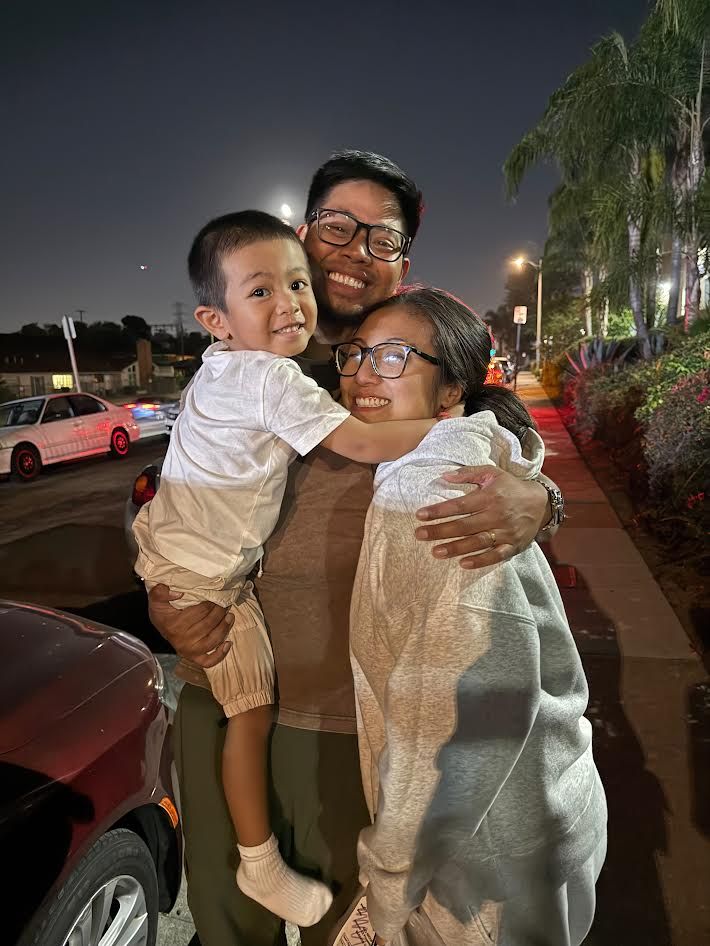
This image shows Delaware County nurse Monica Ryadi, left, in white, being arrested by ICE agents at Los Angeles International Airport on Sept. 15. She and her husband were taking their 3-year-old son to visit Disneyland.Courtesy of the family
“It felt like I was kidnapped,” Ryadi said. “I kept saying, ‘I’m legal, I’m a legal immigrant.’”
She grew up in the United States with government permission, has work authorization, a Real ID, and a Social Security number. She pays taxes. Yet she was chained wrist, ankle and waist like a criminal, she said.
Ryadi wonders if the ICE operation against her began in Philadelphia. As her family waited to board the plane, she said, a woman in a black jacket approached and made small talk.
The woman didn’t have luggage, Ryadi said, and she didn’t get on the flight. Instead, she walked away to talk to a man who also did not appear to be a passenger.
When Ryadi was released from the Adelanto detention center, 90 miles northeast of Los Angeles, immigrant-aid volunteers gave her a ride all the way to the city.
There she flew into the arms of her husband and son.
“I’m so happy to see you!” she cried.
At the hotel, the family saw people decked out in Disney attire, coming back from the theme park. Young Luca asked if they could go.
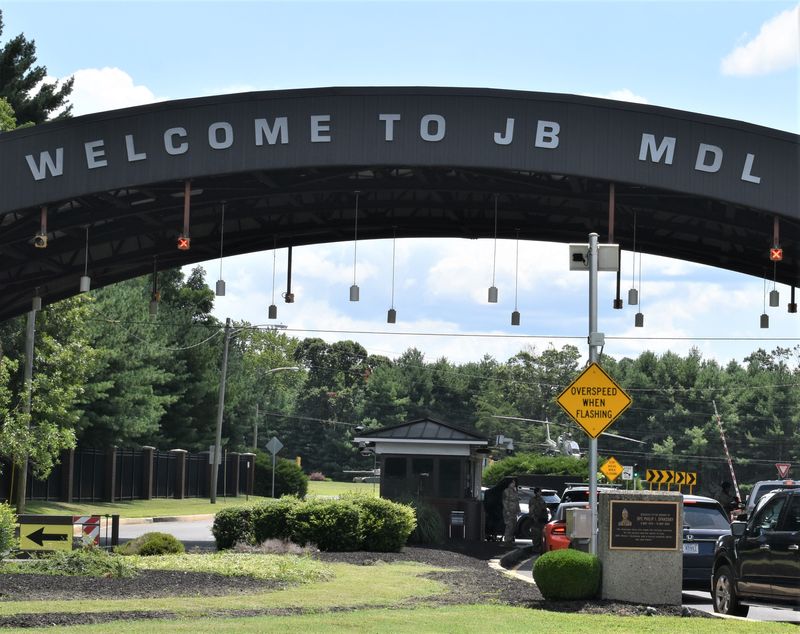
The Trump administration has dropped its plans to build an immigrant-detention center at Joint Base McGuire-Dix-Lakehurst in South Jersey, according to a new report from the Government Accountability Office.
The office said that in October, after the opening of an ICE detention site at Fort Bliss in El Paso, Texas, Pentagon officials said they “no longer plan to build detention facilities on other military installations.”
Specifically, the report said, Defense Department and Immigration and Customs Enforcement officials “told us that they did not move forward with plans for facilities in Indiana and New Jersey.”
More than a year ago, in July 2025, the administration confirmed plans to house detainees at the South Jersey base as a way to support President Donald Trump’s plans for mass deportations.
Specific details were not released, and as time went on it was unclear if planning had gone forward.
In November 2025, local Democratic elected officials said they had received a letter from the administration saying there was currently no approved construction plan, nor a timeline, for confining people at the base.
U.S. Reps. Donald Norcross and Herb Conaway, both New Jersey Democrats and members of the House Armed Services Committee, requested more information about the administration’s plans from the Department of Homeland Security.
The administration’s response said the government’s need for more detention space “reflects the Trump administration’s commitment to restoring the rule of law and ending the catch-and-release policies of prior years that jeopardized American communities.”
The base had been named as one of two sites certified to hold immigrants, the other being Camp Atterbury in Indiana.
The report by the GAO, a nonpartisan, investigative arm of Congress, said ICE had begun new detention initiatives before developing a plan for expansion, resulting in waste. Since January 2025, ICE had invested significant resources in six new initiatives to increase detention capacity, but by July 2026 had scaled back four of them, the GAO said.
The NFL asked the Department of Homeland Security to take down a social media post featuring Eagles legend Brian Dawkins to promote the immigration enforcement efforts of President Donald Trump’s administration.
A DHS spokesperson said it used Dawkins in its post because “DHS is playing lockdown defense at the border.” On Monday, the NFL said it requested that DHS remove the post from its social media accounts.
“We have requested DHS take down the video,” Brian McCarthy, a spokesperson for the NFL, said.
Dawkins, who played for the Eagles from 1996 to 2008, was known for leading the team onto the field before games in a menacing “Weapon X” entrance, in which he would run on his hands and feet like X-Men character Wolverine, ready to eviscerate the opposing team’s offense.
In a video shared on social media Monday afternoon, Dawkins said he did not authorize the Trump administration to use his highlights to promote their immigration agenda.
“I did not give permission for my name, image, and likeness to be used by anybody, all right? By anybody,” Dawkins said.
The video of Dawkins’ entrance implied DHS and U.S. Immigration and Customs Enforcement would take aggressive action against the migrant caravan. DHS said it has been trackingthe group of about 600 people since it left San Pedro Sula, Honduras, on Sept. 20.
Former NFL player Brian Dawkins delivers a speech during an induction ceremony at the Pro Football Hall of Fame in 2018.David Richard
Dawkins is not the first ex-NFL star to be featured in the Trump administration’s increasingly meme-centered presence on social media. The White House’s official X account posted a highlight reel in March of bone-crushing tackles in NFL history, including Eagles cornerback Sheldon Brown’s hit against rookie Reggie Bush, edited to include footage of real drone strikes conducted by the U.S. military in Iran.
The Dawkins social media post follows the White House’s use of taxpayer funds to air a television ad centering Trump before the midterms. The ad that aired in at least two NFL game broadcasts on Sunday, according to CNN, features Donald Trump walking through a hallway declaring “this is the final battle.” At the end of the commercial, a disclosure reads “Paid for by the U.S. Government,” which drew criticism from both sides of the aisle.
Sen. Andy Kim (D., N.J.) questioned how much taxpayer money was spent on the ad on Sunday. “Trump has overseen the most corrupt administration in modern history, making billions of dollars for him and his friends, while your costs go up,” he said in a social media post.
Sen. John Kennedy (R., La.) in an interview on CBS’s Face the Nation said no public official should spend public money on private ads for themselves. “The White House sees differently, but you can’t spend money to promote yourself.”
When Nelson Contreras-Gelves arrived at an immigration appointment in June, he worriedly “already saw myself being back in Venezuela.”
The threat of deportation had loomed ever since he arrived in the United States in March 2022, surrendering at the border and requesting asylum. It hung over conversations he and Ariel Whaley had about marriage. It dictated when they held their wedding reception.
And just a week after the Chester County newlyweds celebrated their marriage, Contreras-Gelves, 35, walked into an immigration appointment in Philadelphia. An hour later, he called to tell his wife he had been arrested and detained by ICE.
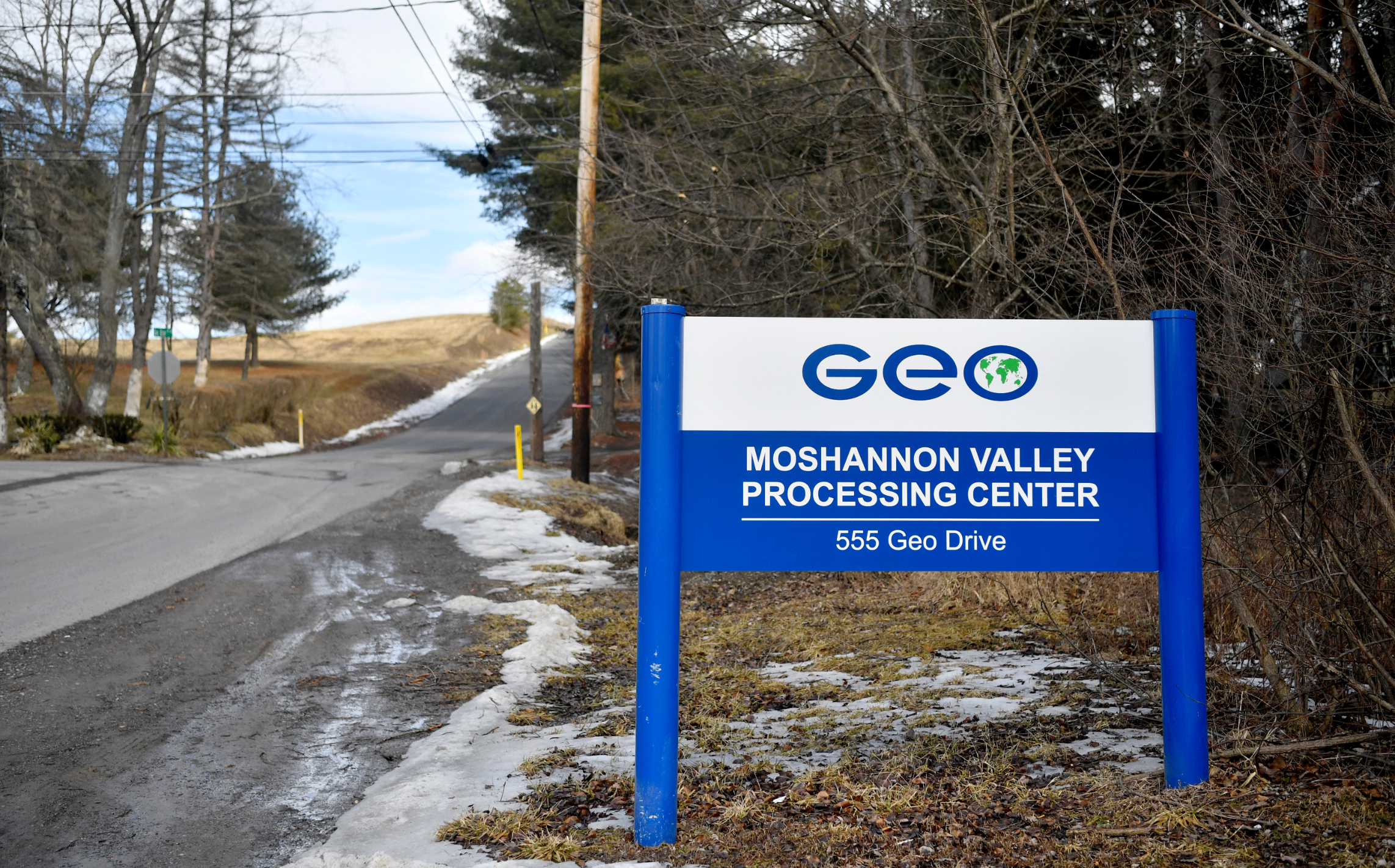
That is, until Sept. 10, when he was abruptly released after months at Moshannon Valley Processing Center, the giant ICE detention center in Philipsburg, Clearfield County.
Contreras-Gelves and Whaley say he has no criminal record.
“Those first couple of days, we just kept on looking at each other, like, ‘Wow, I cannot believe that you are here,’ because it was so out of the world,” said Whaley, 27, during a recent interview in Kennett Square’s Cypress Beach Park, where the pair had volunteered planting trees and rehabbing the park together. Contreras-Gelves does not speak English; Whaley translated his comments during the conversation.
Contreras-Gelves and Whaley are now starting a new chapter — not life as it was before. They don’t know precisely why Immigration and Customs Enforcement granted Contreras-Gelves’ release after a string of denials. And he is under more surveillance than before his detention. He was fitted with an ankle monitor; is limited to traveling only within Pennsylvania, New Jersey, and Delaware; and has frequent in-person check-ins in King of Prussia.
“There’s still uncertainty, but at the very least, we can go through it together, and not have the same sense of immediacy that we have to make some sort of decision,” Whaley said.
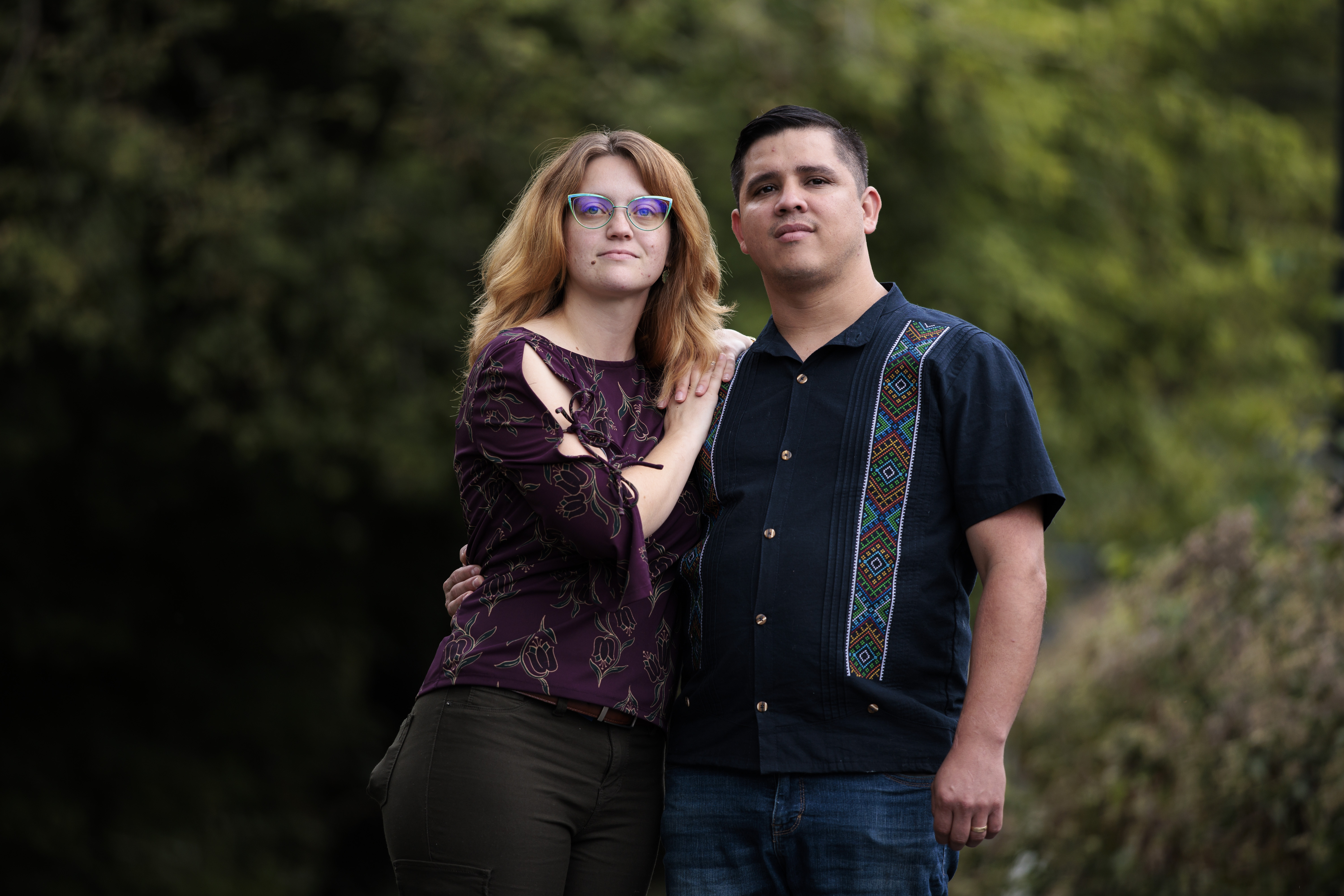
Nelson Contreras-Gelves talks about his proposal to Ariel Whaley at Cypress Beach Park on Sept. 21 in Kennett Square. Contreras-Gelves was released from ICE detention earlier this month.Monica Herndon / Staff Photographer
‘If she enters my heart, she won’t leave’
When it came to Whaley, Contreras-Gelves was nervous to make the first move.
The two met in 2023 at Mighty Writers, a nonprofit educational program for children that also offers food and other resources for underserved families in the Philadelphia region.
Whaley, a Downingtown native, was working at the Spanish-language preschool; Contreras-Gelves started as a volunteer in the food pantry, working his overnight shift at a mushroom farm and then arriving just a few hours later at the nonprofit.
They spent a lot of time together there. Whaley remembers sorting donations together, sifting through an array of lotions and shampoo. He sniffed each one.
Something about it struck her: “I just saw a curiosity and a wonder for the little things that I don’t normally see in a lot of people,” she said. “It made me fall in love very quickly.”
He was likewise smitten. He told a coworker “that muchacha is so pretty.”
“If she enters my heart, she won’t leave,” he recalled saying.
As their relationship got more serious and they both considered marriage, they had to discuss it “kind of like in a business way,” Whaley recalls.
They hesitated for a bit. But ultimately, they bought their rings, and despite his nerves about the pressures of an American proposal, he asked Whaley to marry him in February 2025 at the park where they had their first date.
After a ceremony in May, Whaley wanted to celebrate their love. They picked the date for their June 2026 reception because it was “literally the last weekend” before Contreras-Gelves could possibly be detained, Whaley said. Whaley’s panic attacks about it got worse, a sharp come-down from the pure happiness she had felt at their reception.
Though this appointment was routine, and he had been to immigration check-ins previously, they saw what was unfolding around them. They knew the government was increasingly taking people into custody when they appeared. Something similar had happened to Contreras-Gelves’ friend.
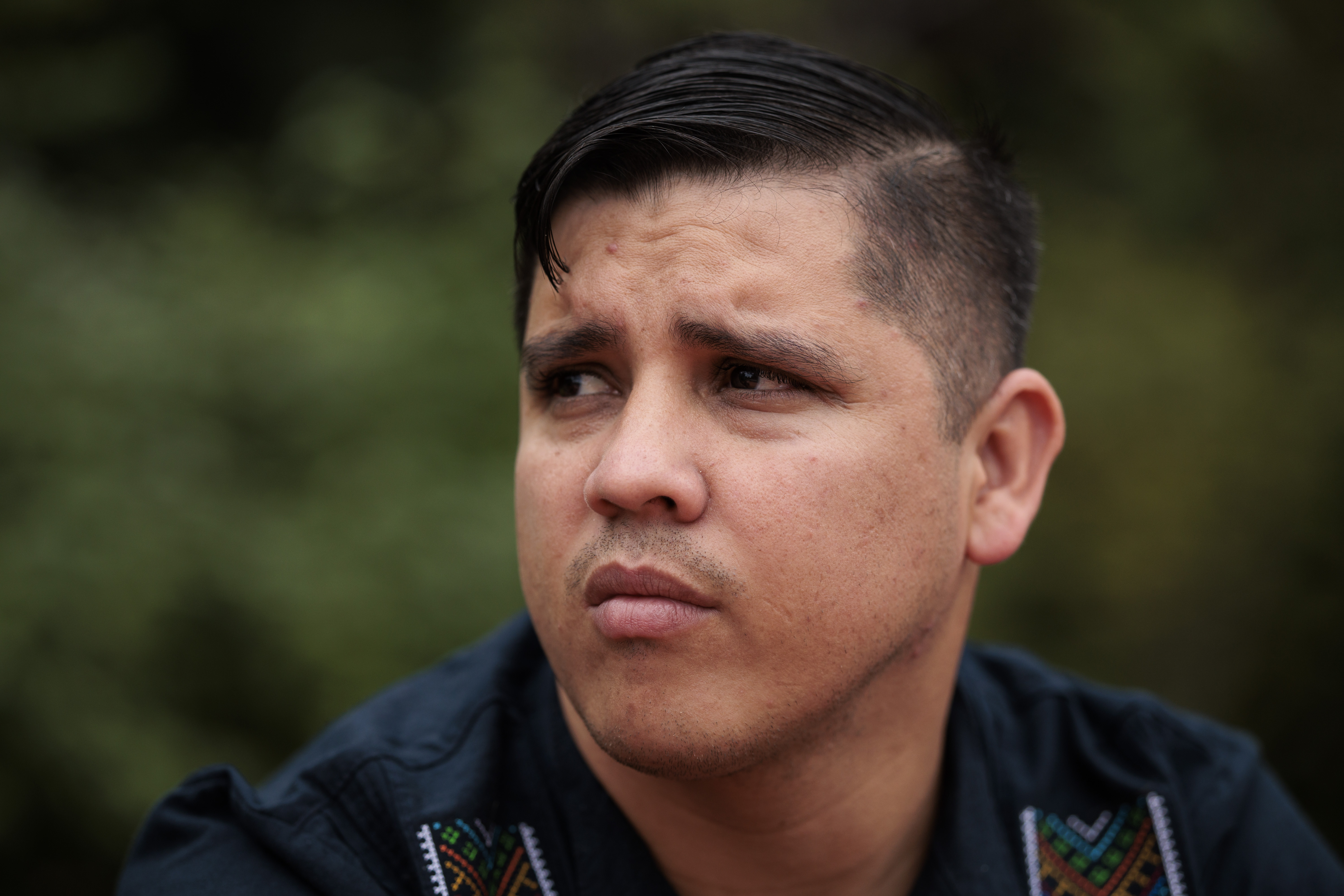
Nelson Contreras-Gelves speaks with a reporter at Cypress Beach Park on Sept. 21 in Kennett Square.Monica Herndon / Staff Photographer
‘Keep the faith’
When the appointment came, what typically was a 15-minute process — fingerprints, a photo — took two hours. Immigration officials asked Contreras-Gelves to report back a few days later with another form of ID from Venezuela.
Friends and family told Contreras-Gelves not to go back. But he knew it would be worse if he didn’t.
One week after their party, Contreras-Gelves stopped Whaley 50 feet from the door to the immigration office, told her he would go in alone, and kissed her goodbye.
He didn’t come back out.
It was a scramble for Whaley, who mobilized to contact lawyers with the Defender Association’s immigration unit. She struggled to figure out how to see him while he was held at the Federal Detention Center in Philadelphia for roughly three weeks, before he was transferred to the 1,880-bed Moshannon center.
For months, his detention consumed Whaley’s life. She was constantly on alert, answering calls from the lawyers and waiting to hear from Contreras-Gelves, unsure if the next time he would tell her he was being deported.
But a community sprung up around them. Whaley helped other detainees contact their loved ones, and helped families navigate addingmoney to their accounts. She connected others with Contreras-Gelves’ attorneys, and visited another man at Moshannon whom Contreras-Gelves had been detained alongside in Philadelphia, helping him communicate with his wife in Mexico.
A GoFundMe page, set up by loved ones, raised nearly $40,000 to support Whaley and Contreras-Gelves as they fought for his release. They launched a letter-writing campaign, sending postcards to elected officials.
Over the months in detainment, Contreras-Gelves faced repeated denials to be released on bond. The conditions of Moshannon were “horrible,” he said. He recalls scalding shower water that burned; a mysterious and unsettling number of bugs; and poor food quality. Medical assistance was often just a pill. He shared his commissary purchases with other detainees who did not have the same access.
A spokesperson for ICE did not respond to a request seeking comment about the conditions at Moshannon or the reason for Contreras-Gelves’ release.
He began to get weary. He thought about signing a voluntary departure form and returning to Venezuela. Whaley, at first, agreed, not wanting him to remain locked up when he could be free — and they could be united — somewhere else. But she pressed him to wait.
“Everybody in our community that already knew us played such a large role in helping us keep the faith, and then all of the people that we’ve met and we’ve been able to help or have helped us have done the same thing,” Whaley said.
And then on the morning of Sept. 10, as Whaley was heading into work as a graduate assistant at West Chester University, she got a phone call. Contreras-Gelves was talking so fast, it took her a minute to understand: He was being released.
She hesitated to tell anyone. It didn’t feel real. But after she talked with an ICE agent to coordinate picking him up, she started calling people.
“I still was like, I’m not going to believe it until he comes out the gate,” she said. “And then he did.”
Ariel Whaley and Nelson Contreras-Gelves walk through Cypress Beach Park.Monica Herndon / Staff Photographer
‘Incredibly lucky’
When people ask them what comes next, they say there is still a lot of uncertainty. They don’t feel like they are returning to the lives they had before.
There’s a lot of ambiguity around the relations between his home country and the United States, and what it could mean for his status. But he will have a new court date, some time in the future.
They hope the momentum they built around Contreras-Gelves’ detention canbedirectedto others who are still at Moshannon, Whaley said. They continue to help others detained there when they can.
AfterContreras-Gelves’ release, they drove a woman and her children to Moshannon to visit her husband, from whom she had been separated for more than a year without the means to visit.
“We were so incredibly lucky. There’s so many people who don’t even get the opportunity to fight as hard as we have, and so we are just so grateful to have the support from everybody,” she said. “We both feel a responsibility to help others who are still going through it.”
Michael “Sandy” Sims was supposed to be back in Philadelphia by now, after a business trip to the West Coast. Instead, he is locked up in an ICE detention center in California.
Sims, 42, a veteran of the entertainment-lighting industry, told his wife that immigration agents were waiting for him when his Lyft driver pulled up at the San Jose airport early on Sept. 2.
Sims was born in Ireland and raised in London, and had been expecting approval of a green card that he and his wife, an American citizen, sought after they married in 2017.
Now he is in custody as U.S. airports become risky places for foreigners, amid an ICE push for ever-greater numbers of arrests.
“It’s horrible,” said Sims’ wife, Jennifer, 46. “We thought we were waiting for a green card.”
For so long, she said, the United States has been a beacon for people around the world who want to come, work, and contribute, to create better lives for their families. Now, she said, “the American dream is gone.”
The advocacy organization Asian Americans United, which works to track airport arrests, said it estimates more than 20 people have been arrested at Philadelphia International Airport or while seeking to fly there since July 12. That includes at least 13 taken into custody at the Philadelphia airport itself.
The Department of Homeland Security said Sims had entered the country legally but overstayed his visa.
“Criminal illegal aliens are not welcome in the U.S.,” DHS said in a statement. “Under President Trump and [Homeland Security] Secretary [Markwayne] Mullin, if you break the law, you will face the consequences.”
The department said Sims faces a criminal charge of domestic battery in Nevada, where he lived at one time. DHS provided no further details and, along with ICE, did not respond to requests for information on what allegedly happened and when.
In a search of Nevada court documents, The Inquirer could find no record of any criminal case against Sims. And Sims’ Philadelphia immigration lawyer, Hunter Yost, said he had no knowledge of and could locate no record of such a case.
Jennifer Sims said her husband has never been charged with a crime.
When she subsequently asked her husband about the government’s assertion that he had a pending criminal case, she said, he told her that when he was arrested and handcuffed by Immigration and Customs Enforcement, one of the agents kept saying, “You’re a wife-beater,” and the other repeatedly said, “No, he’s not.”
Jennifer Sims pictured with her husband, Michael “Sandy” Sims.Courtesy of the family
Sandy Sims sent a note from detention that was posted there:
“Hello to everyone from Dorm B Mesa Verde Detention Center,” he wrote. “Thank you one and all for your support. … I’m so grateful. Thank you all and I hope this situation will be over soon.”
Sims’ wife said he legally entered the U.S. on a work visa in 2016. When that expired, he was subsequently approved for entry under ESTA, the Electronic System for Travel Authorization. That is an online initiative the federal government uses to prescreen travelers before they visit the United States under the Visa Waiver Program.
Jennifer Sims said after they wed, she filed Form I-130, the document required to prove a valid family relationship with a foreigner who wants to immigrate to the United States. That application, she said, was approved in March 2020 ― a key step toward a green card. Her husband had completed his biometrics appointment, where the government collects the applicant’s fingerprints, photograph, and digital signature, three months earlier, she said.
He was given a U.S. Social Security number, she said.
The couple worries their green-card paperwork might have been lost when they relocated to Las Vegas and back to Philadelphia between 2018 and 2021.
Meanwhile, the Trump administration’s nationwide effort to increase arrests at U.S. airports has spurred warnings from immigration attorneys that even those with valid work permits and government-issued identification can be in danger.
An ICE summer push saw a record 49,571 people arrested across the nation in July, many of them taken into custody at airports, courthouses, and scheduled immigration check-ins. That is an average of 1,599 arrests a day, a 15% increase over the previous month, according to figures from the Deportation Data Project.
The July arrests included 1,174 in Pennsylvania and 2,112 in New Jersey.
Homeland Security said airport arrests are occurring because the Trump administration “reversed the horrendous Biden-era policy that allowed aliens in our country illegally to jet around our country.”
“Under President Trump, DHS will no longer tolerate this,” the agency said last month, as news spread of Philadelphia airport arrests. “This administration is working diligently to ensure that aliens in our country illegally can no longer fly unless it is out of our country to self-deport.”
The Trump administration says that its immigration-enforcement effort targets criminals, that it has been arresting and deporting killers, rapists, and child-abusers to make the country safer. However, the latest data showed that half of those arrested in July had no criminal convictions or charges, and less than 25% had been convicted of a crime.
Sandy Sims has worked in entertainment lighting since 2002, including on shows for Metallica, Usher, and Florence + the Machine, the popular English rock band, his wife said.
She said she feels as if the immigration system has been turned into a moneymaker, where people trying to follow the law are charged high fees, and private companies reap profits by keeping people in custody.
President Donald Trump’s administration cannot demand that Philadelphia officials assist his deportation agenda and enforce federal immigration law, the city told a judge Tuesday.
Attorneys for the city and local officials asked U.S. District Judge Chad F. Kenney to toss out the Department of Justice’s challenge to an ordinance that prohibits Philadelphia agencies and employees from honoring immigration detainers.
“The federal government cannot conscript City employees as its agents, including by ordering them to keep an individual in custody, solely to assist with federal immigration enforcement,” the city’s motion said.
The Trump administration’s position in the case runs afoul of the Tenth Amendment to the U.S. Constitution, which prevents the federal government from commandeering state and local governments to enforce federal laws, the city said.
And the Justice Department cannot point to any federal law “mandating” state and local officials assist with immigration enforcement, said the filing on behalf of Mayor Cherelle L. Parker, former City Solicitor Renee Garcia, and District Attorney Larry Krasner.
The city declined to comment on the ongoing litigation. Krasner and the Justice Department did not immediately respond to requests for comment.
That decision should have come as no surprise to Parker’s administration. Parker allowed the bill to become law without her signature, following Garcia’s advice that signing the measure “would send an inaccurate signal to the public that the Administration can legally and practically enforce” its provisions.
The Justice Department expanded its lawsuit in August to include a challenge to the bill that prohibits honoring immigration detainers, requests by U.S. Immigration and Customs Enforcement that a local law enforcement agency keep a person in custody long enough to be handed over to federal agents.
Parker did sign that legislation, which codified a long-standing city practice, along with five other “ICE Out” bills.
The ordinance makes it illegal for a city agency or employee to comply with a detainer by keeping people otherwise eligible for release in custody because of an immigration detainer, an administrative warrant, or suspicion that they violated immigration law.
The amended complaint does not mention Philadelphia’s history of not cooperating with ICE detainers. But with the local law, the city “foreclosed” the prospect of using the mechanism to deport people who were arrested, the suit says.
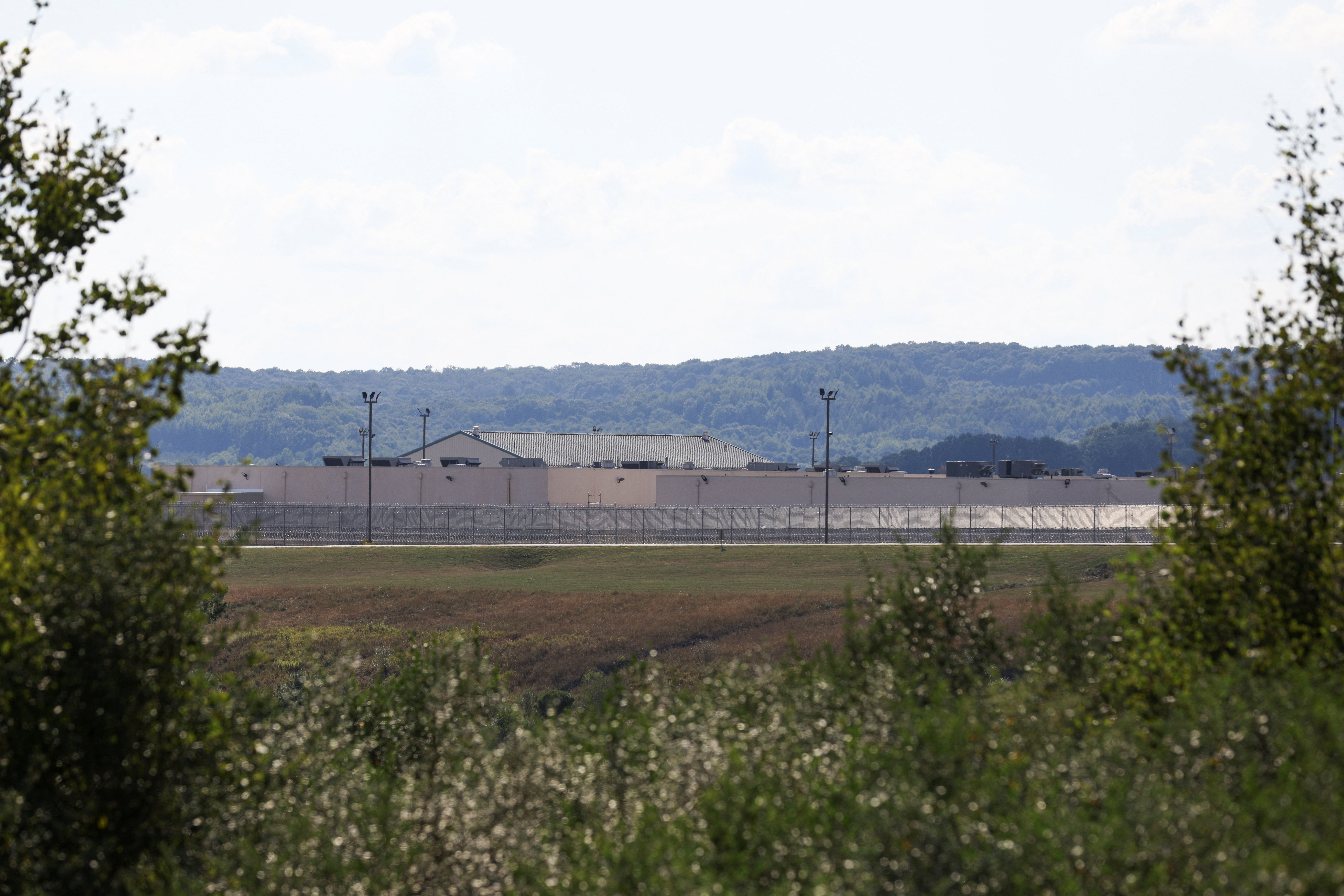
There are signs the Moshannon Valley Processing Center could end up being sold to the federal government, a move critics fear could insulate the center from some state regulation.
In the meantime, county officials approved a controversial extension of the current operating contract Tuesday, ensuring the largest detention center in the northeastern United States can run unimpeded for at least the next six months.
The contract between Clearfield County and Florida-based GEO Group, the for-profit owner of the 1,876-bed facility, was set to expire at the end of September. But Republican Commissioners Tim Winters and John Sobel voted 2-1 against Democratic Commissioner Dave Glass to extend GEO Group and ICE’s contract to operate the Moshannon center.
The vote came at a contentious meeting at which speakers from the audience mostly voiced opposition, questioning why the county had become entangled in federal immigration policy and doubting the true worth and use of the $100,000 payment.
“Blood money!” one person shouted after the vote.
Clearfield’s vote took place as President Donald Trump’s administration quietly mounts a takeover of private detention centers like Moshannon, as it is called, to expand bed capacity to support its mass-deportation goals.
Some local officials and immigration advocates think Moshannon may be next to be sold. In a statement, the Department of Homeland Security said ICE does not discuss potential facility acquisitions.
“The long-term solicitation process remains ongoing,” a spokesperson said.
Federal ownership could insulate the properties from compliance with certain local and state laws, important to the Trump administration when other expansion plans, like turning empty warehouses into detention centers, bogged down amid community and legal opposition.
Moshannon is a common destination of those arrested for immigration violations in Pennsylvania. An unannounced congressional oversight visit in May found that of the 1,417 adults detained there, roughly 78% lacked serious criminal charges or convictions of violent behavior — a contrast to Trump and his allies’ arguments for increased detention.
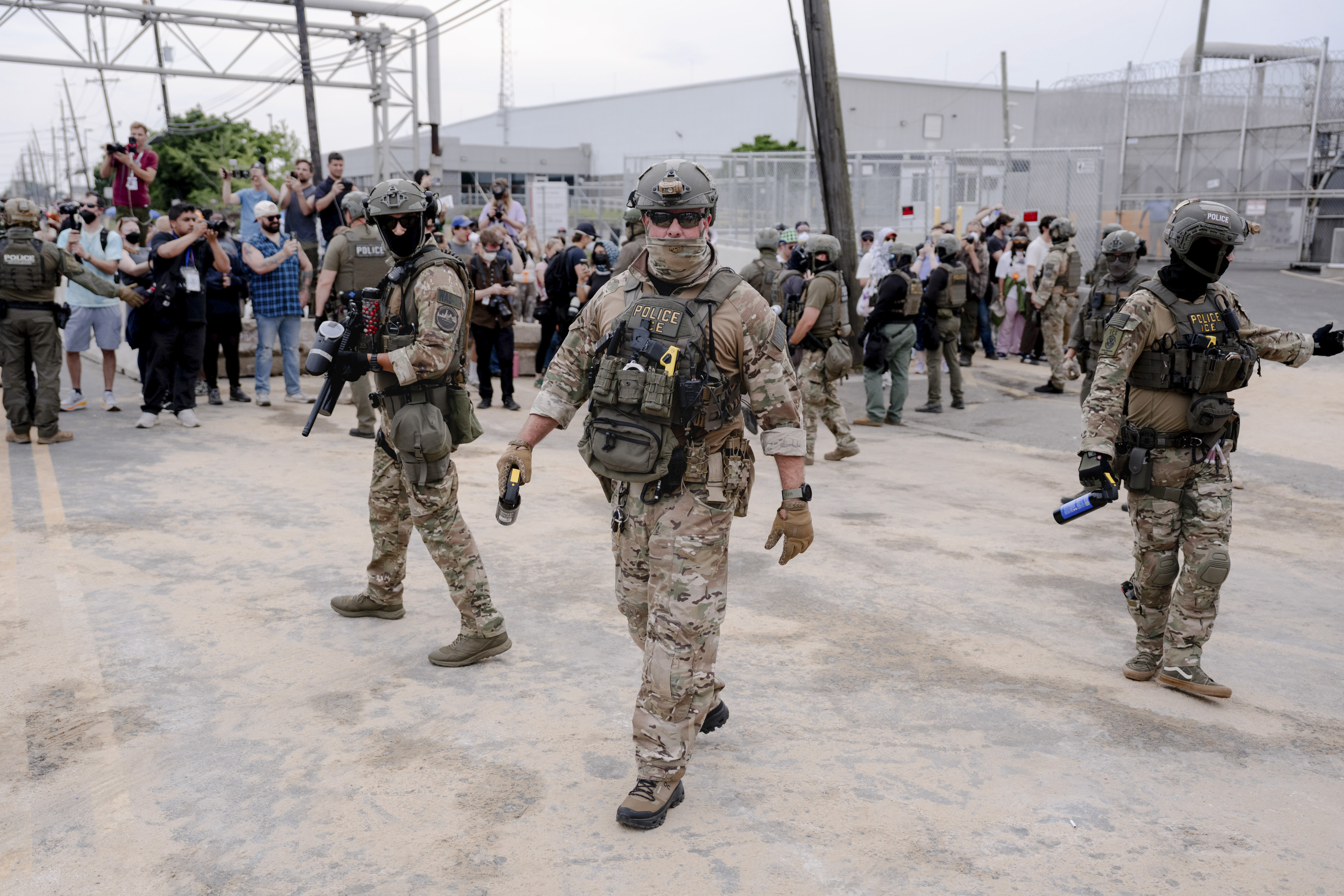
ICE agents outside the Delaney Hall migrant detention center in Newark, N.J., in June.LEXI PARRA
Trump’s push for mass detention and deportation
Congress voted in July 2025 to allocate $45 billion to the Department of Homeland Security for immigration detention, more than a decade’s worth of typical funding. At the time, Trump immigration officials touted the funding as a way to treat deportation “like a business,” with acting ICE director Todd Lyons saying he wants to see the deportation system run “like [Amazon] Prime, but with human beings.”
However, in June, ICE made plans to offload seven of those warehouses, totaling $700 million, by giving them to other agencies or selling them outright, according to the New York Times.
A warehouse purchased by DHS to house an ICE detention center in Surprise. Caitlin O'Hara
GEO Group’s founder and executive chairman, George Foley, said in a May earnings call that the private prison company was “engaged in an active process for the sale” of several facilities to ICE. Foley acknowledged Democratic-led states were considering more active oversight in detention centers, saying, “I think the logical solution to much of that is federal ownership of the facilities.”
GEO Group did not respond to a request for comment.
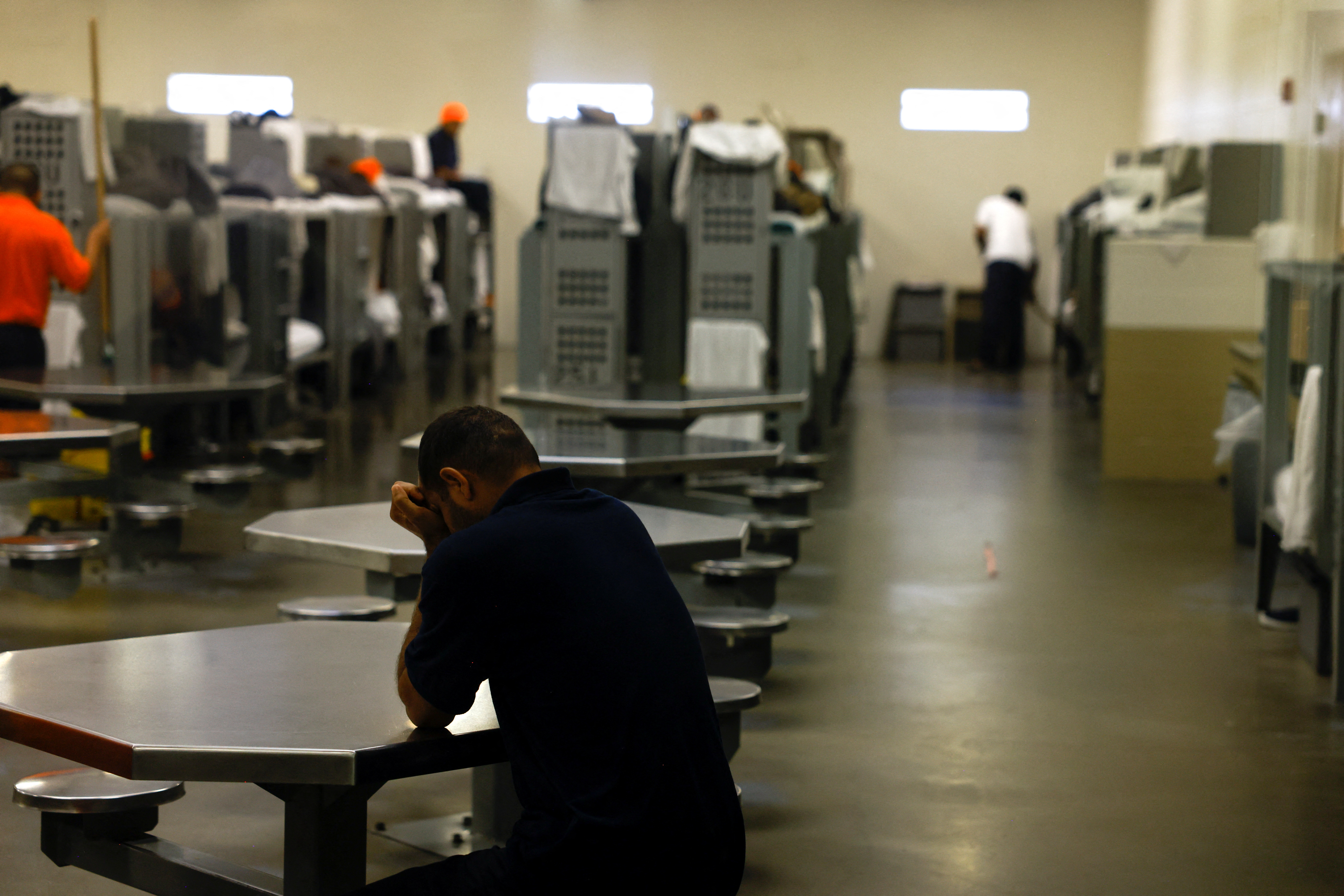
A detainee sits behind glass in a common area at the Moshannon Valley Processing Center in 2023.REUTERS / Quinn Glabicki
The potential sale of Moshannon to ICE
GEO Group has not officially stated its intention to sell Moshannon to ICE. But recent ICE contract bid requests and local dealings with the center’s warden are leading local officials and immigration advocates to suspect a sale.
Earlier this month, ICE requested 10-year contract bids for “turnkey” detention facilities across the country, including in the Philadelphia area. Moshannon is the only private facility in the region that fits that criteria, said Jasmine Rivera, executive director of the Pennsylvania Immigration Coalition, which had called on county commissioners to deny a contract extension.
Rivera said the proposal requests include provisions that could lead to the sale of private detention centers to ICE, similar to its dealings with CoreCivic. GEO Group and ICE’s contract extension “is a stopgap measure” so the parties have “the time to finish the land assessment in the sale of Moshannon,” Rivera said.
In a Sept. 8 Clearfield County commissioners meeting, Glass told the public he directly asked Moshannon warden Leonard Oddo earlier this year whether the Clearfield detention center could be sold to ICE. Oddo said no, according to Glass. In the first week of September, the commissioner e-mailed Oddo the same question, to which Oddo responded, “‘I’ll have to refer you to GEO corporate on that,’” Glass said.
“I took that as kind of a red flag that there may be some kind of a sale,” Glass said at the meeting.
Moshannon Valley Processing Center, an ICE detention facility operated by the Geo Group, where migrants are housed, in Philipsburg, Pennsylvania, U.S., August 24, 2025. REUTERS/Quinn GlabickiREUTERS
What it means for Pennsylvania residents
Having Moshannon fall under federal ownership would mean many of the tax benefits Clearfield County receives for serving as a middleman would cease, Glass said.
“Whatever you think about the facility, having that facility sold to the federal government and losing the tax base on that would be a huge blow,” he said.
Clearfield commissioners have no say in approving the sale if GEO Group and ICE agree to terms.
Due to a now-reversed order that banned federal agencies from contracting with private prisons, GEO Group is contracted through Clearfield County, meaning ICE funding — around $5 million monthly — flows through Clearfield to GEO Group for operating the detention center. Clearfield collects a $200,000 administration fee for its intermediary role.
Winters, who voted to extend the contract, said that current federal immigration policy was “not working,” but that losing a seat at the table with ICE and GEO would leave Clearfield County worse off.
Voting “no” on the contract extension would have eliminated “our communication and our ability to investigate claims,” he said. “Our oversight ability is very small, but we still have it.”
For Rivera, any sale is concerning because ICE could ignore Pennsylvania lawmakers’ attempts to protect public health, environmental and zoning standards, and the safety of those detained, she said.
The newly extended contract will allow ICE to continue paying GEO Group for operating Moshannon through Clearfield County until mid-March 2027. At that point, GEO Group and ICE could approach the county with a new contract, or, as advocates and some local officials fear, federal ownership could come into play.
Olivia Ponce left her native Mexico for South Philly in 2001, with a young daughter and no extended family; she strongly felt the lack of a support system.
Putting her own health and personal growth on the back burner to give her child a better life, she worked unceasingly in the restaurant industry for more than a decade. A phone number on a light pole offering English classes changed her life.
The digits belonged to the Garces Foundation, created in 2012 by Ecuadorian American chef Jose Garces and Cuban dentist Beatriz Garcesafter the death of a friend who had avoided seeking medical care out of fear of deportation.
Since then, the organization has helped Philadelphians from 26 countries in 12 languages, providing access to English classes, free healthcare, and support as they adapt to their new home, regardless of insurance or immigration status.
Now, to honor its communal sentiment, the foundation has changed its name from Garces Foundation to Comunidad Garces, beginning Tuesday.
As the organization approaches its quinceañera, the new name is just one change. The agency is expanding its free community health days from Philly to Kennett Square, where more than 28% of the population is foreign-born.
For Beatriz Garces, the new name responds to the way people have already come to see the organization: as a community.
“We felt like, given everything the community is going through at this moment, it was even more important to evolve the name to something that really feels welcoming to all immigrants,” she said.
Although the word comunidad is Spanish for community, BeatrizGarces said, the sentiment and their doors are open to people from all walks of life.
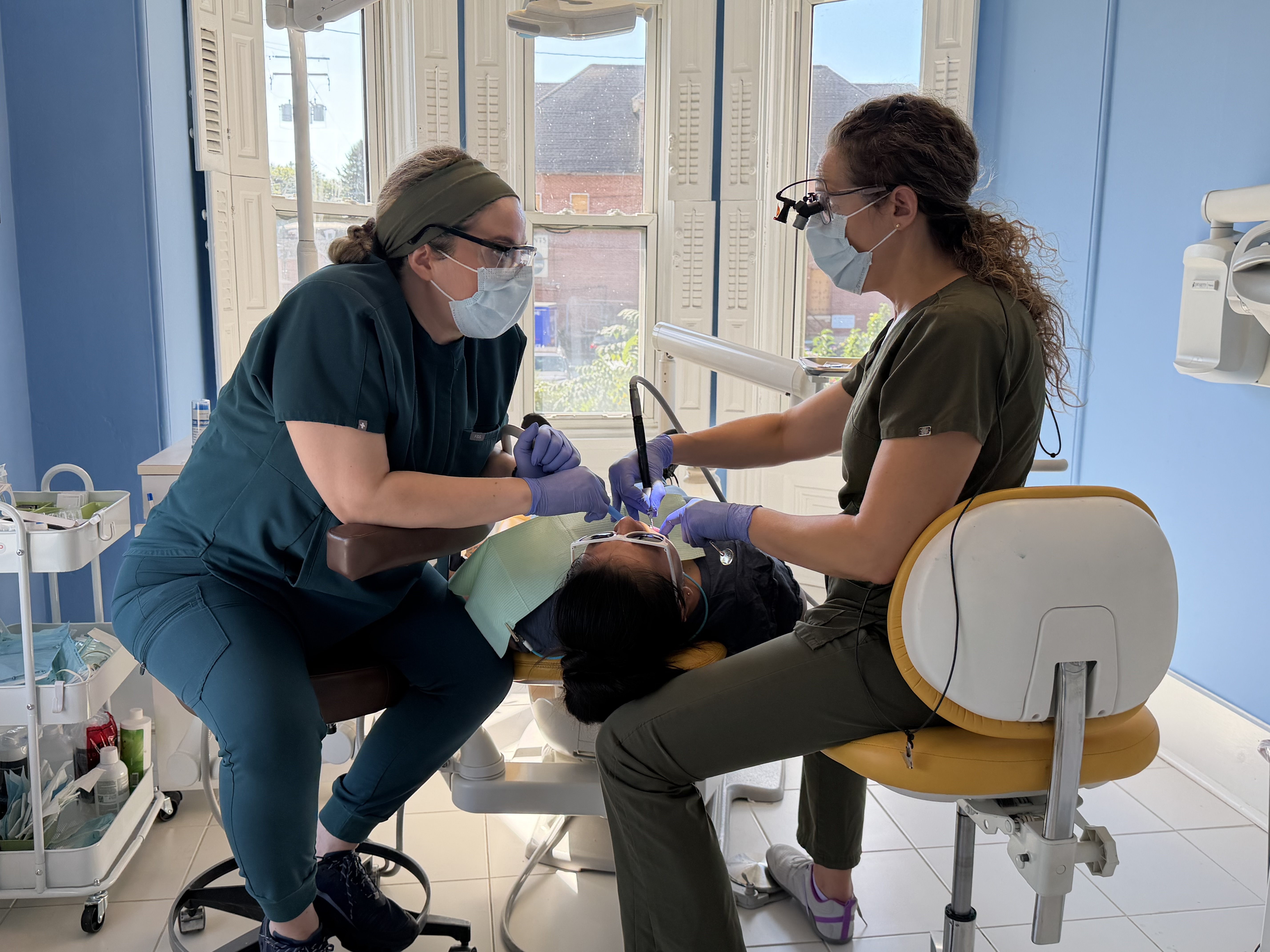
For years, Comunidad Garces has been holding Community Health Days about every other monthin Philly to make medical and dental care free and accessible for people who otherwise would not have it.
Since 2021, the foundation has treated about 5,000 people through medical assistance and the dental program, Beatriz Garces said.
Colon and prostate cancer screenings are now available, as well as mammograms through Penn Medicine’s mobile mammography program.
Now, these services will expand to Kennett Square in partnership with Laurel Dental of West Grove.
“It’s the first time we expanded beyond Philadelphia,” Jose Garces said. The first Kennett Square community health day was held Saturday.
“Just on our first day, we discovered five abnormalities in women through our mammogram screening and were able to pass them on to Penn Medicine to continue their evaluation, so day one already making an impact.”
In the last two years, Comunidad Garces has been expanding to adapt to the needs of a growing immigrant community living through challenging times,Beatriz Garces said.
Since 2025, the foundation has also offered digital literacy classes, even providing computers so folks can enroll in the program.
Ponce herself learned English, got her GED certificate, discovered and treated her prediabetes, and found a support system through the organization.
“Immigration always leaves pain in us, but there is something about the power and resistance we find through this community,” Ponce said. At the South Philadelphia-headquartered foundation, “it feels like you are loved, like there is this family vibe.”
Most recently, Ponce was hired as a case manager at the foundation. She now helps community members find housing, employment, and schools and manage their healthcare visits.
The expansion to Kennett Square is, in part, a way to make sure immigrants have access to what they need to build their new lives in the United States, Beatriz Garces said.
As the name change unfolds, Jose Garces hopes the community feels more included and welcome.
“Our name is changing, but the world remains the same,” he said. “Comunidad means community, and that means our door is open to everybody.”
A group of clergy, political leaders, and activists gathered at the Philadelphia ICE office on Friday in the wake of a deportation officer’s suicide, condemning what they said was the agency’s destruction of lives both inside and outside its ranks.
Speakers said they said they grieved with the family of Joseph Moore, 38, who died of a self-inflected gunshot wound while parked near the Center City headquarters, and with the families of immigrants treated wrongly and cruelly by the agency.
Moore died Aug. 28 as he was facing dismissal, along with other new officers brought on amid a huge wave of ICE hiring, one that critics say has led to the employment of unqualified and unvetted recruits.
“He was an ICE agent,” said state Sen. Art Haywood, a Democrat who represents parts of Philadelphia and Montgomery counties, “but he was also a human being.”
Local ICE officials did not immediately respond to a request for comment.
Speakers called ICE a rogue agency, and called on its officers to quit their jobs.
One man, who kept vigil outside ICE headquarters nearly every day in August, said he tried to talk to officers as they went inside, and wished he could have talked to Moore.
Generally, said Jim Nicholson, who described himself as Quaker and non-violent, the officers he addressed were “not interested in being human, compassionate beings,” that they told him everyone they arrest is a criminal.
“I’m a very sorry to hear an agent of ICE committed suicide. That’s a tragedy,” he said. “If the agent had come to us, to me, I would have tried to help.”
U.S. Immigration and Customs Enforcement, charged with carrying out President Donald Trump’s mass-deportation plan, has been on a hiring binge that more than doubled the size of the agency. Now ICE has begun quietly firing some of those new officers, The Washington Post reported, citing multiple officials who said officers were put on the streets without being properly vetted.
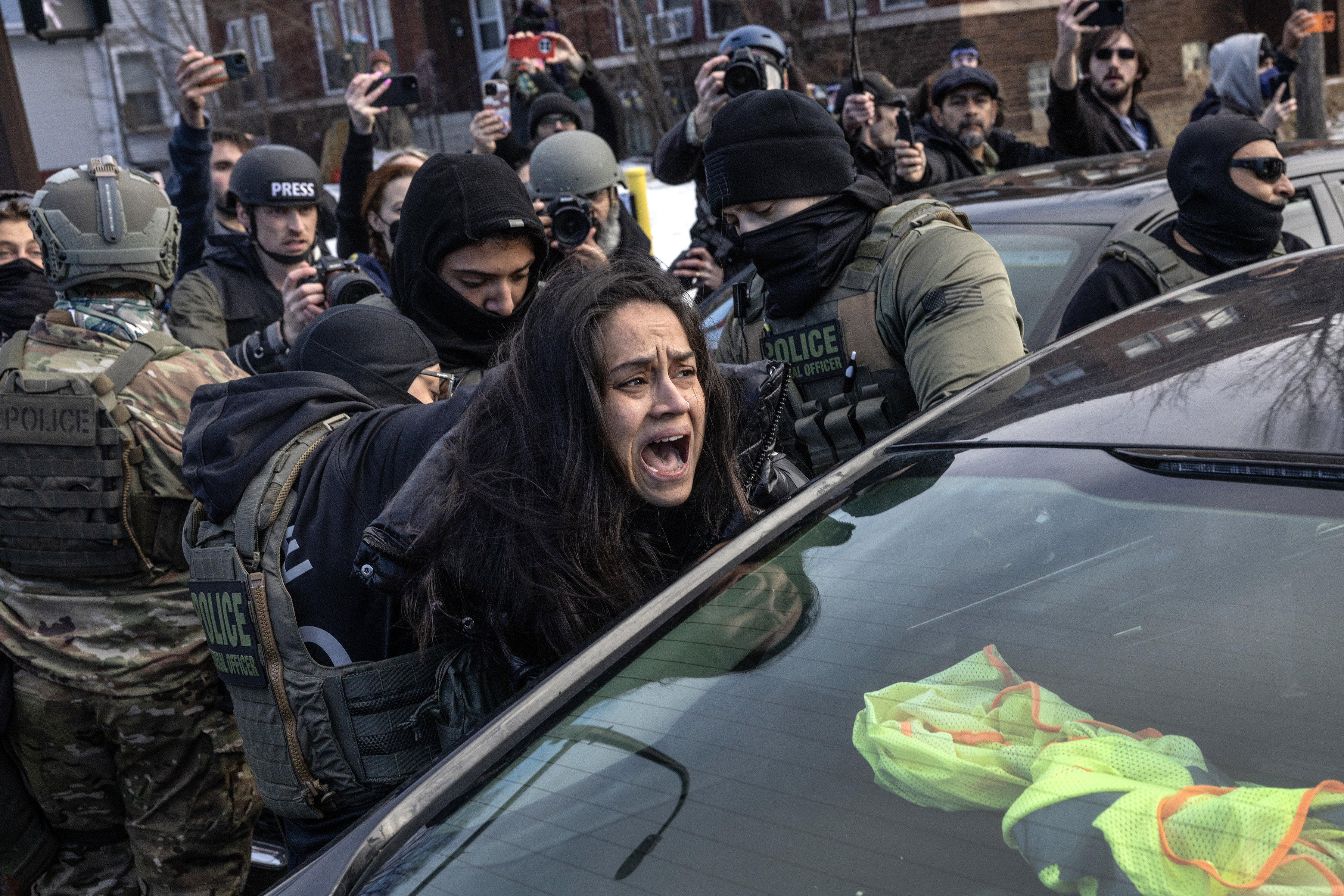
Federal agents arrest a woman after smashing her car window and dragging her from the vehicle in Minneapolis on Jan. 13, 2026. The legality of the Trump administration’s tactics during its immigration enforcement operation, known as Metro Surge, in Minneapolis early this year was challenged by a series of federal lawsuits.DAVID GUTTENFELDER
The Post reported on Monday how Moore, a Marines reservist who graduated from Cheltenham High School in 2006, died by suicide while parked near ICE headquarters.
Philadelphia police officials said officers called to the scene tried to stop Moore from hurting himself.
Police were summoned to the area of Eighth and Race Streets ― the ICE office is one block south ― for a report of an armed man in distress who had barricaded himself inside a vehicle, officials said.
The officers communicated with the man and tried to de-escalate the situation, but he drew a gun and shot himself, police said. No Philadelphia officer fired a weapon, the department said.
Police, without identifying Moore by name, said they have finished their inquiry into the death, and would provide no additional details because it involved a suicide.
In mid-2025, ICE received massive new funding for hiring — about $30 billion, part of $76.5 billion it received through President Donald Trump’s “Big Beautiful Bill.” The administration has said it wants to deport a million people a year, which would require a vastly larger ICE and extensive new detention capability.
Part of the lure was a promised $50,000 signing bonus.
ICE said the majority of new hires were police and military veterans, but an investigation by The Associated Press found evidence that applicants with questionable histories were not fully vetted or were hired in spite of their pasts.
The Post said Homeland Security would not answer questions about specific hiring decisions. It did say that some applicants received “tentative selection letters” and offers to begin working on a temporary status before being subjected to full background checks.
The hiring happened so fast that new officers were put on the streets before being adequately vetted, multiple former officials told the Post. One ICE whistleblower urged officials to halt the expansion, saying in an August 2025 memo that the “overwhelmed” agency had hired officers without checking their fingerprints or their identities, the Post said.
In recent months, ICE has begun quietly firing some of the recruits, the Post reported, citing three former DHS officials who spoke on the condition of anonymity. They said ICE has cited poor performance or red flags that should have been identified earlier.
The Department of Homeland Security rejected those concerns.
Relatives of an ICE officer who shot a Colombian man in Maine in July told The Associated Press he struggled with serious mental health issues since early childhood, and never should have been given a badge and gun. The revelations about the officer, David Brouillette, brought fresh attention to ICE hiring procedures.
The Post said Moore had dreamed of a life in law enforcement since he was a teenager. But two law enforcement agencies fired him, and others rejected him. ICE hired him in the fall as a deportation officer.
Efforts to reach Moore’s family members were unsuccessful.
His obituary said the father of two served 20 years in the Marines as both an active member and a reservist. And that he graduated with a 4.0 grade-point average from Rosemont College, where he earned a bachelor’s degree in criminal science.