The child gasped for air, sitting alone in front of an upstairs television, near death inside her Northeast Philadelphia home.
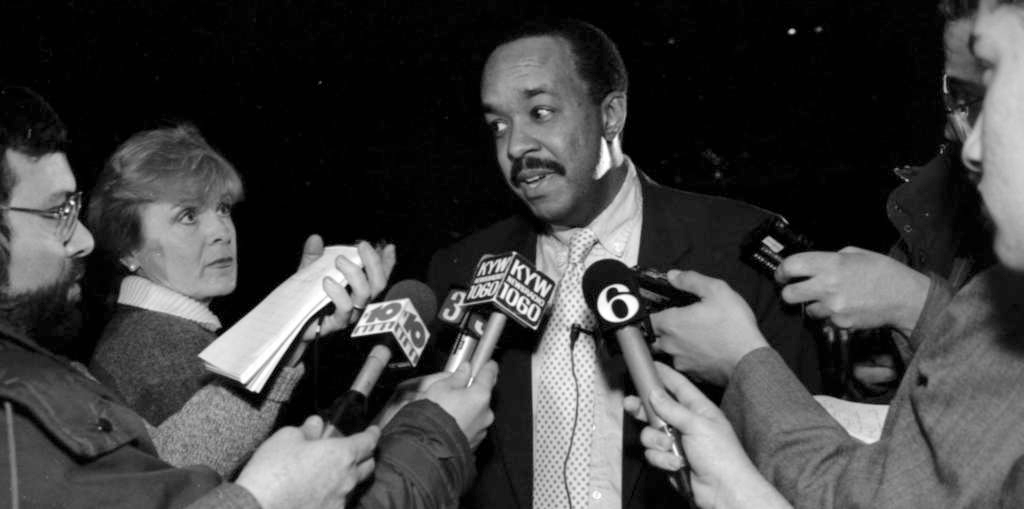
As a measles outbreak ravaged the city, Philadelphia’s deputy health commissioner, Robert Ross, used the home phone to call a judge for a court order to treat the girl. Her family worshiped at Faith Tabernacle Congregation, a fundamentalist Christian church at the center of the outbreak. Many members were refusing all medical care, including vaccinations.
The 1991 outbreak would eventually sicken 1,400 people across Philadelphia and kill nine children. It spurred the city to pursue the nation’s first and only court-compelled vaccinations. Some parents at Faith Tabernacle were ordered, against their wishes, to vaccinate their children against measles.
The girl in the house in Northeast Philadelphia was about 9 years old and “minutes, maybe an hour, away from respiratory failure,” Ross recalled. And when he tried to call for medical care, her grandmother tried to block him from the phone.
The child ended up on a ventilator at St. Christopher’s Hospital for Children and ultimately survived. Her story became a defining moment in the public health response to the state’s last major measles outbreak, part of a nationwide surge between 1989 and 1991 that sickened tens of thousands of people and led to at least 166 deaths.
Then and now, the highly contagious disease spread in communities with low vaccination rates, but for different reasons. The 1991 outbreak spread in a community that rejected vaccines — and across a city with limited access to vaccination even for those open to them. Now, vaccines are easier to access — but too many people don’t want them.
So far, Philadelphia has been spared as measles actively spreads in the region’s western suburbs of Chester County and just beyond in Lancaster County, whose 401 reported cases lead the state.
Ross and other physicians who treated children in Philadelphia in 1991 lament the return of measles, which tops the list of vaccine-preventable diseases once common during childhood.
“I would have said there was no chance this would ever happen again,” said Ross, who went on to spend decades as a public health administrator in California. “We were looking forward to decades of measles-free, whooping cough-free, polio-free livelihoods for children.”
In 1991, parents flocked to vaccine clinics organized around the city. At one event that May, doctors handed out shots to 60 children — with Nerf balls and a DJ on hand to make the medicine go down — in Fishtown and South Kensington, then without full-time pediatricians to routinely provide vaccines. Another vaccination effort immunized 6,000 children over a weekend, with help from the Phillie Phanatic.
Today, families increasingly are opting out of vaccines, often by taking advantage of religious and philosophical exemptions that provide legal outs from immunizations otherwise required to enter school. And vaccine skeptics once relegated to the fringes of public discourse now are setting the federal health agenda under President Donald Trump.
Years of declining vaccination rates have left not only children but also many unvaccinated adults vulnerable. Where only children died in 1991, three of five deaths in the current outbreak appear to have occurred in adults.
“It felt like a more winnable battle in ’90, ’91, than right now,” Ross said.
‘You just knew that an outbreak was imminent’
In the spring of 1989, an R.E.M. concert led to Philadelphia’s first reported cases, involving concertgoers at the Spectrum. The city health department interviewed teenagers exposed at the show, ramped up vaccinations, and braced for the worst.
Pennsylvania laws requiring vaccinations for school admission were still relatively new — on the books for less than a decade — and federal health officials had only just begun recommending a second dose of measles, mumps, and rubella vaccines for children.
Tens of thousands of preschoolers had not received even one dose of the MMR vaccine, the Daily News reported when the first cases emerged. Nearly two-thirds of Hispanic toddlers in North Philadelphia had not received the one dose recommended by age 2, The Inquirer noted at the time.
The virus started spreading: 89 cases were reported in the city in 1989, followed by more than 200 the next year.
The numbers followed a nationwide trend: By December 1990, measles had infected more than 25,000 people across the country, a 68% increase over the year before.
At Philadelphia’s children’s hospitals, St. Christopher’s was receiving three to four measles cases a day in city neighborhoods with high poverty and low access to medical care. Children’s Hospital of Philadelphia was handling one to two at its main campus in West Philadelphia, where at least half of preschoolers had received their recommended shots.
In 1991, officials told The Inquirer that roughly 60% of preschoolers citywide were vaccinated against measles, well below the 95% threshold that scientists now say is necessary to prevent the virus from spreading in a community.
In part, this reflected access challenges. The federal government had reduced public health funding under President Ronald Reagan, a Republican, as rising poverty contributed to a growing uninsured population. The illicit drug use that defined the crack epidemic also meant some parents neglected to seek medical care for their kids, Ross said. All contributed to “a toxic brew” that kept kids from getting immunized, he said.
“You just knew that an outbreak was imminent,” Ross said.
Deaths mount
In January 1991, Philadelphia recorded its first measles death in 20 years — an unvaccinated 18-month-old who developed pneumonia after contracting measles.
The next month, two unvaccinated girls involved with Faith Tabernacle died from measles. Church members told the Daily News their views required rejecting medical care: Only God could cure illness. “They effectively had a ban not just on vaccines but on all medical care,” Ross said.
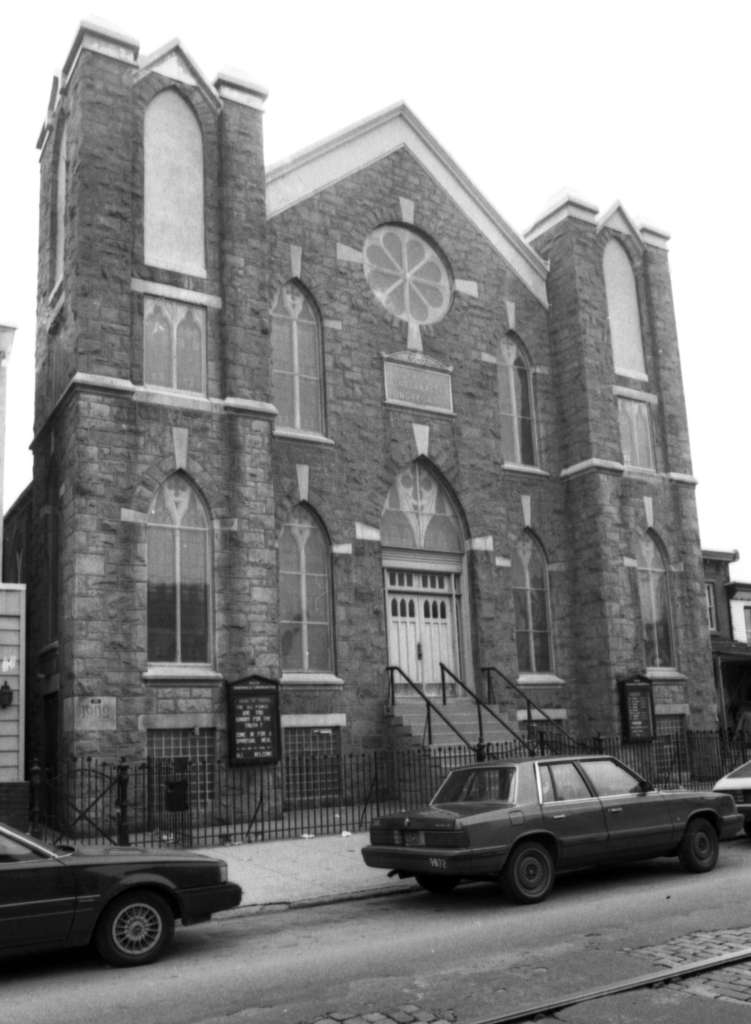
Faith Tabernacle Church at Fifth and Erie Streets in 1991. Children from the congregation died in a measles outbreak that year.File Photograph
Some church members refused to call a doctor or visit a hospital even as their children lay dying. Other parents associated with the church, however, did take their children to the hospital as their conditions deteriorated.
Sarah Long, then an infectious-disease physician at St. Christopher’s, remembers the first child with measles she treated in 1991 — a 2-year-old with a high fever and rapid breathing, characteristic of a case of pneumonia.
But with a classic case of pneumonia, “the child is hyperalert and anxious,” Long said.
“These children — they were not able to sit up. Not able to take fluids. They’re just lying there, incapacitated,” she recalled.
She was stunned by the consequences of a disease avoidable through immunization since the 1960s. “This was a completely preventable problem,” Long said.
After a third death, of a Cheltenham girl whose family attended the church, Ross and other health department workers grew concerned that phone calls with the church’s members were not producing accurate information.
With a judge on call to order medical treatment if necessary, Ross and others knocked on congregants’ doors.
At the house where he discovered the girl gasping for breath upstairs, Ross met eight other children recovering from measles infections, the virus’ characteristic rash fading from their faces.
Hundreds of children not affiliated with the church also fell ill. Six of the nine children who died were church members.
Reached by phone, Faith Tabernacle’s pastor said news reports over the years had “misconstrued the truth” about the church’s experience during the outbreak.
Declining to give his name, and noting that he was not its leader at the time, he said the church supports personal choices about medical care. “We’re not a cult. We present the word. It’s up to the individual,” he said. “We trust the Lord for our healings.”
‘We had to resort to it’
In March 1991, after another child died, several judges upheld a Common Pleas Court ruling that ordered five Faith Tabernacle parents to vaccinate their children. Their parents cried as they brought their children to court for the shots.
“We had to resort to it,” Ross said. ”We just had nothing else available to us to protect those kids.”
Such a ruling is unlikely to happen again in the current political landscape, said Paul Offit, a vaccination expert who heads CHOP’s Vaccine Education Center and worked at the hospital during the 1991 outbreak.
The 1991 court rulings were much more stringent than typical vaccine requirements for schools or employment, Offit said. Under a vaccine mandate, for example, a person might face a penalty for not being vaccinated — like not being able to work a specific job — but can still decline a vaccine.
Philadelphia courts compelled Faith Tabernacle parents to vaccinate their children — with no way to opt out.
By the time courts were compelling parents to vaccinate their children, the city’s large-scale vaccine drives helped ensure that few children still lacked immunity to measles, he said.
The arrival of spring and summer — measles traditionally spreads in the fall and winter — also helped quell the outbreak. So did a wave of media coverage that raised awareness about the virus and spurred many parents to vaccinate.
Offit published a book, Bad Faith, in 2015 about religious objections to vaccination, including Faith Tabernacle’s experience.
In 1991, immunization rates came up as shots were made more widely available.
Now, stricter vaccine mandates for school entry could help reduce measles transmission — but that is politically unviable, Offit said.
Pennsylvania has some of that nation’s most permissive exemption laws, requiring only that parents indicate a religious or philosophical objection to vaccinations on a form before sending unvaccinated kids to school.
An Inquirer analysis found a 15% increase in the use of these exemptions in the last two years, reflecting increasing public mistrust in vaccines.
In the state’s current outbreak, Health Secretary Robert F. Kennedy Jr. has spent years stoking skepticism of the vaccine, although he recently said the MMR vaccine is effective.
Downplaying the dangers of the state’s measles outbreak, he has accused Pennsylvania Gov. Josh Shapiro, a Democrat, of politicizing the outbreak and said his administration may have “fabricated” the first reports of measles-related deaths.
Kennedy later acknowledged that one of the deaths was caused by measles. Yet the Centers for Disease Control and Prevention website currently lists two measles-related death across the nation this year, despite Pennsylvania’s reports of five deaths.
Now local physicians and health systems have limited options to combat anti-vaccination sentiment to increase immunization rates.
“We have two tools: quarantine and vaccine mandates,” Offit said, “and there’s been an erosion in both because people like RFK Jr. say you can’t trust medical experts. I am worried we’re going to be seeing this for years.”
Philadelphians can expect to see fewer children darting through water geysers in front of City Hall and paddling around the pond at Sister Cities Park in the coming decades.
The city and suburbs are losing their populations of kids, and fast.
Between 2010 and 2025,Philadelphia’s number of residents under 18 dropped by 31,038, to 312,490 children in 2025 — a decline ofabout 9%, according to an Inquirer analysis of Census Bureau data. That trend is even more dramatic for children under 5, whose population fell 12%. Those are notable shifts when compared with the city’s overall population gain of about 3%.
This is not unique to Philly. In the last 15 years, nearlyevery major U.S. city has lost residents under 18, said Katie Martin, who directs research on Philadelphia trends and public opinion for Pew Charitable Trusts. And elsewhere in the Philadelphia region, every suburban county has seen its number of children decline during that span. The trend has the potential to become a big workforce and financial problem if it does not turn around.
Demography expertssay surveyrespondents often cite the climbing cost of living and political concerns as reasons for not having kids. Beyond logistics, people in the Philadelphian area say, the decision to not have children is driven by a desire for freedom and flexibility.
“I feel like I wouldn’t have been able to do and experiment as much … if I had been responsible for other human lives,” said Maureen Ferguson, 44, of Souderton, Montgomery County, who has never looked back on her choice to not have kids, filling her life with artistic endeavors like music, theater, illustration, and stand-up comedy.
The population and societal trends driving Philly’s drop in kids
A confluence of changes in population trends is helping demographers piece together what is driving the drop in kids.
For one, a reduction in teen pregnancies and births is changing the landscape. Teen births in Philadelphia fell from 3,072 in 2010 to 809 in 2025, according to data Martin and Pew sourced from the state.
“That has been a huge change,” Martin said. “Not just in Philadelphia, but something you’re seeing nationwide.”
It is a component of a larger trend of having children later in life, she said, which usually leads to each family having fewer children overall.
The pandemic may have contributed as well, as the data show a particularly sharp decline in the number of children in the city between 2020 and 2023.
The counties around Philly have likewise seen notable drops in their populations of children. Between 2010 and 2025, declines in the number of children ranged from 3% in Montgomery County to 12.7% in Bucks County.
Finances have been a recurring theme, Martin said. In a survey Pew conducted last year in Philly, both women and families rated their financial situation as worse than during the pandemic.
(function(){function e(){window.addEventListener(`message`,function(e){if(e.data[`datawrapper-height`]!==void 0){var t=document.querySelectorAll(`iframe`);for(var n in e.data[`datawrapper-height`])for(var r=0,i;i=t[r];r++)if(i.contentWindow===e.source){var a=e.data[`datawrapper-height`][n]+`px`;i.style.height=a}}})}e()})();
Rising housing and childcare costs are likely contributing to the trend in Philly and beyond, said Genevieve Diebold, a senior planning data specialist with the Delaware Valley Regional Planning Commission. She added that fertility rates started decreasing meaningfully following the Great Recession of 2007-09.
Costs are certainly one thing that have deterred Avery Walker, 32, who lives in Point Breeze.
“I know how expensive children are,” she said. “They are a drain on all of your resources — mentally, emotionally, physically, financially — and I would have to give up a lot.”
Prioritizing freedom and flexibility
For Walker and othersThe Inquirer interviewed who do not have kids and do not plan to, the reasoning runs deeper thancost. It comesfrom a desire to live spontaneously and prioritize hobbies, health, and relationships with partners and friends.
Walker, who works in supply chain, likes living on her own schedule, sleeping in, traveling, trying new restaurants, and attending concerts and does not want to give up or modify how she does those things in the ways she likely would need to if she had kids, she said.
Jennifer Gamba, a 48-year-old paralegal in Fairmount, has been married to her husband for about 14 years. They never had strong feelings one way or another about having kids, Gamba said. Over time, the biological door began to close, and that was OK with them.
“It just wasn’t really something we prioritized,” she said.
Maintaining a good relationship with her husband, managing her rheumatoid arthritis, running marathons, and exploring national parks took precedence over kids.
“I think you have to be all in, and I don’t know that I am all in,” Gamba said. “I think I could do it, but it might not have been the best version of me.”
For Kelley Galloway, a 38-year-old real estate agent in Fishtown, finances and politics are factors. The idea of raising children, especially girls, in this political and economic climate is scary, she said. But those issues just reaffirmed the decision she had made long ago.
Throughout her adulthood, Galloway has focused her energy on buying a home, creating a dinner club for women in Philly, advancing in her career, and traveling.
“I went to three concerts this week, and none of them were planned,” Galloway said. “That’s something I could never do if I had children, and that’s why I moved to the city. I wanted to be able to enjoy my life and experience things.”
Jessica Hawk, 57, always knew she didn’t want kids. She never liked playing with dolls as a child, preferring instead to play manager or teacher.
“Whatever that maternal thing is that drives you to have a child, that is missing in me,” Hawk said.
The retired English teacher in Glassboro, Gloucester County, has one million TikTok followers for her videos about education, but she started receiving attention from a different faction about six years ago when she began posting about being happily child-free. Her videos were seen around the world and resulted in her doing interviews for Russian and German media, she said.
“I had so many women in my DMs saying to me, ‘I wish I could forgo having children but, in my culture or in my family or in my religion, I don’t have a choice,’” Hawk said.
She spoke out, she said, to help women who don’t want kids understand just how many like-minded others are out there.
What does this trend mean for the region’s future?
This population shift could become even more stark, and eventuallyspell major issues for the city and the suburbs.
Foreign-born residents have been driving the region’s population growth in recent years. Since those residents tend to have more children than people born in the United States, the immigrant population may be mitigating the drop in young residents and masking what would be an even more dramatic decline, said Letícia J. Marteleto, a sociology professor at the University of Pennsylvania.
But that balance may be short-lived as President Donald Trump’s administration continues its dramatic efforts to curb immigration.
An uneven distribution ofyounger and older residents could compromise bedrock systems designed to keep people financially secure and physically healthy into old age.
Social Security and Medicare rely on contributions from those in the workforce. If there are fewer young people paying into the system and more older people extracting from it, it is increasingly difficult to cover each older resident.
“The whole thing becomes very expensive,” Marteleto said.
The healthcare system, she said, would become similarly imbalanced, an especially acute problem in a place that dubs itself a city of “eds and meds.”
Those dire consequences are a long ways away, she said, but, at this point, it is hard to imagine the population trends turning around without significant government intervention like affordable childcare, housing, and healthcare.
“If we don’t do the necessary things to provide women with the right circumstances for wanting to have more children,” Marteleto said, “we are going to keep getting what we are getting.”
Correction: Philadelphia’s population change was previously misstated. Population grew by 3%.
When thousands of Eagles fans arrive in London this week, they will find more than a football stadium temporarily dressed in green.
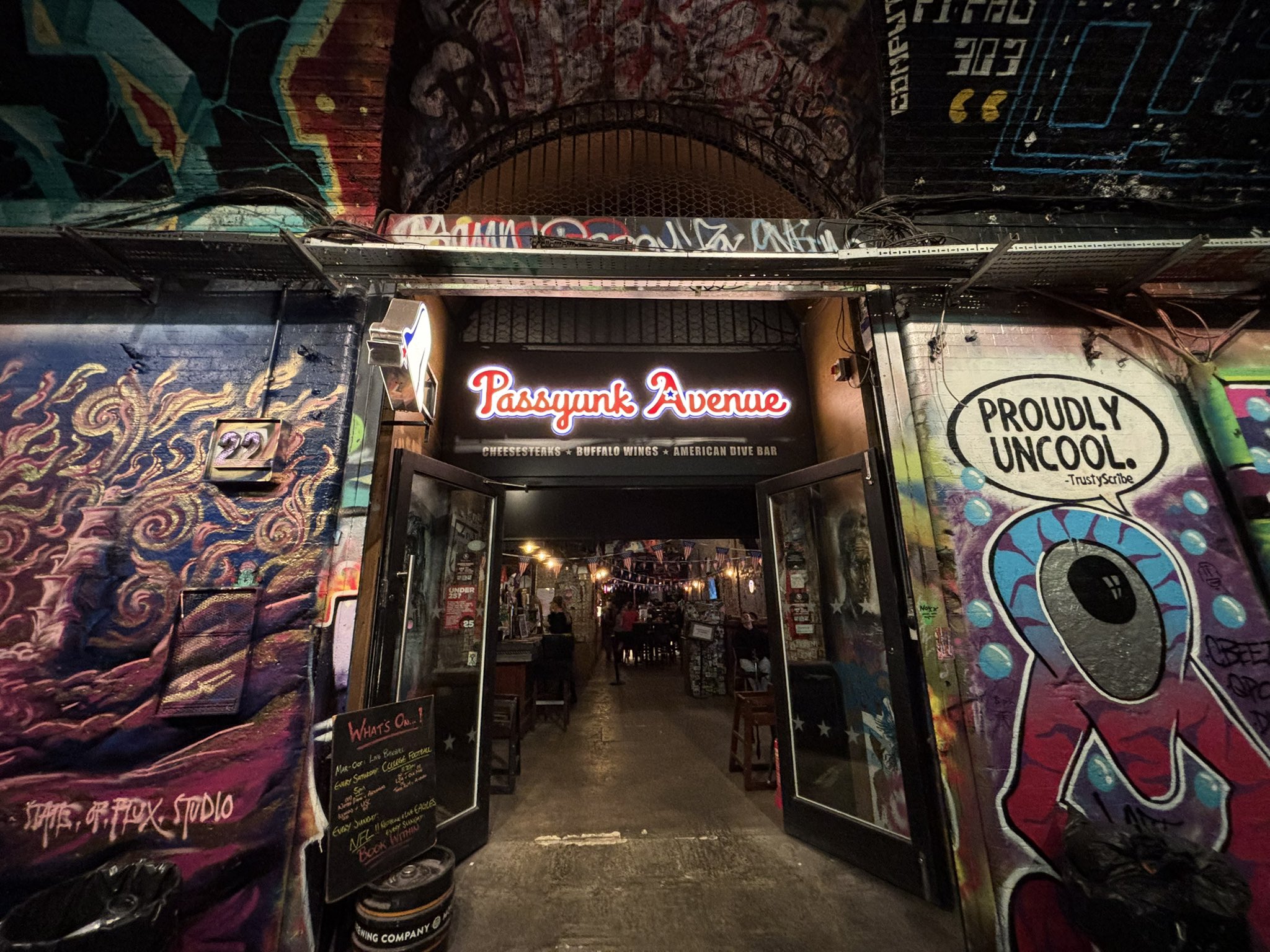
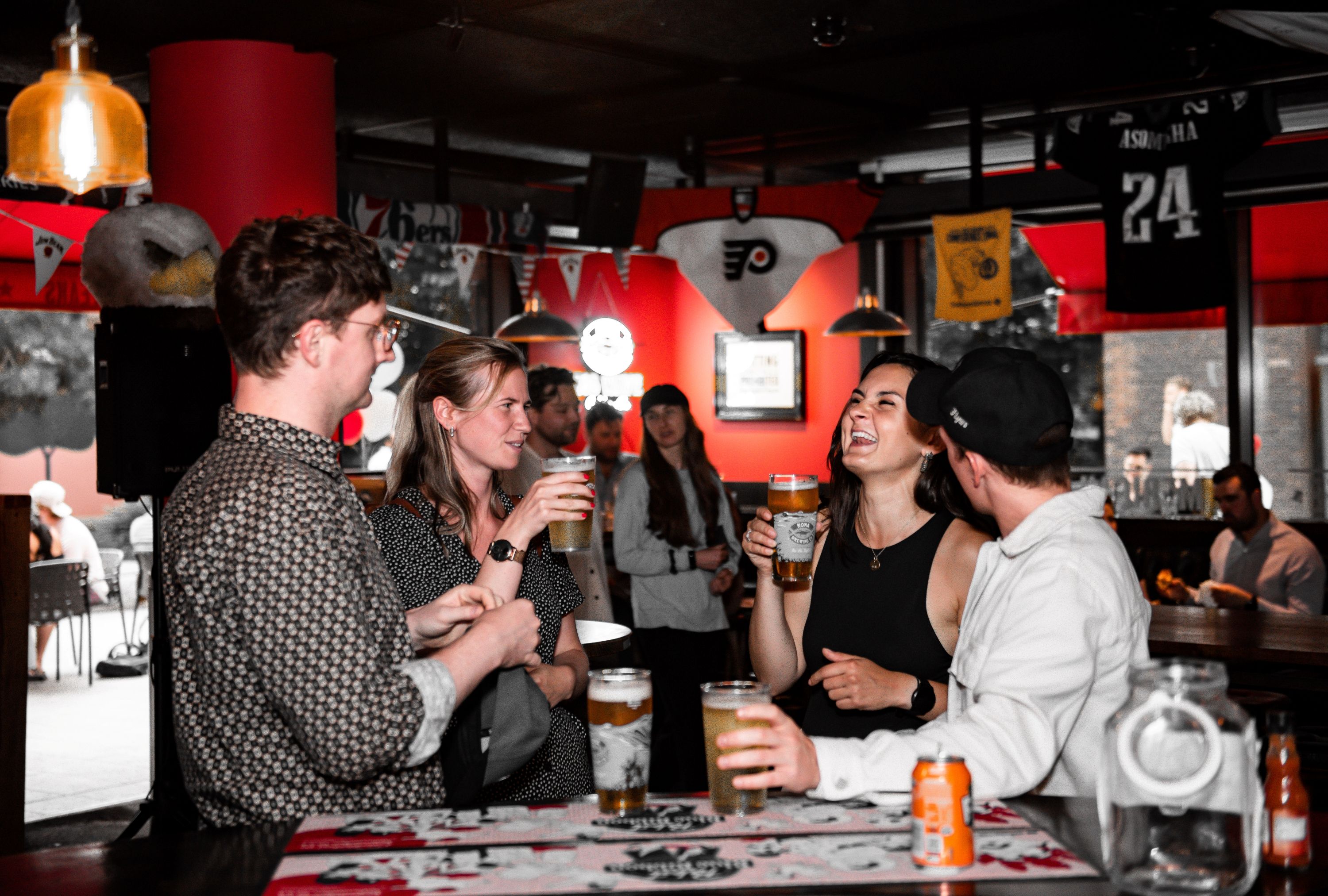
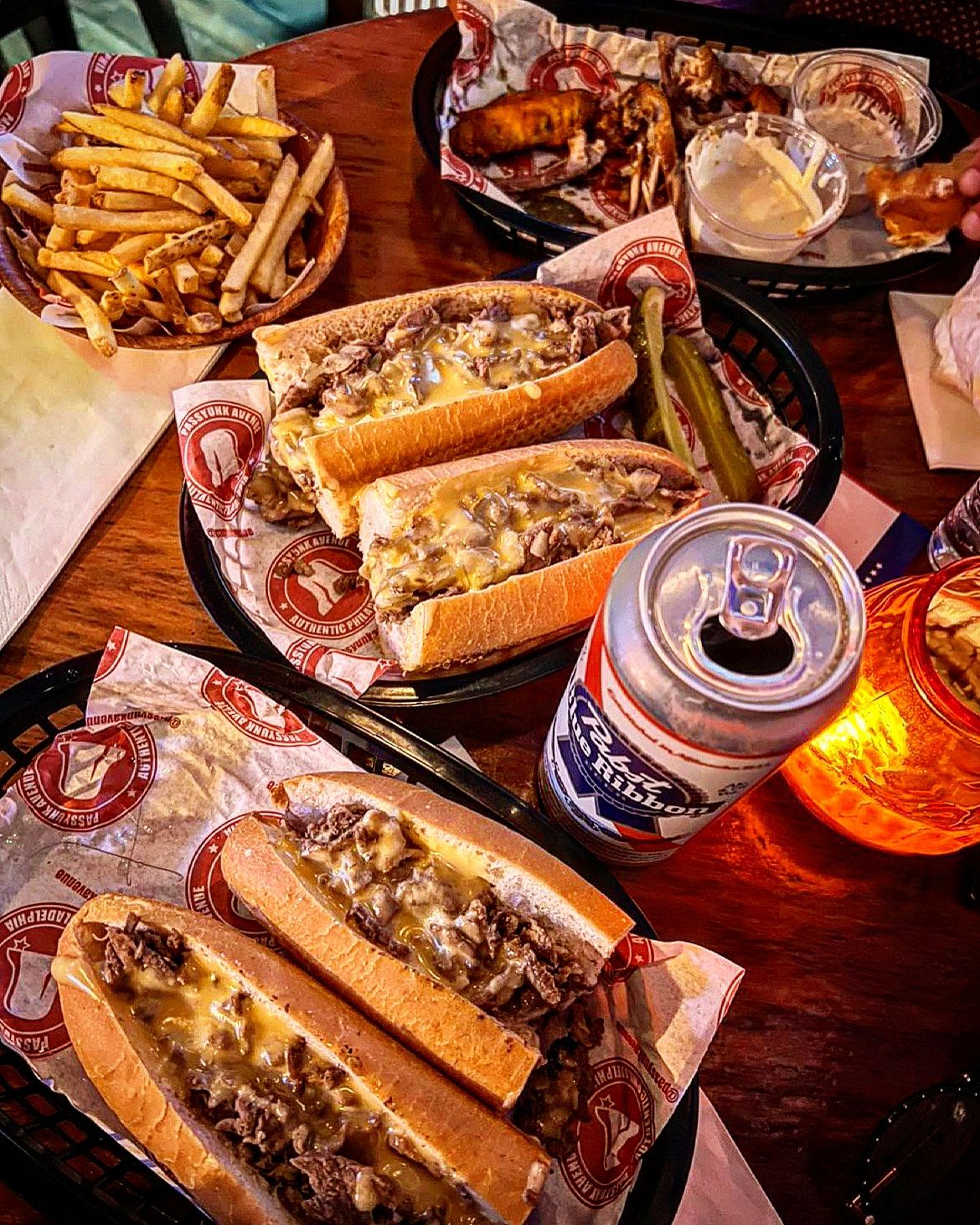
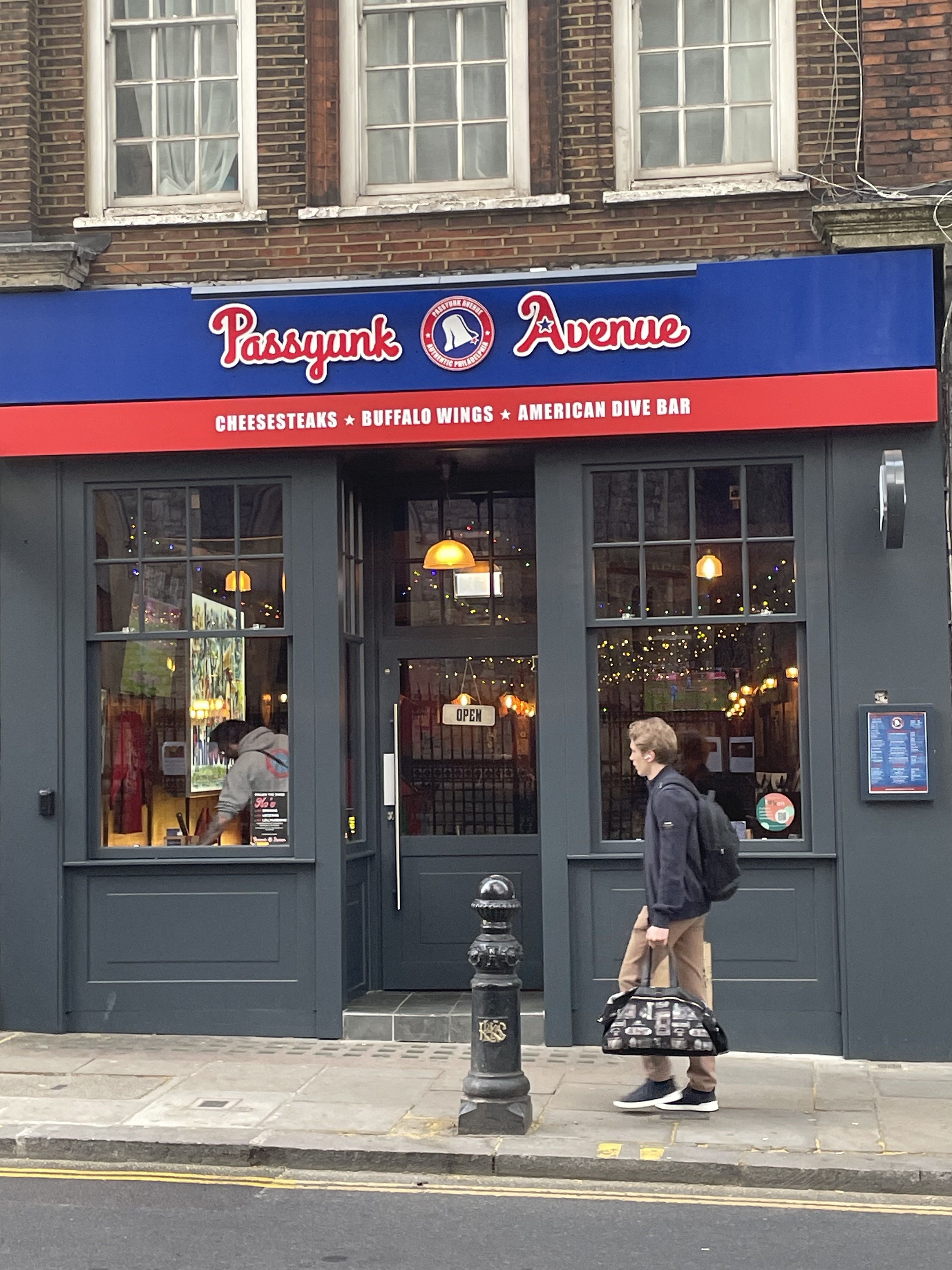
They will find cheesesteaks made with custom-baked rolls, citywide specials, and a series of Philadelphia-themed dive bars called Passyunk Avenue.
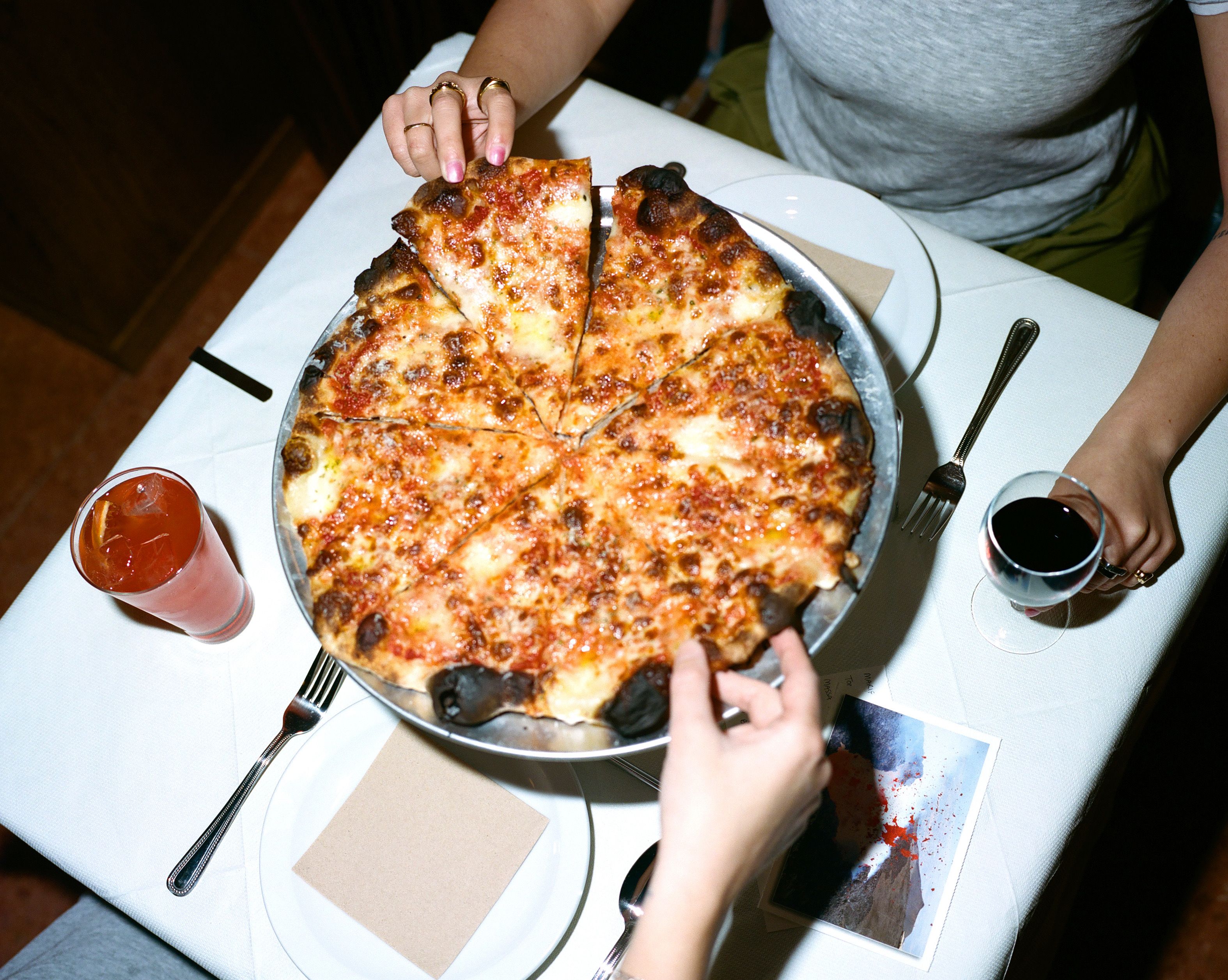
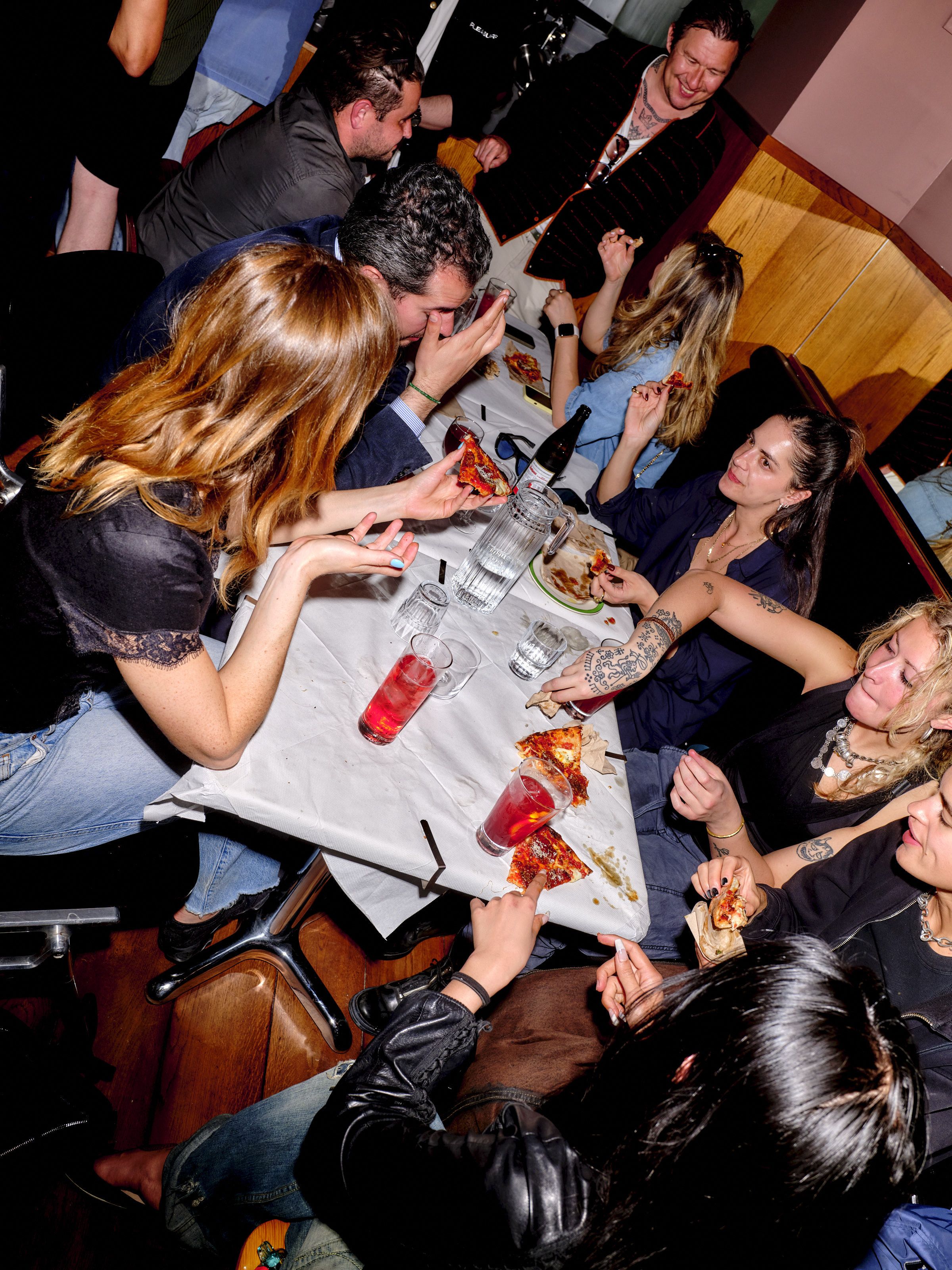
At the new Bar Etna, they can order pizza created by Joe Beddia, one of Philadelphia’s best-known pizzaioli and a partner in Fishtown’s Michelin-acclaimedPizzeria Beddia.
At Bar Etna in London, Joe Beddia is making pizzas that are smaller than those he sells in Fishtown. The tables are smaller, he explains.Joe Hart
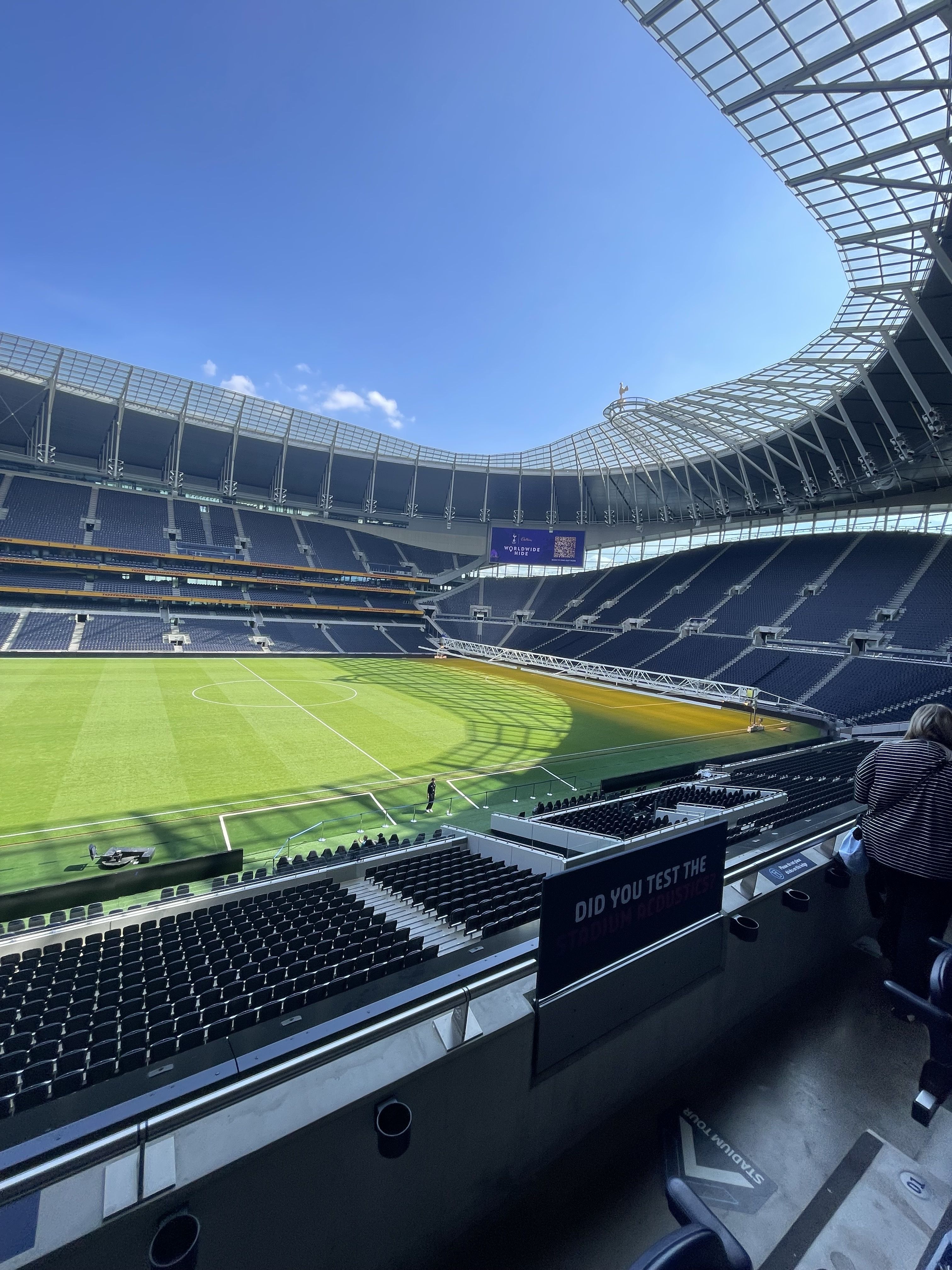
Sunday’s match, scheduled for 2:30 p.m. at London’s Tottenham Hotspur Stadium (9:30 a.m. in Philadelphia), is officially a home game for the Jacksonville Jaguars. Around it, London will host nearly a week of Philadelphia-themed activity extending well beyond the NFL’s events. It shows a culinary connection between Philadelphia and London that has grown since the Birds last played there in 2018.
How Philly will this be? Even Wawa is involved.
Passyunk Avenue plans to party
The five-bar outfit Passyunk Avenue — founded in 2018 by New Jersey native JP Teti — has organized a three-day Wooderloo Terminal Market in the graffiti-lined tunnels beneath Waterloo Station. Modeled after Reading Terminal Market, the event will feature food vendors, bars, vintage merchandise, and entertainment from Thursday through Saturday.
Passyunk Avenue’s Battersea location is near the U.S. Embassy in London.Courtesy of Passyunk Avenue
Passyunk Avenue also will host an Eagles tour of London on a red double-decker bus Saturday, handing out its cheesesteaks near Parliament Square, Trafalgar Square, the Tower of London, and Tower Bridge. The bar will hold a game-day street party Sunday outside its original location in Fitzrovia and a procession through central London on Monday.
By phone this week, Teti described it as a victory parade, although he said it would proceed regardless of the score.
Teti, who grew up in Lawrenceville, Mercer County, moved to London in 2008 to oversee Middle Eastern and African operations for Xerox. He had spent a year in England while studying at Cambridge University, an experience that made him determined to build a life outside the United States.
The restaurant idea began with what he could not find in London.
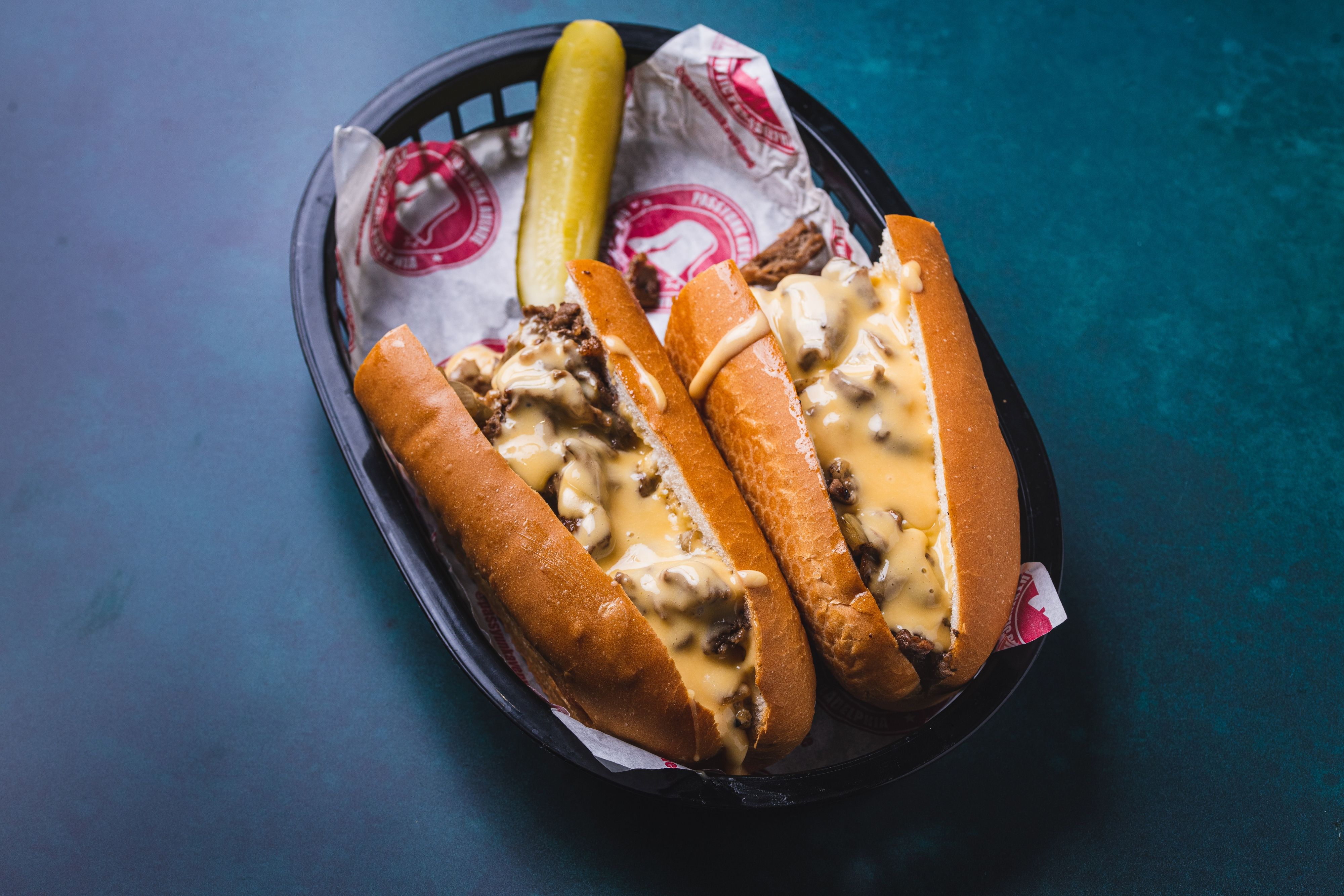
A cheesesteak on a custom-baked roll at Passyunk Avenue.Courtesy of Passyunk Avenue
“Coming from a South Philly Italian American ethnic inheritance, I think about food constantly,” Teti said. “I wondered why, in a city as diverse as London, you couldn’t get hoagies, cheesesteaks, chicken Parms, and so on.”
He also missed Philadelphia’s neighborhood bars. English pubs fill a similar social role, he said, but lack the particular combination of informality, intimacy, and eccentricity that he associated with such places as McCusker’s Tavern, Oscar’s Tavern, and Ray’s Happy Birthday Bar.
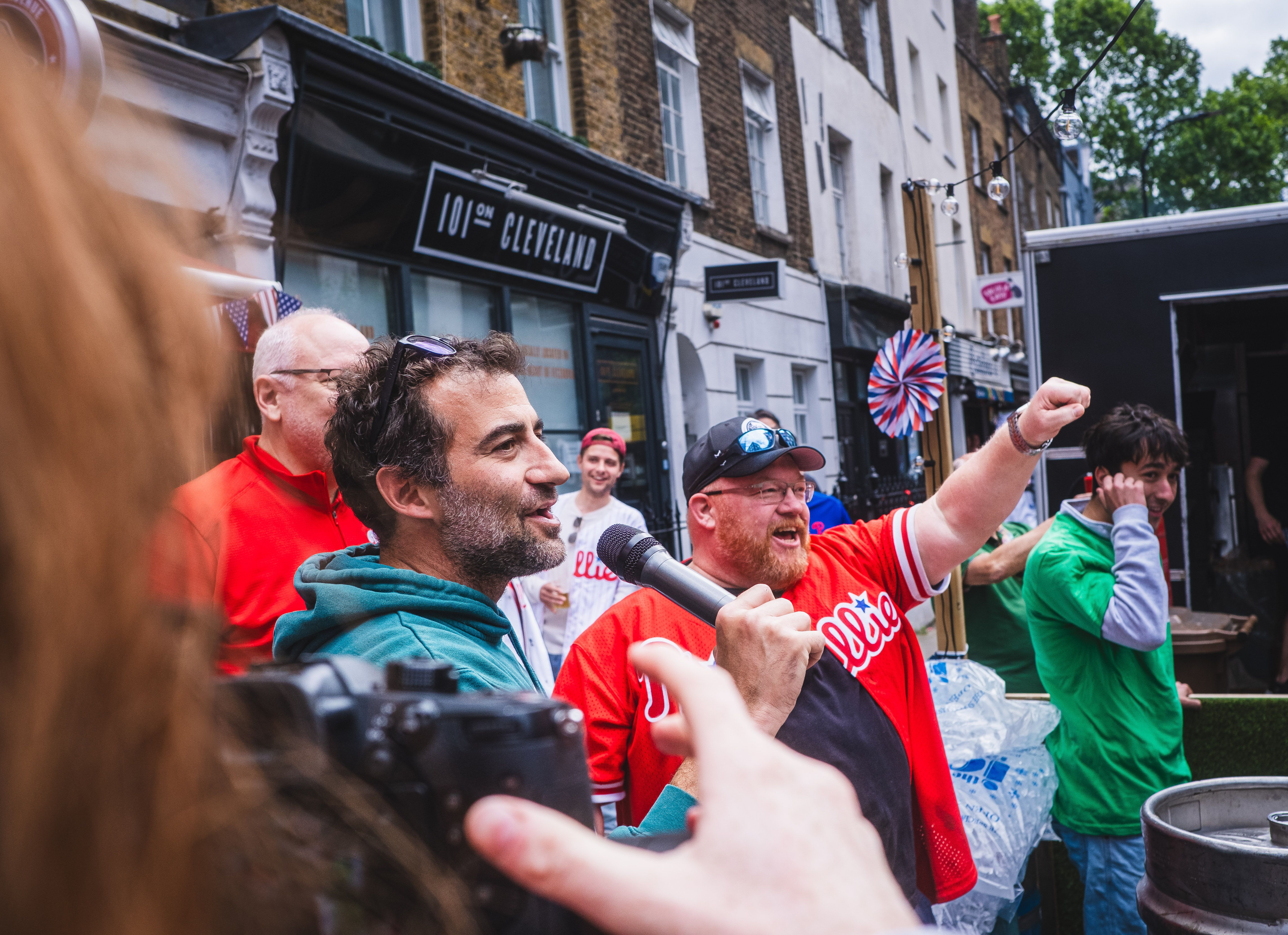
JP Teti takes the mic outside Passyunk Avenue’s Fitzrovia location during a visit from the Phillies in 2024.Courtesy of Passyunk Avenue
Teti believed that Europeans were interested in American culture but were usually offered “very general, broad-brush attempts to describe what other people thought Americana was, based on movies and television, rather than what our experience was.”
Passyunk Avenue, he said, would instead present one specific region, including its food, sports, language, immigrant traditions, and citywide specials.
The first Passyunk Avenue opened in the Fitzrovia neighborhood in March 2018. Teti now operates bars in Fitzrovia, Waterloo, Battersea, and Kensington, along with Passyunk Play, a game-focused offshoot with batting cages, shuffleboard, pool tables, and a self-serve beer wall. This week, he signed a lease to bring Passyunk Avenue to Amsterdam, where he now lives.
PBR is the canned beer of choice at the Passyunk Avenue locations in London.Courtesy of Passyunk Avenue
Although American expatriates became loyal customers, Teti said they were never his primary audience. He built the business for the “Americana-curious Europeans” who might never have visited Philadelphia but were attracted to a detailed, idiosyncratic version of it.
The Eagles’ 2018 visit, seven months after the first bar opened, heightened the appeal.
The team asked to hold an event at Passyunk Avenue but could not publicize it because of the NFL’s relationship with another pub operator, he said. Shortly before the event, an NFL security representative arrived and told Teti that the Lombardi Trophy was coming.
Teti suggested putting it on the backbar. The representative told him that the trophy could not be photographed near alcohol, so Teti cleared the bottles away. “About 25 minutes later, [Eagles tight end] Brent Celek carried the Lombardi Trophy into our first site, put it on the backbar, and became an impromptu bartender,” Teti said. “He served beers for the next 45 minutes.”
The Kensington location of Passyunk Avenue spells out the dive bar’s name in a familiar font.Michael Klein / Staff
The restaurant’s growth required Teti to reproduce Philadelphia foods without access to Philadelphia’s supply chain. A London bakery makes the rolls from Passyunk Avenue’s recipe. Its beef once had to be custom-cut by a butcher in the Netherlands because thinly shaved rib eye was not commonly available in Britain. The bars make their own cheese sauce, Buffalo sauce, ranch, and blue cheese dressing.
Not every Philadelphia staple translated immediately. Roast pork sandwiches, cannoli, and ricotta cheesecake have moved on and off the menu after selling more slowly than cheesesteaks, chicken Parmesan sandwiches, and wings.
“We don’t give up entirely,” Teti said. “People don’t know what they’re missing.”
Philly’s Pizzeria Beddia comes to London
London’s Philadelphia food presence expanded again this spring when Bar Etna opened at 47 Newington Green, a half-hour from Tottenham Stadium. Beddia is a partner with Mike Stampler, a former Philadelphia designer, and British chef and restaurateur Ed McIlroy, whose Four Legs group operates the Plimsoll and Tollington’s fish bar.
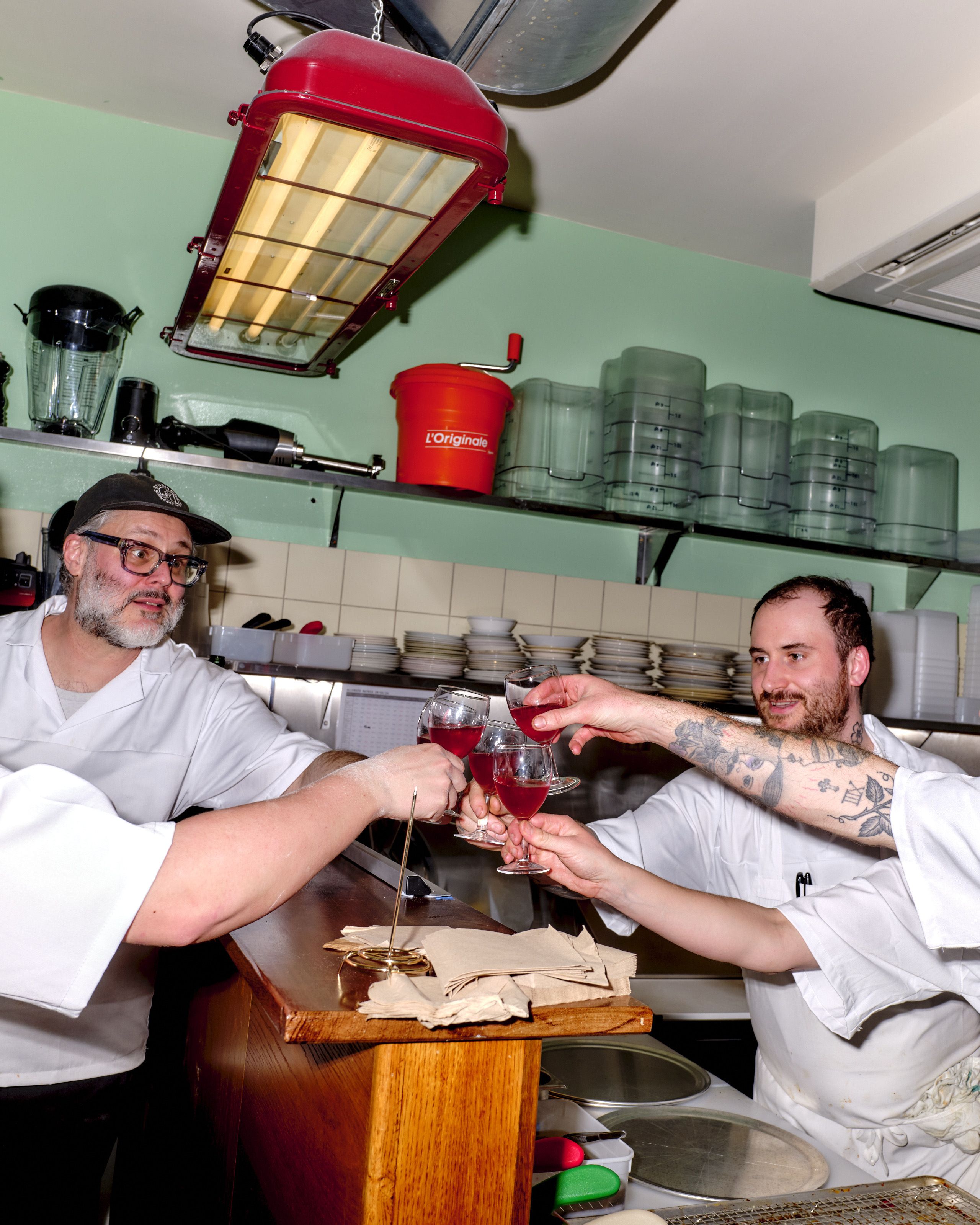
Joe Beddia (left) with Bar Etna chef Cammy Cochrane in the kitchen.Joe Hart
Stampler, formerly of the Philadelphia denim company Norman Porter, moved to London about five years ago. He and McIlroy were considering restaurant spaces when they found one in a neighborhood that Beddia said had relatively little pizza.
“They asked, ‘Do you want to do this with us?’” Beddia said. “I said, ‘Absolutely.’ It was kind of a no-brainer for me.”
Bar Etna’s pizzas resemble those at Pizzeria Beddia, though they are 14 inches instead of 16 to fit the smaller restaurant and its tables. (Metric apparently is not a thing in the pizza world.) The most popular pizzas have been a plain pie and a cream-based pizza with garlic, Calabrian chilies, and greens. Beddia also specifically developed a spicy curry-flavored pizza inspired by saag paneer.
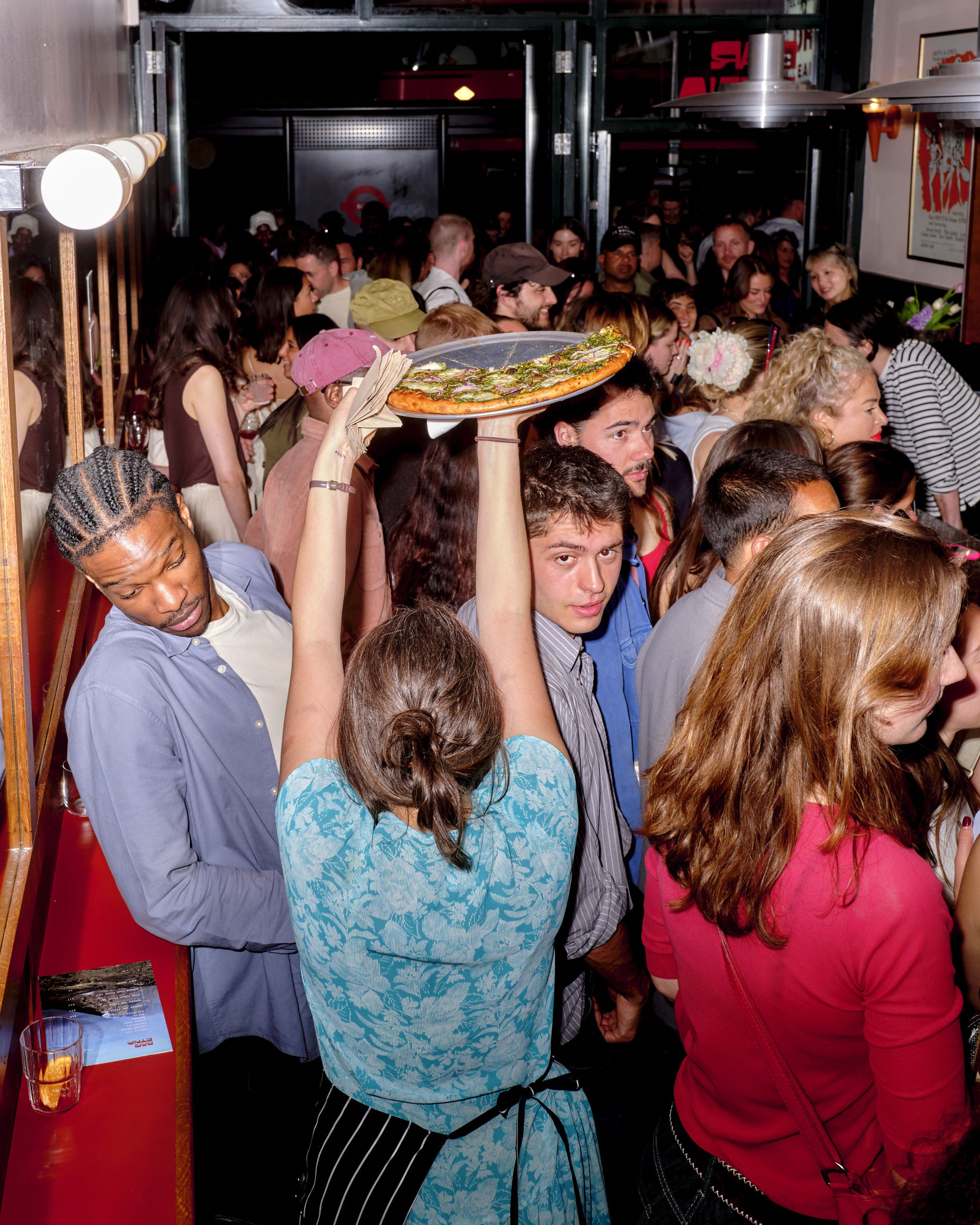
A pizza is hoisted through the crowd at Bar Etna, which opened in May 2026 in London.Joe Hart
The dough proved more difficult to transplant. Importing the Utah-made Central Milling flour used in Philadelphia would have been too expensive, so Bar Etna uses British flours from Shipton Mill and Wildfarmed.
Beddia had less than two weeks between the completion of the kitchen and the restaurant’s opening. He said it took about 12 days of testing to produce dough that met his standards. “It was a nightmare,” Beddia said. “We were down to the last couple of days before we had it.”
Beddia spent two months in London preparing Bar Etna and plans to return during Eagles week.
His larger interest is in seeing how the restaurant has settled into a city that he believes is undergoing a pizza revival. London historically offered either mass-market delivery pizza or Neapolitan pies, he said, but has acquired an appetite for the crisper, more structurally firm American style.
Beddia sees a parallel with Philadelphia, which had deep Italian bakery, pastry, and sandwich traditions but, aside from establishments such as Tacconelli’s, lacked a pizza identity as distinctive as those of New York or New Haven until relatively recently.
The pizzas are small at Bar Etna because the tables are small, says Joe Beddia, a partner.Joe Hart
For Passyunk Avenue’s Teti, the goal is not to suggest that Philadelphia, or the United States, can be reduced to cheesesteaks and football. It is to offer Londoners a specific place and culture rather than another generic American theme. Plus, he said he is more about turning Passyunk Avenue into a global brand.
“We hope Passyunk Avenue’s presentation of this nostalgic form of America — not necessarily what America is, but perhaps the best of what America has been and could be again — can be a bit of a light in the darkness,” he said.
Tottenham Hotspur Stadium, configured for soccer, in April 2025.Michael Klein / Staff
For nearly two decades, Puentes de Salud has provided low-cost medical care to Philadelphia restaurant owners and workers who lack health insurance. Next week, seven restaurants will return the kindness.
Casa México/South Philly Barbacoa, El Chingón, Tequilas, El Merkury, Café Tinto, Mucho Perú, and Amy’s Pastelillos will provide food for Bridges to Our Roots, Puentes’ first large-scale fundraiser since a 2016 campaign for its health and wellness center. It is also the nonprofit’s first major fundraiser for general operations rather than a specific project, said Orfelina Feliz Payne, Puentes’ chief executive officer, and it comes as the nonprofit’s medical clinic is seeing lines form outside its doors for the first time.
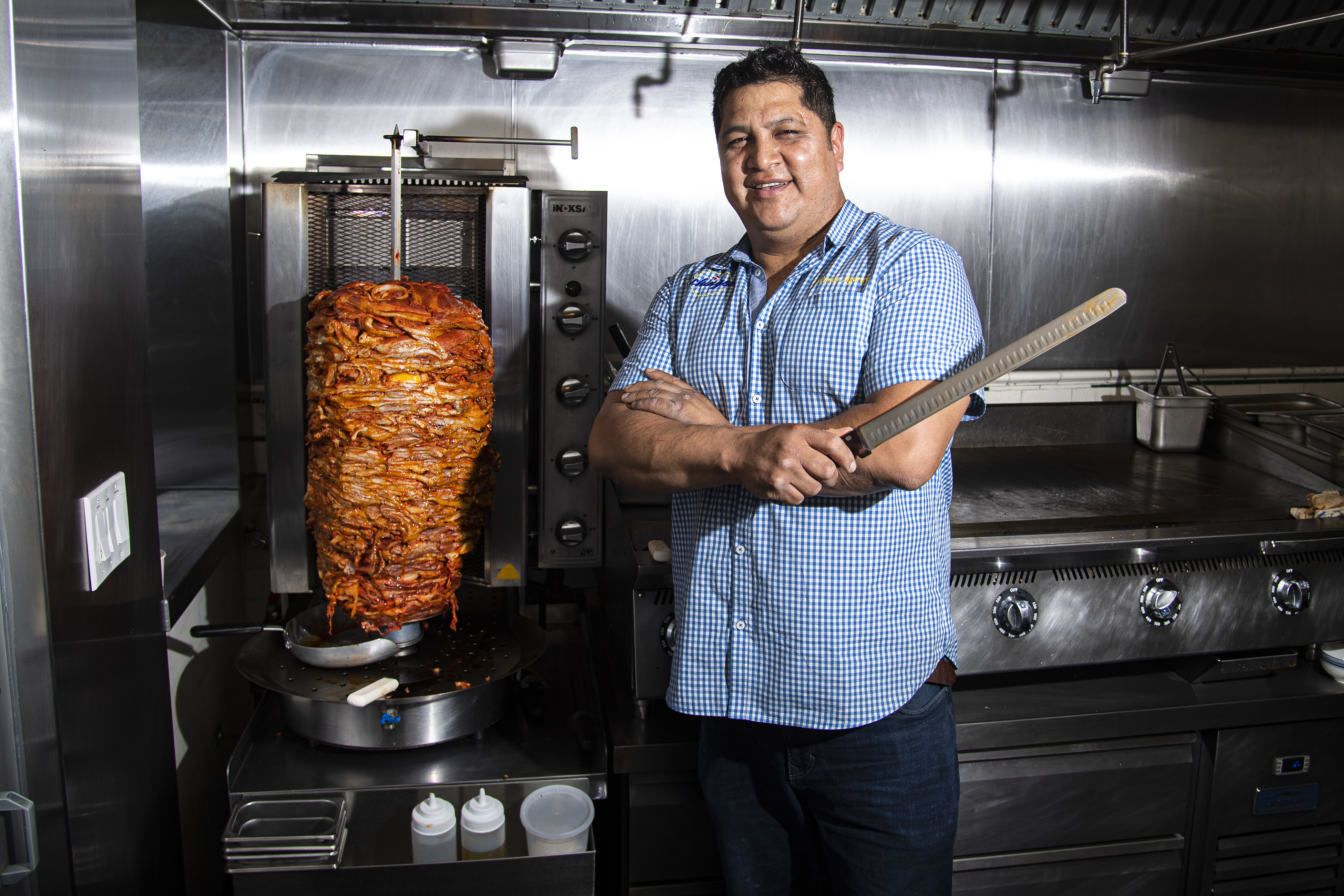
Juan Carlos Aparicio, chef-owner of El Chingón in South Philadelphia and Fishtown, had the idea for a restaurant-centered fundraiser. Jose F. Moreno/ Staff Photographer
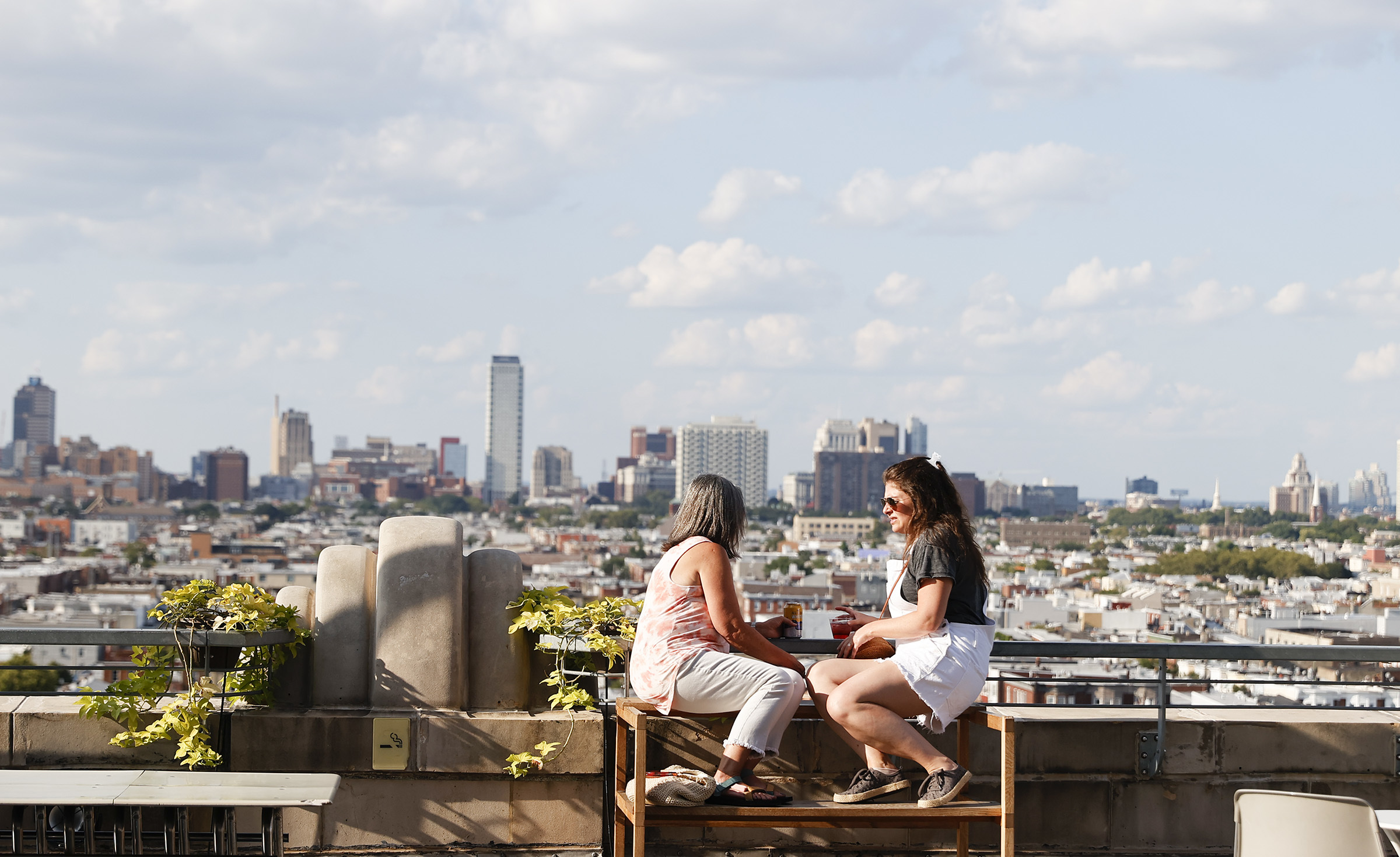
The fundraiser will be held from 5 to 9 p.m. Monday on the rooftop of the Bok Building, 800 Mifflin St. Tickets are $75.
The idea for a restaurant-centered fundraiser came from Juan Carlos Aparicio, chef-owner of El Chingón in South Philadelphia and Fishtown. Development director Juan Marco Álvarez initially approached Aparicio last year about helping with a smaller event that might draw 30 to 50 people. Aparicio urged him to wait and develop something larger.
“There are many people in the Hispanic community, especially those who work in hospitality — restaurants, little cafés, and farms,” Aparicio said. “Everyone goes to work, but many of those people don’t have adequate insurance, so they cannot obtain good-quality medical treatment.”
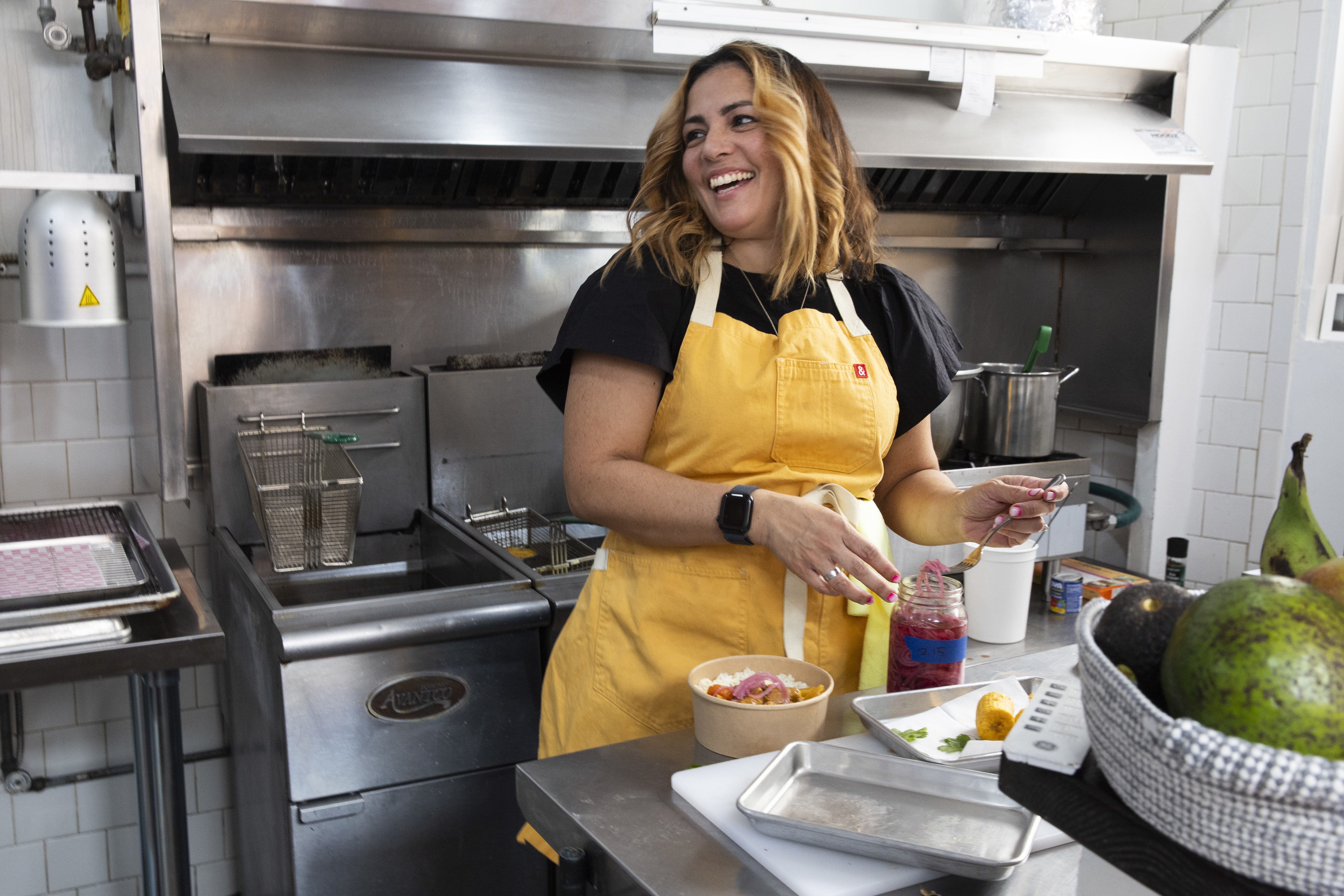
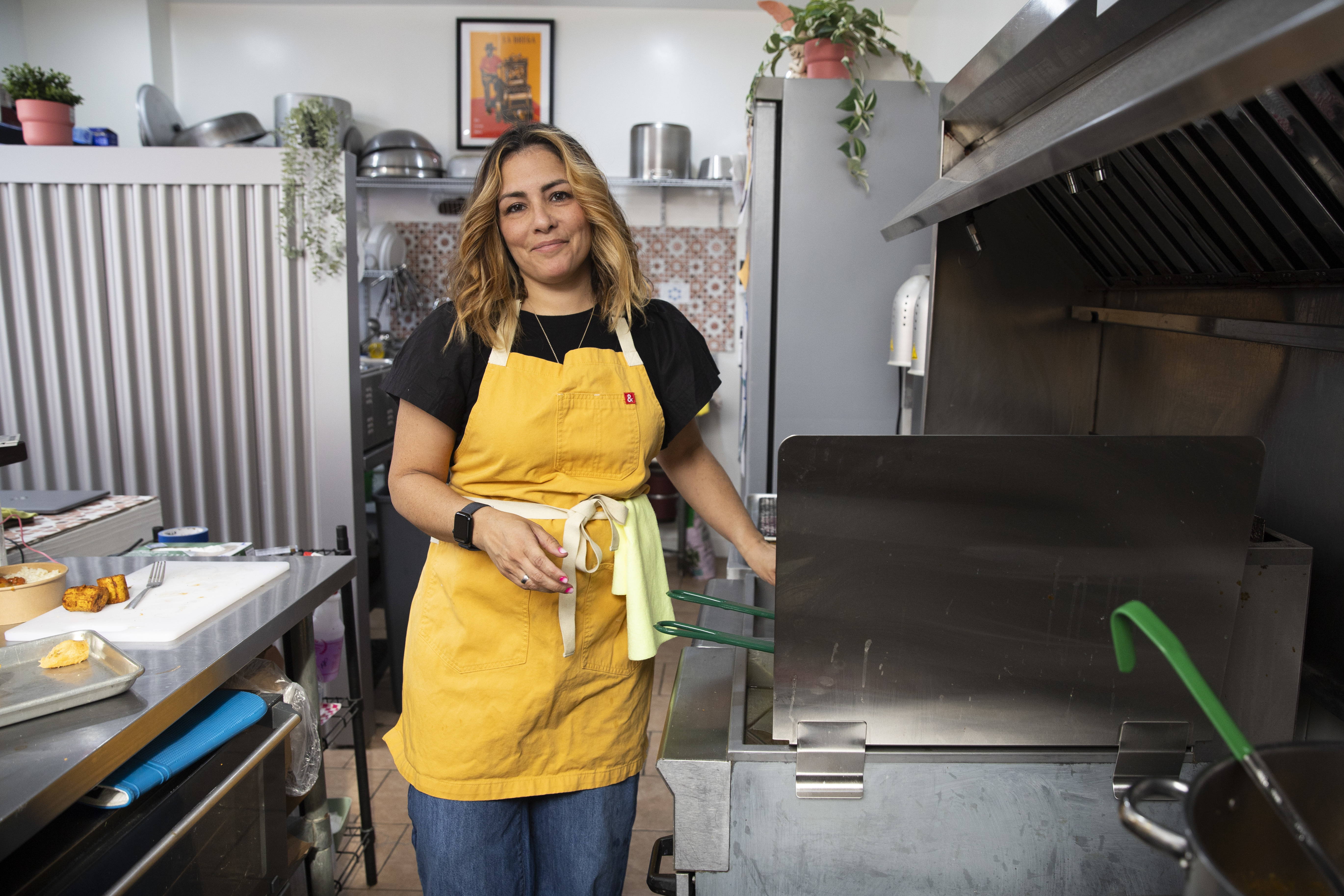
Amaryllis Rivera Nassar working in the kitchen at her shop, Amy’s Pastelillos, in 2024.Monica Herndon / Staff Photographer
Aparicio said he and members of his family had used Puentes’ services after arriving in Philadelphia. He offered El Chingón as the first participating restaurant, started a group chat with other restaurant owners, and called others to recruit them. US Foods agreed to donate products.
The restaurants represent Mexican, Central American, Colombian, Peruvian, and Puerto Rican cooking. Aparicio said organizers intentionally sought a mix rather than limiting the event to one nationality.
“We wanted this to represent the entire community,” he said.
The program also will include Mexican, Colombian, and Cuban dance performances; salsa and bachata lessons from Mike Andino of Estilo Dance Studio; a DJ; and an installation by Philadelphia muralist César Viveros.
A festive fundraiser at a critical time
The event comes as Puentes faces rising demand for services and greater competition for the grants that provide much of its annual budget of about $3.1 million.
Foundations had supplied about 70% of Puentes’ funding, with individual donations providing the rest, Payne said. The organization has been working to increase individual giving and sponsorships as groups that lost federal support compete for many of the same foundation grants.
“The grant environment is really competitive,” Payne said.
Puentes operates medical and dental clinics at 1700 South St. in a building it rents from the University of Pennsylvania for $1 a year. It also provides behavioral healthcare, a food pharmacy and other food-access programs, case management, education, and after-school support.
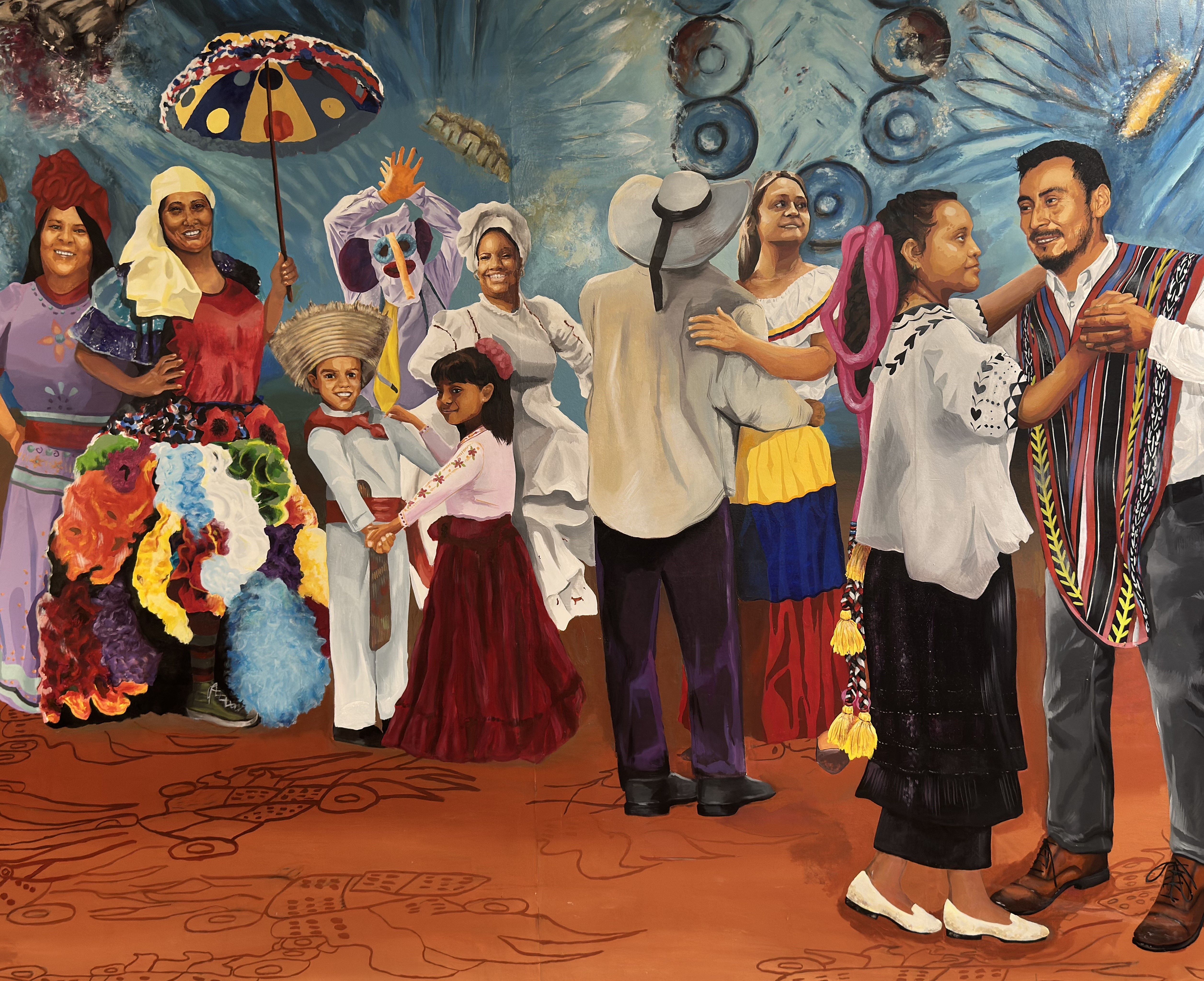
A detail from the murals, painted by community members, at Puentes de Salud’s clinic, 1700 South St.Juan Marco Alvarez
Patients generally pay $20 to $35 — about the cost of a typical insurance copayment — to see a physician, nurse, or specialist. The nurse-managed clinic has six medical staff members and works with about 250 volunteer students and providers annually, many from area universities and hospitals. Penn is its primary institutional partner.
About 15,000 people came to Puentes last year for services including medical and dental care, Payne said. Its medical clinic recorded about 8,000 appointments, a figure expected to reach 10,000 this year.
Until about two years ago, Puentes had not seen people line up outside its building, Payne said. The first lines were for its food pharmacy and free groceries. About a month ago, lines began forming for medical care.
“You can see those things happening as political changes occur,” Payne said. “As people fall off Medicaid and lose access to medical insurance because of their visa or naturalization status, we see the effects in real time.”
Founded in 2008, Puentes previously held smaller, targeted fundraisers. Its only comparable large-scale campaign raised money for the South Street facility, which opened in 2016.
Payne said the connection between Puentes and the restaurant industry is natural. Restaurant employees turn to the clinic when they cannot obtain care elsewhere, and some participating owners have received treatment there.
“A number of them have received care here themselves over the years,” Payne said. “They also know we’ll be here for them if they need anything in the future. It’s a partnership that we’re really grateful for.”
Trevor Hayward wasn’t exactly sure whatto expectwhen he fired off a DM to the official Instagram account for Wheatus, the early 2000s rock band. He had loved themsince his time working as a college DJ in Dublin.
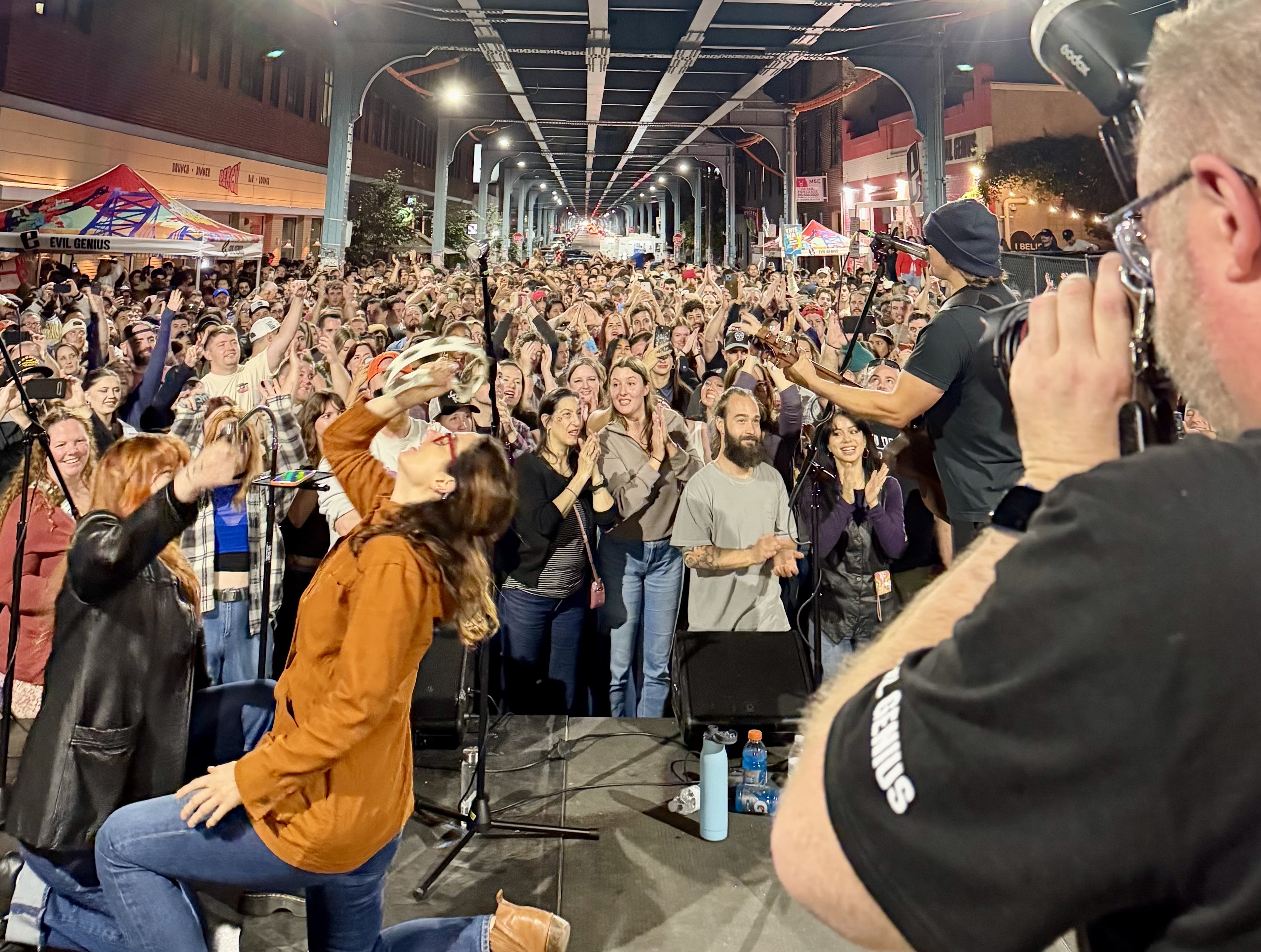
And on Saturday, six months after Hayward sent the message, Wheatus frontman Brendan B. Brown led thousands of Philadelphians in an ad-hoc Eagles chant under the El tracks on Front Street.
Wheatus is performing in Fishtown right now.
Lead singer Brendan Bernard Brown incorporated an “E-A-G-L-E-S” chant into the intro of Teenage Dirtbag.
“I’m not even sure how it came out,” Hayward, 42, said Sunday. “It’s Philly, so, to be honest, it could’ve been someone in the crowd. But it was awesome.”
The now-viral moment came in the middle of “Teenage Dirtbag,” Wheatus’ most recognizable song that has become a millennial anthem.
Wheatus played the song during their headlining set for Evil Genius’ anniversary party, held all day Saturday on a closed-off section of Front Street in front of the brewery.
Hayward said the brewery’s block parties usually attract a crowd, but Saturday’s event drew more than 10,000 people throughout the day.
After the show, Hayward said he met the band, whom he described as gracious and down-to-earth.
He believed the band was the perfect fit for a brewery whose beers are named after pop culture references ranging from McLovin’s conversation with a liquor store clerk in “Superbad” to Tommy Tutone’s ‘80s one-hit-wonder “867-5309.″
“We wanted to celebrate,” Hayward said. “Our culture in our company is nostalgia — that’s the type of beer we make — and we felt like it would be such a natural fit to have them.”
“We don’t have a beer named after them, but may have to now.”
On one block of Martha Street, it feels like Christmas came early. Panettone — sliced and dolloped with whipped cream — is already officially for sale.
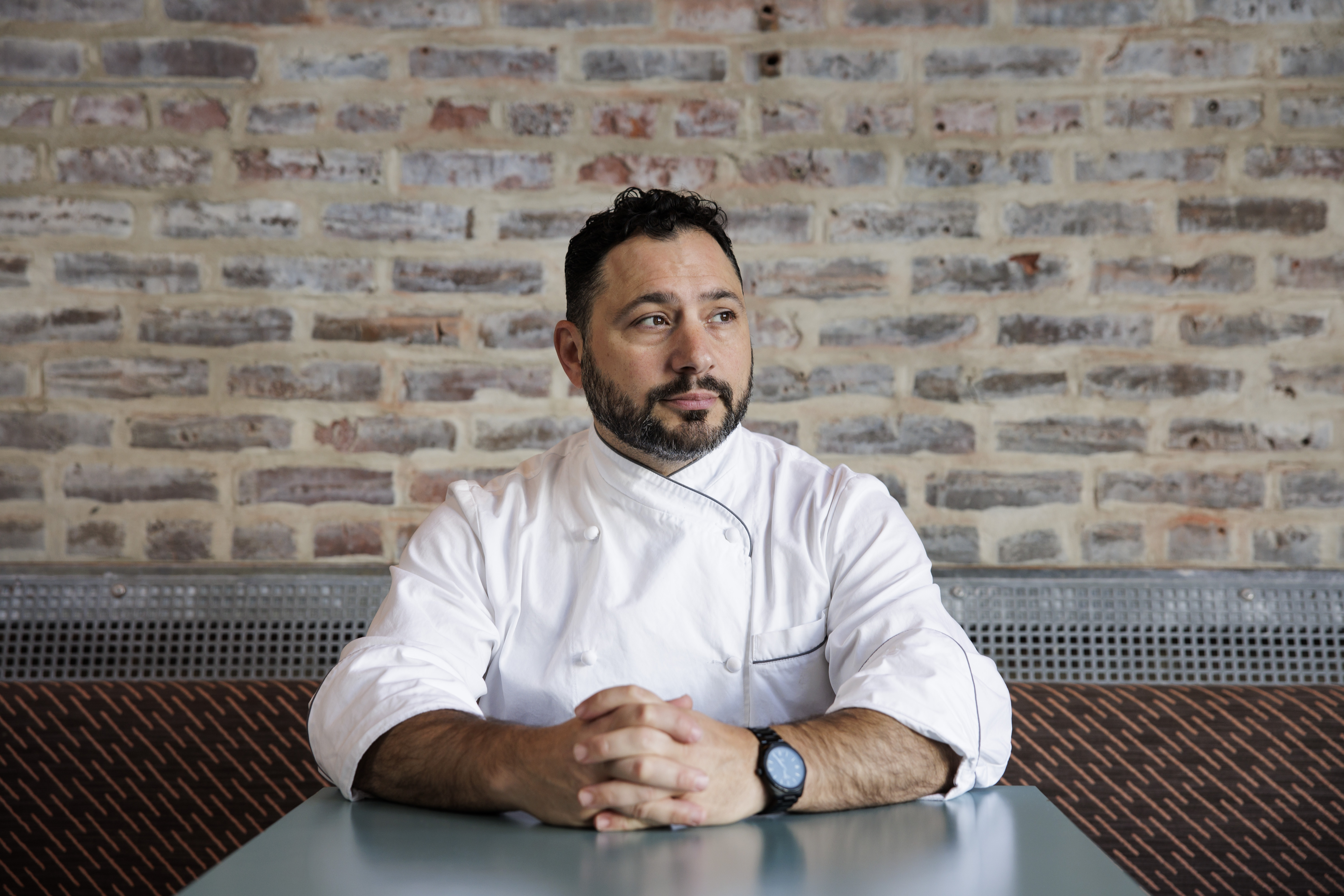
Matty, who oversees the pastry program for Defined Hospitality restaurants including Suraya and Condesa, said Formosa is shorthand for Aquaformosa, the tiny mountain village in Calabria, Italy, where his grandfather was born. Likewise, the pop-up’s menu spans bread-forward (and seasonally anachronistic) sweets that are meant to evoke a sense of warmth. There are oversized cinnamon rolls swirled with blueberry jam, a sticky-sweet plum upside down cake, and doughnut shop-style maple pecan crullers, among other delights.
At Formosa inside Picnic, pastry chef James Matty’s panettone are served as $9 slices topped with whipped cream.Monica Herndon / Staff Photographer
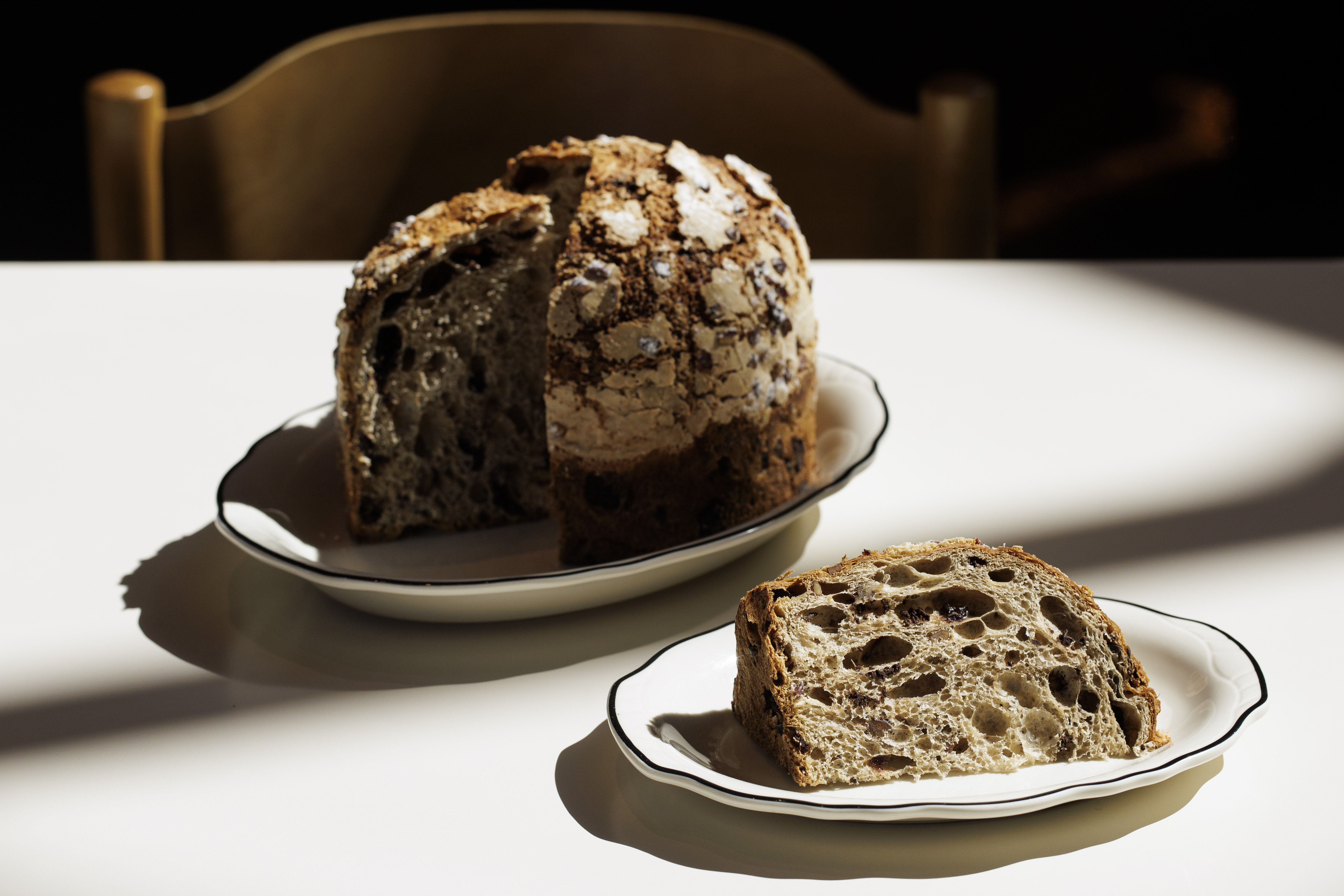
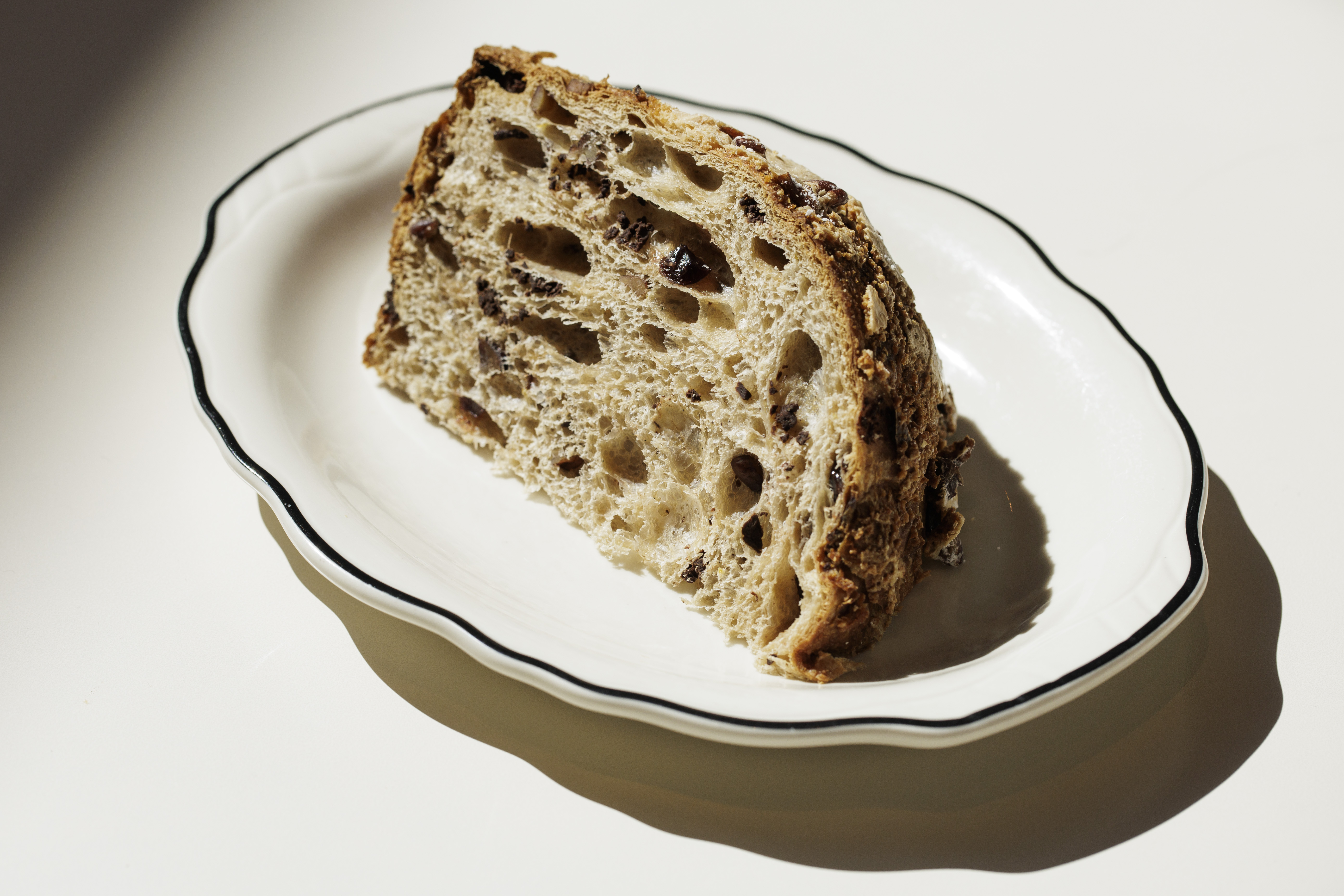
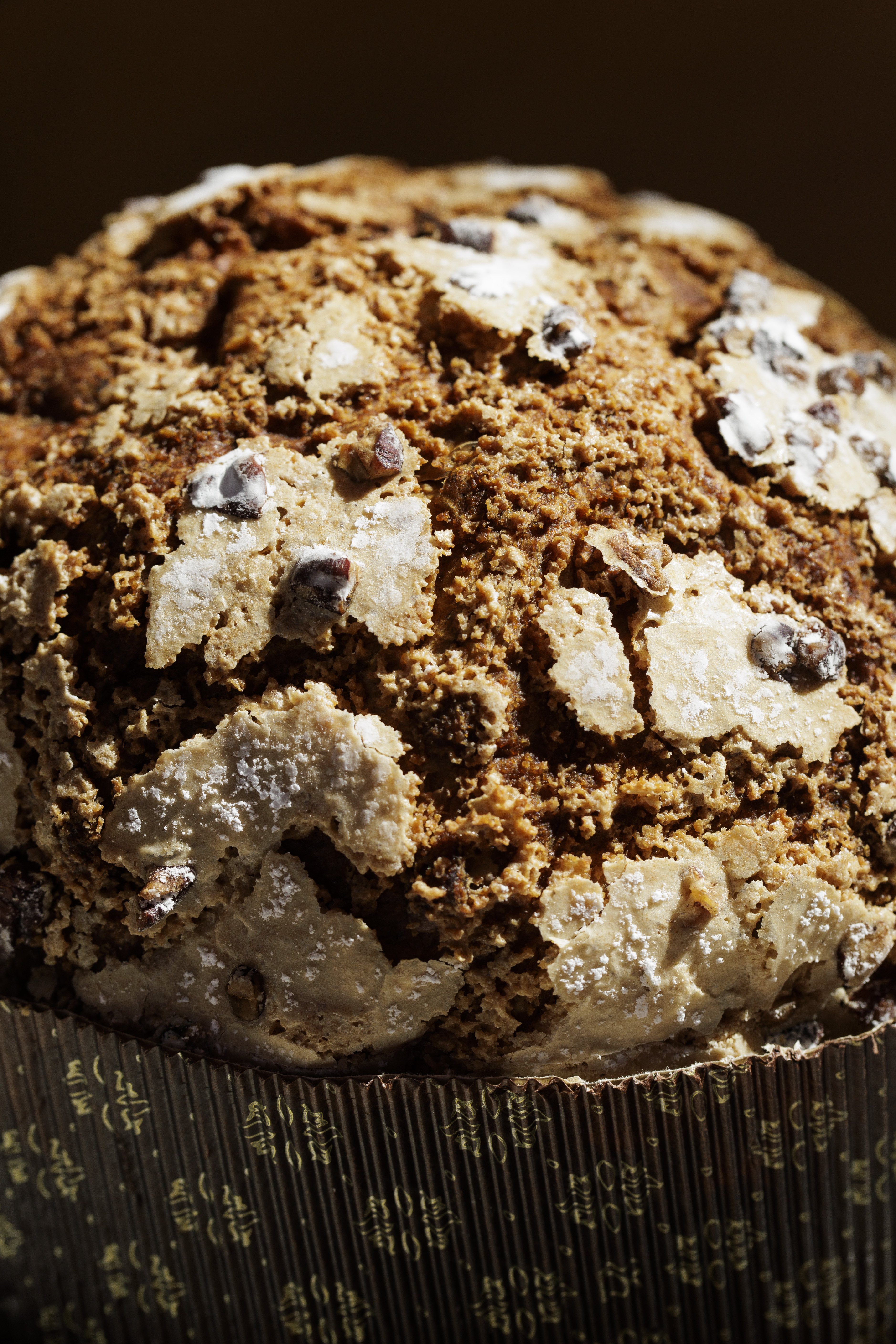
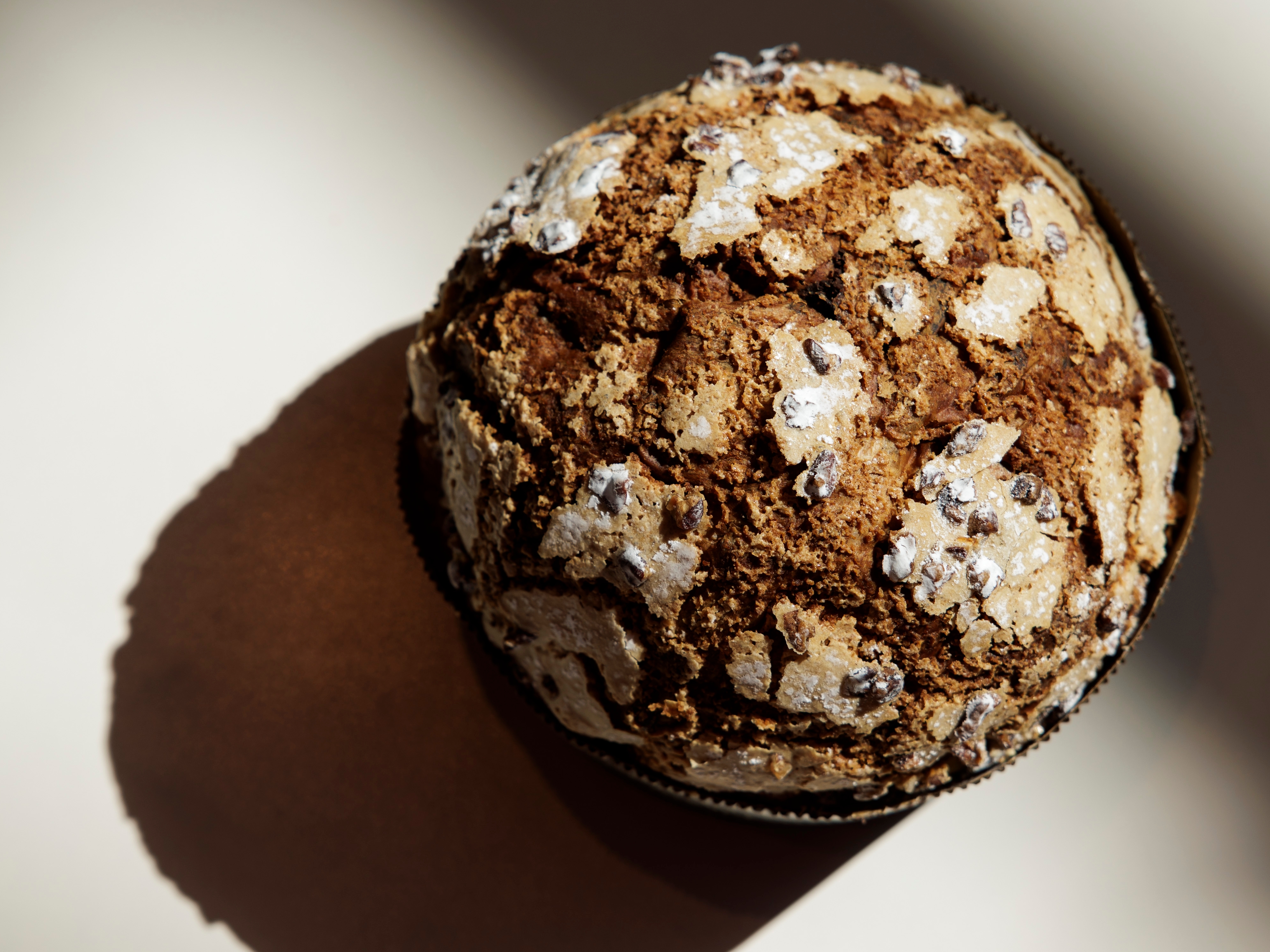
The panettone is Formosa’s crown jewel. Flecked with dark chocolate chips, pecans, and Luxardo cherries, Matty’s version splits the difference between classic and new-aged panettones, which tend to be airier and more voluptuous. His bread is buttery soft and light, with a crackly crust that’s fun to peel off.
To me — a panettone novice — it tasted like a cross between the world’s moistest poundcake and a sourdough loaf.
Matty, who grew up in Trooper, Montgomery County, was also not raised in a panettone family. His fixation with the bread began in adulthood while studying at the Culinary Institute of America, where he became enamored with the craftsmanship good panettone requires.
Pastry Chef James Matty inside Picnic, the restaurant hosting his Formosa pastry pop-ups weekends in October.Monica Herndon / Staff Photographer
Panettone is “like the mountaintop” of bread, said Matty. “It’s the most difficult to pull off consistently.”
Formosa’s version takes the equivalent of a work week to prepare. The dough must ferment for three days, said Matty. It takes another two to proof and bake. The most stressful test comes at end: Panettone must hang upside while cooling so it doesn’t collapse inward under its own weight.
The first time Matty made panettone, he said called it a “complete flop.”
Formosa’s panettone takes five days to prepare.Monica Herndon / Staff Photographer
“It literally flopped out of the mold,” he said. Upward of 20 retries later, and Matty’s panettone hangs steadily on the cooling rack, sort of like muffin-shaped bats.
At Formosa, Matty’s panettone will be served in $9 slices topped with whipped cream. As for selling whole rounds in time for the winter holidays, Matty said to “wait-and-see.”
For now, I’ll just be adding it to the top of my wish list.
Formosa at Picnic, 2421 Martha St., instagram.com/formosa.philly. Hours: 8 a.m. to noon (or sell out) Saturday and Sunday through Oct. 25.
Panettone’s real test come at the end: To cool, the Italian sweet bread must hang upside down. If prepared incorrectly, it flops.Monica Herndon / Staff Photographer
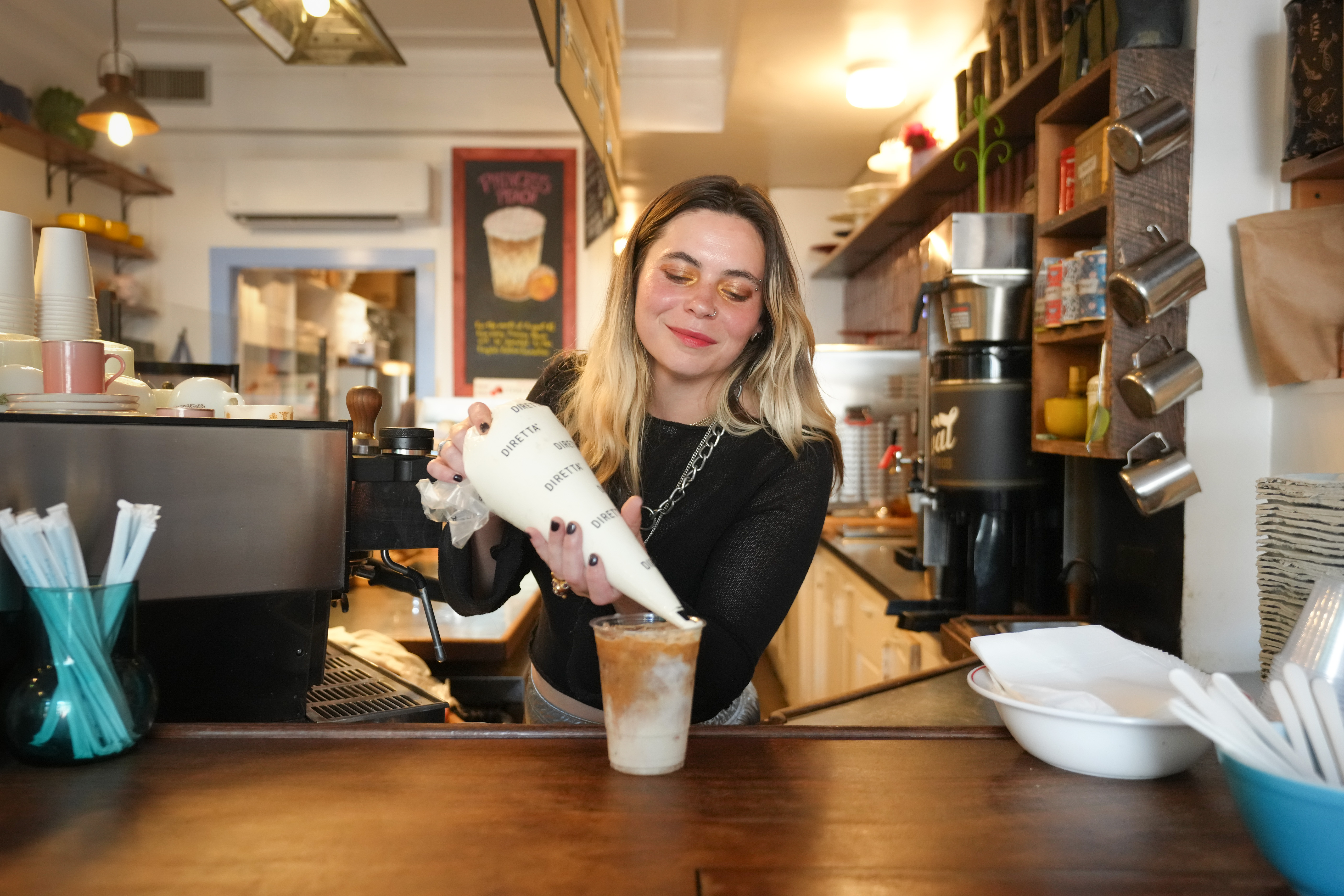
Zoe Tanner’s handiwork is immediately recognizable: Cloudlike cold foam puffs flecked with sprinkles that adorn the lattes at Loretta’s, the Society Hill cafe at the epicenter of Philly’s little treat boom.
Loretta’s sells about 200 specialty lattes on a busy day, Tanner estimates.
This September, Tanner spent hours in Loretta’s basement making bite-size uncrustables to top the coffee shop’s PB&J latte, which comes with Concord grape syrup and a peanut butter cold foam. In May, the drink du jour was a black-raspberry-maple concoction topped with a nutty tahini whip and sprinkles shaped like spring flowers. Next month, Tanner is whipping up a banana latte decorated with pretzel rod ghosts. Proceeds from each creation have gone to local charities such as ACCT Philly and the Eagles Autism Foundation.
“Say what you want about the girls that come in from Instagram, but they’re making a difference by buying a drink,” Tanner said. “That matters to me.”
Tanner, 31, serves as the operations director of all three of Bush and Morris’ businesses, splitting her days between training staff, managing inventory, and developing latte recipes. Barista-ing at Loretta’s, however, is the best part of her job.
“I love connecting with people,” said Tanner. “And coffee is so cool because it goes through so many processes to get into your cup, but everyone who touches it is really important, from the grower to the roaster to the barista.”
Zoe Tanner pipes marshmallow whip onto a speciality latte at Loretta’s, a coffee shop in Society Hill.Jessica Griffin / Staff Photographer
Tanner, who moved to Philly in 2015 from a small town in Maryland, fell into coffee by working at Starbucks while attending the University of Valley Forge. After, she worked her way up from being a barista at La Colombe’s Dilworth Park location to account manager for the local coffee chain, where she was responsible for convincing mom-and-pop shops to use the brand’s products. She started at Loretta’s when they opened.
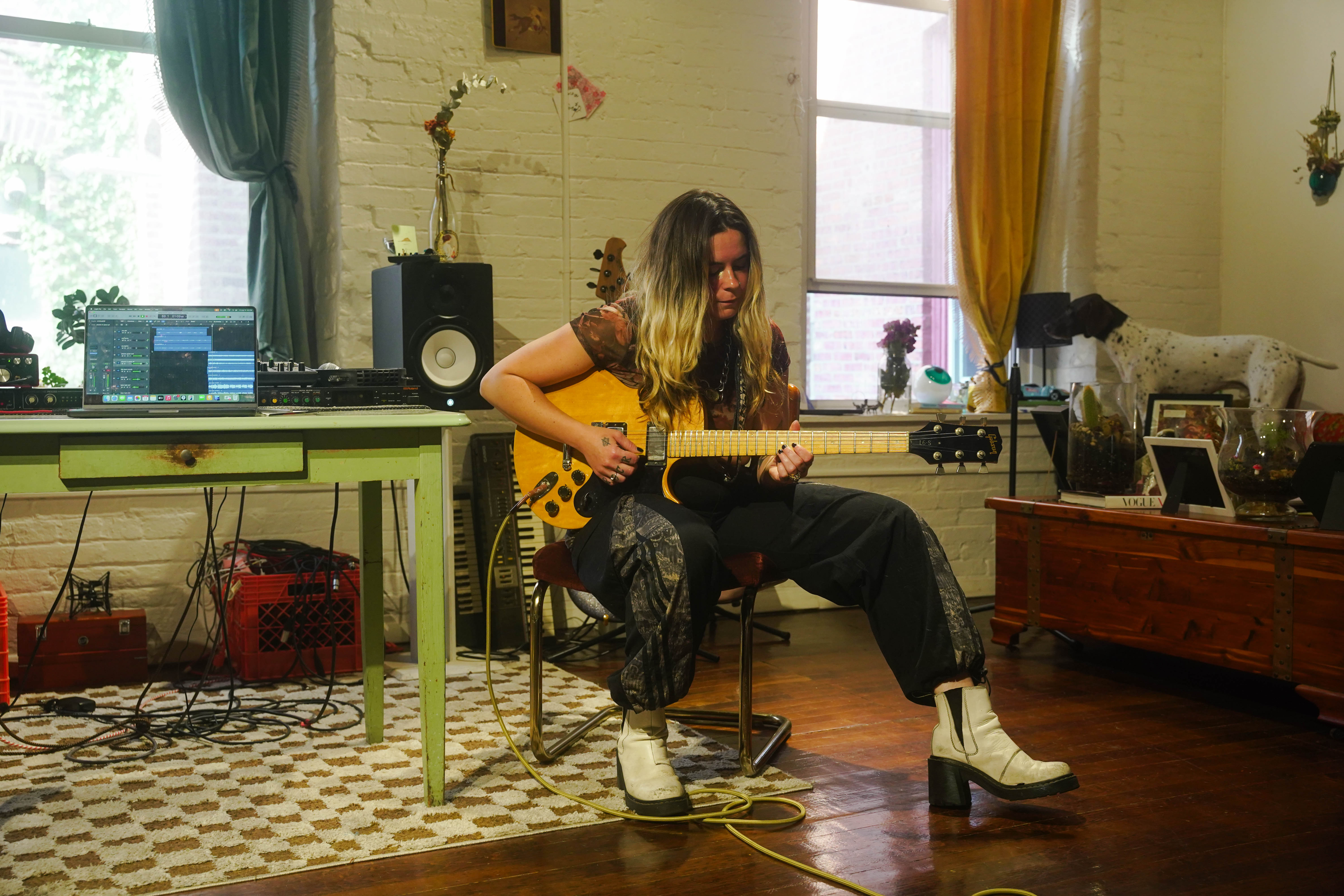
The job fuels Tanner’s second career as a self-made musician who writes, records, and mixes all her music. This fall, Tanner will release her fifth album as Mommy Rockstar Bitch, the grunge persona that has helped Tanner find power in her role as the self-proclaimed “mom friend.”
Tanner said working at Loretta’s keeps her grounded like the novelist Charles Bukowski, who kept his job as a mailman during his early days as a writer. It’s also brought her unexpected fame.
Zoe Tanner plays guitar in the living room of her apartment in Olde Kensington.Rowan Ohara
“I was running in Fishtown the other day when a group stopped me and were like, ‘Can we take a picture with you? You’re the Loretta’s girl,’” Tanner said. “Never did I think coffee would be how I build my brand.”
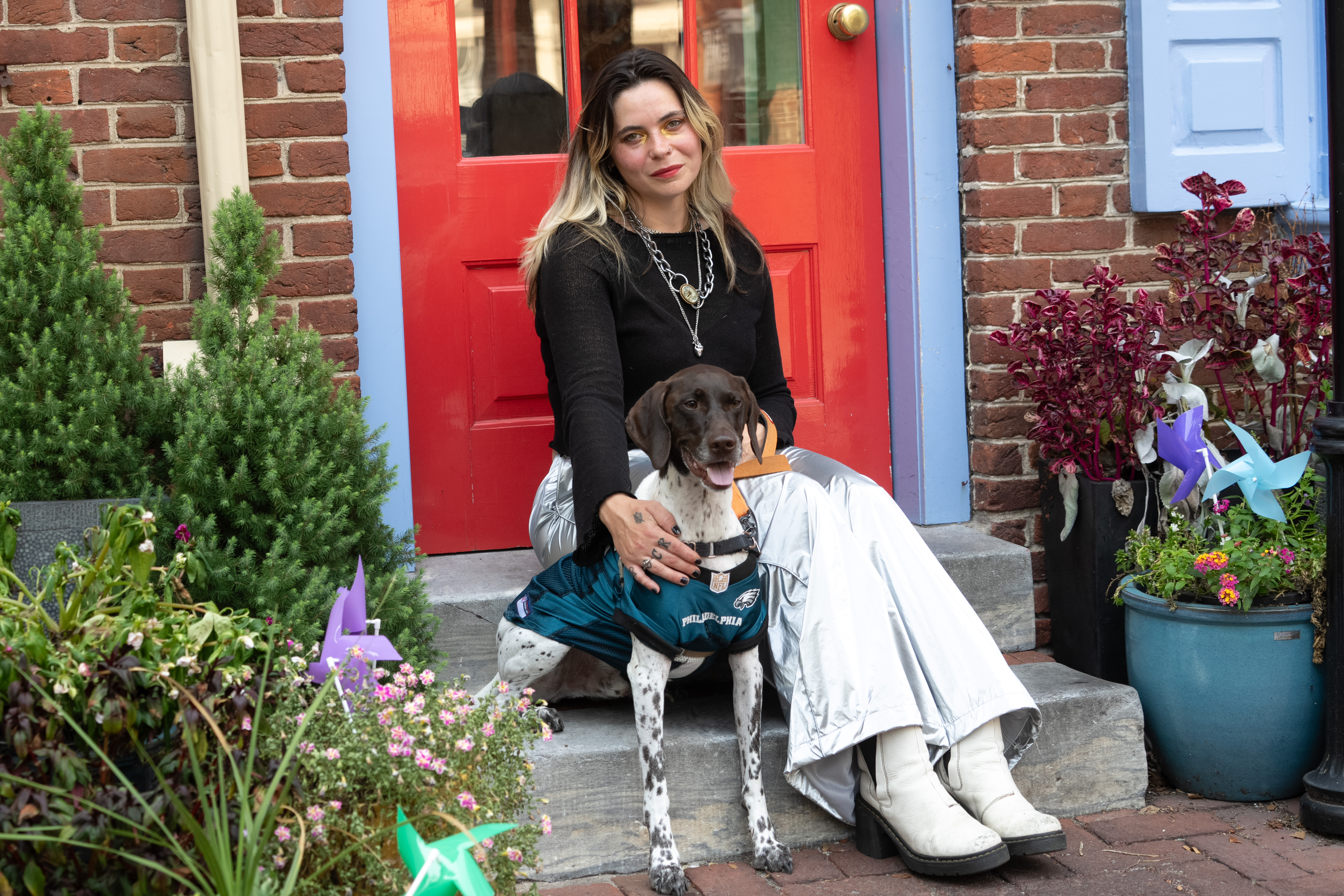
So, how does Philly’s most famous barista spend a perfect day in the city? It involves sharing human food with her dog, running a half marathon, and mixing music from her home in Olde Kensington.
5 a.m.
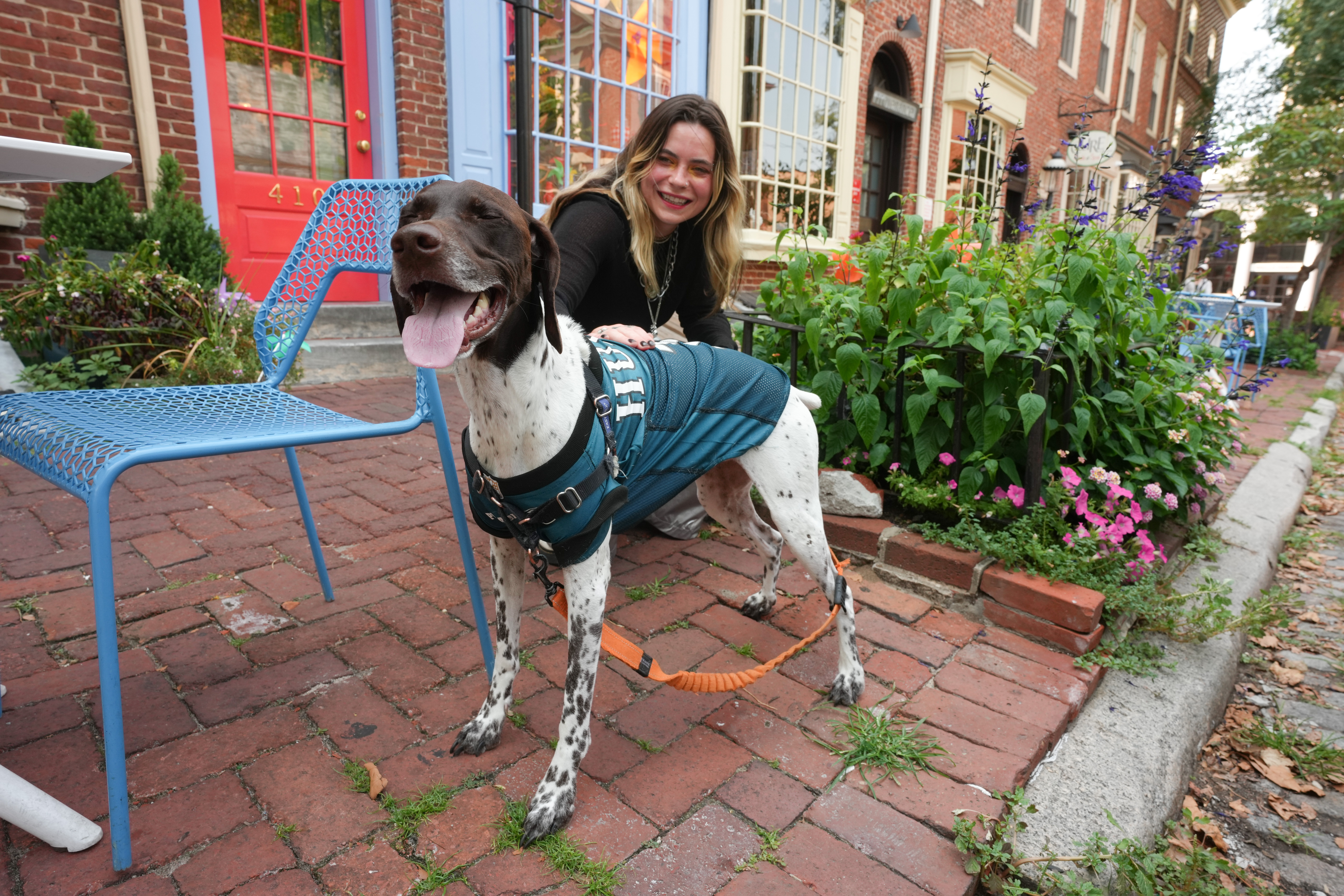
I generally wake up at 5 a.m. with my dog Barrett — a 6-year-old German shorthaired pointer — barking at me to give him pets. I automatically smile; one of my biggest accomplishments in life is that he’s so well-behaved because GSPs are such a tough breed.
After a quick morning walk with Barrett, I’ll head to a 6 a.m. Heated Power Strength yoga class at Monarch Yoga in Kensington. I go without having any coffee, which is so unnatural for me, and then when I get out, I feel so awake and alive. The music is also so upbeat and fun for a strength class, but since it’s a yoga studio, [the instructor] still gives us a spiritual concept to focus on.
Tanner likes to share food with Barrett, her 6-year -old German shorthaired pointer. His favorites include banh mi from Ba Le and pizza from Pizzeria Beddia.Jessica Griffin / Staff Photographer
7:30 a.m.
Next, I’ll grab Barrett for a long walk that’s mostly about him being the center of attention. People might say that I’m a bad dog mom for this, but I share my food with him.
I’m not even embarrassed by this because Barrett has good taste: When we go on long runs, we always stop at Ba Le Bakery in South Philly for a lemongrass and beef banh mi, and when we walk down Frankford Avenue, he will literally yank me across the street for Huda Burger. I even gave him a Pizzeria Beddia birthday party. I promise he’s a healthy dog.
Anyway, on our long walks we will either stop at Rival Brothers Coffeefor a short Americano and so Barrett can look out the window, or Càphê Roasters to split a fried chicken sandwich. It’s funny because I used to joke about never wanting to be a regular somewhere, but now I walk into these places and it feels like I’m talking to my siblings. It’s a beautiful way to start my morning.
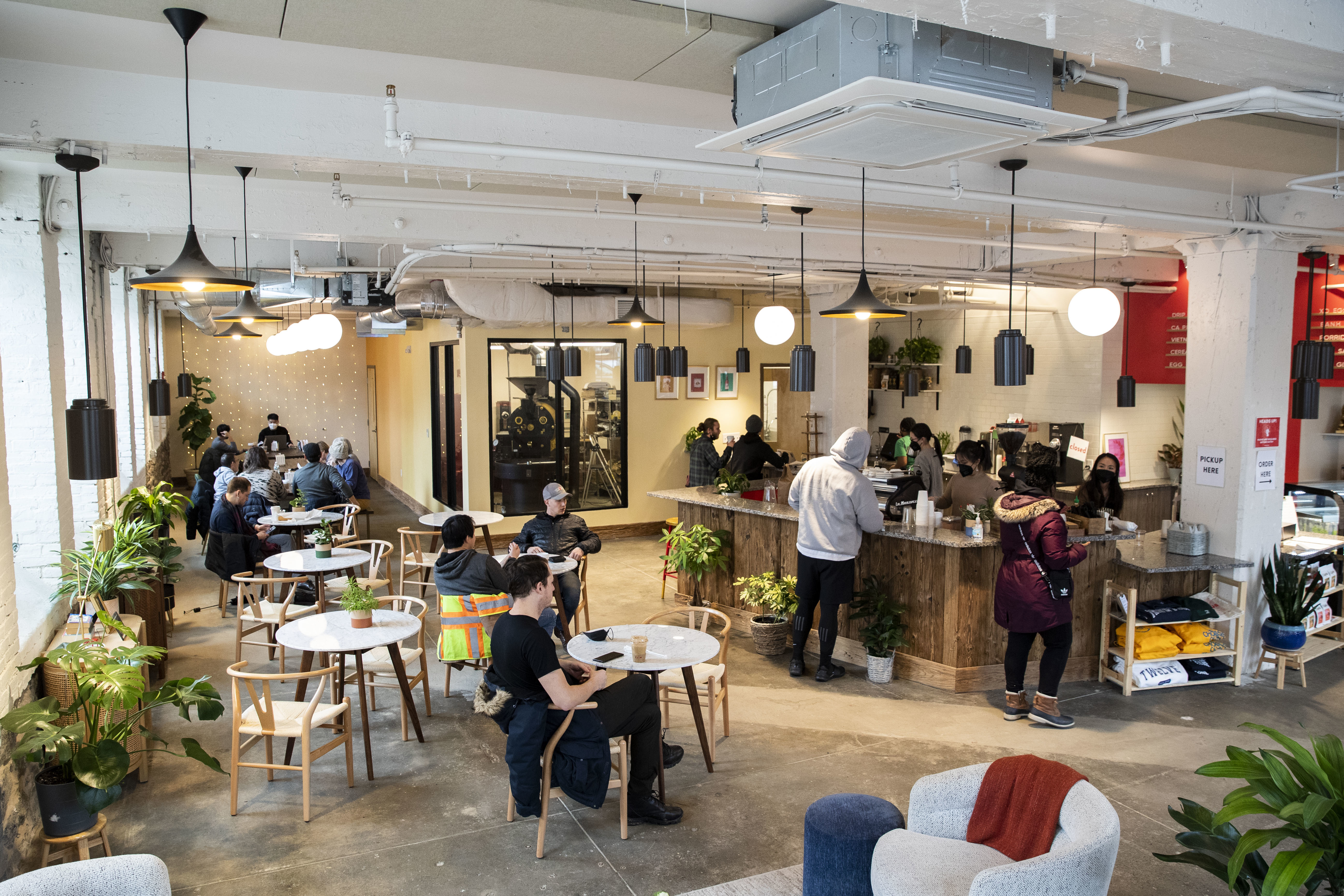
The inside of Càphê Roasters in Kensington, where Tanner and her dog Barrett are regulars.Monica Herndon / Staff Photographer
10 a.m.
After also feeding Barrett real dog food, I head down to Loretta’s to clock in for a shift. On a perfect day, work involves barista-ing a little bit, doing latte research, and filming content for social media.
All of our specialty lattes involve a specialty syrup and cold foam, and they take about three iterations each to get right. I love it because I feel like I’m in a lab, trying to find the right balance of fun and sweetness without just serving people sugar just because it looks pretty … [Kelsey Bush] and I are both very anti-unicorn frappuccinos.
As director of operations at Loretta’s, Zoe Tanner says the best parts of her job include working on latte recipes and barisa-ing.Jessica Griffin / Staff Photographer
At some point, I will stop for lunch. I’m in a protein era right now, so I like to order the Emma, which I equate to Loretta’s version of a chicken Caesar salad wrap. I also love our Rice Krispies Treats. They’re just perfectly done. Packaged Rice Krispies Treats are always so dry.
2 p.m.
It is officially time for me to go on a long run — 13.1 miles at minimum because I’m a distance diva.
My go-to route is river to river: I’ll run from my apartment to Penn Treaty Park, down to the Headhouse Shambles, across South Street to Schuylkill Park, up to the Philadelphia Museum of Art, and back.
While I’m running, I like to listen to a lot of my raw mixes to get a sense of what needs work, but if I’m trying to have a really blissful run, I’ll listen to Dean Blunt or Sade. If you run by the river and put on Sade, you’ll feel like the hottest person in the universe. Trust.
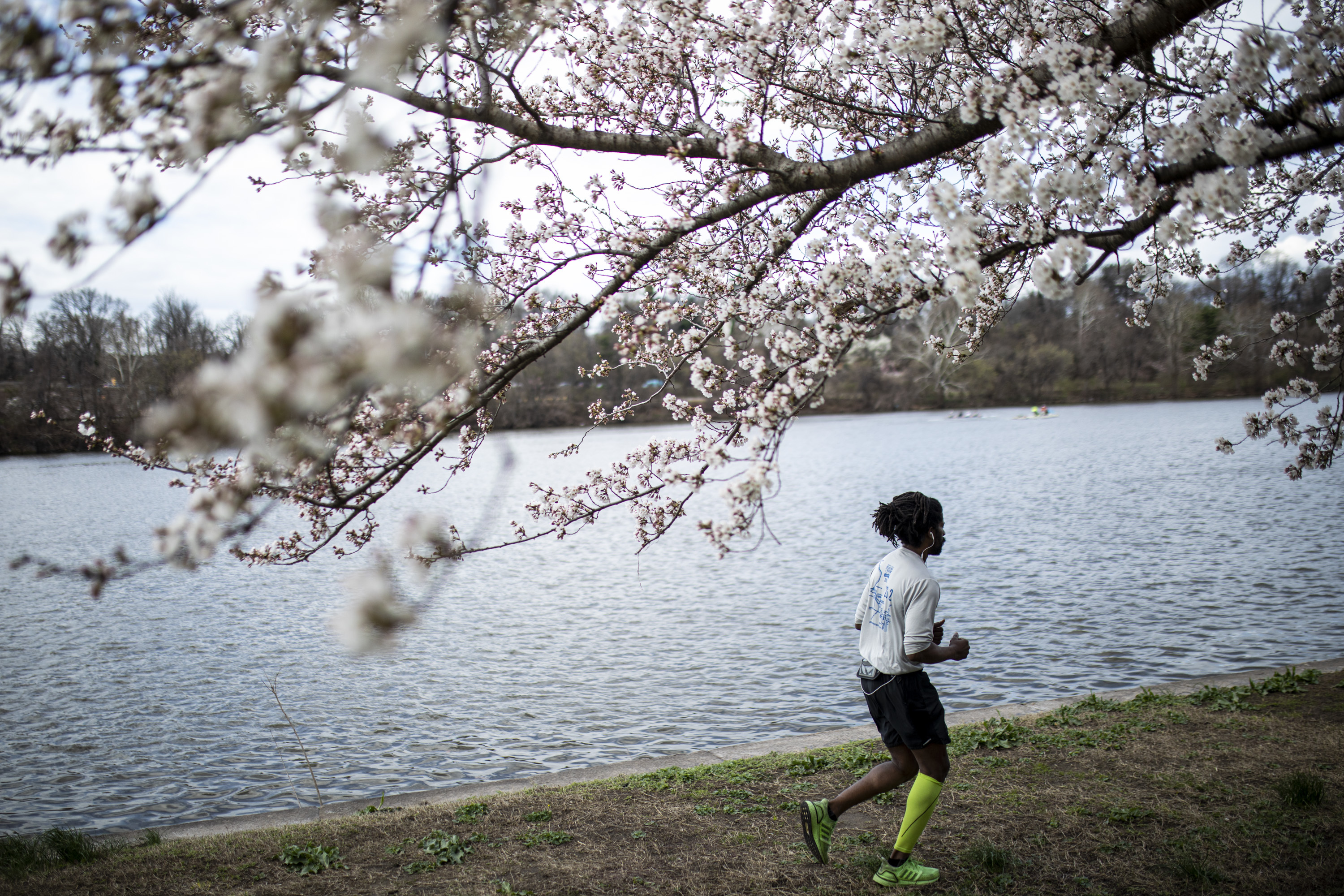
Tanner likes to run along the Schuylkill River, the Delaware River, and through Penn Treaty Park.TYGER WILLIAMS / Staff Photographer
I also like to think of my runs as quests. I will deliberately only bring my phone and headphones so I’m forced to stop for the things I need to keep going, like a snack or electrolytes. It’s fun because it helps me get to know the city better, even after more than a decade. … I think people get tired of Philly because they don’t chew down on it enough.
Running this way has also made me a public bathroom expert because peeing, of course, is always part of the quests. My hot tip: Never count out a Whole Foods.
6 p.m.
After my run, I like to get dinner and drinks with my friends.
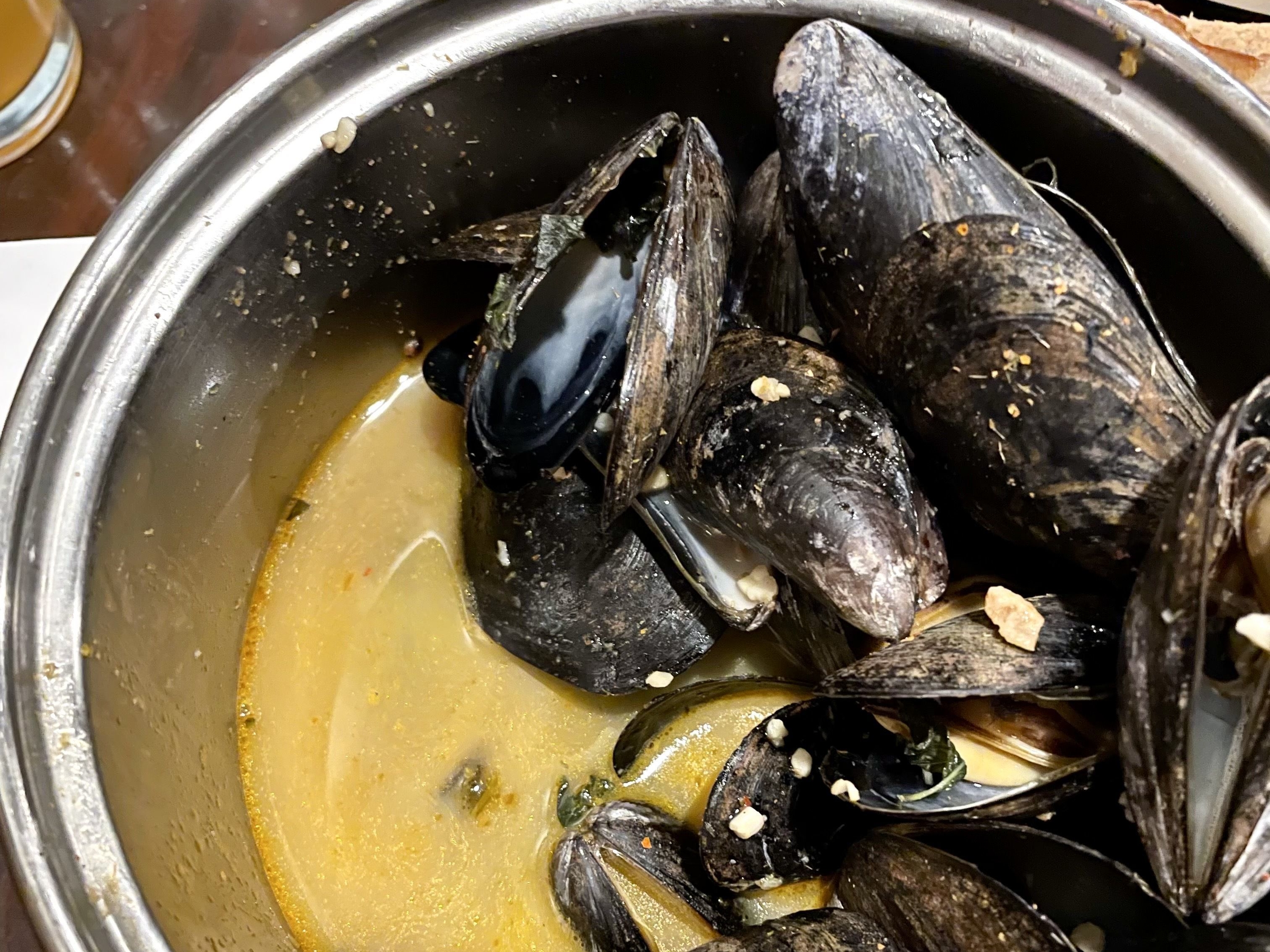
Our go-to is Monk’s Cafe, which I recently learned might be haunted? I typically order the Thai curry mussels, a saison, and fries.
I know there’s a lot of discourse about Monk’s having the best fries, but I want to make clear that I do NOT play that game. Fries come in all shapes and sizes, and they’re all good. I would never body shame a fry. It’s like trying to say a basketball player is more athletic than a football player. How could you?
A pot of mussels in Thai curry broth at Monk’s Cafe.Craig LaBan
If we want to have a less chill night, my friends and I will go to Johnny Brenda’s— I had my first ever legal drink there, and they make a great steak. For a more chill night, we like to eat at Phở 75. I want my pho with dark meat chicken and all the fixings — jalapeños, bean sprouts, cilantro, sriracha, hoisin. Barrett, of course, will probably have a piece of the chicken.
9 p.m.
I like to end my day with music, either by practicing with my band or mixing my album, which reminds me a lot of coming up with drinks for Loretta’s since both start with me asking the same question: What can I do to make this thing pop?
Sound mixing is so similar to food and beverage because it’s very easy to sense when you’ve done too much and need to pull back. Things often taste and sound the best when they’re at their most natural.
This interview has been edited for length and clarity.
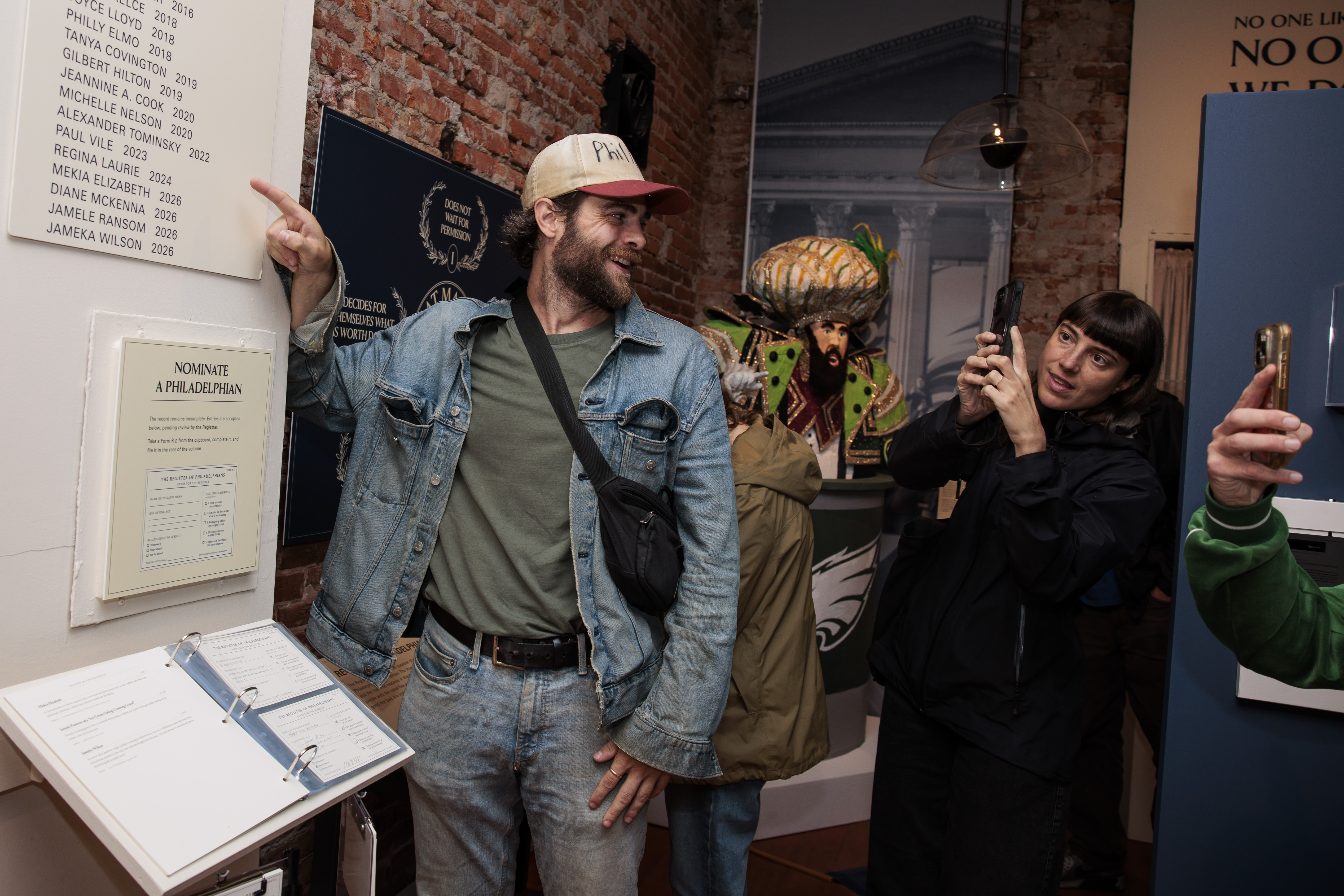
Alexander “Chicken Man” Tominsky walked into the Museum of the Philadelphian in a Canadian tuxedo and a baseball hat with “Phillies” written on it in marker on Tuesday and was blown away to find his name on a plaque alongside other local legends like Benjamin Franklin and Philly Elmo.
“No way! Oh my gracious! Who would have known when I was a little kid crying in my pillow something like this would happen,” he said, pointing to his name.
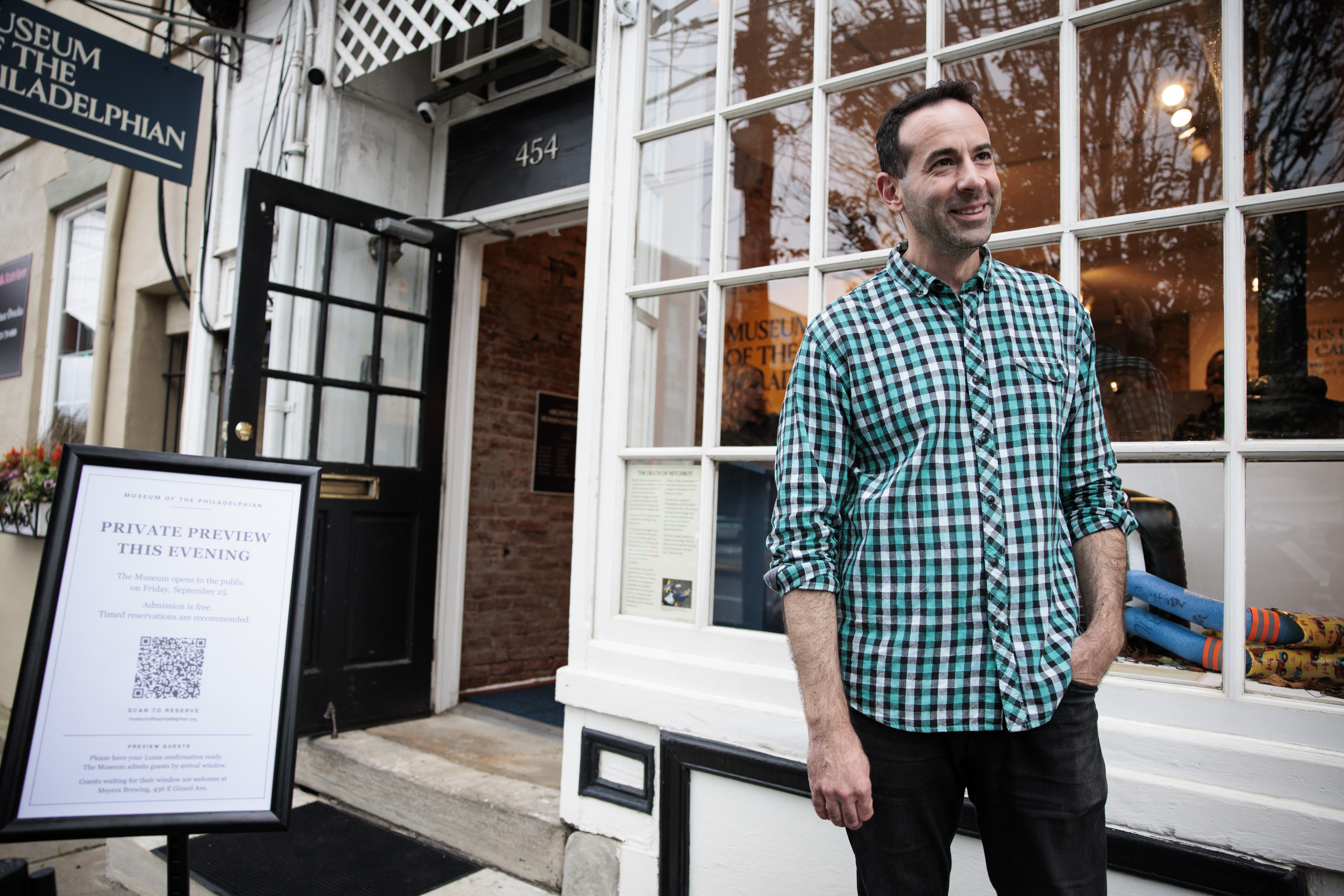
Tominsky — who became renowned throughout the land in 2022 for eating 40 rotisserie chickens in 40 days, culminating with a public noshing of a chicken on an abandoned Walmart pier in South Philly — was invited to a preview opening for the museum by its founder and creator, Brian Adoff.
Founder and creator Brian Adoff outside his Museum of the Philadelphian in Fishtown.Monica Herndon / Staff Photographer
“The museum is about the personality and attitude and conduct of Philadelphians,” Adoff said. “My personal hope is that you leave inspired to really be the best version of yourself, the best Philadelphian you can be.”
Located in a 300-square-foot storefront that was previously Adoff’s office on East Girard Avenue in Fishtown, the free, temporary “micro museum” is just down the road from another Philly landmark — the “I Hate Bank of America” sign. The large, yellow banner was put up by a homeowner in 2007, after the bank branch across the street ticked him off. The branch closed many years ago, but the sign remains, a grand tribute to Philadelphians’ spite.
View on Threads
What makes Philadelphians this way? And what makes it so oddly endearing? These are questions Adoff explores in his absurd and unexpectedly heartwarming museum, which opens Friday.
“There’s an emotional narrative arc the museum takes in its 300 square feet, where it ends with literally a book of Philadelphians who exhibit five qualities that I’ve determined, with my crack team of curatorial advisers, that make up a Philadelphian,” Adoff said.
As of a student of the Philadelphian who’s written hundreds of profiles of the everyday people who make me love this city more every day, I thought Adoff had set a lofty goal for himself when we first met earlier this month. How do you distill what it means to be a Philadelphian in 300 square feet? And how do you decide who makes the cut?
At the preview Tuesday, I was pleased to find that over the course of about 20 exhibits in the space, Adoff skillfully addresses the Santa-hating-battery-throwing-robot-killing tropes that haunt Philadelphians, while also getting to the oddly-touching truths behind those, and other very Philly stories.
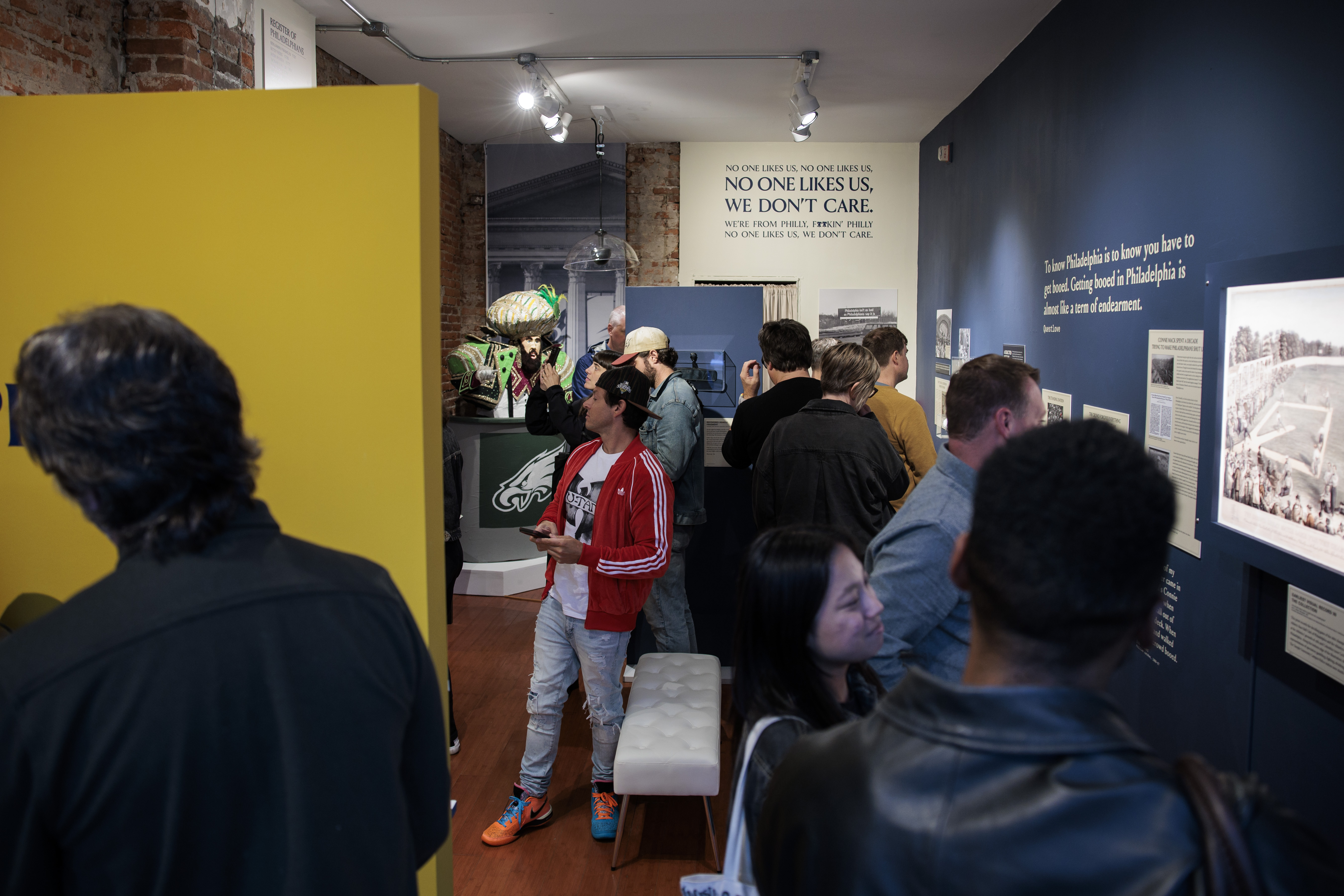
Visitors browse the Museum of the Philadelphian.Monica Herndon / Staff Photographer
And while Adoff and his team have compiled a “Register of Philadelphians” with more than 50 names and stories of local folk heroes who epitomize what it means to be a Philadelphian, their best decision may have been to include cards for visitors to nominate their own quintessential Philadelphian. Because if one thing is certain, Philly is going to have thoughts.
Grease the pole
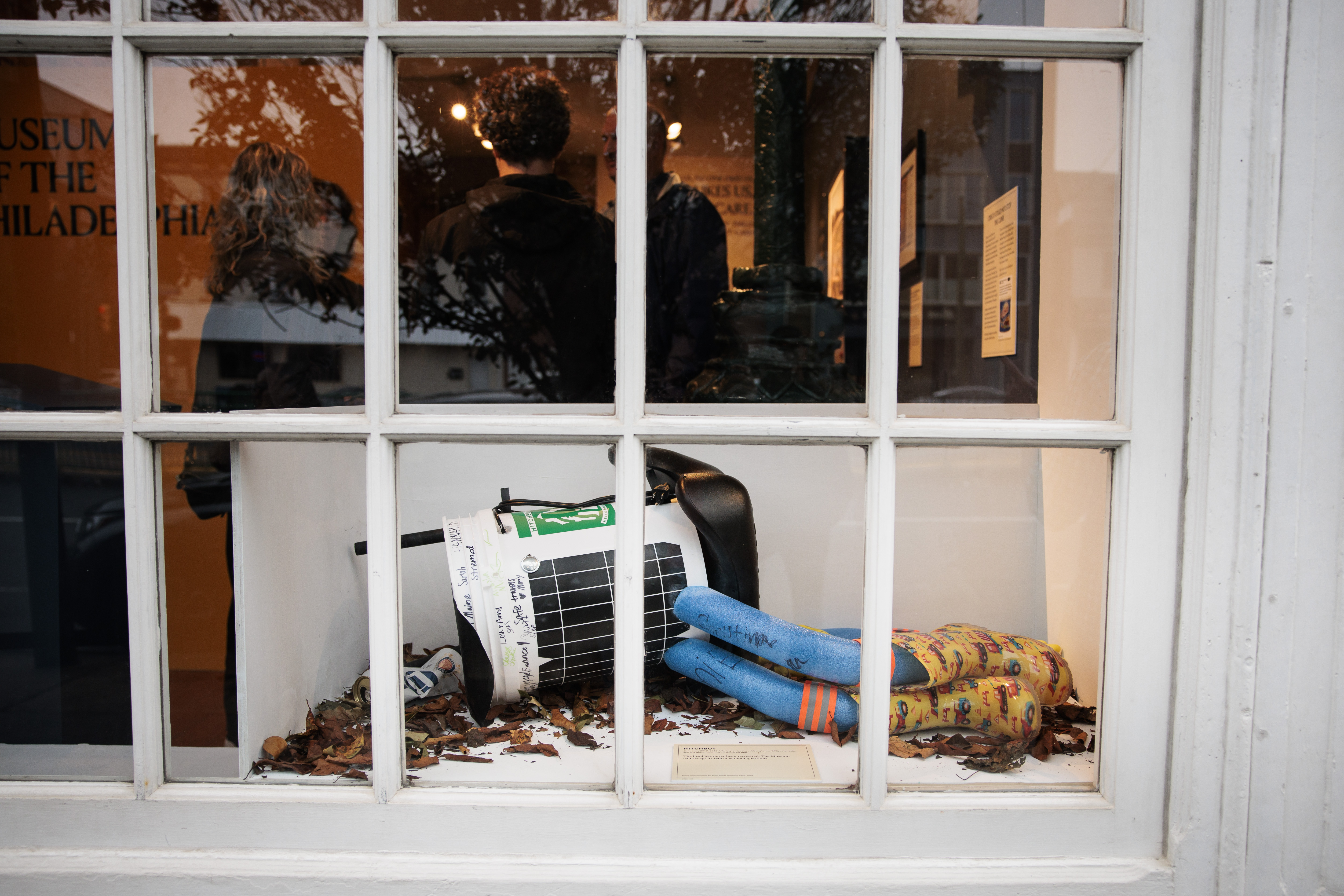
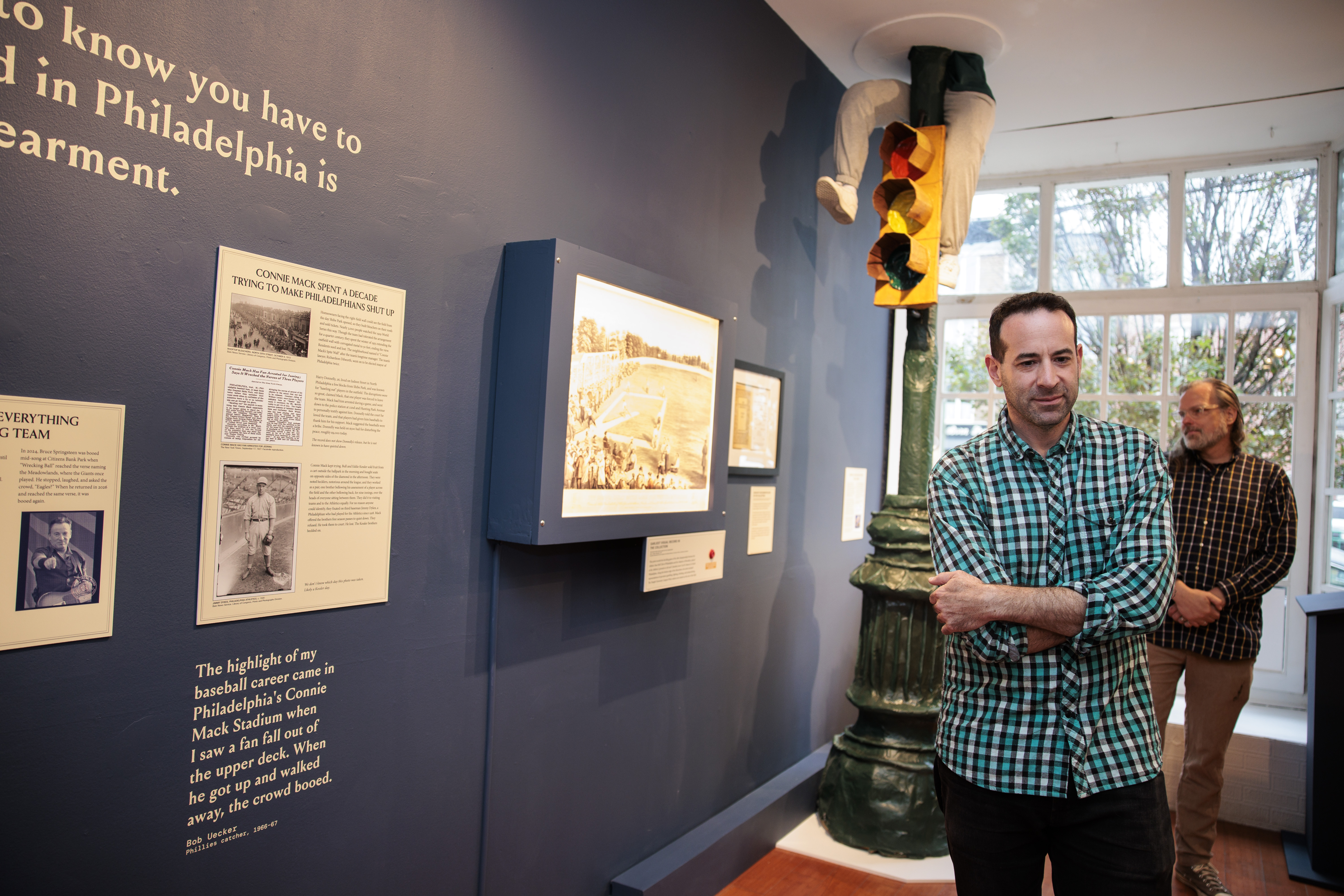
Guests are greeted in the museum’s front window by a re-creation of the death of hitchBOT, the hitchhiking Canadian robot who traveled across the country on human kindness, only to be dismembered and beheaded in Philly. In the accompanying plaque, Adoff notes that Philadelphians offered to rebuild the robot, and that a Philly police detective jokingly blamed the crime on New Jerseyans.
A re-creation of the death of hitchBOT is displayed in the front window of the Museum of the Philadelphian.Monica Herndon / Staff Photographer
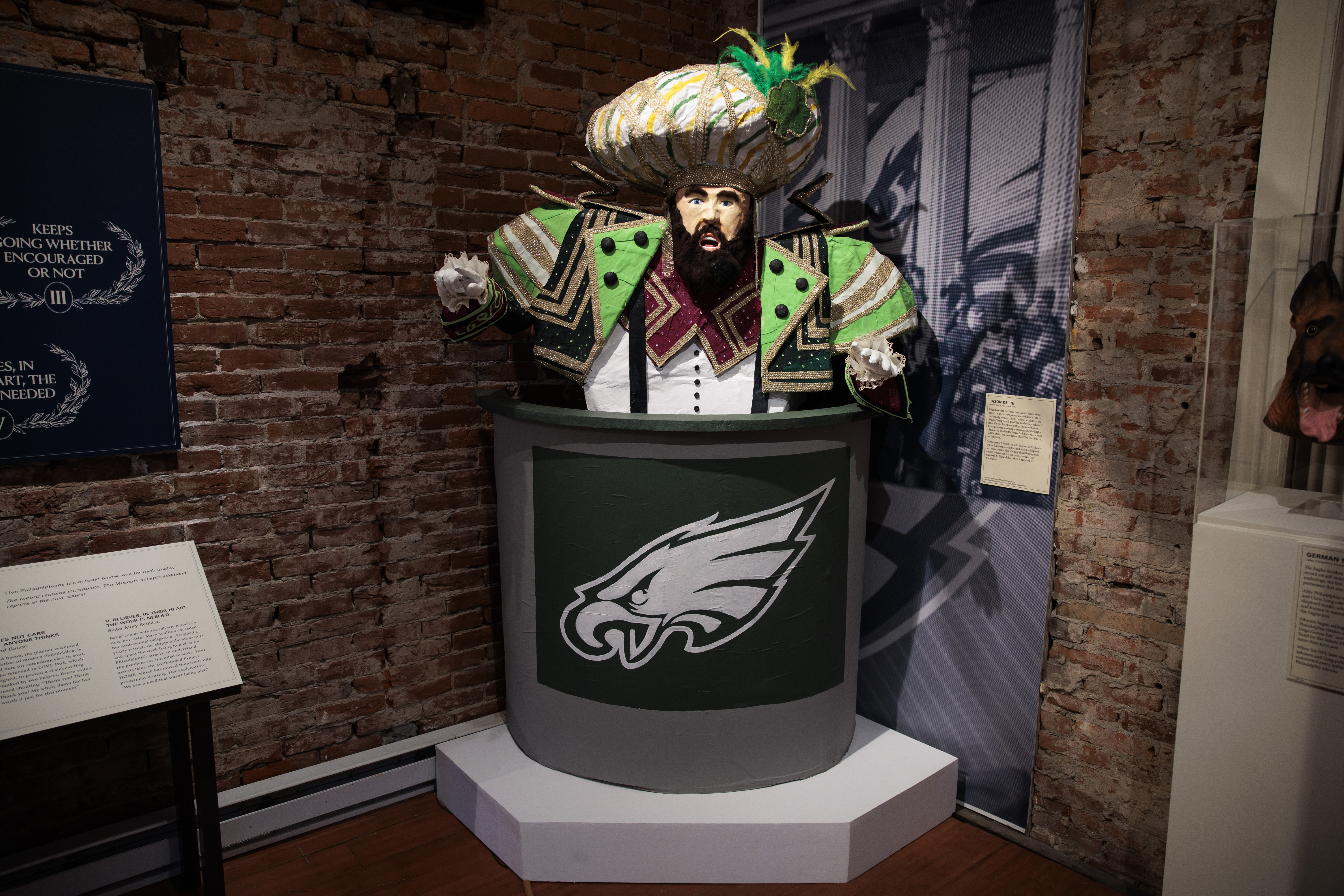
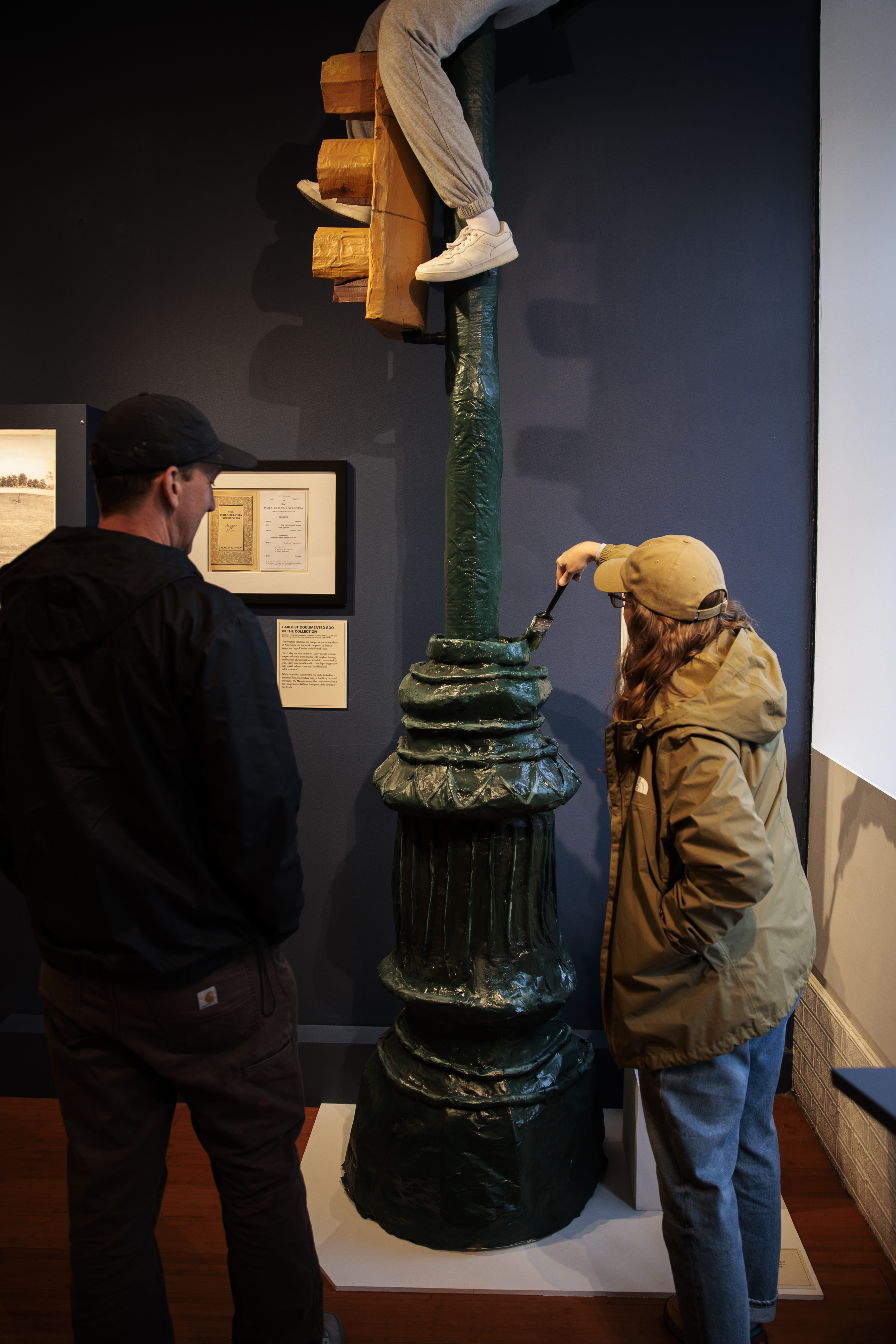
Once inside the museum, two large papier-mâché sculptures immediately catch the eye — one, of a Philadelphian climbing a greased pole, and the other of Jason Kelce during his Eagles Super Bowl speech. In the first, guests are invited to “grease the pole” with a paintbrush and clear goo from a nearby can (you know I did it!), and at the latter, visitors can stand under a sound dome (fancy!) in front of the sculpture to hear Kelce’s “Hungry Dogs” speech.
A papier-mâché sculpture of Jason Kelce during his 2018 Eagles Super Bowl speech is featured in the Museum of the Philadelphian.Monica Herndon / Staff Photographer
In the center of the room is a freestanding wall with a rearview mirror on it. The accompanying plaque tells the story of Ted Passon, whose parked car was flipped in the aftermath of the Phillies 2008 World Series win. Passon created a blog asking Philadelphians who enjoyed the spectacle to help pay for his vehicle, and through the generosity of donors, he was able to get a new car and give $3,000 to someone else whose car was flipped. On an iPad at the exhibit, visitors can play a YouTube video of the flipping and read Passon’s blog.
I remembered the story well because I interviewed Passon about it in 2008. Seeing him at the event Tuesday was a full-circle Philly moment for both of us. Passon, who’s now an Emmy Award-winning documentarian, said he was happy to loan the mirror of the vehicle Philly claimed from him to the museum.
“It’s an honor to be included in the story of Philadelphia,” he said. “If I can be a footnote in the city’s history, I did something right in my life.”
‘Booing is my love language’
Other exhibits explore Philadelphians’ history with booing, our history of throwing things, and the five qualities Adoff and his team have decided make a Philadelphian, with number one being, “Does not wait for permission.”
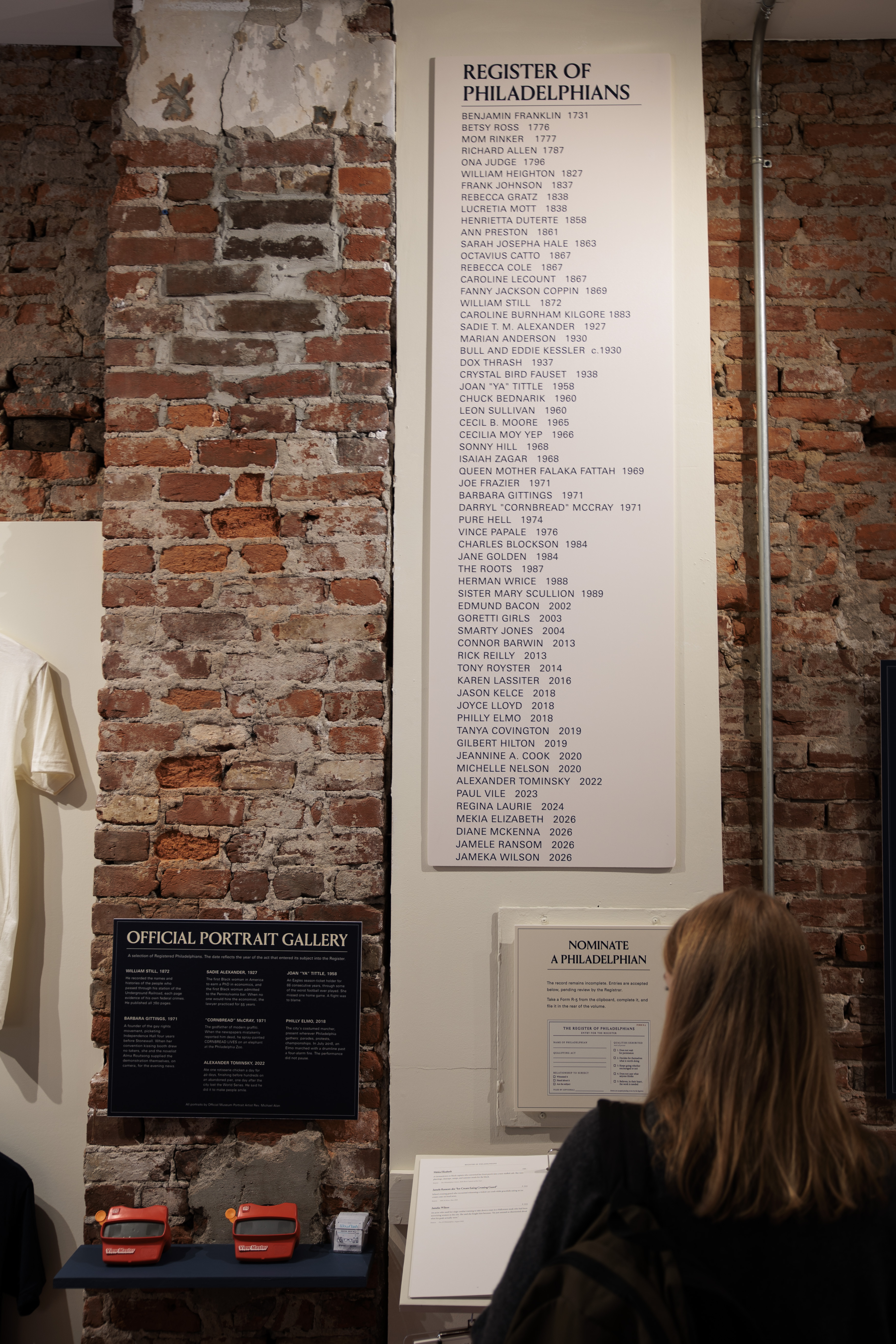
The “Register of Philadelphians” on the wall and accompanying book begins in 1731 with Benjamin Franklin and ends this year, with Jameka Wilson, the woman who went viral for her TV interview about kicking a man in a Chucky mask who was terrorizing pedestrians.
The Register of Philadelphians features notable Philadelphians ranging from Ben Franklin to Jameka Wilson. To the left of the register is the museum’s official portrait gallery, which can be seen through two ViewMasters. Monica Herndon / Staff Photographer
I was excited to see a couple people I’ve written about on the list, including Paul “Jelloman” Vile and the late Gilbert Hilton, who turned heads across the city for years in his “Badillac” car, which was covered in items from Goodwill, and who was one of the most Philly people I’ve ever met.
There’s also a portrait gallery by the Rev. Michael Alan of seven Philadelphians in the register that can only be seen through an old-school ViewMaster, which were a hit with the crowd.
“It was a small space and this was a way to make something look bigger without being bigger,” Alan said.
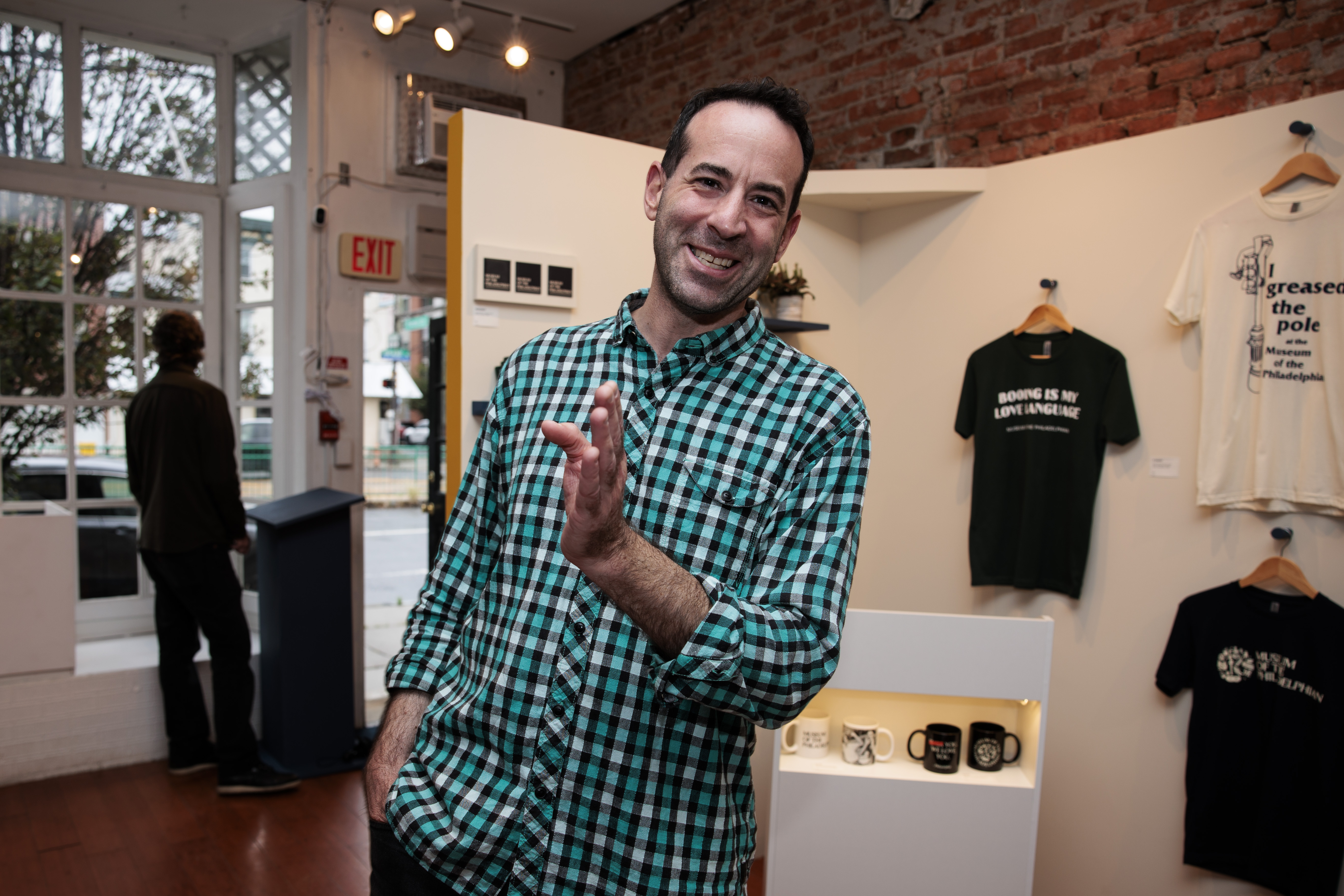
Creator and founder Brian Adoff talks about the Museum of the Philadelphian in front of the museum’s gift shop. Monica Herndon / Staff Photographer
The tiny museum even has a gift shop with shirts that say “I greased the pole at the Museum of the Philadelphian” and bumper stickers that read “Booing is my love language.”
‘The most Philadelphian thing’
The museum was funded by Adoff through his experience design studio, Architects of Human Connection, and admission is free because he believes “the Philadelphian has paid enough.”
The museum is a culmination of Adoff’s many endeavors over the years, from music, clowning, absurdist theater, and working as a tour guide for the Greater Philadelphia Film Office, to managing a software business and, most recently, creating events that connect Philadelphians.
In 2023, he cofounded the Fishtown Choir,and last year, Adoff created Join Philly, which connects Philadelphians with area clubs and groups.
The idea for the museum came to Adoff in June, as he was trying to think of uses for his storefront office space. With the help of five paid collaborators, Adoff built the museum in less than three months, which is impressive, given the amount of research that clearly went into the exhibits, plaques, and bios.
“It started kind of absurd and silly until I was like, ‘Oh, this is just like everything else I do. It matters and it actually has heart and it has meaning,” he said.
Brian Adoff in the Museum of the Philadelphian he created in Fishtown. Monica Herndon / Staff Photographer
Here’s the potentially scandalous thing — Adoff isn’t a Philly native. He’s originally from Long Island, moved to Cherry Hill as a kid, and came to Philly to attend the University of Arts. He spent time in Chicago then returned to Fishtown 20 years ago, where now lives with his wife and son.
Knowing how nativist Philly can be (my native colleagues said transplants can “never” say they’re from Philly if they moved after the age of 13), I had to ask Adoff what gave him the gall to open the museum.
“Because I express the qualities that make a Philadelphian,” he said.
“But you decided those qualities, right?” I asked. (They are: 1. Does not wait for permission 2. Decides for themselves what is worth doing 3. Keeps going whether encouraged or not 4. Does not care what anyone thinks 5. Believes, in their heart, the work is needed).
“Yes, which is the most Philadelphian thing I could have done,” he said.
Adoff wants people to leave his museum feeling as inspired as he did after watching the opening of the Obama Presidential Center on TV. He dreams of Rob Mac narrating an audio tour of the exhibit, like Steve Buscemi does for Eastern State Penitentiary. And his longterm goal is to open a more universal experience one day — a fart museum. Everybody isn’t lucky enough to be a Philadelphian, but everyone farts.
I imagine Benjamin Franklin, a fellow Philly transplant who once wrote a satirical essay about flatulence, would think that’s a gas.
Darrin Rowland (left), and Leslye Rowland grease the pole sculpture at the Museum of the Philadelphian on Tuesday. Monica Herndon / Staff Photographer
Know before you go
The museum, 454 E. Girard Ave., is open Fridays (5 to 8 p.m.), Saturdays (noon to 5 p.m.), and Sundays (noon to 5 p.m.) Sept. 25 through Nov. 1.
Admission is free, but timed reservations online are recommended. Opening night is already booked and only a few spots remain for this weekend.
Like Philadelphia, there is a lack of public bathrooms at the museum, in that there are none.
The museum is wheelchair accessible via a temporary ramp. Email visit@museumofthephiladelphian.org prior to visiting so staff can have the ramp ready.
All ages are welcome, but some exhibits do include profanity.
Every week, Amaryllis “Amy” Rivera-Nassar hand-shapes and deep-fries around 2,000 pastelillos at her Fishtown takeout joint, Amy’s Pastelillos.
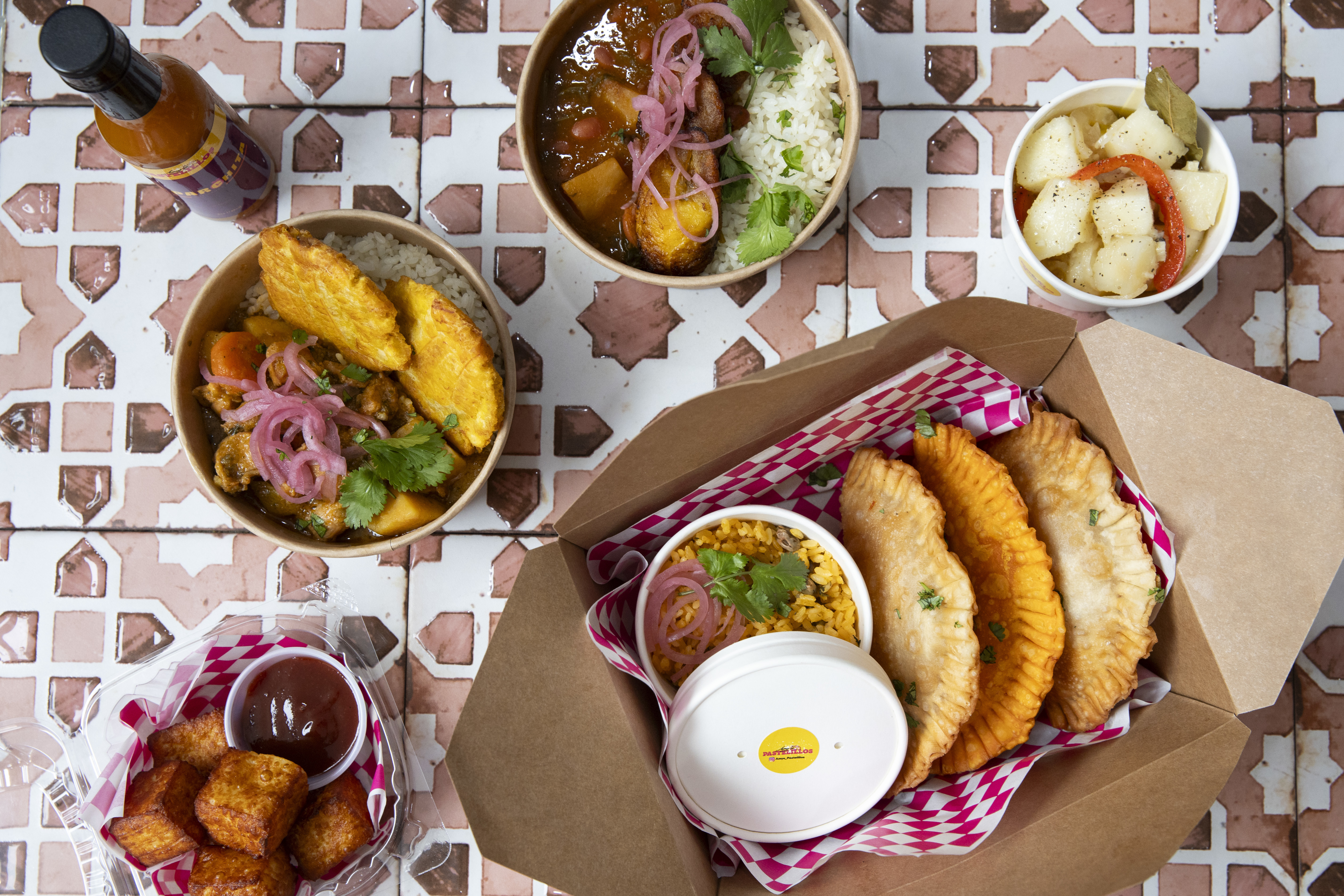
Rivera-Nassar opened the bright pink storefront at 2001 Memphis St. in 2024 after spending years as the neighborhood’s “pastelillo lady,” selling the Puerto Rican turnovers — filled with classic chicken stew, guava BBQ pork, and truffled mushrooms, among others — via pop-ups. But 2026 is the year things really started to click.
The only hitch: Rivera-Nassar says she’s running out of room to keep up. Her kitchen barely has enough space for two burners, two fries, a pair of fridges, and an oven.
“It’s like a little tiny shoebox. We do so much with so little,” Rivera-Nassar said.
Luckily, Rivera-Nassar now has a big team in her corner: This week, the Philadelphia 76ers and Bank of America announced that Amy’s Pastelillos won the Enrich Program competition, making the takeout shop an official Sixers partner for the upcoming NBA season.
A spread of dishes including pastelillos at Amy’s Pastelillos, now an official partner of the Philadelphia 76ers for the 2026-27 NBA season.Monica Herndon / Staff Photographer
The prize package is valued at approximately $250,000, and includes a year of marketing support, business consulting, and strategic networking from both Bank of America and the Sixers. As an official partner, Amy’s Pastelillos brand will be promoted to 76ers fans through a mix of TV, social media, and radio ads, plus appearances.
The opportunity, Rivera-Nassar said, couldn’t have come at a better time.
“I had been spending all year trying to secure support and funding for my business, and had been getting constant ‘nos,’” she said. “I just can’t believe that we won.”
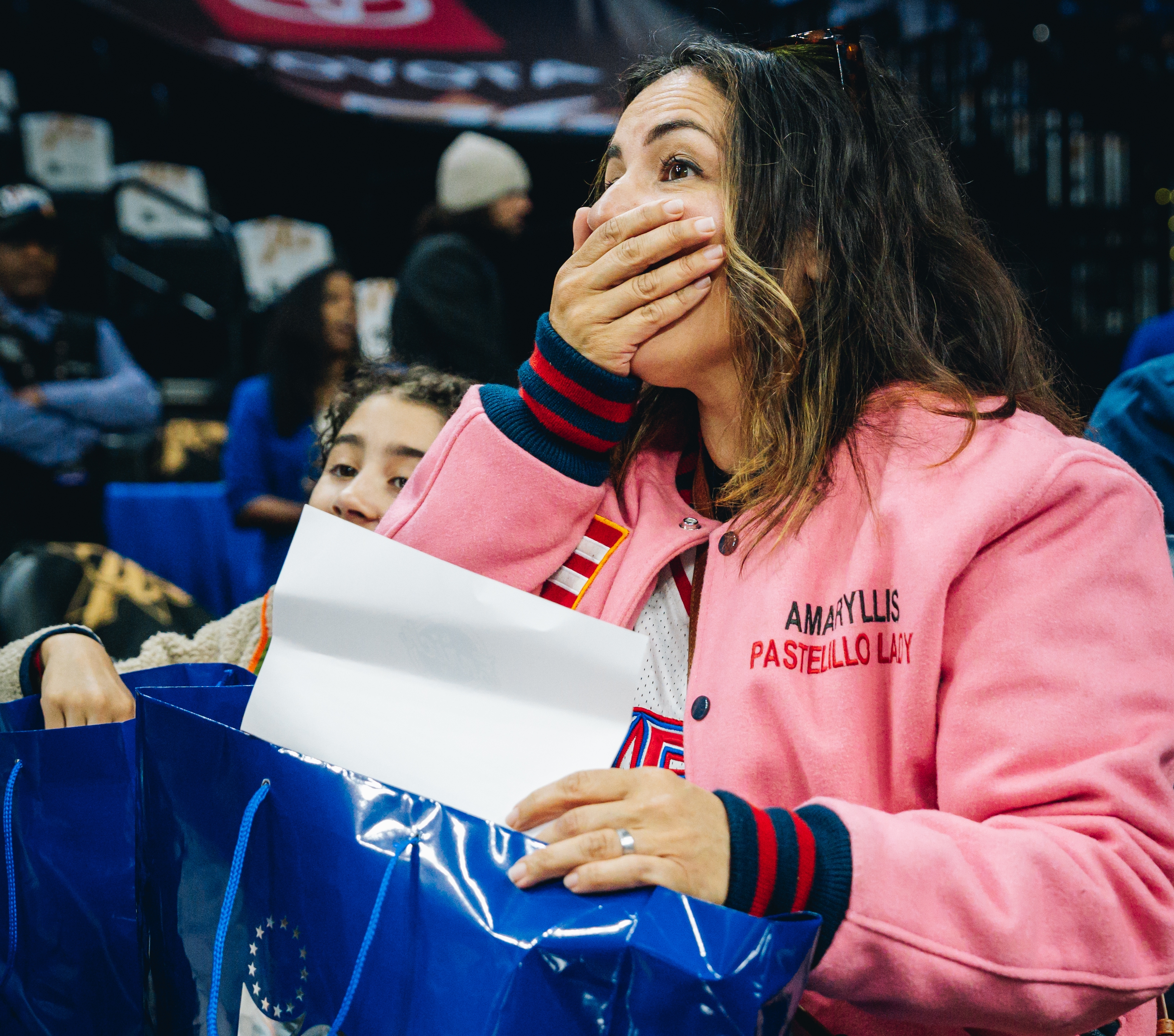
Amaryllis “Amy” Rivera-Nassar, owner of Amy’s Pastelillos, found out her business was an Enrich Program winner during Game 4 of the Sixers playoff series against the Boston Celtics at the Xfinity Mobile Arena.Courtesy Philadelphia 76ers
Bank of America and the Sixers started the Enrich Program during the 2020-21 basketball season as a way to uplift small, local, and underrepresented business owners in and around Philly. Previous winners include East Falls coffee shop Thunder Mug Cafe and the late Charisse McGill’s Lokal Artisan Foods, the brand behind the popular French toast bites stands previously located at Spruce Street Harbor Park and the Christmas Village.
The program is competitive: 175 businesses applied earlier this spring, a Sixers spokesperson said via email. After submitting an application detailing their growth plans, selected business owners must pitch Bank of America and Sixers executives. Enrich’s two other finalists, the Northern Liberties gift shop Laser Philly and the popular Kensington gelato shop Cloud Cups, also received $10,000 cash prizes.
“Amy’s story stood out to us,” the Sixers spokesperson said. “Her vision extends beyond the restaurant itself — she is passionate about creating a space where Philadelphians can experience and connect with Puerto Rican culture and community. That combination of entrepreneurial growth [and] cultural purpose … made Amy’s journey one we were excited to support.”
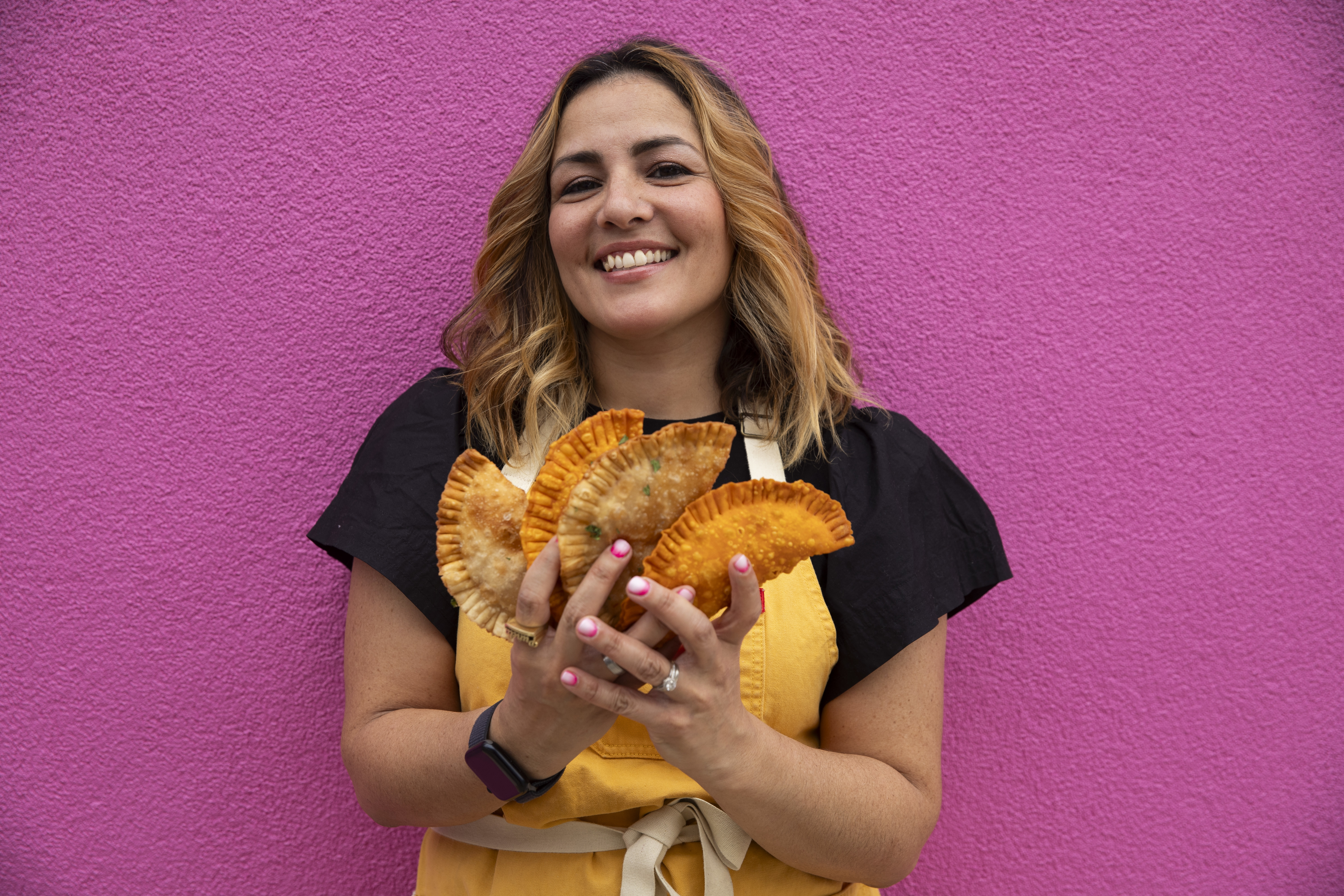
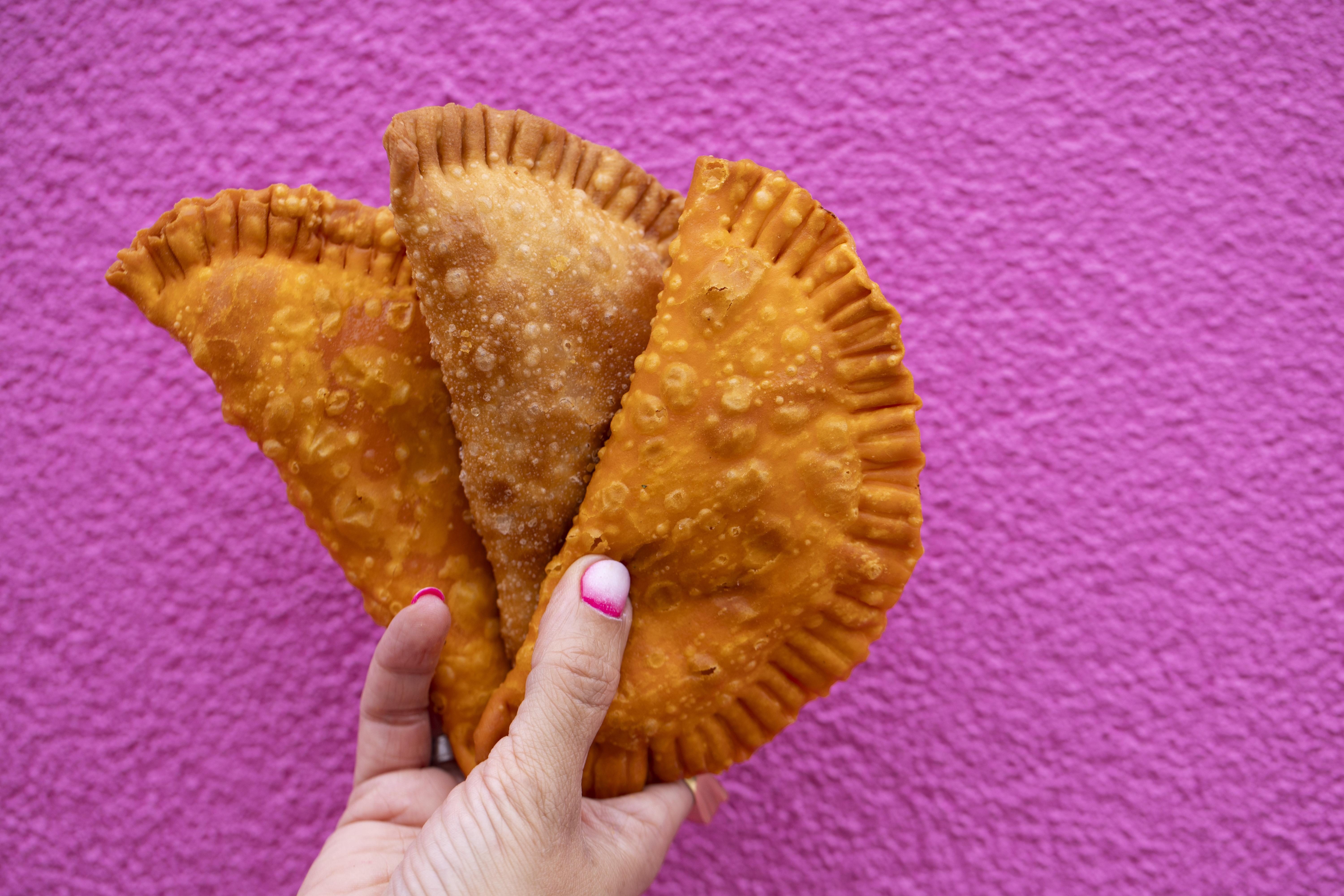
Amaryllis “Amy” Rivera-Nassar holds three pastelillos from the menu outside her restaurant, Amy’s Pastelillos. She estimates the storefront sells just under 2,000 Puerto Rican turnovers per week.Monica Herndon / Staff Photographer
“We did 700 pastelillos in two hours for just Super Bowl parties alone,” she said. “But the aftermath was super-exciting. A lot of people were like, ‘Oooh, Puerto Rican food’ and really wanted to explore the culture.”
Rivera-Nassar believes the support from Bank of America and the added visibility from the Sixers can help Amy’s expand to a larger off-site prep kitchen —even if she can’t bear to leave her bright pink storefront.
“I’m attached. It’s my baby,” she said,at the same time acknowledging that, space-wise,“we’ve hit our ceiling.”
Amaryllis “Amy” Rivera-Nassar works in the kitchen at Amy’s Pastelillos. Now an Enrich Program winner, Rivera-Nassar is hoping to expand to a larger, off-site prep facility.Monica Herndon / Staff Photographer
Rivera-Nassar is most excited to see her business’ name in lights inside the Xfinity Mobile Arena. She learned about winning the Enrich prize while sitting courtside with her 10-year-old daughter at Game 4 of the Sixers playoff series against the Boston Celtics.
“I was already overwhelmed by the fact that Tyrese Maxey and [V.J.] Edgecomb were right in front of us. And then the Sixers reps came out and congratulated me,” Rivera-Nassar said. “I was floored.”
“There never really was a Fishtown, government-wise. It was a localism,” explains Kenneth Milano, a Kensington-born historian and cofounder of the Kensington History Project. Perhaps this is why it’s hard to know exactly where Fishtown’s boundaries are.
“No one [in the old days] would ever call above York Street ‘Fishtown.’ That would have been sacrilege,” Milano said. “With the new folks, they don’t know. The [real estate agent] told them.”
story continues after advertisement
Decades of gentrification in the River Wards have blurred the lines as developers tagged their properties with the coveted Fishtown brand, even as they ventured into what were generally defined as sections of Kensington. (And which Kensington? East Kensington? Olde Kensington? South Kensington? How about Norris Square? And Olde Richmond? And Port Richmond?)
The argument is about more than what to call a few blocks: A neighborhood name can shape a place’s identity, its perceived desirability, and even how it is marketed and valued.
Click anywhere on the map to start drawing your Fishtown boundary
Milano said parish boundaries originally helped reinforce neighborhood identity. Milano, 67, has lived on York Street since age 5 and described the conventional Fishtown as a triangle bounded by Norris, Frankford, and the Delaware River.
The Inquirer’s map of neighborhoods agrees with Milano — although it’s worth mentioning that this map, used internally to help our reporting stay consistent, was created in the 1980s. The Milano-Inquirer definition is definitely conservative when compared to more recent attempts to set boundaries.
By contrast, Zillow’s Fishtown is nearly twice the size. The real estate website includes not only Front Street to the west, but also goes as far north as Lehigh Avenue.
Zillow maintains its own set of neighborhood boundaries “by reviewing sources such as city maps, the Census Bureau, and neighborhood associations,” Zillow spokesperson Briahna Healy said.
There’s some overlap between Zillow’s boundaries and the 19125 zip code. While residents might feel a strong attachment to the last five digits of their address, zip codes exist solely to help route mail. This makes it hard to use 19125’s scraggly borders to define Fishtown — especially when sections that reach that far north are Kensington by any definition.
Somewhere in the middle is the Fishtown Neighbors Association border — sticking with Front Street to the west but extending only as far as York Street to the north. These boundaries “go back about 20 years when FNA was a community organization that needed boundaries to help dictate what projects to work on,” said John Scott, current president of the FNA.
Their boundaries are a single piece in a jigsaw puzzle with surrounding neighboring associations. It explains why some streets are included and others aren’t. For example, the area between Front Street and Frankford Avenue is included because “if we didn’t include them, they would probably be stateless,” Scott said.
This also means that a lot of boundaries are largely codified because the FNA can’t expand without encroaching on neighboring associations — unless, that is, new streets are built, like those in the Northbank development on the Delaware. Now the FNA is about to adjust its boundaries for the first time in a quarter-century to encompass streets south of Schirra Lane.
If we look at all of these definitions at the same time, there is a clear overlap that we can safely call Fishtown.
However, much of the fringe is up for debate. Does Fishtown stop at Front or Frankford, for example? Is York the border, or is it Norris, or even Lehigh?
It’s time for some good, old-fashioned, boots-on-the-ground reporting.
A defining feature of Fishtown are the whimsical fish signs on house facades. Our theory: Surely a painted fish wouldn’t make sense in Kensington. We hit the streets and logged every house that had a fish sign.
Largely, the signs are contained to the FNA-defined borders. But we found a large pocket of signs east of York Street and even a few signs north of Frankford — although they are outnumbered by milk bottle signs to honor Kensington’s old Harbisons Dairy plant.
Fish signs are only one way to delineate Fishtown boundaries. We also looked at restaurants and what neighborhood they describe themselves as belonging to: Fishtown, Kensington, or unsure.
Fishtown has been known for its dining scene since Johnny Brenda’s established the beachhead in 2003. As development marched on, restaurateurs and dining guides followed the cue of developers and real estate agents: We’re in Fishtown.
Today, that’s not entirely the case, as even upscale restaurants are comfortable calling themselves Kensington, though they could claim Fishtown. At Fiore, chefs Ed Crochet and Justine MacNeil use East Kensington for their Italian restaurant north of the York Street roundabout. Directly across is Emilia, chef Greg Vernick’s popular new Italian spot, which doesn’t state its neighborhood in its marketing materials. Resy, its reservation booking platform, calls it Fishtown-East Kensington.
Seemingly everyone says Middle Child Clubhouse is in “Fishtown.” But by dint of its location on the west side of Front Street, it’s arguably in South/Olde Kensington. Yuhiro, a sushi restaurant on Susquehanna Avenue just west of Frankford, markets itself as Fishtown but it could be considered in Kensington.
Then there are the restaurants where it’s even more unclear because they list multiple neighborhoods, or none at all. For example, Picnic, on Martha Street, uses East Kensington in its Instagram bio but has used Fishtown in public relations campaigns. Where is Meetinghouse, a noted bar at Memphis and Cumberland Streets? Chef/co-owner Drew DiTomo thought for a moment: “Its parish is St. Anne’s and I quite like that.”
Finally, we decided to ask people in the gray areas a simple question: “Where are we?”
We found Matt Murphy and Kaitlin Dirkx at Hagert and Tulip Streets — south of Lehigh, north of York, still in 19125. “It’s kind of a curious pocket of the River Wards,” said Murphy, who emphatically called the area “Olde Richmond.” But, as Dirkx added, “they let me into the Fishtown Neighbors Facebook group. My address must have fallen in line.”
Mark Opdyke, who lives on a side street just west of Frankford Avenue near Norris, insisted that his side of Blair Street is in Fishtown. He pointed across the street toward the Blair Garden townhouses, built in 2018 and sold as “Fishtown,” chuckled, and called that side “Kensington.”
At Frankford and Dauphin, Nick Campione’s family has owned AC Auto Repairs for 70 years. Its facade boasts a mural proclaiming, “Welcome to the Neighborhood” with an inscription explicitly describing it as “Fishtown and East Kensington.” Campione won’t take sides: “This is the best of both worlds here.”
Finally, we caught up with Stephanie Goodman and Justin Frye on the west side of Frankford Avenue near Dauphin, in front of the Groove Hound, a doggie day care. Goodman called that stretch Fishtown, adding that it’s two blocks from the house she bought in 2018 across from Philadelphia Brewing Co., which proudly says it belongs to East Kensington. Though Goodman said the real estate agent advertised her block as Fishtown, Frye believes it’s in East Kensington. “Ten different people and 10 different answers,” he said.
So it’s now time for you to decide. Let us know where you think the boundaries of Fishtown are by drawing on the map.
Thanks for drawing your boundaries. Please reach out to interactives@inquirer.com and let us know why you believe these are the boundaries of Fishtown.
This is where the average reader submission currently lays.
Staff Contributors
Design, Development, and Reporting: Sam Morris
Reporting: Michael Klein
Sign Auditors: Sam Morris and Jasen Lo
Illustration: James Olstein
Editing: Charmaine Runes
Copy Editing: Brian Leighton
story continues after advertisement
Subscribe to The Philadelphia Inquirer
Our reporting is directly supported by reader subscriptions. If you want more journalism like this story, please subscribe today
// used for lite color theming and debug buttons only
$colors: (
“purple”: $color-purple,
“pink”: $color-pink,
“red”: $color-red,
“orange”: $color-orange,
“yellow”: $color-yellow,
“green”: $color-green,
“teal”: $color-teal,
“light-gray”: $color-light-gray,
“light-blue”: $color-light-blue,
“blue”: $color-blue,
“black”: $color-black,
“white”: $color-white
);
`;var Wn=tr();var Y=(i=null)=>{let u=Kt.split(`
`),r={};return u.forEach(e=>{let o=e.trim().match(/^$color-([w-]+):s*([^;]+);/);if(o){let s=o[1],n=o[2];r[s]=n}}),i&&r[i]?r[i]:r};var rr=(i,u=null,r=null)=>{r||(r=document.querySelector(“head”));let e=document.createElement(“script”);e.type=”text/javascript”,e.src=i,u&&(e.onload=u),r.appendChild(e)},Ve=()=>(window.PMNdataLayer?.[0]!==void 0&&window.PMNdataLayer[0])?.analytics?.user?.state===”Subscribed”,je=()=>{let u=(window.PMNdataLayer?.[0]!==void 0&&window.PMNdataLayer[0])?.analytics?.user?.state;return window.location.host.includes(“zzz-systest”)||window.location.host.includes(“pmn.arcpublishing.com”)||window.location.host.includes(“stage.fusion.inquirer.com”)||typeof u>”u”},or=()=>{let u=(window.PMNdataLayer?.[0]!==void 0&&window.PMNdataLayer[0])?.analytics?.user?.hasAdsFreeReading;return!!(u&&u==1)},Ae=()=>window.location.host.includes(“localhost”);var To=i=>{(i&&i.querySelector(“.js-loading”))?.setAttribute(“data-state”,”ready”)},Bo=i=>{(i&&i.querySelector(“.js-loading”))?.setAttribute(“data-state”,”loading”)},bo=(i,u)=>{(i&&i.querySelector(“.js-loading”))?.setAttribute(“data-state”,”error”),u&&targetModalErrorEl&&(targetModalErrorEl.textContent=u)},We={stop:i=>To(i),start:i=>Bo(i),error:(i,u)=>bo(i,u)};var ce=document.querySelector(“.js-map-tooltip”),Eo=()=>{ce.classList.remove(“is-hidden”)},Io=()=>{ce.classList.add(“is-hidden”)},ko=(i,u)=>{i&&u&&matchMedia(“(pointer:fine)”).matches?(ce.style.top=i+”px”,ce.style.left=u+”px”):(ce.style.top=””,ce.style.left=””)},Do=(i,u)=>{i==”pre”?ce.textContent=”Click to place the first point”:i==”mid”&&(u{window.addEventListener(“resize”,()=>{ct&&setTimeout(()=>{lr()},300)})},Vo=()=>{rr(“https://interactives.inquirer.com/storage/dependencies/maplibre/5.3.0/maplibre-gl.js”,()=>{let i=new zt;Le=window.maplibregl,Le.addProtocol(“pmtiles”,i.tile);let u=”https://interactives.inquirer.com/melish/1.3″,r=`${u}/north-america.pmtiles`,e=new Oe(r);i.add(e),e.getHeader().then(async()=>{let s=await(await fetch(`${u}/styles/neutral.json`)).json();R=new Le.Map({container:”map”,zoom:13,center:[-75.165222,39.952583],maxBounds:[[-128.362885,24.389629],[-58.886719,52.918839]],attributionControl:!1,interactive:!1,style:{…s,layers:[],sources:{openmaptiles:{type:”vector”,url:`pmtiles://${r}`}}}}),lr(),R.on(“load”,async()=>{for(let f of nr.features)Ko(f.properties.origin,f.geometry);Xo(),st(“people”,sr),st(“signs”,ar),st(“restaurants”,ir),Yo();let y=await(await fetch(“https://interactives.inquirer.com/lyon/2026-fishtown/average.json”)).json();Qo(“readers”,y);let a=R.getCanvas();We.stop(a.closest(“.js-map”)),ct=!0,pt&&ur(pt)}),document.querySelector(“.js-map”).addEventListener(“mousemove”,n=>{jo(n)}),document.querySelector(“.js-map”).addEventListener(“mouseout”,()=>{Wo()}),document.querySelector(“.js-map”).addEventListener(“click”,n=>{Go(n)})})})},lr=()=>{R.fitBounds([-75.14613425987851,39.95952387517457,-75.10908333009395,39.98791745377673],{duration:0})},jo=i=>{if(ve&&ie&&(ue.show(),ue.position(i.clientY,i.clientX),ie==”mid”)){let u=lt(i);xe.features[0].geometry.coordinates[1]=[u.lng,u.lat],R.getSource(“drawing-ghost”).setData(xe),R.setPaintProperty(“drawing-ghost”,”line-opacity”,.5)}},Wo=()=>{ue.hide()},No=()=>{let u=document.querySelector(“.js-map”).getBoundingClientRect().top;u{if(ve){if(ie==”pre”){let u=lt(i);Z.features[0].geometry.coordinates.push([u.lng,u.lat]),xe.features[0].geometry.coordinates[0]=[u.lng,u.lat],document.querySelector(“.js-map-start”).classList.remove(“is-hidden”),pr.setLngLat(u),document.querySelector(“.js-tool-buttons-reset”).disabled=!1,ie=”mid”}else if(ie==”mid”){let u=lt(i);Z.features[0].geometry.coordinates.push([u.lng,u.lat]),xe.features[0].geometry.coordinates[0]=[u.lng,u.lat]}i.target.classList.contains(“js-map-start”)&&Zo(),R.getSource(“drawing-user”).setData(Z),ue.update(ie,Z.features[0].geometry.coordinates.length),ue.show()}},Zo=()=>{ve=!1,ie=”end”;let i=Z.features[0].geometry.coordinates.length,u=Z.features[0].geometry.coordinates[0];Z.features[0].geometry.coordinates[i-1]=u,Z.features[0].geometry.type=”Polygon”,Z.features[0].geometry.coordinates=[Z.features[0].geometry.coordinates],R.getSource(“drawing-user”).setData(Z),R.setPaintProperty(“drawing-user-fill”,”fill-opacity”,.4),R.setPaintProperty(“drawing-ghost”,”line-opacity”,0),document.querySelector(“.js-map-start”).classList.add(“is-hidden”),document.querySelector(“.js-tool-buttons-submit”).disabled=!1},qo=()=>{ve=!0,ie=”pre”,ue.update(ie,0),Z.features[0].geometry.type=”LineString”,Z.features[0].geometry.coordinates=[],R.getSource(“drawing-user”).setData(Z),document.querySelector(“.js-tool-buttons-submit”).disabled=!0,R.setPaintProperty(“drawing-ghost”,”line-opacity”,0),R.setPaintProperty(“drawing-user-fill”,”fill-opacity”,0),document.querySelector(“.js-map-start”).classList.add(“is-hidden”)},lt=i=>{let u=document.querySelector(“.js-map”).getBoundingClientRect(),r=i.clientX-u.left,e=i.clientY-u.top;return R.unproject([r,e])},Jo=()=>{Jt.vote({coordinates:JSON.stringify(Z.features[0].geometry.coordinates[0])})},Ko=(i,u)=>{R.addSource(`boundary-${i}`,{type:”geojson”,data:u}),R.addLayer({id:`boundary-${i}-fill`,source:`boundary-${i}`,type:”fill”,paint:{“fill-color”:Y(“illo-red”),”fill-opacity”:0}}),R.addLayer({id:`boundary-${i}-line`,source:`boundary-${i}`,type:”line”,paint:{“line-color”:Y(“illo-red”),”line-width”:4,”line-opacity”:0}})},Qo=(i,u)=>{R.addSource(`drawing-${i}`,{type:”geojson”,data:u}),R.addLayer({id:`drawing-${i}-fill`,source:`drawing-${i}`,type:”fill”,paint:{“fill-color”:Y(“illo-yellow”),”fill-opacity”:0}}),R.addLayer({id:`drawing-${i}-line`,source:`drawing-${i}`,type:”line”,paint:{“line-color”:Y(“illo-yellow”),”line-width”:4,”line-opacity”:0}})},st=(i,u)=>{let r;window.innerWidth{let i=[{id:”tavern”,coordinates:[-75.13430336980068,39.9690688861316]},{id:”milk”,coordinates:[-75.13290465156766,39.98256059702009]},{id:”pier”,coordinates:[-75.11347715844,39.9714839528569]},{id:”wawa”,coordinates:[-75.11890594948434,39.977239248055895]},{id:”sulimays”,coordinates:[-75.12598489221865,39.971605275979115]},{id:”traffic”,coordinates:[-75.12754751235474,39.98145267435357]}];for(let u of i){let r=document.querySelector(`.js-map-icon[data-id=”${u.id}”]`);new Le.Marker({element:r}).setLngLat(u.coordinates).addTo(R)}},Xo=()=>{R.addSource(“roads”,{type:”geojson”,data:Ne}),R.addLayer({id:”roads”,source:”roads”,type:”symbol”,layout:{“symbol-placement”:”line-center”,”symbol-spacing”:100,”text-field”:”{name}”,”text-font”:[“grot10-regular”],”text-max-angle”:90,”text-pitch-alignment”:”viewport”,”text-rotation-alignment”:”map”,”text-size”:9,”text-transform”:”uppercase”},paint:{“text-color”:”#666″,”text-halo-color”:”#fff”,”text-halo-width”:2}}),cr()},_o=i=>{let u=Object.keys(R.getStyle().sources).filter(r=>r.includes(“boundary-“));for(let r of u){let e=r.includes(i)||i==”all”;R.setPaintProperty(`${r}-line`,”line-opacity”,e?1:0),R.setPaintProperty(`${r}-fill`,”fill-opacity”,e?.2:0)}},en=i=>{let u=Object.keys(R.getStyle().sources).filter(r=>r.includes(“drawing-“)&&!r.includes(“ghost”));for(let r of u){let e=r.includes(i);R.setPaintProperty(`${r}-line`,”line-opacity”,e?1:0),R.setPaintProperty(`${r}-fill`,”fill-opacity”,e?.2:0)}},tn=i=>{let u=Object.keys(R.getStyle().sources).filter(r=>r.includes(“points-“));for(let r of u){let e=r.includes(i);R.setPaintProperty(`${r}`,”circle-opacity”,e?1:0)}},rn=i=>{let u=document.querySelector(“.js-map”);i?u.classList.remove(“is-hiding-icons”):u.classList.add(“is-hiding-icons”)},cr=i=>{let u=JSON.parse(JSON.stringify(Ne.features));u=u.filter(r=>r.properties.defaultVisibility==”visible”),i&&(i=i.split(“,”).map(r=>r.trim()),i=Ne.features.filter(r=>i.includes(r.properties.name)),u=[…u,…i]),R.getSource(“roads”).setData({type:”FeatureCollection”,features:u})},ur=i=>{ct?(i={points:i?.points||null,boundary:i?.boundary||null,drawing:i?.drawing||null,icons:i?.icons||!1,roads:i?.roads||null},_o(i.boundary),en(i.drawing),tn(i.points),rn(i.icons),cr(i.roads)):pt=i},fe={init:()=>{Ho(),Vo()},update:i=>{ur(i)},startDrawing:()=>{ve=!0,ie=”pre”,No()},stopDrawing:()=>{ve=!1},resetDrawing:()=>{qo()},submitDrawing:()=>{Jo()}};var on=()=>{document.querySelector(“.js-tool-buttons-start”).addEventListener(“click”,()=>{pn()}),document.querySelectorAll(“.js-tool-buttons-skip”).forEach(i=>{i.addEventListener(“click”,()=>{fr(),sn(),yr()})}),document.querySelector(“.js-steps-step .js-tool-buttons”).addEventListener(“click”,()=>{nn()}),document.querySelector(“.js-tool-buttons-reset”).addEventListener(“click”,()=>{fe.resetDrawing()}),document.querySelector(“.js-tool-buttons-submit”).addEventListener(“click”,()=>{fe.submitDrawing(),fr(),an(),yr()})},nn=()=>{document.querySelector(“.js-steps-step .js-tool-buttons”).classList.add(“is-hidden”),document.querySelectorAll(“.js-steps-step .js-button”).forEach(i=>{i.disabled=!0})},fr=()=>{document.querySelectorAll(“.js-steps-step.is-hidden”).forEach(i=>{i.classList.remove(“is-hidden”)})},an=()=>{let i=document.querySelector(“.js-tool-buttons-start”).closest(“.js-steps-step”).querySelector(“.inno-p”);i.innerHTML=”This is where you think Fishtown’s borders are.”},sn=()=>{let i=document.querySelector(“.js-steps-step .js-tool-buttons”).closest(“.js-steps-step”),u=parseInt(i.dataset.step),r=document.querySelector(`.js-steps-step[data-step=”${u+1}”]`);r&&r.scrollIntoView({block:”center”})},pn=()=>{document.querySelector(“body”).classList.add(“is-tool-mode”),fe.startDrawing()},yr=()=>{document.querySelector(“body”).classList.remove(“is-tool-mode”),fe.stopDrawing()},mr={init:()=>{on()}};var ln=()=>{or()&&document.querySelectorAll(“.js-adbox”).forEach(u=>{u.classList.add(“is-hidden”)})},dr={init:()=>{ln()}};var me,gr,cn=()=>{me=document.getElementById(“js-inno-toast”)},un=i=>{if(!me)return;me.innerHTML=i,me.classList.add(“is-active”);let u=()=>{me.addEventListener(“transitionend”,fn,{once:!0}),me.classList.remove(“is-active”)};clearTimeout(gr),gr=setTimeout(u,5e3)},fn=()=>{me.innerHTML=””},de={init:()=>{cn()},showToast:un};var Ge,hr=!1,yn=async()=>new Promise(i=>{setTimeout(()=>{console.log(“simulating createShareLink for localhost”),i(“https://inquirer.com/interactives”),mn()},100)}),mn=()=>{let i=document.querySelector(“.js-gift-toast-receiver”);!i||!(i instanceof HTMLElement)||setTimeout(()=>{let u=i?.querySelector(“span”);u&&(u.innerHTML=”Gift link copied to clipboard“)},20)},dn=()=>{let i=window.services?.createShareLink;i&&(Ge=i),Ae()&&(Ge=yn),Ge&&hn()},gn=async i=>{let u=”text/plain”,r=async()=>{try{return await Ge(window.location.pathname)}catch{i.dataset.state=”error”,de.showToast(“Hmm, we couldn’t generate a gift link…”)}},e=new ClipboardItem({[u]:r()});await navigator.clipboard.write([e]).catch(o=>{console.log(o),de.showToast(“Couldn’t copy to clipboard, try again?”),i.dataset.state=”error”}),de.showToast(“Gift link copied to clipboard!”),i.dataset.state=”complete”},hn=()=>{document.querySelectorAll(“.js-gift”).forEach(u=>{(Ve()||Ae()||je())&&u.classList.add(“is-available”)}),document.querySelectorAll(“.js-gift-button”).forEach(u=>{u instanceof HTMLButtonElement&&u.addEventListener(“click”,()=>{u.classList.contains(“disabled”)||(u.dataset.state=”loading”,hr=!0,gn(u),setTimeout(()=>{u.dataset.state=”ready”},2e3))})});let i=document.querySelector(“.js-gift-toast-receiver”);!i||!(i instanceof HTMLElement)||vn(i)},vn=i=>{new MutationObserver(r=>{for(let e of r){let o=[…e.addedNodes].at(0);if(!(o instanceof HTMLElement))return;hr&&de.showToast(o.outerHTML)}}).observe(i,{subtree:!0,childList:!0})},vr={init:()=>{dn()}};var Te,xn=()=>{document.querySelectorAll(“.js-hover”).forEach(i=>{i.addEventListener(“click”,()=>{xr(i)}),i.addEventListener(“mouseenter”,()=>{xr(i)}),i.addEventListener(“mouseout”,()=>{Pr(i)})}),window.addEventListener(“scroll”,()=>{Te!==null&&Pn()})},Pn=()=>{(Te>window.scrollY+100||Te{Pr(i)})},xr=i=>{i.classList.add(“is-visible”),Te=window.scrollY},Pr=i=>{i.classList.remove(“is-visible”),Te=null},wr={init:()=>{xn()}};var Fr=1,ut=class{constructor(u){this.el=u,this.contentPosition=”default”,this.possibleSteps=new Array,this.currentStep=null,this.currentStepEl=null,this.offset=window.innerWidth>960?window.innerHeight*.6:window.innerHeight*.9,this.instanceOfSteps=Fr,Fr++,this.setPossibleSteps(),this.updateContent(),this.bindings()}setPossibleSteps(){this.el.querySelectorAll(“.js-steps-step”).forEach(u=>{u.dataset.step&&this.possibleSteps.push(u.dataset.step)})}bindings(){window.addEventListener(“scroll”,()=>{this.updateContent()}),window.addEventListener(“resize”,()=>{this.updateContent()})}updateContent(){this.updateCurrentStep()}updateCurrentStep(){let u;if(this.el.querySelectorAll(“.js-steps-step”).forEach((e,o)=>{e.getBoundingClientRect().top{let n=”is-“+o,y=”is-“+s;this.possibleSteps.indexOf(o){document.querySelectorAll(“.js-steps”).forEach(i=>{new ut(i)})}};var wn=(i,u,r)=>{document.querySelectorAll(“.js-subscribe”).forEach(e=>{e.classList.toggle(“is-unsubscribed”,!i),e.classList.toggle(“is-preview”,u),e.classList.toggle(“is-dev”,r)})},Cr={init:()=>{wn(Ve(),je(),Ae())}};var Fn=()=>{},Mr={init:()=>{Fn()}};var Ar={init:()=>{Mt.init?.(),mr.init?.(),dr.init?.(),vr.init?.(),wr.init?.(),We.init?.(),fe.init?.(),Sr.init?.(),Cr.init?.(),Mr.init?.(),de.init?.()}};var Sn=()=>{},Lr={init:()=>{Sn()}};var Cn=document.querySelector(“.js-inno”),Tr=()=>{Ar.init(),Lr.init()};Cn?Tr():new MutationObserver((u,r)=>{if(document.querySelector(“.js-inno”)){r.disconnect(),Tr();return}}).observe(document,{attributes:!0,childList:!0,subtree:!0});})();
/*! Bundled license information:
matter-js/build/matter.js:
(*!
* matter-js 0.20.0 by @liabru
* http://brm.io/matter-js/
* License MIT
*
* The MIT License (MIT)
*
* Copyright (c) Liam Brummitt and contributors.
*
* Permission is hereby granted, free of charge, to any person obtaining a copy
* of this software and associated documentation files (the “Software”), to deal
* in the Software without restriction, including without limitation the rights
* to use, copy, modify, merge, publish, distribute, sublicense, and/or sell
* copies of the Software, and to permit persons to whom the Software is
* furnished to do so, subject to the following conditions:
*
* The above copyright notice and this permission notice shall be included in
* all copies or substantial portions of the Software.
*
* THE SOFTWARE IS PROVIDED “AS IS”, WITHOUT WARRANTY OF ANY KIND, EXPRESS OR
* IMPLIED, INCLUDING BUT NOT LIMITED TO THE WARRANTIES OF MERCHANTABILITY,
* FITNESS FOR A PARTICULAR PURPOSE AND NONINFRINGEMENT. IN NO EVENT SHALL THE
* AUTHORS OR COPYRIGHT HOLDERS BE LIABLE FOR ANY CLAIM, DAMAGES OR OTHER
* LIABILITY, WHETHER IN AN ACTION OF CONTRACT, TORT OR OTHERWISE, ARISING FROM,
* OUT OF OR IN CONNECTION WITH THE SOFTWARE OR THE USE OR OTHER DEALINGS IN
* THE SOFTWARE.
*)
*/