I was chatting with a friend recently whom I’ve known for a long time when she used the term woke as if it meant something disgusting.
I was so stunned that I didn’t bother trying to correct her. But I hung up the phone thinking about how the concept has become a political football, with even some Dems kicking it around.
African Americans created this vernacular. It preexisted MAGA’s hijacking of it by decades, dating back to the days of civil rights activist Marcus Garvey, founder of the Universal Negro Improvement Association. It has long been a part of pop culture, showing up in musical performances by everyone from Depression-era blues singer Lead Belly to Erykah Badu in her 2008 song, “Master Teacher.”
I first heard it during the early 1990s. Back then, if someone said, “You’re not woke,” it was considered the ultimate insult, right up there with being an Uncle Tom — or worse. Being woke refers to being alert to racial transgressions. The opposite of woke is to be asleep, and therefore oblivious to systemic racism and injustice.
No matter how President Donald Trump and Secretary of Defense Pete Hegseth attempt to vilify the term, I stand by the notion that being woke is a good thing. As in the exhortation, “Stay woke, brother.”
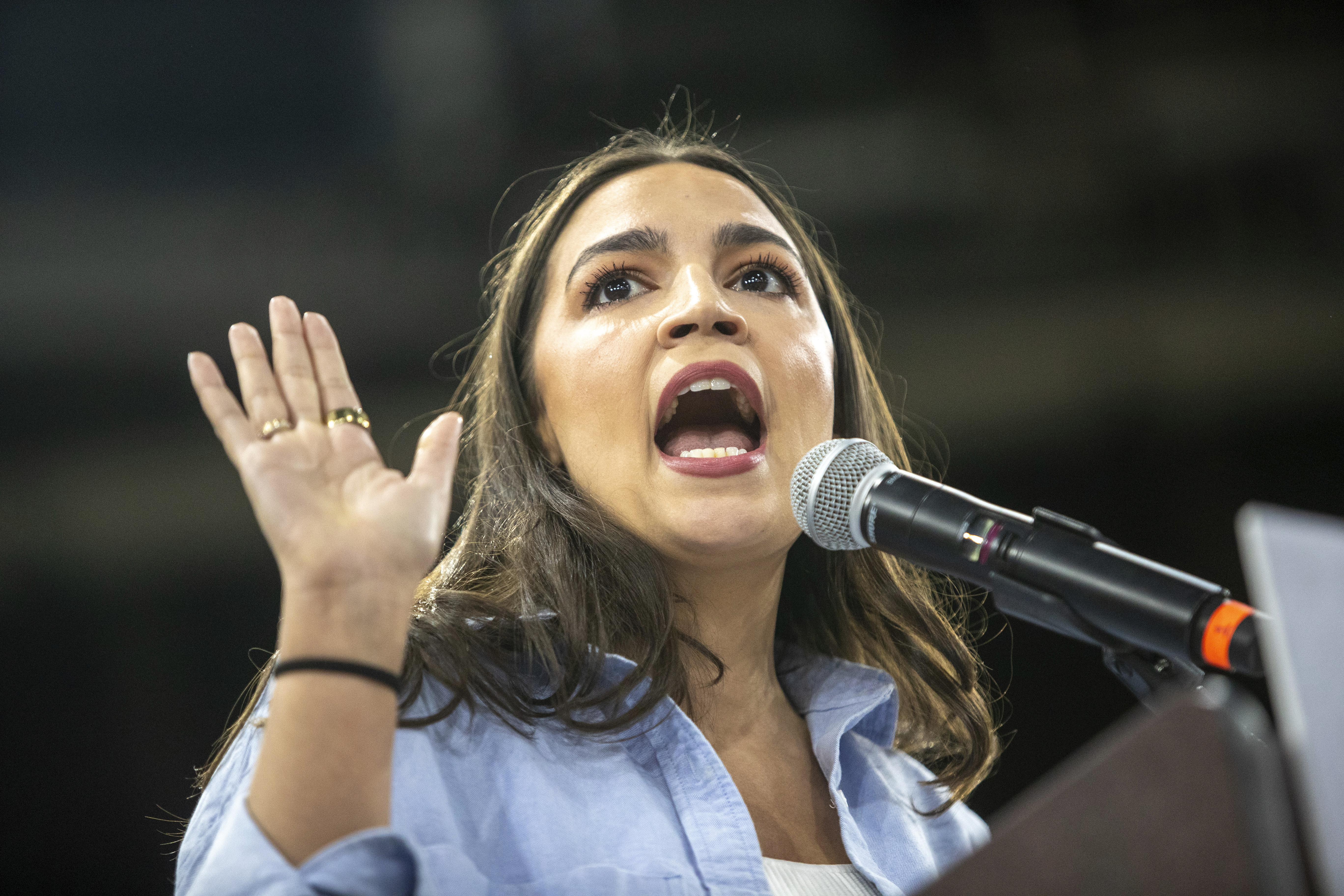
It’s galling to watch politicians bastardize it. U.S. Rep. Alexandria Ocasio-Cortez recently brought it up during an ABC News interview when she said, “I have a local city councilman that has this saying: ‘Woke 1 was crazy.’”
She was talking about Francesca Hong, a progressive candidate running for governor of Wisconsin with a history of making radical statements, and was also quoting New York City council member Chi Ossé, who used the “woke 1” term on social media. I get that Ocasio-Cortez was referring to far-left calls to defund the police — which most Black people never fully supported — among other extremist ideas. But her words still stung.
I have an awful lot of respect for Ocasio-Cortez. I recognize she may be weighing a run for the presidency in 2028 and trying to center herself politically. But this kind of virtue signaling won’t be as beneficial as she hopes if it also alienates African Americans.
M.K. Asante said that “the idea of staying woke became associated with consciousness,” but that the meaning of the term has changed after being co-opted by the mainstream.
For insight, I reached out to M.K. Asante, a professor at Morgan State University whose father is Molefi Kete Asante, a renowned professor of Africology at Temple University. “The idea of staying woke became associated with consciousness,” Asante told me, but added that the term was co-opted around 2020 following the widespread uprisings after the murder of George Floyd by a police officer.
Asante pointed out, “Now it does not have the same meaning in the mainstream.”
He declared an all-out war on diversity, equity, and inclusion efforts in both federal and private sectors, and hasalso taken aim at museums he says are “essentially, the last remaining segment of ‘WOKE.’” Trump also has cut funding from key government programs that support DEI.
Even the military hasn’t been immune. Trump summarily dismissed Air Force Gen. Charles Q. Brown Jr., who was the second Black person to serve as chairman of the Joint Chiefs of Staff, and set about renaming military bases after Confederate generals.
Earlier this year, Pentagon spokesperson Sean Parnell announced on X that officials were targeting Stars and Stripes, an independent newspaper that covers the military, in part to “refocus its content away from woke distractions that syphon morale.” Since then, the paper’s publisher, editor-in-chief, and a reporter have all been terminated, ending 155 years of editorial freedom, as my colleague Will Bunch reported.
Meanwhile, the United States is at war with Iran, Canada, our closest ally, has announced retaliatory tariffs on U.S. products, and American consumers are wondering if the influx of tariff-free foreign beef imports Trump is pushingwill be safe to consume.
Yet, Trump says woke is the enemy.
Despite the president’s best efforts, he can’t stamp the term or its real meaning out.
As Asante pointed out, “You can co-opt a word, but the spirit of what ‘stay woke’ means is alive and well.”
There were two noticeable no-shows as Western leaders gathered Monday to mark the 35th anniversary of Ukraine’s independence — and its five years of resistance to Vladimir Putin’s effort to re-subjugate the country to Russian rule.
There were multiple news reports that President Donald Trump’s clueless peace envoys — son-in-law Jared Kushner and real estate magnate Steve Witkoff — might finally join European allies at anniversary ceremonies.
I say “finally” because neither of these supposed peacemakers has ever deigned to visit Ukraine. Not once. Meantime, Witkoff has visited Moscow eight times, and gushed over Putin as he and Kushner (also a repeat visitor) discussed business deals with Russia.
It is no surprise, then, that Trump’s blinkered envoys postponed their trip, reportedly blaming their absence on intensified Russian missile and drone strikes. Never mind that former Vice President Mike Pence, British Prime Minister Andy Burnham, and other European leaders showed up.
They recognized — as Trump and his envoys still do not — that Ukraine is fighting not just for its own freedom, but for the security of Europe and the United States.
Burnham, who came to Kyiv on his first foreign trip as prime minister, understands the significance of Ukraine’s brave stand against the world’s second-largest army. A Russian military that is heavily aided by the dictators of China, North Korea, and Iran, all eager to undermine America and the democracies of the West.
The U.K. leader rightly compared Ukraine’s resistance against Russian imperialism to Britain’s fight against Nazi Germany in the 1940s, telling Ukrainians, “My nation kept the flame of European freedom alive in the 20th century; you hold that flame in the 21st.”
Burnham is right on the mark.
Ukraine’s President Volodymyr Zelensky hands over the flag of a military unit during the ceremony to mark Ukraine Independence Day in Kyiv, Ukraine, Monday.Efrem Lukatsky
The image of London firefighters bravely battling the blazes caused by the German Blitz, which rained rockets down on civilians in order to break their morale, comes right to mind when watching video of Ukrainian rescue workers pulling women and children out of the rubble of collapsed apartment towers that have been hit with Russian missiles or drones.
Then-Prime Minister Winston Churchill understood that if Britain fell, the Nazis would take over Europe. The Battle of Britain in the summer and fall of 1940, in which incredibly courageous Royal Air Force pilots pushed back the Luftwaffe, forced Adolf Hitler to abandon his planned invasion of England. The courage and spirit of Britons under bombing gave the RAF the time to regroup and attack the Nazis in Europe. It gave President Franklin D. Roosevelt time to act on sending Lend-Lease war supplies to Britain.
Burnham grasps that Putin is a stalking horse for an axis of adversaries – namely China, North Korea and Iran – that backs and finances Russia’s crimes.
Ukraine’s battle of the skies is effectively the first round of World War III. And only one weapon can take down the ballistic missiles Russia is pouring down on Ukraine’s civilian infrastructure: U.S.-made Patriot interceptors.
Yet, Trump has wasted much of America’s Patriot missile stock chasing cheap Iranian drones, and refuses to sell Kyiv a small percentage of what the U.S. retains. And after proposing joint production of Patriots with Ukrainian President Volodymyr Zelensky, the U.S. president immediately backed off.
That is why Burnham announced Monday that the U.K. (along with France) will help Ukraine make its own version of a Anglo/French long-range cruise missile by sharing classified technical information. That will help Ukraine preempt Russian missiles by eliminating the firing sites.
But setting up that production line will take months or years, and Ukraine desperately needs Patriots now.
Ukraine’s President Volodymyr Zelensky (left) hands over the Ukraine state award to European Council President António Costa during a commemorative ceremony in Kyiv, Ukraine, Monday, marking Ukraine’s 35th Independence Day.Efrem Lukatsky
It is hard for many Americans to grasp how important Ukraine’s survival is to our future security. Few U.S. politicians consider Ukraine to be a critical campaign issue. Trump has communicated his disdain for Kyiv to his MAGA followers, and Vice President JD Vance boasts that his proudest moment was helping cut off aid to Ukraine. As for Democrats, they’d rather focus on cost of living and the endless Iran war.
But Gen. Ben Hodges, former commander of U.S. Army Europe, nailed it when he told me recently that what’s been missing from the lack of U.S. attention “is the recognition that it’s in the U.S. interest for Ukraine to be successful.” President Joe Biden was too timid, he noted, and Trump is worse.
America’s enemies are taking full notice.
China is watching and learning from the drone, robot, and electronic warfare being fought in Ukraine, while sharing dual-use weapon parts and technology with Moscow. Every lesson is being fed into the hopper of Xi Jinping’s massive agglomeration of data used for prep to take back Taiwan and dominate South and East Asian neighbors and territorial waters.
North Korea is earning hard currency by sending troops and missiles to aid Russia’s war on Ukraine. In return, it is accessing Russian technology to build up its nuclear arsenal. Iran sends Shahed drones to Russia and learns from Russian upgrades of those drones, which helps Tehran attack U.S. bases and threaten Gulf Arab states in the Middle East.
Meantime, Trump is focused on his White House ballroom, car races, and starting a trade war with Canada, while Kushner and Witkoff chicken out of visiting Kyiv. They have no clue that the fate of the Ukraine war will overshadow everything they now think is important.
Their trips to Moscow are feckless unless they recognize that Putin has no interest in peace. Any “peace process” is dead (irrespective of CIA Director John Radcliffe’s secret visit to Moscow last weekend) until the United States recognizes reality and joins Europeans in squeezing Putin until he fears the war is endangering his survival.
I believe Ukraine will hold out via its tech brilliance and innovation, and its people’s determination not to surrender to the brutal domination of Russia. But the United States will pay a dear price for failing to step up when it could have blocked Putin and his allies — before their war on the West got much, much worse.
Two years ago, every child in the kindergarten class at Eleanor Emlen Elementary in Mount Airy had vaccine protection against measles.
A year later, the school’s kindergarten immunization rate had dropped to just 80%, putting students and the surrounding community at risk of an outbreak of the highly contagious disease.
Emlen is among more than two dozen Philadelphia-area schools that saw double-digit declines in kindergarten immunization rates last school year — in many cases because parents are increasingly refusing vaccines.
The affected schools span a diverse range of communities, from city neighborhoods like Mount Airy to the outlying suburbs. In Chester County, for example, a small private school in Downingtown saw its vaccination rates plunge by 20%.
Even as countywide immunization levels remain relatively high, some 40% of kindergarten classrooms across the region became vulnerable to an outbreak during the 2025-26 school year, up from 33% the year prior, an Inquirer analysis of newly released state data found.
(function(){function e(){window.addEventListener(`message`,function(e){if(e.data[`datawrapper-height`]!==void 0){var t=document.querySelectorAll(`iframe`);for(var n in e.data[`datawrapper-height`])for(var r=0,i;i=t[r];r++)if(i.contentWindow===e.source){var a=e.data[`datawrapper-height`][n]+`px`;i.style.height=a}}})}e()})();
That means that at least 249 schools had vaccination rates below 95%, the level at which scientists say a population must be vaccinated to prevent the spread of measles, one of the most contagious diseases.
Of these, 98 Philadelphia-area schools reported measles vaccination rates below 90%, presenting an even greater risk to students.
A sharp increase in parents opting out of vaccination for religious or philosophical reasons continued to drive down vaccination rates; exemptions in this category rose by 15% in the latest two years for which data are available.
(function(){function e(){window.addEventListener(`message`,function(e){if(e.data[`datawrapper-height`]!==void 0){var t=document.querySelectorAll(`iframe`);for(var n in e.data[`datawrapper-height`])for(var r=0,i;i=t[r];r++)if(i.contentWindow===e.source){var a=e.data[`datawrapper-height`][n]+`px`;i.style.height=a}}})}e()})();
Pennsylvania is among a handful of states that allows parents to opt out of vaccine requirements for philosophical or religious reasons, often by simply signing a form.
The health department published more granular, school-level vaccination data this summer for the first time, after reporting by The Inquirer and the Pittsburgh Post Gazette made this information public for the prior school year, exposing pockets of vulnerability within counties with overall high vaccination.
The new data show the growing public health threat to the region from Pennsylvania’s growing measles outbreak, in which two people in Lancaster County have died, state officials reported Tuesday. They were the state’s first measles-related deaths in three decades.
(function(){function e(){window.addEventListener(`message`,function(e){if(e.data[`datawrapper-height`]!==void 0){var t=document.querySelectorAll(`iframe`);for(var n in e.data[`datawrapper-height`])for(var r=0,i;i=t[r];r++)if(i.contentWindow===e.source){var a=e.data[`datawrapper-height`][n]+`px`;i.style.height=a}}})}e()})();
So far, nearly 400 cases have been diagnosed, with nearly half in Lancaster County. The rapidly spreading outbreak is edging closer to densely populated Philadelphia. Chester County, just west of the city, has reported the second-highest number of cases in the state.
At a news conference on the measles deaths Tuesday, Gov. Josh Shapiro stressed his concern about the rise in Pennsylvania parents opting out of vaccinations over the last 10 years.
“It has dramatically reduced community immunity in different areas of our Commonwealth,” he said. “Today, we see the consequences of a lack of immunization.”
The new school-level data on vaccines, he said, allow “everyone to see their school’s vaccination coverage and make informed decisions.” Lawmakers have also said they hope that having more access to data about their children’s schools will make families more aware of risks within their communities and encourage them to vaccinate their children.
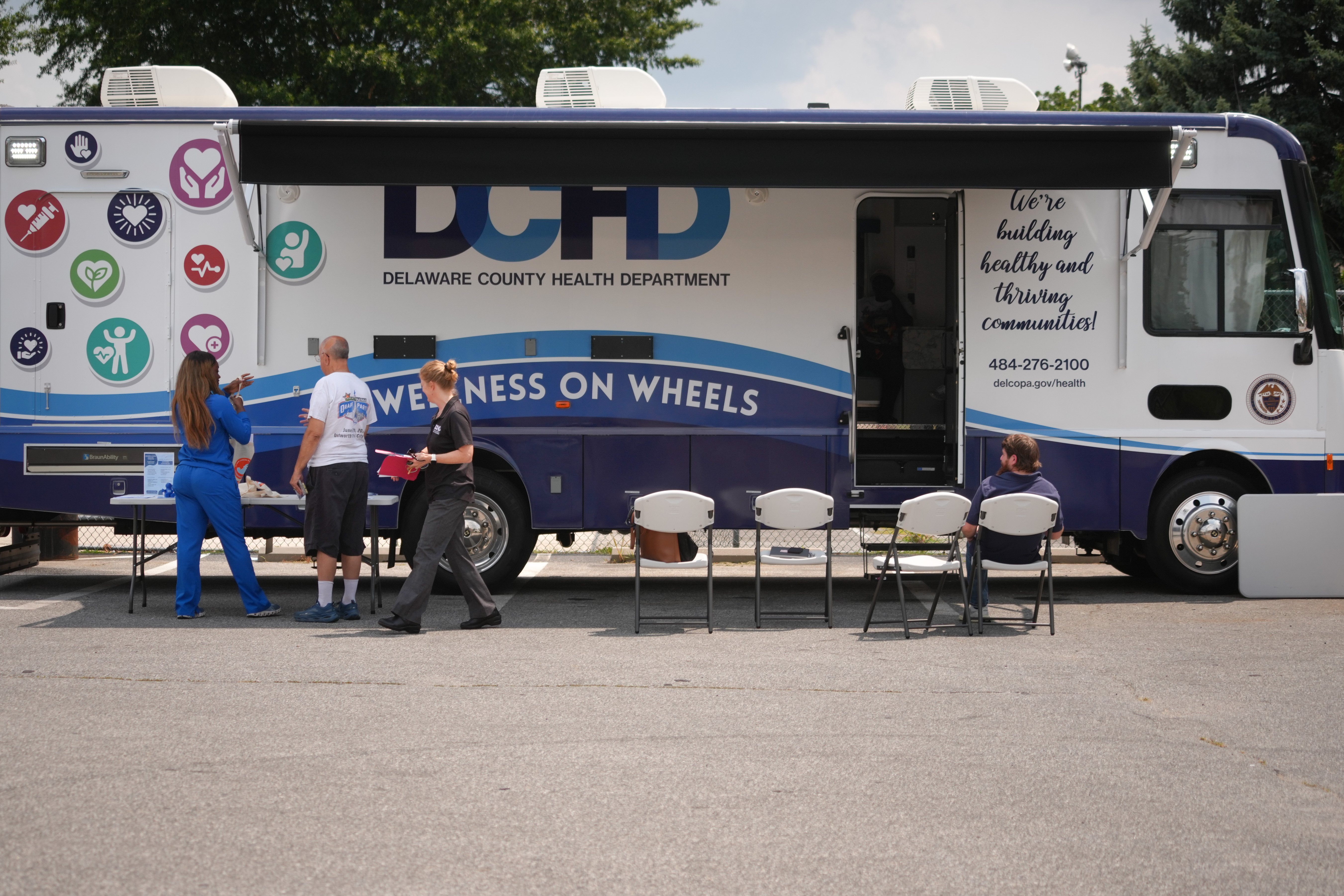
Amid rising measles case counts and declining immunization rates, Delaware County’s health department launched an immunization campaign over the summer to encourage families to vaccinate.Jessica Griffin / Staff Photographer
Emlen, which saw one of the steepest drops in protection, was one of 40 schools in the five-county region that reported 100% measles vaccination rates two years ago, only to drop below the 95% herd immunity threshold last year.
Philadelphia school officials say the changes at Emlen likely reflect increasing hesitancy among parents to immunize their children against measles, mumps, and rubella (MMR) and other diseases. State records show that most unvaccinated kindergarteners at Emlen have philosophical or religious exemptions.
Some fluctuations in kindergarten vaccination rates are typical from year to year, but the rise of anti-vaccine rhetoric in federal leadership appears to be exacerbating fears around vaccination, said Kendra McDow, a pediatrician who serves as the Philadelphia school district’s medical director.
“What we’re seeing is reflective of what I believe are local and national trends,” McDow said. “Families are confused, and they want to do right by their children.”
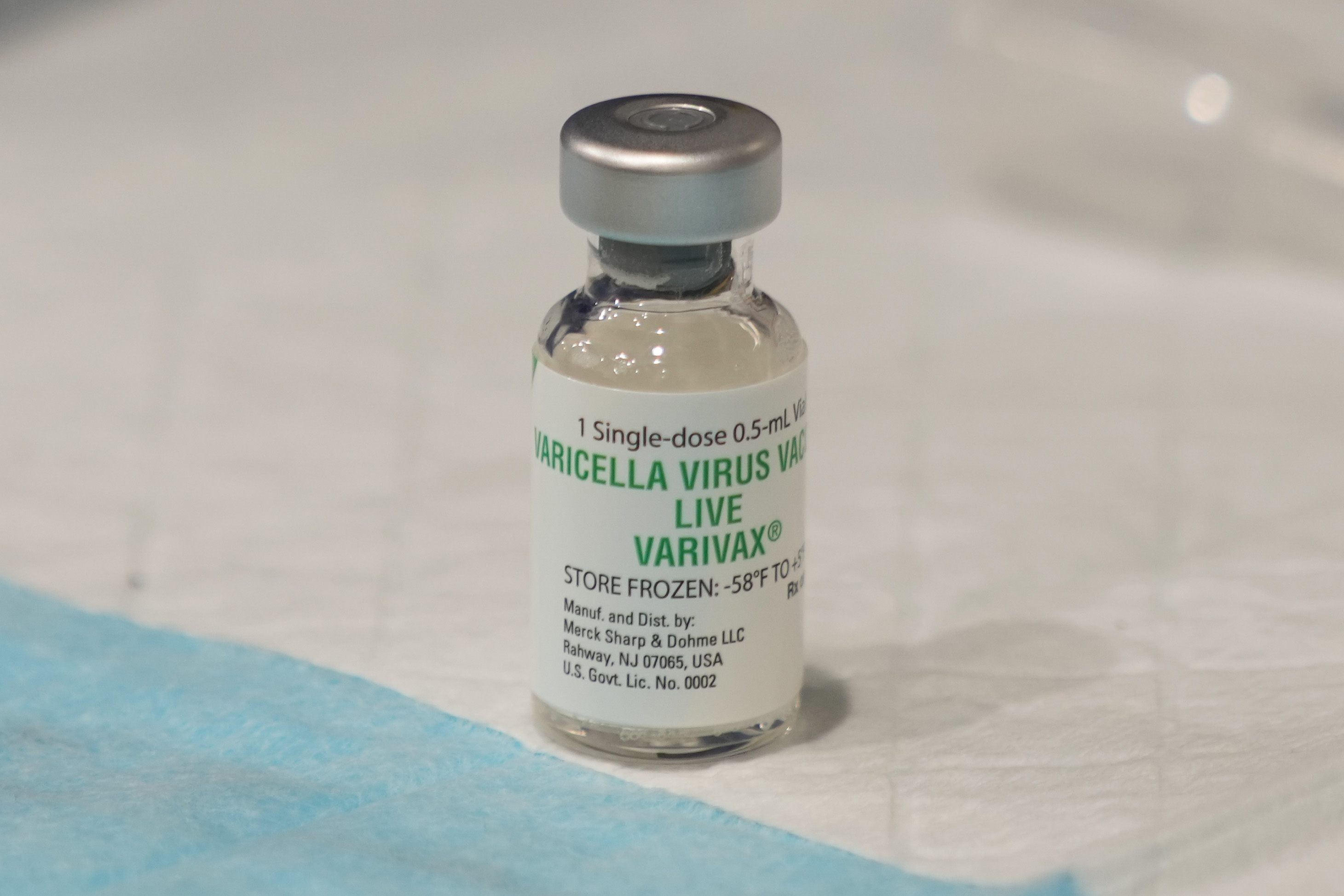
In the latest federal vaccine maneuver — opposed by the medical establishment, prominent Democrats, and Republican Sen. Bill Cassidy, a physician — President Donald Trump signed an executive order this month asking states to “consider updating” laws to require fewer vaccinations for schoolchildren without any medical justification. He also advocated for splitting the MMR vaccine into three separate shots — even though no separate measles, mumps, or rubella vaccines are licensed in the United States.
The order came after a chaotic year in which Health and Human Services Secretary Robert F. Kennedy fired federal vaccination advisers and pushed to upend the federal vaccine schedule. Kennedy, a longtime anti-vaccine activist, has promoted false concerns that vaccinations can lead to autism.
Families are faced with a barrage of misinformation about vaccines. Jessica Griffin / Staff Photographer
With Pennsylvania now experiencing its largest measles outbreak in three decades, Kevin Ressler, a healthcare nonprofit leader in suburban Philadelphia who was raised in Lancaster County, worries that declining vaccine rates reflect increasing political polarization.
“You don’t have to be a scientist to recognize that’s a problem,” said Ressler, the CEO of Alliance for Health Equity, a Coatesville nonprofit that works to improve access to health services. “A lot of this is rooted in whether we are able to hold trusted relationships.”
Philly-area counties all at risk
Philadelphia and its suburban counties overall remain well protected against measles, state officials say. The declines seen in the latest school year amount to less than 1% of all kindergarteners in each of the five counties in the area, an improvement from the drops that followed the COVID-19 pandemic.
But even small drops can be significant given the contagiousness of measles, which can linger in the air for hours and infect nine in 10 unvaccinated people who come into contact with it.
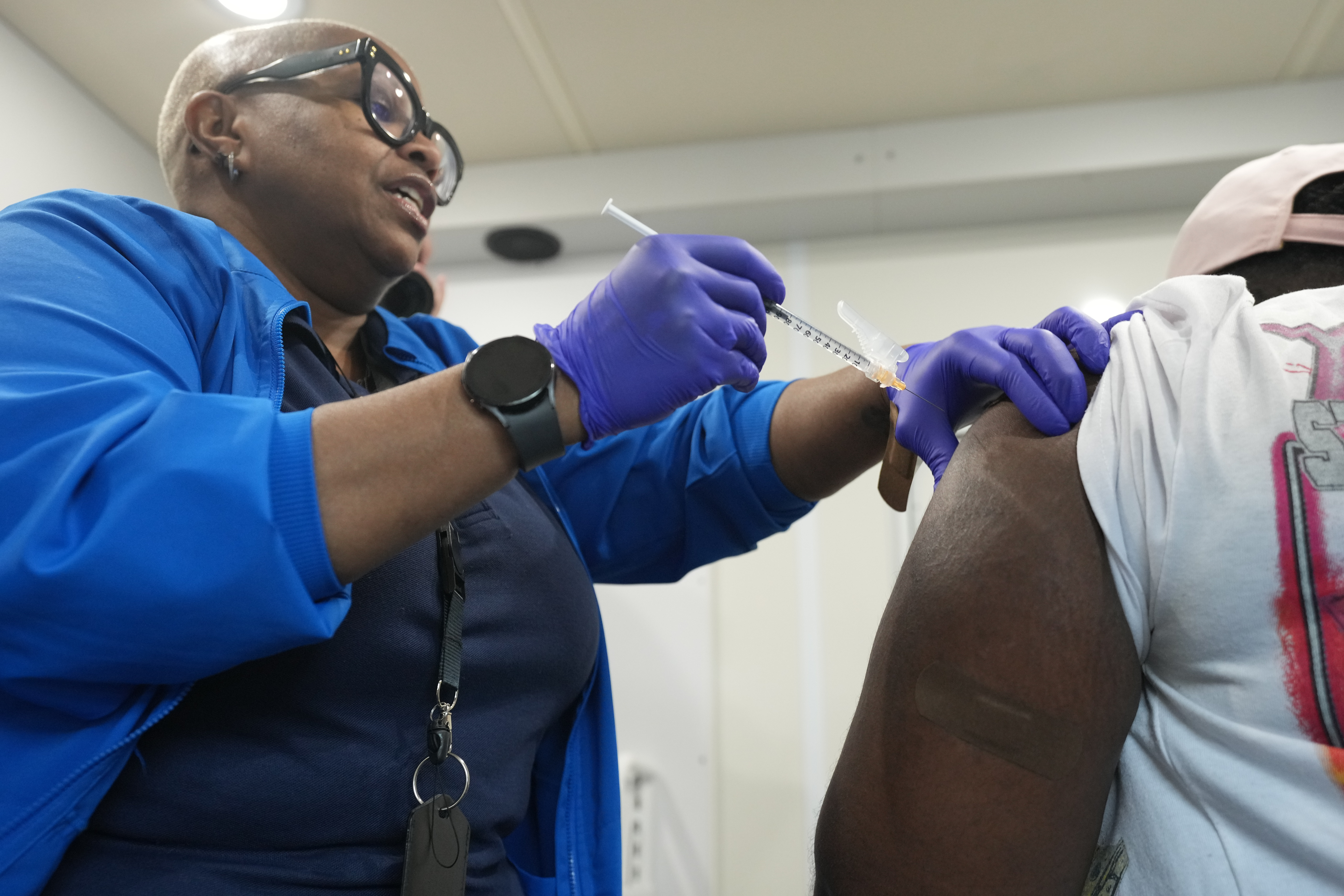
Mia Williams, a registered nurse, vaccinates a client at Delaware County’s mobile clinic in Upper Darby in July. Jessica Griffin / Staff Photographer
“The risk has definitely gone up because of lower vaccination numbers,” said Rene Najera, the director of public health at the College of Physicians of Philadelphia.
Najera says slipping vaccination rates especially endanger vulnerable students and community members beyond the schools, like pregnant women, cancer patients, or babies too young to be vaccinated. Parents of high-risk children should speak with their pediatricians about the risks of attending a school with lower vaccination rates, he said.
Last year marked the first time in more than 10 years that no Philadelphia-area county had reported measles vaccination rates above herd immunity.
Bucks County had the lowest MMR vaccination rate for kindergartners, at 93.7%, down by more than a half a percentage point from the year before.
Montgomery County, the only county in the Philadelphia region with kindergarten vaccination rates at herd immunity two years ago, slipped just below the threshold in 2025, to 94.8% vaccinated.
About 94% of Delaware County and Philadelphia kindergarteners were vaccinated last school year.
In Chester County, the only Philadelphia-area county to report cases in the current outbreak, vaccination rates for kindergartners have held steady at 94.5% for the last two school years. Some schools in the county reported steep drops in MMR coverage ahead of the current outbreak, which has seen 40 cases confirmed since June.
At Windsor Christian Academy in Downingtown, only one in four kindergarteners were vaccinated last year at a school that exceeded the herd immunity threshold the year prior. About 14% of the class had religious exemptions for vaccination. School officials did not return a request for comment.
Caln Elementary School in Thorndale saw measles vaccination rates drop from 100% to 74% in a year. Officials at the school declined to comment. (Caln closed at the end of last school year, and most of its students are transferring to the newly built Doe Run Elementary this year.)
Jeanne Franklin, Chester County’s health director, said she is “moderately” concerned about the current measles outbreak, given that many of the county’s most populous public schools still have high vaccination rates.
The school-level data improve the county’s ability to identify schools with lower vaccination rates.
Chester County health officials talk to school nurses, principals, and other administrators before the start of every school year to remind them of what to do if they identify a case of measles.
Under county policy, a single measles case in a school will mean all unvaccinated students and staff must stay home for 21 days.
This year, conversations that are usually hypothetical have taken on more urgency.
The health department has urged schools to take stock of who within their school is unvaccinated and develop a plan for how they will teach unvaccinated students who are sent home and staff classrooms of absent teachers.
“You don’t own getting them vaccinated,” Franklin said she tells administrators. “But you have to think through these things.”
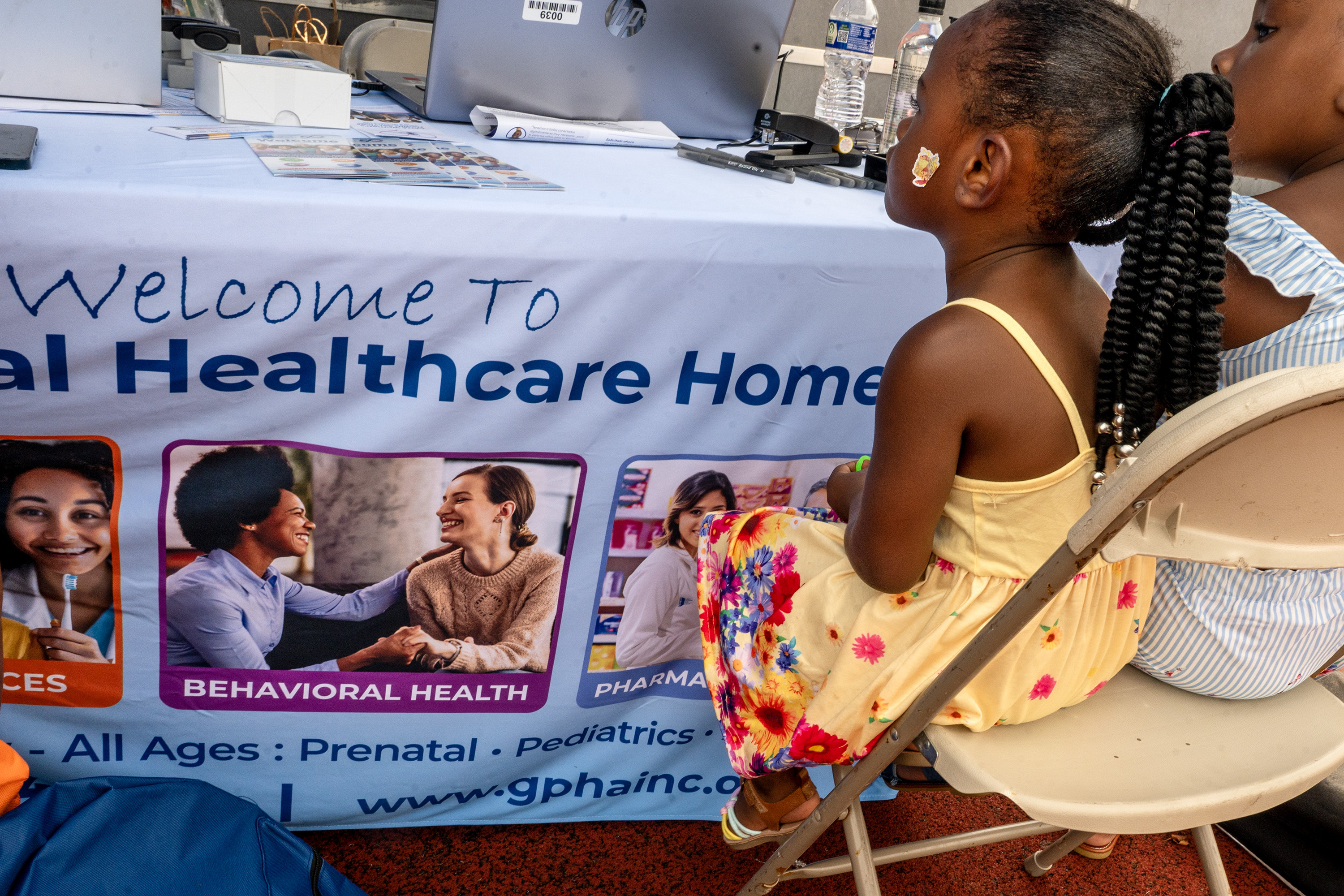
Sisters A’zuri, 3, and A’Sara, 6, wait while their mother, Shania’ Jason, checks in at a vaccination clinic during the School District of Philadelphia’s sixth annual Back-To-School Bus Tour stop this month at Marcus Foster Memorial Stadium. Tom Gralish / Staff Photographer
Philly schools on alert
As the school district’s lead health officer, McDow worries about the threat of measles so close by, but believes concerted efforts in the city have kept vaccination rates “as high as they can be in this current climate.”
She’s also monitoring Philadelphia schools where the state data show declining vaccination coverage. (The publicly available school-level data does not include classes with fewer than 20 students, for privacy reasons, or schools that did not report to the state. About 90% of schools statewide reported data in 2025.)
In some cases, what looks like a decline can be explained by delays in data reporting due to administrative issues or staff absences. School vaccination records are reported to the state during the month of December.
For example, Mantua’s Morton McMichael School reported a 50% drop in MMR vaccination coverage, initially going from nearly nine in 10 kindergarteners vaccinated to just over a third.
But by the end of the 2025-2026 school year, records show 93% of McMichael kindergarteners were fully vaccinated against measles, district officials said, though the state data does not show the improvement.
McDow worries about drops at other schools, from Mount Airy’s Emlen Elementary to North Philadelphia’s James Logan Elementary’s 18.5% decrease in vaccination rates, which are likely related to parents increasingly refusing vaccines.
Pediatrician Amanda Bernard (left) talks with Shania’ Jason and her daughter A’zuri, 3, at a vaccination clinic hosted by the Philadelphia School District this month at Marcus Foster Memorial Stadium.Tom Gralish / Staff Photographer
The school district hosts vaccination clinics over the summer and during the school year, working with the city health department to target families with unvaccinated children and schools with low vaccination rates.
The district also works to ensure vaccination clinics are accessible to working parents, organizing some on weekends or evenings.
“We need to be talking to families and answering questions in transparent ways,” McDow said. “But we also need to be providing the opportunities for vaccination.”
Some families line up for immunizations
On a recent sweltering August afternoon, families lined up at a tent pitched on the football field at Marcus Foster Memorial Stadium in Olney, part of a back-to-school fair sponsored by the Philadelphia School District.
“IMMUNIZATIONS,” read a flag waving in the breeze. Business was brisk all day.
Some families who visited the tent were recent immigrants, getting caught up on vaccinations before their children started at their new schools.
“We’re vaccinated, my husband and I, because our parents vaccinated us. And I’ll do the same for my children,” said Betty Bachene, who moved to Philadelphia from Paris this summer. Speaking in French, she said she’s never been afraid of vaccinating her children, but does fear the diseases vaccines prevent.
Anaiya Burnham, a nurse, said she’d opted against getting COVID or flu shots for her two children, one of whom is entering kindergarten this year. But vaccinating them against measles was never a question.
“I would really be curious to know why anyone would opt out of the MMR, given the research,” she said.
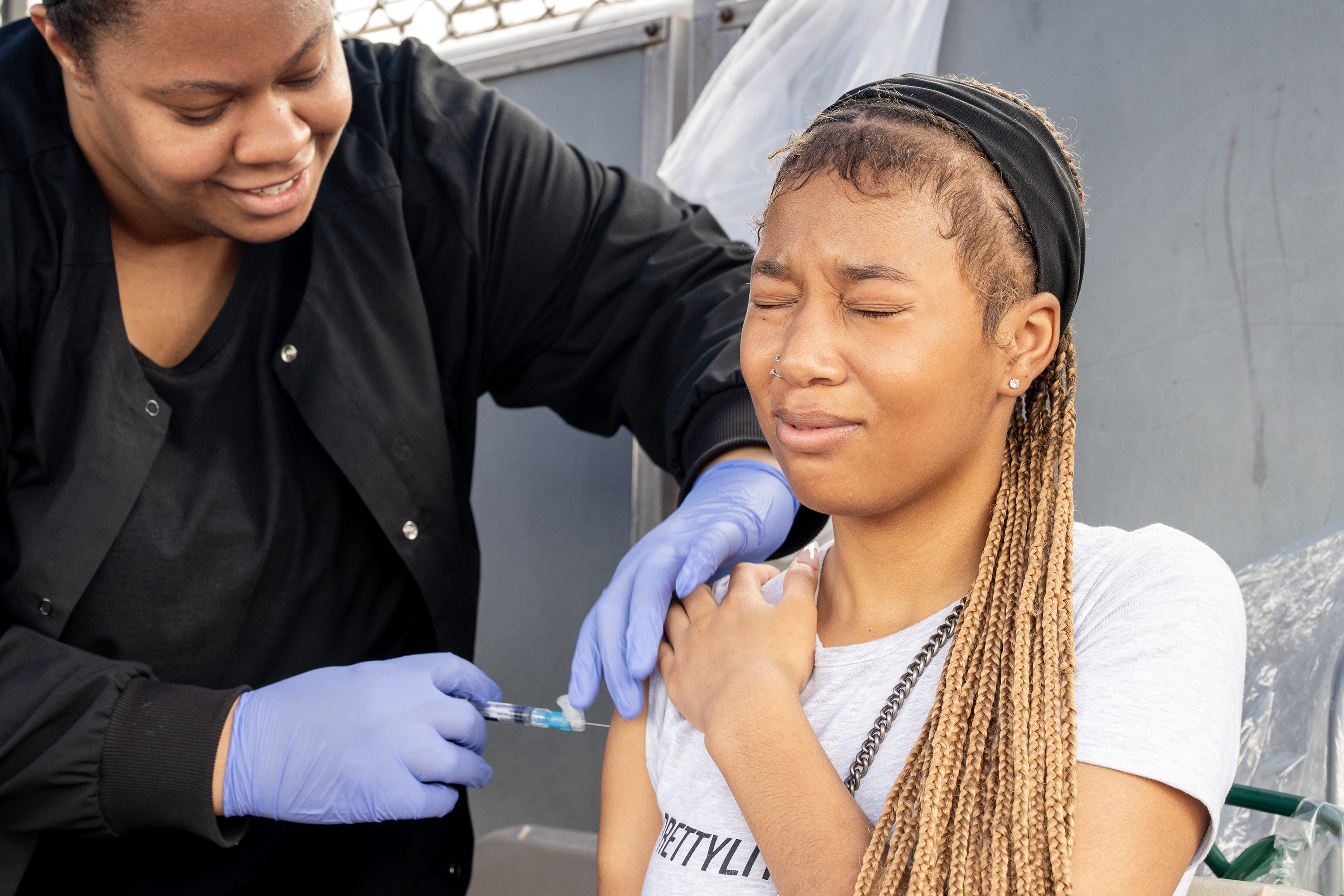
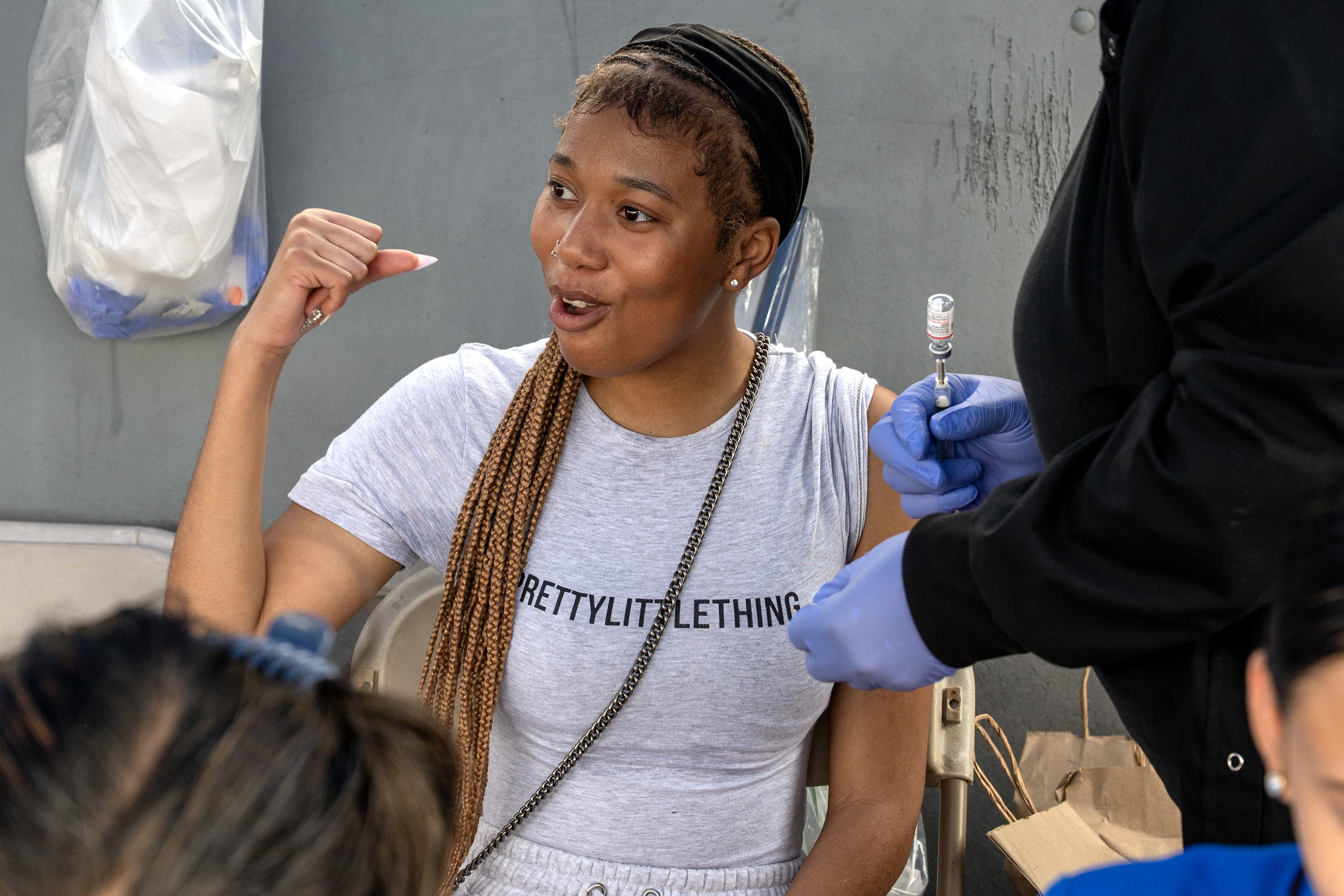
Cianey Brown, 16, reacts and turns to her family after getting an immunization at a Philadelphia school district vaccination clinic this month at Marcus Foster Memorial Stadium. Tom Gralish / Staff Photographer
Philadelphia parents face a number of different barriers that keep them from vaccinating children — and not all of them are related to vaccine hesitancy, said Amanda Bernard, a pediatrician with Greater Philadelphia Health Action, the clinic offering vaccinations at the event.
Some lack transportation to get to a health center outside their neighborhood, or don’t speak English well enough to navigate the healthcare system, she noted.
“I think that these sorts of events are really a way that we could combat that,” said Bernard, who has heightened her advocacy around vaccination as Pennsylvania’s measles outbreak has spread.
“There’s almost a desperation in my education. I sometimes feel like I’m almost begging [families] to get it.”
Editor’s note: This story has been updated to correct the name of James Logan Elementary in Philadelphia.
(function(){function e(){window.addEventListener(`message`,function(e){if(e.data[`datawrapper-height`]!==void 0){var t=document.querySelectorAll(`iframe`);for(var n in e.data[`datawrapper-height`])for(var r=0,i;i=t[r];r++)if(i.contentWindow===e.source){var a=e.data[`datawrapper-height`][n]+`px`;i.style.height=a}}})}e()})();
A Supreme Court decision on mail voting has created uncertainty with 70 days until critical midterm elections, but Pennsylvania Democrats are trying to reassurevoters that they will have the option to cast a ballot by mail.
More litigation over this highly watched issue is expected and further rulings could still come even after November, affecting the next presidential election.
“We will continue to fight at every stage — including in the Supreme Court the moment they attempt to implement this — to make sure every eligible Pennsylvanian can cast their ballot by mail, free from federal interference,” said Montgomery County Commissioner Neil Makhija, a Democrat and an attorney who sits on the county’s election board.
The procedural update, issued Monday, does not rule on the underlying legality of President Donald Trump’s March executive orderthat directed the U.S. Postal Service to help decide which voters should receive mail ballots but rather whether lower courts had the authority, at this stage, to block it.
Pennsylvania was among the states suing to block the order.
“Absolutely nothing has changed here in Pennsylvania. You can vote in person on Election Day or you can vote by mail before Nov. 3,” Democratic Gov. Josh Shapiro said Tuesday evening during a visit to the Eagles’ training camp.
“Your vote will be counted. Your vote is safe and secure,” Shapiro said. “No matter how many times the president wants to try and undermine people’s right to vote in this commonwealth, he needs to know that he will be met with a swift rebuke from me.”
Shapiro noted that the election is administered by the state and its counties under the Constitution.
Revival of the debate about the availability and security of mail voting, and the temporary clearance, however, may instill doubt among voters that their ballot will be received and tabulated, Makhija said.
“With just weeks until ballots go out, last-minute federal interference sows chaos for the voters we serve,” he said.
Trump’s efforts to restrict mail voting, part of his long-standing grievance against the system despite repeatedly utilizing the method himself, are still working through the courts, and several experts doubt the proceedings will move fast enough to affect the November elections, whenfour swing districts in Pennsylvania could help determine control of the U.S. House.
“Whatever may ultimately happen in this litigation, I’m pretty skeptical that anything is going to change for this November’s election,” saidBen Geffen, staff attorney at the Public Interest Law Center in Philadelphia, a nonprofit group that monitors election issues.
States across the country will soon begin preparing applications and mailing ballots to voters.
Pennsylvania voters, who can cast a ballot by mail for any reason, must complete an application by Oct. 27, and all ballots must be returned by Nov. 3 at 8 p.m., according to the Pennsylvania Department of State’s website.
“Turning that battleship around in a matter of days is extremely unlikely,” Geffen said.
A spokesperson for the Pennsylvania Department of State said the ruling does not change state law, and voters should be confident that counties will continue to ensure eligible voters can cast their ballot by mail.
“The USPS action is not lawful, and we will continue to challenge that rule to ensure that Pennsylvania voters can have their voice heard — whether they vote in person, on demand, or by mail,” Geoff Morrow, the department spokesperson, said.
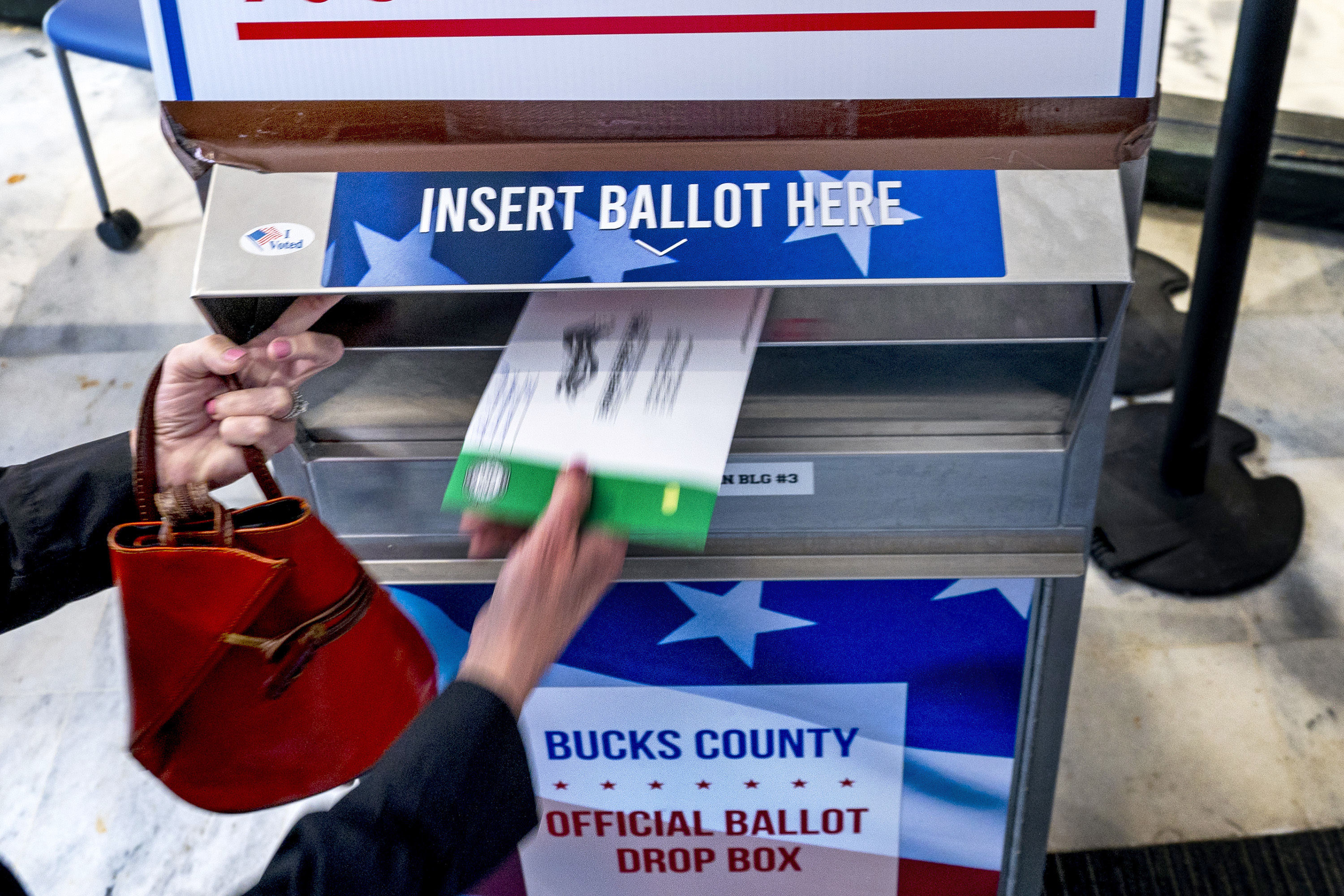
Geffen’s advice for those concerned is to start early. Get your mail ballot application in right away, and as soon as you receive your ballot, fill it out and return it. For now, you can still send your ballot through the U.S. mail. But you can also drop it off at your county election board, and many counties offer satellite locations and drop boxes.
If you prefer to vote in person on Election Day, go in the morning, he said.
“You have options for how to vote, and you will get to vote. Nobody’s taking away the election, and just jump on it early,” he said.
After Trump, through his directive, ordered the Postal Service to withhold mail ballots to individuals who are not on an approved list, which he instructed states to develop in order to prevent noncitizens from voting, Shapiro promised to protect Pennsylvanians’ right to vote by mail. In April, he used his power as governor to join other Democratic states in a lawsuit that argued the order violated states’ constitutional power to carry out elections.
The unions representing postal employees also criticized Trump’s push to restrict mail voting as November approaches.
“Any insinuation that voting by mail is not safe and secure is severely misguided. Letter carriers have securely delivered ballots for decades, and there is no evidence that the existing system requires substantial changes,” NALC president Brian L. Renfroe said in the statement.
Gwen Ivey, president of the American Postal Workers Union, Local 89, which represents between 1,300 and 1,400 U.S. clerks in Philadelphia who process mail, maintenance employees, and drivers who transport mail, also warned against inserting the Postal Service into decisions over voting.
“The Postal Service is a public institution that serves the American people,” Ivey said Tuesday. “It should not be placed in a position of determining who is entitled to participate in elections or becoming an instrument for restricting access to the ballot boxes.”
Trump has long railed against mail voting, referring to the ballots as “crooked” in his State of the Union address and suggesting they amount to cheating. But his 2024 victory in Pennsylvania was thanks, in part, to a higher rate of mail voting by Republicans.
The practice is particularly useful for seniors and voters in rural areas — often with strong Republican bases — where voters may live far from their nearest polling location.
“If you want to win, mail it in, that’s our message to our Republican voters,” then-Pennsylvania GOP chairman Lawrence Tabas said two years ago. The Pennsylvania GOP did not respond to a request for comment for this article.
Pennsylvania Republicans have been more supportive of Trump’s SAVE America Act, an election reform proposal stalling in Congress that he insists will make voting more secure, though most election experts say new guidelines in the legislation would make it harder to vote.
You’ve probably noticed that many of your favorite TV news anchors are on vacation right now, because the conventional wisdom is that nothing ever happens in August. That conventional wisdom has been wrong since Aug. 24, 79 A.D., when Mount Vesuvius erupted. The calendar has failed to stop natural disasters like Hurricane Katrina (see item below) or human-made ones like Richard Nixon, who resigned on Aug. 9, 1974. I’m going to tempt fate and take some vacation time next week, including a rare newsletter skip. I’ll see you in two weeks. What could possibly go wrong?
Trump’s autocratic assault on Stars and Stripes isn’t just bad. It’s personal.
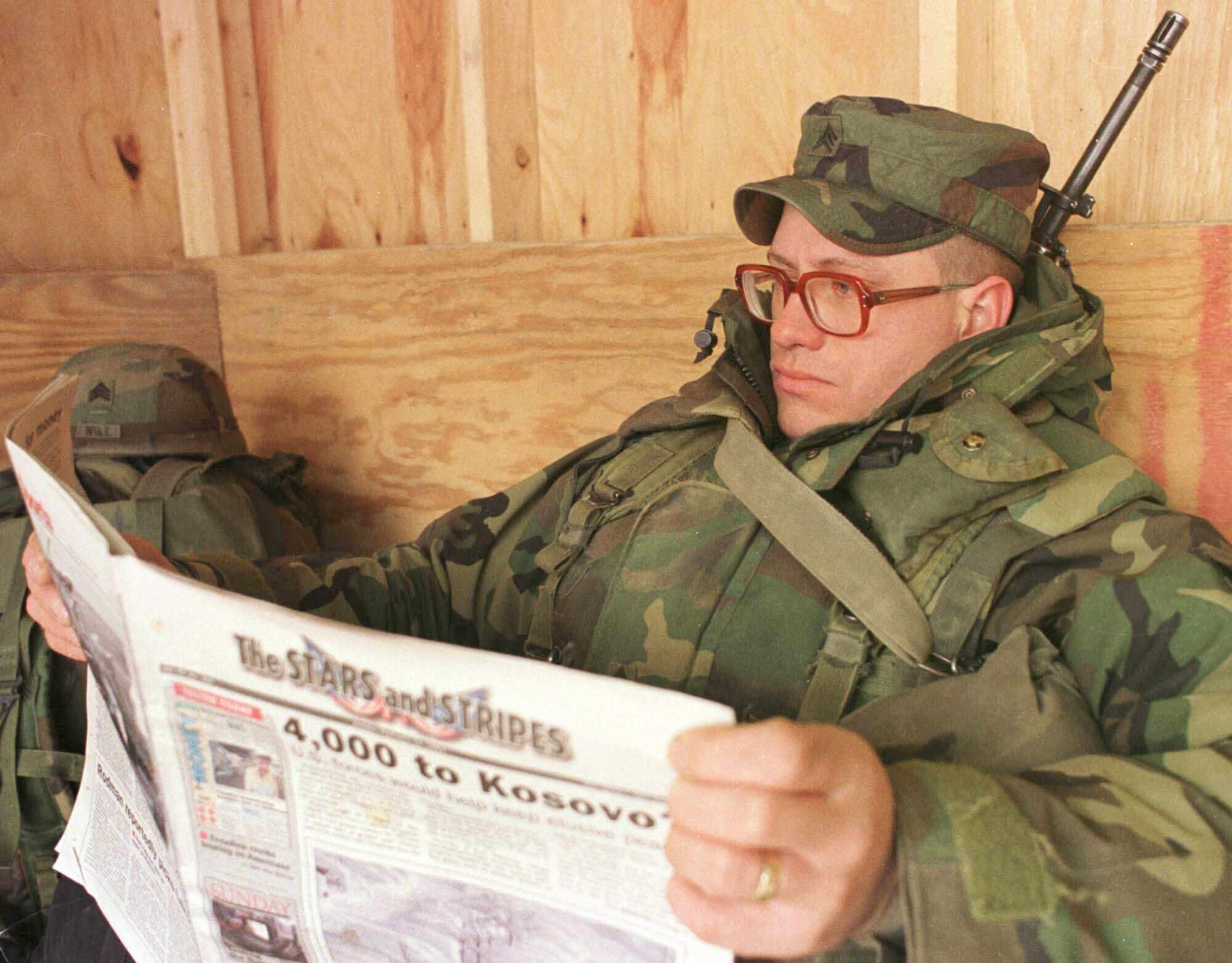
Sgt. John Hubbuch of Versailles, Ky., one of the members of NATO-led peacekeeping forces in Bosnia, reads a copy of the Stars and Stripes in 1999.AMEL EMRIC
Less than two months after the U.S. dropped the most powerful weapon humankind had ever invented — the atomic bomb — on the cities of Hiroshima and Nagasaki, the American military arrived in Japan to implement a very different kind of tool in the U.S. arsenal of democracy.
A free and largely unfettered newspaper.
The first edition of the Stars and Stripes Pacific newspaper was published from downtown Tokyo on Oct. 3, 1945, when the ink on the Japanese surrender that ended World War II was barely dry. This was the start of a decades-long run when print journalism was still the best way to get information that could be entertaining or essential out to hundreds of thousands of U.S. troops who initially occupied Japan and other Pacific outposts, and later would see combat in Korea and Vietnam.
Stars and Stripes Pacific — like virtually everything tied to U.S. imperial might after the war — is part of a complicated legacy that overlapped with American censorship of local and outside media in Japan. Yet, U.S. soldiers managed to get their own information from a publication that celebrated the better angels of the First Amendment back home, with coverage of Tokyo’s war-crimes trial and later from the front lines in Korea.
It was only part of a much grander legacy for Stars and Stripes, which has been the American military’s independent news source tracing all the way back to 1861 and the Slaveholder’s Rebellion.
Famously, when legendary World War II Gen. George Patton threatened to jail editorialcartoonist Bill Mauldin over a cartoon lampooning him, his superior, Gen. Dwight D. Eisenhower, stopped him. “Stars and Stripes is the soldiers’ newspaper,” Ike reportedly said. “We will not interfere.” Mauldin was awarded a Pulitzer Prize for his wartime cartoons. In 2010, Stars and Stripes reporters exposed the Pentagon’s efforts to slant mainstream media coverage of the war in Afghanistan, and won a George Polk Award.
That feisty spirit of Stars and Stripes runs deep in my family’s DNA. My maternal grandfather, Thomas Blender, who’d been a photo editor at the Peoria (Ill.) Journal Star before joining the Army, was sent to Tokyo in those early days to work as a top editor of the Pacific publication. I’ve always regretted, after Grandpa Tom died when I was only 11, that I never got to ask him about those days once I’d been infected with the family journalism bug I’d eventually pass on to my own son.
That must be why it felt like a personal attack last Friday when the Pentagon of Donald Trump and his like-minded “Secretary of War” Pete Hegseth obliterated 155 years of editorial freedom by firing its editor, its publisher — who, seeing the writing on the wall, was about to retire — and its Middle East correspondent. That journalist, Lara Korte, said she was pink-slipped for an interview with CBS News about her reporting on the dreadful conditions for Navy sailors aboard the USS Abraham Lincoln.
The fuse had already been lit back in January when Hegseth’s Pentagon gutted the regulations regarding the government-funded news organization by stripping language that called for “a free flow of news and information to its readership without news management or censorship.” The new rules, which instead said Stars and Stripes’ journalism “must be consistent with good order and discipline of the military,” were seen asan invitation for censorship. Sean Parnell, the formerly embattled Pennsylvania Republican who is now Hegseth’s chief spokesperson, blasted Stars and Stripes for “woke distractions.”
Three months later, Jacqueline Smith, the internal editorial watchdog of Stars and Stripes at the Pentagon, criticized military brass for editorial interference and was promptly fired. But the last straw for the outlet came two weeks ago with its aggressive reporting about problems aboard the Lincoln, which spent nine months mostly at sea with dwindling supplies tied to Trump’s ill-advised war on Iran. Journalist Alison Bath reported that sailors’ families were growing deeply concerned about the mental health of the aircraft carrier’s exhausted crew.
That work epitomized everything that has been good and decent about Stars and Stripes. What the newspaper has shown at its best is that — despite all the contradictions and moral failings of U.S. postwar imperialism — a democratic government can value the press freedom that its armed readers literally died for from Gettysburg to Omaha Beach. That high-minded ideal was a beacon to set us apart from our adversaries in Nazi Germany or Soviet Russia, who never would have permitted the kind of honest coverage Stars and Stripes offered for decades.
Until America found itself with a government with the same philosophy as 1939 Berlin or 1949 Moscow. Just like his boss, Hegseth has shown nothing but contempt for the notion that his “warfighters” might actually serve to protect Americans’ right to the truth about their own government, including the foibles of his Pentagon.
On Monday, it came out that the military’s U.S. Central Command told the Intercept that it maintains “a list of people to disregard,” a.k.a. a blacklist. This is the same U.S. Department of Defense — sorry, Pete, that is still its legal name — that also forced out any journalist who wouldn’t sign their integrity away to work in the press room at the Pentagon.
The firings at Stars and Stripes and the Pentagon’s apparent desire to turn the award-winning newspaper into a Pravda-style propaganda sheet for Hegseth’s testosterone-dosed military feels like a new low on the road toward the utter obliteration of all press freedom.
Since returning to power last year, Trump and his MAGA minions have waged war against journalists they’ve called “the enemy of the people” — and they’ve done so not through some grand Orwellian censorship edict, but through a mix of billionaire carrots and sticks that have inflicted a thousand small cuts. That means rewards for wealthy allies who buy prominent news organizations (think the Ellison family assuming control of CBS and being on the brink of getting CNN) or neuter them (Jeff Bezos at the Washington Post) — but lawsuits, obstacles, or straight-up bullying for everyone else.
Another alarming example of the precarious state of the First Amendment came earlier this month when a lawyer for Trump threatened a $5 billion (with a “b”) lawsuit against a left-leaning think tank, the Center for American Progress (CAP), if it didn’t retract a factual report that the Trump regime’s deployments of National Guard troops to U.S. cities have not lowered crime rates.
The CAP has stood its ground so far, but this reveals the state of play right now. MAGA World has already either bought off or intimidated much of the mainstream media, so now they are hoping they can crush the outliers like Stars and Stripes or CAP, one by one.
The mission my grandfather was dispatched to Tokyo to carry out after World War II was on the fringe of an idea that came to be known as “soft power” — the now-quaint notion that America could form healthy alliances with the rest of the world through good things like vaccinating children or printing uncensored journalism, instead of dropping bombs. Other organizations meant to show people in oppressed lands that press freedom and democracy are things to fight for — like Radio Free Europe — have been forced to grapple with Trump-ordered cutbacks.
The right knows exactly what it is doing — that truth and knowledge are kryptonite for its authoritarian project. Increasingly, they are saying the quiet parts out loud. The great Tennessee journalist Phil Williams recently unearthed a sound bite from a white supremacist confab in Rome in which the conversation turned to America’s growing number of news deserts where journalism has all but perished.
“Local media has been dying all over America, which means that there’s essentially no real way to hold local governments accountable — and they can do whatever they want,” white nationalist Kevin DeAnna told the gathering. “You should be fantasizing about this. This is a good thing.”
No, it’s not. The government’s bludgeoning of Stars and Stripes has truly — to borrow from a storied military campaign of yesteryear — crossed the Rubicon of no return for its all-out blitzkrieg against the truth. All of us, including the laggards of the mainstream media who continue to pretend this war doesn’t exist, need to fight back with everything we have.
I never got to know my Grandpa Tom very well, but I know in my soul that this is what he would have wanted.
Yo, do this!
Meep, meep! If timing is really everything, then the half-animated, half-real feature film Coyote vs. Acme, which hits theaters this week, will be the greatest motion picture of all time. The film is based on a 1990 New Yorker essay that imagines Warner Bros. cartoon icon Wile E. Coyote suing the giant Acme Corp. over years of faulty products that literally blew up in his face and ruined his shot at catching the speedy Road Runner. The fact that real-world corporate baloney delayed for several years the release of this film mocking the excesses of runaway capitalism is an unbelievable irony. I’m really looking forward to seeing it.
Books, despite their apparent looming extinction, remain a great way to track what humankind is thinking about. This summer, the hot topic is anxiety over AI and the unchecked power of Silicon Valley. In addition to the best-selling Nerd Reich, now there’s the great essayist and Harvard historian Jill Lepore with her new tome, The Rise and Fall of the Artificial State, out today. Lepore’s timely work tracks the rise of authoritarianism run not so much by a tinhorn dictator, but by machines, and how humanity can fight back.
Ask me anything
Question: Do PA Dems have a legit chance of freeing us from Joe Pittman’s reign of terror in the state Senate? — Travis (@unraptured.bsky.social) via Bluesky
Answer: Travis, the answer is absolutely yes. Democrats in the Keystone State have managed to chip away at what once seemed like a permanent GOP majority in the upper chamber at the same time that they’ve recaptured the state House. The current Republican Senate edge is just 27-23, meaning Democrats have to flip only three more GOP seats among November’s 25 contests. Every arrow — Trump’s high disapproval, the popularity of Gov. Josh Shapiro at the top of the ticket, and special-election results like last week’s shocking Democratic House victory in a blood-red district in Western Pennsylvania — points toward a blue tsunami. The Democrats have reportedly targeted three suburban swing districts. The big question for 2027 may be whether Shapiro really wants a Harrisburg trifecta pushing him to the left.
What you’re saying about …
OK, last week’s question about Georgia Sen. Jon Ossoff’s pointed comments regarding Donald Trump’s corruption, including an eyebrow-raising mention of ever-present aide Natalie Harp, was kind of a slam dunk for readers of this newsletter. You saw nothing uncivil in the fighting spirit of his remarks, and a surprising number of you echoed back a phrase from my question: “a breath of fresh air.” Wrote Daniel Fleischer: “Jon Ossoff called Trump a ‘crook.’ If anything, that’s a euphemism understating Trump’s criminality.” Added Patricia Eisenberg: “What he said was undeniably true — the President chose this young woman to travel on his escape plane, not one of his cabinet members.”
📮 This week’s question: It seems like the GOP’s got nothing ahead of the midterms beyond its opposition to what it calls “men playing women’s sports.” It’s kind of pathetic, but it does pose a question for Democrats: Do they strongly embrace transgender rights, or is that risking political defeat in today’s culture wars? I have a strong opinion on this, but what do you think? Please email me your answer and put the exact phrase “transgender politics” in the subject line.
Backstory on Indiana’s new, outrageous Katrina
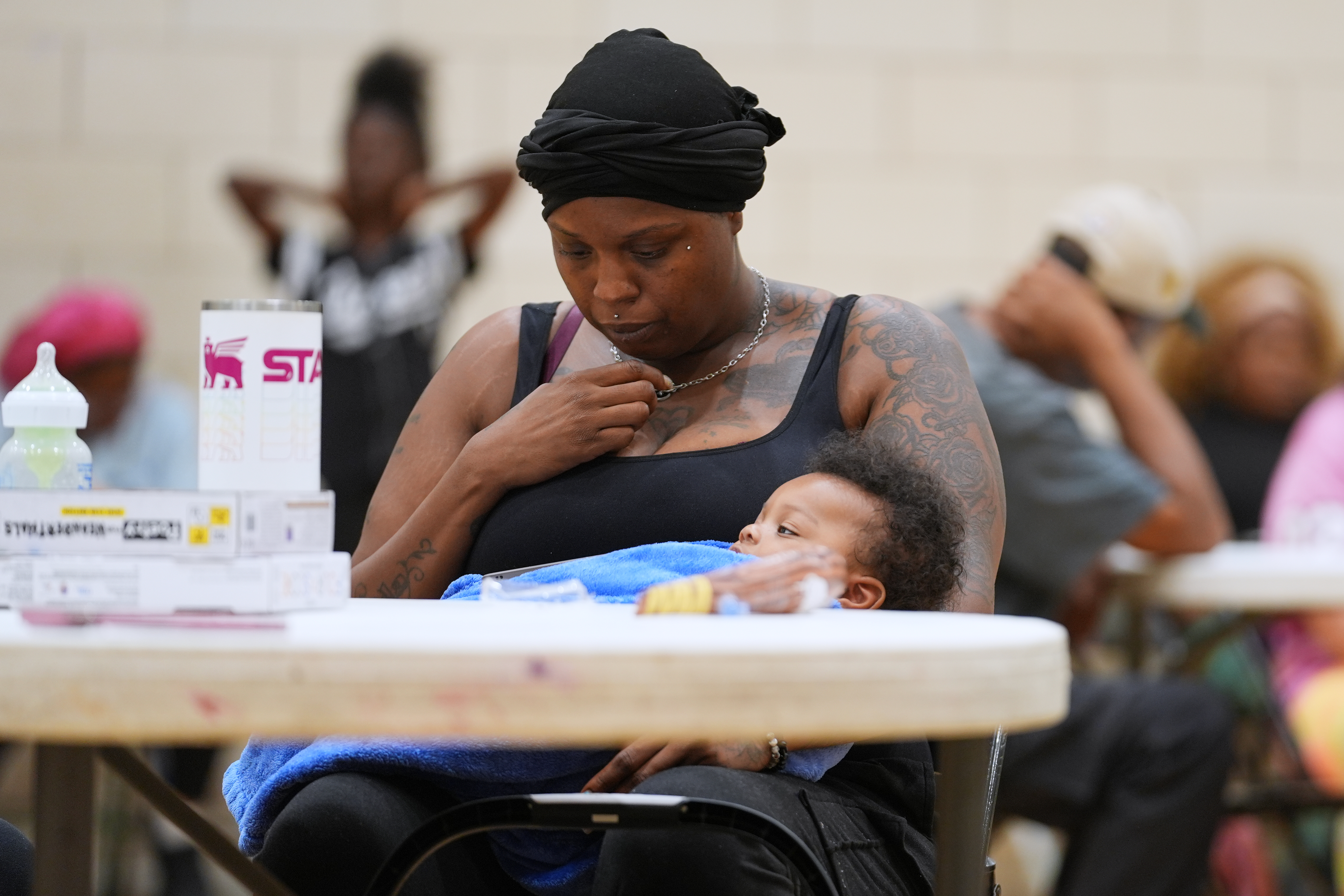
A woman sits inside the City Life Center as she waits for food in Gary, Ind., on Aug. 20, more than a week after a deadly storm passed through the area.Nam Y. Huh
Exactly 21 years ago today, a tropical storm in the Atlantic Ocean rapidly intensified into a hurricane — Hurricane Katrina — and raced across Florida on a path into the Gulf of Mexico, where it became a Category 5 monster. Still, many of us in 2005 briefly thought the Gulf Coast dodged a bullet when Katrina weakened slightly, and its center struck what looked like only a glancing blow on populated New Orleans. Then, one by one, the city’s levees began to break, and the water rose.
The death and destruction in Katrina’s wake was covered around the clock on cable TV, yet it took a couple of days for news anchors to articulate what viewers were seeing with their own eyes. The thousands of people who crowded interstate overpasses or were trapped on roofs were almost all Black, and most were desperately poor.
In These Times wrote the following week that “many Americans were surprised that most of the victims of the New Orleans flood were Black: Their image of the Crescent City had been one of jazz, tasty cuisine and the good-natured excesses of its lively festivals. Where did all those black people come from, they wondered; and where were the white victims?” Katrina triggered some long-overdue conversations about inequality and racism in America, and the inept response from the George W. Bush administration would start his steep decline in public approval. Long before the roughly 1,400 New Orleanians who died in the flooding or chaotic aftermath could be buried, many folks were asking how to prevent this from ever happening again.
It wasn’t a hurricane that struck Gary, Ind., and surrounding communities in the state’s northwest corner exactly two weeks ago on Aug. 11 — just a thunderstorm — but the winds were nearly as intense, snapping trees and downing power lines across the region. Gary’s 67,000 predominantly Black residents hunkered down in the dark nights and blistering hot August days as their refrigerated food went bad, and waited for help. And waited.
While life returned to normal across the rest of the storm-battered Midwest, the massive outage in the region that includes Gary that began with some 375,000 homes lacking electricity dwindled at a snail’s pace. After two weeks, there were still more than 5,000 families without power and struggling with spoiled food and closed schools and workplaces. There is growing anger among residents who say that Indiana’s heavily Republican power structure and Donald Trump’s federal government feel no sense of urgency to rescue a city that is mostly African American.
“This isn’t a problem that started with the storm,” the hip-hop star Freddie Gibbs, who grew up in Gary, told MS Now Monday night. “We are a predominantly Black city that tends to get ignored.” It feels like Katrina redux — an island of utter despair in the world’s wealthiest nation, with a government’s inaction bordering on criminal neglect. But there is one big difference: This festering crisis has been mostly ignored by the national media. The tragedy isn’t just our inability to stop the next Katrina, but our inability to care.
What I wrote on this date in 2022
One of George Orwell’s greatest passages in 1984 concerns Winston Smith’s job of cutting out old newspaper articles and tossing them into “the memory hole” — inconvenient truths meant to be forgotten by civilization. That’s how it feels now reading news stories from those four years in the early 2020s when Donald Trump was out of power, and America took baby steps back toward normalcy that would later get crushed. On Aug. 25, 2022, I wrote about one of these: Joe Biden’s eventually failed plan to wipe out some $300 billion of the nation’s massive student loan debt. I wrote that “this week will be remembered as one giant leap toward an idea that can change everything — the notion that higher education should be a public good, not the privatized rat race that has demoralized our rising generations.”
Look what’s happening out in the streets, got a revolution — and it’s not the one anyone saw coming. Growing public rage against Big Tech — the intrusiveness of artificial intelligence and the noisy, polluting data centers that power it, and increasingly also against omnipresent surveillance cameras — has become the surprise issue of the 2026 midterms. Politicians in both parties are performing backflips to join the bandwagon. Over the weekend, I wrote about how voter anger against Silicon Valley and its billionaires is rapidly reshaping our politics, and what could happen if our broken system fails to deliver radical change.
For the first time in recent memory, August has been living up to its reputation as a slow news month (so far), but on the baseball diamond things have really been heating up as kids are drifting back to school. The Phillies’ just-ended nine-game winning streak has electrified a city that’s been having a pretty good summer in spite of everything. The Inquirer’s oft-cynical sports columnist Marcus Hayes even published a list of five reasons to believe the Phils can go deep into October with a reenergized starting lineup, world-class pitching, and improved defense. A stunning turnaround from long-anticipated rookie pitcher Andrew Painter has also been key to the team’s revival in the National League East. It’s an old-fashioned pennant race, and subscribing to The Inquirer is the best way to keepup.
By submitting your written, visual, and/or audio contributions, you agree to The Inquirer’s Terms of Use, including the grant of rights in Section 10.
More than half of likely voters in Pennsylvania’s forthcoming midterm elections disapprove of President Donald Trump’s job performance, and he is drastically underwater among the state’s electorate on key issues — some of which helped him win a second term in 2024.
Trump, who won the crucial swing state by nearly two percentage points in November 2024, now has an approval rating of 39% and a disapproval rating of 58% among Pennsylvania’s likely voters, according to an Inquirer/New York Times/SienaUniversity poll published Tuesday.
The poll, which was conducted from Aug. 17 to 21 among 760 likely Pennsylvania voters, raises questions about how voters’ perception of the president will affect November’s midterms, when many Pennsylvanians will cast their ballots in four critical swing district races that could determine which party controls the U.S. House.
(function() { var l = function() { new pym.Parent( ‘nyt-trump2__graphic’, ‘https://media.inquirer.com/storage/inquirer/ai2html/nyt-trump2/index.html’); }; if(typeof(pym) === ‘undefined’) { var h = document.getElementsByTagName(‘head’)[0], s = document.createElement(‘script’); s.type = ‘text/javascript’; s.src = ‘https://pym.nprapps.org/pym.v1.min.js’; s.onload = l; h.appendChild(s); } else { l(); } })();
Even among his Pennsylvania supporters who were surveyed, Trump faces some of his lowest approval ratings regarding his handling of the war in Iran and cost-of-living issues, according to the poll, counteracting campaign promises that proved successful in 2024: ending foreign wars and helping people pay their bills.
Once again,the economy will likely be at the front of voters’ minds heading into November — 22% of Pennsylvanians polled said it is their top issue in the governor’s race — and it could also serve as an indicator for the outcome of House races where Republicans will be on the defensive.
“Certainly it’s got to be a drag on their fortunes,” said Don Levy, director of the Siena Research Institute.
(function(){function e(){window.addEventListener(`message`,function(e){if(e.data[`datawrapper-height`]!==void 0){var t=document.querySelectorAll(`iframe`);for(var n in e.data[`datawrapper-height`])for(var r=0,i;i=t[r];r++)if(i.contentWindow===e.source){var a=e.data[`datawrapper-height`][n]+`px`;i.style.height=a}}})}e()})();</script
Trump losing ground on issues that propelled him to White House
The new polling on Trump’s management of top concerns facing the United States — particularly the economy and the cost of living — shows how the issues that helped propel him to the White House in 2024 are now souring his approval among Pennsylvanians, including some who previously voted for him.
Among likely voters in the Keystone State, 39% approve and 61% disapprove of Trump’s handling of the economy. On his handling of the cost of living, 33% said they approve and 66% disapprove.
The data come as voters continue to grapple with rising costs, including unusually high gas prices, and grocery prices that have been increasing for nearly six years. Trump’s tariffs, one of the defining policies of his first year back in office, also raised prices for consumers and businesses.
Now, a quarter of Pennsylvanians who voted for the president in 2024 say they disapprove of how he is handling of the cost of living.
Michael Patterson, 60, of Bucks County, is one of them.
Though Patterson said Trump’s term has been“great” overall, he was expecting more from the president on the economy and costs.
“The prices are still too high, interest rates are still too high,” Patterson said. “We still haven’t seen anything from that promise yet.”
(function(){function e(){window.addEventListener(`message`,function(e){if(e.data[`datawrapper-height`]!==void 0){var t=document.querySelectorAll(`iframe`);for(var n in e.data[`datawrapper-height`])for(var r=0,i;i=t[r];r++)if(i.contentWindow===e.source){var a=e.data[`datawrapper-height`][n]+`px`;i.style.height=a}}})}e()})();
Trump’s messaging on the economy in 2024 was part of why he won Pennsylvania with more votes than any other statewide GOP candidate in history. Pennsylvania voters cited Trump’s promises to bring costs down as a top reason that they voted for him and overlooked Democrats’ warnings about what his election could mean for democracy.
Trump is also hurting on other issues that helped boost him to the presidency, including his promise to end wars. Thirty-two percent of likely voters in Pennsylvania approve of Trump’s handling of the war in Iran and 66% disapprove — including 30% of Trump voters.
Kay Skripac, who voted for Trump in 2024, said thatthough she supports the president on almost every other issue, “I just don’t think that we should have invaded or bombed Iran. I was very surprised, because I didn’t vote for that.”
The 72-year-oldindependent votersaid, despite thinking Trump has done strong work on the economy (she says her retirement portfolio doubled from 2016 to 2026), she is feeling the war’s impact at the gas pump.
“I want everything to just be normal and stay the same, because everything was fine,” said Skripac, who lives in Crawford County. “We weren’t involved in any wars. You didn’t have to worry about any friends or loved ones potentially getting killed. I don’t like that at all.”
Trump’s handling of the Israeli-Palestinian conflict also received low marks from voters, with 62% disapproval, compared with 36% approval.
Republican Sandra Faust, 40, approves of Trump’s handling of that conflict. But her support does not extend to the war in Iran, which Trump launched in coordination with Israel.
Faust, who voted for Trump two years ago, said she strongly disapproves of the war due to rising gas prices and believes it conflicts with the president’s promise to end wars. The Pittsburgh resident, who has a family member in military training to become a jet refueler, said she wishes the conflict in Iran would end.
“Them dragging it on is not only harming us, locally with gas and, you know, pricing and stuff like that, but it’s putting our military in harm’s way, and I’m not happy about that,” she said.
Faust added that she opposes the war because of her belief in the “America First” ideology. That perspective also makes her supportive of Trump’s immigration agenda, she said.
The president is lagging in Pennsylvanians’ support of his immigration policies — which have included mass deportations and enhanced border security — but the disapproval is not as stark. Among likely voters, 44% approve of his handling of immigration and 55% disapprove.
“We are not responsible for taking care of the world’s problems,” Faust said.
What does Trump’s approval rating mean for November in Pa.?
So what does this mean for the midterms?
Time will tell.
But 51% of Pennsylvania’s likely voters who were polled indicated they would be more likely to vote for a Democrat in their congressional district, and 44% said they would support a Republican. More than half, 53%, say they would want to see a flip of control in the House, putting Democrats in charge, while 44% say they would want to see the GOP maintain control.
The polling for the GOP in November is not as bleak as Trump’s numbers, butitshows where voters’ heads are a little more than two months away from the midterms, when Pennsylvanians will weigh in on four competitive swing district congressional races.
(function(){function e(){window.addEventListener(`message`,function(e){if(e.data[`datawrapper-height`]!==void 0){var t=document.querySelectorAll(`iframe`);for(var n in e.data[`datawrapper-height`])for(var r=0,i;i=t[r];r++)if(i.contentWindow===e.source){var a=e.data[`datawrapper-height`][n]+`px`;i.style.height=a}}})}e()})();
Both parties are targeting GOP-held seats in Bucks County’s 1st Congressional District, the Lehigh Valley’s 7th Congressional District, the Scranton area’s 8th Congressional District, and the Harrisburg area’s 10th Congressional District.
Democrats are hoping that a message focused on affordability and tying opponents to Trump will usher in wins this fall. For instance, Democrat Bob Harvie in the heated 1st Congressional District race published a new campaign platform recently that focuses mainly on addressing economic issues.
“The task of Republicans running in various congressional districts, or for the governor of the state, is going to be to somehow separate themselves from the perception that Pennsylvanians have about the job that the head of their party is doing on the economy,” said Levy, the Siena polling director.
But for Democrats, connecting Harvie’s opponent, longtime Republican U.S. Rep. Brian Fitzpatrick, to Trump could be a harder sell. The Bucks County lawmaker consistently outperforms his party and has survived one blue wave after another.
The poll’s findings signal that both parties may also have to think about their branding to the public — 50% of respondents said the Democratic Party is too far to the left and 47% said Republican Party is too far to the right.
Republicans will also have to consider Trump’s unpopularity, especially with women.Sixty-two percent of female likely voters in Pennsylvania disapprove of Trump’s policies, while 34% approve. The president is also strugglingwith men — a key base for him in 2024: 51% of men disapprove of Trump’s policies, compared with 46% who approve.
(function(){function e(){window.addEventListener(`message`,function(e){if(e.data[`datawrapper-height`]!==void 0){var t=document.querySelectorAll(`iframe`);for(var n in e.data[`datawrapper-height`])for(var r=0,i;i=t[r];r++)if(i.contentWindow===e.source){var a=e.data[`datawrapper-height`][n]+`px`;i.style.height=a}}})}e()})();
Democrat Vincent Russo, 78, of Lackawanna County, where Republican U.S. Rep. Rob Bresnahan faces a challenge from Democrat Paige Cognetti in the 8th District, said he will be voting straight blue on his ballot in November and thinks opposition to Trump’s policies will motivate his party to get out to the polls.
“I think the people are starting to see he does nothing but lie,” Russo said.
Staff writers Michelle Baruchman and Gillian McGoldrick contributed to this article.
With a little more than two months until Election Day, Democratic Gov. Josh Shapiro has a double-digit lead over his Republican challenger, Stacy Garrity, among likely Pennsylvania voters in the race to lead the critical swing state — an election that could also serve as an audition for the 2028 presidential primary.
Shapiro holds a 16-percentage-point lead over Garrity, the state treasurer, according to a new poll of 760 likely voters conducted from Aug. 17 through 21 by The Inquirer, the New York Times, and Siena University.
The numbers could foreshadow another commanding victory for Shapiro, as he hopes his popularity trickles into other down-ballot races, including four congressional districts that national Democrats think they can flip. Shapiro is also trying to flip the state Senate for the first time in 30 years and deliver a Democratic trifecta in the statehouse.
(function() { var l = function() { new pym.Parent( ‘nyt-shapiro2__graphic’, ‘https://media.inquirer.com/storage/inquirer/ai2html/nyt-shapiro2/index.html’); }; if(typeof(pym) === ‘undefined’) { var h = document.getElementsByTagName(‘head’)[0], s = document.createElement(‘script’); s.type = ‘text/javascript’; s.src = ‘https://pym.nprapps.org/pym.v1.min.js’; s.onload = l; h.appendChild(s); } else { l(); } })();
A majority of Pennsylvania voters — 60% — have a favorable opinion of the governor, compared with Garrity, who is viewed favorably by just 37% in the state.
Shapiro’s popularity also eclipses that of President Donald Trump, according to the poll. Sixty percent of likely Pennsylvania voters approve of the job Shapiro is doing as governor, while 39% approve of Trump, who won the state two years ago.
Lora Peluso, 63, a Democrat and retired catering director from Pittsburgh, said Shapiro has been a shield in Pennsylvania against some of Trump’s most harmful policies affecting low-income and older people.
“I think [Shapiro] is trustworthy,” said Peluso, who participated in the poll. “His policies are things that actually benefit people, the average working person, seniors.”
Garrity still unknown by some Republicans
Pennsylvania Republicans this year had hoped to avoid another walloping by Shapiro, who has won three times statewide, with fears that a weak gubernatorial candidate could negatively affect the rest of the Republican ticket. So the state GOP took the unprecedented move of endorsing Garrity in September 2025 — approximately 14 months before the election — to try to raise her profile.
Despite securing Trump’s endorsement, Garrity has struggled to raise money, attract support from national Republicans, or compete with Shapiro’s $13 million in ad buys so far this cycle. Her campaign has spent $679,000 on ad buys thus far, according to media-tracking firm AdImpact, as it seeks to introduce the candidate to voters.
Now, with 70 days until the election, a quarter of likely Republican voters still did not know Garrity or know enough about her to form an opinion of her, according to the poll.
Meanwhile, Shapiro maintains favorable opinions among 27% of Trump’s 2024 supporters, and 35% of registered Republicans approve of the job he is doing as governor, the poll found.
(function(){function e(){window.addEventListener(`message`,function(e){if(e.data[`datawrapper-height`]!==void 0){var t=document.querySelectorAll(`iframe`);for(var n in e.data[`datawrapper-height`])for(var r=0,i;i=t[r];r++)if(i.contentWindow===e.source){var a=e.data[`datawrapper-height`][n]+`px`;i.style.height=a}}})}e()})();
Michael Patterson, a Republican from Trumbauersville, Bucks County, who supported Trump in 2024, said he plans to support Shapiro in November because he likes the job the governor is doing and because he does not know much about Garrity besides what he has seen on social media.
“Honestly, I don’t know much about her,” Patterson, 60, said. “I guess I don’t see advertisements on the TV. Other than Facebook, I really don’t see her. The stuff I see on Facebook is just typical partisan stuff.”
Shapiro, on the other hand, appears more moderate and independentfrom his party in Patterson’s eyes.
“He’s kinda doing his own thing. I have a lot of respect for that. He’s not playing partisan games,”Patterson said, contrasting Shapiro with Democrats in California and New York.
Michael Patterson, a Bucks County Republican voter pictured in his Trumbauersville home, plans to vote for Democratic Gov. Josh Shapiro over Republican nominee Stacy Garrity. William Thomas Cain / For The Inquirer
This attitude shows up among other Republicans, too, said Don Levy, the director of the Siena Research Institute.
“Shapiro is seen as sufficiently middle of the road,” Levy said. “He’s got 35% of Republicans approving of the job that he’s doing as governor. That’s a really impressive number in today’s world.”
Other Republicans like Steven Keenan, 70, of Ridley Township, are all in for Garrity, citing her military experience and support for Trump.
“[Shapiro’s] a big phony. He’s a politician,” Keenan said. “She is, too, but she’s been through the wars. I think she’s earned her place. I think we should give a woman a chance.”
A majority of Pennsylvania voters trust Shapiro over Garrity to handle top issues facing the state, including the economy, cost-of-living increases, the Trump administration, immigration, and doing what is best for ordinary Pennsylvanians.
Tina Hoffert, 68, of Lenhartsville, Berks County, said she has not heard much about Garrity, but plans to vote for her in November because she is unsatisfied with Shapiro’s leadership.
“He’s forever bashing Trump,” Hoffert, a Republican, said. “I’m sorry, I don’t care whether you like him or not, he’s our president. You work with him. You don’t fight him. And if there’s things you don’t like that he’s doing, then you go in there and you have discussions.”
Shapiro’s presidential prospects
If Shapiro is reelected in a landslide victory this November, it becomes even more likely that he jumps into the 2028 presidential race as the governor of a key swing state with19electoral votes.
Among those surveyed who said they plan to vote in the Democratic primary in two years, 86% said they would be likely to support him — though the poll did not compare him with other potential primary candidates.
Other prospective candidates include former Vice President Kamala Harris, Govs. Gavin Newsom of California and JB Pritzker of Illinois, U.S. Sens. Mark Kelly of Arizona and Jon Ossoff of Georgia, and U.S. Rep. Alexandria Ocasio-Cortez of New York.
(function(){function e(){window.addEventListener(`message`,function(e){if(e.data[`datawrapper-height`]!==void 0){var t=document.querySelectorAll(`iframe`);for(var n in e.data[`datawrapper-height`])for(var r=0,i;i=t[r];r++)if(i.contentWindow===e.source){var a=e.data[`datawrapper-height`][n]+`px`;i.style.height=a}}})}e()})();
Shapiro has brushed off questions about his ambitions and told a reporter Saturday, in response to whether he would commit to serving a four-year term in office, that “the only thing that I’m focused on — and the only thing anybody should be focused on — is winning in November and being a check on this president’s chaos, cruelty, and corruption.”
Most voters in the poll — 58% — said that if Shapiro decidesto run for president, doing so either would not distract from his role as governor or would not keep him from being effective at governing.
“I mean, it would be a distraction, of course, but I think he’s a professional and a hard worker, and he would figure it out. It seems like he hires good people, too,” said Peter Hewitt, 62, of Devon, a Democrat who supports Shapiro’s reelection bid.
(function() { var l = function() { new pym.Parent( ‘nyt-trump2__graphic’, ‘https://media.inquirer.com/storage/inquirer/ai2html/nyt-trump2/index.html’); }; if(typeof(pym) === ‘undefined’) { var h = document.getElementsByTagName(‘head’)[0], s = document.createElement(‘script’); s.type = ‘text/javascript’; s.src = ‘https://pym.nprapps.org/pym.v1.min.js’; s.onload = l; h.appendChild(s); } else { l(); } })();
Shapiro’s potential candidacy has largely centered on his electability, especially his ability to win the top office in the nation’s premier swing state. He has pitched himself as a Democratic governor more interested in working with Republicans to make meaningful improvements to the state than in picking partisan fights, and voters agree: 58% of respondents said he is neither too far to the left nor to the right.
“He’s done a good job of just being more of a moderate, middle-of-the-road Democrat,” said Andrew Perez, a 58-year-old self-described independent voter in Pittsburgh. He said he appreciated Shapiro’s focus on improving roads and highways and not “just blindly disagreeing” with Trump.
“I think we need a strong presidential candidate who will try to unite the country instead of just keeping it being divisive, so I think that I’d be pretty likely to vote for him [for president],”said Perez, a physician.
Montiese McKenzie, 46, of West Philadelphia, said she is supporting Shapiro for a second term, but is not quite yet sold on a presidential run. She said she has not seen him rise to the level of “fighter” she thinks the Democratic Party needs, and believes as of now, she would be more likely to support someone else in the Democratic primary.
“You see people like Jon Ossoff and JB Pritzker, and they’re not putting up with it. They don’t make it pretty anymore,” McKenzie said. “If I saw some of that in Shapiro, I might be more likely to support him as a presidential candidate. Until then, I’m not sure he has the gumption.”
Shapiro has signed on to dozens of lawsuits against Trump’s administration on a host of issues, from tariffs to gender-affirming care.
But to win the party’s nomination, Shapiro would have to defeat more progressive candidates and make the case for his more centrist approach.
Montiese McKenzie, 48, poses for a portrait near her home in West Philadelphia on Monday, Aug. 24, 2026. McKenzie is a supporter of Gov. Josh Shapiro’s reelection, but is hesitant to back his potential presidential run in 2028.Allie Ippolito / For The Inquirer
Nearly half, 47%, of respondents said he has been just “about right on support of Israel,” with 14% saying he has been too supportive and 19% saying he has been not supportive enough.
Should Shapiro launch a presidential campaign, Hewitt wants to see him “come out on the right side.”
Hewitt, who emphasized his support for Jewish people in his community, said he considers the Israeli government’s actions toward Palestinian people in Gaza to be genocidal. More than 73,000 Palestinian people have been killed in Gaza since the war began nearly three years ago, and multiple international institutions have said Israel’s actions violate human rights.
“I don’t think it’s really that big of a deal for governors per se. He’s not going to vote on national policy as the governor of Pennsylvania,” Hewitt said. But he added: “He does have a voice, and if he’s thinking about a next step beyond Pennsylvania, then he will have to come out in regard to that issue.”
Philadelphia is one of three finalist cities to host the 2028 Democratic National Convention, the party announced Thursday.
In addition to Philadelphia, the Democratic National Committee said it is also considering Denver and Boston on its narrowed short list of cities to hold the next presidential nominating convention. The announcement means that Atlanta and Chicago, which were on a previous list of five potential host cities, have been eliminated from contention.
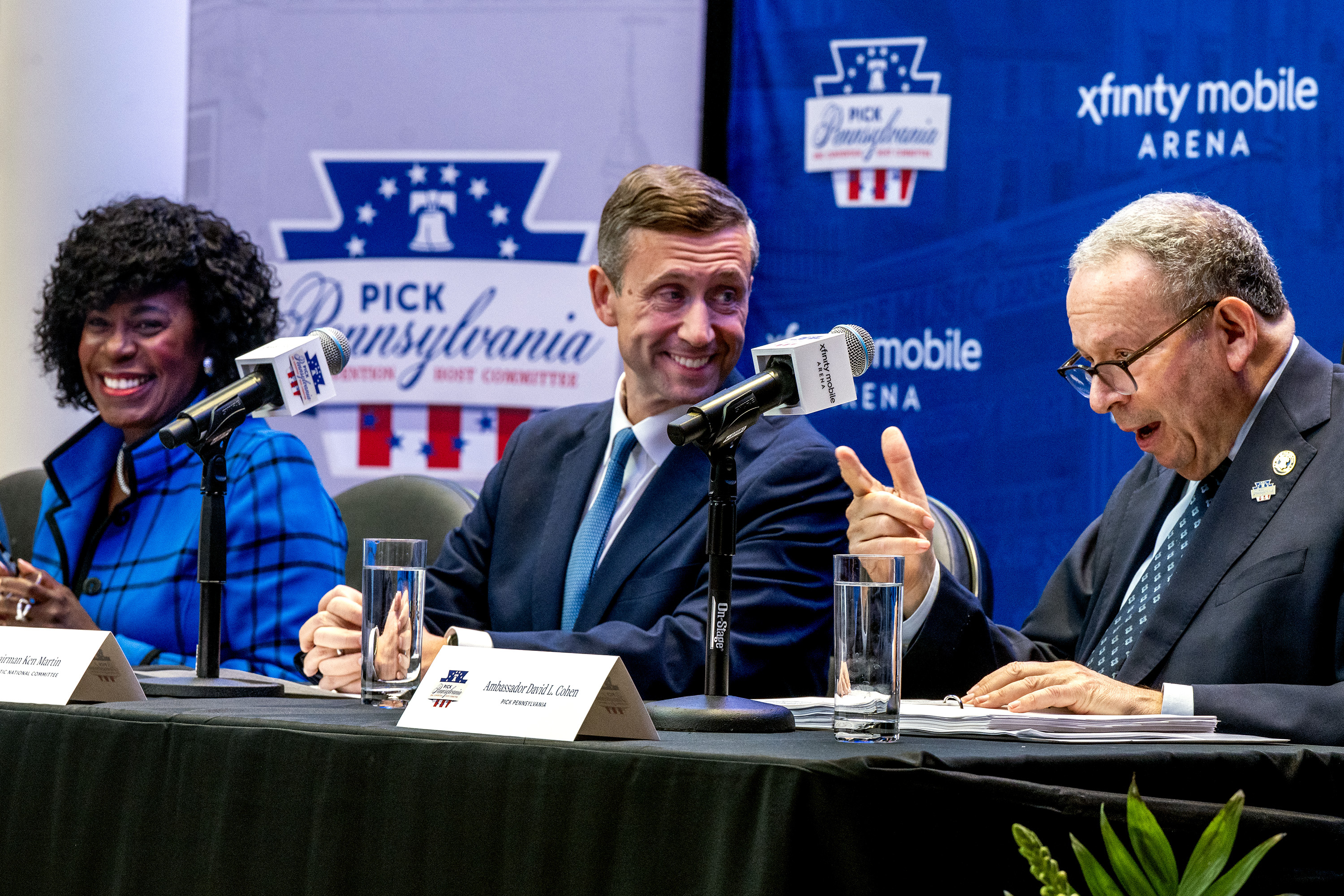
Ken Martin, the chair of the Democratic National Committee, said in a statement that the three finalist cities put forward “incredibly strong bids.” He did not say why the party is no longer considering Atlanta or Chicago.
If Philadelphia is picked, the convention would take place from Aug. 7 to 10, 2028, at Xfinity Mobile Arena in the South Philadelphia stadium complex. The Republican Party’s 2028 convention will be held in Houston.
Democrats in 2028 will choose from an array of potential candidates to succeed President Donald Trump. No major candidate has formally launched a campaign, but Pennsylvania Gov. Josh Shapiro is widely considered to be a contender.
The announcement comes as Martin has faced criticism for his leadership of the party, especially as it relates to fundraising. Democrats trail Republicans ahead of this year’s midterm elections when it comes to money in the bank.
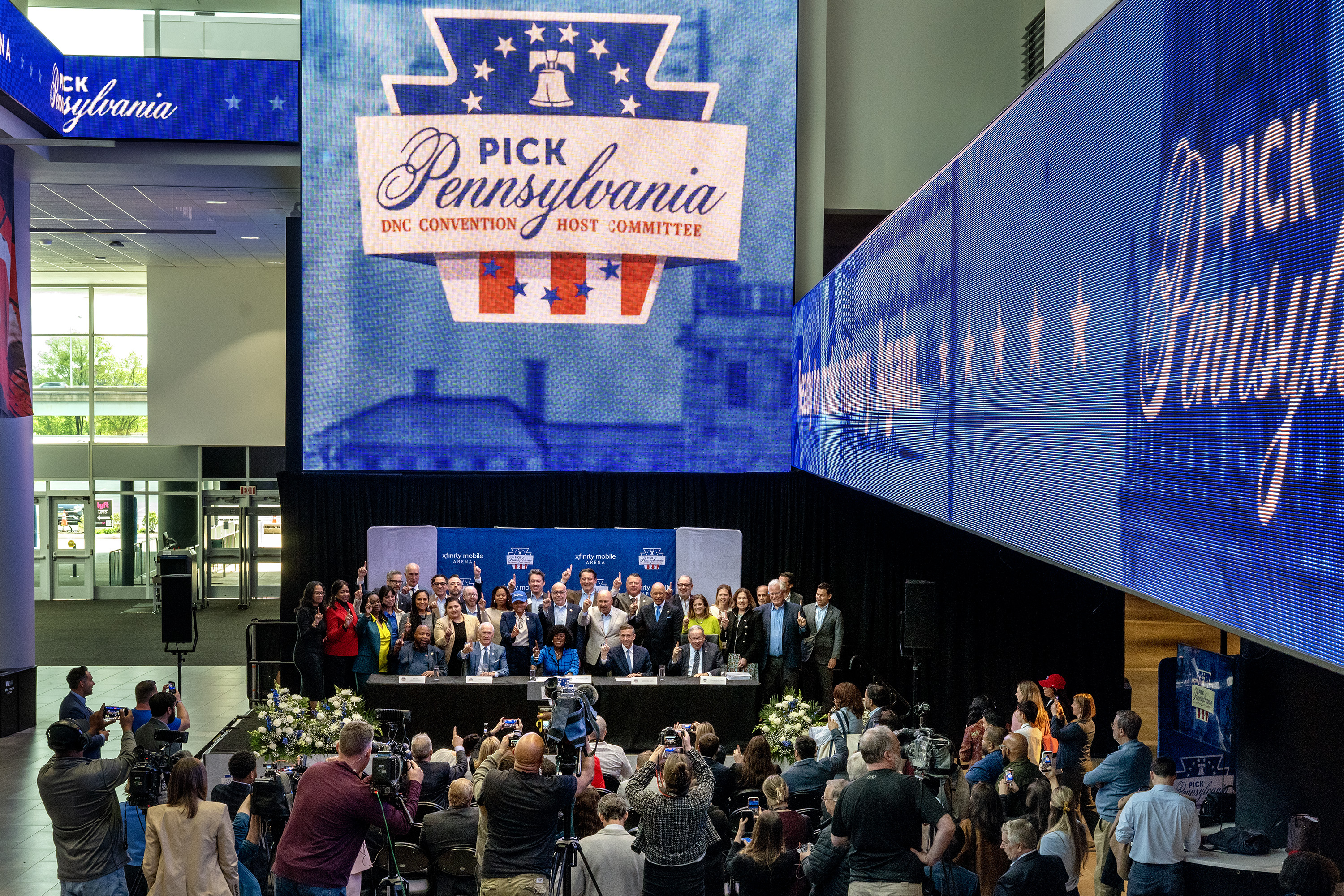
Mayor Cherelle L. Parker is joined by city leaders and Democratic National Committee Chair Ken Martin and his team for a “One City” salute group photo Thursday, April 30, 2026, after they toured the Xfinity Mobile Arena facilities as the city makes its bid to host the 2028 Democratic National Convention. Tom Gralish / Staff Photographer
The party’s decision to narrow its 2028 convention short list comes after Martin and other top officials traveled to the five finalist cities in the spring to assess logistical readiness, including arena capacity, technological capabilities, transportation and security infrastructure, and more.
In April, local Democratic officials and some of the city’s biggest boosters wooed Martin over the course of a three-day trip and presented the city as an improved tourist destination since 2016, the last time the party hosted its major convention in the city. That year, Democrats nominated former Secretary of State Hillary Clinton, who lost the general election to Trump.
The events draw thousands of party members and journalists from around the world, putting the host region in the spotlight for several days. Proponents of hosting the convention also argue that it will generate business as visitors eat, shop, and play; the true economic impact of conventions, however, is up for debate.
Mayor Cherelle L. Parker, who has led the city’s effort to bid for the 2028 convention, said in a news release that Philadelphia this year has “proven that we can do big things better than any other city in the country.”
She cited this summer’s litany of big events in the city, including FIFA World Cup games, the MLB All-Star Game and Home Run Derby, and events associated with America’s 250th birthday.
“We are ready to welcome the Democratic Party and the nation back to our city,” she said.
David L. Cohen, the longtime Democratic Party stalwart and president of Pick Pennsylvania, the city’s host committee, said in a statement that Philadelphia’s selection as a finalist “is a testament to the ongoing strength of our bid and our record of success.”
“We have presented an unmatched case,” he said, “built on experience, preparation, strong partnerships, and a proven ability to deliver major national and international events.”
Pennsylvania Democrats, including Gov. Josh Shapiro, are pointing to a stunning upset in a special election for a deep-red state House district as proof that the party has momentum while campaigning this fall for a trifecta in Harrisburg.
Butler CountyDemocrat Brandon Dukes said his apparent victory over Republican Scott Timko, by fewer than 100 votes as of Wednesday afternoon, was thanks to his focus on local issues, such as a major corridor perennially under construction to the frustration of residents.
“We kept it local, we kept it practical, and we kept it common sense,” Dukes said in an interview.
The 12th Pennsylvania House District, just north of Pittsburgh, went for President Donald Trump by more than 18 percentage points just two years ago and had been held by Republicans since 1999.
Dukes’ apparent win attracted national attention Wednesday as both a sign of the backlash to the president’s party heading into November and as a north star for centrist Democrats as they seek a path forward.
“We won that district last night with a middle-of-the-road community leader, who I backed, who won this improbable race,” Shapiro told CBS Mornings, contrasting Dukes with the party’s more left-leaning candidates this cycle.
“What we’re seeing are commonsense folk from the community who, I think, reflect a lot more my values and my approach to governing who are winning and are upsetting Republicans in these deeply Republican districts,” said Shapiro, a moderate Democrat widely expected to run for president in 2028.
Shapiro recorded a robocall urging voters to cast ballots in the race, his campaign confirmed.
Recipe for November
Democrats are aiming to flip four congressional districts in Pennsylvania this fall and win control of the state Senate for the first time in 30 years with Shapiro, a popular governor, at the top of the ticket.
Dukes, who will compete to win the seat again in November in a rematch with Timko, shattered previous Democratic runs in the Butler County district.
“The fact we just flipped this seat tonight is a political earthquake,” U.S. Rep. Brendan Boyle, a Philadelphia Democrat, said on X.
The district had been represented for more than two decades by one of the Pennsylvania House’s most conservative members, former State Rep. Daryl Metcalfe, who retired in 2023 and was known for his anti-LGBTQ+ rhetoric and actions.
State Rep. Malcolm Kenyatta, a Philadelphia Democrat, said that the seat is one the party “should not have had a chance to come within sneezing distance of,” but that Dukes’ performance provides a blueprint that can be replicated throughout the state.
“Winning here means there is not a single safe seat for the GOP,” Kenyatta, a vice chair of the Democratic National Committee, said on X.
The Associated Press had not called the race as of Wednesday evening, but both parties made statements indicating that they expected Dukes’ lead to hold.
Chantell McCurdy, the director of Butler’s election bureau, said the initial count has been completed and there is a five-day period to challenge the results.
James Markley, a spokesperson the Pennsylvania Republican Party, said in a statement that the race needs to be a “wake up call for Republican voters,” and warned against policies from the Democratic Party’s more leftward flank.
While expressing confidence that the party would win the seat back in November, he also lamented the party’s inability to turn out voters this election.
“The General Election will come down to which party does a better job getting their voters to participate in the election using any legal means of casting a ballot. Democrats did a better job of this,”he said.
Pennsylvania Republican House Leader Jesse Topper of Bedford County downplayed the significance of the special election, calling the results “disappointing but unsurprising” because of demographic change in the district, the timing of the vote during the summer,and the unpredictable electorate for such contests.
“There is much more yet to unfold in the final months of the 2026 election cycle and we will continue carrying out vision for positive growth in Pennsylvania through November,” he said.
But Democrats noted that Dukes’ victory in the district would not have been possible if he did not work to win over Republican voters.
“You cannot win a deep-red district like this without getting at least a big chunk of independents and at least some Republicans” who are “rejecting the chaos and high prices of Donald Trump,” said Pennsylvania Democratic chair Eugene DePasquale.
“I think this is a recipe for a big November for the Democratic Party,” he said.
Dukes, a loan administrator, said he listed affordability, infrastructure, and education as the key issues for his campaign.
DePasquale said Dukes’ campaign worked because he “focused on issues that mattered in the district,” such as high prices and cuts to Medicaid andfood assistance under Trump.
But DePasquale dismissed the idea that Democrats should run only certain kinds of candidates to win.
“We need to be a big-tent party, and we need to have candidates that reflect their districts,” he said. “We are embracing candidates that spread the ideological spectrum of the Democratic coalition, and you’re going to see that lead to success this November.”
Statehouse campaigns often do not receive as much money or attention as congressional and statewide races, but Dukes received a boost from several major figures in the party.
He also boasted an endorsement from former Transportation Secretary Pete Buttigieg, another possible Democratic presidential contender, who said Wednesday that Dukes’ win “reflects voters’ readiness for change.”
Rematch ahead
After he is sworn in, Dukes will serve a roughly 2½-month term, following the resignation of former State Rep. Stephenie Scialabba, a Republican.
As an incumbent, he will then face a rematch with Timko in November for a full two-year term.
Dukes said he plans to “stick with what worked best” for his November campaign, which will include maintaining face-to-face contact with voters.
A graduate of the University of Pittsburgh, Dukes lives with his wife and daughter in Cranberry Township and describes himself as an “avid Star Wars fan” on his campaign website.
House Speaker Joanna McClinton, a Philadelphia Democrat, said Dukes’ win builds momentum for the party to make the case to voters about how electing Democrats achieves their goals on issues like codifying abortion protections and raising the minimum wage.
When state lawmakers return to Harrisburg in September, several issues await, including whether to tax and regulate skill games, finding a long-term funding solution to fund mass transit, and the use of cell phones in K-12 schools.
“When he gets started in Harrisburg in September, he’s going to be a part of the larger House Democratic agenda that’s been focused on affordability and on opportunities for all Pennsylvanians,” she said. “Voters were very motivated to make their values and their frustrations known at the ballot box.”
Dukes will provide votes that he can take back to constituents to further his reelection argument.
“It’s important to tell voters what you’re going to do to make their lives easier because that’s what we did, and we spoke about how we were going to do that,” he said. “It resonated pretty well last night.”
What a difference three words can make. For weeks, the American body politic has watched the strange relationship between Donald Trump and his ever-present 35-year-old aide Natalie Harp in a state of puzzled silence. Then, Georgia Democratic Sen. Jon Ossoff spoke at a weekend rally and said that Trump “doesn’t want to do the job” and would rather “build his ballroom and travelwith Natalie on their apparently defenseless flying palace.” The floodgates opened — on social media and sites like the Drudge Report and in angry retorts from the White House that only threw gasoline on the controversy. It goes to show what Democrats can accomplish when they’re not afraid to speak the truth.
An expert raises questions about Freedom Fuel and Venezuelan oil
The Freedom Fuel Network gas station at 1400 Dreshertown Rd. in Dresher last month.Monica Herndon / Staff Photographer
For a government that seems to be in your face 24 hours a day, the Trump regime has managed to produce more mysteries than Sir Arthur Conan Doyle. Where’s Melania? Why was the president’s butt sticking way out at his last event? But here in Philadelphia, one Donald Trump-linked mystery has confounded motorists for weeks.
Why is Trump-promoted Freedom Fuel, a web of 29 service stations that popped up out of nowhere this summer, able to continue to sell gas cheaper than its rivals down the street?
The mostly suburban stations in Southeastern Pennsylvania and South Jersey burst onto the scene with prices at $3.47 a gallon — lower than anything since Trump’s disastrous war of choice against Iran launched in late February — and continue to undercut their competitors by about 10-20 cents per gallon. Experts have said that’s not sustainable, unless the stations are somehow getting their gasoline on the cheap.
Now a former high-level State Department official in the Barack Obama administration is trying to connect the dots between the Freedom Fuel conundrum and the ongoing questions about millions of barrels of crude oil Trump has bragged that the United States has taken out of Venezuela.
Jonathan Winer, who recently wrote about Freedom Fuel and Venezuela for the Washington Spectator and discussed his findings on the Court of History podcast, doesn’t connect all the dots, but his research is a reminder of how little the American public knows about the aftermath of the Trump regime’s January assault on Venezuela that captured strongman Nicolás Maduro and installed a friendlier head of state.
The Inquirer and other outlets have reported extensively on Freedom Fuel stations in Greater Philadelphia, including its ties to pro-Trump Republican ex-mayor of Evesham Township, N.J., Randy Brown, who signed Freedom Fuel’s certificate of formation. Former commodities trader Yoni Gontownik — a major donor to GOP causes and a New Jersey-based pro-Israel political action committee — also signed those papers.
Trump promoted the launch of Freedom Fuel on his Truth Social feed, but the White House has denied direct involvement in the flag-themed gas stations, and so has the companyitself. “Freedom Fuel Network is a privately owned and proudly patriotic company — along with its convenience store operators, haulers, sign companies, and operational partners — that answered President Trump’s call to action to lower prices at the pump,” it proclaims on its website.
Veterans in tracking the complicated oil market remain baffled. “People can’t mysteriously get fuel at a lower price and continue to offer that,” Winer said on the podcast. “You could, of course, do a very short promotion, but you basically can’t [sustain]it.”
It may be a total coincidence, but the giant enigma that is Freedom Fuel and its cheap gasoline surfaced at exactly the same time the president boasted about the cheap oil the United States is supposedly getting from the resource-rich South American nation his troops invaded.
“We’re taking their oil,” Trump proclaimed about Venezuela while in Las Vegas earlier this month. “To the victor belong the spoils.” He added that what America has taken has paid for the brief January war “many, many, many times.” But analysts know next to nothing about what is actually happening to as much as one million barrels of oil that Venezuela produces every day.
Winer pointed to a couple of common bonds between the efforts to market low-cost gasoline here in Philly and White House efforts to control the flow of Venezuelan oil.
The first is the role of Jarrod Agen, executive director of the National Energy Dominance Council inside the White House, who posted two photos of himself giving a thumbs-up at a new Freedom Fuel station in Philadelphia whenit opened on the July 4 weekend. Both Agen and the president himself insisted that the new gas retailer is proof of what the Trump regime is doing to lower prices at the pump.
Winer noted that Agen was also a key member of an American team that traveled to Caracas in April, met with the Trump-backed new president, Delcy Rodríguez, and came home bragging of new commodities deals, including in the oil sector.
The second overlap that Winer points to involves a Texas-based global commodities firm, Mercuria, which announced on May 1 that it had reached a major deal with Venezuela under what it called a “White House-supported initiative.” The announcement featured a photo of atop Mercuria official posing with Agen.
Mercuria told the Washington Post, which has also investigated Freedom Fuel, that it has no involvement with Freedom Fuel. Yet Gontownik, the trader listed as a backer of Freedom Fuel, was also listed as recently as March in campaign finance reports as an executive with Mercuria. But he also insists that he no longer works for the Texas firm — which has been linked to other Trump-regime commodities initiatives. (The ex-Philly journalist Maureen Tkacik, investigations editor at American Prospect, also raises a lot of questions about the role of Mercuria, Gontownik, and the firm Blue Owl Capital, which Trump invested in earlier this year.)
It must be stressed again that all of these connections are circumstantial. At the same time, this much cannot be disputed: The American people have not been given the most basic information about the extent of U.S. involvement in the Venezuelan oil trade, how much money is involved, or where all that money is going at a time when the price of crude oil has skyrocketed.
I could not agree more with Winer’s plea that Congress go after the U.S. Treasury, State, and Energy Departments that are sitting on undisclosed records of U.S.-linked oil transactions — even though realistically that might have to wait until Democrats gain a foothold on Capitol Hill next year. He also called on the media to dig deeper, which is why I wanted to amplify Winer’s early-stage reporting.
Look, we all want to pay less for gas, which is why motorists have been lining up at Freedom Fuel pumps since the stations opened last month. But most of us don’t want to live in a dying empire where a strongman’s tin soldiers steal a sovereign nation’s buried treasure so that favored insiders can profit. We still have no idea what’s been done in Venezuela in our name, and we need to find out.
Yo, do this!
It’s great that people — especially younger people — are returning to brick-and-mortar movie theaters in the long, hot summer of 2026, but the quality of the releases hasn’t really matched the boffo box-office numbers. That may change starting this weekend with the release of Tony, a movie that could have been titled “Becoming Anthony Bourdain.” The film stars Dominic Sessa playing the future chef, author, and beloved TV traveler as a lanky, awkward 19-year-old, spending a summer on Cape Cod and learning to embrace his love for the kitchen — and humanity. I’m really looking forward to this one.
There are two must-read articles out this week from Adam Bonica, a Stanford University professor who specializes in money and politics. The first is his lengthy investigation into dodgy fundraising practices by top Democratic Party committees and leaders, in which endless spam fundraising emails have hit home with susceptible elderly donors, some of whom have drained their life savings. The second is the story behind the story of how both the New York Times and the “Never Trumper” website the Bulwark both chickened out on publishing Bonica’s essential journalism. The cowardice of the elite media in America’s authoritarian moment is beyond disheartening.
Ask me anything
Question: Why aren’t more Democrats supporting and campaigning on the 32hour work week? It seems like a policy that would appeal to working people across the political spectrum. — brown cloud (@milehighdsa.bsky.social) via Bluesky
Answer: Good question. One political leader, Vermont Sen. Bernie Sanders, has aggressively pushed the 32-hour workweek without a reduction in pay, noting that this would pass the productivity gains of the computer era back to the workers who are being more productive. So, yeah, what’s not to like? It’s certainly true that a lot of Democrats, especially centrists, are heavily dependent on campaign contributions from corporate types who don’t like the idea of a shorter workweek. But I think ultimately, Democratic cowardice on these pro-worker issues goes all the way back to the Ronald Reagan era, and a fear that they’ll be branded by the GOP as the party of “free stuff.” But this isn’t free stuff. We’ve earned it.
What you’re saying about …
Last week’s question about how Democrats should view the primary success of leftists such as Michigan Senate hopeful Abdul El-Sayed drew a response that was both robust (despite the summer doldrums) and fairly unanimous. Proposals from the progressive movement like Medicare-for-All and taxing the wealthy, you agreed, are long overdue. Tom Lees noted that the GOP is trying to find the most extreme democratic socialists, but that “the [Rep. Alexandria Ocasio-Cortez] branch which supports ideas similar to European Social Democrats is the group that is getting people excited.” Craig Strimel added that leftist candidates have failed in the past, but “I also believe that we are so far deep in the current fiasco, and so damned close to total collapse of democracy, that we really are in an all-or-nothing situation right now.”
📮 This week’s question: Georgia Democratic Sen. Jon Ossoff has caused something of a political earthquake with his blunt criticisms of Donald Trump, including a reference to his ever-present young aide Natalie Harp. Has Ossoff crossed a line of incivility that’s a bad look for Dems, or are his criticisms a breath of fresh air? Please email me your answer and put the exact phrase “Ossoff comments” in the subject line.
Backstory on Jason Arday, casualty in the ‘war on woke’
Torchbearer Jason Arday carries the Olympic flame on the torch relay leg between Sutton and Merton in London in July 2012.Joe Giddens
There are two kinds of people in this world. There are normal folks who maybe get a slight whiff of news from the TV or when they boot up their computer, and never heard of a man named Jason Arday. Then there are people who (like me) spend far too much of their day on social media, and now know all about the charismatic Cambridge professor — the youngest Black man to reach those heights in the university’s long history — who came under fire for alleged plagiarism and biographical exaggerations.
The allegations apparently simmered from the day of Arday’s 2023 appointment, but boiled over in recent weeks. He acknowledged some citation errors in his 2015 doctoral thesis — mistakes that Liverpool John Moores University called “honest and reasonable” — but the allegations kept coming. They were fueled by a Cambridge colleague and self-proclaimed “race realist” who went on British national TV to lambaste Arday as “not smart” and label him as merely a diversity hire.
The famously not-laid-back British press went wild on the controversy, with literally hundreds of articles about Arday — not just the Fleet Street tabloids, but even the august Times of London, which ran 60 stories. The media frenzy over the young, dreadlocked sociology of education professor didn’t stop when Arday resigned his Cambridge post, saying that “the relentless accusations, speculation and public commentary have taken a profound toll on me and on those I love.” The media frenzy didn’t even stop when Arday was found dead in his home last Friday. He was 41.
Just one day after Arday’s body was found, Julia Hartley-Brewer, a host on a Rupert Murdoch-owned U.K. TV network, told her audience that Arday “was a liar and a fraud who was rightly exposed for what he really was by academics and journalists who were simply doing their job.”
I’m sorry, but as a lifelong journalist, I never realized that hounding a professor who wasn’t perfect but was loved by his students to his early death is part of the job. To the contrary, I think that good journalism might involve noting that scores of white professors and authors who’ve been caught and admitted to plagiarism or similar issues have been allowed to apologize and go on with their careers. And that bad journalism might be implying that Arday’s middling issues are some kind of commentary on any and every academic with darker skin — as opposed to researching the systemic racism that leaves a supposedly enlightened school like Cambridge with 0.4% Black professors, in an England that’s 4.2% Black.
The ghouls who hounded Arday to his death didn’t work in a vacuum. They tapped intoa disgusting narrative that way too many journalists and self-appointed public intellectuals are spreading not just in the U.K. and the rest of Europe, but here in the United States. They think the righteous COVID-19-era outcry against police brutality and a grossly unequal society was some kind of mania they’ve branded “Woke 1.0.” Never mind that the police were never defunded in 2020, not even close. The nattering nabobs of anti-wokeness won’t rest until every college classroom or airplane cockpit is made safe for white privilege.
Let me do my job as an opinion writer and tell you what I think about these mostly aging, mostly white, mostly male pundits who have so little to say about right-wing fascism that’s in power in America and on the rise in Britain and instead desperately cling to their status from the perceived threat of a few Black intellectuals. With key elections approaching on both sides of the pond, they opportunistically saw Arday as their latest chance to stir up white voters and preserve the status quo, even if that means tolerating an authoritarian police state. Now, a once-promising Black professor is a casualty in their glorious “war on woke.” Have they no shame?
What I wrote on this date in 2020
As I noted in this space a couple of weeks ago, there’s so much about the peak year of the COVID-19 pandemic that we’ve successfully tried to forget. That includes much about the consequential yet somehow anemic showdown between Donald Trump and Joe Biden, which included their virtual, prepackaged summer conventions. On this date six years ago, I grumpily covered the Democratic National Convention from my couch in Delco and — stop me if this sounds familiar — complained that the party was ducking progressive issues. “If viewers didn’t notice what the Democrats left out in their tightly scripted telethon so focused on Trump’s coronavirus failings and his paranoid style — such as climate change, gun violence, and the other things that young people across America have been marching for — the history books might.”
I’ve cut back on column writing this month, mainly because I’m working on a long-term investigation that I’m really excited about. In my one piece published this weekend, I took a deeper dive into the stunning reports that winter drone attacks on fishing boats off the coast of Ecuador — with eight sailors missing and presumed dead — were a covert operation by Donald Trump’s CIA. This callous disregard for innocent human life is the latest example of a White House death cult that must be held to account by a new Congress, and eventually by prosecutors.
It’s truly remarkable the extent to which public opposition to the data centers that support artificial intelligence, or AI, has gone from near zero to 60 mph (or maybe 80) in a matter of months — especially here in Pennsylvania. With public unrest over these behemoths around their air and noise pollution and impact on electric bills, as well as growing discomfort with AI itself, becoming a key issue in the fall election, The Inquirer has been all over this story. On Tuesday, veteran business columnist Joseph M. DiStefano looked at how major contractors are hoping that demand for new data centers will get them through an otherwise sluggish economy. That might be a pipe dream if municipalities respond to voters by rejecting these proposals, as happened last week with a massive facility planned for suburban King of Prussia. You’re going to want to read The Inquirer’s in-depth coverage of this debate before you vote in November, which means it’s time to finally subscribe. What have you been waiting for?
By submitting your written, visual, and/or audio contributions, you agree to The Inquirer’s Terms of Use, including the grant of rights in Section 10.