AUSTIN, Texas — It would be unfair to compare the vibrant reception U.S. Senate candidate James Talarico received at the recent Texas Tribune Festival to the muted response U.S. Sen. John Fetterman drew here two days later.
But allow me to do so anyway.
It was a hometown crowd for the rising Talarico, who, if the polls are to be believed, may become the first Texas Democrat elected to statewide office since 1994. When the doors closed to a capacity crowd at First Baptist Church — with more than 100 people left outside to grumble in the humid 95-degree weather — the vibe as groups of young people rushed to find seats was more pop star than politician.
Even with media access, I barely made it inside. A standing ovation greeted Talarico, and it seemed like every other sentence uttered by the charismatic 37-year-old was met with applause. I had no such trouble finding a seat for Fetterman.
Yet, it wasn’t long ago that the Pennsylvania Democrat elicited similar swooning during his own Senate run in 2022, or that the imposing Fetterman — who leaned progressive and ditched the suit and tie for gym attire — seemed like the future of the party.
Cut to TribFest 2026 and the biggest reaction the Keystone State senator produced from the largely polite, mostly liberal audience was gales of laughter and some jeers from the balcony as he misspoke and identified himself as a “lifelong Republican.”
While some called it a Freudian slip, perhaps Fetterman had seen the Inquirer/New York Times/Siena University poll published earlier that week that showed a majority of Pennsylvania voters saw him more as a Republican than a Democrat.
I couldn’t help but feel for the senator, who expressed genuine exasperation over being questioned about his ideological loyalty. He was speaking my language, after all, when he said he respected Republicans and that to tackle the important kinds of problems facing the nation, “we’re going to need bipartisanship.”
Fetterman is also right when he says he votes with Democrats around 90% of the time. Unfortunately, when he splits, it’s been a doozy.
The senator has unquestionably backed the Israeli government’s response to the brutal Oct. 7, 2023, attacks by Hamas in which terrorists killed about 1,200 people and kidnapped more than 200 others. Israel’s subsequent invasion of Gaza has resulted in the deaths of more than 74,000 Palestinians, in what is labeled by some (including many Democrats) as a genocide.
Support by the government led by Prime Minister Benjamin Netanyahu has increasingly emboldened illegal settlements and violence in the occupied West Bank, as well.
Texas Tribune editor-in-chief Matthew Watkins (right) speaks with Texas Democratic Senate nominee James Talarico during a one-on-one conversation at the Texas Tribune Festival 2026.Eli Hartman for The Texas Tribune
On Tuesday, Fetterman was the lone Democrat to vote against a measure that would have required the U.S. Department of State to report on any investigations into the killings of nine U.S. citizens by Israeli security forces or settlers since 2022.
Fetterman has also blindly supported President Donald Trump’s war of choice in Iran, telling his Texas audience that “the Iranians are really no different than the Nazis.” The senator has been the only Democrat to consistently reject efforts to enact a war powers resolution to rein in the White House, most recently on Sept. 24.
What comes through listening to Fetterman defend his positions is his earnest belief in what he’s doing. He tried to frame his actions as those of someone led by common sense and a plain understanding of right and wrong.
“We’re the good guys,” he said. “The problem is Iran and Hamas.”
When questioned by an audience member about his apparent black-and-white worldview and whether there was room for nuanced positions in U.S. geopolitics, Fetterman said he was nothing but.
“My argument is nuance,” he noted. “That’s why it’s not a genocide [in Gaza], and that’s why is Iran allowed to build a nuclear bomb? That there is nuance.”
Maybe later I’ll coin the term for the sound of a mass skeptical smirk, but here I’ll just call it the audience response to Fetterman’s answer.
The senator’s problem — and why he’s losing Democrats across the country — is that regardless of his earnest belief in what he’s doing, he’s wrong.
He can’t see that you can understand that what happened on Oct. 7 was an atrocity and that the Israeli government’s reaction has gone beyond any reasonable response; that while Iran was a rogue nation that punished its people and sought to undermine Western allies, Trump’s ill-planned war has done nothing but destabilize the region, raise energy prices, and make America weaker.
Still, there seems to be a method to Fetterman’s foolhardiness, and his time on the Texas stage was a mix of defensiveness and defiance.
Pennsylvania’s senior senator seems to be betting on the fact that even if someone like the beloved Talarico wins his race, the electoral reality may leave the Senate almost evenly split between Democrats and Republicans.
“What if that happens …? Who’s 51 …? Oh, yeah,” he mugged. “Wait until the midterms and let’s see what happens.”
Sure, let’s.
Based on his misguided stubbornness, if Fetterman is going to receive any standing ovations from a Texas crowd, it will be down the road in Houston at the 2028 Republican National Convention.
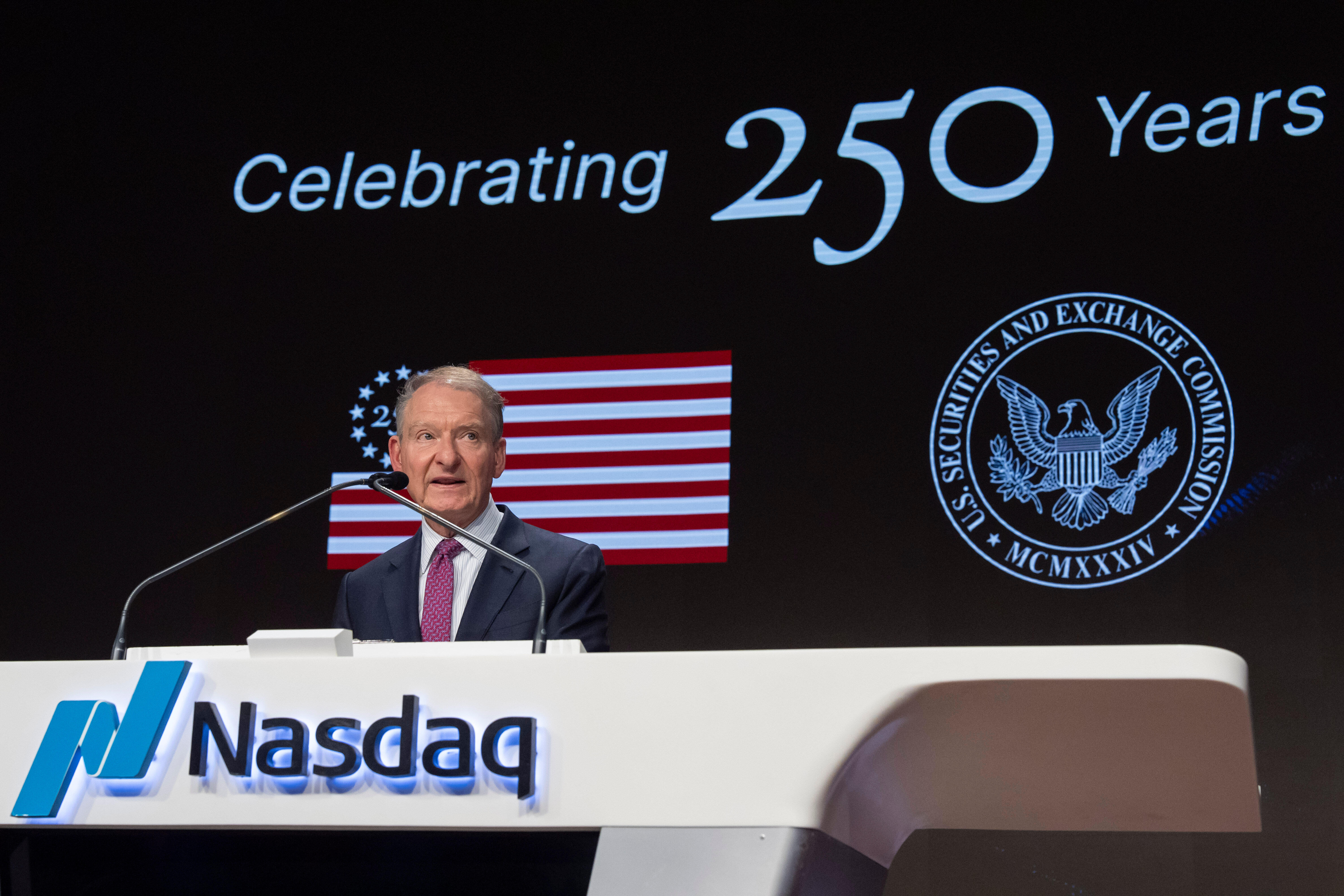
The Securities and Exchange Commission board plans to rescind a rule that said Wall Street money managers who gave money to state and local campaigns were barredfrom collecting fees for managing state and local-government dollars, for two years after they donated.
The SEC rule, created in 2010, had special resonance in Pennsylvania, which ishome to nearly one-third of the nation’s 5,000 public pension funds. Before then,private money managers had donated relentlessly to the politicians whose pension investment boards hired them.
The proposal would end the limit on political contributions and stop requiring investment advisers to keep detailed political-contribution records.
“The SEC is not the nation’s elections regulator,” SEC chairman Paul S. Atkins, wrote in a public letter accompanying his September proposal to ease the rule. Acknowledging the rule he wants to gut “was intended to deter fraud” by barring donors from getting paid to manage public money, Atkins wrote that the rule instead “resulted in the suppression of free speech,” pushing extra-careful firms to ban all political donations, and reducing Wall Street funding for political candidates.
Fraud is already illegal; leave policing money managers’ influence-buying to state and local law and federal election rules, Atkins urged.
But some money managers, including Pennsylvania fund managers, expressed concern about the scale of the federal rollback.
The 2010 SEC rule was “an objective, preventive restraint,” to prevent corruption, Christopher Tobe, a former Kentucky state pension trustee, said in a summary of his comments to the SEC.
By contrast, state and local antifraud laws are typically applied only “after misconduct and harm have occurred,” added Tobe, a critic of private investments in public funds, who features in the public-pension documentaryPension Fight Club.
The first civil case brought under the SEC rule, in 2011, resulted in then-Pennsylvania Gov. Tom Corbett and Philadelphia Mayor Michael Nutter returning campaign contributions to TL Ventures. The state and city pension boards had hired thismoney-losing Chester County firm in a failed attempt to cash in on the dot-com boom. TL agreed to return nearly $300,000 in fees and interest, which the SEC said the firm hadwrongly collected after donating to the campaigns of top state city and state officeholders.
The Pennsylvania State Capitol in Harrisburg. A rolled-back SEC rule could loosen restrictions on state-elected officials taking campaign donations from money managers who work for the government.
Politicians were convicted over investment-firm donations
The SEC rule limiting pay-to-play was enacted amid a string of pay-to-play scandals.
In the late 2000s, a string of mostly Democratic state and city politicians went to prison for receiving or demanding bribes in exchange for hiring professional investors to manage public pension money. In 2010, California pension chief Fred Buenrostro and New York State Comptroller Alan Hevesi were each convicted of corruption charges for taking campaign cash from investment contractors, and sentenced to prison.
The political contributors cited in Buenrostro’s case, portrayed by prosecutors as victims of public officials’ extortion, included Apollo Global Management. Apollo was then headed by Leon Black, who later lost the job over his relationship with disgraced financier and sex offender Jeffrey Epstein. Apollo is now the largest private-equity fund and its clients include Pennsylvania’s state pension funds.
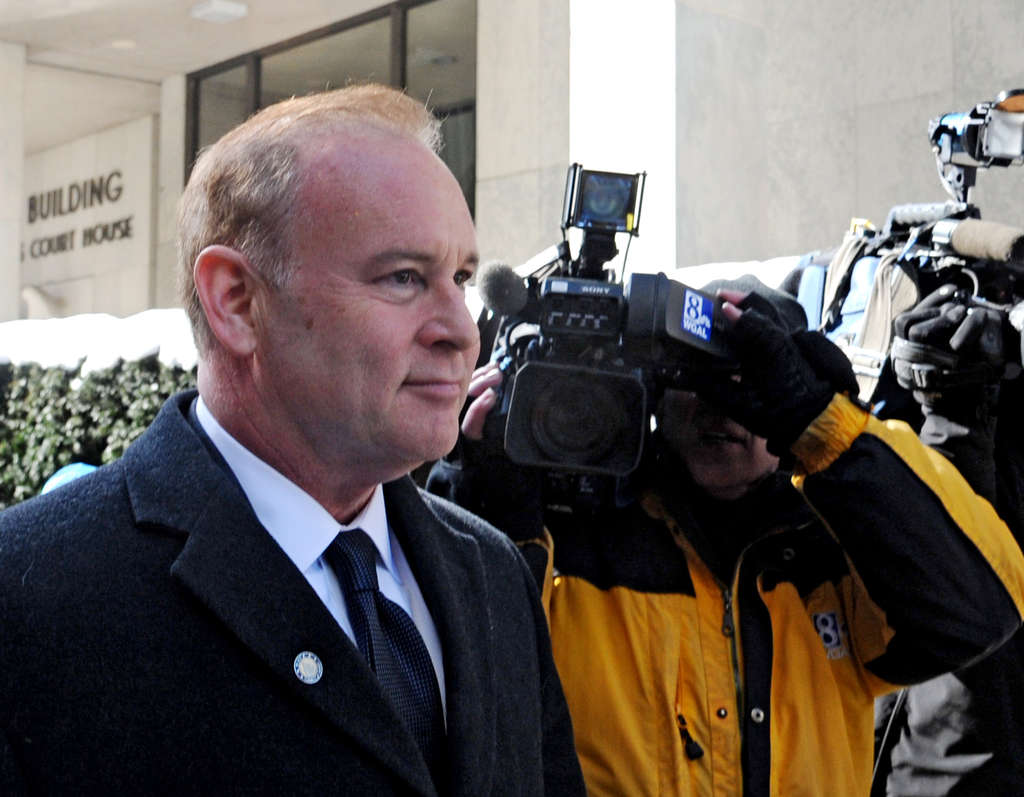
In Pennsylvania, elected state treasurers Rob McCord in 2015 and Barbara Hafer in 2017 pleaded guilty to criminal violations related to their handling of campaign contributions from money managers.
McCord, who had been a tireless political fundraiser for governors and his own campaigns, was sentenced to federal prison; he was released early. Hedidn’t return calls seeking comment.
Rob McCord, former state treasurer, leaves Federal Court in Harrisburg after pleading guilty to two counts of attempted extortion of an investor seeking contracts to manage state funds, in 2015. CLEM MURRAY / File Photograph
Hafer, who got probation and a fine, died last year.
Prior to the SEC rule, it was a common practice for money managers to fund Pennsylvania campaigns forgovernor, treasurer, and legislators. “Not only do they give me money, I hope they vote for me,” Hafer told The Inquirer in 2002.
Political contributions continued
Still, the rule didn’t stop political contributions altogether.
On Sept. 14, 2020, the state officials, teachers’ union local officers, and school board reps who formed the state school pension (PSERS) board met in secret to approve a $100 million investment. The target, code-named Project Newton, was a proposal by Pittsburgh tycoon and Steelers co-ownerThomas Tull.
Two days later, The Inquirer reported, Tull gave $711,000 to campaign funds backing Joe Biden, who was running for president, and $750,000 to a national super PAC for U.S. Senate Republicans. “There is no connection,” Tull said of the timing, so soon after the state’s secret investment. That investment, in hospital-wear maker Figs, later proved profitable.
Indeed, the SEC rule didn’t stop investment managers from donating to national politicians or even out-of-state races.
Still, Tull and national Democrats promised to recover $10,000 of Tull’s money after The Inquirer noted that those funds had been passed to Pennsylvania Democrats, whose leaders included pension board members. The SEC filed no complaint.
What money managers say
“I thought the rule had it right,” said Michael DiPiano, founder of NewSpring Capital, a $3.5 billion private investment fund group in Radnor, whose clients have included the Pennsylvania state and New York City pension funds.
“Limiting or eliminating pay-to-play took donor pressure off of [private-investment fund managers] and leveled the playing field,” so larger firms that could afford the biggest donations wouldn’t crowd out smaller firms, DiPiano said.
“Tighter pay-to-play restrictions should lead to a more objective-based approach” for picking money managers, he added.
Richard Vague, the former banker and Pennsylvania Secretary of Banking who chairs the PSERS pension board, says SEC limits might fairly be eased in some details but “an outright rescinding goes far beyond.”
The rule came after Wall Street “corruption” was exposed in the late 2000s, with the pension fraud cases, he noted. “Protective regulations, laws, and other safeguards get put in place in the aftermath of a major crisis,” Vague added.
It’s not surprising that money managers and their Washington allies chip away at those rules, but with too much trimming, “those safeguards largely disappear,” Vague concluded.
“That makes a subsequent crisis all the more likely.”
“Why am I getting Ken Paxton ads during the Eagles Rams game???” wrote one user on X. Many others posted similar questions, some with decidedly more profanity.
At least three ads supporting Paxton, the Republican candidate in the contentious U.S. Senate race in Texas, aired during the home matchup, which was broadcast locally on Fox29.
Much of the Eagles-Rams audience can’t vote in Texas. So why all the airtime?
“It’s probably aimed at reaching into the pocketbooks rather than the voting hearts of the people who are going to be watching,” said Michael Hagen, an associate professor in the political science department at Temple University.
Hagen said the motive for putting ads in front of people who may not be able to vote in a particular election is typically to solicit donations and raise funds.
With a month until the midterm elections, the Texas Senate has become a “much more competitive question mark” than expected, he said; polls show Paxton is trailing his Democratic opponent, James Talarico. While Democrats have not won a statewide election in Texas in decades, the hotly contested race, and others in battleground states, could also swing control of the U.S. Senate.
According to social media posts, at least one of the slots — of Paxton’s estranged wife urging voters to back the entire Republican ticket — appeared to run nationwide.
“Dawg I am in ROSSLYN, VIRGINIA,” one user said, posting a photo of the commercial on TV. (Also, on Sunday, the Dallas Cowboys played the Houston Texans.)
That ad was funded by a political action committee, which has invested more than $125 million into the race, according to the New York Times. Paxton’s campaign did not immediately respond to an email seeking comment Sunday evening.
Rest assured; Hagen said people shouldn’t expect many more ads from Texas.
“It really is unusual, but it’s an indication of just how much money is being put into the Senate race in Texas, in particular, and Senate races all over the country,” he said. “We’ll definitely see much more money being raised and spent — just not maybe in this particular way.”
With questions about election integrity roiling American politics, Scott Presler — a social media influencer from Pennsylvania who regularly makes wild and unproven accusations around voter fraud — seems determined to fan the flames.
In a recent social media post with more than a million views, Presler claimed — without providing any evidence — that there are as many as 50,000 noncitizens who are registered to vote in the Keystone State. His millions of followers across various platforms are routinely inundated with similar messages, in between appeals to volunteer with his organization, Early Vote Action.
Presler’s post came on the heels of an announcement over the summer by the U.S. Department of Homeland Security — again, without providing much in the way of details — that it had identified 14,576 noncitizen registrations.
I’ve emailed Presler multiple times to find out how he’s arrived at his figures and have yet to receive a response.
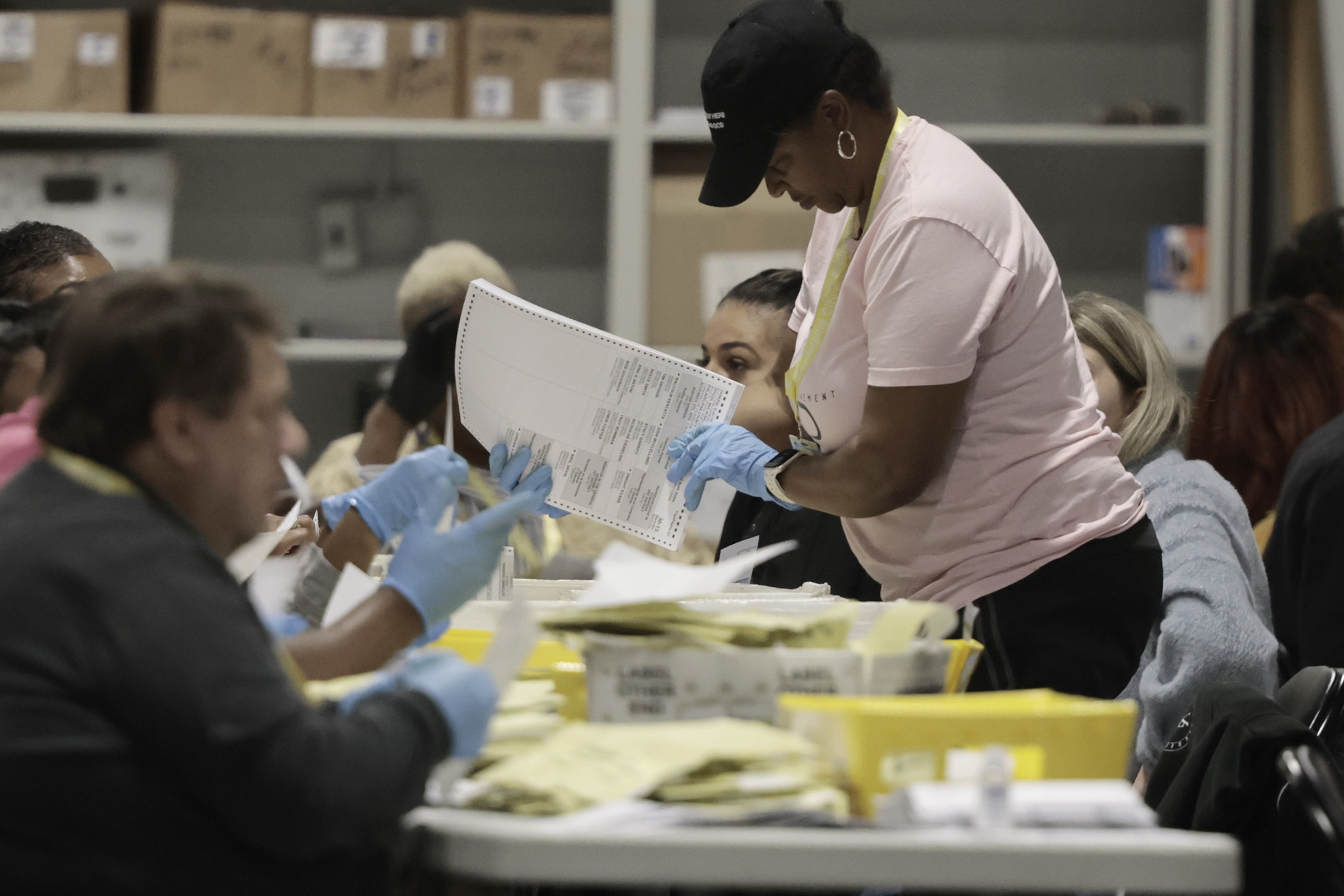
These episodes underscore one of the biggest challenges facing voting officials in Pennsylvania and elsewhere as they prepare for next month’s midterm elections: debunking vague or unverified claims about widespread fraud.
Long before Donald Trump’s unfounded assertions that the 2020 presidential contest was stolen from him, election officials, lawyers, activists, and political parties argued over election security. The goal is to balance two valid, competing concerns: that every eligible voter can cast a ballot, and that every ballot counted is cast by an eligible voter.
But there are crucial differences between partisans like Presler and the most conscientious elections officials.
Because of the sanctity of the ballot, voting officials are careful about the language they use and the claims they make.
Elections administrators distinguish between voting irregularities — errors caused by computer glitches or benign mistakes — and voter fraud, instances where there is a deliberate attempt to shift the outcome of a vote.
And, perhaps most important, the best voting officials regularly show their work and provide evidence for their assertions.
For Presler and others like him, the latter can be especially challenging.
“I have never seen Presler release actual verified data, so we are left to guess, which may be his intent,” said Linda Kerns, a conservative Republican election lawyer with a long history of campaigning for voter integrity. “He appears to compare juror lists to voter registrations, but there are many more steps to the process. Social media posts are rarely evidence-based.”
What experts told me is that what people like Presler are doing is focusing on so-called soft targets, which are very different from confirmed cases of wrongful registration. Lists of people who are not eligible to vote — which may include, for example, those who marked themselves as noncitizens when called for jury duty — are not necessarily wrong, but they may be outdated. Hundreds of thousands of people become U.S. citizens every year. But officials said it is exceedingly rare that noncitizens intentionally register to vote illegally.
More common is what happened recently in Nevada, where Homeland Security officials originally claimed there were around 16,000 noncitizens registered to vote. When the agency later sent a list to the state, it only included 185 names. Nevada officials then confirmed all 185 people were eligible to vote.
It is easy to mock the Trump administration or Presler’s brand of hyperbolic nonsense, but that doesn’t mean election security concerns aren’t real — or that local officials don’t take them seriously.
Secretary of the Commonwealth Al Schmidt speaks during a news conference at the Philadelphia Election Warehouse, in the Far Northeast in October 2024.
Election integrity
When it comes to securing elections, conservative policies to avoid diluting legitimate votes have tended to prioritize measures like voter ID laws and restricting who is allowed to drop off a mail-in ballot. Liberals and progressives, meanwhile, have favored widening access. That’s why they’ve fought against ID requirements and anything else that might encumber legitimate voters.
Pennsylvania Secretary of the Commonwealth Al Schmidt has been caught between these competing impulses for 15 years.
In 2011, Schmidt was an insurgent candidate for Philadelphia’s Republican spot on the Board of Elections. A former analyst at the Government Accountability Office, Schmidt ran and won on a platform of cleaning up local elections.
In 2012, he issued his own report on voting irregularities in that year’s primaries. It was met with some partisan pushback, particularly from progressives. The much-missed City Paper even went as far as calling Schmidt a “snake in the grass.”
Before joining The Inquirer, I worked with Schmidtat the Philadelphia City Commissioners. When I joined the office in 2014, it was clear the city’s elections were in need of fine-tuning.
Then-Deputy City Commissioner Seth Bluestein, who would take Schmidt’s seat in 2022, already had a series of open investigations. (Full disclosure: I’ve known Bluestein for more than 20 years, having met him on our first day as freshmen at Central High School.)
Our office’s biggest find was Dom DeMuro, a South Philadelphia judge of elections who later admitted that during several elections from 2014 to 2016, he had changed the results on voting machines after the polls had closed. This led to a federal investigation that uncovered an entire electioneering scheme, orchestrated by former U.S. Rep. Michael “Ozzie” Myers.
Myers, DeMuro, and another poll worker were all sentenced as a result. As Adam Bonin, a widely respected election lawyer, told me, Schmidt “has found places where Democrats were trying to cheat and he caught them. And they should have been caught.”
After all, much of what was going wrong in city elections was occurring on a smaller scale than what Myers was up to. Bluestein remembers cases where nonaffiliated voters were allowed to participate in primaries, or voters used the wrong machine at shared polling locations.
While these mistakes should not occur, they also aren’t crimes, let alone proof of a conspiracy.
Republican Philadelphia City Commissioner Seth Bluestein speaks with reporters during a news conference outside Philadelphia’s election warehouse in the Far Northeast in November 2024.Elizabeth Robertson / Staff Photographer
Suspicious minds
When it comes to names on lists, suspicion is not evidence, and investigations help dispel doubt. Takethe case of a Philadelphia woman named Cheerful Happiness.
All the way back in 2012, city Republican leaders asked Schmidt to look into a series of names they found suspicious. In the case of a “Joe Cheeseborough/Cheeseboro,” investigators found that his supposed home was a 7-Eleven on South Broad Street. Cheerful Happiness, however, turned out to be a real person.
At the time, she was 100 years old, and workers at her assisted living facility confirmed her identity and the fact that she still voted regularly. Cheeseboro, on the other hand, was listed as “inactive.” This means that if someone had shown up to vote using that name, they’d have to present ID to prove they were who they claimed.
Among election deniers, much has been made of the recent acknowledgment by New Jersey voting officials that 6,600 noncitizens were allowed to register to vote prior to the 2024 election because of a glitch in the state’s motor vehicle system. Even after indicating they were not citizens, a computer registered them to vote anyway.
Bluestein identified a similar case here — with a nearly identical cause — between 2012 and 2017. He led an investigation that was prompted by the wrongfully registered voters themselves; some had written letters asking for their names to be removed from the voting rolls before they applied for citizenship.
As Bluestein looked into the phenomenon, “it became clear that much of the problems were individuals who were getting registered to vote at PennDot.”
Despite having documentation that said they were not citizens, they were asked to register anyway, leading some to believe they were eligible. In other words, this was PennDot’s fault, not the individuals. Of the 220 wrongfully registered voters discovered, 76% had registered to vote at PennDot.
After identifying the problem, Schmidt offered recommendations, which were then adopted by the state. These reforms worked.
When Republican Auditor General Tim DeFoor reviewed the state’s motor voter system earlier this year, he found that the “process works.” DeFoor’s staff looked at more than 200,000 applications and identified 58 that required further review. Of those 58, just one was improperly registered — the result of a data entry error.
Still, this success has not satisfied election integrity activists.
Kerns, the election lawyer, told me that “Schmidt’s focus appears to be on PennDot, but 20% of registrations in Pennsylvania come from other sources. How many noncitizens register through PennDot is the wrong question. What matters is: Can a foreign national register to vote in this commonwealth without their citizenship status being verified?”
Bluestein confirmed that his staff cannot run these checks. He did, however, point out that when officials do find noncitizen registrations, they happen at license centers because the consequences of knowingly violating the law are severe. Filling out a voter registration application as a noncitizen counts as perjury. A perjury conviction could preclude current legal residents from becoming citizens, or even lead to jail time, a fine, and loss of permanent residency or deportation.
Of course, the ideal number of noncitizens on the voting rolls is zero. Each unlawful vote increases the sense of skepticism aboutthe votes of the eligible. That’s why Schmidt and Bluestein — along with their colleagues across the country — regularly take on the challenge of finding and eliminating irregularities.
Reasonable people can disagree on how to balance the need to protect voter rolls vs. ensuring eligible voters are not disenfranchised due to onerous requirements and have their privacy protected throughout the process.
What election deniers are doing has nothing to do with protecting the voting process. By publishing unvetted, outlandish claims, they stoke fear and cast doubt on one of the most crucial parts of our democracy. If anything should fuel suspicion around elections, it’s the motivations of those who want to question the results without sufficient evidence.
U.S. Rep. Brian Fitzpatrick (R., Pa.) has been a member of Congress for nearly a decade, and it is difficult to determine what exactly he has accomplished.
Fitzpatrick, 52, claims to be a problem solver, but he is really part of the problem. Fitzpatrick entered Congress with the MAGA wave that first swept into Washington with Donald Trump in November 2016.
He is a member of a Republican House majority that has been one of the least effective and most dysfunctional in modern times. The GOP controls the House, Senate, and the White House — and still can’t do much to help the American people.
Because Fitzpatrick represents a swing district that covers Bucks County and portions of Montgomery County, he doesn’t always vote lockstep with his Republican colleagues. But when Fitzpatrick’s vote is needed, he backs Trump’s incoherent agenda, which has made life more expensive for everyone.
That agenda speaks for itself: costly tariffs, cruel deportations, unprovoked war, tax breaks for the superrich, massive debt, healthcare cuts, brazen corruption, abuses of power, self-enrichment schemes, and constant chaos.
For Fitzpatrick’s constituents, Republican control in Washington has resulted in higher interest rates, sluggish job growth, and increased prices on everything from gasoline to food, cars, housing, and utility bills. Not to mention a host of constitutional, ethical, and legal abuses with no oversight or pushback.
U.S. Rep. Brian Fitzpatrick (R., Pa.) doesn’t always vote with his Republican colleagues. But when his vote is needed, he backs Donald Trump’s incoherent agenda, the Editorial Board writes.
He did vote against Trump’s signature legislative accomplishment: the so-called Big Beautiful Bill, which added trillions to the ballooning deficit, extended tax cuts for the wealthy, slashed Medicaid and other support for the most vulnerable citizens, and added billions to support Trump’s deportation roundups.
But Fitzpatrick’s no vote came only after final passage of the measure was assured. Weeks before the measure’s final passage, he was the deciding vote to advance the bill that ultimately became law.
He often performs this type of calculated two-step to appear not so extreme to his more moderate constituents. But the results spell pure MAGA.
Fitzpatrick, who recently married a Fox News correspondent, pulled a similar switcheroo on Trump’s costly war in Iran. Initially, he voted against limiting Trump’s power to wage war in Iran before voting to block further military action. He even issued a muddled statement about the war that said nothing.
So he was for the war before he was against it. The result of Trump’s strategic blunder that GOP congressional members enabled has been higher gas prices, billions wasted on bombs, and needless death and destruction with no way out.
Fitzpatrick has harmed his constituents in other ways. He repeatedly supported Trump’s tariffs, which have upended trade relations with allies, roiled financial markets, and increased prices for small businesses and consumers.
He is increasingly out of step with his own constituents. He supports data center development, which most voters oppose. He also opposes codifying abortion rights, which a majority of the public supports.
Fitzpatrick has also been largely missing in action in his own district. He has not held a town-hall meeting with voters since 2017, calling them a waste of time.
He has refused to debate his opponent, Bob Harvie, a Bucks County commissioner. Fitzpatrick declined to meet with this Editorial Board to make his case for reelection — even though The Inquirer endorsed him in the past.
If 80% of success is just showing up, Fitzpatrick has failed his constituents.
The problem may rest with who Fitzpatrick really represents. His campaign is largely funded by billionaires and out-of-state corporate PACs backed by Wall Street banks, Big Pharma, and Koch Industries.
More broadly, the GOP-controlled Congress has failed to uphold its sworn oath to support the Constitution and serve as a check on the executive branch of government.
Fitzpatrick’s true character is shining through in the onslaught of attack ads aimed at his opponent. An ally with a checkered past was recently exposed for planting negative articles about Harvie. That’s a Tammany Hall move.
Fortunately, voters in Pennsylvania’s 1st Congressional District have a more upstanding alternative in Commissioner Harvie.
Harvie, 54, is a Bucks County native who grew up in a blue-collar family (Bristol Borough) and was the first member in his family to go to college. He taught social studies in the public schools there for many years. He is humble, hardworking, and understands the affordability challenges facing Pennsylvanians.
Democratic Bucks County Commissioner Bob Harvie understands the affordability challenges facing Pennsylvanians, the Editorial Board writes.Monica Herndon / Staff Photographer
He would bring some much-needed compassion and decency to a Congress that is turning into TikTok performance artists more interested in viral posts than making government work for the people they represent. Even better, Harvie will answer to the people, not Trump.
Unlike Fitzpatrick, who has not held an in-person town hall in nearly a decade, Harvie has held five town halls since April and has four more scheduled this month.
Harvie was elected commissioner twice. He knows how to work with Republicans and Democrats. The three-member commission includes one Republican, yet more than 90% of the votes have been unanimous.
The commissioners have opened mental health care facilities, launched sustainability programs, and passed a bipartisan resolution opposing the use of warehouses as U.S. Immigration and Customs Enforcement detention facilities.
If elected, Harvie said his top priority would be to address affordability issues facing residents. He also wants to restore trust in government, starting with a ban on stock trading by members of Congress and a clampdown on corporate control of politics by passing a constitutional amendment to overturn Citizens United.
“I was raised to love this country,” Harvie told the Editorial Board. “I cannot stand what’s happening to it.”
Many Americans agree. That’s why The Inquirer endorses Bob Harvie for Congress in Pennsylvania’s 1st District.
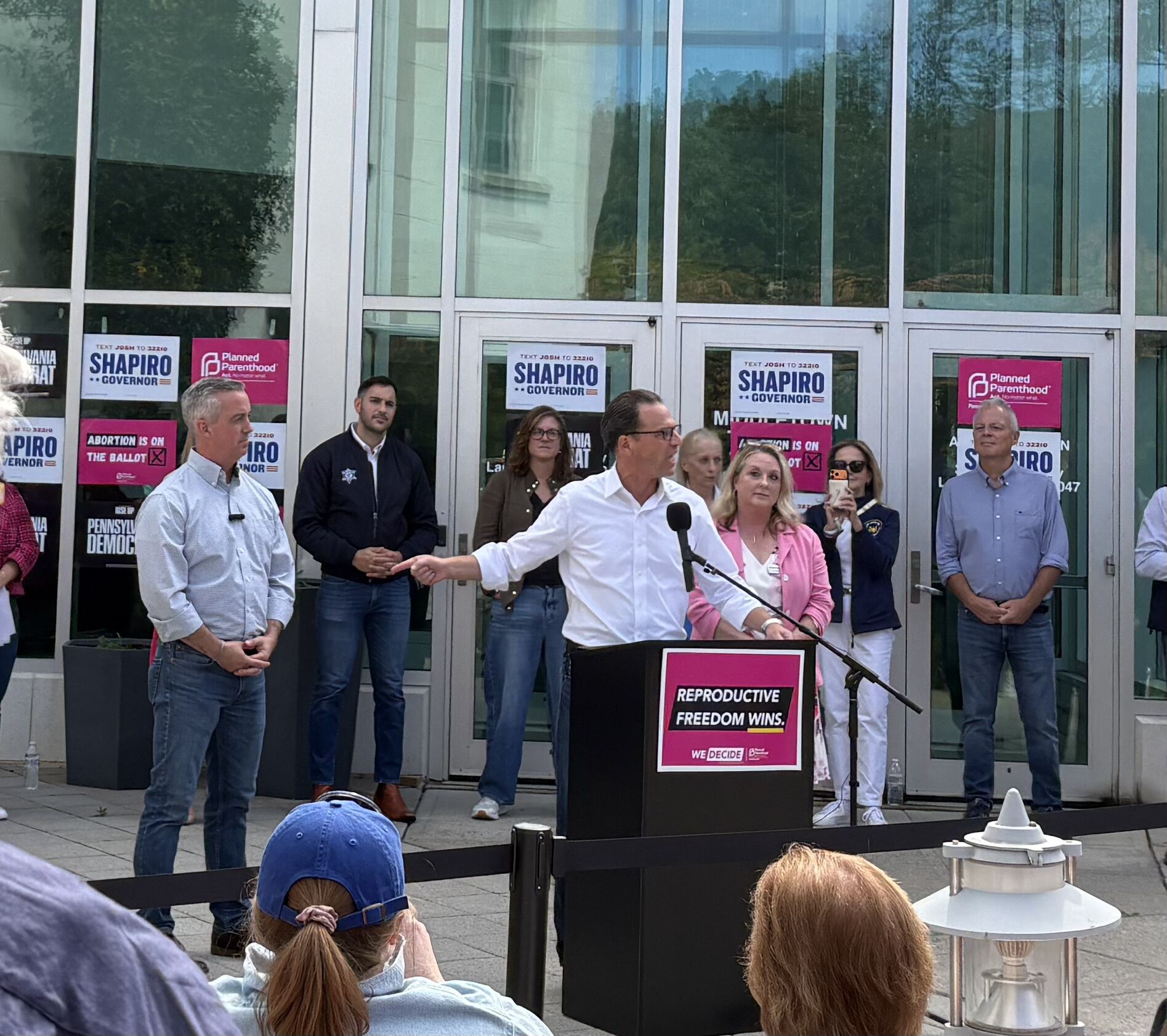
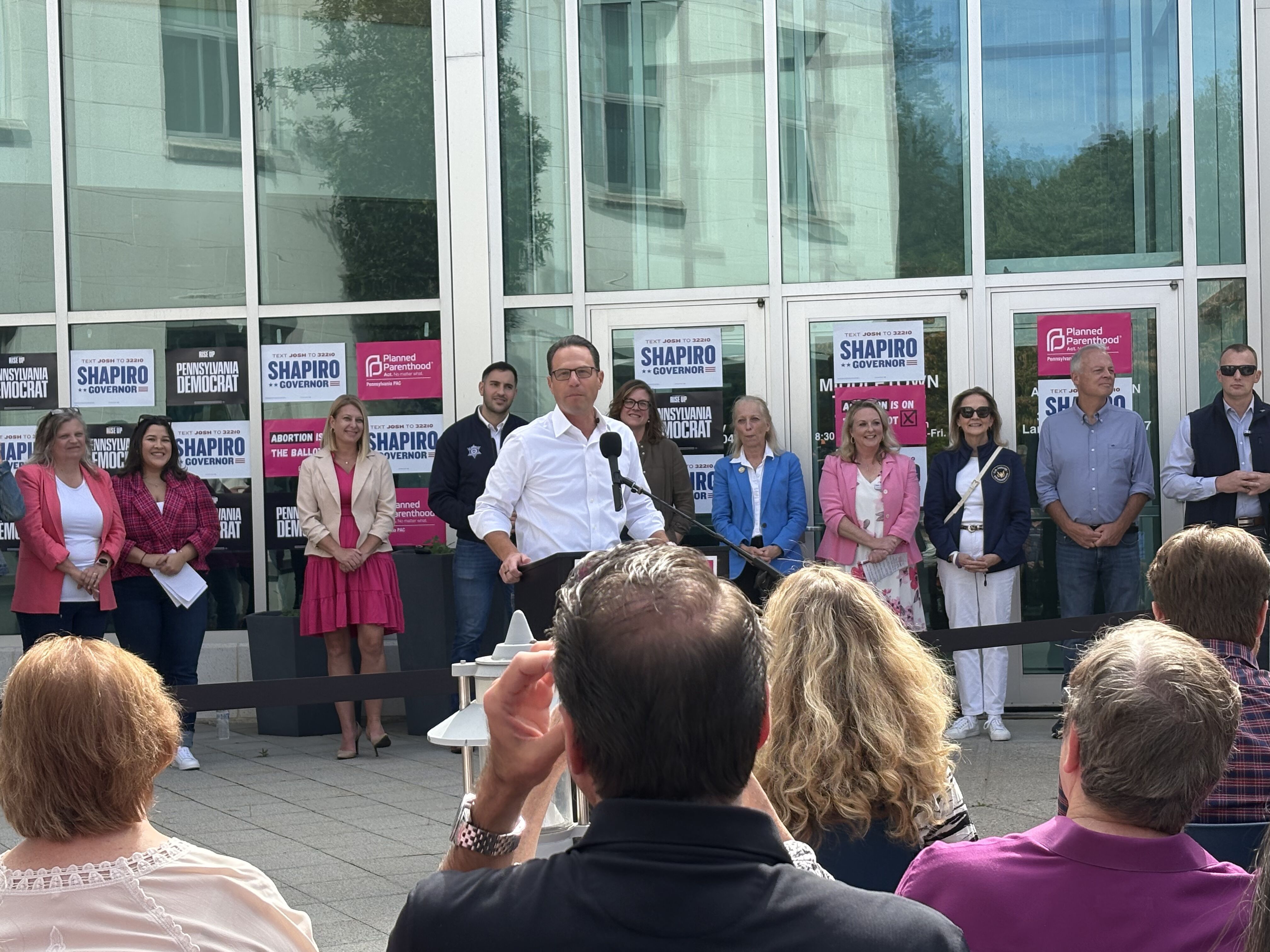
Exactly one month to the day ahead of the highly consequential midterm elections, Gov. Josh Shapiro stood in front of the Middletown Township Municipal Center and said something pretty much everyone in Bucks County is well aware of:
“Bucks County, you’ve got a lot of power,” he told the large crowd that gathered on the lawn and under trees with fall-tinged leaves.
Shapiro kicked off a day of action for Democrats organized by Planned Parenthood’s state-level political action committee Saturday afternoon in Bucks County. The purple county will be the center of crucial races for state Senate and U.S. Congress,and could determine the balance of power.
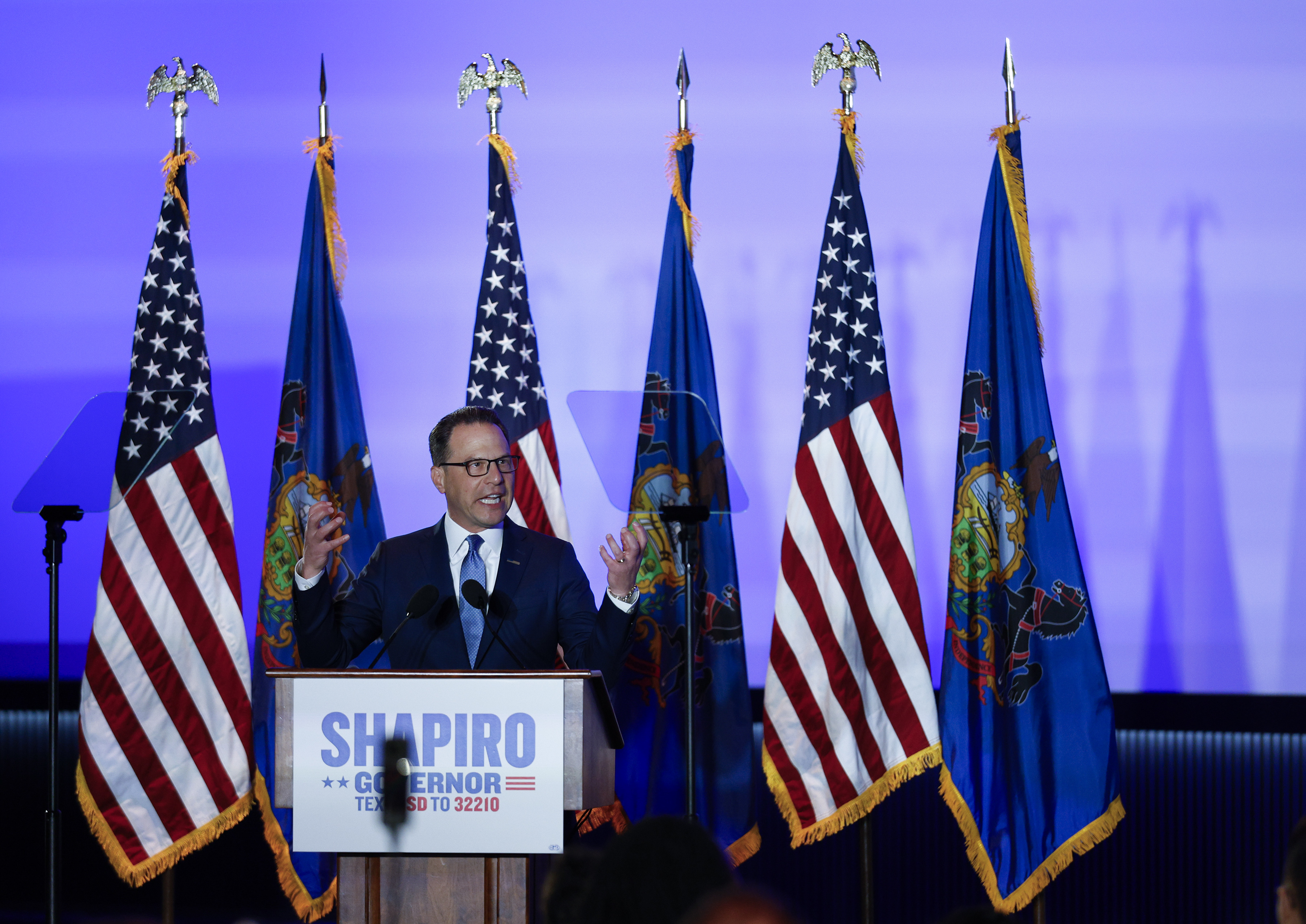
Gov. Josh Shapiro speaks to the crowd gathered at the Middletown Township Municipal Center in Bucks County on Saturday.Fallon Roth
Shapiro, who is also running for reelection, promoted the Democrats at the forefront of those races Saturday, including 1st U.S. Congressional District candidate Bob Harvie and Eileen Hartnett Albillar, who is running in the 6th state Senate district. He framed their election as a chance to put a check on President Donald Trump in Washington, D.C., and an opportunity to flip the state Senate and obtain the first Democratic trifecta in Harrisburg in decades.
Bryan Allen, Kristin Egan, and Monica Weninger are also running in Bucks County to expand Democrats’ majority in the state House.
Shapiro called the 1st Congressional District race — between Harvie and U.S. Rep. Brian Fitzpatrick (R., Bucks) — “the most competitive in the entire commonwealth.”
Three other U.S. House seats in Pennsylvania are also being targeted by both parties: the 7th, 8th, and 10th Districts. Shapiro has also described the 9th as competitive.
Harvie, in his speech, highlighted the affordability crisis and an “economy that is broken.” He also argued that the U.S. has “lost our stature around the world.”
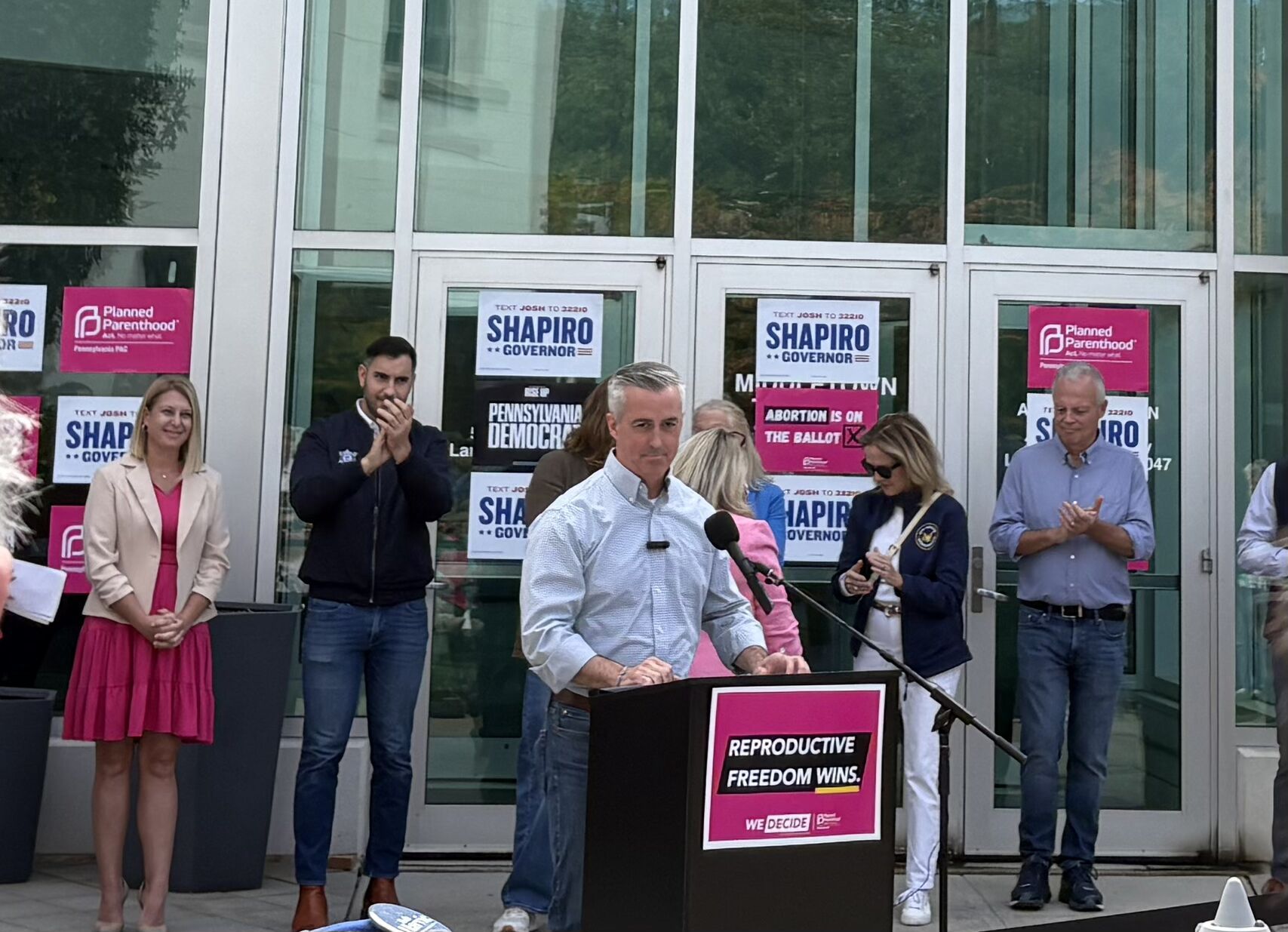
Democrat Bob Harvie (center), challenging GOP U.S. Rep. Brian Fitzpatrick in the 1st Congressional District, speaks to the crowd at the Middletown Township Municipal Center in Bucks County on Saturday.Fallon Roth
“We’re going to put this country back in the path it was meant to be on. A country we can be proud of. A country we can be proud to hand our children and grandchildren, and a country that is strong around the world, strong at home, and we’re going to do that here in this county,” Harvie said.
With Planned Parenthood PA PAC organizing Saturday’s day of campaigning, the slew of Democratic officials and candidates in attendance also highlighted reproductive rights in their rallying calls.
Hartnett Albillar said in her speech that such rights go in tandem with cost-of-living issues, like making a livable wage and accessing childcare and paid family leave.
“People are scared about the unsustainable economic path that we are on, and reproductive healthcare is part of that affordability conversation,” she said. “Reproductive healthcare is something we need to ensure we have in order for economic futures for families.”
She pledged that with a Democratic state Senate, abortion rights would be codified.
“The folks that live here are going to determine whether or not we are going to be able to get that trifecta,” she said.
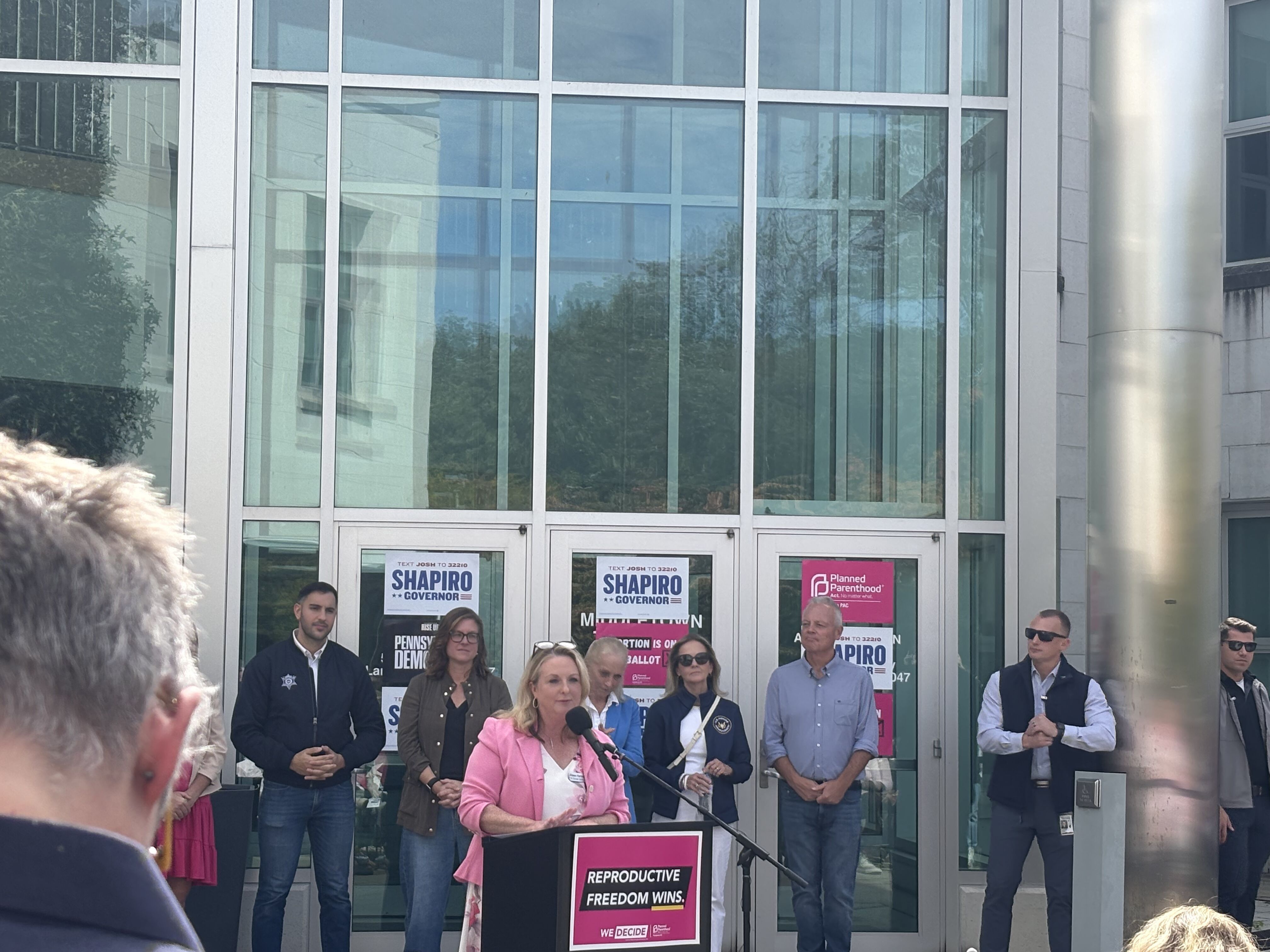
Democrat Eileen Hartnett Albillar (center) speaks to a crowd gathered at the Middletown Township Municipal Center on Saturday.Fallon Roth
Shapiro’s appearance in Bucks County on Saturday afternoon came after his morning campaign stop in Philadelphia’s Ninth Wardand reflects how the popular governor has spent most of his reelection campaign trying to boost other Democrats across the state.
For instance, in July, he launched “Rise Up Pennsylvania” — an effort that is aimed at pooling donations to fund campaign resources for key state Senate and U.S. congressional races.
Before the door knocking and canvassing around town ensued, Shapiro framed November as an inflection point for Bucks County residents and pondered future conversations between crowd members and their kids or grandkids.
“You’re going to be able to look at them and tell them, ‘in the swingiest town, in the swingiest state, in the entire country, you dedicated yourself to meeting your neighbors … telling them what’s at stake.’”
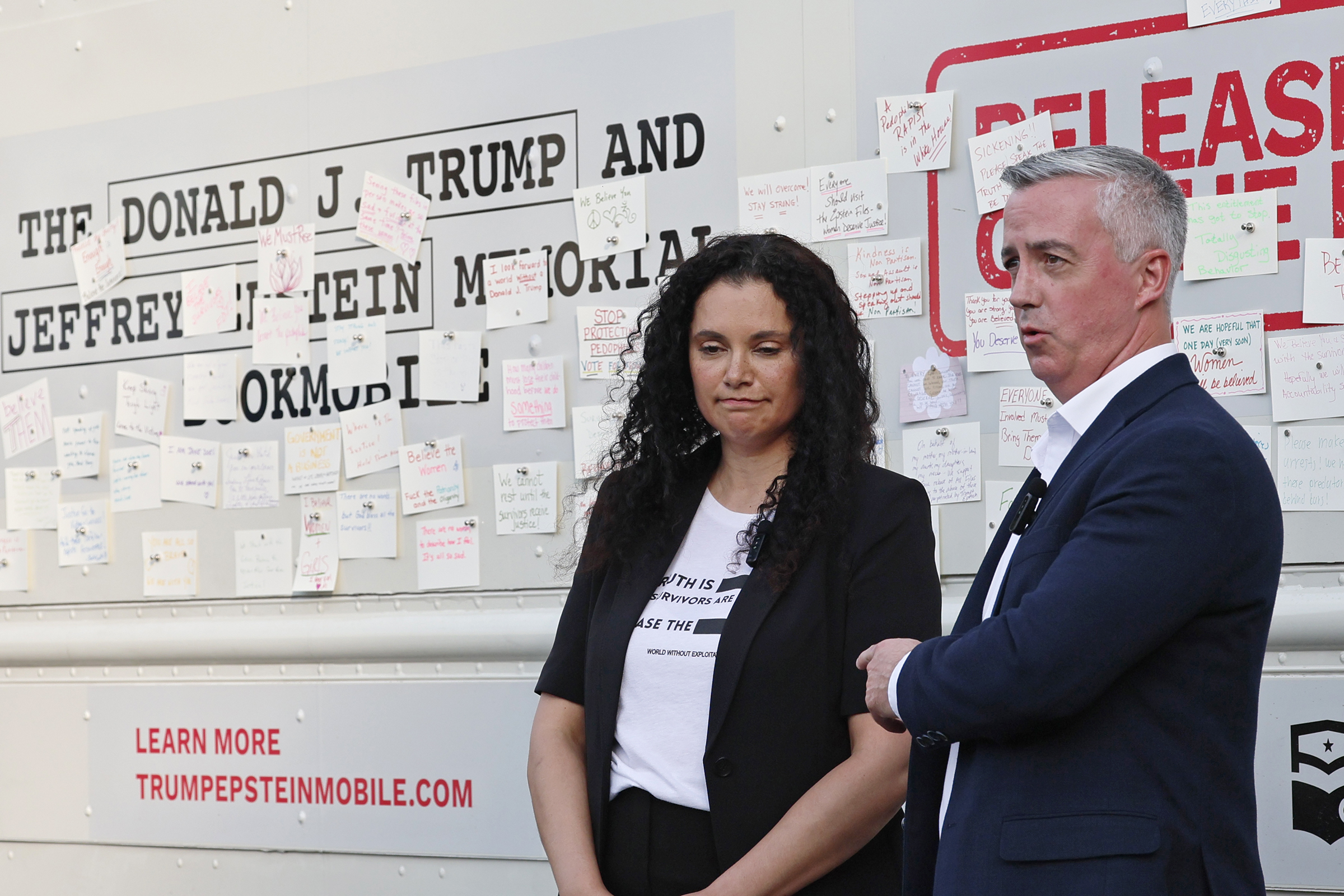
Democrat Bob Harvie thumbed through hundreds of pages bound together in a booklabeled “The Partially Redacted Epstein Files” and said he was disgusted with what he read —or at least what he was able to read.
Entire blocks of text regarding the investigation into Jeffrey Epstein, the financier and convicted sex offender who died in prison in 2019, were marked black.
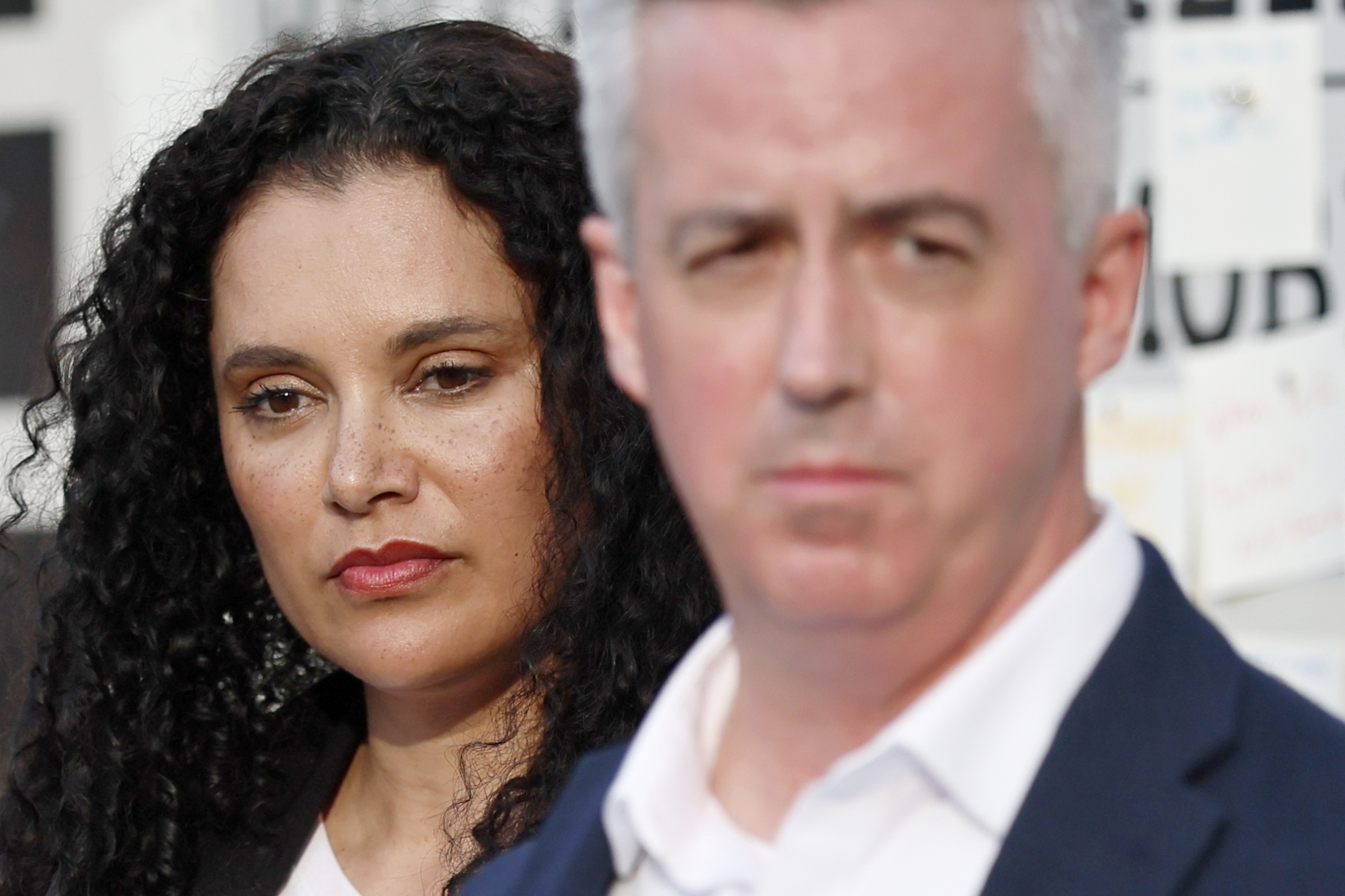
But survivors of Epstein’s predatory behavior, including Sharlene Rochard, who appeared with Harvie Friday in Bristol, are heroes for illuminating what has been blocked from the public, the congressional candidate said.
Harvie pledged to push “very, very hard” to release the full, unredacted files related to Epstein’s crimes if elected.
The Bucks County commissioner is running against Republican U.S. Rep. Brian Fitzpatrick to represent the 1st Congressional District, one of two swing districts in the state that Rochard visited Friday to campaign for Democrats. She’ll be hitting another the following day.
“These are files, but I’m in these files, and that is my life in these files,” Rochard told Harvie. “And I need justice. We need accountability, and we need some transparency, and we need people likeyou.”
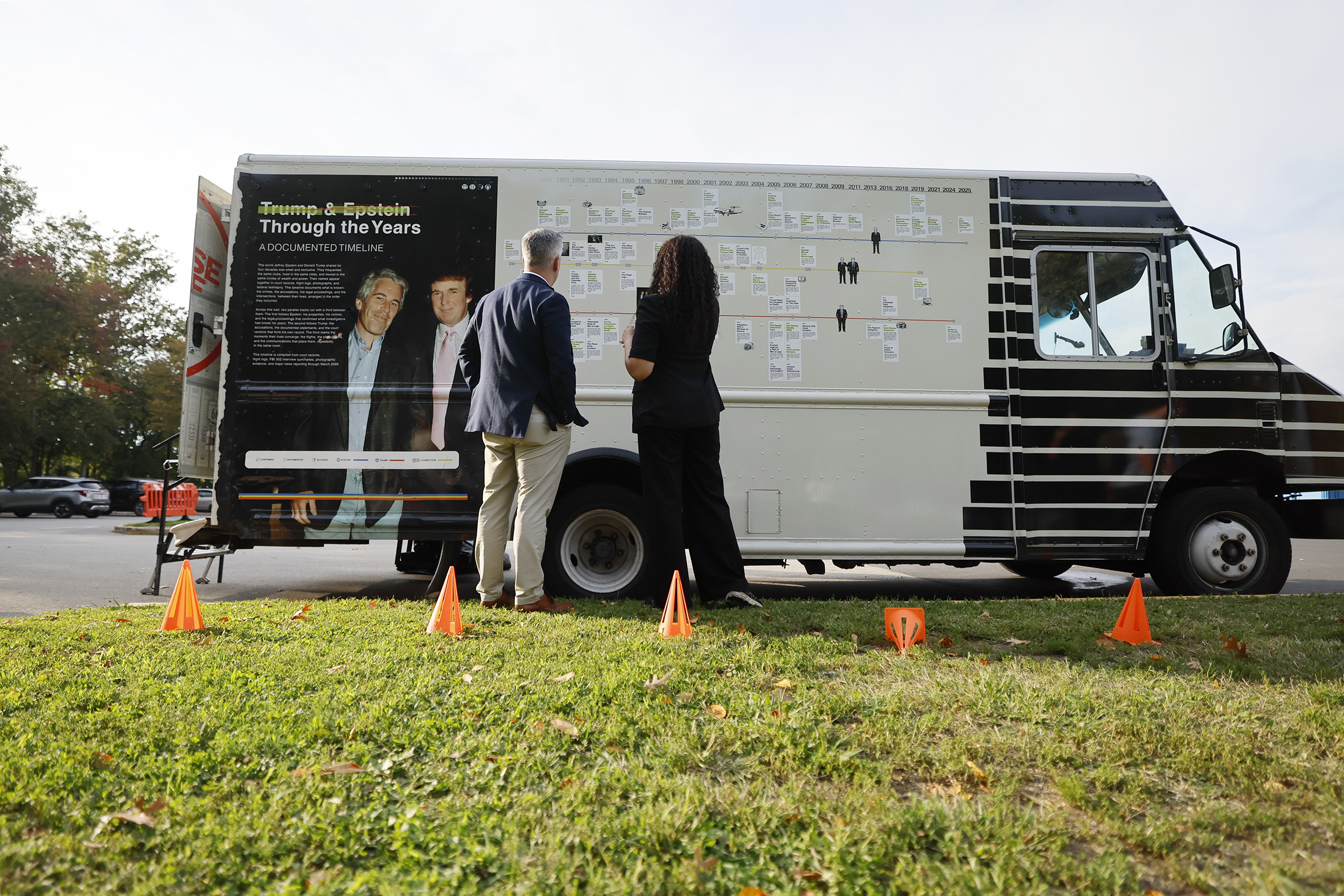
Rows of files were contained inside a traveling bookmobile parked in front of the Bristol waterfront. Plastered on the outside of the truck was a decades-old image of President Donald Trump with his arm around Epstein.
Reminding voters of Trump’s history with Epstein has been a campaign tactic used by Democrats in competitive contests across the country, but Harvie said the issue of justice for survivors should go beyond partisan politics.
“I don’t care what party they’re from,” Harvie said. “I don’t care what office they hold or held. I don’t care how much money they have. I don’t care. We need to do everything we can to protect the victims and honor them and shine a light on this part of our society.”
Sharlene Rochard, a survivor of Jeffrey Epstein’s sexual trafficking and abuse, and Bob Harvie during a news conference at the Donald J. Trump and Jeffrey Epstein Memorial Bookmobile in Bristol.Elizabeth Robertson / Staff Photographer
Earlier in the day, Rochard visited Harrisburg, where she was welcomed by Democrat Janelle Stelson, a former news anchor who promised to “take on the culture of corruption across the government” if elected over incumbent Republican U.S. Rep. Scott Perry in the 10th District.
Rochard was slated to appear Saturday in Bethlehem with Democrat Bob Brooks, who is running against U.S. Rep. Ryan Mackenzie in the 7th District, one of the most competitive contests in the nation.
The truck arrived in Pennsylvania one month before Election Day as Trump continues to plummet in popularity among likely voters in the state. It’s an officially nonpartisan project of Institute for Primary Facts, a nonprofit that builds public art installations, and DEFIANCE.org, a group dedicated to ending sexual exploitation of children and adults.
Rochard, who was born in Canada, began traveling to the U.S. as a teen to model when she met Epstein and was with him in New York, Florida, and on his private island in the U.S. Virgin Islands, she said. Though she’s unable to go into details about her trafficking experience because she is involved in ongoing legal action, she now works alongside fellow survivors to advocate for the files to be exposed.
Every Pennsylvania lawmaker voted to release the Epstein files last year, including Fitzpatrick and the other vulnerable Republican incumbents whose districts Rochard was touring this week.
In a statement last year, Fitzpatrick said he is “unequivocally behind the victims and their family members who suffered immensely” from Epstein’s crimes.
“He 100% stands with the victims, and will support disclosure and transparency every single time,” Heather Roberts, a spokesperson for Fitzpatrick’s campaign, said Friday.
A couple dozen people trickled through the bookmobile during its Bristol stop, though multiple people interviewed entered with familiarity about the files and were already convinced of a strong connection between Trump and Epstein.
“I’m dumbfounded that there are people who don’t believe the victims,” said Deb Crasnick, 69, of Langhorne.
Sharlene Rochard, a survivor of Jeffrey Epstein’s sexual trafficking and abuse, and Bob Harvie at the Donald J. Trump and Jeffrey Epstein Memorial Bookmobile in Bristol on Friday. Elizabeth Robertson / Staff Photographer
Crasnick found out about the event from her friend Diane Grant, 71, of Bensalem, who has been following the tour on social media. But Grant, who called the revelations disturbing, worried the tour’s effectiveness may have limits.
“People have their mindset. Nothing said or shown in there will change it,” she said.
“The economy keeps me up at night,” said Tracey Marshall, 57, who lives in Falls Township. “We need a change.”
Rochard said the purpose of the tour goes beyond Election Day.
Trump has called the Epstein case “a hoax” and said that the files that have been publicly shared are “enough,” a notion the survivor is hoping to dispel with the tour.
“This is something that has happened to me,” Rochard said. “I’m not a Democratic hoax. I am a real person, and we need some justice.”
National Democrats added U.S. Rep. Jeff Van Drew’s South Jersey district on Friday to a list of their target races to flip, signaling they’re taking Cape May Mayor Zack Mullock’s candidacy more seriously than before.
Van Drew has comfortably warded off challengers in recent years. He was first elected as a Democrat in 2018, but then declared his loyalty to President Donald Trump and switched parties a year later.
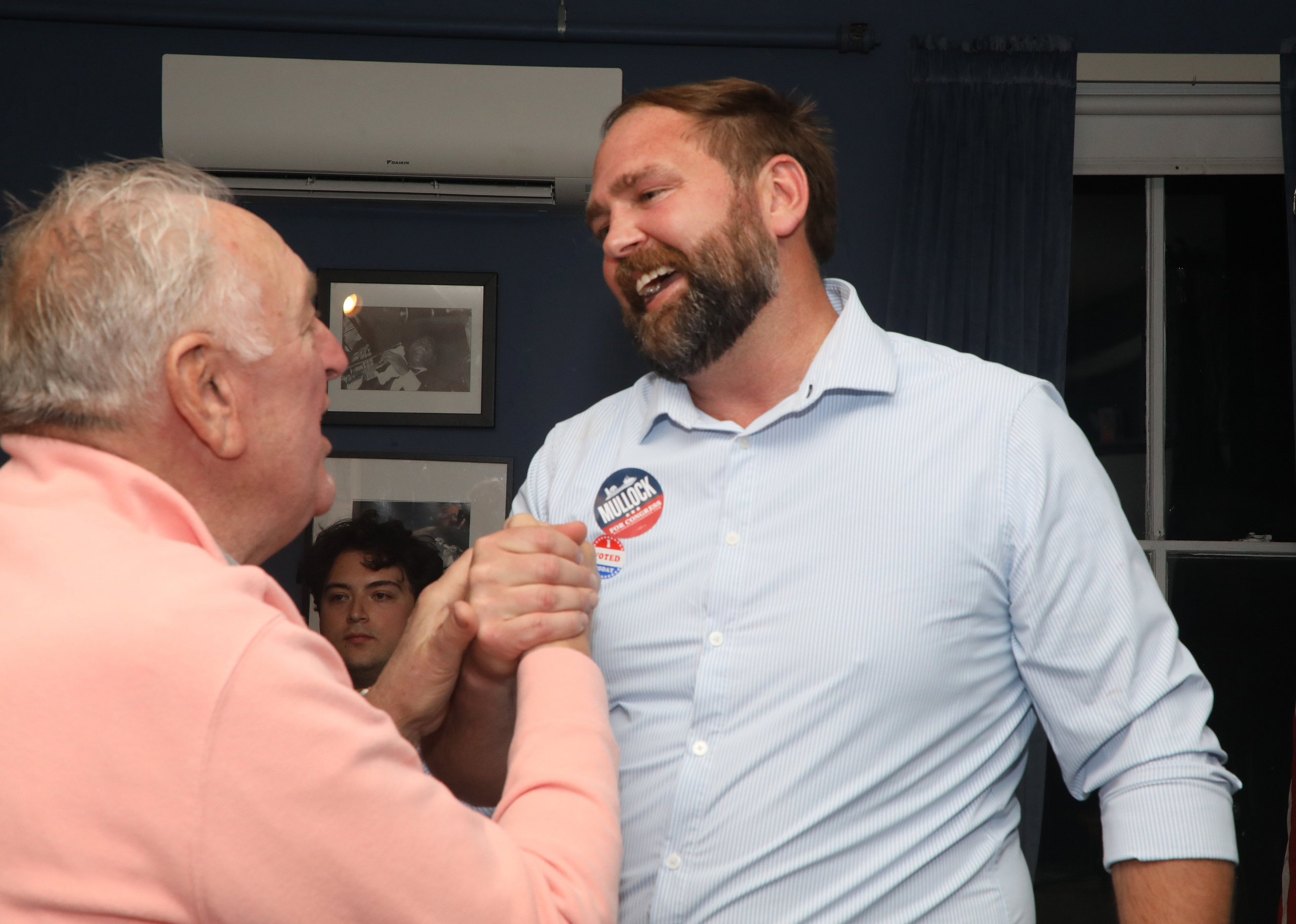
The designation was a long time coming for Mullock, as mail ballots have already begun to come in 32 days before the Nov. 3 election.
Still, it came as a surprise to him. He learned on Friday he made the cut at the same time everyone else did, through social media, he said.
“We may be purplish-red, but you know, we are not a just ‘go with whatever the president says’ kind of district,” Mullock said in a phone call. “We voted for Obama twice. We voted for Jeff Van Drew as a Democrat.”
Local Democrats have been optimistic that Mullock is their best shot yet at ousting Van Drew, but the race had flown under the national radar. The Democratic Congressional Campaign Committee (DCCC), the party’s main campaign arm in House races, had excluded the district from its “2026 Districts in Play” map until Friday morning.
The announcement likely indicates that the national committee will send resources to Mullock’s campaign, such as staff support, but it does not come with the funding that the most competitive “Red to Blue” seats get.
Still, it serves as a nudge to donors to take the race seriously.
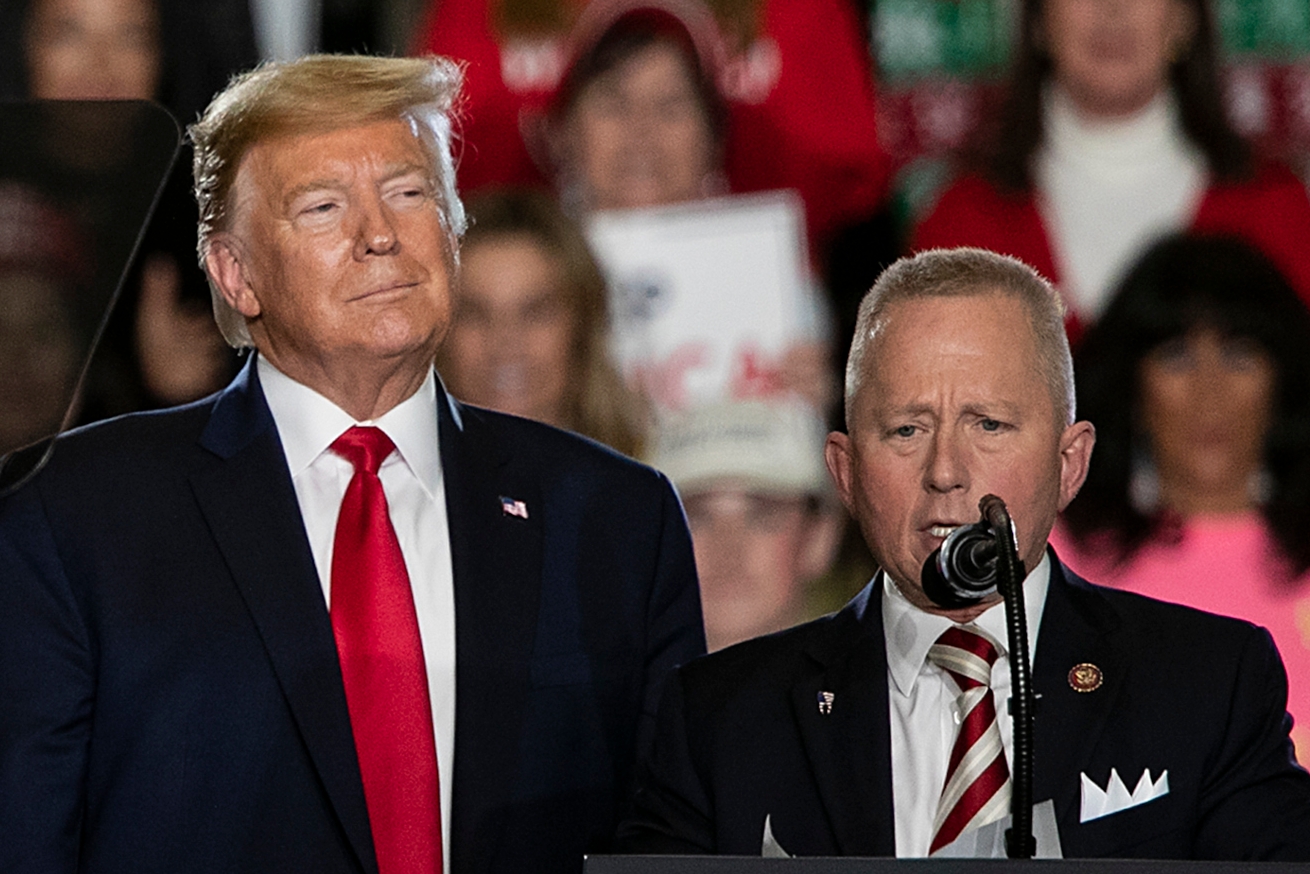
U.S. Rep. Jeff Van Drew speaks next to President Donald Trump at a Keep America Great campaign rally in Wildwood, NJ on Tuesday, Jan. 28, 2020.HEATHER KHALIFA / Staff Photographer
Van Drew’s district was one of eight districts across the country added to the battleground list, showing that Democrats see a blue wave as increasingly likely as Trump’s popularity suffers amid the Iran war and inflation.
National Democrats are now targeting a total of 66 House races, which they say is nearly double as many as in 2024 when Republicans maintained control of the chamber.
Van Drew’s campaign spokesperson Ron Filan, in a statement, said Democrats make the race seem competitive every cycle as a “fundraising ploy,” and that Van Drew “proves them wrong” each time.
“We predicted back in June they would follow this same playbook and appreciate them proving us right,” Filan said. “The DCCC has about a third of House Republicans on one of their silly wish lists or another.”
Van Drew has been thrusting out attack ads as Mullock campaigns across the district, showing that he sees the local mayor as a threat. Filan noted that Van Drew “doesn’t take anything for granted and will continue to campaign as hard as he always has.”
Previously, the only seat in the Garden State on the DCCC’s battleground list was U.S. Rep. Tom Kean’s 7th District in Central Jersey, which is still the only oneon the “Red to Blue” list. Kean, who was absent from Congress for months without explanation until he revealed it was for depression, is viewed as highly vulnerable as Democrat Rebecca Bennett tries to oust him.
The nonpartisan Cook Political Report has rated the 7th District as leaning toward Democrats, but Van Drew’s “solidly Republican” seat will be a more difficult challenge to flip.
The Cape May lawmaker’s closest challenge was in 2020 from Amy Kennedy, who still fell nearly 6 points behind him. He was reelected in 2022 by 19 points and in 2024 by 17 points.
National Republicans cite a double-digit win for Trump in the district in 2024, but Democrats note Gov. Mikie Sherrill came within single digits of her Republican opponent Jack Ciattarelli in the district last year as she reversed red shifts in the state while consistently attacking Trump.
Mullock said he thinks constituents are becoming disillusioned about Van Drew’s support of Trump.
“I think people are realizing what I realized … I thought Jeff was a moderate Democrat that became a moderate Republican, and that is just not what he has become,” the Democrat said.
The 2nd Congressional District spans several South Jersey counties, extending from the Jersey Shore to rural farmland and the Philadelphia suburbs.
DCCC chair Suzan DelBene said in a statement that voters will send Van Drew “packing” because he “prioritizes tax breaks for the wealthiest few while gutting healthcare and raising costs for his constituents.”
The National Republican Campaign Committee (NRCC), meanwhile, is focused on defending Kean’s district, the only Jersey seat on its “Patriots” list.
NRCC spokesperson Maureen O’Toole said in a statement that “Democrats are living in a fantasy.”
“New Jersey families know Jeff Van Drew delivers results, they trust him, and they’ll proudly reelect him in November,” she said.
It wouldn’t be a Pennsylvania election without Bucks County becoming the star of the show.
And that’s exactly what’s happening this weekend, when Gov. Josh Shapiro travels to the swingiest of the swing counties to stump for Democrats up and down the ballot in key races.
🎤 I’m Fallon Roth, the suburban politics reporter at The Inquirer, coming to you live from Bucks (my home county) as we dig into how the suburb will be the make-or-break place for Democrats’ wishlist next month, including a win for Bob Harvie in the 1st Congressional District and shift in party control in the state Senate, which could only happen with help from the Philly suburbs.
We’ll also explore whether Pennsylvania voters would support Shapiroturning his attention to a bid for the White House in 2028.
In this edition:
🗳️All hands on deck: Shapiro will be in Bucks County Saturdayto launch a day-of-action for Democrats, organized by Planned Parenthood’s state-level PAC.
🗳️ The Bucks stops here: Two Bucks County swing districts and another in Montco could determine which party controls the state Senate.
🗳️Homefield (dis)advantage?: Pennsylvania voters are split on whether Shapiro should run for president in 2028.
-Fallon Roth, Michelle Baruchman, Sam Janesch, Gillian McGoldrick (pa2026@inquirer.com)
The latest
The price of gas, groceries and, well, living is on the rise and Pennsylvania’s swing district voters will have affordability on their minds as they head to the ballot box next month.
As democratic socialist candidates become more mainstream — including in Philly — most Pennsylvania Democrats said in a recent Inquirer/New York Times/Siena University poll that they have a positive view of socialism.
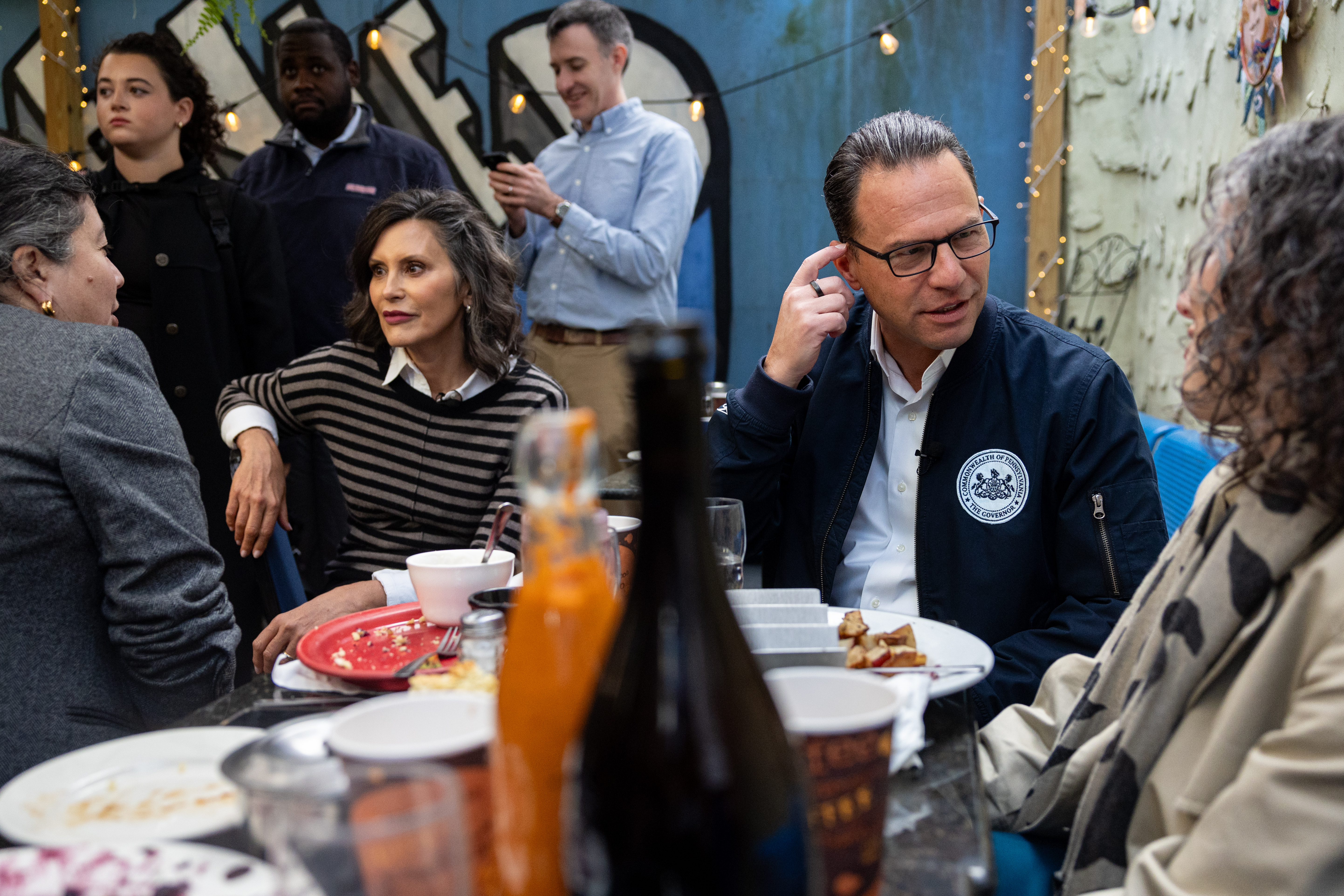
Shapiro and Michigan Democratic Gov. Gretchen Whitmer (possible 2028 rivals) went to Sam’s Morning Glory Diner in Philly to energize voters ahead of the midterms.
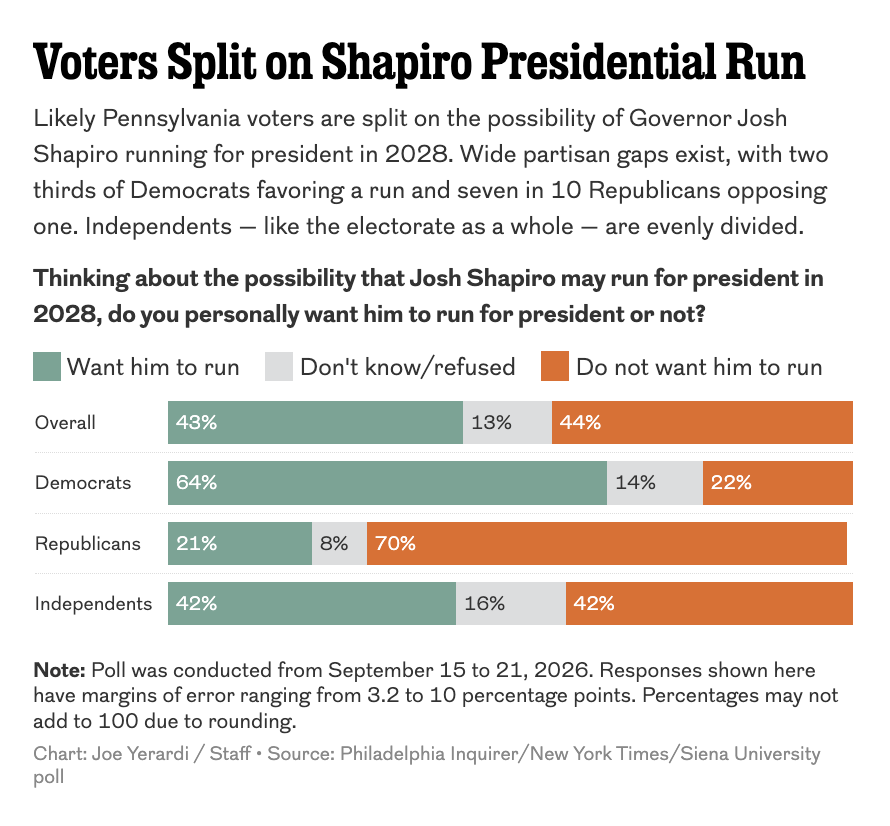
📊 Without a doubt, Shapiro is a popular governor. He’s viewed favorably by Democrats, independents and even some Republicans — no small feat in a swing state that voted for President DonaldTrumpin 2024. But whether these likely Pennsylvania voters want Shapiro to run for president in 2028 is an entirely different question.
Voters, in a poll conducted by Siena University on behalf of The Inquirer and the New York Times, were split on whether Shapiro, who is expected to pursue a White House bid, should run: 43% of respondents want him to run, and 44% don’t.
Of those supporting a potential presidential campaign, 41% ranked his character and competence as their reasons, and nearly one in five said they were satisfied with Shapiro’s performance as governor. But for those who oppose a run, it’s not necessarily because they don’t like him (although that is the case for 21% of respondents).
About one in 10 said they would prefer Shapiro, who is up for reelection this November with a commanding lead against his competitor, to remain in Pennsylvania. Campaigning and presidential debates would likely begin soon into his second term.
“I like his views. I like his policies. I like everything. I just think his religious affiliation will stop him from winning because I think the rest of the country, especially the middle of the country, will rally against him,”said Michael Biello, a 68-year-old Democrat in Philadelphia.
Campaign scrapple
🏥 Is the U.S. ready for Medicare for All?
Democrat Bob Harvie thinks there needs to be more trust in the federal government first before it starts running the healthcare system, he told The Inquirer on Tuesday evening.
Harvie, a Bucks County commissioner challenging GOP U.S. Rep. Brian Fitzpatrick in the swingy 1st Congressional District, has focused his campaign on addressing rising costs and increasing access to healthcare, such as advocating for 55-year-olds to be able to buy into Medicare.
Congressional candidate Bob Harvie (D, Pa.) speaks on Friday, September 11, 2026 at the Garden of Reflection in Yardley, Pennsylvania.William Thomas Cain / For The Inquirer
“My worry is you start talking to people about well, ‘We’re going to take away the healthcare system you have, and we’re going to give you another one, and the government’s going to run it,’” Harvie said of Medicare for All. “We’ve got a lot of work to do to rebuild trust in the government, just like we have a lot of work to do to rebuild how this healthcare system works.”
Michigan Gov. Gretchen Whitmer (second from the left) and Pennsylvania Gov. Josh Shapiro chat with diners at the Morning Glory. The two Democrats have grown close in recent years, but they could become rivals in 2028 if they both pursue the presidency. Aidan T. Gallo / Staff Photographer
👀 What we’re watching
Shapiro and Garrity will face off in a live, televised debate this coming Wednesday, Oct. 7. The Harrisburg-based TV station ABC27 is hosting the debate, which will air on several stations owned by Nexstar across Pennsylvania, including WPHL-TV in Philadelphia. Politics reporters Gillian McGoldrick and Michelle Baruchman will break the major moments down at inquirer.com/politics.
Quote of the week
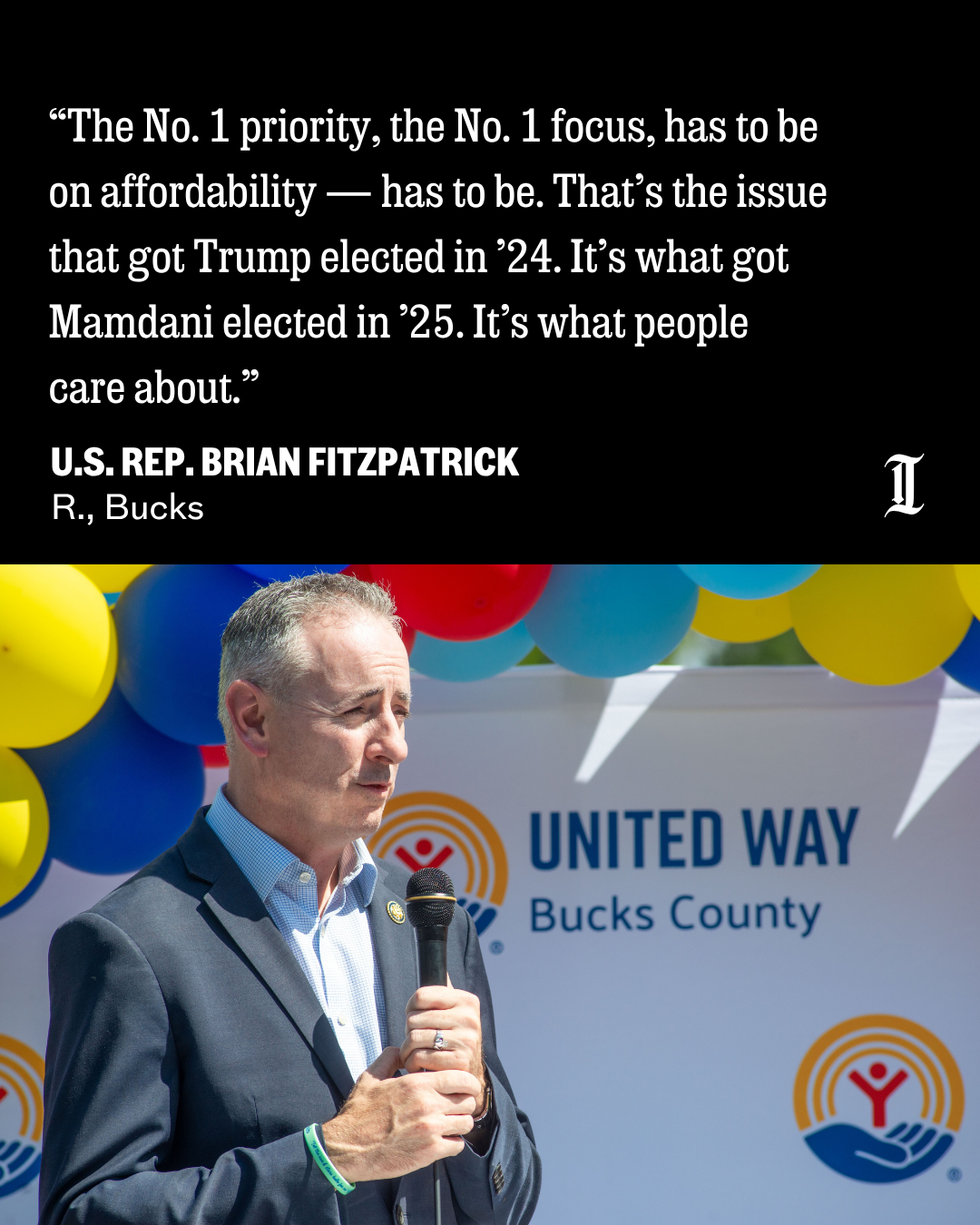
U.S. Rep. Brian Fitzpatrick weighs in on the No. 1 issue this election. William Thomas Cain / For The Inquirer
Fitzpatrick agrees with his opponent, Harvie, on one thing: this election will hinge on which party voters think will do a better job lowering the cost of living.
👋 Thanks for reading, and don’t forget to check back as we enter a final campaign month packed with debates, candidate events and maybe even a few October surprises. You can follow The Inquirer politics team’s coverage here, and we’ll see you in your inbox next Friday.
Gov. Josh Shapiro will be in Bucks County on Saturday to campaign for Democrats up and down the ballot in the key swing county.
Shapiro, who kicked off Democrats’ general election campaigns at a space centrifuge in Warminster this past spring, is returning to Bucks, emphasizing the important role that the perennially purple county will play in November’s midterms with competitive contests for Congress and state Senate on the ballot.
The governor will appear at a canvass launch in Langhorne organized by Planned Parenthood PA PAC, the organization’s state-level political action committee. The PAC has endorsed Bucks County Democrat Eileen Hartnett Albillar, who is running for state Senate in the 6th District, a crucial seat for the party, and state House candidates Bryan Allen, Kristin Egan, and Monica Weninger.
Shapiro will also appear alongside Democratic County Commissioner Bob Harvie, who is challenging GOP U.S. Rep. Brian Fitzpatrick in the Bucks-based 1st Congressional District — one of four seats in the state being targeted by both parties. Harvie is endorsed byShapiro and Planned Parenthood’s federal PAC.
Democratic U.S. Reps. Madeleine Dean, of Montgomery County, and Mary Gay Scanlon, of Delaware County, will also be in attendance.
Democrats are hoping to win control of the state Senate — which they haven’t had for 33 years. The GOP currently holds 27 seats in the 50-member state Senate.
To take control of the chamber with the lieutenant governor’s tie-breaking vote, Democrats would need to flip at least two seats and maintain control of the governor’s office. With a trifecta in Harrisburg, Democrats hope to advance legislation on issues that haven’t gained support in the Republican-controlled Senate, like codifying abortion protections.
The Shapiro-endorsed candidates have an opportunity, if successful in November, to give Democrats more governing power, whether that’s winning party control in the U.S. House, the state Senate, or giving Democrats an expanded majority in the state’s lower chamber.
Shapiro is running for a second term as governor, but he’s spending much of his time using his political prowess to bolster other Democrats ahead of the midterms. Recently, he was in Philadelphia with Democratic Michigan Gov. Gretchen Whitmer to energize volunteers. Earlier this month, he was in Montgomery and Chester Counties campaigning for down-ballot candidates.
Shapiro has invested more than $5.7 million in the state party since fall 2025, his campaign said last month.
Gov. Josh Shapiro poses with Democratic Pa. Senate candidate Chris Thomas (left) and his supporters after a rally in Towamencin, Montgomery County before heading out to canvass Sunday, Sept. 29, 2026.Tom Gralish / Staff Photographer
In July, he launched an effort — “Rise Up Pennsylvania” — that is aimed at pooling donations to fund campaign resources for key state Senate and U.S. congressional races.
Abortion protections remain a key piece of the party’s platform, even as Democrats have refocused their messaging on affordability ahead of November.
“Bucks County will be critical to building a pro–sexual and reproductive health care trifecta in Pennsylvania,” Signe Espinoza, executive director of Planned Parenthood PA PAC, said in a statement Friday.
“We endorsed these candidates because we know they will stand up to fight to protect every Pennsylvanian’s freedom to make their own decisions about their body, health and future.”