The two recent measles-related deaths in Lancaster County, including that of a newborn, were the first in Pennsylvania in 35 years. Sadly, as vaccination rates decline across the commonwealth and the country, they will likely not be the last.
The deaths occurred amid a major measles outbreak in Lancaster that has sickened nearly 400 people. Nationwide, the number of cases grew to a 35-year high.
In normal times (a.k.a. before Donald Trump), federal and state government officials would work together to contain the outbreak, protect the public, and use the incident to urge residents to get vaccinated.
But under Trump, all issues are political. Someone must lose so he can win. Rather than lead and unite, the president and his minions divide and misinform.
Gov. Josh Shapiro did what any responsible public official would do. He traveled to Lancaster General Health’s Women and Babies Hospital to express empathy, support the local community, and urge the public to get vaccinated.
“We hope, and we pray, that those deaths will be the last,” Shapiro said. He underscored, “This illness and death from measles is completely preventable.”
Initially, state officials did not provide details about the two people who died in order to protect their privacy.
Lancaster County Coroner Stephen Diamantoni, a Republican elected official who is also a physician, said the newborn tested positive for measles, but died from a ruptured spleen. State health officials clarified that they define a “measles-associated death” as one in which measles was present, even if it is not the immediate cause of death.
That provided an opening for others to stir the misinformation sphere.
Robert F. Kennedy Jr., the dangerously unqualified head of the U.S. Department of Health and Human Services, rushed right in, claiming on social media that Shapiro’s administration may have “fabricated” the deaths, and wrongly commenting in an interview on C-SPAN that “they cannot find any measles deaths in Lancaster County.”
To be sure, Pennsylvania health officials should have been more forthcoming in sharing information about the patients’ ages, causes of deaths, and reasons for being unvaccinated.
The lack of details “created fertile ground for conspiracy theories to thrive,” said Paul Offit, a physician at Children’s Hospital of Philadelphia who heads the hospital’s Vaccine Education Center.
Offit explained that measles can cause an enlarged spleen to become fragile, which can lead to rupture. He added that he learned from state health officials that the patients who died in Pennsylvania would have lived if they were not infected with measles.
It is frustrating and sad that so much energy is needed to convince the public that vaccines work. Vaccines are tested, proven, and settled science. The most effective way to stop the spread of measles is to get vaccinated.
Indeed, measles was declared eradicated from the United States in 2000. Thanks to vaccines, other viruses such as mumps, rubella, and chickenpox were either eliminated or reduced by as much as 99%.
But measles has made a comeback in recent years as vaccination rates have declined. Pennsylvania is among the states with the most cases, and public health officials fear more outbreaks.
The drop in vaccination rates is due in large part to the spread of misinformation across social media in recent years. That misinformation has been amplified by Trump, the king of conspiracy theories, witch hunts, and any other form of quackery that gets attention and plays to a crowd’s worst fears.
In a cynical political deal to win over so-called Make America Healthy Again voters, Trump appointed Kennedy, who is not a doctor, to oversee HHS.
Beyond his famous family name, Kennedy is best known for spreading misinformation about vaccines and promoting debunked claims about autism. He was a leading vaccine skeptic — and attention seeker — during the pandemic.
From his powerful perch, Kennedy has upended vaccine policy. As a result of his anti-science agenda, the country is getting sicker.
The sooner America’s leaders return to promoting evidence-based science and public health, the safer and healthier we will be.
Philadelphia-area health systems have been moving swiftly to pull offline web links that publicly revealed the daily work schedules and cell phone numbers of healthcare workers, information that hospitals traditionally do not make available online.
The information for thousands of medical workers at Penn Medicine, Children’s Hospital of Philadelphia, ChristianaCare, and dozens of hospitals nationwide was published online through a popular scheduling service, QGenda.
Experts said the online availability of internal information raises serious security and privacy concerns at a time when healthcare workers increasingly face the threat of workplace violence and doxing.
The Philly-area health systems took down the schedules in late August after The Inquirer alerted them that the information was publicly available. Penn and CHOP did not respond to questions about whetherthey were aware the link was accessible without a log in.
A spokesperson for ChristianaCare said the system “recently became aware” the pages were public, and “immediately” worked with the QGenda to “eliminate the vulnerability.”
“We are not aware of any impact to caregivers, clinicians, patient care, or operations,” Christiana’s statement said. “Protecting the privacy and security of our caregivers, clinicians, patients, and information systems remains a top priority.”
Other Philadelphia-area systems did not appear have publicly available links.
The web pages managed byQGenda, an Atlanta-based workforce management software company, exposed months of schedules of physicians, nurse practitioners, social workers, and other hospital employees.
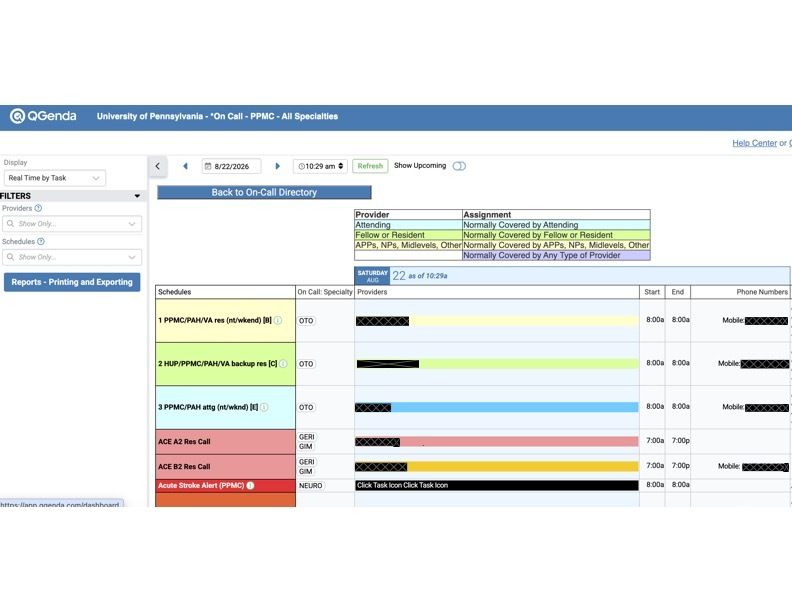
The links don’t appear on Google searches, but anyone with access to basic AI chatbots could pull up live schedules showing the hours and assigned hospital service for on-call doctors andother providers.
“That’s very concerning,” said Lane Kantor, a fourth-year medicine-pediatrics resident at Penn and CHOP, explaining that healthcare providers’ work “sometimes comes with patients who can harass and threaten us.”
Kantor, a leader at Penn’s resident union, said the public information of providers who work with undocumented immigrants or in the areas of gender-affirming or abortion care was especially concerning.
QGenda is used by more than 4,500 organizations, according to the company’s website, including many hospitals that use the software as a one-stop source of information about providers who are on-call and available for consult at any given moment.
It is not clear how the schedules became public, how long the information was available online, to what extent hospital administrators knewthe information was not safeguarded with a log in requirement, or whether anyone — let alone someone wishing to inflict harm — accessed the information.
QGenda did not respond to multiple requests for comment.
The Hearst-owned company offers “QuickLinks” to allow “any staff member without a QGenda account” to easily access the schedule, according to the company’s website. The site also notes that “on-call schedules may contain sensitive information” and that there is risk of “unauthorized access or data breaches” without proper safeguards.
The platform also enableshealthcare systems to restrict access,“so that only devices on your practice’s secure network can access schedule data on the public-facing landing page,” the company’s site says.
Health systems in the Philadelphia area and across the country have taken steps in recent years to minimize doctors’ publicly available information in response to the growing politicization ofmany health services, especially those involvingdiversity, equity and inclusion, abortion, and gender-affirming care.
CHOP, for example, removed provider names from the webpage of its gender and sexual development program in 2022 as the clinic received threats because it provides gender-affirming care for teens. But information on clinic’s providers was available through the now-removed public schedule.
Security experts say releasingpublic work times and locations alongside cell numbers leaves providers vulnerable to being targeted by dissatisfied patients, or individuals who disapprove of the type of medicine a doctor practices.
“This is really alarming,” said Will Owen, a spokesperson for Surveillance Technology Oversight Project, a New York-based privacy nonprofit. “Hospitals must scrutinize the platforms they work with in their data collection to minimize information that can be weaponized.”
Live hospital schedules exposed
After receiving a confidential tip that three East Coast health systems had public QGenda web pages, The Inquirer identified public landing pages for nearly 50 health systems or hospitals nationwide, including Veterans Affairs hospitals, using OpenAI’s Codex.
For some, like Penn and CHOP, the landing pages for the entire system were public. For other hospitals, schedules for only one department or service surfaced.
Some of the United States’ largest and most prestigious institutions had public QGenda links, including Johns Hopkins Medicine and the University of California-San Francisco.
The Inquirer attempted to reach out to each hospital or system for which it found schedules before publication. At least 10,including Hopkins and UCSF, have removed the public link completely or added a password requirement.
A spokesperson for Cedars-Sinai Medical Center in Los Angeles said it was “unaware” that its anesthesia department’s schedule was public. The schedule has since been removed.
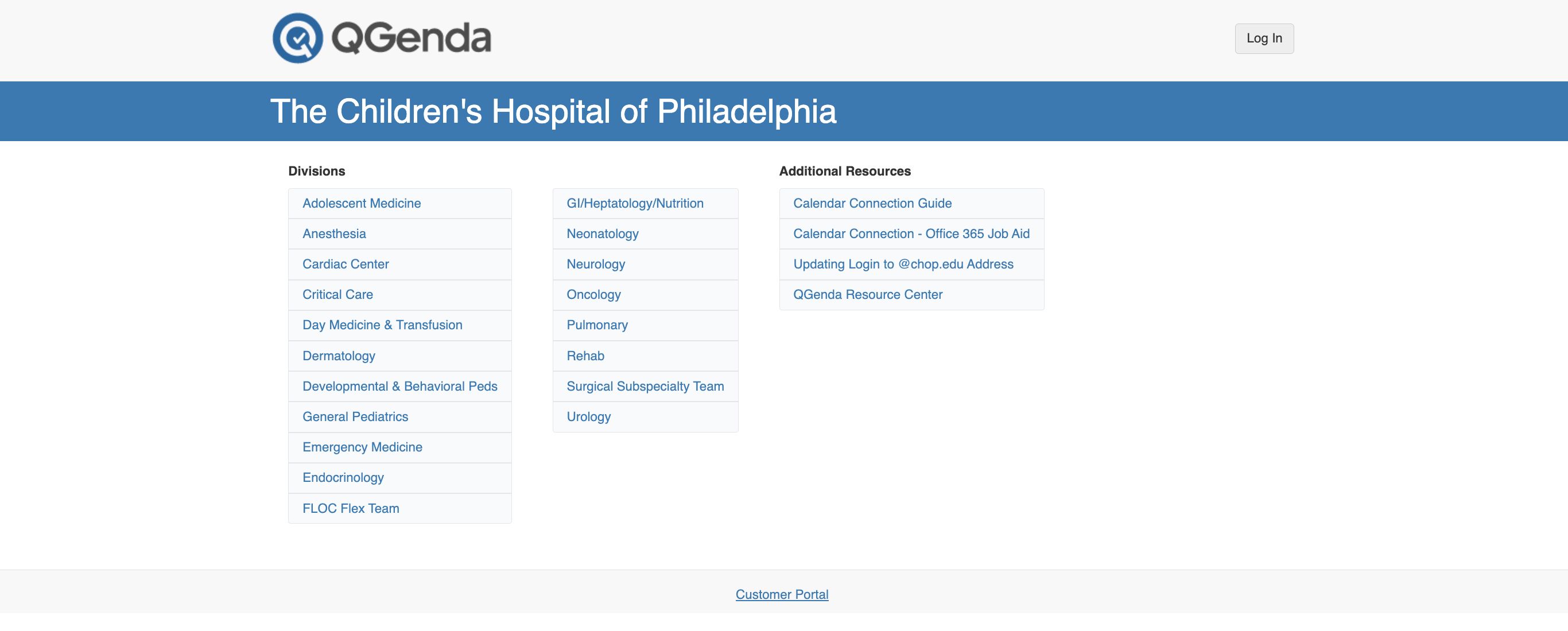
The call schedule for the Children’s Hospital of Philadelphia, and dozens of hospitals nationwide, was available online through a public QGenda link. CHOP updated the web page’s permissions to require a login after being alerted by The Inquirer.Screenshot
CHOP informed hospital staff last week about security updates made to QGenda “out of an abundance of caution.”
“We are taking a precautionary step to update access to the QGenda platform used to display CHOP on-call schedules,” CHOP said in an email to staff obtained by The Inquirer.
QGenda’s platform does not contain patient information, and CHOP “continually assess our systems, processes, and technologies with an eye toward privacy, security, and operational needs,” a CHOP spokesperson said in a statement.
Penn said it uses QGenda to support communication among care teams.
“We continually monitor the risk environment surrounding online information and, as it continues to evolve, we are adding controls that both preserve appropriate protection and provide reliable access for those who need the information to coordinate patient care,” Penn said in a statement.
Gennadiy Ryklin, a hospitalist at ChristianaCare, was surprised to learn a colleague had done a work-hour analysis for ChristianaCare’s attending union using an AI model.
“I asked him, ‘well, how’d you do that without having Claude get access to our private schedules?’ And, well, it’s not private, there’s a public link here,” Ryklin said.
Privacy and data security are principles are drilled into physicians through policies, procedures, and training courses, Ryklin said.
“We understand that patient information in the wrong hands can cause a lot of harm,” the doctor said. “Where’s that same concern for us?”
A June shooting that killed one IT intern and left another injured in ChristianaCare’s Wilmington Hospital underscored for Ryklin the threat of violence within health systems. Law enforcement charged a third intern in connection to the incident.
He reached out to hospital administrators and last week the hospital began removing the public web pages.
Employee privacy exists in a legal gray area, with protections often dependent on institutional policies, said Matthew Bodie, a law professor at the University of Minnesota.
Publicly sharing schedules and cell numbers does “feel invasive,” Bodie said, “especially if employees didn’t know about it.”
The combination of cell numbers and work schedules could be used to cause harm, whether by patients, politically motivated individuals, or stalkers, said Sharona Hoffman, a co-director of the Law-Medicine Center at Case Western Reserve University.
The lack of any sweeping federal employee privacy requirements makes the online availability of the information, “not surprising though very disturbing,” the professor said.
Gov. Josh Shapiro came to the Philadelphia suburbs on Friday morning to announce a new investment in a local police department. But the first question he fielded at a news conference concerned the growing confusion and political intrigue surrounding his administration’s response to two deaths associated with the state’s spiraling measles outbreak.
For the last three days, Shapiro, a Democrat, and Robert F. Kennedy Jr., the Republican heading the federal Department of Health and Human Services, have clashed over what the state has disclosed about the deaths and the consequences of Kennedy’s longtime anti-vaccination activism.
By Friday, Shapiro wanted to bring the focus back to an outbreak that has grown to more than 400 cases so far this year, saying “getting into a back-and-forth with people online who are spewing irresponsible conspiracy theories” does not “serve the public interest.”
But public health and communications experts say that the state’s initial refusal to share more information on the deaths created an environment in which anti-vaccination skeptics could spread their own narrative.
State officials announced the deaths of two unvaccinated Lancaster County residents at a news conference Tuesday, calling the deaths “measles-associated.” Their ages, causes of death, or their medical histories were not disclosed by the governor or his health secretary.
Within hours, other voices started filling the information vacuum. Lancaster County’s coroner told reporters that he had handled just one of the deaths. Coroner Stephen Diamantoni, a Republican elected official who is also a physician, said his office had examined a newborn who had tested positive for measles, but said the baby had not died from measles.
Soon misinformation and innuendo were spreading online out of the seemingly contradictory and limited details being disclosed by state officials, the local coroner’s office, and federal health leaders — all with their own political affiliations at a time when the safety of the measles vaccine increasingly divides Democrats and Republicans.
In response to the coroner’s statements, state health officials said they define a “measles-associated death” as one in which measles was present, even if measles is not identified as the immediate cause of death. Shapiro’s administration confirmed the newborn’s case was one of the two announced deaths, but offered no information on the second death.
President Donald Trump’s health secretary, Kennedy, pounced on the missing details the next day to spread misinformation. He wrote on X that the deaths may have been “fabricated” by the Shapiro administration and said in a television interview that “they cannot find any measles deaths in Lancaster County.”
Shapiro’s administration has called this inaccurate. Still, his administration has not revealed details of its medical review, beyond saying the state Department of Health’s epidemiology team had “thoroughly investigated.”
By late week, the Centers for Disease Control and Prevention, which operates under HHS, posted on X that state health officials were not sharing “information relevant to the outbreak” as it worked “to clarify conflicting information from Pennsylvania officials about whether the two reported deaths were caused by measles.”
State officials, including Shapiro, have repeatedly said the state is cooperating with the CDC.
But Pennsylvania health officials could have shared information on the patients’ ages, causes of deaths, and reasons for being unvaccinated, said Paul Offit, a physician at the Children’s Hospital of Philadelphia who heads the hospital’s Vaccine Education Center and is a vocal critic of Kennedy.
“It created fertile ground for conspiracy theories to thrive,” he said.
In a statement, a Shapiro spokesperson said the governor understands the “desire for as much information as possible to be made public.”
“However, when an individual dies, it is our legal responsibility to protect their right to privacy by maintaining patient confidentiality,” the statement said, noting this is critical to maintaining trust among communities statewide.
In a highly politicized environment in which measles cases are rising — and vaccination rates dropping — public health experts say it’s imperative for health officials to communicate accurately and transparently.
“You have to be transparent, be very clear about what you know, what you don’t know, what you’re trying to find out, and what questions are outstanding,” said Amesh Adalja, an infectious disease physician at the University of Pittsburgh Medical Center and a senior scholar at the Johns Hopkins Center for Health Security.
A lack of information from the state, he said, “created an information vacuum with people very adept at using information vacuums to spread their message.”
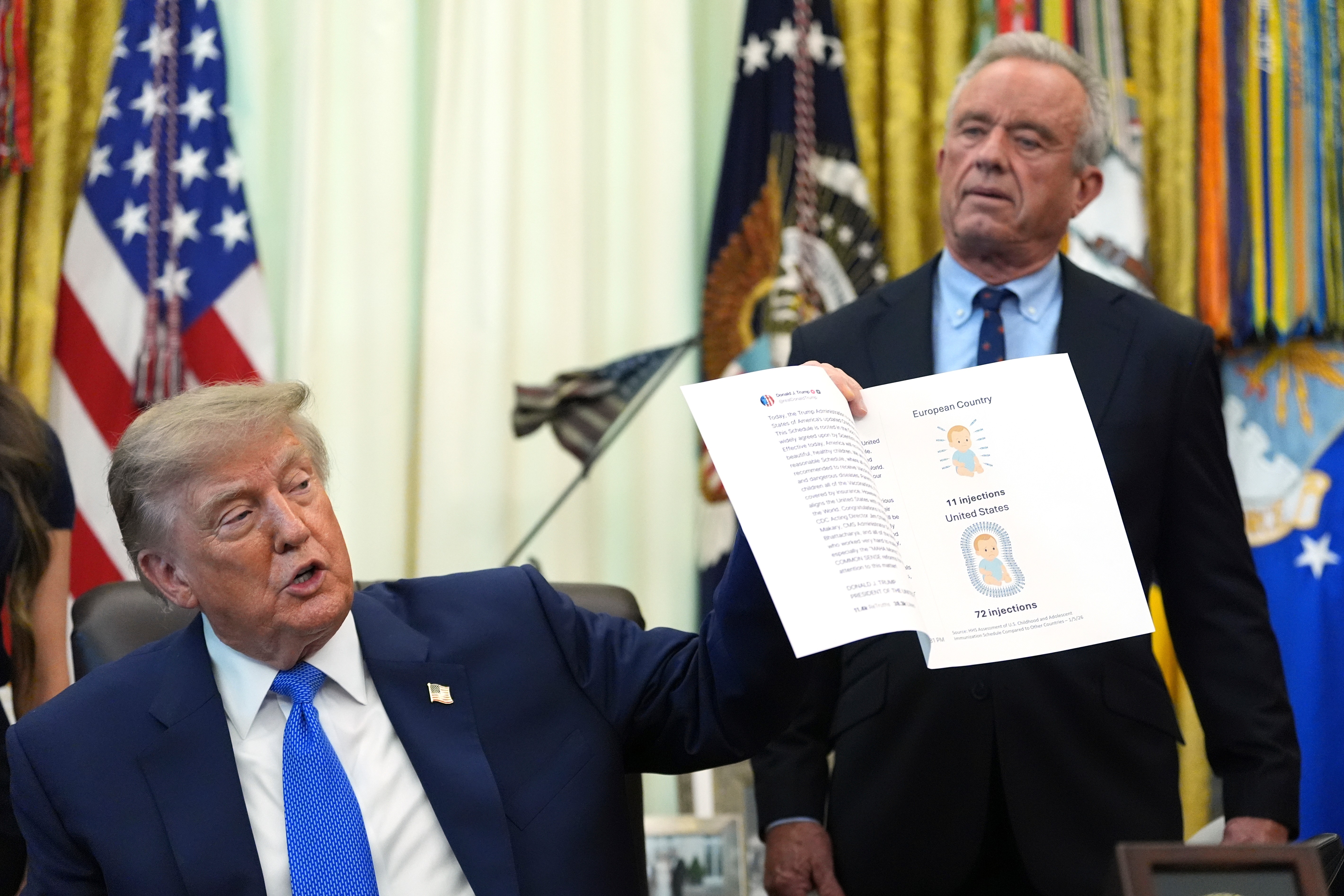
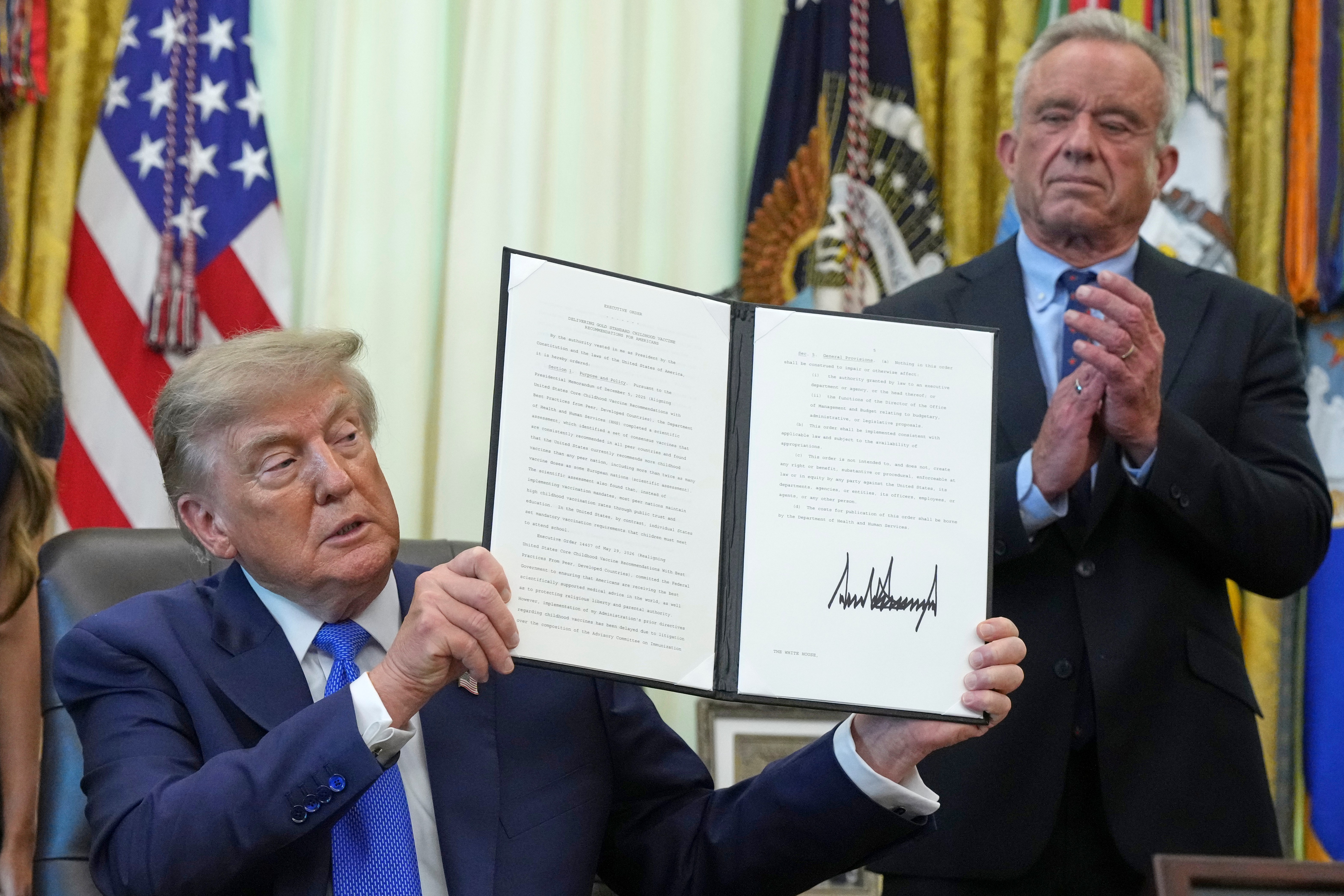
President Donald Trump holds a signed executive order about vaccines as Health and Human Services Secretary Robert F. Kennedy Jr. looks on Aug. 10 in the Oval Office of the White House. Jacquelyn Martin
What’s known about the Lancaster County deaths
Diamantoni said Friday that the baby died shortly after birth at a Lancaster County birthing center on Aug. 14.
Postmortem testing of the baby’s lung tissue showed that the baby had an active measles infection acquired before birth, he said.
He has not talked to the baby’s mother or the midwife who delivered the baby, and has not fully reviewed records from the birthing center where she gave birth, he said in interviews.
He told the Pittsburgh Tribune-Review that measles was listed on the baby’s death certificate, in a section of the certificate that reports other ”conditions contributing to death but not resulting in the underlying cause.”
He told the outlet that measles was included on the death certificate “to offer a broader view of the general health of the child.”
Babies can become infected with measles in utero if the mother is infected with measles and develops a rash within 10 days of giving birth, Offit said.
Diamantoni said a forensic pathologist in his office concluded the baby died of a ruptured spleen and cited trauma to the baby’s torso. He said he was unsure what had caused the trauma, and added that the baby’s spleen did not appear enlarged or infected.
Offit said that measles can cause an enlarged spleen that is then more likely to rupture — including during birth — and that it’s often difficult to tell whether a spleen has become enlarged once it ruptures.
A spleen also doesn’t have to become “massively” enlarged to rupture, he said: Measles can cause the spleen to become fragile, which also heightens the risk of rupture.
In conversations with state health officials, Offit said he learned that the patients who died in Pennsylvania would not have died were they not infected with measles.
He said the coroner should explain why the spleen ruptured, if it was not damaged from measles. Diamantoni said the office is still investigating the cause.
The state has released no additional information on the second death, and Diamantoni said his office was not handling it. He said his chief deputy spoke to the department prior to Shapiro’s news conference Tuesday.
“At no point was the Pennsylvania Department of Health told that this was not a measles-associated death,” a state spokesperson said on Friday. “The Shapiro Administration stands firmly by their comments on Tuesday.”
Public health communications
Pennsylvania’s health department has cited a state law prohibiting public access to death records, saying they cannot release more information on the deaths. Another state law requires the state to keep records of diseases confidential, except when it’s necessary to inform the public of the risk of communicable disease, a department spokesperson said in a statement.
The department “works hard to build and maintain trust in communities all over the Commonwealth — which includes doing everything possible to keep people’s identities confidential,” the statement read.
The department didn’t share information that could be used to “personally identify individuals or their grieving families” because “the circumstances of these individuals’ deaths do not change the Commonwealth’s response: Measles is a serious, highly contagious and preventable disease, and our focus remains on protecting Pennsylvanians, getting people vaccinated, and stopping the spread of this outbreak,” the spokesperson said.
But the state could have been more transparent about how they characterize deaths in a measles outbreak, said Kathleen Hall Jamieson, director emerita of the Annenberg Public Policy Center at the University of Pennsylvania.
People who are not trained in medicine may not understand the term “measles-associated,” for example, or how it differs from a cause of death, and state officials should have taken time at the news conference to explain what they meant by that term.
“You have an obligation to make sure that people don’t mishear on something as fraught as this topic,” she said.
Jamieson added that the political clashes around the deaths could overshadow a crucial point: A highly contagious disease is spreading in an under-vaccinated community, exposing children — including newborns unable to be vaccinated — to a serious illness.
“If we miss that moment, then the public health community has failed,” she said.
Families with kids in tow lined up Thursday at Benjamin Franklin High School for a one-stop shop: physicals, mental health services, vision screenings, and, perhaps most important, vaccines.
The Philadelphia School District is making a full-court press to get its vaccination rates up, amid a statewide measles outbreak and news that some city schools saw double-digit declines in kindergarten immunization rates in the 2025-26 school year — leaving communities vulnerable to further measles spread.
Kids must be healthy to learn, said Kendra McDow, a pediatrician and the district’s medical director, and vaccines against diseases like measles, whooping cough, and chickenpox are crucial protection.
“In 2026, these diseases are very real threats to the health of children and communities,” McDow said. “We are seeing in real time the tragic consequences of children and adolescents not getting vaccinated.”
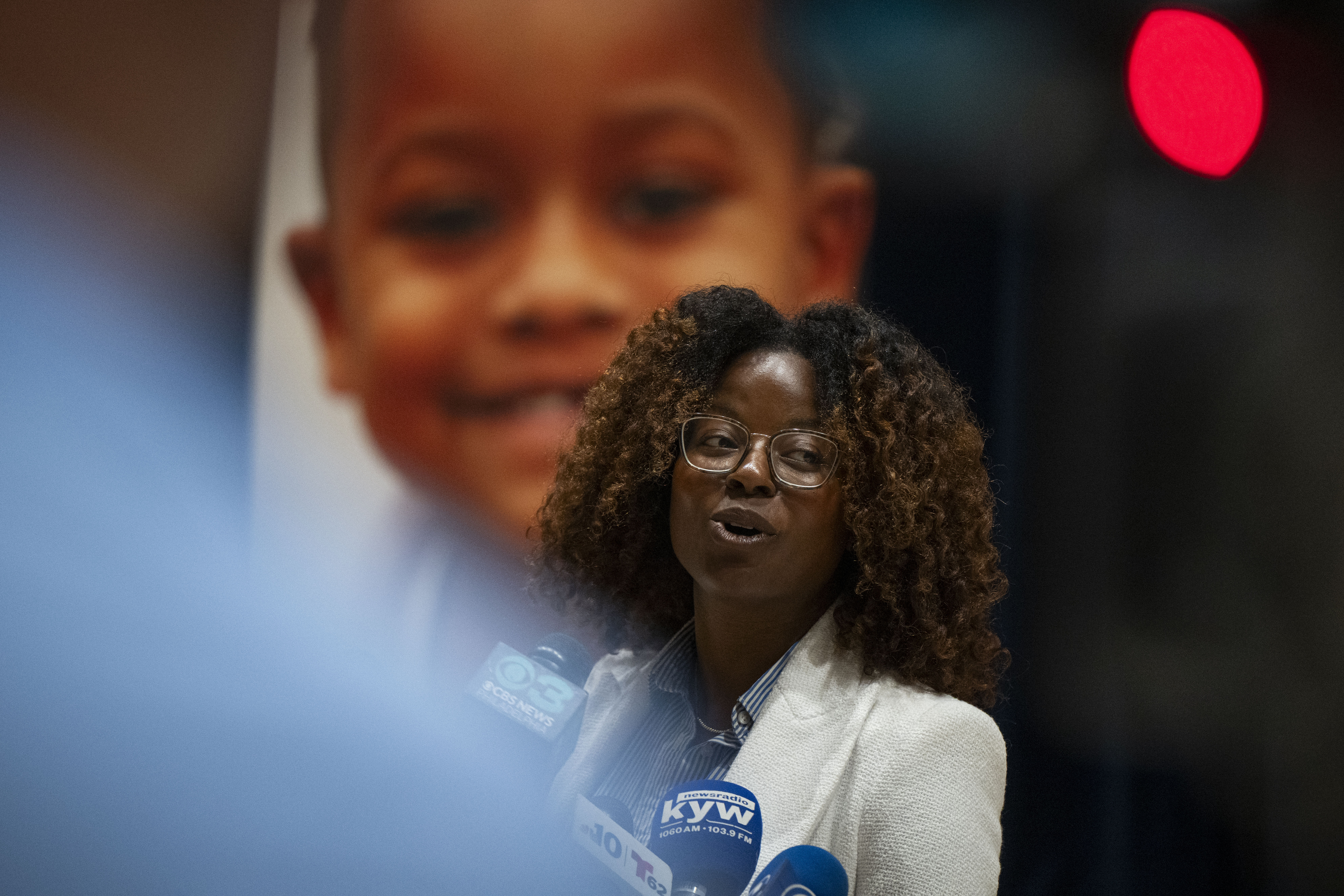
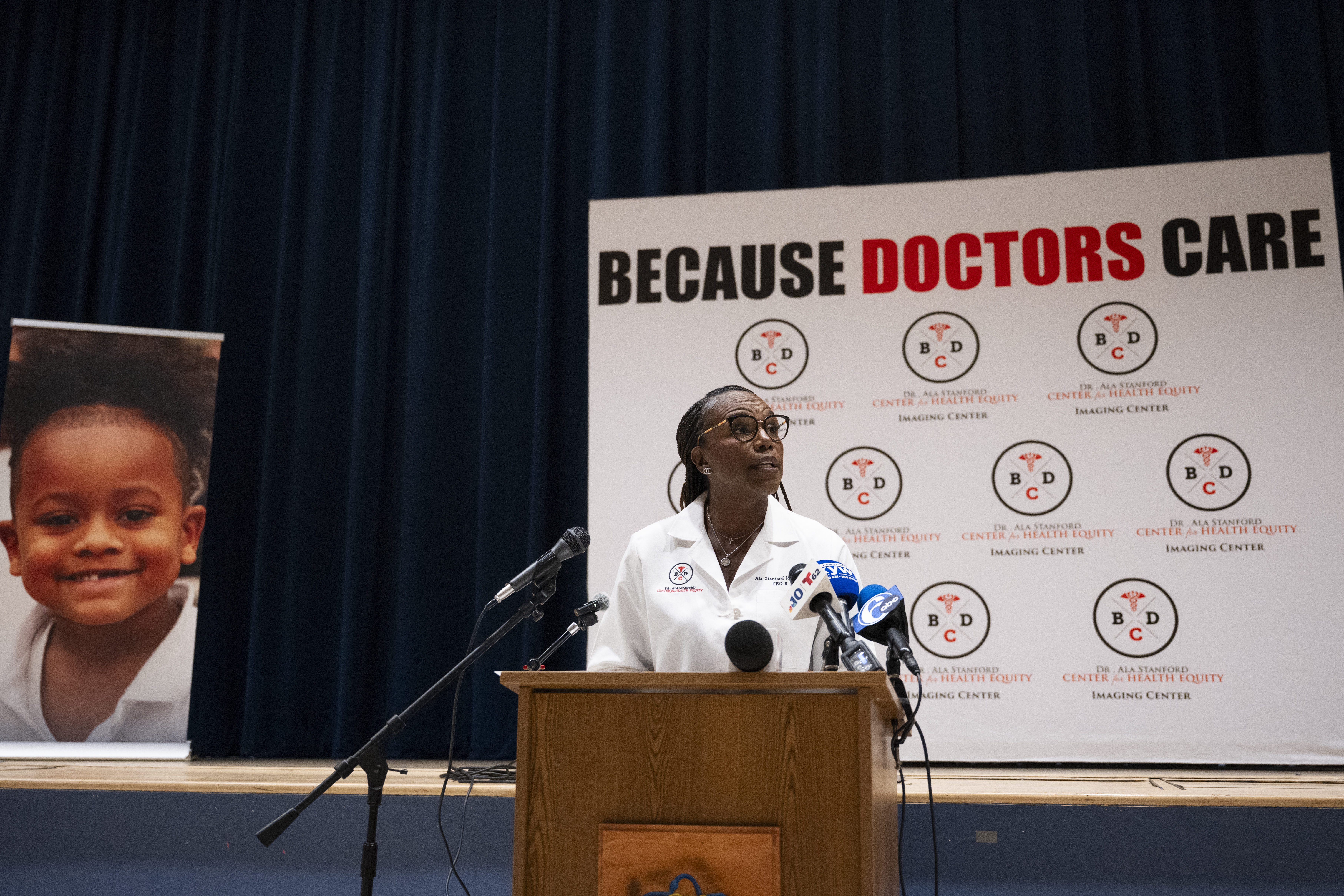
Medical Officer Kendra McDow speaks during press conference encouraging vaccinations for Philadelphia kids on Thursday at Benjamin Franklin High School in Philadelphia.Joe Lamberti / For The Inquirer
To achieve community protection, which scientists call herd immunity, 95% of a school population must be vaccinated. And though Philadelphia’s vaccination rates remain relatively strong compared with other pockets of the state, about 40% of kindergarten classrooms across Philadelphia and its surrounding suburbs became vulnerable to a measles outbreak last school year, up from a third of classrooms the year prior, according to an Inquirer analysis of state data.
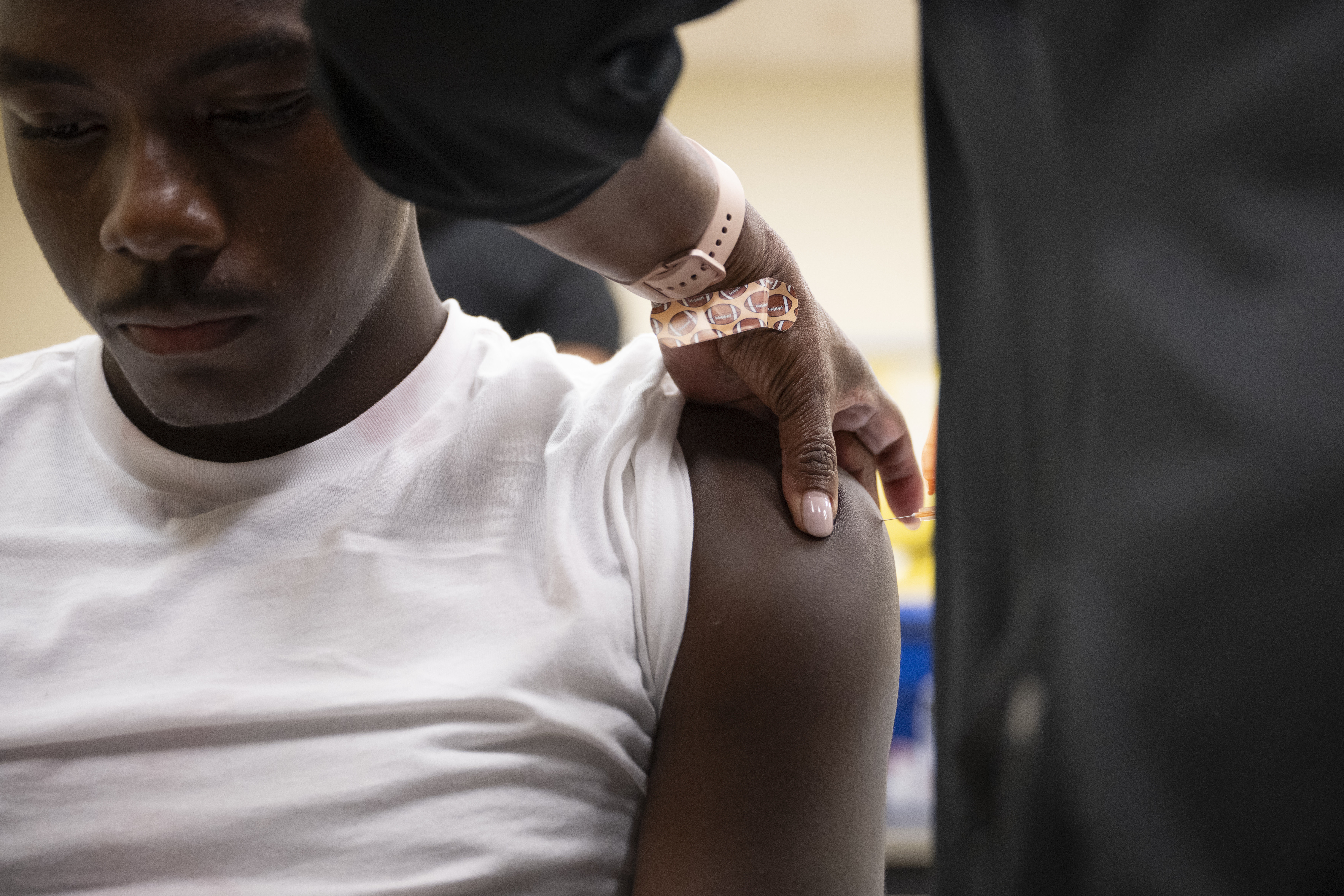
To boost city immunization rates, the district is focusing on access — from a back-to-school bus tour this summer that came with a side of childhood vaccines to the Benjamin Franklin eventover two weeks, which runs through Friday.
Parents can register their children at the district’s Constance E. Clayton Education Center, at 440 N. Broad St., then walk up the block to Ben Franklin, at 550 N. Broad, to get their children vaccines and other preventive healthcare, including connection to mental health services and appointments to get eyeglasses.
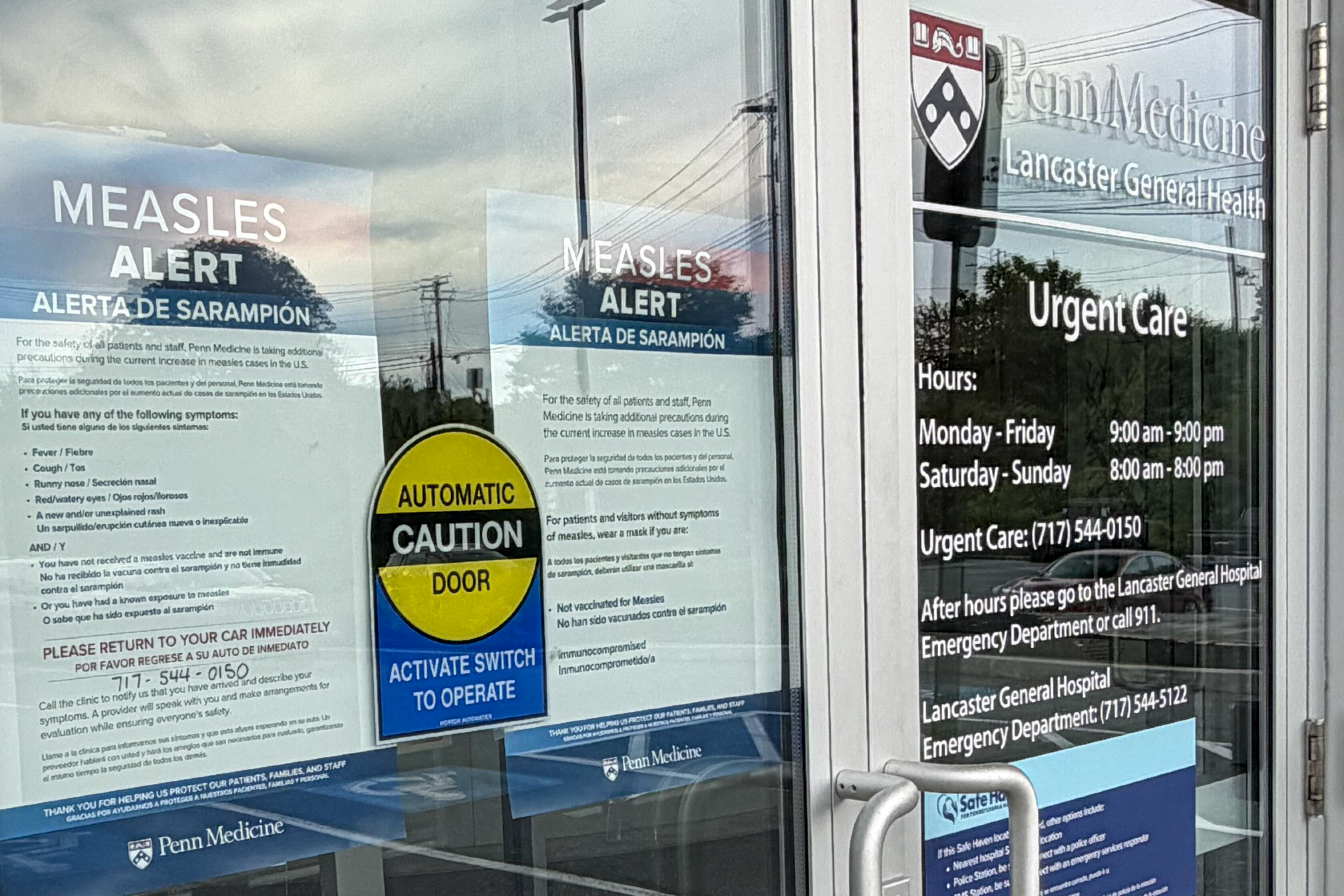
Measles is now in 28 Pennsylvania counties, with more than 400 cases reported this year — nearly half in the last month. No cases have been reported in Philadelphia, but the highly contagious disease is circulating in suburban Chester County.
Pennsylvania had the most newly reported measles cases in the nation last week, said Ala Stanford, founder of the Black Doctors Consortium, and 73 state residents have been hospitalized.
Pennsylvania now has the highest number of cases reported in the state since 1991.
“This is not a mystery. It’s arithmetic,” Stanford said. “It takes 95% of us vaccinated to stop measles from moving through a community. Pennsylvania is at about 93%, and not one county in this region is at 95%.”
What parents need to remember, Stanford said, is that since children traditionally have not received their first measles vaccine until age 1, “every infant in the city, in the stroller, in the car seat, at the family reunion has no protection of their own. We are their protection. That is the entire system.”
In response to the current outbreak, state officials have started recommending that parents in affected areas vaccinate children as early as 6 months with a “zero dose” to provide extra protection against a disease so contagious that it will infect nine in 10 unvaccinated people who are exposed.
The benefits of community protection go beyond babies and children, Stanford said: “It’s the teacher. The lunchroom lady, the man who sweeps the floor, the security officer at the door — you do not know who they go home to at night. You do not know who is on chemotherapy, who has had a transplant, who is caring for a newborn.”
Video: Philly schools recommend vaccinations for students
‘Why so many?’
School officials plan to set up individual vaccine clinics at schools that have problematic compliance rates.
Emlen Elementary in Mount Airy, for instance, had a 100% vaccination compliance rate among incoming kindergarteners two years ago. Last year, it dropped to 80%. (Many Emlen families citedphilosophical or religious exemptions to vaccination.)
Ericka Hayes, senior medical director of infection prevention at Children’s Hospital of Philadelphia, said rampant misinformation about vaccine safety certainly contributed to lower vaccination rates.
“Parents should not let that sway them from giving their children one of the most tested and effective childhood interventions in history,” Hayes said.
Disruptions from the pandemic are another factor in lagging vaccine rates, Stanford said.
Dr. Ala Stanford of the Black Doctors consortium speaks during press conference encouraging vaccinations for Philadelphia kids on Thursday at Benjamin Franklin High School in Philadelphia.Joe Lamberti / For The Inquirer
At a recent clinic at Strawberry Mansion High, Stanford said, children from 30 schools across the city showed up for shots.
“We had 14- year-olds getting four shots, and we said, ‘Why so many?’” Stanford said. Families told care providers that they had fallen off on vaccine schedules, but were relieved to have a chance to catch up their children.
As word spreads about vaccine access, about ease and availability across the city, “more people show up,” Stanford said.
Kids can be excluded for vaccine noncompliance
Children can be excluded from school under Pennsylvania law if they are unvaccinated and their families have not formally filed for an exemption on religious or philosophical grounds.
According to state data, thePhiladelphia School District excluded 34 12th graders, five seventh graders, and three kindergartners last school year for vaccine noncompliance.
Far more students were labeled “noncompliant and attending” — 1,392 12th graders, 1,853 seventh graders, and 669 kindergartners. That means those students’ families have made a plan for them to get vaccinated, but have not yet followed up on it.
Students without vaccine exemptions can be admitted to kindergarten on a provisional basis as long as they have a plan to catch up on their vaccines. (State law allows exceptions for students living in foster care or without permanent housing.) They are listed as “non-complaint but attending” when families fail to adhere to that plan.
School officials have said they work with families in that category to help them catch up on shots, but unvaccinated kids may be asked to stay home if a communicable disease is identified at their school.
School nurses are key to the effort, officials said, on the front lines of ensuring students are vaccine-compliant. Every school in the district currently has a full-time school nurse, McDow said.
One of the district’s 277 school nurse positions is unfilled, but an agency nurse is covering that vacancy, and “we are working to have the position filled as soon as possible,” McDow said.
The act of getting vaccinated or vaccinating your children, said James Garrow, deputy commissioner of the city health department, is powerful.
“Your vaccination can help save lives,” Garrow said.
(function(){function e(){window.addEventListener(`message`,function(e){if(e.data[`datawrapper-height`]!==void 0){var t=document.querySelectorAll(`iframe`);for(var n in e.data[`datawrapper-height`])for(var r=0,i;i=t[r];r++)if(i.contentWindow===e.source){var a=e.data[`datawrapper-height`][n]+`px`;i.style.height=a}}})}e()})();
A newborn baby from Lancaster County was among the two unvaccinated residents whose deaths were associated with measles, Pennsylvania health officials said Wednesday.
As vaccination rates decline in the state, an outbreak that began in April this year has sickened more than 400 people in 29 counties — with the epicenter in Lancaster County, where nearly 200 individuals have tested positive for the viral disease. Local physicians and health officials say the true case count is likely much higher.
The state initially declined to share any information about the deaths, citing privacy concerns, and no information has been released about the second Lancaster resident who died.
The Pennsylvania Department of Health confirmed information about the newborn’s death on Wednesday only after the Lancaster County coroner publicly stated his office was investigating a newborn who had tested positive for measles and died from a ruptured spleen.
Lancaster County Coroner Stephen Diamantoni, a physician, said the cause of death was not the measles. The newborn died shortly after birth from a laceration of the spleen. A postmortem test on the baby’s lung tissue showed that the child had a measles infection that was acquired before birth, he said in an interview.
His description of the death, shared with reporters and a local county commissioner, contributed to a growing uproar on social media over the nature of the deaths and the state’s release of information.
President Donald Trump’s secretary of health and human services, Robert F. Kennedy Jr., traded attacks with Gov. Josh Shapiro, a Democrat, on X over the deaths and the safety of the measles vaccine.
Late Wednesday, Kennedy went further in another X post. He accused Shapiro’s administration of potentially having “fabricated” the deaths, after saying in an interview on C-Span that “they cannot find any measles deaths in Lancaster County.”
He said that Shapiro was not cooperating with the Centers for Disease Control and Prevention or the county in giving information on the deaths.
Shapiro administration staff said the department has been in regular contact with the agency during the outbreak.Pennsylvania Health Secretary Debra Bogen said in a statement late Wednesday that she “sadly can confirm” two measles-associated deaths in Lancaster County.
Measles deaths are rare. Most patients recover after mild illness, but the virus can cause pneumonia and brain swelling and kills about one to three patients in 1,000. The disease is so contagious that it can infect nine in 10 unvaccinated people.
The Pennsylvania Department of Health explained thatit reports deaths where measles are present as “measles-associated,” and it “may not be assessed by the medical examiner or coroner to be the immediate cause of death.”
In Lancaster, the coroner’s officedetermined that the baby’s primary cause of death was a laceration of the spleen, Diamantoni said.
Despite the baby’s positive measles test, the forensic pathologist who conducted the autopsy “did not feel it was related to measles,” Diamantoni added.
His office is seeking to learn whether the baby’s mother had measles at the time of the baby’s birth.
He said state health officials had not contacted him personally as of Wednesday about the two Lancaster County measles-associated deaths, but his chief deputy spoke to the department prior to Shapiro’s news conference Tuesday.
Paul Offit, a national vaccine safety expert and physician at Children’s Hospital of Philadelphia, said news of the coroner’s investigation “doesn’t really give us more information” on the death.
Children can acquire the disease after birth, or can be born with measles if their mother is infected and develops a rash within 10 days of giving birth, he said.
Measles can cause an enlarged spleen, and birth can cause it to rupture, he said. After a spleen ruptures, Offit said, it is difficult to tell whether it had been enlarged, and he added that the coroner should provide an alternate explanation for the rupture if it had not been caused by measles.
Diamantoni said the doctor who performed the baby’s autopsy did not note that the spleen was enlarged, and the office is still investigating the cause of the rupture.
To prevent speculation, the state could release information about the patients’ age, vaccination status, and cause of death while still protecting their privacy, Offit said.
In conversations with state health officials, he said, he learned that “these patients would not have died were it not for measles.”
Anti-vaccination advocates “try and completely misdirect and say it really wasn’t measles. They try to do everything they can to distance themselves from it,” he said. “You’re making it a lot easier for them when you don’t give more information.”
In her statement, Bogen said the department reported the deaths to the CDC on Tuesday morning and met with CDC staff on Wednesday afternoon to discuss the cases.
“DOH’s Epidemiology team thoroughly investigated and verified both individuals tested positive for measles. The information was not reported to the public until the results of the epidemiological investigations were confirmed,” she said.
She noted that state health officials are prohibited from releasing death certificate information except under limited circumstances that do not apply to this case.
A county commissioner questions measles-associated deaths
The clash over the deaths began within hours of Shapiro’s Tuesday news conference.
Lancaster County Commissioner Josh Parsons, a Republican, shared the coroner’s account on Facebook, suggesting the state was spreading incorrect information on the deaths.
In several posts, Parsons questioned whether the patients had died “OF measles or WITH measles” and suggested the state was spreading incorrect information on the deaths.
“We have ZERO information that corroborates the idea that there were two measles deaths in Lancaster County,” he wrote in a post several hours before the state’s announcement. Later, he shared Kennedy’s remarks on C-Span.
Parsons has not responded to several requests for comment from The Inquirer about the outbreak over the last several months.
Yoder, who attended the Tuesday news conference, said at a Lancaster commissioners meeting Wednesday that she had no additional information on the recent deaths.
The consequences, he said, were apparent in the deaths reported in Pennsylvania. He said he had told Kennedy as much in a recent phone call.
Later that night, on X, Kennedy said that Shapiro had falsely accused him of spreading misinformation and that drops in the state’s high vaccination rates occurred mostly during President Joe Biden’s administration.
Replying to Kennedy on X, Shapiro said that he asked the secretary to help him encourage people to get vaccinated and “stop spreading misinformation.”
The governor joined a lawsuit earlier this year against Kennedy’s department’s decision to scale back federal vaccine recommendations for children.
Shapiro noted that Kennedy had visited Lancaster in 2021, during the Biden administration, and told a crowd there that measles could be cured by “chicken soup and vitamin A.”
Measles has no specific treatments, and although vitamin A is sometimes given to severely ill patients, it cannot prevent the disease and is not a cure.
Shapiro added that measles cases have increased in the United States and Pennsylvania under Kennedy’s watch.
Editor’s note: This story has been updated to clarify that the newborn who died had a measles infection acquired before birth.
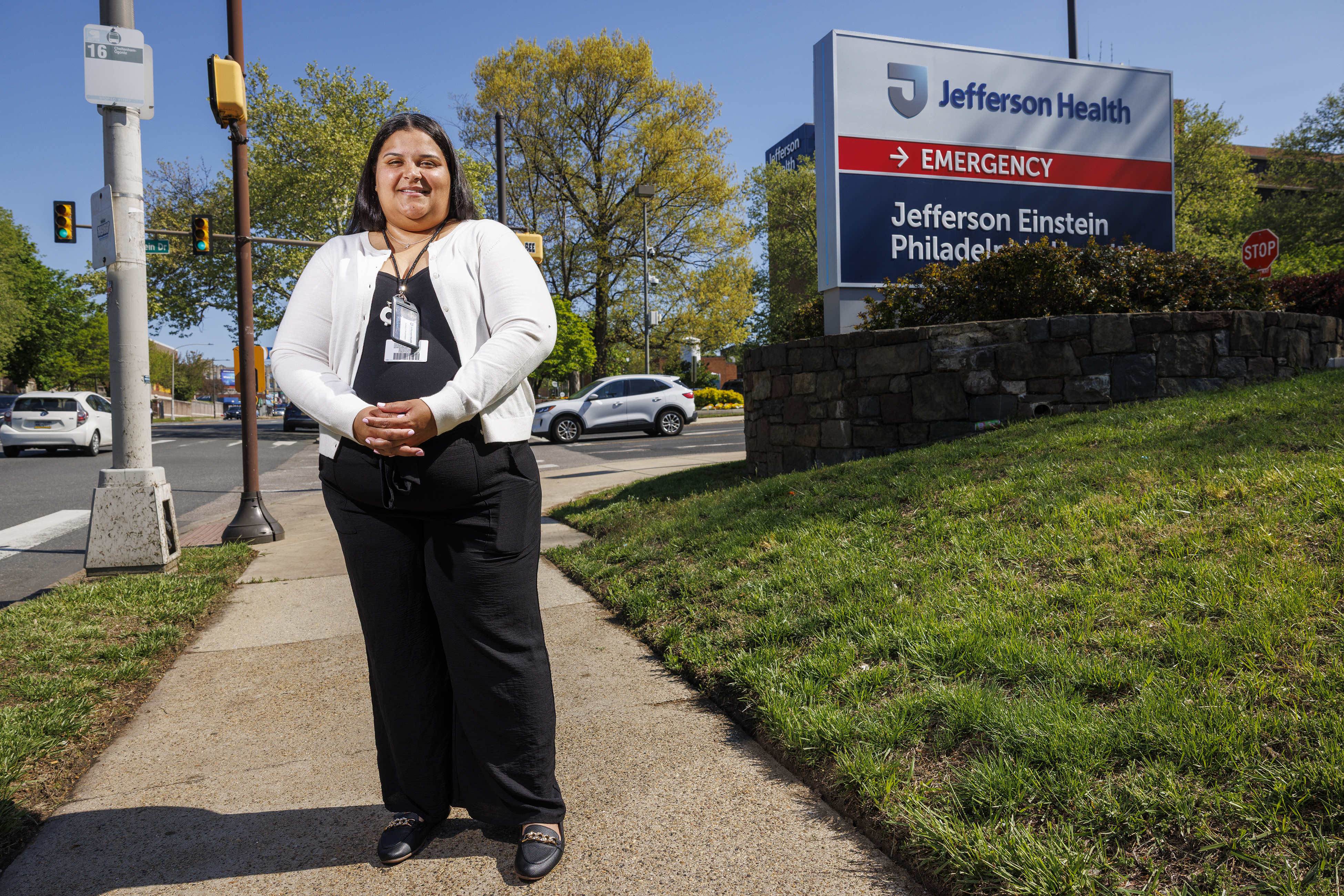
Ashley Boudreaux, an operations manager at Jefferson Health, would like to run a hospital someday.
“I would really like to make it to the C-suite — be a CEO,” said Boudreaux, 37, who works at the medical group’s Philadelphia and Montgomery County sites.
So, without quitting her job, Boudreaux pursued her undergraduate degree in health administration with the University of Phoenix. She graduated in 2023, and now she’s on track to get her master’s in business in November. She’s done all her coursework while working full-time.
It wasn’t easy, Boudreaux said.
“You’re just moving constantly,” she said. “When I look back, I’m like, I don’t know how I did it.”
It helped that Jefferson provided some financial support for Boudreaux’s education.
More than 40% of employers offer this benefit, according to Alex Alonso, chief knowledge officer at SHRM, a human resources association. That number has waned a bit in recent years, but some large local employers still do so.
They include Comcast, which offers tuition reimbursement as an employee benefit and works with Drexel University to shape several master’s programs for tech workers. Another is Aramark, which covers up to the full cost of tuition for eligible hourly employees, and tuition assistance for salaried employees. And Philadelphia’s city workers get tuition discounts at more than a dozen local colleges.
For many, completing a four-year degree would still prove beneficial, said Sean Vereen, president and CEO of nonprofit Heights Philadelphia, which connects young people with education and career opportunities.
“The college degree is not the only way to get to economic success, … [but] there is a connection between your ability to have stronger credentials and your ability to move economically,” Vereen said.
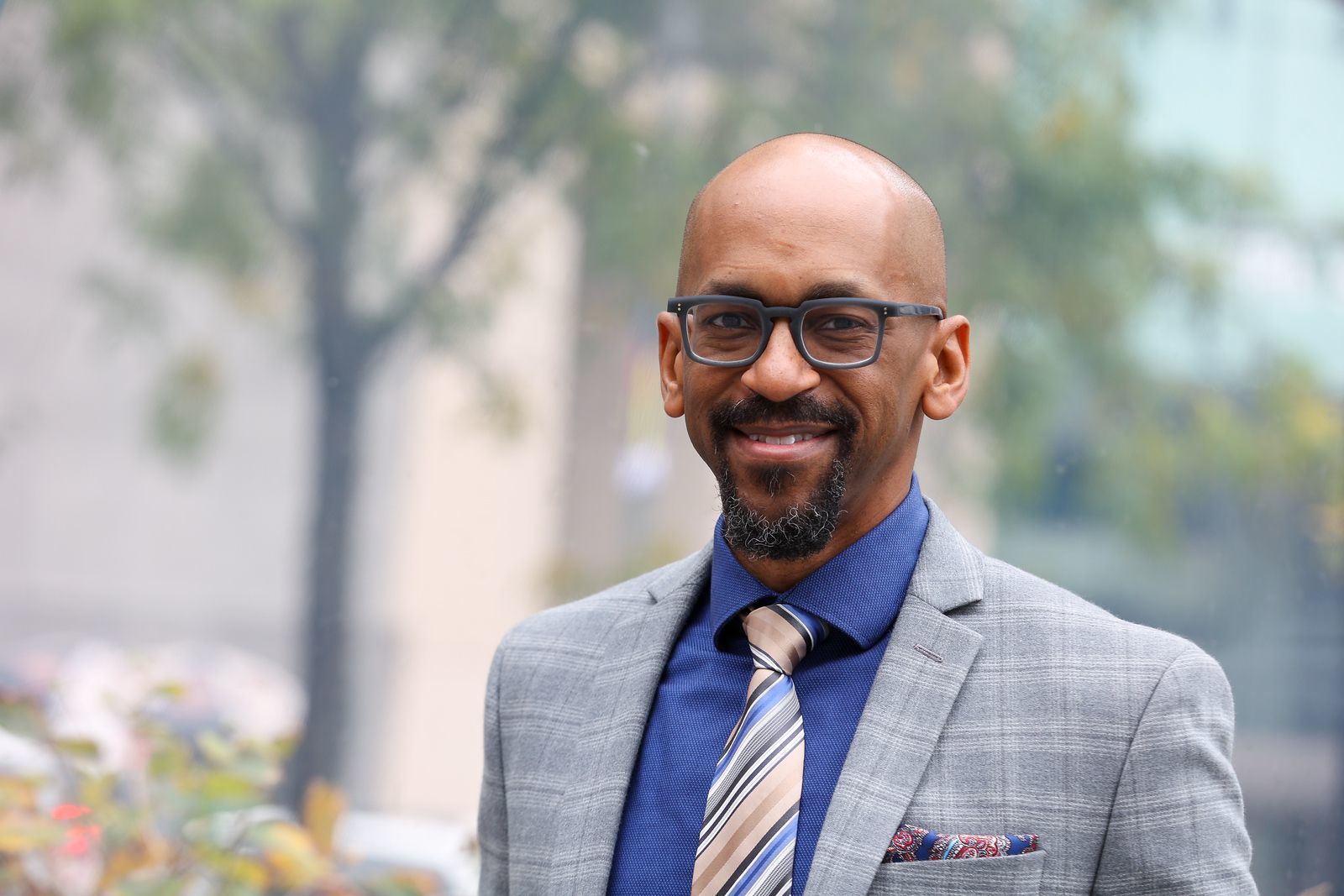
Sean Vereen of Heights Philadelphia. Paola Nogueras
Why workplaces offer tuition assistance
Federal tax incentives have encouraged employers to assist with education costs, said Alonso of SHRM. The benefit also helps companies compete for good hires, he noted.
Most commonly, Alonso said, employers offer up to $5,250 per employee per year. That’s the maximum they can give toward education costs without the employee paying taxes on it. Workers are often required to show that the education is related to their job or career, so they “can actually bring back what they learn to their workplace,” he said.
Sometimes getting additional education, including short-term microcredentials, are prerequisite to a promotion, said Phil Brooks, a vice president at nonprofit Graduate Philadelphia, which supports adult students.
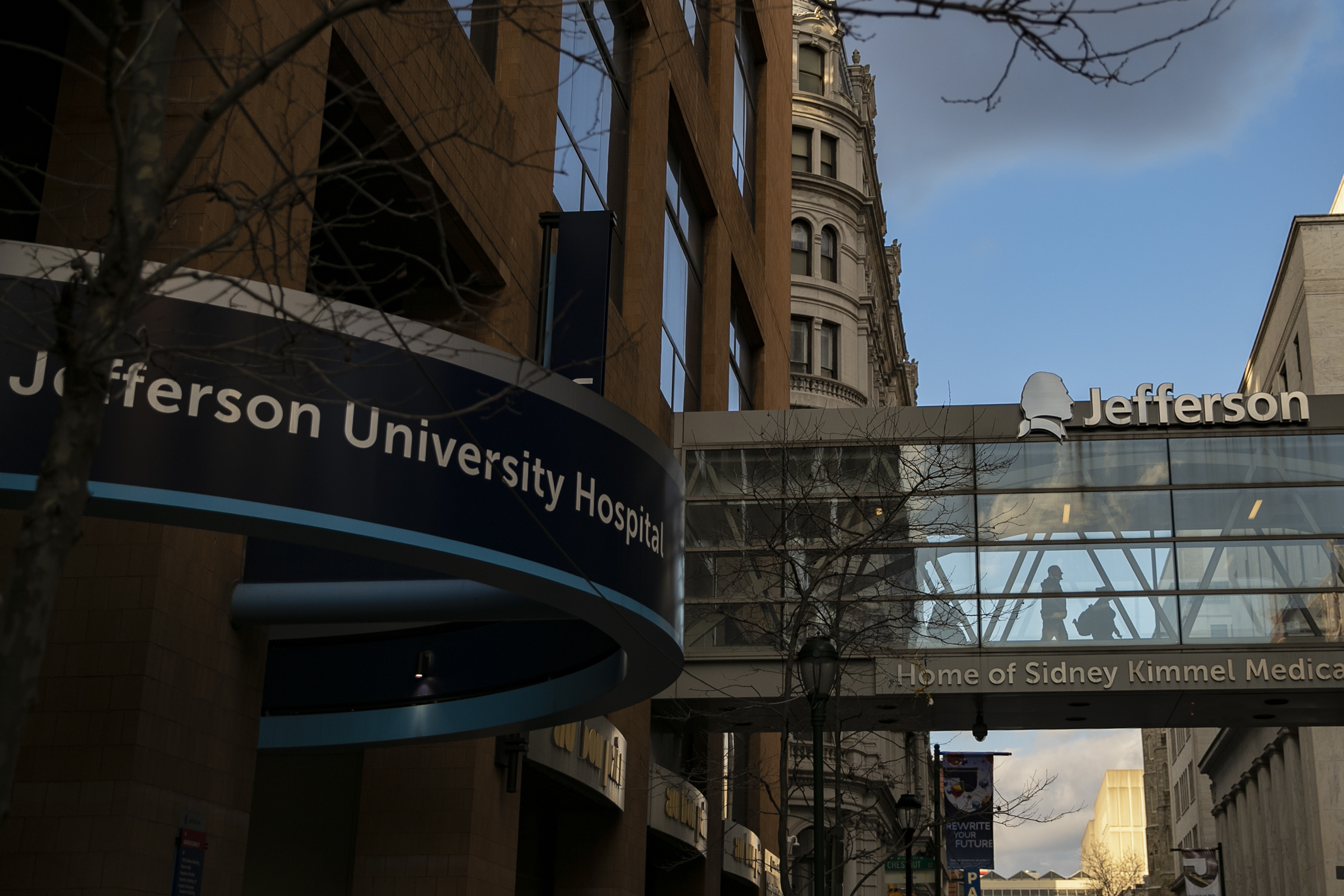
Thomas Jefferson University Hospital in Center City Philadelphia is shown in this 2020 file photo. Heather Khalifa / Staff Photographer
Hurdles for worker-students
Getting a degree while working full-time can mean early mornings, later nights, giving up weekend time, or even using lunch breaks to squeeze in school work.
Other challenges can include transportation for in-person programs or access to a computer and reliable internet connection, says Brooks. Students who owe money to a school where they were previously enrolled might also be held back from transferring or finishing their degree.
Graduate Philadelphia sometimes helps students negotiate with schools to decrease that amount owed, “literally removing this barrier as much as we can,” Brooks said.
“Slow progress is still progress,” she said. “A lot of times, when we start off on a journey, we see the entire staircase, but not realizing that it takes one step at a time to get to the top.”
Getting the promotion
When Nicole Henderson, 38, graduated high school, going to college right away wasn’t an option.
“It just didn’t make sense for our family,” she said. “We just couldn’t afford it.”
Years later, while working at a trading firm, she started pursuing a bachelor’s in accounting. But she put it on hold after a semester when she learned her employer, who encouraged her to go back to school, wouldn’t cover her tuition.
Five years ago, while searching for work as an executive assistant, she saw a role open up at the Children’s Hospital of Philadelphia that didn’t require a bachelor’s degree. She got the job and soon felt the urge to continue advancing her career.
“I’m now at this huge organization with all these opportunities,” Henderson said. “I was like, oh, man, eventually I’m going to have to have this bachelor’s degree.”
Nicole Henderson in her home office in Darby. She went back to school while working full-time and recently earned her bachelor’s from Temple.Alejandro A. Alvarez / Staff Photographer
In 2023, she started working toward that undergraduate degree again. Her colleagues at CHOP were supportive, and she was given flexibility to tune into classes from work sometimes, or work remotely on the days she had a lot of studying to do. CHOP also reimburses a portion of her tuition and has a student loan repayment program. Without that financial support, Henderson says she wouldn’t have pursued the degree.
Juggling work and school can be exhausting, Henderson said. She slept through the day some Saturdays because her “brain was just so overloaded with information.”
But she got her bachelor’s in business from Temple University in December and walked across the stage at graduation in May.
Her classes gave her a new awareness of what’s important to bosses and leaders at her organization, she said, and “how to speak their language.”
She also negotiated a promotion from executive associate to project manager, with a raise.
Now she doesn’t have to wonder “how am I going to convince people that I’m qualified to do this?” she said. “I kind of already have this degree that says that for me.”
This story contains references to suicide. If you or someone you know is thinking of suicide, call or text 988.
Whether they’re seeking treatment for a sprained ankle, stomach pain, or a panic attack, teenagers who come to the Children’s Hospital of Philadelphia emergency department are handed a 10-minute health survey with questions about depression and self harm.
About one in three reports symptoms of depression or suicidal thoughts that may otherwise have gone unnoticed.
Asking all patients aged 12 to 19 about mental health challenges has improved CHOP’s early detection of needs, especially among teens and adolescents being treated for physical ailments.
“There’s this tension of we don’t want to ask a 12-year-old these questions, these are grown-up questions,” said Polina Krass, a pediatric emergency medicine attending physician at CHOP, who helped develop the survey. “But then we miss the mark and are getting kids the help they need only when they’re already in crisis.”
CHOP’s screening initiative, launched in 2011, targets a problem hospitals across the region and country are facing: Mental health issues account for about one out of every eight emergency department visits, according to the Centers for Disease Control and Prevention. Yet hospitals are often ill-prepared to respond to these patients’ complex needs, which can put patient and staff safety at risk.
Safety experts say that one of the most meaningful solutions is for hospitals to treat suicide risk and mental health issues as a core patient safety issue that all staff are trained to recognize, akin to postpartum hemorrhage, heart attack, or stroke.
“This isn’t just a behavioral health issue — this is a system-wide patient safety priority,” said Shannon Kooker, vice president of clinical excellence and patient safety at ECRI, a patient safety organization in Fort Washington.
Suicide risk in emergency departments
Patients at risk of suicide often turn to emergency departments for care, according to a new ECRI report.
ECRI analyzed patient safety incident reports from hospitals, outpatient clinics, and behavioral health programs between 2021 and 2025, looking specifically at suicide deaths and attempts, and instances in which patients expressed having thoughts of killing themselves.
Nearly three-quarters of the 406 incidents ECRI analyzed occurred in emergency departments. That’s partly because hospitals have established protocols for reporting incidents, whereas urgent care and ambulatory centers may be less likely to self-report, Kooker said.
People experiencing a mental health crisis may also be more likely to seek care at hospitals, which typically have specialized behavioral health workers on staff, she said.
Deaths were rare, accounting for just 2.7% of cases analyzed by ECRI. Much more common were cases in which a patient tried to kill themselves or expressed a desire to — a sign that providers have an opportunity to intervene before harm occurs, if they can identify risks quickly, ECRI analysts found.
A system-wide approach to mental health safety
Improving safety for patients at risk of self harm should be a hospital-wide effort, Kooker said.
That can mean changing the emergency room environment, such as installing breakaway doors that open upon impact to reduce the risk of patients harming themselves and using paper scrubs that can’t be knotted into ropes.
More importantly, hospitals should make suicide prevention part of their safety culture, emphasized at the highest leadership levels, she said.
She urged hospitals to standardize policies for responding to mental health emergencies.
That starts with training all staff to recognize warning signs, such as being extremely agitated or anxious, acting erratically or withdrawn, or expressing feelings of being a nuisance or burden to others.
Not every patient needs to be screened for suicide risk, but staff should quickly call for help when they recognize troubling behaviors, Kooker said.
“It shouldn’t be a question mark to the staff — it should be standardized and tested,” she said.
CHOP targets youth mental health
At CHOP, about 10% of emergency department visits involve patients whose primary concern is a mental health issue.
Krass worries about the many more teens and adolescents whose mental health needs may go unnoticed in emergency departments because no one thought to ask.
The optional behavioral health screening survey — now taken by some 600 patients a month at CHOP’s Philadelphia and King of Prussia emergency departments — is designed to better identify those individuals, said Krass, a research scholar at CHOP’s Center for Violence Prevention.
When a patient’s survey answers indicate anxiety, depression, or other mental health concerns, doctors connect them with a behavioral health specialist or social worker for follow-up care.
Patients can complete the 37-question survey on their phone or on a tablet provided by the hospital. Krass and her colleagues have found that youth are more likely to share details about their mental health through this quasi-private format than if doctors ask questions directly.
One of the survey’s final questions is whether it’s a good idea for CHOP to probe so deeply into their young patients’ mental health.
Almost all answer yes.
Editor’s note: This story has been updated to correct the year CHOP began its behavioral health screening initiative.
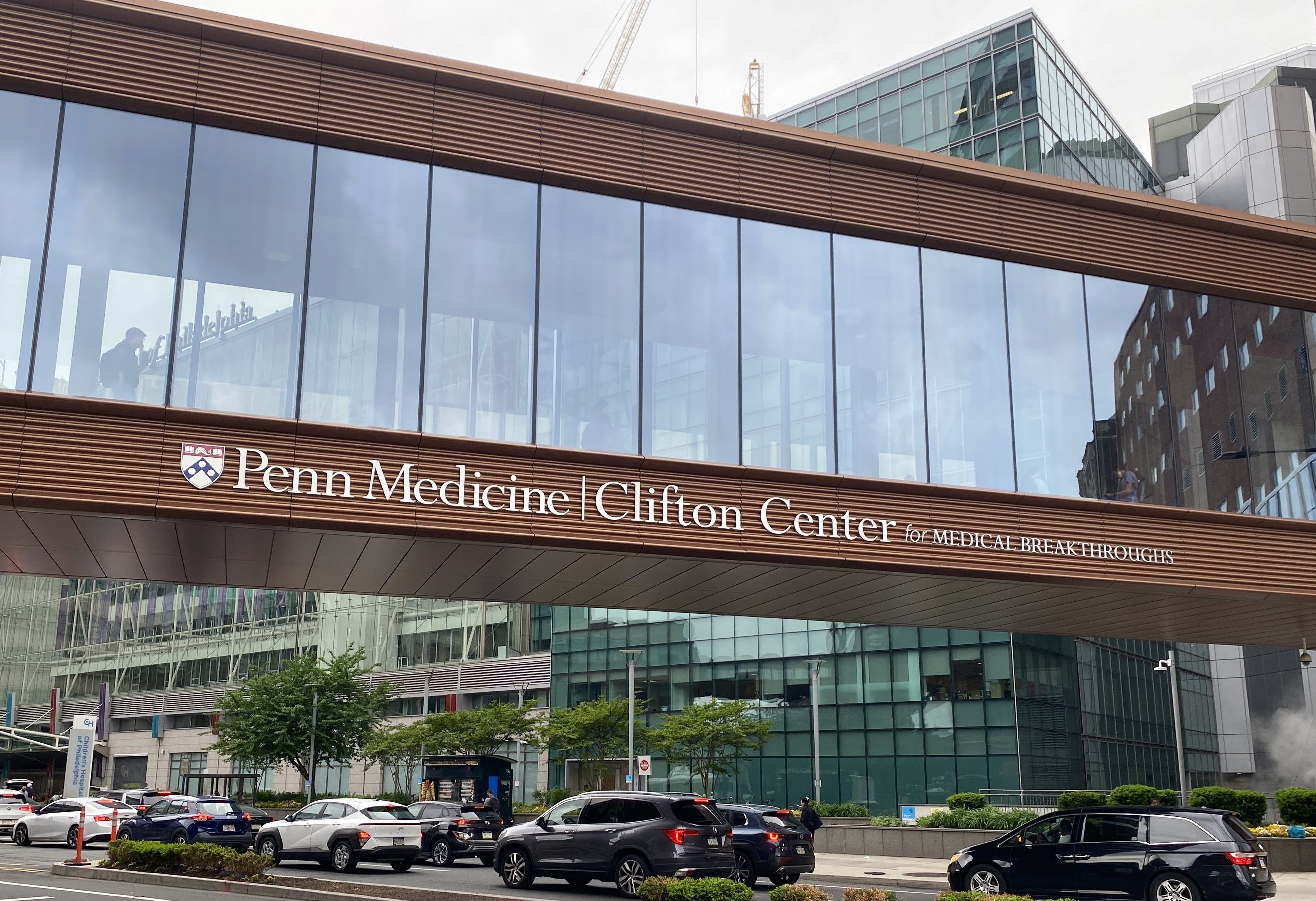
Aramark and the University of Pennsylvania Health System launched a partnership this year to offer the food service giant’s Philadelphia-area employees healthcare in a test of a new model for reducing costs.
Aramark employees who choose the benefit option, called the Penn Medicine Premier Plan, face no deductibles and lower copays when they and their dependents use Penn doctors and facilities.
The move by Aramark into what is called direct contracting comes as employers are contending with years of surging healthcare costs. It’s an example of experimentation designed to slow spending growth in spending and perhaps improve quality, experts said.
“We certainly would like to save money on the model, but its primary focus is to make benefits more affordable” by getting lower prices than it would get by going through an insurer, said James Startare, Aramark’s vice president for benefits.
The model is called direct contracting because Aramark negotiated prices and other terms of the contract directly with Penn, instead of relying on an insurer to negotiate prices.
It’s Penn’s first such contract and the first large-scale direct contract in the Philadelphia region. Aramark talked with other systemsin the area, but Penn emerged as the partnerwilling to enter into the experimental contract. Penn described the deal as a multiyear contract ultimately expected to roll over from year to year.
Aramark didn’t provide details on savings, but its goal was to negotiate prices that are lower than those it would pay though a benefits administrator, such as Aetna.
By eliminating deductibles that function as a barrier to care, the plan is expected to encourage primary care visits. Thiscould reduce long-term costs by catching patients’ health problems early.
For health systems like Penn, such contracts offer a chance to increase market share, streamline payments, and hone their ability to manage the health of a population.
The Penn Medicine Premier Plan features no deductibles and lower copays when Aramark employees and their dependents use Penn doctors and facilities. Harold Brubaker / Staff
Aramark’s move into direct contracting
Penn is Aramark’s third major direct contracting partner.
Employers, even those like Aramark that are self-insured, typically rely on an insurer’s negotiated prices.
With the new direct contract, an Aetna administrative unit still processes the claims for Aramark, and patients who go outside Penn for care use the Aetna network.
Aramark launched its first such contract in 2024 in Dallas and expanded to Chicago last year, each time getting a strong employee enrollment, though it took two years in Chicago, Startare said.
In the Philadelphia region, 35% of eligible employees (those who work 30-plus hours a week on average) have chosen the Pennplan, which took effect Jan. 1, Startare said. That amounts to 800 employees.
Employees who were moving to Aramark with the food services contract were worried about losing their Penn benefits, said Megan Lieberman, a patient services manager at Chester County Hospital who was among those who became an Aramark employee.
But the Penn Premier Plan was very similar to what they were used to. “It was definitely a huge relief to know that we got to hang on to those benefits,” Lieberman said.
A separate contract covers pediatric services at Children’s Hospital of Philadelphia for Aramark employees and their families.
Next year, Aramark plans to take direct contracting into central New Jersey, but did not name the system it’s using there.
What’s in it for Penn
The Aramark contract is an opportunity to focus on “chronic disease management, preventive care, cancer screenings, things like that” for a specific group of 1,400 patients who are motivated to stay within the Penn system, said Mark Angelo, Penn’s chief medical officer for population health.
A key goal is to reduce the deductibles, copays, and prior authorizations that can slow access to preventive care. The model is designed totake care of people before they end up in high-cost places like the emergency department or hospital, Angelo said.
Keeping more patients within Penn is expected to result in savings because of better care coordination and fewer repeated tests, Angelo said. Penn Premier plan members can seek care outside of Penn, but it will cost them more out-of-pocket.
As it is, the typical Penn patient also uses other health systems for some services, said Roy Schwartz, Penn’s vice president for payer strategy.
“Sometimes it’s the right choice, sometimes it can fragment their care,” Schwartz said. “There should be savings just simply coming from having integrated, coordinated care at a place like Penn.”
Penn does not yet have much of its own data on Aramark employees, but indications from Aramark are that the plan’s members were using more Penn services in the first six months, Schwartz said. “It was not just patients who were using Penn anyway for pretty much everything.”
Penn and Aramark officials plan to meet regularly to review results and consider modifications. “We’re hoping this works out well for everybody because we’d love to do some more of these,” Schwartz said.
Momentum behind direct contracting
Employers nationally have long contracted directly with doctors and health systems for specific procedures, like joint replacements, cancer care, and heart surgery. For years, they’ve also paid directly for primary care through on-site clinics.
Aramark’s move to an all-encompassing healthcare plan with a single providerfits into a newer trend gaining momentum nationally. Investors have created platforms like Cost Plus Wellness, Mishe Health, Nomi, and Transcarent to help health systems implement direct contracts.
Northwell Direct’s biggest contract covers 100,000 building service workers in the New York area and their dependents. Ittook effect this year and is expected to save 20% in the first year.
Big savings to start are not guaranteed.
“They may not go into it with a lower cost, but they’re going to go into it with better access, better quality for their employees, and what they’re finding is eventually those lower costs will come,” said Jenny Goins, chief of staff at the National Alliance of Healthcare Purchaser Coalitions.
The Washington nonprofit is putting together a direct contracting advisory council to help more employers to do what Aramark is doing, Goins said.
The model is not expected to replace traditional coverage anytime soon in the Philadelphia region.
“It is not for everyone, and it does take effort and coordination on the part of the employer,” said Tom Belmont, CEO of the Greater Philadelphia Business Coalition on Health. “Also, some health systems are ready for the discussion, while others are not.”
Pennsylvania will not change its immunization guidelines in response to President Donald Trump’s executive order this week calling for states to reduce the number of recommended childhood vaccinations and separate a combination shot protecting against measles, mumps, and rubella (MMR).
Gov. Josh Shapiro, a Democrat, said his administration will “continue to give Pennsylvanians clear public health guidance based on science and facts.”
“President Donald Trump and [Health and Human Services Secretary Robert F. Kennedy, Jr.] are screwing around with the childhood vaccine schedule — ignoring decades of science, sowing chaos and confusion, and spreading dangerous misinformation that put kids and families at risk,” Shapiro said.
States set vaccination mandates for schoolchildren, not the federal government.
And it gives Kennedy, a longtime anti-vaccine activist, 90 days to present Trump with a plan for a number of vaccine policy changes. Changes could include splitting the MMR vaccine into separate shots for each disease. There are currently no individual vaccines for measles, mumps, or rubella licensed in the United States.
“Splitting up combination immunizations, like the MMR vaccine, creates unnecessary hurdles for parents, needlessly extends the window of risk for our youngest residents, and doesn’t follow the results of the many studies that went into developing the previous vaccine schedules,” Pennsylvania Secretary of Health Debra Bogen said in a statement.
White House spokesperson Kush Desai did not comment directly on Pennsylvania officials’ decision to keep its original vaccine recommendations.
He said in a statement that Trump has pledged to reduce the vaccines recommended for all children, and the “administration is committed to delivering with Gold Standard Science and every lever of executive authority.”
“The countless parents whose questions and concerns about America’s vaccine schedule have been ignored if not mocked finally have a true champion in President Trump,” he said.
Vaccine politics under Trump
The new executive order is not binding, experts say, and states are free to ignore it.
Several states, including Pennsylvania, have already balked at Trump’s repeated attempts to upend longstanding childhood vaccination schedules.
And last year, when the Trump administration did not approve COVID-19 vaccinations for certain groups, Pennsylvania changed state policy to allow pharmacists to dispense vaccines based on recommendations from a number of professional medical organizations, including the American Academy of Pediatrics and the American Academy of Family Physicians.
Previously, pharmacists were asked to dispense vaccinations based solely on recommendations from a Centers for Disease Control and Prevention committee. Kennedy fired the entire committee and replaced them with hand-picked appointees last year, some of whom included vaccination skeptics. That action is also the subject of a court battle.
“The way to handle this is to ignore it,” said Paul Offit, the director of the Vaccine Education Center at the Children’s Hospital of Philadelphia and a prominent Kennedy critic.
“It’s not science based, it doesn’t make vaccines safer or more effective,” he said. “All it does is put children in harm’s way.”
He noted that despite longstanding concerns by anti-vaccination activists that children receive too many vaccinations, breaking up combination vaccinations like MMR would result in children getting more shots. “Kids would need six shots instead of two,” he said.
Logistics uncertain
Changing the kinds of vaccines available in the United States would take years, said Ana Santos Rutschman, a professor specializing in health law at Villanova University.
Trump could ask the Food and Drug Administration to approve separate measles, mumps, and rubella vaccinations, which would require extensive clinical trials and a long approval process, she said. And vaccine manufacturers may not attempt to develop new shots if Republicans lose control of the White House in 2028, she added.
“Right now, it’s unlikely anyone will reshift their operations,” she said. “It’s feasible — it’s just expensive, and the payoff is very small.”
The FDA could revoke licensing for the current combination MMR vaccines, but that would likely invite court challenges, Santos Rutschman added.
In the short term, she’s concerned that Trump’s repeated attempts to change longstanding vaccine policy will only confuse parents and providers who have relied on consistent recommendations from the federal government.
“Suddenly, you have our top regulators saying there’s a reason to hop to a different set of products. This is inherently confusing,” she said.
On a mild April day, 12-year-old Sam Okyere reviewed his wish list with his mom during their drive to the Make-A-Wish Foundation’s Bala Cynwyd office.
First choice: Legoland andDisney World.
Second choice: meeting Eagles Jalen Hurts and Saquon Barkley.
Third choice: hanging out with Philly rapper Lil Uzi Vert.
But when Sam, his mom, and two members of the Make-A-Wish crew squeezed into the office’s tiny Lego-themed room for the official discussion, something different flashed to mind.
“I want to help the homeless,” Sam told them.
Sam has sickle cell disease.He’s endured a lifetime in and out of hematologists’ offices, white-knuckling through blood transfusions and bursting into hospitals when “pain crises,” agonizing sensations caused by disruption in the blood flow, tore through his body. This was his chance to do one completely selfish thing, and he chose to be selfless.
“Are you sure this is what you want to do?” Maude Gambrah, Sam’s mom, asked as she started the car to drive them home to Drexel Hill. She knew Sam had a soft spot for homeless people. He was always encouraging her to give money to panhandlers around Philly. But this was his only wish.
“Yeah, Mommy,” he responded. “This is what I want to do.”
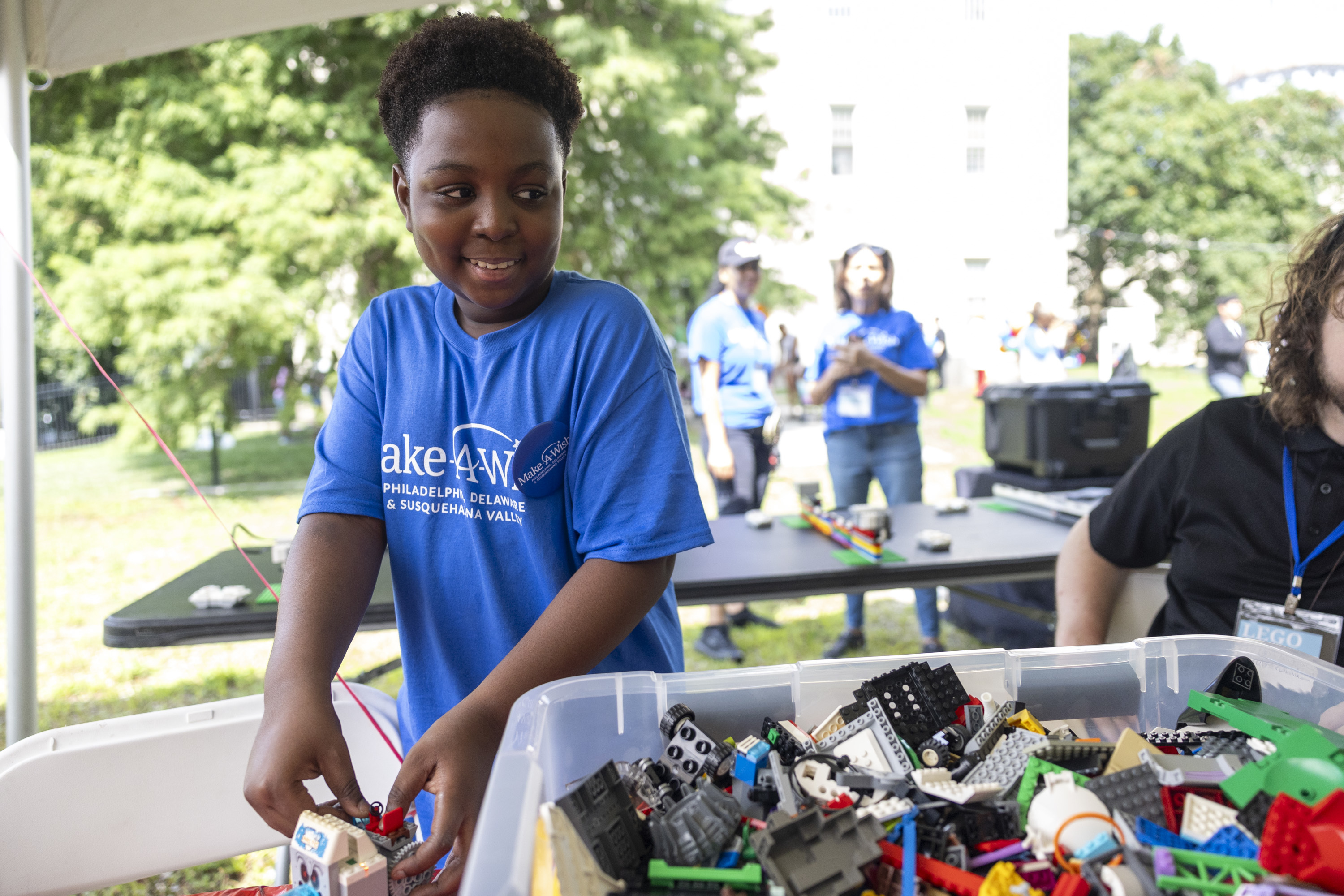
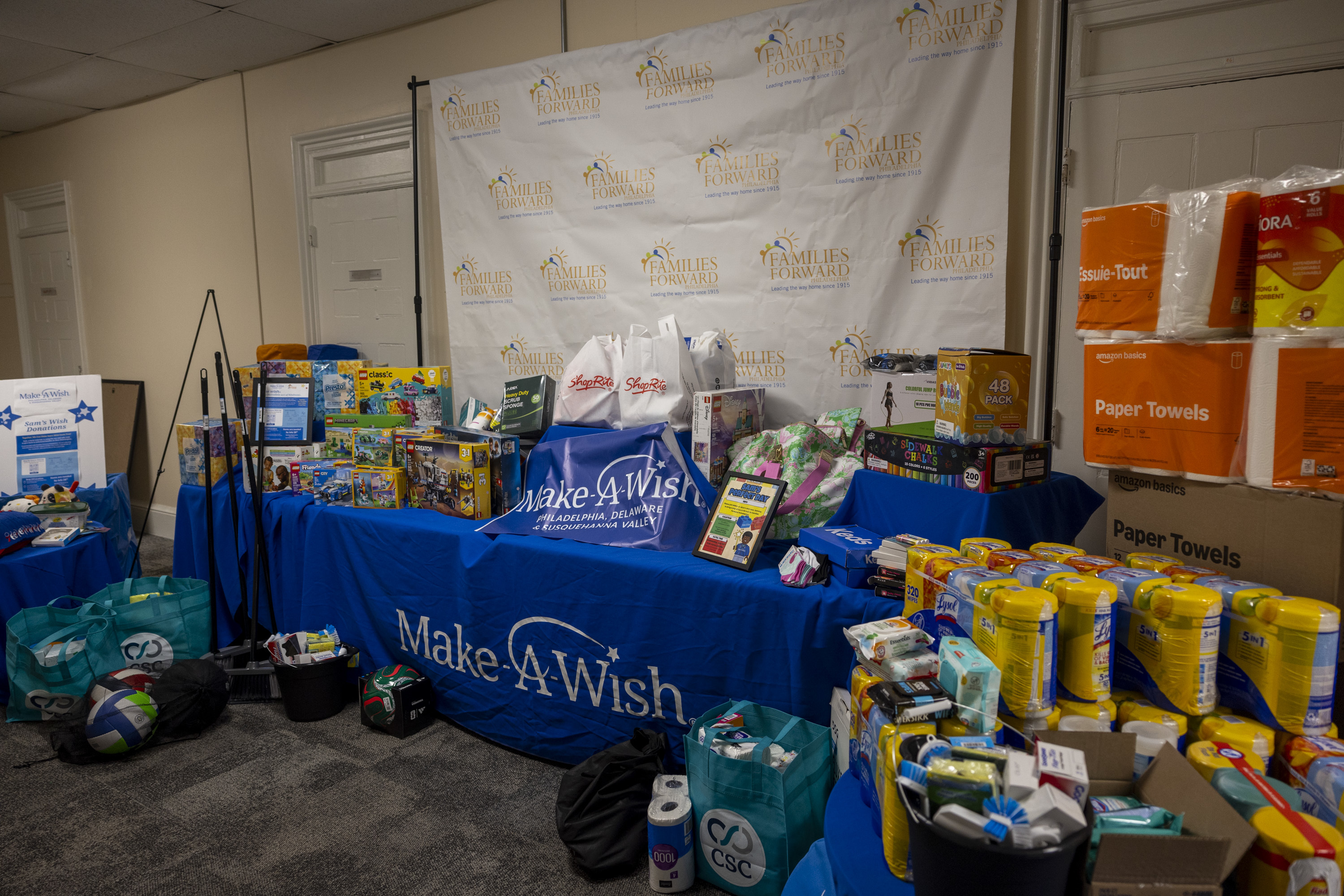
Make-A-Wish settled on Families Forward Philadelphia, a homeless shelter in West Philly, as the recipient of Sam’s wish and hosted a monthlong donation drive for the facility leading up to “Sam’s Perfect Day” last month. The carnival-style extravaganza on the shelter’s front lawn, attended by dozens of families experiencing homelessness as well as Sam and his family, featured Lego displays, a petting zoo, a Lego-inspired bounce castle, and water ice provided by Sam’s family’s Southwest Philly water ice business, Willkay’s.
Making a wish a reality
Word of the wish quickly spread around the office of Make-A-Wish Philadelphia, Delaware, & Susquehanna Valley following the April meeting. Anika Goyal, one of the staffersresponsible for carrying out wishes, knew this one had to be hers.
The chapter, which grants about 335 wishes a year, regularly fulfills shopping sprees, vacations to Disney World, and room makeovers, but it rarely gets one like Sam’s, Goyal said.
So Goyal got to work. Sam emphasized that helping homeless children, specifically, was important to him, so Goyal selected Families Forward as the beneficiary shelter because it emphasizes keeping families intact during their stays.
She reached out to small businesses and nonprofits — as many as she could find that also had Make-A-Wish connections. Oshun Family Center, which Goyal asked to host a table on Black maternal health and to distribute childcare kits, was founded by a mom of a Make-A-Wish recipient. Jam-Rock Kitchen, a local Jamaican restaurant owned by another Make-A-Wish family, slathered up their jerk chicken and spiced up their rice and peas for the big day.
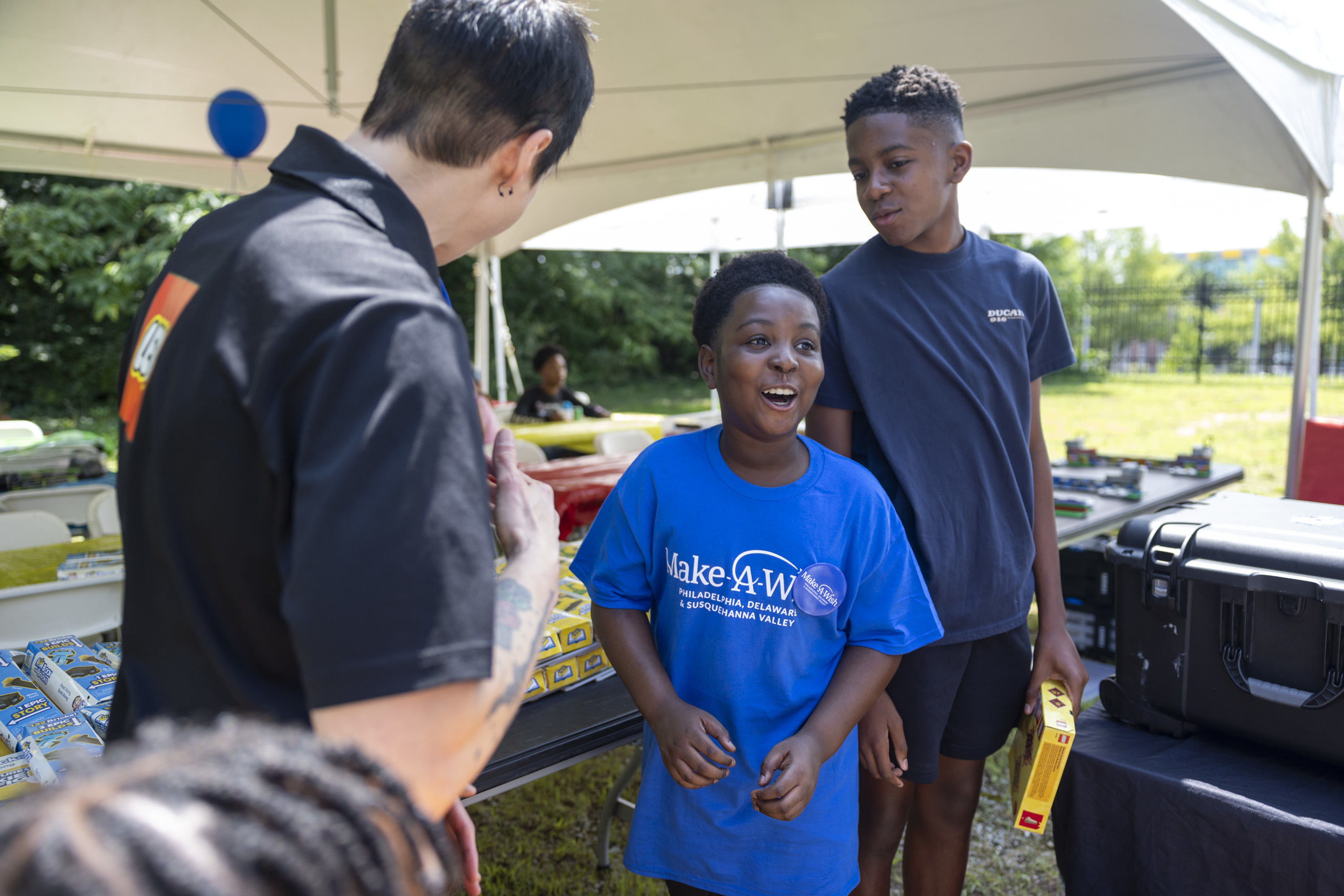
Goyal also looped in staff at the King of Prussia Lego store, a former contestant on the reality TV competition series LEGO Masters, and Swoop, the Philadelphia Eagles mascot, to make the event quintessentially Sam.
Alana Deluca, manager at King of Prussia’s Lego store, talks to Sam Okyere, 12, during his Make-A-Wish donation drive and block party.Tyger Williams / Staff Photographer
“It’s not about him,” Goyal said. “But it is about him.”
As Goyal and the Make-A-Wish team prepared the logistics, Sam contended with a life-altering decision. Sickle cell can be treated through a bone marrow transplant. The ideal donor is a sibling who is a match. Will Okyere, Sam’s 25-year-old brother, was. So Sam and his family scheduled a transplant for the end of August. The process starts with chemotherapy and ends with in-home isolation for several months, requiring Sam to miss most of his seventh-grade year with his friends.
“It’s a bummer,” Sam said. “But, it’s like, anything to get me better.”
“I just want to get sickle cell over and done with,” he added.
Sam Okyere, 12, hanging out with his friend Mosiah Saddick, 12, during Sam’s Perfect Day at Families Forward Philadelphia homeless shelter.Tyger Williams / Staff Photographer
While sickle cell disease is not inherently fatal, it can increase the risk of life-threatening infections, acute chest syndrome, stroke, and chronic organ damage, particularly without medications or interventions such as a bone marrow transplant or gene therapy.
Cynthia Norris, Sam’s attending hematologist at Children’s Hospital of Philadelphia, who referred Sam for the wish, said he stood out among all her eligible patients because he has the most severe variation of the disease and has had a number of complications. His grace and thoughtfulness, she said, also set him apart.
“He’s just a very special young man,” Norris said. “He has so much empathy.”
Sam Okyere, 12, with his dad Akwasi Okyere, Delaware Blue Coats mascot Coaty, and Philadelphia Eagles mascot Swoop during Sam’s Perfect Day Make-A-Wish donation drive and block party at Families Forward Philadelphia homeless shelter.Tyger Williams / Staff Photographer
Living out a perfect day
After months of waiting and preparation, Sam’s Perfect Day finally arrived.
Shiny new yellow, red, and blue soccer balls and Hula-Hoops lined the main hall of the Families Forward office building. Tubs along the mirroring wall brimmed with sunscreen bottles, toothbrushes, and soap. A giant poster sandwiched in the middle bore Sam’s likeness in Lego form — tiny Afro and all.
Some of the donations for Sam Okyere’s Perfect Day Make-A-Wish donation drive and block party.Tyger Williams / Staff Photographer
Families Forward could never have afforded this bounty on its own, said Jessica Main, the nonprofit’s chief development officer. Grant money the shelter receives is often tied to specific types of services like mental health and education. Its budget for toys and recreational materials is around $3,000 annually, Main estimated. That would probably barely cover the glimmering new basketball hoop and sports equipment Sam’s donation drive brought in.
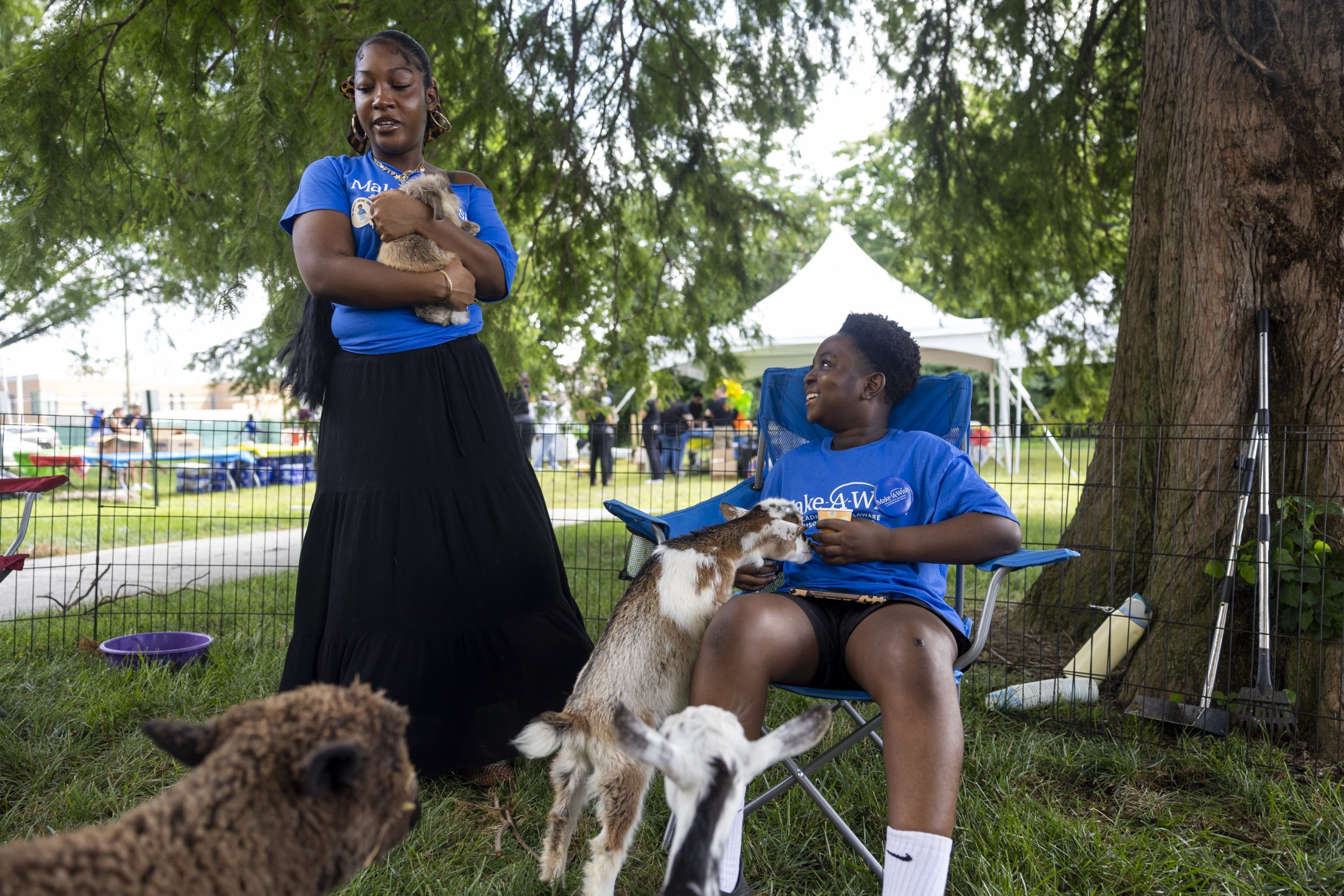
Sam Okyere, 12, with his sister, Kayla, at the petting zoo during his Make-A-Wish donation drive and block party at Families Forward Philadelphia homeless shelter.Tyger Williams / Staff Photographer
Sam nestled into a blue canvas chair in the petting zoo as two goats nibbled food out of Dixie cups he held in each hand.
“I’m naming this one Ashton,” Sam announced to no one in particular, looking at a brown and white goat.
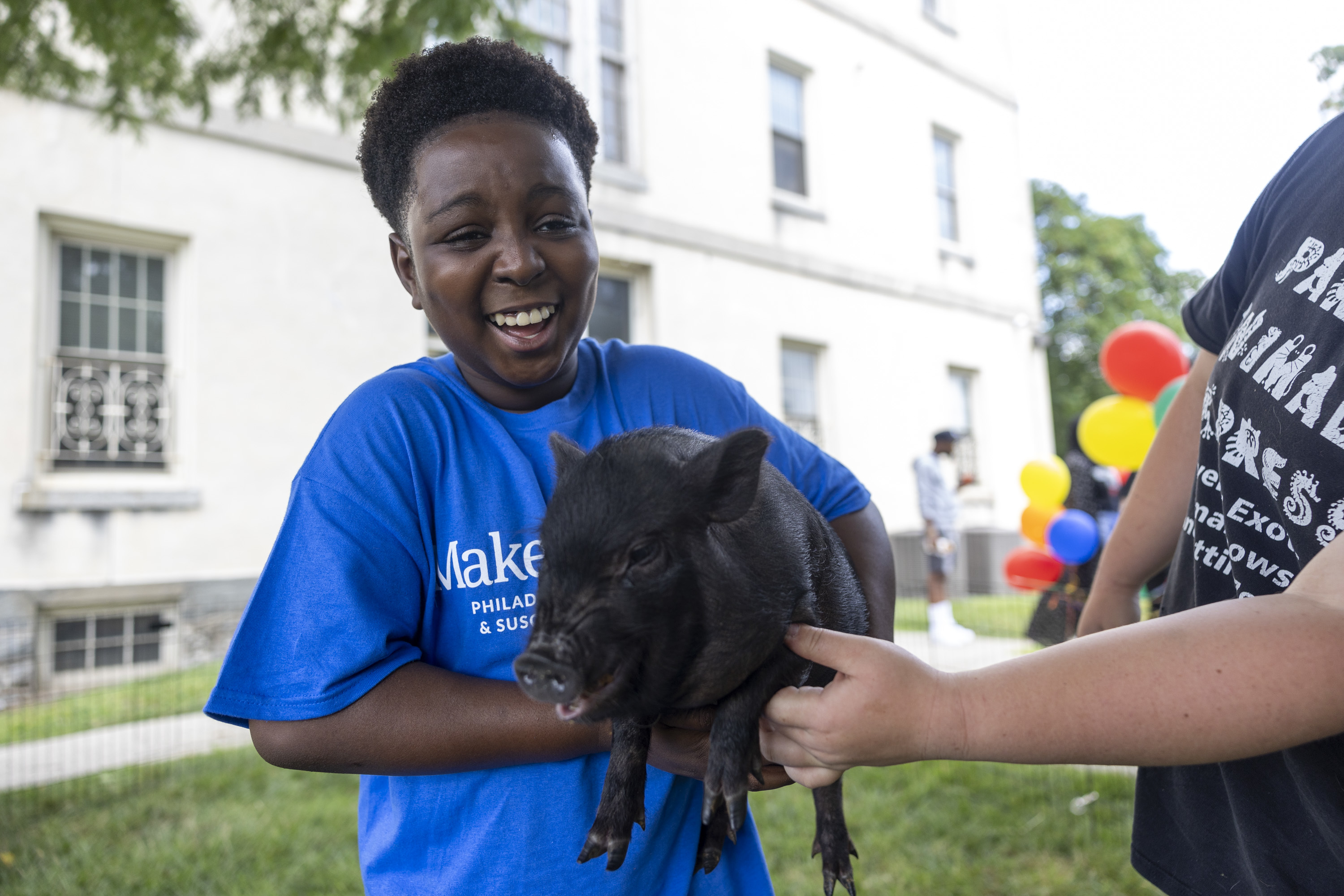
“Food! Anybody want food,” he shouted to the tiny goats (one wearing a feathered bowler hat), bunnies, and one black pig that dragged its rotund paunch on the ground wherever it went.
Sam Okyere, 12, is holding Penelope the pig at the petting zoo during his Make-A-Wish donation drive and block party at Families Forward Philadelphia homeless shelter in Philadelphia, Pa., on Wednesday, July 29, 2026.Tyger Williams / Staff Photographer
“Zane, Kai, Lloyd,” he said, pointing at two goats and then the pig, naming all after characters on his favorite show Ninjago, which the uninitiated will be unsurprised to learn is a show about Legos.
Soon a 3-year-old named Saga, wearing a white dress smattered with images of heart-shaped lollipops, entered the petting zoo enclosure, mouth agape as she stood eye-to-eye with the recently named Ashton the goat and gently patted the silver nubs on either side of its bony head. This was her first experience with farm animals.
Her mother, Quechera Jowers, 32, followed closely. The pair have lived at the shelter for about four months.
“I’m not going to lie, it’s a little nostalgic,” Jowers said, taking in the carnival sights as they waited in line for cotton candy, which, based on crystallized red formations encrusted around Saga’s mouth, it appeared she’d already indulged in.
Throughout the afternoon, gleaming toddler cheeks transformed into butterfly wings, kitten whiskers, and dragon scales with face paint. Pink and purple beads were strung into friendship bracelets, and technicolor swimsuits (each child got one through Sam’s donation drive) grew soaked from a sprinkler raining down on the kids as they descended an inflatable slide adjoined to the bounce castle. Navigating the pipe system of the old converted asylum-turned-shelter facility was the challenge of the morning, Main said.
Beyoncé blared from a portable DJ booth, chubby fingers grasped balloons on strings and absentmindedly released them into the stratosphere, and a topless toddler with wild curls boogied near the mouth of a bubble machine, a diaper band peeking out from his khaki shorts.
Sam Okyere, 12, is trying out the DJ set with Nashirah Felder, of Fishtown, during his Perfect Day Make-A-Wish donation drive and block party at Families Forward Philadelphia homeless shelter in Philadelphia, Pa., on Wednesday, July 29, 2026.Tyger Williams / Staff Photographer
Sam, meanwhile, alternated between the Lego games, petting zoo, and basketball station.
After discreetly lowering his game controller in the middle of a Lego joust, allowing a friend to overtake his spacecraft and win the game, Sam sauntered over to the goats situated in a kennel in the back of a truck to bid them farewell.
Sam Okyere, 12, plays against Corey Samuels, 41, of Princeton, N.J., a LEGO Masters winner, during his Make-A-Wish donation drive and block party at Families Forward Philadelphia homeless shelter in Philadelphia, Pa., on Wednesday, July 29, 2026.Tyger Williams / Staff Photographer
“I don’t want them to leave,” he mused as he delicately scratched a tan one on the chin and, with an understated graciousness rare to find in adults, let alone children, allowed the petting zoo staff to take them away.
As the afternoon drew to a close, Sam settled into a chair in the hallway full of donations and futzed with a small Lego vehicle. An event organizer informed him that the Lego store employees offered to gift him all the leftover toys. Sam politely declined and requested they instead be given to the kids at the shelter.
Asked in the final moments what could have made Sam’s Perfect Day more perfect, he contemplated.