Colin Hitschler can still envision his earliest memories of wrestling and football, the sports that directly tie him to his father, Charles. He’d sit on his father’s lap in the corner of a wrestling mat, and roam the sidelines as his father coached football, often serving as the ball boy.
He says “coaching was probably in my blood,” but it wasn’t until he spent time away from football that he actually developed the itch to do it.
“I spent more time being around coaches than probably players as a little guy,” Hitschler told The Inquirer by phone recently. “The opportunity to chase it — being a wrestler in college probably made me hungrier for losing football, and that obstacle led me to coaching.
“Wrestling is a mentality, and that, I think, is what I bring from wrestling to the football field and to coaching, and something I try to instill within our guys … the challenges that wrestling presents are very similar to the course of a long season of football.”
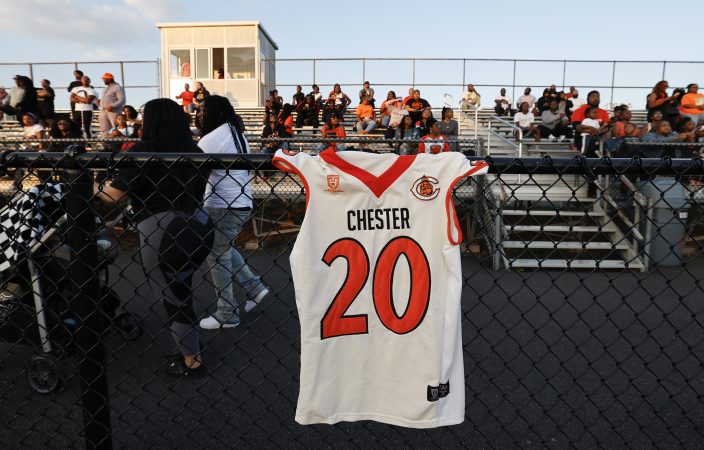
Hitschler, who played football and wrestled at Penn Charter, then wrestled for four years at Penn, has dedicated his career to coaching. Now at UCLA as the football team’s defensive coordinator in his 16th year of coaching, Hitschler is quickly helping turn around the undefeated Bruins in the program’s first year with Kulpmont, Pa., native Bob Chesney as head coach.
Hitschler’s first taste of working in football, though, came with the Eagles in 2009. Sean McDermott — the La Salle College High graduate, former Eagles defensive coordinator, and fellow wrestler — invited Hitschler to be an Eagles training camp assistant in 2009.
“He kind of took me under his wing and gave me my first opportunity to be around it,” Hitschler recalled. “And then I was lucky enough to get to the Chiefs and work in the personnel department. And then I realized that my true passion was coaching.”
‘Aggressive mantra’
Hitschler, 40, didn’t land his first coaching opportunity until two years later, at Division III school Salve Regina in Newport, R.I. It was there that he first worked for Chesney, who took over the program in 2010 after five seasons at Johns Hopkins in Baltimore.
The pair spent just one season together, with Hitschler serving as the co-special teams coordinator and defensive line coach. There was a 14-year gap between coaching stops together, reuniting at James Madison in 2025, but Chesney’s “energy” and “how much he loved ball” were traits that stuck with Hitschler.
Bob Chesney (center) and Colin Hitschler (right) first coached together at Division III Salve Regina in 2011.Lydia Ely
“Some of the late nights, just figuring out little obstacles, and just the way he made his players love the game,” Hitschler said of Chesney, who has one losing season in 16 years as a head coach across three levels of college football. “I was obviously lucky enough to coach a number of other places … but the ability to reunite with him and his energy and the way he makes people feel about the team and the game — that was an opportunity that presented itself that was special.”
Hitschler himself made a quick ascent up the coaching ranks. He coached at Widener, then spent time as a graduate assistant at Arkansas State and South Alabama, and by the time he left the latter in 2017, he had become a safeties coach.
From there, he spent five years on Luke Fickell’s staff at Cincinnati, starting as a defensive quality control coach in 2018 and later becoming co-defensive coordinator by 2022. He followed Fickell, whom he considers “a mentor” to Wisconsin in 2023, then spent 2024 at Alabama as co-defensive coordinator on Kalen DeBoer’s staff, before rejoining Chesney at James Madison.
Every stop he’s been, Hitschler has brought his Philly roots along, even down to his defensive philosophy. He watched Jim Johnson’s Eagles defenses that featured Brian Dawkins and Jeremiah Trotter Sr. and tried to emulate it as a defensive playcaller.
“I was a diehard Eagles fan watching Dawkins and Trotter and those guys create havoc and stay aggressive, and a lot of the front multiplicity that [Johnson] did back in the day,” Hitschler said, who also noted that Johnson’s grandson, Brandon Rose, is on UCLA’s staff as the director of player personnel. “His aggressive mantra is deep within me. … When you grew up in Philly in that era, you loved the Eagles’ defense.”
‘A version of the Bruin Bullies’
Building connections on the recruiting trail is an essential part of Hitschler’s duties, and his deep connections to Philly are prevalent on UCLA’s roster. Three locals are playing out west: St. Joseph’s Prep graduates Anthony Sacca and Maxwell Roy, and La Salle College High grad Darold DeNgohe.
The 6-foot-2, 312-pound DeNgohe had previous ties to Chesney. He was a freshman on the JMU team when Curt Cignetti led it in 2023, then remained with the program in 2024 when Chesney took over. After he spent last season at Rutgers, a relationship that dated back to high school finally came to fruition at UCLA.
Darold DeNgohe has nine tackles (two for loss) in five games this season.Courtesy of UCLA Athletics
“Coach Hitsch gave me my first offer in high school when he was at Cincinnati,” said DeNgohe, who emigrated to the United States from Cameroon at age 9. “That was my first offer. He was one of the first college coaches to really believe in me. So it was really cool. I’ve always wanted to play for him. So when we got this opportunity, we were both really excited to like finally accomplish it and just finally play with each other.”
The combination of Hitschler, Sacca, DeNgohe, and the hodgepodge of other transfers and holdovers from the previous staff has helped UCLA’s defense emerge as a formidable unit.
It held an Oregon offense that entered last week’s game ranked fifth in points and passing yards, and 11th in total offense, to just 15 points and 272 yards of total offense. The Bruins entered the game ranked second nationally in turnovers per game (3) and forced an outstanding seven more against the Ducks.
Hitschler says the defense calls themselves “a version of the Bruin Bullies, or what we aspire to be,” as an homage to the Flyers’ Broad Street Bullies era, and the results are showing. UCLA picked up their first win at Oregon since 2004, and face Hitschler’s mentor, Fickell, and his Wisconsin team on Saturday (7:30 p.m., NBC10). UCLA is seeking a 6-0 start for the second time in the last 20 years.
“I think that combo of brotherly love and ‘Broad Street Bully’ mentality, I think that’s unique about Philadelphia,” said Hitschler, “as somebody that’s kind of lived in a number of different places. I think it’s important that the players feel who I am, and a large part of who I am is the city that I grew up in, and the people that I were around. So bringing that mentality and that personality to our players is really important to me.”
First 5-0 start since 2022 First win in Eugene since 2004 First Top-15 road win since 2014
Added DeNgohe: “We try to bring the physicality and the toughness from the city into the defense, and that’s how we play. We try to have that mindset as the ‘Broad Street Bullies.’”
Federal prosecutors have accused a Chester couple with trapping two intellectually disabled Delaware County women in a double-wide trailer far from home, where they were sexually abused and regularly beaten.
That abuse, prosecutors said after the couple was arrested in 2024, was the culmination of a monthslong nightmare that ended that year and in which Michael Swanson and his former wife, Nicole, groomed and manipulated the women in Chester and then in Tallahassee, Fla., where the couple attempted to hide from a Delaware County Child and Youth Services caseworker in the trailer.
Along with Swanson’s new girlfriend and a man who owned their house on Broomall Street in Chester, the couple conspired to defraud the women of their Social Security benefits and food-assistance cards, stealing thousands of dollars in public benefits after convincing the women to move from their family homes into the squalid property.
Despite ample evidence gathered by prosecutors, charges against Nicole Swanson were dismissed that year, and last month, a Delaware County judge ruled that Michael Swanson was mentally unfit to stand trial.
Now the cases will be tried in federal court.
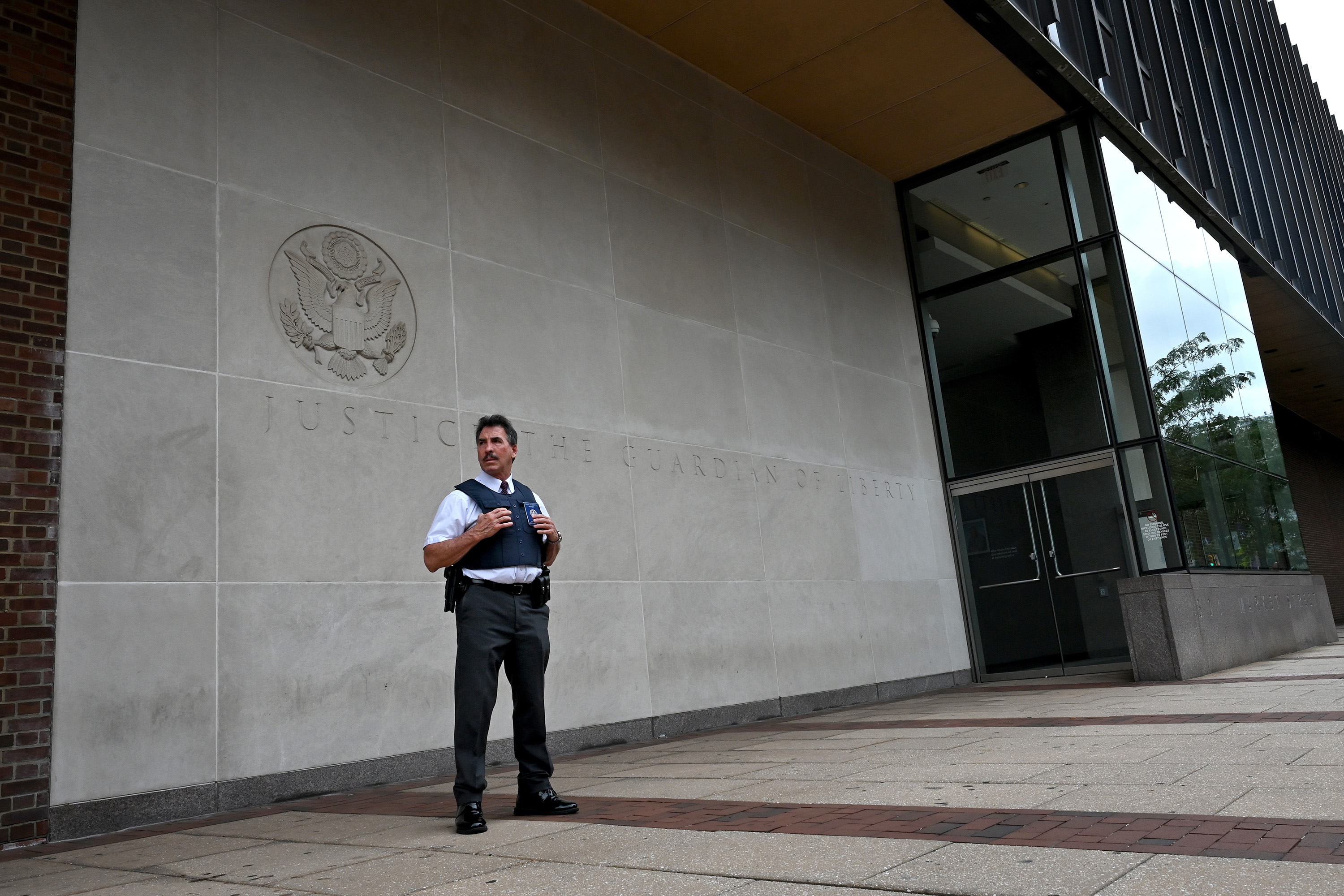
Prosecutors with the U.S. District Court for the Eastern District of Pennsylvania this month charged Michael and Nicole Swanson, Caitlyn Eusden Swanson, and David Dziobcynski with a host of federal crimes for their part in the abuse.
Their arguments were identical to those made by Delaware County attorneys.
They said the defendants, led by Michael Swanson, “groomed, lured, and enticed intellectually disabled women” to live with them, according to an Oct. 8 grand jury indictment.
Michael Swanson, prosecutors said, engaged in sex with the women despite their lacking the capacity to consent. And Nicole Swanson “encouraged the victims to join sexual relationships” with her ex-husband, the document said, and “sometimes engaged in the sex with them herself.”
As a result of Swanson’s criminal behavior, one of the victims gave birth to his child in February 2023.
Meanwhile, the Swansons, aided by Dziobcynski, isolated the women from their families and convinced them to submit new applications for government benefits — listing them as payees, the document said.
The group took EBT cards meant to help feed the disabled women and spent the funds on themselves, according to prosecutors, and they took control of bank accounts that held their Social Security benefits.
And when Delaware County caseworker for some of the Swansons’ children grew suspicious of the arrangement, prosecutors said, the defendants schemed to evade scrutiny.
In July 2023, Swanson wired more than $20,000 from one victims’ account to his own. He rented a passenger van, taking the women to the Florida trailer where Nicole Swanson had fled with their children.
Dziobcynski, prosecutors said, had already harassed the CYS caseworker for months, calling her phone more than 110 times and leaving multiple threatening voicemails.
And the physical and sexual abuse continued in Tallahassee, according to the document.
There, Nicole Swanson told one of the women to engage in sex with Michael Swanson, recording the interaction on her cell phone, prosecutors said.
And Michael Swanson threatened the women, warning them against telling authorities or social workers about their situation. In one instance, Swanson told one of the women he would cut off her hair should she do so, the document said.
A defense attorney said the Swansons had a history of brain trauma and behavioral issues, and said Michael Swanson gave highly emotional, childlike responses during a psychological exam.
But prosecutors presented their own psychological expert who suggested Swanson’s behavior was more like a “caricature” of mental incapacitation, falling outside what would be expected of someone with a disability, the Daily Times reported.
Michael Swanson was released from custody in 2024 and placed on house arrest after paying $1 of a $900,000 nominal bail.
Court records did not make it immediately clear whether he or the other defendants had been arraigned in the federal case or whether they had hired attorneys.
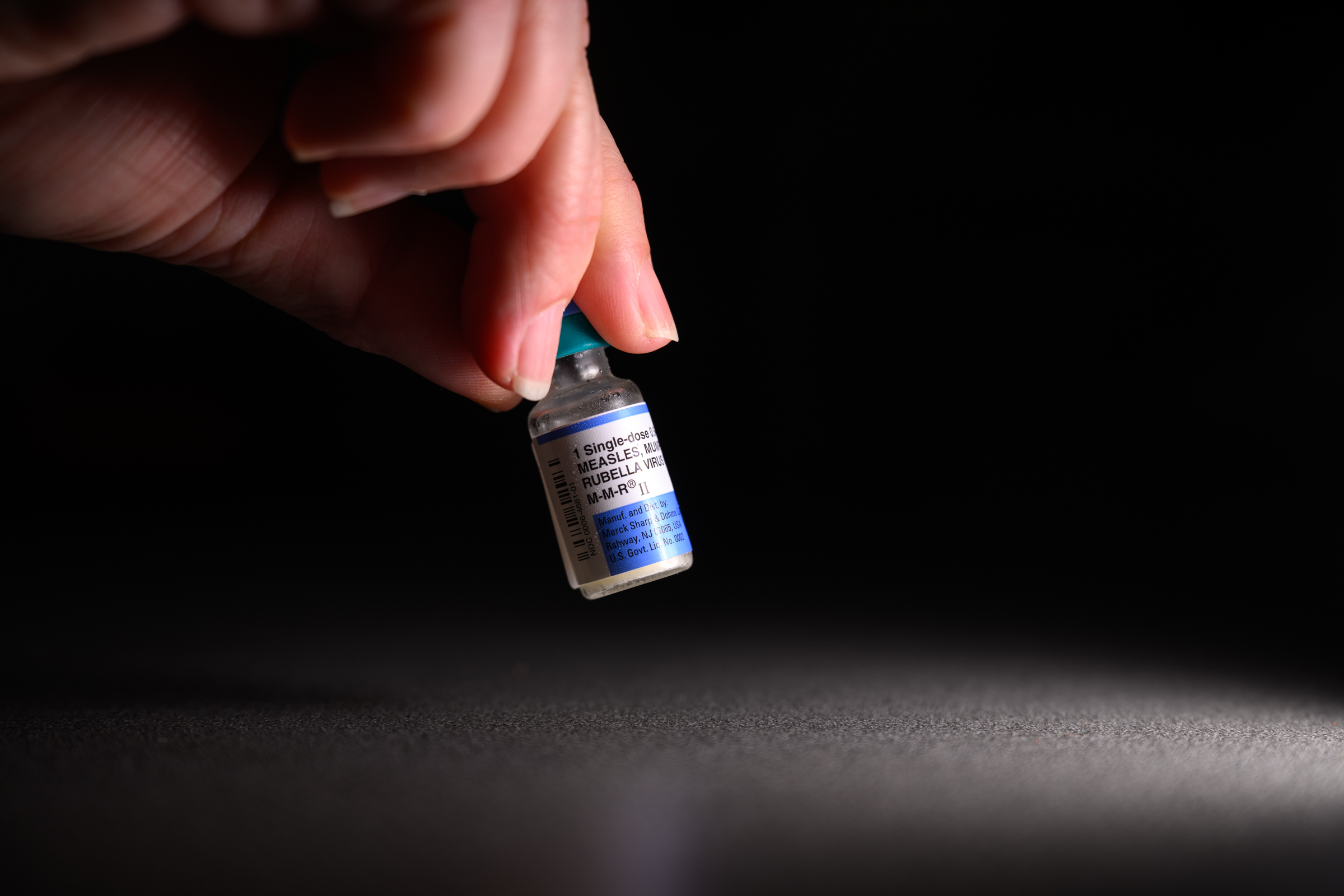
The Centers for Disease Control and Prevention will send a “disease detective” to Pennsylvania this week to help address an ongoing measles outbreak that has now sickened more than 1,200 people across the state, an official with the U.S. Department of Health and Human Services said.
The state requested the assistance of the CDC’s Epi-Aid program, part of the Epidemic Intelligence Service, which provides short-term technical assistance and subject matter expertise during health crises.
Epi-Aid experts typically work with a state for one to three weeks to provide technical assistance investigating an “urgent public health problem,” according to the CDC’s website.
Pennsylvania has the worst measles outbreak in the country in more than three decades.
In the last week, the state reported 157 new cases. The outbreak is centered in Lancaster County and has spread across the state, including into Chester County in the Philadelphia suburbs.
In addition to the expert assistance, federal health officials have provided nearly $4 million in one-time funding to “support measles response operations” through most of 2027, an HHS official said.
The CDC will “continue working closely with Pennsylvania health officials to provide the expertise and support needed to respond to the outbreak and protect public health,” HHS press secretary Grace Davis Jamison wrote in an email.
The state has asked for help improving its understanding of case counts and the trajectory of the outbreak; estimating the “true burden” of measles in Pennsylvania; and understanding how vaccination efforts impact those analyses, Pennsylvania Department of Health spokesperson Neil Ruhland said in a statement.
He said that the effort would be complementary to the health department’s ongoing measles response and that the state is already receiving “remote assistance” from the CDC’s measles response team. About 300 health department staff are working directly with communities around the state, Ruhland said.
Pennsylvania’s request for federal help has been complicated by a highly politicized dispute around the reporting of deaths linked to measles.
Since late August, when the state reported its first two deaths associated with the highly contagious virus, President Donald Trump’s HHS secretary, Robert F. Kennedy Jr., has questioned the validity of the state’s death reporting.
He and Democratic Gov. Josh Shapiro have accused each other of politicizing the deaths. Shapiro claims that Kennedy, a longtime anti-vaccination activist, spread misinformation that decreased vaccination rates and made Pennsylvania vulnerable to a measles outbreak.
Kennedy and CDC Director Erica Schwartz recommend vaccination as the most effective way to prevent measles, the HHS statement noted.
(function(){function e(){window.addEventListener(`message`,function(e){if(e.data[`datawrapper-height`]!==void 0){var t=document.querySelectorAll(`iframe`);for(var n in e.data[`datawrapper-height`])for(var r=0,i;i=t[r];r++)if(i.contentWindow===e.source){var a=e.data[`datawrapper-height`][n]+`px`;i.style.height=a}}})}e()})();
Under Kennedy’s direction, the CDC for weeks omitted measles-associated deaths from its measles data dashboard.
HHS representatives also said the state had not been cooperating with the federal agency, noting that Pennsylvania had not requested assistance through Epi-Aid as other states had.
Before requesting Epi-Aid assistance, Pennsylvania health officials said they were already working closely with CDC staff.
On Sept. 16, state Health Secretary Debra Bogen sent a letter to the CDC saying the state wouldaccept Epi-Aid help if the CDC acknowledged the deaths reported in Pennsylvania, which now total five confirmed by the state. A sixth death, reported this week by a coroner in Franklin County, remains under state investigation.
But the CDC’s data dashboard still reflected only two measles deaths this year nationally as of Wednesday, without noting the location.
The agency says it is working to establish a standard definition for measles deaths and in the meantime will report “measles-caused deaths” when the National Center for Health Statistics identifies measles as the underlying cause of a death, based on information from death records submitted by states.
Public health experts have noted that this process is a departure from previous death reporting protocols and often takes weeks longer.
The state had “several weeks of discussions” with professional staff at the CDC and formally submitted the Epi-Aid request Oct. 7, Ruhland said.
“We continue to seek information from the CDC about their process for reporting deaths before finalizing acceptance of Epi-Aid support,” Ruhland wrote, noting that the CDC updated its dashboard to reflect two measles deaths after Bogen’s letter.
Latest measles case counts
On Wednesday, Pennsylvania health officials reported that 1,222 people in nearly two-thirds of the state’s counties have contracted measles so far in 2026.
(function(){function e(){window.addEventListener(`message`,function(e){if(e.data[`datawrapper-height`]!==void 0){var t=document.querySelectorAll(`iframe`);for(var n in e.data[`datawrapper-height`])for(var r=0,i;i=t[r];r++)if(i.contentWindow===e.source){var a=e.data[`datawrapper-height`][n]+`px`;i.style.height=a}}})}e()})();
Health experts say this number is likely an undercount, as not all measles cases are reported to the state.
About one in five of the reported measles cases required hospitalization.
Lancaster County remains at the epicenter of the outbreak, with 443 cases reported this year. Chester County has seen 90 cases, while Mifflin County, in central Pennsylvania, has reported 183.
Health officials said in a news release that healthcare providers around the state have seen a “surge of interest” in MMR vaccines as the outbreak has worsened.
Providers administered more than 56,000 vaccines in September — more than double those given out in a typical month — and have already given out more than 23,000 vaccines in the first two weeks of October.
Editor’s note: This story has been updated with comment from Pennsylvania health officials.
Even as Pennsylvania’s prospective college student population flattened and some Catholic feeder high schools closed, the business college at Saint Joseph’s University has doubled enrollments, adding programs, professors, and donors since Joseph DiAngelo Jr. took over as dean in 2000.
“DiAngelo has been a defining force at Saint Joseph’s University and a visionary steward,” university president Cheryl A. McConnell said in a statement. As dean of the Erivan K. Haub School of Business, DiAngelo built it into “a premier, AACSB-accredited, nationally ranked school,” McConnell added.
He will serve until the end of the current school year, and plans to teach a class next fall, as dean emeritus. DiAngelo will remain active in fundraising for St. Joe’s, one of the 99 universities worldwide that are run by the Jesuit order of Catholic priests. The university has not named a successor.
Son of a West Philly grocer, DiAngelo says he’s the longest-serving dean among U.S. business school leaders, counting 27 years on St. Joe’s Hawk Hill as of his retirement next spring, and after 13 years running the Widener University business school and its Chester, Wilmington, and online programs.
After attending St. Thomas More High School in West Philly, he graduated from St. Joe’s with a scholarship from the former Food Fair grocery chain, after a stint studying for the priesthood at St. Charles Borromeo Seminary during which his best friend, a fellow student, died of cancer. “I got mad at God,” left the seminary, and later married his high school sweetheart.
After college and service in the Army National Guard, he taught religion and coached baseball at his old high school and then at Archbishop Carroll High School in Delaware County. He began teaching management at St. Joe’s in 1979, earning his doctorate at Temple at night and refereeing high school games on weekends “to put food on the table.”
DiAngelo joined Widener in 1980 as assistant dean, taught management, and was named business school dean in 1987. By DiAngelo’s count, Widener doubled its MBA student body, to 950, expanded the cooperative education program, added undergraduate majors, and extended classes from Widener’s Chester campus to its Delaware foothold.
He returned to St. Joe’s to head the Haub business school in 2000.
On DiAngelo’s watch St. Joe’s expanded its Saturday MBA and online education programs, doubling graduate-school enrollment to 1,200 as big pharmaceutical companies along the U.S. 202 corridor enrolled early- and mid-career salespeople for their MBAs.
Haub undergraduates have also doubled during his tenure, to around 2,600. Total university enrollment is around 5,000, also including the college of arts and sciences, and the nursing, pharmacy, health, and education schools.
Baseball’s Curse of the Bambino barely lasted into the 21st century. But Philly fans have to be wondering these days if we’re living under the Curse of LeBron. When the 76ers signed the 41-year-old hoops legend to complete their construction of an NBA Dream Team, Philadelphia felt like the capital of the sports galaxy. Since then, the Phillies imploded, the Flyers got off to their worst start in franchise history, and the Eagles just suffered the most horrific loss I’ve seen in 60 years of NFL-watching. Thank God the Curse of LeBron has not reached Chester … yet.
How come Gen Z protests crummy schools in France, but not the U.S.?
A student holds a board reading “We want the BAC [high school diploma]/Not the BAC [anti-criminality units]” during a protest to demand more resources at school, in Lille, France, Oct. 1.Jean-Francois Badias
You had to figure it was just a matter of time before the kids protested the sorry state of their public schools.
These, of course, are the K-12 conditions in the Philadelphia School District, and school squalor like this is something you see in a lot of large American cities, unfortunately. But while there’s the occasional one-off rally — like the kids who marched against overcrowding at Philly’s Girls High — we’ve seen nothing when it comes to protesting like what’s happening this month in France.
Vive la différence, indeed! Student protests have swept across France since mid-September after students in less-advantaged working-class suburbs of Paris, starting with one school in Créteil, walked out and formed barricades to protest clogged toilets and crammed classrooms that sweltered as climate change pushed temperatures above 100 degrees Fahrenheit.
In less than two weeks, the demonstrations spread like wildfire — literally, as trash fires raged behind hastily erected blockades — from city to city and to more affluent schools, joined eventually by college students and some of France’s powerful labor unions.
The students’ youthful bravado and their colorful protest signs — some of them in English, like ones that read, “TOO YOUNG TO BE LISTENED TO/OLD ENOUGH TO BE TEAR-GASSED,” or that voice rage against the police or French President Emmanuel Macron — might look familiar to Americans who remember 2011’s Occupy movement. The same could be said about the repressive state response.
In surprising scenes that evoked the most militarized backlash to America’s 2020 George Floyd protests, French police donned riot gear and fired tear gas into the throngs. Amid outrage over violent incidents, like a 14-year-old whose jaw was broken by a tear-gas canister, police have arrested nearly 7,000 people, mostly minors.
The French student uprising is the most visible Gen Z protest movement right now, but it’s not the only one. A year after a series of organized online youth protests rattled the Global South from Madagascar to Nepal, the world’s largest, albeit shaky, democracy in India has been rocked by the growth of the so-called Cockroach Janta Party. Its name is inspired by rage against a top judge who called Indian youth “cockroaches.”
This past weekend, India’s strongman prime minister Narendra Modi sent thousands of security officers into the streets of the capital, New Delhi, to make mass arrests of the protesters and their leaders, hoping to thwart a demonstration over a purge of voting rolls.
Unless you follow the big international news sites, the youth protests in France and India haven’t received extensive media coverage here in the U.S. You could argue that’s because we have plenty of our own problems on American soil, from a make-or-break federal legislative election just three weeks away to a president with the nuclear football who acts increasingly detached from reality. Not to mention the issues of massive school inequality and classroom censorship.
All of which brings back the question: Why isn’t America’s Gen Z manning the barricades?
I poked around and found that someone was asking the same question, but for the youth of the United Kingdom. In a guest essay for the Guardian, journalism grad student Kitty Sayers — born British but raised in France — said French students aren’t imbued with an American-style individualism, as also happens in the U.K.
“The language of rights, citizenship and collective power is woven into French education,” Sayers wrote, explaining how students are taught extensively about the French Revolution, the electric youth-led protests of 1968, and their right to dissent.
“There’s definitely a much bigger culture of protest in France — it’s considered a rite of passage,” agreed Dana R. Fisher, the American University sociologist who specializes in studying contemporary U.S. protest movements, but also saw the French way of dissent in person during a mid-2000s sabbatical there.
Fisher told me Monday that one critical difference is that young people in France also form close relationships with labor unions, not only through their parents but through student associations. She saw that in 2005 when hundreds of thousands of French students took to the streets to oppose school reforms, and she suspects that such ties are still a factor.
Again, it’s community, and a collective spirit — as opposed to rugged individualism at best, or social atomization at worst.
Fisher also correctly noted that young people here are taking part in protests — most notably the 2023-2024 campus unrest over U.S. support for Israel’s lethal assault on Gaza. While most have shunned the large-scale No Kings protests against the Donald Trump regime, they’ve walked out in some places over some aspects of the MAGA agenda, especially immigration raids near their schools.
I’d argue that America’s Gen Z was practically raised not to protest from birth. They were too busy drilling for their standardized tests to learn about civics or their own role in a boisterous democracy. They’ve been told their lives won’t amount to much if they don’t get into the right college, so who wants to risk everything by getting arrested?
While French students are learning all about what happened at the Bastille in 1789, U.S. kids are getting warned they could face severe consequences for walking out of their high school or for demonstrating on the college green if the event is not in the time, place, and manner that is mandated by the administration. The sight of pro-Palestinian protesters getting arrested or servinglengthy school suspensions after 2024’s encampments has had the chilling effect that the authorities wanted.
Still, in spite of an American culture that works against collective action and the right of dissent in every possible way, U.S. history has shown us that everyday folks — especially young people fueled by idealism — do have a breaking point, and it’s rarely in the time, place, or manner the grown-ups see coming.
No one expected the 1964 Berkeley Free Speech Movement after the campus passivity of the 1950s, and Occupy Wall Street caught many people off-guard, as well. Looming college debt and the societal and job-market disruptions of artificial intelligence have placed American students under stresses that are without precedent. Some day in a place you’d never predict, there will be a spark.
Yo, do this!
Speaking of American protests, the No Kings movement returns on Saturday with its first major day of action since last spring. The modern tradition has been large rallies in political off-years by the group that’s fallen out of power — think the tea party in 2009, or the Women’s March in 2017 — with a narrower focus on getting out the vote (GOTV) in election years. No Kings is seeking to have it both ways Saturday, with events that are both GOTV drives and rallies urging true election integrity in the face of theTrump regime’s threats. In Philadelphia, a 10 a.m. rally at City Hall is backed by groups such as PA Indivisible, Common Cause, the NAACP, the American Civil Liberties Union, and the League of Women Voters.
I may wait to stream it online — I’m either too old or too young to sit in a theater for three hours and 55 minutes — but Thursday will bring the long-awaited Musk documentary about the planet’s first (briefly) trillionaire to some multiplexes in the Philadelphia area. Acclaimed filmmaker Alex Gibney’s warts-and-all (and let’s face it, it’s all warts) look at Elon Musk comes as the Wharton grad is spending $276 million to try tobuy the midterm election. Gibney’s how-we-got-here saga has a 97% rating on Rotten Tomatoes.
Ask me anything
Question: How worried are you that [Pennsylvania Democratic Sen. John] Fetterman declares himself an Independent and organizes with [Republicans] if he turns out to be the 50th or 51st D vote? — bob (@huntthesnark.bsky.social) via Bluesky
Answer: Bob, I am somewhat worried. The backstory, as many readers already know, is that Fetterman has broken away from other Democrats on major issues — support for arming Israel, the Iran war, and some key cabinet picks — since Donald Trump returned to the White House. Although Fetterman insists for now that he’s not leaving the Democrats and still votes with them a majority of the time, he finds himself (much like Trump) in a political corner. He’s too unpopular among the Democratic rank-and-file to win a primary in 2028 when he’s up for reelection. He’s better liked now by Republicans. If Democrats get to 50 or 51 seats in November’s election, the GOP could offer him a committee chairmanship and a ton of campaign cash to switch and help them stay in control. The only real solution is for Dems to reach 52 or more seats. I am optimistic on that front.
What you’re saying about …
Last week I asked you about cultural escapes to take your mind off the constant anxieties of the Trump era, and you responded with wonderfully diverse stuff from all over the world. Bonnie Maky Rosen finds refuge in the public libraries of Cuyahoga County, Ohio, and her favorite book, The Light Years by Elizabeth Jane Howard. Stephen LoRusso gets in the Wayback Machine to read the Marcus Aurelius Meditations(!). Weekly respondent Mary Ann Petro likes ghost-hunting shows, Murder She Wrote, old Hallmark Hall of Fame movies, and Ghosts on CBS (I’m sensing a theme). Tom Lees binge-watched Derry Girls on Netflix. From over in London, Inez Soman loves the Philly band The Menzingers and hangs out at Passyunk Avenue. (I wonder if she saw my daughter, who was there eating a cheesesteak outdoors during the Eagles game on Sunday.)
📮 This week’s question: Every day, concern is rising that a cornered Donald Trump will somehow try to steal a November election his party looks certain to lose at the ballot box, possibly by declaring a national emergency. How will you as a citizen respond, and how do you think Democrats or other major institutions should deal with this? Please email me your answer and put “Trump stolen election” in the subject line.
Backstory on the escalating threats from Trump
Homeland Security officers leave the Washington residence of U.S. Rep. Ilhan Omar (D., Minn.) after a search, Oct. 12.J. Scott Applewhite
Opinion journalism looks deceptively easy in the Donald Trump era. Every day now, the man who insisted in his 2024 campaign that he would rule as a dictator only “on Day One” has extended that timeline with outrageous and increasingly illegal actions. Each would have been a yearlong scandal for his 44 predecessors, who, at least by comparison, have been boringly normal since 1789. I could write a 2,000-word essay five times a week that would merely consist of recapping the things the president had done that day before huffing, “This is an outrage!”
In recent days, the regime has made a mockery of the First Amendment’s free speech guarantees with its so-called Justice Department launching an antitrust investigation into five major TV networks for denying Trump pool coverage after he’d banned one of the pool members, CNN, for coverage he didn’t like. His immigration agents, who have already caused chaos with stepped-up enforcement, are making plans to turn up the heat to an unprecedented 3,000 arrests a day. On Monday morning, Homeland Security agents were dispatched on totally specious grounds to raid the Washington, D.C., home of one of Trump’s political enemies, Minnesota U.S. Rep. Ilhan Omar, a leader of a Somali immigrant community that has been the target of repulsive, racist attacks from the Oval Office.
The Omar raid — ostensibly to learn whether her late father had lied on an immigration form more than three decades ago — reminded many online commenters of stories about life in East Germany under its secret police, the Stasi. But yet again, the remains of a sober political establishment had no idea how to respond. Omar’s Minnesota colleague, U.S. Sen. Amy Klobuchar — favored to become the state’s next governor — said the raid and reports that it was ordered by the White House “raise serious questions that should concern all Americans, regardless of political party.”
Ya think?
To be clear, the act of raiding a political opponent’s home just days before an election is indeed outrageous (there … there’s my “hot take”), but the display of ugly brute force — and the utter impotence of his foes who can do nothing more but “raise serious questions” — is arguably as big a part of this picture as the Omar investigation itself. Some called the raid the latest example of American democracy feeling like a frog in boiling water, as Trump turns up the dial of illegal and immoral actions degree by degree, until we’re cooked and there’s nothing we can do about it. Even if the Democrats retake Capitol Hill by storm in January, there is unlikely to ever be the 67 Senate votes to remove the president for his high crimes and misdemeanors. You could call the U.S. Department of Justice and report a crime, except its agents have been tasked with committing them.
Although we can’t ignore Trump’s tactics like the Omar raid or the war on White House press freedom, it’s important here to take a step back and look at a bigger strategy — the method behind the madness. The regime only really cares about one thing at this point: self-preservation. By enriching himself, his family, and his cronies to the tune of billions of dollars in the first two years of his second term, Trump has built a criminal enterprise that’s become too big to fail.
Every political norm and every tenet of the U.S. Constitution the MAGA movement violates — and which goes unpunished — is setting the stage for the coup-like power play that would be required to overturn the election Republicans are losing next month. And that’s only half of the equation. When the regime steps up its immigration raids at the time when Politics 101 says they should be put on hold, and when federal agents shoot a man in New York City on a busy street in broad daylight, they are hoping to provoke an equally violent response. When Trump fantasizes about an enemy attack on Los Angeles or San Diego, he is dreaming of an excuse to send out the tanks and consolidate power.
I’ve mentioned here before the memorable-for-life words of my high school football coach Rob Pickert, who said the only way to play defensive end is to come “with reckless abandon, but under control.” Remember that oxymoron as we fight back in the perilous two months after Nov. 3.
What I wrote on this date in 2009
American presidents have a tortured history with the Nobel Peace Prize that predates Donald Trump’s ridiculous obsession with winning the Norwegian trophy (even after starting wars in Venezuela and Iran). For Barack Obama, winning a Nobel 17 years ago this month was more of a curse than a blessing. I wrote on Oct. 13, 2009, that the judges had likely rewarded Obama to send one final parting shot against Iraq War president George W. Bush, but that after only nine months in the White House, it was far too soon. “And before the president works any magic — real or perceived — anywhere else on the globe, he needs to bring a little peace, love and understanding right here on the homefront,” I wrote.
Only one piece from me this week, but it was a biggie: My lengthy investigation into the aggressive local police cooperation with U.S. Immigration and Customs Enforcement (ICE) in York County in south-central Pennsylvania, where nearly a third of the state’s immigrant arrests under the controversial 287(g) program are taking place. I detailed how a crackdown by cops in municipalities like West York and Carroll Township led to some 500 immigrant arrests in a matter of months — as many as 80% had no criminal record — and terrorized a large Haitian refugee community there. Pennsylvania could follow the lead of our neighboring states and outlaw a program that is causing so much pain, but we’ll need to elect a lot of new folks in November for that to happen.
There was tragic news in Philadelphia this weekend. In the post-midnight darkness of early Saturday morning, a front-porch confrontation between a West Philadelphia man and two city police officers who were working a neighborhood crime investigation turned deadly when the man — identified as 35-year-old Eric Lewis — took out a gun and shot both officers multiple times. One of them — not yet identified by city officials — survived but is in critical condition after taking 12 bullets. His partner — 40-year-old Shane Seiber, a married father of two — was killed. Amid the grief, there are many questions about both how Lewis avoided a 2023 murder rap that would have taken him off the streets, and how someone with a criminal past was able to land a job at Philadelphia’s Water Department. The Inquirer’s ace team of crime and justice reporters — Jillian Kramer, Ellie Rushing, Chris Palmer, and Jesse Bunch, joined by others — sacrificed their weekend to cover a big story from every possible angle. Their work was a reminder of how a robust newsroom makes sure a city gets factual information while digging into the difficult follow-up questions. You help keep those traditions alive when you subscribe to The Inquirer.
By submitting your written, visual, and/or audio contributions, you agree to The Inquirer’s Terms of Use, including the grant of rights in Section 10.
In 2020, seven years after he was appointed to represent a client who claimed he was wrongly convicted, attorney Scott Galloway told the judge that he was still looking into the case and needed more time.
“I am still in the process of interviewing individuals,” the lawyer wrote to the judge in Delaware County, outside Philadelphia, who had already granted him 32 extensions.
His client, Nolan O’Neal, had been a 20-year-old high school student when he was arrested in a murder case by Chester police, who had four eyewitnesses identifying him. At his 2005 trial, those witnesses all recanted, saying police had pressured them to accuse O’Neal.
By the time Galloway joined the case, in 2013, O’Neal had already spent eight years in prison insisting he was innocent. The lawyer’s job was to help him file a petition under Pennsylvania’s Post Conviction Relief Act. That law provided a narrow path to freedom if Galloway could find crucial new evidence or prove that previous lawyers had mishandled the case.
Nolan O’Neal spends time on a visit with his sister Erin O’Neal at the State Correctional Institution Chester, where he’s incarcerated.Courtesy of Erin O'Neal
But court records do not show that the attorney did much other than ask for more time.
In 2022, after nine years, one unsuccessful request to access evidence, and 41 extensions, Galloway filed a two-page petition addressing just one of the many issues O’Neal had wanted him to raise. It would not be enough to get O’Neal his day in court.
For more than half a century, Pennsylvania has promised people who claim they didn’t get a fair trial the right to “effective” post-conviction legal representation, regardless of their ability to pay. That is more than most states promise people after they have been convicted and lost their appeals.
Yet Pennsylvania has done little to fulfill that promise. The Philadelphia Inquirer and ProPublica previously reported that Pennsylvania lets lawyers resolve cases quickly using a practice that is discouraged in several states: filing “no-merit” letters, also known as Finley letters, urging judges to reject their clients’ handwritten or typed claims. In Philadelphia, dozens who had received such letters later had their convictions or sentences overturned based on issues their lawyers had rejected or overlooked.
But the problems go deeper than that: The state’s loose rules and its failure to fund post-conviction work have made the type of breakdown O’Neal encountered a recurring feature of this system.
By filing public records requests with courts serving all 67 Pennsylvania counties and analyzing a decade of court dockets, an Inquirer and ProPublica investigation found that the system Pennsylvania set up to protect the right to counsel instead allows, or even encourages, shoddy representation.
The news organizations found that:
Unlike in other types of appeals, attorneys handling post-conviction cases work under no particular timeline and are allowed numerous extensions. The state also has no standards regarding how many cases lawyers should be assigned, and many counties ask lawyers to sign contracts that set no limit on the number of cases courts can assign them. At least 250 people have languished in prison for five years or longer while waiting for their lawyers to act.
Unlike someotherstates, such as North Carolina and New York, Pennsylvania requires no specific training, experience, or qualifications for appointed posttrial lawyers, and it holds them to few standards. Lawyers are not required to speak to their clients or take other basic investigative steps before withdrawing from cases by writing no-merit letters.
Pennsylvania, which lags behind almost every other state in funding legal defense for poor people, known as indigent defense, dedicates no money for posttrial work. Instead, it leaves it up to each individual county to set pay rates. A majority of county court systems use flat-rate fee structures that some other states ban.
While almost every county in the state has a public defender office, most post-conviction cases are handled by private lawyers who are paid hourly, by the case, or by the year and work with little to no supervision. Our review of court records found pay as low as $500 per case and delays as long as 19 years without a single court filing.
In some counties, contracted lawyers’ backlogs spanned dozens of cases. In Chester County, an affluent region west of Philadelphia, a lawyer left cases untouched for as long as two years before the county ended his contract last fall.
Delaware County, where O’Neal was convicted, relies on a group of part-time lawyers to handle most of its posttrial matters. One is Galloway, who has handled 20 or 30 posttrial cases per year for the county in addition to running his own law practice and, for a time, holding local elected office. Galloway said that his ethical obligation to confidentiality prevented him from commenting on O’Neal’s case. Judge George A. Pagano, who granted him 41 extensions on O’Neal’s case, declined to comment.
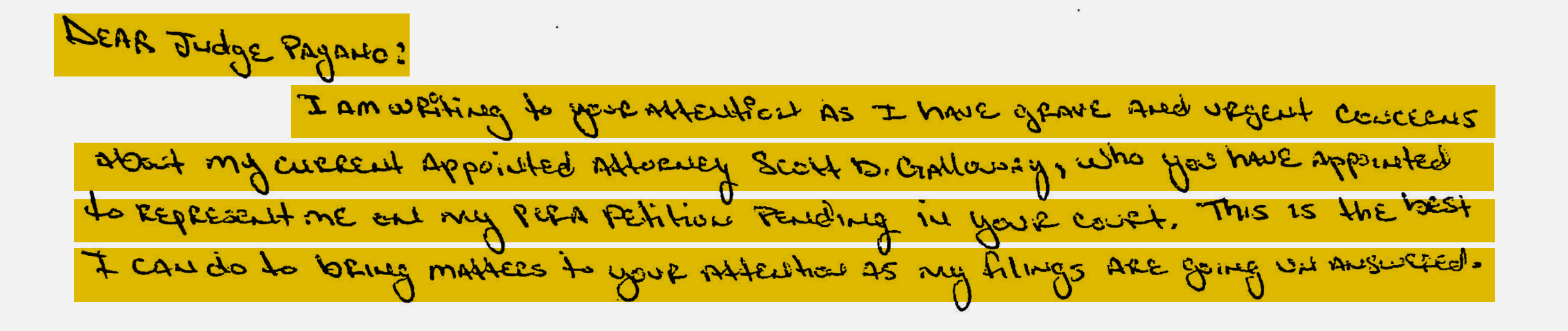
On Aug. 16, 2022, Nolan O’Neal wrote from prison to the judge deciding his post-conviction claim: “Dear Judge Pagano: I am writing to your attention as I have grave and urgent concerns about my current appointed attorney Scott D. Galloway, who you have appointed to represent me and my PCRA petition pending in your court. This is the best I can do to bring matters to your attention as my filings are going unanswered.”Courtesy of Nolan O’Neal
In the years Galloway was on the case, O’Neal wrote him dozens of letters from state prison, proposing legal arguments and sending leads to investigate.
“It is a daunting and exhausting task to navigate this legal process and be heard,” O’Neal said in an interview. “We at times even have to fight the attorneys who are supposed to represent us.”
In 2020, he received a letter from the brother of the murder victim, admitting that his testimony against O’Neal was a lie. “I want to fix it. I know my brother would want me to. It’s been long enough,” he wrote. O’Neal said he pleaded with Galloway to track down the man.
In 2022, Galloway attached the brother’s signed statement to a sparse two-page brief, which mentioned none of the other issues O’Neal had raised nine years earlier or the other witnesses who had come forward over the years. The judge started the process of dismissing the claim. One reason: The filing had been made too late. O’Neal is still fighting his case, now with a new court-appointed lawyer.
O’Neal’s claims have been pending in the Delaware County Court of Common Pleas for more than a decade.Alejandro A. Alvarez / Staff Photographer
Delays and extensions
Before they are assigned a lawyer, Pennsylvania prisoners must write the first draft of their post-conviction filing on their own within a strict one-year deadline. The lawyers appointed to revise their petitions, on the other hand, are not generally held to any timeline. The state courts say lawyers should act “expeditiously so as to reduce unnecessary delays.” Yet judges have granted extensions liberally, court dockets show, and in many cases failed to impose any deadlines at all.
An Inquirer and ProPublica review of court dockets found that hundreds of people have waited two years or longer, only to receive no-merit letters. That analysis is an undercount, since many court clerks do not clearly label attorney filings on their dockets. In Philadelphia alone, roughly 65 people have waited three to eight years for lawyers to take action before reaching that same outcome. Similarly, across the state, dockets show that lawyers received seven or more extensions in dozens of cases before filing Finley letters or nothing at all.
In 2017, Lee Mandell, who has been practicing law in Philadelphia for more than 50 years, sent a Finley letter saying that he had written to but never spoken with his client of four years and did not understand his claims.
“It is entirely unclear as to what the defendant really means,” Mandell wrote. In his own review of the case, Mandell failed to flag an erroneous jury instruction that four years later would lead to the conviction being overturned. Mandell was later formally reprimanded for allowing another client’s hearing to be delayed by six years, during which time two witnesses died. He did not return calls seeking comment.
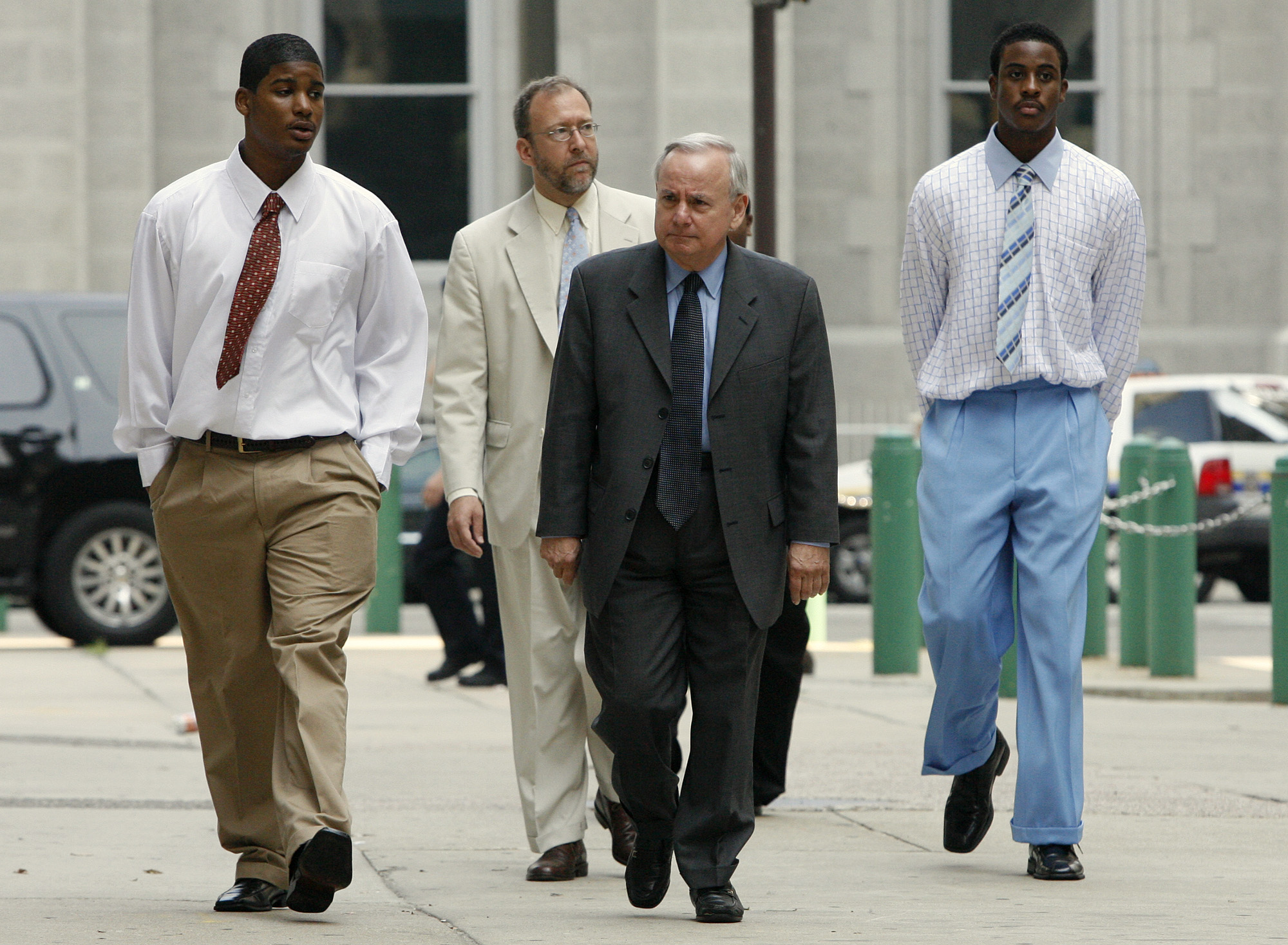
Attorney Lee Mandell (front, center) walks outside Philadelphia’s Criminal Justice Center in 2009. With him (from left) are Nashir Fisher, attorney Stephen Brown and Ameer Best.Alejandro A. Alvarez / Staff Photographer
Judges’ inaction added to lawyers’ delays, leaving matters to stagnate for years on end. In 2023, the state Superior Court registered such concerns about a case from Wayne County, where a lawyer filed a “two-page, deficient motion to withdraw, and the PCRA court did nothing in this case for 20 years.”
But in almost 200 post-conviction cases across Pennsylvania in the last 15 years, lawyers were appointed, then filed nothing at all over the span of a year or longer before being replaced with a new appointed lawyer. One of the cases stagnated for almost seven years, only for a new attorney to pick up the file. Another man was appointed five lawyers over eight years, dockets show, none of whom filed anything on his behalf.
Court officials have long been aware of the backlogs wracking this system, even publishing a law review article about it in 2003. The study outlined needed reforms but acknowledged the lack of political will, saying the “low status” of these cases stems from a bias among judges and lawyers who believe “that most post conviction claims are frivolous.”
No standards for lawyering
The loose timeline is just one dimension of a system with few standards. The state has published no best practices for indigent defense or guidelines on how many cases a lawyer can take; it has provided no training and instituted virtually no guidelines to ensure that court-appointed lawyers are qualified. As a result, lawyers hold widely diverging views on just what obligations they have to their clients.
“I do not know how you can evaluate trial counsel’s performance, which is the main role of post-conviction counsel, without talking to your client and reading trial counsel’s file,” said Jennifer Merrigan, a cofounder of Phillips Black, a nonprofit law firm. That file would reveal whether the lawyer had consulted with experts, received all relevant evidence from the prosecutor, and investigated potential witnesses.
The state’s lack of vetting and training stands in contrast with national norms. A majority of other states have centralized defender services or support offices that provide resources, education, and oversight. For instance, in North Carolina, appeals lawyers seeking court appointments must apply with the state appellate defender and submit references, work history showing the lawyer is qualified to litigate appeals, and legal writing samples. They are also required to take a training course covering strategy and best practices.
Even without a statewide office, Pennsylvania’s Supreme Court could establish minimum qualifications for lawyers handling indigent defense. In August, a state court committee published such a proposal, but it recommends only that lawyers have relevant work experience “to the extent practicable.” Work experience requirements have been enforced in some other states, such as Ohio, for years. But the committee’s proposal argued that work experience is not “possible to quantify” and that “less-than-experienced representation is better than no representation.”
Ted Skaarup, a public defender who has advocated for training and qualification requirements, said inexperienced and untrained lawyers are more likely to default to writing Finley letters. New lawyers, he said, are left to consult with older attorneys who may pass on bad practices. “You go to them for advice and they say, ‘I’ll send you a copy of my [no-merit] letter.’”
Only one of the state’s 67 counties provided written criteria requiring specific work experience for lawyers to be appointed to post-conviction cases in response to records requests. Philadelphia court leadership says that lawyers must complete a training session and show they have recently handled three hearings involving disputed evidence. A volunteer panel tasked with approving prospective lawyers there rarely meets and is not empowered to approve or reject candidates based on writing samples, a core part of screening appeals lawyers in some other places.
In Pittsburgh, the nonprofit Allegheny Lawyers Initiative for Justice has urged local court officials to set up a system to screen and supervise appointed lawyers. For now, the organization is running its own voluntary trainings, as well as a resource center with office hours, a library of sample motions, and help with social service referrals.
Without such systems, the organization’s executive director, Rob Perkins, said, “There’s no quality control.” Lawyers can get away with “doing a poor job in these cases for years without anyone really paying attention.”
Rob Perkins, the executive director of Allegheny Lawyers Initiative for Justice, stands in the Allegheny County Courthouse in Pittsburgh, where he’s urged administrators to adopt training requirements.Justin Merriman / For the Inquirer
‘Your incentive is to do the least work’
When attorney Corrie Woods took over Washington County’s post-conviction caseload in 2020, he was startled to discover about a dozen files that had been untouched since being assigned to the previous lawyer in 2019 or earlier. In some, the lawyer’s inaction had caused the clients to lose their appeal rights.
Looking back, Woods said, it was not surprising, given that the Western Pennsylvania county was paying him $25,000 a year as a part-timer for up to 24 cases. “These cases are not going to take priority in most law offices,” said Woods, who now handles mostly personal injury cases.
Under such a contract, he said, “Your incentive is to do the least work. You’re not getting more for doing more.”
Not Pennsylvania. The state began contributing any money to indigent defense only in 2023. Today it kicks in just 57 cents per capita; neighboring states, on average, pay $26 per resident. Counties provide the rest as they see fit. A pending American Civil Liberties Union lawsuit claims that arrangement has resulted in widespread violations of the right to counsel.
Pennsylvania Spends Less Than Most Other States on Indigent Defense
At 57 cents per resident, Pennsylvania’s state-level contribution toward funding legal defense for poor people is a fraction of what neighboring states pay.
(function(){function e(){window.addEventListener(`message`,function(e){if(e.data[`datawrapper-height`]!==void 0){var t=document.querySelectorAll(`iframe`);for(var n in e.data[`datawrapper-height`])for(var r=0,i;i=t[r];r++)if(i.contentWindow===e.source){var a=e.data[`datawrapper-height`][n]+`px`;i.style.height=a}}})}e()})();
Source: State budget documents, U.S. Census 2025 population estimates
About three-quarters of Pennsylvanians live in counties that use flat-fee arrangements or cap the amount a lawyer can bill for a case. Daniel Buzard, the court administrator in the county where Woods held the contract several years ago, said in an email, “This provides financial stability for both parties.”
Some counties pay as little as $500 per case. Based on time estimates from Maine, one of the only states to publish post-conviction workload standards, that would come out to $11 per hour.
Twenty-one Pennsylvania counties offer flat annual pay for part-time lawyers — sometimes then assigning them caseloads that exceed Maine’s standard for full-time work.
Only five of the 18 contracts obtained in response to public records requests included a limit on the number of cases the court could heap onto a lawyer. None of the contracts set deadlines, specified a time commitment, or described any oversight mechanism.
Stuart Wilder said his contract to handle post-conviction cases in Bucks County, outside Philadelphia, kept the lights on in his office for years. He worked hard for clients, he said, and won several challenging cases. But he said the flat-fee structure did require him to deprioritize cases where he didn’t see merit.
“Being able to file Finley letters gave me the time to work on cases I could fix,” said Wilder, who recently retired.
But in at least three counties, contract lawyers left multiple clients stranded for a year or longer with no progress on their cases, dockets show.
In 2021, the court in Erie County yanked 50 cases from attorney James P. Miller and eventually reported him for discipline, citing extreme delays that cost some clients their appeal rights. Miller, whose law license was suspended as a result, declined to comment. But Erie court administrator Robert Catalde said the debacle spurred the county to double lawyers’ pay to $46,800 and provide benefits.
The criminal court administrator at the Chester County Justice Center had to pull a lawyer’s contract last year, after he fell behind on post-conviction cases.Jose F. Moreno / Staff Photographer
A similar situation played out last year in Chester County, which abruptly ended its contract with the lawyer handling all its post-conviction cases, Charles Thomas Jr., after discovering that he had been putting in an average of just five hours a week across his roughly 25 cases.
One client, Patrick Hickson, said he spent two years trying to get Thomas to track down evidence that could clear him of a 2018 shooting or at least prove he had not gotten a fair trial. His defense lawyer had failed to call a single witness — admitting to the judge, mid-trial, that he had wrongly assumed the prosecutor would send a summons to an eyewitness who had told police Hickson was not the shooter.
To raise the issue, Hickson needed Thomas to track down the missing witness. But when he reached Thomas by phone in August 2025, for the first time in months, the lawyer told him he was off the case. “He said the courts told him he was taking too long,” Hickson said. Thomas declined to comment.
Chester County criminal court administrator Jordan Ludwick acknowledged concerns about the delays but said he resolved the problem by finding a qualified lawyer to take over the contract.
That attorney, Shannon McDonald, said it was “not an easy transition.”
“There were many cases that had not been touched at all,” she said.
She cut through the backlog by filing 17 briefs in just over three months. All but three were Finley letters.
Patrick Hickson receives an associate’s degree from Eastern University in 2025, while incarcerated at the State Correctional Institution Chester.Courtesy of Patrick Hickson
“The case has to survive on the merits,” she said, “and, frankly, the deck is stacked against overturning a case.”
This March, she also sent Hickson a Finley letter. McDonald said ethics rules prevented her from discussing Hickson’s case, but in the letter she blamed Hickson for failing to track down the would-be witness and said his trial lawyer had a strategic reason for not sending the subpoena.
Reading the letter, Hickson said, “I felt defeated.”
Since McDonald asked to drop the case, he is pursuing exoneration alone.
Hannah Beckler of ProPublica contributed to this article.
After years of declining vaccination rates, Pennsylvania is experiencing one the nation’s largest measles outbreaks in decades.
In the Philly region in 2025, almost 250 schools had kindergarten vaccination levels below 95% — the threshold that epidemiologists say is needed to prevent community spread of the virus.
The Inquirer analyzed the most recent kindergarten vaccination data available for 1,800 schools to pinpoint the communities, neighborhoods, and individual schools where children are most vulnerable.
(function(){function e(){window.addEventListener(`message`,function(e){if(e.data[`datawrapper-height`]!==void 0){var t=document.querySelectorAll(`iframe`);for(var n in e.data[`datawrapper-height`])for(var r=0,i;i=t[r];r++)if(i.contentWindow===e.source){var a=e.data[`datawrapper-height`][n]+`px`;i.style.height=a}}})}e()})();
In Philadelphia, Delaware, Chester, Montgomery, and Bucks Counties, 40% of kindergarten classrooms were vulnerable to an outbreak during the 2025-26 school year, up from 33% the year prior, an Inquirer analysis of state data found.
Kindergarten vaccination rates are considered a bellwether for a community’s attitudes toward vaccination, as parents are deciding whether to get the shots required by law to attend school.
Search the table below to see the measles, mumps, and rubella (MMR) vaccination rate among kindergartners at your school and how it has changed since last year.
The data were obtained from the state health department through a public records request. It did not include schools with fewer than 20 kindergarten students, which the state withheld citing privacy concerns.
(function () {window.addEventListener(‘message’, function (e) { var message = e.data; var els = document.querySelectorAll(‘iframe[src*=”‘ + message.id + ‘”]’); els.forEach(function(el) { el.style.height = message.height + ‘px’; }); }, false); })();
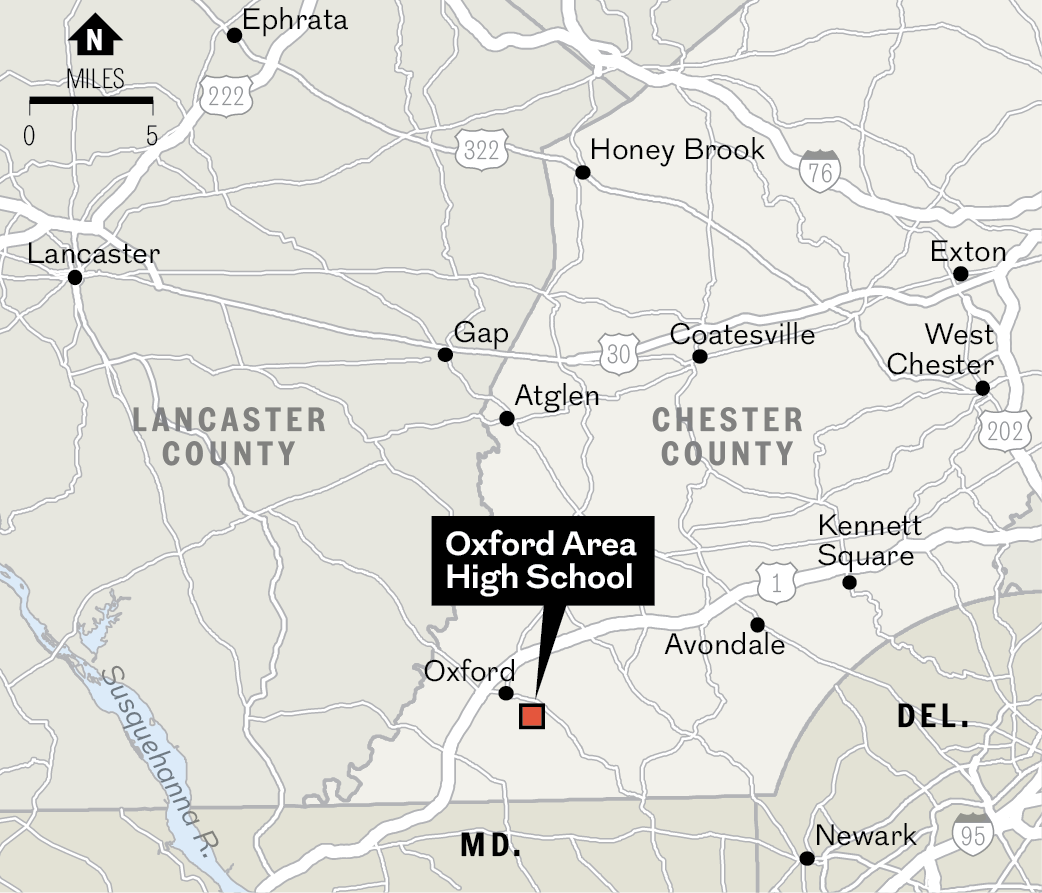
In the latest sign of the concern over a Pennsylvania measles outbreak that is now the nation’s largest, Oxford Area High School was closed on Friday due to a confirmed measles case.
Districts in other outbreak areas have not been closing schools as the state grapples with its worst measles outbreak in three decades, but school officials in the Chester County community west of Philadelphia made the decision after consulting with county health officials to limit the risk from the highly contagious disease.
In a letter to the school community, Oxford Area School District Superintendent David Woods said that all students and staff who are unvaccinated, or do not have proof of their vaccination status, will be required to quarantine at home for 21 days. The school’s quarantine decision follows Pennsylvania Department of Health guidelines.
Schools are required by state law to track and report data for all required vaccines — including the measles, mumps and rubella (MMR) vaccine — for students but not for staff.
Chester County’s health department directed the school to verify the vaccination status of its employees, Woods said in the letter. The district made the decision to close the school Oct. 9 to complete the verification process, a county spokesperson said.
School and county officials have not said whether the positive case involved a student, staff member, or someone else in the school community. “We recognize that situations such as this can be unsettling, especially when they involve the health of children,” Woods said in his letter.
High school and district officials did not respond to a request for comment.
The superintendent’s note did not say whether the school will reopen Monday or whether homecoming festivities planned for this weekend would be canceled.
But the school district did decide that a football game, with Oxford playing at Kennett High School in Kennett Square, could go on “after taking the appropriate health and safety precautions,” officials said in a social media post.
Pennsylvania Department of Health “generally does not recommend school closure for outbreaks of infectious diseases” as an initial response, according to published school guidance. Exposed students and staff who are unvaccinated or cannot verify their vaccination status will be instructed to stay home for 21 days, according to a health department spokesperson.
The decision to close is ultimately made by school administrators, according to the Department of Health, which urges schools to consult with in-house medical staff and county or state health authorities.
Chester County Health Director Jeanne Franklin applauded the district’s quick response, noting the move could prevent longer closures from widespread sickness.
“We don’t want it to get to the point of they have to shut down because they don’t have the staff to run the school, or too many students are infected and can’t come to school,” she said.
The county learned of the case from a health provider who treated the individual, and then contacted the school district.
Vaccine records for students were readily available, but the school was still in the process of gathering vaccine information about staff — a step the county had urged schools to take in anticipation of the region’s outbreak reaching Chester County schools.
The district ultimately decided it did not know the vaccination status of enough of the school’s employees to safely open the school on Friday.
“The moment we called, they were on it,” Franklin said, adding that she “fully respected” the decision to close. As the first school in Chester County with a confirmed measles case, ”they’re going to have an abundance of caution and make sure they get it right,” she said.
Chester County has the third-most measles cases in Pennsylvania, despite an overall measles vaccination rate just below the 95% protection scientists say is necessary to prevent the virus from spreading.
Pennsylvania’s measles outbreak, largest in the nation this year, has sickened more than 1,100 people across more than half of the state’s counties. The state has confirmed five measles-associated deaths, the most seen in the nation in more than three decades.
The state’s outbreak, which began in April, is centered in Lancaster County, right outside the Philadelphia region.
Chester County is the only county in the Philadelphia region in which the virus is known to be actively circulating. The county has reported 87 cases this year, as of Friday, mostly along Chester County’s western border with Lancaster County.
Oxford is located in the southwestern corner of Chester County.
Another school in nearby West Grove, Technical College High School (TCHS) Pennock’s Bridge Campus, operated virtually on Friday, after the Chester County health officials notified its administrators of possible measles exposures between Sept. 30 and Oct. 2.
A spokesperson for the campus overseen by the Chester County Intermediate Unit said the decision was made “because the staff verification process could not be completed within the time frame required by the Health Department.”
Programs housed within its building, including the Practical Nursing Program and Early Discovery Center, were closed for the day.
Additionally, the county on Friday warned of possible measles exposures at multiple pharmacies Oct. 4:
CVS located at 870 Baltimore Pike in Kennett between 10:45 a.m. and 3 p.m.
CVS located at 857 West Baltimore Pike in West Grove between 12:30 and 3:30 p.m.
Giant located at 849 Baltimore Pike in West Grove between 1 and 3:45 p.m.
(function(){function e(){window.addEventListener(`message`,function(e){if(e.data[`datawrapper-height`]!==void 0){var t=document.querySelectorAll(`iframe`);for(var n in e.data[`datawrapper-height`])for(var r=0,i;i=t[r];r++)if(i.contentWindow===e.source){var a=e.data[`datawrapper-height`][n]+`px`;i.style.height=a}}})}e()})();
Joe Maida, who is raising his 5-year-old granddaughter with his wife in East Nottingham, was surprised to hear the high school was shutting down for the day.
Maida, 65, felt there was a lack of information from the district to explain its decision — such as who in the school population was infected, if officials were disinfecting, if there was an adequate “plan of attack” to reopen Monday.
He was also surprised the high school’s varsity football team would be able to play a game Friday night.
“I’m a bit taken aback” by the response, he said.
But his granddaughter is vaccinated, and her elementary school was unaffected. “I’m not giving it a lot of energy,” he said. “It’s the measles. It’s not the plague,” he said.
(function(){function e(){window.addEventListener(`message`,function(e){if(e.data[`datawrapper-height`]!==void 0){var t=document.querySelectorAll(`iframe`);for(var n in e.data[`datawrapper-height`])for(var r=0,i;i=t[r];r++)if(i.contentWindow===e.source){var a=e.data[`datawrapper-height`][n]+`px`;i.style.height=a}}})}e()})();
School vaccination
Chester County reported its first measles case of the outbreak at the end of June. As part of its early preparations, the county health department alerted schools before the beginning of the new school year that they would need to know the vaccine status of all staff and volunteers in the event of a positive case.
While Chester County has an overall kindergarten measles vaccination rate just below the 95% herd immunity rate, Oxford Area High School students appear well protected.
The school reported that all of its 303 12th graders had received the MMR vaccine in the 2025-2026 school year, the most recent year for which data is available.
The district’s middle school, Penn’s Grove School, reported a 96.3% MMR vaccine rate among 7th graders last year.
To better understand how school districts have been preparing for possible measles cases, The Inquirer contacted 12 Chester County districts last month, asking how they were planning and communicating with students and staff about the prospect of quarantines.
The Oxford district, which has more than 3,000 students, did not respond, along with a number of other Chester County districts.
Pennsylvania State Education Association, the statewide teachers’ union, declined to comment on the school closure.
Oxford Area Education Association, which represents teachers at the high school, couldn’t immediately be reached for comment.
School response to measles
Measles, long considered eradicated in the United States, is resurging amid declining vaccination rates.
In the Philadelphia region, at least 40% of kindergartens were vulnerable to an outbreak as of last school year, up from 33% the prior year, according to an Inquirer analysis of school immunization data widely used to assess community protection levels.
Schools are required to report vaccine information for students in kindergarten, 7th grade, and 12th grade. Earlier this year, Pennsylvania’s Department of Health began making this information publicly available through a searchable database, in an effort to raise awareness of declining vaccine rates in schools.
Health officials in neighboring Delaware and Montgomery Counties said they have similarly been advising school districts about rules for unvaccinated students and staff in the event of a positive measles case.
Montgomery County has urged schools to review immunization records and confirm proof of immunity, and develop plans to “rapidly identify students and staff who may be at risk,” said Christina Miller, administrator of the county’s Office of Public Health.
Delaware County’s health department said that it would offer guidance to a school with a positive measles case on how to verify immune status for students, employees, and volunteers, as well as how to identify high- or low-risk exposures at the school.
If a case is identified in a Philadelphia school, the city’s health department said it would work with the school’s administration to determine when the person was infectious and how to protect exposed students and staff.
Counties without a local health department rely on Pennsylvania’s Department of Health.
Neil Ruhland, a spokesperson for the state health department, said school nurses or school leaders should contact the health department immediately if a measles exposure occurs at a school.
Schools should review attendance records, assess where the exposure occurred, and determine the vaccination status of exposed people.
If the department confirms a measles case and exposure at a school, it will notify families and provide guidance on what to do if they’re not vaccinated, Ruhland said. Exposed students who are vaccinated are considered immune and don’t need to do anything else.
An exposed person who isn’t fully vaccinated will be told to quarantine at home for 21 days, whether or not they show symptoms, Ruhland said. But, if that person gets an MMR dose within 72 hours of the exposure, quarantine will be lifted, he added.
Verifying vaccine status
Tracking down childhood vaccine records as an adult can be challenging — many adults may have been vaccinated before medical records were widely stored online, and their long-ago pediatricians may no longer be practicing.
Titer blood tests can check for antibodies that indicate immunity against measles, either from the vaccine or a past infection. People with low antibodies — and therefore low protection — can get a booster.
Perhaps the fastest way to ensure you’re protected as an adult, Franklin said, is to get the MMR vaccine. The vaccine is safe to get even if you have already received it, she said.
Inquirer staff writers Aubrey Whelan, Brooke Schultz, and Maddie Hanna contributed reporting.
Saddle up, folks! In case you haven’t heard, the city’s biggest rodeo is coming back to town.
On Saturday, 8 Seconds Rodeo returns to the Liacouras Center, where some of the nation’s top bull riders and barrel racers will compete for big prize money.
As a former Texan who’s attended some of the oldest rodeos in the country, I can assure you 8 Seconds Rodeo is unlike any other rodeo I’ve experienced. I was there for its Philly debut last year, and the atmosphere was electric. Hip-hop blared through the arena as fans jumped from their seats, phones in hand, to capture the bull riding and barrel racing. It was exactly what founder Ivan McClellan envisioned: an “unapologetically Black rodeo” that welcomed anyone with an appreciation for Western tradition.
But there’s plenty more happening this weekend, from a Chinatown night market to a major new art exhibition.
Marcel Duchamp exhibition to open at PMA this Saturday
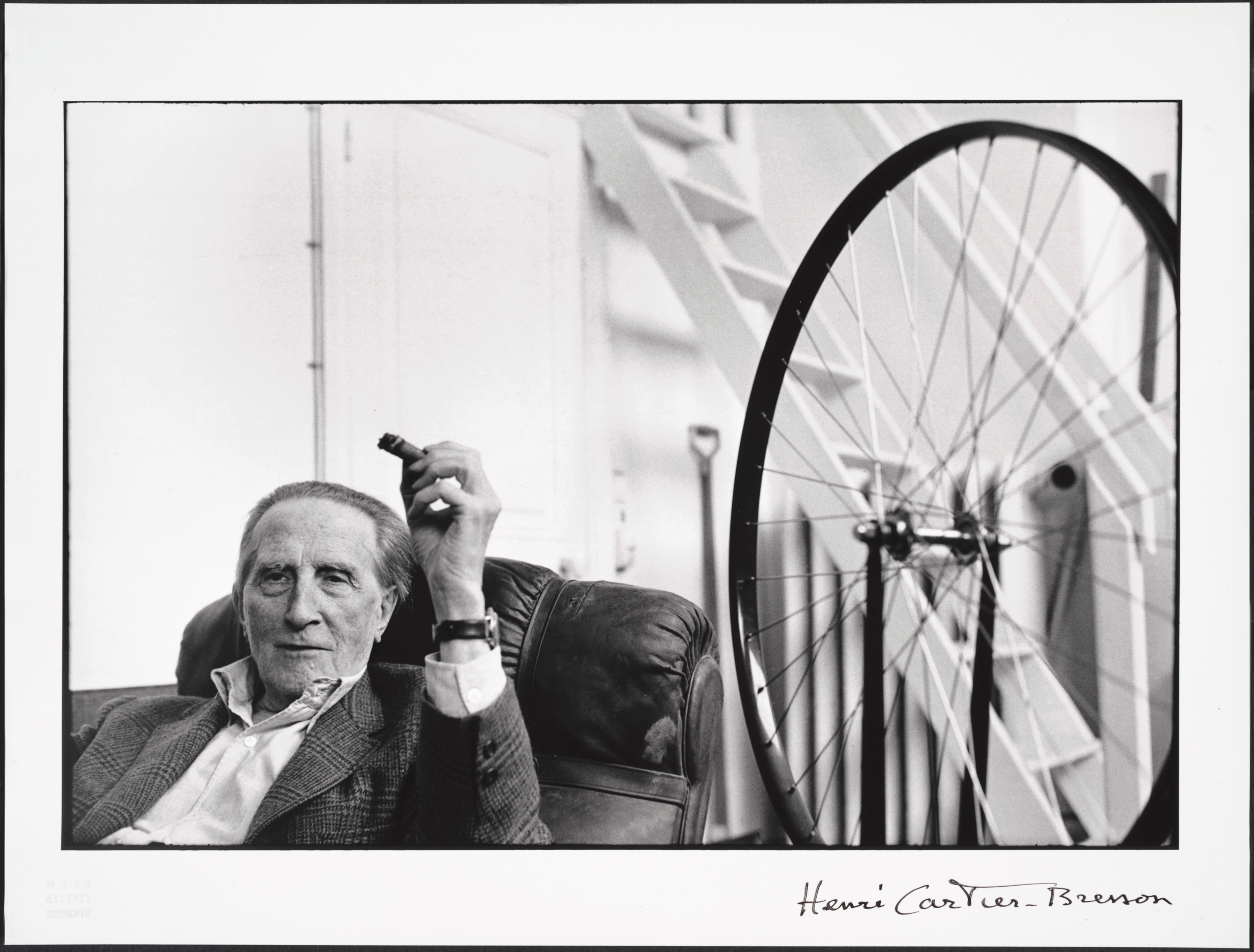
Marcel Duchamp in a 1968 photo by Henri Cartier-Bresson. Gelatin silver photograph. MUST CREDIT: Henri Cartier-Bresson/Cathy Carver/Promised Gift of Barbara and Aaron Levine/Hirshhorn Museum and Sculpture Garden
One of modern art’s most influential artists is getting the spotlight at the Philadelphia Museum of Art.
A major new exhibition opening Saturday brings together some of Marcel Duchamp’s most celebrated works, including “Nude Descending a Staircase (No. 2),” “The Bride Stripped Bare by Her Bachelors, Even,” and “Fountain.”
The exhibition comes to Philly after a stop at New York’s Museum of Modern Art and runs through Jan. 31, 2027.
What happens when 12 Philly chefs go looking for their perfect culinary match? We’re about to find out.
The Inquirer’s new Love at First Bite series puts local chefs in reality TV-style dating pods to find their ideal cooking partners. Once paired up, they’ll work together to create a dish for The Inquirer Food Fest, where they’ll compete for the title of Love at First Bite.
You can follow the matchmaking, kitchen experiments, and inevitable culinary chemistry in new episodes released twice a week.
And here’s the best part: You can actually taste the results. The Inquirer Food Fest returns to the Fillmore on Nov. 14, with dishes from the chef collaborations and plenty more to sample.
Walkers complete their route to Uptown Beer Garden near City Hall with the Philadelphia Chapter of Lunge Run Club during their weekly meetup for singles on Wednesday, Oct. 16, 2024 in Philadelphia, Pa. The viral NYC-based run club is targeted toward singles looking to meet new people.Erin Blewett / For The Inquirer
🎨 Open Studios at Bok: Ever wondered what’s happening behind the doors of South Philly’s former vocational school? On Friday, Bok opens all nine floors for an evening of art, live performances, shopping, and late-night snacks for Open Studios at Bok.
🐉 Come celebrate historic Chinatown: The annual YèShì Chinatown Night Market, which features live performances, arts, crafts, and pay-as-you-go food, is back to celebrate Chinatown’s rich history and culture.
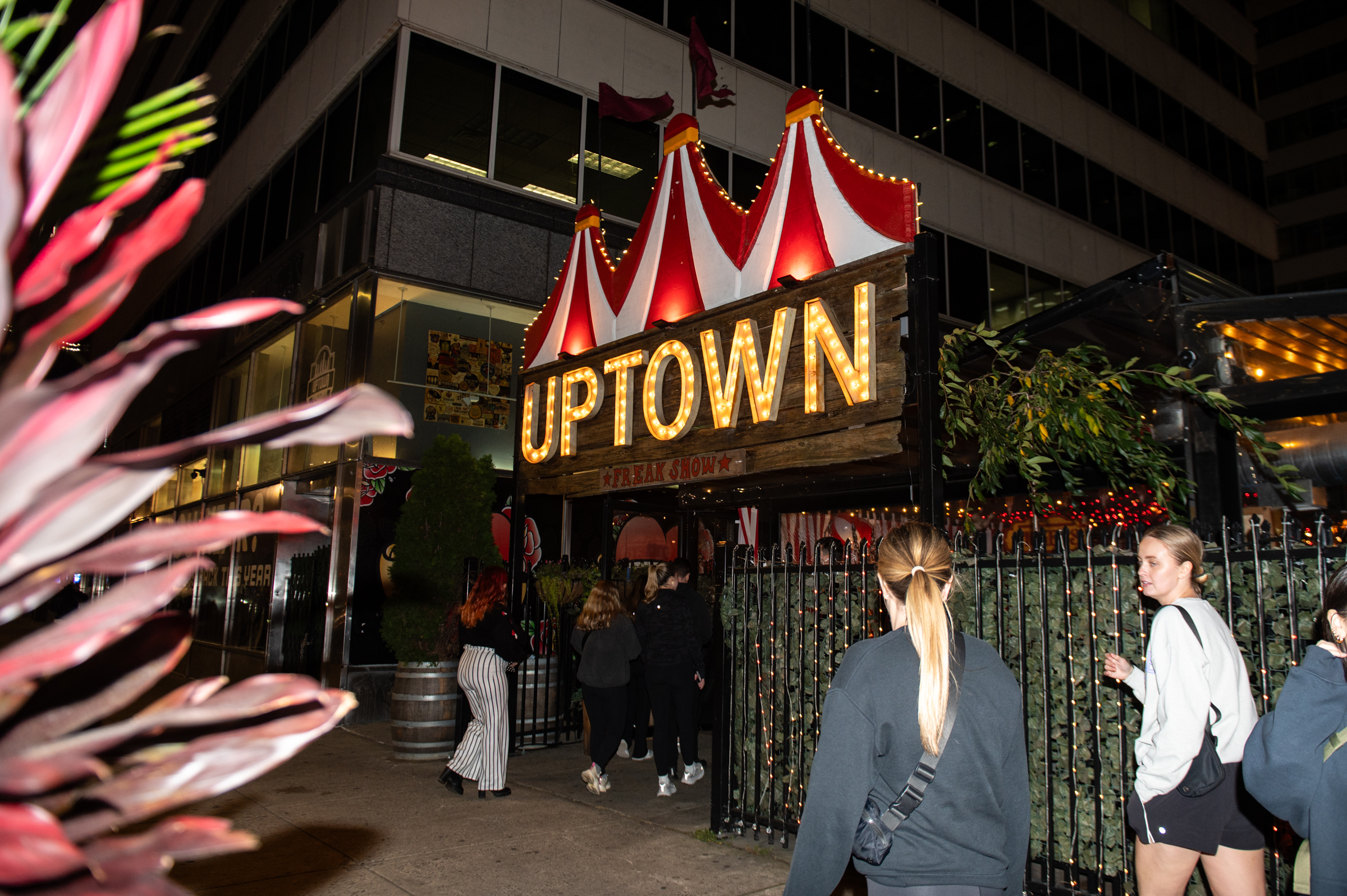
🎃 Halloween arrives at Uptown Beer Garden:Uptown Beer Garden is getting into the spooky spirit with cobweb-covered tombstones bearing the names of late celebrities and a menu of Halloween-inspired specialty cocktails.
🍻 Parks on Tap’s final stop: Head to South Philly for the final Parks on Tap, the traveling attraction for lovers of community and craft brews. The final round of drafts will be served in Columbus Square Park through Sunday.
📅 My calendar picks this week: OURfest 2026, Made in Philadelphia Market at Dilworth Park, Salsa and Bachata Night. Here’s our full list for the week.
8 Seconds Rodeo returns for a second run in North Philly
Bareback rider Patrick Liddell hangs on during the event at the 8 Seconds Rodeo in the Liacouras Center in Philadelphia on Saturday, Oct. 11, 2025.
Here are some more details for my top pick, the 8 Seconds Rodeo.
The all-Black rodeo, which made its regional debut in October 2025, returns to North Philly this Saturday for a second run at the Liacouras Center.
The world’s top bull riders, barrel racers, fiery mutton busters, and bareback horsemen will compete for $150,000 in prize money.
The event, founded by Portland native and Chester County resident Ivan McClellan, looks to attract more than 7,700 attendees for a “rock concert-like production.”
North Philly’s DJ Diamond Kutz will curate the music and 2 million pounds of dirt and dozens of livestock will be transported to the arena.
Doors open at 3 p.m. and the competitions begin at 7 p.m.
Limited tickets are available on ticketmaster.com and resale sites like TickPick, SeatGeek, Vivid Seats, and others.
Pennsylvania Ballet dancers Dayesi Torriente and Sterling Baca in Christopher Wheeldon’s “DGV.”Alexander Iziliaev / Philadelphia Ballet
🎭 Liberation at Suzanne Roberts Theatre: The Pulitzer Prize- and Tony Award-winning play, Liberation, makes its Philadelphia premiere on Friday. The memory play, written by Bess Wohl, follows a group of six luminaries in their pursuit of freedom. The play runs through Oct. 25.
🩰 American ballet, music, and history: After opening the doors of its new home last month, Philadelphia Ballet opens the 2026-27 season with a performance at the Academy of Music. The company will present Stars and Stripes Forever, offering a mix of rich American movement, music, and history.
⚗️ An exhibition on alchemy: Science History Institute’s new exhibition, Fire and Gold: The Art of Alchemy (1450-1850), explores the medieval science and philosophy that later led to the advent of chemistry. The exhibition will display a collection of early alchemical art, rare books, and oil paintings from the Renaissance and Enlightenment periods.
🖼️ Big ideas in miniature form: Small Favors – 20th Annual Miniature Exhibition returns to The Clay Studio. This year’s display will feature nearly 400 small artworks located in four-inch cubes. The exhibition opens Thursday and runs through Jan. 3, 2027.
Staffer picks
Here’s a list of the best concerts this weekend.
Teddy Swims performs “Without You” during MusiCares Person of the Year honoring Mariah Carey on Friday, Jan. 30, 2026, in Los Angeles. (AP Photo/Chris Pizzello)Chris Pizzello
🎤 Thursday: Electro-composer Bayonne, who initially released music under his birth name, Roger Sellers, stops into MilkBoy on Thursday night. He will be joined by fellow electronic artist Bad Snacks.
🎸 Friday: English rock band Basement, who released its fifth album Wired in May, ventures across the pond to perform at the Fillmore Philadelphia.
🔊 Saturday: Booming baritone Teddy Swims, whose music melds soul, R&B, and pop, is taking the stage at Xfinity Mobile Arena as part of his “The UGLY Tour.”
🕺🏽 Sunday: Legendary guitarist Jubu Smith, with support from singer Deron Irons, performs at City Winery Philadelphia to pay tribute to iconic soul man, Frankie Beverly.
❓Pop quiz
What’s the oldest rodeo in the world?
A) Cowtown Rodeo in Pilesgrove, N.J.
B) Payson Pro Rodeo in Payson, Ariz.
C) The Prescott Rodeo in Prescott, Ariz.
D) West of the Pecos Rodeo in Pecos, Texas
Here’s the answer to last week’s question: Where did the Please Touch Museum originally open its doors? Answer: Academy of Natural Sciences
Now, I have a question for you
Every week, I tell you how to spend your time in Philly. This week, I want to know how you’d spend your money.
If you had just $50 to spend on a Saturday night in Philly, what would you do? Where would you eat? What would you see? Would you spend it all in one place or stretch it across a whole night?
Email me your ideal $50 Saturday night. I might share some of my favorite answers in a future newsletter.
See you out there!
– Earl Hopkins
By submitting your written, visual, and/or audio contributions, you agree to The Inquirer’s Terms of Use, including the grant of rights in Section 10.
In a crime that Delaware County prosecutors described as a misguided attempt at revenge, a Chester man was sentenced Thursday to life in prison without parole.
Jesse Allen Jr., 20, was convicted of first-degree murder in July in the 2024 death of 17-year-old Zaheem Sabree, a childhood friend he had recruited to help kill another teen accused of fatally shooting a mutual friend.
Though Allen did not fire the bullet that struck Sabree, he was found liable for his death under the legal principle of transferred intent, which holds that if a person intends to harm someone, but inadvertently harms someone else instead, that is a crime.
And the events leading up to Sabree’s death were set in motion by Allen, according to Deputy District Attorney Matt Krouse.
“I take no joy in asking for the sentence imposed by the court,” Krouse said after the hearing, “but hope this serves as a reminder that the Delaware County District Attorney’s Office will continue to hold responsible those driving the gun violence epidemic in our community and seek justice for victims and their families.”
For the attempted murder of Walker-Jones, Allen was sentenced to a consecutive term of 20 to 40 years in state prison.
Allen shook his head in silence and said nothing as Delaware County Court Judge Mary Alice Brennan handed down his sentence in a courtroom filled with his family and friends.
Walker-Jones, 18, is awaiting a trial on murder charges in the shooting that led Allen to plot against him: the killing of Sabrie “Breezy” Pierce months before Sabree’s death.
Allen’s attorney, Brian Malloy, declined to comment Thursday.
During Allen’s trial, he contended that prosecutors had erred in charging his client instead of Walker-Jones, who fired the fatal shot.
Text messages presented during Allen’s three-day trial showed that he had begun recruiting people to help kill Walker-Jones immediately after Pierce’s killing.
“Everybody gone pay,” Allen said in one message displayed in court.
On the day of the shooting, Allen and Sabree walked together through Walker-Jones’ neighborhood, looking for him, according to evidence presented at trial.
After spotting him near an abandoned fast-food restaurant, they hid nearby and shot at him in a planned ambush.
Shell casings found at the scene showed that Walker-Jones and Sabree shot at each other multiple times — Sabree with a .45-caliber pistol and Walker-Jones with a 9mm, prosecutors said. Walker-Jones and Allen then fled in opposite directions.
Sabree was found near that scene, shot in the head. Police took him to Crozer-Chester Medical Center, where he was later pronounced dead.