I didn’t have Peeping Tom drones on my bingo card for 2026.
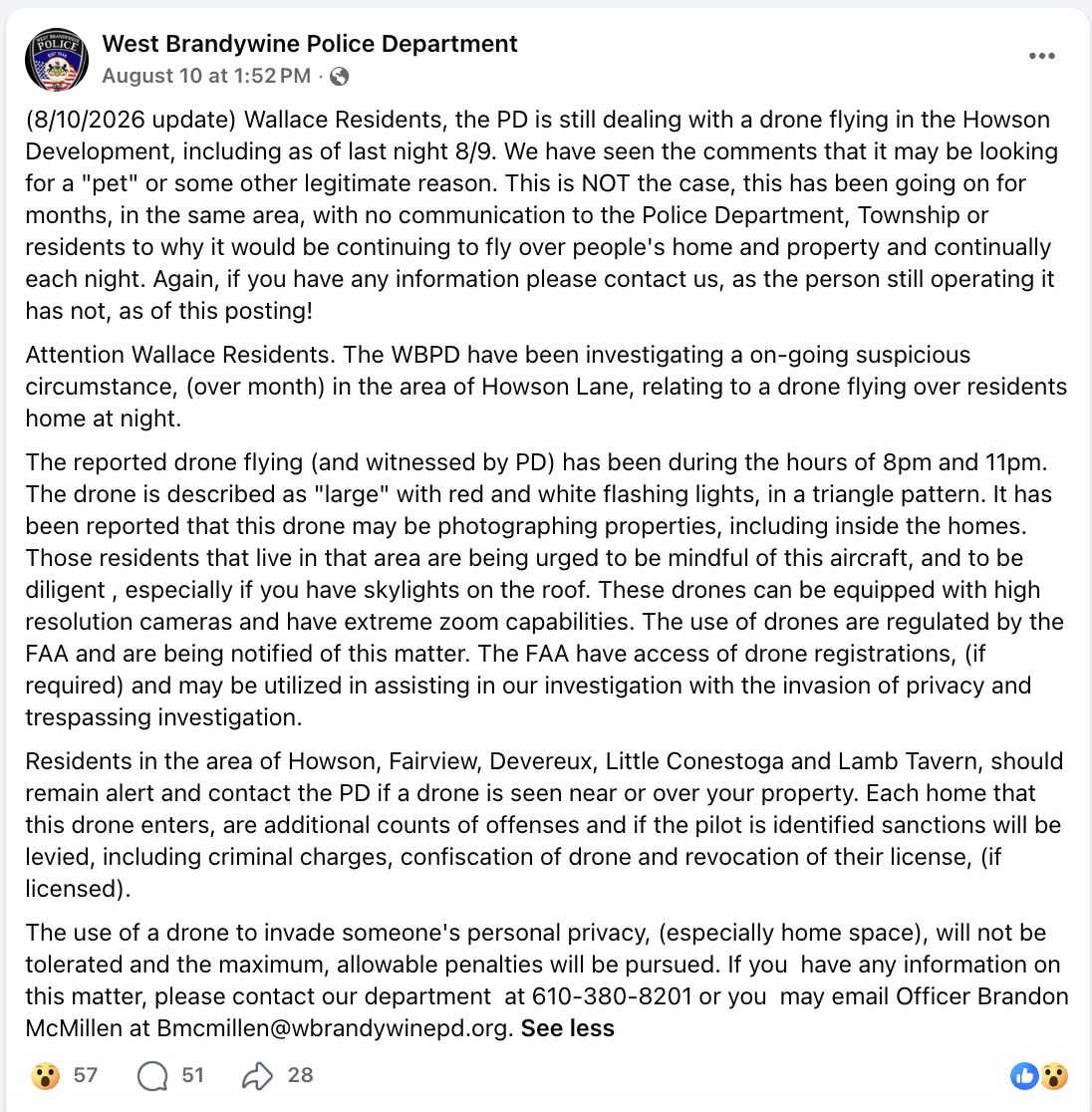
But then, on July 14, the West Brandywine Police Department let residents of Wallace Township in Chester County know, via Facebook, that for a month or so, they’d been investigating (and had witnessed) a drone flying over homes along several roads in my neighborhood at night, between 8 and 11 p.m.
“It has been reported that this drone may be photographing properties, including inside the homes,” stated the police department’s Facebook page. “Those residents that live in that area are being urged to be mindful of this aircraft, and to be diligent, especially if you have skylights on the roof. These drones can be equipped with high resolution cameras and have extreme zoom capabilities.”
Huh. Creepy.
Since we don’t have young children whose images, captured without our consent, might find their way onto the more sinister reaches of the web, and since our house isn’t full of luxury goods to be cased, I didn’t worry much.
Maybe if the drone operator chanced to peep through our windows, he’d take pity seeing the proliferation of dust bunnies and proactively book us a deep-cleaning service appointment?
But the West Brandywine Police Department’s Aug. 10 update upped the ante: “We have seen the comments that [the drone] may be looking for a ‘pet’ or some other legitimate reason. This is NOT the case.”
Screen capture of the West Brandywine Police Department’s Facebook post on Aug. 10 updating residents of Wallace Township on the continued drone sightings.Screen capture
It is particularly disconcerting because Pennsylvania regulations stipulate that for nighttime flying the drones “need to remain within line-of-sight of the remote pilot on the ground.” Even if you aren’t unnerved at the idea of someone deploying a little electromechanical spy to look into your windows at night (when the lights inside make people and things clearly visible in a way they wouldn’t be during the day), the idea that the person doing so is on your property — or close enough to keep the drone in sight — should be.
I can easily imagine folks who already feel vulnerable — the elderly, women living alone, or people who have experienced domestic partner abuse or who have filed for protection orders — being terrified by that prospect.
The thing is — despite the West Brandywine Police Department’s gratifyingly proactive approach to residents’ privacy concerns — it is the Federal Aviation Administration that’s in charge. The state reports that some 11,000 people have an FAA remote pilot rating, and if this peeping drone is flown by a registered pilot, there may be little anyone can do.
Responses to West Brandywine PD’s Facebook posts about this have been predictably mixed in this libertarian-leaning corner of the county. Outrage and worry about surveillance and invasion of privacy, of course, but also lots of drone-flying enthusiasts who chafe at any talk of curtailing their ability to pilot their unmanned craft wherever and whenever — property owners be damned.
Also, since there are a lot of hunters in this neck of the woods, there are a good number of comments about shooting the drone down if it is sighted. I hasten to add that — as tempting as it might be to shoot the flying snoop right between its blinking red lights — drones are considered aircraft, and it is a federal felony to damage or disable them — punishable with a fine of $250,000 and up to 20 years imprisonment.
If you think none of this should matter to you because, hey, you don’t live in Wallace Township and no drone has been haunting your nights, think again. Aerial surveillance by drones is widespread, and largely unregulated. According to the Electronic Privacy Information Center, there are “no clear rules protecting individual privacy against drone surveillance. Despite the fact that drone surveillance implicates significant First Amendment and Fourth Amendment interests and common law privacy rights, the law around conducting aerial surveillance very much remains in a gray area.”
Regardless of what happens at the federal level, I hope that what has been unfolding in Wallace Township prompts Pennsylvania legislators to reconsider Act 78’s limits on local regulation of unmanned aircraft in order to better protect residents from unwarranted and nuisance drone surveillance.
Meantime, the West Brandywine Police Department wants residents to contact them if they see the drone on their property.
“Each home that this drone enters, are additional counts of offenses and if the pilot is identified sanctions will be levied, including criminal charges, confiscation of drone and revocation of their license, (if licensed),” the police department wrote in its latest Facebook post. “The use of a drone to invade someone’s personal privacy, (especially home space), will not be tolerated and the maximum, allowable penalties will be pursued.”
And maybe, just maybe, the fines accrued cumulatively will be enough to make drone operators think twice before unleashing their propeller-driven ghouls to hang around our windows in the middle of the night.
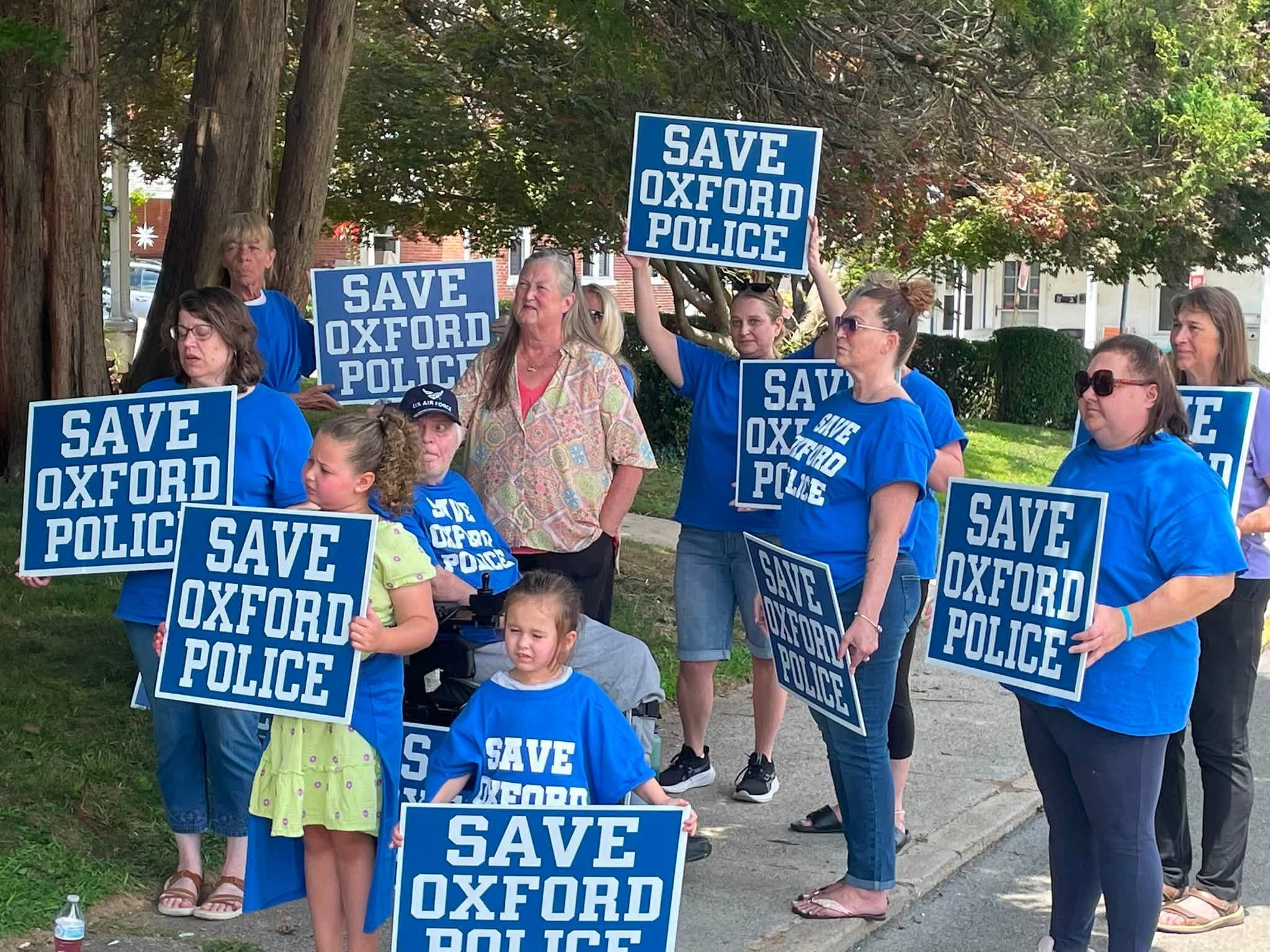
Residents protest against the disbanding of Oxford borough’s police department. Photo courtesy of Danny Graham
Residents in Oxford are concerned about the future of emergency response times and municipal protections in the 5,800-person borough if council moves ahead with disbanding its police department in favor of joining a regional agency.
That’s a decision council will make at an Aug. 17 meeting as it grapples with rising costs to maintain a century-old police force.
For some residents, the decision feels personal. “This is a small town. These guys, all 11 of them, mean something to us. We buy them coffee. We buy them donuts. They are part of our extended family. This matters to us, and how they’re being treated matters to us,” one said.
Traffic signal and safety improvements are expected in six Chester County municipalities thanks to recently awarded state funds. The largest is a nearly $640,000 grant for Tredyffrin Township to make improvements along Lancaster Avenue.
The region will see two celestial events — a partial solar eclipse today and the Perseid’s meteor shower, which will peak tonight — and there are several great viewing spots nearby, including Valley Forge National Historical Park and French Creek State Park. Here’s what to know.
Honey Brook Townshiphas named Nancy Freenock its next township manager and secretary. An attorney by trade, Freenock previously served as the city manager for Warren and borough manager for Clarion, both in Western Pennsylvania.
East Vincent Township is hosting a special planning commission meeting tomorrow at 6:30 p.m. at the municipal complex and on Zoom to consider AQ Dev, LLC’s conditional use application to build 53 single-family homes at 446 Stony Run Rd.
West Vincent Township’s board of supervisors is slated to consider Toll Brother’s proposal to build 46 homes near South Chester Springs and Conestoga Roads at its meeting on Monday.
The third season of Tires, which was created by comedian Shane Gillis and is set and was partly filmed in West Chester, drops on Netflix tomorrow.
Spooky season may still be a couple of months away, but Spirit Halloween has already opened at a former Rite Aid on Paoli Pike in West Chester. It’ll be joined this month by one at the former Tuesday Morning space in Downingtown.
A new coworking space, iThrive Coworking, recently opened at 10 Leopard Rd. in Paoli.
🍽️ On our Plate
Sweltering summer heat and humidity have you clamoring for a cool treat? Revisit our guide to the region’s ice cream shops, including the ever-popular La Michoacana in Kennett Square.
🎳 Things to Do
🎙️ Sound of Summer Free Concert Series: The final show of the season features a performance by Kennett Square’s own rock band The Holy Smokers. ⏰ Wednesday, Aug. 12, 6:30-8:30 p.m. 💵 Free 📍 Anson B. Nixon Park, Kennett Square
🎸 80’s Revolution: The band will transport attendees back a few decades, playing some of the most iconic tunes from the 1980s (leg warmers optional). ⏰ Friday, Aug. 14, 7:30 p.m. 💵 $23-$28 📍 Uptown! Knauer Performing Arts Center
🖼️ Look Around Music and Arts Festival: Hear live music, browse works of art, see skating demonstrations, and grab a bite to eat at this festival. ⏰ Saturday, Aug. 15, noon 💵 $25 in advance, $30 at the door 📍 The Elks Lodge, West Chester
🎶 Eagleview Summer Concert Series: Old 97’s frontman Rhett Miller headlines the next show. Local trio The MAKs will also perform. ⏰ Tuesday, Aug. 18, 7-9 p.m. 💵 Free 📍 Eagleview Town Center, Exton
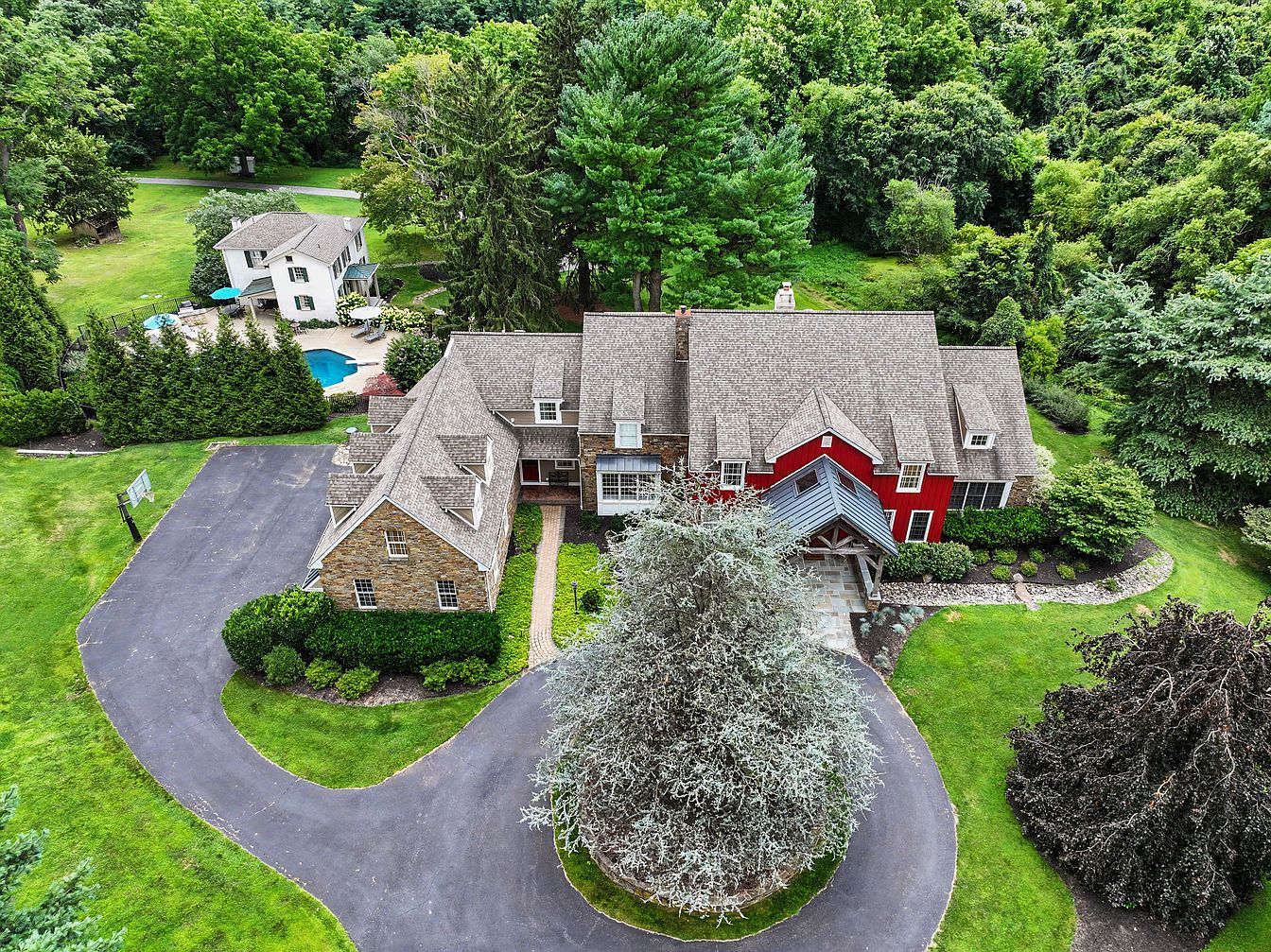
The property includes a sprawling residence, a guest house, and a pool.Next Door Photos | Courtesy of Pat McGowan/The Collective.Real Estate
This Kennett Square property features not one but two homes, both situated on a large lot. The main six-bedroom home is a renovated and expanded mid-19th-century barn, complete with old beams, a stone fireplace, and an expansive walk-out lower level with a kitchenette. The second home, a restored 1800s farmhouse with two bedrooms, spans nearly 1,500 square feet and has its own driveway. Both overlook a pool and hot tub.
By submitting your written, visual, and/or audio contributions, you agree to The Inquirer’s Terms of Use, including the grant of rights in Section 10.
This suburban content is produced with support from the Leslie Miller and Richard Worley Foundation and The Lenfest Institute for Journalism. Editorial content is created independently of the project donors. Gifts to support The Inquirer’s high-impact journalism can be made at inquirer.com/donate. A list of Lenfest Institute donors can be found at lenfestinstitute.org/supporters.
Gov. Josh Shapiro made a declaration in the early days of his administration: Pennsylvania is open for business.
The move would ultimately include promises to slash bureaucratic red tape, cut permit wait times, and offer a new direct line to Shapiro’s office for major corporations hoping to set up shop in Pennsylvania.
Pennsylvania would “move at the speed of business” and “get stuff done,” the new mottos used by his administration, he said. He’s campaigning for reelection in November on the same catchphrases, and boasting major successes like the 12-day repair of I-95 in 2023 that traditionally would have taken months to reopen as an example of how he can think outside the box to solve problems.
What’s more: He sees delivering for residents — showing them government can actually solve problems — as the future of the nationalDemocratic Party, while it searches for an effective message and messenger heading into the 2028 presidential primary, which he is widely expected to enter.
It was with this same spirit last summer that Shapiro announced the largest single private sector investment in Pennsylvania history: Amazon committed $20 billion in Pennsylvania that included two data center campuses in Luzerne and Bucks Counties. Pennsylvania scored the project because of its promise to fast-track permitting and use tax breaks for the massive developments.
“Pennsylvania’s gonna be better off. I think America’s gonna be better off, because we’re going to win the battle of AI supremacy and it’s going to be done right here in the commonwealth of Pennsylvania,” Shapiro said in an interview on CNBC’s Squawk Box on the day he announced the deal.
Gov. Josh Shapiro announces a $20 billion investment by Amazon in Pennsylvania data centers in Salem Township and Falls Township on June 9, 2025.Commonwealth Media Services
But in a year’s time, the politics — and public opinion on both sides of the aisle — have dramatically shifted on data center development. Shapiro’s early welcome of data centers has created an opening for criticism from his gubernatorial opponent and members of his own party.
Yet efforts to cut red tape have proven to be slow and overblown: Only six data centers are actually under construction in Pennsylvania since the announcement, and 10 have received at least one state-level permit approval, according to Shapiro’s office. Still, Shapiro’s popularity is being evaluated by some voters and anti-data center activists on a perception that he moved too quickly and sacrificed the state’s safety in favor of Big Tech.
“I am all about legislators and decision makers getting s— done. This version of it is reckless and it’s irresponsible and it’s not actually serving our people,” said Carrie Santoro, the executive director of progressive advocacy groupPennsylvania Stands Up who has been holding town hall meetings in communities around the state on data centers.
“Governor Shapiro intends to use all the tools available to him to stop the dozens of speculative data center projects that do not meet community needs and Pennsylvania should expect to hear more from him on that in the coming weeks,” said Shapiro’s press secretary, Rosie Lapowsky.
Now Shapiro, who otherwise maintains vast popularity ratings in the state, faces a vulnerability on one of voters’ top priorities as he heads into November, and a particularly sensitive concern among Democrats as he potentially vies for the party’s nomination in two years.
Many states, including Pennsylvania, had already begun welcoming the major projects, and some hyperscale developers plan to spend billions of dollars to build them. Pennsylvania’s General Assembly first approved a sales tax exemption for data center developments in 2021, when Shapiro’s predecessor, Democratic Gov. Tom Wolf, was still in office.
Shapiro, for his part, initially embraced data centers as an economic opportunity for Pennsylvania, bringing union jobs for construction workers to build out the physical infrastructure for the computers running AI software. He also wanted to position Pennsylvania to inherit the most benefit from providing space for AI to operate, leading not only other states but also other countries in the race to advance new technology. He and U.S. Sen. Dave McCormick (R., Pa.) appeared together as early embracers of the technology and the massive buildings needed to power it, speaking together during McCormick’s first AI summit in Pittsburgh last summer.
Sen. Dave McCormick shakes hands with Gov. Josh Shapiro at a panel discussing state investment and infrastructure at the Pennsylvania Energy and Innovation Summit at Carnegie Mellon University in Pittsburgh on July 15, 2025.Kaiden J. Yu / Staff Photographer
But as communities began to push back against the rapid proliferation of data center proposals, in part to protect their water and energy resources, Shapiro adjusted.
Shapiro, like many elected officials, has changed his positions and rhetoric on the unpopular developments. He announced his Governor’s Responsible Infrastructure Standards (GRID) as a way to incentivize developers to follow transparency and environmental requirements in order to receive tax breaks. And when the General Assembly failed to approve his GRID standards or any substantial data center restrictions, Shapiro said he’d act on his own, though it’s still unclear what that will entail.
“You want to build a data center there? You’ve got to bring your own power; you’ve got to pay for your own power. You’ve got to be transparent with the local community — tell them who the hyperscaler is, tell them what’s going to go on there. You’ve got to have a local benefits agreement to help that community. You’ve got to protect the water sources that are used to cool off those facilities,” he said in a June interview with GZERO.
The Democratic governor has been lauded nationally for challenging PJM Interconnection, which is the electric grid operator for Pennsylvania and 12 other states over its efforts to raise prices on ratepayers. He capped the price Pennsylvania consumers could pay through 2029, as residents fear rate hikes due to the data center boom.
But Shapiro’s plan on data centers is too little, too late, Santoro said.
“I saw the GRID proposal as him moving on this issue, and the thing that I am concerned about is he didn’t move enough to keep up with how much voters have moved on this issue,” she said.
Some of those voters would agree. A Quinnipiac University poll of Pennsylvania voters, conducted in early June, found just 24% of those surveyed — and 40% of Democrats — approved of “the way Gov. Josh Shapiro is handling data centers in Pennsylvania.” It’s a stark contrast to Shapiro’s overall approval numbers, in which he’s maintained above 50% approvals — record-high favorability ratings for a first-term Pennsylvania governor.
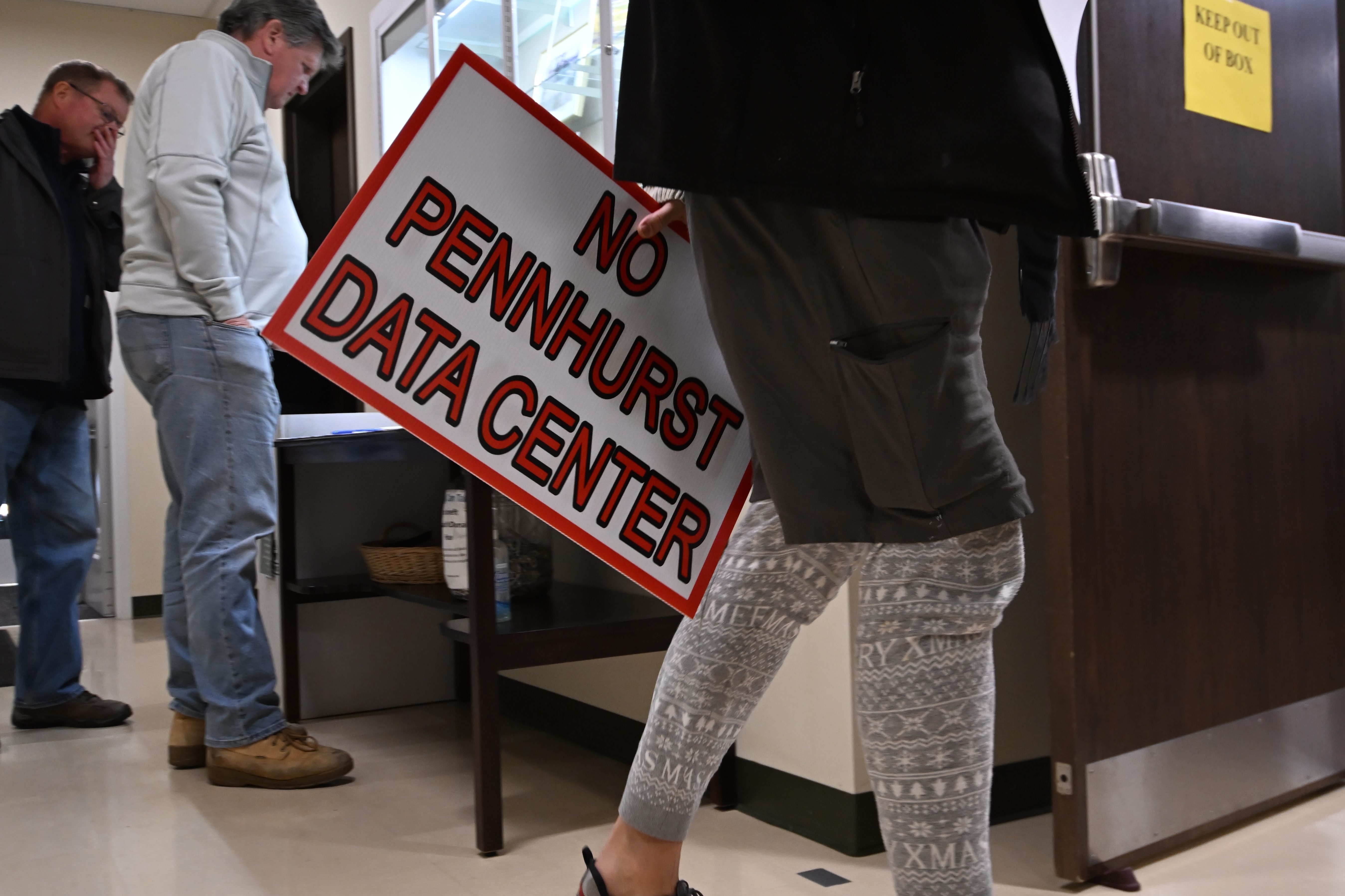
People sign in and head into an East Vincent Township supervisors meeting where an agenda item involved a data center proposal at the former Pennhurst state hospital grounds on Dec. 17, 2025, in Spring City, Pa. Marc Levy
Joanna Tenney, 36, of East Vincent in Chester County, held a sign at a June rally in the state Capitol that read: “Shapiro: Amazon’s bootlicker.” A registered Democrat, she voted for him in 2022, and believes he should be held accountable for supporting data center development in Pennsylvania that led to the fast-tracking of a now-stalled 125-acre data center project near where she lives.
She’s so fed up with Shapiro’s approach to data centers that she said will be writing in the name of her state senator, Sen. Katie Muth (D., Chester), who has been on the front lines of advocating for many state environmental issues, for governor on her November ballot. Tenney said she and a few other anti-data center advocates plan to run a write-in campaign for Muth.
“We’ve elected somebody that we thought was going to make the right choices by us, and we don’t really see that happening,” Tenney said.
Muth, who took office in 2018, said she would not be supporting Shapiro or “any elected official who puts the interests of Big Tech ahead of the health, safety, and future of Pennsylvania communities.”
If Shapiro changes his stance on data centers, she would support him, Muth said. She is the prime sponsor of a bipartisan bill to place a three-year moratorium on hyperscale data center development.
“Get right on the issue, Right your wrongs. If you can’t be on the side of science and people, my support is MIA,” she added.
Emily VanFleet, 26, lives in Archbald in Northeastern Pennsylvania, where six data center projects are underway comprising more than 50 buildings that, when completed, will cover 14% of the town. VanFleet, who is an unaffiliated voter, said she also supported Shapiro in 2022. But because of his public support for speeding up data center development in Pennsylvania, she is “certainly not going to vote for him this upcoming election,” she said. She isn’t sure she’s going to vote at all.
“I want Shapiro to stop being a coward,” VanFleet said in June. “I have emailed him, I have called him, I have reached out to him so many times. I have not heard back, not once. I see his videos all over social media that he has an open-door policy, but I have yet to see it.”
(In May, Shapiro’s administration announced that one of the unpopular Archbald developments, Project Gravity, was removed from a fast-track permitting program for failing to properly engage with the community.)
But negative attitudes toward Shapiro’s position on data centers may be limited statewide and his position is unlikely to dramatically knock down his high popularity or reelection odds: The June Quinnipiac poll found 56% of those surveyed approve of the way he is handling his job as governor overall, and recent polling shows Shapiro ahead 53% to 40% against his Republican challenger, state Treasurer Stacy Garrity.
The data center pitfall
Shapiro’s political opponents — both immediate and prospective — are also seizing on the issue.
Garrity, of Athens in Northeastern Pennsylvania, has also led a statewide listening tour on the topic. In June, she convened one of those sessions in Hatfield with a group of commissioners, zoning planners and emergency responders to talk about how they have been impacted by data centers. She blasted Shapiro for his role in attracting Amazon and said his proposed new requirements amount to a “flip flop.”
“Josh Shapiro has failed on this topic. He was the biggest cheerleader for data center development in Pennsylvania, until he wasn’t,” Garrity said at the June 24 meeting.
Pennsylvania Treasurer Stacy Garrity participates in the podcast “Ruthless” during an event hosted by Americans for Prosperity, Concerned Veterans for America, and the Libre Initiative at the National Constitution Center in Philadelphia on Jan. 29. Elizabeth Robertson / Staff Photographer
Garrity has her own mixed record on data centers.
At the time of the Amazon announcement, Garrity called the investment “great news” that would bring “historic investment” and “create thousands of jobs.” And her current position remains unclear. She has said she opposes a statewide moratorium but wants “a pause” on development instead.
Like Republicans running in districts that supported Trump in 2024 but oppose data centers, she appears to be attempting to find a pro-business and pro-regulation path.
“We want to make sure data centers are an addition to the grid, not a contraction. If there’s infrastructure that needs to be added to the grid, rate payers shouldn’t be paying for it,” she said. “I’m not opposed to data centers, but we have to do them the right way, and we haven’t done it. It’s because of a lack of leadership from the government.”
Garrity’s “long record of supporting completely unregulated data center development makes it clear that she just can’t be trusted,” said Manuel Bonder, a spokesperson for Shapiro’s campaign.
Local government leaders said at Garrity’s campaign roundtable in June that there has been lack of guidance around issues, especially around power demand, water use, infrastructure, environmental impacts, and community compatibility.
Kathie Doyle, a Republican on the Richland Township Board of Supervisors, said confusion around data centers have “set off a firestorm” in her community. Earlier this year, warnings of a supposed proposal for a data center in the Bucks County township circulated on social media, but turned out to be a “business park” with two buildings.
“Our residents don’t understand that we just cannot say no,” she said. Municipalities in Pennsylvania cannot outright ban data center development.
Santoro said Shapiro’s inconsistency is a liability that could sway some voters away from casting their ballot for him.
“Certainly he is giving her an ‘in’ by staying on the wrong side of this,” she said.
And it’s not just Republicans seizing on Shapiro’s position. The early reputation Shapiro earned as a champion of data centers may become a point of attack among other Democratic contenders for the presidency in 2028, too. In a veiled jab at Shapiro in June, Illinois Gov. JB Pritzker, knocked Pennsylvania on a businesspodcast for allowing Constellation Energy to restart Three Mile Island nuclear plant just to power Microsoft’s data centers.
“My guess is that’s going to be a reasonably unpopular thing to have done,” Pritzker said, without noting Shapiro by name on the Prof G Markets podcast.
Vulnerability for down-ballot Democrats
With a $50 million campaign war chest and high approval ratings, Shapiro is widely favored to win reelection this year. But his record on data centers could prove a liability for those he’s hoping to pull along, some advocates, like Santoro, say.
Shapiro has been staking much of his national political clout on his ability to flip four House districts in Pennsylvania for Democratic control of the U.S. House, drawing voters to the polls with his name at the top of the ticket. He’s also aiming to flip Pennsylvania’s Senate into Democratic control for the first time since 1993, giving him a Democratic trifecta in Harrisburg, as the state’s split legislature has blocked many of Democrats’ priorities from becoming law.
Santoro predicted that could be in jeopardy “if he does not change course.”
“Shapiro’s leadership on data centers will be the thing that costs us the first Democratic trifecta in 31 years, and I think that while he will likely win reelection with this wildly unpopular position on data centers, other elected officials and candidates will not,” she said.
Other Democratic candidates aware of data centers’ deep unpopularity are differentiating themselves on the issue, despite remaining otherwise aligned with Shapiro. Scranton Mayor Paige Cognetti, who is running in Pennsylvania’s 8th Congressional District, released a new ad last month putting data center developers on notice.
“Big Tech needs to pay their own way, not hide behind [nondisclosure agreements]. No tax breaks. Don’t raise our electric bills. Don’t poison our water. And hire local union labor,” she said, in the ad spot. “You can’t meet that? Then get out.”
Cognetti’s stance isn’t vastly different from Shapiro’s — both want to end blanket tax breaks — but her rhetoric is much stronger, and she’s putting the issue at the forefront of her campaign.
Democrats insist Republicans, including those running at the state level, don’t have the moral high ground on data centers after failing to pass through several measures that would have enacted stricter controls for their approval.
Sam Silverman, a former congressional aide and founder of Silverman Strategy Group, a strategic communications firm focused on technology and politics, said Shapiro’s approach to data centers — proposing a plan rather than enacting a moratorium — presents a risk that could either pay off and become the model for other states, or fail to fully address all future concerns and is unpopular.
“Shapiro is going out in front by proposing a bargain now. If the standards protect ratepayers, produce visible benefits, and hold bad actors accountable, Pennsylvania could have a model others can follow,” he said. “But because he is putting forward the deal now, he will be judged on whether it delivers.”
Taking a risk involves trust, though. Shapiro can afford to make a big swing at one of the hottest issues in politics because voters put so much faith in him, Silverman said.
“Most politicians do not have the amount of trust and political capital to take a risk, either,” Silverman said.
Whether the governor is triumphant will come down to what standards go into effect and whether bad actors are held accountable, he said, “and whether Pennsylvanians believe those standards are working.”
Chester County authorities believe that the shooting death of a woman in East Goshen Township on Friday was a suicide and that a 9-year-old girl also was wounded by gunfire.
“The child who was shot continues to recover from her injuries. As we announced on Friday, this was an isolated incident and there was no threat to the general public,” the Chester County District Attorney’s Office said in a statement Monday.
Police were dispatched just before 11 a.m. to the Summit House condominium complex on West Chester Pike for a reported shooting. Inside the unit, the officers found the woman, described only as in her 40s, dead from a single gunshot wound.
The girl was treated at the scene by paramedics and was alert and able to speak, said Chief David Leahy of the Westtown-East Goshen Police Department.
Police found a gun not far from the woman’s body.
An earlier version of this article incorrectly reported that the Chester County District Attorney’s Office said the girl was struck by the same bullet that killed the woman.
Before this year, many physicians at Lancaster General Hospital had only read about measles in textbooks.
But now, as they treat pneumonia and brain swelling in patients infected with measles during Pennsylvania’s worst outbreak in three decades, they’re rapidly becoming experts on a disease once considered eradicated in the United States.
“It feels surreal,” said physician Jeffrey Martin, the chair of the Department of Family and Community Medicine at Lancaster General Heath, which is affiliated with Penn Medicine. “You’re treating something you probably never saw before.”
Pennsylvania’s measles outbreak continues to spread across the state, with 18 counties affected as of Mondayand 232 cases reported this year, including more than two dozen in the Philadelphia region. Thirty-eight people have been hospitalized. In the last week alone, state health officials recorded 57 cases.
At the center of the outbreak, Lancaster County has reported 133 measles cases this year — 125 of them since April. At Lancaster General, physicians are treating mostly adults, including pregnant women.
About 35% of the state’s cases this year have been diagnosed in children, who are among the most vulnerable to serious complications. And many experts fear the risk of infection will rise when schools open beginning at the end of August.
Lancaster County has among the lowest vaccination rates in the state, with just 87.6% of kindergartners and 83.3% of 7th graders vaccinated against measles, well below the 95% immunization threshold required to prevent community spread of a disease so contagious that up to 90% of unvaccinated people exposed will become ill.
“I don’t want to be alarmist, but I don’t think we should be minimizing the risk,” said Lancaster County Commissioner Alice Yoder, a nurse who formerly worked as a Lancaster General administrator. “There will be a large number of children coming together every day, and measles is just extraordinarily contagious.”
Back-to-school this year is “a very scary time,” she said.
The outbreak increasingly poses a threat outside Lancaster, with several counties in central Pennsylvania reporting their first cases last week.
Suburban Philadelphia’s Chester County, which borders Lancaster County to the east, has seen 22 cases of measles so far this year. And local cases are higher than reported, officials there say, adding that some residents with measles have refused to cooperate with the health department’s efforts to trace their contacts.
Lancaster officials, too, say the outbreak has spread more widely than case counts indicate. “Every case we have, we know there’s another 10 or 20 behind it,” Yoder said.
Pennsylvania health secretary Debra Bogen speaks to the media at a press conference on the state’s measles response earlier this summer in Lancaster.Dana Munro
New infections may also be coming from other places. Lehigh County reported its first two cases in two siblings last week, according to St. Luke’s University Health Network.
The children, whose parents had opted against vaccinating them, had recently traveled internationally, St. Luke’s pediatrics chair Jennifer Janco said.
St. Luke’s doctors first saw the children on video to avoid exposing other patients at a clinic and worked with state health department staff to test them for measles at home.
“We don’t want someone with measles in a doctor’s office or urgent care waiting room,” Janco said.
Eventually, one of the children was hospitalized at another area health system after becoming dehydrated, Janco said. “They became weak and sick to the point of dehydration — they couldn’t take enough fluids by mouth,” she said.
Like Yoder, she is concerned about the threat to Pennsylvania children with the school year about to start.
“The risk is real. This isn’t measles halfway across the country,” Janco said. “And measles doesn’t care about county lines.”
‘Do it for your neighbor’
State officials for months have recommended accelerating the schedule for routine childhood measles vaccinations, giving infants their first measles, mumps, and rubella shot as early as six months.
State health officials say their staff have administered more than 2,000 doses of the MMR vaccine this year, with more than 1,300 provided in June and July alone.
At Lancaster General, Martin says he’s seen increased interest in vaccination from some parents who had previously refused MMR shots for their children.
“There does seem to be a message that resonates here, and that is, if not for yourself, do it for your neighbor. Get the immunization to protect the most vulnerable,” he said.
Still, he said, many county residents who are not connected to healthcare settings “vaguely hear there’s something going on with measles, but don’t fully understand we’re in an outbreak status.”
And information about the measles from county government officials has been scarce.
Yoder, a Democrat, said she has been unable to convince her fellow county commissioners, both Republicans, to publish more information about the outbreak and the importance of vaccination on the county website.
Josh Parsons, one of the Republican commissioners, did not return a call for comment on the outbreak.
Lancaster County Commissioner Alice Yoder has proposed forming a local health department to combat a growing measles outbreak in the area.Tyger Williams / Staff Photographer
And the county health advisory council, which makes non-binding health recommendations for the county, did not discuss the outbreak at its meeting last month, said Martin, who serves on the council.
State officials handling the outbreak have done “a fantastic job,” Martin said, but he believes stronger local health leadership couldhelp combat the outbreak with a better understanding of the “complexity and diversity” of the county and its attitudes toward public health.
Yoder says the county must do more to reach out to residents about the outbreak and has been advocating for Lancaster County to form a local health department.
“The local government is typically a trusted place for people to go to. It would be so important and beneficial for us to come out stronger about the importance of vaccination,” Yoder said.
For Miller, managing partner at Wapner Newman law firm, it sparked an idea.
Heconnected with NBC Sports Philadelphia and made his pitch: Wapner Newman could pay to sponsor the closer’s walk-out and get the firm’s branding on a viral moment. And fans at home would be able to experience Duran’s intro — complete with images of spiders crawling through fire on the outfield walls — during every home game.
The lawyers figured “it’d be a fun thing for everybody that’s watching the game,” Miller recalled during a recent interview in his Center City office. And “we can help make this happen.”
A deal was inked, with terms Miller declined to disclose, and for nearly a year, Wapner Newman has enjoyed greater name recognition.
Potential clients sometimes mention the ads when they call the firm, Miller said, and occasionally, strangers on the street recognize him from the company’s midgame commercials. Miller said he is most heartened by the fact that more Philly fans now know about the personal-injury firm if they ever need legal help.
Robert Miller, managing partner at Wapner Newman, appears in the law firm’s ads that run on NBC Sports Philadelphia during Phillies games.Courtesy Wapner Newman
Brands “want moments of exclusivity, and that was the highest-profile opportunity,” said Bo Koelle, vice president of sales for NBCUniversal Local, which includes NBC Sports Philadelphia. “Everybody’s looking at when [Duran] is coming out” — and seeing Wapner Newman’s name on the screen next to him.
For dozens of local companies, advertising with the Phillies at Citizens Bank Park or with NBC Sports Philadelphia provides almost-unparalleled visibility in a rabid sports town like Philadelphia.
Phillies fans arrive at Citizens Bank Park for opening day in March.Monica Herndon / Staff Photographer
So how much does this visibility cost? Anywhere from $100,000 to several million dollars, according to executives from the Phillies and NBC Sports Philadelphia.
That range includes advertising in the ballpark,on social media, or on TV, where hundreds of thousands of fans tune into each game. All Phillies sponsors with whom The Inquirer spoke declined to discuss how much they paid for their advertisements, citing the terms of their contracts.
The MLB All-Star Game at Citizens Bank Park drew 8.7 million viewers.Yong Kim / Staff Photographer
But even in a normal year, the Phillies play many more home games than the city’s otherpro sports teams.
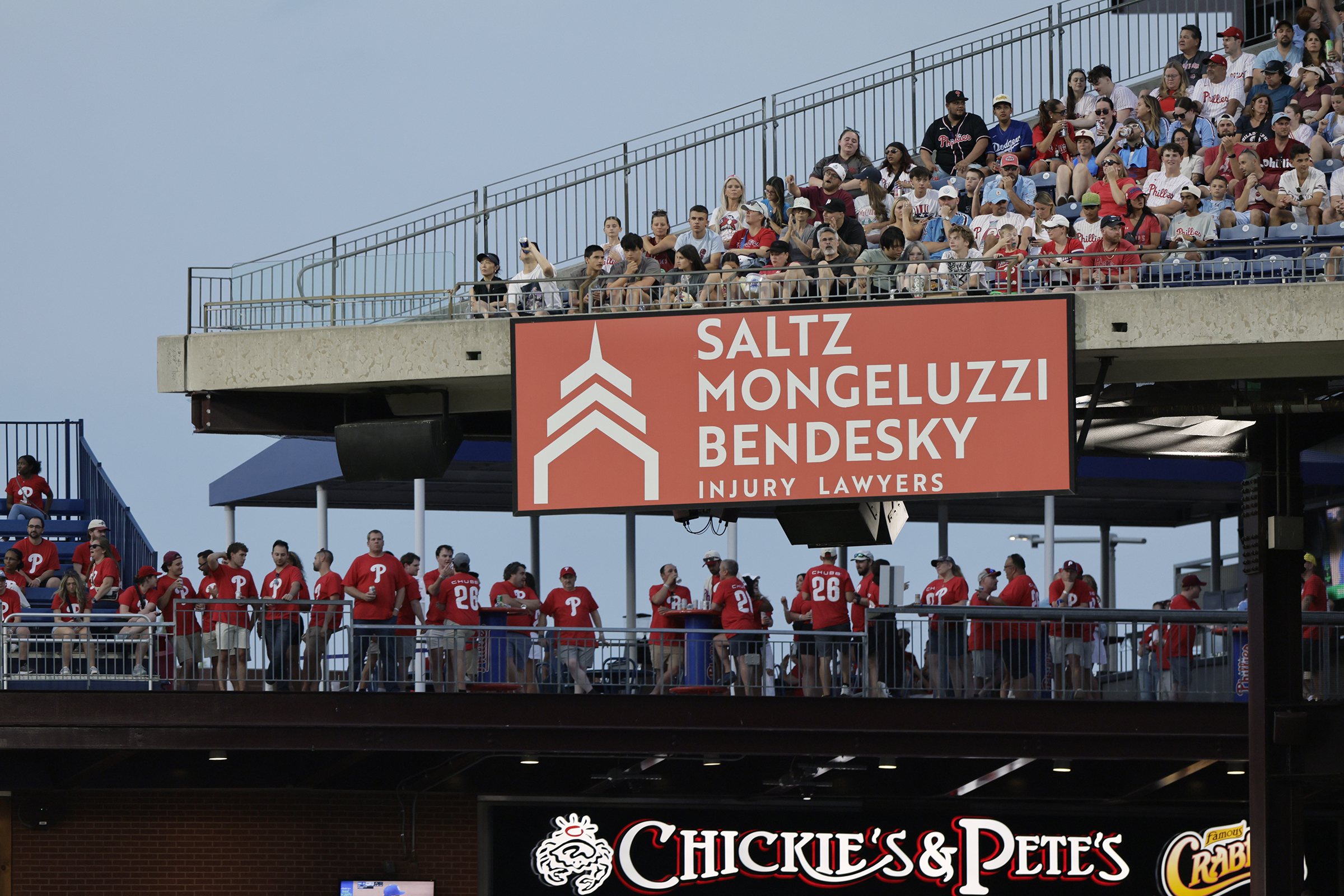
“We’ve concentrated on the Phillies because they have 81 home games and for our in-park advertising we thought we’d rather be seen more frequently,” said Bob Mongeluzzi, founding partner at Saltz Mongeluzzi Bendesky, which has several stadium ads including at the top of the scoreboard.
“I don’t think someone particularly chose us over any other lawyer just because we had an ad on the scoreboard,” Mongeluzzi said, “but it clearly reinforces our brand and keeps our name out there.”
Another Saltz Mongeluzzi Bendesky ad is pictured in right field at a July game.Elizabeth Robertson / Staff Photographer
Unique Phillies sponsorships drive revenue
Each season, the Phillies have between 75 and 100 sponsors who advertise everywhere — the ballpark’s giant scoreboard, the outfield walls, the premium seating sections — according to Brian Fling, the Phillies’ vice president of corporate partnerships. He said ad sponsors serve as a major revenue driver, supporting player payroll and ballpark upgrades.
The blue Independence Blue Cross (IBX) sponsorship patch is seen on the arm of Kyle Schwarber during a June game.Yong Kim / Staff Photographer
One recent ad deal stood out due to controversy. In March, Eileen Kalas, widow of legendary Phillies broadcaster Harry Kalas, said the organization “betrayed” her husband by selling the naming rights of Harry The K’s to Ghost Energy. The eatery under the scoreboard had been named for her husband since the ballpark opened in 2004.
At the time, Ghost Energy founder and West Chester native Ryan Hughes responded to fan criticism, saying, “We’re hoping to bring some new energy to the space while also never forgetting Harry Kalas and the legacy that he left.”
Ghost Energy did not return a request for comment for this article.
Fans at the Ghost Energy Deck, formerly Harry The K’s, during a March Phillies gameYong Kim / Staff Photographer
Whether a Phillies advertiser is a longtime sponsor dating to the Veterans Stadium days or a newer partner, they “align with the team’s goal — championship-level baseball in a first-class ballpark where everyone feels welcome,” Fling said.
An ad for Doc Bresler’s Cavity Busters and the Xfinity pitch speed clock light up the ballpark behind Phillies closer Jhoan Duran.Elizabeth Robertson / Staff Photographer
“Pitch speed is one of the most closely watched real-time statistics in baseball, making it a strong fit for Xfinity’s focus on delivering fast, reliable connectivity for our customers,” Matt Lederer, Comcast’s vice president of brand partnership, said in a statement.
Executives with several Phillies advertisers said the goal is not necessarily to gain customers on the spot. Instead, they said, they want to increase brand awareness and get fans to associate their company with a beloved hometown franchise.
Some have seen tangible signs that this is happening. Philadelphia Insurance recorded a nearly 50% increase in website traffic since it started sponsoring the premium seating club, formerly known as the diamond club, earlier this season, said Brian O’Reilly, chief marketing officer for Philadelphia Insurance Cos. (PHLY).
As part of the partnership, the company’s name and Liberty Bell logo are emblazoned on the blue headrests behind home plate.
“It was amazing how many people texted and called me and said, ‘I saw Philadelphia Insurance during the Home Run Derby or All-Star Game,’” O’Reilly said.
The headrests in the Philadelphia Insurance Club behind home plate bear the company’s logo and the name of its website. Elizabeth Robertson / Staff Photographer
Philly sports ads create consumer ‘trust’
Some Philly companies sponsor multiple local pro teams.
Independence Blue Cross (IBX), the locally based health insurer, has been advertising with the Phillies for decades and has partnerships with all of the city’s major pro sports teams, many of the college teams, and NBC Sports Philadelphia, said IBX chief marketing officer Koleen Cavanaugh.
In addition to advertising, this also gets IBX the ability to host events at stadiums, offer ticket and merchandise discounts to IBX members, and collaborate on philanthropic partnerships, such as a back-to-school supply drive with the Jesús Luzardo Family Foundation last week.
The team “already reached out to us about season tickets and advertising,” said O’Reilly, of Philadelphia Insurance. “We were doing some business with them anyway, but maybe we’ll even do some more.”
At NBC Sports Philadelphia, conversations about Sixers ad partnerships are now underway, earlier than usual, Koelle said. As soon as James news broke, the value of SixersTV ads increased exponentially, Koelle said.
A challenge for the sports network now, Koelle said: Remaining loyal to companies who’ve sponsored Sixers broadcasts since the team’s rebuilding years — and not jack up those partners’ advertising rates.
”But for those that are new, they’ll certainly have to pay the new value,” Koelle said.
Usually, it’s not hard to convince local companies of the value of advertising with any Philly team, he said.
“If [advertisers] want to truly reach people — and reach them in a pipeline that is direct and meaningful — it’s professional sports in Philadelphia,” Koelle said. “If you want people to trust your brand immediately, it’s a great way of doing it.”
Oxford officials are inching closer to disbanding the borough’s century-old police department and joining a regional law enforcement agency, as increasing costs of maintaining the local force have outpaced revenue. But the plan has prompted worries from some residents.
The seven-member borough council will review final agreements to join the Southern Chester County Regional Police Department at its Aug. 17 meeting, where officials are poised to cast their final vote to move ahead with regionalization.
First responders represent some of the most expensive parts of a municipality’s budget, between salaries, health insurance, and pensions, as well as facilities and equipment costs. Oxford will join a smattering of other area municipalities that have moved to regionalization as a way to save money.
But the prospect has sparked concerns in the community of roughly 5,800 people. Some fear that dissolving the borough’s department will increase emergency response times and potentially leave the municipality unprotected. And they worry about losing the officers who have grown up alongside them and understand their community. Some residents have called on the township to try to save the department by cutting costs in other ways.
“These are people that literally would pull my kid over, give him a ticket, and ask how his dad is when he had cancer,” Oxford resident MaryAnn Riess said. “This is personal. This is a small town. These guys, all 11 of them, mean something to us. We buy them coffee. We buy them doughnuts. They are part of our extended family. This matters to us, and how they’re being treated matters to us.”
Mayor Phil Harris does not disagree. But he says it is becoming impossible to maintain the department at its current level — let alone increase salaries or staffing.
“We all want the same thing. I want our officers in a different uniform in our town doing the same job, with more equipment and more access to the tools they need to continue to perform at a very high level,” he said. “That’s the goal.”
Years of deliberation
When Oxford’s council casts its vote later this month, it will be after more than three years of studies and evaluations, the township said.
In 2023, leadership found its police department — which consists of a police chief, 10 full-time officers, and several part-time officers — was the borough’s largest operating expense. It accounts for about half of the borough’s expenditures, with more than $2 million budgeted in 2026 for police.
Meanwhile, the borough’s revenues were not keeping pace. Officials began exploring how they could sustainably provide public safety services long-term.
Original fiscal forecasts were quite “bearish,” Harris said. But even when the borough performed better than earlier projections, the writing was still on the wall, he said.
Its higher revenue was in part thanks to an influx of new homes with higher-than-expected earned income tax. But the largest indicator of why revenue rose was a 21% tax increase during the same period.
“We’re seeing the operational and the structural imbalances continue within the police department,” he said. “We’re struggling on the operational side to be able to maintain what we currently have.”
A July analysis from Keystone Municipal Solutions found that though Oxford’s financial status had improved, it levied the second-highest millage rate in the county, increasing by 21% since 2023, compared with the average of 12% across the county. Additional raises were seen as “counterproductive to the growth necessary for long-term fiscal stability.”
The analysis evaluated five possible service alternatives: keeping the borough’s department, restructuring the existing department, reducing staffing and supplementing coverage with Pennsylvania State Police, relying entirely on the state police, and merging with the Southern Chester County Regional Department.
At its July 29 meeting, the borough council voted 6-1 to authorize the council president, borough manager, mayor, and solicitor to negotiate with the regional department. They will present those agreements to the full council in August.
If the council votes in the affirmative, the borough will join New Garden, West Grove, and Avondale in the regional department. Formed in 2017, the department employs 21 full-time officers.
It is projected the regional department would add 12 more officers with the inclusion of Oxford. Oxford would receive 24-7 police services, with at least two officers on patrol at all times, like the current structure.
Harris said the goal is for every officer who wants to go to the regional department to do so. But there are protections and a path for those who do not.
Oxford is a ways further west from its partners; the borough is up to 16 miles away from them.
To keep response times low, the borough would have a substation — though likely not in Oxford’s existing police building — with cars in the borough. Officers would start and end the clock within Oxford’s boundaries, so there would be no shift-change gaps. They hope to retain the administrative assistant and have a lieutenant stationed on duty at the substation, Monday to Friday.
Officers would get new uniforms, the cars would be relabeled, and Oxford’s assets would become part of the regional department’s assets.
According to the report, after an increase in costs associated with up-front transition costs in 2027, annual savings would range from $300,000 to $320,000 “before declining slightly toward the end of the projection period.” The report estimates cumulative savings through the projection period at approximately $1.4 million.
“What you get by regionalizing is the economy of scale,” Harris said. “You get stability across those lines, and it’s predictability — and you can spread things out, and you can plan.”
More regionalization
The Southern Chester County Regional Department is part of a broader swell across the state of municipalities utilizing regionalized services to slash expenses, said John Brenner, executive director of the Pennsylvania Municipal League.
You would be “hard pressed” to find a community that spends less than 50% of its budget on public safety, he said. And those costs continue to rise.
“That puts pressure on local officials again to say, ‘OK, what is more efficient here? Is there a better way to do this?’ And I think a number of local officials throughout the state have said, ‘You know what? Regionalization might make a lot of sense,’” he said.
It is not a perfect solution: Across the state, municipalities have joined and then withdrawn from regional services due to increasing costs under the agreement, according to the analysis by Keystone. Similarly, Kennett Square pulled out of the regional fire and emergency services commission that it had helped start after costs soared too high. It rejoined the commission earlier this year, having not found a cheaper alternative.
In Chester County, some municipalities contract out with their neighbors’ forces. Oxford tried to embrace such a model, but its closest neighbors have relied entirely on the Pennsylvania State Police for public safety, at zero cost. Contracting Oxford’s force was an expense those communities could not take on.
Across Chester County, more than 20 municipalities rely on the state police for full coverage. Around a dozen others use partial coverage.
But that was not a direction Oxford wanted to go. While the state police do a “great job,” they are “not a community-based police department,” Harris said.
“We were desirous of having a community-based police department that operates in a different model, that knows the neighbors, that knows the streets, that goes out to the festivals, that shakes the hands and goes to the schools and the nonprofits,” he said. “We felt like the [regional department] brings that model and it maintains that standard.”
Residents are concerned
Danny Graham grew up running around town with the men who would go on to become police officers in Oxford. There is a distinct “hometown” feeling to the force, he said. It feels like the officers know what to do, how to calm people down. And they respond almost immediately, he said, recalling an incident outside his home when they were there within 2.5 minutes.
Serious crime — such as larceny or violent crime — was “not prevalent,” according to the report.
But residents worry about what regionalization will do to that community culture and speed of response.
In response, Graham created Save Oxford Police, a Facebook group that amassed nearly 1,000 members in recent weeks. A Change.org petition calling for saving the department has accrued hundreds of signatures.
He said he did not understand how the borough could have enough cash flow for other expenses, but would not invest in the department.
“Something stinks in Oxford, and we’re trying to find that smell,” he said.
He hopes that, if enough people come to the Aug. 17 meeting, they can shut the regionalization effort down by postponing the vote, with the hope something could come up in the interim to save the department.
But, if not that, “it’s no longer Save Oxford Police. It’s Save Oxford Police Officers, because now that means more than the department itself,” he said.
Riess, who believes the Oxford police force is a greater extended family for the borough, said that sitting out on the patio at a restaurant recently, her group watched an officer test each business door, making sure they were locked.
“Do you really think that’s going to happen [with regional]?” she said.
“I’ve never seen regional do that, but I haven’t seen any officers really do that. Except Oxford,” Graham said.
This suburban content is produced with support from the Leslie Miller and Richard Worley Foundation and The Lenfest Institute for Journalism. Editorial content is created independently of the project donors. Gifts to support The Inquirer’s high-impact journalism can be made at inquirer.com/donate. A list of Lenfest Institute donors can be found at lenfestinstitute.org/supporters.
A woman was killed and 9-year-old girl was wounded in a shooting at a home in East Goshen Friday morning, according to Chester County investigators.
Officers from the Westtown-East Goshen Police Department were dispatched just before 11 a.m. to a unit at the Summit House condominium complex on West Chester Pike for reports of a shooting, Chief David Leahy said.
Inside the unit, the officers found a woman in her 40s dead from a single gunshot wound, he said. Authorities did not release the woman’s identity. The girl, who was also shot, was treated at the scene by paramedics, and was alert, conscious and able to speak with investigators, he said.
Investigators found a gun not far from the woman’s body that they believe was used in the shooting.
There was no information available on a motive or a potential suspect in the case.
District Attorney Chris de Barrena-Sarobe said there is no threat to the public, and declined to comment further, citing the active investigation.
“We have just as many questions as you do, and we don’t want to put out any incorrect information,” de Barrena-Sarobe said.
He said his heart goes out to the family of the victims.
The company also has named new directors with long retail and digital experience, replacing those who oversaw the company under billionaire media investor John Malone.
With over 1,000 employees at its broadcasting campus, once one of Chester County’s top tourism draws, QVC has struggled with the decline of television and the fragmentation of digital media.
George said in a statement that he is excited to reconnect with company veterans and to work with the new board. He promised “innovative shopping experiences” and better investor returns during the search for his permanent replacement.
Having cut its crushing debt load in its bankruptcy reorganization, QVC still faces the challenge of adding young shoppers at a time when retailing has spread across social media platforms, streaming apps, and global e-commerce sites.
QVC said it has emerged from Chapter 11 after cutting its debt load by over $5 billion and gaining access to $600 million in new credit.
The stock will re-list on Nasdaq under trading symbol QVCG, replacing pre-bankruptcy shares that traded below $1 just before the bankruptcy.
David Rawlinson was CEO of the QVC companies from 2021 to 2026 as the West Chester remote-shopping group struggled with shoppers’ migration to social media, logistics challenges, and financial stress.Qurate Retail Inc.
The company filed for bankruptcy protection in April after years of losses and cost cuts. Those included the shutdown of rival-turned-affiliate HSN’s Florida campus last year. The companies had merged in 2017.
The new financing is provided by hedge funds specializing in corporate turnarounds, led by Connecticut-based Strategic Value Partners LLC, whose past focus includes natural gas and building materials companies and the 2022 relaunch of airline Aeromexico and Los Angeles-based Oaktree Capital, a unit of Canada-based Brookfield Corp.
Pennsylvania’s school pension fund, PSERS, is an investor in Oaktree. The New Jersey Division of Investment, which manages state, school, and local-government worker pension funds, is an investor in Strategic Value Partners.
In a parting statement, Rawlinson praised “the resilience, commitment and execution our teams have demonstrated,” along with customers and investors. He noted QVC was “a TikTok Shop Seller of the Year for 2025″ and has been growing its streaming-media business rapidly. He added that it’s the “right time” for him to move on, and “I can think of no one better qualified” than George to take over.
George departed after initiatives including his acquisition of Seattle online-shopping network Zulily failed to generate profits. Rawlinson shut the division in 2023.
A fatal fire at QVC’s main warehouse in North Carolina during the 2021 Christmas season worsened COVID-era shipping delays early in Rawlinson’s tenure, making it tougher to pay down debt and endure the costs of new programs.
George is a past chairman of the National Retail Federation, currently chairs the National Constitution Center in Philadelphia, and is a board member at AutoZone and Ralph Lauren. He was an executive at Dell Computer and McKinsey & Co. before joining QVC, and will chair the new board.
Gone from that board are longtime allies of media billionaire John Malone, who invested in QVC in the 1990s, bought control of the company from Comcast in 2003, and had served as chairman. He left the board last year. His son Evan, a Philadelphia entrepreneur, and other longtime QVC board members have been replaced.
Besides George, the new QVC board members are:
David Charles Boone, CEO of Michaels stores
Nicolas Le Bourgeois, a former Amazon and TikTok Shop executive
Jason Lee Horowitz, ex-head of marketing at Mattel
A bridge replacement near Downingtown will stretch into next year, prompting a call to Gov. Josh Shapiro’s administration about the extended closure’s impact on traffic flow through the borough and the sequencing of other projects — including another bridge replacement.
The elongated timeline is, in part, thanks to a change in the foundation design. After the original bridge was demolished, the Pennsylvania Department of Transportation found a different type of rock from what was anticipated, which required a new design, said Helen Reinbrecht, community relations coordinator for the department.
The department expedited a redesign, which was completed in June. Construction is anticipated to be a bit slow into early August, as PennDot awaits proprietary materials, Reinbrecht said.
Deuso said in a news release Tuesday that the public was prepared for a one-year closure of the Boot Road bridge, but that the extended timeline is “a serious failure with real consequences for everyone forced through Downingtown each day.”
“Our roads, intersections, emergency routes, business district, and residents are paying the price,” she said.
She requested a review of whether additional crews, work shifts, equipment, and engineering support could make up for the lost time, and asked for help addressing traffic signal adjustments, detour enforcement, pavement and bridge condition monitoring, emergency-response planning, “and assistance with extraordinary local public safety and infrastructure costs.”
Following Deuso’s letter, PennDot press secretary Alexis Campbell said that the department “understands how vital the Boot Road Bridge is to the community and is expeditiously working to reopen the bridge as soon as possible.”
“The Department expedited the new design of the bridge and is working with the contractor to accelerate construction by adding additional crews and working through the winter so long as the weather permits,” she said.
That will not get underway until the detours from Boot Road and another effort — relocating the Downingtown train station half a mile to the east, where the Keystone Corridor crosses U.S. Route 322 — are completed, borough officials said. Deuso was concerned the Boot Road delays would also hamper the train station relocation.
The Boot Road bridge replacement is a $13.3 million project that replaces the 193-foot three-span bridge with a 105-foot single-span structure. It carried roughly 12,000 vehicles a day before its closure, officials said.
The full closure of the road, between Quarry Road and Southwind Lane, began in late September 2025. Motorists are being detoured to U.S. Route 322, Business U.S. Route 30, and Quarry Road. That is expected to continue until the work is fully completed next spring.
The bridge was structurally deficient, Reinbrecht said.
“I know it can be frustrating and time-consuming to have to use the detours. But this really will be safer and more efficient when the construction is completed,” she said.
This suburban content is produced with support from the Leslie Miller and Richard Worley Foundation and The Lenfest Institute for Journalism. Editorial content is created independently of the project donors. Gifts to support The Inquirer’s high-impact journalism can be made at inquirer.com/donate. A list of Lenfest Institute donors can be found at lenfestinstitute.org/supporters.