Barry Roberts, 45, entered the plea to burglary this week in a negotiation with prosecutors that will see the remaining charges, including conspiracy and theft, withdrawn at his sentencing in January.
His attorney, Taylr Coben, did not immediately return a request for comment.
Roberts and another man, Davon Terry, forced their way into a home on Rhodes Avenue on April 8 in a plot to steal sneakers inside, according to the affidavit of probable cause for Roberts’ arrest.
Terry, 35, died in a fire that broke out during an hours-long police standoff after the burglary was reported, according to investigators.
The home targeted by the two men belongs to Michael Robinson, a former Radnor Middle School paraprofessional. At the time of the burglary, Robinson was in custody, awaiting extradition to Tyler, Texas, on an arrest warrant for allegedly sexually assaulting a 15-year-old boy.
Robinson remains there, awaiting trial, court records show. He has denied the allegations.
On the day of the burglary, Robinson’s girlfriend said she saw on a Ring doorbell camera that two masked men were forcing their way inside the home, the affidavit said. During the break-in, the document said, they passed a black handgun back and forth to each other.
The woman, who was not at the home when the burglary took place, called 911.
When police arrived, the burglars barricaded themselves in the home, investigators said, prompting a response from SWAT team members and other local agencies.
During the standoff that followed, the officers threw a tear gas canister into the home, and a small fire broke out, the affidavit said. No shots were fired during the incident.
Roberts eventually crawled through a basement window in the home and surrendered, according to the affidavit.
Inside the home, investigators found a black handgun that matched the weapon both men were seen holding in the Ring camera footage, the document said.
Terry was found dead inside. The county medical examiner ruled the cause of his death was smoke inhalation, a county spokesperson said Wednesday.
Thomas R. Suozzi, a Democrat, represents New York’s 3rd Congressional District in the U.S. House of Representatives.
The ugly attempt to intimidate Jewish-owned businesses in Philadelphia backfired spectacularly on Sunday. Organizers hoping to drive Jewish and Israeli-associated restaurants out of the city were met by hundreds of Philadelphians who turned out to support the very businesses being targeted. Customers lined up outside restaurants, elected officials condemned the boycott, and ordinary citizens sent an unmistakable message: Antisemitism has no place in the City of Brotherly Love.
That is something worth celebrating. But we must not mistake the failure of one hateful demonstration for the defeat of the hatred that inspired it. We must remain vigilant.
Restaurants targeted
“No business for Zionists! These Zionist establishments must go! Not in our city!”
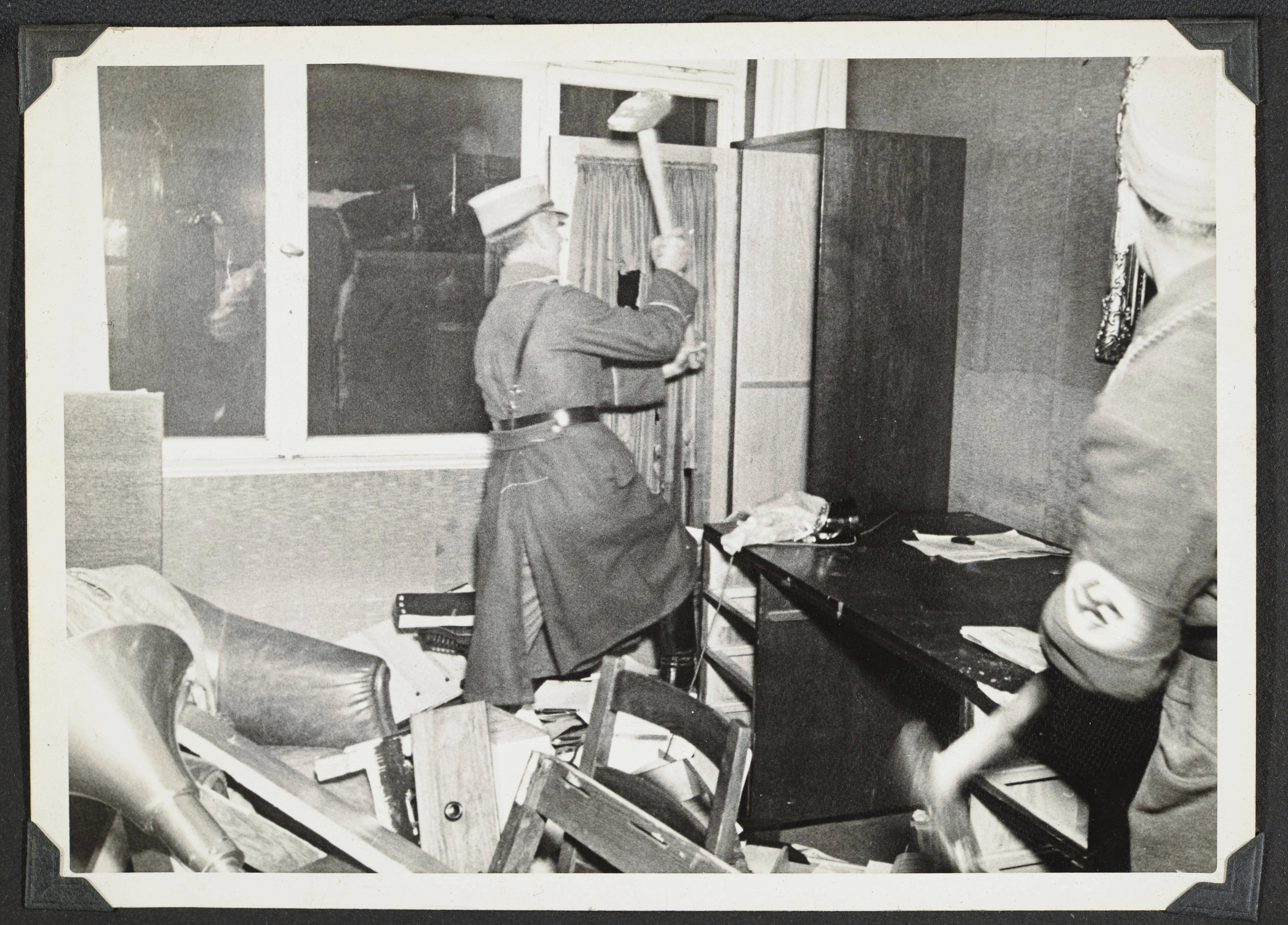
The timing was particularly chilling. The demonstration occurred on the eve of the anniversary of Kristallnacht, the infamous Night of Broken Glass, when Nazi mobs attacked Jewish people, businesses, homes, and synagogues across Germany and Austria on Nov. 9 and 10, 1938.
Nazis ransack Jewish property during Kristallnacht on Nov. 10, 1938. A boycott of Jewish businesses in Philadelphia was scheduled on the anniversary of the antisemitic rampage in Germany. / AP
Years earlier, in 1933, the Nazis organized a nationwide boycott of Jewish businesses, seeking to isolate Jews economically and socially and mark them as outsiders in their own communities.
We should not equate Sunday’s protest with the Nazi atrocities that followed. But the disturbing resemblance between calls to boycott Jewish businesses then and demands to drive Jewish-owned establishments out of Philadelphia today cannot be ignored.
History teaches us that hatred does not begin with concentration camps. It begins when ordinary people are singled out, dehumanized, and told they do not belong.
I understand something about the destructive power of prejudice because of my family’s experience.
My father, Joseph Suozzi, came to America from Italy as a young boy. He became a decorated World War II hero, serving as a B-24 bomber navigator and earning the Distinguished Flying Cross. After the war, he attended Harvard Law School on the GI Bill, graduating in 1948.
Despite his extraordinary qualifications, New York City law firms refused to hire him. Anti-Italian prejudice closed doors that his service, sacrifice, and education should have opened.
He persevered, eventually becoming a respected judge on New York’s highest trial court and later its appellate division. He taught me that America’s promise of opportunity means little if discrimination determines who belongs.
That lesson has guided my public life.
Throughout my years in Congress, I have fought antisemitism and stood firmly with Israel and the Jewish American community. In 2019, I cosponsored legislation opposing the global Boycott, Divestment and Sanctions movement, known as BDS, and spoke against it on the House floor.
Right to worship
More recently, I helped lead bipartisan legislation, the Right to Worship Act, to protect Americans from intimidation when attending religious services. No American should fear going to a synagogue, church, mosque, or any other house of worship.
Americans have every right to criticize the Israeli government, advocate for Palestinians, and engage in peaceful political protest. Those freedoms are fundamental to our democracy.
But there is an enormous difference between criticizing a government and targeting American business owners because they are Jewish or presumed to hold particular beliefs.
They demonstrated the best of America. But Sunday’s events also reminded us how easily ancient prejudices can resurface in modern political movements.
Philadelphia is where our founders proclaimed that all people are created equal. Its citizens showed that they will not stand by while their Jewish neighbors are threatened or intimidated.
That same spirit must prevail throughout America.
We cannot condemn the antisemitism of the past while tolerating its warning signs in the present.
The late U.S. Rep. Tom Lantos, the only Holocaust survivor to have served in Congress, reminded us: “The veneer of civilization is paper thin. We are its guardians, and we cannot rest!”
We cannot rest. We must recognize that“never again” must mean something. And it must mean something now.
Washington Square’s destination for the most erudite of coffee aficionados is saying thank you, thank you, and goodbye — but not for long.
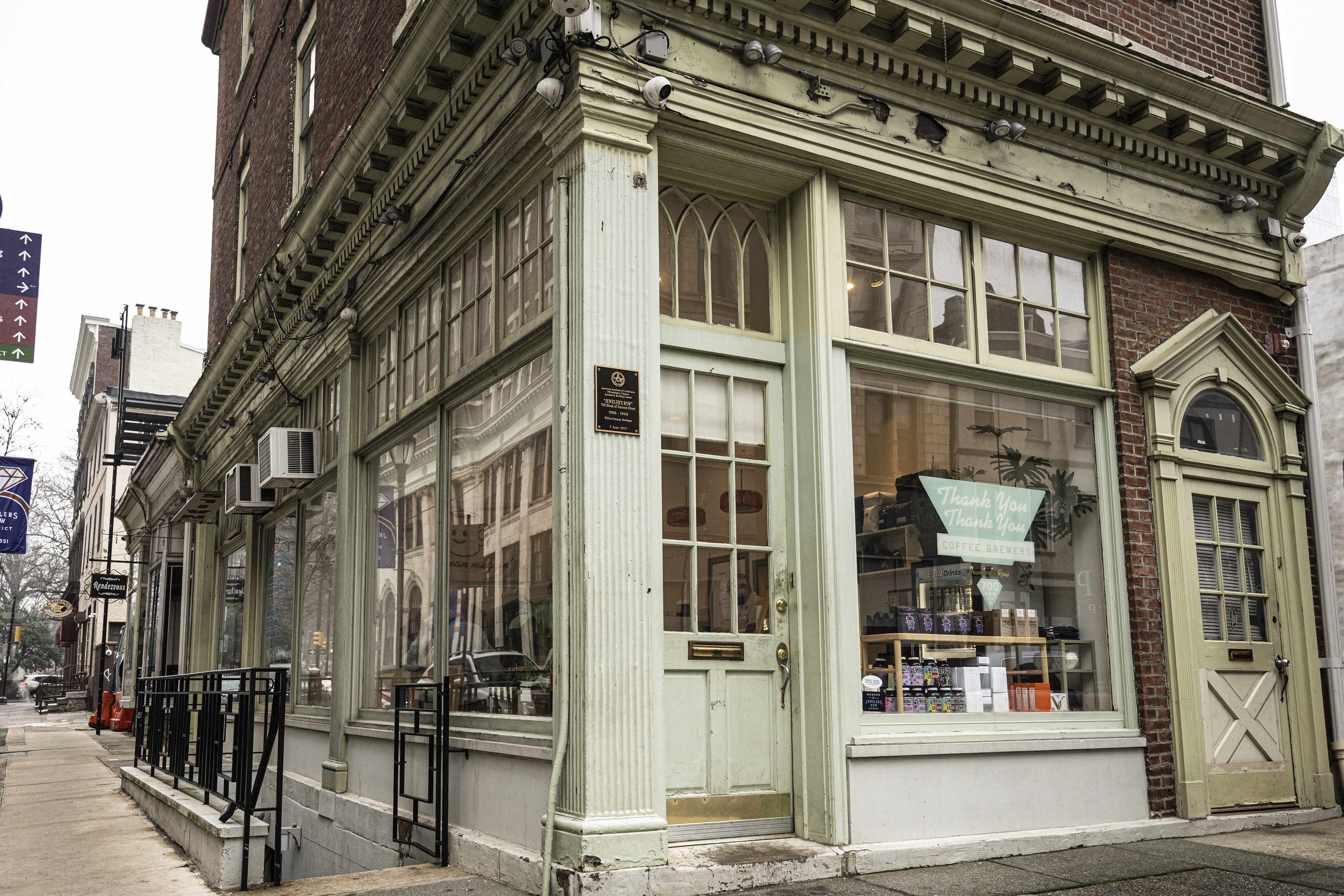
Coffee shop Thank You Thank You opened in a 300-square-foot space at 700 Sansom St. in May 2021 and quickly developed a citywide reputation for its vast inventory of beans from an array of international roasters.
After five years, the shop’s last day of service on Jewelers Row will be Dec. 23.
But if all goes as planned, Thank You Thank You’s loyal following won’t have to wait long to get an expertly brewed espresso from a far-flung roaster. OwnerCody McGregorhopes to open a new cafe at 2401 Washington Ave. by early January.
The new Graduate Hospital location will be about eight times the size of the Sansom Street storefront.
“We’re going to do everything that we’ve always wanted to do but that we didn’t have the space for,” said McGregor. “So in some ways, this is a blessing in disguise.”
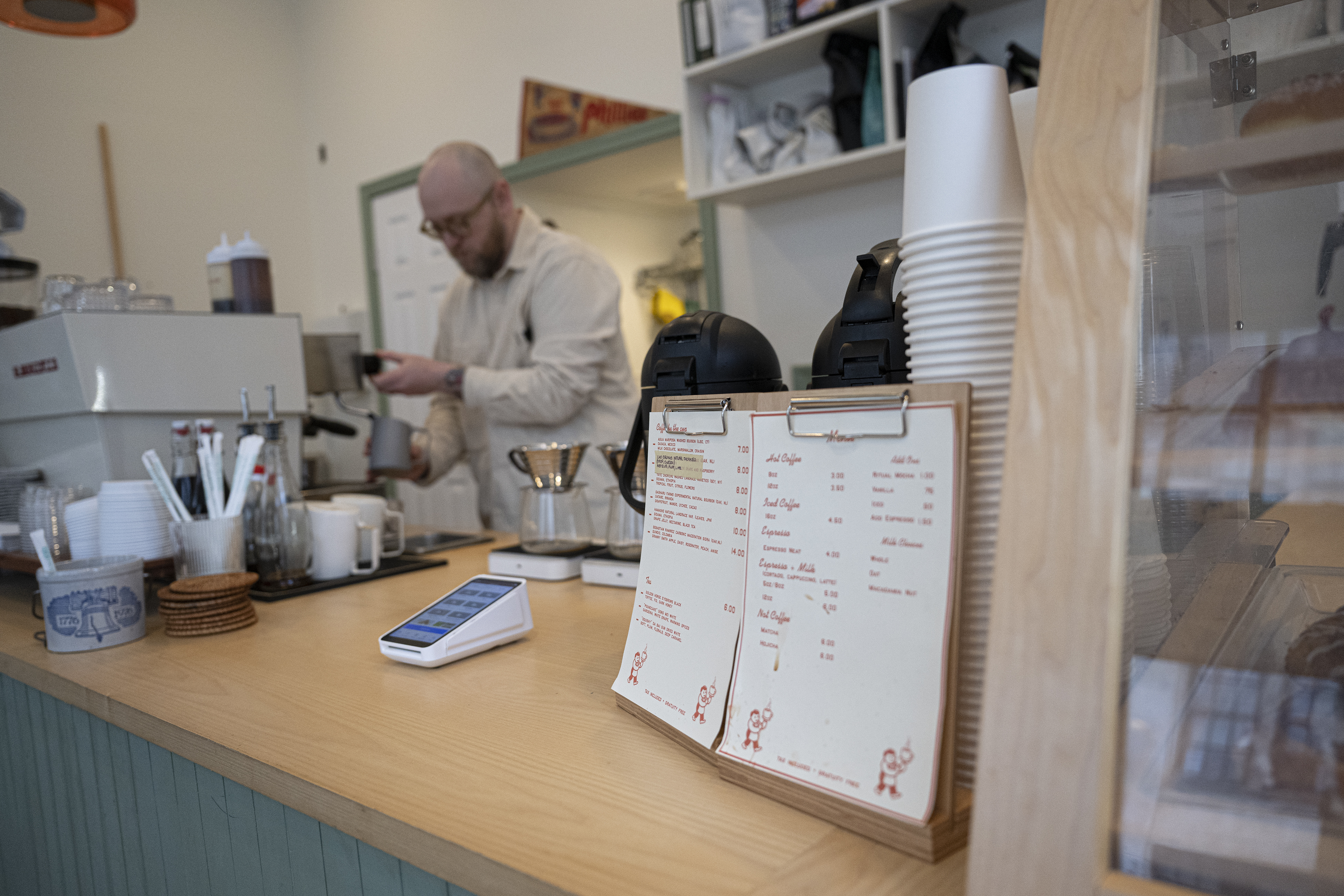
A one-and-one espresso coffee is shown at the Thank You Thank You Coffee Brewers on Jan 24, 2024. Jose F. Moreno / Staff Photographer
McGregor said the decision to close the Jewelers Row shop was prompted bysigns that long-delayed construction on a 99-unit, 35-story apartment tower on the vacant lot next door may soon go forward. That lot, once owned by Toll Brothers, is currently owned by Philadelphia-based developer Pearl Properties, which recently purchased Thank You Thank You’s building at 700 Sansom St., as well as two other historic buildings on the 100 block of Seventh Street. McGregor’s landlord notified him of the sale in late September.
“After talking with the people running the project for Pearl Properties, it seemed untenable to continue business as usual through the construction of it,” he said.
Luckily for fans of Thank You Thank You, McGregor signed a lease in March 2025 on a 2,100-square-foot space at 2401 Washington Ave. — a newly constructed four-story, 28-unit building — for what he initially thought would be a second location. He was familiar with the Grad Hospital neighborhood from two years spent working at the Ultimo Coffee shop near 22nd and Catharine. (He left for a job doing quality control and education at ReAnimator Coffee.)
Work has been underway on the would-be second location for over a year, but had been delayed by various life events, including the birth of McGregor’s daughter.
Thank You Thank You will benefit from more roomin more ways than one.McGregor said the original space was at times so busy that making coffee could feel like a “conveyor belt experience,” something he hopes to avoid in the future.
“The larger working space will allow us to finally push further into creative and inventive, cocktail-style signature beverages,” he said.
The new premises will also allow the shop to show off its bean collection. “We’ve been slowly amassing an archive of our favorite coffees that we’ve kept frozen,” he said. “This will allow us to serve a large back catalog of the best coffees we can find ranging back years, similar to a wine cellar.”
McGregor has an expansive view of coffee, and wants to continue to bring in beans from roasters like Tim Wendelboe from Norway, Drop from Sweden, Koppi (also from Sweden) and Heart from Oregon — all of which he first encountered as a customerat Budin in New York. He has developed relationships with all of those players and more over the years.
Besides its international inventory,Thank You Thank You has a particular way of pulling espresso that is “outside the typical parameters of Italian-style espresso. It’s clarity-focused, with a longer brewing ratio.” In other words, Thank You Thank You’s espresso is made with more water and a different level of pressure than is typical, resulting in“a flavor profile that is more bright, clear, and alive.”
Cody McGregor prepares an espresso at Thank You Thank You Coffee Brewers on Jan 24, 2024.Jose F. Moreno / Staff Photographer
In addition to walk-in service in Grad Hospital, McGregor is planning an appointment-only coffee bar focused on slow pours of coffee, largely inspired by Now and Then in Nashville. “You’ll book a time slot where you’ll sit and have someone walk you through the process [of brewing]. It’ll be more personalized,” he said. “I want to create an environment that feels appropriate to the levels of coffee we’re serving.”
The shop will continue to highlight roasters and producers of terroir-driven coffees imported from all over the world. McGregor also plans to host community tasting events, coffee producer and roaster spotlights, and brewing workshops for home enthusiasts at the new location.
“It’s all about championing the stories of the people who make this global commodity so cool,” he said.
Madeline “Mima” Kohn’s late grandmother, Esther Rasch, grew up in Săcel, Romania, a small village once home to a vibrant Orthodox Jewish community.
But like many Jewish Europeans during the Holocaust, Rasch was stripped of her citizenship, forced from her home, and deported to Auschwitz with her parents and nine siblings.
Only she and five of her siblings survived.
An image of Madeline “Mima” Kohn wearing a traditional Maramures outfit in Breb, Romania. (Still image from “I Don’t Know What I’m Doing Here”).Courtesy of Jacob Pincus
After World War II, Rasch migrated to Hillside, N.J., in the late 1940s. She died in 2007 when Kohn was 3 years old, leaving her granddaughter with only faint memories of her.
“I was very close with my Jewish community. That history was really important, but I didn’t actually know anything about their lives before they came to the U.S.,” Kohn, 23, said. “They just appeared here one day, and I think subconsciously, I was exploring that.”
Growing up in Lower Merion, Kohn learned about her grandmother through stories told by her mother, Monica Rasch. But when her mother died in 2015, Kohn lost another connection to her family’s past.
What remained were 50 photographs of her grandmother and a nine-hour video documenting Esther Rasch’s return to Romania in the 1980s. Much of what Kohn knew about her grandmother’s early life came from watching that footage.
Kohn, then a 21-year-old student at the University of Pennsylvania,wanted to walk the same pastures, elementary school hallways, and synagogue aisles her grandmother had described in the video.
She hoped to create her own memories of the village and understand why, decades after the Holocaust, her grandmother had chosen to return.
“I had to go to Romania to realize that my grandmother was actually from there,” Kohn said. “So much of the discovery was almost self-evident, but at the time, I didn’t really feel like I could internalize that.”
Madeline “Mima” Kohn (center) with director Jacob Pincus and translator Ayana Stefanescu in her grandmother’s village in Săcel, Romania. (Still image from “I Don’t Know What I’m Doing Here”).Courtesy of Jacob Pincus
The film begins with Kohn’s friend, Jacob Pincus, 23, who directed the documentary, flying from Los Angeles to meet Kohn in Cluj, Romania.
With 18-year-old translator Ayana Stefanescu as their guide, they visit shops, restaurants, and historical sites, including the Ethnographic Museum and Elie Wiesel Memorial House.
They walk through the Romanian heat to the Maramureș County Branch of the National Archives, where Kohn discovered her grandmother’s birth and school records.
Although Kohn couldn’t locate anyone who knew her grandmother, or other documents that could speak to her family’s history, she found a sense of “rootedness” in her visit.
“That was something I never felt before,” she said.
“In college, I didn’t feel I had a set professional aspiration. I didn’t know what I was doing here, and I think subconsciously, I knew that I needed some inspiration from earlier generations. I needed to go back and look at something concrete.”
When she was growing up, Kohn said, her grandparents avoided talking about their home countries due to the trauma and loss they endured during World War II.
“I was told, ‘Forget about that chapter. It’s bad,’” Kohn said. “There are a lot of people, especially from my parents’ generation, who refused to go [back] to Germany and Poland because they don’t want to support the economies of these countries, and I deeply understand that.”
But Kohn believes that she and others who are generations removed from the Holocaust can benefit from making these journeys. By avoiding these experiences, she said, they are “cutting [themselves] off from the positive and fulfilling aspects of the history.”
Pincus said that was the most significant theme they wanted to convey in the film.
“We all come from a place,” he said. “It’s not just specific to Romania. We’re all drawn to certain places because we’re from there. That was me at age 16 going to Poland, where most of my family is from. That feeling is what I connected with.”
A ‘gift’ for future generations
For Kohn, the journey began as a historical research project.
She received a $2,500 grant from Penn to travel to Romania, which she used to cover airfare, lodging, research, and a translator.
Making a documentary film was not in the plans until Pincus came along for the journey. The two friends met at age 16 during a Holocaust history trip to Poland, and have traveled together extensively in the years since.
Pincus, who dropped out of film school at the University of Southern California before flying to Romania, brought a 15-year-old point-and-shoot camera, a microphone, and a few film accessories tucked into a toiletry case.
During their trip, he compiled vlog-style testimonies from Kohn and B-roll of the Romanian landscape and historical sites. They soon realized the impact this story could have for an audience, so Pincus spent nearly a year repackaging the footage into a more comprehensive visual experience.
In the time since the trip, Kohn moved to Brooklyn to pursue a career in real estate development, with an interest in urban religious communities, including those across the Jewish diaspora.
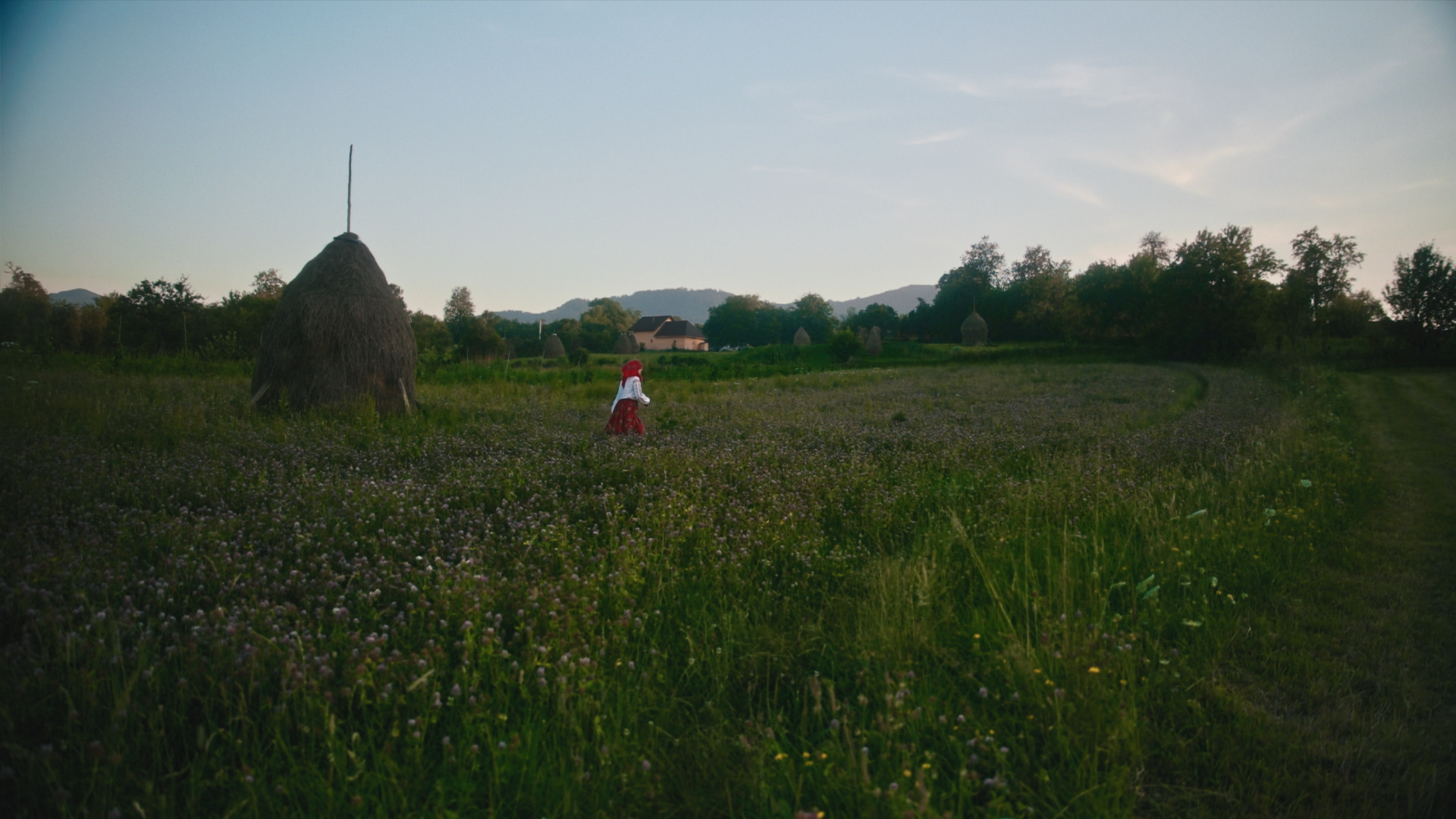
An image of Madeline “Mima” Kohn wearing a traditional Maramures outfit in a field in Breb, Romania. (Still image from “I Don’t Know What I’m Doing Here”).Courtesy of Jacob Pincus
At its core, Kohn said, the film is about “chasing belonging and finding familiarity.” And while she left Romania with unanswered questions about her lineage, she and Pincus felt “gratitude” because of the lives they had in the United States.
Pincus said those lives wouldn’t be possible without the sacrifices of earlier generations.
“We’re trying to help people remember that we come from people who sacrificed for us to be alive. And as soon as that’s lost, we are lost,” he said.
For Kohn, that feeling came full circle when she incorporated footage from an oral history video her mother had made into the documentary. Hearing the voices of three generations who share “strikingly” similar views of the world, Kohn said, provided “all the validation I was looking for.”
It also helped her answer the existential question posed in the film’s title.
“I discovered I do have roots. I do have role models, even if I didn’t spend that much time with them. I do have a path. I do belong,” she said.
“I Don’t Know What I’m Doing Here” is screened as part of Philadelphia Jewish Film and Media Festival on Nov. 17, at 7 p.m., at the Weitzman National Museum of American Jewish History, 101 S. Independence Mall E, Philadelphia, phillyjfm.org
Protein is everywhere you turn in the grocery store these days, from chips and cereal to yogurt, all marketed in bold font and bright colors. Wellness influencers treat protein like a nutrition cure-all, promoting on social media everything from high-protein kits for toddlers to powders for gym-going teens.
Adding to the buzz, the federal government recommended increasing the typical American’s daily protein intake in its newest dietary guidelines published earlier this year. But nutrition experts disagree, saying some of these guidelines aren’t entirely based in science.
So parents may be left wondering: How much protein does my child really need?
At Pediatric Health Chat, we spend a lot of our time thinking about the food kids eat. Protein is an essential part of a child’s diet. It stores energy through building muscle, supports a healthy immune system, and produces hormones that regulate the body’s growth. High-protein marketing misses the most essential part of building a nutritious diet for kids: healthy variety.
Are my kids eating enough protein?
There is no evidence that children are eating too little protein. In fact, kids in North America and Western Europe consume between two and three times the recommended minimum protein, according to decades of nutrition research.
An average toddler needs about 13 grams of protein per day. One egg, one glass of whole milk, and a quarter of a grilled cheese sandwich puts them over that amount.
For a typical school-aged 5-year-old, the recommendation goes up to 20 grams — that’s equivalent to one drinkable yogurt, one bag of peanut butter crackers, and 2 ounces of sliced steak.
Teenage boys need the most protein; a typical 14-year-old needs around 52 grams per day. Meanwhile, a 14-year-old girl should aim for around 46 grams of protein, which one bagel with cream cheese, one piece of toast with peanut butter, one Rx kids bar, and one cheeseburger would meet.
Consuming too much protein can lead to long-term health complications, including dehydration, kidney stones, or liver damage. And because protein makes you feel more full, kids who eat too much may end up getting less of other important nutrients like carbohydrates, fats, vitamins, and minerals.
And yet, the latest Dietary Guidelines for Americans recommend a 50 to 100% increase in daily protein consumption. This recommendation actually comes from findings in adultweight-loss trials, which are hardly applicable to growing kids. The new guidelines also promote red meat and full-fat dairy as healthy sources of protein, despite long-standing expert consensus linking them to type 2 diabetes and heart disease.
The science shows that protein is not more important than other nutrients. Parents should be cautious of sources that suggest otherwise.
But the type of protein is important. Many kids, especially teens, turn to supplements like whey or powders that provide protein in highly concentrated forms to build muscle. More recently, injectable peptides have exploded in popularity, claiming improved muscle strength and lower body fat.
Nutritionists and doctors caution against protein supplementation for healthy kids. Protein powders and bars contain a host of artificial sweeteners and even dangerous metals like lead. And newer peptides are not FDA regulated, meaning they haven’t been rigorously evaluated for side effects.
Eating fresh, protein-rich foods — think salmon, beans and chickpeas, tofu, and lean meats like turkey — throughout the day is sufficient for kids to meet their goals. Even the most serious athletes shouldn’t have to rely on unregulated supplements.
Children following vegetarian or vegan diets still meet their recommended protein targets, though they generally consume slightly less protein compared to kids who eat meat. However, plant-based foods are tougher to digest into amino acids, the building blocks of protein. And unlike meat, eggs, or dairy, most plant-based proteins lack the complete set of essential amino acids our body needs; soy products like tofu and quinoa are both important exceptions.
Combining different protein sources becomes especially important for kids on vegetarian and vegan diets. But it’s also good advice for everyone. Plant-based proteins are higher in good fats, antioxidants, and fiber and are associated with lower rates of cardiovascular disease compared to animal proteins.
The key is balance, and children’s diets might look a little different for each family.
Physicians and nutritionists working with families should strive to create culturally tailored meals, modifying proteins parents know about and can budget for.
For parents, the science is strong: increasing the amount of protein your kid consumes won’t keep them more nourished, but variety will. So, the next time you see protein-fortified bread or pasta sauce at your local grocer, approach it with a skeptical eye. Chances are your child doesn’t need it.
The views expressed in this article are those of the authors and not necessarily those of CHOP. This information is not intended to provide medical advice, diagnosis, or treatment. Always consult a qualified healthcare professional regarding any health or medical concerns.
Vibhav Nandagiri is a medical student at the University of Pennsylvania and a guest columnist for Pediatric Health Chat, an online initiative providing resources for families looking for good information on the latest myths and misconceptions about children’s health.
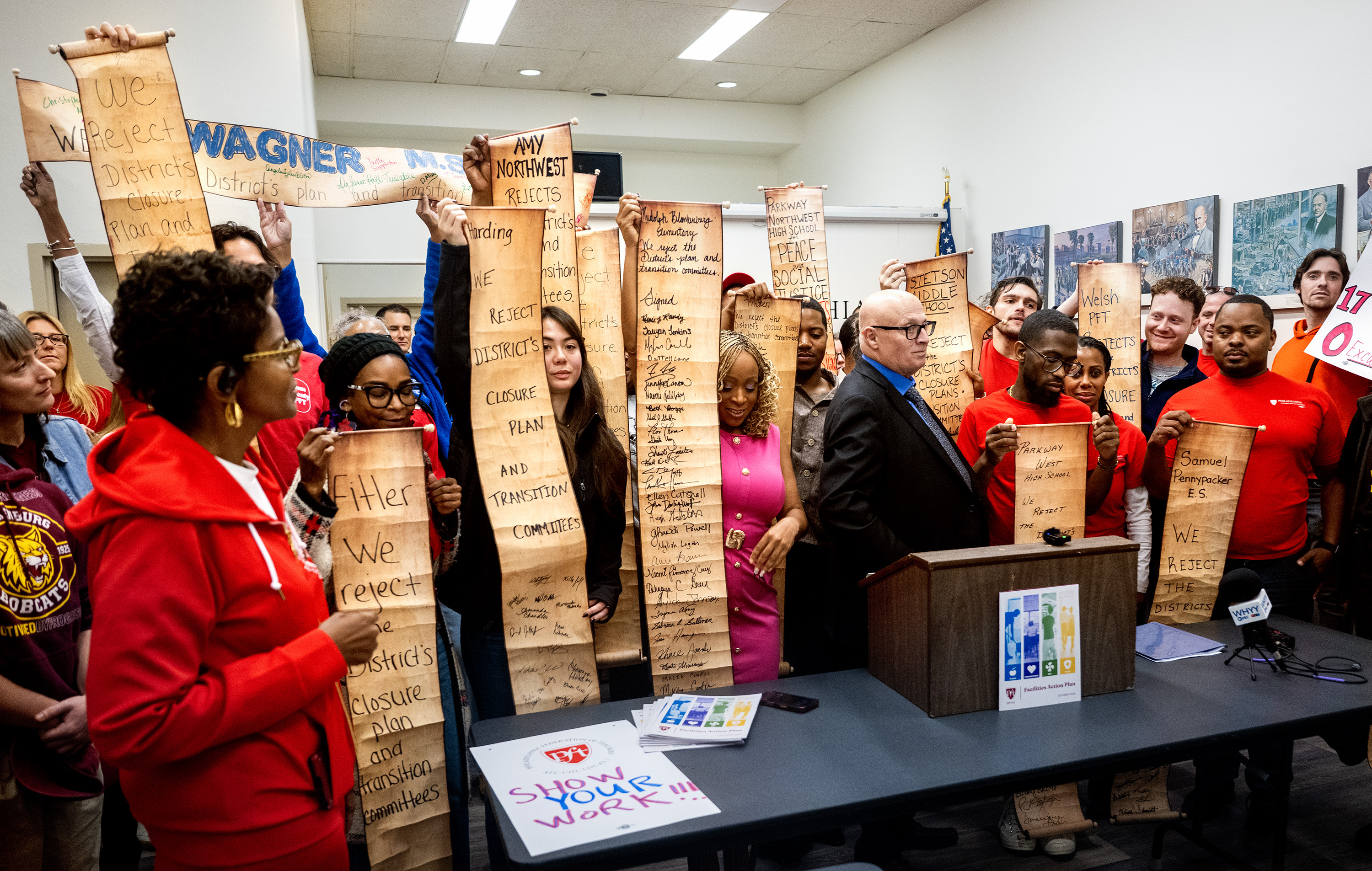
The Philadelphia Federation of Teachers says it has a plan to spare 17 public schools now slated for closure — at a cost of $25 million, money it says the district has in its budget.
The district proposes closing the 17 schools — including some schools that are mostly full and others that outperform their peers — to cope with underenrollment citywide and, its leaders say, to advance academic and extracurricular opportunities for all students.
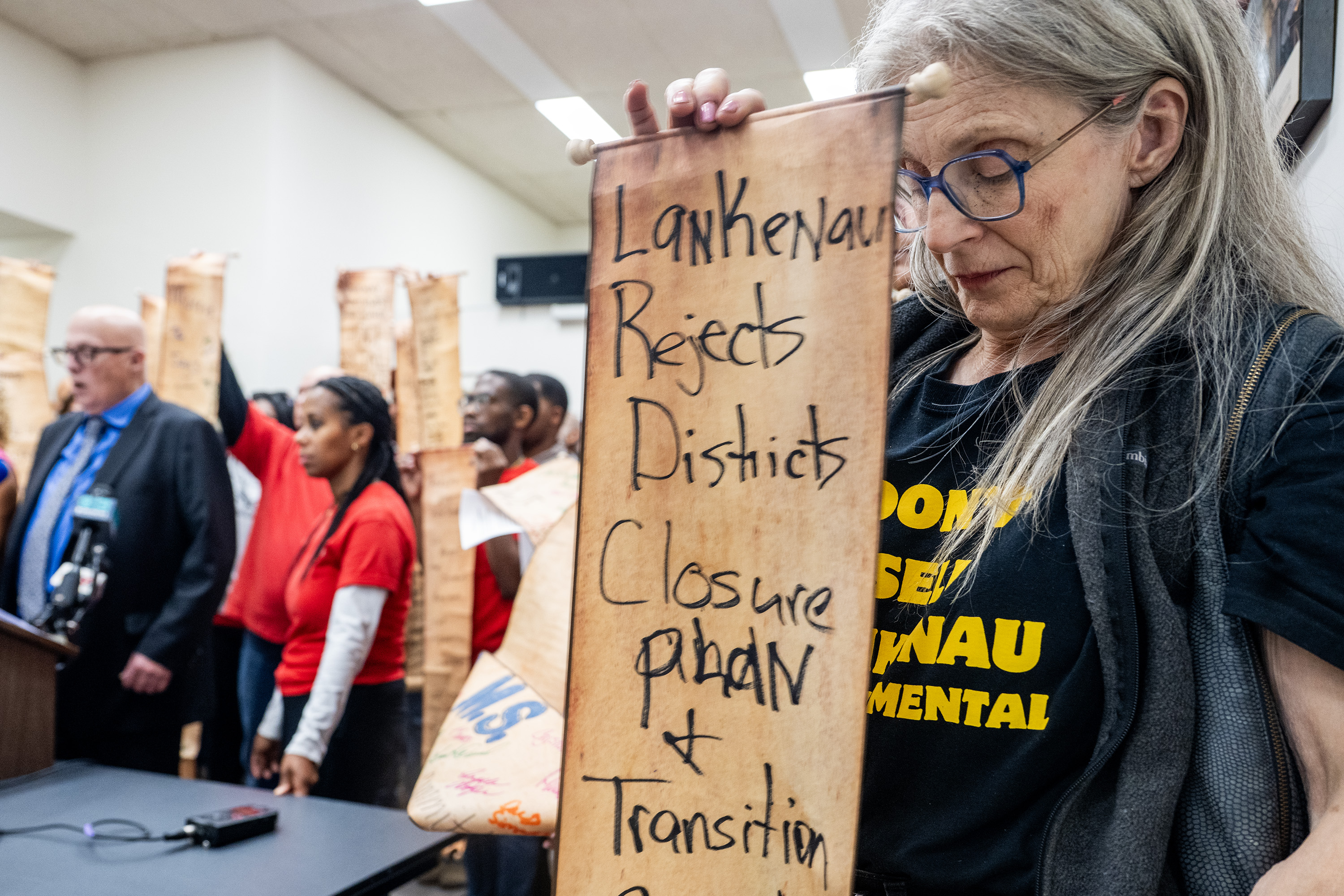
Cynthia Geesey, a life skills teacher at Lankenau Environmental Science Magnet High School, joins other teachers at a news conference.Tom Gralish / Staff Photographer
The PFT says the district has a staggering $6.7 billion in documented repair needs across the city as of this summer; the district’s plan would cost $3 billion, only $1 billion of which the district can cover itself, through 10 years of capital borrowing. The rest of the district’s plan relies on state and philanthropic dollars that are not assured or even promised.
In addition to school closings, the district has proposed modernizing 169 of its 200-plus buildings. But some modernizations are not scheduled to happen for a decade, and some are very modest in scope.
And the district still has enormous capital needs — inadequate electrical systems that do not allow for air-conditioning in about a quarter of all schools, problems with roofs, lead paint, asbestos, mold, and more.
Arthur Steinberg, president of the 13,000-member union, said the district’s proposal lacks crucial detail and makes the system less, not more, competitive for the tens of thousands of students who have left the district for charter and cyber options in the last several decades.
A comprehensive master plan is needed, Steinberg said, but the district’s current iteration “is neither a comprehensive educational facilities master plan, nor a plan that can deliver on even the limited promises it makes.” Use the PFT plan to amend, not discard, the district’s version, the union proposes.
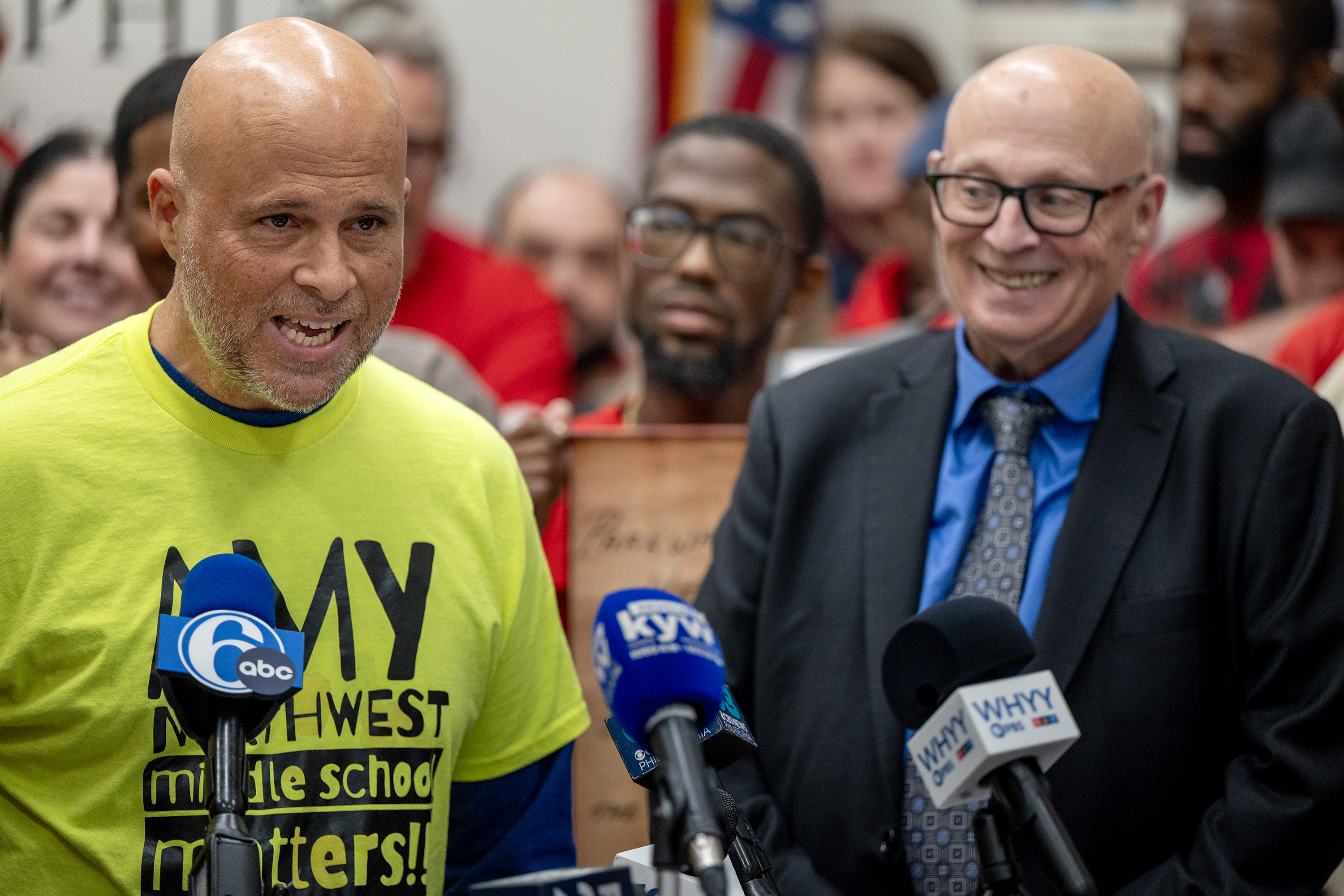
Gavin Torrisi, a teacher and track coach at AMY Northwest Middle School, tells inspiring stories about his students as he joins other teachers from schools scheduled to be closed and Philadelphia Federation of Teachers president Arthur Steinberg (right) during a news conference Wednesday.Tom Gralish / Staff Photographer
The PFT’s plan “aims to stop an exodus of students and staff from Philadelphia public schools by directing the district to implement a comprehensive approach to building repairs, maintenance, and modernization,” Steinberg and LeShawna Coleman, the union’s treasurer, said in the report.
The union wants to establish four pillars for every building — clean, comfortable, dry, and safe — establishing minimum health and safety standards for all schools.
Jerry Roseman, the PFT’s longtime director of environmental services, was the chief architect of the union’s plan, using district data, historical information, and other records.
Roseman and Steinberg dispute some of the district’s underlying calculations in its facilities plan, including how full or empty some buildings are, and how many unfilled student seats exist. The district says there are 70,000 empty seats citywide; the PFT says the correct number is lower.
The PFT’s analysis comes more than six months after the board formally adopted its plan, which explicitly stated closures or other parts could change if circumstances changed. Steinberg said that he had hoped to get the counterproposal finished sooner, but that the district “is not the most transparent” with its data.
District officials said in a statement they appreciated the PFT’s commitment to safe and healthy school buildings, but felt the union’s plan fell short because it “does not adequately address the fundamental challenges facing our school system: declining enrollment, aging and underutilized buildings, and longstanding inequities in educational opportunities.”
Bill Mich, a district spokesperson, said that the 17 schools tagged for closure have $298 million in facilities needs, and that while the PFT’s $25 million would tackle some pressing issues at those schools, “it falls short of addressing these challenges, including the multi-year student enrollment loss at all 17 schools and the need for a long-term and sustainable strategy for the school district.”
Renovation now, not after kids graduate
The PFT’s current repair proposal targets only those 17 schools set to close, but its $25 million price tag is much lower than the sum of all deficiencies the district says are present in those buildings: $548 million.
“By reorganizing the district’s maintenance and operations and janitorial workforce, measurable improvements to facilities conditions can be made before the end of SY 2026,” the report said.
The reorganization would create district-wide efficiencies, reducing building costs “with results delivered while current students are enrolled in the district, as opposed to years after they graduate.”
PFT wants the district to create two teams — one of trade workers, one of custodial staff — to be prepared to quickly address environmental health and safety risks during school hours, and when students are not in the building.
The new teams would bring down the average response time to work orders. It now takes 62 days, on average, for a district work order — a request to do anything from fix a broken toilet to make electrical repairs — to be addressed, the teachers union said.
That is a tall order, as the district faces a shortage of both tradespeople and cleaners. The PFT said addressing pay and working conditions would attract more candidates.
Reorganizing the cleaning and maintenance forces and adding staff to address issues at the 17 schools would cost between $175,000 and $250,000 per building.
PFT officials said a second part to the plan, addressing needed repairs for the roughly 200 remaining district schools, will be released by the end of the calendar year.
The nuts and bolts
The school board voted to close 10 schools this coming June — Blankenburg, Fitler, Lankenau, Robert Morris, Overbrook Elementary, Parkway Northwest, Parkway West, Pennypacker, Robeson, and Welsh.
The remainder of the closures would be phased in, not finishing, in some cases, until 2031. Phased closures would affect the remaining seven schools: AMY Northwest, Harding, Penn Treaty, Stetson, Tilden, Wagner, and Waring.
Under the PFT’s counterproposal, the district would instead close no schools, and begin investing in deferred maintenance projects immediately. Its plan would result in upgrading all district schools to “good” condition, as measured by the district’s own internal benchmark of facilities condition.
Claire Andrews, a teacher at Wagner Middle School, said the PFT’s plan presented a road map for how to move forward.
“To earn back the trust of families who have chosen charter or private schools, the district must show through consistent action that neighborhood public schools can offer safe, welcoming buildings, strong and engaging programs, experienced teachers, and steady academic and social-emotional support,” Andrews said at a news conference at PFT headquarters Wednesday. “Families must be listened to before decisions are made, not after.”
Will the plan go anywhere?
The PFT presented its plan with high hopes Wednesday.
But its proposal is just that. And though some City Council members have made clear their strenuous opposition to closures, Mayor Cherelle L. Parker has said that some closings are necessary.
Addressing City Council in April, the mayor said shutting schools was a painful but essential step to getting more funding from Harrisburg, whose politicians have historically shown little appetite to help the district, especially with a deferred-maintenance problem that one estimate put at $8 billion at one point.
“I know we’re not trying to build the education system for the past — we’re working on our children’s future,” the mayor told Council in April testimony, before the board voted on the facilities master plan. “Right now, we are maintaining square footage as it crumbles, instead of investing in opportunities our students actually need. Yes, this means making difficult but responsible decisions, and that’s what the district has worked through.”
Steinberg, though, said this month’s Democratic Harrisburg sweep is likely to shift the district’s fortunes somewhat.
“We expect the district actually to have increased revenue,” Steinberg said. “Some of that will be devoted to facilities.”
Ronny Drapkin won’t have to move his labfar when he becomes CEO of the Wistar Institute this month.
The longtime University of Pennsylvania scientistwill succeed Dario Altieri on Nov. 30 as leader of the nation’s first independent biomedical research institute, located near Penn in University City at 3601 Spruce St.
He’s excited to build partnerships across Philadelphia’s scientific ecosystem and set the direction of Wistar’s research agenda spanning cancer, infectious diseases, immunology, and vaccines.
Drapkin will also continue studying the biology of ovarian cancer, “a disease that, unfortunately, we still don’t have curative, durable therapies for,” he said.
His scientific accomplishments include advancing the so-called “fallopian tube hypothesis,” which dismantled long-standing misconceptions about ovarian cancer.
In the past, doctors and scientists assumed that ovarian cancer originated in the ovaries. But work led by Drapkin and other researchers in the last two decades has shown that most ovarian cancers likely begin in the fallopian tubes.
“If we understand how these cancers began, we could think about new approaches to prevention, to early detection, [and] ultimately to better treatments,” he said.
The Inquirer spoke to Drapkin about his vision for Wistar — and the future of his own research — in an interview lightly edited for length and clarity.
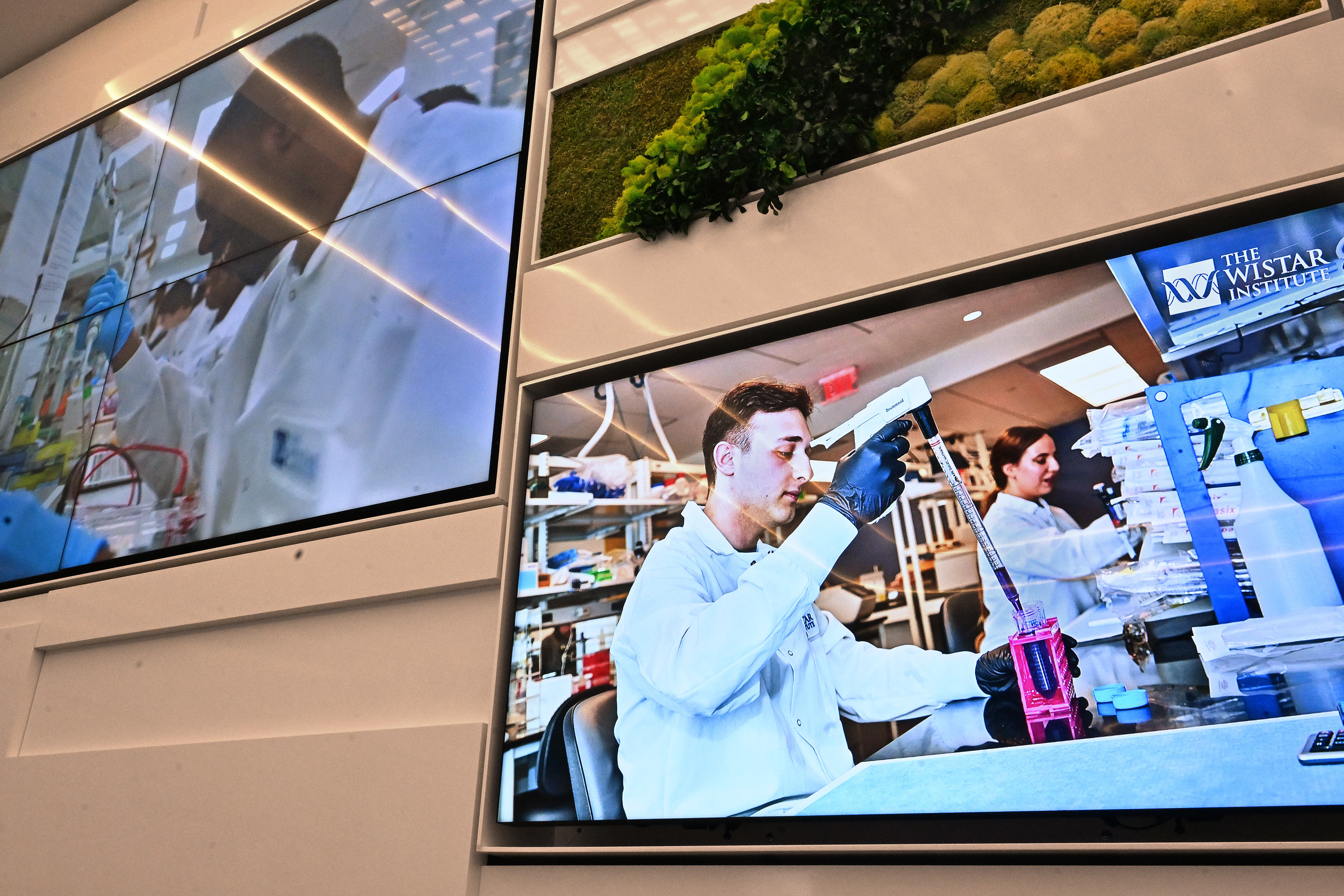
Promotional monitors in the reception/meetup space at the Wistar Institute’s HIV Cure and Viral Diseases Center.Tom Gralish / Staff Photographer
What inspired you to want to lead Wistar?
I’ve spent my career as a physician-scientist trying to understand how cancers develop. Along the way, I’ve come to really appreciate how important scientific environments are in helping make discoveries.
I find myself gravitating toward building teams and consortia and collaborations, which have started locally, and ultimately become national and international. And I think the Wistar has this incredible history of doing this.
What are your priorities for Wistar?
Philadelphia has a tremendous concentration of academic institutions, hospitals, biotechnology companies, and scientific talent. Wistar’s uniquely positioned to connect to those communities, and be able to play an even bigger role in the Philadelphia ecosystem.
Will you continue doing research at Wistar?
I will be moving my entire lab. I definitely will continue advancing the work we’re doing on the Pre-Cancer Atlas to try to understand the early manifestations of ovarian cancer and how we can leverage those observations into better tools for detection and interception.
How did your pioneering work on ovarian cancer begin?
The fallopian tube was thought to be a simple tubal structure of little relevance to cancer. But by the early 2000s, people started to find abnormal-looking cells in the fallopian tube. It turns out no one had ever systematically evaluated it.
Enough of those papers got published that my mentor, Chris Crum, and a few of us decided to process these [fallopian tube] tissues for study. I still remember when the first set of slides came out. We sat there and it kind of dawned on us: Have we been looking at the wrong place the whole time? Is this where this cancer starts?
I started my own lab in 2007, and I made it my mission to study this. At the time, the fallopian tube had been so historically ignored, and, to be honest, female anatomy has been historically ignored.
Can you elaborate on that?
Claudius Galen, the famous Greek Roman philosopher-physician, is really the person that led Western medicine for 1,500 years. Everything we knew until the 16th century was really grounded on his observations. But most of the work he did was limited to dissections of animals, and usually male.
The female anatomy was assumed to be very similar to the male anatomy. No one had really ever carefully dissected and described the female reproductive tract.
It wasn’t until the 16th century when Gabriele Falloppio became the first to clearly describe what the fallopian tube looked like: a small brazen trumpetlike structure with fringes at the very end. So really, if you think about it, female anatomy had been ignored for the better part of 1,500 years.
What has your work found?
Because no one had really studied the tube, I spent my early career making all the model systems [cell lines, mouse models, etc.] that we didn’t have. We were among the first, if not the first, to develop and use them to try to understand what makes this cell so susceptible to becoming cancer.
More recently, we’ve created the Pre-Cancer Atlas, which is an international effort that we’ve organized collecting these precursors from all over the world. We have to have samples that are geographically, racially, ethnically diverse, or else we’re just looking at one piece of the pizza pie.
Now we’ve taken the data that’s emerging and nominated novel biomarkers for early detection and novel targets for cancer interception and therapeutics.
How could understanding the origin of ovarian cancer inform options for prevention?
What’s been shown is that if you take out the fallopian tubes in an average-risk woman — if she’s having, for instance, a hysterectomy for some reason — you reduce the incidence of ovarian cancer by 80%. That was from a study [in Canada] that followed a cohort of over 85,000 women who were having hysterectomies.
To me, it’s a validation of the whole tubal hypothesis.
Two of my colleagues are now rolling out a national program to advocate and train general surgeons to take out the tubes if they’re in the abdomen for any reason. So think about a gallbladder removal, an appendix removal, a hernia repair — any of the things that would potentially lead to general surgery.
What about the high-risk individuals? Right now there are three international trials — I’m the pathologist for one of them — in BRCA-mutation carriers. The hope is that removing the tubes is not inferior to taking out both the tubes and ovaries for risk reduction.
What future projects are you hoping to accomplish in your lab?
One of the things that emerged out of the Pre-Cancer Atlas is our understanding of how early the immune system is activated in cancer. This is a good thing, but it is also quickly shut off. We’ve been trying to figure out how we can leverage that understanding to reactivate the immune system.
The earlier we can do this, when the immune system doesn’t have to be thinking about billions of [cancer] cells, but maybe hundreds of thousands of cells, it has a better shot at eradicating the early manifestation of disease.
[We also found] that ovarian cancers are innervated by sensory nerves. This paper that we’re putting together is showing that [sensory] nerves are contributing significantly to tumor progression, and if we ablate these nerves, the tumors don’t grow nearly as fast. We think all these are going to be new therapeutic targets.
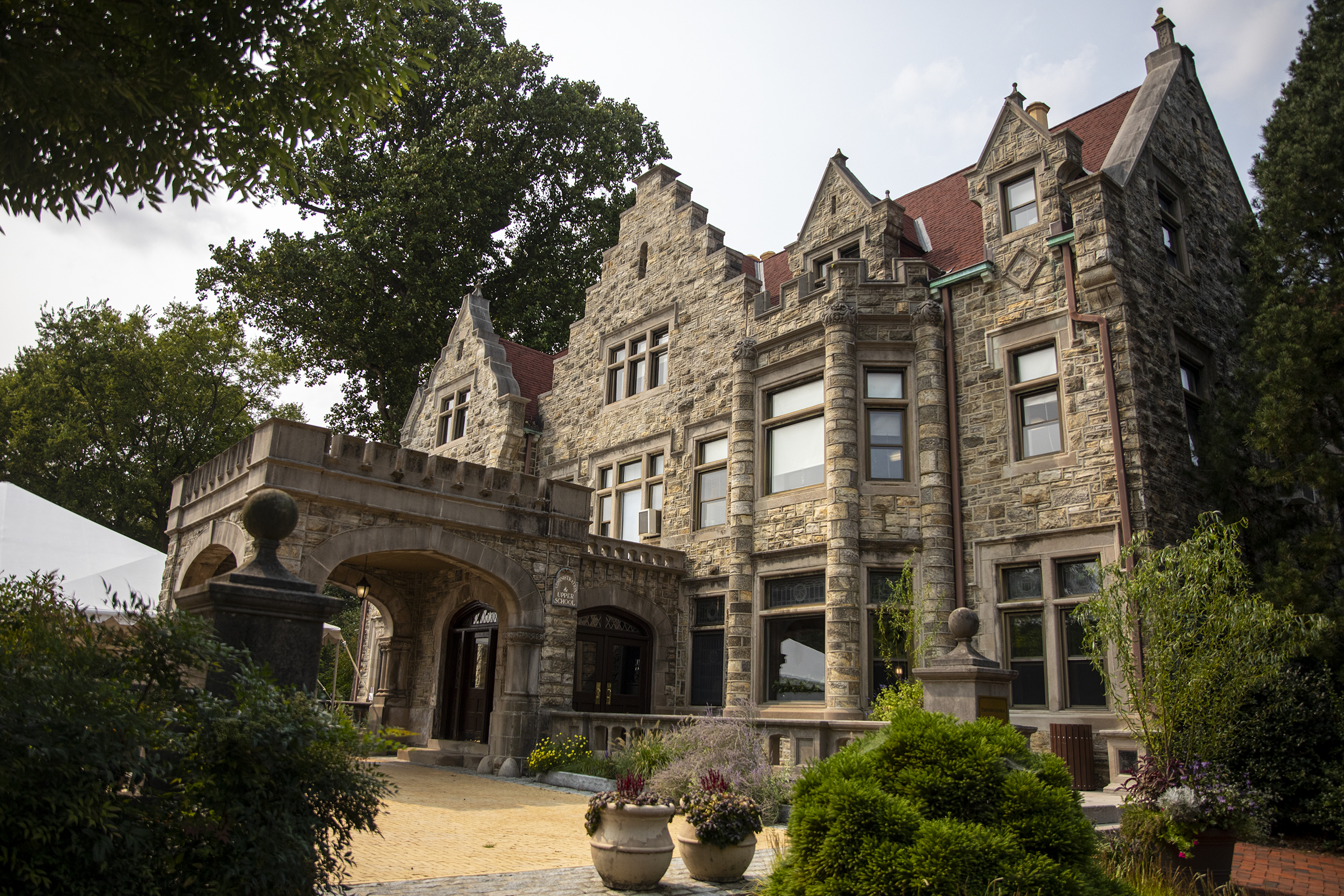
Friends’ Central School said Wednesday that it had received a $24.7 million gift, the largest in the Quaker school’s history.
The K-12 private school in Wynnewood said it believes the gift from an anonymous graduate donor is one of the biggest ever given to a Philadelphia-area independent day school.
“This gift is an extraordinary act of generosity and trust that will benefit our students for generations,” Friends’ Central’s head of school, Beth D. Johnson, said in a statement Wednesday announcing the gift. “It gives our community something precious: additional flexibility and the license to dream even bigger as we realize our strategic plan and build the school’s future together.”
Friends’ Central, which was founded in 1845, enrolls about 900 students.
The late donor specified that the funds are to be used for general purposes, at leadership’s discretion, according to the school. Friends’ Central expects to receive the money from two charitable annuity trusts, with $17 million coming in 2032 and $7.7 million in 2041.
The donor was a member of the Blackburn Society, a group of donors who leave the school in their estate plans. The group is named for longtime Friends’ Central faculty member Eliza E. Blackburn. A gift from Blackburn, who graduated in 1922, enabled the school to buy the Old Gulph Road campus where its lower school is located.
James Wright, clerk of the school’s board of trustees, said that “a sense of institutional momentum” and increasing commitment from donors to the school’s core mission had grown under Johnson, a 1977 graduate who was named head of school in 2022.
The gift announced Wednesday is likely one of the largest ever received by an independent day school in the region, according to Friends’ Central.
Earlier this year, St. Joseph’s Prep, a private Catholic school in Philadelphia, announced a $74 million gift from billionaire Nick Howley, in what school officials there believed was the largest gift to a U.S. Catholic high school.
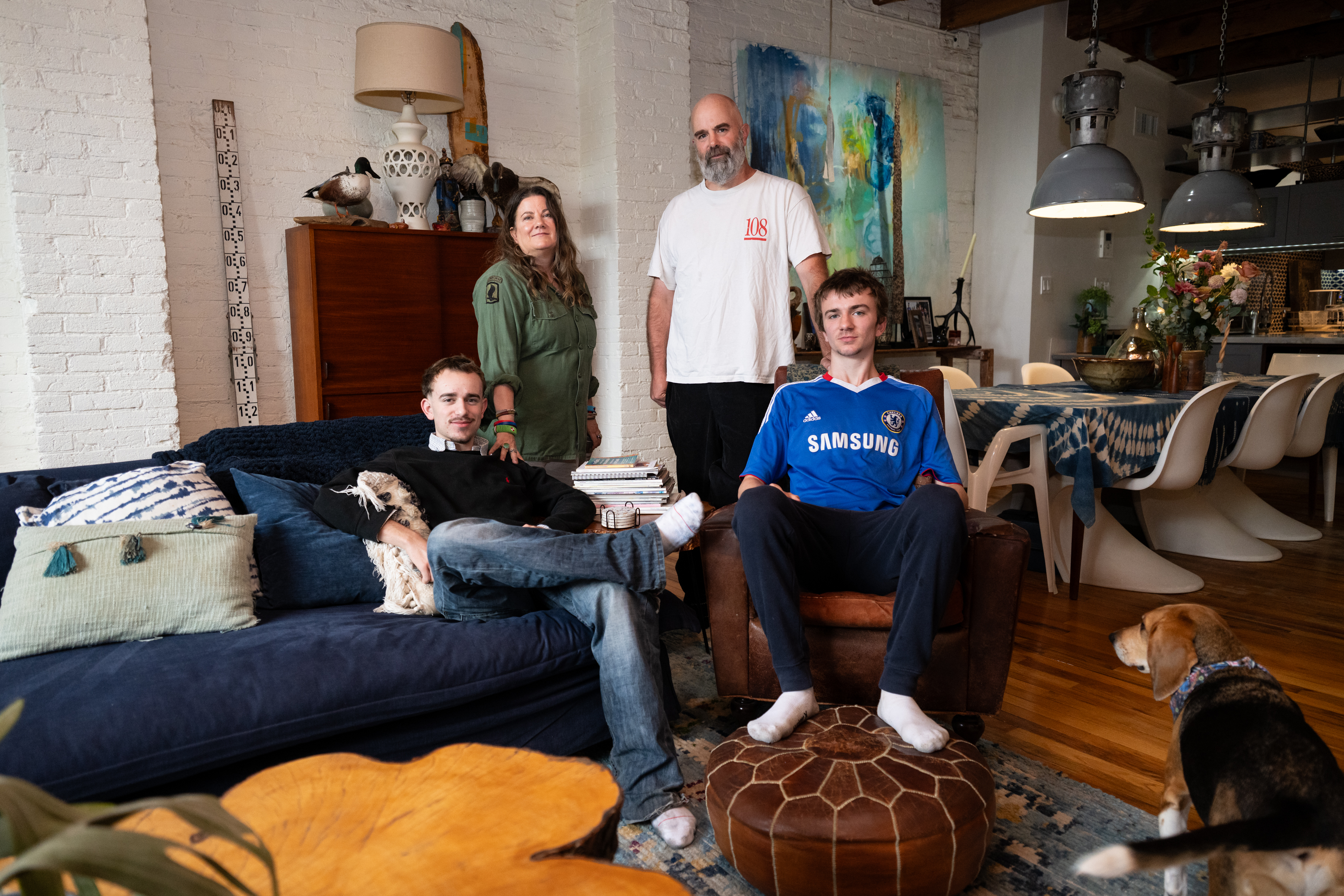
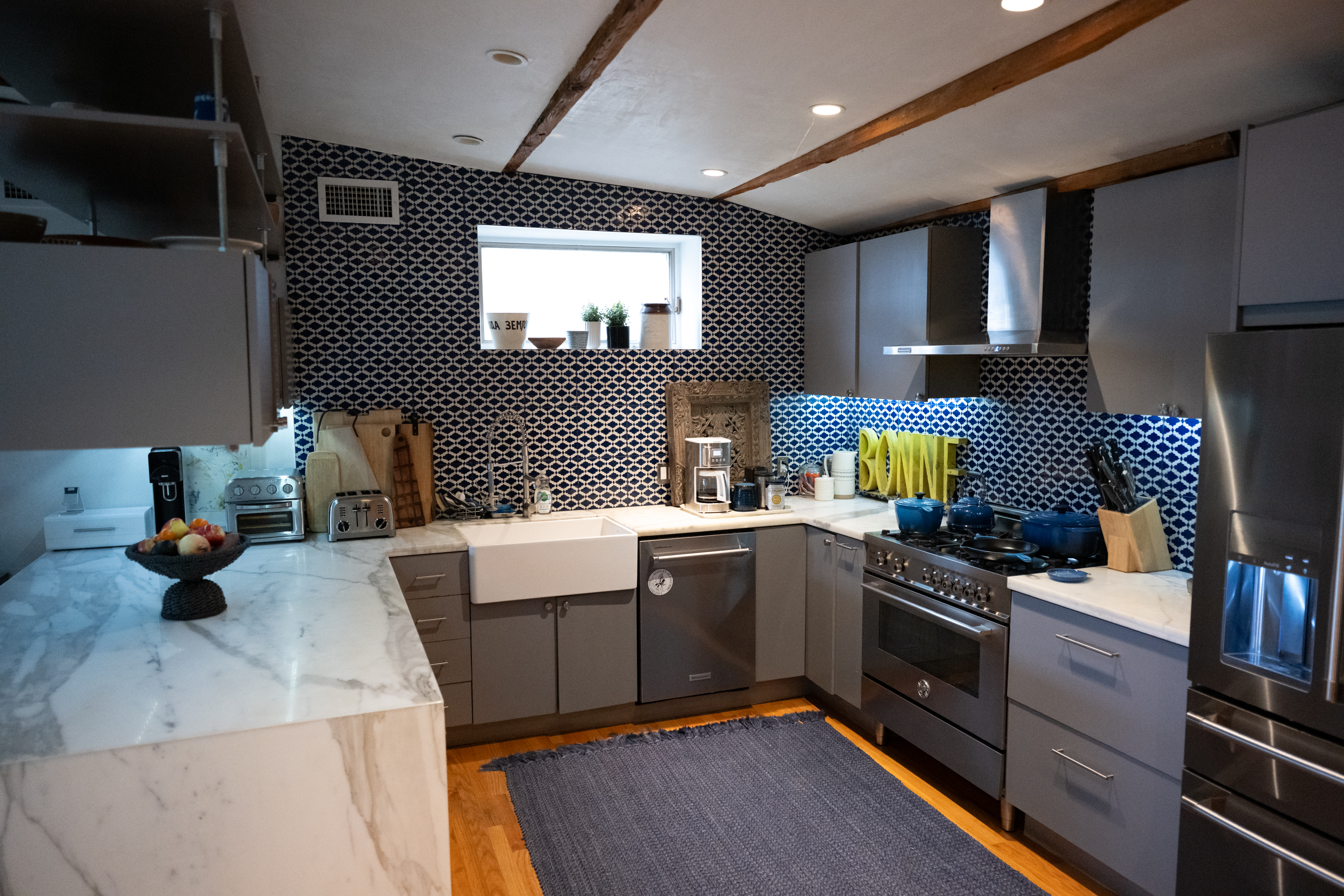
Missy and Dan Peltz’s Bella Vista home is a joyful mix of colorful, imaginative, and zany collections. From stuffed ducks and bird sculptures to skateboards and fine art, it is a lively portrait of the close-knit family.
When they first stumbled upon the three-story house in 2007, it seemed all wrong. The house looked tiny from the outside, and with just one usable bedroom and a baby on the way, it felt too small inside, too. The decor also included lots of red and pink.
The exterior of Missy and Dan Peltz’s rowhouse in Bella Vista.Erin Blewett / For The Inquirer
“But when we walked in, we saw a giant loft, it had a garage, and an enormous backyard,” said Missy, who runs the sustainable marketplace for Free People and dabbles as the owner of MAP CoLab Design on weekends. She recognized the home’s potential.
Built in 1908, the property was part blacksmith shop and part mill, Missy believes. The exposed brick walls were thick and sturdy and the wooden ceiling beams remained in good shape.
When the couple bought the house they immediately whitewashed the red brick walls and gave the rose marble fireplace a natural-colored faux finish. Over the years, through three separate projects, they renovated the kitchen, removed a wall between the kitchen and dining room to create an open-concept living area, added bedrooms, offices, a laundry room, and bathrooms.
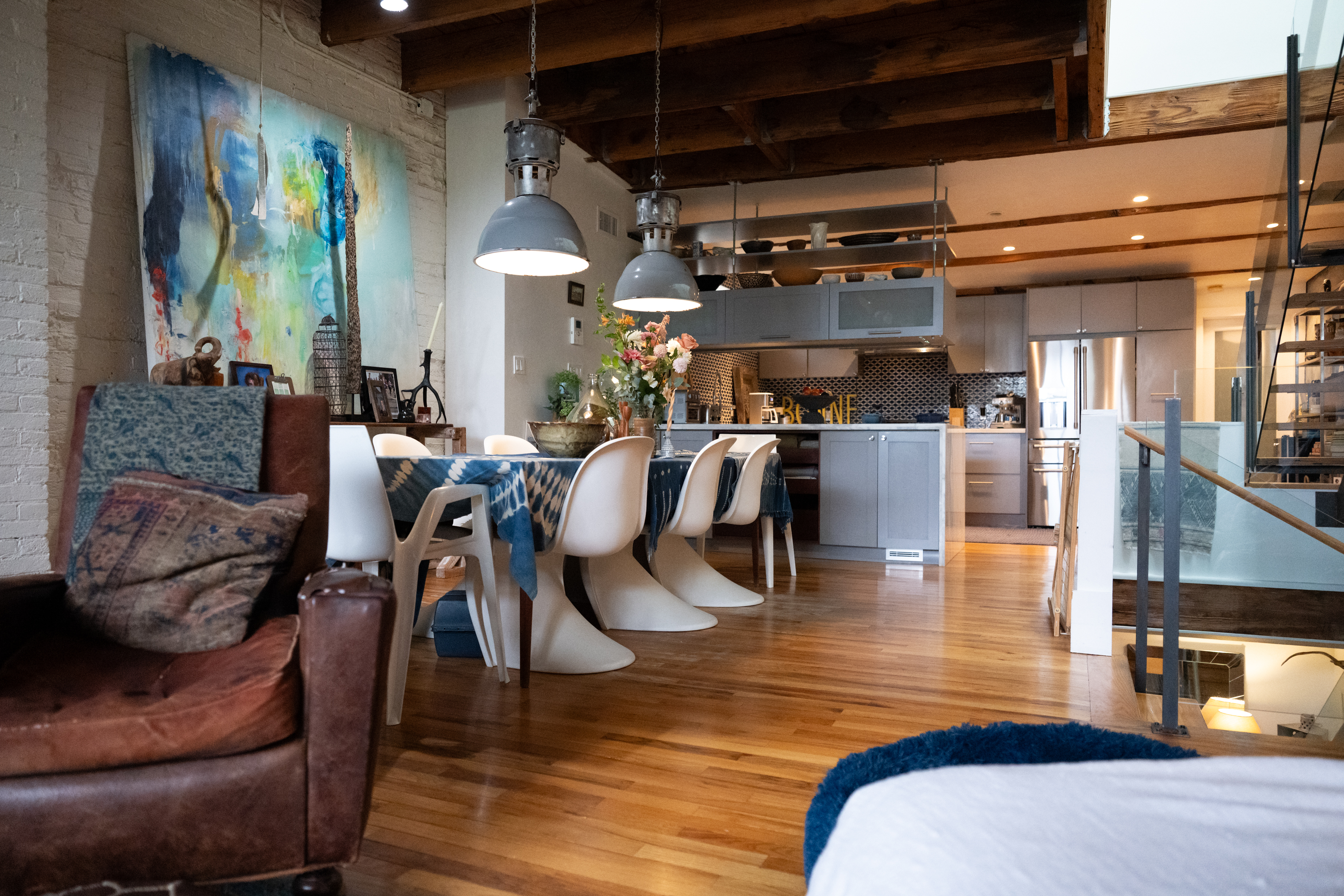
The first floor of the home includes the living room, dining area, and kitchen.Erin Blewett / For The InquirerThe couple renovated the kitchen and made it more open-concept with the dining room.Erin Blewett / For The Inquirer
The result is a 3,400-square-foot home with three bedrooms and four bathrooms. The couple now have a primary bedroom with an en-suite bathroom, and sons Grey, 18, and Sid, 16, have their own bedrooms and bathrooms.
Missy calls her design style maximalist.
“I basically have no filter and zero control,” she said. “I love to just buy things and start new collections all the time.”
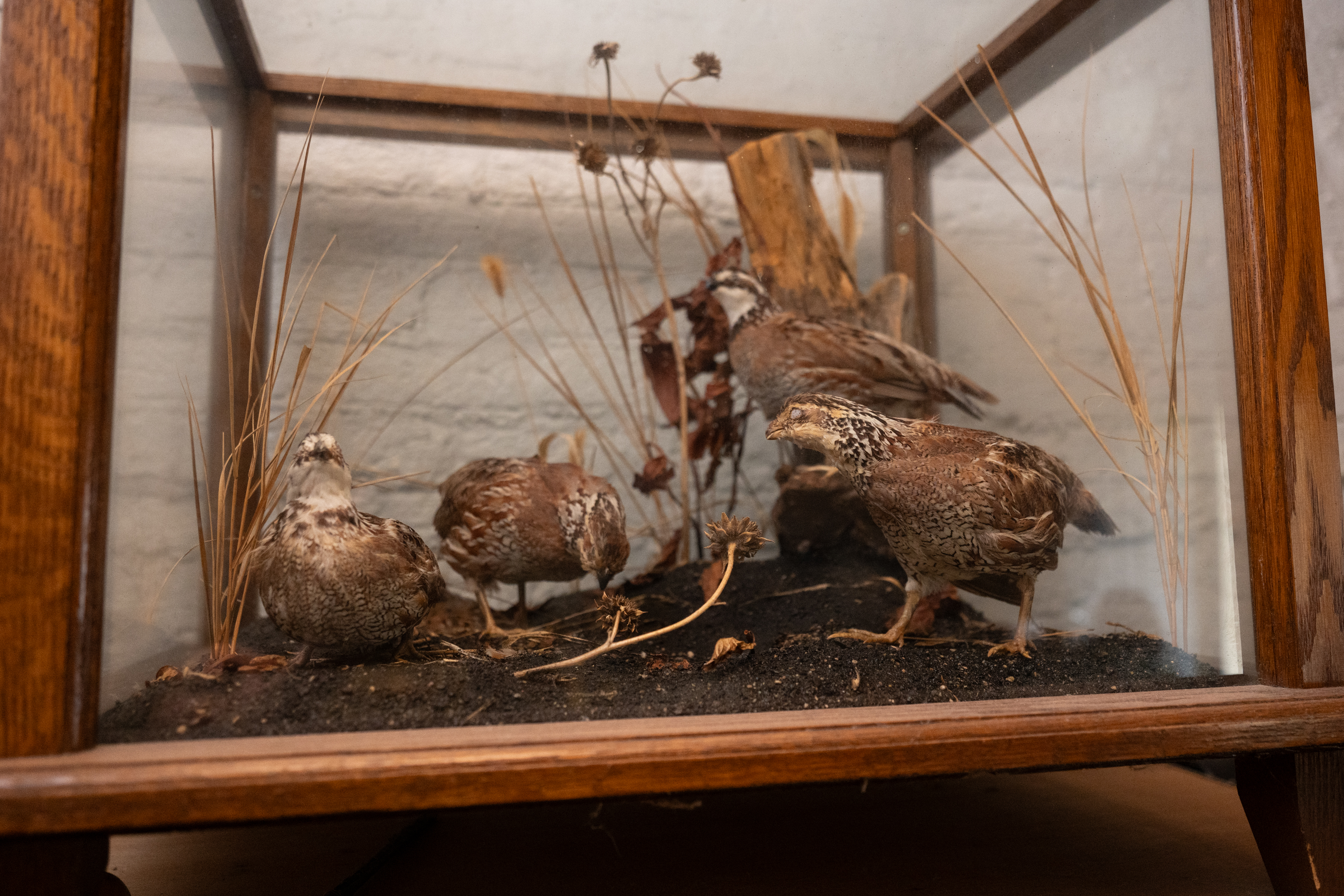
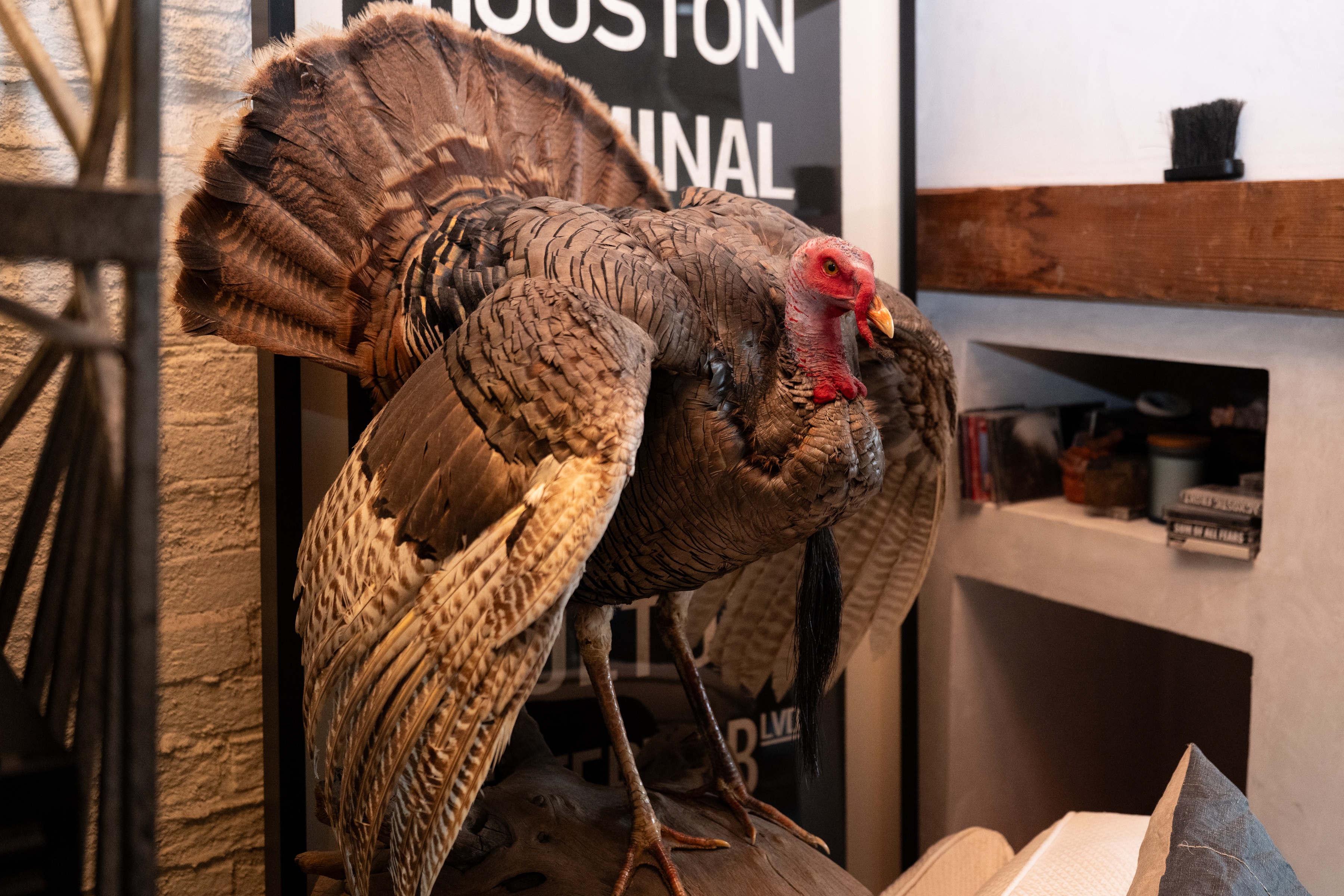
Her passion began when she discovered the thrill of taxidermy while in college. That collection includes ducks, pheasant, deer, armadillo, and birds, including a rare turkey. Her love of birds also inspired collections of Victorian bird boxes and unusual nests.
Other favorite pieces of Missy’s include an African mask. She enjoys furniture and objects that incorporate rustic, knotted wood.
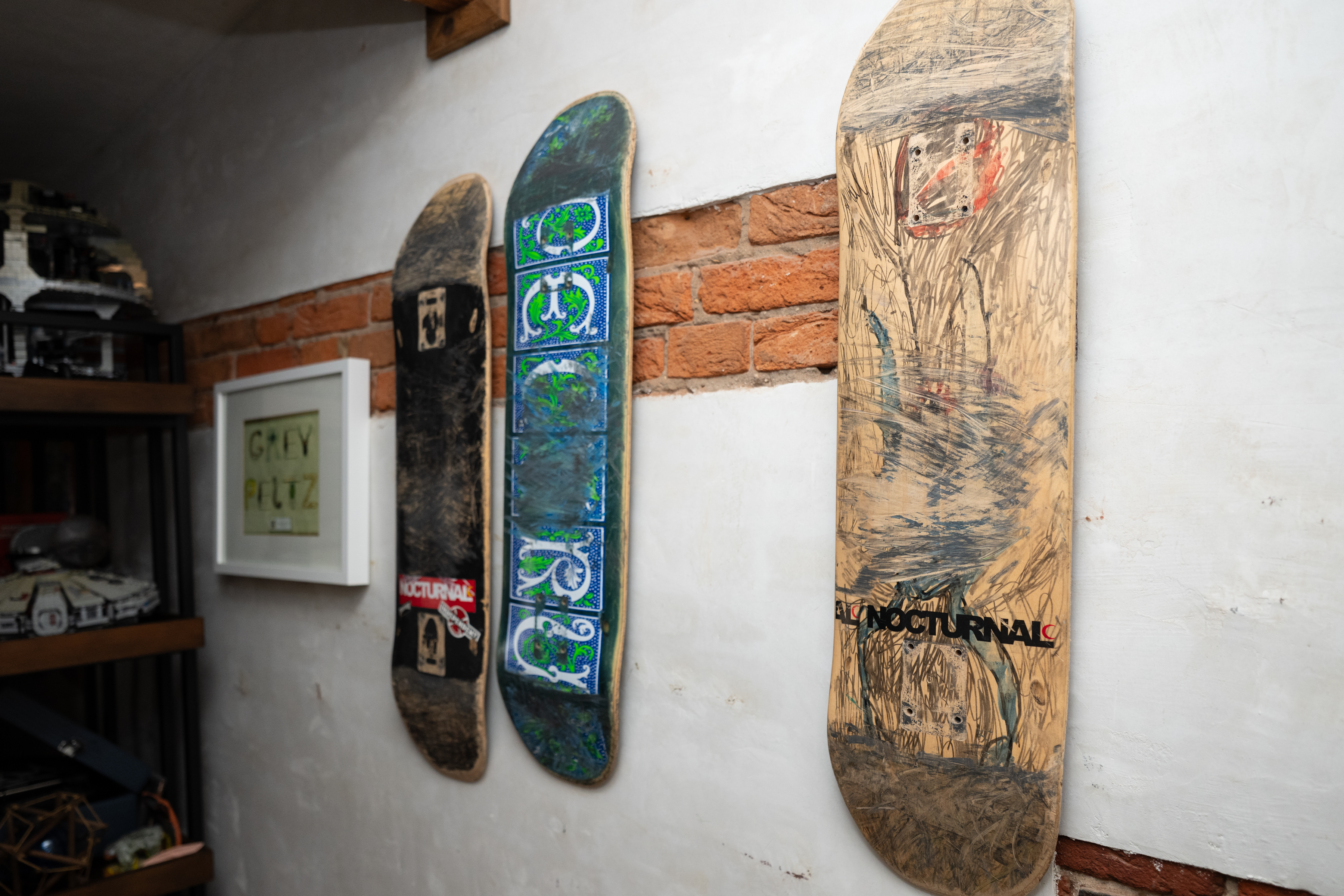
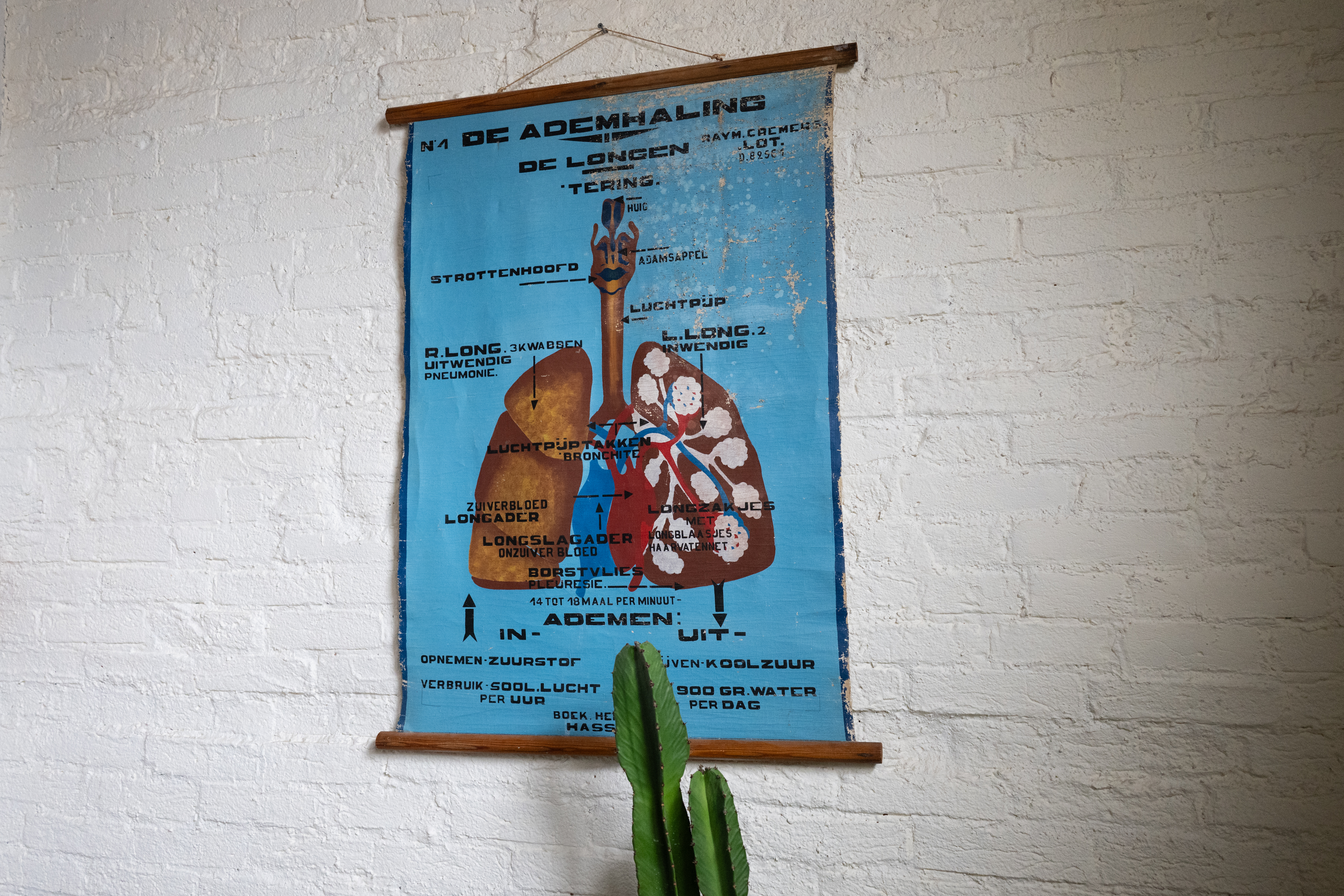
A taxidermy display featuring several birds.Erin Blewett / For The InquirerSkateboards hang on a wall in the bedroom of Grey Peltz.Erin Blewett / For The InquirerA vintage anatomical chart hangs on a wall in the living room.Erin Blewett / For The InquirerA taxidermied turkey is displayed in the living room.Erin Blewett / For The Inquirer
Dan, an avid skateboarder, has a wall in the garage filled with skateboards he’s ridden throughout his life. The collection is a favorite among their sons’ friends. He also collects records and antique fishing gear.
Missy shops at flea markets, junk stores, and antique stores, and when she sees something she loves, she buys it. She can always find a place to put it.
“I like things with soul,” she said. “It has to have a story, be weathered, and had a life before me.”
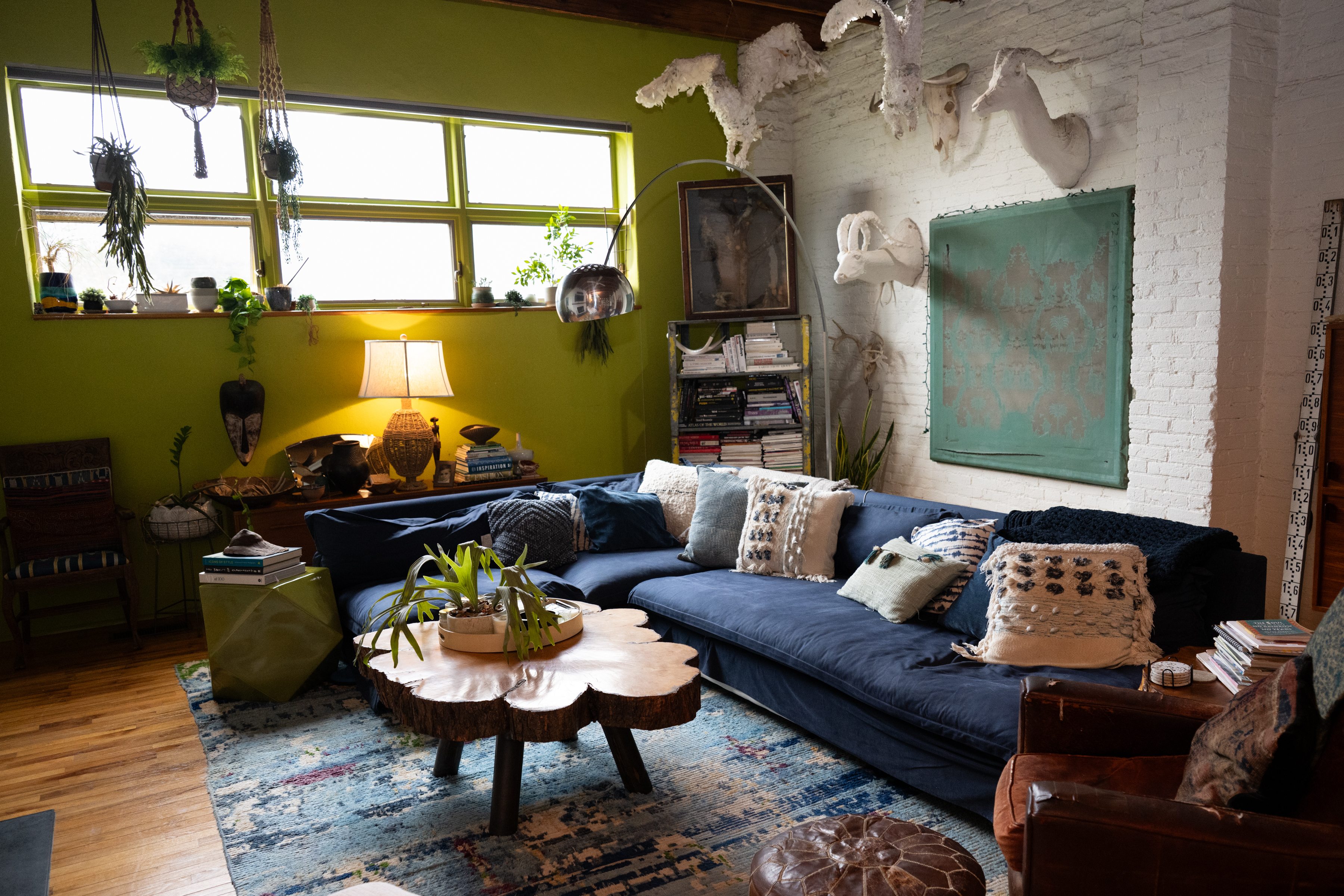
The living room, with 12-foot ceilings, is the family gathering spot and hub for entertaining. They have thrown parties where 75 guests mingled comfortably. A typical night includes cozying up on the oversized blue canvas couch to hang out and watch movies.
The living room, where the family gets cozy on the oversized couch, also features pieces from Missy’s taxidermy collection.Erin Blewett / For The Inquirer
“It’s the heart of the home where we end up spending our time,” Missy said. “It’s also incredibly quiet for a city home because the windows don’t face the street. It’s almost like we’re in our own little oasis.”
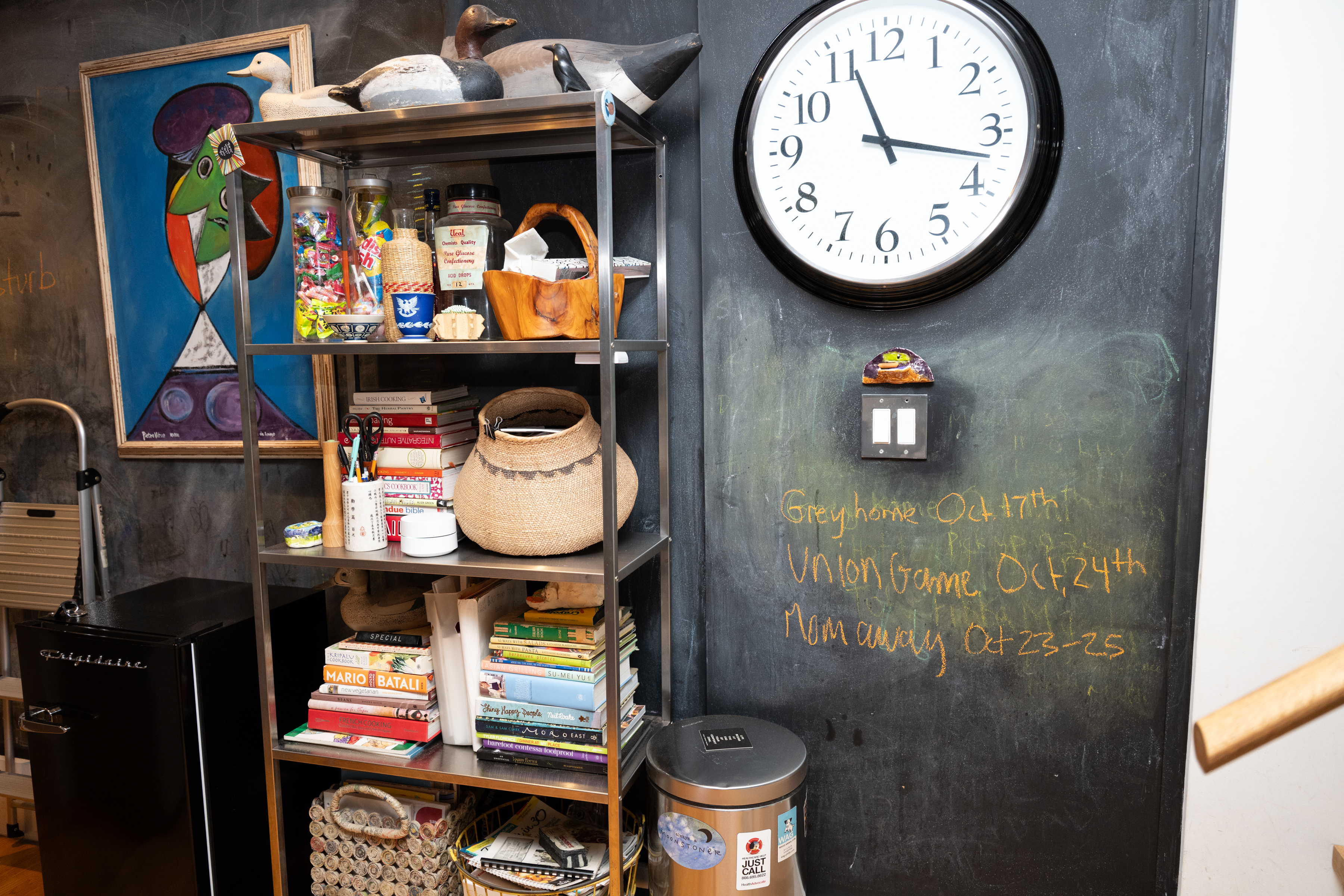
Both Missy and Dan like to cook — homemade pizza is his specialty. The kitchen features a chalkboard wall, one of the first things Missy created when she moved in. It’s where the kids learned their ABC’s and kept track of their growth and where Missy formulates her shopping list. The wall serves as the hub for family communication.
They eat meals at the 10-foot wooden dining room table, built in the 1950s, that Missy found in the 1990s at the Salvation Army for $39. Though it came with chairs, she opted instead to splurge on white s-shaped plastic Panton chairs with her first bonus check from work. She bought the industrial-look light fixture on a trip to Belgium.
Above the table sits one of three paintings she owns by Canadian artist Claire DesJardins, with whom Missy collaborated during a previous job.
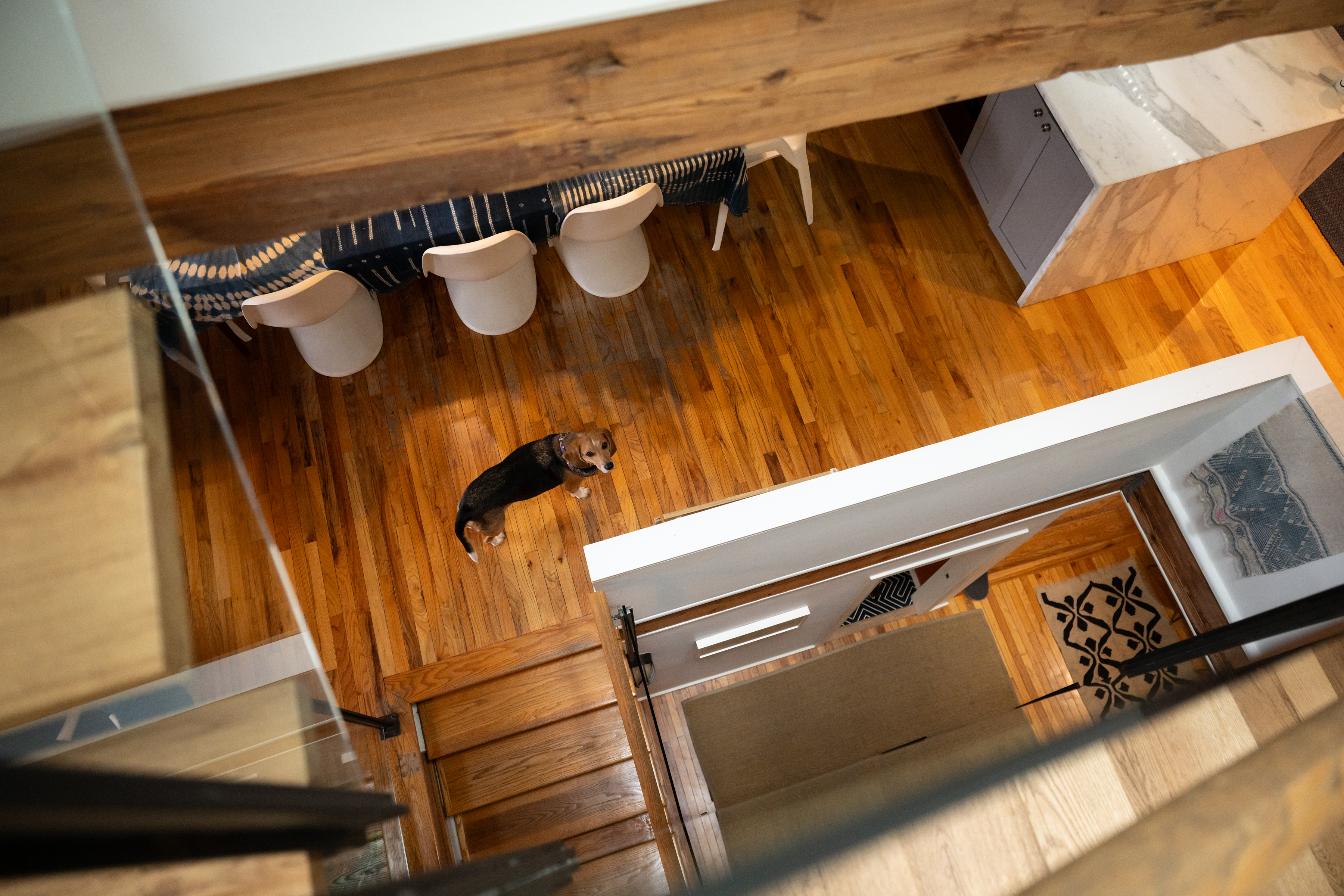
A chalkboard wall and shelves filled with books and baskets in the kitchen.Erin Blewett / For The InquirerThe family dog, Bill Murray, is seen from a staircase.Erin Blewett / For The Inquirer
“The paintings are so vibrant in color and every day I look at them and they make me smile,” Missy said.
The family enjoys spending time in the backyard where their 6-year-old beagle, Bill Murray, likes to frolic. The area, surrounded by a 20-foot bamboo privacy wall, includes a garden house, basketball hoop, and spaces for dining and relaxing.
“I love living in Bella Vista,” Missy said. “It’s in the city but it feels like I’m in the suburbs because I know all my neighbors and the kids have all grown up together. We feel really lucky.”
Is your house a Haven? Nominate your home by email (and send some digital photographs) at properties@inquirer.com.
It’s something that every coach in Major League Soccer has had to deal with since the inception of the league.
But this week, and the early part of next, will be the first time Ryan Richter has had to navigate around it and prepare for a playoff run as a head coach: FIFA’s international match schedule.
The final one of five FIFA dates in 2026, which included the monthlong men’s World Cup, will see a number of the team’s starters away for the week as they prepare for international matches. Some are mere friendlies; however, some, like the pair of U.S. matches against Haiti and Jamaica’s two games against Mexico, offer a meaningful reason to be away from the club for up to 11 days.
It’s not just the matches themselves, but the weeklong national team camps in the lead-up to those matches as well.
In the Union’s case, four players — Cavan Sullivan and Neil Pierre (USA), Danley Jean Jacques (Haiti), and longtime goalkeeper Andre Blake — will be away from the team for a two-leg quarterfinal in the CONCACAF Nations League.
Starting right back Frankie Westfield will spend time away with the U.S.’s under-23 national team, as will backup goalkeeper Andrew Rick.
Additionally, first-team midfielder Phillippe Ndinga will miss time after being called up by Gabon, and striker Malik Jakupović is presumably gone for a sizable chunk of the season as a member of the U.S.’s under-17 national team currently competing in the FIFA Under-17 World Cup in Qatar.
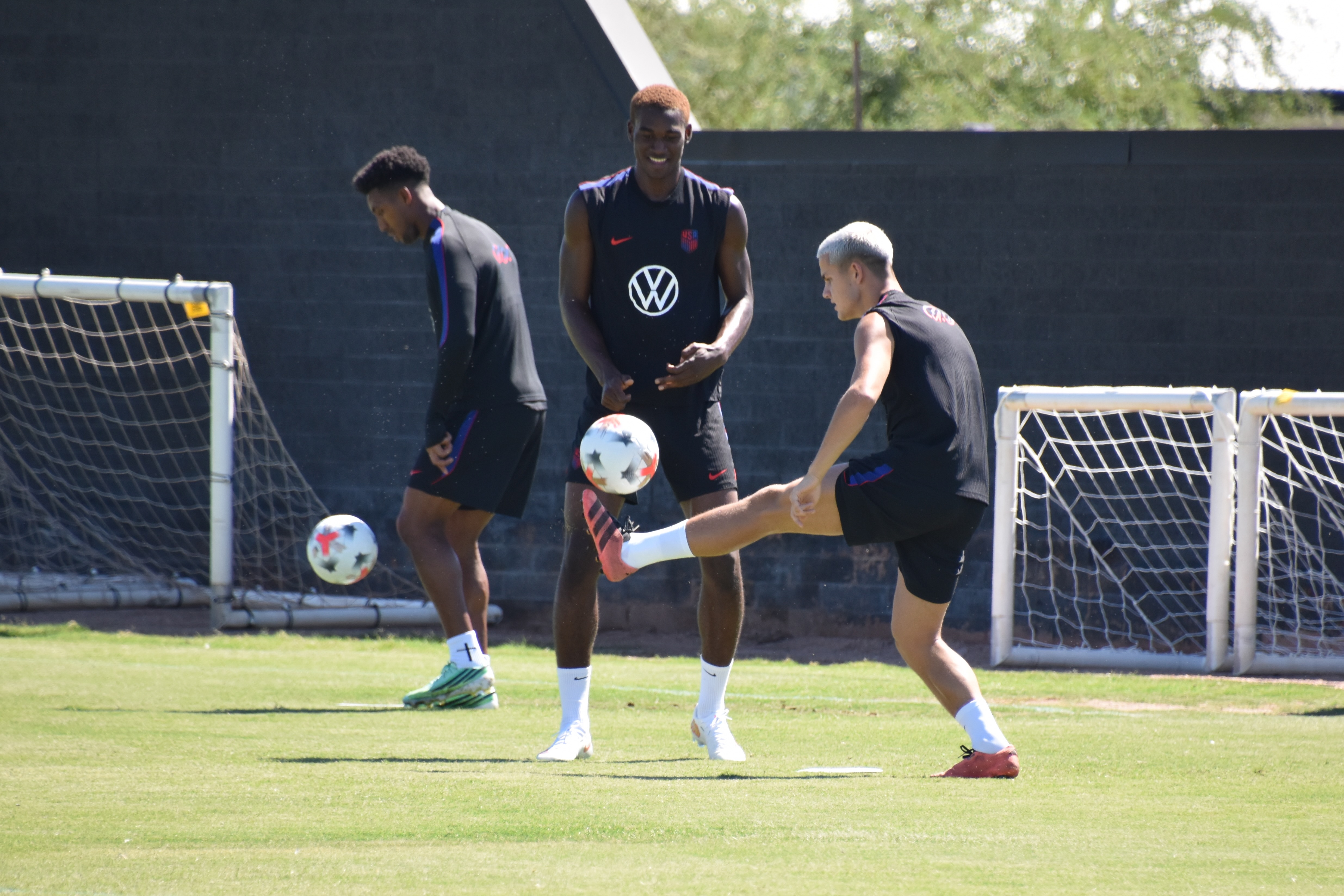
Neil Pierre (center) and Cavan Sullivan (right) are back in action with the U.S. national team this week as the Union gear up for a playoff run. Jonathan Tannenwald
It’s expected that Sullivan, Pierre, and Jean Jacques will all see action in Saturday’s first game when the U.S. takes on Haiti (4:30 p.m., TBS, Universo), and then again next Tuesday (7 p.m., TBS, Universo). As for Blake, it’s anticipated that he’ll once again lead Jamaica against Mexico beginning Saturday (8 p.m., Univision 62) and on Tuesday (9:30 p.m., Univision 62) as well.
However, as the Union gear up for a playoff showdown with New England on Nov. 21 (2 p.m., Apple TV), Richter and the coaching staff will have just three days of preparation with his full squad and assumed starting lineup. And while he’s seen top players on the roster come and go countless times as an assistant, this would be his first as the person in charge.
“Obviously when you’re going into the biggest games of the season, you want to have your full group to prepare, [and] not just two or three days before the playoffs kick off,” Richter said. “I think that’s probably a big motivation leaguewide at least as far as the change in the calendar … but we’re not the only team that’s going to be dealing with that, so it’s not an excuse.”
Not an excuse as much as it’s a hindrance to MLS teams like the Union, who are hoping to enter this second season with a complete roster set to benefit from a week that offers a bit more time to recover. Recovery is crucial for the Union, who rounded out October with a pair of weeks that saw three matches played in seven days, before closing the season with a 4-1 win over Toronto FC last Saturday.
Union players, including Jovan Lukic, Danley Jean Jacques, Cavan Sullivan, and Bruno Damiani, chase Quinn Sullivan after he scored a first-half penalty in Saturday’s win over Toronto FC. Elizabeth Robertson / Staff Photographer
Four starters won’t get that privilege, and will be the last on the Union’s roster to ever have to deal with it, courtesy of MLS’s calendar change that will see the league’s 30 teams play a shortened season beginning in February, before aligning with the traditional August-May FIFA calendar instead of playing meaningful matches in June and July.
While the timing might not be ideal from a club-level perspective, particularly for those that are MLS playoff-bound, as Richter explains, national team call-ups offer a privilege of another kind.
“The guys [who] got called for their national teams, they deserve that,” Richter said. “It’s an awesome honor for them individually to have a chance to represent their country. That’s a real positive, and it doesn’t take away from the positive that is for them and their families and for their careers.”
But in the same breath, he didn’t hide the hint of frustration lying underneath, the kind from a first-year interim coach and team eager to continue their post-World Cup success with a deep postseason run: “But of course, yes, you want to be preparing for the most important games with your full squad and have the weeks of training lead into that.”