Just two years after the format expanded to 12 teams, the College Football Playoff reached an agreement with ESPN on Monday to make the field 24 teams starting in 2027, another seismic shift in the ever-changing world of college football.
Penn State coach Matt Campbell was asked about the change during his press conference on Wednesday. He voiced his support for it, but also added there’s still work to be done to perfect the format.
“Yes, a tournament is the right way to find the champion, and so I still think there’s so much work to do of how do we actually get this exactly right.” Campbell said. “But I know we got great leadership. We got great leadership in the Big Ten, and we certainly have got elite leadership with our president. So, I certainly trust the work they’re doing.”
Neeli Bendapudi, Penn State’s president, is a member of the CFP Board of Managers alongside 10 other presidents from schools across the country, including Notre Dame, Tulane, Texas Tech, and more. The group’s purpose is to govern the CFP’s “business, property, and affairs,” while also developing and approving annual budgets, policies, and operating guidelines.
Campbell said he hasn’t spoken with Bendapudi regarding the expanded 24-team field, but the two “talked a little bit before the season started.”
“From my end of it, I know just even in our Big Ten meetings this summer, there was so much conversation about where this was possibly going,” Campbell said.
Campbell is familiar with a large playoff field. The Division III championship was decided by a tournament with a 32-team field when he was the offensive coordinator at Mount Union from 2005-06. It has since expanded to 40 teams.
Penn State head coach Matt Campbell said a tournament “gives you an opportunity to unveil exactly who is the champion.”Barry Reeger
The Purple Raiders won back-to-back national titles in the two years Campbell coached at his alma mater, and he won three Division III titles as a player for Mount Union from 1999 to 2002.
“I come from a background where you were in the college football playoffs in the smaller school divisions, and I just feel like it always gives you an opportunity to unveil exactly who is the champion,” Campbell said.
But the expanded field means this year will be the last Big Ten championship. Penn State, which is 5-4 and 2-4 in the Big Ten, has won one conference title since the Big Ten added a championship game in 2011. Since joining the conference in 1993, Penn State has won two outright titles (1994, 2016) and a share of the Big Ten twice (2005, 2008).
Big Ten commissioner Tony Pettiti announced Monday in an official statement that this season’s Big Ten championship will be the last, as was expected with the first round of the CFP in the expanded playoff field now taking place during conference championship weekend. The SEC, Big 12, and ACC have all done the same.
Regardless, Campbell was hired to win the Nittany Lions a national championship. The new format doesn’t change those aspirations.
“Those things are what you’re always after,” Campbell said. “I think the reality is, how do you build a program that gives you the ability to do it not just once, but how do you build a program that’s got sustainable success? And I think that in college football, as we’re finding, can be a challenge, and the unique reality we have is we get to lay a foundation to that this year, and then have the opportunity to build ourselves forward as kind of the rules and regulations around us continue to change.”
All the signs are there: Winter is coming. The days when I can pick my toddler up from daycare while it’s light out are numbered; by the time I’m making dinner, it’s pitch black outside. It’s easy to default to complaining this time of year: I hate driving home in the dark. Why do I feel ready for bed at 6 p.m.? But through applying my work as a health psychologist to my own life, I’ve found that with a bit of effort, we can make the shift into the darkest season feel a lot brighter.
One way I do that is by deliberately planning a winter transition week each year. I use this time to ease into the earlier evenings and give myself reasons to look forward to winter. The idea grew out of Norwegian practices I observed when I spent a year living in the Arctic — an experience I write about in my book, How to Winter. Here’s what that looks like for me.
Making space for rest
Like other animals, our bodies are affected by cycles of light and dark. When the sun starts setting earlier, I feel myself slowing down. Rather than fighting or bemoaning this tiredness, I intentionally clear out my calendar during my winter transition week.
I say no to extra obligations, try to cancel or postpone unnecessary meetings, and make time for rest and slowness. That leaves room for evenings when I can go to bed earlier, mornings when I don’t have to rush, and a little extra time to be horizontal on the couch in the afternoon.
When I’ve planned ahead and given myself permission to slow down, my tiredness doesn’t feel like a sign that something is wrong with me. It feels like a natural response to winter’s onset and a reminder that I deserve space to rest.
Preparing my winter nest
Soft lighting everywhere: three candlesticks on the dining table, one pillar candle at my desk, twinkly lights in my toddler’s room, and a glowing yellow lamp that makes everything look as if it’s underwater in the bathroom. Setting up my space for Big Light Off time isn’t just about creating an Instagram-worthy aesthetic. It changes how I feel about the evening darkness. What might otherwise feel gloomy or foreboding becomes a cozy backdrop, a necessary partner in creating a peaceful atmosphere.
I stock up on tea (especially herbal, decaf varieties for after-dinner sipping) and, if it’s cold enough, start sleeping with my hot water bottle tucked into my bed again, which keeps my toes toasty throughout the night. I move my warm coats and scarves into the front hallway and examine my stash of thick winter socks to make sure I have enough.
Putting my house in winter mode ensures that I have what I need to find comfort in the cold and the dark. And the small acts of preparing my space for the season shift my mindset too. I find myself slipping into my winter self, looking forward to spending more time at home, hibernating and going inward.
Going outside
A walk around the neighborhood can be a harder sell when it’s cold, raining, and already dark by late afternoon. But I know that getting outside during my winter transition week will set the habit for the weeks and months to come, so I make a point of doing it.
If I’m up early, I might bundle up and walk the dog in the morning light, enjoying the early brightness — which also helps regulate your body clock. But I’m rarely up early, so I’m more likely to take an early evening walk, noticing the shapes and shadows the streetlights bring out in my neighborhood or showing my 2-year-old the moon, which he can now see before bedtime.
Fresh air, movement, and connection with nature are all natural mood boosters, so especially if I’m feeling a little blah, I know that even a short walk or a few minutes outside with my coffee, wrapped up in a big coat, can help me feel better.
Cooking warming foods
It’s soup season! No winter transition week is complete without a meal that warms me up, which is exactly what I crave once the sun starts setting earlier.
I might make an autumnal squash soup or a chickpea stew. If I’m really tired, I might just order ramen. Either way, sitting down to a hot bowl of something I love is not only comforting, but helps me feel more connected to the changing season.
Planning something to look forward to
Even as I give myself more space for rest, I make sure to plan one thing that feels like a true celebration of winter. Some years I go big: a dinner party, a full day at the sauna or Korean spa, tickets to a show. Other years, I keep it simple with a new book, an afternoon at my favorite coffee shop or a bath by candlelight. Family movie nights, your favorite takeout, a special hike, or a museum outing are all good candidates.
The most important thing here is the intention. Whatever I do, I make it clear to myself and others that I’m doing it in honor of transitioning to winter. This is my way of marking the shift and making it feel like something worth celebrating.
It’s also a way to create my own winter joy. When I give myself something to look forward to, I remind myself of the season’s possibilities; that I can make winter what I want it to be.
Together, these practices help me head into winter feeling more joyful about the months ahead. They give me permission to slow down, help me find comfort in the cold and dark, and remind me that there’s still plenty to look forward to — that winter is special.
The season is often cold and dark, yet the cold and dark can feel gloomy or cozy, depending in part on our perspective. We may be used to thinking, “Winter brings me down” or “Winter is boring,” but we can choose to instead deliberately cultivate beliefs like “Winter is restorative” and “Winter is joyful.” While a positive attitude isn’t a cure for clinical seasonal depression, which is a medical condition, it’s certainly a remedy for the familiar feeling of simply slogging through the colder months.
Our mindsets influence what aspects of winter we pay attention to, which in turn shapes our behaviors and how we feel about the season. Give yourself a week to make room for rest, connection, joy, and comfort and you might find yourself enjoying the colder, darker months ahead more than you ever have before.
On Tuesday, city leaders began officially responding to those demands.
Mayor Cherelle L. Parker, who called 36-year-old Carprice Williams’ alleged treatment of Allford a “crisis of unimaginable proportions,” issued an executive order that calls for child welfare experts to convene and deliver a report on how the city can improve its handling of the thousands of foster cases overseen by the Philadelphia Department of Human Services and managed by a network of contractors and nonprofits.
Meanwhile, City Council members announced they had taken their own interest in investigating the circumstances that led to Allford’s death and making changes to Philadelphia’s child welfare system.
A resolution calling for hearings on the matter, introduced by Councilmember Anthony Phillips and cosponsored by Councilmember Curtis Jones Jr., calls for hearings to probe the workings of DHS and foster care contractors, particularly when it comes to accessing records that detail prior abuse allegations leveled against foster parents. That is a reference to the fact that Williams was able to foster Allford after having a 2021 abuse allegation expunged from her record.
The goal, the resolution says, is to propose safeguards that may prevent another tragedy. Read on for a summary of the mayor’s executive order and the City Council resolution.
What actions were proposed?
Mayor’s executive order:Establishes a Child Welfare Review Committee, which will be tasked with reviewing the way DHS interacts with community umbrella agencies (CUAs) — the nonprofits that contract with the city to manage foster care cases — as well as local foster care agencies.
Committee members will be asked to conduct a “comprehensive review” of issues affecting the city’s child welfare system, according to the order.
Members will review the process for placing children in foster care homes, for example, and probe how the city and state monitor such cases, the order says.
They will also examine how foster homes are licensed and consider how to best manage visitations from a child’s biological family members. And they will review the city’s criteria for contracting with certain foster care providers.
City Council resolution: Authorizes Council’s Committee on Children and Youth to hold hearings that will examine how the city keeps children in its child welfare system safe.
The hearings will explore what safeguards exist to support children placed outside the care of their biological families and how the city can engage with the concerns of a foster child’s family members during placement, according to the resolution.
They are also expected to delve into how city agencies can better coordinate with foster care providers and how to prevent abuse, neglect, and fatalities within the system.
The hearings will probe how contractors select homes for foster placement, for example, or how they assess whether a child’s relatives are eligible for possible placement within the family.
Additionally, the discussions will examine the training foster care providers receive, exploring whether they are prepared to meet the needs of children in their care. That includes training received by staff with the CUAs responsible for managing many of the city’s foster care cases.
The hearings will also focus on DHS — specifically how the city agency records and responds to instances when a foster care provider has been accused of prior abuse or neglect.
That includes examining what types of records and prior investigations providers may “lawfully access and consider during interviews, home studies, and approval decisions, including when a former [caregiver] applies to foster another child through a different provider,” the resolution says.
Who’s involved in the plans?
Mayor’s executive order: The Child Welfare Review Committee will be composed of up to 15 members who are “experts and leaders in the field of child welfare and foster care,” according to the order.
Members will be selected by the mayor from a variety of professional fields, such as childcare advocacy groups, social workers, medical and behavioral health professionals, and legal experts who specialize in child welfare and the foster care system.
Two committee chairs will be appointed by the mayor.
City Council resolution: Council’s Committee on Children and Youth will oversee the hearings. The committee is chaired by Phillips, with Councilmember Isaiah Thomas as vice chair.
The committee includes Councilmembers Kendra Brooks, Jamie Gauthier, Jim Harrity, and Rue Landau.
What are the possible outcomes?
Mayor’s executive order: The committee’s goal is to “work toward the elimination of child abuse-related fatalities, near fatalities, and injuries,” the order says.
It also aims to improve how DHS coordinates with CUAs, nonprofits, and local foster care agencies.
City Council resolution: The hearings could change how the city’s child welfare system operates.
For example, the resolution says the discussions will explore whether additional training is needed for DHS employees to assess whether a foster placement is safe, and to learn how to escalate their concerns about possible abuse to superiors.
The talks could lead to changes in how foster care providers access information about potential caregivers, how caseworkers verify that a child is safe in a foster home, and how attorneys and family members advocate on behalf of a child in a potentially dangerous situation.
And the hearings could change how agencies determine when it is safe for children to return to their original home, among other possible outcomes.
Participating Council members are also expected to consider how to publicly release information regarding these potential changes, whether they are working, and whether additional safety measures may be required.
What are the timelines?
Mayor’s executive order: Mandates that committee members submit a report on their findings to the mayor within 120 days of convening.
City Council resolution: There is no date set for hearings to begin.
After the first hearing, the resolution requires DHS to provide the Committee on Children and Youth a monthly report for a period of two years.
That document is expected to include tallies of children who are placed in kinship and foster care, reunited with a parent or guardian, or subject to a court order terminating parental rights, according to the resolution.
The United States is pulling out of FIFA’s upcoming under-17 men’s World Cup in Qatar, a source with knowledge of the matter told The Inquirer.
The decision was made due to safety and security concerns in the Middle East, according to a letter sent to the U.S. team’s players. They were informed of the decision on Wednesday.
“We are extremely proud of the preparation by our players and coaches to represent the U.S. in the World Cup,” the letter said. “Unfortunately, in light of current circumstances including the U.S. State Department’s Level 3 Travel Advisory for Qatar and related directives for Embassy staff and families, we are no longer able to participate in the tournament. The well-being of our players and staff will always be our top priority.”
The tournament runs from Nov. 13 to Dec. 19. The U.S. had been scheduled to open against Montenegro on Nov. 21. Chile and Algeria are the other teams in the group.
“Please accept our deepest appreciation for your commitment to U.S. Soccer and our shared disappointment about these circumstances,” the letter concluded.
Among the 21 players on the U.S. team is Union striker Malik Jakupović. He was a star of February’s qualifying squad, with eight goals in three games, before his rise with the club’s first team this season. The World Cup was to be his biggest moment yet on an international stage.
The withdrawal means he’ll return to the Union for the playoffs. The Union begin their three-game series with the New England Revolution on Nov. 21 in Foxborough, Mass., with Game 2 at Subaru Park on Nov. 28.
This is a developing story. Please check back for updates.
At sundown, Paul Wright would drive up and down Kensington Avenue in his Ford Explorer between the Erie-Torresdale and York-Dauphin stations, looking for his niece. He checked her into at least four drug rehabs in Camden, Trenton, and Philadelphia, but she would always run.
He had not seen her in years, and hoped she had finally found sobriety and moved away.
“I have some closure,” he said, his voice shaking. “But now I need answers so I can kind of try to figure out what led up to this.”
During a September news conference, police explained that a trove of video and photographic evidence recovered from searches of Horsch’s Olney residence pointed to the possibility that at least five of the seven women were dead.
One victim, who had not previously been named at the request of a relative, was a 25-year-old woman who appeared unconscious and with visible injuries in some recovered photos.
Paul Wright said two family members have told him that investigators were referring to his niece, and a police source confirmed to The Inquirer that the woman was Lelia Wright, whose first name was pronounced Leah.
Wright said he spoke with a detective who declined to provide exact details on the circumstances of her death because he is not considered next of kin.
“Short of not telling me, he told me it was her and she was gone,” said Wright, 49, a construction foreman and father of four.
Wright said relatives told him that police were able to identify her from tattoos on her neck, chest, and back.
“I can’t lay her to rest, I can’t get her cremated and put her with her dad or her grandmom,” he said. “I can’t do anything for her because, as far as I know, she was dissolved in liquids or buried somewhere.”
Paul Wright in Tredyffrin Township, Pa., tried pulling his niece off the streets of Kensington for years. Monica Herndon / Staff Photographer
A chance car stop on June 19 led to the arrest of Horsch’s son, Eugene, after police discovered guns, drugs, and a fake ID made out in the name of another missing woman, Blair Tonzelli. Eugene Horsch is in prison on federal charges, but has not been accused of violent crimes involving the deaths or disappearances of the women. Raymond Horsch died last year.
The discovery of Tonzelli’s ID prompted a sprawling investigation into the Chew Avenue home. For months, crews have excavated pipes, sewer lines, and sections of the front and back yards. Inside, they have torn up floors and taken down walls in search of forensic evidence.
Police have uncovered numerous videos and photos from Horsch’s home they have said seem to show real violence and actual killings.
“Usually when we have a homicide investigation, we have a body, we have body parts,” Police Inspector Raymond Evers said at an August news conference.
“This time we do not.”
A hard life
Life had never been easy for Lelia, Wright said.
Her biological mother, who could not be reached for comment, took her and four siblings to Virginia from Philadelphia when Lelia was little. Relatives intervened after it became clear the woman was unable to care for the children, and Lelia’s grandmother — Paul Wright’s mother — was granted custody, he said.
Since the age of 5, Lelia had been raised in Philadelphia by her grandmother, Julia Wright, her dad, Thomas Wayne Wright, who died in 2019, and his longtime partner, the mother of five more children.
Paul Wright pitched in, too, and for a long time, Julia Wright, Thomas Wright, and Paul Wright lived in three rowhouses on the same block on East Arizona Street near Coral in Kensington.
Lelia dropped out of school and started using drugs as a teenager, Wright said. Her grandmother, whom Wright described as a “no-nonsense mama bear,” put bells on the bedroom doors of Lelia and her two sisters to alert her when they snuck out.
“I can’t tell you how many times my mom would call me and tell me that Lelia ran off, to go find her, and I would go find her and bring her back home,” he said.
When her grandmother died in 2011, at age 71, a devastated Lelia turned to drugs to ease the loss.
“That was probably the catalyst that finally put her out there,” Wright said. “That was the thing that just drove her away.”
Court records show that she was arrested in Philadelphia and Montgomery County at least 11 times between 2012 and 2016 for minor offenses, principally drug possession or sex work. She was repeatedly described as homeless in arrest records, sometimes listing the offices of social service provider Prevention Point as her home address.
Nearly all of Wright’s Philadelphia arrests occurred between the 2800 and 3500 blocks of Kensington Avenue, placing her right in the area where Raymond Horsch picked up drug-addicted women to pay for sex or pornographic work.
Wright said the last time he saw Lelia, she was on Kensington Avenue near M Street, talking to an older man in a dark minivan.
“C’mon, let’s go, Lelia,” Wright called out to her. “We’re going to rehab.”
Lelia took off.
The man in the minivan stepped out, and Wright said he smashed the back driver’s side window with his fist, shattering the glass. The man walked to the back of his car to get something, and Wright said he punched him in the head.
He doesn’t remember the date. He doesn’t know if this man was Horsch.
“What if that old guy was him?” Wright asked. “What if that last time I saw her was the last time he was out looking for girls? These are all things that are going to be pinging around in my head now for the rest of my life.”
Lelia’s contact with the court system abruptly ended in December 2016. She was not formally reported missing at the time of her disappearance.
Over the years, Wright called the morgue, police, prisons, and hospitals multiple times.
“No one ever had any unclaimed bodies or anyone with that name,” Wright said. “So there was always still a hope that she was out there. There was always the hope that she might have gone somewhere and got clean.”
He never had her cell number. He assumed she used burner phones, and she had no presence on social media.
“Now I feel like I failed,” Wright said.
With no human remains yet found, Wright said, he will never have the real closure he seeks. He still thinks about the last night he saw her. What if he had been able to stop her from running?
“I went after her,” he said. “She got away from me, and that was the last time I ever saw her.”
He is convinced that there is more to the story.
“We can’t do anything to him [Horsch] because he’s dead, but there’s no way this could just be him,” Wright said. “Who helped him? How many other victims are there?”
WASHINGTON — The size of Democrats’ majorities in the House and Senate remained undetermined one week after Election Day as more than a dozen races were still too early to call Tuesday.
Democrats are on track to hold 54 Senate seats in January, but could pick up one or two more from Republicans as votes are counted in Alaska and Mississippi. With 255 seats in the House, Democrats will have their largest majority elected to the chamber since 2008, with the potential to pick up several more seats as the remaining races are called.
Here’s a look at where things stand in some of the uncalled races:
Mississippi’s Senate seat remains too early to call
Late in the afternoon Tuesday, Democrat Scott Colom was about 2,600 votes ahead of Republican Sen. Cindy Hyde-Smith in the race for Senate in Mississippi.
There are two key deadlines in the vote-counting process in Mississippi this week: Mail-in absentee ballots must be received by Tuesday, and counties are required to submit their certified election results — including tallies of provisional ballots — to the state by Friday.
It is unclear exactly how many ballots are left to count.
Unlike in some other states, there is no central vote reporting system for Mississippi, and few counties release election results online. Instead, Associated Press journalists and analysts communicate with each of the state’s 82 counties directly for the latest available information on vote counts.
The state will certify its results on Dec. 3.
On Monday, Mississippi Secretary of State Michael Watson said about 14,200 provisional ballots had been processed, of which about 80% were accepted, and about 2,700 mail-in absentee ballots had not yet been returned.
Mississippi does not have automatic recounts or permit candidates to request a recount. Recounts in the state are held only in the event of a court order. The AP may declare a winner in a race that is eligible for a recount if it can determine the lead is too large for a recount or legal challenge to change the outcome.
The vote count is ongoing in Alaska’s Senate race
Democrat Mary Peltola led Republican Sen. Dan Sullivan by about 2,500 votes in Alaska’s Senate race on Tuesday afternoon, with an estimated 76% of the vote counted. The results of some absentee ballots are expected to be released late Tuesday, though the final absentee ballots mailed back from outside the U.S. are accepted as late as Nov. 18, 15 days after Election Day.
Ranked choice voting could also affect the timeline. Peltola is just over 1 percentage point short of the majority needed to win outright. If neither candidate wins a majority, the race will proceed to ranked choice tabulation on Nov. 18. The state’s “target date” for certifying the election results is Nov. 25.
Recounts in Alaska are automatic only in the event of a tie vote. Candidates may also request a recount within five days of the state’s certification.
More than a dozen House races are still up in the air
In most of the House races that have not been called, the margin between the leading candidates was less than 1 percentage point among votes counted as of late Tuesday afternoon.
In North Carolina, four races remain undecided, the most of any state, and Republican incumbents were being challenged in all. There are no automatic recounts in North Carolina, but candidates may request a recount if the margin between candidates is 1% or less of the total votes. The state must receive the recount request by noon Eastern time Nov. 17, two business days after the county canvass in the state. The state is scheduled to certify its results Nov. 24.
In California, only one of the remaining House races, in the 23rd District, will affect the chamber’s balance of power. The other uncalled race is between two Democrats. Mail ballots must be received by Tuesday and counties must certify their results Dec. 3. The state will certify its results Dec. 11.
In South Carolina’s 2nd District, a recount is ongoing in the race between Republican incumbent Joe Wilson and Democrat Zyon Khalia. Wilson led Khalia by only about 3,000 votes in the original tally by late Tuesday afternoon, when 99% of the votes had been counted.
In Minnesota’s 1st District, the race was still undecided late in the afternoon Tuesday, with about 300 votes separating the top two candidates and an estimated 99% of votes counted. Recounts are not automatic in Minnesota, but a candidate can request a publicly-funded recount if the margin between the winning and losing candidates is less than 0.25% of the vote.
In Tennessee’s 4th District, about 300 votes lay between Democrat Victoria Broderick and Republican incumbent Scott DesJarlais as of late afternoon Tuesday. In that state, recounts are held only as part of a legal challenge in the courts. There are no automatic recounts, and losing candidates may not request recounts.
Two governorships remain undecided
Democratic state Sen. Cindy Holscher led state Republican Senate President Ty Masterson in the race for governor of Kansas by less than 1 percentage point late Tuesday afternoon. On Nov. 4, the state announced that a close-race audit of election results requiring a hand count of selected ballots had been triggered in six close Kansas races, including the gubernatorial race. The audit must be completed before Nov. 16, the day by which counties must certify their results.
In the race for governor of Alaska, only about 76% of votes were estimated to had been counted late Tuesday afternoon, and the Democratic candidate, Jonathan S. Kreiss‑Tomkins, was leading Bernadette M. Wilson by about 45,000 votes, 49.6% to 28.9%. The race will advance to ranked choice tabulation if no candidate receives more than 50% of votes.
Eighteen months after the completion of a transformational building renovation, the Haverford Township Free Library is having a banner year.
“All of our statistics are up,” said library director Maryanne Olson, sitting in her office on a quiet Monday morning as toddlers assembled for story time nearby and patrons moved silently through the maze of stacks.
The Haverford Library reopened in May 2025 after an 18-month, $22 million renovation. The project expanded its square footage and added improved spaces for kids, teens, and adults to read, work, create, and congregate. Additions included study and meeting spaces, cozy reading nooks, a local history research room, and the MakerSpace, an interactive workshop where visitors can use technology like 3D printers and laser cutters and take classes on everything from art to coding.
The renovation was funded by a $13 million appropriation from Haverford Township, as well as state and federal grants, American Rescue Plan Act funding, and a contribution from the library.
Since the reopening, programming, reference queries, and participation have ballooned, Olson said, as residents flock to the building to borrow items, learn new skills, and meet their neighbors.
It has also given library staff the opportunity to hold more programs and events. In the first nine months of 2026, program offerings at the library increased by 284% over 2022, the last full year the building was open pre-renovation.
Library staff reported five times as many program attendees and twice as many reference queries as in 2022. Physical visits to the building have risen from 106,383 in 2022 to 123,205 in the first nine months of 2026. And the year isn’t over.
“It sort of, to me, puts to rest this idea that people don’t need to come to the library,” Olson said.
Patrons gather on Sept. 13 for a concert at the Haverford Township Free Library. The library reopened in May 2025 after a long-awaited renovation.Courtesy of Haverford Township Free Library
Olson stepped into the role of library director a year ago after spending a decade in the Queens Public Library system in New York City, most recently as the library’s Ridgewood Branch manager.
Olson pointed to several factors behind the Haverford Library’s successfulyear. More programs and the desire for “third spaces” and opportunities to meet people havedrawn in everyone from 20-somethings to young parents to senior citizens. As concerns about affordability mount, libraries across the U.S. have also seen an uptick in cardholder membership, circulation, and event attendance, a phenomenon Olson has observed locally.
The Haverford Library hosts dozens of events and workshops each week, ranging from quilting and canasta for adults to Dungeons and Dragons for teens. There are more than a dozen book clubs, and children’s story time takes place multiple times a week.
“What I think is really heartening for me is to see just the number of people who are coming into the library,” Olson said.
In surveys and in-person conversations, patrons have called the library “a wonderful safe space for children and teens,” a “welcoming atmosphere,” and “the intellectual center of our community,” Olson shared.
The library’s forthcoming Dine and Discover senior program has more than 60 registrants. Last Friday, usually a quiet day in the after-school hours, Olson said, the library was “just slammed” with teenagers, who she said were “really engaged in the space.”
The MakerSpace at the Haverford Township Free Library. The library reopened in May 2025 after a long-awaited renovation.Courtesy of Haverford Township Free Library
Beyond programs, Olson said, she has seen increased interest in the library’s collection, which extends far beyond the bookshelf.
Patrons can borrow museum passes, Kindles, hot spots, and Roku streaming sticks. They can take virtual yoga classes, read newspapers and magazines, comb through genealogy databases, and use study guides. Through the “Library of Things,” members can check out everything from cornhole sets to camping chairs to label makers. Olson is borrowing serving platters for her holiday meals this year.
With affordability top of mind for many people,Olson said, access tono-cost items only becomes more important.
“People appreciate coming here because things are free,” she said.
Despite abundant warnings that “the end of reading” has arrived, Olson said books “are still front and center.” The library’s highest circulation still comes from physical materials, especially for parents of young children.
The biggest complaint Olson has received? Patrons want even more, which the library director considers a “good problem to have.”
“They’re not just walking in and walking out,” Olson said of library patrons. “They’re coming in, and they’re really using the space, and they’re sharing with their friends, ‘Oh, you should really check out the library and see everything that’s offered.’”
This suburban content is produced with support from the Leslie Miller and Richard Worley Foundation and The Lenfest Institute for Journalism. Editorial content is created independently of the project donors. Gifts to support The Inquirer’s high-impact journalism can be made at inquirer.com/donate. A list of Lenfest Institute donors can be found at lenfestinstitute.org/supporters.
The battle over the Washington Square West historic district is not over yet.
The 1,441-property historic district has been caught up in litigation almost since its inception, with Common Pleas Court Judge Christopher Hall ruling against it in October, and the city quickly appealing his ruling to Pennsylvania’s Commonwealth Court.
The case is unusual because the Philadelphia Historical Commission usually wins appeals that try to reverse its designations.
The city’s appeal means the Washington Square West historic district remains in place while the litigation continues.
In advance of a Commonwealth Court hearing, Hall will have to write a full opinion on the matter, as his ruling came with only a few paragraphs of footnotes explaining his thinking.
The city and a group called Philadelphians for Rational Preservation, which opposed the district, will have to write full briefs as well.
The next ruling is expected by2028.
This month, the Philadelphia Law Department filed a list of ways that it thinks Hall erred in his ruling, which offers a sense of how the forthcoming case could unfold.
Philly doubts validity of public meetings
Hall’s ruling found that the historic district was not supported by “substantial evidence” and that it was broadly unpopular.
He also took issue with a historical commission staffer who reviewed the nomination but did not testify in its defense and with a commissioner who helped draft and revise the nomination. The commissioner did recuse herself from the vote.
Hall found that Philadelphians for Rational Preservation was within its rights to challenge the district because homeowners would be immediately impacted by the new regulations on their homes.
The city challenged all those findings, arguing that Hall should notconsider lack of support for the district when he noted that 85% of those who testified about the district at a 2024 historical commission meeting were opposed.
“The record does not reflect the overall views of affected owners, businesses, or residents, but only the self-selected bias of the limited number of persons who provided public comments,” the law department wrote in the city’s November rebuttal.
The city also argued that Philadelphians for Rational Preservation should not be allowed to pursue the case because the group “failed to identify any constitutionally protected property interest affected by historic designation.”
The law department argued that the group presented “no evidence of actual harm.”
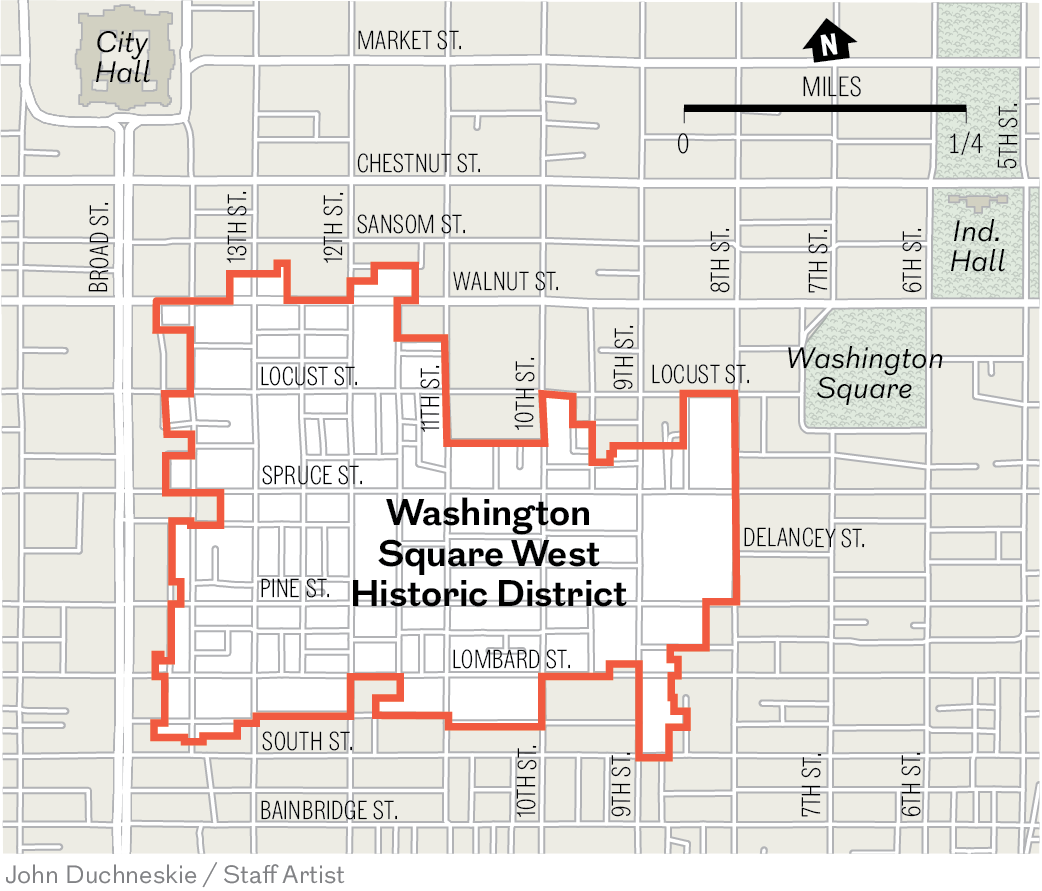
Map of the newly designated Washington Square West Historic District.
In recent months, Philadelphians for Rational Preservation has argued that the district would impose a de facto “preservation tax,” which would add thousands of dollars to home renovations.
The kinds of materials required under preservation regulations are usually more expensive, while some changes — such as replacing doors and windows — would require homeowners to obtain a permit, which they previously would not have needed. That could result in additional wait time, bureaucratic hurdles, and extra costs.
The group’s website includes quotes from homeowners who oppose the district and who share their negative experiences with it.
No conflict of interest?
The judge also ruled against the new district because he found the affirmative case shaky.
“The nomination papers do not explain why most of the properties contributed to the district,” where the period of significance spans from 1740 and 1985, he wrote.
Hall noted that much of the documentation for individual buildings remained blank, with no information included for the year they were built, the name of the architect, or the structure’s historic function.
“No information appears in these fields more often than not,” he wrote.
The city’s law department disputes those findings.
The most detail in the appeal is the defense of Emily Cooperman, a member of the historical commission who told The Inquirer she helped write the original historic designation proposal almost 20 years ago, before she was on the commission. She also updated it more recently but recused herself from consideration of the case in 2024.
Philadelphians for Rational Preservation objected to her involvement while sitting on the commission. The judge appeared to agree, although a detailed objection was not included in his initial ruling.
“Dr. Cooperman recused herself from the commission’s consideration of the nomination, and there is no evidence of any commissioner having a conflict of interest or being improperly swayed,” the law department argues.
Further, the department argues, a proper response would have been to remand the issue back to the commission, not reverse its ruling entirely.
EDMONTON, Alberta ― After a day off Tuesday following a back-to-back in Calgary and Vancouver that was capped off by their first win in four tries, the Flyers hit the ice for a full morning skate at Rogers Place.
You wouldn’t know from the stick raises after goals and looseness on the ice that the last 92 hours had been filled with controversy — notably surrounding Matvei Michkov.
The biggest bombshell came from ESPN hockey insider Kevin Weekes, who reported late Tuesday afternoon that, according to multiple league sources, “Michkov would likely want a new start elsewhere.” He cited “the Flyers [sic] unimpressive start and internal turmoil” as the cause.
**Breaking News** 🚨 📰
From multiple league sources, with the Flyers unimpressive start and internal turmoil, Michkov would likely want a new start elsewhere. He's in the last year of his contract & is a prime trade candidate moving forward. #HockeyXpic.twitter.com/4mYzKiN42G
Surrounded by cameras and reporters, Michkov sat in his stall after morning skate Wednesday in preparation to face the Edmonton Oilers (9 p.m., NBCSP) and addressed the report. “I’m no read all news. I no talk in interview,” he said without a translator. “I need concentration just on tonight’s game, and that’s all.”
Flyers head coach Rick Tocchet, foward Matvei Michkov, defenseman Nick Seeler and captain Sean Couturier met with the media prior to tonight's matchup in Edmonton. pic.twitter.com/UhVNuMZOcK
The 21-year-old forward spoke earlier in the day with Flyers general manager Danny Brière, who reiterated to him and, when he said when addressing the team, the need to concentrate “just on hockey.”
Brière, who was in Calgary for the Flames game on Sunday, traveled back to Alberta after attending the GM meetings in Toronto. President Keith Jones was already on the road trip, and Flyers governor Dan Hilferty is now in Alberta as well. Brière is slated to hold a news conference over Zoom on Wednesday evening (around 6:15 p.m. ET) with media members to address the trade report.
Michkov, who will be a restricted free agent come July 1, is tied for 13th in the NHL with 10 goals and tied with Trevor Zegras for the team lead in points (14).
When asked if he is happy in Philly, he responded: “Yeah, of course.”
Asked for his reaction to the report and if he has spoken to Michkov, coach Rick Tocchet replied: “I mean, there’s nothing to talk about. It’s not true. So there’s nothing to report. You can’t comment on somebody blogging something that’s not true.”
But is there “internal turmoil” or issues in the room as the tweet implied?
“No, because we had a little bit of that stuff last year, and we dealt with it,” Tocchet said, citing in an earlier response that the young team grew last year going through similar things. “So no, not at all. It’s a very close group.”
Flyers general manager Danny Brière is expected to adress the media regarding the Matvei Michkov report on Wednesday night.Jose F. Moreno / Staff Photographer
Added captain Sean Couturier: “We’re still tight. We’re still playing for one another. It’s outside noise. We control what’s in this locker room. We know we have a lot better hockey in us, and we’re going to try to come back to the way we played last year … and we’ll figure things out.”
The report by Weekes comes a day after an NBC Sports Philadelphia camera caught Michkov and defenseman Nick Seeler arguing on the bench. Michkov got animated, with teammates Noel Acciari and Porter Martone trying to calm him down, and at one point he threw a water bottle down.
“He’s a competitive guy. He brings a lot of passion, and we have no issue with it,” Seeler said on Wednesday. “It’s good to show that you care, and he’s one of the guys that obviously is having a really good year, and he cares.
“And it really wasn’t a big deal at all until the media got a hold of it. We spoke after the period, and it was done with, over with, and then all of a sudden after the game, it was this big deal when it really wasn’t.”
Tocchet and Michkov each agreed the interaction was not as big as it was made out to be. Speaking to several Flyers, they all agreed that these kinds of interactions happen more often than not.
Couturier said he often got into it with Jakub Voráček and Claude Giroux — “We would have been shipped out, probably 10, 20 times” — and alternate captain Travis Sanheim told The Inquirer, “I know me and [Travis Konecny] get into it quite a bit, and nobody makes a fuss about it.”
The difference here is that, while during a TV timeout, it was caught on camera.
“This emotional game. Everybody want to win, and Seels emotional guy. Me too,” Michkov said. “All guys hungry for wins and on the bench too. … But for me, this is good. When all guys [are] emotional. … But this is good for me. And we, before this game, we sit together [for] dinner and eat.”
The bench argument does come after Seeler said on Oct. 28, following the Flyers’ 12th loss in their first 15 games, and without naming names: “It’s not about getting points. It’s not about ‘me, me, me.’ It’s about the team and playing for each other and sacrificing for each other. And it’s really not that difficult to understand. You play for the guy next to you; that’s what Flyers hockey is all about, and when we can start figuring that out at the start … we will be a better hockey team.”
He did not name Michkov, but external speculation suggested it was about the Russian forward. Did that amplify the reaction?
“I don’t know. Maybe? I think people just make stories out of nothing in today’s world,” Couturier said. “Seels is the ultimate team guy. He’ll do whatever he can to defend his teammates. Plays the right way. Plays hard every night. You can’t ask for a better teammate. So, yeah, I think it’s just two competitors voicing their opinions.”
Breakaways
The Flyers received some good news Wednesday as Rasmus Ristolainen was activated from injured reserve and took regular line rushes at morning skate ahead of his potential return to the lineup against the Edmonton Oilers. The Finnish defenseman had missed 16 of the last 17 games with a hand injury that he initially suffered on Oct. 3 and reaggravated on Oct. 24.
Global Entry travelers entering the country through Philadelphia International Airport no longer need to stop at a kiosk to answer customs questions when they land.
As of Oct. 13, travelers instead now pass through facial recognition cameras, according to a statement released this month by U.S. Customs and Border Protection (CBP).
PHL is the first airport in the country to deploy the new technology, CBP has said. The agency plans to install the new system across 30 airports.
“This improved process for Global Entry members reflects Customs and Border Protection’s continued efforts to process travelers more efficiently, enhance the international arrivals experience, and strengthen our nation’s security,” Elliot Ortiz, CBP’s area port director in Philadelphia, said in a statement.
The new technology is intended to “strengthen identity verification, streamline traveler flow, improve processing efficiency, and support CBP’s enforcement and security mission,” the agency said.
The Global Entry program was launched in 2008 and had 15.6 million members as of Oct. 1. As part of the program, travelers are able to use TSA PreCheck at airports when departing and the Global Entry lane upon arrival to go through customs.
Travelers who want to join the Global Entry program pay a $120 application fee and undergo a background check and interview. Eligible travelers include U.S. citizens and permanent residents, as well as citizens of other participating countries.
The update at PHL comes as CBP announced in January that it was launching facial recognition technology for U.S. citizens upon arrival through the normal customs process at the airport. PHL is one of 23 U.S. airports that have implemented the technology, along with 10 others internationally.
At the time of the announcement, an agency official said the new technology would result in PHL travelers experiencing “shorter wait times, faster processing through CBP arrivals inspection, and the improved ability to make their connecting flights.”
The airport also started using facial recognition technology in 2023 to board passengers onto international flights, after testing out the technology in 2020. Airport officials noted in a statement at the time that CBP is required to “biometrically record all foreign nationals who enter and exit the United States,” excluding those that don’t require a visa to be in the country.
The new biometric technology isn’t the only recent upgrade at PHL. Last year, the airport started adding new terminal exit lanes and updated bathrooms, amid other improvements in preparation for an influx of passengers in 2026 for the FIFA World Cup, MLB All-Star Game, and United States’ 250th birthday.
The airport has also been adding new options to its offering of lounges. Last year, American Airlines opened two lounges at the airport, and Chase Sapphire inaugurated its lounge between Terminals D and E. Escape Lounges is also planning to open a location in Terminal D this year.