Blog

  • CDC acknowledges one U.S. measles death after omitting Pa. data from its dashboard for weeks

    CDC acknowledges one U.S. measles death after omitting Pa. data from its dashboard for weeks

    The Centers for Disease Control and Prevention confirmed Wednesday that one person died this year in the measles outbreaks it tracks nationally.

    Pennsylvania has reported four measles-associated deaths, but the CDC for weeks omitted them from an online dashboard.

    State officials are “not aware of which death the CDC is citing,” a spokesperson said in a statement Thursday, referring questions to the federal agency.

    Federal health officials did not specify where the death reported on the CDC dashboard occurred. On the dashboard, they said the number was “subject to change” and the agency will update its reporting of deaths “as additional information becomes available and relevant reviews are completed.” The agency did not announce the update.

    The agency also said it is working to develop a standard case definition of measles deaths with the Council of State and Territorial Epidemiologists.

    The update came after the National Center for Health Statistics told the CDC that it had received “a report from a state of a measles-related death,” federal health officials said in a statement late Wednesday.

    “Through its standard process, NCHS verified that the death occurred and that measles was listed as the underlying cause of death. This is now reflected on the CDC website,” the statement said.

    Pennsylvania’s measles outbreak, currently the largest in the nation, has sickened more than 800 people, with state health officials reporting more than 100 new cases in the last week alone.

    Lancaster County, the center of the outbreak, has confirmed more than 300 cases, and nearly 80 people have been diagnosed with measles in Chester County, the only Philadelphia-area county with cases in the current outbreak.

    The four measles-associated deaths reported in the state represent the highest death toll linked to the highly contagious disease in more than three decades.

    Measles-associated deaths in Pennsylvania

    The state announced its first two measles-associated deaths, both in unvaccinated Lancaster County residents, in late August, almost immediately sparking a clash between state and federal officials over how to characterize the deaths.

    Two more deaths were reported this month. One involved an unvaccinated 18-year-old in Mifflin County who died from a serious neurological complication of measles. And measles led to the death of an unvaccinated 40-year-old woman in Jefferson County with severe respiratory conditions.

    Both deaths were confirmed by local coroners, both Republicans.

    The Lancaster deaths, later disclosed as two infants in the Amish community, drew widespread scrutiny.

    The county coroner later said he did not believe measles caused one of the deaths, involving an infant with a lacerated spleen who tested positive for measles, though physicians have noted measles can weaken the organ and make it more likely to rupture.

    The coroner, an elected Republican, said a second death, in another infant with a fatal genetic condition, was caused by measles.

    Pennsylvania defines a “measles-associated death” as one that occurs within 30 days of symptom onset in a person with clinical evidence of infection and a positive laboratory test, and who did not die of another unrelated cause, like a car crash.

    All four deaths recorded in Pennsylvania meet that definition, state officials say.

    Announcing the deaths in Lancaster, Democratic Gov. Josh Shapiro criticized President Donald Trump’s Health and Human Services secretary, Robert F. Kennedy Jr., saying he has spread misinformation about vaccine safety that’s contributed to a decline in measles vaccination rates across Pennsylvania.

    Kennedy, a longtime anti-vaccine activist, said Shapiro was politicizing the issue. Kennedy wrote on social media that the governor’s administration may have “fabricated” the Lancaster County deaths, although he later acknowledged that one death was caused by measles.

    And until Wednesday, the CDC had not acknowledged any 2026 measles deaths on its data dashboard for weeks.

    The agency had briefly noted two measles-associated deaths on the dashboard the weekend after Pennsylvania officials confirmed the two Lancaster County deaths, the Washington Post has reported.

    Then, within a day, the deaths were removed from the website and replaced with an asterisk.

    The CDC initially posted an explanation saying it left the deaths off the dashboard because “available information does not establish whether measles caused or contributed to the deaths or whether the individuals died from other causes while infected with measles.”

    The agency later updated its asterisk explainer to note that the National Center for Health Statistics “does not currently have any death records from 2026 that indicate measles is the underlying cause.”

    Using the NCHS to record deaths from measles is a departure from the CDC’s standard protocol. Former CDC officials say the agency has used a different system, the National Notifiable Diseases Surveillance System, to confirm deaths, and does not typically challenge routine disease surveillance from states.

    It can take weeks for the NCHS system to record a death.

    Delaying death reporting, experts have said, could affect efforts to contain Pennsylvania’s outbreak.

    Staff writer Sarah Gantz contributed to this article.

  • 8 sailors in USS Lincoln group attempted suicide on extended deployment, Navy leader says

    8 sailors in USS Lincoln group attempted suicide on extended deployment, Navy leader says

    WASHINGTON — Eight sailors attempted suicide while deployed with the USS Abraham Lincoln aircraft carrier strike group, which spent a record-setting uninterrupted time at sea supporting the Iran war, the Navy’s top civilian leader said this week.

    Acting Navy Secretary Hung Cao provided the information to Sen. Kirsten Gillibrand in a letter dated Tuesday after the New York Democrat inquired last month about the strike group’s crew of thousands. The Lincoln’s extended deployment drew the nation’s attention following reports of crew stress and poor mental health, as well as supply shortages, including food and hygiene products.

    Gillibrand asked Cao specifically if there were any suicides.

    “There have been no suicides on board during this deployment,” Cao wrote in the letter, which was obtained by The Associated Press and reported earlier by CNN. “Since the beginning of LINCOLN’S deployment, there have been a total of eight suicide attempts across the strike group — this number includes the LINCOLN crew and Sailors from the carrier wing, strike group and destroyer squadron staff, escorting destroyers, and all embarked aviation squadrons.”

    President Donald Trump had downplayed reports about conditions on the Lincoln, which left its homeport in San Diego in November, arrived in the Middle East in January in support of Iran operations, and spent a record-setting uninterrupted time at sea of more than 260 days.

    The carrier and some of its supporting ships stopped in Thailand in early September on their way back home to California. The Lincoln’s commanding officer, Capt. Dan Keeler, said then that the ship will be heading home soon but may make further supply stops. He declined to comment on the exact date the strike group is expected back in the U.S.

    Last month, Trump called the nearly nine months at sea that the sailors endured a “good period of time” but added that “over the years, we’ve had them out there much longer.”

    Trump told reporters in August that he spoke with a retired admiral who recounted being on ships for “much longer.” Trump said the admiral assured him that the Lincoln is “beautifully maintained and beautifully taken care of.” Trump did not name the admiral.

    Defense Secretary Pete Hegseth also had said that conditions about the Lincoln were “completely misrepresented.”

    Gillibrand took aim at both in a statement released this week in response to Cao’s letter.

    “What Trump and Secretary Hegseth dismissed as ‘fake news’ turned out to be serious and deteriorating conditions for our service members,” she stated.

    “Our troops and their families make immense sacrifices every single day, yet the president dismissed them with open disrespect,” Gillibrand said. “That this administration can find endless taxpayer dollars for bombs, ballrooms, and billionaires, but cannot take care of our service members, is completely unacceptable.”

    Extended deployments of carriers wear on service members who are away from home for long periods and increase strain on the ship and its equipment. The Navy is continuing to enforce a blockade on Iranian ports in the Strait of Hormuz, and the Trump administration has offered no clarity on how it intends to wind down the war.

  • A Dunkin’ operator wants to repurpose a Mount Laurel bank building

    A Dunkin’ operator wants to repurpose a Mount Laurel bank building

    In the ubiquity race in South Jersey, Dunkin’ seems to be edging out Wawa. Banks used to be a leading competitor in that race, but with the growth of online banking, they’re disappearing to other development.

    A Dunkin’ operator in Mount Laurel is proposing to repurpose a former Wells Fargo Bank at 4523 Church Rd., east of the North Maple Avenue intersection, into one of the chain’s coffee and doughnut restaurants.

    Applicant Siya Kinjal LLC is scheduled to appear at an Oct. 7 zoning board of adjustment meeting for a use variance and preliminary and final site plan approval. The bank property is zoned residential.

    The Dunkin’ is projected to add 130 in and 120 out vehicle trips in the morning peak hour and 109 in and 114 out in the Saturday peak hour, according to a developer’s traffic study by McDonough & Rea Associates Inc. of Manasquan.

    The 2,999-square-foot Dunkin’ would include a drive-through lane. The property abuts single-family homes on Camelot Court and a gas station, according to a report by board engineer Richard A. Alaimo Associates of Mount Holly.

    The property would be purchased by the developer from 4523 Church Road Associates LLC of Saw Mile Drive in Mount Laurel, according to the zoning application.

    Gulu Puri of Marlton and Ashwin Chaudhary of Pittsgrove filed with the board as owners of Siya Kinjal LLC.

    70and73.com is a hyperlocal news site focused on South Jersey, including the communities of Cherry Hill, Evesham, Mount Laurel, Voorhees, Medford, Medford Lakes, and Moorestown.

  • From 16,000 to 185 to zero: Trump’s claims of illegal voting in Nevada fizzle

    From 16,000 to 185 to zero: Trump’s claims of illegal voting in Nevada fizzle

    When the Department of Homeland Security sent Nevada a list of 185 names last month that it claimed identified noncitizens who had been improperly allowed to register to vote, state election officials got to work.

    On Tuesday, the state sent a strongly worded rebuke to the federal government: Every single person on the list was a lawful citizen.

    “As for the 185 individuals, our records indicate that they were citizens,” Greg D. Ott, a deputy attorney general in Nevada, wrote, according to a copy of a letter sent to Department of Homeland Security officials obtained through open records requests. “You have provided nothing of substance to suggest otherwise.”

    Ott also stated that DHS officials had still not provided enough data for election officials to investigate their claims. Nor have they turned over the list of nearly 16,000 individuals they claim may be noncitizens.

    “Our records do not support DHS’s claims, and DHS has still not provided evidence to change that,” Francisco Aguilar, the Democratic secretary of state in Nevada, said in a statement. “Instead, DHS officials continue their attempts to intimidate election officials into compliance and deter voters with huge claims of fraud with no evidence. Repeating unsupported claims does not make them true.

    It was the Trump administration’s latest stumble in a broad campaign to find proof of widespread noncitizen voting in U.S. elections, despite decades of evidence that it is extremely rare.

    The Department of Homeland Security said in a statement that Nevada’s characterization was “false” and “the list of 185 were simply a subset of individuals that had gone through a rigorous manual review process” at the time of the last meeting between the two agencies.

    The back and forth began in July, when President Donald Trump and Markwayne Mullin, the homeland security secretary, said they had identified more than 270,000 noncitizens on voter rolls in just four states: Nevada, California, New Jersey, and Pennsylvania.

    Both men stated the claims as fact, yet letters sent to election officials in the four states in the days that followed indicated that the numbers may have been inflated. Each letter qualified Trump’s concrete assertions with the phrase “there may be as many as.” None offered actual proof of noncitizens on voter rolls.

    In Nevada’s case, Mullin initially claimed that there were as many as 15,903 noncitizens on the voter rolls. But in a meeting between Nevada election officials and the Department of Homeland Security last month, department leaders admitted that their initial claim was unsubstantiated. That prompted some pointed questions from Nevada election officials, according to a video recording of the virtual meeting.

    “So what you’re saying is the 15,000 number has not been vetted?” asked C. Murphy Hebert, the chief deputy in the Nevada secretary of state’s office.

    “I probably wouldn’t use the sentence, ‘It hasn’t been vetted,’” replied Kimberley Vogt, an official with Homeland Security. “Because definitely we’ve done something with it to get down to 15,000. So I wouldn’t say that. But it hasn’t had a full manual review of each one.”

    Following the meeting, Vogt sent a clarifying email to Nevada officials. “I also wanted to be sure I clarified that we did not reduce the 15,903 to 185,” she wrote. “We’ve manually reviewed some of the 15,903 and confirmed 185 are not U.S. Citizens.”

    Now, Nevada officials are saying even that 185 number is wrong. They also took issue with a letter DHS sent them in early September, in which the agency reiterated its initial claims about nearly 16,000 noncitizens on the rolls and pressured state officials to review each case in a letter to Nevada officials in early September.

    “Each one of the 15,903 individuals identified should be carefully reviewed by your state to determine eligibility for voting in a federal election,” read a letter from the Department of Homeland Security sent Sept. 9.

    But Nevada election officials said in their letter that DHS “has never provided Nevada with a list of 15,903 individuals.” Instead, they said, the department sent them a smaller batch of roughly 6,000 individuals, identified only by what Homeland Security called a voter case number.

    “DHS still has not provided any additional verifiable information for the individuals it suggests are noncitizens,” they wrote.

    The Department of Homeland Security said in a statement that the 6,218 individuals had “the highest number of matching attributes” to a potential noncitizen in their records, and that the smaller tranche of voters “was at the request of Nevada. They wanted to start with a subset less than the 15,903 registrants DHS originally identified.”

    Nevada officials disputed that claim, and records reviewed by the Times did not show Nevada making that request.

    Ott also said the use of so-called voter case numbers, which Nevada officials took to mean voter registration numbers, was imprecise.

    Using only “voter case numbers” without any other information such as a name, date of birth, address, or another verifiable data point could lead to the identification of multiple individuals, Ott said. This is because Nevada recently transitioned to a statewide voter registration system that was previously run by counties. So an individual may have been assigned one number by a county in the past and a different number under the new statewide system.

    “The number also doesn’t tell us whether an individual was born in the United States, naturalized, derived citizenship through a parent, or holds any particular immigration status,” Ott wrote. “A number that matches a voter record thus establishes only that a number exists in, or once existed in, a voter registration system.”

    Trump’s demand for evidence of fraud has prompted multiple governmental efforts. The New York Times this month reported that hundreds of agents with Homeland Security had been temporarily pulled from their duties investigating international crimes and terrorism for a roughly three-week intensive search for noncitizens on voter rolls. The methodology was criticized by Democrats as faulty and potentially illegal, and the Virginia attorney general wrote a letter demanding more information.

  • Scott Bandura’s MLB debut marked a full-circle moment that began with his dad in Philly

    Scott Bandura’s MLB debut marked a full-circle moment that began with his dad in Philly

    Growing up, Scott Bandura and his father Steve would chat about some of the ballparks they wanted to visit together one day. Scott was 10-years-old at the time, and Steve said Oracle Park in San Francisco, Calif., was near the top of that list.

    Fifteen years later, they finally got to see the stadium together. But both were realizing even bigger dreams. Scott was making his MLB debut with the San Francisco Giants on Sept. 13, and his parents were in the stands.

    “Just amazing that the first game I went to Oracle, he was playing in it,” Steve said. “It was an amazing experience to see. It’s just weird, you see the lineup come up on the board, and you see all these stars’ names, and his name’s on there too.”

    Taking the field in San Francisco, the outfielder played his father’s words in his head: “Don’t let the pressure exceed the pleasure.

    “He sent that quote to me when I left and went to college [at Princeton], and when I was in college and I moved on to pro ball, and that exactly what it is,” Scott said. “There’s definitely some pressure to perform and things like that, but this was the dream and this is what I wanted to do my whole life.”

    He has four hits through 10 appearances since his promotion from triple A. Steve’s other piece of advice to his 25-year-old son was to think about what his 12-year-old self would say now.

    Around that age, Scott was a part of the 2014 Taney Dragons Little League World Series team, alongside Mo’ne Davis, the first girl to pitch a shutout in the tournament. Scott was the catcher. The team was comprised of members of the Taney Youth Baseball Association and Anderson Monarchs, which Steve founded and directed.

    Davis, who lived with the Banduras while the two attended Springside Chestnut Hill Academy, “was like literal family” to Scott, and was in attendance in St. Louis on Sept. 15 to watch him play.

    “With all my Monarchs teammates, it’s like having a second family,” Scott said. “They’re just an extension of my family, and it’s great to still have that support from everybody. … I’m still keeping up with them. I know what they’re up to. I’m supporting them too, so it’s just a great all around relationship.”

    Scott was coached by his father since he started t-ball at 2 years old. Per the Monarchs’ three-sport requirement for athletes, Steve also coached Scott in basketball and soccer.

    The admirable qualities he learned from the Monarchs and his father, Scott still carries with him.

    Steve said his son did most of his character building from soccer and basketball, where Scott wasn’t a standout player. But he figured out how to build a role.

    “When I was growing up, the last thing he would say to me before getting out of the car to go to school [was], ‘Be a leader,’ and so I always had that instilled in me,” Scott said. “But also, he put a lot of emphasis into not just being a talented player, but knowing the ins and outs of the games and wanting to be the smartest team on the field from a baseball IQ standpoint.”

    Mon’ne Davis (left ) and Scott Bandura (right) during a Taney Little League game in August 2014.

    But Scott said this whole process is a lot larger than him, and it is a testament to the work his father put in for every child who has come through the Monarchs’ program.

    “For him, it’s a lot bigger than than just me,” Scott said. “He’s been doing it for hundreds of kids for almost 40 years now, so I’m just appreciative.”

    But there’s some differences that come with having the coach as your father.

    After a game, Steve will send his son a note of pointers and they’ll discuss them. Scott said he appreciates the feedback because he isn’t “going through it alone.”

    With every new level from high school to college, throughout the minors, and into the majors, Scott said there are new intricacies and nuances introduced. Steve understands that.

    “Especially as you get towards the higher levels of the game, a lot of guys, their parents don’t know a whole lot about the sport and the intricacies of everything, and how those expand and compound the higher you go in in the game,” Scott said. “Having somebody that understands that and I can talk about it with is awesome.”

    Scott said his father’s intricate understanding of the game was clear during his first MLB hit in his debut, which was “a perfect example of why it’s great to have you know people in [his] life that know baseball.”

    During the bottom o the sixth inning of the Giants’ 6-4 loss to the Padres, Scott hit an infield single, which the broadcast showed his parents reacting to. He said as the play unfolded, you could see his father’s hesitation to see if the play would be scored as a hit or an error before he joined his mother, Robin, in celebrating.

    Robin, a physical therapist, has also instilled her expertise in Scott throughout his baseball journey, helping him through injuries, in addition to driving him and friends from school in Chestnut Hill to practice in South Philly, multiple nights a week.

    Scott said she played the role of mom for him and every other kid that Steve coached throughout the years.

    Now, his parents share the title as Scott’s biggest fans.

    “I’m just a fan now, and as a dad, he needs someone to lean on and talk to him,” Steve said. “That’s what I do now.”

  • Starbucks to shutter 250 stores in North America this week in 2nd wave of closings

    Starbucks to shutter 250 stores in North America this week in 2nd wave of closings

    Starbucks plans to close 250 North American stores later this week.

    It is the second big round of store closures under Starbucks chairman and CEO Brian Niccol, who joined the company in 2024. Last September, Starbucks closed 627 stores in North America and Europe.

    In a letter to employees, Starbucks chief operating officer Mike Grams said the locations targeted either aren’t delivering acceptable financial results or can’t provide the kind of experience that Starbucks wants for customers and employees.

    The company didn’t say Thursday which coffeehouses will close or how many are located in the U.S. It also didn’t say how many of the affected coffeehouses are unionized. More than 700 U.S. Starbucks stores have voted to unionize since late 2021, but the union and the company have yet to reach a labor agreement.

    Grams said Starbucks is continuing to retrofit its North American coffeehouses to make them cozier and more inviting. The company expects 1,500 stores will be retrofitted by Sept. 30, which is the end of Starbucks’ fiscal year.

    “This progress has given us a clearer view of the performance of every coffeehouse,” Grams said in his letter. “While most are benefiting from this overall momentum, some coffeehouses continue to underperform despite the hard work and commitment of all of you.”

    Grams said Starbucks is still committed to growing its store count in North America. At the end of June, the company had 18,371 stores in the region.

    Starbucks said it will transfer employees to other stores if possible or provide severance support if it’s not able to place an employee in another location.

    Starbucks has also been cutting its corporate ranks. The company laid off 900 nonretail employees when it closed stores last September. In May, Starbucks laid off an additional 300 corporate employees and closed some underused U.S. offices.

    The company said it will incur $300 million in restructuring charges with this round of closures, including $200 million in cash charges as it exits leases and pays employee separation benefits and $100 million in non-cash charges due to the disposal and impairment of coffeehouse assets.

    Starbucks shares fell less than 1% Thursday in morning trading.

  • The deaths of two young athletes, and a mother’s words, must start a difficult conversation

    The deaths of two young athletes, and a mother’s words, must start a difficult conversation

    Before the soccer game, teenagers draped their arms over each other’s shoulders and let tears wash down their faces and parents listened in silence as a mother stood in the middle of a stadium to tell everyone there about her boy.

    “I’d do anything,” Megan Hanson said into a microphone, “to have my beautiful son back.”

    Sam Hanson was 16 years old when he died by suicide on April 5. A sophomore at Central Bucks High School East, a catcher on its baseball team, he was the second student-athlete at the school to take his own life in less than four months. The first — Frankie Pacitti, who was 17 and a standout lacrosse player, a self-described ladies’ man who could get guys guffawing and girls giggling just by being himself, the kid in school everyone knew — had died in December.

    A few members of CB East’s girls’ soccer team, among them Mia Forney, a senior forward and perhaps the best female high school soccer player in Pennsylvania, arranged to hold a mental-health awareness night in the aftermath of Sam and Frankie’s deaths. “Once Sam passed,” Forney said, “we realized this is not normal.” When the players asked Megan Hanson if she would speak at the event, she wasn’t certain she was ready. Still, she wanted to try to prevent something like this from happening to someone else. So she wrote a brief speech, and she delivered it Tuesday night, just before the CB East girls’ team beat CB West, 4-0, and she hoped that the people in the bleachers and on the field were listening.

    “Parents,” she said, “I’m not here to scare you but to share some insights I’ve learned … I won’t insult you by telling you to ‘talk to your kids.’ We all talk to our kids, and most of us are highly invested in their lives. What I will tell you to do is to talk to your kids directly about their mental health. Don’t be afraid to ask them hard questions, like, ‘Have you thought about suicide?’”

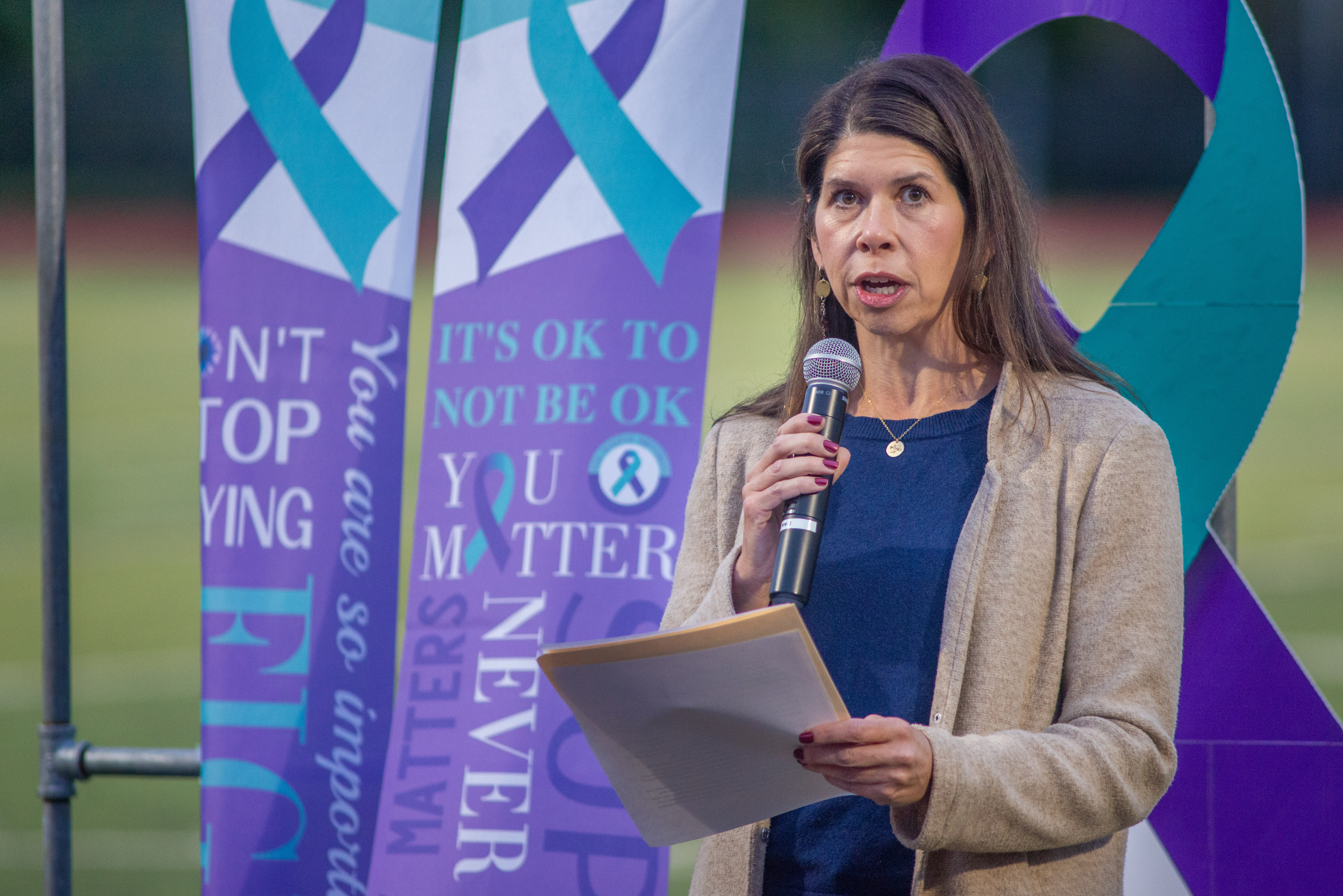
    Megan Hanson, whose son Sam died by suicide in April, speaks during a pregame mental health awareness presentation on Sept. 22. William Thomas Cain / For The Inquirer

    It was her most important, urgent, and accurate message. It aligned perfectly with what Derrick Gordon, an associate professor of psychiatry at Yale University, described as “the myth we have out there is that, if we suspect somebody is suicidal, we shouldn’t raise this with them because we don’t want to put the idea in their head.

    “The reality is, you can’t put an idea in their head that’s already there,” Gordon told me in an interview last year. “Actually, the best course of action is to ask the question of the individual, then talk about it and address it. It’s been my experience, and I think other professionals would say this, that if you raise the issue of suicidality with people who are contemplating it, they feel relieved. ‘Oh, Jesus, I can now finally say it out loud.’ You can talk to them about the possibility that if they’re going to hurt themselves, it would impact you. Oftentimes, they get lost in their own experience of what they’re going through, and you want to get them outside of that space.”

    Megan Hanson had no idea that her son was considering harming himself, how dark his world could get. How could she have an idea? Sam was pulling A’s and B’s in a roster of advanced-placement and honors courses at CB East. As a fourth grader, he had constructed a gift for his Connie Mack coach, Mike McCardle — a pen-and-pencil holder with a photo of the two of them set into it, a gift that McCardle still keeps on his desk. He died on the day before Easter, and it had been a full and wonderful day. Sam had practiced parallel parking in a middle-school lot in the morning, then passed his driver’s test and earned his license and was proud that he had.

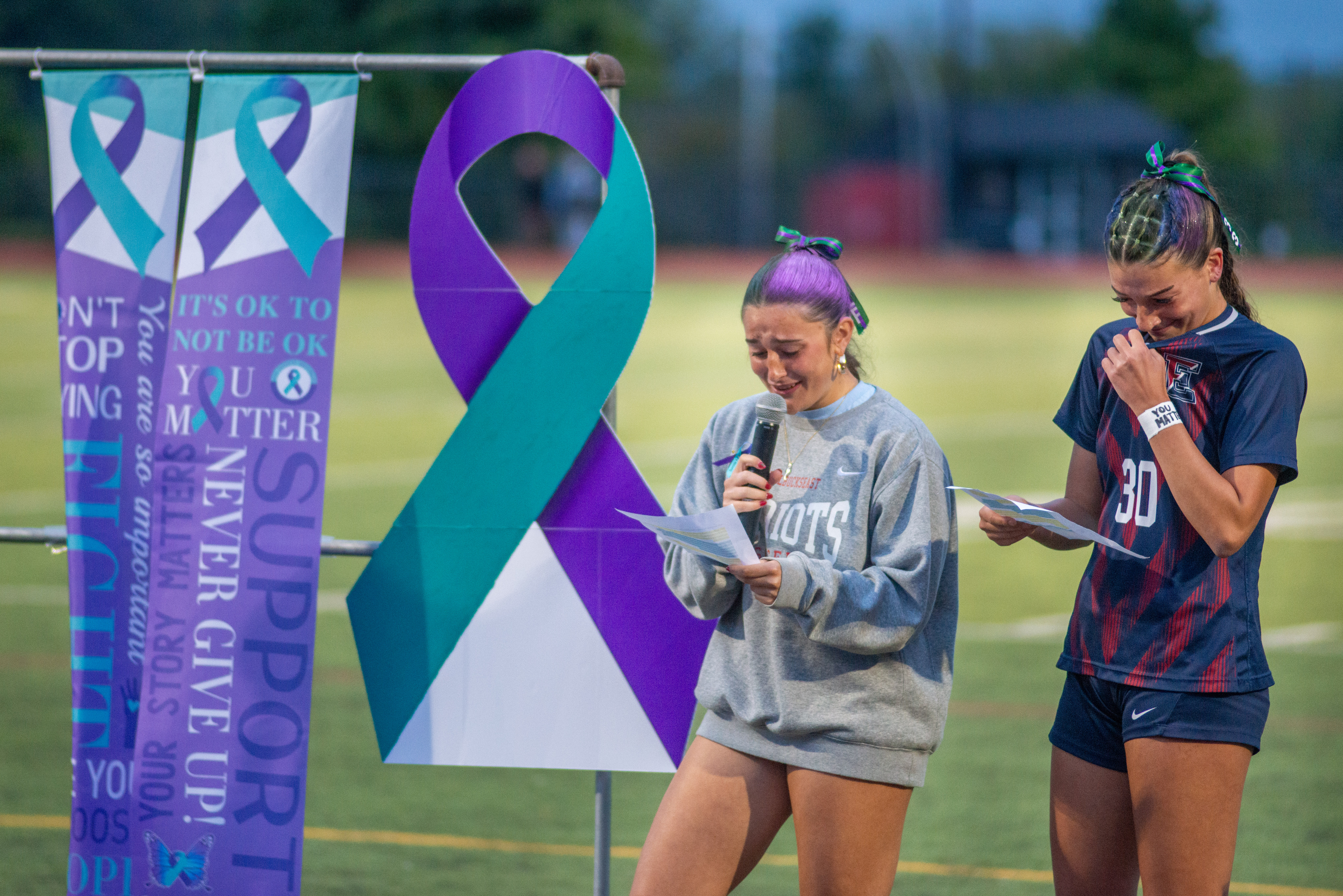
    CB East soccer players Mia Forney (left) and Rylie Leedy make remarks about their late friend, Frankie Pacitti, before the start of their game with CB West on Sept. 22. William Thomas Cain / For The Inquirer

    He and Megan had gone out to lunch to celebrate. He had worked a few hours at the local pub and restaurant where he was a familiar and welcome face to the owners and patrons. Megan allowed him to borrow his car to drive to a friend’s house that night, and when he returned they talked about their plans for Easter. They would go to church in the morning and head to her parents’ house in the afternoon, and when she said good night to him she could never have thought, even in her most dismal nightmares, that he would get out of his bed and go downstairs into the basement and never come up again.

    “It’s hard with teenagers because they’re moody and they don’t talk,” Megan said in a private moment Tuesday, “and I felt like we were getting to a better place where he was being more open with me, and I felt like we were getting to another level in our relationship. The hardest part is just looking back and saying, ‘Maybe this was a warning sign or a cry for help.’ I truly don’t believe it was something he planned out. I wish whatever went on in his brain, if he had just woken me up …”

    She could not finish the sentence, and she did not need to. Home from the soccer game, I called my sons, who are 15 and 12, into the living room. Our family lives in the same school district that Sam Hanson and Frankie Pacitti did. My older son is a sophomore and has a class this semester with Sam’s sister. The boys paused the baseball video game they were playing and plopped on the couch. My wife and I wanted to talk to them directly about something.

  • A business trip from Philly led to an ICE arrest at a California airport. Now a local man is in detention.

    A business trip from Philly led to an ICE arrest at a California airport. Now a local man is in detention.

    Michael “Sandy” Sims was supposed to be back in Philadelphia by now, after a business trip to the West Coast. Instead, he is locked up in an ICE detention center in California.

    Sims, 42, a veteran of the entertainment-lighting industry, told his wife that immigration agents were waiting for him when his Lyft driver pulled up at the San Jose airport early on Sept. 2.

    Sims was born in Ireland and raised in London, and had been expecting approval of a green card that he and his wife, an American citizen, sought after they married in 2017.

    Now he is in custody as U.S. airports become risky places for foreigners, amid an ICE push for ever-greater numbers of arrests.

    “It’s horrible,” said Sims’ wife, Jennifer, 46. “We thought we were waiting for a green card.”

    For so long, she said, the United States has been a beacon for people around the world who want to come, work, and contribute, to create better lives for their families. Now, she said, “the American dream is gone.”

    Sims is being held at the Mesa Verde ICE Processing Center in Bakersfield, a 400-bed facility operated by the for-profit, Florida-based GEO Group.

    The advocacy organization Asian Americans United, which works to track airport arrests, said it estimates more than 20 people have been arrested at Philadelphia International Airport or while seeking to fly there since July 12. That includes at least 13 taken into custody at the Philadelphia airport itself.

    The Department of Homeland Security said Sims had entered the country legally but overstayed his visa.

    “Criminal illegal aliens are not welcome in the U.S.,” DHS said in a statement. “Under President Trump and [Homeland Security] Secretary [Markwayne] Mullin, if you break the law, you will face the consequences.”

    The department said Sims faces a criminal charge of domestic battery in Nevada, where he lived at one time. DHS provided no further details and, along with ICE, did not respond to requests for information on what allegedly happened and when.

    In a search of Nevada court documents, The Inquirer could find no record of any criminal case against Sims. And Sims’ Philadelphia immigration lawyer, Hunter Yost, said he had no knowledge of and could locate no record of such a case.

    Jennifer Sims said her husband has never been charged with a crime.

    When she subsequently asked her husband about the government’s assertion that he had a pending criminal case, she said, he told her that when he was arrested and handcuffed by Immigration and Customs Enforcement, one of the agents kept saying, “You’re a wife-beater,” and the other repeatedly said, “No, he’s not.”

    Jennifer Sims pictured with her husband, Michael “Sandy” Sims.Courtesy of the family

    Sims’ family and friends have started a GoFundMe campaign to cover legal expenses to free him from ICE detention and pay related costs, so far raising more than $20,000 of the $30,000 goal.

    Sandy Sims sent a note from detention that was posted there:

    “Hello to everyone from Dorm B Mesa Verde Detention Center,” he wrote. “Thank you one and all for your support. … I’m so grateful. Thank you all and I hope this situation will be over soon.”

    Sims’ wife said he legally entered the U.S. on a work visa in 2016. When that expired, he was subsequently approved for entry under ESTA, the Electronic System for Travel Authorization. That is an online initiative the federal government uses to prescreen travelers before they visit the United States under the Visa Waiver Program.

    The waiver program allows citizens from 42 countries, including Ireland and the United Kingdom, to travel here for tourism or business for up to 90 days at a time.

    Jennifer Sims said after they wed, she filed Form I-130, the document required to prove a valid family relationship with a foreigner who wants to immigrate to the United States. That application, she said, was approved in March 2020 ― a key step toward a green card. Her husband had completed his biometrics appointment, where the government collects the applicant’s fingerprints, photograph, and digital signature, three months earlier, she said.

    He was given a U.S. Social Security number, she said.

    The couple worries their green-card paperwork might have been lost when they relocated to Las Vegas and back to Philadelphia between 2018 and 2021.

    Meanwhile, the Trump administration’s nationwide effort to increase arrests at U.S. airports has spurred warnings from immigration attorneys that even those with valid work permits and government-issued identification can be in danger.

    An ICE summer push saw a record 49,571 people arrested across the nation in July, many of them taken into custody at airports, courthouses, and scheduled immigration check-ins. That is an average of 1,599 arrests a day, a 15% increase over the previous month, according to figures from the Deportation Data Project.

    The July arrests included 1,174 in Pennsylvania and 2,112 in New Jersey.

    Homeland Security said airport arrests are occurring because the Trump administration “reversed the horrendous Biden-era policy that allowed aliens in our country illegally to jet around our country.”

    “Under President Trump, DHS will no longer tolerate this,” the agency said last month, as news spread of Philadelphia airport arrests. “This administration is working diligently to ensure that aliens in our country illegally can no longer fly unless it is out of our country to self-deport.”

    The Trump administration says that its immigration-enforcement effort targets criminals, that it has been arresting and deporting killers, rapists, and child-abusers to make the country safer. However, the latest data showed that half of those arrested in July had no criminal convictions or charges, and less than 25% had been convicted of a crime.

    Sandy Sims has worked in entertainment lighting since 2002, including on shows for Metallica, Usher, and Florence + the Machine, the popular English rock band, his wife said.

    She said she feels as if the immigration system has been turned into a moneymaker, where people trying to follow the law are charged high fees, and private companies reap profits by keeping people in custody.

    The GEO Group signed a contract with ICE in 2019 to run five locations, including the Mesa Verde center, where Sims is being held, that is expected to bring the company $200 million a year.

    “I feel,” Jennifer Sims said, “like they just want people’s money.”

    Inquirer staff writer Dylan Purcell contributed to this article.

  • Penn picked first three faculty spinouts for early stage StartUP investments

    The University of Pennsylvania picked the first three faculty-founded companies for early stage investments from its newly established $10 million StartUP fund, the university said Wednesday.

    The three companies are working in maternal health, advanced radio-frequency filtering technology, and AI-powered drug discovery.

    Each is receiving the maximum investment of $250,000 from the fund launched in December to make seed investments in companies founded by university researchers.

    “Penn researchers are developing technologies with the potential to address some of the most important challenges facing society today, and many of these solutions have the potential to create entirely new markets,” John Swartley, Penn’s chief innovation officer, said in an announcement.

    Here are some details on the three companies:

    • Vasowatch is developing a non-invasive monitoring system to predict the risk of maternal postpartum hemorrhage, a leading cause of maternal death. Its cofounders are Penn Nursing adjunct professor Stefanie Modri and former Penn Engineering faculty James Weimer. The company will use the money to fine-tune the product and to pay for a clinical trial anticipated to start next year.
    • OneFiltr, cofounded by Troy Olsson, a professor in the School of Engineering and Applied Science, has a compact device designed to allow a cell phone to isolate and process specific frequencies. The company will use its investment to further development of its device for evaluation by aerospace and defense companies.
    • Peptaris Inc. has an AI platform for evaluating and developing drugs based on peptides, which are building blocks for proteins. Cofounders are César de la Fuente and Marcelo Der Torossian Torres. The StartUP investment is part of a larger seed round that Peptaris is using refine its model and evaluate its first candidates. Peptaris said in an SEC filing June that it raised $4 million from investors.
  • Throwing a lifeline to Philadelphia’s rich rowing history

    Throwing a lifeline to Philadelphia’s rich rowing history

    Just as a physical museum is closing in Philadelphia, a new digital museum is opening. Oct. 1 is the launch date for the Rowing History Project, which will showcase the historic holdings of Philadelphia’s 160-year-old rowing clubs — a trove of trophies, banners, artwork, and documents that passersby on Amtrak and Kelly Drive can only imagine.

    But that’s not the only reason a small group of Boathouse Row historians volunteered to create this online-only museum. It was fear. Fear that the history of one of the city’s most iconic landmarks was vanishing along with stories about the traditions and culture of 19th-century Philadelphians. This, after all, is the place where Thomas Eakins rowed and painted, where Frank Furness left an architectural statement, and where a dynasty of Kellys (father, son, and daughter, Grace) propelled the city to international fame.

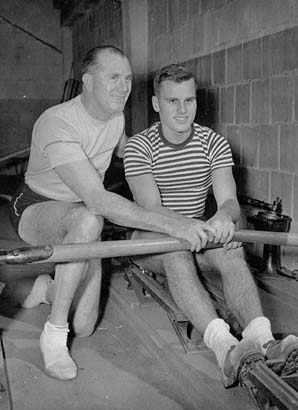
    John B. Kelly Sr. (left) gives a few pointers to his 18-year-old son, Jack Jr., in January 1946. Both father and son earned Olympic medals in rowing.Associated Press

    I first worried about this impending loss of history a decade ago when I was writing a book about Boathouse Row. Sitting on my dining room table was a 19th-century minute book of the Vesper Boat Club that I had borrowed from a member who had taken it home because the club wasn’t caring for it. Its leather cover was split, and pieces were flaking off. Gently turning its pages, I read about the constant break-ins, rules about smoking, drinking, and women, and the obsession with uniforms, including the dress one: “dark blue cloth, naval officers’ pattern, with name of Vesper on front in gold bullion, block letter ½ inch in height.”

    Afterward, I carefully wrapped the disintegrating book in plastic wrap, not knowing what else to do.

    A Vesper Boat Club minute book from the 1890s. After reading it, author Dotty Brown wrapped it in plastic wrap, fearful that it would deteriorate even further.Dotty Brown

    While some clubs have put their old documents in places like the Historical Society of Pennsylvania and the Independence Seaport Museum, others have crammed them under staircases and beside boilers while their members focus on winning races.

    The idea for the Rowing History Project emerged after COVID-19 canceled the 2020 Head of the Schuylkill Regatta (HOSR) — right when it was celebrating its 50th year. Instead, the HOSR pulled together a half dozen Boathouse Row history buffs to organize Zooms called “50 Years, 50 Stories.” The volunteers started meeting every Friday at 11 a.m., and over the years, their weekly planning sessions turned to the dire condition of the clubs’ artifacts.

    While the row could easily fill a physical museum, we watched as the prestigious River and Rowing Museum in Henley, England, shuttered and the Mystic Seaport Museum in Connecticut closed its rowing section.

    Then in 2023, architect and Vesper member Hilary Langer went into the bowels of his club to look at air handlers that needed replacement.

    “I couldn’t get to them because I discovered trophies, plaques — all the heavy stuff,” Langer said. “I was so scared. We were so focused on rowing and operating a very, very complicated operation with masters, lightweights, women, heavy weights, juniors, high schools, that all this stuff was forgotten and neglected. It would still be there if those units hadn’t needed replacement. That is a fact.”

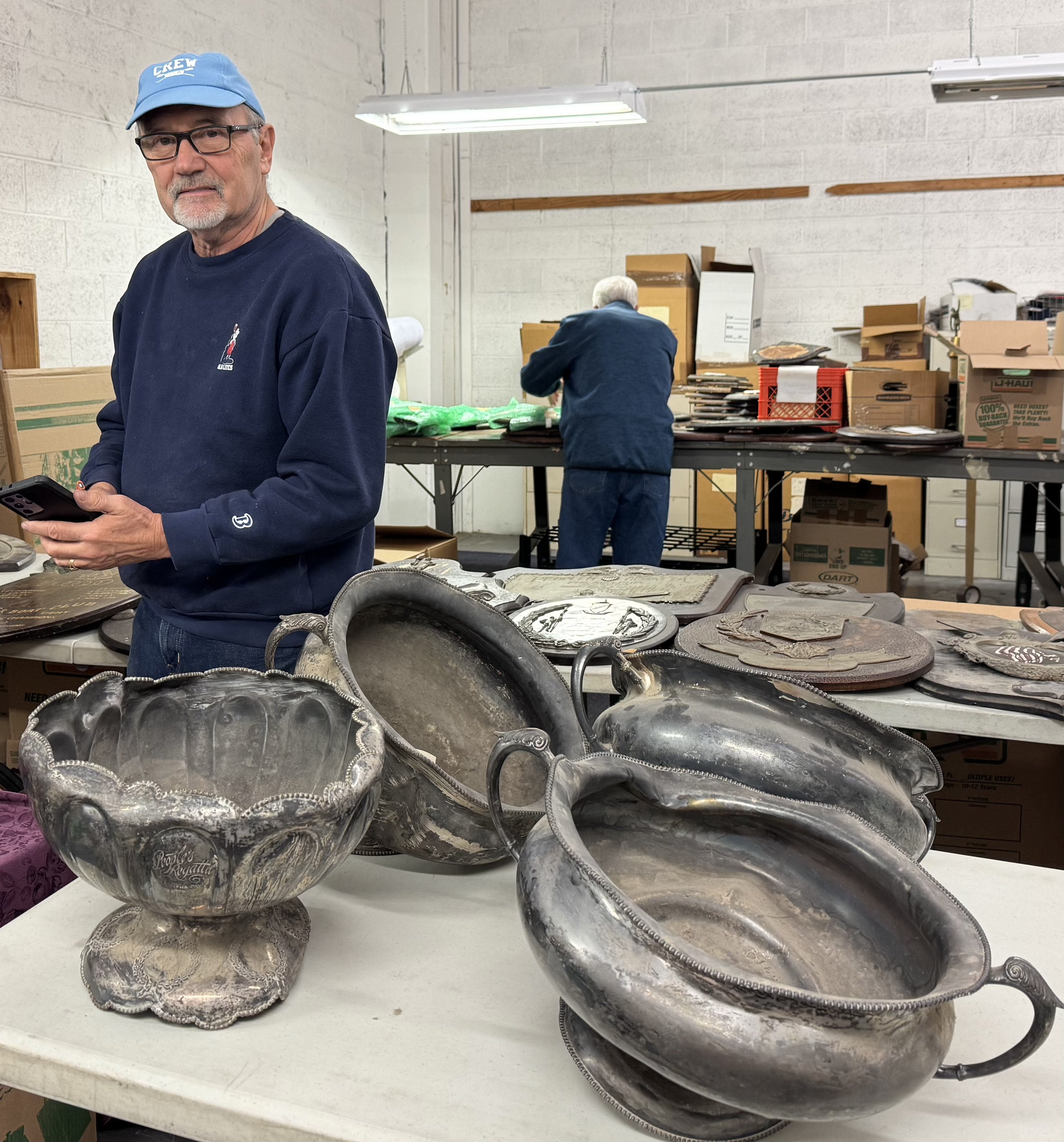
    Hilary Langer of the Vesper Boat Club sorts through damaged trophies, deciding what to keep, what to repair, and what to throw away. About 1,000 items were taken from the club to Boathouse Sports, a clothing manufacturer, which gave the club space.Dotty Brown

    After reaching into every cranny of the club, he pulled out 1,000 items, including the minute book that I’d covered in plastic wrap.

    That galvanized the HOSR group, which includes people with backgrounds in management and technology, not to mention the finish-line-driven spirit typical of rowers. We researched museum-style platforms and paid two professionals — an archivist and a webmaster — to help.

    Vesper’s collection became the “proof of concept,” and when the data for its holdings — photos, descriptions, condition, location, and more — were successfully uploaded, we raced to convince the rest of Boathouse Row to photograph and document its artifacts. The group held information sessions, created instructional videos, and hired a few library students to work with the boathouses. Some private collectors, including one with 3,000 rowing artifacts, are also joining the Rowing History Project as it evolves into an ever-larger museum.

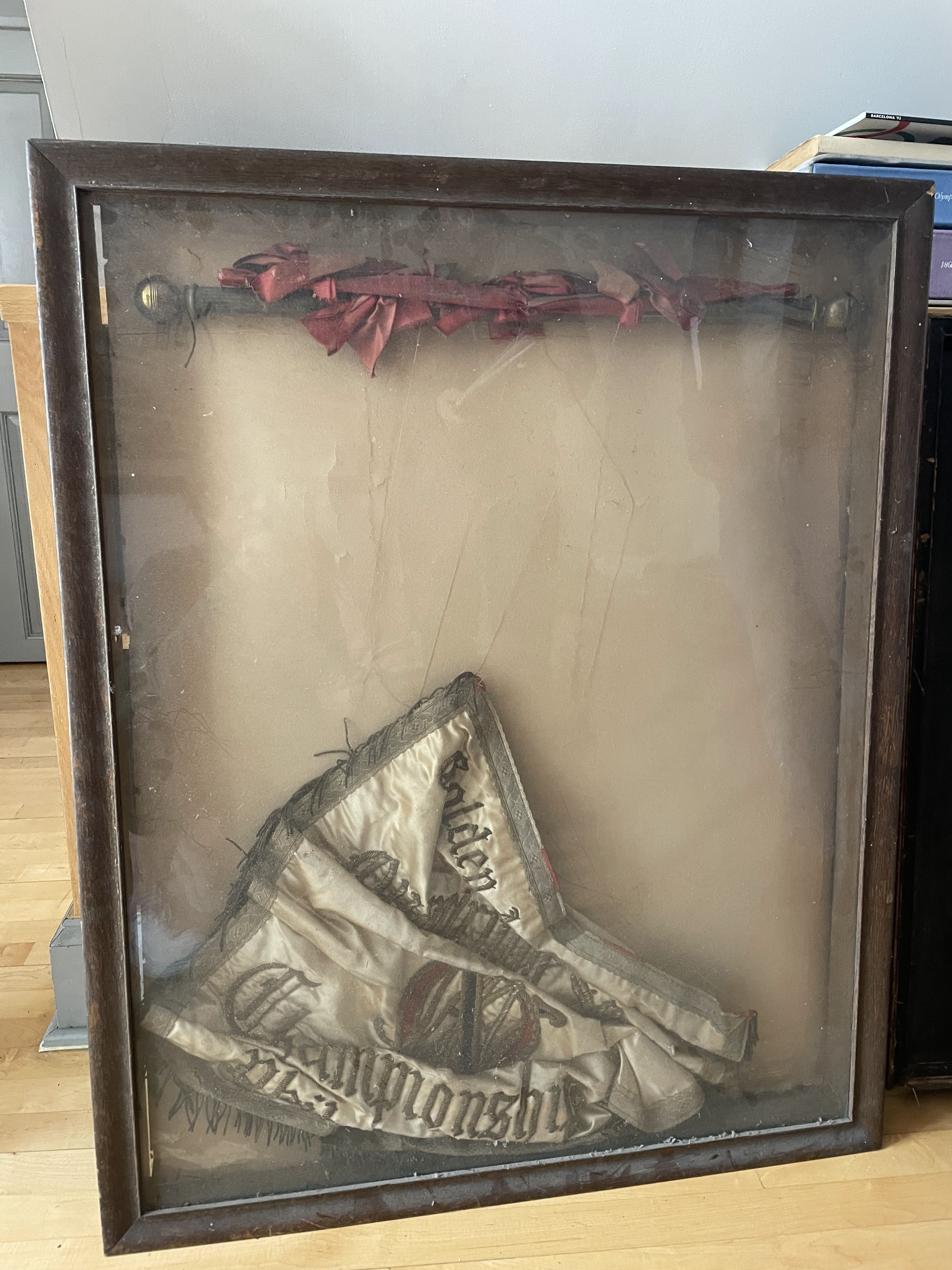
    A moth-eaten banner retrieved from the attic of the Vesper Boat Club.Dotty Brown

    “What we wound up with is not a software program designed just for Philadelphia or Boathouse Row,” said Chris Doyle of the Pennsylvania Barge Club. “It’s intended as a national platform. Our big contribution is a national platform for rowing history.”

    Dotty Brown is a former reporter and editor at The Inquirer and the author of “Boathouse Row: Waves of Change in the Birthplace of American Rowing.” Visit the Rowing History Project at rowinghistoryproject.org.