Blog

  • Dominican Republic’s zoo offers home for confiscated animals as seizures of exotic species soar

    Dominican Republic’s zoo offers home for confiscated animals as seizures of exotic species soar

    SANTO DOMINGO, Dominican Republic — The only zoo in the Dominican Republic is providing a safe haven for confiscated illegal and smuggled animals as a government crackdown aimed at protecting exotic species gathers pace.

    Tucked inside a green oasis in the middle of the capital, Santo Domingo, are crocodiles, flamingos, and even tigers that officials have confiscated from people accused of illegally keeping them. The numbers are growing and threaten to overload the country’s lone zoo.

    “It’s a burden,” said Alfonso Ferreira, deputy director of the city’s National Zoological Park. “People have a predisposition to owning wild animals.”

    Dominican authorities seized 188 animals last year, compared with 30 in 2023, as the government tries to tackle the illegal ownership of certain species. It has also launched educational campaigns to raise awareness about their plight.

    So far this year, officials have confiscated more than 8,900 species, although a majority of those were crickets and young fish to feed animals including seahorses.

    Commonly, flamingos are the most rescued animals, said Nelson García Marcano, head of the Caribbean nation’s Department of Wildlife Regulation and Control.

    Flamingos, which are protected, are often illegally taken from their natural habitat and sold to hotels, which use them as garden ornaments, he said. It’s a trend that individual homeowners have started to follow.

    “People like to copy what they find attractive and beautiful,” said Garcia Marcano, who decried the practice, noting people sometimes amputate a bird’s wings. “It’s a migratory animal,” he said. “It’s an animal that should be free.”

    Nursing animals back to health

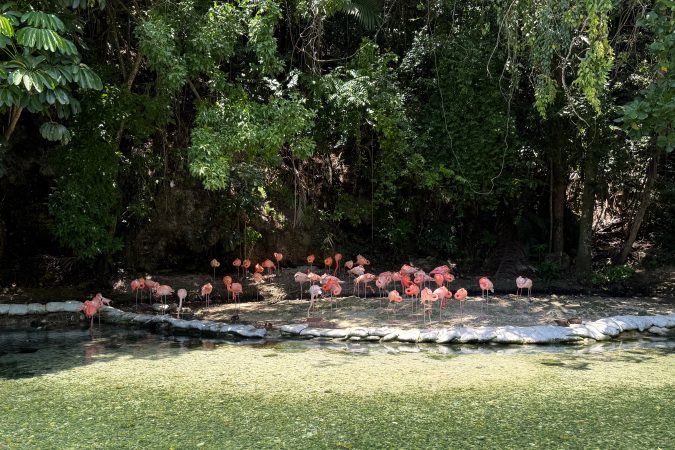
    On a recent hot morning, the Associated Press visited a flock of rescued flamingos that sought shade in a private section inside the zoo.

    They had recently been confiscated by authorities, and it showed. Their typically bright coral feathers were white, as if they had been bleached. Ferreira explained that their captors usually feed them white bread instead of the algae and tiny crustaceans their bodies require.

    To reduce the number of flamingos featured at hotels across the Dominican Republic, García Marcano said they have suggested that staff embrace species including the purple gallinule, a cranelike bird with iridescent feathers.

    At the zoo, the rescued flamingos receive carrots and bird feed and are rehabilitated for several months before some are released back into their natural habitat.

    Nearby, several crocodiles sat without blinking in individual cages filled with greenish water. They, too, had been snatched from their natural habitat and kept as pets.

    Encompassing 309 acres, the zoo is big enough that a small train ferries visitors to exhibits, but resources are stretched. Territorial animals such as crocodiles must be isolated, which requires more cages and, in turn, more funding.

    Veterinarians run multiple tests on the rescued animals to determine their health. Many will require a strict diet because their owners would often have fed them the wrong food, weakening an animal’s immune system and causing physical deterioration.

    “Before, we only received parakeets and parrots,” said veterinarian Tatiana Carreño Pinto. “Now we have a much wider range of species arriving at the park.”

    ‘It’s like cat and mouse’

    The zoo also is preparing to take in exotic animals confiscated in neighboring Puerto Rico as part of a deal reached last year, including caimans that have been seized from suspected drug traffickers.

    Puerto Rico, a U.S. territory, is struggling with an overload of exotic species, with nearly 100 animals seized over the July 4 weekend alone. They included 80 boa constrictors, eight native boas, four reticulated pythons, three caimans, and four troupials — Venezuela’s state bird.

    An official with the Rangers Corps of Puerto Rico’s Department of Natural and Environmental Resources did not respond to multiple requests for comment.

    In the Dominican Republic, officials continue to try to save species that once roamed free.

    A project was launched last year to save an endemic parrot, which is under threat and commonly kept as a pet. The government has erected large billboards warning against trade in the parrots. García Marcano said officials are receiving a growing number of calls about this practice as people spot them along roads while traveling.

    The zoo, once again, steps in to help feed and rehabilitate the seized parrots.

    “Operations have been carried out, arrests have been made,” García Marcano said. “It’s like cat and mouse. You have to maintain constant vigilance.”
  • ‘Iran War Participation Trophy’ mocking Trump arrives in New York

    ‘Iran War Participation Trophy’ mocking Trump arrives in New York

    NEW YORK — First D.C., then Manhattan.

    The satirical art group responsible for about a dozen public pieces mocking President Donald Trump in the nation’s capital over the past 20 months has now landed in New York.

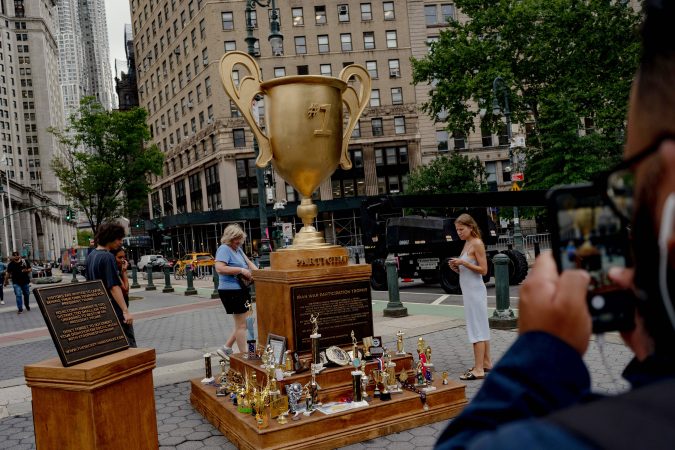
    The anonymous artists who call themselves the Secret Handshake left their mark in Lower Manhattan on Wednesday morning, placing a 10-foot-tall trophy, spray-painted gold and emblazoned with a #1 on its side, in Foley Square.

    A large plaque below the “Iran War Participation Trophy” reads: “We hereby award President Donald J. Trump this participation trophy for his enthusiastic involvement in the Iran War. While some concern themselves with military strategy, diplomacy, or measurable outcomes, President Trump demonstrated the courage to participate regardless of the final score.”

    The war in Iran, which began Feb. 28, has resulted in the deaths of 18 U.S. service members and wounded more than 600.

    Walking to catch the subway, Maren Stange, 79, stopped and chuckled as she bent to read the rest of the trophy inscription: “President Trump joins the ranks of children everywhere who received recognition for simply showing up.”

    Stange, who said she had never heard of the Secret Handshake, wasn’t sure the statue would change anything. “It’s funny and it’s smart,” she said. “But what’s it going to do?”

    The installation, which was first displayed in Washington this month, invites anyone to contribute their own participation trophies to the project.

    Arranged around the plinth were more than three dozen mock trophies and awards. One seemed to mock Trump’s electoral history: “Lost Arizona,” read a baby blue Honorable Mention ribbon, dangling from the neck of a tennis trophy.

    A trophy of a martial arts figure, leg raised in a kick, bore the printed message “Most Swollen Cankles” attached to its white base. One small gold chess award was labeled “Smallest Hands Award.”

    “It’s just kind of trolling Donald Trump,” said DJ Hairston, 37, an attorney headed to the nearby criminal court. “It’s definitely funny. Because that’s what this is — this is a participation war. It’s all stupid. It’s all a farce. And this is what Donald Trump wants. He wants a big gold trophy in the middle of Manhattan.”

    Michael Chrzynowski, 46, and his mother, Candace Goudey, 69, stopped to examine the trophy and the trophy spawn.

    “It’s cathartic. They’re mocking him,” Goudey said. “And then you turn around and read, ‘The true administration of justice is the firmest pillar of good government,’” a message engraved in stone across the street, above the entranceway of the New York County Supreme Court building.

    It felt, she said, like that sense of justice was lacking from the Trump administration.

    “These untalented ‘artists’ should stick to their ugly ‘art’ and refrain from weighing in on foreign policy — which they clearly know nothing about, given the fact that the United States Military achieved all of its objectives during Operation Epic Fury,” White House spokesperson Anna Kelly said in an email when the trophy first appeared in Washington on July 13.

    The Secret Handshake, whose members have declined in phone interviews with the Washington Post to provide any identifying information, has previously placed installations at locations across D.C.

    Earlier works by the group include a statue of Trump and Jeffrey Epstein holding hands, a mock tribute to Trump from the world’s authoritarian leaders, and a reproduction of the desk of former House Speaker Nancy Pelosi (D., Calif.) with a pile of fake excrement on it that ridiculed the Jan. 6, 2021, rioters who sought to overturn the 2020 election.

    Many of the previous installations were at prominent spots on the National Mall, including directly in view of the Capitol’s west side. Those received a National Park Service permit for temporary display.

    In Foley Square, some lawyers with briefcases, heading to one of the courthouses nearby, did a double take when they spotted the trophy, then kept walking.

    “That’s a first,” said a New York court officer, who declined to give his name. “Who put that there? The Secret Handshake? I’ve never heard of them.” He shook his head and began walking to work. “Listen, he’s no worse than any other president, I tell you that much.”

    A man in a red T-shirt bearing the message “Peace of Mind” squinted at the trophy, read the plaque, raised his hands and flipped the bird — two of them — which he said was directed at the president.

    Welcome to New York.

  • Colorado residents are ratting out neighbors over water use during drought

    Colorado residents are ratting out neighbors over water use during drought

    In Denver these days, it’s the brown lawns vs. the green.

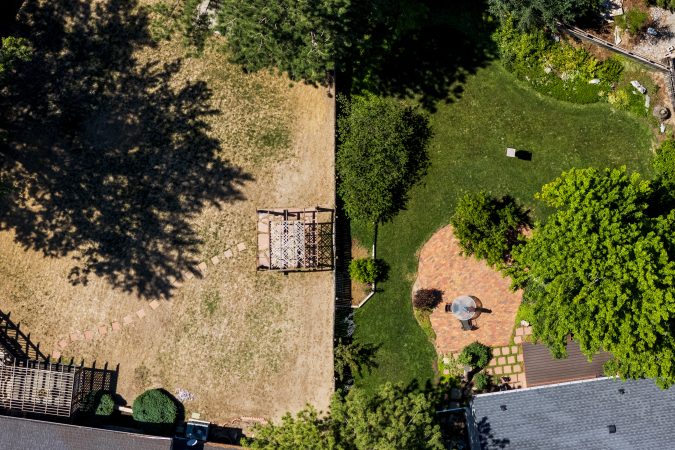
    As Colorado dries up in a historic drought, scofflaws violating water restrictions have sparked tension throughout the state’s largest metropolitan area, turning residential streets into checkerboards of virtue and vice. The emerald green lawns of cheaters now abut the crispy brown grass of the rule-followers — defiance that’s visible for all to see.

    With record hot temperatures following a winter of little snow, the city’s utility had asked that residents cut usage levels by 20% this summer, and mandated that customers only water their lawns twice a week.

    Denverites have so far failed to meet the moment — with only about a 5% reduction by mid-July. And there’s little relief in the forecast, with the furnacelike heat dome that descended on the central United States expected to last through the week.

    More than 4,000 people have reported their neighbors for cheating on the restrictions this summer, the utility said, leading to one story in the Denver Post with thousands of comments, most along the lines of “Snitches get stitches.”

    “Our yard would look so much better if everyone else’s grass was also dead,” said Keifer Hunniford, a tech executive who lives in a quiet neighborhood of mid-century homes on the east side of the city.

    Hunniford, 58, has spent the summer averting his eyes from the big burnt patch in the middle of his yard — it’s too depressing. Meanwhile, his neighbors’ sprinklers whirl on and off many days.

    At a briefing for the state’s drought task force, Russ Schumacher last week outlined the grim circumstances, and said that the time period from October through June was the hottest and fourth driest on record.

    More than 90% of the state remains in a drought condition, according to Schumacher, the state climatologist and director of the Colorado Climate Center. Reservoirs are drying up and the Colorado River, which supplies water to states throughout the Southwest, is at an all-time low at some measuring locations, he said.

    The precipitation numbers “continued to go further and further into a deficit,” Schumacher said.

    Todd Hartman, a spokesperson for Denver Water, said the utility is “quite a way off from our goal” of a 20% reduction in water use. By this point in the season, he said, they had hoped for customers to have used 12,400 acre-feet less of water than normal. Instead, they’ve used 2,900 acre-feet less, which he described as only a “slight improvement.”

    The utility has contacted 3,400 customers to “educate” them on watering restrictions after the more than 4,000 complaints on the new tip line. The first offense results in a warning, the second a $250 fine, and the third a $500 fine, with fines escalating to $1,000 for repeated violations.

    So far, they’ve issued three formal citations that could result in fines.

    Hartman said while they’ve seen “strong conservation efforts” from schools, parks, and multifamily housing units, single-family homeowners remain the worst offenders. The utility hopes to avoid cutting watering restrictions further to just one day a week, which would have a “devastating impact” on landscapes.

    On social media, residents have complained about golf courses that still seem to have pristine greens, and have blamed rapid residential growth and new data centers for straining the water supply. Homeowners associations around the area have added to the confusion by dinging residents for having unsightly lawns, even as the drought has worsened, Schumacher said.

    In Superior, a town about 20 miles from Denver that does not have water restrictions, James Shima, 57, an electrical engineer, said he received a warning email and then a certified letter from his homeowners association in June when he held off on watering due to the statewide drought declaration.

    He was given 30 days to address the problem or face escalation of the violation process, he said.

    “I am now forced to water my lawn two times a day, seven days a week, for two hours during the peak of summer,” he said. His most recent water bill was $300, Shima said.

    Rachel Stanton, the president of the Rock Creek homeowners association, responded in an email that the HOA had “moderated expectations for lawn maintenance in light of conservation concerns” beginning in May.

    “No one is expected to have a lush green lawn right now, but they are expected to do enough maintenance to keep their lawns alive,” Stanton said. She dismissed Shima’s concerns as “a nonstory in which the ‘HOA as villain’ trope does not apply.”

    When Hunniford and his family moved into the neighborhood 12 years ago, it was easy to keep the grass surrounding his two-story mid-century home looking good. Now, it’s almost impossible.

    “Over time we’ve got sick of the stupidity on putting water on this green stuff we don’t really use, and we’ve let ours die,” he said.

    The grass has withered away to bare dirt in some spots. He considered spray painting the remaining brown spears green with turf paint, but his wife said no.

    From his house, Hunniford can look down his street and see some lawns that are dead, some lawns that are green, some that have been replanted with drought-sensitive plants, and his neighbor Pam’s new bright green synthetic turf across the street.

    The brown lawn folks believe the green lawn folks are cheating.

    “There are the known offenders,” Hunniford said. “One of them was watering this morning, and it’s an off day.”

    The brown lawn vs. green lawn debate is one more example of how divided American society has become, he said, and the drought has only added to his malaise and sense of the country in decline. He and his wife, a personal coach, are considering retiring in Mexico.

    Across the street, Pamela Keith, 61, a retired Department of Veterans Affairs counselor, has ripped up her sod and installed $13,000 in synthetic turf, a project that she embraced as a way to preserve the legacy of her mother, Eleanor, who died in 2006 and was an avid gardener.

    Her roses and tulips are long gone, and Keith didn’t even plant any annuals this year as the drought worsened. But she’s managed to save the vegetable garden, including tomatoes, peppers, watermelon, and her mother’s collard greens that still come back every year.

    “We’ve got to keep up with the neighborhood name: Park Forest,” she said, adding that she does worry about her neighbors’ automatic sprinklers frequently running.

    On the days they are allowed to water, she and her husband, Sean, try to beat the other outside “because it’s so enjoyable.”

    But Keith is harboring a secret. For weeks now, she’s been watering her back lawn over the restriction limit, hoping to keep a little grass alive until July 25, when she threw a celebration in honor of her husband, who recently returned after two years on the road as a travel nurse. There was R&B music, and barbecue, and a big-screen TV playing summer movies. She called it “An Evening Under the Stars.”

    She’ll cut back, she said, now that the party’s over.

  • N.J. Democratic delegation asks President Trump to reverse FEMA aid rejection for deadly February snowstorm

    N.J. Democratic delegation asks President Trump to reverse FEMA aid rejection for deadly February snowstorm

    Every Democrat in the New Jersey congressional delegation signed a letter to President Donald Trump asking him to reverse his rejection of disaster aid for a deadly blizzard earlier this year.

    The lawmakers sent the letter, which was first obtained by The Inquirer, to the White House on Friday in support of Gov. Mikie Sherrill’s appeal of the president’s rejection. Their plea comes after Trump denied an $84 million request to the Federal Emergency Management Agency (FEMA) for relief for a late February blizzard earlier this month.

    “Severe blizzard conditions led to widespread damage—overwhelming State and local capacity,” the lawmakers wrote. “Tragically, this fatal event resulted in 12 confirmed weather-related fatalities across nine counties, the most out of any impacted state.”

    The letter was led by U.S. Sens. Cory Booker and Andy Kim, both Democrats. All members of the New Jersey delegation were invited to join, Booker’s office said, but all three of the state’s Republican members opted out. Even U.S. Rep. Jeff Van Drew, a South Jersey Republican, sat out of the effort despite initially backing the request in April.

    Van Drew joined Booker, Kim, and six Democratic House members in an April letter of support for the request in which they said the public assistance and hazard mitigation funds “are crucial to the recovery of the communities” impacted by the storm.

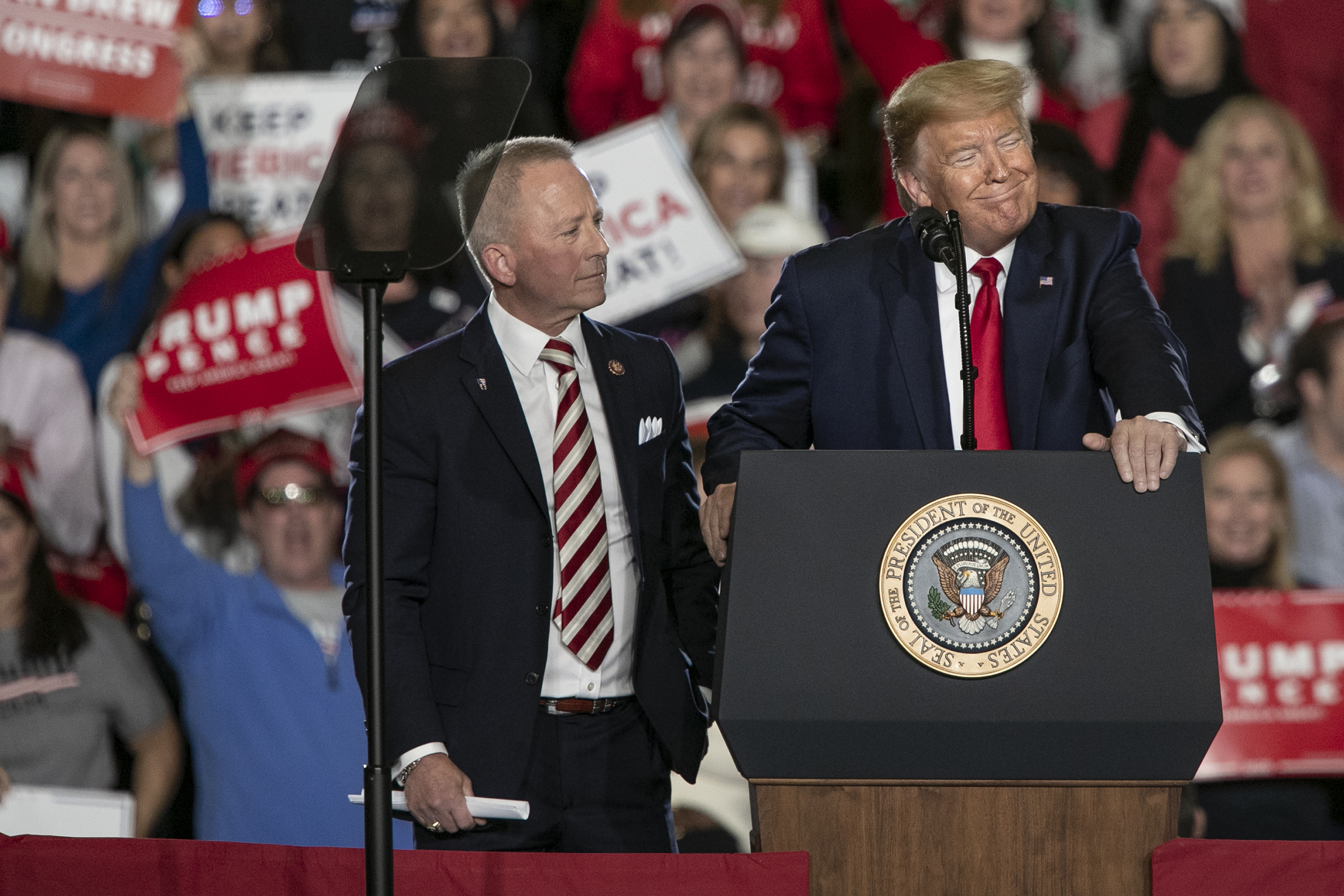
    President Donald Trump smiles while Rep. Jeff Van Drew (R-NJ) stands next to him at a Keep America Great campaign rally in Wildwood, NJ on Tuesday, Jan. 28, 2020.HEATHER KHALIFA / Staff Photographer

    The request sought money for every county in Van Drew’s district for costs related to the snowstorm, including damage from moderate coastal flooding in Atlantic County and his home county of Cape May. Van Drew, a Trump ally and former Democrat, faces a challenge from Cape May Mayor Zack Mullock for his reelection in November.

    Van Drew did not respond to a request for comment.

    In the Friday letter, the Democratic lawmakers’ tone was direct but they did not reference accusations that Trump’s decision was politically motivated. Those concerns come amid a revelation that the Trump administration has been rejecting Democratic states at a particularly high rate. A Wednesday Politico report found Trump recently overrode regional FEMA assessments when he rejected aid for four Democratic states.

    The request included assistance for the vast majority of the state’s counties – including all of South Jersey – as well as hazard mitigation funding statewide, according to the Friday letter. Preliminary damage assessments across those 19 counties documented “extensive emergency work” such as snow and debris removal and “damage to critical infrastructure and public facilities.”

    The New Jersey Office of Emergency Management estimates that disaster costs will exceed $100 million, which is more than five times more than the state’s threshold of about $18 million to qualify for federal disaster assistance.

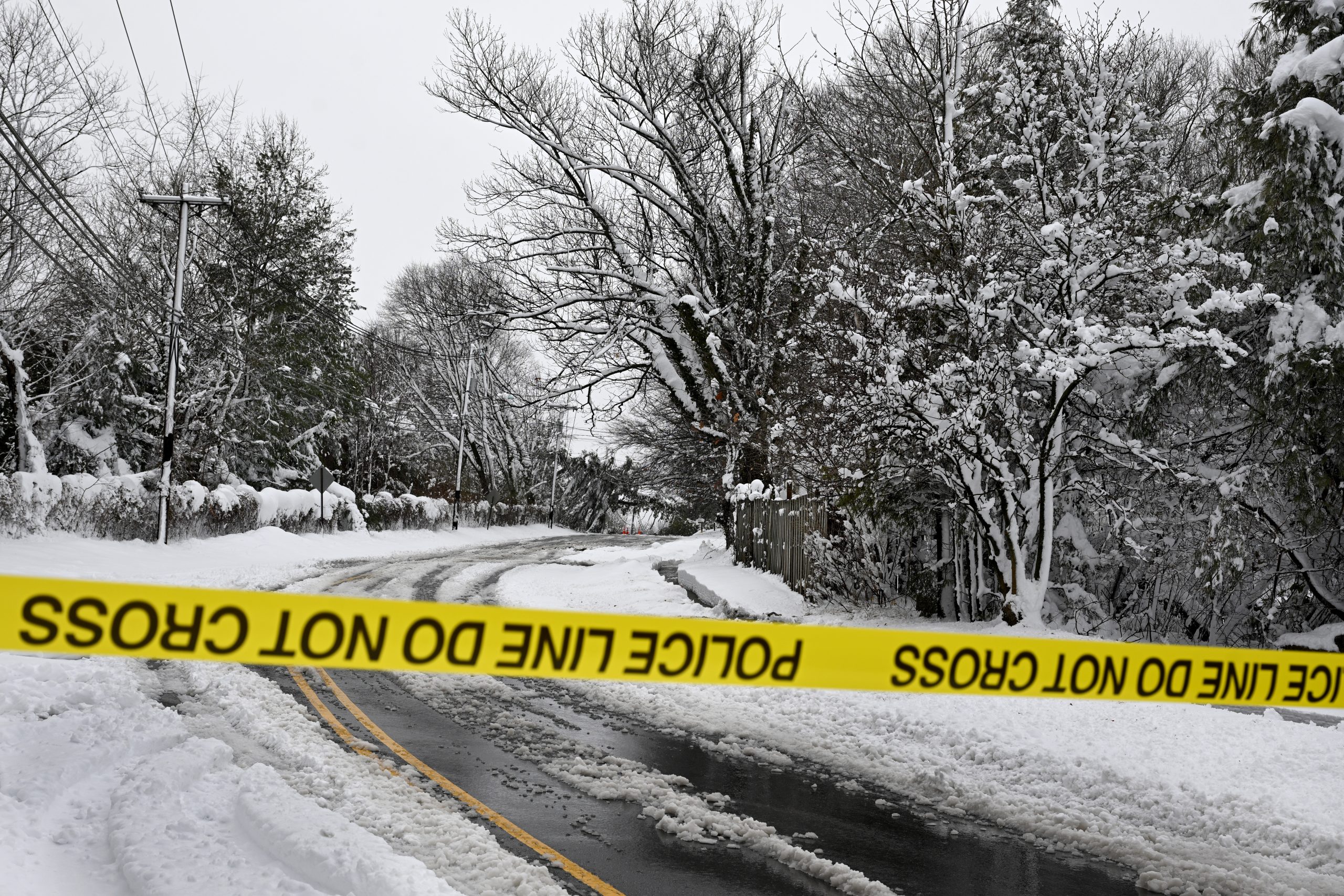
    Covered Bridge Road in Cherry Hill is Monday Feb. 23, 2026 after a power line was knocked down by the Sunday night snorwstorm.Tom Gralish / Staff Photographer

    “The extent of the damage, the operational burden throughout the State, and the cumulative impacts of recent and related extreme weather all provide overwhelming evidence that New Jersey’s request must be granted,” they wrote. “While we commend the actions of the State and local governments to respond thus far, full recovery will require your approval of federal resources.”

    The lawmakers cite National Oceanic Atmospheric Administration data that found approximately 24 inches of snow fell in less than 24 hours across central and eastern parts of the state, and eight of the state’s 21 counties recorded record or near-record snowfalls.

    Power outages during the storm impacted more than 127,000 customers in the state and there were 544 motor vehicle accidents and 1,518 motor vehicle-related assists, according to the letter.

    They also argued that Trump should consider that the state already had a “strained capacity to respond” because of another severe snow and ice storm weeks earlier, as well as six open federal disaster declarations — in reference to prior disasters for which the state is still working on recovery projects.

    “We look forward to working with you to ensure all Americans receive protection and support from the federal government in the aftermath of a serious disaster,” they wrote.

    On Thursday, Sherrill spokesperson Sean Higgins noted in a statement that the costs of the February snowstorm “didn’t care about political boundaries” and that the governor will fight for funding “regardless of political party,” in a nod to the accusations Trump is putting his thumb on the scale based on partisan favoritism.

    White House spokesperson Abigail Jackson said in a statement Thursday, before receiving the letter, that the president “provides a more thorough review of disaster declaration requests than any Administration has before him” and that he responds to FEMA requests “with great care and consideration, ensuring American tax dollars are used appropriately and efficiently by the states to supplement—not substitute, their obligation to respond to and recover from disasters.”

    She also said the Trump administration is committed “to empowering and working with State and local governments to invest in their own resilience before disaster strikes, making response less urgent and recovery less prolonged.” The Trump administration previously tried to cut disaster prevention funding because it was too “focused on ‘climate change” before a group of states including New Jersey sued.

    Kim, the ranking Democrat on the committee that oversees FEMA, said in an interview Thursday that he is concerned that politics were involved in the latest rejection but couldn’t say for sure.

  • Bayada Home Health Care’s new CEO Bryony Winn wants to provide higher levels of care at home

    Bayada Home Health Care’s new CEO Bryony Winn wants to provide higher levels of care at home

    Bryony Winn became the CEO of Pennsauken-based Bayada Home Health Care in March after a career at two big Blue Cross health insurers and at the consulting firm McKinsey & Co.

    Those experiences, she says, prepared her to take the reins at one of the nation’s largest home health companies at a time when Bayada is wants to increase the intensity of its home care offerings — and get insurers to pay for it.

    “Hospitals are full,” and patients want to be at home, said Winn in an interview this month at Bayada’s headquarters in Pennsauken.

    The company, whose founder Mark Baiada converted it to a nonprofit in 2019, operates in 22 states and five additional countries, employs 44,000 people, and had $2.2 billion in revenue last year.

    Winn, Bayada’s first non-family CEO, grew up in Zimbabwe and went to college in South Africa. “Being around so many challenges and so much opportunity every day in the developing world, I always had a sense that I wanted to do things that made lives healthier,” she said.

    When she came to the United States in 2009 to work as a consultant in Chicago, it struck her how specialized and disconnected healthcare is here. “In the developing world, there’s not enough trained people, so it’s a much more connected system around patients and humans,” she said.

    The Inquirer spoke with Winn about the importance of taking care of people at home as the nation’s healthcare providers come under increasing financial strain. Questions and answers have been lightly edited for length and clarity.

    How did your jobs at McKinsey and at Blue Cross of North Carolina and Elevance Health prepare you to lead one of the nation’s largest home healthcare companies?

    I learned a lot about the U.S. healthcare system and became more and more convinced that this lack of connection was driving unsustainable cost, and I still think it’s driving unsustainable cost. Pre-COVID, I used to say affordability is the greatest healthcare crisis of our time. Then COVID really was for a while, and I think we’re back to that now. The quality of care here is amazing if you have a really rare form of cancer. I’d prefer for it to be treated in some of the amazing institutions here than anywhere else in the world. But if you are just a typical person, and especially an aging person here with two or three chronic conditions, you are pushed from pillar to post across a system who doesn’t ever see you as a human being.

    (function(){function e(){window.addEventListener(`message`,function(e){if(e.data[`datawrapper-height`]!==void 0){var t=document.querySelectorAll(`iframe`);for(var n in e.data[`datawrapper-height`])for(var r=0,i;i=t[r];r++)if(i.contentWindow===e.source){var a=e.data[`datawrapper-height`][n]+`px`;i.style.height=a}}})}e()})();

    What do you think you can accomplish at Bayada, which was founded more than 50 years ago, to address that connectivity issue?

    What I can bring to it is really understanding the place of home health in the entire healthcare ecosystem. This is the place where clients and patients want to be; they want to be in their homes. And so the question I’m asking is not what are the kinds of conditions that should be addressed at home, but rather flip that on its head and say, what are the kinds of capabilities you need in the home to be able to address things for clients who want to be there?

    What’s happening now that makes it so important to solve this problem?

    For two decades in healthcare, we’ve been talking about people aging into Medicare. Ten thousand people a day aging into Medicare. Now 10,000 people a day are 20 years older. They’re aging into 85 every day. Because it’s not a change in insurance, it doesn’t generate the same conversation. But it’s a huge change in health status. We now have all of these seniors with two or three chronic conditions, and with a decent chunk of life expectancy still. The delivery system really needs to shift in how we care for these folks.

    What has to change?

    One thing that’s needed is a collection of multiple services in the home. Very rarely do you need just skilled nursing. You need skilled nursing and a home health aide and potentially wound care. That requires care management, a much more connected ecosystem, versus what is today much more a siloed set of services. The second thing is we just need more intense care at home. We have done this quite successfully, and we’re doing it even more now around NICU babies [in partnership with Children’s Hospital of Philadelphia and insurers Highmark and Independence Blue Cross].

    Bryony Winn, who became Bayada’s CEO in March, said her background in health insurance will help the nonprofit expand by finding ways to get paid for new services.Bayada Home Health Care
    Do you see Bayada playing a broader role in health systems’ hospital at home programs?

    I do. We can serve higher-intensity patients at home with more complex care needs, and we do a lot of this today. We’re just not really paid for it, or it’s not the service that we’re meant to provide. So it’s really, how can we more sustainably do this high-intensity work at home? That’s a shift for us. Our clients want it. Wound care at home is hard. It’s one of the biggest reasons for readmission back into the hospital after post-acute discharge. How we can build really strong clinically evidence-based wound care capabilities is one of the big pieces that we’re looking at in this elderly population.

    Providing more intensive care has higher costs. How do you convince insurers to pay more, especially given the prevalence of Medicare and Medicaid in home health?

    There is not a ton of wiggle room, but this is where my background helps. I’ve worked on the payer side for a long time. They truly care about affordability and quality as well, and so it’s really working together to say how does what we need for our caregivers, clinicians, and ultimately clients map with what you can afford, and how do we build this together? I’m not sure home health has ever had those conversations as intently as we need to have them now. It’s a very fragmented industry. Hospitals have been having these more strategic conversations with health insurers for decades.

    Editor’s note: The caption with the main photograph has been updated to correct the name of the person Winn is speaking with. It’s Lillian Floyd, a nurse with Bayada’s Camden County Visits unit.

  • HBO series ‘Task’ to film in Wissahickon Valley Park in August

    HBO series ‘Task’ to film in Wissahickon Valley Park in August

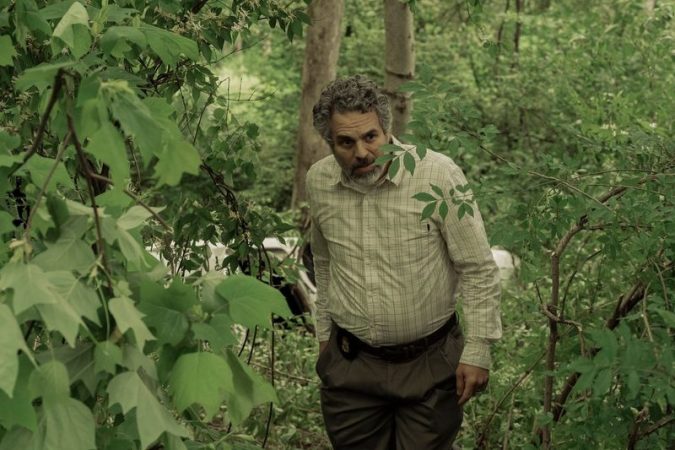
    If you’re taking a run through Wissahickon Valley Park next week and spot those signature Mark Ruffalo curls and determined glint in his eye through the tree leaves, worry not! The HBO series Task is filming its second season in the Northwest Philly park Monday through Friday.

    On Monday, the Bells Mill West Lot will be closed to the public for filming and will reopen the next day. Visitors can park instead in the Bells Mill East Lot.

    On Tuesday and Wednesday, the trail entrance at Manatawna Avenue will not be accessible. Houston Meadow can be accessed through the Houston Playground entrance on the Yellow Trail.

    The film crew is slated to park vehicles and equipment on some parts of Forbidden Drive. The trail will remain open, but hikers and runners may see stop signs warning them of “equipment ahead” or to go “slow ahead.”

    In July, the crew was spotted filming in Manayunk.

    The Delaware County-set series Task by Mare of Easttown creator and Berwyn resident Brad Ingelsby centers on FBI agent Tom Brandis, portrayed by Ruffalo. In the second season, Brandis is leading a new task force and confronting his rival Philadelphia DEA agent Eddie Barnes, played by Mahershala Ali, the Oscar winner who starred in Moonlight, Green Book, and the third season of the HBO crime show True Detective.

    The show’s first season also made its way around the city and suburbs. It featured scenes at the Rita’s Italian Ice & Frozen Custard in Collingdale, the Willowbrook Shopping Center in Boothwyn, and Marsh Creek State Park in Downingtown.

  • Ten months of inspections at Nazareth Hospital: July 2025 – April 2026

    Violations between July 2025 and April of this year.

    The hospital is located in Northeast Philadelphia and is part of Trinity Health Mid-Atlantic.

    Here’s a look at the publicly available details:

    • July 1, 2025: Inspectors came to investigate a complaint but found the hospital was in compliance. Complaint details are not made public when inspectors determine it was unfounded.
    • Feb. 18, 2026: Inspectors came to investigate a complaint but found the hospital was in compliance.
    • April 13: Inspectors visited for a special monitoring survey and found the hospital was in compliance.
  • Dick Allen documentary tour makes a stop in Philly, telling ‘a great story that nobody’s told’

    Dick Allen documentary tour makes a stop in Philly, telling ‘a great story that nobody’s told’

    When production started for My Father, Dick Allen, it was supposed to be a one-hour documentary on the former Phillies star. Four years later, it’s a five-part series, featuring interviews with sportswriters, Allen’s loved ones, and former coaches and players.

    The cast is loaded with Hall of Famers, including Mike Schmidt, Goose Gossage, and Andre Dawson. For co-executive producer Sharon Pannozzo, the biggest surprise was seeing just how enthusiastic everyone they asked was to participate.

    “Not one person batted an eye and said, ‘Well, I can’t do that. You know, I don’t have time’. Everybody made time,” she said.

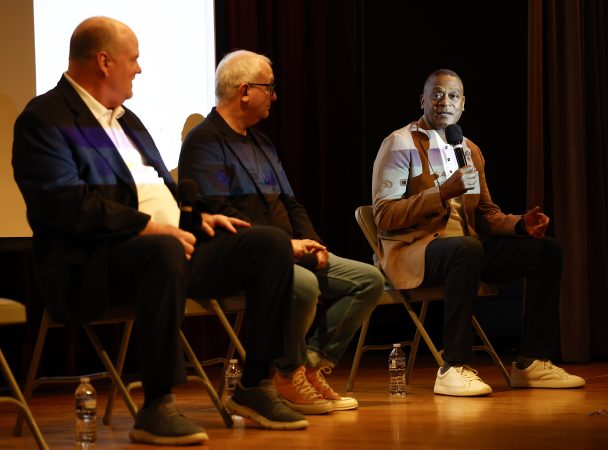
    Over the past few months, the documentary’s production team has put on screening events across the U.S., as they look to find a partner to license the series. On Thursday night, they stopped in Philadelphia, where Allen played nine of his 15 seasons. Fans were given the chance to see the third episode of the series, which focuses on Allen’s first stint with the Phillies from 1963-69. Following the screening was a panel moderated by The Inquirer’s Matt Breen. The participants included director Andy Billman, graphic designer Todd Radom, Allen superfan and co-producer Andy Wooley, and Allen’s son, Richard Jr.

    “Being here is like being at home,” said Allen Jr., known affectionately by his dad as Doobie. “I’ve grown up seeing that Phillies P and the Phillies logo my entire life.”

    Allen Jr. also serves as a producer for the series. Well before filming even started, one of his greatest passions in life was preserving his father’s legacy. For decades, Allen Jr. advocated for his father’s induction into the Baseball Hall of Fame. Allen died in 2020 at 78.

    Dick Allen finally got into the Baseball Hall of Fame in July of 2025, almost 50 years after he stopped playing. Monica Herndon / Staff Photographer

    Allen, who hit 351 career home runs, fell off the ballot in 1997 but was brought up for consideration by the Veterans Committee in 2014. He fell short by just one vote. Allen was brought up again in 2021 but also came up short. Last summer, he finally got into Cooperstown after 20 attempts, receiving 13 of 16 votes from the Classic Era Committee.

    “You can work on a film in the film business for years sometimes, and then all of a sudden it comes together,” said Pannozzo. “We would’ve told the story whether Dick got into the Hall of Fame last year or not … but we had a good ending.”

    When Allen was inducted last summer, Pannozzo and Allen Jr. were given a tour of the Hall of Fame storage vault. The artifact that stuck with Allen the most was a questionnaire his father had filled out at 18 years old, right after he started playing for the Class D Elmira Pioneers. Allen was deeply moved by that piece of paper.

    “My whole life, [baseball was] all he talked about, and I thought, OK, OK, OK, and then I get there, and it’s like, ‘Oh my gosh, he really wasn’t lying,’” Allen Jr. said.

    Another meaningful experience for Doobie was visiting Little Rock, Ark., where his father had played for the triple-A Travelers in 1963. It was that year that the Phillies moved their affiliate from Buffalo to the South. Allen had previously never been to the South and begged the organization to assign him elsewhere, but he didn’t have a choice.

    Inquirer sports reporter Matt Breen (left) moderates a discussion on the life and legacy of Phillies legend and Hall of Fame baseball player Dick Allen in the Montgomery Auditorium at the Parkway Central Library on Thursday.Yong Kim / Staff Photographer

    Allen became the first professional Black baseball player in the city of Little Rock, and it was a brutal year for him. Fans shouted slurs his way at the ballpark, in the parking lot, and throughout the city. Little Rock was also segregated, meaning that Allen was isolated from his teammates except when at the ballpark. He refused to return to the city with any of his kids.

    But the documentary dedicated a whole episode to the horrors Allen faced during his time in Arkansas. When Allen Jr. explored the city for the first time, however, he wasn’t doing it alone. Hall of Fame pitcher Ferguson Jenkins, who also played for the Travelers, volunteered to go through the city with Doobie. Jenkins was very close friends with Allen and overlapped in Little Rock with him briefly in 1963.

    “[He] pretty much substituted for my father, going to the high school, you know, and Little Rock … that would be my favorite part,” Allen Jr. said.

    At this point, the team does not have a deal lined up with a distributor for the film. But they know how important it is to be able to tell the story of Dick Allen to a younger generation of fans who did not see him play.

    “This is a great story that nobody’s told,” said Pannozzo. “Now we have to sell our project.”

  • A man was found engulfed in flames on Kensington Avenue

    Police found a man engulfed in flames along Kensington Avenue Friday morning in what fire department officials called a “non-suspicious” fire.

    Police responded to the 3400 block of Kensington Avenue Friday morning for a report of a screaming person. Upon arrival, a person passing by said a 34-year-old man was found on the ground engulfed in flames.

    Philadelphia Fire Department medics responded to the scene and transported the man to Temple University Hospital, where he was placed in critical but stable condition.

    The circumstances surrounding the incident remain under investigation by the East Detective Division, but the Fire Marshal’s Office ruled the fire to be “non-suspicious.”

    Anyone with information regarding this incident is encouraged to contact the East Detective Division or submit an anonymous tip through the Philadelphia Police Department’s tip line at 215-686-TIPS (8477).

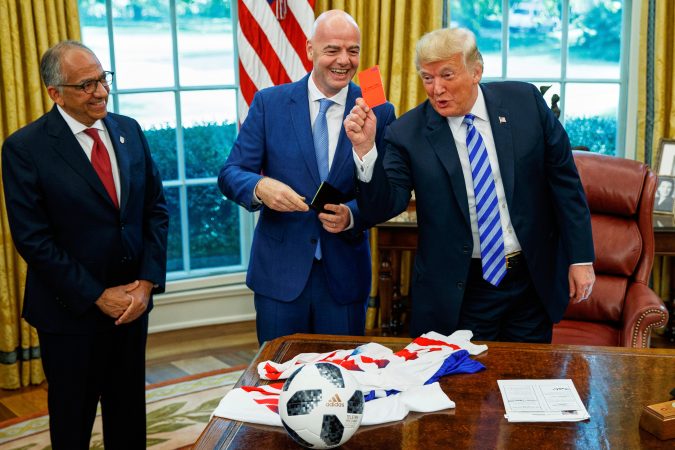
  • Former U.S. Soccer president quits role as top adviser to FIFA boss amid World Cup scandal

    Former U.S. Soccer president quits role as top adviser to FIFA boss amid World Cup scandal

    GENEVA — Two senior FIFA officials criticized Gianni Infantino’s World Cup sell-off plan Friday with one resigning as a presidential adviser and a second saying staff were deceived by a project that must not go ahead.

    Carlos Cordeiro, who represented the soccer body on the White House Task Force for the World Cup, resigned in protest at the private equity plan.

    “I cannot stand by while FIFA considers selling a stake in the World Cup,” Cordeiro, a former U.S. Soccer Federation president and Goldman Sachs banker, said in a statement resigning as adviser to FIFA President Gianni Infantino that urged other senior FIFA staff to speak out.

    Cordeiro was president from 2018-20, and vice president for two years before then. After resigning from U.S. Soccer amid a controversy in the women’s team’s battle for equal pay, FIFA hired him as a senior adviser to the organization and eventually Infantino.

    FIFA’s chief operating officer Kevin Lamour said in a statement to the Associated Press staff were “deceived” by Infantino’s lack of openness planning the private investor scheme and “deserve better than contempt and intimidation.”

    “It is the project of one person,” Lamour, a longtime colleague of Infantino at both FIFA and UEFA, wrote. “Not only must this project not go ahead … but the time has now come for football political leaders to ask themselves the right questions and make the right decisions.”

    Lamour did not resign the post he held since 2024 but said he had a duty to his colleagues.

    “And if that means I lose my job, then so be it” the French official said. “I will understand and respect that decision. At least I’ll sleep well tonight.”

    Ties to Trump’s family

    Cordeiro often joined Infantino on working visits to meet U.S. President Donald Trump at the White House in recent years.

    “Let me be clear. I had no involvement in this proposal, and I oppose it unequivocally,” Cordeiro said, calling the $20 billion commercial subsidiary “a bad deal for football.”

    “Football has been central to my life, and after more than 35 years in banking, I understand both the value of this asset and the consequences of giving part of it away” he said. “That is why this proposal should be rejected.”

    Infantino has proposed spinning off FIFA’s commercial businesses — including World Cups and Club World Cups for men and women — into a $20 billion subsidiary with 20% owned by private investors.

    The “anchor investor,” described by FIFA, is a New York-based investment firm created by Joshua Kushner, the younger brother of Trump’s son-in-law Jared Kushner.

    “FIFA already has access to extraordinary financial resources. The organization sits on billions of dollars in reserves and no debt,” Cordeiro said, noting FIFA’s revenue of $15 billion over the last four years tied to the men’s World Cup just ended.

    “Against that backdrop, selling a permanent stake in football’s most valuable asset to raise $4.2 billion makes little sense. It is mortgaging football’s future without any compelling justification,” he said.

    Cordeiro said he shared five years working for FIFA alongside Infantino with “dedicated, principled people who care deeply about the game.”

    “I hope they, too, will speak up,” he wrote, “because decisions of this magnitude should be made in the interests of football, not those who stand to profit from it.”

    Infantino has been president of FIFA for more than 10 years and had seemed sure to be reelected unopposed next March. FIFA has set a Nov. 18 deadline for challengers to come forward.

    FIFA blames the media

    UEFA threatened to boycott all FIFA games and events until the plan is dropped. North America’s CONCACAF also rejected Infantino’s offer of one-off $20 million payments to each member federation by a mid-September deadline.

    Asia’s soccer body that has been a key ally in Infantino’s 11-year presidency opposed the investor plan and said FIFA must urgently review its management style.

    The Asian statement came hours after FIFA blamed the media and doubled down on pursuing the project which now seems to have a majority of the 211 in opposition.

    “Our planned consultation process was disrupted by incorrect media reports,” FIFA said in a statement early Friday. “We will proceed with this consultation process to ensure that each [member] has the ability to express its vote based on facts.”

    The next FIFA event that would be targeted by the threatened European boycott is within weeks — the Women’s Under-20 World Cup hosted by Poland from Sept. 5. The senior women’s World Cup is next summer in Brazil.

    In November, FIFA will hold an online congress to award the 2031 women’s World Cup to a joint bid of the U.S., Mexico, Jamaica, and Costa Rica; and the 2035 women’s World Cup to the British group of England, Scotland, Wales, and Northern Ireland.

    Inquirer staff writer Jonathan Tannenwald contributed to this article.