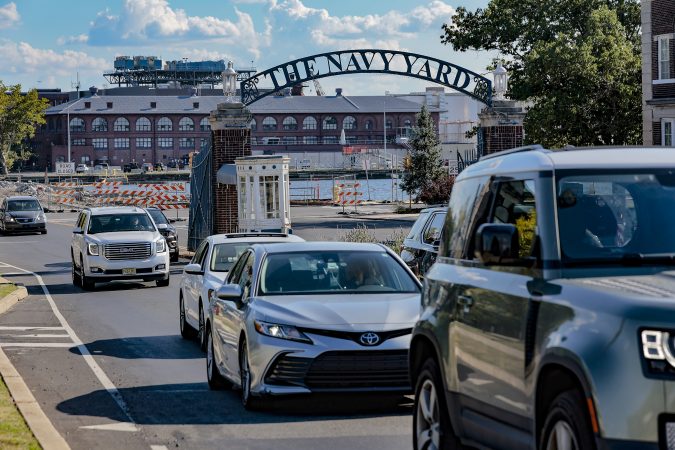
SEPTA is extending Route 45 to provide direct daily bus service to the Navy Yard for the first time in more than a decade, a move aimed at helping to grow both the development and transit ridership.
The new service is scheduled to begin in August, with buses operating at about 20-minute intervals, starting at 12th and Noble Streets in North Philadelphia, through Center City, and to stops inside the Navy Yard itself.
More than 150 employers have facilities in the Navy Yard, with more than 16,000 people working on the campus. There are 614 units of housing and plans for more residential and commercial development.
“Our goal is to provide as many safe, reliable, efficient ways to get to the Navy Yard as possible,” said Alex M. Smith, vice president of Navy Yard strategic initiatives at the Philadelphia Industrial Development Corp. It has built a path alongside South Broad Street to accommodate bike commuters and pedestrians.
“The 45 just provides another level of service for folks that may think otherwise than to take an Uber or their own car,” Smith said.
(function() {
var l2 = function() {
new pym.Parent(‘route45’,
‘https://media.inquirer.com/storage/inquirer/projects/innovation/arcgis_iframe/route45.html’);
};
if (typeof(pym) === ‘undefined’) {
var h = document.getElementsByTagName(‘head’)[0],
s = document.createElement(‘script’);
s.type = ‘text/javascript’;
s.src = ‘https://pym.nprapps.org/pym.v1.min.js’;
s.onload = l2;
h.appendChild(s);
} else {
l2();
}
})();
The Navy Yard’s master plan projects about 3,000 people will be living there within 15 to 20 years. About 450 jobs are expected to be added at Rhoads Industries, a maritime company in the western part of the former military base.
Colin Foley, the chief of service planning and schedules at SEPTA, said a 2023 survey of the Navy Yard workforce found that 86% did not use transit, and 60% of those said they would use SEPTA if more options were offered.
After months of talking about the much-hyped international sports event and festival, we’re finally living it. I am excited to see how it all unfurls after literal years in the making, and you should be too.
Not the sporty type? There’s Sunday’s Odunde Festival, which typically draws around 500,000 visitors to the Graduate Hospital neighborhood in celebration of the African Diaspora.
Also, for lovers of city nightlife, Thursday marks day one under the extended 4 a.m. curfew. It marks the first time Philly bars can stay open past the state’s 2 a.m. cutoff since the 2016 Democratic National Convention.
There’s a lot more that’s in store this weekend. Read on!
A rendering of the Philadelphia FIFA Fan Festival’s “vendor village” at Lemon Hill in East Fairmount Park. From June 11 to July 19, the festival will serve as the official fan experience for the 2026 World Cup in Philadelphia.(Courtesy of Philadelphia Soccer 2026)
Starting Thursday, the Fan Festival opens to 15,000 fans to the festival grounds at Lemon Hill, which has been transformed into an extravaganza of global soccer, writes reporters Henry Savage and Isabel Maney.
The free daily festival is intended for fans of all ages and promises to be a kid and family friendly affair.
The main draw will be a 60-foot screen that takes over the main stage.
What happens when all that cheering gets you hungry? There will be more than 80 local food trucks, serving dishes from the many cultures across Philadelphia, including local faves like cheesesteaks, pretzels, and more.
More than 50 live acts will take the stage at Lemon Hill, including the opening night concert with headliner Luis Fonsi of “Despacito” fame.
You can even get some shopping done. The Philadelphia Festival Marketplace will showcase artisans and makers in the region, offering soccer swag, accessories, jewelry, original artwork, and more.
Scenes from the opening night of Bok Bar — initially called Le Bok Fin — in 2015.Michelle Gustafson
🌭 Eating good: The most iconic dishes in Philly! Check out The 76 list for must-try bites around the city. Our top 10 drops tomorrow!
💃🏽 Enjoy Ballers After Dark: A new sports social club in Fishtown is transforming into a nightlife destination this Friday. Stop by to enjoy cocktails and sounds by DJs Quino, TJ Groover, and Shaka Sounds.
🎉 Meet me at the Bok party: The 10th annual B[L]OK Party is celebrating a decade of Bok and the South Philly creative community. There will be a bouncy castle, live music, face painting, food trucks, art demos, and other family-friendly happenings on Saturday.
🖼️ An affordable art fair: InLiquid’s annual Art for the Cash Poor returns to South Kensington on Saturday. More than 120 local artists will be at Crane Arts, offering original artwork priced at $250 or less.
🏳️🌈 Karaoke brunch and drag magic: Among the many phenomenal Pride Month events in the region includes Pride on Passyunk. Join the fun this Sunday. There will be food and drink specials, karaoke brunch, drag performances, Pilates sessions, and other fun activities all day.
📅 My calendar picks this week: Sounds of the World at Records Forever, A Lady Gaga Pride Party at Warehouse on Watts, Northeast Philly Beer and Drink Festival.
North America’s largest African American street festival has returned
An image of past iterations of Philly’s Odunde Festival. The free public festival is the largest African American street festival in North America, drawing up to 500,000 attendees each year. This year’s event marks the 50th anniversary of its founding.Courtesy of ODUNDE Festival
The Odunde Festival, founded in 1975 by Lois Fernandez, makes its welcomed return.
The weeklong cultural celebration culminates with a daylong celebration on Sunday.
It begins with a spiritual procession that starts at 23rd and South Streets, and moves toward the Schuylkill, where participants make traditional offerings to Oshun, the Yoruba goddess of the river.
Participants then return to South Street, where they can enjoy an array of foods, arts and crafts, and musical performances celebrating the African diaspora.
Legendary band Bel Biv DeVoe is slated to headline this year’s festival. A variety of additional acts will perform across two stages. For more information about this year’s Odunde celebration, read my colleague Dugan Arnett’s story here.
Spring fun this week and beyond
🎶 An early Juneteenth celebration: Bartram’s Garden is hosting the Juneteenth Jubilee on Sunday. The event, recognizing the true emancipation of enslaved African Americans, will be a free, family-friendly event at Eastwick Pavilion filled with poetry readings, biking, music, and more.
🇺🇸 Raise your flags: Flag Day Weekend 2026 is happening at the Museum of the American Revolution. The two-day celebration includes presentations of the original “suit of colors” set to a first-person theater performance.
🎭 The key to a new production: Pig Iron Theatre has a new production opening at Plays & Players Theatre this Saturday. It’s the Barrymore Award-winning production, Franklin’s Key, which explores what it would be like to discover Benjamin Franklin’s secret ability to change the weather during the War of Independence.
🎸 Thursday: Stereo League, the Philly band that Alex Savoth leads with Dan King, will take the stage at Johnny Brenda’s on Thursday. The group will be joined by openers Max Davey and James Clark.
🎤 Friday: Surrealist British songwriter Robyn Hitchcock, who mixes psychedelia with garage rock, is touring with an electric band that includes Philadelphia drummer Patrick Berkery. Hitchcock performs at Ardmore Music Hall on Friday.
🎸 Saturday: Jack Antonoff is producer to the stars, but the New Jersey singer-guitarist also fronts Bleachers. The Antonoff-led band will hit the stage at the TD Pavilion at Highmark Mann this weekend.
🎤 Also Saturday:Multi-talent Nick Jonas stops into Atlantic City to finish off his “A Night with Nick” tour at Hard Rock Live at Etess Arena.
Look, even if fútbol isn’t you’re thing, there’s plenty of places to kick it this weekend.
Don’t miss out on all the festivities, and keep an open mind — you may just score a new find.
Word began to spread quickly around the NHL scouting combine on June 4. It started as whispers and then grew to a roar as everyone heard about Sportsnet insider Elliotte Friedman’s report that Detroit Red Wings captain Dylan Larkin wanted a trade.
A week on from that report, here’s what we know.
What is the latest on the Dylan Larkin trade request?
Larkin is set to begin Year 4 of an eight-year contract he signed in March 2023, with a cap hit of $8.7 million. The contract makes his trade request sticky, as according to Puckpedia he has a full no-trade clause until July 1, 2028. At that time, it becomes a modified no-trade clause with a 10-team trade list.
On Tuesday, the Detroit Free Press reported that Larkin submitted three teams to general manager Steve Yzerman for which he was willing to waive his no-trade clause. The three teams — the Minnesota Wild, Florida Panthers, and Vegas Golden Knights — are all Stanley Cup contenders, with Vegas currently in the Final against the Carolina Hurricanes, and each team has some of his closest buddies on the roster.
Friedman added on his “32 Thoughts: The Podcast” on Wednesday that there are two more teams possibly in the running — the Tampa Bay Lightning and Dallas Stars — that are also considered 2026-27 Cup contenders.
Red Wings GM Steve Yzerman is believed to have a tense relationship with Dylan Larkin. Carlos Osorio
How and why is Larkin suddenly available?
Larkin grew up in the Detroit suburb of Waterford, Mich., played for the U.S. National Development Team in nearby Plymouth, and was drafted 15th overall in 2014 by his hometown team before heading to the University of Michigan for a season. Larkin has never played hockey outside of his home state, skating in 808 games and ranking 10th all-time in points (643) on a list littered with Hockey Hall of Famers like Gordie Howe, his general manager Yzerman, and Sergei Fedorov, for the winged-wheel club.
For the captain of the Red Wings, who will turn 30 at the end of July, maybe it’s time to leave the comforts of home? Or maybe it’s a breakup that has been brewing for some time.
Last year, Larkin hinted that he wasn’t too thrilled with how the trade deadline came and went without much action as the Red Wings were in the hunt for a playoff spot for the second straight year. “We didn’t gain any momentum from the trade deadline, and guys were kinda down about it,” Larkin told reporters last April. “It’d be nice to add something and bring a little bit of a spark on the ice and maybe a morale boost as well.”
That came a little more than a year after his friend Tyler Bertuzzi was traded — Larkin had inked his extension the day before — and Larkin was visibly emotional when addressing the media. Frustration had to be mounting for Larkin, who enters next season with just one playoff appearance — as a rookie — in Detroit. But the GM put the onus on the players, stating at his end-of-season availability, “I’m counting on our best players, our leaders, to give us a bit of a morale boost. That’s what they’re paid for, and that’s the expectations for them.”
“They don’t speak unless they’ve had to, they haven’t for a while,” he quoted the agent. “That’s kind of become common knowledge about the situation in Detroit. Steve and Larkin coexisted, but they didn’t get along at all, and that’s kind of been known by others for a bit now.”
Dylan Larkin (71) is a prolific goal scorer with much-coveted power-play skills.Paul Sancya
What kind of player is Larkin, and what has he accomplished?
Larkin is a perennial 30-goal scorer, having hit the mark for the past five seasons and in six of his 11 NHL seasons. His 34 goals this season would have landed atop the Flyers leaderboard, along with his 14 power-play goals — something the Flyers desperately need help with — and nine game-winners. His 67 points would have finished tied with Trevor Zegras for second, behind the 68 points Travis Konecny dropped.
And the best part? He’s a center — a No. 1 center.
“I think the thing about Dylan is that he is a bona fide, top-six center. He can be the number one center who — the rare thing about him is that he really embraces the head-to-head shutdown role part of it,” Shapiro told The Inquirer at the NHL scouting combine.
“ … When Colorado comes to town, he wants the Nathan MacKinnon matchup, he wants the Connor McDavid matchup. And he’s one of the few players that has the foot speed to actually go into those battles and limit those guys. I think the reason he’s an $8.7 million player, and those guys are $12 million players, is because [while] he could be that offensive guy, he puts so much energy into kind of that defensive end.
“And I think that’s what makes him a little bit rare, is he’s someone who has that ability to be that offensive guy, but has kind of embraced more of that defensive role.”
Danny Danny Brière has explicitly cited an emphasis on the center position within the team’s offseason checklist. Jose F. Moreno / Staff Photographer
Would the Flyers be interested, and at what cost?
Multiple sources have confirmed to The Inquirer that the Flyers are interested in the center. And why wouldn’t they be? He brings the speed, can attack down the middle of the ice, and has that scoring touch — and he could be put into that 1C spot — that the organization has desperately needed for years.
“I think the greatest need is a top-six center,” he said. “And we have guys that have really stepped up; Trevor [Zegras] has played center at times, and he has the skill to play in that role.
“We’ve asked a lot out of Noah Cates, Christian Dvorak, and Sean Couturier to play some heavy minutes, and we’ve asked them to play in that role for a big part of the season. But looking at our team, that would probably be the one area that we could improve on.”
Larkin checks that box, whether as a 1C or, as Shapiro said, in a 1A/1B tandem where you run Larkin in a strength-on-strength system where he plays against the other team’s top lines. But the Flyers also need a game-changer. Is he that guy too?
“I think he can be,” Shapiro said in Buffalo. “I think we’ve seen it in stints in Detroit, and I thought last year at 4 Nations was a good example of — I know the U.S. lost at 4 Nations — but he kind of was someone who raised his game in that big element, and then he was really good at the Olympics. He’s done it in those moments.
“I’ve always been curious about Dylan Larkin, just because we’ve only seen him play five playoff games in his career. He feels like he has kind of that ability that can break games in the playoffs, where you have those tight-checking chess-match games, and it’s a bit muddy, and everything like that, but he has that [ability] where he can break things open there.”
But there is also the timeline part. The Flyers are not a true Cup contender just yet and, as noted by the teams Larkin is picking, that’s a high priority for the center. He’s also set to be 30 and the Flyers youngsters, like rookies Porter Martone, Denver Barkey, and Oliver Bonk, are still raising their games. Would he be willing to wait?
“It’s funny because he is 29, but he’s never played a playoff game [since his rookie season]. His season has ended April 18 every single year for the last nine years,” Shapiro said. “I’m not going to pretend to know the physical limitations of age [but] I do think, for what is left on his current contract … I think his game is still going to age well, because it’s not like he’s someone who’s played an extra 20 games in the playoffs.
“If you’re looking for a guy who’s a little bit older, who’s going to come in and set a bit of the tone of being willing to turn defense into offense, which is kind of my understanding of the way the Flyers want to do a lot of things, [then] yeah, Dylan is very open; that’s something that he’s all about. I think the fit is there stylistically. … [And] I think for him the next fit is going to be somewhere where he doesn’t have to lead the marquee. … If there’s talk about Philly, and you talk about a bunch of the guys they’re already trying to build around, and if he can be the third or fourth guy you mentioned, and you’re kind of building around this core, it’s probably the ideal spot for him.”
It doesn’t sound like Larkin agrees, but if the Flyers come with the right package, maybe he could be swayed? Shapiro thinks the package needs to include a combination of prospects — especially center depth — an NHL player, and draft picks.
Could that mean a Jett Luchanko or a Jack Nesbitt, who is off to play college hockey at Michigan in September? The Red Wings were reportedly interested in landing Rasmus Ristolainen at the trade deadline. And Detroit does not have a first-round pick this June after trading it to St. Louis for Justin Falk, so could the team take the Flyers’ top pick this year or that first-rounder they have from the Toronto Maple Leafs in either 2027 or 2028?
Could Teddy Blueger (left) be a Plan B at center for the Flyers? ETHAN CAIRNS
If not Larkin, what other centers could the Flyers target?
The free agent market is thinner than thin this year, especially when it comes to top-six centers, which is why acquiring someone via trade makes the most sense.
Yes, Claude Giroux and Scott Laughton are unrestricted free agents, but neither fit the top-six and would be short-term stopgaps, not the long-term projection the Flyers need. Giroux has also been playing wing in Ottawa.
But if they want to add depth, someone like Teddy Blueger, whom Flyers coach Rick Tocchet had in Vancouver, could be an option.
The other option is the good old offer sheet. Brière told The Inquirer an offer sheet is something the Flyers would consider, but “I would say it’s probably not likely with the cap going up; a lot of teams have extra dollars to spend.” If they do go that route, it needs to be done smartly, but options include centers Leo Carlsson, Adam Fantilli and his teammate Cole Sillinger, Cole Perfetti, Mavrik Bourque, and Kirby Dach.
If they go the trade route, Robert Thomas of the St. Louis Blues is the most obvious name out there, although recent reports suggest they are not planning on trading the centerman. Matty Beniers of the Kraken has also been mentioned, as has his teammate Shane Wright; however, The Inquirer has learned that Wright may not be considered a fit by the Flyers, and, per a league source, there is no indication that Beniers is available.
Mathew Barzal’s name has popped up, but sources say that is premature. The Athletic’s Pierre LeBrun has reported Auston Matthews is fine sticking around Toronto, and centers like Vincent Trocheck, Blake Coleman, and Nazem Kadri are all over 30 and do not fit the timeline.
It’s a good thing for the Phillies that he does, because they have leaned on their closer a lot this season. Even though Duran was on the injured list for 17 days this year with an oblique injury in his left side, he still ranks fourth in baseball in save opportunities.
“I need to be on the mound every day,” Duran said.
But in this week’s series against the Blue Jays, the Phillies asked even more of Duran than usual, when interim manager Don Mattingly used him three nights in a row. The last time Duran had made three appearances on three consecutive nights was from July 14-16, 2023, when he was a member of the Minnesota Twins.
“If I feel good, I want to be in the game,” Duran said. “So that’s me. The more I throw in the game, I feel more comfortable. I feel way better.”
Duran needed just nine pitches to record a save in Monday’s series opener against the Blue Jays. He threw eight pitches on Tuesday but blew his first save of the season as Toronto walked him off. On Wednesday, he rebounded with a 10-pitch save, his 17th of the season.
Mattingly said the process this season for determining Duran’s availability largely has been following the reliever’s lead. He plays catch pregame each day and then informs the coaches how he feels.
Jhoan Duran blew his first save of the season on Tuesday against the Blue Jays but closed out their win the following night to take the series.Sammy Kogan
“Jho’s been pretty good about telling us,” Mattingly said. “There’s been times when we thought he’d be available, and he says he needed a day. [Wednesday] was not one of those days, and he was adamant, and we kind of go with that.”
The “blown save” on the box score doesn’t capture the whole story of what happened Tuesday night. With the Phillies clinging to a one-run lead, things unraveled quickly: a broken-bat single (.070 expected batting average by Statcast) and another ground ball single (.150 expected batting average) put runners on the corners.
The Blue Jays used two pinch-runners, and after a wild pitch brought the tying run home, all they needed to do to end it was to get the ball out of the infield. Brandon Valenzuela delivered with a single, and Duran no longer had a perfect season.
Mattingly said he wanted to get Duran into another game quickly after that. But for Duran, what happened the day before made no difference. Like every day, he just wanted to pitch.
The flame-throwing right-hander has always had a short memory, and regardless of the result, he turns the page quickly. When Duran walked out on Wednesday, he wasn’t thinking about Tuesday at all.
“Yesterday is yesterday,” Duran said. “I was focusing on today, not yesterday. Yesterday is just the past for me.”
His teammates felt the same.
“We got all the confidence in the world in him,” Kyle Schwarber said.
Jhoan Duran and catcher J.T. Realmuto celebrate a victory in April.Yong Kim / Staff Photographer
Duran threw 27 pitches in three games, not including what he needed to warm up each night in the bullpen. While that total might not seem like much, for a reliever like him who can top 100 mph on the radar gun, each pitch is thrown at a high intensity.
Duran said he handles his workload and recovery by listening to his body.
“I do a lot of recovery in the training room,” he said. “I do it [in] the hotel, too. I always have my recovery machines with me.”
On Wednesday — this time with a three-run cushion — Duran let the leadoff man aboard with a single, but got Vladimir Guerrero Jr. to ground into a double play on the next pitch.
Ernie Clement poked a soft single, just 60.4 mph off the bat, but Duran struck out Kazuma Okamoto on three pitches to seal the win and record another save.
“Insanely [impressive]. His stuff is always elite, and he’s a workhorse, so we love having him in our corner,” said starter Jesús Luzardo. “Seeing him bounce back after [Tuesday] night, which I would call it unfortunate.
“His stuff is second to none. And I think that that’s why he’s the best closer in the game.”
Oil and gas executives have warned the White House that gasoline prices could surge in coming months as fuel inventories fall to critical lows, complicating the Trump administration’s efforts to contain inflation that has already rattled American consumers.
Industry officials say they are doing everything they can to sound an alarm that prices are about to soar as the commercial and government inventories that have mitigated price rises so far are rapidly depleting, according to multiple people familiar with the conversations, who spoke on the condition of anonymity for fear of retaliation from the administration. Some inventories could be wiped out within weeks, the executives have warned, coinciding with the peak summer travel season.
“I have absolutely no doubt the White House — from the president on down — is fully aware of the nearly universal alarm among oil companies and analysts about the direction of travel for oil prices this summer,” said Bob McNally, who was an energy adviser in the George W. Bush administration and founded the research firm Rapidan Energy Group.
The warnings underscore the rising political and economic risks confronting President Donald Trump as the conflict with Iran drags into its fourth month, with little indication that a diplomatic breakthrough is imminent, despite periodic White House predictions of progress.
Already Trump’s administration is confronting the highest rate of inflation in three years, which has led to a significant drop in his standing among voters and deepened concern among Republicans about widespread losses in the midterm elections, which could cause them to lose control of one or both houses of Congress.
The Labor Department’s Consumer Price Index rose at a 4.2% annual pace in the year ending in May, driven by surging gas prices.
Trump has publicly brushed off concerns about the rising prices. “I love it. I love the inflation,” Trump told reporters Wednesday when asked about the new figures. Oil prices will drop “like a rock” once the war concludes, he said.
Industry executives suggest otherwise.
The war with Iran has snarled the Strait of Hormuz, the waterway that transported about one-fifth of the world’s oil and natural gas supplies before the war. Trump has repeatedly sought to assure the public that he is close to a deal to reopen the strait, but that has not happened.
Senior oil executives who typically avoid making alarming projections in public have been doing exactly that.
“We’re sounding the alarm on these inventories going to record lows,” said American Petroleum Institute CEO Mike Sommers on Mornings With Maria, a Fox Business program that Trump frequently watches. “We should be concerned about what prices we’re going to see over the next few weeks. We have to solve this problem in the Strait of Hormuz.”
Industry officials, who spoke on the condition of anonymity to avoid antagonizing the White House, said the administration’s reception to their worries has been mixed. Some officials, they say, are taking the posture that the warnings are hollow. Prices have not shot up toward $200 a barrel, despite warnings since the war against Iran started in late February that they would quickly head there.
The U.S. Strategic Petroleum Reserve has dropped to 349.2 million barrels, approaching a multi-decade low last seen in 1983. The exact date reserves start to run dry can be difficult to calculate, because they cannot be run all the way down.
Millions of barrels of oil need to remain in pipelines and refineries to keep the systems from breaking down. Analysts and industry executives warn the critical moment could come anywhere from the end of this month to closer to the end of summer. But they are universally anxious about how quickly the supply is declining.
Industry models show the collapse of crude inventories within a matter of weeks could push the cost of oil up by 50% or more — sending the price of gas at the pump soaring past $5 per gallon. Oil executives worry that will send the administration scrambling to impose emergency measures like restricting the export of U.S. fuel.
A senior White House official said more information from the industry “is good,” and the administration will continue to take information from oil and gas executives into account.
“But that is one piece of a larger picture that only the president has,” said the official, who spoke on the condition of anonymity to describe the private deliberations.
The price of gas has “consistently gone down for the past couple of weeks,” the official said. The official attributed that to steps the administration has taken to ease prices, including waiving the Jones Act, which governs the ships that can serve U.S. ports, and coordinating the release of 172 million barrels from U.S. reserves.
The national average for a gallon of gas on Wednesday was $4.15, down from $4.52 a month ago, according to data from AAA. The prices fell in part because of reports of peace negotiations in the conflict with Iran, but the latest exchange of attacks has jeopardized a fragile ceasefire.
“The president is focused on finishing the job,” the official said. “We have heard projections again and again throughout this entire conflict that the price would jump higher and higher, that the price of crude barrel would be $150 or $200, or the average price of oil would be upwards of $5. None of that has played out.”
Other administration officials are frustrated that the industry has not moved faster to drill more and expand domestic production to create a buffer, some of the people said.
But companies have been reluctant to invest too heavily in multibillion-dollar drilling operations, which would not yield substantially more barrels for months when the administration is expressing confidence that the strait will reopen within days.
“Both camps know exactly what is at stake,” said one industry official who frequently interacts with the administration. “The industry folks are intent on making sure that if the worm turns, the White House does not point fingers that the industry did not do enough.”
“Everyone everywhere fully appreciates that the standoff cannot go on for another 30-45 days without the political calculations changing,” the official said.
“The White House knows and understands the severity of the potential situation. … They are politically constricted from saying that publicly.”
The potential for a dramatic price hike that would ripple around the world does not align with Trump’s narrative that the United States holds all the cards in negotiations and that oil disruption is but a minor, short-lived inconvenience.
A further hike could carry political consequences for Trump, whose allies now acknowledge the risk that a prolonged conflict poses to the Republican Party’s prospects in the midterms.
“High oil price is like a tax on the economy, and it’s a tax on the incumbent party,” said economist Steve Moore. “This is why Trump is so eager to get this done.”
Trump said that he had conducted a secret military operation to remove 100 million barrels of oil that were stuck in the strait. Military officials said his remark referred to a previously announced plan to share information with shipping companies about safe routes through the waterway.
Experts tracking movement of oil on through the strait say that some shipments have gotten through, but the volumes are extremely limited and do not do very much to solve the inventory problem.
Before the war, some 130 tankers traversed the strait daily. Even if White House alleges that dozens of tankers are slipping through each week are accurate, that would amount to only a fraction of the crude moving through the strait before. Ship-monitoring data suggests the White House claims are exaggerated.
“The president is making a remarkably dubious claim,” said Brett Erickson, managing principal at Obsidian Risk Advisors, which specializes in financial crime and sanctions, and is closely monitoring oil shipments in the Persian Gulf. “And even if some ships are getting through, this is not a long-term solution. Are we going to perpetually be the chauffeur for the Gulf?”
Even if some stranded oil can be smuggled out, ships cannot get back into the strait to reload.
“They don’t even need to hear from us directly to know there is a problem,” said an executive with a major oil company. “There is no shortage of people out there saying this publicly. The inventories are at historic lows.”
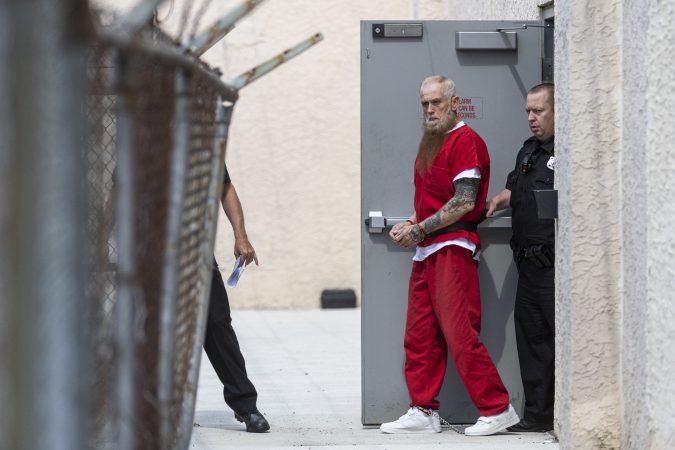
Two years after a Chester man stormed into his workplace with a gun and opened fire in a shooting that left two people dead, he is on trial for murder before a Delaware County judge.
Wilbert Rosado-Ruiz screamed he was “tired of people f— with” him as he fired shots at nearly 50 of his coworkers at Delaware County Linen, injuring five of them, according to the affidavit of probable cause for his arrest.
Rosado-Ruiz, 63, is charged with two counts of murder for killing brothers Leovanny Peña Peña, 30, and Giguenson Peña Peña, 26, after reporting for his early-morning shift at the industrial-laundry business.
Three other people were shot during what prosecutors described as a rampage.
Rosado-Ruiz’s attorney, Kevin O’Neill, has said his client fired the shots after feeling threatened during a confrontation with a group of his coworkers. His actions that day, O’Neill said, did not constitute murder.
Polites rested her case Thursday, but the trial is not over: O’Neill will present his defense in July. The delay, he said Thursday, was to accommodate members of Rosado-Ruiz’s family, who need to travel to Delaware County from Puerto Rico to testify on his behalf.
Prosecutors have said Rosado-Ruiz intended to kill more people on the day of the shooting, and would have done so had the 9mm Remington R51 handgun he was carrying not jammed. Investigators recovered the weapon and traced it to Rosado-Ruiz after his DNA was found on it, according to testimony this week.
Rosado-Ruiz’s coworkers told investigators he had a history of abusive, bullying behavior, including threatening people with his gun, in the 10 years he worked at Delaware County Linen before the shooting, according to court filings.
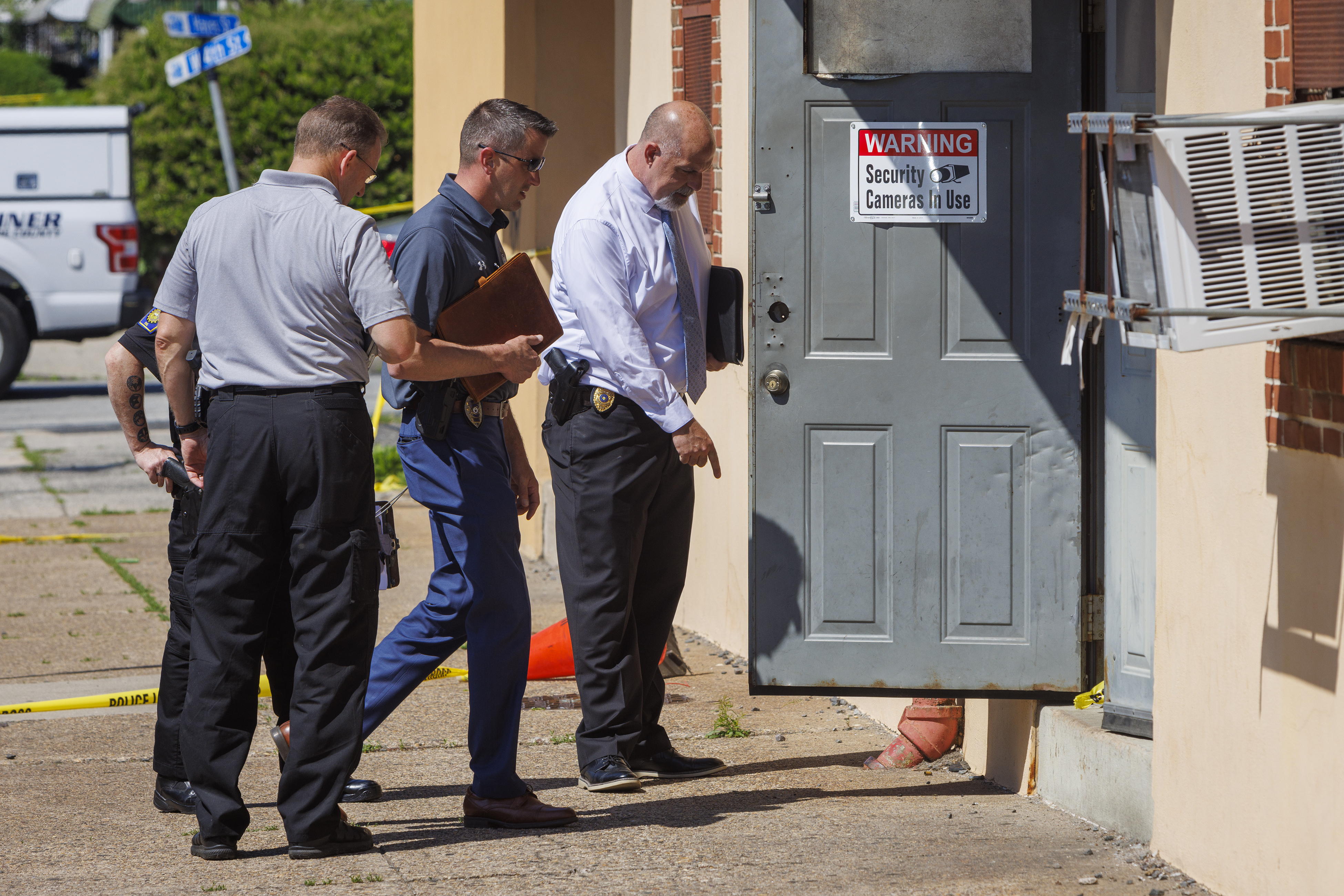
Chester Police search for evidence after a shooting Delaware County Linen on May 22, 2024. Five people were shot in the incident, two of them fatally, according to prosecutors. Alejandro A. Alvarez / Staff Photographer
On the day of the shooting, Rosado-Ruiz got into a verbal dispute with a coworker, Nilamarie Valdivieso.
Valdivieso testified that Rosado-Ruiz “looked very mad” when he arrived at work, and exploded at her when she asked him what was bothering him.
Later, after Valdivieso returned with two supervisors, along with Leovanny Peña Peña, she said, the conversation escalated, and Rosado-Ruiz pulled the 9mm handgun from his waistband.
He shot Valdivieso once in the chest before chasing down and firing at the other victims as they ran and dived for cover, she said. The Peña Peña brothers were both shot multiple times trying to flee Rosado Ruiz, and were pronounced dead at the scene by medics.
Another victim, Charles Doyle, testified that he was fixing an industrial washing machine when he heard several shots ring out in quick succession.
He said he saw Rosado-Ruiz pull a second magazine from his pocket and reload his handgun. Doyle said he yelled out to distract the gunman so that his father, who also worked there, had time to flee.
When Doyle turned to leave, he said, Rosado-Ruiz shot him three times in the back, shattering his right arm and causing severe internal damage to his organs.
Doyle said he is unable to work because of nerve damage in his arms — he said moving his hands feels similar to trying to wiggle his ears.
He testified that he did not see or hear anyone threatening Rosado-Ruiz before the gunfire rang out.
Rosado-Ruiz fled after the shooting, which led police from surrounding departments to lock down streets around the business.
He was taken into custody by an officer from Trainer, pulled over on the edge of Chester as he attempted to drive home. Inside the car, investigators found a backpack with a smaller bag containing additional 9mm bullets, authorities said.
Tuan Van Bui’s bad luck arguably started the day he was born in 1970 in the city then known as Saigon — the child of a Vietnamese woman and one of the thousands of U.S. soldiers who fought in Southeast Asia for nearly two decades.
Van Bui never knew his dad, but he quickly learned what it was like to grow up in a hostile homeland that called the estimated 25,000 to 50,000 Amerasian kids like him “children of the dust.” The communist government that won the war in 1975 denied him any education past grade school.
In 1990, Van Bui caught a break — of sorts. In the late 1980s, a U.S. Congress struggling to come to grips with the mess America had left behind passed the Amerasian Homecoming Act. That allowed Van Bui to legally immigrate to America and settle in Philadelphia’s Kensington neighborhood, but with no real safety net.
His first two decades on U.S. soil were rough, marked by occasional run-ins with the law. But in middle age, Van Bui had settled into a more comfortable American life. He married a fellow Amerasian immigrant in 2017, earned some money from construction and other odd jobs, and indulged his quirky hobbies like stamp collecting. He was paying back his fines from the bad years and — although threatened with a removal order — he religiously showed up for check-ins with U.S. immigration officials.
His family says Van Bui was doing everything the right way.
Still, it was with much trepidation that Van Bui showed up with his wife at the Philadelphia immigration office on Aug. 18, as the reelected Donald Trump and his team pushed for a massive increase in arrests and deportations. What happened next, as his wife related to family members, was even worse than they had feared.
Tuan Van Bui in an undated family photo. Van Bui, 55, died in immigration custody at the Miami Correctional Facility in Bunker Hill, Ind., on April 1.Handout art
Van Bui’s stepdaughter, Ly Wang, told me this week that U.S. Immigration and Customs Enforcement officers were waiting. “Before he could even really check in, they saw him, they spotted him,” she said. “The ICE agents ambushed him, and they shoved my mom out of the way. They tackled my stepdad … shoving him into a wall because he’s a big dude.” Wang said the ICE agents threw Van Bui’s paperwork in the trash and warned her mom, “You need to leave before we make it a problem for you, too.”
Van Bui’s arrest that August day was the start of a seven and a half month Kafkaesque journey through the rancid food and 4 a.m. wake-ups of ICE detention sites, first in upstate Pennsylvania, and then nearly 700 miles away in rural Indiana.
It ended on April 1. That morning, Van Bui had made his usual phone call to his wife and, despite the routine complaints, sounded fine. The next call came that night, but from the chaplain at Indiana’s Miami Correctional Facility. Van Bui had suddenly collapsed and died. He was just 55.
It took more than two months for Wang and her mom — who herself had suffered a debilitating stroke in the days right after watching Van Bui’s violent arrest — to deal with Indiana authorities, obtain some additional testing, bring his body back home, and secure a spot for him in the Fernwood Cemetery in suburban Lansdowne, where he was buried on June 5.
But his family’s many questions have not been laid to rest.
Why was Van Bui’s ICE detention dragged out for so many months when — given the wretchedness of life behind barbed wire — he and his family would have preferred deportation to Vietnam, even if he hadn’t been there for 36 years? Why wasn’t Van Bui given more medical attention, as doctors noted his swollen knees and other signs of worsening health?And why is ICE’s account of Van Bui’s death so different from what other detainees told the family — that staff did nothing at first while they, the detainees, attempted CPR until paramedics finally arrived a full hour after the collapse, too late to do anything but declare him dead?
A 55-yr-old Vietnamese immigrant, Tuan Van Bui, died at the Miami Correctional Center in Indiana in government custody last week, marking the 46th detainee death during the #Trump administration's #immigration crackdown. https://t.co/vHgj8qtncz
And a bigger question hangs over all of this: Why did a redemption-seeking United States government invite Van Bui to come here from the other side of the world, only to leave him to fend for himself before brutally arresting him, dumping him in a hellhole prison, and allegedly watching him die from chronic and then acute neglect?
“I think he fully considered America to be his home, and he was very comfortable here despite even all the challenges against [Amerasians],” Wang said. What happened to Tuan Van Bui is in many ways mystifying, but he is also not unique.
Even as the Trump regime’s deportation raids have sometimes dominated the headlines, much of the attention has focused on the targeting by masked ICE and Border Patrol agents of brown and Black neighborhoods, such as Latinos in Los Angeles and Chicago or the Somali community in Minneapolis. The government’s stepped-up arrests of Asian Americans have largely flown under the radar.
“There’s just a severe sense of fear in the community,” Nancy Nguyen, the executive director of Philadelphia-based VietLead, told me, adding that the message “for the Asian communities is that they are not wanted here under Trump.”
A painful irony is that the hardest hit have been refugees for whom the United States opened its doors in the latter years of the 20th century — a belated acknowledgment that their plight was often the result of America’s violent and unpopular war in Southeast Asia. This winter in Minnesota, masked immigration raiders frequently targeted the Hmong people from Laos who’d once been welcomed for their role in helping American troops and the CIA over there.
Nguyen said that nationally, more than 1,000 Vietnamese immigrants and more than 500 Laotians were deported in 2025 — compared with fewer than 100 a year before the second coming of Trump. A few have been sent to remote African nations like Eswatini, where they don’t know any people or the language. Many more have been languishing, as Van Bui did, in the cruel limbo of ICE detention — sometimes with lethal consequences. Nguyen said that of the 50 or so ICE detainees who’ve died under the Trump regime, nearly a third were of Asian descent.
No one deserves to die in ICE custody. Every person in detention centers deserves basic human needs like water and safe shelter. My visit to Miami Correctional Facility raised concerns that should not be ignored. pic.twitter.com/JznLZKhpff
Van Bui was actually the second Asian American to die at the Miami Correctional Facility — run by the state of Indiana, which contracts with ICE — since February. Lorth Sim, 59, who came to America in 1983 as a refugee from the brutal dictatorship of Cambodia’s Pol Pot, also collapsed at the facility, where officials also blamed heart disease.
What’s more, Van Bui is the third member of Pennsylvania’s Asian community to die in immigration custody in less than a year. In January, 46-year-old Cambodian American Parady La was arrested outside his Upper Darby home and died three days later at Philadelphia’s federal detention center, reportedly while undergoing narcotics withdrawal. Last August, 32-year-old Chinese immigrant Chaofeng Ge died at the upstate Moshannon Valley Processing Center five days after his arrest near Harrisburg; family members and advocates have challenged ICE’s assertion that his death was a suicide by hanging.
In Van Bui’s case, ICE issued a fairly detailed statement that insisted the Amerasian detainee — who’d suffered a serious stroke on Christmas Eve 2023 and used a cane for mobility, among other preexisting health problems — was properly monitored and treated amid clear signs his condition was deteriorating, with a decreased platelet count and then swollen knees indicating “obstructive pulmonary disease.” It also claimed — disputed in the accounts other detainees have offered Van Bui’s family — that staff at the Indiana facility responded quickly to his April 1 collapse with CPR and a defibrillator before he was pronounced dead at 6 p.m.
Whether ICE and Indiana corrections officers offered Van Bui adequate medical care is still up for debate, but what the government definitely did not offer was empathy. As with other ICE custody deaths, grieving relatives were slammed with an official press release that denied Van Bui’s humanity.
“Criminal illegal alien from Vietnam passes away at Miami Correctional Center” was the headline on ICE’s press release, which stressed Van Bui’s encounters with law enforcement when he was a younger man.
His stepdaughter Wang told me the litany of criminal charges in the release includes some arrests for which he was not charged or convicted, and that he was diligently repaying fines for other past violations. But what hurts more is the regime’s cruel characterization of a human being whom Wang described as a soft-spoken, gentle giant who never turned down a request for help from his Kensington neighbors and — “a nerd in a way” — loved to scour flea markets for cuckoo clocks or rare coins or stamps.
Chaofeng Ge, 32, died in August at the Moshannon Valley Processing Center while detained by ICE.Courtesy of David Rankin
She said he’d told her little about the first 20 years of his life in Saigon (renamed Ho Chi Minh City after the war), but did admit that the abandonment of his American GI father weighed on him.
“Something that he did tell me and just confided in me was that he never felt like he grew up feeling wanted, you know? Starting with his dad not being around, and his mother being very busy and being a single parent,” she said. “So he had kind of a rough start.”
Amerasian kids were treated cruelly in Vietnam — as reminders of the hated Americans who’d invaded their country — and typically denied any education beyond grade school, which apparently was the case for Van Bui. The United States seemed to acknowledge that harsh reality when Congress and the Reagan administration enacted the special AM-1 visa that allowed Van Bui to come here in 1990. But the new arrivals didn’t always adapt easily to a home where they were reminders of a war that most Americans wanted to forget as much as the Vietnamese.
“My impression that he got into kind of the wrong mix of crowds,” said Wang, who first met her future stepfather when she was a teenager. “I see him as someone who, because he didn’t have that much of an education … that you could manipulate, unfortunately.”
Like many others, Van Bui faced an immigration judge’s removal order from the 2000s because of his legal problems, yet was allowed to remain as long as he continued his regular check-ins — which he did until his violent arrest last August.
Van Bui was initially sent to the large Moshannon Valley site in Clearfield County, Pa., then transferred in December hundreds of miles west to the lockup in tiny Bunker Hill, Ind., where, since last year, ICE has promised the state of Indiana $291 a day — four times the normal rate — to house some of its rising numbers of detainees.
In just a short period of time, complaints from detainees, advocates, and Indiana Democratic Rep. André Carson — who visited the site just days after Van Bui died — that conditions at Miami Correctional Facility are cruel and inhumane have mounted. Carson said two detainees he met described “heartbreaking” conditions, and that a lack of functioning intercoms may have played a role in Van Bui’s death. The American Civil Liberties Union of Indiana settled multiple suits from state inmates — predating the 2025 deal with ICE — alleging pitch-black conditions from windows covered with steel plates, and frequent episodes of cells flooded with wastewater.
Two deaths this year at Miami Correctional Facility's ICE detention space is getting attention.https://t.co/1pzcfwUQo9
Wang said it took weeks to even learn Van Bui had been moved to Indiana, and when they did reconnect, he complained of freezing-cold winter conditions and horrible food, even as they were awakened by guards for breakfast at 4 a.m. Things were so bad that Van Bui actually wanted to be deported back to Vietnam, but despite finally seeing a judge in February, the government continued to hold him in these gulag-like conditions.
Until he died.
During the agonizing weeks Van Bui’s wife and stepdaughter worked to bring home his remains — an effort which included this still active GoFundMe page — they heard from other detainees, most of them also Asian Americans. One Vietnamese native from Philadelphia who successfully won his release in a habeas corpus case tracked down Van Bui’s wife for a surprise visit, to tell the family his version of what really happened on April 1.
“What we’ve heard from the cellmates is that he collapsed, and they immediately called for help, and no one came,” Wang recounted. “So the cellmates themselves, they did the CPR. None of the staff did CPR. The cellmates did the CPR. They … did CPR and chest compressions relentlessly, with somebody else pressed up against the gate of the jail cell just yelling, ‘Help! Help!’”
They allege there was no help, not right away.
“From their view, what they saw was the correction officer sitting there staring at the video and not moving at all,” Wang continued. “It’s reported that [the corrections officers] waited at least around 15 to 20 minutes before they got up, locked down all the cells, and then finally went over to see what happened. Once they came over, they bought a defibrillator, except they did not know how to use it, so they had to call the paramedics. By the time the paramedics showed up, they declared him dead, which was about an hour later than he actually collapsed.”
I asked a spokesperson for the Indiana Department of Correction about what really happened on April 1, but was referred to ICE. And ICE, as with past columns, has not responded to my request for more information. All we have is ICE’s official report, which insists that detention center staff were the ones who performed CPR, that the defibrillator was used — and which offers no timeline for how long it really took for the paramedics to arrive.
Those explanations aren’t satisfactory to Van Bui’s family, or to immigration advocates here in Philadelphia or the ACLU back in Indiana, who continue to press for answers while they explore possible legal action.
But there are questions that are bigger than any courtroom. Why are Asian communities that, in those post-Vietnam War years, drove the comeback of America’s cities and older suburbs now targeted by a terror campaign from the U.S. government? Why did the United States abuse innocent people from Southeast Asia — and especially the Amerasians — twice, first in a pointless war and now in a gulag archipelago on American soil?
What did Tuan Van Bui do to deserve neglect and death in a dark, dank cell hundreds of miles from the people who loved him?
When his family finally held his services at a Chinatown funeral home, it wasn’t known if his wife would be healthy enough to attend. She did show up briefly at his wake, just long enough to utter these anguished words that Ly Wang posted on their GoFundMe page.
“You said you would come home! Why didn’t you come home?”
America getting out of its group on American soil.
In this World Cup, that is the first goal — and the road begins Friday when the U.S. men’s national team kicks off against Paraguay (9 p.m., Fox29, Telemundo).
Paraguay is the first of three matches for the United States in Group D, where they’ll also face Australia (June 19, 3 p.m.) and Turkey (June 25, 10 p.m.).
It’s a group from which many feel the U.S. can emerge, and a recent pair of tuneup matches against Senegal and Germany provided additional validation.
Gio Reyna was the goalscorer the last time the U.S. men played Paraguay in November at Subaru Park in Chester.Elizabeth Robertson / Staff Photographer
Paraguay is also a team the U.S. defeated 2-1 at Subaru Park in Chester just eight months earlier, with a sizable contingent of players who qualified for head coach Mauricio Pochettino’s World Cup roster.
We’ve been watching since the beginning of qualifying cycles, which, as the host nation, the U.S. didn’t need to qualify for. Along the way, we analyzed a wide pool that over two years competed in a Concacaf Nations League third-place game and a Gold Cup final in the lead-up.
The hope and expectation around this team are mostly justified. Because of that, I’m going to be a contrarian for a moment. Dating back to the first World Cup in 1930, the U.S. men have played 37 games on soccer’s biggest stage. They’ve won just nine, lost 20, and tied eight; and they haven’t won more than one group game in a tournament since that inaugural edition.
This team doesn’t face the pressure of world powers like Argentina and England, but it still faces plenty as a co-host desperate to give the sport a lasting legacy here. Paraguay, meanwhile, loves playing defense — and will likely play even more without injured star forward Julio Enciso.
It’s good for the U.S. that they beat Paraguay last November in a friendly at Subaru Park. But this game will be a lot harder, and I’m not at all sure the home team will have a big home advantage from the L.A. crowd. I think the U.S. wins it close.
One of the great things about being so deeply entrenched in this sport is the freeing feeling that wins and losses in tuneup matches offer very little insight into how good a team is. Win over Senegal? Somewhat ecstatic. Loss to Germany? Somewhat expected.
I think it comes down to a few things, but what I mainly look for in this first match against Paraguay is who Pochettino puts out there. He beat this nation with a group largely comprised of the same guys, and has an even stronger cast in this go-around. I think this is the perfect first match to get acclimated and one the U.S. takes three points in.
Prediction: United States 2, Paraguay 0.
Medford native Brenden Aaronson (right) signs an autograph for a fan during a U.S. men’s national soccer team practice on Monday.Jonathan Tannenawld
Who will be the U.S. face of the U.S. World Cup? Easy. Christian Pulisic, Captain America, who gets America’s biggest soccer party started with a signature goal in the opener. Pulisic, whose goal in a friendly last month was his first goal for club or country in five months, brought the energy in the opening minutes of the 2022 opener before finally breaking through — and perhaps risking his future generations — for a goal against Iran.
The U.S. should win their group, and the path starts with a win on Friday. The Americans will take care of business against Paraguay and the country’s biggest soccer star will shine bright in L.A.
There’s no way that arguably the most talented team America has ever sent to a World Cup loses its first match on home soil … right? Doubts about the goalkeeper situation and the health of Chris Richards aside, this match is too big for the U.S. to lose.
Fortunately for the Americans, the U.S. will get the lowest-ranking member of Group D to start their World Cup campaign. They have already beaten Paraguay in a friendly during Pochettino’s tenure with a less talented squad, and there’s nothing that suggests that the Americans won’t be able to replicate that result on Friday on the big stage in Inglewood.
At 80 years old, Rabbi Sheila Pelz Weinberg has made countless speeches and sermons while also publishing books on spirituality, meditation, and her own life experiences. But this weekend, she’s trying something totally new: She’s telling her story onstage.
Weinberg is one of six women between ages 69 and 86 who star in the theatrical performance GrandWomen presented by Theater of Witness, a theater company based in Center City that creates plays from performers’ real-life testimonies.
Previous productions have spotlighted refugees, formerly incarcerated people, teens, survivors of abuse; GrandWomen focuses on the insights and wisdom of elderly Philadelphians with diverse backgrounds.
“This show was kind of a surprise event in my life,” said Weinberg, who lives in Chestnut Hill with her husband. “It’s not like I’ve never told my story … although it’s very different writing a book and then getting up there on stage.”
Onstage, Weinberg will deliver her story as if she’s speaking directly to her eldest granddaughter, who is 19 years old. Weinberg grew up in New York and later moved to Philadelphia in the 1970s and ‘80s, when she studied at Wyncote’s Reconstructionist Rabbinical College. After spending many years in Amherst, Mass., she returned to Philadelphia about 14 years ago to be closer to her children and grandchildren.
Before saying yes to Theater of Witness artistic director Teya Sepinuck, Weinberg sought her family’s permission — and they all encouraged her.
Joining Weinberg onstage this weekend are Tiguida Kaba, a Senegalese immigrant who founded the African Family Health Organization; Judith Palmer, a lesbian singer and composer with the Anna Crusis Feminist Choir; Kim Nguyen, a former refugee from Vietnam who served on the N.J. Council on the Arts; Hilda Campbell, a poet, carpenter, and minister who lost her grandson to gun violence; and Regina Coyne, a retired defense attorney.
For GrandWomen, Sepinuck spent a few hours interviewing each participant and then developing a script based on their personal stories, which incorporates film, music, and choreography.
For Weinberg, the challenge wasn’t stage fright, though she has occasionally felt nervous before speaking at the pulpit. The hardest part was memorizing the script, after so many years of delivering sermons and talks spontaneously, or with notes nearby.
Rabbi Sheila Peltz Weinberg will perform in “GrandWomen,” running at the Suzanne Roberts Theatre from June 11-13.Courtesy of Theater of Witness
“Getting up in front of people is not unusual, but in this context it really feels different,” she said. “With the other women … I have developed this connection that’s amazing. I never would have met any of them, likely. We just have a lot of warmth towards each other, and humor, and compassion.”
Writer/director Sepinuck has said that she wants this production to serve as “an antidote to these times” and “a communal prayer for peace.”
In recent years, Weinberg said she has leaned into her activism through working with American Friends of Combatants for Peace, supporting Palestinians and Israelis rooted in nonviolence resistance.
“[They] are former Israeli soldiers and former Palestinian fighters that are working for ending the occupation, and they’re amazing people. They found each other, and they see each other in profound ways,” she says.
Their example inspires her work. “There are amazing peacemakers, and we’ve met them, and that’s my [goal], whatever I can do to let people know about that possibility.”
In the show, too, she calls for compassion and deep listening. One of her most memorable lines, she said, is a call for change: “They know that reacting to violence with violence is not the answer.”
In “times of war and hatred and deception,” she said, GrandWomen seeks to amplify “truth and kindness” today, and in the days to come.
“GrandWomen” runs June 11-13 at the Suzanne Roberts Theatre, 480 S. Broad St., Philadelphia, 215-985-0420 or theaterofwitness.org.
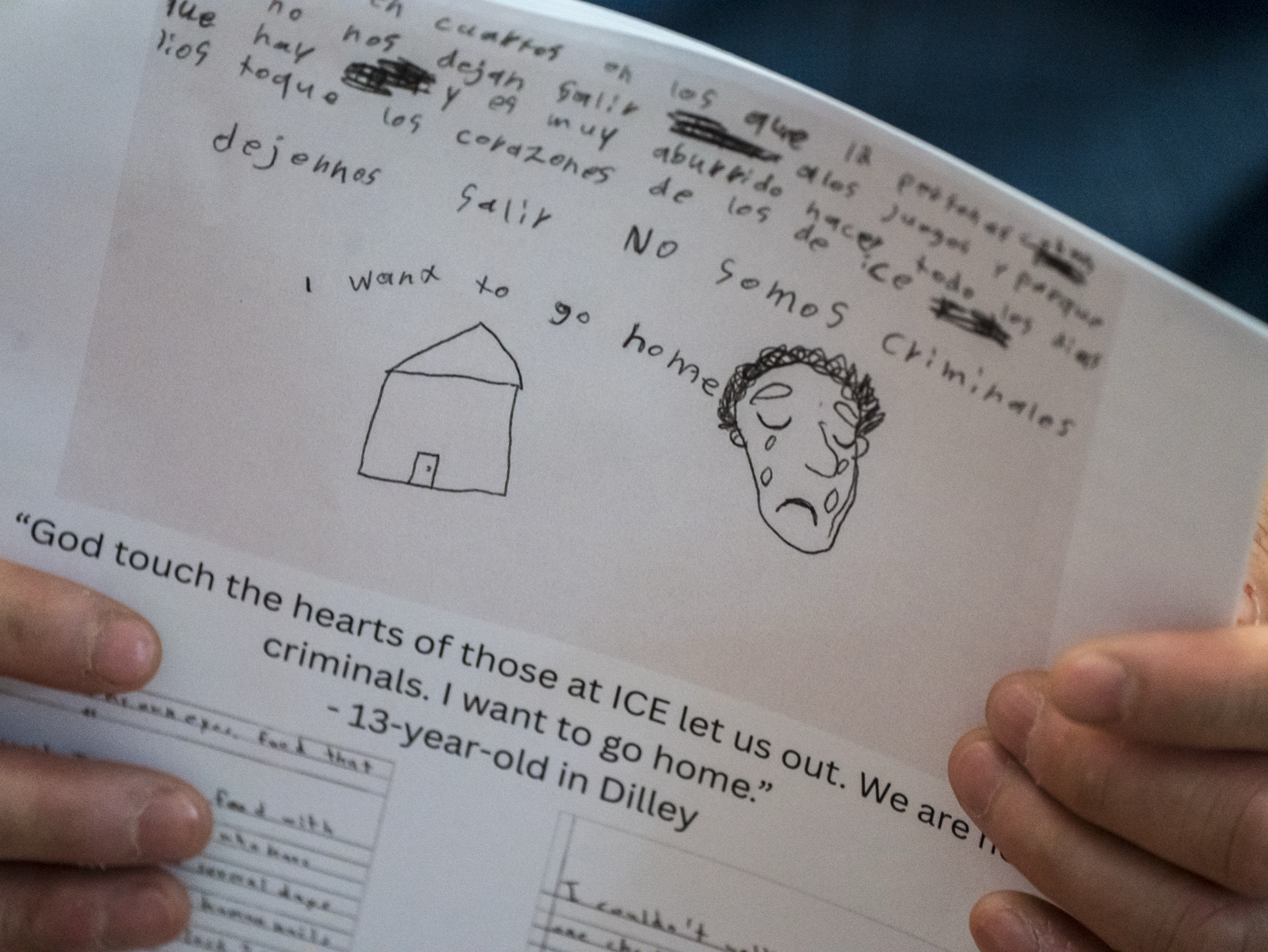
WASHINGTON — Rachel Griffin Accurso — Ms. Rachel, to her millions of followers — made her first visit to Capitol Hill on Tuesday afternoon, wearing a bubblegum-pink linen suit and wheeling a black suitcase filled with stapled packets of handwritten letters and drawings. They were the words and artwork of children, all of whom have been — or remain — in the custody of U.S. Immigration and Customs Enforcement at the nation’s only family immigration detention center.
“I cry a lot,” read one letter from a 7-year-old boy held at the Dilley Immigration Processing Center in South Texas. “I want to get out of here.” Among the illustrations were portraits of crying faces, families standing together behind bars and a red house that a 9-year-old child longed to return to. Accurso clutched one packet in her hand, ready to offer it to the first lawmaker she encountered.
She had come with a plan: Over a brief two-day visit to Washington, she wanted to deliver the letters and drawings to members of Congress and tell them about the children she’d met. Her goal was to urge every official she spoke with — Democrats and Republicans alike — to end family detention and reunite the children and parents who had been separated by ICE enforcement.
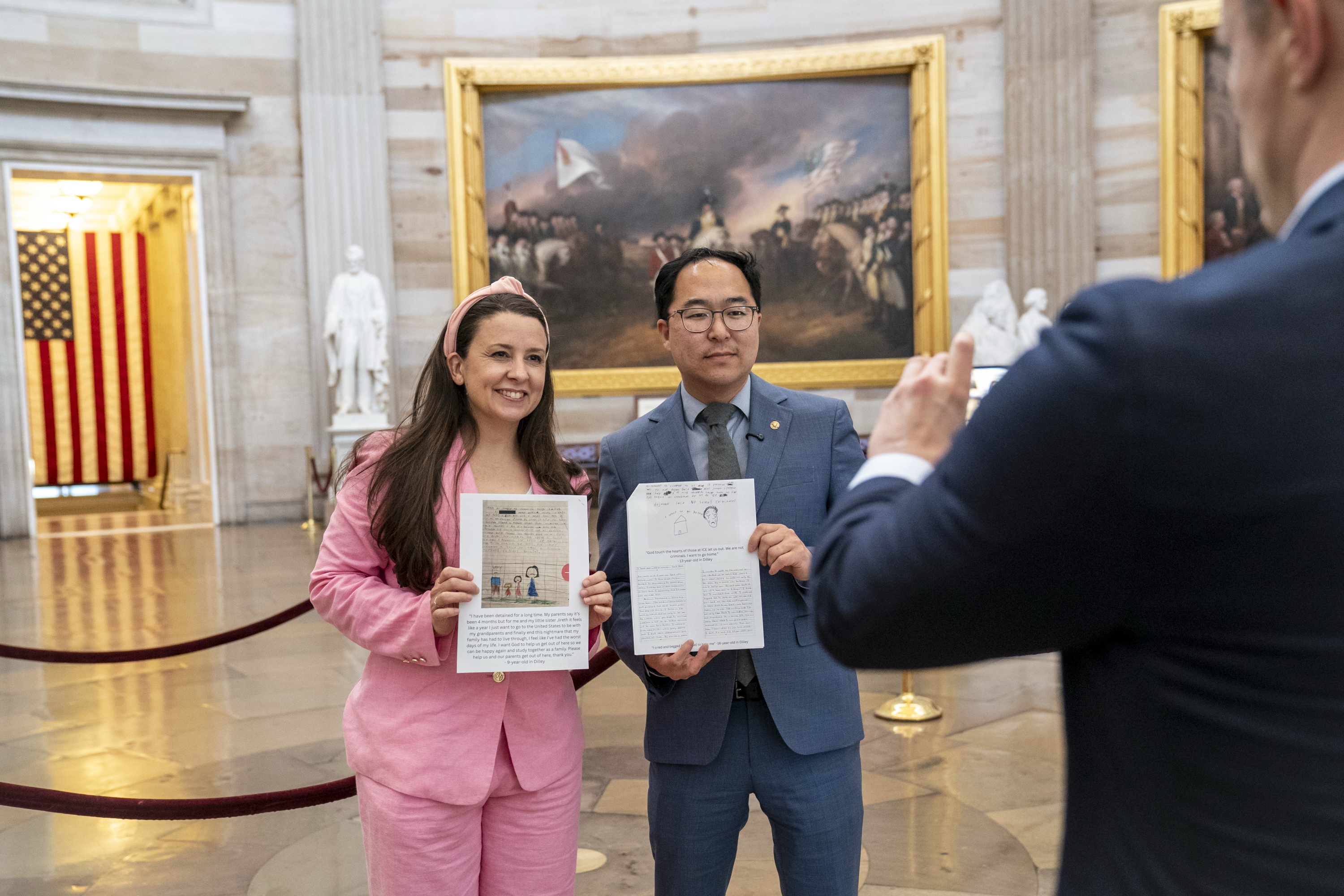
Sen. Andy Kim (D., N.J.) holds the letter of a child detained at the Dilley Immigration Processing Center in southern Texas. Maxine Wallace
It was a new foray into the political realm for the early-childhood educator, who became the reigning star of children’s media with her wildly popular educational videos on YouTube and Netflix. Through her adult-facing social media platforms, Accurso has also emerged as a powerful advocate for vulnerable young people around the world, making headlines — and sometimes drawing backlash — for speaking out on behalf of children in Gaza, Sudan, and other humanitarian crisis zones.
Now her efforts include children closer to home. Over the past few months, Accurso has become an increasingly prominent voice in the debate over family immigration detention and the mounting concerns about conditions at the Dilley detention center. She has spoken directly to 10 families there via video calls, she said, and has publicly shared clips from several of those conversations with her 5 million Instagram followers. Accurso helped launch a petition to close the Dilley facility that has more than 324,000 signatures, including dozens of celebrities (Ben Stiller, Ayo Edebiri, Cynthia Nixon, and John Legend are among the many signatories). She also shared an open letter addressed to CoreCivic, the private prison contractor that has operated Dilley since its Obama-era construction in 2014: “What we have to agree on is not harming children,” she wrote.
When Accurso arrived on Capitol Hill along with her husband, Aron Accurso, they were welcomed by Sen. Andy Kim (D., N.J.). He offered them a brief tour through the Capitol, noting that the Senate had voted just days before to approve $70 billion in funding for President Donald Trump’s immigration enforcement agencies. “When you’re talking about this,” he said, nodding to the packet in Accurso’s hand, “what’s funding this? That’s what’s happening in this building.” As they spoke, the House was preparing to vote on the same funding package.
Accurso and Kim in the Capitol Rotunda on Tuesday.Maxine Wallace
Accurso and Kim posed for photos and filmed a brief video together in the Capitol Rotunda, then parted ways before she headed to the Hart Senate Office Building.
She was stopped repeatedly by enthusiastic interns and staff members who asked for selfies to show their own children, or their nieces and nephews. “What’s their name?” Accurso always asked, before deftly switching the phone setting to record a personalized video for each child: Hi, Ava! Hi, Maeve! Hi, Hugh!
Then she would steer the conversation toward the names of other children — some she had spoken with personally, and others whose circumstances were recounted to her by lawyers, advocates and journalists working with families at the Dilley facility. There was Amalia, an 18-month-old who suffered a near-fatal health crisis while in ICE custody at Dilley; Deiver, a 9-year-old who missed his friends at school and wanted to participate in the state spelling bee; Guri, a 12-year-old who has been detained with his family since February and has experienced chronic blood in his stool for months.
Accurso poses for a group photo with some staff from the office of Sen. Jeff Merkley (D., Ore.) on Tuesday. Maxine Wallace
Accurso was greeted with joyful shouts of recognition in the office of Sen. Jeff Merkley (D., Ore.). She left a packet with the staff of Sen. John Cornyn (R., Texas) and noted that they seemed friendly. She walked into the office of Sen. Lisa Murkowski (R., Alaska) with a cheerful, lilting “Hi, friends!” and the staff member’s subsequent gasp — “Oh my gosh!” — was audible down the hall.
“Well, I hope this works,” Accurso said, as the clock ticked to a quarter past 6 and it became clear that most of the offices were now closed. She had visited 10.
So she headed for the exit and learned the news as she was leaving: Minutes before, the House had narrowly passed the $70 billion funding package — including $38 billion for ICE enforcement and $26 billion for the Border Patrol. The vote paved the way for the agencies to build a detention system and pursue what Trump had pledged would be the largest mass-deportation operation in the country’s history.
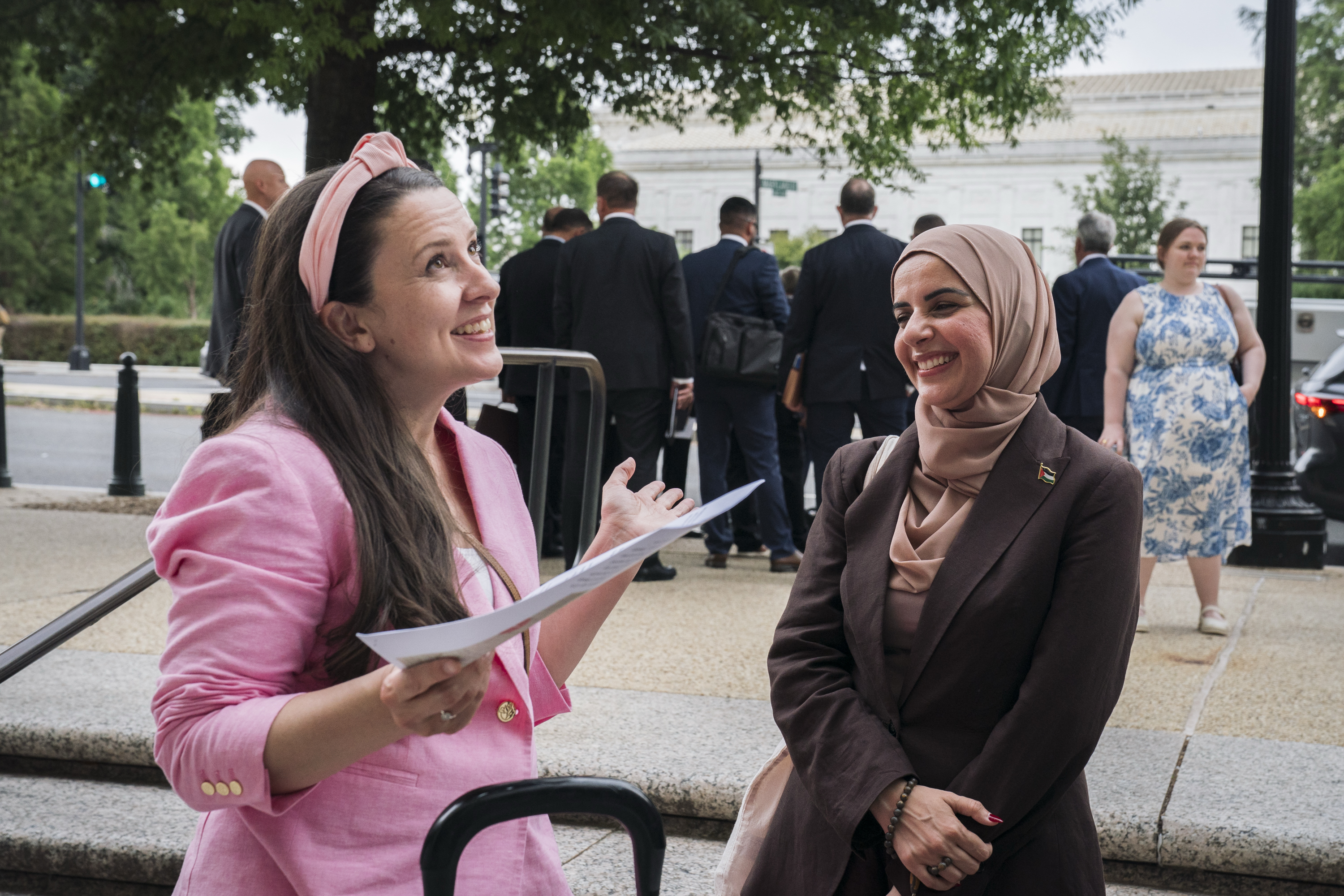
Accurso on Tuesday outside the Hart Senate Office Building with Leqaa Kordia, a Palestinian woman detained for a year amid a Trump administration crackdown on protesters last spring.Maxine Wallace
The day before she took the train to Washington from her home in New York, Accurso visited children and families at a hospitality tent set up by volunteers outside Delaney Hall, an immigration detention center in New Jersey where demonstrators and law enforcement have clashed in recent weeks.
Accurso delivered toys and art supplies to the tent and, with the families there, sang a song written by the Peace Poets along with children detained at Dilley: “I’ll sing from here and you sing from there, together we’ll sing down the walls everywhere.”
She spoke with a 13-year-old girl who described what it felt like to have only brief visits with her father, a truck driver who has lived in the United States for 20 years and supports his wife and three children, the youngest of whom has complex special needs.
“We went to go and visit my dad, and it was really sad,” the teen told Accurso, who wiped away tears as she listened. “He looked like a prisoner. But I knew in my heart that he shouldn’t be in there.”
Earlier this year, as she read more about the children being swept up in ICE enforcement operations, Accurso said, she began contacting legal experts, advocates, and journalists on the ground in Texas who detailed alarming conditions at the facility and helped connect her to families detained together there.
Those parents described children who were deteriorating physically and mentally; several kids said the water in the facility made them feel ill. Autistic children were suffering in particular, Accurso said; one nonverbal 5-year-old named Gael had not had a bowel movement in nine days and had begun hitting himself in distress. Families told her that their children couldn’t sleep because the lights were on all night.
She felt haunted by those conversations, Accurso said later, in an interview with the Washington Post: “I kept thinking, ‘How is this happening?’”
Several children and teens who were included on Accurso’s social media platforms were subsequently released from detainment, including Gael; Deiver, the 9-year-old who begged to go to the state spelling bee; and Olivia Mabiala Andre, a 19-year-old asylum seeker and nursing student. Accurso posted about her gratitude and relief in those moments, but she said she is acutely aware of how many children remain behind, including those who don’t feel safe speaking publicly about what’s happening to their families.
As of early June, about 320 people were at the Dilley center, including nearly 90 children, according to Faisal Al-Juburi, co-CEO of the Texas-based nonprofit Refugee and Immigrant Center for Education and Legal Services (RAICES). In the past year, he said, RAICES has documented roughly 1,500 medical concerns from families held at Dilley.
Accurso has highlighted concerns voiced by medical experts: In April, responding to mounting reports of dangerous conditions for children at the Dilley center — including unsafe water, the spread of measles, delayed medical care and declining mental health — the American Academy of Pediatrics requested urgent access to the facility, reiterating that “no time in detention is appropriate for a child.”
A spokesperson for CoreCivic said in an emailed statement that its facilities are safe, and noted that while some lighting is on during overnight hours, “lighting over sleeping areas is turned off during sleeping hours.”
The spokesperson referred to a statement by Kristen Dauss, the company’s vice president and chief medical officer: “The children and their families at DIPC receive care that is clinically rigorous, federally overseen and delivered with dignity.” Dauss added that children receive clean water from the same regularly tested municipal source that supplies local drinking water, appropriate nutrition and hygiene supplies.
Dauss echoed those points in a recent response to Accurso’s letter to CoreCivic. In a separate emailed statement, a spokesperson for the Department of Homeland Security echoed that families at Dilley are provided appropriate living conditions and medical care.
When Accurso talks to people about the firsthand accounts she has heard, “they’re shocked,” she said. “Why don’t people know? But I also feel like I didn’t know the extent of what was happening, either. We have to get the information out.”
This underscores the value of Accurso’s work and platform, said Elora Mukherjee, an attorney who represents numerous families detained at Dilley and serves as director of the Immigrants’ Rights Clinic at Columbia Law School. With her vast audience, Accurso represents a different way to inform people, beyond the reach of mainstream media: “Overwhelmingly, the American public still does not realize that, as a nation, we are imprisoning babies, toddlers and children who have done nothing wrong,” she said. “Sustained attention on cruelty against children is critically important.”
Al-Juburi noted that although the country’s current immigration policy represents “generations-long, systemic issues that need to be addressed, fundamentally, by our legislative branch,” there is a meaningful impact when prominent people raise their voices.
Culture often shifts before the law does, he said: “We will not see policy change until the public demands it. And that is what gives me hope when people like Ms. Rachel turn their spotlight onto a cause like this.”
The sun was falling through mottled clouds as Accurso left the Hart Building and wheeled her suitcase down Constitution Avenue toward the Capitol. She wanted to record a video there for the children detained at Dilley and the ones waiting in the tent outside Delaney Hall. She would tell them that she’d brought their letters and their artwork to the place where decisions about their future were made. “I have your words right here,” she would say into her phone camera, holding the stapled packet close to her chest. “I’m always going to stand with you.”
But when she arrived at the building, she first took a moment to sit quietly on the empty steps. The House’s vote, and its ramifications, were at the forefront of her mind. She felt a heavy sense of sorrow and defeat, she said.
She adjusted her knotted pink headband and looked up toward the towering dome, bathed in the softening light of dusk. She thought about how young people often stop her — more than a dozen had done so just in the past few hours — to thank her and urge her to keep going. The next day, she would come back and meet with more elected officials in the House. She would make sure that all 535 packets of letters and drawings were delivered to every member of Congress. She would keep telling the stories of the children she’d met.
“I’ll never stop trying, for them,” she said. “I can’t say, ‘I’m just one person, so I’m not going to make a difference.’ What if everyone said that?”