Blog

  • Trump delays his own national intelligence nominee, fueling tension with fellow Republicans

    WASHINGTON — President Donald Trump on Wednesday derailed the confirmation process of his own nominee to head the nation’s intelligence agencies, an extraordinary move that upended Senate efforts to renew a crucial surveillance program and fueled fresh tensions with fellow Republicans on Capitol Hill.

    In an overnight social media post from the Group of Seven summit in France, Trump declared he was delaying the nomination of federal prosecutor Jay Clayton as director of national intelligence just hours ahead of his scheduled hearing, despite bipartisan praise for the nominee and Republican efforts to speed him through the confirmation process.

    Senate Intelligence Committee Chairman Tom Cotton (R., Ark.) said Republicans would go ahead with the Clayton hearing anyway, “unless the president directs him not to appear or withdraws his nomination.” But later he postponed the hearing, saying it was “regrettable” that Trump had directed Clayton not to appear.

    “Mr. Clayton is a patriot and a highly qualified nominee, as the president has said repeatedly,” Cotton said. “While today’s hearing is now unfortunately postponed, I look forward to proceeding with his confirmation in the near future.”

    Trump’s attempt to delay Clayton makes it more likely that his temporary pick for the intelligence job, top housing official Bill Pulte, will take over when outgoing director Tulsi Gabbard leaves office on Friday. Republicans and Democrats in Congress have sharply criticized Pulte, a Trump loyalist who has no known national security experience and has used his current administration perch to target perceived adversaries of the president.

    Trump has defended Pulte, calling him “fair” and “talented” in his social media post. Speaking to reporters in France, Trump called the speedy process to get Clayton formally installed a “rush act by the Democrats.”

    “Why are they afraid of this guy? They’re so afraid of him,” Trump said, referring to Pulte. “They’ll do anything not to have Pulte go in there.”

    Caught in the middle is the renewal of Section 702 of the Foreign Intelligence Surveillance Act, or FISA, bipartisan legislation that aims to prevent terrorist attacks by monitoring the communications of targeted foreigners located outside the United States. Democrats had said they would not provide the necessary votes to pass the bill unless Pulte’s temporary appointment was withdrawn. The current surveillance authority expired last week.

    Further complicating matters, Trump said in his social media post that he would not sign the FISA renewal without his legislation to require proof of citizenship for all voters — which does not have enough votes to pass the Senate — and that he does not want to remove Clayton from his current position as U.S. attorney for the Southern District of New York until his replacement, James McDonald, is approved.

    Trump’s post sent Senate Republicans scrambling, and it was unclear if and when Clayton’s nomination would move forward.

    “We’ll just have to take it a day at a time until we get more clarity on what the White House position is on this,” Senate Majority Leader John Thune (R., S.D.) told reporters Wednesday morning. He said he didn’t know why Trump was holding up the effort.

    “Good question,” he said.

    Escalating tensions between White House and Capitol Hill

    Virginia Sen. Mark Warner, the top Democrat on the Senate Intelligence Committee, called Trump’s move an “extraordinary display of dysfunction from a president who seems determined to turn America’s national security into a political bargaining chip.”

    “The biggest obstacle to resolving these issues has not been Senate Democrats or Senate Republicans,” Warner said. “It has been the chaos and confusion coming from the White House itself.”

    It was just the latest in a series of standoffs between Trump and Senate Republicans this year.

    A funding bill for Trump’s immigration agencies was delayed several weeks when Republicans revolted over a $1.776 billion “anti-weaponization” fund and a $1 billion security request for the White House, including his new ballroom. The bill passed after acting Attorney General Todd Blanche said the settlement would not move forward, and GOP leaders decided to drop the security money from the bill.

    Trump then appointed Pulte as interim intelligence director just as the FISA renewal was moving toward passage, upsetting bipartisan talks. Republicans urged the White House to pull the appointment, to no avail.

    Republican Sen. Thom Tillis of North Carolina said that Trump’s recent moves are “undermining the results he wants.”

    “Jay Clayton was on the brink of having a very good hearing and probably getting some Democrat support, and now we’re in a posture to where it may be the reason that 702 doesn’t get reauthorized,” Tillis said. “That’s a mistake.”

    Tillis called Pulte a “sycophant” to Trump.

    “How could anybody think he was going to be a credible choice?” he asked.

    Democrats say Trump is distracting from other issues

    Democrats say that Trump is undermining Americans’ safety as he makes demands of the Senate and tries to put loyal allies in national security positions.

    Pulte’s appointment “should send a shiver down the spine of every American,” said Democratic Sen. Elissa Slotkin of Michigan, a former CIA analyst and national security official. “The only thing more dangerous than letting FISA lapse is putting Bill Pulte at the head of 17 intelligence agencies.”

    Sen. Angus King, an independent from Maine, said he may have supported Clayton, with whom he met on Tuesday. “It’s unfortunate because he nominated this guy,” King said of Trump.

    Sen. Patty Murray (D., Wash.) said she thinks Trump is also trying to divert attention from the war in Iran.

    Murray said Clayton was on track to be confirmed because “most Democrats felt that allowing Pulte to go in office was a really bad idea, and most Republicans agreed.”

    Consequences for FISA’s lapse

    National security officials across both major political parties have for years described Section 702 as vital for gathering intelligence that can disrupt terrorist attacks and espionage operations, though some lawmakers and civil liberties advocates have raised concerns over the government’s use of information about Americans that is incidentally collected through the program.

    A court order from March certified that the program could continue for an additional 12 months, though it is possible that communications companies could challenge the government’s authority to force them to cooperate and share data.

    Trump’s delay of Clayton “shows he has no interest in getting FISA done,” Senate Democratic leader Chuck Schumer (D., N.Y.) said.


  • FMC boss says the company could be sold by July

    FMC boss says the company could be sold by July

    Workers, shareholders, and farm customers of pesticide giant FMC, whose red-lettered logo glows atop its University City headquarters, should know in a month if they’re likely to get a new owner.

    The process for talking to potential buyers of FMC, the world’s fifth-largest pesticide maker, “is still going on. The number of parties we are discussing with is getting smaller,” CEO Pierre Brondeau told investors Wednesday at Wolfe Research’s yearly chemical-industry conference in New York.

    “It’s always very distracting for an organization” when a sale is under consideration, Brondeau said, adding he expects that “by the time we get to the end of July, to the earnings call for the second quarter, that we can close this process.” Shares briefly rose 10% after his remarks.

    It has been Brondeau’s goal to keep FMC independent since he returned as CEO in 2024 after a four-year retirement from daily management. The company’s share value plunged from above $120 in early 2023 to under $10 last winter, as farm sale growth remained in a post-COVID slump.

    But in February, with FMC’s credit rating fallen to junk-bond status, the company cut its dividend and said it planned to raise $1 billion from asset sales and licensing deals to pay down debt. Executives also hired bankers to talk to potential buyers in case the company could draw an offer shareholders might find more attractive than years of rebuilding.

    Brondeau said Wednesday that FMC was more than halfway to its billion-dollar target, following the sales of operations in India and a smaller business line in Europe, and a licensing deal with Wilmington-based Corteva, the largest U.S.-based pesticide company. Other deals are in the works, he added.

    Brondeau has chaired FMC’s board since 2010. He is the architect of the company’s reorganization into a multinational pesticide business, from a diverse industrial holding company.

    FMC employs around 5,500 workers, including around 300 at its headquarters, and 330 at its Stine research center near Newark, Del., which the company acquired from DuPont in 2021.

    At the conference Wednesday, Brondeau affirmed FMC has products “in the pipeline” that should boost sales and profits in the coming years, balancing its pesticide focus with new herbicides and insecticides to move year-round sales to farmers of many different crops.

    Mergers in the 2010s produced a handful of pesticide multinationals — such as BASF, Bayer, Corteva, Syngenta — as well as FMC. But Brondeau noted the global farm chemical industry remains competitive and fragmented.

    Brondeau said the expense of getting some of its pesticides distributed to more farmers had spurred a deal announced Tuesday to license its rimisoxafen herbicides for Corteva to sell to corn and soybean farmers in the U.S., Brazil, and other Western Hemisphere countries plagued by certain pesticide-resistant weeds.

    Under terms of the deal, Corteva agreed to pay FMC $200 million up front, as well as a cut of the sales.

    FMC was the only one of the five largest global pesticides companies that did not design its chemicals to work with particular genetically modified seeds.

    Corteva, based in Wilmington, was spun off from DuPont and last year announced it was turning its seed business into another separate company.

    Last month Corteva said it would name the new seed company Vylor and move the headquarters of both its pesticide and seed company successors to Indiana. The company will keep an office in Delaware.

  • Chester County hires new voter services director after a series of controversies at the department

    Chester County hires new voter services director after a series of controversies at the department

    Chester County has tapped a new director of voter services after the department’s previous leader resigned following election errors and a series of complaints from former employees.

    Michele DiCaprio, a consultant for a telecommunications company and a former foreign service officer with the U.S. Agency for International Development, will begin her tenure on July 20, the county announced Wednesday.

    “I am honored to join Chester County,” said DiCaprio, a West Chester resident, in a county news release. “I look forward to working with the Voter Services team to ensure secure, accurate, and efficient elections for every voter in Chester County. Elections are the foundation of our democracy, and I am committed to serving voters with integrity and transparency.”

    DiCaprio will be inheriting an office that has recently been enmeshed in controversy, including high staff turnover, allegations of a hostile work environment, and a series of election administration-related problems — most notably leaving approximately 75,000 independent and unaffiliated voters off the poll books during the November 2025 local election.

    Everyone who wanted to vote was able to do so, the county said, with 12,000 voters casting provisional ballots. But the episode bruised residents’ trust in the county’s voting security, exemplified at a public meeting in February.

    An independent law firm investigation ultimately found that human error and poor oversight led to the incident, but it did not call for the resignation of personnel, including Karen Barsoum, then the voter services director.

    Barsoum announced her resignation in March and her last day was June 12.

    Chester County Administrator Erik Walschburger and Deputy Administrator Megan Moser said in the news release that DiCaprio’s experience as a foreign service officer makes her a strong fit for the role.

    DiCaprio spent five years with USAID in Mozambique leading the Democracy, Human Rights, and Governance team working on elections, counterterrorism, and other issues, according to her LinkedIn page.

    “As a foreign service officer, Michele has spent her career leading complex international operations in fast-paced environments while ensuring federal compliance,” Walschburger said.

    “Through her years of work on election operations and counterterrorism program evaluation, she has established a strong track record of developing high-performing teams, strengthening organizational effectiveness, and managing critical public-facing services,” he said.

  • Strong storms are possible in Philly Thursday, but they won’t have anything to do with Arthur

    Strong storms are possible in Philly Thursday, but they won’t have anything to do with Arthur

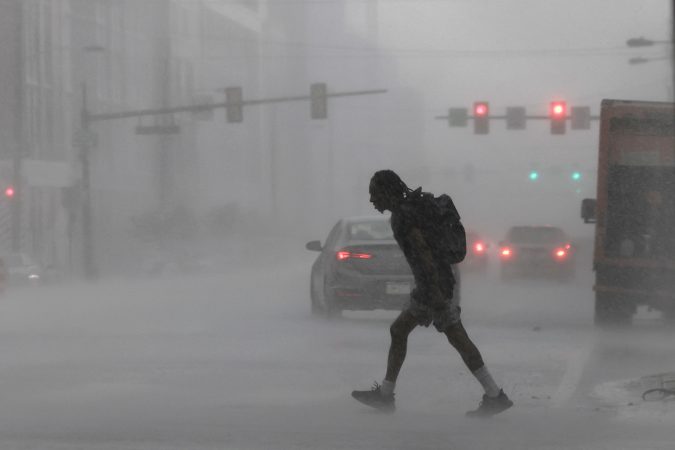
    It would have nothing to do with Arthur, which on Wednesday became the first named storm of the Atlantic hurricane season, but the Philly region may be in for tropical-storm force gusts and strong thunderstorms Thursday.

    Even if the rains don’t come — and on Wednesday, the storm odds were close to 50-50 — wind gusts to 45 mph are possible during the afternoon, said Alex Staarmann, meteorologist at the National Weather Service in Mount Holly, “quite unusual for June.”

    Not so unusual these days would be the forecast high, which would mark the 14th time this year that official readings in Philly had reached 90 degrees or higher. That is about half the average total for an entire year.

    But this heat will be more of a ripple than a wave, and the outlook for the holiday weekend is looking spectacular.

    When the winds and storms may arrive in Philly on Thursday

    As a front approaches, winds from the southwest are expected to gust to 20 mph during the morning and 30 to 40 mph in the afternoon.

    While the winds are all but a certainty, it was unclear if any strong storms would pop Thursday. If they did, the best estimate would be between 1 an 8 p.m., the weather service said.

    “The environment is favorable for damaging winds if anything does develop,” Staarmann said.

    “The biggest question is how widespread the storms are going to be,” he said.

    Uncertainty is a near 100% certainty with June storms

    Such uncertainty is standard fare with thunderstorm threats this time of year, said Rich Thompson, forecast operations branch chief at the government’s Storm Prediction Center, which would have to make a call on posting severe storm watches.

    With so many moving parts and micro-features such as terrain involved, predicting the behavior of small-scale storms is “incredibly complicated,” he said, and on some days clues are frighteningly lacking.

    And while observations have improved immeasurably in recent decades, “we still aren’t observing most of what’s there,” he said. Land-based surface observations are far more plentiful than those over the oceans, which cover 70% of the atmosphere, and in the upper atmosphere, where the weather is manufactured.

    Even if the atmosphere were perfectly measured, he added, meteorologists would still have to contend with the fact that the physics involved in forecasting are not completely understood.

    Arthur and the weekend outlook for Philly

    As for Arthur, knighted with a name by the National Hurricane Center at 11 a.m. Philadelphia time Wednesday as it matured off the southeast Texas coast, it is forecast to deluge portions of the Gulf states.

    Then it is due to head out to sea before it could have anything to do with Philadelphia or the Jersey Shore, which is likely to be a popular destination this weekend.

    For Friday, Juneteenth; Saturday; and Sunday, the beginning of the astronomical summer, highs are expected in the mid-80s with sunny days and no threat of showers until early Monday.

  • Farmers hope to make New Jersey the hazelnut capital of America

    Farmers hope to make New Jersey the hazelnut capital of America

    RINGOES — The first time Ozgur Tunceli planted hazelnut saplings on her Hunterdon County farm, deer came through and ate them to the ground.

    The next time, her goats did the same.

    “Imagine me sitting there and crying and regretting everything that I did,” she said. “I said, ‘I should sell this farm and just go back to my suburban life.’”

    Instead, she got an electric fence. Now, four years after she set out to become a hazelnut farmer, Tunceli has close to 1,000 trees planted on her hilly, sprawling property in Ringoes. She’s part of a small but widening group of pioneers who are working to make hazelnuts as much of a signature New Jersey crop as tomatoes, blueberries, corn, and cranberries.

    “We are really trying to build an entire industry here,” Tunceli said.

    The state wants to help, said Ed Wengryn, the state’s agriculture secretary.

    Officials are eyeing incentives to offset high startup costs and entice more farmers into growing the trees, Wengryn said.

    And Sen. Andrew Zwicker (D-Middlesex), whose district office is just up the road from a hazelnut farm in Hillsborough, is seeking $6.5 million in state funding to help growers buy equipment to sort, shell, and package nuts for sale and secure a processing site. He envisions hazelnuts at every Garden State farm stand and a New Jersey version of Nutella on supermarket shelves someday.

    “The potential for New Jersey to become a major player in hazelnut production is enormous,” Zwicker said. “I don’t think New Jersey peaches, blueberries, and tomatoes are going away, but I think if we get this right, we will be known worldwide as a hazelnut producer.”

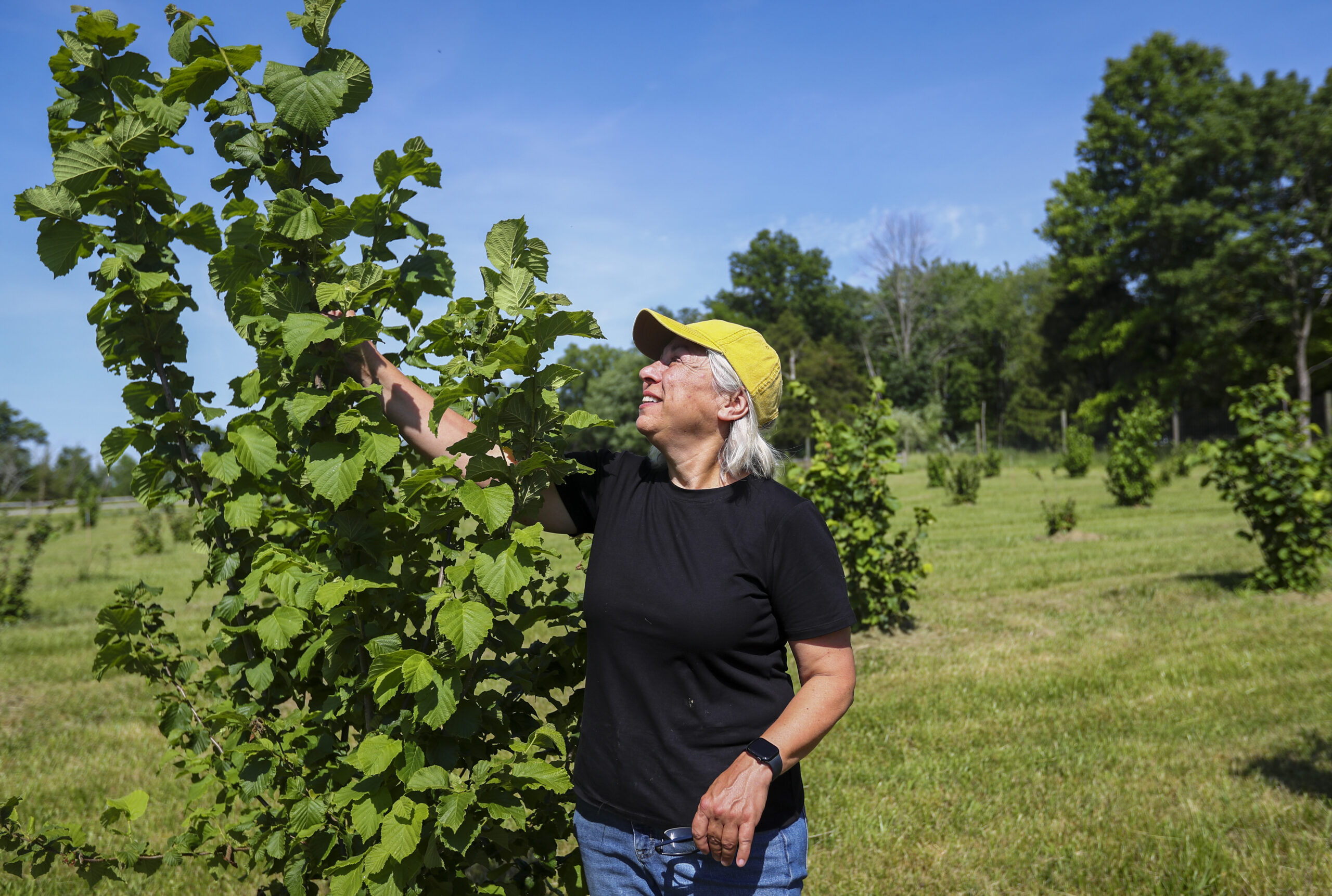
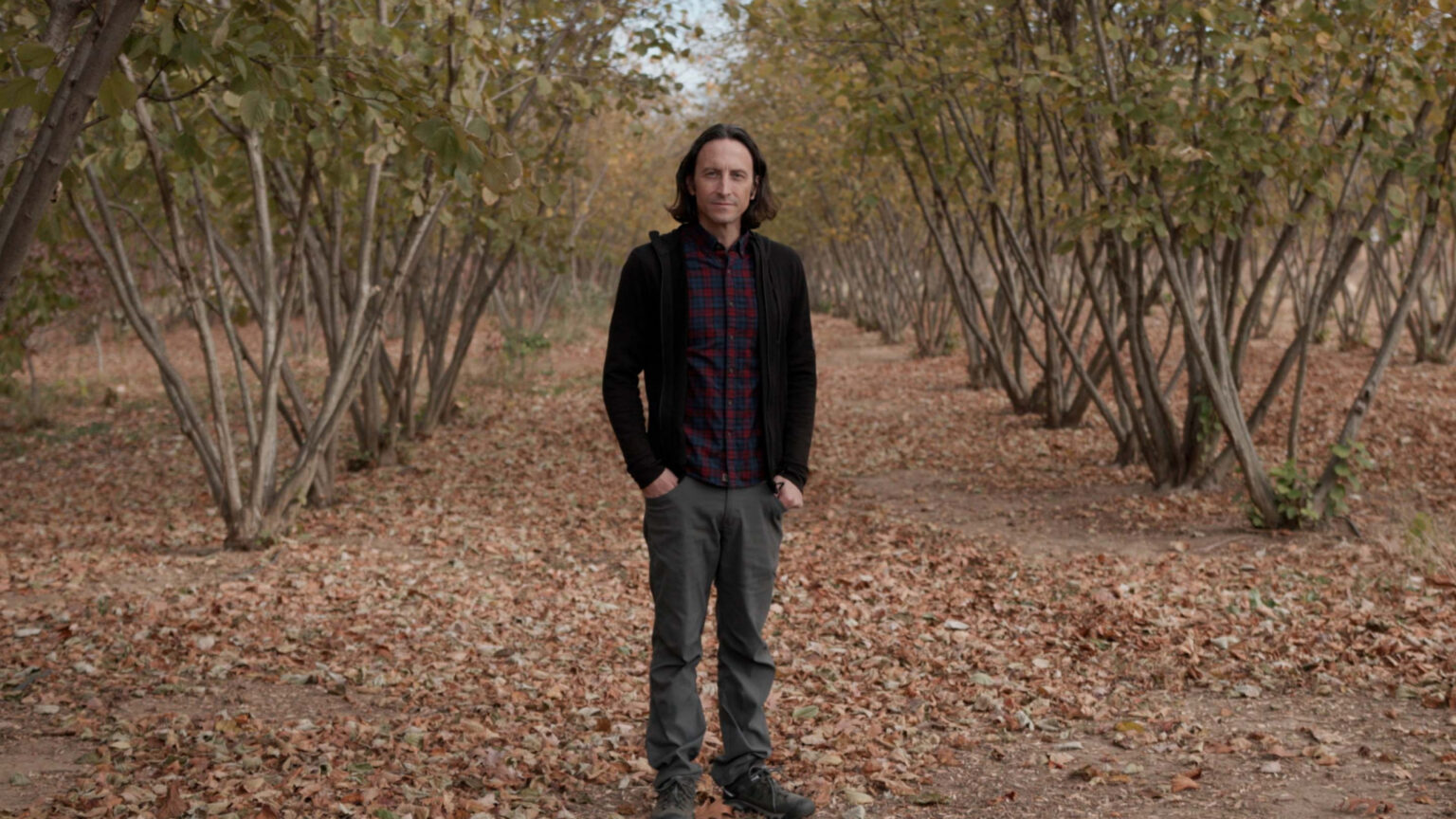
    Ozgur Tunceli shows one of the few of her hazelnut trees that is taller than she is on June 5, 2026, at Our Farm by the Creek, her hazelnut farm in Ringoes.Dana DiFilippo/New Jersey Monitor

    Some hazelnut history

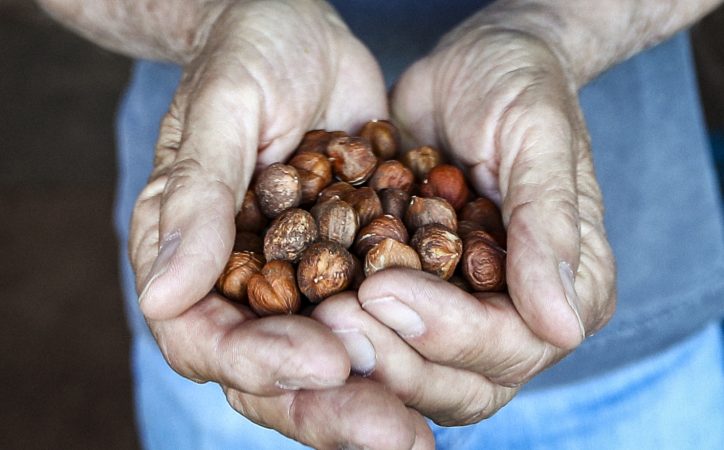
    Turkey produces about 70% of the world’s hazelnuts, and until recently, Oregon’s Willamette Valley was the only place in the U.S. to grow the nutrient-rich, round nuts also known as filberts.

    The seeds for New Jersey’s fledgling filbert industry were first planted, literally, by Rutgers University.

    Tom Molnar was a Rutgers student about 30 years ago hunting for a Ph.D. topic when he decided to focus on hazelnuts, which are native to New Jersey but had been decimated by disease decades ago. Molnar’s mentor was the late C. Reed Funk, Rutgers’ famed turfgrass breeder whose work made the school millions in royalties and a global powerhouse in grass development. Funk saw better breeding as key to growing nuts in the Northeast, Molnar said.

    “We had land, we had funding, and he knew how to run a breeding program,” said Molnar, who’s now a professor of plant biology at Rutgers.

    Molnar rejected nut trees like walnut, pistachio, and pecan, not wanting to compete with big U.S. producers like California and Georgia. He picked hazelnuts because, besides being native to New Jersey, they need less water, are more compact, and produce faster than other nut trees, he said.

    He started by collecting hazelnut seeds from around the world and eventually planted tens of thousands of trees at Rutgers’ research farm in East Brunswick, observing and experimenting to create disease-resistant, higher-yield trees.

    By 2020, his research had progressed enough that he wanted to see how his trees would do around the Garden State. He partnered with several farmers to plant Rutgers-bred varieties whose names honor their Jersey roots: Raritan, Somerset, Monmouth, and Hunterdon. Those farms still serve as living laboratories, with new growers adding to their ranks since Rutgers licensed a Columbus nursery to sell their cultivars.

    “This has been a dream to grow hazelnuts in the eastern U.S. for 200 years,” Molnar said.

    Ed Clerico was one of the “early adopters,” as Molnar puts it.

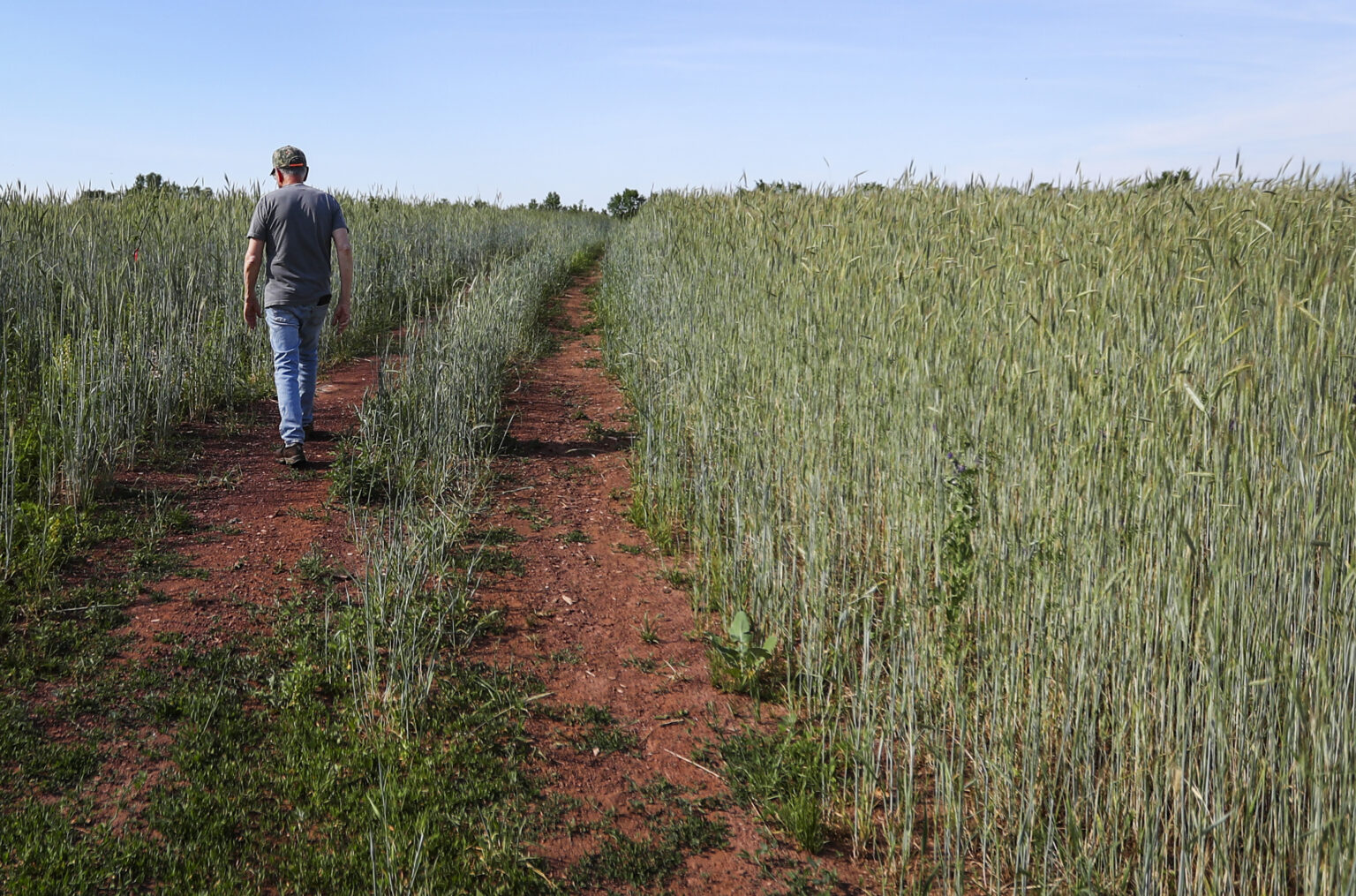
    Farmer Ed Clerico walks the fields of his farm in Hillsborough on June 6, 2026.Dana DiFilippo/New Jersey Monitor

    Clerico is a third-generation farmer whose family ran a dairy farm in Hillsborough (the one near Zwicker’s office), but who pivoted in retirement to perennial crops that don’t require annual tillage and planting.

    He also had a career in water resource management, an experience that has deepened his dedication to filbert farming.

    His 38-acre farm sits along Royce Brook, which feeds the Millstone and Raritan rivers, two waterways that flow through nearby Manville and Bound Brook and that sometimes catastrophically flood. He regards hazelnut trees, as well as thirstier breeds like the persimmons and pawpaws he’s planting in a floodplain beside the brook, as pulling double duty.

    “There’s just a lot of benefits to agroforestry. Growing trees sequester a lot of carbon, so there’s greenhouse gas benefits. And they help with water quality and flood mitigation,” Clerico said. “This could be one of the best stormwater management and water quality advancements. When you hear about stormwater management, people are very oriented towards man-made infrastructure, but we could be using the environment as infrastructure too.”

    Wengryn already is a convert, for the trees’ ecological benefits alone.

    “They create a shade canopy, reducing ambient air temperatures in and around the orchard area. When we get these intense storms that drop a quarter to a half inch of rain in 15 minutes, the leaf canopy breaks that up, so it actually falls more gently to the soil and we get less soil erosion from this kind of agriculture,” Wengryn said.

    Molnar ticks off a long list of other perks he hopes will persuade more farmers to plant Rutgers’ hazelnuts. They don’t require as many fungicides or insecticides, or as much pruning, as the peach, apple, and other fruit trees more commonly grown in New Jersey. They’re harvested by machine so don’t need as much labor as hand-picked crops. The trees are more climate-resistant and can live for over 50 years, making them both less susceptible to weather extremes that can destroy less-hardy crops and a good long-term investment. And hazelnuts aren’t as perishable as other crops; harvested unshelled nuts can be stored and stay fresh for over a year.

    “That means you could sell them throughout the winter into the spring,” Molnar said.

    But several hurdles have kept the industry small so far.

    The high land costs that can make farming a pricey profession in New Jersey have hindered hazelnut expansion, farmers agreed.

    The costs and logistics of processing are another barrier, Molnar added.

    With most filbert farming occurring on other continents, U.S. growers must look to Europe and beyond for the machinery to harvest, sort, and get the nuts to market. Tunceli, Clerico, and two other farmers formed an agroforestry cooperative to process, promote, and sell their nuts. The co-op recently bought some equipment, funded by a federal grant, that they’ll house at Tunceli’s 89-acre farm until they find funding to open a separate processing facility.

    Farmer Ed Clerico bought specialized equipment, including this mower, to harvest hazelnuts on his Hillsborough farm.Dana DiFilippo/New Jersey Monitor

    At the same time, it takes five years for young hazelnut trees to produce their first nuts and seven to eight years for them to come into significant production, Molnar said. That means farmers see little to no return on their investment for years.

    “Younger farmers don’t really have that much money to invest, while older farmers don’t have that much time,” Tunceli said.

    Tunceli, who’s 56 and has kept her job in the healthcare insurance industry, hopes her orchards will thrive enough for her to live wholly off her land, but she expects that could take another five years.

    Because hazelnuts have not been a U.S. crop outside of Oregon, some local farmers also see challenges in who to sell them to, fretting that a market might not exist here.

    Tuncheli is not one whit worried about that.

    She grew up in Turkey and immigrated here for college about 30 years ago. In Turkey, every bit of hazelnut trees gets used, she said. The kernels become nut butters, oils, flour, milk, candies, desserts, and other foods; the trees’ leaves can make herbal teas; their limbs can be used to weave baskets; and nutshells can be used for exfoliating scrubs, cosmetics, and even clean-burning fuels.

    “That part is really easy,” she grinned.

    Wengryn doesn’t see that as a problem either, noting a “global craze” for treats like Italian company Ferrero’s Nutella and Ferrero Rocher chocolate-hazelnut bonbons.

    “People love this product,” he said of hazelnuts. “There’s very little domestic production of it, and this is an opportunity to enter that market.”

    The future of filberts

    Zwicker has submitted two budget resolutions that, if approved, would provide $298,200 in state funding to the agroforestry cooperative to support hazelnut automation, cold storage, food safety compliance, and commercial-scale infrastructure and nearly $6.3 million for the cooperative to build a processing facility and establish grower incentives.

    Wengryn said he aims to work with the state Economic Development Authority to tailor more “business builder” funding to sustainable agriculture like hazelnut farming. He also thinks New Jersey could designate money collected under the Regional Greenhouse Gas Initiative, a multistate effort to reduce the power sector’s emissions that worsen climate change, for agroforestry.

    “This type of agriculture really complements that carbon sequestration and really does improve our air quality and our water quality,” he said.

    Whether or not New Jersey becomes a hub for hazelnuts, Rutgers’ cultivars now grow beyond the Garden State. Their trees are planted on about 300 acres across New Jersey, Pennsylvania, New York, and Ohio, Molnar said.

    His work has made him somewhat of a celebrity in agriculture, at least elsewhere, in places where hazelnuts are a major, prized crop.

    “In New Jersey, I’m an anonymous nobody, and like, nobody cares what I do,” he said with a laugh. “I guess agriculture isn’t really cool.”

    Thomas Molnar stands in front of hazelnut trees cultivated by his team at Rutgers Horticultural Farm 3 in East Brunswick.Photo by Anthony Grippa, courtesy of Rutgers University

    But Clerico expects Molnar’s research, like the trees on his own Hillsborough farm, will outlive them both.

    “Rutgers’ work isn’t just leading-edge in terms of New Jersey. What they’ve done in their breeding programs to produce trees that have multiple gene resistance to diseases could benefit everywhere in the world,” Clerico said.

    Some state legislators clearly agree and aren’t waiting on the industry to scale up to brag about New Jersey’s role in the hazelnut tree’s return to the region’s soils.

    They want hazelnuts to be the official state nut.

    The Assembly passed the proposal Thursday, despite opposition from most of the chamber’s Republicans that drove some to voice their objections for the record.

    Assemblywoman Aura Dunn (R-Morris) said anointing hazelnuts the state nut was a few decades premature, Assemblyman Gregory Myhre (R-Ocean) said the American chestnut should get the honor, and Brian Bergen (R-Morris) blasted the the bill as a “moronic, awful, stupid, crazy, nutty piece of legislation.”

    “Why on earth do we need a state nut?” Bergen said, before imploring Assembly Speaker Craig Coughlin: “I just really wish that, Mr. Speaker, you would do a better job selecting the bills that come to the floor, because this is useless.”

    Bill sponsor Assemblyman Sterley Stanley (D-Middlesex), whose district includes Rutgers’ research farm, remained undeterred.

    In a sweeping statement on the Assembly floor with Molnar standing at his side, Stanley hailed hazelnuts as “the most promising engine for economic development offered to rural communities in decades.”

    “These trees represent a monumental achievement for our state, a true breakthrough in science that reinforces why we are known as the Garden State,” he said. “These hazelnuts are testament to the balanced spirit of innovation and resilience that lies at the heart of what it means to be a New Jerseyan.”

    This story originally appeared on New Jersey Monitor.

  • Scheffler is chasing a career Grand Slam at the U.S. Open. It’s not what motivates him

    SOUTHAMPTON, N.Y. — The comparisons with Tiger Woods began a few years ago when Scottie Scheffler started to separate himself by miles over the rest of golf with alarming control of his shots from tee-to-green that resulted in big wins and a No. 1 ranking for more than three straight years.

    The next comparison could come this week.

    Not since Woods has anyone completed the career Grand Slam in his first attempt, at least not in the modern era that dates to 1960 when it became a thing in professional golf.

    Woods took only 35 days between his epic 15-shot victory in the 2000 U.S. Open at Pebble Beach and his eight-shot victory in the British Open at St. Andrews.

    Scheffler reached the cusp of the career slam when he overwhelmed yet another field at the British Open at Royal Portrush. Now comes the U.S. Open, the major he has played more than any other, and a Shinnecock Hills test that will be new to him.

    Does he want to win? Without question. Does he need to? That goes a little deeper with Scheffler, who cares more about the process than the result.

    “For me, would it be a dream to win the U.S. Open? Of course,” Scheffler said Tuesday. “But at the end of the day, the Grand Slam has never been a motivating factor for me. I always just wanted to be the best version of myself, and that got me this far.”

    It brought him two Masters titles in 2022 and 2024, the PGA Championship and British Open last year, all of them without drama when he walked up to the 18th green.

    “So when it comes to this golf tournament, I’m going to step on the first tee and remind myself I’ve done everything I possibly could in order to play well, and now it’s just a matter of going out there and trying to execute and going back to enjoying the competition versus feeling like you have to win for some reason,” he said.

    He didn’t go as deep as he did at Portrush last year, when he delivered a remarkable soliloquy asking why he wants to win so badly when the joy lasts only a few minutes.

    But it’s clear he relishes the challenge, and Shinnecock figures to be every bit of that.

    Tuesday brought more wind, this time from a different direction, and there’s really no escaping it. Part of the genius of this William Flynn design are three sections of holes that form a triangle, ensuring players face a different wind for each of them.

    The USGA has done its part to make sure it doesn’t get out of control, keeping the course as green and hydrated as possible in anticipation of a windy week.

    “I think it’s the best championship test in the country,” said Rory McIlroy, who last year at the Masters became only the sixth player to win the career Grand Slam. “I think it tests all aspects of the game — driving, iron play, you need to have your wits about you on the greens. It’s a lot of strategy, thoughtfulness.

    “Look, it’s a golf course where it can turn very quickly. You get a day like [Monday] with a lot of wind and dry, clear conditions like this, and I think we’re just going to have to be mindful of that as the week goes on.”

    McIlroy and Scheffler were at Shinnecock on the same day June 1 for a sneak preview, both noticing wider fairways, even though McIlroy was the only one of them who was in the 2018 U.S. Open at Shinnecock, just not for long. He shot 80 the first day, 70 the next and was on his way home.

    Adam Scott has his own love-hate relationship with Shinnecock. It’s among his favorite courses in the world, so much that he plays it often in social settings — he once set the course record of 63 in one such round — but missed the cut in the U.S. Open in 2004 and 2018.

    “I still love the golf course,” Scott said, who is playing his 100th consecutive major this week. “I think it’s as good as any test we have at the U.S. Open.”

    He has played 15 U.S. Open courses during the streak.

    This is the ninth U.S. Open for Scheffler — two of them as an amateur — with his closest call in 2022 at The Country Club, where he finished one shot behind Matt Fitzpatrick.

    But he is the favorite, as is the case at every tournament he plays, even though this year has been one in which he has similar numbers except for the trophies he has accumulated. His only victory was his first start of the year, The American Express in the California desert.

    There were three straight runner-up finishes, including the Masters. He had an astonishing run of 18 consecutive top 10s end at Riviera in February. His worst result was a tie for 24th at Bay Hill.

    But that one win was five months ago.

    “I’d say I feel like I’ve been close most of the year,” Scheffler said. “I feel like I just haven’t been as sharp as I needed to be. I think the margins in this game are so small. For me to be winning a lot of tournaments, you’ve got to just be really, really sharp.”

    One week at Shinnecock can change that. And then for Scheffler, it would be on to the next one.

  • What will Philly look like in 25 years? These kids wrote plays about the changes they want to see.

    What will Philly look like in 25 years? These kids wrote plays about the changes they want to see.

    Angel Okeke, a junior at the Academy at Palumbo in Philadelphia, wanted to make sense of the loss of her best friend’s brother to a tragedy spurred by gang violence.

    Isadora Pendygraft, an eighth grader at Welsh Valley Middle School in Narberth, felt pulled to explore how restorative justice could reshape the criminal court system.

    Avigail Wus, a junior at Pennsbury High in Fairless Hills, hoped to examine how the public, the media, and courts interact with survivors of sexual assault.

    They are among a group of students who spent nearly a year thinking, researching, and writing about changes they want to see in Philadelphia. This month, their work culminated in professional performances of their original plays.

    “It’s freaking amazing,” Okeke said.

    The possibility of performance

    The student work is part of What Now: 2026, a new arts festival marking the country’s Semiquincentennial. When the festival was in the planning stages, Madeline Charne, director of education and programs for Philadelphia Young Playwrights, said she knew youth voices ought to have a place.

    That is how PYP’s Civic Theater Project was born.

    (L-R) Actor Raymond Ingram rehearses as (seated) Palumbo civics teacher Charlie McGeehan, Philly Young Playrights director of education and programs Madeline Charne, students Abigail Wus, Isadora Pendygraft, Angel Okeke, and Harmonee Summers look on during rehearsal at the Drake Theater in Philadelphia earlier this month.Elizabeth Robertson / Staff Photographer

    Charne said she wanted students “thinking about how theater itself can create social change, not just be about social change.” She prompted students to imagine Philadelphia 25 years in the future, to dream about what should be changed, and to see their work as the beginning of that shift.

    “Creativity and art and performance — that’s what has the possibility to make people actually listen,” said Charlie McGeehan, a Philadelphia School District civics teacher who worked as a PYP teaching artist.

    Kids thought so, too. For every spot PYP had in the process, it received roughly five applicants. Eventually, five young people signed on: Okeke; Wus; Pendygraft; Harmonee’ Summers, who attends Springside Chestnut Hill Academy; and Maroua Benfadhla, a student at Science Leadership Academy.

    The young playwrights had to commit one day a week to their work — researching and refining ideas, interviewing change makers around the city, committing to their eventual topic, writing, editing, critiquing one another’s work, and even casting their plays.

    The works the five eventually produced were a revelation, McGeehan said — powerful, smart, and character driven. They were presented in staged readings at the Louis Bluver Theatre in Center City.

    The right rooms, the right resources

    On a sweltering Wednesday this month just before the students’ work debuted, they gathered at the theater for a final run-through.

    The playwrights sat in chairs, eyes fixed on the actors in front of them. The actors performed the plays without sets or costumes, just reading scripts on music stands and allowing the audience to take in the power of the young people’s words.

    The moment Summers first heard professional actors reading words she had written, it stopped her cold.

    “It is so cliche to say it’s magical, but it feels different when your words are literally jumping off the page‚” said Summers, whose play is called The Double K Show. It chronicles two young women’s rise to stardom and the effect substance use has on their lives, and was shaped by events Summers observed growing up in North Philadelphia and attending an elite private school.

    Part of the students’ process was finding resources that might help with the issues they tackled — from recovery and housing assistance organizations to groups that support survivors of sexual assault.

    (L-R) Actor Raymond Ingram rehearses as Palumbo civics teacher Charlie McGeehan, Philly Young Playrights director of education and programs Madeline Charne, students Abigail Wus, Isadora Pendygraft, Angel Okeke and Harmonee’ Summers look on during rehearsal at the Drake Theater in Philadelphia earlier this month.Elizabeth Robertson / Staff Photographer

    Pendygraft, whose mother, Letitia Stein, is an editor at The Inquirer, is a PYP veteran and the only middle schooler in the group. The playbill lists Pendygraft’s author name as Rut, a nickname. She said she was inspired by The 57 Bus, a book she had read about the ripple effects of a crime committed by one teenager against another.

    “The criminal court has a long history of being complicated and a little corrupt and biased,” Pendygraft said, but restorative justice — the theme of her play — would go a long way toward repairing harm.

    Wus said she used the motif of the Salem witch trials as “a critique about the way stories of sexual assault have been commodified into entertainment.” It was a powerful exercise in using her voice, she said, made stronger by the magic of real performers.

    “These actors, they’re the people you see on TV — they are so talented,” Wus said. “Hearing my words out loud has allowed me to make revisions to make my script feel more real. It’s probably one of the best writing experiences I’ve ever had.”

    Okeke, who wrote Echoes Beyond Shut Doors about the loss of Naim Castleberry, her best friend’s brother, said she struggled for a time with the idea that her ideas would go nowhere.

    “It felt very daunting to tackle such big issues. Often, I feel like I feel small as a young person in Philly. I have this doubt, ‘how much of an impact can I really make?’” Okeke said. But she powered through, with words — and the experience was transformative.

    “Us youth really have good things to say if we’re put in the right rooms with the right resources,” she said.

  • Ancient teeth from Siberia rewrite the plague’s timeline, dating back to over 5,500 years ago

    NEW YORK — Scientists have found the oldest known evidence of the plague, which sparked deadly outbreaks dating back about 5,500 years ago — some 200 years earlier than previously thought.

    The disease has sickened humans for thousands of years and wiped out a significant chunk of Europe’s population in the 14th century during what’s known as the Black Death. Though rare, the plague is still around today and is treated with antibiotics.

    “To understand our own history, we believe that understanding the history of plague is extremely important,” said study co-author Eske Willerslev, an evolutionary geneticist with the University of Copenhagen in Denmark.

    Willerslev and other researchers looked for traces of plague-causing bacteria in remains from four cemeteries near Siberia’s Lake Baikal. They found remnants of plague DNA in teeth from 18 ancient hunter-gatherers.

    Dating the carbon in the bones revealed that the plague triggered two outbreaks, with the first cases detected around 5,500 years ago.

    The team found that the prehistoric plague developed in stages and infected several small families. It likely spread from marmots — large native rodents — when people ate their raw organs or touched infected hides during butchery. The disease also traveled between people through coughing and sneezing, the authors said.

    Many of those who died were young children aged 8 to 11. Three young girls were buried side by side, two of whom were likely cousins. An aunt and nephew were found together, but her niece was in a different shared grave, according to the study published Wednesday in the journal Nature.

    “People were around to bury the dead who knew who these people were when they were alive. And that’s a really human element to all of the scientific work,” said study co-author Ruairidh Macleod, who studies ancient DNA at the University of Oxford.

    Kids may have been at greater risk because their immune systems weren’t as strong, researchers said.

    The presence of multiple victims suggests that the prehistoric plague was capable of causing both individual cases and outbreaks, said geneticist Aida Andrades Valtueña with the Max Planck Institute for Evolutionary Anthropology. She had no role in the study.

    Researchers found that this type of ancient plague evolved long before bubonic plague, which was responsible for the Black Death that struck medieval Europe. But there’s evidence that earlier plagues were just as deadly. The disease decimated not only crowded cities, but also small, nomadic hunter-gatherer groups.

    Knowing this can help us “understand the steps that the bacterium took to become the deadly pathogen we know today, and that can provide clues on how pathogens may emerge in the future,” Andrades Valtueña said in an email.

  • Mount Holly cancels July 4 celebration following ‘alarming violence’ at recent Burlington County events

    Mount Holly cancels July 4 celebration following ‘alarming violence’ at recent Burlington County events

    Citing increased safety concerns, a Burlington County township has canceled this year’s annual Independence Day celebration.

    Mount Holly Township officials released a statement on Monday announcing the decision to cancel the township’s Fourth of July festivities, pointing to recent violence at other local events across the region and a lack of time to put enhanced security measures in place.

    “This decision was not made lightly — over the past few months, we have been meticulously monitoring local and regional events throughout New Jersey, assessing which events have been canceled due to alarming violence, as well as those communities that have continued their events with significantly increased security measures and protocol put into place,” the township said in a joint statement with the Mount Holly Police Department.

    In early May, a Maple Shade carnival held to raise money for a local youth football program was canceled after a large group of teenagers caused a hectic scene on the first night. By the end of the month, the Roebling Carnival was similarly canceled after numerous fights broke out on the first night of the Florence Township event, overwhelming police.

    Officials in Medford took note of the events in Maple Shade ahead of their six-day St. Mary of the Lakes Carnival and Music Fest, boosting security with outside agencies, imposing crowd size limits, restricting entrances, and more.

    “With our spectators and vendors’ safety top of mind, we could not enact a viable, actionable solution in such a short period of time to alleviate our security concerns without incurring additional, significant costs to the Township and our residents,” Mount Holly officials said in the statement.

    “We understand the disappointment this decision may cause and extend our heartfelt thanks and gratitude to all who have supported this event over the years.”

  • Sixers are all over — from top 10 to bottom half of the league — in way-too-early NBA power rankings roundup

    Sixers are all over — from top 10 to bottom half of the league — in way-too-early NBA power rankings roundup

    After a first-round series win over the Boston Celtics, the 76ers’ season ended with a sweep vs. the New York Knicks, which extended the team’s drought of conference finals appearances to 25 seasons.

    To help get over their second-round hump, the Sixers, who finished the 2025-26 season with a 45-37 record, hired former Cleveland Cavaliers general manager Mike Gansey as their new president of basketball operations. However, the team also has limited salary cap flexibility with three max contracts.

    Ahead of the 2026-27 season, here’s where the Sixers rank in some way-too-early NBA power rankings …

    The Athletic: No. 8

    The Athletic placed teams within five different tiers. Tier 1: top contenders, Tier 2: in a good place, Tier 3: the bubble, Tier 4: not the tier to fear, and Tier 5: basement floor. The Sixers round out Tier 2, checking in at No. 8 behind the Minnesota Timberwolves (No. 7) and the Los Angeles Lakers (No. 6).

    “The 76ers were the lone Eastern Conference playoff team that was outscored during the season,” Law Murray wrote. “And they looked like light work for the Celtics through four games of the quarterfinals. But All-NBA point guard Tyrese Maxey, All-Rookie shooting guard VJ Edgecombe, veteran small forward Paul George and former MVP center Joel Embiid put together a great week and overcame a 3-1 deficit.”

    Murray added that “Gansey needs to figure out what to do about free agents Kelly Oubre, Andre Drummond and Quentin Grimes while seeking to upgrade the power forward position.”

    The New York Knicks (No. 1), San Antonio Spurs (No. 2), and Oklahoma City Thunder (No. 3) top The Athletic’s list.

    Guard Quentin Grimes is among the Sixers’ free agents.Monica Herndon / Staff Photographer

    ESPN: No. 12

    ESPN has the Sixers ranked at No. 12, two spots above their previous ranking. They rank just below the No. 11 Indiana Pacers and the No. 10 Houston Rockets and ahead of the No. 13 Atlanta Hawks.

    “With three max contracts on the books, the 76ers only have so much flexibility and will all but certainly be into the luxury tax if they just retain Kelly Oubre and Quentin Grimes, both unrestricted free agents this summer,” Tim Bontemps wrote.

    Topping ESPN’s list are the Thunder (No. 1), the Spurs (No. 2), and the Knicks (No. 3).

    Sporting News: No. 12

    Sporting News also has the Sixers 12th, below the Cleveland Cavaliers (No. 11) and the Houston Rockets (No. 10), and (again) just ahead of the Hawks.

    “It’s impossible to predict what will happen with the Sixers because of the constant drama surrounding the team and the murky health status of Joel Embiid,” Stephen Noh wrote. “He had moments where he looked like his old self on offense, but it’s unreasonable to pencil him in for any more than half of the regular season games.

    “Tyrese Maxey, Paul George, and VJ Edgecombe are capable of picking up the slack when Embiid is missing. … The Sixers will be a solid team in the East, but they need depth.”

    The familiar trio of the Knicks (No. 1), the Spurs (No. 2), and the Thunder (No. 3) top Sporting News’ rankings.

    Joel Embiid (left) and Tyrese Maxey are on max contracts.Monica Herndon / Staff Photographer

    FanSided: No. 18

    FanSided had the Sixers ranked at No. 13 in its pre-playoffs ranking. After another second-round exit, they fell to the No. 18 ranking and into the outlet’s fifth tier: “teams that won’t tank but deep down might want to.”

    Joining them in Tier 5 are the Charlotte Hornets (No. 16), the Indiana Pacers (No. 17), the Phoenix Suns (No. 19) and the Utah Jazz (No. 20).

    “The 76ers financial situation is such a calamity, I can’t even detail it here” Oliver Fox wrote. “This team has to start thinking draft-first with building around Tyrese Maxey and VJ Edgecombe; it’s not The Process, but they need fresh talent.”

    FanSided also has the Thunder (No. 1), Knicks (No. 2), and Spurs (No. 3) listed in its top tier.

    Bleacher Report: No. 18

    Bleacher Report placed the Sixers at No. 18, below the Los Angeles Clippers (No. 17) and the Toronto Raptors (No. 16) and ahead of the Portland Trail Blazers (No. 19).

    “And though Embiid still has moments when he looks like the kind of player who can contend for MVPs and be the No. 1 option on a contender, his health remains one of the biggest question marks in the league,” Andy Bailey wrote.

    “There may not be any teams willing to assume that question from Philadelphia, but the 76ers have to seriously consider moving Embiid and moving into an era solidly built around Tyrese Maxey and VJ Edgecombe.”

    The Knicks top the list, followed by the Spurs (No. 2) and the Thunder (No. 3).