
One week into the World Cup, underdogs are stealing the spotlight, Team USA is rolling, Philadelphia is welcoming the world, and the Rocky Curse strikes again. Watch here.
Blog
-

Activist offered money to committeeperson and asked him to vote against Councilmember Cindy Bass in Northwest Philly ward, videos show
A progressive activist on Wednesday offered money to a Democratic committeeperson while attempting to convince that person to vote against City Councilmember Cindy Bass in Wednesday night’s 22nd Ward leader election, videos obtained by The Inquirer show.
The activist, Nate Holt, is a former 22nd Ward committeeperson working to support progressive candidate Octavius Price’s bid to unseat Bass from the party leadership post.
The 22nd Ward leader election has already generated considerable controversy. Wednesday night’s vote will be a redo of the contested initial election, which was last Monday.
The Inquirer last week published a separate video in which Bass declared herself the winner of the first election following a contested voice vote. That prompted the Democratic City Committee to order the vote being held at party quarters Wednesday night.
Both sides have been working to win over committeepeople in advance of the rerun.
In the new videos, Holt is standing on the porch of committeeperson James Harrison. Holt knocks, but Harrison doesn’t immediately come to the door. Holt then appears to shout to Harrison through a window.
“James, this is Nate. Nate Holt, tall white boy. I got your money, man,” Holt says in the videos, which are filmed from a car parked on the street outside the home. “Yo, you know me.”
Holt, who is not a committeeperson, at one point tells Harrison he’s “from the committee.”
Harrison eventually comes to the door.
“Yeah, so you know about this vote tonight? I have some money for you from the previous election,” Holt says in part. “We’re trying to get Cindy Bass out. … Were you going to attend tonight, or do you want to sign a form so that somebody else can vote for you?”
It was not clear what previous election Holt was referencing.
At one point, Harrison says, “Where the money at?”
“Look, I’m going to give you 30 right now,” Holt responds in part.
The audio then becomes difficult to discern as the person shooting the videos — a 12th Ward Democratic committeeperson supporting Bass named Earl Graham — gets out of the car and ends the recording.
Graham confirmed he took the videos and said he went to Harrison’s house while also trying to win his support in Wednesday night’s election.
“I saw somebody at his house banging on the door saying, ‘Hey, I got some money for you,’” Graham said. “I just pulled over and just recorded.”
In a statement, Holt confirmed he “visited the house of a 22nd ward committeeperson” on Wednesday morning and encountered a Bass supporter.
He emphasized that he acted alone and did not approach committeepeople at the direction of any candidate.
Holt did not respond to questions about the money he referenced in the videos.
Bass and other Democratic leaders respond
Ward leaders and the committeepeople that elect them are the neighborhood-based front line soldiers of the Democratic Party, working to get out the vote for party-endorsed candidates and field constituent services requests.
Bass was heavily criticized for her handling of the initial vote, in which she declared herself the victor after a contested voice vote and refused to honor requests for a roll-call vote that could have clarified the results.
Now Bass is saying it is her opponents who are using underhanded tactics.
“It’s very clear what the intent was of this transaction or attempted transaction, and I don’t even know what to say. I’m flabbergasted,” Bass said in an interview after viewing the videos Wednesday.
She added that the videos have been shared with the district attorney’s office election integrity unit.
Spokesperson Marisa Palmer said that, under the office’s policy, she could neither confirm nor deny the existence of an investigation.
“The Philadelphia DAO takes seriously the democratic rights of the residents of Philadelphia and protects those rights even-handedly,” Palmer said.
At his house Friday evening, Harrison on Friday evening declined to talk at length about the ordeal but said Holt did not give him any money.
“He ain’t give me nothing,” Harrison said. “He came asking me to sign for somebody else. … Everybody wants me to do what they want.”
Price on Wednesday said he was “saddened and outraged today when I learned of the video showing community member Nate Holt knocking on a [committeeperson’s] door, and offering him money in an attempt to get him to come to the door and participate in tonight’s election whether in person or by proxy.”
“I did not, nor did anyone on my campaign, advise Nate Holt to offer any committee person money in exchange for their support,” Price said in a statement. “We had no knowledge of his plan to do so. Nate Holt is not a committee person and we have since cut all ties with him. ”
Price also said his “resolve remains stronger than ever … to give voice to all those doing the work to build a stronger and more effective Democratic Party.”
The election will take place at party headquarters on Spring Garden Street, but committeepeople can vote by proxy if they sign affidavits giving their support to one side.
Democratic City Committee chair Brady said the committee had already planned to independently verify all proxies submitted at the meeting before the videos surfaced.
“Any effort to improperly influence these elections, financially or otherwise, is an affront to our democracy and our values in the party,” Brady said in a statement.
Holt’s history with Bass
In a statement, Holt confirmed he “visited the house of a 22nd ward committeeperson” on Wednesday morning and encountered a Bass supporter.
He emphasized that he is not a committeeperson and was not at the moment attempting to get Harrison to sign a proxy voting affidavit.
“I did not coordinate this visit to the committeeperson with anyone else, neither other committeepeople, nor any candidates for ward offices,” Holt said. “I acted alone. I am not currently a committeeperson. I am not voting in any ward election, and I have not collected any proxy votes for any candidate, nor handled any proxy vote forms either physically or digitally.”
But in the videos, Holt at one point explains proxy-voting to Harrison.
“You don’t have to go. You can just sign the form, and somebody else can vote for you,” Holt tells Harrison. “I can get you that form.”
Holt and Bass have history.
Bass in 2024 had the party remove Holt and several others as 22nd Ward committeepeople for allegedly backing Working Families Party candidates for Council. Party bylaws prohibit committeepeople from backing non-Democrats.
Holt has previously worked on a State House campaign for State Rep. Chris Rabb, a progressive who won last month’s high-profile race for Pennsylvania’s 3rd Congressional District race.
Rabb said he was unaware of the incident Wednesday and declined to comment.
-
G7 leaders back Trump’s deal to end Iran war as more details of it emerge
EVIAN-LES-BAINS, France — Leaders at the Group of Seven summit on Wednesday threw their support behind President Donald Trump’s tentative agreement with Iran to open the Strait of Hormuz and extend a shaky ceasefire.
Closing the three-day summit, French President Emmanuel Macron called it a “very good deal,” adding that U.S. allies in the G7 support it “because it’s an agreement that puts a stop to a situation of great instability that had terrible consequences for our economies.”
At his own news conference, Trump hailed the deal as “historic” and said other G7 leaders say “they love this deal because they want to see it over.”
U.S. officials meanwhile dictated the text of the deal to journalists, with details released after the summit ended.
The accord, due to be formally signed in Switzerland on Friday, lays out that the U.S. would work to end all U.S. and United Nations sanctions imposed on Tehran if a final agreement addressing Iran’s nuclear program is reached.
“I think it’ll be done. They want to sign. They want to get back to a normal life,” Trump said earlier Wednesday.
The final day of G7 talks at a lakeside resort in the French Alps started late with Trump, the last to arrive, saying “I’m the boss” as he entered and sat next to Macron. The assembled leaders laughed, and Trump grinned.
The formal talks of the leading industrial democracies closed with sessions on the future of artificial intelligence and fostering economic growth. They discussed concerns that China is flooding export markets with subsidized products, unfairly out-competing their own industries and destroying jobs. Leaders of India, South Korea, Kenya, and Brazil joined the meeting.
Trump later attended aglitzy dinner at the Palace of Versailles outside Paris before he was scheduled to return to Washington. Before entering the palace, Trump complimented both Macron and his wife, Brigitte, whom the U.S. president greeted with a kiss on the cheek and called “amazing.”
Resuming traffic on the Strait of Hormuz is key
Trump still has to sell the deal to some members of his own Republican Party who doubt it will defang Iran’s nuclear program. At the same time, he faces an anxious international community looking for him to follow through on his promise that the deal will reopen the Strait of Hormuz to oil tanker traffic and keep it open.
The G7 leaders said an international maritime mission led by France and the U.K. “can play an important role to facilitate the resumption of maritime traffic in the Strait of Hormuz by protecting merchant vessels, reassuring commercial shipping operators, and supporting verification that all mines are removed.”
Iran effectively closed the strait early in the war that began on Feb. 28 with U.S. and Isreali attacks.
The deal also calls for an immediate end to all fighting in Lebanon between Israel and the Iranian-backed militia Hezbollah. That is one of the most delicate parts of the agreement because Israel has maintained it will continue to defend itself and to occupy vast swaths of Lebanon.
The agreement that U.S. officials dictated to journalists on Wednesday also has provisions to ensure “territorial integrity” of Lebanon after Israel’s latest attacks against Hezbollah in Lebanese territory.
In their declaration, G7 leaders said they supported “through an immediate robust ceasefire” Lebanese efforts to disarm Hezbollah, and protect Lebanon’s territorial integrity and sovereignty.
Israeli strikes in Lebanon have killed nearly 4,000 people and displaced more than 1 million since fighting there began on March 2.
“Israel’s fighting Hezbollah too long, and too many people are being killed,” Trump said.
Leaders vow to support Ukraine, tackle global drug gangs
In a flurry of unanimously agreed declarations, the G7 leaders stressed their support for Ukraine as it battles Russia’s invasion and agreed to increase deliveries of air defense systems. They also said they would bolster sanctions on Moscow, including on Russia’s oil and gas industries.
Trump called the conversations on ending the war in Ukraine “productive” and said both Russian President Vladimir Putin and Ukrainian President Volodymyr Zelensky want to “do something.”
“They just don’t know how,” he said.
Leaders also pledged to step up the fight against the multibillion-dollar international drug trade.
Trump has been waging his own battle against drug traffickers. United States military strikes on alleged drug-carrying boats transiting in Latin America have killed more than 200 people since September, when the Trump administration began an operation it has justified as necessary to stem the flow of drugs.
Critics have questioned the legality of the strikes.
In a separate declaration, the G7 leaders reaffirmed their efforts to halt migrant smuggling and human trafficking, which they said “constitute serious transnational crimes that erode the sovereign right of States to control their borders and expose smuggled and trafficked persons to life-threatening risks.”
Trump calls Modi ‘most beautiful-looking man’
Trump said Wednesday after meeting with Indian Prime Minister Narendra Modi that the U.S. is “very close” to reaching a trade deal with India, and then went on to lavish praise on Modi as “a very tough negotiator.”
“He’s the most beautiful-looking man. He looks so nice. He’s like an angel. But actually, he’s as tough as he’s a killer,” Trump said.
The meeting with Modi came at a choppy moment in the U.S.-India relationship, in part because of the war in the Middle East. On June 10 three Indian sailors were killed in a U.S. military strike on a tanker in the Gulf of Oman in the midst of the U.S. blockade of Iranian ports.
Modi alluded to the incident at their meeting, saying the safety of Indian mariners “is of utmost importance to us.” He added he was “confident” the issue of seafarers” will be a top priority during implementation of the agreement between the United States and Iran.
-
Investigators seek clues in small jet crash that killed 1 in Texas, where bystanders rushed to help
Investigators combed through wreckage Wednesday for clues to why a business jet crashed on a Texas highway, killing one person on board after its pilots reported mechanical problems while requesting an emergency landing at a nearby airport.
The fiery crash late Tuesday in Laredo near the Mexican border sent bystanders racing from their cars to help police rescue passengers and crew from the burning aircraft. The crash killed Joshua Baer, a leader in Texas’ technology and startup sectors, the president of Baer’s company told the Austin American-Statesman.
Video from the frantic scene showed someone trying to smash the cockpit glass with a sledgehammer, while others used makeshift levers as they worked to open the plane’s door. Local officials said a firefighter entered the smoke-filled jet to extract one person still inside after the rest had escaped.
“While the loss of life is deeply regrettable, it is nothing short of a miracle that this tragedy did not become a mass fatality event,” Laredo Mayor Victor Treviño told a news conference Wednesday.
The cause of the crash was not immediately known. The Federal Aviation Administration was investigating along with the National Transportation Board.
Laredo Police Chief Miguel Rodriguez Jr. said investigators working to reconstruct the crash were at the crash site Wednesday.
Crash victim worked to help entrepreneurs launch startups
Baer, 50, was known as a central figure in Austin’s turbocharged evolution as a tech hub. He was the founder and chief executive of Capital Factory, which helps entrepreneurs connect with investors and others to launch their businesses.
“Joshua was a fearless leader, a brilliant partner, and a dear friend to so many of us,” Capital Factory president Bryan Chambers told the Austin newspaper.
Capital Factory executives did not immediately return phone messages Wednesday from the Associated Press.
Baer lived in Austin with his wife and three children, according to his LinkedIn page. He recently taught a student entrepreneur class at the University of Texas at Austin.
“I help people quit their jobs and become entrepreneurs,” Baer said on his LinkedIn page.
Police did not release the name of the person killed, citing a request from family members. Rodriguez said those on the plane included two pilots and three teenagers.
Pilots reported low fuel and power loss, airport director says
The Cessna Citation Latitude twin jet departed Tuesday evening from the Mexican resort city of San José del Cabo and was bound for Austin, Texas, the FAA said in a statement.
The plane was operated by NetJets, a company owned by Warren Buffett’s Berkshire Hathaway that lets people buy part ownership in private jets. NetJets said in a statement it was cooperating with authorities.
The jet went down at about 10 p.m. Tuesday on the Loop 20 highway, just a few minutes after its pilots radioed the local airport seeking to make an emergency landing. Their call to air traffic controllers “mentioned low fuel and a power outage,” Laredo International Airport Director Gilberto Sanchez said.
“They had mechanical issues and they lost communication with the tower,” Sanchez said Wednesday.
Dashcam video posted on social media showed the aircraft careening down the highway and knocking down a light post before stopping near the airport. The jet also barreled into a car, sending one motorist to a hospital in stable condition, said Laredo police investigator Jose Baeza.
Experts wonder if jet lost engine power, had fuel leak
NetJets, started as a private jet charter service in 1964, had never had a fatal crash before Tuesday. Three aviation safety experts interviewed Wednesday praised the company’s safety record.
It shouldn’t take investigators long to get a good idea of what caused crash, in part because both pilots survived, former NTSB investigator Alan Diehl said.
The flight’s final minutes suggest the plane may have lost power to both engines and been attempting to glide into the Laredo airport, said Jeff Guzzetti, a former FAA and NTSB investigator.
“I think they just ran out of altitude and airspeed toward the end there,” Guzzetti said.
Aviation safety expert Mary Schiavo, a former inspector general for the Transportation Department, wondered if the jet had a fuel leak based on the pilots reporting they were running low. The jet has a range of 3,000 miles, roughly three times the distance of their planned flight to Austin.
Ultimately, Schiavo said, a lack of fuel may have prevented more death and destruction.
“Luckily, the plane didn’t explode in a fireball,” she said.
The Texas crash was the third significant aviation accident in as many days. A B-52 bomber crashed Monday during a test flight at Edwards Air Force Base in California and killed all eight people aboard, while on Sunday, 12 people were killed when a plane on a skydiving outing in Missouri crashed.
-
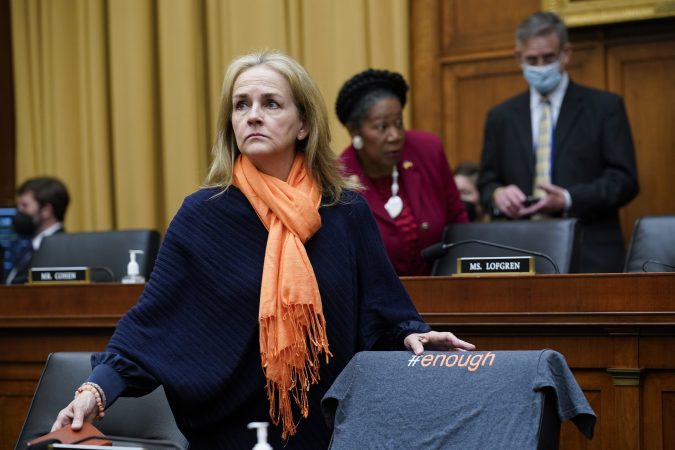
Rep. Madeleine Dean says she was blocked from speaking to detainees during oversight visit to Pennsylvania’s largest ICE detention center
Three weeks after members of Congress listened to and then publicly shared concerns from inside Pennsylvania’s largest immigrant detention center for the first time, U.S. Rep. Madeleine Dean said she was blocked from speaking with detainees while visiting the same facility on Wednesday.
Dean (D., Montgomery) said she was given “a relatively complete tour” and gathered information at the Moshannon Valley Processing Center — a 1,900-bed facility in Clearfield County that is the largest of its kind across the entire Northeast.
But while attempting to speak with detainees, as she has done during other oversight visits, Dean said, she was told that required advance permission from the detainees themselves.
Dean questioned the credibility of that prohibition — especially, she said, after she had informed the facility of her plans ahead of time, and after two of her colleagues were recently permitted to speak with detainees during a similar, but unannounced, oversight trip.
“Let’s put it this way, I got a scoop of the BS,” Dean said in an interview.
The four-term lawmaker’s fact-finding trip came after several weeks of escalating tensions around the conditions facing undocumented immigrants in detention centers such as Moshannon Valley and Delaney Hall in Newark, N.J. Both facilities are privately run by the same company, GEO Group, and have faced allegations of providing inadequate medical care and nutrition while allowing little outside oversight.
U.S. Reps. Summer Lee and Chris Deluzio, both Pittsburgh-area Democrats, said they heard “real concerns” after emerging from Moshannon Valley on May 28.
Their roughly two-hour tour and discussion with detainees was the first time any member of Congress had successfully entered the facility since President Donald Trump took office. It also followed reports of both poor medical care and a hunger strike led by detainees to protest the food.
Lee and Deluzio said women in particular approached them to say they had not received proper prenatal care. At least one told them she had been sexually assaulted at the center. And watching lunches of chicken, rice, and beans being served did not make them less concerned about the quality of the food, the lawmakers said.
A spokesperson for the Department of Homeland Security, which oversees Immigration and Customs Enforcement, later said that ICE “welcomes congressional oversight” and that it provides all detainees with comprehensive medical care as well as proper meals and living conditions.
Dean said Moshannon Valley appeared to be clean and spacious during her trip Wednesday. The medical unit was active — unlike a larger facility in Dilley, Texas, that, after she visited earlier this year, she called “inhumane” for its lacking treatment of both adults and children.
But Dean said she questioned what the facility would have looked like if she had not announced her visit ahead of time, and she was not dissuaded from her position that the facility should be closed.
“This administration has just so successfully, cancerously dehumanized certain populations that we warehouse them now,” Dean said. “And we allow others to profit from it using our taxpayer dollars.”
GEO Group referred a request for comment to ICE, which did not immediately respond.
Dean said she was particularly alarmed that the GEO Group’s contract with ICE, as well as Republican-sponsored federal budget language, appears to incentivize filling detention center beds rather than targeting those charged with violent crimes, as Trump pledged to do. She said a copy of the contract she obtained Wednesday explained GEO Group is paid $10 per individual every day they are detained, up to the first 800 detainees. The cost goes up to $40 per individual per day for every additional person detained, she said.
“It is so perverse. It says nothing about need, nothing about detaining the worst of the worst,” Dean said. “It says pick up as many people as you can, regardless of what they have done or haven’t done, so that every bed is charging and collecting from U.S. taxpayers to keep these people in that population.”
With Clearfield County commissioners expected to vote in September on whether to renew the contract with ICE and GEO, Dean said she hopes the commissioners choose not to extend the facility and instead shut it down.
Lee, who has gone further than other Pennsylvania Democrats by calling for the elimination of ICE entirely, also said last month she hoped the Moshannon Valley facility would close. One of the three Clearfield County commissioners, meanwhile, said he was inappropriately denied entry to the facility and said he does not believe the county should be part of the contract, WJAC reported.
Shutting down immigrant detention centers, however, is rare and difficult. More than 200 centers hold about 60,000 people, and Trump has been determined to increase capacity rather than reduce it.
Dean said there were 1,666 individuals detained at Moshannon Valley on Wednesday, which is more than the 1,417 that Deluzio reported on May 28. According to Deluzio, about 1,100 of those were classified as “low security.”
-
Georgia Republican legislative leaders reject governor’s call for 2028 redistricting
ATLANTA — Georgia’s Republican legislative leaders on Wednesday rejected Gov. Brian Kemp’s call to redraw congressional and legislative districts during a special session, citing concerns about moving too quickly after a U.S. Supreme Court decision weakened federal Voting Rights Act protections for minority voters.
The aborted effort to reduce nonwhite voters’ representation contrasts other Southern states where Republican majorities moved quickly to redraw congressional boundaries ahead of the November midterms, partly in response to President Donald Trump’s pleas to shore up the GOP’s fragile House majority.
Civil rights activists and Democrats, especially Black and other nonwhite lawmakers, celebrated the development and claimed victory after exerting weeks of pressure and gathering hundreds of citizens at the Georgia Capitol on Wednesday ahead of the session.
“Today showed that ordinary people don’t need to wait until November to make their voices heard and protect our democracy,” said U.S. Sen. Raphael Warnock, the state’s first Black senator who returned to Atlanta from Washington to be at the Capitol. “We can stand up and speak right now.”
Kemp had not asked his fellow Republicans to reopen Georgia districts ahead of November. Instead, he wanted them to redraw congressional boundaries for the 2028 election. But the governor, in the final months of his second term, also called on lawmakers to redraw their own districts — a move that would have made Georgia the first state to apply the Supreme Court’s Louisiana v. Callais decision to its legislature.
State House Speaker Jon Burns sent Kemp a letter hours before Wednesday’s special session was set to begin, informing him that legislators would not consider redistricting at all during the session. He announced the decision publicly shortly after, as demonstrators filled the Capitol with chants of “Black voters matter!”
Kemp did not respond to requests for comment from The Associated Press on Wednesday.
Burns said lawmakers want to take their time after the Callais decision, which struck down Louisiana’s congressional map as an illegal racial gerrymander and laid the groundwork for legislatures to reduce the number of districts where Black and other nonwhite voters hold most sway.
The speaker said it was more important for lawmakers to focus on economic matters rather than “partisan games.” He also cited pending litigation over existing Georgia districts and the need to understand the full ramifications for how race can or cannot be used in redistricting.
Privately, Republicans had expressed concerns that a rushed process that diminished Black and other minority voters’ political power could cause a backlash. And they worried that redrawn districts could unintentionally create more competitive jurisdictions that Democrats could win, especially around Atlanta.
Still, Georgia Republicans did not rule out revisiting redistricting later this year.
Conservative justices gave the green light
Before Callais, Section 2 of the Voting Rights Act was understood to require maps — for Congress, state legislatures and local legislative bodies — that gave historically marginalized minorities a reasonable chance to select candidates of their choice. Nationally, those so-called “opportunity districts” have disproportionately elected Black and other nonwhite representatives.
About one-third of Georgia’s 180 state representatives are Black. Latino, Asian and other minorities bring the total nonwhite share to about 40% — roughly reflecting the state’s overall population. Georgia’s U.S. House delegation has five districts out of 14 total where the electorate is majority or plurality nonwhite. All elected Black Democrats in 2024.
With the Callais ruling, a conservative majority of justices concluded that jurisdictions drawn with racial makeup in mind violate the U.S. Constitution’s equal protection clause. Justice Samuel Alito’s majority opinion declared that apportionment should be “race neutral.”
Alito’s stated reasoning did not hinge on party interests, and federal courts have said partisan gerrymandering is constitutionally permissible. But in Southern states, party loyalty dovetails considerably with race and ethnicity. So the decision has allowed Republicans to redraw maps to boost GOP districts by redistributing nonwhite voters who tend to support Democrats.
Many civil rights activists argue that makes it impossible for Southern legislatures to be genuinely “race neutral” when drawing boundaries.
Democrats and activists opposed the special session
Minority voting rights are especially salient in Georgia, where the Capitol complex includes a statue of the Rev. Martin Luther King Jr. and sits blocks from where the assassinated civil rights icon lived, preached and led the movement that yielded the Voting Rights Act in 1965.
Warnock, who is also minister at the Atlanta church where King once preached, invoked the civil rights icon as he led demonstrators who criticized the Supreme Court’s reasoning in Callais that it was discriminatory to draw districts to allow minority voters a chance to elect their preferred representatives.
The senator compared the possibility of scaling back nonwhite representation to the long Jim Crow history of poll taxes and literacy tests. White conservatives in the South once called those policies “race neutral,” too, Warnock noted.
Speaking before Burns’ announcement, Warnock lamented that some white Republicans who might consider redrawing district lines — or already have in other states — also praise King on his federal holiday each year.
“If you want to redraw maps and you have the power to do it, I guess you can do it,” he said. “But keep Dr. King’s name out of your mouth.”
Trump started the fight before the Supreme Court decision
Nationally, a partisan redistricting battle started last year when Trump urged Republican-controlled states to gerrymander their congressional maps. Texas answered the call first.
California Gov. Gavin Newsom and Democrats in Sacramento answered with their own gerrymander that voters later approved. A succession of states followed. The outcome would have been close to even had the Virginia Supreme Court, controlled by conservatives, not struck down new Democratic-drawn maps approved voters. All told, Republicans think they could notch a net gain of 10 seats across the multiple states.
That still may not be enough for the GOP to hold a congressional majority, given Trump’s lagging approval ratings. But it could mitigate Democratic gains and set Republicans up well for 2028 and beyond.
-

Delaware County detected measles in wastewater samples, health officials say
Measles was detected in wastewater samples taken in Delaware County on two days last week, local health officials said Wednesday.
This means someone infected with measles used a bathroom connected to the county’s public water supply, although no one in the county has been officially diagnosed with measles, said Lora Siegmann Werner, director of the county’s health department.
Detecting the highly contagious disease in wastewater can serve as a reminder for parents to vaccinate their children, and for health providers to be on the lookout for people experiencing measles symptoms.
“We’re not trying to scare people, but we thought it was a good opportunity to raise awareness,” she said.
Health officials around the country regularly monitor wastewater for various diseases, including measles and COVID-19.
The treatment plant where measles was detected in samples on June 9 and June 11, DELCORA Western Regional Treatment Plant in Chester, serves about 500,000 people in Delaware and Chester Counties.
Health officials were able to determine the positive samples came from Delaware County, Siegmann Werner said. But it was impossible to tell whether that person was passing through the county or lives there.
It was also unclear whether the infected person was connected to a measles outbreak in four counties west of Philadelphia, including Lancaster County, just over the border from Chester County.
As of Wednesday, state health officials had identified 55 cases in that outbreak, with 32 in Lancaster County. Physicians there have said they fear more cases are circulating in the community among people who avoiding seeking medical care or notifying the state health department.
“We’ve been tracking the outbreaks that occur, knowing it’s likely a matter of time before we have our own cases,” Siegmann Werner said.
The county is engaging in planning exercises and reaching out to healthcare providers to prepare for potential cases in the area.
Measles spreads through the air, lingering in a room for up to two hours after an infected person has left it. About nine in 10 unvaccinated people who come into contact with the virus will contract it themselves.
Two doses of the measles, mumps, and rubella vaccine are 97% effective against the disease.
The virus’ early symptoms include a fever, cough, runny nose, red and puffy eyes, and a rash. In serious cases, measles can lead to pneumonia, brain infections, and death.
There is no evidence it is spread through contact with untreated wastewater, Delaware County health officials said.
Without a confirmed measles case in Delaware County, Siegmann Werner said, the detection of measles in its wastewater will not trigger an investigation into its origin.
“It’s really limited to saying there was someone who was ill” who either passed through the county or lives there, she said. “Please be vigilant and get vaccinated.”
-
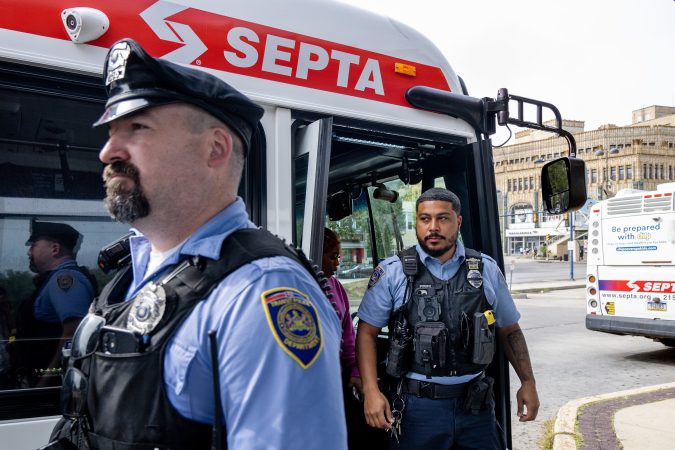
Transit police union and SEPTA have a tentative deal on a 3-year contract
The union representing transit police and SEPTA reached a tentative deal on a new three-year contract Wednesday that includes a 12% raise and avoids a possible strike during the region’s summer of big events.
Officers had been working without a contract since March 31, and the police union said on June 4 it was willing to walk off the job if there was no progress in talks. Leaders said the two sides were at an impasse.
Since then, negotiators traded new proposals and met several times.
Members of Fraternal Order of Transit Police Lodge 109 are scheduled to hold a ratification vote on the agreement Thursday, with SEPTA’s board scheduled to consider it next week.
“SEPTA believes the agreement is fair to our hard-working Transit Police officers and responsible to the fare-paying riders and taxpayers who fund the authority,” spokesperson Andrew Busch said in a statement.
“I can confidently say that a strike has been averted at this time,” FOTP Lodge 109 president Omari Bervine said in an interview.
He credited SEPTA general manager Scott A. Sauer with getting talks moving.
“We were able to actually sit down to direct talks, with the general manager [involved], and that was instrumental in getting a tentative deal worked out,” Bervine said.
A 12% raise is in line with the deal Transport Workers Union Local 234 received in its contract agreement last year. SEPTA engages in pattern bargaining, using contracts with TWU Local 234 as a guidepost.
Officers would get a 5% pay hike in the first year and 3½% in each of the next two years, according to sources familiar with the agreement. They also would receive a $2,500 signing bonus.
Officers are scheduled to get the first installment of the pay bump on June 28, if the contract is ratified and approved. Normally, pay increases for transit police did not kick in until the next anniversary of the start of the contract year — in this case, April 1, 2027.
Lodge 109 has pressed to change the timing so members would start receiving raises as soon as possible after the signing of an agreement, as happens with other SEPTA unions.
The union represents 203 rank-and-file officers who patrol SEPTA’s stations and transit vehicles across its five-county service area.
Bervine had offered to waive the right to strike if SEPTA voluntarily agreed to submit their dispute to binding arbitration.
Most union-represented police officers in Pennsylvania can use binding arbitration, which involves an independent arbiter deciding the final terms of a contract. In turn, those officers are barred from striking.
But state law does not allow transit police and some other state law enforcement officers to use binding arbitration.
Bervine said there was no agreement to include binding arbitration in the contract. There is proposed legislation in Harrisburg to extend it to officers employed by state agencies like SEPTA. “Hopefully, common sense will prevail,” he said.
Union and SEPTA negotiators met on Tuesday and Thursday last week and exchanged new proposed contract language. They met for a third time Saturday.
The union has exercised its right to strike before.
In December 2023, the transit officers union went on strike for three days seeking wage increases matching those given to Transport Workers Union Local 234 and other SEPTA employee unions.
In 2019, transit officers walked out for six days, in part over whether members could review body-camera footage before filing incident reports. They struck in 2012 over a 15-cent difference between the FOTP’s demand and SEPTA’s offer for an increase in the hourly rate that members received for annual recertification as police officers.
-

Christian Pulisic’s calf injury is the USMNT’s biggest story at the World Cup. Here’s what to know.
IRVINE, Calif. — In the traditional American sports, there are rules requiring teams to publish injury reports.
Sure, a coach might just say a player has a “lower-body injury,” especially in hockey. But there still are rules, and many Philadelphians (especially 76ers fans) might know them by heart these days.
At the World Cup, there are no rules — and there’s even less incentive to tell the truth. There’s a long history of subterfuge, from Brazil’s Ronaldo in 1998 to Canadian star Alphonso Davies’ hamstring and U.S. star Christian Pulisic’s calf today.
So if you’re wondering why the U.S. staff haven’t said much about the matter, the answer is simple: why should they? All it would do is give things away to the tournament’s other teams, including the Americans’ next opponent, Australia.

Christian Pulisic did some exercises in the workout tent at the start of Friday’s practice.Jonathan Tannenwald “When I’m in England, they tell you exactly what it is with stuff like this,” said midfielder Brenden Aaronson, whose Medford and Union roots make him as well-versed in American ways as the world’s game. “With this situation, I can’t tell you what it is because I’m not a part of the medical staff and stuff like that. But it is different, and it is a different part of the game when it’s at club and in international football.”
Officially, Pulisic remains day to day. He trained on his own during the first 15 minutes of Wednesday’s practice, which was the portion that was open to watch. Most of that time was spent in the team’s workout tent, but he emerged toward the end and walked across a field to kick a ball back and forth with a coach.
This was the extent of the day’s drama, even though Pulisic’s absence from Friday’s game (3 p.m., Fox29, Telemundo 62) obviously would be a huge deal.

There was a lighthearted moment when a reporter used a pair of binoculars to try to spot Christian Pulisic.Jonathan Tannenwald What do Pulisic’s teammates think of all this? Everyone who has spoken this week hasn’t said much, and that continued Wednesday.
“I’m not sure the exact sort of terminology of his injury,” defender Antonee Robinson said. “I mean, he’s been taking it day by day, and he’s not been training fully with the group yet. We’ve still got a couple of days to see where he’s at, and thankfully we’ve got a lot of boys on the bench who are eager and ready to get involved in helping the team, and a lot of quality.”
A few hours later, the caravan flew north to Seattle to get ready for Friday’s big game (3 p.m., Fox29, Telemundo 62). The U.S. will train at the University of Washington on Thursday, then get ready for a thunderous atmosphere at the stadium downtown on Friday.
Along the way, the ritual likely will be repeated: questions about Pulisic, vague answers, and a collective shrug. This is how it is, and how it has been, and it’s just another part of the World Cup’s spectacle.
And would you believe that Christian Pulisic has WALKED OUT OF THE TENT and is now DOING A DRILL on the field.
(In all seriousness, he’s got some kind of wrapping on his left leg. But otherwise, this whole thing is yelling into a molehill.)
#USMNT
— Jonathan Tannenwald (@jtannenwald.bsky.social) June 17, 2026 at 11:16 AM
In awe of Messi’s hat trick
Speaking of spectacle, they don’t come any better than Lionel Messi’s dazzling hat trick in Argentina’s 3-0 win over Algeria. The 38-year-old tied the World Cup’s scoring record with his 16th goal in the tournament, sending a jam-packed crowd in Kansas City into rapture — and the rest of the world, too.
“For the fans watching, obviously Messi’s probably the greatest footballer who’s ever lived, and he’s still going, still showing quality,” Robinson said. “As a fan, I’m sure it was amazing to watch him. That’s the magic of the tournament: you want to see the world’s best doing what they do on this stage, and hopefully every game like that keeps giving those moments, and it’s enjoyable the whole way through.”
Aaronson has also watched Messi plenty, including in person last year at Subaru Park when Inter Miami visited the Union. He admitted that “the fanboy comes out of all of us,” even though he also knows that if the U.S. finishes second in its group and reaches the round of 16, it could play Argentina.
“If we do play Argentina, we’ll all be ready to go,” Aaronson said.
Messi’s next chance to break the scoring record, which has stood since Germany’s Miroslav Klose set it in 2002, will come Monday against Austria in Arlington, Texas.
But he isn’t the only player chasing history at this World Cup. France’s Kylian Mbappé’s two goals against Senegal on Tuesday took his tournament total to 14, and made him his country’s record scorer with 58 all-time.
Mbappé’s next game is in Philadelphia, on Monday against Iraq. And if there wasn’t already enough hype around Les Bleus’ visit, their 3-1 win in the Meadowlands raises the hype around what might be this World Cup’s most star-studded squad.
Mbappé and Messi’s heroics were expected to draw big TV audiences, along with Norway star Erling Haaland’s two goals in his World Cup debut, a 4-1 win over Iraq. It was quite a sight to have all three stars play on the same day.
Expect another big number for Cristiano Ronaldo’s debut in the tournament with Portugal, in Wednesday’s 1-1 upset tie with the Democratic Republic of Congo. That game joined Cape Verde’s tie with Spain (featuring former Union midfielder Jamiro Monteiro), Jordan’s hard-fought loss to Austria, and Curaçao’s goal against Germany as great moments by underdogs so far.
“You see the results in the last couple of days, of teams who definitely weren’t the favorites managing to get points, and I think that’s what the World Cup’s about,” Robinson said. “It’s about bringing lots of different cultures together and giving them moments like this, and experiences, and it’s really nice to see.”
-
More people in Philly and region struggle with insufficient food after Trump cuts: ‘Hunger has never been higher’
Shelly Gaither, 51, of Cheltenham, makes sure her three sons, ages 6, 9, and 18, get their meals while she manages with whatever is left over — if anything ever is.
“Oh, my God, groceries are too expensive,” said Gaither, a former data analyst who suffers from a disability that makes working difficult. She visits a food pantry regularly to make sure her kids eat chicken when they can. Her monthly SNAP (Supplemental Nutrition Assistance Program) benefits were reduced from $400 to $200 earlier this year because of changes to the program under President Donald Trump’s One Big Beautiful Bill Act.
“I don’t think there’s hope,” she said. “I feel guilty for bringing children into a world that doesn’t want them to exist because the government makes cuts that take away their food and their healthcare.”
For people like Gaither throughout the United States, levels of food insecurity have seen a “remarkable” rise since the pandemic in 2020, according to a national survey taken earlier this year and released in late May by the Federal Reserve Bank of New York.
Around 10% of 1,300 heads of households polled in February reported a lack of enough food and said their children were missing meals, according to the survey. Nearly 16% relied on food donations. Among families taking in less than $50,000 a year, almost 20% reported being forced to skip meals or go without.
In 2020, when the federal government stepped in to help families at the height of the pandemic, just 4% of households reported missing meals, including less than 7% of families earning less than $50,000 a year, according to the survey.
At that time, temporary supplemental unemployment benefits, expanded SNAP payments, and direct government relief payments helped stave off hunger among Americans. Food insecurity increased after COVID-19 relief expired, according to the Urban Institute.
But the recent surge in hunger has also been attributed to the sweeping law Trump signed last year, which reduces SNAP benefits and other safety net programs to help pay for his tax cut.
Findings in the bank’s report also reflect Gaither’s sense of despair, a pessimism about personal finances and the overall economy among people with low incomes. That same group exhibits diminished expectations for finding a job and declining levels of consumer confidence, the survey says.
(function(){function e(){window.addEventListener(`message`,function(e){if(e.data[`datawrapper-height`]!==void 0){var t=document.querySelectorAll(`iframe`);for(var n in e.data[`datawrapper-height`])for(var r=0,i;i=t[r];r++)if(i.contentWindow===e.source){var a=e.data[`datawrapper-height`][n]+`px`;i.style.height=a}}})}e()})();
According to the reserve bank’s report, non-white Americans have been especially hard hit. The number of such households that reported missing meals increased from 4% in 2020 to 19% in February. At the same time, the number of non-white people receiving SNAP benefits jumped from 14% to more than 26%.
Overall, the survey found food insecurity was particularly acute among lower-educated and lower-income households, as well as households with young children. Many families are experiencing financial stress due to the high cost of living, persistent inflation, and high interest rates, even as the stock market has been steadily rising, according to the survey.
Pantries struggle to keep up with demand
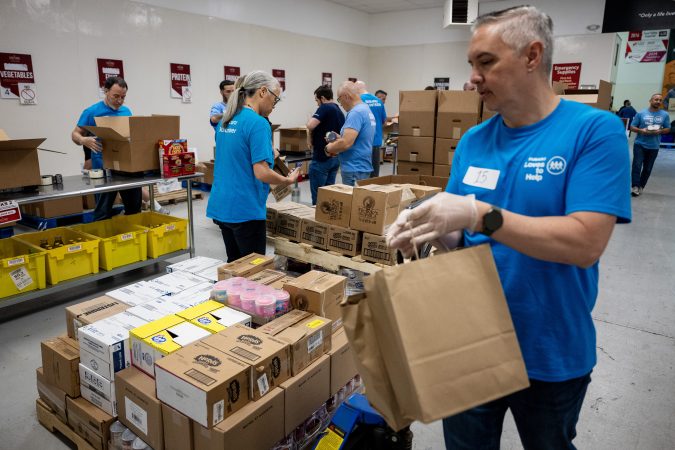
More people are flocking to food pantries, but they are not equipped to take up the slack of reduced SNAP benefits.
“Pantries across the state are in perpetual crisis mode,” said Stuart Haniff, CEO of Hunger-Free Pennsylvania in Pittsburgh. Add to that the advent of summer, when kids are no longer receiving free breakfast and lunch at school. “Families must now provide those 60 to 80 meals a month,” Haniff said.
In Norristown, “immense need” has increased the number of people frequenting Martha’s Choice Marketplace, the largest food pantry in Montgomery County, by 100% since 2022, said Patrick Walsh, director of programs. “And I don’t expect things to get better.”
Food prices are also up 3.2% this spring over last, according to U.S. Department of Agriculture figures, exacerbating the issue.
In South Jersey, “we are seeing record numbers at our food distributions,” said Jane Asselta, president and CEO of the Food Bank of South Jersey, in a statement to The Inquirer. “Life is getting harder to afford for more and more people.”

Matt McDevitt (left) and Michael Hickey load their vehicle at the Food Bank of South Jersey Thursday, June 11, 2026. The men are volunteers at the Temple Lutheran Church in Pennsauken and their food bank is open from 5-6 p.m. every Thursday.Tom Gralish / Staff Photographer Asselta said the Federal Reserve Bank’s report “mirrors” what her organization has observed through its network of 300 community partners.
“Hunger has never been higher,” said Pastor Sonita Johnson, who runs the food pantry at St. John’s Pentecostal Outreach Church in Salem City, Salem County. “Food prices are high, and the lines you see you would not believe — a 50% increase in people just over the last two months.”
Nationwide, between January 2025 and January 2026, SNAP rolls decreased by more than 4 million people — from 42 million to 38 million — according to USDA figures.
Between last September and April of this year, nearly 90,000 Pennsylvanians lost SNAP benefits due to new eligibility requirements stipulated by the Trump administration, according to an analysis by the Pennsylvania Department of Human Services (DHS).
And between December 2025 and last month, more than 32,000 Philadelphians lost benefits, DHS figures show.
In New Jersey, SNAP participation has fallen by more than 50,000 individuals between March 2025 and March of this year, New Jersey Department of Human Services figures show.
The Trump administration’s SNAP changes include an expansion of work requirements for people who receive SNAP benefits and increased documentation requirements “designed to make maintaining eligibility increasingly difficult,” according to the Food Research and Action Center (FRAC), the largest anti-hunger lobby in the United States.
Deputy White House press secretary Anna Kelly said in a statement that Trump signed the changes to strengthen SNAP and to ensure that it is “sustainable for future generations.” She added that Trump was “elected to eliminate runaway spending across the federal government.”

William Meo works on the loading dock at the Food Bank of South Jersey Thursday, June 11, 2026. Tom Gralish / Staff Photographer For people like Shelley Gaither, how her reduced SNAP benefits could be seen as part of “runaway spending” is tough for her to figure, given her needs. To survive this precarious moment, Gaither said, she will do whatever she can.
“We eat more vegetarian meals and I don’t buy my kids cookies or snacks,” she said. “If I drink enough coffee, maybe I just need one meal a day. This is our existence now. This is how we live.”