Blog

  • Trump administration sues Philadelphia over ‘ICE Out’ face mask ban for law enforcement

    Trump administration sues Philadelphia over ‘ICE Out’ face mask ban for law enforcement

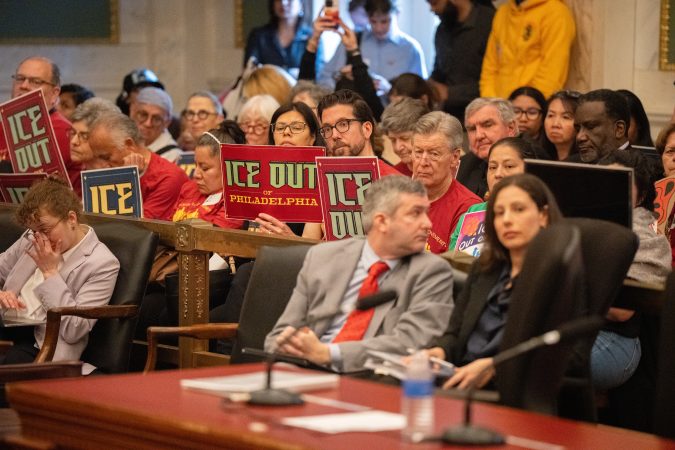
    President Donald Trump’s administration sued Philadelphia and some of its top officials Thursday over a new ordinance that bars law enforcement officers from concealing their identities and effectively bans federal immigration agents from wearing masks.

    The law, part of City Council’s recently adopted “ICE Out” package of legislation imposing some of the nation’s toughest local restrictions on immigration agents, is “blatantly unconstitutional,” the lawsuit said.

    “Such an ordinance also undermines the principles of federalism that underlie our entire constitutional order by seeking to prevent effective federal law enforcement within Philadelphia,” according to the complaint.

    The ordinance makes it a crime for any law enforcement officer, including Immigration and Customs Enforcement agents, to wear face coverings or conceal personal identifiers like badges and nameplates while carrying out their official duties in the city, and it requires officers to identify themselves. It also prohibits the use of unmarked vehicles.

    The bill includes exceptions allowing officers to wear masks in certain circumstances, such as medical emergencies or SWAT operations.

    An officer who violates the ordinance could be prosecuted, and risks up to 90 days in jail plus a fine.

    The suit, filed in the Eastern District of Pennsylvania, names as defendants the city, Mayor Cherelle L. Parker, District Attorney Larry Krasner, and City Solicitor Renee Garcia. It asks a federal judge to find the bills unconstitutional, warning that federal agents could suffer irreparable harm if the policy remains in place.

    “Protecting officers’ personal identities is particularly important during high-risk enforcement operations involving individuals with violent criminal history, gang affiliations, transnational criminal organizations, and known or suspected terrorists,” the suit says.

    The lawsuit marks the Trump administration’s most significant action targeting Philadelphia’s immigrant-friendly policies to date.

    “Today we regrettably had to sue the birthplace of this great Nation,” Associate Attorney General Stanley Woodward said in a statement. “But we will not sit by while Philadelphia flagrantly violates our Constitution, seeking to criminally punish our Nation’s law enforcement heroes merely for doing their job.”

    Philadelphia has long been known as a sanctuary city primarily because it does not comply with ICE-issued detainers, in which federal agents ask local jails to facilitate the arrest of undocumented immigrants in their custody.

    But Parker has largely avoided direct confrontation with the White House over the issue, a reversal from the combative stance of her predecessor, former Mayor Jim Kenney.

    Parker’s supporters credit her with careful, crafty management of the city’s relationship with Trump, noting Philadelphia has been spared from the surges of federal agents the president has sent to other cities. But immigration advocates say Parker has backed away from a fight at a time when strong action is most needed.

    The tension surfaced when Parker decided to let the mask bill became law without her signature, after Garcia warned the mayor that the provisions might not be legally enforceable.

    Council members, however, wanted to take a more proactive stance against Trump’s nationwide deportation campaign. And they seem to have gotten his attention.

    Councilmember Kendra Brooks, who coauthored the “ICE Out” package, said she “will not back down from this fight.”

    “Philadelphia doesn’t like bullies. And we certainly don’t like masked PPD officers or ICE agents terrorizing our neighbors,” Brooks said in a statement. “The people of this city expected our leaders to fight back against Trump’s invasion. That’s what we did when we passed ICE Out.”

    Brooks noted that the lawsuit cites the Parker administration’s publicly aired concerns about the bill, and said other jurisdictions targeted by Trump after they passed legislation restraining ICE have not had to deal with that dynamic.

    “Other lawsuits aren’t dealing with the City’s own words about the laws being used against them,” Brooks said.

    The Parker administration declined to comment.

    The Pennsylvania Immigration Coalition condemned the lawsuit as a political effort to undermine local policies that keep families safe, strengthen public trust, and ensure city resources serve Philadelphians.

    “Once again the Trump administration is using the courts to wage a political campaign against immigrant communities, instead of addressing the real needs of our country,” coalition executive director Jasmine Rivera said in a statement. “Pennsylvanians have been clear, they do not want more immigration enforcement and detention centers, they want affordable education, healthcare, and housing.”

    Councilmember Rue Landau, the legislation’s other coauthor, criticized Trump for “targeting Philadelphia because our city dared to stand up and say that masked federal agents should not be able to operate in our communities and target our vulnerable neighbors without accountability.”

    ‘We will arrest you’

    In addition to banning officers from concealing their identities, the “ICE Out” package, which in April passed Council with a veto-proof supermajority, prohibits federal immigration agencies from staging raids on city-owned property, bans discrimination on the basis of citizenship status, and prohibits the city from engaging in most forms of information-sharing with ICE.

    The legislation also codified some of Philadelphia’s long-standing sanctuary city policies that had been established only through executive order — most notably a ban on city jails honoring ICE detainers not accompanied by judicial warrants.

    Parker signed six of the seven bills in May, and allowed the ban on agents hiding their identities to become law without her signature.

    Parker did not sign the bill after Garcia expressed concern about the ban’s “significant legal and operational challenges,” the suit notes. The mayor’s signature would signal the Parker administration’s intent to enforce the requirement, the solicitor said, and would send an inaccurate signal that the prohibition was enforceable.

    While Parker might have attempted to distance herself from the requirement by not signing the bill, the lawsuit quotes Krasner threatening federal agents with prosecution.

    “We will arrest you. We will put handcuffs on you. We will close those cuffs. We will put you in a cell,” Krasner said in January. “We will do everything in our power to convict you and we will make sure you serve your entire sentence because Donald Trump has no power whatsoever to pardon you.”

    Larry Krasner shown here during a press conference at City Hall to announce a package of bills aimed at pushing back against ICE enforcement in Philadelphia, January 27, 2026.Jessica Griffin / Staff Photographer

    Philly case could have national stakes

    The complaint makes clear that by bringing this lawsuit, the Department of Justice is not closing the door on challenges to other ICE Out ordinances.

    Around the country, more and more Democratic-led communities are attempting to regulate what ICE can and cannot do within their jurisdictions. And doing so with the support of immigrant communities.

    “In all the ways that ICE agents terrorize and violate the rights of our community, masked kidnappings are ones we consistently see and hear about,” said Erika Guadalupe Núñez, executive director of Juntos, the South- Philadelphia-based immigrant advocacy organization.

    She said, however, that “we’re part of a strong local movement organized to fight back, and we all embody the spirit of this city, we will not back down easily.”

    In March, the Montgomery County Board of Commissioners passed a resolution that restricted the agency from using county property or resources for civil investigations.

    Issues around masks and identification have been particularly contentious.

    Activists in Philadelphia and elsewhere say ICE arrests often look like kidnappings or muggings, where men in ordinary clothes, with no visible identification, suddenly descend on their target. The people being arrested may think they are being attacked by criminals.

    Several states, including New Jersey and New York, have passed laws to ban law enforcement officers, including ICE, from wearing facial coverings while on duty.

    In April, the U.S. Court of Appeals for the Ninth Circuit upheld a lower court’s injunction on a California law that required federal agents to “visibly display identification.” The unanimous three-judge panel ruled that the requirement violated the Constitution’s supremacy clause, which bars the states from regulating federal government activities.

    New Jersey Gov. Mikie Sherrill signed bills in March that essentially banned ICE agents and police from wearing masks on the job, drawing pushback from Republican lawmakers. The Trump administration sued New Jersey in federal court in April, and the New Jersey Monitor and others reported that ICE agents continued to cover their faces during recent clashes with demonstrators outside the Delaney Hall immigrant detention center in Newark.

    The Trump administration says federal immigration officers wear face coverings to protect themselves and their families from anti-ICE activists who may seek to identify and harm them. Assaults and death threats are on the rise, the administration said.

  • Mets’ Bo Bichette says he wasn’t close to signing with the Phillies in the offseason

    Mets’ Bo Bichette says he wasn’t close to signing with the Phillies in the offseason

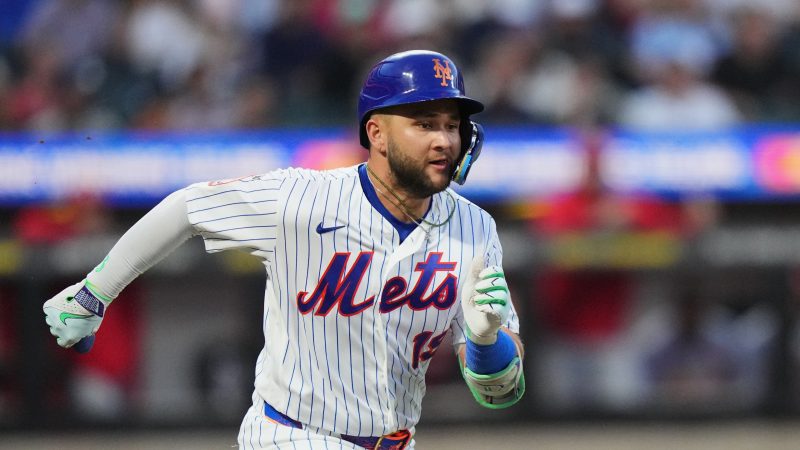
    Even now, five months later, Phillies officials say they went to sleep Jan. 15 believing they were on the verge of signing Bo Bichette as a free agent.

    Bichette has a slightly different recollection.

    “I thought it was an opportunity, for sure, but there was definitely things that needed to be worked out for that to become a possibility,” the Mets shortstop said Thursday before facing the Phillies for the first time this season. “So, no, I didn’t think that [it was close].”

    The Phillies made a seven-year, $200 million offer to Bichette to play third base. If he accepted, it would’ve set in motion other moves, including a likely trade of Alec Bohm and not re-signing longtime catcher J.T. Realmuto.

    But the rival Mets swooped in Jan. 16 with a three-year, $126 million offer that included an opt-out after each of the first two years. Bichette chose the higher annual salary and the shorter term.

    Most Phillies officials said they found out about it like the public did — through reports in the media. Some within the halls of Citizens Bank Park were said to be angry.

    Dave Dombrowski referred to it as a “gut punch,” although he conceded that the Phillies and Bichette never signed a “memorandum of understanding,” the document that would’ve constituted a deal.

    “At 11 o’clock that night, we had a deal, in our opinion,” owner John Middleton told The Inquirer in February. “Not finalized. And the Mets did nothing that we wouldn’t have done and haven’t done, so I don’t blame the Mets. But you went to bed at 11 o’clock thinking we had a deal, and I woke up at 8 o’clock worried we didn’t have a deal, and two hours later, I knew we didn’t have a deal.”

    The member of the organization who is closest to Bichette also thought the star infielder was headed to Philadelphia. Interim manager Don Mattingly, newly hired in January as the Phillies’ bench coach, was ready to welcome Bichette.

    “I was a little surprised because I thought it was one of those that, it was kind of a done deal — or at least really close to it and looked good for us, you know?” Mattingly said Thursday. “I know some stuff went down timing-wise that changed things. But guys have got to do what they’ve got to do for their own career.”

    Bichette, 28, has caught fire lately after a brutal start with the Mets. He had 14 hits in 26 at-bats entering Thursday night and was 24-for-62 (.387) with five doubles, three homers, and a 1.039 OPS in June.

    The Phillies are still looking for a middle-of-the-order bat, preferably from the right side.

    Bichette, whose godfather is former Phillies manager Joe Girardi, was clearly a fit. But he said he never reached out to Girardi to ask about Philadelphia.

    He never pictured how he’d look in red pinstripes, either.

    “I mean, we had a lot of good talks,” Bichette said. “It’s a great team over there, and obviously Donnie being over there was enticing to me. But at the end of the day, I think it just became obvious to me that [the Mets] was the right decision for me and my wife.”

    Bichette said he wasn’t sure what type of reception he would receive when he came to the plate in the first inning.

    “It’s a passionate fan base, you know?” Bichette said, smiling. “You watch Eagles games and Phillie games. I don’t know what the reception will be, but I definitely won’t be surprised at anything.”

  • An all-time World Cup home field advantage awaits the USMNT in soccer-crazed Seattle

    An all-time World Cup home field advantage awaits the USMNT in soccer-crazed Seattle

    SEATTLE — Like any sport, soccer is a game of players, tactics, skills, and decisions. But when it comes to emotions, no sport is like the world’s most famous one.

    Not for nothing did soccer resist the long march of analytics far longer than increasingly-global basketball, baseball, ice hockey, gridiron football, and others. (Americans might not know cricket, for example, but that bat-and-ball game has its own volume of statistics.)

    So, yes, we can talk about player matchups in Friday’s U.S.-Australia showdown for first place in Group D (3 p.m., Fox29, Telemundo 62). We can talk about the Socceroos’ impressive striker Nestory Irankunda and 6-foot-6 centerback Harry Souttar. And we can certainly talk about whether Christian Pulisic will shake off his calf strain in time.

    But it’s impossible to avoid this moment’s romantic side. The Emerald City is rich with a half-century of soccer history, from the NASL’s Sounders to the MLS version, always drawing big and passionate crowds. In recent years, the NWSL’s Reign have joined them, with their own robust fan base watching stars of the women’s game.

    Seattle fans show up in big numbers for soccer games at Lumen Field, the home of MLS’s Sounders and the NWSL’s Reign.Seattle Sounders

    For all that time — from hosting Pelé at the Kingdome to hosting Lionel Messi at Lumen Field, from Bobby Moore to Clint Dempsey, from Michelle Akers to Megan Rapinoe — Seattle’s soccer tapestry has missed one piece.

    Until this year, it had never hosted a World Cup.

    Now, at last, that hole is filled, and with style. Since the day in early 2024 when FIFA announced the U.S. would play a group game here, Seattle has been counting down to this moment, and so have fans across the country.

    A game in this city, with its stage towering over the south side of downtown, is a joy any time. But a World Cup game here is on American soccer’s bucket list. So it’s natural that U.S. and Sounders midfielder Cristian Roldan, in his 12th season with the only club of his career, has led the welcome committee for the squad.

    Cristian Roldan (center) at work on his old college field during Thursday’s practice.Jonathan Tannenwald

    “I’ve told them that the city is ready, that the city is energized,” he said before Thursday’s practice at the University of Washington, his alma mater — with its own famed sports theaters in football’s Husky Stadium and basketball’s Palestra-like Hec Edmundson Pavilion.

    “We haven’t had a game here in a long time, and we’ve been desperate to host a World Cup game, a U.S. men’s national team game,” Roldan added. “So they’re going to feel the crowd, feel the energy, and it’s about feeding off it.”

    He felt it even more as he set foot on his old college field, with glittering Lake Washington a stone’s throw away and Mount Rainier towering beyond. On the same day that Penn product Duke Lacroix returned to his alma mater in Philadelphia ahead of Haiti’s clash with Brazil on Friday, a similar scene unfolded thousands of miles west.

    “I’m thankful to have this full circle moment,” Roldan said. “I don’t think people realize how special it is for me to be here and enjoying this experience with the men’s national team.”

    Mount Rainier looming in the background over the scene at the U.S. team’s practice.Jonathan Tannenwald

    Come lunchtime, a walk through downtown showed what awaits. Fans in U.S. jerseys were all over, from Pike Place Market (Seattle’s version of Reading Terminal) to the glistening waterfront.

    Fox’s studio show set up shop on one of the piers, with the ferries crossing Puget Sound as one backdrop and a boisterous crowd as another.

    It’s a different vibe from sprawling Los Angeles, and they’ll tell you that here as much as a visitor from out east naturally senses it.

    Everything will come together at noon local time on Friday, when a capacity crowd of just under 67,000 will roar the U.S. team onto the field.

    The vibrant scene in Seattle as Fox’s studio show goes on air:

    #USMNT

    [image or embed]

    — Jonathan Tannenwald (@jtannenwald.bsky.social) June 18, 2026 at 2:23 PM

    The players are excited to experience it, especially those who haven’t before. Because the stadium usually has artificial turf, the U.S. men haven’t been here since the 2016 Copa América Centenario, when grass was installed like it has been this summer. (The World Cup’s grass also helped bring the women’s team here in April, ending a nine-year drought.)

    “I’ve obviously spoken to ‘Roldy’ and other people who’ve said how much of a soccer culture Seattle has, and I’m really looking forward to experiencing that firsthand,” defender Antonee Robinson said. “The first game that was played in that stadium looked amazing. So I’m looking forward to being a part of it, too.”

    Roldan isn’t expected to start, and he knows it. But if he gets on the field as a substitute, the roar that rises will no doubt be as great as a U.S. goal.

    “I’m getting goosebumps just thinking about it,” he said. “This is a place that I call home, and I’ve called home for a while. … I’ve given my heart and soul to this club. To be able to see the field would be a dream come true, and I think it would be special not only for me, but I think for the city of Seattle as well.”

  • MLB eliminating clock for All-Star Home Run Derby as event switches to Netflix

    MLB eliminating clock for All-Star Home Run Derby as event switches to Netflix

    NEW YORK — Baseball’s Home Run Derby is eliminating the clock.

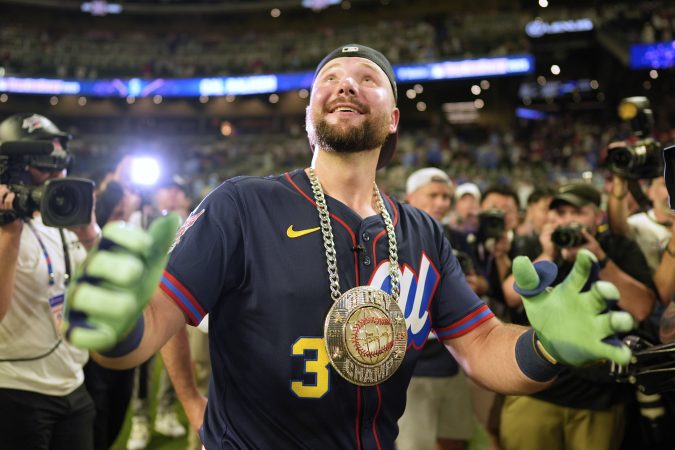
    Each hitter will have 20 swings in the first round of this year’s contest at Philadelphia’s Citizens Bank Park on July 13, Major League Baseball said Thursday. The change coincides with a switch in broadcaster to Netflix from ESPN, which had televised the event since 1994.

    A player who homers on swing 20 will keep on swinging until he doesn’t connect for a long ball. The top four hitters advance, with distance of the longest homer used as a tiebreaker.

    Hitters will be seeded for the second round, where No. 1 faces 4 and 2 meets 3.

    Each player takes 15 swings in the second round, with batters again homering on their final swing continuing until not homering. A best-of-three swingoff would break ties.

    The format for the second round will be used for the final.

    No bonus rounds will be used.

  • Trump administration can install its own slavery exhibits at President’s House, Third Circuit rules

    Trump administration can install its own slavery exhibits at President’s House, Third Circuit rules

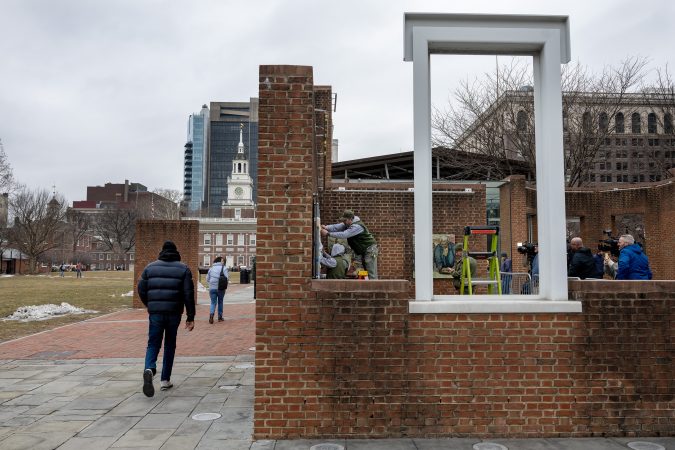
    President Donald Trump’s administration can replace the slavery exhibits it removed in January from George Washington’s Philadelphia residence, a federal appeals court ruled Thursday.

    A three-judge panel of the U.S. Court of Appeals for the Third Circuit unanimously agreed to toss out an injunction issued by a Philadelphia district court judge in February that ordered the National Park Service to restore interpretive panels telling the history of the nine individuals who were enslaved by Washington at the President’s House Site.

    The city does not have a right to dictate the content of the panels, the court found.

    The judges further found that the federal government’s proposed replacement panels, which historians say whitewash Washington’s role in slavery, “are full of historical context.”

    The proposed panels “highlight the momentous events that took place in the President’s House and the other sites at Independence National Historical Park,” Judge Thomas M. Hardiman, a President George W. Bush appointee, wrote in the opinion. “They acknowledge the evil of slavery, including its injustices and hypocrisies, and, by telling the story of the nine slaves that Washington kept in the President’s House, remind us of their essential humanity.”

    Judges Luis F. Restrepo, appointed by President Barack Obama, and Peter J. Phipps, appointed by Trump, joined the opinion.

    It was not immediately clear what would happen next at the site. The federal government did not immediately outline its next steps, and there are conflicting court rulings over the Trump administration’s push to remove displays from national parks that “inappropriately disparage Americans past or living.”

    But the ruling does bring to a close a chapter in the President’s House litigation, the first courtroom clash between Trump and Mayor Cherelle L. Parker’s administration. Any further review of the injunction is at the discretion of the three judges, the full Third Circuit, or the Supreme Court and is not guaranteed.

    Mijuel Johnson, a guide with The Black Journey: African-American Walking Tour of Philadelphia, leads District Court Judge Cynthia Rufe (right) as she visits the President’s House in Independence National Historical Park in February.Tom Gralish / Staff Photographer

    The city was unable to convince the Third Circuit panel it has joint decision-making power with the federal government over the entirety of Independence National Historical Park because of the local ownership of Independence Hall.

    Philadelphia has standing to argue in court that the federal government violated the contract signed when the city donated the President’s House to the National Park Service, Hardiman wrote. The agreement included a guarantee the federal agency would maintain the site.

    But the city had to prove it could win based on that argument to keep the injunction alive, and the judges disagreed.

    “The duty to ‘maintain’ is better understood as a general management obligation that accompanies ownership, not a promise that the exhibits will forever remain in place regardless of the owner’s wishes,” the opinion said.

    The city’s claim that the removal was “arbitrary and capricious” under the Administrative Procedure Act also did not find purchase. The federal law allows challenges only to “final” agency actions, but the newly proposed panels show the January removal was not the Trump administration’s “last word on the matter,” the opinion said.

    The ruling vacates U.S. District Judge Cynthia M. Rufe’s injunction from February that ordered the full restoration of the site to its state before exhibits were removed. The National Park Service restored some exhibits, but some metal interpretive panels could not be reinstalled because they required fixes.

    Avenging the Ancestors Coalition, one of the advocacy groups leading efforts to protect the President’s House, said in a statement that the group was disappointed by the decision but would persevere. The coalition was consulting its legal team to consider potential next steps.

    “This is definitely not the end of this fight, nor does it diminish the importance of ensuring that the full truth of our nation’s history is preserved and presented accurately,” the organization said.

    In a video statement Thursday, Parker said, “I will pursue every legal action possible in efforts to reverse this decision.”

    A spokesperson for the U.S. Department of the Interior simply said: “Trust in Trump.”

    Debate over history

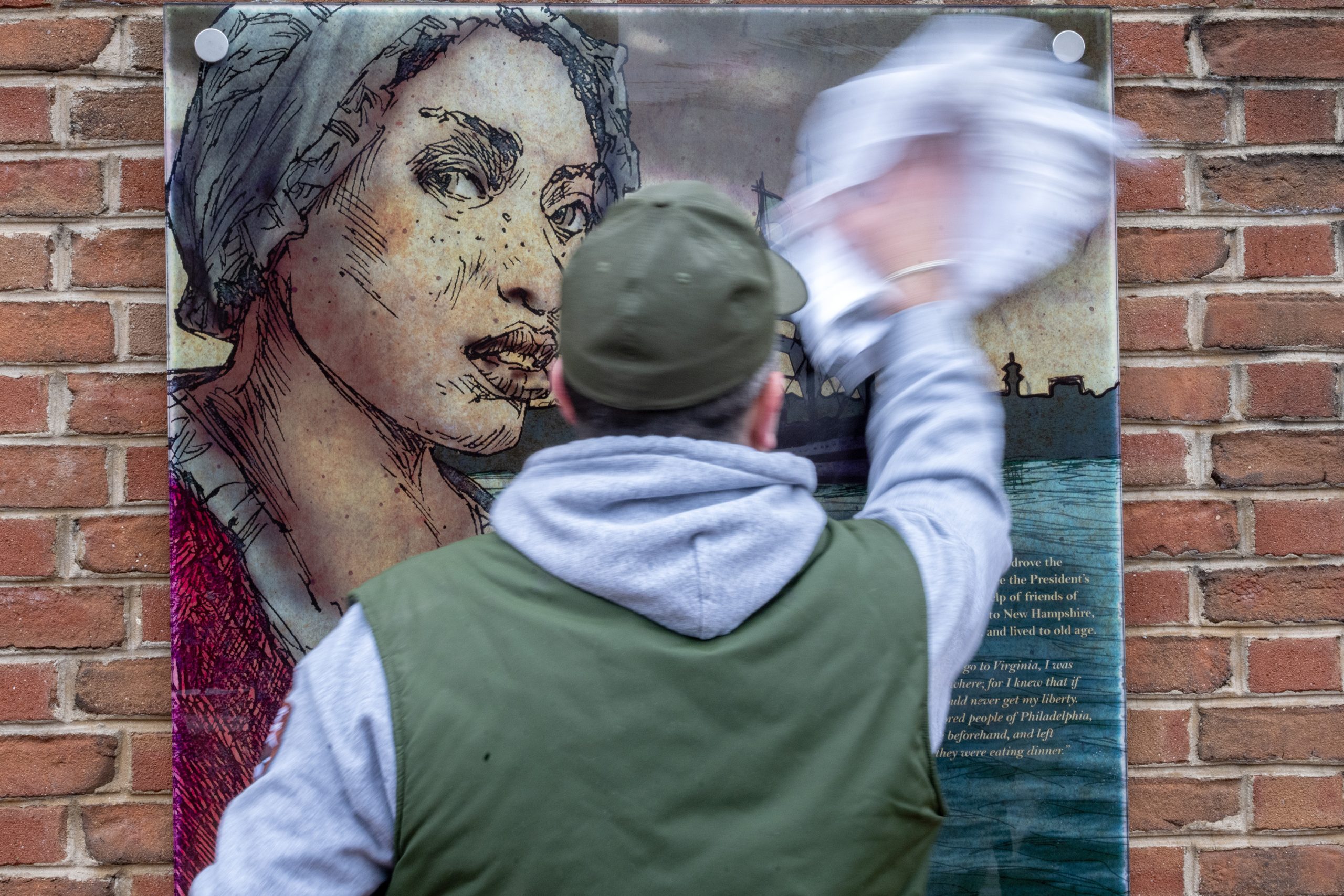
    A worker cleans the glass on the panel for Oney Judge after re-hanging it at the President’s House in Independence National Historical Park in February.Tom Gralish / Staff Photographer

    The ruling is an inflection point in the tumultuous legal saga over whether the federal government has power to determine which version of U.S. history is displayed for public viewing — an issue even more salient ahead of the country’s 250th birthday on July Fourth.

    The Trump administration ordered the removal of the President’s House exhibits in January after almost a year of scrutiny of the site. Months later, the government offered its own vision for how those panels would be replaced, quietly uploading them to the National Park Service website in April.

    An Inquirer review of the panels found that the federal government had softened Washington’s role as an enslaver.

    For instance, one proposed panel argues the people who were enslaved at the President’s House “experienced a greater modicum of autonomy than elsewhere in the South such as to explore the city and sometimes even attend the theater, with Washington buying the tickets.”

    Historians argued the original panels were accurate, well-researched, and site-specific. The development of the site in the early 2000s was the product of collaboration across various disciplines including historians, artists, architects, and advocates.

    But Thursday’s ruling says the Trump administration’s proposed displays offer a nuanced view on Washington’s and John Adams’ roles in or opinions on slavery, adequately highlight the stories of the nine people enslaved at the President’s House, thoroughly acknowledge the horrors and brutality of slavery, and uplift key figures in Black history.

    “One panel … explains that Washington ‘often expressed discomfort with the institution and a desire to see it abolished,’ but, ‘as a Virginia plantation owner, his wealth and livelihood were deeply tied to it,’“ Hardiman wrote. ”Other panels provide an even broader overview of slavery and the struggle to extirpate it.”

    The ruling landed just less than three weeks before the 250th anniversary celebrations, and one day before Juneteenth. Attorneys for the federal government said the new panels had been manufactured and were ready to be installed.

    U.S. Rep. Brendan Boyle (D., Philadelphia), whose district includes Independence Park, said in a statement that Thursday’s ruling highlighted the urgency of passing his Protecting American History Act, which would shield historical displays at the park from government censorship.

    “Just a block away from where our nation was founded, Donald Trump is choosing the path of tyrants who rewrite history instead of learning from it,” Boyle said. “As we approach America’s 250th anniversary, we must tell the full truth of our nation’s history — the good and the bad.”

    Another legal case

    Last week, U.S. District Judge Angel Kelley in Massachusetts ordered the Trump administration to restore all exhibits it had removed as part of its “restoring truth and sanity to American history” push. Following the Third Circuit ruling, the appointee of President Joe Biden rejected a Justice Department request for a stay on the order, saying other circuits’ rulings were not binding on her.

    The administration has appealed to the U.S. Court of Appeals for the First Circuit.

    There is not a prescriptive way to resolve such conflicting rulings, which is why some legal scholars argue against so-called universal injunctions, in which one district judge’s ruling affects the entire country. The Supreme Court signaled its discomfort with those types of orders last year.

    Conflicting rulings have become more prevalent during Trump’s tenure, as his administration has issued drastic measures that take immediate effect, said Michael Foreman, a professor at Penn State Dickinson Law.

    Which order ends up prevailing will depend on whether the Massachusetts ruling is stayed, or if the issue escalates to the Supreme Court.

  • Some GOP allies have harsh views of Trump’s Iran deal

    WASHINGTON — Republican leaders on Capitol Hill, including top national security figures, were voicing strong reservations Thursday — and some outright condemnation — of the Trump administration’s agreement to end the fighting in Iran.

    The memorandum of understanding signed by President Donald Trump started a 60-day negotiating clock to reach a final deal on the future of Iran’s nuclear program. While Trump allies noted the agreement is not final, the lifting of economic sanctions on Iran’s sale of oil and the plan for a $300 billion fund to rebuild Iran and its economy were met with criticism from Republican leaders and conservative influencers, including some close Trump supporters.

    “President Trump has pursued peace through strength. I hope the intermediaries working on this deal are not undermining that objective,” said Mississippi Sen. Roger Wicker, the chairperson of the Senate Armed Services Committee, who has urged Trump to keep up the pressure on Iran and last month warned against striking a bad deal.

    “The $300 billion fund for the reconstruction and economic development of Iran — though not funded by U.S. taxpayers — would make Iran’s payoff under President Obama’s 2015 deal look like a pittance by comparison,” Wicker said, referring to the Democratic administration’s Iran agreement that Trump withdrew from during his first term.

    The criticism from within Trump’s own party — though hardly unanimous — comes as he is trying to bring an end to the unpopular war fewer than five months from midterm elections, where Republicans are facing headwinds in their effort to hold their narrow majorities.

    Trump calls his critics “fools”

    Wicker’s points were backed by a number of his colleagues, many of whom supported the war when it began.

    “History demonstrates giving billions of dollars to the theocratic lunatics who want to kill you is an exceptionally bad idea,” said Texas Sen. Ted Cruz, a staunch supporter of the war. “And so I hope we don’t do that.”

    Trump on Truth Social called his critics “fools” and said the $300 billion payment to Iran by the United States is “fake news.” The interim pact promises a $300 billion fund for postwar reconstruction. It’s not clear where that money will come from — but Trump said, as Wicker noted, the U.S. would not contribute.

    “All there is for the U.S. is Success, Lower Oil Prices, and Victory,” he posted.

    Some senators question financial provisions

    As the memorandum was released to Congress on Thursday, several Republican senators said it left them with questions, many of them about its financial provisions.

    Majority Leader John Thune and fellow South Dakota Sen. Mike Rounds were seeking clarity on how financial incentives to Iran and conditions barring funding terrorism would be enforced, because “right now, a lot of money’s going to go to Iran,” Rounds said.

    To be sure, there were Republicans more closely aligned with Trump’s America First policies in the Senate and elsewhere who were giving him the benefit of the doubt.

    Sen. Roger Marshall stressed the point in the memorandum that supporters say gives the U.S. the upper hand. In a social media post, the Kansas Republican said one of the most important provisions “lays out a key commitment that strengthens regional security and ensures that Iran can never have a nuclear weapon.”

    Louisiana GOP Senate candidate John Fleming, who has focused on Trump’s most loyal supporters ahead of a June 27 Republican primary runoff, said that means Trump has suggested that the U.S. will strike Iran again if it does not live up to the agreement.

    “The criticism may be worthy if there isn’t follow-through,” Fleming said. “He’s using the speak-softly-and-carry-a-big-stick in offering them plenty of help, but at the same time he’s got that stick ready if they don’t live up to their agreements.”

    MAGA voices send a warning

    Still, some of Trump’s strongest supporters in conservative media have warned against the agreement.

    Conservative radio host Mark Levin suggested a strategic rethinking to hold off on an agreement with Iran until after the midterms.

    “We should consider slow-walking the enemy, building up our munitions, our oil reserves, get the price of gasoline down, get through the midterms, then knock them out,” he said in a social media post. Instead, the U.S. seemed to be “rushing to a deal, building up their oil industry” and agreeing to governments “transferring billions to them.”

    Right-wing social media influencer Laura Loomer, who has long supported Trump while also promoting conspiracy theories, was more pointed in her criticism.

    “Who is giving the President tainted, pro-Islamic intel?” she posted on X.

    What all the critics shared is an abiding distrust of the Iranian regime, no matter their relationship to Trump.

    “It does smack of the kind of appeasement,” said former Vice President Mike Pence, whose relationship with Trump was fractured after the Jan. 6, 2021, attack on the U.S. Capitol. “Bottom line. I don’t trust the Iranians.”

  • Peacocks are wandering a Camden County borough. Local police don’t know where they came from.

    Peacocks are wandering a Camden County borough. Local police don’t know where they came from.

    A party of peafowl has spent the past 10 days roaming Berlin Borough in Camden County, and residents and police don’t know where they came from.

    Facebook user Ryan Bigwood of Berlin posted photos last Wednesday featuring a few peacocks wandering Evanine Drive at the Woods, a residential neighborhood on the eastern side of the borough. On Thursday, Bigwood confirmed that three birds, seemingly a family, were still wandering the street a week later, moving from house to house.

    More social media posts followed, including one by the Berlin Police Department on Sunday featuring an artificial intelligence-generated image of an officer riding a horse-sized peacock.

    “This is not the first time they have appeared in recent years and around our community and others,” the post read. “Please only contact your emergency services if there is something alarming about them.”

    Multiple peacocks roam Evanine Drive in Berlin Borough, Camden County, on Wednesday, June 10, 2026. Courtesy of Ryan Bigwood

    Peacocks are no strangers to making South Jersey news. Popeye, a beloved peacock and honorary mascot for Clarksboro in Gloucester County, died in 2019 after someone shot him. In March, a Cherry Hill couple asked the public to find the owner of a peacock that wandered their property for days.

    In Philadelphia in 2018, four peacocks escaped from the city’s zoo. At least two were later recovered after wandering I-76, though at least one more was found dead — likely after being hit by a vehicle, a zoo spokesperson said at the time.

    Michael Scheer, Berlin Borough’s police chief, said this is the first time in his more than two-decade-long career at the department that he’s had consecutive calls related to peacocks. He has no clue where they came from, how many there are, or where they are now.

    “They are not in policy custody, I can tell you that,” Scheer said.

    The department has received about 10 recent calls for peacock sightings, Scheer said. On Saturday afternoon, police reported to the Heritage’s Dairy Store on Route 30 and Tansboro Road in Berlin after a car collided with a peacock crossing the street.

    The peacock seemed fine and quickly ran off.

    Multiple peacocks roam Evanine Drive in Berlin Borough, Camden County, on Wednesday, June 10, 2026. Courtesy of Ryan Bigwood

    “This is definitely the lighter side of the profession,” Scheer said. “They haven’t been aggressive to anybody or anything. They’re just wandering like they’re lost.”

    Another Facebook user posted photos of a pair of peafowl, with different coloring than the birds in Bigwood’s post, on a home roof in Berlin on Monday.

    Dan Keashen, Camden County’s director of public affairs, said wandering peacocks are not a new phenomenon in South Jersey. Keashen said he lives near a farm in Gibbsboro that allows its peacock population to wander freely from street to street. He drives past the birds every day on his commute to work.

    “It’s not an oddity,” Keashen said. “But it’s not like you’ll see them commuting on PATCO either.”

    Scheer said his department hasn’t received any peacock-related calls in a few days. But if people do spot the animals, he advises onlookers to treat them as they would any other wild animal. Camden County animal control won’t come pick up the birds, Scheer said, unless they’re injured or contained.

    “We have never been trained on how to deal with roaming peacocks,” he said.

  • This weekend’s Philly Fair 250 sets the stage for the nation’s big anniversary

    This weekend’s Philly Fair 250 sets the stage for the nation’s big anniversary

    The authors of the Declaration of Independence wrote a preamble to set the tone for the document following it. Now, Philadelphia will have a preamble event ahead of the nation’s 250th celebration to match.

    From Saturday through Monday, Wawa Welcome America and Philadelphia Parks and Recreation will host Philly Fair 250, a free series of family-friendly events including fireworks, musical performances, a trapeze experience, and a full-size replica of the Liberty Bell anyone can ring.

    Philly Fair 250 will be held in Fairmount Park’s Centennial District, in front of the Please Touch Museum. Events will run from 2 p.m. to 9:30 p.m. Saturday and Sunday, and from 2 p.m. to 8 p.m. Monday.

    Everett Jackson, professionally known as DJ Hollywood, tries out the trapeze activity set up for visitors to the Wawa Welcome America media preview for the Philly Fair 250 outside the Please Touch Museum.Erin Blewett / Mural Arts

    As a Philly Fair 250 partner, the Please Touch Museum will be free Saturday and Sunday.

    Parks and Recreation Commissioner Susan Slawson said it was exciting to host the event in the area where the city welcomed visitors for the Centennial Exhibition of 1876, the first world’s fair located in the United States. She said the fair was meant to celebrate “democracy, freedom, and all the opportunities you have here in the city of Philadelphia.”

    There should be something for everyone at Philly Fair 250. The event will honor U.S. history with 13 food trucks, each offering food representing one of the original colonies. Philadelphia’s own Pink Sweat$ will headline an array of music performances on Sunday, and trainer Noel Davis will lead a workout on each weekend date.

    Sue Slawson (center, left), commissioner of Philadelphia Parks and Recreation, and Jane Golden (cente, right), founder of Mural Arts, ring a replica of the Liberty Bell with other organizers and young attendees at the media preview for the Philly Fair 250.Erin Blewett / Mural Arts

    And no summertime event would be complete without fireworks. The Science History Institute will have shows on Saturday and Sunday nights, as an extension of its new “Flash! Bang! Boom!” exhibition detailing the history and chemistry behind fireworks. While most people know fireworks originated in ancient China, much of the chemistry behind the modern style and color was shaped in the United States, said David Allen Cole, president and CEO of the Science History Institute.

    “Really, since the birth of the American republic, fireworks have been a big feature of our lives,” he said.

    Jesse Smith, vice president of interpretation and education and museum director at the Science History Institute, shows off the inside of a firework to demonstrate how it functions.Nate File / Staff
  • US Open starts on soft Shinnecock with strong wind. Sam Stevens takes the early lead

    SOUTHAMPTON, N.Y. — Shinnecock Hills has never looked like this for a U.S. Open, not with such receptive greens and putting surfaces slow enough to keep shots from rolling off the edges and down the slopes.

    About the only familiarity Thursday was the scoring, kept in check by a strong wind that finally shooed away the fog and gave Scottie Scheffler, Rory McIlroy and the rest all they could handle.

    Sam Stevens overcame a double bogey to start his round — a hole that took him over two hours to play because of the fog — and strung together six birdies that carried him to a 2-under 68, making him one of only six players from the early starters to beat par.

    McIlroy saved par on a wild ride along the fourth hole, hit a pitching wedge into 12 feet on the downwind par-5 fifth hole for eagle, closed with two bogeys and was more than happy with a 69, particularly considering it was 11 shots better than the start he had at Shinnecock in 2018.

    Also at 69 were Ludvig Aberg and 2023 British Open champion Brian Harman, Max Greyserman and Ben James, the college star in his second week as a pro.

    Scheffler, needing a U.S. Open title for the career Grand Slam, had to rely heavily on his short game to salvage a 72.

    “The greens haven’t been too firm, the fairways haven’t been too firm, so I’ve really felt like it’s pretty scorable,” said Stevens, who had only his second sub-70 round in his fourth U.S. Open. “Obviously, it’s difficult, but overall it’s an awesome place. I think the setup is great right now.”

    For one day — half of the opening round — the USGA might have been leader in the clubhouse.

    Coming off two Opens at Shinnecock when the course got out of control, the USGA planned to slow the greens to 10 1/2 on the Stimpmeter — rare for any major, much less the U.S. Open — and keep plenty of water on the putting surfaces.

    It was all due to the wind, which did not disappoint. The sustained wind approached 25 mph, and gusts were even stronger. And if that wasn’t enough, it shifted directions in the middle of the day.

    “It was tough around here without wind, and then it was blowing pretty hard — really hard,” Keegan Bradley said after a 70. “The USGA did a great job setting the course up because if the greens were any faster or firmer, we might not be playing right now.”

    McIlroy hit wedge to 3 feet on No. 3, his 12th of the day, not the play he envisioned. He was trying to land it four paces short of the pin. It went four paces long and spun back to set up an easy birdie.

    “The greens obviously are very receptive with them expecting this wind,” he said.

    For all the concern about wind and the course drying out, it turned out to be another weather that got in the way — fog. Thirty minutes after the U.S. Open began, play was stopped and led to a two-hour delay. It was particularly tough on Stevens.

    He laid back off the tee at No. 10 and was preparing for his approach when the horn sounded. When he returned, his 6-iron came up short and back down the hill, he chunked his wedge and his U.S. Open began with a double bogey.

    “Didn’t get to hit my second shot for 2 1/2 hours, or whatever it was,” Stevens said. “Got off to kind of a weird start, but made a birdie on the very next hole. It felt like I settled in after that … The greens were a bit softer. I felt like you could hit good shots close to the hole, and then made a few nice putts, so overall good.”

    McIlroy, whose lone U.S. Open title was 15 years ago on rain-softened Congressional, did some of his best work on the fourth hole. He pulled his tee shot into the knee-high, wispy hay on the left, and his next shot bounced off a cart path some 50 yards away. He hit wedge over where the gallery had been standing and holed an 18-foot putt. He followed that with his eagle — his first at the U.S. Open since 2017 at Erin Hills — until getting tripped up at the end.

    “The greens are pretty slow and quite receptive. I think they need to be at this point. It’s a challenging golf course already, and you put 30-mile-an-hour winds on top of it, it tests the best players in the world pretty well,” McIlroy said. “I think they were prudent with the course setup.”

    Scheffler fell to 3 over when he missed the fairway in high grass to the right on No. 8, did well to punch out into a bunker, blasted out to 18 feet and three-putted for double bogey. Then, his blind shot to the ninth green came back off the front of the green. He holed a 6-foot putt to save par, and that proved key as he limited the damage with a 34 on the back.

    “If you told me when I was staring at my par putt on 9 that I would post 2 over today, I would definitely have taken it at the time,” Scheffler said. “Overall, it was a good battle.”

  • Flyers draft: Philly loves selecting centers. Is 17-year-old two-way pivot Ilia Morozov the next one to join the organization?

    Flyers draft: Philly loves selecting centers. Is 17-year-old two-way pivot Ilia Morozov the next one to join the organization?

    BUFFALO, N.Y. — The Flyers like taking centers.

    Since assistant general manager Brent Flahr took over, starting with the 2019 draft, the Flyers have drafted nine middle men, eight of them in the last three years with Danny Brière as general manager.

    “You can never have enough centers,” Brière told The Inquirer in early June at the NHL scouting combine. He doubled down on Tuesday in his annual pre-draft press conference alongside Flahr.

    Don’t stop the Flyers now; they’re having a good time picking centers with Jack Berglund, Heikki Ruohonen, Jett Luchanko, Jack Nesbitt, Nathan Quinn, and Matthew Gard starting to make some noise.

    And several pivots could be around when the Flyers pick at No. 21 in the first round, although Ilia Morozov may be the most interesting. He also may be the most interesting prospect in the entire draft.

    ‘Blazing down my trail to education’

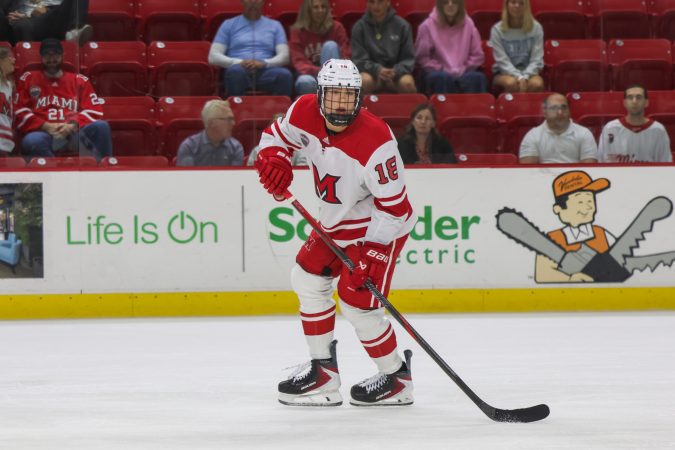
    According to his Instagram post in August 2024, Morozov committed to Miami (Ohio) University and coach Anthony Noreen, who was hired that April. In July 2025, it was official that the kid from Moscow would head to Oxford, Ohio.

    There was only one thing that would make someone pause when reading the news: Morozov, who played one year for the Windy City Storm based out of Illinois as a 15-year-old, and had just wrapped up his lone year for Tri-City of the United States Hockey League, was still 25 days away from his 17th birthday.

    “We felt like his game was mature enough, but we really knew that, just who he is as a person, we felt he would thrive in our environment,” Noreen said.

    Spoiler: he did.

    When Morozov squared up to take the opening faceoff on the season against Ferris State — he centered the top line, to boot — the now 17-year-old began 2025-26 as the youngest player in men’s Division I hockey. Noreen says that the school’s athletic director, David Sayler, likes to remind him it was against a 25-year-old, and Morozov finished the game with 20 minutes of ice time and an assist on the RedHawks’ second goal in a 6-4 win.

    “Morozov is intriguing in that he went to college early and was one of the youngest players,” FloHockey draft and prospect analyst Chris Peters told The Inquirer via text.

    “He didn’t look out of place and has the size and skill combination that suggests he could be a middle-six center with some scoring ability. His production slowed as the season progressed, but there were flashes of a player that could have some higher-end production capabilities if everything goes right.”

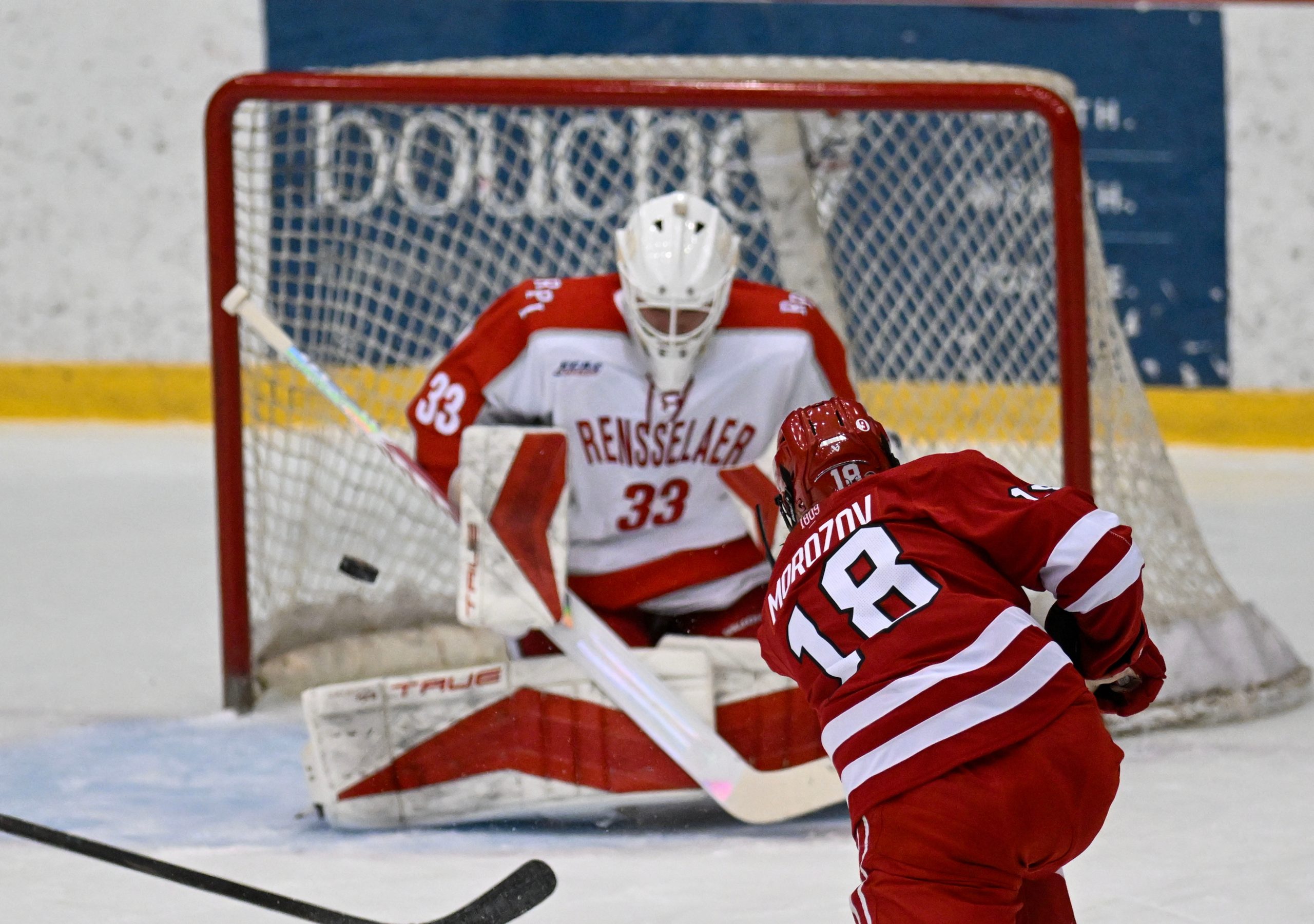
    Miami University forward Ilia Morozov (18) scores against RPI during the 2025-26 season. Hans Pennink

    A self-proclaimed two-way center who has good details in the defensive zone — the Flyers always like that — and can produce offensively, he went on a heater to start his collegiate career. In his first six games, he notched four goals and nine points.

    But then, as the RedHawks played their National Collegiate Hockey Conference schedule against teams like defending 2025 NCAA champion Western Michigan and eventual 2026 winner Denver, his scoring went a little cold. Morozov finished with eight goals — three on the power play and one shorthanded — and 20 points in 36 games, helping Miami go from a three-win season to 18 wins this past year.

    According to Elite Prospects, Morozov is a chaos creator in the offensive zone and a transition puck carrier who plays a middle-driven style. The lack of production did not impact him on or off the ice.

    “All the struggles and adventures and challenges [in life], they taught me that consistency just works, you should never give up and keep going,” Morozov said after finishing in the top 25 of eight fitness tests at the scouting combine, including atop the leaderboard for left-handed grip strength, tied for second on the right side, and tied for fifth all-time with 17 pull-ups. (The Flyers notably tend to draft players who do well in grip strength).

    “I believe that life’s fair, and if you put honest work, if you do 100% every time you have a chance, you will get the result.”

    What gives him such optimism?

    “Because that’s my experience,” he replied. “If I wasn’t doing something right, it was going one way. If I’m doing it right, it’s going the right way. So that’s personally just my experience, and I believe I did lots of work to be here.”

    ‘This Midwest way of ease’

    Like Peters, Noreen believes the offense will come for Morozov. And the coach was quick to note that while he may not have made the score sheet, the young center was involved in countless scoring chances each night, leading the team wire-to-wire in scoring chance differential.

    Using the word “involved” is important here because, keep in mind, when once asked what he wanted to be remembered for, Hockey Hall of Famer Brendan Shanahan responded, “That I was involved.”

    “I think he’s played such a mature 200-foot game that even when he’s not scoring — like, there’s certain players where, if they don’t score, they’re hurting you — he’s the guy that you love his game, you want him on the ice as much as possible,” Noreen said of Morozov. “When he scores, that even takes his game to another level, and we’re confident he’s going to do that.”

    But then Noreen said the part that should make every Flyers fan’s ears perk up:

    “You don’t get many guys that are 6-foot-2[¾], [205] pounds, and can skate and have a brain, and have all those things. He’s a rare package and … the makeup and the intentionality in which he goes about his business and [how he] works, and everything in the person is even more special. We know whatever his ceiling is, he’s going to get there because just the way that he goes about things.”

    On the flip side, Morozov said something that should also draw the Flyers’ attention. When asked how he looked at the opportunity to play against older players, he said: “I think that was an amazing opportunity, because I believe that if you play with somebody who’s better than you, it will make it better.”

    Ilia Morozov has a consolidated ranking of 20 on Elite Prospects, right in the Flyers’ wheelhouse.Lexie Cunningham/Miami Athletics

    This is all starting to fit the Flyers’ modus operandi since Brière took over:

    • a player over 6 feet — check
    • who is a center — check
    • playing hockey in North America — check
    • who is still 17 at the draft like seven players drafted since 2023 — check.

    And he would be the fourth Russian taken under the GM, too.

    And then there’s this: Although the question asked to Flahr on Tuesday was about the characteristics they look for in kids who are more of projects and not projected first-rounders, he gave more insight.

    “There are certain traits, whether it’s hockey sense, competitiveness, skill level. You can overcome size if you’ve got the great motor, big heart, and you’re smart, and certainly when you’re small, you’ve got to have some speed, quickness. … So, there’s different types of players you want to take a chance on, but there’s certain traits you have to have.”

    Well, let’s check these boxes, too.

    Competitiveness? A 17-year-old playing college hockey, he says one of his strengths is his compete level, and, per Noreen, “he’s a winning hockey player” with intensity across the board.

    Hockey sense? He’s a 200-foot, detailed center who can play at all strengths.

    Smart? He’s a finance major at a major university in his second language.

    Language was the biggest adjustment he said about coming to the U.S., but he was ready for the cultural aspects like how people don’t take their shoes off in their homes here. And he is learning French through Duolingo.

    Oh, and he said he’s working on his skating — a common theme for the Flyers — like his explosiveness and first few strides. Called an intense guy by Noreen, Morozov is putting in the work on the ice and in the gym by doing sprints, plyometrics, and weightlifting. The focus? So he can produce way more offense.

    And how about the intangibles like big heart or being a locker room guy? Well first, he stuck around after his media availability to translate for Maksim Sokolovskii.

    “I certainly think the size, the strength, the heaviness, the skating, the being a 6-3, 200-pound-plus centerman in a game that, when it comes down to it at the end, that’s what you need, and that’s what it takes,” Noreen said.

    “Also just the selflessness, the team first, the character, just all of those things added up, you want this kid on your team, you want him in your locker room, you want him as part of your organization. You can’t say that about every guy but this kid, without a doubt, you know he’s going to fit somewhere, and you know that you’re going to love.”