Tower Health reported an $8.5 million operating profit in the year that ended June 30, compared to a $20.6 million loss the year before.
The fiscal 2026 profit will be Tower’s first in eight years, if the result holds in its audited financial.
In the Berks County nonprofit’s preliminary financial report to bond investors Friday, Tower management called the result “an important milestone in Tower Health’s ongoing journey toward sustained financial strength.”
In addition to Pottstown, Tower owns Phoenixville Hospital and Reading Hospital in West Reading, and half of St. Christopher’s Hospital for Children in North Philadelphia in a joint venture with Drexel University.
Here are more details:
Revenue: Tower reported a 2% increase in revenue, to $2.07 billion from $2.03 billion. Reading Hospital in West Reading logged an 11% increase in revenue, while the combined revenue of Phoenixville and Pottstown Hospitals fell 8%.
Patient volumes: Pottstown saw an 11% decrease in hospital admissions, likely because Tower closed the hospital’s intensive care unit at the beginning of the this year. Phoenixville had a small gain of 0.7% in admissions, while Reading was flat. Total surgeries across the system were flat.
Notable: A year ago, Tower reported a preliminary operating profit of $5.9 million for fiscal 2025, thanks to a gain on the sale of the former Brandywine Hospital. That would have been the system’s first profit in seven years, but it turned into a $20.6 million loss in Tower’s audited financial statements. Auditors from KPMG decided that Tower needed to boost medical malpractice reserves and give up on collecting millions owed by patients.
In an email to The Inquirer, Tower CEO Michael Stern expressed confidence this year’s audit will uphold the preliminary result, giving Tower its first profitable year since 2017.
Deli Boys, a crime dramedy set in Philadelphia, has been canceled after two seasons, according to Deadline.
The Hulu series followed a pair of Pakistani American brothers, Raj and Mir (played by Saagar Shaikh and Asif Ali, respectively), as they took over their deli-magnate father’s empire — and reckoned with his secret criminal enterprises.
Created by Temple University alum and former Philadelphia Weekly journalist Abdullah Saeed and executive produced by South Philly native Michelle Nader, Deli Boys packed plenty of Philly references into its 16-episode run, from SEPTA jokes to expired Tastykakes and a Super Bowl watch party.
And the titular delicatessen, “ABC Deli,” was inspired by a real Philly institution at Third and Poplar Streets in Northern Liberties.
The show, however, was filmed in Chicago.
Deli Boys also centered on South Asian characters, with the core cast being of South Asian descent — a “rarity in Hollywood in 2026,” Deadline wrote.
“Thank you to every brown and Muslim and Pakistani and immigrant person who saw themselves in my show,” Saeed wrote on Instagram. “I created this world and these characters for YOU.”
Saeed told the next generation in his post: “I hope I helped you see that you deserve the airwaves, no matter how hard you have to fight for your rightful place.”
Queer Eye star Tan France, who played a British Pakistani gang leader on the show’s first season, previously told The Inquirer that the show “represents us [South Asians] so beautifully.”
France reprised his role for season two, and Saturday Night Live alum Fred Armisen also joined the cast as a Philly gambling savant.
Deli Boys “gives us a chance to be real, fully formed humans,” France said.
The show “failed to find a wide enough audience” to justify a third season, according to Variety, and sources told Deadline the show’s cancellation was due to ratings.
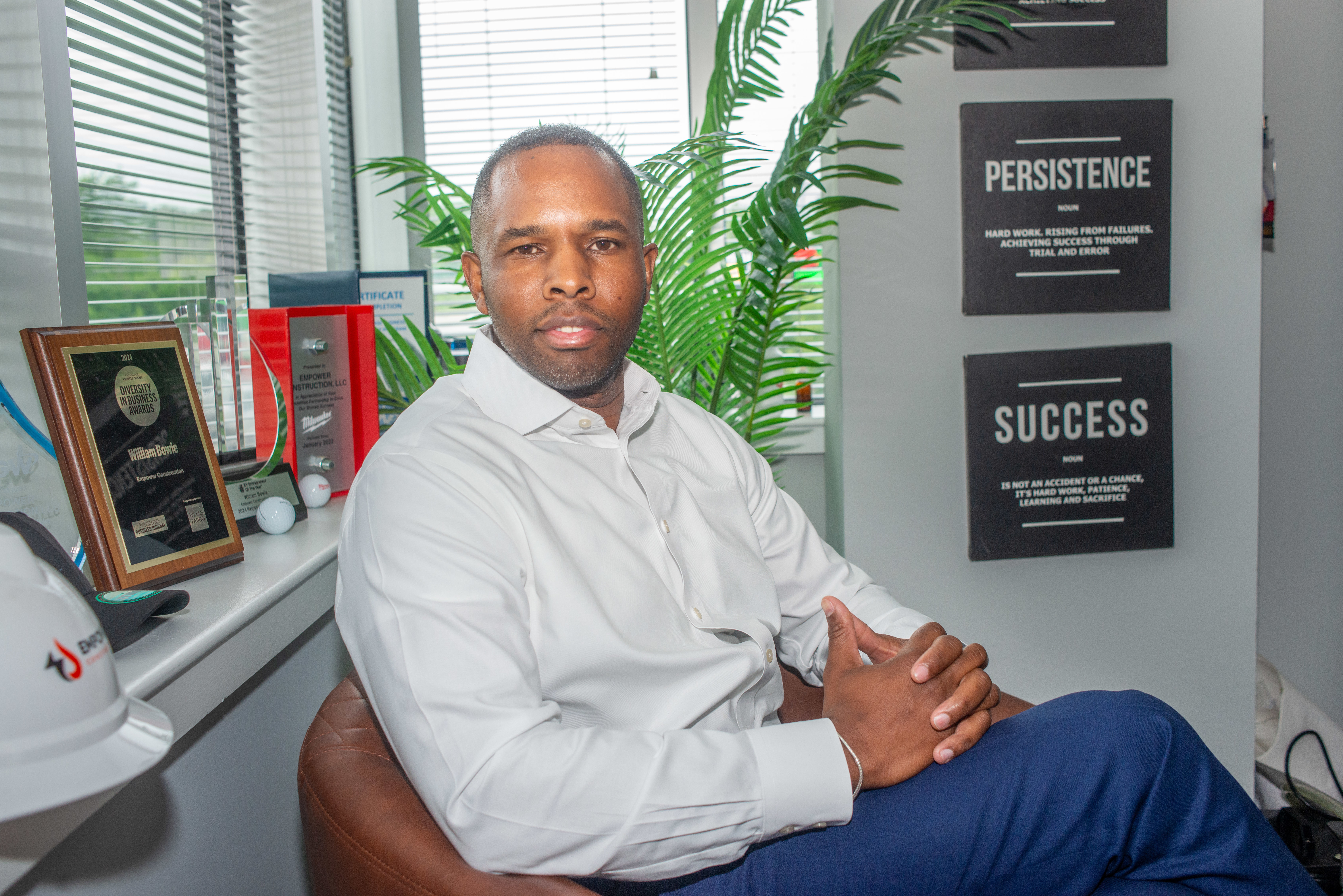
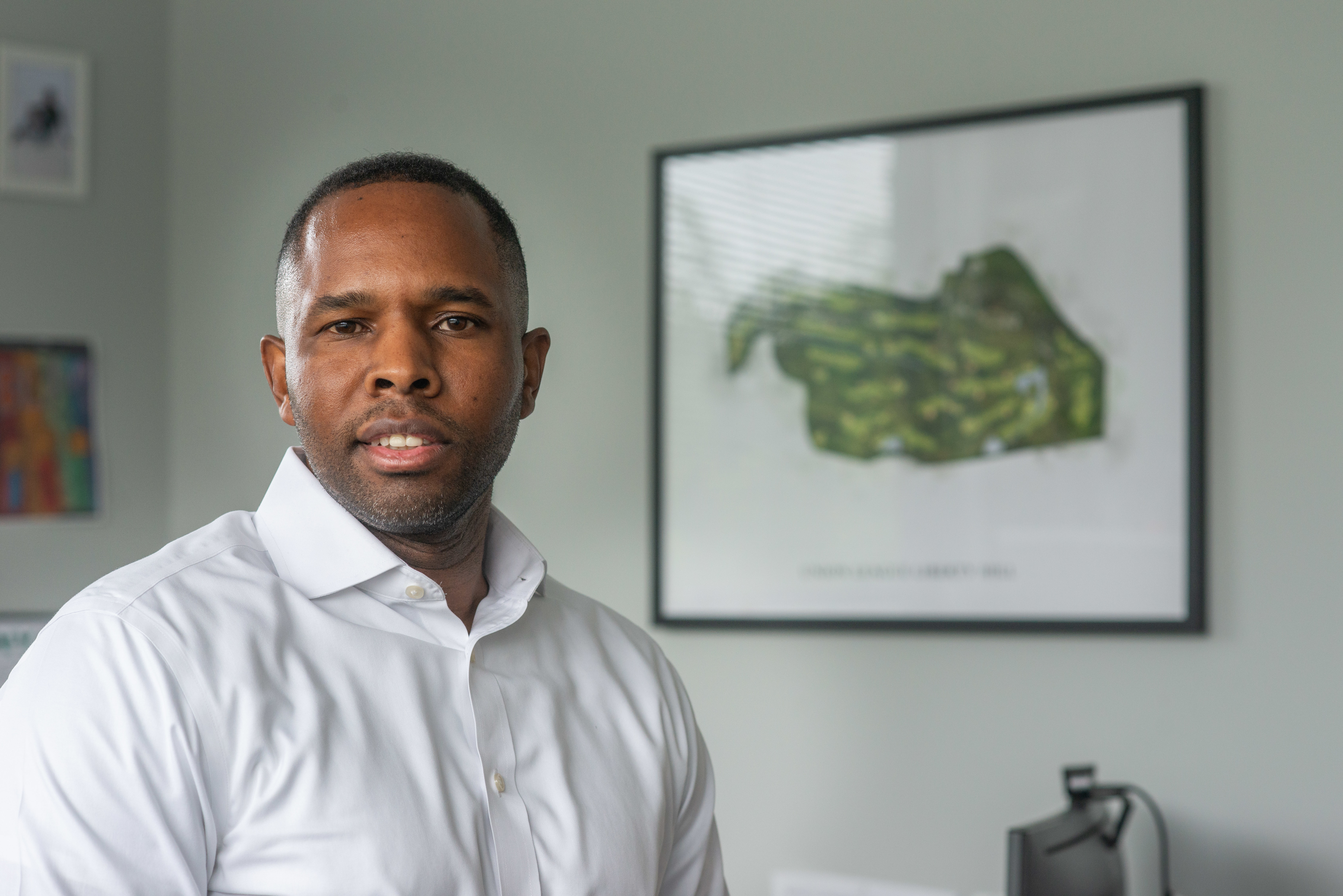
Growing up, William Bowie measured poverty in cups of water warmed in the microwave for his morning baths at a sink. He lived in the Richard Allen public housing project in the Poplar section of North Philadelphia, raised with his brother by a single mother. Even as a high schooler, he was eager to improve his life’s circumstances, but lacked just about everything he needed to do so except a willingness to work hard.
Three decades later, Bowie is president and CEO of his own nine-figure construction company, a journey that he largely attributes to a Philadelphia-based trade community apprenticeship system, similar to the “Nwa Boy” model that has been practiced in West Africa for centuries.
“I kind of challenged myself,” said Bowie, who’s 42,referring to his mindset when he was embarking on his career. “Why can’t I be the best? And why can’t I open that door for others?”
Bowie’s path is hardly an isolated success story. It is one node in a growing, informal network — from union apprenticeships in Philadelphia to a training cohort in Oakland, Calif. — of programs borrowing the Nwa Boy model’s core promise: a credentialed path from labor to ownership, built on relationships and trust rather than credit scores or venture capital.
As race-conscious funding efforts designed to level the playing field for African Americans are dismantled, that promise is drawing new attention from investors, workforce officials, and Black entrepreneurs looking for an alternative route to generational wealth.
The Nwa Boy system, which has its roots in the communities of the Igbo people in southeastern Nigeria, works this way: An established craftsman or business owner — known as the “Oga,” or master — takes on the training of a young person — known as the “Nwa Boy” (pronounced: nwah), or apprentice — often straight out of secondary school.
The apprentice lives and works closely with the Oga for as long as eight years, learning the nuances, logistics, and administration of their chosen craft.
When the apprenticeship ends, the Oga provides the graduate with a “settlement,” or capital — which often includes giving them money or business space — to launch their own independent businesses. The apprentice then continues the cycle.
The Harvard Business Review has called the Nwa Boy system “a Nigerian model for stakeholder capitalism” in which community, workers, and shared prosperity take precedence over individual shareholder return.
In 1970, at the conclusion of three years of civil war, the Igbo people used the Nwa Boy system to build a multibillion-dollar economy from the ground up. That’s when the Nigerian government seized control of the nation’s financial institutions and gave the equivalent of only about 20 British pounds (or roughly $400 in today’s money) to every Igbo adult, regardless of how much they had in their bank accounts before the conflict.
Today, at a moment when Black Americans are witnessing the erosion of affirmative action and DEI programs through court rulings and presidential executive orders, Bowie and others believe the Nwa Boy system may provide an answer to the question of what happens when the system meant to fix a problem becomes the next thing that needs fixing.
As he was embarking on his career in construction, North Philadelphia native William Bowie said he asked himself, “Why can’t I be the best? And why can’t I open that door for others?”William Thomas Cain / For The Inquirer
The blueprint
While Bowie’s blueprint moves from employment to ownership, it did not happen in a vacuum.
After finishing his first year at Drexel University, Bowie faced a dilemma — he had no way to pay a $6,500 bill to enroll for his sophomore year.
“I tested into a magnet school,” Bowie said. “Academics wasn’t a problem. I was thriving in that environment. It’s just that financially I couldn’t afford it after the first year.”
Bowie was not deterred.
“I looked for a different path,” he said. “I tried to make money to get back into my second year in college.”
In Nigeria, young men had been solving the same problem for generations — not with legislation, but with a handshake that meant more than a contract between an Oga and their apprentice. The pact is simple: The master teaches. The apprentice serves.
In North Philadelphia, though, the syndicate of trust had little that resembled the stalls of Lagos’ Alaba International Market. It had Frank Murray.
Murray, a member of the International Brotherhood of Electrical Workers (IBEW) and a family friend of Bowie’s mother, Margaret, encountered a young man desperate for an opportunity. He told Bowie, “This is where the money is at.”
In the Nwa Boy system, the Oga does not simply teach a trade — he transfers his reputation, his customer network, and at the end of the apprenticeship cycle, his start-up capital. The system does not run on contracts, but on trust enforced by community witnesses.
Murray gave Bowie the same thing — a pathway — and Bowie walked through it. Bowie joined IBEW at 19 years old.
He completed a four-year U.S. Department of Labor-certified apprenticeship in three and a half years, earned $75,000 in his first year, and rose to become the youngest area manager overseeing about $300 million in business.
Bowie says IBEW gave him what the Nwa Boy system has always understood, and American institutions have always struggled to replicate — a means to succeed that required no college degree, no venture capital pitch, and no generational wealth.
‘Financial gravity’
Bowie’s playbook from two decades ago is what many American venture builders and investors are now being forced to consider as the formula for prosperity is being recalibrated. They must confront the brutal reality that even seven-figure salaries are no guarantee for wealth creation.
“A paycheck — even a seven-figure one — is just a stay of execution. It doesn’t detach you from financial gravity,” Brandon Jones, founder and CEO of Gravy Capital, said during a virtual panel in April hosted by Visible Hands VC.
When Bowie applied for capital to launch his company, Empower Construction, he felt the earth tugging at his dreams. Even though he had two decades of industry experience and managed a $300 million book of business, the banks still said no.
What finally opened the door was not a stronger application, but a different messenger.
One of Bowie’s mentors, Daniel K. Fitzpatrick, an executive at Citizens Bank, made a single phone call to his colleagues. A line of credit came through. To Bowie, it was the equivalent of receiving an Oga’s settlement.
Saantis Fenmu Davis, a Philadelphia-based financial literacy educator and founder of Geb Cultural Exchange, said the problem starts earlier than the bank. He said it’s essential that Black Americans are taught how to be producers and investors, and not just consumers. “While higher spending and status-signaling often masquerade as affluence, they represent a fundamental mirage of social capital, which may or may not translate to equity or wealth,” he said.
Saantis Fenmu Davis, a Philadelphia-based financial literacy educator and founder of Geb Cultural Exchange, says consumerism is a “fundamental mirage of social capital.”Courtesy of Saantis Fenmu Davis
Murray did not teach Bowie to consume. He taught him to produce.
Patrick Clancy, president and CEO of the city’s workforce development program, Philadelphia Works, is trying to replicate what Murray did across its programs. Philadelphia Works manages roughly $11 million in apprenticeship funding across skilled trades and emerging sectors including IT, healthcare, and education.
Murray was Bowie’s Philadelphia Works, but the path is not without its shadows.
For every successful apprenticeship program or Nwa Boy story told, there is a possibility of exploitation.
In the Nwa Boy framework in Lagos, Nigeria, some apprentices have reported exploitation at the hands of their masters.
Naboth Nwaikwu spent 20 grueling years navigating three successive apprenticeships before finally being settled. He was an orphan. His first master did not settle him because his aunt and uncle instructed him not to. The same thing happened the second time.
It wasn’t until his third attempt, under the apprenticeship of a friend, that he got his settlement, all of which could not account for the years lost.
Nwaikwu now sells construction accessories for a living at Lagos’ Alaba International Market, and makes enough profit to take apprentices of his own if he wanted to, but told me he refuses to do so because “There is a thin line between unpaid apprenticeship and indentured service. I do not want to be the one to cross it.”
Uyi Samuel Oni, a corporate attorney licensed in Nigeria and trained at the University of Pennsylvania’s Carey Law School, said the covenant must become a contract before it can successfully cross continents. “The Nwa Boy system must avoid negative historical connotations linked to terms such as master,” Oni said.
Uyi Samuel Oni, a corporate attorney licensed in Nigeria and trained at the University of Pennsylvania’s Carey Law School, says the Nwa Boy covenant must become a legally binding contract before it can successfully be used in America.Courtesy of Uyi Samuel Oni
A legally compliant American adaptation, he said, must be a win-win for both parties — not merely vocational or community service, but a binding agreement that protects the apprentice’s right to the capital payout that makes ownership possible.
In Oakland, a program called Built Here has emerged as a 21st-century proxy for the Nwa Boy system.
Onye Ahanotu, a former Harvard engineering research fellow and founding member of Built Here, uses training cohorts to mirror the communal trade apprenticeships of southeastern Nigeria. “We meet every week,” Ahanotu said.
The frequency is intentional. In the Nwa Boy system, the covenant is not a one-time transaction — it is a continuous relationship between master and apprentice, reinforced week by week, skill by skill, until the apprentice is ready to stand alone.
Clancy, of Philadelphia Works, understands that frequency. But he said the barriers that push apprentices out are not about ambition. They are about logistics. Most apprentices who do not complete the program fall offbecause of logistics — literacy gaps, a lack of childcare, transportation difficulties, and rigid drug-testing requirements.
The apprenticeship demands sacrifice.
Bowie was 19 years old and the only African American male in a trade that was overwhelmingly white and male. The culture shock was real. His determination was not given. It was chosen every single day.
Bowie narrated his apprenticeship years as a period of determination and exposure to wealth — not suffering. Once he entered IBEW, his obstacles became opportunities.
Clancy said Philadelphia Works offers pathways into the building trades and is open to second-chance applicants. Prior convictions are not automatic disqualifiers. The door is open. Most people do not know it is there.
At the Philadelphia Navy Yard, Hanwha builds ships. The company needs welders. It cannot find them.
Patrick Clancy, president and CEO of Philadelphia Works, the city’s workforce development program, which offers pathways into the building trades and is open to second-chance applicants.Courtesy of Patrick Clancy
Not because the welders do not exist. Not because the work is not there. Not because the wages are not competitive — apprenticeship wages in the building trades start at $25 per hour and can exceed $100,000 annually with overtime. The positions have gone unfilled for three years, Bowie said, because nobody told the kids in North Philadelphia, West Philadelphia, and Germantown that the door is open.
Bowie knows this the way he knows everything about the trades — from the inside. He gives talks online. He goes into Philadelphia schools. And while he may not have known about the Nwa Boy system when he was an apprentice, he regularly references its principles today.
He stands in front of teenagers the same age he was when the system ran out of road for him and tells them what Murray told him: This is where the money is at.
“In Philadelphia, there’s a shipbuilding company at the Navy Yard,” Bowie said. “They need welders. They can’t find them. And you’re telling me that in the city of Philadelphia, in the communities that we come from, that we can’t find welders?” He paused. “The parents don’t know. The kids don’t know. Nobody’s telling them.”
Clancy is trying to change that. Philadelphia Works is actively pursuing apprenticeship funding for Hanwha’s shipyard — planned cohorts of 20 to 30 apprentices at a time. The infrastructure, funding, and jobs exist. What is missing is the same thing that was missing when Bowie was standing at the edge — someone to point at the door.
Murray pointed. One phone call — and a kid from the Richard Allen Homes became a $100 million CEO. Philadelphia has not yet produced its Frank Murrays at scale.
Bowie is working on it. One conversation — and one handshake — at a time.
Ibe Imo is a Philadelphia-based investigative journalist whose reporting examines technology, power, capital, and the systems that determine who builds wealth and who pays for it. He is a recent graduate of the master of journalism program at Harvard University.
For decades, a second-degree murder conviction in Pennsylvania meant an automatic sentence of life in prison — even for people who did not kill anyone.
But in March, the Pennsylvania Supreme Court ruled that punishment unconstitutional in the case of Derek Lee, a Pittsburgh man who argued the mandatory nature of the sentence violated constitutional prohibitions against cruel punishment.
The high court gave the state legislature 120 days to devise an alternative and decide whether to apply it to those already serving the sentence.
That deadline passed without a resolution on July 24. And in early August, the high court rejected a bid by several district attorneys to give lawmakers more time.
So what happens now? Here’s what to know.
What was the maximum sentence for second-degree murder — and what is it now?
Before the ruling, the punishment was life without parole. Now there is no clear answer.
Setting criminal penalties is the legislature’s job, and lawmakers have not put in place a replacement.
The high court’s ruling did not abolish life without parole for felony murder; it only barred making the punishment automatic. A judge may still impose such a sentence, but only after weighing a defendant’s role in the crime.
The justices declined to say whether the ruling applies retroactively to people already serving those sentences, leaving that question to lawmakers, too.
How will judges sentence second-degree murder now that there’s no mandatory penalty?
With no law to guide them, judges are left to their own decisions. And without statewide guidelines, similar cases could end differently depending on the county in which a defendant is tried and on the judge who hears the case.
Philadelphia District Attorney Larry Krasner has expressed little concern about the lack of guidelines.
In an interview this week, Krasner, a Democrat who has forged a path as a progressive prosecutor, said “there’s nothing unusual” about asking judges to weigh the facts and use their discretion. “I’ve always believed that mandatory sentencing is problematic at best, usually a terrible idea, and that individual justice is what the system is supposed to be about,” he said.
But at a joint GOP policy committee meeting in Hazleton last week, several Republican prosecutors and lawmakers voiced concern about the lack of uniformity across the state.
Luzerne County District Attorney Sam Sanguedolce pointed to a case in which a defendant recently asked to plead guilty to second-degree murder.
“I can’t properly advise the defendant what the consequence might be,” Sanguedolce said. “Second [-degree murder] sounds like it’s better than first, but is it? We don’t even know.”
What happens to the people already serving life in prison?
For the nearly 1,100 people serving life for second-degree murder, nothing changes automatically.
The ruling made only one person eligible for resentencing: Lee. And even he could again receive life without parole, if a judge finds his role warrants it.
Others who wish to have their life sentences reconsidered have to go to court and ask to be resentenced. Bret Grote, a lawyer with the Abolitionist Law Center who represented Lee, said such petitions are likely to be denied by trial courts until retroactivity is settled.
Hundreds are expected to try anyway.
That flood could overwhelm courts and public defenders. Statewide, handling the cases could cost more than $34 million, the Public Defender Association of Pennsylvania estimates. In Philadelphia — home to more than 500 people currently serving such sentences — Chief Defender Keisha Hudson puts her office’s share at $40,000 per defendant, or $24 million total.
“We are going to need substantial funding,” she said last week, adding that she hopes to meet soon with city officials about how to pay for it.
Legal experts expect the question of retroactivity to reach the state Supreme Court again, either through an appeal of a lower court’s denial or a so-called King’s Bench petition asking the justices to take up the issue directly.
Lawmakers could also provide a quicker alternative by writing legislation that allows people serving second-degree murder sentences to seek parole, rather than requiring individual resentencing.
Can lawmakers still pass a fix, and what might that look like?
Lawmakers say negotiations will resume when they return in September. Each chamber has passed its own bill, but the two are far apart, with no compromise in sight.
The bill in the Republican-controlled Senate would set a 35-year mandatory minimum for most second-degree murder convictions, while keeping life without parole as an option. Current lifers would become eligible for parole after 35 years — or 20 years, if they are at least 70.
The measure in the Democratic-led House sets no mandatory minimum, instead directing the Pennsylvania Commission on Sentencing to write guidelines while keeping life without parole available. It would make current lifers parole-eligible after 30 years and add a medical parole option for the terminally ill.
Sen. Lisa Baker (R., Luzerne), who wrote the Senate proposal, said she is still hopeful that her caucus and House Democrats will reach a deal. But the parties remain far apart, she said.
“It’s difficult when you’ve got people whose priorities are no mandatory minimums for any crime,” she said. “I understand that we want to keep nonviolent first-time offenders [out of prison], give people second chances. But there needs to be accountability for these crimes.”
Few expect action before November’s midterm elections. “We can’t, unfortunately, make Harrisburg move any more quickly than they already are,” said Hudson, of the Defender Association. “And in the meantime, there are a lot of questions.”
What does all this mean for victims’ families?
Victims’ families are caught in a limbo of their own, said Melany Nelson, executive director of Northwest Victim Services, a Philadelphia nonprofit that assists crime victims.
Those whose loved ones’ killers have not been sentenced are now waiting to learn what punishment will come, and whether it will feel like justice. Those whose cases closed long ago face now the prospect of being summoned back — to a courtroom or a parole hearing — to confront the killer again and potentially watch them set free.
Nelson urged families to contact prosecutors’ offices and victim-advocate services now, rather than be caught off guard, and to weigh in with their state lawmakers.
“We do not want them to be blindsided by anything,” she said.
Correction: A previous version of this article incorrectly described what could happen to people who wish to appeal their sentences. Bret Grote, a lawyer with the Abolitionist Law Center, said such petitions are likely to be denied by trial courts until the question of whether a recent Pennsylvania Supreme Court ruling applies retroactively is settled.
Hayden Panettiere, a former child actor who rose to fame and starred in TV shows Heroes and Nashville, died Aug. 16 in South Carolina. She was 36.
South Carolina’s Greenville County Coroner’s Office confirmed her death, saying she was in cardiac arrest before she died. Emergency medical services responded to a 911 call reporting a cardiac arrest at 1:51 p.m. on Sunday at a residence in Greenville, where they found Ms. Panettiere unresponsive. She was pronounced dead at 2:32 p.m. after lifesaving measures were attempted. There were no signs of trauma, and the cause of death needs further investigation, the office said in a statement.
In May, Ms. Panettiere released a memoir, This Is Me: A Reckoning, in which she detailed her life growing up in the spotlight, and her struggles with postpartum depression, substance abuse, and domestic abuse.
She began acting as a child, gaining her first television credit before she turned 5 on the soap opera One Life to Live. At 10, she starred in the movie Remember the Titans.
Her big break came when she played a high school cheerleader with regenerative superpowers in Heroes in 2006; the TV series ran for four seasons. She later portrayed rising country artist Juliette Barnes on Nashville. She also had roles in the Scream horror franchise, Bring It On: All or Nothing and the rom-com I Love You, Beth Cooper.
Tributes to the actor poured in Monday. “I wish the world had more time with you because I had a burning curiosity about who you were becoming. I saw this beautiful Phoenix rising from the ashes,” actor Viola Davis posted on Instagram.
In an interview on Jay Shetty’s On Purpose podcast released in May, Ms. Panettiere described her debilitating anxiety, alcoholism, and custody battle over her child, circumstances she said were written into her character on Nashville. “It felt like it never ended. I didn’t know where Juliette began and Hayden ended,” she said.
In her memoir and press tour interviews, she described her struggles with postpartum depression, drugs, and alcohol, and the death of her brother three years ago. She also discussed the pressure to please everyone and her fractured relationship with her mother, who served as her manager for years in her childhood, where “everything was business.”
“I finally feel like I have shaken off all of this darkness and this negativity. … And that means I closed one door and another door is opened,” she said on the podcast. “And I can feel all the … exciting possibilities. I feel like I have a lot more life to live.”
Auditioning before she could walk
Ms. Panettiere began acting when she was 11 months old, auditioning for a Playskool train commercial. By 1994, she landed a role on ABC’s soap opera One Life to Live.
“Part of me just wanted to have friends, a place at a cafeteria table, teachers who were kind to me, and lots of fun at recess. But another part of me loved the rush I got from acting and the fact that it made Mom so proud,” she wrote in her memoir.
At 10 years old, she had caught the attention of the casting director for Remember the Titans. She went on to play Sheryl Yoast, a football-loving preteen. “As Sheryl, I was strong and authentic, and on Remember the Titans I was the happiest I’d ever felt as an actor,” Ms. Panettiere wrote.
Soon after, at 12, she secured a guest role as the nerdy babysitter on Malcolm in the Middle. The role was thanks to her mother, Lesley Vogel, who had played the wife of Bryan Cranston’s character on Loving. In her memoir, Ms. Panettiere recalled Cranston, an episode director for Malcolm, saying, “Hayden is so wrong for this role, but we’re going to make this work.”
Once Ms. Panettiere turned 17, she was well known by casting executives, and she was asked to audition for the role of Claire Bennet — the Texas cheerleader with self-healing powers on NBC’s Heroes. She is best known for her performance in Heroes and her role as Juliette Barnes on Nashville.
Barnes’ struggles with postpartum depression and addiction mirrored Ms. Panettiere’s life. In her memoir, Ms. Panettiere wrote about realizing the Nashville writers were modeling the script after her life; playing Barnes became “looking in a funhouse mirror, seeing a distorted reflection,” and diving “headfirst into my own hell.” She took a leave of absence from the show to seek professional treatment.
Struggles with addiction
Ms. Panettiere had long struggled with body dysmorphia, anxiety, and depression, according to her memoir. In the book, she described one paparazzi photograph of herself that showed the back of her thighs. A magazine published it with a banner over her legs: “CELLULITE.”
At an industry event, when she was about 16, a former representative pulled her aside to offer her a “happy pill” before a press interview, she recalled in her memoir. The pills, Ms. Panettiere wrote, “were the gateway drug that ushered me toward the good of pharmaceuticals and the downfall of addiction.”
While nerves pushed her forward as a child actor, they eventually overtook her, she wrote. She was prescribed Klonopin but turned to alcohol since it interfered less with work.
After the birth of her daughter in 2014, her drinking increased as she dealt with postpartum depression. Antidepressants wouldn’t mix well with alcohol, and “I wasn’t ready to stop drinking,” Ms. Panettiere said on a 2023 television appearance. Around the same time, an old neck injury had flared up, and she’d begun taking opioids, she said.
Ms. Panettiere developed jaundice from alcohol abuse. In the memoir, she recalled a doctor’s warning that she’d be dead in five years if she didn’t stop drinking.
She put herself in rehab during the middle of production for the fourth season of Nashville in 2015. The producers temporarily wrote her character out of the script. By her return, Ms. Panettiere’s personal life matched much of the script: Juliette Barnes had postpartum depression, an alcohol and pill addiction, and an impending divorce.
At the time of writing her 2026 memoir, Ms. Panettiere was in recovery.
A complex personal life
Ms. Panettiere’s personal life was relentlessly complex and often tragic. Her parents separated in 2008 while Ms. Panettiere was starring on Heroes, and their protracted divorce proceedings concluded in 2016.
Ms. Panettiere was in an on-and-off relationship with the Ukrainian heavyweight fighter Wladimir Klitschko from 2009 to 2018. The couple got engaged in 2013 but never married.
After the birth of their daughter, Kaya, in 2014, Ms. Panettiere’s postpartum depression led her to seek treatment for substance abuse. In 2018, Klitschko requested full custody of Kaya in Ukraine; Ms. Panettiere granted it.
From 2018 to 2022, Ms. Panettiere dated actor Brian Hickerson. Their breakup resulted in Ms. Panettiere obtaining a protective order against Hickerson, and her memoir describes their relationship as physically abusive.
Ms. Panettiere’s brother, Jansen — a fellow actor — died in 2023 at 28 from complications of an enlarged heart. Ms. Panettiere, 33 at the time, said she had “lost half my soul.”
In adulthood, Ms. Panettiere had a difficult relationship with Vogel, her mother, she said. A former soap opera actor, Vogel was her daughter’s manager early on, and she disputed Ms. Panettiere’s accounts of being pushed too hard in her childhood acting years.
Besides her father and her mother, survivors include her daughter, who lives with Klitschko. Ms. Panettiere had said in May she maintained a strong bond with her daughter and remained close to Klitschko.
After two weeks at the ICE detention center Delaney Hall in Newark, the owner of Zena’s American Mediterranean Cuisine in Collingswood was granted bond on Friday and released to his family.
Iemad Saifo, an immigrant from Syria, was detained during a routine check-in at the ICE office in Mount Laurel. He came to America in 2002 on a business visa and later sought asylum after the outbreak of the Syrian civil war.
According to ICE, Saifo was arrested because he does not have permanent status and for a 2018 case where he was indicted and found guilty of witness tampering and sentenced to five years’ probation.
Dozens of community members from the Collingswood area wrote 150 letters and signed a petition to urge the court to keep him in South Jersey with his family. Many know him from the restaurant that’s been open since 2011.
Voorhees Township is set to have a new solar field that should expand access to renewable energy and to lower utility bills for New Jersey residents.
The 13.5-acre solar field is part of the state’s Community Solar Energy Program, which allows households who use the state’s four major electricity providers to subscribe to a participating solar facility and receive renewable credits on their bills without having to install solar panels themselves.
Solar panels are expected to cover about half the property that used to be a 35-acre landfill. It’s been largely untouched since it closed in 1972.
When complete, more than half of the energy generated from the project will be dedicated to low- and moderate-income households, according to a township administrator.
Haddon Township police are looking for additional victims and witnesses after they arrested a Camden man on Thursday following an investigation into multiple incidents of sexual misconduct including involving minors.
A 60-year-old man from Sicklerville was arrested in connection to multiple burglaries of residents’ backyard sheds, according to Gloucester Township Police. He is charged with three counts of burglary, two counts of theft, and one count of resisting arrest, among others.
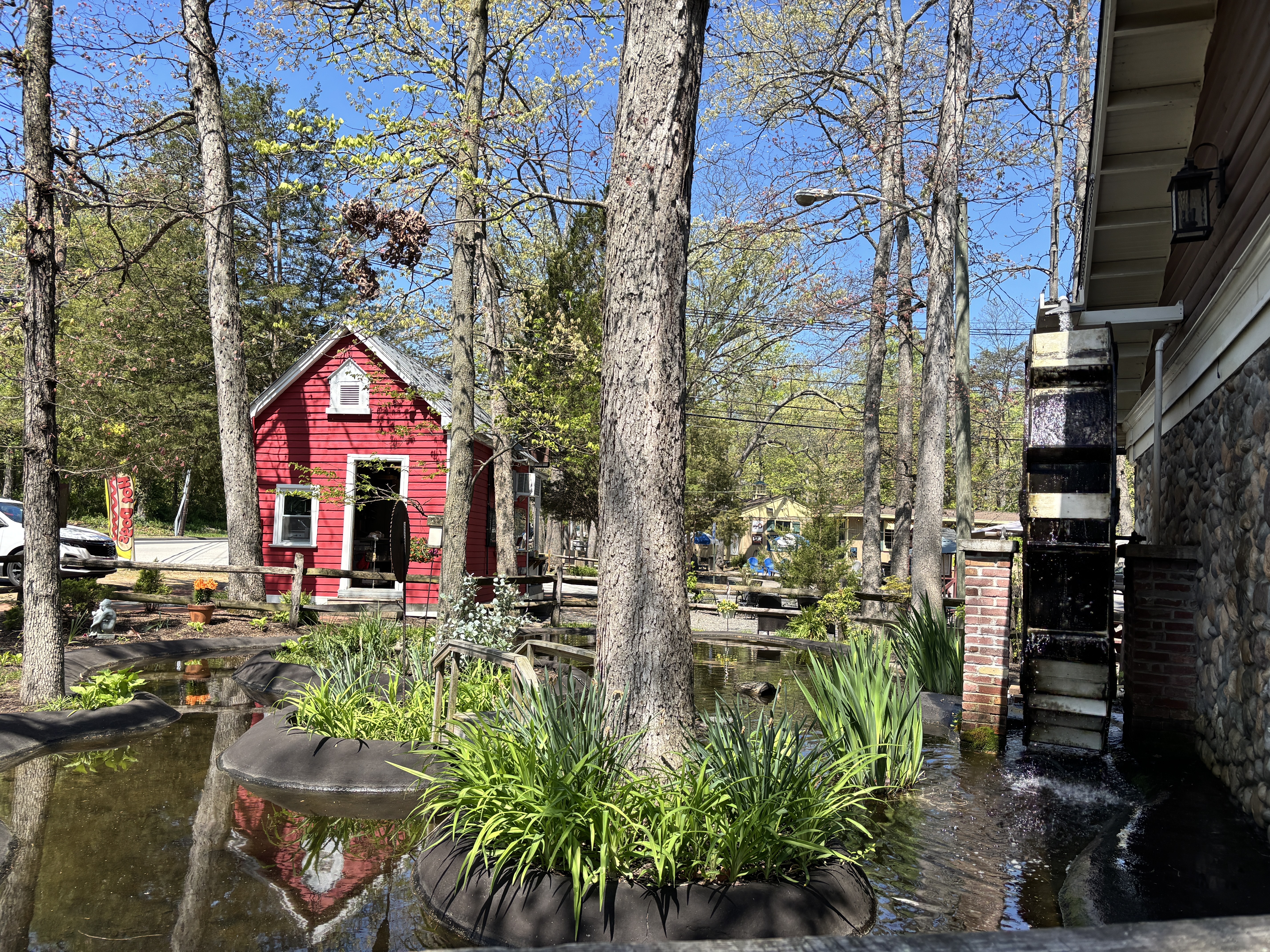
A spring morning at the Rancocas Woods Village of Shops in Mount Laurel.Taylor Allen
The various wood-framed businesses, which include casual eateries, boutiques, vintage shops, and a book store, sit on Creek Road among trees in Mount Laurel. They make up the Rancocas Woods Village of Shopsand it’s always a charming visit.
What does your community look like? What South Jersey memory would you like to share? Submit a photo and/or a brief description for a chance to be featured in the Monday edition of this newsletter.
A former landfill in Voorhees Township will become the home of a new solar field aimed at expanding access to renewable energy and lowering utility bills for New Jersey residents.
Once complete, the 13.5-acre community-scale solar array will join the more than 200 solar projects that make up the state’s Community Solar Energy Program.
Started in 2019, the program allows households served by the state’s four major electricity providers — Public Service Electric & Gas, Jersey Central Power & Light, Atlantic City Electric, and Rockland Electric Co. — to subscribe to a participating solar facility to receive renewable energy credits on their bill without requiring that they install solar panels themselves.
The program also mandates that a majority of the available renewable energy be set aside for low- and moderate-income households, who are less likely to be able to install their own systems, program manager Sawyer Morgan said in an email.
There are now more than 51,000 households subscribed to the community solar program statewide, Morgan said, receiving over $18 million in net savings since the first projects came online in 2021.
Most of the existing community solar projects are at capacity for participating households, he said, but the program anticipates over 100 additional solar projects to be completed and operational before the end of the year.
While New Jersey is currently home to 209 community solar projects with a total capacity of 291 megawatts, Morgan said, an additional 392 projects that are in development or under construction will add 703 megawatts of capacity to the grid.
“These projects are all on rooftops, canopies, landfills, contaminated sites, mining sites, and certain bodies of water as floating solar,” he said, including the solar project in Voorhees.
The 35-acre landfill on Centennial Boulevard ceased operations in 1972, and the property was acquired by the township five years later. In the decades since, the land has remained largely untouched, unable to be developed because of its prior use.
Now, solar panels are expected to cover about half the property, according to development plans approved by the Voorhees Township Planning Board last month. The exact configuration of the panels will be finalized before construction begins, the plans show.
The developer, Voorhees Solar LLC, was not immediately available for comment about the construction schedule, overall cost, and other project details. The company is owned by the Pegasus Cos. Inc., a wireless and broadband service provider based in Bala Cynwyd, according to the application submitted to the township.
“We can’t build a park or redevelop it with homes,” said Stephen Steglik, Voorhees Township administrator. “The only other option was keeping it empty and in its current state.”
At least with the solar project, he said, the township can create savings for residents while also collecting nearly $900,000 in one-time land lease fees.
The project will have the capacity to produce around four megawatts of energy when operating at full power, according to the project plans, enough to power up to 4,000 typical households.
Of the energy is generated by the project, 51% is going to be dedicated to low- and moderate-income households, Steglik said.
“While costs are going higher and higher, at the very least Voorhees Township is trying to take steps to maintain utility costs and at least try to save people a little bit of money,” he said.
U.S. borrowing is at record levels, interest rates are up, and Social Security is running low on cash. Yet new Federal Reserve Chairman Kevin Warsh has offered investors little information on whether the Fed will boost interest rates and fight inflation, or cut rates to feed growth.
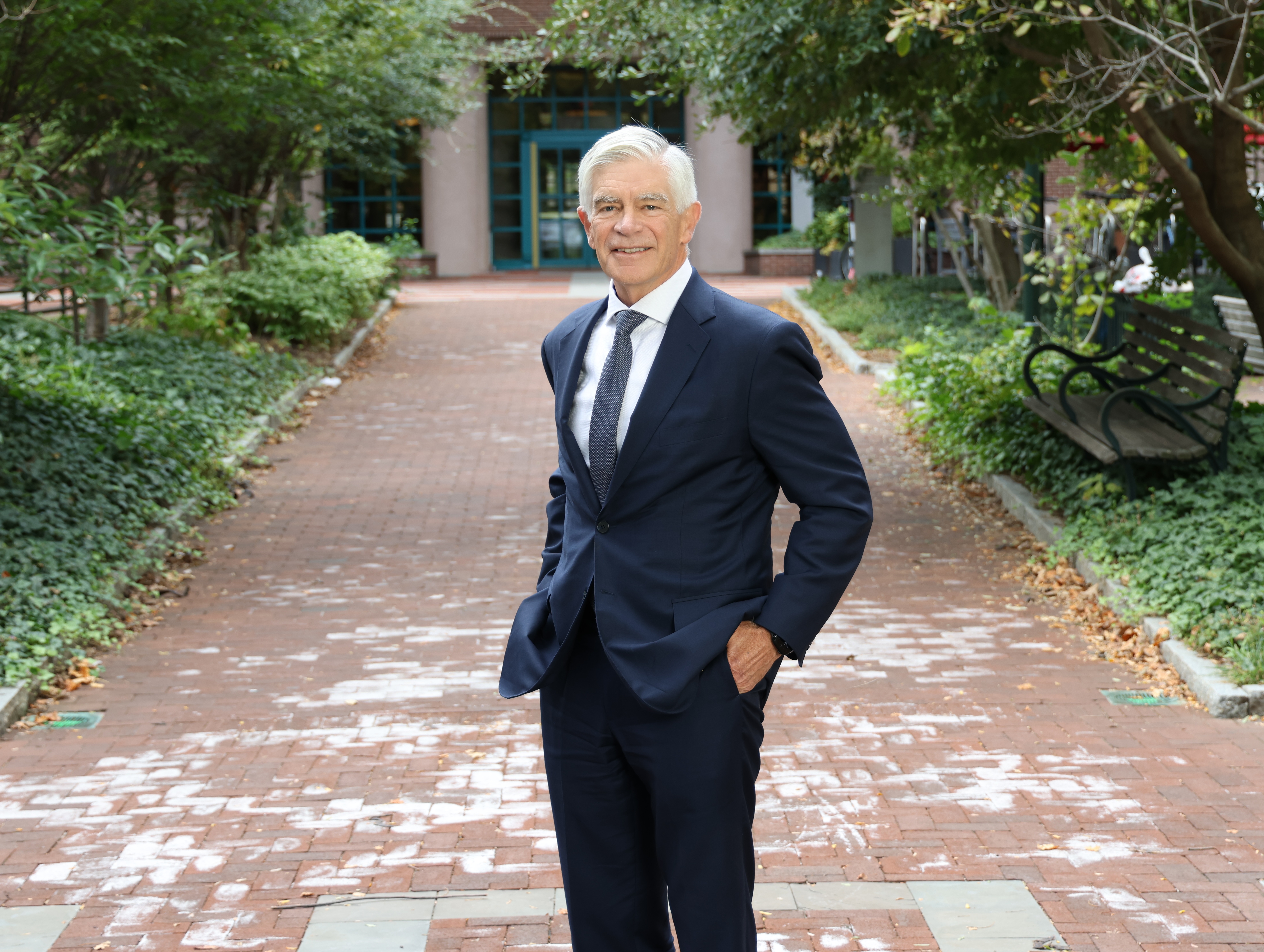
As a past president of the Philadelphia Federal Reserve Bank, Patrick Harker sat in and sometimes voted at Fed Open Market Committee meetings that decided interest rate targets under Warsh’s predecessors from 2015 to 2025. He says it’s important for Fed leaders to speak clearly.
An engineering Ph.D. who grew up in blue-collar Gloucester City, Harker spent the previous 15 years, first as dean ofthe Wharton business school at University of Pennsylvania, thenas president of the University of Delaware, before he was chosen to run the Philly Fed by the search committee he headed after others declined the job.
Harker finished his second five-year Fed term in June 2025 and reported back to Wharton the next day as a professor. He says he has been putting what he learned there to use.
This interview has been edited for clarity and brevity.
How did you align while you were with the Fed?
People at the Fed asked: Was I a hawk, leaning toward higher rates to fight inflation? Or a dove, leaning toward lower rates to support jobs? I’m an eagle, loyal to this country. I’m for doing what the economy requires.
I’m where the vast majority of Americans are: They’re sick of ideology. It gets us nowhere. It drives countries to ruin. That’s never been us.
We are a pragmatic people. Let’s do reasonable stuff.
Are you worried digital finance will spin out of control?
My particular interest is around operational risks caused by technology. Those come in different flavors:
Concentration risk: Just a few key firms — Amazon, Microsoft — providing a lot of the financial infrastructure.
Model risk: Everyone using the same AI models. Some of my colleagues have found that if AI models set prices, they will collude [to illegally boost prices at consumers’ expense]. They will do the same with loans.
Fraud risk: Faster payments equals faster fraud.
Market risk, credit risk, and operational risk: We are looking down into the bowels of the systems moving the money and at cyber hygiene.
Will hedge funds’ use of insurance companies to make risky private credit loans fuel the next financial crisis?
If you pull one thread, will it start to fall apart? At the Fed, I was a bank supervisor. I worried about it. I still worry.
It’s not big enough yet to threaten the system [as mortgage losses did in 2008]. But the ‘private’ asset risks eventually all filter back to the regulated institutions.
I said that at a dinner of people in the private credit industry. They said, ‘We know what we are doing!’ They do; the first people in always know what they are doing.
But there’s only so much talent. And now you have people on the fringe taking bigger and bigger risks. And again all hell will break loose, and everyone will have to deal with it. It will go beyond the skill set of the industry.
You know Jevons Paradox? Technology puts people out of work, then becomes so cheap, demand for that technology explodes, and so do the jobs providing it.
Will AI improve productivity? It better. Our birth rate is not replacing ourselves. Our immigration policy has flatlined.
It’s the most basic rule of economics: If you want more output, you either get more workers, or better machines.
I’m more worried that in the United States, we are really bad at helping people make transitions to new kinds of work. A kid will figure it out. But if you’re 40 or 50, what do we do with you? No one cares; you can understand their anger.
Can Congress fix Social Security and the deficit?
I’m less worried about Social Security because politicians know they can’t get reelected without solving the problem.
With the deficit, they keep kicking the can down the road. It really depends on healthcare, a very large part of the U.S. budget. Economists are starting to talk about the Fed losing the ability to set rates [because it is too busy] keeping Treasury’s financing costs down. When debt gets too high, you can’t avert default.
In this country, we’ve all gone into our own herds, we don’t listen to the other side. But if there’s a vacuum in communications, someone else will fill it with their narrative instead of yours.
You protect credibility the institution built over decades by explaining yourself.
What can you make happen now that you’re back at Penn?
I’m a tenured faculty member. I put together an MBA class. I’m publishing academic journal articles on fraud in payment systems. I had to dust off my quantitative brain.
What motivates him I’m not sure, but he loves this place. His father died when he was here, and the school stepped up with financial aid, he doesn’t forget that.
What do you miss about the Fed?
One of the great privileges of the Fed, when you go to the Open Market Committee, there’s no personal electronics. For two days you have nothing to do but seriously think about what everyone else is saying.
Even if you disagree, it’s in a very professional way. To the public, Washington can look like a big food fight. But at places like the Fed, there are people seriously dedicated to their job.
Are you worried for your grandchildren?
There is hope. People worry everything’s gone nuts; we’re leaving the young people with a giant bill. And a political system that is seemingly broken.
People peddling crazy ideas understand the brain very well: Push these panic buttons. But to quote [former President Richard] Nixon, there is a silent majority who want to have a better life. Not to fight culture wars.
To find “A Nation of Artists” at the Philadelphia Museum of Art, you walk from the Great Stair Hall down a long gallery lined with art that’s not part of the show. The path zigs left and tightens into what looks like a service corridor, and then zags right past the bathrooms.
After this distinctly unceremonious approach, you’ve arrived at one of the museum’s most spectacular events of recent years.
Not only is “A Nation of Artists” momentous — it is billed as the “most expansive presentation of American art ever mounted in Philadelphia” — but it comes with the added juice of inaugurating the museum’s newly renovated American wing on the second floor after a 14-month closure.
The occasion brings yet another distinction: amazingly, after three more galleries open in the wing, it will be the first time in a decade that all of the galleries in the main building will have been open at the same time.
The odd journey to the second-floor American galleries has long been in place, but it seems especially odd now. It would have been nice to reopen this major piece of real estate with more of an architectural drumroll than a drab, winding hallway, especially for an institution that, after the tumultuous year it’s had, could use a thing or two to celebrate.
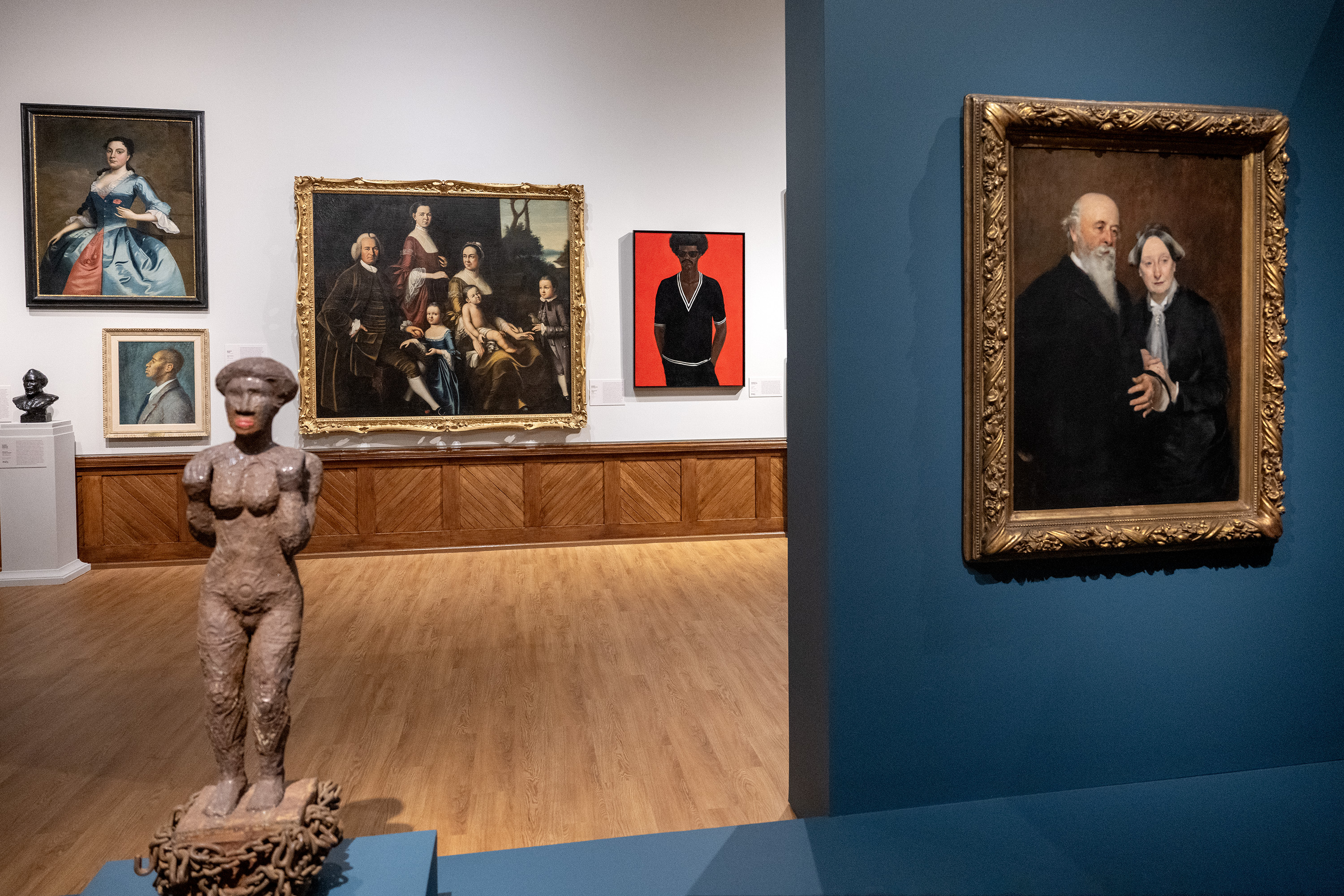
“Miners’ Wives” (right) by Ben Shahn and “The End of the War, Starting Home” by Horace Pippin at the Philadelphia Museum of Art.
It might also be easy to miss the show’s greater significance to the museum and its cohost, the Pennsylvania Academy of the Fine Arts. “A Nation of Artists,” which opened in April with more than 1,000 works at both museums, arrives as a bolt of ambition as the groups work their way through deficits and reorganizations and remind audiences and funders that beyond crisis, there is art, and it is glorious.
The show is the city’s major visual arts celebration of the nation’s 250th anniversary, and while it’s an impossible task to compress the story of art in America into any single show, the overall image that emerges is not a cohesive snapshot, but a fascinating mirror.
There’s sometimes a random, almost improvisatory feeling to “A Nation of Artists” — despite the show’s attempt to place works around themes like the American West or inequity — because America is itself ever-random and improvisatory.
Works in thematically grouped ensembles in ‘A Nation of Artists’ in the newly renovated Furness and Hewitt building at the Pennsylvania Academy of the Fine Arts.Tom Gralish / Staff Photographer
More than 120 works from the collection of John and Leigh Middleton and their family are augmenting “A Nation of Artists.” But after the show closes and the Middleton works are gone, PAFA will put in place a newly curated permanent collection, and the PMA will be left with a sweeping look at American art that starts on the first floor with earlier works and proceeds to the second to bring it up to the mid-20th century.
In other words, “A Nation of Artists” absorbs the Middleton works, but also spotlights the incredible riches in residence nearly all the time. That’s no small thing at a time when arts and culture in Philadelphia is struggling for engagement in the attention economy.
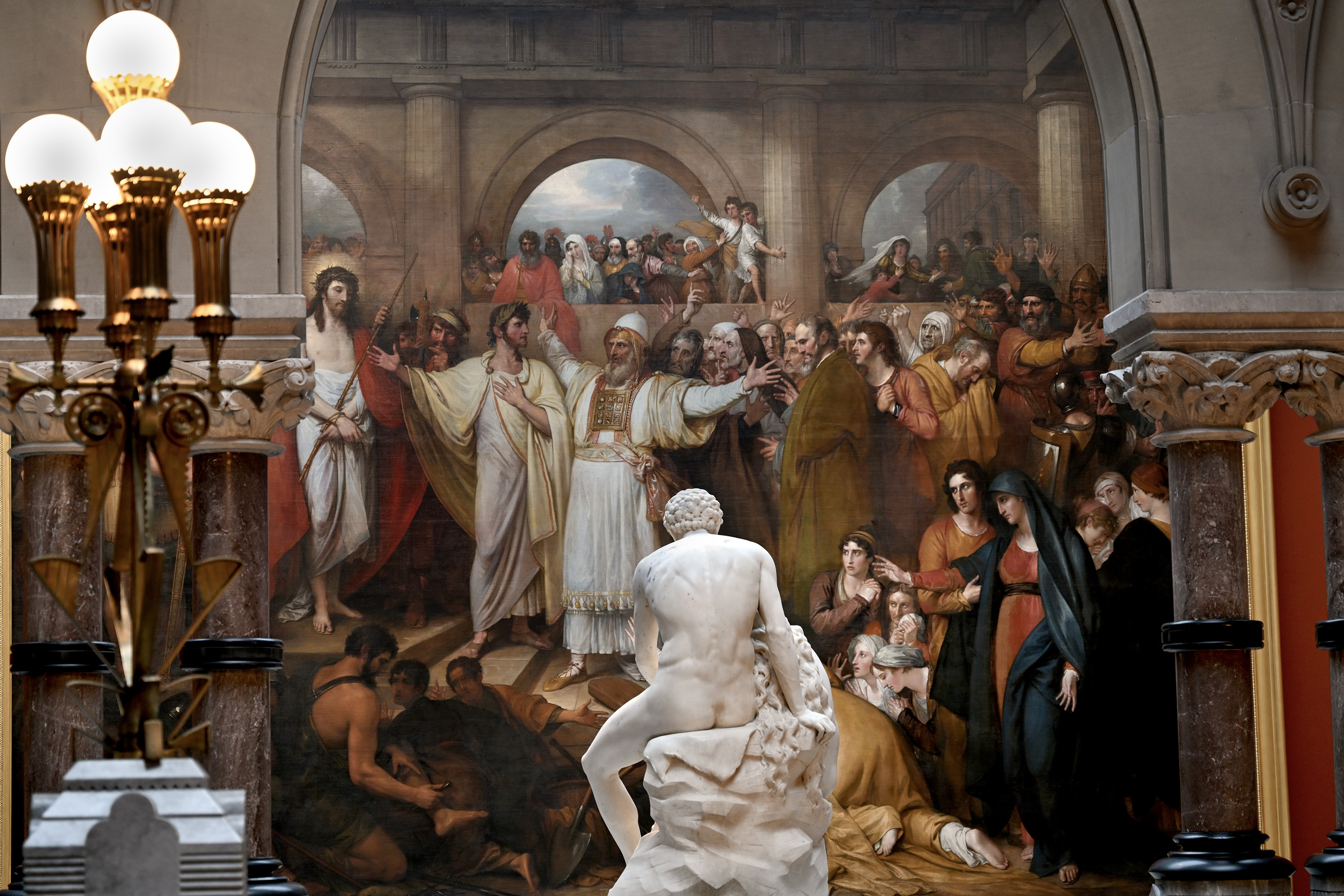
The painting “Christ Rejected” by Benjamin West and marble sculpture “Paradise Lost” by Joseph A. Bailly at the Pennsylvania Academy of the Fine Arts.Tom Gralish / Staff Photographer
A crisp reset at PAFA
At PAFA, the outside world seems to creep in in ways both positive and worrisome.
How can you admire the fruitful pedagogy at PAFA on display by generations of academy students and instructors without feeling concern for the place? The relationship between the museum and school — a specific artistic legacy unique to Philadelphia — is what makes PAFA special, and it remains to be seen whether a recently revamped certificate program at the school is the ultimate answer, artistically or financially.
The exhibition marks a crisp reset: the reopening of PAFA’s jewel of a building, the riotously detailed 1876 Furness and Hewitt-designed landmark, after a renovation project that included a new HVAC system and other renovations.
Laylights (variously utilizing natural or artificial light) in the newly renovated Furness and Hewitt building at the Pennsylvania Academy of the Fine Arts.Tom Gralish / Staff Photographer
It’s good news that there are no dramatic changes; the building continues to dazzle. I visited the show there a half dozen times, and via the church-like rose window and skylights, nature played handmaiden to art. When clouds parted, sun filtered into some of the spaces, and in one gallery the natural light made the whites and colors of George Bellows’ North River pop.
The marble sculpture “Peri at the Gates of Paradise” by Thomas Crawford in the grand staircase at the Pennsylvania Academy of the Fine Arts.Tom Gralish / Staff Photographer
On another morning, the sunlight made the grand stair hall of the Furness building practically vibrate. The smooth white of marble sculptures like Thomas Crawford’s Peri at the Gates of Paradise glowed and the stars-on-cobalt pattern beneath the skylight seemed to be showering down.
Here on this day, there was no more beautiful interior in the city.
At the Pennsylvania Academy of the Fine Arts. In the rear is the oil painting “Death on the Pale Horse” by Benjamin West.Tom Gralish / Staff Photographer
A more sequestered PMA
If PAFA maintains a lively relationship with the outside world, the PMA’s new American wing feels sequestered. There are no visible windows letting in light in the second floor American galleries — no natural light except for a small opening in a staircase.
The layout and footpath (including that unceremonious approach) is largely the same as it had been before the renovation. But the flow within and from gallery to gallery is more open, and there is now a central spine of four continuous middle galleries that opens up a vista that helps to orient the visitor. Three remaining galleries in the renovated American wing are expected to reopen, though the date is uncertain.
Three Thomas Eakins oils (from left): “Mending the Net,” “The Pair-Oared Shell,” and “Sailboats Racing on the Delaware.”Tom Gralish / Staff Photographer
The PMA half of “A Nation of Artists” features a lot of big names (Andrew Wyeth, John Singer Sargent, Georgia O’Keeffe), as well as about three dozen works by Thomas Eakins — intimate portraits as well as epic canvases. There’s a beautiful sequence of three Eakins oils, all painted within a decade of one another, all with rivers in various hues and states of excitement: The Pair-Oared Shell, Sailboats Racing on the Delaware, and the stunning Mending the Net, a seemingly ordinary scene that gathers filmic mystery and story through minutely detailed figures mending a fishing net by the river against a gauzy beyond.
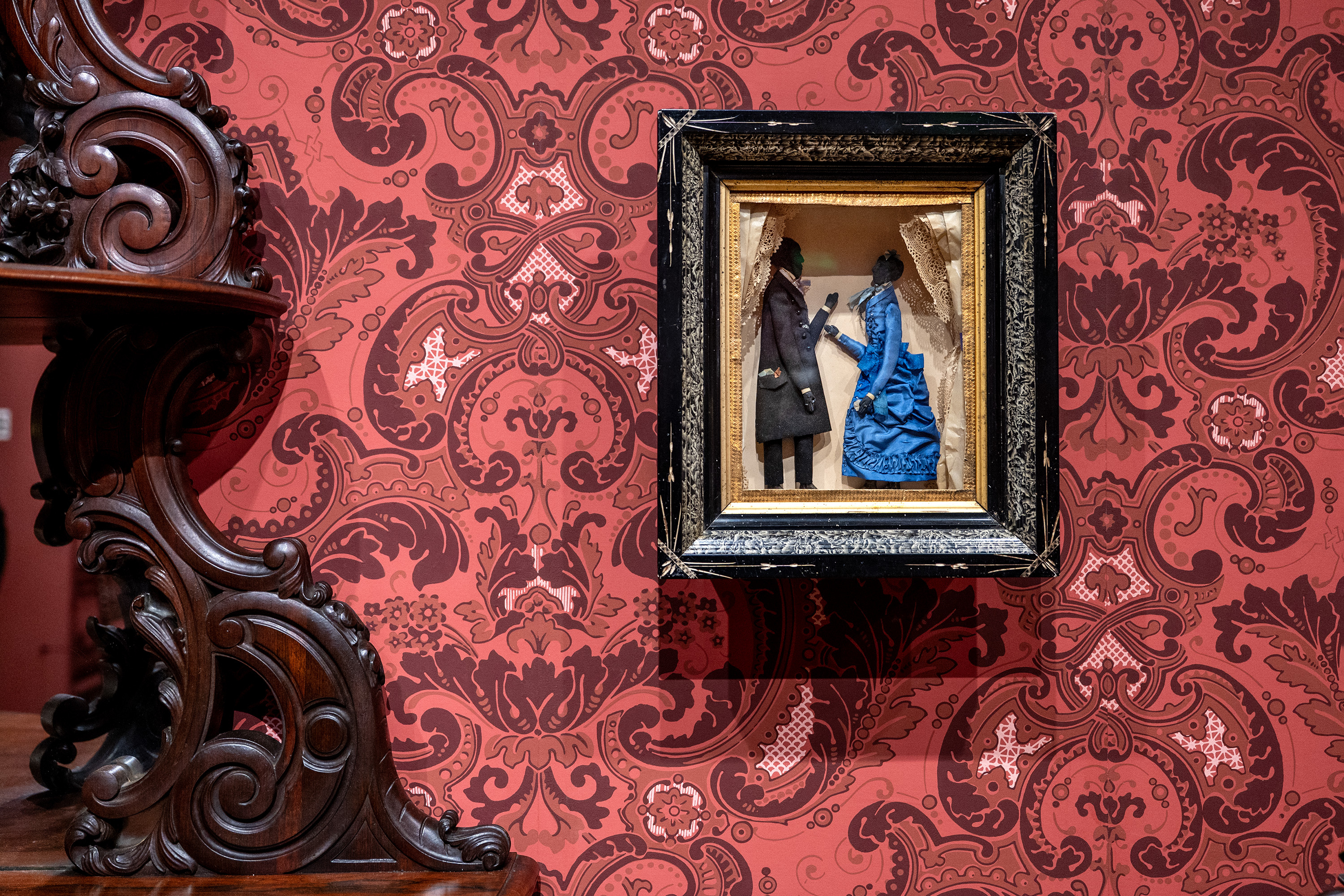
In terms of visitor experience, the new second floor American space succeeds most in moments of drama. The wall in one gallery uses a specially reproduced rich-burgundy period wallpaper, and the relationships among the paintings, furniture, pottery, and other items in the room ricochet beautifully.
“The Lost Pleiad” by Randolph Rogers in the Philadelphia Museum of Art’s salon-style gallery.Tom Gralish / Staff Photographer
A sumptuous feeling immerses visitors in the high-ceilinged salon-style room (gallery 211) that includes vast landscapes and marble sculpture. Though it’s not immediately obvious, the first-floor American works are also part of the show, and they hold yet more Middleton works.
Classics and surprises, and a lot of charm
There’s greater poetry in the architecture at PAFA, but the work itself at both museums is undeniably impressive in scope, and especially at the PMA: painting, sculpture, furniture, silver, fabric, works in clay, and more.
The curators — Kathleen A. Foster and Alexandra A. Kirtley at the PMA, and Leah Triplett and Lea C. Stephenson at PAFA — have delivered not just old favorites, but also surprises.
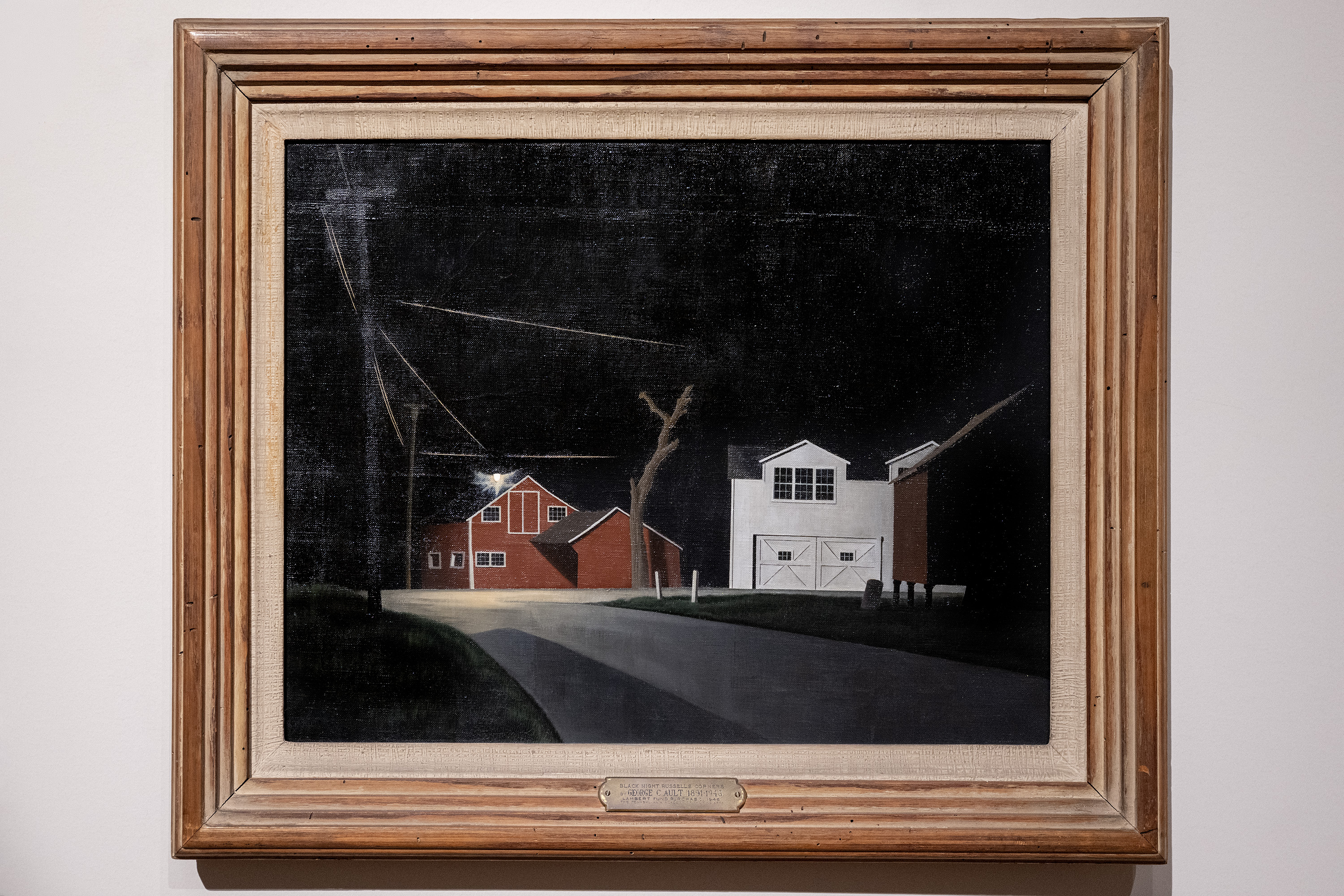
“Black Night: Russell’s Corners” by George Copeland Ault at the Pennsylvania Academy of the Fine Arts.Tom Gralish / Staff Photographer
PAFA’s classics include Winslow Homer’s Fox Hunt; the Jasper Johns Flag1960-66 from the Middletons (which the couple brought home from an auction in 2010 for $28.6 million); and George Copeland Ault’s Black Night: Russell’s Corners (1943), whose flat, cold, electric light suggesting a modern encroachment on agrarian life, can only be appreciated in person.
Among the pieces to which I kept returning: Pink Flower with Clock by PAFA 2011 graduate Aubrey Levinthal, because of the smart way it plays with the idea of photographic positive and negative imagery even though it is an oil; and Harriet Goodhue Hosmer’s Puck on a Toadstool, from 1856, whose supernatural energy is so potent that the figure appears poised to shape-shift and break free of its marble confines.
At the PMA, a single canvas has me reconsidering Edward L. Loper Sr., the Wilmington artist who had his beginnings working for the WPA. Loper’s Abandoned Ferry Terminal is a complex refraction of shadows and colors from 1958 whose geometries never seem to stop shifting.
A small shadowbox of a man and woman formally costumed from around 1880 might be the most unassuming bit of charm in the entire exhibition. Its maker is unknown.
Custom wallpaper at the Philadelphia Museum of Art, with “Portrait Figures of a Man and a Woman, in a Shadowbox.”Tom Gralish / Staff Photographer
Leaning into representation
If you ever wanted a lesson in the difference how a work is displayed can make, just consider how much more substantial an achievement The Gross Clinic looked a few months ago. With bright but warm lighting at the PMA, Eakins’ 1875 canvas was frightening in its vividness, the red of blood on the surgeons’ hands glistening. Today, at PAFA, it looks a little washed out, overpowered by the light coming through the nearby rose window.
Both museums have made a conscious effort to represent a spectrum of identity — gender, regional origin, ethnicity, and so on. This is all to the good, of course. Everyone will find something relatable in this exhibition, and many will discover works that aren’t necessarily relatable on first examination but become so. This is why museums, and good curators, are important.
Detail of “Nydia, the Blind Girl of Pompeii” by Randolph Rogers at the Pennsylvania Academy of the Fine Arts.Tom Gralish / Staff Photographer
It’s a fascinating marker of time to think about the cultural whiplash of the past couple of years in this country, and how vulnerable the simple concept of representation now feels. The tastes of the art establishment change, and so too does how we perceive art.
How could it be otherwise? Every movement comes in with an air of moral and scholarly authority that purports to lay down once and for all an accurate cultural perspective.
The prevailing ethos arrives as the new reality. Then the next reality comes along.
“A Nation of Artists” runs through July 5, 2027, at the PMA, 2600 Ben Franklin Parkway; and Sept. 5, 2027, at PAFA, Broad and Cherry Streets. philamuseum.org, pafa.org.
That’s what Samantha Paige Rosen’s father told her when she was 29.
Rosen was living alone in Bethesda, Md., and struggling with what she called unrealistic deadlines at her copywriting job.
She liked being in the D.C. area and was reluctant to move back to her parents’ house in Bala Cynwyd. Plus, this wasn’t what adults were supposed to do, she thought. Ultimately, she decided to listen to her dad.
“My job was making me sick,” she said, referring to her deteriorating mental health.
The morning after she moved back into her childhood room, she already felt a difference. “The depression lifted. A lightness. A steady, quiet heartbeat,” she wrote in a 2022 essay, “Unlearning the Shame of Living with My Parents as an Adult,” for the literary publication Catapult.
That decision shaped the trajectory of her life.
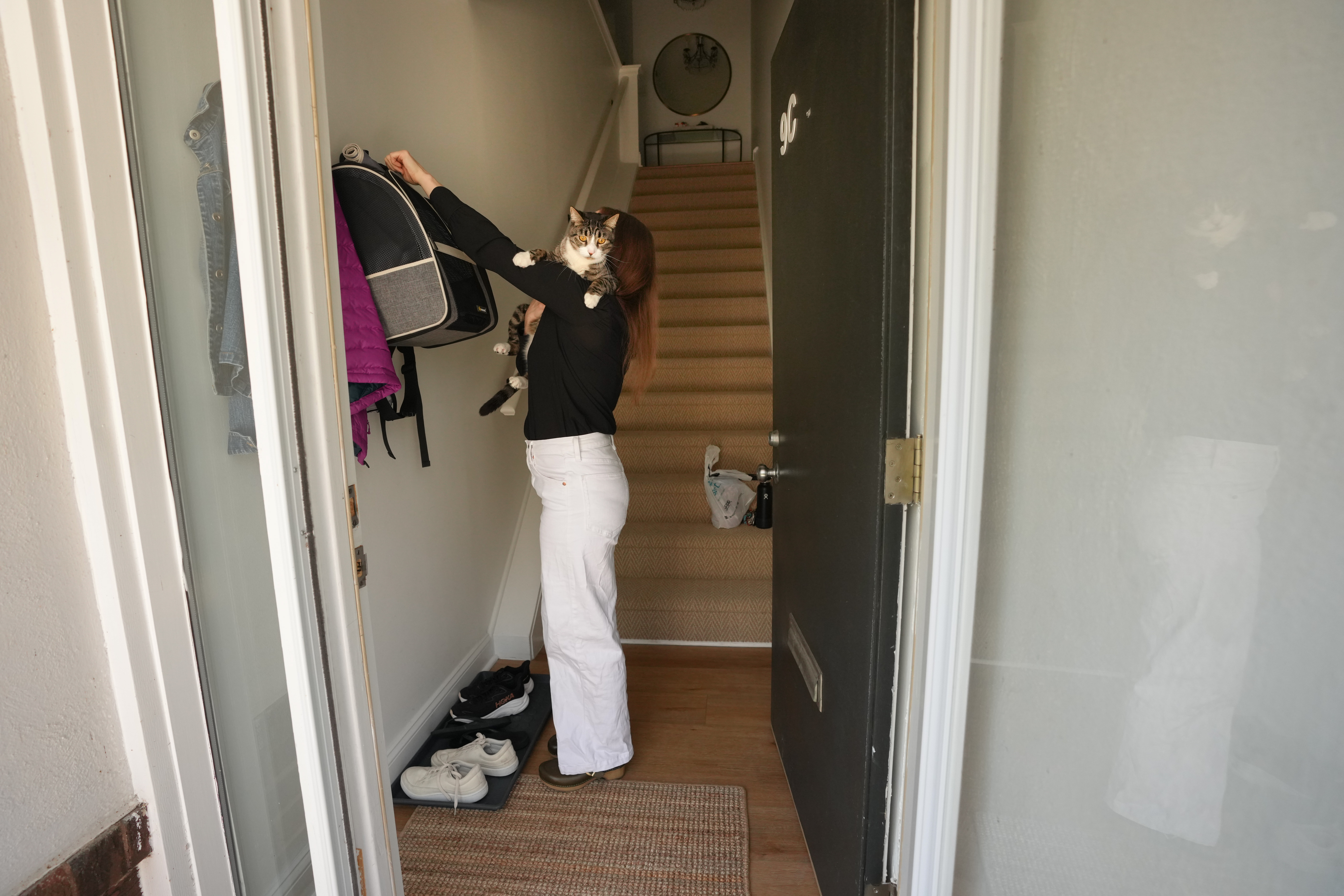
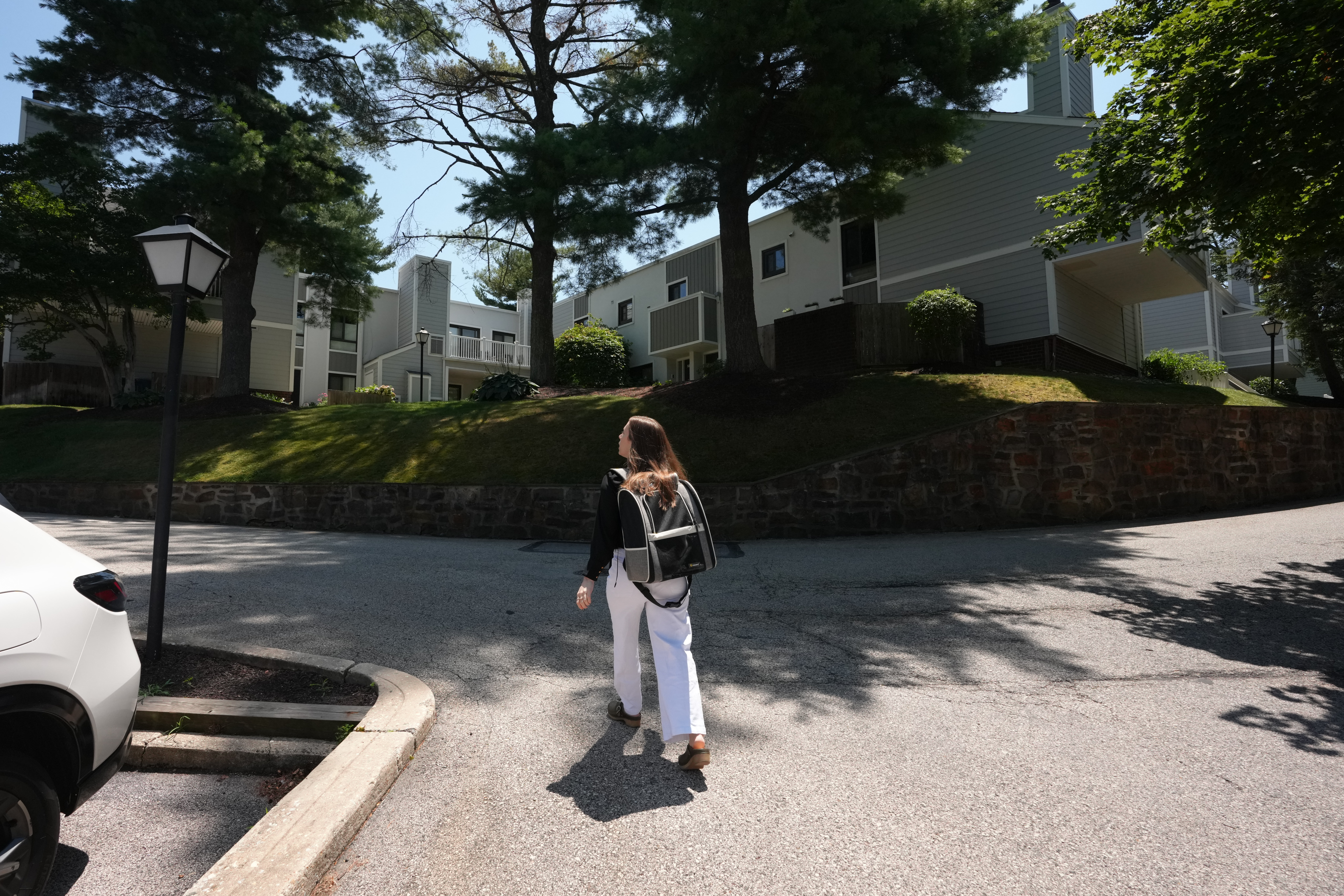
Samantha Paige Rosen, author of the anthology “Living, Together,” prepares to take her cat to her parents’ home for a visit last month. She lives in Penn Valley, a short walk from her parents’ home.Jessica Griffin / Staff Photographer
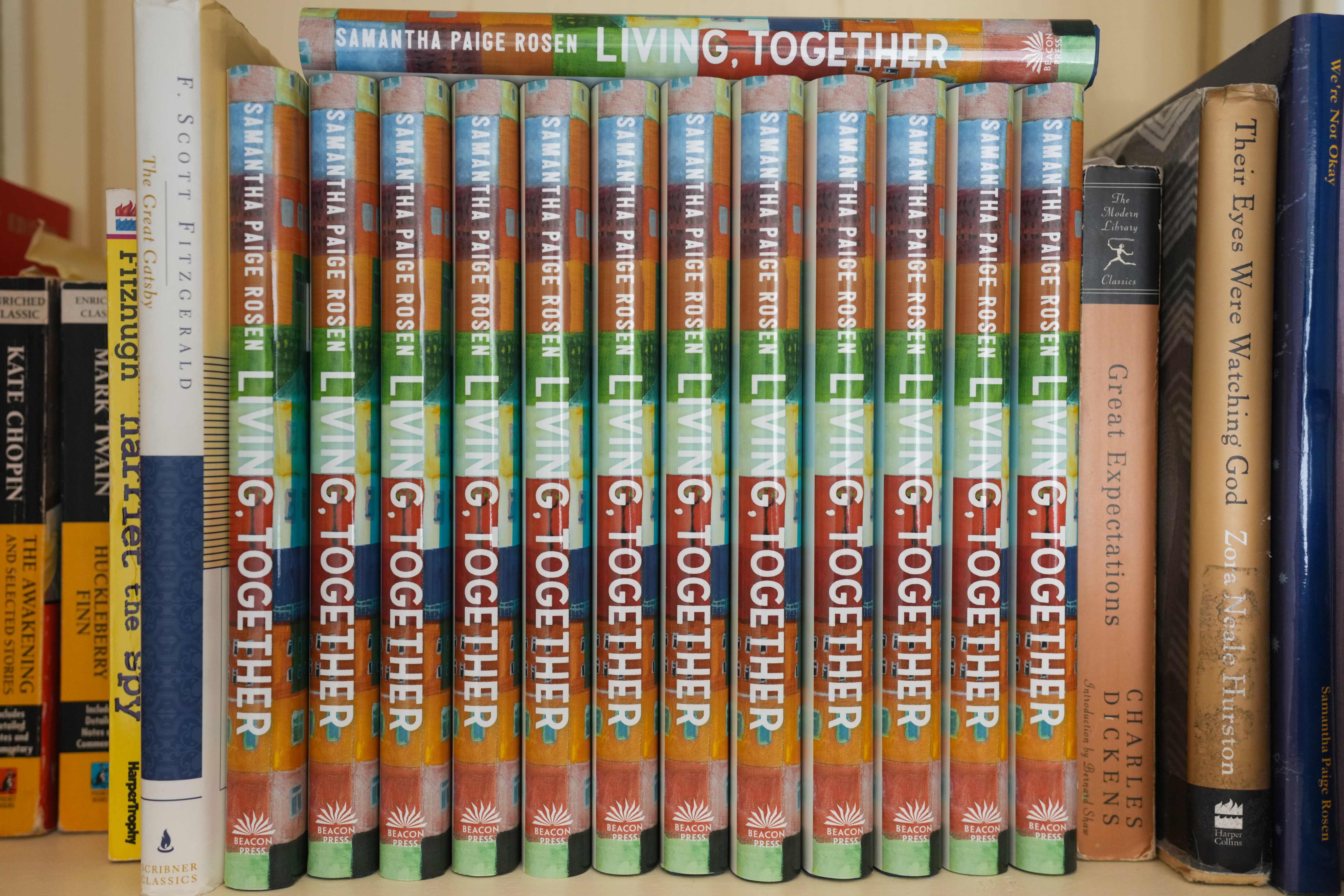
Thanks to the care provided by her parents, she was able to get well and build a tutoring business. And her experience inspired her to pitch, sell, and edit an anthology called Living, Together: Reimagining Community in the Age of Disconnection, out last month from Beacon Press and now an indie press bestseller.
The anthology, a mix of personal essays and conversations featuring 22 writers who live in the U.S., offers a window into the experience of living outside of a nuclear family arrangement. For some, that means living in a multigenerational household, a cohousing community, or three polyamorous parents and children. The book also goes beyond just housing, to focus on building community and chosen family.
Copies of the anthology “Living, Together” by writer Samantha Paige Rosen.Jessica Griffin / Staff Photographer
Novelist Sarah Thankam Mathews writes about her experience sustaining Bed Stuy Strong, the mutual aid organization she helped found during the pandemic. Author Rhaina Cohen explores her and her husband’s decision to live with their friends. Novelist Jonathan Escoffery talks about how his sense of community was shaped by his Jamaican immigrant parents and fellow writers of color.
When she was living with her parents, Rosen, now 36, said she didn’t know anyone who was living in a nontraditional setting and couldn’t find much writing about it. In a lot of ways, the book, she said, “was for me.” She wanted to hear about all the ways people were building homes and community.
It’s difficult to quantify the trend of alternative living arrangements because it’s such a vast term. But what is clear is that what Americans tend to think is middle-class “normal” — living with a spouse and children — is on the decline.
Writer Samantha Paige Rosen, author of an anthology called “Living, Together”, in her home, located a short walk from her parents house, July 20, 2026, in Penn Valley, PA.Jessica Griffin / Staff Photographer
Multigenerational and otherwise non-nuclear family living is common in several global cultures, but Rosen wanted to highlight American writers as a way to combat the thinking that more communal ways of living are suited for other countries but not here.
Living, Together fits into a growing canon of literature focused on envisioning alternative family and relationship structures. From Cohen’s best-selling 2024 The Other Significant Others: Reimagining Life with Friendship at the Center to Mathews’ 2022 novel All This Could Be Different, from Sophie Lewis’ 2022 Abolish the Family: A Manifesto for Care and Liberation to Lola Milholland’s 2024 memoir Group Living and Other Recipes, there’s a growing tide of voices calling for collectivism over individualism.
“There’s a real hunger for interdependence and people don’t know how to get it,” Rosen said. She hopes the book will open people’s eyes to what’s possible. And not just what’s great about communal living, but what’s difficult about it, too.
When Rosen lived with her parents, sometimes she’d visit friends’ places and wonder if she was doing what she should be doing “as an adult woman.” Her mom, Patty Rosen, also remembers fielding some judgment from others about her daughter’s living situation.
“When’s Sam gonna move out?” they asked.
But the Rosens said they loved living together, even with things like negotiating sound while Samantha was tutoring and dealing with her cat crying at the front door. Or being parented a little too much.
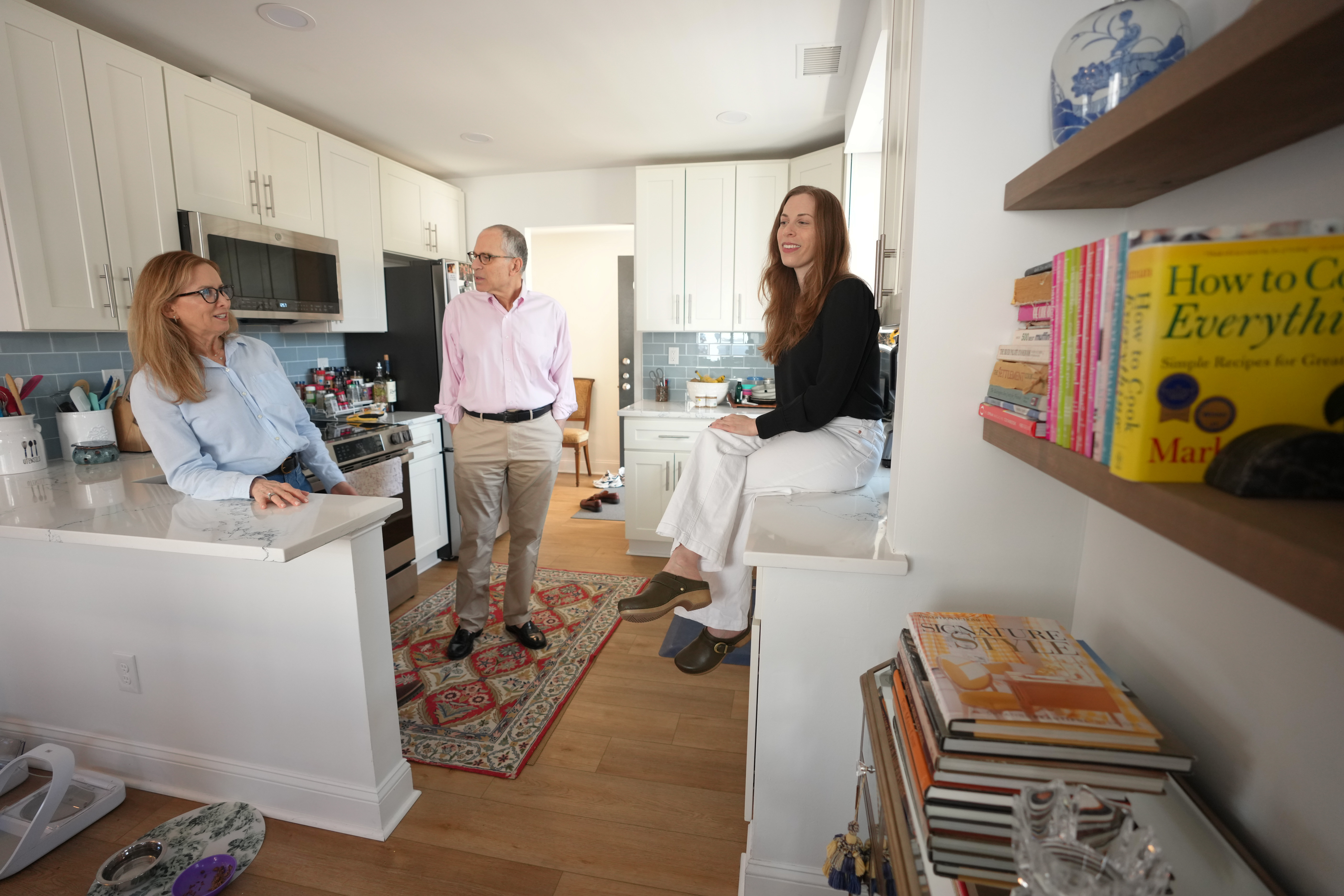
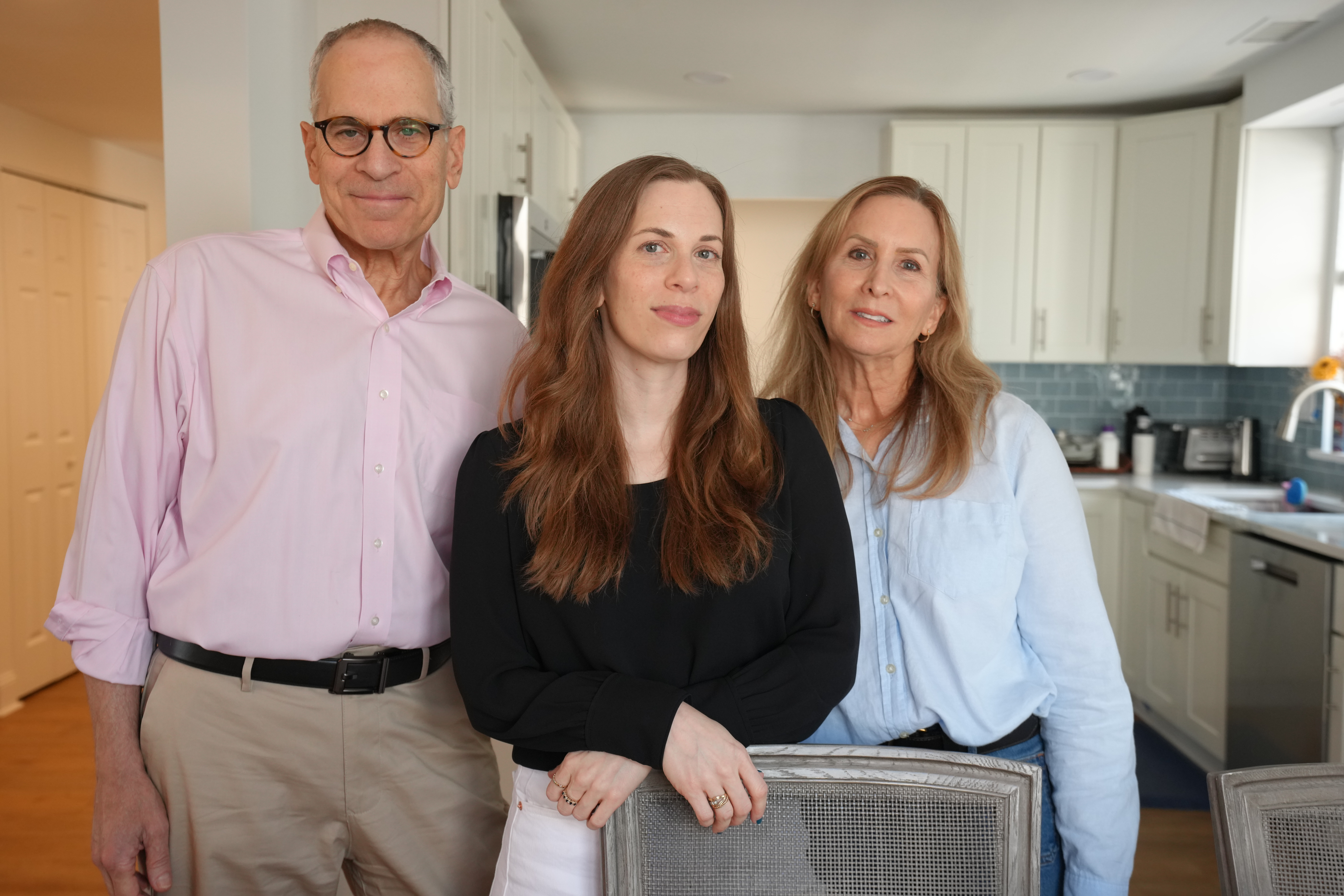
Writer Samantha Paige Rosen, author of the anthology “Living, Together,” poses with her parents in their home in July. Rosen lives a short walk from her parents’ home in Penn Valley and visits with them daily.Jessica Griffin / Staff Photographer
And going on dates? “She didn’t like to be asked about it,” Patty said.
They’d ask about the date’s name and profession, Rosen explained. “Then,” her father, Stuart Rosen, said, pretending to whisper behind his hand, “I would Google.”
In 2025, Stuart and Patty downsized and moved into a house in Penn Valley. Rosen moved into the house across the parking lot — a house she could only afford because of the years she lived with her parents.
The shift in their family’s living situation echoes something Rosen learned while working on the book.
“Those who’ve taken communal living from an idea to reality have reframed their thinking around it again and again, or gotten rid of the frame entirely,” Rosen wrote in an email. “It can last forever or for a season of life.”
In this season of life, Rosen brings Fergal, her cat, in a backpack to her parents’ house everyday to play with their cats. Every Tuesday, she and her dad have dinner and watch a movie. Some evenings, her mom comes over after she finishes work to watch a movie in bed.
Writer Samantha Paige Rosen, author of the anthology “Living, Together,” lives across a parking lot from her parents’ home in Penn Valley.Jessica Griffin / Staff Photographer
The latest iteration of their living situation — and the potential for all the other ways she might live in the future — calls to mind something Rosen wrote in her essay.
She said she wasn’t sure what she’d choose if she had complete freedom to live the way she wanted.
“But I know I’m interested in figuring out how to live beyond the boundaries society has established for me. I didn’t always believe I was capable of that, but I am. We all are.”
Samantha Paige Rosen will be speaking about her book at the Head & the Hand, 2230 Frankford Ave., Philadelphia, as part of “Hot Debut Summer” on Saturday, Aug. 22, 7 p.m.-9 p.m.
“Living, Together: Reimagining Community in the Age of Disconnection” is available in digital and physical bookstores.