Blog

  • After killing hundreds in boat strikes, U.S. military expands campaign on land in Latin America

    After killing hundreds in boat strikes, U.S. military expands campaign on land in Latin America

    MEXICO CITY — Hundreds of people have been killed in the year since the U.S. military began bombing boats it accused of ferrying drugs off Latin America’s Caribbean and Pacific coasts. Now, the Trump administration says it is seeking to extend that lethal campaign to land, pursuing deals that would put U.S. forces on the ground in allied nations across the region.

    President Donald Trump’s defense secretary, Pete Hegseth, announced last week during a visit to Panama that Colombia, Guatemala, and Honduras had agreed to allow the U.S. to carry out joint military operations against criminal groups on their soil, following Ecuador, which launched similar missions with the U.S. in March. Guatemala, however, has denied reaching such an agreement.

    It will be “like you saw with the strikes on the drug boats,” Hegseth said during a military drill in the jungle in Panama. “Same effect on land. And so we’re working with Ecuador. We’re working with Colombia. We’re working with partners to bring the fight to the (designated terrorist organizations) on land.”

    The expansion marks a new phase in the Trump administration’s campaign to pressure governments across Latin America to align with its security priorities and assert what it calls “American dominance over the Western Hemisphere.”

    Voters across the region are increasingly embracing Trump-aligned leaders, giving Washington more willing partners. But critics warn that the widening U.S. military campaign risks civilian casualties and a backlash against the U.S. that could outlast the Republican administration.

    “What’s going on is an attempt to legitimize the increased use of the U.S. military in the region,” said Michael Shifter, a Latin America expert at the Inter-American Dialogue think tank. “It projects power, demonstrates military superiority, and enables Washington to impose its agenda. This is not cooperation, it’s obviously a very asymmetrical relationship.”

    Escalating unilateral boat strikes to joint land operations

    The U.S. military has operated in Latin America for generations, supplying allies with weapons, intelligence, and training to fight drug trafficking, while leaving a fraught legacy of support for military coups and dictatorships.

    But since Trump returned to office in January 2025, Washington has pursued its most interventionist approach to the region in decades.

    His administration has designated 20 Latin American criminal groups as “foreign terrorist organizations,” sent U.S. forces into Venezuela to capture its president, and involved CIA agents in drug lab busts in Mexico. It has killed more than 200 people in over 60 boat strikes in the Caribbean and eastern Pacific, offering little evidence that those targeted were “narco-terrorists” and drawing questions about the strikes’ legality.

    But sustained U.S. combat operations alongside local forces would be “new and different,” said William LeoGrande, a Latin America specialist at American University, testing deep-rooted sensitivities over national sovereignty and the presence of U.S. troops.

    Hegseth provided few details about what joint operations with Colombia, Guatemala, and Honduras would look like. But in Colombia, where Trump-backed Abelardo de la Espriella took office this month, he raised the prospect of U.S. forces joining strikes against armed groups including the National Liberation Army, or ELN, Colombia’s last major guerrilla group. Hegseth said de la Espriella had requested greater U.S. military involvement.

    “Anywhere you traffic drugs or you threaten the American people or our partners, you are a target just like ISIS or al-Qaida,” Hegseth said, equating drug traffickers with Islamic extremist groups that dominated U.S. national security priorities for decades.

    On Saturday, following a drone attack by the ELN on troops, de la Espriella vowed the rebels would “pay a high price.”

    Concerns over U.S. military presence in Latin America

    Ecuador has emerged as the clearest case of direct U.S. military involvement, launching joint raids with Washington despite voters overwhelmingly rejecting foreign military bases in a November 2025 referendum. A New York Times investigation found that one strike on an alleged drug lab in March instead destroyed a cattle farm.

    The push to extend such agreements has gained the most traction among Trump’s ideological allies in the region — conservative leaders elected on promises of aggressive crackdowns on crime in recent months.

    Guatemala stands out as an exception. Its progressive government has worked closely with Washington on security despite political differences. But President Bernardo Arévalo has denied agreeing to joint anti-drug operations, saying they would be illegal without congressional approval.

    Honduras, Colombia, and Ecuador did not respond to requests for comment on Hegseth’s remarks.

    A notable outlier from the new U.S. anti-trafficking alliance is Mexico, a major source and transit point for fentanyl and other drugs entering the U.S. Progressive President Claudia Sheinbaum has cooperated closely with Washington on security but resisted mounting pressure for a U.S. military role in fighting cartels on Mexican soil.

    “Ultimately, the United States will have to define what ‘joint operations’ means in each of these countries. It may discover pretty quickly that this is something most governments — even governments on the right — are quite uncomfortable with,” said Adam Isacson, a defense analyst with the Washington Office on Latin America.

    ‘There is only so much sovereignty they can cede’

    Observers question whether a more militarized approach would produce lasting security gains. Shifter said the campaign may serve partly as a show of force, building on the capture of former Venezuelan President Nicolás Maduro as the Trump administration seeks to offset foreign policy setbacks elsewhere, including in the Middle East.

    Others warn the strategy risks civilian casualties, particularly in Colombia, where armed groups operate among civilian populations and often function as de facto authorities in areas beyond the state’s reach. Rather than beating back those groups, military strikes are more likely to force them to adapt, said Jeremy McDermott, co-director of the Colombia-based investigative organization InSight Crime.

    “The U.S. bombs an ELN camp in Colombia or in Venezuela, what is the first thing the ELN are going to do? They’re going to dismantle all their camps and move into the villages and towns,” he said.

    In the long term, experts say, deeper U.S. military involvement could test how far voters are willing to go in putting security over sovereignty, potentially constraining even Trump’s closest allies.

    “All of these presidents, no matter how far right they are, face pressure to do something about security and to make a show of pursuing the ‘bad guys’ who are making people feel unsafe. There is broad agreement on that,” Isacson said. “But they also know there is only so much sovereignty they can cede before public opinion begins turning against them.”
  • 60 days after signing Iran deal, Trump stuck in quagmire as peace talks stall

    Sixty days ago, seated beside French President Emmanuel Macron at a lavish dinner at the Palace of Versailles, President Donald Trump signed a memorandum of understanding with Iran and declared the beginning of the end of the U.S. conflict with Tehran.

    The “historic breakthrough” would lead to the reopening of the Strait of Hormuz and ensure Iran never obtained a nuclear weapon, the White House declared. Trump advisers said the deal would demonstrate that the president could end, rather than prolong, the kind of “endless wars” in the Middle East he had spent years denouncing.

    The agreement set aside two months for talks to turn the interim truce into something more ambitious: a broader settlement of the decades-long standoff over Iran’s nuclear program.

    That window has now closed.

    The war has not ended. The Strait of Hormuz remains largely shut. Detailed negotiations over Iran’s nuclear program never began.

    The United States has resumed its blockade of Iranian ports. Tehran is demanding concessions that the Trump administration has rejected. And the administration has now publicly disowned several of the key points in the ill-fated memorandum, including development of a plan “with at least $300 billion for the reconstruction and development” of Iran, a waiver of sanctions to allow Iran to sell oil, and a “dialogue” between Iran and Oman over how to run the Strait of Hormuz.

    Trump on Monday went so far as to threaten to bomb Oman over its talks with Iran on management of the strait, through which 20% of the world’s oil used to pass.

    If Oman “gets in the way,” Trump said in a Fox News interview, the U.S. would “bomb the s— out of them.” He demanded that Iran raise “the white flag of surrender” while insisting that neither the approaching midterm elections nor the passage of time was putting pressure on him to reach a deal.

    “I have no time schedule,” Trump said. “I’m not in a hurry. … Midterms have nothing to do with my thinking.”

    Six months after he launched attacks on Iran in coordination with Israel and 78 days before elections that will determine whether his party retains control of Congress, Trump confronts the kind of open-ended conflict he claimed he was uniquely equipped to avoid: one with no obvious military resolution, no diplomatic breakthrough in sight, and mounting economic and political costs at home.

    Continuing the standoff risks leaving him presiding over a war that undercuts one of the central premises of his political identity.

    The war has helped to erode voters’ trust in Trump and may have larger consequences in the midterms, said Lee Miringoff, director of the Marist University Institute for Public Opinion.

    “For a lot of voters, the war in Iran is linked with the economy. When the strait closed, the price of gas went up,” Miringoff said. “The problem for President Trump and the Republicans is that a lot of what he was elected on seems to not be being fulfilled. So there’s a sense of no rationale for why we went in, and no clear sense of how it’s going, and no indication of how we’re going to get out, which is the opposite of what makes for good politics.”

    The White House did not immediately respond to questions about the memorandum’s expiration or the impact it will have on the president’s political goals.

    Trump’s overall standing has deteriorated as the war has dragged on. Strikingly, surveys show an erosion of support among Republicans, whose intense loyalty has been the foundation of Trump’s political power.

    An Economist-YouGov poll released last week found Trump’s approval among Republicans at 79%, a second-term low and 15 points below its level shortly after he returned to office. The share of Republicans who strongly approve of his performance has fallen even more sharply, from 68% to 48%.

    A Washington Post-Ipsos poll last month found a new low of 15% of Americans “approve strongly” of Trump’s job performance. The finding marked the first time the Post-Ipsos poll found that significantly more than half of Trump approvers support him only “somewhat,” rather than strongly.

    The declines cannot be attributed to the Iran war alone. Voters have also expressed frustration about inflation, gasoline prices, and other aspects of Trump’s presidency. But those issues have increasingly become intertwined: The war and the continued disruption of oil shipments have helped make Trump’s foreign-policy predicament an economic and political problem at home.

    Trump has continued to insist that an end to the stalemate is in the offing. On Monday, he told Fox News that the U.S. was engaged in back-channel talks with Iran’s Islamic Revolutionary Guard Corps.

    An IRGC spokesperson quickly denied the claim. Brig. Gen. Hossein Mohebbi told Iran’s semiofficial Tasnim News Agency that there were no talks between Revolutionary Guard officials and the Americans, dismissing Trump’s assertion as a product of “defeat and desperation in the war.”

    Alan Eyre, a former diplomat who served on the U.S. negotiating team that secured the 2015 Iran nuclear deal, said the war has transitioned from a military operation into an economic pressure campaign that the U.S. hopes can force Iran to capitulate. But any economic pain will be felt primarily by the Iranian people, he said, rather than forcing change from the increasingly hard-line regime.

    “The U.S. has no good options,” said Eyre, who is a distinguished diplomatic fellow at the Middle East Institute. “This war has broken a complex system. And it is not getting back to the way it was before Feb. 28.”

  • Trump aims to rebuild defenses against bioweapons as AI fears rise

    Trump aims to rebuild defenses against bioweapons as AI fears rise

    The White House is working to strengthen safeguards against biological attacks after staffing cuts early in the second Trump administration depleted expertise in a field where officials increasingly fear artificial intelligence could make it easier to create deadly pathogens.

    By the end of President Joe Biden’s term, the White House had built a team of as many as 30 people focused on biological security, according to three former government officials who worked on the issue — two for Biden and Trump, and one just for Biden — and spoke on the condition of anonymity to avoid professional retaliation.

    This specialized staff was charged with coordinating the web of federal agencies that deal with biohazards and provided scientific guidance to top officials.

    That team rapidly dwindled after Trump returned to office amid cuts and reorganizations, said the three former officials, as well as a fourth former official, who also worked for both administrations. At times, nobody at the White House was dedicated solely to biosecurity, according to three of the former officials.

    The losses have come as the administration has delayed replacing key Biden-era directives. It revoked a 2023 executive order on AI calling for stronger biological safeguards and cast doubt on a policy issued the following year designed to require companies to screen buyers seeking genetic components that could be used to create biological agents — widely seen by experts as a basic pillar of the nation’s defenses.

    Trump directed officials to produce a revised version by August 2025. More than a year later, it has yet to appear, even as AI companies say their most advanced models are gaining increasingly sophisticated biological capabilities alongside the hacking skills that have alarmed officials this year.

    “They have kneecapped themselves in their ability to create any policy that would have staying power,” said one of the former experts, who recently worked directly on outbreak response policy. “That’s the risk, they’re not playing the long game. The whole purpose of having the technocrats there is to advise political leaders on the nuanced tradeoffs of taking one path or another.”

    In the absence of a large team, the White House has relied on a small revolving cast of employees. They have included a junior fellow without a security clearance; a part-timer from the research organization Rand; a pair of CIA staffers with little expertise in the field; and an Air Force doctor who had been a consultant to the White House medical office, according to the three experts.

    A White House official said the administration was working to strengthen the Biden-era policy, calling it inadequate and technically limited despite the staff devoted to developing it, and did not address questions about the staffing changes.

    “The Administration’s commitment to addressing AI and biological safety risks is clear and ongoing,” the official said in an email. “The White House has been developing policy for over a year, including in our AI Action Plan last summer.”

    The Trump administration has acknowledged the biological security risks AI poses while touting the potential for the technology to help keep the nation safe. Trump told foreign leaders gathered at the United Nations last year that he wanted to prevent biological weapons disasters and said AI was a tool to help.

    At the Pentagon, a former health official who led Operation Warp Speed — the effort during the first Trump administration to rapidly produce a vaccine for the coronavirus — is involved in efforts to use AI to speed the development of new defenses against future pandemics and to deter biowarfare. Part of the work involves analyzing billions of tweaks to antibodies to assess how to respond to new forms of the coronavirus.

    But that work is taking place in a government that analysts and the former experts say has been drained of expertise amid broader cuts to federal public health and science funding.

    The White House removed all the staff from the Office of Pandemic Preparedness and Response Policy, an organization created to lead the nation’s response to the kind of major outbreak that the most dangerous kind of bioweapon could trigger. The office was resurrected as Ebola spread in Africa this spring.

    A National Security Council unit dedicated to health security was also shut, two of the former experts said, and parts of the Office of the Director of National Intelligence and Department of Homeland Security responsible for biological threats were broken up as part of broader reorganizations.

    A scientist who worked on biotechnology and national security issues in both the first Trump and Biden administrations said the federal government is not taking a leading role in coordinating a response to the risks posed by the rapidly evolving technology.

    “Every time an administration changes over there’s a lot of continuity that just gets disrupted,” said the scientist, who spoke on the condition of anonymity because they were not authorized by their employer to speak publicly. In the transition from Biden to Trump, they said, “when it comes to biosecurity, that happened in a very disruptive way.”

    There has never been one federal agency responsible for biosecurity, a sprawling field that encompasses efforts to secure research labs, aspects of public health work, and international diplomacy, and which is increasingly focused on the role of AI. But an analysis of Trump’s most recent budget request by the Council on Strategic Risks, a Washington-based security-policy think tank, concluded that the administration’s rhetoric on biosecurity was not matched by its funding proposals. In a separate analysis, the group found that spending across multiple government departments peaked in 2024, before declining slightly in Trump’s first year — with the administration proposing further cuts.

    “General programmatic cuts and agency-specific reorganizations have restricted and eliminated key programs, clouding budgetary transparency and weakening US deterrence efforts,” the council wrote in a blog post.

    When Trump returned to office last year, his team was focused on eliminating barriers to the development of AI technology. That approach began to shift this spring when a new generation of models proved to be capable of hacking into computer networks, leading administration officials to embrace the kind of government oversight of yet-to-be released tools that they had once spurned.

    There are now signs that officials are taking additional interest in the potential dangers. That has included a recent string of briefings on biological risks between OpenAI, the White House, and half a dozen government agencies, according to a person familiar with the meetings, who spoke on the condition of anonymity to describe their private nature. Politico reported this month that the White House was launching a new initiative involving its cybersecurity office and a top official at the Department of Health and Human Services.

    Leaders in the AI industry have long said that their tools being used to enable a biological attack ranks among their top fears.

    “I’m getting very frustrated,” said David Relman, a professor of medicine at Stanford University who worked on pandemic response in the Biden White House.

    The newest AI models, such as Anthropic’s Mythos and OpenAI’s GPT 5.6, have continued to get better at high-level biological research. But just as the models’ ability to write computer code has made them good at hacking, their biological capabilities have stoked fears that they could be used to help build a new bioweapon, set off a new pandemic, or aid even a relative amateur in carrying out a biological attack. This month, the journal Science published the results of a successful effort to use AI to engineer new viruses. They were designed to infect bacteria rather than humans, but the outcome was a clear sign of what is becoming possible.

    As early as last summer, researchers at OpenAI determined that they were close to reaching “high” levels of capability in biology, which the company defines as capabilities that “significantly increase existing risk vectors for severe harm.” The company briefed the Trump administration and hosted more than 50 government experts for a summit at its San Francisco headquarters last July to discuss how its systems could be used for biological defense. (The Washington Post has a content partnership with OpenAI.)

    The company said it has continued to work with the administration, aiming to provide officials with access to a special version of GPT for biological defense that it calls Rosalind.

    “The Administration has increasingly prioritized this important issue as AI capabilities have expanded, and we welcome their partnership,” an OpenAI spokesperson said in an email.

    Despite the growing concern, scientists remain divided on how serious the risks are, how soon they might materialize, and how the nation should prepare. Large language models that power chatbots could be helping terrorists to do tricky lab work, and specialized biological design tools could aid in the creation of new kinds of deadly pathogens not readily recognized by current methods of surveillance.

    In October, researchers at Microsoft detailed how they had patched gaps in detection systems after using AI to engineer digital versions of thousands of toxins that were not caught by the existing safety net.

    A report by Rand concluded that attackers have a significant advantage over defenders when it comes to biological incidents. Someone carrying out an attack could make multiple efforts, while authorities need to be able to tackle every threat because even one “could result in catastrophic consequences.”

    Leading American AI firms have sought to lock down their models, blocking them from answering questions about risky biological research and providing more capable systems only to trusted partners. But AI guardrails are imperfect and OpenAI said in July that its testing of leading Chinese models, which are made freely available, indicates that they do not have the same kinds of protections built in.

    “I think we have a massive collective-action problem in front of us,” said Relman, the Stanford professor.

    AI systems have gone on runaway hacking sprees in recent months but, for now, experts say the barrier between the digital world and the biological one presents a major hurdle — and an important line of defense. Yet that could begin to change as companies seek to automate laboratories.

    “The ultimate fears are a ways out,” said Crystal Grant, a researcher at the Council on Strategic Risks. “We have a lead time before they’re here to prepare ourselves.”

    Because the same abilities can allow AI to be used for dangerous and helpful biological research, many scientists also fear their work becoming too tightly regulated.

    The Trump administration recently released a new policy on what it calls dangerous gain of function research. It’s a long-standing approach involving tinkering with pathogens in order to better understand how to defend against them. But it has become increasingly controversial in the wake of the coronavirus pandemic. The Trump administration has embraced the theory that the virus escaped from a Chinese lab that was undergoing gain of function work. Some scientists say the new policy is vague and could impede legitimate research.

    In the private sector, researchers complained that biological guardrails Anthropic put on its most powerful model were too strict. The company loosened the restrictions this month.

    Paul Friedrichs, a retired Air Force general, said the need to get the balance of safety and progress right underscored the need for strong leadership and expertise in the federal government.

    Friedrichs, who ended his government career leading the White House pandemic office under Biden, said the cuts in the Trump administration have “unquestionably” left the nation less well prepared and at risk of squandering an incredible opportunity.

    “We’re on the cusp of curing some of the banes of humanity,” Friedrichs said.

  • Villanova ranked No. 7 in preseason FCS coaches poll. Montana State at the top.

    Villanova ranked No. 7 in preseason FCS coaches poll. Montana State at the top.

    The American Football Coaches Association released its preseason Top 25 FCS poll Monday, and Villanova comes in at No. 7.

    The Wildcats are coming off a 12-3 season that ended in the Football Championship Subdivision semifinals with a 30-14 loss to Illinois State. Villanova’s 12 wins marked the second most in school history, and included a 7-1 record in the Coastal Athletic Association.

    As of July 1, Villanova became part of the Patriot League. In a conference preseason poll, the Wildcats were selected to finish first in their inaugural season in the league. They received seven first-place votes, with Lehigh, which won the Patriot title a year ago but fell to Villanova in the playoffs, receiving the other three.

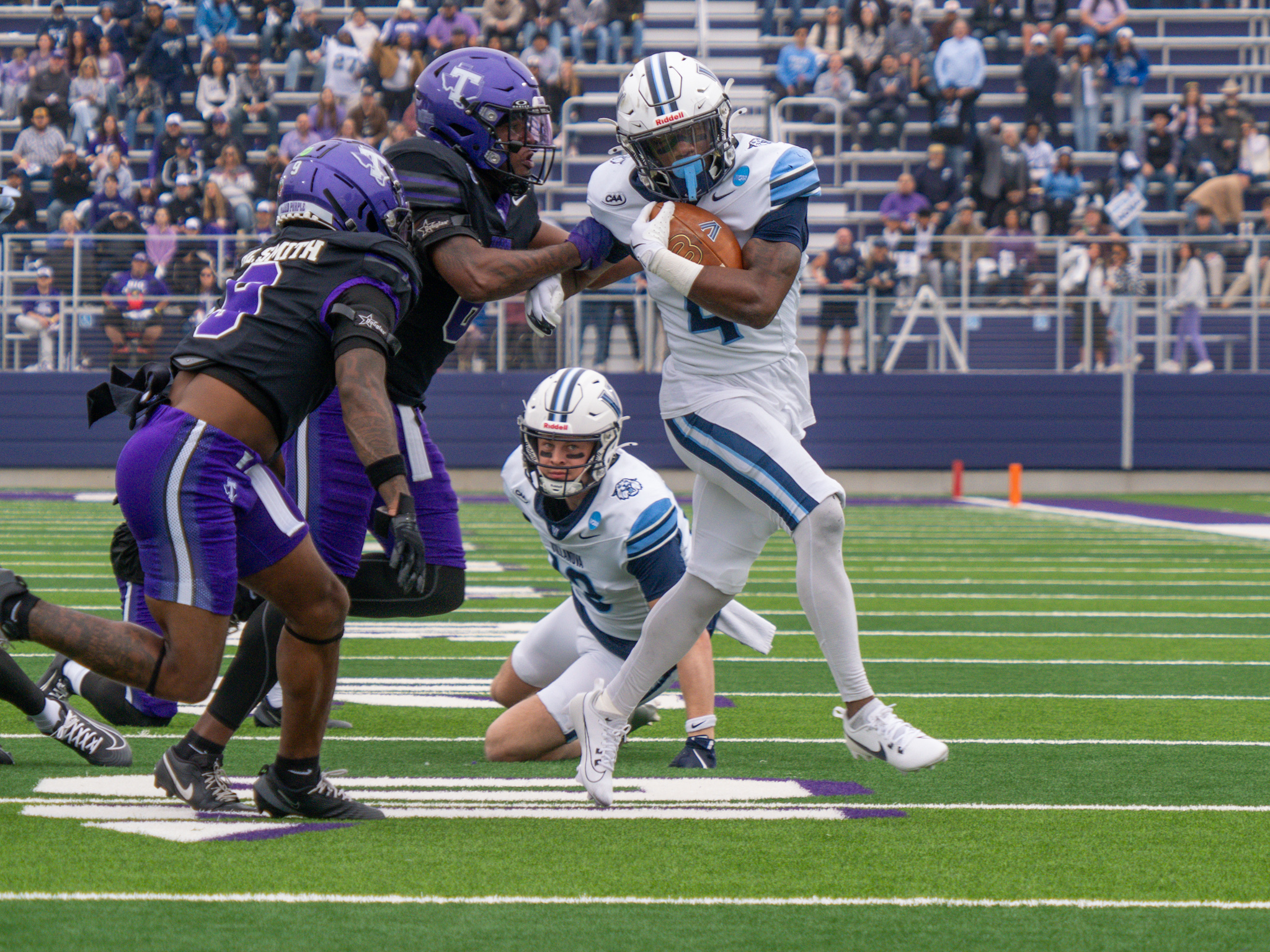
    Villanova running back Ja’briel Mace returns for his junior season.Courtesy of Brendan Maloney

    Quarterback Pat McQuaide, an All-America candidate who passed for over 3,000 yards and 25 touchdowns a year ago, won a court ruling to gain eligibility to return to Villanova this season.

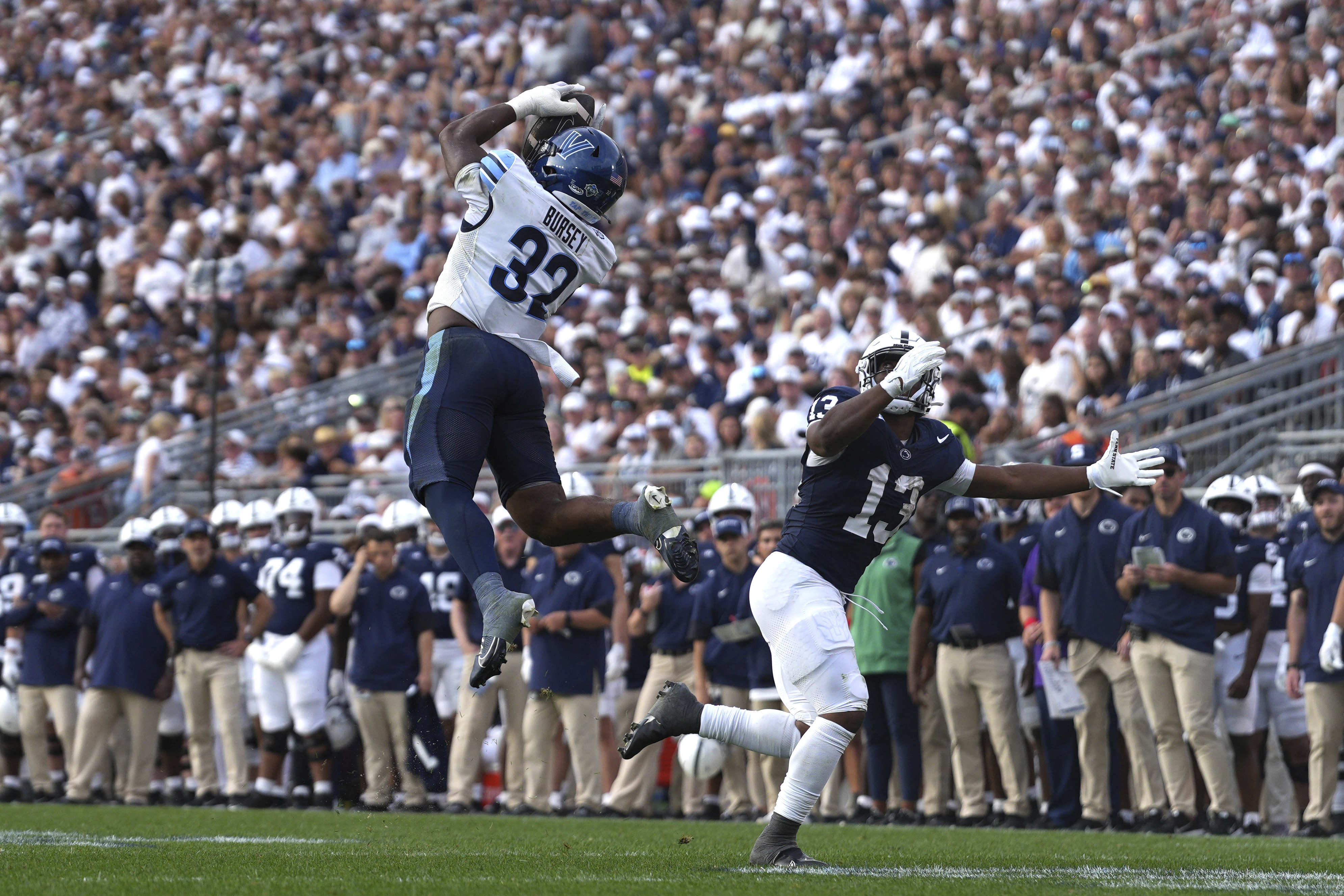
    Running back and rising junior Ja’Briel Mace, junior offensive lineman Chris McCullers, and sophomore Braden Reed, a wide receiver, were all named to the preseason All-Patriot League offensive team. Mace also got a nod on the special teams as a return specialist. Senior defensive lineman Capri Martin and sophomore linebacker Omari Bursey were both named to the preseason defensive team.

    Defending FCS champion Montana State tops the poll with 25 first-place votes, while South Dakota State, which comes in third, was the only other team to receive a vote for the top seed (1).

    Villanova’s season starts against William and Mary at home on Aug. 28, at 6 p.m., marking the first game in the Patriot League for both teams.

  • Trump blames vandals for damaged grass in the spot where he held his big July 4 celebration

    Trump blames vandals for damaged grass in the spot where he held his big July 4 celebration

    WASHINGTON — President Donald Trump says vandals are to blame for large swaths of dead grass on the National Mall near the World War II Memorial — in the spot where he had a stage built and hosted crowds for his July 4 celebration.

    Trump made the accusation in a social media post on Sunday without saying why he believes it’s the work of vandals instead of trampled turf from the Independence Day festivities. The Republican president posted a photo showing a once-grassy area by the World War II Memorial, now patchy and brown across much of the sprawling turf.

    “Look what VANDALS did to the grass connecting the vandalized World War II Monument and the vandalized Reflecting Pool, which will be opened again, and better than ever, shortly,” Trump said on his Truth Social platform.

    “Anybody who thinks the Reflecting Pool wasn’t vandalized should go back to Law School!” he added.

    Trump has repeatedly blamed vandals for damage to his renovation projects in the nation’s capital, often without evidence and sometimes despite opposing accounts from his officials. Trump lashed out at U.S. Attorney Jeanine Pirro this month after her office concluded that damage to the Lincoln Memorial Reflecting Pool was the result of poor construction and not the work of vandals, as Trump claimed.

    Authorities on Friday announced an arrest in connection with vandalism at the World War II Memorial, after the words “Clean hands dirty $” were found painted on the monument and bubbles filled a fountain. Pirro said felony charges were being brought against Melissa L. Farris, who was in custody and couldn’t be reached for comment.

    A woman identified on her Facebook page as Melissa Lovewell on Thursday posted a video in which she is seen taking cans of spray paint from her bag and then painting the monument. “I will wait here to be arrested for spraying our veterans’ fountain,” she says. “It was me. I’m doing it. It’s on camera.”

    The woman was identified by her Kentucky driver’s license as Melissa L. Farris, of Elizabethtown, Ky., an arrest warrant says.

    Charging documents in that case make no mention of the grassy area Trump is highlighting in his new claims. Authorities said Farris had previously been arrested for camping on federal property a few blocks from the World War II Memorial, but not the area cited by Trump.

    That stretch of lawn is instead where a large stage was built and crowds gathered to hear from Trump and watch fireworks at a July 4 event celebrating the nation’s 250th anniversary. Trump claimed without providing evidence that more than 400,000 people attended the event before a storm hit the area and delayed his remarks.

    Photos from the time, taken by a streaming webcam atop the Washington Monument, show a large bandstand and seating areas covering nearly the entire lawn Trump now says has been vandalized. Associated Press photos from the days that followed showed workers removing the structures, revealing brown, damaged grass underneath.

    On Aug. 1, Trump posted a different photo of the same area that appears to show the numbers “86 47” — which federal officials have said constitutes a threat against Trump, the 47th president — emblazoned into the grass. He cited it as evidence refuting Pirro’s conclusion, calling it “a pure case of VANDALISM, that included the grass.”

    “There may have been some contractor difficulty, but the major damage was caused by VANDALS!” he wrote.

    Those numbers are not visible in the photo Trump posted to social media on Sunday.

  • Wawa’s new Phanatic smoothie tastes like a ‘World Series win with a sprinkling of Mets tears’

    Wawa’s new Phanatic smoothie tastes like a ‘World Series win with a sprinkling of Mets tears’

    As Philly guys go, the Phanatic is one suave dude. His gyrating belly, chameleonlike tongue, and ability to burn our opponents without uttering a single word have charmed generations of Philadelphians.

    Now, this smoothie operator has a smoothie all his own and it tastes like the tears of our rivals — sweet, salty, and delicious.

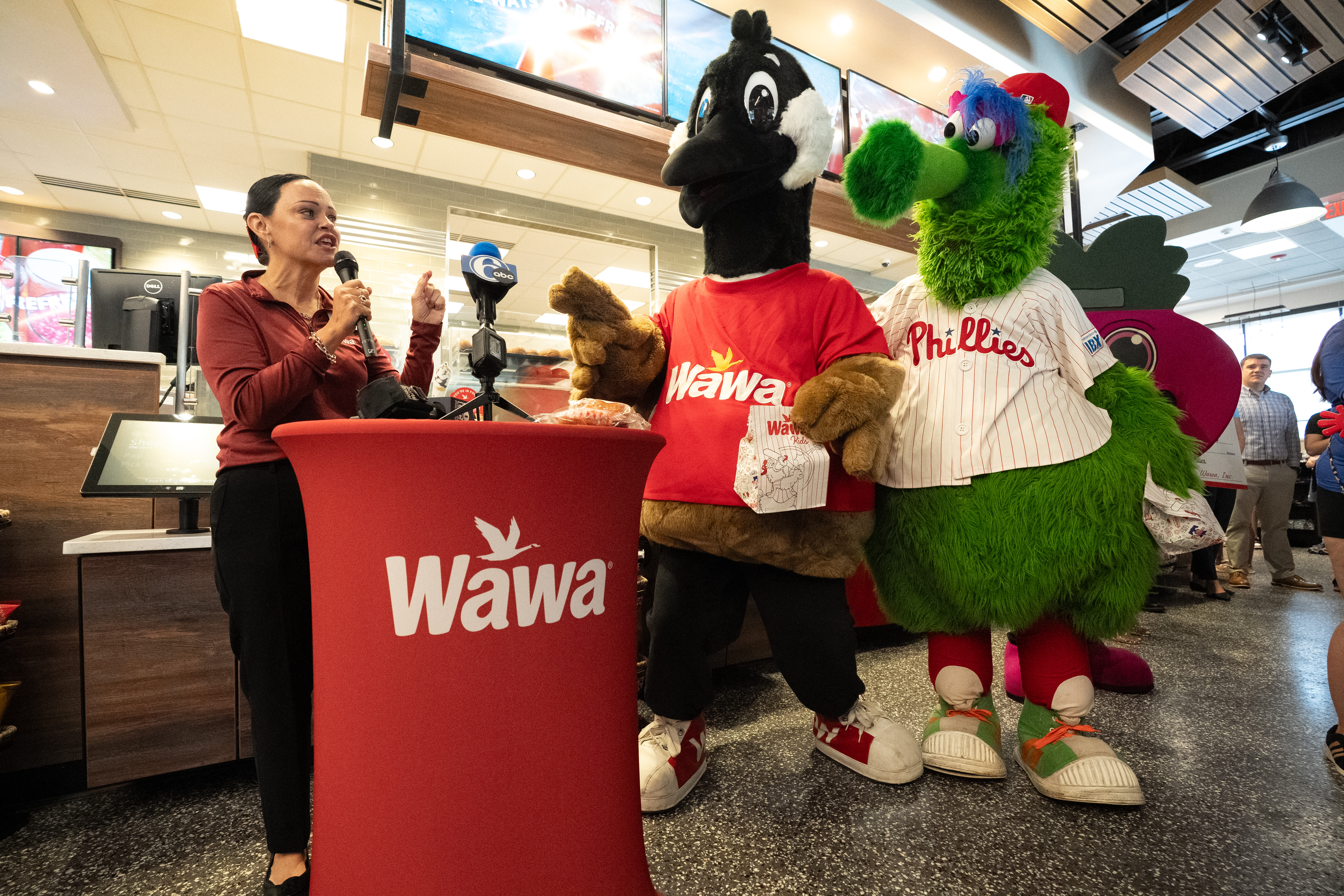
    Kim Rodriguez, Wawa manager, along with the Wawa mascot Wally Goose and the Phillie Phanatic in Philadelphia on Aug. 17, 2026.Jessica Griffin / Staff Photographer

    Wawa debuted its new, limited-edition Phanatic Caramel Curveball Cream Smoothie during an event at the chain’s Penrose Avenue store Monday that was part news conference, part pep rally, and perfectly preposterous.

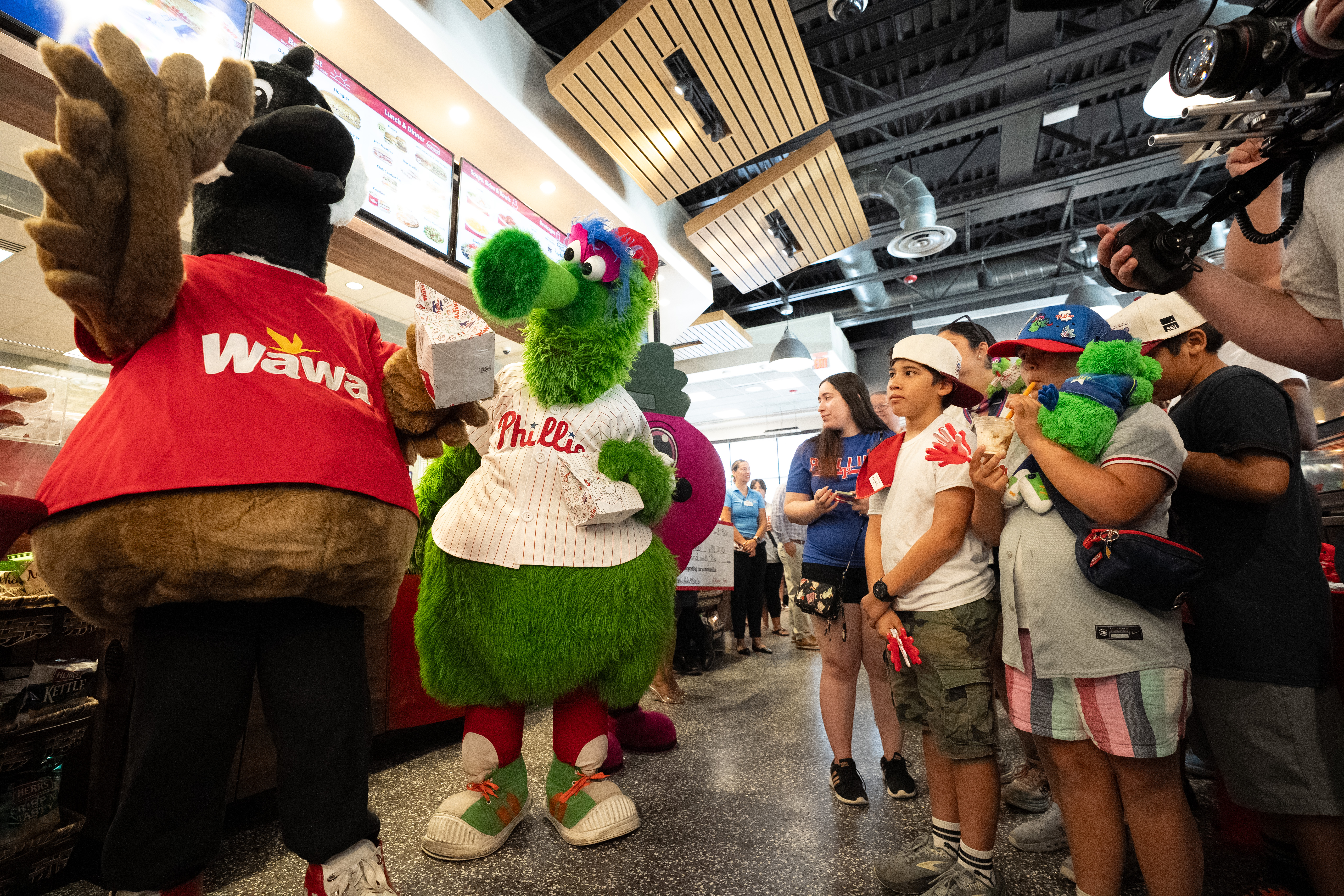
    Fans packed the store — for what, they weren’t exactly sure — they just knew it would be a chance to “hang with the Phillie Phanatic and Wally Goose,” according to Wawa’s Facebook page for the event.

    The two-birds-one-store offer was enough to bring out a flock of more than 75 people dressed in Phillies, Phanatic, and Wawa gear, including sisters Elizabeth and Jennifer Bertolet of Doylestown. They arrived 90 minutes before the event and decided that whatever was about to happen, it was “going to be awesome.”

    “Wally is going to be here and the Phanatic is going to be here. Why wouldn’t we be here?” Elizabeth Bertolet said.

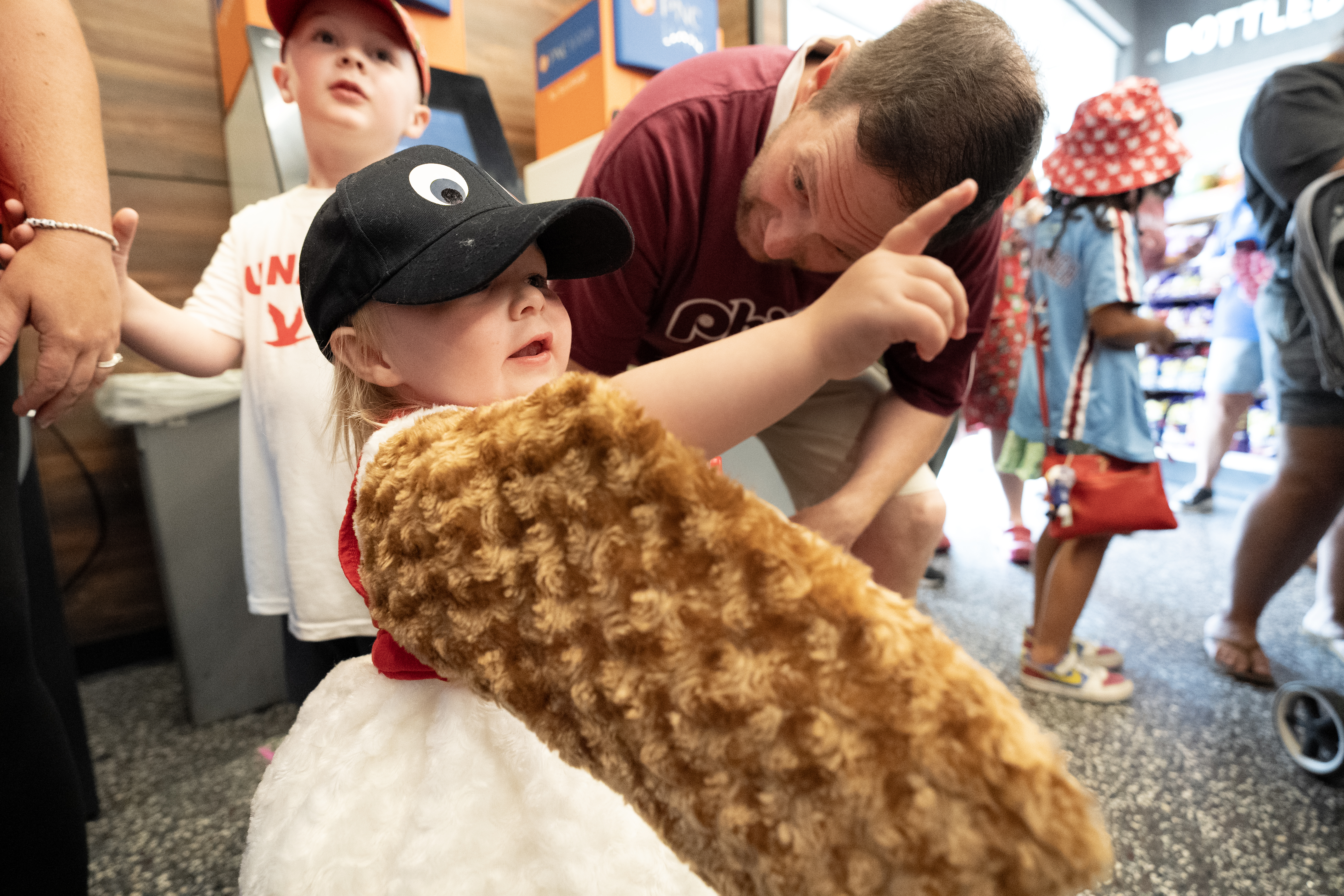
    Maggie McNulty, who is dressed as Wally Goose, and her father, Glenn McNulty, attend an event at Wawa’s Penrose Avenue store celebrating the partnership between the Phillies and Wawa. Jessica Griffin / Staff Photographer

    Justin Tichy, chief operations officer for Wawa, announced during his remarks that the smoothie is part of a new partnership between Philly’s hometown baseball team and its hometown convenience store.

    Fans at Friday’s Phillies’ game against the St. Louis Cardinals will receive a Wawa Kyle Schwarber bobblehead, samples of the Phanatic smoothie, and a chance to see Wally Goose throw out the first ceremonial pitch.

    When asked how he’s feeling about taking the mound, Wally shuddered with nervous energy then practiced his pitching wing.

    She Willians, of Job Corps culinary, and the Wawa mascot Wally Goose at Wawa’s Penrose Avenue store Monday. Jessica Griffin / Staff Photographer

    Perhaps he’ll throw a curveball like Wawa did by not making its Phanatic smoothie green. A source said it’s because the Phanatic is unlikely to put anything green in his smoothie, which 100% tracks. You don’t get that bouncy belly by drinking kale.

    When asked what he thought about the new drink bearing his name, the Phanatic raised his arms overhead then circled his belly around in approval.

    The smoothie is made with vanilla ice cream, caramel sauce, whipped cream, salted caramel syrup, and sea salt pretzel pieces. It comes in a limited-edition cup featuring the Phanatic’s eyes and the tip of his snout and it only comes in one size — phanatically large — clocking in at 970 calories.

    The new Phanatic smoothie

    [image or embed]

    — Stephanie Farr (@farfarraway.bsky.social) August 17, 2026 at 1:39 PM

    Zack Sminkey of Woodstown, N.J., who wore a matching red shirt-and-shorts combo featuring repeating patterns of the Phanatic, brought his 7-year-old daughter Zoe to the event. Both approved of the new smoothie in the big green guy’s honor.

    “It’s really good. It’s very ballpark-tasting,” Sminkey said. “I almost feel like it tastes like Cracker Jacks. It’s delicious.”

    Jennifer Bertolet described it another way as she and her sister toasted their free samples of smoothie.

    “It tastes like World Series win with a sprinkling of Mets tears,” she said.

    Phillies ambassador Scott Palmer with a tray of new Wawa limited-edition Phanatic Caramel Curveball Cream Smoothies.Jessica Griffin / Staff Photographer

    When Wawa released a limited-edition Gritty Smoothie in the spring in honor of Philly’s prince of chaos, it was only a matter of time before the OG mascot king got one of his own, too.

    The partnership between Wawa and the Phillies solidified Wawa as the team’s official hoagie in June. Wawa hoagies now come wrapped in Phillies-themed paper, and the chain is selling red-and-white striped Phillies doughnuts and Phillies-themed kids meals, which come with stickers of the Phanatic and Wally Goose. A portion of the proceeds from the kids meals go to Philabundance.

    In turn, Wawa has an increased presence at Citizens Bank Park with new advertising and ballpark activations.

    Wally Goose and the Phillie Phanatic represent Wawa and the Phillies at a news conference on Monday about their recently-announced partnership. Jessica Griffin / Staff Photographer

    But the Phillies and Wawa were in a situationship long before they made things official this summer. Whenever the Phillies make the playoffs, Wawa brings back its Kyle Schwarber-themed Schwarberfest, a Hoagiefest spinoff featuring discounted hoagies. And in 2024, Bryce Harper was fined by MLB for showing his love for the chain by wearing custom-made Wawa cleats and a headband during a game.

    The Phillies and Wawa collaborations, including the Phanatic smoothie, will be available at stores in the region through Sept. 28.

    No word on if the offers will be extended in the event of a Red October.

    Today while interviewing a woman inside of a Wawa whose baby was dressed like Wally Goose, I was surprise-attacked from behind by the Phanatic, who put me inside of his shirt.

    That is a sentence only a Philly journalist could write – and believe and live through.

    [image or embed]

    — Stephanie Farr (@farfarraway.bsky.social) August 17, 2026 at 1:26 PM

  • Avalon will allow outdoor live music one hour later at Gully’s

    Avalon will allow outdoor live music one hour later at Gully’s

    Avalon has changed its tune.

    Over objections from nearby residents, the affluent Cape May County shore town voted to soften liquor license restrictions for the popular new bar Gully’s, allowing one more hour of outdoor music, until 9 p.m.

    The vote followed an outcry from the town’s locals, old-timers, and music lovers after the band Three and One was told to stop playing at 8 p.m. July 17, two hours earlier than advertised, after complaints from neighbors and a visit from Avalon police.

    The 8 p.m. cutoff for outdoor music was a special condition included in the liquor licenses of Gully’s and other bars in town.

    But at its August council meeting last Wednesday, the council adopted new restrictions on Gully’s that gives the bar one more hour for outdoor live music.

    Gully’s had been appealing those conditions to the state’s Division of Alcohol Beverage Control before the resolution’s adoption.

    Councilman Jamie McDermott downplayed the consequences of extending the music one more hour, and said the noise was “part of living within the two blocks of the commercial business district.”

    “It’s a summer disruption,” he said. “We’re talking about eight Saturday nights that are going to go until nine o’clock.

    “For me, for a summer town, that’s not Sea Isle, that’s the seashore at its best,” he said.

    According to the resolution, Gully’s has retained a sound engineer to help with noise volume from its bands.

    “Each band will be given the sound engineer’s phone number so that the engineer can approve the band’s system before it is set up,” the resolution states.

    In addition, “bands will be warned that they will be cut off and not paid if they do not keep the volume reasonable.”

    The council noted that Gully’s space is mostly outdoors, unlike other bars in town with bigger indoor footprints for music, and that the borough itself has outdoor music until 9 p.m. at its public concerts.

    The extension to 9 p.m. was characterized as a temporary solution for the rest of the summer. The issue will be revisited before next summer.

    Gully’s has agreed to withdraw its appeal, for now, Nicole Curio, the municipal solicitor, told the council.

    The hanging candied bacon served over grits and Gully’s blooming potato at Gully’s on Wednesday, June 17, 2026, in Avalon, NJ.

    The resolution requires Gully’s bands to have smaller sound systems, no 18-inch or larger bass speakers, and to monitor their volume. The restaurant announced the change on its Facebook page.

    The resolution also states that concerned neighbors will be given a number to text if they have issues with the volume.

    Gully’s has also agreed to reposition the stage so that bands are facing the building rather than the neighborhood, the resolution states.

    City Council President Greg “Chet” Johnson said at the meeting that the town needed to ensure that all the new people investing in summer homes had places to go once they arrived in Avalon.

    “The town has changed,” Johnson said, addressing residents who had objected to the new regulation. “It’s a more affluent community that’s coming here. You’ve had great appreciation in your property. This is going to continue to grow and boom. People that come down now, they’re not bringing their groceries. They want to go to restaurants. They want entertainment.”

    The popularity of Gully’s, in a space where a previous business had not flourished, showed that it was something the town as a whole supported, he said.

    Larry Hayes, a neighbor who lives about 500 yards away and has complained about the noise, said he was opposed to the new regulations. Others said Avalon was caving to Gully’s.

    Council Vice President Sam Wierman said it was unrealistic for neighbors near Avalon’s commercial district to want “everything shut off” at 8 p.m.

    “That’s the reality of living,” he said. “I don’t think 9 p.m. is unreasonable. It’s a middle ground.”

    Curio, the solicitor, noted that the resolution did not address other events at Gully’s, like its amplified Monday minnow races, which were also receiving attention from PETA, the animal rights group.

    Resident Jody Kyle, meanwhile, noted a noise issue she thought was worse than Gully’s: The noise from the nearby Wawa, which she said went on until midnight or 2 a.m. some nights.

    “It’s underaged kids who belong at home,” she told council.

  • Trump dwarfs his predecessors in the number of ultra-rich in his second White House, report shows

    Trump dwarfs his predecessors in the number of ultra-rich in his second White House, report shows

    Wealth, perhaps second only to loyalty, has been a prized attribute for Donald Trump during his second presidency.

    The number of people worth at least $100 million whom the Republican president has appointed to his administration is more than four times the combined total under the three previous presidents, according to a report from the consumer advocacy group Public Citizen.

    It’s the numbers for the Trump administration, in the context of previous administrations, that stand out in Public Citizen’s report, published on Monday. In all, 57 Trump officials are worth at least $100 million, including 17 ambassadors and the remaining 40 in senior posts across the executive branch.

    Look no further than Trump’s cabinet. Eight of its 23 members fit the category, notably Commerce Secretary Howard Lutnick and Education Secretary Linda McMahon, both billionaires.

    The president, himself a billionaire, has described his inclination toward appointing the ultrawealthy as deference to financial success. And yet, Trump, who owes his White House comeback to support from middle-income, working Americans drawn to his pledge to lower everyday costs, now faces a midterm electorate decidedly less keen on his handling of the economy.

    Presidents have long sought counsel from the nation’s wealthiest people and tapped some for high-profile administrative leadership roles. Likewise, presidents routinely reward wealthy and influential supporters with ambassadorships.

    Among the most notable examples is Andrew Mellon, the aluminum, oil, and banking tycoon who was among the handful of the nation’s wealthiest people in the 1920s and served as treasury secretary for three presidents.

    The Trump officials worth at least $100 million include Deputy Secretary of Defense Stephen Feinberg and Small Business Administration Administrator Kelly Loeffler, who are also billionaires, and Treasury Secretary Scott Bessent and special envoy Steve Witkoff, both worth hundreds of millions of dollars.

    By comparison, Republican George W. Bush’s administration and Democrat Joe Biden’s each included five members worth $100 million or more. Democrat Barack Obama’s included three, the report states.

    A government populated by so many of the economic elite presents potential problems, the report’s authors said.

    “When the people holding the reins of government are drawn overwhelmingly from the ranks of the ultra-rich, it leads to misplaced incentives and corruption, and begs the question, ‘Whose interests they are truly serving?” said Lisa Gilbert, Public Citizen’s co-president.

    The list does not include Trump, whose net worth Forbes estimates at more than $6 billion. Nor does it include space and social media giant Elon Musk, who advised Trump last year on an effort to reduce the federal government’s size, scope, and workforce and is the world’s wealthiest person, with a net worth Forbes estimates at about $860 billion.

    Trump’s views are well established: Financial success is evidence of executive mastery and negotiating strength.

    “They have great competence, those people. Incredible competence. Some of the smartest business leaders,” Trump said last year in explaining why he put considerable weight on advice from business executives.

    He has also pointed to investments by wealthy people as a signal of future economic growth. To encourage billionaires to deliver, Trump, in his first year back in the White House, pursued policies on artificial intelligence and financial regulation that could benefit wealthy people, along with tax cuts and reduced regulatory burdens for large-scale investments.

    Still, last month, only 32% of U.S. adults approved of Trump’s handling of the economy, down from 40% at the beginning of his second term and as his Republican Party faces headwinds in its attempt to hold both majorities in Congress in November.

  • Trump lashes out at Oman as preliminary deal with Iran expires

    Trump lashes out at Oman as preliminary deal with Iran expires

    As a crumbling truce with Iran officially collapsed Monday, President Donald Trump signaled his frustration at his inability to resolve a war that he started but cannot seem to end.

    In an interview with Fox News, the president lashed out at a U.S. ally, Oman, that has been trying to mediate negotiations with Iran.

    “If Oman gets in the way, we’ll bomb the s— out of them,” Trump said in a phone interview, according to Fox News’ Trey Yingst.

    The latest threat toward Oman, which has facilitated talks between the United States and Iran for years and maintains that it is still a neutral mediator, came as Trump found himself without much leverage to reach the goals he set out at the start of the war.

    Hostilities have now stretched past the six-month mark in a conflict that began with the United States and Israel launching strikes across Iran in February. Administration officials pledged at the time that the war would be over in four to six weeks.

    In June, the two sides agreed to a memorandum of understanding, but that quickly fall apart amid disputes over its wording. Both Trump and Iran’s leaders have said the deal is essentially dead.

    As the ceasefire officially expires, the president and his team have promised to level crushing sanctions against Iran this week, though the details of those plans have yet to be unveiled. And Defense Secretary Pete Hegseth has said the United States can maintain a naval blockade of the Strait of Hormuz, a critical oil shipping corridor, indefinitely — an acknowledgment that there was no end to the war in sight.

    In the Fox News interview, Trump sought to project patience, saying he was “not in a hurry” to secure a deal while maintaining that his central goal remained preventing Iran from possessing a nuclear weapon.

    But in the meantime, it was Oman that received the president’s fury.

    It was the second time this year the president has threatened the country. After it emerged in May that Oman had discussed partnering with Iran to charge fees for ships to pass through the strait, Trump snapped.

    “Oman will behave just like everybody else, or we’ll have to blow them up,” Trump told reporters that month. “They understand that. They’ll be fine.”

    A White House official did not immediately respond to a request for comment.

    This article originally appeared in the New York Times.

  • Trump’s overture to Kim Jong Un strains alliance with South Korea

    Trump’s overture to Kim Jong Un strains alliance with South Korea

    SEOUL, South Korea — The South Korean and U.S. militaries view their annual drills in South Korea as more critical than ever. The stakes have risen dramatically as North Korea has gained battlefield expertise with drones and modern warfare by deploying troops to support Russia’s war in Ukraine.

    The summer exercise had barely begun Monday when President Donald Trump denounced it, dealing yet another blow to the seven-decade-old alliance between Washington and Seoul. Under Trump, bilateral relations have already come under immense strain from ​his punishing tariffs on South Korean exports.​ And his transactional diplomacy has frustrated South Korea, most recently when he appeared to put Saudi Arabia on the path to enriching nuclear fuel on its own soil, a demand Seoul has made for years.

    In recent years, North Korea has ​not only expanded its nuclear arsenal but also repeatedly threatened ​to use it against South ​Korea, labeling its neighbor ​a “most ​hostile enemy.” Its leader, Kim Jong Un, has also forged a mutual defense treaty with Moscow, dispatching troops and​ weapons to ​support Russia’s war against Ukraine. Despite these escalations, Trump, in a social media post, characterized North Korea as “unthreatening and respectful” while boasting of his “very good relationship” with Kim.​

    In the same post, he ​also criticized the decades-old joint military drills with South Korea as “not only costly” but “totally inappropriate and hostile” toward North Korea.

    “I am not happy with the fact that the United States has, long ago, agreed to participate in Joint Military Exercises with South Korea,” he said. “Based on the fact that it is too late to cancel, I have instructed Secretary of War, Pete Hegseth, to substantially reduce the Joint Military Exercises!”

    If implemented, the directive would mark Trump’s first-known concrete overture toward North Korea in his second term. However, it remains unclear whether Kim will embrace the gesture.

    Throughout his political career, Trump has treated the alliance as a​ bad bargain for Americans, frequently accusing Seoul of failing to pay its fair share for the U.S. troops stationed in South Korea — who act as a deterrent to North Korea. During his first term, he unilaterally canceled or downscaled major drills, calling them “tremendously expensive” and “​very provocative.”​ That concession helped facilitate three summit meetings with Kim but failed to roll back his nuclear ambitions.

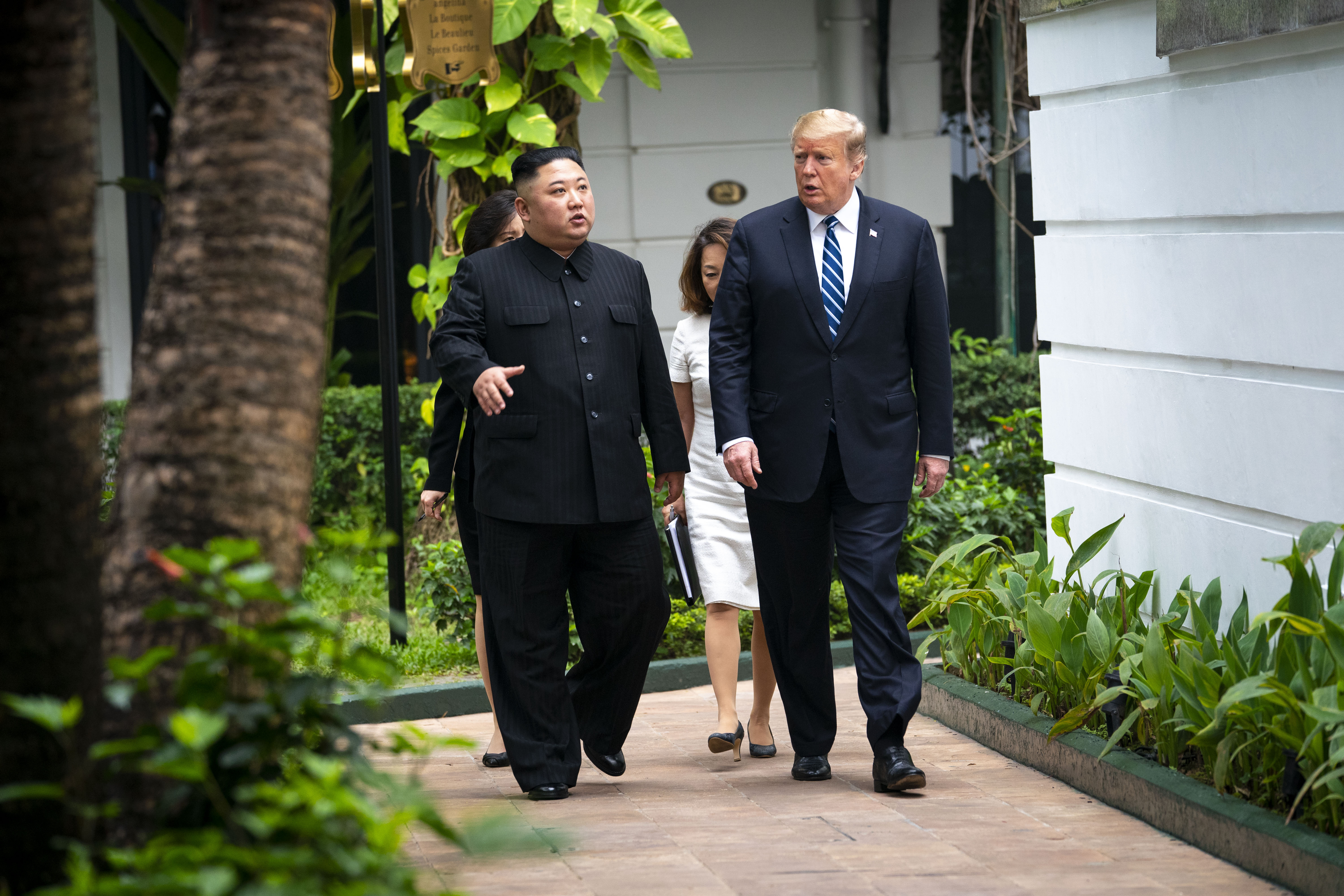
    Since returning to the White House, Trump has signaled a desire to renew that personal diplomacy. Over the weekend, he posted a 2019 photograph of himself and Kim at the inter-Korean border, writing, “Kim Jong Un and I get along GREAT!”

    “Trump’s description of the DPRK as ‘unthreatening and respectful’ is alarming to allies, who have watched the regime steadily improve its missile and nuclear capabilities, while also gaining an additional patron in Russia for its support in the war on Ukraine,” said Emma Chanlett-Avery, the deputy director at the Asia Society Policy Institute, referring to North Korea’s full name, the Democratic People’s Republic of Korea.​

    Th​is summer’s 11-day Ulchi Freedom Shield exercise was designed to adapt to these shifting dynamics​, incorporating lessons learned from recent conflicts, including from Ukraine. Lt. Gen. Joseph E. Hilbert of the U.S. 8th Army noted that the maneuvers would ​also test “the alliance’s ability to rapidly project combat power and secure key terrain within the First Island Chain”​ —​ a long Pacific archipelago seen by the U.S. military as a strategic frontier against China’s expansive territorial claims.

    But Trump found fault with South Korea on another front; in his post, he also criticized Seoul for failing to help “denuclearize” Iran.

    South Korea’s Foreign Ministry on Monday pledged continued coordination with the United States on both joint military exercises and Iran.

    While South Korea’s government confirmed that the drills had begun as scheduled, its defense establishment was deeply rattled. Trump’s directive fueled growing fears​ that the alliance was hollowing out.

    “South Korean conservatives​, in particular, will see the alliance turning into a zombie, ​considerably losing its old strategic objectives and political energy under Trump,” said Lee Byong-chul, an analyst at the Institute for Far Eastern Studies in Seoul.

    Trump’s overture toward North Korea, however, is not entirely unwelcome for his South Korean counterpart, Lee Jae​ Myung, analysts said. A staunch proponent of inter-Korean reconciliation, Lee has urged Trump to ease tensions on the Korean Peninsula through direct talks with Kim. ​North Korea has long cited the joint drills as a major stumbling block to such efforts, calling them “a rehearsal for an aggressive war.”

    On Monday, South Korea reiterated its hopes that the rapport between Trump and Kim would foster “meaningful dialogue.”

    But a second round of Trump-Kim diplomacy faces much steeper hurdles than it did in 2018. North Korea is now a de facto nuclear state that has been bolstered by economic lifelines and diplomatic leverage from Moscow and Beijing. While Kim has noted that he retains “a good memory” of Trump, he has emphasized that North Korea would resume talks ​only if Washington abandons its insistence on denuclearization.

    This article originally appeared in the New York Times.