Blog

  • Chester’s historic bankruptcy has no ‘deadline’ after 4 years and $19.3 million in state dollars

    Chester’s historic bankruptcy has no ‘deadline’ after 4 years and $19.3 million in state dollars

    Entering year five of its rare and historic bankruptcy, at least the City of Chester no longer has to worry about retirees’ pension checks bouncing.

    Chester’s fiscal condition has improved markedly since it entered receivership two years before the bankruptcy, as the state has spent $19.3 million in assorted administrative and legal fees.

    But with an all-time logjam of litigation making the sale of valuable water assets more and more contentious, the city has marked another bankruptcy anniversary with no end imminent.

    And legal experts advise that given the paucity of precedents, the outcome for the erstwhile industrial powerhouse is about as certain as the average seasonal weather forecast.

    An analysis presented at a bankruptcy committee meeting Tuesday — coincidentally the fourth anniversary of the bankruptcy filing — concluded it would take $45.7 million to cover ”funding needs” in 2027. About 90% of that would be used for continued coverage of pension deficits. The police fund, for example, while far from fully funded, now has enough money to make payments for the next five years.

    And given projected costs and the current state of revenue sources, even if it erased the pension shortfalls, the city would continue to run ever-increasing annual budget deficits that would grow to $36.8 million in the next decade, according to the analysis presented by Gordon Mann, managing director of Public Financial Management Group Consulting. About 20% of the town’s revenues come from a casino and an incinerator, and Chester’s 3.75% earned-income tax is Pennsylvania’s highest.

    “This is the gap the city must address to exit bankruptcy,” Mann said.

    Now, with those calculations, Chester is “ready to begin discussions with stakeholders,” including creditors and pensioners, said state-appointed receiver Vijay Kapoor.

    The bankruptcy’s end has no ‘deadline’

    As for when the bankruptcy might end, Kapoor said, “I am moving with due speed to get things wrapped up as quickly as possible. … I don’t have a deadline in mind.”

    Regarding potential money sources, it is at least possible the blue wave that gave Democrats control of the Pennsylvania legislature may work in Chester’s favor by making more funding available, said John Caskey, a Swarthmore College economics professor who is on the board of directors of the Chester Community Improvement Project. Michigan kicked in money to get Detroit out of bankruptcy, he noted.

    “I think there’s a social justice argument for that,” he said. Chester, a predominantly Black city, hosts more subsidized-housing units than the rest of Delaware County combined.

    Said Kapoor: “I am open to any solution, other than the privatization of the water assets.”

    Liquid assets and the future of Chester

    Kapoor’s comment was the session’s first and only reference to what has been an acrimonious dispute between the city and the Chester Water Authority over the control of water assets that are projected to generate more than $60 million in revenue next year. At one time, Aqua Pennsylvania had offered Chester $410 million for the authority.

    The receiver’s office contends the city lost control of the authority, which it had created in 1939, by a legislative sleight-of-hand, which it has challenged in court.

    The receiver’s office has said repeatedly it wants to sell the authority to a “public entity” that would not be beholden to investors.

    “Back in my world, that is what we call magical thinking,” said Noel Brandon, chair of the water authority board.

    He said the receiver wants the water authority’s 45,000 customers, most of whom are located outside Chester, to subsidize the fiscal problems of a city that has been in a state-designated distressed status for 31 years.

    “You can’t loot an entity that had nothing to do with it,” Brandon said.

    Chester’s history of distress

    Chester’s situation has followed the arcs of other postindustrial cities that watched economies collapse, populations decline, poverty rates increase, and tax bases erode.

    “Chester is not unique,” Caskey has said. “It’s just more extreme.”

    The city entered distressed status in 1995 and receivership in 2020. The pension deficits mutated into a crisis.

    The situation was so ominous, Mann said, that at one point the police fund had only two months’ worth of payments available and the city feared some checks might bounce.

    The receiver took the city into the rare Chapter 9 bankruptcy in 2022.

    “Chapter 9 is used so little, there’s a lot of uncertainty that comes along with it,” said Laura Coordes, an Arizona State University law professor who specializes in municipal bankruptcy. She said Chester’s choice was exceptional, in that most towns “would rather not go through the expense of a process where the results are hard to determine.”

    The future of Chester

    Barring resolution of the water-asset dispute or intervention by state government, reductions in pensions and retiree health benefits are likely.

    Gov. Josh Shapiro sees “a long road ahead” for Chester’s bankruptcy, said spokesperson Rosie Lapowsky, but he “has confidence in Chester’s recovery.”

    A fundamental issue in Chester is the need for more taxable real estate, Caskey said, but “I don’t think big taxable businesses are seeking to locate in Chester,“ nor are average incomes likely to increase in the near future.

    Chester could use another entity to generate generous host fees, “a new version of the casino, or something like that,” he said.

    On the plus side, the market value of city real estate has increased about 45%, adjusted for inflation in the last 20 years, according to state figures.

    And one asset the city has is the mayor, Stefan Roots, along with a fiscally responsible administration, Caskey said.

    Roots said bankruptcy overall has yielded benefits to the city.

    “Four years ago, people talked about Chester problems,” he said. “Today, people are talking about Chester possibilities. Four years ago, the question was whether Chester could survive. Today, the question is how far Chester can go.”

  • Meet Wasabi and Rufus, two dogs representing Rocky Balboa’s beloved Butkus at this weekend’s National Dog Show

    Meet Wasabi and Rufus, two dogs representing Rocky Balboa’s beloved Butkus at this weekend’s National Dog Show

    At a Rockyfest photo shoot a few years ago, several people had what seemed like a simple task: tie a red bow around Wasabi’s neck, just like the one Butkus wore in the original Rocky movie.

    There was one problem. The ribbon wasn’t long enough to fit around the 125-pound bullmastiff’s neck.

    As three people struggled to fasten the bow to her collar, Wasabi bounced around, eager to greet everyone around her. The dog was more interested in making friends than posing for pictures.

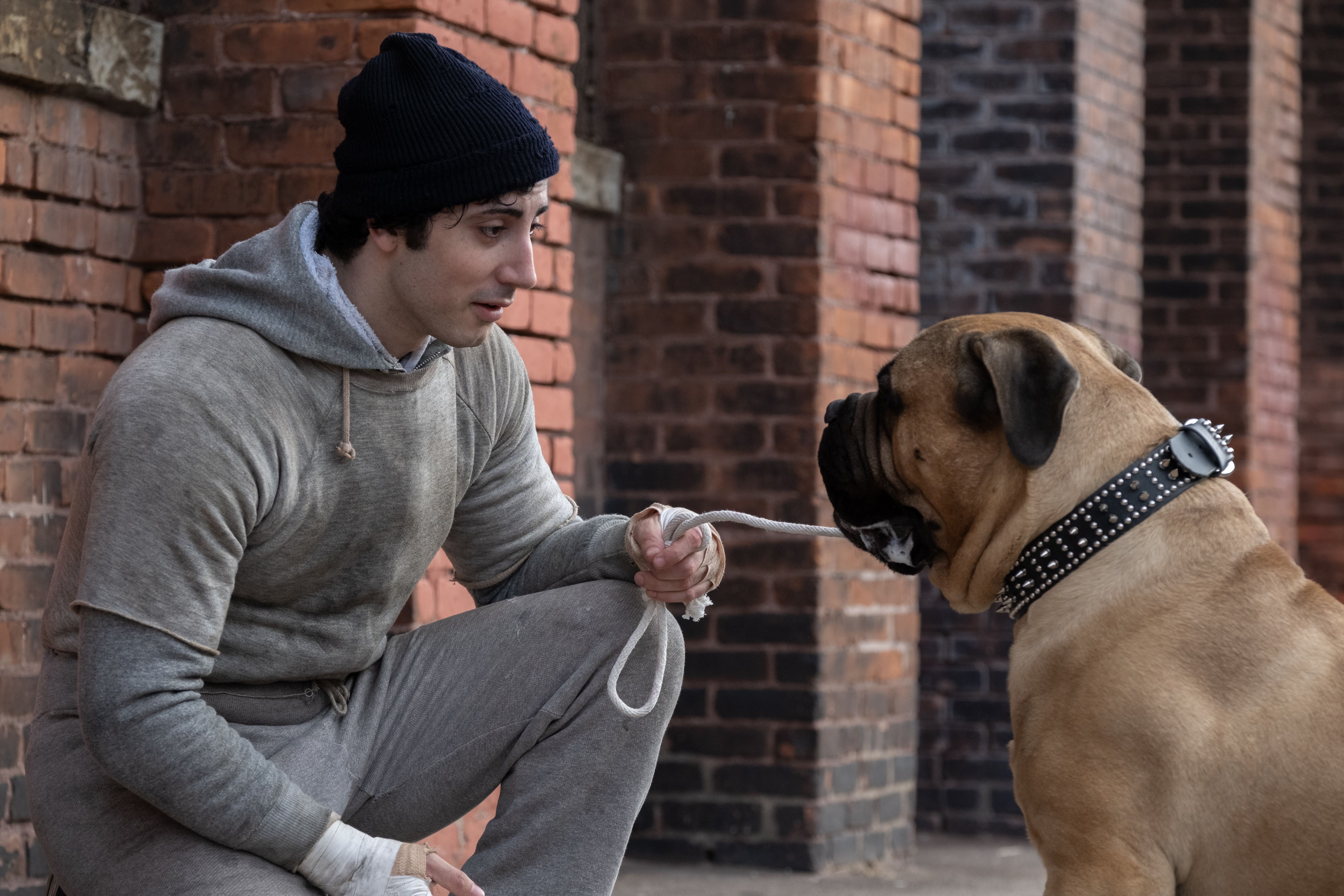
    For the past three years, Wasabi has represented Butkus, Rocky Balboa’s beloved dog, at celebrations throughout Philadelphia. This weekend, she’ll return to the spotlight alongside fellow bullmastiff Rufus as the National Dog Show comes to the Greater Philadelphia Expo Center in Oaks.

    The appearances are part of the festivities surrounding the 50th anniversary of Rocky, the 1976 film that helped make Philadelphia’s Art Museum steps an international landmark.

    Wasabi’s owner, Tamar Paltin, said the dog’s gentle temperament makes her particularly well-suited for the role. Although her size can intimidate people, Wasabi quickly wins them over with her affection.

    “She really loves kids,” Paltin said. “She lives with kids. She goes to library; she goes to college campuses. She’s just really a sweet dog for such a large animal.”

    At home, Wasabi greets visitors carrying stuffed animals in her mouth, her tail bouncing with excitement. She has also learned that going to bed before the family’s other dogs guarantees her the best sleeping spot.

    Her affectionate nature extends beyond home. A certified therapy dog since she was a year old, Paltin says she has a knack for recognizing people who might need some extra attention.

    Paltin, who works in animal science education at Harcum College, said Wasabi sometimes leaves her side to approach a student during a stressful afternoon, gently leaning against them until they relax.

    That temperament has made Wasabi a popular attraction at Rocky-themed events, where visitors line up to meet the dog representing one of the franchise’s most recognizable companions.

    Paltin said the experience has given her a greater appreciation for the films and the way their characters continue to bring people together.

    For Michael Devine, Rufus’ role as a Butkus ambassador carries a more personal significance.

    Devine’s interest in bullmastiffs began when he watched Rocky and saw the relationship between Sylvester Stallone’s character and his imposing canine companion. The breed left a lasting impression, and years later, an encounter with a brindle bullmastiff at a Philadelphia dog show helped solidify his desire to own one.

    Now, decades after first watching the film, his own 140-pound bullmastiff is helping celebrate its legacy.

    Devine described Rufus, a retired champion show dog and certified therapy dog, as an unusually gentle companion who seems to understand how to interact with different people.

    “He’s a gentleman,” Devine said.

    Some bullmastiffs representing Rocky Balboa’s dog, Butkus, will have a special exhibition at this weekend’s National Dog Show in Oaks.Simon Bruty / National Dog Show

    During visits to retirement communities, Rufus is especially careful around residents. At schools, he becomes more playful, allowing children to interact with him as he settles onto the floor.

    Devine recalled one young visitor at the National Dog Show leaning toward Rufus for a kiss. Rather than pulling away, Rufus gently touched his nose to the child’s, drawing a smile.

    That ability to connect with strangers has become central to Rufus’ work representing Butkus.

    The two bullmastiffs also have developed a relationship of their own through their appearances together. Paltin said Wasabi and Rufus occasionally bow and prance around each other when they reunite before returning their attention to the crowds.

    This weekend, Wasabi will participate in Saturday’s Rocky Run before greeting visitors at the National Dog Show’s Rocky-themed booth. Two of her daughters also are expected to participate, while her son competes in the breed ring. Rufus will greet visitors at the show throughout the weekend.

    For Paltin, the celebrations offer visitors an opportunity to see a different side of a breed often judged by its size.

    Devine sees something distinctly Philadelphian in that contrast. Like the city portrayed in Rocky, bullmastiffs can appear tough and intimidating at first glance, he said, but beneath their muscular exterior is an affectionate, loyal companion.

  • They wear wedding rings, but they’ve never been in love with each other

    They wear wedding rings, but they’ve never been in love with each other

    When Cait Wallace and Brennan Keehan were about to close on their house in 2022, someone at the real estate signing asked if they were married. They tend to say yes, although technically they’re not.

    It’s just easier than explaining.

    “It’s not romantic or sexual, but also definitely all of my assets go to them when I die,” Wallace said.

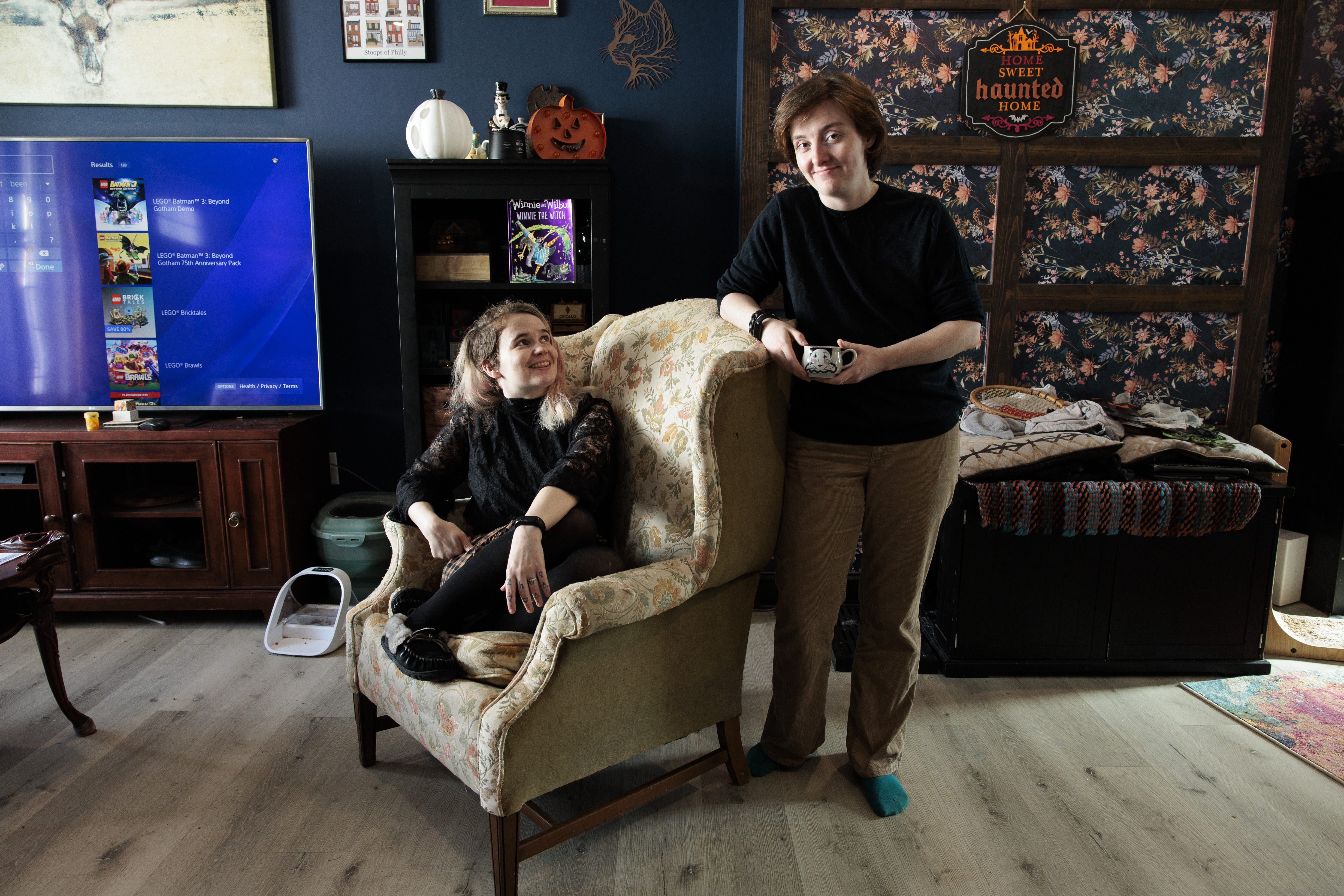
    Wallace, who is 34, met Keehan, 32, in a pagan student club she founded at Drexel. Between rituals and an “occasional field trip to the middle of nowhere,” as Wallace described it, they became friends. After Drexel, they bought a house in Kingsessing with three other friends.

    Inside that crowded house, Keenan and Wallace came to think of each other as platonic life partners. The amount of time they spent together and how much they prioritized each other made others think of them as a duo.

    “That’s when the jokes went to, ‘Oh yeah, you guys are married,’” Wallace said. “If you invited one of us somewhere, we would assume, ‘I can definitely invite [the other].’”

    When the not-quite-a-couple attended a concert by the indie folk musician Will Wood at World Cafe Live in 2022, Keehan noticed that Wallace started crying when Wood sang about growing up and settling down in an unconventional way.

    “Marriage always scared me, but I’d like to have a last love,” the song “Becoming the Lastnames” goes.

    Later that week, Keehan bought them both wedding rings with their birthstones. It wasn’t a proposal, more like an out-of-the-blue gift to mark the relationship they already had.

    “This is someone I’m committed to,” Keehan said. “It would be nice to have something for that. And also just, this is cute. That’s fun.”

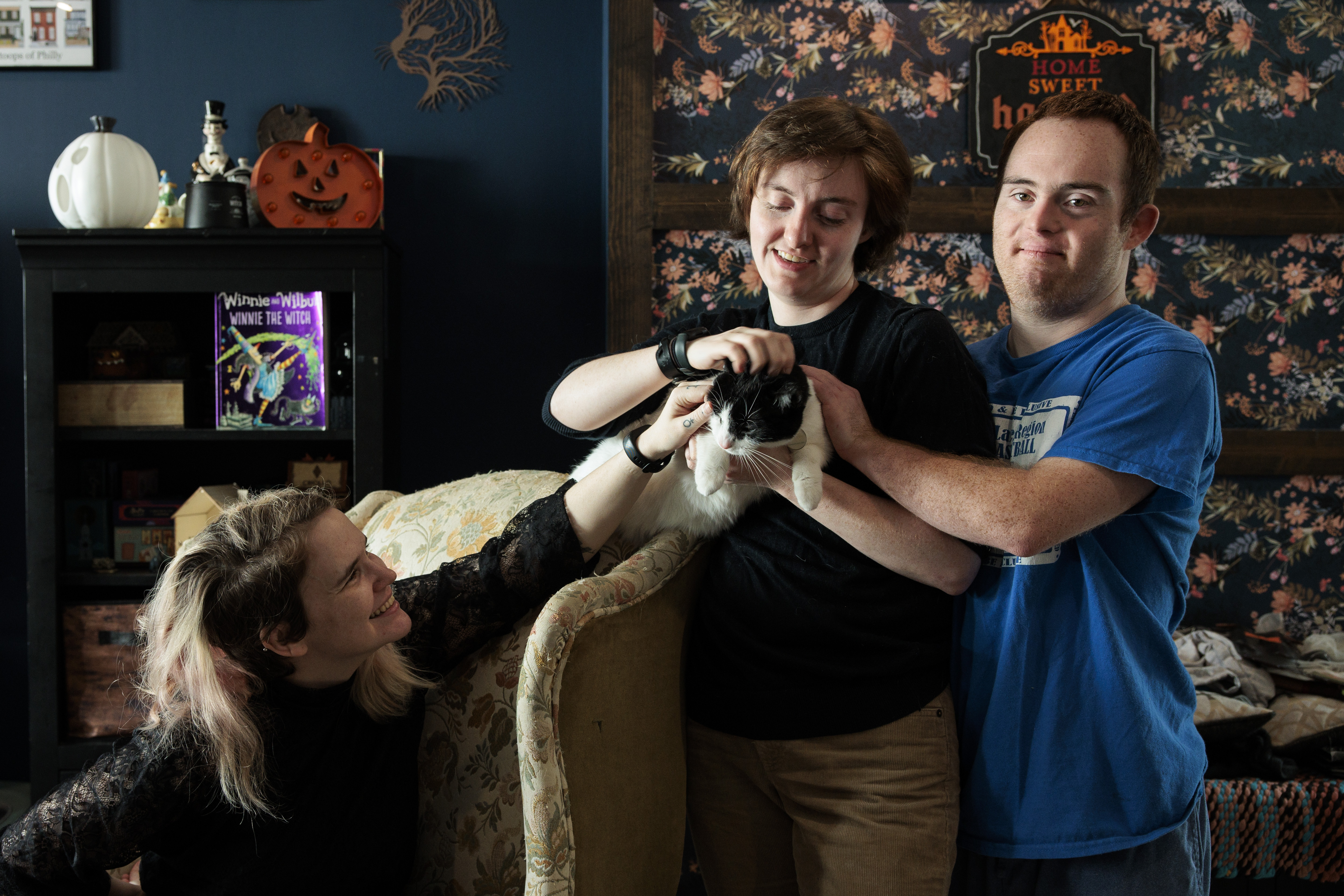
    The two own a three-bedroom house together in Cobbs Creek, where they live with Keehan’s 28-year-old brother, who has Down syndrome. They also expect Wallace’s mother might move in if she is one day in poor health. Keehan works at a local museum, and Wallace, who studied programming, has long COVID and is not currently working. That has meant they no longer split everything down the middle financially as they initially planned.

    They share a car and a joint bank account.

    The following, as told to Zoe Greenberg in separate interviews, has been combined and edited for length and clarity.

    On why they were drawn to each other

    Wallace: We like a lot of the same things — we liked Marvel at the same time and then we both became disaffected with Marvel movies at the same time. The cadence of our speech is pretty much identical.

    Keehan: Both of us love a bit. Absolutely any dumb joke, we will volley for way longer than it needs to go. We have a very similar sense of humor. We both love telling a completely harmless lie, and letting it go for way too long.

    On buying a house together

    Keehan: I’m not sure it was a decision so much as a given. Both of us are from messy divorced parents, so both of us wanted the house to be something that if we do have some horrible falling out, neither of us is homeless suddenly.

    Wallace: We knew having both of our names on the deed would mean that if one of us dies, the other one maintains the right to live there. It turns out my partner could buy the house outright, so we had an agreement where I would pay them back.

    On an unexpected financial shift

    Keehan: We originally wrote it as essentially a loan, with the stipulation that if we sell this house, she owes me the full amount of loan. Since long COVID put her out of work, she stopped paying me back.

    For most of the time I’ve known her, Cait has been more ambitious and certainly made more money than I did, by more than double. But things happen. I’m not not going to have the house, I’m not not going to pay the bill. We have a commitment to taking care of each other.

    Wallace: I always figured I would be making more money and that I would be able to take care of them, and so it’s been a shift to realize, no, I’m the one who has to be taken care of.

    Cait Wallace and Brennan Keehan are committed to each other’s families. They live with Brennan’s brother, Aidan Keehan, right, and expect that Wallace’s mother may move in when she gets older. Monica Herndon / Staff Photographer

    On dating other people

    Wallace: It’s been a couple years since I’ve dated anyone. I don’t think I want to get married to anyone else. If anyone I were dating were to express discomfort with how close I am with Brennan, that would be an immediate deal breaker.

    Keehan: I have been out as aro/ace — aromantic/asexual — for over a decade now. My main reason to be stressed was people don’t tend to commit to friends the way they commit to a romantic partner. So I wondered, “Am I going to be in the lurch?” Having the commitment that this is my person, even if it’s not the way that people often mean that, answers that fear.

    On growing toward each other

    Wallace: They are the most important person in my life. I want to grow in a direction that they also want to grow. If they really want to move to California, I want to be the type of person who wants to live in California.

    On splitting the housework

    Wallace: Something about doing dishes by hand really stresses Brennan out, so that’s my job.

    Keehan: I do most of the cleaning. Cait kills the spiders.


    This story is part of a series about life partners across the Philadelphia area.

    If you want to share your story about who you’re navigating life with, romantically or otherwise, write to lifepartners@inquirer.com. We won’t publish anything without speaking to you first.

  • The very Philly episode of ‘The Gilded Age’ and other arty must-dos this week

    The very Philly episode of ‘The Gilded Age’ and other arty must-dos this week

    A new film about very old people

    For 10 years, filmmaker Sam Green decided to meet each person who held the Guinness Book of World Records’ title of oldest person alive. The film he initially wanted to make would go from one oldest person to another, but the film he ended up with, The Oldest Person in the World, becomes so much more.

    Green’s son Atlas is born and Green is diagnosed with multiple myeloma during the making of this film, which he started shortly after his brother’s death from suicide. What emerges is an endearing meditation on life and mortality. The oldest person in the world, he says, is someone you only meet by chance and not know for long, and in that liminal time, they make you see a glimpse of a future you may not get to see for yourself.

    When Green goes to film the birthday party for Susannah Mushatt Jones’ 114th birthday in Brooklyn, she falls asleep right by her cake and doesn’t wake up for the celebrations. Green travels the world meeting the oldest people, all speaking in different shades of lucidity, while we witness Atlas growing up. The film ultimately becomes a fascinating timekeeper. It reminds us simultaneously of the time we have left on this earth and the time we are constantly and inevitably losing.

    Sam Green is a white man dressed in a black shirt, holds up a mic surrounded by wooden walls.
    Sam Green records the sounds that make up our “soundworld” for “32 Sounds.”Sam Green

    Green, whose 32 Sounds is one of my favorite documentary experiences (for those who have witnessed it, it’s more than just a film), is a filmmaker with a distinct style that doesn’t shy away from testing the limits of what a documentary can do. Oldest Person’s next Philadelphia screening is programmed by Yoni Brook, another filmmaker whose work I really admire. You may know him for working on Philly DA, on which he was the cinematographer and producer. Last year’s Holding Liat, on which Brook is a producer, is also a great and urgent watch.

    “The Oldest Person in the World” plays Nov. 17, 7 p.m., Pen and Pencil Club, 1522 Latimer St., Phila. penandpencil.org. Free and open to public.

    — Bedatri D. Choudhury

    Wesley Stace and his band the English UK play an afternoon show at 118 North in Wayne on Saturday.Ilya Mirman

    A stylish new film noir-ish album from Wesley Stace

    Wesley Stace became an American citizen this past July, having already been a Philadelphia citizen for 16 years.

    So the Hastings, England-born songwriter, novelist, and “Cabinet of Wonders” impresario thought it was about time that his music started to absorb the sounds of the city he lives in.

    That impact is felt on One Last Heist, Stace’s new album on Pravda Records that was recorded at Pete Rydberg’s Studio 1935 at the Bok Building in South Philly. Stace has a reputation as a folk-rock wordsmith who released over a dozen albums as John Wesley Harding — the title of a 1967 Bob Dylan album — before he started using his given name on Self-Titled in 2013.

    But with 2021’s Late Style, Stace started setting his barbed, witty, and narratively sophisticated songs in more posh and polished settings, more suitable for a dinner jacket than a denim one. The musical breadth of that project was limited because it was largely recorded remotely during the pandemic.

    On One Last Heist, Stace follows through with a record that swings more than any he’s ever made. The influence of Philly jazz organ greats such as Jimmy Smith and Shirley Scott is apparent, as is Stace’s abundant affection for the lushly orchestrated recordings on the CTI label, which he has been spinning in his guest DJ appearances at 48 Record Bar in Old City.

    With the aid of veteran musicians like drummer Stephane San Juan (who’s played with Caetano Veloso and David Byrne) as well as longtime collaborator David Nagler, One Last Heist has a stylish film noir feel and the élan to pull off a subtle protest song such “I Say a Lot of Things,” as a Brazilian samba.

    On Saturday, Stace and his backing band the English UK play a show on the Main Line in Wayne at the particularly civilized hour of 4 p.m. He can also be seen playing in a side gig on Dec. 10-11 fronting New Jersey power-pop garage rock band the Smithereens in Red Bank, N.J., and his next multigenre all-star “Cabinet of Wonders” variety show is at City Winery New York on Jan. 10.

    Wesley Stace & the English UK at 4 p.m., at 118 North, 118 North Wayne Ave., Wayne, 118NorthWayne.com.

    — Dan DeLuca

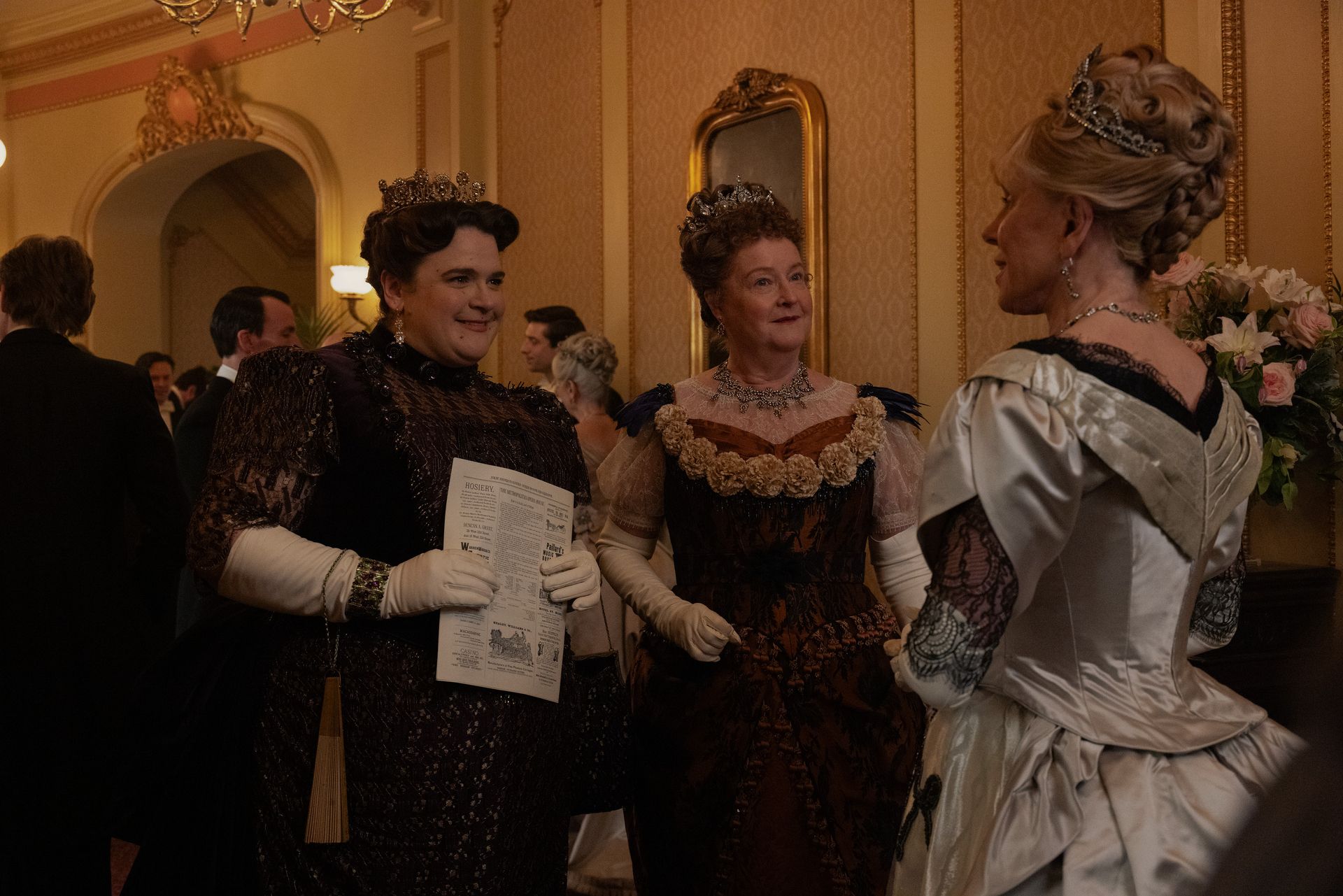
    From left: Bonnie Milligan as Louisa Knapp Curtis of the Philadelphia Curtis family as the first editor of Ladies’ Home Journal; Marceline Hugot as Mrs. Foster; and Christine Baranski as Mrs. Agnes Van Rhijn in HBO’s “The Gilded Age.”HBO

    ‘The Gilded Age’ and its Philadelphia connections

    HBO’s extravagant serial The Gilded Age is back. And I’m thrilled.

    I tune in to Julian Fellowes’ New York City dripping in late-19th-century diamonds, tiaras, and white tie affairs each Sunday to marvel at the floor-length floral gowns, the elegant updos, the witty dialogue — that Mrs. Van Rhijn (Christine Baranski) doesn’t suffer fools — and forbidden dalliances.

    But I also watch The Gilded Age because there’s always a chance a historical figure from Philly shows up at a fictional character’s home for tea. That’s thanks to Philadelphia native, Emory University professor, and former director of African American History at the Library Company, Erica Armstrong Dunbar.

    Dunbar serves as the co-executive producer and historical consultant of The Gilded Age.

    In Season 4, episode 2, the featured Philly figure was Louisa Knapp Curtis, the first editor of Ladies’ Home Journal and wife of publisher Cyrus Curtis (for whom the Curtis Building at Sixth and Market is named.)

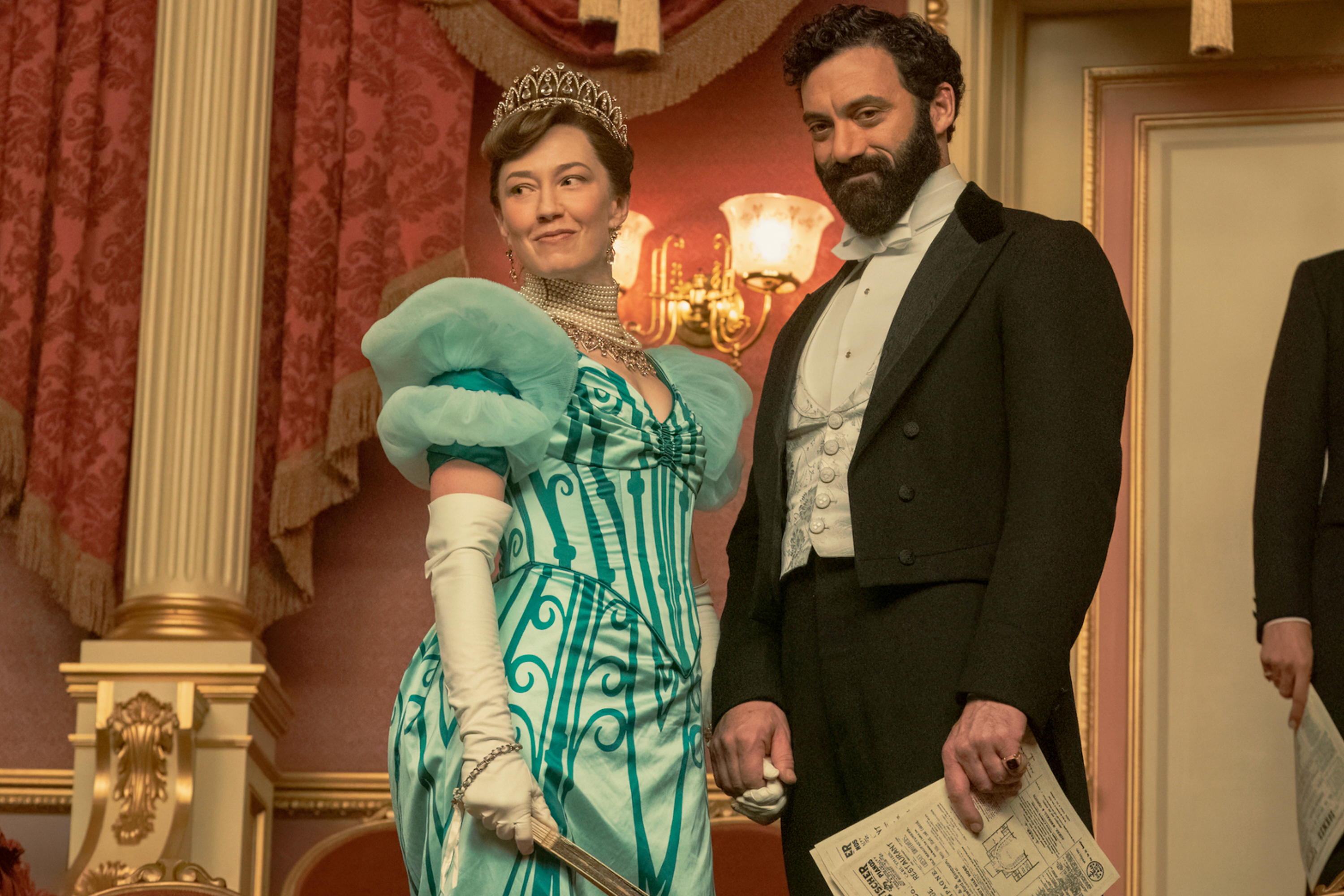
    This image released by HBO Max shows Carrie Coon, left, and Morgan Spector in a scene from “The Gilded Age.” (HBO Max via AP)Uncredited

    In 1876, Cyrus Curtis founded the weekly farm and family newspaper the Tribune and Farmer in Philadelphia. The magazine carried advertisements geared for women, but the articles weren’t that great, at least according to Louisa Knapp Curtis. Louisa convinced her husband that she should write a woman’s column. It was so successful that in 1883, Cyrus Curtis centered it in his women’s magazine Ladies’ Home Journal, which also featured recipes, fashion, and eventually articles on suffrage. In 1903, Ladies’ Home Journal became the first American magazine to reach a million subscribers.

    But I’m getting ahead of myself.

    Sunday’s episode of The Gilded Age is set in 1886. In it, Mrs. Knapp Curtis (Bonnie Milligan) travels from Philadelphia to Mrs. Van Rhijn’s Fifth Avenue mansion to cover her preparations for President Grover Cleveland’s visit. (White tablecloths are the only option for a United States president’s visit.)

    Things are going well until, well, they aren’t. And by the end of the episode, we are left wondering if Mrs. Knapp Curtis will return to Philadelphia with an article about President Cleveland’s visit to Mrs. Van Rhijn’s home — or will Mrs. Knapp Curtis end up filing a story about a presidential dinner held at a different Fifth Avenue mansion.

    “The Gilded Age” airs Sunday nights at 9 p.m. on HBO.

    — Elizabeth Wellington

    Victoria Monét’s striking performance

    Victoria Monét poses for a portrait in New York on Wednesday, Sept. 9, 2026. (Photo by Andy Kropa/Invision/AP)Andy Kropa

    Victoria Monét has all the ingredients of an R&B star. She has the voice to carry a love ballad, enchanting dance moves, and the ability to float between breezy bubble gum hits, foot-stomping anthems, and sleek soulful cuts without slippage.

    The Grammy-winning artist’s brilliance was center stage at the Met on Thursday night for her “Frequency of Love” tour.

    She wore a silk dress with elbow-length gloves, a look reminiscent of Josephine Baker at the height of her powers. Monét opened with “All I Need,” an ode to daughter Hazel and the intro to her sophomore album, Frequency of Love. She followed up with another heartfelt record “Come Back to You” from her October release. Although the material is still fresh, even for her most boisterous fans in the audience on Thursday, the singer had the crowd within her grip before the stage curtains were peeled.

    The curtains then opened, revealing a glowing platform with her band and background dancers holding firm until Monét reached the top of cascading steps. She glided down to perform “Cadillac (A Pimp’s Anthem)” in a shimmering sequin dress, exuding the elegance of the roaring twenties. She also floated between eras in her own discography.

    Monét performed familiar favorites like “Ass Like That,” “Experience,” and “On My Mama” before transitioning to newer album cuts like “Head to Toe,” “Almost,” and “See You in My Dreams.” She broke up the setlist with dance breaks, including a steamy one between her and a backup dancer that drew audible awes from the crowd.

    The show was a savory balance of Monét’s new and familiar works, paired with striking dance sequences and high production value, as evidenced by the cinematic videos of Monét that flashed onto the stage during her outfit changes. The brief vignettes were insights into the artist’s life as a mother and a romantic whose aim is to enjoy the fruits of life, without letting outside forces soil the life she’s built. If the energy at the Met was any indication, it appears that there’s a lot of admiration and love for Monét to enjoy for awhile.

    — Earl Hopkins

  • The Eagles are too bad for national TV, and Mark Ruffalo is eating in Wawa parking lots | Weekly Report Card

    The Eagles are too bad for national TV, and Mark Ruffalo is eating in Wawa parking lots | Weekly Report Card

    The Eagles are too depressing for national TV: F

    The Eagles have officially become so bad that the NFL doesn’t even want the rest of America watching them.

    The league announced that the Birds’ Nov. 22 matchup against the Pittsburgh Steelers is getting bumped from its coveted 4:25 p.m. national broadcast to a 1 p.m. kickoff. Apparently, seven straight losses are enough to convince the NFL that the Battle of Pennsylvania isn’t worth broadcasting to the entire country.

    And the replacement? The Jacksonville Jaguars and New York Giants. When the NFL decides Jacksonville is a bigger television draw than Philadelphia, you know things have gotten ugly.

    It’s a pretty humiliating fall for a franchise that was playing in the Super Bowl less than two years ago. Now, even Nick Sirianni seems to be running out of answers.

    The good news, if you can call it that, is that Eagles fans will have three extra hours to recover from whatever fresh disappointment awaits us that Sunday.

    Watching the SS United States sink off the coast of Florida
    Video: Watching the SS United States sink off the coast of Florida

    The SS United States’ final farewell: B-

    For nearly 30 years, the SS United States sat rusting along the Delaware River, becoming as much a part of South Philly’s landscape as the Ikea across the street.

    And now, after decades of failed attempts to save it, the historic ocean liner is officially at the bottom of the Gulf of Mexico.

    But even its final goodbye couldn’t go according to plan.

    The ship that once broke records for crossing the Atlantic took practically an entire day to sink. Hundreds of spectators gathered on boats off the Florida coast to watch the historic moment, only to spend hours staring at a vessel that was barely moving. Some eventually gave up and headed home before it disappeared beneath the waves around 10 p.m.

    There’s something painfully fitting about a ship that spent decades refusing to go anywhere making everyone wait one last time.

    Of course, it’s sad that such an important piece of maritime history couldn’t find a permanent home above water. But becoming the world’s largest artificial reef is certainly a more interesting retirement than being turned into scrap metal.

    Farewell to the Ikea boat. You took your sweet time leaving us, and apparently you weren’t in any hurry to leave Florida, either.

    The Gobbler, a hoagie filled with turkey, stuffing, and cranberry sauce, has been a staple of Wawa’s fall menu since 2008. It’s paired here with Wawa mac and cheese with Old Bay seasoning.Staff Photo

    The Gobbler’s remarkable history: B

    There are certain things Philadelphians don’t like being told. That our cheesesteaks aren’t the best. That Wawa isn’t as good as Sheetz. And now, apparently, that Wawa didn’t invent the Gobbler.

    According to Philadelphia Magazine, the Thanksgiving sandwich has a history stretching back more than a century, with various combinations of turkey, stuffing, and cranberry sauce appearing long before Wawa got involved.

    Even the name wasn’t Wawa’s idea. Kraft was advertising a stuffing-filled sandwich called the Gobbler in 1992, a full 16 years before Wawa introduced its version in 2008.

    And some of the earlier attempts sound downright criminal. A 1974 creation called the Goober Gobbler combined turkey, peanut butter, and mayonnaise. Whoever came up with that should have been banned from Thanksgiving dinner.

    Still, Wawa deserves some credit. It took a sandwich that had been floating around for decades and turned it into a fall obsession — Philly’s pumpkin spice. By September, we’re apparently ready to eat Thanksgiving dinner out of a paper wrapper.

    Wawa didn’t invent the Gobbler. Fine. But we’re still claiming it as ours.

    Mark Ruffalo in a scene from “Task.” (HBO via AP)Uncredited

    Mark Ruffalo’s Wawa parking lot meal service: A

    Mark Ruffalo has been spending a lot of time in Delco filming the second season of HBO’s Task, and apparently he’s figured out one of the most important rules of living around here: Everything happens at Wawa.

    The actor has been getting his meals from South Philly chef Carly Foglia, who prepares everything from vegan lasagna to tofu tiramisu to accommodate his dietary restrictions. And where does an Emmy-nominated Hollywood star pick up his specially prepared meals?

    The Wawa parking lot, of course.

    Forget fancy restaurants or private catering trailers. Somewhere in Delco, the Incredible Hulk is meeting a woman with Tupperware containers outside a Wawa, probably while someone else is trying to get around them to reach the gas pumps.

    Foglia revealed that Ruffalo has quite the sweet tooth, which means the man playing a gritty FBI agent is apparently surviving on cashew-based cheesecake bites between takes.

    Tormund, an orange cat residing in South Philly who amassed more than 300,000 social media followers because of the funny way he could stand, has died.Courtesy of Alex Holden

    Goodbye to South Philly’s standing orange cat: D

    Philadelphia lost a little bit of internet joy this week.

    Tormund, the orange South Philly cat who became famous for standing on his hind legs with his belly sticking out and his little paws dangling in front of him, has died.

    The beloved rescue cat amassed nearly 300,000 followers simply by standing around looking ridiculous. And really, isn’t that the dream? Imagine becoming an internet celebrity just for getting off the couch.

    But Tormund was more than a meme. He was a beloved member of the Holden family, who shared his antics with the world for six years. When his health suddenly declined, fans raised nearly $5,000 in just three days to help cover his veterinary care.

    Sadly, Tormund couldn’t be saved. His family plans to direct remaining donations to a relative battling brain cancer, giving his devoted following one more opportunity to do some good.

    And for an orange cat from South Philly, that’s a pretty remarkable legacy.

    Phillies pitcher Zack Wheeler throws a pitch in Game 3 of the National League wild-card series against the Braves on Oct. 1, in Atlanta.Yong Kim / Staff Photographer

    Zack Wheeler is still that guy: A+

    The Phillies may have given us another disappointing October, but at least Zack Wheeler is still giving us something to celebrate.

    After undergoing surgery for thoracic outlet syndrome, a condition that has ended other pitchers’ careers, Wheeler returned to the mound this season and pitched like he’d never left. He finished with a 3.00 ERA and 193 strikeouts, earning himself the National League Comeback Player of the Year award this week.

    Oh, and did we mention he had a rib removed during surgery and kept it as a souvenir? Some people keep their wisdom teeth. Zack Wheeler keeps a rib and then goes back to striking out major league hitters.

    He didn’t miss a single start after returning in April, and he’s the first Phillie to win the award since Brad Lidge in 2008. Not bad for a guy whose career some people thought might be over.

    The Phillies’ postseason may have ended far too early, but Wheeler reminded us why he’s one of the best pitchers in baseball.

    Give the man his trophy… and maybe a nice display case for that rib.

  • One of Philadelphia’s most visible and recognizable pieces of public art has been dark for a decade. It might make a comeback.

    One of Philadelphia’s most visible and recognizable pieces of public art has been dark for a decade. It might make a comeback.

    The colorful circles, squiggle, and lines of Stephen Antonakos’ sculpture hovering in the sky just north of Center City are still discernible. But the piece’s essence, its wow factor, is in its medium — neon — and that feature has long been gone.

    Once a seemingly impromptu scribble in the dark sky, Neons for Buttonwood had its off switch flipped more than a decade ago.

    Now, though, the sculpture’s fans are working to bring it back. A committee of residents of CityView Condominiums, on whose south tower the piece is perched, is seeking the money required for its restoration and relighting. About $100,000 has been raised toward a goal of $750,000, says Lynda Orfanelli, cochair with Sonja Eveslage of the Relight the Sky Committee.

    “I feel like it’s starting to happen,” said Orfanelli during a recent rooftop visit to see the sculpture, “but what we really need is that one big donor who has confidence in us, and that’ll give [other potential donors] a feeling like, ‘Yes, let’s get on this train.’”

    “Neons for Buttonwood” by Stephen Antonakos is seen atop the south tower of CityView Condominiums, with the Barnes Foundation in the foreground, on Nov. 10. The neon sculpture hasn’t been illuminated since 2015, but a group is raising money for its restoration.Peter Dobrin

    Neons for Buttonwood sits atop a privately owned building, yet it is among Philadelphia’s most visible and recognizable pieces of public art. It may be little-remembered now, but in 1990, when the sculpture was first lit on what was then Korman Suites at Buttonwood Square, the city’s nighttime skyline was considerably less dazzling.

    There was no coordinated effort to bathe building ensembles emerald when something was on the line for the Eagles or render them in cobalt or pink on other occasions.

    “The reason we turned it off initially was because the pope was coming to town [in 2015], and we had been spending a lot of money doing repairs,” said Orfanelli, “and it was only partially lit. So we decided to turn it off rather than embarrass the building.”

    The sculpture remained off until last year, when it was discovered that while the smaller checkmark facing east could still illuminate, no other part would. The neon tubing was removed because parts of it were breaking off.

    The back of “Neons for Buttonwood” by Stephen Antonakos can be partially seen on the roof of the south tower of CityView Condominiums, Nov. 10, 2026.Peter Dobrin

    Planning a comeback for the 111-foot-long work required clearing a few hurdles.

    The city’s Percent for Art program, which originally shepherded the sculpture, was contacted for approval since the restoration calls for using LED technology instead of the original neon.

    The Greek American artist Antonakos — who died in 2013 and whose works are in the collections of major museums — was noted as a pioneering exponent of neon, and so Orfanelli and Eveslage paid a visit to his widow, Naomi Antonakos, in New York, for her blessing.

    “Her reaction initially was, ‘My husband was a neon artist,’ and we said, ‘If he was alive today he’d probably be using LED,’” said Orfanelli. “And then she spoke to art consultants that she still deals with, and she got back to us and said, ‘OK.’”

    The new LED won’t change colors as other building lighting elements in the city do, and will remain true to the original colors chosen by the artist.

    As fundraising proceeds, leaders have a chance to piggyback onto another project. The repainting phase could happen while the building is putting up scaffolding for unrelated maintenance work expected next year — if the next $50,000-$100,000 can be found by then. Installation of the LED elements would happen when the rest of the money is raised.

    It’s not lost on the committee that when Neons for Buttonwood is restored and relit, there will be one major group of Philadelphians who won’t be able to look out of their windows at night to see it: the building’s residents themselves.

    “That was exactly our point in calling it ‘Relight the Sky,’” said Orfanelli, “because it’s for everybody else.”

    For more information and to donate to the project: relightthesky.org.

  • Finding the art in the shadows of Philly autumn

    Finding the art in the shadows of Philly autumn

    Who would not want to be outside this past week?

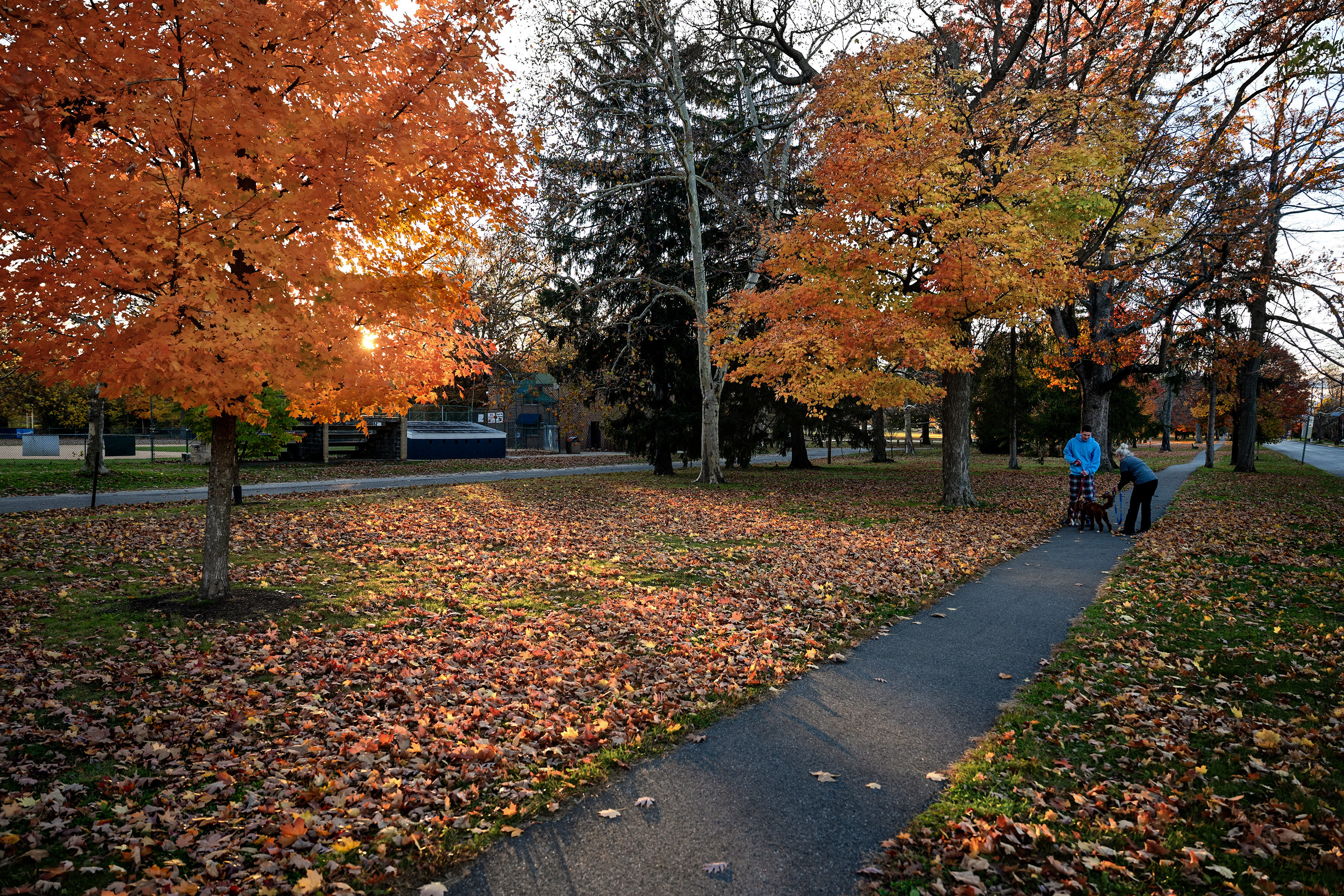
    Autumn foliage in Knight Park in Collingswood on Monday.Tom Gralish / Staff Photographer

    It was awesome, even during Thursday’s downpours and flash flooding. The torrents of hailstones had their charm — despite the day bringing us the chilliest run of weather this season.

    Pea-sized hailstones are on the ground on the University of Pennsylvania campus on Thursday.Tom Gralish / Staff Photographer

    But let’s not get ahead of ourselves. It’s still autumn, and it’s a wonderful time of the year to be a photographer.

    Between assignments in Old City, I took one of my favorite detours, through the historic district. I never tire of walking the exact same streets, as the Founders did, and ended up at a mulberry tree just beginning to show its autumn foliage colors. It’s next to the steel “ghost structure” outlining the spot where Benjamin Franklin’s house once stood. (The tree — despite what tour guides in the city will tell you — is not the same one he wrote about entertaining friends and family under. It, along with his house, were demolished in 1812. The current tree was planted for the Bicentennial.)

    Franklin Court on Monday.Tom Gralish / Staff Photographer
    The 18th Century Garden on Monday.Tom Gralish / Staff Photographer

    I also ended up in the 18th Century Garden, where a single red chokeberry leaf (Aronia arbutifolia) hung onto a branch. The garden showcases plants that were frequently grown in Philadelphia during the 1700s. Lady Bird Johnson, wife of President Lyndon B. Johnson, dedicated the garden to the Founders in 1966.

    While wandering between assignments, I also periodically engage in some “street photography.” That’s the genre of capturing real life, people, places, and everyday situations — mostly on public sidewalks.

    Autumn leaves in Center City on Wednesday.Tom Gralish / Staff Photographer

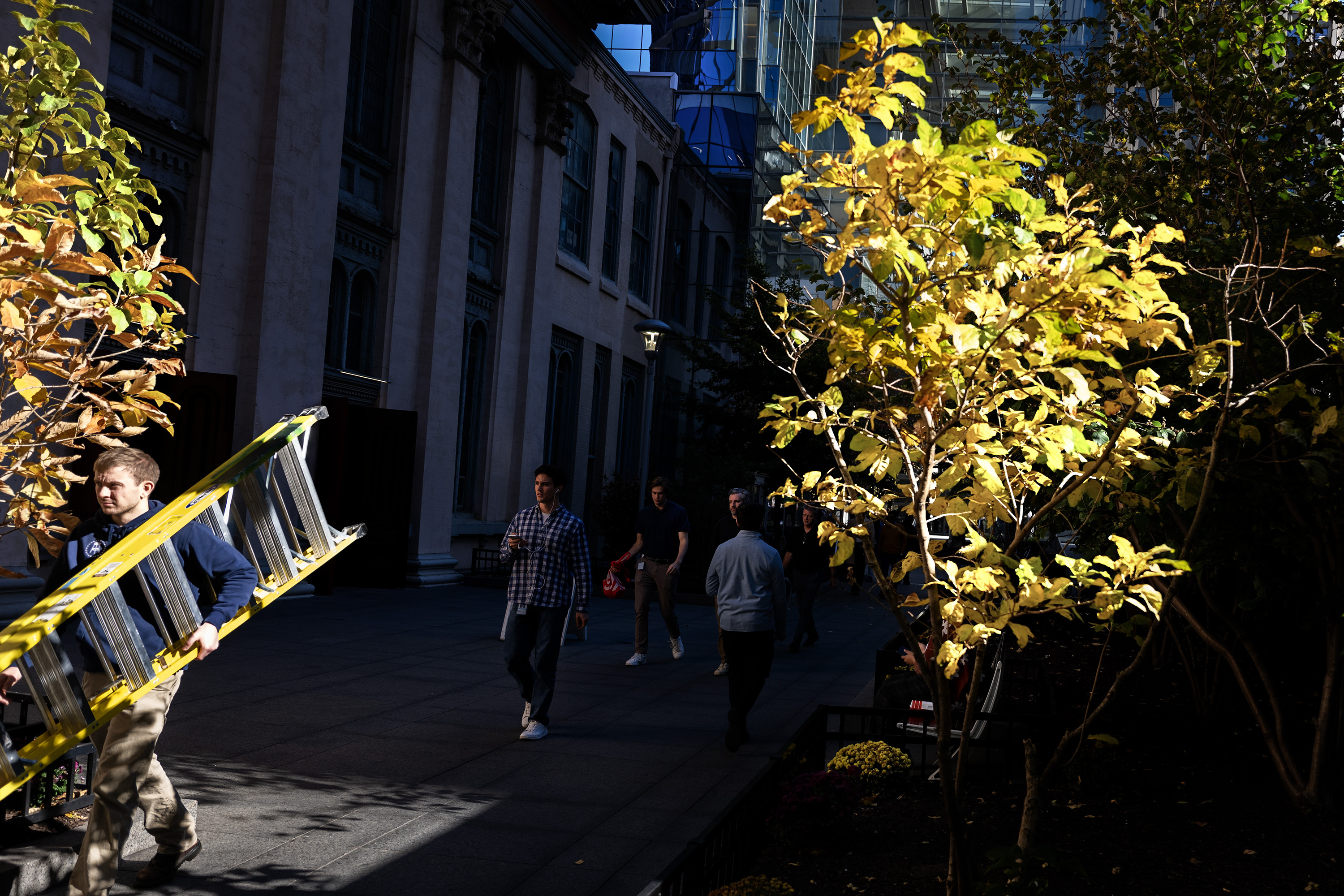
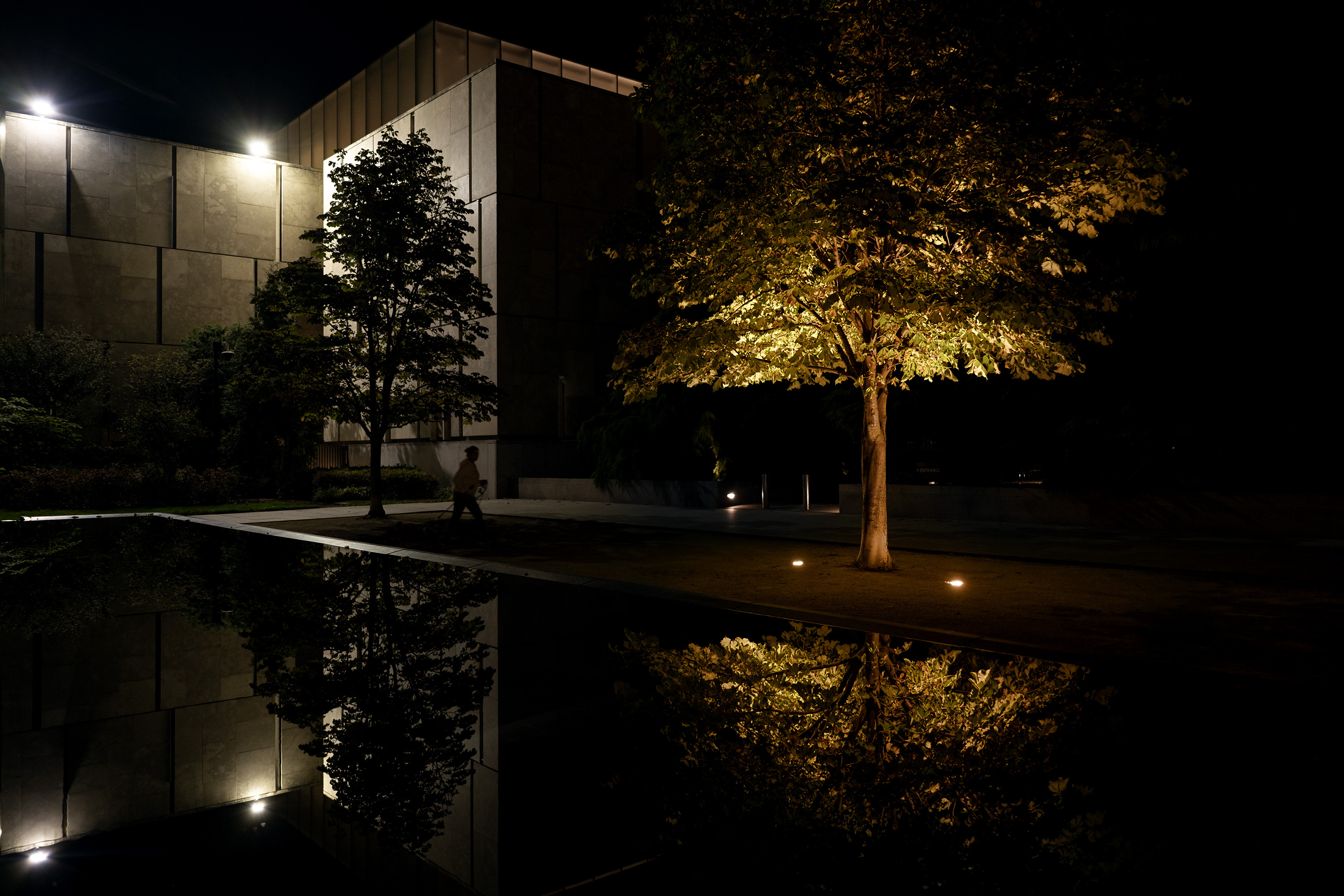
    Besides history — and foliage — in the city in autumn, I also love the low sun and long shadows. Especially among Center City’s skyscrapers, where fellow pedestrians move between light and darkness as if on a stage, the sunlight blasting through curtains of glass and steel like a spot light.

    Those words are meant to evoke the Art (with a capital “A”) of classic practitioners of street photography like Henri Cartier-Bresson or Robert Doisneau.

    NOT a French scene by iconic street photographers Cartier-Bresson or Doisneau. Just a young American pretender, at the Sacré-Cœur Basilica in Montmartre, in 1975 while on a gap year visit to Paris. Tom Gralish / Staff Photographer

    Their photos and those of Garry Winogrand, Robert Frank, Lee Friedlander, Harry Callahan, and Fan Ho are about expressing a personal vision and interpretation. The main difference between their photos and mine is that intention.

    While we all combine composition, candid observation, and timing, I am practicing journalism that I hope will better our readers’ understanding of an event, person, or place. I am trying to illustrate ideas, issues, or incidents in the news, so I usually have a reason why I’m documenting something, other than just for myself.

    But every once in a while… those shadows…

    Center City on Wednesday.Tom Gralish / Staff Photographer

    I just couldn’t help myself.

    Not on the list of street photographers above is Ray K. Metzker, who lived in Germantown with his photographer wife Ruth Thorne-Thomsen. I first became familiar with Metzer’s work right after I came to the Inquirer. He had a major retrospective exhibition at the Philadelphia Museum of Art during the fall after I had spent the previous winter doing a completely different kind of street photography. To this day I feel his presence as I walk the same city, hoping to find, as former Inquirer arts writer Stephan Salisbury said of his photos, “the remarkable in the ordinary and the powerful in the most fleeting.”

    I never got to meet him (too young or shy then to reach out, or knock on their door. I was even living just down the road in Mt. Airy at the time), but two decades later we shared gallery wall space (along with 23 other Philadelphia photographers). Unfortunately he didn’t attend the opening, or a later panel discussion where I got to express my admiration.

    I also have to mention Scott Strazzante, a contemporary newspaper photographer who moves easily between Art (with that capital “A”) and journalism. Watching and admiring his work in both genres over the years has given me the same kind of inspiration and insight for my own photography as Metzker’s

    And one more: Alejandro A. Alvarez, a longtime street photographer, dear friend, and former colleague at The Inquirer. I wrote about him when he retired earlier this year. For decades, before the coffee shops unlocked their doors and the metal roll-up shutters were opened on newsstands Alex was already there, chasing the morning light.

    Finally, a few other non-street photos from this week. All seen here online for the first time:

    Family and friends of Malayshia Allford gather Sunday in to remember the 10-year-old girl whose death of has left people across the city shocked and saddened. Tom Gralish / Staff Photographer
    Marines Master Sgt. Jeremy Vasquez (left) and Gunnery Sgt. Corey Toothman of the 3rd Battalion, 14th Marine Regiment, salute during a wreath-laying ceremony Tuesday at Laurel Hill Cemetery ahead of Veterans Day. The observance, marking the 251st birthday of the Marine Corps, was held at the grave of Brig. Gen. Jacob Zeilin, a Philadelphia native who was the corps’ first general and the designer of the Marines’ “Eagle, Globe, and Anchor” emblem. Zeilin, who died in 1880, is credited with ensuring the Marines remained a separate branch of the military after the Civil War. Tom Gralish / Staff Photographer
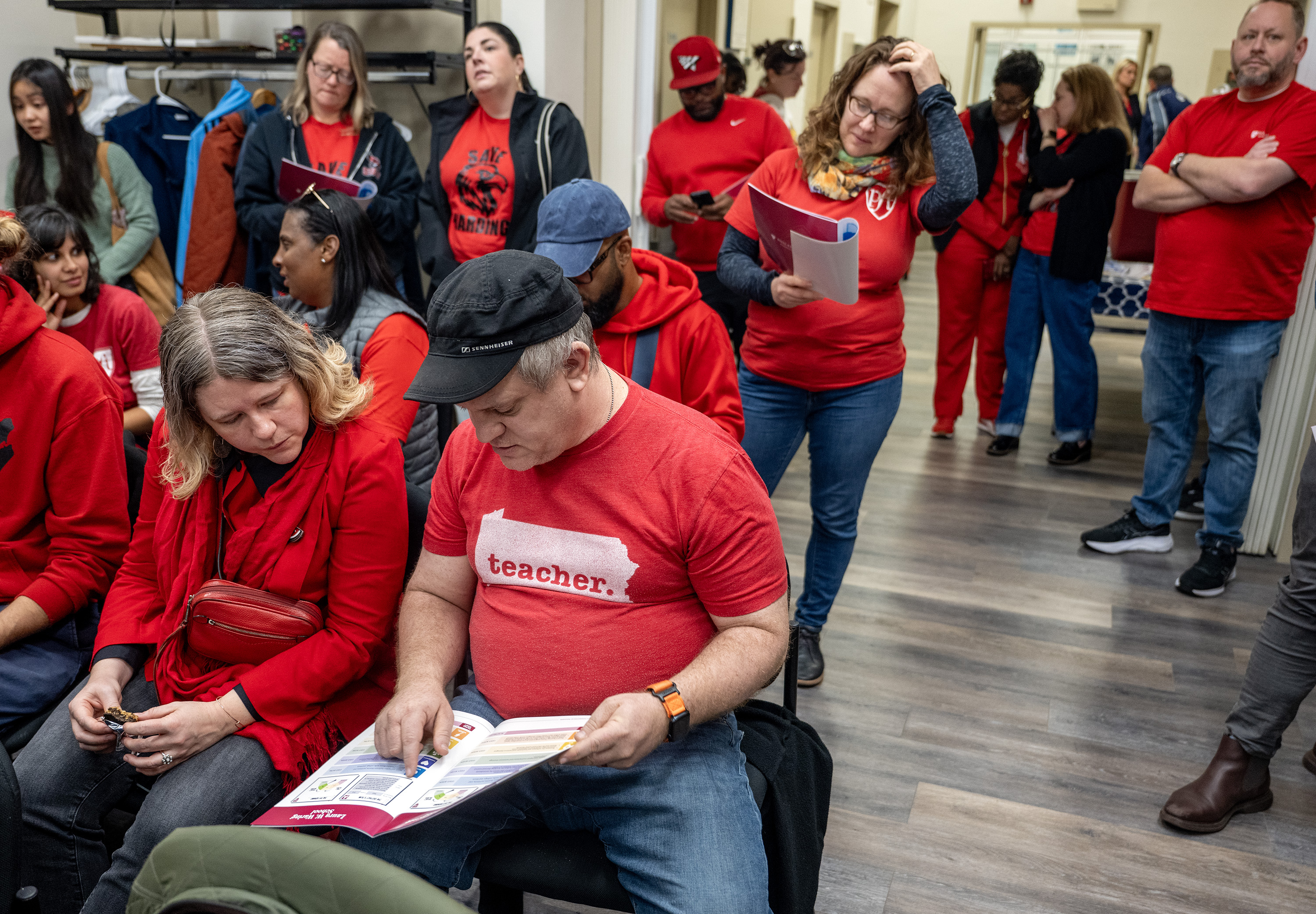
    Teachers Keely Hill and Adam Blyweiss (right) look over their union’s alternative to the District’s facilities plan on Wednesday. One that doesn’t close any schools. Tom Gralish / Staff Photographer
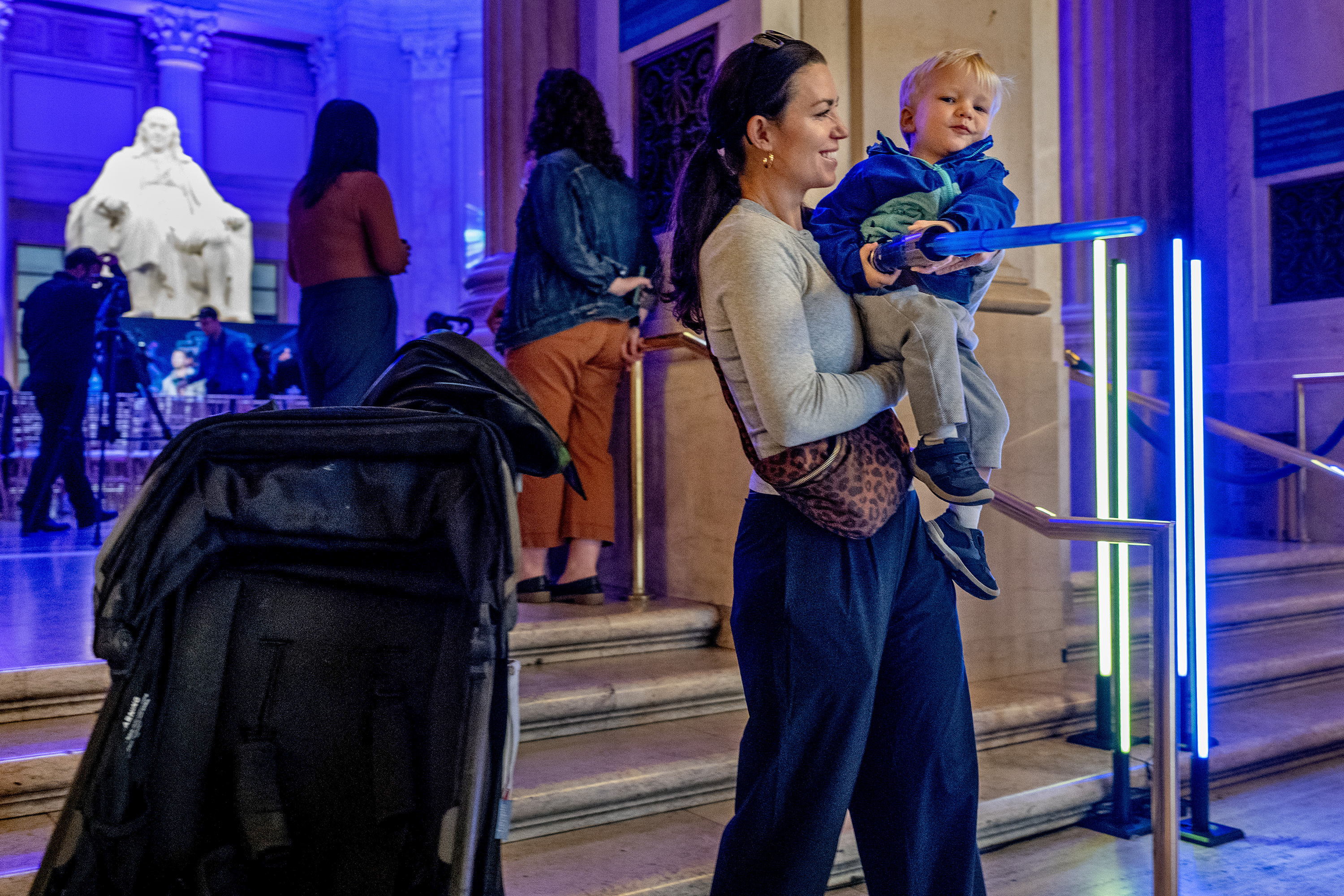
    Grace Mihalich leaves with her two year-old son Howard and his light saber following a Star Wars preview at the Franklin Institute on Thursday.Tom Gralish / Staff Photographer

    And left out of the Week-in-Sports photo gallery, an Eagle winning against a Giant:

    Brothers Shep, 10, and Reed Braunwarth (right, 11) play out their own Eagles-New York Giants game while waiting for Jason Kelce to appear at his New Heights Tailgate podcast on Sunday.Tom Gralish / Staff Photographer

    The stories with those photos: Kelce Tailgate, Malayshia Allford, Veteran’s Day PFT, Star Wars.

    Since 1998 a black-and-white photo has appeared every Monday in staff photographer Tom Gralish’s “Scene Through the Lens” photo column in the print editions of The Inquirer’s local news section. Here are the most recent, in color:

    » SEE MORE: Archived columns and Twenty years of a photo column.

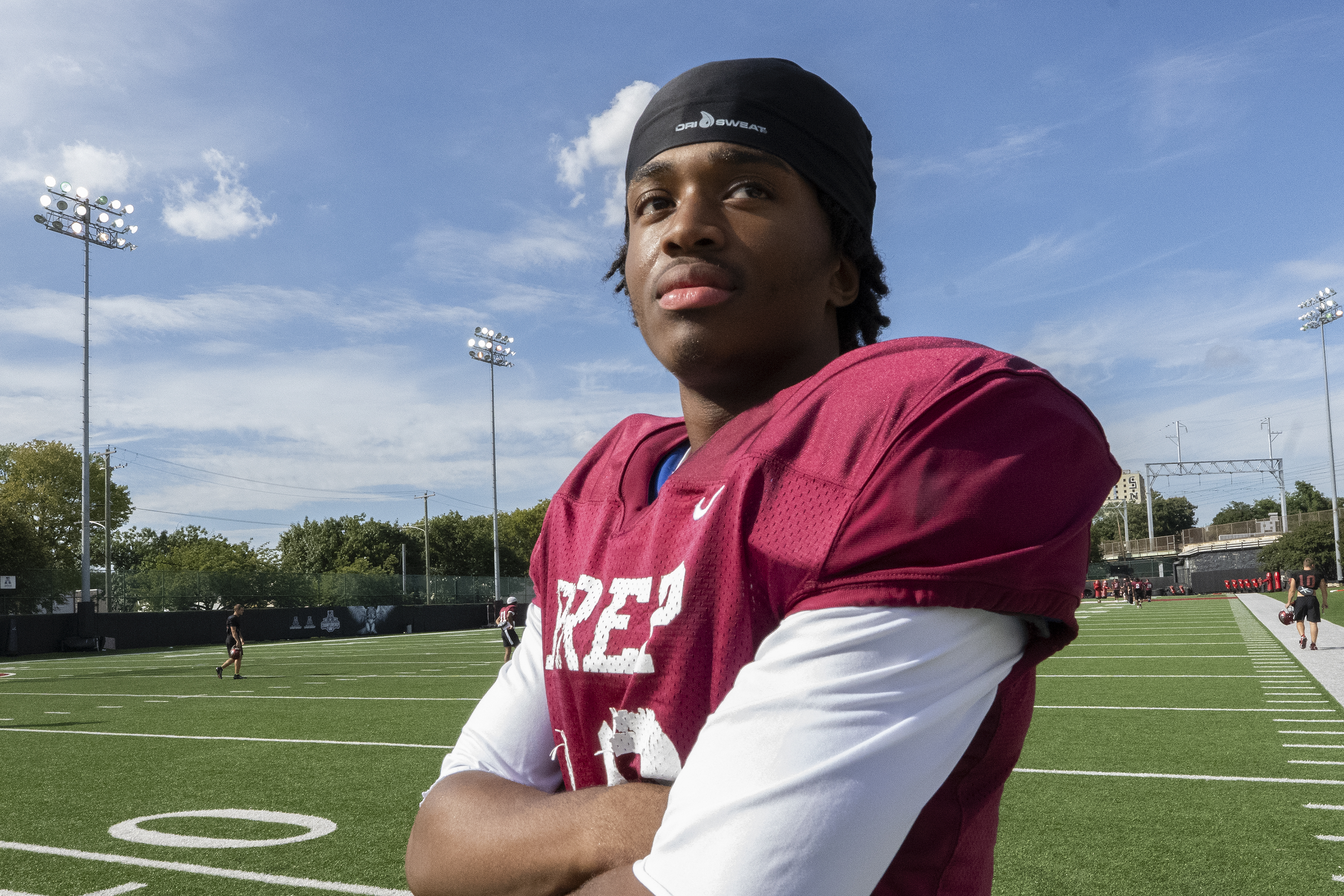
  • St. Joe’s Prep’s Jett Harrison was ‘born into pressure.’ Now, he’s relishing the spotlight.

    St. Joe’s Prep’s Jett Harrison was ‘born into pressure.’ Now, he’s relishing the spotlight.

    Jett Harrison looked up sheepishly as the cameras panned on him. Harrison was a skinny, wide-eyed 7-year-old sitting in the front row next to his older brother Marvin, both clapping in the August heat of Canton, Ohio, in 2016 during their father, Marvin Harrison Sr.’s Hall of Fame induction speech.

    Although it really did not fully sink in until three years later, when Jett was age 10, tucked in the passenger seat while his father was driving through North Philly on a summer day, the windows down, Marvin Sr.’s left arm hanging out the car door and hearing “Hall of Fame” bellowed down the street.

    Jett knew then what that induction day meant.

    The dilemma was that Jett first picked up a basketball before a football. He dreamed more about being LeBron James before he had any inkling about being Justin Jefferson, or his brother, Marvin Harrison Jr., receiver for the Houston Texans and Jett’s idol.

    Jett knew his destiny. He was shaped to do this. He was the shadow who never felt the shadows cast on him, always pestering his brother Marvin, who is six years older, to work out, or doing summer cone drills for 30 to 90 minutes with his dad when he was 12 in the heat, rain, and into the early tinge of fall. There were times, Jett admitted, he did not want to do the drills, but his father instilled a mental toughness and work ethos in him.

    It’s never left.

    Committed to Ohio State on July 1, following his older brother’s path from St. Joe’s Prep to the Buckeyes, the 6-foot-3, 192-pound Hawks’ junior wide receiver is better than both his dad and his brother when they were high school juniors. Jett is rated the country’s No. 5 player for 2028 by ESPN and he has been the scourge of every defense he has faced these last two years.

    Jett and St. Joe’s Prep will face another monumental task when the Hawks take on Roman Catholic, his father’s alma mater, for the Catholic League championship Sunday at noon at Penn’s Franklin Field, where the Cahillites beat St. Joe’s Prep, 21-17, on Oct. 31. Jett’s two touchdown receptions that day broke Marvin Jr.’s all-time Catholic League receiving touchdown record with 38.

    Over nine games this season, facing double- and triple-teams on defenses solely designed to stop him, Jett has 39 catches for 626 yards and eight touchdowns. In the first game against Roman, Jett, 17, caught five passes for a game-high 144 yards and two touchdowns. He has also produced those numbers after the Hawks lost three starting quarterbacks — Syracuse-bound Charlie Foulke and Kobe Towns, who both transferred out — and Max Rogers to an injury for five weeks, replaced by junior Nickee Holden for five games that were all Hawks victories.

    Jett Harrison broke his older brother Marvin Harrison Jr.’s (pictured) Catholic League receiving touchdown record.CHARLES FOX / Staff Photographer

    What often goes unnoticed about Jett, however, came in the last minute of the Roman game with the Prep down by four and driving for the winning score.

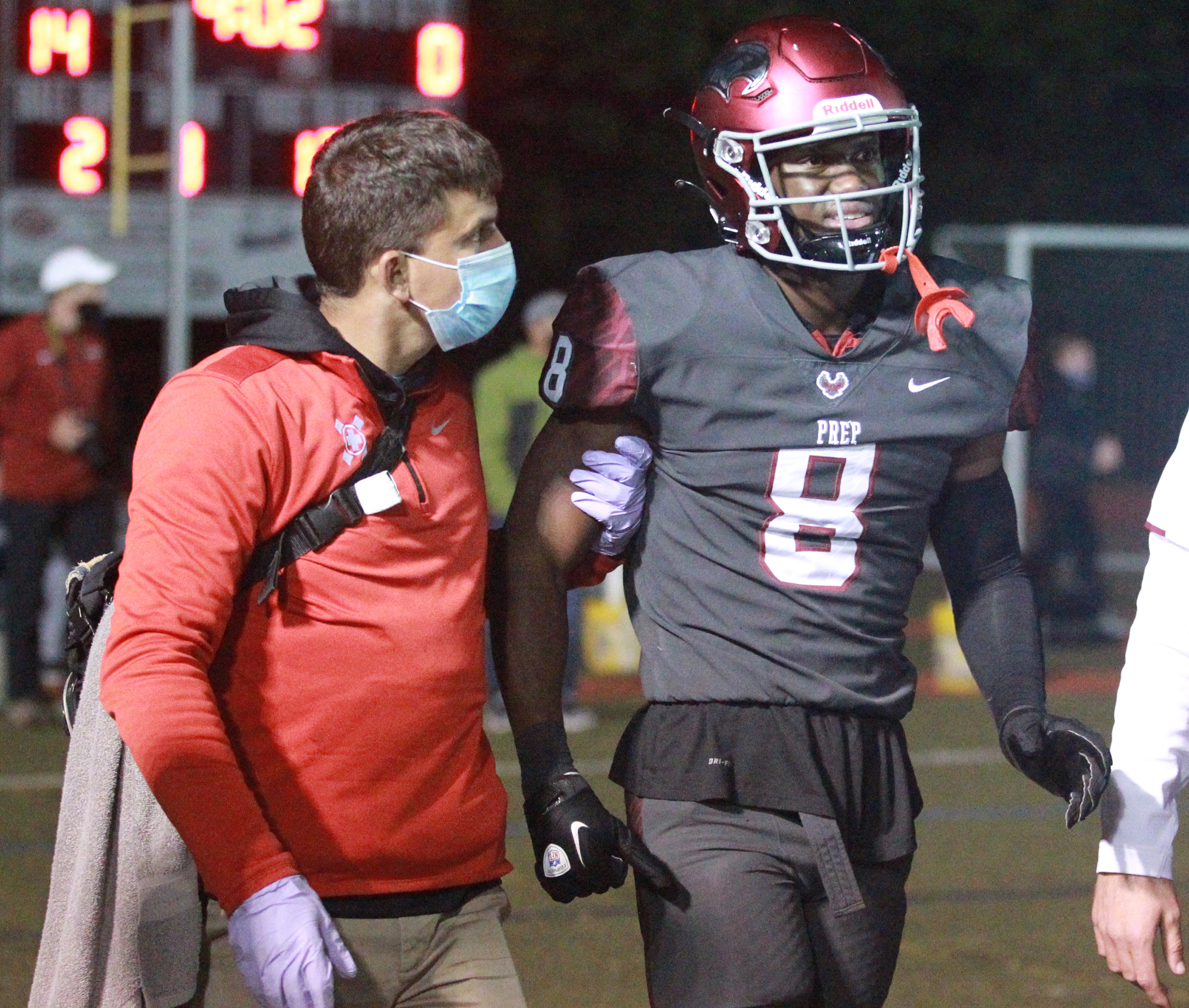
    Jett got popped coming over the middle for an incomplete pass at midfield. It took him a minute to get up, and the trainers came out. When he stood, Jett wanted to return to the huddle. High school rules state that if a player is down or considered injury, they must sit out at least one play. Jett did not want to hear it. He argued with his coaches to let him back in, but Jett was held out for a play.

    “I deal with pressure every game, my dad tells me that I’m everyone’s Super Bowl, and I like it,” said Jett, who carries a 3.5 GPA. “You can say I was born into pressure. I have my dad’s name, a Hall of Famer. You have that shadow. I’m following my brother, who broke all kinds of records and was an All-American [at Ohio State]. But I never ran from that. I like it. I never felt like I was in anyone’s shadow. I was their shadow, always bugging them. I never want to come off the field. … That attitude comes from both my dad and my brother.

    “I was raised around football. I would say around seventh or eighth grade that I began to see a bigger picture with football. Basketball was my first love. I first had a basketball in my hands before I had a football. But I knew my future would be in football.”

    He said he was around 4 years old when he first picked up a basketball, and it was the first organized sport he played when he was 6. His father and Marvin Jr. were also good basketball players. Marvin Jr. stopped playing basketball his sophomore year of high school. Marvin Sr. stopped once he arrived at Syracuse. Jett, who began playing flag football at age 8, made the difficult choice to drop basketball in eighth grade.

    By all accounts, he may have been a better basketball player than he was a football player.

    But he was also a ball boy for Marvin Jr.’s St. Joe’s Prep teams. He was constantly around Marvin Jr. and football. Marvin Jr. was a major influence on Jett. He studied everything Marvin Jr. did, from his vertical moves, to his cuts, to the way he separated from defenders.

    “I knew in high school I couldn’t commit the right time to both sports, and my dad told me to make a choice,” Jett said. “It wasn’t easy. I was ready to play both in high school. I was upset about it. It got a little testy with my dad. Marvin was an influence, too. I [was] always competing against him. Yeah, you can say he was my measuring stick. He never took it easy on me. … We would play tackle football in my parent’s room and he would play on his knees and tackle me. He never let me win. They were some good times. Things like that make you competitive.

    “I wouldn’t be where I am without him.”

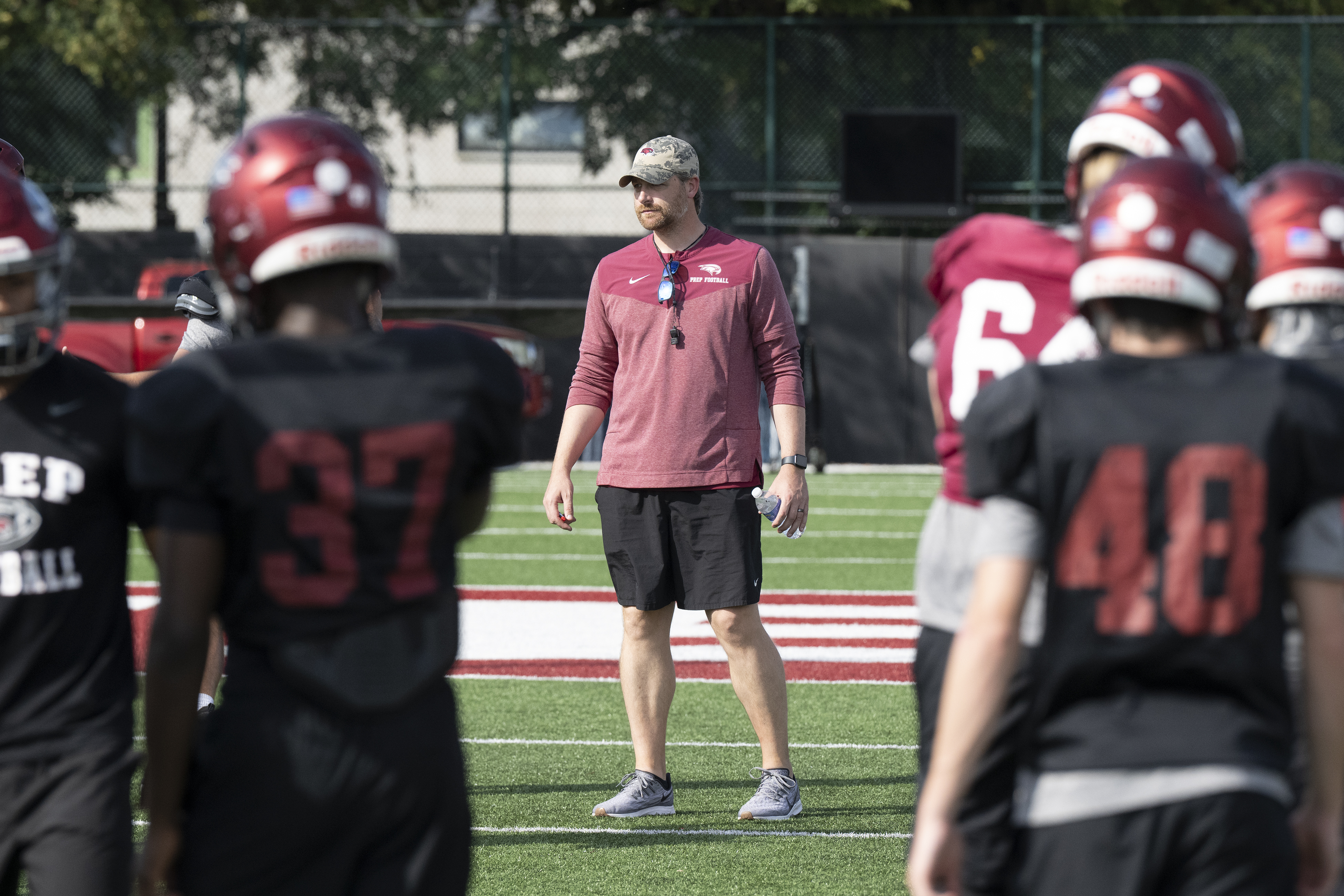
    Tim Roken has now coached Jett and Marvin Harrison Jr. at St. Joe’s Prep.Jose F. Moreno / Staff Photographer

    St. Joe’s Prep coach Tim Roken quite literally watched Jett grow up, going back to when Jett was a ball boy at St. Joe’s Prep.

    “Jett watched Marvin Jr. go through it when he played here at Prep, so that helped him deal with expectations,” Roken said. “Jett and Marvin have a great relationship, and they still stay in touch. Marvin and Jett have a lot of similarities. What Jett learned from his brother was being a great teammate and being a great student. The family has all this knowledge when it comes to being a wide receiver. Jett’s greatest compliment is the amount of attention he gets from opponents. They have to know where he is on the football field — and Jett has earned that attention from his production.”

    What makes Jett special is how he handles it, Roken stressed. Jett is a true student of the game, absorbed in film, drills, anything that will make him better. He is never content.

    He shows up every day with a smile on his face, Roken said, and carries an edge. He never takes plays off. With teams shifting their defense to his side of the field, it opens other areas of the field.

    “You always have to know where Jett is,” Roman coach Rick Prete said. “We’ll have the same problem on Sunday. First off, Prep is very good to begin with. Jett is as good as it gets. He can affect the game with everything he does. He has great speed, great ball skills, his pedigree is second to none, and someone we game plan for, and he still goes out and makes his plays.”

    The other thing coaches love about Jett is that he wants the ball every play. It’s why his route running is precise.

    “Jett’s sophomore year when we played Prep at Conwell-Egan, I remember walking off the field after 22 years of coaching thinking for the first time, ‘This kid is going to be a first-round draft choice someday,’” Cardinal O’Hara coach Mike Ewing said. “That’s the first time that ever happened with me. Jett is 6-3 and twitchy, he can run every route, and every route looks like a vertical, until he makes a cut. He’s incredible. Every defense he plays against rolls to him to some capacity. I’ve seen [La Salle’s] Joey O’Brien [now at Notre Dame] and Jett as sophomores, and Jett in my opinion was better than Joey was as a sophomore. Believe me, I would love to have them both on my team.”

    La Salle head coach Brett Gordon coached O’Brien, who is getting playing time at safety as a true freshman at Notre Dame, and knows high-level talent. There is a careful balance how talented players like Jett and O’Brien impact games at wide receiver. The Explorers did a decent job against Jett this season, holding Jett to four catches in two games for 29 yards.

    “You know someone like Jett will be getting the ball regardless of what the defense is doing,” Gordon said. “It’s easier said than done for a wideout. Prep tries to force him the ball, when everyone knows Jett will be getting the ball. I know every time the ball is in his hands as someone on the other sideline, your stomach is in your throat hoping he gets tackled.”

    For years, Jett was followed by speculation that he would transfer to IMG Academy, or any of a number of big-time national football prep schools. But St. Joe’s Prep is where his game was nurtured and grew. It is where he always dreamed about playing, and where his brother played. In an age where college and high school athletes are bouncing from school to school like ping-pong balls, Jett made sure his message is heard.

    “I hear it [about transferring],” Jett said. “I stayed here at Prep. Something has to be said about loyalty, and Prep is where I always wanted to be. People forget that, because they see all these players bouncing from school-to-school. My father taught me about loyalty. My brother played here, and you can say I grew up here. I’m where I’m supposed to be.”

  • South Philly 12-year-old says goodbye to part of his ‘53-man dad squad’ in viral video to Jordan Davis

    South Philly 12-year-old says goodbye to part of his ‘53-man dad squad’ in viral video to Jordan Davis

    When 12-year-old Jack Powell heard the news that the Eagles had traded defensive tackle Jordan Davis to the Jacksonville Jaguars, he immediately tossed on his kelly green jacket and made his way to the Eagles’ practice facility to say his final goodbye.

    Unfortunately, it was leading into the bye week. So once Powell arrived from his South Philly home, there were no players inside the facility.

    “I cried all night,” Powell said. “I cried all the tears that I could. I had nothing left to cry about. I could have filled up a whole pool.”

    Instead of giving up, Powell decided to record a heartfelt message for Davis and post it onto his social media page, @jacksjourney2025. The video, which showed Powell breaking down into tears over the trade, eventually went viral — accumulating over 136,000 views and 10,000 likes.

    “I just wanted to post it to see if Davis saw it or not because he follows me on Instagram,” Powell said. “I just wanted to say goodbye since, obviously, I couldn’t see him. He meant a lot to me.”

    Over the last year, Powell has built a personal relationship with the former Georgia standout. He first met Davis at the Jefferson Health Training Complex following the Eagles-Rams game in which Davis blocked a field goal and return it for the walk-off touchdown.

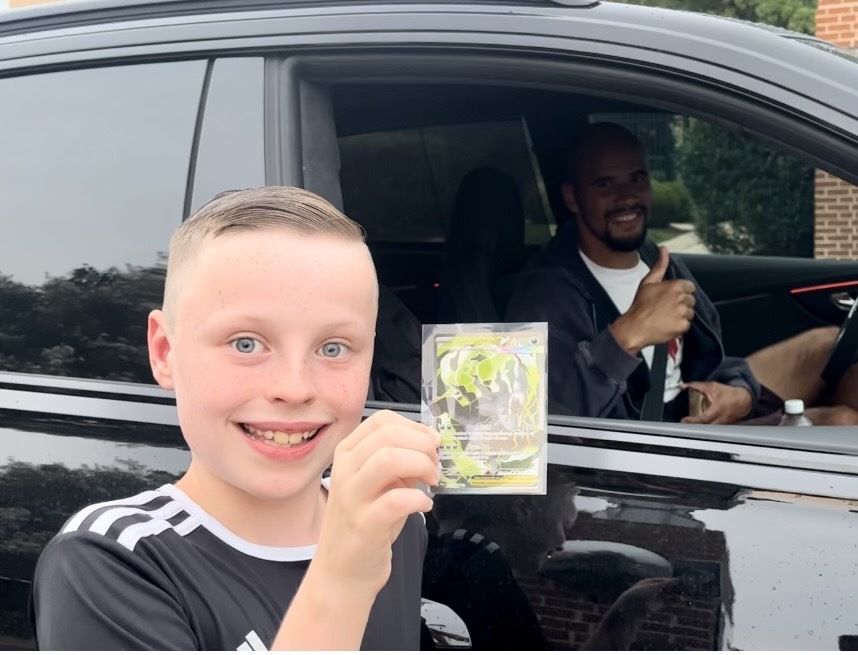
    From that moment on, they’ve shared several interactions — including Powell gifting Davis Pokémon cards, a shared interest of theirs, and a signed photo of the two of them inside the training facility.

    Eagles linebacker Jalyx Hunt later told Powell he had spotted the picture inside of Davis’ locker.

    “I got a picture of me and him signed by him, and he really liked it and said, ‘Hey, can you get me one of these pictures?’ And I’m like ‘Oh wow, all right, sure,’” Powell said. “I printed it out and I signed it for him, and he loved it and he said, ‘I’ll put it in my locker.’ … That’s what makes it hard. When you get so close with them and then they’re traded, you take it harder.”

    Powell, who is autistic, finds it more difficult to adjust to the recent roster adjustments — like the departures of A.J. Brown, Cam Jurgens, and now Davis. They had become part of his “53-man dad squad.”

    “His dad is not very much present in his life, only when he chooses to be,” said Powell’s mother, Kim Davies. “So it’s like we always joke — and the players do, too — that he’s got a 53-man dad squad with him. And I mean a lot of them give him advice, tell him about how first impressions are important, how you always need to look your best, and how to be a good person.”

    Powell has met nearly the entire team. He makes his way over to the Eagles practice facility once or twice a week and waits out front as players drive by. Most players will stop the car, roll their window down, and ask how he’s doing. Others will smile and wave.

    Jordan Mailata, Zack Baun, and Davis were some of the players who stopped every time.

    He’s even built close relationships with some of the players’ partners, including Niki Mailata and Cam Jurgens’ fiancé, Margaret Benzing, whom he met at Chickie’s & Pete’s.

    “Margaret showed up at NovaCare and gave me a whole bag of goodies,” Powell said. “She gave me a winter hat of Jurgens and a salute to service hat. She got me a very nice coat. It was really cool. … I could go on with stories upon stories, but we would be sitting here for pretty much the rest of my life.”

    It’s only fitting that Powell, whose full name is Jackson, would become an Eagles superfan — he was named after his mother’s favorite player, DeSean Jackson. His fandom has grown overtime with the help of his mother and his late grandfather John, who also was known as Jack.

    “Once an autistic child focuses on something, they give it their all,” Davies said. “And maybe it’s different, not every child is the same. But when Jack is focused on something, it’s everything. And that just happens to be the Philadelphia Eagles right now. … So we go over there. It makes him happy.”

    After getting bullied in school and turning to homeschooling, the relationships Powell has built with the players have become a big part of his life. And his mother is trying to do anything possible to keep a smile on his face.

    “It’s more than football,” Davies said. “It’s the relationships you make and the people you meet. And I think that’s what people don’t understand. Jack knows these people, and they know him.”

    And although Powell won’t see Davis drive to the facility anymore, he still wishes him the best of luck with his new team.

    “I’m not going to be rooting for his team, but I’ll be rooting for him,” Powell said. “I hope he does some good things, you know? I hope he has a good little career over there. And I know we’ll be back here. And I really do miss him. Like, I wish I got to say this to his face.”

    Jack Powell wants an in-person goodbye with former Eagles defensive tackle Jordan Davis.Kim Davies

    To get the in-person goodbye they missed out on, Powell and his mother Davies are hoping to go to Jacksonville’s game at the New York Giants on Nov. 22.

    “We are desperately going to try and see if we can maybe somehow get to the game and get behind the visitor’s team bench so he can say goodbye to his friend,” Davies said. “We posted that video in hope that Jordan would see it so Jack can have some kind of closure because it lingers, and it’s going to fester until he gets that chance. He needs to say goodbye.”

    And as Powell continues to form unbreakable bonds with players he looks up to as father figures, he’s also raising awareness for the Eagles Autism Foundation. He’s given EAF pins to players like C.J. Gardner-Johnson, Reed Blankenship, Darius Slay, Isaiah Rodgers, and Brandon Graham.

    “I just want to do it to help the community, help people that are kind of like myself,” Powell said. “Because, you know, it’s important for me to do that every year for people to understand I’m not a kid that just goes around and gets autographs. I also want to give back to the community. I think it’s a very good thing what the Eagles Autism Foundation does.”

  • The best thing Craig LaBan ate this week: The BBQ beef shoulder at Dizengoff

    The best thing Craig LaBan ate this week: The BBQ beef shoulder at Dizengoff

    Is beef shoulder the new short rib? Dizengoff chef de cuisine Quin Meyer is making a convincing case.

    In the ongoing quest to transform CookNSolo’s popular hummusiya from its original incarnation as a fast-casual takeout hub into a full-service neighborhood restaurant, Meyer has experimented with a number of options for a beef entree that’s both delicious and fairly priced. The original plan, to feature a grilled-to-order skirt steak, proved to be cost-prohibitive (given the skyrocketing cost of beef), not to mention tricky to execute consistently.

    So Meyer gravitated toward a more predictable slow-cooked solution with beef shoulder, a five-pound hunk of meat most commonly butchered into flat iron and blade steaks.

    Meyer instead braises the big cut whole for five hours with onions and tomatoes until it’s meltingly tender. It’s then cut into half-pound bricks and caramelized to order in the blazing hot pita oven, where it gets lacquered with a tropical, sweet-tart passion fruit-amba barbecue sauce. The beef is served with a colorful succotash of fava beans, roasted corn, and sumac-dusted onions. When you pierce the meat with a fork, it unfolds with unctuous softness, not unlike a luxuriously braised short rib — but at nearly half the price of that popular cut.

    The shoulder has proven to be one of the most popular entrees, especially for dinner, alongside Dizengoff’s za’atar roast chicken. It’s also a flexible canvas for whatever the season brings. The current rendition recalling the faded warmth of summer will soon shift into deep-fall mode, shined with a tangy date glaze over a garlicky celery root skordalia mash, with broccoli rabe and crunchy celery root chips. Along with the sides of turmeric rice and chopped cucumber-tomato salad that accompany every platter at Dizengoff, it makes for a hearty supper.

    Dizengoff, 1625 Sansom St., 215-867-8181, dizengoffphilly.com