Blog

  • Tyrese Maxey gets a little help from a friend at his Thanksgiving event: Jaylen Brown

    Tyrese Maxey gets a little help from a friend at his Thanksgiving event: Jaylen Brown

    Shortly after the Boston Celtics traded Jaylen Brown to the 76ers, Tyrese Maxey’s foundation held its Night of Giving.

    Maxey’s new teammate Brown made sure to make an appearance and a donation in support of the event. Then on Saturday, as Maxey held what has become an annual Thanksgiving meal drive, Brown wanted to contribute again. This time he did so as a partner in helping to amplify the reach of the event, which is set to give around 5,000 Thanksgiving meals to families in need across five different locations in Philadelphia.

    “That’s just who he is, and I’m just very thankful,” Maxey told The Inquirer this week. “I told him whatever he does, I’ll be a part of, and whatever I’ll do, you know, he’s more than welcome to be a part of.”

    Brown, donning an Atlanta Braves “A” cap for his hometown, and Maxey were at the Alan Horwitz “Sixth Man” Center early Saturday morning, spending some time with families and volunteers at the event before they had practice a few hours afterward.

    For Maxey, the Thanksgiving event is “up there at the top” of the multiple campaigns his foundation puts on each year. It started in 2022 and was born out of one of his “crazy ideas” he brought to those who work with him.

    “Just being able to see people happy, you know, see people crying tears of joy, and then I always have my family there, so my entire family is there giving back and doing that, it’s really great,” Maxey said.

    This season, he had Brown there to help up the total number of meals they are able to dish out. With a smile, Maxey said Brown had “a lot of ability” to contribute to the event’s success, given Brown’s resources through his 7uice Foundation. When Maxey began the event, the foundation handed out 400 meals. That has increased each year, culminating in the 5,000 this year.

    “Someone that has your back in the community, you know they are going to have your back on the court,” Maxey said.

    Tyrese Maxey loves giving back. It comes from his family.
    Video: Tyrese Maxey loves giving back. It comes from his family.

    Maxey said he wasn’t aware of just how heavily involved Brown was in the community in Boston during his 10 years there. When Brown threw a goodbye block party this summer, city and state officials showed up to give him thanks and a key to the city.

    “Every minute that he has, he poured into the city,” Boston mayor Michelle Wu said at the event. “We’re never going to let you forget us.”

    When Brown had his first news conference with the Sixers, he held it at the Francis J. Myers Recreation Center in Southwest Philadelphia in part to highlight his commitment to finding his own way to make an impact on his new home.

    As Maxey has gotten to know Brown in a new light as a teammate, he said Brown was somebody Philadelphia should be proud to “get behind.”

    “I appreciate him,” Maxey said. “He’s a great guy, and that’s just really cool to be able to do something with your teammate like that. I’m very thankful for him. Thankful and glad that we have him in the city of Philadelphia.”

    Barlow at practice

    Dominick Barlow participated at the Sixers practice ahead of their game against the Indiana Pacers on Sunday. Barlow has not played this season as he recovers from a low back stress reaction. Nick Nurse added that the practice “wasn’t super intense.” The team hasn’t put a timeline on his return.

    “I don’t know when he’ll be ready to go, but at least he’s making some progress now,” Nurse said.

  • Comedian Shane Gillis responds to backlash over ‘Saturday Night Live’ monologue

    Comedian Shane Gillis told Saturday Night Live there would be “no controversy” with his opening monologue — a performance that was ultimately slammed by viewers who called his jokes misogynistic.

    During his third time hosting the sketch-comedy show on Oct. 10, Gillis said in his seven-minute monologue that women dress like “whores” when they go to the gym.

    “Look, I’m sorry there’s no other way to describe it,” the Mechanicsburg, Pa. native said.

    Many took to social media to denounce Gillis’ language as tone deaf amid a national reckoning with sexual violence in the wake of the Cornell 7 case. Feminist author Jessica Valenti said on Instagram, “when you demean and denigrate and dehumanize women … What do you think rape culture is?”; actor and former SNL host Dan Levy said in a reel, “I’m speechless that something like that can exist on live national television.”

    On an episode of Joe Rogan’s podcast released Friday, Gillis said the online backlash “had a lot to do with the climate.”

    The Tires star also said SNL didn’t provide feedback or approval on his monologue beforehand.

    “They were like, ‘What’s going on with the monologue?’ And I was like, ‘It’s not great, but I don’t say anything bad,’” Gillis said on the podcast. “The whole time, I was like, ‘Fellas, I’m giving you a solid C minus of a monologue, but I promise there’s no controversy.”

    Critics also admonished Gillis for a bad-word blunder: During a Dr. Seuss-themed skit, he dropped an f-bomb. The flub wasn’t censored on the live broadcast, and the comedian apologized.

    Gillis, who graduated from West Chester University and cut his teeth in Philadelphia’s comedy scene, was announced as an SNL cast member in 2019 then fired before the season premiere for having made homophobic and racist jokes on his podcast. He has maintained that the remarks were taken out of context and said he would apologize to anyone who was offended.

    In the years since, Gillis’ brash style and edgy jokes have launched him into stardom. In July, his one-night-only comedy special at Lincoln Financial Field broke Guinness World Records for attendance and tickets sold.

    Staff writer Emily Bloch contributed to this report.

  • Villanova’s playoff hopes in jeopardy after its overtime loss to Holy Cross

    Villanova’s playoff hopes in jeopardy after its overtime loss to Holy Cross

    Villanova visited Holy Cross on Saturday in Worcester, Mass., knowing it was a must-win matchup.

    And despite a comeback that forced overtime, the Wildcats fell, 30-27, to the Crusaders, which moved Holy Cross into second place in the Patriot League and ended Villanova’s hopes of winning a conference title. At 6-5 overall, 5-3 in league games, the Wildcats are two games behind league-leading Lehigh (9-2, 7-1) with one game left.

    The Wildcats were unable to find the end zone after getting the ball first in extra time and settled for a 38-yard field goal on fourth-and-18. Holy Cross running back Jake Croce then punched it in for the winning touchdown on third-and-goal from the 1.

    Villanova struggled with consistency on offense, especially on the ground. The Wildcats rushed for 48 yards, their lowest total this season.

    Pat McQuaide threw for just 71 yards in the first half before unleashing 342 passing yards in the second and overtime. The sixth-year quarterback completed 33 of 58 attempts. He threw two touchdowns and three interceptions, tying his season high in picks from the opener against William & Mary.

    While the offense was finding its footing late in the game, the Wildcats went 2-for-15 on third down, only converting their first early in the fourth quarter.

    It was also a tale of two halves for Villanova’s defense. The unit allowed 196 yards and three touchdowns in the first. After halftime, the defense flipped a switch and held the Crusaders’ offense to 72 yards before allowing the game-winning score in overtime.

    Playoff picture

    Saturday’s loss put the Wildcats’ playoff hopes in jeopardy, as Holy Cross dropped Villanova to third place.

    Holy Cross now holds the tiebreaker over Villanova, but Lehigh sits in first place. The 8-2 Mountain Hawks defeated the 6-5 Crusaders in the season opener but also lost to Villanova.

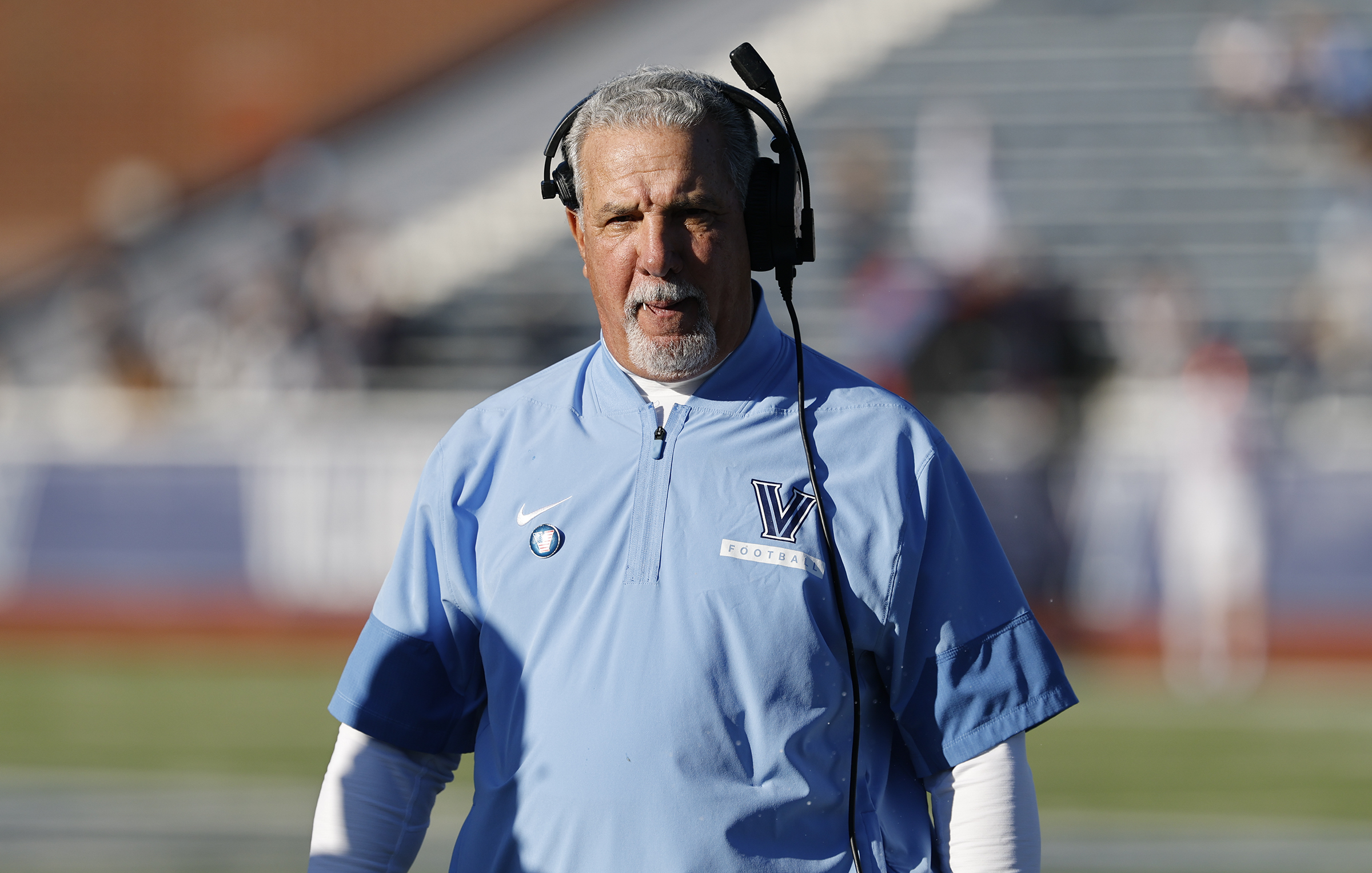
    Villanova head coach Mark Ferrante against Richmond on Nov. 7.Yong Kim / Staff Photographer

    Regardless, Saturday’s loss has made it impossible for Villanova to win the automatic qualifier for winning the Patriot League.

    The Wildcats still have a chance to earn an at-large bid to the FCS playoffs, but next Saturday’s clash with Georgetown is an absolute must-win.

    Turnovers doom Wildcats

    Villanova hasn’t lost a turnover battle since its September loss to Colgate. The early-season problem showed up against the Crusaders.

    Isaiah Ragland fumbled with under a minute left in the second quarter, contributing to the Wildcats trailing by 14 points entering the half.

    In the second half, McQuaide threw three interceptions. His second was costly, as it went right into the hands of Crusader cornerback Anthony Redfern, who returned it back 65 yards to set up a Holy Cross field goal, their last score in regulation.

    Up next

    Villanova will head home for their regular-season finale against Georgetown (3-6, 3-4 Patriot League) next Saturday (1 p.m., ESPN+). The Hoyas are coming off consecutive losses to Holy Cross and Fordham.

    It has been 76 years since these two programs played, with the Wildcats winning 20-14 over the Hoyas on Oct. 28, 1950. Villanova is 7-3 all-time against Georgetown.

  • Eastern University finishes atop the conference, advances to Division III football playoffs

    Eastern University finishes atop the conference, advances to Division III football playoffs

    Eastern University’s football team is heading back to the Division III playoffs after beating Fairleigh Dickinson University-Florham, 52-0, on Saturday.

    The 8-2 Eagles, who are in their fourth season of competitive play under coach Billy Crocker, earned a share of the Middle Atlantic Conference with the win. Delaware Valley beat Widener, 35-7, Saturday to be named co-champions of the MAC since Delaware Valley and Eastern finished with the same conference record.

    Because Eastern owned a head-to-head 21-7 win against Delaware Valley on Sept. 26, the Eagles have earned the league’s automatic bid to the NCAA playoffs.

    Quarterback Brett Nabb starred in Eastern’s win with five total touchdowns (three passing, two rushing) and accounted for 271 total yards. Eastern’s defense forced three turnovers and shut out an opponent for the fourth time this season.

    The Eagles will learn who they face in the playoffs when the Division III brackets are revealed on Sunday at 5 p.m. Last season, Eastern won its second-round game over Franklin and Marshall before falling in the quarterfinal to Susquehanna University.

  • At 57, one of the newest Chester County sheriff’s deputies is fulfilling a longtime dream

    At 57, one of the newest Chester County sheriff’s deputies is fulfilling a longtime dream

    A year ago, Troy Brock had convinced himself his lifelong dream of working in law enforcement would remain just a dream.

    He said he still thinks back to those days in disbelief as he puts on his Chester County Sheriff’s Office uniform.

    “It’s very emotional because I thank God for this every single day that I get up,” Brock said. “I know a lot of people say, ‘Oh, it’s just a sheriff’s position.’

    “It’s not, and they have no idea the journey that I’ve been through to get here.”

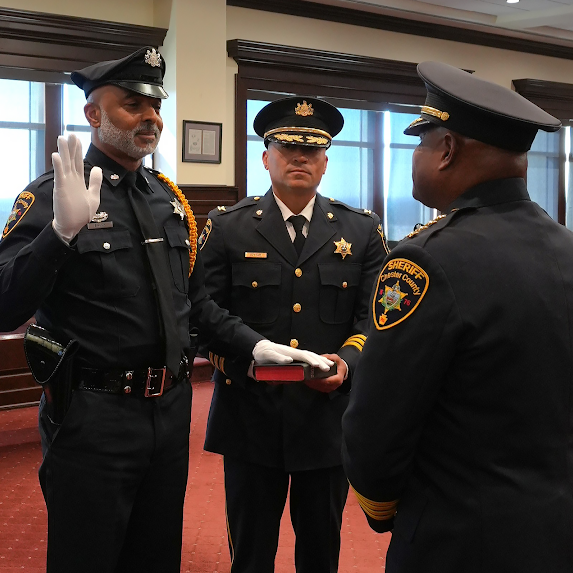
    In June, Brock, 57, was one of the oldest deputies to be sworn in by the Chester County Sheriff’s Office. Brock, a King of Prussia resident, said his journey to joining the office was far from direct.

    The son of a Wilmington police officer, Brock said he always sought to follow his father’s example.

    But nearly 20 years ago, a major injury sidelined him days before he was set to enter the Delaware State Police Academy. In the intervening years, he worked as a security officer at the University of Delaware, St. Joseph’s University, and Children’s Hospital of Philadelphia before landing a role with the Chester County Department of Emergency Services.

    His induction into the department came at a time when the office was reevaluating how it recruits people to serve the county and protect its courthouse, according to Chief Deputy Sheriff Jason Suydam.

    “We want people that live in the community to be part of this law enforcement organization and reflect the variety of people that live and work here,” Suydam said in a recent interview.

    Deputy Troy Brock works at a community event in Downingtown this summer. Brock said he was initially unsure if he would join the Chester County Sheriff’s Office, believing he was past his prime.Courtesy Chester County Sheriff's Office

    Suydam first met Brock at the emergency services department, while he was working as the department’s deputy director of law enforcement. And when Suydam moved over to the sheriff’s office, he extended Brock an opportunity to join his team. Brock said it all seemed too good to be true.

    “I had to chuckle a little bit because I felt like I’ve already buried that skeleton, and I wasn’t going to pursue it, because it was pretty heartbreaking,” Brock said. “But he saw something in me, and I knew I couldn’t let him down.”

    Brock spent months on an intense workout schedule that got him into recruit shape, and he joined the police academy in January.

    Suydam said he knew all along that Brock would succeed.

    “Throughout the time that I’ve known him, I just thought he is the type of person that we need in this profession,” he said. “I remember when we sat down, him saying, ‘I’m too old.’

    “But I don’t subscribe to being too old or too young to do something if your mindset is you want to accomplish it.”

    Brock said in the last five months he has become something of a mentor to his fellow new recruits, most young enough to be his children.

    “The most important aspect that I teach to them is it’s not about chasing a dollar or a position; it’s about having integrity,” he said. “That’s the backbone of law enforcement — being honest and having integrity.”

  • The Flyers haven’t won a game beyond regulation this season. How can they fix it?

    The Flyers haven’t won a game beyond regulation this season. How can they fix it?

    COLUMBUS, Ohio ― The Flyers finish a five-game road trip in Columbus on Saturday night.

    The last time these two teams met, the Flyers battled back from a 3-0 hole before losing in overtime on a two-on-none goal by Blue Jackets forward Kent Johnson.

    It’s been a trend this season. The Flyers have gone past regulation six times in their first 21 games and have lost each one, with five ending in the extra session and one in a shootout. Last season, they played 28 games past regulation, winning 16.

    What are the issues? “All the above,” coach Rick Tocchet said of the team’s overtimes on Friday.

    The Flyers spent a long stretch of practice Friday at Nationwide Arena working on three-on-three action after watching video. Whether it translates to the game itself is anyone’s guess because each game, scenario, and opponent is different.

    But Tocchet follows three tenets: You can’t lose pucks in certain areas; you can’t throw pucks away; and you have to have better line changes. Of the five overtime goals allowed, four came either directly off an odd-man rush or soon after. The Edmonton Oilers took advantage of a bad change on Wednesday for Evan Bouchard’s winning goal.

    “We basically gave the team stats. I think we’ve had five chances. The other team’s had 12,” Tocchet said. “… For us, it’s not a one-man show. We need three guys participating. It seems like we’re not getting that three-man attack or three-man defending. And quite frankly, to be honest, we throw the puck away.

    “You’ve got to have a lot of — it’s not courage, but just the hockey IQ of holding onto a puck. You can’t throw pucks away because that’s probably the number one culprit for us. And we’re trying to find guys. I’ll be honest, all jobs are open.”

    Fifteen players have seen the ice in overtime, with Travis Sanheim leading at 9 minutes, 25 seconds, Oliver Bonk is last with 23 seconds, and Trevor Zegras leads the forwards at 6:16, and Matvei Michkov is third (4:41).

    Rookie Porter Martone, who scored an overtime power-play goal against the Boston Bruins in a pivotal game as the Flyers surged to the postseason last season, has not seen the ice in extra time but is someone Tocchet said could look to moving forward.

    Flyers right wing Porter Martone has not seen the ice in overtime this season.Yong Kim / Staff Photographer

    So what constitutes a successful player in overtime?

    Part of the deployment is based on timing, like needing a center to win the opening draw, as it typically lays the foundation for the rest of overtime, or someone who, because of the fast-paced action, will skate a hard 30 /seconds/ and then change.

    “Guys obviously good with the puck who can defend the puck,” Tocchet said. “It’s really, if you look, I think 60% of the overtime goals are from actually defending the puck into a transition. It’s a big number. So you’re looking for people that just can’t go out there and try to just think about scoring all the time because you have to defend. After that, yes, do your thing.”

    Watching the three-on-three practice, it looked like the Flyers were focusing on maintaining a triangle formation.

    One of the most basic offensive-zone strategies in hockey is utilizing a triangle, where it is not only about spreading out and puck support but also having a player higher in the zone to defend if things quickly head the other way. The bench boss thought his group has been playing flat — or all three across — which is what happened on the Johnson overtime winner at Xfinity Mobile Arena.

    “A lot of times in three-on-three, right, teams will fold into kind of a tight triangle, and it’s hard to spread them out,” said forward Travis Konecny. “So, picking your spots on when to try something and when to attack, and then also not giving up the puck.”

    The bare minimum message on Friday, whether using the triangle or not, was about support, with or without the puck, and awareness.

    “I think at times when we’re in our structure defending, we’re defending pretty good and creating turnovers. It’s the plays [where] we’re trying to force and make, and giving up possession of the puck when we have it,” Sanheim said.

    “And in three-on-three, it’s a possession game. You need to wait for your chances and wait for the other team to make a mistake on coverage. Just being more patient, understanding that we don’t need to force it, and let the game kind of come to us.”

    Breakaways

    Joseph Woll (2-6-2, .902 save percentage) started in goal for the Flyers in the first game of the back-to-back on Saturday. Woll is 2-1-1 in four games against the Blue Jackets with a 2.44 goals-against average and .924 save percentage. Dan Vladař (3-4-4 overall, .879 SV%) is, therefore, expected to be in net against the Oilers on Sunday at home (7:30 p.m., NBCSP). Vladař made 21 saves on 24 shots in the overtime loss on Wednesday. … Columbus head coach Rick Bowness missed his second straight game due to an undisclosed health issue. Don Granato served as the bench boss in his place.

  • Pope laments violence enveloping Peru as he ministers in his former diocese

    Pope laments violence enveloping Peru as he ministers in his former diocese

    CHICLAYO, Peru — Pope Leo XIV prayed Saturday for an end to the violence ravaging Peru, addressing one of his adopted homeland’s most pressing concerns during visits to his former cathedral and a remote community in his former diocese.

    At Chiclayo’s cathedral, Leo entrusted his pontificate to the Virgin Mary in a special ceremony before traveling to Santa Cruz de Succhabamba, nestled in lush green mountains near the diocese’s outer reaches.

    He traveled by helicopter to the city, 93 miles from central Chiclayo and 6,675 feet above sea level. The journey reflected his belief that shepherds must reach the peripheries to minister to their flocks.

    Leo, formerly Robert Prevost, is beloved in the region for venturing beyond the sacristy to serve poor, outlying communities. As bishop, he would make the difficult drive to Santa Cruz de Succhabamba himself in his pickup truck.

    “We all know the pope’s love of cars,” the Rev. Kevin Noriega, who oversees pastoral services, said before Mass. “He would drive everywhere.”

    Rising crime a top concern for Peruvians

    Before leaving, Leo led a special prayer at the Cathedral of St. Mary in Chiclayo, where he served as bishop from 2014 to 2023. He spoke of the “darkness” enveloping Peru, referring to rising crime amid political instability.

    The homicide rate has nearly doubled over the past five years, from 5.8 to 10.7 per 100,000 people. Reports of extortion increased from 2,421 in 2019 to 26,734 in 2025, according to official data.

    “We feel threatened by the uncertainty of widespread violence and by the unspeakable suffering that continues to afflict so many of our brothers and sisters,” Leo said in the cathedral. “Yet, despite this darkness, which so often dims our hope and weakens our trust, God’s gift continues to shine before our eyes.”

    Crime has disrupted daily life, making security Peruvians’ top concern and helping shape the outcome of the last presidential election.

    Conservative Keiko Fujimori took office in July after pledging to tackle crime. She has since declared states of emergency, including in Lima in August and in prisons holding inmates linked to criminal organizations in September.

    Fujimori has also moved to strengthen ties with Washington by bringing Peru into the Shield of the Americas, a U.S.-led regional coalition formed to conduct joint military operations against drug cartels.

    Shortly before Leo’s visit, Fujimori toured the maximum-security megaprison built by Salvadoran President Nayib Bukele. Known as the Terrorism Confinement Center, or CECOT, the prison is a model Fujimori expressed interest in replicating during her campaign.

    In Santa Cruz de Succhabamba, Leo returned to the impact of violence on the faithful. He acknowledged the temptation to respond to injustice with violence but urged a different response.

    “Selfishness, injustice, and evil are not overcome by brutality, but by prayer, patience, and perseverance in denouncing what is wrong, by making our pleas with determination and working diligently to bring about the necessary changes,” he said.

    A final Mass in Lima

    During one of his first engagements in Lima, Leo condemned violence against women, denouncing “machismo” in Peruvian culture and calling for women to be respected and protected as gender-motivated homicides rise.

    Peru recorded 1,261 femicide victims between 2016 and 2024, according to the National Institute of Statistics and Informatics. The annual number of women killed because of their gender rose 44% during that period.

    The country also faces widespread illegal gold mining and is the world’s second-largest producer of coca leaves, the raw material for cocaine, after Colombia, according to the United Nations Office on Drugs and Crime.

    Leo, who received a joyous welcome in Chiclayo on Friday, is expected to address those issues when he meets with Amazonian and Indigenous peoples on Sunday. He will celebrate a final Mass in Lima on Monday before returning to the Vatican.

  • Zelensky says a new European security framework floated by U.S. could benefit Putin

    Zelensky says a new European security framework floated by U.S. could benefit Putin

    KYIV, Ukraine — Ukrainian President Volodymyr Zelensky said the United States had raised the possibility of a new security framework for Europe as part of efforts to end Russia’s war in Ukraine, warning that Moscow could use such discussions to weaken NATO and reshape the continent’s borders.

    Separately, Ukrainian forces struck a major Russian oil facility supporting Moscow’s war effort, Ukraine’s General Staff said in a statement Saturday.

    “In my view, this can be dangerous,” Zelensky told reporters Friday, referring to the new security framework. “This should not be the main agenda.” His comments were embargoed until Saturday.

    He said he believed Moscow was interested in reopening broader questions about European security rather than focusing exclusively on ending the 4½-year war.

    “(Russian President Vladimir) Putin’s desire to change borders in Europe is a fact. I am sure this is part of his concept of revising security guarantees in Europe,” he said. “This is dangerous because, in my view, it is precisely things like this that lead to wars or escalations.”

    European leaders have stressed that decisions about the continent’s security must be made by Europeans themselves, warning against allowing Russia to dictate the terms of a new security order or negotiate NATO’s future.

    U.S. raised Donbas withdrawal in exchange for Ukraine NATO membership

    Zelensky said the U.S. had asked for the first time whether Ukraine would withdraw from parts of the Donbas region in eastern Ukraine that Russia does not control if Kyiv were admitted to NATO. He reiterated that Kyiv would not surrender its territory.

    Ukraine is discussing a comprehensive security package with its partners that could include specific guarantees from NATO and the European Union, a strong Ukrainian military and financial support, for a specified period, he said. It would also include a recovery plan, he said.

    “If the American side confirms precisely this to us, together with other NATO partners, then I will ask our Ukrainian society what it thinks: Do we accept it or not?” Zelensky said.

    He stressed that any arrangement would not involve recognizing occupied territories as Russian.

    Zelensky also rejected the possibility of Ukraine committing to neutrality, saying that would require changing the country’s constitution.

    “If Putin expects Ukraine’s neutrality to be enshrined, that’s not going to happen,” he said. “We’re not in NATO right now anyway.”

    Ukraine hits another major oil facility in Russia

    Ukrainian strikes on the Samara oil pipeline station near the village of Prosvet in Russia’s Samara region Friday set several oil storage tanks on fire, Ukraine’s General Staff said.

    Moscow has not commented on the strike.

    The facility is a key part of the network exporting Russian oil to global markets, the General Staff said. The military also said it struck the Lipetsk-2 airfield in Russia’s Lipetsk region.

    Separately, 22 people, including three children, were injured in a Russian attack on the southeastern Ukrainian city of Zaporizhzhia on Friday, Ukraine’s Emergency Service said. The injured include a 6-month-old baby, a 2-year-old girl, and a 12-year-old boy.

    Zelensky says Europe must decide its own future

    Zelensky warned that broader discussions about Europe’s security could allow Putin to seek changes to NATO’s military presence, including the withdrawal of American troops.

    He said Putin had raised similar ideas with then-President Joe Biden in 2021, seeking a redistribution of power in Europe and the world.

    “I think Putin will bring up Finland and Sweden. I’m sure he will raise the issue of Hungary and the presence of American troops in the Baltic countries,” Zelensky said.

    He said any changes to Europe’s security arrangements must be decided by European NATO members only after the war ends.

    “The sequence should be as follows: a ceasefire, an end to the war in Ukraine, and security guarantees for Ukraine,” he said. “There can be no security guarantees in Europe, or for Europe, without Ukraine.”

    Energy ceasefire and prisoner exchanges are priorities

    Zelensky said Ukraine’s priorities in Abu Dhabi included an energy ceasefire, reopening the Black Sea, prisoner releases, and preparations for a leaders’ meeting to end the war.

    He said Russian negotiators lacked authority to decide on several issues and Moscow was unwilling to accept an energy ceasefire.

    “At the meeting in Abu Dhabi, the Russian delegation said they didn’t have a mandate to decide this issue, but we can also see that they are unwilling,” he said. Negotiators were told to resolve ceasefire questions directly with Putin.

    Zelensky said talks in Moscow with U.S. negotiators resulted in an agreement to exchange more than 1,000 POWs on each side. The exact number was still being determined, he said, estimating 1,200 to 1,300.

    He said Washington supported Ukraine’s demand for European countries to participate directly in future negotiations, rather than remain outside the main negotiating room.

    Britain, France, Germany, and Italy attended the Abu Dhabi meetings, Zelensky said. He expected three to five European representatives at future discussions.

    Kremlin spokesperson Dmitry Peskov said Moscow was open to European participation, adding that it would “help us understand how their stand could help the peace process.” He said Russia would accept any representatives European countries chose to send.

    Zelensky questions Starshield restrictions

    Zelensky accused SpaceX of imposing restrictions on its Starshield satellite system in Russian-occupied Ukrainian territory, saying the limitations were hampering efforts to intercept Russian drones.

    He said the system’s speed had been restricted to a maximum of 100 mph in occupied areas and that the limitations had been in place for five days.

    Zelensky questioned the explanation that the problem was technical, saying the restrictions appeared to have been imposed by SpaceX despite previous assurances from U.S. Secretary of State Marco Rubio that Starshield was more under the control of the U.S. government.

    “The current Starshield restrictions suggest that SpaceX imposed them,” Zelensky said. “That’s what our team is telling me. So this doesn’t quite line up with what we heard earlier. That’s why we need to get to the bottom of all this.”

    He said the restrictions prevented Ukrainian forces from intercepting Russian jet-powered Shahed drones over occupied territory as they approached from the east, forcing them to wait until the drones reached areas where the limitations did not apply.

  • U.S. loses measles elimination status after more than 25 years

    U.S. loses measles elimination status after more than 25 years

    As Pennsylvanians grapple with a major measles outbreak, the Wall Street Journal reported that the Pan-American Health Organization will no longer consider the highly contagious disease “eliminated” in the United States, an extraordinary loss of a public health achievement that the country had maintained for more than 25 years.

    The latest designation by PAHO, a division of the World Health Organization focused on the Americas, is largely symbolic, but it means that measles is once again spreading widely in communities across the United States. A spokesperson for the international health agency said it would hold a briefing on the determination Tuesday. The Journal cited “people familiar with the matter” when breaking the news Friday night.

    “It is a sad day. I think it is a tremendous step back for public health in this country,” said Paul Offit, a nationally renowned vaccination expert and codirector of the Vaccine Education Center at Children’s Hospital of Philadelphia.

    PAHO considers measles eliminated when a country has “no continuous spread of the virus” for at least a year, the Journal reported, adding that PAHO evaluates recent measles outbreaks and reports from the Centers for Disease Control and Prevention to determine how cases in the United States are linked, and whether any outbreaks lasted longer than a year.

    Massive measles, mumps, and rubella (MMR) vaccination campaigns in the United States led to the elimination of the disease in 2000. Many doctors practicing today had never seen a measles case before. The last major outbreak in Pennsylvania occurred in 1991.

    In 2025, amid a measles outbreak in Texas, the country recorded its first measles death in a decade. This year, the CDC has recorded 5,412 measles cases, the most since 1991.

    Pennsylvania has reported the worst measles outbreak in the country this year, with 1,542 cases confirmed as of Friday. About one in five patients has been hospitalized. The state has confirmed seven measles-associated deaths and is investigating an eighth, while New York and Wisconsin have reported three deaths between them.

    Offit said that, given the death rate — typically, about 1 to 3 of every 1,000 children who contract measles will die — measles cases in the United States are almost certainly undercounted.

    The loss of measles elimination status should be a wake-up call for scientists and public health workers, said Brian Castrucci, an epidemiologist and president and CEO of de Beaumont Foundation, a community health philanthropy outside Washington.

    “We’re in an ongoing, day-to-day war with measles, and for the first time in 26 years, measles is winning,” he said.

    In a statement, Pennsylvania Secretary of Health Debra Bogen said declining vaccination rates have made more Pennsylvanians vulnerable to the “entirely preventable” disease.

    “The only way we can successfully stop future outbreaks, protect our most vulnerable residents, and regain our elimination status as a country is for more people to choose to get vaccinated and rebuild our community immunity,” she said.

    Representatives from the U.S. Department of Health and Human Services did not immediately respond to requests for comment.

    Vaccine skepticism rises along with spikes in measles cases

    Measles is one of the most contagious viruses on earth, lingering in the air for up to two hours after an infected person leaves an area. Up to 90% of unvaccinated people who come into contact with the virus will contract it.

    Experts say that 95% of a given population must be vaccinated to prevent the virus from spreading widely; a two-dose regimen of the MMR vaccine is 97% effective against the disease.

    But MMR vaccination rates have been declining for years, both around the country and in the Philadelphia region, amid a burgeoning anti-vaccination movement and the spread of misinformation about the safety of vaccines.

    Vaccination rates in Pennsylvania communities and elsewhere have steadily slipped below the 95% level. In Lancaster County, the epicenter of the state’s spiraling measles outbreak, just 87.6% of kindergarteners had been fully vaccinated against measles for the 2025-26 school year.

    Now, proponents of the anti-vaccination movement are at the highest echelons of the federal government. Health and Human Services Secretary Robert F. Kennedy Jr., an appointee of President Donald Trump, is a longtime anti-vaccination activist.

    Earlier this year, Kennedy said that the MMR vaccine is effective. But he spent years spreading skepticism about vaccine safety — including as recently as September, when he spoke at a conference for Children’s Health Defense, the anti-vaccination group he once chaired.

    Castrucci said that anti-vaccination sentiment has long been building in the United States, and that public health workers must communicate more effectively with vaccine skeptics to rebuild trust and encourage vaccination.

    “This is our own failure of recognizing this growing problem before it became a crisis. The anti-vax movement is a slow-moving cancer in the American psyche,” Castrucci said. “To think this began and ends with RFK, or begins and ends with Trump, or the midterms, is a horribly naive thought.”

    Local health departments need more funding to encourage vaccination and conduct contact tracing, he said. Healthcare providers must help parents navigate questions about vaccination with empathy. And public health officials should emphasize that measles outbreaks take a toll on an entire population, disrupting school operations, hospital work, and other aspects of public life, he said.

    Bogen said that efforts to vaccinate more Pennsylvanians are working, with more than 7,100 MMR vaccines distributed by DOH staff at pop-up clinics since April. Across the state, health providers dispensed more than 61,000 doses of the vaccine in October. In a typical month, providers normally give out just 25,000 doses.

    “Those numbers are undoubtedly the result of earned public trust and are contributing to the progress we are making to protect our communities,” she said. “We are leading with science, listening to medical experts and giving Pennsylvanians the facts they need to make informed decisions about their health and the health of their families.”

    Kids aren’t the only population at risk

    Offit said that years of declining vaccination rates mean the disease is now infecting more adults.

    “The epidemiology has shifted,” he said. Before widespread vaccination was available in the 1960s, most Americans contracted measles as children.

    “Now you have people in their 20s, 30, and 40s, who didn’t grow up with the virus, who may not have been vaccinated,” Offit said.

    Adults make up two-thirds of the measles cases in Pennsylvania, and, like children under 5, people over 20 are more likely to develop serious complications from the virus. Unvaccinated pregnant women are also at high risk, and doctors in Pennsylvania have reported cases of congenital measles — a rare condition in which a woman passes the virus to her child before birth.

    “Most doctors have not dealt with congenital measles or measles in adults,” Offit said.

    Kennedy must do more to promote vaccination, especially among adults, Offit said, and it is crucial that state and local health leaders vaccinate as many people as possible as cases continue to rise.

    “We have an anti-public health HHS secretary,” he said. “We have to do it ourselves, and do everything we can at the state and local level.”

    Staff writer Sarah Gantz contributed to this article.

  • Trump administration delays enforcement of Medicaid work requirement

    Trump administration delays enforcement of Medicaid work requirement

    WASHINGTON — The Trump administration will allow states to delay enforcement of new rules requiring low-income adults to work in order to receive Medicaid coverage, according to a letter it sent Friday to state Medicaid directors.

    The announcement, which followed a recent loss in court over a key element of the work requirement, represents a major setback for a long-sought Republican reform. It comes less than two months before the work requirements were set to begin, on Jan. 1. States can now wait until July before ending coverage for people who do not meet the work requirement, the letter said.

    In the letter, Dan Brillman, who oversees Medicaid at the Centers for Medicare and Medicaid Services, acknowledged the significant burden states faced in building out new, expensive software systems to track the employment of enrollees. Hospitals have prepared massive education campaigns to help patients navigate the additional paperwork.

    “We have heard directly from states about their implementation timelines, impediments to successful launches at scale,” Brillman wrote in the letter.

    He added that the federal government still expected states in January to begin checking whether Medicaid enrollees are working. But for six months, they will not be required to cancel coverage for people who fail to comply, Brillman said.

    The work requirement was enacted in the summer of 2025 as part of Republicans’ major tax and domestic policy legislation. It requires Medicaid enrollees without disabilities or young children to prove they worked, volunteered, or attended school at least 80 hours a month in order to qualify for the program or continue enrollment in it.

    The new requirement was expected to lead to substantial reductions in Medicaid coverage, disqualifying not only beneficiaries without jobs but also many who worked but were tripped up by documentation challenges. The Congressional Budget Office estimated that the policy would result in 5 million more Americans becoming uninsured over the next few years.

    Democratic lawmakers fought the policy last year. Rep. Hakeem Jeffries of New York, the minority leader who is poised to become speaker when Democrats take over control of the House in January, has announced plans to vote on reversing the work requirement and other Medicaid cuts within the first 100 hours of the next Congress.

    In court, 25 states and the District of Columbia had already won a six-month reprieve from some aspects of enforcing the work requirement. A federal judge in Massachusetts found that the Trump administration’s rules for defining who is too “medically frail” to comply with work requirements were stricter than the law allowed.

    The January start date is specified in the text of the 2025 tax law. At a conference with state Medicaid officials last summer, where many expressed concerns about the timetable, Trump administration officials warned that no extensions would be coming.

    “We know it’s going to be really hard for you to meet the deadline,” said Sara Vitolo, the deputy director for Medicaid. “It’s going to be hard for us. The expectation is going to be that we hit it. And that’s coming from the White House.”

    The law also allows states to begin enforcing a work requirement early, and Nebraska and Montana have already begun their programs. In Nebraska, state officials estimate that more than 1,700 people have already been denied or lost Medicaid coverage due to the policy.

    This article originally appeared in the New York Times.