Blog

  • Assigning FEMA staff to immigration enforcement hurt disaster work, House report says

    The Department of Homeland Security misused Federal Emergency Management Agency resources when it diverted dozens of staff to help with immigration enforcement, says a new report by a group of House Democrats shared first with the Washington Post. The lawmakers describe the deployments as an example of how the Trump administration has hindered FEMA’s ability to properly prepare for and respond to disasters.

    Beginning last summer, the Trump administration reassigned FEMA personnel to immigration enforcement roles that were largely outside the scope of emergency and disaster work for long stretches of time when the agency was grappling with extensive cuts and leadership changes, according to the report from Democrats on the House Transportation subcommittee on economic development, public buildings, and emergency management. The probe was based on interviews with 15 current and former FEMA employees and disaster and immigration policy experts.

    “Overall, the Administration’s sweeping immigration agenda has used FEMA resources and personnel to aid in carrying out large-scale immigration enforcement operations, distracting the agency from its statutorily required responsibilities, jeopardizing its workforce levels and expertise, and reducing its ability to respond to disasters and aid survivors,” the report said.

    To assess the probe’s findings, the Post separately reviewed previously unreported documents from the Government Accountability Office related to the report, and spoke with two current FEMA employees with direct knowledge of the agency’s immigration deployments, as well as four former senior FEMA officials and two federal officials who specialize in homeland security.

    Two current and former FEMA officials interviewed said some of the lawmakers’ findings were mischaracterized, because DHS has called on FEMA personnel and specialized teams to support immigration work in the past. They did, however, agree with the report’s conclusion that FEMA’s primary mission “has been measurably undermined by DHS’ policy goals surrounding border security.”

    DHS and FEMA did not provide a comment to the Post by the time of publication.

    The Post reported in August that DHS began to move dozens of FEMA staffers to help immigration agencies with vetting and onboarding new hires, as well as other administrative work. The lawmakers’ report, as well as separate interviews with six current and former federal officials and documents from GAO reviewed by the Post, reveal in greater detail how involved FEMA was with immigration initiatives for nearly a year.

    At the time, some FEMA leaders raised concerns about the legality of using disaster-funded resources for this kind of work, according to one former senior official with direct knowledge of the situation who, like others interviewed for this story, spoke on the condition of anonymity because they were not authorized to speak publicly about FEMA’s immigration work.

    But “they still were sent over,” the former official said.

    FEMA employees worked in detention centers, including in Minneapolis, where protesters surrounded one staffer en route to an Immigration and Customs Enforcement facility, according to witness accounts summarized in the report. FEMA human resources staffers reviewed applications and issued job offers for the surge of new immigration enforcement officers, according to details the agency sent to GAO in connection to the probe and reviewed by the Post.

    “ICE could not have done this work without FEMA,” a former agency official who specialized in national incident management and homeland security, and who had field experience at a Texas detention facility, told lawmakers for the report. “ICE is good at law enforcement, but operations, strategy, and the big picture — FEMA created that structure for them, building the plan and the operation toward the mission end-goal.”

    The influx of immigration work consumed FEMA’s hiring and administration capacity and delayed its ability to process some work, even as disaster staffers were losing their contracts, according to the report. A current FEMA official with knowledge of the situation also described the strain on that department.

    “Basically all human resourcing actions ground to a halt,” the official said. “We couldn’t process even simple things like annual salary adjustments for current staff on time.”

    FEMA helped oversee a group of civilians who volunteered with the Defense Department for immigration enforcement, and whose duties included planning support for arrests, raids, and patrols, and “managing the physical flow of detained noncitizens from arrest to deportation,” according to one GAO document. The current FEMA official similarly described how staffers managed that workforce.

    Because the agency can quickly coordinate resources and logistics, previous administrations have tapped FEMA to support or lead complex missions outside its usual scope. That has included processing the entry of refugees; helping shelter, transport, and provide medical support to migrants; or leading the nation’s coronavirus pandemic response.

    Still, five current and former agency officials described a stark difference in how this administration has deployed FEMA — not for humanitarian work, as had happened in the past, but for coordinating and supporting mass immigration raids, arrests, and deportations across the United States. Former FEMA leaders said this administration’s use of the agency sets a new precedent.

    “I’ve spent almost two decades in emergency management, including leading FEMA. The agency has always faced resource constraints and competing pressures. That’s not new,” said Pete Gaynor, who ran FEMA during President Donald Trump’s first term and oversaw the agency’s coronavirus operation. “What these findings describe, however, raises serious questions that deserve honest answers.”

    Chris Currie, GAO’s director for emergency management issues, said that while FEMA has been asked to do a wide range of tasks outside disaster response and recovery, he was not aware of any previous situation in which FEMA personnel were reassigned to other agencies for the purpose of hiring employees for those agencies.

    Other aspects of the reassignments also raised questions, he said.

    “A valid question is to what extent were they making decisions in the hiring of those candidates? Were they involved in interviews? Were they making qualitative decisions about their ability to perform the function?” Currie asked. “But given the number of ICE officers hired in the last year, it’s clear that DHS needed additional help.”

    The reassignments came as FEMA was mired in internal upheaval.

    Since January 2025, FEMA has lost about 30% of its staff — about 5,000 people, according to the probe — a number higher than previously reported. The losses reflect cuts by the Trump administration, voluntary departures, and involuntary reassignments, the report notes. FEMA has also lacked a Senate-confirmed leader since Trump returned to office last year.

    FEMA has long had a workforce problem, Currie said. Even before the latest Trump administration took over, numerous GAO reports over the years identified staffing issues that contributed to prolonged disaster recoveries, he said.

    “So it’s concerning anytime I see resources redirected away from FEMA,” he said. “Because they have struggled for so long.”

    In May, FEMA told Currie’s office that starting in August 2025, DHS reassigned about 125 people from its security and human resources offices. Earlier that year, 41 FEMA employees volunteered to help DHS at the southern border as part of an internal immigration enforcement mission.

    DHS offered in some cases to renew the expiring contracts of disaster-specific workers if they raised their hands for immigration assignments, according to the lawmakers’ report. Some of these workers, known as CORE, or Cadre of On-Call Response/Recovery Employees, were dismissed en masse last winter, only to then be rehired months later when new FEMA leaders came in.

    In response to questions from GAO, FEMA said DHS instructed the agency to permanently reassign two staffers to ICE. One person declined and chose to voluntarily transition out of DHS. The other initially accepted but resigned before their start date.

    Many FEMA employees stayed in their immigration roles for periods “far exceeding prior administrative practice,” the report found, including for longer than 120 days, which former FEMA administrator Deanne Criswell said was a timeline the agency’s Office of Chief Counsel developed years ago. Some assignments lasted more than 200 days, which Criswell said is concerning because “these employees are hired under special hiring authority to be used to support disaster response and recovery.”

    FEMA told GAO in writing that all details should have ended in May.

    One current FEMA official with knowledge of the situation said that FEMA’s new leaders were winding down the agency’s involvement in immigration support “so we can pivot to our core mission and focus on hurricane season.”

    The lawmakers’ investigation includes other examples of how the Trump administration has hindered FEMA’s ability to coordinate large-scale disaster response efforts.

    During the disastrous Texas floods that killed at least 137 people last July, internal documents included in the report note that lapsed contracts for call centers, which were not renewed by then-Homeland Security Secretary Kristi L. Noem, kept hundreds of disaster survivors waiting in exceptionally long call lines. Emails show how FEMA had warned about the lapse and was trying to work around it, all while processing 60,000 disaster survivor caseloads.

    Rep. Greg Stanton (Ariz.), the subcommittee’s ranking Democrat who led the report, said in an interview that federal law put in place due to failures after Hurricane Katrina was meant to protect FEMA from “politics getting in the way of delivering disaster response.”

    “I’m very angry about what I learned,” he said. “I think the American people will be pretty shocked and disappointed that the United States is not focused on natural disaster preparation and response, that a third of [FEMA] employees are gone, and some that are left are being used for other purposes, especially supporting an agency that has an ungodly amount of increased resources.”

    The lawmakers lay out recommendations that call for strengthening the autonomy and oversight of FEMA. Those include a call to make FEMA an independent, Cabinet-level agency — which has previously been a bipartisan push — and a suggestion that DHS reimburse the disaster agency for its immigration work.

  • Delta Air Lines customers are paying more after the recent leak and fire at its Delco refinery

    Delta Air Lines customers are paying more after the recent leak and fire at its Delco refinery

    Record jet fuel costs — including a 5 cents-a-gallon boost due to a leak and fire at Delta Air Lines’ Monroe Energy plant in Trainer, Delaware County — have been passed along on to airline customers, and Delta has still been able to boost profits, chief executive Ed Bastian told investors at its quarterly investor call Friday.

    At Trainer, “we’re back up to about 75%” of full capacity, but production will remain slow through the third quarter, boosting costs another 5 to 7 cents a gallon, Bastian said.

    Delta’s fuel costs averaged $3.93 a gallon — the highest ever, the company says — in the three months ending June 30. That’s up from $2.25 a gallon a year earlier.

    World fuel costs spiked after the U.S. and Israel attacked Iran in February, and Iran retaliated against U.S.-allied Arab oil suppliers and shippers, reducing exports from producers from several large oil-producing nations through the Strait of Hormuz.

    With demand high and profits rising, U.S refineries have kept production high but reported recent fires and temporary shutdowns this past spring and early summer, in what is usually a maintenance season for refinery operators.

    Despite higher revenues and products, Delta shares fell 2% in morning trading to around $87 and closed at $87.39. The stock hit an all-time high of $95 June 30 before Iran and the Trump administration agreed to a truce, which has since been suspended amid new attacks.

    Delta, which is based in Atlanta, burned 1.12 billion gallons of fuel in the past quarter, up from 1.11 billion a year earlier. The Monroe Energy facility in Trainer produces more than 8 million gallons of jet fuel and other products a day when operating at peak capacity.

    Despite the Trainer slowdown and the Iran conflict’s effect on global tanker traffic, Delta expects its fuel prices have peaked and will fall to around $3.15 a gallon by September, Bastian told investors.

    Delta bought the Trainer refinery from ConocoPhillips in 2012 to make the company less vulnerable to sometimes-volatile jet fuel costs.

    The complex, which employs 500 United Steelworkers members and managers and hundreds of union tradespeople, is configured to maximize jet fuel for Delta’s East Coast operations and trades other products — gasoline, diesel fuel, heating oil — for jet fuel in other markets.

    Delta employs 100,000 worldwide, and Bastian says it continues to hire as it sells new services. Delta sold more “premium” services to passengers than main-cabin service in the second quarter, a reversal from its historical pattern.

    “We are still in the early stages” of further segmenting travel into new premium travel classes, Bastian told investors.

    Corporate-business travel continues to rise, and customers have been willing to pay higher prices. Delta ticket revenues jumped 13% compared to last year, while passenger-miles were only up 1%.

    Transatlantic and domestic U.S. travel has risen, while U.S.-Mexico travel is down over previous years, Delta officials told investors.

    International traffic will grow faster than U.S. travel as Delta continues to add new airports, especially in East and Southeast Asia and the Middle East, Bastian predicted. The company will have to cut costs in the U.S. and Europe. Delta’s shift to new Boeing 787s that are built for more premium travelers and more cargo will help.

    A big challenge, he added, is finding enough airplanes to meet the demand.

  • From VIP suites to fraud allegations: A Delco gym manager built an AI-fueled start-up around cancel culture and sports, then fumbled it away

    From VIP suites to fraud allegations: A Delco gym manager built an AI-fueled start-up around cancel culture and sports, then fumbled it away

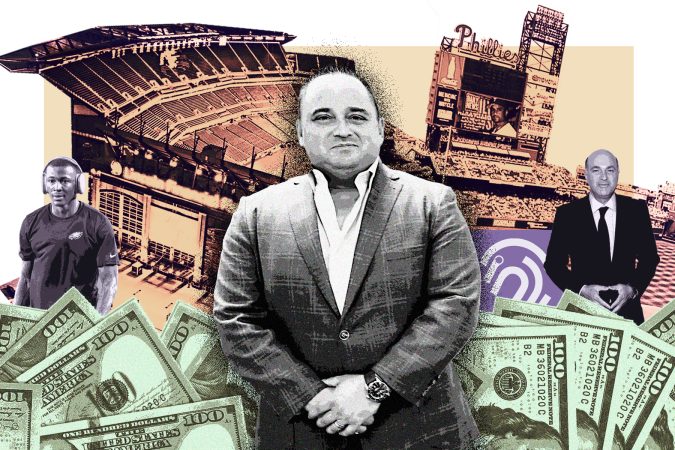
    Nothing about T.J. Colaiezzi screamed “tech CEO.” He was a former gym manager from Delaware County who had dropped out of college and could not write code. But with $27 million in venture capital in the bank, his AI-powered start-up took a risky marketing gamble in the South Philly stadium complex that announced his big ambitions.

    Over three seasons, with the Phillies slugging their way to a World Series, the Eagles racing to another Super Bowl, and a Sixer winning MVP, hometown crowds looked up at scoreboards with ads for his little-known company, LifeBrand. And as Colaiezzi wooed investors from the VIP suites, he sold an underdog story fit for the Philly fanbase and the broader cultural moment.

    LifeBrand, he said, was a safeguard for the cancel culture era, with software that could scour years of social media in seconds and flag compromising posts. Users could purge past mistakes with a click and potential employers could avoid making a hire that might later prove embarrassing. Colaiezzi secured support from sports icons like Phillies legend Jimmy Rollins, as well as current and former Eagles.

    “Catch all your cringeworthy social media posts with LifeBrand,” Eagles wide receiver DeVonta Smith said in a LifeBrand commercial that showed a photo of a “#wasted” tailgater posted carelessly online.

    Now Colaiezzi, 45, is facing accusations of fraud that no artificial intelligence tool can erase.

    Hundreds of pages of court documents and internal company records reviewed by The Inquirer, as well as interviews with a dozen people involved with LifeBrand, tell the story of how a fledgling CEO won over deep-pocketed athletes and business owners, and then — following a series of admitted missteps and alleged misspending — was forced to sell the tech company once valued at $137 million for next to nothing.

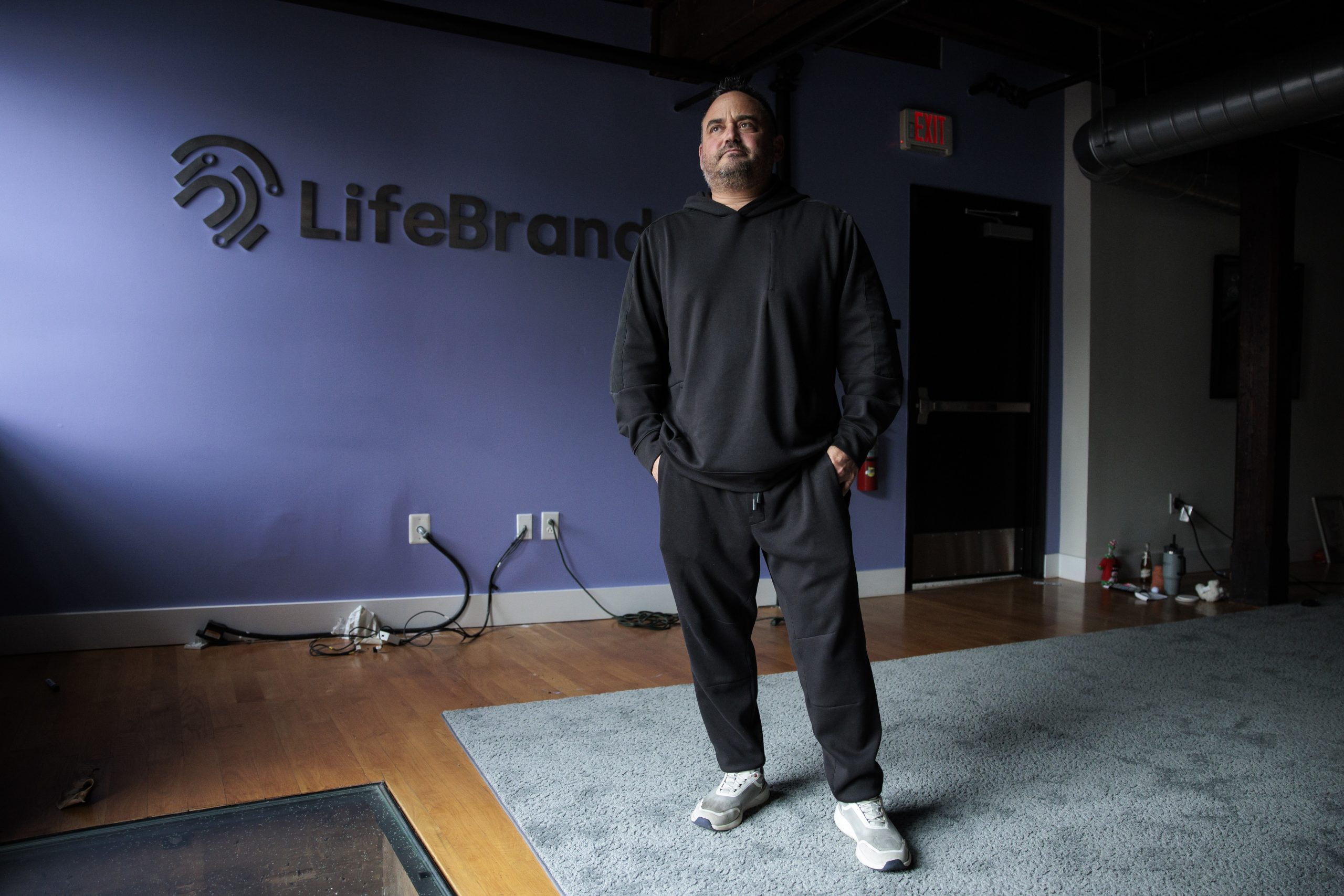
    T.J. Colaiezzi posed for a portrait in the LifeBrand offices on Wednesday, May 27, 2026, in West Chester, Pa.Monica Herndon / Staff Photographer

    In two lawsuits, including one filed last month in Delaware Chancery Court, investors say Colaiezzi squandered their money on a stadium-sized marketing blitz, hired unqualified friends at inflated salaries, and pocketed $6 million to finance a lavish lifestyle, including a $4.8 million home in Ocean City, N.J., and a powerboat. Both lawsuits allege that a prominent regional bank and an enthusiastic securities broker helped facilitate Colaiezzi’s deception.

    Federal regulators are showing interest in the case, with the U.S. Securities and Exchange Commission (SEC) questioning at least one LifeBrand investor in March, according to correspondence reviewed by The Inquirer. An SEC spokesperson declined to comment.

    Meanwhile, the Eagles, Phillies, and Sixers claim LifeBrand owes them a combined $6.2 million in unpaid marketing bills, court records show. And some LifeBrand employees are still owed paychecks from before the company’s collapse.

    To the financiers who sued him, LifeBrand amounted to a “Ponzi-like” endeavor focused more on attracting capital than generating revenue. To Colaiezzi, it was a genuine effort that came up short.

    In multiple interviews with The Inquirer — granted, he said, against the advice of his attorney — Colaiezzi characterized the lawsuits as fallout from former partners who are jockeying for the last scraps of his assets. Those same investors, he said, did not object to his marketing campaign or salary decisions until the company went under.

    Colaiezzi acknowledged making mistakes but denied that any of them amounted to fraud.

    “I was always the first to admit I was not a tech executive,” he said. “I ran health clubs for a living. And I thought I was surrounding myself with the right people.”

    His $6 million stock cash-out was one of those admitted mistakes. But he maintained it was a lawful transaction that took place three years before LifeBrand failed and was never concealed from investors.

    The first investor lawsuit, filed in 2024, reached a settlement in March. Attorneys for the plaintiffs — among them former Eagles Brent Celek and Todd Herremans — declined to comment, citing a confidentiality agreement.

    Meanwhile, a chorus of other backers who saw their capital vanish but have not taken Colaiezzi to court say that the CEO lured them with hollow promises and misled them about LifeBrand’s prospects long after the company began to collapse.

    “I will never go as far as saying this should be on American Greed,” said investor John Cerasani, referring to the CNBC docuseries about white-collar criminals. “He’s not a con man. But it was 100% reckless behavior with other people’s money.”

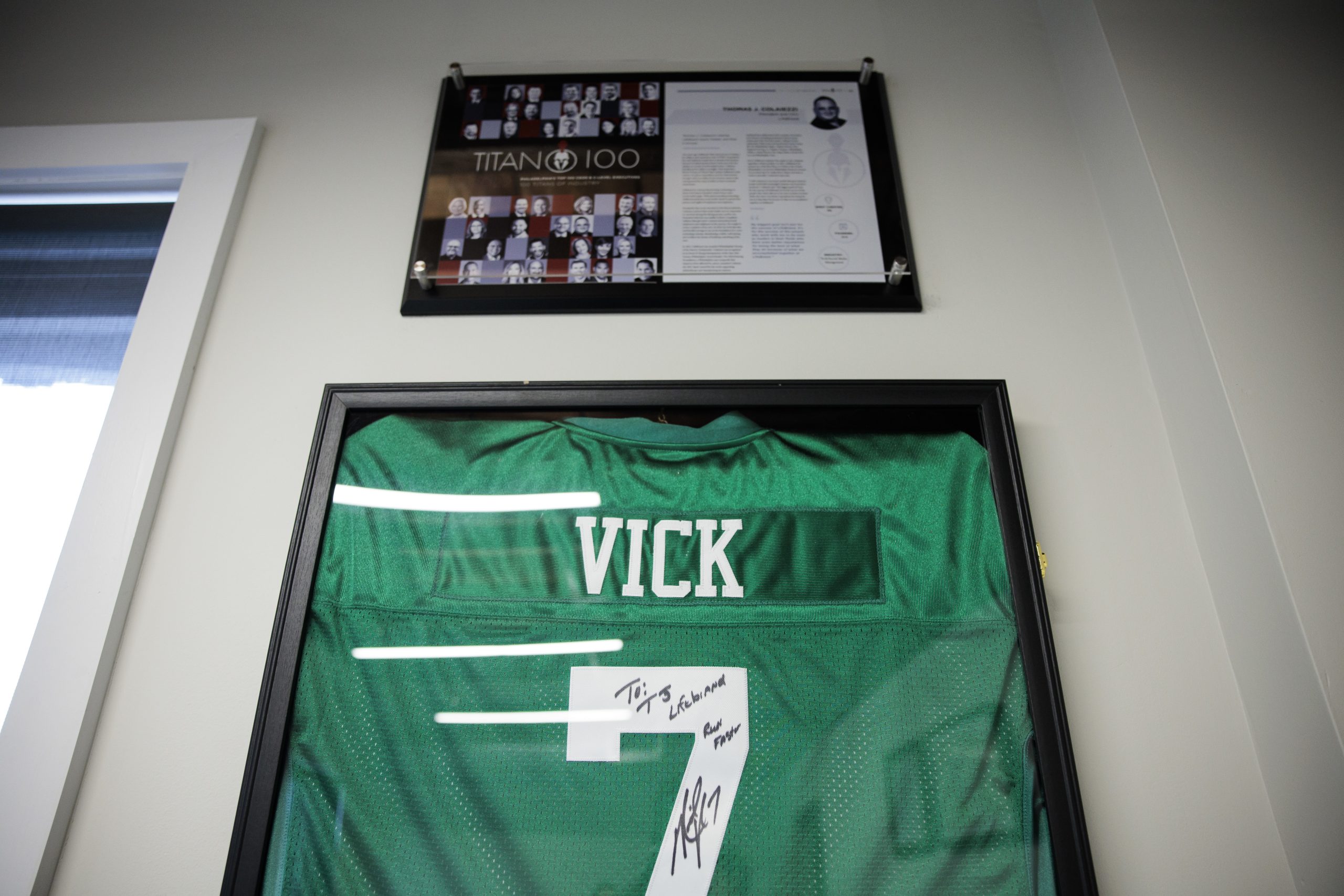
    An autographed Michael Vick jersey in the LifeBrand offices on Wednesday, May 27, 2026, in West Chester, Pa.Monica Herndon / Staff Photographer

    From gym manager to tech CEO

    The son of an IRS official and a homemaker, Colaiezzi went to Springfield High School, where he played lacrosse and built replicas of Victorian furniture. He became a volunteer firefighter, tried to open a deli, and dropped out of Pennsylvania State University before settling in the fitness industry.

    He started cleaning gyms and ascended to regional manager, overseeing LA Fitness and Crunch Fitness locations. It was there, fielding complaints about things that personal trainers and other employees had posted online, that he got the idea for LifeBrand.

    Colaiezzi saw a market full of people getting fired over old Facebook posts and pro athletes apologizing for the flippant tweets they made as teens. Companies wanted ways to vet prospective employees. The need for protection was urgent — a firewall against the damaging effects of a careless post lingering somewhere in the internet’s bottomless memory. Even the dating scene, riven by partisan politics, could benefit from an online cleanup.

    After raising seed money from family and friends, Colaiezzi hired a Prague-based development company to build the software that made LifeBrand a reality.

    His big break came in 2020, when he won a virtual pitch competition hosted by Kevin O’Leary from the hit show Shark Tank, who called Colaiezzi a “strong entrepreneur with every question answered.” The start-up won just $10,000 but earned something better than a cash prize: credibility.

    Colaiezzi leveraged the pitch competition win into a Series A investor drive, securing over $27 million by the end of 2021, surpassing expectations.

    He once told an interviewer that he wouldn’t sleep until he sold the company or until every investor was paid back. One financier, Nick Guiffre, a retired CEO of a manufacturing company, said he saw “the eye of the tiger” in Colaiezzi — a man who could make good on his word.

    After losing more than half a million dollars in LifeBrand, Guiffre, who is not pursuing litigation, said he wished he had done more diligence.

    “I don’t want to say I could afford to lose money,” he said, “but some people who put money in early on, it was their 401(k)s. It was their future.”

    Colaiezzi filled out the top ranks of his company by hiring people he knew. LifeBrand’s earliest board members consisted of Colaiezzi, his brother, a doctor, and an early venture capital investor. His chief operating officer came from the fitness industry.

    He maintains that they were qualified. But, like him, no one had real tech experience.

    “I think I was too loyal to people who were with me from the beginning,” Colaiezzi said. “I should have operated it more like a competitive sports team, and not like a family.”

    LifeBrand President and CEO T.J. Colaiezzi is shown at his corporate office on Monday, Sept. 13, 2021, in West Chester, Pa. Bradley C Bower / For The Inquirer Bradley C Bower / For The Inquirer

    The shadow broker

    Anthony Falco wanted everyone to know how excited he was about LifeBrand. Maybe too excited, his attorney would later concede in court.

    “Dude, this LifeBrand thing is going to [be] f— HUGE,” he texted an investor in 2021. “Signed the Phillies yesterday! Big investors involved. You will thank your little Italian buddy for this someday very soon.”

    Falco was a financial adviser and securities broker who worked at Central Pennsylvania-based Mid Penn Bank and Wayne-based Alden Investment Group. But he had a side job consulting for LifeBrand that involved hyping up its prospects to investors, according to the two lawsuits.

    Gregarious and well-connected, he was Colaiezzi’s liaison to a world of high net-worth investors and sports influencers. Falco invited him to celebrity golf outings, introduced him to Mid Penn Bank’s CEO, and helped bring on big names like ex-Eagles Celek and Herremans.

    “We were banking at TD Bank at one point, and then [Falco] invited me golfing with the CEO of Mid Penn Bank,” Colaiezzi said. “And, you know, why wouldn’t you want to bank with a smaller bank where you got the CEO’s phone number?”

    To Colaiezzi, sports were LifeBrand’s ticket to fame.

    Between 2021 and 2023, LifeBrand paid millions to the Eagles, Phillies, and Sixers in a deal that included naming rights for a gate at Lincoln Financial Field and access to the Eagles Tunnel Club, a 1,400-square-foot lounge where VIPs could rub shoulders with the home team’s players as they hit the field.

    Investors contend both Falco and Colaiezzi deceptively cast these deals as investor partnerships, rather than paid campaigns. According to the lawsuit initiated by the group that included Celek and Herremans, Falco received over a million shares of LifeBrand stock for inducing investors to the company through exaggerated claims, despite telling one that he was not allowed to accept comped shares.

    While working out of LifeBrand’s offices, he texted investors that LifeBrand was going to be “a billion dollar company,” hyping up talks with the NFL and Jay-Z’s Roc Nation. In another text, Falco said LifeBrand was projected to make $58 million in revenue in 2022. But he also cautioned the investor that “nothing is real UNTIL we see that it is real!!”

    LifeBrand’s revenue at the end of that year: $496,005.

    In a motion to dismiss the 2024 lawsuit, Falco’s attorney Sean Bellew wrote that his client was at most guilty of being “overly enthusiastic” about LifeBrand and denied misleading anyone.

    Both Mid Penn and Alden, which investors in that case accused of failing to supervise Falco, denied wrongdoing. Mid Penn argued in court that it had no formal relationship with the investors and that Falco’s work for LifeBrand was an outside matter. The bank declined to comment, citing pending litigation.

    Alden argued much of Falco’s work at LifeBrand occurred prior to his joining the firm, which never formally advised any of the investors. Alden nonetheless paid $500,000 in March through its insurance policy to settle the 2024 lawsuit, according to Falco’s FINRA broker check page. The firm did not respond to a request for comment.

    As for the new lawsuit, Bellew told The Inquirer that Falco never met the plaintiffs who renewed the allegations against him. Falco, he said, was “a victim” of Colaiezzi’s characterizations about the company — same as the other investors.

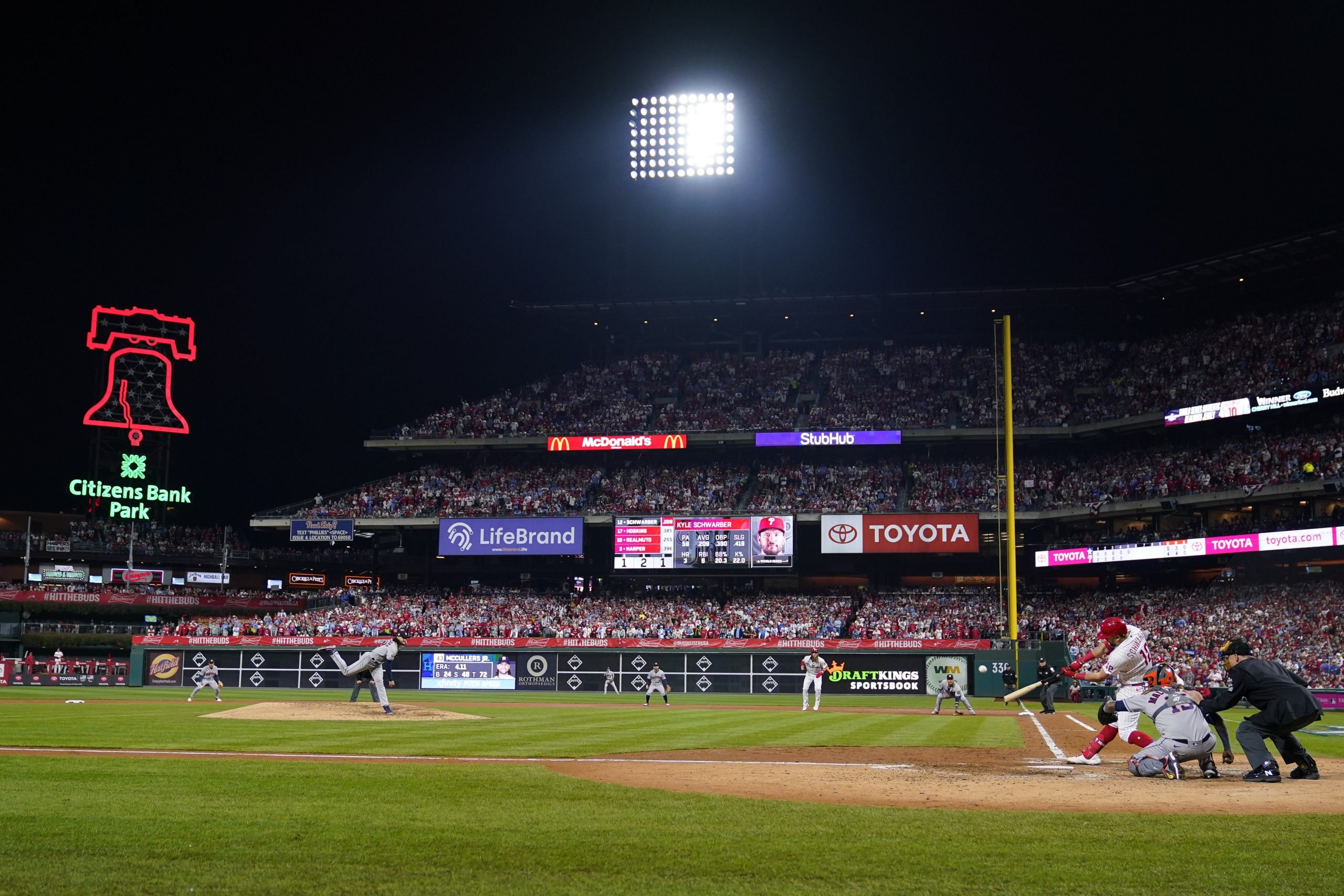
    LifeBrand ads could be seen in the outfield of Citizens Bank Park during the Phillies 2022 World Series run. Matt Slocum

    The Hail Mary marketing plan

    For a self-made CEO from Delco, seeing his company’s name lit up across three stadiums was glorious. It was also a gamble for a young, unprofitable company. Last year, for example, the Tunnel Club naming rights were acquired by Janney Montgomery Scott, a wealth management and investment advisory firm with more than 100 offices and $1 billion in yearly sales.

    Colaiezzi said he told investors about a third of the start-up capital would go toward marketing and said the stadium blitz had their support at the time. He produced text messages from investors who later sued him, which showed them asking for access to VIP seats and praising the buzzy brand campaign.

    “There’s not a single email, text, or phone call with any adviser or board member saying ‘you shouldn’t be spending money on this,’” Colaiezzi said. “Everyone was in line until we ran out of money.”

    Between 2021 and 2023, records show, LifeBrand spent over $16 million on advertising and marketing contracts — more than half its venture-capital haul.

    Colaiezzi said the marketing helped introduce customers to LifeBrand, which scanned millions and deleted tens of thousands of social media posts over those years. He said his sales team used the stadiums to pursue multimillion-dollar contracts with major institutions and companies.

    Some investors told The Inquirer they always had doubts about the marketing. Cerasani, a venture capitalist and gambling influencer, had been wooed as a potential investor with sideline tickets and access to the Tunnel Club, with its open bar with premium liquors, and a buffet with shrimp cocktail and prime rib.

    Every time Cerasani visited, he said, it looked like a private party for LifeBrand executives and Colaiezzi’s close friends, who treated him like “a king.” Rarely did he see prospective clients.

    Colaiezzi denied that characterization. But the gap between the marketing spend and the revenue it produced was impossible to ignore. By 2023, the company was losing over $800,000 a month, according to internal financial records reviewed by The Inquirer.

    Sales reps would take clients to games and work them for months to close a modest $12,000 sale, Colaiezzi acknowledged. The big institutional contracts were not coming through.

    Yet he kept sending optimistic signals to investors.

    In an August 2023 email obtained by The Inquirer, Colaiezzi announced that he had just closed a “transformative deal” with a Denver-based education nonprofit — a three-year, $63 million contract that would use LifeBrand’s data to help students at underserved schools.

    It is not clear how the client, which has no online presence and no publicly available nonprofit filings, was equipped for a deal of that size. The revenue never materialized, and one investor alleged in court that the deal was fiction.

    Colaiezzi said the eight-figure contract was real. He assigned two full-time employees and flew out to meet with leaders, but the nonprofit backed down before the bills were due. If anything, Colaiezzi said, “we got scammed by them.”

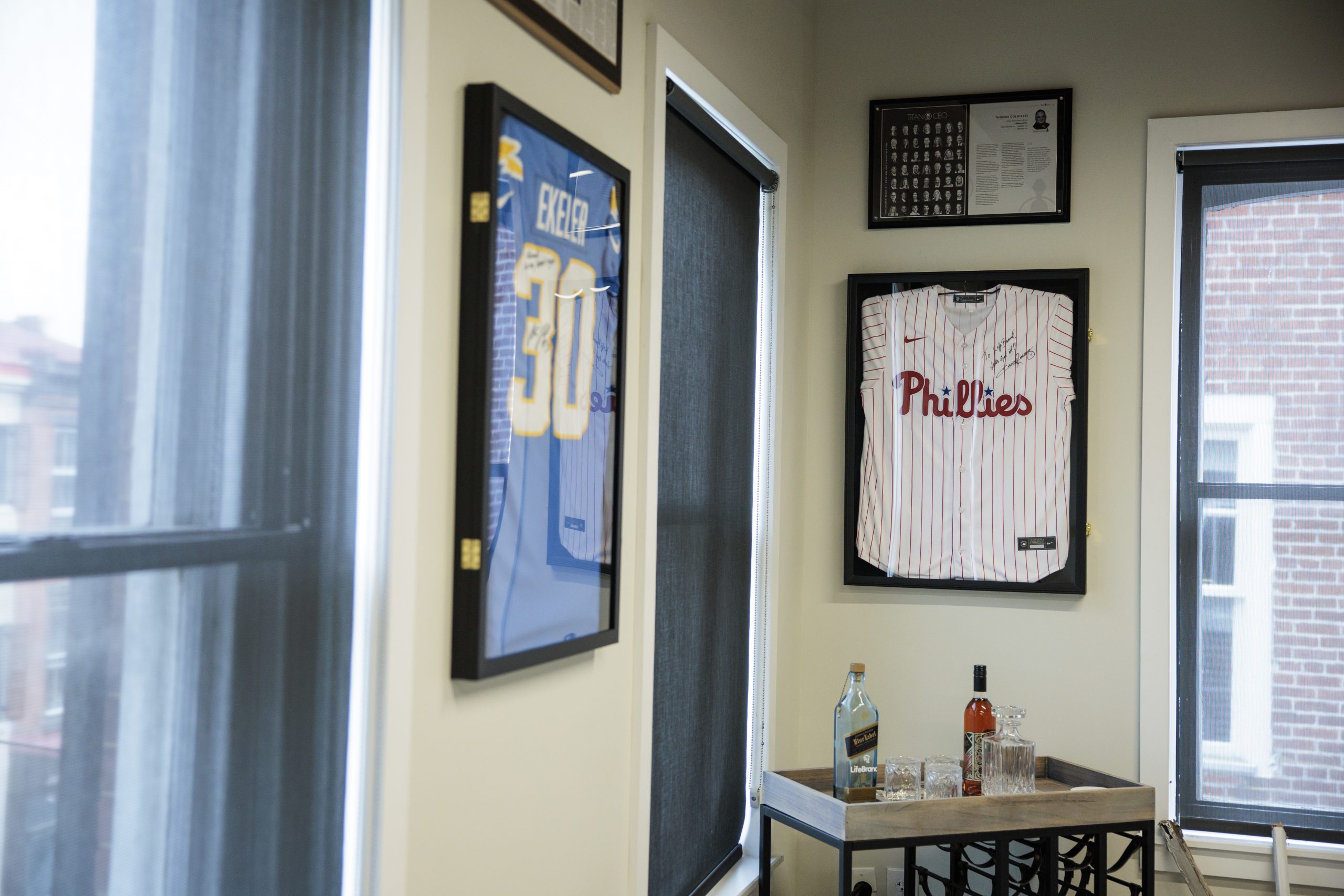
    Autographed jerseys on the wall in the LifeBrand offices on Wednesday, May 27, 2026, in West Chester, Pa.Monica Herndon / Staff Photographer

    Bedlam in the bank

    In May 2024, a group of anxious investors gathered on a video call to discuss the millions they’d sunk into LifeBrand.

    The company was on the brink of collapse. The money was gone. And all that the investors had to show for their backing were memories from the Eagles VIP suite.

    As they raised concerns on the call, one investor shared that Colaiezzi had paid himself a $6.17 million stock redemption at a time when the company had little revenue, according to four people who attended the meeting. Outrage erupted.

    “It was very obvious that things were going off the rails,” said Dan Ellison, a business owner who had invested in the start-up with his wife. “But no one knew that [Colaiezzi] took $6 million.”

    According to Colaiezzi, the 2021 stock redemption was done at the urging of shareholders at the time to dilute his control in the company, and was documented on capitalization tables shared with subsequent investors.

    He said he put $3 million back into the start-up to keep it afloat as he pursued a Series B fundraising round that would generate an additional $50 million — money that could finally turn LifeBrand profitable. That never happened.

    Inside LifeBrand’s offices in West Chester, uncertainty spread.

    Simon Wong, an engineer who worked at LifeBrand for a year until he was laid off in May 2024, recalled a workplace without the start-up grind culture. Most employees left each day at 4 p.m., and at 2 p.m. on Fridays, he said. Wong said he believed in the product and saw Colaiezzi as a leader who cared and said “the right things” about his mission.

    By May, Wong said, software subscriptions stopped getting paid and paychecks were late — then they stopped entirely.

    Colaiezzi agreed to fire himself as CEO, along with his other longtime executives. Then the rest of the board quit, leaving only Colaiezzi to run the company. He begged investors for patience while working with an outside firm to stave off bankruptcy. He laid off the entire staff and then tried to bring some of them back for a slimmed-down version of LifeBrand.

    “It kind of felt like we were getting strung along,” said Wong, who said he is still owed pay from most of his final month working at the start-up.

    LifeBrand — which Colaiezzi valued at $137 million in 2021 — was sold in August 2024 for $75,000 to Sentiment AI, an acquisition company formed by AI consultancy Global Fusion. Colaiezzi was initially kept on as an adviser, but the future of the company would be in the hands of more seasoned tech leaders. He said most investors agreed to convert their shares into the new venture in exchange for a promise not to sue.

    Another group of investors took him to court. And the company’s turnaround effort stalled almost immediately, which Colaiezzi blamed on the litigation.

    “It hit a point where people wanted to kind of run or protect themselves,” Colaiezzi said.

    T.J. Colaiezzi posed for a portrait in the LifeBrand offices on Wednesday, May 27, 2026, in West Chester, Pa.Monica Herndon / Staff Photographer

    ‘It’s like I lost my baby’

    One day last month, inside the restored 19th-century workshop in West Chester where LifeBrand operated for years, Colaiezzi walked solemnly past whiteboards crowded with years-old strategy notes. Framed Eagles, Sixers, and Phillies jerseys still hung on the wall.

    He said in an interview that he feels “a weird obligation” to come to the office every day, while it is still his.

    The building, which Colaiezzi purchased for $2.7 million with other investors and leased back to LifeBrand, is under foreclosure. Now he sat alone at a folding table among packed boxes in what used to be a conference room.

    “It’s like I lost my baby, you know?” he said. “There was so much great potential.”

    Moving on involves finalizing the lawsuits and paying off debt. Lenders and investors have placed liens on Colaiezzi’s Jersey Shore home. Asked if he got in over his head, Colaiezzi said, “Yeah, probably.”

    But he is making plans to erase the LifeBrand failure and replace it with a success story.

    His next venture, he said, is “a family-first social network” powered by AI.

    Parents will be able to upload family histories, recipes, and advice for their children. The idea, he explained, is that children living in a harsh world should be able to get answers to sensitive questions from their own families rather than a remote server.

    “The AI will basically learn how Grandpop would answer a question,” he said, “not how ChatGPT would.”

    The pitch has already secured $50,000 from investors.

    Staff writers Joseph DiStefano, Samantha Melamed, and Abraham Gutman contributed to this article.

  • Trump fires members of bipartisan elections commission

    Trump fires members of bipartisan elections commission

    President Donald Trump dismantled a long-standing bipartisan elections board Thursday, four months before a midterm contest that will determine which party controls Congress.

    Trump dismissed members of the Elections Assistance Commission less than two weeks after the Supreme Court gave the president broad leeway to reshape boards that were designed to be independent. Congress created the panel to strengthen and secure elections in response to the challenges of the 2000 contest and structured it so no more than two of its four members belong to the same political party.

    Trump’s actions weaken the commission, which is responsible for maintaining the federal voter registration form and certifying electronic voting equipment. New appointees would need to be confirmed by the Republican-controlled Senate.

    The move is the latest in Trump’s broad effort to exert authority over elections as he falsely claims the 2020 election was stolen from him. Trump has spent years casting doubts on elections and pushed to limit the use of mail ballots and voting machines.

    In recent months, Trump has sought to overhaul how the midterm elections will be run, in part by directing the commission to redesign a form so that people would have to provide proof of citizenship to register to vote. Many of Trump’s actions on elections, including his attempt to change the form, have been thwarted by courts.

    The White House said the president “reserves the right to remove individuals that may not be totally aligned with the important task of securing America’s elections and ensuring every legal vote is counted.” It did not say whether he planned to name replacements and when he might do so.

    Late last month, the Supreme Court ruled Trump could fire a Democratic member of the Federal Trade Commission in a decision that gave presidents broad powers to determine who controls federal agencies. The ruling was tempered by a separate decision that came the same day that prevented Trump from dismissing a member of the Federal Reserve Board. His latest actions could prompt new litigation and determine the extent of the president’s authority.

    Trump on Thursday fired the two Democratic members of the elections commission, Thomas Hicks and Benjamin Hovland, and accepted the resignation of a Republican member, Christy McCormick. The other Republican member, Donald Palmer, resigned this spring.

    Despite the firings, the commission’s staff can certify voting equipment, disburse funds, and maintain the federal voter registration form, according to the Institute for Responsive Government, a nonprofit group aimed at making government more accessible. The staff cannot establish new policies or guidelines without commissioners, the group said.

    Trump’s move “is a blatant part of his plan to politicize our elections,” said Sen. Alex Padilla (Calif.) and Rep. Joe Morelle (N.Y.). The two are top Democratic members of committees that oversee election policies.

    “Americans deserve elections that are safe, secure, and run free from political interference — not overseen by partisan loyalists and election deniers beholden to Trump,” they said in a statement.

  • Feds award $43 million to Philly gene therapy research to advance treatments for rare diseases

    Feds award $43 million to Philly gene therapy research to advance treatments for rare diseases

    The U.S. government has awarded Children’s Hospital of Philadelphia $39 million to develop a scalable platform for treating rare genetic, liver-related diseases in infants and children.

    The federal Advanced Research Projects Agency for Health (ARPA-H) also announced this week another $4 million for local gene therapy pioneer Jim Wilson to design gene therapies using AI at his University of Pennsylvania spinout, GEMMABio.

    The $43 million in funding earmarked for Philadelphia researchers comes through a new federal effort to advance gene therapies for rare diseases.

    CHOP’s team includes the duo behind last year’s first-of-its-kind, personalized gene-editing treatment involving a Philadelphia-area infant, known as Baby KJ. CHOP’s Rebecca Ahrens-Nicklas and Penn Medicine’s Kiran Musunuru together created a custom drug to correct the genetic mutation driving Baby KJ’s rare metabolic disease — dramatically improving his liver function.

    The funding will expand their work and bring in another CHOP researcher, Lindsey George, who develops gene therapies for bleeding disorders.

    “We’re trying to move beyond just one diagnosis or one gene,” Ahrens-Nicklas said.

    Philly-based scientists comprise two of seven research teams nationwide to receive funding through ARPA-H’s new $160 million effort.

    Called THRIVE, the program aims to help the roughly one in 10 people — most being newborns, infants, and children — with chronic genetic diseases. Ninety-five percent of rare diseases have no approved treatments.

    Leaders want to develop “precision genetic medicines through platforms that can test multiple treatments for multiple diseases in a single clinical trial,” ARPA-H director Alicia Jackson said in a Thursday news release.

    CHOP’s expanding focus

    The CHOP team will focus on building a scalable gene-editing platform that can be used to treat a variety of infants and children.

    Their initial focus is on liver-related genetic diseases, ranging from urea cycle disorders to blood clotting diseases.

    “Essentially it’s the same drug, whether or not you’re targeting a genetic variant that causes a rare metabolic disease or a genetic variant that causes a rare coagulation disorder,” Ahrens-Nicklas said.

    Their five-year plan includes launching preclinical and clinical trials testing the safety and efficacy of their individualized treatments.

    They will also pursue regulatory approvals, work with payors, and implement their therapies at community sites and remote hubs to expand access.

    “We are the three musketeers that already text 25,000 times a day, and will continue to do so,” Ahrens-Nicklas said.

    Wilson experimenting with AI

    Wilson founded academia’s first gene therapy program back in 1993 as a professor at Penn.

    He left in 2024 to spin out biotech start-ups dedicated to tackling rare diseases with genetic medicines.

    “The question is, can we find ways to scale this bespoke personalized medicine strategy, so that it is affordable and cost-effective?” he said.

    In partnership with a biotech called ProFluent, GEMMABio will use AI to design its base editors — the machinery that goes in and make edits to DNA.

    The tool could be rapidly adapted to different patients and diseases, theoretically making the process more affordable, scalable, and efficient, Wilson said.

    His $4 million award will fund preclinical studies of their technology.

    GEMMABio’s initial focus is on two rare liver diseases “for which there is significant unmet need,” he said, including Maple Syrup Urine Disease and homozygous familial hypercholesterolemia (HoFH).

  • A 75-year-old man is charged with murder in fatal Roxborough shooting

    A 75-year-old man is charged with murder in fatal Roxborough shooting

    A 75-year-old man was charged with murder and related crimes in the fatal shooting of a 20-year-old contractor at his Roxborough home this week, authorities said.

    George Barr of Philadelphia was arraigned early Friday morning and was being held in custody without bail.

    In addition to murder, Barr was charged with possessing an instrument of a crime and reckless endangerment in connection with the Wednesday incident.

    Police said that is when Barr, of the 400 block of Ripka Street, shot and killed Salis Hanrahan as the young man and a group of workers were doing construction work at Barr’s home.

    Officers responded to an emergency call there around 2:20 p.m. and found Hanrahan collapsed on the sidewalk with a gunshot wound to the chest, police said.

    He was taken to Jefferson Einstein Philadelphia Hospital and pronounced dead at 2:45 p.m.

    Police have not identified a motive in the shooting and continue to investigate.

    Barr is being represented by a public defender and is expected to appear in court for a preliminary hearing on July 27.

  • Philly hotels and cultural institutions saw historic crowds during Independence Week

    Philly hotels and cultural institutions saw historic crowds during Independence Week

    The crowds came to Philadelphia on the Fourth.

    Philadelphia hotels reached nearly 90% occupancy on July 4, according to exclusive new data released Friday by Visit Philadelphia. The number represents the highest average daily rate since the agency began tracking July 4 data in 2007.

    The previous high was 60% occupancy on July 4, 2016.

    “The July 4 holiday gave us an early glimpse of what’s possible this year,” said Angela Val, president & CEO of Visit Philadelphia, the nonprofit that serves as the city’s official leisure-tourism marketing organization. “Hotels were nearly full, and the strong demand we’re seeing is a great sign for the months ahead.”

    City hotels generated nearly $6 million in revenue alone on July 4, the data showed. Overall, Philadelphia County hotels reaped more than $7 million.

    The average city hotel daily room rate soared to $459 on July 4 — more than double last year, Val said. Philadelphia County room rates reached $413.

    “We’re only halfway through 2026,” Val said. “There are still major events and celebrations to come, and we’re focused on making this a year that inspires people to come back to Philadelphia again and again.”

    Those numbers come just as the Philadelphia Convention and Visitors Bureau announced Friday that Philly hotel revenue jumped more than 50% during the city’s six FIFA World Cup matches.

    “Philadelphia thrives when our city, business community, and hospitality industry come together to welcome the world and showcase all that our city has to offer,” said Gregg Caren, president and CEO of the PHLCVB. “We anticipate the FIFA World Cup will inspire not only future international travel to the city but serve as a shining example of how we can successfully execute major global events, drawing key future business to Philadelphia.”

    In June, officials from the Greater Philadelphia Hotel Association expressed concern that some of Center City’s 14,500 hotel rooms were still available on match days, hosted at Philadelphia Stadium from June 14 to July 4.

    On Friday, John Fricke, chair of the GPHA, said the crowds came.

    “We’re fortunate that our city and hotel team are used to welcoming guests during major events in Philadelphia,” Frickle said in a statement. “But the FIFA World Cup was something truly unique. Hearing guests share how much they enjoyed Philadelphia’s history, neighborhoods, food, and their overall experience was incredibly rewarding — it was a proud moment for us, and a great reminder of why hospitality is so special.”

    More than 400,000 fans from 190 countries attended the matches, while crowds of 250,000 packed into the FIFA Fan Festival at Lemon Hill, according to the Philadelphia Convention and Visitors Bureau.

    Guests tour the Museum of the American Revolution in Old City.Jessica Griffin / Staff Photographer

    Philadelphia cultural institutions also reported historic numbers, with more than 12,000 people visiting the National Constitution Center and the Museum of the American Revolution during Independence Week, according to data released by the city.

    The Revolution museum hosted 8,000 visitors over the holiday weekend alone, its highest three-day attendance ever.

    “The 1st to the 5th was the biggest week we’ve had,” said Scott Stephenson, president and CEO of the museum, which opened in 2017. “July 3 was our biggest payday since the museum opened.”

    The museum was nearly at capacity on July 3 and 4, said Stephenson, who spent hours letting long lines of guests into the museum’s grand theater exhibit featuring George Washington’s original field tent, which ran every 15 minutes instead of once an hour.

    And it wasn’t just the crowds. It was the vibe that was special, Stephenson said.

    “I was just so positive,” he said. “It was just a lot of pride and optimism. People were chatting with each other and having such a great time together, really celebrating our country.”

    “You know we wondered in the years leading up to this if there still was an impulse for families to come to Philadelphia for the 250th,” he said. “The question was, ‘Well, are they going to come?’ And boy, they came.”

  • Here’s how the World Cup provided a sense of ‘community’ at this University City coffee shop

    Here’s how the World Cup provided a sense of ‘community’ at this University City coffee shop

    Driving to West Philadelphia’s Shibam Coffee Co., Ayham Muhanna got a flat tire.

    Muhanna, a rabid Morocco fan, wasn’t going to let that stop him from making it to the cafe, which was hosting a watch party for Morocco’s World Cup quarterfinal matchup against France.

    “I love the community. I love the vibes out here,” Muhanna said. “We could have gone anywhere else, but we decided to come to Shibam. After coming here for the first time for the Egypt and Iran game, we saw that the energy was through the roof. We saw that the community was all here showing out and showing love.”

    France’s Kylian Mbappe (center) reacts to being tripped by Morocco’s Issa Diop (left), during the World Cup quarterfinal soccer match on Thursday.Stephanie Scarbrough

    Although Morocco lost, 2-0, to France in Thursday’s match, the energy was palpable inside Shibam, a Yemeni coffee shop, as a mostly Morocco-supporting crowd packed the cafe. Yemen and Morocco, despite being thousands of miles apart, share many similarities in terms of language, culture, religion. During the World Cup, fans of each country tend to support one another. This was evident at Shibam, as most of the fans were members of the region’s vast diaspora.

    The original Shibam Coffee Co. is based out of Dearborn, Mich., the only Arab-majority city in the United States. Fahad Azam is a part-owner of the West Philadelphia franchise, one of 19 Shibam locations in the country. While not a soccer fan himself, Azam saw an opportunity to further connect with the surrounding community by holding watch parties for the World Cup. The turnout for the first game blew away his expectations.

    A packed house at Shibam Coffee in West Philadelphia is on hand to watch Morocco take on France in Thursday’s World Cup quarterfinal. Courtesy / Sam Foster

    “It was a madhouse,” Azam said. “We didn’t know what we signed up for, but obviously we love the environment, we love the passion that everyone brings. We want to do more. The World Cup is not going to happen again next year. We wanted to show the community that we’re not just a coffee shop.”

    That they did. Although Morocco’s offense was stagnant — France held a 22-5 shot advantage — the fans who packed into Shibam held out hope until the game’s final moments. The biggest crowd reaction came in the 28th minute after Moroccan goalkeeper Yassine Bounou denied France star Kylian Mbappé’s penalty attempt. Then, to start the second half, fans brought out tambourines and drums to lead the usually quiet coffee shop in song.

    The line to get a coffee spanned the cafe. It was impossible to maneuver without bumping into multiple people. Nonetheless, when everyone rose to their feet in anticipation of a shot or as fans broke out into a rendition of Shakira’s “Waka Waka” after the pop star was shown on screen, any would-be negatives disappeared.

    “I’m half Moroccan, so it’s always been in my family, supporting Morocco and coming out for them,” said Mahdi El-Hadi, a Newtown Square resident. “I’ve been a huge Morocco supporter since I was a kid. … We have the vibes; we have the music. We’re always super excited for every game.”

    One watch party attendee, Yusra Aziz, owns a psychotherapy practice. At work, Aziz readily shares the importance of finding and embracing community to her clients. She listened to her own advice on Thursday. Aziz is the daughter of immigrants — her mother was born in Morocco while her father came over from Iraq. The joyful scene inside Shibam was a point of pride for her.

    Fans in attendance at Shibam Coffee in University City for Thursday’s World Cup quarterfinal say that the sense of community was equally as important as the match between Morocco and France. Courtesy / Sam Foster

    “When I was growing up, there was a lot of this type of vibe in our house,” Aziz said, gesturing to the crowd around her. “My family would host it. There would be a lot of our community members. When I was growing up, I could have only dreamed of having something like this. I did not see things like this growing up — cafes that were hubs for our community.

    “It feels symbolic of what my parents did by coming here. They met here in Philadelphia, and I wouldn’t exist if they didn’t meet here. Looking at all these people here, I know that a lot of them are in similar circumstances. Their parents came here, and they were born here.”

  • El Niño is rapidly intensifying and could become the strongest on record and last through winter

    El Niño is rapidly intensifying and could become the strongest on record and last through winter

    Warming in the tropical Pacific has been intensifying rapidly, and with increasing certainty government meteorologists say this El Niño event could become the strongest in records dating to 1950.

    It is all but certain to have profound effects on the Atlantic hurricane season and the winter of 2026-27 across the United States. It’s also going to stick around.

    In its Thursday update, the National Oceanic and Atmospheric Administration advised that El Niño would “strengthen through the end of the year, with a 97% chance it will last through early spring 2027.”

    Sea-surface temperatures over a critical 2.4 million-square-mile portion of the tropical Pacific are running about 2 degrees Fahrenheit above long-term averages, more than qualifying for El Niño status.

    In records dating to 1950, those temperatures have reached as high as 4.5 degrees above normal. In this El Niño event, the temperatures have a “43% chance” of reaching that level, said Michelle L’Heureux, physical scientist at NOAA’s Climate Prediction Center.

    As for what impacts it will have, NOAA scientists point out that El Niňo will not be acting in isolation and that it would be impossible to know. However, based on past strong El Niños, expect unusual levels of strangeness for the next several months.

    For Philly, it may have significance for the stubborn drought conditions, but that also could come with a positive development.

    And its potentially benign effects on the Atlantic hurricane season may save some lives and yield a robust bonus for the U.S. treasury.

    How does El Niño affect the U.S. weather?

    El Niño events develop as part of a periodic natural process as east-to-west trade winds that push water into the western Pacific slacken, allowing prodigious, massive amounts of warm water to move eastward.

    The warmer water interacts with the overlying air, setting off convective thunderstorms and altering west-to-east upper-air winds that deliver the weather to the United States and other parts of the world.

    Reliable responses to El Niño include storminess in the southern United States and warmth in much of the northern states and Canada. For Philly, about the only constant has been weirdness.

    How is El Niño affected by other phenomena?

    El Niño is a crucial piece of the atmospheric puzzle in long-range forecasting. However, it also interacts with other phenomena, such as the Arctic Oscillation — shifts in atmospheric pressure between the Arctic and the lower latitudes, and an important driver of winter temperatures — and patterns in the North Atlantic, which “may reinforce or counteract each other,” said Johnna Infanti, a climate center meteorologist.

    And when it comes to developing outlooks for the seasons, forecasters have to consider earthly phenomena such as changes in soil moisture and sea ice, she said.

    “It is important to remember that an El Niño can shift the odds toward certain outcomes,” she said, “but the outcome is not guaranteed.”

    That said, “stronger events can tilt the odds more heavily in favor of the expected outcome,” she added.

    Was El Niño behind the July 4th weekend extreme heat?

    The short answer in all probability would be no, Infanti said.

    In summer, she said, “there is no clear link between above-average temperatures over the United States and El Niño.”

    Besides, this El Niño is still a relative toddler. This one is expected to last for about a year, a typical lifespan, L’Heureux said.

    While the sea-surface temperature has surpassed the El Niño threshold, “the atmosphere is still aligning,” said Matthew Rosencrans, NOAA’s lead hurricane seasonal forecaster.

    As it intensifies and the atmospheric response strengthens, the impacts will become more evident, and they are likely to be significant during the peak of the hurricane season, from mid-August into September, he said.

    That may be welcome news for residents and property owners along the Atlantic coast and for U.S. taxpayers.

    How will El Niño likely affect the number of Atlantic hurricanes?

    El Niño can generate powerful upper-air shearing winds that can suppress hurricane development in the Atlantic Basin.

    In the six years in which sea-surface temperatures in the key El Niño zone remained 3.5 degrees or higher above normal for three months or more, the Atlantic tropical-storm season was far less active than normal.

    The numbers for all named storms, those with winds of 39 mph or higher; hurricanes, which have winds of at least 74 mph; and “major” hurricanes, those with winds of 111 or higher, were substantially below long-term averages.

    (function(){function e(){window.addEventListener(`message`,function(e){if(e.data[`datawrapper-height`]!==void 0){var t=document.querySelectorAll(`iframe`);for(var n in e.data[`datawrapper-height`])for(var r=0,i;i=t[r];r++)if(i.contentWindow===e.source){var a=e.data[`datawrapper-height`][n]+`px`;i.style.height=a}}})}e()})();

    Among all federal disaster relief fund disasters, hurricanes are far and away the most expensive. In a congressional study covering the 30-year period through 1992, hurricanes accounted for 44%, or more than $150 billion, of all federal disaster money.

    A potential downside would be that fewer storms would lessen the chances for any drought-relieving tropical-storm remnants. (On the plus side, the region would not have to deal with their attendant flooding: See Ida, 2021.)

    Will El Niño affect the Philadelphia winter?

    Looking way ahead, El Niño is not much help in determining how the winter might play out.

    One characteristic of strong El Niños has been persistence of certain patterns. What happens tends to keep happening, since ocean temperatures change slowly.

    The six strongest El Niños persisted into winter and left quite a disparate legacy in Philly. The winters of 1991-92 and 1997-98 were nearly snowless, and that of 1972-73 was the only truly snowless winter in Philadelphia history.

    An industrious young man in Swarthmore adds to a mountain of snow his father crated from the prodigious January 2016 snowfall.

    Conversely, snow was well above normal in the winters of 1965-66, even though no snow had fallen until the end of January; in 1982-83, when an all-out blizzard occurred in February; and in 2015-16, which featured a two-footer in January.

    The upshot: Expect anything.

  • Artist bringing a new mural to South Philly ahead of MLB’s All-Star Game: ‘It’s a love letter to Philadelphia’

    Artist bringing a new mural to South Philly ahead of MLB’s All-Star Game: ‘It’s a love letter to Philadelphia’

    Paul Carpenter grew up in Northwest Philly watching the 1993 Phillies take over the city as they claimed the National League East title.

    Witnessing their success gave him inspiration for his first big project. At just 8 years old, the young artist stared at his bedroom wall, visualizing a blank canvas for his very first mural: a painting of the NL East champions.

    Now, over three decades later, Carpenter has landed his “dream job,” designing Deer Park’s limited-edition All-Star Game aluminum bottles as the midsummer classic makes its way to Philadelphia.

    “This just aligned perfectly for me,” Carpenter said. “Obviously, I’m a die-hard Philly sports fan. This being the All-Star Game, such a high-profile game, it’s just mind-blowing. A really great opportunity for me.”

    Paul Carpenter created the design on the Deer Park limited-edition 2026 MLB All-Star aluminum bottles.Monica Herndon / Staff Photographer

    Carpenter has created art his whole life and studied illustration in college at Delaware. After years doing design work for La Vida Hospitality and Liquid, Surf, Skate, Snow in Delaware, he made his way back to Philly in 2009.

    Despite his experience designing beer cans for Crooked Hammock Brewery, there still were challenges printing the design.

    “The scale was pretty hard to envision, and making sure that everything still’s readable, that the hierarchy of the design holds up and that the different layers of color came out correctly to make the design look exciting and make Philadelphia look great nationally,” Carpenter said. “But, basically, it’s a love letter to Philadelphia. I wanted to capture all the things that really resonate with our cultural fabric as a city.”

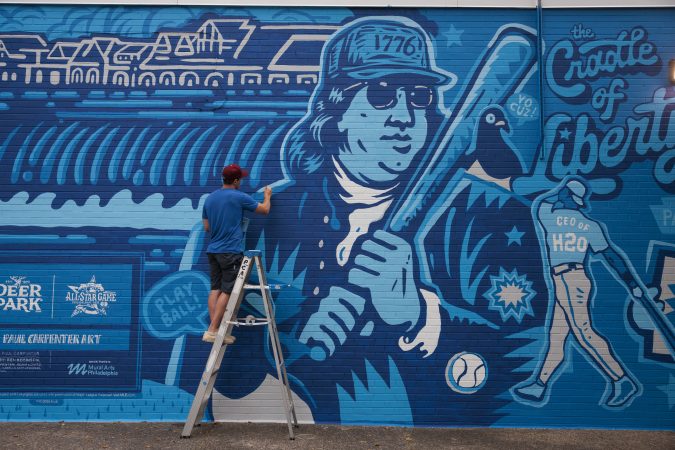
    The design features iconic monuments like the Liberty Bell and Ben Franklin holding a baseball bat. The city’s food culture is represented with images of cheesesteaks, crab fries, and soft pretzels. And there are plenty of Easter eggs for Philly natives — including a reference to the “Woohoo guy” and the William Penn curse.

    “This was easy,” Carpenter said. “This was all low-hanging fruit. It’s all stuff that’s in my lexicon and visual language at this point.”

    Now, Carpenter has a new challenge presented to him: recreating the design in mural form.

    Carpenter has created over 30 murals — not including the one from his childhood bedroom — many of which are in the Philadelphia area, including 11 pillars at Xfinity Mobile Arena and one at Citizens Bank Park.

    The toughest part about this the mural? “The scale.”

    “They’re almost polar opposites,” Carpenter said. “The bottle is very small, 12 inches high, and vertically orientated. And the wall, we got is 2,700 square feet. So, basically, it was like cutting, chopping up the design, and redesigning it to a much different scale.

    “When it’s on a scale of this magnitude and you’re walking down the street, it definitely impacts you differently. All of a sudden, instead of the water ice being tiny, it’s six feet tall.”

    The design features iconic monuments like the Liberty Bell and Ben Franklin holding a baseball bat, the city’s food culture, and plenty of Easter eggs for Philly natives — including a reference to the “Woohoo guy” and the William Penn curse.Monica Herndon / Staff Photographer

    It will take nearly two weeks for Carpenter to finish the mural, known as Hometown Grit, located on Oregon Avenue and South 20th Street. Throughout the process, he painted through all the elements, from thunderstorms to 100 degree heat. The finished product will be unveiled around 2 p.m. Saturday.

    “I’m really looking forward to the interaction of seeing the neighborhood come together,” Carpenter said. “We’ve been interacting with people all week, and it’s really cool because a lot of the work is bringing the local culture and community together. That’s really the big part of my work, celebrating the city, and the people, and the cultural fabric of the city. There’s so much pride in Philadelphia. It’ll be cool to see that in real time.”