Blog

  • Trevor Zegras agrees to a four-year contract extension to become the highest-paid Flyer

    Trevor Zegras agrees to a four-year contract extension to become the highest-paid Flyer

    It’s always been about timing for Trevor Zegras.

    The right time to become a Flyer. The right time to play center. And now it was the right time to lock him in.

    Late on Wednesday, the Flyers inked Zegras to a four-year, $36.5 million extension with an annual average value of $9.125 million. He will be an unrestricted free agent when the contract expires on July 1, 2030, and according to a league source, Years 3 and 4 come with a limited no-trade clause.

    “We’re thrilled to have Trevor committed to our organization for the next four years,” general manager Danny Brière said in the press release.

    “The growth he showed this past season, proving that he is the skilled player he entered the league as, reinforced our belief that he will be an impact player for the Flyers for the years to come. He’s the type of player who can help take our team to the next level, and we’re excited to continue building alongside him.”

    Zegras became a restricted free agent on July 1 and filed for salary arbitration on July 5, two days after the Flyers tendered a five-year, $90 million offer sheet to Leo Carlsson that the Anaheim Ducks matched. The deal avoids an arbitration hearing that was scheduled for next Wednesday and gives him the highest AAV on the Flyers.

    “Personally, I would love that,” Zegras said of staying in Philly at his end-of-season media availability on May 12. “I would love to be here for a long time. … I love the fans. I love the group that we have, and that would be something I’m excited about.”

    Acquired last June, on the heels of two tough, injury-plagued seasons with the Anaheim Ducks, Zegras refound his love for the game in Philly. He posted career highs in goals (26), power-play goals (10), points (67), power-play points (23), and shooting percentage (15.6%) in 81 regular-season games, missing only the inconsequential last game of the season to rest for the playoffs.

    Best friends Trevor Zegras and Jamie Drysdale have relished getting to play together again with the Flyers.Yong Kim / Staff Photographer

    After tallying six goals and 18 points during the Flyers’ post-Olympic push — trailing just Matvei Michkov and Noah Cates — he led the team in postseason scoring with six points (two goals, four assists) in 10 games. Zegras was one of several Flyers making their postseason debuts.

    But this season wasn’t just about his point total, even if it was higher than when he was runner-up for the Calder Trophy in his rookie year, or his sophomore season of 2022-23. It was about a former first-round pick, a big personality, and a once-rising star in the NHL, rediscovering his love of the game.

    “It was big,” he said when asked if it was reaffirming to him. “For me, having that excitement about the game was great. To find that passion for winning and success as a team was big. And I think I lost a little bit of that drive and passion to win and be a really good team, and we definitely had, in my opinion, a great, successful season.”

    Part of that rejuvenation for the 25-year-old New York native came from his connection with his teammates, like his old friends, Jamie Drysdale, whom he played with in Anaheim, Cam York, his former teammate on the U.S. National Development Team and at World Juniors, and veteran Christian Dvorak, whom he met through Dvorak’s former Montreal Canadiens teammate Cole Caufield. And a lot of it came from his connection to coach Rick Tocchet, whom he affectionately nicknamed “Taco” in training camp.

    “Obviously, Tocc is a great guy, to begin with. … He’s a good guy to talk to,” Zegras said the day after he and Tocchet were spotted having a heated exchange in Game 3 against the Carolina Hurricanes. “The one thing I have a ton of respect for is [that] he’ll get in your face and tell you stuff, but then he won’t ever like sit you down for shifts at a time.

    “He puts you right back on the ice. Whether or not it puts fire in you, or fuel, or is teaching you something, he always gives you that chance to go let you prove yourself the next shift, which I love.”

    Tocchet echoed the sentiment that day, after doing it all season long. He called him a “very coachable kid” after mentioning in training camp that he challenged him to approach the game not “for clicks on social media” but to win hockey games. “That’s what he wants,” Tocchet said, and it showed whether he played at center or wing.

    Trevor Zegras ranked second on the team last season, his first with the team, in points (67) and third in goals (26).Yong Kim / Staff Photographer

    But that’s the million-dollar question heading into the 2026-27 season: Do the Flyers view Zegras as a center or a winger? The consensus around the league is that the AAV he received is typically doled out to a center. As noted, Tyson Foerster recently signed an eight-year contract extension with the Flyers for an AAV of $7.1 million.

    Zegras came to Philly excited for the opportunity to return to his natural center position after two years of being forced to the wing by former Ducks coach Greg Cronin. Management was hopeful he could be the answer for their No. 1 center spot, but for the majority of the season, he played on Dvorak’s wing.

    He officially shifted back to the middle after the trade deadline and put up 17 points in 20 games — 12 at even strength with a plus-six rating. The only issue is his face-offs, which sat at 34.1% overall in the regular season, 35.1% across the final 20 games, and 44% in the postseason.

    “I liked playing in the middle down the stretch, just because there’s a little bit more space and you can kind of pick and choose where you want to go a little bit more,” he said.

    “I think playing center in the playoffs was a good experience for me, just in terms of how different it was, how hard battles are, and all that type of stuff. So that was good.”

    The Flyers still have three restricted free agents to sign in Drysdale, forward Nikita Grebenkin, and defenseman Hunter McDonald. Drysdale has a salary arbitration hearing scheduled for Monday. Grebenkin was not eligible for salary arbitration, and McDonald did not file by the deadline.


  • Mark Donovan Hagins, an actor, playwright, and educator who nurtured Philly’s theater community, has died at 56

    Mark Donovan Hagins, an actor, playwright, and educator who nurtured Philly’s theater community, has died at 56

    Mark Donovan Hagins, 56, an actor, teacher, and producer who knew everyone in Philadelphia’s theater community, from the upstarts to the grizzled veterans, died Wednesday, June 24, at his home. His family said his death was sudden but could not provide further details.

    As a resident producer with the Philadelphia Young Playwrights nonprofit, Mr. Hagins mentored, educated, and staunchly advocated for countless young members of the city’s theater community. Mr. Hagins was known as a laid-back person who could calmly solve problems under pressure, while remaining curious and dedicated to serving his students. Those who worked with him said he was an imaginative, collaborative artist who understood the history of Black theater in Philadelphia and was interested in cultivating its future. He had a talent for bringing entertaining stories to life, with even the barest of tools.

    His acting career included productions with Philadelphia’s Freedom Theatre, Azuka Theatre, Walnut Street Theatre, and the Rutgers-Camden Center for the Arts, appearances in the second season of the HBO show The Wire, and roles in other theater workshops, television shows, and independent films.

    One of his first roles came in 1999, when he connected with Philadelphia Young Playwrights as a student at Temple University and performed in the organization’s annual New Voices festival. After graduating in 2000, Mr. Hagins joined the nonprofit as a teaching artist and classroom actor to guide young playwrights and actors, even while his own theater career was just beginning. He produced numerous works by the city’s youth, including through the New Voices festival, where middle, high school, and even elementary school playwrights have their works performed by adult actors.

    Mark Donovan Harris teaching Philadelphia Young Playwrights students. He first connected with the organization when he was a student at Temple University in 1999.Philadelphia Young Playwrights

    “He believed that coming back to North Philadelphia … could make a difference in young people’s lives. And he said, if you could get through them through acting … you could change their momentum. You could change their environment. You could change their way of thinking. When they became adults, you know they would be better people in the world. So he invested into them,” said his aunt Millicent Platt.

    Mr. Hagins was born July 2, 1969. He grew up in the Hartranft section of North Philadelphia with his parents, the Rev. Paul Hagins and Vermell Hagins, and sister, Ramona Johnson, and spent his summers visiting family in North Carolina. Mr. Hagins, who went by his middle name, Donovan, in the theater world, always was interested in theater, but found it to be his passion once he enrolled at Temple, his family said.

    “A fixture of our Temple Theaters community, Donovan was a proud Temple alum invariably seen repping his school with a hat or shirt,” Temple Theaters posted in an online tribute. “He lived in Cherry and White. Donovan embodied the values of generosity and collaboration, showing an unwavering belief in the power of young voices.”

    Professional actors who worked with him spoke highly of how he curated and directed student productions, said LaNeshe Miller-White, executive director of Philadelphia Young Playwrights. While he had a calming, comforting presence around people, Mr. Hagins was always willing to have fun, too, whether it be playing a silly character written by a student or taking hold of the microphone for his weekly karaoke outing, she said. He took his relationships with students seriously, and stayed in touch with some of his mentees long after their time with the program ended.

    “Donovan’s dedication to young artists and to PYP was unwavering, and his generosity, wisdom, and kindness touched countless students and colleagues across Philadelphia and beyond,” her organization wrote after his passing.

    Mark Donovan Hagins stands with Philadelphia Young Playwrights operations manager Ali Nebistinsky.Philadelphia Young Playwrights

    And while playwriting and theater drove him, Platt said, Mr. Hagins’ niece, Ragan Johnson, 25, and his nephew, Gregory Johnson III, 22, were his heart.

    His niece remembered visiting her uncle in Philadelphia, where they would eat cheesesteaks or visit Reading Terminal Market, and bond over Michael Jackson’s music. She said he was a great listener, and recalled how fun it was to watch him perform onstage in Washington during a period when he lived with her family. She will miss their phone calls, she said, when they used to go over her schoolwork together.

    Mr. Hagins’ parents and sister died earlier. He is survived by his niece and nephew; Platt and another aunt, Ella Mae Frederick; an uncle, Phillip Platt; a brother-in-law, Gregory Johnson II; and other family members.

    His family will hold a memorial service, open to the public, on Saturday, July 18, at 11 a.m. at Nix & Nix Event Venue, 1525 W. Dauphin St., Philadelphia.

  • How to make the beach your gym

    How to make the beach your gym

    If you’ve been to the beach with kids, you know it can become an instant playground.

    The beach can be a playground for adults, too, and allow you to move in new and different ways, which can bring fitness benefits you can’t usually get in a gym. The soft sand, wide-open spaces and splashing waves all lend themselves to movement, even when the sun is blazing.

    When you’re navigating seashells and seagulls, “you have to be a little bit more playful, and really present,” said Erin Sampson, a yoga instructor who trains aspiring teachers in Costa Rica and Colorado.

    Compared with exercising on a hard, even surface indoors or even at a park, exercising on sand works your muscles differently, helping to build lower-body strength and improve stability and balance, said Josh Goldman, a sports medicine specialist and team physician for UCLA Athletics.

    And moving in nature and environments that inspire awe can reduce stress and may even lower blood pressure.

    We asked coaches and experts in exercise science how to get the most out of moving on the sand.

    Beach workouts can be short

    The environment may be serene, but exercising on the beach will most likely feel hard: Because sand is less stable than a gym floor or even a trail, your body has to exert more force and energy to walk, run or jump compared with working out on firmer ground, Goldman said.

    Your feet, ankles, hip, and core muscles also have to work harder to provide stability and balance during both propulsive workouts and body-weight exercises like yoga.

    While exercising on sand puts less impact on your joints, the softer the surface, the more challenging any movement becomes, he said. In response, your cardiovascular system will have to work harder to power the same exercise than it would on a firmer and more even surface.

    Soccer and running coaches with access to beaches often have their athletes practice on sand precisely because it is harder, Goldman said.

    But don’t let this scare you: These extra demands on your body mean that you can get a great workout in less time, said Heather Jeffcoat, a physical therapist in Los Angeles. If you can perform well on sand, competing on firmer surfaces may feel like a breeze.

    If you usually work out at the gym or on firmer surfaces, Jeffcoat recommended starting by doing roughly 25 to 30% of what you would typically do when exercising on the beach, to avoid injury and overexertion. For example, if you typically run 3 miles, run about a mile and see how you feel the next day. She also recommended starting on the firmest part of the shoreline, close to the water.

    A similar principle applies to yoga and body-weight training: Easing into these exercises and even starting with less challenging versions of movements you typically do inside can help build the strength and mind-body connection to reap the most benefits. So if you typically do 15 pushups, aim for about five on sand.

    If you have regular access to a beach, you can gradually increase the duration and intensity of your beach workouts as your body adapts, she said.

    Moving in nature and environments that inspire awe can reduce stress and may even lower blood pressure.Amanda Friedman

    They can build mental resilience

    When you take a workout out of the gym and onto the beach, you are opening it up to many more unknowns. There’s the heat and humidity that come with any outdoor workout, but also the possibility of sand on your legs, wildlife and, if you’re on vacation, new terrain.

    It’s not clean or controlled, but that’s the point, Sampson said. The challenge becomes staying focused despite the distractions, and adapting as the ground literally shifts beneath you.

    “It’s the ultimate physical metaphor,” she said, adding that learning to move through obstacles like these can build mental toughness.

    Sand socks can help to protect your feet from heat.Amanda Friedman

    They require a few precautions

    Of course, with all of these additional challenges, you’ll get the most from a beach workout if you come prepared, the experts said.

    Before exercising on the beach, think about your footwear, Jeffcoat said. Walking, running or jumping barefoot can help strengthen your feet and contribute to ankle and leg stability. Sand socks, which beach volleyball players and other athletes sometimes wear while training, can help to protect your feet from heat.

    But if you typically wear orthotics or very supportive shoes while training, doing the same activity barefoot could put you at risk for injury. Jeffcoat recommended starting in sneakers and potentially testing out short bouts of barefoot movement to build strength and stability.

    You should also hydrate before, during and after exercising on the beach, rather than relying on when you feel thirsty, said Cedric Bryant, an exercise physiologist and CEO of American Council on Exercise. You will be exposed to direct sunlight on the beach, along with heat reflected off the sand and water, even on cloudy days, he said, which can put you at risk for overheating and dehydration.

    For all of these reasons, the experts recommended wearing sunscreen, a hat, sunglasses, and moisture-wicking clothing. Sampson typically tells her yoga students to wear close-fitting clothing. “The tighter your clothes are, the less sand you’re gonna have going down or up or around them,” she said.

    A swimsuit also works: When you’re done exercising, you can run into the ocean for an all-natural cold plunge.

    This article originally appeared in The New York Times.

  • House Judiciary Committee issues subpoena to Philly DA Larry Krasner, demands immigration records

    House Judiciary Committee issues subpoena to Philly DA Larry Krasner, demands immigration records

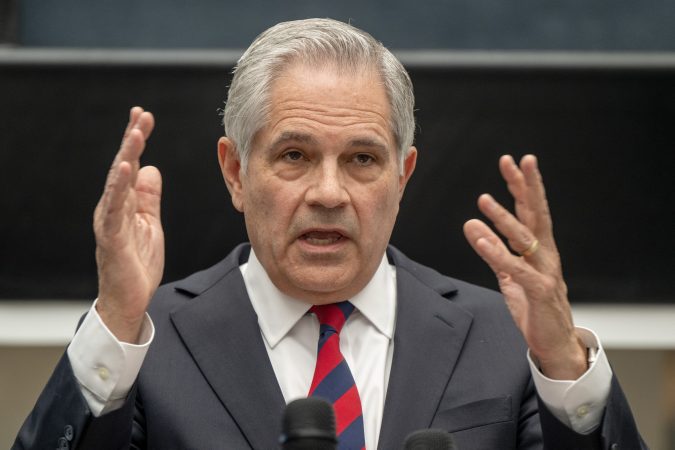
    The House Judiciary Committee subpoenaed Philadelphia District Attorney Larry Krasner on Wednesday, ordering him to turn over documents related to his office’s handling of immigration matters and criticizing what it called the prosecutor’s “pro-illegal-alien policies.”

    The Republican-led Congressional committee said in a letter that it sent the subpoena after Krasner, a Democrat, promised but failed to provide materials that were requested in May.

    The committee, in a letter signed by Rep. Jim Jordan (R., Ohio), its chair, accused Krasner of declining to prosecute or under-prosecuting foreign nationals so that they could avoid consequences connected to their immigration status. The committee said it was asserting its authority to try to end sanctuary-city policies in cities including Philadelphia.

    In response, Krasner called the subpoena “yet another step in authoritarian efforts to do dirt in the dark” and to put pressure on state prosecutors.

    “We have always complied with the law and will continue to do that,” Krasner said Wednesday. “That makes us different from [President Donald] Trump, who spends all day, every day, violating the law of the U.S. Constitution ― and morality.“

    Krasner and the House committee have sparred since May, when the panel accused top city law enforcement officials of shielding criminal immigrants through sanctuary policies and demanded that they quickly turn over a trove of related records and correspondence.

    That represented an escalation by Trump-allied Republicans in their criticism of Philadelphia government on rules concerning undocumented residents, particularly around limiting city cooperation with U.S. Immigration and Customs Enforcement.

    In April, City Council approved high-profile “ICE Out” legislation aimed at restricting immigration enforcement in Philadelphia, putting the city at the forefront of local resistance to Trump’s deportation campaign. The Trump administration challenged part of that package of bills, and this month a federal judge ruled that the city could not prevent ICE agents from concealing their identities.

    In May, in letters to Krasner, Police Commissioner Kevin Bethel, and Sheriff Rochelle Bilal, the Judiciary Committee accused each of hindering federal immigration enforcement. Each letter sought up to six years of immigration communications between their agencies and immigration officials and, in the sheriff’s case, with activist groups including No ICE Philly, Juntos, Asian Americans United, and others.

    The Trump administration has clashed with cities and states that embrace sanctuary policies, contending they are hurting Americans and threatening to cut their federal funding. Philadelphia has long been among the targets.

    Krasner had responded by telling the committee, which said it was conducting oversight of state and local jurisdictions that it believes endanger Americans by not assisting immigration agents, that such policing powers belong to the city.

    “The legal errors are unsurprising,” Krasner wrote to Jordan and to Rep. Tom McClintock (R., Calif.), chair of the subcommittee on immigration, noting that neither had passed the bar. “The factual errors are also unsurprising, given your histories of adhering to wholly repudiated, counterfactual and unscientific election denialism, climate change denialism, and the like.”

    Krasner wrote that he needed time to address each of the committee’s allegations and requests, and was working to hire a lawyer who would be in touch soon.

    In July, Krasner wrote the committee and encouraged it to “question me in public so all Americans are able to see who is telling the truth.”

    The committee’s “fear of such a public airing only makes clearer your lack of real purpose and your complicity in peddling lies,” such as, he said, that local and state prosecutors “rather than President Trump’s ill-conceived deportation actions are responsible for criminals going free.”

    Immigrants are far less likely to commit and be arrested for crimes than U.S. citizens, Krasner noted. But the small number of immigrants who commit serious crimes are being deported by ICE before they can stand trial and be sentenced, given “a ‘get out of jail free’ card and a plane ride to another country, a country where they will never face American justice.”

    The committee told Krasner on Wednesday that time to provide the requested records had run out. Its subpoena directs him to turn over the materials by July 29.

    “Although you may disagree about the need to reform federal law to end sanctuary policies … you cannot seriously contend that the committee lacks the authority to do so,” the committee wrote, adding that Congress may amend statutes “to ensure that prosecutors cannot circumvent immigration law and allow aliens to escape accountability for their crimes.”

  • Poll: 44% of Pennsylvanians say they’re financially worse off now, while a majority oppose AI data centers

    Poll: 44% of Pennsylvanians say they’re financially worse off now, while a majority oppose AI data centers

    Almost half of Pennsylvania voters say they are worse off financially compared with one year ago, while nearly 3 in 4 say they do not want an artificial intelligence data center in their backyard, according to a new poll released Wednesday.

    The Quinnipiac University survey of 895 registered Pennsylvania voters has a 4.3-percentage-point margin of error.

    According to the poll, 44% of Pennsylvania voters believe they are financially worse off than a year ago, as gas prices have fluctuated amid the ongoing war between the United States and Iran. That opinion was politically split, as 64% of Democrats said they are financially worse off now, while 61% of Republican voters polled said they are better off this year than last. Just 34% of respondents said the nation’s economy is excellent or good, while 53% think it is getting worse.

    Meanwhile, 76% Pennsylvania voters said they would oppose data center construction in their communities — a broad swath that includes Democrats, Republicans, and independents.

    Almost half of the voters polled have an unfavorable opinion of artificial intelligence itself.

    “People are really troubled by this new industry,” said Tim Malloy, a polling analyst at Quinnipiac. “It’s about noise, it’s about water, it’s about taxes, and it’s about … not understanding exactly what it is.”

    Quinnipiac’s poll also shows Pennsylvania voters have not been satisfied with the state’s policy responses so far. When asked if they approve of “the way Gov. Josh Shapiro is handling data centers in Pennsylvania,” just 24% of the surveyed voters said they approve. Among the Democrats polled, 40% said they approve.

    The results of the poll, conducted June 9 to 13, come days after Pennsylvania lawmakers and Shapiro approved new regulations on data centers as part of the 2026-27 state budget.

    Starting next summer, data centers will be required to submit information about their energy and water usage to the Pennsylvania Department of Environmental Protection annually. Those reports will be available to the public, and data center operators that do not comply will be fined $10,000 per day.

    But other restrictions on data centers that saw bipartisan support ultimately failed to pass in the budget package and will remain on the table when legislators return this fall.

    Those include an effort championed by Shapiro to limit sales and use tax exemptions benefiting developers, though it would not apply to the $20 billion Amazon project already underway, including a data center in Falls Township.

    Efforts to enact local or statewide moratoriums on data center development were not included in the final state budget, either.

    AI data centers also remain top-of-mind for the voters polled by Quinnipiac, with 76% saying they are following news about them very closely or somewhat closely. The centers ranked among voters’ top issues, with 42% saying they factor into their decision about whom to vote for in the election for governor.

    But other issues — namely the economy and cost of living — top the list, with healthcare just behind.

    Shapiro stays popular

    Shapiro otherwise remains popular among Pennsylvania voters.

    In the poll, 51% of respondents reported having a favorable opinion of Shapiro, and 56% approve of the way he is handling his job as governor.

    “Pennsylvanians agree that Governor Josh Shapiro is delivering results for families, seniors, and businesses all across the Commonwealth by showing up, listening, and getting stuff done,” his campaign said in a statement.

    Gov. Josh Shapiro arrives for the MLB All-Star Game red carpet at Independence National Historical Park on Tuesday, July 14, 2026 in Philadelphia.Monica Herndon / Staff Photographer

    Shapiro, a first-term Democrat, is seeking reelection in November, running against Republican State Treasurer Stacy Garrity. The poll released Wednesday found that 53% of those surveyed would vote for Shapiro, while 40% said they would vote for Garrity. That is a slight change from Quinnipiac’s February poll, when 55% of voters supported Shapiro and 37% said they favored Garrity.

    Garrity, meanwhile, appears to be struggling to gain traction. Just 22% of Pennsylvania voters have a favorable opinion of her, according to the latest poll, while 58% said they have not heard enough about her. Half of the Republicans surveyed said they did not know her well enough to give an opinion.

    More than half of independent voters, 58%, said they would vote for Shapiro in a head-to-head matchup.

    “Usually, it’s not the death knell when not enough people know enough about you, but it sure as heck doesn’t help, and the election’s not that far away,” Malloy said. “Barring some dramatic change in opinion about the current governor, or something that she does or says which just catches fire with people, she’s got a huge uphill climb.”

    Though he has brushed off questions about potential presidential ambitions, insisting he is focused on the state election in November, Shapiro has continued to build a national profile, with media appearances and a book tour.

    Trump approval remains low

    Though he remains strong with the Republican base, only 39% of Pennsylvania voters polled said they would give President Donald Trump a positive job approval. His approval is nearly nonexistent with Democrats at 2%, but even among independents, only 31% rate him well.

    That outlook comes two years after Trump carried Pennsylvania in the 2024 election. He visited the state Wednesday to tout new investments in Pennsylvania’s defense industry.

    President Donald Trump appears at a Defense and Innovation Summit hosted by U.S. Sen. Dave McCormick at the US Army War College in Carlisle Wednesday, July 15, 2026.Tom Gralish / Staff Photographer

    In the forthcoming midterm elections, Pennsylvania voters gave Democrats the slight edge — 49% to 43% — as their preference to control the U.S. House of Representatives over the Republican Party.

    The Quinnipiac poll also showed voters are able to distinguish between state level and national concerns, with 53% saying they are very or somewhat satisfied with how things are going in Pennsylvania.

  • House vote exposes Democrats’ widening divide over Israel

    House vote exposes Democrats’ widening divide over Israel

    A striking number of House Democrats — 103 — voted Wednesday to cut off military aid to Israel for the next fiscal year, in a sign of the growing disconnect between the Democratic leadership’s long-standing support for the Jewish state and the party’s left wing.

    The vote was on a largely symbolic amendment introduced by Rep. Thomas Massie (R., Ky.) to an appropriations package for the State Department and other national security agencies.

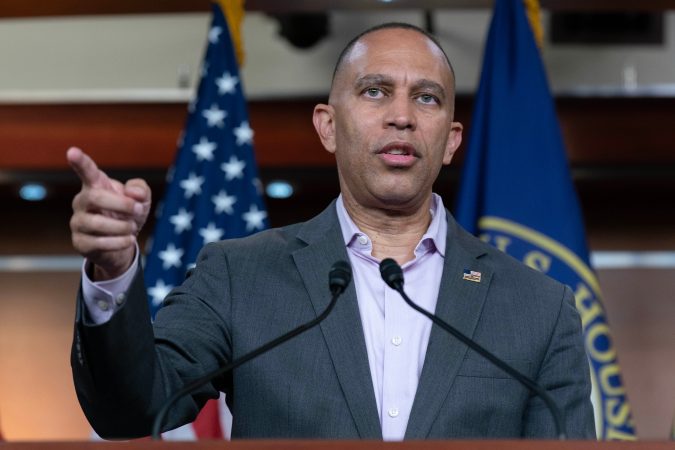
    Despite the considerable Democratic support, the amendment failed in the House. House Minority Leader Hakeem Jeffries (D., N.Y.) voted against it. Massie was the only Republican to vote for the amendment. Ten Democrats voted present.

    Still, the large support for the amendment comes amid a sharp shift among Democratic voters on Israel. A number of Democrats who have voiced support for Israel voted for the amendment, including former House Speaker Nancy Pelosi (D., Calif.) and Katherine Clark (D., Mass.), the minority whip.

    In a statement, Clark — the No. 2 House Democrat — said, “the status quo is not tenable.”

    She added: “We should not provide a blank check for military aid to any country that does not comply with U.S. law, interests, and values. The Netanyahu government has failed to meet that standard.”

    Public support for Israel has plummeted over the country’s military campaigns in Gaza and Lebanon, particularly among Democrats. Nearly three-quarters of Democrats want to reduce or end military support for Israel, according to a Washington Post-Ipsos poll conducted July 8-13. Forty percent of Democrats want to eliminate military support to Israel entirely, including 58% of “very liberal” Democrats.

    Views have shifted dramatically in recent years. Shortly after the Oct. 7, 2023, Hamas attacks on Israel, 28% of Democratic registered voters felt the U.S. was too supportive of Israel, according to polling by Quinnipiac University. That rose to 41% by early 2024 and to 66% last month, including clear majorities of older and younger Democrats.

    Rahm Emanuel, a potential Democratic presidential candidate and former top adviser to Presidents Bill Clinton and Barack Obama, recently traveled to Tel Aviv to warn Israelis that Prime Minister Benjamin Netanyahu had led the country toward dangerous diplomatic isolation.

    Emanuel said U.S. support for Israel was “plummeting around the world” and argued that the United States should end “the American taxpayer’s subsidy of Israel’s defense budget.”

    Jeffries has resisted calls from the base to end all aid to Israel’s government, balancing the priorities of his Democratic members who have stood by the U.S.-Israel relationship. He wrote in a Monday letter to his fellow Democrats that he would be voting against the measure, saying it is too broad.

    But Jeffries said “given the strongly held views throughout the Caucus,” he would let members vote their conscience on the measure.

    A progressive campaign push

    Progressive candidates have cast the divide as evidence that the Democratic establishment is misaligned with its own voters — not only on the war in Gaza, but also on money in politics and the use of U.S. tax dollars abroad.

    “The Democratic Party has been out of step with its own base on Gaza and Palestinian human rights for years. People in this country can’t afford rent, groceries, or a doctor’s visit — and instead of fighting for them, our politicians are sending billions to fund a genocide,” said Darializa Avila Chevalier, a democratic socialist candidate who won a competitive New York primary last month.

    The strategy has had several notable successes.

    In New York, three vocal leftist critics of Israel including Avila Chevalier handily won their primaries, including one in which support for Israel became a central distinction with the moderate incumbent. Candidates making similar arguments also won primaries in Pennsylvania, New Jersey, and Colorado.

    The trend continues in competitive primary races this summer, including in Michigan’s highly watched Senate race where criticism of Israel forms a pillar to progressive candidate Abdul El-Sayed’s message.

    In a statement for this story, Jeffries said the party “must recommit to a two-state solution that prioritizes a safe and secure Israel as a Jewish and Democratic state living side by side in peace and prosperity with a Palestinian state that provides dignity, respect, and self-determination for the Palestinian people.”

    He continued, “It is also imperative that we support the complete reconstruction of Gaza, aggressively surge humanitarian aid to Palestinian civilians and strongly oppose the reprehensible conduct of the far-right Netanyahu government in the West Bank.”

    He added in his letter to fellow Democrats that Israel has reached a point where it should be able to pay for its own defense and that the U.S. should reassess future aid agreements with the country.

    The call for a reset was a significant move for the leader given his past firm support for the U.S.-Israel alliance, said Jeremy Ben-Ami, president and CEO of the liberal pro-Israel group J Street.

    But several progressives have still demanded a stronger stance on the issue than Jeffries’s attempts to balance the positions of the caucus.

    “The Democratic voting base and the American voting base have shifted here,” said Brad Lander, who won a competitive New York primary against Rep. Dan Goldman, a longtime supporter of Israel. “I do believe that the Democratic Party leadership is going to have to catch up.” Lander, like Goldman, is Jewish and supports a two-state solution but differed from Goldman in labeling Israel’s actions in Gaza a genocide.

    The American Israel Public Affairs Committee, the preeminent pro-Israel lobbying group, has become a particular target on the left, held up as an example of what progressives call the corrupting influence of money in politics. Progressive candidates regularly criticize moderate candidates who benefit from spending by AIPAC-affiliated groups, asserting the group’s campaign funding pushes candidates away from the party base’s stance on Israel. AIPAC’s political network supports pro-Israel Democrats and Republicans, including all of the top members of House Democratic leadership.

    El-Sayed has accused his opponent, Rep. Haley Stevens, of failing to adequately condemn the actions of the Israeli government because of what he says is the influence of the pro-Israel lobby. A super PAC affiliated with AIPAC has poured more than $20 million into boosting Stevens.

    “Her entire campaign is bankrolled by outside organizations who know that they’re going to buy a reliable vote to send our tax dollars elsewhere instead of solving actual problems here in Michigan,” El-Sayed said.

    On Wednesday, Stevens voted against the House amendment.

    Stevens is a longtime supporter of Israel, though she has also criticized the government’s handling of the war in Gaza and said Israel’s actions have made Jews around the world less safe. During a debate this month, she said she was the only candidate who truly advocated for the creation of a Palestinian state alongside Israel.

    Stevens’ campaign responded that El-Sayed was “peddling in conspiracy theories” by asserting she was working at the behest of AIPAC.

    “Haley has always believed this race is about the future of Michigan, and that’s why her focus is and has been on promoting policies that will reduce costs, grow the economy and create a strong 21st century manufacturing industry that will carry Michigan forward,” her campaign said in a statement.

    Patrick Dorton, a spokesperson for AIPAC’s super PAC, said the group has the right to partake in the primary process like any other interest group and noted that super PACs have also been spending heavily to back candidates opposed to the U.S.-Israel relationship.

    “The anti-Israel fringe left uses the dark money argument when it suits them and funds super PACs when it’s to their advantage,” Dorton said. “These are red herring arguments to drive pro-Israel Democrats out of the party and out of the primary process.”

    Deryn Sousa, a spokesperson for AIPAC, said that the organization’s membership crosses party lines and the group supports candidates based on their alignment with its support for the U.S.-Israel relationship. Hundreds of AIPAC-backed candidates have won their primaries this year, Sousa noted.

    Democrats for Israel

    Israel still has its ardent defenders among congressional Democrats, several of whom argue that the growing number of vocal Israel critics fails to grasp the reality on the ground.

    “War is terrible, and it’s very hard to be successful in an urban war and successful in the public relations war,” said Rep. Brad Sherman (D., Calif.), a longtime supporter of Israel and co-chair of the Israel Allies Caucus.

    Sherman said he and most other Democrats have been able to criticize the government of Israel without going after the U.S.-Israel relationship, one of the strongest partnerships in the Middle East. He warned that some of the criticism has amounted to demonization and antisemitism.

    And even among the progressive candidates criticizing the party’s stance toward Israel, there is disagreement on the future of the relationship with Jerusalem. While Lander identifies himself as a Zionist, El-Sayed said liberal democracy was incompatible with the idea of a Jewish state.

    The next House Democratic Caucus is likely to include an unusually large number of members openly critical of Israel. Still, foundational disagreements over Israel are nothing new to the caucus.

    Sherman recalled a pushback on similar criticisms against Israel in the 1980s, when the country invaded Lebanon, though he noted the resistance to Israel is greater now among Democrats than then. He was a founding leader at the time of Democrats for Israel, a grassroots group dedicated to rooting out anti-Israel sentiment in the party.

    Avila Chevalier said she would work with anyone “serious about lowering the cost of living working-class people” regardless of their stances on Israel.

    Rep. Bradley Schneider (D., Ill.), a moderate who is largely supportive of the U.S.-Israel relationship, noted Israel critics already serve in the Democratic Caucus and that he is still able to work with them on other issues, including healthcare, housing and education.

    “Democrats are a big tent,” Schneider said. “We welcome diverse opinions.”

  • Donald Trump hits Josh Shapiro, promotes defense investments in Pa. during industry summit hosted by Dave McCormick

    Donald Trump hits Josh Shapiro, promotes defense investments in Pa. during industry summit hosted by Dave McCormick

    CARLISLE, Pa. — President Donald Trump — as fighting resumes in Iran and his administration’s request for $1.5 trillion in defense funding stalls in Washington — used a Wednesday appearance at a defense industry summit in central Pennsylvania mostly to boast about his perceived foreign and domestic achievements, from the oil business in Venezuela to the National Guard’s security work during Mardi Gras.

    In a 53-minute speech that was set up as a roundtable conversation, Trump occasionally applauded the latest investments in Pennsylvania’s defense manufacturing and research, which was the focus of the two-day Pennsylvania Defense and Innovation Summit organized by U.S. Sen. Dave McCormick (R., Pa.).

    He also acknowledged the setbacks in Iran and the widely recognized need for the country to more quickly build items like submarines and munitions.

    But in his second stop in three weeks in Pennsylvania — and specifically in a Republican-held U.S. House district that is critical to his party keeping control in the midterm elections — Trump also weaved through a wide range of topics.

    That included the prospect that Democratic Gov. Josh Shapiro would defeat his preferred candidate in this year’s Pennsylvania governor’s race, Republican Treasurer Stacy Garrity.

    “This guy Shapiro is totally overrated. I watched him the other night doing a speech, and he does not have what it takes,” Trump said in Carlisle. “Maybe he’ll win, and he’s expected to win, but I hear things about Stacy, and I’m hearing some poll numbers that are very good. But Shapiro is — he doesn’t have what it takes.”

    Shapiro, who also attended the summit, held back from pointedly criticizing Trump’s foreign aggression during his panel, and he left the summit before the president’s appearance.

    While most panelists and convention-goers praised the federal government’s focus on military investment, there was little discussion about specific developments abroad or controversies around Trump’s use of the armed forces.

    Just this week, fighting in Iran resumed after a tentative ceasefire was reached and then fell apart. The U.S. Senate, which had previously voted — in a mostly symbolic gesture — to restrict Trump’s actions in Iran, has meanwhile stalled the president’s defense budget as Democrats attempt to exert more leverage to wind down the conflict.

    “This war continues to be a costly blunder that has only made us worse off than before,” U.S. Sen. Andy Kim, a New Jersey Democrat who served as a diplomat before entering Congress, said on social media this week as Trump continued the war effort.

    The bombing campaign that began in late February has been both unpopular — a Fox News poll in June found 58% think the U.S. made the wrong decision by starting it — and costly, as gas prices have remained elevated and the nation’s arsenal of Tomahawk cruise missiles has depleted. It will take years to replenish the stockpile, according to an analysis by the Center for Strategic and International Studies.

    McCormick, who has supported Trump’s efforts in Iran, said in opening the summit on Tuesday that the gathering came “in a moment as consequential as any moment in American history, and maybe in human history.”

    “President Trump’s vision of peace through strength demands new players and new ways of doing business,” McCormick said. “Such radical new thinking has never been more needed in America’s history, in the history of our military. China, Iran, Russia, North Korea: They all share one objective — a weakened United States. And they’re actively working together toward that end.”

    But Shapiro said he believed the administration’s antagonistic relationship with longtime allies is a risk to national security, though he did not specifically frame his comments around the wars in Iran or Ukraine.

    “Candidly, I get a little bit concerned when our administration pokes their finger in the eye of our allies,” Shapiro said. “That undermines our ability to innovate, and it undermines our ability to be stronger with our national defense and to have a deterrence that is going to protect the American people and protect our interests abroad.”

    McCormick, a U.S. Army veteran and former hedge fund CEO, organized the 1,300-person gathering to bring defense contractors and other companies together with government officials, military leaders, and research institutions.

    As at a similar energy- and technology-focused event last year, McCormick used the event to highlight what he described as about $10 billion worth of investments in the state.

    The list featured several ongoing Philadelphia efforts — including new ship orders at the Hanwha Philly Shipyard that McCormick valued at $1.5 billion, and a 10-year, $2.5 billion agreement to support submarine construction by Rhoads Industries and General Dynamics.

    Day & Zimmermann, a Philadelphia-based and family-owned conglomerate that is one of the Army’s largest ammunition suppliers, also won a $2.3 billion contract to update, operate, and run the Hawthorne Army Depot in Nevada, according to McCormick.

    JPMorgan Chase & Co. chief executive Jamie Dimon, who visited the Navy Yard on Wednesday ahead of the conference, also appeared in Carlisle to discuss $13 million in financing his company is providing to Rhoads’ ongoing project.

    Not all of the announcements are new or immediate — such as a recent $84 million order of heavy dump trucks from Mack Defense, which is part of a five-year, $221.8 million contract signed last year and that Trump touted in Macungie last month.

    Trump called the announcements “a colossal victory for this commonwealth and for the entire nation.”

    “Pennsylvania workers will build the ships, submarines, trucks, weapons and industries that will ensure America remains the strongest and the most powerful nation in the history of the world,” Trump said.

    In between diversions about the 2024 election, COVID-19, and claiming — as he has before during rallies in Pennsylvania — that affordability concerns are “fake,” Trump also addressed the focus of the gathering by stressing the need for a faster buildup of military equipment.

    “We used to make a ship a day, and now we’re a laggard in that department,” he said while asking the submarine construction workers in Philadelphia to pick up the pace. “We do lots of great things, but we’re a laggard there.”

    Like his rally in Lehigh County in June, Trump’s speech on Wednesday was located in a congressional district with one of the most competitive races — both in Pennsylvania and nationally — this year.

    U.S. Rep. Scott Perry, a York County Republican, is seeking an eighth term in the 10th Congressional District, which covers all of Dauphin County and parts of York and Cumberland Counties. Perry narrowly fended off a challenge from former local television anchor Janelle Stelson in 2024 and is facing her again as Democrats invest more into the race.

    As polls show Democrats have some broad momentum in the midterms, a new Pennsylvania poll released Wednesday found 39% of voters in the state approve and 58% disapprove of the president’s job performance.

    The same poll from Quinnipiac University found 40% approve of McCormick’s job performance, 33% disapprove, and 28% had no opinion.

    The event Wednesday and the energy-focused summit in Pittsburgh last July have spotlighted McCormick in rare, high-profile ways for a freshman senator. The former CEO of Bridgewater Associates, one of the world’s largest hedge funds, has also developed a close alliance with Trump in ways that have elevated his political stature.

    “Hopefully we’ll fix some of these societal problems,” Dimon, one of the country’s most powerful executives, said when McCormick asked him onstage what the next decade would look like. “And Secretary of Treasury Dimon will be happy to report to you, will be happy to report to President McCormick.”

    McCormick has not publicly expressed an interest in running for president — though at least one widely expected 2028 contender was in attendance Wednesday at his invitation.

    “Defense is critical to the future growth of this commonwealth,” Shapiro said, while praising McCormick in a bipartisan showing.

    Shapiro spoke emphatically about bolstering the state’s role in the defense industrial base and said he is doing what he can to have the state benefit from defense-related jobs and a federal focus on national security.

    Shapiro also appeared at the conference at the U.S. Army War College in Carlisle earlier in the day. In a panel conversation there, he did not criticize Trump by name as he fully endorsed the summit’s goal of supercharging the defense industry and placing Pennsylvania at the center of the expansion.

    President Donald Trump and Secretary of Defense Pete Hegseth (right) are on stage at a Defense and Innovation Summit hosted by U.S. Sen. Dave McCormick at the US Army War College in Carlisle Wednesday, July 15, 2026.Tom Gralish / Staff Photographer

    Those jobs include about 2,200 at General Dynamics, a global corporation whose Pennsylvania employees work on everything from sonar and artificial intelligence to submarine defensive systems and electronic warfare, the company’s president, Danny Deep, said while sitting alongside Shapiro.

    Deep referenced the governor’s 2024 visit to the General Dynamics munitions manufacturing plant in Scranton, when Shapiro and Ukrainian President Volodymyr Zelensky signed both empty artillery shells and agreements to work together. Because of the demand during Ukraine’s war with Russia, the company has ramped up its monthly munitions production from 14,000 to 50,000 — a move that Deep said was possible only with help from the state.

    “That’s because of this public-private partnership, and that’s what makes Pennsylvania so special,” he said.

    President Donald Trump leaves the stage at the end of a Defense and Innovation Summit hosted by U.S. Sen. Dave McCormick at the US Army War College in Carlisle Wednesday, July 15, 2026.Tom Gralish / Staff Photographer

    Michael Coulter, president and CEO of Hanwha Defense USA, likewise said on the panel that the cross-party and cross-government support is essential in the company’s continued expansion at the Navy Yard in Philadelphia. The investments announced by McCormick on Wednesday included a federal government order of new ships that was valued at $1.5 billion and supporting more than 2,000 jobs in Philadelphia.

    “We are foot-on-the-throttle to make shipbuilding great again,” Coulter said. “And Pennsylvania’s the heart of that.”

    Staff writer Joseph N. DiStefano contributed to this article.

  • Monell Chemical Senses Center is relocating within University City after 55 years on Market Street

    Monell Chemical Senses Center is relocating within University City after 55 years on Market Street

    Monell Chemical Senses Center is relocating to a new facility in University City to expand its operations and evolve its science, officials announced Wednesday.

    The nonprofit research institute dedicated to studying taste and smell signed a 20-year lease at One uCity Square, a 13-story research hub, that will include more than $30 million worth of new infrastructure and facility improvements.

    The new location at 25 N. 38th Street is a roughly seven-minute walk from the current home at 3500 Market St., where Monell has resided since 1971.

    Monell plans to finish moving into the new space in early 2027.

    “We’re just at capacity. We don’t have the facilities that are going to push us forward into the future,” said Benjamin Smith, Monell’s executive director and president.

    The move has been a long time coming, as the center’s more than 150 scientists and staff have outgrown its space over the last 50-plus years.

    For example, more scientists have wanted to use newer research methods, such as organoids — miniature versions of organs grown in the lab, he said. However, the current building has limited cell culture space and imaging capabilities.

    “Our people are excited because we’re moving to facilities that are going to help them do more of the work that they want to do,” Smith said.

    Benjamin Smith is the executive director and president of Monell.Courtesy of Monell Chemical Senses Center

    More shared space, room for growth

    The new space, which spans 64,000-square feet across three floors, is technically smaller than Monell’s current building. However, the design will allow for more efficient use of lab space.

    The modern facility has an open layout filled with shared spaces, “as opposed to the old sort of academic lab where you were in one corner of a basement or one corner of a building and you locked your door,” Smith said.

    He hopes this will encourage collaborations and interactions between scientists. That includes both within Monell and with other groups in the building.

    Its neighbors within One uCity will include Dispatch Bio, Century Therapeutics, Penn NSF AIRFoundry, among other research and biotech companies. The office building opened in 2023 and is now roughly 90% occupied.

    Monell’s iconic “Face Fragment” sculpture, perched outside its current building, will move, too. The giant nose and mouth will be featured at the front of the One uCity building, looking out at the lawn.

    “We’re making sure that we don’t lose that legacy,” Smith said. “We take our culture and we move it into the new building and we grow it.”

  • SEPTA and Amtrak are slowing down trains due to the heat

    SEPTA and Amtrak are slowing down trains due to the heat

    The Philadelphia region is under an extreme heat warning Wednesday, leading transit agencies to slow down trains to ensure safe travel amid a high of 98 degrees.

    Amtrak and SEPTA were slowing trains down by 5 to 10 mph, and Amtrak was canceling some Acela and Northeast Regional train trips due to the heat, officials said.

    Amtrak plans to reduce train speeds through Friday, in addition to canceling at least a dozen trains each day Wednesday and Thursday.

    “While these measures are intended to maintain safe and reliable operations, customers traveling during these hours should continue to monitor their train status for the latest updates,” an Amtrak spokesperson said.

    Regional rail train heading to Philadelphia Airport stopping at Jefferson Station. SEPTA Regional rail riders at Jefferson Station, Philadelphia, Tuesday, October 7, 2025.Alejandro A. Alvarez / Staff Photographer

    SEPTA has not canceled trips, but it was operating trains at a slower speed, which could lead to delays of up to 15 minutes on Regional Rail and trolleys, SEPTA spokesperson Andrew Busch said. Subway lines were also running slower but were less affected since they are not exposed to direct sunlight as often as other services.

    “Bringing speeds 5 to 10 mph slower from their top speed is not always very noticeable to customers, but it can cause some minor delays,” Busch said. “Extreme heat like this makes the tracks more susceptible to damage, and by slowing down the speeds you can help prevent that.”

    In extreme heat, rails can begin to warp and eventually crack, creating dangerous circumstances. The wires that hang overhead to power the trains also begin to “sag” in extreme heat, Busch said. The heat also affects electrical equipment like signals and switches, similar to how many across the region can experience power outages in extreme heat.

    When temperatures reach 88 degrees, all of these potential safety hazards intensify, Busch said. That is the threshold for when transit agencies begin monitoring their rail systems to see if adjustments are needed.

    These safety measures are expected into Thursday and Friday as temperatures are expected to reach 96 and 92 degrees, respectively, according to the National Weather Service. Philadelphia has hit the 100-degree mark three times in 2026, just two shy of the record number for most 100-degree days, according to the weather service.

    While the city has not declared a heat emergency, the Philadelphia Office of Homeless Services declared a “code red,” meaning additional outreach was being done to connect those in need to services.

  • Argentina books trip to second straight World Cup final behind another come-from-behind win

    Argentina books trip to second straight World Cup final behind another come-from-behind win

    ATLANTA — Defending champion Argentina rallied to beat England 2-1 on Wednesday and reach the World Cup final.

    Trailing 1-0 heading into the final five minutes of regulation, Enzo Fernández and substitute Lautaro Martínez scored for Argentina.

    Argentina will play Spain in the World Cup final in East Rutherford, N.J. on Sunday (3 p.m., Fox29), while England will take on France in the consolation game on Saturday (3 p.m., Fox29).

    Anthony Gordon had given England the lead in the first half. Still, Lionel Messi and Co. rallied for the third straight game, winning down the wire now against Cape Verde in the Round of 16, Egypt in the quarterfinals, and now, England, which was just five minutes plus added time of qualifying for their first World Cup final since they won it all in 1966.

    Argentina pushed for an equalizer, and the pressure eventually led to Fernandez scoring in the 85th minute. Martinez headed in the winner two minutes into injury time.

    The game resumed one of the biggest rivalries in international soccer, and there was a raucous atmosphere in the stadium even before kickoff as both sets of fans tried to drown out the other team’s national anthem.