Blog

  • Phillies playoffs: Schedule, tickets, opponent, and everything else you need to know

    Phillies playoffs: Schedule, tickets, opponent, and everything else you need to know

    The Phillies are officially heading back to the MLB playoffs, though it feels more like avoiding a disaster than something to be celebrated.

    Philly clinched the National League’s final wild-card spot by defeating the Tampa Bay Rays 7-3 at a dreary, storm-soaked Citizens Bank Park.

    It took 162 games for the Phillies to punch their ticket to the postseason, a trip that seemed all-but-wrapped up just last week. Bryce Harper and company had a five-game lead with eight games to play, but at least the team avoided an epic collapse on par with the 1964 Phillies, who blew a 6½-game lead with 12 games to play.

    It’s certainly been a wild season, catalogued by my colleague Scott Lauber:

    • The 9-19 start that resulted in the firing of manager Rob Thomson and the initial revival under Don Mattingly.
    • A skid after the All-Star break and a surge that began in an Iowa cornfield.
    • The 8-14 finish that put them on the brink of collapse.

    That’s now just the backstory as the Phillies prepare for their fifth-straight postseason run.

    Here’s everything we know about the Phillies’ playoff schedule, wild-card opponent, and how to get playoff tickets if they manage to escape the wild-card round and end up back at Citizens Bank Park.

    This will be updated as more information becomes available.

    Phillies wild-card opponent will be the Braves

    Braves ace Chris Sale dominated the Phillies this season.Yong Kim / Staff Photographer

    The Phillies ending up with the final wild-card means they’ll be traveling south to face the Braves at Truist Park in Atlanta.

    Philadelphia went 4-9 against Atlanta this season, and lost its most recent series a couple week ago.

    The good news is the Phillies have had a fair amount of playoff success against the Braves in recent years. In both 2022 and 2023, the Phillies defeated the Braves in the National League divisional series, despite Atlanta having home-field advantage both years.

    MLB playoffs: 2026 Wild Card TV schedule

    Phillies announcers Tom McCarthy (left) and John Kruk will call wild-card games for NBC. Elizabeth Robertson / Staff Photographer

    The wild-card round of the MLB playoffs is scheduled to begin on Tuesday.

    This year it jumps from ESPN to NBC, and Phillies fans will hear a familiar voice — NBC Sports Philadelphia announcer John Kruk, who will serve as an analyst alongside C.J. Nitkowski and play-by-play announcer Matt Vasgersian. Joey Votto will also join the broadcast as an in-stadium analyst.

    Tom McCarthy, the TV voice for the Phillies, will call the other National League wild-card series between the Chicago Cubs and San Diego Padres.

    Here’s the wild-card TV schedule:

    Tuesday, Sept. 29
    • Phillies at Braves: 2 p.m. on NBC
    • White Sox at Astros: 5 p.m. on NBCSN
    • Red Sox at Yankees: 8 p.m. on NBC
    • Cubs at Padres: 9:30 p.m. on NBCSN
    Wednesday, Sept. 30
    • Phillies at Braves: 2 p.m. on NBC
    • White Sox at Astros: 5 p.m. on NBCSN
    • Red Sox at Yankees: 8 p.m. on NBC
    • Cubs at Padres: 9:30 p.m. on NBCSN

    Any necessary Game 3s will take place Thursday.

    NBCSN is available on Xfinity (channel 1211 in Philly), YouTube TV, Hulu + Live TV, and Fubo, but it isn’t currently available on Verizon Fios. All the games will also stream on Peacock, NBC’s subscription streaming service.

    While NBC Sports Philadelphia won’t broadcast any Phillies games, radio announcers Scott Franzke and Larry Andersen will continue to handle play-calling duties on 94.1 WIP.

    How can I get Phillies playoff tickets?

    If you’re an optimist, you might be able to land Phillies tickets to the NLDS. Elizabeth Robertson / Staff Photographer

    A handful of seats for Games 1 and 2 of a possible National League divisional series at Citizens Bank Park were still available on the team’s website as of Sunday morning.

    Phillies fans can register a chance to purchase tickets to the National League Championship Series, should they advance that far. Registration ends at midnight on Friday, Oct. 2, and a random drawing will occur the following Monday.

    The team will notify you if you’ve been randomly selected for the opportunity to purchase playoff tickets on Monday, Oct. 12.

    Full 2026 MLB playoff schedule

    Jackson Chourio and the Brewers are the No. 1 seed in the NL. Jose F. Moreno / Staff Photographer

    The MLB playoffs feature 12 teams (six from each league), with three division winners and three wild-card teams per league.

    Here are the National League’s six playoff teams:

    1. Milwaukee Brewers
    2. Los Angeles Dodgers
    3. Atlanta Braves
    4. San Diego Padres
    5. Chicago Cubs
    6. Philadelphia Phillies

    Here are the six playoff teams in the American League:

    1. Tampa Bay Rays
    2. Cleveland Guardians
    3. Houston Astros
    4. New York Yankees
    5. Boston Red Sox
    6. Chicago White Sox

    2026 MLB playoff TV schedule

    Following the wild-card round, Fox will broadcast the final two rounds of the National League playoffs, while the American League games will air on TBS. The World Series will once again air on Fox.

    Here’s how the MLB playoff schedule breaks down this season:

    • Wild-card series (best-of-three): Begin Sept. 29 (NBC, NBCSN)
    • Divisional series (best-of-five): Begin Oct. 3 (Fox, FS1, TBS, truTV)
    • Championship series (best-of-seven): Begin Oct. 11 (Fox, TBS)
    • World Series (best-of-seven): Begins Oct. 23 (Fox)

    Phillies should benefit as ABS system makes playoff debut

    J.T. Realmuto has been very successful in his challenges to balls and strikes.Monica Herndon / Staff Photographer

    This will be the first postseason to feature the automated ball‑strike (ABS) challenge system. That should benefit the Phillies, considering catcher J.T. Realmuto’s extreme success challenging balls and strikes.

    As for other playoff rule changes, there will be no “ghost runners” during the postseason.

    MLB’s designated runner rule puts a player on second base to begin each half-inning if a game is tied after nine innings. The rule was an attempt to preserve pitching staffs and avoid extra-long regular season games.

    But during the playoffs, that rule is out the window. So if any postseason games enter extra innings, you won’t see anyone on second base.

    Thankfully, MLB’s other big rule change — the pitch clock — remains in place during the playoffs. MLB games averaged 2 hours and 42 minutes through mid-season, nearly a half hour shorter than games without a clock.


  • Lobsters on the lam? No, Cape May crustaceans didn’t pull off a great nor’easter escape

    Lobsters on the lam? No, Cape May crustaceans didn’t pull off a great nor’easter escape

    As the tidewaters spread across the Shore during this weekend’s nor’easter, so did the viral videos and photos online.

    One widely shared video showed a waterlogged dining room at the famous Lobster House in Cape May. Then Internet jokesters enhanced the video, adding three lobsters serenely swimming out to sea.

    @onebadshark Be Careful If You’re In The Area Of Schellengers Landing Rd, In Cape May, NJ! The Lobsters Have Escaped From The Lobster House! #capemay #newjersey #lobster #house #flood ♬ Hymn to the Sea (Rose's Theme) – Amy Wallace & Reyjuliand

    On Sunday, people drove up to the iconic seafood restaurant and market — closed due to flooding — to witness any evidence of the lobster jailbreak.

    “We’ve had people in Florida and Virginia ask us about it,” Cape May resident Gary Bartlett said of the videos.

    His wife Tracy Bartlett said people are interested in the Lobster House because it is such a popular destination.

    “It’s been around forever,” she said. “My parents came here in the ’40s.”

    @jerseyshoremode Every table set and waiting at The Lobster House in Cape May, which tells you how the night is about to go. via @61580720955840 #jerseyshoremode #jerseyshore #njbeaches #downtheshore #visitnj ♬ original sound – Jersey Shore Mode

    Keith Laudeman, the third-generation owner of the Lobster House, explained that for three days, the water level outside the restaurant inched up — the result of relentless northeast winds holding seawater in the inlet.

    Saturday morning’s high tide was the “icing on the cake” that sent floodwaters pouring through the front door.

    Laudeman dealt with flooding after Superstorm Sandy in 2012 and Storm Jonas in 2016. He said his team will have to wash everything with freshwater, scrub it down with antimicrobial soap, and replace carpeting.

    He hopes to have the restaurant open within three days, and plans for the fish market and coffee shop to be open Monday.

    As for the lobsters escaping to sea, Laudeman said anything is possible.

    “That’s a little far-fetched,” he said. “But if it adds to the story, then go ahead.”

  • White House claim of finding $250 billion in fraud uses questionable numbers

    White House claim of finding $250 billion in fraud uses questionable numbers

    WASHINGTON — Since the White House formed a task force in March intended to combat fraud, top administration officials have repeatedly heralded its work, pointing to huge amounts of recovered payments and graft stopped in its tracks.

    “We found $250 billion of fraud just since the president made me the fraud czar,” Vice President JD Vance, who leads the task force, said in a speech this month at the Republican midterm convention.

    Yet some of the numbers Vance and his task force have promoted are overstated or lack specificity, and rely on temporary pauses in funding as well as cases and actions that long predated President Donald Trump’s second term, according to a New York Times analysis of documents released by the administration. The task force also appears to be relying on claims of fraud that could not be verified or leaning on allegations of fraud that are being prematurely included.

    In August, the White House published a so-called fraud ledger chronicling its work. It singled out three categories of fraud identified and eliminated since January 2025 — not, as Vance said, since this March, when the task force was established. As of Wednesday afternoon, the task force asserted it had found, or “uncovered,” $245.7 billion in fraud through data analysis, “stopped” $62.9 billion annually through actions like suspending providers and enacting rule changes, and “enforced” $59.1 billion through indictments, settlements, and financial fines.

    It is difficult to verify those figures because there is no publicly available breakdown of the total. A senior White House official said the task force chose not to itemize fraud schemes and actions to avoid compromising current law enforcement investigations.

    The task force ledger’s chronology and a White House news release from August offer some details about $47 billion of the more than $300 billion the task force asserts it has identified or eliminated. But even that information falls short, leaving unclear how that amount is spread across the three categories.

    Undoubtedly, the federal government loses vast amounts of money to fraud: $233 billion to $521 billion annually, equal to about 3% to 7% of federal spending, according to one estimate from the Government Accountability Office, an independent, nonpartisan agency that has scrutinized how the government spends taxpayer funds for more than a century.

    Vance and his task force have ferreted out real cases of fraud, and their efforts to draw attention to the problem and recover taxpayer funds are laudable, experts said. But the task force’s unverifiable claims may undermine efforts at transparency and obscure the actual scale of the work it is performing.

    “There’s absolutely no question it’s a ramp-up of effort, and there’s absolutely no question that there’s an opportunity to use technology, especially artificial intelligence, in ways that didn’t exist in the past,” said David Walker, who led the Government Accountability Office as the comptroller general in the Clinton and George W. Bush administrations.

    But, he said, the figures the task force has cited are “assertions that have not been validated by independent parties.”

    Over the years, various inspectors general have struggled to quantify their anti-fraud work in broad strokes, as the task force has done, given the vast differences in how different agencies investigate cases and measure impact, said Mark Greenblatt, a former inspector general for the Interior Department who once led the council of inspectors general.

    It is entirely possible that the task force’s figures are accurate, he added.

    But given that Trump fired more than a dozen independent inspectors general (including Greenblatt) at the beginning of his second term and installed political allies in their place, “There’s no one that can look at those numbers in detail and share with the American people whether they are valid, transparent and that the methodology is sound,” he said.

    Fuzzy figures and possible double-counting

    The task force’s description of its largest “fraud actions” offers few details about how it arrived at the estimates, making it impossible to verify the reliability of those figures.

    About half of what the task force casts as the $245.7 billion in “fraud uncovered” on its ledger can be attributed to the Small Business Administration. But neither the ledger nor the August news release elaborates on what that figure refers to.

    When asked, a spokesperson for the agency referred to a 2023 estimate, calculated by its inspector general, of $200 billion in pandemic-era fraud. She said the agency had identified about $122 billion of that figure as potentially fraudulent but did not provide further details.

    After repeated requests by the Times for additional documentation, the agency announced Wednesday that it had provided the IRS with tax information associated with pandemic-era loans earlier this year, and that the IRS had identified discrepancies associated with about $100 billion in loans. The announcement did not detail what the discrepancies or suspected tax violations may entail, but said that the tax agency was examining cases.

    What the administration has described as other instances of anti-fraud victories appear to refer twice to the same actions or cases. The senior White House official denied that the task force double-counted any figures, saying that it included developments merely as informational updates. But whether the total figures include double-counting — as a ledger of government funding cuts maintained by the Department of Government Efficiency did — cannot be verified given that there is no breakdown.

    The White House news release includes as “key actions and victories” the June captures of two fugitives accused of orchestrating Medicare fraud schemes that totaled $4.9 billion. But another key action encompasses charges against 455 defendants — including those two fugitives — accused of orchestrating healthcare fraud schemes totaling more than $6.5 billion.

    Another key action details the April suspension of payments to 447 hospice providers in Los Angeles “with estimated fraud exceeding $600 million.” But a later action lists separately the May suspension of some 800 hospices, including the initial 447 providers. A news release from the Centers for Medicare and Medicaid Services notes that it suspended $70 million in Medicare payments to 800 hospices in Los Angeles that billed Medicare $1.4 billion last year.

    Taking credit for old cases

    Fraud cases often span years as investigators gather evidence, prosecutors bring charges, juries deliver convictions, and judges issue sentences across different administrations. Many figures the task force has reported take credit for work conducted under previous administrations and local governments.

    “They deserve credit for taking them through the finish line,” Greenblatt said. “I don’t want to denigrate it, but to make it sound like all of the effort, you know, occurred during the lifespan of the task force is a sleight of hand, in my view.”

    The White House declared that the Justice Department’s National Fraud Enforcement Division, which was established in April, “took enforcement action in schemes totaling over $340 million in its first week alone.”

    But according to the department’s own announcement, the bulk of that amount — nearly $280 million — represented people sentenced in fraud cases uncovered and tried months before the establishment of the fraud task force or even the second Trump administration itself.

    For example, the biggest single action cited was the sentencing of a Minneapolis man for his role in a $250 million scheme by a local nonprofit during the pandemic to siphon off food assistance funding. That scheme was hardly unknown: The Times covered the department’s investigation in March 2022 and the man was charged in September 2022, under the Biden administration.

    Prematurely counting pending actions

    Several of the largest numbers the task force reported in its ledger describe actions that have not borne tangible results, but are merely the first steps in building cases or seeking repayment. Other examples refer to so far temporary withholding of federal funding.

    More than a third of the total amount of “fraud enforced” can be attributed to $22.6 billion from the Small Business Administration, which appears to figure prominently in two of the three categories in the ledger. The vast majority of that figure refers to the agency’s announcement in April that it would send 562,000 delinquent pandemic-era loans for debt collection. The loans were previously identified by the Biden administration as potentially fraudulent and totaled $22.2 billion.

    Just how much of that amount has been recovered is not known. In March 2024, under the Biden administration, the Small Business Administration referred about $20 billion in pandemic-era loans for debt collection, according to news reports and agency data. It recovered just over $1 billion in the 2024 fiscal year.

    Topping the White House website’s list of “highest-impact anti-fraud actions” is the administration’s assertion of having recouped “$2.5 billion in Medicaid fraud deferrals,” referring to pauses in federal reimbursements to California and Minnesota.

    But it is possible that the funds, or a portion of them, will be released in the future. The Department of Health and Human Services’ website notes that these are “not permanent funding cuts.” Moreover, top department officials said at a news conference that “federal funds move forward” once the states provide adequate documentation of eligibility.

    When Minnesota sued the federal government for withholding funds, a judge declined to issue a preliminary injunction, ruling that the deferral was “not final,” and assumed “possible future harm.”

    Some have also disputed the notion that a broad freeze on payments can reasonably be counted as fraud that has been prevented. Two officials who managed the Medicaid programs in North Carolina and Indiana recently wrote that withholding funding came with plenty of caveats.

    It “does not identify a fraudulent provider,” they said. “It does not prove a false claim. It does not strengthen service documentation, improve provider screening, modernize data systems to better detect fraud, or help investigators build cases. It simply disrupts the flow of dollars that pay for healthcare and that pay to prevent fraud.”

    Greenblatt said the deferral most likely did stop some fraud — “probably an uncomfortably high amount of fraud” — but assuming all $2.5 billion is fraudulent overstates the amount of fraud prevention.

    Greenblatt added the potential discrepancy captured his prevailing concern over the task force’s accounting: “Are these figures grounded in any sort of standards?”

    This article originally appeared in the New York Times.

  • Police hunt gunmen after 2 mass shootings in South Africa leave at least 27 dead

    Police hunt gunmen after 2 mass shootings in South Africa leave at least 27 dead

    CAPE TOWN, South Africa — Two separate mass shootings in South African townships within hours of each other have left at least 27 people dead, police said on Sunday.

    South Africa has struggled with violent crime for years, but recent shooting incidents have shocked a country used to some of the highest homicide rates in the world.

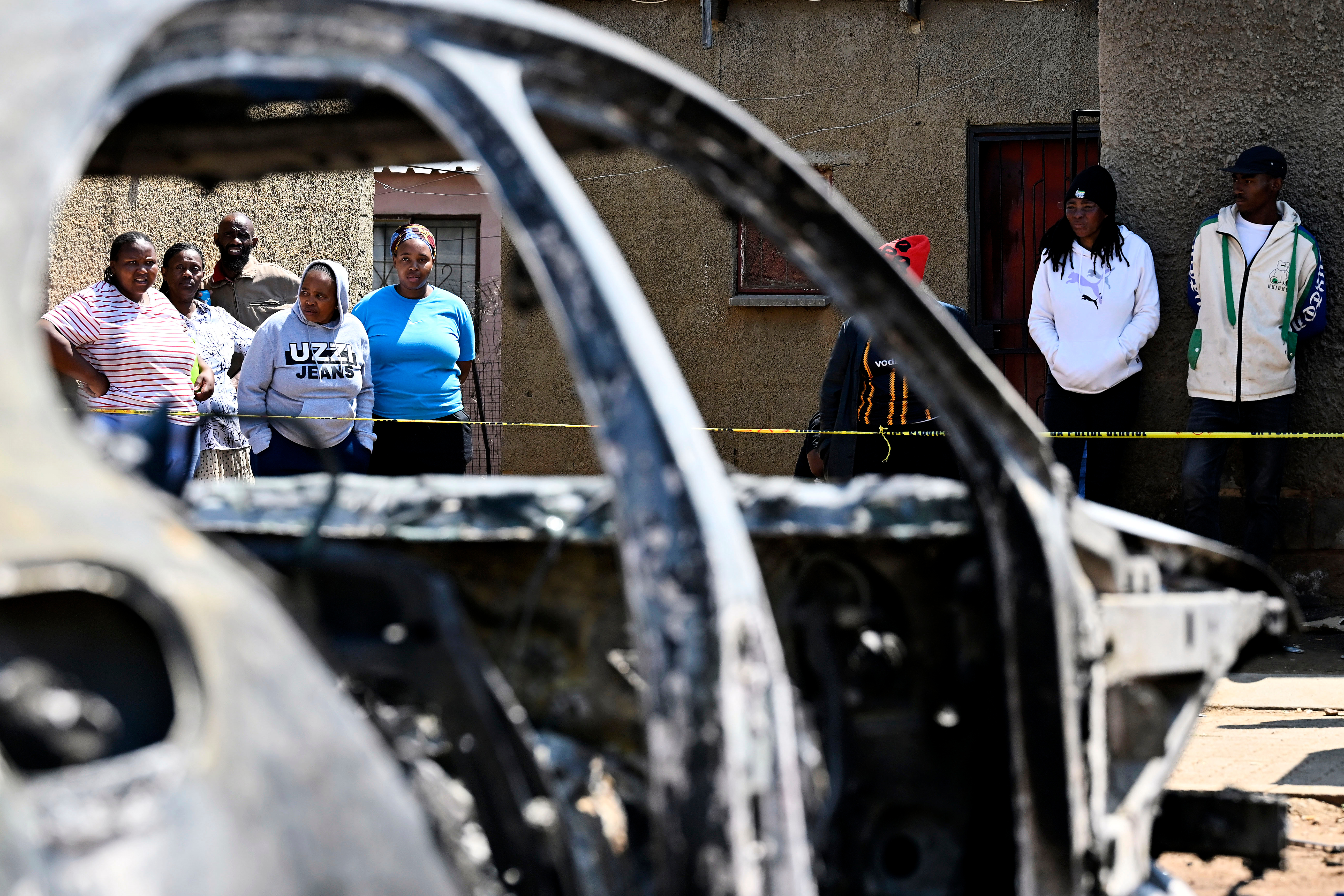
    In the first attack, eight gunmen armed with AK-47 rifles and pistols opened fire at a bar near Johannesburg late on Saturday. The South African Police Service said 17 people were killed at the small venue in Wedela township, southwest of South Africa’s biggest city.

    The attackers fired at patrons outside the bar before moving inside and continuing to shoot. The victims included 13 men and four women, with at least 15 other people injured, police said.

    The gunmen searched some of the patrons and took their mobile phones before escaping in two vehicles. Two cars were set alight outside the bar during the shooting.

    Around four hours later, 10 people were killed and 11 wounded in a shooting at a store linked to what police described as an entertainment venue in Lwandle township, near Cape Town, South Africa’s second biggest city. Police said they were searching for multiple suspects, though they didn’t give an exact number.

    No arrests have been made in either case. Police deployed specialized units to both townships and surrounding areas in the hunt for the gunmen.

    The attacks came five days after another mass shooting in a township near Durban killed at least 11 people, including a pregnant woman, when multiple gunmen attacked a house party in KwaMakhutha township. Police have not reported any arrests.

    South Africa’s gun violence problem

    Wedela resident Siyabonga Nondabula said there had been shootings in the area in the past involving illegal mining gangs, but none of them targeted so many people.

    “Seventeen people and (maybe) even more have died, this has never happened here,” he said. “So I feel very sad and traumatized.”

    A high rate of killings is a longstanding problem for Africa’s most advanced economy, but the phenomenon of mass shootings is becoming more common, according to experts, with recent killings often being carried out by multiple gunmen.

    Gun homicides mostly affect South Africa’s poorest communities in townships and informal settlements made up of shacks and small homes on the edges of many big cities. Police have linked some of the recent shootings, including last week’s house party killings near Durban, to criminal gangs.

    Other recent mass shootings include one in June in a poor neighborhood of Johannesburg that killed 12 people, and two in the space of two weeks in December that left a total of 21 people dead.

    Soldiers deployed to help police fight crime

    South Africa’s violent crime problem prompted President Cyril Ramaphosa to deploy soldiers on the streets in March in a yearlong operation to combat crime in some of the country’s worst-affected areas. The deployment included high-crime areas around Johannesburg and Cape Town, as well as other areas.

    Announcing the deployment, Ramaphosa said crime by organized gangs was the biggest threat to South Africa’s democracy and economic development. Some critics viewed the use of soldiers on the streets as an admission that police were failing.

    Soldiers were deployed Sunday to the scene of the bar shooting in Wedela.

    South Africa has on average 60 homicides a day

    South Africa recorded 5,427 homicides in the three months ending June 30, an average of nearly 60 a day, according to police statistics.

    Shootings are the most common method of homicide in the country. Police and crime experts have long identified the large number of illegal firearms in circulation as a major problem.

    Firearm ownership is legal in South Africa but heavily regulated and subject to strict competency requirements. Estimates from political parties and the country’s national gun owners association suggest that between 2 million and 6 million illegal firearms are in circulation. Those groups say the weapons are used in the vast majority of gun homicides.

  • Palestinian death toll in Gaza war passes 74,000, and other Mideast news

    Palestinian death toll in Gaza war passes 74,000, and other Mideast news

    The Palestinian death toll from the nearly three-year Israel-Hamas war has surpassed 74,000, according to Gaza’s Health Ministry.

    Meanwhile, Iran’s Foreign Minister Abbas Araghchi says Tehran has not been formally notified of U.S. President Donald Trump’s rejection of its proposed deal to reopen the Strait of Hormuz. And the World Health Organization says nearly 700 people have been killed in Yemen since fighting escalated last month.

    Iran’s top diplomat says they await word from mediators

    Araghchi said Tehran awaits a U.S. response through mediators after Trump rejected Iran’s proposal to reopen the Strait of Hormuz and resume negotiations.

    Speaking from New York, Araghchi told NBC that Iran is “fully prepared for the war to be resumed.”

    He added, however: “At the same time, we stand ready for diplomacy. It is up to President Trump to choose.”

    Trump told Axios he expects U.S. negotiators to engage in more talks this week.

    Araghchi, who had described the proposal on the sidelines of the U.N. General Assembly, earlier told Iranian state media that Tehran’s conditions for reopening the strait remained unchanged and there would be “no backing down from them.”

    Israel to expel Dutch diplomats over settlements-related ban

    Israeli Foreign Minister Gideon Saar said the government had notified the Dutch embassy in Israel that its diplomats in Ramallah had to leave within one week.

    Saar said the decision was in response to a Dutch ban that went into effect on Sept. 22 on the “import, purchase, and sale of goods” originating from Israeli settlements in the occupied West Bank, which the Netherlands, like most of the international community, considers illegal.

    Israeli news outlets reported Sunday that Dutch authorities searched the luggage of passengers on a flight from Tel Aviv to Amsterdam to ensure compliance.

    “Any country that acts in a hostile and unilateral manner against Israel will lose influence and relevance in the region,” Saar said in a statement.

    Israel also ousted the Dutch delegation from the International Gaza Support Center last month.

    In Gaza, over 1,100 killed since ceasefire

    Gaza’s Health Ministry on Saturday said the Palestinian death toll has risen to 74,016, with 175,068 wounded. The war began on Oct. 7, 2023, when Hamas-led militants invaded Israel, killing some 1,200 people, mostly civilians, and taking 251 others hostage.

    While a ceasefire that took effect last Oct. 10 has halted the heaviest fighting, Israeli strikes have continued in what the military has said are responses to threats or attacks.

    Since the ceasefire, 1,145 Palestinians have been killed, said the ministry, which is part of the Hamas-led government. It maintains detailed records viewed as generally reliable by U.N. agencies and international organizations. It does not distinguish between civilians and militants. Meanwhile, seven Israeli soldiers have been killed since the ceasefire.

    Next steps in the U.S.-brokered ceasefire remain largely stalled. Israeli forces now control over half of the territory, and Prime Minister Benjamin Netanyahu says they will not withdraw until Hamas disarms.

    Israeli strikes in Gaza kill at least 2

    Israeli strikes in central and southern Gaza killed two Palestinians and wounded several others, according to hospital officials.

    In Gaza City, a strike hit a car, killing one person and wounding several others, according to Shifa Hospital. Video showed a chaotic scene around the charred vehicle.

    Israel’s military said it targeted a military operative.

    A separate Israeli strike in the Muwasi area of Khan Younis killed one person and wounded three others, according to Nasser Hospital.

    Israeli’s military said it targeted a Hamas militant.

    Houthi rebels accuse Yemeni forces of a deadly strike

    Iranian-backed Houthi rebels accused Saudi-backed Yemeni government forces of striking a market in Yemen’s Taiz province, killing at least seven people.

    Anees al-Asbahi, a spokesperson for the Houthi-run health ministry, said the strike hit shops in a market in the district of Taiziyah. He said at least other 40 people, including five children, were wounded.

    The military of Yemen’s internationally recognized government rejected the Houthi claims, saying it attacked Houthi “warehouses and positions” in northern, southern, and western Taiz and left “dozens of dead and wounded” among the rebels.

    There has been fierce fighting on Yemen’s Red Sea coast as government forces attempt to reverse recent Houthi advances. The WHO says almost 700 people have been killed since the escalation last month.

    Hezbollah supporters mark Nasrallah’s death

    Thousands of people gathered in Beirut’s southern suburbs to mark the two-year anniversary of former Hezbollah leader Hassan Nasrallah’s death in an Israeli airstrike. In a video address, his successor, Naim Kassem, reiterated the militant group’s refusal to disarm while Israeli forces occupy southern Lebanon.

    “With regard to disarmament, we have told (the government) that we are ready for dialogue, but first the south must be liberated and its people return,” he said.

    The latest Israel-Hezbollah war began when the Iran-backed group fired missiles across the border, two days after the U.S. and Israel attacked Iran. Israel responded with bombardment and a ground invasion and now occupies a large swath of the south.

    Lebanon’s government signed a U.S.-brokered agreement in June under which Israeli forces would gradually withdraw in exchange for Hezbollah disarming. Hezbollah was not a party to the negotiations, and implementation of the agreement has stalled.

  • Eviction of 87-year-old sparks encampment protest in Madrid over housing crisis

    Eviction of 87-year-old sparks encampment protest in Madrid over housing crisis

    MADRID — Protesters outraged by the eviction of an 87-year-old woman camped overnight in Madrid’s historic Puerta del Sol plaza, where more demonstrators — including multigenerational families — joined them on Sunday for a second day of protests over Spain’s housing crisis.

    Tens of thousands marched through Madrid on Saturday to protest the eviction of María del Carmen Abascal from the apartment in the upscale Retiro neighborhood where she had lived for more than seven decades.

    The demonstrators are demanding stronger tenant protections, measures to combat fraud, and a ban on evictions when alternative housing is unavailable.

    Many refused to leave after Saturday’s march and pitched tents in Puerta del Sol for the night.

    “The housing situation is unsustainable,” said Natalia Navarro, a 27-year-old actor who was among those camping out at the plaza. “We are all out on the street because we are fed up.”

    “The wave of indignation and anger that has been unleashed is now unstoppable,” said Alicia del Río, a spokesperson for the Madrid Tenants’ Union, which led the protests.

    “We will remain here” until the government passes new laws, including indefinite rental contracts, and stops evictions like Abascal’s, del Río told journalists at the plaza on Sunday. Spain’s Socialist-led government is expected to announce new measures in its weekly cabinet meeting next Tuesday.

    Eviction ‘sparked this social unrest’

    On Sept. 23, Abascal was carried from her apartment on a stretcher and placed in an ambulance as supporters — who had tried unsuccessfully to stop the eviction — chanted her nickname, “Maricarmen.”

    “I haven’t managed to defend my home, but I have fought so that others can learn to fight for what’s theirs,” Abascal said in a video recorded from her hospital bed after the eviction.

    Images of the eviction spread widely across Spain, fueling outrage and criticism of public authorities and real estate investment companies accused of pricing residents out of their homes. Critics often refer to such companies as “vulture funds.”

    “Maricarmen has been, in a way, the last straw that sparked this social unrest,” said Simón de la Riva, 43, a teacher who took part in Saturday’s protests.

    Speaking at a Socialist Party rally in Madrid, Prime Minister Pedro Sánchez addressed Abascal directly: “I have a message for you, Maricarmen: The government is working around the clock to bring a Royal Decree on housing next Tuesday. And I ask parliamentary groups to make one last effort to have it validated in the National Parliament for Maricarmen.”

    Abascal has criticized Sánchez and blamed him for her ordeal.

    “Does he not realize the quantity of evictions that there are daily?” she asked during an interview with Spain’s state broadcaster RTVE the day before she was forcibly removed from her home. “Does he not realize, or does he not want to realize?”

    A home for seven decades

    Spanish media reported that Abascal’s father first rented the apartment in 1956 and that she remained there as a tenant under rent controls after her parents died.

    The building changed ownership in 2018, and Abascal was offered the opportunity to buy the apartment but could not afford it, according to the Madrid Tenants’ Union.

    Urbagestión, an investment fund that later bought the unit, raised her monthly rent from 500 euros ($570) to 2,650 euros.

    It subsequently lowered the rent to 1,650 euros, which Abascal still could not afford on her pension, the union said.

    Rising costs and a growing housing shortage

    Rising costs and a housing shortage are pricing many Spaniards out of the market, despite strong economic growth in Europe’s fourth-largest economy. Incomes have not kept pace with the rising housing costs, and analysts say tourism and immigration-driven population growth in cities have placed further pressure on the limited housing supply.

    The Bank of Spain estimated that the country had a shortage of about 550,000 homes last year, with Madrid, Barcelona, and Valencia accounting for a substantial share.

    The demonstrations in the symbolic Madrid plaza this weekend reminded many in Spain of the historic demonstrations starting May 15, 2011, when members of the “indignados movement” camped for 28 days straight, sparking similar sit-ins across the country and the world. That movement was a reaction to evictions and other issues following a global economic crisis, including unemployment, austerity measures, and corruption.

    Estefania Molina, a political scientist and columnist, said the stakes of popular frustration are growing. In 2011, “people protested because they couldn’t buy an apartment.”

    “Today, the protest is about not being able to rent a room in someone else’s home,” she told Spanish television.

    Spain ranks near the bottom of countries in the Organization for Economic Co-operation and Development for subsidized public rental housing, which represents less than 2% of the country’s housing stock. The European Union average is 8%.

  • Florida rides win over Rebels to No. 8 ranking, Penn State falls out of AP Top 25

    Florida rides win over Rebels to No. 8 ranking, Penn State falls out of AP Top 25

    Florida made a massive jump in The Associated Press Top 25 on Sunday and landed in the top 10 for the first time in five years while four new teams joined the rankings in a major shuffle.

    The Gators’ 24-point win over then-No. 4 Mississippi under first-year coach Jon Sumrall on Saturday earned them a 13-rung promotion to No. 8, their highest ranking since 2020 and first top-10 appearance since 2021.

    Texas, Georgia, and Notre Dame continued to hold the top three spots, Miami was a season-high No. 4 and Ohio State moved up two spots to No. 5. Indiana, Alabama, Florida, Mississippi, and BYU completed the top 10.

    The Longhorns received 62 first-place votes from the media voting panel, four more than last week, after they held off Tennessee 20-17 in their first road game.

    Georgia, coming off a convincing win over Oklahoma and outscoring opponents by an average of 41.5 points per game, got six first-place votes, double its number last week. Miami and Indiana each received one first-place vote.

    Mississippi State moved up eight spots to No. 16, its highest ranking in four years, for beating Missouri at home. Oregon was up five spots to No. 15 after winning on the road against Southern California. Houston also moved up five spots to No. 20 after winning at Georgia Southern.

    Iowa earned its highest ranking since 2021, at No. 14, for knocking off Michigan on the road on the final play of the game.

    Seven ranked teams lost in Week 4 and four dropped out of the poll. Penn State took the biggest fall, going from No. 13 to unranked after losing to Wisconsin at home.

    In and out

    No. 19 Oklahoma State, which won at West Virginia for its third straight victory after losing 21 straight against Bowl Subdivision opponents, is ranked for the first time in two years.

    No. 22 Boise State of the Pac-12 is the first Group of Six team to crack the Top 25 this season. The Broncos’ 25-point win at Western Michigan was their third straight win after a narrow loss at Oregon. They hadn’t been ranked since the 2025 preseason poll.

    No. 23 UCLA is 4-0 for the first time in four years after a 51-point road win over Maryland and is ranked for the first time in three years.

    No. 24 Kentucky followed its win at Texas A&M with an easy victory at South Alabama to earn its first ranking since 2023.

    In addition to Penn State, Michigan, Louisville, and Texas A&M fell out of the Top 25.

    Full rankings

    1. Texas
    2. Georgia
    3. Notre Dame
    4. Miami
    5. Ohio State
    6. Indiana
    7. Alabama
    8. Florida
    9. Mississippi
    10. BYU
    11. LSU
    12. Texas
    13. Utah
    14. Iowa
    15. Oregon
    16. Mississippi State
    17. Tennessee
    18. USC
    19. Oklahoma State
    20. Houston
    21. SMU
    22. Boise State
    23. UCLA
    24. Kentucky
    25. Missouri
  • Trump administration plans to gut clean car rules

    Trump administration plans to gut clean car rules

    WASHINGTON — The Trump administration will move Monday to sharply scale back fuel-efficiency rules for new cars and light trucks, gutting one of the government’s most significant efforts to reduce gasoline consumption and speed the country’s shift to electric vehicles.

    President Donald Trump said Saturday on social media that he had “just approved new Fuel Economy Standards,” adding falsely that President Joe Biden had implemented an “EV mandate.” Transportation Secretary Sean Duffy said in his own social media post that the move would be announced Monday.

    The final rule from the Transportation Department is expected to significantly weaken federal mileage standards, which have prodded automakers to increase the fuel efficiency of gasoline-powered cars and to sell more nonpolluting electric models.

    The proposed rule, issued in December, required automakers to achieve an average fuel efficiency of 34.5 mpg for cars and light trucks in model year 2031, down from the standard of 50.4 mpg set by the Biden administration.

    Trump claimed on social media that loosening the mileage standards would lower the price of new cars by thousands of dollars. But Congress already eliminated fines for automakers that don’t meet the standards, rendering the rollback on Monday largely symbolic.

    At the same time, drivers across the country have been spending more on gas since the U.S.-Israeli attacks on Iran began in February. The national average price of a gallon of gas was $4.48 on Saturday, according to AAA.

    The move Monday would mark the final step in a remarkable retreat from U.S. attempts to counter China’s chokehold on the production of EVs and their batteries.

    In February, the Environmental Protection Agency ended all federal limits on planet-warming pollution from cars. Last year, lawmakers also repealed tax credits of up to $7,500 for buyers of new electric cars and blocked California from setting its own stricter limits on automobile pollution.

    When Congress ended the fines for failing to meet the mileage standards, it already saved automakers hundreds of millions of dollars. The new announcement could further encourage U.S. car companies to make more big pickup trucks and sport utility vehicles, which tend to generate the most profit in the short term.

    But that could threaten their competitiveness in the long run.

    EV sales are growing rapidly in the rest of the world, spurred by concerns about spiking fuel prices amid the war in the Middle East. U.S. carmakers that delay EV development could be left at a significant disadvantage to foreign rivals in the coming years.

    Congress created the mileage standards in 1975 in response to an oil embargo by Middle Eastern countries. Since then, automakers have steadily improved the distance that conventional cars can travel on a tank of gas while expanding their electric and hybrid offerings.

    Transportation is the country’s largest source of the greenhouse gases, like carbon dioxide, that are warming the planet. The Biden administration strengthened the mileage standards as part of its sweeping strategy for addressing climate change.

    But Trump, who has called climate change a “hoax,” made attacks on EVs a mainstay of his campaign to retake the White House. He claimed falsely and repeatedly that Biden’s policies would ban conventional cars and force motorists to go electric.

    The Sierra Club, an environmental group, said in a statement Saturday that it planned to challenge the Trump administration’s move in court. It also argued that the decision would raise fuel costs when affordability is a top concern for many voters.

    “Americans need relief from high costs, but instead Trump is giving automakers a free pass on pollution and handing families the bill — at the pump and with their health,” said Katherine Garcia, director of the group’s Clean Transportation for All campaign. “The Sierra Club will fight this senseless rollback every step of the way.”

    Representatives for the Alliance for Automotive Innovation, a lobbying group for most major carmakers, did not immediately comment on the plan. The group previously argued that the Biden administration’s rules were difficult for many members to meet.

    This article originally appeared in the New York Times.

  • We need to find the words for Trump’s madness before things blow up

    We need to find the words for Trump’s madness before things blow up

    Newspaper readers on Earth 2 woke up this week to a shocking headline in the Bizarro New York Times: “President’s Mental Health Crisis Spirals Downward Again in Stunning and Senseless Speech to UN.”

    The article began: “BIZARRO NEW YORK — In a rambling and at times incoherent 40-minute speech to the United Nations General Assembly that shocked delegates from around the alternative planet, President Donald Trump made up his own new name for artificial intelligence, lied about his regime’s murderous attacks on boats in the Caribbean, and threatened a nuclear Armageddon in Iran.

    “The speech from a hoarse and occasionally confused Bizarro American president sparked a rushed press conference on Capitol Hill from rattled Democrats calling for Mr. Trump’s immediate removal under the 25th Amendment, an outcome also urged by three major U.S. newspapers in front-page editorials.”

    Meanwhile, here in the polluted reality-based atmosphere of Earth 1, Trump’s mashugana speech to the U.N. was more or less “sanewashed” by the media and by Congress — just like everything else from 21st-century Caligula, like his 2 a.m. AI-fueled posting sprees on social media, his growing obsession with renaming lakes and whatnot, or the more serious unconstitutional power grabs.

    The actual not-bizarro New York Times did mention the Iran annihilation threat in its headline, but explained that Trump had laid out his “Winner-Takes-All Vision” of geopolitics, which also presumably would have been the paper of record’s 1938 sanewashing of a certain German dictator’s foreign policy.

    It’s not the first time a vision of journalistic objectivity that was forged in a very different mid-20th-century America has failed the public. I say that as someone who began an evolution from “straight” news reporter to opinion journalist when conventional reporting failed to call out the obvious lies when the U.S. invaded Iraq in 2003.

    But what was a big problem a generation ago now looms as a once-in-a-lifetime catastrophe: A demagogue who hijacked American democracy, just as the nation’s founders feared would happen, is devolving into a mad king before our eyes.

    Less than halfway through Trump’s second term, a buck-naked monarch is parading down Fifth Avenue atop a horse he just appointed to his cabinet, holding nothing but a .38-caliber pistol he occasionally fires into a stunned paradegoer, just to prove he can still get away with it. Somewhere in New York or Washington, D.C., a headline writer is hailing a president’s “One-of-a-Kind Approach to Diplomacy.”

    The United States is in a world of trouble right now — losing a totally pointless war in which insane prices at the gas station are collateral damage, committing crimes against humanity from the waters off South America to the meatpacking plants of Dodge City, Kan. — but there is no more pressing crisis than the mental state of a president who believes the only limits on his power are “my own morality, my own mind.”

    The salary of both the elite Beltway media and our corporate-sponsored members of Congress depends very much on not understanding the seriousness or nature of this crisis, and so both occupations cower at the thought of making the hard moral choices required by even a child’s understanding of our mad emperor’s new clothes.

    There are some eyes-wide-open scribes out there like indie journalist Dan Froomkin, formerly of the Washington Post, who’s long been crusading against the news media’s sanewashing of Trump and wrote in a recent piece that “his idiocy is intertwined with his derangement. And yes, it’s compounded by the lack of anyone inside his bubble willing to correct him. But it’s not so much correction that he lacks. It’s a functional brain.”

    Froomkin backed up those words that you won’t see on your TV screen or in leading newspapers with a slew of examples: Trump’s imposition of economically crippling tariffs despite not understanding what a “trade deficit” is, his shifting day-to-day comments on whether or not the Strait of Hormuz is open for oil tankers, or his frequent bragging about passing a cognitive test used to detect dementia.

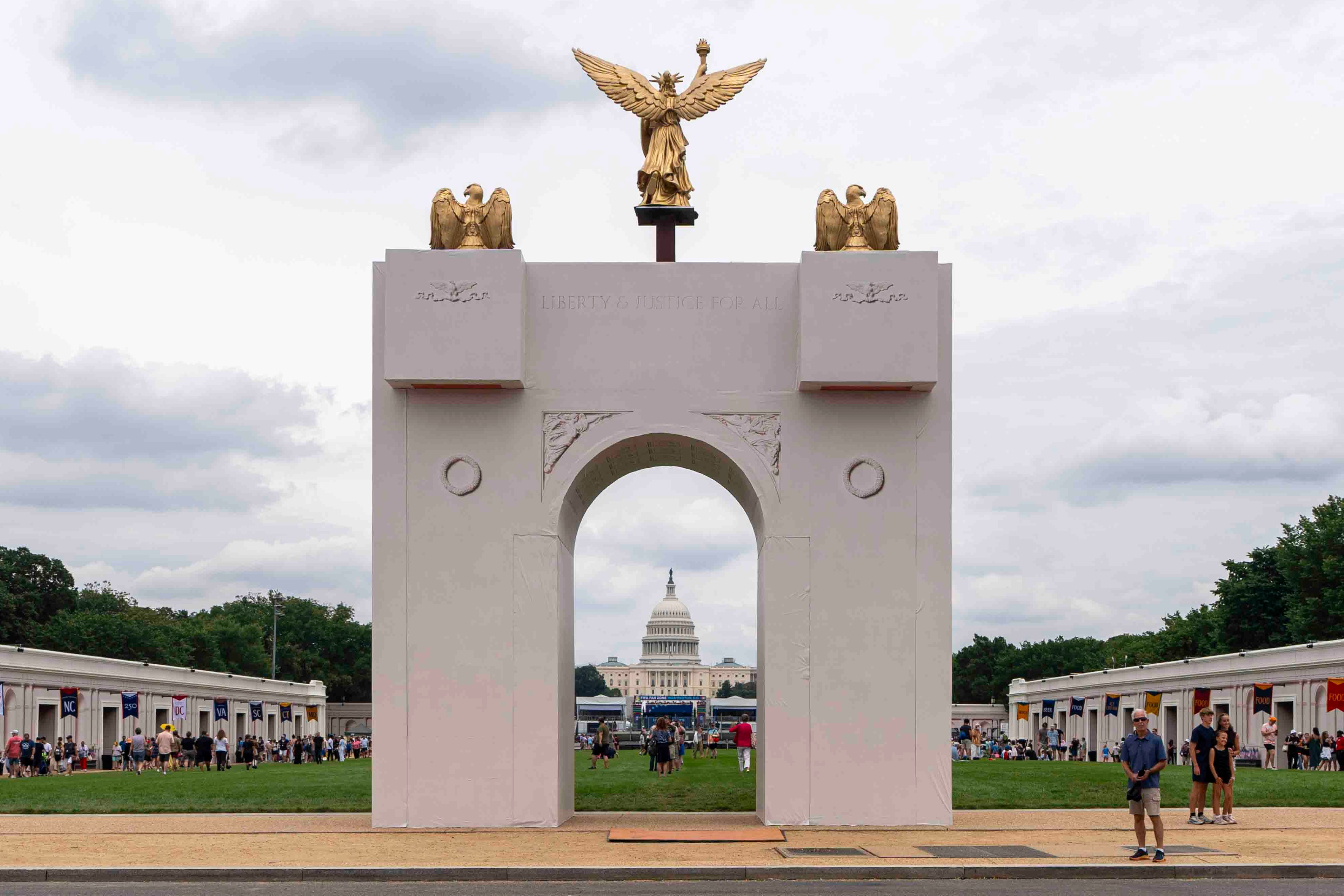
    A mockup of President Donald Trump’s proposed triumphal arch stands at the Great American State Fair on the National Mall in June.Jen Golbeck

    I try not to write a “hot take” column every time the president utters something completely irrational, because that would be at least five or six times a week and there’d be no time to write about all the other bad things happening in our country right now.

    I did find myself baffled by the coverage of what I thought was maybe the most bat-guano crazy thing to come out of Trump’s unhinged Truth Social feed: his “announcement” that his 250-foot “triumphal arch” in the nation’s capital will now become a sniper’s nest stockpiling live ammo and lethal drones.

    What read like a plea for a 302 involuntary commitment police call for 1600 Pennsylvania Avenue was instead treated by too many journalists as a serious news story, followed up by thumb-sucking pieces about Trump’s new penchant for invoking “national security” to silence critics of his many vanity projects. Fellow journalists: We need fewer “think pieces” and more “this man cannot think” articles.

    The U.S. Supreme Court, with its three Trump-appointed justices, has made it clear that the president will never be punished in a courtroom for his multiple high crimes and misdemeanors. But if another trial did somehow take place, I believe Trump could have grounds for an insanity defense, because he certainly appears to lack an ability to understand how politically toxic his shtick has become.

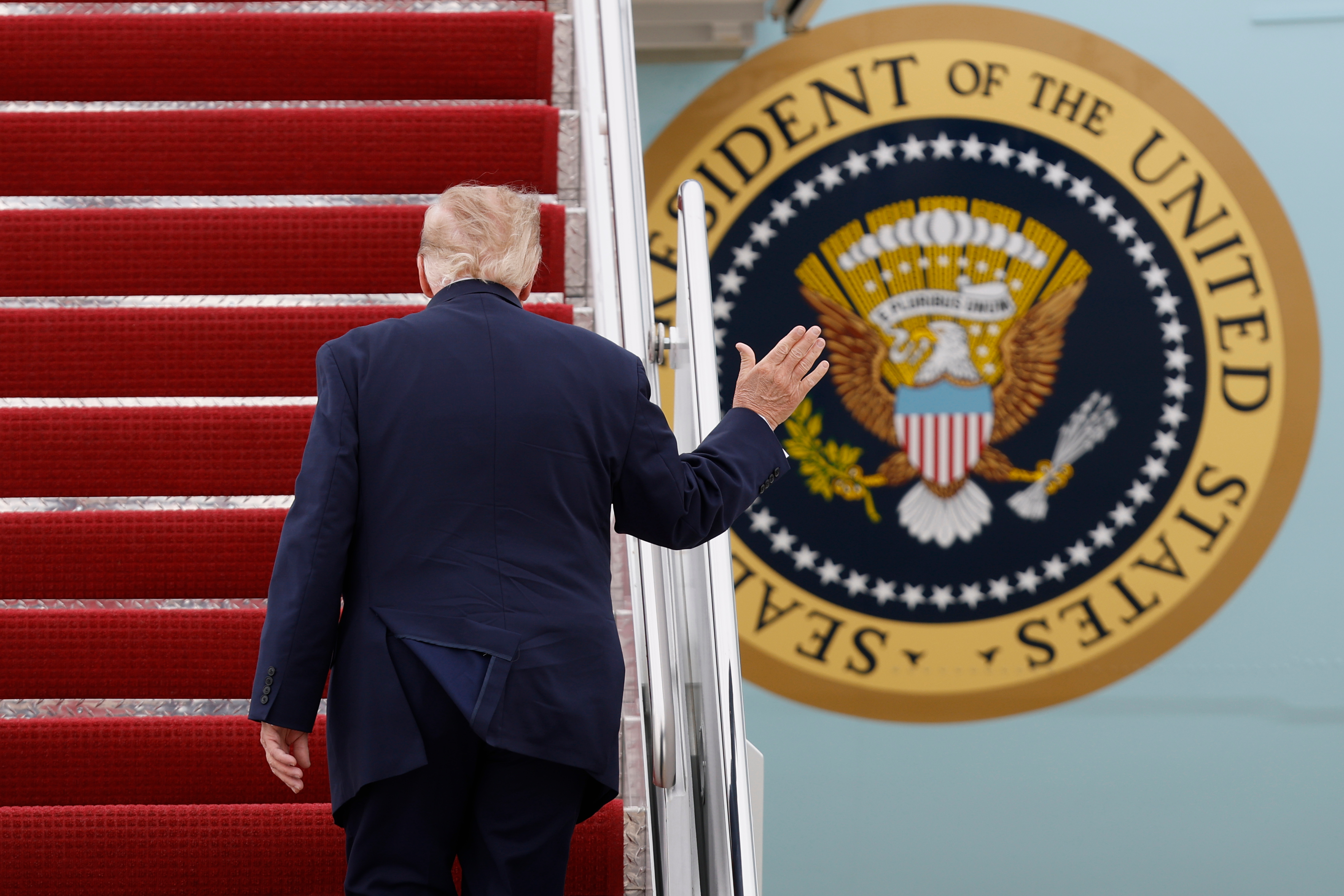
    This week, with some polls showing Trump’s approval rating plunging to Richard Nixon pre-resignation levels, the president commandeered Air Force One to fly to yet another college football stadium’s luxury box, with his blonde Rasputin, Natalie Harp, right by his side. This came after a week dominated by a gaudy three-day summit with Chinese dictator Xi Jinping, where tuxedoed guests gorged on sesame-crusted sea bass while nothing was done about the planet’s many pressing problems.

    President Donald Trump toasts with Peng Liyuan, the wife of China’s President Xi Jinping, during a state dinner in the East Room of the White House Thursday.Alex Brandon

    It was Trump’s close aide and social media guru Dan Scavino who put an exclamation point on the “let them eat cake” mindset by posting an AI video of him getting pushed through the aftermath of the Xi dinner on a cart spraying a bottle of Champagne, with two attractive women at his side. But can you truly “own the libs” with a 29% approval rating? Or do they just not care, and if so, why not?

    In a broken country that now runs on the “mind” and the “morality” of its weakened strongman leader, there are three explanations the media needs to discuss, but for the most part won’t:

    1. The oldest man ever elected president in American history is gradually succumbing to dementia, much like his own landlord father whose employees created a desk full of fake work for him in his final years, and his yes-sir Oval Office aides refuse to confront the problem.
    2. Trump has always been like this — an out-of-control, unrepentant narcissist — and he is determined to spend his last three years of power achieving only the things that matter to him, which are building giant monuments to himself as well as the infrastructure to make sure no one from his family goes to prison. In such a world, his approval rating, or your vote in November, matters not.
    3. The scariest of the three: Trump is crazy … like a fox. In other words, all the insane pronouncements about his power to change the names of things like AI or Lake Ontario are really just numbing the public to the idea that he can do anything he wants, including somehow nullifying the upcoming election with the Democrats looking likely to win both houses.

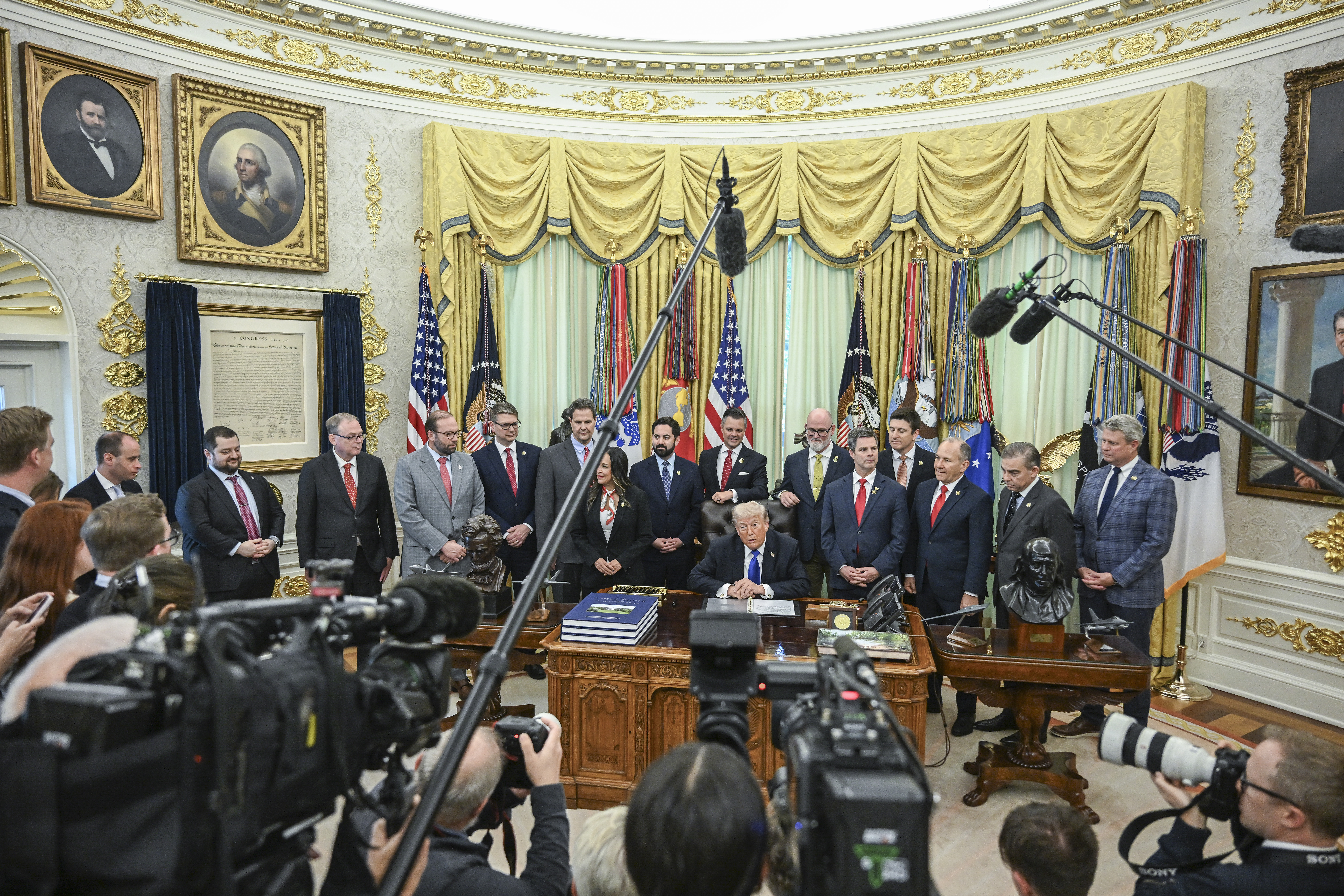
    That would certainly explain a rash of blatantly illegal recent actions such as spending taxpayers’ dollars on what are clearly political pro-Trump TV ads, not spending nearly $1 billion authorized by Congress, or his nakedly unconstitutional banning of journalists from the White House press pool because he didn’t like their stories.

    If no one is blocking Trump from these fairly serious violations, who will try to stop him when he sends troops or immigration agents to polling places, seizes huge numbers of ballots, or conspires with Republicans on Capitol Hill to not seat Democratic election winners? And then ignores judicial orders to cease and desist?

    This is exactly why the time to sound the alarm is now, and not Nov. 10 or Jan. 3, when undoing irrational and unlawful moves by the White House will be much, much harder. Look, TV punditry and newspaper analyses that stop pretending the president is a well man, or newspaper editorials calling for his resignation, or leaders in Congress backing impeachment won’t end the crisis … today.

    But calling attention now to Trump’s gross unfitness to hold office will set the stage for the battles to come — moving the Overton window on what can be done to restore democracy and helping any sensible Republicans understand there’s still a way to save both themselves and the country before it’s too late.

    The right words matter, a lot. We need to start urgently looking for them.

  • Networks to resume Trump coverage, even as White House excludes CNN

    Networks to resume Trump coverage, even as White House excludes CNN

    The major networks were set to resume their collective television coverage of President Donald Trump on Sunday, even though the White House blocked CNN from participating in the TV pool over the weekend, according to four people briefed on the deliberations.

    Five networks — ABC, CBS, CNN, Fox News, and NBC — collaborate to provide footage of Trump’s daily events, covering the president on a rotating basis and sharing footage with one another and other global news outlets.

    Throughout the past week, the quintet had suspended the TV pool in an effort to force the administration to reinstate CNN, after Trump barred its journalists from the White House grounds. The networks went so far as to refuse to air footage of portions of Trump’s summit with China’s top leader, Xi Jinping.

    But under a tentative plan that began taking shape late Friday, the other four networks would return to performing pool duties, the people said. Each time that CNN came up in the pool rotation, the group of networks would decide whether to provide a substitute crew. Otherwise, CNN’s slot would be left unfilled, and Trump would not receive major network coverage.

    The networks could agree to suspend the White House TV pool at any time, the people said.

    The major networks declined to comment Saturday. In a previous joint statement, they wrote that “no administration should restrict a news organization because it objects to its reporting.”

    Resuming the TV pool effectively hands Trump more control over the list of news outlets granted close-up access to many of his events. It also ensures that viewers will receive high-quality broadcast coverage of the president.

    On Friday, the White House allowed CNN to provide pool footage for Trump and Xi’s visit to the National Archives. But the administration later backtracked, telling CNN it could not serve as the pool for Trump’s trip to Tennessee on Saturday. The other networks declined to provide a substitute.

    In private discussions over the weekend, network leaders said that Trump’s decision to restart the barricade of CNN had left them choosing among several unpleasant options.

    If the TV pool was indefinitely suspended and an emergency or crisis occurred, there would be no cameras to film Trump, leaving the public relatively in the dark.

    CNN’s tussle with the administration is also wending its way through the courts, and that could take months to resolve. A legal dispute involving the Associated Press, which the administration barred from the White House press pool in 2025, has dragged on for more than a year. Network leaders believe it would be untenable to suspend TV coverage of Trump for a significant length of time, according to two of the people briefed on their discussions.

    (A federal court quickly restored the AP’s access, but an appeals court mostly reversed that decision.)

    Network leaders stressed that their new plan for pool operations was ad hoc: If the White House was making last-minute decisions about which outlet could attend certain presidential events, they said, then the network pool would do so as well.

    Trump’s standoff with the press began Sept. 18, when he abruptly banned CNN, MS NOW, and Politico from the White House, saying he disliked their coverage.

    On Thursday, a federal judge in Washington ordered the White House to reinstate the outlets for two weeks.

    The order, from Judge Timothy J. Kelly of U.S. District Court in Washington, made clear that CNN journalists should be given back their hard passes, the press badges that allow access to the White House grounds. But the ruling included no explicit instructions about whether the administration had to allow CNN back into the smaller TV pool, which is allowed to cover the president in tighter spaces like the Oval Office and Air Force One.

    The next hearing in the case has not yet been scheduled.

    For now, the president does not appear to be backing down. He posted on social media Saturday, in all capital letters: “Fake News should not be allowed in the White House!!! It has gone on far too long, at a tremendous cost to our country.”

    This article originally appeared in the New York Times.