
Blog

  • John Kruk says the ‘Hall of Pretty Good’ is ‘better’ than Cooperstown. What is it, and why are there so many Phillies?

    John Kruk says the ‘Hall of Pretty Good’ is ‘better’ than Cooperstown. What is it, and why are there so many Phillies?

    Last month, John Kruk was inducted into the Hall of Pretty Good, an internet-born honor that recognizes baseball’s fan favorites who weren’t cut out for Cooperstown.

    Kruk’s son, Kyle, texted the news to his father, a three-time All-Star with the Phillies in the ’90s.

    “I thought it was some people just farting around,” said John Kruk, who now is a broadcaster for the Phillies. “But after I read it, they got some good players in there.”

    The Hall of Pretty Good features names from Phillies World Series champion Shane Victorino to longtime Braves center fielder Ender Inciarte. Among other stipulations, no Cy Young or MVP award winners are permitted entry into the hall to ensure its “pretty good” nature. Any would-be inductee needs to receive 65% of an Instagram fan vote to join the hall’s ranks.

    Upon hearing this description, Kruk, who is known for his dry humor, had a lingering question.

    “Do you need to be under the influence of drugs to vote on this thing?” he asked.

    Quips like that, which he readily says on air, surely helped him receive 95% of over 38,500 fan votes to become the 77th member of the hall. A new generation of baseball fans has become familiar with Kruk because of his engaging personality in the booth. He wants to thank some of those fans, who voted him “pretty good,” in person.

    “We need to get a Hall of a Pretty Good ceremony,” Kruk said.

    What would Kruk’s ideal induction look like? Fittingly, it would not have the prestige of the National Baseball Hall of Fame, which is holding its induction ceremony on Sunday in Cooperstown, N.Y.

    “I wouldn’t wear a suit. That [stuff is] out,” Kruk said. “If you’re in the Hall of Pretty Good, wear whatever … you want. Not a stuffy suit. What, in August? People don’t want to sit outside and watch it; we’d have to go inside with air-conditioning, probably a middle school gymnasium.”

    The hall’s creator, Bryce Whitlow, is on board.

    “It sounds like [Kruk] totally understands the gist of the account,” Whitlow said, laughing. “It’s meant to be kind of funny, but also it is to seriously honor players like him as well. They do deserve a space to be honored and remembered. I love that he doesn’t want a big museum or a mansion, just a gym. And we can just wear like a polo or a T-shirt. That’s perfect.”

    ‘Give him flowers’

    Whitlow, 24, created the Hall of Pretty Good in 2024. The hall’s Instagram account currently boasts roughly 277,000 followers. Whitlow also hosts a podcast under the same name where he has interviewed past and current players.

    “I’ve always been an overly sentimental type of guy,” Whitlow said, “so that trickled down to my love of baseball as well. All the players I grew up loving, they weren’t talked about anymore because they weren’t Derek Jeter or Ryan Howard or Jimmy Rollins — those types of guys. It kind of saddened me a little bit.”

    Whitlow also noticed that baseball coverage has become more take-based and even toxic in recent years. He longs for a “positive, nostalgic place” to celebrate former players, so he made one. With the help of his wife, Amanda, Whitlow listed about 1,000 players who fit his “pretty good” standards. One by one, the account’s fans have voted on whether they should be in the hall.

    For Whitlow, adding Kruk was a no-brainer. The former first baseman logged 100 home runs (62 with the Phillies) and 592 RBIs (390 with the Phillies) during his 10-year career.
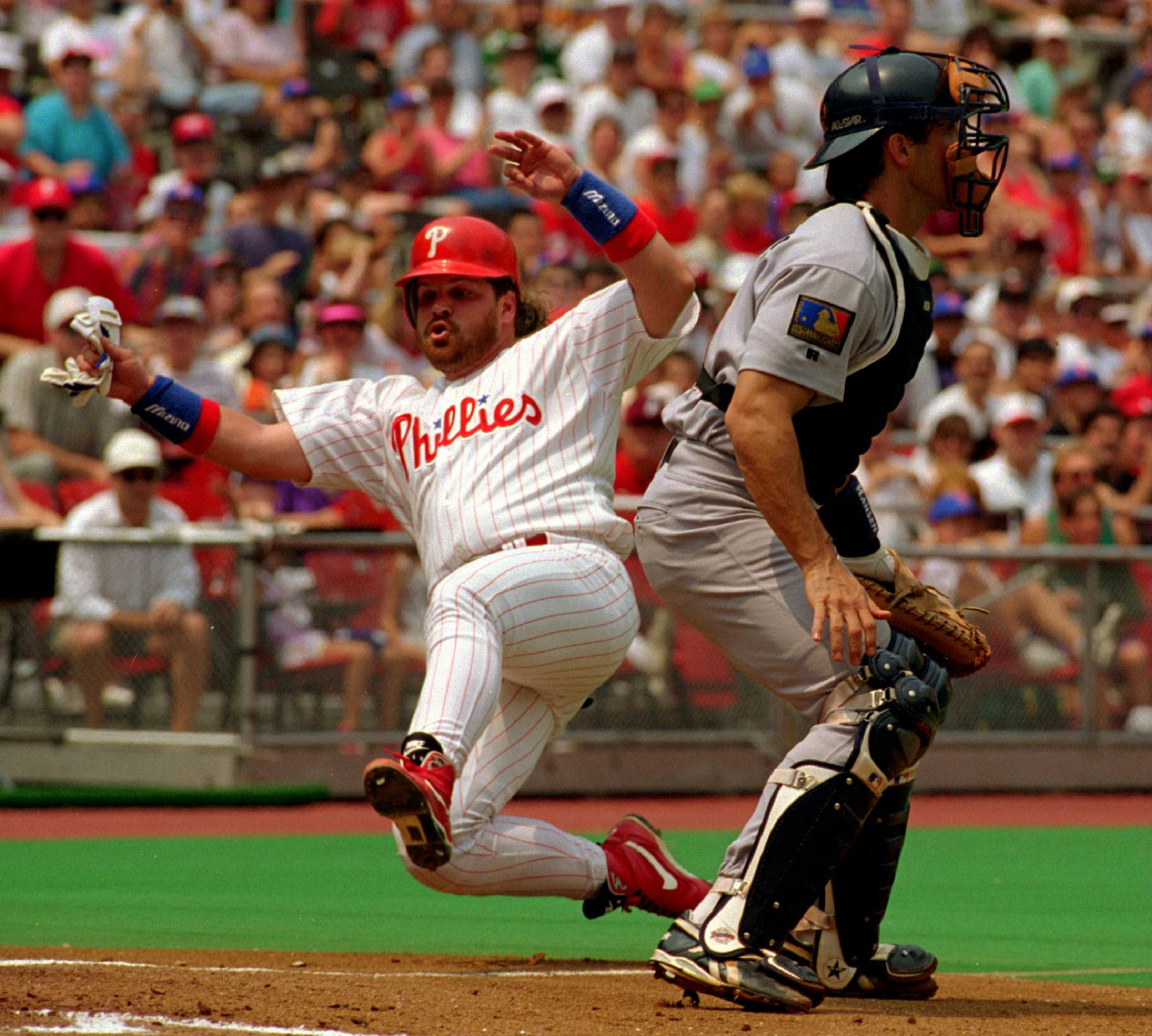
    During his days with the Phillies, John Kruk slides into home against the San Diego Padres at the Vet.ALEJANDRO A. ALVAREZ / STAFF FILE

    “Make no mistake, this guy was a borderline elite player,” Whitlow said. “It was a bit of a shorter curve, but it was amazing. People know how awesome he is in the booth, but just to see how dynamic of a player he was. The guy can hit, so it was cool to give him flowers for more of his baseball play than what he does in the booth.”

    Long before the Hall of Pretty Good, Kruk’s career did get the attention of Cooperstown. In 2001, six years after his retirement, Kruk became part of a select group of players who received just one Hall of Fame vote.

    “Think of all the people that have ever played, think of all the kids that wish they could have played at that level, and how many people have never gotten one vote,” Kruk said. “But I think [the Hall of Pretty Good] is better, personally. Because I know I’m not getting in that other one. I would never get in that other one. I resigned to that fact after my second year in the big leagues. To be considered by fans means more to me.”

    “I always thought making All-Star teams was neat. Back then, it was all fans [voting]. The fact that enough people thought I was deserving, I thought that was great. And this is the same thing to me, except I don’t have to play.”

    Full of Phils

    Many Hall of Pretty Good players bounced around while in the league. Along with Kruk and Victorino, other notable inductees who saw action as Phillies include infielder Jean Segura, catcher Darren Daulton, relief pitcher Steve Cishek (who was the hall’s first inductee), outfielder Juan Pierre, starting pitcher A.J. Burnett, pitcher Tom Gordon, and shortstop Didi Gregorius.


  • From national champion to pro lacrosse star: Delco’s Andrew McMeekin excels beyond the faceoff

    From national champion to pro lacrosse star: Delco’s Andrew McMeekin excels beyond the faceoff

    At halftime of this year’s NCAA men’s lacrosse championship at Scott Stadium in Charlottesville, Va., the NCAA commemorated the 25th anniversary of Princeton’s national title team.

    As the current Tigers went into the locker room, the players from 2001, which was the last time Princeton won the title, greeted them with cheers and words of encouragement to finish the game strong.

    “It was pretty serendipitous,” said faceoff specialist and Delco native Andrew McMeekin.

    The Tigers defeated Notre Dame, 16-9, on May 25 to claim the program’s seventh national title. Less than two months later, McMeekin is now making a name for himself in the Premier Lacrosse League with the Boston Cannons.

    McMeekin ranks third in the league in faceoff percentage (56.8%) and scored his first professional goal on July 11 in a 15-13 win over the Denver Outlaws.

    Playing at the next level

    Playing professional lacrosse was always McMeekin’s goal.

    He was coached by Chris Bates at Episcopal Academy. Bates was one of the original coaches during the PLL’s inaugural 2019 season. Once at Princeton, McMeekin watched the upperclassmen continue their careers professionally. Those personal ties with the league sparked a desire to reach the top of the sport.

    When the 2026 PLL college draft was held April 14, McMeekin wasn’t surprised that his name wasn’t called. Specialty players, like goalies and faceoff men, are rarely selected on draft night.

    Still, conversations with the Cannons coaches later that month assured him that his professional opportunity would come.

    Building a winning culture

    Before beginning his professional career, McMeekin had one final goal to accomplish at Princeton: Win a national championship.

    It was the culmination of a four-year journey to get there, McMeekin said.

    “It really did feel like a full four-year build,” he said. “Each year had its own story and our class in general took away the right things that we needed to take away after the seasons ended. It came together at the right time.”

    The group of 10 seniors, who lived together in a house off campus, met once or twice a week outside of practice to discuss how to set the standard, what being a good teammate looked like, and how they could improve as a group.

    Andrew McKeekin is Princeton’s career record holder for faceoff wins and groundballs.Courtesy of Camryn Ley

    “We learned to have honest and productive conversations early because we knew that it would benefit the team,” McMeekin said, “and since we, as a senior class, understood that, it trickled down from there.

    “All the guys really cared about was winning as a team, and that’s different from what I’ve seen from a lot of other teams. All the best teams in the country have extremely talented players, obviously, but I think the teams that are willing to sacrifice egos a bit and more just want to win as opposed to one guy having all the best stats — that’s what our team thrived on the most this year.”

    McMeekin left his impact on the Tigers lacrosse team. He’s the program’s career leader in faceoff wins (698) and ground balls (446), and he set the school’s single-season record this year for ground balls (145). He also finished 23rd in the nation in faceoff percentage (57.7%).

    Lacrosse player first

    Part of the success for McMeekin can be traced back to weekly four-hour round-trip drives to Cockeysville, Md.

    Since seventh grade, McMeekin has trained with Jeremy Rualo, founder of Inner Circle Lacrosse. Inner Circle is built around a simple philosophy: players should be lacrosse players first and faceoff specialists second.

    “I coach the position for the play, holistically,” Rualo said. “The play is to provide the ball in a possession to the offense. Two guys face off, yeah, but that isn’t decoupled from the midfield play that is about to happen.”

    Rualo, who works professionally in clinical genomics and next-generation sequencing, said faceoffs were never intended to be separated from midfield play.

    Andrew McMeekin is making a name for himself in the Premier Lacrosse League with the Boston Cannons.Premier Lacrosse League

    When he played lacrosse in high school and college, if a player took faceoffs, they were also expected to contribute as a midfielder. The specialization of the position developed later, eventually leading to the modern-day FOGO – “faceoff, get off.”

    Now, Rualo and McMeekin believe many young players specialize too early without developing the broader skills to become complete lacrosse players.

    “A lot of the time people look at faceoff as a very siloed and individual thing, but holistically it is a three-on-three with the wings and obviously very tied to possessions,” McMeekin said. “I take pride in making sure I have good plans for my wings and have a whole team view of the faceoff as opposed to just making it one-on-one the whole time.”

    Inner Circle emphasizes the entire play that happens after the whistle. Players train in game-like scenarios, learning not only how to win faceoffs, but also how to anticipate where the ball will go, compete for ground balls, and contribute as a midfielder.

    “Because of the way that we train, and the scale at which it is done and the holistic picture, what you get is the Inner Circlers are outstanding at midfield and that becomes this massive separator,” Rualo said. “No one else really does it, because they don’t think that way.”

    Developing complete lacrosse players is non-negotiable, Rualo added.

    “‘Why do you want to [stink] at lacrosse?’” he jokingly asks his players. “You should absolutely be a lacrosse player first.”

    McMeekin has carried this philosophy with him throughout high school and college. Now, he’s taking it to the next level.

    “The coaches are very adamant about me trying to take shots, and pushing transition while still being smart with my risk tolerance,” he said. “I’ve had a long leash in that sense to try and score and push the offense, so we are going to continue with that.”

  • Gov. Josh Shapiro’s admin consulted with Amazon and data centers on his marquee protections, records show

    Gov. Josh Shapiro’s admin consulted with Amazon and data centers on his marquee protections, records show

    Gov. Josh Shapiro spent months preparing a set of standards he promised would “hold data center developers accountable.”

    But behind the scenes, top Shapiro administration aides were drafting the framework with the input of Amazon and the powerful data center lobby and sharing early drafts with company officials before making them public, records show.

    The emails, first reported by climate change media outlet HeatMap earlier this year and obtained by an anti-data center activist in Montour County through the state’s open records law, show a cozy relationship between Shapiro’s administration and data center developers. But they also show the role the technology giants played in influencing the final version of Shapiro’s guardrails — though that influence only went so far.

    Shapiro in May introduced the initiative as the Governor’s Responsible Infrastructure Development, or GRID, which are a set of transparency and environmental standards data center developers would need to meet to access state tax breaks and other incentives Shapiro asked the General Assembly to write into law. The Democratic-controlled state House approved these standards, but it’s stalled in the GOP-controlled Senate, as legislators struggle to find common ground on one of the most hot-button issues facing them today.

    A spokesperson for Shapiro said the administration consulted numerous stakeholders as part of the drafting of the policies, including the Pennsylvania Building & Construction Trades Council, the Pennsylvania Environmental Council, the Natural Resources Defense Council, and more. Data center development is supported by many building trade unions across the state, which are likely to benefit from the major projects.

    Environmental groups broadly support Shapiro’s proposal and want stronger regulations on data center projects. Some groups want to ensure the provisions are mandatory, instead of voluntary, as Shapiro proposed.

    “As finalized, the Governor’s GRID standards set firm guardrails to protect Pennsylvania communities and hold data center developers accountable to strict standards requiring them to take additional action to ensure Pennsylvania communities benefit — and are not harmed — by these projects,” said Rosie Lapowsky, Shapiro’s press secretary, in a statement.

    Shapiro, a Democrat seeking reelection this year and a possible 2028 presidential contender, has remained data-center friendly and emphasized that Pennsylvania should play a core role in the “battle for AI supremacy.”

    But he has sharpened his rhetoric in recent months, citing his own personal evolution on the issue, as public opinion has also shifted with roughly 76% of Pennsylvanians across party lines opposing the projects.

    “Too many of these projects have been shrouded in secrecy, with local communities left in the dark about who is coming in and what they’re building,” Shapiro said in his budget address in February.

    Yet as other states like New York have put moratoriums on data center development, Shapiro has chosen to fast-track permits and support tax breaks to incentivize the massive projects, though he now believes they should meet certain voluntary standards.

    Amazon has already committed to a $20 billion investment in Pennsylvania — the biggest investment in state history — to build two data center campuses in Luzerne and Bucks counties and will access the state’s sales tax exemption for data centers as approved by the General Assembly in 2021.

    The Data Center Coalition — the powerful industry group made up of data center developers like Amazon, Google, Anthropic, OpenAI, and Microsoft — shared feedback on several drafts of Shapiro’s GRID principles and approved of most of its measures. But the industry still has “some significant concerns” with the voluntary program, including its clean energy provisions requiring certain percentages of its power to be from low- or zero-carbon sources.

    Dan Diorio, the Data Center Coalition’s executive vice president of state policy and government affairs, described the proposed GRID program’s requirements to access tax breaks as “extensive” compared to the 37 other states that offer sales tax exemptions.

    “We look forward to continuing to work with the legislature and the governor’s office on outlining what would ensure Pennsylvania remains a strong and competitive data center market,” Diorio said.

    Fengqi You, an energy systems engineering professor at Cornell University and data center expert, said it’s best practice for governments to consult all stakeholders, including industry leaders. But data center developers and local communities have opposing viewpoints that must be balanced, he said.

    “The right model, in my view, is to consult widely all the stakeholders, decide independently, and disclose transparently,” You said. “The standards are only as strong as the conditions and the consequences.”

    But some of the conditions should not be voluntary incentives, like Shapiro proposed, You said. This has been echoed by some environmental and anti-data center groups, which argue that the provisions don’t go far enough if compliance is ultimately voluntary for the tech giants.

    “It’s a useful starting point, but the incentive conditions should not substitute a minimum public protection for all,” You said. “If a company is receiving a tax exemption, then the state should have every reason to attach some very strong public interest conditions.”

    ‘Not ban or discourage data centers’

    Ahead of Shapiro announcing his plans for GRID as part of the state budget address, Shapiro administration officials went further in their efforts to reassure companies like Amazon, which they’ve courted for years, records show.

    In a Feb. 3 email, Department of Community and Economic Development Secretary Rick Siger wrote to Amazon Web Services staff that Shapiro would not “ban or even discourage data centers” and that “this new approach will not look back at projects or agreements already in place.”

    Other emails, sent in March by Sam Robinson, a deputy chief of staff to Shapiro, request that Amazon and the Data Center Coalition submit their feedback and mark up drafts. Shapiro’s administration declined to share those earlier feedback drafts.

    Legislators in Pennsylvania’s split General Assembly did not write Shapiro’s GRID proposal into law as part of this year’s $50.8 billion budget deal, and only enacted one new data center requirement despite near-unanimous support to repeal tax breaks for the projects. Shapiro now says he’s “considering all executive actions” he can do without the legislature.

    Colby Wesner, a pediatrician in Montour County, received troves of emails from top Shapiro administration officials, top Amazon staff, and more as part of several Right-to-Know Law requests he submitted to find out more about a now-blocked project near his home.

    “It’s a really insincere attempt,” Wesner said of the GRID principles. “It’s a public relations stunt.”

    Now that Shapiro is considering acting on his own, Wesner said he wants to know whether Shapiro will add restrictions or continue to welcome the projects into Pennsylvania.

    “Maybe he is listening to constituents and an executive action will demonstrate that he is listening to citizens,” Wesner added. “If it is, then great for him. But to date, everything he has done has been pro-data center industry.”

    Amazon , for its part, declined to comment on its role in the drafting of the GRID principles, which, if approved, would not apply to their ongoing projects. Becky Ford, a principal for global infrastructure expansion at Amazon Web Services, replied to Robinson on March 18 that they “look forward to providing feedback.”

    “We’re committed to being good neighbors in the communities where we build and operate, and will continue working with state and local leaders to invest responsibly and to keep creating good jobs across the Commonwealth,” an Amazon spokesperson said in a statement.

  • These 400 Philly kids almost didn’t make it to the finish line. They collected their diplomas Thursday.

    These 400 Philly kids almost didn’t make it to the finish line. They collected their diplomas Thursday.

    School faded as a priority when Simone Smith was a senior at Lincoln High, after her beloved grandmother died.

    “I didn’t have no one telling me to get up, go to class, so I missed a lot of school,” said Smith, 18.

    Her grades slipped, and she narrowly missed graduating with her class in June. But that near-miss galvanized her.

    Soon to be graduate Simeone Smith remembers her late grandmother Elodee, in the green room lounge ahead of the 2026 Summer Graduation Ceremony at the Met, on Thursday.Bastiaan Slabbers / For The Inquirer

    Summer school “was easy” once she buckled down, Smith said — she completed social science and English requirements, and on Thursday, she collected her hard-won diploma, one of nearly 400 Philadelphia School District students who crossed the stage at summer graduation after earning a handful of credits in summer school.

    “This graduation was delayed, but not denied,” author, actor, and poet Jaylene Clark Owens told a packed auditorium at the Met on North Broad Street.

    Smith, who wore a custom-made stole honoring her grandmother and will now enroll and play Division I basketball at Georgia Southern University, was thrilled.

    “It just feels great to be able to do this,” she said. “Me and my sister are the only ones that got our high school diplomas — my family has a lot of dropouts. But I wanted to do it for my Nana.”

    Soon to be graduates listen to the rendering of the National Anthem and Black National Anthem during the 2026 Summer Graduation Ceremony at the Met, on Thursday.Bastiaan Slabbers / For The Inquirer

    The graduation was a boisterous scene of joy and celebration: young people in an array of caps and gowns representing schools from all over the district, some in T-shirts and shorts under their robes, some in party dresses. Families wept, cheered, shouted: “You did that!” There was a steady drumbeat of applause, a sea of flowers and camera flashes, the arms of bursting-with-pride-parents reaching out to touch passing graduates.

    A beaming school board president Reginald Streater said Thursday’s graduation was no less significant or important than the ceremonies that happened in June.

    Family members and friends react as graduates celebrates receiving their diploma during the Philadelphia School District’s summer graduation ceremony at The Met on Thursday.Bastiaan Slabbers / For The Inquirer

    “You took ownership of your future,” Streater said. “There is never just one path to success. We believe in you, and we can’t wait to see all that you accomplish.”

    School Board President Reginald Streater and Superintendent Tony Watlington shake hands with graduates during the 2026 Summer Graduation Ceremony at the Met, on Thursday.Bastiaan Slabbers / For The Inquirer
  • Phillies Extra with Jim Bowden

    Phillies Extra with Jim Bowden

    Jim Bowden spent 16 years as a general manager with the Reds and Nationals before becoming an MLB analyst and commentator. And with the trade deadline approaching — Aug. 3 at 6 p.m. — he joined Phillies Extra to discuss the Phillies’ needs, some potential targets, and what it’s like to be a GM in the frenzied days leading up to the deadline. Watch here.

  • Letters to the Editor | July 24, 2026

    Letters to the Editor | July 24, 2026

    Transparent leadership

    On its face, the fact that more than 6,000 people who were not U.S. citizens were able to register to vote in New Jersey — and approximately 400 of them did cast ballots — was rightfully big news. Lost in the headlines, I believe, was the fact that Gov. Mikie Sherrill learned about this last week and, within six days, went public, knowing it would look bad for all those involved. This leadership — in which transparency and accountability are prioritized over political gain — is exactly what is needed in a situation such as this. I can speak to that as a resident of New Jersey and say I am proud to have Gov. Sherrill leading the way.

    Steve Clayton, Ocean, N.J.

    Flip-flops

    I read Mike Sielski’s recent column suggesting that in order for soccer to become a staple sport in the United States, “flopping” must be eliminated.

    I respectfully disagree. Flopping has little to do with soccer’s struggle to gain a major foothold here. Instead, it is the lack of scoring that turns American fans away. Americans are accustomed to the high level of excitement that comes from scoring in our most popular sports. We want the thrill of touchdowns in football, high-scoring basketball games, and more offense than a typical 1-0 baseball or hockey game.

    The key to increasing soccer’s popularity in the U.S. is to increase scoring. This could be achieved by changing the rules to favor offense, or increasing the width and height of the goals.

    Soccer is a beautiful game. Making it more exciting through more scoring will truly enhance its growth.

    Iz Cakrane, Haddon Heights

    Nuclear proliferation

    The Trump-Kushner cabal has decided to use the U.S. government to promote a Saudi nuclear enrichment program. Curious.

    Saudi Arabia is an autocratic kingdom run by a violent young Saudi prince, Mohammed bin Salman, whose wealth and power are much admired by President Donald Trump. Also, bin Salman’s financial tentacles directly enrich the president and his son-in-law, Jared Kushner.

    The Saudi Sunni branch of Islam operates madrassas dedicated to ideals that have faced criticism from human rights groups — misogynistic, homophobic, anti-democratic, and opposed to “decadent” Western humanist values.

    Now, in return for undisclosed financial considerations, President Trump promotes a Saudi nuclear enrichment program. Will there be meaningful oversight of the president’s business partner to prevent weapons-grade nuclear enrichment? Why empower the Saudi nuclear program? What will we do when China or Russia decide to enable proliferation in Iran? What about other nations seeking nuclear weapons to guard against a fickle U.S. regime?

    Will Congress exert restraint on the president’s nuclear business deal? Doubtful. More likely, history will witness this cultish Republican Congress unleash global nuclear proliferation. How will Americans respond?

    Mike Shivers, Altoona

    Join the conversation: Send letters to letters@inquirer.com. Limit length to 150 words and include home address and day and evening phone number. Letters run in The Inquirer six days a week on the editorial pages and online.

  • Dear Abby | Husband’s career struggles impact couple’s marriage

    DEAR ABBY: My husband and I have been married for 11 years and have two children. When we met, he worked two union jobs, paid his bills, saved his money and took care of his mother and grandmother when they needed his financial support. About six years ago, he decided he didn’t want to work with the union anymore, and I supported him in exploring alternative career paths. He has tried currency trading, personal training and used car sales. Nothing seems to stick.

    I work five days a week and have a part-time job on the weekends to bring in extra income. We are unable to make ends meet, and my extended family often has to bail us out because we can’t pay our bills. I told my husband I need him to start making a decent income again. He said he would, but I see little effort from him in terms of gaining solid employment.

    Our relationship is not going well. I have lost faith in him. I want to stay together, but I need him to provide for his family. I don’t know how much more of this I can tolerate. Please help.

    — OVERWORKED AND UNDERWHELMED

    DEAR O & U: Your husband has gotten comfortable with letting you do the heavy lifting in the family. If you don’t give him specific goals and deadlines, he’s not likely to clean up his act.

    State the exact monthly income you need him to provide, even if he ends up working several part-time jobs to do so. Then give him a certain number of job applications he must complete each day. If he doesn’t reach these goals by a certain date, the next step will be separation. This may seem harsh, but remember that you and your kids are suffering because he isn’t pulling his weight.

    ** ** **

    DEAR ABBY: I have been married to a wonderful man for 36 years. During the last 12 years, he has had heart surgery and some depression. He refuses to get out of his easy chair and do anything. He won’t bathe or shower and insists that washing off in the sink is good enough. He smells, and I’m embarrassed to go places with him because of it.

    I have tried to encourage him and let him know how I love a clean-scented man. He just doesn’t care. I won’t even kiss him. He refuses to help around the house and expects me to do everything. I still work, and we are raising a granddaughter. I’m no longer in love with him but I do love him. I have wanted a divorce for a while now, but, financially, I can’t afford to live on my own. Thank you for any advice.

    — ALL WASHED UP

    DEAR ALL WASHED UP: You need to discuss this with a doctor who can advise you about the options for treating depression and apathy after heart surgery, as well as an attorney who can help you determine if enough assets have been acquired during your 36-year marriage to allow you to live independently. Once you have that information, you may be able to give your husband an ultimatum and force him out of the easy chair and into a healthier lifestyle, which could add years to his life.

  • Horoscopes: Friday, July 24, 2026

    ARIES (March 21-April 19). Different interpretations begin to converge. Now people can coordinate their efforts and move forward together. Cooperation will get a little easier each day from here because everyone is working from the same understanding.

    TAURUS (April 20-May 20). Many people enter new social situations trying to fit in. You’ll have more success letting people discover who you already are. Genuine connections form faster when there is less translation required.

    GEMINI (May 21-June 21). Today, assess people based on their curiosity, not their knowledge. What they ask — or if they ask anything at all — will tell you much more about their interests and motivation than what you might learn in an answer.

    CANCER (June 22-July 22). Today brings themes of entitlement versus contribution. Judgments about who deserves what are often tangled up with people’s self-image and personal biases. Many who think they should get more have less claim to it. Merit and self-confidence don’t always go together.

    LEO (July 23-Aug. 22). Love doesn’t happen to you so much as through you. It moves you to act because you care. Decisions made from love rather than fear will lead somewhere worthwhile. Acts of love have long consequences.

    VIRGO (Aug. 23-Sept. 22). The current situation calls for strategic thinking. Resist the urge to focus only on the immediate outcome. Sometimes the real victory is gaining experience you’ll be able to use long after this particular challenge is over.

    LIBRA (Sept. 23-Oct. 23). You lived the past, you imagine the future and now is the only moment in which you can really affect destiny. Three different times seem to exist simultaneously today. It’s how you know you are, at your core, timeless.

    SCORPIO (Oct. 24-Nov. 21). There are two paths: one bathed in sunlight, promising warmth and familiarity, the other shrouded in moonlight, fog and the allure of the unknown. You don’t have to decide; your feet already know.

    SAGITTARIUS (Nov. 22-Dec. 21). When your brain is trying to hold too many open loops, you can feel overwhelmed. Write it out and the feeling of overload will decrease even before a single problem is solved just because you move the problem out of your head and onto paper.

    CAPRICORN (Dec. 22-Jan. 19). Make a request. Use clear language and say the thing that lets everyone know where you’re coming from and what you want. You’ll be pleased by how quickly circumstances improve once people understand exactly what you need.

    AQUARIUS (Jan. 20-Feb. 18). You don’t have all the information, and that’s OK. Focus on taking care of yourself instead of trying to figure everything out. Events will reveal something you couldn’t have anticipated, and that change will ultimately put you on a better path.

    PISCES (Feb. 19-March 20). You may be tempted to keep thinking about a problem that’s already been solved. Not because the answer is unclear, but because it’s not the answer you wanted. Accept it, deal with it and move on. The next chapter is waiting.

    TODAY’S BIRTHDAY (July 24). It’s your Year of the Exceptional Standard, in which you’re the one who gets to decide what quality looks like. As your expectations become your everyday reality, you’ll find yourself eating, sleeping, working, loving and living better. More highlights: You’ll attract both admirers and eager students. New styles and environments. Your inner life gets stronger in the same way muscles do: repetition. Libra and Capricorn adore you. Your lucky numbers are: 1, 13, 11, 17 and 26.

  • U.S. military says it’s launching new strikes on Iran as clashes escalate over shipping routes

    U.S. military says it’s launching new strikes on Iran as clashes escalate over shipping routes

    CAIRO — The U.S. military announced Thursday that it is conducting the 13th night of strikes against Iran as clashes escalate over shipping routes. Earlier Yemen’s Iran-backed Houthi rebels said they attacked two Saudi oil tankers in the Red Sea, potentially widening the Iran war as international oil topped $100 a barrel.

    U.S. Central Command said the latest attacks are designed to “further degrade Iran’s ability to threaten civilian mariners and commercial vessels transiting regional waters” as the Americans push to regain control over the Strait of Hormuz and restore the flow of international shipping.

    A short time later, Iranian state media reported explosions along the strait in Bandar Abbas and Qeshm, as well as to the northwest near Andimeshk and Omidiyeh.

    Meanwhile, the Houthis threatened to shut down another key trade route, with the world economy already reeling from Iran’s closure of the Strait of Hormuz. The threat came as Iran and the U.S. have stepped up attacks as they vie for control of the strait, through which a fifth of the world’s oil and gas transited in peacetime, setting off a scramble for alternative routes.

    President Donald Trump threatened “major military punishment” against the Houthis if their attacks on ships continue.

    “If they do this again, the U.S. will hold Iran responsible, in that the Houthis are a Surrogate and/or Proxy of Iran, and major military punishment will be inflicted upon Iran and, of course, the Houthis, themselves,” Trump wrote on social media.

    As the rhetoric escalated, so did the economic fallout. The price of Brent crude oil, the international standard, spiked more than 6% Thursday, to about $100 a barrel. That is the highest level since May, before the two sides reached a preliminary peace agreement last month that has since collapsed.

    Prime Minister Ali al-Zaidi of Iraq, which has close ties to both the U.S. and Iran, was in Tehran on Thursday to call for peace and dialogue, and he promised not to allow Iraqi territory to be used for attacks on Iran, his office said. Al-Zaidi met with Trump earlier this month in Washington.

    U.N. Secretary-General António Guterres warned Thursday that the region is being pulled “into an ever-widening circle of confrontation” with one crisis feeding another and every escalation triggering the next.

    “Diplomacy is the only way forward,” Guterres told the U.N. Security Council. He called for Pakistan’s efforts to mediate an end to the war to be strengthened.

    Houthi attacks are a ‘double whammy’ on oil shipments

    The Houthis’ SABA news agency said the rebels had struck two tankers, the Encelia and the Layla, in the Red Sea, causing fires on both. There were no reports of casualties.

    It was the first reported Houthi attack on a vessel since they announced a blockade of Saudi-linked shipping through the Bab el-Mandeb Strait earlier this week in retaliation for the kingdom’s blockade on Yemen and a recent attack on the international airport in Yemen’s rebel-held capital, Sanaa.

    Bab el-Mandeb, at the southern tip of the Arabian Peninsula, is a vital shipping chokepoint connecting the Red Sea to the Gulf of Aden. Around 12% of the world’s trade, including a fourth of global container traffic, passes through there, moving between Europe and Asia via Egypt’s Suez Canal.

    The state-run Saudi Press Agency reported an attack set the Encelia ablaze overnight in the Red Sea. It did not mention the Layla.

    The United Kingdom Maritime Trade Operations Center said it received a report of a tanker being struck by “an unknown projectile” 80 miles southwest of Al Shuqaiq, Saudi Arabia, in the Red Sea.

    The Houthi attacks put at risk oil shipments from Saudi Arabia’s Yanbu port on the Red Sea and present a “double whammy” on top of the disruption in the Strait of Hormuz, said maritime data and analysis firm Lloyd’s List Intelligence.

    Saudi Arabia has diverted millions of barrels a day of oil exports to Yanbu via an overland pipeline as the war has bottled up the Persian Gulf.

    The Houthi threat “raises questions on the viability of this route,” Lloyd’s said in slides accompanying an online webinar Thursday.

    The rebels say they are blockading Saudi Arabia, but during their announced blockade of Israel at the height of the war in Gaza, they targeted many vessels with little or no connection to that conflict, disrupting global trade.

    Both sides dig in over Strait of Hormuz

    Iran says it has the right to manage traffic and potentially charge fees in the Strait of Hormuz, which was open to all toll-free before the war. It has attacked ships using a route through the strait that is overseen by U.S. forces and intended to be outside Tehran’s control.

    Trump said on social media Thursday that sanctioned Iranian funds in the possession of the U.S. will cover the expense of fixing boats damaged in the war.

    “Please let this statement serve to represent, until further notice, that from this point forth, any and all damages done to Ships, Cargo, or anything related thereto, will be paid for by Iranian Money that the United States has in its possession, and controls,” Trump said.

    It was unclear what legal mechanisms Trump would use to access and spend the funds, but he said that doing so would be “the fair and equitable thing to do.”

    In response to Iran’s attacks, the U.S. began the widening campaign of strikes across Iran and restored a naval blockade of Iran’s ports. U.S. Central Command said it has redirected about a dozen commercial vessels and disabled one since the blockade resumed.

    The war of words has also escalated. Iranian Foreign Minister Abbas Araghchi said Tehran would adopt an “eye for an eye” policy on U.S. strikes against its infrastructure. U.S. Secretary of State Marco Rubio retorted that Trump’s policy is “a head for an eye.”

    “The price will continue to get higher every single night until they come to their senses,” Rubio told reporters while traveling in the Philippines for a regional summit.

    Iran’s health ministry said Thursday that 55 people have been killed and 629 have been wounded since renewed U.S. airstrikes began on June 27.

    Iran has responded to U.S. attacks by targeting energy infrastructure and desalination plants providing drinking water in parched neighboring Gulf countries.

    Polls have shown the war is unpopular among Americans, a fact reflected in the narrow passage Thursday of a resolution in the U.S. House to halt the war. Though a handful of Republicans crossed party lines to support the measure, the vote remained largely symbolic.

  • DA’s office says two prosecutors who said Krasner told them to ‘protect the office’ in controversial case are ‘ill-informed’

    DA’s office says two prosecutors who said Krasner told them to ‘protect the office’ in controversial case are ‘ill-informed’

    The Philadelphia District Attorney’s Office said Thursday that the two prosecutors who accused DA Larry Krasner of encouraging them to act unethically in a controversial appellate case did so in a court filing that was both unauthorized and “ill-informed.”

    In a court document filed late Thursday, written by Assistant District Attorney Thomas Gaeta and signed by Krasner, the office said prosecutors Katherine Ernst and Steven J. Wildberger acted inappropriately and without Krasner’s permission when they filed a brief Monday saying the office had a conflict in the appeal of Dennis Johnson, who is seeking to have his murder conviction overturned.

    The office said it had taken steps to address all of the issues it saw with Johnson’s case, and that Ernst and Wildberger’s assertions were “ill-informed” and made without firsthand knowledge because they were no longer a part of the case.

    The filing primarily focused on the steps the office took to ensure it was handling the case in a legal and ethical manner — and did not directly address the two prosecutors’ contentions that Krasner had asked them to “protect the office.”

    In their filing Monday, Ernst and Wildberger said they tried to persuade Krasner to allow the state attorney general’s office to take over Johnson’s appeal after the prosecutor previously assigned to the case, Jaclyn Mason, recommended that his case be overturned — a recommendation the office later sought to reverse, saying Mason’s filing was full of false statements.

    U.S. District Judge Paul S. Diamond then ordered a hearing on the matter. And in explosive testimony in federal court last week, Mason said she had sought to vacate Johnson’s conviction at the direction of her boss, Matt Stiegler — whom she accused of colluding with defense attorneys. Stiegler has said that was not the case.

    Mason, who has since resigned, also said she was later told to lie about the case to minimize scrutiny of the office.

    District Attorney Larry Krasner at a 2025 press conference.

    Ernst and Wildberger, who work in the law division of the DA’s office, said that as they were evaluating the case in the spring, they tried to encourage Krasner to refer the case to the state attorney general because of issues with how it was handled.

    For example, they said, Stiegler, the supervisor who they believed had made mistakes while overseeing the case, was still offering legal advice about it from a different role in the office, which Ernst and Wildberger viewed as self-interested and “inappropriate” because of his potential interest in clearing his name rather than evaluating the case on its merits.

    But Krasner’s office kept the case. And as they deliberated how to move forward, the two prosecutors wrote, Krasner told them “to litigate the case in a manner to ‘protect the office.’”

    Then, in late June, Ernst and Wildberger wrote, they again asked Krasner to refer the matter to state prosecutors, but “DA Krasner stated that there would be ‘consequences’ for anyone who notified the court of the conflict issues.”

    Ernst and Wildberger then filed a notice in federal court saying they believed the DA’s office was beset by conflicts and should not handle Johnson’s appeal.

    Krasner’s team, in its first response to the matter this week, said that was not true.

    Ernst and Wildberger, they said, were appropriately excluded from the case as soon as they disclosed a personal conflict with it, and did not have firsthand knowledge of the office’s discussions thereafter.

    The prosecutors “are disqualified from filing or speaking on behalf of the Commonwealth” and were not authorized to file the “notice of conflict” or to speak for the office about the matter, they said.

    Any discussions Ernst and Wildberger had with the office about the case are privileged conversations they should not be able to disclose, the DA’s filing said.

    To remedy the issue, the office said, it has hired a new prosecutor to handle the case who has been walled off from the ongoing conversations. Assistant District Attorney Jean Peters-Baker, who recently joined the office and has spent more than 25 years as a prosecutor, will review Johnson’s case and decide if it has merit, the filing said.

    Johnson was convicted of second-degree murder in 2009 in the shooting death of Kenyatta Smith during a robbery outside a North Philadelphia convenience store two years earlier. He was sentenced to life in prison.

    Johnson appealed his conviction, in part because he said his trial attorney was ineffective. Mason filed court documents in 2022 agreeing with that assertion and saying Johnson’s conviction should be overturned.

    But then, this spring, others in the office reviewed the case and took the opposite view.

    Ernst and Wildberger said they were prepared to testify before Diamond about the situation. Others in the office are also expected to take the stand as the case proceeds.

    The judge has not yet scheduled a date for testimony.