SpaceX launched its enormous Starship into orbit for the first time Monday and successfully delivered the most advanced Starlinks yet, but decided to cut short the flight.
SpaceX said the spacecraft would reenter over the Pacific and splash down north of Hawaii three hours after blasting off from Texas. The company had been aiming for a 10-hour flight, spanning six full laps around Earth, to prove its readiness for NASA’s Artemis moon program.
The spacecraft almost didn’t make it to orbit after one of its engines shut down too soon. But with everything else working well and the bad engine no longer needed, flight controllers decided after several tense minutes to proceed as planned.
“Starship is orbital,” Mission Control announced to cheers.
NASA Administrator Jared Isaacman congratulated SpaceX on reaching orbit and “managing every step in a safe, responsible, and especially inspirational way.”
Rocket carries 26 of Musk’s most advanced Starlink satellites
Founder Elon Musk’s showpiece rocket — the biggest and most powerful ever built — carried 26 of the latest and most advanced Starlink satellites to join the 11,000 older models already providing internet service. They popped out of the spacecraft one by one, drawing more cheers from the SpaceX crowds looking on from the launch site at Starbase, Texas.
The decision to end the flight early came soon afterward. No reason was provided.
This time, SpaceX was intent on circling the globe from an altitude of 170 miles — not just once but six times over almost 10 hours, ending with a Pacific splashdown near Chile. While Starship achieved the proper orbit zipping along at 17,500 mph, flight controllers opted to play it safe and bring it back several hours sooner, after just a couple of laps.
The first-stage booster was never meant to return to the Starbase launch site either, instead dropping into the Gulf of Mexico within minutes of the morning liftoff.
SpaceX wants to ensure that everything works before flying Starship back to Starbase. If the spacecraft breaks apart over land and rains debris onto people, “our popularity would diminish very rapidly,” Musk said at a business summit earlier this month. “That’s why we’re being extremely cautious here.”
Depending on the findings from Monday’s orbital debut, the next Starship could return to the launch pad with giant mechanical arms grabbing the hovering spacecraft. If the catch works — Musk gives it even or slightly better odds — then SpaceX will refly the spacecraft by year’s end or early next year.
The 407-foot rocket was designed from the start to be fully reusable — a key to lowering launch costs. SpaceX managed to salvage the last Starship from the Indian Ocean in July. Engineers modified the newly launched Starship’s heat shield based on hands-on inspections from the recovered spacecraft, which is being tugged back to Starbase.
SpaceX wants Starship to be certified for orbital flight
NASA’s Artemis III mission is coming up as soon as next summer, a triple-launch docking exercise in orbit around Earth between an Orion capsule full of astronauts and competing lunar landers. Jeff Bezos’ Blue Moon will blast off first, then Orion — which will close in for a linkup — then Musk’s Starship for a docking with Orion once Blue Moon is unleashed.
The next mission — Artemis IV slated for no sooner than 2028 — would have astronauts landing on the moon in either Blue Moon or Starship, whichever is ready first. Subsequent moonshots will alternate between the two billionaires’ landers.
Musk originally developed Starship for Mars, intending to launch scores of them with the red planet’s first settlers. For now, he plans to focus on the moon and use Starship to haul satellites into orbit by the truckload, phasing out the company’s frailer Falcon 9 rocket within several years. A second Starship launch site is nearing completion at Florida’s Kennedy Space Center and a third is planned for Louisiana.
Bryan Watts has spent more than three decades watching ospreys reclaim the Chesapeake Bay, returning each spring from South America to crowd its tidal rivers and creeks, shorelines, channel markers, and nesting platforms. The William & Mary biologist followed their recovery from the DDT era as the bay became home to the world’s largest breeding population of ospreys.
Now one of America’s great wildlife recoveries is coming undone. Across the Chesapeake this year, Watts and his colleagues at William & Mary’s Center for Conservation Biology recorded the worst osprey breeding season they have ever documented. Researchers working these waters have found chicks emaciated and starving in their nests.
A starving osprey chick can seem almost weightless — its breastbone sharp beneath feathers, its body too small for the nest around it. Three summers ago, Watts spent 3½ hours checking 81 nests on Mobjack Bay: empty nest after empty nest, with just three chicks at the end. Seeing a dead chick still gets to him, but what really stops him is absence. Watts drove home, he said, “with a sick feeling that something is clearly not right.”
The warning sign is no longer confined to the Chesapeake. Last week, Watts and his colleagues released the first picture of the 2026 breeding season up and down the East Coast: 2,886 osprey pairs in 65 study areas across 10 Atlantic states. Only 28% of saltwater study areas produced enough young to maintain their populations, compared with 93% of freshwater areas. The deficits extend from the Chesapeake through Delaware and New Jersey to Long Island and southern New England.
At the center of that widening crisis is a fish most Americans would hardly recognize. Atlantic menhaden are silver, oily, and generally less than a foot long. Rich in fat and calories, they are the principal prey of Chesapeake ospreys and the nucleus of a food web extending far beyond the bay, including the fish humans do eat. Striped bass, bluefish, whales, and seabirds feed on them; Maine lobstermen put them in traps.
A fight over menhaden has brought together an unlikely — and increasingly vocal — coalition. Recreational anglers want menhaden in the water for the striped bass and other game fish that eat them. Charter captains need those predators to make a living. Lobstermen need menhaden for bait. Conservation groups want enough left for ospreys and other wildlife.
What remains uncertain is why menhaden aren’t there when birds and fishermen need them. Scientists are looking at several possible explanations, including commercial harvest and changing water conditions. Timing may matter, too: Osprey food demand has typically peaked from mid-May through mid-July, while in some recent years large numbers of menhaden haven’t arrived until weeks later.
But a growing number of critics have begun to focus on Omega Protein, which runs the Atlantic Coast’s last remaining menhaden reduction plant, located in Reedville, Va. The state receives about three-quarters of the entire Atlantic Coast menhaden quota, and roughly 90% of its share goes to the reduction fishery supplying Omega.
At the Reedville plant, menhaden are processed on an industrial scale into fishmeal, fish oil, and other products. Its exclusive supplier, Ocean Harvesters, caught nearly 300 million pounds of Atlantic menhaden for the plant in 2024. That scale alone has made the fleet impossible to ignore in the debate over how many menhaden are being left for everything else that eats them.
Steve Atkinson, chairperson of the Virginia Saltwater Sportfishing Association, argues there are no longer enough menhaden in the bay to support both industrial reduction fishing at its current level and a healthy ecosystem. Members of his group are seeing fewer schools of menhaden and catching fewer game fish, which is why they support cutting the bay harvest cap in half in the meantime. “We need action now, not five years from now,” he said.
Omega and Ocean Harvesters reject that conclusion, saying scientists have not established that their harvest causes local shortages or osprey failures. That dispute — over a fish neither side fully controls, eaten by a bird neither side can feed — is at the heart of the fight.
Ben Landry, vice president of public affairs for Ocean Fleet Services, the parent company of Ocean Harvesters, said in a statement that blaming osprey starvation on the menhaden fishery is “an oversimplified explanation for a complex ecological issue.” Water conditions, other prey, predators, and habitat change all contributed to the birds’ decline, he added.
Watts himself describes the evidence as a strong association, not proof that commercial harvest caused the nesting failures.
Regardless of the exact cause, scientists have documented major shifts within the Chesapeake. In saltier waters, where ospreys depend most heavily on menhaden, 81% of nesting pairs failed to raise a single chick in 2026. Across those waters, four nesting pairs produced, on average, just one chick among them — far short of the rate needed to sustain the population. In fresher reaches, where ospreys can turn to catfish and gizzard shad, pairs produced enough young to sustain their numbers.
The food reaching the nests has changed, too. At some Chesapeake nests, Watts found, ospreys are bringing home menhaden more than 80% less often today than they did in the 1980s.
Anglers coastwide are seeing their own version of that shift. For 26 years, Chris Newsome made his living guiding fishermen on the Chesapeake from Virginia’s Middle Peninsula. A biologist by training, Newsome knows there will always be pockets of fish somewhere. What has disappeared, he said, is the ability to count on finding them. The good fishing comes in stretches that are “shorter and shorter and shorter.” For a charter captain, he said, what’s needed is “predictability.” This year, after what he called “the worst fishing in my lifetime,” Newsome closed his business and put his boats up for sale.
Fishermen up and down the Atlantic Coast describe the same increasingly uneven pattern: One community can be surrounded by menhaden, also called pogies or bunker, but more fishermen cite long stretches between sightings where they once reliably found them.
Off Virginia, spotter pilots search from the air for the dark stain of a menhaden school. Seine boats encircle the fish with massive purse-seine nets, close the bottom like a drawstring and pump the catch aboard larger vessels, including Ocean Harvesters’ new $9 million, 165-foot Tangier Sound. The fleet can also follow migrating menhaden north into federal waters, sometimes as far as New Jersey.
Reedville is the survivor of a once-sprawling industry. At its peak, more than 20 processing factories operated from Maine to Florida. As stocks contracted and states imposed restrictions, the plants disappeared; by 2006, Reedville was the only one left.
The corporate arrangement behind that fleet is unusual. Cooke, the Canadian seafood conglomerate that bought Omega for nearly $500 million in 2017, is constrained by a federal law that allows a fishing vessel to be owned by a company only if U.S. citizens own and control at least 75% of the company. Ocean Harvesters is 80% owned by Seth Dunlop, a U.S. citizen, Cooke employee, and nephew of Cooke CEO Glenn Cooke; Omega owns 20%.
Most of the catch is reduced into fishmeal, fish oil, and concentrated products rather than sold as food for people. Before Cooke took Omega private, federal filings identified Nestlé Purina PetCare as one of Omega’s biggest customers. Some Blue Buffalo and Purina pet foods list menhaden fish meal or oil among their ingredients, though the labels do not identify suppliers. Landry said in an email that most of Omega’s fishmeal and oil is sold domestically, including into pet food markets.
Most of Omega’s sales are domestic, with about 17% going overseas last year, according to Landry. Omega markets a concentrated menhaden product as an “attractant” for aquaculture feed pellets, and trade records reviewed for this story show its products shipped to Honduras, Indonesia, and Vietnam. That rankles fishermen who see menhaden becoming harder to count on at home.
A menhaden left swimming is hard to value. But some of that hidden worth can be measured. A June 2026 study commissioned by the Theodore Roosevelt Conservation Partnership, an advocacy group, estimated that East Coast anglers spent $804 million in 2025 on trips using menhaden as bait, chum, or scent. The estimate combines a survey of 1,316 anglers with federal fishing and spending data. For comparison, Omega says its combined Atlantic and Gulf operations generate about $300 million in annual sales, and Omega and Ocean Harvesters say their Virginia operations directly employ about 260 people.
Balancing those demands falls largely to the Atlantic States Marine Fisheries Commission, a 15-state body that manages menhaden along the coast. It classifies Atlantic menhaden as “not overfished” and says overfishing — fishing above the established threshold — is not occurring. But that is a coastwide finding. ASMFC says its assessment cannot tell whether menhaden are abundant enough in a smaller area such as the Chesapeake Bay.
Last year, the commission lowered its estimate of the menhaden population after revising a key estimate in its assessment: how many menhaden die of natural causes each year. ASMFC stressed that the change reflected a better understanding of the fish, not a decline in their numbers.
Jerald Ault and Jiangang Luo, University of Miami scientists whose reanalysis prompted that revision, now say even the revised estimate may be too high. “If natural mortality is set too high,” Ault said in a university statement, “the population can appear able to support more fishing than its biology allows.” ASMFC reviewed an earlier version of their analysis but not the final peer-reviewed paper.
The lack of definitive science has become an argument against tighter limits. Yet Virginia lawmakers have spent years failing to fund the research that could provide it.
In 2023, the General Assembly ordered the Virginia Institute of Marine Science to draw up a research plan for menhaden. Scientists, conservationists, anglers, and industry representatives agreed on nine research priorities, including abundance and localized depletion.
But in each legislative session since, bills to fund that research repeatedly stalled. In 2026 alone, three different proposals failed to advance during the session: one to fund research aimed at understanding menhaden abundance in the bay, another to temporarily halt industrial fishing there, and a third to limit when and how the fleet could fish.
Omega says it never opposed the research. But a letter its lobbyist sent to Virginia lawmakers last year proposed replacing the full study with a two-year pilot or deferring it until 2026. Landry said that officials at the company believed full funding was no longer available by then and that the study as written was not scientifically sound research.
“The industry is now using that delay in definitive science as an excuse to stall new limits,” Chris Moore, the Chesapeake Bay Foundation’s Virginia executive director, said in an email. “The alarm bells in the bay keep getting worse. It’s mind-boggling.”
Landry, however, said the industry has helped fund preliminary research, given Virginia Institute of Marine Science researchers access to its vessels and “supported the research appropriation included in Virginia’s current budget.”
After the legislation failed again this year, Virginia Gov. Abigail Spanberger kept the research alive through the state budget, and Virginia provided $2 million over two years for the Virginia Institute of Marine Science to begin the work. Meanwhile, the commission is now considering changes to the Chesapeake reduction cap ranging from no cut to a 50% reduction.
Omega and Ocean Harvesters oppose a 50% cut to the bay harvest, and Landry noted that regulators classify menhaden as “not overfished,” adding that tighter Chesapeake limits aren’t justified “without a demonstrated biological need.”
The fight extends to Louisiana, where Omega operates alongside Daybrook Fisheries, another menhaden-processing company. After three net failures spilled an estimated 850,000 fish in 2023, lawmakers strengthened tracking, enforcement, and reporting. But a 2026 bill to move the fleet farther offshore and reduce other species caught with menhaden failed.
Back on the Chesapeake, the numbers keep getting worse. In the saltier reaches where ospreys depend most on menhaden, the birds’ reproduction has fallen for three straight years. If that continues, Watts projects the bay’s osprey population could fall by roughly half within a decade.
By September, the Chesapeake begins to empty of ospreys. The adults leave first; the young follow later, migrating alone, sometimes thousands of miles south. Those that survive will return next spring to the same rivers, the same navigation markers, sometimes the same nests.
For generations, that journey has ended with the same promise. They came home to the Chesapeake, circled above the water and hunted.
I was angry when I learned that a grand jury found no cause for criminal charges in the death of Nolan Wells, a Black teenager who died after a July 4 boat trip to an island in Mississippi with a group of white friends.
The facts surrounding the case were strange from the time Wells went missing. His friends said the 18-year-old wanted to stay on Horn Island to talk to a girl, so they left without him, and Wells left his phone on the boat. Days later, when Wells’ body was found floating in the waters off the island, Jackson County sheriff officials declared that no foul play was suspected.
Then, just days after the grand jury concluded Wells’ death was “consistent with drowning,” Wells’ family released details from the official autopsy report from the Mississippi medical examiner. The autopsy indicated that there was no water in the lungs, stomach, or throat of Wells, which begs the question: How does one drown without ingesting water?
That troubling question, along with a history that includes countless lynchings, the murder of Emmett Till, and the murder of voting rights activist Medgar Evers, demands a deeper investigation. Yet I know, in that secret place where my ancestral memory lives, that the investigation might never take place.
Wells’ family did all they could to find the truth. They hired attorney Benjamin Crump, sued social media companies for cell phone records, and hired an independent pathologist to conduct a second autopsy after the Mississippi medical examiner performed the initial postmortem. Wells’ friends were mostly silent, but the internet was not. Observers retreated to their familiar corners — left and right, progressive and conservative, bigoted and anti-racist. Our opinions of the case tended to be shaped by our long-held views and lived experience.
Perhaps that’s why, when Jackson County District Attorney Angel Myers McIlrath promised to conduct a fair and thorough investigation, I was skeptical. Then, when she announced that she would convene a grand jury, I was hopeless.
Because grand juries operate in secret and only view the evidence presented to them by the prosecutor, the outcome is heavily influenced by the prosecutor. I believe that’s why we don’t see criminal charges in cases like the tragic death of Nolan Wells.
Just as my ancestral memory calls out to me and screams for racial justice, the history of Mississippi calls out to the current power structure and demands white supremacy.
It’s why the district attorney could release a redacted grand jury report, never share all the evidence, and scold the public for questioning whether race played a role in Wells’ death.
“What I cannot accept, what I cannot ignore, is that false narratives that Nolan’s death was somehow racially motivated, and that this is a case of another young Black man denied justice by a racist, corrupt system, were perpetuated and allowed to spread,” McIlrath said in a video explaining the grand jury’s decision. “There is not a shred of evidence to support these narratives.”
Perhaps the DA can’t accept what she framed as false narratives, but how can we know they’re false? The grand jury operated in secret, then released a report with some of the details blacked out. There was no preliminary hearing, no public airing of evidence, and no real attempt to answer the family’s ongoing questions about what happened to their son.
There is only one thing that I know to be true in the death of Nolan Wells, and his mother, Christine Wonsley, gave voice to it in the wake of the grand jury’s findings.
“Last night was a reminder that our son’s life does not matter to those who hold positions that are supposed to serve and protect the public,” Wonsley said.
It breaks my heart that she’s right.
Editor’s note: An earlier version of this column misstated the location of the island that had been visited by Nolan Wells; it was Horn Island. It also incorrectly noted that Wells’ organs were removed before his body was released to his family; the organs were included with the rest of his remains.
Lenora D. Wolfgang, 91, of Philadelphia, French professor emeritus at Lehigh University, literary researcher, author, teacher, mentor, and artist, died Thursday, May 14, of heart failure at her home near the Philadelphia Museum of Art.
Professor Wolfgang, or, as many of her Lehigh students and colleagues called her, Madame Wolfgang, planned to study art in Paris after high school and live as a painter. But, she told her family, she became so enthralled by the French language at Philadelphia High School for Girls that she curbed her art aspirations, earned three degrees in French at the University of Pennsylvania, and taught French and French literature at Lehigh for 26 years.
Inspired by professors at Penn, she became an expert in medieval French language and literature, and her doctoral dissertation and first book were an analysis of an 800-verse prologue to a 13th-century French poem. She studied in France on a Fulbright Scholarship in 1956 and ’57, and in Spain on a grant from the American Council of Learned Societies in 1978.
She wrote two books on French poetry, served research fellowships with the National Endowment for the Humanities in the 1980s and ’90s, and earned a grant from the American Philosophical Society in 1981 to transcribe manuscripts at the National Library in Paris. In 1990, reviewers at Penn’s French Forum journal said her second book, also on 13th-century French poetry, “provides the modern scholar with a standard text and thorough apparatus that will serve current and future generations well.”
This photo and story about Professor Wolfgang appeared in the Morning Call of Allentown in 1984.Newspapers.com
She belonged to many academic language and literature organizations, and was a student adviser and faculty committee member at Lehigh. In tributes, former colleagues called her “a true mentor” and “a real mensch.” One said: “It was clear that I had an ally in Lenora and that she wanted me to succeed.”
A former student said she was “a good friend and sounding board” in a 2025 interview with the Lehigh alumni relations department. “She was always ready to help, share her knowledge,” a former colleague said, “and always did it with tact and unselfishness.”
Professor Wolfgang earned bachelor’s and master’s degrees, and a doctorate in French at Penn. She taught French classes at Temple and Rutgers Universities, Penn, and high schools in Philadelphia before joining Lehigh’s Department of Modern Languages and Literature in 1980.
She commuted three hours round trip to Lehigh, in Bethlehem, Pa., from West Philadelphia three days a week and was promoted from assistant professor to associate professor in 1986, then to full professor in 1989. She retired from Lehigh in 2006.
Professor Wolfgang (center) traveled the world and enjoyed hosting dinner parties with family, friends, and academic colleagues. Courtesy of the family
After Lehigh, Professor Wolfgang taught continuing education classes about French playwright Molière and other topics to adults at the Osher Lifelong Learning Institute at Temple. After the COVID-19 pandemic lockdown ended, she returned to the institute briefly as a student.
Professor Wolfgang was adept at painting as a girl in West Philadelphia and won several art competitions, and later showed her photography at Penn’s Faculty Club. “She was a natural talent,” her family said in a tribute.
Lenora Divida Poden was born Sept. 25, 1934, in Philadelphia. Her parents emigrated from Poland and Romania, and her mother leftthe family when Professor Wolfgang was in junior high school.
She and her father had to hide their Jewish heritage and alter their last name to minimize antisemitic attacks. “Yet Lenora overcame these challenges,” her family said, “excelled academically, and rose to the top of her academic field.”
Professor Wolfgang married her first husband, Marvin Wolfgang (above), in 1957, and her second husband, Leon Salganicoff (below), in 2010.Courtesy of the family
An exceptional student, she was valedictorian of both her 1952 senior high school class at Girls’ High and her 1956 senior undergraduate class at Penn’s College for Women. She married Marvin Wolfgang, a professor at Penn, in 1957, and they had daughters Karen and Nina, and lived in University City.
In 1977, The Inquirer featured their house in a photo spread about its French-inspired Gothic style of architecture. Professor Wolfgang said: “Perhaps that is one reason I feel so very much at home.”
After her husband died in 1998, she married Leon Salganicoff, a professor emeritus at Temple, in 2010. He died in 2011.
Professor Wolfgang was an avid reader. She traveled the world, listened to classical music, and enjoyed hosting dinner parties with friends and academic colleagues.
Professor Wolfgang (left) doted on her family and sent personalized birthday cards. Courtesy of the family
She almost went to law school in the 1970s before gaining her full-time teaching position at Lehigh. She doted on her family, sent personalized birthday cards, and kept in touch with teachers, colleagues, former students, and friends even after they parted.
“She was brilliant,” a longtime friend said in a tribute, “and she was fun.” Her family said: “Everyone loved her.”
In addition to her daughters, Professor Wolfgang is survived by two grandsons, a great-grandson, and other relatives. A brother died earlier.
A private celebration of her life was held earlier.
The Sixers’ first preseason game is Oct. 5 against the New York Knicks at Xfinity Mobile Arena. Philly will kick off the regular season Oct. 20 against the Knicks at Madison Square Garden.
// Pinned
// Timestamp 09/28/26 4:43pm
LeBron James’ goal in Philly is clear: ‘I didn’t leave my family to lose in the second round’
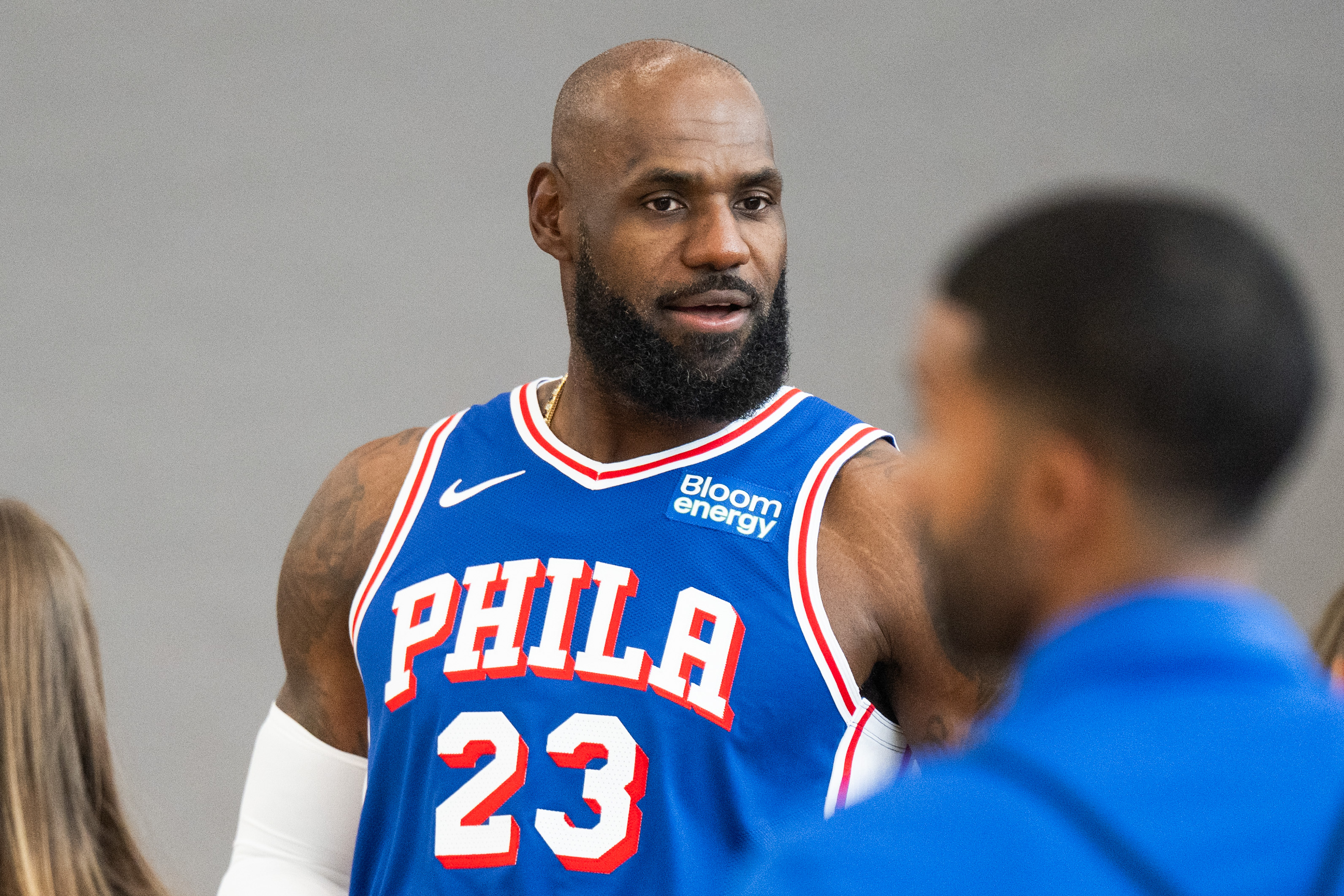
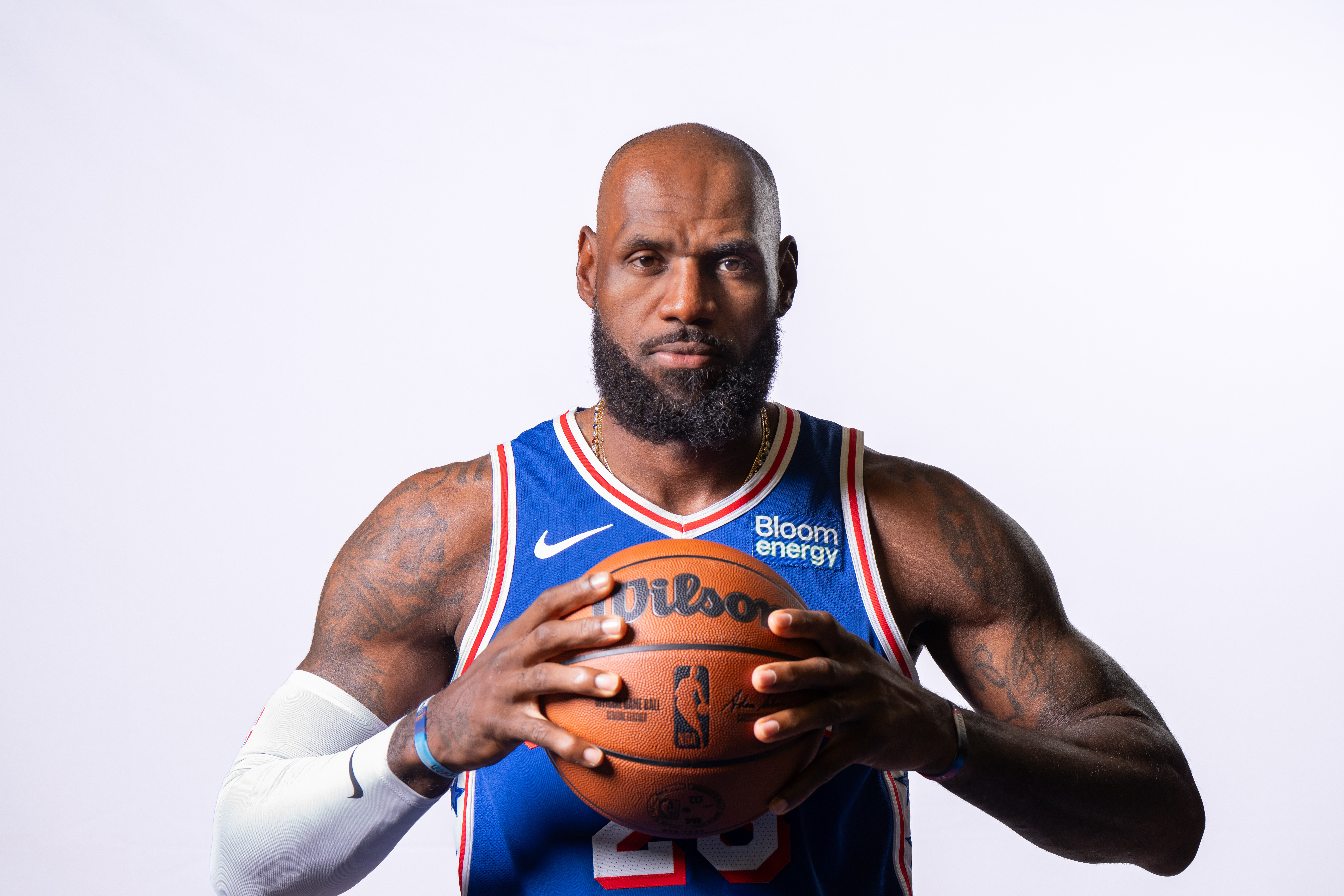
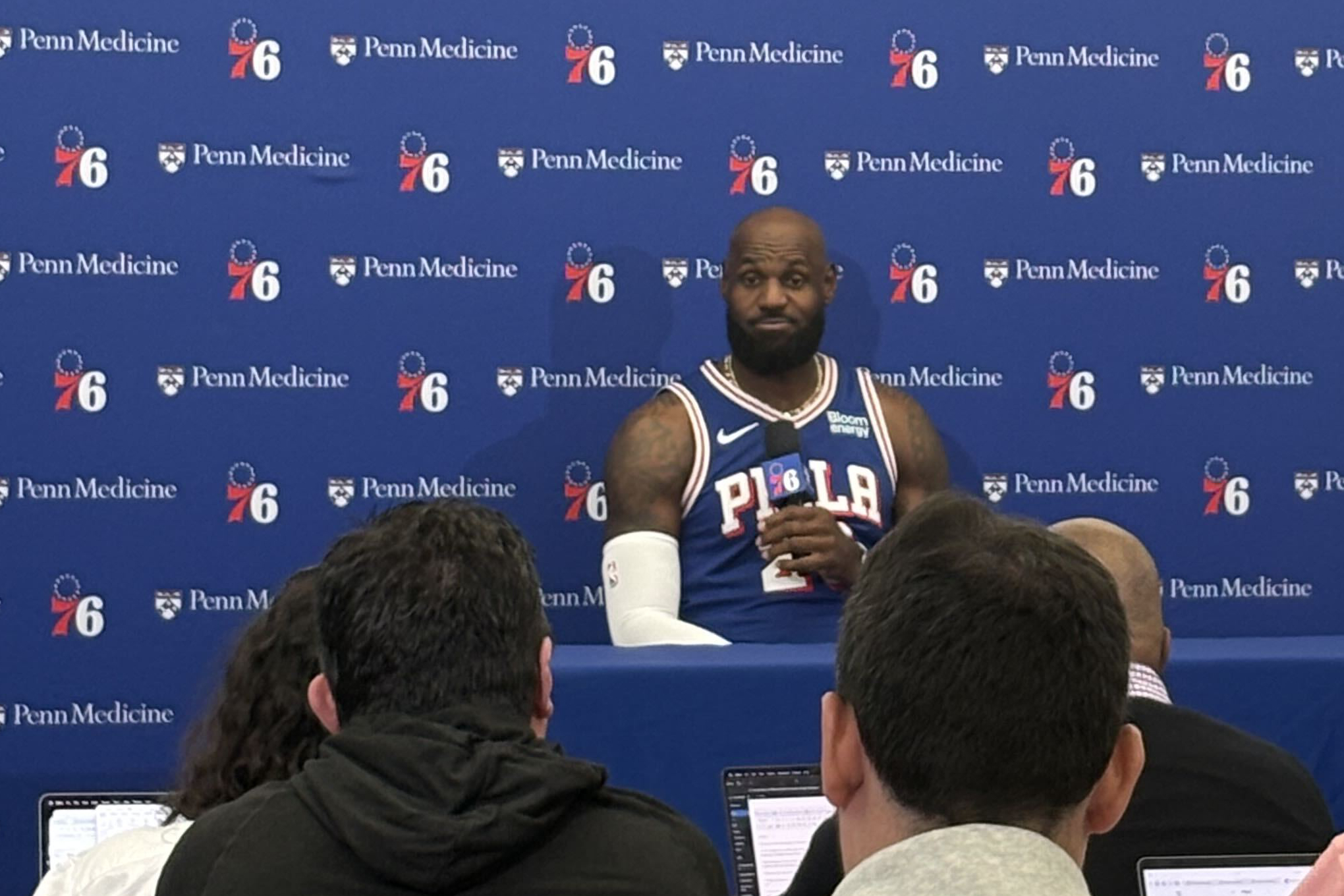
LeBron James donned a Sixers jersey for the first time Monday. Jose F. Moreno / Staff Photographer
LeBron James grabbed and glanced at the name tag perched on a table, then quipped, “You guys know who I am, right?”
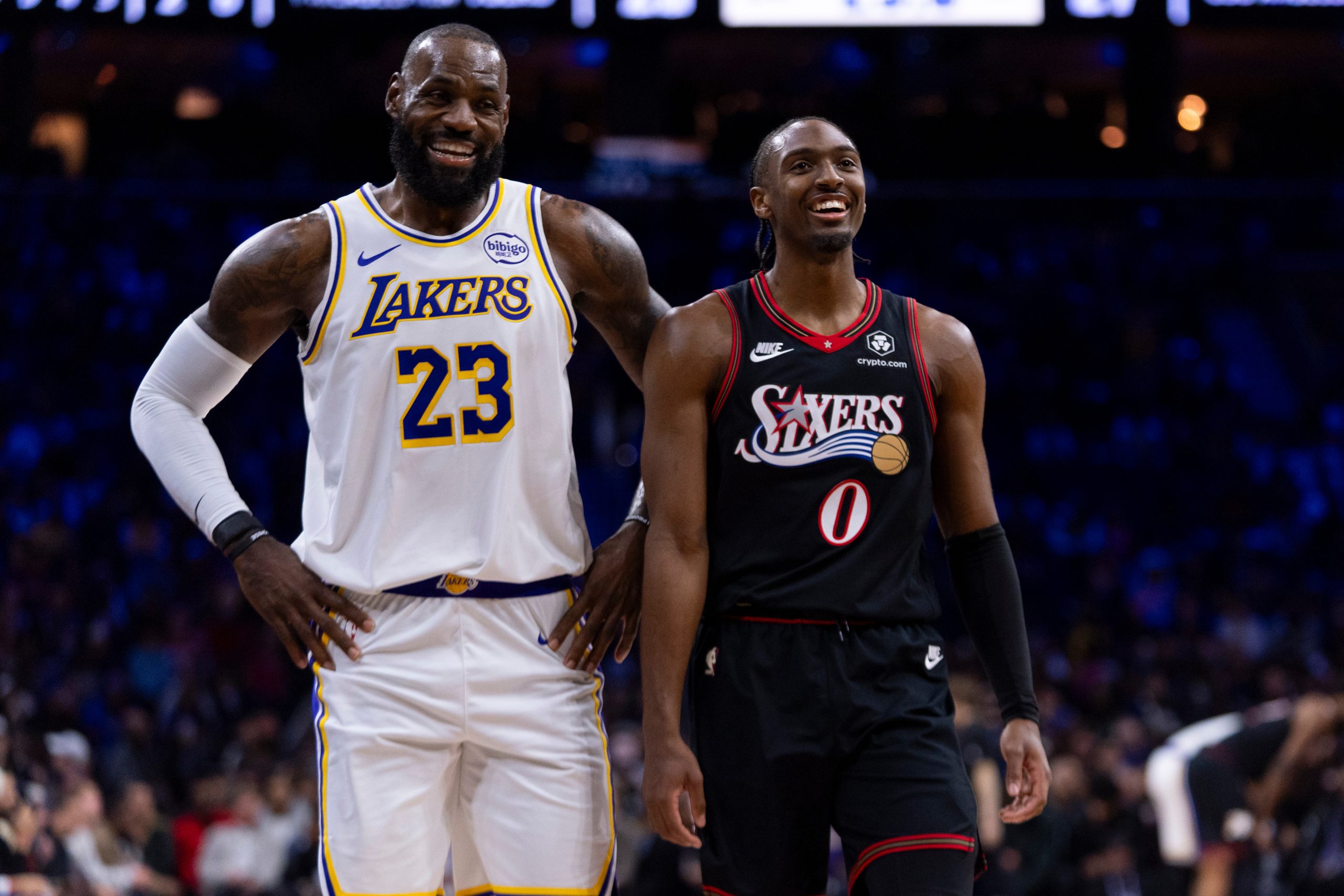
Those assembled inside the 76ers’ practice facility did, of course. James, one of the NBA’s all-time greats and a mainstream international celebrity, generally commands such hubbub. But the blue No. 23 jersey that James wore Monday amped that attention up even more. New teammate Tyrese Maxey even called seeing his friend and summer workout buddy’s new professional attire “really just weird.”
In James’ long-anticipated first day inside these walls — and first time speaking publicly since he chose the Sixers in a stunning free-agency move in July — the future Hall of Famer touched on needing to learn new streets and new people. The Northeast Ohio native mentioned getting reacclimated to weather in this part of the country, on the tail end of the weekend’s nor’easter storm. James acknowledged the outside noise surrounding the Sixers will be “doubled and tripped and quadrupled now that I’m here.”
Yet James reemphasized that his goal, in perhaps his last destination in a storied NBA career, is to seize the Sixers’ newfound super team status. The four-time champion hopes to provide the “blueprint” for the “collective sacrifice” and consistent work habits required to reach the NBA mountaintop, a feat the Sixers have not accomplished in more than four decades.
“Everyone wants, like, instant oatmeal,” James said at the Sixers’ media day ahead of the start of training camp. “You just put the oatmeal in the bowl, you put water in it, throw it in the microwave, and in a minute-and-a-half, you’ve got something to eat. You’re ready to go.
“If you want to do something special, it takes time. And it takes, every single day, doing things that you may not want to do. Because it’s the same thing, over and over and over and over and over, repetition after repetition after repetition. …
“That is the best way to expedite being great: You have to fall in love with doing things [that are] uncomfortable. And if we can do that, we can be a great team. If we don’t do that, then we’ll be like, ‘Oh, man, that was a great team on paper and we had a lot of great talent, and we lost in the second round.’”
Joel Embiid looks light, sounds optimistic about his new teammates and Sixers’ chances
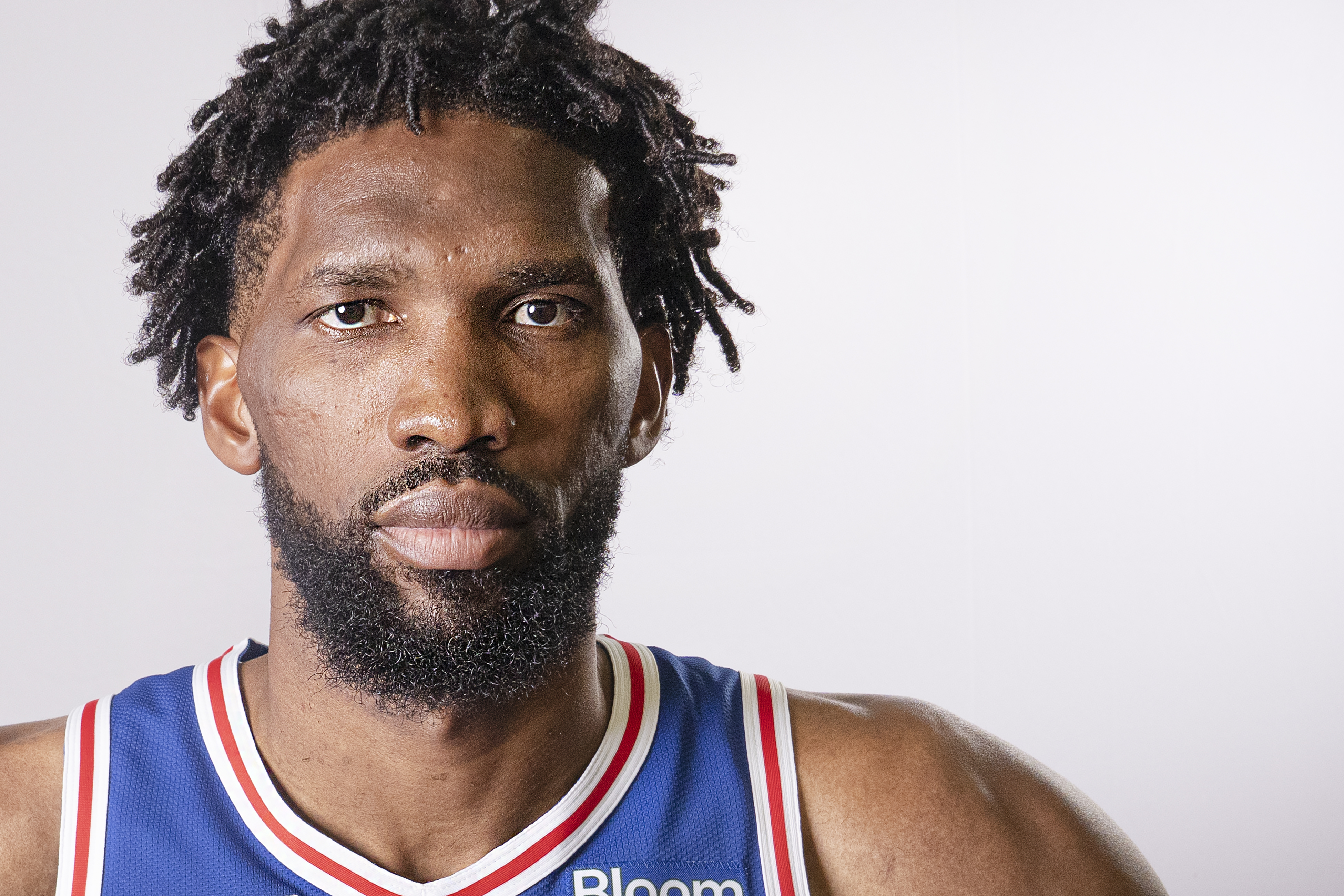
Joel Embiid poses for a portrait during Sixers media day Monday. Jose F. Moreno / Staff Photographer
At the end of last season, Joel Embiid was optimistic about what a summer without a major injury could do for the Sixers heading into next year.
So, what did he spend his summer doing?
“Nothing,” he said with a smirk. “Gained a lot of weight.”
Embiid looked up toward the ceiling and debated whether he wanted to keep trolling when asked for further clarification about his summer.
“I feel good,” Embiid said Monday. “I won’t get into all the details of what I did, but I felt like I did the right things to put myself and the team in a position to succeed.”
Contrary to his jokes, he looked visibly lighter and said he wants to play “as much as possible” this season after struggling with injuries on and off through his entire NBA career. He said his knee issues were “behind him.”
“Jo is one of the most talented guys we have in the world,” LeBron James said. “For him, it’s just about health.”
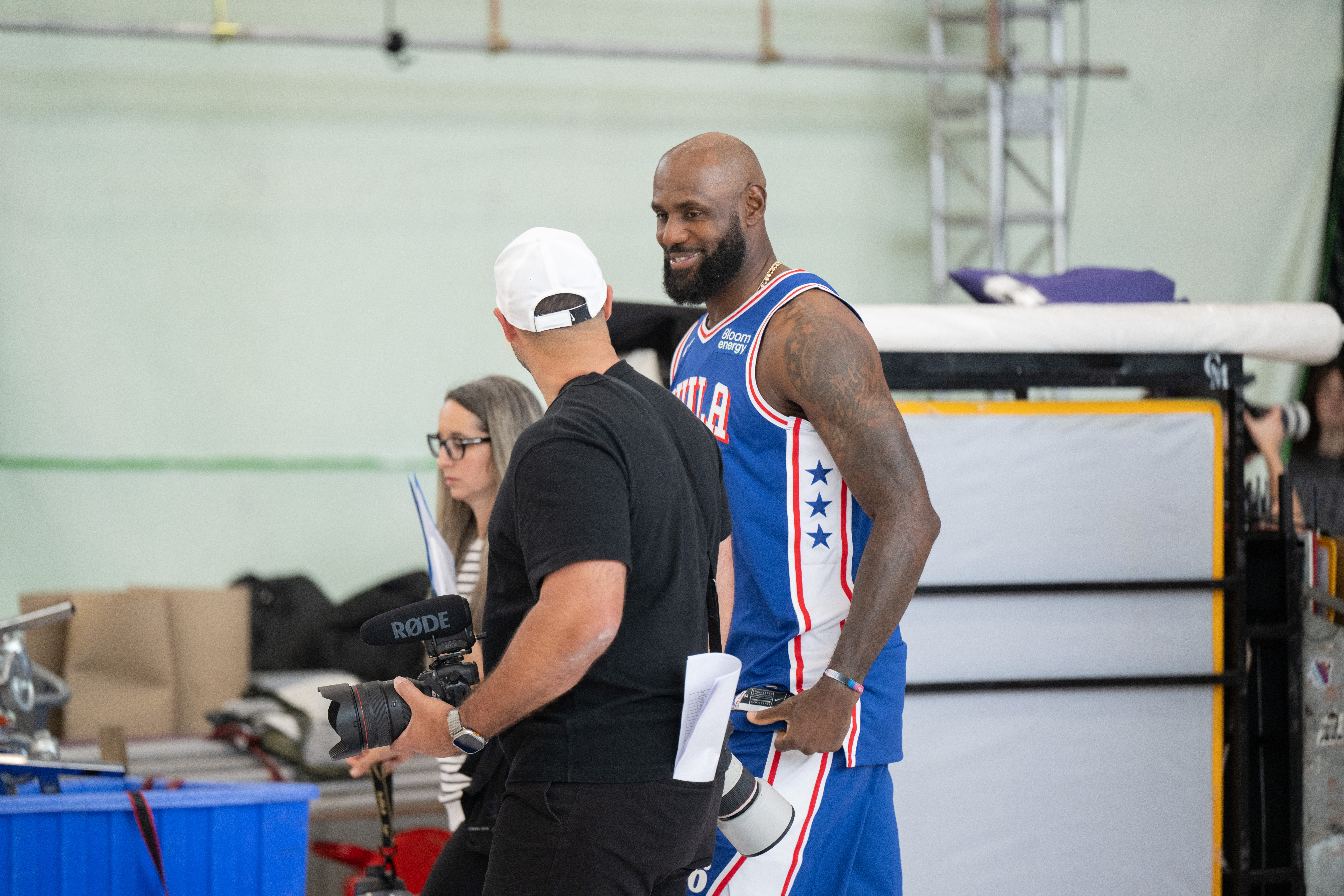
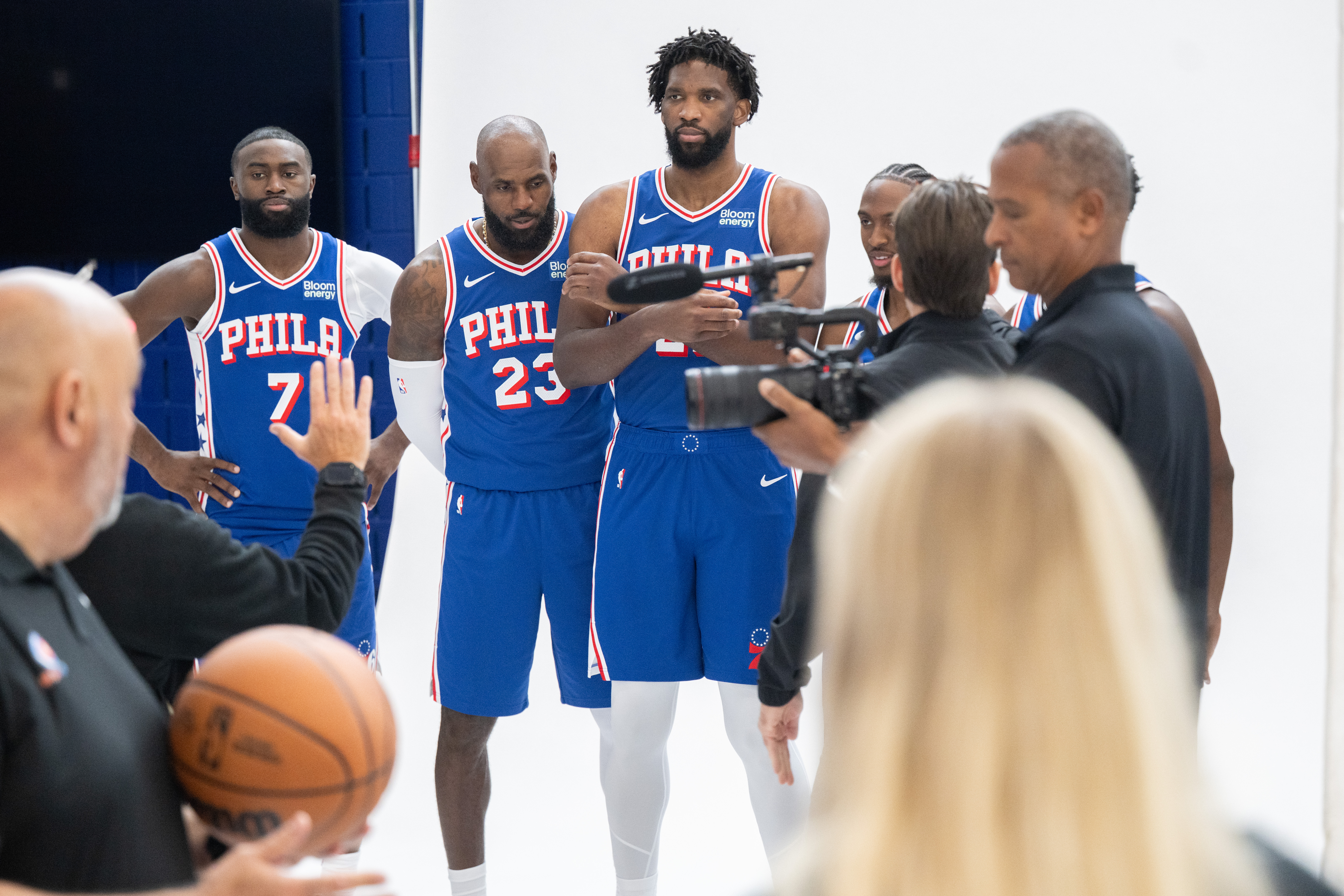
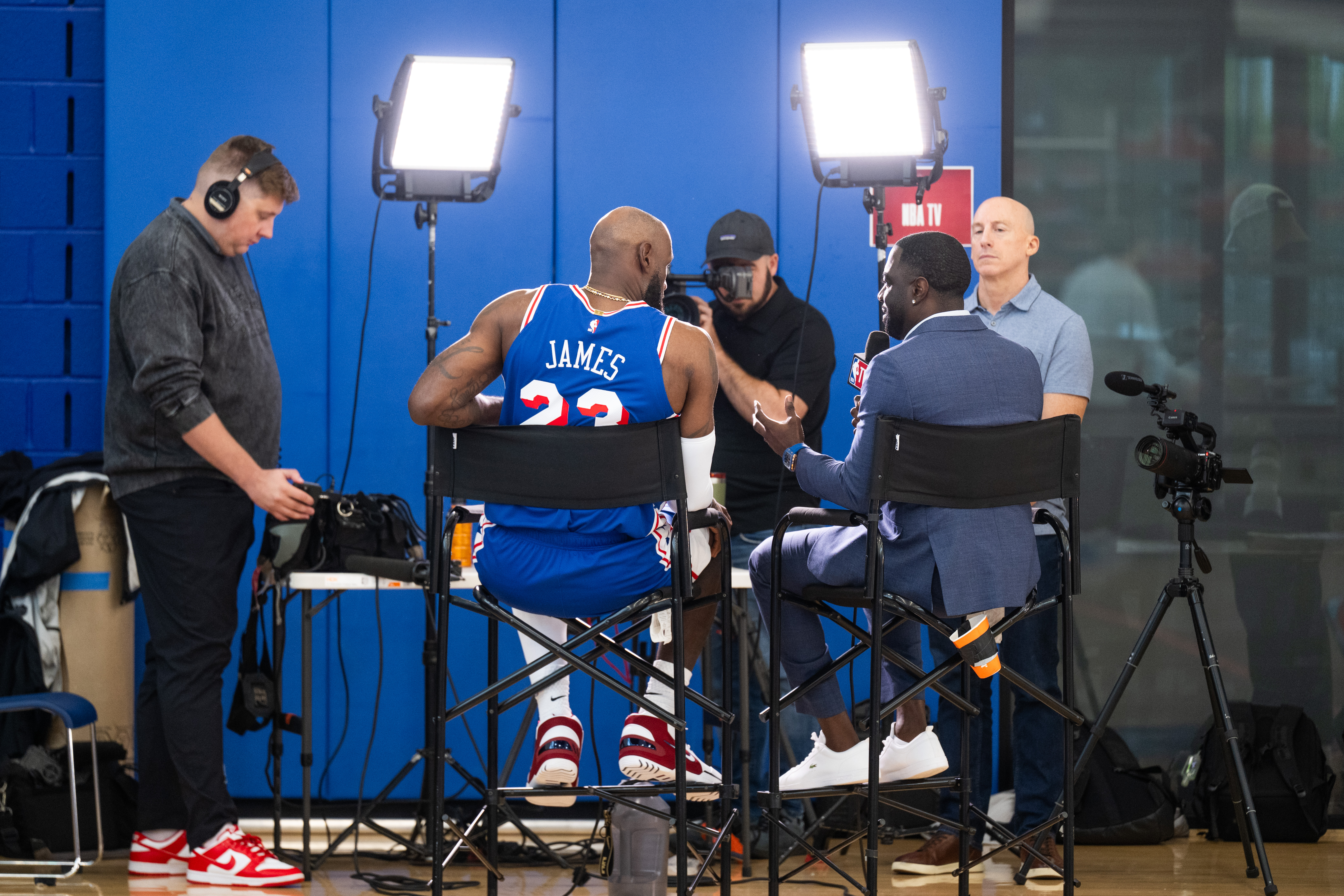
LeBron James at media day at the Sixers Training Complex in Camden, N.J. Monday.Jessica Griffin / Staff Photographer(Left to Right) Jaylen Brown, LeBron James, Joel Embiid, and Tyrese Maxey during a photo session. Jessica Griffin / Staff PhotographerAdem Bona with Franklin during Sixers media day. Jessica Griffin / Staff PhotographerLeBron James during an interview at Sixers media day. Jessica Griffin / Staff PhotographerTyrese Maxey poses during Sixers media day.Jessica Griffin / Staff Photographer
// Timestamp 09/28/26 2:52pm
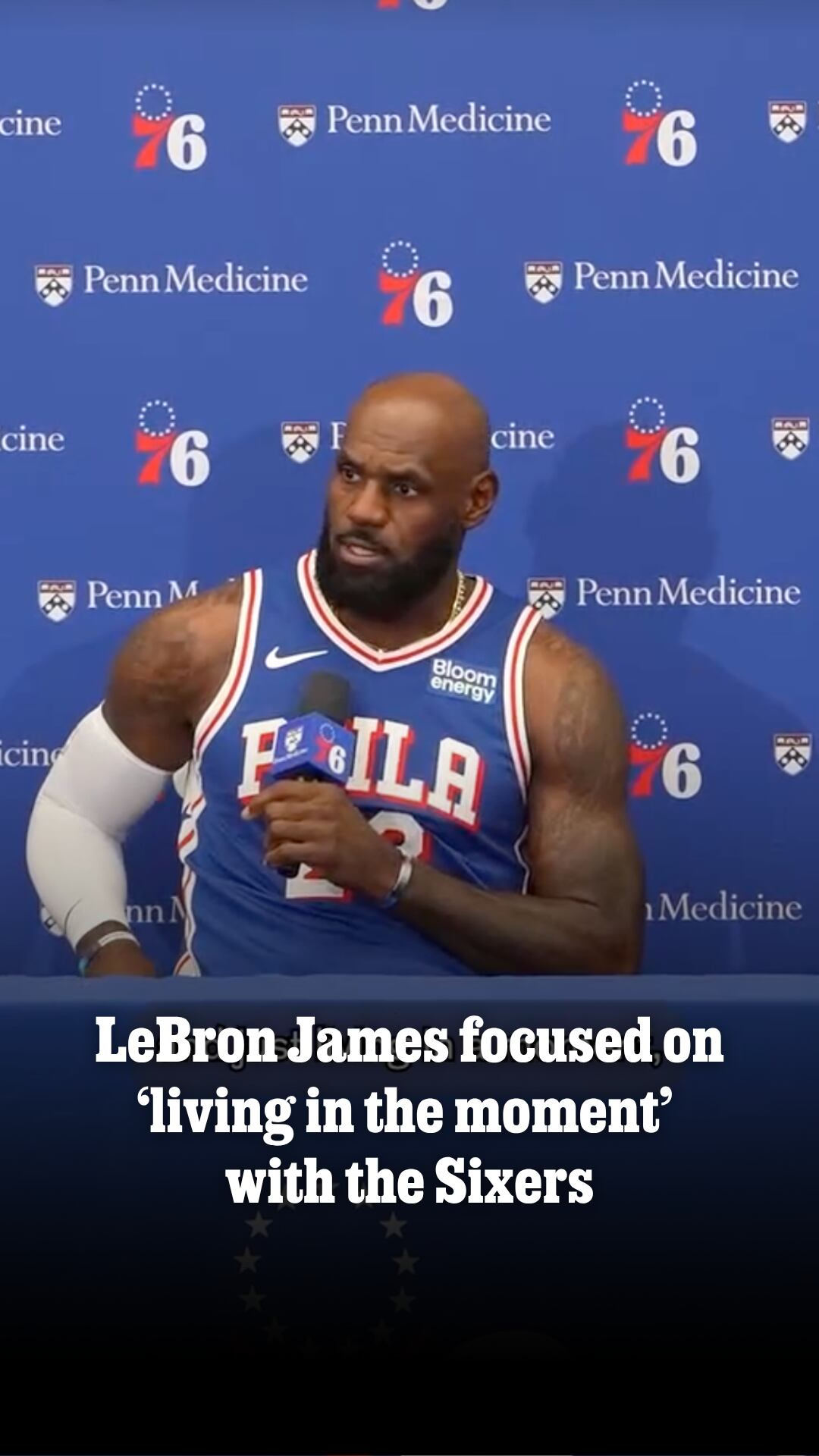
LeBron focused on ‘living in the moment’
Video: LeBron James is focused on ‘living in the moment’ with the Sixers
LeBron James ultimately picked Philly, but he was close to joining the Knicks. Gabriela Carroll /
During LeBron James’ free-agency process, his agent, Klutch CEO Rich Paul, hinted that the hall of famer would’ve seriously considered joining the New York Knicks if they didn’t win the 2026 NBA title.
“I had visions of playing in [Madison Square] Garden and finishing my career in the Garden,” James told ESPN. “One of the best places I’ve ever played. I think it’s the No. 1 arena in the world, as far as for a basketball player. But after they beat San Antonio, I was like, ‘Hey, I can’t.’ I couldn’t do it.”
So that’s one big question answered. Another that has percolated since James joined the Sixers is where he plans to live. There were rumors that he would live in New York City and commute to Philly and even discussions about him taking a helicopter to practices and games.
Asked where he will keep a residence, James didn’t commit to one city.
During Jaylen Brown’s first press conference in Philadelphia in July, he mentioned the Sixers’ group chat was already up and active as the new teammates got to know one another. VJ Edgecombe wanted to make sure everyone knew it was his idea.
“You know who really initiated the group chat? I did,” Edgecombe said.
When the Sixers traded for Jaylen Brown, Edgecombe told Tyrese Maxey that the two of them, plus Brown and Joel Embiid, should be in a group chat together.
“Then LeBron came, and obviously I don’t got LeBron James’ number,” Edgecombe said. “I can’t say, ‘go add Bron to the group chat?’ Besides, even if I had his number, why would I randomly add LeBron to a group chat? You get what I’m saying? So I told Tyrese to do it.”
Maxey, of course, has a close relationship with James, and played a key role in recruiting him to Philadelphia. The two frequently train together in LA over the summer.
“‘Rese did it, but it was my idea,” Edgecombe said. “Anyone who tells you it was their idea, they’re lying.”
VJ Edgecombe was getting a pedicure during the Jaylen Brown trade
VJ Edgecombe was getting a pedicure when he heard about the Jaylen Brown trade. "He don't answer the phone when I call, but I've got to get there. Sometimes you've got to earn the privilege," Edgecombe joked about his relationship with Brown.
When Jaylen Brown threw a goodbye “block party” in Boston this summer, the mayor and other elected officials came out to thank Brown for his service to the community.
When he came to the Sixers in a surprise trade this summer, he intentionally held his press conference at a Boys and Girls Club in Philadelphia, a signal of his intent to become active in the community, something that has been a passion for Brown throughout his career and something he touched in his comments at media day.
“What I value is the human connection, to be able to bring people together, uplift your community, and inspire people,” Brown said. “What I always preach is athletes are more than line items or stats on a sheet. I preach the human connection, how you uplift the community and bring people together. … I think we’re getting away from that.”
His media day comments were a mix of questions about on- and off-the-court activities this summer. When asked a question that touched on who might be the “alpha” of the Sixers, or if that even mattered on a team like this, Brown just responded, “Next question.”
In other answers, he emphasized the importance of defense while saying he wasn’t sure if his championship experience in Boston would carry over to Philadelphia.
“I’m not so sure if that’s true. It’s a new group,” Brown said. “I’m approaching this with an empty slate. Coming in every single day and trying to maximize every opportunity. Not taking anything for granted. I don’t have, I wouldn’t say expectations. You just got to come in and get ready to work. Create a winning environment and see where that takes you. I’m not sure if things in the past will help you. They may.”
Tyrese Maxey’s recruitment of LeBron James started years ago.
Maxey spent time in the gym with James prior to his rookie season and admitted that he shot a text to James a few years ago even though it was clear the hall of famer was set to return to the Lakers in free agency. Maxey joked that he knew it was a long shot but still asked James if he was interested in “coming back to the Northeast.”
Those moments paid off this summer. When the Sixers added Jaylen Brown and James made it clear he wouldn’t return to Los Angeles, things turned a bit more serious. Those conversations took a different shape and happened more often, according to James, who said he didn’t have just one conversation about Philly with Maxey.
James was clear that his relationship with Maxey played a pivotal role in his decision to join the Sixers. So did the presence of Brown and conversations with Joel Embiid, a former Team USA teammate of James who joked at media day that they didn’t speak this summer.
“Our relationship, when I broke a lot of the teams and franchises down I could possibly play for, he was one of the main deciding factors.”
Maxey’s role in adding James was lauded all summer. Yet he was still surprised it happened.
“I see him in the summertime every year,” Maxey said, “but to see him here in Camden, New Jersey, in the facility with a Sixers jersey on, it’s a cool experience.”
After hearing James speak, Maxey’s part in making that happen can’t be overstated.
Kidding or not, that answer was in line with a summer in which Embiid said he purposefully maintained a low profile and worked on his body. Continuing his trend of potentially trolling answers, Embiid said he “gained” a lot of weight, even as he looks noticeably trimmer.
“Just want to stay out of the way, focus on what I need to be focused on, which is basketball,” Embiid said. “And I got my family, and especially since I became a father and got married, just be me. Stay out of the way, enjoy my family, and take care of what I need to be taking care of on a daily basis, that’s what I did this summer.”
Embiid is healthy coming into the season, and his health will be a constant point of conversation throughout the season if the Sixers are going to be true title contenders. He mentioned the team and he “got a plan and we gonna execute it.”
When asked about adding Jaylen Brown, Embiid said: “I was excited because you’re getting a guy — First Team All-NBA. The job he did, especially when [Jayson Tatum] was hurt, was huge. Obviously we played against him, but what he brings on the defensive, offensive end … to be able to add that, combining that with everything he does on and off the court, I think he’s going to be good for the city of Philadelphia.”
LeBron: Tyrese Maxey was ‘one of the main deciding factors’ in coming to Philly
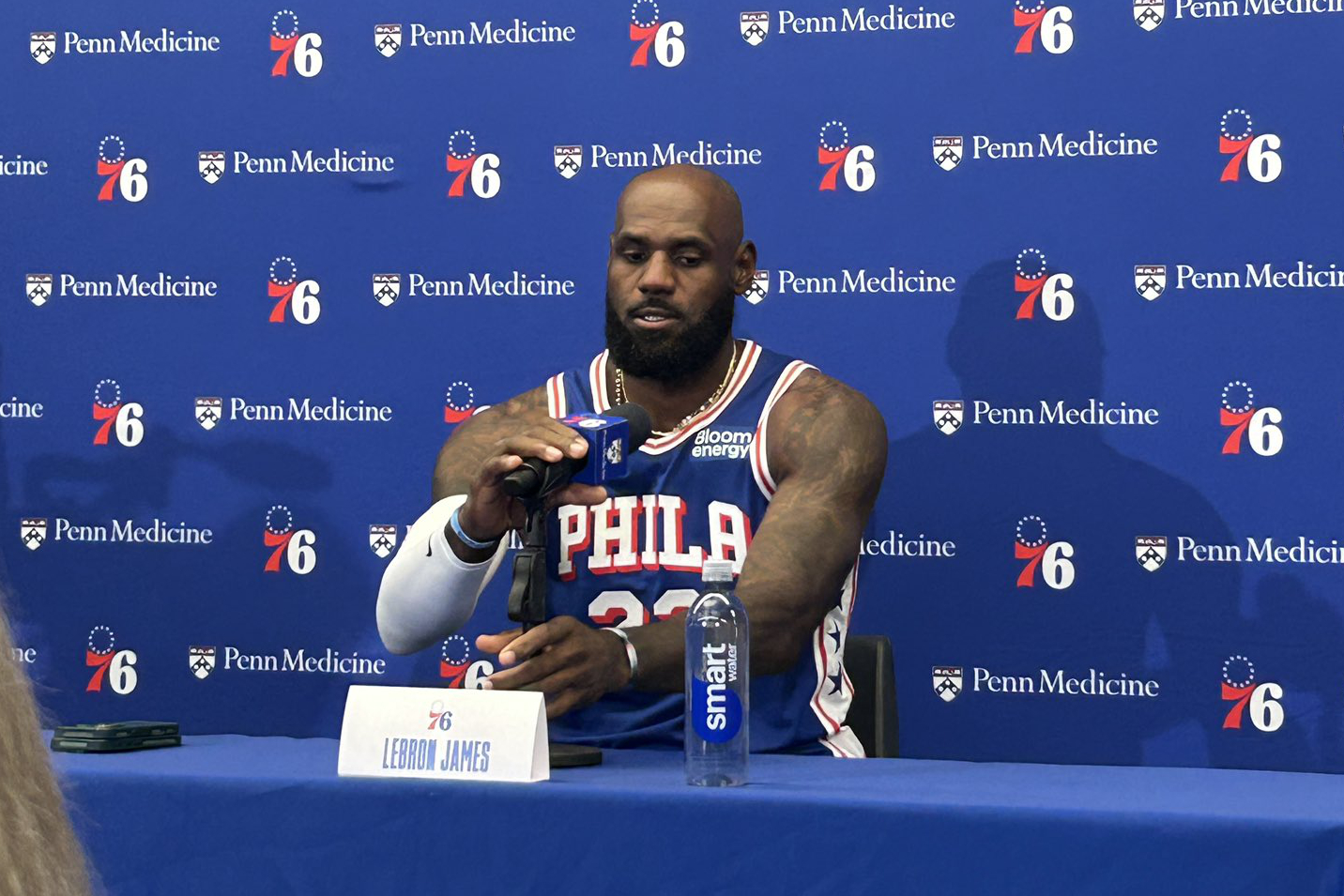
LeBron James speaks to reporters at Sixers media day Monday.Ariel Simpson / staff
When LeBron James was choosing among what he said was five teams in free agency, a primary factor in his decision to choose was his relationship with guard Tyrese Maxey.
The two have worked out together and became close through their association with James’ agency, Klutch Sports.
“Great relationship with Tyrese and we talked a lot,” James said. “I picked his brain a lot about not only where he sees his career going, where he sees the franchise going and how much he believes in the franchise and if I were to come here, how would I fit in, would it be a plus or a negative.”
James mentioned that it wasn’t just one conversation he had with Maxey about where he fits on the team and in the locker room, and in terms of his personality.
“I was just asking all the questions I could ask him and it wasn’t just one conversation,” James said. “… When I broke all the teams down that I could possibly play for, he was one of the main deciding factors.”
LeBron on Philly fans: "We respect you, but we hate you. I love that. I thrive in that… We're going to be on the same side now. I need a little hate, so I hope we get a few people who aren't real Philly fans so I can get that tension."
LeBron on Philly fans: "They know sports, they know ball, if you're not doing what you're supposed to do, they're going to let you hear it. They're going to hold you accountable."
He realizes that by coming to Philadelphia and joining a roster as talent-rich as the Sixers, there’s going to be a lot of “noise.”
And that was going to be “doubled, tripled and quadrupled” with him in town. So when the team goes through predictable tough stretches of the season, he’s ready to deal with that attention. But as James stated in his opening news conference, “the noise is just the noise.”
Among the things James said that has impressed him so far is that “everybody is on the same page.” That he thinks the team will be able to have the kind of communication needed to bring together a team that hasn’t played together previously.
When asked how his game may fit in with this team, James wasn’t shy.
“The luxury of my game is I can do everything. Literally, I can do everything.”
Howdy from Sixers media day, where the parking lot at the practice facility was more crowded than I’ve ever seen it more than an hour before press conferences begin. pic.twitter.com/DRb5Rgm5ob
Sixers media day to feature LeBron James, Jaylen Brown, and more
The Sixers will hold their annual media day Monday morning at 11 a.m., which has just a bit more juice this year thanks to the addition of LeBron James.
Monday will also be the first time Philly fans hear from Jaylen Brown, who the team landed in an offseason trade with the Boston Celtics. And Joel Embiid will speak to reporters for the first time since his team has been transformed into a top Eastern Conference contender.
Bloom Energy patch on a Sixers jerseyCourtesy of the 76ers
The Sixers announced a new jersey patch partnership with Bloom Energy.
In a release, the Sixers said the deal will be “one of the most comprehensive and impactful patch partnership deals in the NBA.” One of Bloom Energy’s largest manufacturing hubs is located in Newark, Del., and as part of the partnership, the company will sponsor the Delaware Blue Coats’ jerseys.
The Sixers partnered with Crypto.com for six seasons beginning in 2021. No terms were ever officially announced, but reports at the time suggested the deal ran for six years, which would bring the deal to the end of 2026-27.
The Sixers also announced their full slate of jerseys, which included the return of their black uniforms and a new look with stars and the word “Sixers” in small print across the top of the chest.
the Sixers unveil their new jersey patch partner Bloom Energy and their slate of 2026-27 jerseys: pic.twitter.com/7zmynKyf1S
LeBron’s move to Philly caused some sticker shock for Sixers fans seeking tickets
Sixers fans shown during a playoff game in May at Xfinity Mobile ArenaMonica Herndon / Staff Photographer
It should come as no surprise that 76ers tickets will be significantly more expensive this season after the massive additions of LeBron James and Jaylen Brown.
But Thursday’s single-game ticket drop and the earlier presale for season-ticket holders still caused a bit of sticker shock for fans.
Single-game ticket prices started at $75 before fees for upper-deck seating, which bumped the final tally up to $88 with fees.
However, that base-level price was only available for six of the Sixers’ 41 home games at point-of-sale. Those include games against the Bulls (Nov. 2), Raptors (Nov. 12), Grizzlies (Dec. 1), Wizards (Jan. 12), Clippers (Jan. 25), and Hawks (April 4).
For marquee games, including games against the Knicks and the home opener against Cleveland on Oct. 22, primary ticket prices started at $320.
For years, the Sixers searched for a solution to Knicks fans taking over Xfinity Mobile Arena. In the playoffs in 2024 and 2026, everyone from Joel Embiid to Sixers ownership to Fanatics owner Michael Rubin pitched in to fill the arena with Sixers fans, to no avail.
At Madison Square Garden, faced with similar fan complaints of price gouging (opening-night Knicks vs. Sixers tickets were running fans upward of $1,000 just to get in the building), Knicks ownership paused single-game ticket sales, apologized, and said that “mistakes” had been made in pricing the tickets.
“We are rolling back to last year’s prices plus an average increase of 12 percent,” the team said in a release.
LeBron James (left) said his relationship with Tyrese Maxey is much bigger than basketball.Chris Szagola / AP
LeBron James got his first taste of Philadelphia in his senior year of high school when he played at the Palestra.
James spoke about his decision to join Philadelphia on the first episode of season four of his Mind the Game podcast with Hall of Famer Steve Nash released on Friday, including a big recruiting role played by Tyrese Maxey.
“When I became a free agent and we decided to let the Lakers know that I wouldn’t be returning, he was one of the first people that was on my line,” James said. “Calling me, ‘Yo, what we doing? Yo, what’s up OG? Come on down here, we could use you down here.’”
James said he and Maxey have a relationship that extends beyond the basketball court, which played a big role in his decision to join the Sixers. Maxey even used to play video games with James’ sons, Bronny and Bryce, when he was 19.
“I just love everything about Tyrese Maxey,” James said. “Every day you get the same person, and that is very rare in sports and obviously super rare in life. And obviously we know what he brings to the basketball court.”
The Sixers’ trade for Jaylen Brown also caught James’ attention, but the final piece for James was Joel Embiid, who he said was “one of the most important” parts of his decision.
“He’s done everything in our league, and the only thing he has not done is win a championship,” James said. “I want to try to help him get that first one. He has the city on his back. I hope I can be that final little piece that can help him get over the hump.”
My parents were big supporters of public education.
Teaching was their life’s work. They spent almost their entire careers in the District of Columbia Public Schools system. However, they chose to send my four siblings and me to Catholic schools through grade 12. They sacrificed almost everything to do it. Many of their educator friends made similar choices.
My husband’s mother made a similar pick. He still recalls how out of place he felt after his mom — also a schoolteacher — enrolled him in an expensive, predominantly white boarding school in New England when he was just 11. Last year, during one of his school reunions, I walked around and marveled at the beauty of the campus.
At the same time, though, the thought of him dressed in his little blazer and being so far away in Massachusetts makes my heart ache for the adolescent version ofhim. Not that he regrets it. It put him on the path to Princeton University.
Like many other middle-class families, our parents faced a difficult decision: send us to our neighborhood schools with all of their problems, or identify the best possible educational opportunity for us elsewhere.
Add in a bunch of other variables that Black students in predominantly white private schools often still face — including social isolation and subtle discrimination — and the decision becomes even more difficult.
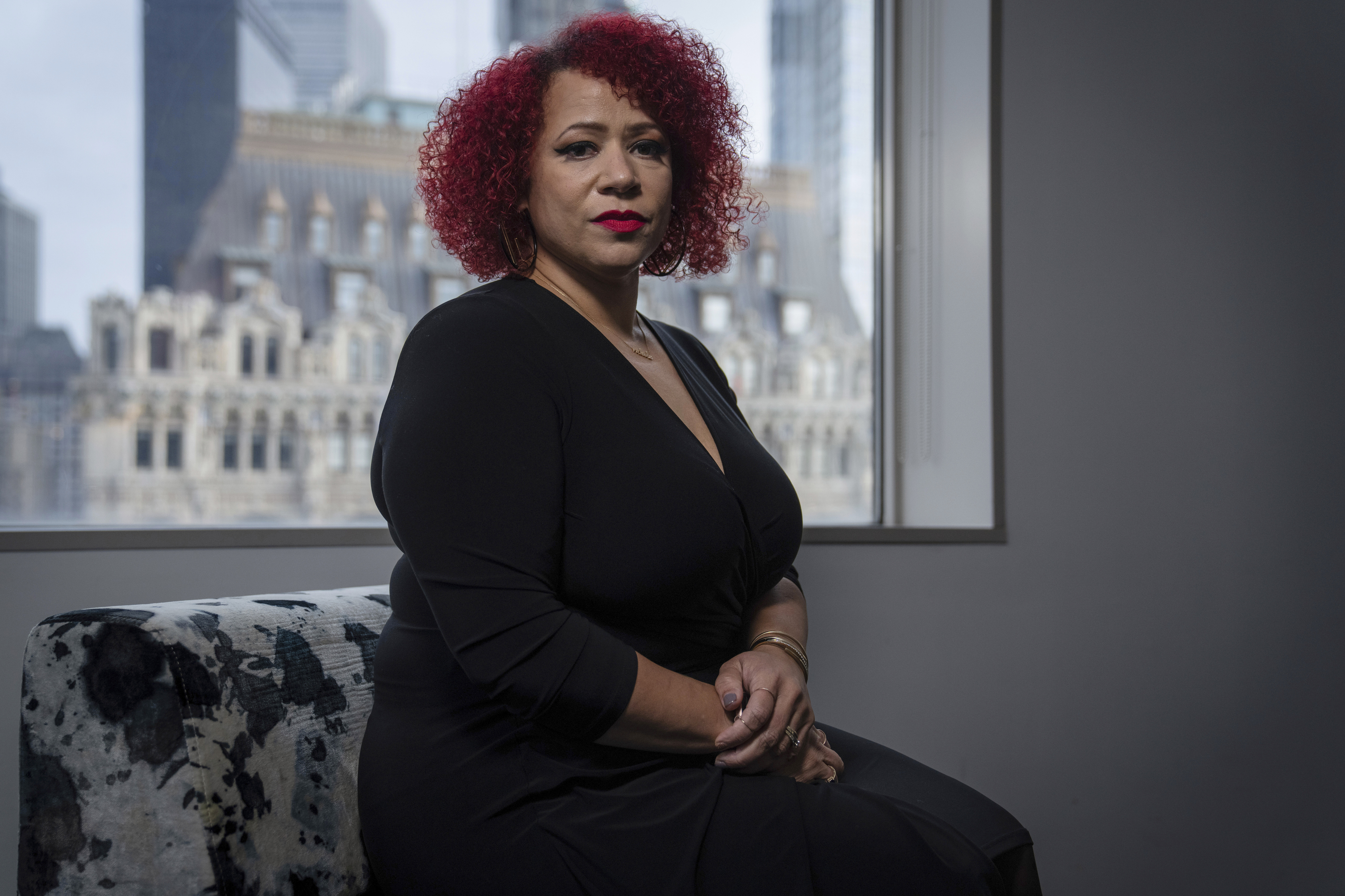
I’ve been thinking a lot about the choices Black parents have to make for their children after reading Nikole Hannah-Jones’ essay in the New York Times about what her family went through getting her daughter educated in New York City public schools.
The Pulitzer Prize winner, who founded the 1619 Project, could have afforded to send her daughter to the most exclusive school in the city. Instead, she enrolled her only child in a segregated, high-poverty public elementary school in Brooklyn across from a public-housing project.
Because she and her husband were well-off financially, Hannah-Jones naively thought they could use their resources and networks to help the school thrive. It was a decision based “on the collective good and not just our individual advantage,” she wrote.
She acknowledged that her decisionreturned to haunt her years later when her daughter was in middle school and confronted her, saying, “So you had money to send me to one of the best schools, and you chose not to?”
In the piece, Hannah-Jones delves deep into why she made the choice that, she eventually concludes, was a mistake.
“Najya deserved better. They all did. But she was mine. This girl, my only child, looked to me to protect her, to give her what she needed to thrive. And I had not chosen her.”
It was a stunning admission.
Not to mention brave.
When it comes to choosing schools, there aren’t always suitable options, especially for socially conscious Black parents like Hannah-Jones. People sometimes find themselves having to make a no-win choice the way she did.
“Which struggle are we asking our children to bear? Stay in the neighborhood school and risk being underserved; leave for a more selective or whiter school and risk isolation, racism, and the message that the children left behind are not worth saving,” Sharif El-Mekki, CEO of the Philly-based Center for Black Educator Development, told me in an email.
Hannah-Jones’ daughter, Najya, now attends a selective, predominantly white and Asian public high school. Hannah-Jones wrote she is better off academically, but racism is a factor. “My daughter had never been part of a minority in a school, and now she sat in classrooms where some classmates casually tossed around racial slurs as if it were cool.”
Najya also has regular homework assignments, which was something she wasn’t used to. She hadn’t learned to study on her own. Her grades faltered. Her parents hired an algebra tutor and learned that their student “had huge gaps in many of the building blocks of math that she should have learned in elementary school, like mastery of long division and fractions.”
Eventually, Najya was able to get her footing and started getting A’s and B’s again.
I reached out to Shanée Garner, executive director ofLift Every Voice Philly, a grassroots, Black-led parent organization, who pointed out, “The most heartbreaking aspect of [her] story is how clearly it reveals a trap any of us can fall into: Believing that being right, or having access and influence, is enough.”
She added, “There is no perch high enough and no argument brilliant enough to produce the seismic and enduring shifts our public systems require.”
Public education needs widespread systemic reforms to better serve diverse populations.
That’s where critics should be directing their outrage — not at Hannah-Jones for the choice she made about schooling her daughter, a decision that was rooted, as others have noted, in an attempt to live out her principles. Some people are mad at the wrong things. As Hannah-Jones noted, Najya will be fine. She “has learned resilience,” her mother told a reader online.
But what about all of the children enrolled in schools that don’t adequately serve them? They must not be ignored. Their schooling matters, too.
When it comes to those often-forgotten students, we already know where Hannah-Jones stands on the principles of equity, fairness, and equal educational opportunities. What about the rest of us?
The logo of Bloom Energy, maker of mini-power plants, is replacing Crypto.comon theSixers’ uniform advertising patch this season.
Bloom Energy is hiring and trying to raise its local profile, said vice president Barry Sharpe, who runs the company’s plant in Newark, Del. Bloom has stepped up recruiting in nearby Pennsylvania, New Jersey, and Maryland.
So what exactly is Bloom Energy, and why are they supporting the Sixers?
Bloomis based in San Jose, but its biggest employee center is the Newark factory, which has languished for years butsuddenly became profitable in 2025. That’s when Bloom began selling its modular, off-grid electric plants to power-starved high-speed artificial intelligence data centers.
The Newark plant, where 1,200 of Bloom’s 2,200 employees work, makes fuel cells, an update of 1800s technology that presses natural gas or other hydrogen-based fuels through battery-like metal plates at superhot temperatures to generate electricity — at temperatures of around 800 degrees Celsius (about 1470 degrees Fahrenheit).
Fuel cells run independent of electric-power grids, which can take years to grantapproval for new plants to power data centers.
AI data centers built for Oracle, Microsoft, Intel, and other giants, including the DataOne center in Vineland, have been placing orders with Bloom. That’shelped pack the Newark plant with a production backlog, new hires, and new robots.
Bloom offers “reliable, clean power that can be quickly deployed andeasily scaled,” Oracle Cloud Infrastructure executive vice president Mahesh Thiagarajan said in a statement.
Bloom joined the S&P 500 list of the most-valuable U.S. companies last week.
The Newark plant is located among labs and offices that have sprung up between I-95 and the University of Delaware. A warehouse, a repair center, and other Bloom structures line a nearby road.
Besides data centers, Bloom says its boxes help power Urban Outfitters’ headquarters at the Navy Yard, as well asCoherent Corp.’s data center and telecom-equipment factories in Pennsylvania and New Jersey. Bloom also sells power to PSE&G in New Jersey and to Delmarva Power in Delaware — whose customers continue to paymonthly surcharges that cover certain Bloom costs, as part ofthe deal that brought the factory to Newark.
A sudden boom
Though the company opened the Newark plant in 2012 with state aid and went public in 2018, Bloom Energy lost money and its stock price languished below its original offering price.
The new ordershave boosted Bloom’s share price from under $20 to around $300. As of Friday, the company was worth $85 billion on the stock market, more than Comcast or General Motors.
Short-sellers and subsidy critics have warned that Bloom’s data-center orders may not come in on schedule, or at all; that fuel cells aren’t always as efficient as claimed; and that the company’s proprietary metal-and-ceramic fuel-cell cores depend on specialized materials that are hard to find from U.S. sources.
But even as Oracle and other data-center boom stocks falter, Bloom shares have stayed close to their bullish high. On Friday, Bloom closed at $288.70.
Bloom has a smaller plant near its Silicon Valley headquarters. “We like to say that California builds the [fuel cell] engines; Delaware builds the cars,” Sharpe said, referring tothe 30-foot-long, 8-foot-high, 4-foot-wide modular boxes installed on-site at users’ locations. Sharpe, a former Ford and Toyota executive, has run the Newark plant since 2012.
Each 325-kilowatt, 13-ton cell group is housed in one of the metal boxes made in Delaware. As local power sources, they enable data centers to open without tapping the strained U.S. electric grid. As they wear down, the cylindrical fuel cells in these Bloom boxes are swapped out for easy replacement without shutting the system.
The Newark plant was built in anticipation of rapid growth that took more than a decade to materialize. Sharpe said the plant has only recently reached its limit, with the addition of an automated welding line that will enable a single controller to join plates, instead of the three-worker welding crews.
The company is making plans for a 125,000-square-foot addition.
How it started
Bloom was founded in 2001 by University of Arizona rocket scientist KR Shridhar, who remains the CEO. Early investors included Kleiner Perkins Caufield & Byers, a Silicon Valley venture capital firm. Kleiner Perkins helped secure government funding from the Barack Obama administration and state governments for energy projects that offered less-polluting alternatives than burning coal, oil, or gas.
Then-Delaware Gov. Jack Markell was eager to replace lost Chrysler, GM, and DuPont Co. factory jobs in the state.Delaware power users have contributed over $200 million to their power company to cover certain Bloom costs — more than Bloom’s total profits to date — under a 21-year contract critics have failed to end in legal and regulatory challenges.
The first wave of Bloom Energy customers included Walmart, JPMorgan, and other image-conscious companies that wanted credit for burning less carbon. Delmarva Power, the local utility, also uses some Bloom cells.
The assembly plant stood partly empty for its first decade, with a fraction of the projected workforce. In 2019, Bloom had to return a slice of its subsidy because it employed just 300 in Delaware, a third of its targeted 900.
The company has now passed that target and won’t have to repay more, Bloom officials say.
Entering the game Monday Night in Chicago, the good news for the Eagles’ defense is that veteran linebacker Zack Baun remains elite.
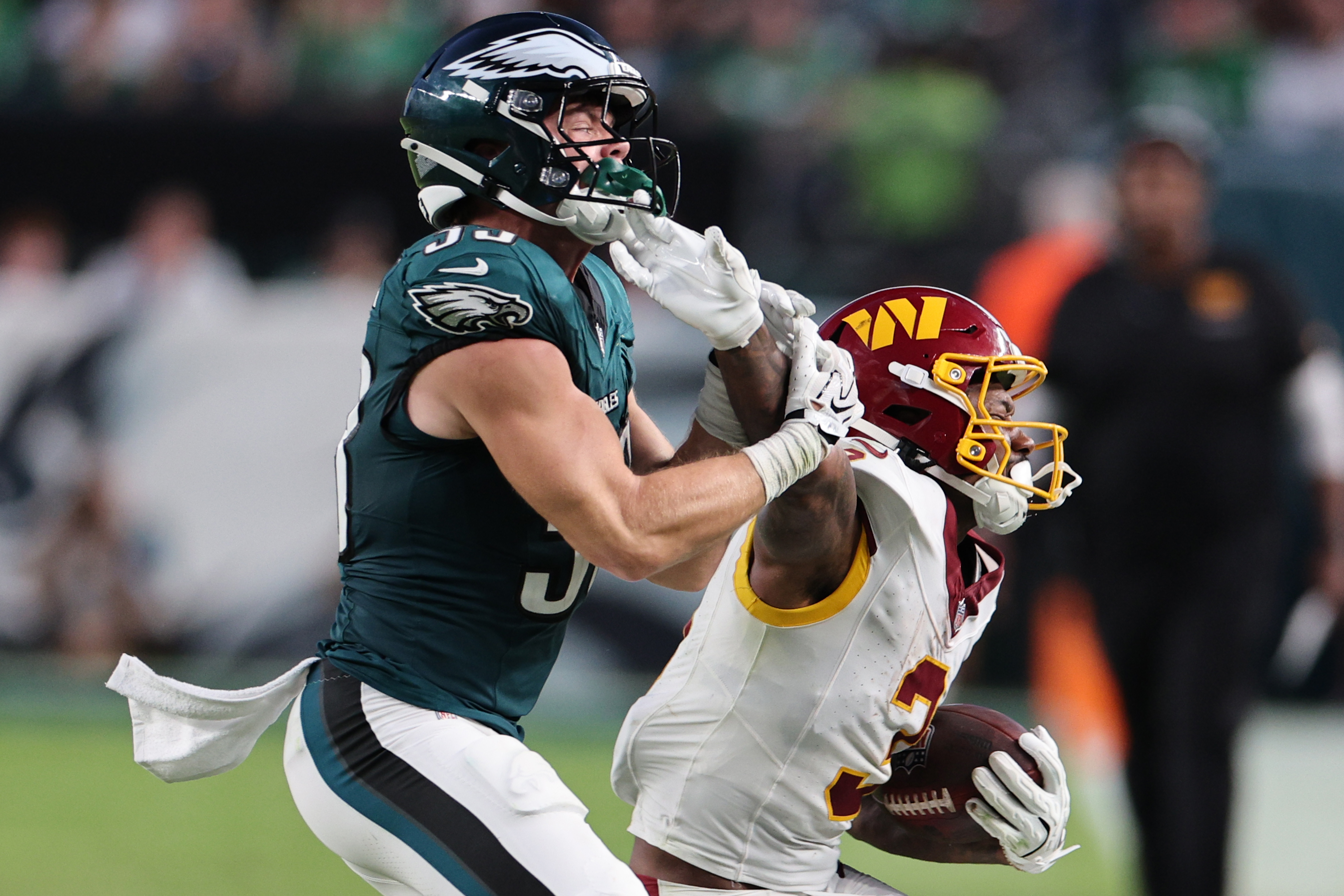
The bad news: Newly extended tackle Jalen Carter, as well as soon-to-be-extended defensive backs Quinyon Mitchell and Cooper DeJean, have not played to their elite standard. They have forced zero turnovers, have one sack combined, and remain, as a group, unremarkable through two games.
Mitchell, among the best cover corners since he was drafted in 2024, suddenly is mediocre, if you consider the grades from Pro Football Focus relevant. Most folks pointed to PFF rankings the past two seasons, when Mitchell was blowing folks away with grades that hovered around 80, which was top-six. Mitchell’s at 62.3 entering MNF, which ranks 48th among corners with about as many snaps as he has, and Mitchell remains without an interception in his 34 regular season games.
Carter, who got a $152 million extension just before training camp, disappears for large spans of the game, just like he did as a rookie three years ago. Carter has a wrist injury, but still.
And DeJean — he’s just been awful. He was ranked No. 1 by PFF among all corners as a rookie in 2024 and No. 2 among nickel corners last season. But since DeJean moved to safety part-time this season, he’s been a liability. Like Carter, DeJean is not 100% (calf, abdomen), but, again … still.
Asked if he would consider simplifying DeJean’s life by moving him to safety full-time instead of shuttling him between there and nickel corner, defensive coordinator Vic Fangio said, “No.”
Fangio’s defense is one of three in the NFL without a takeaway.
Deshaun Watson’s (4) competent play creates some tension both for the Browns and the league. David Richard
Deshaun Watson’s resurrection
Three weeks into the season, the league’s least likable quarterback has resurrected hope in football-crazed Cleveland.
Understand that calling Deshaun Watson the least likable quarterback in the NFL is saying something, considering the NFL still suffers the presence of Aaron Rodgers and, tangentially, the top in-game analyst is the insufferable G.O.A.T., Tom Brady.
However, between accusations of Watson’s serial sexual misconduct with massage therapists (he has settled or resolved 24 lawsuits), the smarminess with which he has comported himself since the accusations were made in 2021, the astonishing decision of the Browns in 2022 to mortgage their future on Watson by trading for him and guaranteeing him $230 million despite pending litigation, and his generally poor play, Watson, who often is booed in his own stadium, has few friends and fewer allies.
Injuries to his shoulder and his right Achilles tendon cost him most of the past three seasons, but the Browns failed to acquire competent replacements. Watson outplayed Shedeur Sanders in training camp and he has been the Browns’ starter this season.
For better or worse, since Game 1, Watson has played well. His play was key to wins in Games 2 and 3, in which he compiled a 106.4 passer rating with no interceptions and ran for 67 yards on 18 carries. He looks a lot like the player who went to Pro Bowls from 2018 to 2020.
The Browns were expected to founder this season after they traded superstar defensive lineman Myles Garrett to the Rams in June, hired rookie coach Todd Monken, and had no clear starter at QB. Instead, after beating the Panthers on Sunday, they’re 2-1, they have winnable games on deck against the Steelers and Jets, and they have a clear leader in Watson.
The NFL suspended Watson for 11 games and fined him $5 million in 2022 in connection with the misconduct. If he continues to lead the Browns to wins, it will be fascinating to see how the NFL, its in-house media wing, and its national broadcast partners deal with this unique tale of … redemption?
Matthew Stafford and the Rams will come to Philly next week as a 1-2 team. Jack Dempsey
Extra Points
The Rams, who visit Philly on Sunday, fell to 1-2 when the Broncos completed a touchdown drive in the last minute, then intercepted reigning MVP Matthew Stafford for a second time in the fourth quarter, this one at the buzzer. The first interception was a 66-yard pick-six with 4:49 to play. … The Ravens stunned the Cowboys (1-2) in Rio de Janeiro with a last-second field goal set up by the Cowboys’ decision, with the game tied, to kick off for a touchback, which gave the Ravens the ball at their own 35, then played man coverage and surrendered a 27-yard completion and called a timeout with 1 second to play. Tyler Loop then kicked a 56-yard field goal. … The Super Bowl champion Seahawks had won 12 in a row and they got Sam Darnold and his strained rear end back in time to visit D.C., but, with Jayden Daniels sidelined for a third time in two seasons with a dislocated left elbow, former Eagles backup Marcus Mariota led the Commanders to a 33-31 win. … Retread quarterback Kirk Cousins, 38, and first-time head coach Klint Kubiak, 39, have the Raiders at 3-0, as the Saints committed four fourth-quarter turnovers, including a game-clinching fumble forced by former Eagles star linebacker Nakobe Dean. … The battered Niners also moved to 3-0 with a win in Arizona, but they lost two more players: receiver Mike Evans (rib) and left tackle Trent Williams (stinger).
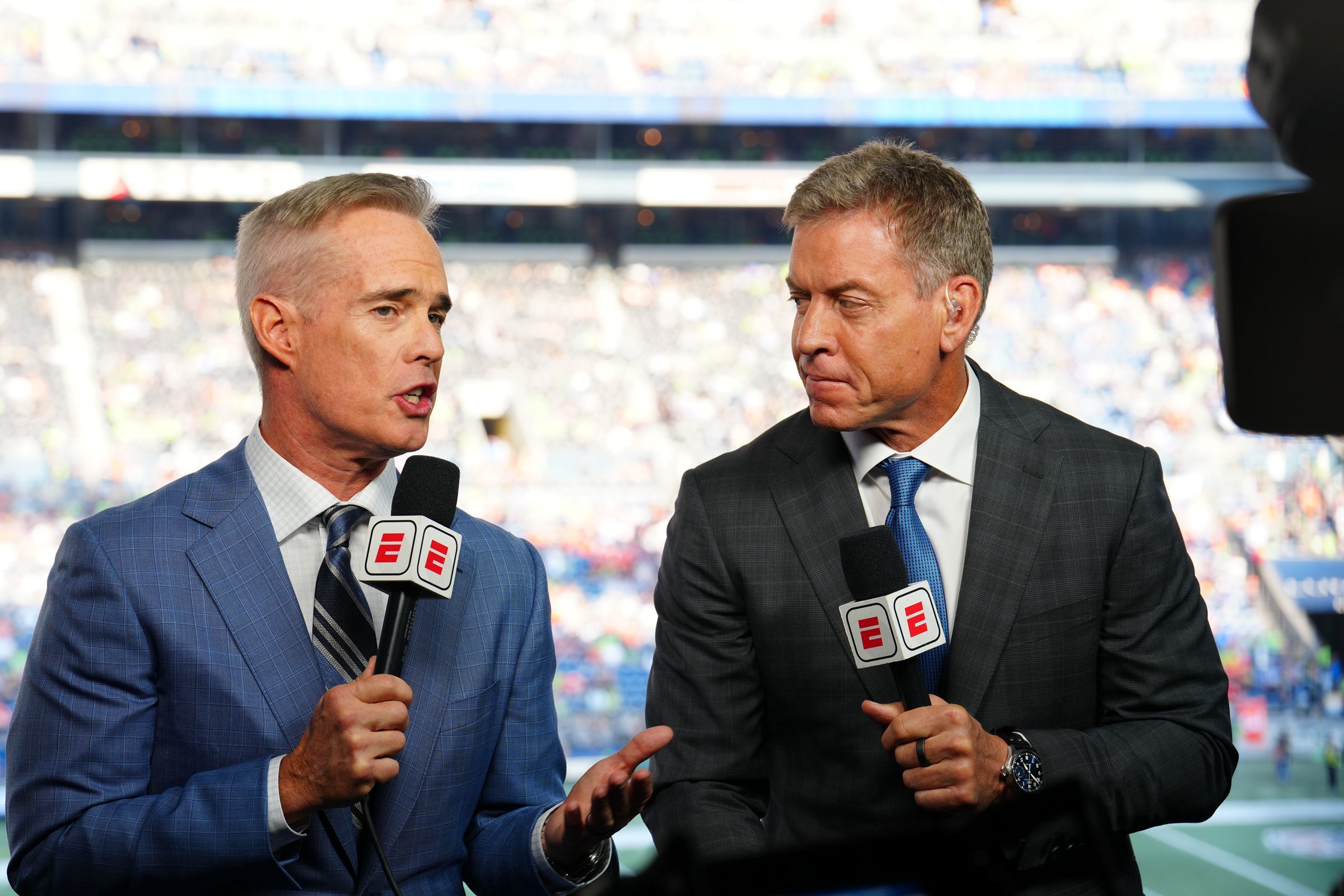
Buck has had a lot stacked against him in Philly during much of his broadcasting career. Eagles fans have hated Buck because of his association with Hall of Famer Troy Aikman, who led the Dallas Cowboys to three Super Bowl victories. Phillies fans felt like he was rooting against their team because they were used to hearing fan-friendly announcers like Harry Kalas and Tom McCarthy.
“Philly fans are at times hard to please, and that’s what makes them great,” Buck said. “They demand effort and excellence.”
A good example of the divide was 2008, when Buck was broadcasting the Phillies’ World Series victory on Fox while Kalas provided the radio call.
Kalas’ passionate call of the final out, a strikeout by closer Brad Lidge, still gives goose bumps to Philly sports fans: “Swing and a miss! Struck him ooooooooout! The Philadelphia Phillies are 2008 world champions of basebaaaaaaaall!”
Buck’s call, by contrast, was dry and direct: “Phillies are world champions.”
“I was raised in a house where I was taught to dislike Joe Buck,” Kylie Kelce said last year on her husband’s short-lived ESPN late-night now. “It seemed as though he was always cheering for the other team,”
Buck’s voice is one of the few in the sports world that signal a big game, and fans have come to view him and Aikman as one of the best broadcasting duos in the league. This year, the two will be back calling the Super Bowl, their first together since 2020 at Fox.
Joe Buck (left) and Troy Aikman have been calling games together since 2002. ESPN Images
Buck isn’t sure what to attribute his newfound respect from Philly sports fans to. Likely it has something to do with Aikman being far removed from his playing days with the Cowboys, but the more likely culprit is that he no longer calls national baseball games.
“Everyone is listening to every tone that comes out of your mouth and assigning some rooting interest that just doesn’t exist,” Buck said. “There would just be no reason why I would root against Philly. It’s just silly stuff.”
“I think people have come around on Joe over the past five to 10 years,” Cataldi said. “He’s always accused of rooting for the opposite team, but if you listen to his broadcast, it’s right down the middle.”
In his fifth season on ESPN’s Monday Night Football, Buck won’t have a rooting interest when the Eagles take on the Chicago Bears. But his stat guy in the booth will.
Ed Sfida, a Villanova grad, has worked with Buck and Aikman since 2003, dating back to their days at Fox Sports. They’ve become so close Buck invited Sfida to his wedding when he married Michelle Beisner, who now works alongside her husband at ESPN.
“Back at Fox, if the Eagles were playing the same time we were doing another game and scored a touchdown, we’d look down in the corner of the booth where Sfida stands and he’s doing the Eagles’ wing flapping thing,” Buck said. “He’s the best.”
Buck doesn’t see himself following in Merrill Reese’s footsteps
Merrill Reese is in his 50th season as the radio voice of the Eagles. Monica Herndon / Staff Photographer
Buck is in his 33rd year calling NFL games in a career that dates back to Fox acquiring TV rights to the league in 1994.
That’s a long time, but he has a ways to go to match Eagles radio announcer Merrill Reese, who is in his 50th season calling the Birds, easily the most-tenured announcer in the league.
If Buck were to make it to 50 years, he’d be 74. So does he seem himself lasting in the booth that long?
“The answer to your question is no,” Buck said. “It’s just amazing to me, whether it’s Merrill or Al Michaels, the mental clarity and strength it takes to find your way through these games and not say something ridiculously stupid.”
“I’m just blown away by Merrill and how smart and clear and energetic is he,” Buck said.
A future without Troy Aikman at ESPN?
Troy Aikman’s ESPN contract expires at the end of the season. Jayne Kamin-Oncea
Buck recently signed a contract extension reportedly worth more than $100 million that will keep him at ESPN through the 2032 season. But Aikman hasn’t and reportedly won’t until after the season ends, after he and Buck call the Super Bowl at SoFi Stadium in February.
There’s been uncertainly about the longtime duo before. When Aikman signed with ESPN in 2022, Buck had a year remaining on his deal with Fox, but executives let him out of his contract early so he could move to ESPN with Aikman.
Buck hasn’t spoken with Aikman about his plans, but he hopes the two will remain together at ESPN and keep the NFL’s longest-running TV booth going.
As for Aikman, there could be plenty of options. With uncertainty at CBS due to Tony Romo’s arrest and subsequent suspension, Aikman could solidify their No. 1 booth ahead of their Super Bowl next season. There’s also Amazon Prime, where Thursday Night Football announcers Al Michaels and Kirk Herbstreit have contracts that expire at the end of the season.
“I’ve been in this business long enough to know nothing is a guarantee,” Buck said. “So my only answer to any of that is we’ll see.”
First came a proposal to permit tariff-free beef imports, but that immediately angered America’s farmers and ranchers.
Then came a plan to ban exports of domestic diesel fuel, but that met with pushback from major oil companies.
In between, President Donald Trump pitched the idea of simply cutting $5,000 checks to adult Americans frustrated, polls show, by high food and gas prices — if the GOP maintains control of Congress. But that idea, too, has come under fire, even from some Republican lawmakers concerned about the potential hit to the budget deficit.
With just five weeks until Election Day, the White House has thrown out multiple ideas for combating persistent inflation, which has outpaced wage growth. But experts say it is unclear whether Trump can execute any policy that would placate inflation-weary voters and help the GOP maintain control of Congress.
“These are symptoms of panic in the administration about problems that they have in part created,” said David Wessel, director of the Hutchins Center on Fiscal and Monetary Policy at the Brookings Institution.
Inflation has been running over the Federal Reserve’s target rate since 2021, but an array of Trump policies have fed the problem, economists say. Trump’s decision to join Israel in going to war with Iran has disrupted the global oil supply, leading to elevated energy rates. His tariffs have produced higher prices for some imported goods. And his administration’s immigration crackdown has made low-cost labor harder to find, keeping price pressures on domestic companies high.
Consumer frustration is reflected in polling. The gap has steadily widened between voters who approve of and disapprove of Trump’s performance as president, and 73 percent of Americans said they disapprove of Trump’s handling of the economy in a recent poll conducted by SSRS for CNN. Only 27 percent approved — his lowest approval rating on the issue ever recorded by the survey.
Against that backdrop, Trump has floated a parade of ideas for cutting prices.
“President Trump pledged to lower costs and raise real wages for everyday Americans, and the Administration continues to rigorously evaluate every option on the table to deliver,” White House spokesman Kush Desai said in a statement.
On top of the political hurdles, however, these policies have been “small in the grand scheme of things … if they’re helpful at all,” said Mark Zandi, chief economist at Moody’s Analytics. “So it’s not like it’s moving the dial on the affordability crisis.”
Douglas Holtz-Eakin, president of the American Action Forum, a conservative-leaning think tank, said it’s not uncommon for politicians to try to bring down prices in the run-up to elections, especially when their party’s control of Washington is at risk.
President Joe Biden did the same ahead of the 2022 midterms, notably by calling for a federal gas tax holiday and releasing millions of barrels of oil from the nation’s Strategic Petroleum Reserve in an effort to bring down sky-high gas prices.
“This whack-a-mole with particular prices is something the Biden guys tried,” said Holtz-Eakin, who was a senior economic adviser to President George W. Bush and the 2008 presidential campaign of then-Sen. John McCain (R-Arizona). “It doesn’t solve the economic problem, and it doesn’t seem particularly politically successful.”
For Trump, time is running out, said Rebecca Patterson, a senior fellow at the Council on Foreign Relations.
The U.S. economy is so big and so complex that improving affordability “is simply not something anyone can do in a month,” Patterson said. “Actions taken today might help in the medium and longer term. But between now and the election, the best you can hope for is that voters appreciate that you’re trying.”
One idea the administration has executed is buying back Treasury bonds. But so far, the payoff has been minimal.
In part because of the competition for cash from massive private-sector spending on artificial intelligence, investors are demanding higher interest rates for Treasury bonds. Higher bond yields, in turn, raise interest rates for consumer loans such as mortgages. The average 30-year fixed mortgage rate hit 7 percent last week for the first time since January 2025.
In August, Treasury Secretary Scott Bessent announced he would intervene in the bond market by buying back longer-term Treasury bonds to try to slow the rise in yields. That has not yet worked in bringing down yields, though Bessent contended in a recent congressional hearing that it is nonetheless a success because “we then proceeded to have the two most successful Treasury auctions that we’ve had in 20 years.”
While Bessent was wrestling with the bond market, Trump decided to tackle meat prices.
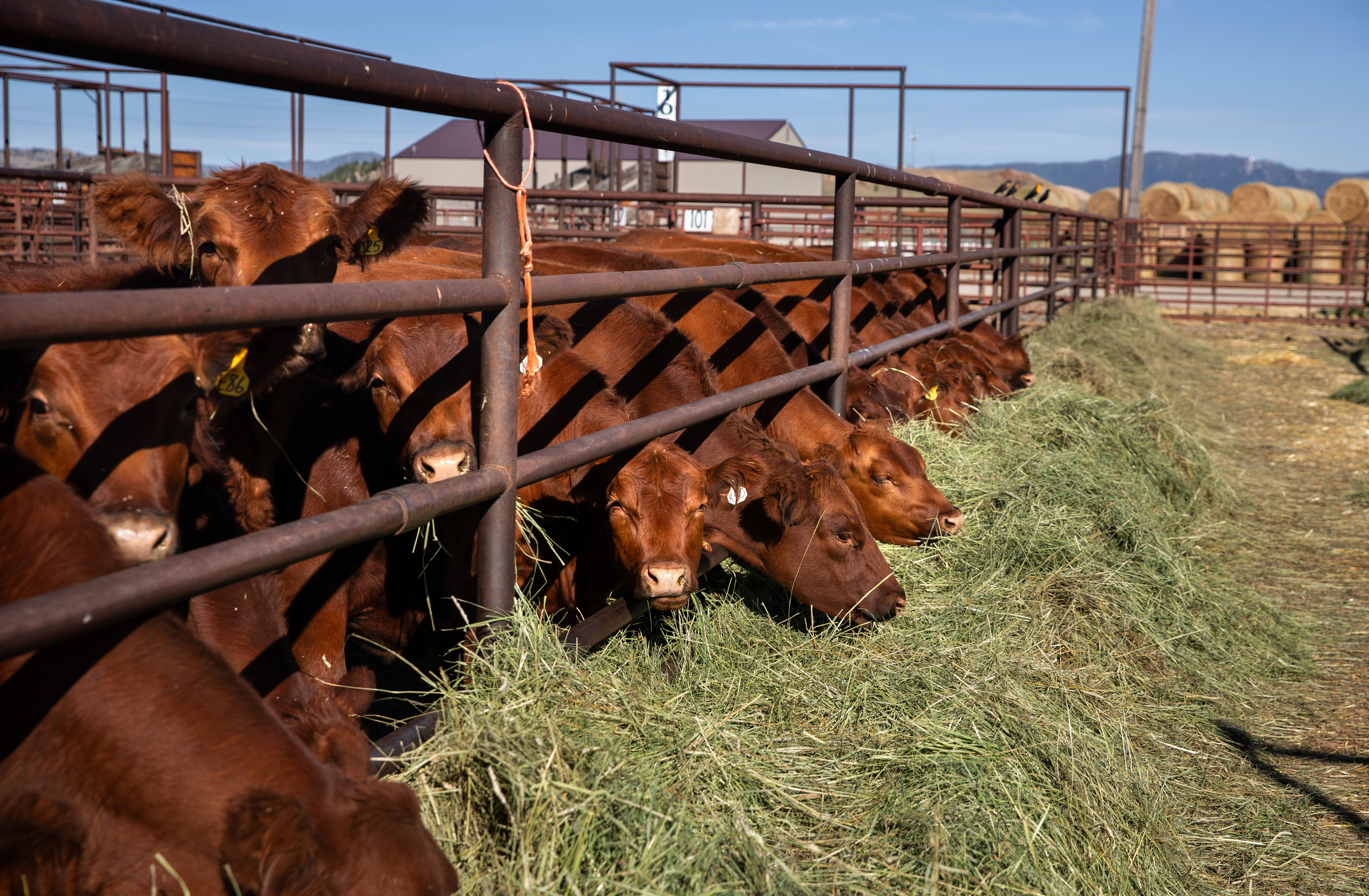
In late August, the president signed a proclamation that rolled back tariffs on foreign beef trimmings for 90 days in an effort to boost imports and lower ground beef prices, which have risen almost 25 percent since the beginning of Trump’s second term.
But that drew rare pushback from farm-state Republicans, including Sen. Chuck Grassley (Iowa), Sen. Pete Ricketts (Nebraska), Sen. Roger Marshall (Kansas) and Rep. Ashley Hinson (Iowa), who is running in a competitive Senate election in her state.
The lawmakers argued that a flood of cheap foreign beef would undermine American farmers and ranchers, who are already struggling with high fuel, grain and fertilizer prices due to the Iran war and other factors.
Trump issued a follow-up executive order aimed at helping ranchers, and the Agriculture Department announced new policies aimed at supporting American beef producers. The administration is now reportedly considering reversing course on beef imports — though the White House has denied that.
Then came the Republican midterm convention in Dallas, where Trump made his biggest pitch yet: If Republicans keep both the House and Senate on Nov. 3, Trump said he would give every adult American a $5,000 dividend to spend within the United States.
Some Republican lawmakers applauded the idea, but others were skeptical, saying the checks not only could exacerbate inflation but also could increase historically large budget deficits. The proposal could cost more than $1 trillion at a time when concern is growing about the nation’s outsize debt, which recently surpassed $40 trillion.
Public interest groups blasted the idea; Lisa Gilbert, co-president of the left-leaning consumer watchdog Public Citizen, called it an “explicit and desperate attempt to buy votes.”
And voters largely have not been swayed: A YouGov poll released earlier this month found that 64 percent of U.S. adults felt they would probably or definitely not receive the dividend if Republicans were to win the election.
So far, there have been few signs of interest on Capitol Hill, where lawmakers would have to draft legislation to authorize the checks and vote to approve it.
Last week, after diesel prices hit a record high, Trump and Bessent announced a new idea for tackling soaring fuel prices: a ban on diesel exports. Their theory was that a ban would boost the diesel supply for American consumers, lowering the price at the pump.
Several Republican candidates in competitive congressional races supported the idea. But major oil companies and Energy Secretary Chris Wright objected, arguing that such a policy would incentivize companies to lower diesel production, which would further raise fuel prices.
By midweek, the fate of the diesel export ban, too, seemed uncertain: Wright said any new limits on diesel exports were likely to be voluntary.