Blog

  • Comey says seashells post was political speech – not a threat – as he presses to dismiss charges

    Comey says seashells post was political speech – not a threat – as he presses to dismiss charges

    WASHINGTON — Former FBI Director James Comey urged a judge on Monday to throw out federal charges against him, arguing that a photo of seashells arranged on a beach he posted on social media was not a call to violence against President Donald Trump but protected political speech.

    Comey’s lawyers argue the government cannot prove the Instagram photo of seashells in the numerical arrangement of “86 47″ constituted a “true threat” against the Republican president, who fired Comey in 2017 and has publicly called for his prosecution. The slogan — which has long meant to “get rid of” or “eject” — has been featured on thousands of items sold online and regularly displayed at protests, defense lawyers wrote in court papers.

    “But the government now singles out Mr. Comey to prosecute one of the President’s most prominent critics for publishing another person’s statement of political opposition,” his attorney’s wrote. “That attempt to suppress core political speech contravenes both the statutes at issue and the First Amendment.”

    The seashells case against Comey was the second in months targeting the ex-FBI director, a long-running Trump foe whom the president over the years has called a “corrupt piece of garbage” and other pejorative names.

    An earlier case in Virginia accusing Comey of lying to Congress was dismissed last November after a judge concluded that the prosecutor who charged him and another Trump adversary, New York Attorney General Letitia James, was illegally appointed to the job.

    More broadly, the case is part of a retribution campaign by the Trump administration Justice Department, which has initiated investigations across the country into individuals the president does not like. Comey has long drawn Trump’s ire for his role overseeing the early months of an investigation into whether Trump’s 2016 campaign had coordinated with Russia to sway the outcome of that year’s election.

    The two-count indictment charges Comey with “knowingly and willfully” making a threat to “take the life of, and to inflict bodily harm upon” Trump and with transmitting a threat in interstate commerce. It does not provide evidence that Comey knowingly threatened Trump, especially since Comey has said the opposite, but suggested a “reasonable recipient who is familiar with the circumstances would interpret” the message as a threat.

    Comey was interviewed by the Secret Service last year over the post after Trump administration officials asserted that he was advocating the assassination of Trump, the 47th president. Comey deleted the post shortly after it was made, writing: “I didn’t realize some folks associate those numbers with violence” and “I oppose violence of any kind so I took the post down.”

    “Even if ‘86 47’ could implausibly be read to suggest violence, a reasonable observer would still understand Mr. Comey’s post as mere political hyperbole, not a true threat,” Comey’s lawyers wrote. “The Supreme Court has rejected threats prosecutions based on speech far more directly threatening than Mr. Comey’s seashells post here.”

    The Justice Department has not elaborated on any evidence of intent the government has. But acting Attorney General Todd Blanche said earlier this year that prosecutors in every case prove intent with “witnesses, with documents, with the defendant himself to the extent it’s appropriate.”

    “And that’s how we’ll prove intent in this case,” Blanche said in April, shortly after he was elevated to lead the department after Pam Bondi’s firing.

    Trump, in a Fox News Channel interview last year, accused Comey of knowing “exactly what that meant.”

    “A child knows what that meant,” Trump said. “If you’re the FBI director and you don’t know what that meant, that meant assassination. And it says it loud and clear.”

  • 333 Belrose is back with a new look and the same popular nachos

    333 Belrose is back with a new look and the same popular nachos

    Radnor’s 333 Belrose shut down in June 2025 for what was billed as a six- or seven-month renovation.

    But when the January target came and went, chef Ross Essner said, regulars would show up at the door to ask the same two questions: “First, they wanted to know when we would reopen and then, ‘Will the nachos return?’”

    The answers: late June, and yes.

    The Main Line mainstay, which opened off King of Prussia Road in the St. Davids section in 1999, reopened in late June after an extensive renovation that rearranged its dining rooms and enlarged the bar.

    Capano Management, which acquired the property in December 2022, initially expected the work to take only a few months. But early in the project, Essner said, designer Barbara Gisel of Haverford proposed flipping the layout, turning the dining room into a larger, dark-toned bar with 13 seats, a backlit wall of spirits, and a poster of Keith Richards, while converting the old bar into a bright dining room. “It ended up opening the whole space,” Essner said. “Now the bar is the focal point when you walk in.”

    That dining room, boasting a vaulted, paneled ceiling, white millwork, and divided-light windows, and a checkerboard wood floor, has the feel of an updated country house. Woven chairs, pale tabletops, sculptural floral chandeliers, and contemporary artwork modernize the historic shell without hiding its character. The patio spills out from the bar through full-length doors.

    Customers dine at the bar inside 333 Belrose in St. Davids on Thursday, July 23, 2026.Allie Ippolito / For The Inquirer

    The 3,870-square-foot building was once used as a stable where lore holds that George Washington once watered his horse.

    Essner, also Capano’s director of hospitality, described the menu as American food with occasional international influences. “Our goal isn’t Michelin stars or accolades,” he said. “The food is approachable. Nothing too cerebral, nothing too crazy. We want to be good enough for the neighborhood every day, but also nice enough that you can come here to celebrate something.”

    Entrées ($29 to $46) include goat-cheese gnocchi with short rib and horseradish cream, steak frites, black cod with mashed potatoes, a cowboy pork chop, and a long-bone short rib. Desserts include crème brûlée, peanut-butter mousse with chocolate ganache, and a warm skillet cookie with coffee-toffee ice cream.

    Shellfish cobb salad at 333 Belrose.Allie Ippolito / For The Inquirer

    And yes, the nachos are back. Layered with black beans, house-made lime and chipotle cremas, pickled jalapeños, cheddar, Colby Jack, guacamole, pico de gallo, tomatillo salsa, a Cooper Sharp sauce infused with peppers, and cotija, they remain one of the restaurant’s signatures. They were landing on table after table during a recent dinner service. “We would never take this off,” Essner said.

    The company, which also owns such Delaware restaurants as Columbus Inn and Charcoal Pit, views Belrose as a long-term investment rather than a project expected to produce an immediate return, Essner said. “The goal is to be here for the next 20 years.”

    333 Belrose, 333 Belrose Lane, St. Davids. Hours: 5 to 9 p.m. Tuesday to Saturday.

    A previous edition of this article misstated chef Ross Essner’s title.

  • Police vetted dubious allegation only after Buttigieg was separated from children

    Police vetted dubious allegation only after Buttigieg was separated from children

    Officials who separated former Transportation Secretary Pete Buttigieg from his young twins last month relied on a vague and unsubstantiated allegation from an accuser authorities later deemed possibly “mentally unstable,” according to previously unreported police records.

    The records, obtained by The Washington Post, and an interview with the apparent complainant offer the most detailed account yet of how a false tip led investigators to the home of one of the country’s most prominent Democrats, drawing bipartisan outrage.

    Child welfare experts who reviewed the documents at The Post’s request said they illuminate a flawed process that was made worse by poor judgment by agencies and a lack of communication among investigators from two states.

    Michigan State Police reports detail the chain of events from the allegation to its eventual determination it was unfounded and potentially politically motivated. Indiana child welfare authorities who received a tip on a hotline with “very limited information” about Buttigieg did not pass along the caller’s name or contact information when notifying officials in Michigan, where Buttigieg now lives, which the Indiana child welfare agency says is their policy.

    Michigan police waited six days after approaching Buttigieg to attempt to identify the caller.

    By then, Buttigieg, a former mayor of South Bend, Indiana, and 2020 presidential candidate, had gone public with the ordeal in a June Substack post, describing it as “the ugliest thing that has happened to me since my career in service began.”

    Michigan authorities had told Buttigieg he could not be alone with his 4-year-old children until they could be interviewed away from their parents the next day, Buttigieg recounted. The children stayed with their grandparents who lived nearby. Buttigieg, who is widely expected to run for president again, called that 24-hour separation “among the darkest hours of my life.”

    Buttigieg said the authorities initially would not tell him what he was accused of. Vivek Sankaran, a professor at the University of Michigan Law School and child advocacy law expert, said he was troubled that Michigan State Police went to Buttigieg’s door with such a vague allegation that didn’t present any indication that children were imminently at risk.

    “At the very least, it’s incredibly poor investigative work. I would even say reckless, in light of how harmful this is for the family,” Sankaran said.

    “It should scare all of us,” he added.

    Michigan State Police spokesperson Lauren Thompson-Phillips said the investigation was “conducted promptly, and the allegations were determined to be unfounded,” adding that the department’s “responsibility was to assess and ensure the safety of the children involved.”

    The first openly gay Cabinet member confirmed by the Senate, Buttigieg, 44, has faced attacks from some corners over his sexual orientation and his decision to adopt two children with his husband, Chasten. He told authorities of the “many threats” his family receives, including death threats, according to the report.

    “This has been a painful and infuriating situation for the family,” Buttigieg spokesman Sean Manning said in a statement to The Post. “They are in touch with Michigan authorities, seeking answers and accountability for what happened.”

    The Michigan attorney general’s office has opened an investigation of the allegation against Buttigieg and how it was handled, spokeswoman Kimberly Bush told The Post.

    “Common sense would have shown that this targeted report plainly lacked credibility on its face,” Bush said. “Before children are separated from their families, due diligence should be exercised to ensure some nexus exists between the source and the family, or that the complaint comes from a reputable, reliable, or verifiable source. We have requested the Michigan State Police turn over all evidence at the completion of their investigation and will zealously investigate all leads, policies and procedures that allowed for such a flagrant violation of the Buttigiegs’ privacy.”

    Officials at Michigan and Indiana state police departments and child welfare authorities declined to answer questions about what, if any, steps they took to verify the allegations before contacting Buttigieg.

    Thompson-Phillips did not respond to a specific question about why state police waited six days to request information from Indiana authorities about the complainant.

    Ron Green, a spokesperson for the Indiana Department of Child Services, said the agency followed “established procedures,” including not sharing information about callers. He and Michigan child welfare authorities declined to comment specifically about the Buttigieg case.

    After receiving a partially redacted copy of the Michigan State Police report that referenced a Facebook post by the caller, The Post was able to identify and contact the woman, who said she lived in Alabama. Public records show she has also lived in Indiana.

    In a phone call, she was unable to answer basic questions about her accusations. She acknowledged that she made reports about Buttigieg to authorities but declined to say to whom.

    The Post is not naming the woman because it was unclear whether she was fully aware that she was speaking to a media outlet on the record. When asked to corroborate her claims — with dates, documents and other specifics — she did not and accused the reporter of working with Buttigieg on a cover-up.

    The Michigan State Police report redacts the complainant’s name and details of the allegation, but the woman’s comments to The Post align with what Buttigieg has recounted being told by authorities and nonpublic details in the police report, including that she met him in the small city of Florence, Alabama.

    Michigan authorities had asked Buttigieg during their investigation if he had traveled to Florence at any time between 2021 and 2023, and his attorney confirmed to them that he had not after reviewing travel records.

    The woman said a sergeant from the Indiana State Police had since called her and was “harassing” her. Indiana State Police spokesperson Ron Galaviz confirmed an ongoing investigation of an allegation of false reporting but said he was unable to comment further.

    Thompson-Phillips, the Michigan State Police spokeswoman, said the agency is deferring to Indiana to identify the accuser and will then “evaluate whether any charges are appropriate.”

    How the Buttigieg investigation unfolded

    Authorities must balance taking child abuse allegations seriously with preventing misuse of the reporting system, the spokesperson for the Michigan attorney general’s office said. The office’s investigation into Buttigieg’s case also aims to reduce the risk of false allegations of child abuse “against other well-known residents and elected officials as the newest form of threat or intimidation,” the spokesperson said.

    Under Indiana law, anyone who suspects a child has been abused is required to make a report, and the Department of Child Services must initiate an assessment within 24 hours. In Michigan, a Children’s Protective Services investigation “must begin within 24 hours” of a report, and usually includes face-to-face interviews with the alleged victims and perpetrators, plus a viewing of the child’s home.

    Buttigieg’s case involved extra complications with multiple agencies across two states. Their interactions and information sharing are partially detailed in the Michigan State Police report.

    Indiana police officials learned about the woman’s call on June 22. They notified Michigan authorities on June 23, prompting a Michigan State Police trooper and child welfare official to visit Buttigieg later that day.

    In his Substack post, Buttigieg said that he was not told the details of the allegations against him, and that he was told to stay at a hotel or send his children to stay with relatives until they could be interviewed the next day. Buttigieg and his husband, who was not accused of wrongdoing, made the decision to send the 4-year-old twins to their grandparents. The children sat alone for separate, hourlong interviews with investigators on June 24 and told investigators they felt safe, according to police records.

    An Indiana child welfare worker contacted the caller again before referring the case to Michigan, reports show, but gained no new information. Those reports do not detail any further attempts by Indiana or Michigan police officials to vet the tip before the visit to Buttigieg.

    When Michigan investigators interviewed Buttigieg, they told him they did not have the name of the person who made allegations against him, according to Buttigieg and the police records.

    On June 26, Buttigieg went public, and Michigan State Police publicly said the allegation against him was false.

    On June 29, a week after the initial tip, a Michigan child welfare worker told a Michigan State Police official that Indiana police informed her that the possible person who reported the allegation was a “mentally unstable woman in Indiana.”

    That’s when the reports show that Michigan State Police contacted their Indiana counterparts to get the caller’s identity, and an Indiana investigator said they would try to interview her to verify the allegations and determine if she made a false report.

    Indiana State Police did not answer The Post’s questions about the claim the accuser was mentally unstable. The woman did not respond to a question about this description of her.

    “This case highlights everything that is wrong with a system of reporting and investigating where no one has accountability,” said Dale Margolin Cecka, professor of law and director of Albany Law’s Family Violence Litigation Clinic. “And a family is traumatized because of it.”

    Under an ideal system, Cecka said, Indiana authorities would have better vetted the caller and shared the identity of the tipster with Michigan, who should have done their own vetting and declined to act on an anonymous allegation.

    An Indiana state investigator looked into the caller and reported finding a Facebook post in which the caller urged people not to vote for Buttigieg and referenced her accusation weeks before she contacted authorities, according to the Michigan report, which does not say when the post was found. In other social media posts viewed by The Post, the woman praised other Democrats.

    The woman told The Post that she decided to contact authorities about Buttigieg because she was worried about his children and his presidential ambitions. She declined to say why she waited years to report her allegations. The police report said she told the Indiana child welfare worker she did not know why she waited.

    Meanwhile, Buttigieg said in his Substack post that he is grappling with what the ordeal means for his family and his country.

    “Even though the accusation was absurdly and obviously false, and was promptly rejected by law enforcement, I still worry about the harm it has done,” he wrote. “And at the most basic level, I worry about how anyone, even in today’s world, could fail to respect the absolutely fundamental principle that whatever you think about someone in politics, you leave people’s kids out of it.”


  • Of all the places in the world, pop star Audrey Hobert says she would haunt Drinker’s Pub in Center City

    Of all the places in the world, pop star Audrey Hobert says she would haunt Drinker’s Pub in Center City

    Ever been throwing back a white tea shot (or four) at Drinker’s Pub at 19th and Chestnut Streets and found yourself wondering: “You know what would make this better? A slender strawberry-blonde ghost.”

    Well, apparently, you wouldn’t be the only one. At an onstage Q&A in a respite from performing, singer-songwriter Audrey Hobert was asked: “If you could haunt any place, just some place, for the rest of your life, what would you choose?”

    As she gripped a plastic water bottle sitting in front of a large speaker, Hobert, who grew up in L.A., smiled and contemplated.

    “Such a great question,” responded Hobert, in a lime green zip-up and gym shorts. “I would probably haunt this bar in Philly which is where, during my song ‘Silver Jubilee,’ it’s like based on a real weekend in Philly in my life and that’s where we spent most of the weekend so I’d probably haunt that bar. It’s the best bar I’ve ever been to.”

    The video capturing the moment was posted Sunday on TikTok and labeled as “audrey q+a in columbus.” It has since amassed more than 130,000 views.

    @thewayiloafedyou audrey q+a in columbus!! #audreyhobert #whostheclown #fangirl #staircasetostardomtour #concert @Audrey Hobert ♬ original sound – addi 🪩

    Hobert said she couldn’t recall the name of the bar in the moment, but a blog post on her website detailing the backstory of “Silver Jubilee” explains that the song was inspired by a Halloween weekend in 2024 she spent at Drinker’s Pub in Center City celebrating her cousin’s 25th birthday.

    Hobert didn’t go into detail about what made the experience so memorable other than spending time with friends and family and a mysterious man from Spain. But almost two years later, the neighborhood haunt (pun somewhat intended) still clearly holds a special place in her heart.

    The “Sue Me” singer is in the midst of her “The Staircase to Stardom Tour,” which stopped in Philadelphia on June 10 at the Met.

  • Zelensky and Britain’s new leader discuss drone projects and missile defense for Kyiv

    Zelensky and Britain’s new leader discuss drone projects and missile defense for Kyiv

    LONDON — Ukrainian President Volodymyr Zelensky and new U.K. Prime Minister Andy Burnham met Monday at a British naval base and discussed joint drone projects and Ukraine’s urgent need for ballistic missile interceptors to counter Russian attacks.

    Zelensky’s visit was the first by a foreign leader since Burnham took office a week ago, and the prime minister said it signaled the U.K.’s “unwavering” support for Kyiv to defend itself against Russia’s 4-year-old, full-scale invasion.

    His predecessor, Keir Starmer, was in the Ukrainian capital less than two weeks ago in his last overseas trip before leaving office, and Burnham said he planned to visit soon.

    Burnham is the fifth British prime minister Zelensky has dealt with since Russia launched the war in 2022.

    “You are the first leader I have welcomed in person since taking office, and that is no accident,” Burnham told Zelensky. “It is intended to send a very clear message: we are with Ukraine 100%, I am personally with you 100%, and I will honor every commitment this country has made to Ukraine in full.”

    Zelensky said the two countries’ relationship was “stronger than ever.”

    The meeting, aboard the aircraft carrier HMS Queen Elizabeth docked at Portsmouth on England’s south coast, came a day before Zelensky is expected to visit U.S. President Donald Trump in Washington.

    Burnham said they had “talked at length” about Kyiv’s need for more interceptors to shoot down Russian ballistic missiles, “particularly in terms of Ukraine protecting critical national infrastructure during the winters.”

    “We’ve taken away some things that we will now follow up with our partners,” Burnham said after the meeting.

    Russia has intensified strikes on gas stations, power facilities, and other infrastructure this year in a broad campaign to strain Ukraine’s logistics and energy networks.

    Zelensky said on X that the leaders also discussed “joint defense production.” Britain and Ukraine already have a deal to work together on new drones, and Zelensky told Sky News beforehand that he hoped to build a “big, big factory” in Britain.

    They also met more than 200 Ukrainian military personnel who have spent three weeks in Britain for an exercise aimed at strengthening their fighting capabilities and measures to counter mines in the Black Sea, the U.K. government said.

    Burnham announced that the U.K. will give Ukraine the intellectual property behind its new “Stone Cloak” electronic warfare system, which is capable of jamming Russian air defenses to stop drones from being detected.

    Ukraine has expanded its campaign of frequent drone attacks deep inside Russia that have targeted oil facilities, military factories, and, most recently, logistical centers, bringing the war home to millions of Russians and raising pressure on President Vladimir Putin.

    The raids have shattered Putin’s narrative of the conflict as something that doesn’t affect the lives of ordinary people in his country. But he has remained undeterred and Russia has ramped up its aerial campaign, regularly bombarding Ukraine with missiles and drones.

    Russia and Ukraine trade drone attacks

    Russia again attacked Ukraine overnight with 147 long-range drones, according to Ukraine’s air force, which said it intercepted or jammed 123 of them.

    In Zaporizhzhia, one person was killed and two injured in attacks on the city that damaged a residential high-rise and several private homes overnight, according to regional administration head Ivan Fedorov.

    A Russian strike on the town of Balakliia in the Kharkiv region killed one person and wounded eight, according to Vitalii Karabanov, head of the city military administration.

    In the Nikopol district of the Dnipropetrovsk region, Russian strikes damaged a kindergarten, residential buildings, and infrastructure, injuring a woman and a 6-year-old boy, according to administration head Oleksandr Hanzha.

    In the eastern Kharkiv region, regional council member Oleksandr Skoryk said Russian forces destroyed every gas station along the highway between Kharkiv and Poltava, a distance of about 93 miles. The highway is a key supply route linking Kharkiv, the country’s second-largest city and a regional hub close to the Russian border, with central Ukraine.

    Romania’s Ministry of National Defense said a drone briefly entered its airspace before crossing the river border into Ukraine, where explosions were subsequently reported. It said two F-16 fighter jets were deployed to monitor airspace.

    The drone’s incursion into Romanian airspace marked the fourth such incident in as many days. The three previous drones were all shot down by the NATO member.

    In Moscow, Russia’s Defense Ministry said air defenses downed 276 Ukrainian drones overnight.

    Rostov regional Gov. Yuri Slyusar said five people, including a child, were killed when a Ukrainian drone hit an apartment building in Rostov-on-Don. Ukraine’s military General Staff said Ukrainian forces struck an export terminal in Rostov-on-Don, setting it ablaze.

    The Ukrainian military said other strikes in the Moscow-held part of the Kherson region targeted a ground relay station used to control drones and a bridge over the Henichesk Strait that Russia uses for military logistics. Russian fuel and supply depots were also hit.

    In the city of Belgorod in southwestern Russia near the border with Ukraine, a Ukrainian drone attack injured 12, including two children, according to regional emergency officials.

    Iran vows retaliation after Ukrainian attack on a ship

    Iranian Foreign Minister Abbas Araghchi said Ukraine struck an Iranian vessel in the Caspian Sea, killing a sailor.

    In a statement on X on Sunday, Araghchi denounced the attack as a “blatant U.N. Charter violation done at Israel’s behest to drag Europe into its war.” He said he made it clear in calls with the European Union foreign policy chief Kaja Kallas and Russian Foreign Minister Sergey Lavrov that the attack “can’t go unanswered.”

    Zelensky said on X that Ukrainian long-range strikes in the Caspian Sea over the weekend achieved “very good results,” adding the targets included “vessels involved in transporting military cargo linked to Iran, as well as a warship.”

    Ukrainian Foreign Minister Andrii Sybiha rejected Iran’s threats of retaliation as unjustified and groundless, saying Tehran’s weapons supplies to Russia have made it a direct accomplice to Moscow’s aggression. “Iran has no standing to pretend to be a victim,” he posted on X, and called its references to the U.N. Charter “absurd.”

    Sybiha said Iran’s statements were an attempt to divert attention from Russia’s attacks on civilian shipping in the Black Sea, which was to be a focus of an emergency U.N. Security Council meeting Monday.

  • McConnell not medically cleared to leave rehab yet, Capitol physician says

    McConnell not medically cleared to leave rehab yet, Capitol physician says

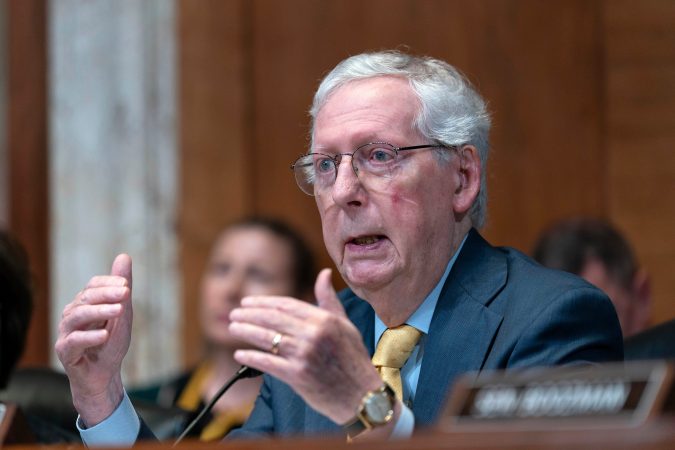
    Sen. Mitch McConnell (R., Ky.) has not been medically cleared to leave a rehabilitation facility, the Capitol physician’s office said Monday, and will miss Kentucky’s Fancy Farm Picnic on Saturday as he continues recovering from a June fall.

    McConnell, 84, was hospitalized June 14 after suffering a fall at home and has not returned to the Senate. He said earlier this month that he had moved to a rehabilitation facility but has not provided a timetable for his return.

    “I’m still working hard to get back to my full schedule of work in the Senate and in Kentucky, keeping up with intense physical therapy per my doctors’ orders,” McConnell said Monday in a statement. “Unfortunately, that means I won’t be able to make it to Fancy Farm, Kentucky this Saturday.”

    In an accompanying statement, Congress’ Office of the Attending Physician said McConnell was “not yet medically cleared to leave the rehab facility and return to the office.” Its physicians visit him daily, the office said, and he is undergoing multiple physical therapy sessions each day to rebuild his strength and reduce the risk of future falls. The office said childhood polio “continues to be a significant factor in his mobility.”

    McConnell has been a regular speaker in the past at Fancy Farm, a picnic in rural western Kentucky that draws politicians from across the state every August.

    McConnell shared a photo of him with his wife, Elaine Chao, which his office said was taken on Sunday.

    McConnell has faced growing questions about his health and when he will return to the office over the past six weeks, which occasional updates from his office have not silenced. Scott Jennings, a former McConnell campaign aide, urged McConnell last week to “routinely update his constituents on how he’s doing.”

    “When you’ve been in a hospital for a month and you’ve missed all the votes … you owe your boss, like anybody else out there who works, an explanation of what’s been going on and when you’ll get back,” Kentucky Gov. Andy Beshear, a Democrat, said earlier this month.

    McConnell’s office has said that he continues to work as he recovers. David Popp, a McConnell spokesperson, said Friday that McConnell “continues to meet with staff regarding Senate and Kentucky business, including discussions on defense appropriations, foreign policy, the farm bill, constituent services, and constituent federal grant requests.”

  • Trump’s Board of Peace lowers ambitions as peace plan lags

    Trump’s Board of Peace lowers ambitions as peace plan lags

    Israel’s right-wing government and the Board of Peace created by President Donald Trump to implement his Gaza peace plan appear on a collision course over the future of the enclave.

    “We are coming home. Gaza is ours,” National Security Minister Itamar Ben Gvir said as he led a demonstration of hundreds of supporters, along with other Israeli government ministers and lawmakers, to the northern Gaza border July 19.

    A number of Israeli officials, without contradiction by Prime Minister Benjamin Netanyahu, have said that Israel is not leaving Gaza and vowed to reestablish settlements that were dismantled when it agreed to “disengage” from the enclave more than a decade ago.

    A White House official confirmed that Trump will meet Tuesday with Netanyahu, who is traveling to Washington to attend a memorial service for Sen. Lindsey Graham. The meeting is likely to center on Iran and Trump’s peace efforts in Lebanon.

    Trump’s Board of Peace has struggled to make progress moving beyond the first phase of his plan, which included the release of all remaining Hamas-held hostages and a ceasefire that left what is now more than 60% of Gaza cleared of Palestinians and occupied by the Israel Defense Forces, and the rest controlled by Hamas.

    Phase Two outlines a sequenced disarmament of Hamas, Israeli withdrawal, and installation of an interim Palestinian government and police force with security provided by an International Stabilization force while internationally financed reconstruction of Gaza takes place.

    Earlier this month, Board of Peace officials briefed Congress on a new element of the plan that would precede those stalemated steps with construction of a pilot “humanitarian and governance zone” for about 50,000 Gazans who agree to live there.

    The briefing was intended to demonstrate progress and transparency to skeptical lawmakers and others who have questioned what the board has achieved thus far.

    While international humanitarian agencies last week noted improvement in food access, the World Food Program said that “the overall humanitarian situation remains brutal” for the up to 2 million Gazans who remain in the truncated, Hamas-controlled part of the enclave, surrounded by the IDF. “Families lack water, sanitation, and medicine,” the WFP said, citing continued problems of international funding and Israeli-restricted humanitarian access.

    The pilot community is to be located in an IDF-controlled area near the now-razed city of Rafah in southern Gaza, according to Board of Peace officials. The officials said it will be separated from the Israelis by a still-to-be formed international force composed of foreign troops and commanded by U.S. Army Maj. Gen. Jasper Jeffers.

    Gazans who have strayed, intentionally or not, across the current dividing line between Israeli and Hamas control — marked by the IDF with widely spaced, yellow concrete blocks that have gradually been moved inward to consume more of Gaza — have been shot at regularly by Israeli troops; some have been killed.

    The current position of the so-called “yellow line,” which Netanyahu said in May he had ordered extended to 70% of Gaza, is far beyond the 53% allotted under the peace deal. IDF Gen. Eyal Zamir has described the line as Israel’s “new border,” where the military exercises “operational control.” The IDF has said it gives warnings before using lethal force against anyone crossing the line.

    On the eve of Netanyahu’s visit to Washington, Israel’s security cabinet on Sunday said that, in principle, it would allow the international force to enter the Israeli-controlled area in support of the planned pilot community.

    According to Israeli news accounts of the cabinet meeting, any Palestinian moving to the pilot community would have to be individually screened for ties to Hamas, and the entry of any foreign troops would have to be directly approved by Netanyahu and his foreign and defense ministers.

    But “it’s unclear whether Palestinian civilians would find that to be a sufficiently secure arrangement and would feel comfortable doing it,” said former U.S. ambassador to Israel Dan Shapiro, now at the Atlantic Council think tank.

    “The model is a little bit bizarre in the idea that it says to Palestinians who are not currently under Israeli control, come live under Israeli control. It’s better for you,” Shapiro said.

    According to a senior Board of Peace official, who spoke in an interview on the condition they not be identified by name, Palestinians who agreed to move into the pilot area would be free to come and go into Hamas-controlled Gaza at any time.

    The official described the pilot project as “serious temporary housing.” They estimated that it will cost $150 million — including humanitarian and medical needs and — and completed before the end of this year.

    The planned humanitarian zone, called “New Rafah,” would be a far cry from the ambitious redevelopment of Gaza into a high-tech industrial center and waterfront resort, with high-rise residential communities, high-speed transportation and parks, outlined by Trump negotiator and son-in-law Jared Kushner.

    When he introduced what he called “New Gaza” in January at the World Economic Forum in Davos, where world leaders first signed up for the Board of Peace, Kushner said demolition and removal of unexploded ordnance, at least in the Israeli-occupied portion of Gaza, had already commenced. Construction of New Gaza, he said, would begin under the second phase of Trump’s peace plan.

    “We’re looking to cultivate a very deep relationship with both chambers and across the aisle” in Congress, the Board of Peace official said, adding that they planned to appoint a permanent congressional liaison. A second official said that in the briefings, the board was “signaling its readiness to receive $200 million” from a State Department peacekeeping account to add to what is now about $300 million that other countries have donated for overall Gaza renewal.

    The State Department did not respond to specific questions about peacekeeping funds but said that it “continues to evaluate how existing authorities, programs, and interagency coordination can best support” the peace and stability objectives laid out in Trump’s plan.

    So far, Bahrain and Morocco have publicly acknowledged contributing funds to the endeavor, plus what the senior official said were “other folks who I don’t think are out there yet.” This month, the European Commission and 15 European countries agreed to provide around $1 billion “to support the implementation of ongoing and planned early recovery projects” for Gaza.

    Asked whether that money would go into private Board of Peace accounts at J.P. Morgan or a World Bank account that is part of Trump’s peace plan, and thus available for the pilot project, a European Commission spokesperson said each donor nation would decide where and through what channels it wanted its specific contribution to go.

    Spokespeople for staff of the House Foreign Affairs Committee and Senate Foreign Relations and Appropriations Committees declined to comment on the briefings by Jeffers, Board of Peace adviser Joshua Gruenbaum and retired Lt. Gen. Mark Schwartz, who is organizing a civilian Palestinian police force.

    While refinements in the Trump plan made by Board of Peace High Representative Nickolay Mladenov spell out in detail partial Hamas disarmament and IDF withdrawals in reciprocal sequence, neither side trusts the other and each has adopted a “you first” stance.

    The pilot project “makes sense in that while disarmament [of Hamas] is not moving forward,” the Board of Peace is “looking for some way to show other elements of the plan can advance,” Shapiro said. “None of this is easy. The Israelis are very resistant to it because they want to prioritize disarmament. … And there may be political factors” in the run-up to Israel’s October elections.

    Last week, Hamas announced selection of a new leader, Khalil al-Hayya, to replace Yahya Sinwar, killed by the IDF in Gaza in 2024. One of his priorities, al-Hayya said in a televised address, was “to accelerate and carry out reconstruction … not a gift or favor from anyone” and not tied to any “trade-offs, concessions, or political positions.”

    He offered no explanation of how that would be accomplished.

    The senior Board of Peace official said that some progress was being made in negotiations with Hamas over turning over their weapons in sequence with Israeli withdrawal, and expressed little concern about any intransigence by Israel.

    “A lot of times what politicians in the Middle East tell you is not exactly what is happening in reality,” the official said. “We have really good relationships with Prime Minister Netanyahu and his team. I think when we are ready to go deploy that first pilot program, they’re going to be committed to making sure it’s a success.”

  • Trump demands Senate cancel August break until it passes voting bill

    Trump demands Senate cancel August break until it passes voting bill

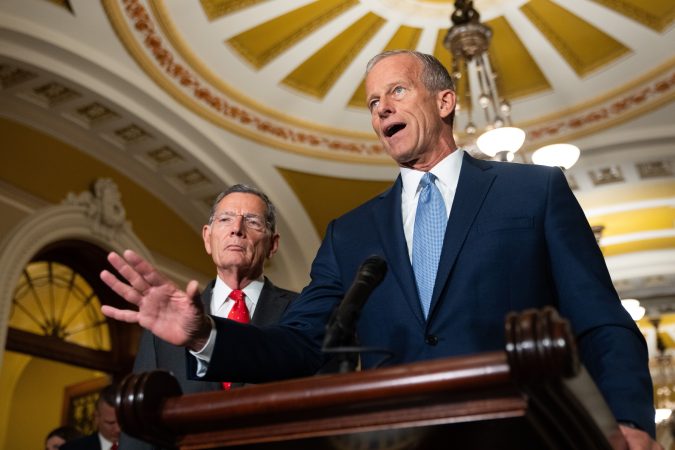
    WASHINGTON — President Donald Trump on Monday demanded that Senate Majority Leader John Thune cancel the chamber’s upcoming August break until senators pass a strict proof-of-citizenship voting bill, even as Republicans lack the votes to advance it.

    Trump has repeatedly urged Thune to scrap the legislative filibuster, which effectively sets a 60-vote threshold for most legislation in the 100-member Senate, or find another workaround to pass the voting bill, known as the SAVE America Act. But Republicans hold only a 53-47 majority, and Thune has consistently said they don’t have the votes to pass the bill or change the rules to get around the filibuster.

    “John Thune should not allow the United States Senate to ‘leave town’ until it passes The Save America Act or, far better still, TERMINATES THE FILIBUSTER,” Trump wrote on social media.

    He later insisted to reporters Monday that he has a good relationship with the Senate majority leader but said Thune has “got to get his job done.”

    It’s the latest escalation in a monthslong pressure campaign by Trump and others in the GOP base to pass the SAVE Act ahead of the midterms. A small but vocal group of Republican senators has also increasingly pressed Thune to find a way forward.

    House Republicans have also attempted to create another path for the legislation through the budget reconciliation process, which would allow grant money associated with voting rules to pass the Senate with a simple majority.

    The House last week approved a budget framework that included $10 billion for voting-related changes aligned with the SAVE America Act. But Thune has said Republicans don’t currently have the votes for that approach, either.

    Trump’s pressure comes during an important period

    The fight threatens to complicate the Senate’s final legislative sprint before the August break, when Thune had hoped to focus on a long list of priorities that includes government funding, cryptocurrency legislation and sanctions on Russia. The August break, scheduled to start on Aug. 7, is a pivotal stretch for senators to return home and campaign ahead of the midterm elections.

    Several Republican senators are facing competitive races, including Maine Sen. Susan Collins, Ohio Sen. Jon Husted and Alaska Sen. Dan Sullivan. Republicans currently hold a 53-47 Senate majority. Republicans are confronting broader political headwinds as well, including an unpopular war in Iran, surging gas prices and costs that remain high for voters.

    Thune has enjoyed broad support from his GOP conference all year as he’s pushed back on Trump’s demands. He previously kept the SAVE Act on the Senate floor for weeks in an effort to build additional support, but was unable to secure the votes needed to advance it.

    Utah Sen. Mike Lee, who has led the push for the bill in the Senate, escalated his pressure late last week, warning that how Republicans handle the SAVE America Act “could impact not only the November midterm elections, but also the Senate GOP leadership elections.”

    “Leaders must lead. And if they don’t, they’re not leaders,” Lee wrote on social media Friday.

    Frustrated by the pressure when he doesn’t have a route to pass the bill, Thune has urged Trump, Lee and others to help him find the votes. Trump on Friday said he’d “certainly be willing” to help call senators.

    Asked last week if Trump is frustrated with Thune, White House press secretary Karoline Leavitt said that “his patience is running out.” But Trump told reporters on Air Force Once Monday while traveling to an event in Michigan, that he hasn’t “even thought” about potential replacements for Thune.

    The late-summer dispute echoes a similar fight before last year’s August recess, when Trump pressed Thune to keep senators in Washington to clear a backlog of his nominees. The Senate ultimately left town without a deal after negotiations with Democrats collapsed.

    The SAVE America Act would create new national rules

    The SAVE America Act, which stands for Safeguard American Voter Eligibility, would require Americans to prove they are citizens when they register to vote, mostly through a valid U.S. passport or birth certificate. It would also require a valid photo identification before voters can cast ballots, which some states already demand.

    Voting experts have said the bill could disenfranchise some 20 million American voters who don’t have birth certificates or other documents readily available.

    Trump has made it his legislative priority in 2026, saying it would “guarantee the midterms” and falsely claimed that election cheating is “rampant.” He previously declined to sign any other legislation until it was passed.

  • This Sixers fan has the tweets to prove he waited almost a decade for LeBron to join the team

    This Sixers fan has the tweets to prove he waited almost a decade for LeBron to join the team

    An X (formerly Twitter) account that’s been around since 2017 has only ever had one question: Is LeBron James a 76er yet?

    After having lost hope and gone dormant years back, the anonymous account has returned for what fans are calling “the greatest re-login” of all time.

    It was a moment of redemption when @IsBronA76erYet came back online Friday. The user didn’t use words, but rather posted a popular GIF from the TV show BMF, where one of the main characters, Lamar, opens his eyes while on oxygen after waking from a coma. Millions of viewers knew exactly what they meant.

    You see, not much is known about X user @IsBronA76erYet besides their fandom. X stats show the account was created in July 2017, is based in the United States, and follows only two accounts — take a wild guess who.

    @IsBronA76erYet followed a format popular across Twitter accounts throughout the aughts. The “is [insert topic] XYZ yet” accounts were devoted to constantly answering a lingering question, usually in the pop culture realm, with a brief status update.

    Know Your Meme has documented dozens of so-called “gimmick accounts” on Twitter over the years, with the earliest examples dating back to 2007, according to managing editor Zach Sweat.

    Examples include “Is Winds of Winter out yet?” an account devoted to George R.R. Martin’s sixth novel in the A Song of Ice and Fire series, @knickswintrack, which follows if the Knicks have won, or “Is GTA 6 out yet?” which has been waiting since 2019 for the latest Grand Theft Auto installment.

    “When these pop up dedicated to a specific event, most of the time they fizzle out or are forgotten when the thing they’re dedicated to never happens,” Sweat said. “However, when they do come true, people love digging them up and reviving them, and it’s always really funny seeing them come back to life and seeing how users react to them like they were an oracle or something.”

    Over the course of @IsBronA76erYet’s lifespan, it would repeatedly just tweet: “No.”

    There was a brief moment of hope for this devoted X user in August of 2017 when media outlets suggested James was done with the Cleveland Cavaliers. “No, but soon,” the account mused.

    But in 2018, when James announced he was headed to the Los Angeles Lakers, the user took it like a dagger to the heart. “He never will be now,” the user tweeted on July 1, 2018. “Time to deactivate.” The account went quiet.

    For years, fans speculated that James’ retirement from the league was imminent. Even James, the NBA’s oldest active player at 41, said there were moments he thought he was done, too.

    “I was pretty sure I played my last game,” James said in a series of social media posts Friday morning. “I still truly love this game, and I have more to give.”

    That’s when the figurative oxygen tank started hissing for this X user — or probably more likely, when they started fervently trying to find their old dormant account’s login information.

    At 9 p.m. Friday, it was the tweet seen around the world.

    Is LeBron A 76er Yet was back.

    Their prophecy had been fulfilled. And the internet was there to see it.

    The wordless post with the GIF has been viewed over 50 million times and has 1 million likes — more than the 400,000 or so likes for ESPN insider Shams Charania’s post breaking the news about James in the first place.

    Users have been enamored with the account’s determination.

    “One million likes from a non verified account who’s finally got Bron in Philly, after not tweeting for 7 years. We’ll never see this organic tweet ever again,” one user wrote. The account “rose from the ashes,” said another. “Remembering the password on an account you haven’t been able to use in eight years is worth the [likes] alone,” another remarked.

    On Monday, @IsBronA76erYet posted again. This time, they wrote something they’ve never gotten to say before. One word, three letters. “Yes.”

  • Shapiro planned to flat fund rape crisis centers. They convinced him to double their line item.

    Spotlight PA is an independent, nonpartisan, and nonprofit newsroom producing investigative and public-service journalism that holds power to account and drives positive change in Pennsylvania. Sign up for our free newsletters.

    HARRISBURG — After years of asking for more funding, Pennsylvania’s rape crisis centers saw their funding nearly doubled in this year’s state budget, a lifeline that the resource-starved organizations say will allow them to restore staff and services.

    The $12 million increase brings total annual funding for the state’s 47 rape crisis centers to just over $24 million, and comes after they were left flat-funded for six of the past 10 budget cycles.

    Administrators at and advocates for these centers say they had to convince Gov. Josh Shapiro and his administration that the situation was dire.

    “I listened,” Shapiro said at a Monday news conference. “These people are true public servants, the work they do every day,” he said. “They deserve more, and they got it.”

    The lack of new state funding, along with federal cuts, the budget impasse of 2025, and ongoing inflation, has troubled crisis centers in recent years, leaving the majority financially strained to the point of cutting staff and services, administrators and advocates told Spotlight PA.

    They said the influx of dollars will help reinstate cut programs and workers, but cautioned there’s still a long way to go to mend years of underfunding.

    “Sexual assault centers have been ringing this bell with our legislators for the past two to three years, trying to explain that we are really coming into the precipice of a real risk for crisis services declining or crumbling in many different parts of our state and of our counties,” said Ali Perrotto, chief executive of the Sexual Assault Resource and Counseling Center serving Lebanon and Schuylkill Counties.

    The commonwealth’s 47 rape crisis centers provide services to around 26,000 survivors of sexual violence annually, according to the state Department of Human Services. These services include 24/7 hotlines and crisis counseling; prevention education; housing; and training on sexual assault-related issues.

    State funding for these centers is distributed through a formula that takes into account population density, number of victims served, and hours of direct service provided. Centers also receive federal dollars, as well as grants and donations. Funding streams vary drastically by center: While some larger ones have relatively diverse finances, others are highly dependent on the state to operate.

    In 2025, lawmakers approved a 2% funding bump amounting to around $250,000 more for all crisis centers. Advocates said this was not enough to meet the needs of organizations already in deep financial straits due to the four-month impasse that preceded the budget deal.

    Rape crisis centers are among the nonprofits and other entities whose state payments get frozen when there is no budget. Perrotto said the situation forced SARCC to cut its prevention services and put off a capital purchase that would have provided housing for survivors in Lebanon County. The decision came after the center had to decide between investing in property or paying its staff, she said.

    Other centers, she added, had to dip into reserve funds or use lines of credit to keep paying wages. When the budget finally passed last year, the number of workers had dwindled to the point where centers were unable to restore everything. And organizations that did take out loans or use lines of credit still have to pay interest, which can only be financed through fundraised dollars, not grants.

    The impasse wasn’t the only difficulty. Rape crisis centers receive funding from the federal Victims of Crime Act fund. Money in the fund comes from fines paid by people who are federally convicted and goes to a range of services for crime victims. However, administrative changes at the federal level have lowered the fund’s balance. A state guide published this spring said money is now “critically low,” a dip that has caused a 45% decrease in victim services funding since 2022.

    At the same time, the number of survivors seeking services at rape crisis centers increased, Perrotto said.

    That uptick stems from lawmakers expanding the responsibility of local law enforcement, who now must directly refer victims to service agencies. This has increased the number of people coming through the doors of crisis centers.

    “We had more influx into the systems, even though we had fewer staff to meet the need and less funding to provide the services locally,” Perrotto said.

    There was often little rape crisis centers could do to tighten their belts further.

    Perrotto said that over the past five years, SARCC has cut 50% of its staff. Those who remained working provided constant access to services, including a 24-hour support line along with counseling, legal, and medical support.

    “The longer an impasse goes, the more of a tax there is on survivors and on the centers who are providing services to them,” Perrotto said.

    The fight for more funding

    When Shapiro first made his budget pitch in February, it didn’t address these issues; he proposed keeping funding flat once again.

    This caused an uproar from rape crisis centers. Advocates and administrators at centers across the commonwealth signed on to a letter asking for a $12.5 million bump.

    “Every year, flat funding has been equal to a budget cut, forcing centers to stretch already-thin resources even further as inflation and demand rise,” the letter said.

    It wasn’t until Shapiro listened to advocates and heard their testimonies that he realized the magnitude of the issue, he said during a Monday news conference at the YWCA in Carlisle.

    Joyce Lukima, director of the Pennsylvania Coalition to Advance Respect, which distributes state funding and advocates for rape crisis centers, said center leaders from across the state also met with lawmakers in May to discuss the need for funding.

    She said this year is the first time she believes advocates’ concerns were actually listened to.

    “After so many years of talking about this, I feel that we were heard and heard in a way that caused someone who was in a position to be able to take action to help move our cause forward,” she said.

    Perrotto was part of that effort. She compiled data about crisis centers’ needs across the commonwealth and presented it to Val Arkoosh, head of the state Department of Human Services.

    Detailed information on centers’ services and various funding streams was necessary to clearly illustrate to legislators the magnitude of the problem, said Arkoosh at the Monday event. Perrotto said the data she gathered showed the “buying power cut” of rape crisis centers — a loss in ability to pay for bills, staff, and services while still helping the same number of people.

    While the money alone is a step in the right direction, Lukima said there’s going to be a lot of necessary rebuilding to right the wrongs of previous years’ funding difficulties.

    She added there’s also a need to ensure that funding keeps pace with inflation to prevent centers from reaching their limits before getting more state resources.

    Perrotto echoed that point. “There’s going to be a build-up period, so we have to build back and restore what was lost or what was kind of crumbling in the current system, and we’re doing that with less staff,” Perrotto said.

    Along with rehiring furloughed workers, she said the new money will also go toward properly paying people who worked through underfunding. In 2022, her most recent analysis, Perrotto said the average wage for prevention educators and advocates working at sexual assault programs was $16 to $18 an hour.

    Increasing wages will ensure survivors are taken care of by workers who aren’t stretched too thin, or who need to work multiple jobs to make ends meet. Centers will also put funding toward restoring programs to ensure the caseload is not as heavy, she said.

    Lukima said she also predicts centers’ money will be allocated toward reinstating sexual abuse prevention programs that were cut in favor of maintaining services seen as more critical.

    At the end of the day, she said, rape crisis centers are essential for survivors of sexual violence, and lawmakers should treat them that way.

    “There isn’t a necessity for people to get to a breaking point before they get that increased allocation,” Lukima said, “recognizing how critical and important services are to the community, to the state, and making sure that that increase comes — just like it does for many other professions, just like it does for our legislatures — without having to have a multiyear struggle.”

    BEFORE YOU GO… If you learned something from this article, pay it forward and contribute to Spotlight PA at spotlightpa.org/donate. Spotlight PA is funded by foundations and readers like you who are committed to accountability journalism that gets results.