Blog

  • Trump admin asks colleges to agree to reforms. Penn is a member of the group that helped draft them.

    Trump admin asks colleges to agree to reforms. Penn is a member of the group that helped draft them.

    The University of Pennsylvania, Rutgers University, Pennsylvania State University, and Princeton University belong to a national university group whose leaders helped the U.S. Department of Education develop a new list of reforms it would like all colleges to adopt by the end of the year.

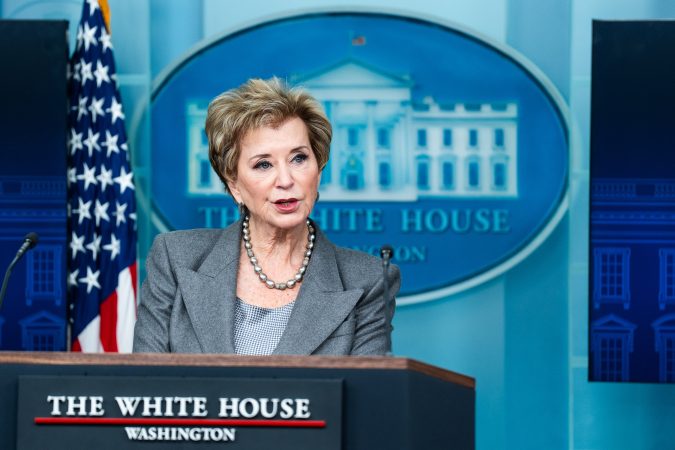
    U.S. Secretary of Education Linda McMahon on Monday sent a letter to colleges asking them to agree in public statements on their websites to wide-ranging reforms that include cracking down on protests, hiring more conservative faculty, combating grade inflation, taking steps to ensure there aren’t “covert” attempts to use race-conscious admissions practices, and containing tuition costs, among other changes.

    There is no plan to sanction schools that don’t sign on, but those that do could be in line to get more research funding, according to Bloomberg, the first to report on the letter, citing a White House official.

    The latest effort by President Donald Trump’s administration to reshape higher education at least initially appears to be getting a warmer response than the list of demands made in its controversial compact that was rejected by most universities, including the University of Pennsylvania, last year.

    The reforms were developed with the help of four university presidents from the Association of American Universities, including the group’s board chair and vice chair, according to Bloomberg.

    “We’d much rather be a partner than play the guessing game as we have been,” Douglas Girod, president of the University of Kansas and board chair, told Bloomberg.

    AAU president Barbara Snyder told Bloomberg she planned to call on her member colleges to support the plan.

    Penn is one of 71 research universities nationally and in Canada that belong to the group. The university did not respond to a request for comment on whether it planned to participate.

    Penn last October rejected the White House’s university compact, which would have given the school preferential consideration for federal funding in exchange for agreeing to operational demands. Many groups on campus had spoken out against the compact, and Penn president J. Larry Jameson in a letter to the federal government at that time said he outlined areas where Penn found “existing alignment” with the compact and where the school had “substantive concerns.”

    “For the good of the nation, university leadership must seize this occasion to drive essential reforms — a process some began by adopting positions of institutional neutrality and improving policies related to campus protests,” McMahon wrote in her letter Monday. She called on all colleges to “describe to the American public your commitments to rigorous teaching, pathbreaking research, and national service — commitments that make our universities a bedrock institution of the American republic.”

    She acknowledged that not every college’s response would be the same, but presented schools with a series of questions that they should address. Among them are:

    “How will your institution ensure admissions decisions are based on merit, achievement, and your university’s educational purpose?”

    “How will you guarantee that unruly and violent protesters do not harass students or disrupt classes, research, public lectures, and campus operations?”

    “How will your faculty hiring and evaluation practices support academic vitality and ensure that all relevant perspectives are taken seriously?”

    “What can your school do to contain costs, improve pricing transparency, and ensure that every academic program equips students to repay their loans?”

    “How will your school protect academic programs from foreign influence and safeguard the integrity of the research enterprise?”

    McMahon also warned against allowing academic disciplines to foster political and social goals.

    “When disciplines skew toward one side of the ideological spectrum, the truth-seeking function of the university suffers and public trust declines,” McMahon wrote.

    Penn State said its leadership team had received the letter and is reviewing it.

    Rutgers said it also had received the letter and “welcomes constructive dialogue with federal and state policymakers and remains focused on providing an excellent, accessible education that advances research to serve New Jersey and the nation.”

    Princeton did not immediately respond to a request for comment.

    “We look forward to learning more from the Department of Education about this effort and collaborating to advance shared goals,” Waded Cruzado, president of the Association of Public & Land Grant Universities, said in a statement. Penn State, Rutgers, Temple University, and the University of Delaware are part of that group.

    The other three AAU presidents involved in drafting the new reforms include Andrew Martin at Washington University in St. Louis, Michael M. Crow at Arizona State University, and Ron Daniels at Johns Hopkins University.

    Temple is not a part of AAU, but Temple president John Fry has worked closely with Crow, whose university sponsors the University Innovation Alliance that Temple joined last year. The alliance is a national organization of public universities aimed at finding innovations to improve learning and increase college attendance, retention, and graduation rates ― especially for low-income students ― then scaling those innovations across campuses. It was founded by 11 presidents including Crow.

    Fry at the time described Crow as a mentor and said that he had known him for more than 30 years. They started presidencies simultaneously in 2002, Fry at Franklin and Marshall College in Lancaster, and Crow at Arizona State.

    In a statement, Temple said it was “carefully reviewing” the letter from McMahon.

    “Upon initial review, much of what is outlined in the letter is consistent with core tenets of what we do as a university,” the school said. “Our approach will continue to be guided by our mission and our strategic plan.”

    Martin, of Washington University, told Bloomberg that he planned to respond to the McMahon letter.

    “My expectation is this letter will have some things in it not everybody will agree with, but that universities will consider it,” he told Bloomberg. “Certainly compared to the compact, I think this is a step in the right direction.”
  • Giving back means ‘everything’ to Labaron Philon Jr. — and it gave Sunrise’s campers a day to remember

    Giving back means ‘everything’ to Labaron Philon Jr. — and it gave Sunrise’s campers a day to remember

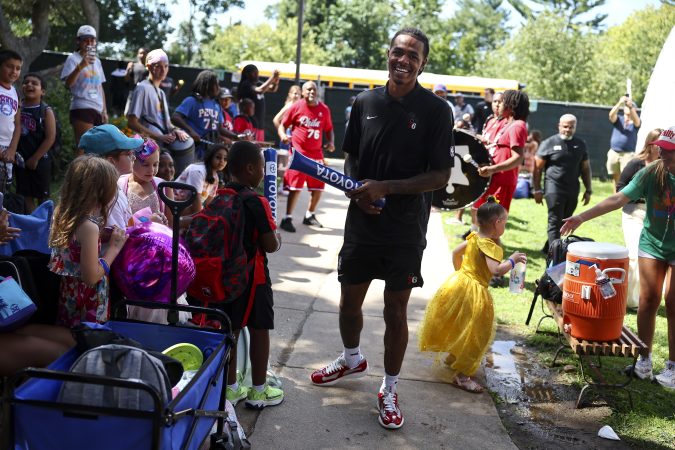
    The entrance to the Kaiserman JCC gymnasium in Wynnewood was lined with members of the Sixers Stixers drum line, keeping rhythm to welcome Sunrise Day Camp students as they arrived Monday in a mix of 76ers jerseys and formalwear.

    The mixed attire summed up Sunrise’s campers agenda for the day: prom and a Sixers basketball clinic.

    Sunrise Day Camp is a free summer camp for children with cancer and their siblings. The basketball clinic, in conjunction with the Sixers Youth Foundation, is just one of the many events held at the camp. Jennifer Rebetti, the senior director of Sunrise Day Camp in Philadelphia, said the goal is to make every day “the most magical day,” and “the magic was overflowing” in the penultimate day of summer camp.

    Campers participate in a basketball clinic with the 76ers at Sunrise Day Camp on Monday.Monica Herndon / Staff Photographer

    “We found out last Wednesday that they would be joining us, and it’s been a week of excitement,” Rebetti said. “The lead up is ‘who’s coming, who are they going to meet?’ and at the end of the day I don’t think it matters who they meet, it just matters that the Sixers Youth Foundation is there for them again because every time, we love partnering with them, they’ve just been fantastic.”

    While the campers enjoyed activities and games with the Jr. 76ers and Franklin the Dog, the real surprise came as Sunrise participants did their daily sendoff and were joined by the Sixers’ first-round draft pick Labaron Philon Jr.

    The rookie met with the campers and signed autographs, later offering remarks about what it meant to him to be there.

    “It means everything,” Philon said. “Being out here, being able to come out here and see the kids and see everybody around and just get in the community a little bit. I feel like that’s always been an important thing for me. So just continuing to do that, I feel like that’s a fun thing.”

    But Philon wasn’t the only one giving back on Monday.

    Counselor Jadon Sephes, 16, was once in the shoes of the campers as a sibling. For him, the camp offered a sense of normalcy in his everyday life. Now he wants to pass that same feeling on to the campers.

    Campers arrive for a basketball clinic with the 76ers at Sunrise Day Camp on Monday.Monica Herndon / Staff Photographer

    “You’re forgetting that ‘I have to go through this and that’ during my daily day, and I can just be a normal kid without having to talk about what’s going on with my sibling or myself,” Sephes said.

    Rebetti said that is the intention of the camp, serving as an equalizer and allowing campers to “just be themselves” as they navigate difficult circumstances.

    “This place really is the place that equalizes everybody,” Rebetti said. “Whether you’re the primary person with cancer or you’re the sibling of a kid with cancer, it’s really hard to be either of those people, and this place is where it all comes together, and they just get to be siblings, and they just get to be friends, and they just get to be kids. … I think at the end of the day, they walk away with smiles and laughter and the sense that they really belong and are included in something super special.”

  • 25 states sue over Trump’s new tariffs, calling them ‘pretext’ to replace his old ones

    25 states sue over Trump’s new tariffs, calling them ‘pretext’ to replace his old ones

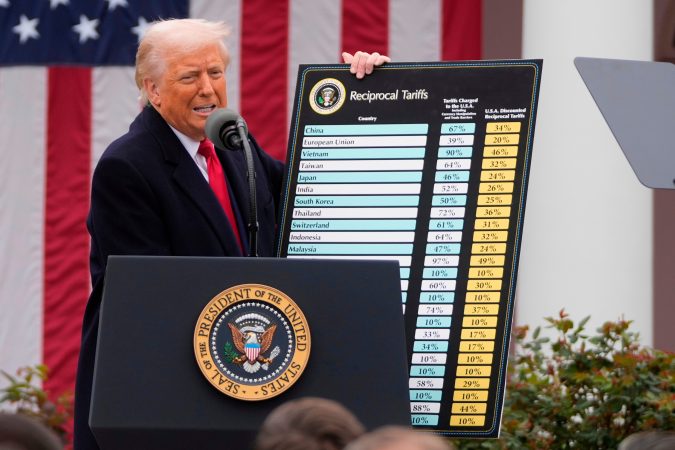
    WASHINGTON — Twenty-five states sued the Trump administration Monday over its latest tariffs, calling them a pretext for replacing import taxes the Supreme Court struck down in February.

    The United States last month imposed double-digit tariffs on 59 countries and the European Union, charging that they had not done enough to crack down on imports produced by forced labor. The new tariffs took effect just as the clock ran out on temporary tariffs President Donald Trump had turned to after the Supreme Court defeat.

    “After losing at the Supreme Court, the administration is once again trying to illegally raise taxes on families and businesses with a new round of tariffs,” said New York Attorney General Letitia James.

    Joining New York in the lawsuit announced Monday are Arizona, California, Colorado, Connecticut, Delaware, Hawaii, Illinois, Kentucky, Massachusetts, Maryland, Maine, Michigan, Minnesota, Nevada, New Jersey, New Mexico, North Carolina, Oregon, Pennsylvania, Rhode Island, Virginia, Vermont, Washington, and Wisconsin.

    Pennsylvania Gov. Josh Shapiro, who joined the suit in his official capacity, posted about in on X Monday afternoon.

    “Donald Trump is once again trying to impose his disastrous and illegal tariffs. So we’re taking him to court — again. The President’s tariffs have injected unnecessary chaos and confusion into Pennsylvanians’ lives — and have raised prices across the board for our farmers, small businesses, and families,” Shapiro said. “We’ve won in court before to protect Pennsylvanians from the costs of Trump’s disastrous trade war — and the Supreme Court has already ruled his tariffs unlawful — so now we’re going back to court to stop him yet again.”

    Trump, who argues that high tariffs will revive American manufacturing, last year overturned decades of U.S. policy that favored lower tariffs and ever-freer trade. Invoking the 1977 International Emergency Economic Powers Act, or IEEPA, he imposed double-digit tariffs on imports from almost every country, saying America’s longstanding trade deficit amounted to a national emergency.

    But the Supreme Court ruled that IEEPA did not authorize tariffs. The decision forced the administration to send refunds to importers who’d paid the tariffs. Eager to make up the lost revenue, Trump turned to temporary 10% worldwide tariffs. But they expired at midnight July 24.

    Now he’s tapping more durable tariffs under Section 301 of the Trade Act of 1974, which permits the president to impose import taxes and other sanctions against countries found to engage in unfair trade practices. Trump used Section 301 to impose big tariffs on China in his first term, and they survived court challenges.

    The administration this time invoked Section 301 to impose the forced-labor tariffs, which range from 10% to 12.5% and hit countries that provide 99% of American imports.

    “The United States is using its lawful authority to obtain the elimination of unreasonable acts, policies, and practices that burden U.S. commerce,” White House spokesperson Kush Desai said. “A foreign country’s failure to impose and effectively enforce a prohibition on the importation of goods produced with forced labor is unreasonable and burdens U.S. commerce, including American workers, and must be addressed. Section 301 tariffs have proven to be a legally durable tool since the President’s first term, and they remain so now.”

    The states’ lawsuit follows two other lawsuits filed in The Court of International Trade in July by small businesses that also challenged the 301 tariffs.

    Both of those lawsuits argue that the government didn’t adequately establish its case against each specific economy or spell how the tariffs will eliminate the specified practice they are being levied for, as required by Section 301.

  • A new trial is ordered for a man convicted in the slaying of Philly police officer in 2012

    A new trial is ordered for a man convicted in the slaying of Philly police officer in 2012

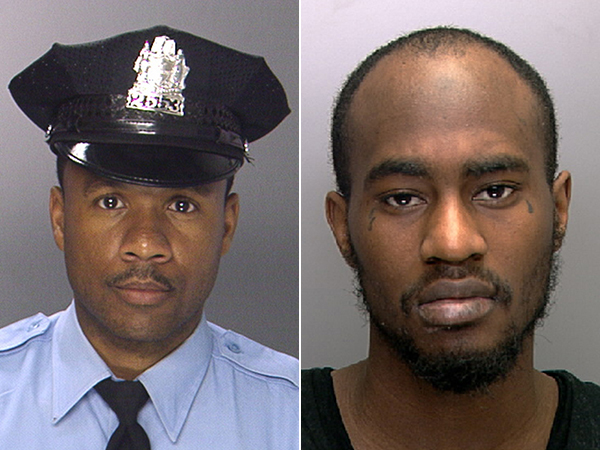
    A Philadelphia Common Pleas Court judge on Monday ordered a new trial for a man serving a life sentence for the death of a police officer in 2012, reportedly citing the connection of disgraced ex-homicide detective Philip Nordo to the case.

    Court records show that Judge Jennifer Schultz vacated the 2014 murder conviction of Rafael Jones, who was sentenced the following year to life in prison without the possibility of parole for the fatal shooting of Officer Moses Walker during a street robbery after the end of his shift on Aug. 18, 2012.

    KYW Newsradio reported the judge cited the case’s connection to Nordo, who was convicted in 2022 of sexually abusing witnesses and suspects.

    During Nordo’s trial, one of his accusers was an informant in the Walker homicide investigation who said Nordo helped steer a $20,000 reward to the man and then, years later, raped him.

    Multiple cases involving Nordo, including murder convictions, have been overturned in recent years.

    District Attorney Larry Krasner said he would address the order for a new trial at a news conference Tuesday.

    Police Commissioner Kevin Bethel said in a statement: “I am disappointed by today’s decision, particularly for the family of Officer Moses Walker and every member of this Department who continues to carry his loss.”

    Bethel added: “At the same time, we respect the court and the legal process. We remain confident in the evidence surrounding this case and believe that, when the process is complete, the individual responsible for Officer Walker’s murder will continue to be held accountable and will never again walk free.”

    Jones and Chancier McFarland were arrested during the homicide investigation. McFarland pleaded guilty and testified against Jones as part of a deal with prosecutors to avoid life in prison.

    A lawyer for Jones could not be reached for comment. According to court records Monday, Jones was being held at the State Correctional Institution in Chester City.

    Shortly before dawn on Aug. 18, 2012, the 40-year-old Walker left the 22nd District station at 17th Street and Montgomery Avenue in North Philadelphia dressed in civilian clothes — shorts, athletic jacket, and baseball cap — and carrying a backpack and wearing earphones.

    Walker was targeted, McFarland testified, because he looked like a student from nearby Temple University — “an easy mark.”

    McFarland testified that Jones shot Walker when the officer reached for a weapon.

    After Walker collapsed at Woodstock Street and Cecil B. Moore Avenue, McFarland said, he grabbed the officer’s iPod and earphones before taking off.

  • After allegations of a ‘toxic climate’ at Frankford High, the school will have a new principal for the first time in a decade

    After allegations of a ‘toxic climate’ at Frankford High, the school will have a new principal for the first time in a decade

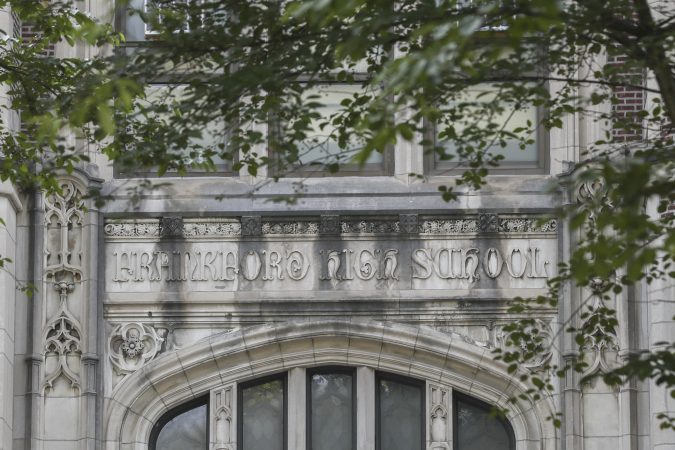
    For the first time in more than a decade, Frankford High is getting a new principal.

    Michael Calderone, who has served as Frankford’s principal since 2015, told the staff on Friday that he’s leaving to become the interim principal of Dobson Elementary in Manayunk.

    Calderone’s move comes after the district conducted an audit of what some staff said was a “toxic” climate at the school and serious allegations about Calderone, including that he struck a student and retaliated against teachers who spoke out against him.

    District officials did not comment on the results of the climate audit, but typically do not discuss personnel matters.

    Calderone said, in a letter sent to Frankford staff and obtained by The Inquirer, that the move to Dobson “holds tremendous personal and professional significance for me” because he began his career there, as teacher and dean.

    “Returning to lead the school where I first developed my passion for educational leadership feels very much like a homecoming and has always been a dream of mine,” Calderone wrote.

    Noah Tennant, the interim associate superintendent for secondary schools, said in an email to Frankford staff that Calderone “is a school leader with a proven track record of improving student outcomes, leading school transformation, and building collaborative systems. His leadership and contributions to the Frankford High community will leave an indelible impact on all he served.”

    Mary Jackson, a retired Philadelphia principal who’s served as Frankford’s interim leader in the past, will be “guest principal” while the district searches for a replacement for Calderone, Tennant said in the letter.

    “In the coming months, the district will initiate a process to identify the next permanent principal who will continue the important work underway and ensure every student and staff member is supported,” Tennant wrote.

    A Frankford climate audit

    The first public hint of controversy happened in early 2026, when Frankford’s budget, like spending plans across the school system, was shrunk because of district-wide cuts. Calderone ordered a number of teachers’ jobs cut out of seniority order, a move that was protested by the Philadelphia Federation of Teachers, and ultimately overturned.

    The PFT and teachers say the targeted educators — whom Calderone said he moved to advance academic goals — were ones who had spoken out against him, they told The Inquirer.

    At the same time, a number of current and former Frankford staff raised allegations about significant culture issues at the school, and the district conducted the audit.

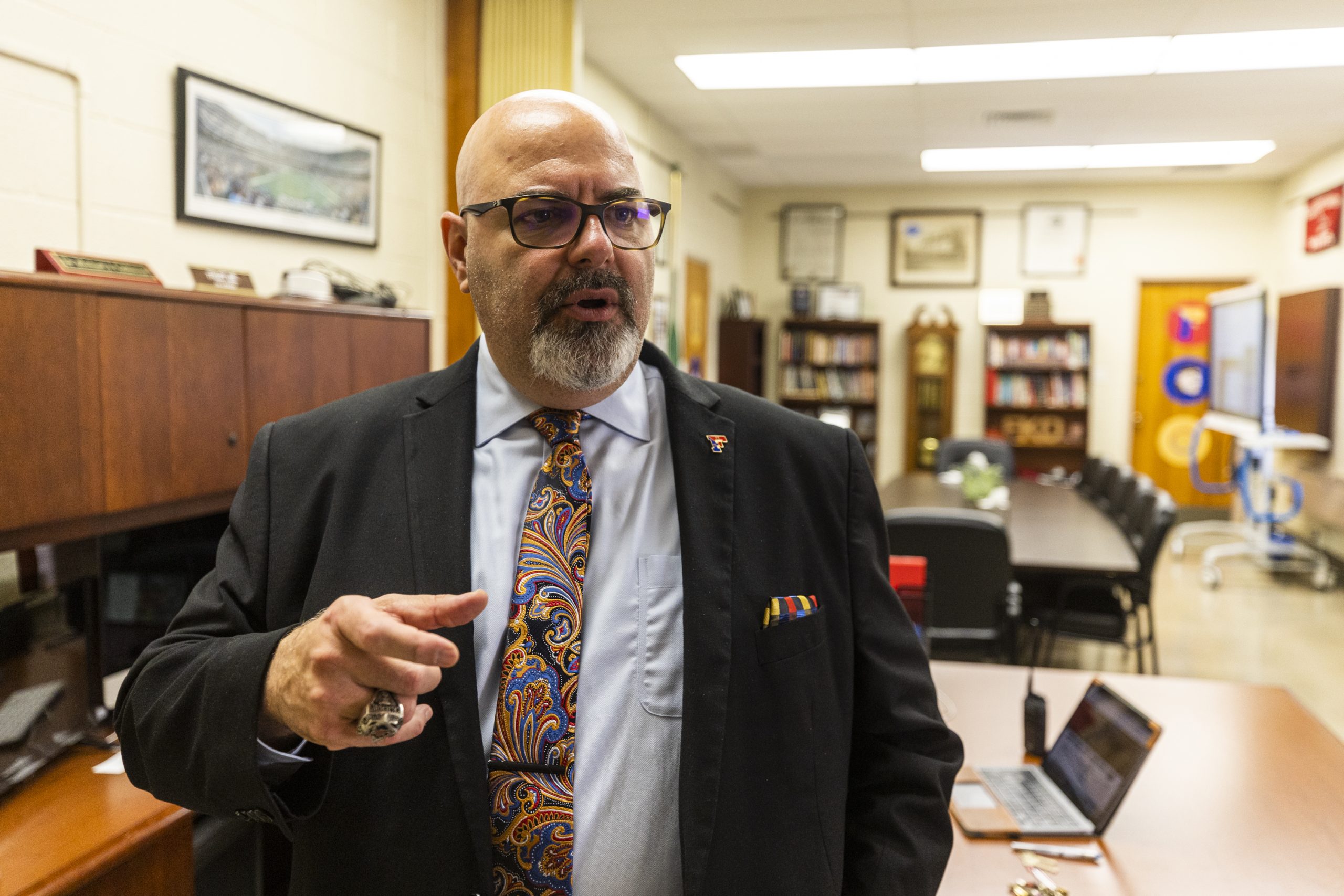
    Michael Calderone is shown in his office at Frankford High in this 2023 file photo.Tyger Williams / Staff Photographer

    According statements from multiple staffers made to the district and PFT and obtained by The Inquirer, Calderone, who earned citywide recognition for his work at the comprehensive high school, was a volatile leader who forced out many capable staffers.

    Some staff said the principal screamed at adults and students on multiple occasions. They also said he made improper requests, including asking teachers to provide grades for students in classes they did not teach.

    Others said he spoke openly about intentions to get rid of staff members who were not allies, to force out staff who he believed were opposed to him.

    Two staffers also told the district that Calderone punched a student who had assaulted multiple Frankford staffers. The staff did not report the assault when it happened because they were afraid for their jobs, they said.

    Other Frankford staffers agreed that there was widespread discord at the school, but say those who opposed Calderone contributed to the toxicity.

    Arthur Steinberg, PFT president, who had previously said that he did not believe Calderone was fit to run Frankford “or any school at all,” in a statement Monday commended the Frankford staff who brought concerns to the administration.

    “Thanks to their bravery and persistence, Frankford will be a healthier, more positive place to learn and work for all,” Steinberg said. “It is our hope that whoever is assigned to replace Dr. Calderone is able to reset the working environment for staff, so that Frankford is once again the warm, welcoming school community it was before he arrived.”

    ‘Thank you for your trust’

    Calderone, in his letter to Frankford staff, said he was particularly grateful for the community’s resilience during a tough time — the hulking main Frankford building was shut for multiple years because of asbestos issues, with students scattered between multiple buildings. He said he was also proud of Frankford’s aviation and hospitality programs, launched during his tenure at the school.

    “Thank you for your trust, your partnership, and the memories we have shared,” Calderone wrote. “I have every confidence that Frankford High School will continue to thrive and achieve great things. I wish you all the absolute best. Frankford will always be the ‘Home of Champions’. But never forget: every champion was once just a contender who refused to give up. I ask you to carry that relentless, unbroken spirit with you into every new day. Thank you for letting me walk this path alongside you.”

    Calderone will be moving to a very different school than the one he’s led for 11 years.

    Frankford educates about 900 students in its massive Oxford Avenue building. Dobson, a K-8 on Umbria Street, educates about 250, though both have large populations of students with disabilities.

    Dobson’s former principal, Khloe Williams-Lawani, accepted another job in the school system.

  • Trump says Pirro ‘folded like an umbrella’ in bid to drop Reflecting Pool vandalism charges

    Trump says Pirro ‘folded like an umbrella’ in bid to drop Reflecting Pool vandalism charges

    WASHINGTON — President Donald Trump said Monday that U.S. Attorney Jeanine Pirro “choked” and “folded like an umbrella” in moving to drop charges against a former Olympian accused of vandalizing the Lincoln Memorial Reflecting Pool.

    Speaking at an unrelated Oval Office event, Trump ducked questions about whether he’d fire Pirro, a former Fox News host and longtime ally he handpicked as top federal prosecutor in the nation’s capital. But the president kept up his drumbeat of sharp criticism, saying he remained disappointed by her assessment that damage to the Reflecting Pool was the result of shoddy construction, not vandalism.

    “Frankly, I think she choked because the judge was really vicious. Instead of going after the people that did it, the judge went after her and went after her department, and I guess she choked,” Trump said in response to a reporter’s question after he signed an executive order for military spouses. “I don’t know what the hell happened.”

    The move to dismiss charges against David Hearn was an embarrassing setback for the Justice Department and marked a rare moment during Trump’s second term of an aide or political appointee openly defying him. After initially posting on social media over the weekend, “I disagree 100% with Jeanine Pirro,” Trump was still fuming two days later, insisting for several minutes that vandalism had marred the troubled project.

    “I was disappointed with Jeanine Pirro, really disappointed,” the president said Monday. “She folded like an umbrella.”

    Pirro has not commented publicly since Trump’s initial social media post criticizing her.

    Hearn has said he was on a bike ride June 19 when he reached in to examine the pool’s newly peeled coating and briefly touched a chunk attached to the side of the pool. But he said he obeyed a park worker who told him to let go of it.

    The president also used the opportunity Monday to distance himself from the troubled project, which he had touted as part of his overarching efforts to spruce up the nation’s capital.

    Trump said in April that he had consulted with a trio of firms that had worked on swimming pools at his properties and that the one he picked for the Reflecting Pool project had done work at his golf course in Northern Virginia. That firm was Virginia-based Atlantic Industrial Coatings, which was awarded a $14.7 million no-bid contract to repaint and waterproof its concrete floor.

    “I have a guy who’s unbelievable at doing swimming pools,” Trump said then. “He looked at it. He called me up. He said, ‘Sir, we can do something on it.’”

    But Trump insisted Monday that “I didn’t know the contractor” and for the first time hinted that he wasn’t pleased by the work that was done to get the Reflecting Pool ready in time for Independence Day celebrations.

    “I’m not saying I was 100% thrilled with the contractor, but the contractor was rushing. We wanted to get it open for July Fourth,” he said.

    Crews drained the Reflecting Pool weeks ago to launch a new round of repairs. The White House hasn’t said when those might be finished or how much more they will cost, but the Trump administration did not seek new bids from other companies on the new round of repair work.

    Trump also said Monday that the Reflecting Pool would be “fixed” and reopened in the next week and a half to two weeks — without providing further details.

  • The final defendant was sentenced in the murder of a West Philly Parks and Recreation employee

    The final defendant was sentenced in the murder of a West Philly Parks and Recreation employee

    A third defendant has been sentenced in the death of Tiffany Fletcher, a Philadelphia Parks and Recreation employee who was struck by a stray bullet during a 2022 shooting in West Philly.

    Tevin Kee, 20, pleaded guilty to third-degree murder, conspiracy, and gun charges in April. On Monday, he was sentenced to 12½ to 25 years in prison, according to Assistant District Attorney Jeff Hojnowski.

    Fletcher was sweeping outside the Mill Creek Recreation Center where she worked on a September afternoon, when two groups of youths began shooting at each other. Fletcher, caught in the crossfire at 47th and Brown Streets, was struck by a stray bullet in her torso and died. She was 41 years old, and a mother of three.

    The case sparked outrage, as Fletcher’s death came to represent how dangerous Philadelphia had become in the years immediately following the pandemic.

    Tiffany Fletcher (center, yellow tank top) was photographed with lifeguard Robin Borlandoe, 70, (immediate left), assistant recreation leader Charles McKnight (just above Tiffany) and other staff and volunteers at the Mill Creek Recreation Center pool in August 2022.ELIZABETH ROBERTSON / Staff Photographer

    Kee was the final defendant to be sentenced. Two others pleaded guilty to similar charges in the case. In 2024, Makie Jones was sentenced 10 to 20 years, and Malik Flegler was sentenced to 12½ to 25 years. Jones was arrested on the day of the shooting, and Flegler was arrested weeks later.

    But Kee, who was 17 at the time of the shooting, was not arrested until last year, at a traffic stop in Lower Pottsgrove Township. All three suspects were teenagers at the time of Fletcher’s death and charged as adults.

    Following Kee’s sentencing, Philadelphia District Attorney Larry Krasner made a point to say the legal process in each case was not over. He said each defendant would have parole board hearings once they had served their minimum sentences, and referenced statistics indicating most defendants typically serve greater time than their minimums.

    “Justice wasn’t done,” said Geraldine Fletcher, Tiffany’s mother. She said she wasn’t satisfied with any of the sentences, and said she hoped the three individuals suffered for eternity. Geraldine Fletcher said the family would participate in those parole hearings to share the pain of their loss.

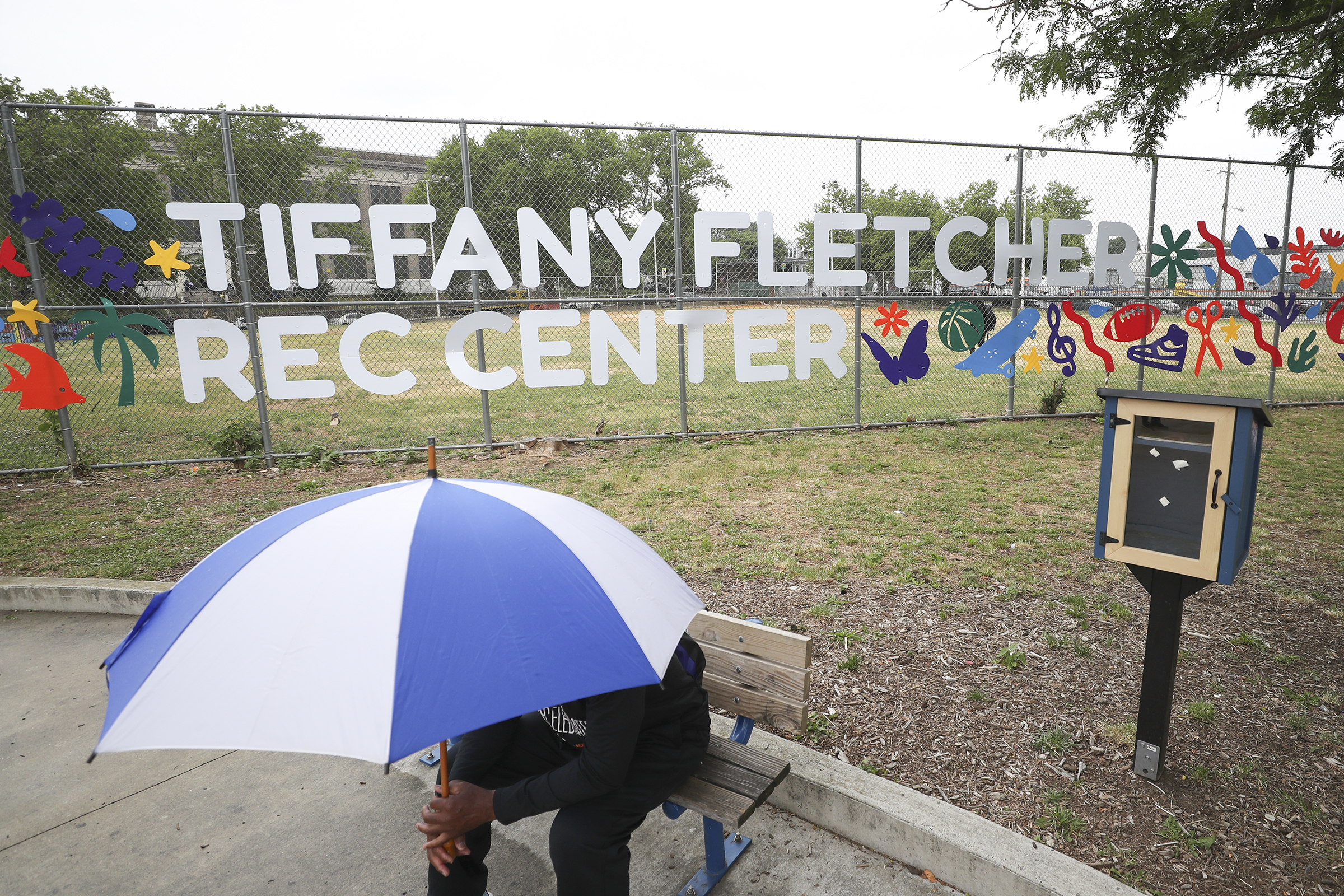
    Until then, Fletcher’s family and community will continue to honor her memory. The Mill Creak Recreation Center and its pool was renamed for Fletcher in 2023, and in April, City Council adopted a resolution to rename the 4700 block of Brown Street, “Tiffany Fletcher Way — Gone But Never Forgotten.”

    A sign at the renamed Tiffany Fletcher Recreation Center (formerly Mill Creek) in West Philadelphia in June 2023.Heather Khalifa / Staff Photographer
  • MLS’s new commissioner will be Cherry Hill native Larry Berg, a LAFC part-owner

    MLS’s new commissioner will be Cherry Hill native Larry Berg, a LAFC part-owner

    NEW YORK – Larry Berg, a member of Los Angeles FC’s ownership group with roots in Cherry Hill, has been elected as the new commissioner of Major League Soccer.

    He will officially take the reins on Jan. 1, with current commissioner Don Garber keeping the job until then. Garber will then take the role of chairman.

    “Thanks to the vision and commitment of so many people, Major League Soccer has achieved tremendous success, but I believe our greatest opportunities are still ahead,” Berg said in a statement. “We have an extraordinary opportunity to strengthen the quality of our competition, develop more world-class players, deepen our connection with supporters, and continue elevating Major League Soccer’s place in the global game. Together with our owners, clubs, players, partners, supporters, and league staff, I could not be more excited for what comes next.”

    A formal news conference will take place Tuesday at the league’s Manhattan headquarters. Monday’s vote took place there, with representatives of all 30 teams’ ownership groups.

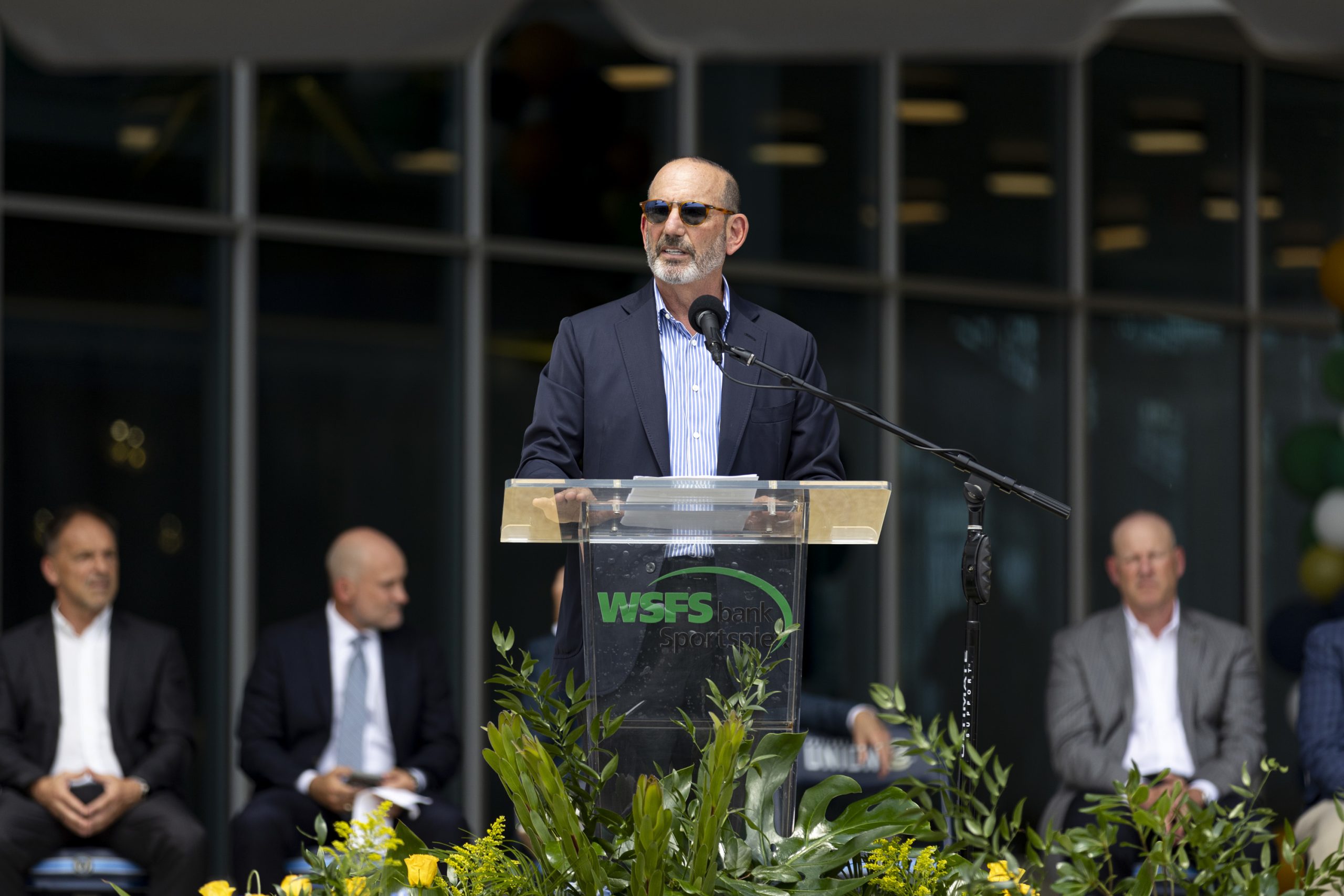
    Larry Berg poses for a photo at MLS headquarters after being elected as the league’s new commissioner.Major League Soccer

    “Having worked closely with Larry over the past decade, I’ve seen firsthand the qualities that make him an exceptional leader, and I have complete confidence he is the right person to serve as Major League Soccer’s next commissioner,” Garber said. “His integrity, judgment, collaborative leadership, and unwavering commitment to building LAFC and the league have made him an invaluable partner. I look forward to working alongside Larry during this transition and supporting him as he leads MLS into its next chapter.”

    Berg, 60, has been part of LAFC’s ownership group since the team launched in 2018. He will be just the league’s third commissioner since it launched in 1996. Doug Logan had the job from 1995-99, and Garber has had it ever since.

    Berg topped David Nathanson, a former Fox Sports executive with ownership stakes in teams including the Seattle Sounders, NWSL’s Angel City FC, and NHL’s Seattle Kraken.

    Those were the only two candidates, and just one other was known to have been in the race: veteran San Francisco 49ers and Leeds United executive Paraag Marathe. He took himself out in mid-July.

    Don Garber has been MLS commissioner since 1999.Tyger Williams / Staff Photographer

    Berg has recently been co-chair of MLS’s powerful sporting and competition committee. That group is in charge of setting the league’s roster rules, including a long-anticipated overhaul to push the pace harder in the global game. That overhaul seems close to arriving, and no doubt Berg will be a leading figure in presenting it to the public.

    He also has quite a few ties to the Philadelphia area. He’s a Cherry Hill native who played soccer at Cherry Hill East High, and attended Penn’s Wharton business school. He’s a Philadelphia sports fan, from the Eagles to soccer’s Atoms back in the day, and his wife is from the city.

    Berg’s career away from soccer has been in the investment world. He knows 76ers lead owner Josh Harris well, having worked at Apollo Global Capital and Harris’ newer 26 North investment firm.

    Of course, Berg’s fandom hasn’t extended to the local MLS team here, but that’s no surprise. He has helped build LAFC’s juggernaut, with a history of stars and a 2022 MLS Cup title at the Union’s expense.

    Now everyone will see if his business acumen with a club can translate to the overall league.

    Larry Berg (left) with his wife Allison, a Philadelphia native.FilmMagic

    Nathanson spent many years in the media world. His biggest feat was helping Fox land World Cup broadcast rights starting in 2015, after ESPN had held them for decades. He was also involved in deals for Concacaf tournaments and other soccer properties. After leaving Fox in 2017, Nathanson became an investor in a wide variety of areas, including sports teams.

    Coincidentally, he also has ties to Philadelphia as a Penn alum, and is a regular visitor to the city. His top selling point as a candidate is having TV rights experience, with MLS already starting to look for its next round of big deals. The all-in-one Apple package will end in 2029, and Fox’s small package of linear broadcasts expires after this year.

    Nathanson declined to comment when approached, but he no doubt will be heard from in other ways in the sport.

    Union principal owner Jay Sugarman told The Inquirer he was pleased with Berg’s victory.

    “We had two very impressive candidates, and both of them had clear plans on how to build on Don Garber’s legacy, which gives us a lot of excitement for the future,” Sugarman said. “I think Larry understands this league inside and out, and I’m excited to move forward with him.”

  • FAA certifies Boeing’s new 737 Max 7 jetliner for flight after years of delays

    FAA certifies Boeing’s new 737 Max 7 jetliner for flight after years of delays

    The Federal Aviation Administration on Monday approved the smallest model of Boeing’s Max jetliners for commercial service nearly a decade after the aircraft manufacturer first unveiled the plane.

    Certification of the Boeing 737 Max 7 represents a milestone in the company’s work to overcome years of safety, quality, and production challenges. The long-delayed Max 7 is part of Boeing’s 737 family of commercial jets, which is the company’s bestseller and has been at the center of its troubles.

    The FAA said it cleared the new plane after years of additional testing, design changes, and an extensive review of its design and safety systems. The certification was delayed as Boeing addressed technical issues and heightened regulatory scrutiny following two crashes involving the larger Max 8 that killed 346 people in 2018 and 2019.

    Since the crashes off the coast of Indonesia and in Ethiopia, the FAA overhauled how it certifies Boeing aircraft. It said its oversight of the company would continue beyond the Max 7’s approval.

    Before signing off on the aircraft, the FAA said, it required Boeing to make several safety changes, including updating flight-control software, improving cockpit alerts for pilots and redesigning the engine anti-ice system to prevent overheating.

    “Our team of dedicated engineers and test experts worked through challenges, an extended pandemic, and the transition to new certification processes,” said Stephanie Pope, president and CEO of Boeing Commercial Airplanes.

    Safety inspectors will remain at Boeing production facilities to monitor manufacturing, including observing the company’s Safety Management System and overall safety culture, the agency said.

    The Max 7 is expected to be used primarily on short- and medium-haul routes. Several carriers, including Southwest Airlines, have outstanding orders for the plane.

  • U.S. stocks rally near a record as falling oil prices ease Wall Street’s worries about inflation

    U.S. stocks rally near a record as falling oil prices ease Wall Street’s worries about inflation

    NEW YORK — The U.S. stock market rallied to the edge of its all-time high on Monday after easing oil prices helped calm Wall Street’s worries that inflation could get even worse.

    The S&P 500 jumped 1.5% and is just 0.1% below its record set earlier this summer. It was coming off a frenetic July, where it swung up and down as oil prices shot higher because of the war with Iran, before ultimately ending the month just about where it started.

    The Dow Jones Industrial Average, which measures a narrower slice of the U.S. stock market, climbed 693 points, or 1.3%, to an all-time high, while the Nasdaq composite leaped 2.1%.

    Stocks got a lift as the price for a barrel of Brent crude sank 4.7% to $83.77. It dropped after President Donald Trump said over the weekend that he decided to hold off on new strikes against Iran at the urging of allies in the region.

    Brent’s price careened between $72 and $102 last month as worries rose and fell about when the war with Iran would allow oil tankers to freely exit the Persian Gulf again to deliver crude to customers worldwide. The latest acquiescence by Trump helped to ease worries about the global flow of crude, and Treasury yields correspondingly fell in the bond market.

    The yield on the 10-year Treasury sank to 4.68% from 4.75% late Friday. It, though, remains well above its 3.97% level from before the war with Iran.

    Higher yields threaten to undercut prices for stocks and other investments, while slowing the economy by making borrowing more expensive for U.S. households and businesses. The average long-term U.S. mortgage rate has already leaped to its highest level in a year.

    Monday’s ease in oil prices helped airlines and other companies with big fuel bills lead the market. United Airlines flew 5.8% higher, while American Airlines climbed 5%. Norwegian Cruise Line Holdings steamed 6.6% higher.

    Boeing jumped 8% after U.S. regulators certified its 737 MAX-7 planes, clearing them for commercial service.

    Tyson Foods rose 2.8% after the meat company reported a slightly stronger profit for the spring than analysts expected. CEO Donnie King said strength is continuing in the company’s chicken business and its prepared foods, which include brands like Jimmy Dean and Hillshire Farm.

    It joined a lengthening list of big U.S. companies to deliver a bigger profit for the spring than analysts expected. That’s imperative for Wall Street because stock prices tend to follow the path of corporate earnings over the long term, and worries were rising that U.S. stock prices may have broadly already shot too high.

    Companies in the S&P 500 are on track to deliver earnings per share for the spring that are 47% higher than a year before, according to FactSet, with more than half of the companies in the index having already reported. If that ends up being the case, it would be the strongest growth since the spring of 2021, when the economy was roaring out of the COVID pandemic.

    Also offering encouragement for profits was a report on Monday showing that growth for U.S. manufacturing accelerated to its strongest level since 2022.

    Keeping Wall Street unsettled, though, were swings for stocks of companies that make computer chips. They’ve been veering up and down for weeks on worries about whether their surging revenues because of the artificial-intelligence boom are sustainable.

    If AI ends up producing less profit and productivity than hoped, Big Tech companies could curtail their spending sprees on data centers that have helped chip stocks soar to tremendous heights.

    Micron Technology went from a drop of 6.4% to a gain of 1.7% through the day before ending with a gain of 0.8%, for example. It’s up roughly 190% for the year so far.

    All told, the S&P 500 rose 110.78 points to 7,600.50 and finished just shy of its all-time closing high of 7,609.78. The Dow Jones Industrial Average climbed 693.38 to 53,178.41, and the Nasdaq composite rallied 540.04 to 25,913.90.

    The manic swings for AI stocks have been most dramatic in South Korea, where the Kospi index is dominated by just two tech titans, Samsung Electronics and SK Hynix.

    Seoul’s Kospi fell 5.1% Monday, coming off Friday’s 17.9% surge that was its best day in history.

    In neighboring Japan, Tokyo’s Nikkei 225 fell 0.9% after the United States and Japan confirmed they had moved together to prop up the value of the Japanese yen against the dollar. A stronger yen would help to limit inflation in Japan, but it could also potentially hurt Japan’s exporters.