
Blog

  • National hunger fighter visits Northeast Philly to criticize ‘a dangerous double whammy’ of SNAP cuts and rising prices

    National hunger fighter visits Northeast Philly to criticize ‘a dangerous double whammy’ of SNAP cuts and rising prices

    People throughout the Philadelphia region, hampered by cuts to federal food aid and soaring prices, are “facing a dangerous double whammy causing a skyrocketing hunger crisis,” said Joel Berg, a national hunger fighter, speaking in Northeast Philadelphia on Tuesday.

    Berg, CEO of the New York-based nonprofit Hunger Free America, was visiting Feast of Justice, one of the largest food pantries in the city with “probably the most diverse food pantry clientele in the nation,” he said. That is proof, according to Berg, that food insecurity can affect anyone, from any background.

    Feast of Justice, he added, “is the food affordability issue in the flesh.”

    Especially critical of the One Big Beautiful Bill Act, signed into law by President Donald Trump on July 4, 2025, Berg noted that it included more than $1.1 trillion in cuts to Medicaid and the Supplemental Nutrition Assistance Program (SNAP).

    Roughly 4 million Americans are expected to lose SNAP benefits in 2026 under the law. Many of them do not meet work or age requirements newly added to the anti-hunger program. The reductions in SNAP and Medicaid benefits helped pay for tax cuts ordered by Trump.

    Alahallak Abdelmenim and his children Asil (left), 6, and Hasan (right), 8, load groceries into their shopping cart at the Feast of Justice Food Pantry Tuesday, Aug. 11, 2026.Tom Gralish / Staff Photographer

    In Pennsylvania, around 144,000 SNAP recipients could see benefits cut this year — an estimated 45,000 in Philadelphia and 12,000 in its collar counties, according to Pennsylvania Department of Human Services estimates. In New Jersey, around 50,000 individuals could lose SNAP benefits, New Jersey Department of Human Services figures show.

    It’s not “rocket science,” said Berg, who used a pallet of canned beans and apple sauce as a lectern as he addressed a small crowd at the pantry. “When there’s a drought and you take away water, the drought’s going to get worse. When there’s a hunger crisis, and you take away food, the hunger crisis is going to get worse, especially after you throw in inflation,” he added.

    In response, Trump spokesperson Anna Kelly said Tuesday that Trump is “strengthening” SNAP to sustain it into the future. Changes to SNAP “crack down on waste, fraud, and abuse,” she said. Kelly added that Trump is “uplifting every American’s financial situation by passing the largest tax cut in history — which every congressional Democrat opposed — and bringing historic numbers of jobs and investments into our country.”

    Pastor Tricia Neale, executive director of Feast of Justice, said Tuesday that since the enactment of the One Big Beautiful Bill Act, an additional 1,850 families in Northeast Philadelphia have turned to the pantry for help. Overall within the last five years, she said, the number of households the pantry supports has grown from 2,750 to 6,425, a more than 200% increase.

    “And,” Neale added, “the crisis is accelerating.”

    Pastor Tricia Neale, executive director at Feast of Justice, displays a chart showing the decline in food sourcing as she speaks at a press conference at the food pantry Tuesday, Aug. 11, 2026. Tom Gralish / Staff Photographer

    The pantry has been forced to absorb a 35% decline in donated food it receives, in part because of cuts to federal and state food programs that have been so vital, she added.

    Even with diminished supplies, Feast of Justice is an essential institution, according to Angie Bryant, 55, of Tacony, a client. Formerly a phlebotomist who can no longer work, Bryant said she recently lost her SNAP benefits because new age restrictions exclude her participation.

    “In the body, hunger is hurtful,” she said. “Without this place, I don’t know how I could make it.”

    Food banks such as Philabundance and Share Food Program do their best to provide Feast of Justice whatever food they can, Neale emphasized.

    Volunteer Daniel Khan (center) restocks the shelves as clients load groceries into their shopping carts at the Feast of Justice Food Pantry Tuesday, Aug. 11, 2026. Tom Gralish / Staff Photographer

    If SNAP is the safety net, “we’re the safety net of the safety net,” said Loree Jones Brown, CEO of Philabundance, who joined Berg and Neale at Feast of Justice on Tuesday. “But we can’t make up for the cuts.”

    She added that “this is a crucial time for food banks, legislators, and community organizations to stand together for our neighbors and against hunger.”

    That Feast of Justice does its best to beat back hunger is widely appreciated in the community, said client Anthony Morales, 27, of Mayfair. Laid off from a warehouse job, he said he is responsible for feeding his 7-year-old daughter and his partner, and he needs the pantry’s support.

    “When you fall,” he said, “this place lifts you up. You have a lot of fear and anxiety without enough food. It can give you hope and confidence that tomorrow could be better.”

  • Investigators say Myanmar’s military has escalated airstrikes against civilians

    Investigators say Myanmar’s military has escalated airstrikes against civilians

    BANGKOK — Myanmar‘s military has increasingly used low-cost aircraft such as motorized paragliders and gyrocopters in escalating aerial attacks that kill civilians in its conflict with armed, anti-government groups, a U.N. investigation said in a report Tuesday.

    Separately, a major ethnic armed group fighting the government in Rakhine state said 20 civilians had been killed in strikes by the military so far this month.

    Myanmar’s military government did not immediately respond to either the U.N. probe or the allegations by the Arakan Army. In the past, the military has said it only attacks legitimate targets of war, accusing the resistance forces of being terrorists.

    The report by the United Nations-established Independent Investigative Mechanism for Myanmar, or IIMM, details a yearlong investigation into alleged war crimes and crimes against humanity committed by Myanmar’s military and affiliated militias, as well as the opposition armed groups.

    It found that abuses escalated around the country’s army-organized elections in December and January. The IIMM said it observed a notable escalation in aerial attacks in the months preceding the elections and that they have continued unabated afterward, with investigators also documenting a pattern of deliberate arbitrary detention, torture, and sexual violence.

    The IIMM said civilian casualties are worsened by the military’s increasing use of “double-tap” aerial attacks, in which a second strike follows the first, apparently targeting first responders, people helping the wounded, and those trying to flee.

    The IIMM said the Myanmar military was increasingly using motorized paragliders — also known as paramotors — as well as gyrocopters and drones to carry out low-altitude airstrikes with unguided explosives.

    In several recent incidents in the upper Sagaing region, paramotor pilots allegedly cut their engines as they approached targets, allowing them to glide silently and leaving civilians little or no warning to flee or seek shelter, the report said.

    The IIMM’s report came as the Arakan Army, a powerful ethnic armed group fighting the army in Rakhine, said that about 20 civilians were killed and 22 injured in airstrikes across three townships from Aug. 1-11, including one attack involving up to eight aircraft that lasted about an hour.

    The military-backed government has not publicly commented on the alleged attacks.

    According to the Assistance Association for Political Prisoners, an independent organization that keeps detailed tallies of arrests and casualties linked to the civil war, more than 8,000 civilians have been killed and more than 31,000 arrested by Myanmar’s security forces since 2021.

    The IIMM, which was established by the U.N. Human Rights Council in 2018 to monitor violations of international law in Myanmar, said it gathered evidence from more than 1,600 sources and witnesses that can be used in future prosecutions of those responsible.

    “Behind every piece of evidence we collect are people whose lives have been devastated by these crimes,” group leader Nicholas Koumjian said in the report. “Communities across Myanmar are not only living under the constant threat of violence but are also coping with the profound and lasting impact of what they have endured.”

    The IIMM said it is also investigating serious crimes allegedly committed by armed groups opposed to the military, including members of the Arakan Army, who have been accused of rape and other sexual violence against Rohingya Muslim women, summary executions, child recruitment, and the destruction of mosques in Rakhine.

    The report said numerous people were also arrested under an electoral law that carries up to 20 years in prison or the death penalty for acts such as criticizing the elections online or distributing “anti-election” leaflets.

    The election was dismissed by the critics as a sham designed to consolidate the military’s grip on power after its 2021 takeover that ousted the elected government of Aung San Suu Kyi, triggering deadly civil war.

  • For Nigel Farage, success brings new pressures and a showdown with Count Binface

    For Nigel Farage, success brings new pressures and a showdown with Count Binface

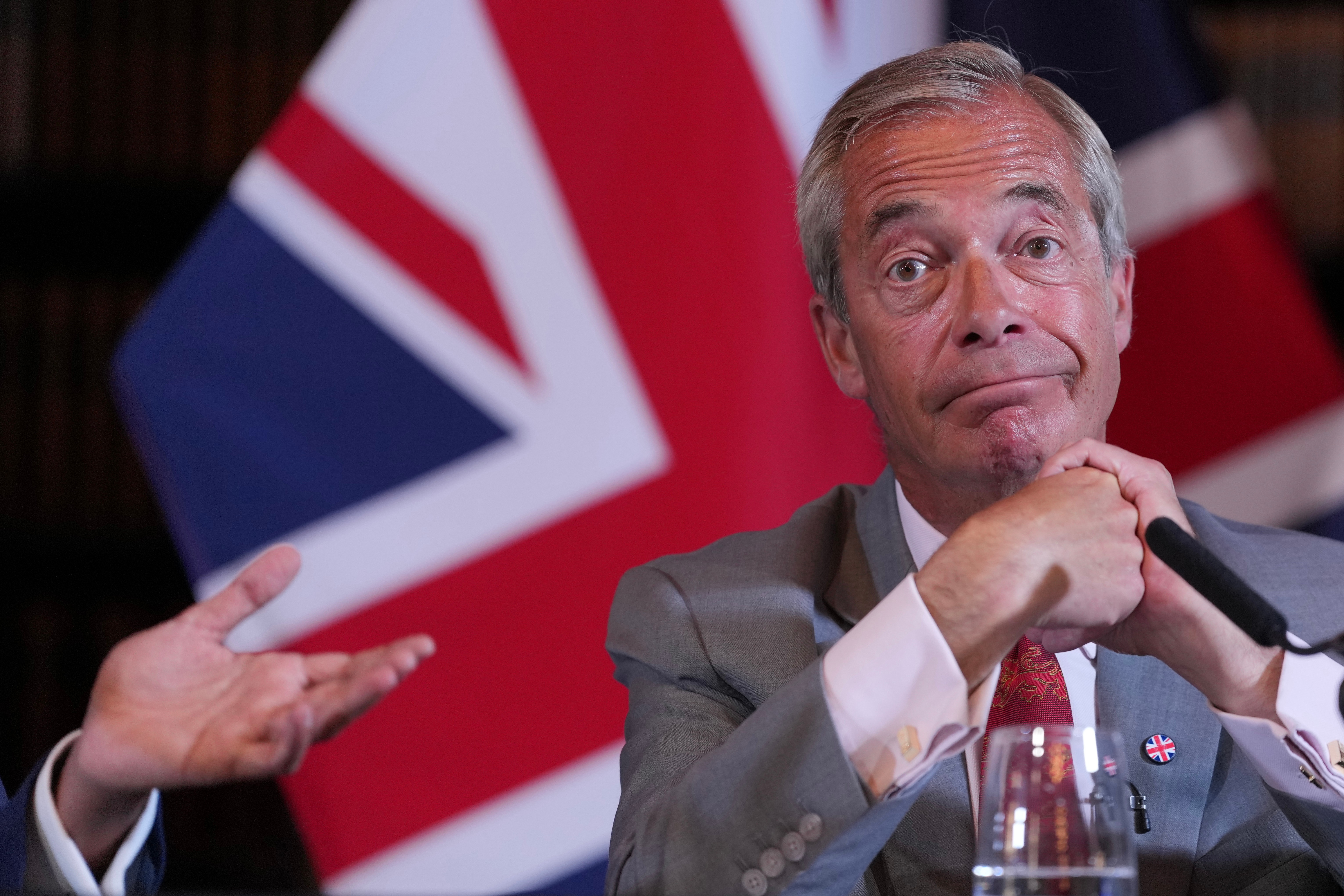
    LONDON — Nigel Farage depicts himself as an outsider taking on the establishment, but now the tables have turned.

    The leader of anti-immigration party Reform UK is running in an election as the incumbent favorite, and his main opponent is a man dressed as a garbage can.

    Farage, an ally of U.S. President Donald Trump, triggered Thursday’s special election in the English seaside town of Clacton by quitting his seat in the House of Commons last month. Facing awkward questions about his finances, Farage said he would let voters judge him in a “people versus the establishment” contest.

    But the other main parties called it a stunt and refused to take part, leaving Farage running against an assortment of independents, jokers, and single-issue candidates led by Count Binface, a comic space alien with a trash can on his head. In that field, it’s Farage who looks like the mainstream politician.

    Simon Usherwood, professor of politics and international studies at the Open University, said Farage’s appeal is built on his image as a straight-talking individualist, “the kind of bloke you can have a pint with down the pub.”

    “It’s that very charismatic aspect of Farage that is both his strength and his weakness,” Usherwood said. “He has fallen into a trap of thinking that he is somehow immune from the kind of scrutiny that would undo other politicians.”

    Farage built his brand on Brexit and immigration

    For two decades, the populist Farage has led small parties with an outsized impact on British policy.

    His charisma — and, critics say, his distortions — were key to securing victory for the “leave” side in Britain’s 2016 European Union membership referendum. After Brexit, Farage switched his focus to migrants crossing the English Channel in small boats, a stream that he has called an invasion.

    In 2024 he was elected to Parliament at his eighth attempt, representing the strongly Brexit-backing town of Clacton in eastern England.

    Becoming a lawmaker brought unwelcome scrutiny of his finances. Parliament’s standards watchdog is investigating an undeclared donation of 5 million pounds ($6.7 million) to Farage in 2024 from Christopher Harborne, a Thailand-based cryptocurrency billionaire. Farage says he didn’t need to declare the money because it was a personal gift he used to fund his security and came before he was elected.

    Newly elected lawmakers must declare gifts worth more than 300 pounds ($400) received in the previous year if they are related to political activities.

    Farage is also facing an investigation into his financial relationship with George Cottrell, an aristocratic crypto-gambling entrepreneur who served eight months in a U.S. prison for fraud a decade ago after offering to launder money for undercover agents posing as drug traffickers.

    Cottrell, 32, remains close to Farage and has reportedly given him money for security and staff. U.K. media report that Cottrell and his mother have been interviewed by police as part of a probe into donations to Reform UK, though they have not been arrested.

    Farage is standing by the man he calls “Posh George,” saying Aug. 3: “I don’t ditch my allies.”

    Farage faces off against Count Binface

    The governing Labour Party and opposition Conservatives, Liberal Democrats, and Greens all declined to run in Clacton. But it is still a crowded field, with almost three dozen candidates, including representatives of Rejoin EU, the Everyone Is God Party, and the Monster Raving Loony Party.

    By far the best known is Count Binface, a frequent comedy candidate whose platform includes the pledge “I will not accept 5-million-pound gifts from crypto billionaires (on Earth).” He says his main appeal is “I’m not Nigel Farage.”

    Farage doesn’t find it funny. He and his party claim Binface, alter ego of comedian Jon Harvey, is just another representative of a hostile political establishment.

    “The establishment is using every means available, fair and foul, to undermine Farage before the country gets a chance to elect him,” Gawain Towler, Farage’s former press officer and now a Reform UK board member, said in a blog post.

    Farage won handily in Clacton in 2024, and most observers expect him to win again. If he does, the parliamentary investigation of his finances will resume. A finding of wrongdoing could lead to Farage being suspended from Parliament and trigger yet another special election for the seat.

    Reform UK has just seven lawmakers — eight if Farage is included — but led nationwide opinion polls for more than a year. But the party has recently suffered setbacks, losing a string of special elections, including one in June that brought Prime Minister Andy Burnham to power.

    After months of flagging popularity, Labour senses a “Burnham bounce.” Meanwhile, Conservative leader Kemi Badenoch has found her feet after a shaky start. And Restore Britain, a far-right party with just one lawmaker but a loud social media presence amplified by Elon Musk, is nibbling away at Reform’s support.

    Farage, 62, has a history of walking away from parties he led. He stepped down from both the UK Independence Party and its successor, the Brexit Party, in the last decade.

    He has earned more than 2 million pounds ($2.7 million) outside of Parliament in the past two years from speeches, promotional work, and television appearances, far more than he makes as a lawmaker. He might be tempted to quit politics again if he remains under sustained pressure.

    Martin Farr, a contemporary historian at Newcastle University, said Farage will probably come out of the election strengthened, at least in the eyes of his supporters.

    “To his supporters, this will be an example of how he’s fearless and he’s prepared to fight against, as he will put it, the tyranny of the majority, the tyranny of the establishment,” Farr said. “To his opponents, it suggests a thin-skinned demagogue who has reacted petulantly to scrutiny and has been embarrassed by the fact that no one else has taken his stand seriously.”

  • Trump told Ukraine it had no cards. Then Kyiv took the war to Russia

    Trump told Ukraine it had no cards. Then Kyiv took the war to Russia

    The meeting in the Oval Office between U.S. President Donald Trump and Ukrainian President Volodymyr Zelensky was a diplomatic car crash.

    “Your country is in big trouble. You’re not winning,” Trump said, dressing down Zelenskyy in front of the world’s media. “You don’t have the cards.”

    The blowup in February 2025, three years into the war, was more than just a heated public exchange: The Ukrainian delegation was asked to leave the White House, and Washington briefly suspended intelligence sharing with Kyiv. In the ensuing months, as Russia made slow but steady gains on the battlefield, Trump warmly welcomed Russian President Vladimir Putin in Alaska and seemed ready to push Ukraine into an unfavorable peace deal, including forcing it to give up territory.

    But even as Zelensky sat next to Trump, his forces were preparing an operation that would reveal Ukraine’s ability and ambition to take the war to Russia: Months later, drones smuggled into the country attacked Russian bombers, destroying or damaging planes worth hundreds of millions of dollars.

    Since then, Kyiv has ramped up a campaign of longer-range strikes inside Russia and in areas Moscow has seized, increased production of weapons, targeted Russian air defenses, and hit oil infrastructure and the warehouses of a major retailer in a bid to ensure ordinary Russians feel the impact of the conflict.

    In an embarrassment to Putin, Ukrainian drone strikes sent thick plumes of smoke billowing over St. Petersburg shortly before the opening of an international economic forum in June. Concern over Ukraine’s attacks led Russian authorities to scale down the May 9 military parade commemorating the defeat of Nazi Germany. Strikes on oil refineries have caused a summer fuel crisis.

    By the time Trump and Zelensky met at a NATO summit in July, the American president said the Ukrainian leader had “been very effective” in the war. “We’ve actually developed a good relationship,” Trump added.

    But as Ukraine’s strikes have intensified, so have Russia’s — and Kyiv faces major challenges in defending against them because of shortages of American Patriot air defense missiles.

    In the first six months of the year, 1,396 civilians were killed in Ukraine, according to the U.N. Meanwhile, the world body said Russian authorities reported 250 civilians killed in the same period. On Monday, a strike that Ukraine said hit an oil refinery in Russia killed 13 people, according to local officials.

    And while Ukraine’s effort appears to have shifted the narrative about the war in Washington, it’s still not clear if it will be able to push Putin toward the negotiating table.

    Ukraine’s strikes are aimed at undermining the idea that Russia can afford to “just let this roll,” said Jack Watling, a senior research fellow at the London-based RUSI think tank.

    The question of whether it will succeed depends on how much pain Ukraine can exact. “Logically, above a certain threshold, it does work but whether they can reach that threshold is an interesting question” — and one that depends at least partly on factors outside Kyiv’s control, like continued European financial support, he noted.

    Ukraine brings the war to Russia

    While most of Ukraine’s strikes have a range of less than 125 miles, its longer-range attacks have increased dramatically this year. It launched three times as many of those strikes in July as it did in January, according to data from ACLED, an independent conflict monitor. Repeatedly hitting deep into Russia has forced its military to stretch air defenses over a larger area.

    Many of its strikes have focused on four key categories of targets, according to an Associated Press analysis of hundreds of Ukrainian attacks this year — compiled from statements by Russian officials and state media and the Ukrainian military.

    As the Iran war pushed up energy prices, leading the U.S. to ease sanctions on Russian oil, Kyiv ramped up strikes on oil infrastructure to deny the Kremlin revenue from fuel exports and force shortages on ordinary Russians. It is also striking defense manufacturing to damage Russia’s long-term ability to produce weapons, targeting air defenses to clear a path for its own arms, and hitting retail warehouses to bring the effects to ordinary Russians.

    — As part of the campaign against oil infrastructure, Kyiv said it hit Russia’s largest oil refinery, more than 1,550 miles from Ukraine.

    — Kyiv has also targeted defense manufacturing centers. It hit a factory making navigation systems multiple times, including with its own Flamingo missile.

    — In July and August, Ukraine struck Wildberries warehouses. Kyiv said the company helps supply the Russian military. Moscow denies that.

    — Many of Ukraine’s strikes on Russian air defenses and radar are around Russian-held Crimea and are often carried out with drones.

    Maj. Robert “Magyar” Brovdi, the commander leading Ukraine’s drone war, told the AP its strikes in Crimea are also aimed at rendering the peninsula unusable as a staging ground for Russian forces.

    Starlink gives Ukraine an advantage — for now

    It’s not always clear if Ukraine’s attacks are effective — and some may have resulted in minimal or no damage. In May and June, Ukraine said it hit several satellite, reconnaissance, or signals intelligence facilities in Russia, but satellite images analyzed by AP did not show major damage.

    Still, Ukraine has one advantage that can help it strip back Russian air defenses and make its drone strikes more precise.

    It has access to Elon Musk’s satellite communications service Starlink — which means its operators can control drones in real time in Russian-held Ukrainian territory. Russia has been blocked from using Starlink.

    But Russia is also building its own version of Starlink, and is installing jamming systems that hamper Starlink connectivity, Brovdi said.

    Ukraine is investing heavily in weapons production

    Even before the Oval Office meeting, Ukraine scrambled to invest in new weapons — but that moment was “a real wake-up call,” said a European military official who spoke on condition of anonymity to discuss the front-line situation in detail. It became clear that U.S. support could be stopped “from one day to the next.”

    Ukraine doubled down on production, churning out a growing array of weapons in larger numbers and shortening traditional research and production cycles from decades to years or even months.

    Even so, Ukraine is still not able to produce as many missiles as it needs. It also took Ukraine time to make systems that could target facilities precisely enough that Kyiv felt comfortable using them to strike deep into Russia, Watling said.

    And while Ukraine has begun to resolve navigational issues with its missiles, such as the Flamingo, those weapons are still not as accurate — or as stealthy — as their Western analogues. That often means hundreds of drones must be fired to overwhelm Russian air defenses to allow a missile to get through.

    It’s an expensive and time-consuming way to wage war since only 5% to 9% of what Ukraine fires gets past Russian air defenses, according to Watling.

    But, although Russia’s weapons are more powerful, Zelensky suggested at the NATO summit that Putin is “losing the initiative” in the war as Ukraine has moved the fight from the stalled battlefield to the sky.

    Sitting next to Trump at the summit, the Ukrainian leader even cracked a joke, demurring when Trump asked him if he would accept Moscow as a venue for peace talks, as Putin has suggested.

    “There are a lot of Ukrainian drones in the air,” Zelensky said. ”It would be dangerous.”

  • Jalen Hurts’ wide receiver group looks different from what was expected in camp. His preparation keeps moving forward.

    Jalen Hurts’ wide receiver group looks different from what was expected in camp. His preparation keeps moving forward.

    Jalen Hurts has been preparing for this situation.

    On Tuesday, the Eagles offense entered its second week of training camp without DeVonta Smith and Makai Lemon, two of the top (if not the top) receivers on the team. Both pass catchers have missed time with hamstring injuries. While their exact timelines for return are unclear, their ailments are not considered long-term concerns.

    Such is life in the NFL, as Hurts knows. In 2023, for example, he lacked top receiver A.J. Brown for the wild-card blowout loss to the Tampa Bay Buccaneers.

    Smith had 148 receiving yards in that game. No other receiver had more than 32.

    Building chemistry with every receiver, not just the top targets, is critical for a quarterback’s success in the passing game during a long, unpredictable season, according to Hurts. The injuries to Smith and Lemon are reminders of that reality.

    That process of building chemistry doesn’t start during the offseason program, take a break in late June, then pick back up with training camp. Hurts spent time with his receivers, including the tight ends, over the summer for workouts and off-the-field bonding in Orlando, Fla.

    “I put an onus on the time that we spend in the summertime, and that’s always been a very important thing to me,” Hurts said Tuesday. “So the time that we’ve been able to take advantage of in that time and carry that on to where we are now, and the game happens, injuries happen, and so in all, it’s about how you respond, who steps up, and who’s able to fill that void.”

    A variety of receivers are attempting to fill that void, including newcomers Dontayvion Wicks, Hollywood Brown, and Elijah Moore. But perhaps none of the active roster contenders among the receivers corps are more unheralded than Darius Cooper, the 2025 undrafted free agent out of Tarleton State.

    Cooper, 24, made the initial 53-man roster out of training camp last year, but his role on the team wasn’t prominent. Nick Sirianni labeled him one of the “dirty work guys” of the Eagles offense last season, primarily responsible for blocking.

    He had just 11 targets in 2025, resulting in nine receptions for 92 yards. But with Smith and Lemon absent, Cooper’s targets have exploded in training camp. He had his best day on Monday, when he hauled in several impressive catches that ran the gamut of the route tree.

    How good can Cooper be in Year 2?

    “I think he’s pretty good already, and I think he’s going to continue to grow,” Hurts said. “I can’t make you a promise and say that he’s going to be X, Y, Z. Just think he’s going to continue to develop into the player he’s shown he is, and he has very strong hands. He’s always been really good at the deep ball from his time back in small-college Texas ball.

    “He’s got a hunger and he’s got a diligence about himself. And I think those are great competitive qualities, competitive traits that you can have.”

    Hurts also lauded Cooper’s physicality and his “really big catch radius.” Both traits allow him to make contested catches, a skill set he has displayed through two weeks of camp.

    “I just think I’m excited to see him grow, continue to grow, and grow with him,” Hurts said.

    But Smith and Lemon aren’t out of sight, let alone out of mind, as Sean Mannion irons out the offense. Both receivers have been present on the sideline during camp, often listening to the play calls through a headset during team drills.

    The offense is new, but Smith is a seasoned, proven veteran who has missed time during training camp before. Lemon, the first-rounder out of USC, is not. Hurts has been impressed with how the rookie has handled his acclimation to the NFL despite being sidelined.

    He noted that Lincoln Riley, his former coach at Oklahoma and Lemon’s coach at USC, told him that the rookie receiver brings an intensity to his preparation.

    Hurts can sense that intensity, too, even though he isn’t suited up on the field.

    “The way he’s been engaging himself and doing the things that Smitty’s doing, and being right there in the huddle,” Hurts said. “He may not be getting these reps, but am I in the huddle? Am I feeling it? Am I getting that same vibe and that same energy as if I am playing and I do have my pads on? So I just think it’s all in the preparation.”

    The Eagles will have to wait until Lemon recovers from his injury for that preparation to pay off.

    Hurts, while grateful for the increased reps with his other receivers, was hopeful that he wouldn’t have to wait much longer.

    “Hopefully, we can get that ball rolling here soon, get everybody healthy, and see who all we have,” Hurts said.

  • For those playing, the Danny Rumph Classic men’s final was ‘bigger than basketball’

    For those playing, the Danny Rumph Classic men’s final was ‘bigger than basketball’

    Collin Gillespie wasn’t supposed to be in Philadelphia on Monday night.

    The Phoenix Suns point guard’s flight out of his hometown got canceled. With a suddenly clear schedule, Gillespie, who starred at Archbishop Wood and Villanova, looked to make a surprise appearance at the Danny Rumph Classic.

    He did not disappoint.

    Gillespie’s 19 points and six assists helped catapult Team Training By Brunner (TBB) over Team Rumph Center, 103-101, in the men’s final. Fans packed into Drexel’s Daskalakis Athletic Center were treated to a closely contested matchup. TBB led for the majority of the game, but the Rumph Center trailed closely behind until the final whistle.

    Ultimately, it was the heroics of Gillespie and Tyrese Martin, who made nine appearances with the 76ers last season, that allowed TBB to come out on top. Martin, who was named the game’s most valuable player, finished with 33 points and 14 rebounds.

    “I’m here for the people,” Martin said. “That’s what the offseason, the summer’s for. Put on a show for the people at home. So that’s all I’m doing down here, and it was fun to do.”

    Added Gillespie: “It’s always a great environment. Great experience playing here for [something] bigger than basketball.”

    The namesake for the classic is Danny Rumph, a Philadelphia native who died in 2005 from hypertrophic cardiomyopathy — a condition that makes it harder for the heart to pump blood. Rumph went into sudden cardiac arrest while playing pickup basketball at the Mallery Recreation Center in Germantown. He was 21.

    Team TBB’s Collin Gillespie goes for a layup against Team Rumph during the Rumph Classic men’s final.Yong Kim / Staff Photographer

    If Mallery — now renamed the Rumph-Mallery Recreation Center — had a defibrillator on site, Rumph’s life may have been saved. To honor his life, the Daniel E. Rumph II Foundation has provided every Boys & Girls Club and recreation center in Philadelphia with a defibrillator. It also provides regular HCM screenings and CPR training to members of the community. The foundation’s biggest fundraiser is the annual Classic, a five-day pro-am basketball tournament.

    Monday night, which boasted two youth exhibition games alongside the men’s final, was a sellout. The event brought in a crowd made up of mostly families. There also were a few notable names present.

    Rapper Meek Mill and social media star Nasir “Gillie Da King” Fard sat courtside. At halftime of the men’s final, both spent time taking photos with fans. Meanwhile, La Salle forward Anthony Finkley and Villanova guard Tyler Perkins were in attendance. Newly acquired Sixer Jaylen Brown made a surprise appearance on Friday.

    Shark in the water

    Early in Monday’s final, it looked like it would be smooth sailing for Gillespie and company, but there was a shark in the water: Rumph Center point guard Josh Sharkey.

    The Archbishop Carroll graduate willed Rumph Center back into the game after trailing by as many as 12 points in the opening minutes. With under seven minutes to go in the first half, Sharkey drilled a step-back three-pointer and was fouled. The ensuing free throw cut TBB’s lead to three.

    As the Jaws theme song — a nod to his last name — blared through the DAC, the crowd cheered loudly for Sharkey, a Philadelphia native.

    “This is an amazing environment,” said Sharkey, who finished with 22 points. “I don’t get to do this often. I don’t get to play in front of the city. So any chance that I get, I like to put on a show. I’ve been seeing these people since I was like 8, 9, 10 years old. This is a special event. It’s for a good cause, celebrating Danny Rumph, and it’s kind of like a basketball family reunion.”

    Team TBB takes on Team Rumph during the Rumph Classic men’s final at the Daskalakis Athletic Center.Yong Kim / Staff Photographer

    Along with leading Rumph Center in scoring, the 5-foot-10 Sharkey made it his mission to face guard Gillespie.

    “Me and Colin been playing against each other since we was little kids,” Sharkey said. “Man, it’s always a fun battle. I got nothing but love and respect for him, and it’s vice versa. It’s always fun to compete against him. And obviously, he’s a high-level pro, so it’s good to challenge myself and try to compete with him out here.”

    Trying to shake Rumph Center’s swarming defense, Gillespie took a couple of hard falls. He also suffered a small cut on his left cheek.

    “It was super intense,” Gillespie said. “I almost got hurt a couple times, so that wasn’t in the plans. But it got close, and those guys are competitive. They play hard, and it was fun.”

    Former Providence forward and Philadelphia native Clifton Moore was clutch for TBB. He scored all eight of his points in the second half, and blocked a shot in the game’s closing minutes.

    “I know we’re going to stick it out because we’re talented,” Moore said. “We’re a good group of guys. We’re hungry, and it felt good, man. Felt [good] to get one in my hometown.

    Next Bright Stars

    Before the men’s final, Monday acted as a showcase for the next generation of Philadelphia hoopers.

    Local girls’ and boys’ high school players highlighted two 20-minute games. Along with its health-related work and advocacy, the Rumph Foundation has made it its mission to invest in the area’s youth. Last week, the foundation held an event that was centered around using basketball to bridge the gap between generations.

    Viola Owens (right) meets with Team TBB member Tyrese Martin before the Rumph Classic men’s final.Yong Kim / Staff Photographer

    Monday’s youth exhibitions acted as an extension of that goal.

    “Danny Rumph, it’s a legendary league,” Rocky Johnson, a rising junior at Imhotep Charter, said. “It means a lot to me because I was the little kid in the crowd watching the Danny Rumph. Now I’m playing, and it’s surreal to me.”

  • Trump pivots back to sanctions for Iran as other strategies to end his war fizzle

    Trump pivots back to sanctions for Iran as other strategies to end his war fizzle

    WASHINGTON — President Donald Trump likes to say that he started his war with Iran after 50 years of economic pressure had failed to stop its nuclear weapons ambitions — but he’s now betting that another financial squeeze can bring an end to that war.

    Trump’s administration is hoping that months of bombing have pushed Iran’s economy to a breaking point that will force its leadership to cave to demands to end its nuclear program and fully reopen the Strait of Hormuz to oil and natural gas tankers.

    The Republican president on Monday said that since Iran is seeking compensation as part of any peace talks, he now intends to demand the same for the U.S. side. It’s part of a larger pivot this weekend by Trump to argue that Iran is now on the cusp of financially collapsing, even though it has already endured decades of financial sanctions, which are often a longer-term strategy rather than an immediate tool of warfare that can halt a conflict.

    The shift comes as U.S. stockpiles of key weapons have dwindled and as stop-start talks seem again to have stalled. But Trump insists the pressure can lead to a breakthrough.

    “Yeah, they can make trouble, but they’re broke,” Trump told reporters. “They have no money. You know, Iran is broke, totally broke. And, they’re not paying their soldiers. They have inflation of 300%.”

    Inflation is running high in Iran, although Trump’s estimates were higher than what administration officials have been citing to reporters. But the prospect of a longer war also carries inflation risks for other nations, including the U.S., where the war and higher gasoline prices are unpopular.

    Crude oil prices climbed on Monday as investors interpreted Trump’s comments as a sign that fewer ships would be traversing the Strait of Hormuz, continuing to limit global supplies of gasoline, jet fuel, natural gas, and other forms of energy. The Iran war largely closed the waterway involved in shipping roughly 20% of global oil supplies before the conflict — and attempts to reopen the strait have been short-lived as it has become a source of leverage for the Iranians in negotiations.

    Iran does not appear to be publicly intimidated by the prospect of more financial sanctions.

    “Whenever Washington proves itself incapable of pursuing diplomacy, it retreats into sanctions; and whenever those sanctions fail to produce results, it simply increases the dose,” said Esmail Baghaei, spokesperson for Iran’s Foreign Ministry, on social media. “The real risk is that American politicians, clinging to this bad habit, will instead strangle their own remaining chances of a less humiliating exit from a crisis of their own making.”

    The White House has called this Operation Economic Fury

    The president didn’t say what additional financial pressure would be applied, but the administration has since April 16 been engaged in what it calls Operation Economic Fury against Iran. Treasury Secretary Scott Bessent called this component the “financial equivalent” of a bombing campaign as the countries that buy oil from Iran or bank with it could be sanctioned.

    But one problem with this pivot is that the sanctions are unable to bite as quickly as the impact of the largely shuttered strait, said Richard Nephew, a senior research scholar at Columbia University who helped direct Iran sanctions strategy in the Obama administration.

    Nephew stressed that the value of sanctions as a tool is limited because Trump has not articulated clear strategic goals for the war, at times stressing that it can’t have a nuclear weapon, then emphasizing the strait and then talking about ballistic missiles. Instead, Trump has engaged in a massive series of aerial assaults and a level of destruction that has not produced the quick end that he initially promised.

    “Economic pressure is a possible element in his strategy, but he’s yet to explain the purpose,” Nephew said. “Trump has systematically weakened his own hand through his inadequate use of force, inarticulate elucidation of an objective, and vacillation on negotiations.”

    Still, the sanctions and the ongoing U.S. naval blockade of Iranian ports give the U.S. economic and financial leverage, said Juan Zarate, a deputy national security adviser in the George W. Bush administration. Zarate said the U.S. sanctions threatening third-party countries doing business with Iran also have an impact. But these things take time, he noted.

    “The ultimate question will be how far the United States is willing to go to constrict Iran’s oil trade and threaten third countries with severe sanctions — and whether it has the patience to test whether the economic pain will change the regime’s behavior,” Zarate said.

    Past presidents used sanctions. Trump has said they didn’t go far enough

    Trump’s latest pivot to economic issues with Iran is something of a flip-flop. Trump has long derided past presidents who used sanctions to limit Iran’s economic ability to pay for its military and nuclear development. In a speech last week in Las Vegas, he defended the bombing, missiles, and drone attacks that began on Feb. 28 by indicating that the sanctions from previous administrations that date back to November 1979 had failed.

    “It’s been 47 years, but really, it’s been 50 years because they’ve been saying 47 for three years, it’s been 50 years,” Trump said. “And no other president has done what you should have done a long time ago, because Iran cannot have a nuclear weapon, can’t have it.”

    The Iranian economy has suffered gravely because of the war, with the International Monetary Fund estimating the overall economy shrinks by 5.4% and the Iranian government recently reporting an annual inflation rate of 88.6%. The U.S. Treasury Department said average loadings of Iranian oil have decreased from 1.8 million barrels per day before the war to less than 500,000 barrels per day over the past month.

    The U.S. economy — the world’s largest — has continued to grow, but inflation is elevated and borrowing costs have risen in ways that have hurt Trump’s popularity and led to disapproval of the Iran war.

    A senior U.S. official, insisting on anonymity to discuss strategy, said the U.S. military has set back Iran’s ability to produce, sell, and ship oil and other energy resources. The administration sees the naval blockade of the strait and sanctions as effective and views Trump as having additional options that can be cranked harder in the weeks and months ahead.

    Trump is essentially arguing that U.S. voters are better able to tolerate any economic inconveniences than Iranians, who have been in a state of economic hardship for years.

    “It’s not just what the military can do — we’ve got the most powerful economy in the world as well,” Defense Secretary Pete Hegseth said Monday in a joint appearance with Bessent. ”And when you’ve got a motivated treasury secretary who can pull a lot of levers because he knows how to do it, you can put a lot of pressure on adversaries.”

  • Philadelphia paid $2.3 million to victims of a retired police officer who is behind bars for sexual assault

    Philadelphia paid $2.3 million to victims of a retired police officer who is behind bars for sexual assault

    Patrick Heron is in prison, but Philadelphia’s taxpayers continue to pay for the former police officer’s heinous crimes.

    The city paid $2.3 million last month to settle a lawsuit brought by two women who were sexually abused by Heron when they were children a decade ago.

    A lawsuit by another victim is ongoing in Common Pleas Court.

    Heron, who retired from the Philadelphia Police Department in 2019, was sentenced in 2023 to 15 to 40 years in state prison after pleading guilty to avoid a trial on more than 200 counts of child sexual assault, pornography, kidnapping, and related offenses.

    The 56-year-old was arrested in 2022 and accused of using his position for years to lure girls, often targeting victims who had run away, been arrested, or struggled with addiction.

    The women’s lawsuit accused the city of “reckless disregard for the safety of the public” by allowing a “morally corrupt sexual predator” to remain on the force and victimize at least 48 women and girls, despite years of sustained complaints of misconduct against him starting shortly after he joined the department in 1995.

    The department even began the process to terminate Heron in 2008, the complaint says, following sustained allegations that included “associating with known criminals,” “little to no regard for his position as a police officer,” and having been detained by police officers for soliciting a sex worker in Kensington.

    But Heron maintained his badge and went on to assault the two girls, among other victims.

    “Instead of just firing him, they were moving him around different districts,” said Joshua Van Naarden of VSCP Law, the firm representing the two plaintiffs.

    Heron eventually resigned in 2019 following an internal affairs investigation into an allegation that a uniformed Heron was caught by a CVS surveillance camera attempting to steal a phone charger.

    Heron assaulted one of the two women in 2016 when she was 9 years old. He held her captive in his bedroom, took 22 illicit photographs while she was unconscious, and sexually assaulted her, according to the complaint.

    The former officer sent her a Facebook message in 2021, when the victim was 15, and solicited photos from her as well as sex for money, the suit says.

    And when the teen accused him of acting inappropriately, Heron threatened to have her arrested.

    Heron assaulted the second women in 2016 while on duty. He picked her up from Temple University Hospital’s emergency department when she was 11 years old, after responding to a report that she had run away from home.

    After she was discharged from the hospital to Heron while he was on duty, with instructions to take her home, Heron gave her a laced drink and took photos of the unconscious child.

    Two days later, Heron picked up the 11-year-old from her house and again took illicit photographs of her.

    Both women were involved in Heron’s prosecution, the complaint says, and he pleaded guilty to counts resulting from his crimes against them.

    The woman who was victimized as an 11-year-old did not know about the abuse, which took place while she was unconscious, until law enforcement found photos of her on Heron’s devices, Van Naarden said.

    “There are tons of other victims out there that may not even be aware that they were victimized by him,” Van Naarden said.

    The city deserves credit for settling the lawsuit, which was filed in December 2024, relatively quickly to prevent the women from having to relive their trauma through depositions, testimony, and court hearings, the attorney said.

    The lawsuit was settled in April and the city paid $1.3 million on July 31 to the woman Heron assaulted when she was 9 and $1 million to the woman assaulted when she was 11, a spokesperson for the city’s law department said. There were no other conditions as part of the agreement.

    The city declined to comment further on the settlement or on the ongoing lawsuit.

    A second lawsuit from an alleged victim of Heron was filed in April in the Philadelphia court and tells of similarly harrowing abuse.

    The victim was a 16-year-old mother of a newborn when she met Heron in a courthouse in 2014, the suit says.

    “She was, by every measure, among the most vulnerable individuals Defendant Heron could have encountered in his capacity as a uniformed Philadelphia Police Officer,” the complaint says.

    Heron groomed her, the suit says, and starting in 2015 assaulted at least once a month for a period of four years, often drugging her “to prevent her from accurately recounting or reporting what had been done to her.” The assault included rape, according to the complaint.

    The lawsuit says Heron threatened the girl to secure her silence.

    “He repeatedly reminded her of his status as a police officer and his ability to weaponize that status against her, her child, and her incarcerated family member,” the lawsuit says.

    Ashley Garland, an Anapol Weiss attorney representing the unnamed victim, said her client deserves the same accountability as the two victims who received payment.

    “We are continuing to pursue justice on her behalf,” Garland said in a statement, “and we hope the city changes how it handles officers with sustained misconduct records, preventing them from harming the residents they are supposed to protect and serve.”

  • Russian attacks kill 10 in Ukraine as Zelensky says Moscow is getting more North Korean missiles

    Russian attacks kill 10 in Ukraine as Zelensky says Moscow is getting more North Korean missiles

    KYIV, Ukraine — Russia attacked Ukrainian cities with missiles, drones, and glide bombs Tuesday, killing at least 10 civilians, officials said, as President Volodymyr Zelensky said Moscow is getting new military help from North Korea for its more than 4-year-old invasion.

    Zelensky said Russian forces used ballistic missiles supplied by North Korea in an overnight attack on the southeastern city of Zaporizhzhia, where a company said seven workers at its steel plant were killed and 21 injured.

    Three more people, including a 15-year-old boy, were killed by Russian drones and artillery in the central Dnipropetrovsk region, authorities said.

    In addition to the ballistic missiles, North Korea is preparing to deploy more of its troops to Russia, Zelensky said late Monday.

    Russian President Vladimir Putin and North Korean leader Kim Jong Un signed a strategic partnership agreement in 2024, pledging mutual aid if either country faces aggression.

    Kim has sent thousands of troops and huge supplies of weapons to support Putin’s full-scale invasion of Ukraine. Some experts say the engagement with Moscow is helping improve North Korea’s military capabilities, and Zelensky said the battlefield experience would help Pyongyang menace other countries in its region.

    Ukraine says Russia is poised to escalate the war

    Ukraine says Russia is scaling up its production of ballistic missiles, aiming to exploit Kyiv’s critical shortage of Patriot air defense interceptors that can stop them, and claims Moscow is preparing to recruit more troops for a new push on the front line that stretches 775 miles along eastern and southern Ukraine.

    “Every step Russia takes — increasing ballistic missile production, bringing in North Korean equipment, preparing for mobilization — all of this shows that Moscow is preparing not for peace, but for escalation,” Zelensky said on social media.

    In an unusual step, Ukraine’s air force didn’t say in its daily report how many missiles Russia launched overnight. It was not clear whether the omission was deliberate, and Kyiv officials made no immediate comment.

    U.S.-led diplomatic efforts to stop the war have fizzled as Washington grew frustrated with the lack of progress and its attention turned to the Iran war.

    In an indication that Putin is determined to press on with the invasion, Russia’s highest court on Monday ordered that Yabloko, the only political party opposing the war, be excluded from the ballot in the Sept. 18-20 parliamentary election.

    “The Kremlin will not enter serious negotiations or make meaningful compromises on its demands as long as Putin believes that he has a viable military path to achieving his full objectives,” the Institute for the Study of War, a Washington-based think tank, said in an analysis Monday.

    “Ukraine’s Patriot shortages offer Russia an opportunity to cause very serious damage to Ukraine over the coming winter and will therefore contribute to delaying meaningful negotiations and protracting the war,” it said.

    Russia hits the grounds of a Kyiv children’s hospital

    Russian forces also struck parts of the Ukrainian capital, Kyiv, overnight, according to officials. One strike hit the grounds of a children’s hospital, leaving two craters and shattering windows, the State Emergency Service said. Children and medical workers were in bomb shelters and nobody was hurt, it added.

    At another location in Kyiv, a Russian strike started a fire in a warehouse that spread across about nearly 13,000 square feet, according to emergency officials.

    The Russian Defense Ministry said its forces overnight struck “military industrial facilities and transport and logistics centers” in Kyiv and Zaporizhzhia with “ground-based precision weapons.”

    It said in a statement that it hit civilian storage facilities housing drones in Kyiv and a metallurgical plant in Zaporizhzhia.

    Metinvest, a major Ukrainian mining and metals company with operations in Zaporizhzhia, said seven of its steel plant employees died as staff tried to reach shelters after a warning of an incoming ballistic missile.

    The company, which employs tens of thousands of people, said in a statement that the attack damaged its blast furnace and other equipment and forced the plant to shut down.

    Russia targeted Kyiv and Zaporizhzhia with Zircon anti-ship missiles and Iskander ballistic missiles, while launching 120 long-range strike drones across the country, Ukraine’s air force said.

    Russia’s biggest e-commerce company hit again

    Meanwhile, the Russian Defense Ministry said its air defenses overnight intercepted nearly 400 Ukrainian drones over 14 regions and Crimea, the peninsula that Moscow illegally annexed from Kyiv in 2014.

    Russia’s biggest online retailer, Wildberries, said its logistical facilities in the Voronezh region near the Ukrainian border came under attack and caught fire. It added that the fire was extinguished and goods stored there were “largely undamaged.”

    Ukraine has repeatedly struck Wildberries warehouses and Russian oil facilities in what it says is a strategy to compel Putin to negotiate an end to the invasion.

    Ukraine’s General Staff said its forces struck an oil refinery in the city of Orsk in Russia’s Orenburg region near the border with Kazakhstan, about 930 miles from Ukraine, causing a fire.

    The refinery, with an annual processing capacity of about 44 million barrels of crude oil, produces gasoline, diesel, and aviation fuel, among other products. The extent of the damage was being assessed, the military said.

    Meanwhile, Romania’s Ministry of National Defense said its navy destroyed two drones drifting in the Black Sea about 90 nautical miles from the port of Constanta.

    The Gerbera-type drones were neutralized by divers using controlled detonations, and some pieces were recovered, the ministry said, adding that Ukraine said the drones were not theirs.

    U.N. says over 16,000 civilians are being held by Russia

    The United Nations, meanwhile, estimates that more than 16,000 civilians detained by Russia during the war are still being “deprived of their liberty,” with many held incommunicado and on grounds that don’t comply with international law.

    “Widespread and systematic torture and ill-treatment” of both Ukrainian civilian detainees and prisoners of war by Russia are continuing, including sexual violence, said Claudia Fuentes Julio, the U.N. assistant secretary-general for human rights.

    She spoke at an informal meeting of the U.N. Security Council on Monday to spotlight the plight of civilians and soldiers taken following the Russia invasion.

  • Janet Klein, celebrated longtime historic preservationist and philanthropist, has died at 96

    Janet Klein, celebrated longtime historic preservationist and philanthropist, has died at 96

    Janet Klein, 96, of Rydal, Montgomery County, former member of the Philadelphia Historical Commission, historic program director for the Fairmount Park Commission, regional project coordinator for the National Trust for Historic Preservation, chair of the Pennsylvania Historical and Museum Commission, volunteer, and philanthropist, died Tuesday, Aug. 4, of age-associated decline at her home.

    Born in Philadelphia, Mrs. Klein earned degrees at Philadelphia High School for Girls and the University of Pennsylvania. She and her husband, Lewis, traveled the world after they married in 1952, and she told The Inquirer in 1973 that she became interested in local historic preservation after returning from abroad in 1964.

    “I felt something was lacking here,” she said. “There was no pride nor a thorough knowledge of what we really have in Philadelphia to share with visitors.”

    So she joined the Philadelphia Museum of Art’s tour guide program, rose to chair of guides for the Fairmount Park house tours, and conducted hundreds of tours for thousands of visitors to the eight historic houses in the park. “The guides,” she said in 1973, “can’t help but sense that somehow they have passed on to the visitors the continuing life of historic Philadelphia.”

    Eventually, Mrs. Klein became historic program director for the Fairmount Park Commission, was appointed to the Philadelphia Historical Commission by then-Mayor Wilson Goode in the 1980s, and served as chair of the Pennsylvania Historical and Museum Commission from 1997 to 2003. Friends called her “formidable” and compared her to the Energizer Bunny.

    Keen to spark public interest in historic sites, Mrs. Klein forged partnerships between site officials and schools, community groups, businesses, and the media. In 1997, she oversaw filmmakers as they shot scenes for the movie Beloved at the Landis Valley Museum in Manheim Township.

    She appeared often in The Inquirer and said in 1989: “We often find that people who live just around the corner from a house museum don’t know it existed.”

    At Fairmount Park, she redefined the commission’s operating procedures and enlisted students as volunteers at its public mansions. At the city historical commission, she led walking tours of Old City and helped determine the historic designation of the old Lit Bros. building, the Boyd Theatre, the Dilworth house, and other significant structures.

    This story and photo of Mrs. Klein (right) was published in The Inquirer in 1973.Newspapers.com

    With the state historical and museum commission, she erected historical markers across the state, helped designate the Art Museum as a Commonwealth Treasure in 2002, and directed the commission’s public relations, tourist promotions, and preservation efforts.

    “History doesn’t have to be dead,” she said in 1998. “Historical markers represent the people and their interests. They are a way for young people to learn about their heritage and gain a personal respect for the past.”

    She also led the Comprehensive Historic Assistance Program for the National Trust for Historic Preservation in the 1980s, helped create the Liberty Trail near Independence Hall, and directed the restoration of the first historic home in the Lukens National Historic District of Coatesville.

    She served on the board of visitors at Temple University’s Ambler campus and Klein College of Media and Communications, on the collections committee at the Union League, and as a guide at the Winterthur Museum in Delaware. She was active with the Pennsylvania Department of Conservation and Natural Resources, the Museum Council of Philadelphia, and other groups.

    This story and photo of Mrs. Klein appeared in The Inquirer in 1998.Temple University

    She was honored for her service by the Women’s Center of Montgomery County in 1999 and by the Preservation Alliance for Greater Philadelphia in 2001, and was named a Distinguished Daughter of Pennsylvania in 2000. In 2018, she earned an award for service and philanthropy from Coatesville’s National Iron and Steel Heritage Museum.

    As philanthropists, Mrs. Klein and her husband supported what became, named after them, the Klein College at Temple, the National Association of Television Program Executives, the Police Athletic League, the American Heart Association, and other organizations dedicated to education, healthcare, youth development, and social service. They created the Janet and Lew Klein Making A Difference Award for the Pennsylvania Association of Broadcasters and donated his professional papers to Temple.

    “She was an inspirational community leader,” said David Boardman, dean of Temple’s Klein College, “who inspired others through her generosity, her brilliance, and her warmth.”

    Janet Surman was born March 3, 1930. She grew up in Oak Lane and earned a bachelor’s degree at Penn.

    Mrs. Klein (left) appeared with others in 2007 to celebrate a historical marker at the corner of 9th and Christian Streets.Alejandro A. Alvarez / Staff Photographer

    She met Lewis Klein in college, and they married in 1952. They had a son, Stephen, and a daughter, Ellen, and lived in Melrose Park and Rydal. Her husband, a pioneering TV broadcaster and cofounder of Gateway Communications, died in 2019.

    Mrs. Klein and her husband traveled the world for decades and attended dozens of galas and fundraising events. She enjoyed gardening, was an avid reader, and liked to play Scrabble.

    In 1993, Inquirer columnist Clark DeLeon called her “a wonderful, funny, vivacious lady.” Temple’s Boardman said: “She was truly one of the best human beings I’ve ever had the privilege to know.”

    In addition to her children, Mrs. Klein is survived by a granddaughter, two great-grandchildren, and other relatives.

    A celebration of her life is to be held later.

    Donations in her name may be made to the Abington Police Athletic League, 1166 Old York Rd., Abington, Pa. 19001.

    Mrs. Klein grew up in Oak Lane and earned a bachelor’s degree at Penn. Courtesy of the family