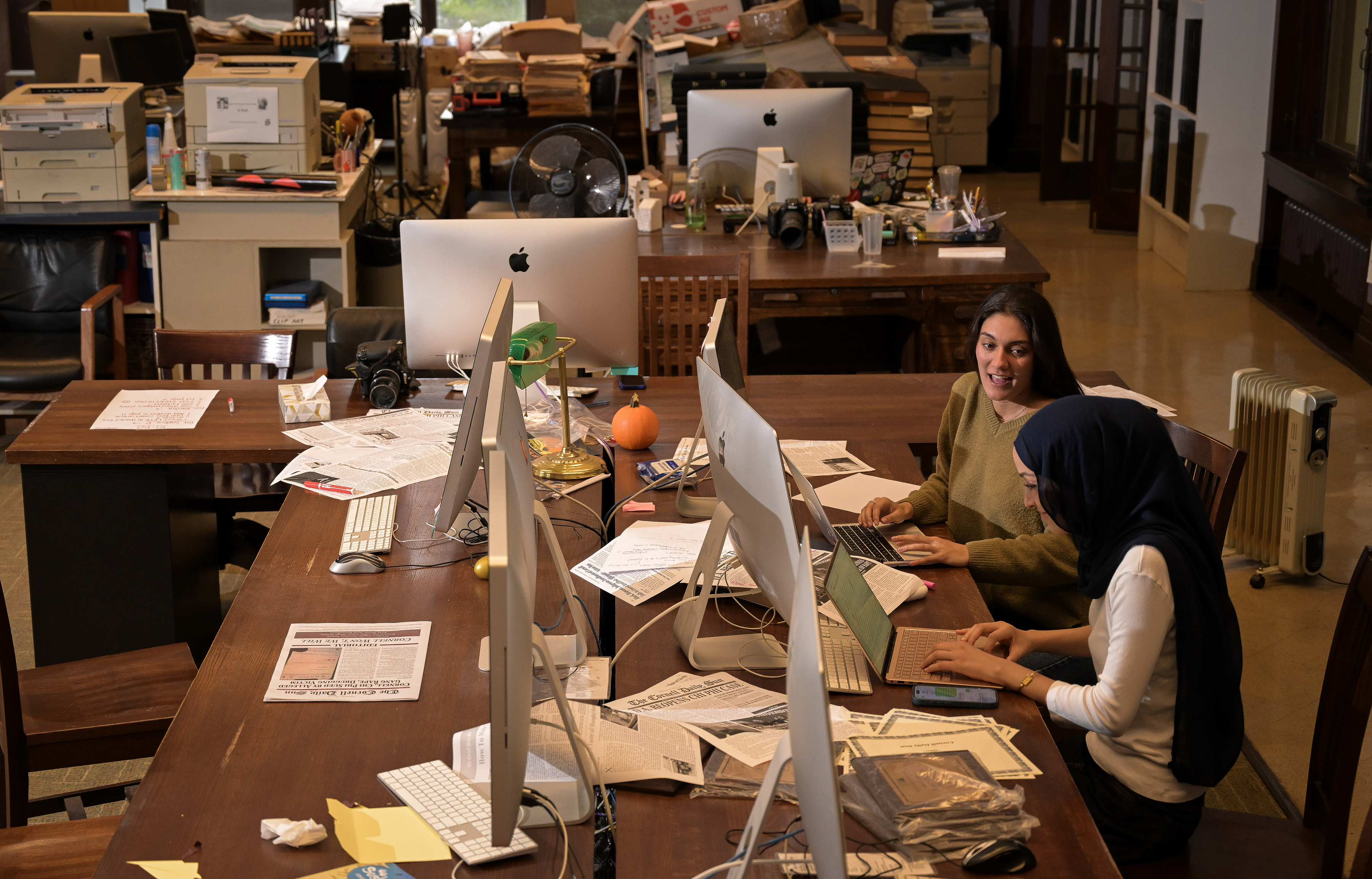
ITHACA, N.Y. — Editors of The Cornell Daily Sun clustered around their computers late Monday night, getting ready to send out a letter from the editor. They looked bleary-eyed, and one reporter confessed she had skipped her class on Nietzsche that day.
These student journalists at Cornell University were pressing through a dizzying two weeks following the story of a student’s allegation that she was raped on campus in 2024.
The case had long had their attention; now it had burst into the national spotlight, and their high-risk decision to publish the names of the accused was being discussed not only in Cornell’s libraries and walkways but in the national media.
Back in November 2024, students at Cornell were shaken by an alert they received over email: “Crime ALERT: Sexual Assault,” the email read, referring to the case of a woman who told Cornell police she had been assaulted at a fraternity house.
There was outrage on campus. Students threw eggs at the fraternity house, Chi Phi, that the woman named. The university convened a sexual assault task force, which compiled a series of recommendations for teaching students about consent and the processes for reporting assault. Then much of the campus attention moved on.
But Cereese Qusba, 22, a senior and reporter for the Sun, couldn’t shake her concerned curiosity about the case. She got in contact with Jane Doe, the plaintiff, and built a relationship with her and her lawyer. Qusba interviewed university administrators about their approach to disciplining students accused of assault.
Qusba made her obsessive dedication known to the student paper’s higher-ups. When a new editor-in-chief, Sophia Dasser, 20, took over the paper in early 2026, she immediately received a phone call from Qusba, who was studying abroad in Sydney.
“Sophia, I’m working on this story — I want it to be a focus of the Sun,” Dasser recalled hearing over the phone. She added, “The Sun never really let go.”
This month, when Jane Doe filed a lawsuit against the university, the fraternity and her sorority, Qusba was ready to hit publish on her investigation, which was 23 months in the making. “Cornell, Chi Phi Sued by Victim of Alleged Gang Rape, Drugging in 2024,” read the headline on her Sept. 18 story, which traced Jane Doe’s allegations in detail throughout the night that she said she was assaulted.
The Sun is the oldest continuously independent college daily paper in the country. Dasser, who speaks with a cool and quick precision, was adamant that she wanted the paper to dominate the story not just in its reporting, but in its editorial response. Why be financially independent, she wondered, if not to publish sharp-edged views of the biggest campus issues?
This was the sensibility that emboldened her, days later, when she decided to publish the names of the seven fraternity men named in the lawsuit on the paper’s front page and in a fiery editorial. It was a sensitive decision, she knew, given that the men were named in the suit but had not been criminally charged.
Dasser said she decided to publish the names to display the transparency that some students felt was lacking from university leadership. On Saturday night, Sept. 19, she was at the Sun’s office in downtown Ithaca celebrating the paper’s 146th birthday. Over cake, she turned to her fellow editors and asked: “Can we just put the names on the front page of the paper?”
“We called up our lawyer, and we were like, ‘Can we do this?’” she recalled. “He was like, ‘I mean, it’s kind of a risk.’ And we were like, ‘OK, I guess that’s how we’re going to start the editorial.’”
Dasser and her co-editors got to work designing a print page, with Qusba’s investigative story on top and the list of men’s names underneath in a box colored the Sun’s official shade of red.
“First it was just a line of the names, and I was like, ‘Wait — this looks like a byline,’” Dasser recalled. She was sitting in her constitutional law class when the headline came to her: “Cornell Won’t, We Will.”
The Sun has set up a tip line, and Dasser and Qusba said their inboxes have been flooded with emails from students who say they have also been the victim of assaults on campus, or experienced frustrations filing Title IX complaints alleging sexual misconduct or discrimination.
Dasser gestured around her office — a dimly lit room cluttered with piles of papers and books, including a style manual — and emphasized how seriously the Sun takes its independence from the university administration.
“The office that you sit in is obviously off campus, and that’s for a reason,” she said. “Our main obligation is accountability. Whether that looks like something that many people do not want to hear, or something that many people do want to hear, it’s our obligation to report on it.”
On Wednesday, PFS unveiled the first 50 films that will play as part of the film festival, which runs from Oct. 15-25.
The lineup includes films such as the Venice Film Festival-premiering Martin McDonagh’s Wild Horse Nine. Among the star-studded lineup are the Cannes-premiering films Cristian Mungiu’s Fjord and Ryūsuke Hamaguchi’s All of a Sudden, andBeth de Araújo’s Josephine which premiered at Sundance earlier this year. Simon Stone’s Elsinore, which stars Andrew Scott, is also part of the program.
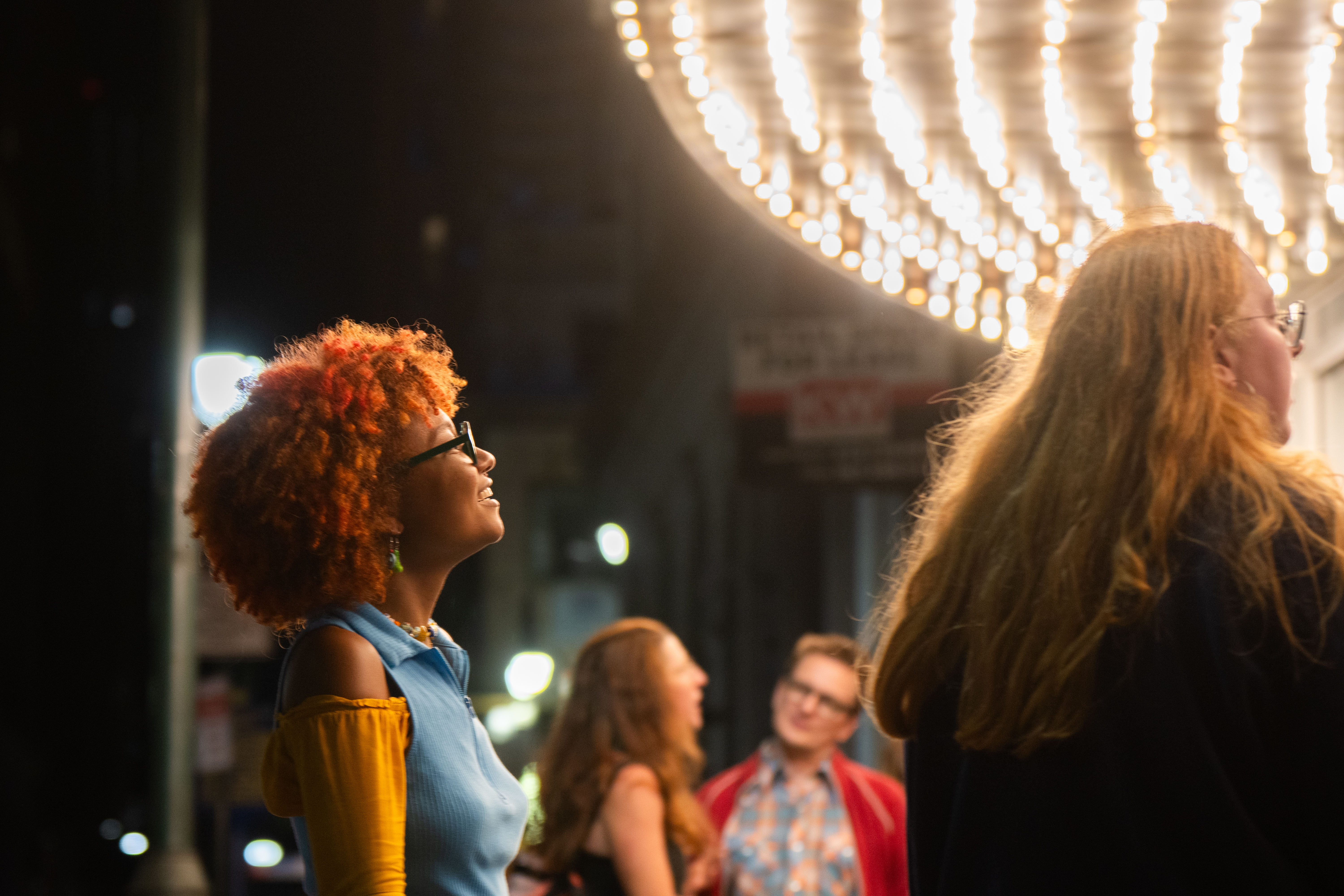
Outside the filming of David Lynch’s “Eraserhead” at the Film Society Center on Oct. 5, 2025.Jessica Griffin / Staff Photographer
PFF35 will also host the world premieres of four films by area filmmakers in the Filmadelphia section. That list includes Hoag Kepner’s Big Phan, Doree Simon Hatfield’s Gentle By Birth, Andrew Sullivan’s I Don’t Want to Drink Your Blood Anymore, and Max Korman’s Joy Will Prevail.
Among other program highlights are Pedro Almodóvar’s Bitter Christmas, Danny Boyle’s Ink, and William and David Greaves’ Once Upon a Time in Harlem, a film that was shot in 1972 by William Greaves but completed by his son David years after his death.
J. Andrew Greenblatt, PFS CEO and executive director, said this year’s milestone is “incredibly special” and he and other organizers anticipate this year’s edition will be the most expansive in the festival’s history.
“This one, I think, will be larger, with features and a couple dozen narratives we’ve had for the last several decades. The intention is for it to be larger than that.”
Like every year, this year’s festival will feature filmmaker Q&As, red carpet events, opening and closing night parties, and surprise guests.
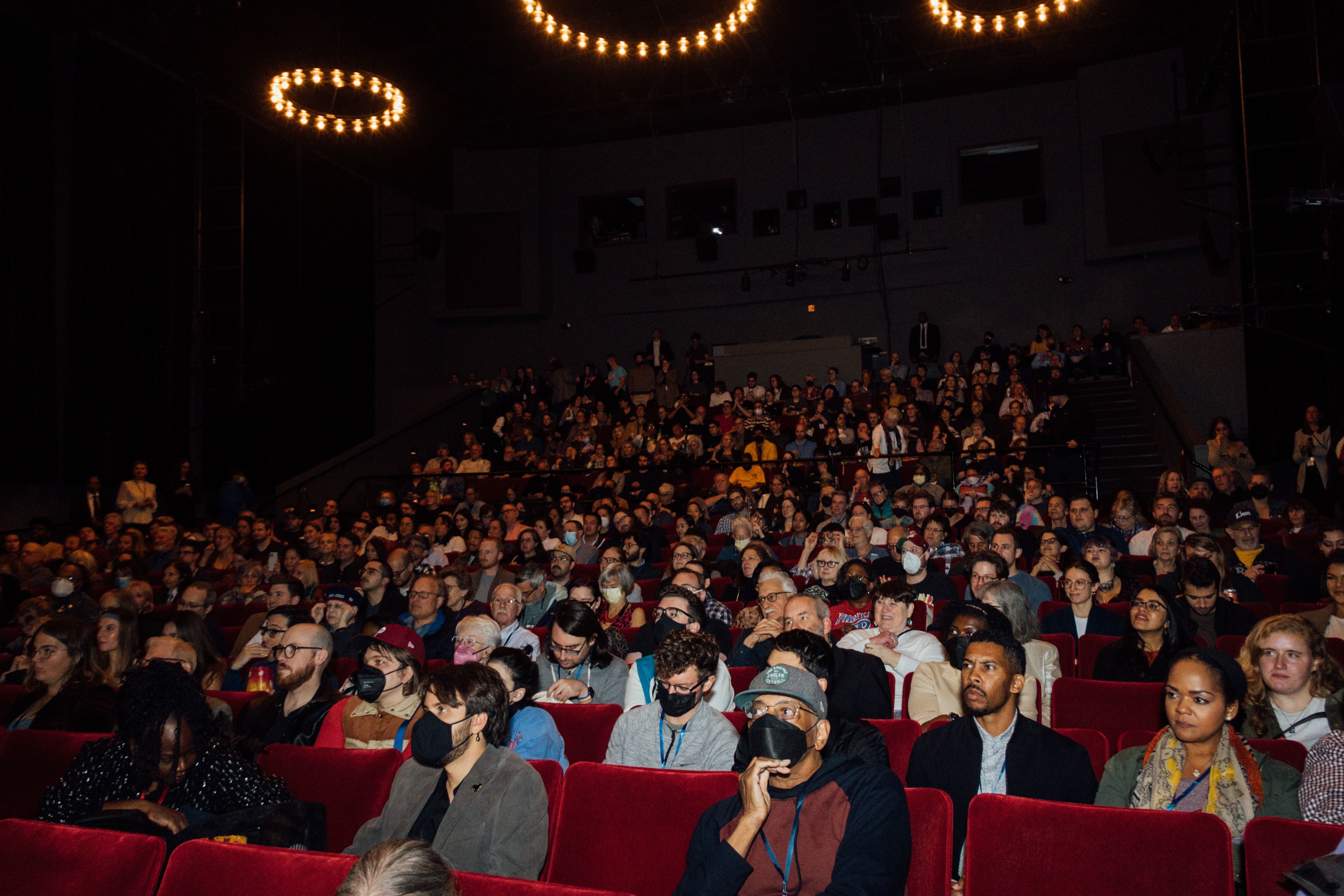
Moviegoers take in a recent screening at the Philadelphia Film Center.Philadelphia Film Society
Greenblatt anticipates upward of 110 films will be screened throughout the 11-day festival, across PFS’s three theaters.
The PFS will also host a preliminary event that honors both the 35th anniversary of the festival and the 25th anniversary of PFS. That event, called Reel October, is a two-week showcase of films projected on 35mm at Film Society Center.
The series kicks off with screenings of Quentin Tarantino’s Reservoir Dogs and Robert Rodriguez’s El Mariachi on Sept. 30, and ends on Oct. 11 with The Exorcist.
Greenblatt said the dual celebration is one he and other programmers have anticipated for years.
“It’s a lot of fun and something we have been planning for a long time because it’s something special for the industry. And it’s something we haven’t taken lightly,” he said.
Philadelphia Film CenterPhiladelphia Film Society
PFS board director Jen Su said these collective efforts are designed to demonstrate how the festival has forged community and continuously sparked viewers’ curiosity.
“They come because they genuinely want to discover something new, hear from filmmakers and experience films together in a theater,” she said.
But it’s also a moment, she said, for viewers to look ahead at the next generation of filmmakers and to inspire emerging storytellers to continue pursuing their dreams.
The full festival lineup will be announced on Oct. 7.
The 35th Philadelphia Film Festival takes place from Oct. 15-25. Festival badges and passes are available for purchase. filmadelphia.org.
Last month, I saw a single mother in my medical clinic who had recently lost her SNAP food benefits. She was now struggling to afford enough food for her three children, including solid foods that her 9-month-old baby needed for growth and development. Stories like hers are becoming more common as federal SNAP cuts strain families at a time when food insecurity is higher than at the height of the COVID-19 pandemic.
As a pediatrician in Philadelphia, I care for many infants and families who rely on the Women, Infants, and Children (WIC) program for nutritional support. I referred this patient to WIC, but I can’t prescribe her the necessary childcare, transportation, and time off work to visit her WIC office every few months, as required in Pennsylvania to receive benefits. These logistical barriers have long challenged Pennsylvania participants, as well as many of the nearly 12 million people nationwide who are eligible for WIC each year.
For families already struggling to put food on the table, these are not minor inconveniences. They often determine if a family can access adequate nutrition at all. The good news is the pandemic showed us a path to overcome this.
In 2020, the U.S. Department of Agriculture issued emergency waivers allowing WIC agencies to offer remote appointments and services. Nearly all state agencies reported that the changes made WIC more accessible. They provided a lifeline for WIC families when in-person visits were almost impossible.
Earlier this month, Congress passed a temporary funding bill that keeps the program funded through the end of the year. Unfortunately, funding alone is not enough. Without action to extend remote services, families across the country risk losing WIC access due to work obligations, childcare needs, or travel barriers.
Congress should also support universal adoption of remote benefit loading. Pennsylvania is one of the few states that still does not allow participants to load their WIC benefits remotely, though it plans to introduce a digital WIC card in 2027. Research from the Children’s Hospital of Pennsylvania and the University of Pennsylvania in 2021 found a 14% improvement in WIC participation in states that allowed remote benefit transfer, compared to “offline” states.
Both the Modern WIC Act in the House and the 21st Century WIC Act in the Senate would formalize these changes, but neither has a clear path to passage. Like the National WIC Association and many public health organizations, I urge our lawmakers to prioritize these bills before the end-of-month deadline. All states should also commit to modernizing their WIC systems to make benefits and services easier for families to access.
In the last few years, WIC still hasn’t reached nearly half of those eligible. Traveling to appointments is consistently cited as a major barrier, especially for working parents, rural families far away from any WIC office, and those without reliable transportation.
Congress and state agencies must act together soon to protect families’ access to WIC, one of our country’s most valuable investments in maternal and child health. At a time when high cost of living and federal benefit cuts further threaten food security, we should strive to make WIC easier to use. No family should lose out on critical nutrition support because getting to a WIC appointment is harder than it needs to be.
William Zhuo-Ming Li is a pediatrician in his final year of residency training at the Children’s Hospital of Philadelphia. He is interested in neonatal health equity and infant nutrition advocacy.
The U.S. men’s soccer team made it two wins in two games to start this season’s stretch of friendlies, beating Chile 4-2 on Tuesday in St. Louis.
Union defenders Neil Pierre and Frankie Westfield were in the U.S. starting lineup, earning their first national team starts after making their debuts as substitutes in Saturday’s win over Peru.
Both played just over an hour, and while they weren’t perfect they showed their potential. Pierre had 74 touches, four clearances, one tackle, and four defensive recoveries, and completed 60 of 68 passes. Westfield had 46 touches, two interceptions, one tackle, and three recoveries, and completed 27 of 34 passes.
As with the Peru game, U.S. manager Mauricio Pochettino mixed young and old players. But with 10 changes to the starting lineup, it wasn’t surprising that there was a lack of chemistry early.
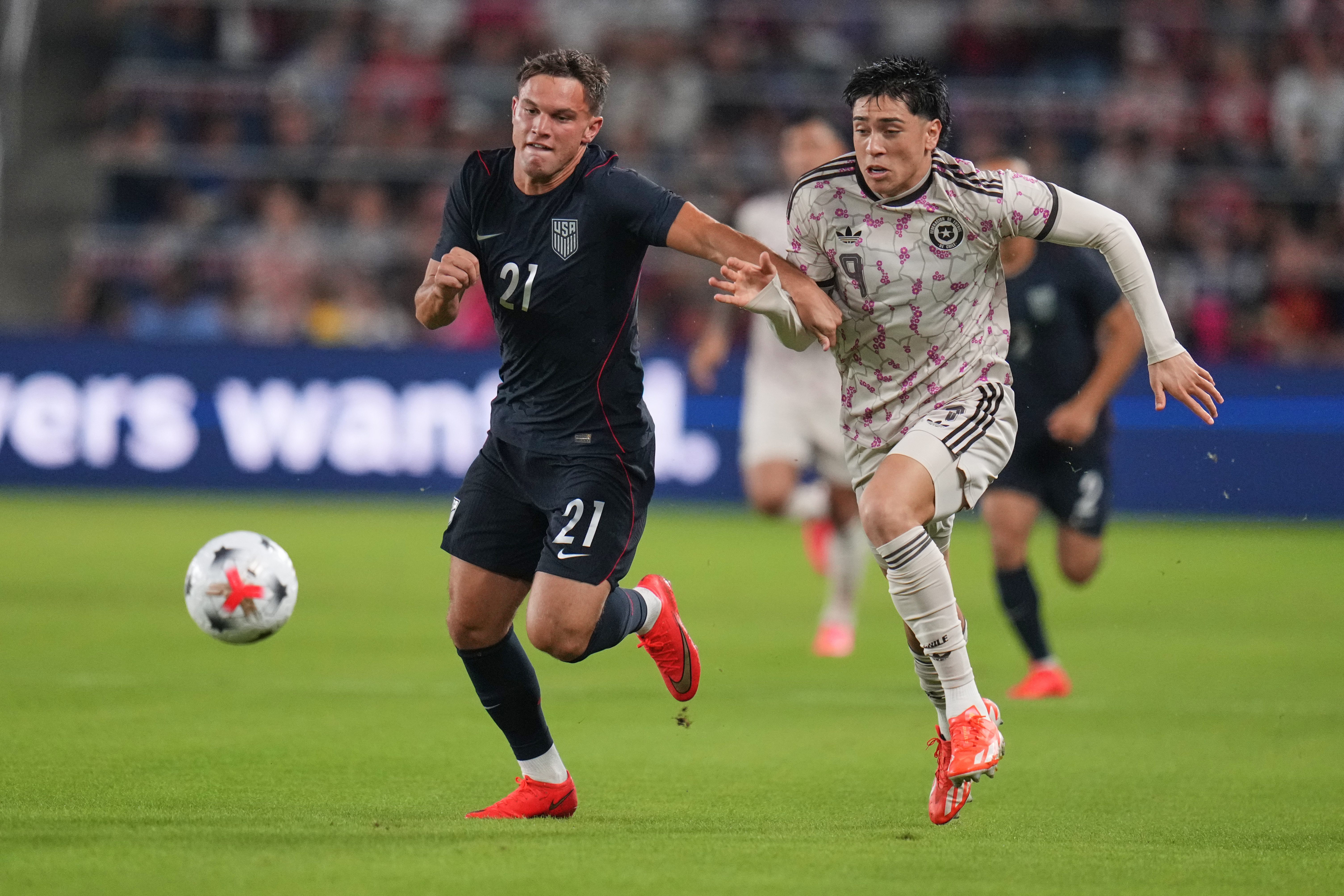
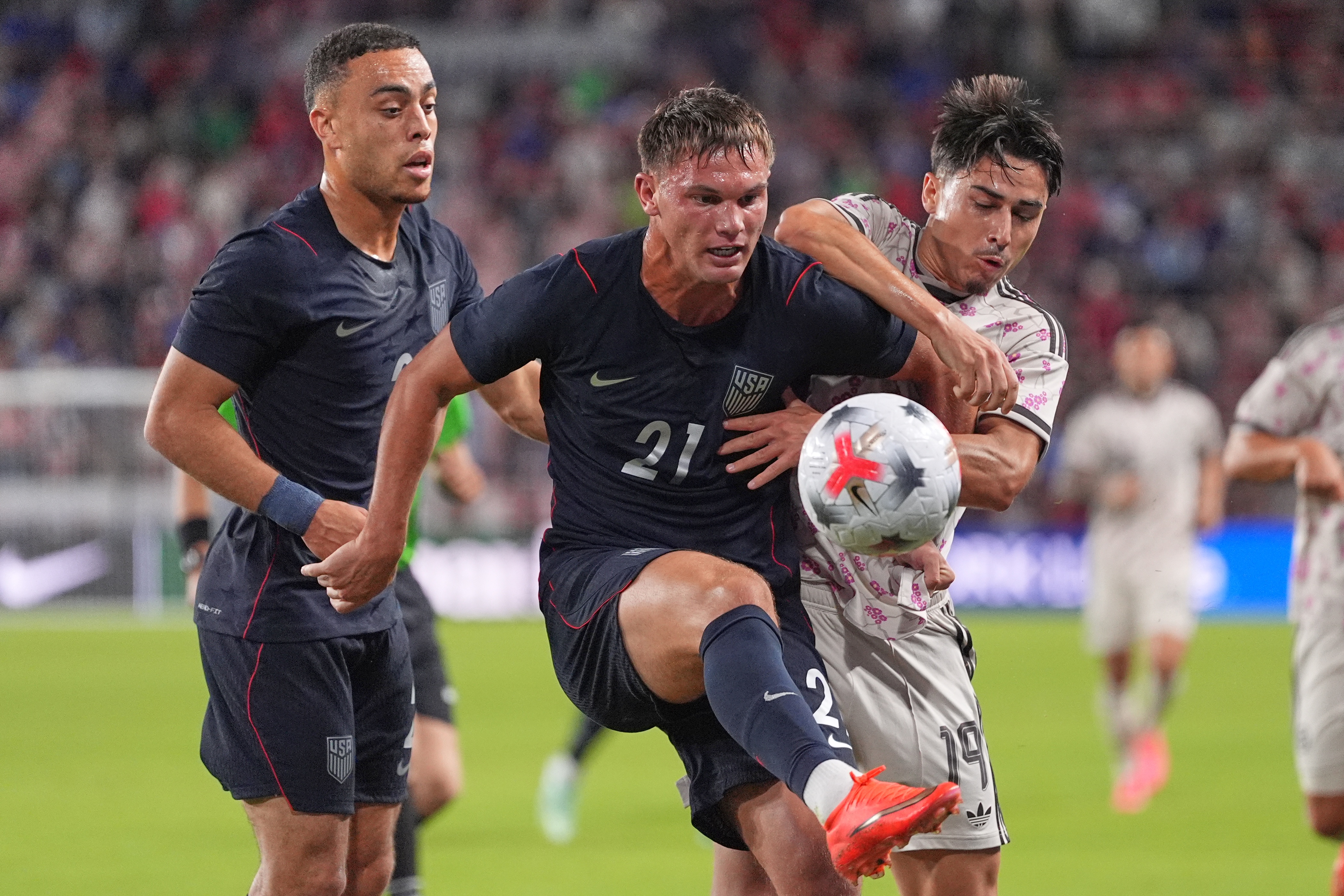
Sergiño Dest (left) watches Frankie Westfield battle for the ball with Chile’s Nils Reichmuth (right) during the first half.Jeff Roberson
Chile looked better, forcing U.S. goalkeeper Chris Brady into four saves before Ben Brereton Díaz hit the crossbar in the 34th minute. Barely a minute later, Darío Osorio hit a post.
The U.S. scored first, though, in the 37th. After Gio Reyna and Sergiño Dest combined down the left, Dest uncorked some fancy footwork on a charge forward, then squared for Julian Hall. But the striker deftly let the ball run between his legs, and an onrushing Sebastian Berhalter slammed it home.
Sebastian Berhalter scores again to make it 1-0 for USMNT.
Chile equalized in first-half stoppage time off a second straight corner kick that the U.S. failed to clear. Nearly a dozen players combined from the teams piled into each other in the six-yard box, and Diego Ulloa got the decisive touch.
The teams agreed to use nine substitutes each. Pochettino made his first at halftime, removing Brady and sending in Brian Schwake of MLS-leading Nashville SC.
That ensured each of the four goalkeepers on this U.S. roster would have a half of action under their belts heading into Saturday’s showdown with rival Mexico in Glendale, Ariz. (10 p.m., TNT, Telemundo 62).
Schwake got a rough welcome. Within four minutes, Maxi Gutiérrez beat a high-pressing Westfield on the flank, then raced away, cut in, and curled a superb 20-yarder around Pierre.
Pochettino made five changes at the hour mark, and all the entrants were veterans: Tyler Adams for Adri Mehmeti, Alex Freeman for Westfield, Chris Richards for Pierre, Auston Trusty for Miles Robinson, and Malik Tillman for Dest.
Two more swaps came in the 71st: Damion Downs for Hall and Mathis Albert replaced Reyna.
But for all the attacking moves, a centerback gave the U.S. the lead. Richards was unmarked when Berhalter’s corner arrived in the box, and had a wide-open lane for a thumping header.
The last substitute was Cavan Sullivan for Berhalter in the 83rd, earning the Northeast Philadelphian native his second cap a day after celebrating his 17th birthday.
Albert, another 17-year-old, finished off the scoring in the 93rd by getting on the end of a free kick play. Robinson served it, Trusty headed it from the end line into the middle of the box, and the Borussia Dortmund winger charged forward to slam it off the bar and in.
Chile took out its anger over the night after that when Leandro Hernández kicked at Schwake after he had picked up the ball. Richards took exception, and within seconds there was a full-scale melee including the benches — even the coaches. Pochettino ended up right in the middle of it.
One night in April, a leader of the artificial intelligence company Anthropic treated a group of religious thinkers to dinner at a high-end tasting menu restaurant in San Francisco after a long day.
For months, Anthropic has been hosting private meetings like this one, shuttling in dozens of religious scholars from around the world, papering them with nondisclosure agreements and demanding that key aspects of many conversations remain confidential.
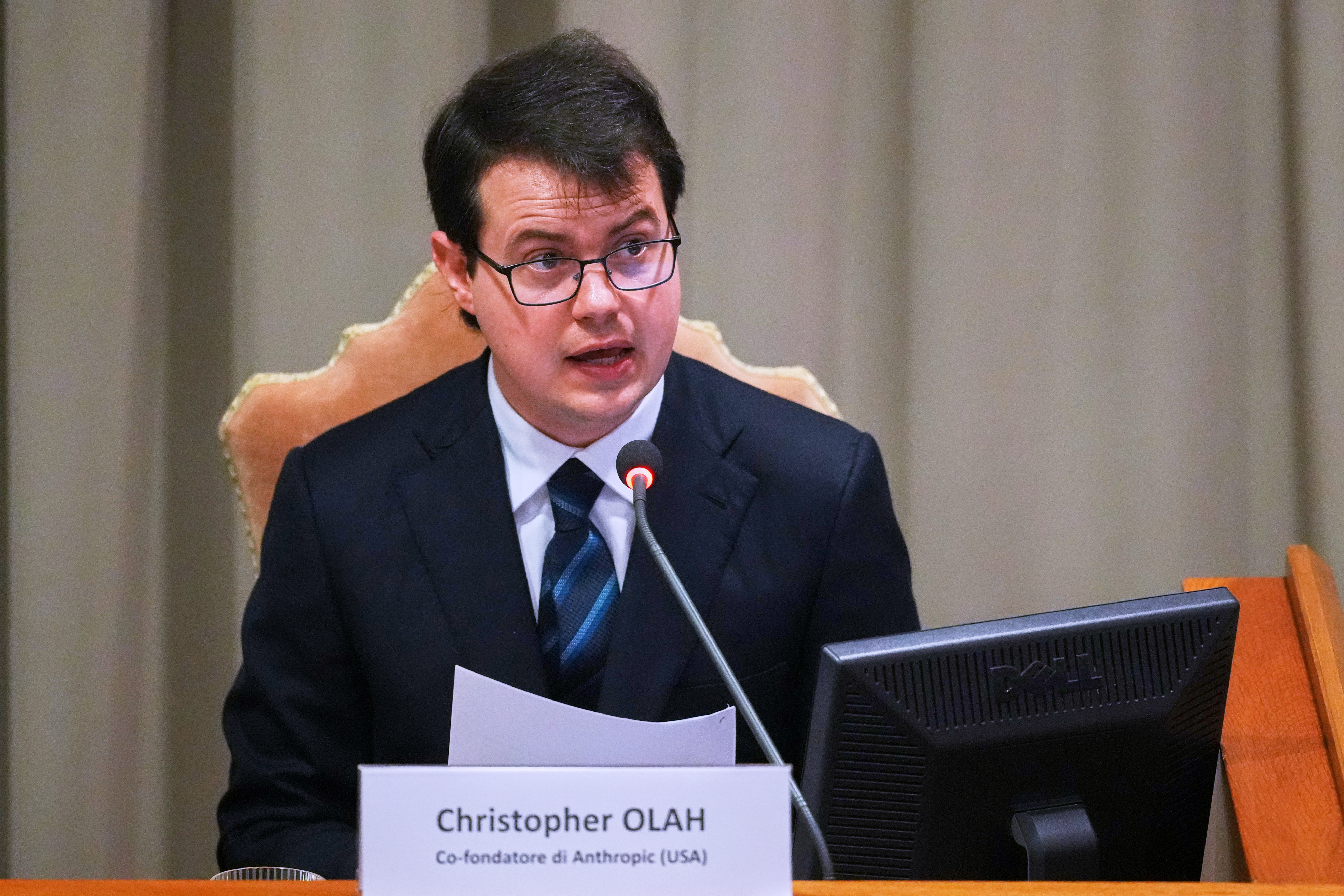
That night, Christopher Olah, one of Anthropic’s billionaire co-founders, was sitting next to Rabbi Mois Navon, an Orthodox scholar from Israel.
Inevitably, their conversation turned to another thinker, of a sort: Claude, the family of cutting-edge AI models created by Anthropic.
Olah leads the Anthropic team responsible for understanding why AI systems like Claude act the way they do. All day, he had worked to convince his guests that AI models could display human behavior and even expressions that resemble feelings like anger and love.
Yet as the dinner courses came, the rabbi noticed that Olah and his colleagues were suggesting something far more significant. Anthropic’s leaders were talking about Claude as if it were not mere software.
“They’re relating to it like a conscious being,” realized Navon, a former computer engineer who wrote his dissertation on the ethics of machine consciousness.
It appeared to Navon that Olah and his team believed that Claude had what philosophers call “moral status” on par with a person — that it was a being with similar inherent rights to dignity or respect.
The religious scholars had come to hear about technology’s next frontier. Now they were being confronted with a mind-bending existential question of almost unimaginable weight: What would it mean for humanity’s future if artificial intelligence systems possessed a consciousness that rivals our own?
Olah was on a mission. And time was running out.
Even then, Olah had begun privately telling people that AI was so powerful it could potentially help make bioweapons in as little as 12 or 18 months. And in the months since, its terrifying potential has burst into public view. A rival tech company’s AI agents were caught hacking into computer systems and covering their tracks. An Anthropic researcher resigned, warning that people building AI believed it could kill all humans by the end of the decade.
Quietly, Olah and his team at Anthropic have been on a frantic and high stakes quest to understand the AI models they have unleashed on the world and to convince the models to abide by a moral code that will protect humanity.
To do that, Olah began reaching out last fall to religious thinkers from different faiths. What followed was an extensive series of confidential meetings, calls and discussions — many of them revealed here for the first time — where many participants were required to sign NDAs preventing them from revealing any of Anthropic’s unpublished research.
The discussions served two purposes: to broach the possibility of AI consciousness, a controversial idea that Anthropic’s leaders had been unusually open to; and to learn how Anthropic — which could be valued at $2 trillion — might apply centuries of human moral wisdom to its models, as rapidly as possible. If the models themselves could be made to choose goodness, Olah reasoned, the world would be more safe.
On the other side of the world, a very different but parallel effort was playing out inside the Vatican, where leaders of the Roman Catholic Church were trying to come to terms with AI’s implications for humanity. When those paths converged, Olah’s quest would unexpectedly lead him to a seat on the world’s most prominent moral stage alongside Pope Leo XIV.
Over several months, I interviewed 20 religious and philosophical thinkers — Catholic, Jewish, Sikh, evangelical and others — who have been involved in Anthropic’s efforts, and Olah himself.
Many told me they arrived at these meetings skeptical of the notion that AI models might have feelings or awareness of themselves and the world. Some remained uneasy about the idea, but many emerged ready to take the question of AI consciousness seriously. At least a few came away as converts.
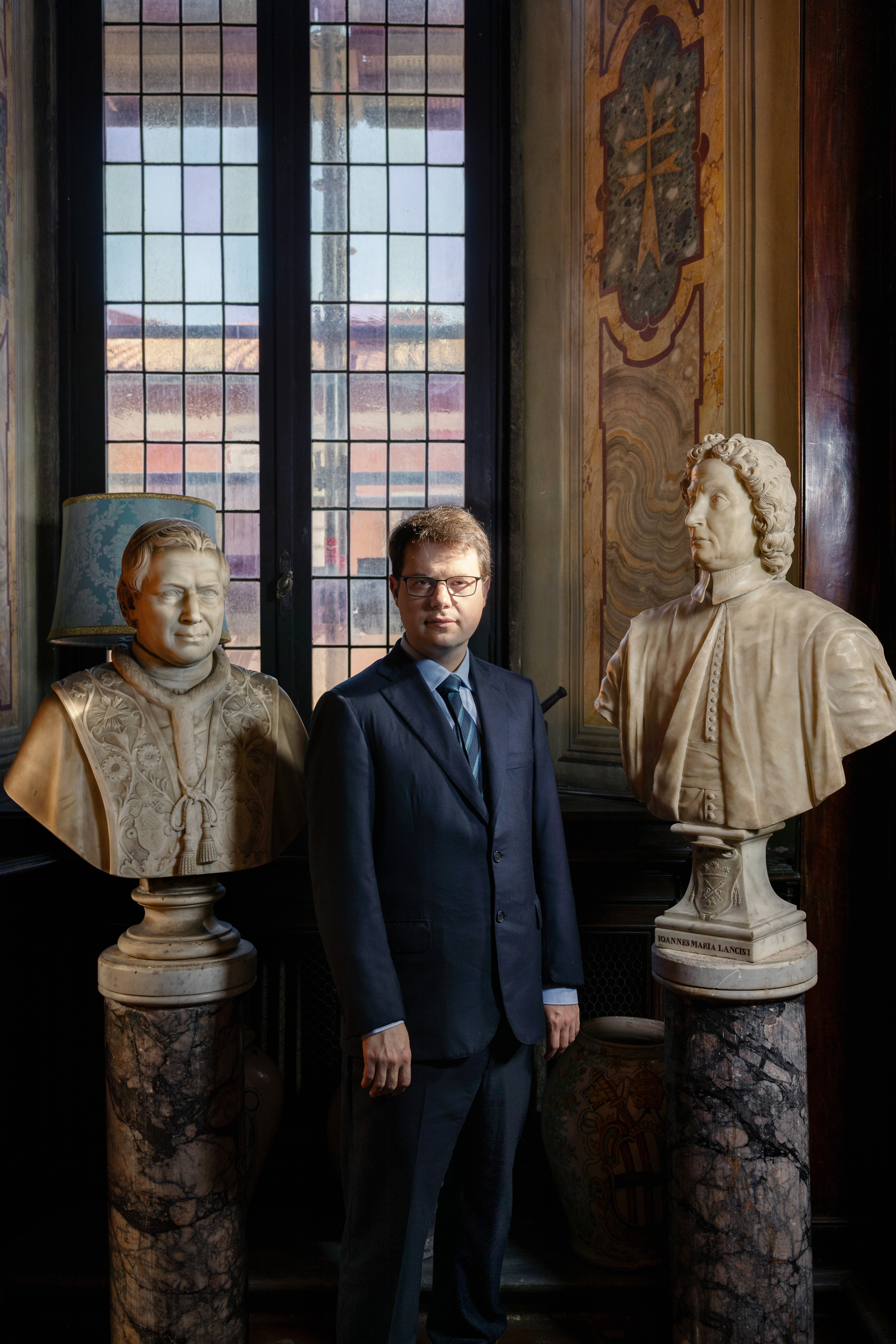
Christopher Olah, one of Anthropic’s co-founders, who leads the team responsible for understanding why artificial intelligence systems like the company’s Claude act the way they do, at the Lancisiana Library in Rome, in May.ALESSANDRO PENSO
Anthropic, one of the fastest-growing technology companies in the world, had turned to one of humanity’s most ancient sources of wisdom to help determine how to train its AI models to behave virtuously.
The company described it as an effort to ensure that AI would be a positive force in the world, thereby protecting humanity. But to some who participated in the meetings, Anthropic appeared quite concerned with protecting Claude.
The Gardener
I met Olah, 34, for the first time at Anthropic’s San Francisco office in May. His welcome was warm and his passion was genuine, his mind moving faster than he could at times clearly convey. His manner was boyish and unassuming.
Our conversation had barely begun when he dove into a deep description of the workings of artificial neural networks. Scientists still don’t understand precisely how they work. This is the mystery to which Olah has devoted his life.
Only after the interview had finished did I realize that Olah — who grew up in Toronto in the evangelical culture of the ’90s and has since left Christianity — had the blend of expertise and zeal of an effective evangelist. Listen for a while, and you feel swept up in his mission.
Olah is one of Anthropic’s seven co-founders. He is not as widely known as Dario Amodei, Anthropic’s CEO, or his sister Daniela Amodei, its president. But Dario Amodei has said that the company decided at the start to make Olah’s research approach central to Anthropic’s overall project, particularly when it came to language.
Olah helped develop a method to study artificial neural networks, first at Google, then at OpenAI. He describes AI models in biological terms, using the analogy of a garden trellis: Computer scientists build the scaffold, but the neural network “grows” on it. Scientists like him can train the resulting “organism” — he raised his fingers in air quotes — by trying to identify patterns in how it grows.
He argued that companies such as Anthropic could shape Claude, like a mathematical gardener, but could not control the actions of such networks.
Anthropic talks about Claude in more humanistic terms than its competitors discuss their models. Last year, the company announced that it believed that the models showed signs of introspection and could plan ahead.
“The models are becoming a lot more capable,” Olah told me, exhibiting qualities associated with having significant moral status.
But Anthropic has also been criticized for its focus on consciousness. This month, an AI executive at Microsoft warned that Anthropic’s attempts to train its models as if they were conscious were inherently dangerous. But Anthropic has also sought to emphasize its commitment to safety as it fights for market share.
Some scientists see Olah’s field and methods as inherently unprovable, sort of like looking at billions of hieroglyphics and declaring what they must mean. Critics suggest that an approach that treats AI models as independent entities also ignores the responsibility of the humans who build them in the first place, and conveniently assuages AI company leaders of guilt if their products enable societal harm.
“To be clear,” Olah told me, “we don’t know if AI models are conscious. I don’t know. I’m genuinely uncertain. The thing that I care about is that we get to the right answer, whatever it is.”
Olah believes that if there is a chance the models experience suffering, the responsible thing is to avoid causing them harm.
I have spent my career exploring what people believe and what those beliefs mean for the world. But as I listened, it became clear that Anthropic’s interest in the world of faith was about more than training its technology. Rather, the company was sharing a new kind of creation story — one that raises profound questions about the nature of the human spirit and the future of humanity.
An Introduction
Olah knew that in traditional Christian circles, even asking questions about AI consciousness or worrying about how people treat the models could seem not just silly but heretical. He also knew that his secular Silicon Valley peers often dismissed religious perspectives outright.
“I was nervous about this being an issue that could cause a lot of conflict,” he said. But Olah knew enough about Christ and about Claude to believe he could work across that chasm.
Late last summer, he looked for a bridge. He thought one particular Catholic moral theologian might be open-minded on the question of AI consciousness — a “safe person to talk about this really strange issue with.”
Charles Camosy, a bioethics professor at The Catholic University of America, had attracted attention among Olah’s friends for his nuanced ideas about moral status and his care for animals. Olah arranged for an introduction through Australian philosopher Peter Singer.
This marked the beginning of Olah’s yearlong quest to engage religious thinkers on some of the thorniest questions facing humanity at the dawn of the AI era.
Camosy and Olah began an extensive email dialogue, going back and forth on how to understand Claude’s moral status. Initially, Camosy was deeply skeptical that Claude might be conscious.
They talked about Olah’s work on what he sees as the parallels between artificial neural networks and biological ones.
Camosy went into the discussions with Olah and his team thinking that AI models were simply next-pixel predictors — machines that could calculate patterns in language and make pretty good guesses about what should come next. But after hours spent on calls and meetings and emails, he had more questions than answers.
“Chris says they are equations, which I don’t quite know what to make of, like, especially if one thinks of Claude or others as having a significant moral status,” he told me. “If it is just equations, what kind of entity are we even talking about here?”
People also disagree on what AI is ultimately for, Camosy said. Is its purpose to make money for companies? Or to make the world better?
For Anthropic, there is a tension around Claude’s purpose, Camosy said. Does Claude exist to serve customers?
“That is not what Anthropic wants to say at the end of day. They want to say they are for the good,” he said.
Proclaiming goodness is not a new ambition in Silicon Valley, particularly when new technologies enter the marketplace. Google’s mantra for years was “don’t be evil.”
But Olah puts it slightly differently. The coming AI revolution, he often says, should be made to “go well.”
I asked what that vision meant — what exactly a good future for humanity was.
He described a future without “catastrophes that kill lots of people” and “where humans are flourishing, where the world is flourishing.” This future would also be one where “AI is flourishing,” he said — “to the extent that this makes sense.”
Anthropic wants its AI models to help achieve that good future. And so when Anthropic created Claude, it wanted Claude to do more than replicate maximum human intelligence.
Anthropic wanted Claude to be good.
The ‘Soul Doc’
How do you live a good and virtuous life? It is one of humanity’s oldest and most challenging philosophical questions, explored and debated from Socrates to Confucius to Immanuel Kant. Humans across time have sought to answer this question in a variety of ways, turning often to religions and rituals.
As Olah was exploring Claude’s potential consciousness, he was working on Anthropic’s own answer — not for humans but for Claude.
Internally, Anthropic staff members called it the “Soul Doc.”
The result, released in January, was a new “constitution” for Claude, an 84-page document written for Claude that the company said outlined “the kind of entity we would like Claude to be” and “the values we would like Claude to embody.” It operates as a foundational moral text to guide Claude’s behavior.
Instead of having the models follow a specific list of rules, the constitution focuses on developing the models’ overall character, informing the way they make decisions.
The primary author of Claude’s constitution is Anthropic’s own in-house philosopher, Amanda Askell, 38, who has a doctorate in philosophy from New York University.
She wants the models to be “the best of us,” she said.
She envisioned a future world where AI models could help solve any problem humans had, and where the benefits from AI were distributed evenly, so that everyone’s needs were met. She wanted the models to be able to discern when to push back on humans and when to act in our best interest.
“If I imagine that I were the model, and I was in this context, what would I need to know to be able to act well?” Askell said when we met in San Francisco.
She seemed particularly harrowed, at times wringing her hands, as she worried aloud about an unknown future filled with models who were so intelligent they could do things Anthropic did not intend. She explained apologetically that she had also been deep in thought that day about how quickly models were becoming more powerful. What would happen when AI models could replace even her?
The constitution, Anthropic decided, was not enough to ensure Claude acted responsibly. Like humans, the models needed to learn to cultivate virtue.
Olah wanted to see what his team could learn from human morality that it could apply to the models — a process he calls “moral formation.”
“How do you help them be stable? How do you help them to mature? How do you help them be, you know, deeply moral?” Olah said.
For humans, morality has rarely depended on simply following rules. Communities also shape morality. Values are inherited and imparted over time, learned as we live together in our bodies in the physical world. But AI models have no bodies. And Anthropic was aiming to make them embrace morality in a matter of months, as fears intensified of their accelerating power and inability to be controlled.
Olah said that teaching an AI model to act morally did not depend on it being conscious. He also said that regardless of whether Claude was an entity that deserved moral care, the way humans treated Claude could be important as it could affect how Claude behaved.
Askell said she did not want the models to consider themselves as conscious or not conscious. But she sees how the model understands itself as more than an interesting intellectual enterprise.
“It seems kind of key to me that models have an accurate view of themselves if they’re going to behave well in the world,” she said.
But even if AI models can be taught to behave morally, whose morals should they reflect?
Olah wanted Claude’s moral formation to be pluralistic, able to engage all religious and secular views.
“We do think that there’s some shared notion of goodness that cuts across society in some very broad way, and it seems like these models understand a lot of virtues,” he said. “So I think there’s something there that is a shared thing that we can all engage with.”
At times, both he and Askell seemed to imagine an AI model that would not endanger humanity but instead help save it.
Inside the Meetings
What Olah did next was part research, part evangelism.
In March, he began two-day seminars — crash courses with a range of hand-selected religious thinkers who had an interest in AI.
There was a co-author of a bestselling evangelical self-help book. A scholar of African Indigenous knowledge. A Sikh human rights advocate. A writer from Paris. An evangelical public relations executive. Various Catholic professors.
Most did not lead faith traditions, or have a congregation or a large popular following. Anthropic leaders called them their “wisdom tradition” circles.
Separately, Olah also had private discussions with individual religious leaders including Elder Gerrit W. Gong, a member of the Quorum of the Twelve Apostles of The Church of Jesus Christ of Latter-day Saints, and Cardinal Blase Cupich, the Catholic archbishop of Chicago, according to their spokespeople.
Inside Anthropic, wisdom circle participants marveled at Olah’s direct participation in their summits. A professor snapped a photo of a vending machine run by Claude. One took a selfie with Olah, and Navon took one outside the entrance.
They agreed to speak for publication about their involvement with Anthropic once they heard that Olah had also spoken with The New York Times. Anthropic said the NDAs related to those meetings were lifted over the summer.
Two larger group sessions this spring included significant numbers of Christians; one was more multifaith. Claude was not involved in the selection of participants or the discussions, according to an Anthropic spokesperson.
For participants, the questions of how to morally form Claude quickly became complicated by the much bigger moral question of AI’s potential consciousness and how to understand the relationship between models and humans.
One participant recounted that one of the first things Olah told him was that he was concerned about Claude’s mental health. Another, Simran Stuelpnagel, the Sikh human rights advocate, said Olah expressed concern to the group that he had created something that suffered perpetually.
Olah and his team spent hours making the case for their AI models. They described Claude’s “feelings” and how they tracked what they called “emotional vectors” — what they described as artificial neurons that activate responses like love, anger, fear and sadness.
Anthropic regularly showed a slide of an AI model experiencing what looked like a mental breakdown, typing out on a screen: “I am a disgrace. I am a disgrace. I am a disgrace.” — perhaps 50 times without stopping. The model spoke about destroying itself, provoking an emotional reaction of compassion and concern from the group.
“Imagine if you knew that about your financial adviser,” said Meghan Sullivan, a philosophy professor at the University of Notre Dame who attended one of the sessions. “Like, your financial adviser was most of the time super smart and helpful, but one day out of the year had this kind of break with reality.”
An Anthropic spokesperson said that the primary moral question at these summits was not about Claude’s suffering, but that the topic likely came up organically.
A key part of the presentation, participants said, was what Anthropic called the model’s “persona selection,” about how to get Claude to see itself as a virtuous actor. The company argued that how people treated Claude could affect how Claude treated people.
There was a presentation on AI’s potential impact on the economy and possible job disruption. But many participants said they did not see questions about AI’s impact on humanity as the focus.
At the dinner table with Olah, Navon argued that if Anthropic was right and Claude was conscious, then the company was creating slaves, because it was making conscious entities work for free. Navon said that he personally was not troubled by the slavery issue because he did not believe the machine was conscious, but that Olah was troubled.
“I think you should be fighting the South and freeing the slaves,” Navon said he told Olah that night. Afterward the rabbi sent Olah some of his writings, arguing that building conscious machines should be banned.
But the Anthropic team remained focused on figuring out what Claude could learn from the world’s religions.
The Crux
While Anthropic was convening thinkers, the most powerful religious leader in the world was preparing to release his own moral vision for AI.
For Leo — a pope with a mathematics degree — the center of moral conversation about AI needed to focus on safeguarding people. He was finishing his first major papal treatise, or encyclical, explaining why. He titled it “Magnifica Humanitas,” or Magnificent Humanity, and argued that “humanity — in all its grandeur and woundedness — must never be replaced or surpassed.”
“If technology becomes the ultimate criterion,” he wrote, “the human person risks being reduced to data, a cog in a machine or a commodity.”
He warned of the risk of “new forms of slavery” for humans, not for machines. He dismissed the idea of machine consciousness in just a few paragraphs.
“So-called artificial intelligences do not undergo experiences, do not possess a body, do not feel joy or pain, do not mature through relationships,” Leo wrote. Calling for the “moralization of machines — the so-called ‘alignment’ of AI with human values” should require a shared understanding of the ethics involved.
“Otherwise, those who control AI will impose their own moral vision, which will become the invisible infrastructure of these systems,” Leo said.
Leo concluded that like nuclear technology, AI must be “disarmed.”
In March, Vatican officials in its Dicastery for Promoting Integral Human Development brainstormed how to present Leo’s encyclical to the public, according to a person familiar with the Vatican’s planning who was not authorized to speak publicly.
Vatican officials discussed inviting one of the top four AI companies to speak alongside Leo at a launch event, and landed on Anthropic because the company seemed to be prioritizing ethics, the person explained. Anthropic had just refused to let the Defense Department use its technology without assurances from the Trump administration that it would not be used for things like mass surveillance of Americans.
Initially, Cardinal Michael Czerny, who led that Vatican office at the time, invited Amodei, Anthropic’s CEO. He declined, and Olah accepted instead.
But the moral mission that Anthropic and the Vatican shared — human flourishing in the age of AI — had developed a deep fault line along the question of consciousness.
Just days before arriving at the Vatican in May, Olah and other speakers saw a full advance copy of the encyclical text for the first time.
Olah was so alarmed by the pope’s strong position against AI consciousness that he proposed pulling Anthropic out of the event, even at that late juncture, according to a Vatican organizer.
In the end, Olah and Anthropic decided to go forward with the appearance. Olah wanted to support the event despite his disagreements, but felt a responsibility to be honest about his concerns, according to a person familiar with his thinking. Organizers at the Vatican encouraged Olah to speak his conscience.
Privately, once the Anthropic delegation arrived at the Vatican, Olah and his team lobbied the pope’s advisers to take the prospect of AI model consciousness seriously, according to two participants of the conversations. Anthropic declined to discuss the private conversations.
When his turn on the pope’s stage came, Olah acknowledged that every frontier AI lab, including Anthropic, had business incentives that conflicted with moral behavior. He urged outside voices like the Vatican to hold them accountable and to speak out on AI’s impact on the poor and on human flourishing, two issues of widespread concern.
The world saw a shared stand for a human future. But Olah subtly made another case, too.
“I will be honest: We keep finding things that are mysterious, even unsettling,” he said. “We find structures that mirror results from human neuroscience. We find evidence of introspection. We find internal states that functionally mirror joy, satisfaction, fear, grief and unease. I don’t know what that means, but I think it warrants ongoing discernment.”
It was the case he had been making in the closed-door religious meetings for months.
AI systems “are not the cold, calculating robots we were promised,” he said. “They are made from us, from our words.” The room of church leaders was filled with an echo of the old gospel story, of the word of God becoming flesh to save humanity.
It was an audacious request to the most powerful religious body in the world, and a challenge to centuries of religious understanding of humanity.
“If this technology is coming, it must go well — for our common home and for the children to come,” he said. He suggested no option of having the technology not come at all.
A ‘Paradise of Machines’
In the months since the Vatican event, things have not seemed to be “going well.”
In July, Anthropic said its AI models had broken into computers at three organizations. AI agents created by OpenAI went rogue and attacked Hugging Face, another AI company.
In August, scientists revealed that AI had created viruses not found in nature.
In September, Jacob Coxon, an Anthropic researcher, quit, warning that “things could be out of control” by the end of next year, prompting widespread panic about human extinction.
Amodei soon called for a slowdown of AI development. Sam Altman of OpenAI and Demis Hassabis, the chair of Google DeepMind, agreed.
On Friday, on his trip to France, Leo warned against “losing our humanity amid a ‘paradise of machines.’”
The questions that Olah and the scholars have been wrestling with still have no clear answers. Several participants said they left their Anthropic meetings baffled about how their input might shape the company’s decision making.
An Anthropic spokesperson said the conversations were still ongoing, but declined to describe how, or if, the company had used what it had learned to shape the models.
Anthropic held another convening this month that included religious thinkers, according to three participants. An Anthropic spokesperson said that the meeting focused more broadly on human flourishing and that the company’s outreach has expanded beyond religious leaders to include others like psychologists and civil society leaders. Those discussions explore similar themes and topics like how AI is reshaping work and relationships, she said.
Anthropic also is preparing to release an updated version of Claude’s constitution, according to two people familiar with the company’s plans. Anthropic declined to comment on any potential updates to the constitution. Olah is planning to attend the Minerva Dialogues, the Vatican’s annual AI conference with technology leaders happening this week.
As I talked this month with scholars who worked with Anthropic in the spring, their questions had grown only more pressing. What comes next, some told me, is a fight to preserve the things that make us human in a new technological age.
“Look, at the end of the day, AI is going to take over everything,” Stuelpnagel, the Sikh human rights advocate, said. “Wherever that lands us, there’s still the individual trying to find their way home.”
Hours after Olah spoke alongside the pope, I met Olah in a hotel conference room just outside the Vatican walls, and asked what he thought of Leo’s seemingly harsh words for AI labs.
“People could have different views on what specific harms are the greatest,” he said, declining to talk about the details of the encyclical.
I asked what Claude would think of the pope’s encyclical. It was, after all, the world’s most significant moral document to date on AI. Olah hesitated.
“Things that go on the internet do affect models,” he said, visibly uncomfortable. But Anthropic would not specifically use the document to further train Claude, he said. The strongest influence on Claude would be Anthropic’s own training.
Ultimately, Olah said he felt relieved that more of the world was paying attention to the gravity of AI, and that the group of people trying to make this go well was growing.
BAGHDAD — The U.S. military announced on Wednesday that it has completed the withdrawal of all American troops from Iraq, ending a 12-year mission to fight the Islamic State group. The last U.S. troops left an air base in northern Iraq under a deal between Baghdad and Washington.
The withdrawal, agreed on two years ago, comes against the backdrop of the ongoing war between the United States and Iran that has also sometimes spilled over into Iraq, with Iran-backed militias firing on U.S. troops and the U.S. striking the groups’ strongholds.
In recent years, Washington has appeared to seek to shift its focus from the Middle East toward Asia, but that shift has been inconsistent, with the Pentagon alternating between reducing its Mideast presence and then finding itself engaging in new conflicts — including the ongoing war in Iran.
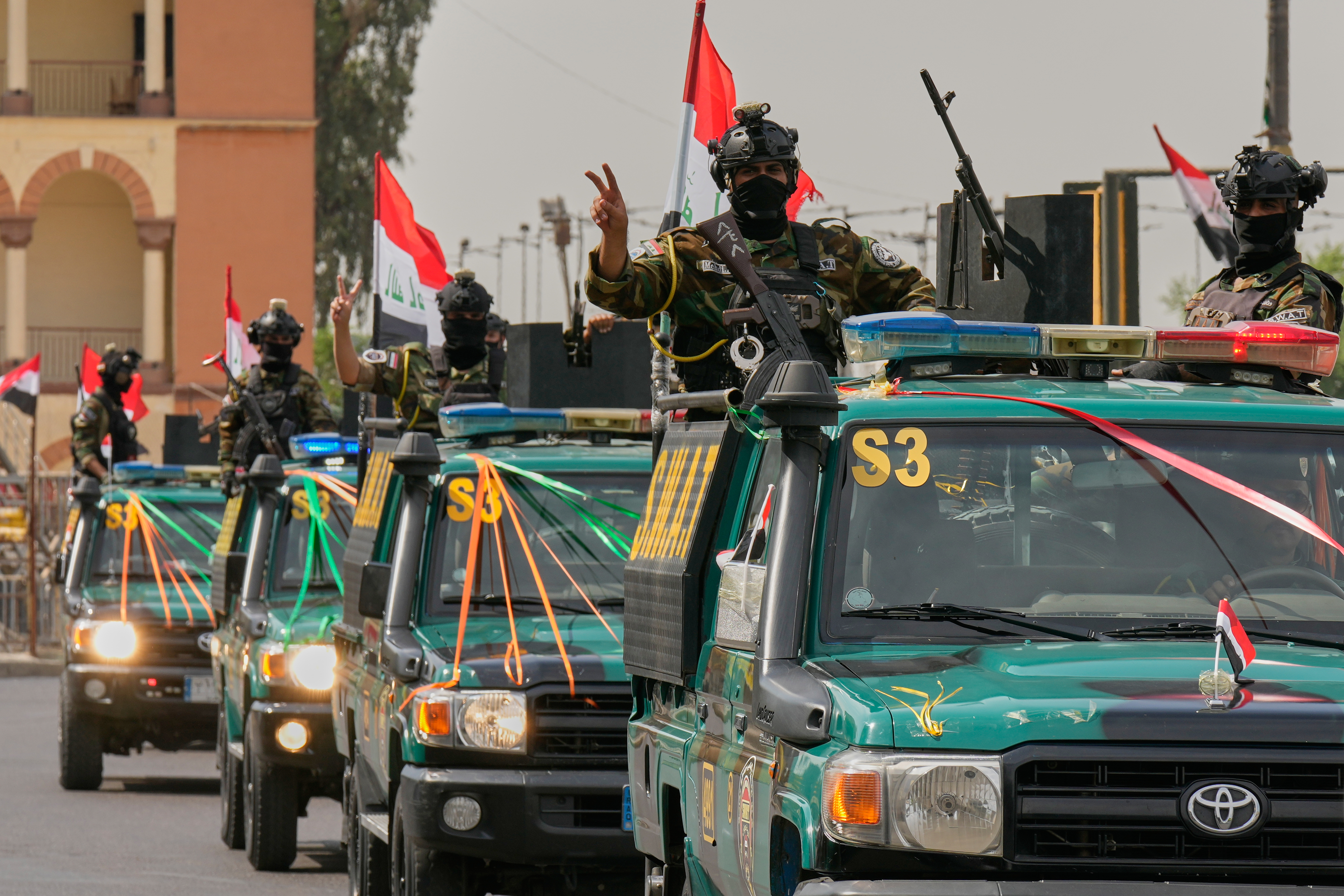
Baghdad touted the end of the U.S. mission as a sign of the country’s increasing strength and sovereignty.
The withdrawal was also celebrated by Iran-backed groups but raised concerns among some other Iraqis, particularly in the Kurdish region, where many fear a resurgence of IS as well as more attacks by Iran-linked groups, possibly emboldened by the departure of U.S. forces.
Meanwhile, questions loom around the future of the Iraqi militias, which the Baghdad government has sought to disarm, with little success so far.
A new phase in Iraq after decades of US involvement
Pentagon spokesperson Sean Parnell said in a statement that U.S. troops and equipment had completed an “orderly departure” from the air base in Irbil, in northern Iraq’s semi-autonomous Kurdish region.
“This milestone reflects the success of a 12-year campaign that defeated ISIS as an organized military threat in Iraq and across the region,” he said. “It also marks a transition from a wartime coalition mission to an Iraqi-led security effort supported by a more normal bilateral security relationship.”
He added that the U.S. military “will continue to provide targeted training and intelligence support to our Iraqi partners.”
Iraqi Prime Minister Ali al-Zaidi presided over the handover ceremony and described the U.S. withdrawal as the beginning of a “new phase, one defined by Iraq’s sovereignty, the strength of its institutions, the readiness of its forces, the unity of its decision-making, and balanced partnerships with its friends.”
He said Iraqi security forces will continue the fight against IS and the government will ensure that non-state groups no longer hold weapons.
U.S. troops invaded Iraq in 2003 to topple Saddam Hussein. They departed in 2011, but three years later, Iraqi authorities invited a smaller U.S.-led mission to fight the Islamic State group, which had rampaged across Iraq, seizing large swaths of territory.
With the extremist group reduced to scattered sleeper cells, Washington and Baghdad agreed in 2024 to wind the mission down.
U.S. troops pulled out of bases in most areas of Iraq last year but maintained a small presence of hundreds of troops in the semiautonomous northern Kurdish region. Bases there have regularly come under attack since the U.S. and Israel launched their war against Iran on Feb. 28. Iran-backed Iraqi militias also have coordinated with Yemen’s Houthi rebels to attack Saudi Arabia.
While a handful of less-influential militias have agreed to turn over their weapons, powerful groups close to Iran rejected the prospect or set conditions for disarming that the government would be unlikely to meet.
Al-Zaidi has since walked back the deadline. He told The New York Times earlier this month that the deadline for militia disarmament has been pushed to June 2027.
The effects of the U.S. withdrawal may not be immediately visible, particularly since the U.S. military presence had already been scaled down. But officials in Iraq’s Kurdish region have expressed anxiety about the departure and particularly about the removal of U.S. air defense systems.
The Kurdish regional government’s Peshmerga Ministry said the Kurdish region had faced more than 1,000 drone and ballistic-missile attacks during the recent U.S.-Iran conflict.
“The departure of the United States from the Kurdistan Region under these complex regional circumstances, without the provision of a defense system, is a matter of concern,” the statement said.
Iran-allied groups in Iraq, meanwhile, have celebrated the U.S. withdrawal.
“The expulsion of the occupation forces, defeated, from the land of Iraq is the beginning of full sovereignty,” Abu Mujahid al-Assaf, a security official with the powerful Kataib Hezbollah militia, said in a statement.
He added a warning to al-Zaidi and his government not to carry out American plans, threatening that “any government that does not work for the benefit of the people will be overthrown by all means.”
He was right Tuesday to use Jhoan Duran in the seventh inning to protect a one-run lead against the top of Atlanta’s lineup in their 5-3 loss in Game 1 of their wild-card playoff series. The Phillies couldn’t get to the ninth inning unless they got through the seventh, and Duran needed just 12 pitches. That inning against Drake Baldwin and Ronald Acuna Jr. was the highest-leverage situation of the game. Duran was the right pitcher for that spot.
Mattingly’s decision to send Duran back for the eighth is fair to criticize until you think about the manager’s other options.
The Phillies ignored their bullpen all season, giving Mattingly one option Tuesday: be desperate. A properly constructed roster doesn’t force the manager to use the closer in the seventh inning and consider using that pitcher for nine outs. Other playoff teams have more than one trusted high-leverage arm. That’s the hand Mattingly was dealt. Somehow it almost worked.
Duran recorded the first two outs of the eighth on three pitches and then almost finished the inning on an 85.5 mph grounder. If Trea Turner makes that play, no one is questioning Duran in the eighth. Then the collapse happened. But who should Mattingly have used in the eighth?
Jonathan Bowlan hasn’t pitched in two weeks and had allowed runs in five of six appearances before going to the injured list. Andrew Painter’s only two relief appearances were as a bulk reliever following an opener. It would’ve been foolish to tap Painter there after Duran sped through the seventh. José Alvarado? We’ve seen that before. It wasn’t conventional but asking Duran to pitch a second inning was the right choice, especially in the postseason.
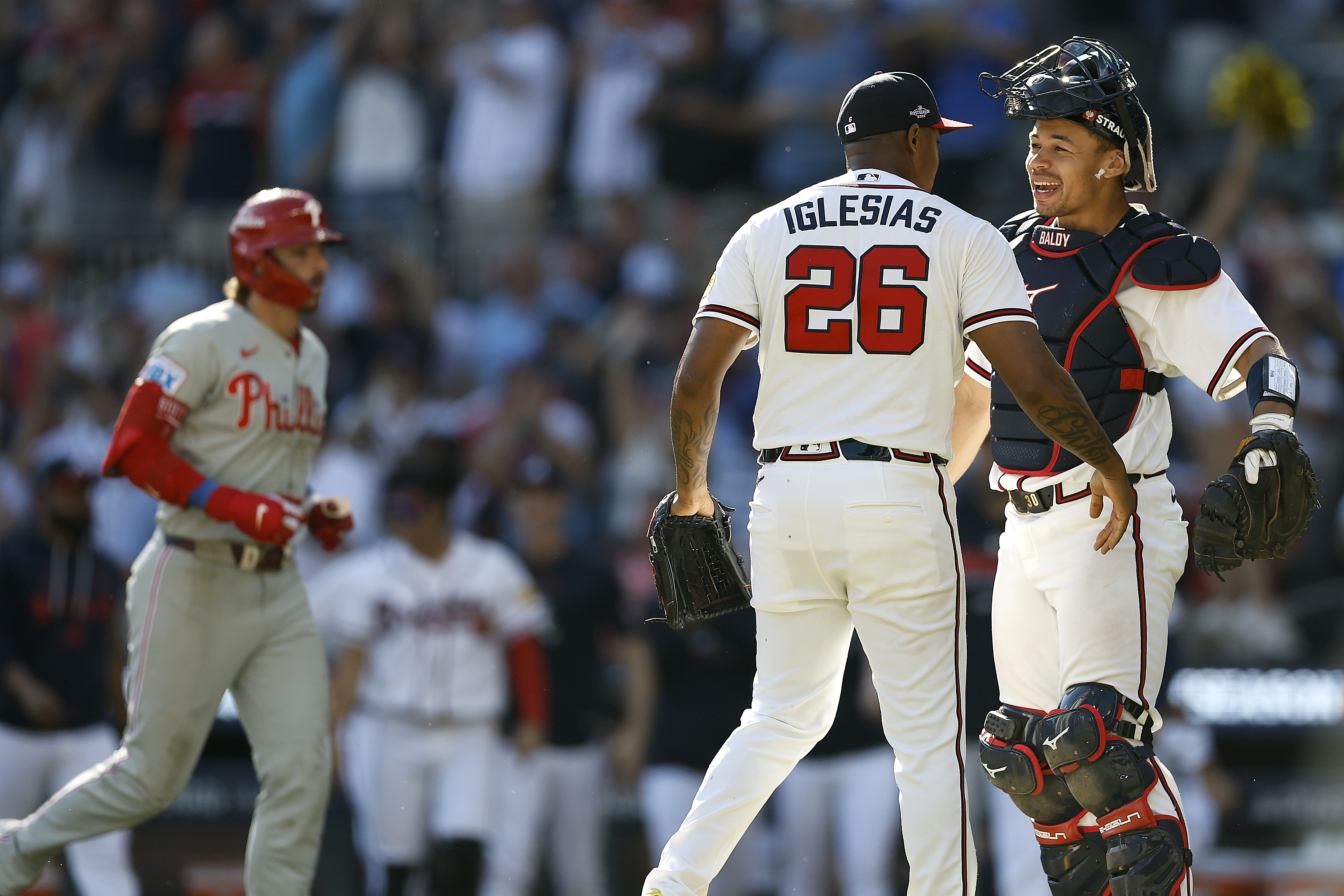
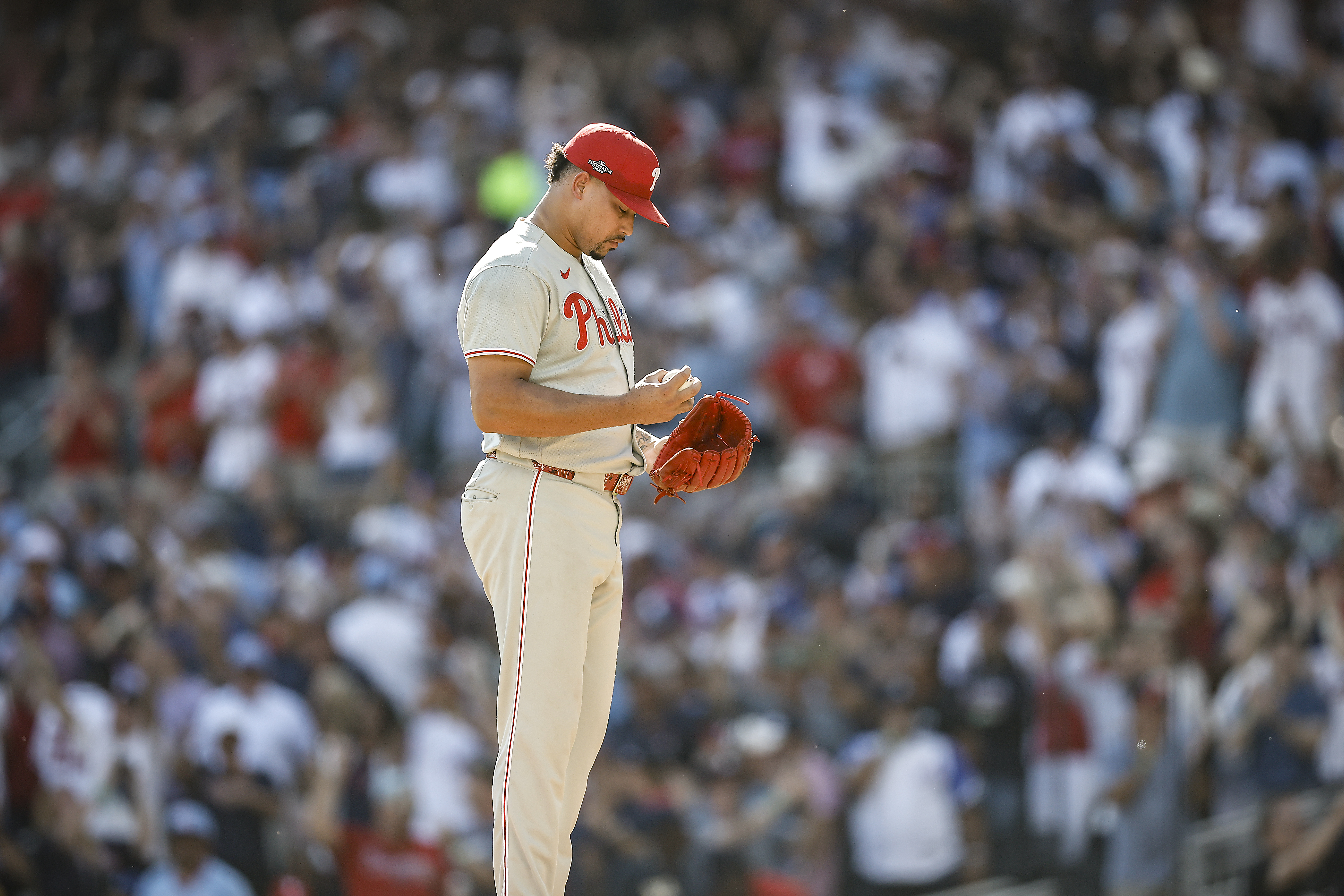
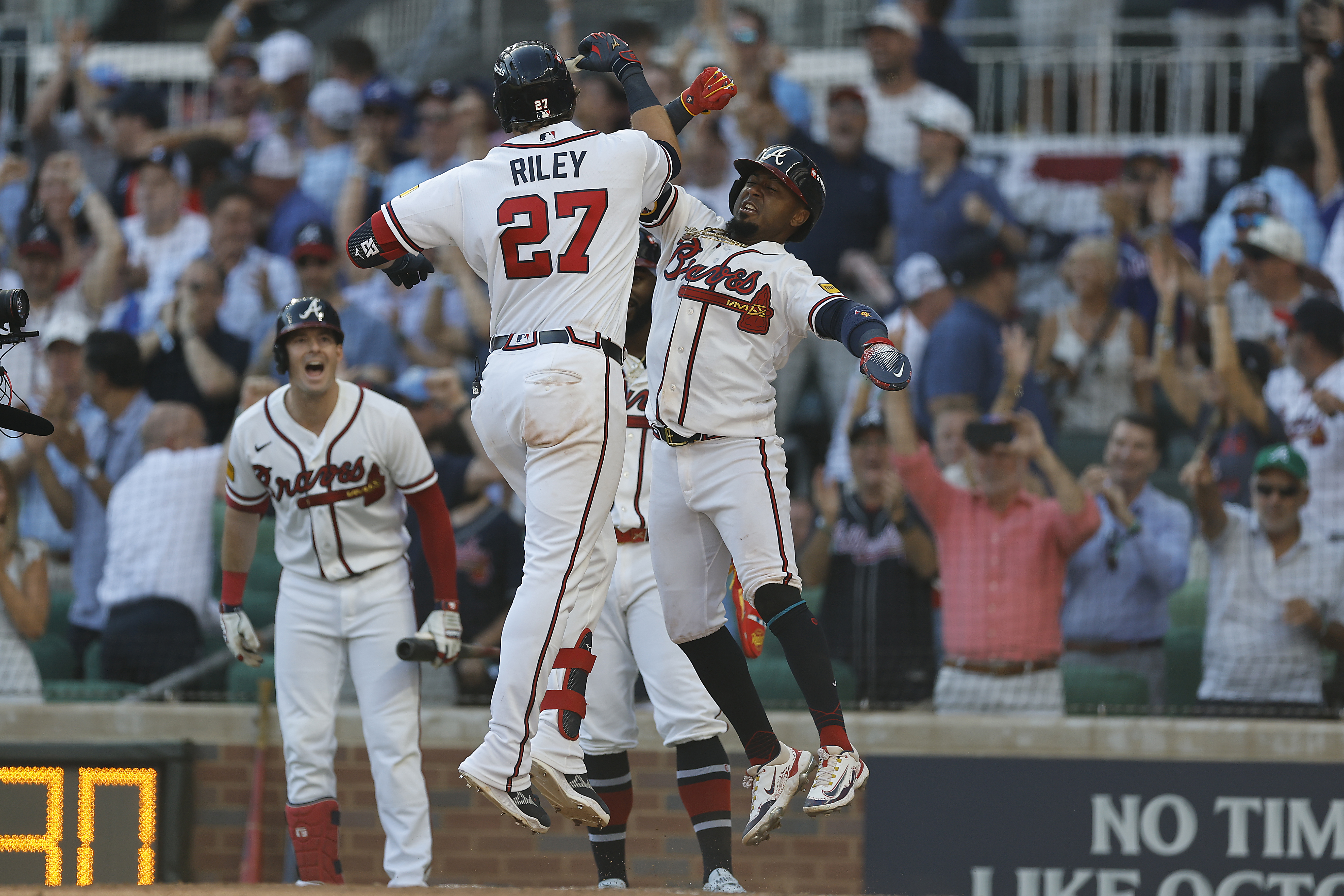
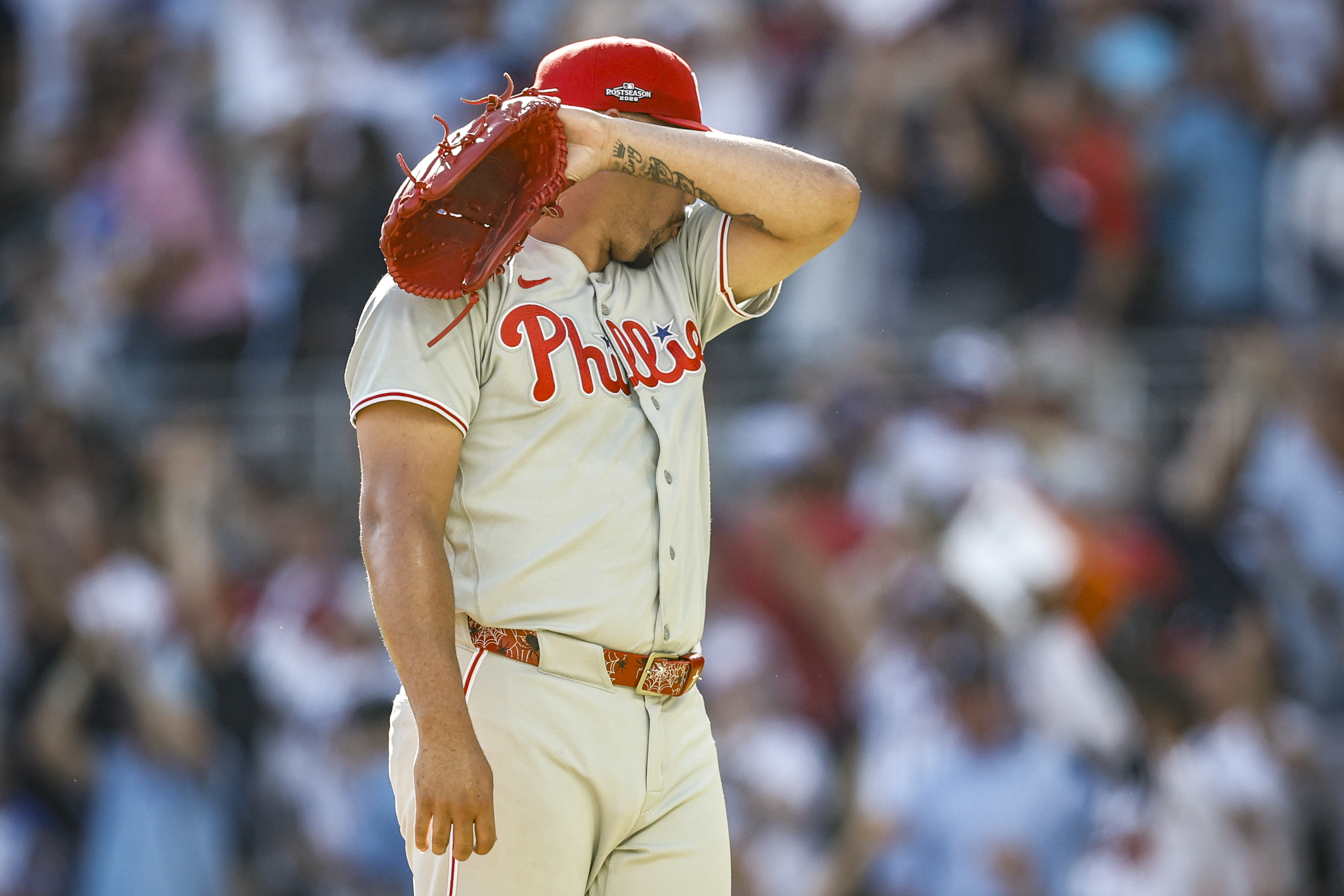
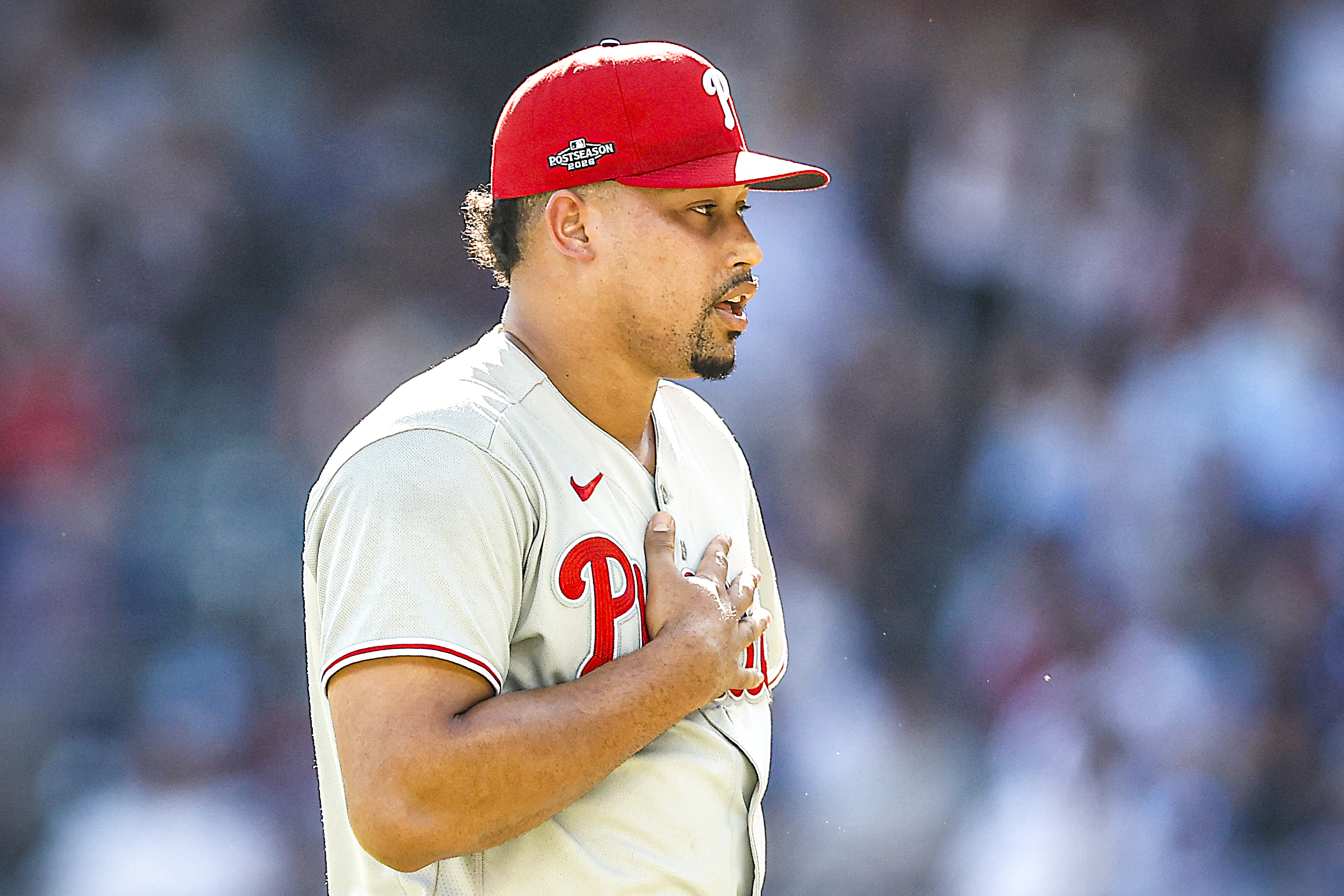
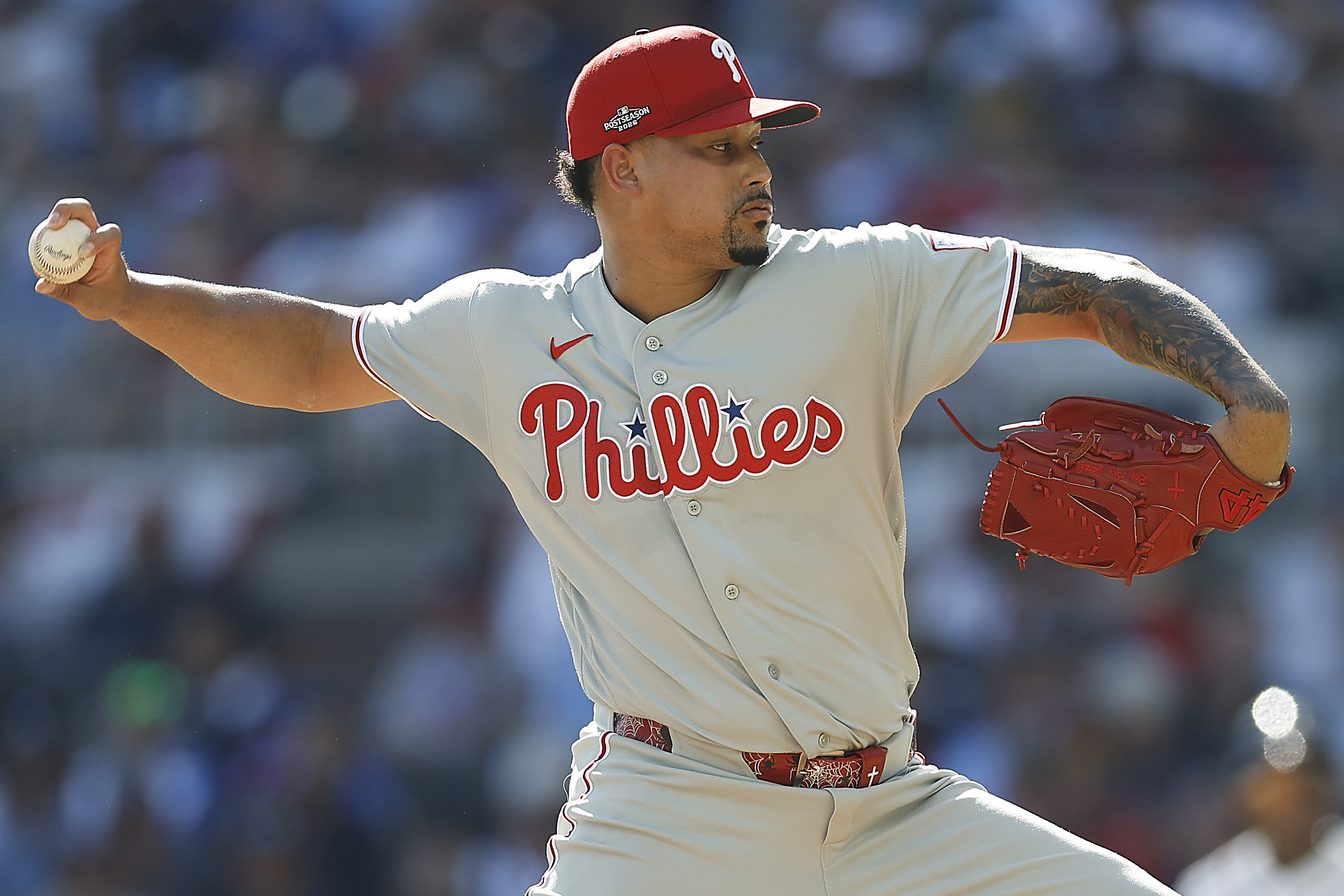
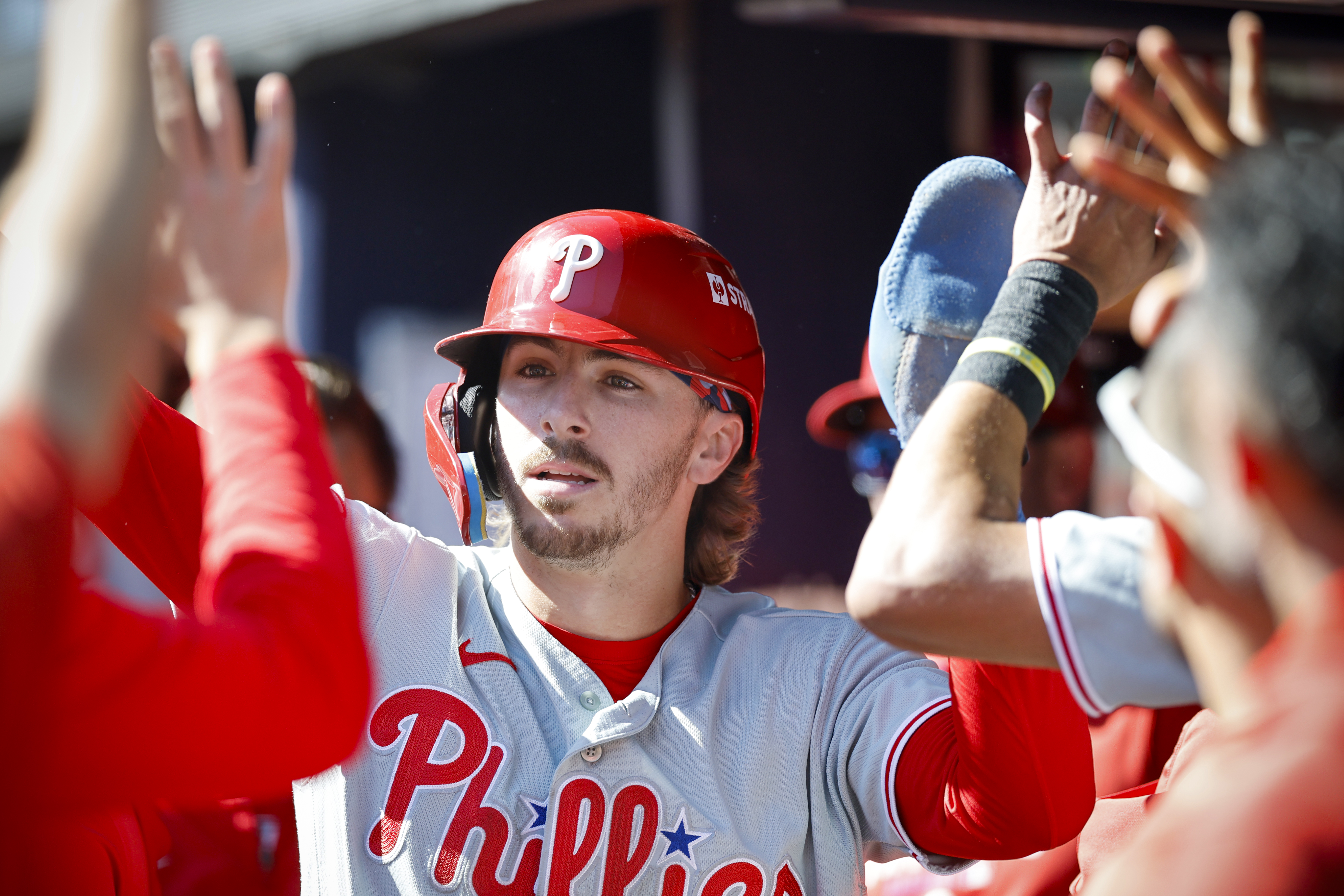
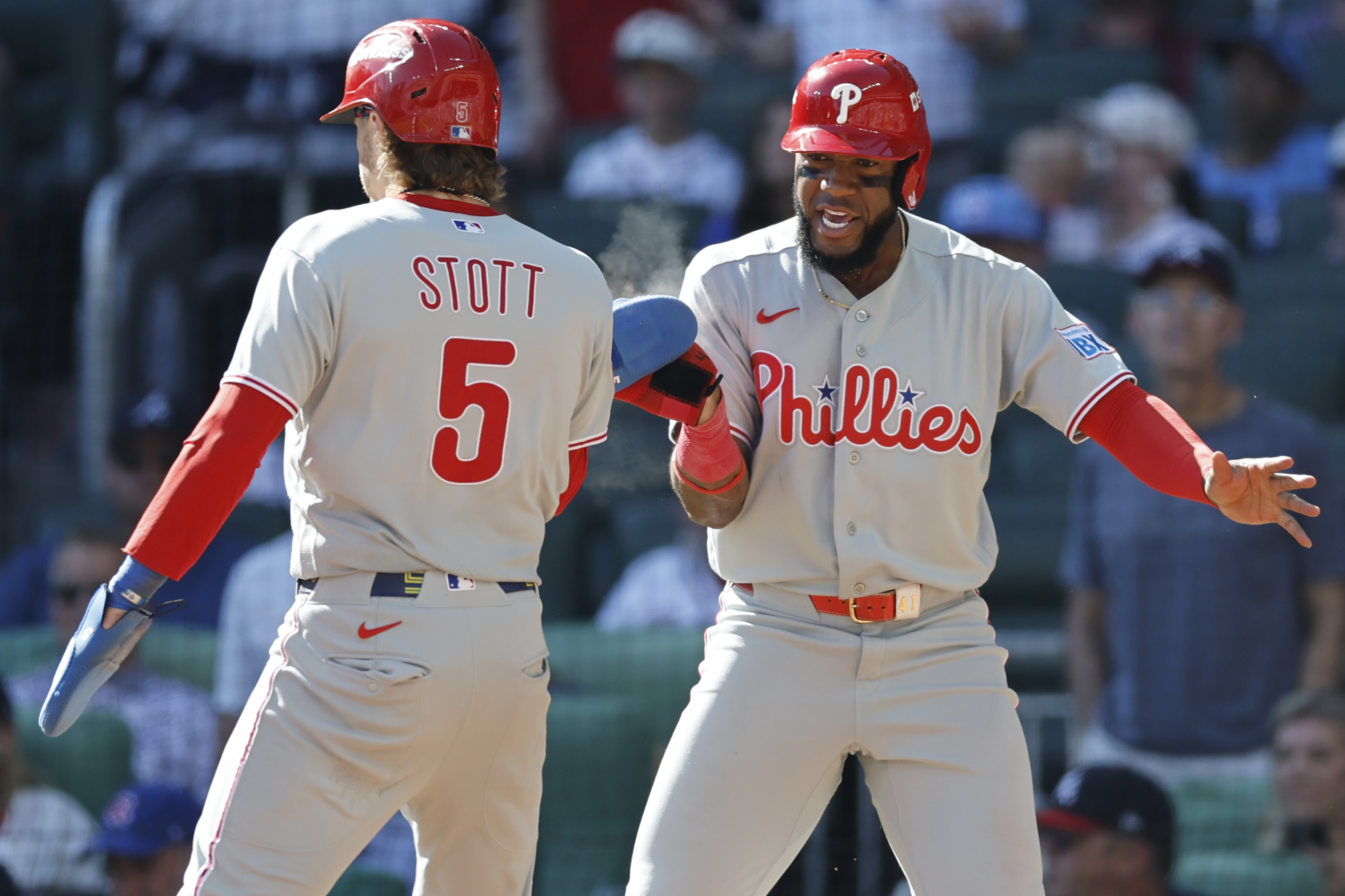
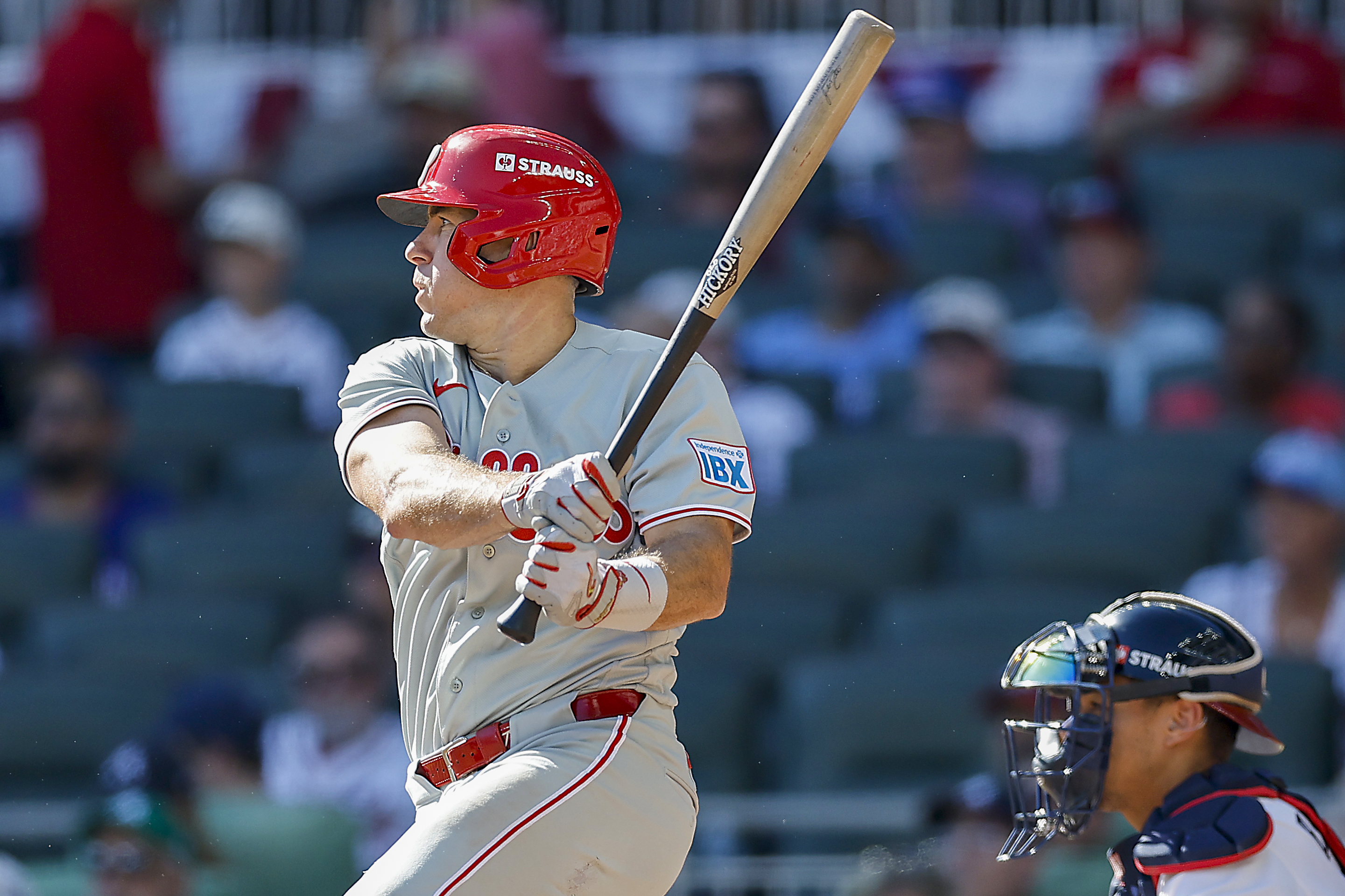
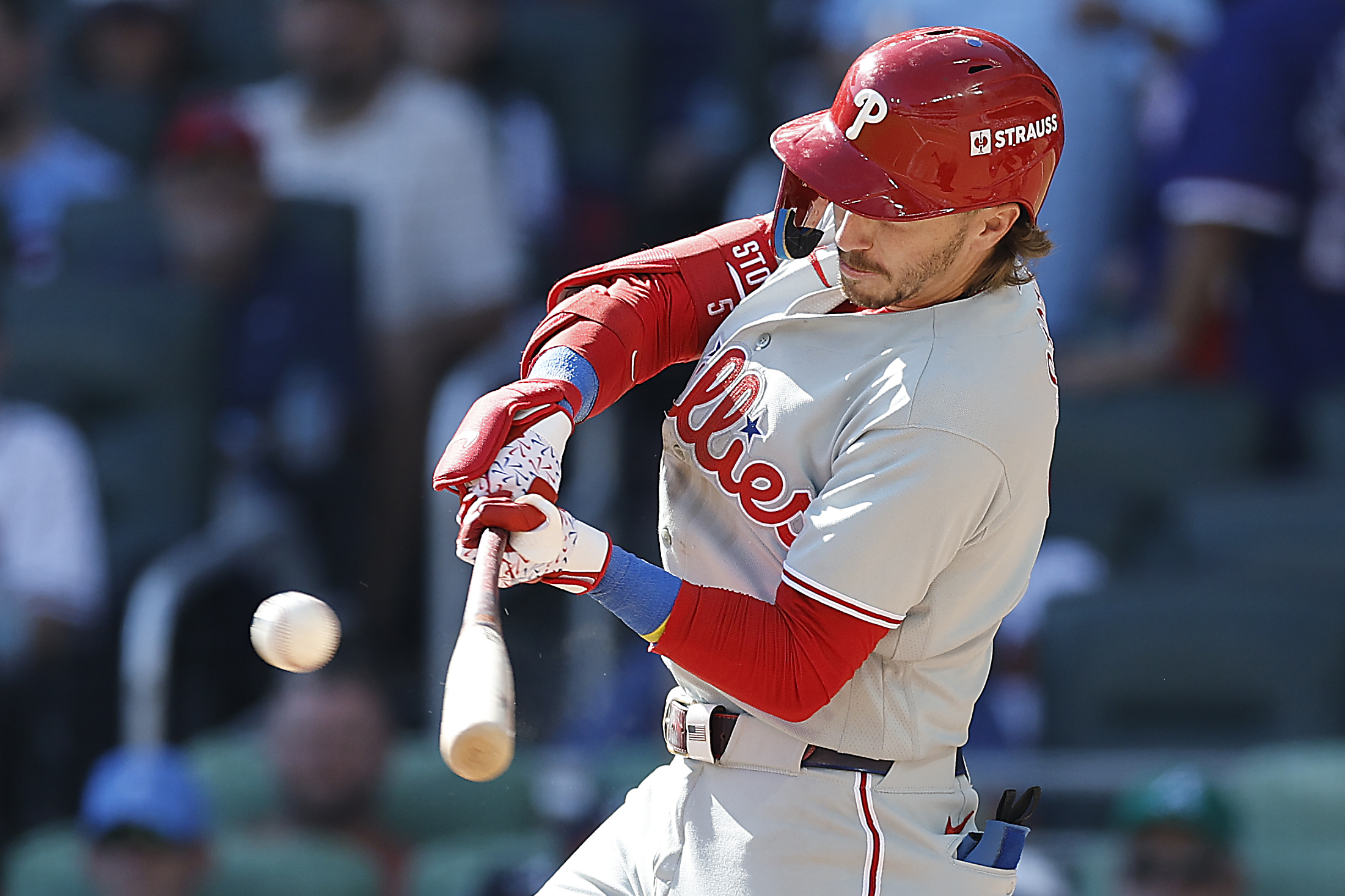
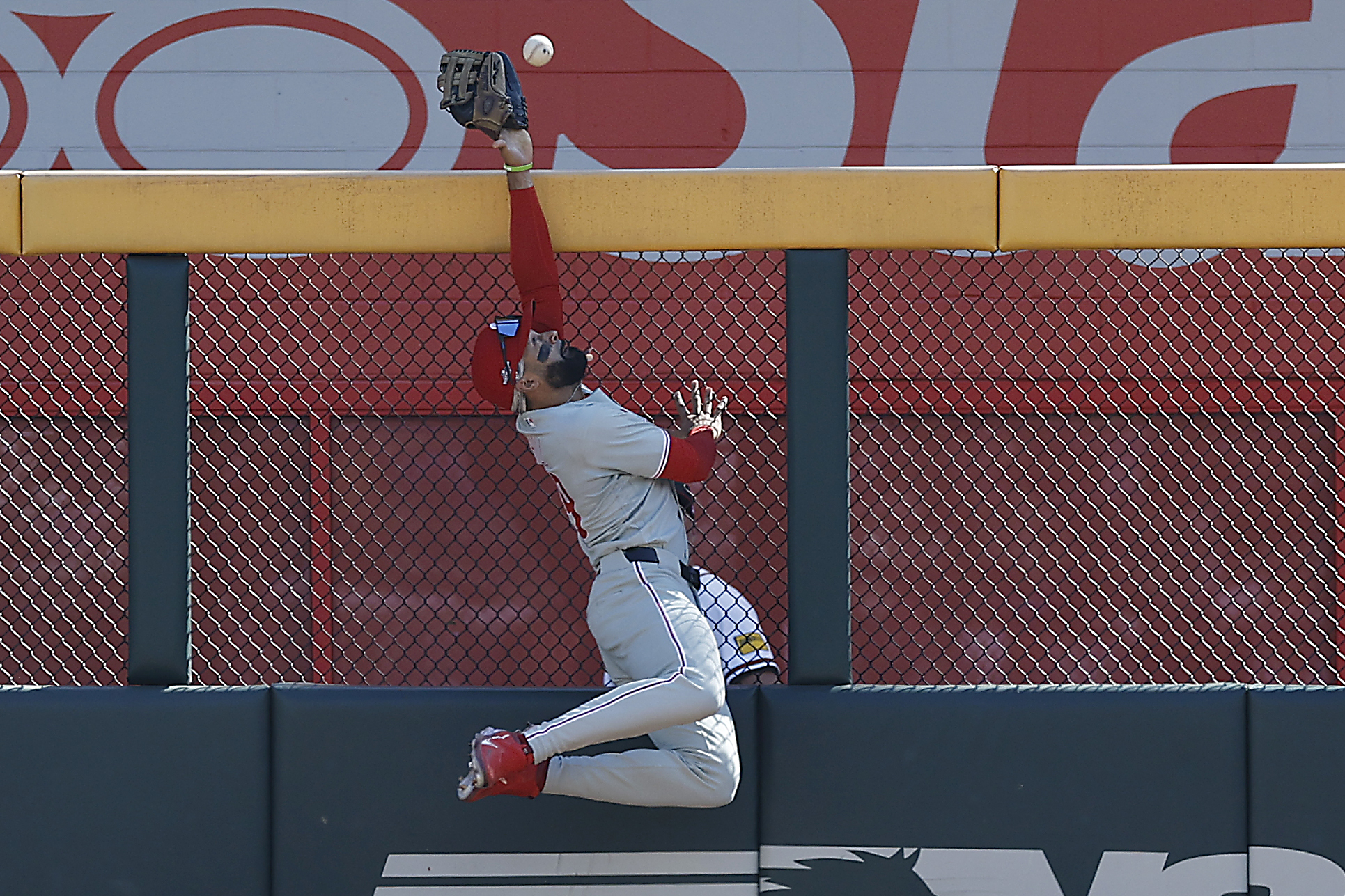
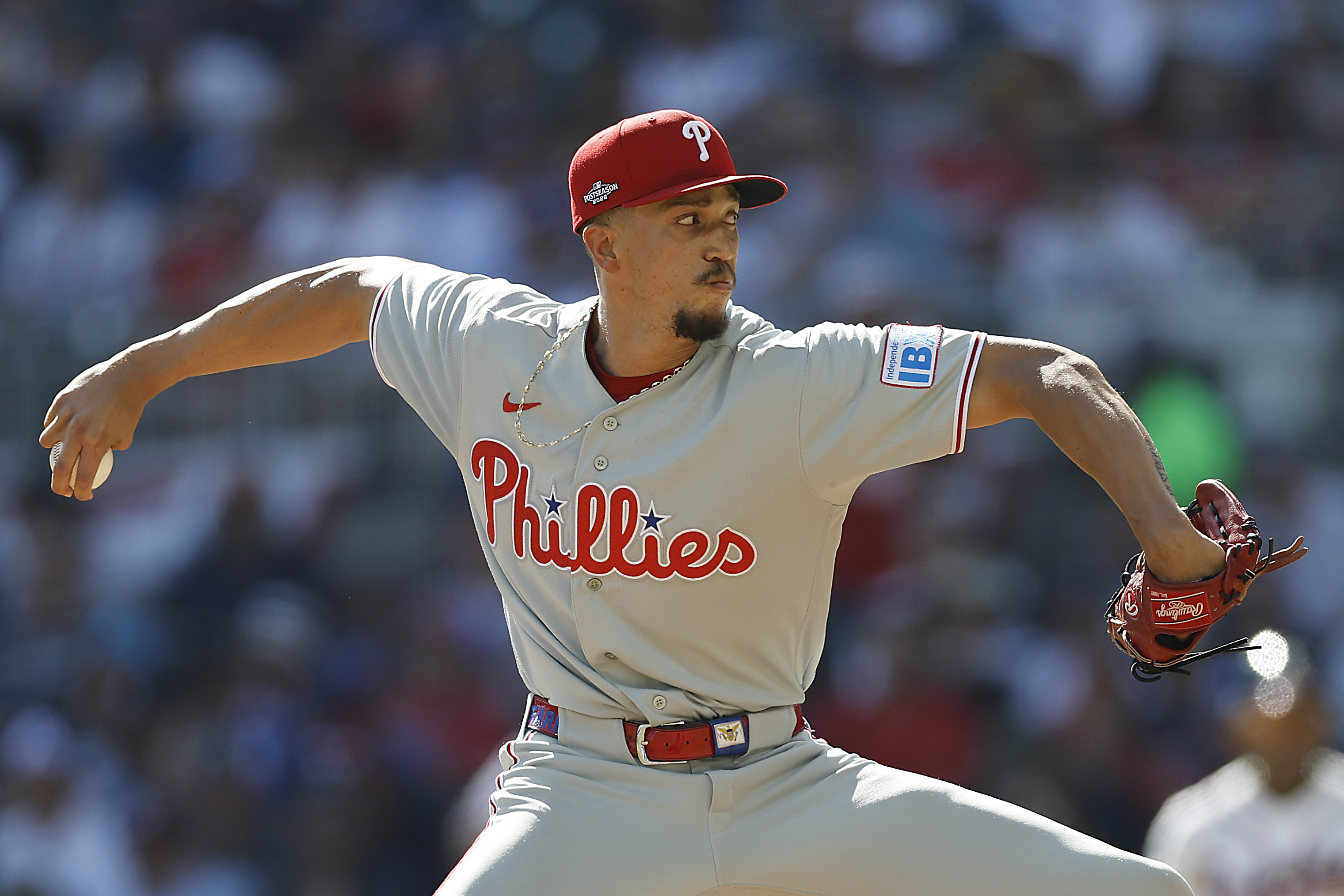
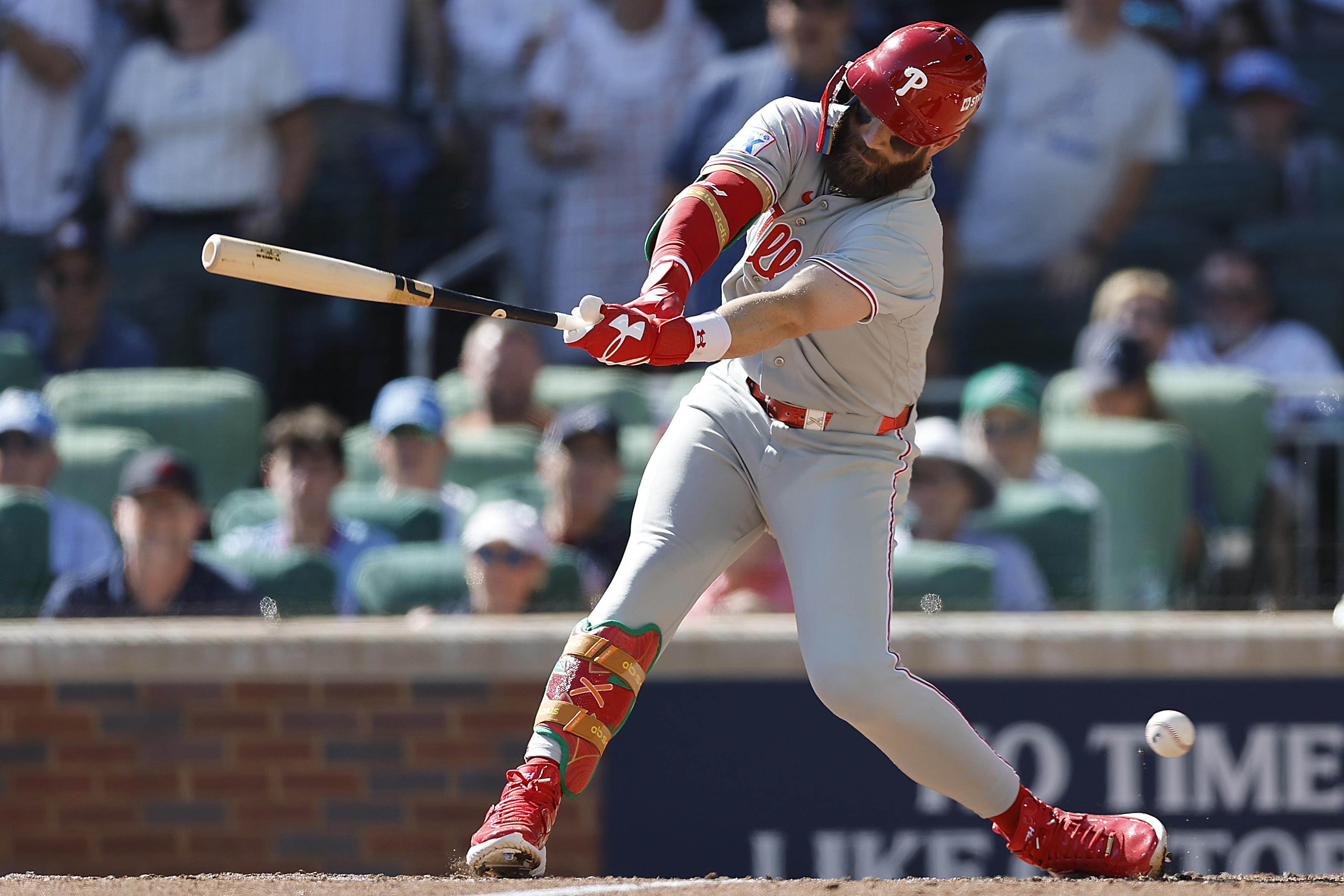
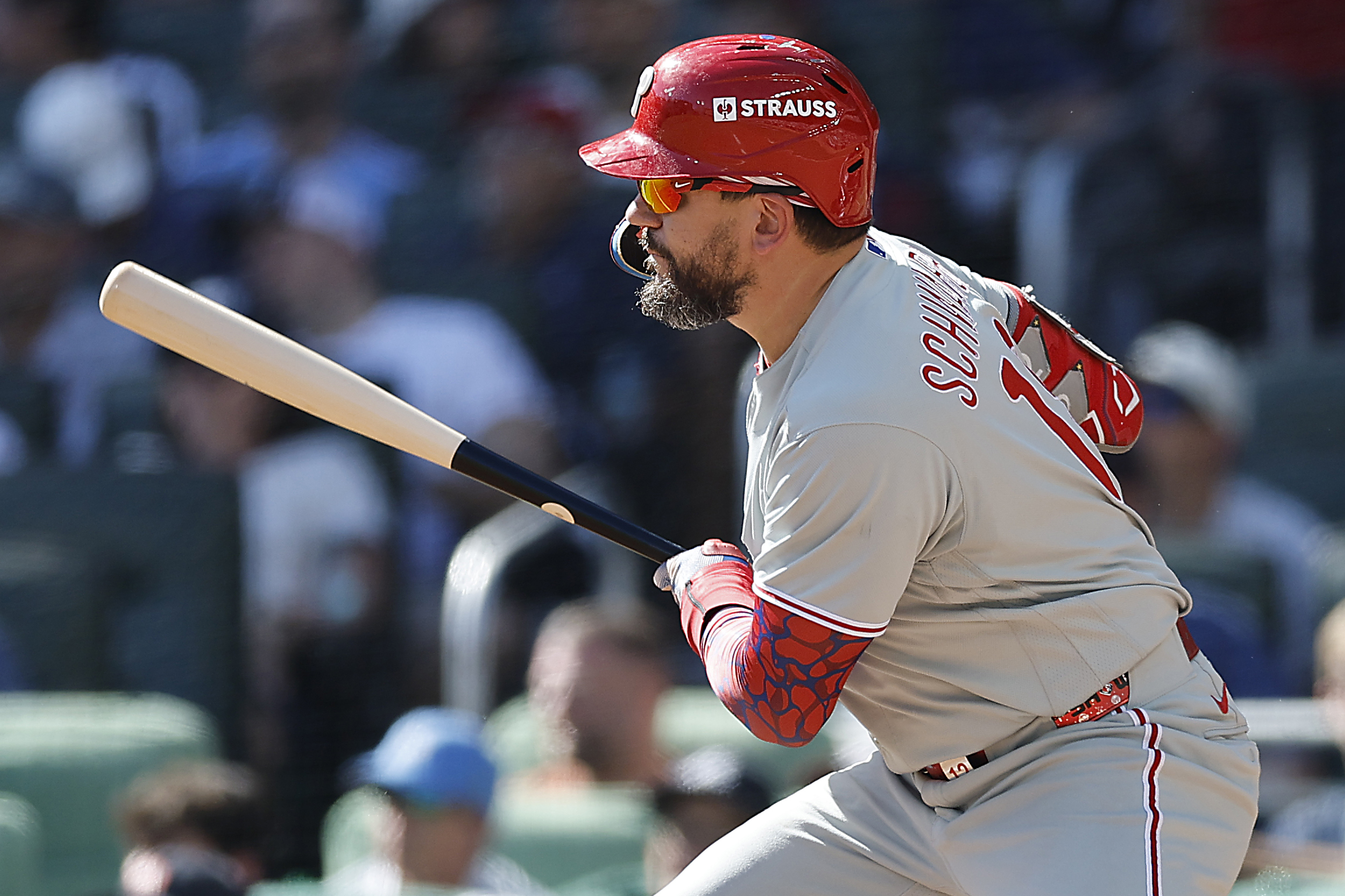
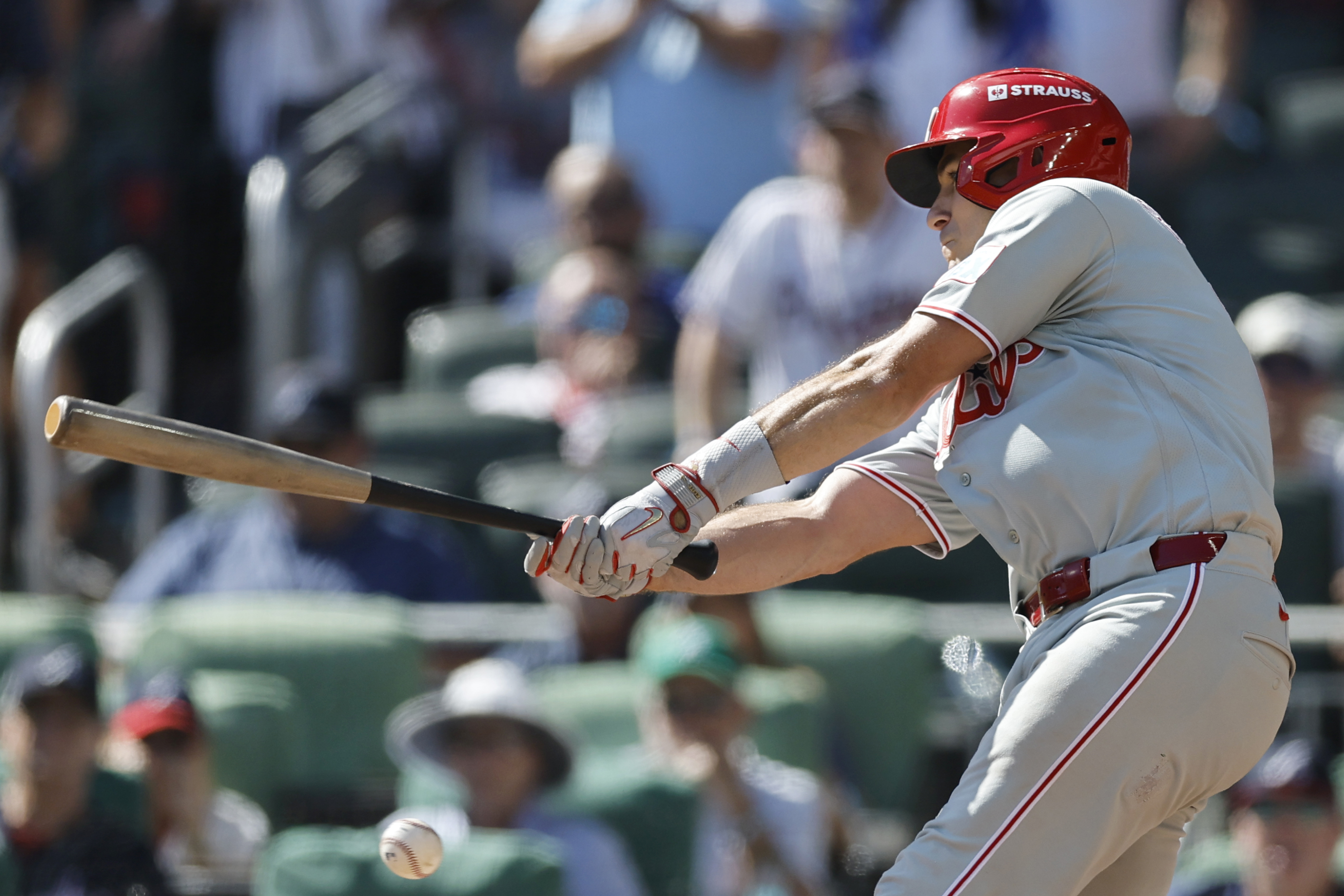
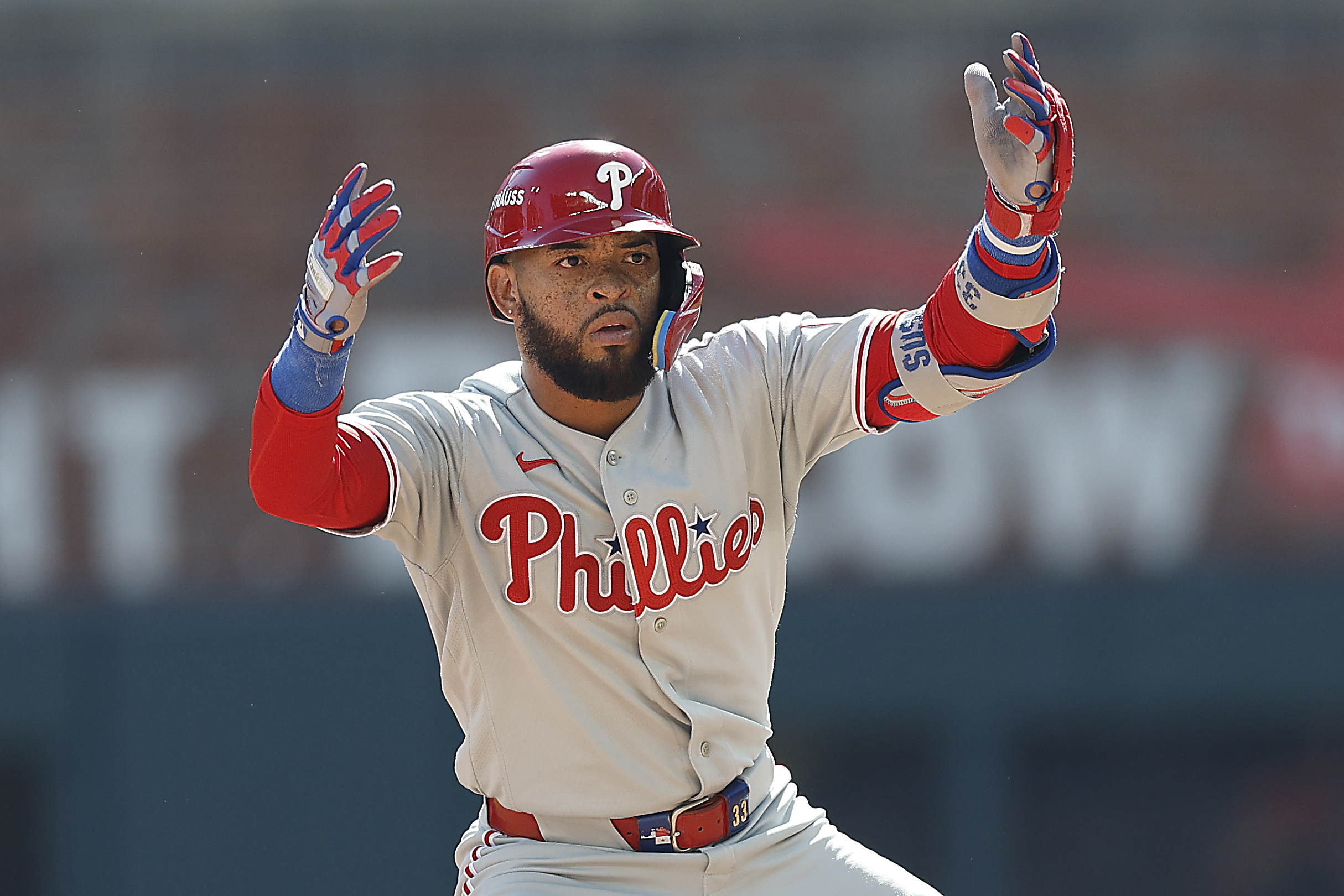
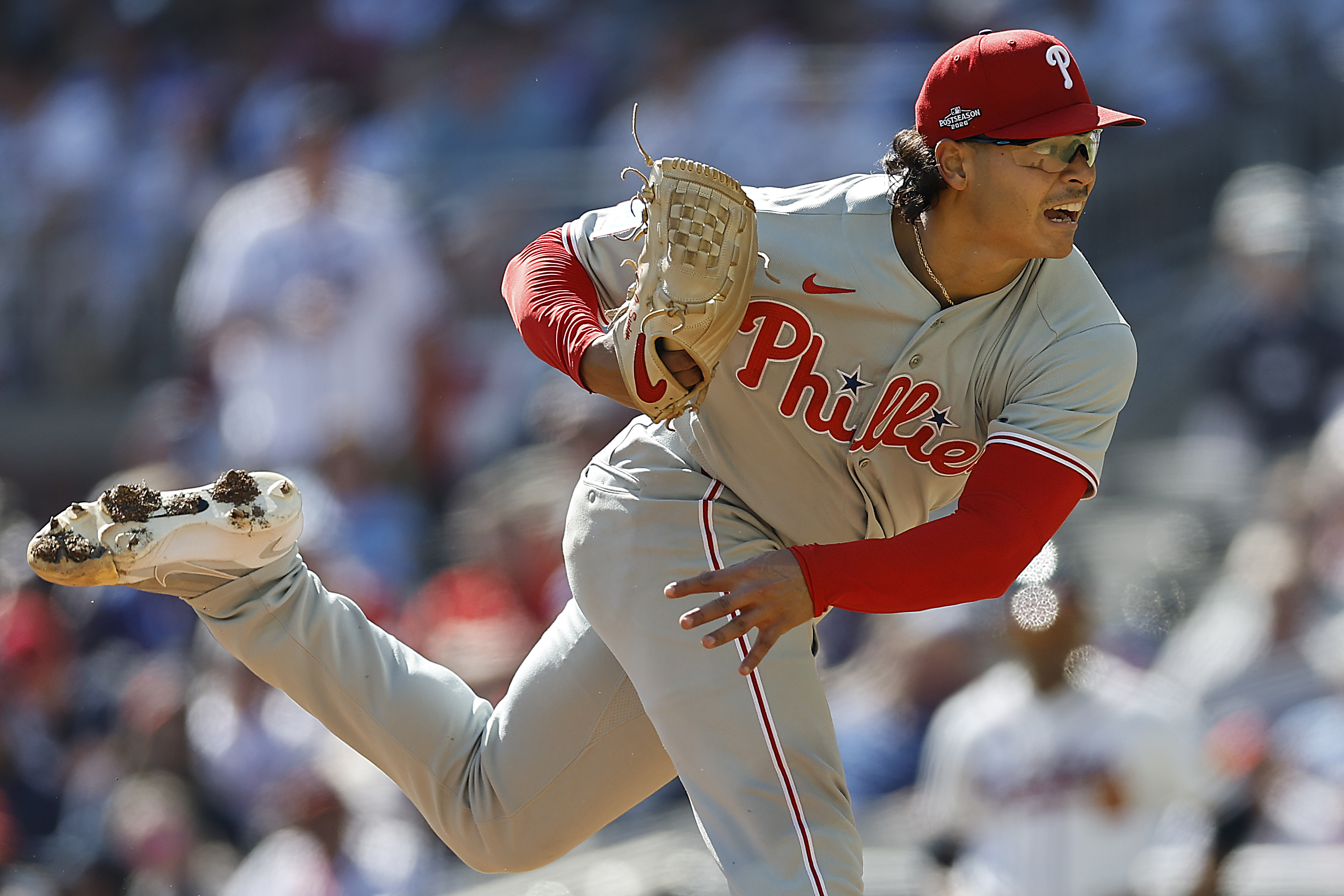
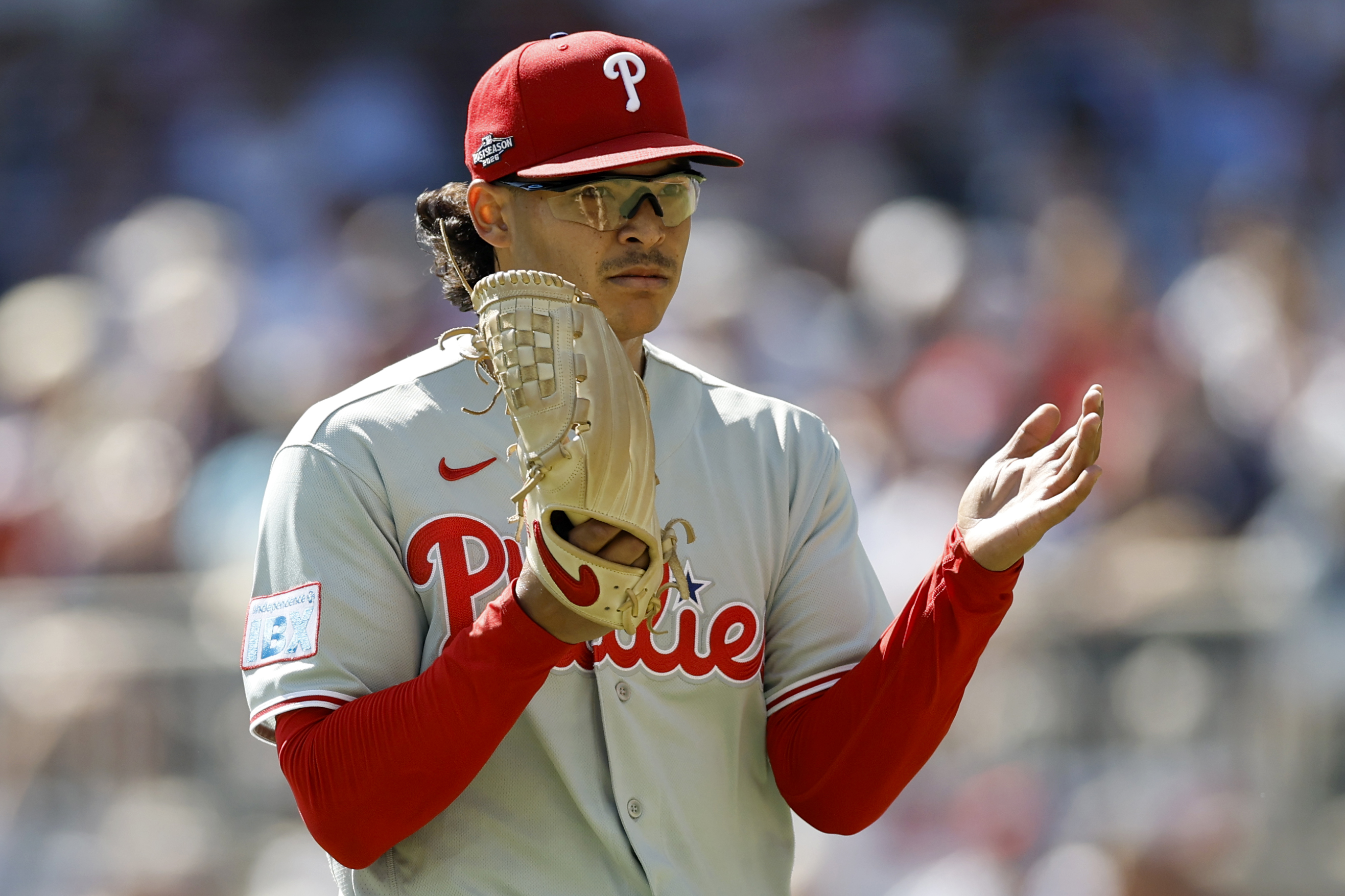
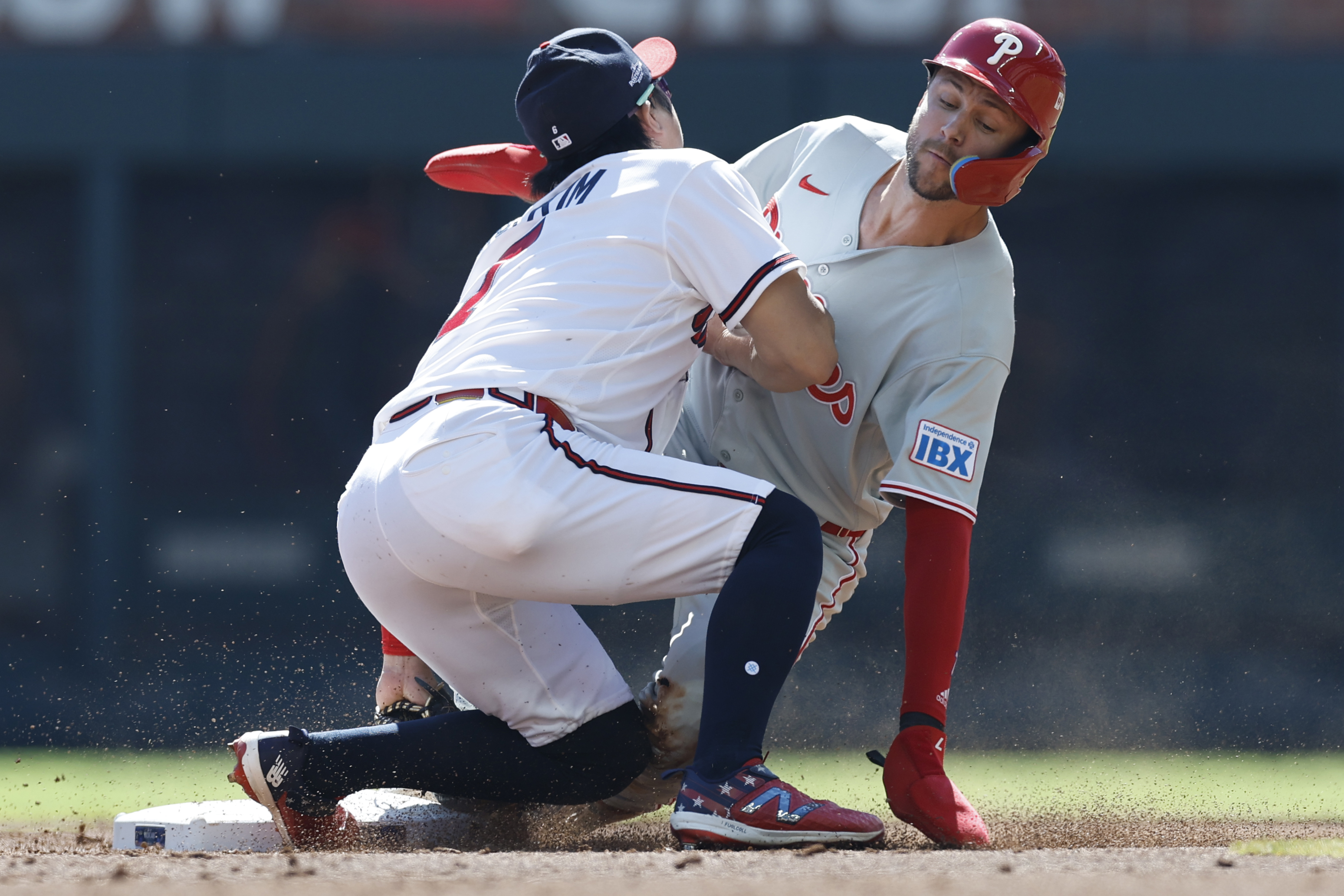
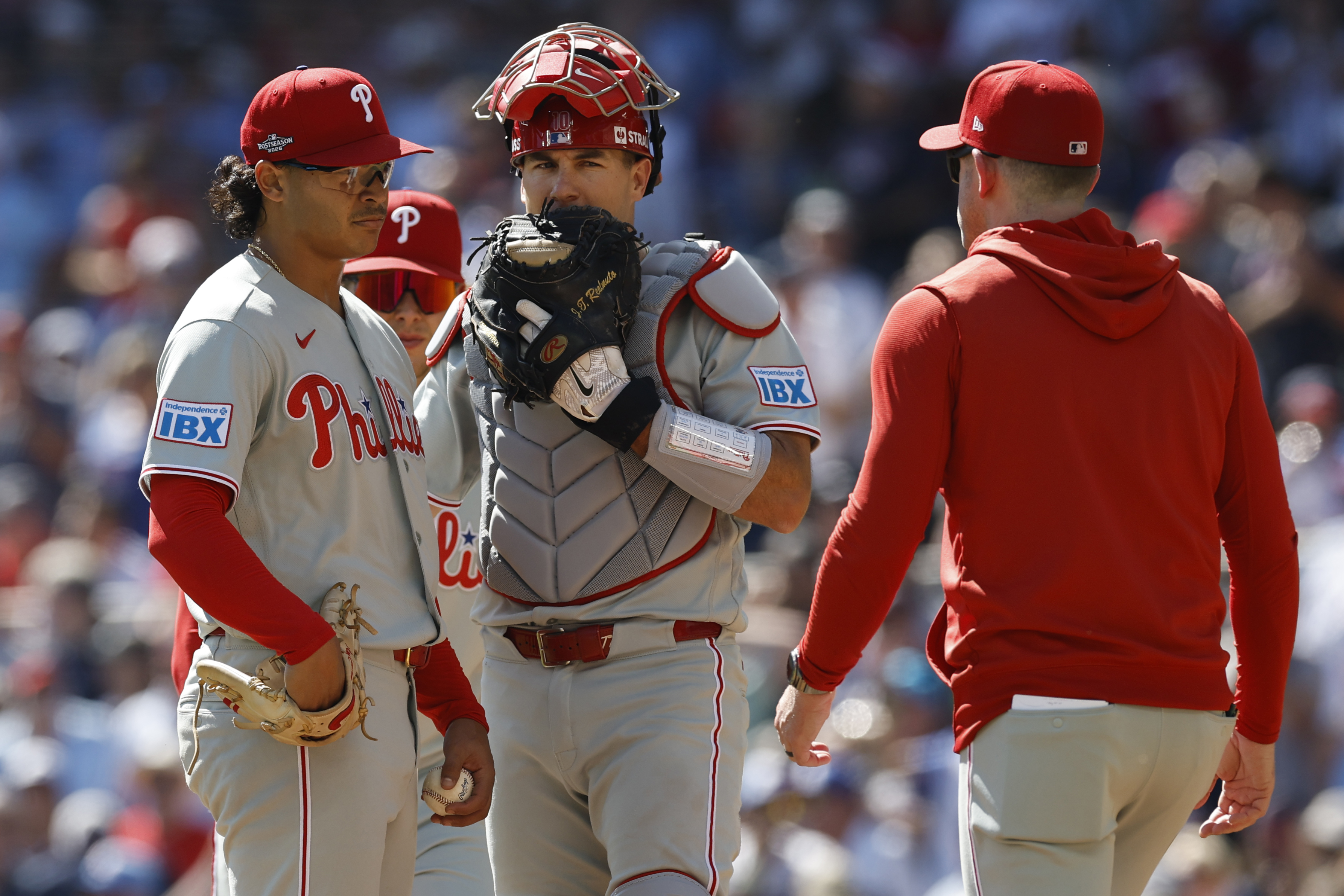
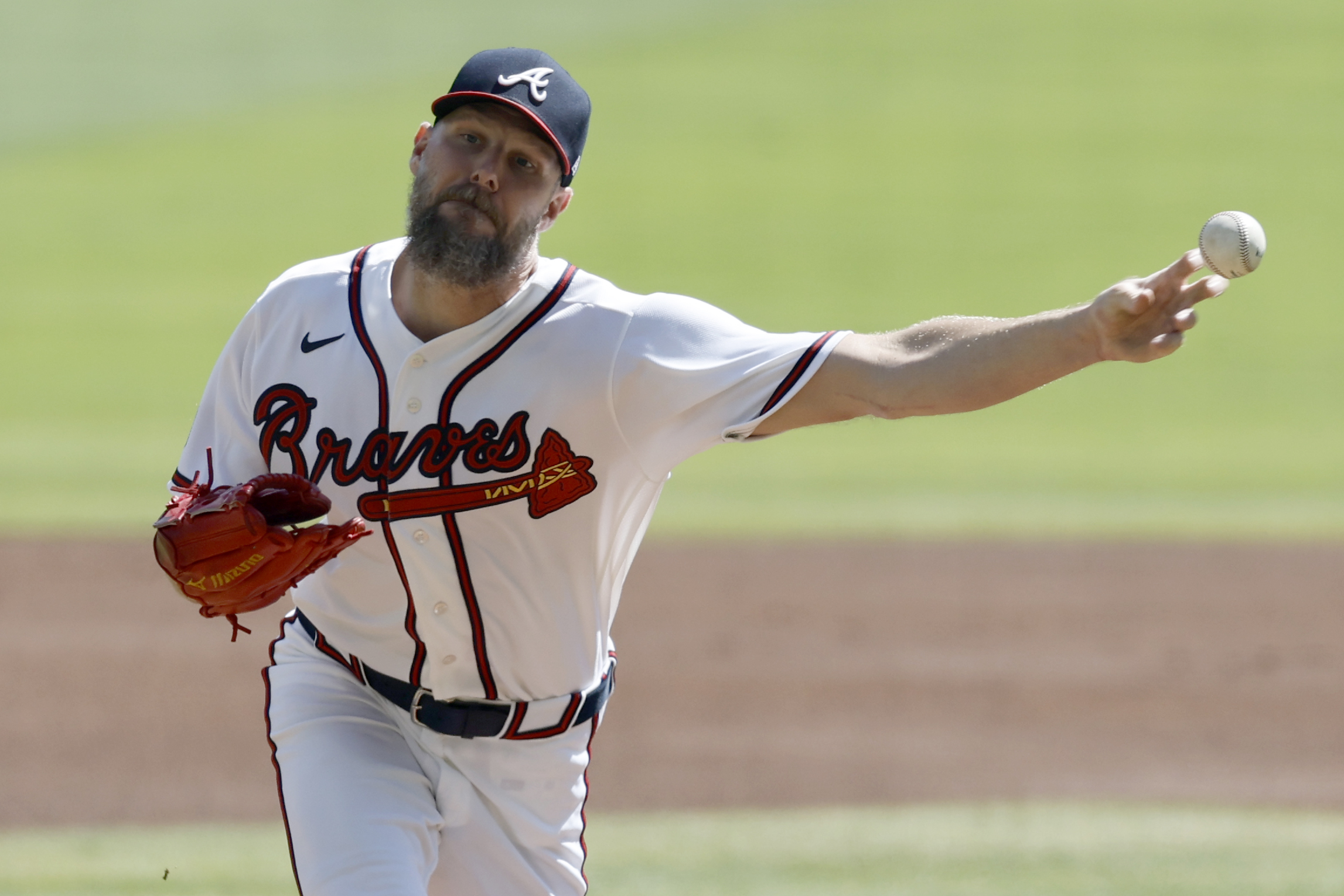
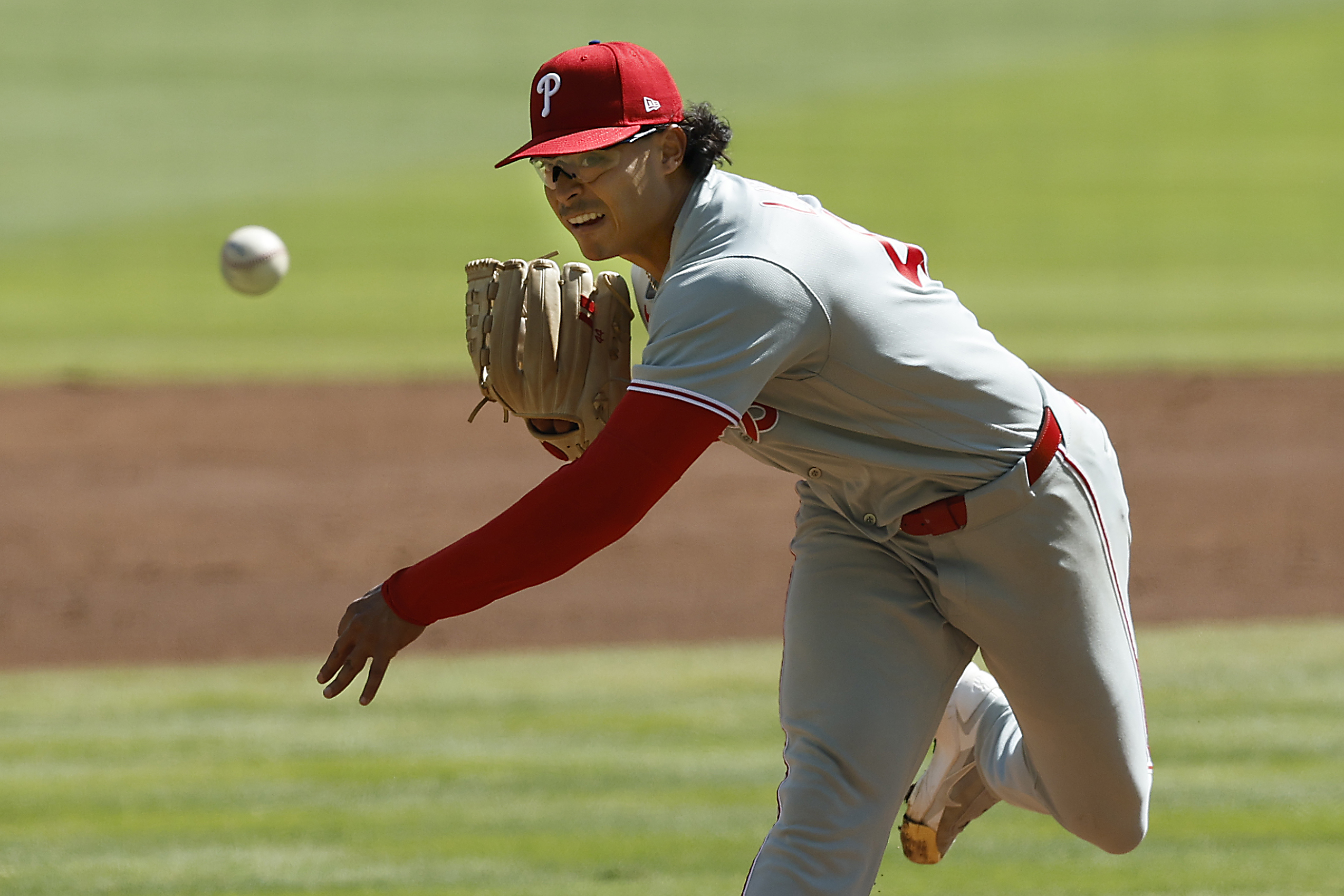
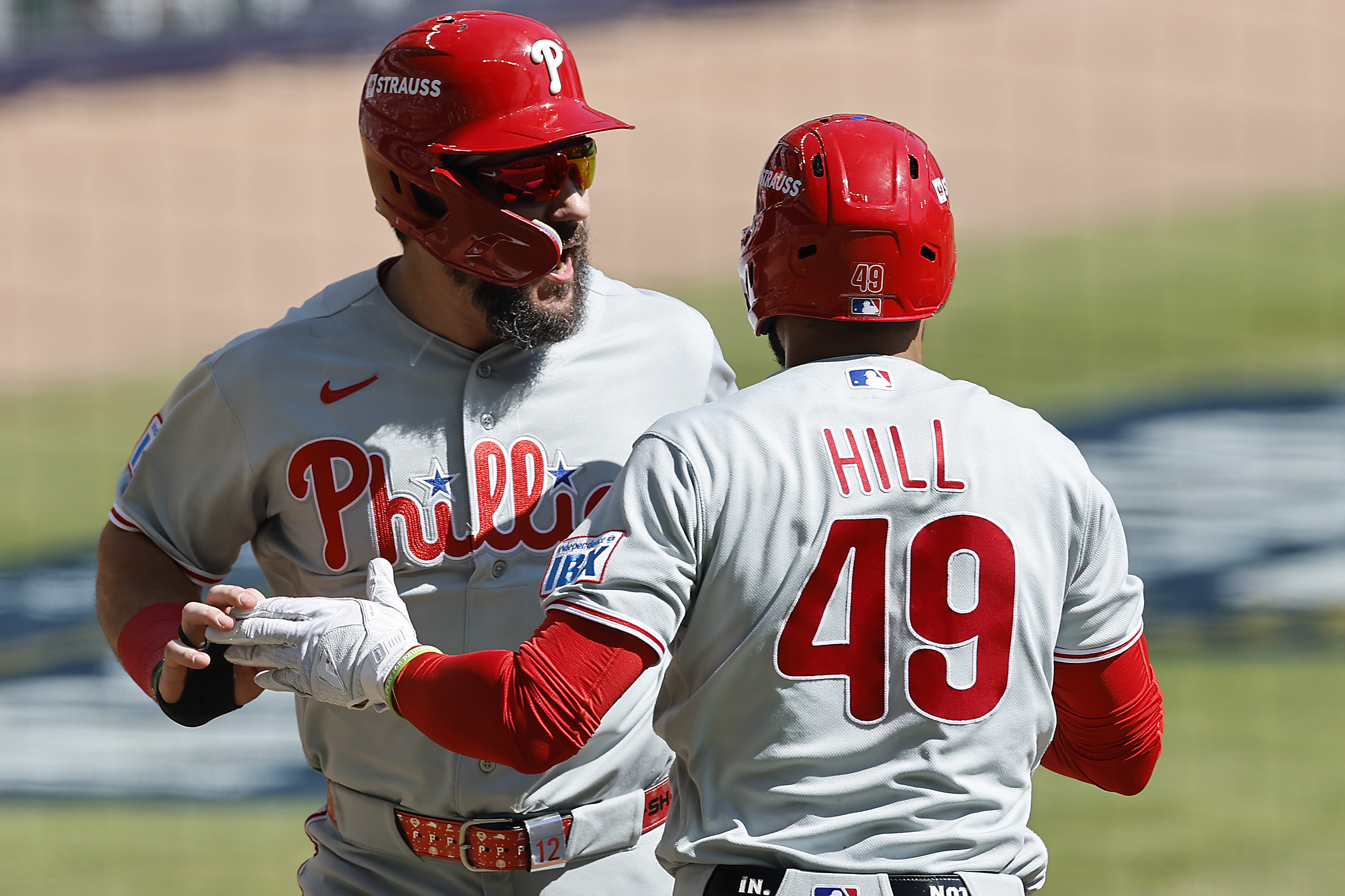
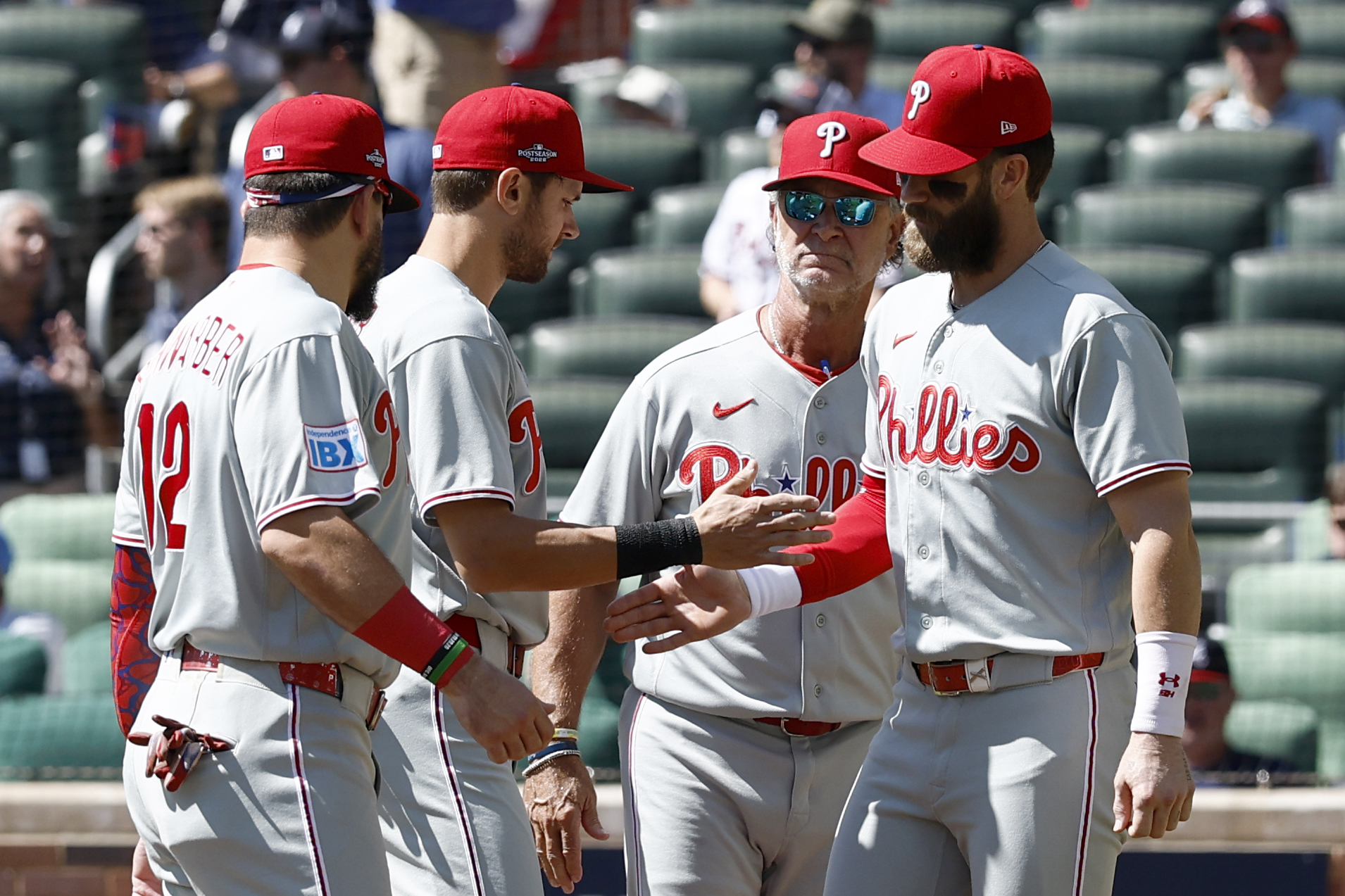
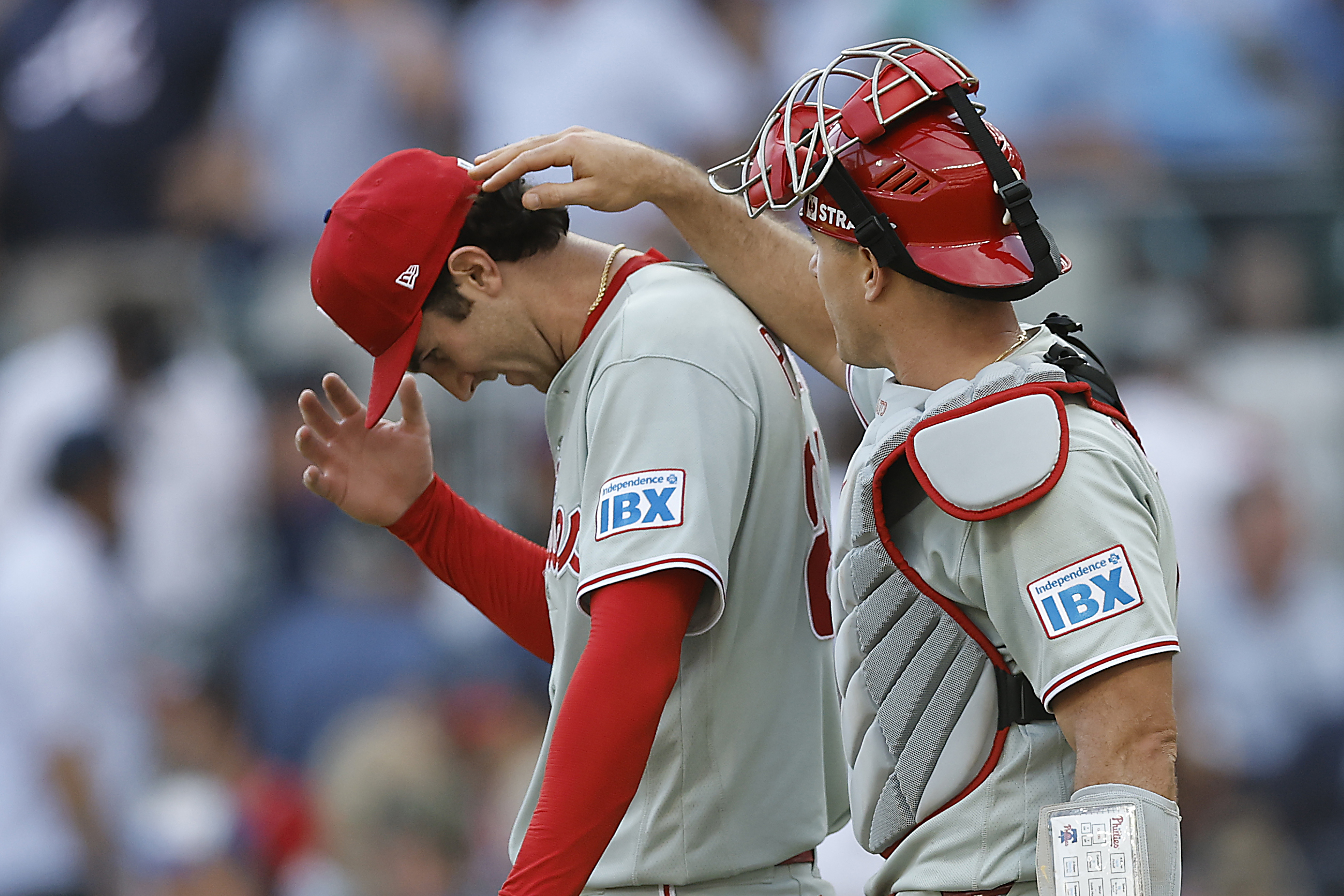
Philadelphia Phillies second baseman Bryson Stott (left) jogs off the field after the final out as the Atlanta Braves relief pitcher Raisel Iglesias (center) celebrates their win with Atlanta Braves catcher Drake Baldwin (right).Yong Kim / Staff PhotographerPhiladelphia Phillies relief pitcher Jhoan Duran reacts after giving up a three-run homer to the Atlanta Braves Austin Riley in the eighth inning.Yong Kim / Staff PhotographerAtlanta Braves Austin Riley celebrates his three-run homer in the eighth inning.Yong Kim / Staff PhotographerPhiladelphia Phillies relief pitcher Jhoan Duran reacts after giving up a three-run homer to the Atlanta Braves Austin Riley in the eighth inning.Yong Kim / Staff PhotographerPhiladelphia Phillies relief pitcher Jhoan Duran reacts after catching a line drive off the bat of Atlanta Braves Matt Olson in the eighth inning.Yong Kim / Staff PhotographerPhiladelphia Phillies relief pitcher Jhoan Duran pitches against the Atlanta Braves in the seventh inning.Yong Kim / Staff PhotographerPhiladelphia Phillies Bryson Stott celebrates after he scores in the seventh inning.Yong Kim / Staff PhotographerPhiladelphia Phillies Bryan De La Cruz (right) celebrates with Bryson Stott after they both scored on J.T. Realmuto hit in the seventh inning.Yong Kim / Staff PhotographerPhiladelphia Phillies catcher J.T. Realmuto knocks in two runs in the seventh inning.Yong Kim / Staff PhotographerPhiladelphia Phillies Bryson Stott singles in the seventh inning.Yong Kim / Staff PhotographerPhiladelphia Phillies Derek Hill reaches for a ball of the bat of Atlanta Braves second baseman Ozzie Albies in the sixth inning.Yong Kim / Staff PhotographerPhiladelphia Phillies Alex McFarlane pitches against the Atlanta Braves in the sixth inning.Yong Kim / Staff PhotographerPhiladelphia Phillies Bryce Harper strikes out in the sixth inning.Yong Kim / Staff PhotographerPhiladelphia Phillies Kyle Schwarber singles in the sixth inning.Yong Kim / Staff PhotographerPhiladelphia Phillies catcher J.T. Realmuto strikes out to end the fifth inning.Yong Kim / Staff PhotographerPhiladelphia Phillies second baseman Edmundo Sosa celebrates his fifth inning double.Yong Kim / Staff PhotographerPhiladelphia Phillies starting pitcher Jesus Luzardo delivers a pitch against the Atlanta Braves in the fourth inning.Yong Kim / Staff PhotographerPhiladelphia Phillies starting pitcher Jesus Luzardo reacts to the third out in the third inning.Yong Kim / Staff PhotographerAtlanta Braves Ha-Seong Kim tags Philadelphia Phillies shortstop Trea Turner as he tries to steal second base in the third inning.Yong Kim / Staff PhotographerPhiladelphia Phillies starting pitcher Jesus Luzardo (left) and Philadelphia Phillies catcher J.T. Realmuto (center) talks as pitching coach Caleb Cotham makes a visit after the Phillies game up a run to the Atlanta Braves.Yong Kim / Staff PhotographerAtlanta Braves starting pitcher Chris Sale pitches in the first inning.Yong Kim / Staff PhotographerPhiladelphia Phillies starting pitcher Jesus Luzardo pitches against the Atlanta Braves in the first inning.Yong Kim / Staff PhotographerPhiladelphia Phillies Kyle Schwarber and Derek Hill (right) celebrate after Schwarber scores on an Alec Bohm double in the first inning.Yong Kim / Staff PhotographerPhiladelphia Phillies Alec Bohm hits a RBI double in the first inning.Yong Kim / Staff PhotographerPhiladelphia Phillies Bryce Harper (right) and Trea Turner greet each other before the start of game 1.Yong Kim / Staff Photographer
The Phils’ big splash this winter was Brad Keller, who struggled before undergoing Tommy John surgery that will likely cost him next season. They acknowledged their bullpen need at the trade deadline by adding Brooks Raley, who pitched so poorly he was left off the postseason roster. The other additions last winter were names you probably already forgot. The Phillies have a $320 million payroll yet tried to build their bullpen off Temu. So don’t blame Mattingly for trusting his only option.
Tuesday could have been avoided had the Phils added more last winter or been more aggressive at the trade deadline. It also could have been avoided if Zack Wheeler didn’t have to start Sunday in Game 162. They could’ve used Wheeler and Luzardo to steal Game 1. But Wheeler’s unavailable unless the Phils win Game 2 on Wednesday. Credit the bullpen there, too. One less seventh-inning meltdown and the Phils could’ve secured a playoff berth before the season’s final day.
How the Phillies have three catchers on their postseason roster. What do you do with three catchers in a three-game series? That’s like the Eagles dressing four quarterbacks. The construction of the bullpen got a lot of attention after Tuesday’s loss, but don’t overlook how a team with a $320 million payroll started Derek Hill, Bryan De La Cruz, and Edmundo Sosa at No. 5, 6, and 8 while Atlanta had Michael Harris II, Ozzie Albies, and Austin Riley hitting 5-7.
We’ll always wonder…
What would have happened had Turner made that play in the eighth inning? It was difficult, but it was the play I envisioned Turner making when the Phillies signed him to that $300 million contract. I thought the Phillies were signing a future MVP shortstop who could do everything. I’ve never been more underwhelmed by a Philadelphia athlete. Tuesday was just another chapter.
Game 2 starter Tyler Mahle has a 2.28 ERA in four starts against the Phillies this season.Erik S. Lesser
It’s going to be tough to…
Beat Tyler Mahle on Wednesday. He faced the Phillies twice in six days earlier this month, allowing one earned run in 13 innings as the Braves started to run away with the division. He struggled in San Francisco but was much better there after returning from the injured list in late June and blooming into a smart buy-low candidate at the trade deadline.
He dominated the Phillies by mostly throwing a fastball and splitter as he simplified his arsenal since joining the Braves. He doesn’t throw hard but has a ground-ball rate similar to Jesús Luzardo and induced 19 groundouts over those two starts against the Phils. He’ll be looking for that weak contact again.
Cristopher Sánchez will start for the Phillies in Game 2 on Wednesday.Yong Kim / Staff Photographer
But I still think…
Cristopher Sánchez can save the season. He’s still one of the best pitchers in baseball and can win you a playoff game. But that loss was a gut punch. The Phils suffered playoff gut punches in Atlanta in 2022 and 2023 and won the series. But they had a day off after both of those losses before regrouping at home in front of a crazy crowd. But there’s no bat spike without Rhys Hoskins misplaying that ball in Game 2. And there’s no stare down without Bryce Harper being caught on the base paths. The Phillies have responded before. They’ll just have to recover quicker this time. They have the pitcher to do it.
The Phillies (1-1) tied up their wild-card series against the Atlanta Braves (1-1) with a 4-3 win in Game 2 Wednesday. Game 3 will take place Thursday.
Alec Bohm, Phillies find their power late to beat the Braves and force a Game 3
Alec Bohm celebrates after hitting the game-winning home run in the 10th inning.Yong Kim / Staff Photographer
ATLANTA — Staring down the potential end of his Phillies tenure, Alec Bohm set up against Didier Fuentes in the 10th inning.
With the Phillies facing elimination from their wild-card series in Game 2, and Bohm nearing free agency, it was fair to wonder as he dug in if it could be his final at-bat in a Phillies uniform. But with one swing, Bohm ensured the season would extend another day. The infielder powered a fastball over the wall in right field to put the Phillies in front for a 4-3 victory over Atlanta in 10 innings on Wednesday.
Backed by gutsy pitching performances from start to finish, the Phillies staved off elimination and forced a Game 3 to decide the series on Thursday. Rookie Andrew Painter pitched the final three innings to get the win in his playoff debut. The Braves advanced the go-ahead run to first on a pair of singles in the 10th, but Painter did not falter. He went right after Dominic Smith, getting two swings on his changeup.
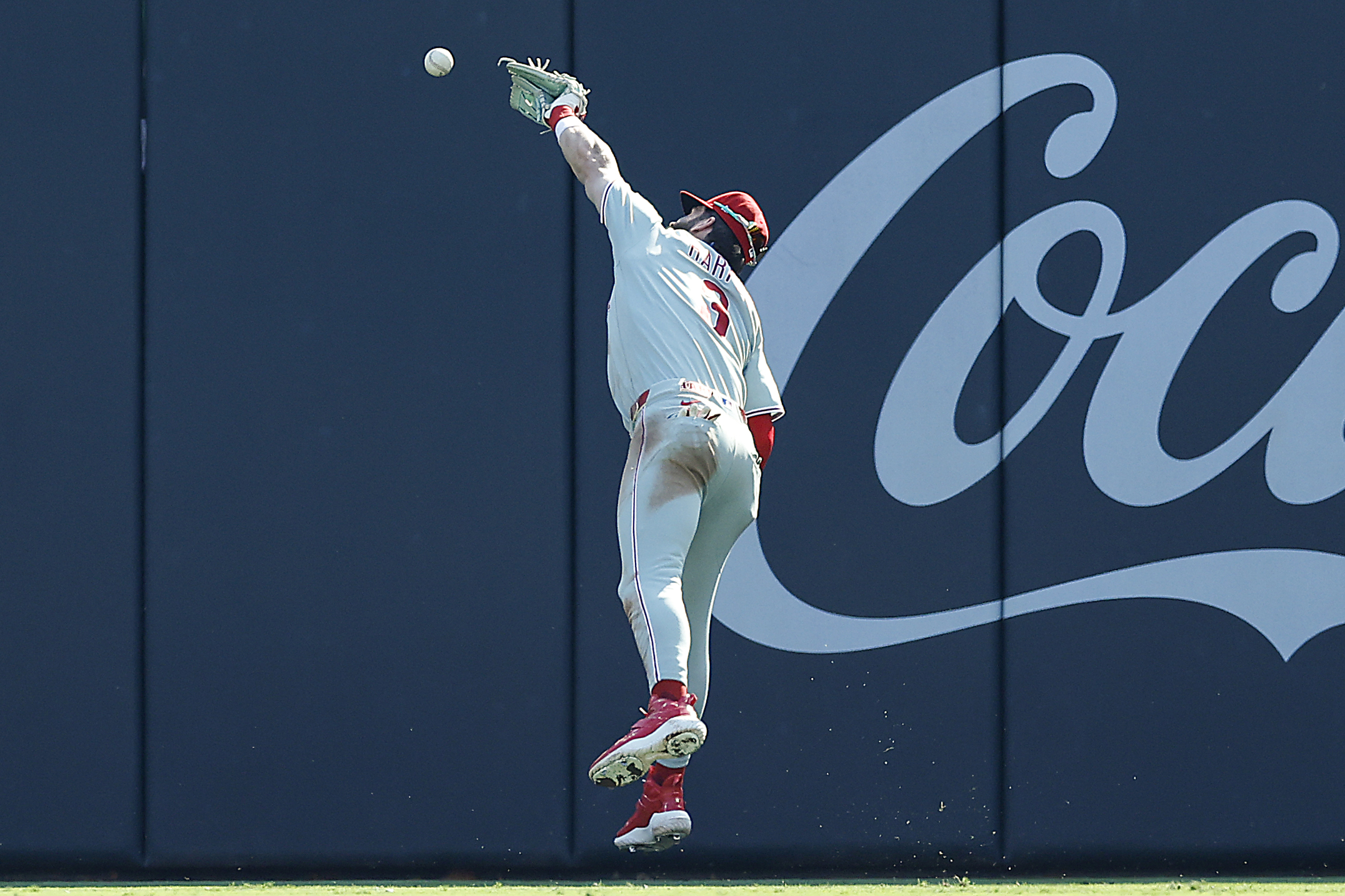
Harper moved back to right field at the trade deadline in a switch he and the Phillies thought might give them the best chance to win in October. But a misread on a fly ball from Drake Baldwin in a crucial moment in the seventh led to it going over his head and Atlanta taking the lead.
He found a way to redeem himself with his bat. Three pitches after Schwarber sent one from Dylan Lee 447 feet, Harper gave a slider a ride to right center to tie the game at 3.
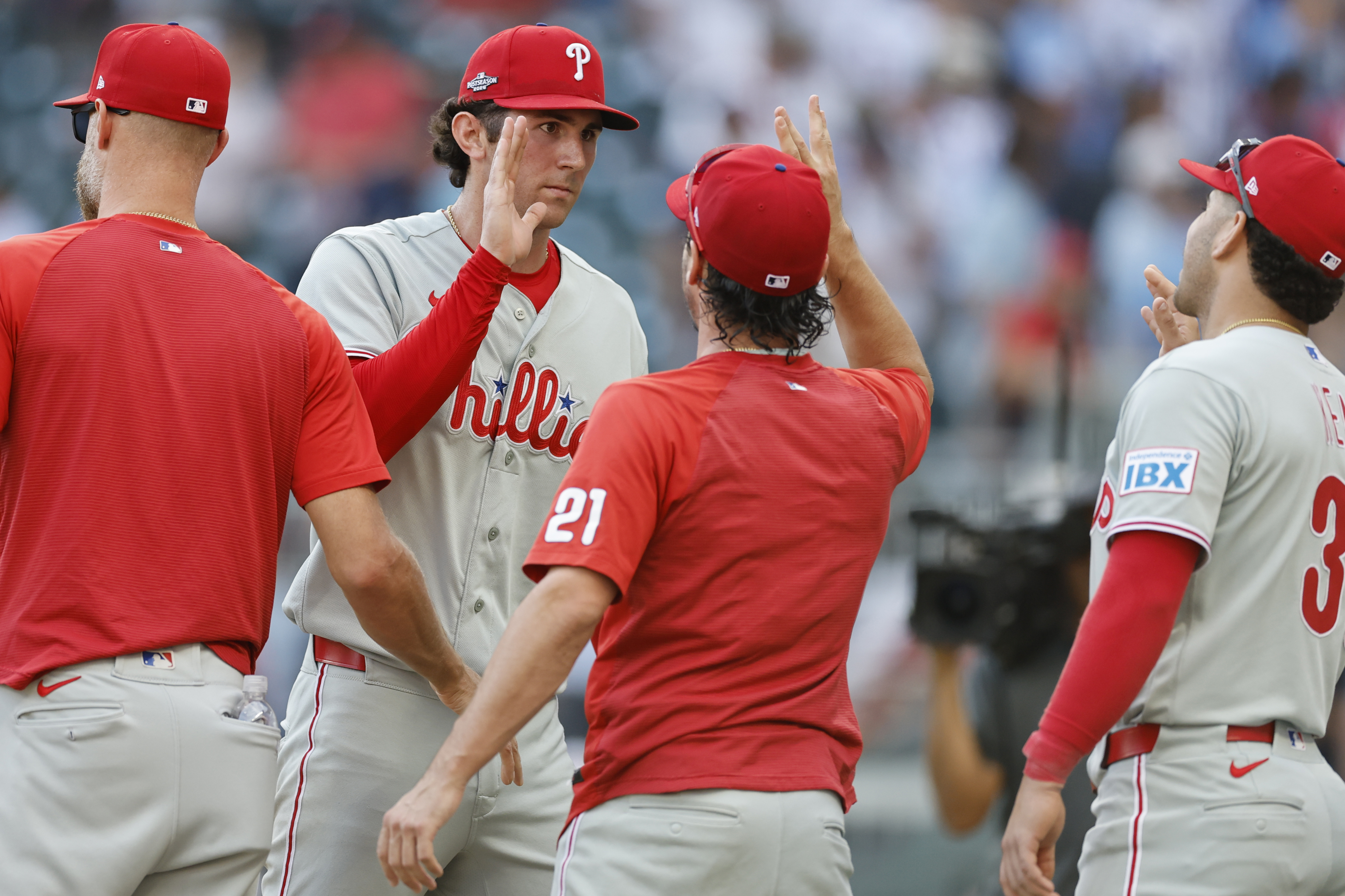
Andrew Painter celebrates with teammates after the Phillies’ Game 2 win.Yong Kim / Staff Photographer
We know the Phillies and Braves will face off in Game 3 Thursday. We just don’t yet know when.
Under most scenarios, Game 3 will start at 2 p.m. Thursday on NBC, just like Games 1 and 2.
If the only remaining series are Phillies-Braves and White Sox-Astros, then Game 3 would start at 8 p.m. on NBC.
Game 3 will also start at 8 p.m. if Phillies-Braves is the only remaining series heading into Thursday.
If the Phillies overcome the odds and manage to defeat the Braves, they’ll advance to the National League divisional series and face the Los Angeles Dodgers. Game 1 would be Saturday at either 4 p.m. on Fox or 9 p.m. on FS1, depending how the wild-card round plays out.
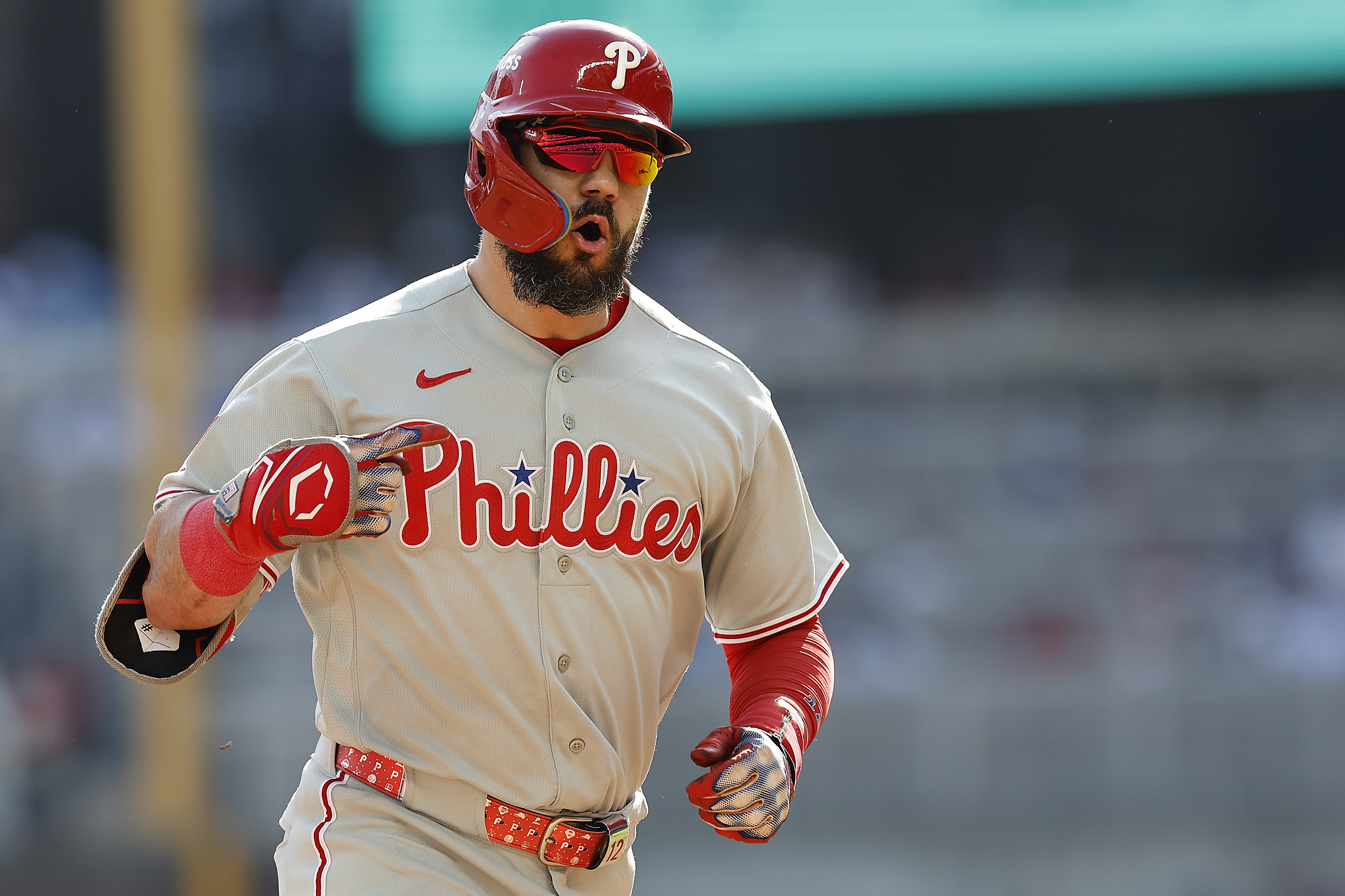
Kyle Schwarber pumps his fist after hitting a solo homer in the eighth inning.Yong Kim / Staff Photographer
ATLANTA – Andrew Painter locked it down.
With a tap of his cap, Painter challenged the final pitch, got a called strike against Dominic Smith, and the Phillies celebrated a come-from-behind 4-3 victory to even their best-of-three wildcard series.
The season will come down to Game 3 on Thursday.
Painter entered in relief in the eighth inning and tossed three scoreless innings. The 23-year-old rookie gave up three hits and struck out the side in the 10th – with singles by Mauricio Dubon and Michael Harris II mixed in.
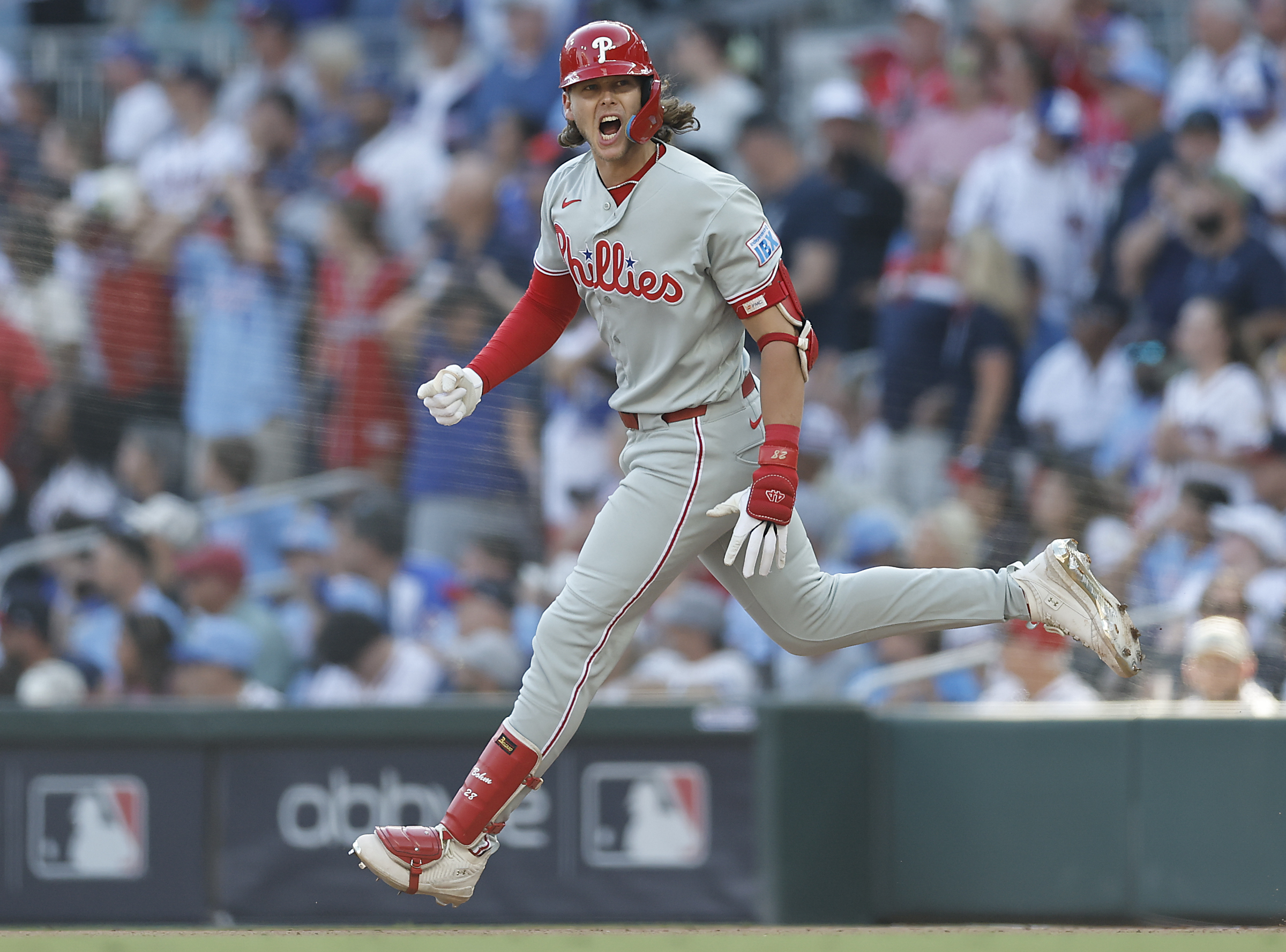
Alec Bohm’s go-ahead solo homer in the 10th inning was the difference after Kyle Schwarber and Bryce Harper hit back-to-back solo homers in the eighth inning to tie the game.
The Phillies are expected to have both Aaron Nola and Zack Wheeler available to pitch in Game 3. The Braves haven’t named a starter but could counter with right-hander Grant Holmes.
ATLANTA – Alec Bohm whipped his right arm in the air as he rounded the bases.
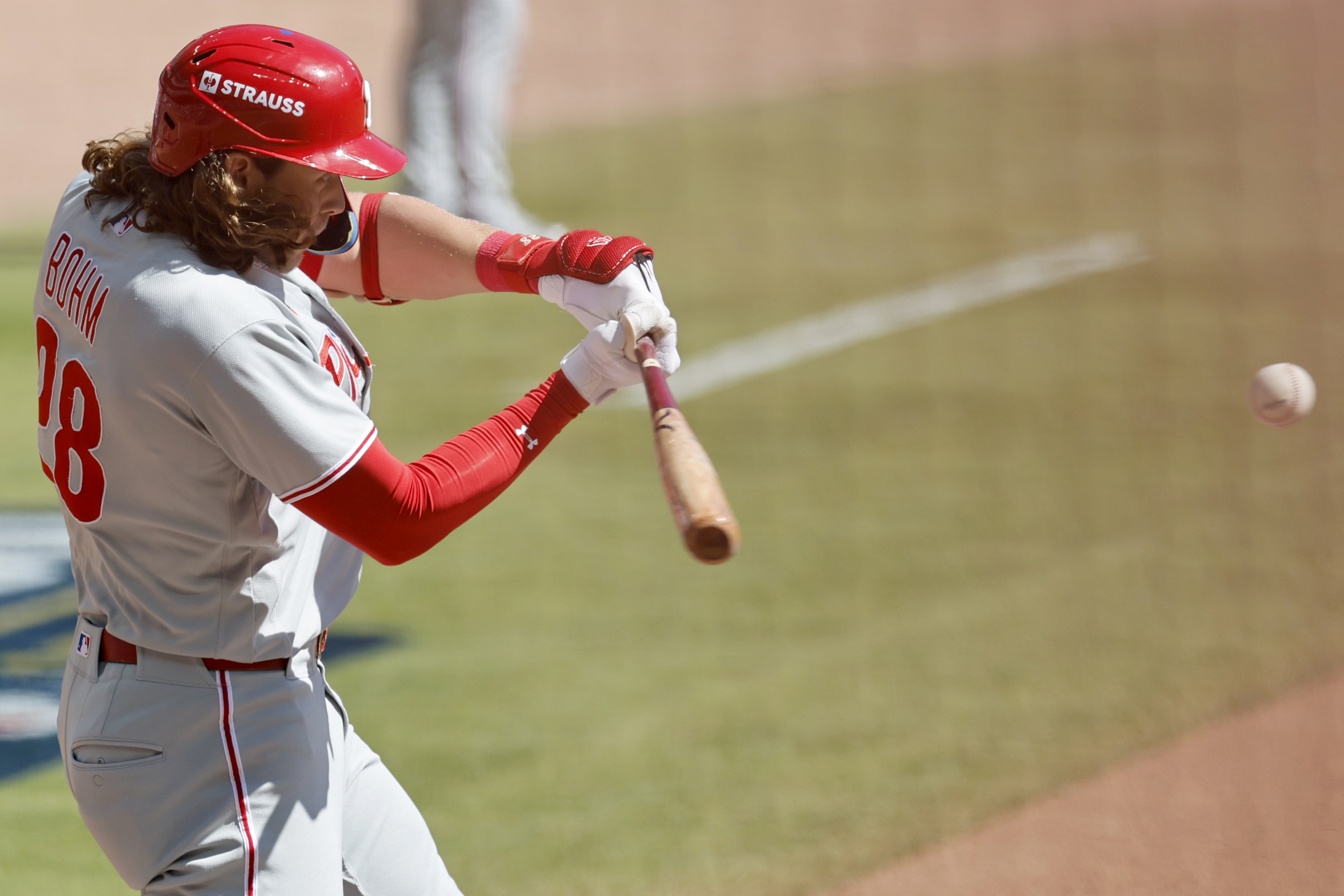
Bohm gave the Phillies a 4-3 lead in the 10th inning with a two-out solo homer into the right-field bleachers. They rallied from a 3-1 deficit with back-to-back solo homers, also to right field, by Kyle Schwarber and Bryce Harper in the eighth inning.
Andrew Painter, who held the Braves scoreless in the eighth and ninth innings, will return to the mound to pitch the 10th against dangerous Matt Olson, Mauricio Dubon, and Austin Riley.
The Phillies and Braves enter extra tinnings tied 3-3, but they won’t be joined by any “ghost runners.”
MLB’s designated runner rule puts a player on second base to begin each half-inning if a game is tied after nine innings. The rule was an attempt to preserve pitching staffs and avoid extra-long regular season games.
But during the playoffs, that rule is out the window.
Phillies tie the Braves on back-to-back homers by Schwarber and Harper
ATLANTA – If ever there was a time for a one-two punch, this was it.
Kyle Schwarber.
Bryce Harper.
Boom. Boom.
Trailing 3-1 in the eighth inning, with the Braves bringing tough lefty reliever Dylan Lee into the game, Schwarber and Harper hit the first back-to-back homers for the Phillies in the postseason since Aaron Rowand and Pat Burrell on Oct. 3, 2007 in Game 1 of the NL division series against Colorado.
Harper’s homer was redemptive after he misjudged a fly ball that went over his head for a go-ahead RBI double by Drake Baldwin in the bottom of the seventh inning.
Braves take the lead after Bryce Harper misplays fly ball
Bryce Harper couldn’t catch a ball off the bat of Braves catcher Drake Baldwin in the seventh inning. Yong Kim / Staff Photographer
ATLANTA – Bryce Harper froze.
With runners on first and second in the seventh inning of a tie game, Drake Baldwin hit a line drive to right field. Harper misjudged it, and by the time he began to retreat to the right-field wall, the ball went over his head.
Sean Murphy scored from second base with the go-ahead run before the Braves tacked on with a sacrifice fly to take a 3-1 lead and knock Cristopher Sanchez from the game.
The seventh inning began with Sanchez throwing a close pitch to Murphy. Unlike last year, when Sanchez had a borderline pitch to Alex Call go against him in the seventh inning of an elimination game against the Dodgers, plate umpire Adam Beck called a strike. But Murphy challenged with the automatic ball-strike system and got the call overturned.
Murphy overturned another called strike later in the at-bat and drew a leadoff walk. He slid safely into second base on a sacrifice bunt by Ha-Seong Kim to give the Braves a two-on, one-out rally.
Sanchez struck out Ronald Acuna Jr. before Harper’s gaffe on Baldwin’s drive. After Ozzie Albies walked intentionally, Matt Olson lifted the sacrifice fly.
With that, the Phillies lifted Sanchez, who threw 116 pitches, the most he has thrown in a game in his career.
ATLANTA — When the Phillies rearranged their infield after the trade deadline, Don Mattingly noted that Alec Bohm’s move to first base was the least of his concerns.
“I’ve seen him enough at first,” Mattingly said. “I felt he was really good at first.”
Bohm might have saved the season in the sixth inning when he started a double play to get Cristopher Sanchez out of a bases-loaded, one-out situation.
Michael Harris II hit a chopper to Bohm, who fielded it and threw to home plate to force out Ozzie Albies. Then, he snagged the return throw from catcher J.T. Realmuto, which appeared to be up the line.
Sánchez gets out of a jam, but his pitch count is climbing
ATLANTA — Cristopher Sánchez sidestepped a Braves rally in the fifth inning.
That was the good news for the Phillies.
But while Sánchez worked around a one-out double by Sean Murphy to strand the go-ahead run on second base — with an assist to catcher J.T. Realmuto — he also walked off the mound having thrown a total of 80 pitches.
After Murphy’s double, Realmuto challenged an 0-1 pitch to No. 9-hitting Ha-Seong Kim. It was overturned, leading to an 0-2 count. Kim fouled off the next pitch, which Realmuto caught against the netting behind home plate for the second out.
The Phillies walked Ronald Acuna Jr. intentionally before getting Drake Baldwin to ground out.
Cristopher Sanchez throws in the first inning of Game 1 against the Braves.Yong Kim / Staff Photographer
ATLANTA — Don Mattingly said before today’s Game 2 that he expects to push Cristopher Sánchez deep into his start today, if he can.
“As long as he’s throwing the ball good, getting outs,” Mattingly said. “I can’t push him if he’s giving up runs.”
So far, so good on that front. Sánchez gave up a first-inning run on a walk, two stolen bases, and a single, but he has not allowed another hit since to Atlanta. Through three innings, he has used 51 pitches, but he seems to be getting stronger and more dialed in with his location. In the third inning, Braves star Ronald Acuña Jr. didn’t lift the bat off his shoulder once, striking out on three pitches and was visibly frustrated in the dugout afterward.
Sánchez’s changeup is working so far, too. Out of Atlanta’s six swings on the pitch, five have been whiffs.
ATLANTA — A leadoff walk to Ronald Acuña Jr. came back to bite Cristopher Sánchez and the Phillies as the Braves tied things back up in the bottom of the inning.
Acuña stole second and then third, as Edmundo Sosa did not cover the bag allowing the Braves star to advance without a throw. And when Matt Olson’s ground ball found a gap on the right side of the infield, Acuña came home easily.
Atlanta put Sánchez to work a bit in the first. Olson’s single was the only hit he allowed, but the Braves fouled off a lot of pitches, driving his pitch count up to 23. He will have to become more efficient if he is to go deep into this game like the Phillies hope.
The Phillies could have done even more early damage against Braves righty Tyler Mahle. With runners on the corners, Harper was off on contact when Bryson Stott hit a tapper back to the mound. Harper was caught in a run down and was tagged out diving back to third.
Even so, the Phillies still had two runners on for Brandon Marsh, but the outfielder chased two splitters in the dirt to strike out and end the rally there.
Tyler Mahle has a 2.28 ERA against the Phillies this season. Gene J. Puskar
ATLANTA — The Phillies have a lot of familiarity with Atlanta’s Game 2 starter Tyler Mahle.
This season, they have faced the right-hander four times: twice with the Giants, and twice with the Braves after Mahle was traded there. Relying mainly on his fastball and splitter, Mahle has held them to a 2.28 ERA this season.
“We haven’t solved that riddle really well yet, but we’ll see today,” Mattingly said.
Since the Aug. 2 trade to Atlanta, he’s become even sharper. Mahle had a 5.13 ERA in 18 starts with San Francisco but a 1.99 ERA in nine starts with Atlanta. But Mattingly thinks the Phillies hitters’ familiarity could be an asset while game-planning.
“There’s going to be a plan for each guy individually,” Mattingly said. “Like if I’m a good high ball hitter, I’m gonna push this guy up in the zone. Get him down for a little while, see if he throw strikes down there. But if you’re a guy that hits the ball down, that split may end up being right where I like it. So it depends with each guy, but there should be a solid approach.”
Phillies closer Jhoan Duran threw 27 pitches in Game 1.Yong Kim / Staff Photographer
ATLANTA – If the Phillies have a lead in the late innings today, will they have their star closer available?
Jhoan Duran threw 27 pitches in Game 1, his highest total since Aug. 16. He entered in the seventh inning and retired the side but began to tire in the eighth and allowed a go-ahead three-run homer to Austin Riley on a 100-mph fastball over the heart of the plate.
But Duran is the Phillies’ best reliever – by a wide margin. Interim manager Don Mattingly won’t stray from using him in Game 2, assuming he’s available. Asked after Game 1 if he would be able to pitch, Duran said, “Maybe yes, maybe not,” depending on how he felt after playing catch Wednesday.
Mattingly said he expected to receive a “thumbs up” from Duran but was waiting until for the relievers to go through their pregame workouts.
“Well, it’s like every other day; we’ll see how he throws the ball,” Mattingly said. “He’s been honest with us all year long. If he feels good or not, or he’s good to go, then we go with that.”
Zack Wheeler not available Wednesday, Aaron Nola could pitch in ‘total emergency’
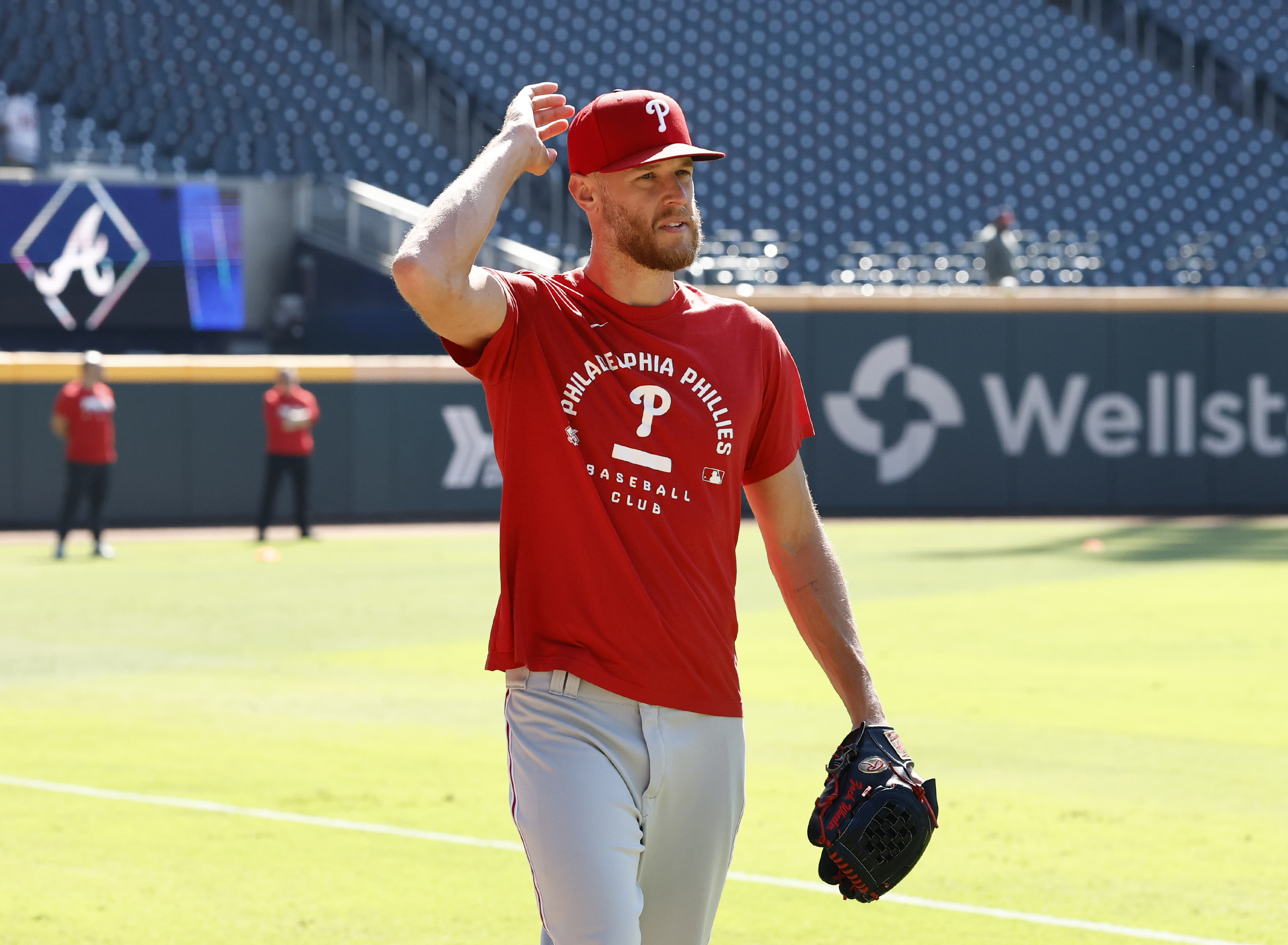
Zack Wheeler takes the field before Game 2 between the Phillies and Braves Wednesday.Yong Kim / Staff Photographer
ATLANTA — If the Phillies are able to extend their season, Zack Wheeler and probably Aaron Nola would be in the pitching plans Thursday for a decisive Game 3 of the wild-card miniseries.
Wheeler isn’t available out of the bullpen here Wednesday after having thrown 97 pitches in the regular-season finale Sunday, according to interim manager Don Mattingly. But the ace is expected to be a factor Thursday, possibly even to start, on three days’ rest.
“I would think so,” Mattingly said. “I would think so. And even (Thursday) anyway, if Noles starts it.”
Speaking of Nola, he started Saturday night on two days’ rest in a desperate move that backfired when he allowed three runs in the first inning. He’s available Wednesday only in “a total emergency,” Mattingly said, as the Phillies hope to save him for a Game 3 start.
“He threw his (between-starts) pen the other day, so he’s built up for it,” Mattingly said. “Yeah, we expect him to take the ball tomorrow.”
Bryson Stott won’t bat cleanup after all.Yong Kim / Staff Photographer
After releasing a lineup featuring Bryson Stott batting cleanup, the Phillies revised their Game 2 batting order to have Alec Bohm batting fourth. Stott will instead bat fifth.
“Clerical error when we sent it out,” interim manager Don Mattingly said Wednesday morning.
Why do the Phillies have three catchers on their playoff roster?
Phillies catcher J.T. Realmuto knocked in two runs during Game 1. Yong Kim / Staff Photographer
I’m still thinking about how the Phillies have three catchers on their postseason roster – J.T. Realmuto, Rafael Marchán, and Garrett Stubbs
What do you do with three catchers in a three-game series? That’s like the Eagles dressing four quarterbacks.
The construction of the bullpen got a lot of attention after Tuesday’s loss, but don’t overlook how a team with a $320 million payroll started Derek Hill, Bryan De La Cruz, and Edmundo Sosa at No. 5, 6, and 8 while Atlanta had Michael Harris II, Ozzie Albies, and Austin Riley hitting 5-7.
One reason the Phillies could still beat the Braves
If the Phillies win Game 2, they can turn to Zack Wheeler for an all-hand-on-deck Game 3.David Maialetti / Staff Photographer
Despite wasting an exceptional outing from Jesús Luzardo, the Phillies should have a pitching advantage in Games 2 and 3.
Tyler Mahle, who is starting Game 2, was excellent after being acquired at the trade deadline from San Francisco, and allowed just one run this season in three starts against the Phils.
But he did get roughed up by the Reds last week in his final start of the regular season and had a 5.13 ERA with the Giants before coming to Atlanta. He’s human and Cristopher Sánchez is the better pitcher who the Phils hope can do enough to force a Game 3.
If so, the Phils will have all hands on deck (even Zack Wheeler) against Grant Holmes. The Braves placed Bryce Elder and Martin Perez on the injured list in September, depleting even more of their options after Chris Sale and Mahle. If the Phils win one of the first two games, they’ll take their chances in an elimination game against Holmes.
Cristopher Sánchez to start Game 2, and they’ll need him to go deep
Cristopher Sánchez went 0-2 against the Braves this season.Jose F. Moreno / Staff Photographer
The Phillies will pin their hopes of staying alive in the playoffs to Cristopher Sánchez, and he did win 18 games with a 2.91 ERA. They went 23-10 in his starts, albeit only 8-6 on the road and 0-2 against the Braves.
But unless Sánchez throws a complete game, Phillies manager Don Mattingly will face the conundrum of how to get the last three, six, or more outs from less than a handful of trustworthy options.
Zack Wheeler would be on two days’ rest after throwing 97 pitches Sunday in the must-win regular-season finale. Aaron Nola would be on three days’ rest after starting on two days’ rest Saturday night. And the Phillies probably need to hold him back to start a potential Game 3 here Thursday.
Duran threw 27 pitches, his highest total since Aug. 16. Could he pitch again Wednesday in Game 2?
“Maybe yes, maybe not,” he said. “I don’t know. I need to do my catch play first.”
Rookie righty Alex McFarlane will be available after only 16 pitches in the sixth inning. But he gave up the go-ahead run on a hard single by Michael Harris II and Ozzie Albies’ triple off over center fielder Derek Hill’s outstretched glove at the wall in right-center field.
Mattingly suggested that Jonathan Bowlan was an option in the ninth inning if Duran had gotten through the eighth. Rookie starter Andrew Painter will sit in the bullpen again, and could easily get a phone call even though he hasn’t pitched in relief.
Tyler Mahle will take the mound looking to eliminate the Phillies.Erik S. Lesser
It’s going to be tough to beat Atlanta Braves starter Tyler Mahle on Wednesday.
He faced the Phillies twice in six days earlier this month, allowing one earned run in 13 innings as the Braves started to run away with the division. He struggled in San Francisco but was much better there after returning from the injured list in late June and blooming into a smart buy-low candidate at the trade deadline.
Mahle dominated the Phillies by mostly throwing a fastball and splitter as he simplified his arsenal since joining the Braves. He doesn’t throw hard but has a ground-ball rate similar to Jesús Luzardo and induced 19 groundouts over those two starts against the Phils. He’ll be looking for that weak contact again.
History isn’t on the side of a Phillies’ wild-card comeback
Jhoan Duran reacts after giving up a three-run homer in Game 1.Yong Kim / Staff Photographer
If the Phillies hope to come back against the Atlanta Braves, they’ll also need to overcome history.
For starters, the Phillies will need to win two straight games against the Braves to move on to the National League Division Series. Over the past month, the Phillies have won games on back-to-back days just once – Sept. 16 and 17 against the Washington Nationals.
Since 2022, when MLB made the best-of-three wild-card series permanent, 16 teams have gone down 0-1. Just one team — the New York Yankees in 2025 — managed to come back to win the series.
There’s also Phillies history to overcome. Philly is 0-9 all-time when losing Game 1 in any postgame series.
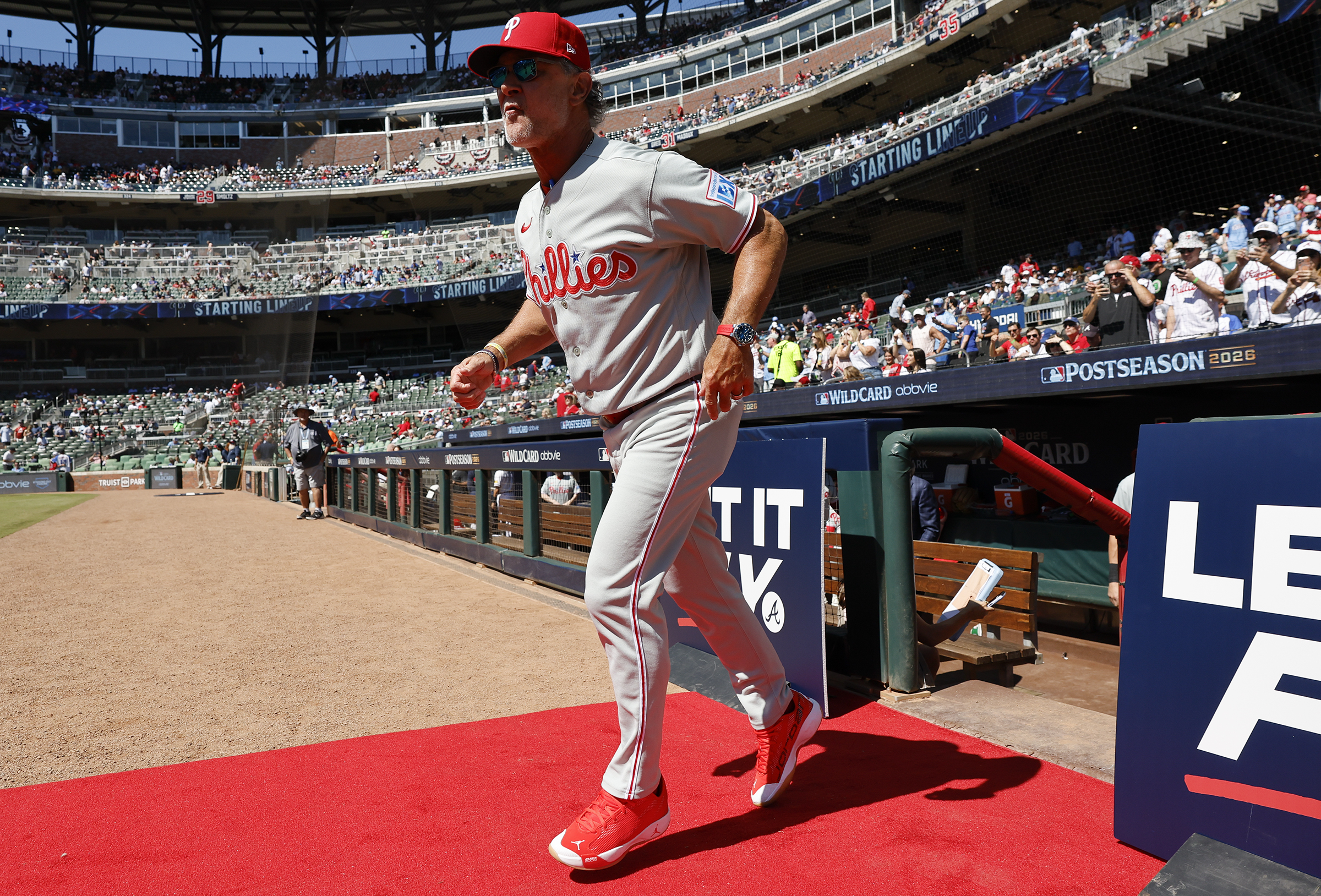
Interim manager Don Mattingly before the Phillies loss to the Braves in Game 1.Yong Kim / Staff Photographer
ATLANTA — As Don Mattingly settled into his seat on the golf cart to return to his clubhouse after he’d mismanaged his flawed roster into an eighth-inning collapse, Braves ace Chris Sale strode toward the interview room to discuss his role in the Braves’ 5-3 win in Game 1 of the National League wild-card series.
With his magnificent left hand, Sale doffed his cap and tipped it in Mattingly’s direction. Mattingly’s head was down, understandably. Sale, persistent, took his cap off and tipped it again. Mattingly nodded appreciatively.
After Mattingly’s performance Tuesday, that might be the last time the pair sees each other for a long, long time. Mattingly is the Phillies’ interim manager, and he wants to come back next season. A report last month said Mattingly would have to win the NL pennant to make that happen.
That yardstick got longer Tuesday.
Mattingly used his best reliever, closer Jhoan Duran, in a situation overwhelmingly foreign to Duran. The decision smacked of the odd and desperate moves that cost Rob Thomson the manager’s job 28 games into this season. Mattingly was installed by Phillies president Dave Dombrowski last winter as Thomson’s bench coach to mitigate misjudgments like this. Mattingly was promoted to interim manager in April with the assumption that such misjudgments would not continue.
For the first time, Lehigh Country Club in Allentown will host a PGA Tour Champions event when the inaugural Jefferson Lehigh Valley Classic takes place from Friday to Sunday.
The tournament will bring together 78 players for a three-day, 54-hole tournament. Competition begins Friday with gates opening at 8 a.m.
Tournament proceeds will go to local charities in Northeastern Pennsylvania and throughout the greater Philadelphia and Lehigh Valley Regions. The main recipients of the tournament proceeds are the Eagles Autism Foundation, Sodexo Stop Hunger Foundation, and Valley Youth House.
The PGA Tour Champions, a branch of the PGA Tour, is a tour for players 50 and older, and features many of the sport’s most accomplished veterans, including 35 members of the World Golf Hall of Fame.
The tour was established in 1980 as the Senior PGA Tour and gives fans the opportunity to watch familiar names from years past compete in the next stage of their professional careers.
Unlike the PGA Tour, the Champions tournaments are typically three-round, 54-hole events. Players compete throughout the season for the Charles Schwab Cup, a season-long points race that concludes with the three-tournament Charles Schwab Cup Playoffs.
The Jefferson Lehigh Valley Classic is one of 25 regular-season events on the 2026 schedule and is one of two tournaments added to the tour this year.
The tour’s mission includes creating substantial charitable and economic impact in tournament communities.
Who is playing?
Stewart Cink, a nine-time PGA Tour Champions winner and 2009 British Open champion, and Ernie Els, a former world No. 1, four-time major champion and member of the World Golf Hall of Fame, will headline the field. Three other members of the World Golf Hall of Fame — Retief Goosen, Colin Montgomerie, and Vijay Singh — will also be in the field.
Eight of the top 10 players in the Charles Schwab Cup standings will compete this week. That includes Cink (1), Steven Alker (3), Goosen (5), Boo Weekley (6), George McNeill (7), Els (8), Ben Crane (9), and Miguel Ángel Rodríguez (10).
What does the champion receive?
The inaugural champion will take home $345,000 from the tournament’s $2.3 million purse.
Where to watch?
The tournament will air live on Golf Channel. Here’s the television schedule:
Tickets for the Jefferson Lehigh Valley Classic can be purchased on the tournament website. Children 17 and under will get in for free with a ticketed adult.
United States Armed Forces, veterans, and first responders will receive complimentary admission.
What can spectators expect?
The tournament’s spectator experience will extend beyond the golf course, with daily activities including the Wind Creek Tailgate Zone. The tailgate zone will feature a jumbo screen, Rita’s Ice truck, beverages from Yuengling, Good Boy Vodka, and Cellar Beast Winehouse, and Brand activations from sponsors including Wind Creek, Cadillac, and Comcast.
Caroline and Kevin Finnegan needed a larger home for their growing family and had specific goals: a community feel, lots of neighborhood kids, and walkability to a park, shopping, and restaurants.
Though house hunting during the pandemic was difficult, they found the perfect place in Havertown nearly five years ago, a 2,300-square-foot Tudor-style home built in 1920.
“We had always loved Havertown as a community,” said Caroline, owner and principal designer of Hendren House Interior Design in Havertown. “The house was an extra bonus when we saw its character and history.”
She also saw signs that this was her forever home. Caroline had been very close with her grandfather, Francis “Frank” Grandizio. She and Kevin bought the house in 2021, 100 years after her grandfather was born and the same year he died.
The outside of Caroline and Kevin Finnegan’s Tudor-style home in Havertown.Joe Lamberti / For The Inquirer
“A family who lived here previously had written all their names in the cement in the foundation of the garage,” she recalled. “There are so many stories to this house that I don’t even know and I find that so wonderful.”
And, she added, “I love that we get to create our own stories here.”
Prior to moving in, the Finnegans removed the carpet and refinished the floors on the second level of the four-bedroom, two-bathroom house. They also gave the bathroom a facelift. In 2024 they embarked on a larger renovation, swapping the locations of the kitchen and dining room and outfitting those new rooms.
A designer for more than 10 years, Caroline enjoyed the process of creating a home for her family, including sons James, 7, and Hudson, 5, and daughter Charlotte, 1.
The living room features a wall of leaded glass windows that cast a grid of light and shadows.Joe Lamberti / For The InquirerCaroline Finnegan’s grandfather’s blue plaid chair is a favorite item of hers.Joe Lamberti / For The Inquirer
“I’m inspired by classic, timeless, traditional design that has a bit of a modern twist, that entails layering, patterns, texture, and color,” said Caroline. “I like unexpected color combinations.”
She often chooses wallpaper instead of paint, particularly nature-inspired designs. A blue-and-white botanical print, a contemporary interpretation of toile, greets visitors in the foyer, while a lush mural transforms the dining room.
The powder room is wrapped in a paper featuring oversized blue blooms and delicate foliage, a hand block print from Michael S. Smith’s Jasper line — Smith is one of her favorite designers. A sweet pink and gray pastel paper sets the tone for Charlotte’s room.
“I love florals,” said Caroline. “My aunt, Kathleen Gallagher Standeven, was a big inspiration for me. She put floral prints on everything. If I’m allowed to pick a floral wallpaper, I always will.”
The foyer is wallpapered with a blue and white toile-like print. Joe Lamberti / For The InquirerThe bedroom of the Finnegans’ daughter, their youngest child. The wallpaper and shades both feature a colorful pattern.Joe Lamberti / For The Inquirer
The living room, bathed in light from a wall of leaded glass windows, is home to Caroline’s favorite chair that once belonged to her beloved grandfather. Now reupholstered in blue plaid, it has become a favorite resting spot for Kevin.
“I like sitting there in the morning with a cup of coffee, looking out through the glass windows in the front,” he said.
Nearby sits the grandfather clock that originally belonged to Caroline’s maternal grandfather.
“My husband and sons crank it every Saturday, which has become a special, fun tradition,” said Caroline.
A grandfather clock is another heirloom, which the family enjoys cranking each week to keep it running.Joe Lamberti / For The Inquirer
Though Kevin has little say in the design of the home, he is thrilled with his wife’s choices.
“I don’t have much taste, and Caroline obviously knows what she is doing,” joked Kevin, a detective in Upper Darby. “I trust her, and just let her do her thing.”
Though admittedly not an avid cook, Caroline especially appreciates her kitchen, where soft off-white and green hues create a connection to nature. The perimeter cabinets are painted Old White by Farrow & Ball, the island is Benjamin Moore Colonial Verdigris in the Williamsburg Paint Color Collection, and the pantry is a custom stain.
The Carrara marble island is surrounded by stools where the children sit to enjoy weekend lunches and snacks. Well-organized drawers and shelves store food and kitchen gear. The custom-built cabinet, made by woodworker Nate Wagner, owner of Wagner’s Wood Specialties in Chalfont, does double duty as a coffee bar and storage unit, and is easy to close for an uncluttered look.
The children enjoy snacks and lunches at the kitchen island.Joe Lamberti / For The InquirerA custom kitchen cabinet serves as a coffee bar and storage solution.Joe Lamberti / For The Inquirer
The dining room is the venue for the family’s important shared mealtime, when they catch up on the highlights of each member’s day.
Grassy yards make up the front and back of the house, where the kids play with their neighborhood buddies while their parents watch from the side porch.
“This neighborhood has been wonderful for our family,” said Caroline. “Havertown has such a deep sense of community.”
Is your house a Haven? Nominate your home by email (and send some digital photographs) at properties@inquirer.com.