Blog

  • Bill Rasmussen, ESPN co-founder, dies at 93

    Bill Rasmussen, ESPN co-founder, dies at 93

    LAND O’ LAKES, Fla. — Bill Rasmussen, who co-founded ESPN in 1979 after being fired from a public relations job in the World Hockey Association, died Tuesday. He was 93.

    ESPN historian Mike Soltys said Mr. Rasmussen died at his Florida home from the effects of Parkinson’s disease. Mr. Rasmussen announced in 2019 that he had been diagnosed with the degenerative disease in 2014.

    “Bill was a remarkable man — a visionary and an innovator who conceived the idea of a network entirely devoted to sports,” ESPN chairperson Jimmy Pitaro said in a statement. “Quite simply, none of us would be here today if it wasn’t for Bill’s passion and all the hard work and entrepreneurial spirit he put into building ESPN in the late 1970s — key aspects of our company culture that still carry on to this day.”

    Mr. Rasmussen and his son Scott came up with the idea of a network carrying sports around the clock, and it would revolutionize Americans’ TV-watching habits. But the pair didn’t stick around long. They were forced out after only a year by ESPN majority owner Getty Oil.

    Bill Rasmussen’s original idea was a cable channel covering only Connecticut sports. Many cable operators in the state were skeptical, but someone suggested buying satellite time to reach a national audience.

    ESPN was launched on Sept. 7, 1979. George Grande welcomed viewers to the first SportsCenter broadcast before the network’s first live event, a slow-pitch softball game between the Kentucky Bourbons and the Milwaukee Schlitz.

    “In those days, we didn’t know if we’d last four weeks, four years, let alone 40-some, but we knew it was special,” Grande said. “Bottom line was Bill Rasmussen was the true purveyor of the original American dream, and he gave us all something very special that we still have today.”

    The Rasmussens secured financial backing from Getty Oil and a rights deal with the NCAA, and built a studio in Bristol, Conn., still under construction when ESPN went on the air.

    The Getty investment and the deal with the NCAA occurred on the same day.

    “When someone tells you you can’t do something, you want to prove them wrong,” Bill Rasmussen said. “Many, many people told us there wasn’t enough sports to do a 24-hour channel. I didn’t argue with anybody. I just thought they were wrong and I was right.”

    When the Rasmussens were forced out of ESPN in 1980, Getty owned 85% of the network. Texaco, which had acquired Getty, sold its interest in ESPN to ABC in 1984.

    Bill Rasmussen and ESPN were estranged until 1999, when company executives invited him to the 20th anniversary celebration. Since then, he has been embraced and recognized for his vision of creating an all-sports network. He toured the country in 2019 for the 40th anniversary and gave speeches at Walt Disney Co. and ESPN events.

    “Bill was our George Washington and a good friend,” said veteran anchor Chris Berman, who joined ESPN three weeks after the network launched in 1979. “He was such a grateful person and every sports fan can be grateful for Bill. He wasn’t a glass half-full guy; his glass was always overflowing with optimism. He greeted everyone with a smile and we can all smile knowing Bill’s legacy.”

    Born in Chicago, Mr. Rasmussen earned degrees from DePauw University in Indiana and Rutgers University and served in the Air Force. He started an advertising services business, then worked in radio and television as a broadcaster during the 1960s.

    He was hired in 1974 as public relations director for the WHA’s New England Whalers in Hartford, Conn. The team’s entire front office was fired in 1978, and Mr. Rasmussen soon turned his attention to brainstorming with his son on the creation of sports on cable TV with the help of a $9,000 credit card advance.

    “There was a whole lot of chutzpah and a whole lot of vision, and they’re maxed out on their credit cards. It’s the American dream,” said Bob Ley, one of the network’s original anchors.

    Mr. Rasmussen was inducted into the Sports Broadcasting Hall of Fame in 2025.

    Mr. Rasmussen was preceded in death by his wife of 56 years, Lois, in 2011 and is survived by two sons, Scott Rasmussen and his wife, Laura, and Glenn Rasmussen, daughter Lynn Van Hollebeke and her husband, Louie, seven grandchildren, one great-grandson, and one great-granddaughter. In addition to his wife, Mr. Rasmussen was predeceased by his brothers Robert and Donald Rasmussen, sister Vivien, and a grandson.


  • Two men convicted of first-degree murder in 2020 killing of Philadelphia teen rapper

    Two men convicted of first-degree murder in 2020 killing of Philadelphia teen rapper

    Six years after an up-and-coming teenage rapper was shot to death outside a West Philadelphia home, two of his killers have been convicted and sentenced, prosecutors said.

    Donovan Williams, 24, was found guilty last week of first-degree murder in the killing of Aamir Johnson-Daye, known as D4M Skiano, and of the attempted murder of a man who was with him, the Philadelphia District Attorney’s Office announced Tuesday.

    A judge on Friday sentenced Williams to life in prison without the possibility of parole, plus 46 to 92 years, court records show.

    Williams’ codefendant, Bahij Dini, 28, pleaded guilty earlier this month to third-degree murder, conspiracy, and firearms offenses, and was sentenced to 13½ to 42 years, prosecutors said.

    But the two convictions have not closed the case. Prosecutors said that three gunmen climbed from a car on July 5, 2020, and opened fire on the family’s home, but that the third shooter has not yet been identified. Nor was a possible fourth participant, they said, who may have stayed in the vehicle.

    “We don’t have all the answers here,” District Attorney Larry Krasner said, appealing for the public’s help.

    Johnson-Daye’s parents stood with prosecutors at the news conference, just days before what would have been their son’s 25th birthday, they said.

    His mother, Latoya, thanked investigators, saying: “This is a perfect happy birthday for him.”

    But she also pressed the public for information on the people being sought who have not yet been identified. “Please just come forward,” she said. “We’re still not done yet.”

    One night, two killings

    Johnson-Daye was part of a West Philadelphia rap collective whose videos drew hundreds of thousands of views online. His songs were also played on the radio.

    Prosecutors said it was possible that his killing on the 1400 block of North 61st Street grew out of an earlier death the same night. A 15-year-old football player, Angelo Walker, was fatally shot nearby on Nassau Road, said Assistant District Attorney Jeff Hojnowski, who helps lead the office’s homicide unit and prosecuted the case against Williams and Dini.

    Walker was affiliated with Williams and Dini, and word of his death spread quickly, Hojnowski said. He said a long-running feud between two neighborhood groups — one Williams belonged to and a rival that Johnson-Daye rapped with — may have also played a role in the fatal shootings.

    About two hours after Walker was killed, he said, Williams, Dini, and a third gunman drove to the North 61st Street house. Johnson-Daye was on the front porch with another man when the gunmen approached and opened fire, killing him, Hojnowski said. No one else at the home was hit, he said.

    Detectives recovered 14 spent casings, Hojnowski said, and determined three guns were used — one for each shooter.

    The case against Williams and Dini was built almost entirely from surveillance video, cell phone location data, and digital records rather than eyewitnesses, Hojnowski said. Cameras captured a tinted Buick registered to Williams parking on the block with its lights off, then three figures walking toward the porch and the flashes of discharged bullets.

    Prosecutors said the gunman they identified as Williams fired with his left hand — Williams is left-handed — and wore clothing later recovered from his home and car. Cell phone records placed him and Dini at the scene, and tracked them afterward to a hotel near Philadelphia International Airport.

    Williams’ attorney did not immediately return a phone call Tuesday.

    Dini had initially been charged with first-degree murder. Coley Reynolds, Dini’s attorney, called the plea to third-degree murder “an extremely competitive offer that resolved the case without looking at a possible life sentence.” Cooperation with the ongoing investigation, Reynolds said, was not part of Dini’s deal with prosecutors.

    ‘We can get these things done’

    Johnson-Daye’s 2020 killing came in a year of increasing violence in the city. The conviction of his killers, Krasner said, comes during one where homicides are down about 18% from last year — when such killings reached a decades-long low.

    “We can get these things done,” he said. “But we can’t do anything without the support of the public.”

    Anyone with information is encouraged to contact the Philadelphia police tip line at 215-686-TIPS (8477).

  • The Patriot League denied Villanova quarterback Pat McQuaide’s eligibility for 2026. What’s next?

    The Patriot League denied Villanova quarterback Pat McQuaide’s eligibility for 2026. What’s next?

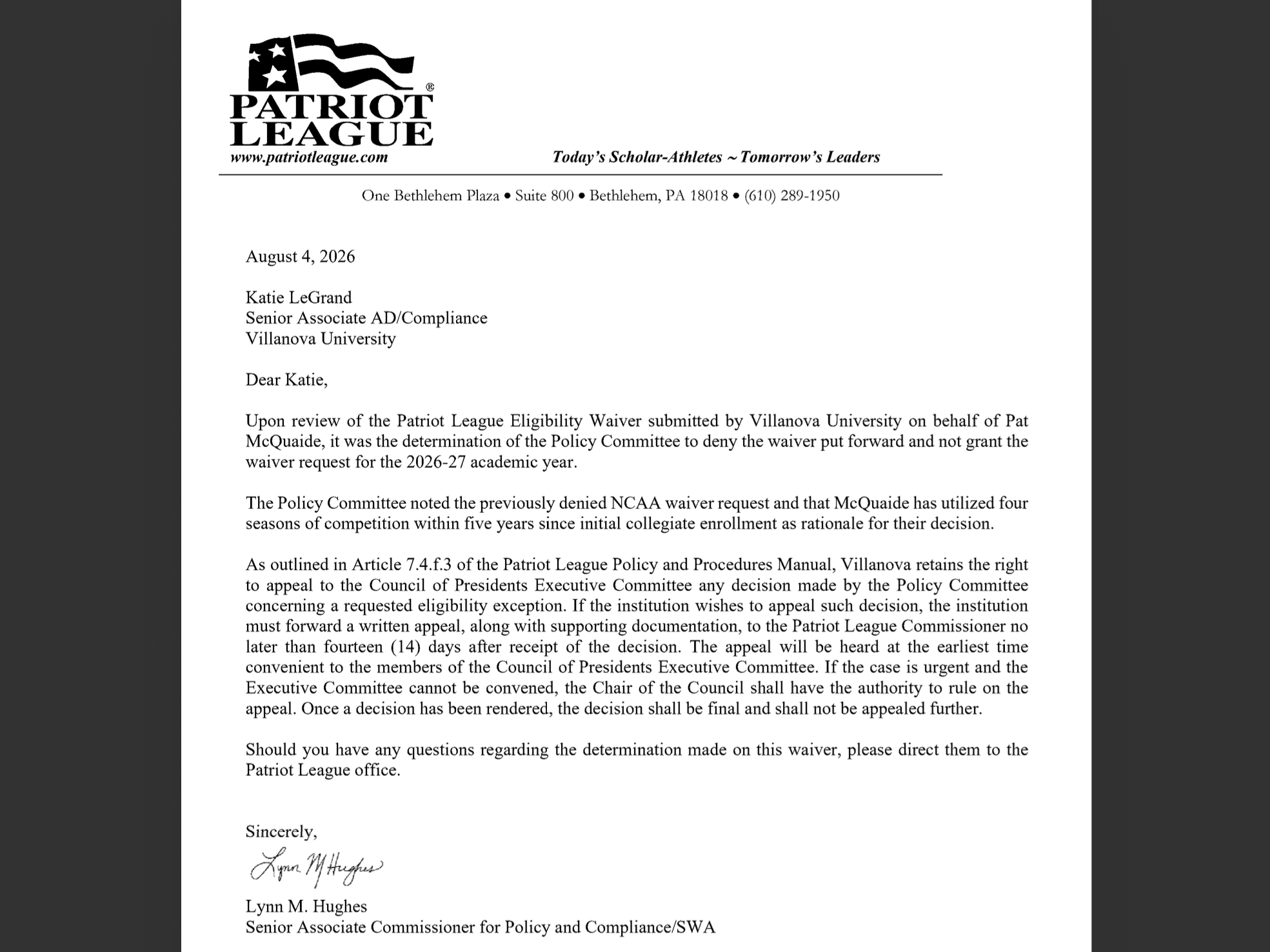
    Despite Villanova quarterback Pat McQuaide being granted a preliminary injunction to play this season, the Patriot League has deemed the Wildcats starter ineligible.

    On Aug. 4, the Patriot League sent a letter to Villanova stating that the conference denied McQuaide’s eligibility waiver request. The conference’s decision conflicts with a preliminary injunction granted on Aug. 1 by Cuyahoga County (Ohio) Common Pleas Court judge Timothy P. McCormick. McQuaide, a native of Cuyahoga County, originally motioned to sue the NCAA after it denied his waiver request to play in 2026.

    In its reasoning, the Patriot League cited the original NCAA ruling which had been overruled by the Ohio court. The letter to Villanova from Patriot League Senior Associate Commissioner for Policy and Compliance Lynn Hughes states that the quarterback “has utilized four seasons of competition within five years since initial collegiate enrollment.”

    “The university is aware of the situation and are in the process of working with [McQuaide] and the Patriot League to determine next steps,” wrote Villanova athletics.

    The Patriot League declined to comment.

    “The Patriot League is now asserting [the four seasons of competition rule] as its basis to prohibit [McQuaide] from playing in any Patriot League games,” Richard Hamilton Jr., the attorney that represented McQuaide in Cuyahoga County, told the Inquirer. “My understanding is that Villanova has been informed that if he plays in any games, then they’ll be forfeited.”

    On Aug. 11, Hamilton, on behalf of McQuaide, filed a Motion for Clarification to the Cuyahoga County Common Pleas Court. Hamilton is looking for the court to clarify whether the Patriot League is legally required to obey the court’s preliminary injunction. If so, the conference is required to allow McQuaide to play.

    Patriot League Senior Associate Commissioner for Policy and Compliance Lynn Hughes wrote in a letter that Pat McQuaide “has utilized four seasons of competition within five years since initial collegiate enrollment.”Courtesy of Richard Hamilton Jr.

    “It’s an extraordinary move,” Hamilton said. “No conference has done it. I have no idea why the Patriot League has insinuated itself into it, and have no idea why the Patriot League believes that it, and not the court, is the final arbiter on who plays and who doesn’t after a valid court injunction.

    “Frankly, my own legal view is that [the Patriot League is] in contempt of court. Hopefully, we can get this resolved, if not in a Cleveland court in Delaware County.”

    McQuaide contends the COVID-19 pandemic toward the end of his high school career disrupted his development and recruitment before he landed at Kent State as a walk-on. McQuaide redshirted at Kent State, before transferring to Mississippi Gulf Coast Community College, where he led the junior college ranks in passing yards, passing yards per game, and passing TDs.

    The legal question around McQuaide’s eligibility surrounds his 2022 season at Mississippi Gulf Coast. JUCO programs are not under the purview of the NCAA, but seasons spent at that level have historically counted towards student-athletes’ eligibility.

    Villanova, which submitted the waiver request to the NCAA on behalf of McQuaide, argued that the COVID-19 pandemic directly led to McQuaide’s single season at Mississippi Gulf Coast. The school described the year as a “necessary bridge rather than a choice to ‘use’ an additional season.”

    For this reason, Villanova had requested that the season should not count as one of McQuaide’s allotted seasons of eligibility.

    McQuaide subsequently played for two seasons at NCAA Division I FCS program Nicholls State before transferring to Villanova for the 2025 season.

    The initial decision by the Ohio court had noted that Villanova was holding a roster spot for McQuaide, who threw for 3,123 yards and 25 touchdowns last season. McQuaide is not currently listed on Villanova’s official roster, but he has been seen at team practice. The Wildcats were recently ranked No. 7 in the preseason FCS coaches poll.

    There’s no other quarterback on Villanova’s roster who has completed a pass in college. Villanova will host William & Mary next Friday (6 p.m.) in its season opener, which is also the first-ever Patriot League game for both teams.

    Both programs were formerly longtime members of the Coastal Athletic Association (CAA).

  • Former U.S. Open champ Sloane Stephens to compete in inaugural Ennoble Care Philly Open

    Former U.S. Open champ Sloane Stephens to compete in inaugural Ennoble Care Philly Open

    The inaugural Ennoble Care Philly Open is bringing some big names to town, and now that field includes a past Grand Slam champion.

    On Tuesday morning, the tournament, a WTA 125 event, announced that Sloane Stephens will enter the competition as a wild card. The former world No. 3 women’s singles player in the world has been making a comeback following a fractured right foot last year.

    Currently ranked No. 240 in singles, the 33-year-old has a long history as a formidable force on the court. She won the 2017 U.S. Open and was a star for the former Philadelphia Freedoms, the World TeamTennis squad owned by Billie Jean King.

    She reached the quarterfinals of the U.S. Open the next year and was a finalist at the 2018 French Open. Before that, she was an Australian Open semifinalist and Wimbledon quarterfinalist in 2013.

    Stephens’ last tournament win on tour was at the 2024 Open Capfinances Rouen Métropole, a WTA 250 event on clay in Rouen, France. She has eight career singles titles.

    The Philly Open is Aug. 23-29 at Penn’s Hamlin Tennis Center. Just one week before the U.S. Open in New York, the tournament will feature 32 singles players competing for a $115,000 purse.

    Stephens has been competing around the world this season, often as a wild card. On Sunday at the Cincinnati Open, she upset No. 24 seed Anastasia Potapova in the second round. She will play the No. 10 seed Marta Kostyuk in the round of 32 on Tuesday afternoon.

  • New York developer proposes 129 affordable apartments near Temple University

    New York developer proposes 129 affordable apartments near Temple University

    A 129-unit affordable apartment building is slated for 11th and Berks Streets in North Philadelphia, just east of Temple University’s campus.

    The six-story structure will be built on land owned by the Philadelphia Housing Authority (PHA) but will be developed by New York City-based Jonathan Rose Cos., which has built two other affordable apartment complexes in the area.

    The designer for the building is Philadelphia-based WRT architects, which worked with Jonathan Rose on other projects in the neighborhood.

    “We’ve kind of been marching our way down the block,” said Marissa Hebert, an architect for the building with WRT. “This will be their third project in Philadelphia.”

    The others include 120 units in Paseo Verde at the corner of Ninth and Berks and 133 units at NC Five at 10th and Berks.

    “Being able to still have the site so close to Temple, to be able to put affordable units for the actual residents and long-term community members has been really great,” Hebert said. “You can see the impact of still having affordable housing in this neighborhood.”

    The majority of the units — 61 apartments — will be affordable to those making 60% of area median income (AMI), or just over $44,000 for a one-person household; 54 units will be at 50% of AMI, which is just under $42,000 for a one-person household, and 14 will be for those making under 20% of AMI, or almost $17,000.

    The project is being largely funded through Low Income Housing Tax Credits, a federal program, and subsidies through PHA such as the project-based Section 8 program.

    The proposed apartment building from Jonathan Rose Cos., the New York-based developer’s third project in North Philly.WRT Architects

    The building will be carved into 60 one-bedroom apartments, 60 two-bedrooms units, and nine three-bedrooms.

    “They said they would have the three-bedroom units on the first floor,” said Elizabeth Segarra, of Asociación Puertorriqueños en Marcha (APM), a nonprofit developer and the lead community group in the area.

    “Why? Because they don’t want families on a third floor jumping, and then a single person complaining because they’re hearing too much jumping,” Segarra said. “So they’re going to keep that kind of environment on the first floor.”

    The project will include 21 parking spaces and no ground-floor commercial, although there will be amenities such as a gym and community room in the building.

    On the rest of the site, PHA is planning to build 15 for-sale townhouses at affordable prices, as well as recreational spaces including a basketball court.

    Hebert of WRT says the apartment building will be the largest “passive house” project in Philadelphia, in reference to a building standard that tries to minimize energy use in structures.

    “That’ll mean lower utility costs for all the residents, better thermal comfort for them, and higher indoor air quality,” Hebert said.

    Jonathan Rose plans to begin construction in December and anticipates the building taking two years to complete. Tenants will be able to move in early in 2029.

    “It’s not only going to bring more people to the community, it’s going to bring more jobs, and it’s going to bring a live vibe in that area,” Segarra said. “They really knocked it out of the park.”

  • Justice Department pushes to revive criminal case against Kilmar Abrego Garcia

    Justice Department pushes to revive criminal case against Kilmar Abrego Garcia

    NASHVILLE — The Justice Department is pushing to revive criminal charges against Kilmar Abrego Garcia, telling a federal appeals court late Monday that a judge erred in his scathing ruling that called the case against the man mistakenly deported to an El Salvador prison an “abuse of prosecuting power.”

    The government is appealing the May ruling by U.S. District Judge Waverly Crenshaw that threw out charges of human smuggling against the Salvadoran national. The ruling amounted to an extraordinary rebuke of a Justice Department that under President Donald Trump has repeatedly been accused of targeting defendants for political purposes.

    Crenshaw found that Abrego Garcia would never have faced criminal charges had he not successfully sued the government over his 2025 deportation. The ruling was an embarrassment for the Trump administration, which only brought him back after securing a criminal indictment against him.

    Crenshaw stopped short of finding the government acted with “actual vindictiveness,” a rarely-met standard that usually requires evidence like a prosecutor admitting that charges were filed in retaliation against someone. But the judge did find there was enough evidence of “presumptive vindictiveness.” That included the timing of the indictment.

    Homeland Security had been aware of the 2022 traffic stop in Tennessee that was the basis for the human smuggling charges for more than two years before Abrego Garcia was deported. The agency only reopened the case and began investigating in earnest after Abrego Garcia was ordered returned to the U.S.

    Crenshaw also found that statements by U.S. Attorney General Todd Blanche, who was a deputy at the time, suggested the Justice Department was targeting Abrego Garcia because he won his wrongful-deportation case.

    In a brief filed Monday night with the 6th U.S. Circuit Court of Appeals, federal prosecutors argued that Crenshaw got it wrong. Blanche’s statements, they argue, demonstrated a legitimate motive for prosecuting him. His rationale reflected a “normal assessment of the societal interest in punishment,” not an “improper penalty,” they said. The statements “explained that the government was seeking to protect the public and confirm its prior assertions about Abrego’s criminal activity,” the brief states.

    But even if Blanche’s statements reflected an animus against Abrego Garcia, they are irrelevant because the person who actually brought the charges was then-Acting U.S. Attorney for the Middle District of Tennessee Rob McGuire, the brief states — rehashing an argument thoroughly rejected by Crenshaw that McGuire’s motives were the only motives that mattered in the case.

    Crenshaw’s ruling noted the sustained oversight of the case by top Justice Department officials, including regular communications between McGuire and Associate Deputy Attorney General Aakash Singh, in finding that the criminal case was thoroughly tainted. Crenshaw also noted that prosecutors never called as a witness the investigator who actually reopened the case, to explain why.

    Abrego Garcia, 31, is a Salvadoran citizen with an American wife and child who has lived in Maryland for years although he immigrated to the U.S. illegally as a teenager. A 2019 order by an immigration judge prohibited his deportation to El Salvador, finding he had a “well founded fear” of a gang that had targeted his family there. The judge allowed him to live and work in the U.S. under Immigration and Customs Enforcement supervision, but he was not given residency status.

    Blocked from re-deporting Abrego Garcia to El Salvador, the Trump administration has vowed to deport him to a third county, threatening to send him to Uganda, Eswatini, Ghana, and, most recently, Liberia. Abrego Garcia has said he would agree to be deported to Costa Rica, which has said they will accept him, but the government has so far declined to send him there.

    He is fighting deportation to Liberia in a separate federal court case in Maryland.

  • South Philly’s Tex-Mex mecca Taco Heart is expanding to Ardmore

    South Philly’s Tex-Mex mecca Taco Heart is expanding to Ardmore

    Taco Heart, South Philly’s hub for Texas-style breakfast tacos, is set to open in the Ardmore Farmers Market in October, bringing its fresh flour tortillas and Tex-Mex fare to the Main Line.

    Nano Wheedan, Taco Heart’s owner, said coming to Ardmore “seemed like the perfect next step for us” as the restaurant navigates its first expansion beyond South Philadelphia.

    Taco Heart’s menu is anchored by the tastes and textures familiar to anyone who’s stepped into a Texas-style taco restaurant before: egg, cheese, avocado, jalapeño, queso, refried beans, pico de gallo, steak, brisket. In addition to tacos, customers can order bowls served with house-made chips, quesadillas, sides of queso, desserts, and beverages, such as cucumber limeade and cold-pressed juice.

    Wheedan is a Philly native and Penn Charter grad who got schooled in breakfast taco culture during a 15-year stint living and working in Austin, Texas. There, he played music and was director of operations at Home Slice Pizza, where he befriended Philly bagel master Philip Korshak.

    Wheedan and his wife, Carinne, a Texas native, relocated to Philly during the pandemic. It was during the height of lockdowns that Wheedan set up a stand outside of his South Philly home, hawking breakfast tacos to neighbors. The ad hoc taco project later got the name Nano’s Tortillas, and Wheedan found a spot in the Bok Building, where he could cook and serve pickup orders. During this time, Wheedan also became an investor and business manager at Korshak’s namesake bagel joint, Korshak Bagels. (Korshak is now working on building Korshak Picnic Provisions, a corner shop built around hot dogs and house-made sourdough biscuits.)

    In 2022, Taco Heart opened its doors in a polychromatic corner building on Seventh Street and Passyunk Avenue.

    Nano Wheedan, owner/chef Taco Heart, in 2022. Alejandro A. Alvarez / Staff Photographer

    For Wheedan, introducing Philadelphians to the Texas-style breakfast taco has been a tall task, but he’s been heartened by the reception, both from Philly locals and transplants from the Lone Star State, or “Tex-pats,” as he calls them.

    “There’s so many people with a connection to this food who have been missing it, and I am so grateful and moved when Texans tell me that they’ve finally found a piece of home at Taco Heart,” he said.

    It was in the last year that Wheedan felt Taco Heart finally “had its feet under itself,” and he began to think about what it would mean if he “took advantage of economies of scale” and opened a second location, using Taco Heart’s South Philly flagship as a prep kitchen at night. He was looking into opening his next location in the River Wards when the Ardmore Farmers Market approached him. The market offered a fully-functional kitchen setup, a solid base of foot traffic, and exciting culinary neighbors. He signed on.

    Taco Heart’s Morning Bowl. Alejandro A. Alvarez / Staff Photographer

    Large swaths of the market, located at Suburban Square, were left vacant earlier this year after Di Bruno Brothers shuttered multiple locations, including its outpost in Ardmore.

    Wheedan is planning to serve most of the same items in Ardmore as he does in South Philly. While some items like salsas, quesos, and refried beans may be prepared in South Philly and transported to Ardmore, Taco Heart’s signature flour tortillas will still be made fresh.

    Wheedan also hopes the expansion will allow Taco Heart to move into the world of catering: In Austin, getting breakfast tacos for the office is the equivalent of the East Coast bagel breakfast, he says.

    Taco Heart is set to open Oct. 5 at the Ardmore Farmers Market (120 Coulter Ave.).

    This suburban content is produced with support from the Leslie Miller and Richard Worley Foundation and The Lenfest Institute for Journalism. Editorial content is created independently of the project donors. Gifts to support The Inquirer’s high-impact journalism can be made at inquirer.com/donate. A list of Lenfest Institute donors can be found at lenfestinstitute.org/supporters.

  • New technology policy at Lower Merion will scale back, keeping iPads out of kindergartners’ hands

    New technology policy at Lower Merion will scale back, keeping iPads out of kindergartners’ hands

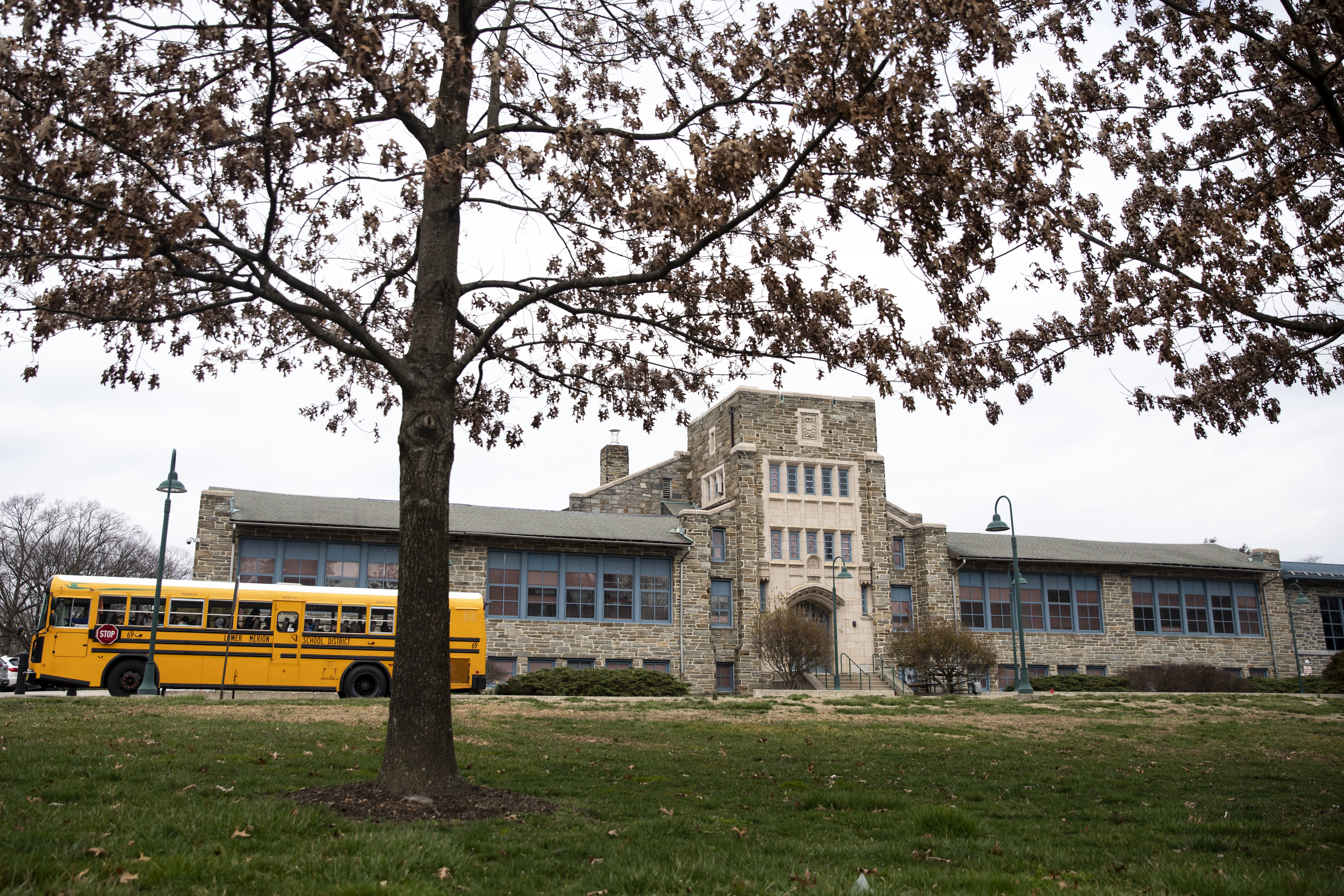
    Kindergartners, first graders, and second graders in Lower Merion schools will no longer receive personal iPads and laptops, under a policy passed by the school board Monday scaling back on students’ technology use.

    The policy — which also specifies that third and fourth graders will not bring computers home and limits fifth and sixth graders’ use of computers at lunch and between classes — follows backlash from parents who have been confronting the board since spring about the use of screens in schools. These parents fault the district for providing their kids with devices they say distract them in the classroom, expose them to dangerous content, and fail to help them learn.

    “We heard legitimate concerns and undertook an unusually significant amount of time to really make substantial change,” Anna Shurak, the board’s policy committee chair, said at Monday’s meeting, noting that the district will also give teachers and parents new tools to monitor what kids are doing on their laptops.

    “What we actually will see will be much different when students walk into school this fall,” Shurak said.

    The changes come amid increasingly heated debate in the affluent Montgomery County district, as parents nationally demand more say in how their kids interact with technology in schools. A Lower Merion parent group that petitioned this spring for the ability to reject one-to-one devices — a request refused by the district’s superintendent — had urged the board not to adopt the new policy, arguing it did not go far enough.

    After parents shouted at the board during a meeting earlier this month, it went into recess and moved the meeting online — and announced late last week that Monday’s meeting would be online only, citing disruptions and “threatening comments posted on social media pages.” The district has banned two parents from school board meetings for a year.

    “Over the past several months, Lower Merion school board members and our school district superintendent have been subject to threats, our meetings have sustained disruption over and over, and we have witnessed harassment during our public meetings,” board president Kerry Sautner said at the start of Monday’s meeting, adding that “our school team has had their home and families harassed.”

    “This is unacceptable,” Sautner said.

    District spokesperson Amy Buckman said that comments posted on the Facebook page for Pencils Over Pixels, the parent group pushing for less technology use, “included calls for both death and doxing of Lower Merion School District leadership.”

    The comments “were viewable for approximately 48 hours (and maybe longer),” Buckman said in an email.

    In a statement Monday, Pencils Over Pixels said it was “horrified by threatening, violent, or hateful comments directed at board members and district employees.” The group, which has enlisted a public relations firm to help promote its message and has gained national attention, said it did not believe the comments came from its members, and once it became aware of them, “we deleted and reported them.”

    The controversy, it said, reflected why the parents have been pushing back on screens in school.

    “What chance do children and teenagers have in this toxic digital environment while their brains, judgment, and emotional regulation are still developing?” the group said.

    The district is strengthening its filtering system to block kids from inappropriate sites, and parents will be able to restrict what kids can access on their school-issued devices in their homes, Shurak said.

    The new technology policy makes clear that “teachers and relationships are central to learning,” Shurak said. “Technology is a tool, not a substitute for instruction.”

    Tech changes by grade level

    The new policy ends Lower Merion’s practice of giving personal devices to kindergartners, first graders, and second graders.

    In the classroom, any use of devices at those grade levels “shall be minimal, highly structured, and limited to specific educational purposes such as diagnostic testing, whole-class demonstration, visual display, or, if applicable, state testing preparation,” the policy says. (Pennsylvania’s standardized tests, which start in third grade, are required to be done online.)

    In third and fourth grades, students will have “teacher-directed” access to devices that remain in the classroom, while starting in fifth and sixth grades, kids will be issued individual devices. But they will stay in classrooms unless parents want their kids to bring them home, according to the policy.

    By seventh and eighth grades, kids may take their devices to and from school under the policy, though they will not be penalized for not completing any computer-based homework, district officials have said.

    The policy describes giving students increased independence with devices to form “responsible digital habits,” preparing high schoolers for college and careers.

    Theresa Doggett, a parent of three children in district elementary, middle, and high schools, said the district was making substantial changes.

    Because of pushback from parents, “public narrative is making it sound like nothing’s being done,” said Doggett, an administrator at a charter school network in Philadelphia. With help from another parent, she wrote and circulated an open letter to support the board and administrators that read in part: “Enough is enough.”

    “We cannot continue creating conditions in which talented educators and leaders spend disproportionate amounts of their time responding to conflict, personal attacks, and the demands of whichever voices are loudest rather than leading our schools,” the letter says, noting high turnover in Lower Merion’s superintendent job.

    Questions about implementation

    But in comments submitted via chat and read aloud by the district’s solicitor during Monday’s meeting, parents continued to question how the policy would play out in practice.

    Some noted the lack of strict limits on screen time. Administrative rules accompanying the policy list guidelines for how much time students should “typically” spend on devices each day: less than 30 minutes for third and fourth grades, 60 minutes for fifth and sixth grades, 90 minutes for seventh and eighth grades, and 120 minutes for high school.

    The rules also describe “allowing reasonable flexibility based on educational purpose.”

    The policy “leaves devices in my 7-year-old’s classroom and sets no enforceable limit on how long she uses them,” said Akshaya Kumar, a lawyer who teaches at Columbia Law School. She also questioned a separate technology safety policy passed by the board Monday, noting it does not require the district to tell parents what it sees while monitoring student devices.

    Michael Post, a physician with two children in the district, said he had “never seen a group of people so adamantly disregard what is happening in front of them.”

    “The amount of research and data showing educational technology harms to our children are astronomical,” Post said. He called on the district to form an expert panel to advise it on technology use and “eliminate all technology for elementary and middle school.”

    One parent expressed an opposite concern — wondering if children would still be able to take home Chromebooks to do accelerated math, and if her fourth grader would have the same chance to learn how to create PowerPoint presentations as her seventh-grade son.

    “Our community does not have one perspective on technology,” Shurak said.

  • ICE pitches legal insurance to help shield local officers who make immigration arrests

    ICE pitches legal insurance to help shield local officers who make immigration arrests

    U.S. Immigration and Customs Enforcement is pitching a plan to help shield local police officers who make immigration arrests from possible financial consequences if they are accused of on-duty misconduct.

    The agency is proposing to subsidize liability insurance for state and local officers who are trained and deputized to enforce federal immigration laws, according to a planning document published Friday.

    ICE’s partnerships with local departments have soared since President Donald Trump returned to the White House last year and may get an additional boost with liability insurance by removing a hurdle that has made some local police departments reluctant to join. The Associated Press is the first to report on this insurance proposal.

    Under the plan, officers would purchase insurance covering up to $500,000 in personal liability, which typically funds legal fees, settlements, and judgments. Officers would be reimbursed up to $250 annually — roughly what the insurance is expected to cost.

    One prominent critic of ICE’s immigration crackdown said the program would be yet another way for officers to avoid personal accountability for misconduct.

    “The concern here is that ICE is going above and beyond to guarantee law enforcement does not have even the slightest risk of liability for violating Americans’ rights while helping ICE arrest people,” said David Bier, director of immigration studies at the Cato Institute, who has called on Congress to make it easier to sue ICE agents for wrongdoing.

    ICE outlined the plan in a document informing industry officials that it is considering hiring a contractor to help provide outreach, training, and communications support for its so-called 287(g) partnerships with local departments, which are named for a section of a 1996 immigration law. The contractor would hire the insurance vendor and process the reimbursements, among other tasks.

    ICE has asked for industry feedback by Thursday. The proposed timeline for launching the program and its estimated cost are unclear.

    ICE had no immediate comment on the plan.

    Arrests by ICE’s local partners have spiked since last year

    During Trump’s second term, ICE has offered generous financial incentives to participating local agencies, increasing the number who have partnered with the federal government, as well as the number of arrests.

    Nearly 1,600 agencies in 32 states now have agreements to participate in ICE’s task force model, in which trained local officers can interrogate, arrest, and charge people suspected of being in the country illegally, according to ICE data.

    Departments qualify for funding to help cover expenses like their officers’ pay, equipment, and vehicles. With encouragement from state and local Republican officials, agencies in Florida, Texas, Oklahoma, and Georgia have been among the leaders.

    Arrests made through such programs jumped to an average of 3,000 per month in the first two months of 2026, according to the most recent ICE data provided to the University of California Berkeley’s Deportation Data Project. That compares to a monthly average of 250 in 2024 under President Joe Biden.

    Local departments, officers worried about liability for ICE work

    As local officers increasingly carry out federal immigration work, they and their departments have expressed concerns about the civil liability that could result from claims alleging excessive use of force, wrongful arrest, and illegal search and seizure, among other things.

    That’s because insurance policies that cover their local work may not apply. Pennsylvania’s risk pool, for instance, recently made clear that it would exclude “proactive immigration enforcement activities” from coverage, forcing several participating counties to search for other insurance options.

    Butler County Sheriff Michael Slupe said he found insurance to cover his 13 deputies participating in the program at a cost of $20,000 in annual premiums.

    “I want to make sure the guys are additionally covered, so we had to spend the money,” he said, adding that federal funding would cover the cost.

    Federal officers usually enjoy legal immunities and a government-funded defense when they face lawsuits. But those protections may not always apply to local officers, which has heightened their concerns over liability and the need for insurance.

    While lawsuits are the main concern, professional liability insurance typically helps cover legal fees for officers facing criminal investigations as well.

    Sheriffs’ group says ICE’s idea sounds promising

    Justin Smith, a former Colorado sheriff who is executive director of the National Sheriffs’ Association, said ICE’s plan sounds promising and that he was anxious to speak with ICE about how the plan would work.

    Smith said he has shared concerns with ICE that some sheriffs are reluctant to join the partnerships because of the potential liability at a time when immigration enforcement faces intense public protests and media scrutiny. Smith said others who are partnering with ICE have already started facing legal claims tied to their immigration work, which can be costly whether or not deputies are ultimately found to have done anything wrong.

    “Right now, any time you are working on immigration there is going to be a much higher potential for there being problems and having suits and issues,” he said. “They’re recognizing that it is a different environment. And I think trying to be good partners with us as best they can.”

    Under their agreements, ICE warns local departments that they are responsible for the costs of incidents that give rise to liability. But it seeks to reduce the risk by saying local officers performing ICE-authorized functions are “acting under color of federal authority,” which would bar lawsuits against individual officers.

    The agreements also state that local officers who face lawsuits can ask the U.S. Department of Justice to represent them, and that ICE will generally support their requests. But the final decision on whether to do so rests with the Department of Justice.

  • Pentagon weighing smaller U.S. military presence in Gulf once Iran war ends

    Pentagon weighing smaller U.S. military presence in Gulf once Iran war ends

    The Pentagon is evaluating its military footprint in the Middle East in an early sign of the Iran war’s potential to transform the U.S. presence in the region, according to eight people, including officials and others familiar with the matter.

    One of the key areas the Defense Department is assessing is whether to pull back troops from the Persian Gulf, where America’s large overseas military bases have been battered by months of Iranian strikes, two people familiar with the ongoing analysis said.

    The damage to these facilities has prompted a once-in-a-generation chance for the Pentagon to reconsider its presence in the region. The Defense Department has already signaled that it might not rebuild its bases as they were before the conflict.

    The evaluation is being led by the Pentagon’s policy office, though a senior Pentagon official, who like others spoke on the condition of anonymity to discuss the sensitive analysis, said that the Joint Staff and U.S. Central Command were also studying the issue.

    Defense Secretary Pete Hegseth had not yet ordered a formal review of U.S. posture in the region, the official said. Instead, the official cast the analysis as “prudent planning” that could eventually inform how the administration addresses whether to rebuild the bases damaged during the war.

    “Decisions are going to have to be made on some of this stuff,” the official said.

    U.S. Central Command, which runs U.S. military operations in the Middle East, normally stations about 40,000 troops across almost 20 sites in a 1,500-mile arc from Jordan to Oman.

    Since early this year, the military has surged warships, fighters, air defense assets and other scarce military equipment to the region to defend U.S. forces and carry out more than 13,000 strikes against Iran.

    America’s largest and most permanent bases in the Middle East are in the Persian Gulf, where Bahrain hosts the headquarters of the U.S. Fifth Fleet and where other states, such as Kuwait, house Army and Air Force assets.

    Allies in the Gulf have for decades depended on U.S. forces for their defense. Any regional drawdown could leave states unable to defend themselves against Iranian attacks. Investing in domestic capabilities or partnering with other powers to offset the shortfall could take months to years.

    People familiar with the Pentagon’s analysis said the issue is likely to intensify a debate between camps within the administration that support military interventions and others that have argued the Pentagon should curtail some of its security commitments to refocus on defending the U.S. homeland or deterring more powerful adversaries, like China.

    The discussions have also involved Adm. Bradley Cooper, the head of U.S. Central Command, who supports deliberations about potentially moving U.S. troops west from the Persian Gulf, said a U.S. official.

    A spokesperson for U.S. Central Command declined to comment.

    Before the start of the war in February, U.S. Central Command evacuated many of its bases, judging them too vulnerable to Iranian missile and drone attacks to maintain normal staffing levels. Some of the shifts away from the major Gulf facilities might last after the war, a person familiar with the posture adjustments said.

    “Iran thinks we are in the traditional places,” the person said, declining to specify the changes so as not to put U.S. service members at risk. “And we are not.”

    Six U.S. service members were killed in a March strike on Port Shuaiba, a military facility in Kuwait, and more than 200 U.S. facilities have been damaged or destroyed during the conflict, the Washington Post reported in May.

    While defending its personnel in the region, the U.S. military has also expended more than 1,000 sophisticated air-defense interceptors, draining the Pentagon’s stockpile of Patriot and Terminal High Altitude Area Defense missiles, the Post reported in March.

    “The war really did highlight the vulnerability … of U.S. forces in the region,” said Michael Ratney, a former diplomat who served as the U.S. ambassador to Saudi Arabia and the deputy chief of mission in Qatar.

    Moving troops and equipment further west to Jordan, Israel, or the Red Sea coast of Saudi Arabia could help alleviate some of the pressure, he argued, while noting the added distance wasn’t a “perfect solution to this problem.”

    Iran has already demonstrated it can strike faraway targets in Jordan and Israel. Last month an Iranian attack on Jordan killed four U.S. service members.

    Tehran’s retaliatory attacks against bases in the Persian Gulf plunged the region into crisis and are stoking frustration among core U.S. allies there, who feel they were not properly consulted by the Trump administration before starting the war.

    Allison Minor, who served during the first Trump administration as the director for Arabian Peninsula affairs on the National Security Council, said the Gulf countries could maintain elements of their security partnership with the U.S. — such as arms sales and intelligence sharing — while hosting a smaller troop presence.

    “But you need to be discussing all of those comprehensively and not just the question of the sheer number of troops,” she said.

    The Pentagon has publicly estimated that the war’s cost will reach about $37.5 billion by the end of September, but that price tag does not account for the money it will take to rebuild bases in the region.

    Jules Hurst III, the Defense Department’s comptroller, told the Senate in May that the reconstruction costs were being left out because the administration has not yet decided how it wants to rebuild from the damage.

    In April, the center-right American Enterprise Institute estimated it would cost $5 billion to repair the U.S. bases that have been targeted.

    Multiple people familiar with the Pentagon’s analysis cautioned that any permanent changes to U.S. posture were still distant and would require the approval of senior administration officials.

    In June, President Donald Trump signed a preliminary peace deal with Tehran and signaled that the war was coming to a close. The agreement later collapsed, and the two sides have sporadically exchanged strikes in the months since.

    A recent policy proposal from Defense Priorities, a think tank that advocates for military restraint, calls for closing U.S. bases in close striking range of Iran’s missiles and drones, such as Kuwait. The proposal also calls for moving forces dispersed in the United Arab Emirates, Jordan, and Bahrain to more secure facilities such as the Prince Sultan Air Base near Riyadh.

    More hawkish voices in Washington have sought to influence the Pentagon’s planning by proposing the movement of U.S. troops in the region to Israel. A report by the pro-Israel group Jewish Institute for National Security of America in March called for more U.S. military assets to be moved to Israel’s Ovda Airbase.

    This winter, in the run-up to Operation Epic Fury, Washington sent F-22 Raptor fighter jets to the base in a sign of deepening U.S.-Israel military relations.

    There is disagreement within the Trump administration over that recommendation given concerns that an expanded U.S. presence there could pose a counterintelligence vulnerability amid the Pentagon’s growing concern about Israeli espionage.

    Also, the office of Undersecretary of Defense for Policy Elbridge Colby has launched a public review of America’s military presence in NATO, after the Trump administration announced it was pulling thousands of troops out of Germany and Poland. The study is set to conclude in December.