Philadelphians can expect to see fewer children darting through water geysers in front of City Hall and paddling around the pond at Sister Cities Park in the coming decades.
The city and suburbs are losing their populations of kids, and fast.
Between 2010 and 2025,Philadelphia’s number of residents under 18 dropped by 31,038, to 312,490 children in 2025 — a decline ofabout 9%, according to an Inquirer analysis of Census Bureau data. That trend is even more dramatic for children under 5, whose population fell 12%. Those are notable shifts when compared with the city’s overall population gain of about 3%.
This is not unique to Philly. In the last 15 years, nearlyevery major U.S. city has lost residents under 18, said Katie Martin, who directs research on Philadelphia trends and public opinion for Pew Charitable Trusts. And elsewhere in the Philadelphia region, every suburban county has seen its number of children decline during that span. The trend has the potential to become a big workforce and financial problem if it does not turn around.
Demography expertssay surveyrespondents often cite the climbing cost of living and political concerns as reasons for not having kids. Beyond logistics, people in the Philadelphian area say, the decision to not have children is driven by a desire for freedom and flexibility.
“I feel like I wouldn’t have been able to do and experiment as much … if I had been responsible for other human lives,” said Maureen Ferguson, 44, of Souderton, Montgomery County, who has never looked back on her choice to not have kids, filling her life with artistic endeavors like music, theater, illustration, and stand-up comedy.
The population and societal trends driving Philly’s drop in kids
A confluence of changes in population trends is helping demographers piece together what is driving the drop in kids.
For one, a reduction in teen pregnancies and births is changing the landscape. Teen births in Philadelphia fell from 3,072 in 2010 to 809 in 2025, according to data Martin and Pew sourced from the state.
“That has been a huge change,” Martin said. “Not just in Philadelphia, but something you’re seeing nationwide.”
It is a component of a larger trend of having children later in life, she said, which usually leads to each family having fewer children overall.
The pandemic may have contributed as well, as the data show a particularly sharp decline in the number of children in the city between 2020 and 2023.
The counties around Philly have likewise seen notable drops in their populations of children. Between 2010 and 2025, declines in the number of children ranged from 3% in Montgomery County to 12.7% in Bucks County.
Finances have been a recurring theme, Martin said. In a survey Pew conducted last year in Philly, both women and families rated their financial situation as worse than during the pandemic.
(function(){function e(){window.addEventListener(`message`,function(e){if(e.data[`datawrapper-height`]!==void 0){var t=document.querySelectorAll(`iframe`);for(var n in e.data[`datawrapper-height`])for(var r=0,i;i=t[r];r++)if(i.contentWindow===e.source){var a=e.data[`datawrapper-height`][n]+`px`;i.style.height=a}}})}e()})();
Rising housing and childcare costs are likely contributing to the trend in Philly and beyond, said Genevieve Diebold, a senior planning data specialist with the Delaware Valley Regional Planning Commission. She added that fertility rates started decreasing meaningfully following the Great Recession of 2007-09.
Costs are certainly one thing that have deterred Avery Walker, 32, who lives in Point Breeze.
“I know how expensive children are,” she said. “They are a drain on all of your resources — mentally, emotionally, physically, financially — and I would have to give up a lot.”
Prioritizing freedom and flexibility
For Walker and othersThe Inquirer interviewed who do not have kids and do not plan to, the reasoning runs deeper thancost. It comesfrom a desire to live spontaneously and prioritize hobbies, health, and relationships with partners and friends.
Walker, who works in supply chain, likes living on her own schedule, sleeping in, traveling, trying new restaurants, and attending concerts and does not want to give up or modify how she does those things in the ways she likely would need to if she had kids, she said.
Jennifer Gamba, a 48-year-old paralegal in Fairmount, has been married to her husband for about 14 years. They never had strong feelings one way or another about having kids, Gamba said. Over time, the biological door began to close, and that was OK with them.
“It just wasn’t really something we prioritized,” she said.
Maintaining a good relationship with her husband, managing her rheumatoid arthritis, running marathons, and exploring national parks took precedence over kids.
“I think you have to be all in, and I don’t know that I am all in,” Gamba said. “I think I could do it, but it might not have been the best version of me.”
For Kelley Galloway, a 38-year-old real estate agent in Fishtown, finances and politics are factors. The idea of raising children, especially girls, in this political and economic climate is scary, she said. But those issues just reaffirmed the decision she had made long ago.
Throughout her adulthood, Galloway has focused her energy on buying a home, creating a dinner club for women in Philly, advancing in her career, and traveling.
“I went to three concerts this week, and none of them were planned,” Galloway said. “That’s something I could never do if I had children, and that’s why I moved to the city. I wanted to be able to enjoy my life and experience things.”
Jessica Hawk, 57, always knew she didn’t want kids. She never liked playing with dolls as a child, preferring instead to play manager or teacher.
“Whatever that maternal thing is that drives you to have a child, that is missing in me,” Hawk said.
The retired English teacher in Glassboro, Gloucester County, has one million TikTok followers for her videos about education, but she started receiving attention from a different faction about six years ago when she began posting about being happily child-free. Her videos were seen around the world and resulted in her doing interviews for Russian and German media, she said.
“I had so many women in my DMs saying to me, ‘I wish I could forgo having children but, in my culture or in my family or in my religion, I don’t have a choice,’” Hawk said.
She spoke out, she said, to help women who don’t want kids understand just how many like-minded others are out there.
What does this trend mean for the region’s future?
This population shift could become even more stark, and eventuallyspell major issues for the city and the suburbs.
Foreign-born residents have been driving the region’s population growth in recent years. Since those residents tend to have more children than people born in the United States, the immigrant population may be mitigating the drop in young residents and masking what would be an even more dramatic decline, said Letícia J. Marteleto, a sociology professor at the University of Pennsylvania.
But that balance may be short-lived as President Donald Trump’s administration continues its dramatic efforts to curb immigration.
An uneven distribution ofyounger and older residents could compromise bedrock systems designed to keep people financially secure and physically healthy into old age.
Social Security and Medicare rely on contributions from those in the workforce. If there are fewer young people paying into the system and more older people extracting from it, it is increasingly difficult to cover each older resident.
“The whole thing becomes very expensive,” Marteleto said.
The healthcare system, she said, would become similarly imbalanced, an especially acute problem in a place that dubs itself a city of “eds and meds.”
Those dire consequences are a long ways away, she said, but, at this point, it is hard to imagine the population trends turning around without significant government intervention like affordable childcare, housing, and healthcare.
“If we don’t do the necessary things to provide women with the right circumstances for wanting to have more children,” Marteleto said, “we are going to keep getting what we are getting.”
Correction: Philadelphia’s population change was previously misstated. Population grew by 3%.
MIAMI — Tropical Storm Isaias formed early Wednesday in the warm waters off eastern Mexico and forecasters said it was expected to strengthen into the first hurricane of the Atlantic season before hitting the U.S. Gulf Coast later in the week.
Isaias was centered about 285 miles west of Progreso, Mexico, and about 580 miles southwest of the Mississippi River’s mouth, according to the Miami-based National Hurricane Center. It had maximum sustained winds of 40 mph and was moving east-northeast at 8 mph.
It was not immediately known where the storm may make landfall on the Gulf Coast. The hurricane center’s initial projections said the center of Isaias could come onshore late Friday or early Saturday somewhere between eastern Louisiana and the western Florida Panhandle. People in those areas were urged to prepare for the storm.
“There is an increasing risk of dangerous wind and storm surge impacts along portions of the northern Gulf Coast,” the hurricane center said. “Residents from Louisiana to the Florida Panhandle should closely monitor the latest forecast updates and ensure they have their hurricane plan in place.”
Florida Gov. Ron DeSantis declared a state of emergency for 25 counties in the Panhandle and Big Bend regions. The declaration activates the state’s emergency management plan to prepare for hurricanes and other potential natural disasters, allowing actions including the deployment of personnel and equipment to respond.
Isaias, pronounced ees-ah-EE-ahs according to the hurricane center, is expected to bring areas of heavy rain to portions of the Gulf Coast and much of the U.S. Southeast on Friday and into the weekend, forecasters said.
The storm comes as the Atlantic hurricane season has been unusually quiet this year due to a strong El Niño, which disrupts storm formation over that ocean. Storm activity in the Pacific has been above average.
The Eagles released their first injury report of the week on Wednesday evening, and it was a long one — but it wasn’t all bad news.
While the report included some notable absences, a few were expected. Saquon Barkley (hamstring), DeVonta Smith (hamstring), and Marcus Epps (groin) were all held out. Wideout Hollywood Brown (ankle) and center Drew Kendall (knee) also missed practice, with the last name being especially notable given the current state of the offensive line. The team was also without linebackers Jihaad Campbell (knee) and Jonathan Greenard (ankle).
But linebacker Zack Baun (concussion) and tight end Dallas Goedert (knee) both returned to practice in a limited fashion, as did corner back Quinyon Mitchell, who left Sunday’s loss to the Rams with a knee injury. Offensive tackle Fred Johnson was also a limited participant.
Wednesday Eagles practice report:
DNP
Saquon Barkley (hamstring) Hollywood Brown (ankle) Jihaad Campbell (knee) Marcus Epps (groin) Jonathan Greenard (ankle) Drew Kendall (knee) DeVonta Smith (hamstring)
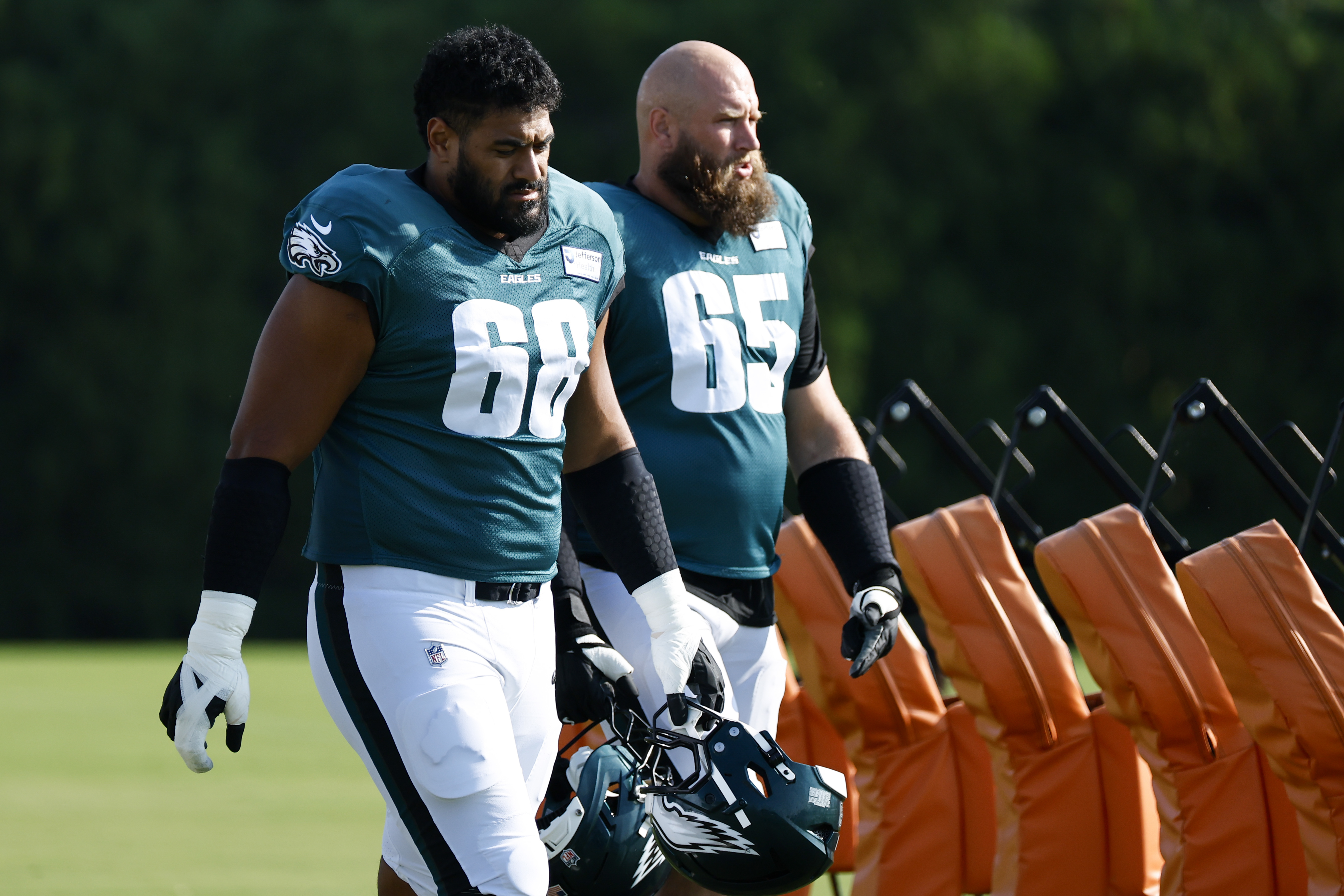
With Lane Johnson officially retiring, Eagles rookie Markel Bell, who started Sunday against the Rams, will now be the team’s full-time starter. He’s thankful he got to learn from Johnson for as long as he did.
Markel Bell said he is "grateful" to have spent time with Lane Johnson since OTAs. He said he'll take his wisdom with him going forward.
But the former Miami Hurricane has actually been learning from Johnson longer than that, thanks to his OL Masterminds summit.
Found this video from last year’s OL Masterminds summit. Lane Johnson answering questions and giving tips to Francis Mauigoa, who’s now with the Giants, and Markel Bell, Mauigoa’s teammate at Miami.
Jordan Mailata recalls a tearful moment with Cam Jurgens
Jordan Mailata on Cam Jurgens: "We shared a moment, Cam and I, where we cried…. You think about all memories. Won a lot of games here. Won a championship here. … In a moment of embrace you kind of forget about everything and you just try to savor the last moment you have …" pic.twitter.com/SLzhuPRWCE
Eagles running back Dameon Pierce will likely back up Will Shipley on Sunday.Monica Herndon / Staff Photographer
With Saquon Barkley week-to-week with a hamstring injury and backup Tank Bigsby landing on IR, the Eagles added some depth at running back by signing Dameon Pierce to the active roster.
#Eagles have officially signed RB Dameon Pierce to the active roster and WR Erik Ezukanma to the Practice Squad.
The Eagles added Pierce in the offseason, and he got the call back up Will Shipley, the only other healthy running back on the active roster, over Carson Steele and Jaydon Blue. The 26-year-old Pierce’s best season came as a rookie in 2022, when he appeared in 13 games and accounted for over 1,100 yards (939 on the ground) and five total touchdowns.
With Barkley expected to miss at least Sunday’s game in London, the Eagles could still look to add another running back to the roster before kickoff.
Jalen Hurts on Lane Johnson: ‘I wish to see him smiling again’
Jalen Hurts knows that Lane Johnson leaves a big whole in the right side of the Eagles offensive line, and not just because Lane Johnson was one of the best ever at his position. There was also a personal connection between the two, one that grew over time and left the Birds quarterback hoping his former right tackle “at peace.”
“There’s a comfort level in where we come from, our background, being from Texas, the relationship we have, and that’s a huge comfort level,” Hurts said Wednesday. “Someone you’ve played with, you’ve gone to bat with, you know them [and] they know you, and there’s a shift there. It’s a different thing for me to process in the middle of the season as a player, and I think as a person I wish to see him smiling again; I wish to see him happy and at peace and that’s what I sincerely wish for him.”
Jalen Hurts: ‘I got a lot of love for Lane and Cam’
Eagles center Cam Jurgens hugs quarterback Jalen Hurts late in Super Bowl LIX at the Caesars Superdome in New Orleans against the Kansas City Chiefs on Sunday, February 9, 2025.Yong Kim / Staff Photographer
Jalen Hurts has lost 40% of his starting offensive line in the last two days following Lane Johnson’s retirement Tuesday and the team’s trade of Cam Jurgens Wednesday. Despite two straight losses for the Eagles, it’s no surprise the big changes to his protection were the first topic Hurts was asked about when he met with the media after practice.
“You can’t replace what we’ve done and all the things that we’ve accomplished together, the memories,” Hurts said early Wednesday evening. “I got a lot of love for Lane and Cam, and I have a lot of love and gratefulness for the times we’ve spent together, the games we’ve played together, the adversity we’ve overcome, so I wish them nothing but the best with my sincerest heart.”
But all those memories and shared experiences won’t keep Hurts upright on Sunday in London when the Eagles face the Jacksonville Jaguars. He thinks Drew Kendall and Markel Bell — as well as Willie Lampkin, who is filling in for an injured Landon Dickerson — are up to the task.
“I feel good about the guys we have,” Hurts said. “I feel good about the work that we’re putting forward, and the week will tell how much that will improve.”
Hurts, who said he processed Jurgens trade news by getting back to work, also said that he got a chance to talk to Jurgens face-to-face after the deal went down.
“I actually ran into Cam after it happened,” Hurts told reporters. “And so I had my conversation with him as a teammate and as one that has had experiences and we’ve experienced the glory and overcome the things that we’ve overcome together. That’s a bond that not many can relate to or connect to. And so, like I said, I’m very grateful for that, and in the end it’s a commitment to the guys in this locker room and the objective of our team and what we have out there and what we’re trying to accomplish.
“We’ve got a lot of opportunity in front of us, we’ve got a lot of opportunity to improve, and we’re attacking that every day.”
Eagles still trying to win this year, Howie Roseman says
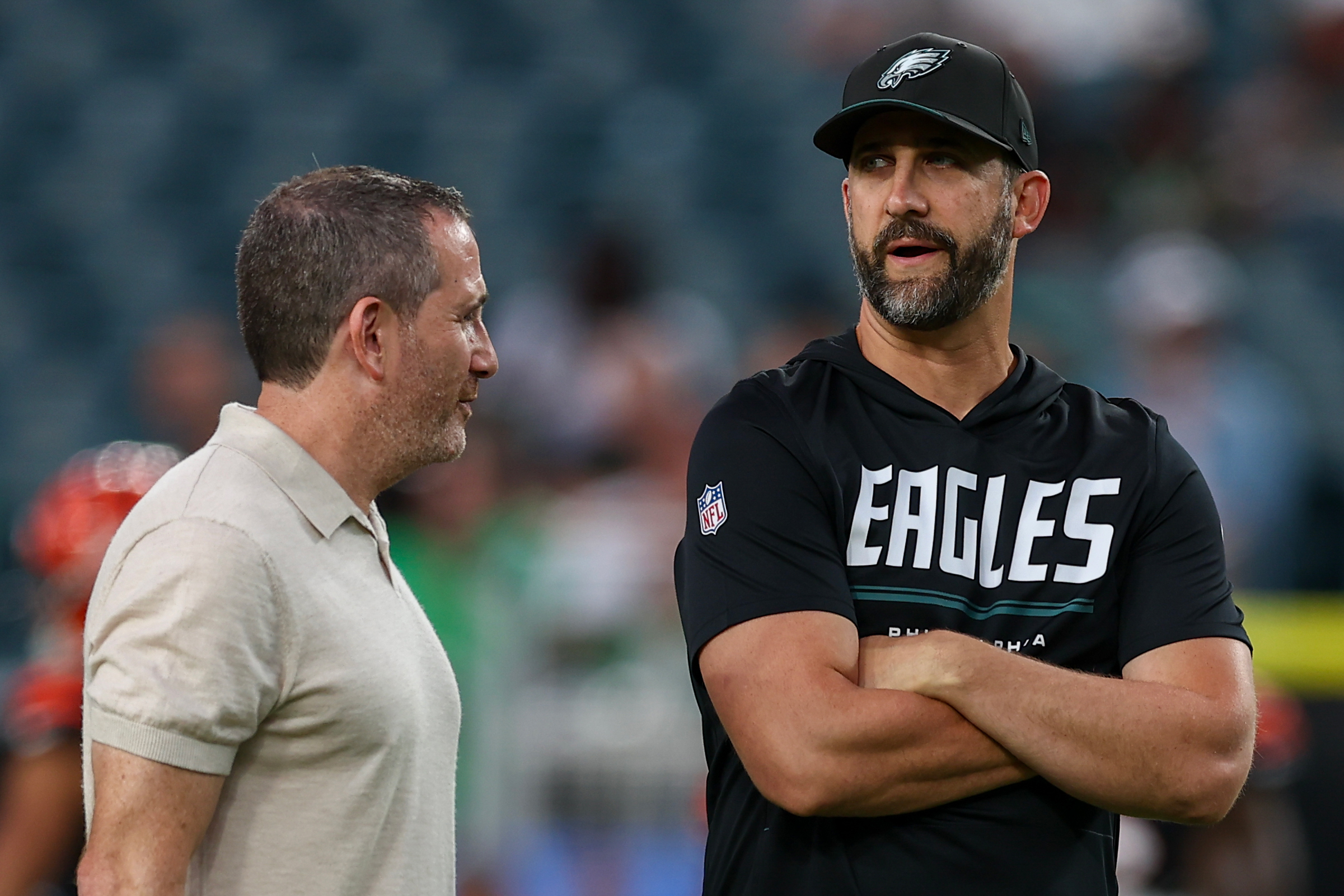
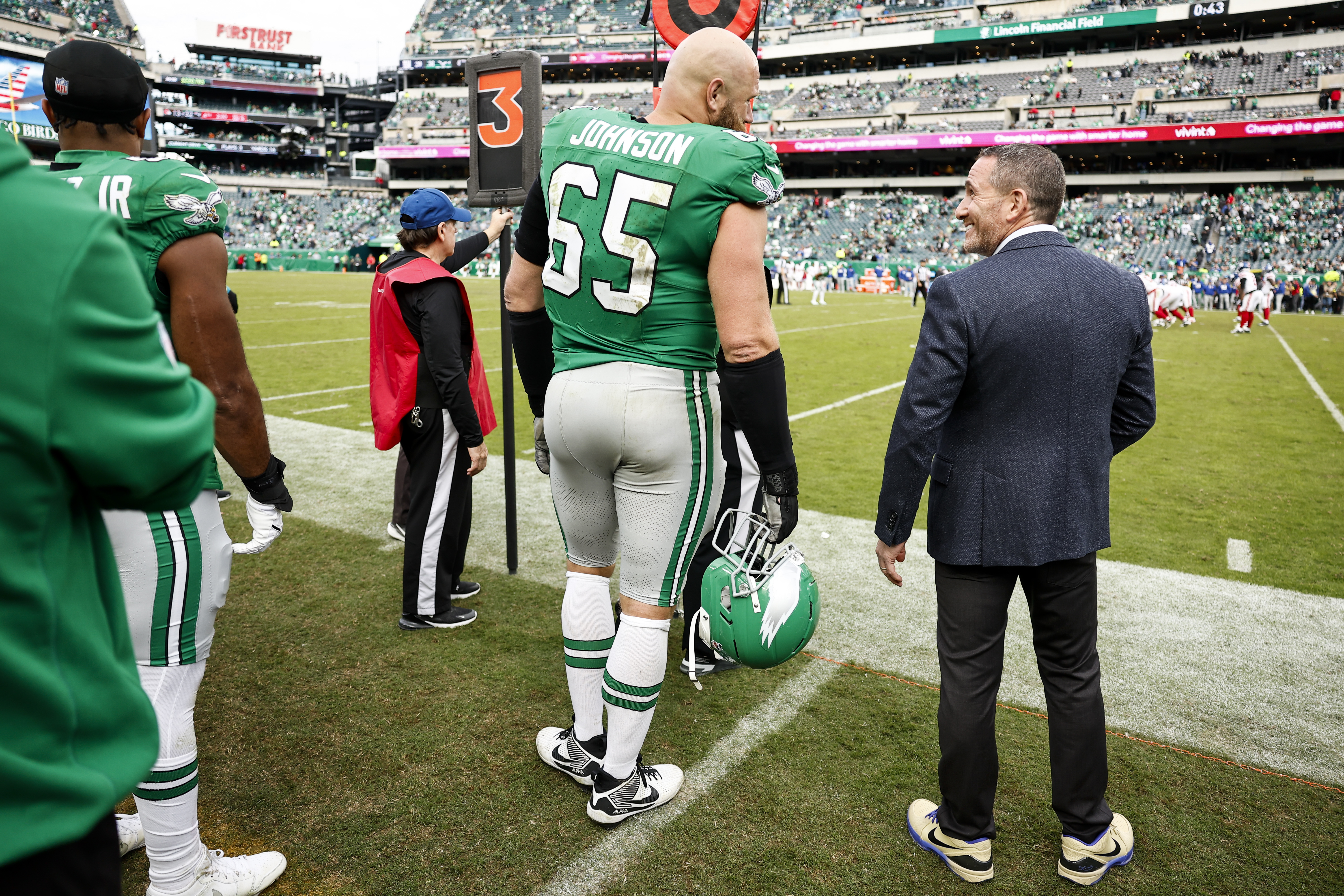
Eagles general manager Howie Roseman (left) talks to Eagles head coach Nick Sirianni.Monica Herndon / Staff Photo
The Eagles aren’t selling, Howie Roseman said Wednesday, and the retirement of Lane Johnson and the day-after trade of Cam Jurgens belong in “separate buckets,” according to the general manager.
“I think nothing has changed in terms of our goals,” Roseman said. “We’re trying to win this year. I think from my perspective, just looking at what is the ultimate goal, which is to win the last game of the year and then to have a run like we’ve had.
“You want to have an extended run. My job is to look at how we can have sustained success for a long period of time. You don’t get many opportunities to get second-round picks in trades and get flexibility.”
But losing Johnson is a big deal, as Roseman knows.
“Certainly Lane is a Hall of Fame player and I’m not going to discount that having Lane on this team has been a huge plus for us,” Roseman said. “He’s one of the best offensive tackles to ever play the game of football. When you lose a player like that, you’re not getting better.
“I think you put that in the other bucket, and you can’t then discount opportunities that you think give you a chance to compete for a long period of time because of other decisions. You have to operate kind of in a silo when you have these decisions otherwise you put yourself kind of in a situation where it compounds something that happened. What happened with Lane is in a separate bucket here and then you have to make a decision and say, all right, what is the value of this and how can this help us going forward?”
What about the 2026 Eagles?
“High expectations for the team this year,” Roseman said. “I think it’s very early in the season. You don’t want to compare it to any other seasons because it’s a different season.”
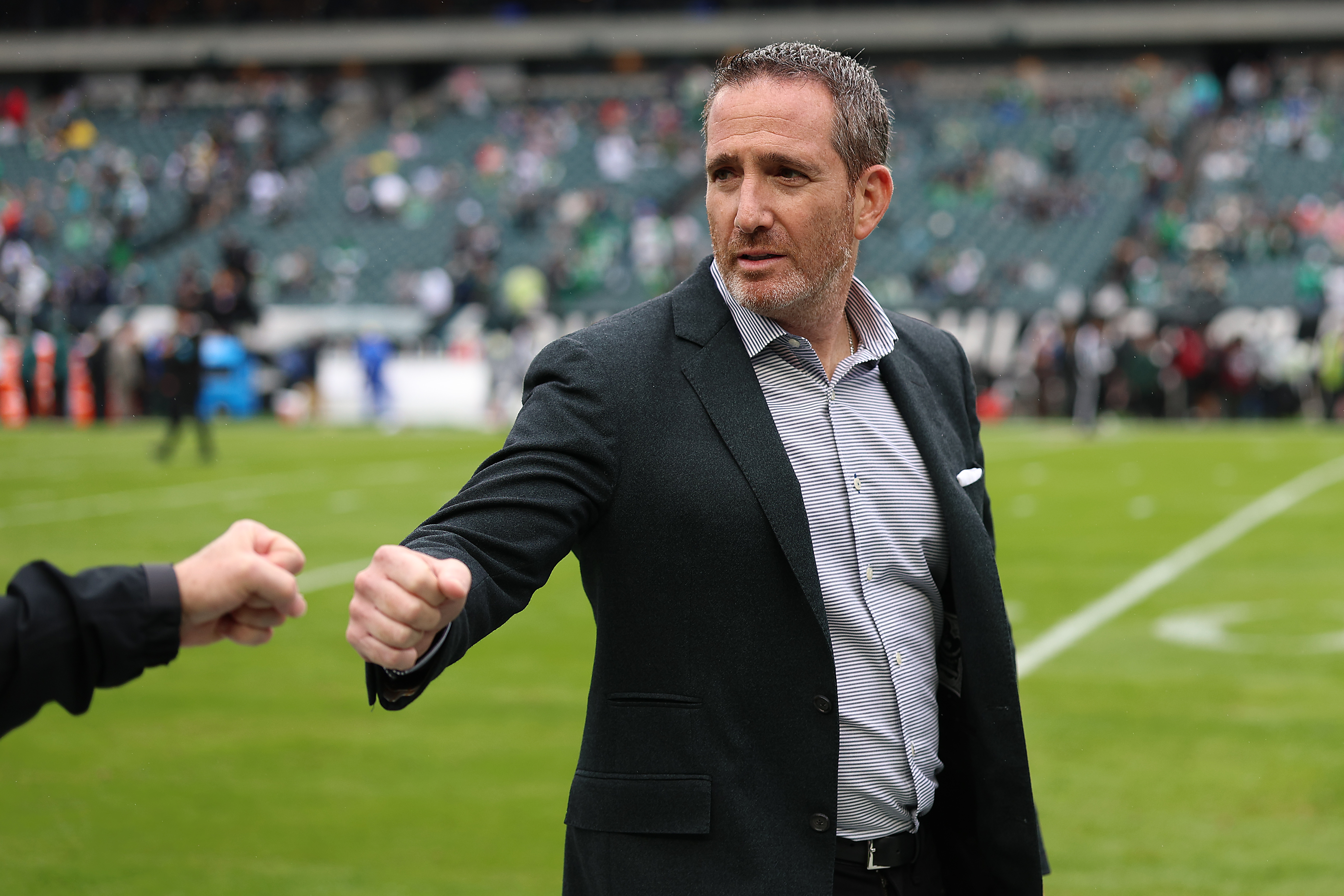
Eagles general manager Howie Roseman before Sunday’s loss to the Rams. David Maialetti / Staff Photographer
Eagles general manager Howie Roseman said he wasn’t necessarily looking to trade Cam Jurgens, but it got to a point where making a deal with the Ravens became a “win-win.”
“Obviously the Ravens have been looking for a center,” Roseman said on Wednesday afternoon. “They lost three centers. I speak to [Ravens GM Eric DeCosta] a lot. Originally I kind of told him it wasn’t anything we were looking to do. Over the last 24 hours it got to the point where we felt like it could be win-win.
“For them, obviously getting a player who had been a two-time Pro Bowl center for us. And for us being able to get the picks we were able to get and use that money, also, to sign players.”
The early success of Drew Kendall factored into the Eagles being willing to part with Jurgens.
“When you talk about the two and the five, moving from the seventh to the fifth – we’ve had success in the fifth round – plus the money, plus Drew playing, we felt like we were getting four players for one,” Roseman said.
The financials also were a factor. The bill is due for several young Eagles defensive players of the future, and the offense is going to need to get cheaper.
Jurgens signed a four-year, $68 million contract extension prior to the 2025 season and is under contract through the 2029 season.
“With all these guys that we got coming up, a lot on the defensive side of the ball that we want to re-sign and want to extend, [we] felt like that that was a good situation for us.”
“You walk away because it’s a very, very, very, very bad situation, and it doesn’t look to be getting any better,” Smith said. “And this brother said, ‘Hey, my life matters. It’s time. I’m going to call it’s quits. My mental health. My mental.’ “
Smith attempted to backtrack a bit following light pushback from guest Kimberley A. Martin and Chris “Mad Dog” Russo, but his lack of an apology for mocking the seriousness of Johnson’s issues drew a strong rebuke from the sports media world.
“From what I know of Smith, he is not a bad guy and he is smart enough to know when he is wrong. He should apologize,” wrote The Athletic’s Andrew Marchand.
Among those criticizing Smith’s comments was former Sixers announcer Marc Zumoff.
“Not knowing what Lane Johnson has mentally endured and dealt with is malpractice,” wrote Flyers radio host Jason Myrtetus. “Lane showed great courage to shine a light on mental health struggles and for him to be mocked this way is just wrong.”
Former Eagles defender Chris Long suggested fans Google “Stephen A Smith talks about mental health,” a reminder of a 2024 video the former Inquirer columnist filmed about his own struggle with depression after his brother died in a car accident and his mother passed away.
“There’s no debate when it comes to mental health,” Smith said in the video.
Ex-Eagles president says Ravens made an ‘awful trade’
Cam Jurgens will return to center with the Ravens. David Maialetti / Staff Photographer
Former Eagles president Joe Banner wasn’t shy about the Baltimore Ravens’ decision to trade for Eagles offensive lineman Cam Jurgens.
“This is an awful trade by Ravens,” Banner wrote on social media Wednesday. “Back injury and has played terrible for two years including at center. Shocking trade.”
The Ravens, decimated themselves by injuries at center, praised the addition of Jurgens.
“Cam is a player we have long admired going all the way back to the draft process,” Ravens general manager Eric DeCosta said in a statement. “He’s a young foundational piece along our offensive line — a great scheme and cultural fit who will contribute quickly in Baltimore. We are confident that Cam will significantly impact our team and community.”
For the Ravens, adding a center was a necessity after losing both Jovaughn Gwyn and Ethan Pocic in Week 3 and Danny Pinter during a joint practice with the Minnesota Vikings. Baltimore was forced to move rookie first-round pick Vega Ioane from right guard to center.
Eagles trade shows team’s confidence in Drew Kendall
Drew Kendall replaced Jurgens at center following Landon Dickerson’s injuryYong Kim / Staff Photographer
The decision to deal Cam Jurgens to the Baltimore Ravens doesn’t help the Eagles in the short term, but it signifies their belief in Drew Kendall at center moving forward.
The move to trade Jurgens is surprising, considering the injuries and Lane Johnson’s retirement.
Come on down, young O-linemen (Willie Lampkin, Micah Morris).
Landon Dickerson is eligible to return after Week 5 from injured reserve and figures to get the nod at left guard when he is healthy enough to play. Right guard Tyler Steen is set to be a free agent and his future is in doubt with the team.
Eagles center Cam Jurgens is heading to Baltimore.Yong Kim / Staff Photographer
The Eagles are trading Cam Jurgens and a 2027 seventh-round pick to the Baltimore Ravens in exchange for a 2027 fifth-round pick and a 2028 second-rounder, the team announced on Wednesday.
Prior to 2026, Jurgens, 27, spent two seasons as the Eagles’ starter at center (2024-25) and one season as the starter at right guard (2023). Jurgens started the first game of the 2026 season at center, but moved to left guard in Week 2 against the Tennessee Titans in the absence of the injured Landon Dickerson.
With Jurgens at left guard, the Eagles turned to Drew Kendall, the 2025 fifth-round pick out of Boston College, to take over at center. Kendall acquitted himself well in three games at center, while Jurgens struggled at left guard, casting uncertainty about his future role when Dickerson returns to the lineup.
Jurgens entered the concussion protocol on Monday in the aftermath of the Eagles’ Week 4 loss to the Los Angeles Rams.
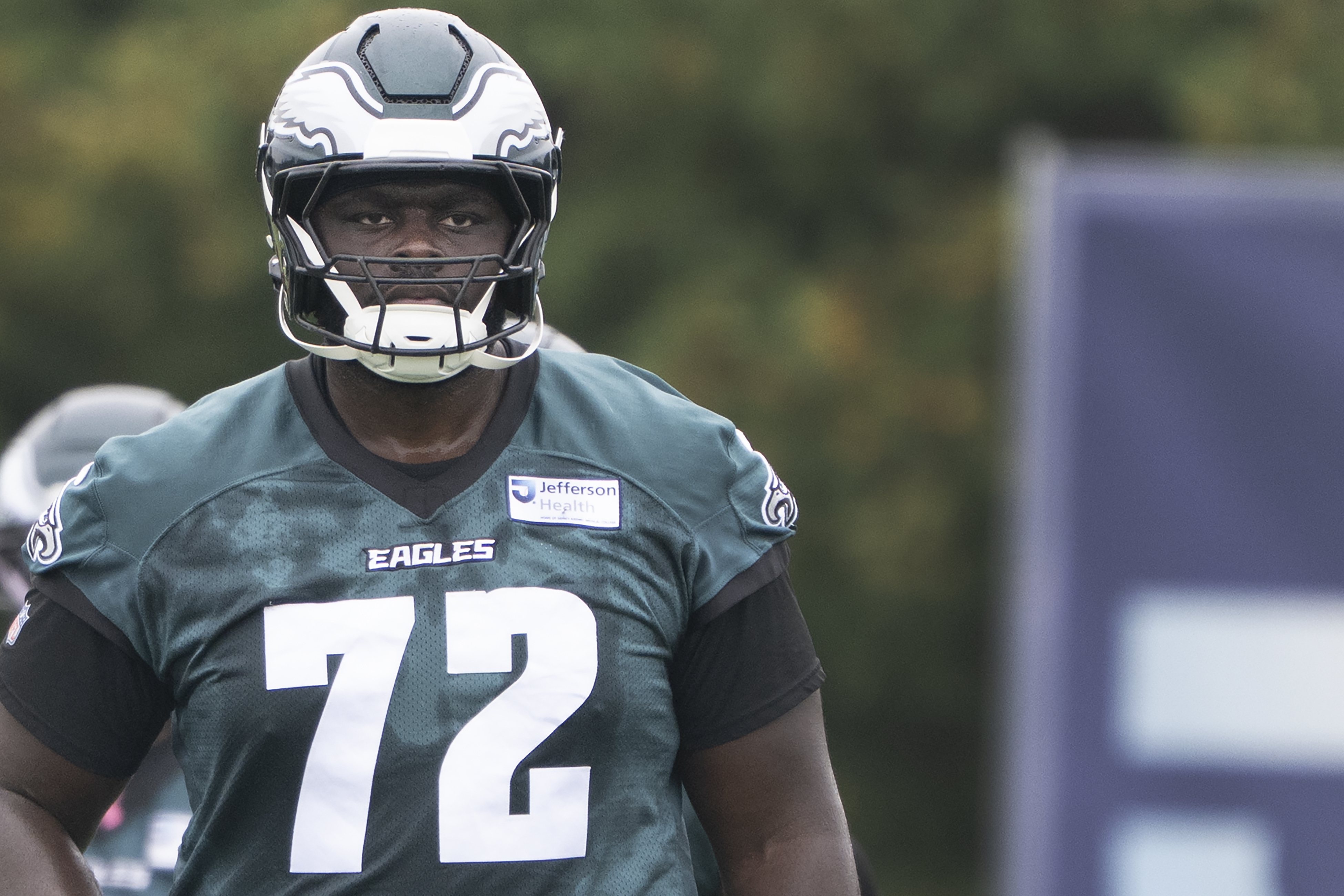
Nick Sirianni gave a vote of confidence to Lane Johnson’s immediate replacement Wednesday. He also left no doubt that Markel Bell will be the starter at right tackle on Sunday in London.
That may have been obvious, but the Eagles do still have Fred Johnson on the roster, though he’s been dealing with a knee injury.
Bell, a rookie third-round pick out of Miami, made his first NFL start in Week 4. The 6-foot-9, 346-pound tackle had some good moments but also struggled at times. He was charged with a team-high six pressures and three sacks allowed Sunday vs. the Rams.
Bell, who started every game for the national runners-up last season, will have a chance to learn more on the job moving forward.
“I love the draft pick that we have there, our decision to take him,” Sirianni said. “He’s highly talented and I’m so excited for his opportunity and what he can be.”
Bell only spent a brief time with Johnson this season, but Sirianni thinks it was valuable. You can watch film on some of the best players in the league — and Bell said after he was drafted that Johnson was someone he studied — but being around those players and seeing it up close is different, according to Sirianni.
“Those moments are invaluable and everything that you do helps,” he said. “Every purposeful step that you take, you grow in, and that certainly is one of those things you can grow in when you’re around guys like that.”
Eagles moving up RB Dameon Pierce following Saquon Barkley, Tank Bigsby injuries
Nick Sirianni confirmed that the #Eagles are elevating RB Dameon Pierce to the 53-man roster in light of injuries to Saquon Barkley (hamstring) and Tank Bigsby (groin).
Nick Sirianni on Lane Johnson: ‘I’ll miss him dearly’
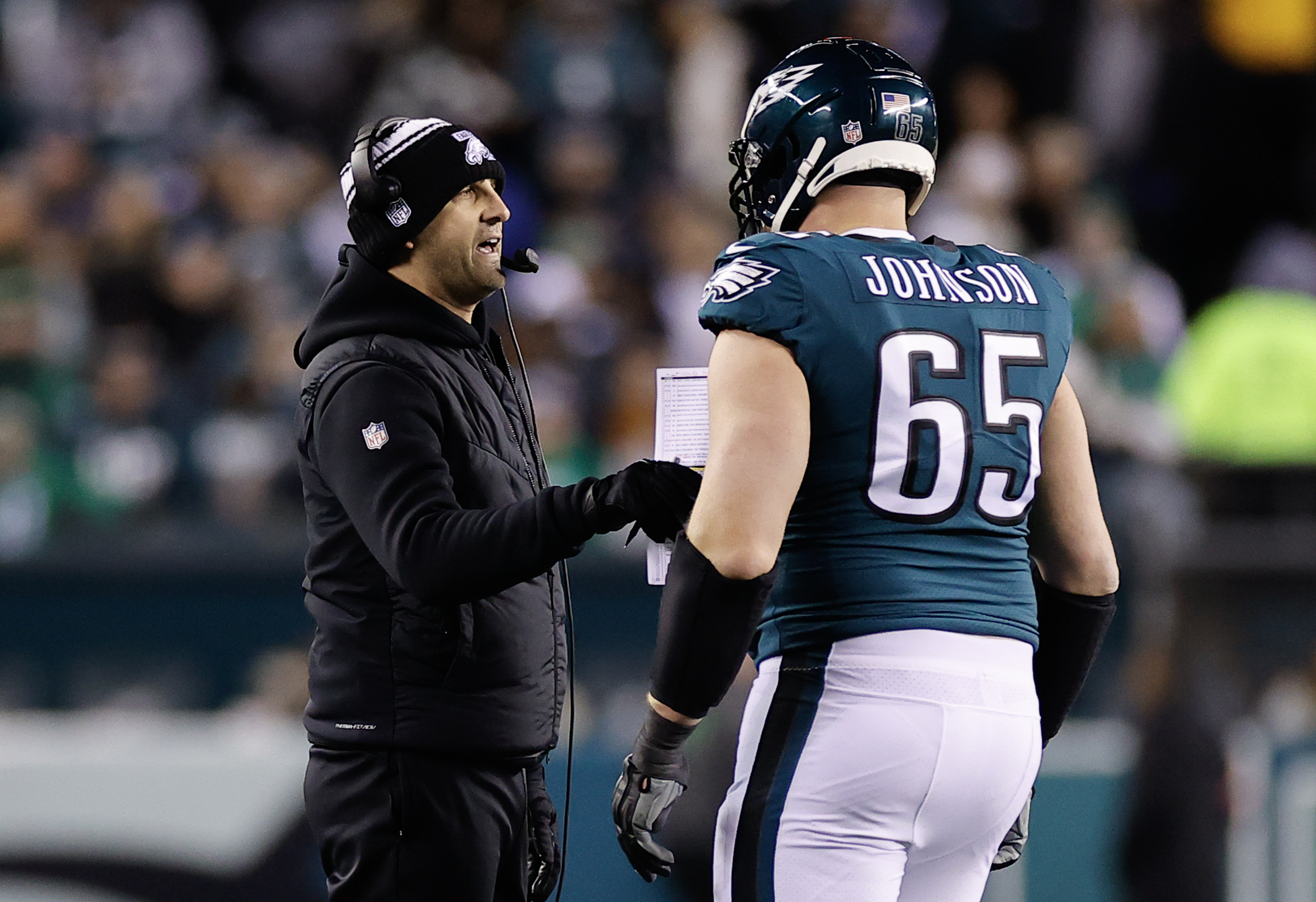
Nick Sirianni talks to Lane Johnson during a 2023 playoff game against the Giants. Yong Kim / Staff Photographer
Nick Sirianni’s scheduled Wednesday press conference began, of course, with him being asked to react to Lane Johnson’s retirement.
“I love Lane,” Sirianni said. “I’ll miss him dearly and I wish him the best. And obviously that’s not the end of Lane and my’s relationship.
“I feel good about where we are in that room. I’m really excited for Markel’s opportunity. I thought under the circumstances last week he handled that really well.”
Watch: Nick Sirianni speaks following Lane Johnson’s retirement
// Timestamp 10/07/26 10:51am
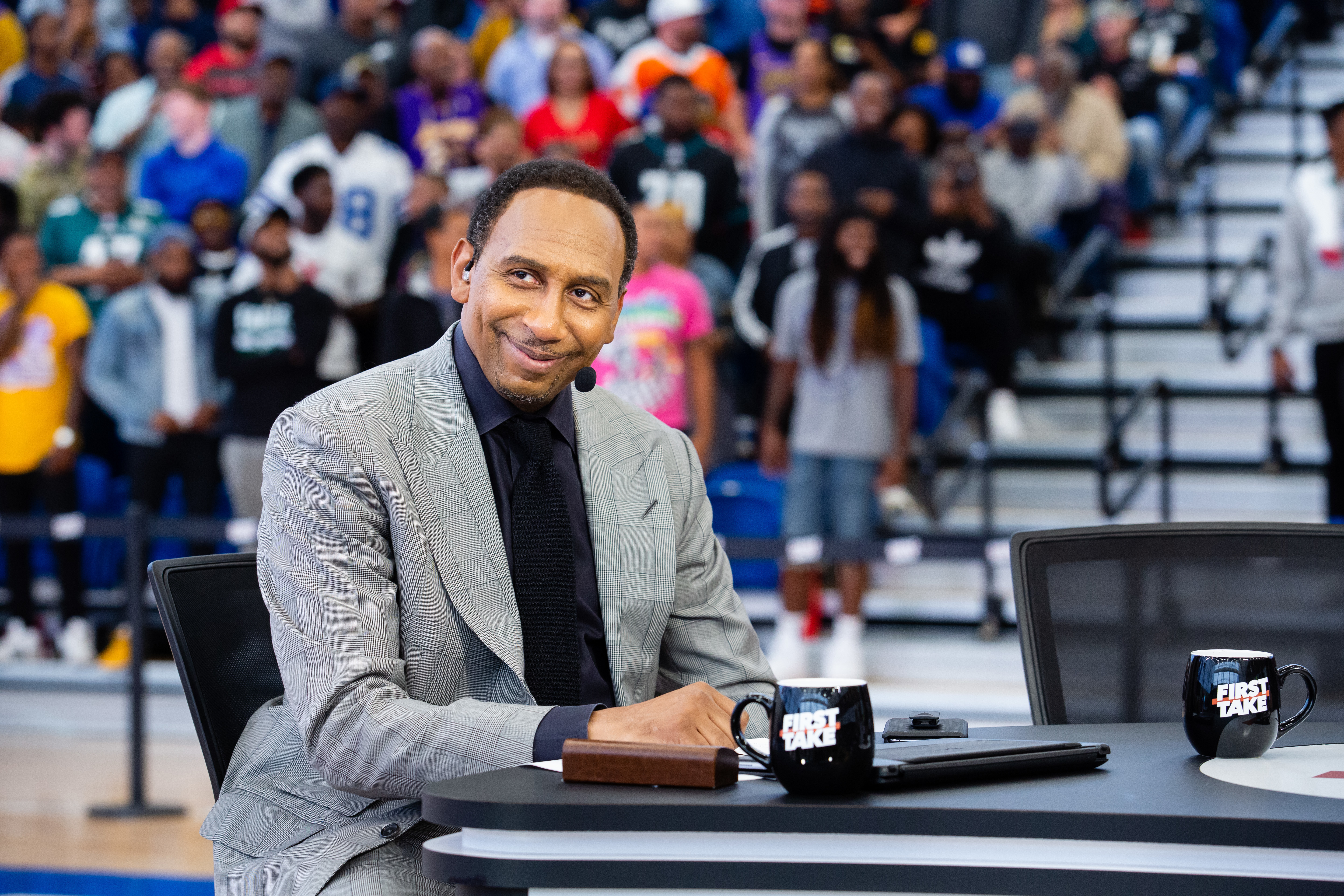
Stephen A. Smith mocks Lane Johnson’s mental health claims
Stephen A. Smith said Lane Johnson wouldn’t have retired if the Eagles were in better shape.
While most of the NFL media world had nothing but praise for Lane Johnson following Tuesday’s surprise retirement, ESPN’s Stephen A. Smith appeared to mock the retiring Eagles great over his mental health claims.
Speaking on First Take Wednesday, Smith suggested what really forced Johnson to retire was the terrible start of the Eagles, who are 2-2, lack an offensive identity, and are dealing with a long list of injuries.
“And now, the brother sat up there – one of the all-time greats on the offensive line – and what did he do? He went like this, ‘You know what? I’m going to call it quits,’” Smith said. “Four games in to the 2026 season, a dude that has been in the league forever, sits back and says, ‘I need to focus on my mental health.’”
While Johnson has contemplated retirement numerous times during his career, Smith said the Eagles All-Pro wouldn’t have walked away if the Birds’ season was off to a stronger start.
“You walk away because it’s a very, very, very, very bad situation, and it doesn’t look to be getting any better,” Smith said. “And this brother said, ‘Hey, my life matters. It’s time. I’m going to call it’s quits. My mental health. My mental.’ “
While agreeing with Smith on the impact Johnson’s absence will have on the team, NFL reporter Kimberley A. Martin called out the longtime ESPN host for mocking very legitimate mental health issues.
“I feel like you’re making light of the situation,” Martin said.
Even Chris “Mad Dog” Russo thought Smith went a bit far with his comments.
“Listen Stevie, I don’t know… if they were 4-0, I don’t know if that would’ve made any difference with Lane Johnson,” Russo said.
"Now he calls it quits, not before the season. Not in the offseason…four games into the 2026 season, a dude that has been in the league forever, sits back and says I need to focus on my mental health" – Stephen A. Smith on Lane Johnson retiring pic.twitter.com/itUSL5LrVt
A short time later, Smith clarified he was not mocking Johnson’s mental health issues, he was making light of “the Philadelphia Eagles’ trashy situation.”
“I am saying to you that the Eagles situation is so chaotic, so haphazard, it’s not worth it to some people,” Smith said. “To be in Week 4, approaching Week 5, and you choose to walk away? That’s about the Eagles. That is what I am talking about.
“I’m saying this is a situation that the Eagles could drive you to, because the stress ain’t worth it,” Smith added.
So what impact will Johnson’s sudden retirement have on the Eagles’ salary cap?
Timing is everything, since we don’t know when Johnson’s retirement will be official. But according to Spotrac, the most likely outcome is the Eagles will take a full $20.3 million cap hit this season and $25.5 million next season. That’s assuming the Eagles are able to recoup a prorated portion of his $18.7 million option bonus, which was exercised last month.
Over The Cap’s Jason Fitzgerald has yet to provide a detailed breakdown, but suggested the timing of Johnson’s retirement shouldn’t impact the Eagles cap situation much.
Will try to get a post up explaining the eagles cap with Lane Johnson. They have some options and he was already set to be designated a post june 1 next season. Not sure this really changes much in terms of their cap planning
Eagles to hold first practice Wednesday without Lane Johnson
Nick Sirianni is scheduled to speak to reporters late Wednesday morning.Elizabeth Robertson / Staff Photographer
The Eagles will hit the practice field Wednesday for the first time since Lane Johnson announced his sudden retirement.
The Birds are scheduled to take the field for warmups at 2:30 p.m. at the Jefferson Health Training Complex. Among other things, it’ll be the first opportunity to get a tally on the lengthy list of injuries the Eagles are coping with, including offensive lineman Cam Jurgens entering the concussion protocol.
Eagles head coach Nick Sirianni is scheduled to speak to reporters before practice begins.
Eagles injuries: Updates on Saquon Barkley, Cam Jurgens
Saquon Barkley leaves the field during Sunday’s loss to the Rams.David Maialetti / Staff Photographer
The Eagles injury list got longer during their loss to the Los Angeles Rams Sunday.
Here’s what we know Wednesday morning:
Saquon Barkley, running back: Barkley is unlikely to play because of the hamstring injury he suffered against the Rams, according to the Inquirer’s Jeff McLane. It’s a week-to-week injury, so Barkley will avoid going on the injured reserve list.
Cam Jurgens, offensive lineman:Jurgens is in the concussion protocol after self-reporting symptoms Monday. It’s unclear if he’ll be cleared in time to play Sunday.
DeVonta Smith, wide receiver: Smith didn’t play against the Rams after he was unable to practice that week because of a hamstring injury. His status for Sunday’s game remains unclear, but Jeff McLane reported Smith was expected to miss multiple games.
Zack Baun, linebacker: Baun missed Sunday’s game (his first time missing a regular-season game) because he was in the concussion protocol. It’s unclear when he’ll be allowed back to play.
Jordan Mailata still ‘shocked’ by Lane Johnson decision, has advice for Markel Bell
Jordan Mailata and Lane Johnson walk together during 2025 training camp.Monica Herndon / Staff Photographer
Speaking on 94.1 WIP Tuesday afternoon, Eagles offensive lineman Jordan Mailata was still “shocked” by the surprise retirement of his teammate, Lane Johnson.
“Yeah, still a hard one to swallow to be honest,” Mailata told WIP afternoon hosts Spike Eskin and Ike Reese. “I’m still processing my emotions… I just think about how much I’m going to miss him moving forward.”
“My piece of advice was something I told myself when people expected me to fill the shoes of the great J.P., Jason Peters,” Mailata said. “I said I wasn’t here to fill his shoes. I’m here to make my own.
“This is another opportunity for me to remind Markel that I understand what you’re going through, and the one thing you can do now is create your own shoes,” Mailata added. “You’re here to create your own legacy and your own story, and that’s all we want… You don’t have to be Lane Johnson.”
How the Eagles offensive line looks without Lane Johnson
Eagles rookie Markel Bell took Lane Johnson’s place during Sunday’s loss to the Rams.Jose F. Moreno / Staff Photographer
The Eagles lost against the Los Angeles Rams for many reasons, but their record without Lane Johnson since he was drafted fell to 18-30 (.375). Their overall success since 2013 can be attributed to many, but a record of 122-63-1 (.659) when he’s in the lineup can’t be overstated.
Rookie Markel Bell has potential, but he wasn’t drafted until the third round for a reason. The hope was that the 6-foot-9, 346-pound tackle would get a year to develop under Johnson. But the Eagles did too much wishing and hoping when it came to their offensive line.
They’ve known for years that Johnson could retire at any moment. They knew Landon Dickerson thought about retirement himself this offseason after years of injury and is now on injured reserve. They knew that center Cam Jurgens, after returning too soon from back surgery last season, had lost confidence.
But rather than address the O-line, general manager Howie Roseman drafted wide receiver Makai Lemon and tight end Eli Stowers in the first two rounds. They have a few promising reserves in current center Drew Kendall and backup interior lineman Willie Lampkin to go along with Bell.
And they have, of course, a very good left tackle in Jordan Mailata and a serviceable right guard in Tyler Steen. But the unit is often only as strong as its weakest link, which has been evident so far this season.
Lane Johnson rode the rollercoaster during his NFL career, remarking about the grueling nature of the tackle position in particular.Jose F. Moreno / Staff Photographer
Lane Johnson had thought about retiring along with Jeff Stoutland.
The plan was that they’d “go out together,” something they had “talked about before last season,” a source familiar with Johnson’s thinking told The Inquirer.
The Hall of Fame-bound right tackle was initially devastated when Stoutland walked away from the Eagles in February, a move that was precipitated by the organization’s decision to change its offense and strip the longtime offensive line coach of his run game coordinator role.
“I think it’s my sign,” Johnson told a few confidants at the time.
But he didn’t want to make a rash decision. He wanted to hear out Eagles coach Nick Sirianni, new offensive coordinator Sean Mannion and Stoutland’s replacement, Chris Kuper. He was encouraged by what he heard about the Kyle Shanahan-Sean McVay scheme they had planned to implement in Philadelphia.
Johnson made calls to other players who had been coached by Kuper, a former player himself, and the responses were positive. He knew he still had good football left in his then-35-year-old body, despite missing the final eight games of the 2025 season with a Lisfranc foot injury.
And when he finally decided to make his return public, he simply responded to a text message from The Inquirer with a thumbs-up emoji.
But the idea of retirement had long been on Johnson’s radar. He was ready to quit the game in the middle of the 2021 season when his mental health reached a crisis point. A year later, he told The Inquirer he might have two years left.
“F— this game,” he said in Nov. 2022.
Johnson was talking about the never-ending anxiety of playing tackle at the highest level of the sport.
“It’s like Michael Myers always around the bushes,” he said. “That’s the best explanation I can come up with. The job’s never finished. I don’t look forward to any games.”
Lane Johnson leaves the field after the Eagles loss to the Chicago Bears in Week 3.Monica Herndon / Staff Photographer
The Eagles record without offensive tackle Lane Johnson in the lineup since he was drafted No. 4 overall in 2013 is 18-30 (.375). With Johnson on the field, the Birds record during that same time was 122-63-1 (.659).
Johnson retires having not allowed a quick pressure (under 2.5 seconds) since Week 10 of 2024, according to Next Gen Stats. His streak of 558 pass blocks without allowing quick pressure is 210 longer than any active player in the NFL.
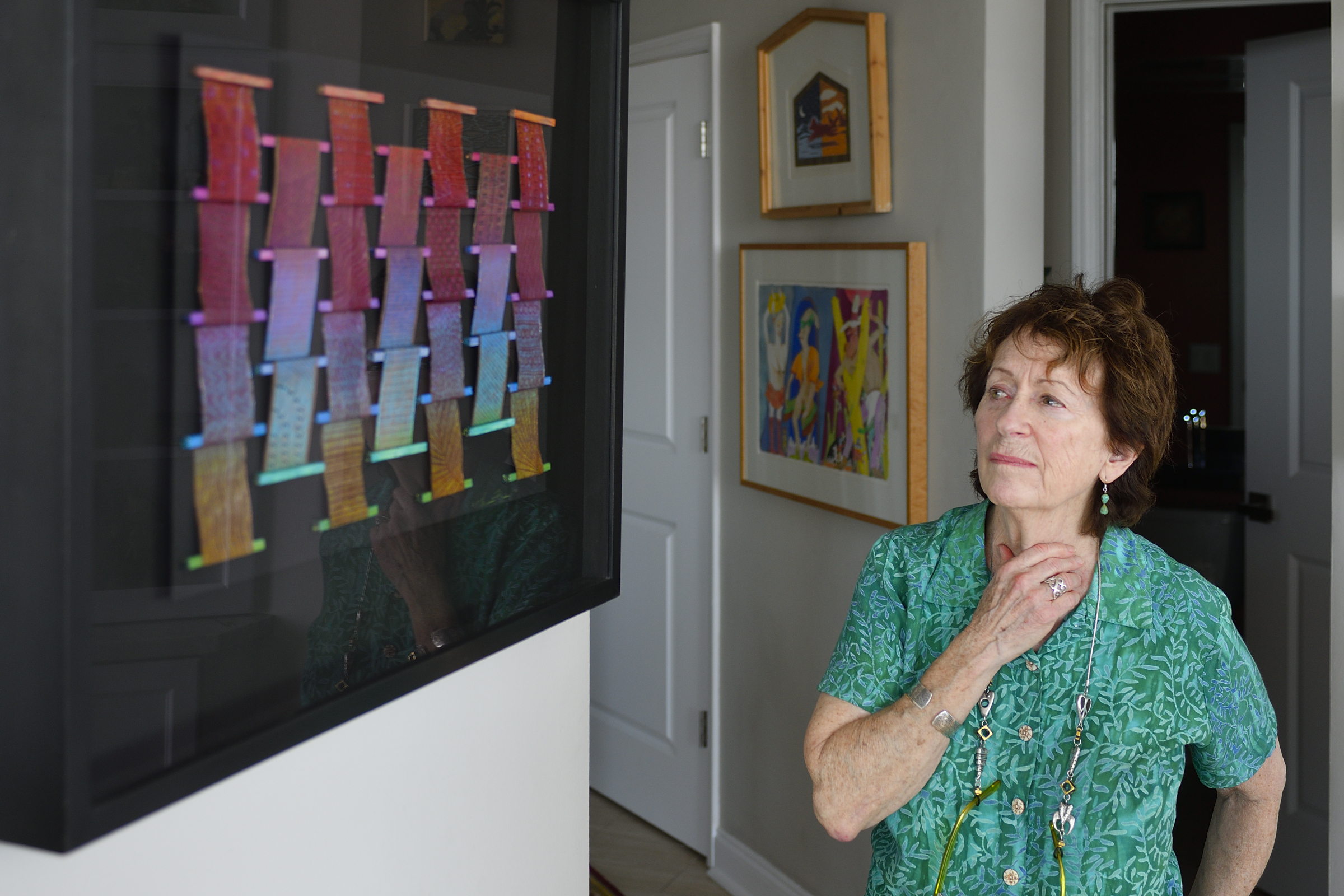
Near the dining area in artist Mur Sherman Hayman’s condo is a portrait she painted of a swashbuckling palace guard in the court of Louis XIV.
The handsome, mustached model for the portrait was Hayman’s husband, Mark Paul. Hayman also painted Paul as a Renaissance bishop and a cowboy. The couple shared a fondness for fanciful art.
Hayman misses Paul, who died of complications from a blood cancer in November. She is grateful to him for creating the comfortable home she shares with Ginger, their Australian Terrier.
The couple moved to the condo at Symphony House five years ago, she said, “my husband reluctantly, and I gleefully.”
Sunlight flows through the large windows into the living room of Hayman’s home, where Ginger lounges on the couch.Bastiaan Slabbers/ For the Inquirer
They moved from a four-story townhouse just 3½ blocks away, where they had lived nearly 40 years.
The 31-story Symphony House’sname references its proximity on Broad Street to the Kimmel Center for the Performing Arts, home of the Philadelphia Orchestra.
Mur’s former home required going down and up flights of steps in a courtyard before arriving at her door. Encouraged by an artist and real estate agent friend, Jill Sablosky, Hayman persuaded her husband to downsize.
The entrance to the Symphony House, from below. The building was named for its proximity to the Kimmel Center for the Performing Arts.Bastiaan Slabbers/ For the InquirerThe Symphony House was completed in 2008.Bastiaan Slabbers/ For the Inquirer
Once they started looking, she said, her husband’s architect instincts kicked in. He found condo conversions of historic buildings interesting but discovered water damage and other issues.
Hayman’s daughter, Ashley, suggested they look at Symphony House, built in 2008.
Paul and Hayman visited the two-bedroom, two-bath, 12th-floor unit with a balcony and were impressed with the expansive views looking all the way to the Delaware River. After back-and-forth negotiations, they bought the apartment.
“We could now watch fireworks on the river,” Hayman said.
The couple replaced faded maple flooring with oak. After a contractor gave them a “shocking” price for custom work, Paul designed a storage unit in the living room from standard white kitchen cabinets. Above the self-venting gas fireplace, sliding doors hide a television.
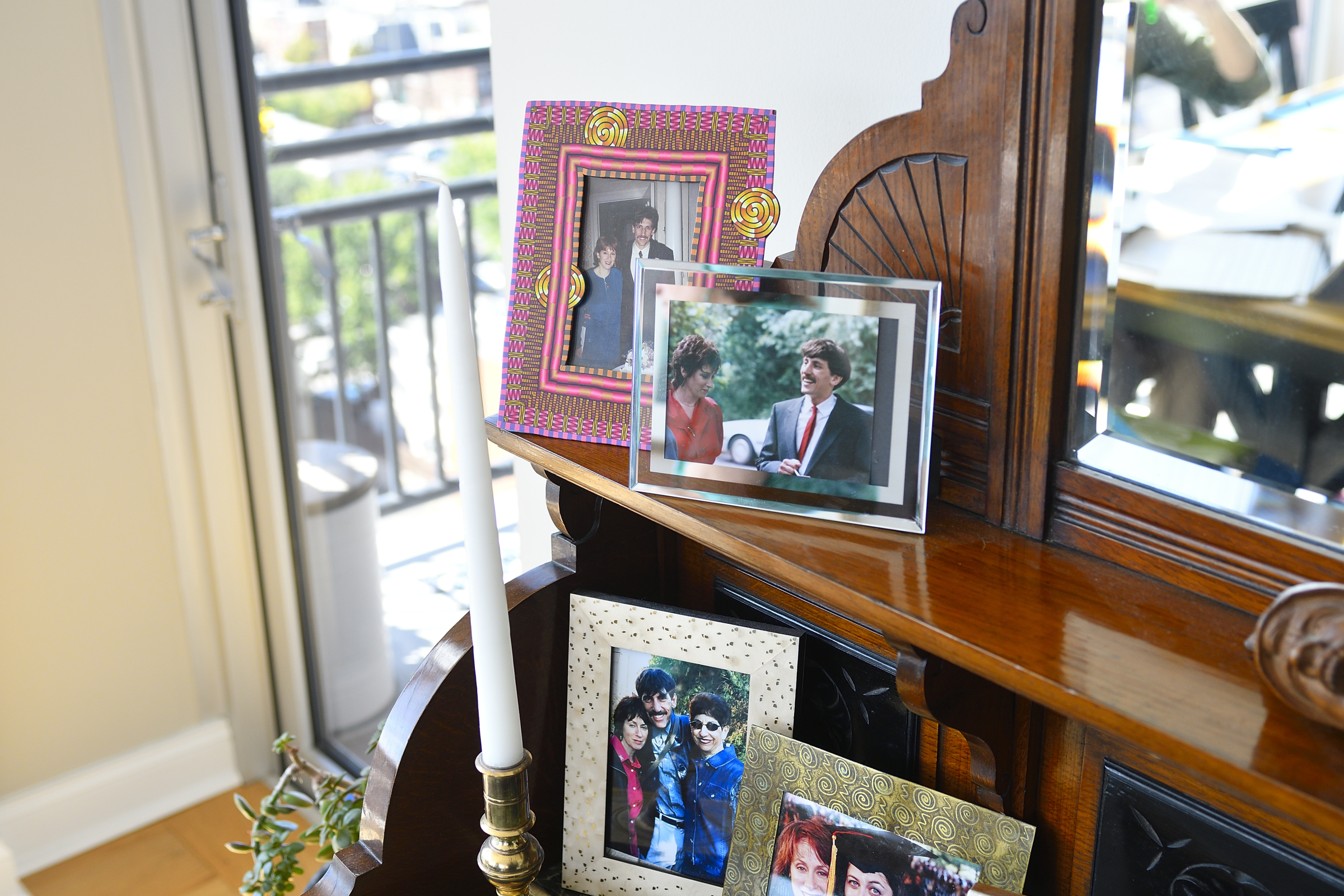
Family photos are on display in Hayman’s home.Bastiaan Slabbers/ For the InquirerHayman gestures toward a mixed-media portrait she painted depicting her late husband, Mark Paul, as a Louis XIV-era palace guard.Bastiaan Slabbers/ For the Inquirer
A corner shelf is filled with cloisonné, Limoges porcelain, and contemporary pieces from the Clay Studio. A pair of antique deer as well as other vintage objects were gifts from Hayman’s parents, David and Goldie Sherman, who were antique dealers.
“Every time they visited,” Hayman said, “they bought us tchotchkes.”
Inlaid wood furniture and Oriental rugs in the condo came from Hayman’s parents. The concrete lion on the balcony, otherwise furnished with chairs from Wayfair, also came from them.
Among several pieces of abstract art in the living area is a two-dimensional arrangement of multihued rectangles by Hayman.
Vibrant glass candy pieces lie in a porcelain dish on the coffee table.Bastiaan Slabbers/ For the Inquirer
She found the oak dining table and black dining chairs online. The blue living room couches were purchased from Raymour & Flanigan as was the white furniture in the primary bedroom.
The living-area walls are painted pale gray. And the primary bedroom and bathroom walls are sky blue — a color her husband loved, Hayman said.
Two pink chairs in the bedroom came from her parents, as did Hayman’s dressing table.
“I told my father I needed a drawer, and he had his carpenter make one,” she said.
Antique furniture is combined with contemporary bedding and side tables from Raymour & Flanigan.Bastiaan Slabbers/ For the Inquirer
It would appear the room has an animal theme with paintings of a rabbit, fish, dog, and horse. Over the bed, though, is a floral painting by artist Csilla Sadloch. An intricate maroon, blue, and white paper collage by Carol Moore hangs nearby.
Paul changed the entrance to the primary bedroom to create two dressing rooms instead of one and installed frosted pocket doors.
The walls in the guest bath and bedroom are desert rose, which matches the oriental rug. Paul used the space as a home office with a storage unit he designed on one wall and what appears to be a matching closet on the other. Pulling the handles on the closet doors reveals a Murphy bed.
Ginger lies on a Murphy bed in the guest room.Bastiaan Slabbers/ For the InquirerA dog-butt coat hanger, which Hayman found during a trip to England, hangs on the wall in the vestibule of her home.Bastiaan Slabbers/ For the Inquirer
Like all residents in the building, Hayman has a handsome oak front door with wood trim. In the foyer she has hung six luminescent paper collages by Doug Zucco.
The “dog butt hangers” from a shop in England in the hall are her “favorite things,” Hayman said. They are just the place to hang a wet raincoat, she said, when she returns to her beloved home.
Is your house a Haven? Nominate your home by email (and send some digital photographs) at properties@inquirer.com.
Since Labor Day, when President Donald Trump opened up his war chest for the midterms, Republicans have pumped half a billion dollars into competitive House and Senate races.
A month later, the polls haven’t moved in their direction.
High-quality public surveys show Democratic Senate candidates tied or leading in Alaska, Georgia, Maine, Michigan, North Carolina, Ohio, and Texas — the same as before Labor Day. Democrats’ lead on the generic congressional ballot has slightly widened since, from about six points to roughly nine, according to analyst Nate Silver’s polling average.
Notably, the surge of attack ads has not sunk the Democrats at the center of some of the most expensive races. More voters hold a favorable than unfavorable view of Texas Democratic Senate candidate James Talarico, according to a late September New York Times/Siena poll — despite more than $115 million spent attacking him. Michigan Democratic Senate candidate Abdul El-Sayed’s favorability actually increased by five points since August, to 47%, Fox News surveys show, despite $76.2 million in attacks.
One factor: Republicans’ advantage looks bigger in dollars than in actual airtime, thanks in part to the timing of their purchases. In Senate battlegrounds, the GOP spent 26% more than Democrats did to secure just 7% more broadcast ads, according to AdImpact.
Republicans say the attacks are steadily eroding Democratic support and keeping the races competitive. Democrats counter that the GOP is stuck spending heavily just to contain their expanding ambitions in states Trump won handily in 2024 — the equivalent of Republicans fielding competitive challenges in Rhode Island, Washington state, or Maryland.
“They should be getting more for what they’re spending, and they’re not,” said Lauren French, a spokeswoman for the pro-Democratic Senate Majority PAC. “Can they spend their way out of a bad economy, a bad president, a bad candidate, and a bad message in Texas and Kansas?”
In a cycle with so many advantages for Democrats — an unpopular president, an unpopular war, inflation, the usual pattern of midterm swings — money was supposed to be the GOP’s ace. In particular, Republicans were counting on the more than $400 million in Trump’s super PAC, plus a similar amount he says is held in a related nonprofit, to come to their rescue. Trump has said he will spend $400 to $500 million on the midterms and save some for 2028. So far, his super PACs have reserved more than $194 million in advertising, according to media tracker AdImpact.
But the super PACs didn’t turn on the money until Labor Day, so they faced higher prices for scarcer airtime compared with groups that reserved their ads earlier. In addition, super PACs pay full freight for TV ads, while campaigns pay discounted rates; that has benefited Democrats whose candidates have been better fundraisers in high-profile contests, whereas Republicans have relied more heavily on party committees and super PACs under Trump’s control.
In Texas, the discrepancy is especially pronounced as the expensive Senate, House, and governor’s races drive up prices for limited inventory. Last week in the Dallas media market, Talarico’s campaign paid $950,000 for the average viewer to see its ads 10 times, according to a Democratic media buyer. By comparison, Paxton allies spent $4.65 million for the average viewer to see their ads 13 times — five times the money for just 30% more impact.
The cost of running TV ads in Texas has gone up so much that Paxton allies started running spots nationwide during sporting events hoping that people in Texas would see them, because that cost less than buying the same airtime in all the state’s local markets.
The campaigns’ cost advantage over super PACs does not extend to digital advertising, which both parties are increasingly emphasizing as consumer habits change. More than 80% of the electorate is now reachable on YouTube, compared with closer to 50% on traditional TV, the Democratic media buyer said.
Democrats anticipated that they would be outspent and took advantage of the Republicans’ delay. In focus groups, the Talarico campaign found that if he established and defined himself with voters first, he could withstand the expected attacks — but not if the attacks got there first, a person familiar with the research said.
Republicans struggled to point to an example of a race where the recent influx of money fundamentally changed the dynamic. One GOP strategist working on Senate races compared the incremental changes to World War I trench warfare.
“Our spending has enabled us to stay competitive,” said an operative working for Trump’s political team, who spoke on the condition of anonymity because they were not authorized to talk publicly.
In some races, Republican groups have begun cutting their losses. The main Senate GOP super PAC canceled its remaining ads in North Carolina, where former Republican National Committee chairman Michael Whatley trailed former governor Roy Cooper (D) by 11 points in a YouGov survey last month. The GOP House super PAC similarly cut reservations in Omaha, where Democrat Denise Powell is leading Republican Brinker Harding in the race for the seat being vacated by Rep. Don Bacon (R, Neb.).
REIM, Israel — On a field where music festival revelers were gunned down by Hamas-led militants three years ago, Israelis on Wednesday embraced and wept for those lost in an attack that plunged the Middle East into war.
Israelis mourned at the site of the Nova Music Festival, as well as at bomb shelters, intersections and in communities targeted on Oct. 7, 2023. On that day — the deadliest in the country’s history — militants killed 1,200 people and took 251 hostage. Israel’s retaliatory offensive killed tens of thousands of Palestinians, destroyed much of Gaza and drove most of its 2 million residents from their homes.
This is the first anniversary since all the hostages, living and dead, were returned. Signs calling for their return are mostly gone, but reminders of those who were killed are ubiquitous in a country still reckoning with the trauma of that day.
For Palestinians, the anniversary brings another day of fear and misery. Most Gaza residents live in squalid tent camps, with large parts of cities bombed to rubble. More than half the territory remains in the hands of the Israeli military. Despite a ceasefire deal reached nearly a year ago, Israeli strikes continue almost daily.
Israeli troops occupy a large chunk of southern Lebanon in their conflict with Hezbollah militants, who began firing on Israel in 2023 in support of Hamas. Iran, the United States and their allies are locked in a confrontation that has seen attacks across the region and has shaken the global economy — a conflict that Israel helped launch and that the war in Gaza paved the way for, even if they weren’t directly connected.
Families mourn at the festival site
Hundreds of people paid their respects to the more than 350 people killed in and around the festival site. Videos from that day showed militants gunning down fleeing revelers, shooting the wounded at point-blank range and ambushing those seeking refuge in bomb shelters.
On Wednesday, survivors’ relatives hugged at 6:29 a.m. — the exact time the first rockets were launched three years ago — as explosions boomed in nearby Gaza.
Anya Davitashili, who lost her 25-year-old son, Sean, said she visits the site every Saturday. It’s where she feels closest to him.
“I have a video of him dancing here that ends at 6:29 in the morning. It’s in front of my eyes all the time,” she said. “Every morning, you wake up and there is just endless missing.”
A released hostage marks his first Oct. 7
Elkana Bohbot, 37, is marking the anniversary in Israel for the first time since his release after 738 days of captivity. For most of that time, he said, he was held underground in a dark, damp tunnel.
Bohbot, who was abducted from the festival, was kept in a small cell with other hostages, given little food and allowed to bathe only every few weeks, he said. His captors forced him to take part in propaganda videos, including one where he acted out a fake call to his family.
In the year since his release, Bohbot has undergone physical and emotional rehabilitation. In August, his wife, Rivka, gave birth to a daughter, fulfilling his promise to himself in the tunnels to give his 5-year-old son, Reem, a sibling.
The newborn Michele is “not a symbol for my people, she is more of a symbol for the enemy,” Bohbot told The Associated Press. “This child is the message for you that we were here and we will always be here forever.”
Palestinians in Gaza live among the ruins
No events are expected Wednesday in Gaza, but Hamas in a statement defended the Oct. 7 attack, saying it had returned the Palestinian cause to the world’s attention.
“The conflict with the enemy did not begin on that day, (and) its final chapters are not written yet,” it said.
Palestinians in the territory said their suffering over the past three years had previously been unimaginable.
“We witnessed death, destruction, and bombardment that we had never known before,” said Walid Akram, a Gaza City resident who, like most in Gaza, has been displaced by the war.
Raed Khozeiq’s coastal neighborhood in Tel al-Hawa was largely flattened. Nothing about his life now is the same, he said.
“No country in the world has gone through what we have experienced here,” he said. “A war of extermination, starvation, the absence of schools and universities — nothing remains.”
More than 74,000 Palestinians have been killed in Gaza, according to the territory’s Health Ministry, which does not distinguish between civilians and militants in its figures but says around half were women and children. The numbers from the ministry, part of the Hamas-run government, are seen as generally reliable by U.N. agencies and independent experts.
While a ceasefire that took effect Oct. 10, 2025, halted the heaviest fighting, Israeli strikes have continued, targeting what Israel says are Hamas militants. Since the ceasefire, 1,460 Palestinians have been killed in Gaza, according to the ministry. Five Israeli soldiers have been killed in attacks in that period. Restrictions on the entry of goods and aid have contributed to a hunger crisis, food security experts say.
The Middle East has been reordered
A contentious election at the end of the month hangs over this year’s anniversary in Israel. Voters are bitterly divided over Prime Minister Benjamin Netanyahu’s leadership, his role in the security failures surrounding the attack and his refusal to launch an official inquiry into them.
The attack set in motion a cascade of events that led to wars across the Middle East as Israel confronted Hamas, Hezbollah and their backer, Iran. Israel has seized swaths of territory in Syria and Lebanon, where more than 300,000 Lebanese remain displaced. The United States joined Israel in attacking Iran’s military and nuclear program in two rounds, battering Iran and upending global markets far from the battlefield.
Violence has also risen across the Israeli-occupied West Bank, where Israel’s far-right government has heightened restrictions on Palestinians while emboldening extremist settlers who have attacked them and destroyed their property.
STOCKHOLM — Scientists Henri B. Kagan and Kenso Soai won the Nobel Prize in chemistry Wednesday for untangling mysterious mirror images in molecules, a discovery that has been used to develop countless drugs and transformed modern medicine.
Many molecules come in versions that look alike but are not exactly identical, like right and left hands. Kagan, who is from France, and Soai, from Japan, found ways to make chemistry pick a side, describing and designing reactions to produce the desired mirror image.
“The medicines we have today would not be possible without this chemistry,” said Rigoberto Hernandez, president of the American Chemical Society.
Soai was shopping at a neighborhood supermarket when he heard he had won.
“I’m very excited to receive the very nice news,” Soai told the Nobel committee and journalists by phone. “Of course, this is one of the most exciting days in my life.”
The discovery enabled most modern medicines
Mirror images of the same molecule can have different properties. For example, one version of the chemical carvone smells like mint, while the other has a whiff of caraway, a spice often used in rye bread.
The alternate versions can also behave differently when interacting with other chemicals. When designing drugs to treat diseases, scientists are choosy about which mirror image they use. They want the version of a molecule to treat a cold, not one that will make the sniffles worse.
In the 1980s, Kagan’s work showed there might be a way to design reactions to produce one form of a molecule over the other. Years later, Soai perfected the process. He created the first-ever chemical reaction to efficiently produce only one of a molecule’s mirror images, in what’s now known as the Soai reaction.
“This is probably the coolest experiment in organic chemistry,” said Peter Somfai, a member of the Nobel Committee for Chemistry.
Kagan, 95, is affiliated with the Université Paris-Sud in Orsay, France. Soai, 76, is affiliated with the Tokyo University of Science. The Nobel committee described their work as a feat never previously achieved by anyone “other than life itself.”
The French Academy of Sciences, where Kagan is a member, congratulated him, as did French President Emmanuel Macron, who called the prize “an immense source of pride for the country” and “a recognition befitting a lifetime of research.”
“It might be difficult to say that this drug, or that drug, was developed using this,” Somfai said. “I would say all of them, because we use this as a tool, we use this as an understanding, how to develop catalysts, how they function.”
Life, too, prefers one mirror image over the other. DNA twists to the right, and the proteins in human bodies are made of mostly left-handed building blocks.
In addition to developing better medicines or perfumes, deciphering the mirror images of molecules can help scientists understand the chemical architecture of life, said chemist Holden Thorp, editor-in-chief of the journal Science.
“There are still fascinating aspects that remain unknown and surely more yet to be discovered,” Soai said at a news conference hosted by his university in Tokyo. “I hope to do what I can, however modestly, to contribute to help advance research in this field.”
Japan’s largest newspaper, Yomiuri, distributed an extra edition with a headline proclaiming “Nobel Prize Mr. Soai,” with a big photo of the scientist. The papers quickly disappeared as office workers picked them up on their way home.
More Nobel prizes are still to be awarded
The Royal Swedish Academy of Sciences announced the winner in Stockholm.
Last year, three scientists won the chemistry Nobel for their development of new molecular structures that can trap vast quantities of gas inside, laying the groundwork to potentially suck greenhouse gases out of the atmosphere or harvest moisture from desert environments.
The literature prize is set to be awarded Thursday. After Friday’s peace prize is awarded, the Nobel Memorial Prize in Economic Sciences will be announced Monday.
The prize money this year is 12 million Swedish kronor (about $1.2 million), whether for an individual, a small group of laureates, or an organization.
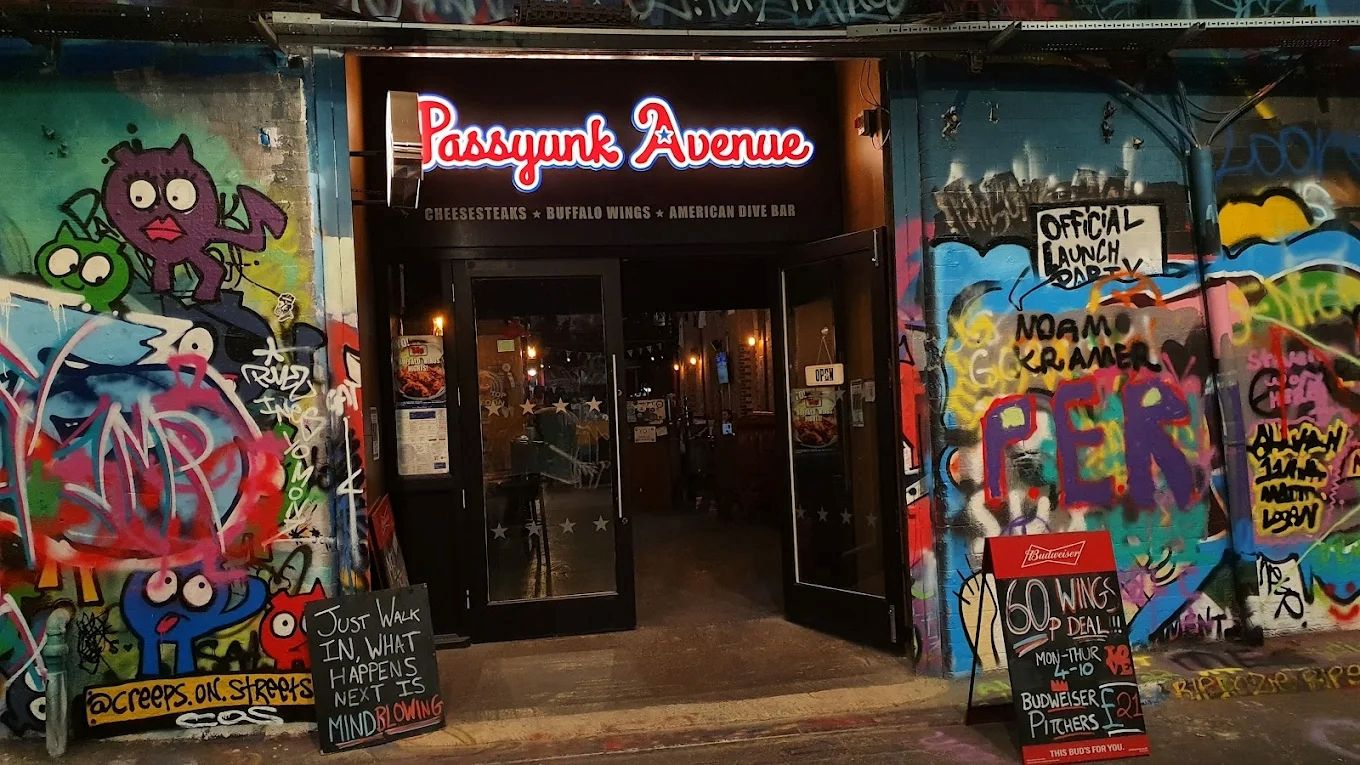
When the Eagles and their fans arrive in London this week, they should find Philly food connections. At least, cheesesteaks and pizza. Passyunk Avenue is a five-unit Philly-fied dive bar owned by a guy from New Jersey, and one of Bar Etna’s backers is Joe Beddia of Pizzeria Beddia fame, who has crossed the pond with his dough recipe.
Wawa has been quietly testing premade sushi rolls at select stores, and Beatrice Forman drove 23 miles to try them. Reaction, as you might imagine, has been mixed.
Apizzeria 888 in Elkins Park, whose ultra-thin crusts and quirky setup have made it a cult favorite over the last year, is closing in less than two weeks. On the plus side, owner Sebastian Besiso has increased hours during the countdown. Read on to see what he’s up to next.
Lucatelli’s Pizzeria is headed to Jenkintown, where owner David Schiavo — who has locations in Doylestown and Newtown — plans to take over the former Pizza Wheel at 314 Old York Rd. Schiavo also recently took over his family’s Maple Glen Pizza, which he’s planning to renovate and reflag to a Lucatelli’s, a more upscale brand. He expects Jenkintown to open in December.
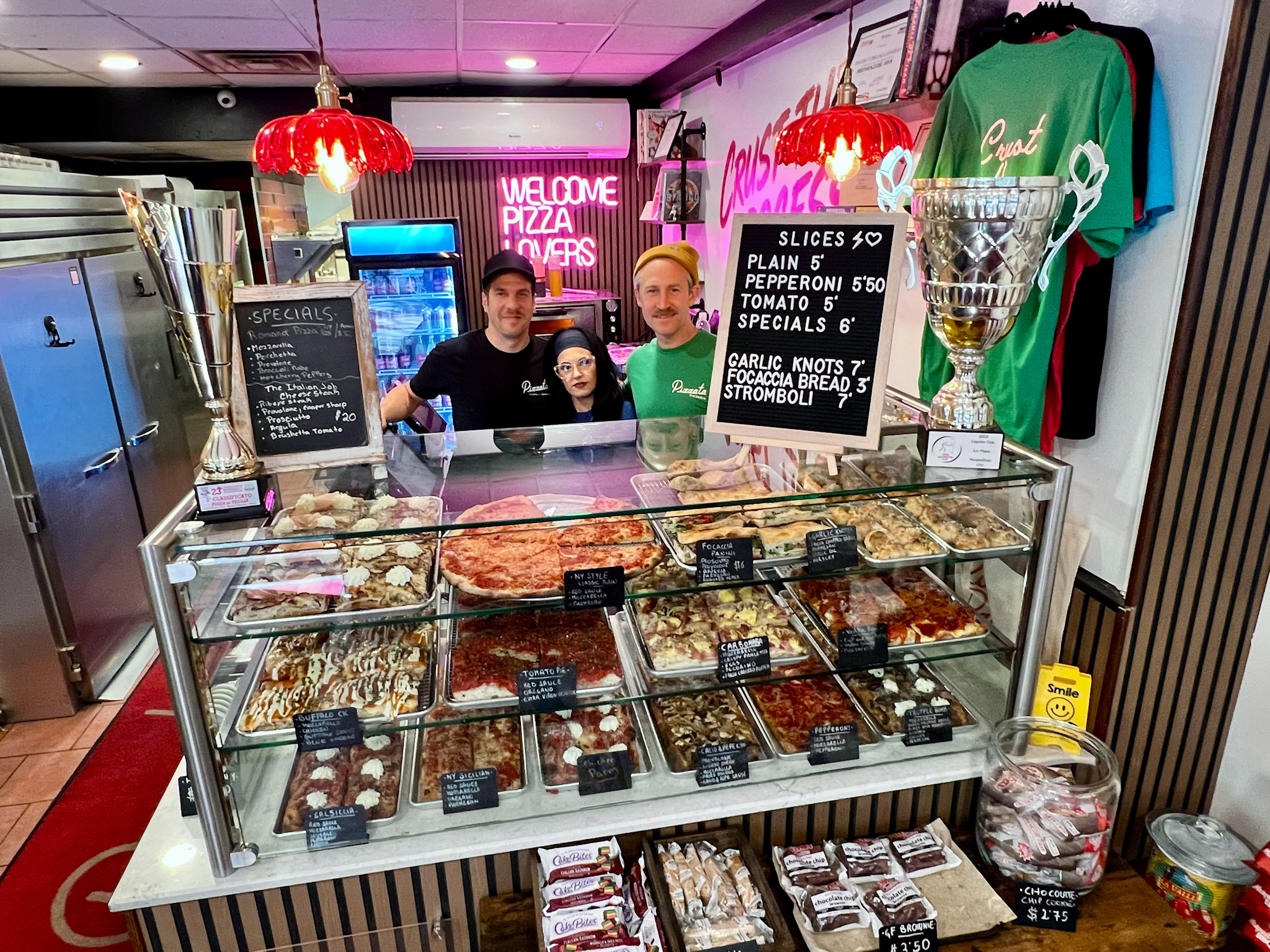
Pizzata Pizzeria’s original location at 240 S. 22nd St. in Rittenhouse-Fitler Square is sporting a new display case — the better to see everything, as well as show off co-owner Davide Lubrano Lavadera’s pizza-competition trophies. This move also adds a small Italian retail section.
All Aboard Candy stocks Bubs and other varieties of so-called Swedish candy. As Jenn Ladd relates, the woman-owned business is part of a wave of new-school candy stores that are springing up in cities all over the country.
Making coffee at home has turned into an elaborate affair with the surge of at-home espresso machines on the market. Now, reports Emily Bloch, coffee shops are leaning in with professional barista training.
Scoop
Animal is a bar-restaurant planned for the 2401 Walnut St., which was last a Human Robot outpost after turns as Spread Bagelry’s “Spreadquarters” and Jose Garces’ 24 Wood Fired Fare. Developer Chuck Block says it will pair a casual public-house menu, with a 70-seat dining room, 36-seat oval bar, and outdoor terrace, under the direction of general manager Dave Champagne (ex-Schulson Collective and Roy-Pitz Brewing). A separate 40-seat fine-dining restaurant in Garces’ former atelier is being developed, as well. Chef is TBA. Opening is targeted for late fall, initially open for dinner Wednesdays through Sundays, with the fine-dining restaurant following.
Can Moroccan-French cooking break the Morris House’s streak of short-lived restaurants? Critic Craig LaBan says he finds promise at Soufiane at the Morris, but service lapses and uneven cooking cloud its potential.
Briefly noted
“Neighborhood Bar” is on the sign and that’s exactly what Simon Atiya, who also owns the nearby Giovani’s Bar & Grill,plans to open at 222 S. 15th St., the former Shiroi Hana. He says the timeline is up in the air.
Puentes de Salud, which provides healthcare mainly to the Philadelphia Latino community, has rounded up seven notable restaurants for a fundraiser Monday at Bok Bar.
Pat’s King of Steaks was in the news last week as an influencer threw a cheesesteak through the service window, hitting a manager. He later turned himself in and faces a summary offense.
Terence O’Reilly’s name may not ring a bell. But if you’ve dined out in the region since 1963, know that he probably made sure your plates were clean. Mr. O’Reilly died Oct. 1, and I recount his immigrant’s story.
WineDive’s new weekday happy hour is themed to 1990s’ “After School Snax,” with food, music, and cartoons from that era. It launches Monday at 1534 Sansom St. with a party featuring merch giveaways and free kiddie cones, and runs 4-6 p.m. Mondays through Thursdays thereafter, with such drinks as Cereal Milk Punch — a “Froot Loop” milk punch, gin, and fruit — and a PB & Fluff Old Fashioned (peanut butter-washed bonded bourbon, maple syrup, and toasted marshmallow). Food includes Bagel Bites, a brown bag lunch of a mini ham and cheese toasty with a bag of chips, and a house-made PB&J Uncrustable.
❓Pop quiz
Name the Chinatown restaurant that recently reopened its dining room for the first time since the pandemic.
What happened to Mix, the bar at 21st and Chestnut Streets? — Chris P.
Mix Bar & Grill, which opened in 2008 at the RiverWest Condos, shut down last weekend, as Victor Fellus sold to Aakash Patel, who also owns Bar1010 in Northern Liberties. Patel says he’s working on what he calls a refresh and hopes to reopen soon with a new menu.
📮 Have a question about food in Philly? Email your questions to me at mklein@inquirer.com for a chance to be featured in my newsletter.
By submitting your written, visual, and/or audio contributions, you agree to The Inquirer’s Terms of Use, including the grant of rights in Section 10.
More than 350,000 people spend time in Center City Philadelphia on an average day. That’s because it is a lot of things to a lot of people: the largest employment hub in our 11-county region, the densest and fastest-growing residential area, the highest concentration of restaurants, shops, museums, and theaters, and the primary destination for millions of conventioneers and tourists annually.
Even if you don’t live or work here, chances are you spend time here, or know people who do.
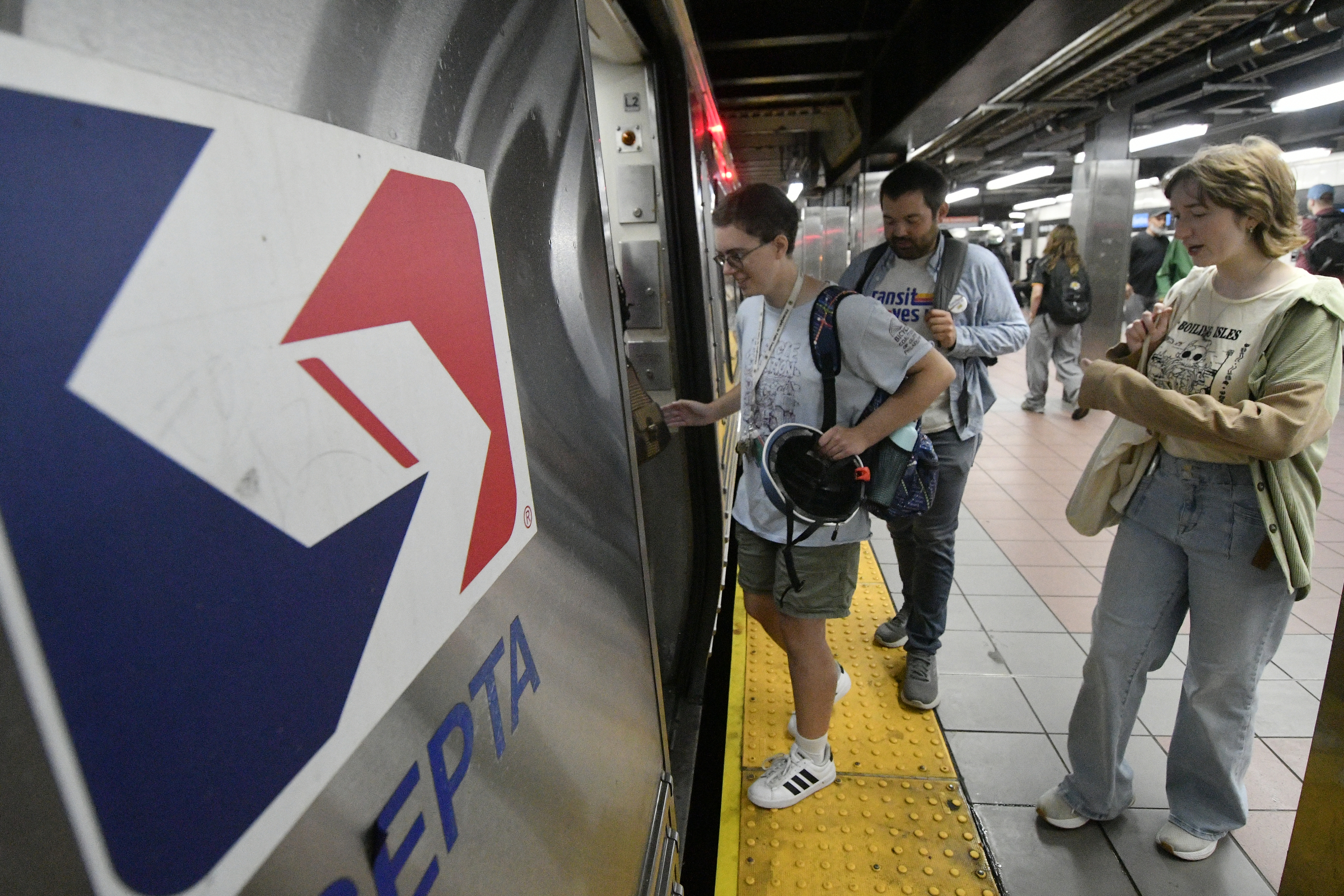
This is largely possible because we are the beneficiaries of decades of investment in transit, including a Regional Rail network that connects more than 150 stations in neighborhoods across Philadelphia and towns across our suburbs to the urban core. This puts us billions of dollars of investment ahead of many cities and regions around the U.S. that came of age after the advent of the automobile.
The bad news is that we’ve never been able to use this irreplaceable infrastructure to its full potential. We’ve made some transformative moves, such as combining disparate and struggling transit agencies to create SEPTA in the first place.
Most notably, just over 40 years ago we did something no other U.S. city has done: We built the Center City Commuter Connection that combined the legacy lines of the Reading and Pennsylvania Railroads into one integrated system. This was done, in part, because planners at the time understood the potential to run Regional Rail less like a commuter rail and more like a high-frequency metro service.
Because we’ve never made the necessary investments in vehicles, signals, and station platforms to bring this idea to life, we live with an enviable set of “good bones” that stop short of offering real choice or convenience.
It doesn’t have to be that way. Accelerate, SEPTA’s vision for best-in-class transit, would transform quality of life for millions of people across our region. In so doing, it would completely redefine our relationship with Center City.
We’ve all been there: You miss a big meeting because your usual train was canceled and the next one skipped your station due to overcrowding. The comedy show runs long, you reach the platform two minutes after the last train home pulls out, and now you’re paying $50 (or more?) for an Uber.
Date night ends early because it’s either the 9:16 or the 11:16, and the sitter can’t stay that late. Or maybe you miss half the game because you can’t risk an ill-timed transfer.
Picture knowing the next train downtown (or back home) is never more than 15 minutes away, at any hour, on any day of the week. Neighborhoods such as Fox Chase, Eastwick, Germantown, Mount Airy, and Manayunk would connect to Center City often enough that you’d never think about a schedule again. So would suburbs like Media, the Main Line, Jenkintown, and Conshohocken. If you live in these places, commutes and nights out alike just became painless.
Picture knowing the next train downtown (or back home) is never more than 15 minutes away, at any hour, on any day of the week, writes Clint Randall.Jasmine Goldband / Staff
Service at that scale makes room for life’s surprises: a high-stakes deadline at work, spontaneous dinner plans, last-minute concert tickets from a friend, staying at the bar through the end of the playoff game; all of these scenarios and countless others become painless adjustments rather than costly complications. Trips that now feel like carefully calculated events, such as bringing grandma in for the Flower Show, taking the kids to The Nutcracker, or showing out-of-town friends around for the weekend, become simple outings that need little advance planning. Miss a train? Another one is coming in 15 minutes or less.
And that’s just Regional Rail. Under Accelerate, the El (Market-Frankford Line) would run every three minutes. Modern light-rail vehicles, the kind many riders have only seen in Europe, would replace today’s trolleys. Buses would come more often, including nights and weekends. New vehicles and major investments in maintenance, cleaning, and security would mean fewer breakdowns and cleaner rides.
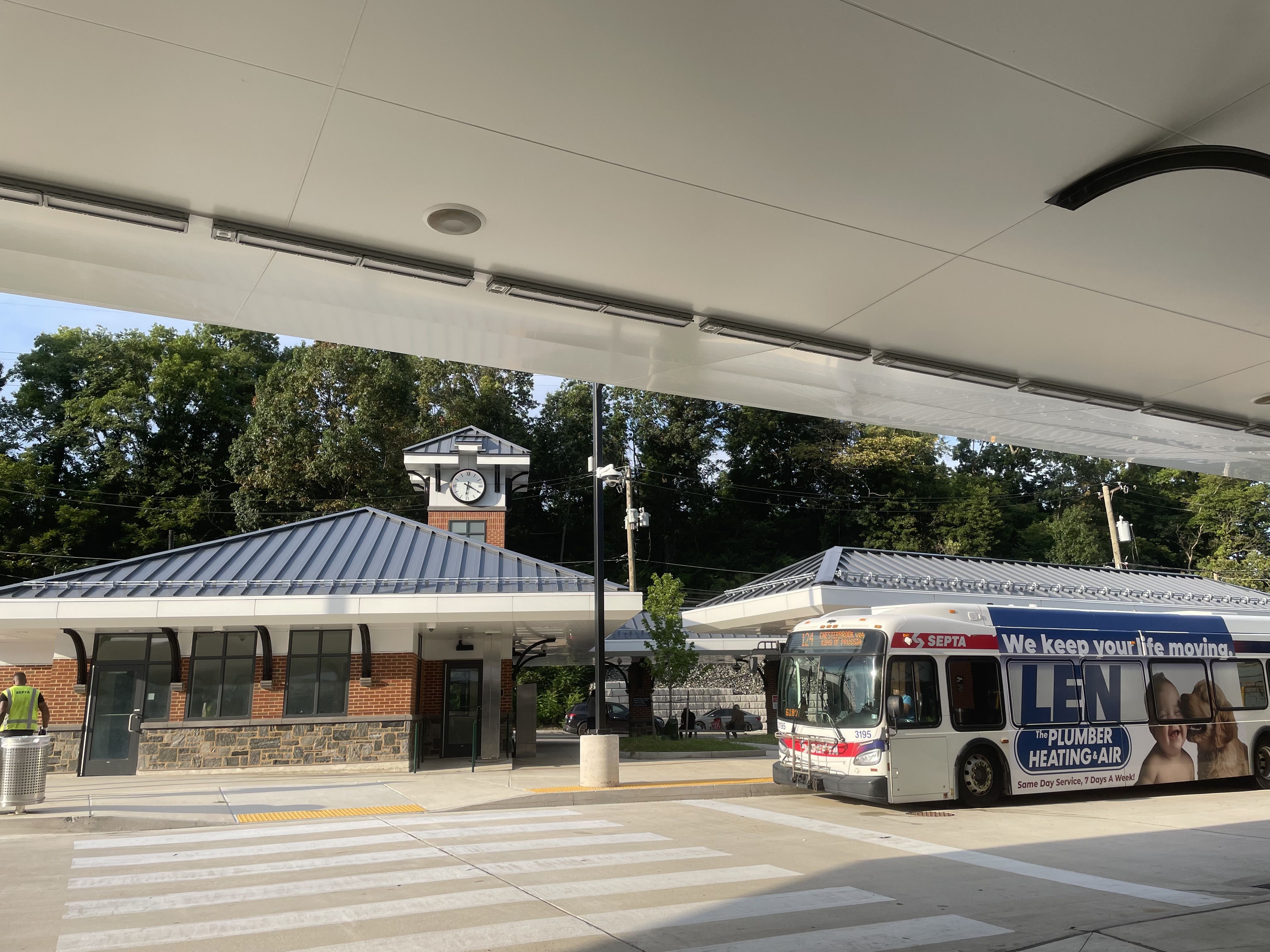
SEPTA’s new Wissahickon Transportation Center on Ridge Avenue in Manayunk is a major upgrade for the city’s bus riders. The sprawling, $50 million station opened in January 2026 and allows 5,000 passengers a day to switch between 11 bus lines.Inga Saffron / For The Inquirer
The immediate and widespread impacts of such investments are real: fewer reasons to get in the car, less time circling for parking, and less money at the pump. Fewer meals cut short, encores missed, meetings adjourned early, mad dashes to the platform. More spontaneity, more time spent where it matters, more saying yes to the events and occasions that make Philadelphia such a special place to live.
All it takes is money. Not subsistence money. Not barely-keeping-up money. Money that places like Seattle, Boston, and Washington, D.C., have managed to identify, each of them spending more than double what we spend in a year on capital projects alone. SEPTA Accelerate has the potential to meaningfully improve quality of life across our region while making Center City Philadelphia one of the most appealing places in the country to live, do business, and visit.
Clint Randall is vice president of economic development at the Center City District.
As tech CEOs debate the looming threat of artificial intelligence to worldwide safety and economic stability, lawmakers in New Jersey have begun taking steps to protect the workforce from fast-moving changes that have already disrupted how many do their jobs.
The state Senate Labor Committee last week voted unanimously to approve a bill that would regulate how employers use AI to monitor, evaluate, and ultimately replace workers.
The bill, which comes amid a broader backlash to AI and surveillance technology, now moves to the Senate budget committee for consideration before a vote by the full chamber. The “Fair Act” would require private- and public-sector employers to provide 60 days notice before implementing AI that would impose significant changes to job expectations. Employers who eliminated jobs because of AI advances would be required to offer training, extended severance pay, and benefits, according to the bill.
It would also regulate how employers use electronic monitoring tools to collect information about employees’ productivity, and how “automated employment decision-making systems” are used to hire, promote, and fire people.
“It makes sure employers can’t spy on you when you are off the clock. Your boss should not be able to follow you home,” said Charle Wowkanech, president of the New Jersey State AFL-CIO, which represents 1 million public- and private-sector workers and their families, who spoke at a recent rally outside the Statehouse to draw attention to the bill.
Artificial intelligence is already monitoring the productivity of thousands of people who work in grocery stores, factories, and cannabis operations in the state, said Daniel Ross, president of United Food and Commercial Workers Local 152, which represents workers in New Jersey, Pennsylvania, Delaware, and Maryland. “The time-test matrix is so unreasonable that workers skip bathroom breaks, they don’t take water breaks, to avoid falling behind,” Ross said.
“Surveillance is not mainly harmless oversight, as it’s sold by employers,” Ross said. “Workers subjected to these practices experience elevated stress levels, declining mental health, and [increased] injury rates.”
Other states have already taken up the issue.
California, Colorado, Connecticut, Illinois, and New York have enacted various workplace protections from AI, according to Multistate, a clearinghouse for state legislation across the country. Pennsylvania has introduced its own bill to regulate AI in the workplace.
However, New Jersey business and industry leaders urged the committee to rethink some of the most sweeping provisions of the bill.
Most of the 1,300 members of the Chamber of Commerce Southern New Jersey are small businesses, which are not equipped with vast human resource or legal departments to implement the law, said Adam Guzjewski, president of Katz Government Affairs.
The bill requires employers to comply with vague requirements to ensure AI does not undermine “an employee’s autonomy, dignity, or welfare.”
But Jack Kelly, a lobbyist for the New Jersey Business and Industry Association, said it’s unclear how these requirements will be enforced for businesses.
“Large corporations may have dedicated legal compliance and technology teams. Many New Jersey businesses do not. For small businesses, these requirements create significant barriers to entry,” Kelly said.
New Jersey’s legislation is not out of step with how other states have regulated AI use, said Tony L.J. Lin, anassociate professor of accounting at Rowan University who studies artificial intelligence in the workplace.
“If AI materially restructures jobs, we need a mechanism for retraining and redeployment,” Lin said.
States should push back on efforts to evaluate employees through invasive means like monitoring keystrokes, simply because this strategy likely does not fully show a worker’s productivity or value, Lin said.
Lin said there is great potential to improve jobs using AI. A nurse-practitioner, for instance, would benefit from technology that handles automated tasks. But a nurse-practitioner will always be valued for the “human judgment, contextual understanding accountability” aspects of the job, he said.
Debbie White, president of the largest nurses union in New Jersey, isn’t so sure.
“Healthcare employers are increasingly using AI and electronic monitoring systems to track worker productivity, evaluate performance, and influence staffing decisions,” White testified during the Oct. 1 hearing in Trenton.
However, White said these systems fail to measure “the reality of nursing care,” which often involves time comforting ailing patients and educating their families among other overlooked aspects of the job.
“AI can be useful, but it can’t replace the judgment of a nurse at the bedside,” she said.