The fights over the next surgeon general and the next Centers for Disease Control and Prevention director have been shaped by a movement that calls itself holistic while practicing its opposite. Last month, senators grilled Erica Schwartz, Trump’s CDC nominee, on whether she would defend vaccine science under a wellness-aligned U.S. Department of Health and Human Services. She would not fully commit.
The replacement, Nicole Saphier, is a radiologist who also sells herbal supplements, hosts a podcast called Wellness Unmasked, and wrote the 2020 book whose title, Make America Healthy Again, became the slogan of a national movement.
The specifics differ. The underlying category error is the same.
On its critique of American medicine, the MAHA movement is not wrong. After performing thousands of spine surgeries, I have come to believe — along with much of the literature in my own field — that a meaningful share of the elective spine operations in the U.S. are performed on patients who would do better without them.
We medicate teenagers for inattention without asking how they sleep. We treat the disc and forget the life it sits inside. When the wellness movement says American medicine has been reduced to organ systems and 15-minute appointments, the criticism lands because the charge is true.
The trouble is what the movement offers instead. The word holistic — from the Greek holos, whole — was supposed to mean a way of seeing that integrates what reductive medicine has pulled apart. In the movement claiming the word, it has come to mean the opposite: a parallel architecture that excludes vaccines, excludes the cardiologist, excludes the entire framework that produced antibiotics, anesthesia, and the survival of children who, a century ago, would simply have died.
That is not integration. It is the same fragmentation in different clothes.
I think about two patients I saw last year in clinic, a week apart. The first was a woman in her 20s with six months of worsening back pain. She had seen a chiropractor weekly, taken supplements from a wellness coach, and tried three essential oil protocols. She had not seen a primary care physician in four years. When she finally reached me, her foot had begun to drop. Her MRI showed a large disc herniation crushing the L5 nerve root. She needed surgery within days.
The second was a man in his 60s, wealthy and well-connected, who had already undergone two lumbar fusions and was being recommended for a third. His pain was real. His anatomy did not explain it. No surgeon had asked him about his sleep, his weight, the 70 hours a week he sat at a desk, or whether he had tried any of the dozen nonsurgical paths that might have helped.
Both were failed by a system that has lost the capacity to put the pieces back together. One by a wellness world that calls itself holistic but excludes the tools of modern medicine. The other by a medical system that calls itself evidence-based but excludes anything that does not fit into a billing code. They are the same problem in mirror image.
Real holism is harder. It says that a child benefits from both unstructured play and the pediatrician who notices the heart murmur. That a patient with back pain benefits from both yoga and the surgeon who knows when to — and when not to — operate. Holism integrates. The movement that owns the word does not.
Patients do not have to wait for Washington.
Integrated programs — where physical therapists, behavioral health clinicians, nutritionists, pain specialists, and surgeons share a single chart and a single conversation about the same patient — exist around the country. They are not yet the default, but they can be found.
If you are navigating a chronic problem, three questions are worth asking your clinician: Do you have colleagues outside your own discipline who will be part of my care, and do you talk with them? Is the goal of the first visit to decide on a procedure, or to decide whether a procedure is the right answer? Last, what would have to be true for you to recommend a treatment other than the specific thing you do for a living? A clinician who can answer those questions without flinching is closer to holism than any movement claiming the word.
This is what the country’s next surgeon general — and its next CDC director — should be arguing for. Not another round of the wellness-vs.-medicine fight, with two sides accusing each other of missing the whole.
A real defense of the whole person would acknowledge what each gets right and refuse what each gets wrong, and insist that the institution — not the patient — do the integration.
Whoever takes those offices next will be asked, eventually, what holistic means. It would be worth the country’s time if their answer were a real one.
Vijay Yanamadala is vice chair of neurosurgery at Hartford HealthCare’s Ayer Neuroscience Institute, associate professor of surgery at Quinnipiac University’s Frank H. Netter School of Medicine, and a 2026 public voices fellow with the OpEd Project.
The CEO of South Philly drone software and hardware maker Exyn Technologies resigned Wednesday after an internal investigation showed he used a company credit card to rack up $287,000 in unauthorized personal expenses, according to a statement Exyn filed Thursday in a revised quarterly financial report with the SEC.
Brandon Torres Declet, the CEO, had pledged to boost sales and profits after taking the money-losing company public in an IPO in May.
Exyn named chief operating officer Benjamin Williams as acting CEO, a role Williams also filled for five months in 2023 after founder Nader Elm left the company and before Torres Declet’s hiring. The company named director Gregory McNeal as board chairto replace Torres Declet in that position.
In a Wednesday filing, Exyn had said the CEO was “terminated.” In a brief interview Wednesday night, Torres Declet said he expected the company would amend that statement, as it did. He declined further comment.
Torres Declet’s departure followed an internal investigation opened Aug. 11 by the board’s audit committee into allegations that Torres Declet “used a company-issued credit card to pay for personal travel and other personal expenses that were recorded as business expenses in the company’s books and records.”
Torres Declet was denied severance, according to the filing. Exyn added that it has asked him to return the unauthorized payments.
Torres Declet joined Exyn in late 2023. He was paid a salary of $366,667 plus a bonus of $200,000 for 2025, plus stock options. The stock went public at $7.70 but has traded lower ever since, closing Wednesday at $2.
On Aug. 3, eight days before the investigation opened, the board boosted his salary to $482,000, plus a bonus of up to $362,000.
Exyn raised $19 million in the IPO. Sales of Exyn’s drone hardware and software, used by mining companies and offered to military and commercial users, totaled $5.8 million last year, up modestly from $5.6 million in 2024. But expenses in each year, including salaries for the company’s staff of 45, totaled around three times that much.
Before joining Exyn in 2023, Torres Declet, a lawyer, had worked for years in the drone business and earlier as a counsel to Congress and for the New York Police Department, according to his posted resume.
Interim CEO Williams, who holds engineering and business degrees from the University of Pennsylvania, worked previously at AT&T, Lockheed Martin, and for the U.S. Navy. He also ran a string of small start-ups, including Reelio Inc., purchased by an AT&T affiliate in 2018.
After Torres Declet’s departure, Exyn said in its SEC filing that the company acknowledged poor credit card controls. The company listed other “material weaknesses” in its accounting procedures including a lack of oversight in tracking inventory, failure to properly report its loan agreement with Arizona-based Western Alliance Bank, and failure to properly recognize expenses.
Exyn attributed the accounting issues to having too few staff with technical accounting knowledge.
The company is based in a former brewery barn on Washington Avenuein Philadelphia. Torres Declet said last spring that he was looking for larger quarters to accommodate growth after Exyn’s lease agreement expires next year.
Exyn’s investors represent the breadth of interest in industrial and military drone projects. The largest shareholder before and after the IPO was Reliance Strategic Business Ventures Ltd., owned by India’s multibillionaire Ambani family. Others include Wilmington-based Longview Innovation; Israel-based Neolync Holding; and Penn Engineering dean Vijay Kumar, an Exyn cofounder. Early investors included Chicago-based Alyeska Investment Group; military-focused Anzu Partners, a firm linked to the Japan-based Softbank Vision Fund; In-Q-Tel, which invests in tech companies that sell to the CIA; Pennsylvania-funded Ben Franklin Technology Partners of Southeast Pennsylvania; and Penn alumni-funded Red & Blue Ventures.
Early funding also came from the Defense Advanced Research Projects Agency, the research and development arm of the U.S. Department of Defense.
Exyn was founded in2014 by Kumar and Elm, a Penn robotics scholar who worked for Kumar’s General Robotics, Automation, Sensing & Perception (GRASP) lab, which helped develop drone quadcopters. The company’s initial clients included mining companies hoping to reopen closed deep mines in the U.S., Canada, and other countries.
The IPO prospectus said the company’s Exyn Defense Inc. subsidiary focuses on such military uses as “autonomous systems for reconnaissance, contested logistics, and force protection,” for use in underground tunnels and on city buildings.
Mayor Cherelle L. Parker has seen more than twice as much turnover among top officials in her administration than her most recent predecessors had at the same point in their tenures, according to an Inquirer analysis of personnel moves.
Come September, when City Solicitor Renee Garcia’s resignation takes effect, more than half of Parker’s highest-level appointees will have departed in the two years and nine months since she took office in January 2024.
Following last month’s announcement that Managing Director Adam K. Thiel and Garcia would soon be leaving Parker’s administration, The Inquirer compared turnover at the top level of city government under Parker with former Mayors Jim Kenney and Michael A. Nutter. The analysis included chiefs of staff, deputy mayors, and the half-dozen other positions designated by the Philadelphia Home Rule Charter as part of the mayor’s cabinet.
The analysis found:
Of the 11 people Parker appointed to those jobs, six have already left the administration or are poised to leave by September. Kenney had lost three of his 11 top appointees by the same point in his tenure, and Nutter had lost two of the nine officials in comparable positions.
Most strikingly, Parker has lost three of the top four officials in her government: Chief Deputy Mayors Aren Platt and Sinceré Harris, the architects of her 2023 campaign, and Thiel, who oversaw most of the city’s operational departments. By this point, Kenney and Nutter both had lost two of the six people who held comparable roles in their tenures.
For the director of the Philadelphia Department of Labor, a cabinet position, Parker is on her third appointee, after her first two left city government after short stints leading the agency. (Parker has also had three directors of LGBTQ+ affairs, a non-cabinet position, after firing the first two people who served in that role.)
In another cabinet role, that of commerce director, Karen Fegely has been serving on an interim basis since May 2025, when Parker’s original appointee, Alba Martinez, resigned to produce a musical.
Tiffany W. Thurman, Parker’s chief of staff, said the turnover has not raised “any red flags or alarms internally.”
“It’s cyclical, and it’s part of the process,” Thurman said in an interview Thursday morning, after the initial publication of this story. “The work is continuing, and it’s strong and it’s good, and the vision hasn’t wavered despite the turnover, and so I’m very, very pleased with the team that we have right now.”
(function() { var l = function() { new pym.Parent( ‘parker-staff__graphic’, ‘https://media.inquirer.com/storage/inquirer/ai2html/parker-staff/index.html’); }; if(typeof(pym) === ‘undefined’) { var h = document.getElementsByTagName(‘head’)[0], s = document.createElement(‘script’); s.type = ‘text/javascript’; s.src = ‘https://pym.nprapps.org/pym.v1.min.js’; s.onload = l; h.appendChild(s); } else { l(); } })();
Although the top rung of Parker’s administration has seen high turnover, the analysis found that the next two tiers of city government leaders under Parker have seen less churn.
Of 18 key department heads not included in the charter-designated cabinet under Parker, three have resigned from or been forced out of city government. (A fourth, former Fire Commissioner Craig Murphy, stepped down as part of a scheduled retirement after Parker appointed him on an interim basis.)
Of the 76 additional political appointees, smaller department leaders, and deputies identified by The Inquirer — including all of the officials whose appointments Parker publicly announced as she filled out her administration — at least 12 have resigned, been fired, or moved to a new role in a discipline-related transfer. (Others have received promotions or switched roles to fill vacancies.)
Major officials who remain in the administration hold some of the most critical posts in city government, such as Police Commissioner Kevin J. Bethel, the first appointment Parker announced after her election, and Finance Director Rob Dubow, who has held his role since the start of Nutter’s administration in 2007.
While smaller in number, the departures among the second and third tiers of city government leadership under Parker have included losses in important positions, including Water Commissioner Randy Hayman, Licenses and Inspections Commissioner Basil Merenda, Chief Policy Officer Sophie Bryan, and Budget Director Robert McDermott.
(function() { var l = function() { new pym.Parent( ‘parker-staff2__graphic’, ‘https://media.inquirer.com/storage/inquirer/ai2html/parker-staff2/index.html’); }; if(typeof(pym) === ‘undefined’) { var h = document.getElementsByTagName(‘head’)[0], s = document.createElement(‘script’); s.type = ‘text/javascript’; s.src = ‘https://pym.nprapps.org/pym.v1.min.js’; s.onload = l; h.appendChild(s); } else { l(); } })();
There is always turnover in administrations, but it is often clustered around the end of mayors’ four-year terms. (There are exceptions: A majority of Philadelphia city solicitors since 1992, for instance, have served around two to three years, putting the length of Garcia’s tenure on par with her predecessors.)
Traditionally, deputy mayors and chiefs of staff work most closely with the mayor, and the posts have often been filled by people in the mayor’s inner circle or top campaign aides. They often do not have deep city government experience, which was the case for Harris and Platt, both of whom have since returned to politics.
Appointments for operational positions, such as managing director and police commissioner, usually go to people with experience in their fields. Thiel led the fire department and the office of emergency management under Kenney. Bethel was a former deputy police commissioner.
Parker, at the helm of City Hall, has said she has a demanding leadership style.
“With my team, am I always stretching and pushing and requiring that homework is done?” Parker said in a 2024 interview. “Yes, but I also believe I have the best and the brightest people with me. So naturally I have very high expectations for them because, quite frankly, they’re smart.”
Candi Jones, the administration’s chief human resources officer, said that Thiel and Garcia’s tenures are roughly in line with the average length of their predecessors’ over the last four administrations.
“Turnover is not turmoil,” Jones said Thursday during the interview with Thurman. “What is of most importance is that the city has an obligation for operational continuity. … Everyday, our operations are continuing to be managed daily, weekly, monthly. There has been no gaps in service.”
She also emphasized that key officials like Bethel, Dubow, and Thurman “since day one have been in place and really have been moving the government forward.”
The Inquirer attempted to reach all of the former administration officials mentioned in this article. Many declined to comment for this article or did not respond to interview requests. Attempts to reach several others were unsuccessful.
‘Big Three’ loses two
Even before Parker took the oath of office, intrigue over personnel matters became a defining aspect of her administration.
After winning the mayor’s race, Parker announced in late 2023 that she would appoint a “big three” of senior advisers to lead her administration, rather than a single “big mahoff,” an all-important aide who touches almost all major decisions, as had been the case in past administrations.
“No one like me has ever been elected mayor of our city, and no one has ever organized their senior staff this way,” Parker, the city’s first Black female mayor, said at the time.
Parker tapped City Hall veteran Vanessa Garrett Harley to fill Platt’s role, while Harris has not been directly replaced.
Despite Parker’s initial vision for a triumvirate of top aides, Thurman has by all accounts become Parker’s indispensable No. 2. Parker has referred to Thurman as her “chief air traffic controller.”
Mayor Cherelle L. Parker walks from her office at City Hall on Wednesday, Jul. 9, 2025, to speak hours after her administration struck a tentative contract agreement with District Council 33 leaders overnight, ending a workers strike. With her are: Chief Deputy Mayor Sinceré Harris (from left); Chief of staff Tiffany W. Thurman; and Chief Deputy Mayor Vanessa Garrett-Harley.Tom Gralish / Staff Photographer
Thiel’s tenure with the city, meanwhile, has been one of the most perplexing sagas of Parker’s first term. In the administration’s early days, he often appeared alongside the mayor at news conferences during emergencies and major announcements.
But his public role overseeing many of the city’s day-to-day operations faded over time, and his obligations outside City Hall grew. In addition to working as a high-paid consultant and adjunct professor — as he had since the start of the administration — Thiel joined the U.S. Army Reserve in 2024 and took multiple leaves from the city for military service, including during this winter’s prolonged snow and ice emergency.
In July, Parker announced Thiel’s resignation, noting that he is leaving to “reenter the private sector.”
Philadelphia Managing Director Adam Thiel updates the latest from garage collapse at 30th and Grays Ferry with Mayor Cherelle L. Parker on Thursday, April 9, 2026.Yong Kim / Staff Photographer
New positions, new faces
Parker, who has also greatly expanded the mayor’s office staff and increased salaries, created numerous new roles after taking office. Several people left those positions shortly after becoming thefirst people to hold them.
Kafi Lindsay resigned as director of the Philadelphia Office of Strategic Partnerships just nine months after being appointed, according to her LinkedIn profile. Rachel E. Branson resigned as the director of the Philadelphia Office of Minority Business Success after a year and three months, according to her LinkedIn profile. And Hassan Freeman last fall was let go as director of neighborhood and community engagement after an altercation with Councilmember Isaiah Thomas outside City Hall.
Some signs of strain within the administration emerged during Parker’s second year in office.
Parker last summer fired Brandee Anderson, who was the chief diversity, equity, and inclusion officer, and Tyrell Brown, the director of LGBTQ+ affairs, amid a thorny personnel issue that also led to the deputy chief of staff, Chris Dailey, moving to the managing director’s office in a disciplinary transfer.
Last month, Anderson sued the city, alleging her termination was part of an effort to “suppress” DEI work in the administration. Around the same time, Shania Bennett, Parker’s former director of youth engagement, a non-cabinet position created by Parker, posted on social media that her time with the mayor’s administration was “the worst experience of [her] life” and that she resigned due to “unprofessional harassment” from a fellow staffer.
‘What’s the bench?’
George R. Burrell, a lawyer and former City Council member who held senior roles under two mayors, said the personnel churn under Parker will test the leadership skills of the behind-the-scenes city officials who have been elevated to fill vacancies.
“The question you have, when you have this kind of turnover, is, ‘Well, what’s the bench?’” said Burrell, who served in the administrations of former Mayors William J. Green III and John F. Street. “The question of what happens next and the quality of what happens next is the quality of the bench.”
Veteran city staffers now occupy four of the six top roles originally held by Parker appointees who have since left City Hall. Harris’ position was not directly replaced.
The exception is former Assistant U.S. Attorney Monique Galloway, a newcomer to Philadelphia government, who will replace Garcia as the city’s top lawyer next month.
Burrell said he expects longtime city bureaucrat Carlton Williams, who has replaced Thiel as managing director after serving as Parker’s director of clean and green initiatives, to succeed in his new role.
“I watched him evolve into what is a productive public servant,” Burrell said. “So I think that’s a bench member who is going to perform at the level that’s needed.”
Philadelphia Mayor Cherelle L. Parker announces Carlton Williams as the new Philadelphia Managing Director, replacing Adam Thiel during a news conference at City Hall in Philadelphia on Tuesday, July 28, 2026.Jose F. Moreno / Staff Photographer
Once in office, Parker took nearly a full year to fill out her administration with appointments to key positions. She did not announce her selection of Kehinde “Kenny” Solanke to lead the Philadelphia Department of Behavioral Health and Intellectual disAbility Services, or DBHIDS, until July 2025, a year and a half into her tenure.
During that process, Parker said she was seeking the “best and brightest” and conducted national searches for some roles. A vast majority of her appointees, however, had strong ties to Philadelphia.
In 2024, when Parker was filling out her administration, she said she attended a training for new mayors at Harvard University. Some leaders from other cities, she said, were interested in recruiting Hayman, who had been appointed water commissioner by Kenney in 2019.
When Parker took office, it was unclear if she would keep Hayman in command of the water department. She announced she was retaining him in March 2024, and relayed the Harvard anecdote to demonstrate how Philly already had some of the country’s top public servants.
“He’s not going anywhere,” Parker said at the time. “We were able to hold on to some of the best talent in the nation.”
In July 2025, Hayman left Philadelphia to become the executive director of the New Orleans Sewerage and Water Board.
Staff writers Ryan W. Briggs and Anna Orso contributed to this article.
With only a few weeks of peak barbecue season left and Labor Day weekend around the corner, there’s no better time to stock up on wines like this one that are equipped to handle a rack of ribs.
Red wines and red meats go together so well that it’s tempting to think that anything goes as long as the colors match. If you’re a fan of leaner, drier reds from places like Italy or France, it’s helpful to know that they will not taste their best with barbecue sauce. With only a handful of fruity exceptions like valpolicella or Beaujolais, those combos are almost guaranteed to clash due to the ultra-dryness of most European classic reds and the sticky sweetness of most barbecue sauces.
Red wines from the Americas or the southern hemisphere are better equipped for barbecued ribs, chicken, or even BBQ-flavored chips because they taste so much riper and register as sweeter, even when their actual sugar content is almost as low.
Bold red blends from California are a great choice for barbecues because, in addition to tasting less dry and more fruit-forward, they align nicely in other dimensions as well. Most are quite intense in their concentration of flavor and almost all feature prominent oak flavors that harmonize with the smoky taste of barbecue sauce.
Cheaper reds may acquire oaky flavor through the use of extracts or wood chips, but premium wines like this Sonoma red blend from Rodney Strong get their oak taste the old-fashioned way — by aging in newly toasted oak barrels. Here, grapes like merlot and cabernet sauvignon contribute a blackberry backbone while jammier malbec and zinfandel add a sweet black cherry component. The result is a robust blend that is juicy enough to handle ribs and all the other barbecue staples, but still dry enough for red wine lovers to sip on and enjoy by itself.
Rodney Strong Red from Sonoma County.Rodney Strong
Rodney Strong Red
Sonoma County, California; 14.5% ABV
PLCB Item #96511
On sale for $18.99 through Aug. 31 (regularly $22.99)
Also available at: Canal’s in Mt. Ephraim, N.J. ($15.49; mycanals.com), Hopewell Super Buy Rite in Pennington, N.J. ($15.49; buyrite.wine), Moorestown Super Buy Rite in Moorestown, N.J. ($15.99; moorestownbuyrite.com)
Everything seemed primed for President Donald Trump to get his ballroom.
No, not that ballroom. His other ballroom.
Across the Atlantic, in the tiny village of Doonbeg, where the Trump International Golf Links & Hotel rises above the dunes of a wind-swept beach, the president and his family had promised to build “the nicest ballroom in Ireland” — a grand edifice that would extend across 12,000 square feet and seat 320 guests at 42 tables.
And unlike in Washington, where Trump’s push to fast-track a grandiose White House ballroom set off a political and legal fight that has now reached the Supreme Court, the population of Doonbeg, which hovers around 300, had lined up behind the project.
In a letter to the local planning commission, a local pub owner said it would halt the village’s decline. Another resident said it would create jobs and bring in offseason tourism. A statement by the Doonbeg Football Club called the golf resort “not just a business … but an integral part of our community.”
Even the snail lobby had been appeased.
Questions over the fate of the threatened Vertigo angustior snail — a microscopic mollusk nestled in Doonbeg’s sandy dunes — had bedeviled the golf property even before the Trump Organization owned it. But in February, the commission approved the ballroom provided the Trumps offer a snail restoration plan.
“The ballroom,” said Rita McInerney, a Doonbeg resident and member of the Clare County council, had become “part of the community’s vision.”
The jubilation, however, was quickly cut short.
Days after the February approval, a lone appeal was lodged by Liam Madden, a hermetic figure notorious for blocking hundreds if not thousands of development projects across Ireland, including a previous expansion plan in Doonbeg. Impervious to shaming or calls for decency, he once stirred such rage that a foe attacked him with a blowtorch.
“Please,” Madden urged the appellate board, “refuse this nonsense.”
Trump’s other ballroom was stalled.
Guests ride horses at Trump International Golf Links Ireland.Anastasia Taylor-Lind
How to torpedo a project
Madden is a tall man with white hair who lives in a historic house behind a thick stone wall in the Irish village of Longford. He owns no cell phone. He has no website. No social media accounts. The only way to find him is either through his malfunctional landline or an email address that identifies him, in Latin, as the “Irish Vitruvius.”
And yet, people across this country know the name Liam Madden.
When confronted by bothersome development projects, the Irish over the years have turned to this quarrelsome and punctilious man for his ability to torpedo plans. He is what many in Ireland call a “serial objector” — someone who makes a living by appealing planning commission decisions. Madden, however, bristles at that classification.
Instead, when he’s feeling reticent, he describes himself as “the most successful appellant in the history of the Irish state.” At other times, including in interviews with the Washington Post, he referred to himself as a “god,” a “hero,” a “celebrity.”
“There simply isn’t anyone better,” he said. “It’s a scientific fact.”
“I’m modest as well,” Madden, 76, added. “That’s one of my failings.”
His profession is an unintended outgrowth of Ireland’s wildly permissive planning appellate system. In most of Europe and the Americas, a person typically needs to legally demonstrate some stake — financial, geographic or otherwise — to gum up a project with an objection. Ireland has taken a different tack.
All anyone has to do to file an appeal — and trigger a monthslong review by An Coimisiún Pleanála, the national appellate planning board — is submit a preliminary “observation” and pay a nominal fee. Appellants don’t have to be Irish. Or even in Ireland.
“There’s no such thing as too much democracy,” reasoned Lorcan Sirr, a housing analyst at Technological University Dublin.
A house in Doonbeg is painted in preparation of the Irish Open Golf Tournament.Anastasia Taylor-Lind
The system increasingly has become a matter of national controversy. Developers complain that it’s an impediment to progress, vulnerable to abuse and fueling a cottage industry of serial objectors, some of whom have used appeals to extract payments from developers. In 2024, lawmakers proposed reforms.
Madden, who’s never been accused of such improprieties, looks at other serial objectors as a lesser form of the species. He said he would never profane his craft with profit-seeking. What motivates him is the pleasure of winning — identifying even the smallest legal violations to bedevil his adversaries.
That, and bald-faced publicity. “I’m perpetually seeking notoriety,” he said.
So in January, while flipping through the papers, he saw what he recalled as a “golden opportunity.” In Doonbeg, roughly three hours from Madden’s house by car, Eric Trump had proclaimed his intent to build the “nicest ballroom in Ireland.”
Madden knew then what he must do.
“If there is a God in heaven,” he declared one July evening, “I will win the planning appeals and capitalize on it for notoriety.”
Volunteers for Doonbeg Tidy Towns water flowers along Main Street.Anastasia Taylor-Lind
A village praying for a golf course
Doonbeg was in trouble. As the 1990s drew to a close, the shoreline village, whose history dated to at least the 1500s, was fading.
“We weren’t poor in community,” said Tommy Comerford, a fifth-generation Doonbeg resident. “But we were poor in jobs and opportunities to keep our young people.”
The community pitched the European Regional Development Fund on a golf course — and won financing for it. Designed by famed golfer Greg Norman, the Doonbeg Golf Club opened in 2002, just as the local population fell to 206.
Busloads of golf tourists from the United States and Canada were soon rolling in. Seasonal employment at the club — which quickly added a luxury hotel and events space — grew to 300 people. Residents who’d left were coming back.
“The golf resort is so important to us,” said Seoirse Comerford, 52, who returned to take over the family pub.
But the resort could not turn a profit. By 2011, it had lost a reported $70 million. In January 2014, it was put up for sale, and worry spread through Doonbeg.
“It was like, ‘Oh my God, 300 jobs — gone,’” said Caroline O’Brien, a resident.
A savior, however, quickly arrived: an American buyer named Donald Trump. He touched down at Shannon Airport in May 2014 and immediately declared his plans for the resort.
“One of the main reasons I’m here is siting the ballroom,” Trump said. “A truly great ballroom. I believe people from all over the world will be using this ballroom.”
The sand dunes of Trump International Golf Links, as seen from Doughmore Bay Beach. Anastasia Taylor-Lind
‘I’ll be a friend to the snail’
Shortly after the sale’s announcement, an Irish environmentalist named Tony Lowes got a call from Trump.
“I’ll be a friend to the snail,” Lowes recalled Trump declaring.
Questions over the threatened Vertigo angustior, a fickle creature with exacting ecological needs, had long troubled the golf course. Even before it was built, Lowes’s Friends of the Irish Environment had filed a lawsuit to protect the snail. A judge ordered that the snail’s lot be “maintained or improved” and a settlement agreement even allowed for the appointment of a snail expert as a sort of steward.
For years, the snail thrived, and Trump promised to sustain its roll.
But Lowes said the Trumps haven’t kept their word, and the snail’s population has plunged. Shortly after they bought the resort, the snail expert was dismissed. (The expert didn’t respond to requests for comment.) Then, in 2016, the Trumps proposed building a 1.7-mile rock barrier wall along Doughmore Bay Beach to forestall shoreline erosion and protect the links from storm damage.
Environmentalists said the plan, even after it was scaled down, would alter the dunes’ delicate alchemy and doom the snail. To block construction, Friends of the Irish Environment filed an appeal with the national planning board. At its side, with his own appeal, was Liam Madden.
The board decided against the Trumps. Madden basked in glory.
Comparing himself to Saint Patrick, Madden at the time said he’d drive Trump “out of Ireland” like a “snake.”
Trump International Golf Links Hotel, seen from Doughmore Bay Beach. Anastasia Taylor-Lind
The making of a serial objector
When he graduated from architecture school in 1973, Madden said he wanted only an architect’s life. But the planning system was so integral to his work that he immersed himself in planning law and, upon submitting his first appeals, realized, “I was very good at it.”
During the mid-1990s, as Ireland experienced a building boom, people began seeking out Madden for his unusual acumen. Some wanted him to clear a project’s way. Others wanted the opposite. He became friend and foe to developers.
“He had a nickname among developers: the ‘Condom Man,’” said Irish federal senator Joe Flaherty. “You’d use him once, and then throw him out.”
Most of Madden’s work was done in obscurity. But his name nonetheless often rose to public notice.
First came a political campaign in 2004 against a candidate also named Liam Madden, for nothing more than what Madden called “devilment.” Then he stalled a project by the Gaelic Athletic Association, which is Ireland’s largest sporting organization, until it apologized to him over a decades-old grievance.
In 2013, Madden delayed the reopening of St. Mel’s Cathedral, a massive church that suffered a devastating fire, by objecting to a glass elevator that he alleged would offend the “modesty” of “Scotsmen visiting in their kilts.”
The town was furious.
“It was hugely emotional for the town,” Flaherty said. “It was two middle fingers to the local community.”
The attention only spurred Madden on. He objected to a fast food development. He objected to converting an abandoned factory into a car auction site. He objected to Trump’s barrier wall. And he objected to UFC legend Conor McGregor’s bid to build a boutique hotel, challenging him to a “bare-knuckle fight.”
Louis Herterich, a longtime client, said most people simply didn’t get Madden. “He’s just different,” Herterich said. “His god is being right and getting it right and winning.”
Flaherty added: “Nobody in their right mind would want to be Liam Madden — the criticism, the open contempt — but he relishes it.”
In a way, the two men said, they almost felt sorry for Trump.
“Even if he loses,” Flaherty said, “he’ll just find something else and keep going at it.”
Newly built houses in Doonbeg. Anastasia Taylor-Lind
A fatal error?
To Madden, there is no way he’ll lose — not this one.
“I’ve caught them with their pants down,” he said while beaming one July evening.
He returned to the snail — this time focused on helicopters. The Trump Organization, a promotional video indicated, allows guests to be ferried in and out by helicopter. In materials published online, an aviation company, Executive Helicopters, said it has two “heli landings” at the resort, one by the hotel and one on the golf course.
To Madden, this was a “fatal error”: The Trump Organization neither mentioned the helicopters nor sought to measure their ecological impact. The ballroom proposal thus was “tainted at law and beyond remedy,” he wrote.
Plus, Madden wrote, “Would our poor little Vertigo Angustior survive?”
The Trump organization didn’t respond to a request for comment. Golf course manager Joe Russel declined to comment. Executive Helicopters didn’t respond to a request for comment.
Geraint Ellis, an expert on Irish planning law who reviewed the appeal at The Post’s request, said Madden’s objection wasn’t frivolous. “Mr. Madden seems to have found some issues that are worthy of further scrutiny,” Ellis said.
As word spread of the objection, Doonbeg residents reacted with outrage. The golf resort had nothing to do with Trump, resident Rita McInerney said. Doonbeg started the resort, and will rise or fall with its fortune. How could a single outsider with nothing at stake kick up such trouble?
“Ludicrous,” she said.
“Disgraceful,” agreed Seoirse Comerford.
“Totally unfair,” added Tommy Comerford.
Doonbeg resident Rita McInerney said the ballrom became “part of the community’s vision.” Anastasia Taylor-Lind
In Washington, the White House ballroom is well underway. Foundational construction has started. The $900 million, 90,000-square-foot structure is coming into focus, including new details like gold-colored presidential seals. The Supreme Court is expected to rule this week, potentially giving it a green light.
But in Ireland, where the national appellate board is expected to rule by year’s end, Liam Madden insists the other ballroom will never be approved.
“Joe Biden beat Donald Trump once,” he said. “I’ve beaten him twice.”
The financial struggles of a once-popular theater in Collingswood have spiraled into debate over who runs it in the first place and whether taxpayers should have paid millions of dollars to keep it afloat.
Collingswood Borough has rented the property housing the Scottish Rite Auditorium, which seats 1,050, for $1 annually from the Scottish Rite Freemasons for 23 years.
But Collingswood officials say they are looking to transfer management of the Scottish Rite — one of the largest theaters in South Jersey and once host to major touring acts like Kansas, David Crosby, and America — to Camden County after declining ticket sales left the onus on Collingswood to pay for expenses in recent years.
Commissioner Jim Maley, a former mayor and a Democratic member of borough government for the last 37 years, said post-pandemic theater losses have cost the borough $505,000 since 2020.
Maley helped found the nonprofit that manages the Scottish Rite property, Collingswood Foundation for the Arts, with the help of two former officials back in 1999. The foundation, which Maley said was created to secure arts grants for Collingswood, has long received the borough’s financial support without question.
That changed recently.
At a heated meeting of Collingswood’s three-person board of commissioners on Aug. 3, the public demanded to know who runs the Scottish Rite, whether it is really part of the borough, and, if not, why taxpayers are paying for it, especially when Collingwood schools are struggling.
Now, residents and at least one commissioner are scrambling to find answers, while Maley says the new round of questioning is just another effort by naysayers to undermine him.
What changed?
On July 31, a website by an anonymous user went live: “The Scottish Rite. Who actually runs it?”
The site, with a corresponding Google Drive of public documents, alleges that Maley and other officials created a conflict of interest by authorizing millions in payments and loans to Collingswood Foundation for the Arts, Maley’s brainchild, since 2003.
The conflict-of-interest accusation is not the first in Collingswood.
Maley said the theater issue is another example of meaningless attacks against him. The foundation managing the Scottish Rite is part of the borough, he said, and thus deserves its dollars.
Who runs the Scottish Rite?
Maley begins his account of the theater in 2003, when the Collingswood Foundation for the Arts gained control of the Scottish Rite. That is also when the borough secured a lease for the property and entered into a management agreement for the theater with the nonprofit.
The Collingswood Foundation for the Arts, which manages the Scottish Rite Auditorium and the Collingswood Grand Ballroom at 315 White Horse Pike, was the subject of recent confusion at a Collingswood commissioners meeting on Aug. 3, 2026.Sarah Nicell
Maley and his fellow commissioners passed an ordinance at that point to borrow $5 million in bonds to fund a loan to the foundation for renovations to the Scottish Rite. The loan was never paid back, Maley said, since there was no expectation the nonprofit would do so.
At first, Maley said, borough employees ran the theater.
But when the nonprofit made more money, its staff — one full-time employee and four regular part-timers, with 20 or more brought in specifically for events — switched to the foundation’s payroll, a change confirmed by Elizabeth Pigliacelli, Collingswood’s chief financial officer.
The borough allocated hundreds of thousands of dollars in its annual budgets for the theater’s operating expenses, insurance, and utilities, and the nonprofit repaid Collingswood at the end of each year.
That is, until the pandemic hit.
Deficits at the theater left the borough paying $250,000 and $55,000 in 2020 and 2021, respectively. The theater managed to power through for the next three years, but the borough had to pay the theater $200,000 in 2025 to keep it afloat, along with $100,000 to apply for a state grant for renovations to the property. That grant has not been awarded.
A 2007 management agreement on the borough website, the most recent available, says the foundation should pay for its own operations. Still, Maley said, the borough “has always been ultimately responsible.”
A duty to understand
Some residents say public records muddy Maley’s picture.
Unlike other borough entities, the foundation has not hosted regular board meetings for two years, according to Maley. Those meetings have never been public.
And while the borough rents the Scottish Rite property, the municipality’s public works department does not maintain it. On an Aug. 14 visit to the theater, Jimni Kricket, a South Jersey landscaping business, was doing outdoor work. The company is owned by Paula Lara, the executive director of Collingswood Foundation for the Arts.
“Public works does all municipal properties,” Commissioner Amy Henderson Riley said in a text, “except you’re correct that her company has the contract for that property. why? I don’t know.”
When the commissioners were asked on Aug. 3 who sits on the board, no one could answer.
Maley later told The Inquirer the board is made up of Collingwood’s current elected officials, but Mayor Solano-Ward and Henderson Riley, both Democrats elected last year, said they were not aware of that arrangement.
“If I don’t understand the relationship, how the heck is the public supposed to understand what this is?” Henderson Riley said.
Henderson Riley said she started questioning the nonprofit when she spotted a bill in the treasurer’s July report for the foundation’s “legal fees,” more than $2,300. The meeting minutes are not yet public, but Henderson Riley said she voted against the payment, and the bill was not paid.
The nonprofit was sued in January by Chammings Electric, a Vineland-based company, for thousands in unpaid bills for work at the Scottish Rite. The lawsuit, the second against the foundation since 2024, is ongoing.
Henderson Riley said she sought legal advice from the borough solicitor, Caitlin Harney Norcia, but Harney Norcia told her she could not answer because the nonprofit has paid her for attorney services.
“I just want to understand,” Henderson Riley said. “If it’s part of the Borough, I have a fiduciary duty to protect our assets, to understand what this is.”
In the meantime, Henderson Riley said, she has sought special counsel to help resolve the problem, which she said will likely take weeks.
The foundation’s nonprofit status also complicates the puzzle.
The foundation’s tax-exempt status was revoked by the IRS in 2024, since the nonprofit had failed to file its annual reports since 2020. Maley said that the missed deadlines were mistakes and that he has since filed them to hopefully re-up the foundation’s tax exemption.
New Jersey law confirming whether a municipality can create and run a nonprofit is hard to find.
But in a 2017 notice, the New Jersey Division of Local Government Services published its view, after some officials raised questions about whether a government can establish a charity. Municipalities are not allowed to create or operate nonprofits, and while local officials can facilitate the creation of a local nonprofit, the notice states they cannot “control its operations” by using taxpayer dollars.
The notice also said local officials cannot appoint government officials or staff as the majority of the nonprofit’s board.
Still, Maley said the nonprofit’s creation was facilitated by municipal lawyers. Several South Jersey attorneys specializing in municipal government declined to comment or said they could not due to their work with Collingswood Borough.
Lara did not return requests for comment.
‘Pass the buck’
Kate Delany, president of South Jersey Progressive Democrats and a Collingswood resident since 2007, was one of several people to demand answers at the Aug. 3 commissioners meeting.
“There are better ways to spend that money if we could get some of that back in our community,” Delany said.
Schools are one clear area in need of money, Delany said.
Maley said Collingswood has started conversations with Camden County to shift ownership “because they have a greater ability to handle the expense.”
Dan Keashen, a Camden County spokesperson, said nothing has been decided yet, since preliminary conversations have not begun. But some Collingswood residents do not want the theater to trade hands, since they worry about losing their chance at answers.
Delany, whose polling place is at the Scottish Rite, said Collingswood should not “pass the buck” to the county.
“That’s something we want to stop,” Delany said. “It’s a Collingswood issue, and we want it to stay in Collingswood.”
2026 Volkswagen Jetta GLI Autobahn vs. Hyundai Elantra N vs. Mazda3 2.5T Premium Plus AWD Hatchback: Let’s have some fun without breaking the bank.
This week: Mazda3 Hatchback
Price: $41,560 as tested. Ouch. Some bank-breaking this week after all.
What others are saying: “Highs: Posh interior, engaging to drive, manual transmission and AWD options; Lows: The stick is limited to a single setup, abysmal rear visibility with the hatchback,” reports Car and Driver.
What Mazda is saying: “For the fun of the drive.”
Reality: Fun comes at a cost.
What’s new: The aging little hatchback (or sedan) gets some added standard features and packaging updates. Its last major redesign came pre-pandemic in 2019.
Competition: In addition to the comparison vehicles, there are the Honda Civic Si, Honda Civic Type R, Toyota GR Corolla, Volkswagen Golf GTI, and Volkswagen Golf R.
Up to speed: The Mazda3 is fast enough to get you out of jams. Hit the sport mode switch, and the power really comes through.
The 2.5-liter turbocharged four-cylinder engine definitely adds oomph to the experience, boosting the 186 horsepower in lesser models to 250. That means you’ll get to 60 mph in 5.6 seconds, according to Car and Driver, compared to 7 for the base front-wheel-drive model or 7.5 seconds for the all-wheel drive. The turbo tested matches the Jetta but falls behind the Elantra N.
Shifty: Knock the PRND gear selector to the left, and you can slice through the six gears on your own. Pull for upshift, as with the Hyundai; the Jetta is the odd sedan out here, with the upshift push.
Somehow Mazda’s small SUV, the CX-30, felt a lot more fun. Maybe it was the shifter, maybe it was the whole feel, seating position, drivability. Among our test group, though, the Mazda3 is the winner for shifting fun.
A stick is also available, but not if you want the turbo or all-wheel drive. But clutching could add enough fun to the slower ride and put the vehicle around a more reasonable $30,000 (the manual hatchback starts at $25,650).
On the road: The Mazda3 provided some joy but not Elantra N-level highs. It also didn’t have the Elantra N-levellows — hitting road seams and bumps with thunderous force. Similarly, the Mazda kept its composure throughout the drive, not frightening me like the Jetta GLI with frantic dances when the gas pedal was stomped. Here, the Mazda3 wins out.
The interior of the 2026 Mazda3 Hatchback keeps the same look it has for years. The dial controller for the media system and simple gauges remain.Mazda
Driver’s Seat: The leather-trimmed Driver’s Seat provided plenty of support and comfort and didn’t feel at all too firm on my travels. The gauges remain what Mazda owners are familiar with, and that’s fine — they’re really all you need. Mazda doesn’t have a Toyota or BMW budget for updating willy-nilly, and that suits my ilk. In this category, the Elantra N lags the other two.
Friends and stuff: Here’s the really nice part about this Mazda3: It was a hatchback. So of course its spaciousness wipes the board compared to the Jetta and the Elantra.
Cargo space is 20.1 cubic feet behind the rear seat. There’s also a bunch more space when the seat is folded, but Mazda doesn’t share those measurements.
The rear seat has plenty of foot room, and the hatchback boosts the headroom a bit, but legroom remains a bit challenging. This category is a draw.
In and out: The Mazda3 skirts sports car territory with its height, so if you’re of a certain age, you’re going to feel it here. (I’ve learned how to stand up leaning on the doorway so it looks nothing at all like I’m approaching age 60, he said delusionally.)
Play some tunes: Speaking of old, the Mazda3 keeps the dial and buttons for stereo control, in addition to the touchscreen that’s so ubiquitous it must be required by law. The touchscreen does have its uses, but the dial and buttons allow for moving around the choices without looking with some practice. Perfect for, you know, driving, which is kinda why we’re here, no? (That guy driving in front of us obviously disagrees.)
The sound, unfortunately, is not up to the latest from the competition, a B+ at best. The bass either thudded or was lacking and song clarity was hit or miss. (Shockingly, the CX-30’s got an A rating.)
Keeping warm and cool: This system also matches all the other Mazdas, dials for temperature and horizontal buttons operating the rest of it, with a small readout.
Fuel economy: The vehicle averaged 24 mpg over its lifetime, kinda par for the course, tied for the loser spot in this category.
Where it’s built: Hofu, Japan, and 85% of its components hail from the Land of the Rising Sun, with none from the U.S.
How it’s built:Consumer Reports rates the Mazda3 a 4 out of 5 for reliability, as it has for the previous two years.
In the end: Mr. Driver’s Seat is faced with one of his biggest dilemmas ever with this comparison. The Jetta brings so much to the game for a bargain price, which we should reward, but a Volkswagen with a 2 out of 5 reliability rating will not stay a bargain.
I still daydream about the Elantra N slicing through the curves north of Reading (and Mrs. Passenger Seat probably still cringes when thinking about that ride), but everything else is so less-than. Still, take a spin in the Elantra N.
The Mazda3 has fun, space, all-wheel drive, and the best reliability rating. But, oh, that price. It’s the same as a similarly equipped CX-30 Turbo, so I’d probably send you to the Mazda dealer and let you choose. Maybe learn to drive a stick if you have to save some dough.
I was in the ballroom of the Marriott Marquis hotel in Atlanta Saturday night when sports talk show host and political commentator Stephen A. Smith was named a recipient of the National Association of Black Journalists’ 2026 Thumbs Down Award.
Talk about a fork-drop moment.
People gasped. Others groaned. There were cheers and boos as the realization of what had just happened registered. Smith — whose smiling face was plastered up on a giant screen — had gotten an award nobody ever wants to get. A voice-over announcer explained that he had been selected because of his “recurring public pattern of disparaging commentary directed at prominent Black women across politics, sports, and media.”
Smith, the star and executive producer of ESPN’s First Take, was not in attendance. But he promised a bold response, posting ominously on X that Christmas had arrived early. He wrote: “I’ve shut my mouth for years. Now y’all started something.”
Fox News host Sean Hannity wasted no time in getting Smith on his conservative talk show, and asked if the award had to do with Smith’s criticisms of so-called radical people on the left. Hannity also brought up U.S. Rep. Jasmine Crockett (D., Texas) and former MSNBC host Joy Reid, and accused them both of saying “nutty things.” That was rich coming from him.
Smith should have let him have it for that. But instead of defending these smart, accomplished Black women, Smith made it all about himself. He brought up how he had been raised by a Black woman and has four older sisters, 10 nieces, and two daughters, and called NABJ’s indictment a “flat-out lie.”
“I don’t know what the hell they are talking about,” Smith said about NABJ.
U.S. Rep. Jasmine Crockett (D., Texas) speaks during a primary election watch party in March in Dallas. Tony Gutierrez
Oh, I think he does.
Smith, a registered independent, publicly apologized last year after catching major heat for criticizing Crockett, saying she used “rhetoric for the streets” and questioning how it served her constituents. Smith has been similarly critical of tennis legend Serena Williams, former Vice President Kamala Harris, as well as Reid.
We know this game. Black women make easy targets for provocateurs like Smith who cater to a largely white male audience. Greater energy should go into going after politicians like President Donald Trump, who thinks Smith is “low IQ” and “dumb as a rock.”
In a video released Tuesday, Smith asked: “Where are your facts? You don’t have facts. You have feelings. Everything that I am. Everything that I’ve achieved, that has uplifted me in my life, has been associated with Black women. Black women have been my strength, my source of inspiration, and so much more my entire life.”
Joy Reid photographed during the TIME 100 Summit in 2025 in New York. Mary Altaffer
Other recipients of this year’s Thumbs Down Award include Federal Communications Commission Chair Brendan Carr, DuJuan McCoy, the owner of Circle City Broadcasting, CBS, and the Washington Post.
This isn’t new. NABJ has been calling out individuals and institutions since its founding in 1975.
The late Daily News columnist Chuck Stone planted the first seeds for the Thumbs Down Award a half century ago when he wentafter Agriculture Secretary Earl L. Butz, who made a racist remark about Black voters, according to former NABJ president DeWayne Wickham during an interview on #RolandMartinUnfiltered. During NABJ’s very first convention in 1976, Stone, who was president, organized a news conference demanding Butz’s ouster.
Kamala Harris, former vice president and 2024 presidential candidate, at the National Action Network Convention in New York in April.Angelina Katsanis
I met Smith years ago when we were both still early in our careers. He worked for The Inquirer; I was at the Daily News.
Like me, he credits NABJ for helping jump-start his journalism career. Last year, he aired his show, First Take, from the convention in Cleveland. He’s also mentored young journalists and recruited at the career fair. Smith refers to members of NABJ’s sports task force as his “brothers.”
There’s no telling what’s next for him. TV and film projects? A run for the presidency?
I don’t rule anything out.
I just hope that instead of being defensive, Smith reflects. He should think about whether his words have uplifted the community of Black women he says have played such a big role in his achievements. He has to ask himself if some of his own rhetoric has been “for the streets.” And he needs to take NABJ president Errin Haines’ advice and view the Thumbs Down Award as a “call to do better.” The door is open. The opportunity for change is there.
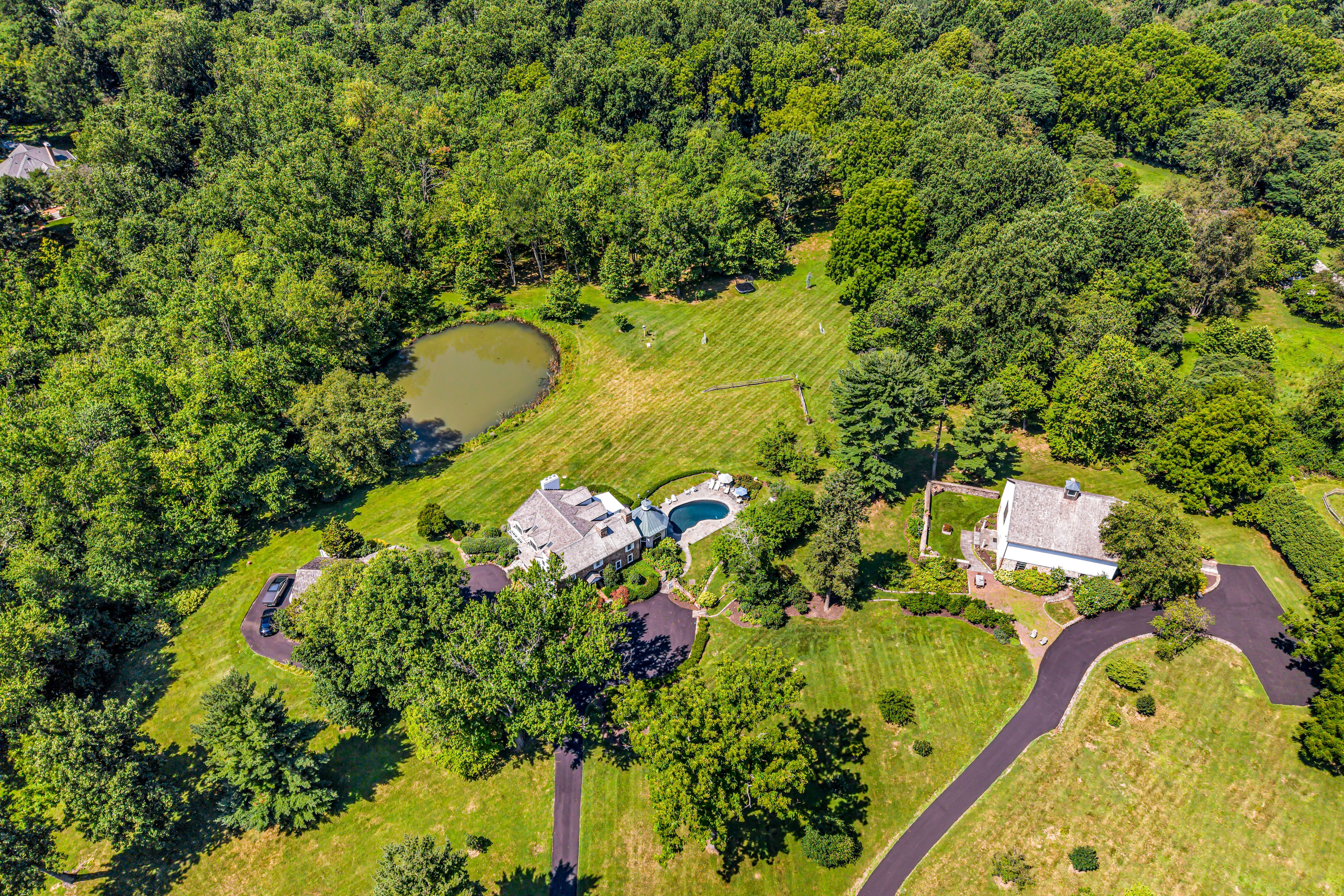
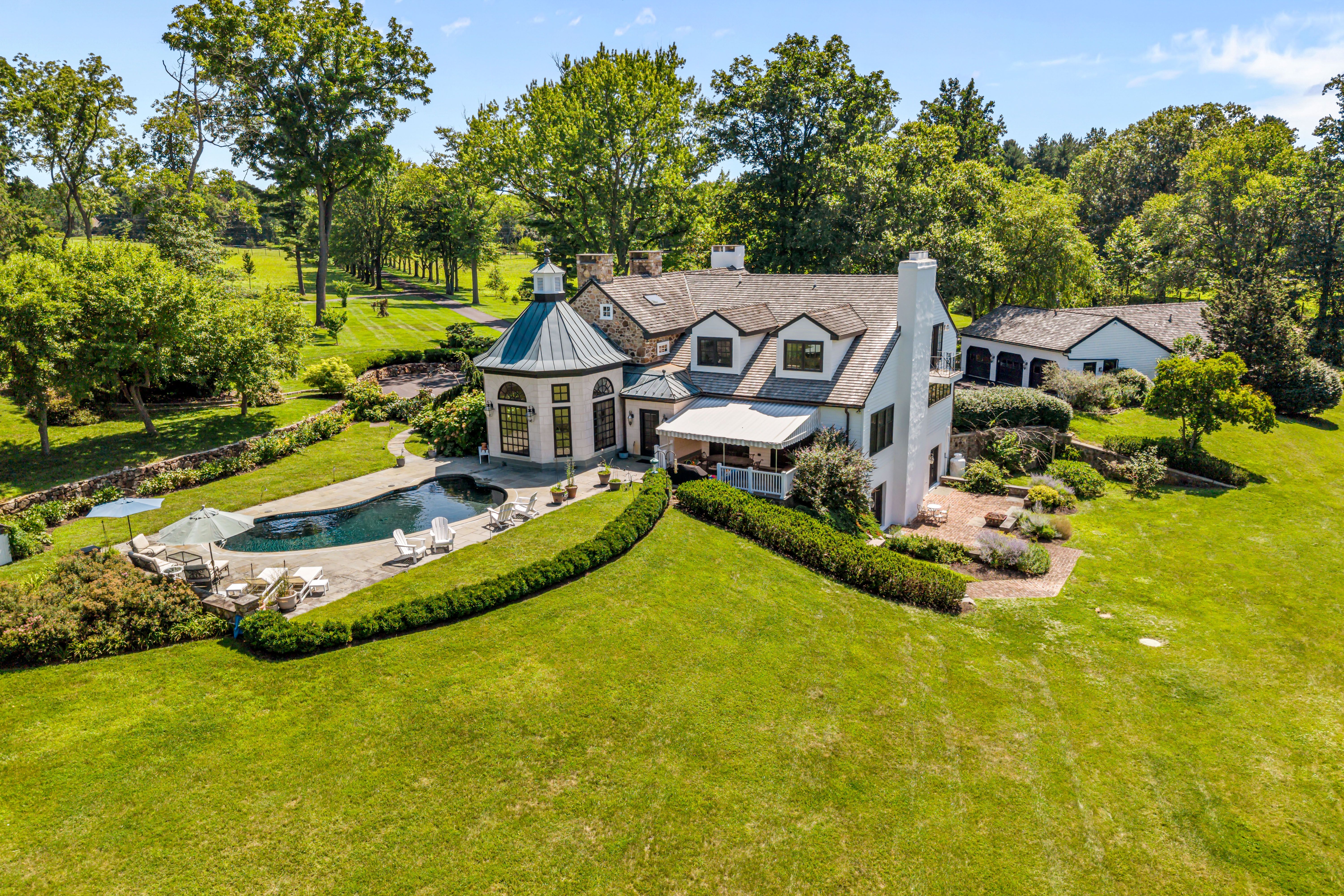
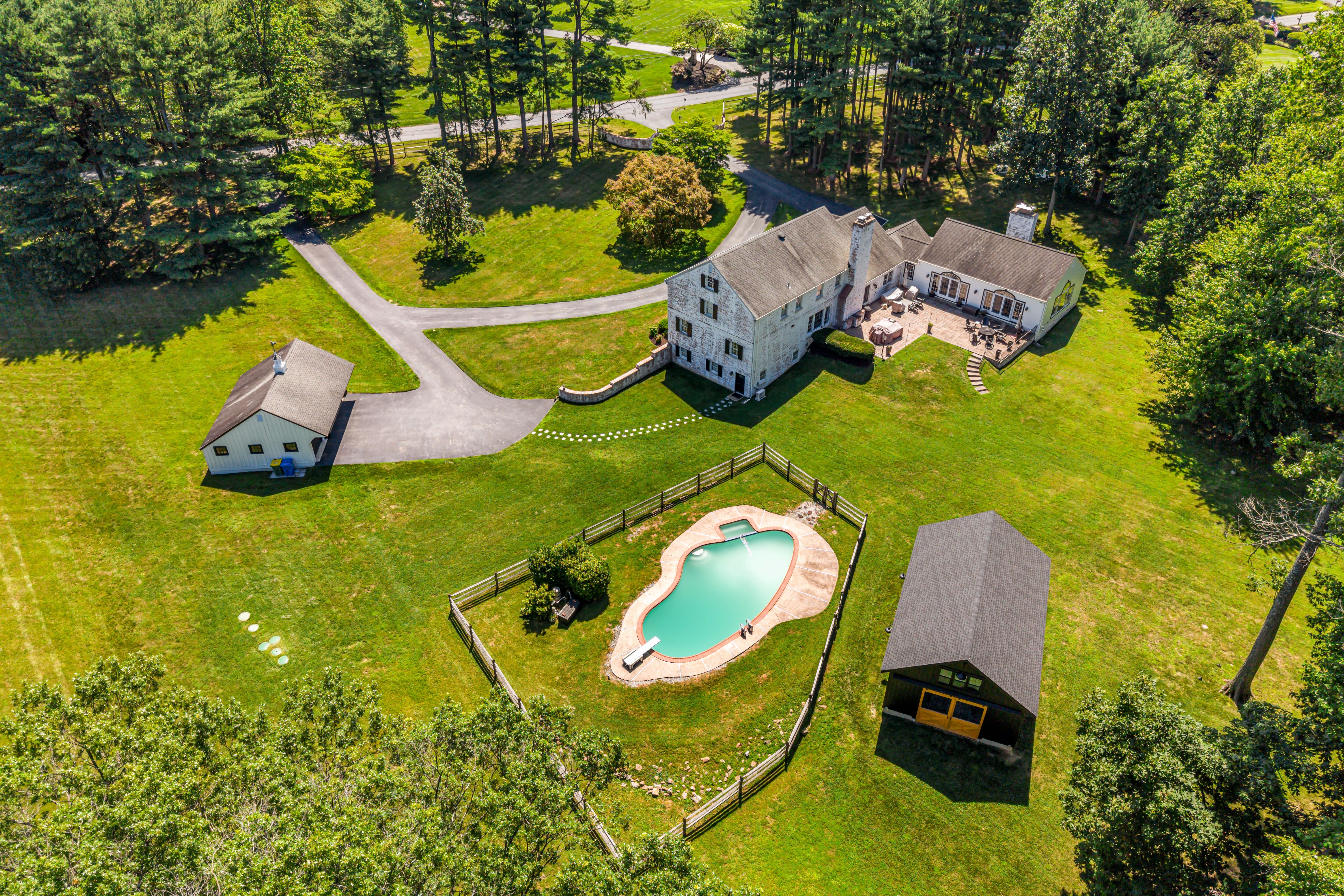
Three properties that span 27 acres and include two homes, two pools, and a two-story barn are for sale for $8.95 million in Willistown Township, Chester County.
The three parcels, situated among the area’s pastures and horse farms, together form the largest package of land currently for sale along the Main Line whose use is not restricted by a conservancy, according to listing agent Karen Strid of Compass Real Estate.
“Each parcel is worth something, but together they’re worth so much more,” Strid said.
That a buyer can do whatever they want on the land, including building more homes, “is what makes [the listing] so rare,” she said.
“It’s such a special purchase for someone who really understands the area,” Strid said.
The three combined parcels for sale at 416, 418, and 420 Dutton Mill Rd., spanning 27 acres in Willistown Township, are outlined in red.Billy Kyle
Willistown Township, which neighbors Malvern Borough and includes the 19th-century village of Sugartown, is a desirable location for people who want land and a more rural feel and also access to mountains, beaches, and major cities, Strid said.
These parcels are “appealing to the people who want privacy and can have whatever they want and don’t want to be in the middle of nowhere,” she said. “You’re really close to everything, but you feel like you’re in your own world.”
The seller owns all three parcels, which together are called Sugartown Springs Farm. Strid said it would make a good family compound. Across the parcels, buildings and property features are “spread out in a really nice way,” she said.
The parcels were privately listed for sale on the Compass and Redfin platforms the second week of August.
Two homes and a two-story barn
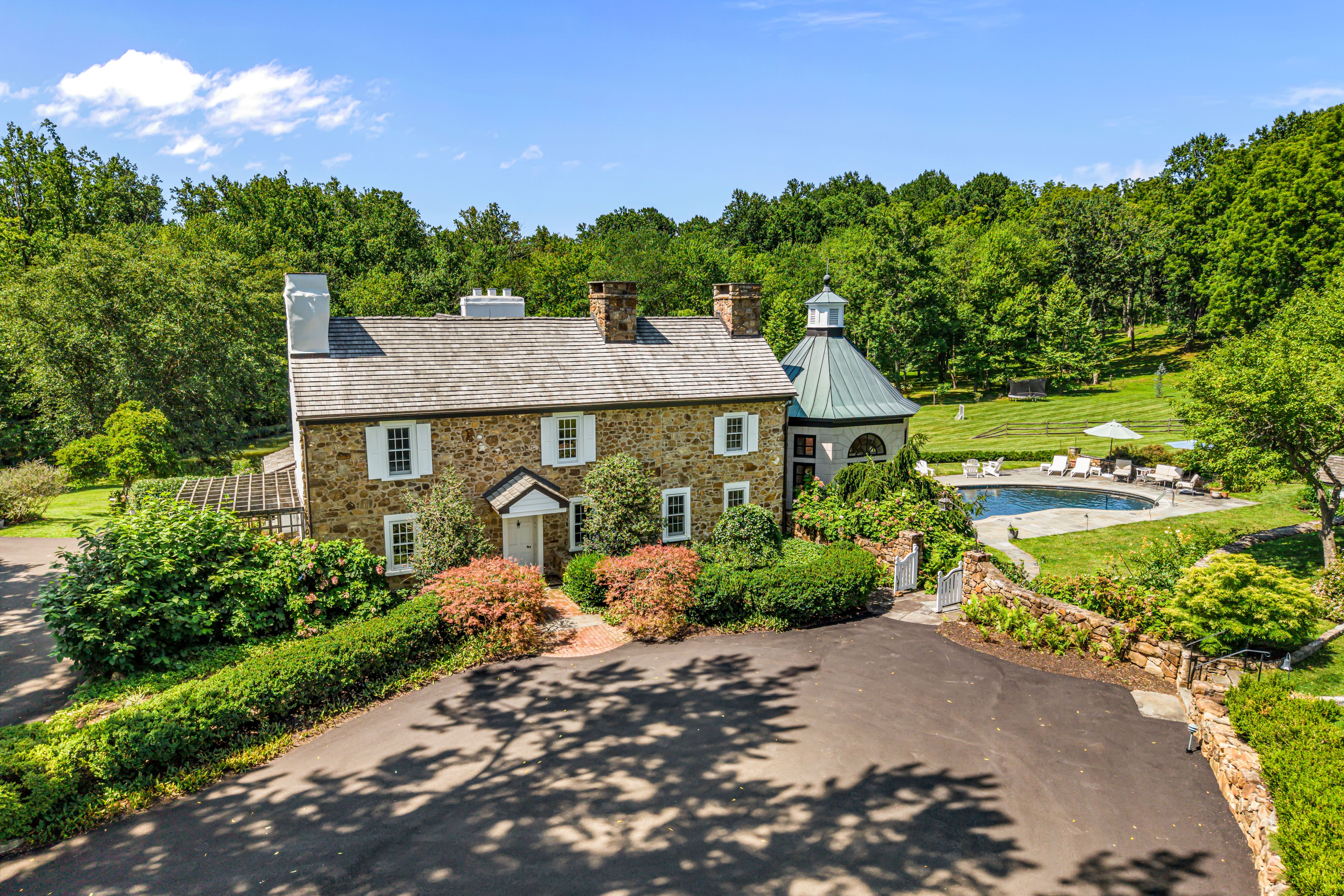
At 418 Dutton Mill Rd., a stone main house dating to the mid-1700s offers four bedrooms, four full bathrooms, and one half bathroom. The primary en suite bedroom includes a fireplace, soaking tub, shower, and double vanities.
The stone main house at 418 Dutton Mill Rd. has four bedrooms and a two-story solarium that serves as the dining room.Billy Kyle
The 7,559-square-foot house features interior stone walls, exposed timber beams, hardwood floors, and more fireplaces throughout. The two-story solarium serves as the dining room and highlights views of the grounds. The home also has an elevator.
The 10-acre property includes an in-ground pool and a spring-fed pond. A detached garage off the circular driveway can fit six vehicles and also includes a full bathroom and a second laundry room.
The 10-acre property at 418 Dutton Mill Rd. includes an in-ground pool and a detached garage that can fit six vehicles.Billy Kyle
To the right of the main house is a two-story timber-frame barn at 420 Dutton Mill Rd. The barn was once used as an art gallery for Andrew Wyeth’s paintings.
The structure features a glass atrium, a room that could be a bedroom or office, 1½ bathrooms, a kitchenette, and multifunctional space. The upper level has beamed ceilings and gathering spaces.
The upper level of the barn at 420 Dutton Mill Rd. can be used as a gathering space.Billy Kyle
The property includes a stone-walled courtyard and spans 12.8 acres.
These two parcels are listed for sale for a combined $5.975 million.
A second home at 416 Dutton Mill Rd. is listed for sale for $2.975 million. The Colonial spans 6,032 square feet and was built in 1963.
The home has six bedrooms, three full bathrooms, two half bathrooms, formal living and dining rooms, and a walkout finished basement. It features fireplaces and brick wall accents and has a finished attic.
The 4.2-acre property includes a rear stone patio, a detached three-car garage, an in-ground pool, and a timber-frame barn built in 2024.
The home for sale at 416 Dutton Mill Rd. in Willistown Township features an in-ground pool, a timber-frame barn, and a detached three-car garage.Billy Kyle
This home is currently being rented for $9,000 per month under a lease that ends in early 2028.
Strid said standing on Sugartown Springs Farm highlights why people value the lifestyle it represents.
“It’s so serene and calm and beautiful,” she said.
As we alluded to last week, we at Down the Shore are moving from complaints and pet peeves to soliciting solutions, including from our text group, The Shore Line.
We received many ideas, mostly grouped around a few big problems: parking and cars, costs, public access, plus some thoughts on restaurants.
Several proposed off-island parking and shuttles to reduce the number of cars on barrier islands. One suggested congestion pricing for cars on the islands, or beach tags for cars (oof). Another idea: beach tags that could be used in any town, like a museum pass.
Kenneth Lacovara, founding executive director of Rowan University’s Edelman Fossil Park & Museum, said in an interview that, while not questioning that the father-son team found the Megalodon tooth as they said, there is no chance the tooth originated in Sea Isle.
“I don’t see how a Megalodon tooth could naturally occur on the coast of Sea Isle City.”
Deposits from the Megalodon’s Miocene epoch would be 500 to 600 feet under the sea along this part of the coast, Lacovara said, as the cakelike geographic layers get deeper and deeper as you head from, say, Philadelphia, down to Sea Isle.
Even with ocean dredging for beach replenishment, Megalodon shark teeth fossils from that depth would not surface.
“That fossil didn’t come from Sea Isle City,” Lacovara said.
Michael Bowers, 42, said he discovered the fossil while visiting Sea Isle City with Bo, 11, a dirt bike rider, who documented the find on his YouTube channel, Fastkid71. They sought out experts from the Cape May Whale Watch & Research Center and from the New Jersey State Museum, who validated the tooth’s authenticity.
“I’m not suggesting they are faking it,” Lacovara said. “That Megalodon tooth is not there naturally. It was maybe dropped by somebody, or lost by somebody. It’s more like finding a treasure than a paleontological discovery.
Mystery unlocked? Or deepened? I’m just the messenger!
📮 Have ideas or news tips about the Shore or this newsletter? Thoughts about the Megalodon? More suggestions for improving the Shore experience? Send them to me here.
🌧️ A little rain in the forecast but not a washout.
The wind shifted to a cool ocean breeze just before dusk on Aug. 17, 2026, in Ventnor, N.J.Amy S. Rosenberg / staff
Your thoughts on: Shore fixes
Jenifer Baldwin says towns should focus on sustainability and public access:
Make townships responsible for providing public parking and public restrooms with outdoor showers and changing rooms. Start working toward zoning that requires new development to include affordable public accommodations (motels, campgrounds, public beach facilities). Get creative about linking our barrier islands with alternative modes of transportation. Go car free in designated areas.
Kara Cumiskey says the problem is “cars, cars, cars.”
I think that there should be a “beach tag” for cars. Or some type of “congestion pricing” for bringing your car onto the Island. I have a rental property that has 4 bedrooms. The tenants this week brought 7 cars.
One texter thinks Shore towns need to add a golf cart lane.
Maybe either a lane or certain streets to use golf carts. It is horrifying the way people pack kids in them and drive in traffic. Many do not drive safely either. Toddlers sitting on someone’s lap or just on a seat!
Several texters, like this one, urged everyone to just … be nicer.
It really comes down to respecting one another and that starts at home. I know I sound like an old head (I’m only 45) but it’s what is wrong with the world today.
🧠 Trivia time
Kevin Pellegrini was first with the answer to Avalon’s old white underaged drinker roundup bus, the Magic Bus.
This week’s question:
This beach town established its beach patrol in 1855, making it the oldest operational beach patrol in the country and the future home of an International Lifeguard Museum.
Which town is it?
A. Wildwood, N.J.
B. Rehoboth Beach, Del.
C. Atlantic City, N.J.
D. Huntington Beach, Ca.
If you think you know the answer, email us. First one gets a shout-out.
Your Shore memory
Not to shock everyone with a winter memory, but it’s almost Labor Day! This is from Lisa Guercio.
The best off season Shore memory was a weekend special at the Bolero Hotel in Wildwood. It was a snowy weekend with my first walk on the beach with snow over the sand. We also got to swim in the indoor pool on the roof while the snow was falling, which was a thrill. There were also ice chunks in the ocean that were a wonderful sight. The shore in off season is better than summer, as far as I’m concerned. Especially now that it so unaffordable during the summer season anyway.