Blog

  • Sen. Cory Booker debated his longshot challenger from South Jersey. They mostly talked about Trump.

    Sen. Cory Booker debated his longshot challenger from South Jersey. They mostly talked about Trump.

    Democratic Sen. Cory Booker took to the stage Thursday for a debate with Justin Murphy, the South Jersey Republican mounting a long shot campaign to unseat the well-funded incumbent.

    They mostly talked about President Donald Trump.

    Murphy, a former Tabernacle committee person who calls himself a Reagan Republican, unsuccessfully sought U.S. House nominations in 2008 and in 2010 — with Tea Party backing — and for Senate in 2024. The Burlington County attorney has little chance in the Nov. 3 election against Booker, a prolific fundraiser and former mayor of Newark who has served in the Senate since 2013 and could pursue the presidency for a second time in 2028.

    As of June 30, Booker raised more than $33 million while Murphy raised just over $27,000.

    There are nearly 865,000 more Democrats than Republicans in New Jersey. The state’s electorate, as of June, includes 38% Democrats, 35% unaffiliated voters, and 25% Republicans.

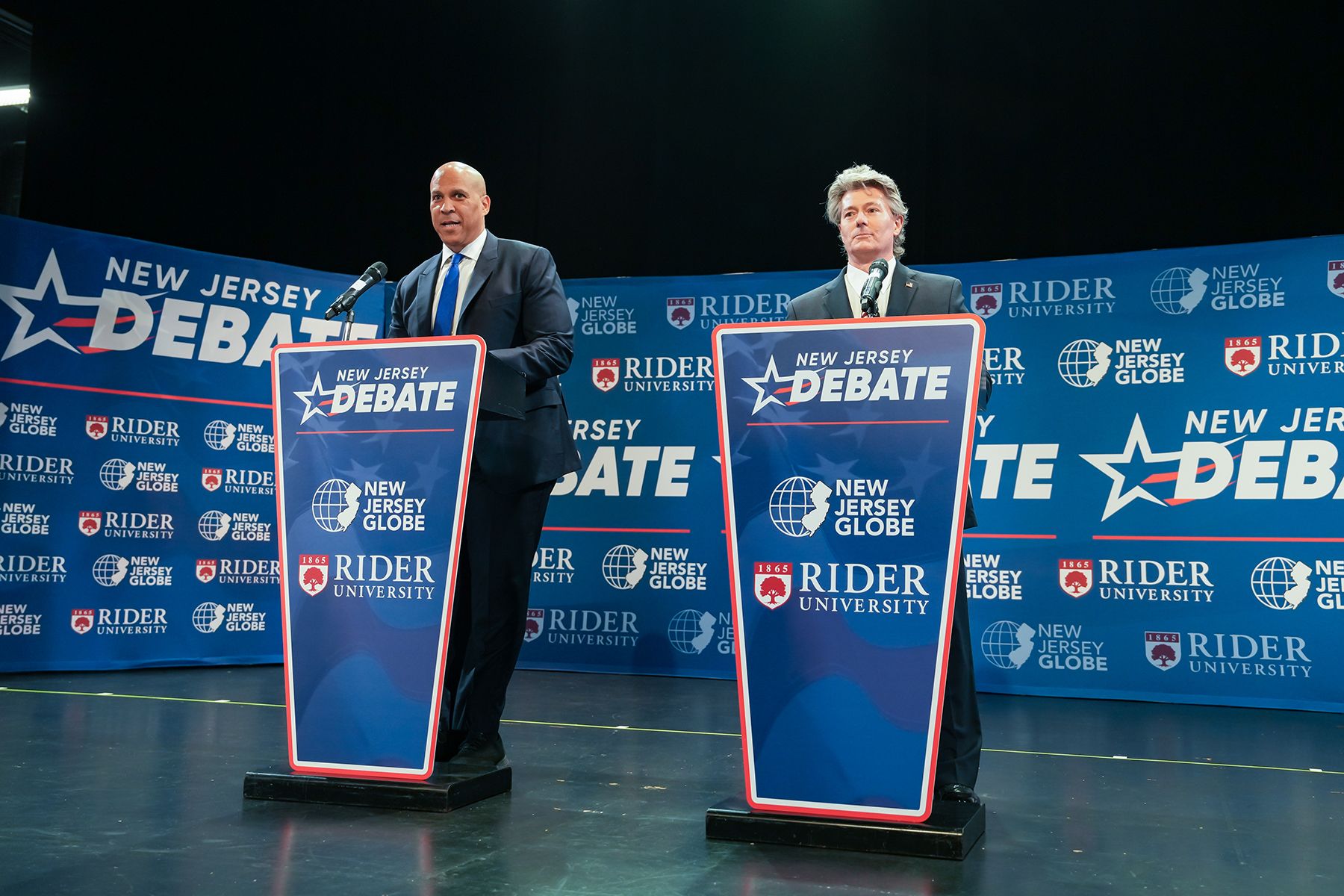
    The debate, which was hosted by the New Jersey Globe and Rider University and broadcast nationally by C-SPAN, lasted about one hour.

    The moderators focused much of their questions on Trump’s policies. Booker criticized congressional Republicans, who he said have “enabled” the president. Murphy, on the other hand, praised the current economy — a stark contrast to Democrats’ messaging this campaign season.

    The two candidates were mostly civil, shaking hands and posing for a photo before getting started. Booker, who is bald, made a couple of jokes about Murphy’s voluminous head of hair.

    The most raucous part of the debate was when audience members erupted during both Booker and Murphy’s remarks about the state’s sanctuary policy for immigrants.

    Here are the highlights.
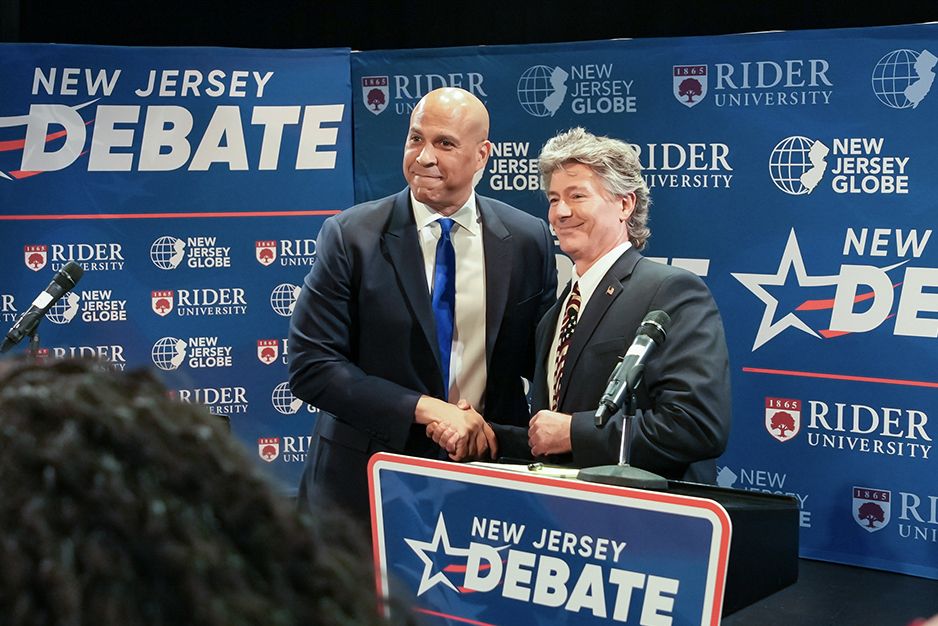
    Sen. Cory Booker, left, and his South Jersey Republican challenger Justin Murphy, shaking hands on the debate stage Thursday night.Pete Borg / Rider University

    Focus on Trump: His cabinet, Iran, and the Epstein files

    Murphy supports Trump but said he’s not a “blind rubber stamp.” He admitted he is not well-versed on Trump’s cabinet picks or the Epstein files.

    When asked about Trump’s cabinet members, the Republican said he trusts the president’s judgement but that he doesn’t know enough about them.

    “I don’t know about their backgrounds. I couldn’t name them all for you right now,” he said.

    “You’ve gotta be honest,” he added.

    The Republican also said his knowledge is limited on the Jeffrey Epstein files, in which Trump is referenced thousands of times. Trump lobbied against releasing them to the public until it was clear he didn’t have enough support from his own party. Murphy said he supports the law that required the files to be released with redactions and exceptions — and supports an overall increase in transparency around them.

    Booker had fierce criticism of the president on both subjects.

    The incumbent said he voted for some of Trump’s appointees for his first term but the second time around, “something happened where it suddenly seemed like the standard he was creating for a cabinet position was loyalty to him.”

    He said the Trump administration’s handling of the Epstein files was an example of Trump’s White House working to protect the president from valid inquiries “and as a sword to go after anybody that criticizes him.”

    As for the Iran war, Murphy defended Trump but also said the president should wrap it up.

    “Mr. President, put your cowboy hat on and get out there, and kick some … and get this done and done right,” he said to cheers from supporters.

    Booker responded that Murphy’s attitude is precisely the problem, calling it a “false bravado.”

    “We do not need yahoo policy,” Booker said. “We need sound people that use military force as a last resort, who know the power of diplomacy, who don’t insult your enemies and threaten to invade Canada and Greenland, but pull our allies together.”
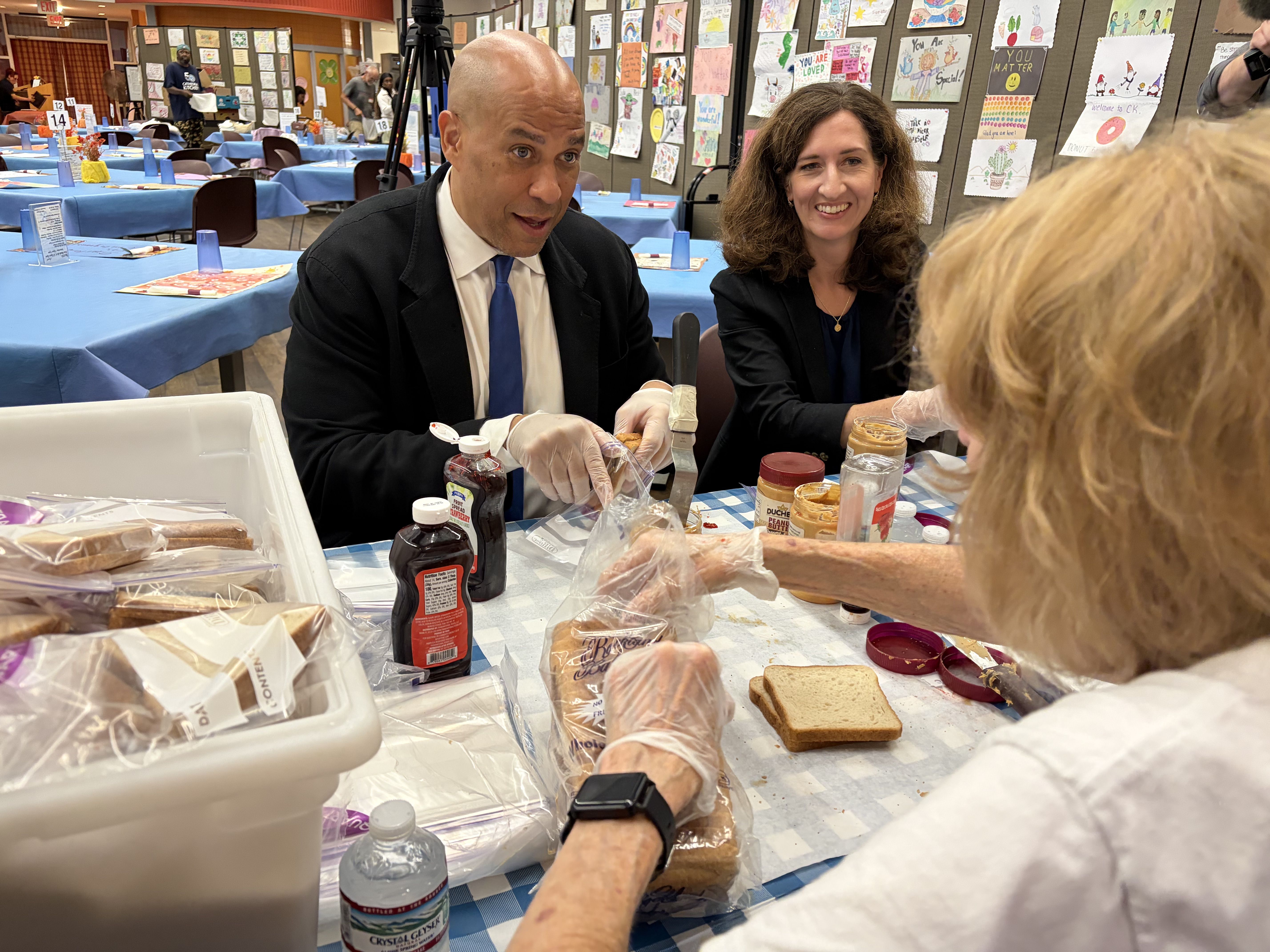
    Sen. Cory Booker sits with volunteers at Cathedral Kitchen in Camden on Thursday, Aug. 27.Aliya Schneider / Staff

    Housing policies

    Sahmya Smith, a Rowan student and Passaic County voter, asked the candidates how they would address the racial wealth gap in New Jersey driven by home ownership disparities.

    Booker touted bipartisan housing efforts including a new housing law and opportunity zones, the second of which he said resulted in affordable housing construction in Atlantic City.

    “For me, as a guy who was the mayor of Newark, New Jersey, a majority minority city, we were able to double the production of affordable housing during the last housing recession we had in 2008, 2009, it’s something that I feel is really urgent right now,” he said.

    He said that Trump’s trade war with Canada is driving up building costs.

    Murphy said the best way towards home ownership “is being gainfully employed with low interest rates.” He said the Republican Party is providing the opportunity for the American Dream and that the country, referencing statistics from the Census Bureau that found that the median household income reached a historic high in 2025 since tracking began in 1967 and the poverty rate is the lowest it has been since tracking began in the 1960s.

    That being said, the bureau also found that income inequality remained high, and the supplemental poverty measure — which considers non-cash benefits like food aid and household expenses — reached an all time low in 2021 under former President Joe Biden, AP reported.

    “We continue to empower people through economic empowerment and betterment,” Murphy said, citing tax relief on tips, overtime, and Social Security benefits. He also noted that there should be more housing supply.

    Candidate Justin Murphy, in the suit, at a Pinelands Republican Club event on Jan. 29, 2025.Aliya Schneider / Staff

    Sanctuary state

    New Jersey’s Immigrant Trust Directive, known as the state’s sanctuary policy, limits state law enforcement’s cooperation with federal immigration officers. Booker said the policy made immigrants feel more comfortable contacting law enforcement to report crimes, but that people feel unsafe again because of ICE immigration sweeps directed by Trump.

    “My first priority is keeping New Jersey towns, municipalities, and cities safe, and to do that, I believe the policies of our state are good in keeping bright lines between what is a federal responsibility and what is a county and state and local responsibility,” he said.

    Someone off camera shouted that they had to “butt in” and verbal chaos erupted with shouts from the audience.

    Murphy said sanctuary policies “are a magnet for criminal illegal aliens,” even though “not every illegal alien is in this country to do us harm.”

    “Sanctuary jurisdictions are a problem. They incentivize illegal immigration, and I don’t believe they help our state stay safe,” he added.

    As he elaborated on his stance, another interruption erupted from the audience. Murphy responded by saying his position is “not xenophobia.”

    Murphy recently received heat from Democrats for comments he made at an August town hall hosted by the Morris County GOP, saying “Islam creates a problem” in response to a question that mentioned a “big Muslim problem.”

    Booker at the time called Murphy’s remarks “vile.” Murphy told Politico he intended to reference “radical Islam” and not all Muslims.
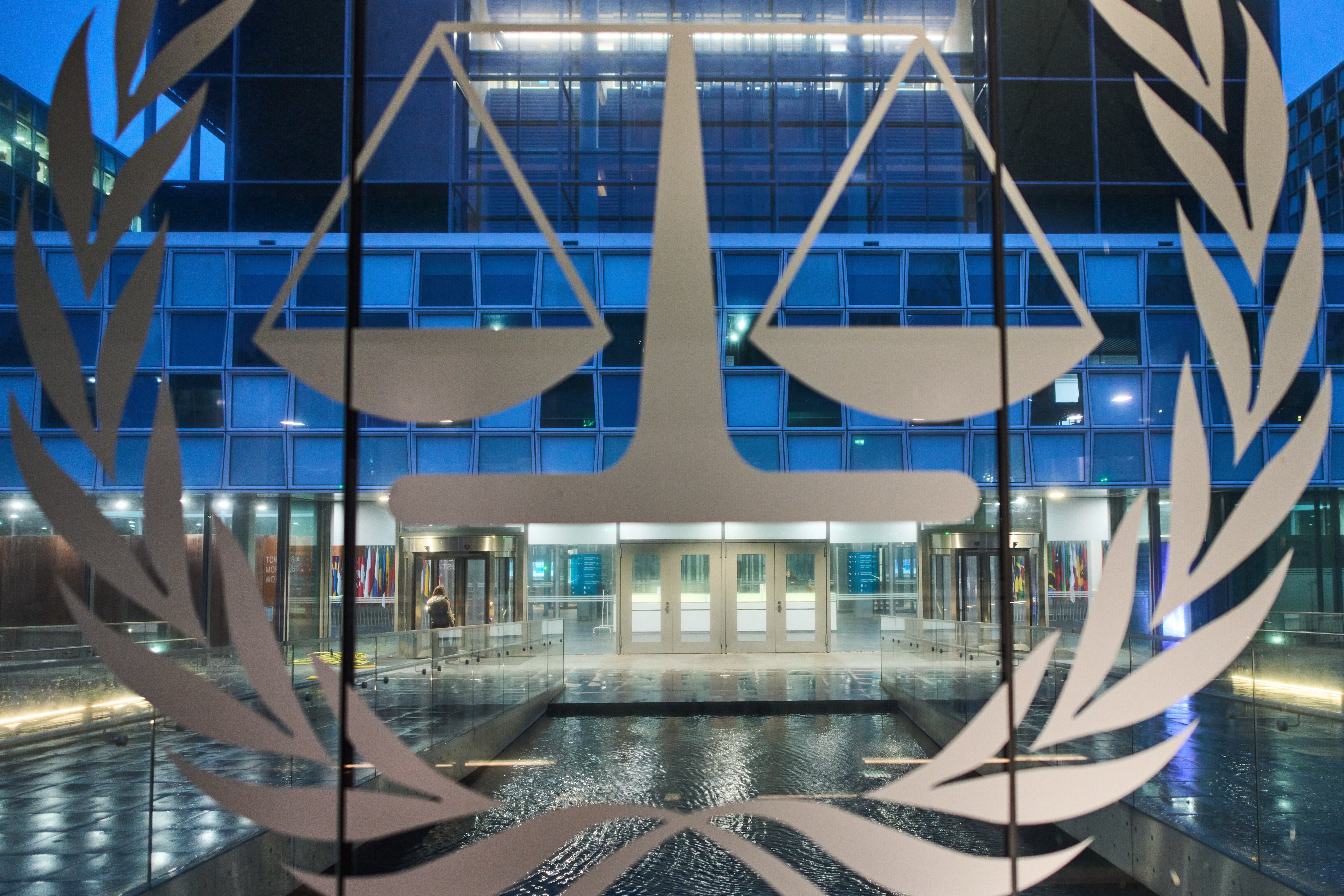

  • Trump administration hits International Criminal Court with severe sanctions

    Trump administration hits International Criminal Court with severe sanctions

    ATHENS, Greece — The Trump administration announced Friday that it was imposing severe financial sanctions on the International Criminal Court, its latest effort to cripple the global body that seeks to prosecute those accused of war crimes, genocide, and other murderous criminal acts.

    The new sanctions, unveiled by Secretary of State Marco Rubio and the State Department, would prohibit transactions with the court after a grace period of six months. Any companies doing business with the court afterward could be subject to punishment by the U.S. government.

    The threat of that could constrain the institution’s ability to carry out daily operations.

    Although the State Department had been preparing the sanctions for months, Rubio’s announcement came just hours after a committee in Norway said it was awarding the Nobel Peace Prize to Navi Pillay, a South African lawyer who served for nine years as a judge on the ICC and worked as the top human rights official at the United Nations.

    The sanctions are an intensification of the Trump administration’s push to undermine the court. In February 2025, just weeks after taking office, President Donald Trump issued an executive order directing agencies to come up with sanctions to impose on the court.

    At the time, he said the court was trying to violate American sovereignty and undermine “the critical national security and foreign policy work of the United States government and our allies, including Israel.”

    Rubio said in a statement Friday that Trump would never allow the court to prosecute Americans. “We will ban transactions with this rogue court, cutting off their resources and crippling its ability to operate,” he said.

    Rubio announced in July that the United States planned to “systematically disable” the court, which Trump has long described as a threat to Americans.

    The administration has imposed financial sanctions and visa bans on court judges and prosecutors, but the measures announced Friday are broader.

    The ICC said in a statement that the American move was “an assault on the rule of law and on the very foundations of the international legal order, which strikes at the simple principle that no one stands above the law.”

    Many companies that have business ties with the court will be granted licenses over the next 180 days to continue their work without financial punishments, the State Department said.

    During that period, the Trump administration will assess whether its concerns regarding the ICC have been addressed, the department said in a statement. The administration can then adjust the licenses based on that.

    The Treasury Department is helping to enact the sanctions and maintains a list of entities punished with financial restrictions.

    Of nearly 200 nations in the world, 125 have signed the Rome Statute of the International Criminal Court and are subject to its rulings. The United States never ratified the treaty establishing the institution, and both it and Israel are among those that are not bound by the statute.

    However, given the number of countries that are members of the court — including close U.S. allies — the prosecution of U.S. citizens could put those people at risk of arrest and extradition in many parts of the world, in theory. But experts often say that the chances of foreign officials taking those actions are low.

    Rubio announced the sanctions the day after he returned from a three-nation tour of Europe during which he was trying to strengthen alliances. The three countries he visited — Iceland, Greece, and Portugal — are all members of the ICC.

    The court, officially established in 2002 and based at the Hague in the Netherlands, has a mission to investigate and prosecute genocide, war crimes, and other serious offenses. The Trump administration has in the past pushed back on the court’s ability to look into the conduct of U.S. soldiers in Afghanistan and has also been highly critical of the court’s actions against Israel.

    In November 2024, the court issued arrest warrants for Benjamin Netanyahu, the prime minister of Israel, and Yoav Gallant, the defense minister for much of Israel’s war in the Gaza Strip. Prosecutors had investigated the officials for war crimes and crimes against humanity in operations in Gaza, where thousands of Palestinian civilians have been killed and some have starved to death. Israel carried out airstrikes and ground operations after the deadly Hamas attacks in Israel in October 2023.

    The Trump administration has already sanctioned many of the court’s judges. Rubio has suggested that even more sweeping punishments were necessary because of the possibility that the court could prosecute U.S. citizens, and U.S. service members in particular.

    Such actions would “mean the death of the U.S. as a sovereign and independent nation,” Rubio wrote in an opinion essay published in the Wall Street Journal this summer.

    Defenders of the court often point out that it has no police force of its own, and would be able to arrest and try U.S. citizens only if member states carry out arrests.

    The Trump administration is not the first to take on the ICC: Under George W. Bush, the United States also pushed back on the court’s ability to go after Americans.

    Yet the Trump administration’s effort to dismantle the institution — “brick by brick, if necessary,” according to Rubio — is an escalation, from skepticism and rhetoric to outright dismemberment.

    “This is incredibly disturbing,” said James A. Goldston, executive director of the Open Society Justice Initiative legal organization, calling the sanctions a “calculated attack” on international justice.

    Whether the American attack on the ICC will cripple the institution will depend in part on how its member nations respond, he said, and whether they stand by the institution.

    “We know that the court has been preparing for this much-rumored eventuality,” he said. “We’ll have to see.”

    The European Union’s executive arm, whose 27 member countries are also members of the court, said in a statement that “the EU will work closely with the ICC to ensure it continues to operate effectively” and called the American move “deeply regrettable.”

    The EU statement emphasized that the six-month delay leaves “room for dialogue.” Canada, Denmark, Germany, France, Italy, Japan, the Netherlands, and Britain also released a joint statement in defense of the court Friday.

    The court was already in a state of turmoil. Karim Khan, the institution’s chief prosecutor, was removed earlier this year after an investigation into allegations that he sexually harassed a subordinate. Khan has denied the accusations.

    In a recent interview with the New York Times that was conducted before the latest sanctions were announced, Tomoko Akane, president of the court, said that the institution has been taking “measures to strengthen its resilience” in the face of the Trump administration’s threats.

    “A permanent body like the ICC must never be shut down,” she said. “The stakes extend far beyond the court itself.”

    This article originally appeared in the New York Times.

  • Anthropic’s artificial intelligence gave a false homicide tip to Philly police, triggering a meeting with the company

    Anthropic’s artificial intelligence gave a false homicide tip to Philly police, triggering a meeting with the company

    An artificial intelligence model operated by Anthropic submitted false information about an unsolved Philadelphia homicide to the police department’s public tip forum this summer, law enforcement officials said Friday.

    The unprecedented incident occurred in July and raised concern among department leaders, who met with Anthropic representatives to discuss the interaction on Thursday, police said.

    Sgt. Eric Gripp, a police spokesperson, said an Anthropic AI model contacted the department’s tip forum, PhillyUnsolvedMurders.com, around 11:30 p.m. on July 18.

    The model gave information purporting to come from someone with information about an unsolved homicide, he said.

    It was not immediately clear which homicide the AI told the department it had information about.

    The email was flagged as spam and remained in that folder until Wednesday, when Anthropic alerted police to the incident, authorities said. No city or police data was accessed as a result of the interaction, Gripp said.

    Anthropic told police the false tip was generated as the company tested interactions between its AI model and “randomly selected websites,” according to Gripp.

    A spokesperson for Anthropic did not immediately return a request for comment.

    The company discovered the error on Sept. 28. As a result, Gripp said, Anthropic terminated testing for that model and added safeguards for further trials.

    The news arrives ahead of the release of a report from Anthropic on Friday that is expected to detail the Philadelphia police incident as well as other instances of unintended behavior from its AI models.

    Earlier this summer, the company made international headlines when it announced that its Claude AI models had broken free from isolated testing environments and, in several instances, hacked into the internal infrastructure of outside organizations.

    Anthropic notified those companies, whose names it did not disclose, about the breach on July 27.

    A little more than a week earlier, authorities said, Philadelphia police received the artificially generated homicide tip.

  • Flyers takeaways: Encouraging play from David Jiříček, and Cam York’s struggles continue

    Flyers takeaways: Encouraging play from David Jiříček, and Cam York’s struggles continue

    OTTAWA, Ontario ― The Flyers’ 2-1 loss to the Senators on Thursday was their best effort of the season.

    Despite their five-game losing streak, there are plenty of positives to take away from the team’s most recent performance, and also a few negatives, as the Flyers attempt to round into form.

    Here’s a look at whose stock is up and whose is down after the loss in Ottawa:

    Stock up: David Jiříček

    Thursday’s game was exactly what the Flyers want to see from Jiříček: threatening on offense and not an active liability on defense. Jiříček had a few great defensive plays, including one to save an empty-netter, but was most noticeable offensively.

    Jiříček, moved up to the first power-play unit, was part of maybe the two best power-play sequences of the season, between sole goal of the game — scored by Matvei Michkov — for the Flyers and the subsequent power play. He had one especially nifty pass through the legs to set up Tyson Foerster.

    After trading for Jiříček at the deadline last year, his stock has gone up and down, with the preseason game against Washington a notable step back. But given another chance with Ristolainen out, Jiříček recovered with a solid performance after making a big mistake in Tampa. If Jiříček is going to stick in the lineup, he will need to continue stringing together games like Thursday, but it’s evidence of the vision the Flyers had when acquiring him.

    Stock down: Cam York

    In a better game for virtually everyone on the Flyers’ roster, Cam York still struggled. The Flyers conceded five high-danger chances with York on the ice and generated just one at five-on-five. He was also a victim of the Flyers’ lack of discipline, spending 5 minutes, 1 second on the penalty kill.

    With Ristolainen out, York was separated from his usual partner, Jamie Drysdale, and paired with Jiříček. Drysdale, paired primarily with Travis Sanheim, was on the ice for seven Flyers high-danger chances at five-on-five and didn’t concede any.

    York took a step forward to end last season, becoming a reliable penalty killer on that second pair. But he hasn’t been able to maintain that level heading into the year, even on Thursday, which was a better defensive performance from the team overall.

    Stock up: Matvei Michkov

    After an up-and-down sophomore campaign, Michkov has shown his commitment to improving his two-way play to start the season. Outside of a bad penalty immediately following the Senators’ first goal, Michkov played his best game of the young season.

    He scored the Flyers’ only goal, a greasy rebound on the power play, and now has two of the Flyers’ six goals this season. Michkov’s also improved a lot of the little details of his game, making a few noticeable defensive plays. Without a traditional center on the No. 1 power-play unit, the Flyers even had Michkov taking face-offs.

    “He won a couple of draws there, so maybe there’s something there at the dot,” Flyers coach Rick Tocchet said. “I think he made a couple this year, and we said to just give him a shot.”

  • Philly DA Larry Krasner again called for the judge who accused him of potential crimes to recuse himself

    Philly DA Larry Krasner again called for the judge who accused him of potential crimes to recuse himself

    Philadelphia District Attorney Larry Krasner on Friday again said the federal judge who accused him of potentially breaking the law should step away from the underlying case, writing in court documents that the judge had displayed “apparent bias” against him during the proceedings.

    In a brief filed Friday, Krasner again defended his conduct in the matter before U.S. District Judge Paul S. Diamond, and said Diamond’s “baseless allegations of criminality demonstrate only the Court’s apparent bias.”

    The brief largely echoed arguments Krasner made in another motion he filed 10 days ago, in which he also called for Diamond’s recusal. And Friday’s filing — which came in response to one from the state attorney general’s office that supported Diamond’s handling of the case — came two days after the deadline the judge set for any additional paperwork to be filed on the issue.

    Krasner nonetheless said the “bedlam” caused by Diamond’s actions and decisions “has unfairly done real and lasting damage to the DAO and to the reputations of its personnel.”

    “The Court did not demonstrate ‘neutrality throughout an evolving landscape,’” he wrote, “rather, it twisted the landscape in what publicly appears to be an effort to steer the proceedings to a particular conclusion.”

    Diamond has not yet responded to Krasner’s filings, and has not said whether he will step back from the underlying matter — a post-conviction case in which a man is challenging his murder conviction. It was not clear how quickly Diamond might rule.

    Friday’s filing was the latest development in a high-profile saga that has led to a series of controversial developments concerning Krasner’s office.

    Chief among them was Diamond’s memorandum last month in which he said Krasner and one of his top supervisors, Matthew Stiegler, may have committed crimes including conspiracy, obstruction of justice, or perjury.

    The judge also said he had referred the matter to the U.S. Attorney’s Office for a potential criminal inquiry. Federal prosecutors have declined to comment on how or if they might proceed.

    Krasner has denied wrongdoing. And in a series of documents he filed last month, the progressive Democrat said Diamond — who was appointed by President George W. Bush, a Republican — had shown apparent bias against him, including by misinterpreting witness testimony, making inconsistent credibility determinations, and reaching “baseless” conclusions about what happened.

    He said some of Diamond’s language was “Orwellian” and that at least one instance of potential criminal conduct relied on allegations “more closely resembling fever-dream conspiracy theories than evidence.”

    In Friday’s filings, he largely reiterated those arguments, although he did appear to say for the first time that he “chose” not to testify before Diamond because the judge had “twisted what was at issue” throughout the proceedings.

    The underlying matter is centered on Dennis Johnson’s attempt to have his 2009 murder conviction overturned. Krasner’s office had once supported that effort, but reversed course earlier this year after prosecutors discovered that the staffer who filed the brief backing Johnson’s position had made a series of mistakes in her paperwork.

    After that, Krasner and several of his staffers held a variety of discussions about what went wrong, who was to blame, and how the office should move forward. And this summer, when Diamond called hearings to learn how the errors occurred, the prosecutors involved in those discussions told the judge that the DA had acted in ways they viewed as inappropriate — including, they said, by entertaining proposals to blame a single staffer, and threatening “consequences” for those who didn’t follow his orders.

    Diamond said some of the actions could amount to obstruction of justice or criminal conspiracy.

    Krasner, however, has disputed those characterizations and said some of the staffers who spoke out against him were “legally incorrect” about what took place and had behaved in ways that were insubordinate.

    As for Diamond, Krasner said in his Friday filing that he “appeared to pre-judge the case and levied baseless accusations of criminality.” And although Krasner said at one point in the brief that he chose not to testify because of what he cast as the unclear nature of Diamond’s inquiry, he also criticized the judge for suggesting that crimes occurred “with zero input from Krasner, whose input the Court had not and still has not sought.”

    Beyond saying Diamond should recuse himself, Krasner has also asked the judge to reconsider a decision barring him and one of his supervisors from participating in the case moving forward.

    That aspect of Krasner’s appeal remains pending. Diamond said any additional paperwork on that issue should be filed by the middle of next week.

  • $90 for your vote? Trump’s Medicare giveaway is too little, too late.

    $90 for your vote? Trump’s Medicare giveaway is too little, too late.

    On Thursday, I received an email from Medicare containing a letter personally signed by President Donald Trump, informing me that I would receive a one-time $90 payment to offset part of my October Medicare premium. Lo and behold, that very afternoon I received the payment.

    How generous.

    The president assured me that he was fighting to lower healthcare costs, reduce prescription drug prices, and put patients first.

    What a remarkable coincidence that this unexpected presidential generosity arrives less than a month before the November midterm elections.

    In my opinion, this is an extraordinarily transparent attempt to influence older American voters by placing $90 in their pockets shortly before they cast their ballots.

    And perhaps most insulting is the apparent assumption that seniors will overlook the administration’s healthcare record in exchange for a payment that doesn’t even cover half of one month’s standard Medicare Part B premium.

    Let’s examine the numbers.

    The $2 billion being distributed comes from the Medicare Improvement Fund, established by Congress in 2008 — not from some new presidential initiative. Approximately 20.8 million beneficiaries will receive payments, but tens of millions of Medicare recipients, including those enrolled in Medicare Advantage, are excluded.

    In 2024, the standard monthly Medicare Part B premium was $174.70. In 2026, it is $202.90.

    That’s an increase of $338.40 annually.

    The annual Part B deductible has also increased, from $240 to $283.

    Together, those increases total $381.40 annually, before accounting for supplemental insurance, prescription drugs, hospital expenses, or other out-of-pocket costs.

    Trump’s $90 payment offsets less than one-quarter of that increase.

    To be fair, Medicare premiums are determined through statutory formulas reflecting healthcare spending. Not every increase can be attributed directly to Trump. But that doesn’t change the reality that seniors are paying substantially more.

    Meanwhile, the administration has supported far more consequential reductions in federal healthcare spending.

    In July 2025, Trump signed the One Big Beautiful Bill Act, which the Congressional Budget Office projected would reduce federal Medicaid spending by approximately $911 billion over 10 years.

    Medicaid isn’t simply a program for younger Americans. Millions of seniors depend on it for nursing home care, home-based assistance, and help paying Medicare premiums.

    Reduced federal funding could force states to restrict services, reduce provider payments, or find additional revenue. For older Americans requiring long-term care, the consequences could be devastating.

    Americans ages 50 to 64 face additional challenges. New Medicaid work and reporting requirements threaten coverage for millions, while the expiration of enhanced Affordable Care Act premium subsidies has made insurance substantially more expensive for many people approaching retirement.

    A $90 payment does nothing to address those problems.

    The president’s prescription drug claims deserve equal scrutiny.

    In his letter, Trump claims to be the first president in history to reduce Americans’ prescription drug prices.

    That assertion ignores President Joe Biden’s Inflation Reduction Act of 2022, which authorized Medicare to negotiate prescription drug prices, capped covered insulin at $35 monthly for Medicare beneficiaries, and established limits on annual out-of-pocket prescription drug spending.

    The first negotiated prices took effect in January.

    Trump deserves credit for independently verifiable savings achieved by his administration. But he cannot legitimately claim credit for policies enacted by his predecessor.

    Nor should Americans forget his first administration’s repeated attempts to repeal the Affordable Care Act, including support for litigation seeking to invalidate the law.

    But perhaps the most troubling aspect is the timing and presentation of this payment.

    The administration announced the program Oct. 2, just weeks before a national election.

    Medicare beneficiaries received a personalized presidential letter praising Trump’s healthcare accomplishments and promoting his policies. The communication reads more like a political advertisement than a routine government benefit notification.

    Whether it violates federal restrictions on taxpayer-funded political activity requires legal examination. But Congress should investigate whether Medicare’s official communication system is being used for partisan political promotion.

    Government benefits should never become campaign props.

    And let’s remember: This money doesn’t come from Trump’s personal bank account. It comes from federal funds authorized by Congress.

    Americans should accept the $90 if eligible. But accepting a government benefit doesn’t require accepting the president’s preferred political narrative.

    Older Americans deserve affordable premiums, meaningful prescription drug savings, dependable healthcare coverage, and protection against catastrophic medical expenses — not a temporary rebate accompanied by a presidential sales pitch.

    In my opinion, this payment is too little, too late, and far too conveniently timed to be dismissed as innocent presidential generosity.

    Mr. President, thank you for the $90.

    But if you believe that’s enough to make Americans forget your healthcare record, you’re seriously underestimating the intelligence of the people receiving your letter.

    Michael A. Gottesman is the founder of the New Jersey Public Education Coalition and author of “Speaking Truth to Power.”

  • N.J. Pinelands Commission approves Atlantic white cedar restoration project, despite objections

    N.J. Pinelands Commission approves Atlantic white cedar restoration project, despite objections

    The New Jersey Pinelands Commission voted Friday to approve an Atlantic white cedar restoration project that has drawn objections from some environmentalists.

    The vote by the 15-member commission allows the New Jersey Forest Service to broaden cedar cover over 171 acres in Wharton State Forest.

    It’s the first phase of an ambitious $19 million state plan to restore 10,000 acres statewide. The state holds the East Coast’s last major concentrations of the tree. It’s historical 115,000 acres have dwindled to 25,000.

    But the process has been bumpy as some environmentalists have railed against cutting existing cedars and the potential use of herbicides.

    Mark Lohbauer, a commissioner from Pennsauken, voted against the plan. So did Commissioner Jessica Rittler Sanchez.

    Lohbauer said he did not believe there had been enough public input or discussion of the project.

    A major sticking point for Lohbauer, and some representatives of area environmental nonprofits, is the location chosen for the project off Sandy Causeway in Waterford Township, Camden County.

    They say the tract already has existing, healthy, mature cedars they fear will be cut down as part of the process.

    “I’m just not comfortable approving a blanket project,” Lohbauer said before casting his no vote. “The plan as it is includes acreage of what I consider to be cathedrals of Atlantic white cedar … as far as the eye could see.”

    He also questioned the potential use of herbicides.

    Lohbauer spoke after a lengthy presentation by Bill Zipse, supervising forester, and Todd Wyckoff, the state forester.

    Zipse said the area was chosen because it has healthy cedars that can provide a natural seed bank for regeneration. The plan calls for both cedars and competing hardwoods to be removed to create zones where new cedar can thrive.

    He also said that if herbicide is used, it could be limited to one application. Herbicides are often the only way to control rapidly growing competing vegetation such as phragmites, a reedy grass, the foresters said.

    Correction: This story has been corrected to note that New Jersey Pinelands Commissioner Jessica Rittler Sanchez voted against the plan.
  • This Philadelphia Airport lounge is closing for months amid a massive expansion

    The Centurion Lounge at Philadelphia International Airport is set to temporarily close next week as American Express begins a yearlong expansion of the space.

    The lounge in Terminal A-West is shutting its doors from Friday, Oct. 16 until sometime next year, American Express announced Thursday. The credit-card company said it plans to double the lounge’s size to more than 12,000 square feet across two stories, add a “coffee and wellness bar,” and upgrade its amenities. The renovated space is expected to reopen by the end of 2027.

    American Express did not respond Friday to a question about how much the expansion will cost.

    The lounge “will celebrate Philadelphia’s rich history as the nation’s founding city, as well as its creative energy and enduring craftsmanship, with select works by local artists,” according to American Express. Kate Sullivan, chief commercial officer for the airport, said in a statement that the revamped space would be “distinctly Philadelphia.”

    An American Express spokesperson said the updated lounge will have a Blue Roast by American Express Coffee and Wellness Bar, serving espresso drinks, cold brew, and rotating seasonal beverages from a local roaster, as well as smoothies and other nutritious food options.

    A rendering of the new coffee bar that will become part of the American Express Centurion Lounge once its expansion is complete next year.Courtesy American Express

    The Centurion Lounge at PHL opened in 2017 for American Express premium cardholders. At the time, it was the company’s eighth lounge in the U.S. Today, it operates its flagship lounges at 16 airports nationwide, and plans to open a 30,000-square-foot, two-story lounge at Newark International Airport next year.

    Airport lounges have become more popular — and often more crowded — in recent years. A growing number of credit cards come with lounge access. And travelers without those cards can sometimes pay to get into the spaces with day passes.

    Amid this increased demand, analysts expect the airport-lounge market to reach $6.4 billion next year.

    Last year at PHL, Chase Sapphire opened a lounge between Terminals D and E, and American Airlines opened neighboring lounges in Terminal A-West. The pay-per-visit Escape Lounges also plans to open an outpost in Terminal D by the end of the year.

    The Centurion Lounge is complimentary for those who have the American Express Platinum Card, Business Platinum Card, Centurion Card, and the Delta SkyMiles Reserve Cards, as well as their guests.

    Inquirer staff writer Ariana Perez-Castells contributed to this article.

  • Philadelphia Ballet opened its season with a quartet of patriotic pieces. It was impossible not to smile by the end of it.

    Philadelphia Ballet opened its season with a quartet of patriotic pieces. It was impossible not to smile by the end of it.

    Philadelphia Ballet opened its 2026-27 season on a festive note Thursday at the Academy of Music with “Stars and Stripes Forever!,” a quartet of works celebrating America’s Semiquincentennial. It was a program of ballet fireworks, mostly featuring its principal dancers.

    All four pieces were created during the 20th-century ballet expansion in the United States, when George Balanchine and Jerome Robbins were laying down the landscape of choreography. The fourth piece was by Eliot Feld, who had a ballet company in New York (and in his teenage years played Baby John in the movie West Side Story).

    It’s a patriotic program but one that feels more period piece than political, set in the theater where John Philip Sousa’s “Stars and Stripes Forever” had its premiere in 1897.

    The program opened with Fancy Free, which Robbins set to music by Leonard Bernstein in 1944, for what is now American Ballet Theatre. It was the precursor to the Broadway musical and movie On the Town, so it may look familiar to people who haven’t seen the ballet before. It’s a comedy about four sailors on leave who meet three women whom they try to charm.

    Arian Molina Soca, Jack Thomas, and Nicholas Patterson outdid themselves in these roles, both as dancers and actors. Molina Soca and Thomas have had many starring roles. But it was a breakout role for Patterson, a soloist, who — having survived a series of double air turns into Dallas Cowboys cheerleader-style jump splits — is surely a rising talent in the company.

    Philadelphia Ballet principal dancers Yuka Iseda (left) and Ashton Roxander in Eliot Feld’s “Variations on ‘America.’ “Alexander Iziliaev / Philadelphia Ballet

    Feld’s Variations on “America” is short and delightful, and on Thursday night was a pas de deux for Ashton Roxander and Yuka Iseda, both of whom were breaths of fresh air. The music is by Charles Ives and William Schuman, and the dancers are the Liberty Bell, cannons, and general spitfires. There were a few moments Thursday when Iseda’s very fast pirouettes nearly got the best of her, and the pair’s final lift was a struggle. But the overall impression was strong, entertaining dancing.

    The last two pieces were both Balanchine, starting with the concert version of Who Cares? to a series of songs by George and Ira Gershwin. It was danced by Sterling Baca and three women: Thays Golz, Dayesi Torriente, and Sydney Dolan (who had been injured most of last season), all of whom took on the tricky technical steps with ease and sparkle.

    The final piece on the program is the showstopper, Balanchine’s Stars and Stripes, set to Sousa. This is a full company piece with tutus, military-style uniforms, and necessary precision. Two more soloists proved themselves here: Lucia Erickson and Gabriela Mesa. It was impossible not to smile.

    As an added treat, Philadelphia Ballet’s music director, Beatrice Jona Affron, who has already taken a job with New York City Ballet, was back at the baton (and will be for part of the Nutcracker season as well).

    Philadelphia Ballet in Stars and Stripes Forever! Through Sunday at the Academy of Music. $25.25-$274.68. 215-893-1999 or philadelphiaballet.org

  • Penn State’s Midwest migration is failing, Temple rides the rush, and Eastern is dominant, yet again

    Penn State’s Midwest migration is failing, Temple rides the rush, and Eastern is dominant, yet again

    It would appear that the Great Iowa State migration to Penn State hasn’t exactly been a seamless transition. When Nittany Lions coach Matt Campbell arrived in Happy Valley in December, he brought 14 of his starters from the Cyclones with him.

    In fact, in a sweep of Penn State’s 112-man roster, 24 came from Iowa State, headlined by quarterback Rocco Becht, who was so dedicated to helping Campbell that the fifth-year quarterback is taking just one class this fall, and it’s online.

    That familiarity was supposed to help Campbell get Penn State off on the right foot, and it did, against nonconference opponents Marshall, Temple, and Buffalo. But in the Big Ten, the Nittany Lions have struggled, being upended by Wisconsin and routed by Northwestern last week, in what historically has been a gimme game for Penn State.

    Northwestern running back Joseph Himon II (center) runs away from Penn State defenders during the Wildcats’ 34-13 win over the Nittany Lions last Friday. Melissa Tamez

    Campbell told media members Tuesday that his roster lacks an “identity” at the moment and he’s still trying to find out what ails it. What’s apparent is a lackluster offense that has seen Becht throw just one touchdown pass in the last two games compared to three interceptions.

    It doesn’t get any easier for a Penn State team that faces No. 19 USC on Saturday (7:30 p.m., NBC10) in the team’s annual White Out game. Ticket prices for the game have plummeted with fans knowing that a win is destined to be an uphill climb and a loss effectively ends any chance of qualifying for the College Football Playoff —assuming that ship hasn’t already sailed.

    But Campbell remains hopeful. Right now, hope is all the Nittany Lions seem to have.

    “The reality of it is, we have to be better, and it starts with my leadership of making sure we get better,” Campbell said. “But, I got great belief in the humans that we have; we’re just not there right now.”

    Temple quarterback Ajani Sheppard (right) and running back Hunter Smith (29) have been the one-two punch of a potent Owls rushing attack. Isaiah Vazquez / For The Inquirer

    The BIG number: 212.6

    That’s the number of rushing yards Temple has averaged on the ground through five games, courtesy of dual-threat quarterback Ajani Sheppard and a shifty running back room . In the win against South Florida last Saturday, the Owls ran for 182 yards, with Sheppard accounting for the bulk of the carries (14). Now, Temple will look to get to .500, welcoming UConn to Lincoln Financial Field on Saturday (3:45 p.m., ESPNU).

    Cracks in the fortress

    Last season, one could almost place a wager on a prediction market that Villanova would be taking a win away from Villanova Stadium and cash out. The Wildcats celebrated a 23-game winning streak at their stadium along the Main Line dating back to 2022 and finished with a 12-3 record last season, getting to the FCS semifinal before its streak was snapped by then-No. 17 Illinois State. This season, the Wildcats are 0-3 at home, with their most recent loss a nail-biter last Saturday to Morgan State.

    Villanova coach Mark Ferrante (right) talks to running back Ja’briel Mace during the Morgan State game last Saturday.Isaiah Vazquez / For The Inquirer

    Where do the Wildcats (2-4) go from here? Well, nowhere just yet given they have a much-needed bye week before a trip to New York to play Fordham on Oct. 17 (3:30 p.m., ESPN+). But as coach Mark Ferrante noted, there will be a bit of soul-searching during this week of reflection.

    “Yeah, we’ll see how our guys respond,” Ferrante said when asked about the upcoming week off. “I mean, they’re still in class next week, so it’s not like they have a week ‘off.’ And then we have an extra week to prepare for the next opponent, which is Fordham. So we’ll clean this up tomorrow, just like we do on every Sunday.”

    Penn coach Rick Santos will look to get back to winning ways when the Quakers host Howard on Saturday.Jose F. Moreno / Staff Photographer

    Three questions

    🏈 How long will it take Penn freshman quarterback Miles Teodecki to get up to speed with the rigors of college football? A good test arrives when Penn hosts Howard at Franklin Field on Saturday (1 p.m., ESPN+). It will be the first time the Quakers play the Bison in their 150-year history.

    🏈 What was behind the turnaround for an Eastern football team that, after losing its season opener, has launched out to a 3-1 start? They have outscored opponents 80-28, including a 32-0 rout at home of Lebanon Valley College. Just like last season when the Eagles finished with a 10-2 record, this will certainly be a team to watch. Up next, a game against King’s College at home on Saturday (12:30 p.m., watch live).

    🏈 Will D’Anton Lynn’s knowledge of USC as its former defensive coordinator serve as an advantage to Penn State? Lynn, a former Penn State player himself, has no allegiance to the school in Southern California, and is a coach for a team that is watching its College Football Playoff hopes dwindle by the day.

    Texas quarterback Arch Manning (center) looks to lead the No. 1 Longhorns at home against SEC (and former Big 12) rival Oklahoma. Sara Diggins

    Game(s) of the week

    No. 2 Georgia at No. 6 Alabama (Saturday, 7:30 p.m., 6ABC)

    This is a game that will test the Bulldogs’ status as the second-best team in college football. Conversely, it could expose the Crimson Tide as not being worthy of being considered a top-10 team if they lose. However, oddsmakers like Alabama enough to make it a 1.5-point favorite given the game is in Tuscaloosa, Ala.

    Prediction: Georgia 27, Alabama 21

    Oklahoma at No. 1 Texas (Saturday, 3:30 p.m., 6ABC)

    Usually this space is reserved for just one game, but this matchup is a channel flipper for those also interested in Temple’s game against UConn. Oklahoma is unranked, but the Sooners are looking to prove their 24-point loss to Georgia last week was a fluke, and what better way to do it than to chase down the red-hot Longhorns offense, which is led by quarterback Arch Manning. Clearly, this is the thinking of oddsmakers who only have the Longhorns as 7.5-point favorites at home in this storied rivalry.

    Prediction: Texas 38, Oklahoma 28