An Idaho man scammed Pennsylvania residents and businesses into paying for bogus spotted lanternfly containment training and permitting, according to a newly filed lawsuit from the state attorney general’s office.
Kevin Wardell and his company Diverse Solutions LLC allegedly operated the scheme under the banner of the “Spotted Lanternfly Commission” between last year and this year, sending deceptive, official-looking letters to at least 80 residents. The letters threatened recipients with civil and criminal penalties if they did not comply with the training, according to the lawsuit, which was filed in Dauphin County Court this week.
According to the filing, the letter included a logo that was designed to look like the Great Seal of the United States, and referenced an “order by the Department of Agriculture” that “required compliance.” All the targets had to do, the letter said, was pay for the permitting at a website allegedly operated by Wardell.
At least 80 Pennsylvania residents and businesses received the correspondence, but it was not immediately clear how many paid. The lawsuit alleges “numerous businesses” were alarmed by the letter, and added that “there may be consumers” who did not contact authorities.
“Pennsylvania is working hard to stop the spread of invasive species such as spotted lanternflies, but they aren’t the only pests that are harming Pennsylvanians,” Attorney General Dave Sunday said in a statement. “Scammers peddling fraudulent trainings and fake permits do not help anyone keep their crops safe from this destructive species.”
The Keystone State has a quarantine related to the insects active in most counties, and businesses moving products into or within those areas are required to be trained and permitted, according to Penn State Extension. But the permitting and training are offered free by the Pennsylvania Department of Agriculture and Penn State Extension.
Wardell, the lawsuit alleges, charged $59 to $139 for his fraudulent training and permitting service. The trainings offered, the attorney general’s office said, consisted of three videos totaling seven minutes combined, and featured Wardell himself speaking generally about spotted lanternflies without providing information about preventing their spread. The legitimate training runs about three hours.
The lawsuit alleges Wardell had no authorization from the state to offer the trainings, and could not issue legitimate permits. In doing so, Sunday’s office said, Wardell violated the Unfair Trade Practices and Consumer Protection Law.
The attorney general is asking the court to bar Wardell and Diverse Solutions from doing business in Pennsylvania and to order restitution for victims who paid for the fraudulent permits and training.
Police in Bucks County are asking for the public’s help in identifying the perpetrator who vandalized a golf course with swastikas and an antisemitic slur near a Jewish school.
The Yardley Borough Police Department on Monday said the vandalism occurred between Friday at 8 p.m. and Saturday at 7 a.m.
“During this time, portions of the golf course greens were intentionally damaged with racial slurs and swastika symbols carved into the turf,” police said.
“This type of behavior is not only a criminal act, but it is also hateful, offensive, and has no place in our community. The Yardley Borough Police Department is committed to thoroughly investigating this incident and holding those responsible accountable,” the police said.
Anyone with information about what happened can contact the Yardley police at 215-493-2782 and ask for Officer Alex P. Bires at Ext. 411.
“Despicable behavior!” Yardley Councilmember David Appelbaum wrote on Facebook as he shared the Yardley police post about the vandalism.
The incident happened near the Abrams Hebrew Academy.
Rabbi Ira Budow said police came to the school on Monday to review surveillance video, but the school’s cameras had not recorded the perpetrator.
Budow said he has been director for 46 years and the school has never experienced antisemitism from the Yardley community.
Nonetheless, Budow said, the academy has spent $150,000 a year on beefed-up security since the Oct. 7, 2023, Hamas attack on Israel that sparked the brutal conflict in Gaza.
John Shapcott, director of golf and club operations at the Yardley Country Club, on Wednesday said members were told in a notice about the vandalism.
“Two swastikas were scratched into the 10th green, and a racial slur was written in the greenside bunker on the 4th hole,” the country club told members.
The club immediately contacted police, notified Abrams Hebrew Academy, and promptly repaired the damage, the statement to members said.
“Yardley Country Club unequivocally condemns hate speech, fascism, antisemitism, and all forms of hateful conduct. Such acts are reprehensible, have no place at the Club or in our community, and will not be tolerated. The Club will continue to cooperate fully with local authorities as they investigate the incident and work to prevent similar acts,” the statement said.
Adrienne King, president of the NAACP Bucks County Branch 2253B, said in an emailed statement Tuesday night that her organization “was deeply disturbed to learn of the racist and antisemitic vandalism discovered at the Yardley Country Club. Swastikas and racial slurs are not simply acts of vandalism. They carry a painful history and send a message of hate and intimidation that can impact an entire community.”
King said the incident was “especially troubling given other recent incidents here in Bucks County. Just last week, our Branch spoke out following alleged threats containing racist and anti-Muslim language directed toward a historically Black church in our county.”
She added: “We cannot become numb to expressions of hate simply because there is so much happening around us. Each time they occur, we have a responsibility to name them, condemn them and stand with the communities affected.”
The Pennsylvania Human Relations Commission said it was offering its “unwavering support” to Abrams Hebrew Academy.
The commission “is also grateful to the Yardley Borough Police for their swift action to investigate this incident as a potential hate crime and their request for community assistance are encouraging steps toward accountability. We urge anyone with information to come forward, as public cooperation is critical to identifying those responsible and ensuring justice is served.”
The American Jewish Committee Philadelphia/Southern N.J. said in a statement on Wednesday that the antisemitic vandalism was “deeply disturbing and unacceptable.”
The organization continued: “As the Jewish community prepares to mark the third anniversary of the October 7 terrorist attacks, many Jews are already grappling with an increasingly hostile environment and are feeling especially vulnerable and concerned for their safety.”
The committee added: “This is a moment for people of good conscience to stand together in rejecting hate in all its forms. We all have a responsibility to ensure that our communities remain safe, welcoming, and inclusive.”
It was a blowout, and it left a lot of questions. The Eagles’ 27-7 loss to the Bears Monday night at Soldier Field featured an offense that fizzled, a defense that folded, and a coaching staff that looked outmatched. On the latest episode of unCovering the Birds, The Inquirer’s Jeff McLane and Jeff Neiburg provided a postmortem of the defense’s disappointing start to the season, critique of offensive coordinator Sean Mannion’s approach, and assessment of how some of general manager Howie Roseman’s moves have panned out so far.
Jeff McLane: What do you think are the biggest issues? Big picture when we’re looking at the defense, not just this game. What could be the problems going forward that the Eagles have to find a way around?
Jeff Neiburg: To hear multiple players use the phrases like ‘we’re not … on the same page’ or miscommunications, those are the worrisome things to me, right? Like, of course, you know, Ben Johnson might be Vic Fangio’s boogeyman at this point, right? It’s only a two-game sample size, but boy, the data is there at this point. and Ben Johnson’s offense creates a lot of chaos. It causes miscommunications because there’s so much motion, there’s lots of things going on, there’s funky formations.
I’m with you in the sense that some of this stuff is just isolated to this game, I think. but there are worrisome trends. Not being able to communicate correctly.
I think it was Zack Baun who mentioned after the game, he said it comes down to communication, whether that’s hearing the call, playing the right thing, knowing the assignment. Those are the things [the Eagles] got to get better at.
McLane: I think it is concerning that it wasn’t really just this game. Like the defense was underwhelming in the first two weeks. Now, they kind of kept the scores down.
I thought they were pretty much good enough against Washington, kind of folded late. It felt a little bit like last year when the offense wasn’t getting the job done to close out games and the defense had to do it or that, you know, they suffered under the weight of how ineffective the offense was. Last week, 12 missed tackles. I think they had 11 this week. Vic [Fangio] kind of did what he normally doesn’t do, which is he stacked the box. He kind of sold out to stop the run based upon what the Bears had done to them last year, 281 yards on the ground, and so you can’t fault him in that regard.
Video: unCovering the Birds: Unpacking Nick Sirianni’s rough night in Chicago
And you know, look, make Case Keenum — 38-year-old Case Keenum who hasn’t started in nearly three years, and when he did start a few years ago was dreadful — make him beat you. The way they beat the Eagles was they just got the ball out of his hand quick. They schemed up one, or two plays. I’m not saying Keenum didn’t play well. There were times where he had to kind of make some really sharp and quick decisions and maybe sidestep a rusher here or there. But they forced the Eagles to tackle. And this is clearly now an issue. And I think if you’re looking at those guys in the middle of the field, specifically the safeties and you know, the linebackers, like they’re just not getting it done. And miscommunication should be [viewed as] an issue.
Third year in Vic Fangio[’s] scheme and the majority of the guys are back. You know, I mean I know Riq Woolen is new, but the rest of guys really aren’t, in that back seven. So that is concerning.
Neiburg: An interesting part too, I don’t think we’ve touched on with the defense yet. What’s your level of concern with the lack of impact the vaunted interior trio (Jalen Carter, Jordan Davis, Moro Ojomo) has made on games so far?
McLane: Jalen Carter’s getting paid to be like a Jeffrey Simmons-type defensive tackle and it just hasn’t been there. He makes these splash plays when … he’s a smart football player, he can kind of diagnose something or whatever. I just don’t see him winning a lot at the point of attack. I mean, he gets held a bunch, but it’s like there’s just not a push in the pocket where he’s in the quarterback’s face even. There’s not him, just like kind of winning. One-on-ones he’s not even really kind of pushing the pocket. And this was a center that quite frankly, is maybe one of the worst pass blocking centers in the NFL. Now I haven’t looked I haven’t looked at the film.
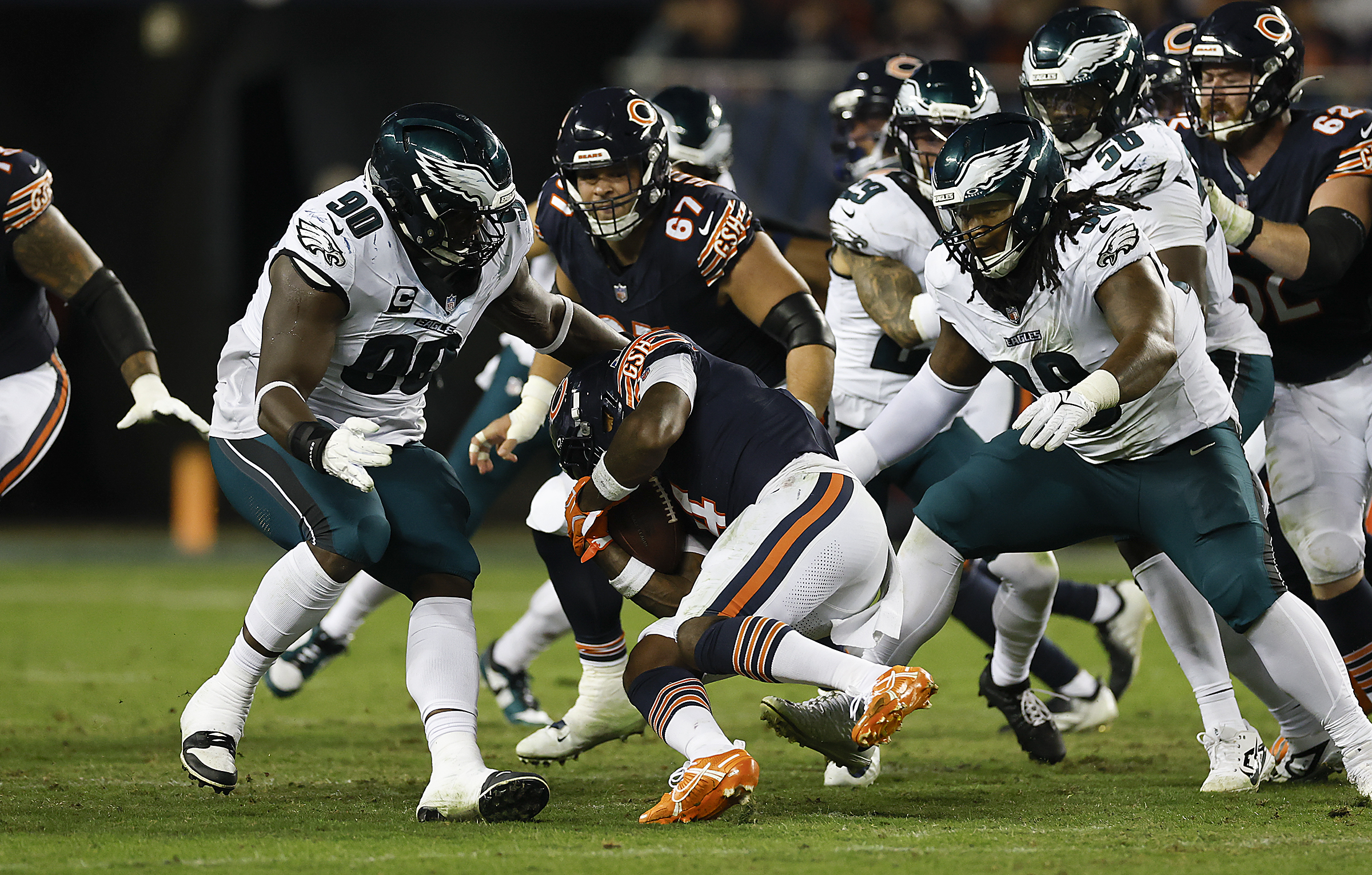
Eagles defensive tackle’s Jordan Davis (left) and Jalen Carter go after Chicago Bears running back D’Andre Swift on Monday. Yong Kim / Staff Photographer
Neiburg: I’ve seen a couple clips out there. I got to really look at it a little more to see what happened. My feeling from it was that the pass rush wasn’t horrible. The ball was coming out quick, and it was really more a problem with the back seven.
But you know, Jordan Davis you are paying all this money and [is a] good run defender, although I don’t think he had his best game, even though the numbers are pretty good. But he’s not out there a lot on pass rushes because that’s just not his thing. And it’s just like, can you afford to pay someone [like that] that amount of money? [Carter and Davis are] not a big contributor on passing downs. Like they’re both good players. I’m not saying they can’t even become great players, but they’re paying them to be dominant players. And right now, I just don’t see it.
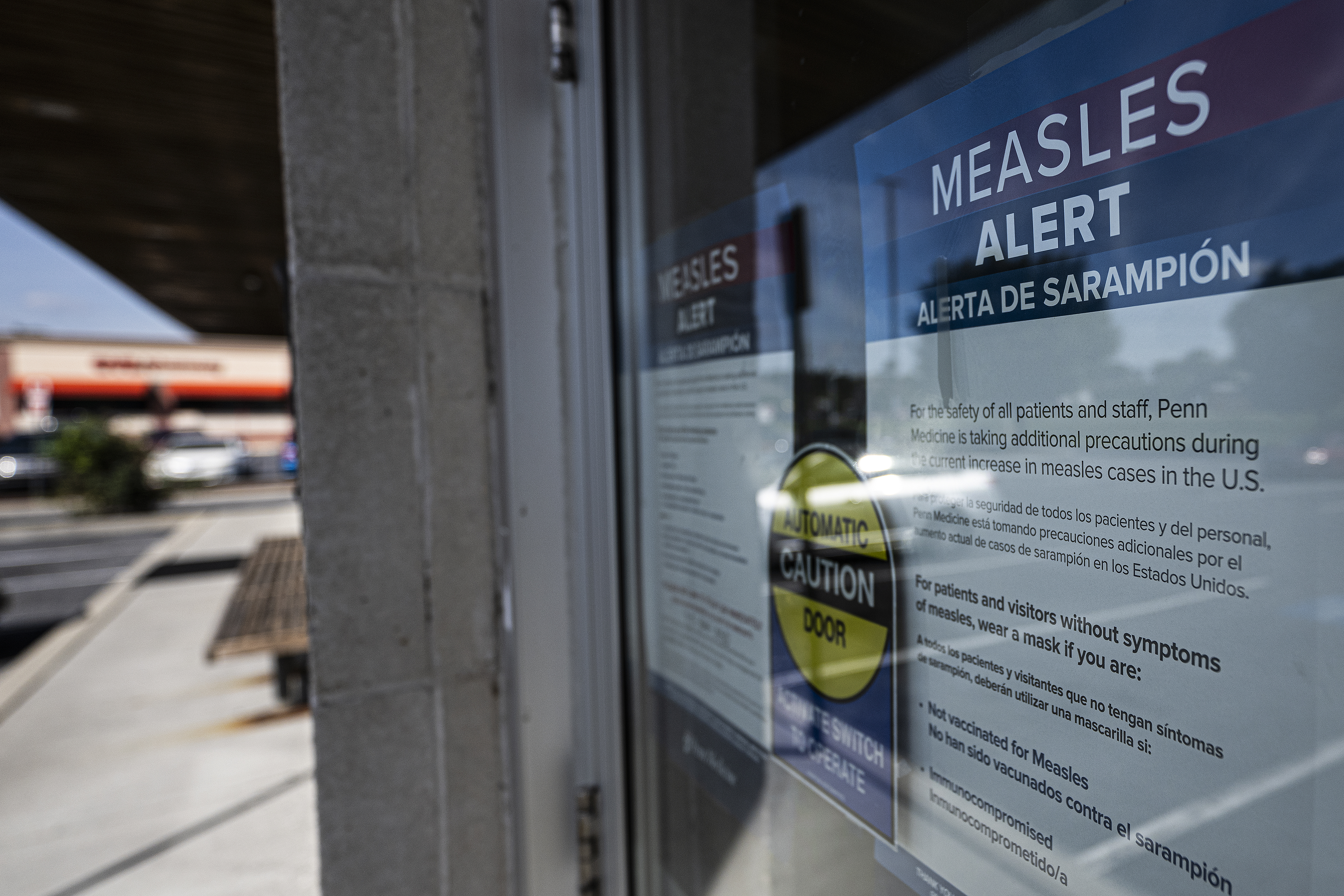
A fifth person has died amid Pennsylvania’s growing measles outbreak, state health officials confirmed on Wednesday.
The Pennsylvania Department of Health said in a news release that an unvaccinated resident of Lancaster County tested positive for measles and has died.
Health officials said they would not release any additional identifying details about the person who died, citing state privacy laws.
The state has confirmed two other measles-associated deaths this year in Lancaster County residents, both involving infants in the Amish community.
Mifflin and Jefferson Counties have also reported two measles-associated deaths involving an 18-year-oldand a 40-year-old, respectively.
The announcement came as confirmed measles cases in Pennsylvania reached 943 so far this year, the largest outbreak in the state in three decades and the highest case count nationwide this year. The state has confirmed 40 new cases in the last two days.
The outbreak is centered in Lancaster, where nearly 400 people have been sickened so far this year, but also expanding in other counties, including Chester County in suburban Philadelphia, which had reported 83 cases as of Wednesday, the third-highest countywide case count in the state.
(function(){function e(){window.addEventListener(`message`,function(e){if(e.data[`datawrapper-height`]!==void 0){var t=document.querySelectorAll(`iframe`);for(var n in e.data[`datawrapper-height`])for(var r=0,i;i=t[r];r++)if(i.contentWindow===e.source){var a=e.data[`datawrapper-height`][n]+`px`;i.style.height=a}}})}e()})();
The death toll reported in Pennsylvania is also the nation’s highest since 1992, but state and federal officials have clashed over how to characterize the four previous deaths reported in the state, all in people who were unvaccinated and confirmed to have measles infections.
The CDC’s public tracking of the toll of measles outbreaks nationally currently only shows two deaths from measles, reflecting decisions made under the leadership of President Donald Trump’s Health Secretary Robert F. Kennedy, Jr., a longtime anti-vaccine activist. The CDC’s website does not say where the two deaths occurred.
Gov. Josh Shapiro, a Democrat, has accused Kennedy of spreading misinformation about the safety of the measles vaccine, contributing to declining vaccination rates statewide. Kennedy has faulted Shapiro for politicizing the deaths and initially said his administration may have “fabricated” two deaths.
Pennsylvania officials said the latest death also fits the criteria for the state’s definition of a measles-associated death: One that occurred within 30 days of symptom onset in a person with clinical evidence of a measles infection and a positive lab test, that wasn’t due to an unrelated cause, like a car crash.
In confirming measles-associated deaths, the state also considers medical records and whether the person was exposed to measles before their death.
Statewide, nearly one in five people with reported cases have been hospitalized.
About a third of confirmed measles cases have occurred in children under 18.
Physicians and local officials in affected counties have warned that there are likely far more cases than have been officially reported.
Nearly all of the confirmed cases of measles have been in unvaccinated people, state officials said. The state confirmed four cases involving extremely rare “breakthrough” infections in people who were vaccinated, less than 1% of the total cases reported.
(function(){function e(){window.addEventListener(`message`,function(e){if(e.data[`datawrapper-height`]!==void 0){var t=document.querySelectorAll(`iframe`);for(var n in e.data[`datawrapper-height`])for(var r=0,i;i=t[r];r++)if(i.contentWindow===e.source){var a=e.data[`datawrapper-height`][n]+`px`;i.style.height=a}}})}e()})();
Lancaster County coroner Stephen Diamantoni said state officials called him Wednesday to inform him of the latest measles-associated death, but provided no additional information on the case.
He said his office had not handled any recent deaths involving a person who tested positive for measles.
Diamantoni, an elected Republican who is also a physician, had questioned the state’s conclusions about an earlier death in Lancaster County, in an infant who tested positive for a measles infection acquired before birth.
The baby died shortly after birth from a lacerated spleen, Diamantoni said, adding that he did not believe the child’s death was caused by measles.
State officials have said that the baby’s death fits their definition of a measles-associated death, and physicians have noted that measles can weaken the spleen, putting it at risk for rupture.
Diamantoni also investigated the death of a second infant, which was not initially reported to his office. The six-week-old had a fatal genetic condition that made her particularly vulnerable to respiratory illnesses. That death was caused by measles, Diamantoni said.
The other two deaths, in Mifflin and Jefferson Counties, involved an 18-year-old who died from a rare neurological complication of measles and a 40-year-old woman with serious respiratory issues that also put her at higher risk of death from measles.
A central line of attack in the waning weeks of the 2026 midterms comes straight out of the tried and true Republican playbook: Democrats are soft on crime.
But as crime rates plummet across the country, it’s been a hard case to make. In Michigan and Georgia, North Carolina and Texas, Republicans have struggled to pull voters back to the violence and disorder that followed the onset of COVID-19.
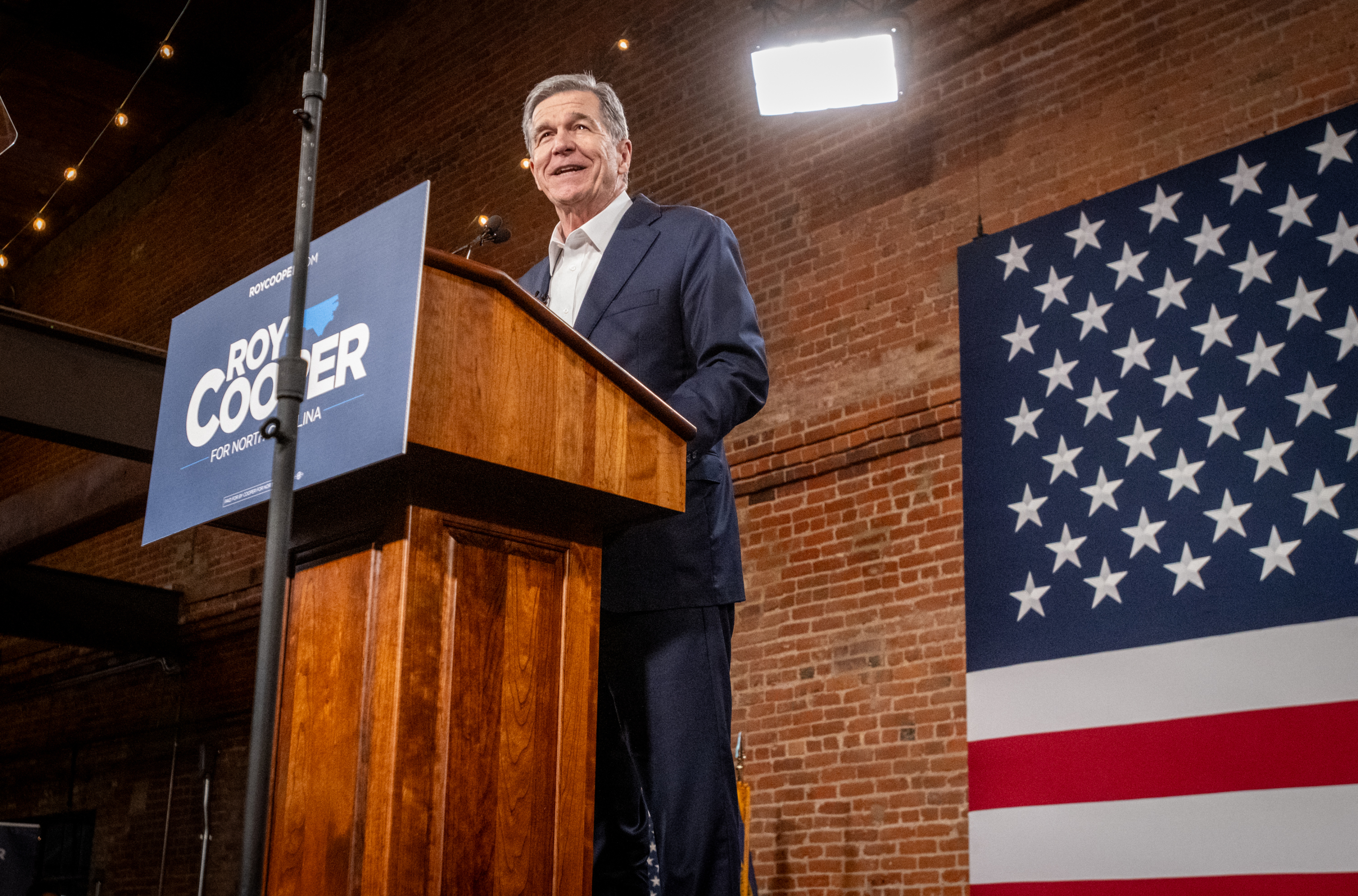
Nowhere is that clearer than in the Senate race in North Carolina. One Republican ad there tried to blame Roy Cooper, the former governor running for Senate, for a murder that took place in the wrong Carolina, the one to the south. Another asserted that he had given the man who fatally stabbed a Ukrainian woman on a light rail train in Charlotte, N.C., last year an early release from prison; he did not.
A third presented the story of a man whose son had been murdered, implying that Cooper’s policies were responsible. After it was released, the father, a Democrat, complained that he had been “swindled, hoodwinked” into making a political endorsement when he had been told the topic was gun violence.
Republicans have soldiered on, spending $18.5 million in North Carolina on ads about lawlessness and murder. But polls show Cooper, a former governor and attorney general, consistently leading his Republican opponent, Michael Whatley.
“It really does not seem to be having much traction at this point, and the folks who are long schooled and well versed in North Carolina politics have wondered why Michael Whatley didn’t take a different approach,” said Mitch Kokai, a senior political analyst at the John Locke Foundation, a free-market think tank based in Raleigh, N.C..
For Republicans, that different approach is proving elusive. The chaos at the border — a reliable political target since 2018 — has calmed. State laws barring transgender students in athletics have taken some of the sting out of that issue as well. The war on Iran is unpopular. Voters say they are most concerned about the high costs of everyday necessities.
And crime — usually a winning issue for Republicans, who are generally more trusted to keep law and order — is seeing a staggering drop. The downward trend that began during the Biden administration has only accelerated. One analysis found that the murder rate last year was the lowest it has been since 1900.
“This is the first election really in my lifetime where I have felt that it’s not an issue,” said Holly Harris, a veteran Republican strategist who is now the executive vice president of advocacy at Arnold Ventures, a philanthropy with a focus on criminal justice. “I remember when I was at the Republican Party years ago, every ad that we wrote was focused on crime. And it’s just not hitting the same mark.”
The good news on crime has posed a challenge for Republicans. How do you take credit for the peace while simultaneously blaming the other side for what President Donald Trump has called “American carnage?” At a recent campaign rally in Gastonia, N.C., Trump pivoted from blaming Cooper for the “blood-soaked killing fields” of North Carolina to hailing his own record within half an hour.
“Last year, we achieved the largest drop in violent crime ever recorded,” he said.
In The Charlotte Observer, Andrew Dunn, a conservative political commentator, wrote that the president’s description of the state as “one of the most violent and one of the worst in the whole nation” would backfire, even with those who agreed that Cooper had a poor record on crime.
“Who is buying that description of North Carolina?” Dunn asked.
Violent crime in North Carolina this year is down 22% compared with the same period in 2024, outpacing the national decline of 14%, according to data collected by the Crime Index. Property crime is down 18% compared with 2024, about the same rate as the national decline.
Republicans have spent $105 million on ads about crime, more than a quarter of total spending, compared with $35.5 million spent by Democrats, according to an analysis of spending on federal races in the general election by AdImpact, a media tracking firm.
In the previous two election cycles, attempts to tie all Democrats to far-left positions like defunding the police and abolishing prisons proved effective, in part because crime had spiked to alarming highs right after the pandemic and the police brutality protests in 2020.
Such attacks were often met with an uncomfortable silence, and Republicans were able to connect crime to a border that appeared to be exceptionally porous. Candidates repeatedly raised examples of violence committed by immigrants without permanent legal status and rising rates of fentanyl overdoses.
Those links have broken as drug overdoses drop, the border grows quiet, and even some Republican lawmakers say the president’s immigration crackdown has gone too far.
In the current climate, soft-on-crime attacks risk looking out of tune with the electorate’s deeper concerns, “especially when voters feel that they’re getting robbed at the gas station every day,” said Jim Kessler, the executive director of Third Way, a centrist Democratic organization in Washington.
Cooper, who was first elected to statewide office 26 years ago, as attorney general, has noted that many of Whatley’s accusations were found to be false and has defended his record. A campaign spokesperson said, “Roy spent his career putting rapists and violent criminals behind bars and signing tough-on-crime laws.”
“Most people look at Cooper, they don’t see somebody that is soft on crime,” said Carter Wrenn, a veteran Republican political consultant.
But for candidates without Cooper’s profile, strategists have counseled against trying to out-tough Republicans on crime. “If you’re going to be Republican lite, then people are going to pick Republicans,” said Celinda Lake, a longtime Democratic strategist.
The Vera Institute, a nonprofit that works to reduce mass incarceration and has used focus groups to test messaging on criminal justice policies, has offered “serious about safety” as a rival slogan. The idea was initially met with some mockery — one social media post said it sounded like a college sex talk — but candidates have increasingly adopted safety as a buzzword, with a new set of talking points to go with it.
James Talarico in Texas and Dr. Abdul El-Sayed in Michigan, both Democratic candidates for the Senate, talk about recruiting and training police officers and explicitly link public safety to increased spending on housing, education, mental health care, and drug treatment.
El-Sayed, the former health director for Wayne County, Mich., has gone from praising the “defund the police” movement for wanting to devote more resources to fighting poverty, to offering “a vision for public safety that I think all of us can agree with.”
“We want to know that we can get home safely,” he told CNN in June. “We don’t want to worry about being the victim of somebody’s violence, whether it’s from a neighbor or the state itself.”
Harris, the veteran GOP strategist, said, “Democrats are adopting some of the Republican talking points, to be candid.” Both sides are retreating from more extreme positions, she said, creating an opportunity for lawmakers to return to more nuanced, evidence-based policies. She characterized tough-on-crime attacks as “outliers.”
This week, El-Sayed’s Republican opponent, Mike Rogers, who has touted his experience as a former FBI agent, dropped his own crime attack ad. “It’s Abdul El-Sayed who would surrender our borders to the drug cartels,” a father whose son died as a result of opioid use says.
But Democrats are also playing offense this year, with ammunition from the Jeffrey Epstein scandal. Republicans, they charge, are protecting child predators, and Trump’s pardons of drug traffickers, fraudsters, and the rioters of Jan. 6, 2021, have been grist for their own soft-on-crime attacks.
In Nebraska a political action committee supporting Dan Osborn, an independent, unveiled an ad this week attacking the Republican incumbent, Sen. Pete Ricketts, for pardoning a man who had raped a woman three decades earlier.
Talarico has accused his Republican opponent, Ken Paxton, Texas’ attorney general, of an “Epstein-style sweetheart deal” that initially would have allowed a child molester to spend just one day in jail. Paxton’s office has said that the deal, which required the man to surrender his law license for five years but did not require him to register as a sex offender, was reached because the victim was unwilling to testify.
In North Carolina, skirmishes over “pedophile protectors” have proliferated, spurring lengthy examinations of the sex crime rap sheets of pastors, board presidents, and party operatives.
In July, a Democratic PAC spent more than $2 million on ads about Harvey Lee West Jr., a child sex offender who did time in prison and then ascended the ranks of the state Republican Party, winning influence and committee appointments while Whatley was the chair.
Whatley’s campaign spokesperson said that the candidate had never hired West for a paid position. But the ads accuse Whatley of “putting politics over safety.”
FILE — Michael Whatley, Republican’s candidate for a U.S. Senate seat in North Carolina, joins President Donald Trump on stage during a campaign rally at the airport in Gastonia, N.C., Sept. 16, 2026. Across the country, and especially in the North Carolina Senate race, Republicans have charged opponents with being soft on crime, even as President Trump brags over plunging crime rates. (Kenny Holston/The New York Times)KENNY HOLSTON
Speaking to the media on Day 2 of training camp, Trevor Zegras expressed that if he wants to play center, which he is slated to do to start the season, he needs to be better at faceoffs.
A question followed noting how good Noel Acciari’s numbers were in the playoffs, when the then-Pittsburgh Penguins forward had a 61% winning percentage in the circle against the Flyers.
“Yeah, yeah, I know. I wonder why,” Zegras said with a chuckle. The question continued, asking if Acciari is someone whose brain he would pick. “Yeah, for sure,” Zegras said. “Ask him what I was doing wrong, probably.”
Zegras, who famously battled Acciari in the regular season, can now look across the Flyers’ locker room in Voorhees to find out. Acciari inked a two-year deal with a $2.8 million average annual value on July 1.
“I think the right-handed draw,” coach Rick Tocchet said about the value Acciari adds to the lineup. “He killed us last year, and now they don’t have that, so that’s good; helps us for our face-offs tonight.”
Video: Danny Brière on 2026-27 Flyers: ‘We’re not going to creep up on anyone’
The Flyers open the 2026-27 season at Xfinity Mobile Arena on Wednesday (7:30 p.m., TNT, truTV), against their Keystone State rivals, whom they knocked out of the playoffs in six games in the first round of the 2026 Stanley Cup playoffs. A veteran of 585 NHL games, the 34-year-old is excited to kickstart the season against his former team and play in front of his new fanbase.
“I’m just glad I’m on this side now,” grinned Acciari. “They’re passionate, and I love that.”
The native of Rhode Island, who wore Rasmus Ristolainen’s No. 55 in Pittsburgh, will now don 52 because “in high school [at Bishop Hendricken High] I was number 10, so five and five is 10, so five times two is 10.” Acciari will be slotted onto a revamped fourth line alongside captain Sean Couturier and rotating left wingers Carl Grundström and Garrett Wilson.
“North-South, try to be heavy on the puck, good in the defensive zone,” he said when asked to describe his game to The Inquirer. “[Penalty kill], take pride in that, block shots, throw hits, and the occasional try and score when we can.”
Noel Acciari (55, facing off against the Devils’ Jack Hughes) is slated to make his Flyers debut Wednesday night. Noah K. Murray
Last season Acciari finished seventh in hits (65) and blocked shots (62) on the Penguins, despite averaging less than 14 minutes a night. Since becoming an NHL mainstay in the 2017-18 season with the Boston Bruins — he’s also played for the Florida Panthers, St. Louis Blues, and Toronto Maple Leafs — Acciari ranks 43rd in hits (1,246), between tough defenseman Ben Chiarot and winger Milan Lucic, who each have four inches on him.
“He’s super effective,” said Owen Tippett, who played with Acciari in Florida and was someone the new guy bounced questions off.
“Obviously, he plays the game heavy, but just his details of his stick and blocking shots and everything like that, he’s going to help not only that line but also our PK as well. And having a right-handed centerman doesn’t hurt as well.”
The only right-handed centerman on the team — like Luke Glendening, who came on later in the 2025-26 season — Acciari will switch with Couturier depending on the side of the faceoff circle. He has also become a penalty-killing partner to Couturier, the longest-tenured Flyer. The two have already built a strong relationship on and off the ice.
“Just kind of being able to read off each other,” Acciari said. “The short time we’ve been together, I feel we’ve kind of made some sort of connection in the preseason games and practices. Each time it’s gotten better, and I think it’ll continue to grow.”
Breakaways
Tocchet confirmed that Dan Vladař will get the start in the opener. … The coach said forwards Denver Barkey and Nikita Grebenkin, who were not on the ice for morning skate, are still day-to-day. “Barks has improved. He might be a little ahead of Grebby,” Tocchet said. … The Flyers held an optional skate, and Acciari and Couturier did not participate but are good to go.
Fleece fragments in a washer flow into a wastewater treatment plant. A plastic bag blows into a stream. A water bottle washes down a storm drain.
All can end up in the region’s waterways as microplastics smaller than a grain of rice and find their way into drinking water and the stomachs of animals and fish.
This kind ofmicroplastic pollution was detected in 22 stream and river segments across the Delaware River watershed, according to a new survey of waterways by the nonprofit advocacy group PennEnvironment Research and Policy Center.
Researchers analyzed water samples from sites along the Delaware River and its tributaries across Pennsylvania, New Jersey, Delaware, and New York.
The research was conducted in partnership with the nonprofit Environment New Jersey Research and Policy Center. Scientists with the Academy of Natural Sciences at Drexel University helped analyze the results, which were released Wednesday during a news conference at Fairmount Water Works.
Contamination was found in the Delaware and Lehigh Rivers and the Schuylkill. It was found in Neshaminy Creek in Bucks County, Brandywine Creek in Chester County, and Cooper River in Camden County. And it was found along the Christina River in Delaware.
Drexel’s lab analysis confirmed microscopic plastic at every sampled site, highlighting what the researchers say is a widespread environmental threat.
“We can look at a waterway, and it might be free of litter, it might be free of visible plastic pollution, but that doesn’t necessarily mean it’s clean,” said Faran Savitz, an advocate for PennEnvironment. “The big takeaway is that we should be concerned. The depth, the breadth of this plastic pollution is staggering.”
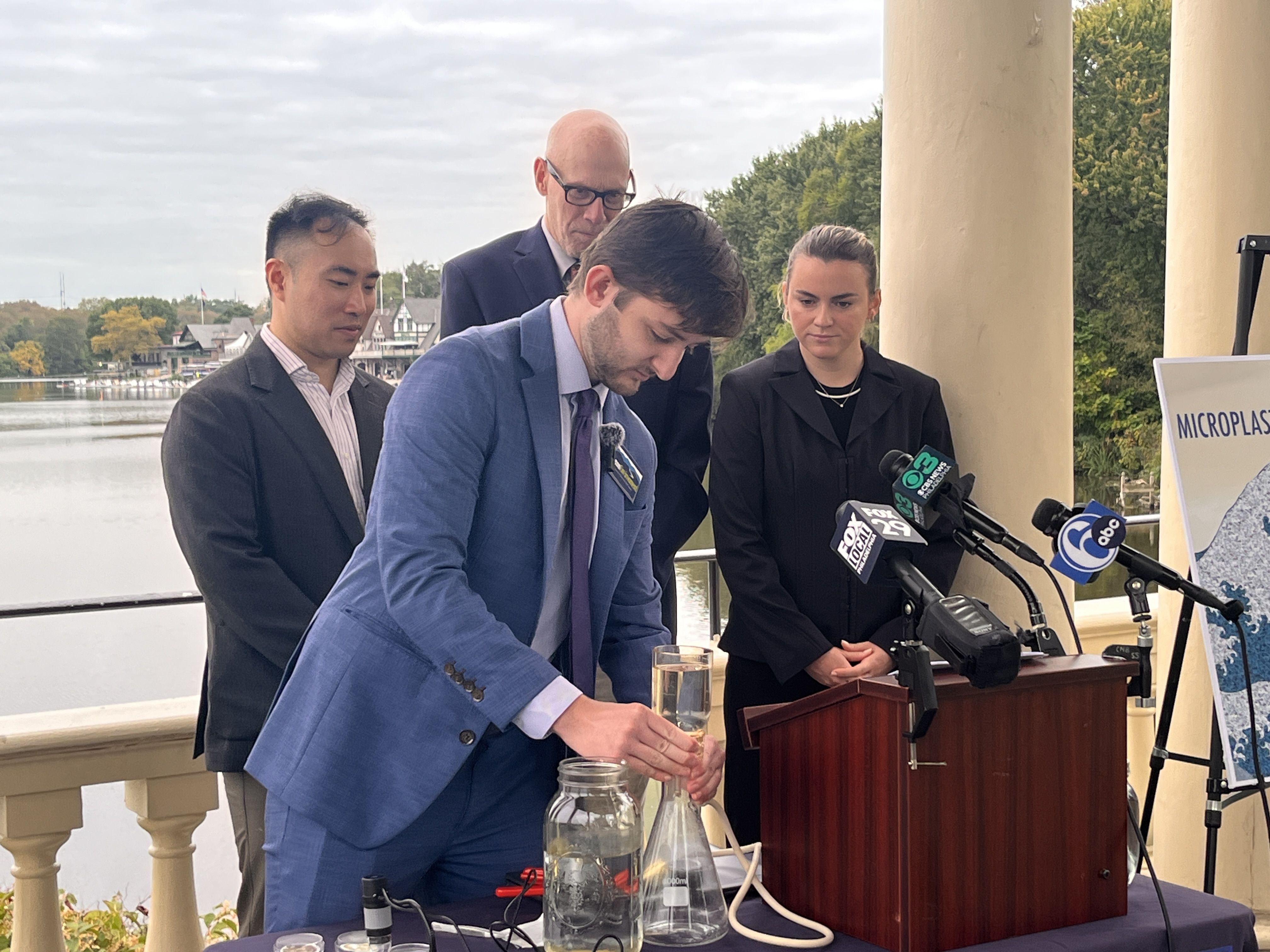
Faran Savitz with PennEnvironment demonstrates water testing. In the background from right are: Lizzy Mulvenna, with Environment New Jersey Research & Policy Center; David Velinsky, senior scientist, Academy of Natural Sciences; and Derek Ho, microplastics researcher, University of Pennsylvania.Frank Kummer
Where do microfibers come from?
Waterways in and around Philadelphia emerged as significant focal points in the survey results.
Samples drawn from the Delaware River in Philadelphia tested positive for multiple categories of microplastics including microfibers, microfragments, and microfilm, as did other waterways. Microbeads, often found in cosmetic products, were also found in the Christina River.
Microplastics are defined as fragments of less than 5 mm in length.
The synthetic microfibers came primarily from clothing and textiles. Rigid microfragments from items such as fishing line were found in 82% of locations. And flexible microfilm from bags and packaging appeared in 77%.
(function(){function e(){window.addEventListener(`message`,function(e){if(e.data[`datawrapper-height`]!==void 0){var t=document.querySelectorAll(`iframe`);for(var n in e.data[`datawrapper-height`])for(var r=0,i;i=t[r];r++)if(i.contentWindow===e.source){var a=e.data[`datawrapper-height`][n]+`px`;i.style.height=a}}})}e()})();
Microplastics have been found in humans
Researchers explained that laundering synthetic garments releases millions of microfibers that wastewater treatment facilities are unable to completely filter out before they are discharged into local streams.
However, because plastic does not biodegrade but continuously fractures into tiny fragments, filters capture only a portion of plastic entering a waterway.
Savitz said PennEnvironment’s study did not release the concentrations of microplastics because it did not want to compare one waterwayor state against another.
The findings carry ecological and public health implications, as microplastics can block digestive tracts in wildlife and absorb toxic chemicals like PCBs and PFAS that bioaccumulate up the food chain, the report stated.
On average, humans ingest approximately 5 grams of plastic weekly, which is roughly equivalent to the weight of a credit card. Microplastics have been found in human blood, lung tissue, and organs, the researchers said.
Plastics are also routinely found in wildlife, including sea turtles, birds, and whales. About 60% of all seabirds have ingested plastic, with that number rising.
The environmental advocates are urging state and local leaders to enact policies such as producer responsibility for plastic packaging, bans on single-use foam and plastic bags, strict limits on pre-production plastic pellets, and enhanced drinking water filtration systems.
Microbeads once used in personal care products were phased out under President Barack Obama in 2015. But many of those products still linger on household shelves.
File: A glass vial containing water and microplastic pollutionGetty Images
Philadelphia’s drinking water
Philadelphians get their drinking water from the Delaware River and the Schuylkill. Most microplastics are filtered out at the Philadelphia Water Department’s wastewater treatment plants, but some particlesstill get through.
In 2025, PWD removed 4.6 tons of plastic litter from the Delaware and the Schuylkill, alongside an estimated 1,000 tons of plastic extracted through sewer maintenance, the researchers stated.
PWD said in an online report that it is “unclear whether microplastics pose a danger to human health,” noting that the risk could depend on the level of exposure, the type of plastic, and the size of the particles.
But it noted that research suggests some are harmful to fish and animals and can build up in the organs or bloodstream over time.
“PWD is always investigating advanced treatment technologies that may eliminate microplastics and other impurities,” the report stated.
David Velinsky, a senior scientist at the Academy of Natural Sciences of Drexel University, said, “plastics and microplastics are everywhere, from our clothing to the ubiquitous water bottle.”
When plastics and microplastics are not properly disposed of or recycled, he said, they break down into ever smaller pieces.
They “can travel great distances through both the air and in the water,” Velinsky noted.
A plea for ‘producer responsibility’
To combat pervasive plastics, advocates are urging federal and state lawmakers to enact targeted reforms, including the federal Plastic Pellet Free Waters Act currently before Congress, and state-level producer responsibility legislation for plastic packaging.
Savitz emphasized that shifting financial and operational burdens back onto manufacturers is critical to curbing waste at its source.
At least seven states have passed producer responsibility laws, though not all are in effect, according to the Product Stewardship Institute. Those states include Washington, Oregon, California, Colorado, Minnesota, Maryland, and Maine.
“If we can shift the burden back onto companies that create this waste in the first place,” Savitz said, “we can actually reduce the waste, encourage recycling, and make these broader, more systemic changes.”
Temple’s men’s and women’s basketball teams will open American play on Dec. 30, with the men traveling to Rice and the women hosting Charlotte, as part of the Owls’ 18- game conference slate announced Wednesday.
Both programs will face six conference opponents twice, with three at home and three on the road. The Owls’ men’s and women’s teams each finished 8-10 in the American last season.
The American men’s and women’s basketball tournaments will be held in Tampa in March. Game times and broadcast information for Temple’s conference schedules will be announced at a later date.
The men will play their first two conference games at home against UTSA on Jan. 2 and UAB on Jan. 5. Temple will also host each of the American’s top three finishers from last season — South Florida, Wichita State and Tulsa — with defending regular-season and tournament champion South Florida visiting the Liacouras Center on Jan. 14.
Temple handed South Florida one of its three conference losses last season, beating the Bulls, 79-78, at the Liacouras Center on a Mohamed Keita tip-in with six seconds remaining.
The Owls will have a difficult road stretch midway through conference play. Beginning Jan. 31, Temple plays four of five games away from home, traveling to UAB, North Texas, Florida Atlantic, and South Florida in between a Feb. 7 home matchup with East Carolina.
Temple will return home to face Wichita State on Feb. 21 and Tulane on Feb. 24 before visiting East Carolina on Feb. 27. The Owls will play their conference home finale against Memphis on March 4 before ending the regular season at UTSA on March 7.
Women’s schedule
The women begin conference play with two home games, following their opener against Charlotte with a Jan. 2 matchup against Rice. The Owls will get an immediate test against the defending American regular-season champions, who went 17-1 in conference play last season.
Temple will host each of the five teams who finished above the Owls in last season’s conference standings — Rice, East Carolina, South Florida, Tulsa, and North Texas — at the Liacouras Center.
After opening January at home, the Owls will play four of their next six games on the road, including trips to Memphis, UAB, South Florida, and Wichita State. Temple closes the month at Tulane on Jan. 30 before traveling to UTSA on Feb. 6.
The UTSA game will be Temple’s first meeting with the Roadrunners since they eliminated the Owls from last season’s American tournament. UTSA beat Temple, 59-51, in the second round before going on to win the conference tournament and earn an NCAA Tournament berth.
Temple then begins a three-game homestand against Tulsa on Feb. 9, followed by Wichita State on Feb. 13 and Florida Atlantic on Feb. 17. The Owls’ final home game is against South Florida on Feb. 27 before they close the regular season at Florida Atlantic on March 6.
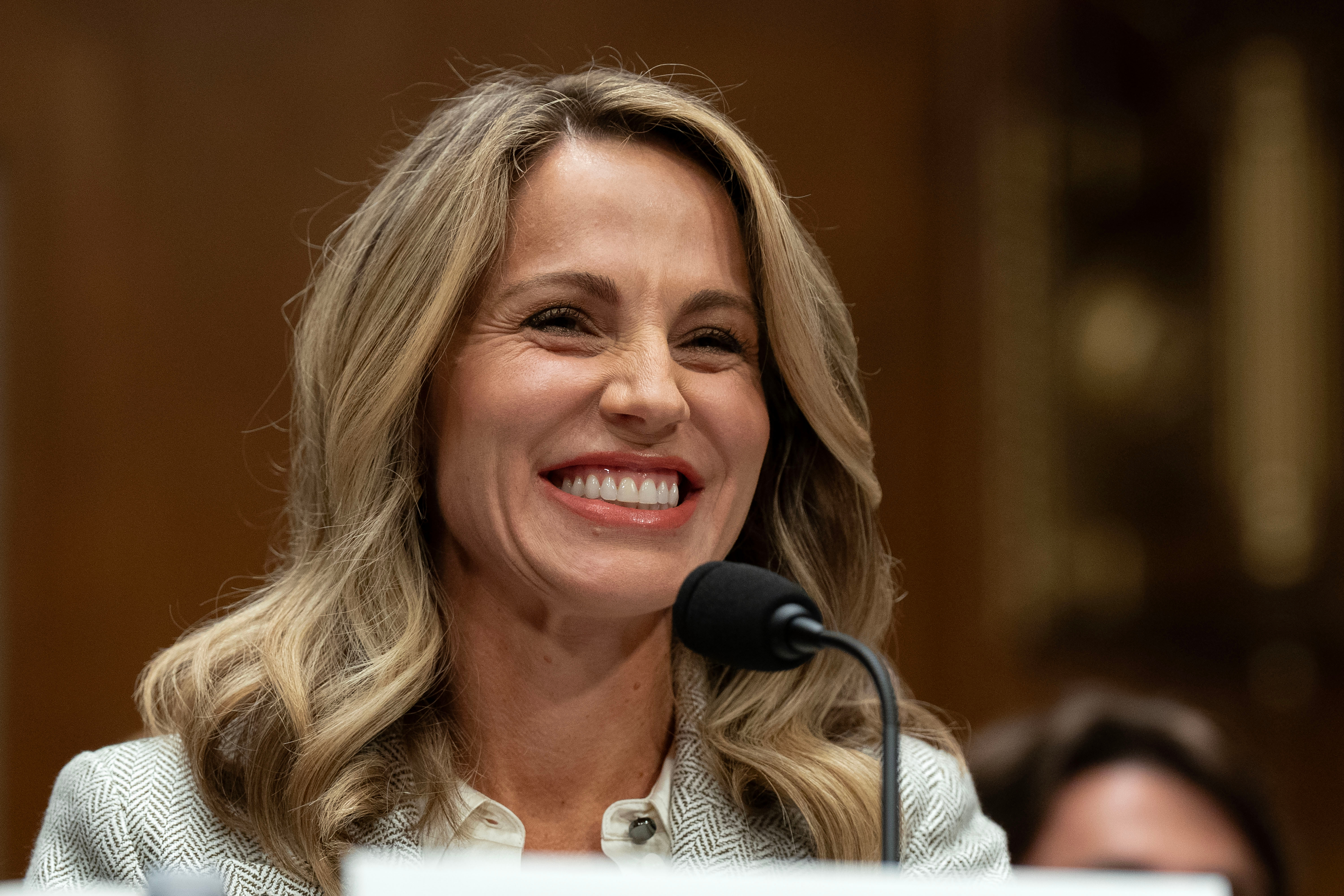
WASHINGTON — Nicole Saphier, President Donald Trump‘s third nominee for surgeon general, moved a step closer to confirmation after a Senate committee voted to advance her nomination on Wednesday.
Saphier, a radiologist and former Fox News Channel contributor, was advanced out of the Senate Committee on Health, Education, Labor and Pensions on a 12-to-11 vote to serve as surgeon general after she was grilled at her confirmation hearing earlier this month about her stance on childhood vaccines.
She expressed support for vaccines and told lawmakers she didn’t believe they cause autism. The Trump administration has sought to revisit claims about a link between vaccines and autism, although widespread scientific consensus and decades of studies have firmly concluded there is none.
Timothy Westlake, who was nominated to serve as assistant secretary for mental health and substance use at the Department of Health and Human Services was also advanced out of committee on the same en bloc vote.
It was not immediately clear when the officials would face a full Senate vote for their confirmation but they are expected to be approved.
During her confirmation hearing, Republican Sen. Bill Cassidy pressed Saphier to declare whether she believed there was a link between vaccines and autism. Saphier responded that she does “not believe childhood vaccines cause autism,” adding that “the MMR vaccine is our greatest tool for combating measles,” in response to a question by Cassidy over whether parents should give children that shot.
MMR stands for measles, mumps and rubella, and the president recently called for the shots to be spaced out, against the guidance of medical groups.
The surgeon general position carries limited policymaking power but serves as a loud megaphone as the nation’s top communicator to Americans on public health issues.
Cassidy, who led the inquiry into Saphier’s views on vaccines, ultimately voted in support of her nomination.
Sen. Bernie Sanders, the ranking member of the Senate HELP committee, said ahead of Saphier’s vote that he would vote down her nomination because in part Saphier “has questioned the need for the hepatitis B vaccine at birth, when the data science has been clear.”
“We need a surgeon general who will tell the truth about vaccines, not someone who misleads the public,” Sanders said. At her confirmation hearing, Saphier said the universal birth dose of hepatitis B was safe and effective.
Chris Klomp, who was nominated to serve as deputy secretary of the Department of Health and Human Services, was advanced out of the Senate Finance Committee last week on a 15 to 12 vote. He was questioned during the same hearing as Saphier about his duties associated with the role as the current chief counselor of the Department of Health and Human Services under the leadership of Health Secretary Robert F. Kennedy Jr. as well as about his vaccine stance.
In protesting Klomp’s nomination at the Senate Finance Committee, Sen. Ron Wyden said Klomp “tried to create the impression that he will be the adult in the room on vaccines. Yet, as we sit here today, the vaccine chaos that we’ve come to expect from Robert Kennedy’s HHS continues.”
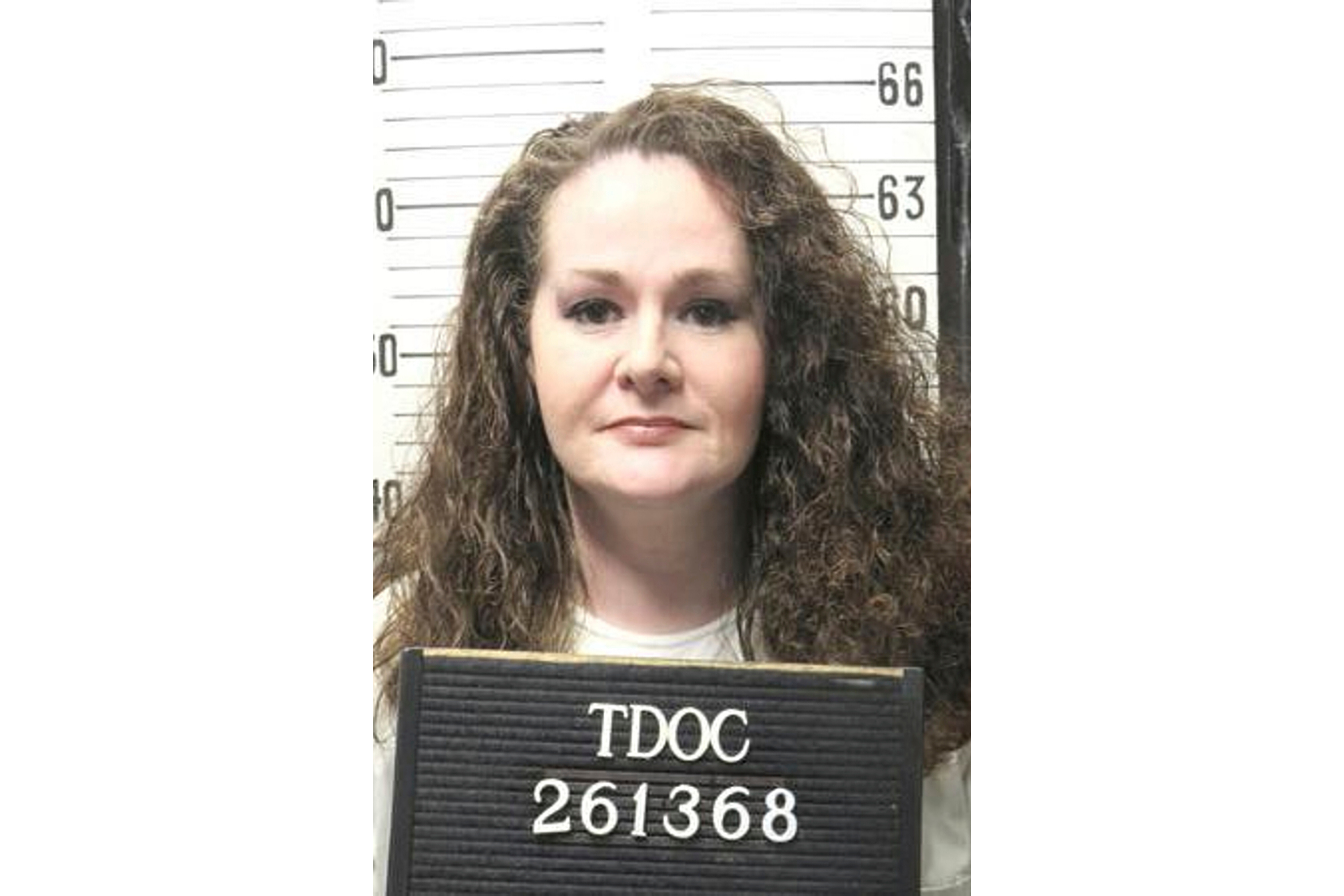
NASHVILLE — The U.S. Supreme Court is allowing the execution of Christa Gail Pike to go forward in Tennessee, overturning a last-minute stay that was issued by an appeals court hours earlier Wednesday.
Pike, 50, was scheduled to die by lethal injection in the morning, and witnesses had already gathered at the Riverbend Maximum Security Institution in Nashville when the 6th Circuit U.S. Court of Appeals voted 2-1 to issue a stay. That court said a delay was needed to consider whether Pike’s allegations of childhood sexual abuse were fully considered at her sentencing.
The Supreme Court’s three liberal justices, Sonia Sotomayor, Elena Kagan, and Ketanji Brown Jackson, dissented from the ruling. Sotomayor called the court’s decision stunning, as it clears the way for the execution to happen “before her still-pending legal challenges to her conviction can be properly considered.”
Pike, who was 18 at the time, and her boyfriend were convicted of the 1995 stabbing and beating of 19-year-old Colleen Slemmer, their classmate at a job training facility in Knoxville.
The case garnered widespread attention back then in part because a pentagram that was carved on Slemmer’s body and other elements of the crime stoked fears of Satan worship during the “satanic panic” of the 1980s and 1990s.
Decision stopping execution was swiftly appealed
After the stay was issued, Tennessee’s attorney general immediately appealed to the Supreme Court. Witnesses and media remained at the prison while the high court considered the case.
Despite the Supreme Court’s ruling, it was not immediately clear if the execution would happen Wednesday. The state’s execution order expires at midnight, according to Kelley Henry, a Nashville-based attorney experienced with Tennessee death penalty law. If time runs out, the state Supreme Court would need to set a new date.
In its appeal to the U.S. Supreme Court, the attorney general’s office wrote that halting the execution at the last moment traumatized Slemmer’s family and rewarded “abusive delay tactics” by Pike’s attorneys.
Pike does not deny committing the killing, but her supporters argue the state should consider her age at the time, her mental illness and her allegations of severe sexual abuse that included being raped from the time she was a toddler.
“It is inconceivable that in the 21st century, the criminal justice system is poised to execute a survivor of rape and child sexual abuse whose jury never had the opportunity to consider those facts in weighing the defendant’s moral culpability,” her attorneys wrote in a filing.
Pike’s case renewed debate on the death penalty for teens
As the execution date drew near, Pike’s case renewed debate over the death penalty for young offenders.
Assistant Federal Defender Stephen Ferrell said Pike’s death sentence is an outlier because other 18-year-olds in Tennessee have had such sentences vacated.
After the killing, Pike was diagnosed with bipolar disorder and post-traumatic stress disorder. In her clemency petition, she said she only wanted to fight Slemmer but killed her in a frenzied attack when she couldn’t “put the brakes on.”
“I was a mentally ill 18-year-old kid. It took me numerous years to even realize the gravity of what I’d done. Even more to accept how many lives I affected. I took the life of someone’s child, sister, friend. It sickens me now to think I had the ability to commit such a crime,” Pike said in a statement.
Victim’s mother says she is waiting for death sentence
Slemmer’s mother wants the lethal injection to go forward, saying she has waited decades to see Pike’s sentence carried out.
“Every time I think about it, I think about Colleen feeling that pain and trying to get up and run,” May Martinez told The Associated Press in a telephone interview on Saturday.
Martinez said a group helped raise money so she and her husband could travel from Florida to witness the execution. She didn’t respond to a message Wednesday after the execution was halted.
Martinez said her daughter’s age also should matter in deciding Pike’s fate.
“Not a day goes by, or a minute goes by that I do not think about Colleen. Holidays are the worst,” she said, noting that her daughter would have turned 51 earlier in September.
The killing rocked the city of Knoxville. Prosecutors said Pike, fearing Slemmer was trying to steal her boyfriend, lured her to a wooded area on Jan. 12, 1995. Pike cut Slemmer with a box cutter and beat her with a large chunk of asphalt. Shipp, Pike’s boyfriend, has admitted that he was the one who carved a pentagram, a star-shaped symbol associated with Satan, into her body.
Shipp was 17 when the crime happened and received a sentence of life in prison with the possibility of parole. Pike was the only one sentenced to death.
Executions of women are rare in the U.S.
Tennessee has not executed a woman for at least 200 years, according to Robin M. Maher, executive director of the Death Penalty Information Center. Older records can be spotty, though, so it is difficult to know precise details about the last woman who was put to death there.
Since the Supreme Court reinstated the death penalty in 1976, 18 women have been put to death, representing about 1% of all executions, according to the center.
Most recently, in 2023, Missouri executed Amber McLaughlin for a 2003 killing, in what is believed to be the first execution of a transgender woman in the U.S. In 2021 the federal government executed Lisa Montgomery, marking the first time in nearly seven decades that it put a female inmate to death.
Pike would be the 30th person executed in the U.S. this year after Florida carried out an execution on Tuesday.