Blog

  • Denmark approves security deal with U.S. and Greenland, seeking to finally ease tensions with Trump

    Denmark approves security deal with U.S. and Greenland, seeking to finally ease tensions with Trump

    COPENHAGEN, Denmark — Denmark’s parliament on Thursday approved a hard-wrought deal with Greenland and the United States to strengthen security in the Arctic and North Atlantic, a final step aimed to defuse months of tensions over the Trump administration’s pressure about a possible U.S. takeover of the vast, mineral-rich island.

    The trilateral deal — between U.S. President Donald Trump and Danish and Greenlandic leaders — paves the way for more U.S. bases in Greenland, a semiautonomous territory of NATO ally Denmark. It also eases tensions in the Atlantic alliance and with the European Union over Trump’s repeated calls for the vast island to become part of the U.S.

    U.S. Secretary of State Marco Rubio said Thursday the deal “will make us all safer, stronger, and more secure.”

    “This agreement modernizes the United States-Denmark-Greenland defense partnership and bolsters the national security of the United States and our allies in NATO,” Rubio wrote on X. “Looking forward to more cooperation in the future.”

    The 109-0 vote in the Folketing amounts to a final step: The deal enters into force once the parliaments of Denmark and Greenland have signed on, followed by formal notification of the United States in a diplomatic note.

    Greenland’s parliament approved the deal earlier this month, also with no opposition.

    “Today is a big day,” Danish Prime Minister Mette Frederiksen wrote on Facebook. “It hasn’t been an easy process.”

    She said the agreement respects Denmark’s sovereignty and territorial integrity, and the right of Greenlanders to self-determination.

    Greenlandic Prime Minister Jens-Frederik Nielsen wrote on Facebook that Thursday’s vote proved that Greenlanders can stand firm in their rights while also finding solutions through dialogue and cooperation.

    “We have been through a difficult time, during which many people here at home have been concerned about our country and our future,” he said. “I hope that today’s decision will help bring greater calm and a sense of security.”

    The U.S. ambassador to Denmark, Kenneth Howery, welcomed the “strong support” in the Danish parliament for ratification of the deal “paving the way for it to enter into force.”

    “The agreement is a tremendous accomplishment, one that modernizes our partnership for the security challenges of the future and bolsters the security of the United States, the Kingdom of Denmark, including Greenland, and all of NATO,” he wrote on X.

    The aim is to bolster the U.S. military presence on Greenland but keep the self-governing island under Danish control. It would still apply if Greenland eventually chooses independence.

    Trump and the leaders of Greenland and Denmark signed the deal in September in New York, after months of quiet, behind-the-scenes negotiations to address his security concerns and Danish and Greenlandic fears of a possible U.S. takeover.

    Under the deal, which builds on a defense agreement dating to 1951, the United States can expand its military presence on the island and “modernize and expand” its activities at the remote Pituffik Space Base in the northwest.

    The U.S. can also set up “defense areas” at Narsarsuaq in the south and Mestersvig in the east of Greenland, and can establish additional defense areas in the territory and strengthen its military operations or sites.

    The three sides expressed support for a stronger NATO engagement in the Arctic, and for allowing the U.S. military access to Greenland to defend the NATO area — including through the ” Golden Dome ” defense system.

    After repeated U.S. warnings about the threat in the region from geostrategic rivals Russia and China, the agreement says only NATO members can establish manned or unmanned military installations on Greenland.

  • Congress is on the verge of upending landmark environmental laws. Here’s how.

    For weeks, Democrats and environmental groups have been torn apart by a bill making its way through Congress. The measure, known as the Bipartisan American Affordability and Jobs Act (BAAJA), would ease the way for the development of vast wind and solar farms, and ensure data centers pay their fair share for electricity — but it also would spur fossil fuel development and, according to some lawyers, eviscerate existing environmental laws.

    Experts say that however you view the bill, it will fundamentally transform America’s environmental laws. “No one alive has experienced a proposal of this magnitude for the environment,” said Danny Cullenward, an economist and lawyer at the University of Pennsylvania’s Kleinman Center for Energy Policy.

    The measure could pass the Senate as soon as this week and then would head to the House. Here’s what it would actually do for clean energy, data centers and fossil fuels.

    Data centers

    Data centers would have strict requirements on financing their own power if the bill passes. The public roundly dismissed data centers during the midterm elections, with voters opting to restrict or slow such development in 40 of 41 local ballot races around the country. The only exception was North Dakota, where an 845-person town called Harwood voted against increasing data center oversight.

    Currently, data centers have to pay for either their general cost of operating on the existing power grid, or the cost of any additional upgrades and transmission lines needed to serve them. That “either/or” policy means some of those costs could be passed on to consumers — although so far, the impacts seem to be small.

    If the bill passes, data centers will have to pay for both — ensuring that those extra costs aren’t passed on to the consumer.

    “The bill takes a pretty hard line on data centers,” Daniel Palken, director of infrastructure for energy and permitting at Arnold Ventures, a philanthropy that supports the bill, said in a briefing last week. “It’s virtually starting to err on the side of having data centers pay strictly more than their costs.”

    Clean energy

    Two of the Senate’s most dedicated climate hawks — Sheldon Whitehouse (D, R.I.) and Martin Heinrich (D, N.M.) — sponsored the bill, in large part because of how it would improve the large power lines that can carry solar and wind power across long distances.

    “In many parts of the country, clean energy tends to be the cheapest and fastest-to-deploy energy,” said Ben Schifman, a senior technology fellow at the Institute for Progress and a former environmental lawyer. “But it has a real problem, and the problem is that it can’t get from where it’s needed to where the population centers are.”

    The United States currently builds around 500 miles of high-voltage transmission lines every year — a tiny fraction of the roughly 5,000 miles the country needs to add per year to support the build-out of the grid. One infamous power line, the SunZia line from New Mexico to Arizona, took 17 years to gain final permitting approvals. Currently, states can block or indefinitely delay lines that they don’t think would provide local benefits, slowing the pace of building.

    The bill would require utilities to upgrade existing transmission lines and give the Federal Energy Regulatory Commission a stronger role in planning and executing new high-power lines. Experts estimate that it would cut the time for new transmission lines to be approved from more than 10 years right now to around five or six years.

    “In the status quo it’s very easy, comparatively speaking, to build fossil fuel infrastructure, fossil fuel pipelines — but very difficult to permit and build transmission lines,” Schifman said. The bill, he says, helps fix this problem, unlocking more wind and solar development. “If clean energy were on an even playing field, it would be winning,” he added.

    Chad Whiteman, vice president of environment and regulatory affairs at the U.S. Chamber of Commerce, says that the bill would help lower prices by allowing a greater build-out of all types of energy, including renewables. “If we want to address climate, if we want address it in the time frame that scientists say we have to, then you have to be able to build those clean energy resources,” he said.

    Fossil fuels

    For some environmental groups, the problem with the bill is that even if it would unlock clean-energy development, it also could unleash more coal, oil, and gas development. The bill takes aim at the National Environmental Policy Act, a decades-old law that requires agencies to evaluate the environmental impact of a project that is on federal land, has a federal permit, or has federal funding. Currently, this review process takes almost four years, on average, and NEPA violations can result in a project’s approval being paused indefinitely or even revoked by the courts.

    The new legislation says that a court can send the environmental review back to be revised but that during that revision, the project can still go forward. Critics say this amounts to repealing the law altogether.

    “Does NEPA need to be reformed? You bet it does,” said David Bookbinder, a longtime environmental lawyer. “This isn’t that. This is simply repealing it.”

    Abigail Dillen, president of the environmental law firm Earthjustice, says the bill would dramatically undercut environmental groups’ ability to fight polluting projects. “Our system is still built for oil and gas,” she said. Earthjustice opposes the bill.

    Supporters say that the bill helps to fix a broken system, in which projects can be stalled for years or even decades. “Our permitting process is really, really bad,” Xan Fishman, executive vice president of the energy program at the Bipartisan Policy Center, said in a briefing. “It started with really good intentions, but it’s morphed into this process that takes years and years and years to get a yes or a no.”

    Some research suggests the bill would give a slight edge to clean energy, although a small one. According to the research company Rhodium Group, the bill would spur development of both fossil fuels and clean energy, lowering greenhouse gas emissions by around 3% by 2040. But depending on how the next decade and a half goes, Rhodium also noted that it may not reduce emissions at all compared with the status quo.

    Endangered species

    Some other provisions of the bill also have been controversial. The bill would require that the “best available science” be used for the Endangered Species Act, which critics say could allow courts to leave out some emerging research when evaluating a species. It also would allow states to conduct endangered-species reviews, instead of the U.S. Fish and Wildlife Service — states that may not have the ability or desire to carry out those reviews.

    “Any state that does not take the issue of endangered species seriously, the ESA is a dead letter,” Bookbinder said.

    The bill also includes language around “project certainty,” a provision intended to help developers avoid a future president torpedoing projects that they don’t like. (For example, President Donald Trump has targeted wind farms, and both Presidents Barack Obama and Joe Biden halted the Keystone XL pipeline at different points.) The bill prevents the federal government from interfering with projects that already have all their applicable permits.

    Some lawyers and environmentalists worry that it will make it harder for groups to fight projects that were given permits illegally: A president could issue permits during his or her term that would then be impossible to revoke. “You can imagine — maybe there’s a next ballroom to build,” Dillen said, referring to Trump’s White House project.

    But others say that this provision has been fixed by language added during the amendment process, including to say that “certainty” affects only projects that obtained their permits legally.

    “I am beyond satisfied that this is not going to produce the parade of horribles that people think it would,” Schifman said.

  • Trump flaunts camaraderie with Xi and Putin but has little to show for it

    Trump flaunts camaraderie with Xi and Putin but has little to show for it

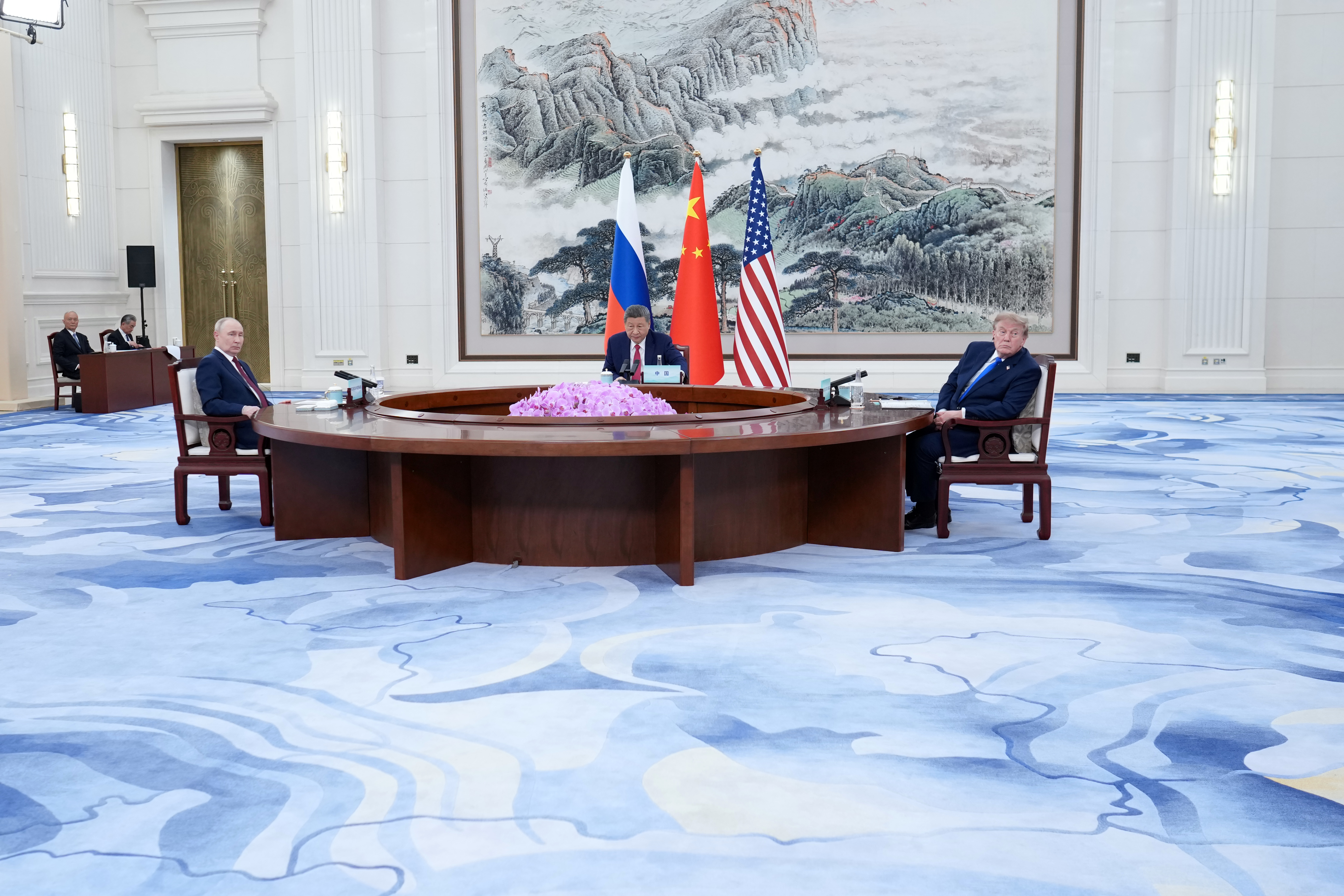
    SHENZEN, China — President Donald Trump used his first-ever trilateral summit with Presidents Xi Jinping of China and Vladimir Putin of Russia on Thursday to say that their respective nations were “uniquely positioned to discuss how to reduce the number of nuclear weapons on earth.”

    But after an 80-minute conversation at a lakeside villa in the city of Shenzhen, a Chinese technology hub, it was unclear whether the three leaders had agreed to return to the kind of arms control talks that for decades were a centerpiece of diplomacy among superpowers during the Cold War. On new threats, including artificial intelligence, the three leaders were largely silent.

    Trump, who also met with Xi and Putin separately at the Asia-Pacific Economic Cooperation forum this week, appeared delighted to convene the world’s largest nuclear powers for a discussion about disarmament. But he did not come with a detailed plan for how to reduce the number of nuclear weapons, or outline a path to one.

    Instead, Trump relished what amounted to a high-profile photo opportunity of the three leaders seated around a circular wooden table. For Trump, the main achievement seemed to be a mutual commitment to keep talking about peace — without taking meaningful steps toward it.

    “Too often, past leaders avoided talking to nations with whom they had disagreements, and we feel the opposite,” Trump told Xi and Putin. “No peace was ever forged by declining opportunities for engagement and speech.”

    After the summit, the leaders released a joint statement saying they had agreed to reform the United Nations, increase the production and supply of petroleum, oppose perceived abuses by the International Criminal Court against state officials, and continue their dialogue on reducing nuclear risks. “A nuclear war cannot be won and must never be fought,” the statement said.

    While China, which has the fastest-growing nuclear arsenal on earth, agreed to participate in the three-way discussion of nuclear weapons, the leaders announced little concrete beyond agreeing to continue a dialogue on reducing nuclear risks. Xi has long been reluctant to agree to nuclear arms control because China’s arsenal remains a fraction the size of those belonging to Russia and the United States.

    In the end, Trump’s whirlwind journey — two weeks after the Republican Party suffered a wipeout in the midterm elections and amid anxiety at home about widespread digital outages — amounted to a grand show of camaraderie.

    As host of the tightly choreographed event, Xi flattered Trump and gave him an opportunity to ask for China’s assistance on matters ranging from ending global conflicts to spending more on U.S. agricultural goods. The summit also removed Putin from his status as a global pariah over his invasion of Ukraine, elevating him to a leader deserving of equal diplomatic footing.

    But for all of the talk of peace, there was no announcement of breakthroughs in the talks the Trump administration is engaged in to end that conflict. Nor did Trump appear to dwell on finding a way out of the its war with Iran.

    “We don’t need any help,” Trump said, when asked by a Fox News reporter before the summit whether he would seek assistance from the other leaders in ending a conflict of his own making. In fact, the help Trump could ask for would involve demanding that China and Russia stop assisting Iran: U.S. intelligence has concluded that both countries provided either technology or targeting information that likely helped the Iranians strike U.S. military bases in the Middle East.

    On Fox News, Trump described the three-way conversation as a way to disrupt the growing “partnership without limits” that Xi and Putin say they have formed in recent years. Trump said he hoped to break up that alignment and turn it into a three-way conversation, rather than a partnership focused on countering American influence.

    China and Russia’s alignment, Trump said, “should have never been allowed to happen.”

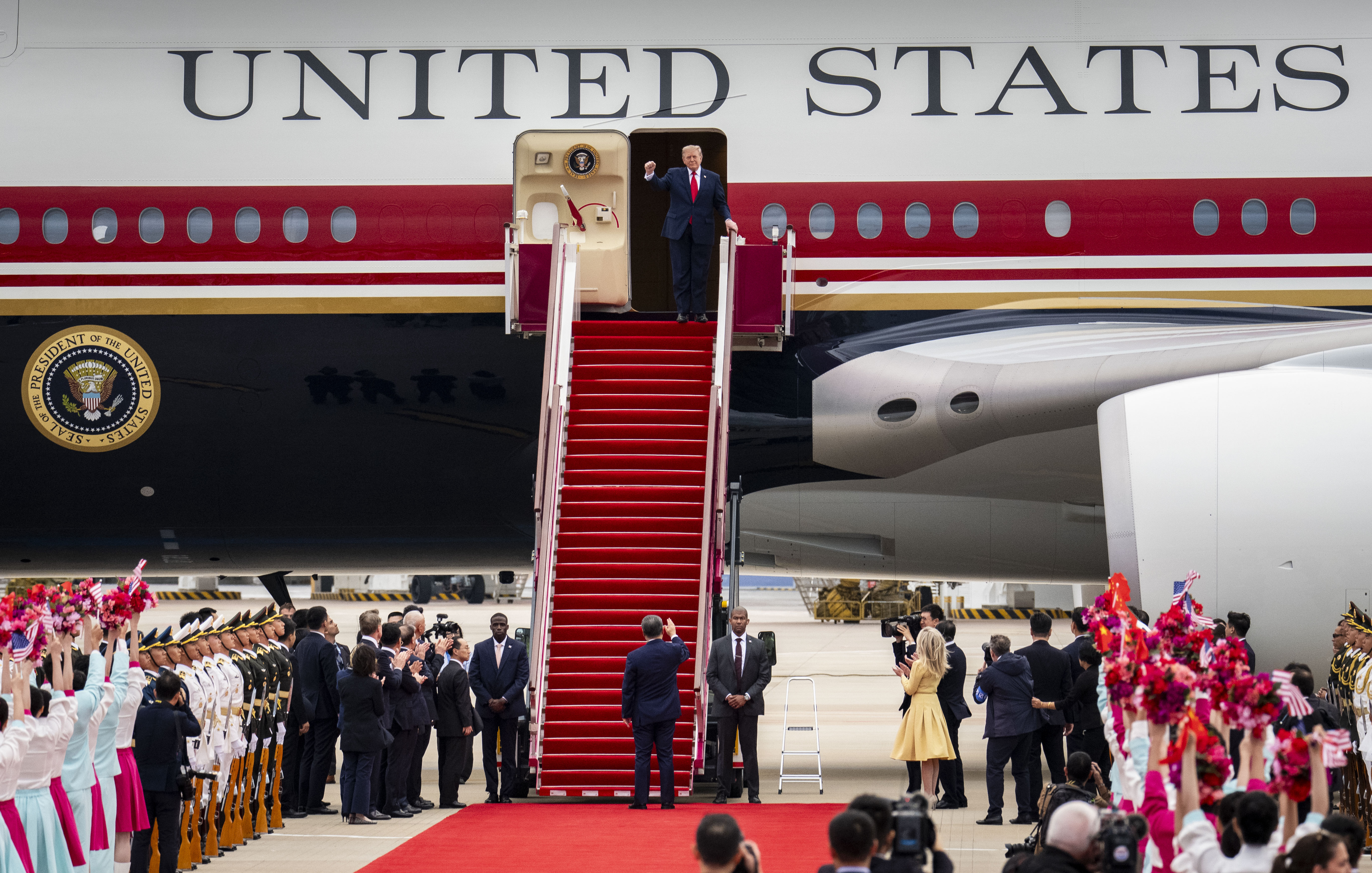
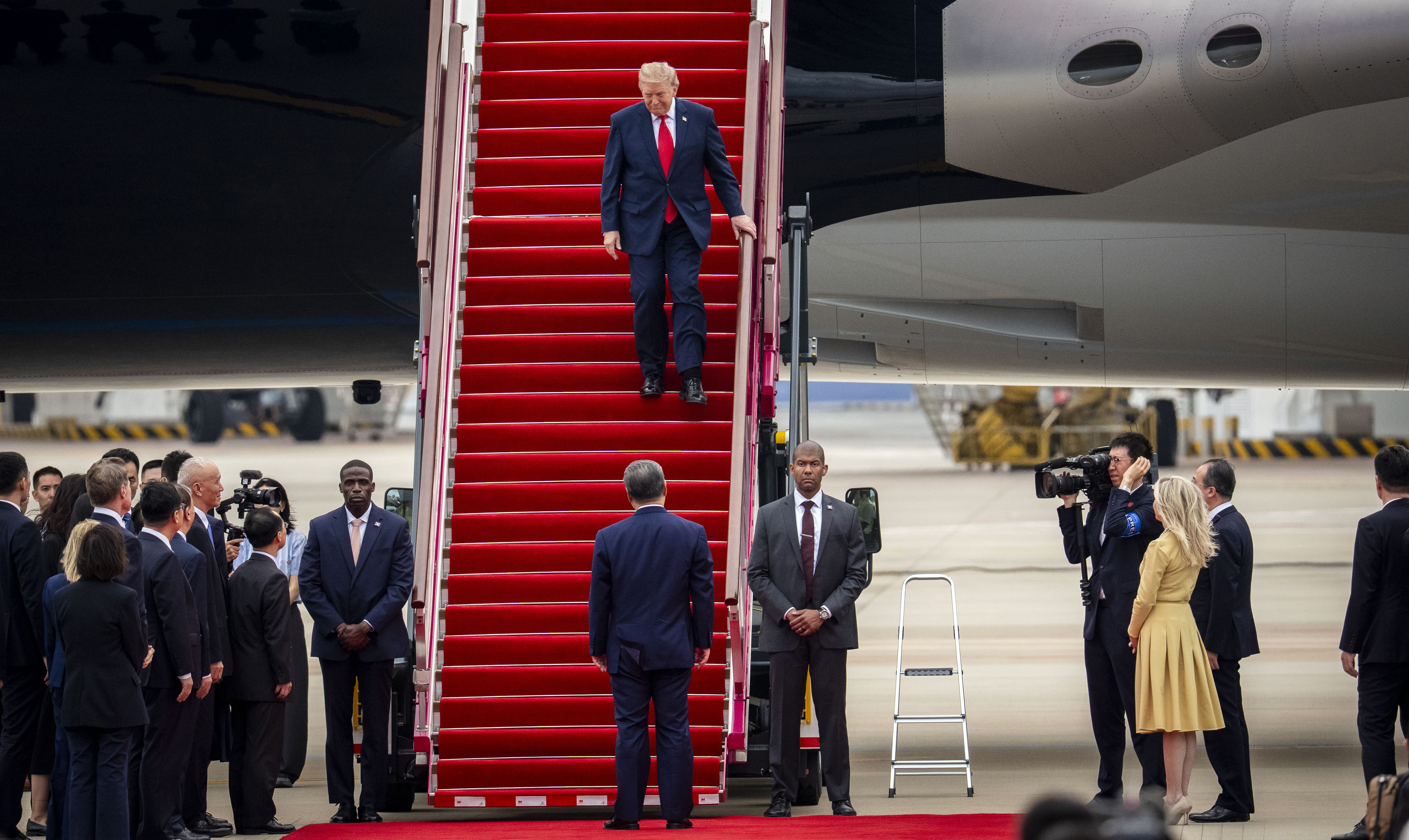
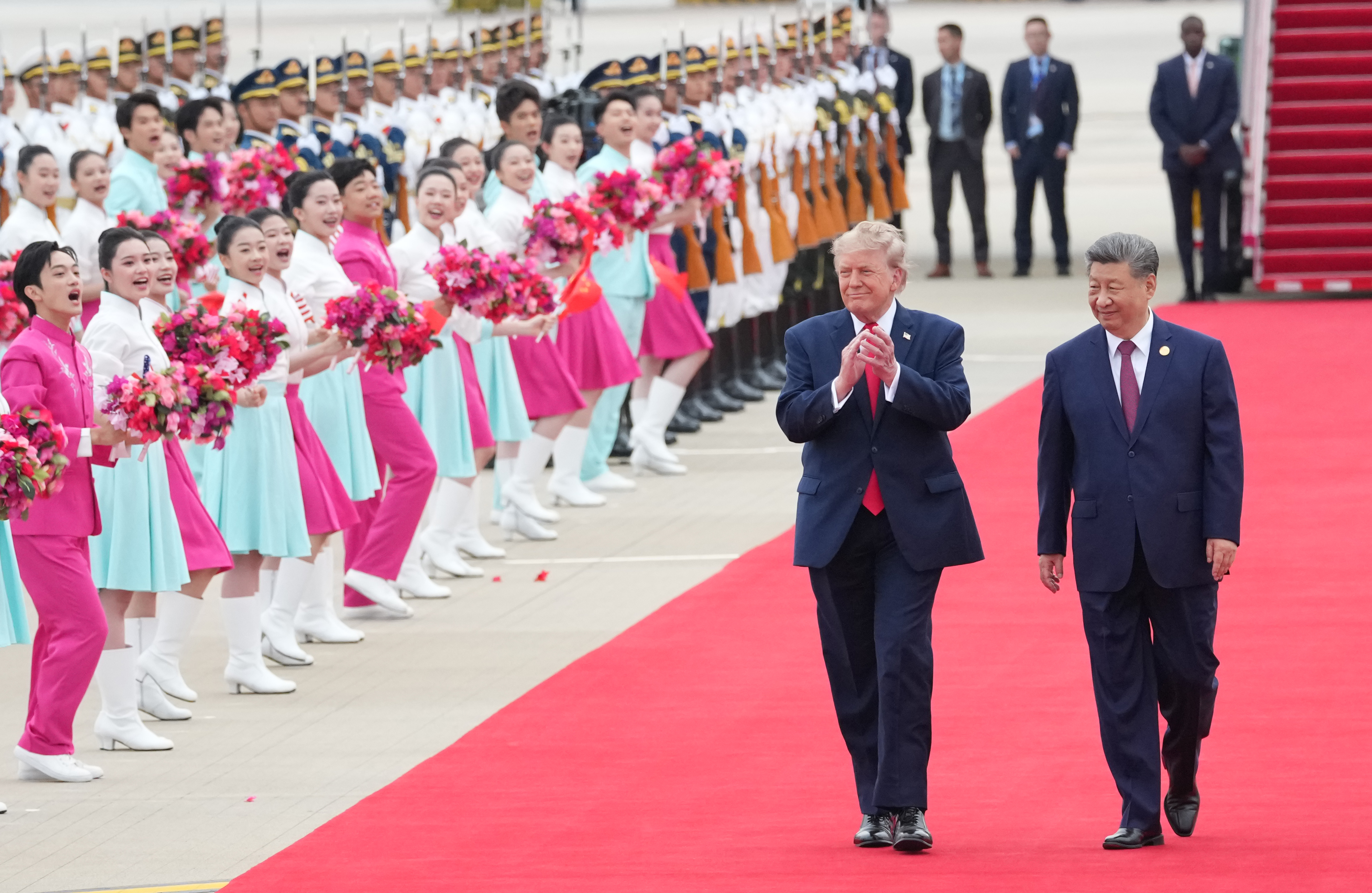
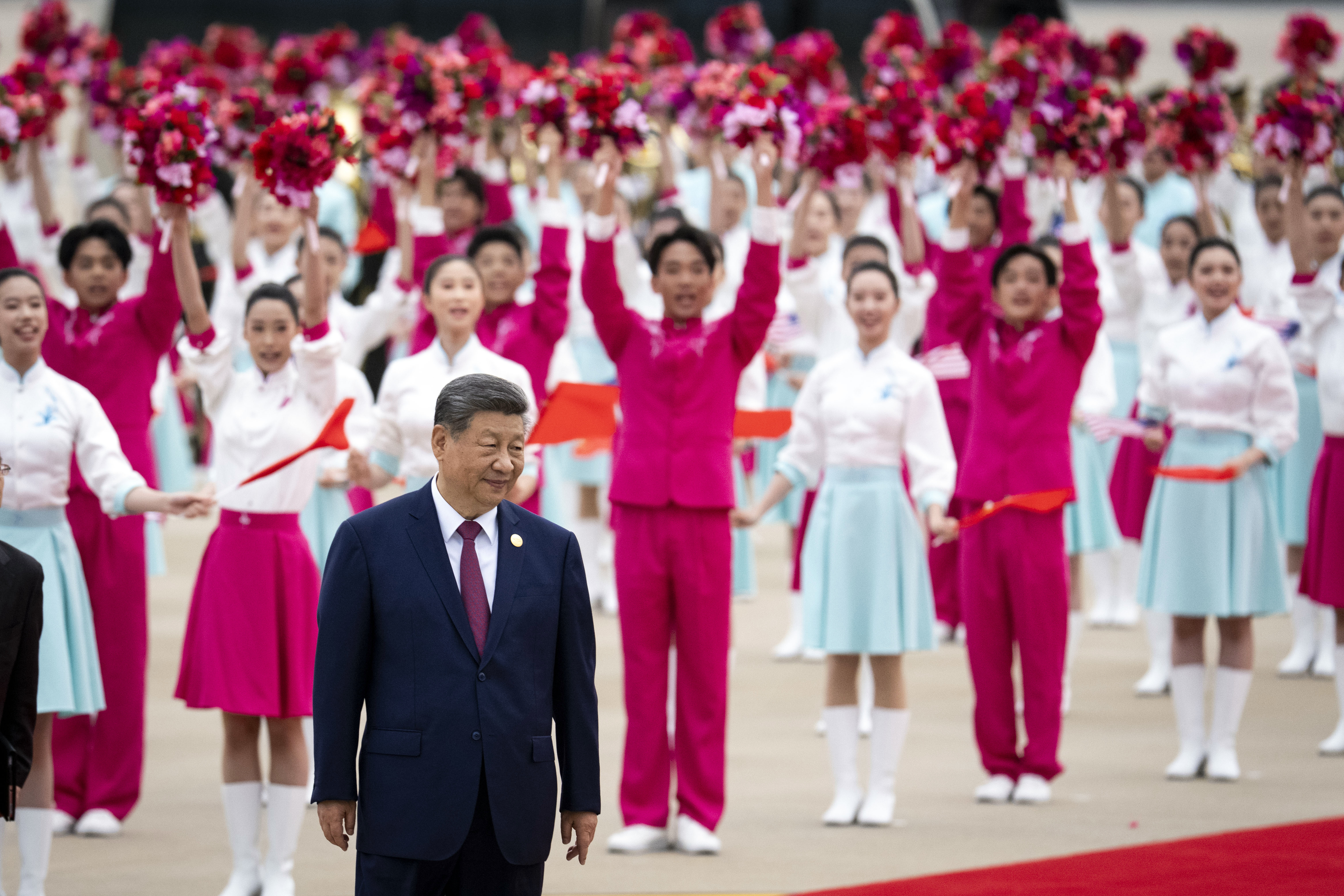
    Seeking his own path into Xi’s good graces, Trump has held three meetings with the Chinese leader this year, with the goal of cooling a tit-for-tat trade war and of building up a personal relationship through mutual flattery. Trump traveled to Joint Base Andrews to welcome Xi to Washington in May, and Xi responded in kind when Trump arrived in Shenzhen on Wednesday, treating the president to a military exercise and a fleet of U.S. and Chinese flag-waving dancers in a flurry of pink, blue and white outfits.

    In Shenzhen, the heart of China’s robotics, telecommunications, semiconductor and software industries, Trump did not visit the chief technological competitors to the United States, or see coffee-serving robots near the city’s center.

    Still, he marveled over the ceremonial welcome and held it up as evidence of a warming bond, telling an interviewer that “one of the great presidents of China” had greeted him. “He’s never gone to the airport to meet somebody,” Trump said.

    The president, who spends much of his time in the United States on bombastic appearances and incendiary social media posts, was on his best behavior alongside Xi. (He was his old self on Fox News before the summit, when he threatened to wipe out Iran should it attack the United States directly.)

    Xi, for his part, said a much improved relationship between China and the United States in recent months was “the right way” for the two powers to “get along.” But he also warned that the key to keeping ties stable “lies in taking concrete actions to implement the consensus reached by the two heads of state.” The remarks came days after Washington moved to close a loophole on Chinese access to advanced AI chips.

    As for Putin, the summit was his first encounter with Trump since the two men met in Alaska last year. That meeting was a diplomatic flop, and the war in Ukraine has intensified since then. The peace mechanism Trump advocated — a direct meeting between Putin and President Volodymyr Zelenskyy of Ukraine, moderated by Trump — has yet to materialize.

    This time, White House officials were modest in their predictions. Expectations were set so low that White House officials who previewed the trip last week initially said Trump would not bring up the war in Ukraine at all, although he ultimately did.

    In Shenzhen, Trump continued welcoming Russia back into the fold of great superpowers. He called Putin “my friend,” and insisted that all three leaders would like to see the war end quickly. The Russian leader reiterated after the meeting, however, that he would not be negotiating with Ukraine.

    During the trilateral meeting, Xi and Putin embraced the idea of peaceful leadership, without making commitments that would be much of a burden to either of their countries. In his own remarks, Putin said their nations were “united not only by the status of being the victorious countries in World War II, but most importantly by the joint responsibility for maintaining international peace and security.”

    And Xi mentioned a utopian goal that has pretty much fallen off the agenda of superpowers. He described nuclear weapons as a “sword of Damocles hanging over humanity” that should be eliminated. But Beijing has typically called on the United States to take the first steps in arms control, a demand that Trump seemed to acknowledge earlier in the day.

    “For me, it’s a hard thing,” he told Fox News. “And it’s probably hard for them to do also.”

    It has been done before, by Trump’s predecessors. Today, the United States and Russia each have slightly more than 5,000 nuclear warheads, and only 1,550 deployed under the New START treaty that expired earlier this year — down from tens of thousands on both sides during the Cold War.

    China, however, was never a party to past nuclear reduction treaties, and it is now intent on building up to at least current Russian and U.S. levels.

    Trump also said in Shenzen that he wanted to crack down on nuclear proliferation by smaller powers — his justification for attacking Iran — and restrain what he said were the excesses of “rogue” organizations like the International Criminal Court.

    Putin is subject to an ICC arrest warrant over alleged war crimes in Ukraine. Nevertheless Trump welcomed the Russian leader in Alaska last year and extended an invitation to the Group of 20 summit next month in Florida. Putin told reporters after the meeting that he was unsure if he would attend.

    One topic that went missing from each leader’s remarks was artificial intelligence, as China and the United States are locked in fierce competition over the new technology.

    Trump did not answer a question, shouted by a Bloomberg News reporter at APEC earlier in the day, if the former CEO of Nvidia — a company that has been central to the AI boom — had been disloyal to the United States. The executive, Jensen Huang, resigned after he was found to have two extramarital relationships, including one with a woman who U.S. intelligence has determined is a Chinese asset.

    The reporter who shouted the question was admonished by Chinese officials and barred from the trilateral meeting. Trump seemed blasé about the matter of espionage earlier in the day, telling Fox News that “we spy on them too.”

    As the president basked in flattery from an authoritarian whose ironfisted leadership he has openly admired, he gently suggested that he had not received as much media coverage as he would have liked.

    “It’s too bad the media couldn’t see some of it,” Trump said of his trip.

    President Donald Trump, left, with President Xi Jinping of China before their bilateral meeting in Shenzhen, China, on Thursday, Nov. 19, 2026. Trump said that he would bring up the war in Ukraine at the first-ever meeting of leaders of Russia, China and the United States. (Doug Mills/The New York Times)DOUG MILLS
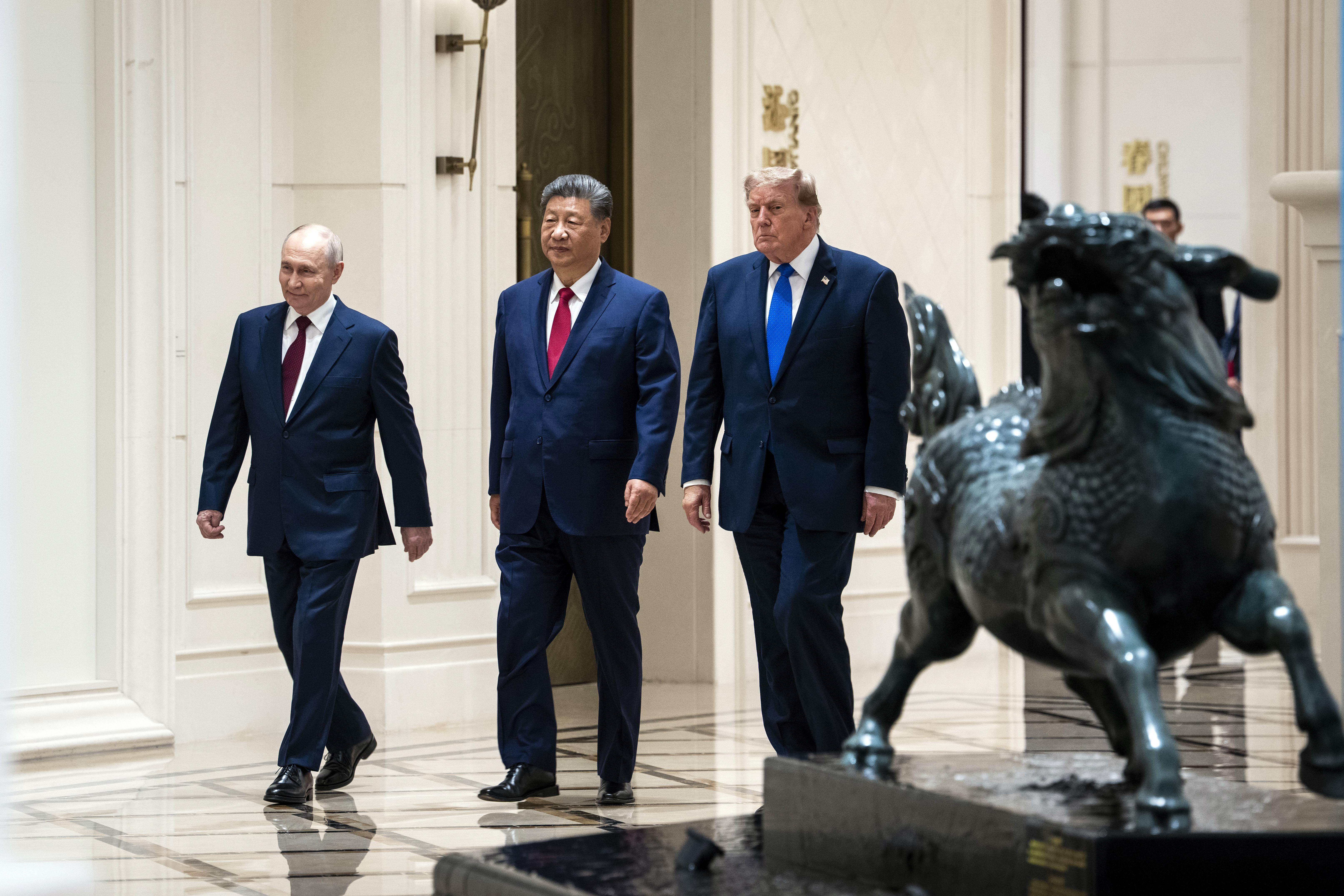
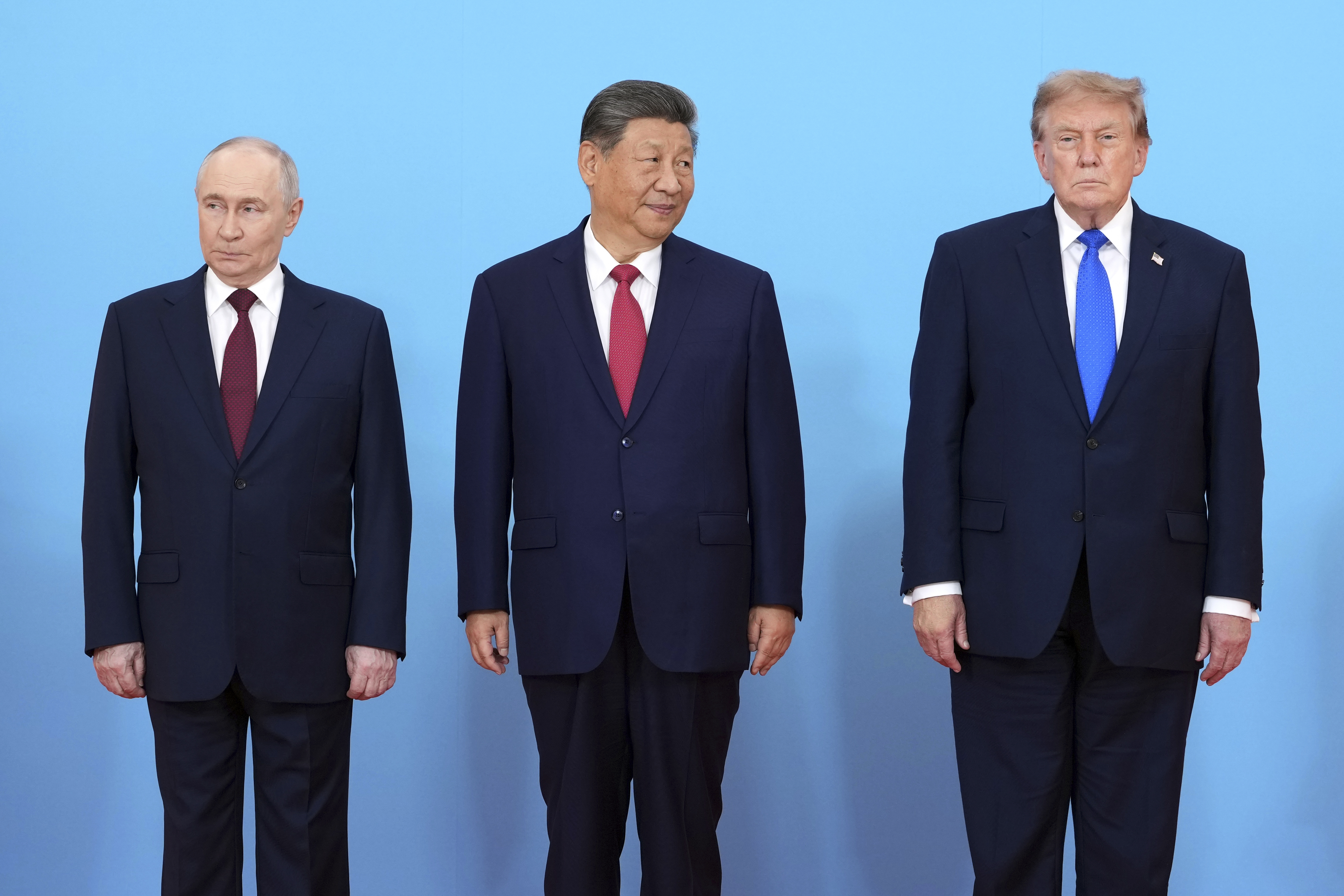
    From left: President Vladimir Putin of Russia, President Xi Jinping of China and President Donald Trump of the U.S. meet in Shenzhen, China, on Thursday, Nov. 19, 2026. Trump said that he would bring up the war in Ukraine at the first-ever meeting of leaders of Russia, China and the United States. (Doug Mills/The New York Times)DOUG MILLS
    President Donald Trump of the U.S. boards Air Force One after meeting withPresident Xi Jinping of China and President Vladimir Putin of Russia in Shenzhen, China, on Thursday, Nov. 19, 2026. Trump said before the meeting that he wanted to discuss nuclear weapons and the wars in Ukraine and Iran. But the three leaders appeared to refer to the topics only in vague terms. (Doug Mills/The New York Times)DOUG MILLS
    From left: President Vladimir Putin of Russia, President Donald Trump of the U.S. and President Xi Jinping of China meet in Shenzhen, China, on Thursday, Nov. 19, 2026. Trump said before the meeting that he wanted to discuss nuclear weapons and the wars in Ukraine and Iran. But the three leaders appeared to refer to the topics only in vague terms. (Doug Mills/The New York Times)DOUG MILLS
    From left: President Vladimir Putin of Russia, President Xi Jinping of China and President Donald Trump of the U.S. take their places for a group portrait in Shenzhen, China, on Thursday, Nov. 19, 2026. Trump said before the meeting that he wanted to discuss nuclear weapons and the wars in Ukraine and Iran. But the three leaders appeared to refer to the topics only in vague terms. (Doug Mills/The New York Times)DOUG MILLS
    President Donald Trump of the U.S., right, and President Xi Jinping of China during their trilateral meeting with President Vladimir Putin of Russia, not pictured, in Shenzhen, China, on Thursday, Nov. 19, 2026. Trump said before the meeting that he wanted to discuss nuclear weapons and the wars in Ukraine and Iran. But the three leaders appeared to refer to the topics only in vague terms. (Doug Mills/The New York Times)DOUG MILLS
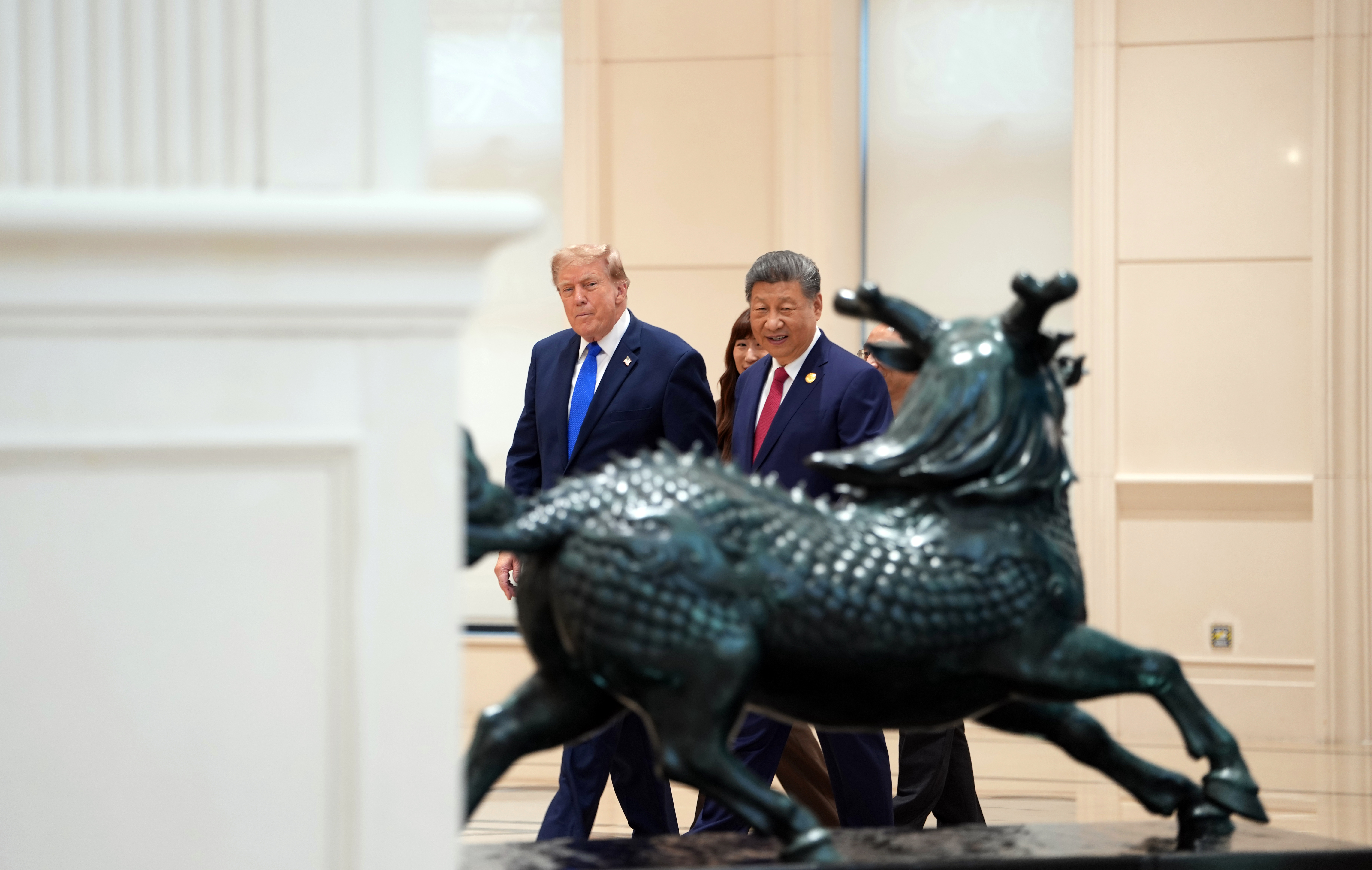
    President Donald Trump, left, with President Xi Jinping of China before their bilateral meeting in Shenzhen, China, on Thursday, Nov. 19, 2026. Trump said that he would bring up the war in Ukraine at the first-ever meeting of leaders of Russia, China and the United States. (Doug Mills/The New York Times)DOUG MILLS
    President Donald Trump, left, with President Xi Jinping of China before their bilateral meeting in Shenzhen, China, on Thursday, Nov. 19, 2026. Trump said that he would bring up the war in Ukraine at the first-ever meeting of leaders of Russia, China and the United States. (Doug Mills/The New York Times)DOUG MILLS
    President Donald Trump of the U.S. speaks as he sits across the table from President Xi Jinping of China during their bilateral meeting in Shenzhen, China, on Thursday, Nov. 19, 2026. Trump said that he would bring up the war in Ukraine at the first-ever meeting of leaders of Russia, China and the United States. (Doug Mills/The New York Times)DOUG MILLS
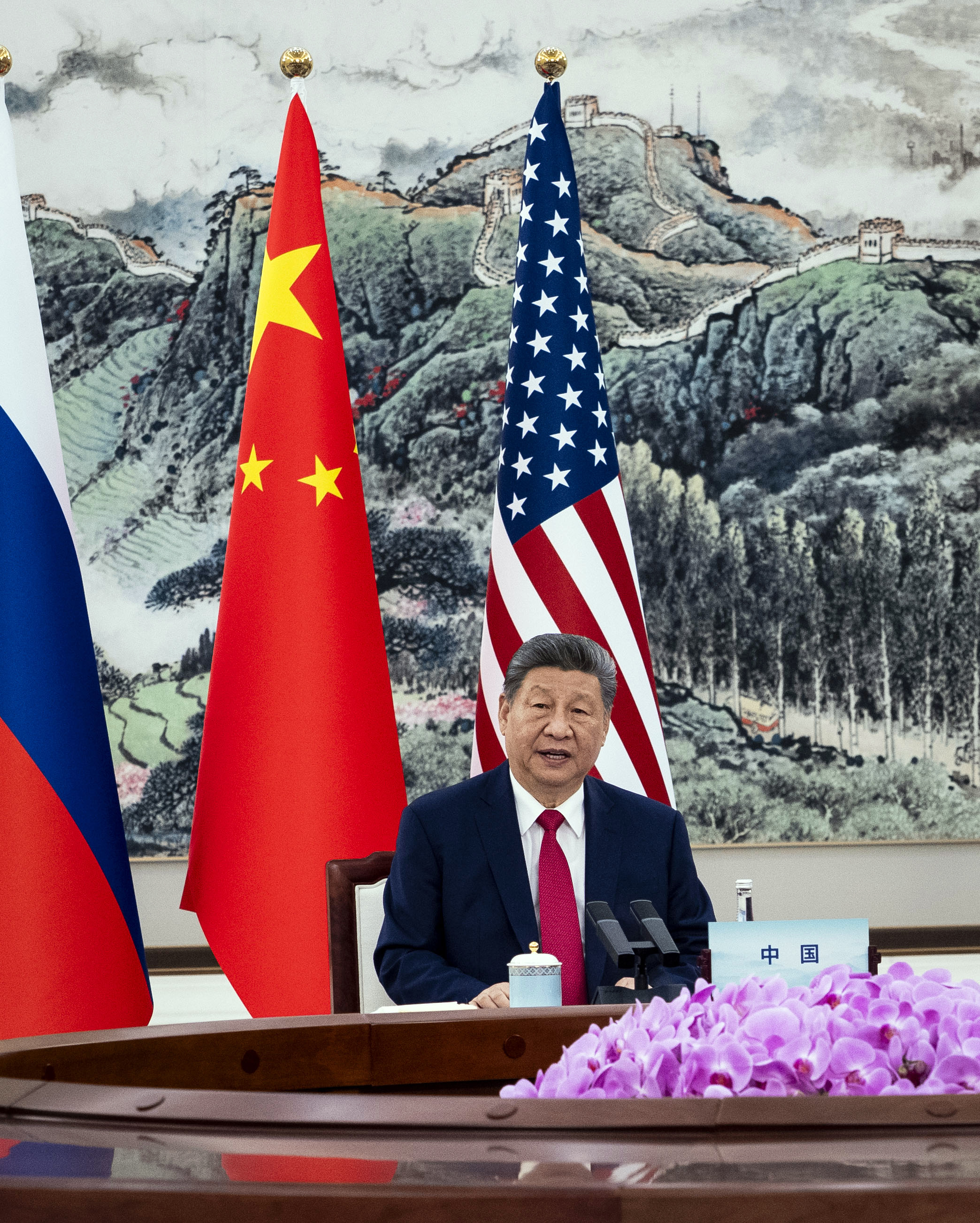
    President Xi Jinping of China speaks during a trilateral meeting with President Donald Trump of the U.S. and President Vladimir Putin of Russia in Shenzhen, China, on Thursday, Nov. 19, 2026. Trump said that he would bring up the war in Ukraine at the first-ever meeting of leaders of Russia, China and the United States. (Doug Mills/The New York Times)DOUG MILLS
    President Vladimir Putin of Russia meets with President Xi Jinping of China and President Donald Trump of the U.S. in Shenzhen, China, on Thursday, Nov. 19, 2026. Trump said that he would bring up the war in Ukraine at the first-ever meeting of leaders of Russia, China and the United States. (Doug Mills/The New York Times)DOUG MILLS
    From left, President Vladimir Putin of Russia, President Xi Jinping of China; and President Donald Trump of the U.S. in Shenzhen, China, on Thursday, Nov. 19, 2026. Trump said that he would bring up the war in Ukraine at the first-ever meeting of leaders of Russia, China and the United States. (Doug Mills/The New York Times)DOUG MILLS
    President Donald Trump, left, with President Xi Jinping of China before their bilateral meeting in Shenzhen, China, on Thursday, Nov. 19, 2026. Trump said that he would bring up the war in Ukraine at the first-ever meeting of leaders of Russia, China and the United States. (Doug Mills/The New York Times)DOUG MILLS
    President Xi Jinping of China , center, speaks during a meeting with President Vladimir Putin of Russia, left, and President Donald Trump of the U.S. in Shenzhen, China, on Thursday, Nov. 19, 2026. Trump said that he would bring up the war in Ukraine at the first-ever meeting of leaders of Russia, China and the United States. (Doug Mills/The New York Times)DOUG MILLS
    President Donald Trump, left, with President Xi Jinping of China at their bilateral meeting in Shenzhen, China, on Thursday, Nov. 19, 2026. Trump said that he would bring up the war in Ukraine at the first-ever meeting of leaders of Russia, China and the United States. (Doug Mills/The New York Times)DOUG MILLS
    President Donald Trump of the U.S. meets with President Xi Jinping of China and President Vladimir Putin of Russia in Shenzhen, China, on Thursday, Nov. 19, 2026. Trump said that he would bring up the war in Ukraine at the first-ever meeting of leaders of Russia, China and the United States. (Doug Mills/The New York Times)DOUG MILLS
    President Donald Trump, right, poses for a group portrait with President Xi Jinping of China, center, and President Vladimir Putin of Russia before their meeting in Shenzhen, China, on Thursday, Nov. 19, 2026. Trump said that he would bring up the war in Ukraine at the first-ever meeting of leaders of Russia, China and the United States. (Doug Mills/The New York Times)DOUG MILLS
    President Donald Trump, right, poses for a group portrait with President Xi Jinping of China, center, and President Vladimir Putin of Russia before their meeting in Shenzhen, China, on Thursday, Nov. 19, 2026. Trump said that he would bring up the war in Ukraine at the first-ever meeting of leaders of Russia, China and the United States. (Doug Mills/The New York Times)DOUG MILLS
    Troops march in formation as President Donald Trump is welcomed upon his arrival at the airport in Shenzhen, China, on Wednesday, Nov. 18, 2026. (Doug Mills/The New York Times)DOUG MILLS
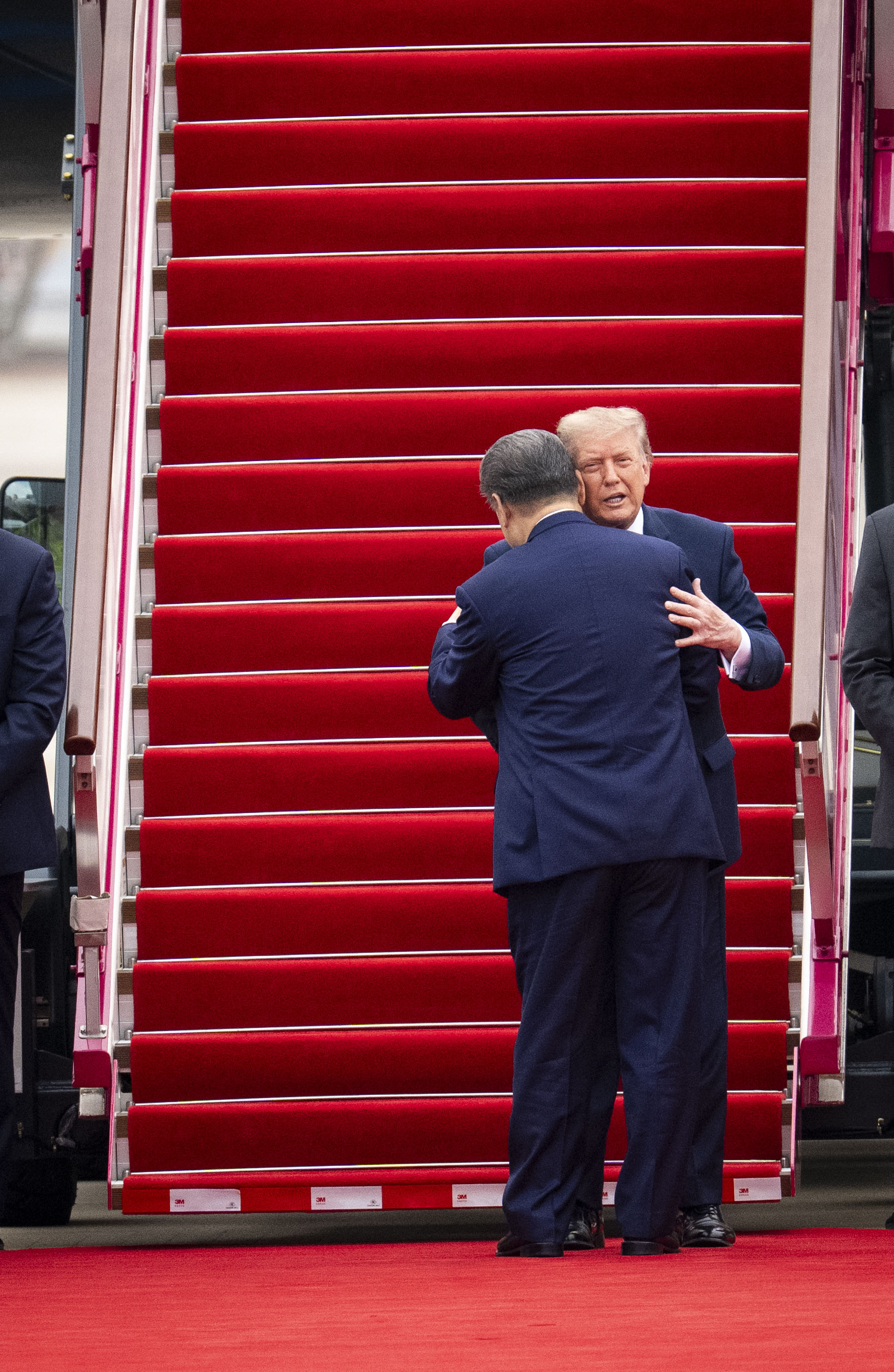
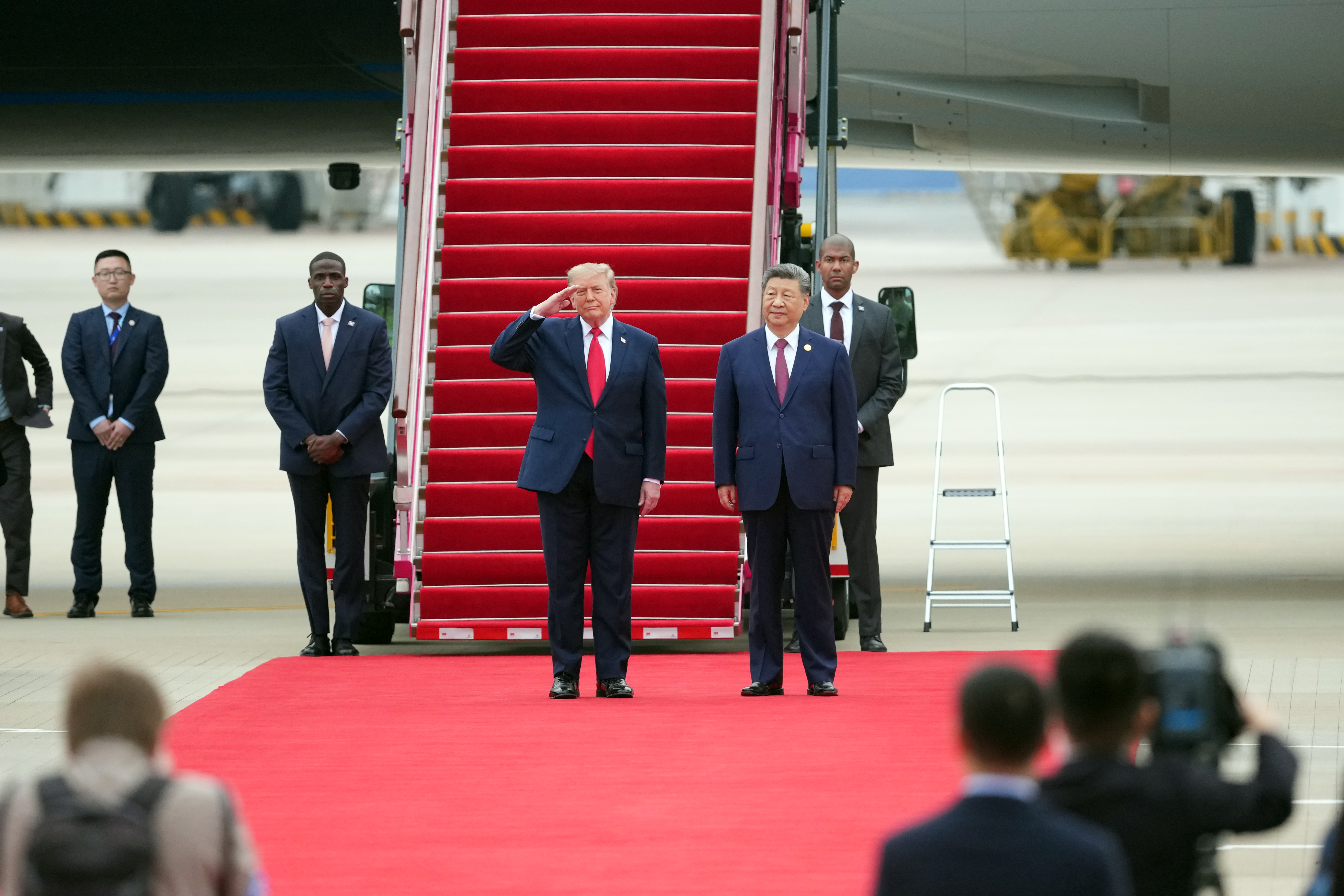
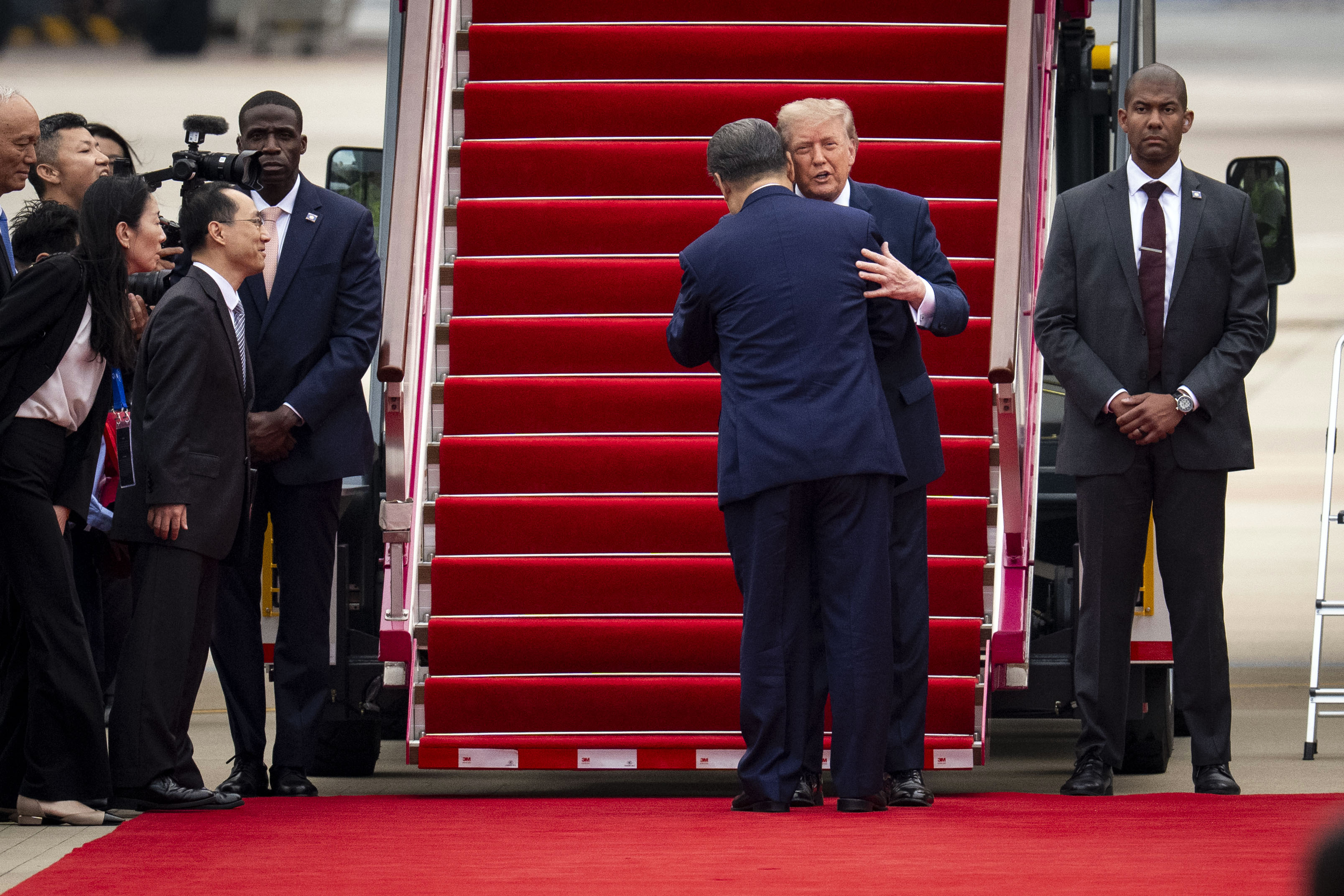
    President Donald Trump is embraced by Xi Jinping, the Chinese leader, upon his arrival at the airport in Shenzhen, China, on Wednesday, Nov. 18, 2026. Xi told Trump that he took the unusual move for a Chinese leader of greeting him at the airport because the American president had done the same for him when he visited the United States in September. “China is a nation of etiquette with a tradition of reciprocity,” Xi said, according to Chinese state media. (Doug Mills/The New York Times)DOUG MILLS
    RETRANSMISSION TO PROVIDE WIDER CROP AND ADDITIONAL CAPTION INFO — .President Donald Trump gestures as he arrives at the airport in Shenzhen, China, on Wednesday, Nov. 18, 2026. President Xi Jinping of China waves to Trump from the bottom of the stairs. Xi told Trump that he took the unusual move for a Chinese leader of greeting him at the airport because the American president had done the same for him when he visited the United States in September. “China is a nation of etiquette with a tradition of reciprocity,” Xi said, according to Chinese state media. (Doug Mills/The New York Times)DOUG MILLS
    Protesters in Manila, the Philippines, face off against police in riot gear as they denounce President Donald Trump’s visit and the U.S.-led Pax Silica initiative on Wednesday, Nov. 18, 2026. (Jes Aznar/The New York Times)JES AZNAR
    Xi Jinping, the Chinese leader, back to camera, waits to greet President Donald Trump upon his arrival at the airport in Shenzhen, China, on Wednesday, Nov. 18, 2026. It was a rare personal greeting by Xi before a summit they are expected to hold with President Vladimir Putin of Russia. (Doug Mills/The New York Times)DOUG MILLS
    Protesters in Manila, the Philippines, take to the streets to denounce President Donald Trump’s visit andthe U.S.-led Pax Silica initiative on Wednesday, Nov. 18, 2026. (Jes Aznar/The New York Times)JES AZNAR
    Police officers are deployed as protesters in Manila, the Philippines, take to the streets to denounce President Donald Trump’s visit and the U.S.-led Pax Silica initiative on Wednesday, Nov. 18, 2026. (Jes Aznar/The New York Times)JES AZNAR
    Police officers are deployed as protesters in Manila, the Philippines, take to the streets to denounce President Donald Trump’s visit and the U.S.-led Pax Silica initiative on Tuesday, Nov. 17, 2026. (Jes Aznar/The New York Times)JES AZNAR
    Protesters in Manila, the Philippines, take to the streets to denounce President Donald Trump’s visit andthe U.S.-led Pax Silica initiative on Tuesday, Nov. 17, 2026. (Jes Aznar/The New York Times)JES AZNAR
    Secretary of State Marco Rubio, who is accompanying President Donald Trump on his trip to Asia, departs after speaking to reporters in Manila, the Philippines, on Wednesday, Nov. 18, 2026. (Doug Mills/The New York Times)DOUG MILLS
    President Donald Trump, left, President President Ferdinand Marcos Jr. of the Philippines in Manila on Wednesday, Nov. 18, 2026. (Doug Mills/The New York Times)DOUG MILLS
    President Donald Trump, center, arrives for a meeting with President President Ferdinand Marcos Jr. of the Philippines in Manila on Wednesday, Nov. 18, 2026. Looking on are, from right: Deputy White House Chief of Staff Dan Scavino; White House Chief of Staff Stephen Miller; Treasury Secretary Scott Bessent; and Secretary of State Marco Rubio. (Doug Mills/The New York Times)DOUG MILLS
    President President Ferdinand Marcos Jr. of the Philippines, right, welcomes President Donald Trump to the presidential palace in Manila, the Philippines on Wednesday, Nov. 18, 2026. (Doug Mills/The New York Times)DOUG MILLS
    The U.S. delegation during a welcome ceremony for President Donald Trump at the presidential palace in Manila, the Philippines on Wednesday, Nov. 18, 2026. From left: Deputy White House Chief of Staff Dan Scavino; U.S. Trade Representative Jamieson Greer; White House Chief of Staff Stephen Miller; Commerce Secretary Howard Lutnick; Treasury Secretary Scott Bessent; and Secretary of State Marco Rubio. (Doug Mills/The New York Times)DOUG MILLS
    Xi Jinping, the Chinese leader, looks on during a welcome ceremony for President Donald Trump at the airport in Shenzhen, China, on Wednesday, Nov. 18, 2026. It was a rare personal greeting by Xi before a summit they are expected to hold with President Vladimir Putin of Russia. (Doug Mills/The New York Times)DOUG MILLS
    President Donald Trump salutes as he is welcomed by Xi Jinping, the Chinese leader, upon his arrival at the airport in Shenzhen, China, on Wednesday, Nov. 18, 2026. It was a rare personal greeting by Xi before a summit they are expected to hold with President Vladimir Putin of Russia. (Doug Mills/The New York Times)DOUG MILLS
    President Donald Trump gestures as he arrives at the airport in Shenzhen, China, on Wednesday, Nov. 18, 2026. (Doug Mills/The New York Times)DOUG MILLS
    A colorful flyover by military jets as President DOnald Trump is welcomed upon his arrival at the airport in Shenzhen, China, on Wednesday, Nov. 18, 2026. (Doug Mills/The New York Times)DOUG MILLS
    Troops march in formation as President DOnald Trump is welcomed upon his arrival at the airport in Shenzhen, China, on Wednesday, Nov. 18, 2026. (Doug Mills/The New York Times)DOUG MILLS
    President Donald Trump, left, is welcomed by Xi Jinping, the Chinese leader, upon his arrival at the airport in Shenzhen, China, on Wednesday, Nov. 18, 2026. It was a rare personal greeting by Xi before a summit they are expected to hold with President Vladimir Putin of Russia. (Doug Mills/The New York Times)DOUG MILLS
    President Donald Trump is embraced by Xi Jinping, the Chinese leader, upon his arrival at the airport in Shenzhen, China, on Wednesday, Nov. 18, 2026. It was a rare personal greeting by Xi before a summit they are expected to hold with President Vladimir Putin of Russia. (Doug Mills/The New York Times)DOUG MILLS
  • After 8 years, a co-op grocery stocked by more than 100 local producers is opening in Kennett Square

    After 8 years, a co-op grocery stocked by more than 100 local producers is opening in Kennett Square

    Caitlin Buttery used to spend a lot of time biking through Philadelphia to farmers markets for fresh, local, seasonal groceries. That became more challenging when she moved to the suburbs, with options farther apart and two young children.

    So when Buttery drove past a yard sign asking members to sign on to support Kennett Community Grocer, she immediately sent in the $300 membership fee. Now, as board secretary to the cooperative, farm-stop grocery store, she and the leadership behind it are excited to bring a diverse collection of local offerings to the community.

    “It’s somewhere I can stop, and it’s much easier, much less time than the five days a week I would spend grocery shopping before,” she said.

    Caitlin Buttery, secretary of the Kennett Community Grocer’s leadership board, waiting to fill the shelves on Nov. 17.Steven M. Falk / For The Inquirer

    Eight years in the making, Kennett Community Grocer is slated to open on Monday at 629 E. Cypress St. in Kennett Square, with local producers selling on consignment goods including fresh produce, fermented products, artisanal cheeses, grab-and-go food, pantry staples, and handmade and small-batch artisan items. A majority of the products are from Chester County, or within about a 75-mile radius. To fill gaps for goods not found in the county (such as beans or maple syrup), staff purchase through a distributor that sells items from independent, small businesses.

    The grocery store, which will be open 8 a.m. to 7 p.m. every day, is a co-op and “farm stop” model, giving members, who pay a one-time membership fee, a say in board leadership and what appears on shelves, plus discounts and access to private events and workshops. Anyone can shop, regardless of membership.

    The co-op has about 550 members so far and is seeing more trickle in as the store prepares to open.

    A “farm stop” works with local farmers, who set the prices and take home 70% of the proceeds (the rest pays nine staff members and keeps the lights on). Frequent flyers at Kennett Square Farmers Market will likely recognize some of the labels, as that is where the store’s leadership started when it began reaching out to producers.

    “I stop at the farm stands when I can. But there’s only so many you can do,” said Stu Mundth, vice president of the board. “This is kind of bridging the gap where we can bring more local food to more people and really support everyone.”

    Caitlin Buttery, secretary, left and Greg Gurev, board president, talk on Nov. 17 about the opening of Kennett Community Grocer.Steven M. Falk / For The Inquirer

    Kennett Square and surrounding Kennett Township are exploding in population growth, but are still swaddled by farmland — not just the quintessential mushrooms, but dairy, vegetable, and row crops, too — making it a prime location to connect the town with the farmers nearby. Chester County, with its long agricultural history, recently welcomed another cooperative grocer, West Chester Cooperative. The model is seeing success in the region; Weavers Way Co-Op, based in Philadelphia, is relocating one of its stores to a bigger spot to accommodate a growing clientele.

    On the ground, Rachel Sanchez, the general manager of the new co-op, has been tasked with finding producers to stock the shelves. Sanchez had a career working in natural food at Whole Foods and Harvest Market in Hockessin, Del.

    “I quickly started to get that, No. 1, there is an abundance of food being made in our nearby area in our region, not only in Chester County … and the majority of those producers want to be in a retail space, and they want to be in an area where they don’t live, so that they can reach a wider audience,” she said.

    From left to right, Greg Gurev, board president; Stu Mundth, vice president; and Caitlin Buttery, secretary. None of the three board members had a background in natural food before they began volunteering with Kennett Community Grocer, but they each came to it thanks to a passion for locally grown food.Steven M. Falk / For The Inquirer

    More than 170 producers have signed on to sell their products through the grocer, with more expressing interest as opening day approaches, Sanchez said.

    Edie Burkey, who served on the store’s board before leaving to found Friends of Kennett Food Co-Op as a nonprofit supporting organization, learned about Sanchez from a farmer while developing the store. Burkey knew Sanchez was the right pick immediately — a view reinforced by the array of goods on shelves by opening.

    “We relied on our community coming together and making the recommendations,” Burkey said. “I’m so honored to be part of work that is truly working for the farmers and the producers in this area.”

    None of the board members came from a background that prepared them to step into this work. But their passion for bringing an option to Kennett Square, and the wider community, drove them to it anyway.

    Rachel Sanchez, general manager, has approached more than 100 providers about selling through the store.Steven M. Falk / For The Inquirer

    “We really want high-quality local food. It’s hard to find really quality food that’s grown on good-quality soil,” said Greg Gurev, board president. “This is going to check all those boxes.”

    Gurev envisions the space becoming a community builder, where the co-op will hold farmer meet-and-greets and workshops and educational programs geared toward different age levels. It will also work with Kennett High School’s readiness program, where student interns will get a first foray into the business world.

    Before it even opened, the store had, in fact, already started to build community. From volunteering with the co-op, Buttery has seen familiar faces at borough events; she has even found out fellow volunteers are her neighbors through their co-op yard signs.

    “It helped me build my community out here,” Buttery said. “I came out here not knowing anybody, and now it’s a lot of my social life.”

    This suburban content is produced with support from the Leslie Miller and Richard Worley Foundation and The Lenfest Institute for Journalism. Editorial content is created independently of the project donors. Gifts to support The Inquirer’s high-impact journalism can be made at inquirer.com/donate. A list of Lenfest Institute donors can be found at lenfestinstitute.org/supporters.

  • In bending to Trump, law firm did $11.8 million of free work for administration

    In bending to Trump, law firm did $11.8 million of free work for administration

    The future of Kirkland & Ellis was on the line.

    President Donald Trump, weeks into his second term, had begun an unprecedented campaign to target elite law firms with punitive executive orders that could hurt their profits.

    A top partner at Kirkland, Mark Filip, scrambled to stave off the orders, signaling that he would be willing to negotiate with Trump’s lead personal lawyer and de facto enforcer, Boris Epshteyn.

    Epshteyn, at a moment of maximum leverage, pressed Filip.

    “You have a big trade practice, right?” Epshteyn wrote in a text message to Filip.

    “Please call,” Filip replied.

    The contours of the deal were outlined in a social media post by Trump in April 2025 in which he announced that Kirkland had agreed to do $125 million in pro bono work on causes Trump had championed, like helping veterans.

    But a year and a half later, Kirkland has quietly disclosed to Congress that it has done an array of free work for the Trump administration, about 6,491 hours valued at $11.8 million, according to documents reviewed by The New York Times and interviews with five people familiar with the matter.

    The records, including text messages and a seven-page letter the firm recently sent to Congress, offer the most detailed look yet at the terms of the deal. Kirkland has completed free work for the Commerce Department, the Pentagon, the Postal Service, the U.S. International Development Finance Corp. and an investment entity created as part of a trade deal between the United States and Japan, according to the five people and the letter.

    The letter Kirkland sent to Congress came in response to requests from top Democrats — Sen. Richard Blumenthal of Connecticut, Sen. Adam Schiff of California and Rep. Jamie Raskin of Maryland — who have repeatedly pressed the firm to clarify the details of the deal. The three lawmakers are expected to have key oversight roles in Congress next year, when their party controls the House and Senate.

    The disclosures demonstrate how Trump was not only able to make it more difficult for Kirkland to oppose him and his administration in court. He also successfully reshaped the firm into a tool of the state.

    The revelations raise questions about whether the firm and the White House violated a long-standing federal law that makes it illegal for the federal government to accept free work, circumventing Congress.

    In August 2025, the Times reported that Kirkland and Paul Weiss, the first firm to cut a deal with Trump, were doing work for the Commerce Department on trade deals. But until now, the breadth of the firm’s free legal work, including how many hours it worked for the government and the number of departments or agencies it worked for, had remained unclear.

    Under the Antideficiency Act, the executive branch is limited in accepting free services, to ensure that an administration does not undertake efforts for which Congress has not appropriated money, or over which lawmakers cannot have oversight.

    Zachary Price, a law professor at the University of California, San Francisco, and an expert in congressional appropriations, said that there were some exceptions to the act. But the arrangement between the law firms and the Trump administration, he added, “certainly violates the spirit of the law.”

    “It amounts to expanded resources available for the executive without Congress providing them,” Price said.

    In response to questions, Kirkland said in a statement that it had fully cooperated with the requests from lawmakers, and would “continue to cooperate.”

    The firm said that its work did not violate the Antideficiency Act.

    “First, the act does not apply where there is an agreement that the services will be provided for free, as there was here,” the firm said. “Second, the Antideficiency Act regulates the conduct of executive branch officials, not private parties like Kirkland.”

    The firm said it had represented governments free of charge in the past on significant matters and “would have considered accepting these sorts of representations, consistent with its past practice, without any agreement with a particular administration.”

    In the letter to lawmakers, the firm defended its independence, saying that it had declined to work on certain issues for the administration. Those include the U.S. Census, the pitched fight over the renaming of the John F. Kennedy Center for the Performing Arts, and the Postal Service plan to restrict mail-in ballots.

    The firm also said that it had continued to represent transgender inmates on a pro bono basis, and had rejected a request from a veterans group supporting the construction of Trump’s triumphal arch.

    In response to Kirkland’s disclosures, Blumenthal, Schiff and Raskin have urged other firms with ties to the administration to follow suit. Those include eight firms that made deals with the administration, as well as Sullivan & Cromwell, which represents Trump.

    “The scope of Kirkland’s work for the administration indicates that we need to know from other firms how much, and what type, of work they did,” Blumenthal said in an interview. “The administration’s tactics smacked of implicit or overt threats, and we need to understand what led these other firms to capitulate.”

    Shortly after he took office again last year, Trump issued a series of executive orders against law firms he believed had crossed him.

    To the shock of the legal community, Paul Weiss capitulated to Trump, agreeing to do $40 million in pro bono work on causes Trump championed. In exchange, the president dropped a potentially crippling executive order against the firm that could have made it impossible to represent clients.

    The firms were facing headwinds on a second front.

    Kirkland was among 20 top law firms to receive a letter from the Equal Employment Opportunity Commission demanding information about their “diversity, equity, and inclusion (DEI) related employment practices.”

    Under mounting pressure, Kirkland and a group of firms moved quickly to make deals. The intermediary, however, was not a government official, but a personal lawyer for Trump, Epshteyn.

    In its letter to Congress, Kirkland acknowledged how the executive orders — and fighting them in court — could have jeopardized its relationships with clients.

    “It would be rational for clients with matters before the federal government — be it transactions being reviewed for approval, investigations by agencies, or requests for product, device, or drug approvals — to not engage firms where they perceived the potential for adverse consequences solely on their choice of counsel,” the firm wrote.

    The Paul Weiss deal, it added, functioned as a kind of blueprint.

    It “set forth a precedent for how firms that wished to avoid immediately irreparable harm and protracted, intrusive litigation could resolve potential disputes with the administration,” the letter said.

    To cut the deal, Kirkland said that it hired Ballard Partners, a lobbying firm with close ties to the White House, to arrange a meeting with Trump’s aides, including May Mailman, then a deputy to Stephen Miller, one of the president’s top advisers.

    The firm also hired William Burck, the same lawyer who had struck the Paul Weiss deal with the White House, to negotiate with the employment commission.

    Kirkland, in its letter, said that there was no underlying document that described the terms of the agreement — only Trump’s social media post announcing the deal. It noted that the administration had not asked it for an accounting of whether it had fulfilled its obligations.

  • Cavan Sullivan returns from the USMNT, and turns his focus to the Union’s playoff hopes

    Cavan Sullivan returns from the USMNT, and turns his focus to the Union’s playoff hopes

    There was no highlight-reel moment for Cavan Sullivan with the U.S. men’s soccer team this time around. All he did in the Concacaf Nations League quarterfinal against Haiti was play 25 minutes as a substitute in the second game of a series that was already decided.

    That was partly because of an ankle knock he suffered before taking the field in the first place, and in part because departing manager Mauricio Pochettino turned to his veterans to take the lead this time. They gave an emphatic response in a pair of matches that ended 6-0 and 2-0, respectively.

    But at least Sullivan was there, and did enough to leave a good impression. Whoever takes the U.S. job next won’t be able to ignore him.

    “It was a tough week for me mentally and physically, just coming off that knock against Toronto — getting hit in the 90th minute and then leaving the next day is tough,” Sullivan told The Inquirer. “But I’m proud that I survived and got through, and pushed enough to be able to play in that last game. It’s always an honor to represent, and it was a great camp.”

    Cavan Sullivan got banged up in the Union’s regular-season finale against Toronto.Elizabeth Robertson / Staff Photographer

    It was clear in this window and the early-autumn friendlies that Pochettino put a lot of stock in Sullivan’s potential. While the 17-year-old’s goal against Mexico was the biggest moment, there were lots of smaller ones in practices that mattered too.

    “It meant a lot, from such a world-class manager,” Sullivan said. “The love and trust he showed for me and many others was really appreciated. It was sort of like a dream start with the national team. So I’m grateful for everything he gave me, and all the opportunities.”

    Asked his opinion on what direction the U.S. team should go in for its next manager, he politely steered the conversation elsewhere.

    “We’ll see what happens,” he said. I’m looking to always make a difference when I get on the field. “And I’m back here with the Union for the playoffs, so that’s what I’m focused on in terms of that.”

    Cavan Sullivan (right) with Mauricio Pochettino at a U.S. practice in September.Taylor Banner

    So, on to that. Sullivan is set to start in Saturday’s first-round series opener at the New England Revolution (2 p.m., Apple TV), and the spotlight on him will be as bright as ever. On top of it likely being his first MLS playoff start, he didn’t play in the Union’s 2-1 loss to New England at Subaru Park last month because of an injury.

    It was hard to tell that night just how much he was missed. Though the Union had a 25-12 advantage in shots, the way the Revolution defended led to questions of whether he’d have made the difference alone.

    Then again, if it’s a matter of finishing, having another scorer on the field should help.

    “I saw a lot of good things from our end: a really solid 30 minutes, plenty of chances, we just didn’t put them away,” Sullivan said. “They’re a really good team that is dangerous and has dangerous players, and they like to move the ball, and they’re good in tight spaces, so you know they’re bound to break our press sometimes. … We’re looking to tighten the screws and change some things for this game, but same mentality as always.”

  • City Council may try to overhaul Philadelphia’s foster care system

    City Council may try to overhaul Philadelphia’s foster care system

    Philadelphia City Council will soon consider legislation that would force the city to overhaul its child welfare system and exercise more oversight of foster care placements.

    City Councilmember Cindy Bass introduced a bill on Thursday that would require the Philadelphia Department of Human Services to move away from outsourcing child welfare case management to privately contracted agencies and for the city to control the foster system itself.

    The development follows the death of 10-year-old Malayshia Allford, who was in foster care. Her foster mother, Carprice Williams, a former teacher in the Philadelphia School District who faced a previous allegation of abuse, was charged this month with Malayshia’s murder.

    “We’ve been asking DHS to do this on their own for a very long time,” said Bass, a North Philadelphia Democrat who has for years been critical of DHS. “It’s quite apparent as of now that they haven’t done it, they don’t intend to do it, they won’t do it. And we’re going to have to make them do it.”

    Family members hold a painting of Malayshia Allford, 10, during a Celebration of Life in her honor at Compassion Connect Venue on Wednesday, Nov. 18, 2026 in West Philadelphia. Carprice Williams, foster mother of Malayshia Allford, was charged with her murder.Monica Herndon / Staff Photographer

    The new legislation raises the stakes ahead of a Council hearing scheduled for Friday morning, when members will question city officials about Philadelphia’s procedures and whether systemic failures played any role in Malayshia’s placement.

    Williams had been previously accused of abuse and a state agency recommended that she never foster again. However, she successfully appealed that finding and her record was expunged.

    Friday’s hearing is being held by the Committee of the Whole, which means that all 17 Council members will have the opportunity to question city and school district officials. DHS is led by Commissioner Kimberly Ali, who has worked in the agency for more than 25 years.

    Council’s probe is one of multiple investigations into the system following Malayshia’s death. Mayor Cherelle L. Parker established a special committee to examine what went wrong, and District Attorney Larry Krasner said his office would conduct an independent review.

    A spokesperson for the Parker administration declined to comment.

    Bass’ new legislation will be referred to a committee for its own hearing, and must first pass out of committee before it can be considered for a vote by the full Council.

    The bill would require the Philadelphia Department of Human Services to develop a comprehensive plan to transition away from the city’s unique child welfare system, which relies on a patchwork of nonprofits to manage services for children and families.

    Those nonprofits, called community umbrella agencies (CUAs), provide case management across 10 service areas. The system was created in 2013 as part of an overhaul of the child welfare system that was intended to localize services so that agencies are based in the neighborhoods they serve.

    A 2025 Inquirer/Resolve Philly investigation found significant problems with the system, including overburdened caseworkers, high turnover, and little progress on the number of near-fatalities and deaths of children.

    That reporting also found that CUAs have faced dozens of lawsuits alleging that children in foster care were abused, and that core oversight problems traced back to DHS.

    DHS already handles investigations of alleged abuse by families and identifies cases when children should be removed from their homes. CUAs take over from there, handling case management for families and identifying foster homes for placement.

    Malayshia was receiving case management services from Catholic Community Services, one of the city’s contracted providers.

  • Penn State’s trip to the NCAA women’s soccer tournament will be its 32nd straight

    Penn State’s trip to the NCAA women’s soccer tournament will be its 32nd straight

    When Erica Dambach became the head coach of Penn State women’s soccer in 2007, she took over a program that expected success.

    The Nittany Lions had made 12 consecutive NCAA Tournament appearances, and Dambach was tasked with continuing that streak while hopefully winning a national title along the way.

    In the years since, Dambach has done that and more, with No. 24 Penn State earning its 32nd straight bid into the Big Dance after a 9-4-5 regular season record that included a win over No. 5 Michigan State.

    The Nittany Lions will face Villanova at home on Friday (6 p.m., ESPN+).

    “We talk to the players a lot about being a part of something bigger than yourself, and I feel that too,” Dambach said. “Obviously, having only been here for 20 of those years, I walked into a really successful program, and with that you feel the pressure and the privilege, and I think that’s what the players feel as well.

    “As we get this awesome opportunity to be a part of something really special, I think that they enjoy that type of pressure. … I don’t take a single one of these for granted.”

    Leading scorer Aubrey Kulpa said the team met with a few alumni on Zoom last year, and since then she’s realized how many generations of players are rooting for the program each year.

    “Knowing that you have people behind you who have done this before you is pretty special,” she added.

    Penn State is hoping for a bit of a bounce-back run in the tournament this year, as the Nittany Lions lost in the second round in 2025 to Virginia, marking the first time they hadn’t made the Sweet Sixteen since 2016. The last and only time Penn State won a national championship was in 2015.

    And they’re coming off an overtime loss to Purdue in the quarterfinals of the Big Ten Tournament, so momentum isn’t exactly on Penn State’s side at the moment.

    “I think for us, we competed really hard,” Kulpa said. “We obviously took some hits just with players not being in the game, so I think learning from that. We’ve talked a lot about solving problems together, and with the people that we do have on the field right now, so I think we’ve dialed in on that, and that will be our focus for the next couple matches.”

    When the Nittany Lions take the field Friday, it’ll be their first game in 15 days. That long of a break can be challenging, but it also gave Penn State a chance to recalibrate.

    Kulpa said she’s “itching to play” after two weeks without a match.

    “There’s no doubt a fire [is] burning in this group right now,” Dambach said. “They want to kick somebody else. We’ve been able to work on some things. We are able to take that first weekend, three days, which you don’t get to do that all season. So again, it’s rest, refill your cup, compete a bit, try to add a few things.”

    Dambach said her squad is “firing on all cylinders.” She feels as though the Nittany Lions don’t lack in any one area, and is confident in their ability to prevent Villanova’s “dynamic [and] fast forwards” from taking over the game.

    “After 20 years of being at Penn State, I think we, as a coaching staff, have a pretty good idea what makes a team successful when there’s only 64 teams left,” Dambach said. “All the ingredients that you need … this team does possess all of those ingredients.”

  • After a summer of uncertainty, quarterback Jalen Parker found a home — and a little star treatment — at Washington Township

    After a summer of uncertainty, quarterback Jalen Parker found a home — and a little star treatment — at Washington Township

    Take it one day at a time.

    That was the advice Washington Township quarterback Jalen Parker received from his father, Paden Atkins, this past year when Parker’s future seemed to be changing everyday.

    Through three seasons at Winslow Township High School, Parker helped lift the Eagles to two NJSIAA Group 4 state championships and rewrote New Jersey’s record books — becoming the state’s all-time leader in passing touchdowns as a junior. He looked to add to his record of 107 touchdown passes during his senior campaign, but the departure of head coach Bill Belton threw a wrench in Parker’s plan.

    On April 15, Belton was announced as the head coach of St. Augustine Prep. The next day, Parker transferred to Camden High. That would be far from his final destination, though. Parker transferred two more times, enrolling at Gloucester Catholic for six weeks this past spring before flipping to Deptford High. He only stayed at Deptford “for like three days.”

    In August, Parker enrolled at Washington Township. It wasn’t his first, second, or third choice, but Parker would be joining a program that was coming off a 14-0 season and won a Group 5 state championship. Then, the school looked at his transcript.

    “We told him right from the get-go — like the whole grade situation — ‘This is what you need to do in order to get yourself situated, and it’s not just about football,’” Washington Township coach Mike Schatzman said. “We told him like, ‘Hey, if you don’t play a snap for us, we need to get you right for the future.’”

    Parker spent the remaining weeks of the summer and beginning of the school year playing catch-up in the classroom. After serving a mandatory four-game suspension for transferring as a senior, Parker was deemed eligible by the NJSIAA to play. He made his season debut against Kingsway, leading Washington Township to a 28-7 win against their crosstown rival. Parker now has the 12-0 Minutemen in contention for another championship.

    Jalen Parker has helped the Minutemen to a 12-0 record.Tom Gralish / Staff Photographer

    Washington Township is slated to host Rancocas Valley (12-0) in a NJSIAA Group 5 semifinal on Friday (6 p.m.).

    “When I first got here, I just wanted to show them I’m here to play, but I’m here to win, too,” Parker said. “We’re not here just to have fun. We’re here to have fun and win. So us going out there and having fun and winning how we are — it just led everybody to get closer and become more of brothers.”

    ‘He’s got a name’

    Despite playing in two state championship games, Parker was nervous before his first start at Washington Township.

    “There were a lot of butterflies because it was like a new area, people,” Parker said. “Now, I got a student section. Never had that. … I didn’t want to let nobody down.”

    Parker has given his new school a lot to cheer for.

    Through eight starts, he has completed 67% of his passes for 1,447 yards and 24 touchdowns. He also added eight touchdowns on the ground — four of which came against his former school Winslow on Oct 16. The community quickly embraced Parker, with Schatzman noting that more school alumni than ever before are coming back to Township to watch the record-breaking quarterback.

    “We have had more little kids at practice this year, like middle school kids that ride their bike up and wait for us, really wait for [Parker],” Schatzman said. “They’re like, ‘Hey, I want to take a picture. Is that Jalen Parker? Can I take a picture with him?’ This is like a Tuesday afternoon. We’ve never had that level of celebrity. He’s got a name.”

    Parker is taking his “celebrity” status in stride, joking that he can cut in the lunch line now. However, while South Jersey has taken notice of the quarterback, his talent has not gotten the attention of any Division I scouts.

    Jalen Parker said he isn’t worried about not having any Division I interest.Tom Gralish / Staff Photographer

    “We know national signing day is next month,” Parker said. “There’s always another time to sign. So I’m not going to be mad if I don’t get nothing now. I’m just going to go where the wind takes me, wherever coach helps me get to.”

    Parker has been in an uncertain place before.

    “[This summer] helped me [understand] not trying to take life for granted, like not trying to move too fast, not trying to grow too fast,” Parker said. “Like it’s always a time and place where you can do things.”

  • Mount Laurel mayor calls data center bans ‘irresponsible’ as residents push to block the development

    Mount Laurel mayor calls data center bans ‘irresponsible’ as residents push to block the development

    Mount Laurel Mayor Stephen Steglik called data center bans “irresponsible” and “all theater” at a township meeting this week where residents urged council members to ban any future development of the centers.

    Towns across the state have adopted bans out of fear of high electricity and water usage and noise from the centers, which are increasing as artificial intelligence demand grows. Cherry Hill, the largest South Jersey municipality, prohibited large-scale data centers with the adoption of a new law in July.

    No data centers have been proposed in Mount Laurel so far.

    “There are larger legal consequences,” Mayor Stephen Steglik said at the Monday meeting after several residents spoke in support of a ban. “I know that people have done or promoted ordinances that ban, but that technically doesn’t do anything. It’s all theater.”

    Steglik, who is also the Voorhees Township administrator, said a banning ordinance could invite a lawsuit from a data center developer.

    “If Mount Laurel passes an outright ban on data centers, we could end up in a costly court fight, leaving taxpayers with the bill and putting our local control at risk,” Steglik wrote in a message to residents on the township website after the meeting.

    Monroe Township in Gloucester County adopted ordinances earlier this year and denied a developer’s bid to build a 1-million-square-foot center and warehouse. The developer, Hexa Builders of Princeton, is fighting the denial in federal court.

    Environmental advocacy groups such as the New Jersey Sierra Club and the Pinelands Alliance have called for state action to curb the centers. Gov. Mikie Sherrill in August signed legislation that holds centers accountable for their impact on communities but does not ban them.

    At Monday’s council meeting, resident David Lipshutz suggested a moratorium on data centers, if a ban is not possible, at least until the effects can be fully studied.

    He said Mount Laurel needs a data center “as much as we need an ICE detention facility.”

    “Once it’s done, it’s done, and then we have all the effects, then it’s too late,” Lipshutz said.

    Another resident, Steven Stern, told council members the “huge behemoth data centers” have no place in a densely populated state like New Jersey.

    He proposed that centers be built offshore in New Jersey near power-generating windmills.

    Resident Jessica Dunlap was concerned about the “fast-tracking of data centers in different municipalities” and called for a “careful assessment” before building a data center.

    Despite the concerns, Steglik stood firmly against an outright ban, saying that quality of life would continue to be “paramount” in township decisions.
    “Why anyone would tell you your township can specifically ban an industry is beyond me,” Steglik said at the meeting. “Personally, I think that’s irresponsible with rhetoric, and that’s not my brand of politics or my kind of leadership.”