Blog

  • Copilot stabs captain on flight to Israel before passengers storm cockpit and stabilize jetliner

    Copilot stabs captain on flight to Israel before passengers storm cockpit and stabilize jetliner

    TEL AVIV, Israel — A copilot stabbed a captain Wednesday on a flight to Israel before passengers burst into the cockpit and wrestled with the attacker as the plane descended sharply and passengers screamed, witnesses said. The jetliner was stabilized and made an emergency landing in Saudi Arabia.

    It was not clear what motivated the attack, which led Israel to scramble warplanes amid concerns about a possible hijacking. Israeli Prime Minister Benjamin Netanyahu said Saudi Arabia arrested the copilot, who was not identified.

    The shaken passengers from the FlyDubai flight from Dubai to Tel Aviv landed Wednesday evening in Israel on another flight, as onlookers cheered.

    “We’re going to die,” passenger Naama Bershadski recalled thinking as she closed her eyes and prayed for a good ending.

    Aviation experts were surprised that the plane did not crash after a descent so extreme that most of the rudder was ripped off the tail.

    A video shared by Netanyahu’s office showed passenger Yaniv Hayoun, who grappled with the attacker, wearing a bloodied shirt and hugging the prime minister, who told him: “I look at you and I see a lion. I see a great hero.”

    Responders knew they had seconds to act

    After a passenger saw one pilot stab the other and called out for help, Yaniv said, he and others pushed their way into the cockpit, where he saw the copilot apparently trying to destroy the controls, Israeli broadcaster Channel 12 reported.

    “The door apparently wasn’t locked, and we managed to open it somehow,” Hayoun told journalists. “What made it difficult for us was the (other) pilot himself. He had been stabbed and was on the other side of the door.”

    As people wrestled with the attacker, Yaniv said he grabbed the controls and pulled them the way he had seen on television. Then other crew members took over. FlyDubai said the aircraft was secured by on-duty crew “who diverted and landed the aircraft safely.”

    Another passenger in the scrum, Tzvika Manes, told Channel 12 it took many minutes to subdue the attacker.

    A third responder, dentist Shota Musayev, told journalists the passengers realized they had just seconds to take control of the plane before a “critical event.” They also feared another attacker might be on the plane, so “we spread a few more people inside the plane so that if something happened, we would be able to simply take control.”

    Musayev then attended to the wounded captain: “He was just praying the whole time and was in contact with me, and I was afraid we would really lose him.”

    Netanyahu identified the Indian captain as Smit Machchhar and noted his “extraordinary bravery.” The Indian Embassy in Saudi Arabia said Machchhar was in stable condition.

    “Despite being stabbed and seriously injured, he fought back, resisted, opened the cockpit door, and enabled passengers and crew to overpower the attacker — preventing a catastrophic mid-air disaster,” Netanyahu said on X. “He saved the lives of 174 people, including Israeli citizens and other nationals.”

    When the struggle was over, video footage on social media reviewed by The Associated Press showed two men on the plane’s floor, bloodied and wounded. The captain and first officer were injured, according to a statement by Prince Sultan bin Abdulaziz International Airport in Tabuk, where the plane landed at 9:45 a.m., an hour after making a distress call.

    Among the passengers who intervened were members of the Israeli security forces and air marshals, according to a person familiar with a probe by Saudi Arabia and regional partners. The person was not authorized to comment publicly and spoke on condition of anonymity.

    Netanyahu had warned in recent days of unspecified, heightened security threats. The country is a week away from the anniversary of the Hamas-led Oct. 7, 2023, attack on Israel, which has triggered a series of wars, and is weeks away from an election.

    Aviation experts marvel that the plane didn’t crash

    In the chaos about two and a half hours after leaving Dubai, the flight descended from 33,000 feet to 17,000 feet in about a minute, before making an erratic circle close to the Jordanian border and landing in Tabuk about an hour later, according to Flightradar24, which identified the aircraft as a Boeing 737 Max 8.

    “Suddenly the aircraft started to fall down, like, a massive turbulence, like a massive G-force, for 20 or 30 seconds,” passenger Almog Italie said.

    Former United Airlines pilot and aviation safety expert Steve Arroyo said he was surprised that the plane was able to land safely after most of the rudder was ripped off the tail during the extreme descent.

    “That was a serious descent and strong aerodynamic forces on that rudder for that to happen. I’m just amazed the aircraft didn’t come apart,” Arroyo said.

    Another aviation safety expert, Jeff Guzzetti, said that given the rate of descent, it may not have been possible for the plane to level out if it had fallen below 10,000 feet.

    “It is remarkable they were able to pull out of that dive. What saved them is there was enough altitude left for them to recover,” said Guzzetti, who used to investigate crashes for the National Transportation Safety Board and the Federal Aviation Administration in the U.S.

    Crew made a panicked mayday call while seeking a place to land

    A person who heard the flight’s communications with air traffic control described the plane being turned away by Saudi Arabia and Jordan before eventually landing in Tabuk, while passengers screamed in the background.

    The person said the pilot’s voice was trembling as he called “mayday” and said a hijacking was taking place and ambulances would be needed. But Saudi Arabia initially denied clearance to land and directed him to Jordan. The plane was told to wait for clearance from the Jordanian military and then turned away.

    The pilot then returned to Saudi Arabia and said he had to land in Tabuk. The air traffic control operators gave no reason for the earlier refusals. The person who heard the communications spoke on condition of anonymity because they were not authorized to speak to the media.

    Saudi Arabia and the United Arab Emirates had released little information as of late Wednesday. FlyDubai, the lower-cost sister carrier of Emirates airlines, said its flights to and from Israel would be suspended while an investigation takes place.

    Israeli Foreign Minister Gideon Saar said he spoke with his counterpart in the UAE and they agreed to work together “against extremist elements seeking to harm security and undermine stability in the region.” The general Civil Aviation Authority of the UAE said it was investigating a security incident. Saudi authorities said they had also launched an investigation.

    An official confirmed that Israel had scrambled warplanes, fearing a hijacking. The official spoke on condition of anonymity because the incident was under investigation.

    Israeli passengers have made emergency landings in Saudi Arabia before

    Israelis were targeted in a string of hijackings and airplane attacks by Palestinian militants in the 1960s and 1970s. Israel has not experienced a hijacking in decades but maintains some of the strictest airport security in the world, including on Israel-bound flights.

    The emergency landing in Saudi Arabia was not the first for a plane carrying Israelis home. The kingdom does not have formal diplomatic ties with Israel, but it ended its longstanding ban on Israeli flights overflying its territory in 2022.

    Since then, Saudi Arabia has coordinated emergency landings for Israeli passengers, including in 2023 when a plane experienced an electrical malfunction.

    The UAE has become a popular vacation destination for Israeli tourists since the countries normalized ties in 2020.
  • U.S. can deport the leader of Wisconsin’s largest mosque on national security grounds, judge rules

    U.S. can deport the leader of Wisconsin’s largest mosque on national security grounds, judge rules

    CHICAGO — The U.S. can deport the leader of Wisconsin’s largest mosque — an outspoken advocate of Palestinian rights — on the grounds that he is a threat to national security, an immigration judge ruled Wednesday.

    Salah Sarsour was detained in Milwaukee in March by U.S. Immigration and Customs Enforcement officers. A federal judge ordered Sarsour’s release in June, saying he raised a “substantial” claim that the Trump administration was targeting him for speaking out against Israel and advocating for Palestinian rights.

    Sarsour called the ruling “deeply disappointing,” but said he intends to appeal.

    “I will continue fighting to defend the right to free speech and to stay in the country I have called home for more than three decades,” Sarsour said in a statement.

    Government attorneys say Sarsour’s decades-old convictions in Israel make him a threat to national security and accuse him of lying on his green card application. Judge Jayme Salinardi, with the Chicago Immigration Court, found him removable on foreign-policy grounds but tossed out the government’s claim that Sarsour lied to immigration authorities.

    Sarsour says he fears for his life if he is deported to the West Bank

    Sarsour, who was born in the Israeli-occupied West Bank, was imprisoned in Israel in 1988 after confessing to throwing a Molotov cocktail and stones at Israeli military personnel. In 1995, he was convicted of attempting to possess weapons. Sarsour denies committing those crimes. His attorneys say he was tortured and coerced into confessing in both instances.

    Sarsour, the president of the Islamic Society of Milwaukee, does not have a criminal record in the U.S., where he has lived since 1993. His attorneys say the U.S. government has known about Sarsour’s convictions in Israel since he arrived.

    Deportation to the West Bank “means the end of my life,” Sarsour told The Associated Press on Tuesday.

    One of his attorneys, Patrick Taurel, told the AP that Sarsour’s earlier treatment by Israeli authorities is “probably a good indicator of what awaits him” if he is deported.

    At a status hearing Wednesday, Taurel pressed the judge to specify that Sarsour can only be deported to Israel or the Palestinian territories. Jordan, a country to which Sarsour has no connection, is listed as a possible destination on the order of removal.

    Sarsour was instructed by immigration officers to list Jordan as his home country on an immigration form because his preferred entry — “Palestine” — is not a fully independent, unified state. But he “has no right to reside in Jordan,” Taurel said.

    Salinardi declined, calling it an issue to be addressed on appeal.

    Attorney says Sarsour will fight deportation

    Taurel said Wednesday that Sarsour is being unfairly targeted.

    “If Salah can be deported for his speech in support of Palestinian rights, anyone can face the same fate,” he said.

    Secretary of State Marco Rubio issued a memo in June 2025 invoking a rarely used immigration provision saying Sarsour could be deported on the same grounds as Mahmoud Khalil and Mohsen Mahdawi, both advocates for Palestinian rights whom the Trump administration has tried to expel, according to court documents.

    Before the judge’s ruling, Taurel said Sarsour would need to demonstrate on appeal that he could be tortured again if he were deported.

    “It’s a very high bar, although I think we can meet it in this case, given what Salah has already experienced, and given the government of Israel’s treatment” of others like him, Taurel said.

    A notice of appeal is due within 30 days. Salinardi did not schedule a new hearing and announced he is retiring and that Judge Craig Defoe will oversee the case going forward.

    Sarsour says he was tortured and coerced into confessions

    Jawad Boulos, who represented Sarsour when he was convicted in Israel, testified in August that Sarsour was coerced into confessing and that he wasn’t convicted of any charge tying him to a terrorist organization. He said Sarsour was tortured by Shin Bet, Israel’s internal security agency.

    The Department of Homeland Security challenged Boulos about the torture allegations, questioning how he could know it was true.

    Sarsour’s current defense team has asked why U.S. authorities waited until this year to detain him. Taurel said the government has known about Sarsour’s imprisonment in Israel for decades and that he has not concealed that from immigration authorities.

    Experts on forced confessions and the treatment of Palestinian prisoners in Israeli prisons also testified in Sarsour’s defense. Israeli military courts have faced repeated scrutiny over allegations of limited due process and the high conviction rate of Palestinians. Israel rejects the claims.

    In June, U.S. District Judge James Patrick Hanlon ordered Sarsour released from ICE custody saying he could have a case arguing the U.S. government detained him in retaliation for protected speech. Further, Hanlon said, government attorneys had not explained why Sarsour was suddenly considered a threat after decades as a lawful permanent resident.

    The Trump administration has appealed Hanlon’s ruling.

    Sarsour, who has Type 2 diabetes, lost more than 30 pounds while detained by ICE, and his blood sugar levels were checked only once a month, putting him at risk of organ failure or death, his attorneys said.

    An investigation by KFF Health News and The Associated Press found that hundreds of detainees in at least 33 states have filed federal lawsuits with similar allegations of medical neglect.

  • A sickly falcon found at the PMA in June is cleared for takeoff

    A sickly falcon found at the PMA in June is cleared for takeoff

    A gray plastic tote shook outside the Schuylkill Center for Environmental Education every few minutes Tuesday afternoon, proof that patient 718 was ready to fly.

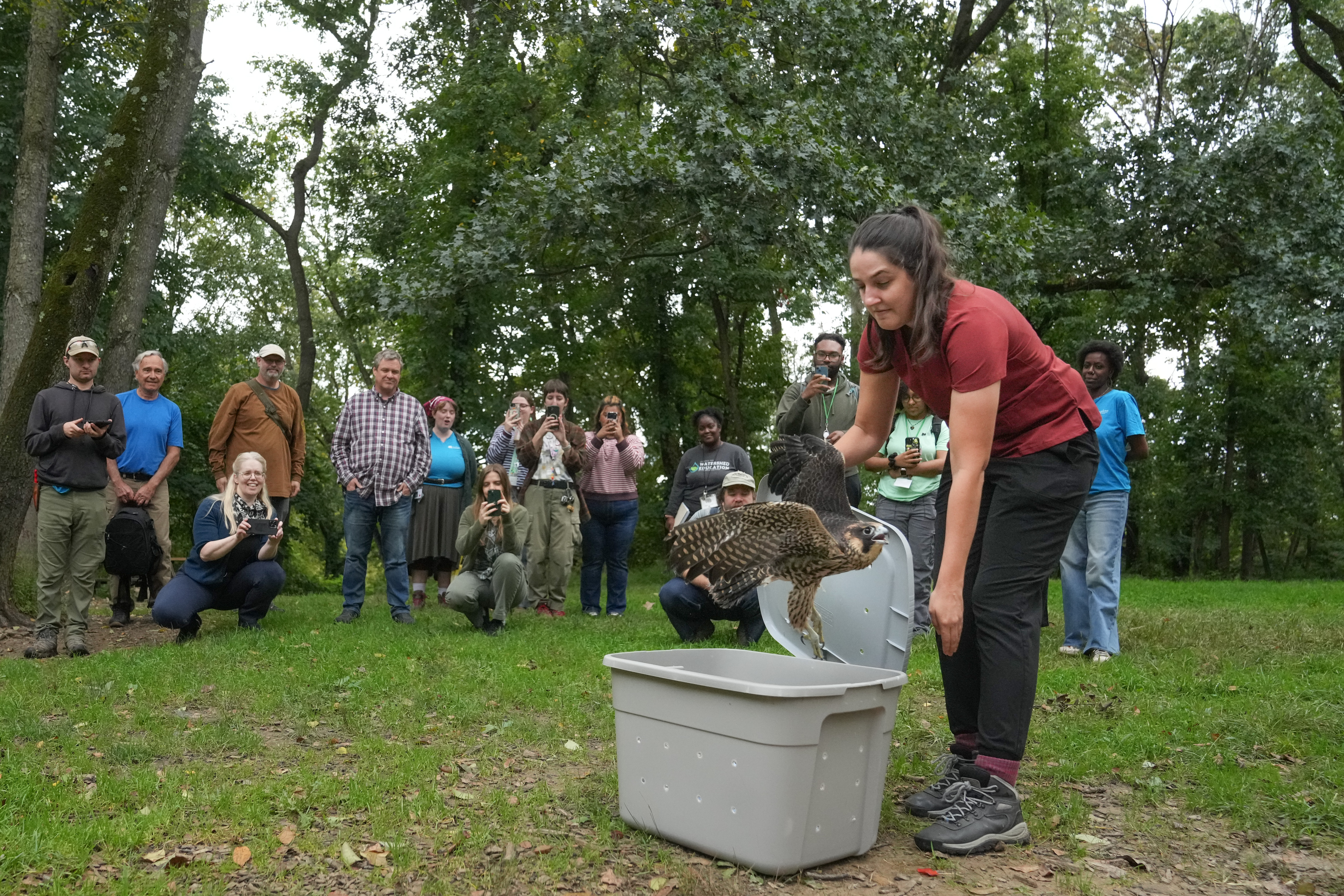
    A crowd gathered on the lawn beside it, adjusting shutter speeds to capture the world’s fastest animal. Just after 1 p.m., Sydney Glisan, director of the center’s wildlife clinic, unfastened the bungee cord, removed the lid, and offered the male peregrine falcon a few words of encouragement.

    “All right, buddy,” Glisan said. “Today’s the day.”

    Peregrine falcon released into the wild after healing from lead poisoning
    Video: Peregrine falcon released into the wild after healing from lead poisoning

    Like a feathered fighter jet, the bird burst from the tote and bolted for the big trees in Roxborough, letting out a few raucous shrieks as it disappeared.

    Patient 718 — animals are rarely named at the Schuylkill Center — arrived thin and sickly on June 4, suffering from high levels of lead poisoning. The bird was found near the entrance of the Philadelphia Museum of Art earlier that day, far below the nest its parents built there.

    “He was just kind of sitting there,” Glisan said of 718.

    A sibling, who had lower levels of lead poisoning, was also discovered at the museum the same day. That falcon, also a male, was treated at the clinic and released into the wild on July 1.

    Glisan said most raptors in the region would test positive for lead, but 718’s levels were “off the charts.” Lead can be found in the soil, she said, from bullets, lead-poisoned prey, and even fishing gear.

    At the clinic, 718 received chelation therapy, where a medication binds to the lead in the bloodstream and is then passed by the bird. The falcon received four rounds of chelation over the summer, with recovery breaks.

    “It’s hard on the body,” Glisan said, “but he was a real trouper.”

    After chelation, the falcon was taken to an aviary, where he practiced flying through an obstacle course that included pool noodles. He aced the test.

    “It was fascinating,” she said. “They move so fast.”

    Peregrines mostly hunt other birds from high perches and can reach speeds of over 200 mph when dive-bombing on prey.

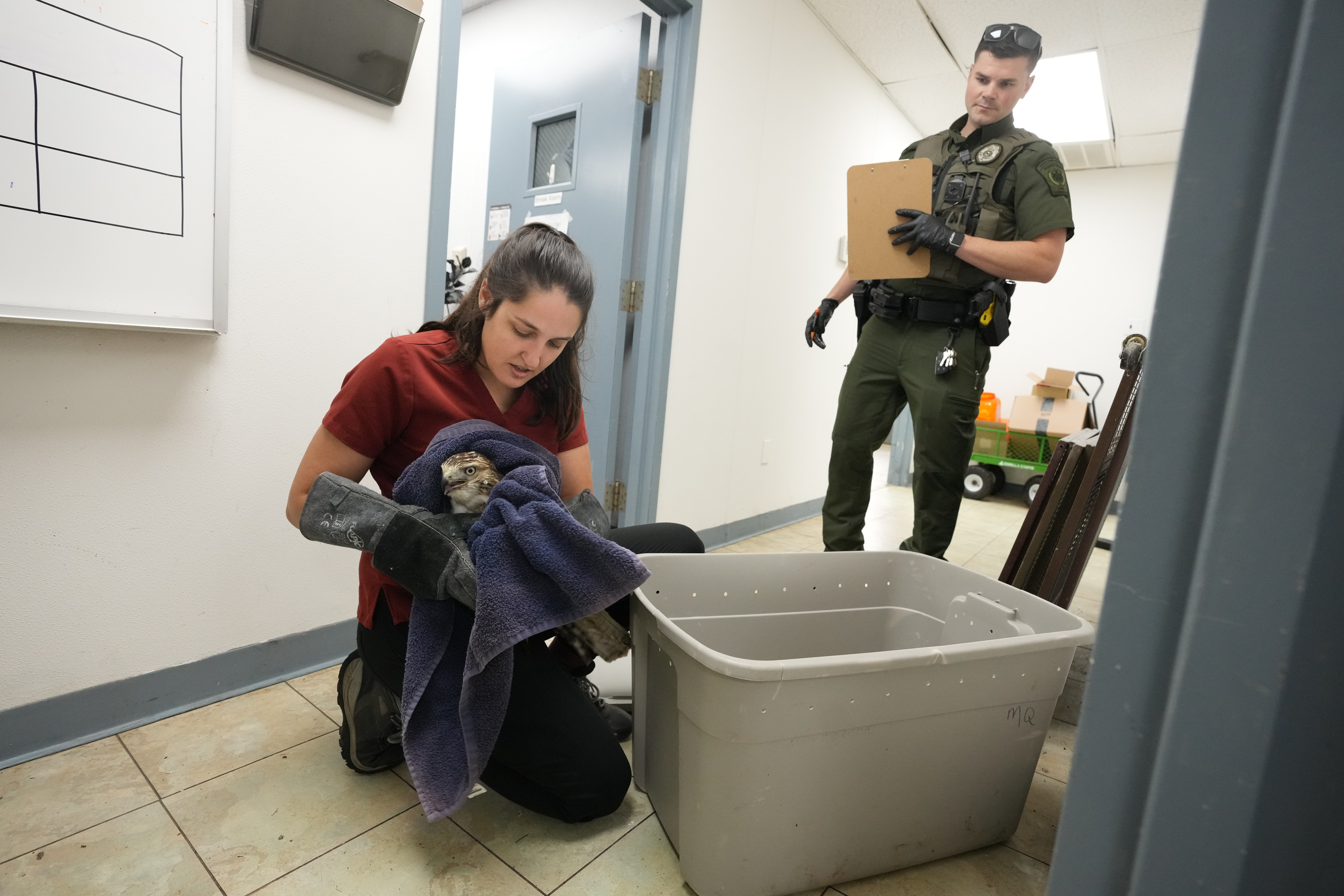
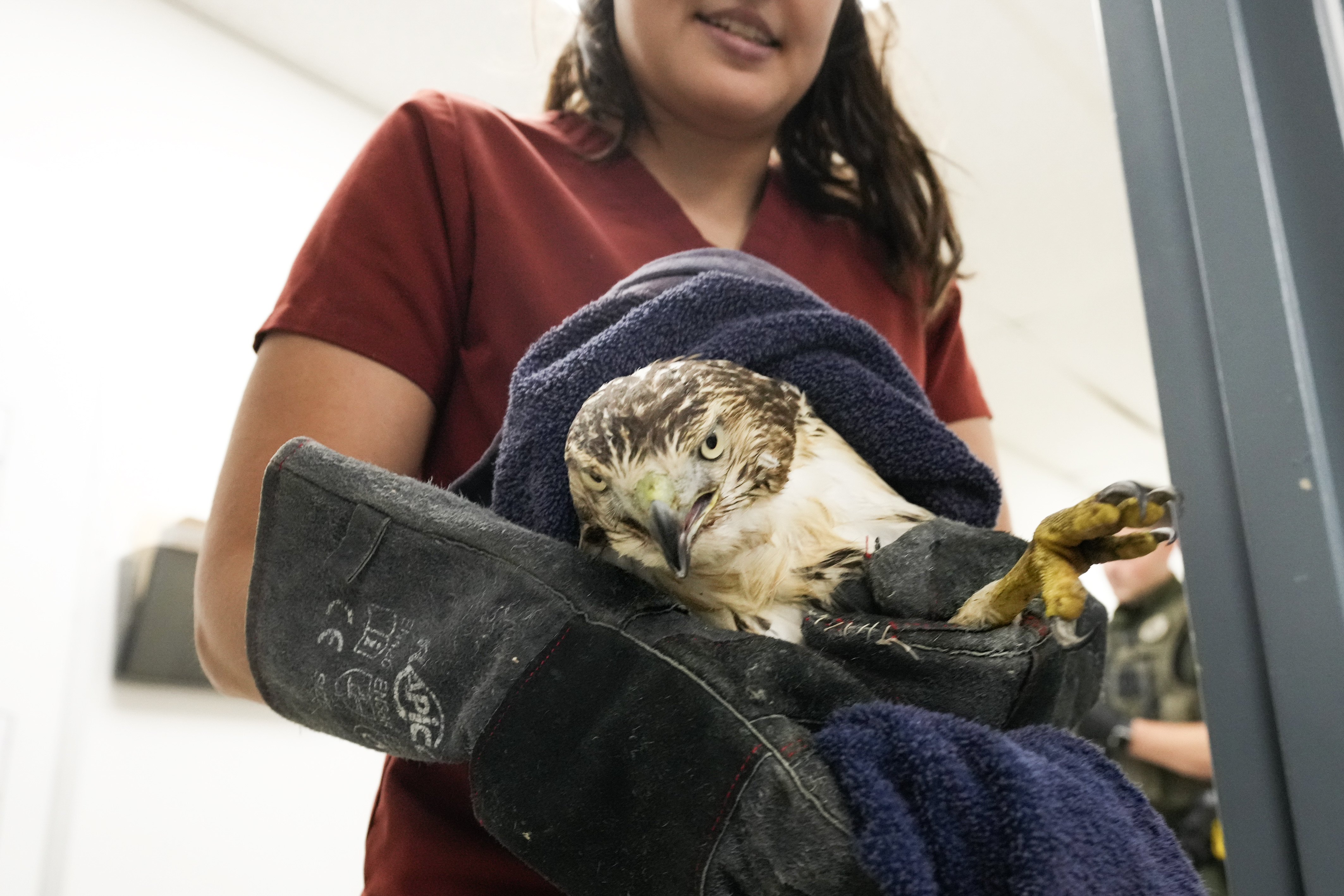
    Sydney Glisan, director of the wildlife clinic at the Schuylkill Center for Environmental Education, cares for a red-tailed hawk who was brought into the clinic on Tuesday.Jessica Griffin / Staff Photographer

    Glisan said 718 would probably find his own territory and not return to the art museum. She said there are at least three active peregrine nests in Philadelphia, including one at City Hall.

    Sydney Glisan, director of the wildlife clinic at The Schuylkill Center for Environmental Education, cares for a red-tailed hawk who was brought into the clinic Tuesday.Jessica Griffin / Staff Photographer

    As of Tuesday afternoon, the Schuylkill Center has treated 1,775 animals this year, including numerous species of birds, gray squirrels, and rabbits. More were coming in by the minute, including a red-tailed hawk with an injured talon and a baby squirrel that tangled with a dog.

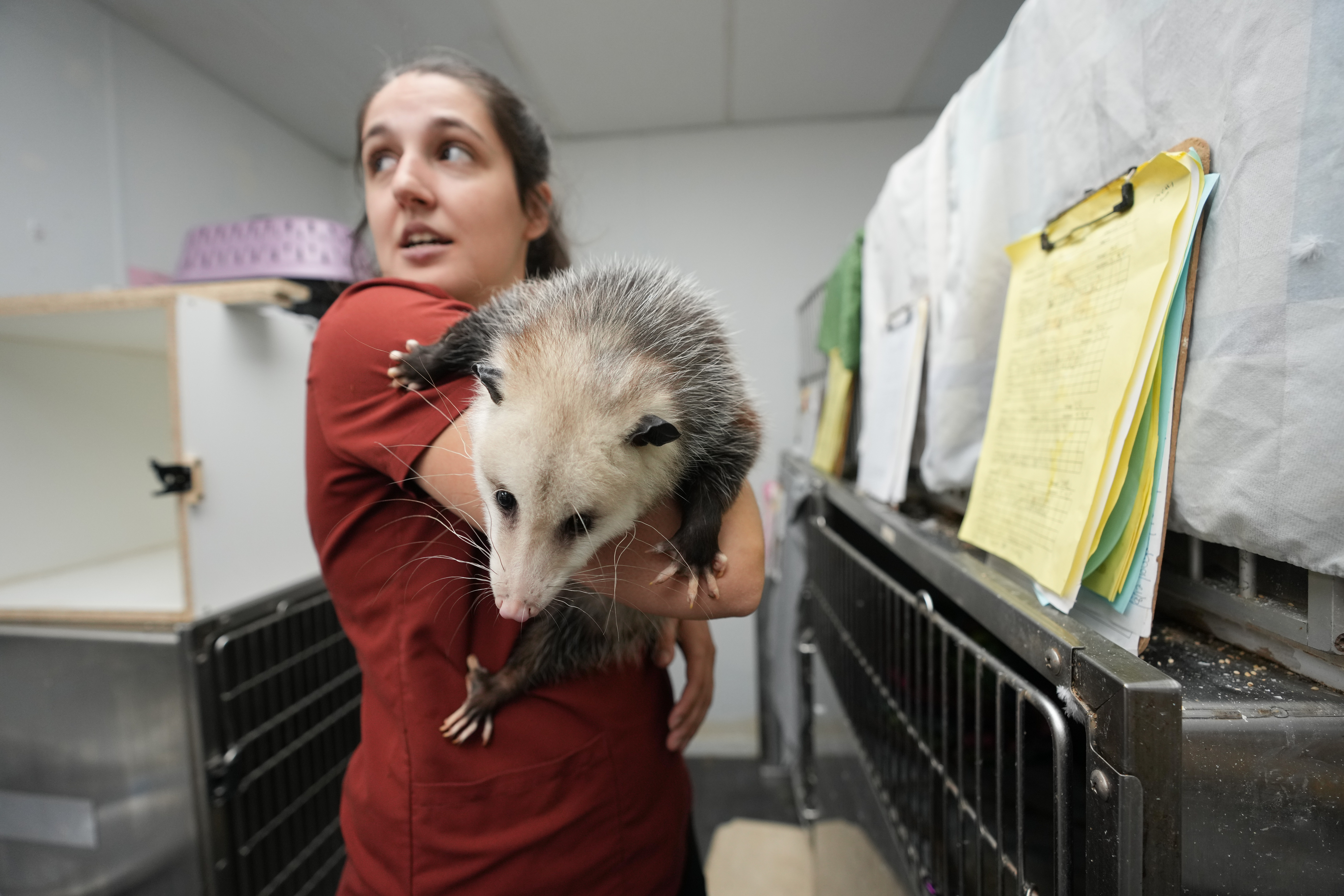
    Many animals that come in don’t survive long, Glisan said, and some, like Buttercup, the mostly blind-but-friendly opossum with frostbitten ears, are unable to be released due to their injuries. They are used for education and, on occasion, cuddling.

    “I do love you, Butter,” Glisan said, cradling the opossum.

    Sydney Glisan, director of the wildlife clinic at The Schuylkill Center for Environmental Education, shown here with Buttercup, the mostly blind-but-friendly opossuma who is a permanent resident at the clinic.Jessica Griffin / Staff Photographer

    Erin Mooney, the Schuylkill Center’s executive director, said the facility does not charge to take in and treat animals. She also said the center needs a new clinic building because theirs is 31 years old, and too small.

    While the Schuylkill Center receives money from outside agencies on occasion, Mooney said they rely heavily on donors.

    “In order for the work at the clinic and the Schuylkill Center itself to continue, we need people to give,” Mooney said.


    For more information, visit: https://schuylkillcenter.org/support/donate/

  • A pedestrian was killed in a car crash in Center City

    A pedestrian was killed in a car crash in Center City

    A pedestrian was killed in a car crash in Center City on Wednesday morning, police said.

    At about 6:42 a.m., Philadelphia police responded to a report of a crash involving a vehicle and pedestrian near 19th and Lombard Streets. The victim was a woman in her 20s and she was pronounced dead at the scene, according to police.

    The woman was crossing Lombard Street when the vehicle driver, who was traveling westbound, struck her. The driver remained at the scene, and no arrests have been made.

    Police are investigating the incident.

    Last year, Philadelphia reported its fewest number of traffic-crash deaths since 1928. But the city still remains dangerous for pedestrians and cyclists.

    Overall crashes declined from 2020 to 2025, while crashes involving non-motorists have stayed the same or increased, according to an analysis of Pennsylvania Department of Transportation data by the group Philly Bike Action. Fifty-five percent of people killed in Philly traffic crashes last year were non-motorists, and 52% of serious injuries from crashes occurred when a driver hit someone not in a car, the group found.

  • Penn State made head-scratching decisions in its first loss. It also exposed glaring weaknesses.

    Penn State made head-scratching decisions in its first loss. It also exposed glaring weaknesses.

    While leading by 10 points, Penn State decided to run on third-and-12 midway through the fourth quarter. Running back James Peoples didn’t pick up the first down as boos echoed through Beaver Stadium.

    It was the fourth time that offensive coordinator Taylor Mouser called a run in a third-and-long situation in a 24-20 loss to Wisconsin on Saturday.

    “It’s always situational for me,” Mouser said Tuesday. “The defense had been playing so good up to that point, didn’t want to put them in a bad spot, have something bad happen. Didn’t have a ton of rhythm going in the pass game up to that point either. So it was take the less of two evils and play the field position game, as dumb as that sounds and as much as I hate to say that.”

    Those third-and-long decisions were just some of the head-scratchers from the Nittany Lions first loss of the season (3-1, 0-1 Big Ten) and showed where the offense needs to grow ahead of their road matchup against Northwestern (2-1, 0-1) on Friday night (8 o’clock).

    “You got to stay focused on what the goal is,” Mouser said. “And the goal for us on a short week has to be the work. We just don’t have the time to be able to dwell on it and feel sorry for yourself. No one else does. And this Northwestern team is going to try to murder us.”

    Red zone struggles

    Penn State has made 20 red-zone trips this year, but only 10 have ended in a touchdown. Against Wisconsin, the Nittany Lions reached the 1-yard line on their second possession, but settled for a field goal.

    “I’m frustrated with that,” Mouser said. “And it’s an ongoing message. … Are we playing the right people? Are we handing it to the right people? Are we throwing to the right people? Are the right people in the right spots to be able to block and execute the plays? We haven’t been able to do that, and it’s our job as coaches to figure that out.”

    Penn State went 1 of 3 on red-zone trips, with the lone touchdown coming off sophomore cornerback Daryus Dixson’s interception that set up the Nittany Lions at the Badgers’ 11-yard line.

    These red-zone struggles first popped up against Temple, with Penn State’s first three opportunities only resulting in three points. The issues haven’t gone away.

    Lack of tight end usage

    Senior Benjamin Brahmer was the only tight end with a catch in Saturday’s loss, finishing with four receptions. Redshirt senior Gabe Burkle was targeted twice, while redshirt junior Andrew Rappleyea was thrown to once.

    “I still walk out of the game frustrated with my inability to get those guys the ball as much as we should,” Mouser said. “Rapp’s one of our best pass catchers and didn’t find a way to get the ball more. Same with Ben and even with Gabe.”

    Mouser took accountability for the lack of targets his tight ends received, and knows he needs to rely on Brahmer and his fellow tight ends in the passing game with top wide receiver Koby Howard out for the foreseeable future.

    “Those three are some of our best pass catchers and we’re going to have to find ways to get them the ball in easier ways that we can make those throws,” Mouser said. “I still don’t think we’ve sniffed just how good that room can be and the standard I think those guys can play with.”

    Becht’s poor showing

    Rocco Becht said Tuesday he plays better on the road, so it’s a good thing Penn State is headed to Northwestern this weekend after the quarterback’s performance against the Badgers.

    Becht went 12-for-29 with 129 yards, zero touchdowns, and his first interception of the year, though the pass was tipped. He put blame on himself postgame, saying he needs to be better for his team.

    On Tuesday, Mouser took accountability for Becht’s struggles.

    Rocco Becht went 12-for-29 with 129 yards and zero touchdowns against Wisconsin.Barry Reeger

    “I know what Rocco Becht is,” said Mouser, who also was his offensive coordinator at Iowa State. “He’s a 10,000-yard passer, and I’ve known him for three years, and I know how good he is. So when it’s not working, I’m going to always put it on myself because I know how talented he is and the way that he prepares.”

    The Wildcats’ defense sits at the bottom half of the Big Ten in passing yards allowed this season with 218 per game, potentially giving Becht an opportunity to get himself and his wide receivers going after a tough showing against Wisconsin.

    “We didn’t really show ourselves last Saturday who we were, and we didn’t put enough out there to bring that win home for us,” Becht said Tuesday. “I think for us, it’s just continuing to go out there on Friday and continuing to just do our job and have fun and go out there and play ball.”

  • Skill games funded my VFW post. Harrisburg’s inaction could close it.

    Skill games funded my VFW post. Harrisburg’s inaction could close it.

    In a matter of weeks, my Veterans of Foreign Wars post could be facing a decision none of us ever thought we would have to make: closing our doors.

    Not cutting back. Not shortening our hours. Closing.

    Think about that for a moment.

    A place built by veterans, sustained by veterans, and dedicated to serving veterans and our community could disappear because lawmakers in Harrisburg could not find a way to create a set of guidelines to govern skill games — the slot machine-like devices that everything from convenience stores to veterans posts like mine rely on for income.

    And I have one question for them: Why? Why, when there are ways to come up with a solution, would you allow organizations like ours to fail?

    VFWs, American Legions, volunteer fire companies, fraternal clubs, and small businesses across Pennsylvania are looking at their finances and making painful plans for what comes next if skill games go away.

    Back in June, the Pennsylvania Supreme Court gave state lawmakers 120 days to regulate skill games and help businesses and organizations stay open. With less than a month left, they have not acted.

    At our VFW, the revenue from skill games isn’t extra money sitting around waiting to be spent. It has become part of what allows us to keep the lights on, pay our bills, employ people, and continue serving our community.

    It isn’t just us at risk. Jim Brown, state commander of the VFWs, warns that a ban on skill games risks a vital revenue source for these organizations and threatens the survival of many VFW posts across the state.

    Senate Bill 1079, sponsored by State Sens. Gene Yaw and Anthony Williams, or House Bill 2213, sponsored by State Reps. Danilo Burgos and Jonathan Fritz, offers a path forward. They would responsibly regulate skill games and establish a $500 monthly fee per machine.

    That’s a compromise. The state gets revenue — $300 million a year. The games get regulated. And organizations like ours get a fighting chance to survive.

    So why can’t lawmakers get this done?

    I’ve heard the argument that veterans organizations, firefighters, and other nonprofits survived before skill games, so we should simply go back to raising money the way we used to.

    I would invite anyone making that argument to try it themselves.

    Could you go back five or 10 years and live on the income you made then while paying today’s bills?

    Could the state run today on the budget it passed 10 years ago (which notably was less than half of what the state budget is today)?

    We can’t chicken barbecue ourselves out of the coming budget hole. There aren’t enough dinners, raffles, bake sales, and pass-the-boot drives to replace the dependable revenue many organizations now receive from skill games.

    Our volunteer firefighters want to fight fires and keep protecting our communities. They do not want to be full-time fundraisers.

    What scares me most is that this doesn’t end at our front door. When a VFW loses revenue, the community loses revenue. We support food drives, local charities, and families who need a hand. Volunteer fire companies do the same while providing an essential public service.

    Will Harrisburg step in to support the Little League team? Will it help the food bank? Will it support the homeless veteran? Will it replace every donation that disappears when a VFW, American Legion, fire company, or Elks Club can no longer afford to give?

    That is the part of this debate I don’t hear enough about. The consequences don’t stop with the machines. They are far-reaching.

    They reach the bartender or club employee who loses a job. They reach the veteran who loses a gathering place and support system. They reach the firefighter whose organization loses revenue and struggles to find new volunteers.

    They reach every community organization that depended on donations from local clubs.

    Organizations are making plans right now. They are looking at layoffs. They’re deciding what expenses they can cut. They’re considering which donations and community programs they can no longer afford. Some, like us, are wondering whether they can remain open at all.

    The East Wing and Pennsylvania War Veterans’ Memorial Fountain at the main public entrance to the Pennsylvania Capitol on Commonwealth Avenue in Harrisburg. There is still time for legislators to pass legislation on skills games that allows for regulation and a path forward for the small businesses that depend on them, writes Rusty Miller.Tom Gralish / Staff Photographer

    Pennsylvania lawmakers have legislative days coming up. They have an opportunity to prevent a crisis.

    Lawmakers must pass legislation that regulates skill games and gives organizations a workable path forward. This would protect the jobs tied to these establishments. Protect veterans organizations and volunteer fire companies. Protect the community programs those organizations make possible.

    We have spent our lives believing that when our community needs us, we show up.

    Now we need our lawmakers to show up and do their job and find a solution.

    Rusty Miller worked for many years as president of a wireless construction company that specialized in all facets of cell site and switch construction, and retired in 2021. He has belonged to the Mechanicsburg VFW Post 6704 for 25 years.

  • AC/DC did the same thing it always does. Philly fans wearing devil horns lapped it all up.

    AC/DC did the same thing it always does. Philly fans wearing devil horns lapped it all up.

    AC/DC frontman Brian Johnson made a promise shortly after taking the stage at Lincoln Financial Field on Tuesday night: “We’re gonna do the same thing we always do.”

    It was met by a roar of approval from the sea of fans sporting red light-up devil horns, reaffirming that the Australian-born band’s multigenerational audience expects nothing less — or more.

    Throughout its more than half-century history, AC/DC has belonged to a stunted-but-exultant branch of the rock family tree that stubbornly refused to evolve past the bracingly simple riffs, the strutting duckwalk of Chuck Berry, and the lyrical concerns of a hormonal adolescent.

    That these sentiments are coming from a group of men in their 70s has rarely been an issue for rock icons of a certain age, but AC/DC has clung to its aura of misspent youth with an impish fervor that shrugs off questions of dignity with a raised pint and a lascivious grin.

    AC/DC fans sing and dance Tuesday during the band’s “Power Up” tour stop at Lincoln Financial Field.Elizabeth Robertson / Staff Photographer

    At 78, Johnson remains the gregarious, leering charmer with the air of a man perpetually perched on his favorite barstool, even as he skulks around a stadium-size stage. A decade after being replaced on tour by Guns N’ Roses frontman Axl Rose because of hearing loss, Johnson sounded strong despite a few stumbles — swapping verses on “Dirty Deeds Done Dirt Cheap,” which he acknowledged with a chuckle, or missing his entrance on “Whole Lotta Rosie.”

    A voice that in its prime sounded like a junkyard dog snarling double entendres through a barbed-wire fence suffers the ravages of age differently than a more finely honed instrument. But Johnson managed to summon his gloriously serrated howls when he needed them, talk-singing his way through the rough patches as if sharing a private joke.

    AC/DC’s guitarist Angus Young performs during the band’s “Power Up” tour stop at Lincoln Financial Field on Tuesday.Elizabeth Robertson / Staff Photographer

    Which brings us to Angus.

    The poster boy for arrested development, Angus Young still sports a schoolboy uniform at 71 (royal blue for this occasion, topped by a bright yellow cap emblazoned with his first initial). With his shock of gray hair, Young looks less like the juvenile reprobate gone to seed of his younger days, more like a student cursed, mummylike, to wander the halls of his school for all eternity.

    The sole remaining member from the band’s 1973 founding, Young is indisputably the star of the show. From the opening riff of “If You Want Blood (You’ve Got It)” to the closing cannon fire of “For Those About To Rock (We Salute You),” the guitarist remained in perpetual motion throughout the two hour-plus show while churning out nearly two dozen indelible riffs. He eventually removed his tie, bashing it against his strings for the solo to “Sin City,” and even took the mic to growl a couple of lines of “Dirty Deeds.”

    AC/DC’s Brian Johnson (left) and Angus Young play on during the band’s “Power Up” tour stop at Lincoln Financial Field on Tuesday.Elizabeth Robertson / Staff Photographer

    The leaps that accompanied each song’s final crashing chord don’t quite achieve the height they used to, and the blistering fretwork on “Thunderstruck” has slowed a step or two, but Young commands attention like few guitarists can. He quite literally eclipsed the rest of the band for an extended solo showcase on “Let There Be Rock”: As the rest of the stage fell into shadow, he first duckwalked to the end of the stage, where he was hoisted skyward on a raised platform, spinning and spasming on the floor as confetti erupted around him; then ascended to a catwalk atop the bank of Marshall amps to engage in an extended call and response with his adoring audience.

    Johnson and Young both have personalities outsized enough to split the spotlight between them, necessarily so as the touring version of the band is otherwise filled out by hired guns. Longtime bassist Cliff Williams and drummer Phil Rudd remain official members of the band and contributed to the most recent album, 2020’s Power Up, but have been replaced for the tour by Chris Chaney, formerly of Jane’s Addiction, and Slash’s Snakepit/Alanis Morissette drummer Matt Laug. From half a football field away, Stevie Young could pass for his late uncle Malcolm, clad in all black and jittering along with the steady chug of his rhythm guitar.

    AC/DC’s Brian Johnson sings during the band’s “Power Up” tour stop at Lincoln Financial Field on Tuesday.Elizabeth Robertson / Staff Photographer

    AC/DC’s first Philly stop in seven years came two and half years into its “Power Up” tour, which finally wraps up Friday in East Rutherford, N.J. Its namesake album was given two nods in the 21-song setlist, with “Demon Fire” and “Shot in the Dark” fitting snugly in with the classics. The title track from 2000’s Stiff Upper Lip was the only other song drawn from the band’s 21st-century output.

    Otherwise they stuck, as promised, to the familiar, accompanied by unobtrusive visuals: columns of flame for “Highway to Hell,” monochrome and static for “Back in Black,” a bell lowered from the rafters for “Hells Bells.”

    Opening the evening, as they have throughout the lengthy tour schedule, was the Pretty Reckless. Led by former child star and model Taylor Momsen, who has been moonlighting recently with the sporadically reuniting Soundgarden, the band shares the headliner’s penchant for amped-up, blues-based rock, if not its gift for memorable riffs.

  • South Jersey’s century-old amusement park is back up for auction

    South Jersey’s century-old amusement park is back up for auction

    The 119-year-old Clementon Park & Splash World is heading back to auction just weeks after announcing its closure and five years after it was purchased at a bankruptcy auction.

    Potential buyers can either continue operating the park, spanning more than 50 acres in Camden County, as an amusement destination or redevelop the property in a variety of ways, including as a hotel or for retail, residential, or entertainment uses, according to the property listing.

    The public auction is set to begin Oct. 19 at noon with bids starting at $1.5 million, the listing shows. The 48-hour auction window is scheduled to close at noon on Oct. 21.

    IB Parks & Entertainment bought the park for $2.37 million in the 2021 bankruptcy auction after financial struggles forced the park to shut down suddenly two years earlier.

    The company operated the park for five seasons before announcing its closure at the end of Labor Day weekend this year.

    “After five memorable years, we are saddened to announce that we have made the difficult decision to close the park and plan to offer the park for sale,” the company said in a statement announcing the closure on its website and social media accounts earlier this month. “It has been a privilege to care for a place that has meant so much to generations of families.”

    At the time of the closure, the park was one of five amusement properties owned by the company, including West Berlin’s Sahara Sam’s.

    IB Parks & Entertainment did not respond to requests for comment.

    Clementon Park opened in 1907 as the brainchild of state Assembly member Theodore B. Gibbs and his sons and quickly became a popular destination for families across South Jersey.

    After years of being independently owned by various families, the park was bought by its first private amusement park operation company in 2007.

    With various management companies at the helm over the next decade, the park expanded significantly with the addition of new thrill rides, children’s attractions, and a 23,000-square-foot wave pool.

  • Main Line cannabis payments operator charged with $9 million fraud

    Main Line cannabis payments operator charged with $9 million fraud

    A Lower Merion businessman who raised $9 million from more than 50 Main Line, pro sports, and Hollywood investors for Kind Financial, his marijuana payment-processing business, was charged by federal prosecutors Tuesday with five counts of fraud.

    The businessman, David Dinenberg, “fraudulently induced dozens of people into buying shares of Kind” by supplying false sales and business information, and “misleading the investors into believing that their entire investments were being used” for the company, not “diverted” for his personal use, according to charges filed in Philadelphia federal court. Dinenberg did not return calls seeking comment.

    The U.S. Attorney also called on Dinenberg to forfeit $9 million prosecutors contend he had raised from investors by fraud.

    Kind worked his networks of friends and business contacts to raise money from singer John Legend; former tennis star Andy Roddick and his actress-model wife, Brooklyn Decker; former Sixers manager Billy King; former Eagles star Brian Westbrook; investor Lindy Snider, whose family once owned the Flyers; and dozens more, according to investor lists.

    Investors had spoken to federal investigators.

    But Snider and others who invested in Kind, then tried to keep the company going after the board confronted Dinenberg about his spending and he left in 2023, said Wednesday that they had no advance notice of the criminal charges.

    David Dinenberg, who headed Kind Financial, hoped to serve cannabis growers at a time when few banks would do business with the industry. He has been charged with fraud and accused of embezzling.Kind Financial

    Instead of using all the money to build his marijuana business, Dinenberg allegedly “embezzled” more than $750,000 to pay for “unauthorized personal expenditures,” including family members’ school tuition, a luxury California rental home, and country club memberships. Prosecutors say he lied to investors by exaggerating sales and prospects for Kind.

    Dinenberg is also accused of stealing $175,000 from Rhode Island, which had hired Kind to collect cannabis fees from growers.

    Prosecutors say Dinenberg was supposed to forward that money to the state, less a small transaction payment, but began keeping the fees, and reported money that should have gone to the state as company revenue.

    Dinenberg started Kind in 2012 to process cannabis transactions that were legal in some states but prohibited under federal law. The legal complexity discouraged national banks from working with cannabis businesses, but also created what Dinenberg persuaded investors was an opportunity for his company to focus on serving legal-cannabis pioneers.

    The prosecutors depict Dinenberg as a successful fundraiser who founded a series of related companies, hiring two friends and a “family connection” to run the business in 2014, and tapping each of the three employees to help fund Kind.

    Kind in 2015 acquired cannabis-farm payments software from Colorado-based Agrisoft Development Group, which had clients in Colorado and a few other states, and used that relationship to land a software development partnership with Microsoft that won national media coverage.

    After the Microsoft deal, Kind won the Rhode Island contract. But Kind’s cash flow from the Rhode Island work was so meager that Dinenberg stopped paying his lawyers and stopped paying Kind employees — while keeping the tax and Social Security deductions he had withheld for them, prosecutors said.

    Dinenberg issued glossy investor documents that projected sales of under $500,000 in 2016 would zoom to over $10 million in 2017 and $40 million in 2018 — with “no factual basis” for the unaudited financial reports, their “false” revenue data, and baseless projections, prosecutors allege.

    In 2019, Dinenberg closed a business deal with pioneering cannabis investor Hartstreet Holdings and Colorado-based Herring Bank to develop a KindPay app to pay cannabis transactions through the Mastercard payment network, according to the prosecutor’s charges.

    At first, it worked: “In 2020 and 2021, KindPay was working and some dispensaries even had KindPay kiosks” to enable sales, according to prosecutors.

    But in 2021, Mastercard figured out that KindPay was used for marijuana sales, and cut the service off, according to prosecutors.

    By 2023, Dinenberg had taken more than $750,000 from Kind bank accounts to cover personal expenses. Confronted by an employee, Dinenberg admitted he’d stolen money but claimed the total was $80,000, according to prosecutors. He resigned May 4 of that year.

    Snider and other investors looked at ways to keep the company going, but its websites have since gone dark.

    “The company has been defunct for some time, and it’s truly a shame what has happened,” said Snider in an email after learning of the charges. She declined further comment.

  • What sparked Mark McKenzie’s return to the Union? Being closer to ‘family,’ on and off the field

    What sparked Mark McKenzie’s return to the Union? Being closer to ‘family,’ on and off the field

    Mark McKenzie still can’t quite put his finger on it, but a return to Chester feels right.

    On Wednesday, his professional career came full circle when the Union officially announced that he will join the team on Jan. 1 via a designated player contract during January’s FIFA transfer window. McKenzie, 27, will return to the club “that took a chance on him” when he joined its first team in 2018, after grooming the central defender for years in its youth academy and developmental teams.

    He will enter coming off a year as a mainstay on the backline of Toulouse in France’s Ligue 1, with performances that caught the eye of U.S. national team coach Mauricio Pochettino. That landed him a spot on this past summer’s 26-man roster for the FIFA World Cup.

    So how did the Union ultimately land McKenzie? It definitely took some convincing. He had options from other clubs in Europe, and his decision to return wasn’t just a simple phone call from Union brass. However, to hear McKenzie tell it, when he was looking for what would come next in his now nine seasons as a professional, Philly checked a lot of boxes.

    “I don’t think it was necessarily a ‘who called who,’” said McKenzie. “It was more of I was looking for something next in my career, and to be honest [initially, I] couldn’t pinpoint exactly what that was. Some players want more money. Some players want to play in certain leagues, or play in the [UEFA] Champions League. Some players just want to go home.

    “I think for me it was a mix of different things. And my agent and I were on the same page with what I wanted and what I envisioned for that next step. So we were putting out feelers and figuring out what that would look like.”

    With that as the mindset, McKenzie said his agency representation at The.Team met with Union sporting director Jon Scheer and others on whether a move back would even be viable. It took stages, but according to McKenzie, it worked out that Philly felt like the right choice for the Bear, Del., native, with several family members still in the area.

    In May, Mark McKenzie (center, right) battles Senegal forward Sadio Mané during an exhibition match ahead of the World Cup.Scott Kinser

    Scheer told The Inquirer that convincing McKenzie meant a face-to-face with him and his representation, meeting McKenzie outside of the country just before preparations began for the World Cup.

    “We went out to Spain to speak with him and his agent, and for us it was more a gauge to see where his head was at and what he wanted to do next,” said Scheer. “It wasn’t necessarily easy, as he had options, but at the end of the day, I think we offered a package and an opportunity for him to come home and that’s something he wanted.”

    The dollar amount of that total package remains to be seen but could be revealed when the Union holds their official news conference to announce McKenzie, scheduled for a virtual conference later today at 12:30 p.m. For McKenzie, who is expected to rejoin the team on a designated player contract, he says coming home will still allow him to “continue to develop.”

    Mark McKenzie (left) spent three seasons with French Ligue 1 club, Toulouse FC. Emma Da Silva

    Success in bunches

    Even before his departure for Europe, McKenzie knew immense success with the Union. As a homegrown player, he played along the club’s back line for former coach Jim Curtin, and helped guide the team to three consecutive playoff appearances from 2018-20.

    The 2020-21 season saw him head to Belgium’s Genk on a transfer valued at $6 million. He’d celebrate winning the Belgian Cup later that season with Genk, and go on to play two more seasons before a move to France’s Ligue 1 and finding himself a mainstay on Toulouse’s starting 11. It was his performances there that enabled him to earn that spot on the national team roster for the World Cup.

    He says that all of those stops along the way have helped him grow as a player and as a person in his professional career, choosing to go the gradual approach to stardom as opposed to a big splash that felt unnatural.

    “There was the possibility to go to maybe a bigger league or to a different club [from the Union my first time around], but I think for me, I wanted to take steps that were right for me,” McKenzie said. “I feel that too many times, especially young players, they get fixated on the idea of going to maybe a big club or going somewhere that looks optically like the thing to do, and then end up regretting it, or end up going and bouncing along.

    Mark McKenzie (left) battles Australia’s Connor Metcalfe during their international friendly last year. David Zalubowski

    “I wanted to go somewhere where I can develop, where I can play meaningful minutes, where I could be seen for the player I was and the person I was, and still be challenged in the same way. And going to Belgium from Philly was like that first step for me in getting my feet wet in Europe.”

    Dive deeper and McKenzie says the moves all along the way were more strategic, in terms of acclimating to the rigors of European soccer than being thrust into it from the outset.

    “I was able to experience the [UEFA] Champions League, Europa League and Conference League and after going through those years, it was like, all right, well, what’s the next step now? It was a strategic step of how can I make sure that I’m one, playing week in and week out, and two, still playing against some of the best players in the world and showcasing what I can do against the best in the world.”

    Now McKenzie says he gets the opportunity to do that, surrounded by the familiar confines of the Union’s sprawling complex in Chester and in front of familiar faces of family and friends he had to say goodbye to while plying his trade overseas.

    Union defender Mark McKenzie plays against the New England Revolution in 2020.YONG KIM / Staff Photographer

    Family comes first

    Just before the start of the 2025 Gold Cup, McKenzie and his wife, Carley, welcomed their first child, Micah. For the new father, it meant several sleepless nights, getting acclimated to the rigors of parenting on top of preparing for a major tournament. In November, while McKenzie was back in Philly as a member of the U.S. national team, he noted that he was still balancing fatherhood and his thriving professional career.

    So how much did having family and friends minutes away instead of a world away factor into his decision to return, especially having a new, young family of his own?

    “It’s huge, man,” McKenzie said. “I think about the years that I’ve been in Europe, and you get the opportunity for family to come visit, be together and watch games. But now, the opportunity to walk off the field, to come back home and laugh and talk to a lot of the same people? That adds more to your career or who you are as a player than sometimes the wins and losses do.

    “At the end of the day, when I look back at my career, I’m just a product of who my family is and how strong my support system is. So, for me to come back here, not only make sure that they feel that love, but also my family at the Union … family is a core value, you know, and that’s what’s pushed me to get to where I am today. It’s a big part of the reason why I made the decision to come back here, and it’s going to be a big part of the reason why we’re successful as a club.”

    Mark McKenzie and fellow former Union player Paxten Aaronson bang the ceremonial drum ahead of a match in 2023. Philadelphia Union

    On Saturday, McKenzie was in Chester and watched the Union deliver a 4-2 win over Orlando City, setting a franchise record as they now revel in an unbeaten streak of 12 games. McKenzie opened the match with the ceremonial banging of the drum on the field. It not only started the game, but also the countdown of his return to the field in a few short months.

    When asked what that moment was going to feel like, McKenzie was a man of few words, but he had one that spoke volumes.

    “Surreal,” he said. “Yeah, I think that’s the best way to describe it.”