Blog

  • 25 years after 9/11, al-Qaeda still has a home in Afghanistan

    25 years after 9/11, al-Qaeda still has a home in Afghanistan

    Twenty five years ago, Osama bin Laden led the planning of al-Qaeda’s attacks on Sept. 11, 2001, from a Taliban stronghold in Afghanistan, where he lived as their guest.

    Now, the Taliban rule over Afghanistan once again, trying to present a more modern face to the world.

    But despite the veneer, the Taliban have not changed their ideology, and armed groups, including dozens of al-Qaeda members, remain in Afghanistan. Many of the conditions that made the Sept. 11 attacks possible remain.

    The Taliban outlasted the U.S. war to oust them and are now ruling over 45 million Afghans. They use the latest iPhones to contact European and U.S. diplomats. They travel to the Persian Gulf and Turkey, and promote trade with Uzbekistan and India. Their fighters now patrol Afghanistan’s cities, some using abandoned U.S. military gear.

    And when Taliban officials receive foreign visitors in their gilded offices in Kabul, the capital, they insist that they want peaceful relations with the world. They repeat the commitments they made in 2020 during peace talks with the United States, not to allow another major attack to take root on Afghan soil.

    Marwa, an Afghan girl, begging on a recent evening in an area near Ziyafat. Half of Afghanistan’s population needs humanitarian aid.TOMAS MUNITA

    “We consider the chapter of war to have come to an end,” Afghanistan’s foreign minister, Amir Khan Muttaqi, said in a recent interview in Kabul.

    But the United States, the European Union and most other governments are not ready to trust them.

    Their promises about security are similar to the ones Mullah Mohammad Omar, then the Taliban’s leader, made months before 9/11, when he told a journalist that bin Laden “does not operate against anyone from the soil of Afghanistan.”
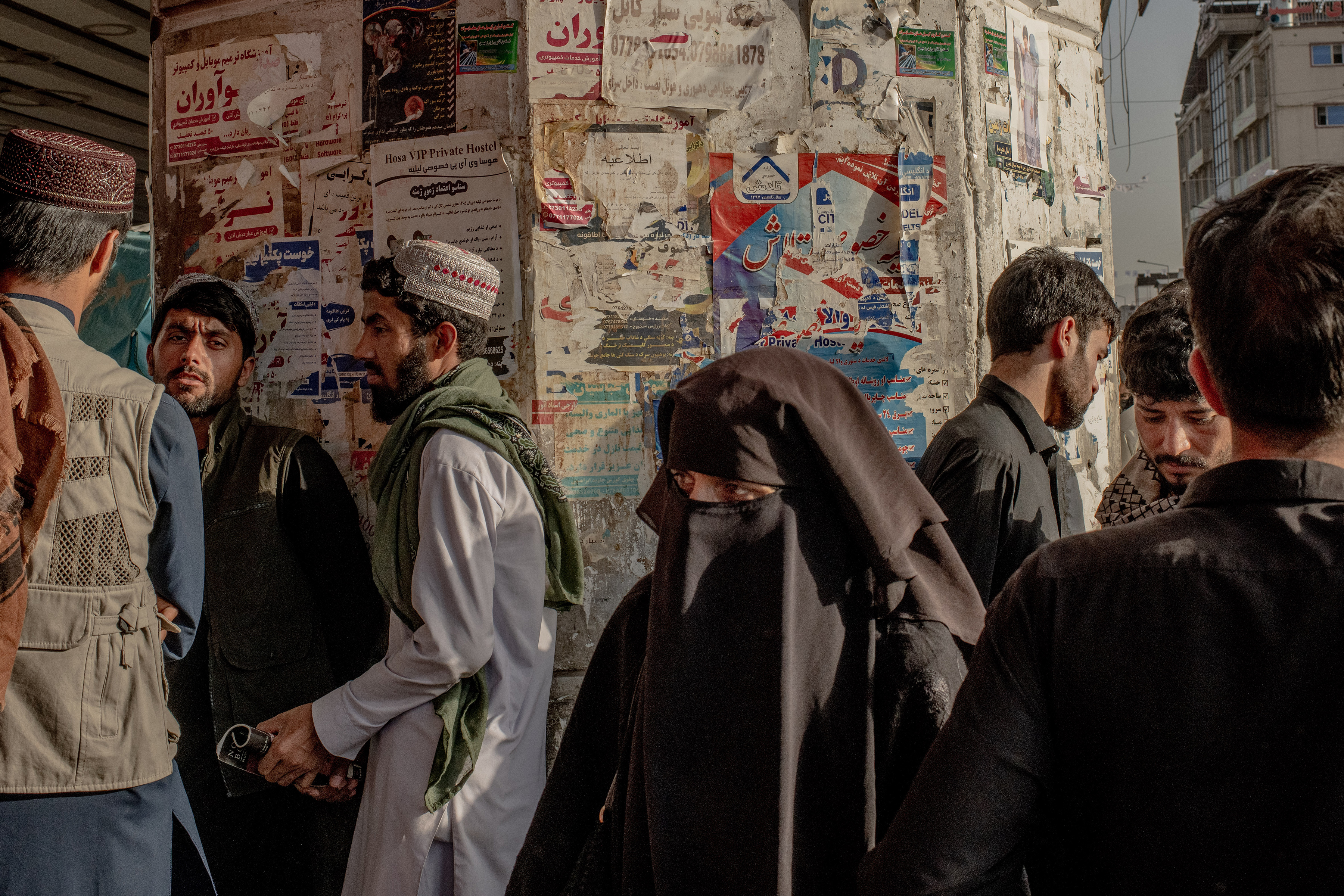
    The Taliban have imposed increasingly severe orders on how women should dress in Afghanistan. They remain excluded from most public spaces and can’t work most jobs.TOMAS MUNITA

    Al-Qaeda and other militant groups remain in Afghanistan, although without a leader as powerful as bin Laden and without their past influence over the Taliban.

    And there is a troubling intelligence vacuum. Security officials and diplomats acknowledge that they lack the full picture of what is happening inside Afghanistan. It has again become a dark room where, they warn, new threats could emerge unnoticed.

    Sherin Jan Haidari, 55, praying in Wardak Province, west of Kabul, at the grave of his two nephews and niece killed by Afghan soldiers during the U.S.-led war.TOMAS MUNITA

    What security means now

    In conversation, Afghans often describe life in their country by what it is no longer: at war. Roads are safe. Mining deals are welcome. The sound of gunfire is less common. Civilians are no longer in constant danger of being killed by drones or crossfire, though the threat from unexploded devices remains. Kabul has seen an influx of new money and new restaurants that mimic the glitter of Dubai in the United Arab Emirates.

    That is the Taliban’s message: Calm, not chaos, permeates Afghanistan.

    But that is only one part of the story. Extremist armed groups still have a home in Afghanistan, according to the United States, China, Russia, and the United Nations.

    The militant threat in Afghanistan is much less significant and visible than in the years leading up to 9/11, experts and security officials say, when up to 30,000 militants and fighters were in the country.

    Still, United Nations experts estimate that 15,000 to 20,000 militants are scattered among about 20 groups in Afghanistan. Russia says they could number up to 23,000.

    Al-Qaeda has only a few dozen members, according to estimates from the United Nations and security experts, but some of them live freely in Kabul. The Afghan authorities have issued national identity cards to the leadership of al-Qaeda’s South Asian branch, according to the United Nations’ group of experts monitoring terrorist networks.

    Thousands of Islamic State group militants also roam the rugged borderlands between Afghanistan and Pakistan.

    Most numerous are the thousands of militants from Tehrik-e-Taliban Pakistan, known as the Pakistani Taliban, or TTP, who navigate the porous border to stage attacks on Pakistani security forces. Security experts and officials attribute a sharp increase in attacks on Pakistan to the permissive environment provided by the Afghan Taliban since 2021.

    Though in far lower numbers than in the 1990s, foreign fighters have also recently traveled to Afghanistan from Syria and Somalia.

    The Taliban in Afghanistan deny backing the Pakistani Taliban but privately say that they could not rein in the group even if they wanted to.

    Pakistan has been a close ally of the United States under President Donald Trump, and the United States has accused the Taliban of breaking their counterterrorism promises. Even China, long a staunch supporter of pragmatic engagement with the Taliban, has urged the group to “resolutely eliminate all terrorist forces.” The European Union wants it “to do more to convince the world that Afghanistan is not a potential threat.”

    Intelligence diplomacy

    The continued presence of thousands of militants is one of the main reasons for the Taliban’s continued isolation from the rest of the world. Most security analysts believe that they pose a threat mainly to the region, not the West, but al-Qaeda and the Islamic State group still promote a global ideology.

    The Taliban claim they work closely with foreign intelligence services to fend off the Islamic State’s group’s Afghanistan affiliate. A senior Afghan intelligence official, speaking on the condition of anonymity to discuss national security matters, called this “intelligence diplomacy.”

    The two groups are enemies because the affiliate adheres to an extremist jihadi ideology that views the Taliban as apostates for accommodating religious minorities and seeking international engagement. The affiliate claimed responsibility for the attack near the Kabul airport during the U.S. withdrawal in August 2021 that killed 13 U.S. troops and more than 170 Afghan civilians. It has repeatedly targeted Shiite communities in Afghanistan and has claimed deadly attacks in Kabul and Islamabad, Pakistan’s capital, this year.

    The Taliban have deployed special forces teams to infiltrate areas controlled by the Islamic State group, according to Antonio Giustozzi, a senior research fellow at the Royal United Services Institute in London who follows militant groups in the region.
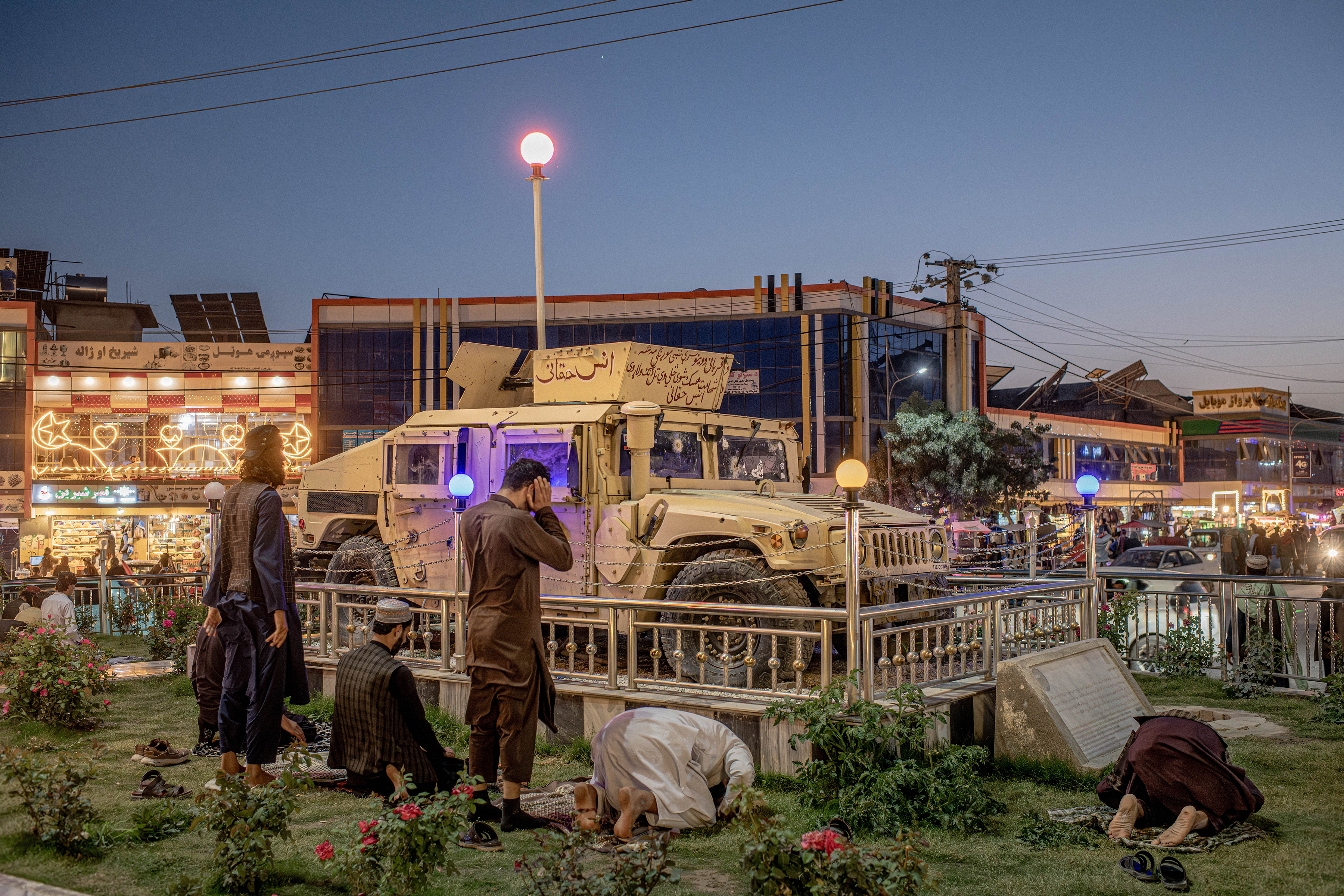
    Afghans praying in the central square of Gardez, eastern Afghanistan, near an American Humvee from the war. The writing on the vehicle reads in part, “I hope the tower of martyrdom will stay high and shining in the sky.”TOMAS MUNITA

    Experts and security officials say the affiliate no longer has the capacity to mount a large-scale assault. They attribute this to the work of the Taliban and Pakistan, as well as a broader loss of momentum by the group.

    “Kabul, to its credit, is waging a fierce armed struggle against Islamic State,” Sergei K. Shoigu, Russia’s former defense minister and now the secretary of its Security Council, said this year.

    The Taliban’s relationship with al-Qaeda is of another nature.

    U.S. counterterrorism officials have in recent years called Afghanistan a “nursing home” for al-Qaeda’s senior members and defined the group’s threat from the country as being at its “lowest point” in decades.

    But its influence persists.

    Al-Qaeda never abandoned the Taliban during their 20-year insurgency, and the Taliban have not abandoned al-Qaeda in power.

    A few dozen Qaeda members remain in Kabul and along the Pakistani border, training the Pakistani Taliban, according to the United Nations’ monitoring group on terrorist networks.

    (Bin Laden’s successor, Ayman al-Zawahri, was killed in a U.S. drone strike on his balcony in Kabul in 2022.)

    “The exact role of al-Qaeda Afghanistan? It’s very hard to say,” said Colin Smith, the coordinator of the U.N. group, which collects information from more than 40 intelligence agencies for its biannual reports.
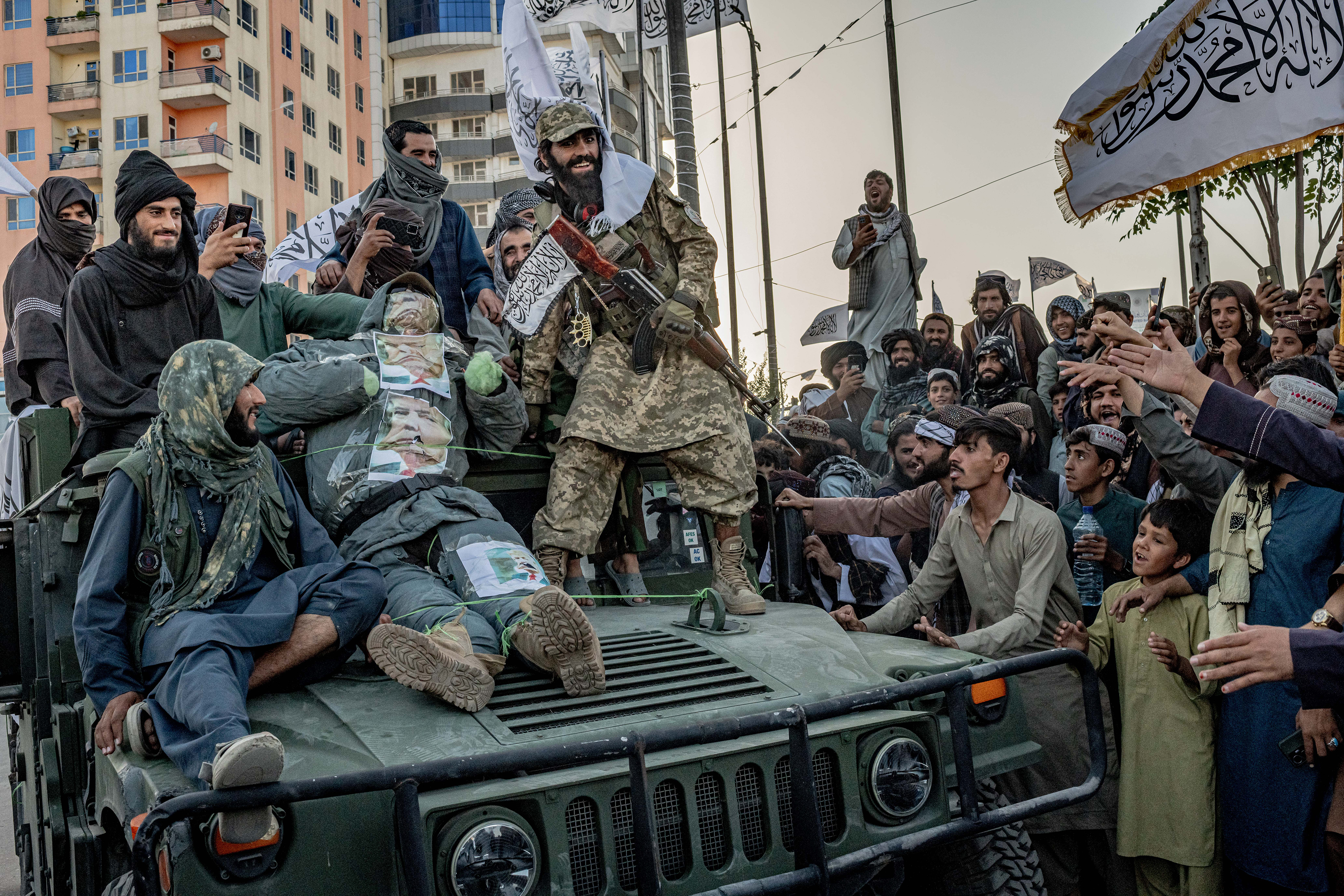
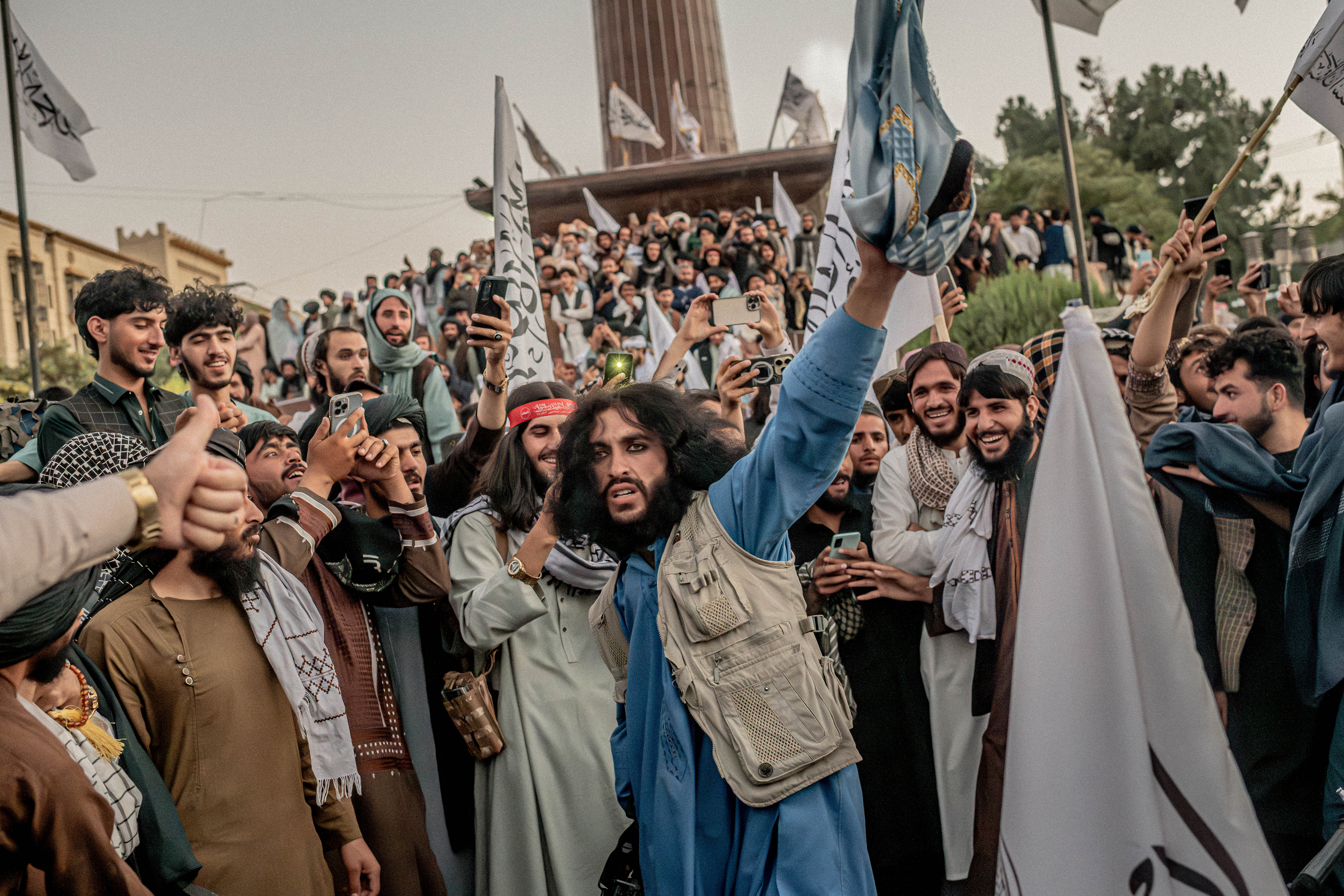
    Taliban soldiers paraded in Kabul with an effigy of President Donald Trump on Aug. 15, in celebration of their return to power five years earlier. The soldiers later stabbed the effigy.TOMAS MUNITA

    In April, al-Qaeda declared support for the Pakistani Taliban and renewed its endorsement of the Taliban government in Kabul, hailing the group as “a modern role model.” By backing the Taliban, al-Qaeda is buying time and space in Afghanistan, Giustozzi said.

    Cumbersome allies

    The Taliban’s relationship with militant groups keeps alive a long-running debate: Are the Taliban an insurgent group engaged in statecraft; a state-ruling entity that hasn’t shed its insurgent past; or a mix of both?

    That uncertainty reflects the balancing act at the heart of the Taliban’s survival. Allowing Afghanistan to serve as a launchpad for international terrorism is not in the Taliban’s interest — as they learned after 9/11. But out of hospitality, ideological zeal and a lack of resources, they have so far been unable, and in part unwilling, to expel them.

    The Pakistani Taliban are forcing the Taliban to face the consequences. The two fought side by side during the U.S.-led war, and the Pakistani Taliban now expect a return on investment: support to establish a similar stronghold in Pakistan.

    If the Taliban withdraw support to their Pakistani counterparts, they risk seeing more of their disgruntled fighters join the Pakistani Taliban. Most of the Taliban’s rank and file now control checkpoints and patrol cities. The Pakistani Taliban are offering a new jihad, right next door.

    “We sacrificed our generation to bring peace,” said Farhad Sangari, the Taliban commander of a special forces unit in Kabul, on a recent evening as he led a traffic patrol. He added, “I miss the memories of jihad and the front line.”

    Many experts and security officials also fear that the vast network of religious schools that has expanded across Afghanistan since the Taliban takeover is teaching a violent, expansionist agenda.

    “How many hundreds of thousands of men have been exposed to the Taliban ideology glorifying jihad?” said Michael Semple, a longtime Afghanistan expert at Queen’s University Belfast in Northern Ireland.

    Afghans are now living with a situation they haven’t faced in decades. They are somewhat safe at home, but Afghanistan is once again exporting insecurity.

    The return of gunfire

    Whatever its exact nature, the relationship between the Taliban and militant groups now threatens to destabilize Afghanistan.

    Fed up with relentless attacks from the Pakistani Taliban, the Pakistani military has retaliated with dozens of airstrikes on Afghan security and civilian infrastructure this year, including in Kabul.

    A senior Pakistani intelligence official, speaking on the condition of anonymity to discuss national security matters, said his country’s leadership had concluded Pakistan’s domestic security would not improve until it “sorted out” the Taliban. Over the past few months, Taliban officials have grown increasingly concerned about the possibility of a Pakistani-backed attempt at regime change in Afghanistan.

    Anti-Taliban resistance groups waiting in the wings now see an opportunity. Three groups, led by former members of the U.S.-backed Afghan military, have claimed responsibility for more than 50 attacks on Taliban officials, checkpoints and buildings across Afghanistan since July.

    The leader of one of them, speaking on the condition of anonymity to discuss the attacks, described them in an interview as targets of opportunity, aimed at cracking the veneer of security that the Taliban have so far maintained.

    The scattered attacks do not yet pose a regime-ending threat, but at least two local officials have been killed by anti-Taliban forces in recent weeks.

    They are another reminder that in Afghanistan, war is not yet a distant memory.

    This article originally appeared in The New York Times.

    In July in Wardak Province, the remains of a car that was hit by an airstrike, killing five Taliban fighters.TOMAS MUNITA
  • Oil prices leap to their highest since May and drag Wall Street lower

    Oil prices leap to their highest since May and drag Wall Street lower

    NEW YORK — Oil prices keep climbing as the war with Iran keeps clogging the global flow of crude, and they leaped Thursday to their highest levels since before the summer. That worsened worries about inflation and cranked up pressure within the bond market, helping to send stocks lower again on Wall Street.

    The S&P 500 fell 0.6% for a fourth straight loss, its longest such streak since June, though it’s not far from its all-time high set last month. The Dow Jones Industrial Average dropped 316 points, or 0.6%, and the Nasdaq composite sank 0.7%.

    Stocks sank under the weight of rising oil prices. Brent crude, the international standard, climbed another 6.3% and briefly topped $108 per barrel for the first time since May before settling at $107.63.

    It’s jumped from less than $72 in early July as hopes fade that the war with Iran will allow oil to flow freely again from the Middle East anytime soon. President Donald Trump said on Wednesday that oil prices likely won’t come down until after the U.S. midterm elections in November.

    The jump has vaulted the price for a gallon of regular gasoline to an average of nearly $4.28 across the United States, according to AAA. That’s up nearly 34% from a year earlier and is not only costing people more at the pump but also through higher prices for all kinds of products that move by truck to store shelves.

    A report on Thursday said inflation at the U.S. wholesale level accelerated to 5.4% last month from 4.8% in July, and retailers could eventually pass such increases in prices onto shoppers. A report is coming on Friday that will show how much inflation U.S. consumers are feeling.

    The typical move to rein in high inflation is for the Federal Reserve to raise its main interest rate, the federal funds rate. Such a move then filters out through the rest of the bond market, makes it more expensive for U.S. households and businesses to borrow money, slows the overall economy, and undercuts prices for investments. That hopefully would remove some of inflation’s fuel.

    A report on Thursday suggested the U.S. job market may remain solid, with fewer workers applying for unemployment benefits last week. That could give the Fed more confidence that the economy could withstand higher interest rates.

    Following Thursday’s reports, traders see a roughly 73% chance the Fed will raise the federal funds rate at its meeting next week. That’s up from the 61% probability seen the day before, according to data from CME Group. That’s also despite Trump’s consistent lobbying for interest rates to go lower rather than higher.

    The Fed’s counterpart in Europe, the European Central Bank, raised its own interest rates on Thursday in hopes of getting inflation in check. It cited “the conflict in the Middle East” and how it “continues to generate inflation pressures.”

    It all pushed the yield on the 10-year Treasury up to 4.95% from 4.83% late Wednesday, which is a significant move for the bond market.

    It’s up from just 3.97% before the war with Iran began and is back to where it was in the autumn of 2023. That was after the Fed cranked the federal funds rate higher to get super-high inflation coming out of the COVID pandemic under better control.

    Higher yields mean investors can make more money putting their money into bonds, which can in turn make investors less willing to pay high prices for stocks and other investments that are riskier than bonds.

    Some investors see a 5% yield on the 10-year Treasury as the next potential flashpoint. But strategists at Bank of America’s Research Investment Committee suggest 7% may be the more important threshold, pointing to peaks for expensive stocks around that point in the past.

    In the meantime, the rising 10-year Treasury yield is making mortgages more expensive and hurting the housing industry. One report on Thursday said the average long-term U.S. mortgage rate hit its highest level in over 14 months, while a second one said sales of previously occupied U.S. homes fell in August to their slowest pace in more than a year.

    The benchmark 30-year fixed rate mortgage rose to 6.76% from 6.71% last week, mortgage buyer Freddie Mac said Thursday. One year ago, the average rate was 6.35%.

    That helped sent stocks of homebuilders lower, including drops of 3.5% for Lennar and 2.4% for D.R. Horton.

    Elsewhere on Wall Street, Macy’s fell 4.7% even though the retailer reported stronger profit and revenue for the latest quarter than analysts expected. While raising its forecast for earnings this fiscal year, it warned that “there are macroeconomic and geopolitical factors that could influence” how much its customers feel comfortable spending.

    Macy’s said it received $116 million in tariff refunds from the government — $98 million during the quarter and another $18 million after the quarter ended. Macy’s CEO Tony Spring told the Associated Press Thursday that it’s using some of the proceeds to lower prices on certain items like furniture and other big-ticket purchases.

    All told, the S&P 500 fell 44.66 points to 7,591.70. The Dow Jones Industrial Average dropped 316.56 to 52,064.10, and the Nasdaq composite sank 171.62 to 26,081.72.

    In stock markets abroad, indexes slipped across much of Europe and Asia. Hong Kong’s Hang Seng dropped 1.3% for one of the world’s biggest moves.

  • Brothers seeking pardons for sex trafficking hire a former Trump lawyer

    Brothers seeking pardons for sex trafficking hire a former Trump lawyer

    Tal, Oren, and Alon Alexander, three prominent brothers convicted of running a decadeslong sex-trafficking scheme in New York earlier this year, have enlisted lawyer Alan Dershowitz in their apparent pursuit of a pardon from President Donald Trump.

    They retained him in March 2025, nearly 11 months before their trial began in New York federal court, and since then have paid him hundreds of thousands of dollars, according to financial documents obtained by The New York Times.
    Those documents include a copy of a check for $250,000, as well as a wire transfer receipt and an invoice from Dershowitz requesting an additional $250,000.

    Dershowitz confirmed to the Times that he was working for the Alexander family, but said he had not yet discussed options for a pardon with them, describing his role as a consultant on “legal, constitutional, and sentencing issues.” According to a letter reviewed by the Times, written by Dershowitz to the mother of the men, his work also includes pursuing options of “executive clemency and judicial reversal.”

    He had not discussed their case with President Donald Trump, Dershowitz said, and although he had visited the brothers in prison and held regular conversations with their criminal defense lawyers, he had not yet explored avenues for a pardon with them. The brothers each face a minimum of 15 years and a potential life sentence. Their sentencing is scheduled for Oct. 6.

    “My work has been purely on legal issues completely,” Dershowitz said in a phone interview, but added, “I would be happy to provide consultation services on any aspect.” Dershowitz said he took on the case because he knew Shlomi and Orly Alexander, the brothers’ parents. He confirmed that he was working on behalf of all three brothers.

    “I saw that they were facing very serious consequences,” he said. “I don’t ever turn down a case based on the government’s allegations.”

    Lawyers for the Alexander brothers, in a joint statement, said they were not aware of any efforts to contact the White House on behalf of their clients. “Our sole focus has been on preparing for sentencing,” they wrote.

    Dershowitz, 88, a high-profile lawyer, has ties to Trump, having helped to defend him during his first impeachment trial, where he was acquitted, and advising him at times on foreign policy.

    In Trump’s first term, Dershowitz was credited with shaping more of the president’s clemency decisions than almost any other advocate. He played a role in at least 12 clemency grants, including two pardons, which wipe away most consequences of convictions, and 10 commutations, which reduce prison sentences.

    He was sought after by other clemency seekers looking for an edge in a system in which connections to the president are seen as a way to skip to the front of the line. Lawyers and lobbyists with ties to the president have charged steep rates to people seeking to avoid or shorten prison sentences.

    Dershowitz, who once described himself as a “liberal Democrat” but announced this year that he was joining the Republican Party, has also provided advice to others seeking clemency this year. He counseled OneTaste, a wellness company described by critics as a sex cult. The company’s founder and director of sales were convicted of forced labor conspiracy last year, and they are in federal prison in Brooklyn.

    It is not clear if Dershowitz — whose decadeslong career has included representing Jeffrey Epstein — has had as much success in helping to secure clemency grants in the second Trump administration.

    The brothers — Tal Alexander, 40, and the twins Oren and Alon Alexander, 39, who were raised in Florida — have their own connections in Trump’s orbit. Oren Alexander and Tal Alexander, who had been among the highest-earning real estate brokers in the country before their arrest, represented Jared Kushner and Ivanka Trump in their purchase of a $24 million Florida mansion in 2021.

    The Alexanders began exploring avenues for seeking pardons before they were found guilty of sex trafficking and assault against both women and girls.

    Last year, a person close to the brothers made inquiries with the Tzedek Association, a Jewish group that has been influential in shaping Trump’s clemency grants and criminal justice policies. The Tzedek Association, which was involved in at least one commutation granted this year, worked with Dershowitz on clemency issues during the first Trump administration.

    Less than three months after their arrest, the documents show, the Alexander family paid Dershowitz’s retainer of $250,000. The Times reviewed a photograph of a check dated March 5, 2025, made out to Dershowitz and signed by Orly Alexander. The Times also reviewed a receipt from a wire transfer showing a transaction on that same day of $500,000, with a handwritten note scrawled below noting the funds had been wired after selling stocks belonging to Alon Alexander. “Send 250k to Dershowitz,” it noted.

    More than a year later, Dershowitz sent a letter to Alexander, the mother, and to Inbal Rosenthal, who is the family’s accountant, according to a person with knowledge of the matter who agreed to speak under condition of anonymity to protect their privacy. He was owed more money, he wrote.

    “Between March 1, 2025, and June 11, 2026, I have devoted 142 ¾ hours” on behalf of the Alexander brothers, Dershowitz noted. His work included visiting them personally, meeting with their lawyers and reviewing options for clemency and pardons, he wrote. He noted that his hourly fee had increased to $2,750, but he was billing at his previous rate of $2,500 and was now owed an additional $106,857 on top of the retainer.

    “Please wire an additional retainer of $250,000,” he wrote.

  • Phillies miss chance to keep pace in NL East, fall to Astros after Jhoan Duran surrenders ninth-inning homer

    Phillies miss chance to keep pace in NL East, fall to Astros after Jhoan Duran surrenders ninth-inning homer

    Zack Wheeler went to a full count against back-to-back hitters only to walk both and load the bases. His pitch count climbed above 100 on a hot, sticky afternoon.

    And rookie reliever Alex McFarlane was ready.

    Easy call, right?

    Maybe in the playoffs, assuming the Phillies get in, Don Mattingly will act like most managers and be aggressive with the bullpen. Not yet, though. And come to think of it, maybe never. Not with three starting horses who are easier to trust on fumes than any of his fresh relievers.

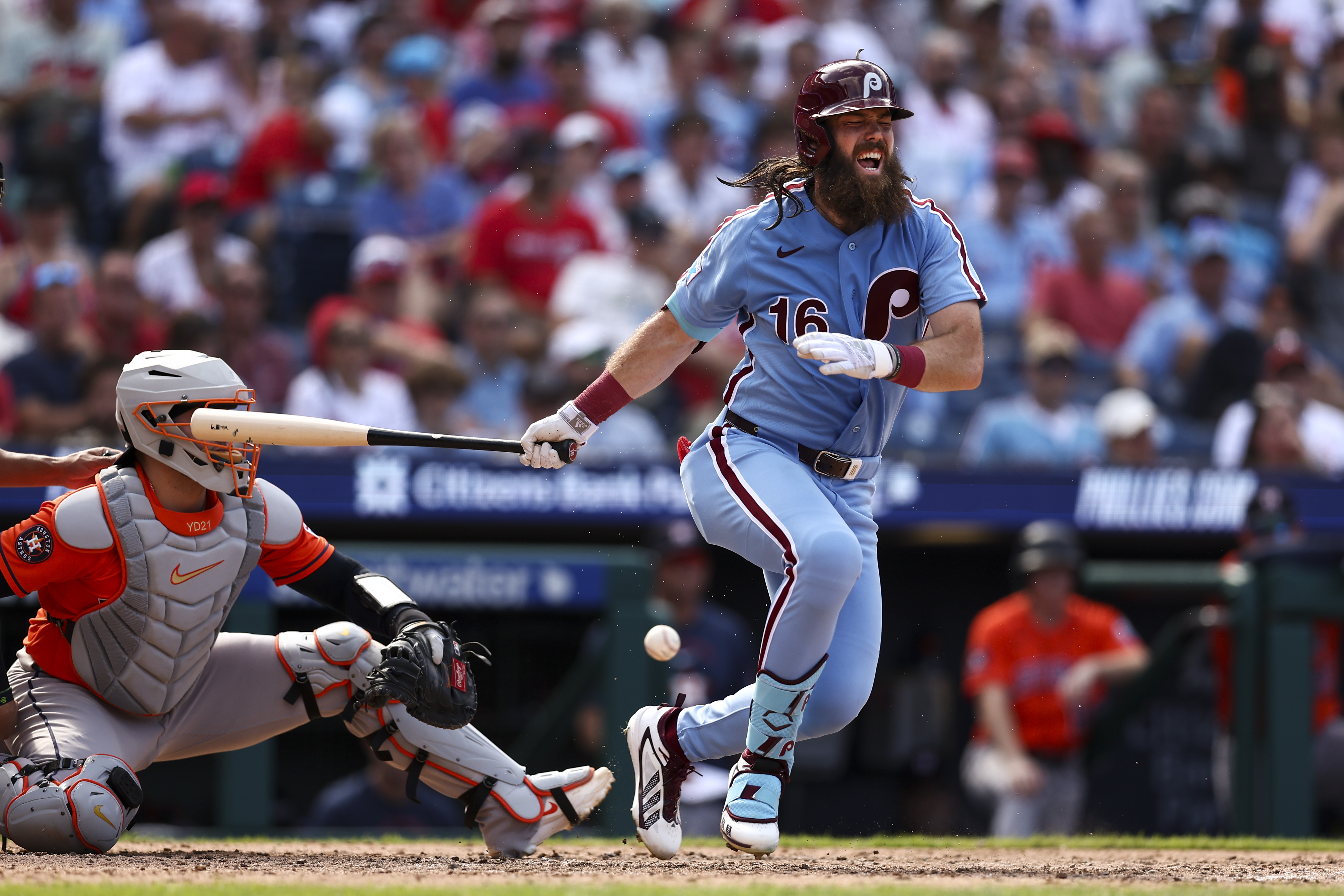
    So, Mattingly stuck with Wheeler, who slung a sweeper to escape the seventh inning Thursday, only to watch star closer Jhoan Duran give up a tiebreaking homer to the Astros’ Cam Smith in the ninth in a dud of a 2-1 loss to cap a homestand that felt, well, meh.

    “Playoff situation, you’re usually not letting your guys roll like that,” Mattingly said after pushing Wheeler to 110 pitches. “You’ve got to be more careful. But right now, I think he was the best guy for that situation today.”

    If Wheeler could’ve thrown 130 pitches, he would’ve been the best choice beyond the seventh inning, too, just as Cristopher Sánchez and Jesús Luzardo would when they start.

    Let’s get back to that. First, a check of the standings: The Phillies slid to four games behind the division-leading Braves before hopping on a flight to Atlanta for three games that would’ve felt so much more like a showdown if the deficit was only three games.

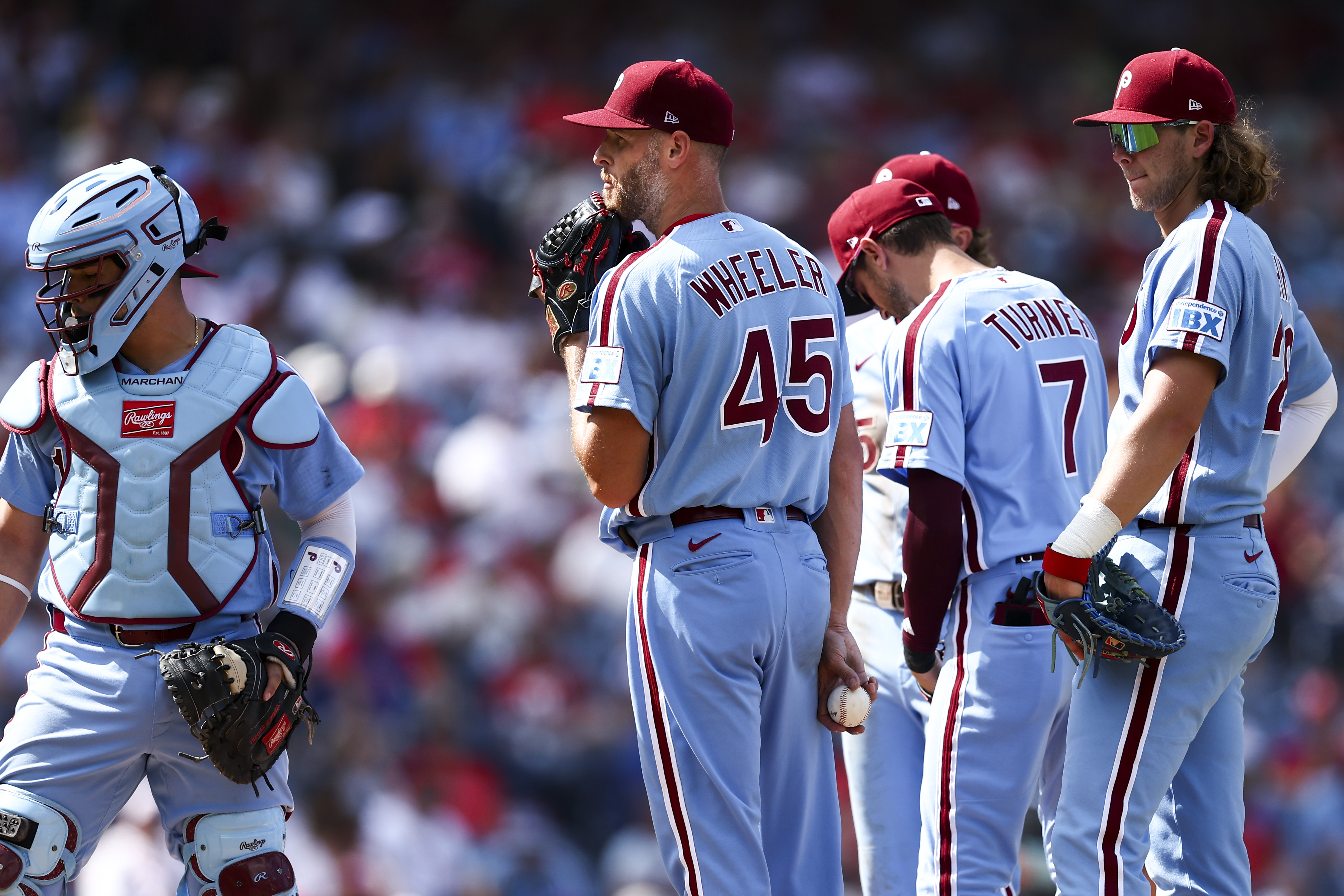
    Phillies starter Zack Wheeler (center) talks it over with teammates during the seventh inning Thursday.Monica Herndon / Staff Photographer

    Instead, the Braves could finish 7-8 and the Phillies would have to go 12-3 to overtake them.

    Not impossible, but also not likely, considering they alternated losses and wins during a 3-4 homestand and haven’t won consecutive games since a six-game roll from Aug. 26 to Sept. 1.

    But the Phillies still lead the Cubs by one game for the top National League wild card, which brings the benefit of playing the best-of-three first-round miniseries at home.

    “We want to play at home,” Bryce Harper said. “It’s a huge advantage in the postseason, just hearing it from other players coming into here and playing in this environment. We expect our crowds to be loud and crazy and obnoxious and talk the crap that they do to other players. I think it plays a huge part.”

    In that case, it would behoove the Phillies to play well over the next nine games in Atlanta, Washington, and New York.

    And it sure feels like they wasted an opportunity in the finale against the Astros.

    Despite not getting a hit through four innings against Astros righty Cristian Javier (remember him from the combined no-hitter in Game 5 of the 2022 World Series?), the Phillies tied it in the fifth on Luis Arraez’s leadoff single, Alec Bohm’s double, and a fielder’s choice.

    Wheeler recorded his third consecutive solid start after his roughest six-start stretch in seven seasons with the Phillies. But after striking out the side on 16 pitches in the sixth inning, he loaded the bases in the seventh on a leadoff bunt single and back-to-back two-out walks.

    Luis Arraez reacts on a single in the fifth inning of the Phillies’ 2-1 loss Thursday.Monica Herndon / Staff Photographer

    The Phillies got McFarlane loose. Did Mattingly consider going to him?

    “It’s hard to bring in a kid there, bases loaded,” Mattingly said. “[Wheeler] was throwing the ball good. He felt good. I thought it was his.”

    Said Wheeler: “He asked me before the inning if I was good, and I said, ‘Yeah.’ But it’s obviously up to him and his call. You’ve got to respect that. I was able to wiggle out of that, and I appreciate him letting me go out there and get that done.”

    Across the sport, managers tend to ask less of starting pitchers in the postseason. Maybe Mattingly’s approach with Wheeler foretells that the Phillies will actually ask Wheeler, Sánchez, and Luzardo — all among the top-10 pitchers in baseball — for more.

    “I think a few things probably play into it,” Wheeler said. “Maybe who’s coming up, how much the bullpen’s been used, all that stuff.”

    Also, who’s in that bullpen. The Phillies’ main bridge to Duran consists of Jonathan Bowlan (career postseason appearances: zero), erratic lefty José Alvarado, and rookie McFarlane, with Orion Kerkering attempting to get back on the upswing of his roller coaster history.

    Even Duran is showing cracks. He hung a splinker — his signature splitter/sinker hybrid — to Smith, who hit only the second homer against him all season. It came a few days after he gave up a hard-hit double and triple and gave up a go-ahead run in the ninth inning against the Braves.

    “I feel good,” said Duran, who likely will be asked to get more than three outs in his postseason appearances. “I feel much better than when I started the season. I feel really good right now.”

    In any case, Mattingly’s best bet may be to push the starters, at least until it’s time for Duran.

    Wheeler conceded that 110 pitches in September often feels different than it would in April.

    “Today it felt like that, just because it was hot and that last inning I worked a little bit more,” he said. “Some days are different than others.”

    There may be more days like this for the Phillies’ big three starters. Their ability to hold up could determine if the Phillies host a wild-card series — and, ultimately, how far beyond that they advance.

    “It’s big, you know?” Wheeler said. “There’s nothing like playing here in the playoffs. It’s probably the best atmosphere there is. To be able to host and play here, it’s important.”

  • Kelly N. Moore, award-winning clinical psychologist, Rutgers professor, and mental health activist, has died at 46

    Kelly N. Moore, award-winning clinical psychologist, Rutgers professor, and mental health activist, has died at 46

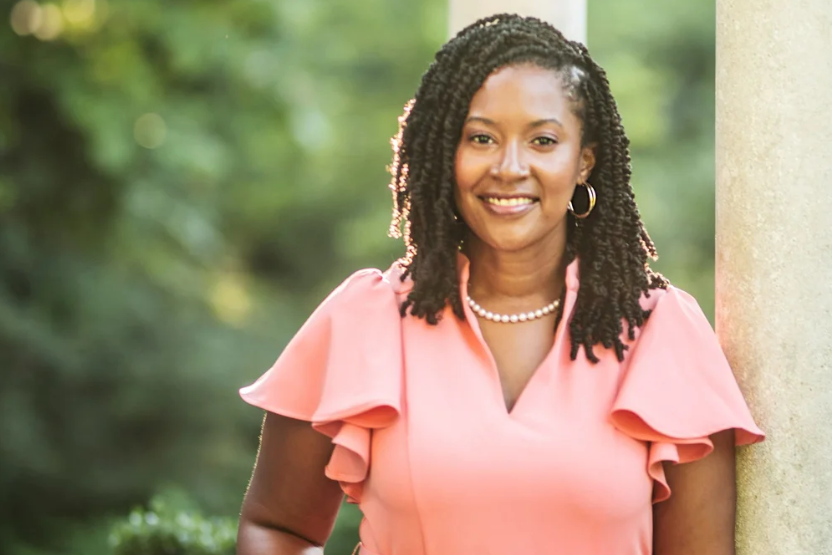
    Kelly N. Moore, 46, of Burlington Township, award-winning clinical psychologist, founder of Moore Wellness LLC, director of the Center for Psychological Services at Rutgers University, graduate school clinical associate professor, former fellow at the University of Pennsylvania’s Center for the Treatment and Study of Anxiety, mentor, author, mental health activist, volunteer, and 2026 Willingboro High School Hall of Fame inductee, died Thursday, Aug. 20, of kidney cancer at Virtua Voorhees Hospital.

    Adept at treating anxiety, depression, trauma, and perinatal disorders, Dr. Moore became director of the Rutgers Center for Psychological Services and a clinical associate professor in the Graduate School of Applied and Professional Psychology in 2020. As CPS director, she mentored hundreds of doctoral students regarding academic requirements and clinical procedures, and supervised the center’s community mental health clinic.

    She significantly expanded the center’s services and outreach, Rutgers colleagues said in a Facebook tribute, and forged important partnerships on campus and in the community. Colleagues said: “Her warm demeanor, melodic voice, vibrant spirit, and calming presence made all who met, and were fortunate enough to know her, feel seen, welcomed, and heard.”

    Earlier, Dr. Moore was program manager for the Rutgers Children’s Center for Resilience and Trauma Recovery. She also taught in the school’s juvenile justice and youth development programs.

    She spent two years as a fellow at Penn’s Center for the Treatment and Study of Anxiety after earning her doctorate in clinical psychology at Rutgers in 2011. During the COVID-19 pandemic, she founded Moore Wellness LLC and focused on helping women, children, and clients of color.

    “Wellness does not mean you will never experience challenges,” Dr. Moore said in an online profile for Psychology Today magazine. “Rather, it means having the tools to manage the challenges when faced with them.”

    Dr. Moore was an outspoken activist for mental health education and services. She spoke with groups often, organized workshops, and was featured in newspapers and magazines and on TV and podcasts. “Just trying to get people to understand as much as they can about the impact their mental health and well being have on their day-to-day lives,” she said in a 2026 podcast interview with the Multicultural Counseling Institute.

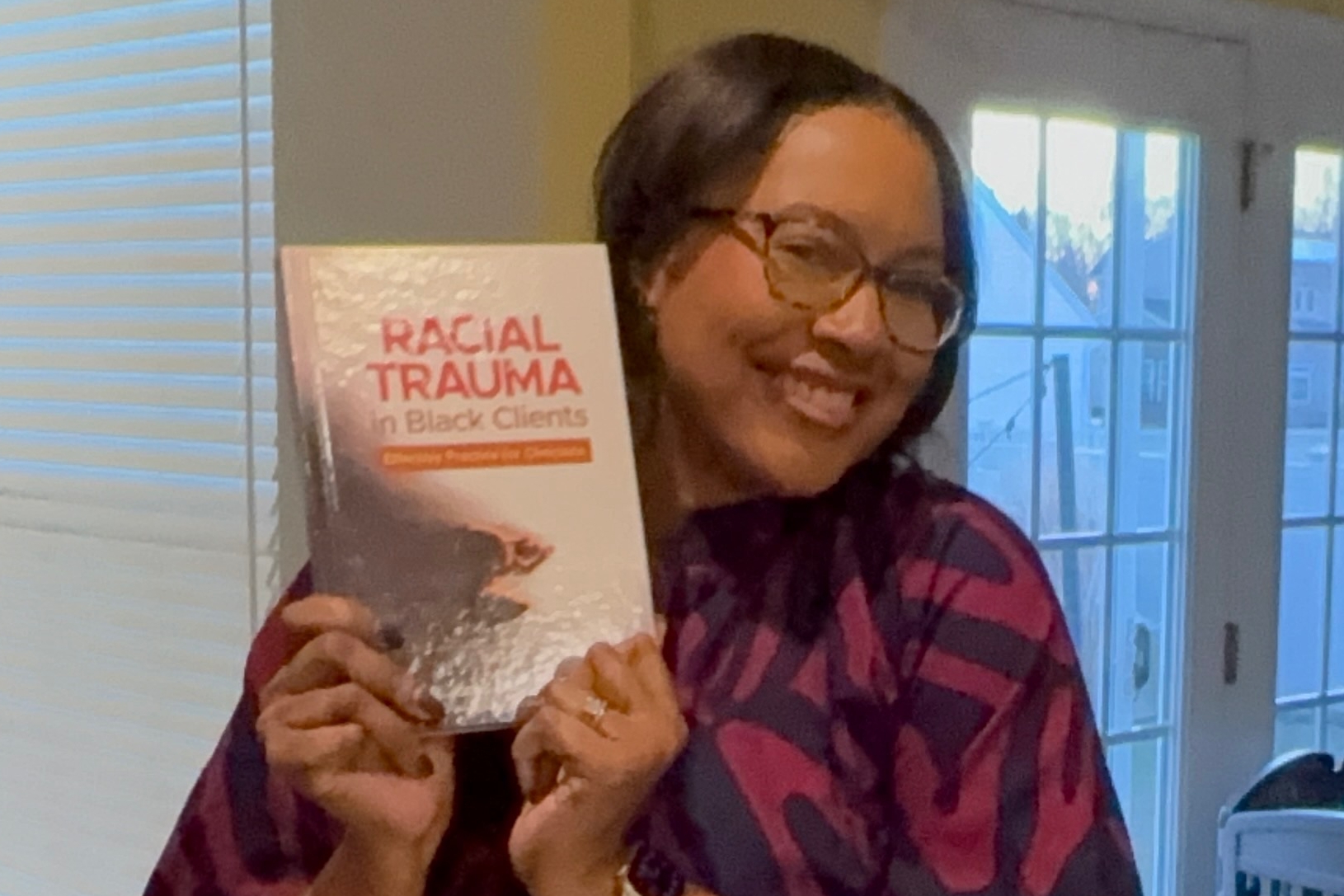
    She blogged about mental health on her website, moorewellnessllc.com, and contributed pages to academic texts. In 2025, she cowrote Racial Trauma in Black Clients: Effective Practice for Clinicians.

    She belonged to the American Psychological Association and the New Jersey chapter of the Association of Black Psychologists. She was active with the Therapy for Black Girls podcast and the Leadership Institute for Women in Psychology.

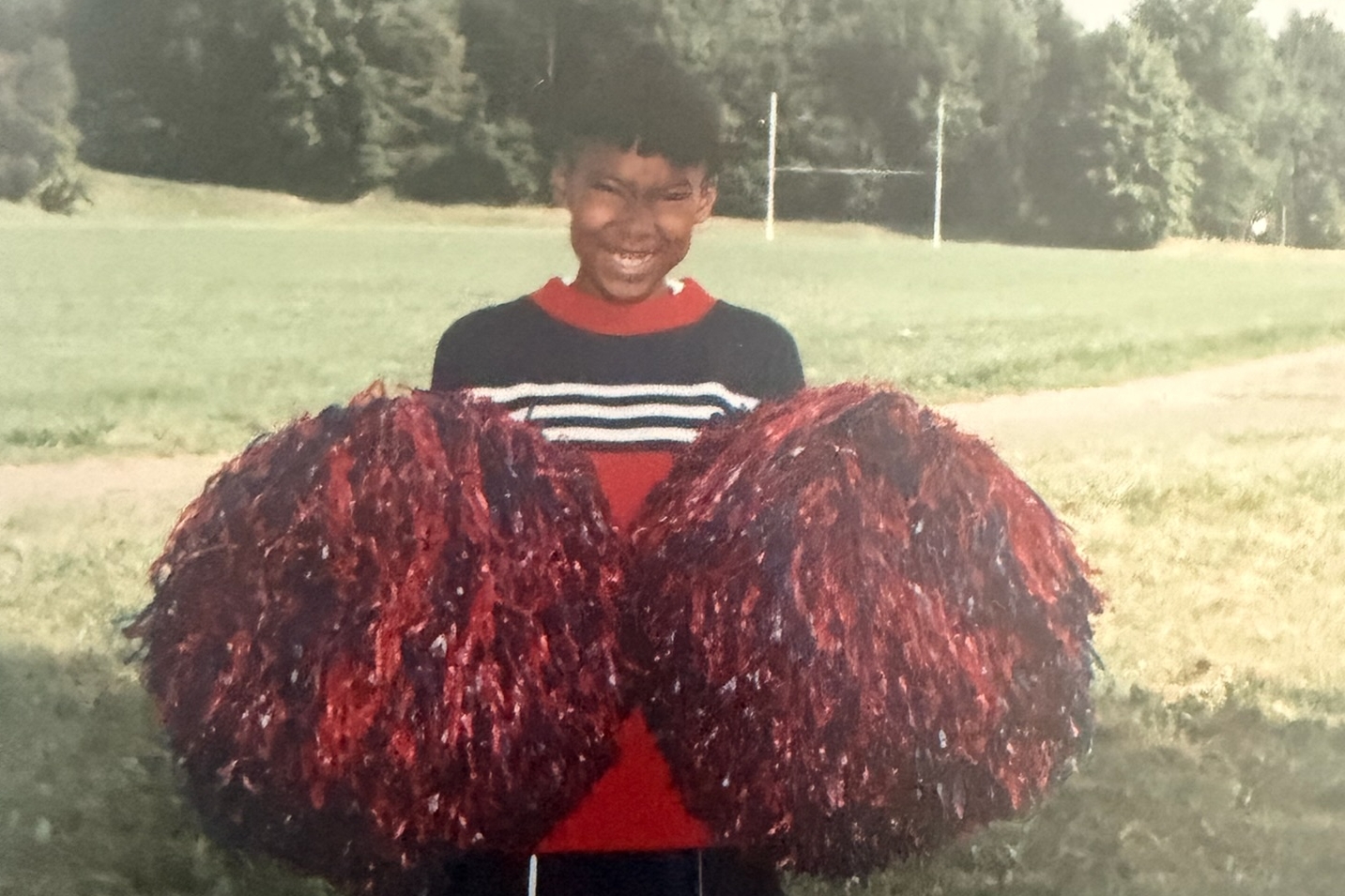
    Dr. Moore was a cheerleader and lacrosse player, and graduated from Cornell University in 2002.Courtesy of the family

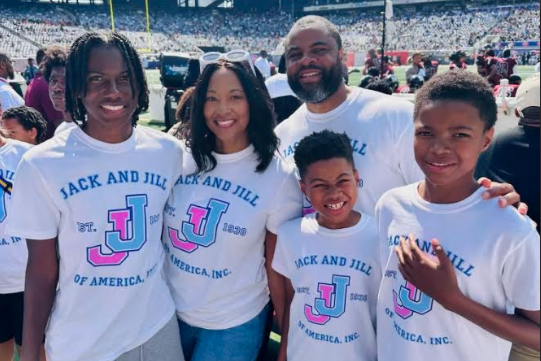
    She earned leadership and achievement awards from the New Jersey Psychological Association, the National Council of Schools and Programs of Professional Psychology, and other groups. She was president and a board member of the Burlington County chapter of Jack and Jill of America Inc. Colleagues there called her “a beautiful example of leadership, service, grace, and love.”

    Kelly Nicole Walker was born Aug. 20, 1980, in Philadelphia. Her family moved to Willingboro when she was 2, and she graduated from Willingboro High School in 1998.

    She was a cheerleader and played lacrosse and viola as a teenager. Her mother, Diana, was a social worker, and she showed Dr. Moore up close how one person could impact their community.

    “I was just fascinated by this concept,” Dr. Moore told the Multicultural Counseling Institute in the podcast interview. “It was already set at a young age that this was the kind of work I should be doing.”

    She earned a bachelor’s degree in human development at Cornell University in 2002 and a master’s degree in education at Penn in 2003.

    She met Melvin Moore through friends, and they married in 2004 and had sons Miles, Mason, and Matthew. They lived in Marlton and Delanco, and, since 2015, in Burlington Township.

    Dr. Moore was a longtime member and dance choreographer at the Gospel Tabernacle Church. She joined Alpha Kappa Alpha Sorority Inc. at Cornell in 2000 and was on the executive board of its Pi Mu Omega chapter in Willingboro.

    Friends noted her “warmth, generosity, and kindness,” and called her “genuine” and “quietly brilliant” in online tributes. One friend said: “She sure made me proud to be from Willingboro.”

    Dr. Moore and her husband, Melvin, married in 2004 and had three sons. Courtesy of the family

    Dr. Moore doted on her sons and called them her “M & M’s.” She was an avid reader and led several book clubs.

    She liked to garden, play piano, take photos, cook, and crochet. She was diagnosed with renal medullary carcinoma about a year ago and was determined, her husband said, to reach her 46th birthday. She did it.

    “She always led with purpose and intention,” her sister, Kim Hayes, said. “She was such an amazing person.”

    Dr. Moore’s husband said: “Kelly exemplified unmatched strength in how she lived, how she loved, and how she led. She loved helping other people.”

    In addition to her husband, sons, and sister, Dr. Moore is survived by her father, Michael, her brother, Ahmeen, and other relatives.

    A celebration of her life was held earlier.

    Donations in her name may be made to the Chris “CJ” Johnson Foundation, Box 292, Sugar Land, Texas 77487.

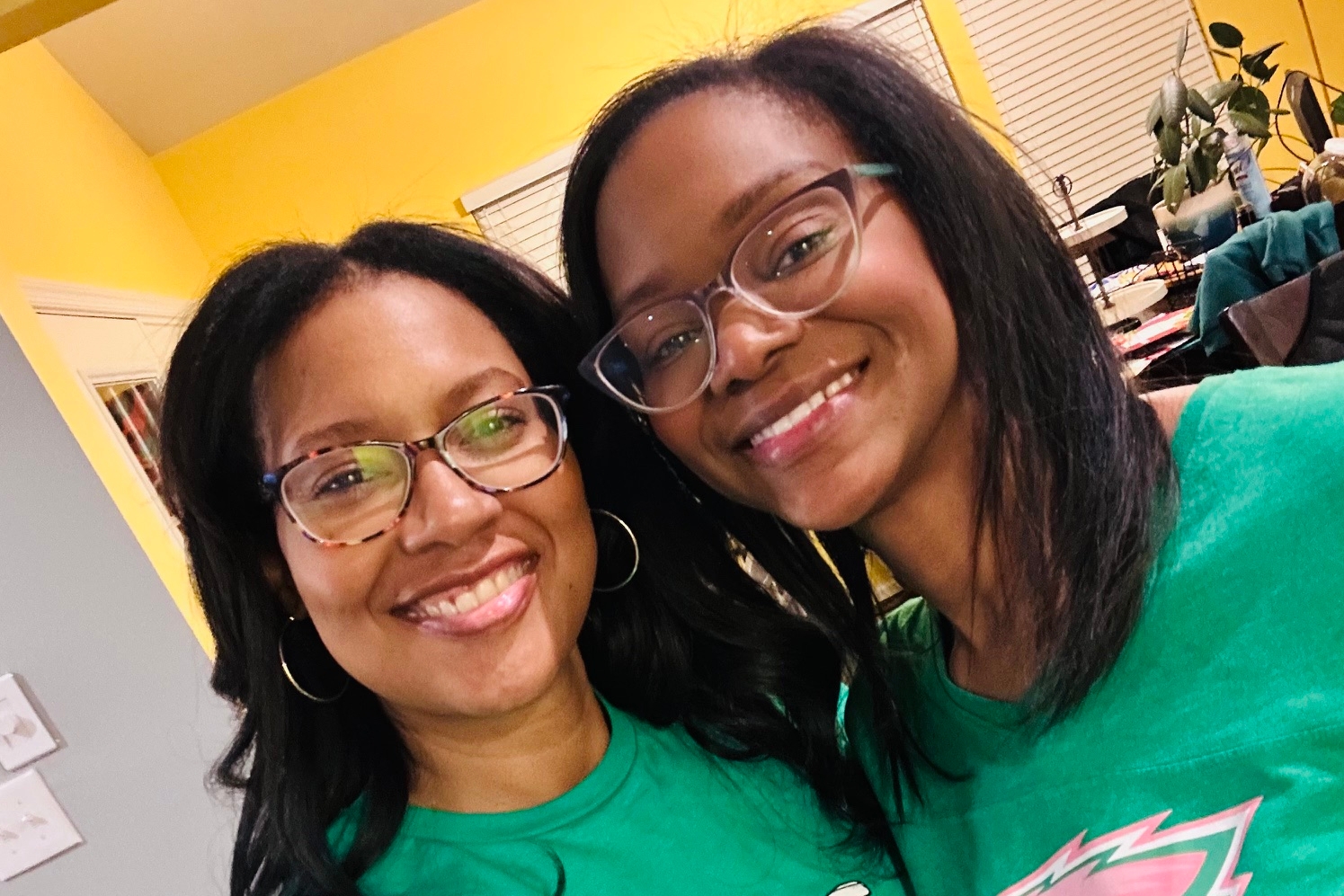
    Dr. Moore (left above) was close with her sister, Kim. Below, she celebrated when her book was published in 2025.Courtesy of the family
  • Healthy Moms, Healthy Babies America pledges $100M to cut U.S. maternal mortality rate in half

    Healthy Moms, Healthy Babies America pledges $100M to cut U.S. maternal mortality rate in half

    Healthy Moms, Healthy Babies America, a bipartisan campaign founded by philanthropists Olivia and Tom Walton, announced a $100 million pledge Thursday to make giving birth in the United States safer.

    The five-year commitment aims to cut the maternal mortality rate in the United States in half by 2031.

    “For millions of moms in America, maternal health is bad and getting worse,” Olivia Walton told The Associated Press in an interview. “There’s just so much bipartisan consensus around wanting to fix this. I really think the political will is there, and part of our job is to help surface that with an information campaign.”

    According to the most recent data available, the United States has one of the highest maternal mortality rates among wealthy nations. The Centers for Disease Control and Prevention said 688 people died in 2024 during pregnancy or shortly after giving birth. The maternal mortality rate rose to 19 deaths per 100,000 live births in 2024, up from 18.6 the year before.

    Improving data collection and accelerating hospitals’ reporting of deaths is an important pillar of the new Healthy Moms, Healthy Babies America initiative, Walton said. The most recent state-level data on maternal mortality is still from 2022, with annual totals based on provisional data available through 2024.

    “You can’t fix what you can’t measure,” she said, adding that the Waltons’ nonprofit Heartland Forward partnered with the U.S. Department of Health and Human Services in May to collect more data on maternal and infant health outcomes from 220 hospitals around the country called the Perinatal Improvement Collaborative.

    The U.S. maternal mortality issue is ‘eminently solvable’

    Healthy Moms, Healthy Babies America President Neel Shah said that, unlike many medical issues, maternal mortality is “eminently solvable.”

    “The biggest cause of suffering isn’t a lack of knowledge,” he said. “It’s a lack of execution on the knowledge. … This is a matter of will.”

    The initiative will focus on expanding access to maternal health in rural areas, training midwives and expanding postpartum care, and helping states use strategies that have proved successful, Shah said. He points out that California has managed to reduce its maternal mortality rate by half by combining strategies with investments. He said New Jersey, which previously ranked 47th among states in maternal mortality, has improved its outcomes by focusing on the cities where the needs are greatest.

    Walton said states are “in the driver’s seat” for making changes to maternal and infant healthcare, in part because about 40% of births are paid for by Medicaid.

    “I’ve got blue-state solutions of what works, red-state solutions of what works, and purple-state solutions of what works,” she said. “It’s really possible.”

    Using the $100 million initiative to generate more funding

    For that reason, Healthy Moms, Healthy Babies America plans to fund these care improvements by focusing on states. Walton plans to use the $100 million commitment as a way to encourage state governments to match the nonprofit’s investment. She hopes that corporations and other funders also contribute to the cause.

    “Taking on risk and going first is a great use of philanthropic capital,” she said. “The goal is to prove that this works and then have state funding take it over.”

    The focus on states, however, doesn’t mean the initiative won’t seek federal solutions as well.

    Healthy Moms, Healthy Babies America is supporting bipartisan Congressional legislation, including the Rural Obstetrics Readiness Act and the NIH IMPROVE Act, which would expand access to maternal care.

    “It’s unacceptable that in 2026 in the U.S., maternal mortality rates are moving in the wrong direction,” Republican Sen. Katie Britt, of Alabama, said in a statement. “It’s imperative we work together across both the public and private sectors to reverse this alarming trend.”

    Democratic Sen. Cory Booker, of New Jersey, said poor maternal health outcomes don’t just hurt families.

    “The economic consequences are equally alarming,” Booker said in a statement, estimating a cost of $165 billion each year.

    Walton said the issue is a personal one for her and her husband, Tom, grandson of Walmart founder Sam Walton, who live in Arkansas.

    “I’m a mom myself and I just had three kids in the last eight years,” she said. “I live in a state with the worst maternal mortality in the country.”

    However, she also believes the issue has broad, national implications.

    “I have an overarching belief that if you take care of mom, she’ll take care of everything else,” Walton said. “Healthy moms lead to healthy families. Healthy families lead to healthy communities. Healthy communities lead to a healthy economy.”

  • Kylie Kelce had three Eagles offensive linemen on her podcast to talk a new season, superstitions, and more

    Kylie Kelce had three Eagles offensive linemen on her podcast to talk a new season, superstitions, and more

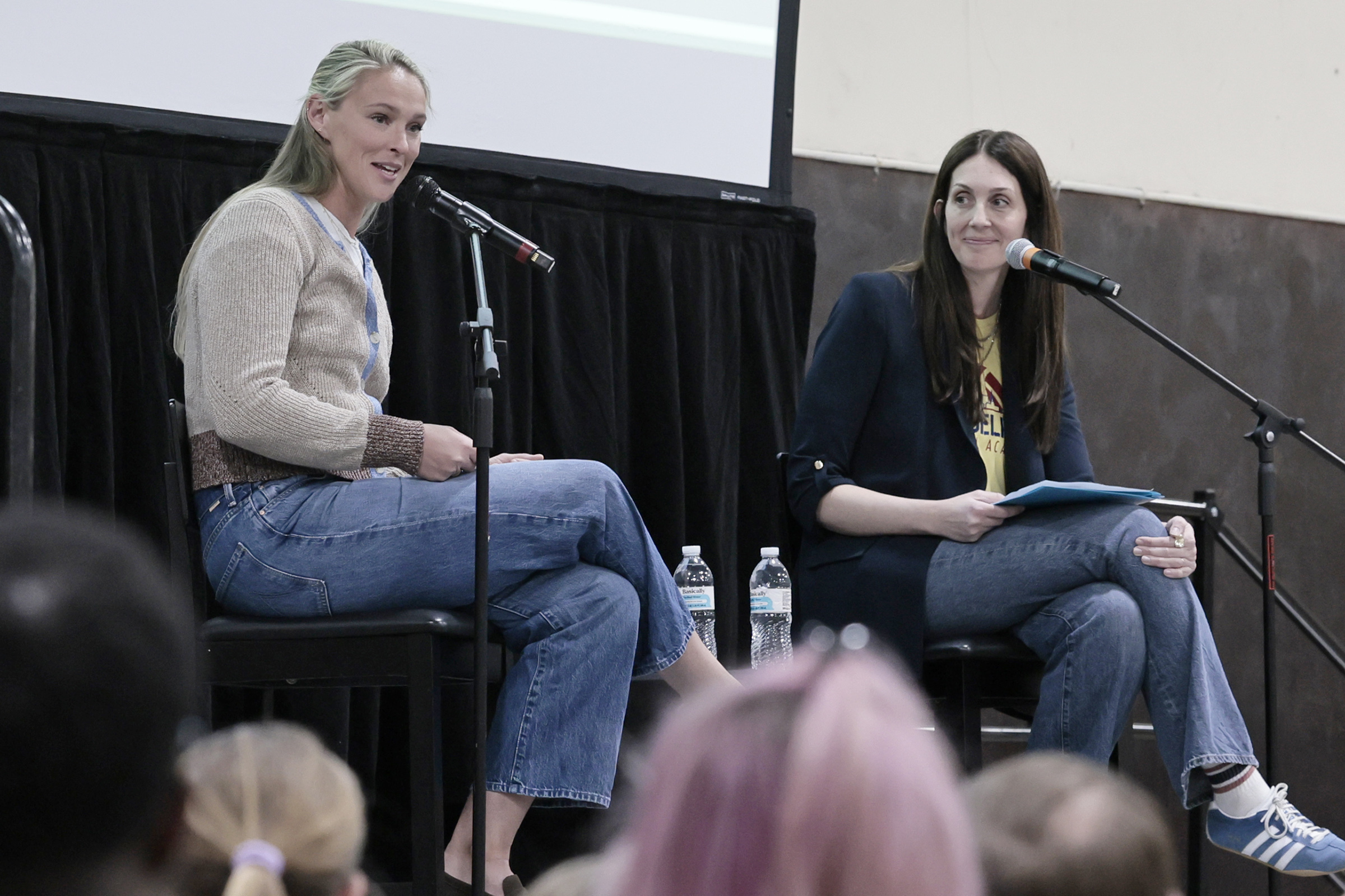
    In just a few days, Lincoln Financial Field will be filled with screaming fans. But on Thursday morning, Kylie Kelce brought some casual fun to the stadium with an on-site taping of her podcast, Not Gonna Lie.

    The episode featured Eagles offensive linemen Lane Johnson, Jordan Mailata, and Landon Dickerson — aka her husband, Jason’s, former teammates — as well as their wives, Kelsey, Niki, and Brooke. The roughly hourlong episode ran the gamut in topics from game day superstitions, first impressions, and Jason Kelce crash outs to a low-stakes version of The Newlywed Game. Mailata, Jason Kelce, and Johnson’s Philly Specials Christmas albums also came up, and Johnson said those “are on standby.”

    As the Kelces and Eagles prepare for Week 1, Kylie and the O-linemen shared some of their good-luck practices. Kylie even brought a wooden spoon to the field, just in case she needed to knock on wood to ward off any bad Eagles luck.

    “Game day rituals usually include a very specific T-shirt,” Kelce said. “It means whatever T-shirt I take out that has a new Eagle — which is not the old-school Eagle, that one has not worked out for me in the past. … I’ve tracked it.”

    And pro tip: She says not to tag her in social media posts or send her messages, especially pregame. On game days, “Life is not happening. The Eagles are happening, and that’s what we’re focused on,” she said. That’ll include Sunday, when she plans to be at the Linc for the season opener vs. the Washington Commanders.

    Some other rituals included eating the same meals before games, though Mailata now says he’s “tired of being a prisoner of superstition.”

    “I’d have the same pasta order for like seven years,” said Mailata, who was drafted in 2018 but is entering his seventh NFL season. “Even breakfast, the same breakfast. I wasn’t even hungry, but I’d force down eight eggs and four pancakes. Now, just four pancakes because I just prioritize the carbs.”

    Johnson was less devoted to his rituals, but he admitted that he sometimes looks away when a game isn’t going the Eagles’ way. Kelce has gone as far as rotating a full 180 degrees in her seat at the Linc rather than watching.

    Even as a veteran entering his 14th season, there’s still an element of unknown entering the season opener for Johnson.

    “The first game is always weird because nobody’s playing in preseason,” Johnson said. “Like, you have some things you see, but it’s really like you’re going to learn it in the first couple drives, series, what their cards are.”

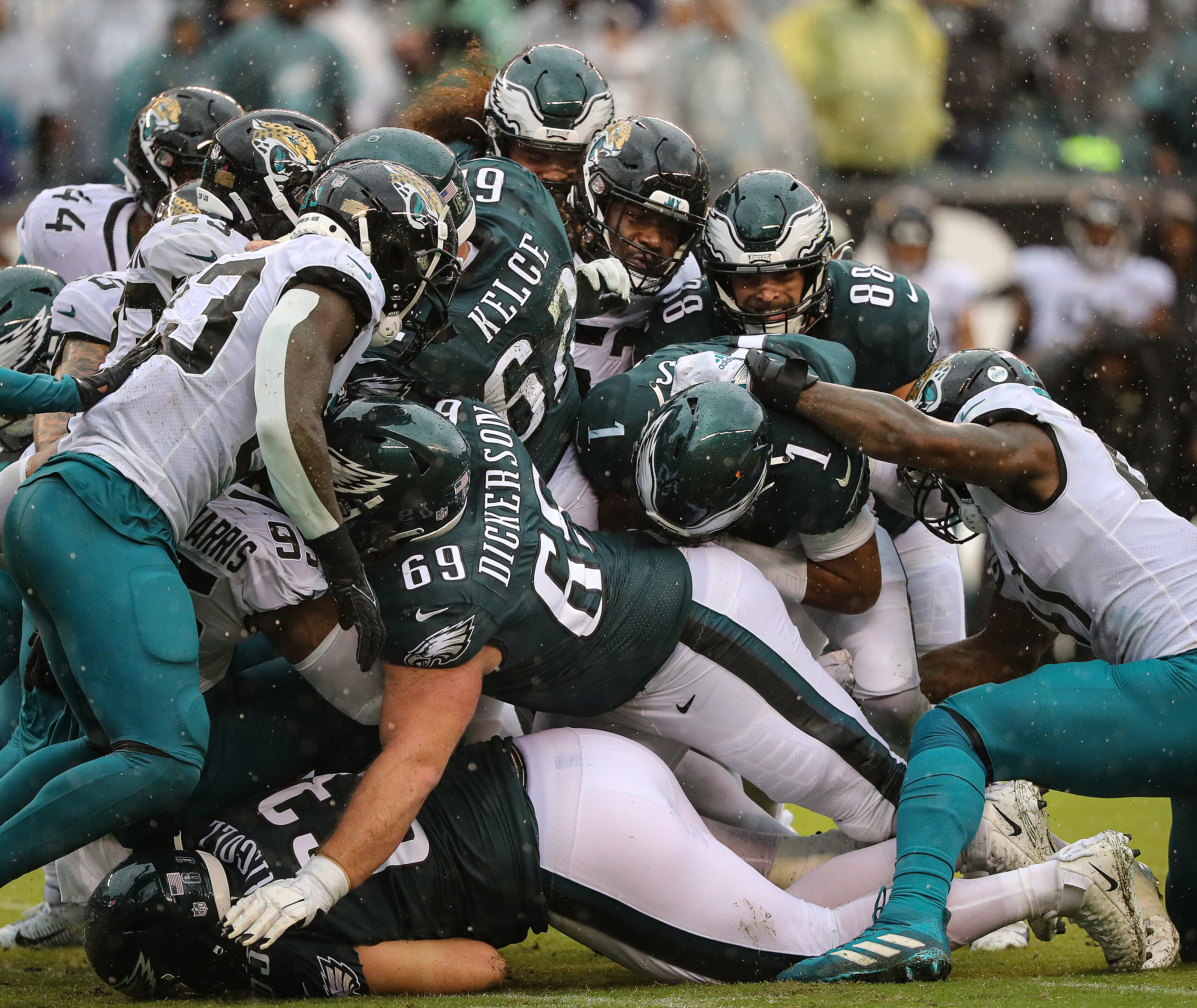
    Jason Kelce and his fellow offensive linemen help Jalen Hurts sneak for a first down.David Maialetti / Staff Photographer

    The players discussed their feelings about longstanding rivalries, like the Cowboys (and their thoughts on the “America’s Team” branding), as well as other contenders like the San Francisco 49ers, Kansas City Chiefs, and Los Angeles Rams.

    “My husband is on record saying that Aaron Donald is the guy he least looked forward to playing up against,” Kylie Kelce said, receiving a chorus of agreement about the Rams star.

    “Yeah, him and his teammate Myles [Garrett],” Johnson added.

    The wives appeared later in the episode and shared similar sentiments about their nerves watching the games and being immersed into NFL life.

    “When I think of my ‘welcome to the NFL’ moment,” Niki Ikahihifo-Bender Mailata said, “Jordan got injured early on, and I remember being like, ‘Oh my gosh, oh my gosh!’ And then they’re like, ‘No, it’s OK, it’s OK. It’s only bad if the cart comes out,’ and then the cart came out.”

  • Constituents are ‘livid’ with Fetterman after Trump convention video and other behavior, says Rep. Madeleine Dean

    Constituents are ‘livid’ with Fetterman after Trump convention video and other behavior, says Rep. Madeleine Dean

    DALLAS, Texas — Just steps away from a Republican midterm convention that she slammed as a “farce,” U.S. Rep. Madeleine Dean (D., Montgomery) said Thursday she was “gravely disappointed” with Democratic U.S. Sen. John Fetterman’s participation in the event — as well as a range of other issues that she said indicate his abandonment of democratic values.

    “What I wish he was doing was — back home in Pennsylvania — making sure, like I am, that Pennsylvania will see more Democratic members of the House to uphold the values that he originally ran on,” Dean said after Fetterman appeared in a video at the convention Wednesday night that praised President Donald Trump.

    Fetterman’s appearance was a remarkable and rare turn for a Democratic lawmaker, even one who has frequently crossed the aisle to support the opposing party like he’s done since Trump returned to office.

    In a video that served as an introduction to a speech by U.S. Sen. Dave McCormick (R., Pa.), Fetterman said he and McCormick are able to “work with President Trump to fight and defend the steel way of life” in Pennsylvania.

    As he’s done repeatedly, he also denounced socialism and what he considers the “anti-American way of life” that the leftist wing of his party represents. That message fit nicely into some of Republicans’ most prominent attacks on Wednesday as they tried to motivate their base to turn out for GOP candidates in the midterm elections — including in several Pennsylvania key races.

    On Thursday, a web page soliciting donations to Fetterman’s campaign committee included a link to the video and said Fetterman would “keep standing his ground, speaking his mind, and putting Pennsylvania first.”

    Fetterman said in a statement later that he made the video to support McCormick, who has become a staunch ally and one of his biggest defenders. He also said, as he has for months, that would not switch parties.

    “That’s entirely on John,” Dean said Thursday when asked by a reporter if Fetterman should remain in the Democratic Party. “I will tell you, from the ground, from suburban Philadelphia, my constituents are livid. Those who went out and knocked doors for him, they are absolutely livid.”

    Dean was in town on the second and final day of the convention alongside four other House Democrats who blasted what they were hearing from the gathering, which has largely been a celebration of Trump.

    But Dean was quickly asked by reporters about the convention’s most surprising turn so far — the appearance of Pennsylvania’s controversial Democratic senator.

    Dean has, historically, had a closer relationship with Fetterman compared to some of the other Democratic members of Pennsylvania’s U.S. House delegation. The pair briefly ran against each other in the 2018 lieutenant governor primary, which Fetterman won. Dean said it was then that she grew to “really like him and his family, and his values.”

    Those values, she said, have taken a turn in more ways than one. She criticized his convention video as a “stunt” while saying she was mostly disappointed by his work ethic, his decisions to back Trump policies, and his “blind support” of Israeli Prime Minister Benjamin Netanyahu’s attacks in Gaza.

    “All I want is for his good health, his well being. And that has been my worry,” Dean said in an interview after the press conference, referring to Fetterman’s well-documented health struggles.

    “But I think you have to look at his record, and his record of not working, of not participating, and not caucusing with Democrats, of not being active in his committees — alongside what he is active on, [which] is voting alongside Mr. Trump, and enabling this corruption of chaos,” she said.

    Dean is one of several Pennsylvania Democrats who have ramped up their public concerns about Fetterman, with some essentially promising to oust him if he runs for reelection in 2028.

    “He’s not going to be a senator after 2028 — mark my words,” U.S. Rep. Chris Deluzio, an Allegheny County Democrat who is a potential candidate for the seat, after the video.

    Dean did not comment on the next election other than saying “voters will have to decide whether that is appropriate” for Fetterman to conduct himself the way he has, including associating closely with Israeli leadership.

    Democratic Gov. Josh Shapiro, who has clashed with Fetterman but hasn’t heavily criticized his job performance as a senator, said Thursday he did not see the video. The governor said at an event in Chester he was “not going to get distracted” from his duties as governor and his reelection campaign.

  • U.S. airstrikes targeting Houthis killed scores of civilians in Yemen

    U.S. airstrikes targeting Houthis killed scores of civilians in Yemen

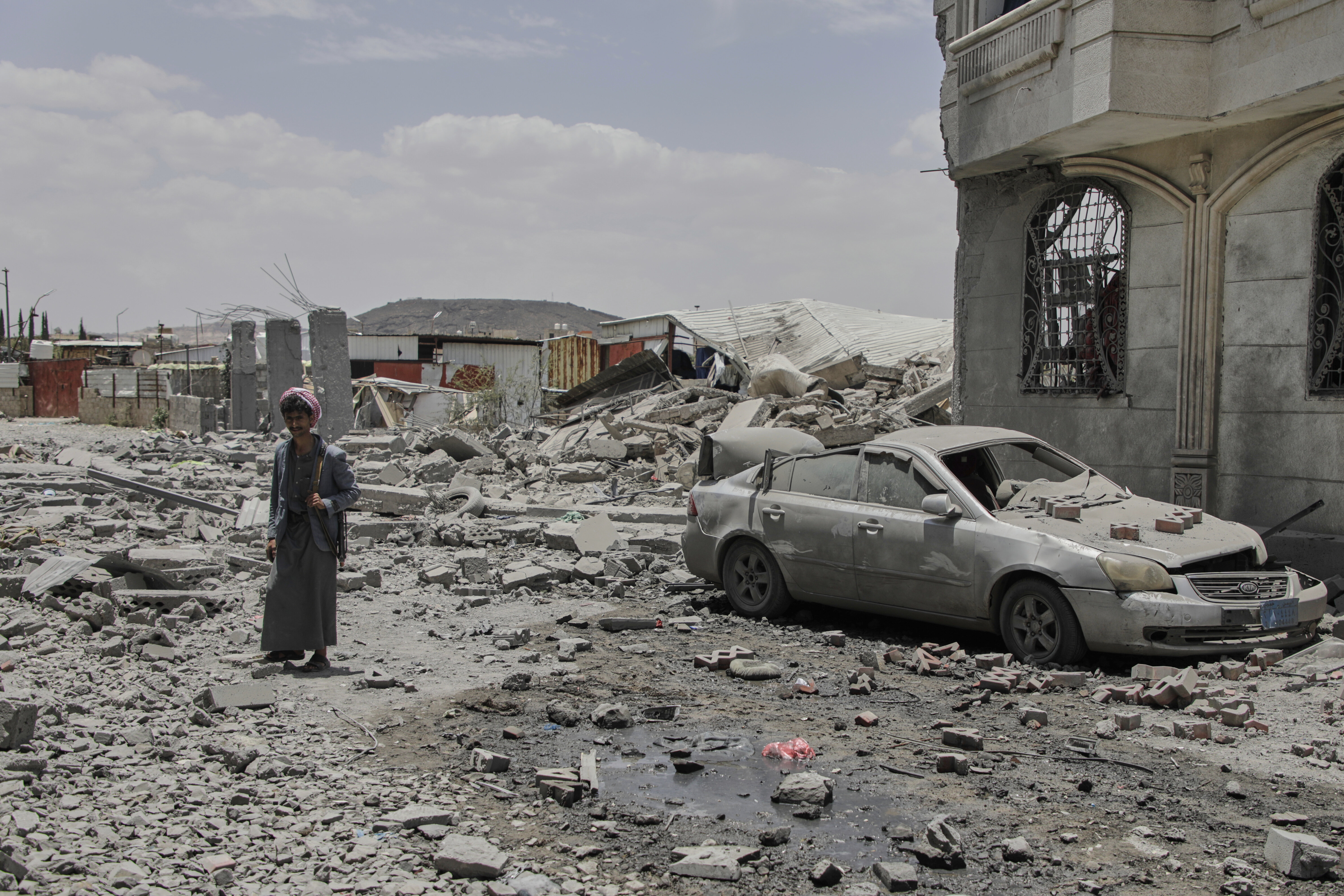
    WASHINGTON — U.S. airstrikes against Yemen’s Houthi militants from late 2023 to mid-2025 killed 213 civilians, according to a report released Thursday by the Costs of War Project at Brown University.

    Most of the casualties — 208 deaths and 341 wounded — occurred during President Donald Trump’s second term as his administration pursued the Iran-backed group.

    The Pentagon has not publicly acknowledged civilian deaths in the 2024 attacks but has reported that it killed 153 civilians and wounded 243 in Yemen in 2025.

    In October 2023, President Joe Biden ordered retaliatory airstrikes in Yemen after Houthi fighters attacked a Navy destroyer in the Red Sea, and again in January 2024 after Houthi missiles and drones targeted civilian vessels in the region.

    The latter series of strikes continued until just weeks before Biden left office.

    Trump ordered strikes on Houthi fighters in March 2025 in response to attacks on commercial shipping vessels in the Red Sea launched from Yemen.

    Beyond the loss of life, the report said hundreds of Yemenis lost farms, shops, factories, and small businesses in the attacks, leading to increased homelessness and worsening poverty among people who were already desperately poor.

    “There’s a myth that an airstrike is going to strike a military target and kill a militant and it’s over,” said Stephanie Savell, an anthropologist and director of the Costs of War Project. “But what this report highlights are the reverberating, indirect, human costs of war. The report looks precisely at civilian infrastructure that’s targeted, not military infrastructure or outposts.”

    Two U.S. attacks were particularly devastating, according to the researchers.

    On April 17, 2025, the researchers said, U.S. forces killed 80 civilians in an attack on a port facility in the Houthi-controlled province of Hodeida.

    Less than two weeks later, a U.S. attack on three warehouses used to detain African migrants killed 68 civilians.

    Most of the workers killed at the port were the main breadwinners for their families, who have since slid deeper into poverty and hunger, according to Savell.

    The Pentagon did not immediately respond to a request for comment.

    The Costs of War Project is a collective of scholars who research the consequences of U.S. wars launched after the terrorist attacks in the United States on Sept. 11, 2001. The project published the report with Mwatana for Human Rights, which did research inside Yemen and coproduced the report.

    Investigators collected evidence by conducting interviews, analyzing weapon remnants and collecting documents including death certificates.

    While the Pentagon has carried out many airstrikes in Yemen targeting al-Qaida fighters since the Sept. 11 attacks, the most recent U.S. strikes in the country have targeted the Houthis, who are part of the so-called Axis of Resistance led by Iran, along with the armed groups Hamas in the Gaza Strip and Hezbollah in Lebanon.

    According to the report, the Pentagon launched 930 airstrikes in Yemen from Dec. 18, 2023, to January 2025.

    Then in March 2025, Defense Secretary Pete Hegseth launched Operation Rough Rider against the Houthis. By the end of April, the cost of Hegseth’s campaign was more than $1 billion.

    Trump, frustrated with the lack of progress, halted the operation on May 5.

    Brian Finucane, a former State Department attorney who advised on the law of war, said, “There are more significant civilian casualty incidents over the Rough Rider campaign than all the previous attacks during the Biden administration.”

    He added that the Trump administration “launched two to three times the number of strikes Biden did.”

    “Trump was also willing to bomb targets in more densely populated areas than Biden was,” he said. “Additionally, the migrant detention facility that was bombed in April 2025 had routinely been visited by officials from the Red Cross and should have been understood by Central Command as off-limits for attack.”

    A Defense Department report on military operations for 2025 acknowledged the civilian death toll from the attacks on the port and the migrant detention facility, along with a strike in Sanaa, the capital, on April 6 that killed five civilians and wounded 25.

    Condolence payments to survivors and the families of those who were killed, the report noted, were “determined to not be appropriate” in all three cases.

    Just days after Hegseth took office in January 2025, the Army announced that it planned to close an office dedicated to reducing and mitigating civilian harm during combat operations. The office was reduced in March of that year from roughly 200 people to 11. At the time, Hegseth’s office declined to answer questions about the reductions.

  • How ‘hypermilers’ are trying to beat high gas prices

    How ‘hypermilers’ are trying to beat high gas prices

    When a traffic light turns green, Dan Kroushl is unlikely to be the first driver out of the gate. He won’t floor the gas pedal, and he never drives over the speed limit.

    Instead, he eases forward by lightly pressing the accelerator, and the moment he sees a yellow light, he gently taps the brakes.

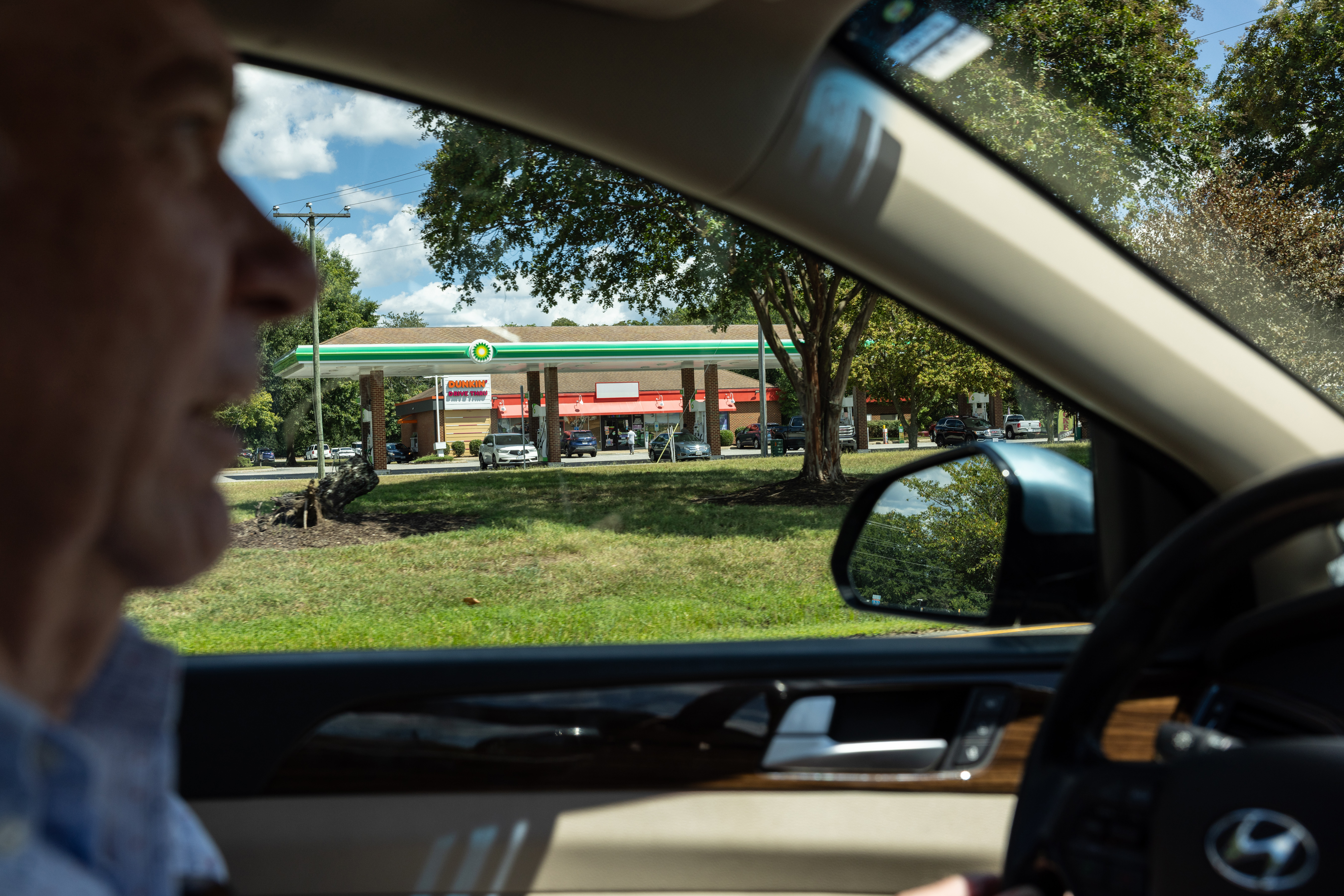
    These techniques and others make Kroushl, 61, a so-called hypermiler, a driver who squeezes as many miles as possible out of each gallon of gas. And after a summer of soaring gas prices driven by the war in Iran, hypermilers like Kroushl say their strategies can help drivers who are feeling pinched at the pump make the most of every gallon.

    “People think when they are pumping gas: I can’t do anything about it,” Bradlee Fons, 74, a fellow hypermiler, said of the increased gas prices. “I tell them, ‘You’re in total control.’ People can control their fuel costs.”

    Bradlee Fons, 74, a self-proclaimed hypermiler, stands next to his 2017 Toyota Prius parked near a gas station in Jackson, Wis., on Sept. 6.Sara Stathas

    Hypermilers mostly aim to maximize fuel efficiency by driving smoothly, without hard stops or starts. But sometimes they employ more extreme measures, like not using air-conditioning or removing a vehicle’s interior door panels to reduce its weight.

    It’s both a lifestyle choice and a way to reduce greenhouse gas emissions, the hypermilers say, but they think some of their strategies could be useful to regular, everyday drivers looking to save on fill-ups.

    Gas prices have risen sharply since the United States and Israel attacked Iran on Feb. 28, freezing the flow of energy from the Persian Gulf. As fighting in Iran intensified last week, diesel fuel prices hit a record high in the United States, with gas prices up nearly 34%, according to AAA.

    As of Thursday, regular gas costs an average of $4.27 per gallon, though prices vary in different states. The average in Pennsylvania was $4.45 a gallon for regular gas and $4.36 in New Jersey, according to AAA.

    With a few tweaks, Fons said, drivers can easily save 30% or more on their gas bill.

    “Drivers do not have to be at the mercy of the government, the high gas prices or anything else,” he said. “They have options.”

    The 2017 Toyota Prius that Fons drives in his home in Jackson, Wis., just north of Milwaukee, is estimated to achieve 52 mpg, according to its official EPA rating. But, Fons said, he gets 83.2 mpg by driving with fuel economy in mind.

    Fons, who started a nonprofit organization called Drive Smart Wisconsin, keeps a list of simple techniques that he said any driver can use to save money on gas. At the top of the list is “nonaggressive driving,” which he defined as moving smoothly and purposefully. Other strategies include completing multiple errands in one trip so the car does not use extra fuel to warm up, and keeping up with vehicle maintenance.

    Most cars are at peak fuel efficiency between 45 and 65 mph. Hypermilers recommend staying in that range and not going over the speed limit on the highway. Driving faster causes the vehicle’s drag to increase, reducing fuel mileage at an exponential rate.

    Hypermilers also avoid unnecessary braking, which eats up fuel, and they accelerate slowly when starting from a complete stop. They anticipate slowdowns ahead.

    “You work the gas so you’re barely holding the speed you want to hold,” explained Bruce Gregersen, 79, a hypermiler who lives in St. Cloud, Minn. “It takes a little more concentration, but once you get used to it, you’ll do it automatically.”

    Hybrid cars, which combine a traditional gasoline-powered engine with one or more electric motors and a battery pack, offer greater fuel efficiency and are the vehicle of choice for many hypermilers.

    Bob Winger, 71, of Williamsburg, Va., is part of a group of hypermile enthusiasts who have set multiple world records for fuel efficiency, including one for the lowest consumption of fuel in a non-hybrid vehicle driving through all 48 contiguous states. Winger said they had set that record by using techniques such as “ridge riding,” in which the passenger-side wheel moves along the white paint stripe on a highway because the friction is lower there than on the asphalt.

    Such extremes are not necessary unless one is trying to set a world record, Winger said. Instead, he said, drivers can achieve greater mileage by doing simple things like making sure their tires are properly inflated, which helps decrease resistance. Using full synthetic oil reduces friction within the engine, he added.

    “You don’t have to do crazy stuff,” he said. “Just driving conservatively, you can save without really pulling out all the tools in the toolbox.”

    This article originally appeared in The New York Times.