In one form or another, eyeglasses have existed for centuries.
Ancient Roman scholars and medieval monks used blown glass to magnify manuscripts. Paintings from the 17th and 18th centuries depict well-to-do folks sporting eyeglasses, including Benjamin Franklin, who invented bifocals. Leonardo da Vinci conceptualized contact lenses as early as 1508.
Glasses and contacts have come a long way since. The 75% of American adults who need some sort of corrective eyewear can choose between comfortable contacts and thousands of fashionable frames.
Still, shopping for new specs and contacts can be a hassle.
Nonprofit Delaware Valley Consumers’ Checkbook’s surveys of local consumers reveal sizable differences in customer satisfaction. In general, chains and franchise operations were rated lower than independent firms, but there was variation among each outlet type.
You’ll want to shop around for price. Checkbook’s undercover shoppers collected prices for 18 models of eyeglasses (with single-correction lenses) and found that some outlets charge twice as much as others. For example, for a pair of Ray-Ban RX5286 eyeglass frames with lenses, prices at surveyed stores ranged from $166 to $487. For eyeglasses, the least expensive sellers were usually online.
Not all eyeglass retailers sell the same products, so it’s difficult to compare prices among some of the largest chains for the exact same frames. Comparing costs is further complicated by the dominance of EssilorLuxottica, which not only manufactures millions of pairs of glasses from dozens of brands annually, but runs thousands of retail stores where it markets and sells eyewear, including For Eyes, LensCrafters, Pearle Vision, Sunglass Hut, and the optical department at Target.
For the limited selection of specs they carry, Checkbook’s shoppers found Costco, Walmart, and Warby Parker offer low prices, and Costco and Warby Parker also get fairly high ratings from their surveyed customers.
Checkbook researchers also collected prices for six brands and models of contact lenses and found even larger store-to-store differences. For example, prices for a one-year supply of Biotrue ONEday daily disposable contact lenses (plus exam and fitting), ranged from $460 to $1,150. Among brick-and-mortar outlets, BJ’s, Costco, For Eyes, and Walmart had the lowest prices for contacts.
We found the lowest contact prices online, but some internet sellers were more expensive than the lowest-priced local brick-and-mortars. If you’re replenishing a year’s supply and not changing brands or type, there’s little reason not to grab the savings by buying from a low-cost supplier.
If you are buying glasses, choosing the type of frame is a major decision. Consider comfort, positioning, durability, appearance, and price.
Eyeglasses on display at Warby Parker in Philadelphia.
How they feel
Check for comfort at the bridge of the nose and ears, where glasses touch your face. The lightest glasses are usually the most comfortable. Look for thin plastic or metal frames.
With metal frames, know that they have a nosepiece of rocking pads (small adjustable plastic pads) that are unlikely to slip and can be easily adjusted — an advantage over plastic frames, which usually have a rigid nose support. But rocking pads concentrate the weight on a small surface, which is uncomfortable to some people.
How they are positioned
Eyeglass frames are designed to position lenses to provide maximum visual acuity. Some frames may position lenses too far from your eyes, or too high or too low. If the frames slide down your nose, you won’t get the full benefit. The stronger your prescription, the more critical the positioning.
If you wear your glasses for driving, sports, or other activities requiring peripheral vision, make sure the “temples” (the two side parts of a frame that extend behind the ears) are located above or below the eyes, not directly alongside them.
How long they will last
Barring accidents, glasses should last three or four years, and many wearers want to change styles at least that often. If you plan to keep the frames longer — or the frames get knocked around a lot — strength and durability are important. Both depend on the frame materials, thickness, and craftsmanship.
The strongest metal frames are usually made of titanium, with flexible hinges and smooth welding wherever two pieces of metal are joined. The strongest plastic frames are made of nylon, but these tend to be thick, heavy, and plain. Among other plastic types, the strongest usually have at least moderate thickness, metal reinforcing within the full length of the temple, and flexible hinges.
How they look
Whether you buy specs in person or online, you’ll need to try them on to ensure they suit the shape of your eyebrows and cheekbones, spacing of your eyes, height of your nose bridge, and size of your head.
The best approach? Try on multiple frames and choose what you like. Then look at prices, and if your favorite costs too much, ask a staffer to show you a similar-looking cheaper frame.
How much they cost
Frame prices vary tremendously. Prices for decent-quality frames range from less than $40 to more than $1,000.
Shopping around is key to getting a good deal.
Delaware Valley Consumers’ Checkbook magazine and Checkbook.org is a nonprofit organization with a mission to help consumers get the best service and lowest prices. It is supported by consumers and takes no money from the service providers it evaluates.
Marqui Adams grinned ear-to-ear as he stood near the 40-yard line of Lincoln Financial Field on Saturday evening, and was told by a passing Delaware State teammate that he was “the best QB in the MEAC.”
He was recounting the steps behind Delaware State’s dramatic 36-33 comeback victory, down 17 points in both the first and second halves. The Delaware State quarterback and Neumann-Goretti graduate was benched earlier in the game after being sacked twice and with the offense stuck in neutral.
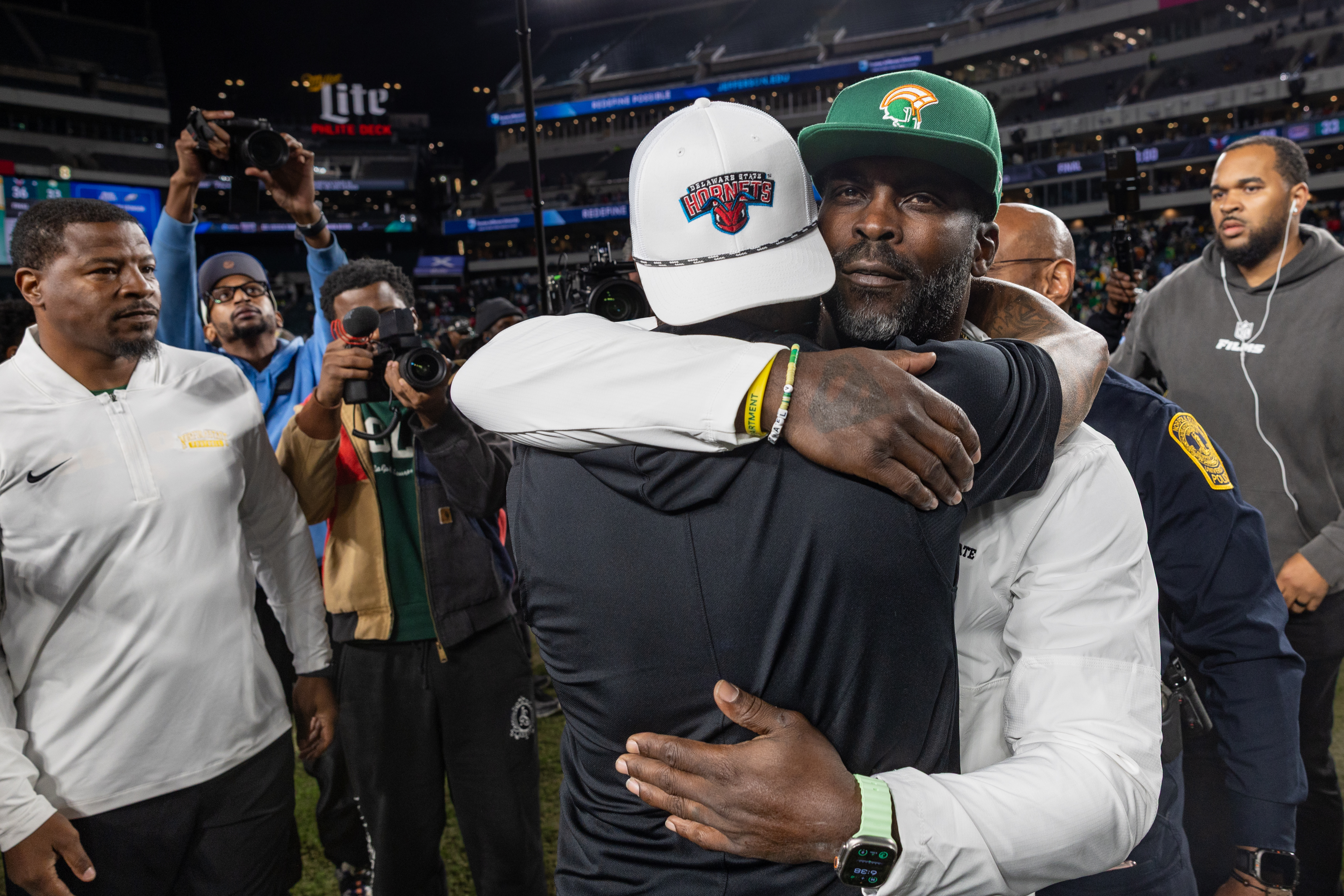
His head coach, DeSean Jackson, said he gave the fifth-year quarterback — who was once a starter in 2023 and 2024 and tore his ACL last season — a pep talk. It worked, as Jackson’s Delaware State once again took down Norfolk State, coached by Jackson’s former Eagles teammate, and friend, Michael Vick, with a game-winning kick as time expired in the second annual HBCU Classic.
“It just felt like a blessing to come back to my home city,” Adams told The Inquirer as Delaware State’s band played its sweet victory music. “I had to put on for my city. … It just really felt like a dream come true. [I] had to go out there and ball.”
Vick and Jackson, beloved Eagles players now in their second seasons at the helm of their respective schools, treated the 32,567 fans in attendance to another quality game at the Linc. Last year’s 27-20 Delaware State win featured two teams going in opposite directions, with Delaware State finishing with an 8-4 record and Norfolk State at 1-11.
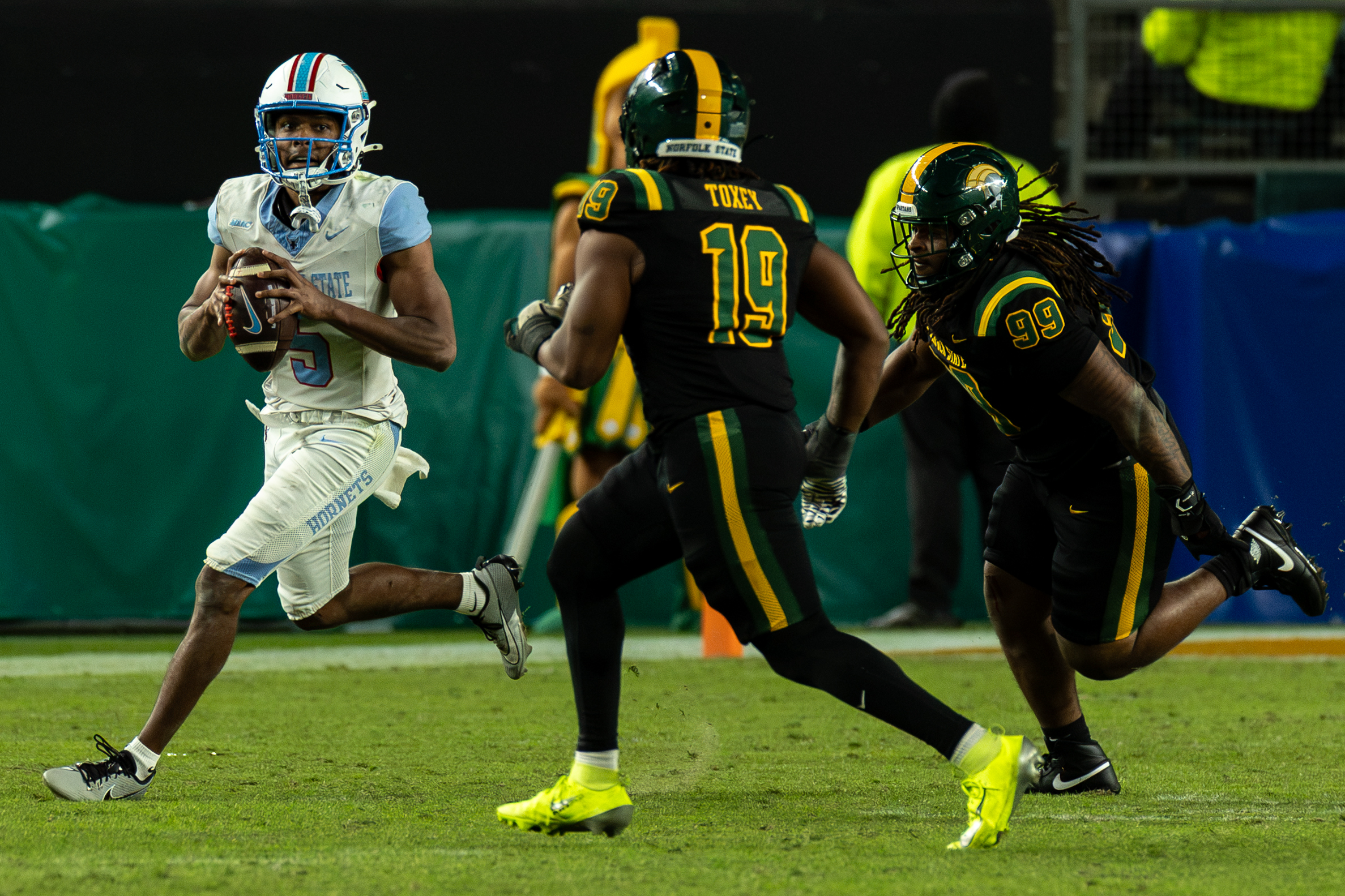
Delaware State quarterback Marqui Adams (center) looks to throw downfield during Saturday’s HBCU Classic game against Norfolk State.Aidan T. Gallo / Staff Photographer
This year, the stakes were higher, with both teams entering the game at 4-4 overall and 0-1 in Mid-Eastern Athletic Conference play. The festivities surrounding One Philly HBCU Week added to the excitement, bringing step shows, a battle of the bands, career fairs, and two football games to the Linc.
One of those games featured Mayor Cherelle L. Parker’s alma mater, Lincoln University, where she graduated in 1994. Lincoln fell to Virginia Union, 62-0.
Saturday’s game was more than keeping each team’s Mid-Eastern Athletic Conference championship hopes alive.
“I just got a disclaimer. This stadium is now called the Delaware State Eagles,” quipped Jackson, who is now 2-0 against Vick. “A challenge that I put on my team [was] if we lose any more games going forward, we can chalk it up for the rest of the season with our chances for MEAC championship play. We’ve got a lot of Philly guys on this team, man. You know the heart and soul of my career and what I meant and what Philadelphia has meant to me. So it’s just opportunity and to play in front of Philadelphia fans.”
Michael Vick and DeSean Jackson embrace after Delaware State’s dramatic walk-off win to comeback from down 17 twice. pic.twitter.com/YcnxgjPKN1
Of the Philly kids on Delaware State, Adams shined brightest. He completed 17 of 23 passes for 243 yards and four touchdowns, with his final TD tying the game, 33-33, midway through the fourth quarter. He stepped up through the right side of a collapsing pocket and flipped the ball to Kyree Benton for a 20-yard score.
Adams was far down the depth chart to open the season and became the fifth quarterback to play this year. His play in the final 33 minutes may make him a mainstay for Delaware State’s quarterback room.
Marqui Adams magic! Delaware State comes back from down 17 to tie the game at 33-33 with 7:47 left in the fourth quarter. pic.twitter.com/2cOrpK0t3h
“Since I’ve been here, it’s been hard times for [Adams],” Jackson said. “We missed him all last year, and just [him] fighting to get back, I felt lately [he’s] been doing a good job of getting back to his normal. … If it wasn’t [for] him [Saturday night], we wouldn’t win this game. And obviously, the team effort, everybody on the team did a great job. But his play at quarterback, man, kept us in the game, and obviously came back and won the game for us.”
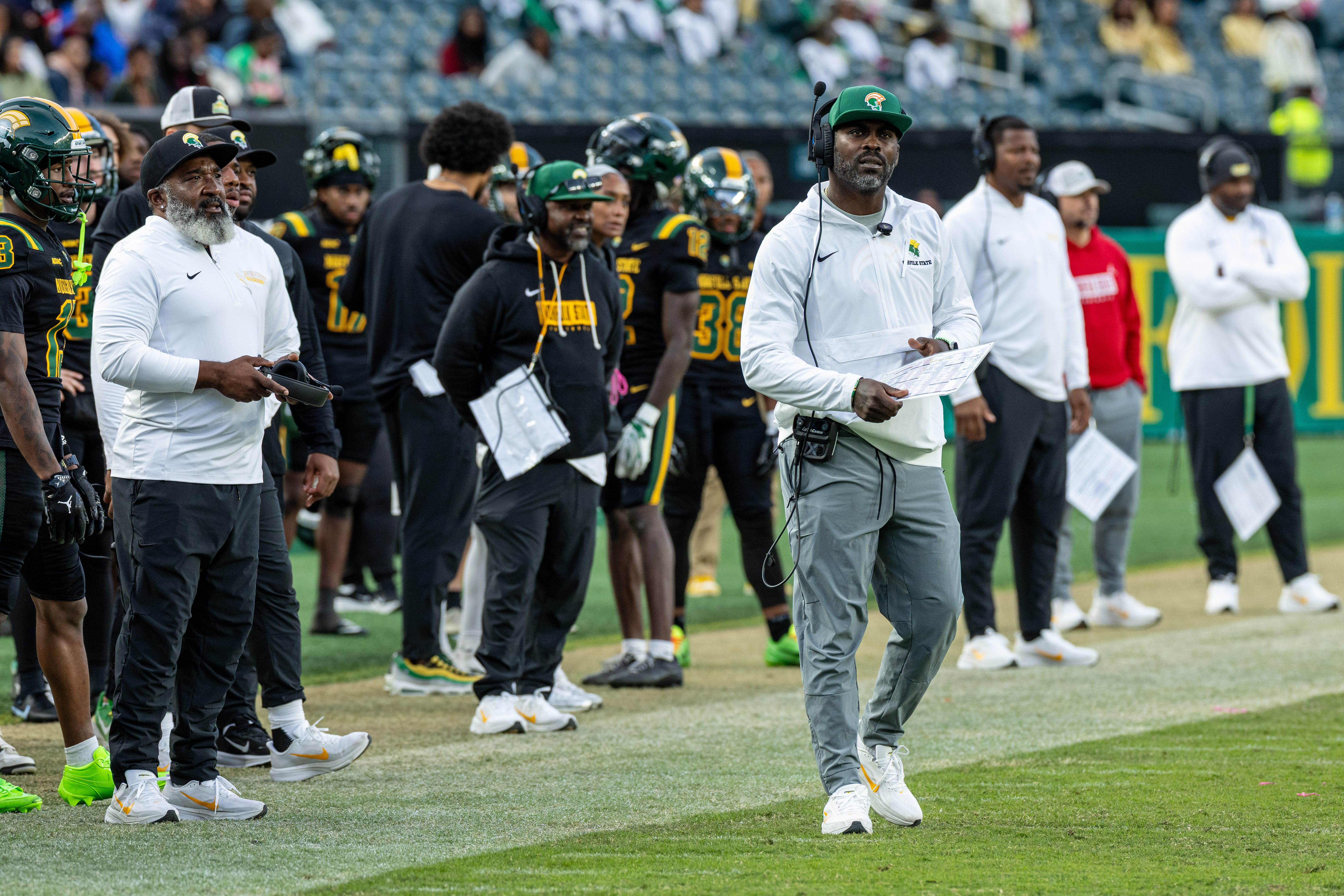
Former Eagles quarterback and Norfolk State coach Michael Vick at the HBCU Classic at the Lincoln Financial Field on Saturday.Aidan T. Gallo / Staff Photographer
The mood was much different for Vick as he sat down in a familiar press conference room to take questions after the loss.
Just 366 days ago, Vick spoke of looking “forward to better days” after dropping his eighth game in nine tries. It appears those better days have arrived a year later, despite the loss.
The disappointment still stings, he says, but the program is “in a better place.”
“I do think it’s a lot of room to build, going through last year,” Vick said. “This year, getting a chance to really observe where we [are] at, who’s in position, where we can get better, what areas where can I get better. … It’s part of the decision-making, and I have to be accountable for. And it’s the fun part of it, you know. But [we have] three critical games left. I will say it’s very important, I think, that we finish strong.”
Lost in the excitement was the return of former Eagles offensive tackle Tra Thomas to the Linc, this time on the sidelines as a coach.
Thomas, who spent 11 seasons with the Eagles, joined Jackson’s staff earlier this year as an assistant offensive line coach. He exchanged pleasantries with Vick before and after the game. Thomas and Jackson also were teammates for one season with the Eagles.
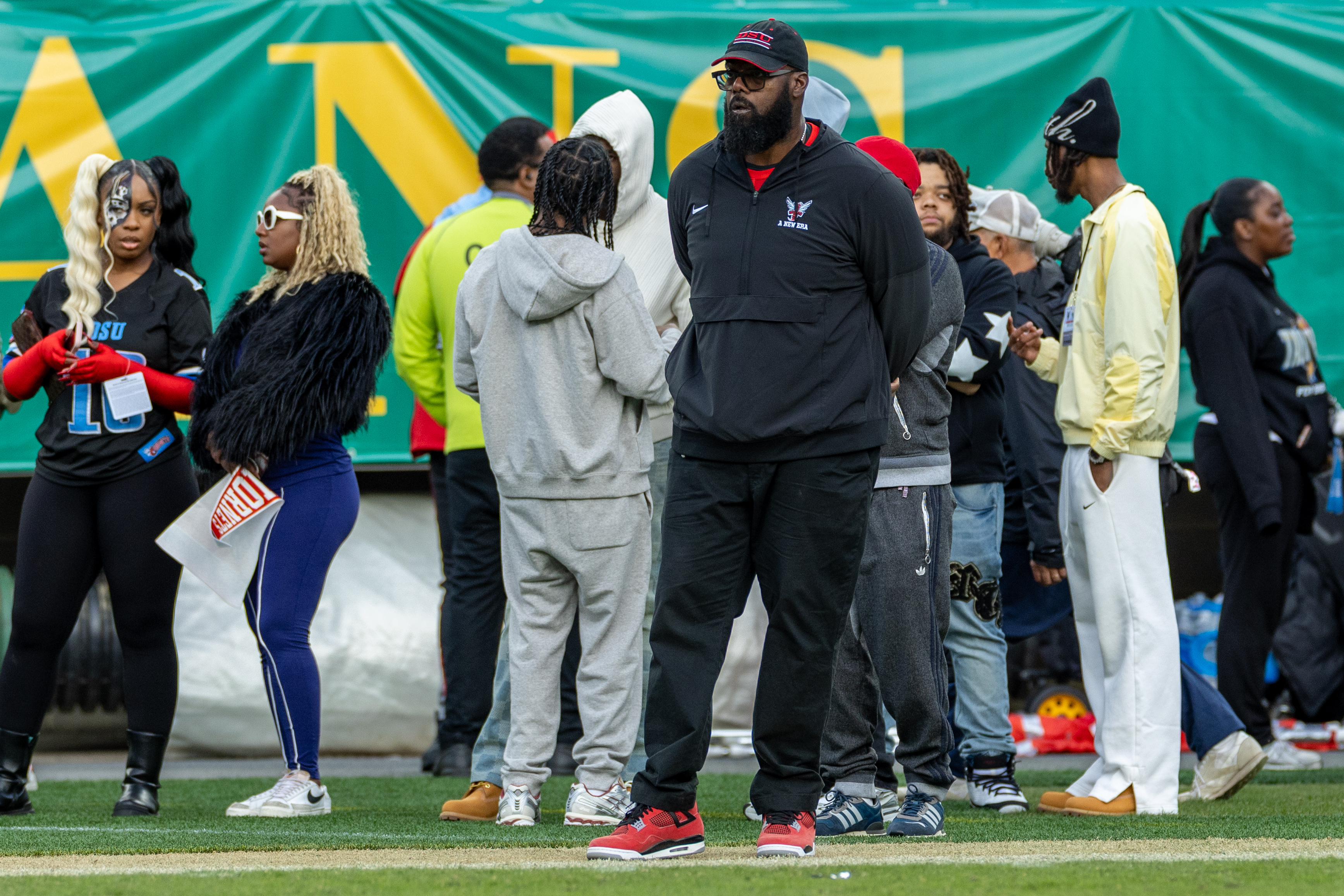
Former Eagles offensive lineman and now Delaware State assistant Tra Thomas watches from the sidelines on Saturday.Aidan T. Gallo / Staff Photographer
Thomas says he earned his degree at Florida State a few years ago so he could coach at the college level and use the “12 years of [NFL-playing] experience and [try] to pour all that into the guys.”
“Coming back to the Linc, it brings back so many memories and emotions, because you spent so much time on this field,” Thomas told The Inquirer, noting that both of his parents went to Florida A&M, an HBCU in Tallahassee, Fla. “Just coming back and being a part of this — this is the reason why I wanted to come back and coach on the college level. … To have this opportunity is extremely special.”
Two former #Eagles catching up pregame. Norfolk State head coach Michael Vick and Delaware State assistant OL coach Tra Thomas. pic.twitter.com/I469T5vDO9
Jackson told The Inquirer earlier that he appreciates Thomas’ “dedication to these players” and added that “the amount he knows [about offensive line play] is definitely a great addition to have.”
Will the Classic return to Philly again?
Philadelphia has placed a renewed emphasis on celebrating HBCUs with an annual HBCU Week. Mayor Parker worked for years to bring HBCU football back to the city, reviving a tradition that dates to 1919.
Could the HBCU Classic expand beyond the two games the Eagles helped host this week?
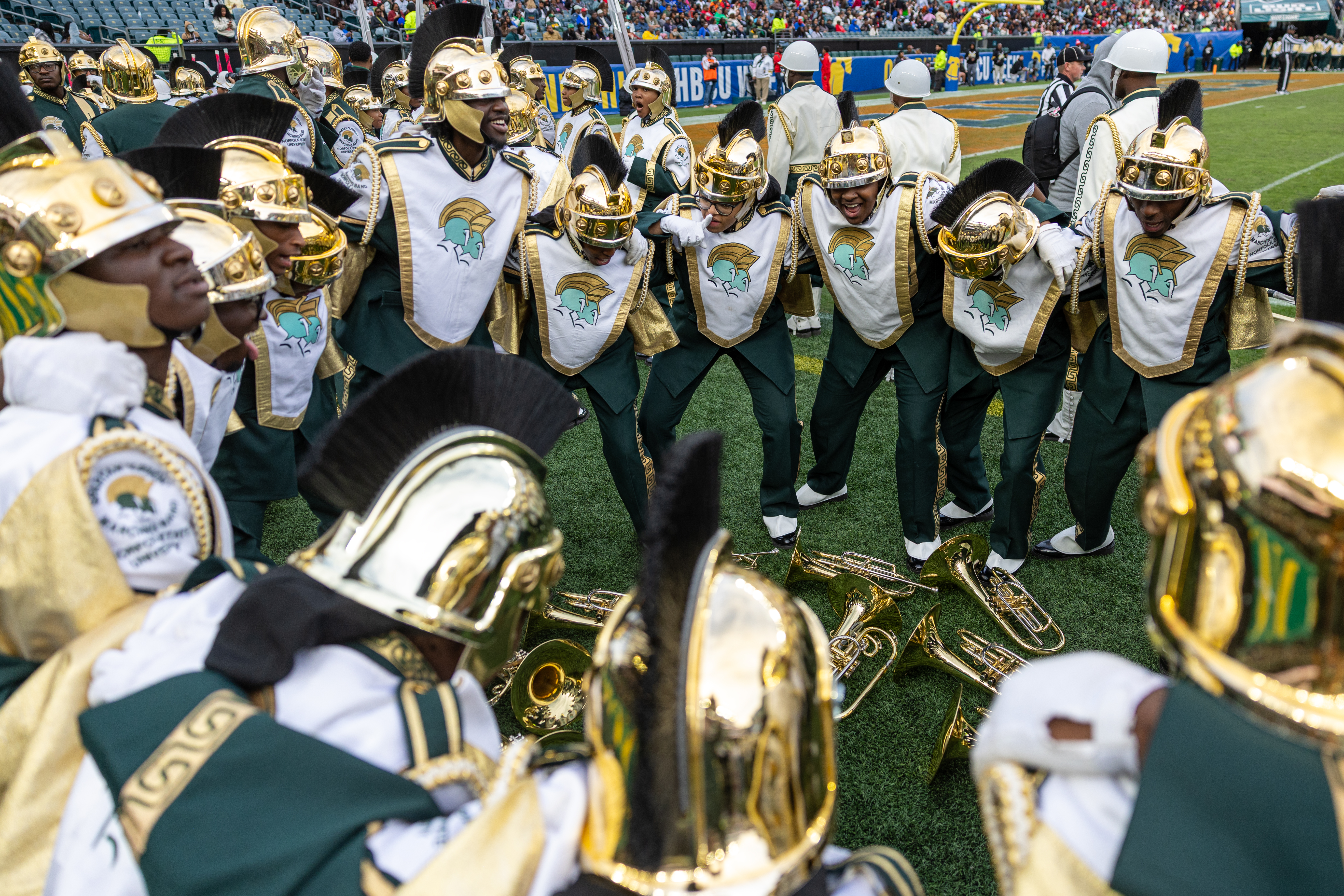
Spartans ‘Legion’ Marching Band Mellophone section leader Amiya Suber (center right) hypes up her section before performing their halftime showcase on Saturday.Aidan T. Gallo / Staff Photographer
“[I’m] not necessarily sure, we’ll kind of see where it goes,” Frank Gumienny, the chief operating officer for the Eagles, said earlier this week. “We love the local [connection], obviously [with] Lincoln being sort of in our backyard, so to speak. And really, what excited the Eagles and myself and the whole Eagles organization is like this is not just [two] football games. … It was really the combination of everything: The football game, obviously the two great [programs] playing on the field, but then also the career fair, the job fair. We had a step show, and really I learned a lot about the HBCU culture and how exciting it really was.
“The city is committed, and Mayor Parker specifically is committed. And we are Philadelphia; wherever we can, play a role to enhance the city of Philadelphia, we do.”
Both Norfolk State and Delaware State appear committed to participating, as long as Vick and Jackson remain on the sidelines. Even Vick, who said “no” last year when asked about making the game an annual event, changed his tune following Saturday’s loss.
“Just going back and thinking about it, it’s just a great opportunity for the players. The stage is as big as it’s going to get on our level, and we got to take advantage of that,” Vick said. “And the opportunities being created. Shout out to the city of Philadelphia, Philadelphia Eagles for making this happen, giving us an opportunity to play in the presence of Lincoln Financial.
“It’s a no-brainer, man. It’s a blessing to be able to do this, and I hope the players feel that.”
On the topic of keeping a Jackson-Vick matchup at the Linc, Gumienny noted that the Eagles have had “discussions with the mayor about expanding it to different HBCUs.” Scheduling will always be a challenge with the Eagles and Temple football sharing the Linc and needing an open date on the calendar, says Gumienny.
But for the second year in a row, the budding rivalry between the two former Eagles teammates stole the show, even with an HBCU Battle of the Bands held earlier in the day.
‘Approaching Storm’ Delaware State drum major Zuri Brown, 23, performs during the HBCU Classic at the Lincoln Financial Field on Saturday.Aidan T. Gallo / Staff Photographer
“We’re trying to build it and have a lot more excitement around the HBCUs, and hopefully it continues to grow and take different directions,” Gumienny said. “But I think having two guys like Michael Vick and DeSean definitely shines a light on the game.”
As millennials and other young workers navigated a turbulent job market, they routinely heard career advice warning them against “job hopping” and the much-dreaded “résumé gap.”
But today, job hopping is much more normalized in the workplace. There’s less expectation on the part of companies or their employees that they are forever committed to each other. And in many sectors, hiring managers understand that moving from firm to firm is often a financial decision as well as a career choice.
When people periodically change jobs as part of the normal course of things, there are bound to be some gaps along the way. So why does that scary old “résumé gap” still strike fear into the hearts of jobseekers?
When she started her career in executive search, Noureen Ali said she distinctly remembers being trained to look for résumé gaps and job-hopping as indicators of someone’s poor commitment. Now, working as the principal director for HR advisory services at McLean & Co., she advises leaders on talent strategy and acquisition. These days, she said, hiring managers and recruiters don’t need to rely on “signals” like that anymore.
“That is not actually capability,” she said. “Those were dated predictors of success.”
But in a tricky job market, people worry any little thing — a typo in a cover letter, a résumé gap, a dated LinkedIn profile — could set them back. In a 2026 survey from the jobsite Monster, 13% of respondents admitted to fibbing on their résumés, mostly to either beef up their skills or fudge employment dates so as to minimize any appearance of a gap.
Diksha Gupta, a 35-year-old postdoctoral research associate based in Charlottesville said she has taken enormous steps — living an ocean away from her spouse and traveling for jobs on different continents — to avoid the “résumé gap.” She worries it could come across poorly to future employers.
“What will I say? How will it look to other people that I did not have a job, despite my having a Ph.D.?” she said. “My biggest fear is that they think I’m incompetent, that there is something wrong with me that I couldn’t get a job.”
But most employers today won’t balk when they see a gap on a résumé, said Lisa Williams, senior vice president of human resources at LendingTree. People have time between jobs because of personal health reasons, caregiving responsibilities, corporate layoffs, or a particularly long job hunt.
But if there’s a gap of longer than six months on a résumé, Williams doesn’t want jobseekers to try to hide or obscure that period — instead, she encourages them to directly address it in an interview or cover letter. Intentionally framing that period of time can open a bigger discussion about related certificates, skills, and life experiences accrued during the so-called “gap,” she said. And most important, bringing it up head-on means you can take charge of the conversation.
“Don’t hide it, because then you leave it open for the interpretation of the employer even if it is something like, ‘Unfortunately, I was impacted by a corporate reduction’ or ‘I was taking care of a sick family member,’” she said. “You don’t need to provide a lot of detail, but just naming it and putting it on your résumé, it prevents the employer from making assumptions they shouldn’t make.”
Ryan Novozinsky breaks down the Eagles’ matchup against the Commanders, including the biggest takeaways, standout performances, key turning points, and what the Eagles’ result means moving forward.
CHARLOTTE, N.C, — Less than 24 hours after beating the New York Knicks at Xfinity Mobile Arena, the 76ers cleared out of another locker room, victorious, this time in Charlotte.
Since this was North Carolina, the remains of the trip included half-empty buffet trays of barbecue from a local restaurant, Noble Smoke. That savory meal will help make up for all the calories they burned on this back-to-back, which concluded with a 109-104 comeback victory over the Hornets.
Even if back-to-backs are a facet of everyday life in the NBA, they’re not fun for those involved, young, old, or in between.
“Back-to-backs are hard, man,” guard Tyrese Maxey said. “Especially a team like [Charlotte]. They play fast. Put you in a lot of actions. We just had to make it through, make it to the fourth. As long as it’s a game in the fourth.”
For some teams, that might just be a mantra without meaning. For these Sixers, it has been a way of life on their journey to a 6-1 record. Once again, the Sixers came back from a double-digit deficit, as they have in four of their six wins.
Once again, the Sixers were the better team in clutch-time situations, even with Joel Embiid and LeBron James both out for rest. And once again, coincidentally, VJ Edgecombe hit a dagger three to put the Sixers up four with under 40 seconds to play, as he did against the Knicks. Edgecombe said he “owed” the team that one after scoring just 10 points on 4-for-13 shooting, but that, as the shot clock was winding down, he wanted to give the ball back to Maxey.
“I’m going to be honest, ’cause like I said, I wasn’t making. But I said the team trusts me. They trust me in the clutch, and obviously I trust myself, and so … I looked at [Tyrese], and he was like, ‘Go,’ so I just went.”
VJ Edgecombe on his second straight dagger three in as many nights. Said he was looking to get the ball back to Tyrese Maxey. pic.twitter.com/rQtBpjfVL2
That trust might be one reason the Sixers have prevailed in these close games. Forward Dean Wade said that’s what happened on defense in the final three minutes – that there was a trust the team had that just clicked in, even after the second half had mostly gone Charlotte’s way. The way the Sixers want to play defense, Wade said, requires that trust.
“We just locked in and truly trusted each other,” Wade said. “Our biggest thing is physicality. When we’re physical on defense, we’re at our best. When you’re physical on defense, you’re going to get beat sometimes, and then that whole trust thing comes in — people on the backside, rotations on the backside. So that was the biggest thing is we trusted.”
After the Sixers trailed 101-94 following a timeout, they found another gear they hadn’t had all night. Anfernee Simons hit a three-pointer off an offensive rebound by Wade, who finished with a career-high 10 assists. Then Simons got a steal. Then Jaylen Brown got a steal. Then Wade got a block. Before anyone knew it, the Sixers were up 102-101 before Edgecombe all but ended it with his three.
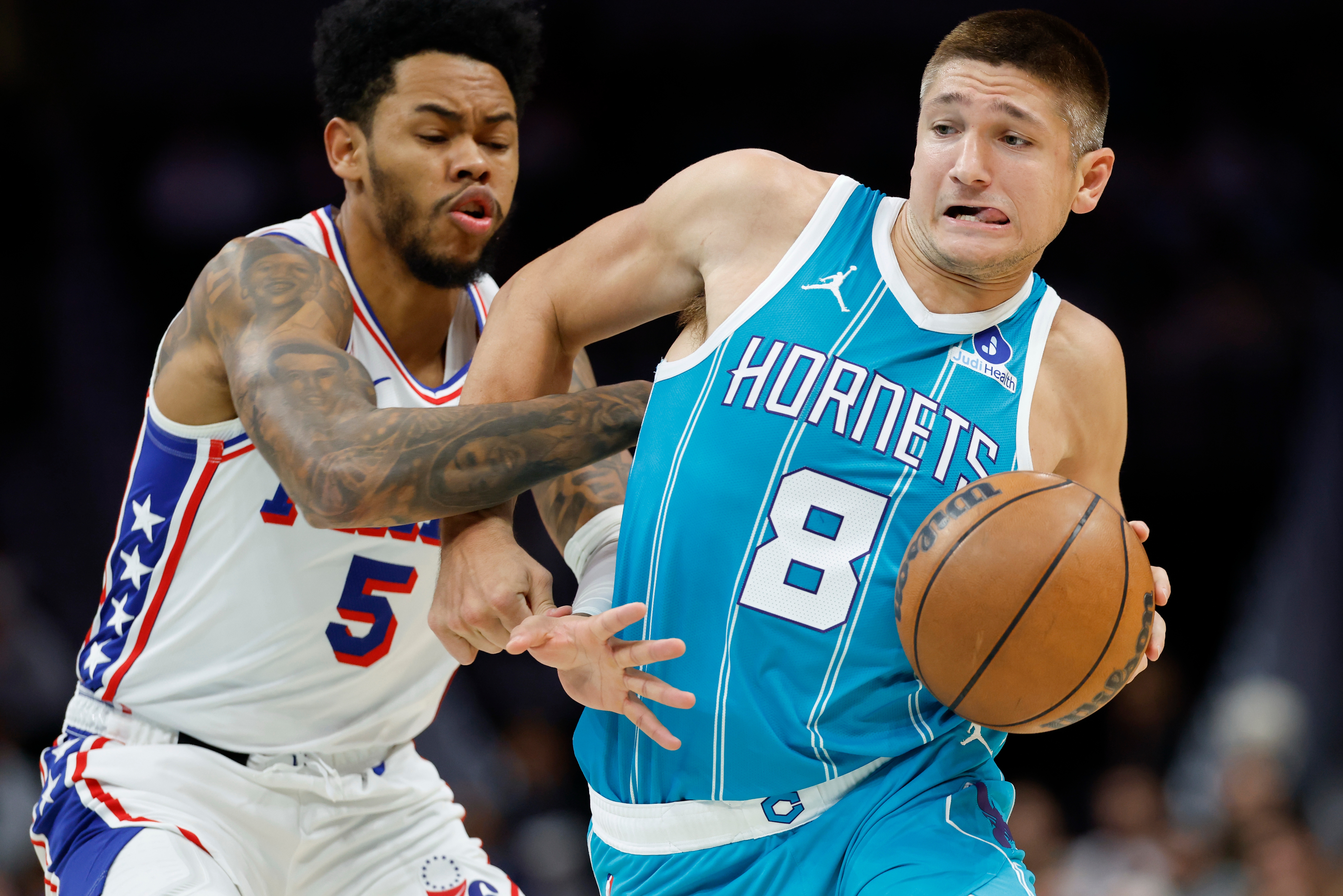
Sixers guard Anfernee Simons battles for the ball against the Hornets’ Grayson Allen during the first half of Saturday’s game in Charlotte.Nell Redmond
Why didn’t the Sixers play like that from the start on Saturday? Well, the schedule didn’t do them any favors. It’s not an excuse for them, just a fact. Simons has been in the NBA for nine years. He has seen other teams in the Sixers’ situation Saturday just play out the string on the game. Chalk it up to a schedule loss and move on.
However, there is something different about this group, he said.
“That’s one thing that’s kind of special about this team — nobody wants to give up the game,” Simons said. “Especially when we’re on this run like this right now. I think everybody understood that.”
A big difference Saturday is they did it without Embiid and James, who Maxey has said is a “calming influence” in the guts of the game. James couldn’t provide that security blanket against the Hornets. This shorthanded group had to figure it out on its own. From the start of training camp, coach Nick Nurse repeatedly said the Sixers have been “connected.” So far, they have shown that trait when it matters most.
“Just our competitive nature,” Maxey said. “I think we have a lot of competitive guys on this team. Guys that want to compete and [are] not going to lay down.”
Even when that may sound tempting to do Night No. 2 of a back-to-back.
When Audrey Rutter and her sister inherited their childhood home in Tulsa, Okla., in 2023, Rutter had just graduated from a master’s program in Chicago. She was job hunting and planning a wedding, and her schedule was tight, as were her finances.
Her sister wanted to turn the home into a rental property, but the two-bedroom house in a disinvested neighborhood had not been well maintained. Their mother had bought the home for $38,000 in 1998, later adding upgrades like central air and heat. Then she was diagnosed with breast cancer, and any extra funds she had went toward medical bills.
“It wasn’t a nice neighborhood,” recalled Rutter, who is 32. “But it did give us that sense of stability.”
Neither sister had the funds on hand to spruce up the house or buy the other out, and their differing opinions on what to do with their inheritance strained their relationship. Eventually, they decided to sell to a home-flipping company for $52,000.
Rutter didn’t try to negotiate. It wasn’t a terrible price for the area and the property’s condition, she reasoned. She used her half of the proceeds to pay for her wedding and act as a cushion while she pursued her job search in public housing policy.
“It was very stressful,” she said. “Once we had the offer, though, I felt a lot of relief. I just wanted to sell it and be done with it.”
The great housing transfer
Tens of trillions of dollars will be passed from older generations to younger ones in the coming decades as the “Great Wealth Transfer” unfolds in the United States. And homes will be a major part of that as skyrocketing prices make up an ever-larger share of people’s estates.
A record 340,000 homes were transferred through inheritance in the 12 months ending in August 2025, according to property data analytics company Cotality. Home resales overall were down during that same time period.
For many middle- and upper-class families, “the home is their biggest source of wealth,” said Peggy Sizow, chief fiduciary officer for National Advisors Trust, an independent trust company. She calls it “probably the most common asset that we see in estate planning, especially in today’s America.”
That may seem like a dream scenario for young Americans who are priced out of the market amid the nation’s affordability crisis, but Rutter’s experience shows it can be fraught.
Plenty of financial complications can arise: not just maintenance costs, but property taxes that heirs may not be able to afford, utility bills they need to cover, and even property liens. Some heirs may be on the hook to pay their elders’ deferred property taxes out of the inherited estate, said Daryl Fairweather, chief economist at Redfin. If they’re unable to do so, that could necessitate the sale of the home. Of course, cleaning out a home and preparing it for listing is not a cheap endeavor, either.
And depending on the number of family members involved, the inheritance can get even more complicated, financially and emotionally. Disputes over what to do are common, especially when siblings, for example, have differing incomes, goals, and relationships to the property.
The best way to avoid financial surprises and family drama is to make a detailed plan — and have a conversation between generations — before a home is passed on, Sizow said. But many families put off the inevitable, whether because they cannot afford to retain legal help, don’t know to do so or don’t want to address their own mortality.
“When it comes to money, people are often very emotional,” she said. “Money brings out the best and the worst in people.”
The impact on intergenerational wealth
Still, there’s no denying the connection between homeownership and intergenerational wealth. Households that inherit property are more likely to become homeowners, and homeowners are more likely to have higher net worth than nonowners. They are also more likely to leave property to their children, in turn, continuing the wealth-building cycle.
“Because wealth compounds across generations, delays or exclusions from homeownership today can shape economic outcomes decades into the future,” according to a recent report from Realtor.com.
Roseanne Harvey was grateful to inherit her great-aunt’s home in Victoria, British Columbia, in 2020. Though it is a humble two-bedroom house in what used to be a working-class neighborhood, real estate prices there have risen so drastically so quickly that Harvey said she would never have been able to buy property in her hometown.
While she acknowledges what a privilege her inheritance was, she said it also came with a “generational weight.” Her relative lived in the home for almost 70 years before passing it on to Harvey’s mother, and after she died in early 2020, Harvey spent most of the pandemic lockdown cleaning out her great-aunt’s belongings and renovating the house amid her grief and isolation. She cycled through emotions as she did — sadness, anger, resentment, pride — yet now thinks of the process as “healing.”
Were it not for her great-aunt’s desire that the home stay in the family, Harvey would have considered selling it. She and her partner have no children, which means the family wealth transfer may end with her.
“I’ve tried to approach it with reverence and a sense of, this is what they wanted. I’m carrying out their legacies and their wishes,” said Harvey, 50. “But there’s definitely duty and obligation attached to it.”
Similarly, when Chrissy Burgess and her two siblings inherited their aunt’s vacation home in upstate New York, they were keen to keep it in the family and continue their annual Fourth of July parties. They wanted their own families to experience the same summers on the lake they had enjoyed growing up.
But the house had a number of problems, including a hole in the roof, broken windows, and bat and mice infestations. It was also much too small for all three of the siblings’ families to visit at the same time. Given their own homes and children to care for, the question was how much each could afford to put into the property — and what that meant for their share of ownership and future obligations.
After years of wrestling with what to do and many tense conversations, the siblings retained a lawyer to draft an operating agreement for how to manage house usage, upgrades, and other considerations. They built an addition so the three families can visit at the same time from their respective homes in New York City, Philadelphia, and Austin, Texas.
Burgess said they all understand they’re not likely to make their investment back if they were to sell.
“It’s a life disappointment to me that we’re not physically closer,” said Burgess, who lives in Brooklyn. “This is the way that we get to have our families together. It is complex, but it’s so meaningful.”
I make no claim to journalistic objectivity when it comes to Jimmy Buffett. I saw my first Buffett show at Foellinger Auditorium in Champaign-Urbana, Ill., in 1974 as he promoted his third album, A White Sport Coat and a Pink Crustacean. I attended many more over the years.
I ran into him during Florida’s 1986 Senate race, when he campaigned for the Democrat, Bob Graham, and the state’s endangered manatees. Then, through our mutual friend (and my colleague) Maureen Dowd, we became friends for the last decade of his life, regularly chewing over national political developments and, later, his health issues. We had a lot in common as former altar boys, writers, and musicians, with one of us being considerably more successful than the other.
His death, in 2023, left an immense void in Parrothead Nation, as his fans are known. But the newly opened “Jimmy Buffett Son of a Son of a Sailor Experience” at the National Maritime Museum of the Gulf, in Mobile, Ala., will provide some solace and bright memories. While Buffett will be forever linked to Key West, Fla., he is truly a son of Alabama’s Gulf Coast, the region that nurtured him and instilled in him a love of the sea and sand.
“The fact that it is sitting there on the same water he grew up on deepens the meaning I get from it, and I don’t think I’m the only one,” said Mac McAnally, Buffett’s longtime collaborator and a key member of his Coral Reefer Band. “I don’t think the connection will be wasted.”
The two-story, 6,000-square-foot permanent exhibition opened in early October. It traces the arc of Buffett’s life from his boyhood in the region to his success as a live entertainer who popularized a new style of music and had millions of people yearning for a margarita and a tropical breeze. It includes childhood memorabilia along with guitars, clothing, handwritten lyrics, gold records, rare video footage, the wooden telephone booth from the cover of Coconut Telegraph, and a replica of his Key West recording studio, Shrimp Boat Sound.
And there is a taste of the concerts that defined Buffett for the public and his die-hard fans.
“After touring with Jimmy for 35 years, it was hands down the best year-round summer job anyone could ever imagine,” said Mike Ramos, Buffett’s tour manager.
The museum pays particular homage to Buffett’s grandfather, Captain James Delaney Buffett, a career merchant mariner and the titular captain in the song “The Captain and the Kid,” the family figure who stoked the young guitar player’s wanderlust. The grandfather was an adventurer who, as another of Buffett’s other canonical songs goes, switched from sails to steam. His dress blues share exhibit space with the Martin 12-string guitar his grandson employed to (perhaps) write and definitely play “Son of a Son of a Sailor” at hundreds of shows.
Buffett was born in Pascagoula, Miss., but his family moved to Mobile when he was a toddler. He described his coastal childhood in the song, “Life Is Just a Tire Swing,” noting that in his idyllic adolescence he had never been “west of New Orleans or east of Pensacola.” His parents worked at the Alabama Dry Dock and Shipbuilding Co., just across the Mobile River from where the museum now stands.
The exhibition chronicles his early attempt to break in, busking around New Orleans. It, of course, covers the Key West years with a directional sign that points out his famous haunts there. There is a section on his Save the Manatees campaign started with Graham, who was then serving as governor. But the exhibition treads lightly on Buffett’s deep interest in politics. He never injected his political views into his shows, though they were never far from the surface.
Attention is paid to his status as a bestselling author and his love of flying on his odd assortment of planes. You can listen in on a phone conversation with Buffett as he discusses the fishing prospects off Islamorada in the Keys. The exhibit nods to the trippy preconcert Bing and Bong Show that Buffett and his band leader, Michael Utley, hosted on Radio Margaritaville, his internet radio station. It was a Parrothead version of Face the Nation.
Overseeing the exhibition is a 7.5-foot-tall bronze statue that captures a smiling Buffett in stride as he appeared at a televised 2010 concert in nearby Gulf Shores to drum up business after the tourism-destroying Deepwater Horizon oil spill. The statue shows Buffett, as always, performing barefoot but includes a pair of discarded bronze flip-flops from the Margaritaville line. Ever the businessperson, he would definitely approve of the branding.
During that concert, he noted that he was a child of U.S. 90, the highway that runs along the Gulf between Florida and Texas. In the months ahead, the museum hopes to encourage a sort of Buffett legacy trail that would take people between New Orleans, Pascagoula, and Mobile
The museum’s purpose, his sister Lucy Buffett said at a preview for friends and family, “is not to glorify him.”
“But it is to celebrate the Gulf waters that inspired him to venture past the horizon to find adventures, stories, lessons, and successes,” she added.
The exhibition and its locale also comport with a sentiment Jimmy Buffett regularly expressed in “Back Where I Come From,” a song written by McAnally that was a standard at Buffett shows and remains one for the Coral Reefers.
“Back where I come from, where I’ll be when it’s said and done,” the song goes. “I’m proud as anyone, that’s where I come from.”
Lacey Bachart is caught in the vast gulf between the nation’s two major political parties, neither of which is appealing to her to join.
“Money hungry, I see that on both sides,” said Bachart, who is legally blind and works at Wawa part-time. “They get power and say they’re going to do this and that, and it just does not happen.”
Two years ago, Bachart, a 22-year-old Sellersville resident, decided not to register with either major political party.She is one of 1.2 million unaffiliated voters in Pennsylvania, the fastest-growing group of voters in both the state and her Bucks County-based congressional district. Roughly 78,000 Pennsylvania residents registered without a political affiliation in the last year alone.
Bachart and other unaffiliated voters are poised todecide the outcomes of four hotly contested congressional races on Tuesday,including the 1st Congressional District, where she lives.
These voters have outpaced new Democratic and Republican registrations in each of the four swing districts.
And while they represent a smaller share of the state electorate than Democrats and Republicans, their total is four times larger than the gap in registered voters between the major parties.(There are 230,000 more voters registered as Democrats than Republicans in the state.)
(function(){function e(){window.addEventListener(message,function(e){if(e.data[datawrapper-height]!==void 0){var t=document.querySelectorAll(iframe);for(var n in e.data[datawrapper-height])for(var r=0,i;i=t[r];r++)if(i.contentWindow===e.source){var a=e.data[datawrapper-height][n]+px;i.style.height=a}}})}e()})();
What this means is that unaffiliated voters have never been more important to swinging the vote in places like the 1st District.
There, Republican U.S. Rep. Brian Fitzpatrick and Democrat Bob Harvie, a county commissioner, are competingin a race that could be decided by a few thousand votes.
Bachart said she is leaning toward Harvie as Election Day approaches, hoping to put a check on President Donald Trump.
“I think it’s time for a change. We’ve had Brian Fitzpatrick for a while, and I’m a huge disapprover of Trump,” she said. “I don’t think Brian Fitzpatrick is a huge disapprover of Trump, as much as he says he might be.”
Outpacing both parties
Over the last year, according to an Inquirer analysis, Republicans lost about 900 voter registrations in the 1st District, and Democrats added about 3,100 voters after a renewed focus on voter registration efforts.
But 5,400 new voters in the district have registered as unaffiliated since October 2025, outpacing both parties combined.
Now, there are about 84,000 total unaffiliated voters in the 1st District — 14.6% percent of the electorate. That is more than nine times the difference between Democrats and Republicans in the swing district, where the GOP currently holds a roughly 9,000-voter advantage.
(function(){function e(){window.addEventListener(`message`,function(e){if(e.data[`datawrapper-height`]!==void 0){var t=document.querySelectorAll(`iframe`);for(var n in e.data[`datawrapper-height`])for(var r=0,i;i=t[r];r++)if(i.contentWindow===e.source){var a=e.data[`datawrapper-height`][n]+`px`;i.style.height=a}}})}e()})();
Understanding what drives these ideologically diverse voters, however, is complex.
Like Bachart, they tend to be younger than those registered with a party. Statewide, the median unaffiliated voter is 39.That is 11 years younger than the median Democrat and 16 years younger than the median Republican.
Regardless of age, many unaffiliated voters are driven by their dissatisfaction with the two major parties and the status quo.
Joseph Macary, 79, an unaffiliated voter who lives in Doylestown, said heis “fed up” with everyone in politics.
The son of a Christian Arab immigrant from Lebanon, Macary said he inherited his father’s view that regardless of who occupied the White House, U.S. policy in the region has failed Arab people.
“What’s been going on [in the Middle East] drives me crazy,” Macary said.
Though he plans to vote for Democrats, Macary said, Harvie does not necessarily inspire him. “I have no real views on him,” he said. “But I’ll probably vote for him anyway.”
Fitzpatrick, on the other hand, “sides too much with Trump, who’s a lunatic,” Macary said.(The incumbent votes with Trump and Republicans less than any other House Republican, though it is still about 70% of the time, an Inquirer analysis found).
“Even if he’s against Trump, his voice is drowned out among Republicans. His vote is meaningless,” Macary added.
(function(){function e(){window.addEventListener(message,function(e){if(e.data[datawrapper-height]!==void 0){var t=document.querySelectorAll(iframe);for(var n in e.data[datawrapper-height])for(var r=0,i;i=t[r];r++)if(i.contentWindow===e.source){var a=e.data[datawrapper-height][n]+px;i.style.height=a}}})}e()})();
In addition to voters officially registered as unaffiliated, many in Pennsylvania who are still registered as a Democrat or Republican no longer feel a deep attachment to their party. Their registration is not keeping up with their ideology.
Bryan Canonica, an IT consultant from Southampton, is registered as a Republican but identifies as an independent voter. He plans to vote for Harvie, the Democrat, in the 1st District race, though it is more of a snub to Fitzpatrick.
“He’s just been in office too long,” Canonica, 46, said. “And he’s too close to Trump, even if Fitzpatrick voted against him sometimes. We need a shake-up.”
Meanwhile, Zbigniew Chrzanowski, 63, a registered Democrat in Newtown who identifies as an independent, plans to vote for Fitzpatrick.
Chrzanowski, a former member of Poland’s parliament who became a U.S. citizen in 2006, has come to know Fitzpatrick personally. He appreciates the congressman’s support for Ukraine amid its war with Russia.
Fitzpatrick, he said, “is trying to be independent from the psycho [who] is in the White House right now,” referring to Trump.
The fight for unaffiliated voters
One of the only Republicans to publicly admit he did not vote for Trump in 2024, Fitzpatrick told The Inquirer during one of his last campaign rallies that his closing message to voters in one of the most purple districts in the nation is “I’m one of them.”
“Nobody’s questioning my independence. And there’s no member of Congress, Democrat or Republican, that is more independent than I am,” he said in a separate interview.
He also said he would “100%” register as an independent if it were not for the closed primary system, which prevents unaffiliated voters in Pennsylvania and seven other states from casting their ballots in primaries. The five-term GOP lawmaker,who has not campaigned with Trump this year, introduced the Let America Vote Act to allow unaffiliated voters to participate in primaries for federal elections.
Harvie has not shied away from his Democratic bona fides, campaigning with Gov. Josh Shapiro and other party leaders, but he said in an interview with The Inquirer that he believes his voting record on the Bucks County Board of Commissioners, which is composed of two Democrats and one Republican, speaks to his independence. He pointed to votes on mental health, public safety, and sustainability issues.
“All those things have been done in a bipartisan way, and I think people recognize that,” Harvie said.
Eugene DePasquale, chair of the Pennsylvania Democratic Party, said he sees the growing trend of unaffiliated voters across the nation and believes it is the party’s job to show them why they should become Democrats.
“I think there’s still a chunk of people that want to make sure that we prove that we’ve heard them, we’ve heard their concerns, and we’re ready to deliver,” he said. “What hopefully we’re going to have in November will give us the opportunity to show people we’ve gotten the message and we’re going to deliver.”
Since DePasquale took over as state party chair, Democrats have reversed a downward trend on registrations, solidified their statewide lead, and outpaced Republicans, including in the vote-rich Philadelphia suburbs.
(function(){function e(){window.addEventListener(message,function(e){if(e.data[datawrapper-height]!==void 0){var t=document.querySelectorAll(iframe);for(var n in e.data[datawrapper-height])for(var r=0,i;i=t[r];r++)if(i.contentWindow===e.source){var a=e.data[datawrapper-height][n]+px;i.style.height=a}}})}e()})();
Meanwhile, thePennsylvaniaGOP’s executive director, James Markley, said Fitzpatrick’s record will sway unaffiliated voters in Bucks and Montgomery Counties on Election Day.
“When independent and unaffiliated voters go to the polls, we believe they base their votes on job performance, real results, and a desire for pragmatic solutions,” he said in a statement.
Changing the entire system
If unaffiliated voters want real change, they should stop voting for the two parties and forge their own path, said Chris Gambino, a 39-year-old unaffiliated voter in Doylestown who is mounting an independent campaign for a state House seat.
“It is very clear to me that both parties care solely about power and fundraise based on outrage,” he said. “There’s very little desire to find common ground and solutions, and that’s problematic to me. That’s not the world I want to live in.”
There is no independent candidate in the 1st District race, but there will be independent optionslower on the ballot in some races.
Gambinois runningoutside the two-party system to represent the 143rd state House district, which includes parts of Bucks County. Gambino, a former Delaware Valley University professor who now researches agriculture funding, is facingGOP StateRep. Shelby Labs and Democrat Tim Hayes, who works for an environmental advocacy group and previously served as the president of the Dublin Borough Council.
Butas a voter, Gambino is facing a binary choice in the 1st District race and has not yet decided whom to cast a ballot for.
Fitzpatrick, Gambino said, “seems pretty happy being embedded in the Republican Party.” But in examining Harvie’s positions and record, he said, he is asking: “Is this person going to be able to vote against their party line if the time comes?”
Gambino said true democratic representation can get lost in a system that props up two parties.
“We are beholden to whatever the party says and does, and then we lose the ability to be accountable,” he said.
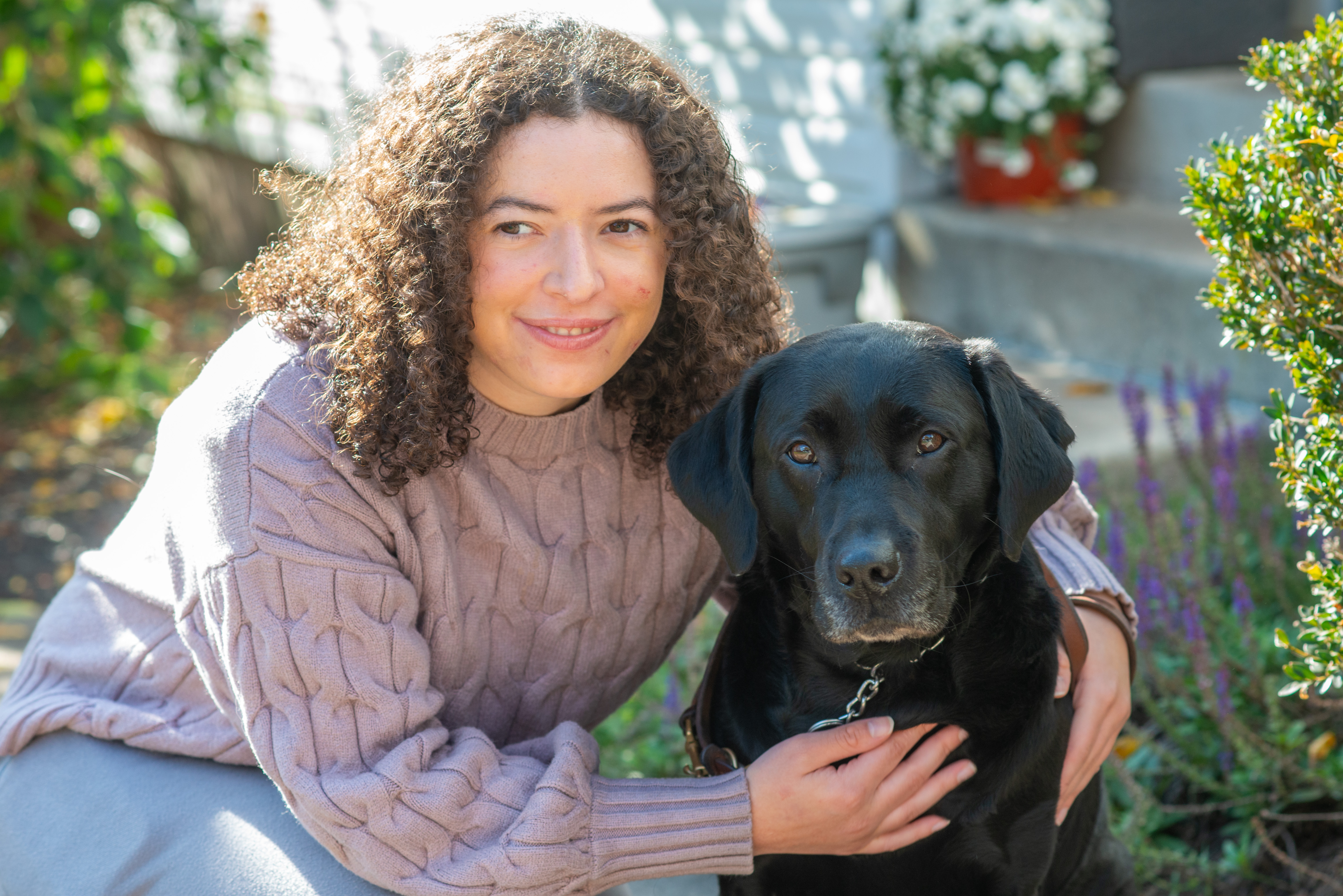
Lacey Bachart, an unaffiliated voter in Bucks County, poses outside her home with her service dog, Leah, her home in Sellersville, Pa. William Thomas Cain / For The Inquirer
It is a message that resonates with Bachart.
Bachart, who lives on disability in addition to her Wawa income, said her voice and others in the disability community often get overlooked as parties focus on winning, rather than serving the needs of everyone in the community. It is one reason why she has not affiliated with a party.
“We struggle to survive even when the entire country as a whole isn’t struggling to survive,” she said.
The Eagles will travel to face the Washington Commanders at 8:20 on Sunday night at Northwest Stadium. Here’s what you need to know about the matchup:
When the Eagles have the ball: The Eagles know they have to run the ball effectively to have any chance of resurrecting their offense, and for the first time this season, they actually showed some life on the ground last week vs. the Dallas Cowboys. It’s a shame Saquon Barkley couldn’t stay on the field because he looked explosive and decisive whenever he got the ball out of the backfield. He returned on Friday after missing the first two days of practice this week, but it’s unclear how much he’ll be hindered by hamstring and back injuries if he can go. The Eagles’ running back room has looked like a MASH unit. The latest casualty to go on injured reserve was Dameon Pierce. If Barkley is out or limited, Elijah Mitchell or Jaydon Blue could be tabbed as the lead ball carrier. Yikes.
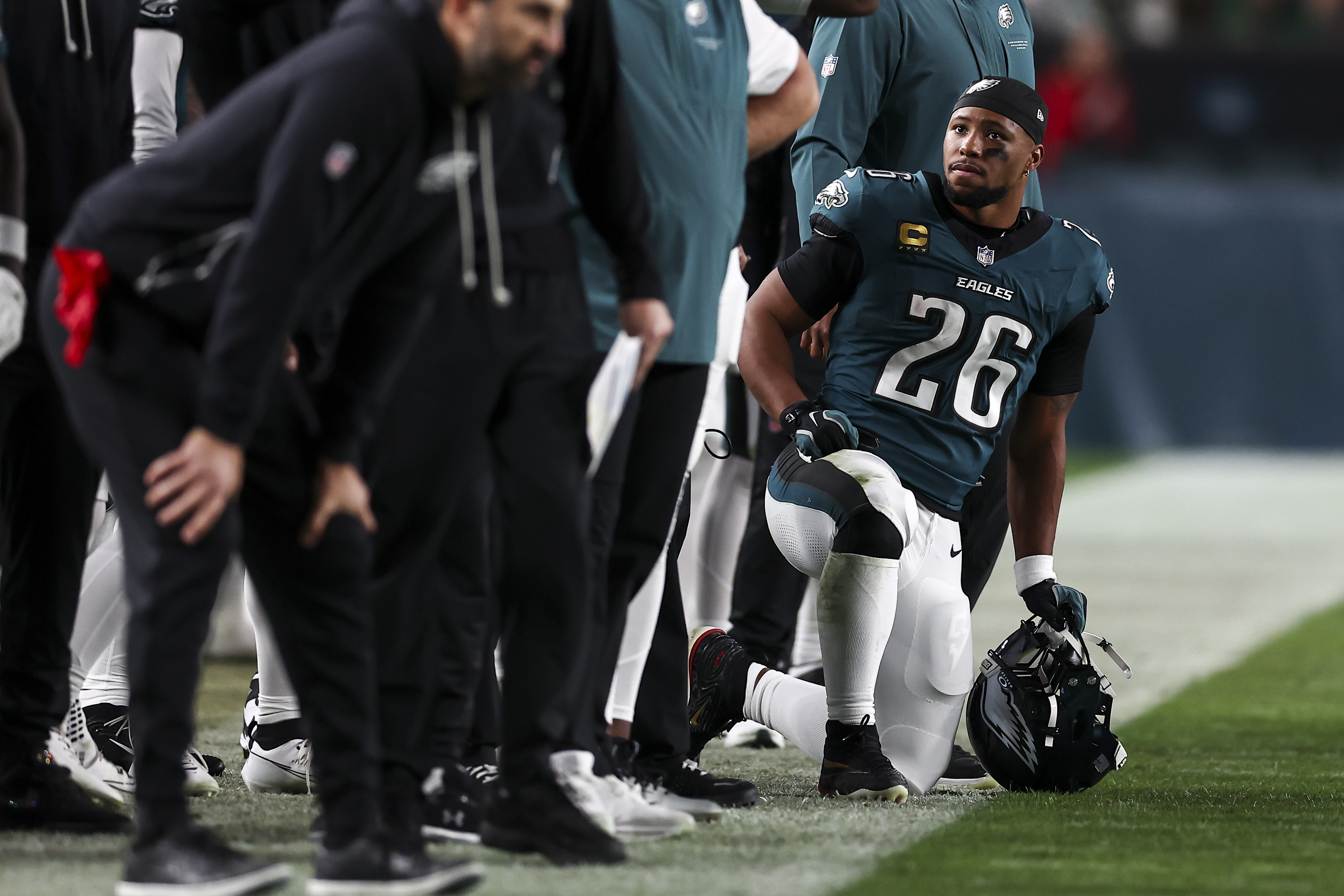
A healthy Saquon Barkley (26) would give the Eagles a fighting chance in Week 8. Monica Herndon / Staff Photographer
Sean Mannion’s commitment to the outside-zone run game is admirable, though not entirely sensible. The Eagles simply don’t have the personnel to consistently employ the scheme. They did have greater success between the tackle box in left guard Landon Dickerson’s return last week. If this is to be the starting five up front for the remainder of the season, Mannion has a chance to build off that continuity. The Commanders’ run defense isn’t great. They rank 20th in expected points added (EPA) per rush, but are holding running backs to just 3.8 yards a carry. Aside from a Barkley 42-yard jaunt on an inside-zone run, Washington held Eagles tailbacks to just 2.8 yards on their 17 other rushes in the first meeting in Week 1. Longtime defensive tackle Daron Payne is out for the season with a foot injury, a major blow to the unit.
The Commanders’ run efficiency numbers have been weighed down by their struggles to contain scrambles. Defensive coordinator Daronte Jones plays a lot of two-high safety shells, which can allow for mobile quarterbacks to break containment. Jalen Hurts gained 48 yards on five scrambles in Week 1 vs. Washington. Alas, his replacement Tanner McKee poses no such threat. McKee showed improvement as a passer in his second start, but there were still misfires, misreads, and misadventures whenever he had to drop on passing downs. Mannion did well to get the ball out with schemed-open first reads, particularly on money downs. The Eagles went 7-of-15 on third and fourth downs.
The downfield passing game was lacking, however, without receivers DeVonta Smith (hamstring) and Dontayvion Wicks (ankle). They will be sidelined for a second consecutive week. Rookie Makai Lemon stepped into the vacancy and continued to show why the Eagles drafted him. He’s not afraid to stick his nose in tight spaces and make tough grabs. He’ll likely be McKee’s top read, along with tight end Dallas Goedert, who could be showcased again ahead of the trade deadline. Jones has tried to implement fairly exotic coverage schemes, but there have been busts in the back end partly as a result. Trey Amos is back at corner, while safety Quan Martin is the secondary’s weak link.
Commanders defensive coordinator Daronte Jones likes to blitz. Nick Wass
The Commanders don’t have a strong four-man pass rush. If they’ve gotten pressure, it’s come more from blitzing. Jones worked under mad genius Brian Flores in Minnesota, and Washington is second only to the Vikings in blitz rate (42.3%). The Cowboys only blitzed McKee on 10% of his drops last week, which boggled the mind. The Eagles had another unblocked pressure on the first play last week and managed to complete the pass, but there’s little doubt Washington will send overloads and simulated pressures at a unit that still doesn’t have enough answers against exotic pressures. Commanders linebacker Frankie Luvu is Jones’ chess piece in the blitz, but rookie linebacker Sonny Styles looks like a star in the making.
When the Commanders have the ball: Jayden Daniels is a good quarterback. He’s not the one-year wonder some have painted him as amid various injuries. He’s back from an elbow injury that sidelined him a few weeks, and despite not having much around him, he’s still managed to keep the Commanders in games. He lost top receiver Terry McLaurin (knee) for the season recently, however, and needs all the help he can get behind a porous offensive line. It’s no wonder he’s looked hesitant in the pocket at times, especially early in games. But he still has a savvy veteran receiver in Stefon Diggs and a couple of capable downfield threats in rookie Antonio Williams and former first-rounder Treylon Burks.
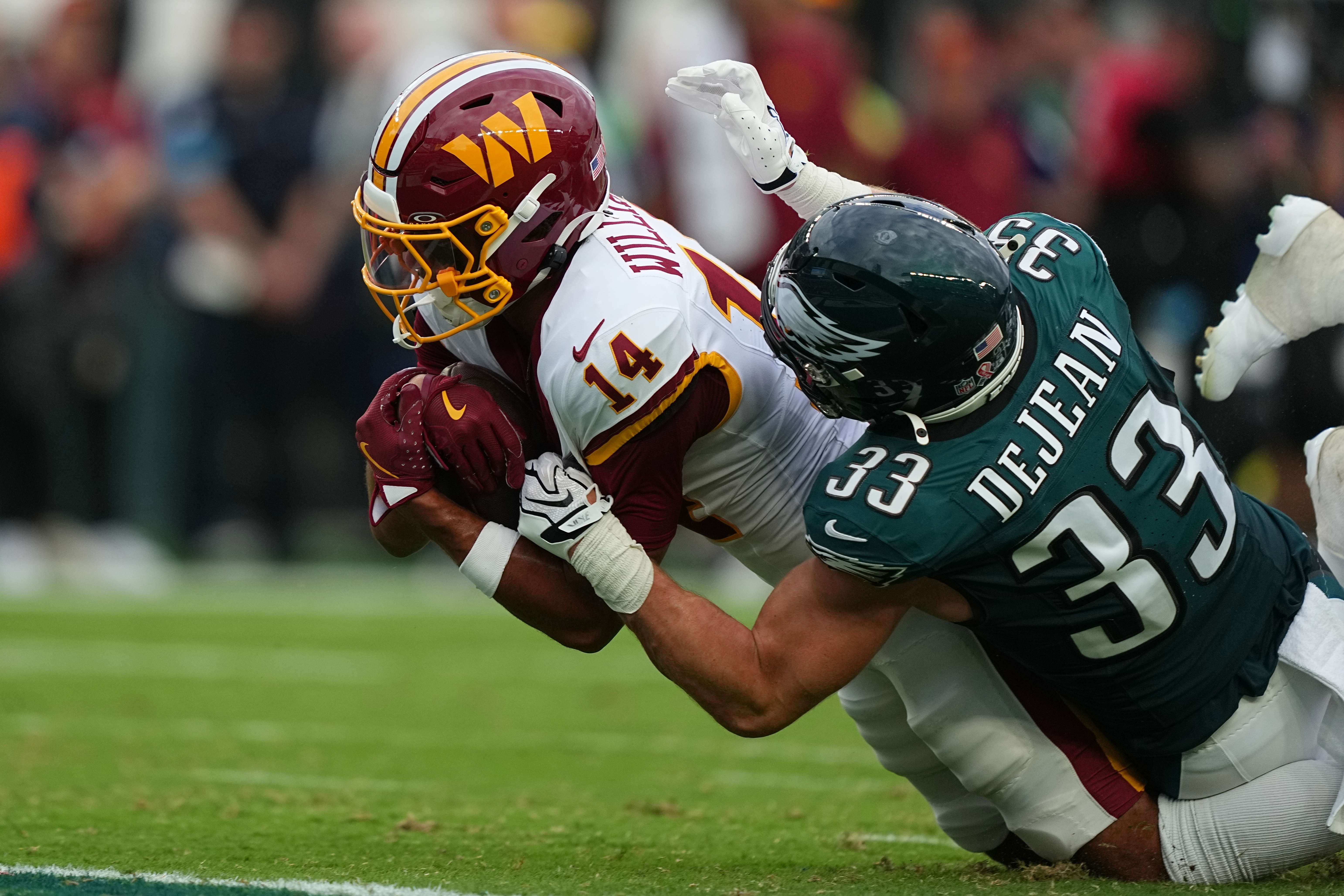
Cooper DeJean (33) had a rough time against Antonio Williams and Washington in Week 1 in a season that as been a step back for the All-Pro. Matt Rourke
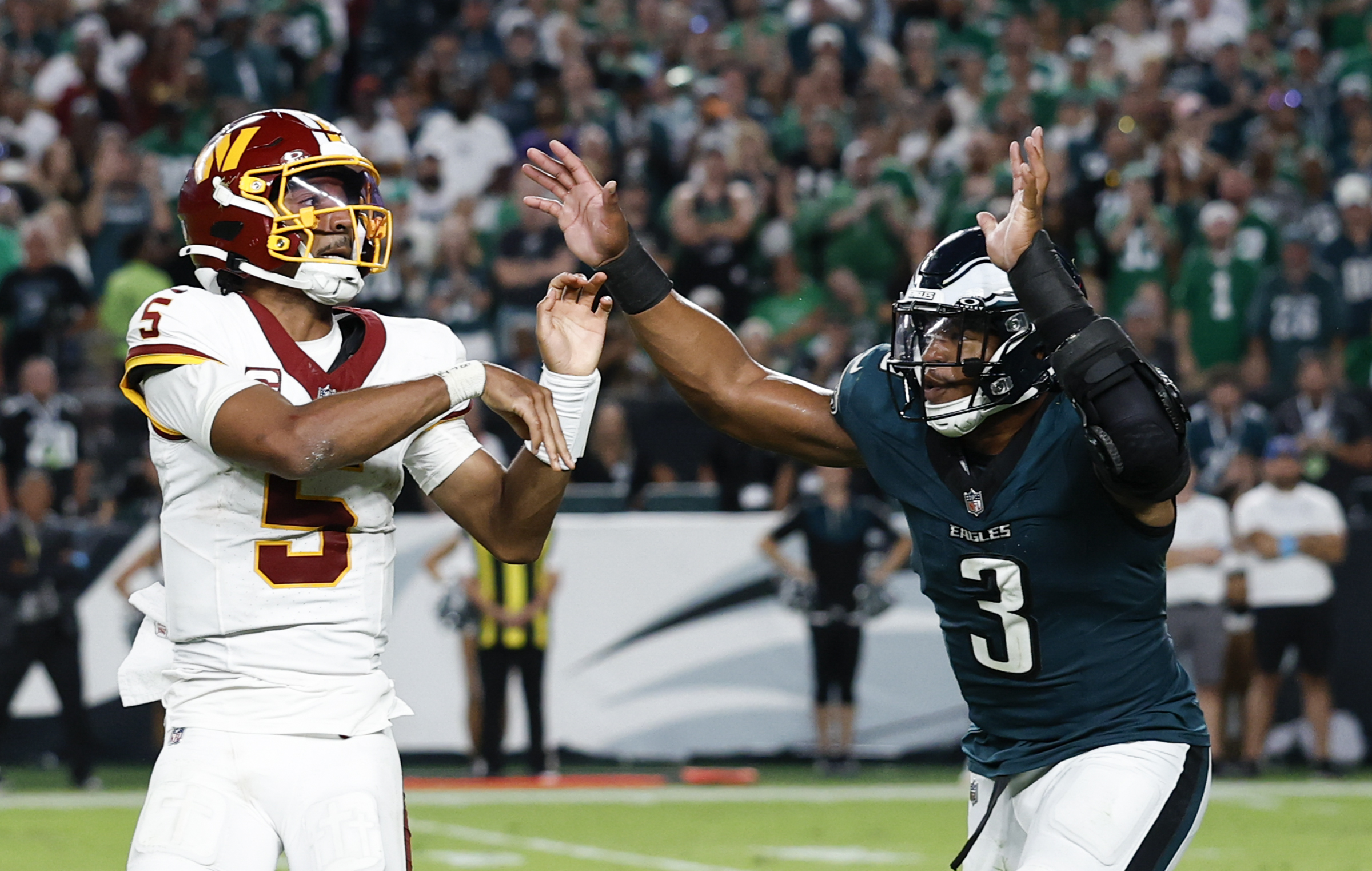
Diggs got the better of Cooper DeJean back in September. The Eagles slot cornerback’s struggles in that game weren’t a one-game blip. I wouldn’t be surprised to see Washington offensive coordinator David Blough go after him in man coverage situations. Blough’s system hasn’t leaned into the under-center stuff that many predicted before the season. Daniels is often in shotgun or the pistol. But he still has a lot of early reads over the middle and will take advantage of second-level linebackers who bite on play-action. Jeremiah Trotter Jr. may be an overall upgrade over Jihaad Campbell (hamstring/quad), who is out, but Trotter is still lacking in experience.
The Commanders, like the Eagles, have struggled against the blitz. But the Eagles, unlike Washington, don’t have effective blitz packages or blitzers. This is where not having Nakobe Dean might have hurt the most. A toothless blitz has hindered a Vic Fangio pass rush that is last in quick pressure rate. Dak Prescott wasn’t touched once last week. Defensive tackles Jalen Carter and Jordan Davis have taken a lot of heat for the pass rush inadequacies, but the lack of pressure from the edges is of bigger concern. Jonathan Greenard has been either hurt or unproductive, while Jalyx Hunt and Nolan Smith Jr. haven’t won enough one-on-ones. Smith should be back after missing a game because of a concussion.
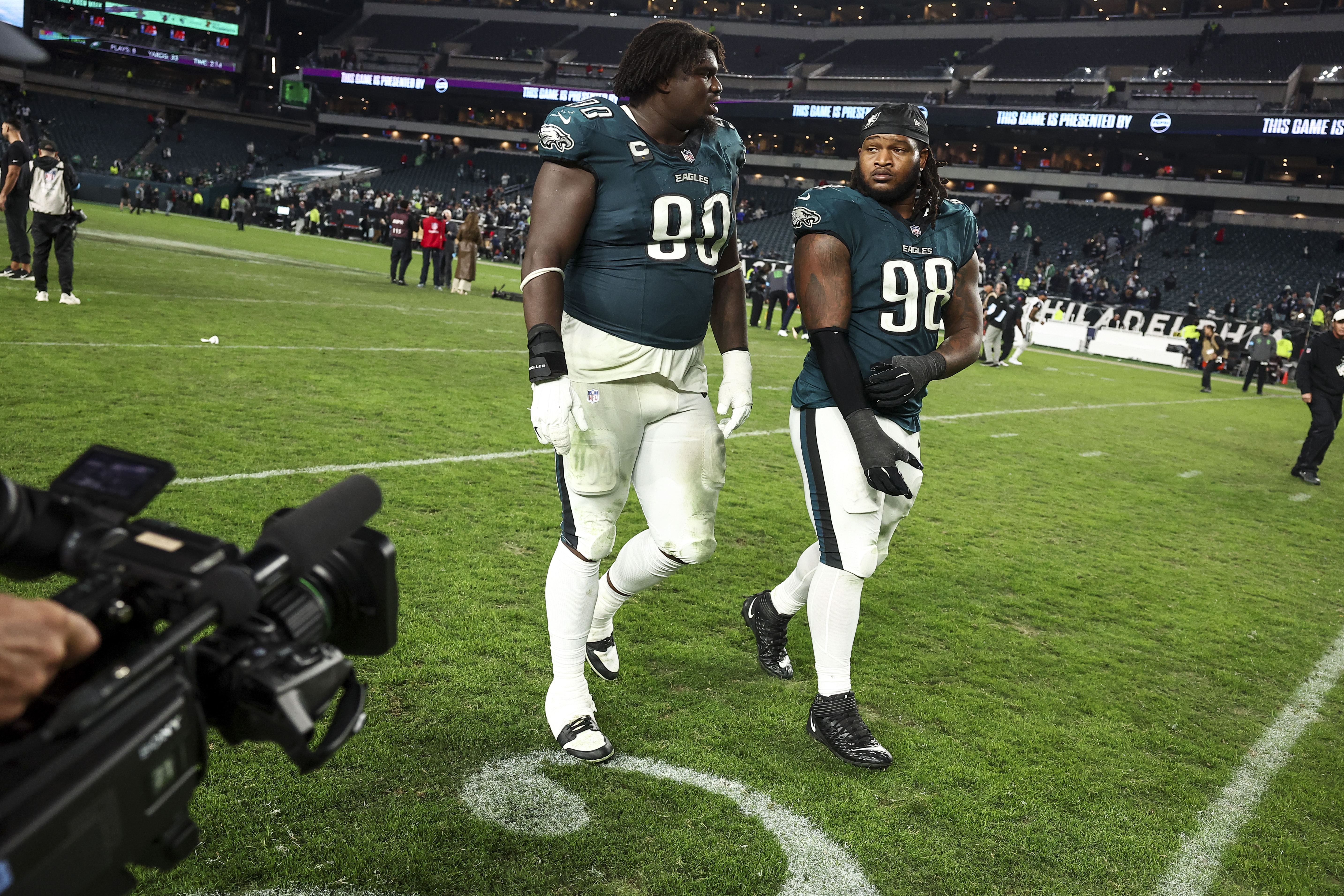
Jordan Davis (center) and Jalen Carter (right) will face scrutiny on Sunday after a weak outing on Monday Night Football. Monica Herndon / Staff Photographer
The Eagles face another set of below-par tackles after failing to capitalize on matchup advantages on Monday night. Left tackle Brandon Coleman, who was forced into the lineup after Laremy Tunsil suffered a triceps injury in training camp, has been a turnstile. We’ll see if Carter has enough pride, as Fangio said he would, to rebound from a career-low performance. He’ll mostly encounter right guard Sam Cosmi, Washington’s lone top-tier blocker, and Carter has faded in their earlier matchups.
Washington’s run offense isn’t strong and recently lost top tailback Jacory Croskey-Merritt. Rachaad White, formerly of the Tampa Bay Buccaneers, has been passable as his replacement. A heavy zone-blocking scheme hasn’t opened enough holes and has struggled against five-man fronts. I can see Davis and Co. bouncing back from last week’s disastrous outing. But they also have to contend with Daniels’ mobility. He can knife defenses on the ground, and Fangio’s scheme has historically had issues keeping running quarterbacks in check.
Extra points: The 1-4-1 Commanders are coming off a much-needed bye. They aren’t quite as banged up as the Eagles, but they’ve gotten off to another bad start with a coach in Dan Quinn who is teetering on the edge of getting fired. Somehow they’re 5½ point favorites, which speaks volumes more about the Eagles than anything else.
Nick Sirianni needs his team to demonstrate effort before Sunday night’s primetime audience. Yong Kim / Staff Photographer
Nick Sirianni didn’t call out his players for their effort vs. Dallas, but there were clues that some guys may be checking out. It’s understandable, with half the starting offense injured or gone. But Sirianni’s future could ride on how his team fights in the face of adversity. The culture stuff is supposed to be his strength. If he can’t at least get his squad to play hard, there really isn’t much left to keep him here. That may sound harsh. He certainly does more than that, but after repeated changes to his staff and scheme, there’s little doubt owner Jeffrey Lurie is questioning his coach’s future. He came close to firing him before, although I doubt such a move would come in-season.
As for the outcome of this game, can I pick both teams to lose? Maybe a tie? I won’t chicken out, so let’s go with the home team.
One by one, the eggs are rolling off the production line, 250 a minute, at Zitner’s Fine Confections’ new chocolate factory in Hatfield, Montgomery County.
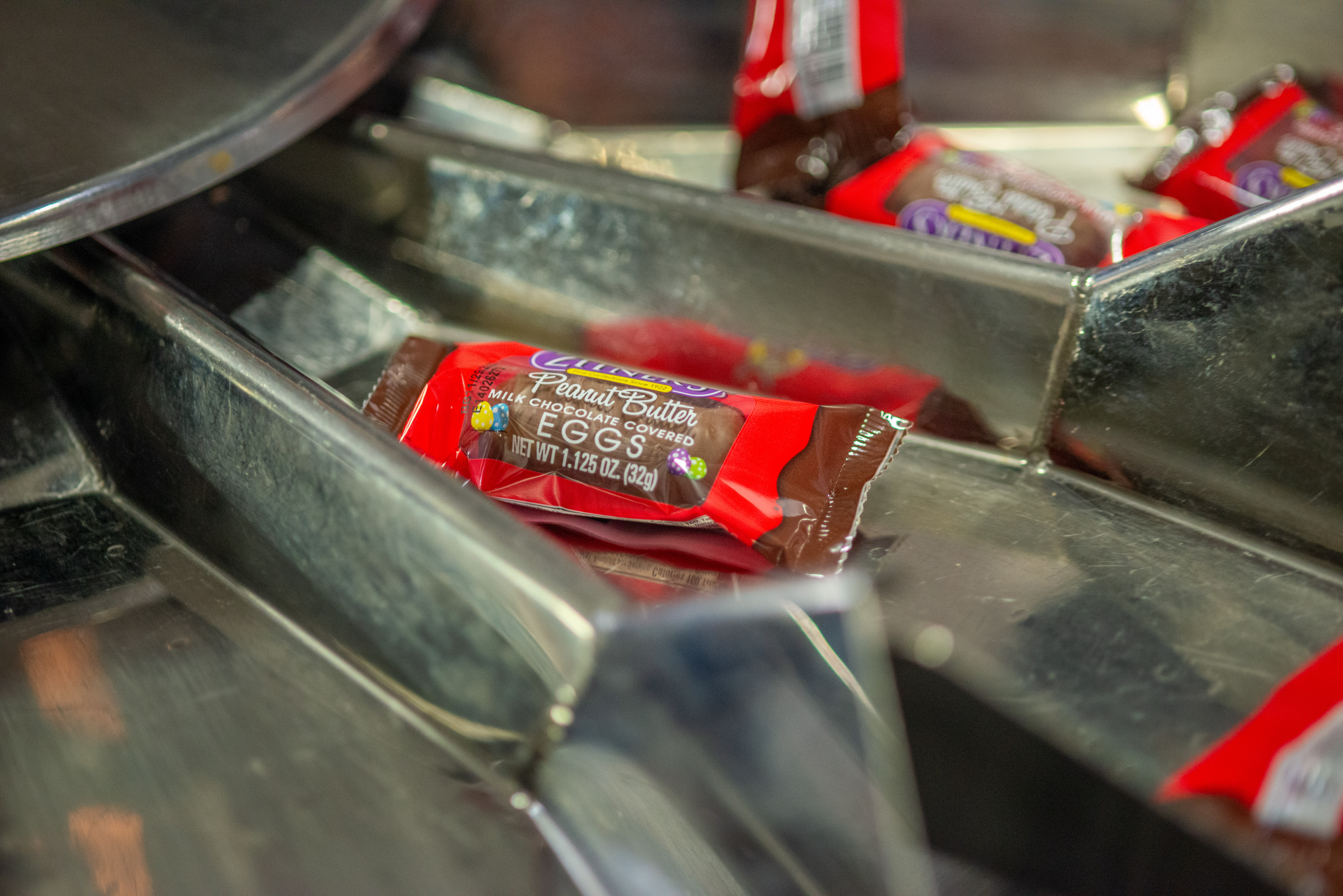
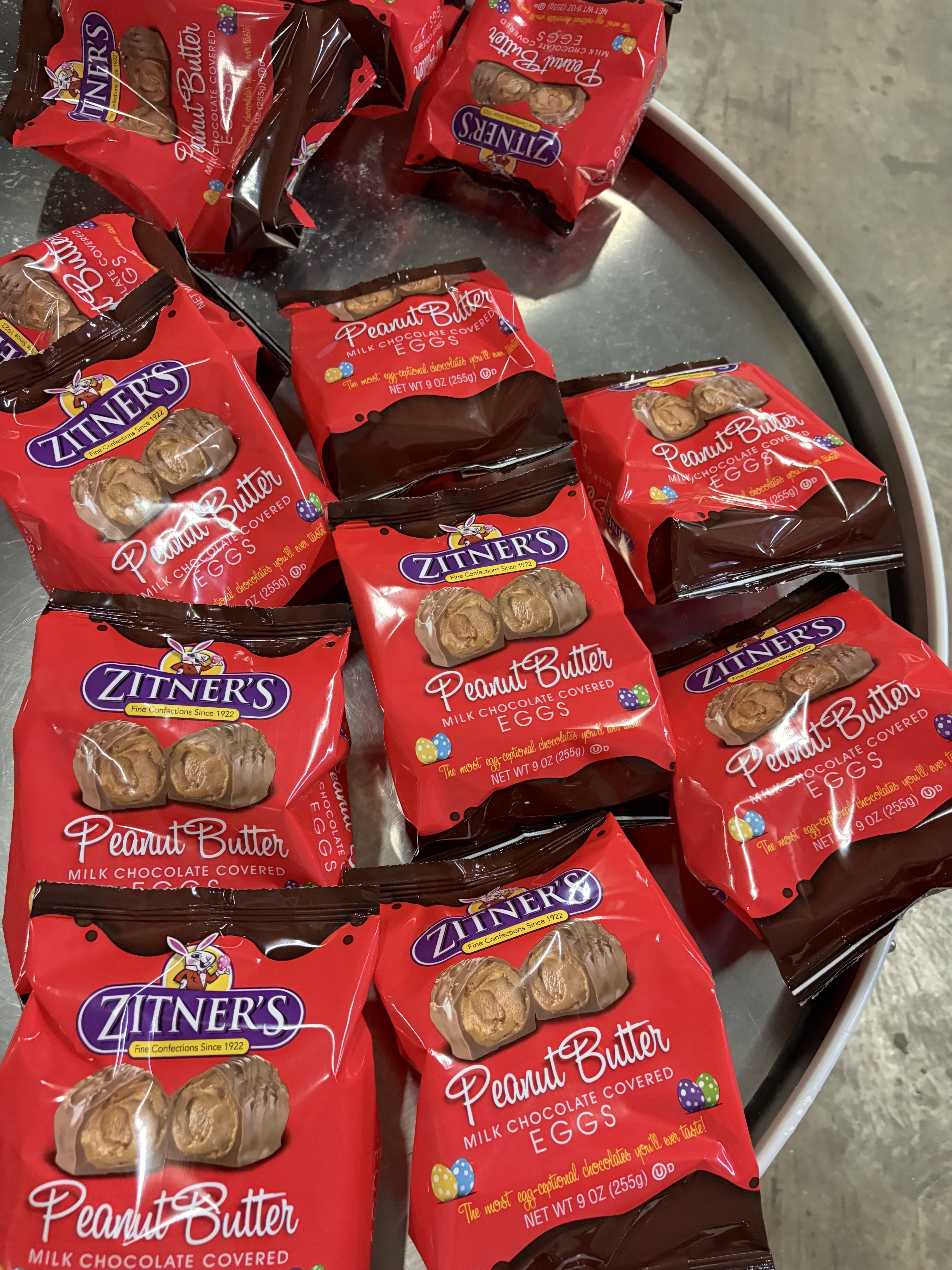
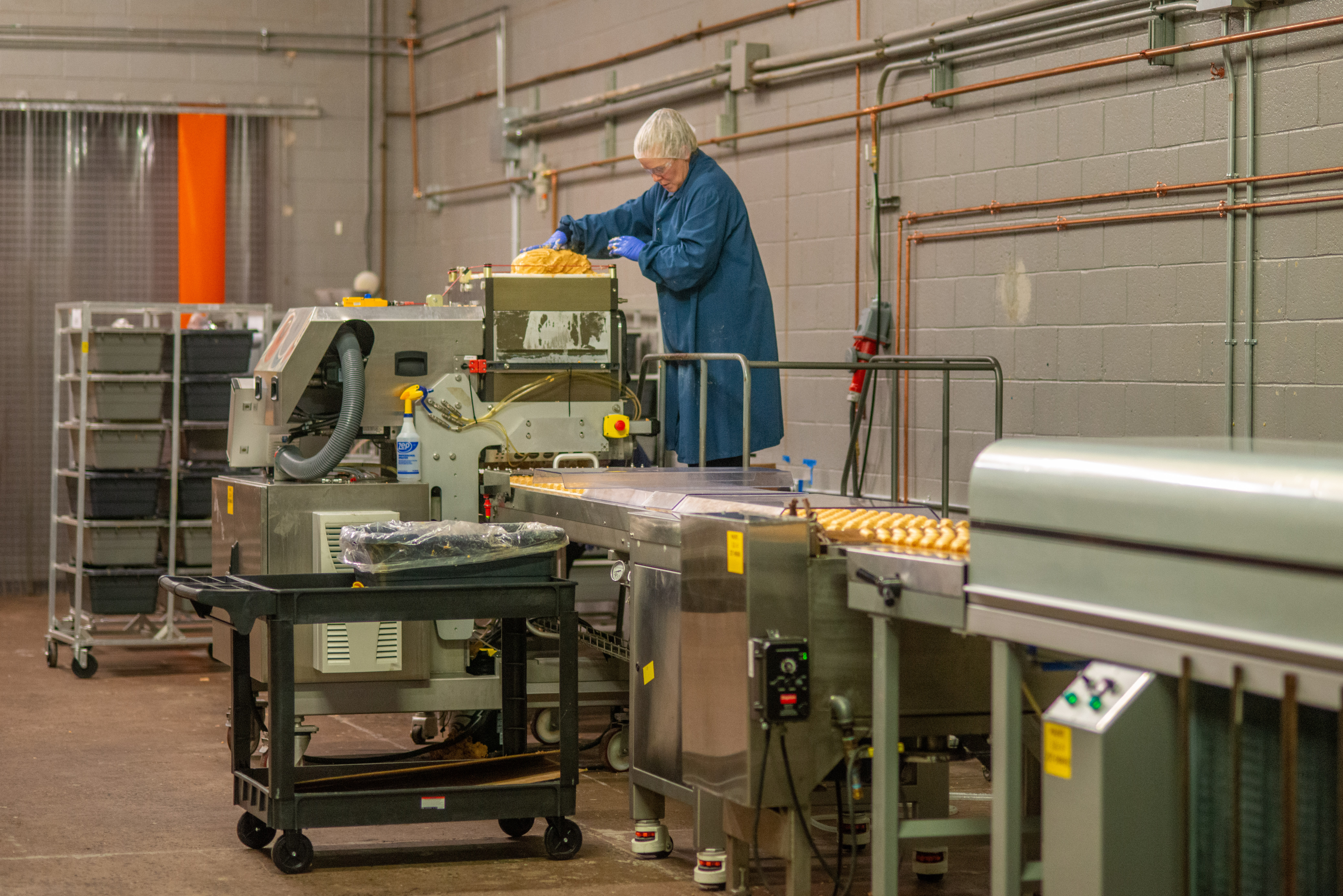
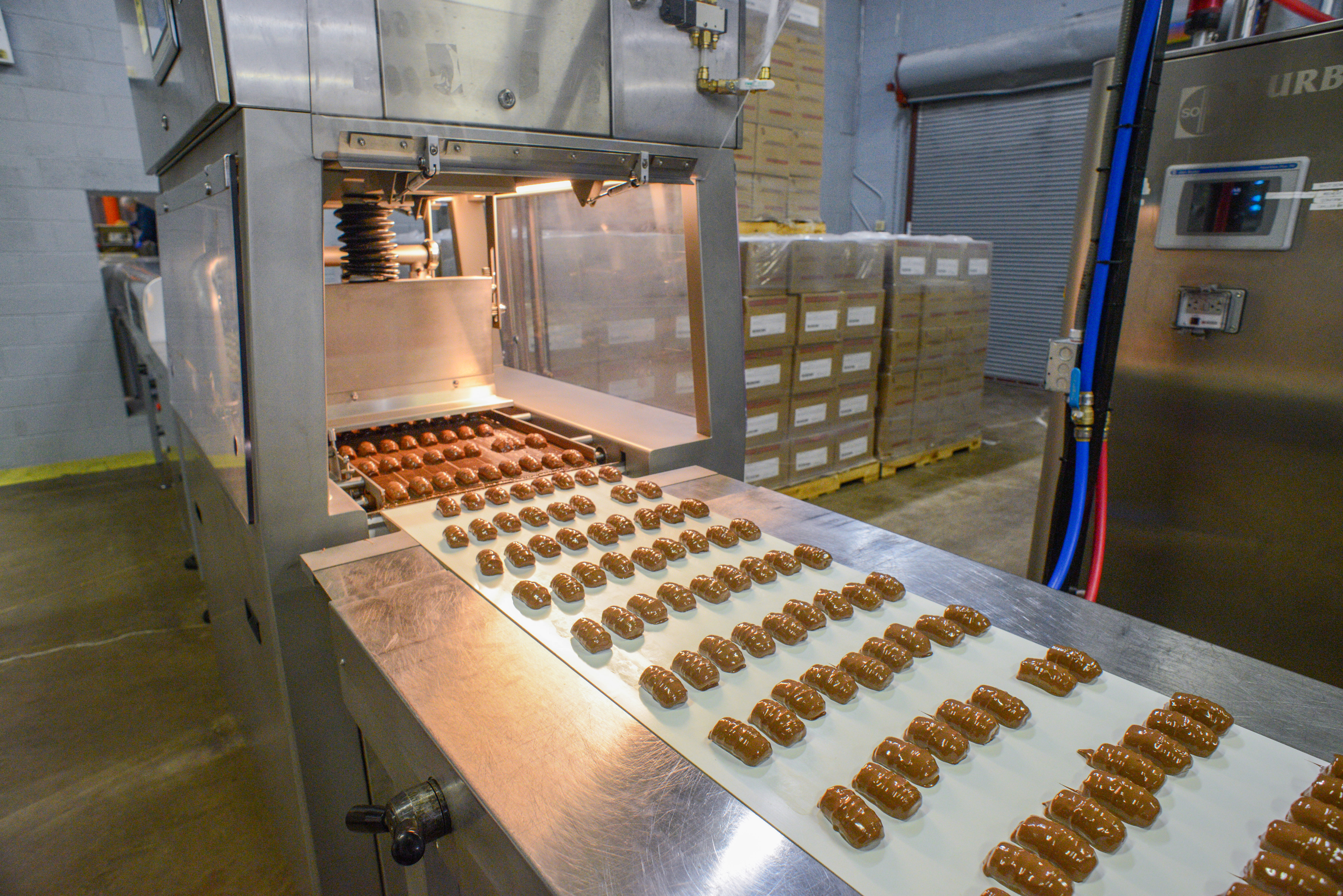
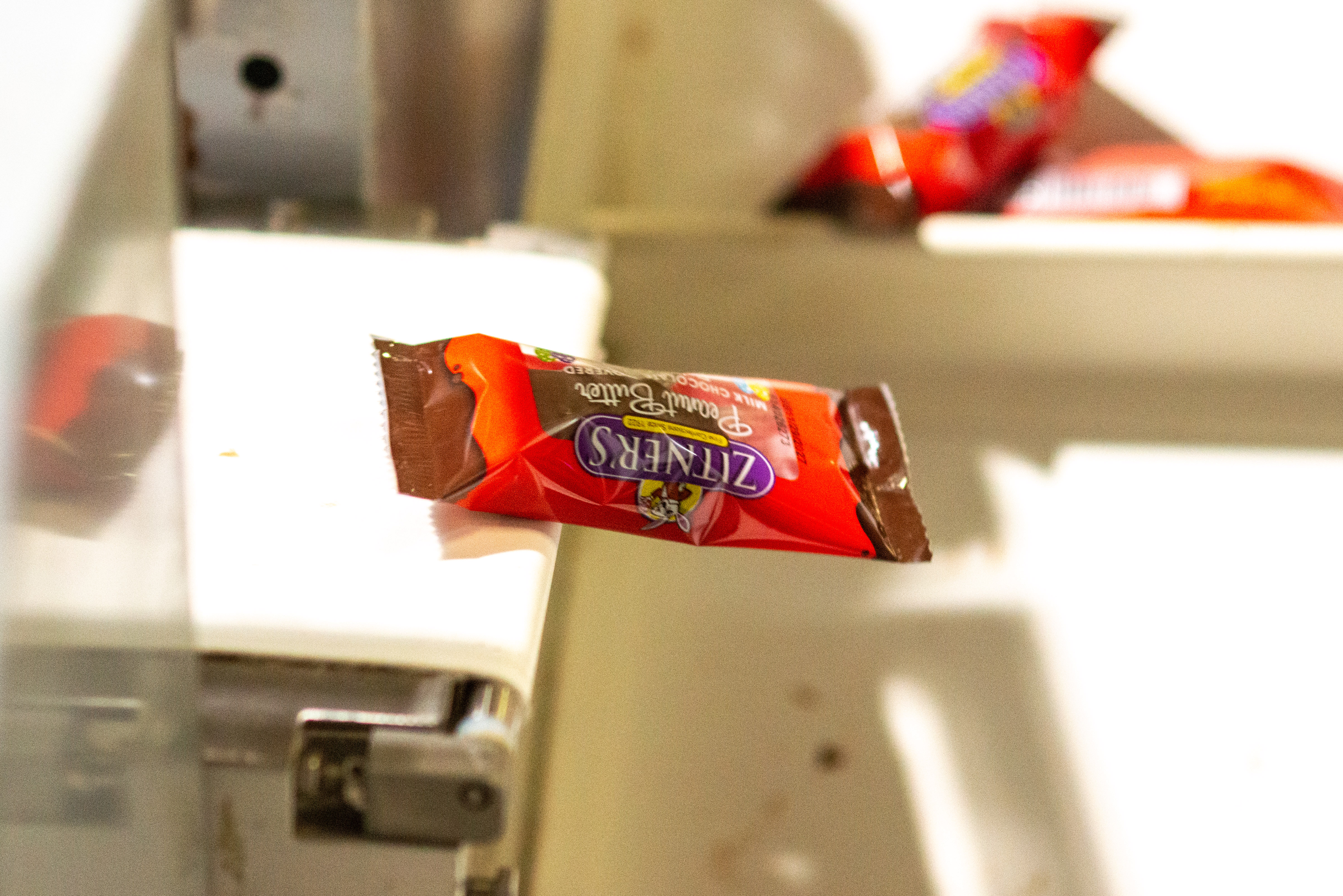
First come peanut butter eggs. Hair-netted and jacketed workers feed peanut butter cream from 50-pound tubs into a machine that forms it into eggs, coats them in chocolate, and sends them — like the old I Love Lucy bit — toward a whirring wrapping machine.
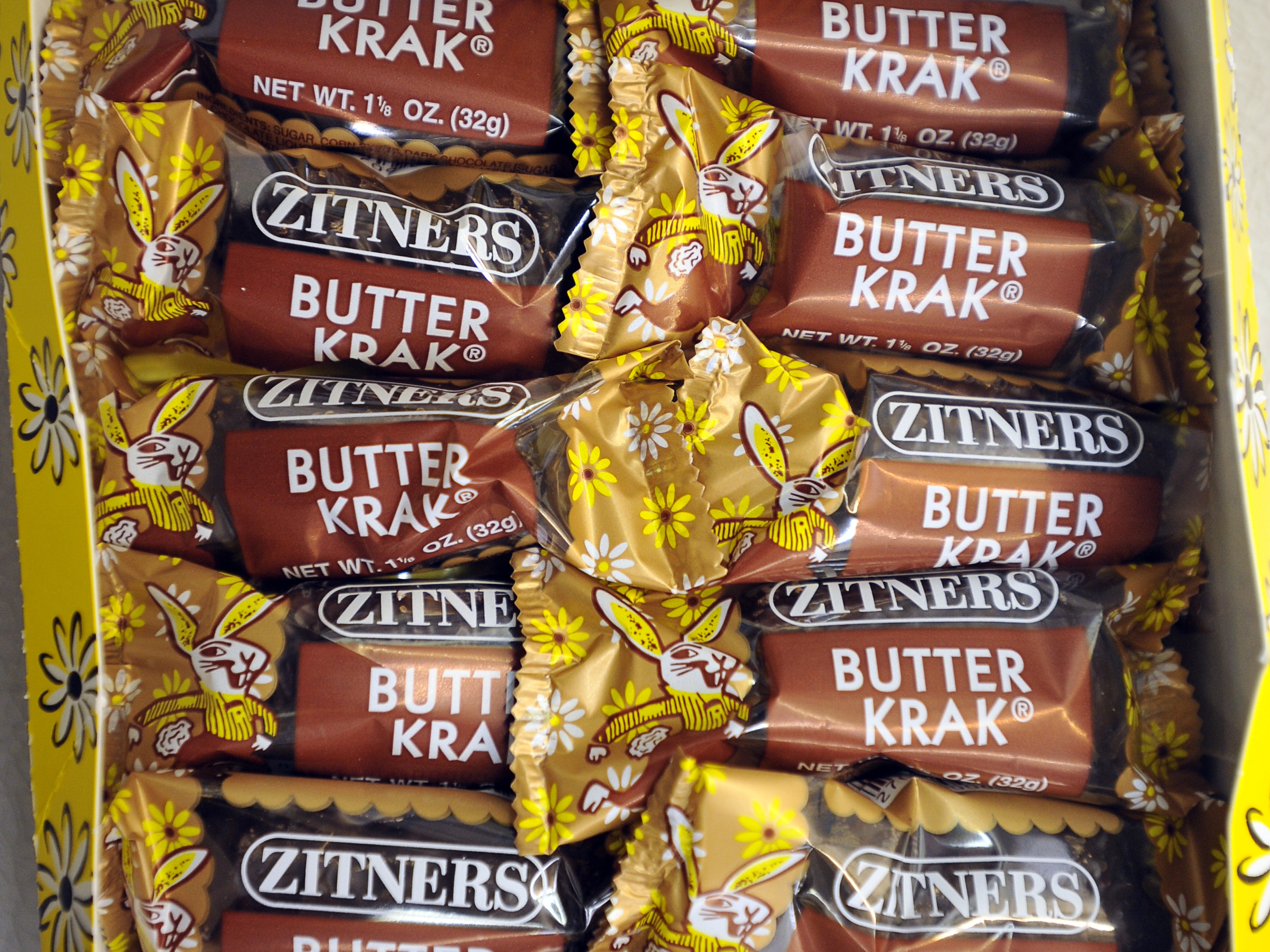
Next up will be Zitner’s dark chocolate specialties: Butter Cream, Coconut Cream, Double Coconut, and — the crown jewel — Butter Krak, a sweet amalgamation of everything.
For Evan Prochniak, Zitner’s CEO, this has been a long time coming.
Video: Inside Zitner’s new chocolate factory
The century-old Philadelphia candy company, whose cream-filled eggs have been Easter basket fixtures for generations, is back in production after missing the 2026 holiday season. Its products are expected to return to Philadelphia-area grocery shelves in December, possibly before Christmas.
While the factory is new, Prochniak insists the candy won’t be any different. Zitner’s is using the same recipes and ingredients that customers remember.
The comeback follows the closure of Zitner’s longtime North Philadelphia factory and the acquisition of Kargher Chocolate, a Hatfield manufacturer, by Prochniak, 55, and his business partner, Phil Priolo, 54.
The 25-mile move required hauling 10 truckloads of machinery up Route 309, installing new electrical service and compressed-air lines, and reconfiguring a 100-foot production line. It gives Zitner’s a modern home and room to expand.
Production began in September at about 220 eggs a minute. Prochniak has since increased the pace and hopes to reach 275 soon.
“We are really humming now,” he said last week. “There were a lot of little odds and ends that I tweaked, and we’re just cranking that candy out.”
Phil Priolo (left) and Evan Prochniak, business partners and onetime college roommates, along the production line at Zitner’s plant. William Thomas Cain / For The Inquirer
Butter Cream production began last week, with Coconut Cream or Double Coconut next. Prochniak plans to make Butter Krak, the company’s top seller, from early December through New Year’s.
“There’ll be no Christmas for me at all,” he said. “It’ll be Easter.”
Chocolate season
Zitner’s starts its Easter production in the fall with peanut butter eggs, its only milk chocolate-coated variety. Making them first allows the company to thoroughly clean the equipment of peanuts afterward to prevent allergen cross-contact.
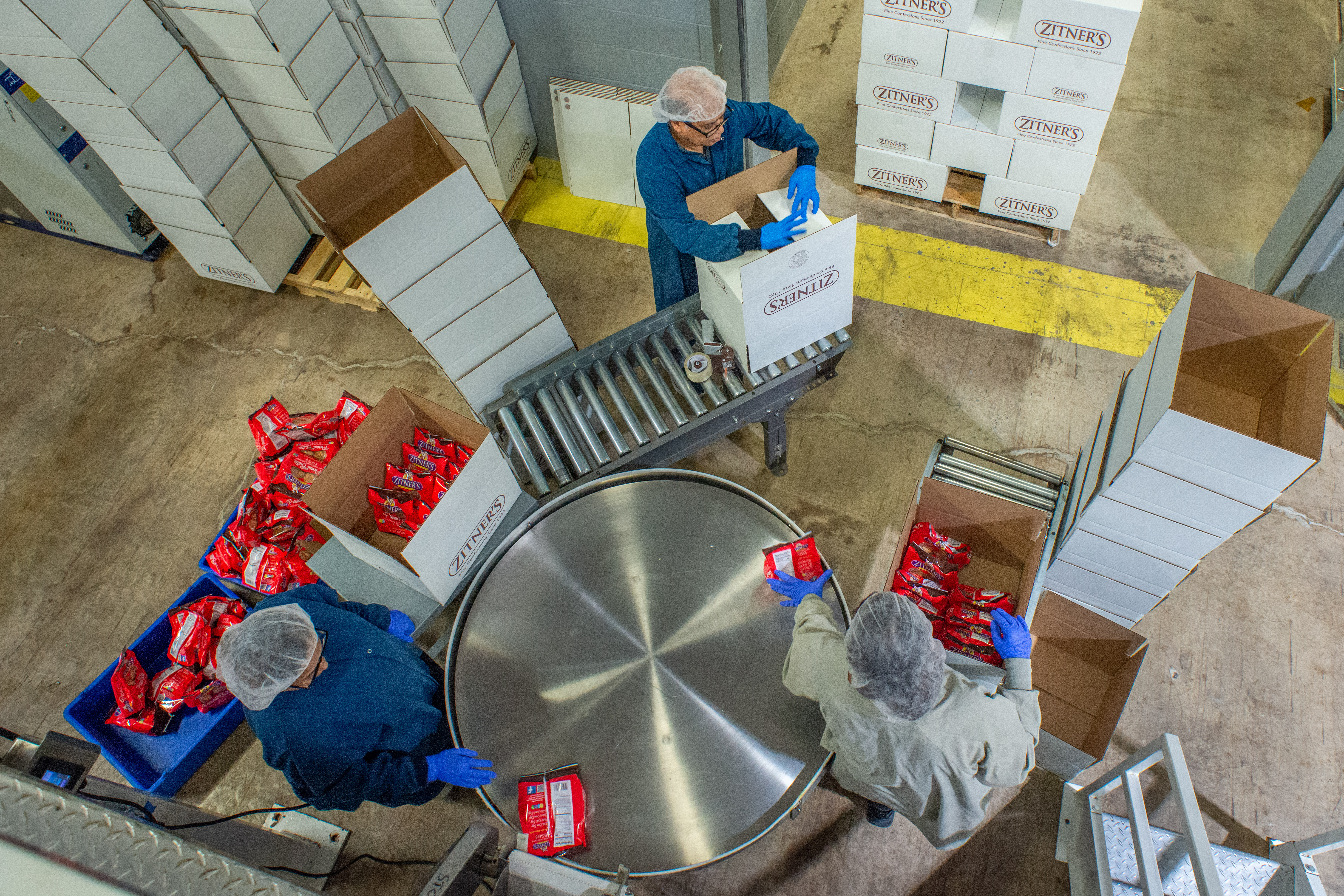
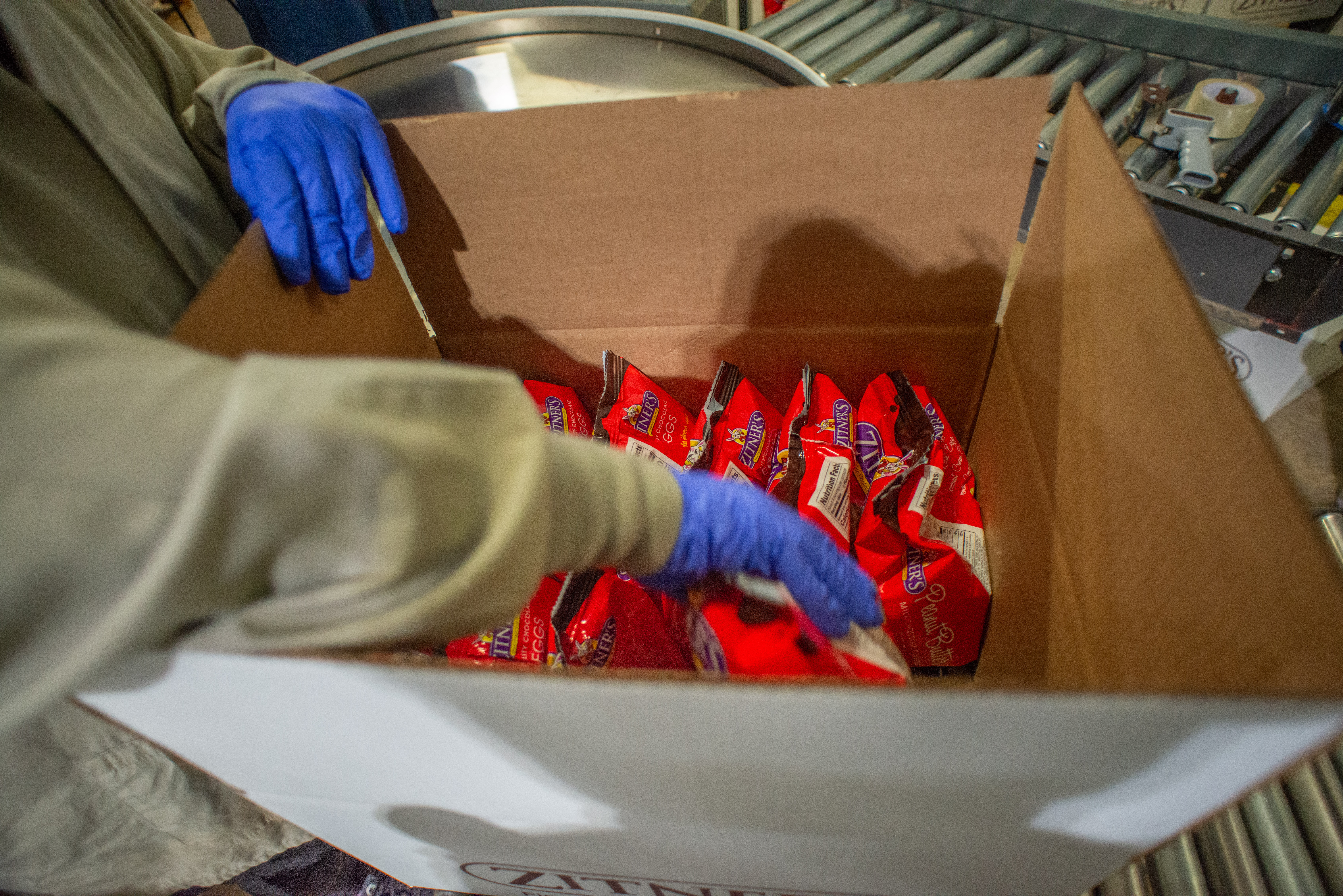
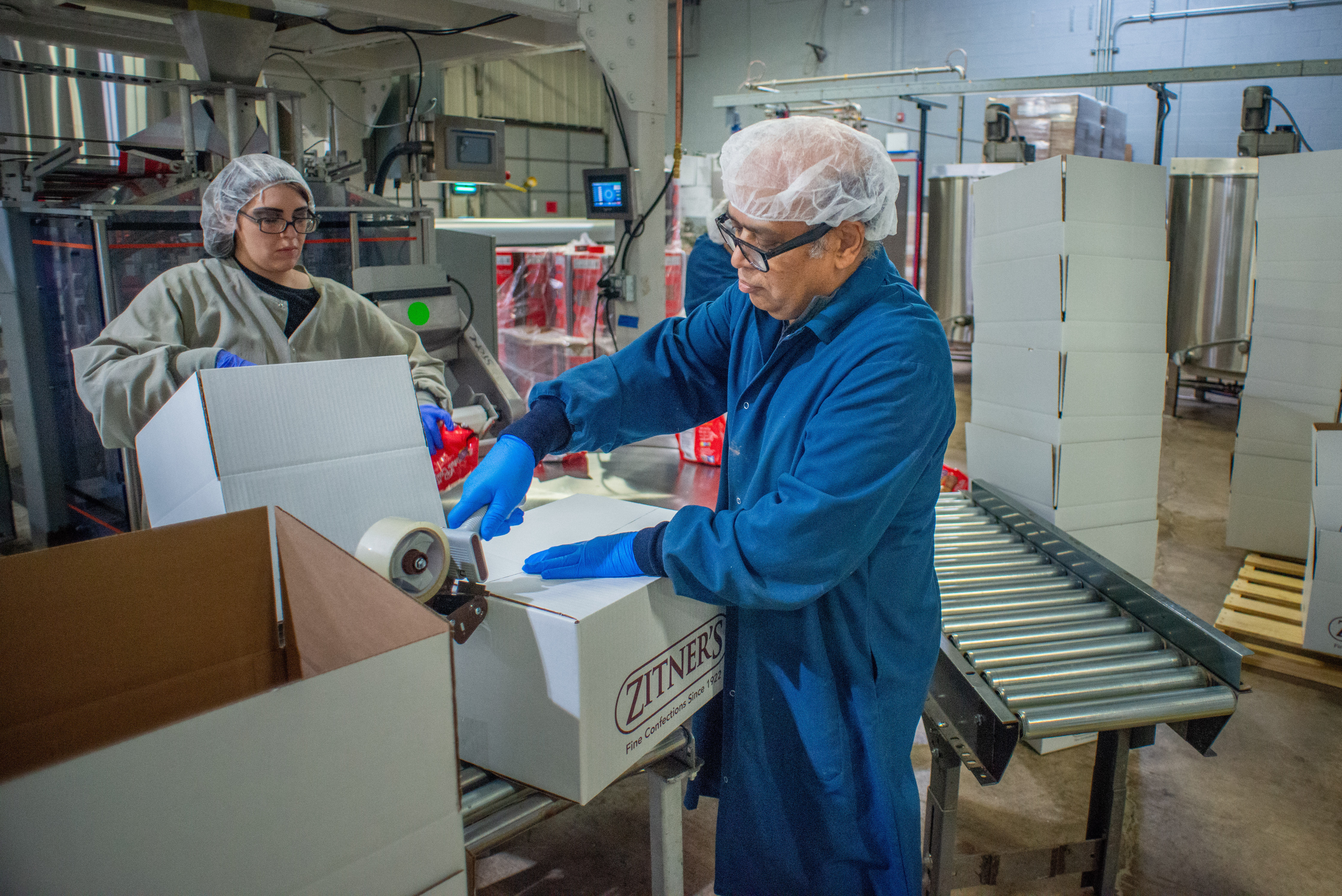
The peanut butter filling — made in-house from Virginia peanuts, salt, sugar, and other ingredients — is fed into machinery that forms, coats, cools, and wraps the eggs. They’re packed eight to a bag, 12 bags to a case.
The company has substantial orders from Acme and Weis Markets scheduled for shipment during the first two weeks of December, Prochniak said. ShopRite has placed large orders for early January.
Wrapped batches of Zitner’s eggs are boxed for shipping at the factory in Hatfield.William Thomas Cain / For The Inquirer
Prochniak said he brought samples to an Acme representative last week. She told him the chain would put the candy on shelves as soon as it arrived.
Retailers have increased their orders even though Easter falls relatively early this year, on March 28, ordinarily a reason to order less because of the shorter selling season.
Prochniak said customers treat Zitner’s eggs differently from typical Easter candy.
“This is something people eat every week,” he said. “They go to the grocery store, put it in their shopping cart, eat it, and go back the next week for more.”
Some customers stock up before Easter and freeze it to last until the following year.
A factory in crisis
Zitner’s last manufactured candy at its factory near 17th and Clearfield Streets in summer 2024. Prochniak said the building, occupied since the 1960s, had deteriorated.
“If you go back and look at the Bizarre Foods episode we were on [in 2015], you can see the roof was already falling in back then,” he said.
The first test batch of Zitner’s peanut butter eggs at the Hatfield facility, as they came off the line on Sept. 9, 2026.Courtesy of Evan Prochniak
A neighboring salvage operation also displaced the factory’s shipping and receiving area, forcing workers to load trucks on 17th Street.
Zitner’s outsourced production for Easter 2025 but couldn’t relocate in time for Easter 2026.
After an attempt to acquire another candy business in the Harrisburg area fell apart, Prochniak approached Douglas Kargher, who was looking to retire from his family-owned chocolate business.
Kargher wanted to sell outright, so Prochniak enlisted Priolo, his longtime friend and roommate back at Penn State, to be his business partner. They established Cocoa Ridge, a holding company, to acquire Kargher Chocolate’s assets. The deal closed in March.
Priolo, formerly an executive at Exelon, is president and CEO of the Kargher operation. His business card identifies him as Chief Chocolatier.
Zitner’s remains a separate company, and Kargher has its own private-label business making and selling chocolate chips and nonpareils.
Wioth production stepping up, “there’ll be no Christmas for me at all,” says CEO Evan Prochniak. “It’ll be Easter.” William Thomas Cain / For The Inquirer
The arrangement also gives Prochniak something he has long wanted: greater control over chocolate manufacturing. Zitner’s has traditionally purchased chocolate made to its specifications by outside manufacturers. In the future, the partners plan to connect Kargher’s chocolate-making equipment to Zitner’s production lines.
A new beginning
Ingredient costs remain a challenge. Sugar, essential to the cream centers, has risen from about 57 cents a pound to nearly 78 cents, Prochniak said, and could reach 80 cents.
The production equipment represents years of experimentation.
Sixteen years ago, Prochniak was a real estate attorney eyeing up Zitner’s’ North Philadelphia property for redevelopment. When that plan fell through, he studied the then-88-year-old candy business and discovered it was turning away orders because it couldn’t make enough. He acquired Zitner’s with partners in 2010.
Butter Krak eggs, which date to the 1930s, are the company’s top seller.Sharon Gekoski-Kimmel / Staff Photographer
Starting around 2013, Prochniak worked with European equipment makers to automate production of Zitner’s soft centers, then added equipment for coating, cooling, and wrapping.
The line eventually stretched to 100 feet. In Philadelphia, it ran straight across the factory. In the Hatfield plant, where Zitner’s took over a Kargher storage area, workers cut an opening in a wall so the line could pass through, turn around, and continue in the opposite direction. It’s now about twice the size.
The peanut mixture, cut to shape and size, is covered in chocolate to make a batch of Zitner’s eggs.William Thomas Cain / For The Inquirer
For all the modernization in production, Prochniak is adamant that the new equipment has not changed what goes into Zitner’s eggs; it just enables the factory to make more of them.
Butter Krak, the company’s top seller, dates to the 1930s. Annie Zitner, who founded the company in 1922 with her husband, Sam, in Kensington, taught her nephew Leon Sherman to make the combination of buttercream, shredded coconut, toasted coconut, and bittersweet chocolate. The eggs originally sold for a nickel.
Prochniak, who grew up in Southwest Philadelphia, remembers receiving Zitner’s candy at Easter, although his mother was strict about sweets.
Chocolate-covered eggs for Easter produced by Zitner’s in 2018. CEO Evan Prochniak wants to bring back the large, decorated ones.Alejandro A. Alvarez / Staff Photographer
His childhood favorite was Butter Cream. Today, it’s Butter Krak.
He has plans for more storage, possible expansion, and eventually reviving older Zitner’s products, including marshmallows and those big decorated buttercream and coconut cream eggs. He also wants to restore the small counter displays that once sold individually wrapped eggs at places such as Wawa.
But first, there are supermarket orders to fill.
The eggs keep coming
During a September visit, a worker kept the eggs lined up as they approached the wrapping machine.
“She’s also looking for flaws in the candy — pieces sticking together, cracks, incomplete chocolate coatings,” Prochniak said.
Rejects were pulled off the line and tossed into a bin. Each wrapped egg received a quality-control stamp.
A worker loads peanut butter mix into a machine that presses it into egg shapes at Zitner’s factory in Hatfield.William Thomas Cain / For The InquirerThe peanut filling is covered in chocolate to make a batch of Zitner’s peanut butter eggs at its factory in Hatfield.William Thomas Cain / For The InquirerThe peanut mixture is covered in chocolate to make Zitner’s peanut butter eggs at its factory in Hatfield.William Thomas Cain / For The InquirerZitner’s peanut butter eggs, newly coated in chocolate, roll down the line at the Hatfield factory. William Thomas Cain / For The InquirerPeanut butter eggs approach the wrapping machine at Zitner’s Fine Confections.William Thomas Cain / For The InquirerA wrapped Zitner’s egg is ready to be bagged at the factory in Hatfield.William Thomas Cain / For The InquirerZitner’s CEO Evan Prochniak in his safety garb at the factory, the home of Kargher Chocolates.William Thomas Cain / For The InquirerA worker inspects Zitner’s peanut butter eggs before they reach the wrapping machine. William Thomas Cain / For The InquirerWrapped Zitner’s peanut butter eggs are ready to be boxed.William Thomas Cain / For The InquirerEight eggs to a bag, 12 bags to a case: Wrapped batches of Zitner’s eggs are boxed for shipping at the plant in Hatfield. William Thomas Cain / For The InquirerEmployees box the bagged eggs at Zitner’s factory in Hatfield.William Thomas Cain / For The InquirerWrapped batches of Zitner’s eggs are boxed for shipping at the factory. William Thomas Cain / For The Inquirer
“I can tell you the day that egg was made and trace it all the way back to the sugar that went into it,” Prochniak said. “Everything is tracked.”
Surely, it must be tempting to eat candy all day.
“Not good for your waistline,” Prochniak said. “But I’m tasting it all the time. I have to make sure the recipe is exactly what it’s supposed to be.”