Blog

  • The busiest ambulatory surgery centers in the Philadelphia region

    The busiest ambulatory surgery centers in the Philadelphia region

    The two busiest surgery centers in the Philadelphia region last year were operated by Penn Medicine in Radnor and Jefferson Health in Center City.

    Such facilities have grown increasingly popular as a cost-saving option for procedures that do not require intensive hospital resources or overnight stays.

    While they offer convenience, the facilities operated by Penn and Jefferson both count as hospital departments for billing purposes, which means they cost more than surgery centers operated by independent physicians or other companies.

    Penn Medicine Radnor Surgery Center operates within a large outpatient facility near the intersection of I-476 and Route 30. It logged 12,464 surgical visits in 2025, up from 8,961 the year before, according to data published last month by the Pennsylvania Department of Health.

    Penn attributed the growth to the addition of new gastroenterologists in Radnor to perform colonoscopies, upper endoscopies, and other procedures. Colonoscopies, in particular, account for a large portion of the overall volume in surgery centers outside hospitals.

    Jefferson Surgery Center was close behind, with 12,261 surgical visits, up from 2,639 in 2024. It sits within the Honickman Center, which opened in 2024 at 1101 Chestnut St. in Philadelphia. Jefferson has gradually expanded the array of surgical services offered there.

    “Growth has been driven by both increasing patient demand and the strategic transition of services from other Jefferson locations, allowing us to provide care in a state-of-the-art outpatient environment,” Jefferson said in an email.

    Other fast-growing surgery centers include two independently operated facilities focused on orthopedics, Premier at Exton Surgery Center in Exton and Restore Orthopaedic Surgical Institute in Chadds Ford.

    (function(){function e(){window.addEventListener(`message`,function(e){if(e.data[`datawrapper-height`]!==void 0){var t=document.querySelectorAll(`iframe`);for(var n in e.data[`datawrapper-height`])for(var r=0,i;i=t[r];r++)if(i.contentWindow===e.source){var a=e.data[`datawrapper-height`][n]+`px`;i.style.height=a}}})}e()})();

    Surgery center ownership matters

    Even though the Penn and Jefferson outpatient facilities are not in hospitals, their ownership by large hospital systems enables providers to get paid as if they were located inside the Hospital of the University of Pennsylvania or Thomas Jefferson University Hospital.

    Hospital outpatient department billing rates are sometimes twice as much as the rates paid to independent surgery centers.

    For example, surgery to remove torn cartilage from a knee can cost $7,190 when performed on an outpatient basis in a hospital, nearly three times the $2,477 cost in ambulatory surgery centers (ASCs), according to Philadelphia-area commercial insurance averages from Turquoise Health.

    Health insurers Independence Blue Cross and Highmark have implemented policies this year seeking to save money for employers and patients by moving care out of hospitals and into ambulatory surgery centers or ASCs. Both insurers say they will only pay for certain procedures if they are done in an ASC.

    But it’s not enough to move surgeries to a setting outside a hospital, given the hospital-like billing status of certain surgery centers.

    “The cost savings from an ASC depend on the facility’s ownership, licensing, and billing model,” Richard Snyder, IBX’s chief operating officer, said in a email to The Inquirer.

    IBX would like to see more ASCs in its Southeastern Pennsylvania market and is “prepared to help catalyze growth through continued value-based arrangements, strategic partnerships, and investments,” Snyder said.

    Litigation over ASCs and other policies

    In a July lawsuit against IBX, Jefferson claimed that the insurer’s ASC policy amounted to a change to the financial terms of their contract that needed to be negotiated.

    The lawsuit said that ASC mandate will cost the health system $35.4 million, but doesn’t specify over what time period.

    IBX filed a motion last week to dismiss the lawsuit, which was moved to U.S. District Court in Philadelphia from the Philadelphia Court of Common Pleas.

    The insurer says that the lawsuit was premature because Jefferson filed it before completing a contractual process designed to resolve such policy conflicts.

  • The Big Picture: Eagles deliver — on and off the field — and more of the week’s best sports photos

    The Big Picture: Eagles deliver — on and off the field — and more of the week’s best sports photos

    The Eagles won (again) in Week 1 as the NFL season kicked off. They haven’t lost an opener since 2020, the year before Nick Sirianni and Jalen Hurts took over. While the Birds weren’t the only game in town this week, they were the biggest sports story — and a pair of players even made some headlines off the field. Each Friday, Inquirer photo editors picked the best sports images from the last seven days. Here’s this week’s Big Picture …

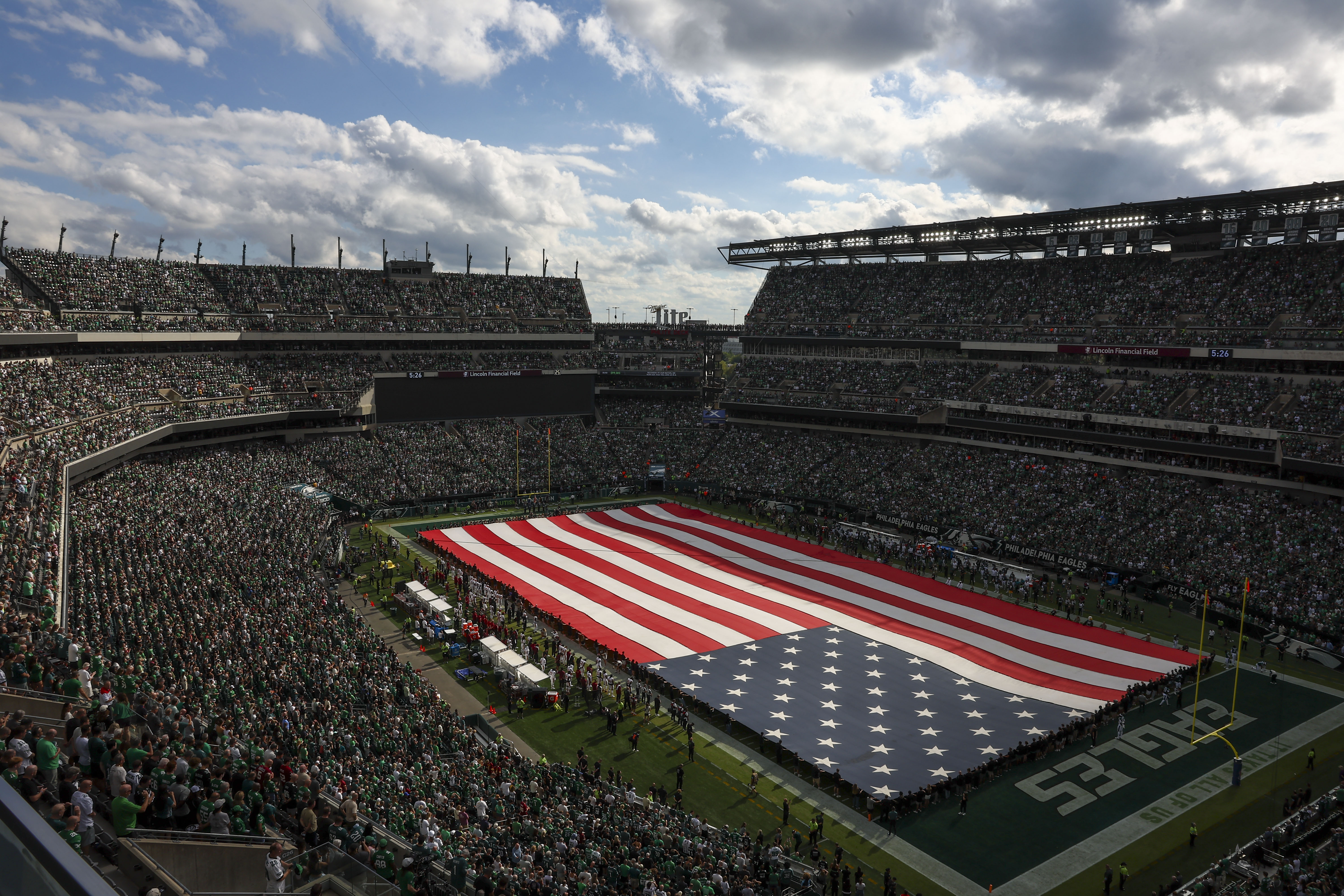
    The Eagles broke out the 100-yard-long American flag during the playing of the national anthem prior to Sunday’s season opener against the Washington Commanders.Monica Herndon / Staff Photographer
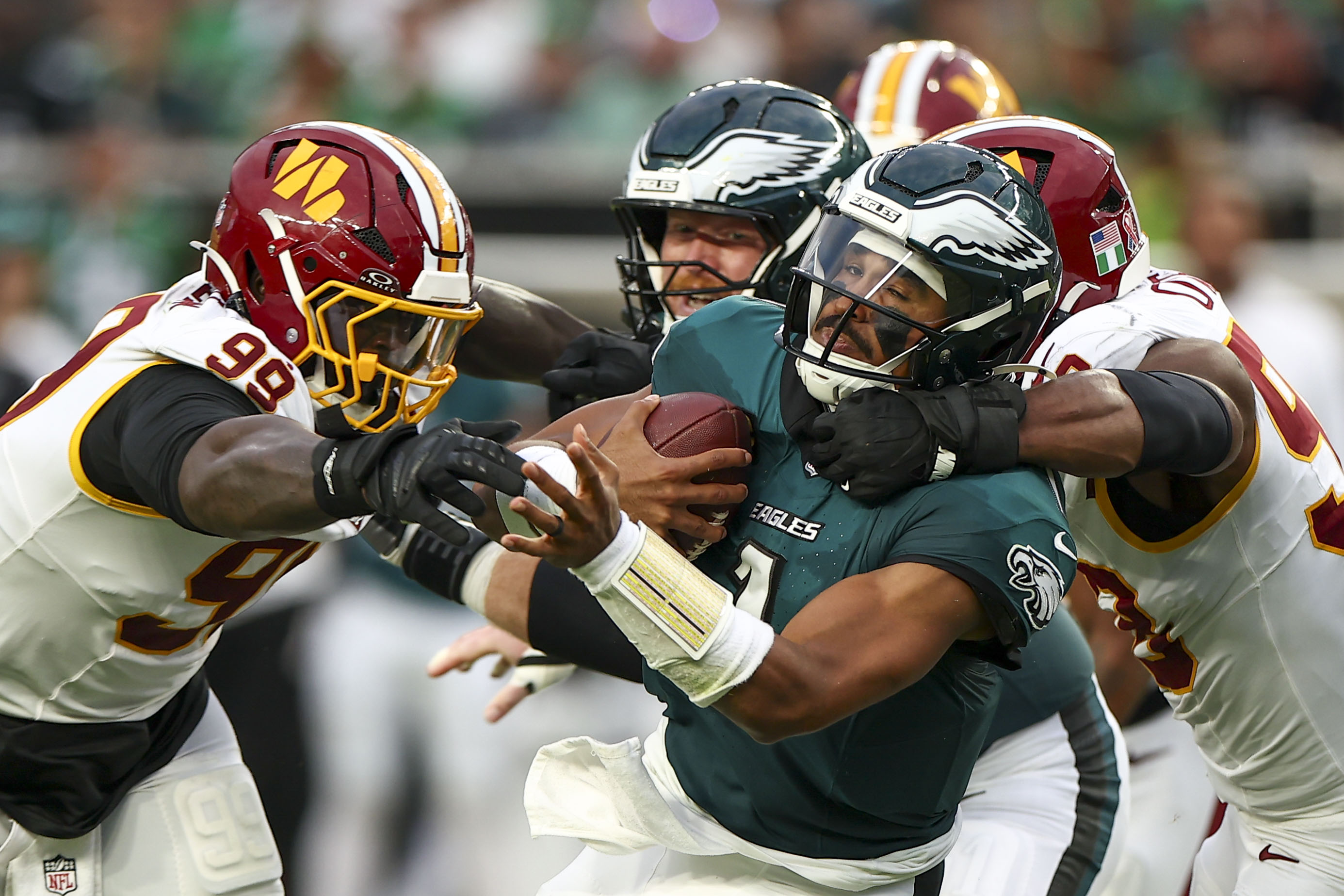
    Jalen Hurts was sacked three times by the Commanders as the Eagles offensive line struggled without a healthy Landon Dickerson (not pictured).Monica Herndon / Staff Photographer
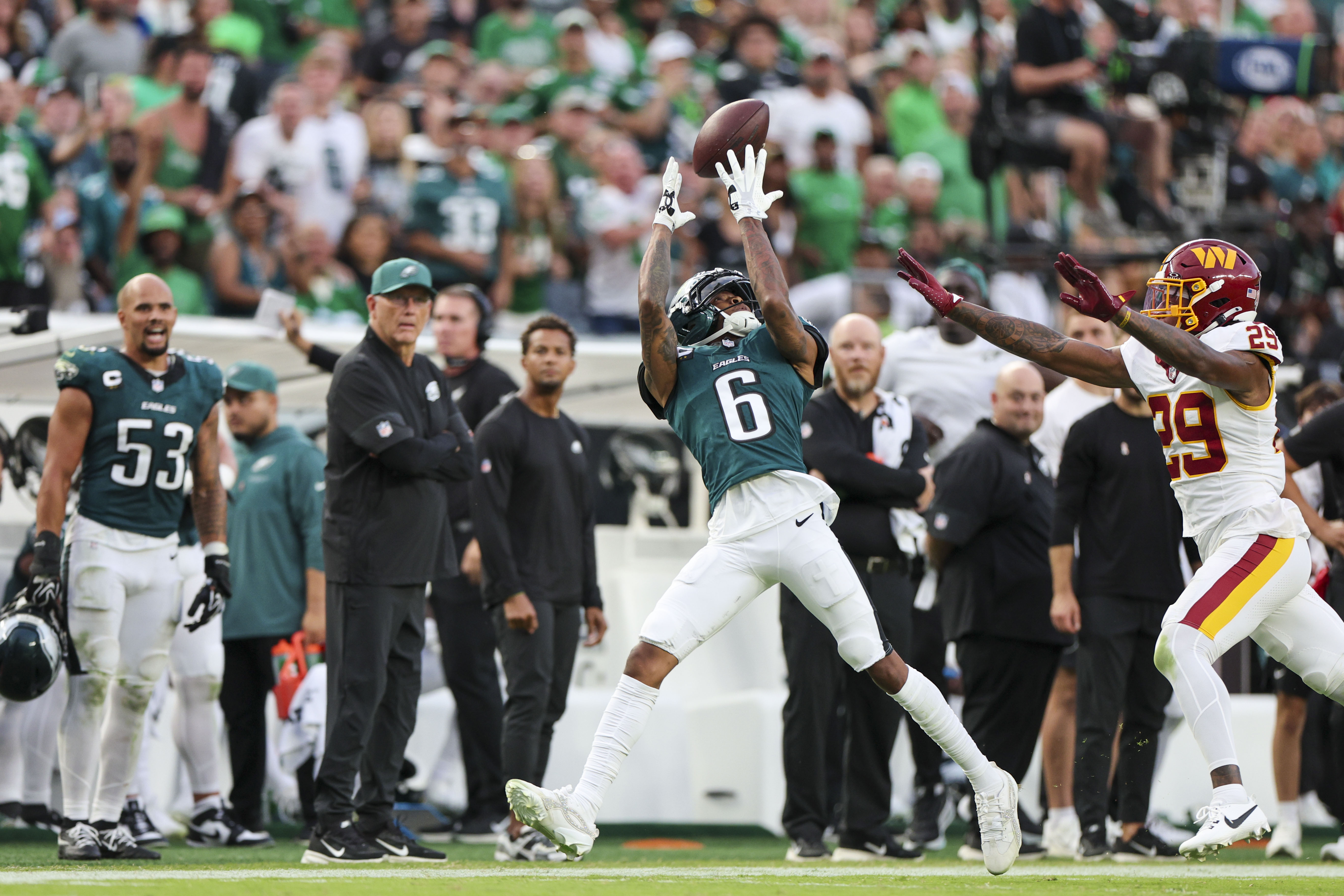
    Wide receiver DeVonta Smith caught three passes, including this one for 31 yards, in the Eagles’ Week 1 win. He led all receivers with six targets.David Maialetti / Staff Photographer
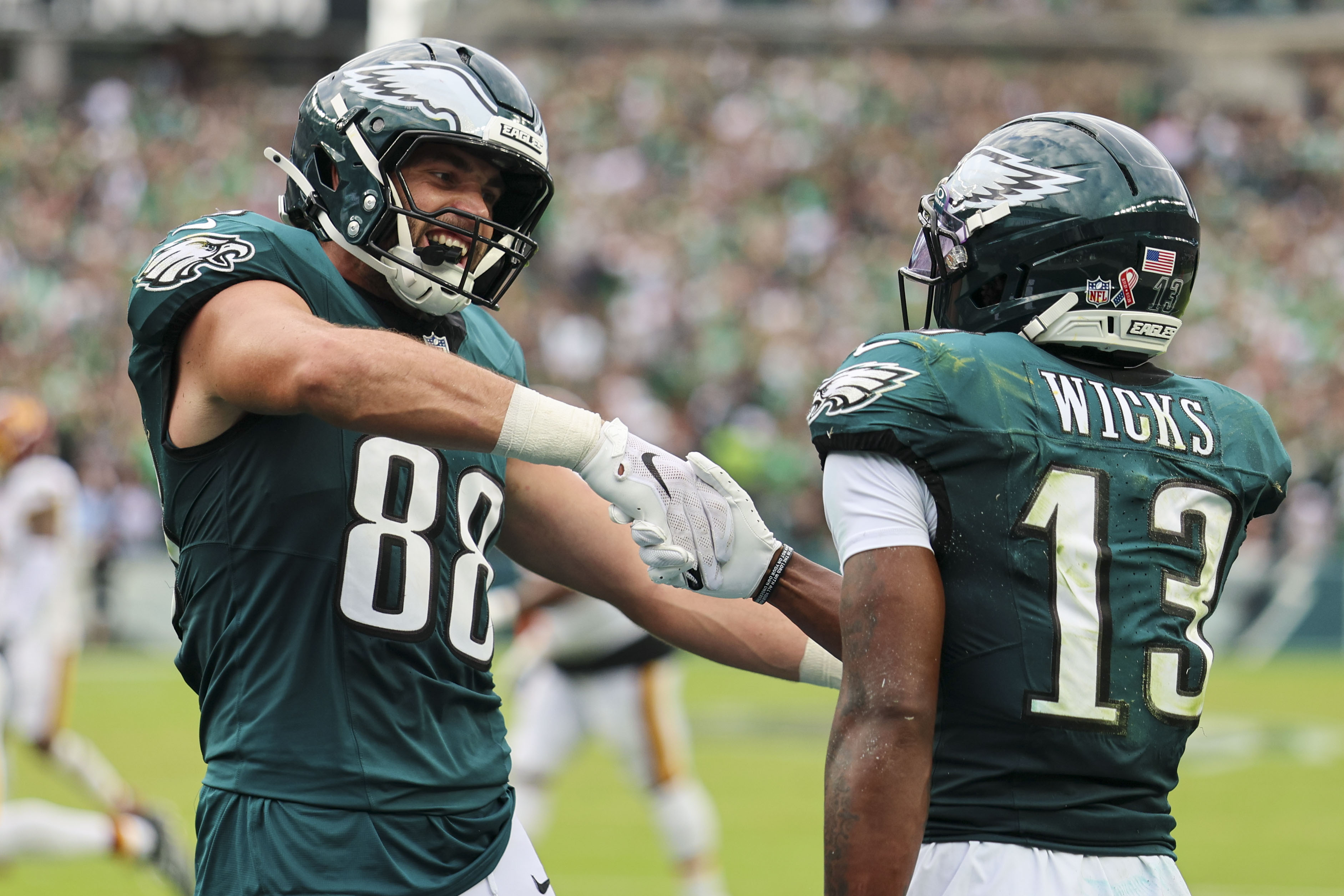
    Eagles tight end Dallas Goedert (left), who caught a pair of touchdowns on Sunday, celebrates with Dontayvion Wicks after the new wide receiver caught a touchdown of his own.David Maialetti / Staff Photographer
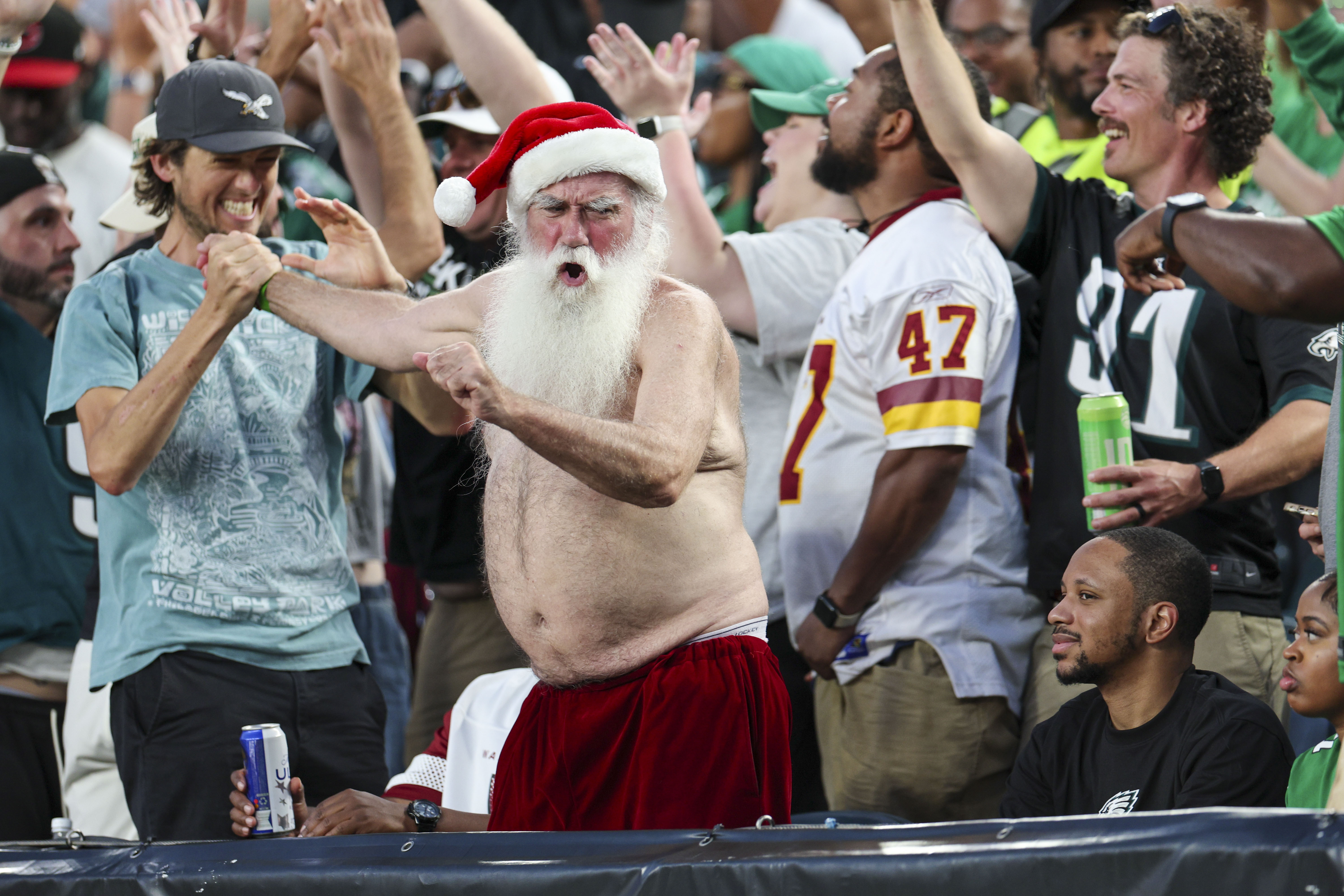
    A shirtless Santa celebrates after Dallas Goedert’s second touchdown extends the Eagles’ fourth-quarter lead.David Maialetti / Staff Photographer
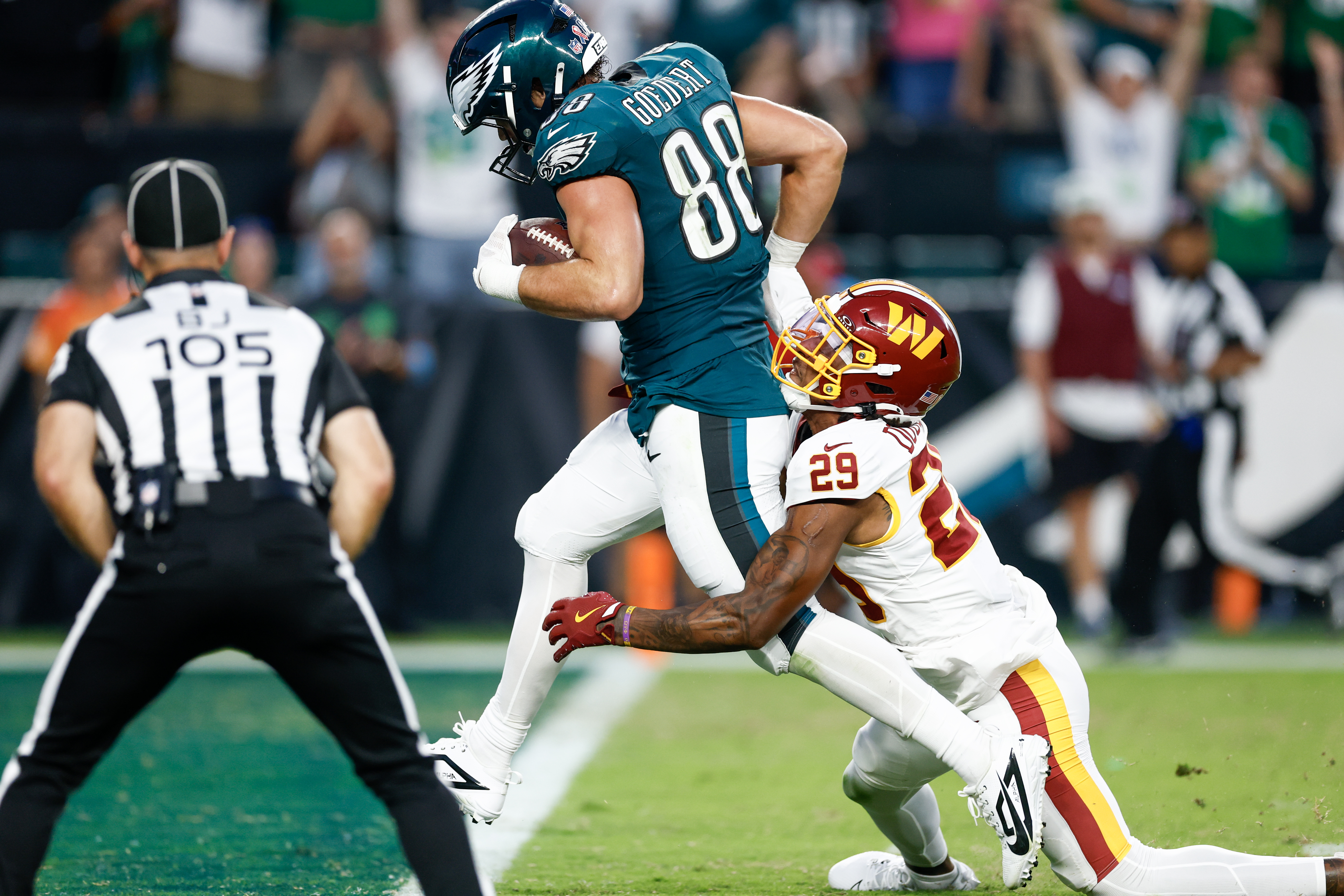
    Goedert’s 43-yard touchdown in the fourth quarter helped the Birds escape Week 1 with a win.Yong Kim / Staff Photographer
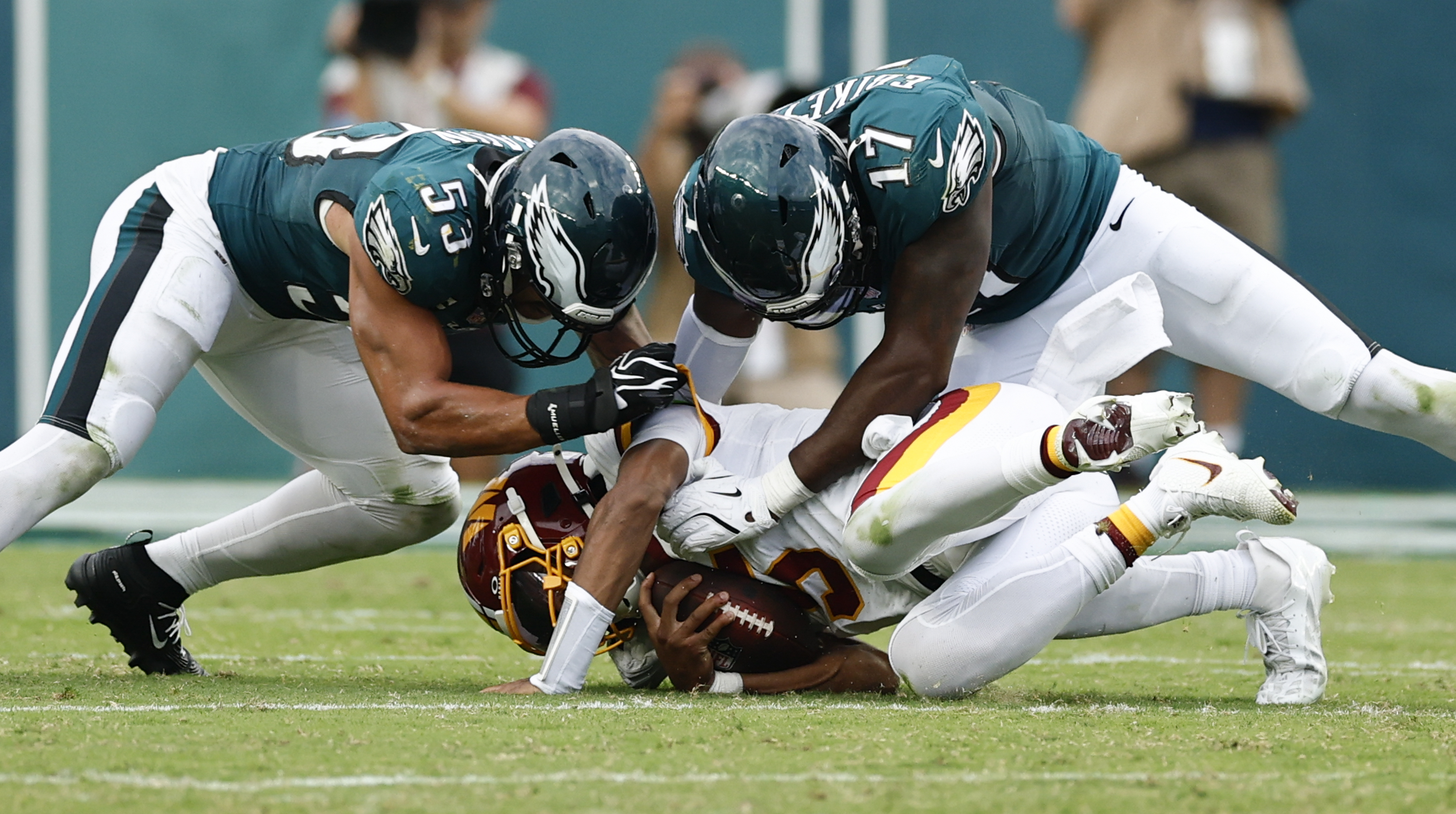
    Eagles linebackers Zack Baun (left) and Arnold Ebiketie (right) bring down Commanders quarterback Jayden Daniels. The Birds only sacked Daniels once, but limited him to 164 passing yards.Yong Kim / Staff Photographer
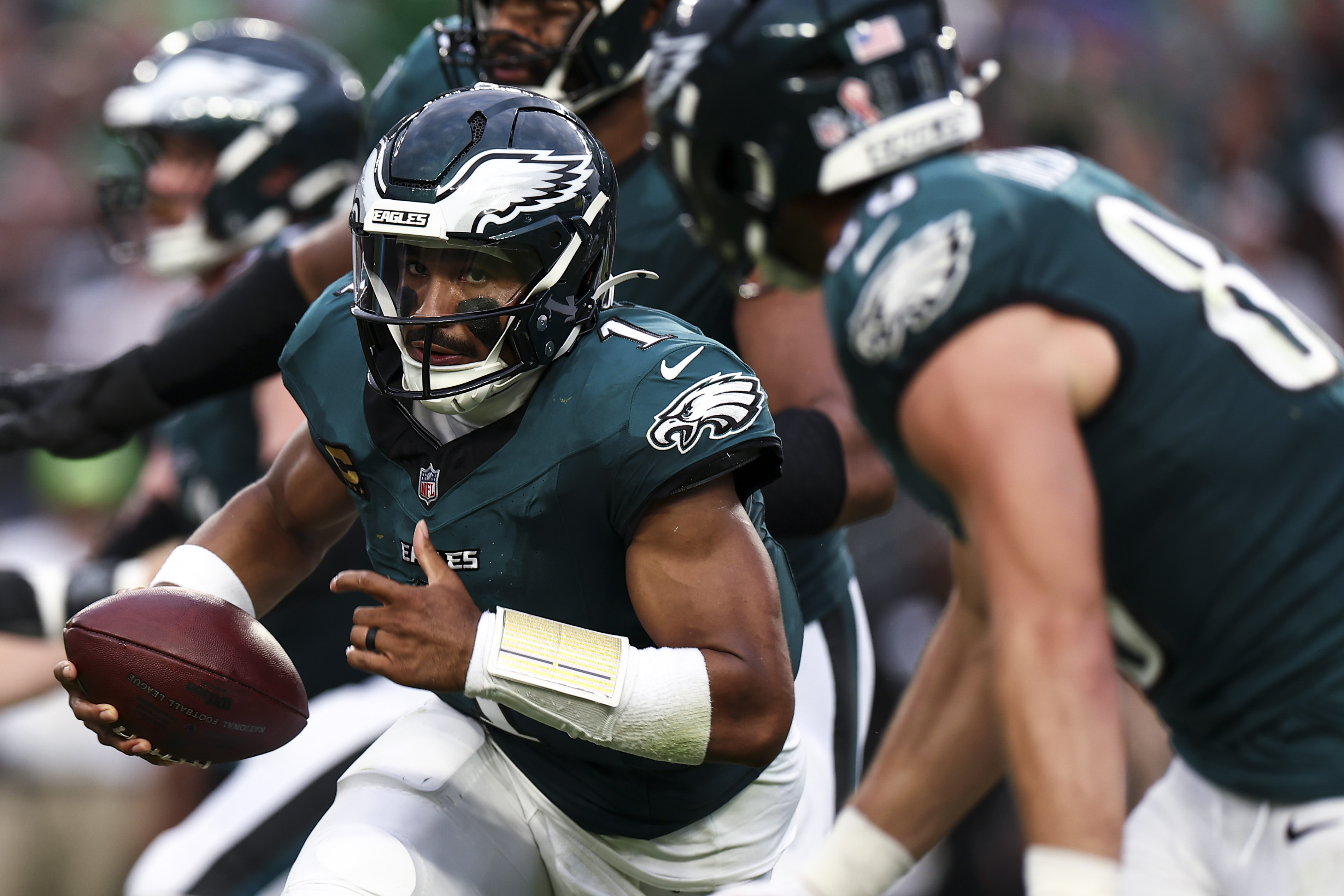
    Hurts ran for 46 yards in the win.Monica Herndon / Staff Photographer
    Yes, that’s Eagles punt returner Britain Covey. He’s sporting a new number this year after previously wearing No. 18.Yong Kim / Staff Photographer
    Eagles cornerback Cooper DeJean (left), seen here in pursuit of Commanders wide receiver Stefon Diggs, admitted he didn’t have his best game in Week 1.David Maialetti / Staff Photographer
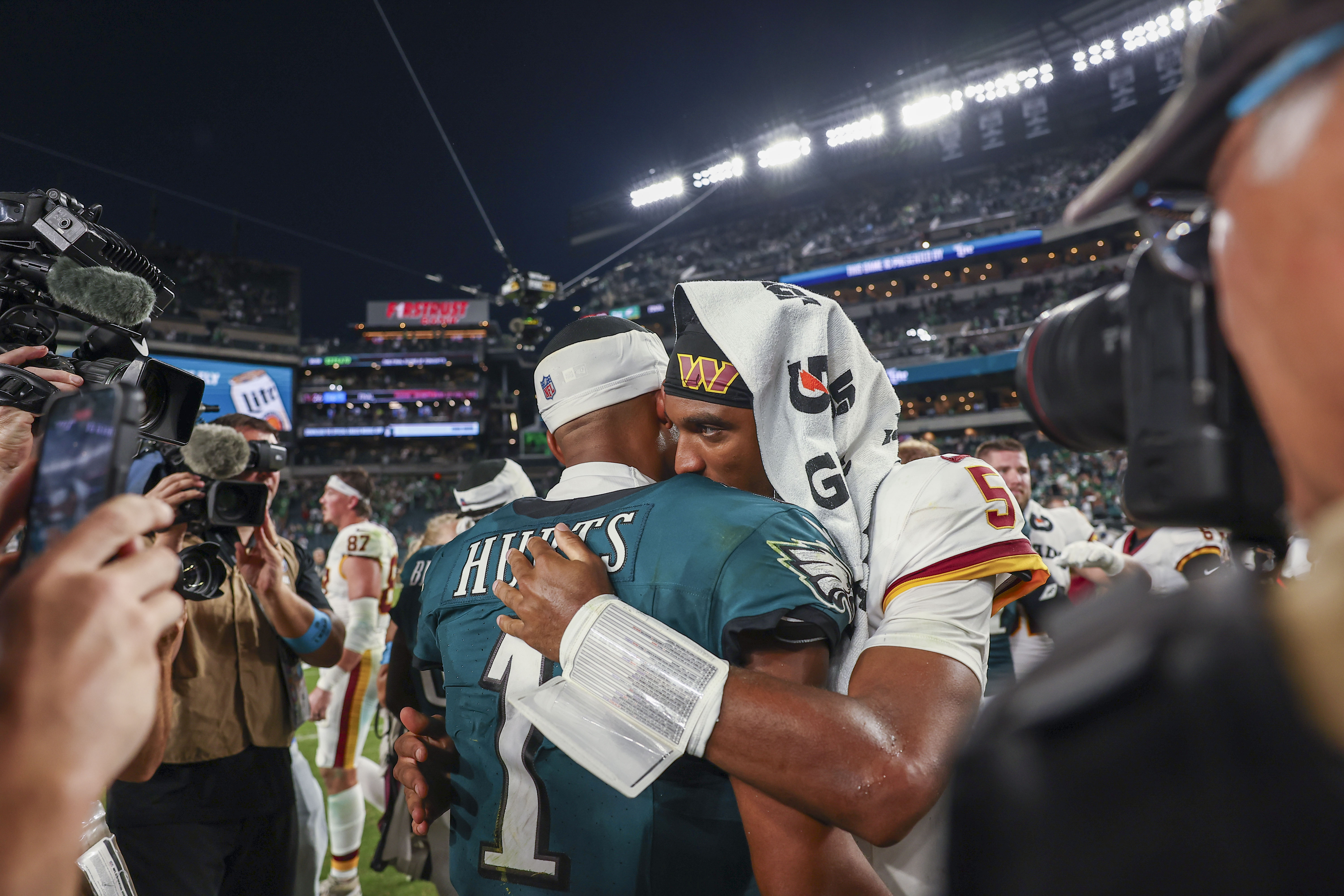
    Jalen Hurts outdueled Jayden Daniels to take home a crucial NFC East victory in Week 1.Monica Herndon / Staff Photographer
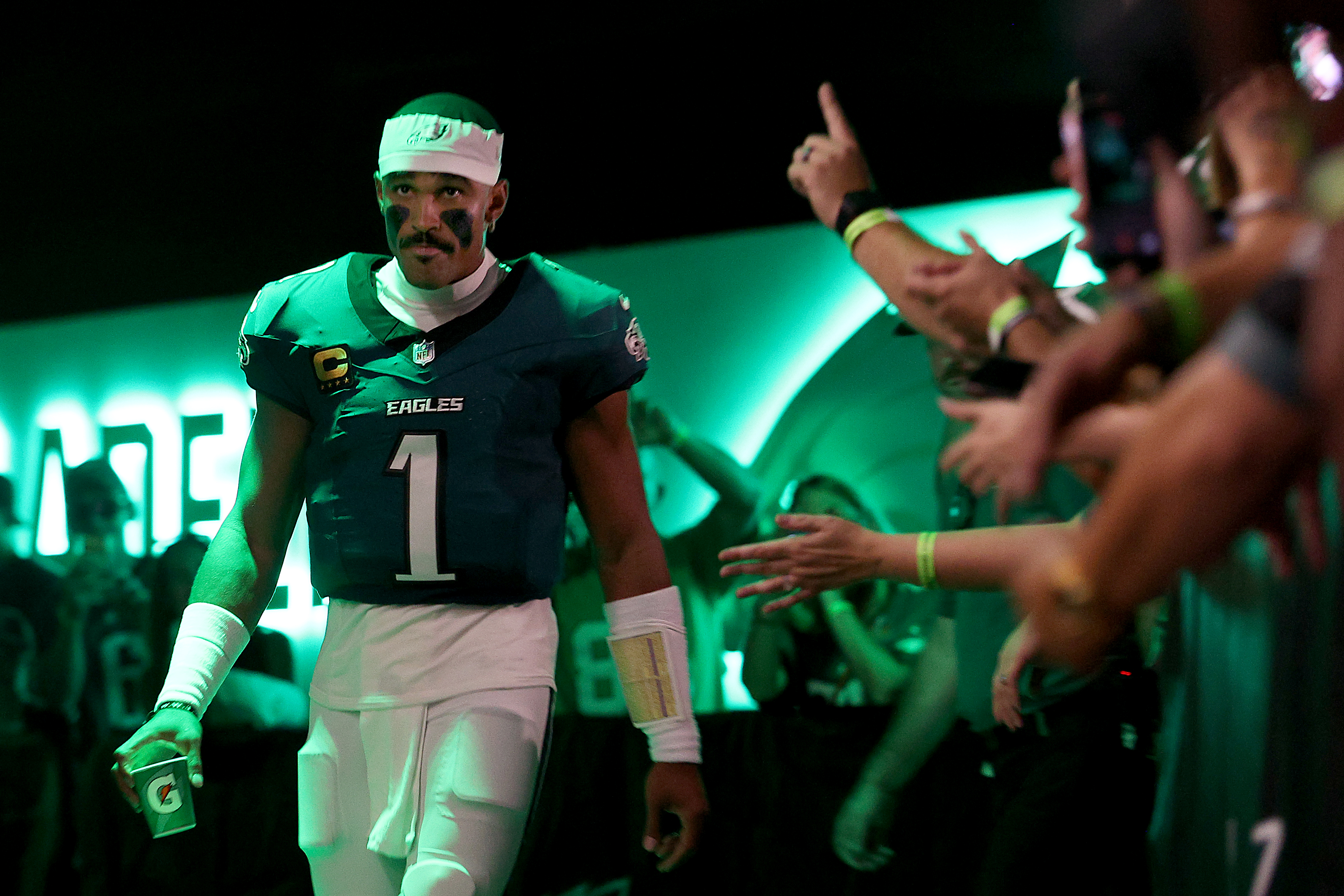
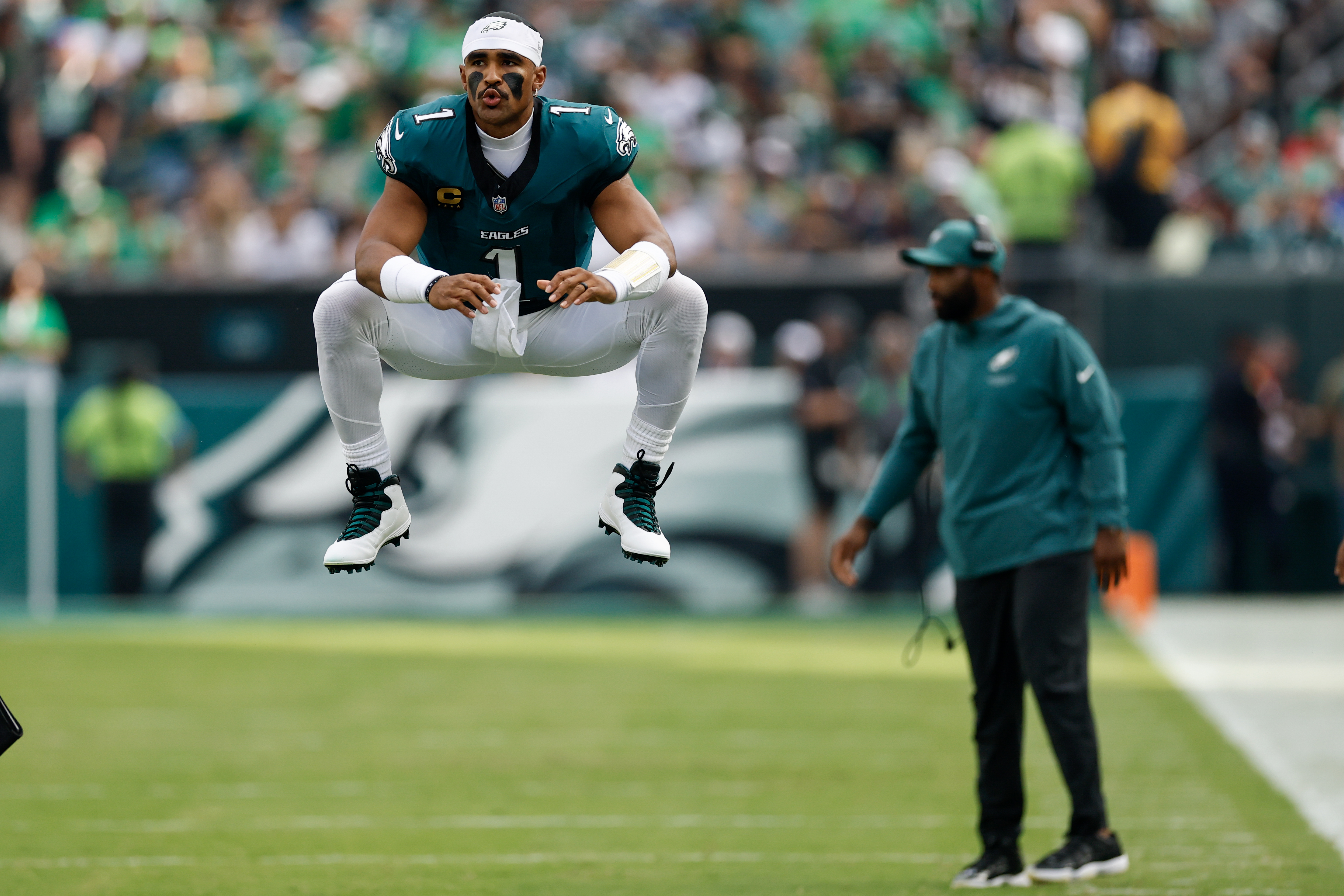
    Eagles quarterback Jalen Hurts before the start of the season opener against the Commanders Sunday, Sept. 13, 2026, in Philadelphia.Yong Kim / Staff Photographer
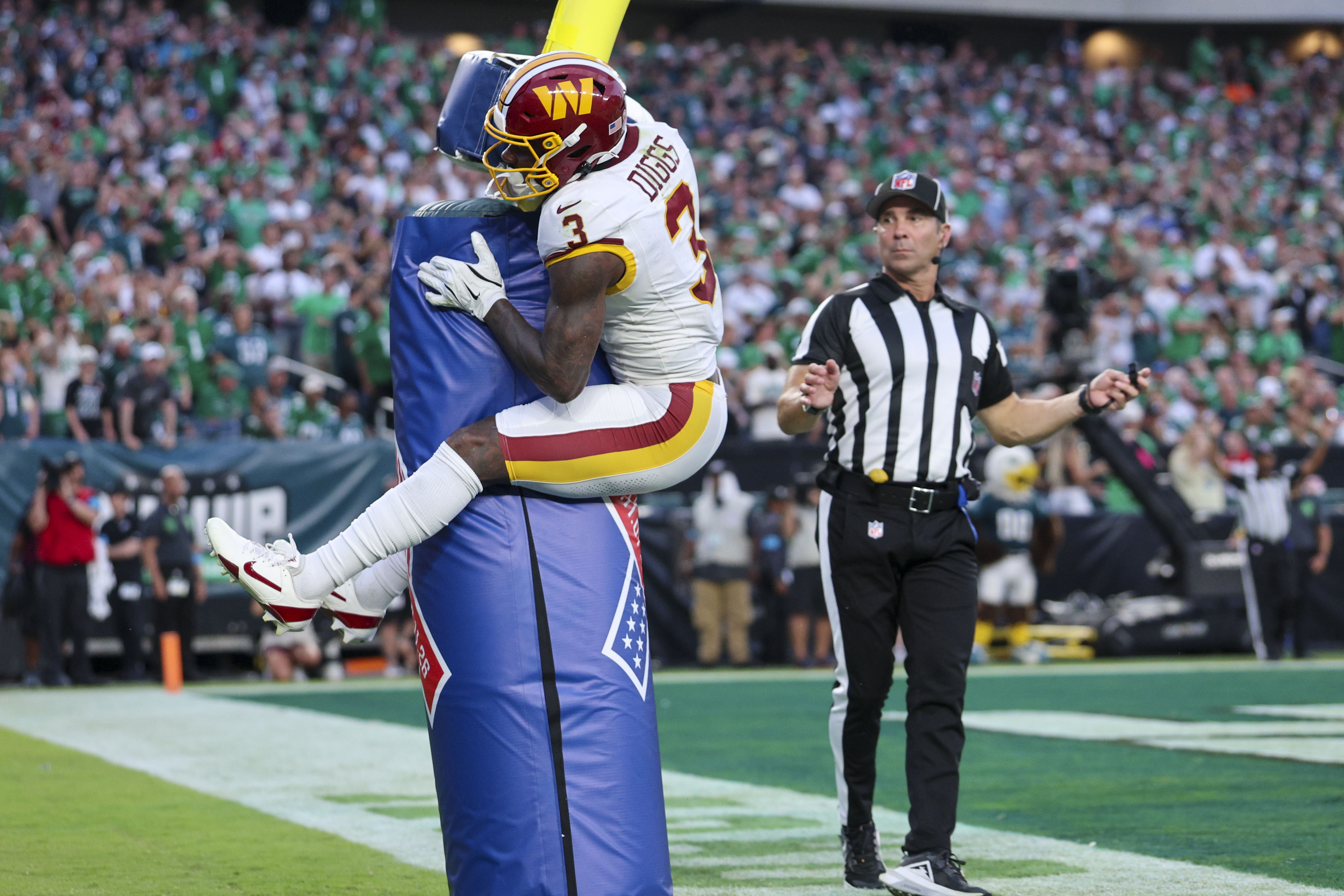
    Stefon Diggs was penalized for hugging the goalpost after scoring a touchdown in the fourth quarter. The call prevented the Commanders from going for two, helping the Eagles win the game.David Maialetti / Staff Photographer
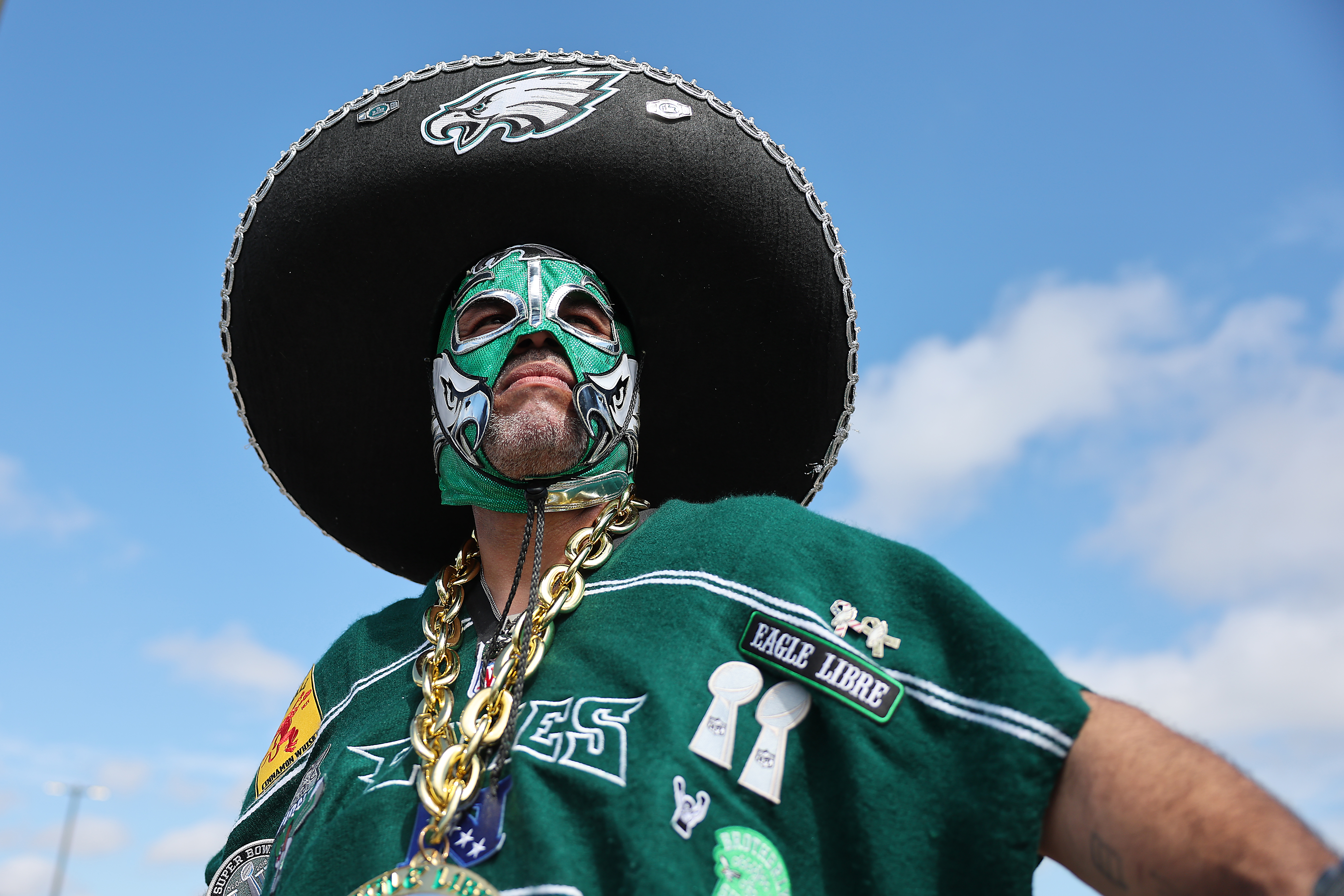
    Eagles fan Kenny Torres — also known as Eagle Libre — of Prospect Park, poses for a portrait while tailgating.David Maialetti / Staff Photographer
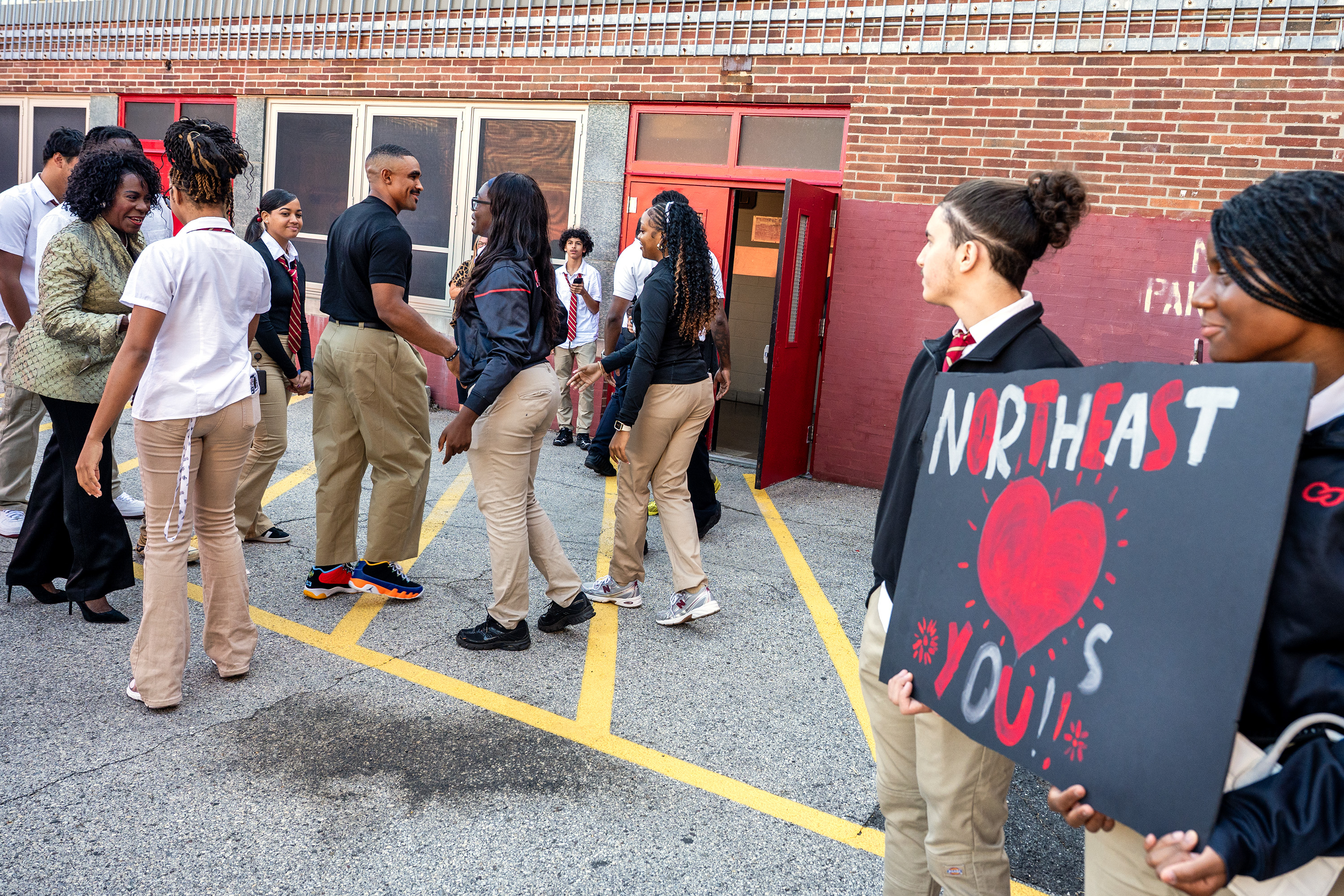
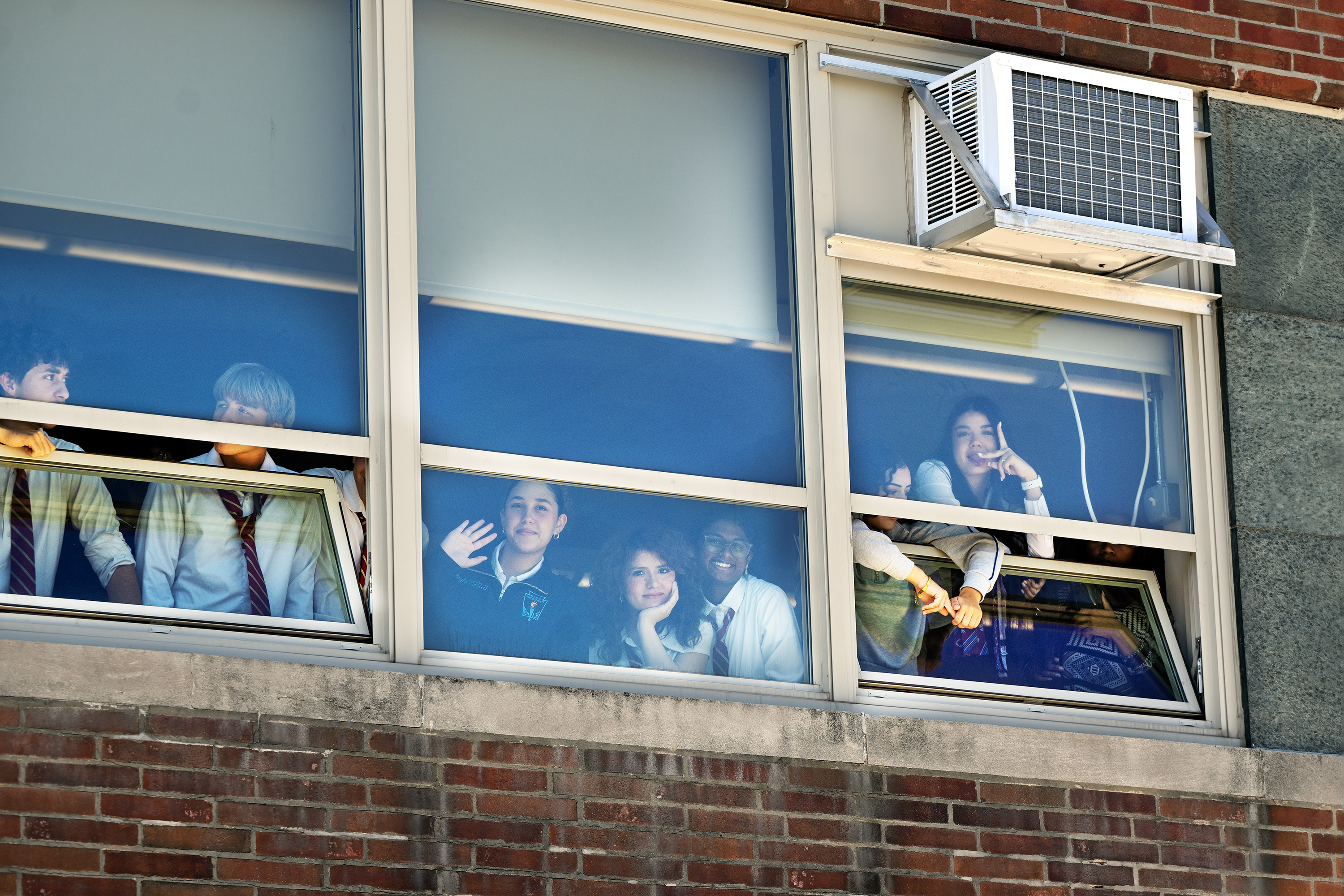
    Mayor Cherelle L. Parker (left) and Eagles quarterback Jalen Hurts (center) are greeted by students as they arrive Tuesday at Northeast High School, where Hurts announced he was donating $600,000 for an air conditioning system at the school.Tom Gralish / Staff Photographer
    Northeast High School students watch from their classroom — with a window air conditioning unit — as Eagles quarterback Jalen Hurts leaves.Tom Gralish / Staff Photographer
    Students welcome Eagles linebacker Jalyx Hunt at an assembly Tuesday at Little Flower Catholic High School, where he endowed four new scholarships.Tom Gralish / Staff Photographer
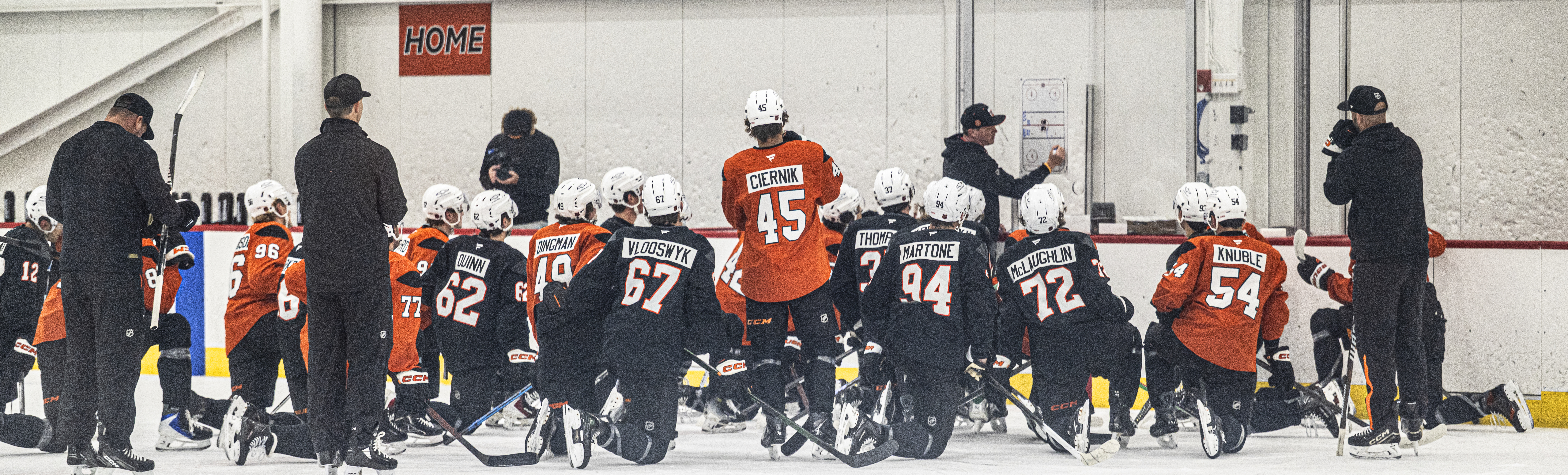
    Flyers camp kicked off this week, starting with the team’s rookies.Jose F. Moreno / Staff Photographer
  • Former Titans linebacker Avery Williamson found his passion bringing water ice to Tennessee: ‘This is legit Philly water ice’

    Former Titans linebacker Avery Williamson found his passion bringing water ice to Tennessee: ‘This is legit Philly water ice’

    Roughly four miles from Nissan Stadium, where the Eagles will play the Tennessee Titans on Sunday, there will be a little piece of Philly in Nashville.

    Ahead of Sunday’s game, at Corner Bar South on Nolensville Pike, former Titans linebacker Avery Williamson will be selling his own version of Philadelphia’s signature water ice. He uses a recipe he bought from Philly native David Gavin, the owner of Blazin Flavorz, a North Philly restaurant known for its gourmet pretzels and creative water ice flavors.

    “This is not knockoff water ice,” Williamson said. “This is legit Philly water ice. We had a number of Philly people pull up and try, and they gave me the stamp of approval. So I’m excited for everybody to try it out.”

    Williamson opened his water ice company, Tennessee Crush Water Ice, in April 2025. After retiring from the NFL in 2021, the Kentucky alumnus was looking for something else to be passionate about. And after years of trial and error, he found it in the form of water, sugar, and fruit juice.

    “It’s something that’s gotten me out of my funk of being five years removed,” Williamson said. “It’s gotten me out of that funk and just that mindset of not accomplishing anything, even though I’ve accomplished a lot. But as a person that’s been at that top level, when you’re done, you’re like, ‘Now I’m at the bottom.’

    “I think the biggest thing when I got done playing was that it was an identity crisis. And you’ve done something for so long, so when you take off the pads, it’s painful. It’s a painful process. You want people to respect you in a different sense now. I was like, ‘OK, I can’t play football. So I want people to see me as a businessperson.’”

    Tennessee Crush Water IceCourtesy of Avery Williamson

    Finding a new passion

    After seven seasons in the NFL, Williamson tried to find his next passion. First, he started a YouTube channel called Tailgate 54. After one year, he started looking into working in financial services. Then he started a landscaping business, coached high school football, worked in trucking, and opened a building for multipurpose space.

    He didn’t discover his true passion until 2024, when he attended Eagles wide receiver DeVonta Smith’s celebrity softball game.

    “I was two years removed from the game and was just trying to figure everything out,” Williamson said. “I was getting ready to open up a business back here in my hometown [of Milan, Tenn.]. I was like, ‘I really don’t want to go.’ But I ended up doing it. I just wasn’t in the best mood. It was a weird time in my life, and so we were going to the softball tournament that day, riding to the stadium, and [Ryan Sanders and Lauren Westerman] were talking about water ice. I’m sitting back in my chair, like, ‘What are they talking about?’ And they kept talking about it. So, I finally asked, ‘What are y’all saying?’ And one of the ladies was like, ‘I’m saying water ice’ and I was like ‘What is that?’”

    On that trip, he tried his first water ice: a “red flavor” from Rita’s.

    “I was like ‘Yo, what did I just eat?’ I wasn’t expecting that at all,” Williamson said. “It just blew my mind how good it was.”

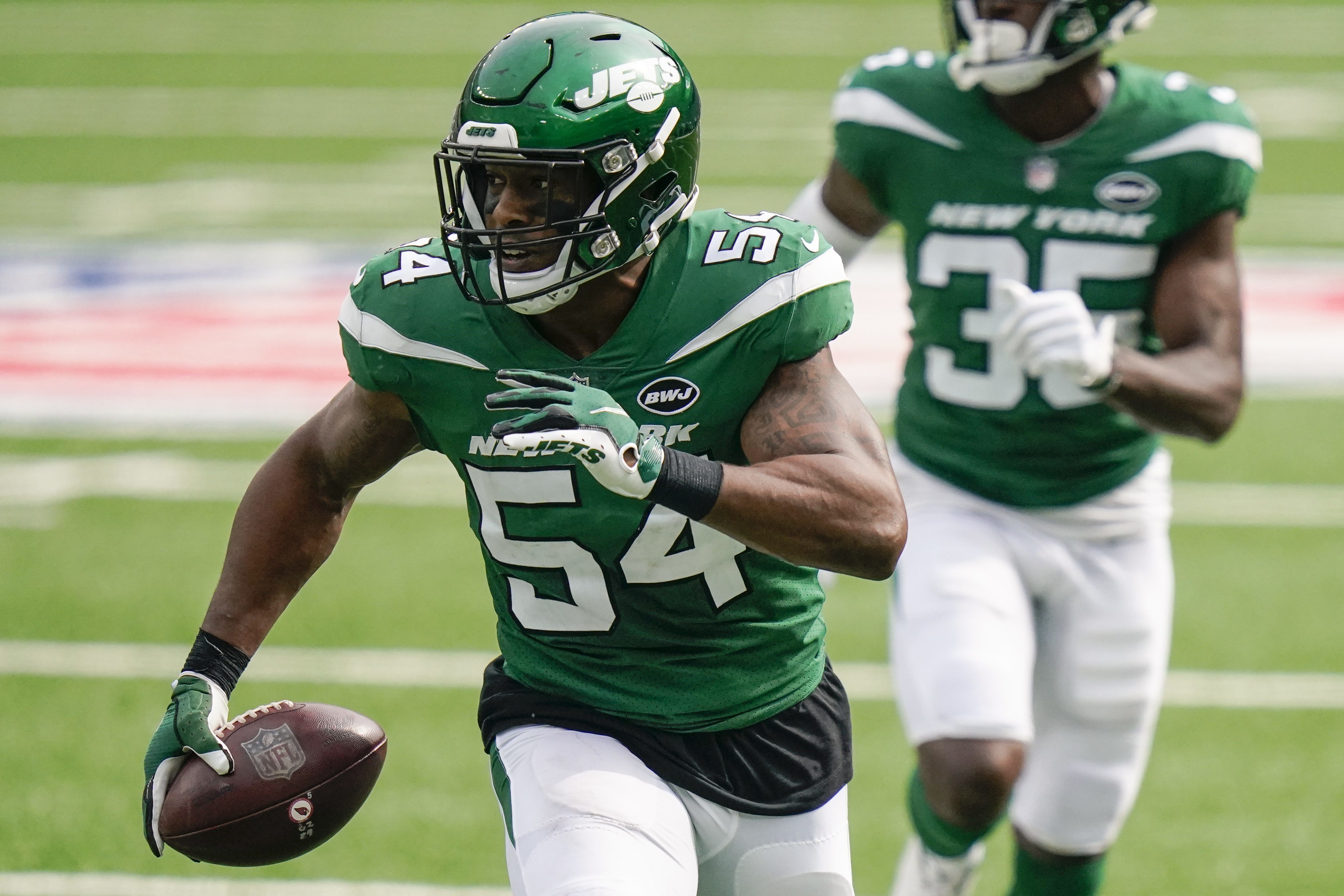
    Avery Williamson, here returning an interception in a game against the Arizona Cardinals in 2020, played for the Titans, Steelers, and Jets.Frank Franklin II / AP

    A year later, Williamson was thinking of new stores to go into his building in Milan, which is in western Tennessee. That’s when plans for Tennessee Crush Water Ice were set into motion. He reached out to Sanders, who put him in touch with Gavin, who has owned Blazin Flavorz for 14 years.

    “In this culture, a lot of us safeguard, and it’s not too many opportunities for minorities to make a way out,” Gavin said. “I tried to make sure I was going to be that bridge for the culture to make sure I did not safeguard stuff. So once he retired from the NFL, he’s trying to look for something because most of the people when they retire, they don’t know what to get into after that. So I told them this is a great opportunity and Tennessee would be wide open for them.”

    After Williamson bought Gavin’s recipe, he purchased a water ice machine, and his wife, Kelli, found a food truck they could use to sell water ice on the go while using one of the spaces in his building as the company’s factory.

    ‘It’s every day, it’s nonstop’

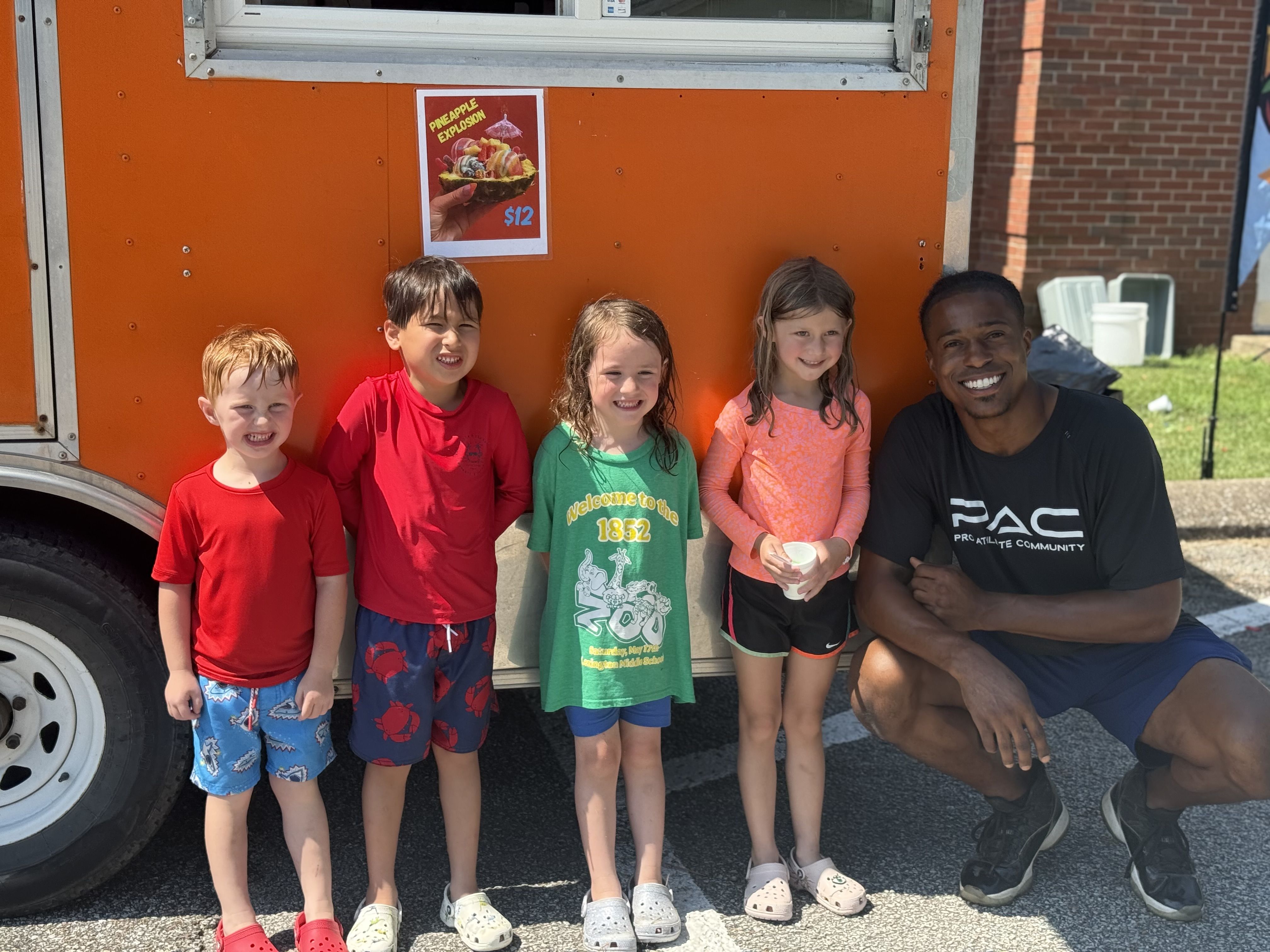
    Williamson opened the business in April 2025, setting up their bright orange trailer in a Kroger parking lot — before the truck was wrapped in Titans blue with cartoon images of Williamson decorating the sides.

    “Nobody knew who I was, incognito,” Williamson said. “I didn’t have a sign. I had nothing. And then a guy and his son came up, they were asking what it was and I was like, ‘It’s water ice.’ They tried it, and he was like, ‘Man, this stuff is really good.’ And that’s when I was like, ‘We got something.’”

    The flavors sold at the trailer are sour apple, tiger’s blood, mango, strawberry, blue apple, blue raspberry, pineapple explosion, cotton candy, and Nerds gummy.Avery Williamson

    Throughout the summer, the Williamsons worked festivals and end-of-year school events before getting into high school football games. But winter was a dead period for the company.

    “I was about to burn the trailer last November,” Williamson said. “I was so mad. Things just weren’t going as planned. I told my wife, I’m done with it, and someone told me not to do it. But I was going to take it in the middle of the field, just light it on fire.

    “I was almost … ready to quit. Like, people looked at me crazy. I know people were probably like, ‘Yo, this man got to be broke.’ But I was genuinely just trying to find a hustle, trying to find something that I could wake up and be excited about. And because I’m retired, you’re looking for that thing to really get you going. So I know people looked at me crazy. But, I just kept on pushing, pushing, contacting people.”

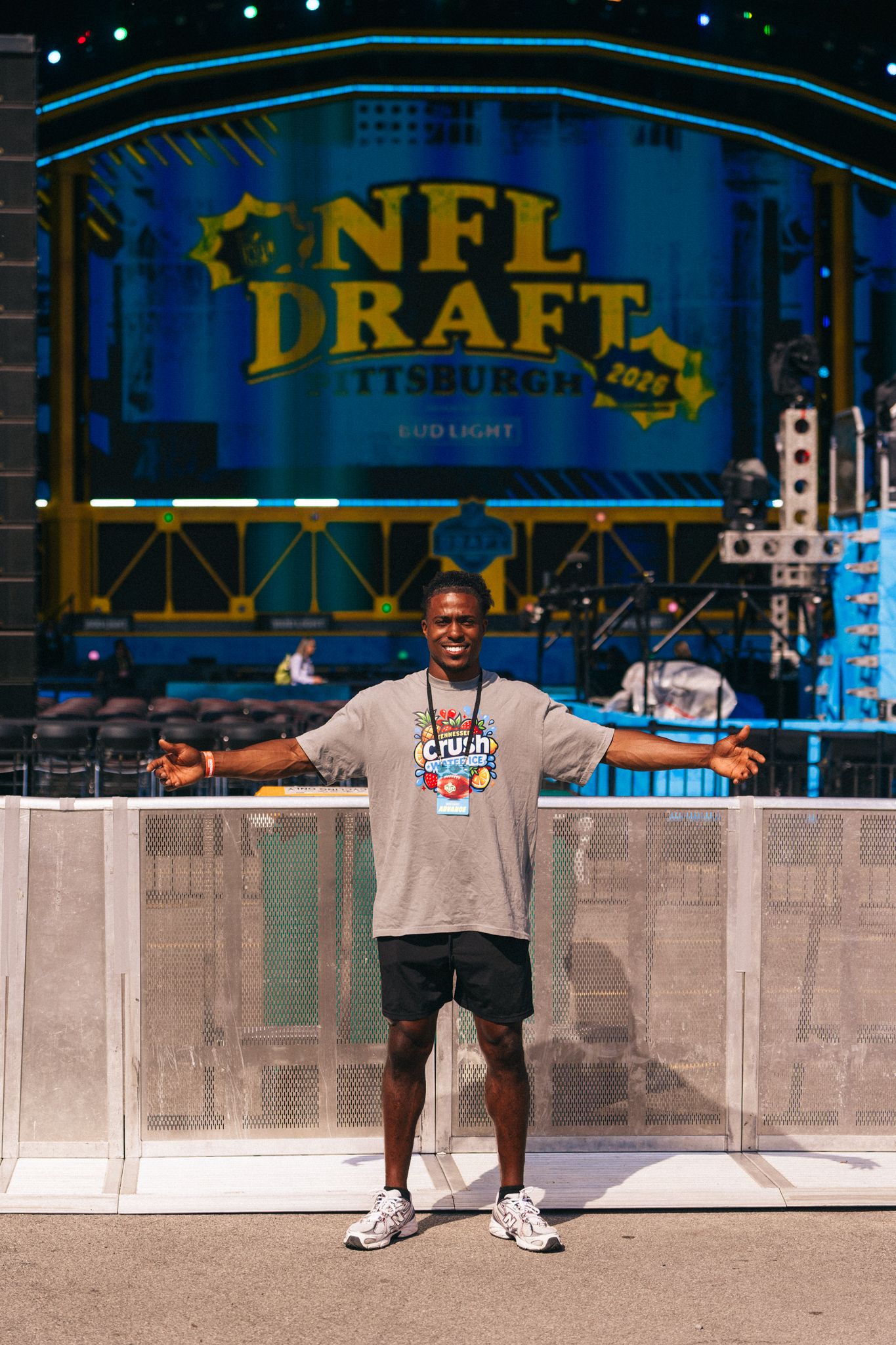
    That’s when Williamson decided to reach out to his former Kentucky teammate, Edward Berry, who is now an agent for CAA Sports. Berry helped Williamson secure a spot at this year’s NFL draft in Pittsburgh.

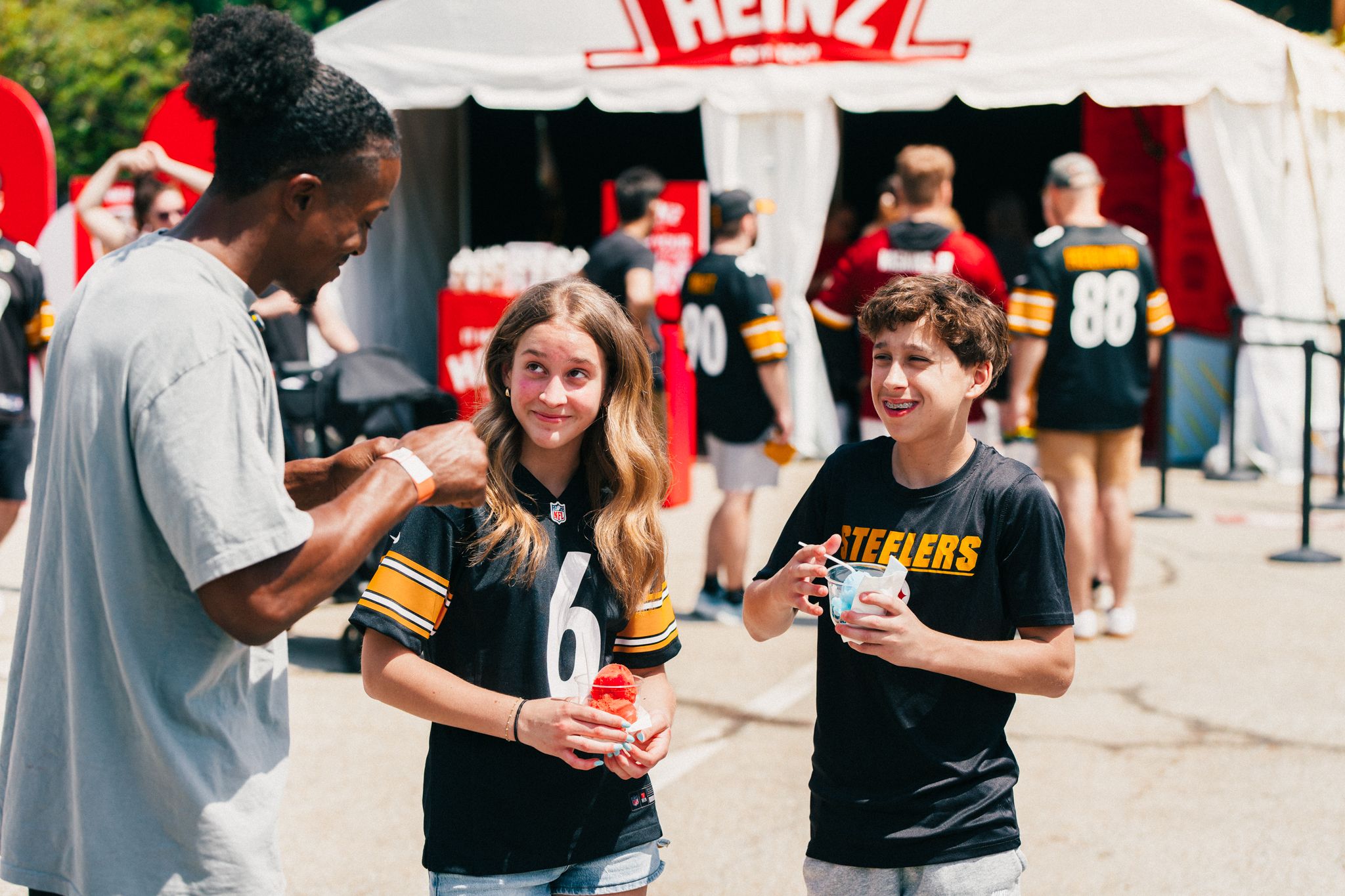
    “That was a huge boost and momentum shift leading to this year. I mean, we served over 2,000 people,” Williamson said. “We had a lot of success, we got some great content, and it boosted the business back here. So I was like, ‘If I’m going to do this, I just need to really attack the media space.’ So we started doing more content and just started pushing and pushing it hard.”

    The NFL draft in Pittsburgh was a big break for Avery Williamson and his company, Tennessee Crush Water Ice.Avery Williamson

    Since then they’ve expanded to schools with premade cups, festivals, Kentucky’s Venture River Water Park, and colleges like Austin Peay, Bethel University, and Kentucky.

    “Football taught me the grind. It’s every day, it’s nonstop, and it’s the same in business,” Williamson said. “I thought I was going to jump out and start making money like that. But no, I had to literally pay my dues to figure out what I wanted to do and find what excited me. And water ice is just something that excites me. I love getting into these events and seeing people try.”

    Former NFL linebacker Avery Williamson says he loves bringing water ice to people.Avery Williamson

    ‘Football is not forever’

    As of what’s next for Tennessee Crush Water Ice, Williamson hopes to close a deal with a major college, he wants to build a drive-in for his water ice factory, he’s hoping to find a spot in Nashville to sell from, and he’s thinking of expanding to even more states.

    But for now, he’s just grateful to have found his passion outside of football.

    “It’s truly amazing to see what you can accomplish when you put in the work, the time, the effort,” Williamson said. “When I was done playing, I just walked away from it. I wish I would have had a game plan. I didn’t. I tell guys to get a game plan together. Football is not forever. Find a passion, find it early, and just work at it.”

  • Aaron Nola keeps turning back the clock with dominant outing in Phillies’ shutout win over Mets

    Aaron Nola keeps turning back the clock with dominant outing in Phillies’ shutout win over Mets

    NEW YORK — Aaron Nola once stood on the mound here and struck out 10 consecutive batters, tying a major-league record set by a Hall of Famer with a 10-foot tall statue outside the main gate of this ballpark.

    Just in case anyone forgot who Nola is.

    It was a long time ago — June 25, 2021, to be exact — when Nola shared a feat with Tom Seaver. Nola is 33 now, with as much mileage on his iron right arm as any pitcher in the sport. And until this week, he wasn’t as essential to the entire Phillies’ operation.

    But with nine games to go, a playoff spot within reach, and star lefty Jesús Luzardo shut down by an inflamed shoulder, the spotlight is back on the Phillies’ longest-tenured player.

    What a time, then, for Nola to turn back the clock.

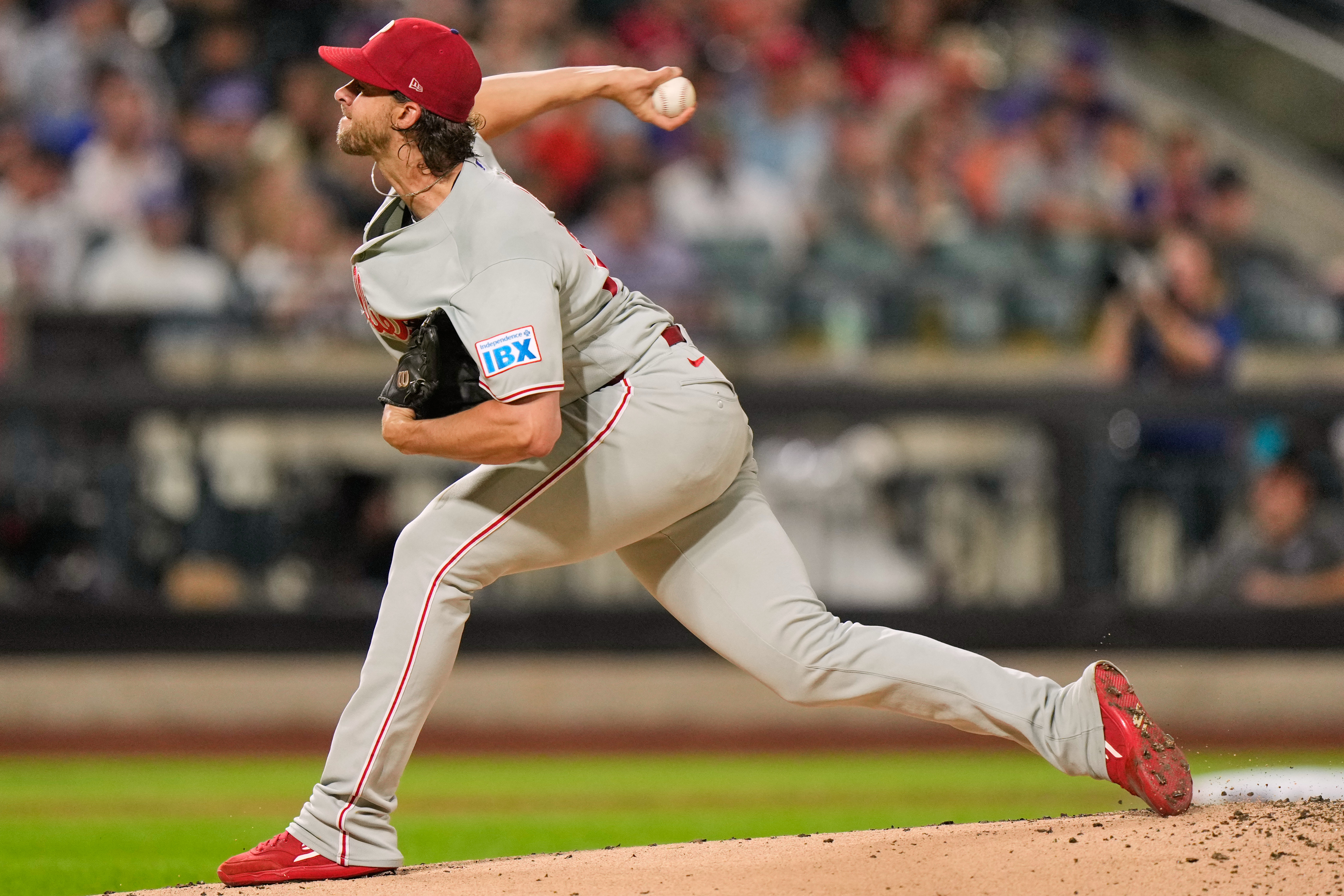
    That’s clearly what’s happening, the latest gem coming Thursday night when Nola faced the minimum 15 batters through five innings, didn’t yield a hit until the sixth, and threw 81 pitches over seven innings — a model of efficiency and effectiveness — in a 3-0 victory over the Mets.

    You could’ve sworn it was 2022 all over again.

    “It feels good,” Nola said, understated as ever.

    But here’s the thing: It wasn’t a one-off. Quietly, as is his nature, Nola has pitched like this for six weeks, beginning with a hard-luck 1-0 loss July 28 in Miami. In his last 10 starts, he has a 2.10 ERA in 60 innings.

    Aaron Nola on the Phillies' World Series chances: 'We definitely have the team to do it'
    Video: Aaron Nola on the Phillies’ World Series chances: ‘We definitely have the team to do it’

    These are the Phillies, though, so it couldn’t be all good. Jonathan Bowlan, who has emerged as the primary setup reliever, took over from Nola and left in the eighth inning with what the Phillies termed “tightness” in his right groin.

    “No pop, nothing like that,” said Bowlan, who missed two weeks in April with a strained right groin. “All I can do is treatment, and re-evaluate and go from there. We’ll just have to see what tomorrow brings.”

    The bullpen is already missing Brad Keller, sidelined in July by season-ending elbow surgery. Orion Kerkering has been slowed by turf toe. Rookie Alex McFarlane is already playing a big role. Without Bowlan, lefty Tim Mayza and others would have to take up the mantle.

    “We’ll find out more tomorrow,” interim manager Don Mattingly said after the Phillies pulled into a tie with the idle Cubs for the top National League wild card and lowered their playoff-clinching magic number to five. “I don’t want to be coldhearted, but you’d have to move on and find a way to fill that spot, which is not necessarily easy to do. But that means other guys got to step up. That’s all.”

    Just like Nola.

    Nola is nothing less than one of the best homegrown pitchers in franchise history. On the Phillies’ all-time lists, he ranks second in strikeouts (2,045), fifth in wins (116), and seventh in innings (1,884).

    Someday, he’ll get a plaque on the Wall of Fame in Ashburn Alley.

    But through June, Nola had a 6.04 ERA — after an injury-plagued 2025 in which he finished with a career-worst 6.01 mark. Never one to overpower hitters with velocity, his command must be precise. And nothing has gotten easier for him, not with the advent of the pitch clock, the automated ball-strike system, a limit on the number of pickoff moves, and just the passage of time.

    It was fair to wonder if Nola, signed through 2030 at $24.57 million per year, was cooked.

    Aaron Nola has a 2.10 ERA in his last 10 starts.Seth Wenig

    “Not for me,” Mattingly said. “Honestly, guys that locate like that and work and are healthy, you know what they’ve been in the past. And guys just don’t quit trying to get better and reinventing themselves, in a sense. As you get older, you have to do it.”

    Indeed, after a decade of spinning his curveball, burying his sinker, and pounding the strike zone, Nola changed his pattern. In particular, he threw more changeups, even to right-handed hitters.

    “I think it’s just mixing well and throwing all the pitches for strikes and just trying to keep everything sharp and the delivery sharp,” Nola said. “Try not to be too perfect with my pitches.”

    Against the Mets, Nola relied on his signature curveball. He threw 47 pitches through five innings and sat through a long delay in the top of the sixth when Mets first baseman Jared Young got carted off the field on a stretcher in a scary scene after colliding with pitcher Nolan McLean and taking a knee to the head.

    (Young had feeling in his extremities, according to the Mets, but was taken to the hospital, where a CT scan was negative.)

    Nola allowed a one-out walk in the sixth on a 10-pitch duel with Brett Baty before finally giving up a hit, a solid single to left field by Nick Morabito. He got through the seventh and might have come back for the eighth, too.

    “But just checking with him, he seemed hesitant to me,” Mattingly said. “He felt like he didn’t have the same fastball. He was kind of running out of gas.”


    NL wild-card standings

    window.addEventListener(“message”,function(a){if(void 0!==a.data[“datawrapper-height”]){var e=document.querySelectorAll(“iframe”);for(var t in a.data[“datawrapper-height”])for(var r,i=0;r=e[i];i++)if(r.contentWindow===a.source){var d=a.data[“datawrapper-height”][t]+”px”;r.style.height=d}}});


    And given the uncertainty with Luzardo, Mattingly isn’t about to take chances with Nola — or any other starter.

    “We really hope [Luzardo] can come back healthy — and quick,” Nola said. “We really need him.”

    Meanwhile, there’s Nola, with his 3.88 ERA in 11 career postseason starts, tied for 14th-most among active pitchers.

    “Noles is huge,” Mattingly said. “It was tough there early for him, but he just hung in there, kept working, and next thing you know, you’re seeing this. And with Zeus, not knowing what’s going on as this thing gets down to the wire, how Noles factors in could be huge.”

  • A woman has been charged with murder in a Kingsessing fire that killed a man and injured 4 others

    A woman has been charged with murder in a Kingsessing fire that killed a man and injured 4 others

    The Philadelphia district attorney’s office has charged a woman with murder and other crimes for her alleged involvement in a fire in February in the city’s Kingsessing neighborhood.

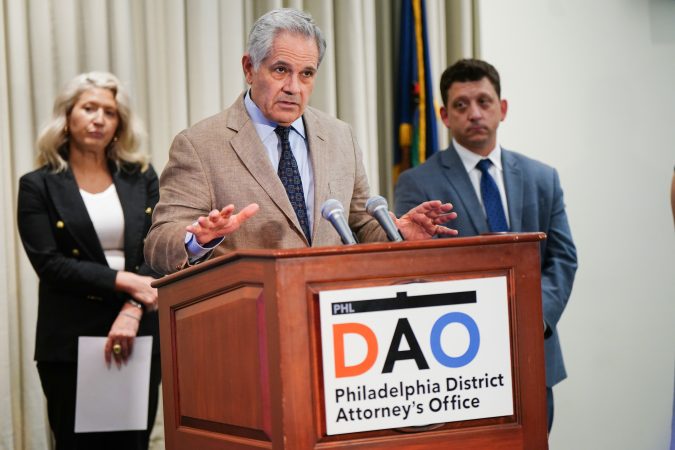
    Chardae Sapp, 34, was charged with murder, attempted murder, aggravated assault, arson, causing or risking a catastrophe, and two misdemeanors, District Attorney Larry Krasner’s office said Friday.

    The charges date back to a fire at a house on the 5400 block of Regent Street on Feb. 4 around 1:40 a.m., prosecutors said. Four people were taken to the hospital for treatment. Twenty-six-year-old Raymond Bell, found unresponsive in a bedroom, died as a result of the blaze.

    Fire marshals determined that the fire was deliberately set and began in a second-floor bedroom “when an open flame was applied to available combustibles consisting of bedding and mattress materials,” the District Attorney’s office said.

    “This is a terrible tragedy that should have never happened and could have been even deadlier if the fire had spread faster,” Krasner said in a statement, thanking first responders for their roles in the investigation. “Our office looks forward to pursuing a fair and just outcome in this case and continuing to support the co-survivors.”

  • MIT report warns AI is causing ‘cognitive surrender.’ Universities are in a bind.

    MIT report warns AI is causing ‘cognitive surrender.’ Universities are in a bind.

    The worries that artificial intelligence is degrading education have been building for months. Students are using it for everything, including cheating, and a recent report out of the Massachusetts Institute of Technology said it is triggering “cognitive surrender.”

    Many university leaders are embracing AI with enthusiasm anyway.

    As AI leaders warn about the dangers of their own technology, the dissonance between the optimism of university leaders and the fears of many students and professors may increase. Professors and students are often in a bind about what they should do: Use more AI to stay relevant, or dial back to preserve learning and thinking?

    While some politicians and AI leaders are warning about possible doomsday scenarios for humanity as AI models advance, many campus leaders are focused on the existential threat the technology poses to universities.

    The committee at MIT studying AI use released a number of alarming findings, including that the technology has caused “major shifts in campus culture,” isolating students who are skipping office hours and ditching communal studying. Getting answers from a bot can create “the illusion of learning” for students who reach for AI “at the first hint of struggle,” the MIT committee wrote in its August report.

    At the same time, “the potential of these technologies to augment work across campus is immense,” the committee wrote.

    The MIT report crystallized some of the thinking in higher education about AI, but top administrators have been embroiled in debates for several years. Administrators have often been the most eager to champion AI efforts, while many faculty and students remain more skeptical.

    “I think you have to lean in, but you have to do so in a way that’s thoughtful and ethical and asks the right questions,” said Wendy Hensel, the president of the University of Hawaii, where she presented an AI strategy to regents in July. “The right answer to AI is not just ‘no.’ It can’t be. It has to be approached with curiosity and understanding of the implications.”

    The hodgepodge of policies universities have created to respond to AI often reflect the confusion about how to proceed — with some clear do’s and don’ts, but often a lot of wiggle room for faculty and students to figure it out on their own.

    Experts warn that AI harms learning

    For a motivated student, an AI chatbot can function as a sort of tutor. Chatbots can break down the steps in a math problem, surface unexpected sources for research papers, and offer feedback on writing.

    Still, a growing body of research suggests that AI use can also harm learning.

    A recent study of 26,000 Chinese secondary-school students found that AI adoption led to an 18% increase in homework scores, but a 20% decline in scores on secure exams. The implication was that rushing through homework with help from chatbots degraded the deeper learning needed to perform well when the technology was not available.

    One 2025 study out of MIT found that people who used chatbots as writing assistants struggled to remember what they had written only minutes after finishing their essay. “You basically didn’t engage any of the memory networks that would actually help you remember,” said Nataliya Kos’myna, an MIT researcher who worked on the study.

    Other research has shown that people who have greater trust in AI and rely on it more are more likely to have lower cognitive engagement.

    But AI can be hard to avoid. Chatbots are embedded within the Google Classroom suite, which is nearly ubiquitous in schools, and within many online learning systems used by universities.

    Some tools block outright cheating or plagiarism and allow professors to toggle specific AI capabilities on and off. But the most popular chatbots among students will instantly complete entire assignments, including research papers, on a student’s behalf.

    Many universities are embracing AI anyway

    Sian Leah Beilock, the president of Dartmouth College, has argued that preparing graduates to use AI is an existential requirement of institutions of higher education.

    “In a world that promises to be defined by AI, universities that fail to produce graduates who can use it productively will consign themselves to irrelevance,” she wrote recently.

    Harvard University President Alan Garber said in public remarks this month that AI-backed research is on the cusp of a boom that may drive the pace of knowledge faster than at any other time in human history. Garber has said that researchers in many fields are now unlikely to be at the leading edge of their disciplines without AI.

    Ohio State is integrating AI into every major, with the expectation that every student will be fluent in their field of study by graduation. The university has directed every department and major — from business and engineering, to English and veterinary medicine — to train students on how to use AI in their respective fields, and when not to.

    “What is OK to off-load to AI, and what is not?” Ohio State University President Ravi V. Bellamkonda said in an interview in July. “The answer to that depends on the field and depends on your stage of learning.”

    Elizabeth Kiss, the president of Union College, said universities have to educate students on both the thoughtful use of AI and on the things AI doesn’t do, such as “lead teams, push the boundaries of knowledge.”

    Still, some schools are creating boundaries

    The University of Chicago has banned AI in certain required social sciences courses, while the university’s law school banned phones, tablets, and laptops in first-year classrooms. The university is one of a handful that recently adopted new academic integrity rules.

    The law school at the University of California, Berkeley, adopted a policy forbidding the use of AI “to conceptualize, outline, draft, revise, and edit” work submitted for credit.

    Cornell University has created a disciplinary process meant to correct AI cheating while avoiding black marks on students’ records. Now, students accused of minor misuse will be allowed to accept responsibility and complete a workshop and some reflective work.

    Steve Jackson, the vice provost for academic innovation, said the program would not be used for plainly egregious misconduct. “This is a chance to sanction something, catch it, not let it go unnoted or to let it pass,” he added.

    Like many institutions, Harvard does not have a central set of AI rules. David Deming, dean of Harvard College, wrote in a note to students arriving for the fall semester that he favors more AI where “it can deepen learning,” but that the school was also looking to AI-proof some assignments.

    That would mean more in-class tests, Deming said, and fewer take-home assignments, where the temptation to cheat is powerful. He said he intends to produce a set of guidelines for AI use at the college by the end of the academic year.

    For younger students, some school districts are proceeding cautiously. This month, the nation’s largest school district, in New York City, vastly limited student AI use in grades K-8, while the second-largest district, in Los Angeles, essentially banned student use of chatbots at every grade level.

    Policing ai use is hit or miss

    Students are often navigating this landscape without clear guidance from their colleges.

    Most institutions leave it up to individual instructors — who may have little experience with AI — to set rules on how the technology is used in each class.

    It may seem clear that submitting chatbot-generated text is cheating, while using a chatbot to revise one’s own writing is allowed. But the line between those two capabilities is thin, and much AI use lies in an ethical gray zone.

    Many educators “don’t even know where to start,” said Annie Chechitelli, chief product officer at TurnItIn, a company that makes software that can detect plagiarism and track and guide AI use. “What is OK? What’s not OK?”

    Many instructors have already moved to on-paper assignments in the classroom, or locked-down computer browsers that limit AI misuse. Others report success in using AI detection software, which has recently improved in its ability to flag chatbot-written text while avoiding false positives.

    Some see AI as a crucial partner for thinking and writing and put few limits on how students use the technology. Others subscribe to the notion of “AI literacy,” assigning students to use chatbots to produce an essay or poem, for example, and then critique and try to improve the output.

    In Australia, the University of Sydney has adopted the “two-lane approach,” seen as a global model. Across disciplines, students must complete some assessments in person, under secure conditions meant to restrict AI. But other assignments must use AI, to help familiarize students with the technology that is reshaping the economy.

    “It’s almost like sex ed,” said Anita Sarma, a professor of computer science at Oregon State who has studied the impact of AI on student cognition. “They will do it anyway,” she said. “How do we teach them responsible use?”

    This article originally appeared in the New York Times.

  • Villanova is still searching for its identity. Mark Ferrante believes the pieces are coming together.

    Villanova is still searching for its identity. Mark Ferrante believes the pieces are coming together.

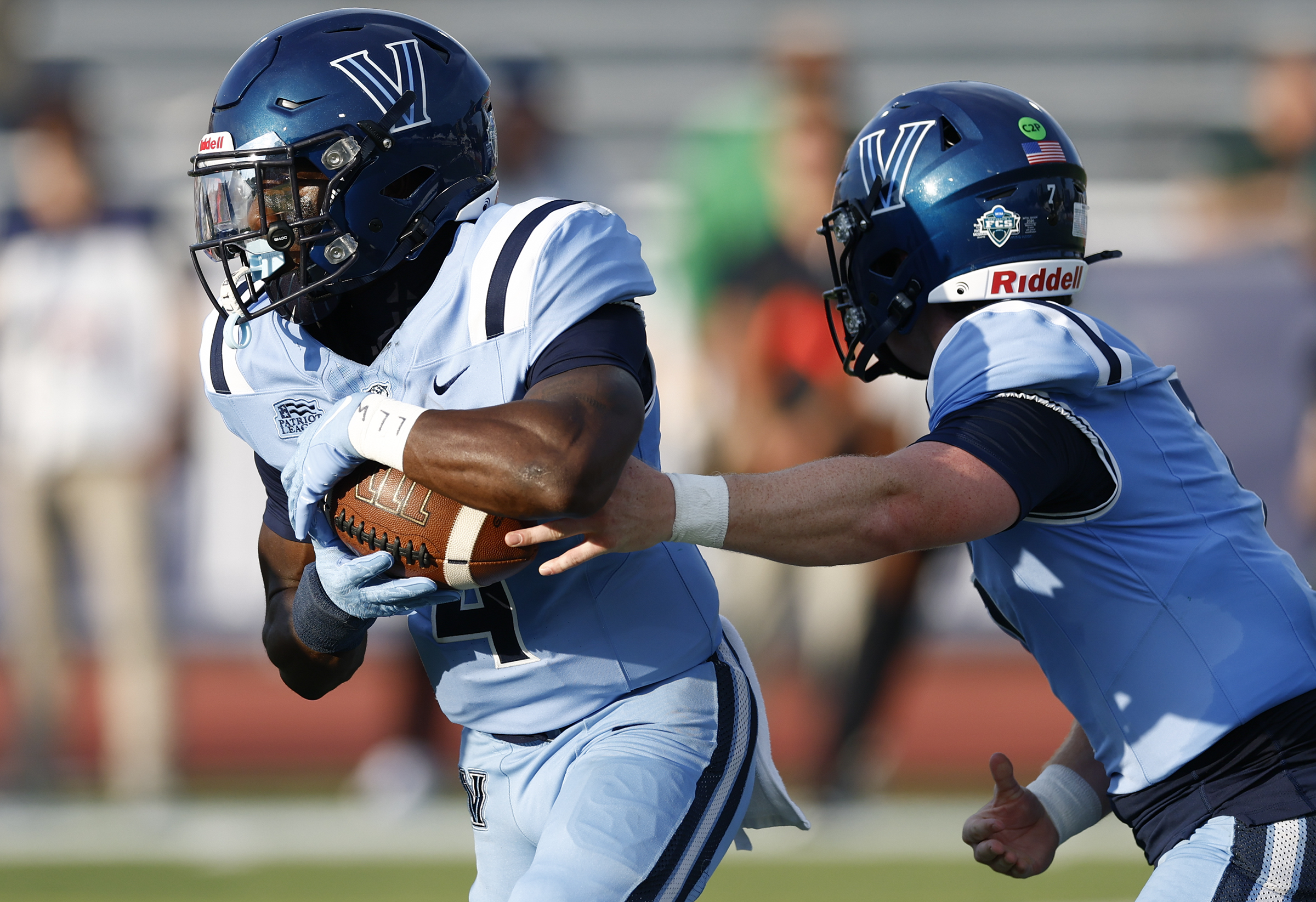
    Villanova is off to a similar start as last season following a blowout loss to No. 23 Louisville.

    But compared to last year, when Penn State trounced Villanova, 52-6, coach Mark Ferrante expressed some positives to build on entering Saturday’s matchup at Long Island University (noon, NEC Front Row).

    “This year, we seemed to be more competitive in the front end of the game,” Ferrante said of Villanova’s 59-13 loss to the Cardinals. “I think that will pay dividends down the road. I think our guys have gained confidence knowing that we could drive the ball down the field on our opening drive and put points on the board against a team like Louisville.

    “You just got to do it more consistently, and you got to do it for four quarters so that’s really the learning curve.”

    For Ferrante, that starts with his team’s approach and execution in practice.

    After turnovers and penalties plagued the Wildcats in their season-opening loss to William & Mary, Ferrante turned his focus to reducing the “mental penalties” in practice. They have since allowed 12 penalties and committed one turnover across their last two games.

    “If there’s going to be penalties, you want them to be aggressive ones during the play, not the pre- or post-snap penalties,” Ferrante said. “Those are some things we emphasize in practice and we have improved in that area. We’d like to create a few more turnovers in our favor, so we can steal a possession or two during the course of the game.”

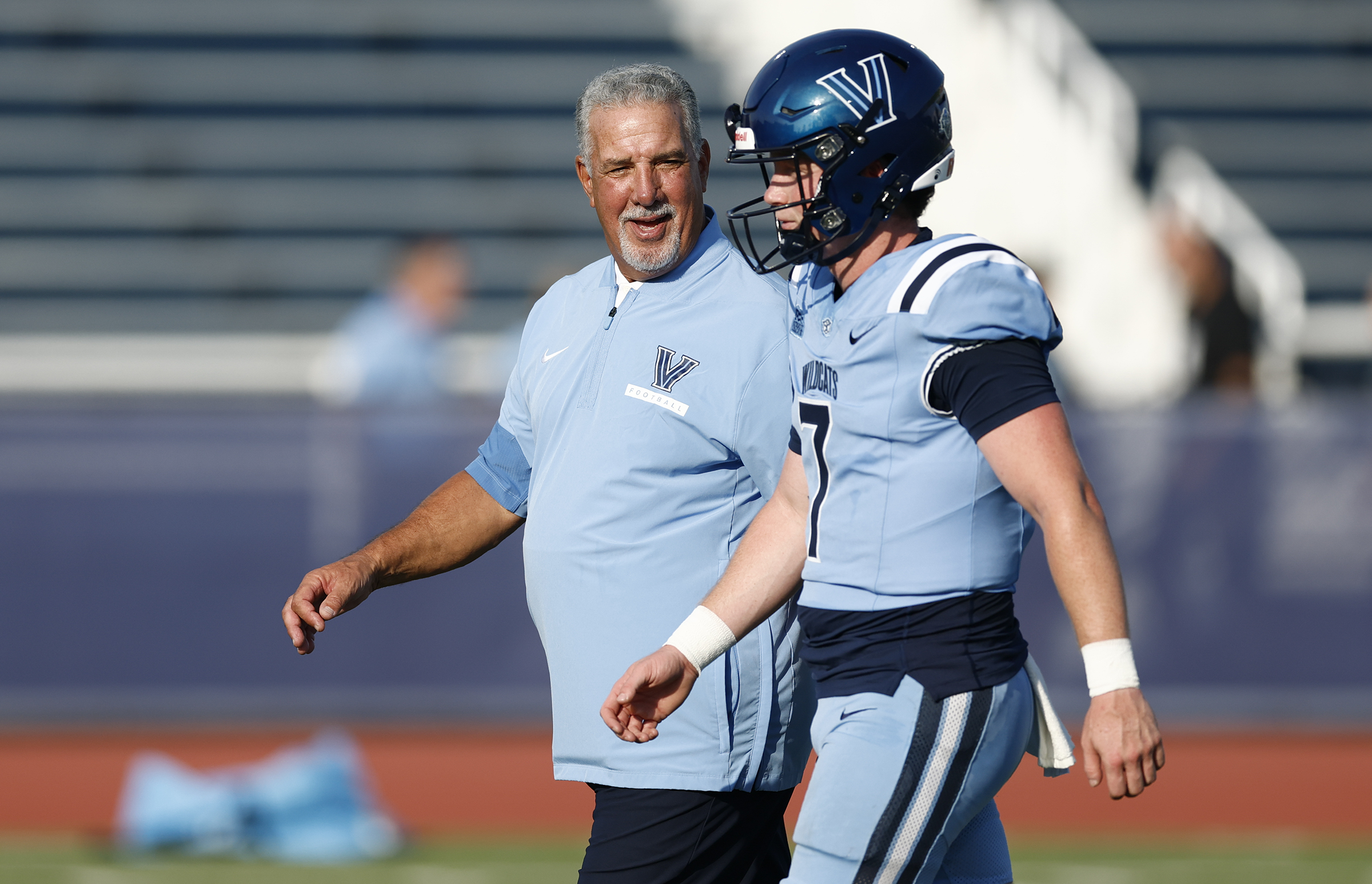
    Villanova coach Mark Ferrante talks with quarterback Pat McQuaide on Aug. 28.Yong Kim / Staff Photographer

    As the turnovers and penalties have lessened, Villanova’s offense has improved. Graduate quarterback Pat McQuaide and rushing duo of juniors Ja’briel Mace and Isaiah Ragland “keep getting better each and every week,” Ferrante said.

    “No matter how many guys you got coming back from a previous year or how many you lost, it’s never going to be the same. Each team has to find its own identity, I think this team is still searching for it a little bit.”

    He noted that around this time last season is when his team started to click. He feels confident about the direction this year’s Wildcats are heading and believes they are getting to a similar place.

    “We were already in preseason practice when McQuaide joined us, so he missed the first couple [of] days, there was a little catch up there, but I’m sure it’s got to affect your mental psyche a little bit,” Ferrante said. “But now that he’s been here, and August camp into the first three games, now we need to see the continual and steady progress.”

    Beyond the offense, Ferrante has been satisfied with special teams. Dominic LeBlanc has been perfect on field goals and PATs since transferring into the program this offseason, while sophomore Luke Myers has been impressive since taking over punting duties.

    “He’s been doing a really nice job, he gets the ball out quick,” Ferrante said. “He averaged 44 yards a punt against Louisville, the unfortunate part is he had too many opportunities to go out against Louisville. We like to keep him off the field a little more than we did, but he did a great job.”

    Heading into LIU, Ferrante emphasized that his defense needs to have patience and discipline.

    “Don’t let the stuff around you get your eyes caught somewhere else, and all of a sudden, you’re not where you need to be,” Ferrante said. “I think this week especially, you can say it every week, but this week especially, how they maneuver the pieces that they have on the field around, we have to have really good discipline with our eyes and then just do your [job], play your assignment to the best of your ability.”

  • Where to watch Eagles games in Philly, from sports bars to giant screens

    Where to watch Eagles games in Philly, from sports bars to giant screens

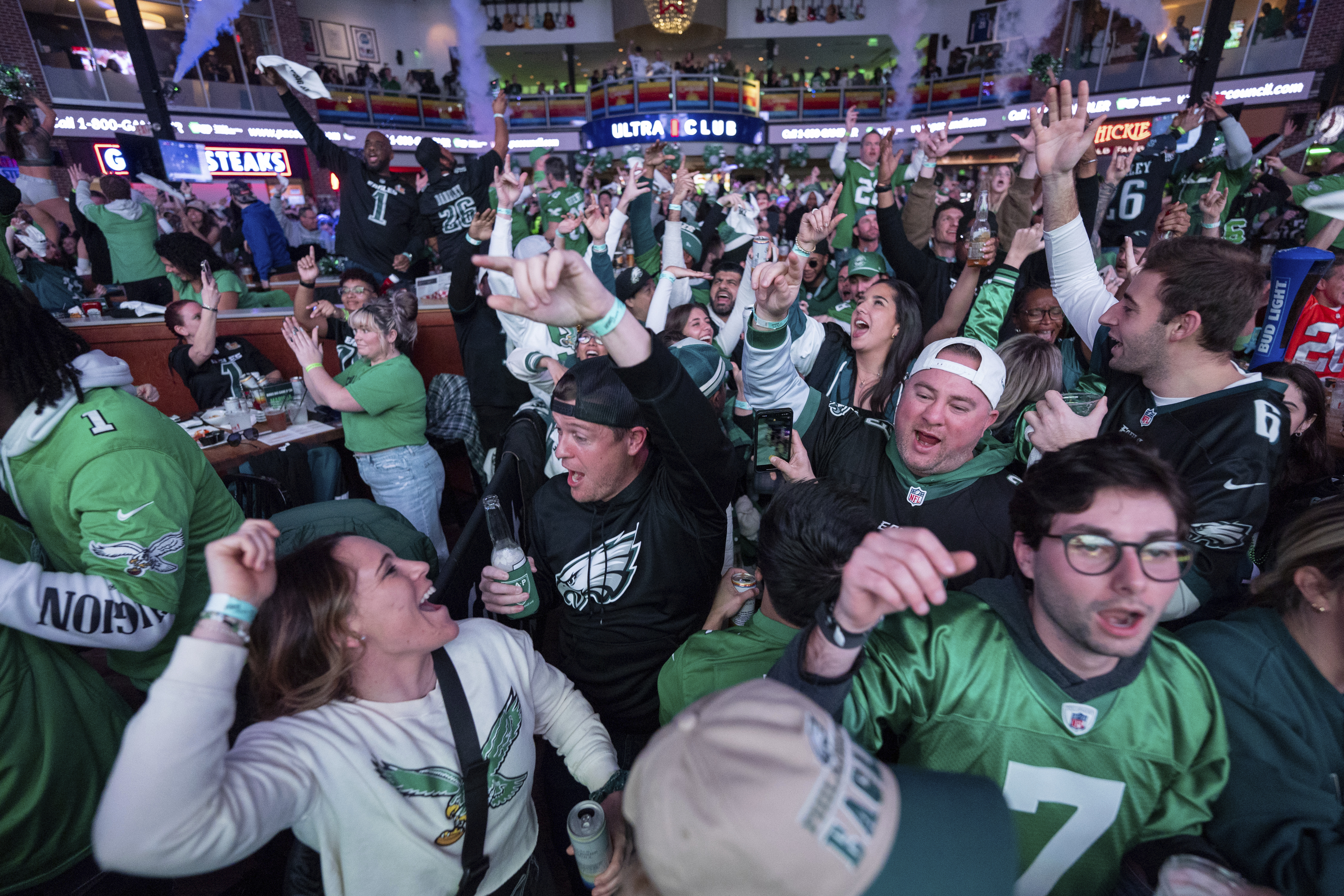
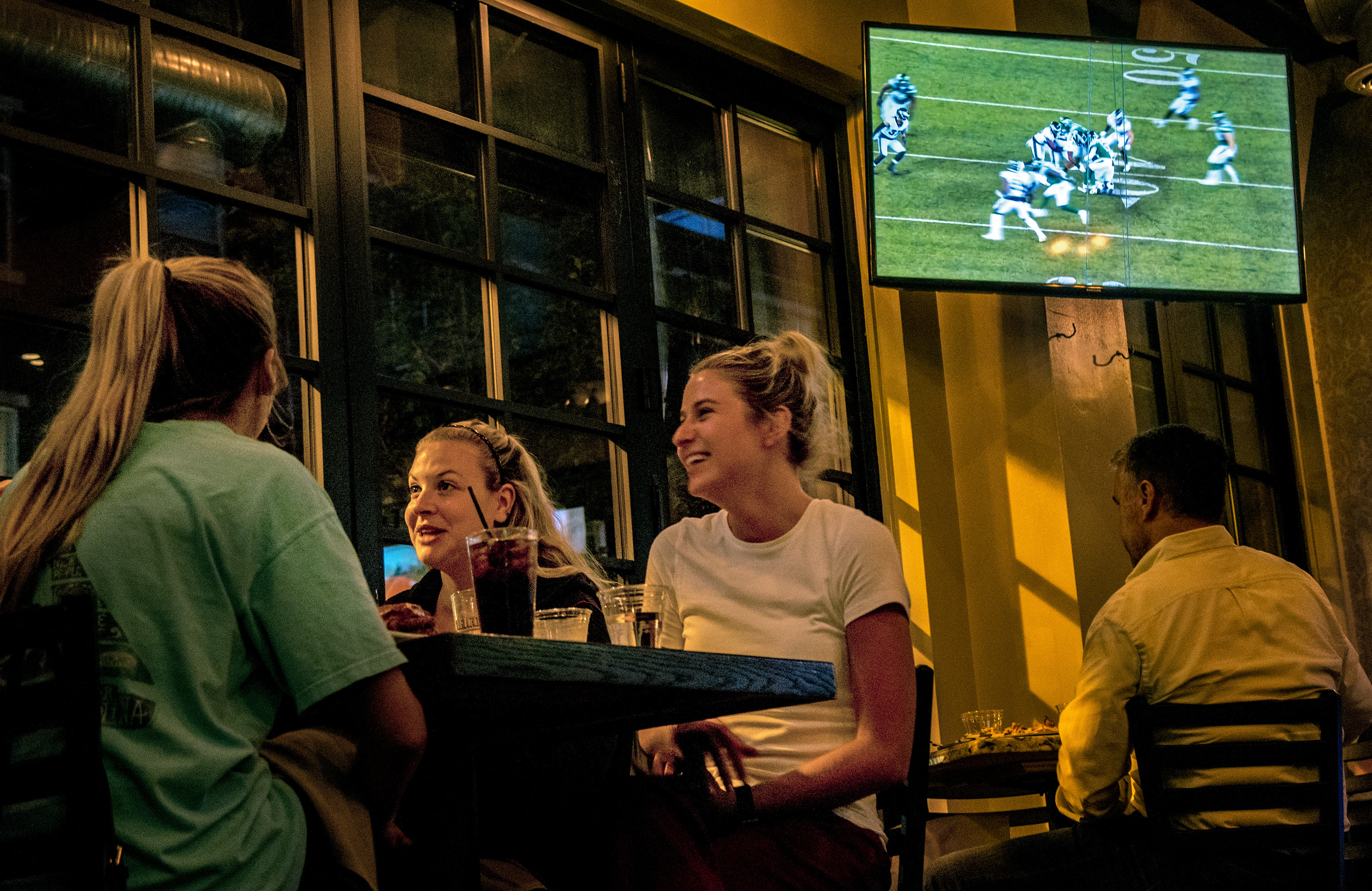
    Football and the Eagles are back, and every week fans will be packed into tailgates, living rooms, and watering holes to watch the Birds’ potential path back to the Super Bowl.

    Philly has hundreds of spots to catch a game, from breweries with wall-size projectors to restaurants streaming the broadcast over the bar. Here are some of the top picks — big venues, sports bars, breweries, and restaurants — to help you plan your game day.

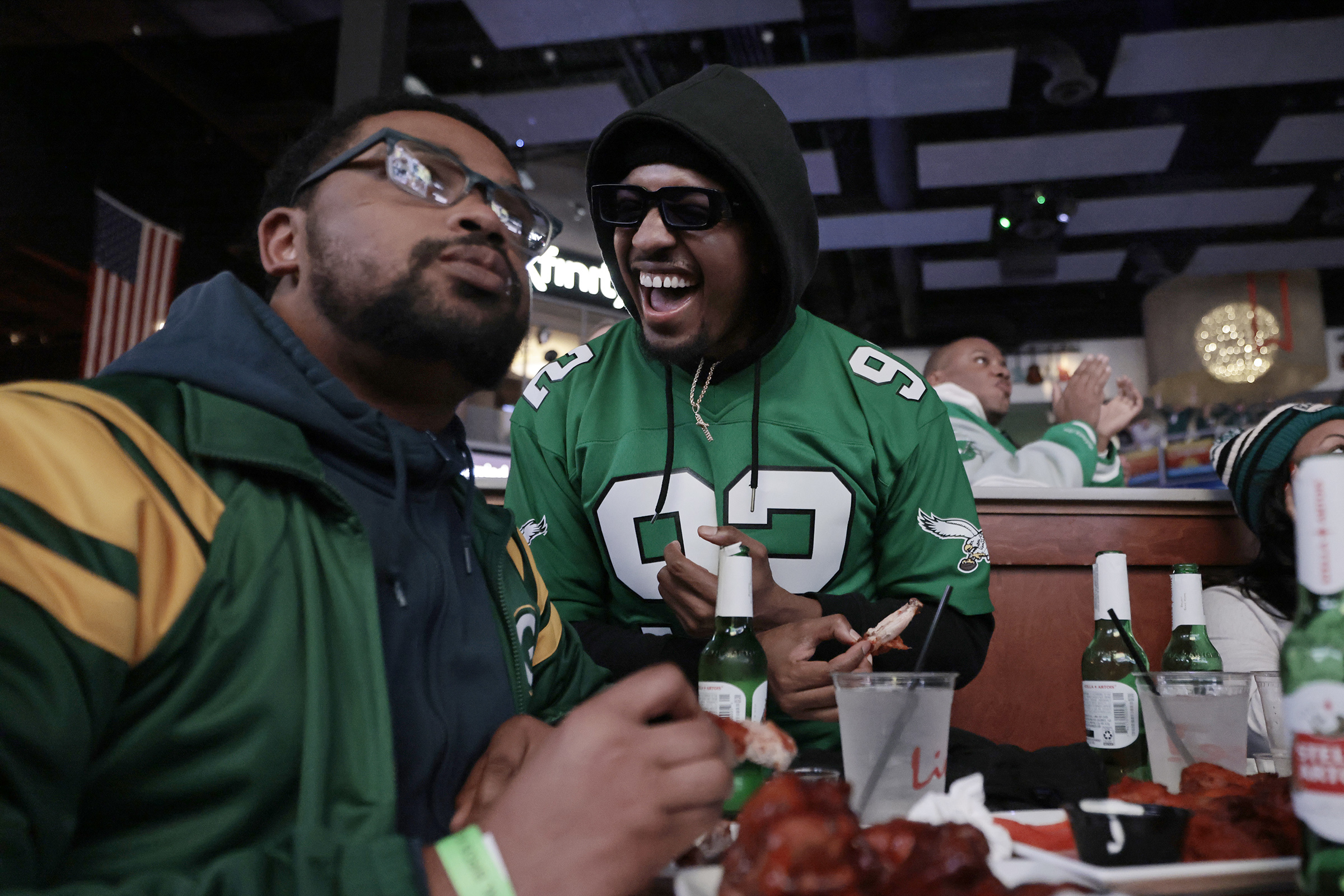
    Eagles fan Justin Ghee (right) gets in the face of his friend Packers fan Ronald Roberts when the Eagles sacked the Packers quarterback in the first half of the Eagles vs. Packers NFL playoff game. The friends were viewing the game at XFINITY Live! Philadelphia on Sunday, January 12, 2025. Both men are formerly from Philly, attended Howard University and now live in Washington, D.C.Elizabeth Robertson / Staff Photographer

    Big venues, bigger screens

    Live! Casino

    Right next to the South Philadelphia sports complex is the fairly new Live! Casino and Hotel, with at least two venues located within the casino to watch the games. Take your pick between the 52-foot screen at Sports & Social, or Luk Fu, the casino’s pan-Asian restaurant with game-day specials.

    📍900 Packer Ave., Philadelphia, Pa. 19148, 📞 833-472-5483, 🌐 philadelphia.livecasinohotel.com

    Stateside Live! (formerly Xfinity Live!)

    So close to the Linc that you can hear the stadium roar from the patio, Stateside Live! (formerly Xfinity Live!) has a 58-foot screen and dozens of TVs in its bars.

    📍1100 Pattison Ave., Philadelphia, Pa. 19148, 📞 215-372-7000, 🌐 xfinitylive.com

    Rivers Casino

    Watch the Eagles play on a massive HD video wall at BetRivers Sportsbook inside Rivers Casino in Fishtown. Game-day beer specials and giveaways will be available, plus each game brings a chance for fans to win tickets to a forthcoming Eagles game.

    📍1001 N. Delaware Ave., Philadelphia, Pa. 19125, 📞 877-477-3715, 🌐 riverscasino.com

    Craft Hall

    Craft Hall is a massive beer hall, with family- and pet-friendly fixtures, equipped with two projector screens and several TVs lining the walls playing every Eagles game. Enjoy $5 draft beers and $15 beer pitchers with under-$20 food specials, including wings and pizza.

    📍901 N. Delaware Ave., Philadelphia, Pa. 19123, 📞 267-297-2072, 🌐 crafthallphilly.com

    Classmates from the Philadelphia area attending East Carolina University in North Carolina meet at Founding Fathers on South Street to watch the Eagles. Tom Gralish / Staff Photographer

    Sports bars and breweries

    Cavanaugh’s Headhouse & Rittenhouse

    Cavanaugh’s sports bars are some of the best venues to be at on game day, with locations in Rittenhouse and Headhouse Square off South Street. The Rittenhouse location will offer Bud Light in $5 cans and in $22 bottle buckets. Headhouse will have $4 draft Michelob Ultras and $20 buckets of Bud Light.

    📍421 S. Second St., Philadelphia, Pa. 19147 / 1921 Sansom St., Philadelphia, Pa. 19103, 📞 215-928-9307 / 215-665-9500, 🌐 cavsheadhouse.com / cavsrittenhouse.com

    Founding Fathers

    South Street’s premier sports bar with TV-lined walls, an extensive bar-food menu, and a draft beer list that offers popular craft beers and local talent.

    📍1612 South St., Philadelphia, Pa. 19146, 📞 267-519-0253, 🌐 foundingfathersbar.com

    Dock Street Brewery

    Philadelphia’s oldest craft brewery invites you to their Washington Avenue brewery and bar every game day to watch on their wall-size projectors alongside food and drink specials.

    📍2118 Washington Ave., Philadelphia, Pa. 19146, 📞 215-337-3103, 🌐 dockstreetbeer.com

    Evil Genius Beer Co.

    This Fishtown taproom will treat you to Evil Genius’ celebrated classics and latest craft brews while watching the game on a 16-foot screen. Game-day specials include $42 beer towers and $45 Stateside buckets.

    📍1727 N. Front St., Philadelphia, Pa. 19122, 📞 215-425-6820, 🌐 evilgeniusbeer.com

    Lucy’s Bar

    This Rittenhouse sports bar has a 16-foot screen and game-day deals, including a $40 appetizer platter stacked with wings, cheese curds, onion rings, and pretzels. Drinks include a $6 citywide (dubbed the “buddy system”) and $10 to $12 cocktails.

    📍1720 Chestnut St., Philadelphia, Pa. 19103, 🌐 lucysphiladelphia.com

    Yards Brewing

    Philadelphia’s largest brewery is delivering specials every game day at its Spring Garden Street taproom, including $6 Trash Talks, an IPA made especially for the Eagles season.

    📍500 Spring Garden St., Philadelphia, Pa. 19123, 📞 215-525-0175, 🌐 yardsbrewing.com

    Libertee Grounds

    A block away from the Girard Avenue BSL station is an Asian-fusion sports bar with a curated craft beer list, several TVs playing the Eagles on game day, and a slew of specials: $1 Jell-O shots, $20 beer pitchers, $10 wings, and more.

    📍1600 W. Girard Ave., Philadelphia, Pa. 19130, 📞 267-324-3487, 🌐 liberteegrounds.com

    The Bayou Bar & Grill

    Manayunk’s Bayou Bar & Grill has been playing every Eagles game for decades. Enjoy its festive atmosphere, and a weekly Eagles merchandise giveaway all season long.

    📍4245 Main St., #1602, Philadelphia, Pa. 19127, 📞 215-482-2560, 🌐 bayoubargrill.shop

    Independence Beer Garden

    A Center City open-air beer garden with every Eagles game projected onto a big screen along the wall, accompanied by domestic beers on tap, cocktails, and classic pub grub.

    📍100 S. Independence Mall West, Philadelphia, Pa. 19106, 📞 215-922-7100, 🌐 phlbeergarden.com

    Bar-Ly

    Chinatown’s premier sports bar, Bar-Ly carries a whopping 60 beers on tap with TVs and large screens lining the walls. It gets busy on game day, so call ahead to reserve a table.

    📍101 N. 11th St., Philadelphia, Pa. 19107, 📞 215-922-2688, 🌐 bar-ly.com

    The Rook

    Every Eagles game day at the Rook in Manayunk, fans can watch the game while taking advantage of the $12 domestic beer pitchers and a $12 “Philly Special” pulled pork sandwich, with broccoli rabe, roasted long hots, and provolone.

    📍4001 Cresson St., Philadelphia, Pa. 19127, 📞 267-323-2906, 🌐 therookmanayunk.com

    Restaurants

    Jaffa Bar

    Jaffa Bar will be playing every Eagles game on the bar’s TVs and offering a bevy of game-day specials: $12 black lime pepper wings with herbed labneh; $2 raw bar items (oysters, New Jersey top neck clams, and shrimp cocktail), and $6 french fries with tehina ketchup. Plus, $9 specialty cocktails.

    📍1625 N. Howard St., Philadelphia, Pa. 19122, 📞 267-857-9944, 🌐 jaffabarphilly.com

    Positano Coast

    Aldo Lamberti’s Positano Coast in Old City will offer a rotating menu of specials, with games playing across the bar’s TVs.

    📍212 Walnut St., 2nd Floor, Philadelphia, Pa. 19106, 📞 215-238-0499, 🌐 positanocoast.net

    Patchwork

    Patchwork, nestled inside Rittenhouse’s Hyatt Centric, will play the Eagles games all season long, offering $10 citywide, $11 Super Lyte (Blue Chill), and $13 seasoned crinkle-cut fries.

    📍1620 Chancellor St., Philadelphia, Pa. 19103, 📞 215-985-1234, 🌐 patchworkphilly.com

    Taqueria Amor

    Head to Taqueria Amor on Manayunk’s Main Street for every Eagles game to watch with sound on and $3 off beer pitchers.

    📍4410 Main St., Philadelphia, Pa. 19127, 📞 267-331-5874, 🌐 taqueriaamor.com

  • Why Democrats are starting to feel bullish about a midterm wave

    Why Democrats are starting to feel bullish about a midterm wave

    Democrats’ wary optimism about the midterms gave way to growing confidence this week.

    The party has seen strong post-Labor Day polls in key battlegrounds — and even in traditionally red areas. Recent escalations in the war in Iran, including an attack on a major pipeline in Saudi Arabia, mean the rising gas prices bedeviling Republicans will not be going down anytime soon. Republicans have not been able to bring prices under control more generally. And President Donald Trump’s unpopularity is at near-record levels.

    Considering all this, Democrats now think conditions are right for the party to retake control of the House and possibly the Senate later this year.

    “If the election were held today, we would win the majority,” Senate Minority Leader Chuck Schumer (New York) said in an interview with The Washington Post.

    Schumer said he felt “considerably more bullish” about Democrats’ chances of retaking the Senate than he did a few months ago. He described the environment as uncannily similar to 2006, when discontent with the war in Iraq helped Democrats recapture the Senate and the House.

    House Minority Whip Katherine Clark (D-Massachusetts) said Democrats’ recent momentum is driven by their focus on the economy, with voters believing that the party understands the financial pain they’ve felt in the years since Republicans swept into unified control.

    “That is what is driving these polls,” Clark told The Post on Thursday.

    Still, Democratic fears remain.

    Democrats need at least four more seats to take the Senate majority and would have to win at least two in states Trump carried by double-digit margins in 2024. Republicans are seeking to blunt any Democratic gains by flipping Democratic-held open seats in Michigan and New Hampshire, where polls show competitive races. The nonpartisan Cook Political Report shifted its rating of the Senate contest in New Hampshire from “Lean Democrat” to “Toss Up” this week.

    Republicans focused on keeping control of the House argue that they have a more favorable map, partly because a GOP redistricting effort has limited the number of battleground districts, and partly because they believe that Democratic primary voters nominated weak candidates in a handful of key races.

    Then there is the incoming flood of GOP money.

    Republicans are set to spend nearly $140 million more on ads than Democrats are in the nine most competitive races in the final weeks of the campaign, according to ad tracking firm AdImpact. The disparity is especially yawning in the Senate contest in Texas, where Republicans have reserved $39.6 million in ads and Democrats have reserved just $5.1 million.

    On the House side, the National Republican Congressional Committee plans to run coordinated ads in 39 districts, with more than $24 million in ads reserved.

    The Democratic Congressional Campaign Committee has plans for coordinated ads in 14 districts.

    “The Republican campaign engines are firing on all cylinders, and we are burying House Democrats in battleground districts across the country,” said Mike Marinella, spokesperson for House Republicans’ campaign arm. “Republicans have the historic fundraising advantage, a more favorable map, stronger candidates, and the firepower to defy history and grow our House majority.”

    Schumer acknowledged Republicans’ financial advantage but said it would not stop Democrats from retaking the Senate.

    “We don’t need as much money as them given the political climate, given the terrain,” he said. “All we need is enough to stay in the ballpark and be able to answer them.”

    Republicans have begun to openly acknowledge electoral concerns in recent weeks, particularly with polls showing that Democrats are far more eager to vote than Republicans are.

    Sen. John Kennedy (R-Louisiana) told reporters Thursday that he was going to Kansas, Nebraska and Iowa to raise money for GOP Senate candidates.

    “If you told me six months ago I was going to be having to spend my time in those three states, I wouldn’t have believed you. Those ought to be fat guy layups for us,” he said, though he predicted Republicans would hold those seats.

    “The far left, they’re angry,” Sen. Ted Cruz (R-Texas) said this week on the “Pod Force One” podcast, describing this as a “challenging environment” for his party. “They hate President Trump with a burning passion. And they’re going to crawl over broken glass to vote.”

    Senate Majority Leader John Thune (R-South Dakota) acknowledged Wednesday that Republicans are facing “headwinds” but said the Senate races that will decide control of the chamber remain competitive.

    “It’s not a great environment for us,” Thune said. “But we’ve got really quality candidates in all the competitive races, and the polling that we’re seeing in those races shows that these races are tight.”

    Republicans have been debating how to increase enthusiasm beyond spending more money. Some, largely those closely tied to the president and his political operation, argue that the path to victory is to re-create the electorate Trump built in 2024. Other Republicans — primarily those in battleground districts where private and public polls show that voters are deeply upset with the president — believe the way to win is to distance themselves from the administration and its policies, a difficult task following a decade of Trump remaking the party in his own image.

    “I’m asking you to pretend that I’m on the ballot,” Trump said during one of two speeches he gave at the Republicans’ midterm convention in Dallas recently. “Just one more time.”

    Trump has made it difficult for many candidates, especially those in tight races, to embrace this tactic. In large part, that’s because he has repeatedly dismissed the issue that voters say is their main stressor: prices. His trade war has raised prices on goods across the country. And gas prices, which have shot up because of the president’s war against Iran, are nearing $4.50 per gallon on average.

    However, speaking at a campaign rally Wednesday in North Carolina, a state he has won in three straight presidential elections, Trump said high fuel prices were “a very inexpensive price to pay for what we have done” in Iran.

    A Republican operative working on House races, speaking on the condition of anonymity to be candid, responded to Trump’s comments with an animated image of actor Bryan Cranston screaming, “F—!”

    The president has promised to get out the vote for Republican candidates, including those in trouble deep in Trump country. Some have taken him up on his offer, but not every candidate wants him around, and administration officials’ visits to red states have been seen as warning signs for Republicans.

    Vice President JD Vance traveled to Kansas this week to stump for Republican Sen. Roger Marshall, who is in a tighter-than-expected race against Democrat Adam Hamilton. Trump and Vance won Kansas by 16 percentage points in 2024.

    Vance is also set to campaign in Iowa on Friday. But the state’s Republican Senate nominee, Rep. Ashley Hinson, will not appear next to the vice president. A Hinson spokesperson cited previously scheduled events, but the absence comes as the candidate seeks to tout her bipartisan record in a state Trump won by 13 percentage points in 2024. Hinson is locked in a tight race against Democratic state Rep. Josh Turek.

    And in South Florida, an area Trump dominated in 2024, Republican Rep. María Elvira Salazar openly broke with the president Thursday.

    “Mr. President, some of your immigration enforcement efforts have gone too far,” Salazar says directly to the camera in a new campaign ad. “The same Hispanics who helped you get to the White House in 2024 feel betrayed today.”

    Democrats say they began to see a change during what was supposed to be Republicans’ hallmark 2026 event: the party’s unorthodox midterm convention. The gathering was billed as a way for the GOP to showcase its front-line candidates, but instead it featured Trump defending his record and pledging to give each American adult a $5,000 check if Republicans hold Congress this year, a proposal many Democrats saw as a sign of desperation.

    “We’re not measuring the drapes, but the ground has shifted,” said Xochitl Hinojosa, a longtime Democratic operative and top spokesperson at the Democratic National Committee after the 2016 election.

    Some Democratic operatives running campaigns said they had been waiting to see whether Republicans would coalesce around a clear affordability message during the Texas event. But when it became obvious that the event would be a Trump-centric celebration that offered no direct case for why Republicans deserved unified control for two more years, their confidence grew.

    “Turns out breaking all your campaign promises and doing everything possible to make life more expensive for everyone is bad politics,” said Viet Shelton, spokesperson for House Democrats’ campaign arm. “Shocker.”

    The last time Democrats experienced a wave election was in 2018, when the party swept into control of the House two years after Trump’s first presidential win.

    Meredith Kelly, a Democratic operative who was the top spokesperson at House Democrats’ campaign arm at the time, said that there are plenty of similarities between that year and this one — primarily around Trump’s unpopularity — but that the biggest difference is how Republicans’ worries are coming from voters who helped them win in 2024, such as rural voters and Black and Latino men.

    “Their coalition’s floor is falling out from underneath them,” said Kelly.

    The prospect of a wave election has Democratic candidates in districts once thought entirely unreachable for the party feeling like they may have a shot to do the unexpected in November.

    Eileen Laubacher, a retired Navy veteran running against GOP Rep. Lauren Boebert in a district that spans eastern Colorado, knows that her odds of winning have always been long. Trump won the district less than two years ago by 18 percentage points. But powered almost entirely by anger at Washington and voters’ fears about their personal finances, Laubacher thinks she has an opportunity to take down her outspoken Republican opponent.

    “People vote frequently about their pocketbooks and their wallets, but I think the situation is growing ever more fraught for people,” said Laubacher. “Every aspect of their life has become more expensive, and they do not feel that the government is doing anything about any of it.”

    Jarrell Dillard contributed to this report.

  • Postal Service chief says work stopped on computer system key to Trump effort to limit mail voting

    Postal Service chief says work stopped on computer system key to Trump effort to limit mail voting

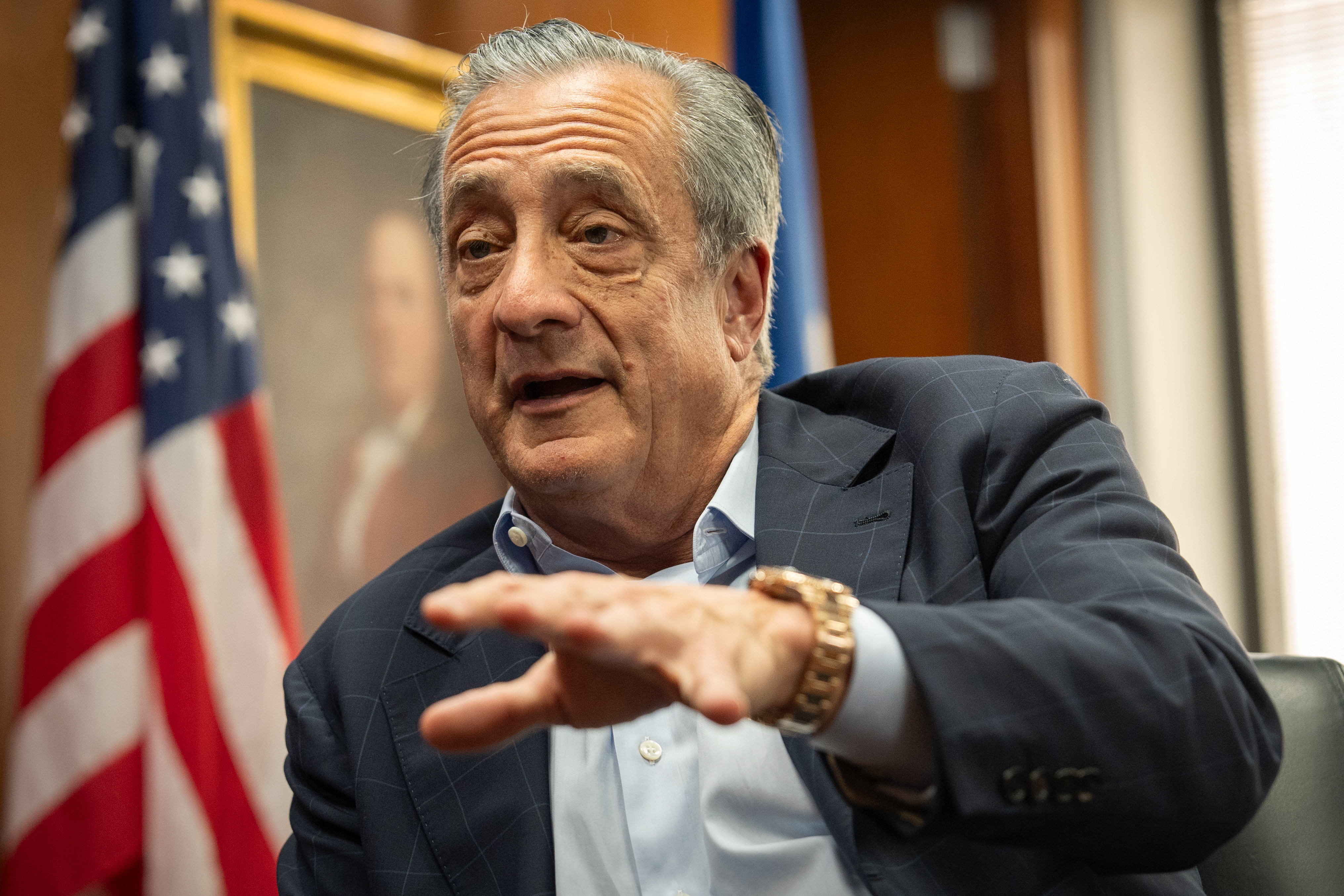
    WASHINGTON — The top official at the U.S. Postal Service said Thursday that the agency has stopped work on developing a controversial computer system that was central to President Donald Trump’s effort to limit mail voting after the Supreme Court rejected his executive order this week.

    “There’s an injunction so we’re not doing anything,” postmaster general David Steiner told The Associated Press in an interview.

    Steiner, a onetime chief executive of Waste Management, has spent most of the past year atop the postal service navigating political and financial challenges. He’s pressing Congress for changes that would help him resolve what he has called a “liquidity crisis.”

    And Trump’s efforts to largely eradicate mail voting turned the postal service into an unlikely arbiter of who is eligible to vote just months before this year’s critical midterm elections, a role Steiner seemingly had little interest in playing. Unlike Trump, who was sharply critical of the Supreme Court decision and ridiculed some of the justices, Steiner offered no assessment of the court’s action.

    Steiner also declined to take a position on Trump’s policy, presenting himself as the leader of an “independent agency of the executive branch” whose influence over the president’s order was limited to operational concerns.

    “I don’t get to decide what rules that are put on us that I decide to accept or not accept,” he said. “I looked at it more from the execution side.”

    The postal service has asserted its independence in the past, including during a 2019 standoff when the first Trump administration sought to pressure the agency as the president was in a dispute with Amazon. Steiner said he wouldn’t get into the “nuance” of that.
    But the pressure has grown so intense at points that it’s fueled talk of whether Steiner might resign, a notion he denied.

    “There’s no truth to that,” he said. “I think I know the motivation behind it. I think it’s somebody that would like to see me out of a job.”

    Inserting the Postal Service into elections

    The executive order Trump signed in March directed several federal agencies to develop state citizenship lists. Those lists would have been delivered to an online portal at the Postal Service, which would have been allowed to send mail ballots only to voters who were cleared through the process. Steiner said he knew about the order about a month before it was unveiled but said his focus was largely on implementation, not the policy’s merits.

    A whistleblower report released earlier this month by Sen. Richard Blumenthal, D-Conn., argued the system was hastily built and riddled with errors.

    Steiner said he read “portions” of the whistleblower report and acknowledged the obstacles associated with building such a massive platform quickly. Still, he said he had confidence in colleagues working on the project and had planned to unveil it around Sept. 15.

    “There’s absolutely no doubt that we worked fast,” he said. “My personal opinion is it was a monumental task and I’m very proud of our IT department for being able to do it that fast.”

    In addition to the voter list, Trump’s order would have required states to adopt a uniform envelope style that included barcodes, something states said would have been arduous so close to the election.

    Following the Supreme Court’s ruling, a memo sent to all postal service employees Wednesday and obtained by the AP said the agency will “not be enforcing any of these new rules in the 2026 federal election.”

    “First and foremost, for Election Mail it is business as usual,” according to the memo. “We continue to follow established protocols, and we remain entirely focused on our core mission: delivering the mail safely and securely for voters and election officials across the country.”

    Though the Supreme Court rejected Trump’s executive order for this year’s election, Justice Brett Kavanaugh indicated he might rule in favor of the administration if the issue comes back before the court at a later time.

    Steiner encourages voters to cast ballots early

    Steiner said the postal service would still encourage the use of envelopes and barcodes in future elections, which it has long recommended. He said such changes wouldn’t be required but those who don’t comply may have to pay more.

    “If you use the barcode in the envelope, we’ll charge you a lower price,” he said. “If you don’t, we’re going to charge you a higher price because it’s harder for us to process.”

    While the postal service isn’t moving forward on Trump’s order, there are still concerns about postmark delays that could have an impact on this year’s elections. The number of ballots rejected for late postmarks has soared in the vote-by-mail states of Washington and Oregon, according to recently released data highlighting concerns about recent changes in postal service operations.

    Steiner said there were no plans to alter those operations and encouraged voters who use mail to get their ballots in early.

    “We say seven days,” he said. “Everything is solved if people vote early.”