Blog

  • Two centuries on, Smithsonian connects Jefferson’s hair to Hemings’ children

    Two centuries on, Smithsonian connects Jefferson’s hair to Hemings’ children

    For more than 200 years, the question has nagged at the edges of American history: Did Thomas Jefferson father children by Sally Hemings, a woman he enslaved?

    The claim that he did has prompted denials, polemics, scandalous bestsellers, and sober historical scholarship, before settling in recent years into a widely, if not universally, accepted truth.

    Now the Smithsonian Institution is offering what it says is the most definitive evidence yet, based on an extraordinary piece of data: Thomas Jefferson’s genome, sequenced from samples culled from a few strands of his hair.

    In a new book, Richard Kurin, the Smithsonian scholar who led the effort, describes how a team of researchers used cutting-edge techniques to extract and sequence Jefferson’s DNA. They then compared it with DNA samples obtained from 13 living Hemings and Jefferson family descendants.

    It’s a 15-year detective story that involves archaeologists, genealogists, molecular geneticists, and historians, stretching across multiple changes in Smithsonian leadership. Kurin, in a video interview this week, called it a “capstone” to decades of previous research and “extraordinary proof” that Jefferson fathered Hemings’ children.

    So is it absolutely certain?

    “Other people may have other ideas, and I don’t think there’s necessarily an institution position,” Kurin said. “But I think it’s compelling.” He added, “It’s very clear.”

    History by a Hair, publishing Tuesday by Crown, a division of Penguin Random House, arrives with endorsements from prominent scholars.

    But it is landing at an extraordinarily tense moment for the Smithsonian, which has been engaged in a standoff with the Trump administration. The president has accused the institution and its secretary, Lonnie Bunch III, of promoting a “divisive, race-centered ideology” that dishonors the nation’s founders and overemphasizes slavery and other negative parts of American history.

    This month, Bunch, who has led the Smithsonian since 2019, announced that he would depart by the end of the year. Last week, the administration outlined its plans to install signs outside the Smithsonian’s National Museum of American History, warning visitors of what it claims is inaccurate history.

    While the Hemings issue has not figured into the controversy, the Smithsonian has adjusted the rollout of its research. An event on Tuesday announcing the findings has been moved from the American history museum to a less prominent Smithsonian location, limited to descendants, and closed to the news media. An online public lecture by Kurin through the institution’s educational arm set for the next day was canceled.

    Kurin acknowledged what he called the “unpredictability” of the moment. But for him, the research was just “doing my job.”

    “This is a topic of interest to the American people,” he said. “I didn’t invent this question, and it wasn’t invented by the Smithsonian. It goes back to Hamilton and Jefferson and Adams. If we have evidence, scholarship, and science that helps elucidate American history, I think we have a duty to pursue it.”

    In a foreword to the book, Bunch, 73, strikes a similar note, linking the research to the museum’s truth-seeking mission.

    The research, he writes, “helps resolve an issue that had divided us since the time of our national founding, and points to how science, scholarship and education can bring us together as people of one, albeit complicated, American family.”

    A Notion long discounted

    The claim that Jefferson fathered children by Hemings goes back to the early days of the Republic, when Jefferson’s political opponents lobbed the scandalous charge that he had an enslaved Black mistress at Monticello, his estate in Virginia.

    Jefferson’s paternity was also recorded in generations of Hemings family accounts, including an 1873 oral history given by her son Madison, who said that Hemings had become Jefferson’s “concubine,” bearing five children by him, including one who died in infancy.

    Still, deep into the 20th century, the notion was discounted by most mainstream, white historians, who saw it as out of keeping with Jefferson’s character.

    The 1990s saw a sea change, driven in part by a 1997 study by Annette Gordon-Reed, who analyzed the wealth of evidence in support of the claim, and the ways it had been systematically discounted by white scholars. In 1998, geneticist Eugene Foster published a DNA study in the journal Nature, which indicated that Hemings’ son Eston was the son of a Jefferson male.

    In a 2000 report, the Thomas Jefferson Memorial Foundation, the nonprofit group that owns and operates Monticello, concluded that multiple strands of evidence suggested a “high probability” that Jefferson was the father of Hemings’ son Eston, and that he was “most likely” the father of her other children.

    In 2018, Monticello went further, declaring it a “settled historical matter.” Still, some skeptics have continued to advance other paternity candidates, including Jefferson’s brother, Randolph.

    Kurin, a cultural anthropologist who joined the Smithsonian in 1976, has helped oversee many complex projects, including the development or renovation of most of its museums. The Jefferson effort, he said, began with a flash of simple intellectual curiosity.

    In 2011, Kurin was previewing a Smithsonian documentary about Jefferson’s personal Bible, which he had created by cutting out passages containing Jesus’ moral teachings and pasting them into a new book.

    Kurin wondered: Could Jefferson have cut himself in this process, leaving blood behind?

    There was no blood. But conservators, he learned, had found something else: three strands of hair.

    At that time, no one had reliably sequenced usable samples of nuclear DNA (the genetic material found in the nucleus of every cell) from follicleless hair shafts, which these were. But after getting permission from the Smithsonian’s Board of Regents, Kurin started working with Beth Shapiro and Ed Green, two experts in ancient DNA at the University of California, Santa Cruz, who were pioneering new techniques for extracting and sequencing DNA from challenging sources.

    Kurin was mindful that the research could yield clear evidence that Jefferson was not the father of Hemings’ children. He discussed that possibility with Bunch, who at the time was the director of the National Museum of African American History and Culture.

    “The museum has to be on a foundation of truth,” Bunch said. “Whatever it is.”

    ‘We’re going to exhaust it’

    The first task was simply to figure out if the Bible hairs were actually Jefferson’s, by comparing any DNA that could be extracted with samples taken from a known Jefferson descendant.

    A genealogist started tracking down living fifth-generation descendants of Jefferson and of Hemings. (Fifth-generation descendants, some of whom were already in their 80s, would most likely be the last to have enough possible Jefferson DNA — an average of roughly 3.1% — to provide a clear match.)

    Three years in, the team hit a possible dead end. The scientists had analyzed mitochondrial DNA, which passes unchanging through the female line, extracted from the Bible hairs. It didn’t match a sample obtained from a female-line descendant of Jefferson’s mother. So it couldn’t be Jefferson’s hair.

    The team turned to another source that had emerged: strands from a lock at Monticello said to have been clipped from Jefferson’s head while he was on his deathbed in 1826.

    That hair matched the DNA sample from the living maternal-line descendant. “We’re going to exhaust it and sequence the crap out of it,” Shapiro wrote to Kurin.

    The team was ultimately able to sequence Jefferson’s entire genome, employing groundbreaking techniques that didn’t exist when the research started but have since been used to solve criminal cases like the Gilgo Beach murders and the Golden State Killer, for which Green managed to recover and sequence DNA from rootless hairs.

    Shapiro, whose research has also included recovering the DNA of extinct species like the dodo and the woolly mammoth, credited the Jefferson project with helping spur creative thinking about new ways to extract DNA from hair.

    “It’s hard to say we ever would have gotten to this place, where all these tools were used to convict the Gilgo Beach serial killer, if it hadn’t been for starting this project,” she said.

    Ultimately, the team was able to compare Jefferson’s DNA with that from samples obtained from nine fifth-generation descendants of Hemings via Madison and Eston. They shared between 0.5% and 5% of DNA with Jefferson, within the range of the expected average of 3.1% for a fifth-generation descendant.

    The team also got data from two fifth-generation Jefferson descendants via his daughter Maria, who shared 2.4% and 2.6% of his DNA, and two descendants of Jefferson’s brother, Randolph.

    Sam Vohr, a computational biologist working with the team, used the data to run 20,000 simulations of each paternity scenario involving Thomas Jefferson, Randolph, or Randolph’s sons. The odds that Thomas Jefferson did not father either Madison or Eston were less than 1 in 1,000.

    In an interview, Green said Jefferson being the father of Eston and Madison is by far the most likely scenario. Strikingly, he noted, the person with the highest percentage of shared DNA with Jefferson — 5% — wasn’t a descendant of Jefferson and his wife, but a Hemings descendant.

    “Any alternative paternity scenario is going to have to reconcile that,” Green said.

    This month, one Hemings descendant who had given a sample in 2015 asked to withdraw her participation, saying she was dismayed that the book was appearing before a related article had been published in a scientific journal. The Smithsonian confirmed that the descendant’s sample and related data had been destroyed.

    Shapiro said the descendant’s data had also been removed from the scientific article, which is under submission and awaiting completion of peer review. The team also reran its analysis. “It didn’t change the results,” Shapiro said.

    Jefferson’s freckles

    It remains to be seen how the research, which so far has been closely guarded, will be received.

    Gordon-Reed said she welcomed the findings, which she was briefed on several months ago, but confessed to “mixed feelings.” In her view, the historical evidence, bolstered by the 1998 DNA study, was enough. “But it’s always good to have more corroboration,” she said.

    The most surprising thing about the research, Gordon-Reed said, was that it was possible at all.

    “Now they have Jefferson’s genome,” she said, adding with a laugh, “Can they clone him?”

    Views among Jefferson descendants vary, with some having long accepted that he fathered children with Hemings and others strongly rejecting the idea.

    The Monticello Association, a Jefferson descendant group that owns the graveyard at Monticello, which does not admit Hemings descendants, did not respond to requests for comment.

    David Miller, a sixth-generation Jefferson descendant whose mother, Sarah Coachman Miller, provided a DNA sample, said he welcomed the results, which confirmed what he already believed.

    His mother died before the results came back. But through the project, Miller had connected with some Hemingses, whom he calls “cousins.”

    “It’s positive the family now hopefully gets the recognition and acknowledgment and acceptance they deserve,” he said.

    The person in the study who shares the most DNA with Jefferson is Clara Lee-Nutt, 64, who lives in Sharpsburg, Md. Along with 5% of his DNA, she also has what her father teasingly told her were Jefferson’s freckles.

    Growing up, being descended from Jefferson wasn’t something that was shouted from the rooftops. It was the kind of claim, she once overheard her father say, that could “get you lynched.”

    But now Lee-Nutt embraces it. In January 2009, she published an open letter to Jefferson, whom she says she views “with reverence,” in Newsweek, telling him about the inauguration of Barack Obama and her hopes that Americans could move forward “as one people.”

    Lately, Lee-Nutt said, she had thought often about her father, who died when she was 10. Before getting the Smithsonian’s results, she had braced herself for the possibility that the stories he had told her were wrong.

    She said she understood how some Jefferson descendants might feel as if something were being taken away from them.

    “But we’re not trying to diminish anyone,” she said. “We just want to be able to tell our children who they are.”

    This article originally appeared in the New York Times.

  • The Union are changing the narrative around the fate of their season in real time

    The Union are changing the narrative around the fate of their season in real time

    It was Frankie Westfield’s shot that set the tone.

    His shot from just outside Sporting Kansas City’s 18-yard-box was hit with a verve that said so much — without being able to say anything.

    It was angry, it was forceful, it was frustrated.

    Fortunately, it was also extremely accurate. Watch it, and you’ll see that’s apparent.

    It would be the goal that would see three more follow in a nine-minute span that fueled a 4-3 Union win against Sporting, after Philly took a 3-0 deficit into the locker room at halftime.

    Up until Westfield’s strike in the 64th minute, the story was written to appear like a night in which nothing would go right for the Union, a team on the precipice of finding a 10-game unbeaten streak snapped on the road by Sporting, a team desperately looking to surge out of the basement of Major League Soccer’s Western Conference.

    Two of Sporting’s three goals were scored by an attacker the club spent $17 million to acquire in Brazilian André Luiz, from Greece’s Olympiacos FC. And for the first 50-plus minutes of the first half, Luis was earning his game check, embarrassing Union defenders with his speed and using deft whipping shots that sailed past seasoned goalkeeper Andre Blake.

    Honestly, watching it felt like it fit the narrative of Philly sports teams. It can’t be too good for too long.

    After all, things in the past few weeks were going too well for the Union. They were riding that unprecedented unbeaten streak, spearheaded by a 16-year-old who the soccer world is watching mature into his own in real time. We already knew Cavan Sullivan was different, but over the course of 11 matches in which the Union have taken at least a point, his maturity has blossomed.

    And then you have three Philly-area players who have a spotlight on them as products from the Union’s own youth academy that will now be the latest, and among the youngest to get the opportunity to represent their country on the senior level. By the time you read this, in addition to Sullivan, 18-year-old defender Neil Pierre and Westfield, 20, will be on their way to the U.S. Soccer’s national training site in Atlanta to begin preparations ahead of four games during the first international window since the FIFA World Cup.

    Cavan Sullivan (center) blows past a Sporting Kansas City defender in the club’s come-from-behind win at Children’s Mercy Park on Saturday.Courtesy / Philadelphia Union

    In fact, all three had contributions on the goals that saw the Union bypass Sporting. It started with Westfield, then Sullivan got his goal in the 66th off a great run into the box by midfielder Danley Jean Jacques to slot it past Sporting goalkeeper Stefan Cleveland, and Pierre’s header down off a ball into the box in the 73rd forced an own goal after defender Zorhan Bassong headed the ball into his own net.

    “The mentality of this group is outrageous,” said Union interim manager Ryan Richter, postgame. “[It] would have been easy to to quit at halftime, on the road, long travel, down 3-0 with guys going away with the national team after the game.

    “But the way that the guys responded in the second half was, was fantastic. Congrats to them for showing again the way that they’re believing in each other right now.”

    But it goes on from there. A forward in Milan Iloski, who’s found form. A defender in Kai Wagner, who in addition to playing the role of antagonist, is having one of his best seasons as a pro in a return to the Union during the break. A coach who has provided as good a case as ever as interim boss in Richter, who led the team since the World Cup break and like the rest of us who watched the Union’s performance on Saturday night, looked in stunned disbelief at what he just witnessed — despite playing it cool, postgame.

    Midfielder Danley Jean Jacques (left) celebrates with Cavan Sullivan after his assist on Sullivan’s goal in the 66th minute. Courtesy / Philadelphia Union

    “We got a reminder tonight that we are not perfect,” said Richter. “And when we’re not at our best, any team in this league can beat us.”

    With that wealth of riches, over the past two months witnessing the Union’s first half unraveling felt like it fit the Philly sports mold. We can never have it too good. There’s always got to be a struggle.

    Don’t believe it? Ask the Phillies or take a look at their final score as that team continues to claw for a postseason spot.

    But the Union changed the narrative in what might be one of the best come-from-behind wins of the season in MLS. Richter and Co. continue to surge up the Eastern Conference ladder as a team that was written off in June, believed to be a collective franchise in disarray after limping into the World Cup break with just one win in 15 matches. Now, we’re talking about a team with 14 goals in their last three games, with eight still to play in a historically forgiving league.

    In the 98th minute, after getting up from a foul, Wagner looked to the Sporting KC sidelines and their fans and flashed a devilish grin. But it didn’t feel like trolling (as Wagner has been known to do to both fans and the opposition from time to time).

    Union defender Kai Wagner celebrates following the club’s come-from-behind win against Sporting Kansas City on Saturday.Courtesy / Philadelphia Union

    As fans chirped at him, undoubtedly frustrated that their club just blew a three-goal lead, Wagner’s grin felt like he knew that this team was destined for big things. That not even a three-goal deficit on the road is a means to an end for this collective.

    “When a group of players responds the way they did in the second half, and that’s not just the guys who started the game, it’s the guys who, whatever role they played, you know, they did a pretty good job … it was fun to be a part of,” Richter said. “It was fun to watch, and it’s exciting to be a part of.”

    Union goalkeeper had two saves, including a monster stop that thwarted a potential hat trick from Sporting’s Andre Luis in the first half. Courtesy / Philadelphia Union

    Odds and endlines

    When Pierre took a hard challenge toward the end of the game, there was cause for concern, considering he was on a flight shortly after to join U.S. Soccer’s 28-man camp ahead of four international games beginning with Peru in Orlando on Sept. 26. However, when asked postgame, Richter had very little concerns about it, saying, “He went down probably five times [over the course of the game] but he kept going. So I think he he’s doing all right. Probably some bumps and bruises but nothing serious.” … It’s wild to say, but if not for a few first half saves from Blake, Sporting seemed primed for more goals. Blake was credited with two saves, including a monster one in the first half to keep Luis from getting what seemed destined to be a hat trick. … Quinn Sullivan certainly looks back to full strength as his rabona pass to Iloski in the 68th, saw Iloski muscle past Sporting defender Lasse Berg Johnsen to score the equalizer.

  • Phillies send struggling reliever Orion Kerkering to triple A: ‘Sometimes you need to step away’

    Phillies send struggling reliever Orion Kerkering to triple A: ‘Sometimes you need to step away’

    NEW YORK — After extended struggles, the Phillies have optioned reliever Orion Kerkering to triple A, the team announced on Sunday.

    The Phillies will continue their wild-card pursuit without Kerkering, who has struggled significantly in the second half. In four appearances in September, he had an 18.68 ERA. The right-hander headed to Lehigh Valley after Saturday’s 10-3 loss to the Mets.

    The IronPigs’ season concludes on Sunday, but the Phillies will hold a “stay-hot” camp starting on Thursday for reserve players to be prepared if needed for potential postseason action. Kerkering will take a few days to reset and then participate in the camp. While he is not eligible to return for 15 days after being optioned, the Phillies would be able to bypass that rule in the event of an injury to another pitcher.

    “Felt like he had lost confidence and just needed that to be able to try to right the ship, and it’s hard to do that here and now in this situation,” said interim manager Don Mattingly. “So it’s best to get it right, and get him right, and go from there.”

    After getting knocked around for four runs in the eighth inning on Saturday, the Phillies reached a crossroads with the 25-year-old, who was unable to hold the game to a three-run deficit.

    On Friday, with the Phillies trailing by one, Kerkering gave up a three-run homer to Juan Soto. Interim manager Don Mattingly said it was “hard to find places” to use Kerkering.

    “It got to the point where it’s almost unusable,” Mattingly said.

    In a corresponding move, right-hander Max Lazar was recalled from triple A. This is Lazar’s third stint with the Phillies this year. He has a 4.07 ERA in 42 minor league innings.

    The Phillies once viewed Kerkering as one of their top high-leverage arms with the potential to be a setup man for closer Jhoan Duran, but he fell down the depth chart during his second-half struggles. Before the All-Star break, Kerkering had a 2.43 ERA and 1.16 WHIP. Since then, though, those numbers have shot up to 9.43 and 1.95, respectively.

    This is Orion Kerkering’s first time being optioned since he made his major league debut in September 2023.Yong Kim / Staff Photographer

    “He handled it fine,” Mattingly said of Kerkering’s reaction to the demotion. “Obviously, I’m sure guys are always disappointed. Nobody wants to be optioned, especially now. It kicks you right out of a chance, if we’re able to take care of our business and get into a playoff round, it kicks him out of that.”

    Kerkering’s best offering, his sweeper, has no longer been effective. Hitters averaged .429 against the pitch in September.

    In his outing on Saturday, Kerkering’s velocity had also lost a tick. His fastball, which has averaged 97.2 mph this season, sat at 95.3 mph.

    Kerkering had been dealing with turf toe for a stretch in September, which had him in a walking boot away from the field for a period of time, but he said on Friday that was no longer an issue.

    “I don’t know. I don’t think there’s anything physically wrong with him,” Mattingly said.

    The Phillies will try to get to the bottom of Kerkering’s struggles in Lehigh Valley. This marks the right-hander’s first time being optioned since he made his major league debut in September 2023.

    “Sometimes you need to step away, just like a lot of people,” said Phillies president of baseball operations Dave Dombrowski. “Sometimes you need to step away.”

    Luzardo, Bowlan progress

    While the rest of the Phillies have an off day Monday before starting the final homestand of the regular season, both Jesús Luzardo (shoulder) and Jonathan Bowlan (groin) will report to the field to continue to work.

    Both pitchers played catch for the first time on Sunday, marking a significant step as they both work to return from injury. Dombrowski said the club feels “very optimistic” about both of their progress and potential readiness for the postseason.

    The club is leaving the door open for Luzardo to return as either a starter or a reliever in the postseason and have not made any further decisions on how they would envision using him if he remains on track. He is eligible to be activated on Sept. 27 at the earliest, which is the last day of the regular season.

    Dombrowski said the Phillies are “very optimistic” about Jesús Luzardo’s progress.Derik Hamilton

    “Positive signs with him,” Mattingly said. “We felt he was getting better and better. The last couple of days, the range of motion was back, there was no more stiffness. Then the doc basically had to say, ‘Hey, start start playing catch.’ So that’s where we’re at. It’s been positive with him.”

    Bowlan, on the other hand, is not on the injured list and is officially day to day with a mild groin strain, though it’s still not a guarantee he will be able to return by the end of the season. The team doctor, Steven Cohen, joined the club on its trip to New York to evaluate both Luzardo and Bowlan.

    “Originally when it happened, he was saying maybe he could be back, but we haven’t had any further discussions, other than that he’s been progressing well,” Dombrowski said. “He threw out I think 90 [feet on Saturday] and felt good, but it’s a situation where we haven’t pushed it beyond that.”

    Extra bases

    Nestor Cortes pitched three scoreless innings in triple A on Monday, allowing two hits and striking out three. … Following Monday’s off day, Zack Wheeler (13-5, 2.99 ERA) will start the series opener against Milwaukee. The Brewers have not yet announced their starting pitcher for the game.

  • Phoenixville will turn into ‘Gilmore Girls’ town Stars Hollow for one weekend

    Phoenixville will turn into ‘Gilmore Girls’ town Stars Hollow for one weekend

    As Kenzie Hamblin watched Gilmore Girls unfold in the fictional town of Stars Hollow, she looked around Phoenixville and thought, “I literally live in this town.”

    And now, that’ll be actually true — at least for a weekend.

    On Friday, Sept. 25 through Sunday, Sept. 27, a smattering of Phoenixville shops will transform into staples from the show in an event that Hamblin and business partner Mallory McDaniel organized.

    All across downtown, existing shops will dress up as Stars Hollow storefronts, from Le Chat Club, to Doose’s Market, to the Dragonfly Inn, and, of course, Luke’s Diner. Hamblin’s shop, Silly Little Art Shop at 28 S. Main St., will become Al’s Pancake World, serving up piping hot art kits and more.

    Visitors can expect themed events, redecorated interiors and window designs, specialized merchandise, a map to collect stamps from participating shops for a prize, and maybe a handful of grumpy Lukes serving them coffee.

    The plan was sparked about a year ago, when Hamblin saw another similar pop-up in a nearby town. It was fun, she recalled, but she knew Phoenixville could do better. The borough has the bones to do so: There’s an “amazing creative, collaborative energy” among the small business owners, and a genuine investment from the community they serve, she said.

    “We have all this magic that exists in Phoenixville,” Hamblin, 35, said. “I want people to experience that, but then also get to have that fun of experiencing the magic of Stars Hollow — as much as any place can create that.”

    For the uninitiated, you may ask: What is it about Stars Hollow, the whimsical, quirky New England small town in which Gilmore Girls is set?

    The show, a quick-witted, comedy-drama that follows the lives of a mother and daughter, ran for seven seasons in the early 2000s and has amassed devoted fans since. Among those fans, the town has become a desirable, beloved place. It has it all: It’s close-knit, supportive, and yes — walkable. It taps into something people just seem to crave: connectedness and community, Hamblin said.

    “People live in suburban wastelands, where you live in a house, and you don’t really know any of your neighbors, and you don’t have a downtown; you have a shopping mall,” she said. “And I think people want to live somewhere like Stars Hollow, where it’s very community-oriented.”

    Kenzie Hamblin, left, and Mallory McDaniel, right, will transform their storefront, Silly Little Art Shop, into Al’s Pancake World later this month. Artist Emily White, middle, has designed a “Gilmore Girls” collection.Photo courtesy of Kenzie Hamblin

    And you may ask, what is it about Phoenixville?

    “I lived here before it was cool to be from Phoenixville,” said Julie Miller, whose pottery shop at 24 S. Main St. will become the Dragonfly Inn. “There’s such a strong community in the downtown, and a want for the downtown to survive, and a want for it to be this special, quaint little slice of heaven that it has become. I think that really equates with Stars Hollow.”

    And the response to the town coming to life has been pretty resounding. Hamblin organized a small group of businesses to participate in this year’s event, with the goal of drawing a couple hundred people downtown. When she posted the initial social media flier, though, it got more traction than she could have predicted — more than 100,000 views and 5,000 shares in the first 24 hours.

    Within the community, other businesses wanted to participate. And beyond the community, new customers have dropped by, scoping her shop out ahead of the event later this month, she said. (@starshollow.pa on Instagram is giving updates to the weekend’s offerings.)

    The business owners aren’t entirely sure what the magnitude of the turnout could be, but they’re excited.

    Miller, 36, said the enthusiastic response has been “amazing, and also a little terrifying in the best way.”

    She’s creating a line of dragonfly teacups and teaspoon rests. Themed pieces from other local artists will also be on offer in her shop. And to tap into the coziness of the inn, complimentary tea and cookies will welcome visitors.

    “It’s just really exciting for the potential,” Miller said. “Hopefully that just means that this is going to continue and be like another amazing thing that happens in Phoenixville that we get to do once a year.”

    Studio 323, at 323 Bridge St., will become Weston’s Bakery, offering fall-themed baked goods from a local microbakery on Saturday (“Who doesn’t love baked goods on a homemade plate?” owner Abby Wheeler, 31, noted), alongside other local artisans’ creations through the weekend.

    “As a creative space, a themed assignment to transform our space is what we live for,” Wheeler said.

    Though Jason Hafer, 48, isn’t overly familiar with the show himself, his staff is enthusiastically helping transform Reads and Company into Stars Hollow Books. There will be a Gilmore Girls-themed book display up front, and the staff plans to be decked out accordingly in plaid.

    Though a town might be content with its slate of other annual events, “we have like this great young business … and they’re bringing like their creativity and their passion to the town, which is I think what makes things so great,” Hafer said.

    And over at Al’s Pancake World, Hamblin and McDaniel, 34, will be dressed as waitresses, serving up art kits in takeout containers, alongside a collection of other merchandise they’ve made.

    “I deeply, deeply want our town to stay quirky and fun and strange and weird,” Hamblin said. “The only way for [small businesses] to stay and to grow and to be successful is if we can get people to come to town to ultimately enjoy themselves and spend money and enjoy Phoenixville for what it is and fall in love with it. If there’s any way I can be a part of that, to build success for our town in any small way, then that’s what I want to do.”

    This suburban content is produced with support from the Leslie Miller and Richard Worley Foundation and The Lenfest Institute for Journalism. Editorial content is created independently of the project donors. Gifts to support The Inquirer’s high-impact journalism can be made at inquirer.com/donate. A list of Lenfest Institute donors can be found at lenfestinstitute.org/supporters.

  • How Temple University failed my daughter on her first day of college

    How Temple University failed my daughter on her first day of college

    Remember all those big feelings you had on move-in day as a college freshman? After a long summer, you probably arrived on campus ready to tackle dorm life fortified with new flip-flops, towels, and a duvet. Today held great promise — the start of a new you.

    My daughter recently enrolled at Temple University. Her move-in day was scheduled for the final week in August. I was proud, and she was excited. Yet, on our drive to campus, we discovered that something was wrong. She was somehow assigned to an all-male floor. How could this be?

    We contacted residence life and chatted with a well-meaning student who told us there was nothing she could do. Could we speak with her supervisor? Yes — another caring individual informed us that her hands were tied and that no other dorm rooms were available. How could this be possible? It was her first day of college.

    My daughter is transgender and autistic. Temple University assigned her to a male dorm section despite us working closely with intake counselors and disability resources to ensure a smooth and safe move to a gender-inclusive setting. Somehow, a form was missed that coordinates between the office that ensures students with special needs have the necessary supports and the residence halls that house our students.

    Move-in day for Temple students living at 1300 Residence Hall at 13th Street and Cecil B. Moore Avenue in August 2023.Alejandro A. Alvarez / Staff Photographer

    We pulled up to her assigned dorm in a packed car for drop-off only to learn my daughter could not be accommodated.

    We drove home and unpacked the car. She moved back into her bedroom. It was devastating. There was a lot of crying.

    The following day, we were contacted by another staff member who informed us they had found a room for my daughter in a female suite. However, the floor was not gender-inclusive.

    My daughter would have to roll the dice and not disclose her gender identity.

    We asked what the contingency plan was if her roommates rejected her. There was no plan.

    We thanked the staff member and declined the offer. I sought assistance from many university administrators (president, provost, dean, heads of the disability resource center), none of whom responded.

    Fail.

    Full disclosure, I support the mission of Temple University as an alum, a donor, and tenured full professor in the College of Public Health. I am writing today not as a representative of the university, but as a concerned parent and member of the Philadelphia community.

    I am saddened (but not surprised) by how our move-in transpired.

    My daughter was collateral damage in an ongoing war for ever-higher enrollment numbers and was let down by an on-campus support system that has been weakened by extreme budget cuts.

    Like many American universities, student tuition dollars are integral to Temple’s survival. Student retention and enrollment are both down. The university is facing a well-publicized $25.5 million budget shortfall.

    Faculty, librarians, and support staff have been thinned to the breaking point. For example, many of my faculty colleagues in the College of Public Health recently learned that our salaries were to be cut by approximately 20%.

    This scenario is not unique to our institution. Indeed, a common cycle is at play.

    Tuition revenues fall in tandem with reduced enrollment and poor student retention. These deficits cause financial distress for the university. So administrators relax admissions and increase tuition in anticipation of a financial “sugar rush” that comes with more paying customers and a higher tuition rate.

    But many newly accepted students require complex psychosocial and educational supports, and those supports are now largely to be shouldered by a depleted faculty.

    Administrators cast instructors as friendly and approachable. Although this is a well-intentioned strategy, the teacher-student relationship is not based on casual friendship.

    As instructors, we are compelled to use a boilerplate syllabus template that addresses students using first-person language as if we are addressing them personally:

    Feel free to visit us during “drop-in” hours and discuss “anything you need to talk about.”

    That could mean anything from personal relationships, dating, intimate partner violence, parental neglect, trauma, financial insecurity, and concerns about immigration policies and enforcement (e.g., Will I be safe here?). Most of my faculty colleagues are not trained as clinical psychologists. Nor do we have sufficient expertise — or in-class support staff — to help students with complex learning disabilities in the context of large (and growing) classroom settings.

    When vulnerable students fail and/or withdraw, administration often attributes retention and enrollment dips to faculty — as justification for deeper cuts to classroom instruction and increases to a vast administrative framework.

    This cycle is continually baffling to us as teachers, because many of our institution’s most damaging reputational failures have originated in the boardroom rather than the classroom.

    I believe in Temple University and in its founder’s vision of a high-quality public education where students from all walks of life benefit from world-class scholars. The university has enriched my own life by providing the training I needed to thrive as a neuroscientist and clinical translational dementia researcher. My colleagues care deeply about the success and well-being of our students.

    Yet, many of us fear the university is losing its way.

    Unrelenting pressure for new revenue streams, expansion into costly real estate ventures, and lack of reinvestment in teaching and research are eroding the foundation of what makes us so special.

    My family experienced these failures up close on my daughter’s first day of college — when we learned there was no place for her here.

    Any educational system that fails its vulnerable students and families this badly needs oversight and reform. I hope we find it.

    Jamie Reilly is a professor in Temple University’s department of communication sciences and disorders.

    Editor’s note: An earlier version of this essay misstated the amount of Temple’s budget deficit; it is $25.5 million.

  • As tailors disappear, this Upper Bucks shop looks to a fifth generation

    As tailors disappear, this Upper Bucks shop looks to a fifth generation

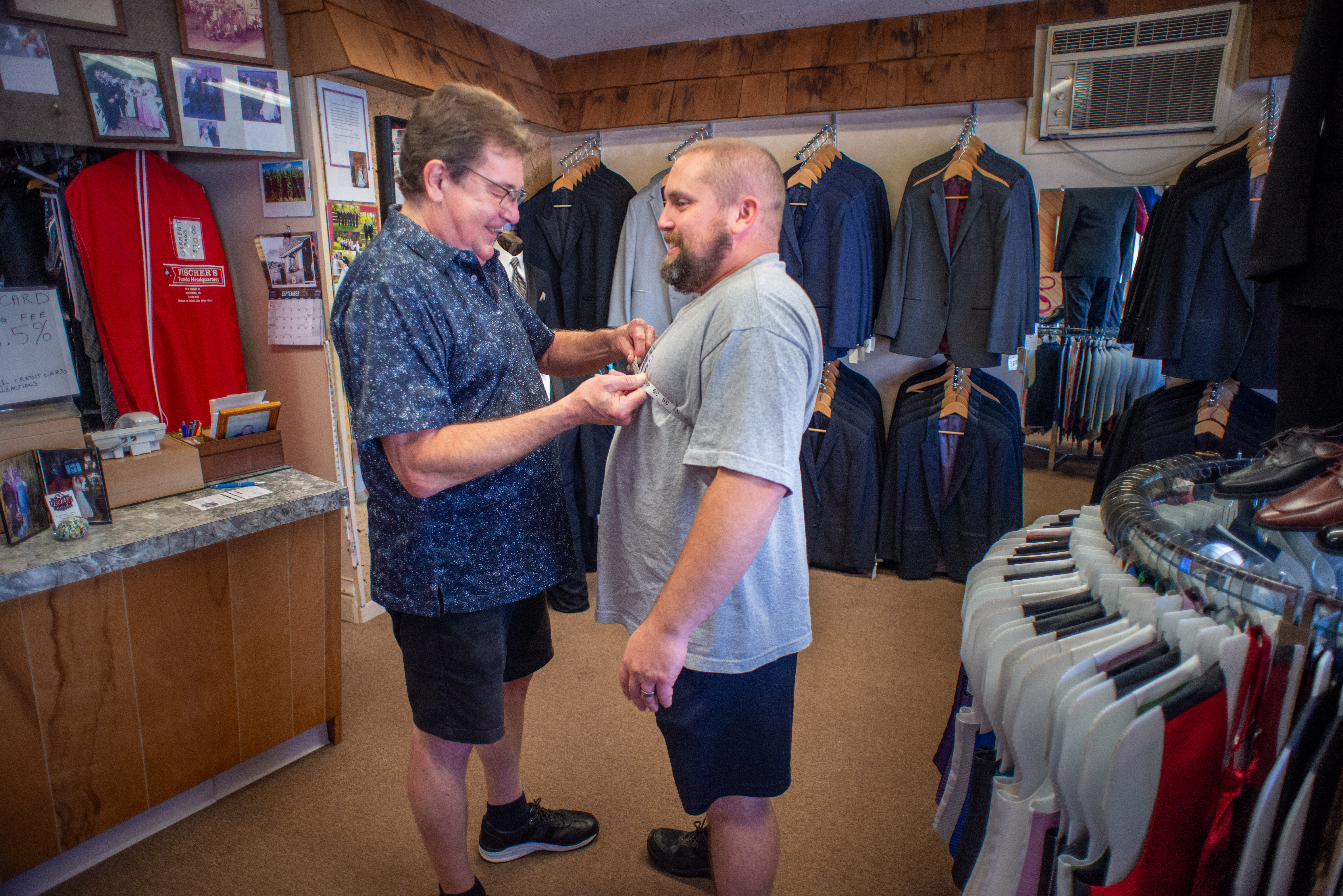
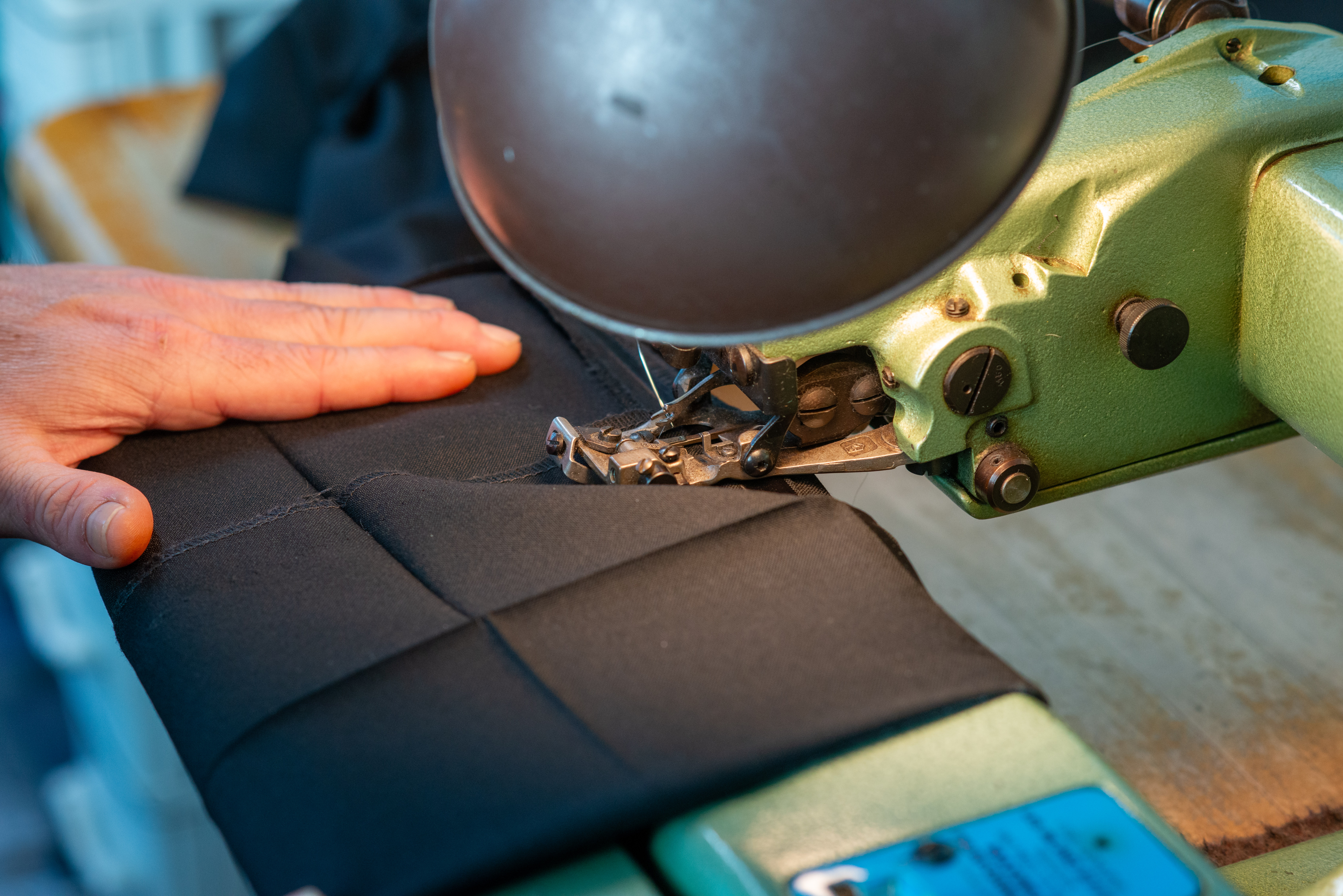
    Brett Fischer of Fischer’s Tuxedo in Quakertown learned tailoring as a kid, when his dad owned the store. Now, Brett runs the tailor and dry cleaning business with son Dustin, who learned from Brett.

    Dustin started out “shining shoes in the back, and then you know, little by little … sew a button on, shorten sleeves, just easy things,” Brett said.

    Dustin is the fifth generation to run Fischer’s, started over a century ago by his German-Romanian great-great-grandfather in the same Broad Street location the family operates today.

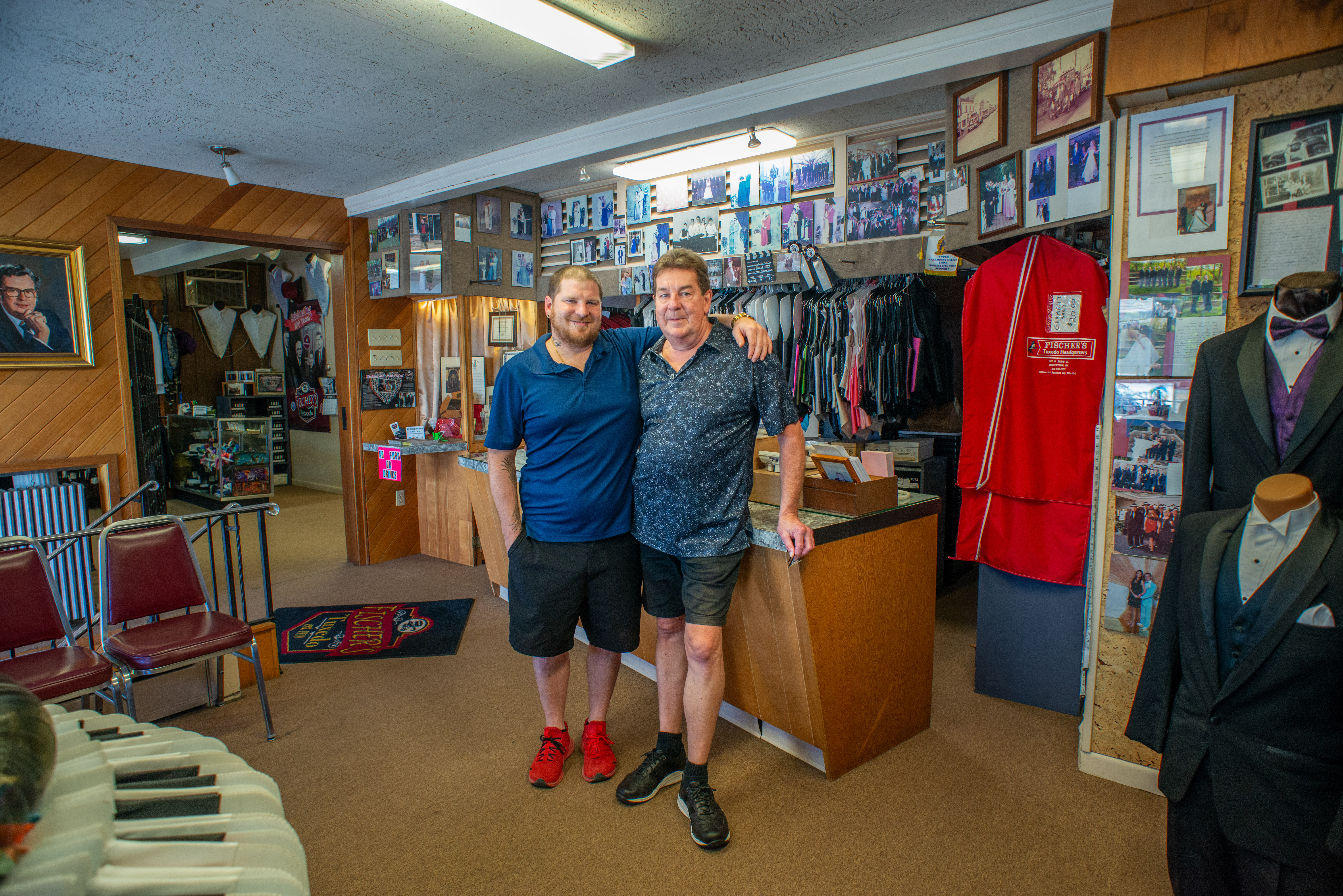
    Owner Brett Fischer (right) and son Dustin Fischer pose for a photo in their store Saturday, Sept. 19, 2026, at Fischer’s Tuxedo in Quakertown. Tailors are disappearing, but this Upper Bucks shop is set to pass to a fifth generation.William Thomas Cain / For The Inquirer

    That’s “extraordinarily uncommon,” said Cindi Husbands, CEO of the American Tailors and Sewing Association.

    Across the country, tailors are disappearing as business owners reach retirement without anyone to replace them.

    Fischer’s offerings have changed over time. Services once included seasonal clothing storage because many home closets were too small to hold them, Brett said. His grandfather used to send clothes on the train to Philadelphia for dry cleaning, before he brought that service in-house.

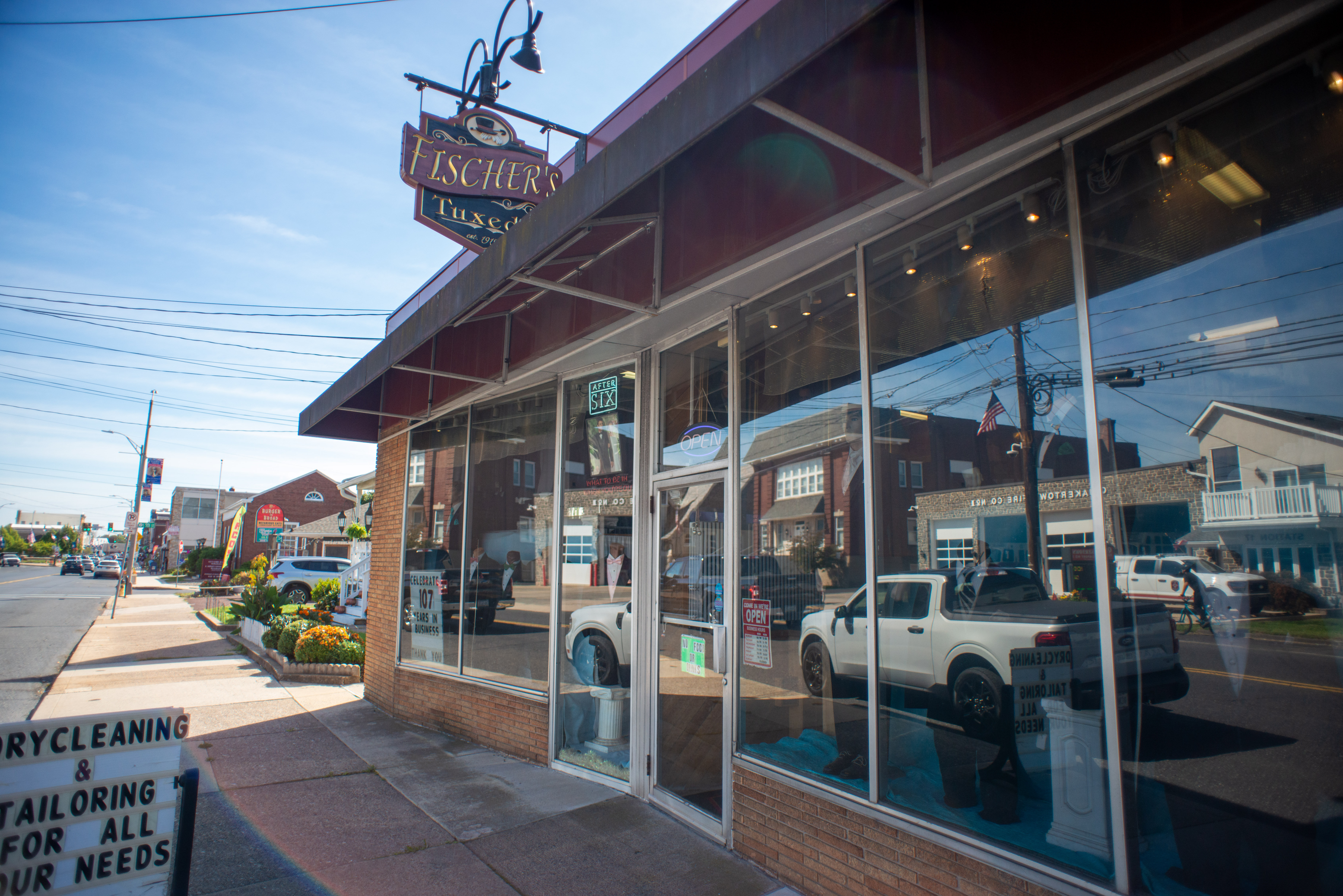
    Fischer’s Tuxedo is seen Saturday, Sept. 19, 2026, in Quakertown, Tailors are disappearing, but this Upper Bucks shop is set to pass to a fifth generation.William Thomas Cain / For The Inquirer

    The store grew with it.

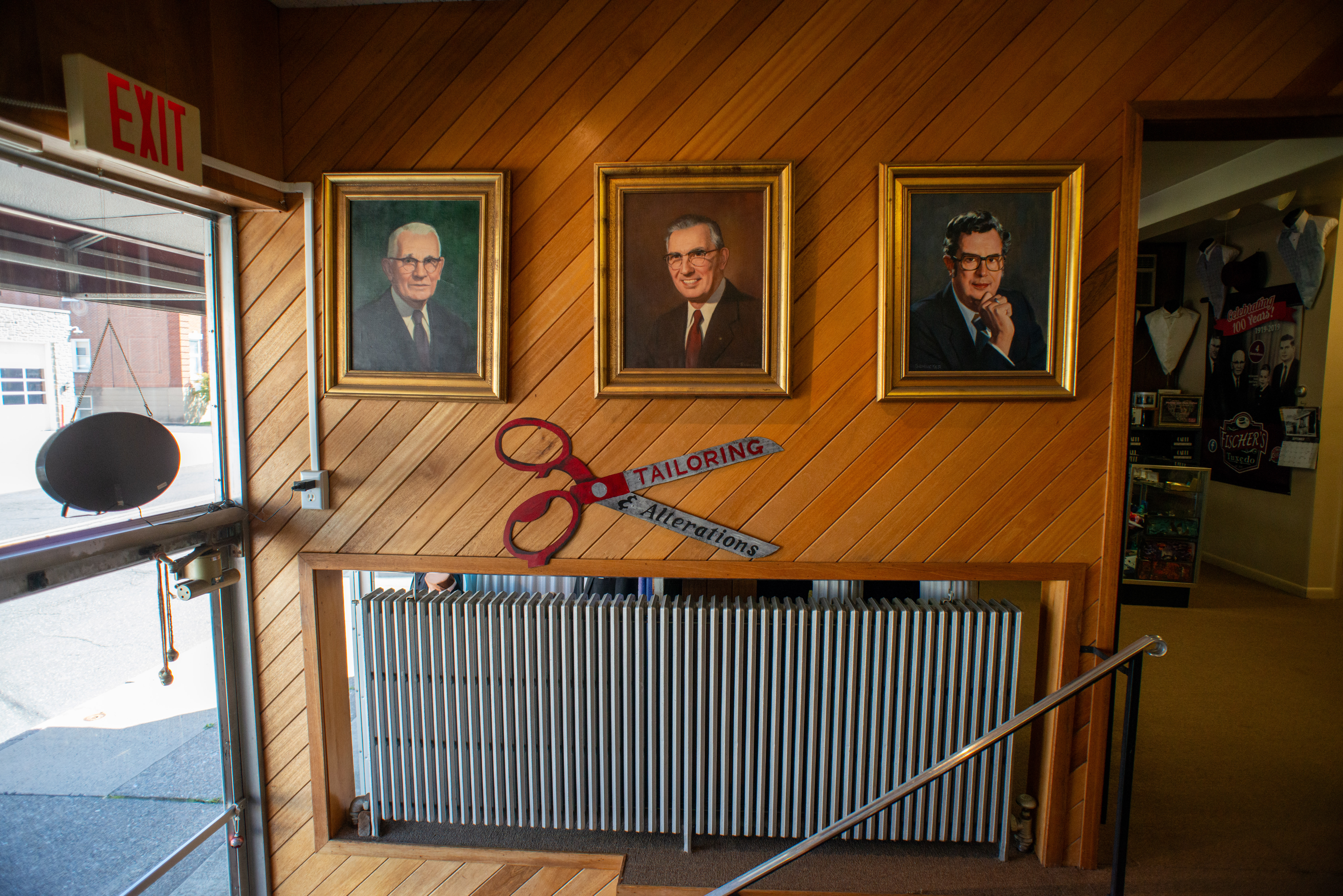
    Originally built as a twin home, the front porch is now an indoor reception area. The upstairs apartments became storage. On the wall by the entrance hang painted portraits of Brett’s father, grandfather, and great-grandfather.

    The generational wall of portraits is seen Saturday, Sept. 19, 2026, at Fischer’s Tuxedo in Quakertown, Pa. Tailors are disappearing, but this Upper Bucks shop is set to pass to a fifth generation.William Thomas Cain / For The Inquirer

    Today, weddings and other formal events are the heart of the business. There are 10,000 suits stored in the 5,900-square-foot shop, Dustin said. But, weddings are smaller than they used to be, he said, and people buy less formal clothing in general.

    “It’s a very dressed-down society. … They just wear what we’re wearing,” Dustin added, pointing to his blue polo shirt. “You can wash it in your laundry machine.”

    In towns without tailors, other businesses like bridal shops have absorbed some of the demand, Husbands from the trade association said, but it’s difficult to replace the skills and experience of a professional, full-service tailor.

    Her organization, along with major retailers like Nordstorm, are investing in tailor training programs to rebuild the workforce.

    Dustin Fischer hems pants Saturday, Sept. 19, 2026, at Fischer’s Tuxedo in Quakertown. Tailors are disappearing, but this Upper Bucks shop is set to pass to a fifth generation.William Thomas Cain / For The Inquirer

    With fewer tailors, Dustin expects to see higher costs and lengthier pants.

    “They’re going to charge you an arm and a leg for a simple job,” he said. “Or you just won’t get it done. You’re going to wear your pants, and they’re going to be nice and long.”

    Brett attributes his family’s long success to word of mouth, good customer service, and providing “a great product at an extremely fair price.”

    Dustin Fischer sews, irons, and presses clothing Saturday, Sept. 19, 2026, at Fischer’s Tuxedo in Quakertown. Tailors are disappearing, but this Upper Bucks shop is set to pass to a fifth generation. William Thomas Cain / For The Inquirer

    Father and son both worked other jobs before joining the family business full time. Brett made office furniture, and Dustin worked in restaurants, a car wash, and a chocolate factory.

    After 34 years at the helm, Brett is not sure when he’ll retire: “I’m probably gonna wake up one day and say ‘I’m just done.’”

    And Dustin doesn’t know yet whether he’ll keep the store running himself, though he expects someone in the family will.

    “But you never know,” he added. “Life’s weird.”

    This suburban content is produced with support from the Leslie Miller and Richard Worley Foundation and The Lenfest Institute for Journalism. Editorial content is created independently of the project donors. Gifts to support The Inquirer’s high-impact journalism can be made at inquirer.com/donate. A list of Lenfest Institute donors can be found at lenfestinstitute.org/supporters.

  • Lower Merion’s gas-powered leaf blower ban has led to 437 complaints and put ‘tremendous stress’ on staff, officials say

    Lower Merion’s gas-powered leaf blower ban has led to 437 complaints and put ‘tremendous stress’ on staff, officials say

    A gas-powered leaf blower ban in Lower Merion has put “tremendous stress” on township staff, as hundreds of complaints have piled up since its implementation this summer, officials said at a Sept. 9 meeting.

    Officials from Lower Merion’s department of building and planning told commissioners at a recent budget meeting that enforcement of the ban has strained resources as staff are pulled away from other work to address a growing collection of complaints. The department is asking to promote one part-time staff member to full-time and hire a seasonal code compliance officer to meet the increased demand.

    “There’s a significant amount of administrative time required to enforce the ordinance, and it’s just beyond our existing capabilities to do this,” Chris Leswing, Lower Merion’s director of building and planning, told commissioners.

    Leswing said investigating potential violations has pushed back other projects, requiring the department to pay increased overtime so staff can address their day-to-day responsibilities.

    Lower Merion received 437 complaints of leaf blower violations and issued 49 fines from June 1 to Sept. 9, according to Ernest Pendleton, assistant director of building and planning.

    In that same time frame, the department received 80 reports of all other standard property maintenance violations, including trash, debris, noise, lighting, high weeds, and grass issues.

    The proposed upgrade of the administrative clerk to full-time next year would add $48,000 to next year’s budget, and hiring a seasonal code compliance officer for 22 weeks of the year would add $35,000.

    Lower Merion commissioners passed the ban on gas-powered leaf blowers last fall, a move proponents said would help safeguard the environment and protect residents against harmful air and noise pollution.

    The ordinance phased out gas-powered leaf blowers on a seasonal basis, starting with a ban from June 1 to Oct. 1 this year, with an eventual all-out ban beginning in 2029.

    Enforcement is complaint-based. Residents are encouraged to report violations via Lower Merion’s LM Report-It app, email, or phone. Violators first receive a warning, then a $100 fine for a first offense, $250 for a second offense, and $600 for a third or subsequent offense.

    Enforcing the leaf blower ban presents a specific set of issues for staff, Pendleton said. Only around one-third of leaf blower complaints include enough evidence to be verified, meaning for the majority of infractions, a township staff member must conduct an independent investigation before deciding whether to fine a property owner. Investigations often include reviewing photos and videos and driving to the site of the violation. Complaints are doubly difficult to investigate as the department’s inspectors are often “scheduled out,” meaning no one is available to look into tips as they are being called in, according to Pendleton.

    “We don’t have any inspector sitting inside our building to run out to a site,” Pendleton said.

    Commissioners at the meeting said residents have reported feeling uncomfortable with the complaint-based system.

    “They’re feeling as though they’re being asked to report on one another in the absence of another type of system,” said Commissioner Chris McGuire, who said she is getting reports that “neighbors are quibbling because one has reported the other.”

    Pendleton said hiring a seasonal code compliance officer would help alleviate the fact that “neighbors aren’t liking to have to tell on neighbors,” though he noted that all of Lower Merion’s standard property maintenance complaints, with the exception of building codes, come in through resident reporting.

    “We don’t send anyone out to look for problems,” Pendleton said.

    Both commissioners and staff said they expect leaf blower complaints to drop in the coming years as residents and landscapers continue to transition to electric equipment. Pendleton said adding a seasonal officer would allow the township to have flexibility to shed the position should complaints drop off.

    Some commissioners seemed poised to fulfill the building and planning department’s staffing requests, but no formal votes were taken at the meeting.

    This suburban content is produced with support from the Leslie Miller and Richard Worley Foundation and The Lenfest Institute for Journalism. Editorial content is created independently of the project donors. Gifts to support The Inquirer’s high-impact journalism can be made at inquirer.com/donate. A list of Lenfest Institute donors can be found at lenfestinstitute.org/supporters.

  • 📚 Philly’s bookstore boom | Morning Newsletter

    📚 Philly’s bookstore boom | Morning Newsletter

    Good morning, Philly. While the Eagles face the Titans and triple-digit heat in Nashville today, we’ve got showers with highs in the upper 70s.

    Our main Sunday read highlights a surge in bookshops across the Philadelphia region.

    Further on, learn about an expanding network of curbside composting.

    — Paola Pérez (morningnewsletter@inquirer.com)

    If someone forwarded you this email, sign up for free here.

    Bookstores are so back

    New bookstores are popping off from Fishtown to Manayunk and West Chester.

    Books are flying off the shelves, even with the growing competition. The phenomenon mirrors a national trend of physical book sales outpacing online retail in the past five years. Libraries are seeing a resurgence in patronage, too.

    Sellers told The Inquirer’s Jess Rohan that a hunger for community, a desire to support local businesses, and screen fatigue are fueling the boom. Books also offer an escape.

    In their own words: “There is a bit of backlash to the doomscrolling,” Abington’s library director told Rohan. “People just want to tuck themselves into a different world,” said a Bordentown shop owner.

    Hear from readers and bookstore owners alike on the return to print, and see a map of bookstore openings in the region since 2025.

    📖 Plus: We asked local booksellers what they’re reading and enjoying. Here are their favorites.

    ‘A full-circle food system’

    For many enthusiasts, what began as a backyard experiment to collect compostable material later grew into a way of life to reduce waste and improve food system circularity.

    Curbside compost is trending in the Philly suburbs, as a growing system of providers and composters work together towards what one compost aficionado calls “a better, more sustainable future of a full-circle food system.”

    ♻️ Composting is a process that recycles and breaks down food and other organic matter into soil-like material. The brown stuff is then used in farms and gardens to fertilize soil for new crops.

    🍎 In Delco, many residents’ scraps are ending up mixed into a five-acre site at Linvilla Orchards.

    🗑️ As more municipalities adopt composting programs, purveyors say the practice is becoming a key part of the region’s waste management strategy.

    Inquirer Local reporter Denali Sagner has the story.

    What you should know today

    • A group of clergy, political leaders, and activists gathered at the Philadelphia ICE office on Friday in the wake of a deportation officer’s suicide, condemning what they said was the agency’s destruction of lives both inside and outside its ranks.
    • A police officer at Temple University is under internal investigation for allegedly making racist comments to young Black males riding dirt bikes on campus.
    • Protesters gathered near Lincoln Financial Field ahead of Ed Sheeran’s concert on Saturday evening. It was his first show since Macklemore was dropped as an opener following the rapper’s pro-Palestinian remarks onstage.
    • As measles cases spread in Pennsylvania, some Philadelphia-area parents are opting to vaccinate kids early, delay daycare, and avoid Lancaster County.
    • A developer has sued the Upper Merion Township Board of Supervisors over its rejection of a proposed 4.6 million-square-foot data center campus.
    • The Trump administration’s plan to overhaul SNAP would force Pennsylvania to pay more for the federal food program and jeopardize those in need, Gov. Josh Shapiro’s office says. That’s a price the state is not ready to pay.
    • Former Philadelphia labor leader and longtime Democratic power broker John “Johnny Doc” Dougherty has reportedly changed his party registration to Republican. President Donald Trump commuted his prison sentence for a corruption conviction earlier this month.
    • A mixed-income apartment project in Center City received its final approval after almost 11 years of delays. Construction will begin in a matter of weeks.

    This week in history

    🎤 Here’s Tommy Rowan with a look back at Atlantic City crowning the first deaf Miss America.

    Heather Whitestone was not the first deaf contestant, but she remains the only deaf woman to have won.

    At 18 months old, she contracted a serious bacterial infection that damaged the nerves in her ears and led to a total loss of hearing.

    A reporter would later ask Whitestone about the potential challenges she faced fulfilling such a public-facing role.

    “I think I’m doing just fine,” she said with a wry smile. “I mean, look at us now.”

    Read on for the full story.

    ❓Pop quiz

    Despite rumors, Uncle Bobbie’s Coffee and Books in Germantown clarified that it has no issues with this NFL player:

    A) Micah Parsons

    B) Colin Kaepernick

    C) Jalen Hurts

    D) Josh Allen

    Think you know? Check your answer.

    What we’re …

    🍕 Craving: Wood-fired Neapolitan pie from one of the Philly suburbs’ best shops.

    🐦‍⬛ Wondering: When the Edgar Allan Poe National Historic Site, now shuttered for two years, is expected to reopen.

    🧠 Unlocking: The relationships between words to solve this week’s Pillars.

    🧵 Admiring: A Bayeux Tapestry that has returned to public view for the first time in decades, among the best art we saw this week.

    🏖️ Reviewing: The Inquirer’s Amy S. Rosenberg made 10 predictions on how the Shore summer would go. Here’s how she did.

    🧩 Unscramble the anagram

    Hint: Philly bandleader of Japanese Breakfast a.k.a….

    CELLE HUMANIZER

    Email us if you know the answer. We’ll select a reader at random to shout out here.

    Cheers to Beth Dombkowski who correctly guessed Saturday’s answer: La Colombe. The Philly-founded coffee company is launching a canned matcha latte as the drink’s popularity grows.

    Photo of the day

    Members of the Philadelphia Ballet perform after the ribbon cutting ceremony at its new N. Broad Street building, in Philadelphia.Jessica Griffin / Staff Photographer

    Years in the making, Philadelphia Ballet officially opened its sparkling new headquarters Friday morning. Culture writer Peter Dobrin reports.

    🎶 Today’s song goes like this: “Is it for peace and plenty, or is it for the sacred face? / It’s all for the love of you.”

    👋🏽 Thanks for starting your day here. Have a great one, and go Birds.

    By submitting your written, visual, and/or audio contributions, you agree to The Inquirer’s Terms of Use, including the grant of rights in Section 10.

  • Curbside compost is trending in the Philly suburbs. In Delco, many residents’ scraps are ending up at Linvilla.

    Curbside compost is trending in the Philly suburbs. In Delco, many residents’ scraps are ending up at Linvilla.

    Fifteen years ago, Chris Pieretti was just trying to get people to come around on compost.

    Now, the Upper Darby resident and compost aficionado spends his days traversing the region in his truck, collecting a potpourri of food scraps in green buckets, and turning eggshells, banana peels, and coffee grounds into a nutrient-rich, soil-like product.

    Pieretti is behind Kitchen Harvest, which collects compostable materials and processes them on a five-acre site at Linvilla Orchards in Delaware County. Kitchen Harvest is, in Pieretti’s words, part of “a better, more sustainable future of a full-circle food system.”

    It is part of a growing network of providers and composters across the Philadelphia region who are working to reduce waste and improve food system circularity, where scraps of food once grown in the Earth can return to it, fertilizing soil for new crops.

    With Haverford Township debuting its municipal compost program this summer, joining Media and Swarthmore, among other municipalities, compost purveyors say the practice is breaking out of its crunchy origins and becoming a key part of the region’s waste management strategy.

    Chris Pieretti holds a compost bag at Kitchen Harvest in Delaware County. Pieretti is working with local homes and municipalities to compost food scraps and yard waste. Jose F. Moreno / Staff Photographer

    What is composting?

    Composting is the process of recycling organic materials like food scraps and yard waste, breaking them down into a brown, soil-like material called compost, and using that material in farms and gardens to enrich other plants and crops.

    The composting process happens on micro and macro scales — in small home gardens and at multi-acre sites like Kitchen Harvest’s.

    Compost advocates tout both its environmental and agricultural benefits. In the U.S., food is the single most common material sent to landfills, where it is responsible for 58% of methane emissions, a powerful greenhouse gas, according to the Environmental Protection Agency. Adding compost to soil increases its nutrient content, conserves water by helping retain moisture, and reduces reliance on chemical fertilizers, the EPA says.

    “Food is only wasted when we throw it in the trash. It’s our choice to dispose of it in that method, but we don’t have to,” said Gwenn Nolan, founder of Mother Compost, a company that collects compost material throughout the Philly suburbs and brings it to the Kitchen Harvest site at Linvilla.

    Going from ‘crunchy’ to ‘waste management strategy’

    Many compost enthusiasts have a similar story: What started as a backyard experiment grew, through trial and error, into a way of life and, for some, a career.

    Nolan, of Mother Compost, got her start asking 10 friends on the Main Line to try composting so she could test demand for a compost collection service. She bought a small truck, picking up the bins of food scraps early in the morning before heading to her job in financial services. After the pandemic, residential demand ballooned, and Nolan made Mother Compost her full-time job. Now, the company serves around 1,500 homes; schools including Bryn Mawr College and Villanova University; culinary institutions including Reading Terminal Market; and corporate offices.

    Nolan collects compost in her truck and carts it out to Pieretti, whom she calls “the master mixologist,” for processing.

    “It’s really exciting to see the commercial side and the institutional side coming online as well,” Nolan said. “It’s becoming more a piece of the waste management strategy than just this kind of crunchy, environmental practice that I think people thought about it before.”

    Kate Jacoby, who runs Center City vegan restaurant Vedge with her husband, Rich Landau, is one of Nolan’s loyal customers. Jacoby began composting in her small Philadelphia backyard during the pandemic, expanding her home compost operation when the couple moved to Chester County in 2021 and, eventually, bringing composting to the Vedge kitchen.

    “I get such a satisfaction knowing that it’s going to go into the soil and it’s not going to sit in a landfill,” Jacoby said.

    Foods scraps like banana peels, onion skins, and lemons are turned into compost. JESSICA GRIFFIN / Staff Photographer

    An expanding suburban compost network

    As compost accessibility grows, so, too, does the number of municipal governments offering compost services to residents.

    Media became the first municipality to sign on with Kitchen Harvest in 2021, embracing a borough-wide compost program with a catchy “Gotta Getta Bucket” promotional video.

    “The community at-large really supported the idea, and the participation was really high,” Pieretti said of Media.

    Many suburban programs have followed in the footsteps of Bennett Compost, which has been serving the city of Philadelphia since 2009.

    Lower Merion in 2025 debuted both a community drop-off and a curbside pickup pilot program through Mother Compost and Bennett Compost. Swarthmore Borough launched a curbside compost program through EZComposting in January.

    When Haverford Township launched its Kitchen Harvest partnership this summer, Pieretti felt like he had “won the compost championship.”

    In July, Haverford Township collected 162 tons of organic material, an increase of 111 tons from last July, according to township manager Dave Burman, who called the program “pretty successful.” The township also collected 141 fewer tons of trash this July than the year prior.

    Haverford Township’s program is optional, with no additional cost or registration process for residents.

    “We’ve tried to make it as easy as we could for people to participate, and so far, so good,” Burman said.

    Buckets of finished compost at the Kitchen Harvest site at Linvilla Orchards. Jose F. Moreno / Staff Photographer

    At its best, proponents say, compost creates a circular system. Much of Kitchen Harvest’s compost product is used by Linvilla Orchards to feed the crops, and composters can buy back bags of the finished product at a discounted rate.

    Sarah Linvill, team member at Linvilla, said the farm is grateful to work with Kitchen Harvest and to “be hosts for that kind of work.”

    Composting services are “just invaluable to the community,” Linvill said.

    Nolan called Linvilla “a tremendous resource for the region” when it comes to compost.

    Composters like Jacoby, of Vedge, say they now cannot imagine a world where they simply toss an apple core into the trash.

    “If you really, really dig down and want to get kind of philosophical about it,” Jacoby said, “when your soil is healthy and it’s full of nutrients, you’re going to have better-tasting food for yourself to consume.”

    This suburban content is produced with support from the Leslie Miller and Richard Worley Foundation and The Lenfest Institute for Journalism. Editorial content is created independently of the project donors. Gifts to support The Inquirer’s high-impact journalism can be made at inquirer.com/donate. A list of Lenfest Institute donors can be found at lenfestinstitute.org/supporters.

  • What caused this teenager’s weight loss, fatigue, and passing out? | Medical Mystery

    What caused this teenager’s weight loss, fatigue, and passing out? | Medical Mystery

    A previously healthy 17-year-old girl went to the emergency department after she had passed out while trying to walk up the stairs at home.

    Fortunately, she wasn’t seriously injured as her mom caught her. The girl said she had been very tired and had unintentionally lost about 20 pounds over the last few months.

    In the Emergency Department, her blood pressure was a little bit low at 100/60, with normal being closer to 120/80. On examination, she looked tired but was otherwise stable. Blood and urine samples went to the lab, and she was admitted for further workup.

    Unintentional weight loss, fatigue, and syncope (fainting) are often nonspecific symptoms that can be caused by a variety of conditions, including nervous system, blood, and hormone disorders.

    Sometimes, the nervous system does not respond appropriately when a person moves from sitting to standing. The sympathetic nervous system should ramp up and increase heart rate and blood pressure to make sure the brain gets the blood and oxygen it needs.

    This can go awry in patients who are very dehydrated or have less responsive nervous systems. In such cases, the result can be low blood pressure when standing up (called orthostatic hypotension) and passing out.

    This patient did not have any signs of dehydration, and her blood pressure stayed low whether she was sitting, prone, or standing. Sometimes drugs or medications can cause such symptoms, but her urine drug screen was negative, and she did not report taking any medications.

    Blood disorders, such as anemia or cancer, are a more concerning cause of these symptoms. Anemia is when there are not enough red blood cells or hemoglobin to carry oxygen throughout the body, which can cause shortness of breath and fatigue.

    Cancers can cause an increase in metabolism, also resulting in weight loss and fatigue. Thankfully, her exam and blood tests ruled these diagnoses out.

    Another potential culprit might have been type 1 diabetes, in which the immune system mistakenly targets and destroys the pancreas, causing low insulin production. This can lead to high blood sugar, weight loss, and fatigue. However, this patient’s blood sugar level was slightly low in the Emergency Department, rather than elevated.

    High thyroid hormones can cause high heart rate, weight loss, and anxiety; while low thyroid hormones can cause fatigue, weight gain, and depression. The patient’s thyroid levels were normal on her blood tests, so this ruled out thyroid disease as a cause.

    One more possibility could have been her adrenal glands, which release several hormones that regulate metabolism, as well as blood pressure and “fight or flight” responses.

    Decreased adrenal hormones, particularly cortisol, can cause decreased appetite and weight loss, low blood pressure, and low blood sugar — all symptoms that she had. A test of her morning cortisol showed a very low level, and a follow-up test showed that her adrenal glands were not producing any cortisol in response to triggers.

    This finding suggested that adrenal insufficiency was the cause of her symptoms, though the root cause was still unclear.

    The solution

    There are many possible causes of adrenal insufficiency. Some children are born with dysfunctional adrenal glands due to genetic conditions. Injuries during birth, infections, or medications can cause decreased blood flow or direct damage to the adrenal glands and subsequently decreased function.

    Autoimmune disorders, where the immune system accidentally attacks its own organs instead of infections, can cause adrenal damage. More rarely, brain injuries or tumors can cause decreased adrenal hormone production through various mechanisms.

    One final laboratory test found that this patient had antibodies in her blood which were attacking her adrenal glands. This confirmed the diagnosis of adrenal insufficiency, which in this case is called Addison’s disease.

    By the time of this diagnosis, she was feeling better and went home with medications to replace the missing hormones. She will likely be on replacement adrenal hormones for the rest of her life to manage symptoms.

    Our advice

    Vague symptoms can be common in many different conditions, some more serious than others. Children and adolescents with unintentional weight loss and prolonged unexplained symptoms such as fatigue should see their doctor to be screened for potentially dangerous causes. This may include blood work, imaging, or other tests to help determine the underlying diagnosis.

    Rebecca Mirochnik is a third-year pediatric resident and Hayley Goldner is a pediatrician in the adolescent medicine department at Nemours Children’s Hospital, Delaware.