Category: Wires

  • Trump approval hits new low two weeks before midterms, poll finds

    Trump approval hits new low two weeks before midterms, poll finds

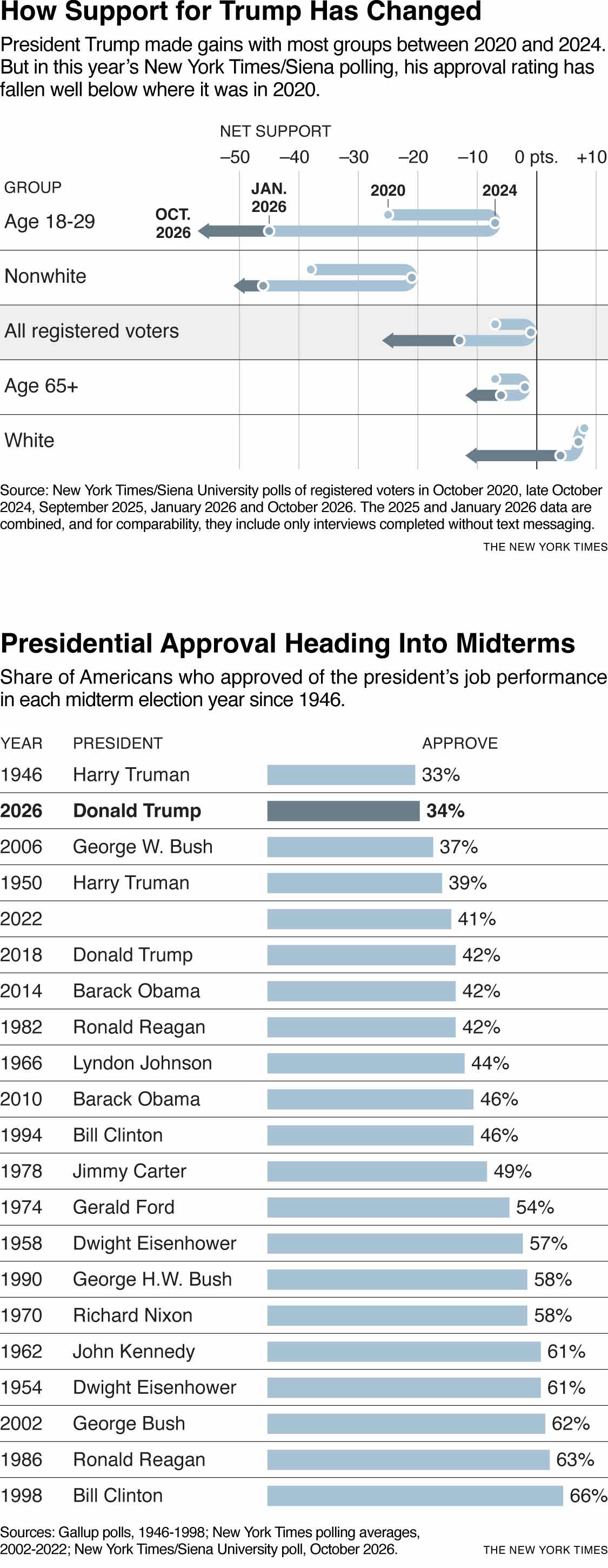
    President Donald Trump’s approval rating hit a new low just a few weeks before the midterm elections, driven down by broad disapproval of his handling of the economy, the war in Iran and high gas prices, according to a new national poll from The New York Times and Siena University.

    Just 36% of likely voters said they approved of Trump’s performance, while 59% said they disapproved. That is his lowest approval rating recorded in any Times/Siena poll. More than two-thirds of independent voters said they disapproved of the way he has handled his job as president.

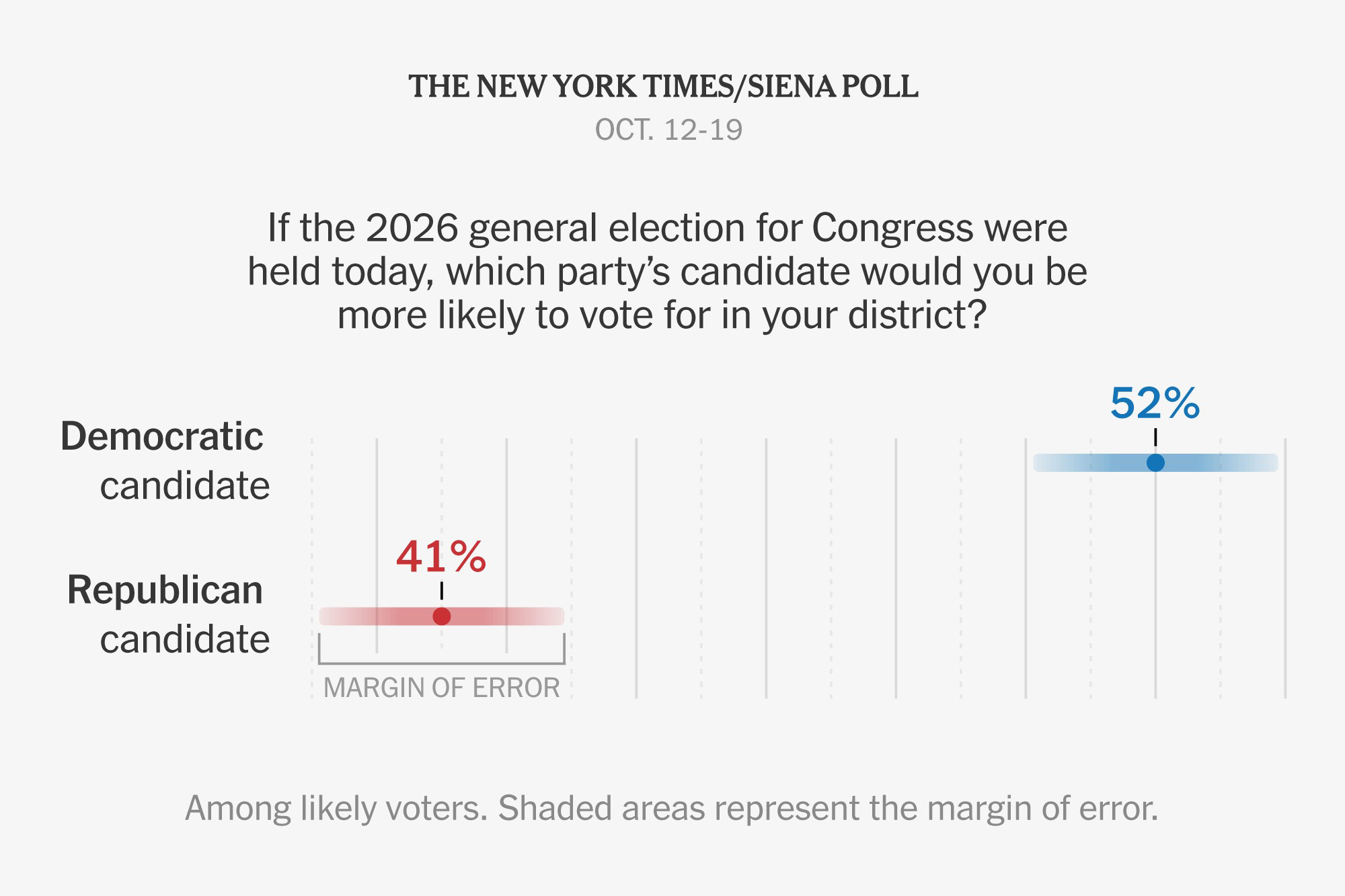
    Likely voters said they preferred Democratic candidates over Republicans by 11 percentage points in their congressional districts in the final Times/Siena national poll before the midterm elections, a slight improvement for Democrats since last month. The metric is widely seen as a strong indicator of political momentum.

    The national political environment is bleak for Republicans. Americans broadly disapprove of economic conditions under the Trump administration, with three-quarters rating the economy as fair or poor. A majority of voters blame Trump for the decline: 69% disapprove of his handling of the cost of living, 65% disapprove of his handling of the war in Iran and nearly three-quarters disapprove of his handling of gas prices, which are above $4 a gallon.

    But Democrats still face serious challenges, particularly as they seek to win control of the Senate. To do so they are trying to flip seats in Republican-leaning states including Texas, Iowa, Alaska, and Ohio, which Trump won by double digits in 2024. Other polls show that Democrats and Republicans are locked in tight races in several key Senate contests.

    Still, the deep economic frustration has even broken into the coalition that elected Trump to his second term. Over the past year, Democrats have improved their standing among men, young voters and Hispanic voters — winning back some voters in those groups who helped propel Trump to victory two years ago.

    Paul Gettings, a Republican who lost his job running a logistics company in June, said he supported Trump in 2024 but plans to back Democrats this year. He cited frustration with high gas prices, the war in Iran, and what he sees as harsh immigration enforcement in Simi Valley, Calif., where he lives.

    “I’m very disillusioned with the Republican Party and how they can continue to support Trump,” said Gettings, 62, who is unemployed. “He’s turned into a politician just like the rest of them and it’s a lot of empty promises.”

    Among all registered voters, including those who are less likely to vote, Trump’s approval rating was even worse, with 34% approving of his job performance. Trump built his 2016 and 2024 wins partly on the strength of his support among white voters without a college degree, but the poll found that group is about evenly split in its approval of his job, with 48% approving and 46% disapproving.

    As views of Republicans have declined, public perceptions of Democrats have grown increasingly positive over the last two years on an array of measures.

    A majority of likely voters now see the Democratic Party as the party of the working class — a shift from 2022, when voters gave the Republican Party the edge. Voters also see Democrats as more likely to keep their promises than Republicans, a striking reversal from two years ago, when Republicans held an advantage on that question.

    And majorities across nearly every demographic group now view Democrats as more understanding and able to fix the problems of average Americans.

    “The Republican Party is, if anything, causing more problems for people like me: being Latino, feeling the weight of that kind of prejudice that I think the Republican Party tends to kind of portray,” said Vince Cordero, 25, an independent in Oak Lawn, Ill., who said he plans on voting for Democrats this year. “I also think the Democratic Party deserves an opportunity to see if they’re really up to snuff.”

    By a 15-point margin, more voters trust the Democratic Party over the Republican Party to tackle the cost of living, the single most important issue to voters. The party holds an 8-point advantage on the economy, an area that has historically been a strength for Trump. Democrats have also grown their lead since September on who voters trust to handle foreign wars and artificial intelligence.

    But even amid his declining numbers, Trump has held on to strong support from his base. The vast majority of Republicans, 82%, still approve of his job performance and his signature policies, including the Iran war and tariffs.

    “People are upset, ‘Oh, Trump put these tariffs on people and now our food costs go up,’” said Sheila Murdock, a retired nurse from Shelley, Idaho, who has already voted absentee for Republicans this year. “Well, yes, but if you look at the bigger picture and what it eventually does, it makes things better.”

    The poll also found immigration reemerging as a defining concern for voters. Ten percent of voters now say it is their top issue this fall, up from 6% in September. Among Republicans, almost 20% now say it is their top priority — nearly double the percentage who said the same last month.

    While Democrats still hold an edge over Republicans in who voters trust to handle immigration — which had long been a Republican strength — that advantage has shrunk since September. Now, 46% of voters say they trust Republicans on immigration, 50% say the same of Democrats.

    Still, the survey indicates that even as Democratic candidates gain support, there is lingering discontent with their party. Just 28% of voters said they are satisfied with the Democratic Party, 8 points lower than the share who express satisfaction with the Republican Party.

    Much of the unhappiness stems from Democratic voters themselves. Forty-three percent of Democrats said they are unsatisfied with their party, compared with just 16% of Republicans who said the same about the GOP.

  • Supreme Court rebuffs Trump administration restrictions on medical care for transgender inmates

    Supreme Court rebuffs Trump administration restrictions on medical care for transgender inmates

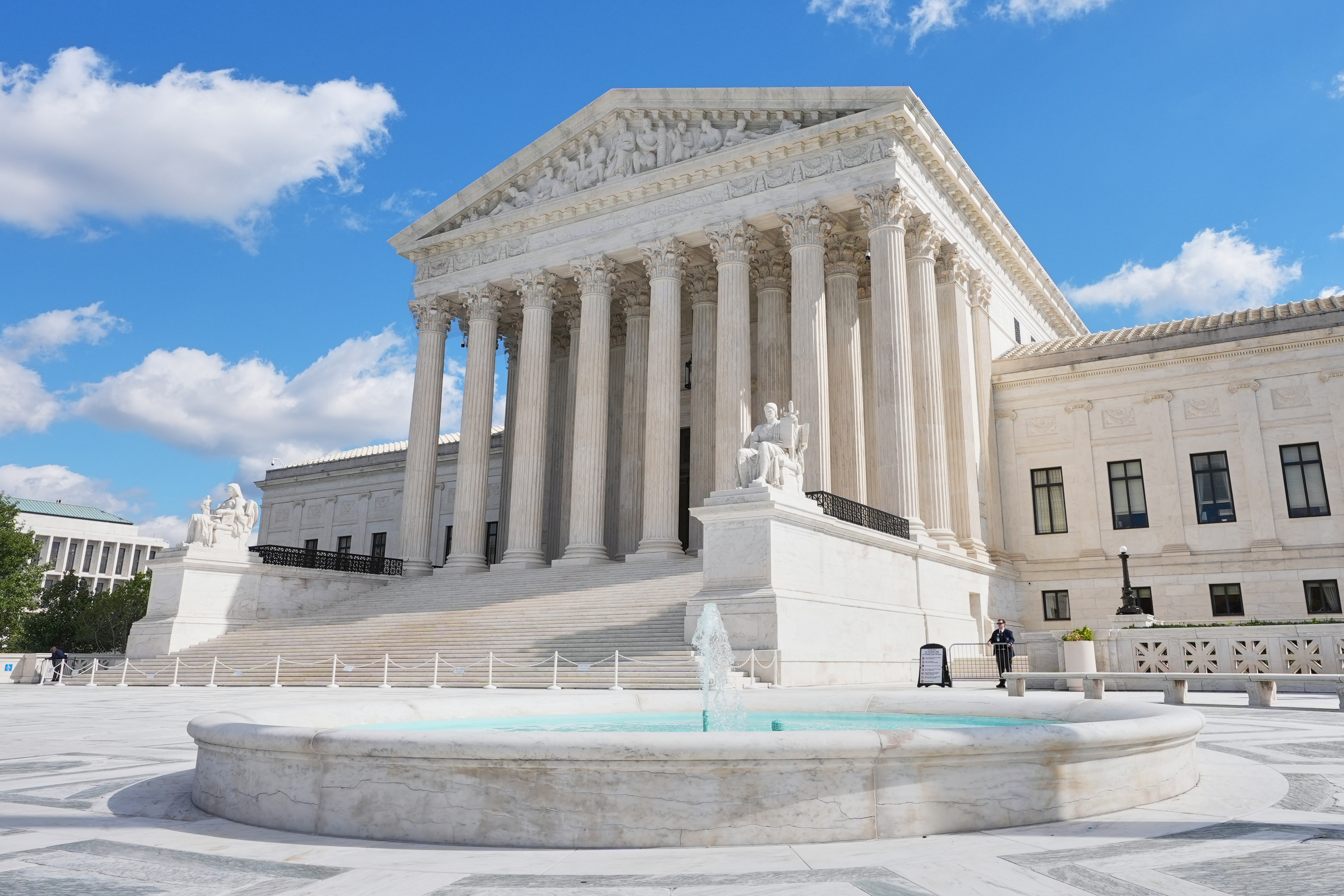
    WASHINGTON — The Supreme Court on Wednesday refused to allow the Trump administration to immediately enforce new medical restrictions for transgender people in prison.

    The decision leaves in place a lower-court block on the policy. It was adopted after an executive order from President Donald Trump, a Republican who has taken several steps to roll back transgender rights during his second term.

    The brief order did not detail its legal reasoning. Justice Samuel Alito and Clarence Thomas would have allowed the policy to be enforced as the lawsuit played out in lower courts.

    The Supreme Court has previously allowed other policies for transgender people to move ahead for now, including restrictions on military service and passport sex markers.

    Trump’s order called on the Bureau of Prisons to revise its medical care policies so that federal funds aren’t spent “for the purpose of conforming an inmate’s appearance to that of the opposite sex.”

    The new policy would halt surgeries, taper off hormones, and end social accommodations like makeup and wigs. Prisons would continue to offer mental health services.

    Attorneys for transgender inmates challenged the policy in court and U.S. District Judge Royce Lamberth ordered treatments to continue. Lamberth, who was nominated to the bench by Republican President Ronald Reagan, pointed out that untreated gender dysphoria can cause severe side effects like depression, anxiety, and suicidal thoughts.

    The Trump administration appealed, arguing that treatments raised security concerns and “could no longer be justified.” A divided appeals court panel left the order in place.

    About 600 inmates were receiving hormone therapy in 2025, the agency said in court records. Withdrawing care would have significant effects on their bodies and mental health, their lawyers said. The government has not detailed evidence of security problems linked to hormone therapy for transgender inmates over the 30 years it has been provided, they wrote.

    The conservative-majority Supreme Court has previously upheld state laws banning certain medical treatments for transgender youth, and restricting sports participation by transgender athletes in women’s sports.

  • Putin agrees to resume three-way talks on Ukraine war with Kyiv and Washington, Kremlin says

    Putin agrees to resume three-way talks on Ukraine war with Kyiv and Washington, Kremlin says

    Russian President Vladimir Putin agreed Wednesday to resume three-way negotiations next month with Washington and Kyiv aimed at ending the war in Ukraine, a Kremlin official said, potentially setting up the first such talks since February.

    The Russian leader agreed “in principle” to resume the talks after Nov. 10, Putin foreign affairs adviser Yuri Ushakov told reporters following a meeting in St. Petersburg between Putin and U.S. envoy Steve Witkoff.

    The talks will focus on “building a security system for Russia and Ukraine after the conflict ends,” Ushakov said.

    Witkoff’s talks with Putin about Moscow’s full-scale invasion of Ukraine took place as U.S. President Donald Trump pushed Kyiv to make a deal that stops the fighting.

    Ukrainian President Volodymyr Zelensky has insisted that only a summit of leaders can break the impasse. The two armies remain locked on the battlefield, and the countries pummel each other with daily long-range strikes.

    Representatives of the three countries held three rounds of negotiations early this year, meeting twice in Abu Dhabi in January and February, followed by further talks in Geneva in February.

    However, little progress was reported beyond exchanges of prisoners of war as Moscow and Kyiv stuck to their longstanding basic demands.

    Latest proposals to end the war have little of value, Kremlin says

    The discussion in St. Petersburg lasted about three hours, the Kremlin said, and came a day after Witkoff met with Zelensky and some European leaders in Norway’s capital, Oslo.

    The proposals from the Oslo meeting “contained little of real value in the context of resolving the Ukrainian crisis,” Ushakov said.

    However, he later told Russian state TV that while Moscow isn’t “fully satisfied” with the Oslo proposals, they are a step in the right direction.

    Witkoff’s meetings suggested leaders are keen to bring new momentum to U.S.-led peace efforts, more than 4½ years after the war began. Efforts by the Trump administration since early last year to end the war have made no significant progress.

    Zelensky said freezing the conflict in Ukraine was the “minimum” required from Russia to bring about an end to the war.

    “Right now, we have to freeze, and I think this is (the) real way to end this war,” Zelensky said in an interview broadcast Wednesday on Fox News.

    Witkoff sees ‘some degree of momentum’ in peace efforts

    Witkoff and Putin met at St. Petersburg’s Constantine Palace, with Ushakov and Russian presidential envoy Kirill Dmitriev also at the table. Trump’s son-in-law, Jared Kushner, joined the discussion via a video link, Ushakov said.

    Before the meeting, Witkoff said that there was “some degree of momentum” in talks.

    During the meeting, Witkoff and Kushner proposed a three-way meeting with the U.S., Russia, and Ukraine at the technical level and shared progress on their talks with Zelensky a day earlier, according to a U.S. official familiar with the talks who spoke on condition of anonymity to discuss the private meeting.

    Witkoff and Kushner also discussed a postwar economic plan, European security, and plans for the upcoming meeting, the official said.

    In televised opening remarks, Witkoff thanked Putin for agreeing to send diesel to the U.S., after Trump lifted a ban despite anger from some U.S. lawmakers, adding that the fuel would help reduce prices for American farmers and truckers.

    Putin said he was ready to consider prospects for the restoration of U.S.-Russia economic ties and that he was prepared to discuss the U.S.-led conflict with Iran. Moscow stands ready to use its relationship with Tehran to help bring peace, he said.

    Ushakov said that “large-scale joint economic projects that offer significant prospects for cooperation” between Russia and the U.S. were discussed in detail with Witkoff.

    “Some of these are, in fact, nearing the implementation stage,” he said.

    In other developments, Russia on Wednesday released a retired American teacher who had been imprisoned on charges of fighting as a mercenary in Ukraine. Witkoff said it appeared to be a goodwill gesture by the Kremlin after Trump asked Putin to free Stephen Hubbard.

    Putin also met Wednesday with Chinese Premier Li Qiang, who was in St. Petersburg for talks with other Russian officials, the Kremlin said.

    Russia has cultivated its ties with China, and the two countries last month vetoed a U.S. proposal for U.N. experts to keep monitoring sanctions on Iran.

    Putin and Witkoff also discussed a possible meeting next month between the Russian, Chinese and U.S. leaders at an economic summit in China, Ushakov said, adding that Beijing is already preparing for it.

    Norway’s prime minister sees a possible ‘new phase’ in talks

    After his trip to Russia, Witkoff returned for more consultations in Oslo, where he met with Norwegian Prime Minister Jonas Gahr Støre at the airport before flying back to the U.S. The meeting lasted just over an hour, Norwegian broadcaster NRK reported.

    “I think we may have entered a phase now where the Russians are also looking for opportunities for diplomacy,” Støre told the broadcaster. He said the new talks were likely to happen in mid-November.

    Asked whether Zelensky could accept a border running along the current front line, Støre said: “I don’t think Ukraine will ever formally accept it and say that this is the new border. But whether they can live with it is another matter.”

    Zelensky was still in Oslo on Wednesday, where he visited Norway’s parliament and met with lawmakers.

    Zelensky said the talks in Oslo and St. Petersburg included discussion of future security guarantees for Ukraine, the fate of occupied territories, postwar reconstruction and the possibility of a ceasefire.

    Trump presses Zelensky to compromise

    At the White House on Tuesday, Trump increased the pressure on Zelensky to come to an agreement with Russia as relations between the two leaders have soured again.

    “We want Zelensky to make a deal,” Trump told reporters in the Oval Office. “We’ve given a lot to Ukraine. We’ve gotten absolutely nothing back except grief, death, tremendous monetary loss.”

    If that doesn’t happen, “I think it’s going to be a very bad thing,” Trump said.

    Amid fears that Washington was turning its back on Ukraine, Zelensky said Kyiv is once again receiving early warnings from its partners about incoming Russian missiles, after recent strikes that he said occurred without enough notice from allies.

    Russian attacks kill 5 people and wound at least 23 others, Ukraine says

    Overnight Russian attacks in Kyiv left three people dead and 12 wounded, while 10 residential buildings were damaged, the city’s military administration said.

    Energy facilities were targeted in Kyiv and three other cities in Russian attacks early Wednesday, Ukrainian Prime Minister Serhii Koretskyi said. Outside the eastern city of Kharkiv, two people died and 11 others were wounded when drones exploded in a residential area, he said.

    The Russian Defense Ministry said that overnight its forces struck a warehouse, an electrical substation and a bulk carrier at sea that was headed to the Ukrainian port of Odesa.

    The Russian Defense Ministry reported Wednesday that its air defenses intercepted 373 Ukrainian drones over multiple Russian regions overnight, as well as the illegally annexed Crimean Peninsula and the Black Sea.

  • Their police jobs ended. They kept using Flock’s vast surveillance network.

    Their police jobs ended. They kept using Flock’s vast surveillance network.

    When Andrae Wright left his job as an investigator at the Effingham County Sheriff’s Office in 2021, he handed in his gun and badge. But he kept something powerful: his log-in credentials for Flock, a police tool he used to search a vast network of roadside cameras tracking the locations of passing cars.

    In the five years after leaving the force, Wright searched the system more than 60 times without being stopped by anyone at the Georgia sheriff’s office, according to a statement by the Georgia Bureau of Investigation and Flock audit logs reviewed by The Post. He repeatedly searched the location of a vanity license plate bearing the middle name of his wife, according to the audit logs. The couple divorced this year, court records show, and at the time of some of his Flock searches, Wright was fighting for permanent custody of their teenage daughter.

    In July, after a tipster alerted local authorities, police arrested Wright and charged him with stalking his wife, claiming he misused Flock data “for the purpose of harassing and intimidating her,” according to his warrant. State law restricts the use of license plate readers to legitimate law enforcement investigations.

    Wright did not respond to phone calls, text messages, or voicemails seeking comment. Brian Bailey, a sheriff’s office spokesman, said that the agency had not conducted regular audits of who had access to its Flock system during that time but that it plans to begin doing so.

    The case marked one of at least 11 times in which government officials have discovered unauthorized users have gained access to Flock databases and searched them without permission, sometimes to track the locations of romantic partners, a Washington Post investigation has found.

    The incidents expose what security experts describe as alarming vulnerabilities within Flock’s nationwide network of license-plate-reading cameras and the law enforcement agencies that use them.

    Though Flock has pitched itself as a security-first business that closely controls access to its trove of license-plate data, company leaders have resisted calls from their own staff to implement stricter guardrails, according to three former employees who spoke on the condition of anonymity to avoid professional repercussions.

    Flock managers told staff repeatedly that they didn’t want to create barriers to securing camera contracts with law enforcement agencies that were resistant to more restrictive security controls, two of the employees said.

    To provide the most detailed accounting to date of unauthorized access, including two incidents that have not been previously reported, The Post interviewed police or city officials in eight states and three former Flock employees who worked on technical issues. The Post also analyzed Flock software logs released in response to public records requests, court documents, police records, and officials’ statements.

    The 11 incidents of unauthorized access tallied by The Post reveal how easily users could gain or retain access to Flock’s data. In four of the cases, officers were able to keep using their log-ins to Flock after leaving the force or while serving a suspension, because their accounts were not shut off. In six of the cases, police shared log-ins or passwords with active law enforcement officers from other agencies, in what officials later deemed violations of state laws, department policies or Flock contracts.

    In Indianapolis, a police recruit who was not authorized to access Flock was able to use the tool for more than two years after a more senior officer opened it on the more junior officer’s laptop and didn’t log out. The junior officer, Matthew Binford, used his colleague’s credentials to search his estranged wife’s license plate more than 1,000 times over a 12-month period, according to a court affidavit. Prosecutors criminally charged Binford and four other Indianapolis officers last month, after an August inquiry from The Post prompted an agencywide audit by the city’s police department.

    Binford declined to comment when reached by phone.

    Flock Safety, an Atlanta-based company valued by investors at $7.5 billion last year, has rapidly built a nationwide surveillance network, blanketing roadsides with at least 120,000 cameras that photograph passing cars and enable police to track suspects’ vehicles over time. The network’s growth has also expanded the potential for abuse: The Post has reported that at least 100 employees of law enforcement agencies have been charged with or accused of misusing license-plate readers for unauthorized purposes.

    Flock has been slow to adopt basic safeguards that are standard practice among commercial and government software vendors – measures that could have prevented many of the intrusions, according to security experts interviewed by The Post.

    Many police departments don’t require employees to register Flock accounts to a government-issued email address, which could be deactivated at the end of their employment, interviews and officials’ statements show. Though Flock contractually requires the use of official emails, the company acknowledges it hasn’t widely enforced that policy until recently.

    While movie-streaming companies like Netflix have built tools to crack down on password sharing, Flock does not appear to closely monitor for log-ins occurring from unusual locations and devices, said Jon Gaines, an independent security researcher.

    Security experts also said Flock could have prevented Binford, the Indianapolis officer, from using his co-worker’s credentials if it had taken the simple step of periodically asking users to reenter their password — a common practice for apps that deal with medical, banking, or other sensitive data.

    “There’s zero reason you can’t prompt a cop to put in his password,” Gaines said. “Even if it’s once a month.”

    After The Post presented Flock with its findings, the company said in an emailed statement that it plans to implement additional security measures that it had not previously announced. Paris Lewbel, Flock’s spokesman, said that since earlier this year, the company has been working with customers to identify and remove accounts that violate its terms of service, “including accounts registered to non-agency email addresses and logins shared among multiple people.”

    Starting next year, the company said, it will also begin requiring users to log back in every 12 hours.

    Lewbel declined to comment on the individual cases of unauthorized access or the accounts of former employees but said: “When we identify security gaps or violations of our policies, we take action. In several of the incidents described, we’ve done exactly that.”

    Several of the incidents of unauthorized access could have been prevented if Flock had required its users to provide an additional form of verification, such as a code from an email message or an app, a security practice called multi-factor authentication (MFA) that has been standard for many companies, including at least one of Flock’s competitors.

    Flock “should have had this on day one and enforced it,” said Mert Karakaya, a senior research engineer at IPVM, a surveillance industry research group. “It’s cybersecurity ABCs.”

    Flock made MFA the default option for users in 2024. In August, amid a flurry of reports of officers misusing Flock to stalk romantic partners and exes, the company began requiring MFA.

    One of Flock’s competitors, Rekor, has required MFA for all customers since 2019, the company’s chairman, Robert A. Berman, said in an interview.

    Lewbel said MFA has always been available to Flock customers who wanted it.

    Multiple employees implored the company to require MFA after an unauthorized user obtained the Flock log-in credentials of a police officer in Mishawaka, Ind., in August 2024, said two of the former employees, who were involved in detecting and responding to the incident.

    The person, who used the name “grimoire,” obtained license-plate data and, in an online forum, published files containing the locations of 24,356 Flock cameras across the United States and the details of 167,944 “hot list” alerts triggered by Flock cameras in the vicinity of Mishawaka, according to a copy of the raw data reviewed by The Post and screenshots of the forum post that were published on the blog Dark Web Informer.

    “I thought I would post this if anyone is interested in how US mass surveillance tools like Flock work,” the unauthorized user wrote, according to the Dark Web Informer post.

    Following the incident, Flock employees told senior executives that the breach could have been prevented if the company had required police departments to use multi-factor authentication, the two former employees said. Soon after that, Flock made MFA the default setting but continued to allow agencies to opt out.

    Though the former Flock employees said they discussed the incident on a “war room” videoconference call and Slack messages, Mishawaka officials say Flock never informed them of a data breach. In an Aug. 16, 2024, email to Mishawaka, which the city later shared with The Post, Flock said it had deactivated one of the department’s users who was “running an abnormal number of lookup searches,” but it did not mention a breach.

    In a blog post and in emails to customers, the company maintained that it had never been hacked. “I want there to be zero confusion about what is happening,” Garrett Langley, Flock’s CEO, said in December 2025 emails to several local agencies. “Flock has never been hacked. Ever.”

    In his statement for this article, Lewbel said the August 2024 incident was not a hack, because it “involved unauthorized access or misuse of customer accounts, not a compromise of Flock’s underlying cloud infrastructure.” Flock, he added, has “taken significant steps to strengthen account security and make it harder for unauthorized users to gain or retain access.”

    Matthew Lentsch, a spokesman for Mishawaka, said the city has not found evidence of a data breach. He declined to comment on the details the former Flock employees provided to The Post. Five months after the incident, Flock notified Mishawaka that it was offering MFA, which the city “worked with Flock to expediently implement,” Lentsch said.

    In a letter last year to the Federal Trade Commission, Sen. Ron Wyden (D, Ore.) and Rep. Raja Krishnamoorthi (D, Ill.) said the company’s “cavalier attitude towards cybersecurity needlessly exposes Americans to the threat of hackers and foreign spies.” The lawmakers cited evidence that hackers used malware to steal the Flock passwords of 35 police officers and highlighted that the company did not require MFA.

    Sensitive data, broad sharing

    Police guidelines published this year by the International Association of Chiefs of Police, an Alexandria, Va.-based trade group representing 35,000 police officials around the world, said access to license-plate readers should be granted only to staff members who need it to do their jobs “and promptly removed when an individual’s duties no longer require it.”

    But in practice, some departments don’t keep track of who is using these tools or restrict those who don’t need access.

    During an agencywide review last month, triggered by reports of Flock misuse in Georgia, the Cobb County Sheriff’s Office learned that around 200 of the agency’s roughly 900 staff members had access to Flock, including people who worked at the county jail.

    “We had people on there who had no reason to be accessing it,” Assistant Chief Deputy Gina Hawkins said in an interview, adding that her review did not identify any cases of apparent misuse. Cobb County shrank the pool of authorized users to about 50.

    Flock’s contracts restrict customers from granting access to any people “who are not officers, employees, or agents” of their agencies. But around the country, police have informally shared their passwords with nonemployees and sometimes even set up formal accounts to allow officers from other agencies access to their Flock dashboard, according to interviews and officials’ statements.

    During an internal audit in August, Kevin Collins, the police chief in Covington, La., discovered that a previous chief of his department had granted access to officers from the Louisiana State Police and two neighboring law enforcement agencies. Realizing he had no way of governing their use or investigating their actions, Collins deactivated their accounts.

    “Extending search access to outside agencies limits our ability to fully verify the purpose behind each individual query run against our system,” Collins said in a letter to the agencies, which The Post obtained through a public records request.

    Last year, officials in Richmond learned that giving outsiders access to a Flock database can lead to unforeseen policy violations.

    Shortly after President Donald Trump was inaugurated, the Bureau of Alcohol, Tobacco, Firearms, and Explosives began deploying agents to work on immigration enforcement. An ATF analyst, who had previously been given access to Richmond’s Flock system to assist with local investigations, began using it to search for immigrants, including several who had escaped from a Virginia detention center in March 2025, according to a statement the city issued later that year.

    Richmond officials became aware of the unauthorized access when the ATF agent used the city’s Flock system to search for an immigrant in Illinois. Because Illinois is one of several states that ban the use of license-plate readers for immigration enforcement, Flock says it scans for searches like these and automatically prevents the state’s cameras from being accessed for this purpose.

    Flock sent Richmond police an alert “that two searches from the ATF analyst inadvertently accessed Illinois vehicle data with ‘ICE’ in the query field,” the city said. Richmond immediately terminated the agent’s access, and the city later banned all access to its Flock system by federal agencies.

    The city said this month it would not renew its contract with Flock.

    Since Andrae Wright was arrested and charged in July, authorities have investigated two more former police officers — another in Georgia and one in Michigan — for allegedly running Flock searches after their employment ended.

    The Fulton County Sheriff’s Office, in Atlanta, told The Post last month it had become aware of unusual activity by a former officer who continued to use the agency’s Flock system after leaving the force. The activity had gone unnoticed, in part, because the officer had worked for the Fulton County Police Department, a sister agency that shared a Flock subscription with the sheriff’s office.

    In an interview, Sheriff Patrick Labat suggested that the intrusion would have been uniquely challenging to prevent and compared it to a hack of federal infrastructure by sophisticated foreign actors.

    But Wade Yates, chief of the Fulton County Police Department, said the problem was pretty clear: When the officer resigned, nobody at the police department told the sheriff’s office to remove her access. And because her department didn’t require MFA at the time, she would not have been prompted to authenticate her identity with an active government email.

    The case is now being investigated by the GBI. The officer could not be reached for comment.

    Yates said the department now has its own Flock account, separate from the sheriff’s office, as well as a process for deactivating former employees. It requires everyone to log in while connected to the government’s IT network.

    “They didn’t remove the employee,” Yates said. “I’ll take the heat for that.”
  • Macron slams as ‘stupid’ claims by Trump and others blaming Muslim migrants for French riots

    Macron slams as ‘stupid’ claims by Trump and others blaming Muslim migrants for French riots

    PARIS — French President Emmanuel Macron said Wednesday that foreign leaders — including those “on the other side of the Atlantic” — were seeking to exploit France’s tense social climate for political gain following a weekend of street violence and looting.

    Protests over soaring living costs have led to widespread rioting and looting that have drawn worldwide attention and shocked many French citizens. U.S. President Donald Trump has used the violence to rally his political supporters, making unsubstantiated claims that Muslim migrants are responsible for the unrest, and urging Macron to “close your borders and take control before it is too late!”

    Macron responded by saying there “has been foreign manipulation of information in the aftermath” of the looting in Paris and other French cities last weekend. “And that has led to comments that are as unacceptable as they are stupid, from many people, including foreign leaders,” he said.

    Asked by a reporter if he was referring to Trump, Macron replied: “Among others.” He added that there have been “AI-generated images depicting scenes that never actually happened in France. We’ve had people claiming that we were invaded by hordes of migrants and Islamists, which is completely false.”

    Macron did not specify which AI-generated images he was referring to, nor how he knew the content was false.

    French Foreign Minister Jean-Noel Barrot said his office can provide the countries concerned with the necessary clarification, “to help them avoid spreading or amplifying false information and making baseless claims on social media.”

    Macron and Trump once enjoyed a good relationship, but Trump regularly mocks the French president in his public speeches.

    “The fact is, all the people who are speaking ill of our country right now are people who don’t love our country,” Macron said. “So those people really bother me.”

    “When I see leaders who are in the middle of election campaigns, whether in the region or on the other side of the Atlantic — who sometimes naively repeat AI-generated content or spread narratives that certain circles are clearly trying to promote about what happened in France — they’re using our country for their own political campaigns,” said Macron. “And we don’t need that.”

    Macron secures diesel supplies

    Macron was speaking in Qatar at the end of a tour of key energy suppliers in Gulf Arab states, where he secured an additional 100,000 metric tons of diesel per month from the United Arab Emirates, with a further 100,000 tons to be confirmed in Bahrain.

    Macron’s office said he traveled to the Middle East to find solutions to the energy crisis and rising energy prices, and to secure supplies of oil, gas, diesel and jet fuel.

    The Élysée said nearly 295,000 additional tons of diesel per month could be secured, including supplies from Saudi Arabia — equivalent to more than 10% of France’s monthly diesel consumption. Macron later traveled to Saudi Arabia to meet Crown Prince Mohammed bin Salman “to continue efforts to secure and diversify oil and gas supplies,” according to his office.

    Earlier this month, the Group of Seven wealthy democracies agreed to release 100 million barrels of oil and fuel products, beginning with substantial quantities of diesel after the fuel’s price hit a record high in the United States.

    “I would remind you that France initiated the G7 meeting that led to the release of strategic reserves, which, through implementation at the national level, will help bring down prices starting in early November,” Macron said.

    New protests planned in France on Thursday and Saturday

    Petrol, energy and food prices have surged in recent months, and it remains to be seen whether Macron’s announcement will ease protesters’ anger. He said the additional diesel supplies addressed “some of the anxieties.”

    “I also hear the concerns of our high school and university students. Those concerns stem from other factors, but in any case, I think things are moving in the right direction,” he added.

    High school students have raised concerns about underfunded schools, dilapidated facilities, and staff shortages, particularly in lower-income neighborhoods. Some also say school days, which often run from 8 a.m. to 6 p.m., are exhausting and the university admissions system is complex and unfair.

    France has had two consecutive quiet nights since the weekend’s unrest. Curfews have been imposed in parts of several major cities, including small areas of Paris.

    Further protests are planned for Thursday and Saturday following calls from student unions and groups within the “yellow vest” movement, whose demonstrations over fuel prices shook France in 2018 and 2019.

    Paris police said Wednesday they would ban Thursday’s planned protest in the French capital, citing concerns for public safety and the protection of property.

    Prime Minister Sébastien Lecornu, who met union representatives on Wednesday, said a “massive” security operation was planned for Saturday to prevent a repeat of the violence by small groups of rioters that had exposed shortcomings in security measures.

    “We are using the legal means at our disposal to prevent further incidents of this kind,” Macron said. “Those who intend to cause disturbances in city centers next Saturday will be prevented from doing so. Tomorrow, we will also have a very detailed update on the implementation of these measures, including anticipation, intelligence gathering and security, not just for Saturday, but also for the coming weeks.”

  • Roger Goodell says the NFL welcomes a review of how Eagles handled Jalen Hurts’ blood clots

    Roger Goodell says the NFL welcomes a review of how Eagles handled Jalen Hurts’ blood clots

    NEW YORK — NFL commissioner Roger Goodell said Wednesday that the league welcomes an investigation into the Philadelphia Eagles’ handling of Jalen Hurts’ blood clots after the players’ union asked for one.

    Goodell said in his news conference at the end of the NFL’s annual fall meeting that Dr. Allen Sills, the league’s chief medical officer, has gone through the steps that were followed and added that the union had a right to call for a review.

    “Obviously, there was a medical evaluation, and I think our protocols were incredibly good there,” Goodell said. “The protocols were followed. Our process is to make sure that’s the case, and our chief medical officer has gone through that, so we’re comfortable that what we’ve seen in the protocols have happened.”

    Sills on Tuesday offered a passionate defense of the Eagles medical staff. The NFL said officials were in touch with team doctors and trainers, as well as the Cleveland Clinic in London.

    Executive vice president Jeff Miller said officials had a good sense of the course of events. He disputed a report that Hurts was awake for more than 30 hours before playing against Jacksonville on Oct. 11, saying that the QB returned to the hotel and slept for roughly seven or eight hours.

    Hurts is on injured reserve and expected to miss the rest of the season after a blood clot in his left calf traveled to his lungs. The Eagles and agent Nicole Lynn said Monday that Hurts has deep vein thrombosis and bilateral pulmonary embolisms.

    Goodell downplayed the role that international travel may have had in the situation.

    “The most important thing here is Jalen’s health, ultimately, and the future of him,” Goodell said. “He’s a wonderful young man: not just a great player, but he’s someone we all care deeply about. I’m more worried about his health, ultimately, but the protocols were followed.”

  • 2 men rearrested in U.K. on suspicion of assisting Iran over suspected plot at a U.S.-run air base

    2 men rearrested in U.K. on suspicion of assisting Iran over suspected plot at a U.S.-run air base

    LONDON — British police said Tuesday they have rearrested two men on suspicion of assisting Iran’s intelligence service in a suspected plot at a U.S.-run air base in England last month.

    Counter Terrorism Policing said the men, a 24-year-old British national and a 25-year-old dual U.K.-Iranian national, were arrested under the National Security Act.

    One of the suspects was first arrested on Sept. 27, when the suspected plot against the U.S.-run base at RAF Fairford took place. The air base in western England has been used to bomb Iran during this year’s war.

    The second suspect was first arrested on Oct. 1. Until Tuesday the men had been bailed pending more investigation.

    Scores of residents were evacuated from their homes near the base as armed police officers and army bomb-disposal experts swarmed the rural area. Police later said they had found a quantity of an accelerant — gasoline — in three vans at the site, but no explosives.

    British authorities have linked Tehran to the incident, which led the U.S. to pull its bombers from RAF Fairford. Prime Minister Andy Burnham said the apparent plot was “almost certainly” directed by Iran’s Revolutionary Guard, or IRGC.

    Iran has denied involvement, although it has previously said that it considers any base used to attack its territory a legitimate target.

    Five other men in their 20s were arrested earlier then released on bail pending further investigation. No one has yet been charged.

    Laurence Taylor, head of National Counter Terrorism Policing in the U.K., said detectives are looking at “many lines of inquiry involved in this hugely complex investigation.”

    “This is very much a live investigation, and our evidence gathering continues, but at this time our position remains the same; we consider it highly likely that there is Iranian state involvement,” he said in a statement.

    “Our investigators are continuing to examine what that level of involvement was and the ambition behind it,” he added.

    Last week the head of Britain’s MI5 spy agency warned that both Iran and Russia were expanding their attacks against the U.K., and that the RAF base incident was not unique.

    Ken McCallum, who leads the U.K.’s domestic security service, said Tehran is seeking to intensify its attacks in Britain beyond the traditional targets of Iranians opposed to the country’s Islamic authorities.

    In all, more than 50 people have been arrested over Iran-linked plots in the past year, McCallum said.

  • Driver charged with intentionally injuring Australian federal lawmaker

    Driver charged with intentionally injuring Australian federal lawmaker

    MELBOURNE, Australia — Police on Tuesday charged a driver with intentionally causing serious injury to an Australian federal lawmaker who is in critical condition after being struck by a car in an apparent escalation in political violence that has shocked the nation.

    Helen Haines, a 65-year-old independent politician, was in hospital in critical but stable condition after being struck by a car outside her office in the city of Wangaratta, in Victoria state, on Monday in what police alleged was a “targeted” incident.

    Brendan Nugent, from nearby Tarrawingee, was charged with intentionally causing serious injury, dangerous driving causing serious injury, and causing harm to a federal official, police said in a statement on Tuesday.

    Suspect to face court on Wednesday

    Nugent has been in police custody since shortly after Haines was injured and a crowd of bystanders subdued him. He will appear in a Wangaratta court on Wednesday, when he could potentially be released on bail.

    His father, Rod Nugent, released a statement Tuesday describing Haines as a “deeply respected, valued, and much-loved member of our local community.”

    “Helen has been our friend for more than 20 years and what happened to her yesterday is devastating and unfathomable,” the father said, adding that he would cooperate with police.

    The incident shocked Australians as political violence is rare here and politicians have always been accessible to the public. Most lawmakers are not accompanied by security officers and go about their work and personal lives on their own.

    The prime minister thanks a bystander for intervening

    Australian Prime Minister Anthony Albanese said he phoned local barber Ricky Jefferies, who had run from his store to help members of the public detain the suspect, to thank him on Tuesday for intervening.

    “It’s a reminder that at the worst of times, we see the best of the Australian character,” Albanese said in Melbourne.

    Jefferies earlier told reporters he searched the driver’s pockets and removed a knife. Police confirmed a knife had been found. Jefferies also said he did not consider himself a hero.

    “It was crazy,” he said. “A lot of people got involved immediately and they didn’t even check for danger. They just ran to help.”

    Lawmaker’s family says it’s grateful for ‘swift assistance of bystanders’

    Haines’ family released a statement expressing thanks for the “swift assistance of bystanders” as well as health workers and police.

    Haines, who was first elected to Parliament in 2019 and had been reelected twice since, was initially taken to a hospital in Wangaratta, a city of 30,000 people. She was airlifted later on Monday to a hospital in the state capital, Melbourne, 147 miles away.

    The Alfred Hospital didn’t respond Tuesday to a request for comment on media reports that Haines had had a leg amputated.

    Albanese announced on Monday that the national counterterrorism team was investigating, incorporating police and intelligence agencies. Police have since said the incident appears to be isolated.

    “This wasn’t an accident. There was a deliberate act, it would appear. We don’t know what the motivation is,” he said.

    Recent data has shown that threats of political violence have grown in Australia. The head of the Australian Security Intelligence Organisation spy agency, Mike Burgess, on Tuesday reiterated an earlier warning that politically motivated violence was a top security concern, along with espionage and foreign interference.

    Police reported in 2025 that threats against parliamentarians had doubled over the past three years. Official data showed more than 1,000 such threats against politicians in the 2025-2026 fiscal year.

    Albanese and lawmakers from across the political spectrum spoke to media outlets Tuesday, urging their colleagues, reporters and the public to turn down the heat in increasingly fractious political debates. Many also said they hoped Australia’s easygoing culture of approachable politicians wouldn’t change.

    Injured lawmaker was not considered controversial or polarizing

    Haines was not known for polarizing views. The daughter of dairy farmers and mother of three was a nurse, midwife, and academic before entering politics, and advocated for rural health matters. She was initially elected in 2019 with a campaign focused on health equity, rural prosperity, and climate action.

    Albanese said eyewitnesses had reported the suspect passed Haines in his SUV as she stood by the trunk of her parked car. The SUV then turned and came back before the driver allegedly drove into the politician, the prime minister said.

    Home Affairs Minister Tony Burke told Australian Broadcasting Corp. that the driver allegedly reversed and struck Haines a second time, pinning her against her car, after initially hitting her.

    One of the bystanders who came to Haines’ assistance, Cody Lepoidevin, told reporters he thought he was witnessing a hit-and-run when the SUV backed away after she was first struck.

    But instead of fleeing the scene, Lepoidevin said the driver “then reversed and drove back into her.”

    Australia has a low rate of political violence

    Elsewhere in the world, authorities have warned of growing threats to lawmakers. The United States has seen a rise in political violence over the past decade.

    That includes the 2022 hammer assault on the husband of then-House Speaker Nancy Pelosi, a Democrat, in California; the 2024 assassination attempt on Donald Trump at a Pennsylvania rally during his presidential campaign, as well as another on the president at the White House Correspondents’ Association Dinner in April; and the assassinations in 2025 of a Democratic Minnesota state lawmaker and her husband, and of conservative commentator Charlie Kirk in Utah.

    In Britain, killings of politicians have also prompted bolstered security. Labour lawmaker Jo Cox was shot and stabbed in 2016 by a far-right extremist, while Conservative David Amess was stabbed in 2021 by an attacker inspired by the militant Islamic State group.

    In July, the former British politician and reality TV contestant Ann Widdecombe was found beaten to death with a hammer at her home. A man has been charged with murder and terrorism-related offenses.

  • U.K. to send jets to defend Saudi Arabia from Houthi attacks

    U.K. to send jets to defend Saudi Arabia from Houthi attacks

    Britain says it will expand its military support to defend Saudi Arabia against attacks by Yemen’s Iran-backed Houthi rebels. In southern Yemen, the death toll from a Houthi missile strike on a government training camp rose to 73. And the United Nations warns of a humanitarian crisis in the besieged Yemeni city of Taiz, where Houthi strikes on Tuesday killed two people and wounded six.

    Meanwhile, an Israeli attack on an apartment in Gaza killed two people and wounded others. The Israeli military said it had targeted a Hamas militant.

    Britain extends ‘defensive’ military support for Saudi Arabia

    Defense Secretary Wes Streeting said Royal Air Force Typhoon jets would “conduct defensive counter-air operations over Saudi Arabia, helping to protect Saudi cities, civilian populations, and critical national infrastructure from Houthi attack.”

    That means the British planes would shoot down airborne drones or missiles, but not strike Houthi targets on the ground, Streeting said.

    The U.K. also is sending a military transport and an unspecified number of military advisers to Saudi Arabia, and is extending its offer to provide in-air refueling of Saudi planes operating against the Iran-backed rebels for another 90 days, Streeting said.

    Predawn Israeli attack on Gaza apartment kills 2

    The attack before dawn Tuesday killed a husband and wife and wounded others, according to Shifa Hospital. The Israeli military said it targeted a Hamas militant. Other Israeli strikes on Monday killed at least four people.

    Israel’s military has killed more than 1,500 Palestinians in Gaza since Israel and Hamas agreed to a ceasefire last year, according to the territory’s health ministry, which maintains detailed records and is regarded as generally reliable by U.N. agencies and independent experts.

    The ministry, part of the Hamas-run government, does not distinguish between civilians and militants in its toll but says women and children account for nearly half of those killed.

    Death toll from Houthi attack on training camp reaches 73

    The recruits were all aged between 18 and 20, and some were still missing a day after the Iranian-backed rebels hit the government’s al-Alam military training camp with ballistic missiles, Shabwa governor Awad Ibn al-Wazir told the Associated Press as he announced the new death toll.

    Monday’s strike was part of a recent surge of fighting in Yemen, which started when forces from the internationally-recognized government and Saudi-led coalition launched airstrikes on Houthi-held Sanaa International Airport in July, shattering a 2022 ceasefire deal that had largely paused Yemen’s civil war.

    U.N. says Houthi siege of Taiz risks humanitarian crisis

    A Houthi missile hit a residential area in the besieged city of Taiz on Tuesday, killing two teenage girls and wounding six other people, local authorities said.

    The Houthis have besieged Yemen’s third-largest city as part of their monthslong offensive against Yemeni government forces, repeatedly targeting it with missiles and artillery.

    The rebels have largely encircled the city and cut off most supply routes from government-held areas, putting civilians at “grave risk,” U.N. human rights chief Volker Türk said Tuesday. The siege has sent prices soaring, leaving many residents without food and other necessities.

    “Humanitarian aid must be immediately allowed to enter the city and its passage must be facilitated. Civilians wishing to leave must be allowed to do so freely and safely,” Türk said.

    Qatar says Israel isn’t committed to negotiating an end to Gaza war

    A senior Qatari official says Israeli leaders are instead focused only on “war and death and destruction” in the lead-up to Israel’s first national elections since the Hamas-led Oct. 7, 2023, attacks.

    “Sadly, right now we do not have a partner for peace in Israel,” said Majed al-Ansari, spokesperson for Qatar’s Foreign Ministry and adviser to the Qatari prime minister, speaking to the Associated Press on stage at the Global Security Forum in Doha.

    Al-Ansari said: “You look at all the statements coming out from all the political parties and all the political candidates right now in the elections. Does any of them even talk about peace with Palestinians? Does any of them even talk about stability of the region?”

    Qatar also warned that Iran’s targeting of shipping in the Strait of Hormuz and threats to undersea internet cables would cause the greatest harm to countries in the region, including Iran itself. Ibrahim Al-Hashimi, director of the Foreign Ministry’s media department, said such actions “must stop immediately.”

    Netanyahu holds call with Trump over Iran

    The prime minister suggested that Israel and the United States could launch new attacks on Iran in a video he posted of a call with Trump.

    During the call, Netanyahu thanked Trump for his endorsement, which came about a week before Israel’s national elections. Netanyahu faces a tight reelection race widely viewed as a referendum on his leadership before and after the Hamas-led Oct. 7 attack and through a series of inconclusive wars, including with Iran.

    “Donald, we have a job to finish. You said it, and we’ll finish it together. We’ll finish it, and no one else will do it,” Netanyahu said in the video.

    Iran says it won’t surrender enriched nuclear material

    Top security official Gen. Mohsen Rezaei said during a meeting with Pakistan’s army chief Asim Munir on Tuesday that Iran won’t negotiate with the United States until Washington takes steps to build trust and meets Tehran’s conditions.

    Rezaei added in a statement reported by Iran’s state broadcaster that his country would not surrender “a single particle of enriched nuclear material.”

  • FAA clears the way for airlines to put Boeing’s long-delayed 737 Max 10 into service

    FAA clears the way for airlines to put Boeing’s long-delayed 737 Max 10 into service

    Boeing’s 737 Max 10 airliner has been approved for passenger service after years of delays, the Federal Aviation Administration announced Tuesday.

    The Max 10’s certification represents another milestone in Boeing’s efforts to restore its reputation and financial footing after years of safety, quality, and production challenges. With production approved, the aircraft can now be sold to domestic and foreign carriers.

    “After extensive safety reviews — including thousands of hours of test flights — the team at the FAA is ready to approve this critical aircraft for sale,” Transportation Secretary Sean Duffy said in a statement. “This is a major win for American manufacturing and our nation’s status as a global aviation powerhouse.”

    Duffy is expected to speak about the decision later Tuesday during a visit to Boeing’s manufacturing plant in Everett, Wash.

    The Max 10 — the largest version of Boeing’s best-selling 737 family — is an important piece of Boeing’s effort to regain ground in the narrow-body market. For airlines, the larger plane offers a way to carry more passengers on a single flight, potentially lowering costs per seat. For travelers, it could eventually mean more seats on popular routes, though the impact on fares will depend on how airlines deploy the planes and how much competition they face.

    Stephanie Pope, president and CEO of Boeing Commercial Airplanes, said in a statement that “completing the certification program clears the path for us to deliver a Boeing airplane that will set a new standard in commercial aviation.” The Max 10 will typically seat 185-210 passengers, according to Boeing, compared with 175-195 on the Max 9 and 160-180 on the Max 8.

    The single-aisle jet was introduced at the Paris air show in 2017 to help Boeing compete with rival Airbus. But technical and regulatory hurdles repeatedly delayed certification of the largest version of Boeing’s best-selling 737 family.

    Boeing said in its 2020 annual report that it expected to make the plane’s first delivery in 2023. The company now expects to begin deliveries in 2027.

    The delays have held up a key part of Boeing’s business. More than 30 customers worldwide have ordered 1,555 Max 10s that Boeing has yet to deliver, accounting for more than 30% of its total 737 Max backlog.

    Major customers for the Max 10 include United Airlines, Delta Air Lines, American Airlines and Ryanair. Alaska Airlines joined that list in January, ordering 105 Max 10s, with options for 35 more.

    Boeing’s struggles have been particularly acute since two deadly crashes involving the smaller Max 8 killed 346 people in 2018 and 2019 off the coast of Indonesia and in Ethiopia, respectively. In 2024, a panel flew off of an Alaska Airlines Max 9 in midair, renewing scrutiny of Boeing’s manufacturing and safety practices.

    The Max 10 is intended to compete with Airbus’s A321neo model family, which entered service in 2017. The largest A321neo can carry more passengers and fly farther without refueling than the Max 10.

    Still, Boeing designed the Max 10 to carry more passengers while burning less fuel than older aircraft — a potentially attractive combination for airlines facing soaring jet fuel costs amid the U.S. war with Iran. Those rising costs have put added pressure on airlines to control expenses.

    The Max 10’s certification completes the lineup of four 737 Max models. The FAA cleared the smaller Max 7 for airline operations in August.

    Certification means the FAA has determined that the Max 10’s design meets safety standards, following engineering reviews and flight testing. But Boeing must continue to show it can consistently build the aircraft to the approved design, and each plane must be cleared before it can fly passengers.

    In the wake of the fatal Max 8 crashes, the FAA overhauled how it certifies Boeing aircraft. But over the past 18 months, the agency has gradually eased some of its restrictions on the company, increasing the limit on how many planes Boeing can produce. In July, the FAA also said Boeing could once again issue airworthiness certificates for its 737 Max and 787 planes at the end of production, allowing the company to take back some responsibility for determining whether finished aircraft are ready to fly.

    Editor’s Note: This article has been updated to include a statement from the president and CEO of Boeing Commercial Airplanes.