Category: Wires

  • North Korean leader Kim Jong Un visits China to inaugurate a new cross-border bridge

    North Korean leader Kim Jong Un visits China to inaugurate a new cross-border bridge

    SEOUL, South Korea — North Korean leader Kim Jong Un visited China on Saturday, inaugurating a new bridge that connects the two countries and vowing to expand cooperation with his powerful neighbor.

    Kim’s visit to China is his latest move in an increasingly assertive foreign policy as he seeks to align Pyongyang with Beijing and Moscow in a united front against the United States under what he portrays as a “new Cold War.” It’s his first visit in a year.

    Kim arrived in the Chinese border city of Dandong Saturday after crossing the newly opened bridge, according to South Korea’s Unification Ministry and China’s official Xinhua News Agency.

    Both sides promise to strengthen cooperation

    In Dandong, Kim visited a memorial marking China’s support of North Korea during the 1950-53 Korean War and met with Wang Huning, a member of the Standing Committee of China’s Communist Party.

    At the memorial, Kim said that North Korea will “firmly carry forward the invincible DPRK-China friendship forged at the cost of blood all the time,” according to the North’s official Korean Central News Agency. DPRK stands for the Democratic People’s Republic of Korea, the North’s official name.

    During their meeting, Kim reaffirmed a resolve to develop bilateral cooperation, while Wang conveyed Chinese President Xi Jinping’s greetings and said Kim’s visit to the memorial was “of great significance” in carrying forward the friendship between the two countries, KCNA said.

    The two toured a car factory as well, before Wang accompanied Kim to the bridge to send him off, according to KCNA and Xinhua.

    New bridge was built to help expand trade

    Experts said the opening of the New Yalu River Bridge this month was a key symbol of strengthening ties between North Korea and China and reflected their intent to expand trade, as it is expected to accommodate two-way traffic around the clock, including container shipments and heavy cargo trucks. The bridge was opened after more than a decade of delay.

    While returning home via the bridge, Kim said “the bridge would undoubtedly and correctly fulfill its historic mission of linking the two countries and firmly joining the minds of the peoples of the two countries,” KCNA reported.

    Kim has recently taken steps to bolster ties with China, the North’s traditional main ally and economic lifeline, after years of prioritizing ties with Russia. China, for its part, has sought to restore its unique influence over North Korea.

    North Korea has sent thousands of troops and conventional weapons to support Russian President Vladimir Putin’s war in Ukraine, possibly in exchange for military and economic assistance.

    Kim’s visit timed to key battle anniversary

    Kim’s latest visit to China is his sixth since taking power in late 2011 following the death of his father, Kim Jong Il. The visit appears to be timed to underscore the strength of his ties with Beijing ahead of the Oct. 25 anniversary of China’s first major victory in the Korean War, which was days after Chinese troops crossed the Yalu River into North Korea in October 1950.

    The war began with North Korea’s surprise attack on the South in June 1950, prompting a U.N.-led coalition headed by the United States to intervene and push back the offensive. North Korea was backed primarily by Chinese forces, with assistance from the then-Soviet Union’s air force, before fighting ended with a 1953 armistice that left the peninsula technically at war.

    Xi traveled to Pyongyang in June for a meeting with Kim. During their summit, Xi expressed Beijing’s willingness to expand bilateral cooperation in trade, agriculture, construction, and technology, while Kim described ties with China as a top strategic priority.

    Kim last visited Beijing in September 2025, when he met with Xi and watched a military parade alongside Putin and other foreign leaders.

    Kim has maintained a hard line toward Seoul and has so far rebuffed a proposal from U.S. President Donald Trump to revive their diplomacy, which broke down in 2019 during Trump’s first term. Kim’s government has called for Washington to abandon its “hostile policy” and drop demands for the North’s denuclearization as a precondition for renewed talks.

    South Korea’s liberal government, which favors engagement with the North, hopes renewed talks between Washington and Pyongyang will thaw inter-Korean relations, and has also urged China to play a “constructive” role in resolving the standoff. Seoul’s spy agency told lawmakers last month that it saw a 50% possibility of a meeting between Trump and Kim on the sidelines of next month’s Asia-Pacific Economic Cooperation, or APEC, summit in Shenzhen, China.

    “From Seoul’s perspective, if North Korea focuses more on economic development than military buildup and threats, that would be positive for diplomacy and security,” said Leif-Eric Easley, a professor at Ewha University in Seoul.

    “But if Kim can extract ever more benefits from China and Russia, it is unclear what Seoul could offer that would be worth the political risks Pyongyang attaches to exchanges with a more prosperous, globalized, and free Korea.”

  • Venezuela’s opposition leader Machado returns after months in exile, as doubts over democracy deepen

    Venezuela’s opposition leader Machado returns after months in exile, as doubts over democracy deepen

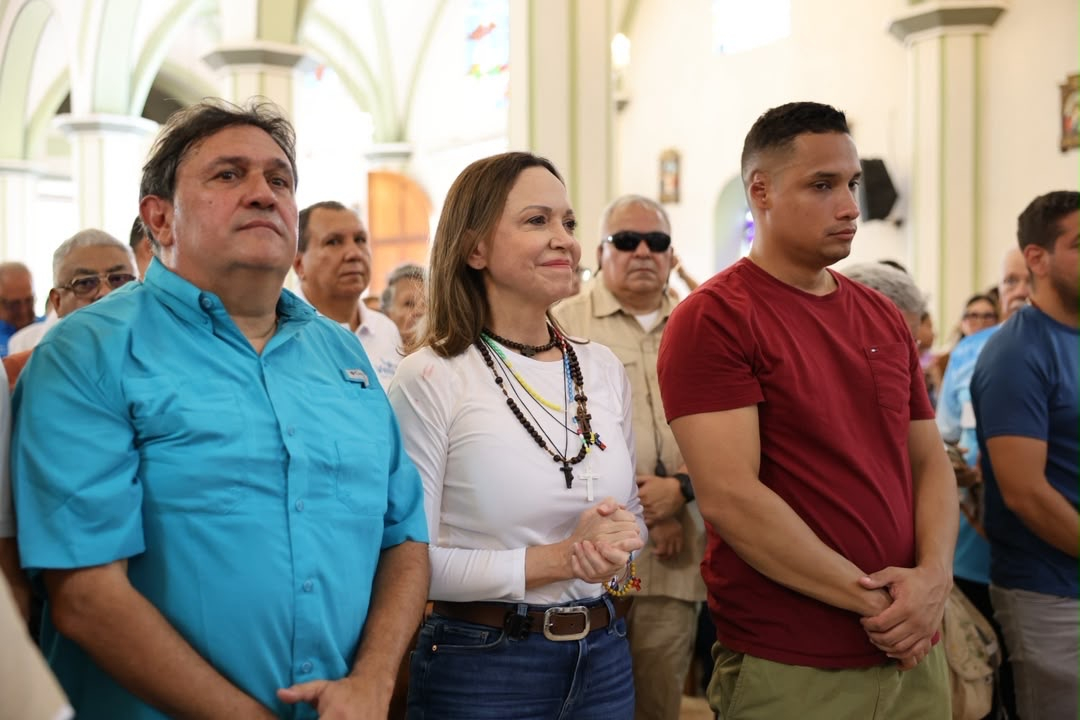
    CARACAS, Venezuela — Opposition leader and Nobel laureate María Corina Machado reappeared in Venezuela Sunday for the first time since December, returning from exile at a time when doubts about the country’s democratic future — and the role of the U.S. — are growing.

    It was her first appearance since the U.S. military deposed the country’s then-President Nicolás Maduro in January, replacing him with an interim president who has exceeded the time she was authorized to serve, with no election scheduled.

    Machado announced her arrival on social media, writing, “I am here. With you.”

    Another leading figure in the Venezuelan opposition, Edmundo González, wrote on X confirming that Machado had arrived and that he would be at her side “very soon.”

    “Today is a very important day for Venezuelans. Our sovereign voice returns with her to lead and guide this process!” he wrote. “You know it, this is until the end.”

    Venezuela run by Maduro ally backed by Trump administration

    On Sunday afternoon, Machado strode into a church in the state of Lara, west of Caracas, to the applause of dozens gathered there as they shook her hand and hugged her, with cellphones aloft to record her return.

    “María! María!” one person cried, as another shouted, “Welcome to Venezuela!”

    “Long live freedom, damn it!” a man yelled.

    One woman wiped away tears and called it “a miracle” while another woman’s hands flew to her face as she saw Machado enter the church.

    The crowd began chanting “Freedom!” as some supporters pumped their fists in the air.

    Machado then left the church and was headed to Caracas with stops scheduled on the way as people reached into her car, with one woman promising: “We’re not going to leave your side!”

    Asked by reporters Sunday about Machado’s return to Venezuela, U.S. President Donald Trump said, “I don’t know anything about it, but I think she’s a very nice woman. She gave me her Nobel Prize. So how can I say anything else? And I hope she’s safe. She’s a very nice woman. But we’re doing really well in Venezuela.”

    Since Maduro’s ouster, Venezuela has been run by acting President Delcy Rodríguez, a longtime Maduro ally who received the Trump administration’s blessing to succeed him.

    Rodríguez was initially supposed to serve only 90 days as acting president, but has remained in office and has made no move to call an election.

    Machado was briefly detained in January 2025, following a protest against Maduro’s planned swearing-in ceremony, and went into hiding in Venezuela for 11 months. After making a clandestine escape from the country, she reappeared that December in Norway, where she was awarded the Nobel Peace Prize for her peaceful challenge to Maduro’s authoritarian government.

    Machado and her allies have been demanding a date for a presidential election in Venezuela, but U.S. officials have emphasized economic stabilization first.

    Credible evidence shows the opposition won the last election

    In October 2023, Machado won an opposition primary and intended to challenge Maduro in the 2024 presidential election, but the government barred her from running for office.

    González took her place on the ballot, and ample credible evidence showed that he defeated Maduro by more than a 2-to-1 margin. But the National Electoral Council, which is stacked with ruling-party loyalists, declared Maduro the winner.

    The lead-up and aftermath of the election were marked by widespread government repression, including forced disappearances, torture, and other human rights violations. More than 2,000 people, including poll workers, were detained in the days after the vote.

    In January, the U.S. military captured Maduro in Caracas and whisked him to New York to face drug-related charges, which he has denied. Many Venezuelans were stunned by the Trump administration’s decision to work with Rodríguez, instead of Machado, to try to revitalize the crisis-racked country.

    Machado has demanded a date for a presidential election

    Machado had repeatedly vowed to return to Venezuela and, according to her party, she made seven unsuccessful attempts.

    One of the efforts would have seen her take a charter boat, but the operator canceled the trip, alleging the vessel was unfit for navigation. In another attempt, her team said, Machado tried to fly to the Caribbean island of Curacao, from where she could take a speedboat to Venezuela, but her plane was denied landing permits.

    Opposition activists have accused Venezuela’s government of blocking Machado’s return, a claim denied by Venezuelan authorities. Others have also questioned whether the Trump administration has also been involved in the efforts to stop her from returning.

    Trump administration officials deny they are holding Machado back but have said that, on some occasions, they have advised her against returning due to safety concerns.

    After Maduro was deposed, Venezuela’s highest court said Rodríguez could serve as acting president for up to 90 days — an interim appointment that could be extended by the National Assembly for an additional 90 days. But the ruling party-controlled assembly never voted to extend her term.

    Machado and her allies have demanded that the Rodríguez government set a date for a presidential election. Rodríguez told the U.N. General Assembly in September that Venezuelans will determine the “right moment” for the next election.

    U.S. Secretary of State Marco Rubio has argued that before holding new elections, Venezuela must stabilize its economy and rebuild its institutions, including its courts and electoral council. But he said in a news conference earlier this month that Machado has “every right to enter her country whenever she wants to return.”

    Supporters of Machado have held demonstrations in Caracas demanding her return.

  • Tens of thousands of Israelis living abroad are expected to fly in for pivotal vote

    Tens of thousands of Israelis living abroad are expected to fly in for pivotal vote

    TEL AVIV, Israel — For two decades since leaving Israel for Canada, Yael Natra said, she didn’t consider returning to vote in her home country’s elections. She felt it wasn’t right to cast a ballot in a place she no longer lived.

    But now, after seeing the far right gain power, Natra, 61, said she believed she had no choice.

    Ahead of Israel’s election on Tuesday — the first since the 2023 Hamas-led attacks and ensuing wars in the region — Natra spent thousands of dollars to travel nearly 6,000 miles from Toronto to Tel Aviv to be in the country and vote, she said.

    Israeli law generally requires citizens to vote in person in the country, with narrow exceptions for diplomats and certain official emissaries abroad. Natra said she plans to cast her ballot for parties not aligned with the current government led by Prime Minister Benjamin Netanyahu.

    “The Israel that I grew up in is disappearing,” she said in an interview from Toronto, citing an eroding democracy and deeply divided society. “If something won’t change this time, I don’t know what’s going to be.”

    Tens of thousands of Israelis living abroad are expected to fly in for this week’s vote, according to AID Coalition, a U.S.-based nonprofit focused on strengthening Israel’s democracy. The election is one of the most consequential in Israel in years, widely seen as a referendum on Netanyahu’s handling of the wars and the hard-right turn Israel has taken both domestically and on the world stage.

    Israel has more than 7.3 million registered voters, but polling suggests a tight race. Previous elections have turned on thin margins. It’s unclear what effect these voters might have, but many liberal Israelis who don’t support Netanyahu have left the country in recent years, suggesting that those returning to cast ballots would not support him.

    “Many Israelis who have left over the years — and especially since Oct. 7 — are exposed to the isolation and animosity toward the country much more palpably than those inside, and as such are likely to want to vote out. Netanyahu,” said Mairav Zonszein, a senior analyst with the International Crisis Group, a nonprofit think tank.

    U.S tops the list of voters traveling to Israel, group’s estimates show

    AID Coalition estimates that as many as 67,000 voters are returning to Israel, based on surveys of expatriates and registration data gathered for its “Fly&Vote” initiative. It says about half are flying in from the United States, with others from Europe, Canada, Australia, and New Zealand.

    “It doesn’t matter what side of the political spectrum you’re on, everyone views these elections as going to be critical,” said Jonathan Barsade, AID Coalition’s president.

    Israelis planning to travel from the U.S., United Kingdom, and Canada told the Associated Press they felt a sense of obligation to try to preserve Israel’s democracy.

    Hadar Susskind, 53, said he wants a new Israeli government to reverse course in the West Bank and Gaza, halting settlement activity and settler violence in the former and allowing for reconstruction in the latter.

    He and four relatives who live in the U.S. were flying back to “reaffirm Israel’s democracy,” he said.

    “This government is digging the hole deeper every day,” he said. ”The first thing the new government needs to do is put the shovel down.”

    Dahlia Scheindlin, an American-Israeli political analyst, said the mobilization effort this year is notable, compared with past elections. And while many campaigns have focused on anti-Netanyahu sentiment, she said it’s unclear overall how those flying in will vote.

    “There are also expats coming in to vote for the pro-Netanyahu side,” Scheindlin said.

    Some previously supported Netanyahu but say their views changed

    Netanyahu’s main opponent, Gadi Eisenkot, is a centrist politician and former military chief of staff who has pledged to establish a state commission of inquiry to investigate the Oct. 7 attacks and Israel’s conduct during the war. Eisenkot says he wants to restore the country’s standing with international allies.

    Natra, who described her politics as center-right, said she voted for Netanyahu in the 1990s. But now, she said, his government’s inability to take responsibility for the failures that led to the Oct. 7 attacks and his support for the ultra-Orthodox community have turned her away.

    Natra’s younger sister, 57-year-old Tamar Ichilov, said the “horrible things” Israel is doing in Gaza and the occupied West Bank motivated her to travel to Israel to vote. She said Israel is consumed by a “vendetta” and intent to “destroy” after the Oct. 7 attacks, and she believes its actions have contributed to rising antisemitism.

    “People don’t like us, and I can’t blame them,” she said in Tel Aviv, shortly after landing at Israel’s main international airport.

    Record numbers of Israelis left in recent years

    A record number of Israelis have moved away in recent years, a trend that began in 2022 and peaked amid the wars and turmoil following the Oct. 7 attacks, according to Israel’s Central Bureau of Statistics.

    Eti Wissotzky Cohen, 44, said she settled last year in the U.K. with her husband and two children after growing increasingly alarmed by Israel’s democratic backsliding and the shrinking space for liberal voices. But it was the first war with Iran in June 2025 that convinced Cohen the Israeli government would do anything to stay in power.

    “They’re looking at the Israeli population as pawns,” she said, telling AP she flew back to Israel to vote for the center-left Democrats party.

    Cohen said she wants to return to Israel to live someday but would find it difficult with Netanyahu in power.

    Zorik Nitzan also said he still believes in “the dream of Israel” but moved to Canada just over a decade ago “for a better, easier life.”

    He is traveling to Israel a few days before the election, he said, because it feels like “the last chance … to beat the Netanyahu movement and to get this country back on course.”

  • Ukraine disputes Elon Musk’s claim that its military violated Starlink’s terms of service

    Ukraine disputes Elon Musk’s claim that its military violated Starlink’s terms of service

    KYIV, Ukraine — Ukrainian officials have disputed claims by SpaceX CEO Elon Musk that the country’s military violated Starlink’s terms of service by using the civilian satellite internet network for offensive drone strikes.

    Serhii Beskrestnov, a defense technology adviser to President Volodymyr Zelensky, said long-standing restrictions on the civilian system in Ukraine made such offensive use impossible.

    “It’s very strange that Elon Musk doesn’t know about the restrictions on Starlink’s operation in Ukraine,” he wrote in an online post.

    SpaceX’s Starlink and its military-focused Starshield service are critical to Ukraine’s wartime connectivity. Earlier this month, Ukrainian drones connected to Starshield lost connectivity at high speeds, disrupting defenses during daily Russian air attacks. Officials said the so-called speed caps were lifted on Saturday, and the service was restored.

    Still, questions have persisted about who ordered the interruptions to the satellite internet system that Kyiv has relied on for years to counter Moscow’s attacks.

    Writing on Telegram, Beskrestnov said that drones operated via the civilian Starlink system had a speed restriction of 43-56 mph within Ukraine and did not work in Russia.

    “Therefore, we physically cannot use commercial Starlink for deep strikes or medium-range strikes,” he said.

    Musk acknowledged on Saturday that SpaceX had throttled Starlink in Ukraine.

    “Using Starlink, a civilian commercial service, for offensive drone strikes to kill people has never been allowed, nor should it be,” Musk wrote. “Ukraine military violated Starlink terms of service and used it for offensive drone strikes to kill people. That loophole was closed last week.”

    But he maintained that the U.S. government controlled whatever changes happened with Starshield, the military-grade version of Starlink that is the backbone of Ukraine’s drone operations and communication. U.S. President Donald Trump has maintained that he didn’t make that call, while Vice President JD Vance has hinted at White House coordination with Musk.

    Restrictions imposed last week on Starshield alarmed the Ukrainian military and government officials, with commanders reporting lost drones and disrupted missions. They also added to tensions between Kyiv and Washington, a relationship already strained by Trump’s reported deal with Moscow to import diesel from Russia that Ukraine viewed as a betrayal.

    The U.S. is making new efforts to end the war

    The restoration of Starlink service followed a new U.S. diplomatic push to end the war. Russia agreed Wednesday to resume three-way negotiations with Washington and Kyiv next month. On Friday, Kyiv and Moscow also agreed to a localized ceasefire brokered by first lady Melania Trump around Oleshky, a war-ravaged, Russian-occupied town in Ukraine’s southern Kherson region.

    Meanwhile, Zelensky on Sunday said Russia had launched nearly 2,300 drones targeting Ukrainian cities over the past week, renewing his call on Western allies to speed up deliveries of interceptors.

    “This week alone, Russia has launched about 1,600 guided bombs, 48 missiles of various types, including ballistic missiles, and almost 2,300 strike drones at Ukraine,” Zelensky wrote in an online post.

    He said the attacks — many of them deadly — had affected nine regions of the country, damaging power plants, grain stores, civilian homes, and commercial facilities.

    More civilian deaths in Ukraine and Russia

    Russia launched more than 20 attacks on Ukraine’s Dnipropetrovsk region overnight into Sunday, using drones and an aerial bomb, according to local authorities. Three people died at the scene and a fourth man later died in hospital, regional military administration head Oleksandr Hanzha reported, while over a dozen people were injured.

    In Vinnytsia, a city in central Ukraine, at least six people were injured when a Russian drone struck a residential building, according to the state emergency service. The attack also damaged a nearby care home, with emergency crews evacuating 15 elderly residents, the service said.

    Also according to the emergency service, consecutive Russian strikes on a shopping center in Kharkiv injured four people late on Saturday, including three rescue workers. Ukraine has long accused Russia of so-called double-tap strikes, in which an initial attack is followed by another once rescuers arrive on the scene.

    Russia’s Defense Ministry on Sunday claimed its forces targeted multiple sites in and around Kharkiv, including a shopping and logistics center, that it said had stored dual-use goods meant for the Ukrainian military.

    In Russia, two people were killed and 13 others injured in Belgorod, a city 25 miles from the Ukrainian border, following “mass” nighttime drone strikes by Kyiv, regional Gov. Alexander Shuvayev reported on Sunday.

    In the Russian city of Oryol, the body of a fourth victim was pulled from the rubble the day after a Ukrainian strike on an industrial plant, local Gov. Andrey Klychkov reported. On Saturday, local authorities said three people had been killed in the attack.

    Ukraine’s General Staff that day said its forces hit an electronics plant in Oryol that makes components for the cruise and ballistic missiles Russia fires at Ukrainian cities.

  • Obama, in Midwest, assails ‘cruelty’ and indecency from Trump and his allies in the midterm campaign

    Obama, in Midwest, assails ‘cruelty’ and indecency from Trump and his allies in the midterm campaign

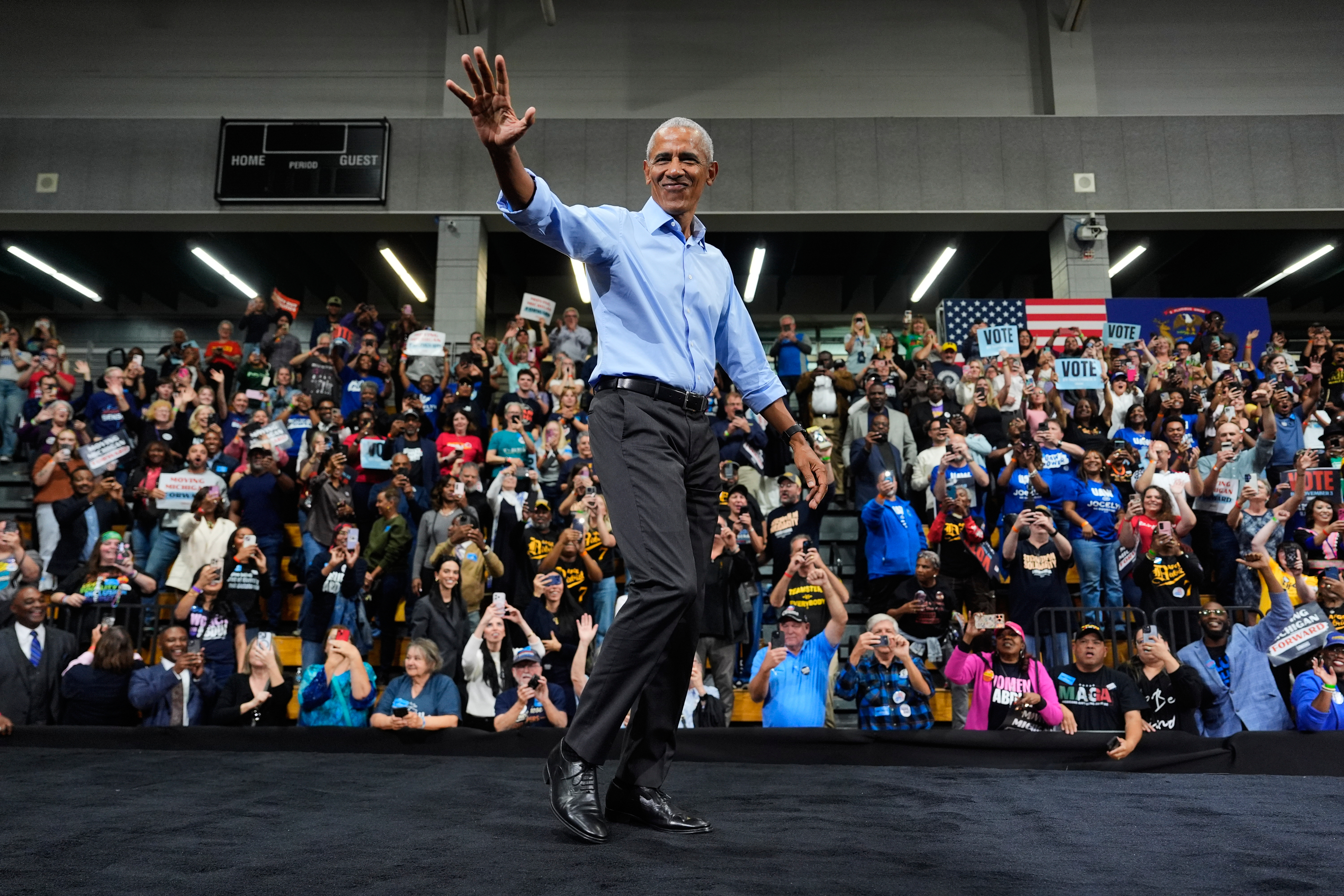
    DETROIT — Former President Barack Obama on Saturday seized on what he described as cruelty and indecency coming from President Donald Trump and his Republican allies, stepping into one of the nation’s ugliest midterm fights as he worked to rally Democratic voters in two Midwestern battlegrounds.

    First in Ohio, Obama took aim at Republican gubernatorial candidate Vivek Ramaswamy, who has doubled down on an advertising campaign featuring the estranged mother of Democratic rival Amy Acton. Trump and Vice President JD Vance have also defended the ad, even as Republican leaders across Ohio, including Gov. Mike DeWine, have called for its removal.

    “In recent days, we’ve seen there is no line he will not cross, no low he will not sink to,” Obama said of Ramaswamy, noting that Acton has “spoken movingly about her painful childhood and all she’s experienced: abuse, neglect, and homelessness.”

    Later in Michigan, Obama condemned critics of Senate candidate Abdul El-Sayed, suggesting that they’re using his name or his faith to tear him down.

    “We have seen this movie before. I starred in it,” Obama told a packed high school gym in Detroit. “I’ve got a long-form birth certificate to prove it.”

    “Abdul is as Michigan as it gets,” he added.

    Obama, 65, remains the Democratic Party’s best motivator nearly a decade after leaving the White House. And he’s taking his star power on the road in the final days of the midterm elections, which will help determine the balance of power in American politics on Nov. 3.

    Trump cast his own ballot on Saturday in Florida, where he defended the Ramaswamy ad, which has emerged as a national flashpoint a little more than a week before Election Day.

    “The mother said that Amy Acton is a liar, and she’s no good,” Trump said. ”And you know what? I don’t think you can get a better reference on that.”

    The Ramaswamy campaign video features Acton’s birth mother, Donna Arthur, calling her “a liar” and insinuating she has mental health issues.

    Acton, Ohio’s COVID 19-era health director, has made no secret of facing homelessness and abuse as a child. Arthur lost custody of her children after their stepfather, Arthur’s husband, was indicted on a charge of rape involving Acton.

    The abuse allegedly happened from December 1976 to April 1978. Cledith Arthur failed to show for a court appearance and became a fugitive. Donna Arthur remained married to him until his death in 2004.

    Appearing before Obama, Acton spoke as if addressing Ramaswamy directly.

    “My opponent has chosen to exploit, intentionally, my childhood to save his stumbling campaign, but it’s not going to work,” she said. “Decency still matters.” She added: “Mr. Ramaswamy, you are not just out of touch, you are out for yourself and you are a danger to my state. Apparently there is no low to which you won’t stoop.”

    Although Ohio has become more reliably Republican, it’s been a hotly contested battleground this year. Trump and Vance have both visited the state in recent weeks to drum up support for Sen. Jon Husted and Ramaswamy. And the controversy over Ramaswamy’s ad has ratcheted up the already high temperature.

    Michigan, too, is a critical state this midterm season, with high-stakes contests for the Senate and governor.

    While Obama addressed both races, he offered a passionate defense of El-Sayed, a former public health official running against former Rep. Mike Rogers, a Republican.

    The former president pushed back against those who call El-Sayed a radical, declaring that “Abdul shares my values.” He also acknowledged that El-Sayed was critical of him after his 2012 reelection for not following through on all of his progressive campaign promises.

    El-Sayed wrote that Obama “was not the right choice — he just wasn’t the wrong one.”

    “Some of these folks say, well, you know, Abdul didn’t like some of the things you did as president,” Obama said in Detroit, wearing a blue shirt with no tie, his sleeves rolled up. “You know who else doesn’t agree with everything I do? Michelle Obama. Michelle Obama, about five times a day.”

    Democrats hoped that Obama’s appearance in the city, which is three-quarters Black, could bolster support for El-Sayed among Black voters. In the primary, his opponent Haley Stevens won Wayne County, which includes Detroit, by about 6 percentage points. Former Vice President Kamala Harris, the first Black and South Asian vice president, campaigned for El-Sayed in September.

    Cheryl McWilliams, 67, said Obama’s speech “pumps you up to vote,” and she’s hoping to see high turnout in the midterms.

    “If Detroit doesn’t vote, whoever’s running is going to lose, period,” McWilliams said. “I’m just hoping we can reach voters that don’t vote. They think it doesn’t matter, and it does.”

    Chunnika Hodges, who lives in Detroit and canvassed for El-Sayed on Saturday, said some Black voters are supporting Rogers because they don’t think anything has changed after years of voting for Democrats. Some are also wary of El-Sayed because of his progressive policies, Hodges said.

    “We don’t lean to the conservative, but we have seen that within our community,” Hodges said. “There are conservative Blacks, conservative Democrats.”

    While Obama talked up Democratic candidates in Ohio and Michigan, he also spoke at length about Trump.

    He accused the Republican president and his family of rampant corruption and called out his inability to lower costs, noting that Trump has instead focused on building a new White House ballroom and helipad on the South Lawn.

    “I don’t know if you’ve noticed, but he seems very focused on home renovation,” Obama quipped. “He should be on HGTV.” He went on: “There’s gold everywhere. He’s got the White House looking like Saddam Hussein opened a Cheesecake Factory.”

    The former Democratic president acknowledged that the nation has Trump for another two years, until his term ends. But voters are not stuck with Trump’s allies, he said.

    “We’re not stuck with a spineless Congress and Republican governors who are handling lawlessness and carelessness and cruelty and indifference for working people,” Obama said. “After two years of chaos and cruelty and corruption and incompetence … you get a chance to say enough is enough.”

    Obama will headline a rally in Georgia this week with Sen. Jon Ossoff and candidate for governor Keisha Lance Bottoms. Trump, campaigning in Perry, Ga., on Saturday evening with their Republican rivals, made several references to Obama’s Michigan event, insisting “the place was empty.”

  • A new level of threat and fear risks pushing the U.S. and Iran back to full war

    A new level of threat and fear risks pushing the U.S. and Iran back to full war

    WASHINGTON — Inside the Trump administration, officials are expressing fears that Iran is in the “advanced stages” of planning attacks against U.S. officials.

    More than 6,000 miles away, the Iranians appear convinced that Israel and the United States are preparing to unleash their third major attack in 16 months, a final push to force Iran to surrender to U.S. demands.

    The conflict in the Middle East has entered a new phase in which a maelstrom of factors, from the political calendars in the United States and Israel to the potential for all sides to be seeking pretexts for action, are creating heightened levels of tension and risk.

    This is how countries can escalate into full-scale war, several diplomats and outside experts noted. If the U.S. intelligence disclosed this past week is right that Iran has credible plans to attack Americans at home and abroad, one senior European official said — “and it probably is,” the official added — one gunshot that appears aimed at a U.S. official could touch off a conflagration. So could a stray explosion near a bunker sheltering Iranian leaders, who already survived their predecessors’ deaths in a decapitation strike in the opening hours of the war on Feb. 28.

    The fact that Prime Minister Benjamin Netanyahu of Israel and President Donald Trump are facing critical elections that could dramatically affect the balance of power in their countries feeds into the complex set of calculations that all sides are making. Even if he is defeated Tuesday, Netanyahu could decide to launch one last strike that he may believe his successor would hesitate to execute. Similarly, Trump, who knows how unpopular the war is even among his strongest supporters, may want to show that at least when it comes to his powers as commander in chief, his authority is undiminished.

    And, as in other moments of global peril — the Cuban missile crisis and the decision to invade Iraq, as examples — partial or faulty intelligence, or just a failure to understand the adversary’s true motives, can carry deadly consequences. Iraq poses another cautionary tale, when selective intelligence can be used as an actual pretext for military action.

    U.S. officials say they are focused on elements of the most recent intelligence suggesting that the Iranians may seek to kill U.S. ambassadors in the Middle East and U.S. officials on American soil — a longtime ambition of Iran’s elite Unit 840, which has carried out kidnappings and assassinations around the globe. But history suggests Iran’s desires often outstrip its capabilities. It has at times hired hapless hit men who have been arrested before they could do harm.

    Still, those incidents are a reminder that U.S. and Iranian fears are rooted in bitter experience. And while Trump has said he would not attack before the Nov. 3 midterm elections, he has also hinted that all bets are off after that. Senior U.S. officials say that in private, Trump appears to be leaning toward another round of major strikes inside Iran. Plans developed by Central Command detail an expanded list of bombing targets, including energy infrastructure and other sites vital to the Iranian economy, according to an official with direct knowledge of the planning.

    Echoing Trump’s bombast, a senior official in Iran took to social media in recent days to say the country was preparing to take on its adversaries with surprise attacks, with “zero red lines.”

    A rising threat

    U.S. officials and European allies said the intelligence about potential attacks had been rising in recent weeks, since a suspected Iranian plot against a military base in Britain used by the U.S. military.

    The intelligence reviewed by senior officials included Iranian plotting of how to respond to an attack by either the United States or Israel with an assassination campaign, as well as other attacks Iran could carry out in retaliation for earlier U.S. attacks, officials said.

    The intelligence about the plots remains highly classified, so it is hard to judge. Only the most senior U.S. lawmakers — members of the so-called Gang of 8 — had been briefed before the warning from Jay Clayton, the director of national intelligence, became public on Friday. Some officials have been puzzled by why Trump administration officials released the letter, given that they knew they could not back it up by discussing evidence of specific plots.

    The gap between what Trump and most of his advisers say about the war publicly and the intelligence they are receiving is wide, and neither the White House team nor Pentagon leadership has given a briefing on the conflict in months. The president prefers to keep information closely held, but that has merely heightened the risks.

    But the essence of the intelligence findings is that several Iranian plots have moved from the aspiration stage toward execution. And a Western official compared the U.S. reaction with the response to the warnings of the Iranian threats to attack American personnel and bombers at RAF Fairford, a base in southern England, earlier this month. A dozen B-1 Air Force bombers were withdrawn, and Iranian officials said that if they returned, it would be taken as a sign of imminent attack.

    Trump said nothing to reporters on Saturday about the intelligence, but did say he would decide soon whether to take renewed military action. He has been briefed regularly on the new intelligence, which some officials say is being taken more seriously than any warnings since the war began.

    There is some evidence the Iranians have operatives inside the United States who are “not just simply Iranian nationals,” one official said. But even if Iranians are plotting attacks from the United States, it is not clear they can: Iranian officials, in their communications with colleagues, often exaggerate their ability to carry out covert overseas attacks.

    Still, Iran almost always finds criminals and hit men to hire for assassination plots, particularly in Europe and the United States. The danger of any specific attack plan depends on the competence of the criminal hired to carry out an assassination, U.S. and Western officials said.

    Haunting memories from 2024

    This is not the first time Washington has gone through this exercise.

    The mix of real threats from Iran against Trump and some of his top advisers, along with other potential assassination attempt scenarios, created a climate of fear and paranoia for the president’s team throughout the 2024 campaign. Those threats had grown in intensity throughout Trump’s four years out of office, and were animated in part by Trump’s decision in January 2020 to order a strike on the head of Iran’s elite Quds force, Gen. Qassem Soleimani.

    The Biden administration tracked an increase in threats, and the FBI arrested a Pakistani nationalist on July 12, 2024, charging him with a murder-for-hire plot directed by Iran’s Revolutionary Guard against Trump.

    Separately, then-President Joe Biden’s senior advisers had tracked what was described as a credible threat against Trump from Iran, and sent countersnipers to his outdoor rally in Butler, Pa., on July 13 that year. One of those snipers shot an attempted assassin, Thomas Matthew Crooks, who officials said was acting on his own and had no connection to a foreign plot.

    But the back-to-back incidents — along with a hacking of campaign officials’ emails that was said to have been led by Iran — generated constant fear inside the Trump campaign.

    Other perceived threats and anxieties were comical. A small item was discovered in the campaign headquarters in South Florida, prompting a 911 call and fears it was a listening device. It turned out to be a device that could be purchased online, a prank carried out by someone on the campaign.

    The Trump team has continued to sift through threats, including against senior White House officials. They pay close attention to the names of officials mentioned by Iranians in intercepted chatter.

    In Iran, telegraphing the reaction

    Iranian officials believe their most inspired moves after the Feb. 28 attack included striking U.S. bases across the Middle East and closing the Strait of Hormuz, which caught U.S. officials off guard. They have made no secret about their intentions to expand the scope of the war if a third round of fighting breaks out. In public remarks, senior officials have threatened to target civilian infrastructure, energy sites, and underwater fiber optic cables that carry internet and other communications traffic.

    Two Iranian officials, one of them a member of the Revolutionary Guard, said in interviews Saturday that the expansion of targets also included U.S. diplomats and personnel. The officials, who asked not to be named because they were not authorized to speak publicly, confirmed State Department reports about Iran’s plot to target Americans.

    The officials defended the plan and noted that Israel and the United States had killed dozens of Iranian officials and some family members. In their view, they said, that made targeting Americans “fair game.” It is not clear whether they have the reach, however.

    Iran’s success rate has measurably deteriorated compared with the 1980s, in the earlier years of the revolution, when it carried out a string of assassinations of Iranian political dissidents.

    Mahdi Mohammadi, a senior adviser to Mohammad Bagher Qalibaf, the lead negotiator and speaker of parliament, said on social media that Iran views the coming part of the war as existential.

    “We are in a surprise phase of the war, and we will not fight a classic war,” Mohammadi said. “It will be an asymmetrical, fierce, and conclusive war that will target the enemy’s strong points and weak spots.”

    This article originally appeared in the New York Times.

  • This used to be a cornerstone of every job application. Not anymore.

    This used to be a cornerstone of every job application. Not anymore.

    The debate over whether cover letters had become an outdated ritual was already in full swing before the proliferation of artificial intelligence.

    An increasing number of job postings had stopped requiring cover letters altogether, and surveys offered wildly conflicting accounts of whether hiring managers bothered to read the cover letters they received.

    Now, with so many job seekers relying on AI to help with their applications, a well-written cover letter has ceased to be a reliable signal of a serious applicant, said Judd Kessler, professor of business economics and public policy at the University of Pennsylvania.

    “It’s not just easier to write a cover letter, it’s easier to write a phenomenal cover letter,” Kessler said. “That’s become more of a prerequisite and less of a differentiator.”

    At the same time, the use of AI has contributed to an explosion of applications. For every open role in 2026 there are twice as many applicants as there would have been for similar roles in 2022, according to a recent study from LinkedIn Research.

    That makes hiring managers and recruiters less likely to give cover letters even a perfunctory glance. They have too much else to handle during a busy job search, said Johnny C. Taylor, president and chief executive officer of the Society for Human Resource Management.

    “The cover letter is literally dead, never to be resuscitated,” he said. “There’s too much volume for this beautiful piece of prose.”

    In some cases, to handle the volume, recruiters are tasking AI to do the prescreening. That puts AI bots in the position of assessing cover letters written by AI bots — in some cases, responding to job postings that were originally written with the help of AI.

    Pelumi Ogunlana, a 36-year-old corporate banking professional based in the greater Chicago area, said he’s heard of some horror stories, like people uploading résumés and cover letters in which chatbot edits were visible.

    But what’s a responsible, rational job candidate to do? When a posting says cover letter optional, should you submit one? And if you do send one with your application, how much emphasis should you put on it?

    “It’s tough when no one can give you a right answer,” Ogunlana said. “You have some recruiters saying, ‘It’s worth it,’ and others saying, ‘No.’”

    If there is any consensus, it’s that cover letters with a “human element” still can help an applicant stand out.

    They need to sound different from all the ones written with AI, said Jason Baker, vice president of talent acquisition at Arctic Wolf, a security operations firm.

    Baker recalled one applicant who didn’t land the job they originally applied for, but because their cover letter made such an impression, Baker invited them back when the company was hiring again for a similar position.

    Vicki Salemi, a career expert at the job site Monster, said the necessity of a cover letter tends to vary from firm to firm and manager to manager. Some have told her over the years that they only cared about seeing a résumé; others insisted on reviewing every single cover letter before making a hiring decision.

    But having a solid cover letter on hand — and carefully tailoring it to each position — could make a difference to even one manager, which in turn could make a difference to an applicant’s future at that company.

    “Whether or not the company looks at it is another story,” she said. “But you want to put your best foot forward.”

    In the future, as AI tools continue to make it increasingly easy to apply for jobs, Kessler said he expects employers to rely more on other materials in an application package. These could be personalized letters of recommendation from trusted sources or even attendance at in-person networking events — anything that indicates you gave individualized attention to this particular position.

    “These are things an AI agent cannot do on your behalf,” Kessler said. “These are not things you can do for every firm.”

  • The biggest wealth giveaway in modern history aims to transform the world

    The biggest wealth giveaway in modern history aims to transform the world

    SAN FRANCISCO — ChatGPT maker OpenAI and its rivals in artificial intelligence have promised investors immense profits while also warning that their technology will disrupt society by automating jobs and creating new national security threats.

    Now those same companies are directing hundreds of billions of dollars toward charitable projects that will attempt to soften the blow.

    Anthropic, which makes the chatbot Claude, said Sunday that it would donate 5% of the company to a new fund to benefit the public. It may be used to address AI’s destabilizing impact on workers, the company said, including payments “to specific populations.” If the company is valued at $2 trillion when it lists on the stock market this year, as some analysts expect, the fund will be endowed with $100 billion. Anthropic’s seven founders — all set to become multibillionaires — have separately said they will donate 80% of their wealth to charitable causes.

    The day after Anthropic’s commitment, SpaceX founder Elon Musk said that he plans to give “one of my SpaceX shares to every kid in America” next year and donate more in the future. President Donald Trump later said that the shares will be distributed through Trump Accounts, which have enrolled 70 million children since the program launched in July. At SpaceX’s share price late Wednesday, Musk’s contributions could total more than $11 billion.

    SpaceX founder Elon Musk said that he plans to give “one of my SpaceX shares to every kid in America” next year and donate more in the future.Julia Demaree Nikhinson

    Combined with OpenAI’s philanthropic foundation, which the company has said owns about a quarter of the company, the money set aside by the three AI firms could represent nearly $300 billion of philanthropic capital — more than three times as much as the influential Gates Foundation run by Microsoft cofounder Bill Gates.

    The massive commitments could make the AI companies influential far beyond their business interests. Gates and fellow billionaires George Soros and Charles and David Koch caused major shifts in global health and climate policy, and U.S. politics, with much smaller amounts than the AI companies have on tap.

    Anthropic has said its new fund won’t make political donations, and as a 501(c)3 nonprofit, OpenAI’s foundation is not able to make them.

    Anthropic, and OpenAI’s foundation, have already backed projects working on new treatments for respiratory disease and Alzheimer’s. But they have not released detailed plans for their huge philanthropic funds.

    All three AI firms have discussed using their philanthropy in ways that could offset the inequality they predict their technology may cause, or share the wealth created by AI more broadly.

    OpenAI’s foundation identifies the effect of AI on jobs and the economy as one of its core focus areas and in May allocated $250 million to studying it. Anthropic previously set aside $200 million to fund research into the impact of AI on jobs and said its fund announced this week that it will pursue the same issue with “bolder approaches.”

    Musk’s announcement that he would donate stock to the public follows his previous claims that AI would create such economic abundance that the government could send out checks that create “universal high income.”

    Arvind Narayanan, a computer science professor at Princeton University, said the latest philanthropic proposals from AI giants are a sign of “the big disconnect between how industry leaders view the potential effects of AI and how regular people do.” Recent surveys show that Americans want real work to do, not live on handouts, he said.

    “I don’t think ‘automate and compensate’ is going to be the way forward,” Narayanan said.

    A spokesperson for the OpenAI Foundation said its mission is to benefit people through the use of AI and help “society prepare for and become resilient to new challenges as AI advances.” The organization has distributed $855 million since March 2026, the spokesperson said. OpenAI said in February that the foundation’s stake in the company was worth more than $180 billion. (The Washington Post has a content partnership with OpenAI.)

    Anthropic did not have comment.

    Sam Manning, a senior research fellow at the nonprofit GovAI, a think tank dedicated to AI governance, said the companies alone are unlikely to be able to mitigate disruption from their technology.

    “The main lever that needs to be pulled to help make this all go well in the U.S. is going to be at the federal policy and state policy levels, and that is not something you can just pay for with philanthropic money,” said Manning, who previously studied the economic implications of AI as a contractor for OpenAI.

    Giving money also cannot address some of the most significant effects of AI able to displace humans from jobs, he said. Workers whose careers are drastically changed by smarter machines may suffer from a loss of identity, not just income, Manning said.

    Critics of the AI industry have argued that the charitable pledges amount to a marketing campaign aiming to win goodwill for a technology that is broadly unpopular with the public. Majorities of Americans believe AI will destroy many jobs and is bad for society, a Post-ABC News-Ipsos poll released Wednesday found.

    At the same time, private-sector giveaways like Musk’s stock pledge are genuinely exciting to many people struggling in today’s economy, said Linsey McGoey, a sociology professor at the University of Essex in Britain.

    “Investment accounts like Robin Hood are popular for a reason,” she said. “Rather than chastising voters for this, those of us who want a fairer economy need to harness and redistribute market power in novel ways.”

    Gene Sperling, an economist who oversaw the $1.9 trillion coronavirus relief plan during the Biden administration and founded Georgetown University’s Economic Dignity Lab, said that giving stock to members of the public has limitations.

    The value isn’t accessible unless the stock is sold. And mass donations of stock could “buy off public support” for a company, Sperling said, potentially undermining attempts to introduce sensible regulation that could affect a firm’s business.

    Regardless of what form their donations take, the AI firms have pledged to give enough to have a major impact in the world.

    Brian Galle, a professor of law at UC Berkeley Law who focuses on taxation and nonprofit organizations, said the AI companies could have a significant positive impact if they spend in a focused way.

    He compared the potential to how the Ford Foundation’s spending on agricultural research in the 1960s helped create more productive crops for developing nations. “They were able to leverage that into a program that prevented billions of people from starving over the long run,” Galle said.

    Anthropic and OpenAI could do something similar for the world if they choose, he said. “It gives the funders a chance to really get to scale on a problem of their choice in a way that almost no one ever gets to do.”

    One approach the AI companies could take would be to fill the humanitarian gaps left by the dismantling of the U.S. Agency for International Development by the Trump administration’s U.S. DOGE Service, the group previously overseen by Musk, Galle said. Doing so would probably offer “very high social return for the money,” he said.

  • A Mexico City taco stand won a Michelin star. It split the joint in two.

    A Mexico City taco stand won a Michelin star. It split the joint in two.

    MEXICO CITY — The hiss of meat grilling, the chatter of patrons, the thrum of the street: El Califa de León is a noisy place. But heads nonetheless turned on a recent evening when an electric drill whirred to life and punctured one of the taco stand’s tiled walls.

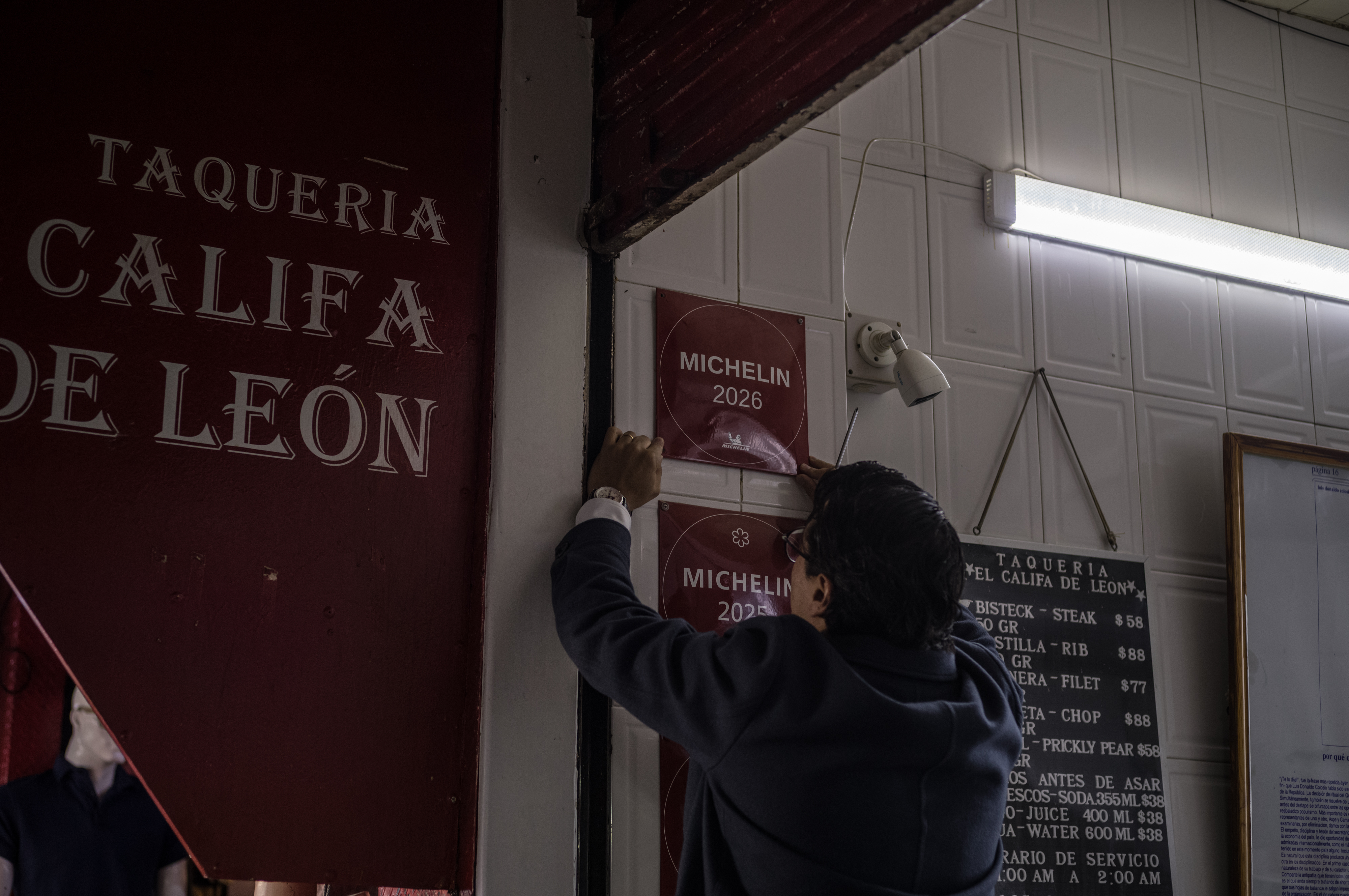
    One of the most famous taquerías in this taco-crazed town was hanging its latest plaque from the Michelin Guide, the French arbiter of the world’s best restaurants. But this one was different from the others awarded to this blue-collar taco stand in Mexico City’s Colonia San Rafael.

    It was starless.

    In the rarefied domain of Michelin-starred restaurants, losing the honor is often tantamount to personal tragedy and professional disgrace. Some restaurateurs have fallen into depression. Others have resorted to litigation. One chef said it was worse than losing his parents. Just the fear of it might have driven another to suicide.

    Mario Hernández, 69, owner of El Califa, the first taquería to win the coveted designation, watched as the new plaque – signifying only inclusion in the Michelin Guide, not a star – was hammered into the wall. Then he looked away.

    “Well, they took the star away from us,” he said. “But at least we have some recognition.”

    In a city with more than 11,000 intensely competitive taquerías, the question of who merits credit for El Califa de León’s success has been a matter of public debate since Michelin deigned it starworthy in 2024. The conversation has also expanded to encompass the broader themes of overtourism, labor relations and class.

    Months after El Califa won its star, the taquería’s longtime grillmaster, Arturo Rivera, quit the restaurant, and a private dispute went public. Rivera, 58, a former taxi driver with a primary school education, said the taquería hadn’t given him the recognition he deserved. Hernández said the fame had gone to Rivera’s head.

    José Andrés Hernández, the owner’s son, hangs the recent Michelin recommendation plaque at Taquería El Califa de Léon on Oct. 8.Alejandro Cegarra

    In May, Michelin took away El Califa’s star and gave one to Once Mil, a fine-dining taquería in the posh neighborhood of Lomas de Chapultepec. The demotion has raised questions in this city’s insular taco world – about not only what had gone wrong at El Califa, but also which Mexico, rich or poor, should control the narrative of the taco, that most egalitarian of foods.

    Michelin Guide officials declined an interview request.

    Rivera has now opened a taco joint of his own. Tacos Versalles lies less than a mile from El Califa, placing them into direct competition for bellies and stars.

    Rivera and Hernández, each speaking over the din of his own taquería, offered fundamentally different accounts of how El Califa first rose to international prominence, who deserved the credit and what gives a taco its star quality.

    “It came from me, from my own creation,” Rivera said.

    “It could have been anyone behind the grill,” Hernández said.

    The truth, whatever it might be, was a curl of smoke rising from the grill and vanishing.

    ‘Why this place? And why this taco?’

    Tourists take a selfie in front of Taquería El Califa de León.Alejandro Cegarra

    El Califa de León occupies little more than a cubbyhole wedged between a discount clothing store and a pharmacy that boasts of offering, “The same but cheaper.”

    For most of its 60-year history, the taquería was an obscure neighborhood spot, the preferred lunch spot to a cadre of passersby, fellow vendors and politicians working within walking distance.

    Its menu includes four tacos, and only four tacos. Each is as spartan as the taquería itself – nothing but corn tortilla and grilled meat: pork chop, rib, steak or thinly sliced beef.

    The sensation of biting into one is elemental. It’s both an evolution and devolution of the taco. To Michelin’s anonymous judges, they were transcendent. They lauded El Califa’s “technical ability,” “standards” and “consistency.”

    “In the morning or at night during the busy dinner hours,” the judges commented, “the quality remained the same on every visit.”

    Within Mexico City’s culinary circles, the award came as a shock. The guide had recognized street food from all over the world, but never in Mexico. More surprising, several critics said, was that El Califa had been the one selected.

    “It was never thought to be a destination,” food writer Natalie de la Rosa said. “It was a conversation: ‘Why this place? And why this taco?’”

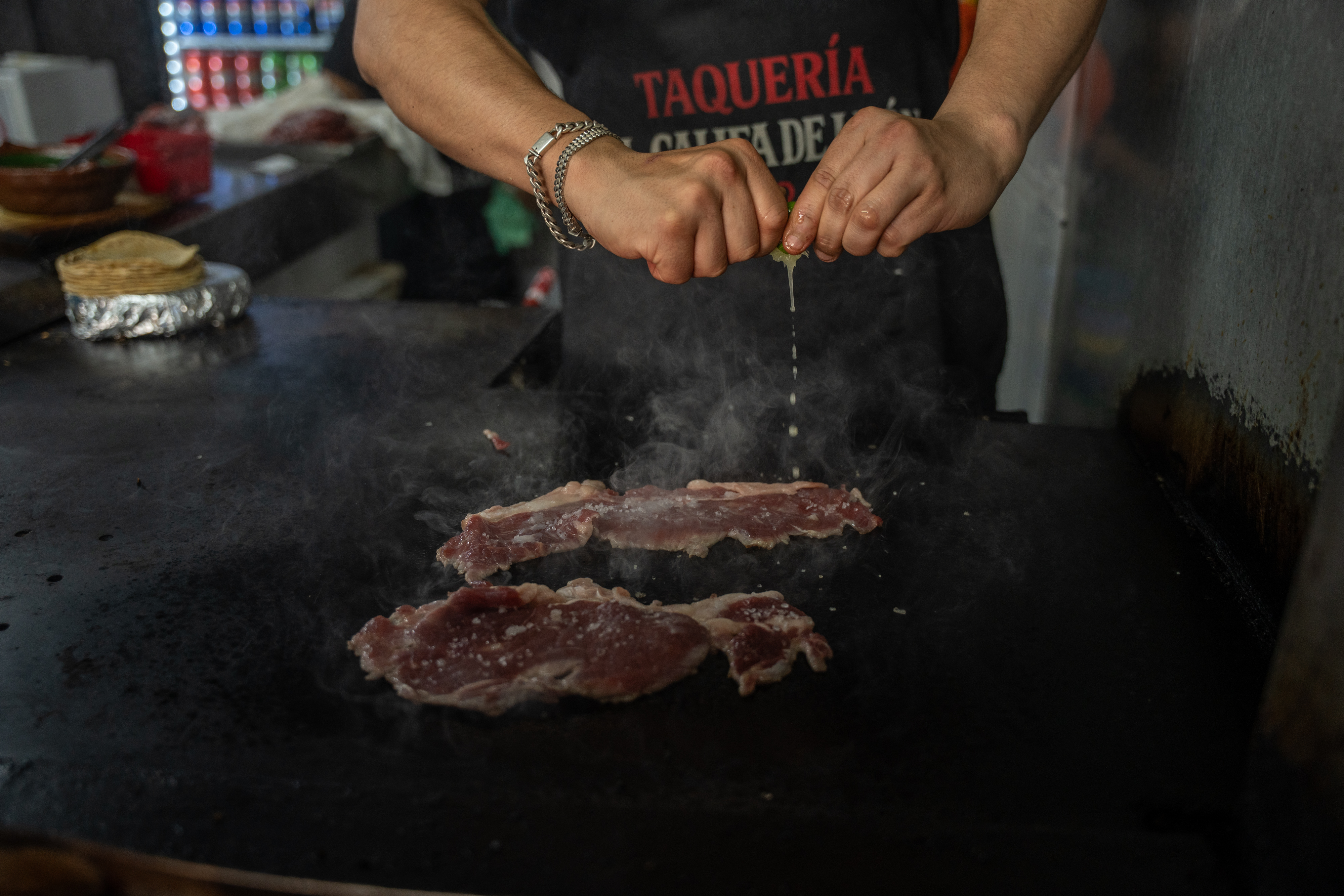
    Meat being roasted in the kitchen of Taquería El Califa de León.Alejandro Cegarra

    The surprise extended to El Califa’s kitchen, where Rivera, 58, had toiled for more than 20 years. Born one of nine in a poor family, he began his working life as child, carrying sacks of vegetables and fruit in a Mexico City street market.

    He learned to cook from his mother, who wanted her children to be self-sufficient. But he never imagined a career in the kitchen. He instead found work first as a carpenter, then as a taxi driver.

    Only on Jan. 22, 2001, did he get his first job in a kitchen – at El Califa. “Leave him there,” he said one happy eater gushed to a Califa manager. “Whatever you do, don’t move him.”

    They didn’t. For the next 23 years, Rivera was behind the grill nearly every day, earning around $400 per month. He developed his own technique, rubbing what he called his “magic powder” onto the meat. But he never considered himself a chef – not until Michelin came calling.

    Rivera had never heard of the guide. At first, he thought he’d won some tires. When he learned what it meant, he said the recognition was an awakening – the culmination of two decades of careful craft.

    “Now,” Rivera said, “I’m a chef.”

    First, the tacos. Then, the drama.

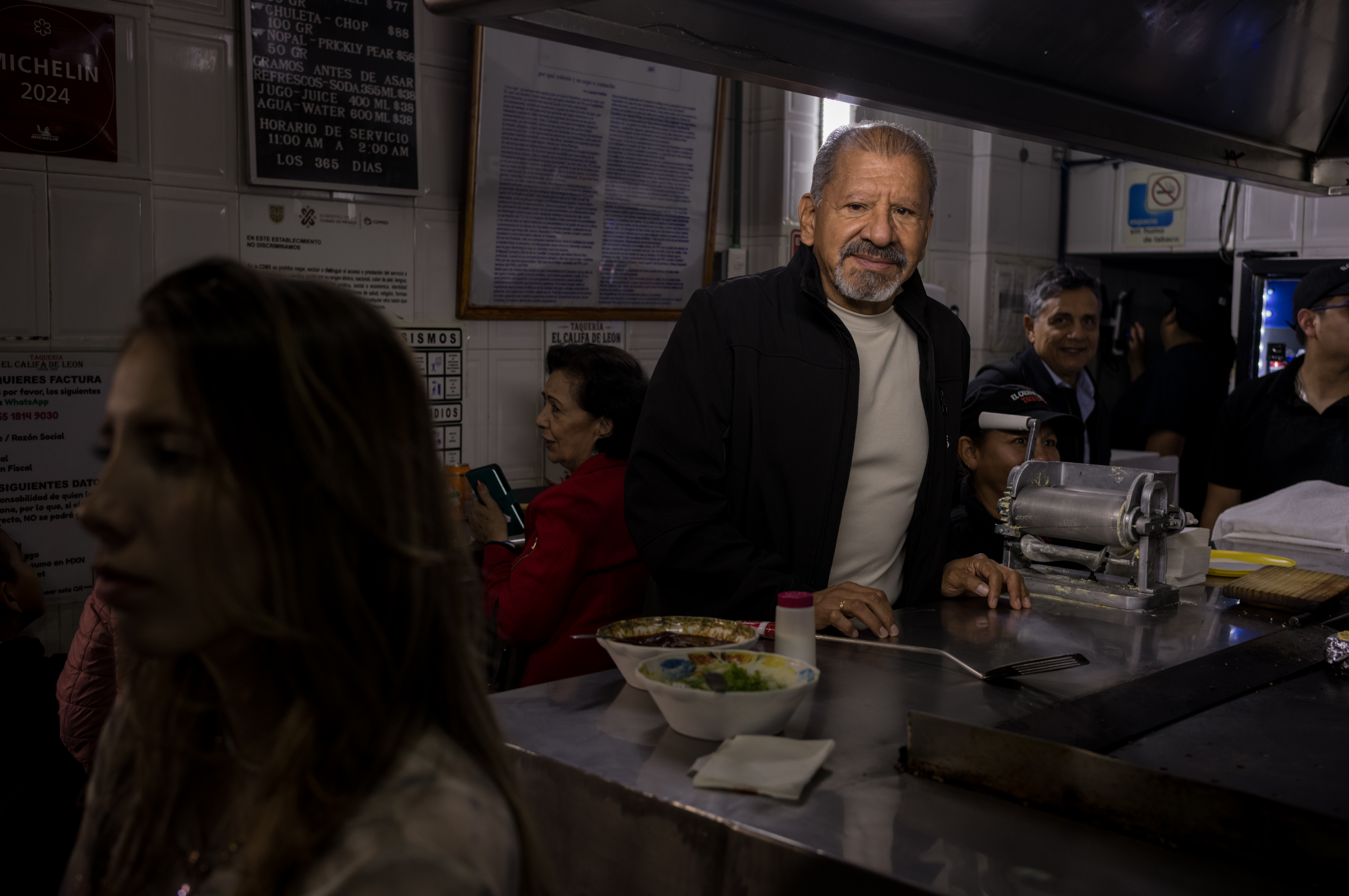
    Mario Hernández poses at Taquería El Califa de León.Alejandro Cegarra

    Hernández disagreed. To the Califa owner, who’d spent more than four decades stewarding the taquería, its success was due to concept, history and simplicity – not the person who happened to be cooking.

    When his father, Juan Hernández González, founded the taquería in 1968, it served only steak tacos. But they weren’t just any steak tacos.

    “My father was the world’s first loco who had the idea to make a fillet taco,” Hernández claimed. “He worked his entire, entire life with meat.”

    Three decades later came the next evolution: the rib tacos. Then the pork chop. And finally, 15 years ago, after his wife had counseled him on his need to evolve the menu, Hernández added the gaonera taco – packed with thinly-sliced beef – which he’d tested at El Mesón Taurino, his other restaurant.

    “The first ingredient is the quality of the meat, then its cut,” Hernández said. “The third point is how it’s grilled, then the salsas, and the fifth ingredient is the magic that the customer brings to it.”

    To Hernández, the tacos were his family’s story, a legacy he intended to pass down his sons, who would pass it down to his grandsons. When it earned the star, he was dumbfounded. Soon hundreds of people, many of them foreign, were lining up outside. Every day brought more. It was more success than he had ever imagined.

    Then came the drama.

    Newly minted Michelin-starred chef Arturo Rivera Martínez prepares an order of tacos at the Tacos El Califa de León taco stand, in Mexico City, Wednesday, May 15, 2024. Tacos El Califa de León is the first ever taco stand to receive a Michelin star from the French dining guide.Fernando Llano

    Neighboring vendors, whose businesses were disrupted by the lines, complained to the city government. An American company convinced Hernández to serve El Califa tacos at pop-up restaurants in Dallas – a venture plagued by hours-long lines and exorbitant prices. The Texas reviewers declared it a “disaster” and the “worst dining experience ever” that made “fools of everyone.” The critics are now also lampooning the El Califa offshoot in New York City, which opened in August, over the expense of its $19 tacos.

    “Fame came too quickly,” said José R. Ralat, Texas Monthly’s taco editor. “They didn’t know how to handle it.”

    Hernández said his tacos were worth the prices and dismissed the criticism as “jealously.” The only one changed by fame, he said, was his grillmaster. Hernández accused Rivera of acting like a “rock star.”

    “If he’s really a chef, let’s invite him to prepare whatever number of meals,” Hernandez said. “And let’s see if this guy really has the ability to be able to prove himself as a certified chef.”

    In September 2024, Rivera, unable to tolerate what he viewed as a lack of respect, quit.

    Neither he nor the taquería deserved all of the credit, he said. It had been a marriage of concept, talent and experience.

    “The award was both to the taquería and the chef,” Rivera said. “It was 50-50.”

    But when Rivera heard this year that Michelin had taken away El Califa’s star, he felt vindicated.

    “I’m still at the top,” he said.

    And that was how he felt on a recent Thursday at Tacos Versalles, behind the grill under a sign: “Chef Arturo Rivera, With a Michelin Star.” As he laid out the fillets onto the grill, he could see the tables were already beginning to fill. The orders were coming in fast.

    A waiter approached. He murmured to Rivera: “There’s a new order here. … Chef.”

  • State officials offered to store nuclear waste. Then residents found out.

    State officials offered to store nuclear waste. Then residents found out.

    HARPERS FERRY, W.Va. — The jagged limestone rocks of Old Standard Quarry have weathered many eras of history. The property was the site of a Civil War battle, then a quarry, and is now a popular destination for bungee jumping, its dark green water fed by a natural spring.

    Recently, the state proposed yet another use for the land: as storage for radioactive nuclear waste from around the country.

    “I thought it was a joke,” said Pasha Majdi, president of the Jefferson County Commission. “It doesn’t make any sense.”

    It wasn’t a joke. Without consulting residents or local officials, Gov. Patrick Morrisey’s energy office submitted a detailed pitch to the Trump administration offering the Jefferson County quarry and three other sites for a potential “Nuclear Lifecycle Innovation Campus.”

    The Trump administration has said such campuses would need to agree to store spent nuclear fuel — one of the nation’s most vexing environmental problems — in exchange for federal support for research, development, and production facilities that aim to modernize and grow the country’s nuclear power infrastructure.

    The administration claims the campuses could create 25,000 jobs and generate tens of billions of dollars in private investment and tax revenue. Those economics are alluring to states eager for development.

    Twenty-six expressed some manner of interest before the federal government chose Utah, Tennessee, Oklahoma, Louisiana, Idaho, and West Virginia as finalists.

    “West Virginia is intentionally beginning with nuclear initiatives that are actionable and high‑value, particularly those tied to the spent and partially spent fuel stream and backend services, areas where the state can quickly demonstrate success and build momentum,” the state’s pitch promised. It assured that “West Virginia recognizes that for any project with potential community impacts, social buy-in and community alignment are foundational.”

    But the way things played out in West Virginia underscored how community anxiety around nuclear waste is not easily overcome. That anxiety is why there is no comprehensive plan for permanently disposing of the tens of thousands of tons of spent fuel that already exist in the United States, much less for getting rid of the waste that could be generated with the quadrupling of nuclear power capacity President Donald Trump envisions.

    As soon as details of the West Virginia proposal were disclosed, thanks to a public records request by the Charleston Gazette-Mail, the backlash was intense. Days after dismissing the report as “fake news,” Morrisey (R) withdrew the state from consideration altogether.

    The Morrisey administration did not respond to requests for comment.

    Energy Department spokesperson Ben Dietderich said in an emailed statement that “the program has proven to be a huge success — with more than 25 states applying to participate — much of that success can be attributed [to] allowing states and local communities decide for themselves if an innovation campus is right for them.”

    The West Virginia episode, though, left communities bewildered, the governor politically wounded, and the nuclear waste problem unresolved.

    The nuclear life cycle campus competition comes after the federal government tried — and failed — to create a repository for spent fuel for decades. Congress had designated Yucca Mountain, Nev., as the most suitable place for it. But local opposition derailed that plan.

    Now, the focus is on finding a “consent-based” solution that would be developed in coordination with communities interested in developing facilities. Such a model has been successful in parts of Europe. It typically takes many years of deliberation and negotiation by the communities involved.

    “I’m personally a bit skeptical that states are going to move as fast as the [Trump] administration wants or is expecting,” said Matt Bowen, a nuclear scholar at Columbia University’s Center on Global Energy Policy who has been tracking the life cycle campus initiative.

    The difficult conversations state officials need to have with the cities and counties that would host nuclear campuses are just getting underway. Nuclear industry officials say states taking a deliberative, democratic approach are getting genuine interest from communities that are viable candidates for a campus.

    In West Virginia, though, state officials appear not to have communicated with each other or the towns they were offering up in their pitch. And their experience shows how quickly the process can go sideways.

    Far from the fast-growing Harpers Ferry region, in economically struggling Boone County, the state’s nuclear pitch called for storing waste at what was once one of the largest mountaintop-removal coal mines in the country — an environmentally damaged site the state and local community have for years been seeking to convert into a redevelopment opportunity. The former coal-mining stronghold has lost nearly one-fifth of its population since 2010, as jobs disappeared.

    But the nuclear campus proposal landed with a thud there, too. Local opposition quickly emerged. The area’s state representative expressed frustration on social media that the community had not been consulted and relief when the state scrapped the proposal.

    The proposal had highlighted the potential benefits of a new state law, written for data center developers, that allows for fast-track approval of permits while bypassing local governments.

    “It felt for many of us like: ‘Here we go again,’” said Christine Wimer, president of the Jefferson County Foundation, a conservation advocacy group. “This is the same old thing in West Virginia. People come here. They get the good stuff. We get taken advantage of.’”

    Wimer said everything about the site the state was proposing near Harpers Ferry was unworkable. The porous limestone is particularly ill-suited for storing toxic materials. Half the property is a federally protected conservation zone, forever honoring its status as a historic battlefield. The other half, she said, is underwater.

    “Limestone essentially works like a highway for waste,” said Cara Keys, a county commissioner, as she stood over the quarry. “You could put something here, and it could infect someone’s well 20 miles away. The fact that they thought this could be a nuclear waste dump is very concerning.”

    Steve Pearson, editor of Jefferson County’s Observer Weekly newspaper, dove deep into the details of the proposal and emerged perplexed how it ever got submitted. “Even if you just wanted to build a warehouse, you could not do it there,” he said. “There is no land for it.”

    Down the road from the quarry in Middleway, a remarkably well-preserved village of 18th and 19th century stone, brick, and log buildings on the National Register of Historic Places, farmers were already exhausted trying to stop plans for a large water-bottling plant that developers are seeking to build over the vociferous objections of community leaders, who warn it would be an environmental mess. The news that the state hoped to store nuclear waste nearby left them stunned.

    “I like to be left alone,” said David Liskey, 75, who has been in the area all his life. His ancestors started farming there in the mid-1700s. “People like it here the way it is. We don’t want what they are talking about doing.”

    Gabby Wilson has only been in the area a short time, having recently relocated from North Carolina. But Wilson, the owner of Prismatic Art Studio in downtown Charles Town, was every bit as blunt as Liskey.

    “It’s just gross,” she said of the nuclear campus proposal. “We moved here to get away from things like that.”