Category: Wires

  • Democrats begin to clash over who replaces Platner even before he exits

    Democrats begin to clash over who replaces Platner even before he exits

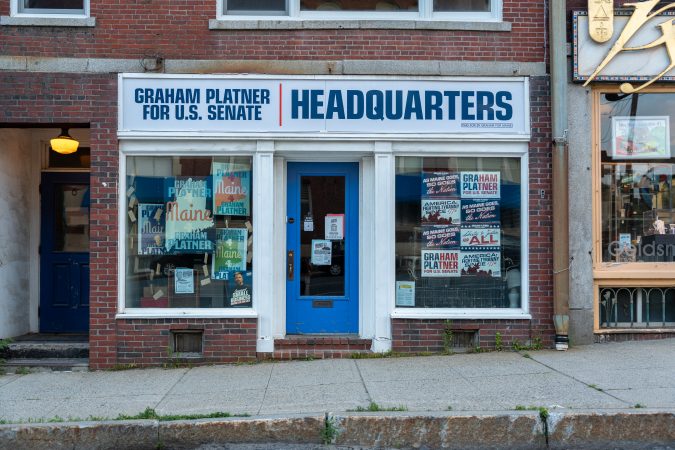
    The implosion of Graham Platner’s campaign for Senate in Maine after an accusation of rape has ripped open divisions inside the Democratic Party as its progressives and moderates battle to pick his successor even before he has said he will step aside.

    National Democrats have grown alarmed that a seat seen as crucial to winning control of the Senate could be slipping from the party’s grasp. Platner had survived a series of controversies — about a tattoo with Nazi symbolism, inflammatory old Reddit posts, and his relationships with women — but many in the party abandoned him after the rape accusation, including the leaders of the Maine Democratic Party and Senate Minority Leader Chuck Schumer.

    They have demanded that Platner step down before a Monday deadline for him to be replaced on the ballot to find a new Democrat to run against Sen. Susan Collins, a longtime Republican fixture in the state. The main super political action committee for Democratic Senate candidates said it would redirect $24 million in ad reservations to other states if he remained.

    Sen. Bernie Sanders (I., Vt.), one of Platner’s earliest and most prominent backers, joined the chorus on Tuesday afternoon.

    “I have spoken with Graham Platner about the best path forward for Maine,” Sanders said in a statement. “In light of these very serious allegations, I have recommended that he step aside.”

    Platner, who has denied the allegation, said on a private call with his campaign staff on Monday evening that he believed he still had leverage to influence which candidate would replace him on the ticket, according to three people familiar with the conversation. On the call, he did not announce plans to withdraw but implied such a decision would be coming, the people said.

    Platner’s campaign had stopped running ads on Meta’s platforms, such as Facebook and Instagram, as of Tuesday, according to the company’s ad disclosure database. He had been running multiple ads as recently as Monday evening.

    The drama comes almost exactly two years after the Democratic Party was roiled by the exit of Joe Biden, then the president, from his reelection race and the speedy anointment of Vice President Kamala Harris as the Democratic nominee. That process — and Democrats’ ultimate loss in 2024 — has left deep scar tissue for many in the party.

    Many on the left — including, it appears, Platner himself — want any replacement to come from the progressive wing of the party after he won the primary over Gov. Janet Mills, a moderate two-term Democrat, who withdrew over a month before the election.

    “To the Democratic establishment: This is not your opening,” said Joseph Geevarghese, executive director of Our Revolution, a group that emerged from Sanders’ 2016 presidential campaign. Referring to Senate Democrats’ campaign arm, he added, “Mainers did not vote by an overwhelming margin against Janet Mills and the DSCC’s handpicked pick just to be handed another status-quo candidate anyway.”

    On the flip side, many in the party establishment believe those on the left should show some humility after Platner’s collapse.

    A range of Democratic groups and activists engaged in the politics of “I told you so.”

    “When women raise the alarm, listen,” said a social media post from EMILY’s List, a group that works to elect Democratic women and that had backed Mills. “Graham Platner’s behavior is disqualifying (AS WE HAVE SAID THIS WHOLE DAMN TIME), and he should end his campaign.”

    On Tuesday morning, more Democrats who are ideological allies of Platner called for him to step aside, including New York City Mayor Zohran Mamdani.

    “I believe that it’s time for him to drop out of the race,” Mamdani said when asked at a news conference. “I think the focus of today should be to respond to the gravity of what so many of us have read, and I think the only appropriate response is for the campaign to come to an end.”

    Mamdani and Platner share several advisers, including Morris Katz and Rebecca Katz of the Fight Agency.

    The progressive group MoveOn also dropped its endorsement.

    As the situation in Maine threatened to spiral out of control, Schumer and the Democratic Senatorial Campaign Committee are set to host major donors this week for a fundraising retreat at the Broadmoor in Colorado Springs. Donors are asked to contribute $44,300 to attend, according to a copy of the invitation.

    The event, which was previously scheduled, was billed as a “special weekend to discuss the DSCC’s strategy and campaigns for taking back the Democratic Senate majority,” but now talk is likely to be consumed by the developments in Maine.

    Platner can be replaced as the Democratic nominee if he withdraws voluntarily by Monday. The state Democratic Party would then have until July 27 to pick his replacement, under state law. But the law does not dictate how the state party itself needs to pick Platner’s replacement.

    What that would look like remains unclear. The options under discussion include a convention or a statewide caucus in late July.

    “We ask for your patience as this work continues,” Devon Murphy-Anderson, the state party’s executive director, wrote in a message to committee members on Tuesday, adding: “Whatever process is ultimately adopted must reflect our Democratic values. It should be open, inclusive, transparent, and fair.”

    A range of candidates are being discussed, with some early attention on those who ran and lost the primary for governor this year. Those Democrats include Troy Jackson, a former president of the Maine Senate; Nirav Shah, a former director of Maine’s public health agency; and Shenna Bellows, Maine’s secretary of state. But some Democrats were concerned about elevating someone who just lost.

    Supporters of Jackson, who had backed Platner in the primary, created a Draft Troy website, and he filed paperwork with the Federal Election Commission for a Senate exploratory committee. Shah put out a statement that said he had received “hundreds of encouraging messages,” adding that anyone who ran for the nomination should commit to a televised debate and “multiple town halls across every corner of the state.”

    Another possible candidate is Dan Kleban, a co-founder of the Maine Beer Co., a brewery outside Portland. He briefly ran for Senate last year before dropping out and endorsing Mills. But like Platner, he has never held elected office or been through the rigors of a campaign.

    Yet another possibility is Jordan Wood, who also previously ran for Senate and dropped out. Wood ran instead in the primary for Rep. Jared Golden’s House seat and lost.

    Golden, a moderate Democrat and veteran who holds the most pro-Trump House seat of any Democrat in Congress, is retiring and previously said he was ready to step away from elected office.

    In recent days, Golden has fielded calls gauging his interest in a run for Senate, according to two people familiar with those conversations who spoke on the condition of anonymity to describe private discussions.

    Golden has not commented since the latest allegations against Platner emerged.

    More unconventional picks were being bandied about, as well. One Democratic firm in recent days included actor Patrick Dempsey in a poll. (He was viewed favorably by 52% of voters in the survey.) Others floated the popular liberal historian Heather Cox Richardson, who is based in Maine.

    Some Democrats erupted after the news emerged that Platner wanted a replacement who was aligned with him politically. One person familiar with the Platner campaign’s internal discussions said Monday that Platner would seek a guarantee he would be replaced by someone in agreement with “the values and vision and policy agenda” that he had pressed.

    Others argued that under the circumstances, Platner’s support would be damaging.

    Joe Baldacci, a state senator who ran and lost in the primary for Golden’s House seat this year, said the idea that Platner would bless a replacement would be the equivalent of “tying a lead weight” to the person.

    “After you have put the Democratic Party in a shambles and undermined all Democratic candidates running for office in Maine then you should have no say in who will be your successor,” Baldacci wrote on social media. He added, “Any connections to Platner will doom that person’s campaign from the very beginning.”

    This article originally appeared in the New York Times.
  • Judge rejects Justice Department attempt to get names of 2020 election workers in Fulton County

    Judge rejects Justice Department attempt to get names of 2020 election workers in Fulton County

    ATLANTA — The U.S. Department of Justice cannot have the names and personal contact information for every person who worked during the 2020 election in Georgia’s Fulton County, a federal judge ruled Tuesday.

    The Justice Department in April obtained a grand jury subpoena seeking the names and personal contact information of county employees and volunteer poll workers. President Donald Trump has long claimed without evidence that widespread voter fraud in Georgia’s most populous county, a Democratic stronghold, cost him victory in the state in 2020.

    Fulton County asked a judge to quash the subpoena, arguing it was meant to “target, harass, and punish the President’s perceived political opponents” and that it was “grossly over broad and untethered to any reasonable need.”

    “Given the low need for the subpoenaed information and the highly burdensome nature of the disclosure of the same, the Subpoena is unreasonable and must be quashed,” U.S. District Judge William Ray wrote in his ruling, calling the scope of the request “staggering.”

    Emails seeking comment were sent to both the Justice Department and Fulton County.

    While grand juries often work with federal prosecutors to investigate alleged crimes, “that does not give the DOJ the right to use the Grand Jury to do whatever the DOJ wants,” he wrote.

    Even if the records sought by the Justice Department could help find people who worked for the county during the 2020 election who support the theory that the election was unfair, the information couldn’t be used to charge anyone, Ray wrote.

    “That is because the statute of limitations for any possible crime arising from the 2020 Election has long expired,” he wrote.

    The subpoena came after the FBI in January served a search warrant at the Fulton County election hub and seized hundreds of boxes of ballots and other documents from the 2020 election. A federal judge in May denied the county’s request to force the federal government to return the ballots.

    The Justice Department argued in a court filing that the subpoena was the “next step in the normal investigative process” and that it seeks “records identifying persons with relevant knowledge.”

    Kamal Ghali, a lawyer for the county, argued that the subpoena “will chill participation by election workers” and that the statute of limitations for any of the alleged misconduct had already lapsed.

    Justice Department lawyer William McComb argued the statute of limitations issue is not relevant at the investigative stage. The point of the investigation is to figure out what charges can be brought, he said.

    “My point is, as we sit here now, we are not sure what charges can be brought. That’s the whole point of the investigation,” he said.

    The request for election workers’ contact information, McComb said, “would simply be a pathway to determine and speak with and interview certain individuals who worked at the polls who may have seen, heard or done something in and of themselves.”

    The judge noted that the Justice Department had expressed concern about possible criminal actions in the years that followed the election, including an alleged failure by the county to preserve electronic ballot images. But he pointed out that the subpoena seeks information related to what happened during the 2020 election and its immediate aftermath.

    “In these hyper-political times in which we currently live, there are sure to be some who disagree with this decision because they believe the allegations of fraud in the 2020 Election and believe that ‘light’ should be brought to those claims,” Ray wrote.

    He added that nothing prevents continued investigation into those allegations by people who believe those claims — such as Congress or even the Justice Department — but the power of the grand jury, “which exists to investigate potential crimes and to bring viable indictments,” cannot be used for that purpose. Otherwise, anyone in power could use the grand jury process to subpoena personal information of citizens “with no legitimate law enforcement purpose,” he wrote.

    “Thus, everyone, whether you support the President or you do not, or whether you believe the 2020 Election was fair or believe that it was not, should be concerned about the DOJ’s ability to utilize the power of the Grand Jury to appropriate your private information without a legitimate purpose,” Ray wrote.

  • NATO unveils billions in arms deals to prove its firepower as Trump again demands Greenland

    NATO unveils billions in arms deals to prove its firepower as Trump again demands Greenland

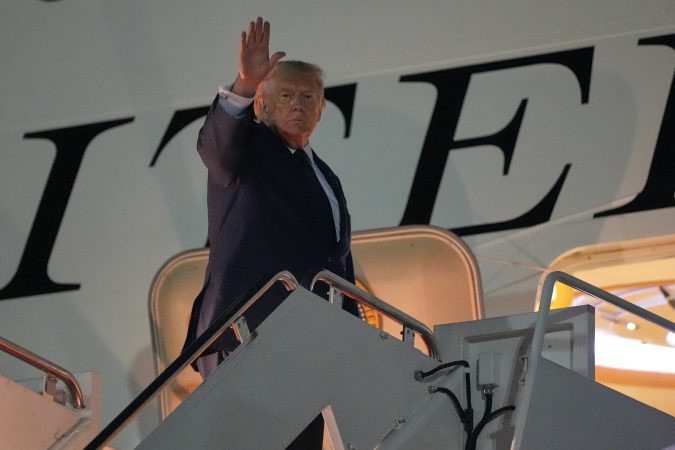
    ANKARA, Turkey — President Donald Trump on Tuesday insisted that the United States should be in control of Greenland rather than NATO ally Denmark, renewing tensions in Europe even as the trans-Atlantic military alliance was announcing billions in arms deals at a summit in an attempt to appease the mercurial U.S. leader.

    Trump called the semiautonomous island “an important part” for the United States, as he repeated the false claim that it’s surrounded by Chinese and Russian ships and said he won’t let Greenland be threatened.

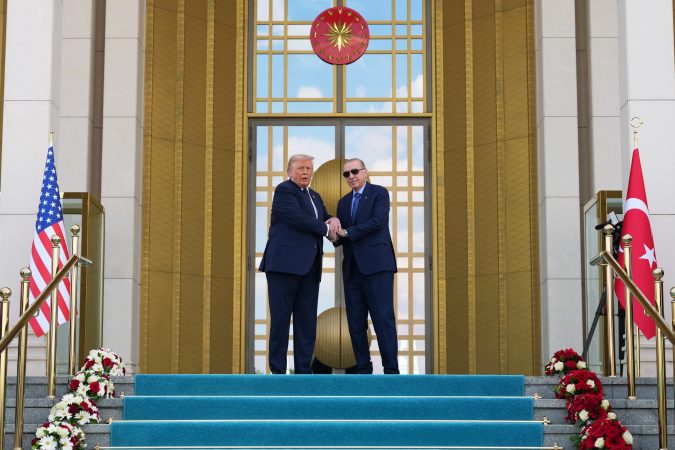
    “That should be controlled by the United States, not by Denmark,” Trump told reporters during a meeting with Turkish President Recep Tayyip Erdogan in Ankara.

    The NATO alliance was founded on the principle that its 32 members will defend each others’ territory and not threaten to seize it. At the summit, European countries and the alliance’s secretary-general, Mark Rutte, were already working overtime to address another longstanding Trump complaint: that European allies do not spend enough on their own defense.

    Separately, Trump announced that the U.S. will lift sanctions on Turkey that were issued after Ankara purchased a Russian missile defense system that led to the country being kicked out of the F-35 fighter jet program — in a nod to his warm ties with summit host Erdogan.

    Trump cites Erdogan ‘chemistry’ as he lifts obstacle on F-35s

    Turkey’s purchase in 2019 of Russian-made S-400 missile defense systems sparked years of tensions, despite the warm personal relationship between Trump and Erdogan dating back to the U.S. president’s first term.

    Legal hurdles remain before Turkey could be fully admitted back to the U.S. F-35 program, but the removal of sanctions issued under the Countering America’s Adversaries Through Sanctions Act would help ease that process. Regaining access to the F-35s is a top goal of Erdogan.

    “We’re going to be taking the sanctions off, OK?” Trump said in response to a question, saying Secretary of State Marco Rubio, Treasury Secretary Scott Bessent, and Defense Secretary Pete Hegseth were working on the issue.

    Trump said the possibility of selling F-35s to Turkey is “something certainly we’d consider” given the countries’ relationship, and that “Turkey’s been, in many ways, much more loyal than other countries that we think would be loyal.”

    Erdogan expressed hope that the U.S. will sell the F-35s, saying the U.S. president always stands by his word.

    Trump and Erdogan showed off their fondness for each other. Erdogan greeted Trump with an elaborate ceremony involving military officials on horseback and jets overhead emitting red, white, and blue smoke.

    Asked what makes their relationship so strong, Trump said there’s “a chemistry that works between us,” adding that “Sometimes you get along with the toughest people, like him.”

    Turkey’s access to U.S. F-35s could complicate relationships elsewhere. Israeli Prime Minister Benjamin Netanyahu said he has urged Trump not to sell the fighter jets to Turkey, saying it would put Israel in danger.

    “This is not a force for peace and stability,” Netanyahu said on CNN. “When you give them that power, you’re going to see aggression its wake.”

    There is also opposition among U.S. lawmakers to Turkey having the F-35s as long as the Russian missile defense system remains in its possession. Even if sanctions are lifted, the Trump administration still faces restrictions under U.S. law that prevent Turkey from being able to purchase the fighter jets if it owns the S-400s.

    NATO has ‘moment of great pride’ on defense

    Earlier in the day, NATO showcased military projects worth billions of dollars — an investment Rutte called “money well spent” and one clearly meant to try to satisfy Trump.

    Rutte was speaking to government ministers and defense industry officials at a forum billed as NATO’s “big reveal,” to the thrum of techno music.

    NATO does not own weapons — these are the property of member countries — but it has 14 AWACS early warning radar surveillance planes that are about 50 years old, along with newer surveillance drones.

    A deal to replace the aging planes was announced Tuesday. Swedish manufacturer Saab will supply up to 10 new GlobalEye surveillance aircraft for a 10-nation consortium, Swedish Prime Minister Ulf Kristersson announced.

    “It’s a moment of great pride,” he said.

    Some projects will be paid for with funds from a system of cheap loans for defense purposes set up by the European Union, comprising up to $170 billion raised on capital markets.

    Representatives from 15 nations announced a multinational effort to buy air-to-air refueling and transport planes from Airbus. Then Rutte announced a four-country effort to purchase as many as five new Triton surveillance drones.

    Rutte had told reporters on the eve of the two-day summit that “we will announce tens of billions in new contracts.” However, at Tuesday’s event, no dollar figures were given and the display included some projects long since agreed upon.

    Ukraine’s Zelensky pushes for NATO entry

    Separately, Ukrainian President Volodymyr Zelensky made a fresh appeal for his country to be allowed to join the alliance, saying his country’s armed forces are highly experienced and would boost NATO’s defense capabilities.

    He highlighted Ukraine’s ability to strike deep inside Russia and hit oil refineries and other energy targets. He said Ukraine’s armed forces are “eliminating” on average 30,000 Russian troops every month. He is set to meet with Trump on Wednesday in Ankara.

    “Frankly we take no pride in this,” Zelensky said, noting that the war with Russia — now in its fifth year — is one “we did not seek but one we are forced to fight.”

    Concern is mounting among some European countries that Russia might be preparing a hybrid attack — a combination of conventional warfare with tactics like cyberattacks — on the continent as Russian President Vladimir Putin struggles to secure victory in Ukraine.

    Yet a senior NATO official, speaking on the summit’s sidelines, said that despite some “reckless” actions by Russia, including airspace violations over Poland, Romania, and Estonia, the alliance has been successful in deterring Moscow from any potential attack on a member country. The official insisted on anonymity to brief reporters.

  • McConnell speaks to Republican leaders as speculation swirls about his health, remains hospitalized

    WASHINGTON — The Senate’s top two Republicans have spoken individually to Kentucky Sen. Mitch McConnell, according to aides, as the former GOP leader remains in the hospital more than three weeks after being admitted for undisclosed health issues.

    Aides to McConnell have declined to release any information about his condition, fueling speculation about his prognosis and whether he will be healthy enough to be at the Capitol when the Senate returns to Washington next week after a two-week recess. McConnell, 84, is retiring at the end of his term in January.

    A spokesperson for Senate Majority Leader John Thune (R., S.D.) said he had spoken with McConnell by phone on Monday and that the two had a “lengthy and substantive conversation that covered a variety of topics, including national security.” As leader, Thune is generally kept up to date on illnesses and absences in his conference as he has to navigate vote counts and his narrow 53-47 majority.

    Wyoming Sen. John Barrasso, the No. 2 Senate Republican, had a 20-minute conversation with McConnell on Tuesday, according to a spokesperson. The two discussed Senate races ahead of the midterm elections, the Supreme Court, and other topics, the statement said.

    “Senator McConnell was fully engaged and is eager to get back to the Senate,” said Barrasso spokesperson Kate Noyes.

    Another McConnell ally, Republican strategist Scott Jennings, posted on X that he had also talked to McConnell for 20 minutes on Tuesday, and that “he’s still recovering in the hospital.” Jennings said they spoke about politics, foreign policy, “and even a little bit of Senate history.”

    Few details released as McConnell remains in the hospital

    McConnell was admitted to the hospital on June 14, according to a statement from his office that only said he was “receiving excellent care.”

    A statement a week later said that he would not be voting that week. And on Thursday, a new statement said that he ”appreciates the outpouring of support he’s receiving while he continues his recovery in the hospital.”

    “The Senator continues to improve, and is working closely with his staff on Kentucky and Senate matters while the Senate is out of session,” the statement said.

    A spokesperson for McConnell released the same statement again on Tuesday, with no updates.

    McConnell has a history of health troubles

    The senator’s unspecified health issues come after several hospitalizations in recent years.

    While he was still Republican leader, McConnell was hospitalized with a concussion in March 2023 and missed several weeks of work after falling in a Washington hotel. He twice froze up during news conferences after he returned, staring vacantly ahead before colleagues and staff — including Barrasso, who is a doctor — came to his assistance.

    A year later, he fell and sprained his wrist while walking out of a GOP luncheon.

    McConnell had polio in his early childhood and he has long acknowledged some difficulty as an adult in walking and climbing stairs. He also tripped and fell in 2019 at his home in Kentucky and underwent surgery for a fractured shoulder.

    The Kentucky senator was first elected to the Senate in 1984 and was the Republican leader from 2007 until last year, serving as both majority and minority leader during that period. He has remained active as a rank-and-file senator, showing up for work when the chamber is in session, often using a wheelchair to get around.

  • Judge rules for the Washington Post in $3.8B defamation suit brought by Trump Media

    Judge rules for the Washington Post in $3.8B defamation suit brought by Trump Media

    A federal judge on Thursday ruled in favor of the Washington Post, throwing out a $3.8 billion defamation lawsuit filed in 2023 by President Donald Trump’s social media company, Trump Media and Technology Group.

    U.S. District Judge Thomas Barber, who is based in Tampa, wrote in a summary docket entry — known as a minute order — that Trump Media “failed to present evidence that would allow a jury to find by clear and convincing evidence” that the Post “published the allegedly defamatory statements with actual malice.” Barber granted the Post’s motion for summary judgment and denied one from Trump Media.

    The judge said in his ruling Thursday that a full opinion is forthcoming.

    Public figures who sue for defamation in U.S. courts generally must demonstrate that the defendants acted with actual malice — disseminating information they know is false, or acting with reckless disregard for the truth — under the standard set by the landmark 1964 Supreme Court case New York Times Co. v. Sullivan.

    In the complaint, lawyers for Trump’s social media company alleged a “yearslong crusade” by the Post that culminated in an “egregious hit piece.”

    The article, published on May 13, 2023, focused on Trump Media’s effort to obtain financing ahead of a merger to take the company public. The deal, a merger with a special purpose acquisition company, or SPAC, called Digital World Acquisition, received sign-off from federal securities regulators in February 2024. One month later, in March, the company debuted under the ticker symbol DJT on the Nasdaq stock exchange.

    “We are pleased with the court’s decision and look forward to reviewing its written order upon release,” a Post spokesperson wrote in a statement.

    After discovery concluded in the case, the Post published a correction to the original piece, appended with a hyperlink on May 22, 2026 — three years after it was published.

    The correction noted that “[d]iscovery in the ongoing litigation has established that Trump Media didn’t pay a loan referral fee of $240,000, as was stated in the article and was based on The Post’s reporting at the time of publication.”

    Trump Media said the correction was a win and said it is considering appealing the court loss.

    “After three years, The Washington Post finally admitted its harmful story was false,” a spokesperson for Trump Media wrote in a statement on Monday. “We believe a jury should decide whether these falsehoods were actionable and will evaluate whether to appeal last week’s ruling in due course. We will also continue to hold the media accountable.”

  • An Idaho mother who said her toddler twins died after vaccinations has been charged with murder

    An Idaho mother who said her toddler twins died after vaccinations has been charged with murder

    An Idaho woman who said her toddler twins died last year after being vaccinated faces murder charges connected to their deaths, authorities said.

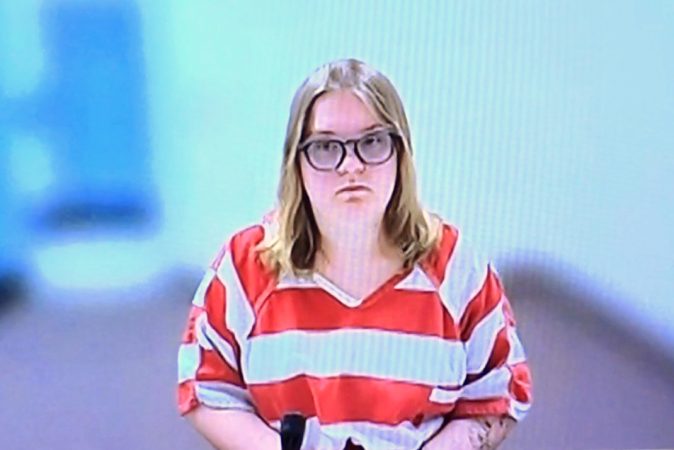
    A grand jury indicted Andrea Shaw, who is accused of suffocating her 18-month-old twins in May 2025, on two counts of first-degree murder on June 29, according to court records and a statement from the Payette Police Department.

    While appearing last year on an internet show produced by Children’s Health Defense — an anti-vaccine group founded by Health and Human Services Secretary Robert F. Kennedy Jr. — Shaw said her twins died after getting vaccinated. Kennedy has not been affiliated with the group since December 2024, when he formally resigned as chairperson to join President Donald Trump’s administration.

    Shaw, 23, was arrested by Boise police officers last week and arraigned Thursday. She is being held on a $2 million bond and could face life in prison or the death penalty if convicted or if she pleads guilty to first-degree murder. Her next court appearance is July 14.

    Joe Filicetti, an attorney representing Shaw, wrote in a text message that she “denies anything and everything” and that the state “cannot prove” the criminal charges.

    “We will defend her with wholeheartedness,” Filicetti added.

    The Payette Police Department and the Payette County prosecutor’s office declined to comment Monday.

    During her May 2025 appearance on the Children’s Health Defense show, Shaw said she found her twins dead in their room days after they got vaccinated for the flu and other diseases.

    “They had got their shots at the same time by two nurses at the same time,” Shaw said. “And they got sick.”

    Medical experts point out that the childhood vaccines at issue — hepatitis A, influenza, and DTaP — are safe and effective for kids and recommended by various medical groups.

    Shaw is also a plaintiff in a federal lawsuit brought by Children’s Health Defense and others against the American Academy of Pediatrics. The lawsuit, which was filed in January in federal court in Washington, accuses the American Academy of Pediatrics of racketeering for its “central role in an enterprise that has defrauded American families about the safety of the childhood vaccine schedule for several decades.” In the lawsuit, Shaw is described as a mother “whose children died following routine vaccinations administered according to AAP guidelines.”

    The American Academy of Pediatrics has asked the court to dismiss the suit, asserting in an April court filing that it is the “latest missive in a campaign targeting” the academy and its “use of science-backed evidence in vaccine policy.”

    In January, pediatricians and other experts became alarmed when U.S. health officials made broad changes to childhood vaccine guidance, dropping several universal recommendations. Kennedy, who helped lead the anti-vaccine movement for years, said the changes better align the U.S. with peer nations “while strengthening transparency and informed consent.”

    In March, a federal judge blocked the changes and said Kennedy likely violated federal procedures in revamping a key vaccine advisory committee. But the judge’s order is not the final word; the blocks are temporary, pending either a trial or a decision for summary judgment.

  • The accused is in court but conspiracy theories still swirl around Kirk case

    The accused is in court but conspiracy theories still swirl around Kirk case

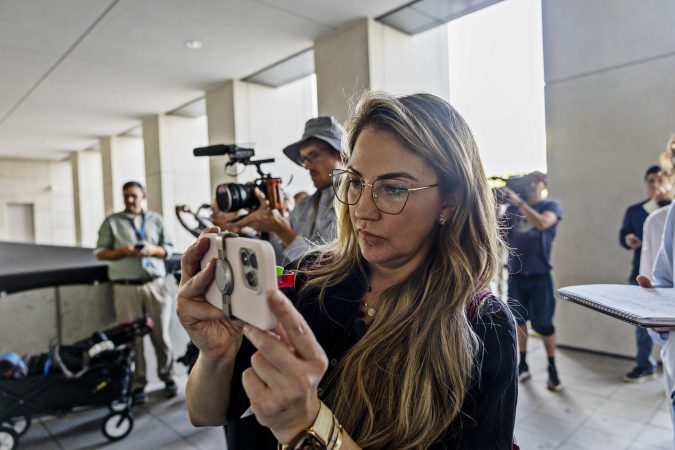
    PROVO, Utah — Outside the state District Court where the preliminary hearing for a man charged with shooting Charlie Kirk was about to begin its first day, Houston-based podcaster Keli Rabon laughed sheepishly when asked if that man, Tyler Robinson, was guilty.

    “You’re going to think I’m crazy,” Rabon replied, “but I think Charlie’s still alive.”

    Robinson, she went on, “was at most a spotter” at the scene of the crime at Utah Valley University last September. Rabon suggested that Kirk, a 31-year-old conservative activist, was currently at an undisclosed location and that he, along with his wife, President Donald Trump, and other government officials, were potentially involved in the “psy-op.”

    Rabon is one of several conspiracy theorists at the Provo courthouse. Camping out overnight to be the first member of the public allowed into the courtroom, Selena Armitage, too, had questions. A true-crime enthusiast living 45 miles away in West Valley City, Armitage said of Kirk’s killing, “I don’t think we’ve even scratched the surface.”

    The proceeding this week to weigh evidence against Robinson will seek to impose judicial norms on a case that seems likely to test those standards to the breaking point. Kirk’s death, after all, is the first assassination of a prominent American political figure in the internet age. Any straightforward prosecution of Robinson will require navigating a parallel universe of conspiracy theories turbocharged by social media.

    The cramped district courtroom has just 14 seats available to the public, and some will be occupied by people including Rabon and Armitage, who are of the view that the state’s case is far from the complete picture. They will be reinforced by untold watchers of the hearing’s livestream.

    The shooting was, in effect, nationally televised. The moment a bullet pierced Kirk’s neck was captured on mobile phones and posted in real time.

    As straightforward as the horrific footage was, internet sleuths were not taking it at face value: Where is the exit wound? Where is the blood? Who are the adults in the campus audience? Is one of them gesturing just before the shot? Why do some of the staff members of Turning Point USA, Kirk’s political organization, seem to react without alarm to his slumping body? Why are several men in the crowd wearing maroon shirts?

    The first two days of testimony have offered additional fodder. The prosecution’s opening witness, a former Utah Valley special officer named Chris Bagley, testified Monday that his body camera’s battery died while he was investigating the rooftop where police say Robinson fired his lethal shot.

    Under cross-examination by defense attorney Kathryn Nester, Bagley also acknowledged that his report did not include any mention of a rifle case that surveillance video showed the shooter carrying. Nor had he identified a plainclothes officer with a badge who had accompanied Bagley to the rooftop. Nor had he secured an empty pistol holster that he saw lying abandoned on the grassy area near where Kirk was killed.

    On Tuesday morning, Nester elicited from the lead investigator in the case, David Hull from the State Bureau of Investigation, the facts that no shell casings had been found on the rooftop, while at least two other firearms were discovered at the crime scene below. Hull also admitted that he had not interviewed two individuals who claimed that their own rooftop video featured an individual whose clothing and build did not match those of Robinson.

    Such vagaries are common in criminal investigations. Evidence is rarely conclusive, eyewitness accounts seldom 100% reliable, confessions not always ironclad. But such nuance can be lost on the judges and juries of social media.

    Right-wing social media influencers have foraged on Kirk’s assassination with particular zeal, chief among them Candace Owens, a former Turning Point USA star turned antagonist who has devoted dozens of podcast episodes to the subject.

    “I feel confident stating that Tyler Robinson did not murder Charlie Kirk,” Owens said recently. In her view, Robinson was “a total patsy” who was not even on campus that day.

    Owens has at various times implicated the victim’s widow, Erika Kirk, Turning Point USA staff, and even the Israeli government, but only with tantalizing questions and dots for her audience to connect, not a true alternative scenario.

    Erika Kirk and other Turning Point officials have expressed outrage, but privately, they have acknowledged the far right’s susceptibility to such theories, owing to a suspicion of traditional news sources and hostility toward the left.

    Kirk himself regularly argued that the 2020 presidential election was stolen and that Democrats were purposely opening the border to reshape the electorate.

    Such theories may lack evidence, but they have an audience. By far the biggest media presence at the Utah preliminary hearing is Fox News Channel, which has more than a dozen employees in Provo. And as Rabon acknowledged outside the courtroom, conspiracy theories are popular — some more than others. Her podcast was eight months old and already had 7,500 YouTube subscribers, a figure that she said would be higher if she were to embrace a more alluring conspiracy theory, such as the belief that Kirk was killed by an incendiary device in his microphone.

    “I’m doing ‘fake death,’” Rabon said. “If I was doing ‘exploding microphone,’ the algorithms would like me better.”

    This article originally appeared in the New York Times.
  • Explosions rock Syria’s capital as French President Macron visits

    Explosions rock Syria’s capital as French President Macron visits

    DAMASCUS, Syria — Explosions rocked Syria’s capital on Tuesday and injured at least 18 people as France’s president met with his counterpart in a landmark visit to the country rebuilding from years of civil war, Syria’s Interior Ministry said.

    It was the second attack in Damascus in a week and a setback for President Ahmad al-Sharaa as he welcomed the first major Western leader to visit since the ouster of longtime dictator Bashar Assad by insurgent groups in late 2024. Syria’s new rulers have wrestled with outbreaks of violence as they assert control, but the capital had been largely peaceful.

    French President Emmanuel Macron was in the presidential palace when the explosions happened. An official from the Elysee Palace said he was safe and the meeting with al-Sharaa continued, speaking on condition of anonymity to discuss Macron’s security.

    No group immediately claimed responsibility.

    “Nothing can smother the aspiration of Syrian women and men to live in a fully sovereign, safe, pluralistic, and united Syria,” Macron said on X hours later. “This morning I met Syria in all its diversity. I saw dignity, courage and determination.”

    Later, al-Sharaa and Macron announced they have agreed to reappoint ambassadors after more than a decade, marking a major restoration of diplomatic ties.

    “Our meeting marks a historical milestone,” al-Sharaa said. France had closed its embassy in 2012 but symbolically reopened it in early 2025.

    Macron, who played a major role in pushing Europe and the United States to drop most sanctions that were imposed on Syria under Assad, was in Damascus before heading to Ankara, Turkey, later Tuesday for a NATO summit that al-Sharaa also would attend.

    A large plume of smoke was seen at the site of the blast near the Four Seasons Hotel, where Syrian media reported Macron was staying. Footage on social media showed a van and a motorcycle on fire and bloodstains on a busy street near the headquarters of the Tourism Ministry and the Damascus National Museum.

    The Interior Ministry in a statement reported by Syrian state media said one bomb had been placed in a garbage bin and the other in a parked car. It said four of the wounded were police officers, and no deaths were immediately reported.

    On Thursday, an explosive device detonated in a cafe near the Justice Palace, killing at least 10 people and wounding more than 20.

    Syria’s government sees Macron’s visit and the signing of over a dozen agreements with Paris and large French companies as a major boost for the country’s new authorities in their bid to rebuild the country battered by a 14-year uprising-turned-civil war under Assad.

    One agreement was to kick off the process of returning some 51 million euros ($58.3 million) in illicit assets that belonged to Rifaat Assad, the late uncle of Assad. Other agreements included rebuilding the destroyed water and electricity infrastructure in the city of Homs, providing technical assistance to Syria’s Central Bank as it undergoes financial reforms and bolstering cargo infrastructure at the Damascus airport.

    “The outcome of this visit confirms that Syria is steadily moving toward a new phase of international partnerships based on shared interests and mutual respect,” a Syrian foreign ministry official told the Associated Press, saying the perpetrators of the attack will be brought to justice. “Attempts to destabilize the country will not alter this trajectory.” The official spoke on condition of anonymity in line with regulations.

    The explosions represent a challenge for al-Sharaa, who has pushed to assert full control over Syria, appeal to minorities skeptical of his Islamist-led rule, and win the support of Western governments who were concerned about his past leadership of the formerly al-Qaida-linked Hayat Tahrir al-Sham group. His government has promised political and economic reform after decades of autocratic rule.

    The conflict in Syria killed nearly half a million people and displaced millions. Infrastructure lies in ruins. While other nations and businesses have made large investment pledges, the country still needs hundreds of billions of dollars to rebuild and lift millions out of poverty.

    Before arriving at the presidential palace, Macron met with members of Syrian civil society, though his office did not give details.

  • Le Pen says she’ll run for French presidency next year despite court-ordered monitor

    Le Pen says she’ll run for French presidency next year despite court-ordered monitor

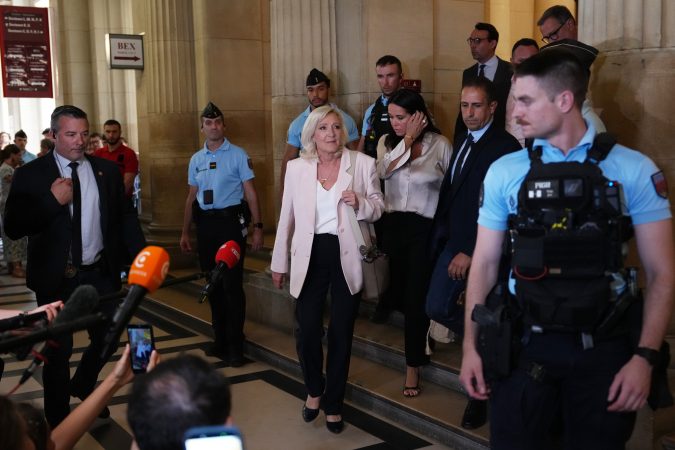
    PARIS — Far-right leader Marine Le Pen says she’ll run for the French presidency next year despite being sentenced Tuesday to wear a court-ordered electronic monitor for embezzlement.

    The decision by the 57-year-old veteran of three presidential races sets up a fourth campaign like no other: potentially seeking votes while subject to the monitoring and a judge’s determination of how, and for how long, the punishment is applied.

    Le Pen said she will appeal the ruling to France’s highest court and that the process will suspend the sentence that she wear the monitor for a year.

    “I will therefore campaign without an electronic bracelet,” she said in a television interview Tuesday night. “Tonight, I am a candidate for the presidential election.”

    The appeals court ruling cleared the way for Le Pen to run again by shortening a ban handed down by a court last year that kept her from seeking public office for five years.

    But the appeals court also said she must wear an electronic monitor. Le Pen previously said that campaigning while wearing one wouldn’t be possible. But she made clear Tuesday night that she now believes that she won’t be subjected to monitoring at all, and that she’ll be vindicated in her appeal to the Cour de Cassation.

    “My hands are clean,” she said.

    The Court of Cassation previously said it would be able to rule before the presidential election. Its first round is in April.

    The appeals court ruled that Le Pen oversaw years of misuse by her National Rally party of European Parliament funds by paying staff with money intended for European Union parliamentary assistants. She had denied criminal wrongdoing but said during the trial that the party had made a “mistake.”

    Both prison sentence and ban have been shortened

    The appeals court upheld guilty verdicts for all 11 accused, including Le Pen and other party members. The party itself also was declared guilty.

    However, the court scaled back the punishments handed down by a lower court last year.

    From five years handed down in March 2025, the ban was cut to 45 months, with two-thirds of it suspended. Le Pen has already served 15 months of the ban, meaning that the potential obstacle is effectively removed.

    Le Pen previously said that not being able to make a fourth run in 2027 would amount to “political death.”

    The verdict also cut her prison sentence from four years, two of them suspended, to three years with two suspended.

    How often Le Pen will be allowed to go out wearing the monitor, and other details about the monitoring, aren’t yet known. Conditions will be determined by another judge in the coming weeks or months.

    After at least six months of wearing it, the judge could allow Le Pen to remove it as a reward for good behavior that would include her paying the 100 million euro ($114 million) fine the appeals court included in her sentence.

    Le Pen went straight to her party’s office

    From the courthouse, Le Pen went to the National Rally’s headquarters in Paris, where her protege Jordan Bardella was seen earlier in the day. The party faces a potentially difficult decision choosing which among the two might be better placed to run in 2027.

    Bardella, a European Parliament lawmaker, lacks Le Pen’s experience and it would be his first presidential election campaign.

    A Le Pen has been on the ballot papers at every presidential election since 1988: four times for her father and three times for her.

    The party was called the National Front when her father, Jean-Marie Le Pen, founded it in 1972. It ditched that name in 2018, part of Marine Le Pen’s efforts to broaden her appeal by moving away from her polarizing father’s legacy. His associations with people who collaborated with France’s Nazi occupiers in World II and his multiple hate-speech convictions, including Holocaust denial, made the National Front anathema to many voters.

    Le Pen has steered her party’s growth in popularity as it sought to become more mainstream. It has been the largest single party in parliament’s National Assembly since 2024, although it doesn’t have a majority in that sharply divided lower house.

    But her embezzlement conviction would leave her open to criticism from potential election opponents.

    The court noted ‘the principle of freedom to stand for election’

    The court said Le Pen’s party embezzled 2.8 million euros ($3.2 million) over more than 11 years.

    “The facts are serious,” said the chief judge, Michèle Agi.

    But the court, in written notes detailing the verdict, pointed out “the voter’s freedom of choice” and said the 15 months of ban from seeking elected office that Le Pen has served have repaired harm done to public integrity by her wrongdoing.

    “Disregarding this would undermine the principle of freedom to stand for election, an essential condition for the democratic expression of universal suffrage,” the court said.

    The judge had been expected to spend several hours reading out the full verdict. Instead, the proceedings were over in less than 40 minutes in the courtroom without air-conditioning, on a day when Paris temperatures surpassed 86 Fahrenheit. Table fans provided a slight breeze.

  • Judge dismisses Prince Harry’s privacy invasion lawsuit against publisher of Daily Mail

    Judge dismisses Prince Harry’s privacy invasion lawsuit against publisher of Daily Mail

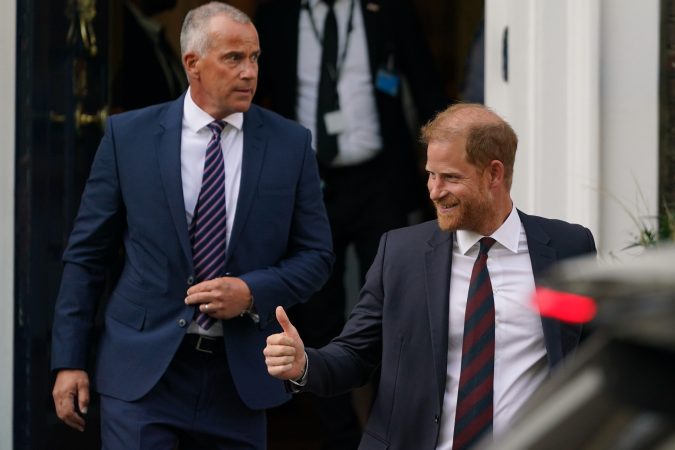
    LONDON — Prince Harry’s final lawsuit aimed at taming the British tabloids ended in defeat Tuesday as a judge said he failed to prove his privacy invasion claims against the publisher of the Daily Mail.

    Justice Matthew Nicklin rejected the broad inferences the Duke of Sussex relied on to try to show that Associated Newspapers Ltd. engaged in unlawful activities. He said there was a shortage of evidence to support the claims and found a possibility that the reporting came from legitimate sources.

    “In substance, the claimants’ case invites the Court to conclude that, because the information was private and because Associated cannot positively explain how it was sourced, the article must have been unlawfully sourced,” Nicklin wrote. “That is not a permissible approach.”

    The ruling scuttles a bid by Harry and six others, including singer Elton John and actor-model Elizabeth Hurley, seeking substantial damages but could leave them with massive legal bills. ANL put the legal costs for both sides above 50 million pounds ($67 million) for years of case preparation and an 11-week trial.

    The publisher called it an “overwhelming victory” and a “magnificent vindication” of the Mail’s journalism.

    The newspapers had denied the allegations as “preposterous,” insisting the roughly 50 articles at issue were based on lawful sources including friends, royal aides, and publicists who offered information to reporters.

    Harry said the court had denied him the justice and accountability he sought.

    “It is a complete and obvious whitewash, but sadly not altogether unexpected,” Harry said in a joint statement with another claimant, anti‑racism activist Doreen Lawrence. “However, the lengths to which the court has gone to exonerate the Mail is as shocking as it is totally unwarranted.”

    Harry’s campaign against the press yields mixed results

    The 436-page decision leaves a mixed legacy for Harry’s trio of lawsuits accusing tabloid publishers of using unlawful tactics, such as phone hacking or hiring private detectives to dig up dirt on his life.

    Harry won a judgment in 2023 that condemned the publishers of the Daily Mirror for “widespread and habitual” phone hacking. Last year, Rupert Murdoch’s flagship U.K. tabloid, the Sun, made an unprecedented apology for intruding on his life for years and agreed to pay substantial damages to settle his privacy invasion lawsuit.

    Mark Stephens, a media lawyer not involved in the case, said Harry’s first significant loss was due to a lack of evidence such as admissions of culpability that he had in previous lawsuits.

    “This was always a mosaic case where little inferences from different things were being put together by the lawyers for Prince Harry,” Stephens said. “Associated Newspapers’ lawyers cleverly rearranged the tiles to show an innocent picture as opposed to the culpable picture that the claimants’ lawyers were trying to demonstrate.”

    The verdict, released remotely with no court hearing, coincided with Harry’s visit home to the United Kingdom, which has been dominated by headlines over his latest efforts to repair a rift with his father, King Charles III.

    Harry has said his litigation — in which he broke with royal family tradition to seek relief in the courts — was a primary source of his falling out with his father and brother, Prince William.

    His grudge with the tabloids runs deep and his legal actions are part of his larger quest to reform the news media that he says damaged his relationships and made him “paranoid beyond belief.”

    He blames the press for the death of his mother, Princess Diana, who was killed in a car crash in 1997 while being pursued by paparazzi in Paris, and for attacks on his wife, Meghan, Duchess of Sussex, that led the couple to abandon royal life and move to the United States in 2020.

    “They continue to come after me, they have made my wife’s life an absolute misery,” he testified as he choked back tears in the witness box during the trial in January.

    Newspaper editor says Harry is a hypocrite

    Associated Newspapers’ editor-in-chief Paul Dacre called Harry “a confused and angry young man” and said he felt sorry he had been drawn into the case. He mocked Harry’s tell-all memoir, Spare, which included details of drug use, losing his virginity, and dishing dirt on his kin.

    “There isn’t a laundry in the cosmos big enough to wash all the dirty linen he has aired about his own family,” Dacre said. “For him to complain about his privacy being invaded takes not just the biscuit but the whole tin. Poor Harry.”

    Attorney David Sherborne said at trial that the Daily Mail and its sister publication, Mail on Sunday, used their journalists, freelance reporters, and private eyes for “clear, systematic and sustained use of unlawful information gathering” to snoop on his clients.

    Defense lawyer Antony White said Harry was inclined to see unlawful evidence gathering everywhere but the more likely source of stories about him came from “ordinary, legitimate journalism.”

    Other claimants in the case were actor Sadie Frost, former politician Simon Hughes, and John’s husband, David Furnish.

    The Mail trial played out differently from the Mirror case, with journalists parading to court to defend their work. Some Mail reporters pointed to official mouthpieces, such as a palace spokesperson, and others named their sources to dispute Harry’s assertion that his “social circles were not leaky.”

    “They were not all tight-lipped,” Katie Nicholl, a former Mail on Sunday editor, said about Harry’s associates. “I had very good sources in the inner circle.”