Category: Wires

  • Authorities release early ransom note in Nancy Guthrie case, hoping someone recognizes it

    Authorities release early ransom note in Nancy Guthrie case, hoping someone recognizes it

    TUCSON, Ariz. — Authorities released an early ransom note in the investigation into the disappearance of Nancy Guthrie in hopes that someone will recognize the writing style. A second note released Friday indicated Guthrie died shortly after she was kidnapped.

    Both notes initially went to a Tucson television station days after the 84-year-old mother of Today show host Savannah Guthrie went missing from her home outside Tucson on Feb. 1. Authorities have not said whether Nancy Guthrie is still alive.

    The Pima County Sheriff’s Department said, “We believe these distinctive linguistic characteristics may be recognizable to someone who knows or has interacted with the notes’ writer.”

    The first note, sent Feb. 2, said Guthrie was safe but scared and would be released unharmed once her captors received $4 million in cryptocurrency, with the ransom amount increasing if the first demand was not met.

    It said Guthrie would be released within 12 hours if the payment was received. It also included a threat to kill her if the ransom wasn’t paid.

    “Your mother is aware of this and her life is in your hands,” the first note read. “It is in the best interest of everyone to have this completed as soon as possible.”

    The second note to the family said Guthrie died shortly after she was taken. “She is buried in nature now,” the second note said. “Nothing you could have done could have changed the outcome.” The note ends with an apology, “We are truly sorry.”

    The sheriff’s department said the notes reveal a distinctive pattern of word choices and provide insight into the writer’s mindset. The agency said someone who knows the notes’ writer may recognize the patterns.

    In a statement, the sheriff’s department also went further to appeal to people who may know something about the case, saying it may be difficult to come forward due to a personal relationship with someone involved or just for their own safety.

    “We recognize relationships and loyalties change over time as do people and their perspectives,” the sheriff’s department wrote. “It is not too late to come forward.”

    The sheriff’s office also said Friday that two videos recovered from Guthrie’s doorbell camera might be from two separate days and indicate an unidentified male prepared ahead of when Guthrie was taken. Authorities are seeking information on anyone who was behaving differently, changed their physical appearance, suddenly left the Tucson area, or had a noticeable or unexplained interest or disinterest in the case.

    “Investigators continue to pursue every available technological and investigative lead,” the sheriff’s office said. “However, community members remain a vital resource as we seek to provide answers for Nancy’s family.”

    Also, two men detained and released early in the investigation into Nancy Guthrie’s disappearance are seeking a combined $3 million against a southern Arizona sheriff’s department. In a legal claim, they say they were wrongfully held by law enforcement.

    The claim made Thursday against Pima County Sheriff Chris Nanos’ department centers on the separate detentions of Carlos Alfredo Palazuelos and Daniel Maddow on Feb. 10. It said they were released hours later but have suffered from having been mentioned in the investigation.

    Nanos’ office declined to comment on the notice of claim, a necessary precursor to filing a lawsuit against government entities.

    Despite an intense search involving thousands of law enforcement officers and volunteers, there has been no sign of the mother of three since she was reported missing. Her children, including the NBC host, have made heartbreaking video pleas for help, but to no avail.

  • Hungary braces for a full shutdown of the Paks nuclear plant as the Danube River hits record lows

    Hungary braces for a full shutdown of the Paks nuclear plant as the Danube River hits record lows

    BUDAPEST, Hungary — Hungary’s only nuclear power plant will shut down for the first time in its history due to record-low water levels on the Danube River, Prime Minister Péter Magyar said Friday, adding that the plant may not come back online for several weeks as the river is expected to continue receding.

    The Paks nuclear plant, located around 50 miles south of the capital Budapest, is operating at less than half its normal capacity, producing 965 megawatts of power rather than the usual 2,000.

    The plant uses water from the Danube to cool its reactors, but the exceptionally low water level has tested the ability of pumps to bring sufficient quantities into the plant.

    Speaking at a news conference at the plant on Friday, Magyar said further reductions in output were imminent later Friday and that the entire plant will likely be powered down by Tuesday or Wednesday. He stressed that the shutdown can be performed safely and poses no risk to the public or environment.

    The Soviet-built, four-reactor plant at Paks accounts for nearly half of Hungary’s electricity production. If it is powered down, it will be the first time in its 44 years of service.

    Hungary and much of Central Europe has been in a prolonged period of drought in recent months, disrupting tourism, agriculture, and industry and confronting residents with the realities of climate change. Water levels are not expected to rise on the Danube in the coming days or even weeks as no significant rainfall is forecast.

    Magyar said Friday that the Danube’s water level has only risen on three occasions in the month of August in the last 20 years, and added that the level at Paks could recede to as low as negative 57 inches — far below the previous record of negative 39 inches set in 2018.

    A level of negative 52.7 inches requires the full powering down of the plant, he said. A negative reading means the river has fallen below the gauge’s zero reference level, not that the river is empty.

    Hungary’s government has requested that companies that consume large quantities of energy voluntarily reduce their consumption to help stabilize the energy supply, particularly in peak demand hours between 5 p.m. and 10 p.m.

    Magyar said Hungarian energy conglomerate MOL had committed to reducing its electricity needs by 65 megawatt-hours, a decrease of 40% from its normal consumption.

    Magyar announced Friday that his party had recommended suspending parliamentary sessions planned for Monday and Tuesday in the interest of conserving energy. He also ordered that all state institutions turn off decorative lighting by Monday.

  • Regulators propose overhaul to law governing how banks lend to low-and-middle income communities

    Regulators propose overhaul to law governing how banks lend to low-and-middle income communities

    NEW YORK — The Trump Administration has announced an overhaul to the rules governing a critical piece of Civil Rights-era legislation, most notably a reduction in the number of banks that will need to fully comply with the law.

    The Office of the Comptroller of the Currency and the Federal Deposit Insurance Corporation on Friday jointly announced the proposed changes to the Community Reinvestment Act, a law that requires regulators to document how well banks do in lending to low-to-middle income neighborhoods. It would be the first major revision of the law’s rules and regulations in nearly three decades.

    Under the proposed revisions, bank examiners would put more weight on the lending banks do in certain communities and geographies, and less on how many branches they open or how much in deposits they take in from a local community.

    The number of banks that would need to comply with the law would be reduced as well. The definition of a small bank will increase from banks with under $412 million in assets to banks with $1 billion in assets. Banks between $1 billion and $10 billion in assets will now be classified as an intermediate bank.

    This would reduce the number of banks who need to comply with parts of the CRA by 800 banks. Only 86 banks, or roughly 3% of all institutions, would be subject to the full extent of CRA under the new regulations.

    Another change that is likely to be fought over relates to how banks give money to community development groups. Under the CRA, banks can donate money to local organizations that do poverty or low-income housing work in their communities to show they are providing resources to a local community. The new regulations could narrow the groups and programs that banks could donate to in order to meet those obligations.

    In a summary of the changes, the bank regulators said these changes would ensure community development grants “are not diverted to activist causes or consumed by excessive operating costs.” Banks would also need to collect more detailed information on who gets their community grants, including addresses, which would give more transparency to who is receiving grants from banks.

    That change could negatively impact groups like the National Community Reinvestment Coalition, an umbrella group for community development groups that often receive money from banks under the CRA. The new rules discourage banks making grants to national organizations and instead focus their grants on local groups.

    Jesse Van Tol, the CEO of NCRC, said that it was “unfortunate” that the bank regulators were politicizing grant making under the CRA.

    “CRA was created to work for low-to-middle income people. A lot of these changes are going to discourage banks from making grants, particularly in rural areas, where I expect there will be significant drops in activity,” Van Tol said.

    The proposal announced Friday by the OCC and FDIC did not include the other major bank regulator, the Federal Reserve. Banking groups had been pushing for a joint proposal from all three regulators, to make sure all three were aligned on the same requirements under the CRA.

    The CRA was passed in 1977 to combat redlining, a practice whereby banks would discriminate against the poor and minorities by choosing not to lend or open branches in minority-majority neighborhoods or in poor neighborhoods.

    The law is complex, requiring banks to document how they do business in the cities and areas they operate in. Banks must sit for regular examinations to see whether they are complying with the law. A bad CRA examination could restrict a bank’s ability to open new branches or merge with another bank or have other consequences. The data collected through CRA is also used by the Department of Justice in redlining cases.

    The last major revision of the CRA’s regulations happened in 1995, and there have been repeated attempts by administrations of both parties to update the rules to reflect how banking and financial services have changed in the past 30 years. But those revisions have repeatedly failed, either due to opposition from other regulators, the banks, or community groups, or have been blocked by courts. The Biden administration tried its own revisions of the CRA rules but those changes were blocked by courts in Texas.

    The proposed rules will now go out for a 60-day comment period where they will be finalized after banks, community groups, and other parties have a chance to weigh in on the changes.

  • Social media companies sued over deaths of four teens as pressure, lawsuits over child safety mount

    Social media companies sued over deaths of four teens as pressure, lawsuits over child safety mount

    The families of four teenagers who died by suicide are suing Meta, TikTok, Snapchat, and YouTube over what they describe as “years of escalating harms” from using their platforms that eventually resulted in their deaths.

    The lawsuit, filed Thursday in the Superior Court of Delaware, is the latest in a flurry of suits filed against the social media giants that alleges their platforms are addictive and dangerous.

    The complaint was filed on behalf of four families from Texas, North Carolina, Minnesota, and Tennessee whose children died over a 14-month period starting in July 2024 through September 2025.

    The Social Media Victims Law Center is bringing the suit on behalf of the families, and its founding attorney, Matthew Bergman, said it’s “particularly salient” that the children in this case died “long after” similar suits had been filed.

    “These platforms continue to kill kids, despite the platitudes of their executives,” Bergman said in an interview. “This is a clear and present danger to the health and safety of children, not just in the United States but around the world.”

    The four teens who died by suicide each experienced harms including social media addiction, severe sleep deprivation, depression, anxiety, and suicidal ideation after years of using the social platforms, the complaint states. Livi Castro died at age 13, Riv Kelleher at 14, Nathaniel Chambers at age 17, and Dawson Holden at 18.

    The complaint alleges the social media companies knew they were causing harm to young users.

    A spokesperson for Google, which owns YouTube, said in a statement that “providing young people with a safer, healthier experience has always been core to our work. In collaboration with mental health and parenting experts, we’ve built services and policies to provide young people with age-appropriate experiences, and parents with robust controls. We send our deepest sympathies to the families and are reviewing the claims in this lawsuit.”

    Representatives for Meta, TikTok, and Snap did not immediately respond to requests for comment.

    Sacha Haworth, executive director of The Tech Oversight Project, said in a statement that parents, activists, and whistleblowers have come forward and met with lawmakers for years and “while Congress has dragged its feet, more children have died.”

    Federal legislation of social media has moved at a glacial pace. The Senate passed the Kids Online Safety Act — which had the support of parents’ groups and children’s advocacy organizations — exactly two years before this lawsuit was filed. The House of Representatives never voted on that version of the legislation, and the House and Senate are currently disagreeing on key provisions they think should be included.

    Meta, YouTube, TikTok, and Snap are facing numerous state and federal lawsuits over harms to minors. Meta is on trial in Tennessee this week for a lawsuit brought by the state attorney general claiming that the company deliberately designed its platforms, notably Instagram, to make them addictive to young people, and did not warn them of its dangers. And in August, Meta is heading to trial in federal court in Oakland, Calif., to face four of dozens of states that sued the company in 2023. That lawsuit says the company is contributing to the youth mental health crisis by designing addictive features and violated federal law by collecting data on kids under 13 without parental consent.

    Not all lawsuits are successful, and many are settled out of court. Last week, a Florida teenager dropped his case against Meta that was set to go to trial in state court in Los Angeles, without receiving any payment from the company. Meta had argued that the teen only used his Instagram and Facebook for just minutes a day, on average, and created most accounts only after hiring a lawyer in his case.

    Still, the mounting court cases can get expensive, even for a company like Meta Platforms. Earlier this week Meta said it had $2.4 billion in legal expenses in the second quarter, which contributed to a relatively unusual 14% profit decline.

  • Thousands of immigrant children losing legal representation

    Thousands of immigrant children losing legal representation

    SAN ANTONIO — Tens of thousands of immigrant children who arrived in the United States as unaccompanied minors in recent years may be forced to face a judge alone after a federal contract providing them legal representation expired on Friday.

    The leaders of several nonprofit organizations that provide legal services to immigrant children say they will need to scale back or shutter their operations altogether starting next week. Collectively they represent about 24,000 children who crossed the nation’s southern border without a parent. The groups have spent much of the last year providing legal counsel even though the federal government has not reimbursed them.

    Without a renewed contract, the legal aid organizations say many children with pending cases before an immigration judge will have to defend themselves without a lawyer. Most do not have a legal status in the country but can potentially qualify for asylum or a special visa. Many do not speak English as their primary language, and attorneys say they are more likely to be ordered deported if they do not have a lawyer.

    Michael Lukens, executive director of the Amica Center for Immigrant Rights, which provides children legal representation in the Washington, D.C., area, said the contract’s expiration comes as immigration judges and enforcement officers are pressuring unaccompanied minors to return home by signing voluntary departure forms.

    “The best chance that a child has for a fair day in court and due process is to have an attorney at their side,” Lukens said. “It’s very clear the government is trying to take away that one piece of the puzzle.”

    The Office of Refugee Resettlement, which falls under the Department of Health and Human Services and oversees the shelters that house unaccompanied minors, said in a statement Thursday that the agency remains “fully compliant with its legal and regulatory obligations and does not act in any way that could dissuade a child from seeking appropriate legal relief.”

    ORR officials said they offered to extend the existing contract so long as the providers share information about their clients. Several nonprofit leaders said the federal government was asking for confidential information about the children they serve and their sponsors — who are usually parents or relatives seeking family reunification. The organizations said they are legally and ethically unable to disclose such data and fear authorities could use it to target families during enforcement operations.

    The Trump administration tried to halt some funding for attorneys to represent unaccompanied minors shortly after taking office last year. In February 2025, officials notified the Acacia Center for Justice that the organization needed to stop all work related to a $200 million contract that funds various groups providing the children with attorneys. But a few days later, officials reversed course and restored it without explanation.

    Nevertheless, the Trump administration stopped reimbursing legal aid organizations who operate under the contract last November. The groups estimate they are owed $65 million in payments, and some have had to dip into their reserves in order to keep working.

    Congress passed bipartisan legislation nearly two decades ago that mandates the funding to protect children from exploitation. The federal government, providers argue, is obligated to pay these organizations with the money lawmakers appropriated.

    “They are clearly trying to destroy the program by grinding down the financial health of nonprofits,” Lukens said. “We have seen layoffs and furloughs and we will see a lot more of that if these invoices are not paid.”

    The legal services program also allows attorneys to monitor conditions inside federally funded shelters that house unaccompanied minors, some of which are not regulated by state officials. Many of the children in shelters are waiting to be reunited with parents or relatives, who can claim them by providing identification and financial and biometric information to the government to prove their relation.

    Fewer than 2,500 children are currently in federal custody, and on average they are staying there for 117 days — four times longer than they did a year ago, federal data shows.

    Melissa Lopez, the executive director of Estrella del Paso, a legal services provider, said the complexity of the nation’s immigration laws make it necessary for children to have legal representation. She recounted the case of a 7-year-old boy who went before an immigration judge in Texas. He told the judge he wanted to return to his home country, where his father had been deported.

    His lawyer helped him navigate the best way to do that. Immigrants can file for a voluntary departure to leave the country and avoid a deportation order with more severe consequences, but a young child, she said, would not know the difference or how to do that.

    “We cannot expect a child to have the level of understanding of these legal differences,” Lopez said. “It’s absurd.”

    Lopez said her organization will likely have to scale back its services in far west Texas and southern New Mexico. A year ago, Estrella had a team of 30 staff employees and attorneys. She expects just three staff members to continue serving 243 children in the weeks ahead. The organization is still waiting on $1.2 million in federal reimbursements for legal services provided through July, Lopez said.

    “It’s not a question of can philanthropy fill the gap,” Lopez said. “The issue is the federal government is not meeting its obligations under the law.”

  • A blanket of seaweed smothers coastlines from the Caribbean to Mexico

    A blanket of seaweed smothers coastlines from the Caribbean to Mexico

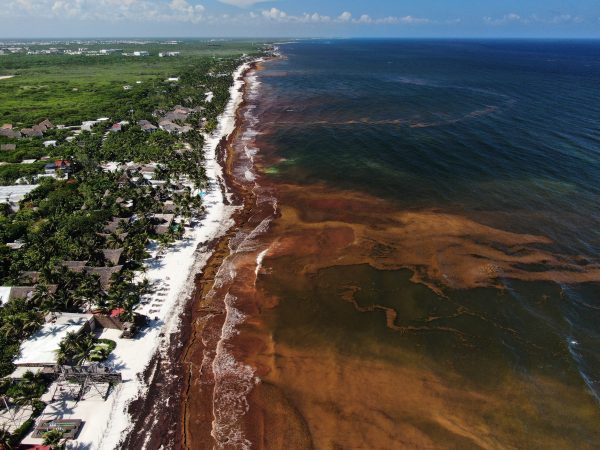
    PUERTO MORELOS, Mexico — Swaths of seaweed are blanketing the beaches and coastlines of the Caribbean and Gulf of Mexico, suffocating shorelines and snuffing out marine life while spooking visitors in areas that depend heavily on tourism.

    Some 27 million metric tons of self-sustaining sargassum have been recorded in the Atlantic, Caribbean, and Gulf of Mexico in July, according to a report released Friday by the University of South Florida’s Optical Oceanography Lab.

    The prickly seaweed covers miles of coastline, releasing a foul smell as it rots onshore.

    This year marks the first time that scientists have observed sargassum growing in large quantities in areas including the Caribbean and Gulf of Mexico, instead of being swept into those areas by ocean currents.

    The algae usually reproduces asexually as it travels from Western Africa, said Brian Barnes, a marine scientist and research assistant professor at the University of South Florida. “None of this is normal,” he said. “Every year is a little bit of a new story.”

    The Great Atlantic Sargassum Belt has been growing since 2011, dumping an increasing amount of seaweed along coastlines in the Caribbean and Gulf of Mexico. Experts have said that agricultural runoff, warming waters, and changes in wind, current, and rain could be factors.

    The sargassum that began reproducing in the region earlier than usual this year stems from a record 40 million metric tons reported last year.

    “The 2025 bloom was so big it never really left,” Barnes said. “It was enough to start a new bloom locally.”

    Seaweed threatens tourism

    Sargassum levels in the Caribbean reached record levels in June, while the amount present in the Gulf hit 5 million metric tons in June, nearly double last year’s record, according to the University of South Florida.

    Scientists expect 2026 to be the second largest amount of sargassum recorded in the Atlantic, Caribbean, and Gulf of Mexico, noting that June alone saw 34 million metric tons, which was only 10% lower than the year-earlier period.

    Mexico said Thursday it plans to invest $115 million to tackle the blooming algae, which poses an environmental and economic threat. The government estimates that up to 9,000 tons reach its Caribbean coastline on the worst days. Given current resources, Mexico says it can only gather 1,200 tons of sargassum a day.

    On a recent evening, Alan Vázquez closed the restaurant where he works as a waiter in the popular tourist town of Playa del Carmen because there were no customers. He had resisted closing for several hours, hoping he would receive a tip and salvage the day, but vast quantities of decomposing sargassum are turning the famed turquoise waters black, driving away tourists.

    “It’s sad that such a beautiful and lively place … has ended up like this,” Vázquez said.

    He fears suffering the same fate as four of his colleagues who were laid off two months ago due to a drop in tourism that has devastated hotels and businesses in the state of Quintana Roo, one of Mexico’s tourism gems, where sales fell 30% in the first half of the year, according to estimates from local businesses.

    In Puerto Rico, sargassum blankets the waters around popular tourist areas, including La Parguera.

    “I don’t recall ever having that much concentration in so many places at once,” said Waldemar Quiles, the U.S. territory’s natural resources secretary.

    Much of the record sargassum reported last year ended up along Puerto Rico’s coastline, prompting the governor to declare a state of emergency.

    It surpassed the previous record set in 2022 with a peak of some 22 million metric tons.

    “It’s not a one-off event anymore,” said Emmanuel Maldonado González, an environmental sociologist at East Carolina University. “It’s becoming a growing hazard.”

    Experts warn proliferation will worsen

    Patches of sargassum in open waters provide a healthy breeding ground for wildlife, including turtles, fish, and seabirds, and can be “a bit of an oasis of life in the middle of the ocean,” Barnes said.

    But once it’s closer to shore, it reduces oxygen in the water, smothers mangrove roots, and blocks sunlight from reaching coral and sea grass.

    Once it washes ashore it can prevent newly hatched sea turtles from reaching the ocean, while the heavy machinery used to remove it from beaches risks destroying fragile turtle nests, scientists say.

    “The coastlines are not built for this,” Barnes said.

    In the U.S. Virgin Islands, people are walking up to 25 feet on mats of seaweed before even reaching the water, according to Amy Dempsey, an environmental consultant.

    “This is by far the worst I’ve seen it in the last five years,” she said. “We are getting slammed in the Virgin Islands.”

    The smell of rotten eggs permeates communities where large piles of decaying sargassum emit ammonia and hydrogen sulfide.

    “The effects of these gases on people can be severe,” warns the U.S. Environmental Protection Agency, noting it can cause nausea, headaches, and lung irritation.

    Used in composting and bioenergy production

    Officials on the French Caribbean island of Martinique recently opened a shelter to temporarily house those affected by the toxic gases after residents protested.

    So far this year, crews in Martinique have collected more than 11,500 tons of sargassum — including 638 tons in four days alone this month — according to government data. Sea barriers catch some of the seaweed, while crews on shore collect the remainder by hand, storing and processing it for composting and bioenergy production.

    Researchers at the University of South Florida and the U.S. National Oceanic and Atmospheric Administration used artificial intelligence and found that from 2003 to 2022, macroalgae blooms increased by more than 13% per year in the tropical Atlantic and Western Pacific.

    Overall, the blooms reached 16.9 million square miles, according to a study published earlier this year.

  • Trump claims breakthrough on Hamas disarmament, Gaza transition

    Trump claims breakthrough on Hamas disarmament, Gaza transition

    The United States has brokered a pathway to a deal between Hamas and the Israeli government for the Palestinian militant group to lay down its arms in Gaza in exchange for an eventual Israeli withdrawal from the territory, U.S. officials said Thursday, a potential breakthrough to end nearly three years of conflict there.

    The framework was a potential step toward an Israeli pullout from Gaza and the eventual rebuilding of the territory, much of which has been reduced to rubble. But on Friday morning, Israel remained conspicuously silent on the deal, and after years of fighting, there was little trust between the sides.

    President Donald Trump portrayed it as “a HISTORIC agreement for the COMPLETE DISARMAMENT of Hamas and all other armed groups in Gaza. This is a monumental step toward lasting PEACE and SECURITY,” in a post on social media.

    He said that the agreement envisioned Hamas disarming in stages, with the Israeli military pulling out of the territory gradually and being replaced by an international stabilization force that would work in partnership with a revamped Palestinian police force to provide security.

    As of Friday, Israeli Prime Minister Benjamin Netanyahu’s office had not commented officially on Trump’s announcement, raising questions about where Israel stands on the latest development.

    Hamas said in a statement Friday that Israel’s “commitment to halting the killing and ending its aggression is the fundamental prerequisite and the first step towards implementation” and that a “framework and timetable for what has been agreed upon” must be established.

    A U.S. official said Hamas had agreed to the framework through Egyptian mediators. The official suggested that the plan didn’t diverge from what Israel agreed to nearly a year ago as part of a deal to free hostages — but acknowledged the possibility that the Israeli position has changed in the meantime.

    “We’re not asking Israel to do anything other than agree to the 20-point plan that they agreed to initially, and so we’re very confident they will adhere to it. If they don’t, obviously, President Trump will be very, very disappointed,” a U.S. official said, speaking on the condition of anonymity to discuss the sensitive negotiations. Israel agreed to the plan in September 2025.

    But the official acknowledged the challenges: “We’re going to try to do something very, very impossible,” the person said.

    The road map leaves major implementation questions unanswered. U.S. officials characterized it as a step-by-step plan to hand power in Gaza to Palestinian authorities that are not Hamas, which launched an attack on Israel on Oct. 7, 2023, that was met by an intense Israeli response. The composition of the new Palestinian administration was not fully clear, for instance, nor which countries would contribute to the international forces, or when they would deploy.

    “This agreement is a critical step towards Gaza finally being governed by a new Palestinian government that will work closely with the Board of Peace to help the Palestinian people. At the same time, Israel will have the security it deserves, with Gaza no longer used as a base for terror attacks,” Trump wrote.

    Israel has long insisted that Hamas disarm first. Hamas had called for Israeli forces to withdraw first. The White House on Thursday did not clarify how that deadlock will be overcome.

    On Friday, an Israeli official, speaking on the condition of anonymity to discuss sensitive diplomatic issues, reiterated Israel’s long-standing position. “Israel demands the complete disarmament of Hamas, including the removal of weapons from Gaza and the full demilitarization of the Strip, as a prerequisite for any process,” the official said.

    That would be a rejection of the step-by-step plan envisioned by Nickolay Mladenov, the director general of the Board of Peace, the Trump-backed group that was set up in the aftermath of the 2025 deal to release the remaining hostages that Hamas seized during the October 2023 attack.

    Hamas said in its statement that any decision to give up heavy weapons was contingent upon a variety of factors, including “a complete cessation of all forms of aggression” and Israel’s “withdrawal from the Gaza Strip.”

    Throughout the week, the Israel Defense Forces have continued to conduct strikes in Gaza, on Friday announcing that the IDF had killed a Hamas supply officer and Hamas supply commander.

    The political calendar in Israel may create a challenge in the short term. Netanyahu faces elections in October and is likely to face political pressure not to take actions that look like concessions to Hamas before then. One U.S. official said that the plan may take “200 to 350 days” to implement, saying that the emphasis was more on the concrete steps required to push the deal forward rather than the calendar.

    Egypt, Qatar, and Turkey have all served as mediators during the extensive negotiations, with Egypt hosting senior Hamas officials in recent weeks for the final drive toward an agreement, U.S. officials said.

    Netanyahu met with Trump on Tuesday while he was in Washington for the funeral of Sen. Lindsey Graham (R., S.C.).

    The mediation efforts have taken place against the backdrop of the war in Iran, which historically was Hamas’ biggest backer. Its ability to support the Palestinian group has suffered over three years of escalating attacks by Israel and the U.S. that culminated in the February joint attack on Tehran and its leadership.

    The humanitarian situation for the up to 2 million Gazans who remain packed in the Hamas-controlled part of the enclave “remains brutal,” according to the World Food Program. Residents in the territory are surrounded by the Israel Defense Forces, and “families lack water, sanitation and medicine,” the group said.

    The question of which side moves first has posed a challenge to disarming Hamas and securing the withdrawal of Israeli forces from Gaza. Some of the elements in the proposal unveiled Thursday echoed ideas that were floated by the Biden administration but never successfully implemented.

    “This potential announcement by Hamas on disarmament could be meaningful,” Ilan Goldenberg, who worked on Gaza issues in the Biden White House, wrote on X. “The million dollar question will be how Israel responds. And I would put good money on Bibi … doing absolutely nothing to reciprocate.”

    The Israeli military has cleared more than 60% of Gaza’s territory of Palestinians, and Netanyahu in May said that he had ordered Israeli forces to extend their control to 70% of the land. Gaza’s Palestinian residents are packed into the remainder of the territory, which is under Hamas control.

    Hamas has previously stated that the group is open to “freezing or storing” its weaponry, but has said that such a move would only be taken once a clear path to a Palestinian state is established. The group has also said even if it disarms it will never forgo the “right to resist.”

    Under the framework, the group would also disclose the extensive underground tunnel network that runs under much of Gaza so that the tunnels could be destroyed.

    The Trump administration has also struggled to stand up a military force that it has said will take over control from Hamas for the management of the territory. The international stabilization force was announced in February, but since then countries that previously committed troops to the force put their commitments on hold indefinitely, including Indonesia, Morocco, Kazakhstan, Kosovo, and Albania.

    The international force would be commanded by U.S. Army Maj. Gen. Jasper Jeffers.

    On the call Thursday, the administration did not provide updates on these specific commitments, but one official stated that the U.S. has “commitments for over 5,000 troops now from different countries that are participating and looking to continue to build it.”

    In a statement on Friday, the National Committee for the Administration of Gaza — which is a technocratic team of Palestinians meant to organize governance of the strip — said that it “welcomes the progress announced yesterday regarding the road map, and the opening of a path toward beginning its implementation.”


  • Tax returns show California’s Newsom earning between $1.7 million and $2 million annually

    Tax returns show California’s Newsom earning between $1.7 million and $2 million annually

    SACRAMENTO, Calif. — California Gov. Gavin Newsom and his wife made between $1.7 million and $2 million annually from 2022 through 2024, and they paid about half a million a year in federal and state taxes, according to tax returns released by his office.

    The Democrat’s office released more than 700 pages of tax filings spanning four years for reporters to review, offering a window into Newsom’s finances as he prepares to leave office and considers a 2028 presidential bid. Newsom’s office did not release returns for 2025, because the couple filed for an extension and will complete those returns in October.

    The returns show the Newsoms’ income has remained relatively consistent since when he took office in 2019, when the couple reported $1.7 million in annual income. The exception was in 2021, when the family sold a house for nearly $6 million in Marin County, making roughly $800,000 from the sale. That year, they made $4.2 million and paid more than $1 million in federal and state taxes. They earned roughly $2 million in 2022.

    The release of the couple’s tax filings comes as their finances have been under scrutiny after the U.S. Justice Department launched investigations into the Newsoms, the governor announced last month. Newsom has blasted the probes as politically motivated.

    It was the first time Newsom released returns since 2022.

    Newsom made nearly $200,000 annually from serving as governor, but most of his income comes from winery and restaurant businesses that he put in a blind trust when he took office. The returns don’t name each individual business, making it impossible to know which ones gained and lost money.

    The PlumpJack Group, a company he owns that includes a suite of wineries and restaurants, is now run by his sister and cousin.

    His wife, Jennifer Siebel Newsom, a film director, lost money most years from Girls Club Entertainment, a production company she founded. The business produced Miss Representation, a 2011 documentary about disparaging portrayals of women and girls in media, and two other films.

    The Newsoms paid between roughly $14,000 and $44,000 a year for childcare for three of their four children, according to the tax filings.

    They gave between $40,000 and $65,000 in gifts to charity each year, mostly through monetary donations. They also donated thousands of dollars worth of clothing, toys, and other items to thrift stores and nonprofits, including in 2022, when they gave away Armani business wear they originally bought for $45,000 to a racial justice organization in Oakland.

  • U.S. spy agencies suspect Iran launched cyberattack on Minnesota water facilities

    U.S. spy agencies suspect Iran launched cyberattack on Minnesota water facilities

    U.S. intelligence agencies have assessed that Iran was likely behind a coordinated cyberattack on more than 30 municipal water systems in Minnesota this week, according to several U.S. officials.

    The FBI is investigating the attack, which comes as a five-month-old military conflict between the United States and Iran threatens to escalate.

    Though intelligence agencies have not definitively concluded that Tehran is responsible, the hack follows urgent warnings by federal cybersecurity officials that Iran for months has been targeting internet-exposed devices that control operations at water, wastewater, and energy facilities in the U.S. and, in some cases, causing disruptions.

    Intrusions have been noted at several water and energy systems across the country since shortly after the war began on Feb. 28, said Joe Slowik, director of threat research for Dataminr, a real-time commercial intelligence platform.

    “It is not a secret that these things have been taking place since the spring,” he said. “There have been disruptions in multiple critical infrastructure sectors. It’s a big deal.”

    The New York Times earlier reported that federal and state investigators believe Iran was likely responsible for the Minnesota attacks.

    At least one system was briefly offline and another saw its remote sensors disrupted, but the state’s information technology agency notes that there are no active requests for Minnesotans to modify their drinking water usage.

    The attacks took place on Sunday and Monday, according to a statement by Minnesota IT Services, the information technology agency.

    The agency, as well as the affected municipalities, are working with state and federal authorities to share threat intelligence and remediate the attack.

    Nate George, the mayor of Braham, Minn., said in an online statement that his city’s public works department discovered the attack early Monday morning. After learning at least four other Minnesota communities were affected, they determined the plant had been hacked.

    “Public works isolated the affected system, restored a backup, and restarted the plant within approximately 90 minutes,” George said of the city’s response, noting that Braham’s residents received water from the city’s water tower while the plant was offline.

    In the city of Plymouth, several devices that control the water and sewer systems’ operations were hacked and taken offline but have now been restored, said Michael Thompson, the city’s public works director. The water supply was not affected, he added. But devices known as programmable logic controllers, or PLCs, which operate on the city’s cellular network and track water level, pressure, pump operations, and equipment alarms, were impacted.

    Iran has been actively targeting the U.S. with cyberattacks since the war started on Feb. 28, but most have not drawn headlines.

    Kurt Gaudette, head of intelligence for Dragos, a cybersecurity firm that specializes in protecting critical infrastructure, noted a pattern with attacks in March and in Minnesota: the targeting of small utilities that use internet-exposed controllers with default passwords. “It’s very low-hanging fruit,” Gaudette said.

    He said he has seen such attacks in the past, notably in late 2023, when a PLC at a municipal water pumping station in Aliquippa, Pa., was hacked. The attack, which caused no major disruption, was claimed by a group affiliated with Iran’s hard-line Islamic Revolutionary Guard Corps and known as CyberAv3ngers.

    The Aliquippa station used PLCs made by an Israeli firm, Unitronics, which were targeted by the hacking group across the U.S., Britain, Israel, and Ireland. Israel had just begun its invasion of Gaza in response to the attack by the Palestinian militant group Hamas that killed about 1,200.

    In general, Iran’s goal with cyberattacks seems to be less outright destruction than to deliver psychological effects to two audiences, said Alex Orleans, head of threat intelligence at Sublime Security, an email security company.

    “The first is the American people, to make us freak out and to turn sentiment against the war by making it look like it’s not worth the costs, when in reality our systems are pretty resilient,” Orleans said.

    The second is the Iranian regime itself, he said. “They want to show their bosses that they’re contributing to the war effort.’’

    Slowik, who tracks foreign cyber threat actors, said that the events in Minnesota and other states, including in the Eastern U.S., are the work of Iran’s Islamic Revolutionary Guard Corps’ Cyber Electronic Command.

    Iran’s actions “reflect a desire or need to say, ‘Hey, we can hit you too, even if it’s not New York City or Los Angeles,” Slowik said.

    The Department of Homeland Security’s Cybersecurity and Infrastructure Agency issued advisories in April and July noted that the IRGC was exploiting PLCs.

    On Thursday, the agency issued a new advisory saying that it is seeing “a significant increase” in cyber threat actors targeting programmable logic controllers in the water and wastewater system sectors. CISA urged they be disconnected from the internet as soon as possible and that default passwords be changed.

    In March, the IT systems of a major medical equipment maker, Stryker, were disrupted for two to three weeks by a hacktivist front group known as Handala, which the Justice Department said is operated by Iran’s Ministry of Intelligence and Security.

    Handala also claimed earlier this year to have hacked the personal email account of FBI Director Kash Patel.

  • Romo on leave from CBS Sports after arrest on suspicion of operating vehicle under the influence

    Romo on leave from CBS Sports after arrest on suspicion of operating vehicle under the influence

    Tony Romo has been placed on leave from his role as the lead analyst on CBS’s NFL coverage following his arrest last week on suspicion of operating a vehicle while under the influence.

    CBS Sports announced Friday that the former Dallas Cowboys quarterback was on leave “until further notice.” JJ Watt will join Jim Nantz and Tracy Wolfson as CBS Sports’ lead NFL team during Romo’s absence.

    Romo, 46, was arrested July 23 after he was stopped while driving south on Interstate 43 in Wisconsin. According to the Milwaukee County Sheriff’s Office report, Romo performed poorly on field sobriety tests before getting taken into custody, booked, and released.

    He has a court date set for Sept. 21.

    CBS Sports’ announcement comes after citations released by the Milwaukee County Sheriff’s Office indicated an open bottle of an alcoholic beverage was found in the passenger’s side of Romo’s black Jeep during an inventory before it was towed.

    According to the citations, police stopped Romo after he was seen passing cars in a gore area, which separates interstate traffic from cars entering from an on-ramp. Police said Romo questioned what a gore area was during the stop.

    Body camera footage released earlier this week showed Romo telling deputies he had been coming from a golf course and was on his way “to visit grandma and grandpa” when he was stopped. A deputy told Romo he suspected him of being impaired because he had “red glassy eyes” and an “odor of an intoxicating alcoholic beverage.”

    Romo went to high school about 35 miles from Milwaukee in Burlington, Wis.

    He has been the lead game analyst for CBS’s NFL coverage since 2017 after making four Pro Bowl appearances during an NFL career that ran from 2004-16 and was spent entirely with Dallas.

    Romo remains the Cowboys’ franchise leader in career touchdown passes with 248. He held the franchise record for career passing yards (34,183) until Dak Prescott overtook him last season.

    Watt joined CBS in 2023. He was an analyst on The NFL Today for two seasons before teaming with Ian Eagle on the network’s No. 2 crew beginning last season.

    Romo wasn’t expected to have his first game until the opening Sunday of the regular season on Sept. 13. CBS will air a preseason game between the Cincinnati Bengals and Philadelphia Eagles on Aug. 28.

    CBS likely will reveal its game assignments and announcer pairings for the first three weeks of the regular season in the next couple of weeks.