Category: Nation World News Wires

  • Ukraine’s rescuers deal with grim aftermath of aid shelter bombings as Moscow pounds energy targets

    Ukraine’s rescuers deal with grim aftermath of aid shelter bombings as Moscow pounds energy targets

    KYIV, Ukraine — Rescuers worked for a second night in a desperate search for survivors Tuesday at an aid distribution site destroyed by a series of Russian attacks in a village in southern Ukraine. The death toll reached 31 as they removed bodies throughout the day and looked for dozens of people still missing.

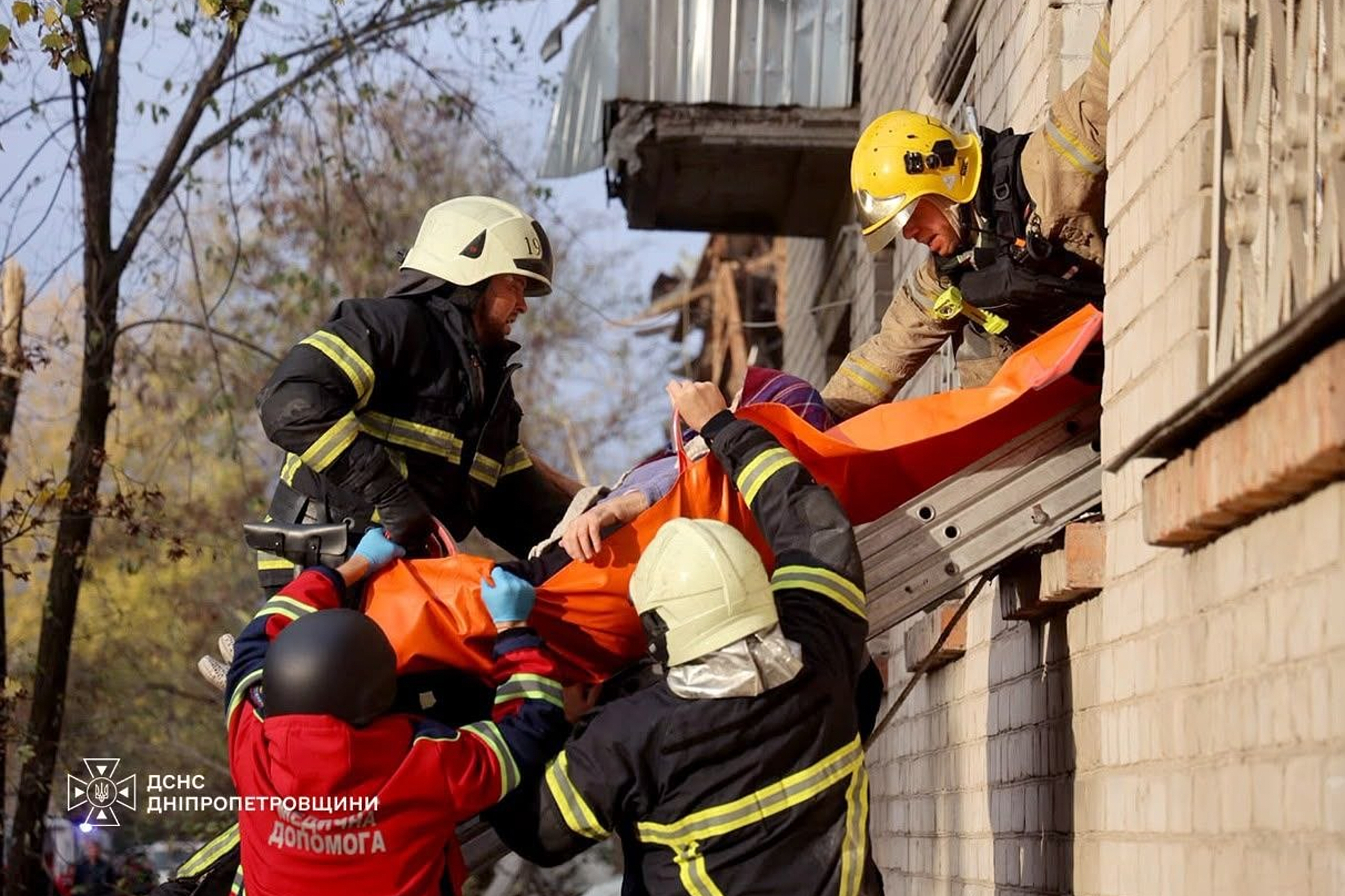
    Monday’s attacks on a shelter and former school with bunker-busting bombs came as people were lined up for aid in Komyshuvakha, a village in the Zaporizhzhia region. Teams of emergency workers and volunteers picked through debris at the cratered blast sites, as bodies were pulled from the rubble and carried away in white plastic sheeting. More than 45 residents remained missing.

    “The scale of the tragedy is terrifying,” said Mykhailo Semikin, acting head of the region’s military administration, in an online post. “This is one of the worst tragedies in terms of the number of civilian victims in our region since the start of the full-scale war.”

    As Ukraine prepared for a new round of U.S.-brokered peace negotiations next week, more than 4½ years after Russia’s all-out invasion, a wave of strikes overnight into Tuesday targeted power plants across the country, damaged hospitals, and wounded scores of people.

    Russia launched 289 attack drones, 17 ballistic missiles, and 59 cruise missiles across nine regions, triggering emergency power cuts, President Volodymyr Zelensky said in an online post that noted the barrage coincided with the U.S. midterm elections.

    “The Russians think America won’t notice this signal of theirs,” he said. “But we need to notice and stop such terror. We need to help Ukraine defend its skies; otherwise, Russia will never stop its missile strikes.”

    A volunteer describes the aftermath

    Baptist pastor Vladyslav Makhovskyi joined the search for survivors, removing bodies and helping elderly Komyshuvakha residents swaddled in blankets.

    He told the Associated Press the attack on the shelter was “truly devastating” and a shock to residents who had sought cover there.

    The shelter was sturdy and had provided internet access and other assistance, and “was a place they trusted,” Makhovskyi said.

    “People even came there to spend the night because they felt safer there,” he added. “I’d been in that school and its underground shelters many times.”

    It was struck by a Russian bomb “so powerful that it broke through the heavily reinforced concrete blocks,” he said. “The job’s not done. There are more (bodies) in there.”

    Bodies wrapped in white plastic sheets were carried from the ruins and laid in rows as smoke drifted across the shattered landscape. Rescue efforts were interrupted Tuesday by menacing Russian drones, forcing soldiers to halt recovery operations and open fire to try to bring them down.

    Three days of mourning were declared in Zaporizhzhia. The dead included four police officers and two rescue workers, Semikin said. At least five people were hurt.

    Zelensky had said on X that the strikes first targeted the former school that was used for regular distributions of humanitarian aid and then took aim at a nearby shelter.

    “This is further proof that Russia wants no de-escalation,” he said.

    Attacks intensified after humanitarian ceasefire

    The attack came after the expiration of a six-day ceasefire in the Russian-occupied city of Oleshky that allowed trapped residents to evacuate. It was the most significant truce between Kyiv and Moscow since 2022.

    “We offered to Russia to extend the ceasefire in Oleshky, but this was the answer: new attacks, new strikes, new killings of our people,” Zelensky said in Berlin, where he met German Chancellor Friedrich Merz and attended a security conference.

    In the northeastern region of Kharkiv, a Russian missile and drone attack wounded at least 62 people, local authorities said.

    A strike damaged a medical facility in the Nemyshlianskyi district, shattered windows in four apartment buildings, and damaged cars. More than 200 patients were transferred to other medical facilities, said Oleh Syniehubov, head of the regional military administration.

    In the Dnipro area, rescuers pulled a woman alive from the rubble Tuesday morning, after a Russian attack killed one person and wounded 17, local authorities said.

    The attack damaged an outpatient clinic and a hospital. Patients were transferred to other hospitals, Oleksandr Hanzha, head of the regional military administration, said.

    Power plants pounded in latest barrage

    Russia attacked more power plants and other infrastructure ahead of winter, causing extensive damage and electricity outages as it carried out 20 strikes in 10 regions overnight, Ukraine’s energy ministry said.

    Ukrainian power utility DTEK said three of its power plants halted operations. No injuries were reported.

    Russia’s Defense Ministry said it shot down 856 Ukrainian drones overnight. Moscow Mayor Sergei Sobyanin said 493 drones were fired toward the capital.

    A Ukrainian drone attack wounded two employees at an oil refinery in the Russian city of Yaroslavl, regional Gov. Mikhail Yevrayev said, adding there was damage to the refinery’s infrastructure.

    Rolling blackouts have been instituted in the south, west, and east of Russian-occupied Crimea following attacks on energy infrastructure, Moscow-installed officials said.

    Zelensky consults with Europeans ahead of peace talks

    Zelensky’s trip to Germany began a new round of consultations with European leaders ahead of U.S.-mediated peace talks Nov. 10-11 in Abu Dhabi.

    U.S. President Donald Trump’s special envoy, Steve Witkoff, confirmed the dates of the talks, with negotiations to focus on postwar security arrangements, de-escalation, and humanitarian efforts. Kremlin spokesperson Dmitry Peskov confirmed a Russian delegation will attend.

    Zelensky said Ukraine’s priorities for the talks were halting strikes on energy and critical infrastructure, unblocking Black Sea grain shipments, and expanding prisoner exchanges.

    He said he hoped those talks and other diplomatic efforts would pave the way for trilateral talks among the countries’ leaders, which he said were needed to resolve key issues.

    “Europe’s involvement in the process — in achieving peace — is essential,” he said. ”We are doing everything possible to ensure that we have a common European view of all the security challenges and of how this war should end and what its outcome should be.”

    Zelensky told the Berlin Security Conference that even though his country is experiencing an extremely difficult period, “Ukraine will never surrender.”

    Asked if he still believes the U.S. can bring an end to the war, Zelensky replied: “President Trump is still president.” He added that “America has huge influence and power” to push Russian President Vladimir Putin toward negotiations.”

    Russia agreed last month to resume three-way negotiations with Washington and Kyiv aimed at ending the war, setting up the first such talks since February.

    The European Commission said it would host a meeting Wednesday with officials from France, Germany, the United Kingdom, the European Union, NATO, the United States, and the World Bank to discuss postwar reconstruction in Ukraine. Zelensky said a Ukrainian delegation would attend.

  • Judge complicates construction timeline on Trump’s memorial arch project with multiple deadlines

    Judge complicates construction timeline on Trump’s memorial arch project with multiple deadlines

    WASHINGTON — A judge on Monday complicated President Donald Trump’s efforts to plow forward on construction of a memorial arch, setting multiple notification deadlines before any work can begin.

    U.S. District Judge Tanya Chutkan, who is overseeing a lawsuit challenging the Trump administration plans, said she must be told of any decision by the National Capital Planning Commission within an hour. The order set the same time limits for any decision by the National Park Service and the Department of the Interior.

    All three are part of a process the administration laid out in notifying the court of its plans Oct. 28 pending approval Thursday of the construction by the National Capital Planning Commission. The government’s notice said construction could begin once that approval was finished, the Interior Department issued a final decision authorizing construction, and the proper notification was published. “NPS may publish such notice as early as November 5, 2026, and construction could commence as early as November 5, 2026,” the notice said.

    Chutkan, who was nominated by President Barack Obama, said “defendants shall also provide notice within thirty minutes of any activity related to or in preparation for the construction of an arch on Memorial Circle. Defendants are reminded that any construction or demolition in preparation for construction before the National Park Service issues final agency action authorizing construction or without 14 days’ notice would be a violation of the court’s previous orders.”

    The motion is the latest wrinkle in what was a flurry of court activity over the weekend. Chutkan was already considering a preliminary injunction in the lawsuit filed by three Vietnam veterans and an architectural historian when the District of Columbia and Virginia filed a separate lawsuit opposing the construction and seeking a temporary restraining order.

    The judge consolidated the cases and set up a joint briefing schedule, indicating that her decision will likely be triggered by the Planning Commission meeting.

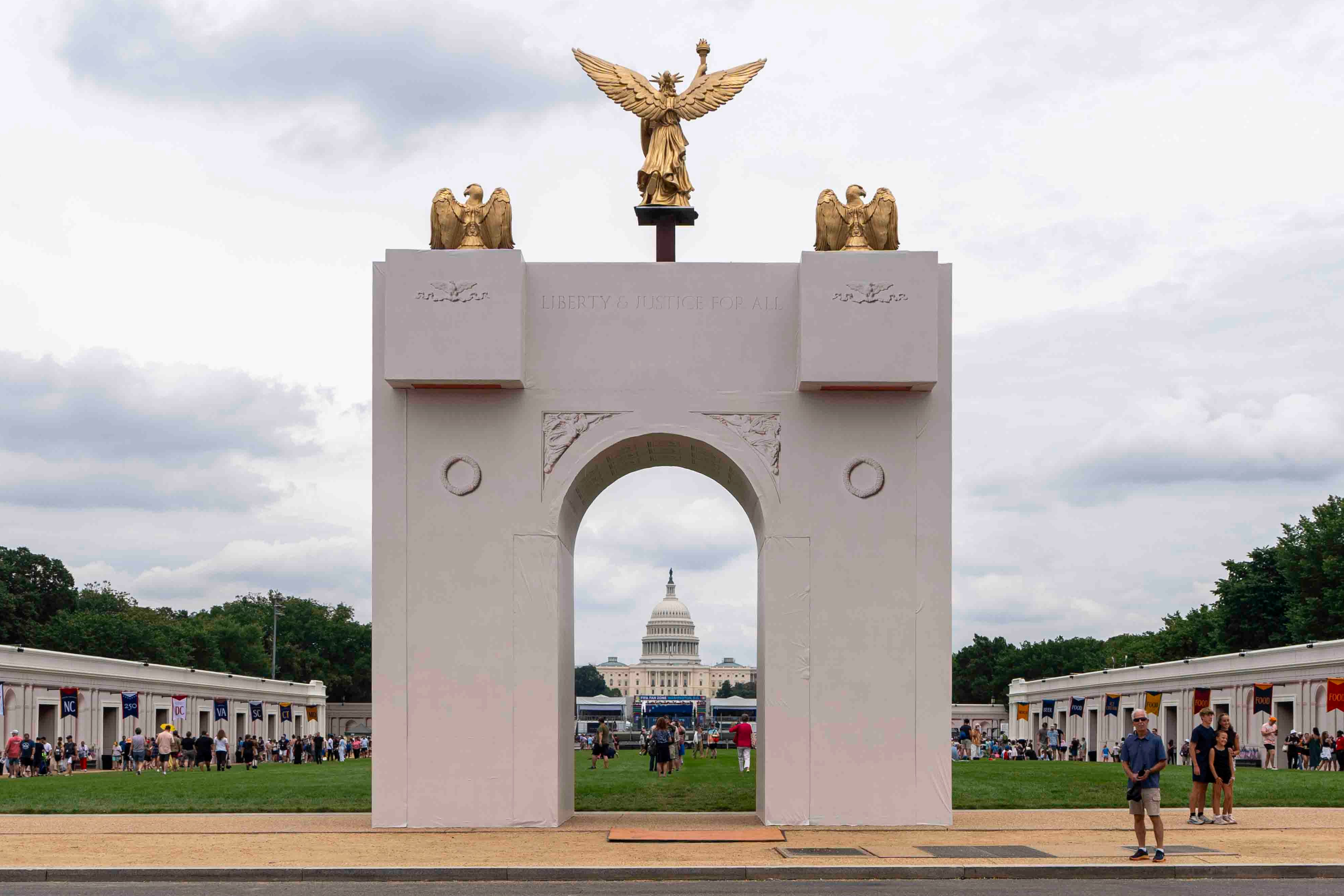
    On Friday, the government submitted a 106-page plan for the arch that envisions a massive structure more than 12 stories high that includes a huge bronze statue of Lady Liberty with wings and carrying a torch with an eternal flame. The structure would include an observation deck with views to the east and west, an “occupied roof,” and two mezzanines.

    Inside the arch are rooms for program space, offices, a staff lounge, circular staircases, multiple elevators, and a “fire command center.” The project proposes significant traffic changes in the area, including rerouting traffic on nearby roads. Administration officials have said the arch also will have a national security function.

    During the hearing Oct. 30 Chutkan asked what the urgency was and how would the government be harmed “apart from the executive’s desire to bedazzle the city” if she issued a preliminary injunction while the lawsuit plays out. Administration lawyer Robert Stander said the arch was “absolutely a high priority project” and were Chutkan to step in, that would impede the work of the government.

    The arch is one of several projects around Washington that President Donald Trump has undertaken as he remakes the city, from renovating one of its storied public golf courses to threatening to demolish the John F. Kennedy Center for the Performing Arts.

    Charles A. Birnbaum, founding President and CEO of the Cultural Landscape Foundation, one of the organizations challenging administration projects, said Chutkan’s order sends a message: “The administration is learning they cannot ignore the judiciary in the way they’ve ignored the public.”

  • Trump spends the day before midterm Election Day promoting his Reflecting Pool makeover

    Trump spends the day before midterm Election Day promoting his Reflecting Pool makeover

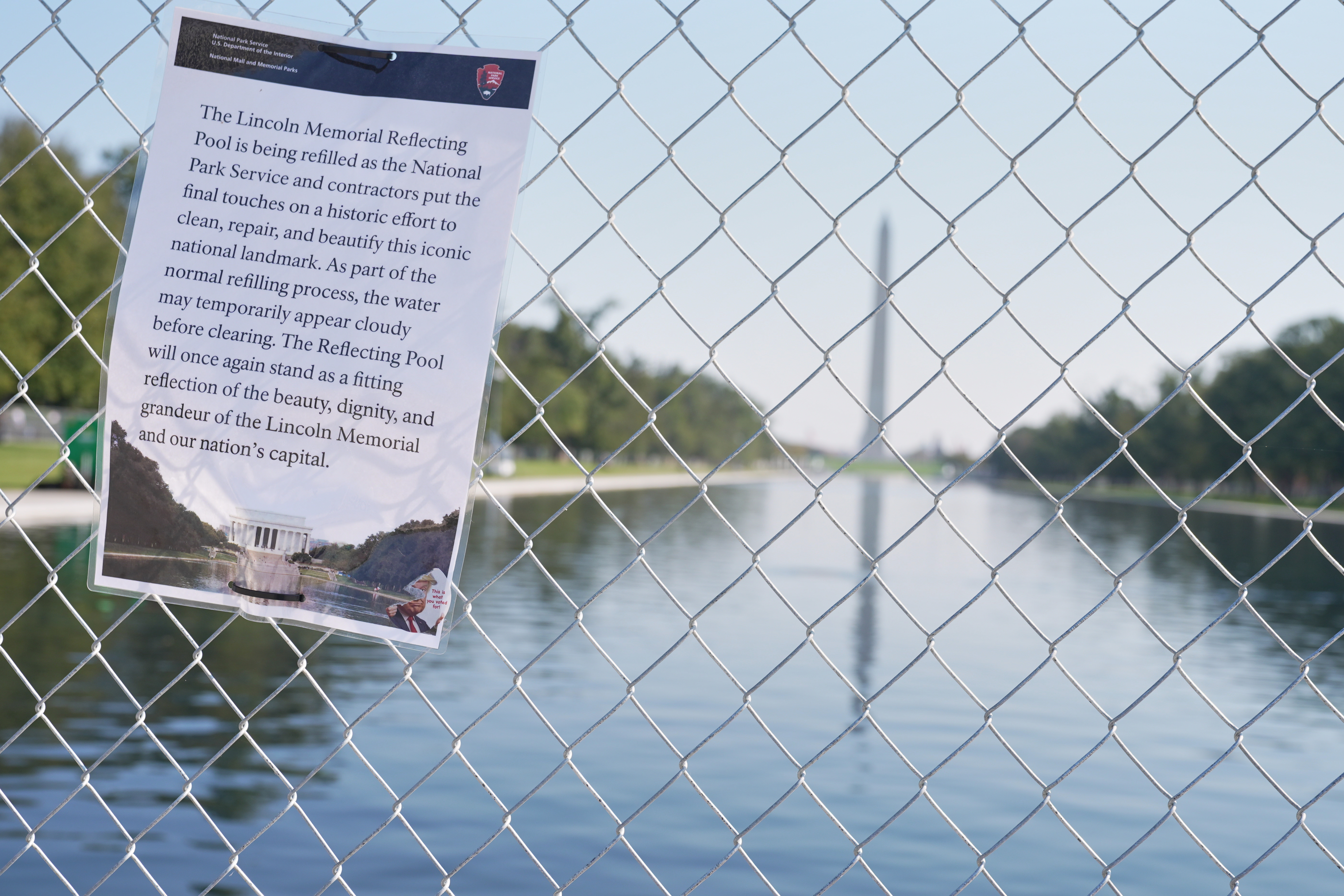
    WASHINGTON — As Republicans and Democrats were making their final pitch to voters on the eve of Election Day, President Donald Trump opted to forgo the campaign trail and instead focused on his renovations at the Lincoln Memorial Reflecting Pool, drawing attention to an expensive, problem-plagued repair job in a place far away from most of the people his party wants to persuade.

    It was an unusual closing argument for Republicans to keep control of Congress. But it conforms with the way the president has devoted considerable time, attention, and money in his second term on beautifying his Washington surroundings.

    Trump, wearing a white “USA” hat, even seemed to admit that he had spent much of his time focused on improving the capital city.

    “We have a lot of great things planned for Washington, and I could get into the nation, but for that, you don’t have enough time,” Trump said.

    Instead of focusing on issues voters have said they’re worried about, Trump dedicated a large portion of his remarks to his D.C. makeover and the pool, announcing its official reopening, joking that he wanted to name it after himself, and repeating his false claims that the repair work he ordered was vandalized.

    After he finished his remarks on Monday, Trump stood silently while triumphant music played and he held up a poster with an image of the previously algae-clogged pool. It was his last public appearance before Election Day.

    Democrats, for their part, were spending the last 24 hours before Election Day making their case in areas where Republicans have long dominated, while trying to contain the fallout from a messy intraparty split in Michigan. Democratic Senate candidate Abdul El-Sayed was brushing aside concerns that his prospects could be hurt after his former primary opponent threw her support behind his Republican opponent, Mike Rogers.

    In addition to giving the speech on Monday afternoon, Trump also was scheduled to participate in nine telerallies for Republicans, where he uses brief remarks on a mass phone call to plead for voters’ support.

    Vice President JD Vance, meanwhile, hit the campaign trail with more traditional stops in New York and Ohio, where Republicans were fighting for House and Senate seats.

    Trump touts renovations as voters worry about the economy

    The Reflecting Pool, a long, narrow basin at the foot of the Lincoln Memorial, is one of Washington’s most iconic sites. Martin Luther King, Jr. famously gave his “I Have a Dream” speech from the steps of the memorial in 1963, looking out over the pool.

    But this summer it became a focus of Trump’s attention, with the president frequently speaking about his plans for the shallow pool on social media, at the White House, and beyond. He displayed posters about the project in the Oval Office and even had his motorcade drive him over the resurfaced pool before it was refilled.

    The pool was soon clogged with algae blooms, and its “American-flag blue” liner began peeling and floating up in chunks. The Justice Department charged former Olympian David Hearn with intentionally damaging the Reflecting Pool but then dropped the case this summer after determining he was not responsible.

    But the president continues to repeat false claims that vandalism — rather than shoddy workmanship — was to blame for the new blue surface peeling away.

    On the platform where he spoke Monday, signs were hanging that said “Restoring Our Capitol” and “The Reflecting Pool.” A poster perched on a display board showed the reflecting pool under the words, “Back, and more beautiful than ever!”

    He waxed on about the particular color blue he selected to have the bottom of the pool painted, the kinds of grass and types of columns he had selected for repairs around Washington, and held up a series of blown-up images of rusted pipes taken during the renovation process.

    He then started repeating some of his midterm elections pitch, defending his record and attacking Democratic nominees, before eventually turning back to the pool.

    The president’s message in the closing days of the midterm campaign was similarly detached from voters’ concerns about the high cost of living. He’s called affordability a “hoax” while boasting to audiences far from the nation’s capital about his renovations of the Reflecting Pool and the White House, along with repeatedly praising the physiques of the GOP’s nominees.

    Vance stuck closer to the party message as he campaigned Monday in Rome, N.Y. As he campaigned for Republican House candidates Kailee Buller and Anthony Constantino, he touted Trump’s moves to end taxes on tips and overtime and secure the border while branding Democrats as “lunatics” who have contempt for American voters.

    Democrats try to flip Republican-favored seats while grappling with fractures

    Democratic candidates were working to capitalize on widespread disaffection over high prices, the fallout from Trump’s war with Iran, and historical trends that typically favor the party out of power in midterm elections.

    In places like Iowa, where voters have not elected a Democratic governor in two decades, Democrat Rob Sand was asking canvassers knocking on doors to help break that streak.

    He was appearing with Kentucky Gov. Andy Beshear, seen as a potential 2028 presidential candidate, who cited his own races as proof that a Democrat can win over Trump-backed candidates in states like his own and Iowa.

    “This is it,” said Sand, who faces Republican Zach Lahn. “We have 30-whatever hours to change the direction of the state of Iowa.”

  • Karl Bushby embraces emotional mother as he completes his 28-year, 31,000-mile walk around world

    Karl Bushby embraces emotional mother as he completes his 28-year, 31,000-mile walk around world

    HULL, England — Karl Bushby embraced his weeping mother Monday as he returned to his northern England home to complete a 28-year odyssey to walk around the world.

    “Where have you been?” his mother, Angela, asked as he arrived outside the home he left in 1998 that was now decked with a banner saying “Welcome Home Son.”

    He didn’t need to tell her.

    Bushby set out from Punta Arenas, Chile, on Nov. 1, 1998, and walked 31,000 miles across four continents and 30 countries to get home. He navigated shifting ice over the Bering Strait and swam across the Caspian Sea and English Channel to avoid taking a boat or plane — or any transport — to propel him forward.

    He vowed not to return until he could complete the journey on foot. It was an eye-opening adventure full of danger and drudgery that was interrupted for years at a time by the unexpected: the 2008 financial crash that sapped funding from sponsors, the 2020 COVID-19 pandemic, and mountains of bureaucratic red tape to get across international borders.

    A trek made possible by kind strangers

    On the final day of the journey, Bushby pushed his cart toward a hero’s welcome at City Hall before setting off for the last stretch to see his mother.

    “Sorry to keep you waiting,” he joked to the crowd of hundreds who cheered his arrival. “Is that it, is it done?”

    The ex-paratrooper said he looked like he was 10 years old when he left his mother’s row house at the age of 29. He returned at 57 — softer, grayer, and weathered, but far more worldly.

    “They say it takes a village but literally it took a world to get me here,” Bushby said. “The kindness of strangers, so many, from individuals to nation states to get me back here today. I didn’t do this alone. There was a big team. The biggest team. Earth.”

    Idea started with a birthday card from his dad

    Bushby had a thirst for adventure, but his mission only came into focus when his father, Keith, sent him a birthday card in the mid-90s. His dad, an army veteran himself, mentioned an argument two special forces troops had about the possibility of walking from London to New York over the Bering land bridge, believed by some scientists to have been used by early humans to migrate from Asia to the Americas at a time of lower sea levels.

    Perilous jungles, scorching deserts, and frozen tundra slowed Bushby down, but bureaucratic holdups brought his adventure to a halt for long periods.

    Bushby originally calculated the distance could be covered in about five years, but he knew that was unrealistic.

    “You just dump a whole bucket full of reality on that,” he said. “We suspected that it was 12 years plus. And the plus was a big plus. But never in our wildest dreams would we ever have imagined 28 years.”

    Danger on land and sea followed by border problems

    He dodged Colombia’s armed conflict in the dangerous Darién Gap, the roadless and rugged jungle, rainforest, and mountains between South and Central America in 2001, and was then jailed for 18 days after crossing a restricted border zone in Panama.

    After being airlifted to safety during the 56-mile Bering Strait crossing in 2006 with American adventurer Dimitry Kieffer, they started again and faced a standoff with a polar bear, survived near-death plunges into freezing waters, and almost lost all their supplies when their sleds plunged in the sea. After managing the rare crossing, the pair were jailed and faced deportation for entering Russia illegally.

    It took Bushby almost 10 years to make his way through Russia in fits and starts because of visa struggles and weather that only allowed travel a few months a year. When Russia denied him a visa in 2012, Bushby walked in protest from Los Angeles to the Russian Embassy in Washington, D.C., which eventually led to him getting the proper paperwork.

    Family firsts and a long-awaited reunion

    Bushby has met several times over the decades with family members who have met up with him on his journey. He was greeted on the beach in Dover by his father and brothers after crossing the channel last month.

    He reunited with Adam, his 36-year-old son from an early marriage whom he had rarely seen, and he met his 12-year-old granddaughter for the first time, which he said was amazing.

    Bushby hadn’t seen his mother in a decade, setting the stage for an emotional and somewhat awkward reunion captured amid a throng of cameras and a documentary film crew.

    “Behave yourself, mother,” he joked, as his mother wrapped her arms around him and wept. “Get yourself together.”

    He said he had long tried to imagine that moment he would return to find his mother at the gate where he left her so long ago. He said it was an emotional reunion that was “one great, big, blurry mess” he was trying to process.

    “It was kind of almost shocking to see my mother after so long,” he said at a news conference later. “She’s changed a lot. We’ve all changed a lot in that time.”

    Next steps for a man who walked millions

    In the final days of his trip, Bushby spoke of his anxiety over the trip ending, not knowing what he would do next and coming to terms with having to live in his mom’s basement.

    “It’s like stepping across the event horizon into a black hole,” he told the Associated Press. “I have no idea what’s about to happen in my life.”

    There will be plenty to keep him busy. Six speaking engagements are scheduled in the next two months, a sequel to his memoir Giant Steps is due, and German filmmaker Werner Herzog is making a documentary on his trek.

    He expects to struggle with the ups and downs other adventurers have experienced after long journeys.

    “The only way I think, you know, you get over that is just get another mission, another passion, and get busy,” he said. “That’s what I intend on doing.”

  • Floods swamp the arid Southwest, forcing evacuations and altering Election Day plans

    Floods swamp the arid Southwest, forcing evacuations and altering Election Day plans

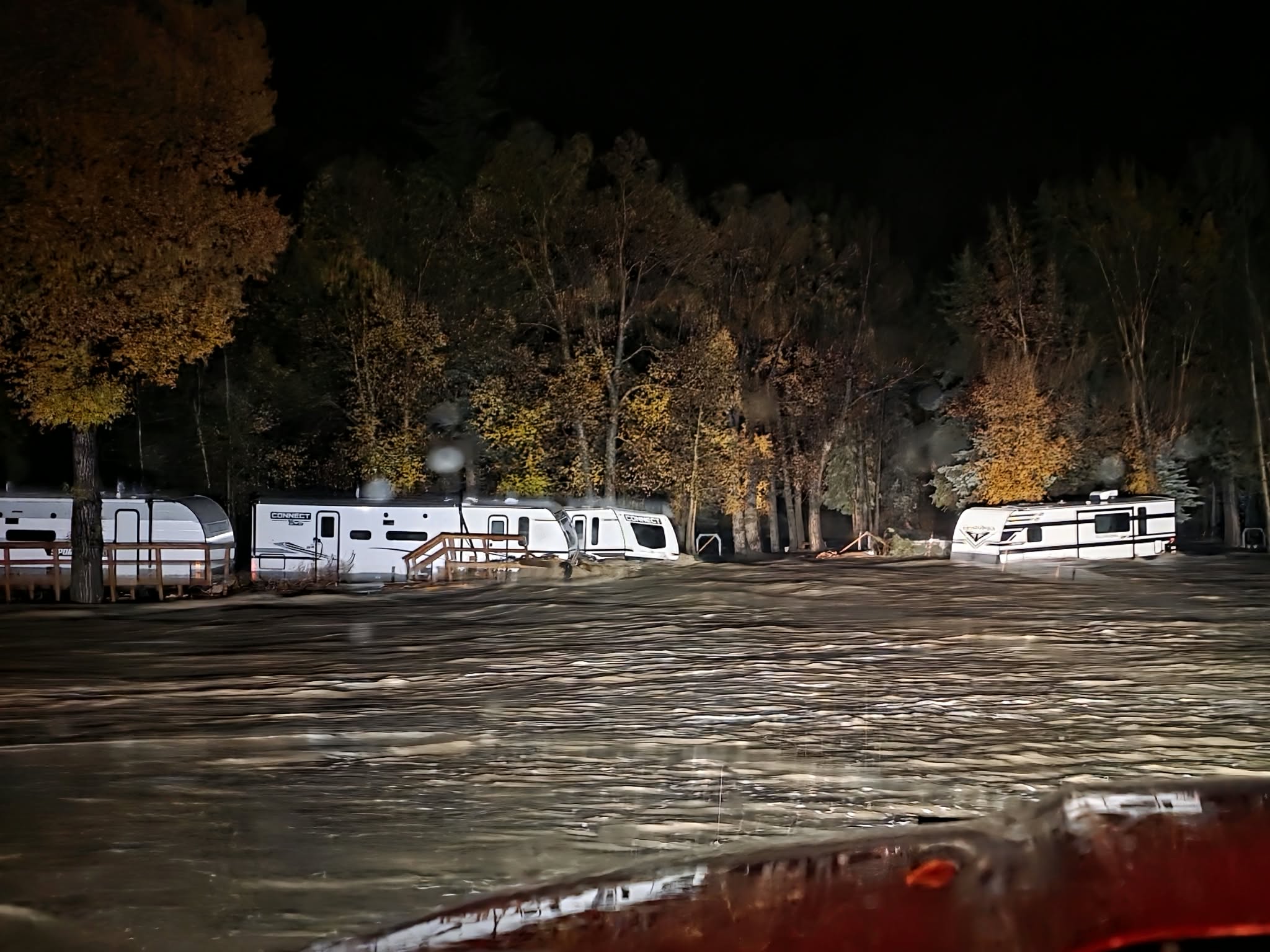
    A massive amount of water from unusually heavy rain was flowing through flood-weary parts of the Southwest on Monday, forcing hundreds of evacuations and keeping swift-water rescue teams busy as elections officials in at least one town announced alternative voting plans for Election Day.

    One person died in the flooding, and police suspect a second death also is weather-related. The National Weather Service estimated as much as 4 inches of rain could fall across the Four Corners region — where New Mexico, Arizona, Colorado, and Utah meet — through Monday as the phenomenon fueled by the warming Pacific known as El Niño disrupts weather patterns.

    Over 20 trillion gallons of water have fallen on the Four Corners states and Nevada in the past two weeks, according to calculations by former National Oceanic and Atmospheric Administration chief scientist Ryan Maue.

    Officials had warned of “potentially catastrophic” flooding in Pagosa Springs, Colo., a town of more than 2,000 that was nearly wiped out in a 1911 flood when the San Juan River crested at approximately 17.8 feet. Readings late Sunday night showed the river reached 16.81 feet this time before receding Monday, the weather service said.

    Alternative voting plans were arranged for evacuated or marooned Pagosa Springs residents by the Colorado Secretary of State’s office. Other elections officials also made recommendations for voters to cast their ballots before the storms hit.

    More rivers rise, forcing more evacuations

    People had to leave their homes along the Animas River in southwestern Colorado, where Durango police Chief Brice Current said authorities were checking Monday on residents who rode out the flooding at home.

    “There is still a lot of people stranded,” Current said. “There’s a lot of emergency services being utilized today.”

    The Animas River was closed to kayaks and other recreational watercraft, and Current warned that sewage and chemicals flushed into the river could make people sick. Riverside trails and foot bridges were also closed, he said.

    “The water is very high right now,” Current said. “We don’t want to create any more emergencies by recreating.”

    Evacuations also were ordered along the San Juan River in New Mexico and on the Navajo Nation. The Utah Navajo Health System posted about highway closures and detours. The village of Chama in New Mexico was evacuated and cut off by road closures. Farther south, the rising Jemez River made campgrounds and fishing sites inaccessible.

    Dry creekbeds turned to raging torrents in Arizona

    Record rainfall numbers were reported across Arizona, including an eye-popping 7.3 inches over two days at Workman Creek, in a wilderness area northeast of Phoenix.

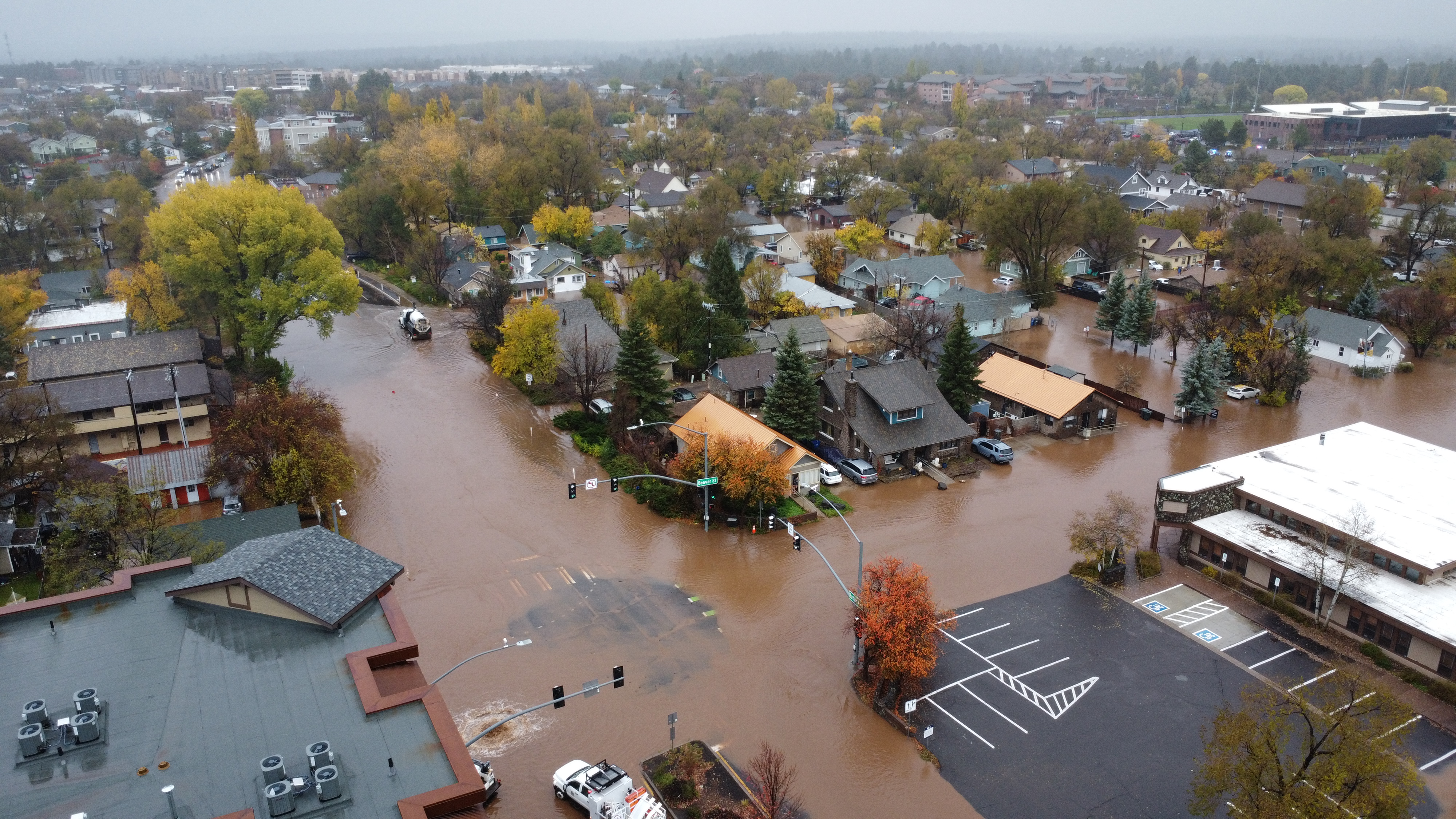
    The two-day total of 5.15 inches in Flagstaff contributed to the wettest Nov. 1 ever recorded for that city, which typically has less than a handful of days per year where rainfall tops an inch, said meteorologist Jennifer Tate with the NWS Weather Prediction Center.

    “What really stood out to me was that this wasn’t localized. It was a very broad system that brought a lot of rain to a lot of places,” Tate said Monday.

    In Flagstaff, where rain fell nearly nonstop Sunday, a man was seen falling into fast-moving floodwaters that went into a drainage tunnel near Northern Arizona University, police said. The body of Williams Singavarapu, 73, of New York, was found Monday, about 12 hours later, about 15 blocks from where he vanished in the flood.

    Flagstaff police said a second man, whose identity hasn’t been released, also was found dead Monday in a storm water drainage area. Police said it appeared to be weather-related but were awaiting an official cause and manner of death.

    In Sedona, officials ordered residents near Oak Creek to leave Sunday as floodwaters trapped multiple people in their homes. The heavy rain washed out part of a main highway between Flagstaff and Sedona, mangling guard rails and leaving the road littered with boulders and trees. Arizona Department of Transportation crews were working to clear the roads and repair the damage.

    Swift-water rescues also were happening in Tucson, where weather service meteorologist Aaron Hardin said, “We are getting two or three months of rain in a span of a couple of days.”

    And manhole covers were popping up in the Pinetop-Lakeside area of central Arizona, where residents reported sewage backing up into homes because of flooding, the region’s sanitary district announced.

    Flooding in Colorado tourist town affects voting plans

    In Pagosa Springs, town residents impacted by the floods who received a ballot by mail can get a replacement one at any vote center across the state, the secretary of state’s office said.

    Voters who cast in-person ballots outside their home county can vote for only statewide races, but mail ballots can be returned to any drop box or vote center in the state by 7 p.m. on Election Day. The La Plata County clerk will have special hours Tuesday to help.

    Pagosa Springs had just lifted an evacuation order from previous flooding last week, only to reimpose it Saturday.

    Katie German, owner and chef of Bruin Coffee in Pagosa Springs, said Sunday that downtown was evacuated and streets flooded. She was most worried about the one bridge into town washing out, blocking trucks carrying everything from food to fuel.

    “I’m worried about my business, worried about my employees, definitely worried for everybody in this town,” German said.

  • Russia bombs aid center and shelter in southern Ukraine, killing 24, authorities say

    Russia bombs aid center and shelter in southern Ukraine, killing 24, authorities say

    KYIV, Ukraine — Russia bombed an aid distribution center and neighboring shelter in southern Ukraine on Monday, killing 24 people, Ukraine’s emergency services agency said.

    Ukrainian President Volodymyr Zelensky said in a post on X that 10 guided bombs targeted an area that included a school building used to distribute humanitarian aid and a nearby shelter.

    “This is further proof that Russia wants no de-escalation,” Zelensky said.

    The attacks in the village of Komyshuvakha, in the southern Zaporizhzhia region, occurred as a limited ceasefire expired Monday in Kherson, a different region in the country’s south. The limited ceasefire agreement had allowed humanitarian aid and evacuation missions into front-line areas in Russian-occupied territory.

    “There was a moment when the next steps could have shown that progress toward peace was possible,” Zelensky said. “With these killings, Russia is sending an entirely opposite signal: Russia is counting on more killings.”

    As night fell in Komyshuvakha, emergency responders used flashlights to search through the rubble of collapsed buildings, according to photos and video posted online by local officials. About 20 people are considered missing and the death toll could rise, these officials say.

    In other areas of Ukraine, authorities reported multiple Russian drone attacks that injured at least 17 people.

    Earlier, residents of Ukraine and Russia had received phony emergency alerts from government-run mobile apps that were hacked, authorities in both countries said. The phony alerts in Ukraine included a warning about an imminent nuclear threat.

    It was not clear if the cyberattacks late Sunday in Ukraine and early Monday in Russia were related. Ukraine said its mobile app, which residents rely on to seek safety from Russian missile and drone strikes, was up and running again after being temporarily suspended. Russian authorities said efforts to restore its emergency alert mobile app were ongoing.

    After cyberattacks, false alerts sent in Ukraine and Russia

    A Russian Telegram channel with links to the country’s security services said Monday that a hacking group, Hitcore, claimed responsibility for the breach of the Ukrainian emergency alert system. The Associated Press did not independently verify the claim, and the identities, affiliations, or motivations of the purported hackers remained unclear.

    The alerts received by Ukrainians — making false claims of high radiation levels, a chemical threat, and public disturbances in Kyiv — were written in English, Russian, and Ukrainian. The English language alerts contained spelling and grammatical errors.

    One of the messages, written in Russian, said: “Hi! There will be a nuclear threat across Ukraine. Do not worry, the Oreshnik is incoming,” a reference to a Russian ballistic missile.

    There was little indication the fake alerts caused panic in Ukraine. Instead, there was a flood of humorous posts online, with social media users sharing photos of their pets relaxing and apocalypse-themed images generated by artificial intelligence. A photo shared of Kyiv Mayor Vitali Klitschko, a former international kickboxing champion, included the message: “It’s a good thing we have a boxer for a mayor.”

    In a Telegram post late Sunday following the breach, Ukraine’s air raid alert channel said “unauthorized parties” had interfered with the app’s operation and warned users not to click on links in “suspicious notifications.”

    Ukraine’s state-run Center for Countering Disinformation urged people to monitor other emergency channels on social media while the cyberattack was being addressed.

    A spokesperson for Ukraine’s air force command, Yurii Ihnat, said in a television interview that the cyberattack had no impact on Ukraine’s security and defense operations.

    In a statement, Russia’s Emergency Situations Ministry said hackers sent a false alert through its app at approximately 2:45 a.m. Moscow time on Monday across 33 of Russia’s 89 regions. It did not say who it believed carried out the attack.

    The ministry said that the digital vulnerability exploited by the attackers had been identified and that “necessary measures” were being taken to prevent a similar breach. It also reassured Russians that the wider public alert system was working normally through SMS messages, media broadcasts, and municipal sirens and loudspeakers.

    Kremlin spokesperson Dmitry Peskov said all of Russia’s state agencies were under the constant threat of cyberattacks, including a growing number that use artificial intelligence.

    “All government bodies must take steps to improve the cybersecurity of our digital resources,” Peskov said.

    Limited ceasefire ends in Kherson region

    As the ceasefire in Ukraine’s Kherson region came to an end on Monday, Ukraine’s general staff said that Russia’s military had used the pause in fighting to bolster its drone defenses and replenish ammunition supplies.

    The brief pause in fighting, which began on Oct. 27, was part of a humanitarian aid and evacuation mission in the Russian-occupied city of Oleshky, and marked the most significant truce between Kyiv and Moscow since Russia’s full-scale invasion began nearly five years ago.

    Speaking to reporters in Kyiv on Monday — before the deadly bombings in the Zaporizhzhia region — Ukraine’s ombudsman and lead civilian negotiator for the mission, Dmytro Lubinets, said he hoped the localized ceasefire and evacuation would act as a “model” for other such efforts.

    Elsewhere in Ukraine, emergency services reported that drone strikes injured 12 people in the eastern Kharkiv region and damaged a refrigeration facility, greenhouses, and residential buildings.

    Five people were also reported injured in the Black Sea port city of Odesa, where a warehouse was targeted and homes were damaged.

    Russia’s Ministry of Defense said Monday that it shot down 212 Ukrainian drones overnight. The head of Russia’s Samara region, Gov. Vyacheslav Fedorishchev, said in a statement that local air defenses were repelling an aerial attack, but did not give further details.

    Independent Russian media outlets later reported that Ukrainian drones had targeted one of Europe’s largest oil transport hubs in Samara.

  • Supreme Court rejects Trump administration push to set aside thousands of California ballots

    Supreme Court rejects Trump administration push to set aside thousands of California ballots

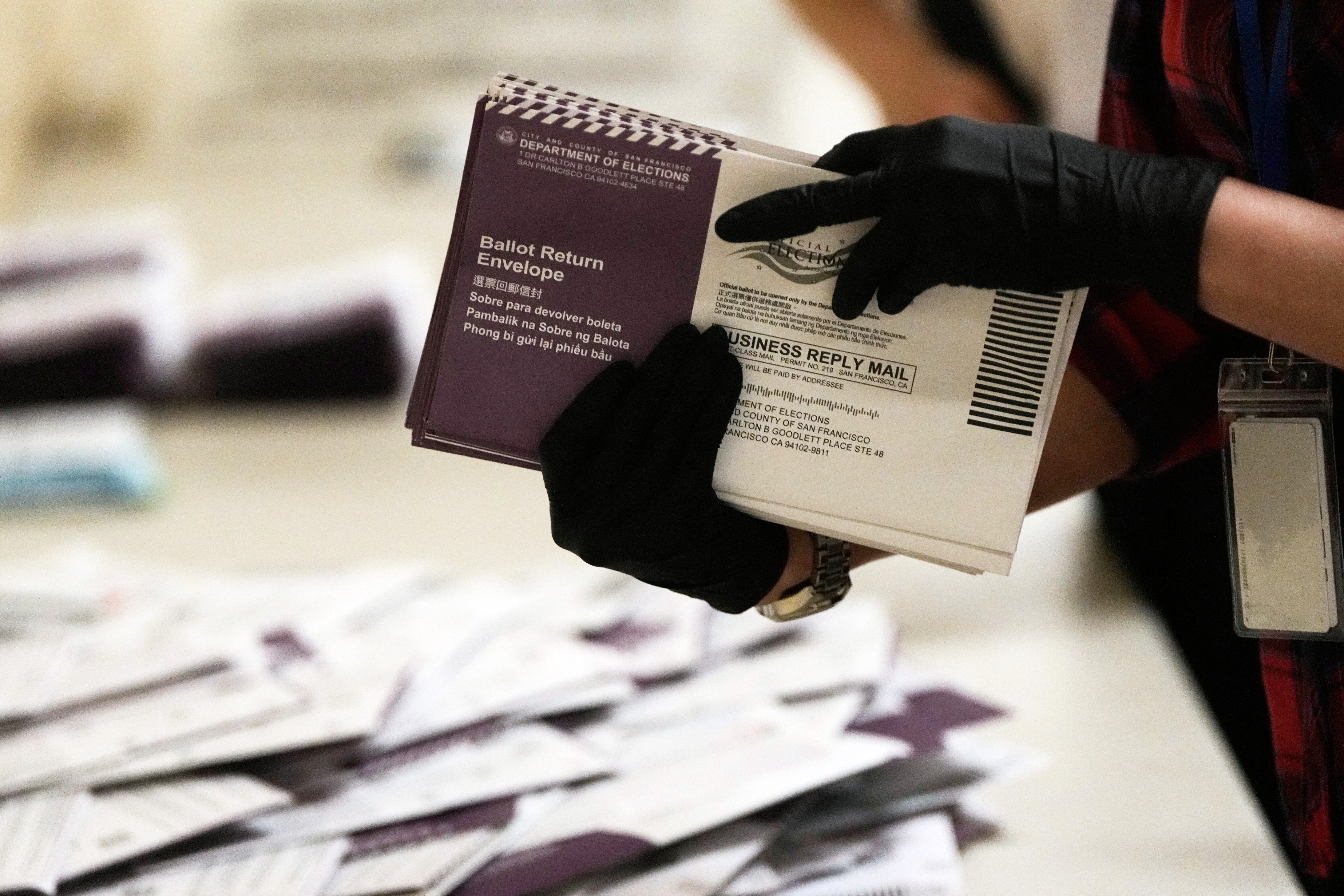
    WASHINGTON — The Supreme Court on Monday rejected a push for California to set aside thousands of mail ballots from people President Donald Trump’s administration claims are noncitizens, a decision that comes on the eve of the pivotal midterm elections.

    The high court refused to intervene in a case involving 20,000 people the Republican administration flagged as likely noncitizens on the largely Democratic state’s voter rolls.

    It was the latest in a flurry of election-related litigation the day before the midterm elections, which will decide control of Congress for the last two years of Trump’s second term.

    In California, the Trump administration had asked the high court to set aside the challenged ballots until the voters’ citizenship status could be verified. But officials there said that the list appeared to be filled with errors and that setting the ballots aside could effectively disenfranchise legal voters.

    The high court did not detail its reasoning, as is common in emergency decisions. The justices previously rejected Trump’s push to restrict mail ballots around the country in September, even though the justices have sided with his administration in a series of other emergency docket appeals.

    The Republican Trump administration has prioritized identifying noncitizen voters this year, despite them being rare.

    A district court judge previously denied the Justice Department’s request and warned that the demand could disenfranchise citizens in Tuesday’s midterm elections to determine control of Congress.

    Also on Monday in Washington, another federal judge ruled against the administration’s efforts to make last-minute demands of California election officials, finding they violated the U.S. Constitution.

    “The Executive Branch has likely violated the Constitution’s Elections Clause, which commits authority over election rules to the states and Congress alone,” wrote Chief Judge James Boasberg.

    The administration, for its part, said segregating the ballots was a modest request that would eventually allow legal votes to still be counted.

    The administration has faced a remarkable string of losses in court in its push, as well as criticism for waiting until a few weeks before the election to make its demands of California election officials with a list that even the Department of Justice admits is not entirely reliable.

    Voting has been underway in California since early October. All of the state’s roughly 23 million registered voters are mailed a ballot. Hundreds of thousands of ballots have already been processed. California election officials have said that finding and setting aside the challenged ballots now would be logistically impossible.

    California Attorney General Rob Bonta, a Democrat, said the appeal “reeks of desperation and is another attempt to undermine our elections and trample on the rule of law.”

    Lower courts have sided with the state, with a district judge warning that segregating ballots would “wreak havoc” on the midterm elections and erode trust in the democratic process.

    “If the Executive can discount votes and threaten an ongoing election due to unproven allegations, then our democracy is in danger,” wrote U.S. District Judge David O. Carter, who was nominated by President Bill Clinton, a Democrat.

    A 2-1 appeals court panel upheld his order, with one judge appointed by Trump and another appointed by President Joe Biden, a Democrat, voting in favor. The third judge on the panel, also appointed by Trump, argued in a dissent that California’s unwillingness to separate the ballots encourages the “violation of federal law.”

    The Justice Department has sought to move the case along quickly, unsuccessfully asking an appeals court to intervene early.

  • All 9 people aboard a jet that crashed in Florida have died, transportation secretary says

    All 9 people aboard a jet that crashed in Florida have died, transportation secretary says

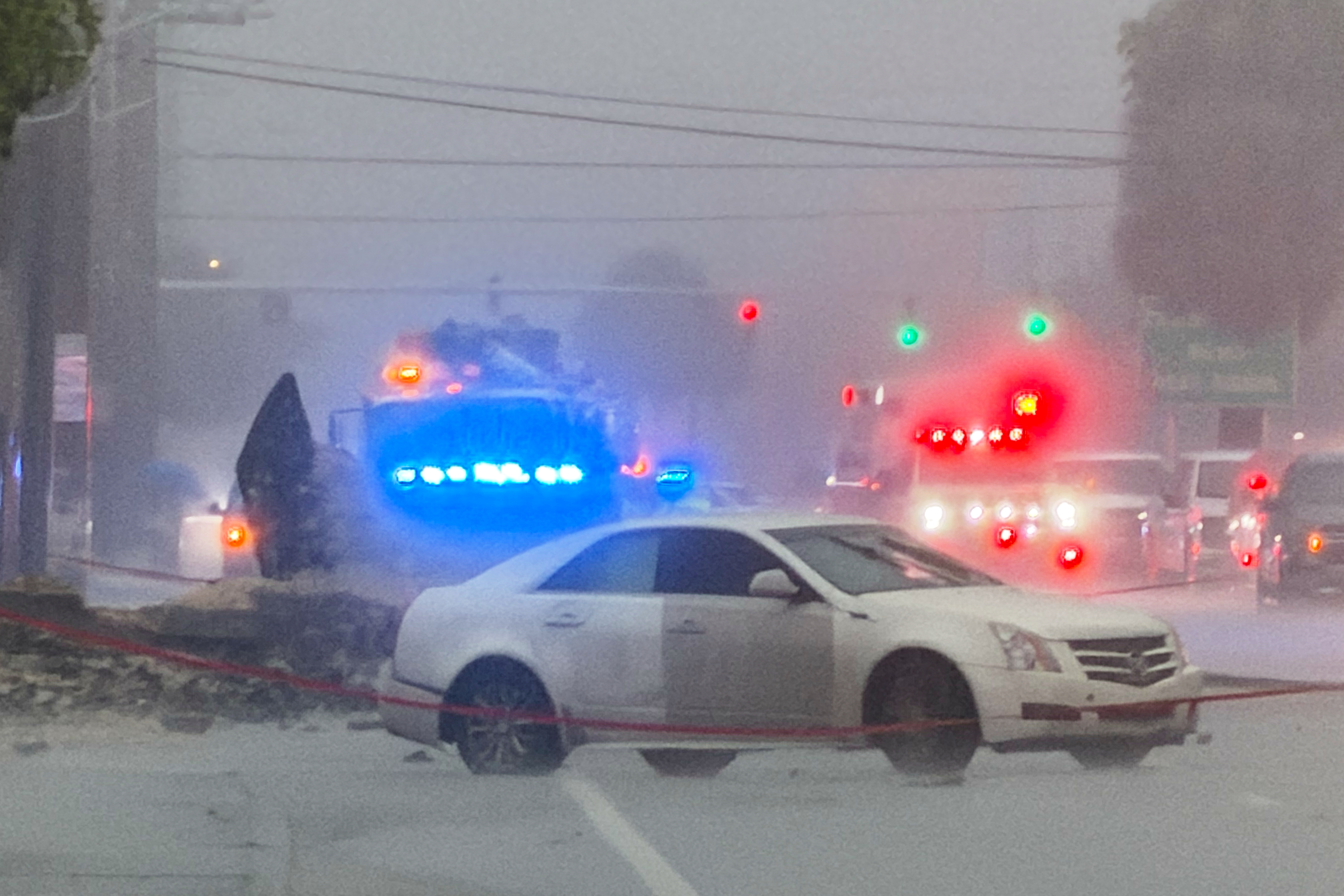
    WEST PALM BEACH, Fla. — A business jet carrying nine people nose-dived into a South Florida neighborhood Sunday and erupted into a giant fireball that appeared to just miss homes before crashing near a busy roadway. Everyone on board was killed, the nation’s transportation secretary said.

    Video recorded by people inside their cars captured the terrifying moment the Bahamas-bound aircraft plunged from the sky, before striking near the roadway and exploding. Flames flickered around chunks of pavement lining the crater as people milled about, expressing shock that it landed only feet from homes and inches from passing vehicles. Thick black smoke engulfed the crash site.

    Transportation Secretary Sean Duffy posted on X that the Learjet 60 crashed in Palm Beach County at 12:50 p.m. and called it a “horrific tragedy.” The Federal Aviation Administration is sending a team to support the National Transportation Safety Board’s investigation, he said.

    Florida Gov. Ron DeSantis said there were no immediate reports of anyone on the ground injured or killed.

    “It was a cataclysmic plane crash,” DeSantis told reporters at the scene. “It looked like a missile going down and left a big crater on the side of the road.”

    Rain pounded the region on Sunday. A flood watch due to excessive rainfall was in effect through Monday afternoon, the National Weather Service said.

    The aircraft had departed Austin-Bergstrom International Airport in Texas and was headed to the Bahamas, according to the Federal Aviation Administration. Authorities did not immediately say what caused the jet to go down or who was on it.

    The plane was heading east at 35,000 feet when pilots reported turbulence, icing, and precipitation and requested to climb 2,000 feet.

    Moments later, the plane entered a steep dive, first 10,000 feet per minute, then 20,000 feet per minute, and up to 30,000 feet per minute, speeding the plane beyond its design limits, according to air traffic control recordings and flight tracking data.

    A pilot declared an emergency and issued distress calls. The plane banked sharply to the right before it crashed steeply into the ground.

    Minutes before the crash, the pilot reported ice accumulating on the jet and turbulence that was jolting it by as much as 700 feet, according to air traffic control recordings captured by LiveATC.net.

    “We have light, clear ice that is manageable and moderate turbulence,” the pilot told controllers.

    But the situation rapidly deteriorated. After encountering precipitation and requesting to climb, the pilot declared an emergency as the aircraft began losing altitude at an alarming rate.

    “We’re descending 8,000 — mayday, mayday — we’re descending 10,000 feet per minute,” the pilot radioed.

    “We are in an overspeed condition descending 20,000 feet per minute,” the pilot radioed, before delivering a devastating acknowledgment of what was about to happen. “We’re going to crash into the ground.”

    Jim Reynolds, a spokesperson for Austin-Bergstrom International Airport, said the jet was a private aircraft. He could not immediately provide details about who was on the flight.

    Palm Beach County authorities are evacuating about 600 people from a nearby mobile home community while federal officials investigate the crash. The road will be closed until further notice, county officials said.

    The crash occurred in Greenacres, Florida, according to Palm Beach County sheriff’s officials. The city of 45,000 people is about 7 miles southwest of West Palm Beach.

  • Trump signals he’ll give closing election pitch at the Reflecting Pool, a revamp plagued by problems

    Trump signals he’ll give closing election pitch at the Reflecting Pool, a revamp plagued by problems

    WASHINGTON — President Donald Trump signaled Sunday that he’ll make his closing pitch of the midterm elections at the Lincoln Memorial Reflecting Pool, pushing his slow, expensive, and problem-plagued efforts to repair it back into the spotlight as Election Day looms.

    In comments to reporters as he deplaned from Air Force One for a rally in Iowa, Trump said his speaking at the site would “show how beautiful it is.”

    “We might hold it tomorrow or something,” Trump added, without giving specifics. But in a post on his social media site before landing, Trump said that his Sunday evening rally in Kansas — which follows his stop in Iowa — “Will be my last stop.”

    That would further suggest that, rather than using Monday to travel to key states and try to energize his “Make America Great Again” supporters as his Republican Party tries to maintain control of Congress, Trump would opt for an event at a Washington renovation project that has been embarrassing and contentious.

    The unusual move would be a departure from Trump’s monthlong race to stage more than 25 rallies in largely conservative areas, hoping the GOP can overcome his own low approval ratings and polls predicting that the Iran war, high energy prices, and cost of living increases could spell a strong election night for Democrats.

    Trump spent a lot of time at those rallies talking about his second-term focus on molding the White House and the surrounding nation’s capital in his own image, cramming the Oval Office with gold flourishes, demolishing the East Wing to construct a sprawling ballroom, converting the Rose Garden into a patio space reminiscent of his Mar-a-Lago estate, and installing a sprawling South Lawn helipad.

    He also closed the Kennedy Center after failed attempts to add his name to the building, has planned a towering arch just outside the city, and is pushing to revamp a century-old public golf course.

    Trump has bristled at criticisms from former President Barack Obama and other Democrats that he’s spent too much time focused on construction projects — insisting that renovations relax him and that he does them quickly and without requiring too much planning time.

    Trump said Reflecting Pool fix would be fast and inexpensive

    His Reflecting Pool saga began in April when Trump said he wanted to change its color and would use contractors he knew to fix the monument in mere days and for about $1.5 million before Independence Day.

    The repairs wrapped up nearly three months behind schedule and the budget ballooned to more than 10 times Trump’s early estimate — and that’s assuming no more additional work will need to be done in the future.

    Trump had initially declared the work was complete in June. But after the overhaul was unveiled, the pool was soon choked with algae blooms, and its “American flag blue” liner began peeling off in sections. The pool was quickly drained anew for repairs in mid-July.

    Trump has repeatedly blamed vandals, but the office of the U.S. Attorney for the District of Columbia — former Fox News host and longtime Trump ally Jeanine Pirro — said the problems were caused by shoddy workmanship.

    In his comments Sunday, Trump continued to insist that the Reflecting Pool “was vandalized badly.” He said that security cameras have since been added to stop that.

    Still, a particularly ignominious moment came when the Justice Department charged former Olympian David Hearn with intentionally damaging the Reflecting Pool — then abruptly dropped the case this summer, determining he was not responsible.

    A judge later permanently dismissed the case.

    That prompted Trump to fume that Pirro “choked,” and that he was “disappointed with Jeanine Pirro, really disappointed. She folded like an umbrella” — though he stopped short of firing her.

  • Flash floods trigger evacuations in Arizona and Colorado amid heavy rains in Southwest

    Flash floods trigger evacuations in Arizona and Colorado amid heavy rains in Southwest

    More heavy rainfall produced flash flooding and mandatory evacuations in a wide swath of the Southwest on Sunday, including a Colorado mountain town bracing for a river to reach historic levels, as weary residents in the normally arid region deal with another round of overflowing rivers and creeks.

    In southwestern Colorado, officials in Pagosa Springs, a town in the Rockies located near ski resorts and known for its hot springs, warned in a Facebook post of potentially “catastrophic flooding” as the San Juan River was forecast to crest at more than 19 feet around 11:00 p.m. Sunday.

    “To put the forecast into perspective, during the devastating 1911 flood that wiped out most of what existed as the town of Pagosa at that time, the San Juan River crested at approximately 17.8 fee,” the Archuleta County Sheriff’s Office said in a separate Facebook post. “This is a potentially catastrophic flood event. Extensive damage is expected.”

    Officials in the tourist destination of Sedona, Ariz., ordered residents in areas near Oak Creek to leave immediately as floodwaters were rising rapidly and multiple people were trapped in their homes. Officials in nearby Camp Verde also issued an evacuation order for residents living near the Verde River, West Clear Creek, and Wet Beaver Creek.

    Arizona expects 2 to 3 months’ worth of rain in a couple of days, meteorologist says

    “We are getting two or three months of rain in a span of a couple of days,” Aaron Hardin, a meteorologist with the National Weather Service in Tucson, said of conditions that have resulted in flash floods, possible river flooding, and swift water boat rescues in Tucson, some 230 miles south of Sedona.

    The latest round of soaking rains started Saturday evening and was expected to bring flash flooding to already saturated areas through Monday. The weather service estimates as much as 4 inches of rain could fall across the region, fueled by a series of Pacific storm systems.

    The weather service issued flood watches for nearly all of Arizona and parts of southern Utah, southwestern Colorado, and western New Mexico, in addition to part of southern Nevada. That includes the sparsely populated Four Corners region where Arizona, Colorado, New Mexico, and Utah meet.

    Highway into Colorado tourist town is closing

    Pagosa Springs officials said anyone in low-lying areas along the San Juan, Rio Blanco, Navajo, and Piedra Rivers should head to a designated shelter at a local church.

    They said residents should leave immediately, and not wait as emergency crews may be extremely limited during the worst of the storm. The highway entering the hot springs town also would be shut down to inbound traffic Sunday afternoon, town officials added.

    Katie German, owner and chef of Bruin Coffee in Pagosa Springs, said downtown had been evacuated and that there was street flooding. German said she was most worried about the one bridge into town washing out.

    “We’re all saying Pagosa is closed because they’re shutting down the highway on both sides of us,” said German, who closed her shop earlier Sunday and whose parents had to evacuate their homes to a brother’s house.

    “I’m worried about my business, worried about my employees, definitely worried for everybody in this town,” she said. “This town, we’re a very, very tight community. We all help each other out.”

    Emergency crews from several towns help Sedona’s fire, police with rescues

    In Sedona, officials ordered residents living in affected areas to head to Sedona Red Rock High School. But they urged people not to attempt to drive across roads with rushing waters and to stay away from creek beds and washes.

    Sedona Fire District Chief Ed Mezulis said in a short clip posted on Facebook that emergency crews from surrounding communities were coming in to assist as local fire and police officials were already responding to multiple reports of residents trapped in their homes due to the rising floodwaters.

    “Please stay at high ground, watch your alerts, and be careful,” he advised.

    A video shared by the fire department showed powerful floodwaters inundating vehicles and rushing past homes and other structures. Other videos and photos shared on social media showed people standing on a pedestrian bridge taking photos and videos as churning, brown waters rushed underneath.