Category: Associated Press

  • House Democrats plan vast oversight of Trump administration. Impeachment is an option

    House Democrats plan vast oversight of Trump administration. Impeachment is an option

    WASHINGTON — House Democrats are preparing a vast oversight agenda, with investigations of President Donald Trump, his family, and his administration if the party sweeps control of the chamber from Republicans in the November elections.

    The undertaking is as robust as it is daunting, spanning several House committees. With majority power comes bigger budgets and staff, and the ability to investigate, subpoena, and potentially course-correct what the Democrats say are widespread corruption and abuses of power. Impeachment of the Republican president and cabinet officials is not off the table.

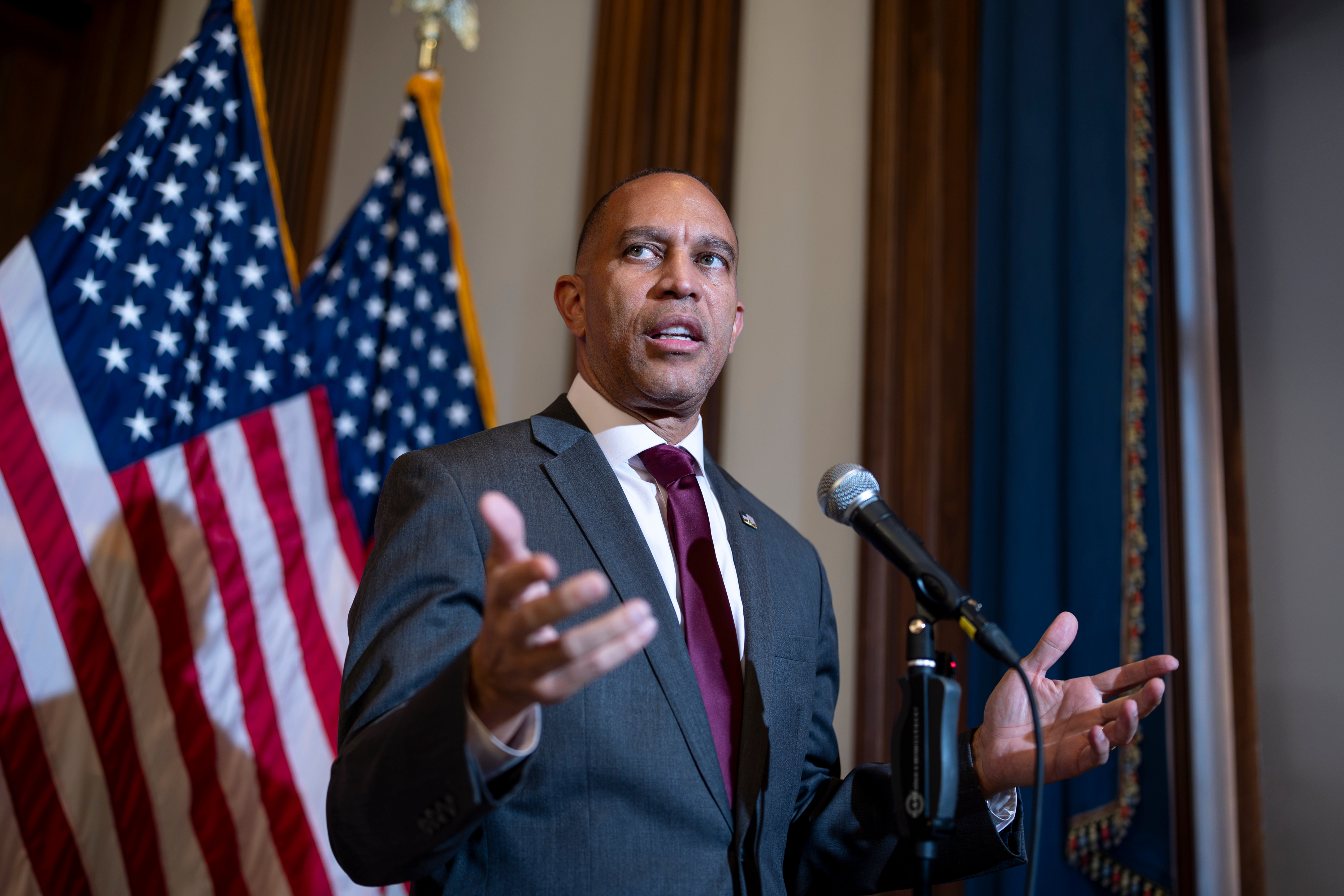
    “There is a cost to the American people of the out-of-control corruption,” said Democratic leader Hakeem Jeffries of New York, who is in line to become House speaker if Democrats win control at the Capitol.

    “If folks have been stealing from the American people, shortchanging the American people, or screwing over the American people,” Jeffries said, “we are going to hold the crooks accountable.”

    Congress has enormous ability to conduct oversight of the executive branch as part of its power as a coequal branch of government, and a road map for the Democratic-run investigations has already been set by the almost daily letters lawmakers send to the administration and in amicus court filings.

    Democrats are asking about the money-making by Trump and his family, whose wealth has grown dramatically since he returned to the White House in January 2025. They are investigating the potential civil rights violations of Americans killed protesting U.S. Immigration and Customs Enforcement operations and of detained immigrants being deported to faraway countries. They have fought the closing of the Kennedy Center, launched investigations into private funding of the America at 250 celebrations, and tracked the shuttering of federal operations, including the U.S. Agency for International Development.

    New questions emerge daily, including the Trump family’s recent acknowledgment that a weekend wedding party for the president’s son Donald Trump Jr. was partly funded by a Russian oligarch, with reportedly close ties to the Kremlin.

    Rep. Jamie Raskin (D., Md.), who is in line to become the chairperson of the Judiciary Committee, characterized the issues involved as “gargantuan.”

    “We need to zero in quickly on the forms of systemic corruption that have cost the public huge amounts of money,” Raskin told the Associated Press, “and where there are legislative cures available.”

    Trump impeachments made history then. Could it happen again?

    Jeffries will almost certainly be under pressure from the far left to move more swiftly to articles of impeachment against Trump, who during his first term became the first president to be twice impeached by the House. Both times, he was acquitted by the Senate.

    Impeaching the president a third time may not hold the currency that it once did. Democrats will more likely focus their impeachment efforts on cabinet members. Defense Secretary Pete Hegseth already faces articles of impeachment from a Republican, Rep. Thomas Massie of Kentucky, over his leadership at the Pentagon and his management of the Iran war.

    “We haven’t ruled anything out,” Jeffries said recently about the tools available to Congress, “and we haven’t ruled anything in.”

    The White House is likely to play hardball if confronted with investigations, and Democrats are bracing for an administration that potentially ignores subpoenas or refuses to turn over paperwork that lawmakers are demanding.

    The Democrats are also reaching beyond the administration into various corporate and business entities for potential wrongdoing.

    ‘We’ll act like the Congress,’ says one Democrat in line to lead a committee

    Ranking Democratic lawmakers who are in line to lead committees if power shifts are beginning to chart the investigations they plan to tackle.

    Rep. Robert Garcia of California, the top Democrat now on the Oversight and Government Reform Committee, has outlined five priorities, including Trump family business dealings, the administration’s handling of the Jeffrey Epstein investigation, and ICE operations.

    “We’re already doing work,” Garcia told the AP.

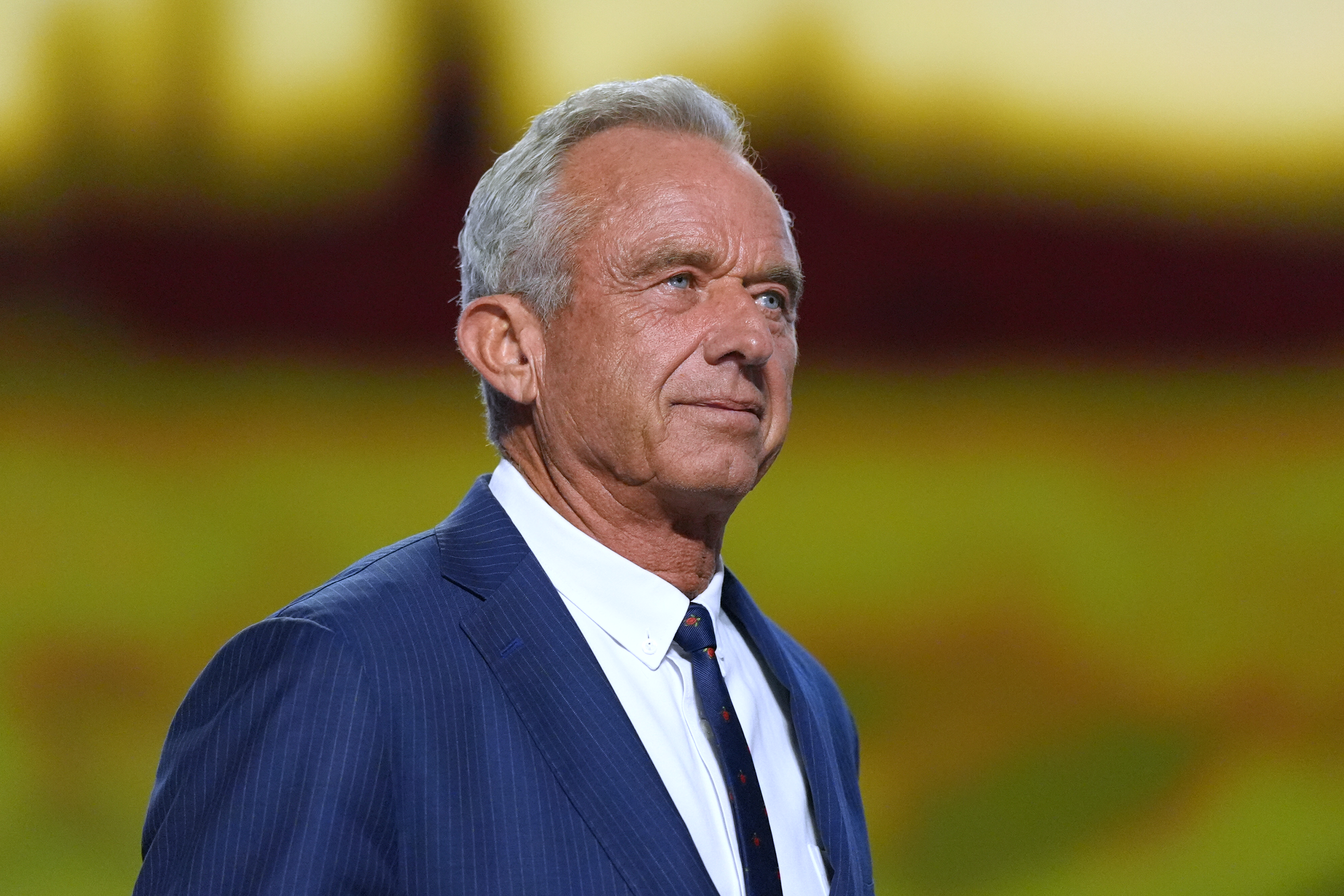
    He also mentioned the Department of Health and Human Services under Secretary Robert F. Kennedy Jr., as well as broader allegations of corporate corruption.

    The top Democrat on the House Foreign Affairs Committee, Rep. Gregory Meeks of New York, whose jurisdiction includes the State Department, said the committee plans to investigate Trump’s international dealings, including around the Iran war.

    He expects the committee will also look into the administration’s Venezuela operations — from the military strikes on alleged drug boats in the Caribbean and Pacific waters to the U.S. partnership with a private company to develop and access the South American country’s oil.

    Rep. Jared Huffman of California, the ranking Democrat at the Natural Resources Committee, which overseas the Interior Department and its National Park Service operations, has begun digging into Trump’s “vanity projects,” including the demolition of the White House’s East Wing for a new ballroom and the president’s proposed arch.

    Huffman and other committee members have also been eyeing the Trump family’s role in various minerals deals.

    At the committee’s last session before lawmakers recessed to campaign for the midterm elections, Huffman said that if Democrats take charge, he plans to call witnesses, put them under oath, and follow the evidence where it leads.

    “When people ask what will we do,” he said he responds, “My answer is simple. We’ll use those tools. We’ll act like the Congress.”


  • Tasia Fortune’s hanging was ‘staged’ after her death in a drug dispute, Mississippi police say

    Tasia Fortune’s hanging was ‘staged’ after her death in a drug dispute, Mississippi police say

    JACKSON, Miss. — Tasia Fortune was apparently killed in a drug dispute before her body was hung in a tree in a “staged” lynching behind an abandoned home in the Mississippi capital this summer, a detective testified Friday.

    Fortune was killed in a disagreement about drugs, and she fought hard with her attackers before she was killed, Jackson police Detective Samuel Dukes told the court. Citing the medical examiner’s opinion, he also said the hanging was “staged.”

    Fortune was Black, and the Aug. 3 discovery of her hanging body stoked fear and drew widespread attention because the scene recalled actual lynchings in the Southern state, which has a long and troubled history of racial violence.

    Authorities haven’t disclosed the exact cause of Fortune’s death or said why they think her body was hanged afterward, but they ruled it a homicide and arrested two men, both of them also Black, on murder charges. They also issued an arrest warrant for an unnamed third person.

    Outside court, Fortune’s mother, Christy Spivey, told reporters that she had been aware that her daughter died before her body was hanged.

    “What bothered me was they said Tasia fought for her life. I know she did. I know my daughter,” Spivey said.

    The hearing was meant to determine whether there is sufficient evidence to send the case against the first man arrested, Jarques Ratliff, to a grand jury for a possible indictment. It will resume Sept. 30.

    Ratliff, 51, was arrested in mid-September and has pleaded not guilty. He remains jailed without bond. Police arrested a second defendant, 25-year-old Earnest Lloyd Jr., this week.

    During Friday’s hearing, Ratliff blurted out in court that he and Fortune were friends.

    “It sounded sincere. Tasia had a lot of friends,” Spivey said later. ”I hope if he is innocent that he can prove he’s innocent. We don’t want any innocent people going to jail.”

    Ratliff’s stepdaughter, Lashuna Jones, was among her father’s supporters at court.

    “He didn’t do it, and I’m behind him,” she said.

    Spivey has said her daughter, who had four children, struggled with homelessness in recent years, and that she wasn’t sure where Fortune was living at the time of her death. She said Fortune had talked about starting a cleaning business and was trying to get her life in order.

  • White House network TV pool resumes operations after a dayslong ban of news outlets from grounds

    White House network TV pool resumes operations after a dayslong ban of news outlets from grounds

    The U.S. network video pool for the White House was back in operation Friday, for the first time since President Donald Trump banned three news outlets in an extraordinary showdown over media access.

    At noon on CNN, viewers could see Trump and President Xi Jinping touring the National Archives, along with Melania Trump and Peng Liyuan, Xi’s wife. The banner along the bottom of the screen read: “Trump and China’s Xi Visit National Archives.” It was a routine report from a state visit — but for the fact that CNN had not aired live video of Trump in several days.

    “As of now, all systems are go,” said a person familiar with the pool, speaking on condition of anonymity because of the fluidity of the situation.

    The pool consists of five major U.S. broadcast outlets that take turns shooting and sharing video. When the White House banned CNN — which belongs to the pool — from White House grounds, along with MS NOW and Politico, the other four pool providers declined to participate in a show of solidarity.

    A judge temporarily struck down the ban in an overnight ruling early Thursday, but his ruling didn’t directly address the pool. The networks continued to refrain from covering Trump as part of the pool, even as reporters from all three outlets were allowed back in the White House.

    CNN was not commenting directly on Friday, referring instead to its editorial coverage. But Brian Stelter, the network’s media analyst, posted on X that CNN had a pool assignment at the National Archives event and that the White House had approved the network’s credentials.

  • Iran proposes a deal to reopen the Strait of Hormuz in 7 days if the U.S. meets its conditions

    Iran proposes a deal to reopen the Strait of Hormuz in 7 days if the U.S. meets its conditions

    Iran has offered to reopen the Strait of Hormuz and resume talks on its nuclear program in seven days if the United States lifts its naval blockade of Iranian ports, waives sanctions on Iranian oil sales, and observes a ceasefire that would include Lebanon.

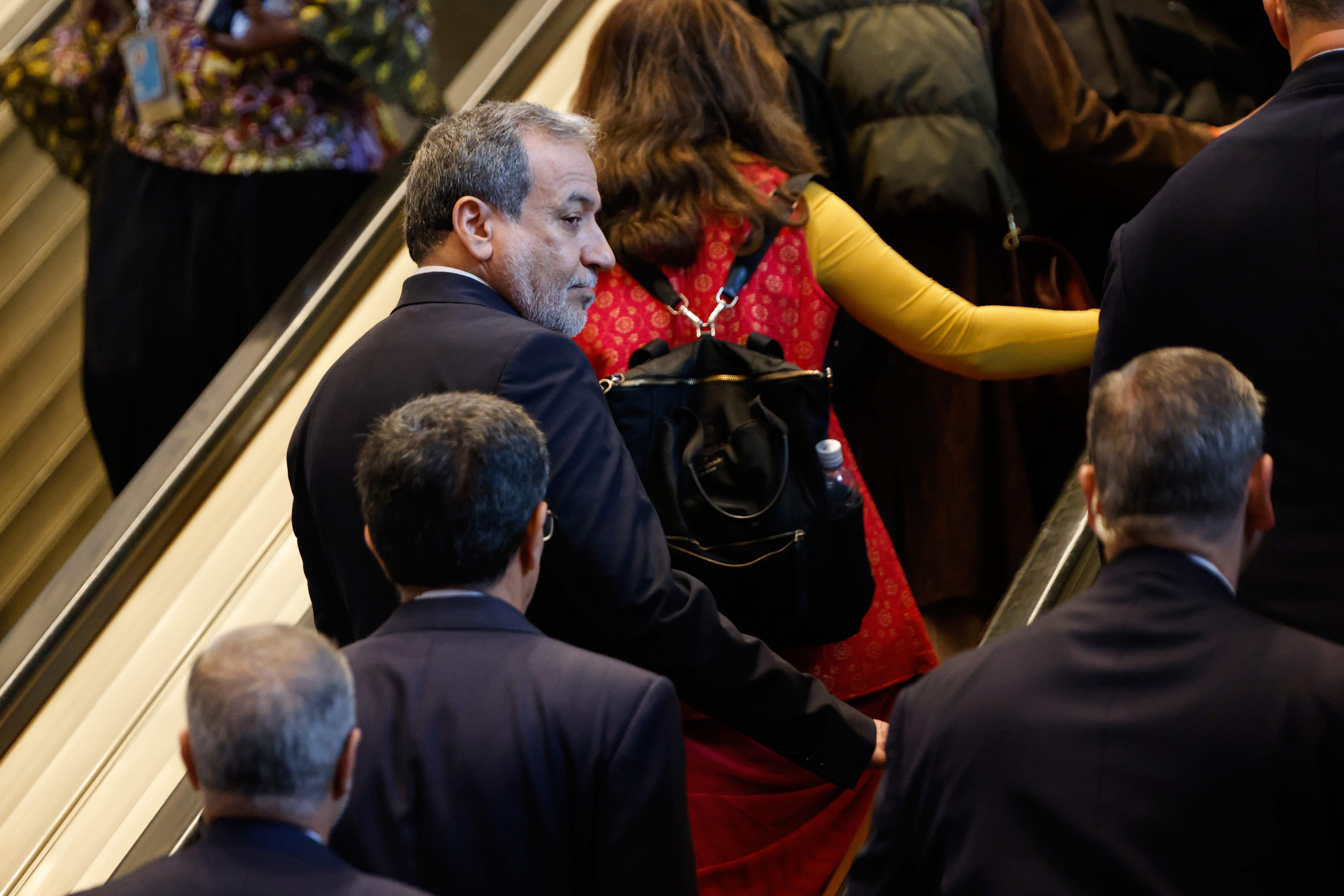
    Iran’s Foreign Minister Abbas Araghchi detailed the proposal in a private gathering on Thursday on the sidelines of the U.N. General Assembly in New York, according to one attendee.

    Trita Parsi, executive vice president of the Quincy Institute think tank, said Araghchi suggested that a speedy agreement would help U.S. President Donald Trump ahead of November’s midterm elections. The arrangement would also relieve enormous economic pressure on Tehran as the U.S. piles on additional sanctions.

    Iran’s disruption of the strait — through which a fifth of the world’s traded oil and gas transited before the war — has emerged as its main point of leverage. The effects have been felt far beyond the Middle East.

    There was no immediate comment from Iran’s U.N. mission or other Iranian officials. A person familiar with the matter, speaking on condition of anonymity to discuss private deliberations, told the Associated Press that Saudi Arabia was skeptical of the latest push for a deal.

    The White House said Friday that U.S. officials are having positive and constructive conversations with mediators on the Iran war. In response to questions from the Associated Press, it said the U.S. is facilitating significant oil exports through the Strait of Hormuz.

    Proposal resembles a June deal that quickly crumbled

    The proposal, conveyed to the U.S. by mediators, strongly resembles the so-called Memorandum of Understanding reached in June, but with an accelerated timetable. The earlier agreement, which called for a 60-day interim period, quickly collapsed as Iran resumed attacks on shipping in the strait.

    Trump has said he is in no rush to reach a deal, even as high oil prices fuel inflation. On the Iranian side, there are questions as to whether the hard-liners who dominate the security forces would accept compromises championed by moderates like President Masoud Pezeshkian.

    “If Trump calculates this arrangement is worthwhile and can bring political benefit before the midterms and reduce gas prices, perhaps we’ll see flexibility not seen in previous weeks,” Parsi said. But he noted “deep suspicion,” especially around the prospect of Iran merely buying time to ship out more of its oil and ease its economic pain.

    Other signs of renewed diplomacy

    In the latest sign of diplomatic movement, Pezeshkian hosted the prime minister of Qatar early Friday. Qatar has been a key mediator, including during hours of indirect Iran-U. S. talks at the U.N. this week.

    It was not clear how long Pezeshkian and Araghchi would stay in the U.S. after Pezeshkian addressed the annual U.N. gathering of world leaders on Wednesday, ending his speech by saying Iran remained open to diplomacy.

    U.S. Secretary of State Marco Rubio, on the same day, said, “If there’s an opportunity to exchange ideas and messages, we will.”

    After multiple failed attempts at a deal, however, suspicion is high on both sides. The U.S. and Israel have attacked Iran twice while it was engaged in nuclear talks, and the U.S. and Iran accuse each other of having swiftly violated the June agreement.

    “The Iranians already know that the chances of this not being accepted by Trump are much higher than the opposite,” Hamidreza Azizi, senior Iran analyst at the International Crisis Group think tank, wrote on X.

    “They want to show that they were ready for diplomacy and that it was the United States that, for the third time, decided to attack in the middle of a diplomatic track — something that people within (Iran’s) strategic community have been anticipating over the past few days.”

    It’s unclear if the proposal would include the Yemen conflict

    The proposal would include Lebanon, where Israel and the Iran-backed Hezbollah have been mostly observing a ceasefire. It’s not clear, however, if it would include the revived conflict between Yemen’s Iran-backed Houthi rebels and Saudi Arabia, which has put even more pressure on global markets.

    Iran appears to think the Houthis’ newly enhanced ability to threaten the Bab el-Mandeb strait on the Red Sea — another trade chokepoint on the other side of the Arabian Peninsula — could push Trump to make a deal.

    Maj. Gen. Yahya Rahim Safavi, a military adviser to Iran’s new supreme leader, told state television that the Americans “face a new problem called the Bab el-Mandeb Strait.”

    He added: “I think the process that is unfolding is in our favor, and the Americans will be forced to accept Iran’s conditions.”

    With the Houthis’ latest surge in attacks, Saudi Arabia was skeptical of Araghchi’s latest push for a deal with the U.S., according to the person familiar with the matter.

    The kingdom, along with other Gulf states, had advocated over the summer for a return to negotiations, saying they could live with an agreement that gave Iran a temporary role in managing the Strait of Hormuz, the person said.

    But the Saudi calculations changed as the Houthis seized Yemen’s strategic Red Sea coast from pro-government forces and a vital Saudi pipeline came under attack.

    Earlier this month, Gulf leaders planned to gather in Oman to discuss an emerging agreement between Oman and Iran on the Strait of Hormuz, which runs between the two countries. But the meeting was canceled after Saudi Arabia called for amendments, only some of which were accepted by Iran, the person said.

    Iran’s leadership has shown signs of divisions

    Iran’s leaders have sought to project unity, but some hard-liners want to continue or escalate the war to secure bigger U.S. concessions and have criticized Pezeshkian and Araghchi’s diplomatic steps this week.

    Firebrand lawmaker Ebrahim Rezaei wrote on X that merely meeting with “the aggressor enemy” showed weakness. Iran’s Assembly of Experts, a panel of Shiite clerics who appoint the supreme leader, said, “There is no path other than resistance.”

    The head of Iran’s powerful Revolutionary Guard, Brig. Gen. Ahmad Vahidi, highlighted the U.N. speech by “the esteemed president” while focusing on Pezeshkian’s comments that Iran doesn’t fear war.

    Iran’s parliament speaker, Mohammad Bagher Qalibaf, who served as chief negotiator in earlier talks with the United States, provided a rare public acknowledgment of the internal divide.

    “There is a view that speaks of war but offers no prospect or mechanism for bringing it to a powerful conclusion,” he wrote on social media. “At the opposite end is a current that makes the error of underestimating national capabilities.”

    He added: “The first error keeps the country in a state of permanent crisis, while the second hands national resources and dignity over to the enemy.”

  • Pope praises free press, warns a ‘paradise of machines’ could undermine humanity as he opens France trip

    Pope praises free press, warns a ‘paradise of machines’ could undermine humanity as he opens France trip

    PARIS — Pope Leo XIV warned Friday that a “paradise of machines” risked undermining humanity as he opened a trip to France by posing fundamental questions about what it means to be human in the age of artificial intelligence, a nuclear arms race, and other threats to life itself.

    Leo raised existential concerns about scientific progress, life, and human rights during his opening speech to President Emmanuel Macron and authorities at the Élysée Palace and then to diplomats and United Nations employees at the headquarters of UNESCO, the U.N. culture and education organization.

    With wars plaguing Europe and the Middle East, he reaffirmed the Vatican’s opposition to nuclear weapons and said the nuclear deterrence doctrine was “mistaken” since it was just fueling a new arms race.

    “Peace is not a balance of power; rather, it is built day by day through dialogue and justice,” he said.

    Leo has an intense four days in France, where the Catholic Church has lost ground in influencing ethical issues given the strict approach to secularism that is enshrined in the French Constitution.

    Yet thousands of people lined his motorcade route, waving French and Holy See flags, with some braving hours of the unseasonable heat to catch a glimpse of him. The turnout underscored the surprising level of interest in Leo’s visit, the first official state visit by a pope to France in 18 years.

    “To see him, praying with us, it comforts us in our faith and on our path,” said Senegalese Sister Antonia Faye, who was glowing after her first-ever event with a pope, an evening prayer service at Notre Dame that featured angelic choirs and the cathedral’s booming organ.

    “Being with the pope is different to being alone or praying alone. We felt the benediction that came down on us,” she said.

    Pope says reporters ‘are all welcome’

    During his flight to France, Leo told journalists they were welcome to report on him, as he responded to the Trump administration’s attempt to bar U.S. media from the White House and affirmed the importance of journalists covering public figures.

    Asked by a CNN reporter about the Trump administration’s attempt to bar CNN and other reporters, Leo said the media was welcome on his plane.

    “I am very happy that here, you are all welcome,” he said. Good media coverage is important, he said, and equally important “that we have it all the way around, for everyone”

    The American pope has long affirmed the need for free and independent press, a point he made in one of his first audiences as pope. Speaking to journalists who covered the 2025 conclave that elected him, Leo called for the release of imprisoned journalists and affirmed the “precious gift of free speech and the press.”

    A capstone visit as Macron’s term ends

    For Macron, who is barred from seeking a third term in May elections, hosting the American pope is something of a capstone. Pope Francis had refused repeatedly to make a proper state visit to France during his 12-year pontificate and pointedly refused to join the inauguration of the rebuilt Notre Dame cathedral in 2024 that Macron had championed.

    “For a president of the republic as Macron, who is at the end of his mandate, it can be important to be aside the pope and to capture a part of his popularity,” said Charles Mercier, director of history and sociology of Catholicism studies at Paris EPHE university.

    With seven months left in his term, Macron’s approval ratings are near record lows, driven by anger over the rising cost of living and criticism of France’s growing debt and deficit and deteriorating public services.

    Smiling broadly as Leo spoke French, Macron thanked the pope for visiting, saying: “You are here with us for an extended visit, giving us your time, and that is moving.”

    Leo calls for the French to mull lofty questions about life

    Unlike Francis, who liked to travel to small Catholic communities far from Rome, Leo has been keen to emphasize and reawaken Europe’s Christian roots. He is seeking to push the church’s message about the value and dignity of human life in a country where the right to abortion was enshrined in the constitution in 2024, and where lawmakers recently gave final approval to a bill allowing adults with incurable illnesses to receive lethal medication.

    The French Catholic hierarchy strongly opposed the measures, in keeping with Catholic teaching that human life must be protected and defended from conception until natural death.

    In his speech to Macron and other government and diplomatic authorities, Leo reminded France of its “deep Christian roots” and called for the French to remember that the right to life is the “indispensable foundation of every other human right.”

    His concern about the dignity of human life and humanity as a whole extended to the threats posed by artificial intelligence.

    “The paradox has become increasingly evident: while ‘intelligence’ is attributed to computational systems, we struggle to recognize the inalienable dignity of human persons, whose lives are judged according to the criterion of efficiency and, when deemed no longer productive, are rejected and discarded,” he said.

    From the very start of his pontificate, Leo has identified AI as one of the greatest challenges facing humanity. He dedicated his first encyclical to the topic, “Magnificent Humanity,” calling for robust regulation and for AI developers to work for the common good rather than profit.

    Leo also appealed to AI developers and political leaders responsible for regulating them to slow down, an appeal that several top AI companies seem to have taken to heart recently.

    “If we are to avoid losing our humanity amid a ‘paradise of machines’ invading and conditioning our daily lives, there is an urgent need for education in ethical discernment and the capacity to acknowledge the moral good,” he said.

    Leo earlier told reporters that he was pleased his message was being heard and said he hoped the dialogue that the Vatican initiated with tech companies would continue.

    “And I think from their perspective, many of them, they’re very much open to looking for ways of making sure that AI does not displace or ultimately destroy humanity, but rather is a tool for human beings,” he said.

    A visit to Notre Dame that Francis declined

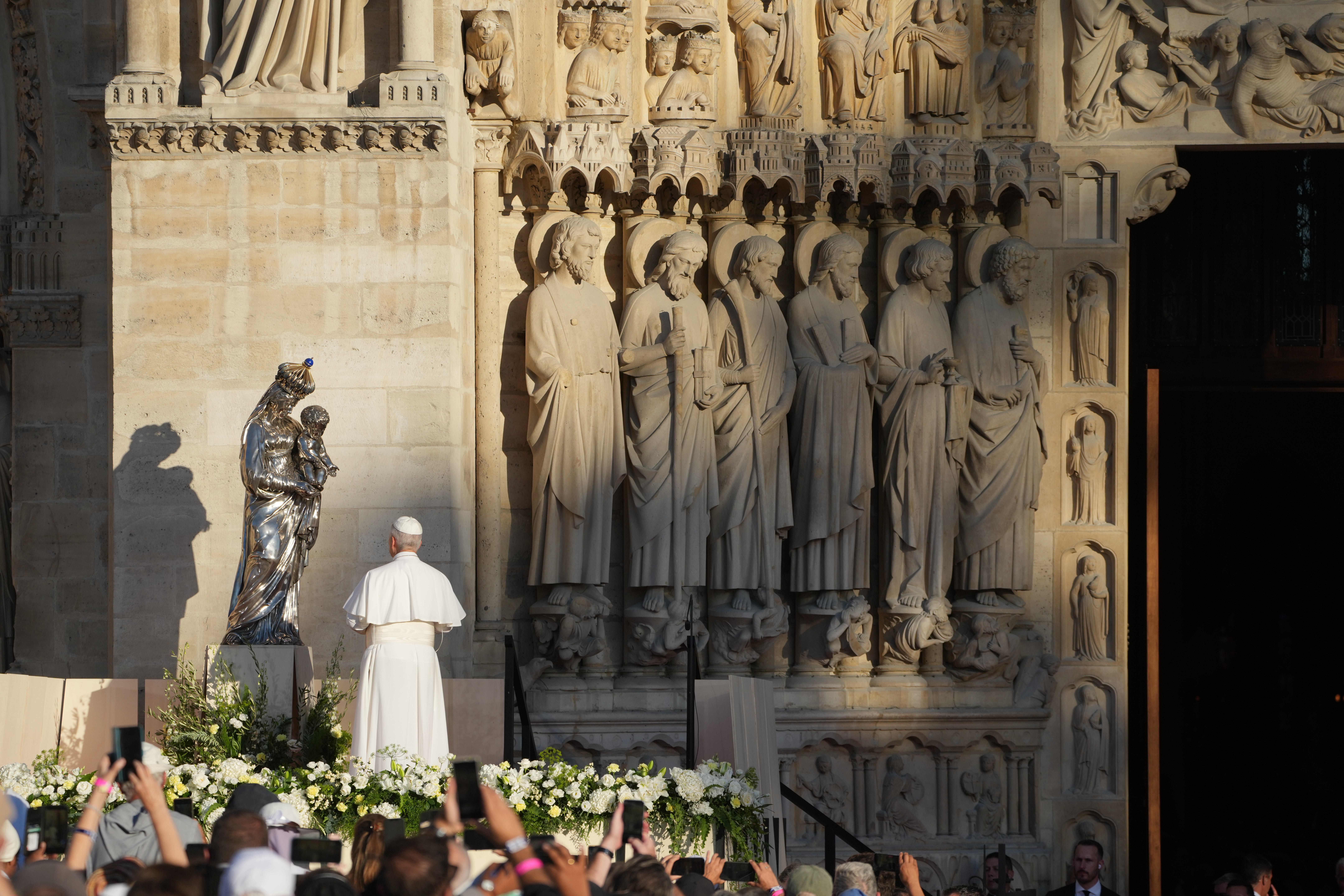
    Later on Friday, Leo presided over evening prayers in Paris’ soaring Notre Dame cathedral, the first pope to celebrate there since the devastating 2019 fire that consumed the cathedral’s roof and toppled its spire.

    After being mobbed by a crowd of eager nuns outside, Leo walked down the central aisle to the combined thundering of the organ above and cheers from the pews below. As bells tolled, he knelt in silent prayer in the same spot where, in 2019, flames brought down scorched roof beams.

    Leo marveled at the brilliance of the stained-glass windows and restored cream columns and praised the artisans who repaired them. He urged the priests and nuns gathered in the pews to be inspired by the combined effort to bring the Gothic masterpiece back to life.

    Francis had refused to visit France on a proper state visit, and explicitly refused Macron’s invitation to come for the 2024 reopening of the cathedral that drew dozens of world leaders.

    He did make three short trips to French cities, however, including Strasbourg in 2014 and Marseille and Corsica in 2024, a one-day visit that became his last foreign trip.

  • Democrats press RFK Jr. on an ethics agreement change involving law firm fees

    Democrats press RFK Jr. on an ethics agreement change involving law firm fees

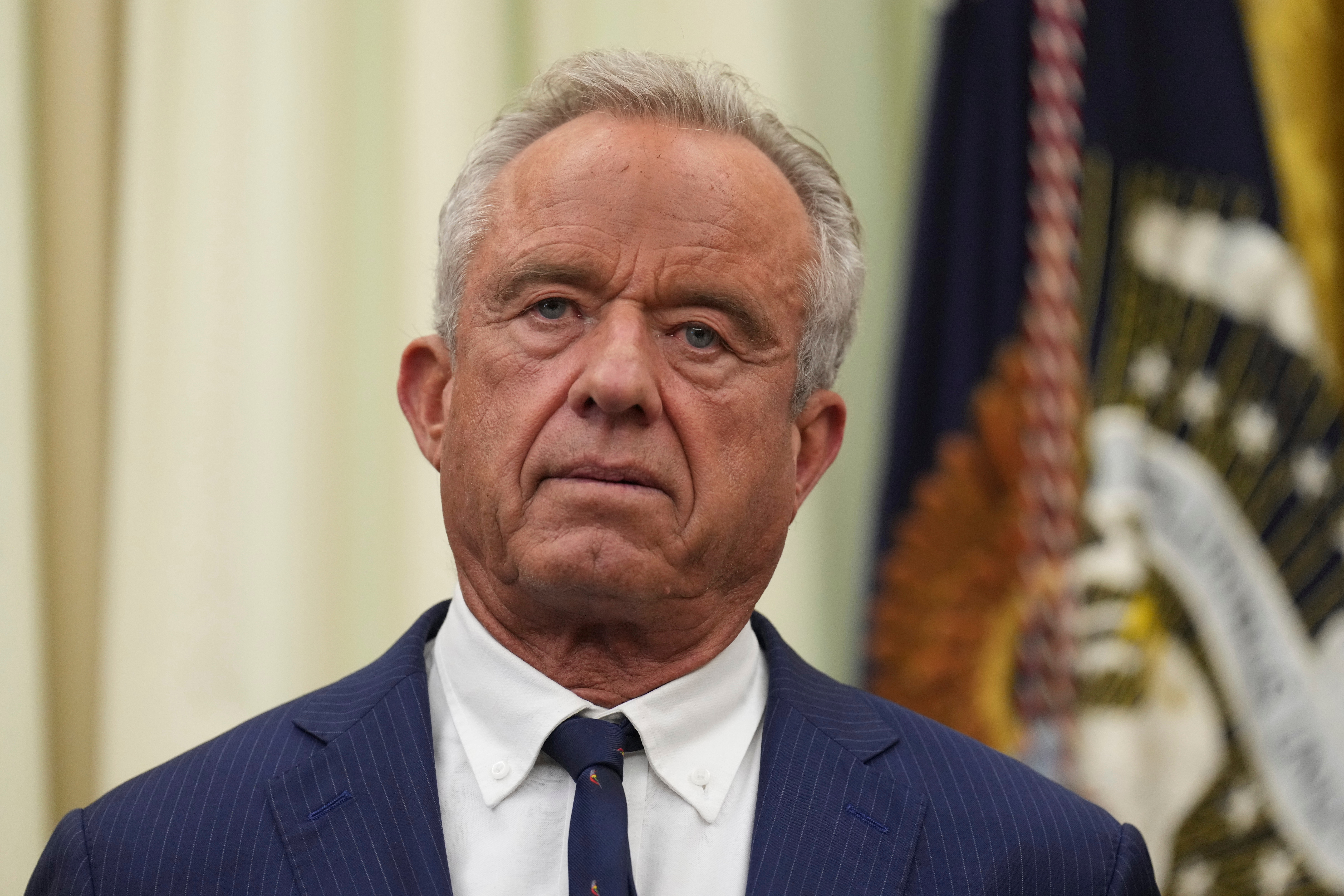
    WASHINGTON — Congressional Democrats are pressing for answers from Health Secretary Robert F. Kennedy Jr. over what they describe as a previously undisclosed change to the ethics agreement he made before being confirmed, which they say calls into question his credibility and the integrity of his decisions.

    Ahead of his confirmation vote last year, Kennedy told lawmakers that he would not collect fees related to litigation he pursued before becoming a government official against the drugmakers of a cervical cancer vaccine, saying he would transfer his financial interests to his adult son.

    The lawmakers say they recently learned, however, that shortly after his confirmation hearings, Kennedy quietly changed his ethics disclosures and transferred his stake to his former employer, the personal injury law firm Wisner Baum, apparently contradicting his sworn commitments to members of Congress.

    In a letter sent to Kennedy on Thursday, Democratic Sens. Elizabeth Warren of Massachusetts, Ron Wyden of Oregon, Richard Blumenthal of Connecticut and Angela Alsobrooks of Maryland said the health secretary has provided no explanation for the change.

    “Your decision to withhold this information from Congress and apparent failure to report this change to agency ethics officials is deeply alarming,” the senators wrote. “These troubling findings call into question the veracity of your public ethics commitments, your transparency with Congress and the public, and potentially, your compliance with federal ethics disclosure laws and regulations.”

    Emily G. Hilliard, an HHS spokesperson, told the Associated Press that HHS had confirmed Kennedy’s compliance with his ethics agreement in May 2025. “Any claim that Secretary Kennedy maintained a financial interest in this litigation after taking office is false,” she said.

    Kennedy’s testimony to lawmakers during his confirmation hearing has come under scrutiny before.

    During the arduous confirmation process in which he needed the support of some skeptical Republican lawmakers to advance, Kennedy pledged to maintain vaccine policies that, once in office, he moved to change. He also said a 2019 trip to Samoa had “nothing to do with vaccines,” an account refuted by documents recently obtained by the AP. The Department of Health and Human Services has denied Kennedy lied over the Samoa trip.

    Kennedy’s initial ethics disclosure, filed in January 2025, allowed him to retain a 10% contingency fee in cases that he had referred to Wisner Baum. After warnings from lawmakers about the conflict of interest, Kennedy agreed to amend his ethics agreement to divest his interest to his son.

    But in an Aug. 25 letter to Warren, HHS revealed Kennedy transferred those fees to Wisner Baum. Kennedy’s son Conor Kennedy is employed at the firm.

    “At the time, Secretary Kennedy intended to assign those interests to a non-dependent adult family member,” said the letter. “After further consideration, Secretary Kennedy irrevocably assigned his outstanding contingency-fee interests in the Gardasil cases directly to Wisner Baum.”

    The senators are now pushing Kennedy for answers on what his agreement with Wisner Baum entails, noting that if it involves any agreement about future payments, it could amount to a conflict of interest.

    “If you made any kind of implicit or explicit agreement for future payment or other future rewards with Wisner Baum in exchange for assigning them this stake, it would mean that you have an ongoing conflict of interest that calls into question your integrity and the motivations for your decisions as HHS Secretary,” the lawmakers’ letter to Kennedy said.

  • CDC vaccine policy recommendations grind to a halt under Health Secretary Kennedy

    CDC vaccine policy recommendations grind to a halt under Health Secretary Kennedy

    NEW YORK — The Food and Drug Administration recently approved a new flu vaccine that tested well in older adults. But the federal agency responsible for telling doctors and the general public how to use it has made no recommendation on it.

    The Centers for Disease Control and Prevention’s inaction on the mFlusiva vaccine marks a break in longstanding practice. It’s also an example of how the agency’s vaccine review-and-recommendation process has been blown up in the past year, grinding decision-making to a halt.

    Efforts by vaccine-wary officials in President Donald Trump’s administration to scale back shot recommendations have been put on hold. Federal guidance on new vaccines has stopped. And public discussion of vaccine policy questions that might cross political divides — including whether there’s solid evidence to justify giving fewer shots to kids — has diminished.

    Health Secretary Robert F. Kennedy Jr.’s crusade to upend vaccine policy and the legal action opposing it have disrupted longstanding systems that deliver crucial health guidance to Americans, affecting whether people are getting the best available protection against vaccine-preventable diseases.

    “We find ourselves at a point where even if credible evidence (for a new vaccine policy) has reached a tipping point, we don’t have an obvious mechanism that can formalize that change,” said Jason Schwartz, a Yale University health policy researcher who studies government health agencies.

    Many in medical field praised a ruling that halted Kennedy’s changes

    For 60 years, the Advisory Committee on Immunization Practices guided the CDC’s vaccine recommendations. The committee met publicly, reviewed vaccine data, and sought input from various health groups. The panel voted on recommendations that went to the CDC director, who almost always adopted them as the government’s guidance, leading public and private insurers to pay for the shots.

    Trump, a Republican, appointed Kennedy to oversee federal health agencies, including the CDC. Kennedy last year dismissed the committee and replaced it with a group that included several anti-vaccine voices. Controversial decisions followed, leading to a lawsuit from the American Academy of Pediatrics and some other medical groups.

    In March, a federal judge said Kennedy likely violated federal procedures, stopped Kennedy’s panel from holding further meetings, and suspended Kennedy’s decision to reduce the number of vaccines recommended for children.

    Many in the medical and public health communities celebrated the decision and took the order as a respite from what they saw as the Trump administration’s assault on vaccines.

    Jason Goldman, president of the American College of Physicians, said he hoped “it will mean a return to a transparent and evidence-driven process that safeguards the health of all communities and the best interests of our patients.”

    In reality, the process stalled and splintered

    With Kennedy’s committee shut down by the court order, doctors’ groups that used to collaborate with the ACIP have gone their own way. Working with a University of Minnesota researcher, they have debated — not publicly — the kind of medical evidence formerly presented at ACIP meetings and issued their own recommendations.

    The trade association for private health insurers decided to heed the medical societies’ choices, and the insurers have continued to pay for shots recommended by those organizations.

    Many of the groups’ recommendations match prior ones made by ACIP and the CDC before Kennedy’s arrival. But they also made their own updates.

    For example, ACIP previously recommended that a new shot be given to women late in pregnancy: a vaccine against respiratory syncytial virus, or RSV, which can be dangerous to newborns. The government panel recommended that the vaccine be given between September and January in most of the U.S., to coincide with the time of year when RSV infections are most common.

    But RSV season sometimes remains active longer. For that reason, the medical groups recently said the shot should be offered to those women through the beginning of March.

    “We all recognized this needs to evolve,” Chris Regal, director of clinical innovation at America’s Health Insurance Plans, the health insurance trade association, said in a recent webinar.

    The official CDC guidance remains unchanged.

    Unanswered vaccine issues are piling up

    The mFlusiva flu shot is another example of the unusual way vaccine policy updates have stalled.

    The shot is the first flu vaccine made with the mRNA technology that was key to ending the COVID-19 pandemic. Kennedy has criticized mRNA vaccines and last year canceled contracts for the development of new ones. The shots also took a tortuous path through the FDA, which finally granted full approval in people ages 50 to 64.

    But the CDC this month quietly posted that it has decided to maintain its flu vaccine endorsements from last year due to “legal uncertainties and inquiries.” That means mFlusiva is not among the listed flu vaccines recommended to the public this fall.

    The medical societies are recommending it as an option, however.

    Another ACIP function was to vote on whether certain vaccines should be covered by Vaccines for Children, a government program that pays for shots for children who have no health insurance.

    The FDA approved updated COVID-19 vaccines, but as the summer dragged on — and fall vaccination campaigns got underway — the government would not say if the VFC program will pay for those shots. It was only this week that officials confirmed orders could be placed through that program.

    HPV vaccine reassessment is derailed

    Another question concerns the HPV vaccine, given to preteens to prevent certain cancers.

    Two HPV shots are recommended, but some recent research has suggested that perhaps one shot could be enough — at least for girls. Indeed, in 2024 the ACIP formed a working group to begin a reassessment of the recommendations.

    That work was derailed when Kennedy fired the entire committee. In January, he decided on his own to order that the number of recommended doses be reduced to one as part of a dramatic contraction of the childhood vaccination schedule. His decision was suspended by the judge’s order.

    Experts are trying to better understand the timing and the duration of protection from just one dose, particularly in boys. The American Academy of Pediatrics is weighing a change to its HPV vaccination recommendations and could reach a conclusion later this year, said the AAP’s James Campbell.

    It’s possible that the medical societies will end up agreeing with Kennedy on just how many HPV shots make sense. But that might not necessarily clear up the current mess, Schwartz said.

    “The credibility of the Trump administration, when it comes to vaccine recommendations, is so compromised in the eyes of the mainstream medical and public health communities,” he said, “that even recommendations that might align with where the public health community was trending are likely to be viewed with skepticism or distrust.”

    Meanwhile, the Trump administration is considering changing the federal government’s categories for vaccine recommendations, although a specific proposal has not been released and a Department of Health and Human Services spokesperson did not respond to questions about what is being contemplated. Public comments were due earlier this week.

    An alliance of 15 Democratic state governors said the proposed changes are likely to increase confusion and administrative complexity.

    “It’s Governors and their residents who bear the brunt of any increased disease outbreaks due to confusion related to hastily made federal changes,” Angela Botticella, managing director of the Governors Public Health Alliance, said in a statement.

  • Supreme Court lets Trump administration use revamped federal voter eligibility database for now

    Supreme Court lets Trump administration use revamped federal voter eligibility database for now

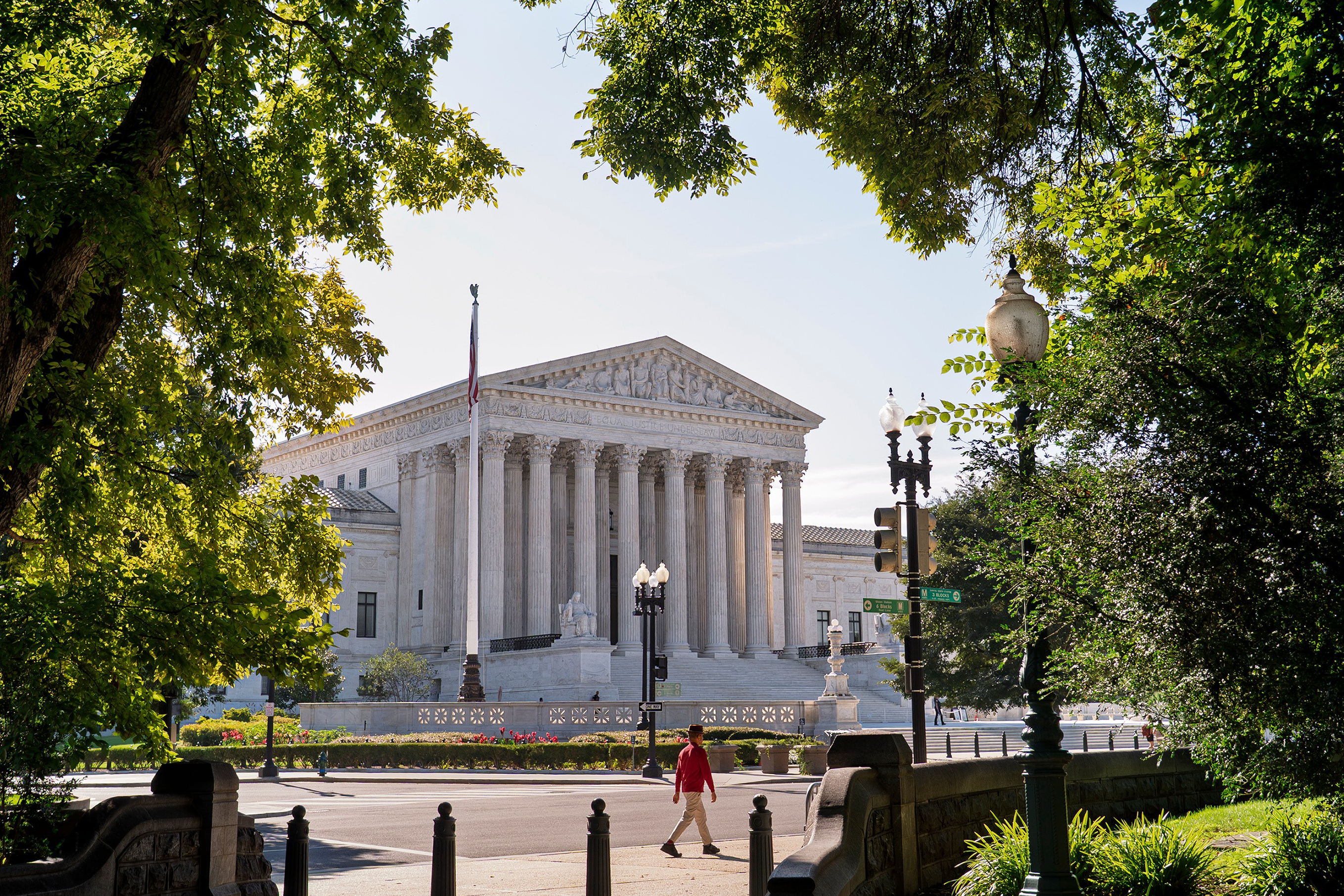
    NEW YORK — The Supreme Court on Friday lifted restrictions on a controversial federal voter database before November’s elections, granting President Donald Trump a temporary win in his aggressive campaign against noncitizen voting.

    The court’s three liberal-leaning justices publicly dissented from the decision.

    The emergency order allows states, for now, to use the Department of Homeland Security program, called Systematic Alien Verification for Entitlements, or SAVE, in their efforts to verify the eligibility of voters on their rolls.

    States’ use of the SAVE program is voluntary. The immediate impact on the upcoming midterms is likely limited because existing law blocks most states from systematically purging voters from their rolls within 90 days of an election, said David Becker, an election law expert who leads the Center for Election Innovation and Research.

    He said since the program is voluntary and DHS itself has admitted the data is not perfect, “states may find this to be a useful tool used along with other tools to keep their lists up-to-date.”

    The court’s order puts on hold a federal judge’s June ruling that had deemed the Republican administration’s recently revamped version of SAVE illegal. U.S. District Court Judge Sparkle L. Sooknanan had blocked the use of the tool, saying it violated Americans’ privacy rights and could result in voters being wrongly removed from the rolls.

    A federal appeals court let her order stand.

    But the Supreme Court majority found that a 1996 law explicitly allows DHS to get information about citizenship and immigration from other federal agencies. The federal government also has “an obligation to respond” to states seeking to verify citizenship.

    “The order below prevents the Federal Government from using the program it believes is best suited to the task,” the majority wrote in the unsigned order.

    Justice Ketanji Brown Jackson dissented, joined by Justices Elena Kagan and Sonia Sotomayor. The database has long been seen to fall under federal privacy laws, she wrote, and there are real risks that legitimate voter registrations could be mistakenly revoked.

    “The harm caused by burdening or disenfranchising even a few lawful voters outweighs the nonexistent harm that the Government experiences when it is prevented from taking an action that it likely lacks the authority to take,” Jackson wrote.

    The plaintiffs and counsel team in the case called the ruling “profoundly disappointing” and said it puts “millions of Americans at risk of being unlawfully targeted by the administration’s unreliable voter purge database” before the midterms.

    “However, this case is not over,” their statement read. “The D.C. district court ruled that the expanded SAVE program violated multiple laws. We will be doing everything in our power to protect Americans’ voting and privacy rights by ensuring that the district court decision stands.”

    The White House did not immediately respond to a message seeking comment.

    The SAVE program was created under an immigration law mandating that DHS help federal, state, and local agencies prevent government benefits from going to noncitizens. The Trump administration last year moved to significantly expand its search abilities. Since then, at least 67 million registrations have been scanned through the program, but critics worry it could end up purging valid voters from the rolls.

    Some registrants have already been wrongly flagged. In Travis County, Texas, for example, officials said they investigated 97 voters flagged by SAVE as apparent noncitizens and found that at least 10% of them — and likely up to 21% — were U.S. citizens. The county urged the Supreme Court to reject the administration’s appeal, while the state of Texas submitted its own brief defending the database.

    Even though the use of the SAVE program has been blocked for months, the administration said in court filings that DHS officials have continued using Social Security Administration data “in certain cases to verify information and help determine whether illegal voting may have occurred.”

    DHS in August launched its own investigation to find noncitizen voters on state rolls, according to a federal whistleblower statement that said the effort is rushed, filled with errors and potentially violates state laws. DHS has defended that investigation as being conducted “diligently and professionally.”

    The effort to create a national voter list is among numerous steps Trump has taken during his second term to try to overhaul the way elections are run. Most of those steps have been blocked by various courts, in part because the Constitution gives states and Congress the authority to set election rules, but provides no such power to the president. In mid-September, the Supreme Court rejected a bid from Trump to restrict mail ballot procedures before the midterms.

    Research shows that noncitizen voting, which is already illegal and punishable as a potential felony that could lead to deportation, is exceptionally rare. But Trump has remained fixated on the idea that massive numbers of noncitizens are voting in U.S. races.

  • Energy Department will spend $2 billion to squeeze more electricity from the aging power grid

    Energy Department will spend $2 billion to squeeze more electricity from the aging power grid

    ALLENTOWN — The Energy Department said Thursday that it will spend almost $2 billion to try to squeeze more electricity out of the nation’s aging and stressed power grid, as President Donald Trump’s administration steps up efforts to avoid blackouts amid skyrocketing energy demand spurred by artificial intelligence.

    The money will go toward 31 projects across 26 states that are expected to produce more than 23 gigawatts of additional electricity capacity — enough to power 16 million homes. The projects will use new technologies such as sensors to measure real-time weather conditions to ensure safe transmission or direct power away from congested paths, the department said.

    The upgrades could improve power reliability and lower electricity costs for about 100 million Americans, officials said.

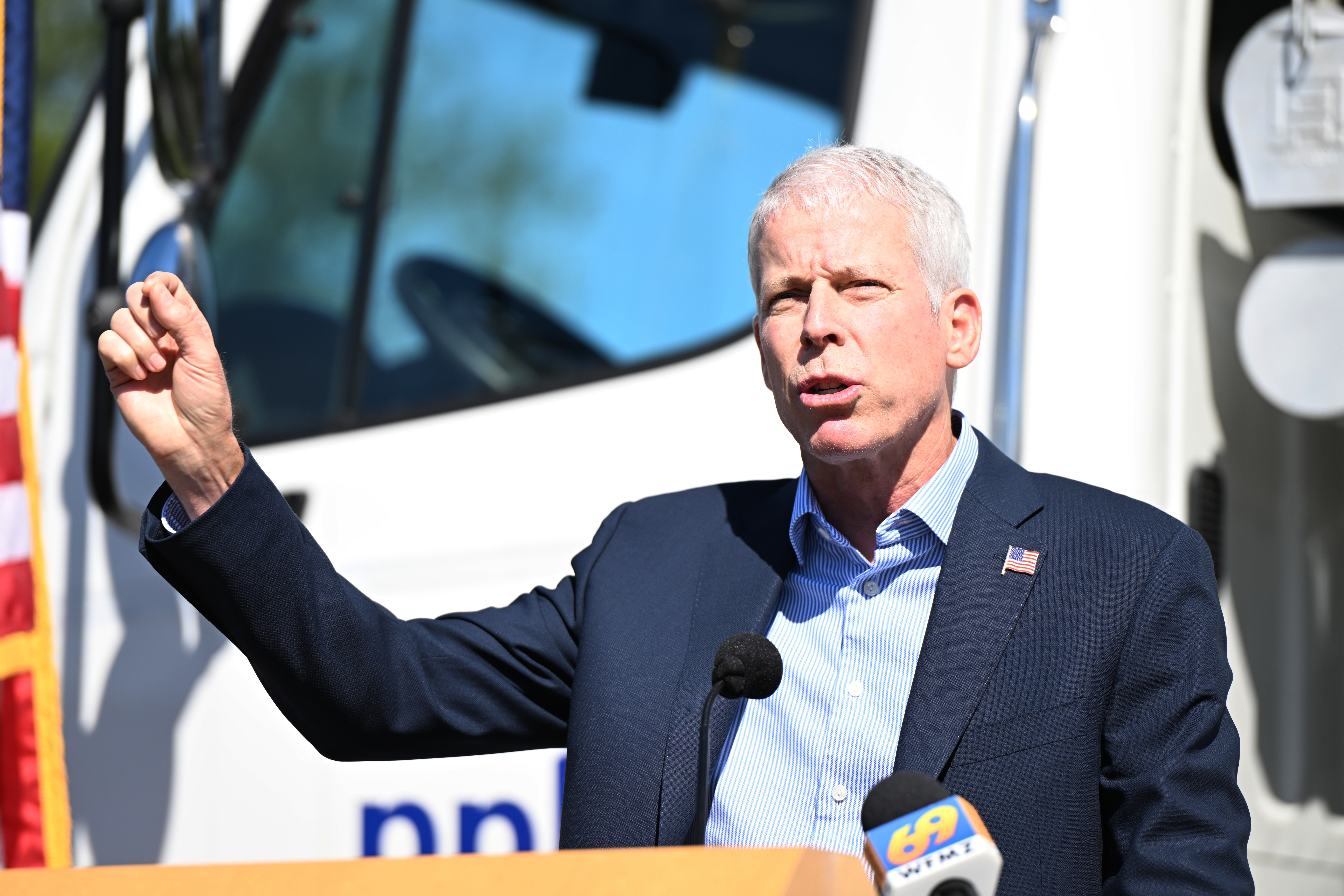
    “This is a quick way to lower electricity prices and increase reliability: using fibers that are already in the transmission lines to analyze what’s the temperature out, what’s the wind out, how can we use this transmission line to distribute more power, but safely and only in the right conditions,” Energy Secretary Chris Wright said in a news conference promoting the grants Thursday at a PPL Corp. facility in Allentown.

    The eastern Pennsylvania electric utility says two data centers in its territory came online this year and six more are under construction, with enough other data centers in the advanced planning stages that its peak electric demand could quintuple by 2032.

    PPL said it is receiving $71.5 million to modernize an existing high-voltage transmission line across roughly 30 miles in northern Pennsylvania.

    The announcement comes amid warnings that AI’s voracious demand for power is threatening to overwhelm U.S. power supplies, as massive new data centers come online faster than new power plants can be built. It also comes as electricity bills rise faster than inflation in many parts of the U.S., blamed in some areas on demand from data centers.

    The snowballing opposition to data centers in communities across the country has thrown a wrench into the plans of the world’s richest companies and transformed the midterm election landscape.

    Trump continues to stick up for data centers, even as politicians from both major political parties criticize them and many communities try to block them.

    In the meantime, Congress and some states are trying to push utilities to use new technology to make grids more efficient, lessening the need to build new power plants.

    Julia Selker, the executive director of the WATT Coalition, a trade association for grid-enhancing technologies, said both the projects and the scale of the investment are significant. Utilities in the U.S. are lagging places like Europe in adopting the technologies, despite federal investment in the past to develop and test them.

    Wright said that work on the projects should begin right away and that he hoped some efficiencies are in place before this winter to tamp down price spikes when extreme weather sends demand skyrocketing.

    He said he didn’t know whether the projects would have gotten done without federal funding. Many, he said, had been under consideration before the grants were offered, but the grant recipients hadn’t “quite pulled the trigger” on them.

    Projects being announced Thursday will involve component enhancements on more than 1,500 miles of transmission lines and technological enhancements across nearly 21,000 miles, the department said.

    Projects were prioritized based on those that can be put into operation quickly, officials said. Money for the grants comes from the bipartisan infrastructure law enacted by Congress under then-President Joe Biden, a Democrat. The government’s $1.9 billion in funding will be matched by $3.35 billion in cost-share funding from the recipients, the Energy Department said.

    Recipients include utilities, cooperatives and four state agencies. The state agencies — in Colorado, Indiana, Ohio, and Oklahoma — were the biggest recipients, collectively drawing at a total of $810 million, with the Colorado and Oklahoma projects promising improvements to the wider regional grid.

    Trump has vowed to “unleash” the nation’s energy sector in his second term, aiming to drive up record-setting domestic oil and gas production, strip away pollution restrictions on power plants and keep expensive coal-fired power plants operating past their retirement dates.

    The administration also has pledged nearly $4 billion to buy back offshore wind leases as Trump seeks to discourage the expansion of wind energy in favor of fossil fuels.

    His administration has pushed to help tech giants build and connect data centers to power plants and high-voltage power lines and convert Cold War-era uranium enrichment plants into data center and power plant complexes.

  • Cubs clinch second straight playoffs trip by beating Marlins as Crow-Armstrong joins 40-40 club

    Cubs clinch second straight playoffs trip by beating Marlins as Crow-Armstrong joins 40-40 club

    CHICAGO — Pete Crow-Armstrong joined the 40-40 club by stealing his 40th base to go along with his major league-leading 45 home runs, and the Chicago Cubs clinched their second straight postseason berth a 2-1 victory over the Miami Marlins on Thursday.

    Seiya Suzuki homered for the Cubs (88-71), who assured themselves of one of the NL’s three wild-card berths.

    Chicago also was a wild card last year, when the Cubs beat San Diego in the first round and lost to Milwaukee in a Division Series. The Cubs will be making consecutive postseason appearances for the first time since four straight from 2015-18, which in 2016 included their first championship since 1908.

    The Cubs clinched their berth shortly after the White Sox earned their postseason trip with a 9-1 win at Kansas City.

    Miami (78-81) was assured its third straight non-winning season.

    A favorite to win the NL MVP award, Crow-Armstrong became the seventh 40-40 player, joining a group that includes Los Angeles Dodgers star Shohei Ohtani and Atlanta Braves outfielder Ronald Acuña Jr. Jose Canseco was the first with the 1988 Oakland Athletics.

    Crow-Armstrong hit his 45th homer during Sunday’s 9-1 win at Cincinnati, extending his career high. The 24-year-old drew a leadoff walk from former Phillie Tyler Phillips in the first inning and swiped second base on the next pitch to Suzuki for his 40th steal in 47 attempts. Fans chanted “MVP” as the Wrigley Field videoboard proclaimed the feat.

    Ohtani was the previous player with a 40-40 season, hitting 54 homers and stealing 59 bases for the 2024 Dodgers. Acuña hit 41 homers and swiped 73 bases for Atlanta in 2023. Alfonso Soriano (2006 with Washington), Alex Rodriguez (1998 with Seattle) and Barry Bonds (1996 with San Francisco) are the other 40-40 players.

    Matthew Boyd (10-5) allowed one run, five hits and two walks over seven innings, and Ryan Zeferjahn pitched a perfect ninth for his seventh save to finish a five-hitter.

    Ian Happ tripled off Jack Ralston (0-2) to start the sixth and came home three pitches later on Nico Hoerner’s single, breaking a 1-1 tie.

    Miami’s Jakob Marsee had an RBI single in the third and Suzuki hit his 26th homer in the fifth, a drive off Jack Ralston.