Category: Associated Press

  • U.S. set for largest mass visa revocation in history targeting up to 200,000 foreigners, officials say

    U.S. set for largest mass visa revocation in history targeting up to 200,000 foreigners, officials say

    WASHINGTON — The Trump administration is preparing to revoke the business and tourism visas of up to 200,000 foreigners who have applied for or are currently seeking asylum status in the United States. If it happens, the move would be the largest single mass revocation of visas in U.S. history and would likely face legal challenges.

    Unless the order is challenged or revised, the State Department is expected to announce in the coming weeks the revocation of so-called B1 and B2 visas issued between 2016 and 2026 whose holders have sought asylum or are now seeking asylum, according to State Department documents obtained by the Associated Press and two U.S. officials. The action will be taken in coordination with the Department of Homeland Security.

    “We are coordinating with DHS to identify and revoke the nonimmigrant visas of foreigners who have come to the United States claiming to be short-term visitors, but then file for asylum to stay here permanently,” said State Department spokesperson Tommy Pigott.

    He declined to comment on the number of visas that might be revoked, saying, “As the process will be ongoing, the number of revocations remains dynamic and will be done on a rolling basis.”

    The revocations would not necessarily result in their immediate deportation, the officials said. Most of those with asylum cases currently pending would be recategorized but would lose their status as business or tourism travelers, according to the officials, who spoke on condition of anonymity because the revocations are not final yet.

    Since President Donald Trump took office for his second term last year, his administration has steadily ramped up restrictions on visa applicants — demanding more information about their social media histories, requiring the posting of expensive bonds for the processing of visas, and outright banning the issuance of visas to citizens of certain countries.

    In a social media post on Monday, Deputy Secretary of State Christopher Landau called out people who he said try to use tourist and business visas to get into the United States and then apply for asylum.

    “People in the US and all over the world are fed up with bogus asylum claims,” Landau wrote on X. “Asylum isn’t supposed to be a loophole to circumvent immigration law.” Landau cited the case of a Colombian citizen who came to the U.S. in 2015 on a tourist visa and then applied for asylum.

    B1 visas are generally issued for business trips and B2 visas are generally issued for tourism, family visits, or medical care. It was not immediately clear from the documents or the officials how many of these visa holders are seeking or have sought asylum in the United States and would be affected by the revocations.

    Current applicants for B1 and B2 visas are asked to affirm that they will not apply for asylum in the United States and to prove that they intend to return to their home countries.

    In the past 18 months, the State Department has revoked about 175,000 visas for people who have been convicted or accused of crimes ranging from drunken driving to rape and robbery, as well as for people who have spoken out publicly against U.S. policies, particularly in the Middle East.

    The administration has also moved to crack down on so-called birth tourism, a practice the administration claims is used by foreign pregnant women to come to the United States to give birth so that their child will benefit from birthright citizenship. Trump has tried several times to end birthright citizenship, but those challenges have been rejected by courts, including the Supreme Court.

    The State Department documents obtained by the AP suggest screening of current B1 and B2 visa holders began after the State Department received information about asylum requests from the Citizen and Immigration Service.

  • Firefighters are trying to stop a fast-moving Nevada wildfire from spreading to homes in Reno

    Firefighters are trying to stop a fast-moving Nevada wildfire from spreading to homes in Reno

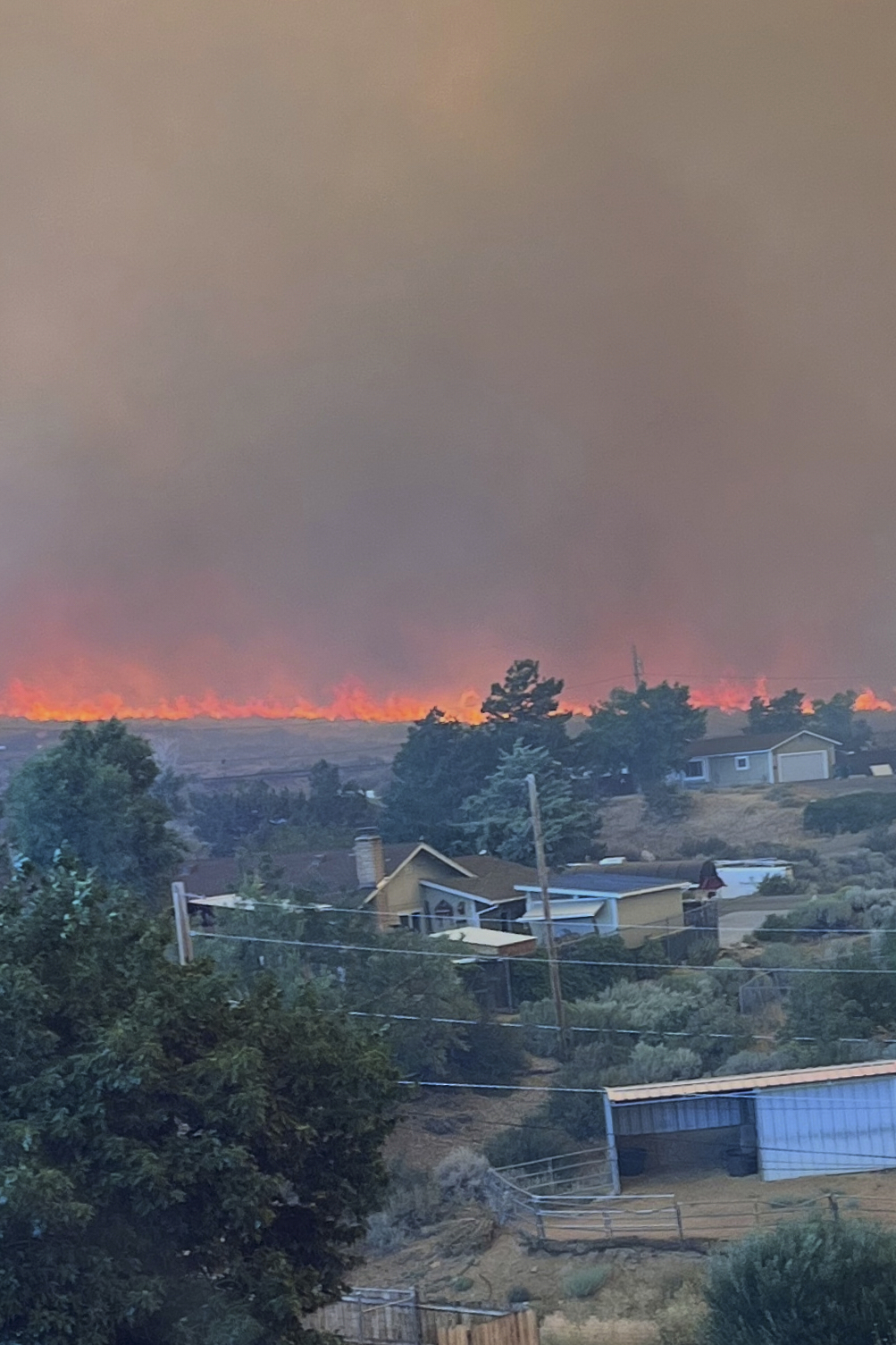
    RENO, Nevada — A wildfire that mushroomed over the weekend in the Sierra Nevada foothills spread perilously close to neighborhoods in Reno, Nev., forcing authorities to urge more than 90,000 residents to leave their homes.

    The out-of-control fire has already burned some homes, but there’s concern that shifting winds could push the flames into newly developed and densely packed neighborhoods in Nevada’s largest city outside of metro Las Vegas.

    Schools across Washoe County were closed Monday because of the evacuations and to keep roads clear for emergency crews. Nevada’s governor declared a state of emergency in the county and mobilized the National Guard to help with aerial firefighting and protecting evacuated neighborhoods northwest of downtown Reno.

    At a roadblock in one neighborhood, residents expressed frustration Monday that they could not get back into their homes.

    “There’s no fire here! Why are the National Guard here?” a driver yelled.

    Authorities said late Sunday that the Hawk Fire had stayed in its footprint and firefighters were extinguishing hotspots while working to keep the fire from jumping a main highway and reaching homes and businesses. There was zero containment.

    The fire began Saturday and grew to more than 23 square miles on Sunday. It’s the third large wildfire in the rugged terrain north of Reno in the past two weeks — all caused by human activity, according to fire officials. They haven’t said whether the Hawk Fire was intentionally set or accidental.

    Reno, home to about 280,000 people, is known for its casinos and as a gateway to nearby Lake Tahoe, North America’s largest alpine lake and a popular vacation destination. It’s also about 120 miles southwest of Nevada’s Black Rock Desert, site of the annual Burning Man festival, which begins Aug. 30.

    At least six people — three first responders and three civilians — have been injured by the fire.

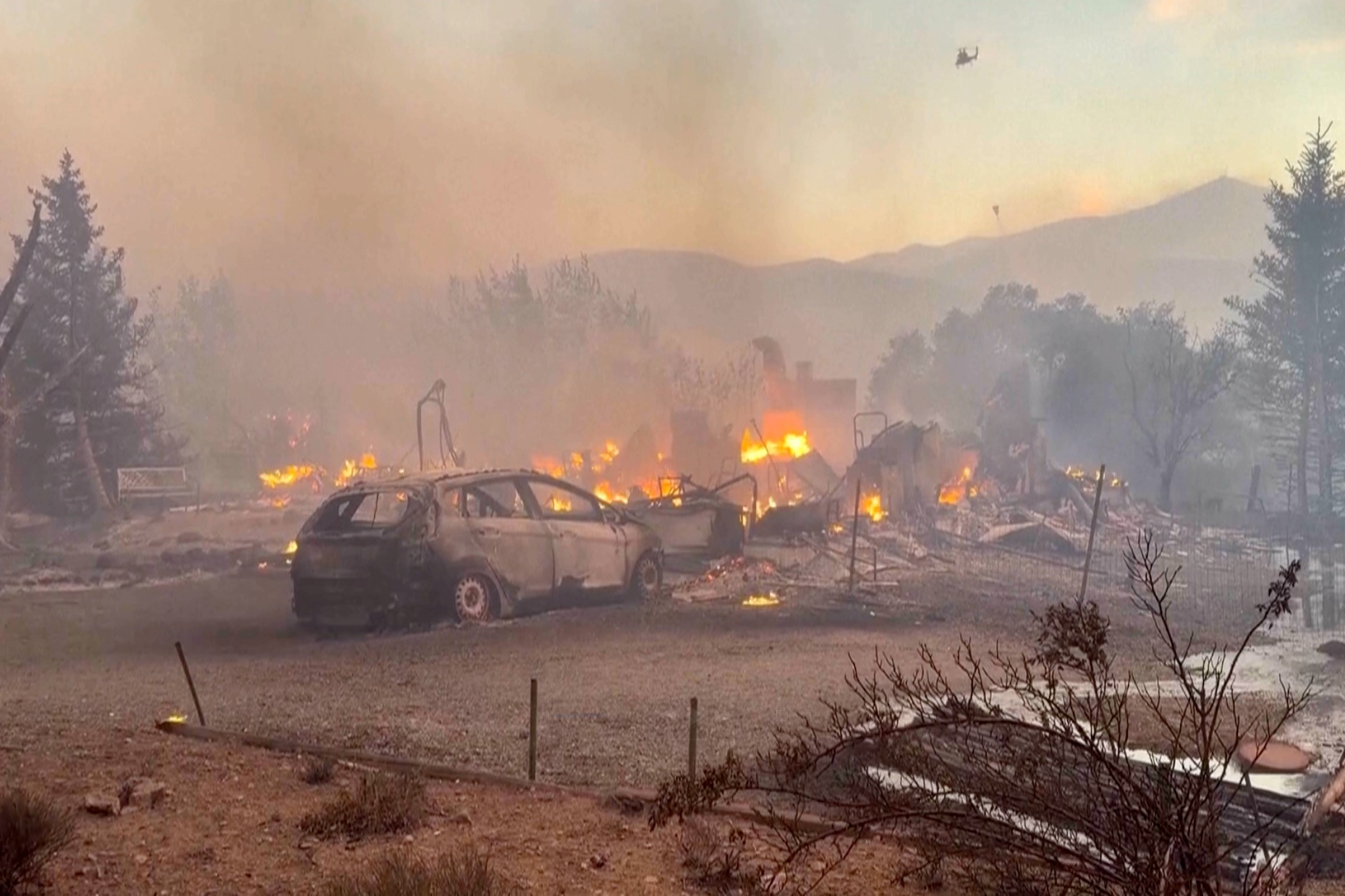
    Videos posted on social media showed the smoldering ruins of homes and cars, with only a scorched basketball hoop still standing.

    Many residents had little time to evacuate after the fire exploded in size.

    “Honestly, I thought it was like in a movie,” said Ruby Delatorre, who got back from a concert only to find her home in the evacuation zone. She returned Sunday to walk to her home and get a few more possessions.

    “I literally want to cry and go back for all my stuff. I just got what I thought I needed,” Delatorre said.

    Some who spotted the smoke on Saturday thought it was from another wildfire that has been burning the past two weeks.

    Teresa Lenshyn, who is among the evacuees, said being forced to leave was chaotic and stressful. “You don’t know if the winds are going to shift and it’s going to get worse,” she said.

    Much of Nevada’s western edge is under an increased risk of wildfires this week because of high winds and low relative humidity, the National Interagency Fire Center said. The National Weather Service says the region will see warm, dry, and breezy conditions, and that critical fire weather conditions are possible in the week’s later half.

    Extremely dry conditions across the American West have sparked a rash of wildfires this summer. Fires in eastern Washington state forced the evacuation of 60,000 people in the Spokane area in early August.

    Nationwide, there have been more than 50,000 wildfires — the most over the past 10 years covering the same time period, according to the national fire center.

  • European leaders mark Ukraine’s 35th Independence Day as Russian invasion pushes on

    European leaders mark Ukraine’s 35th Independence Day as Russian invasion pushes on

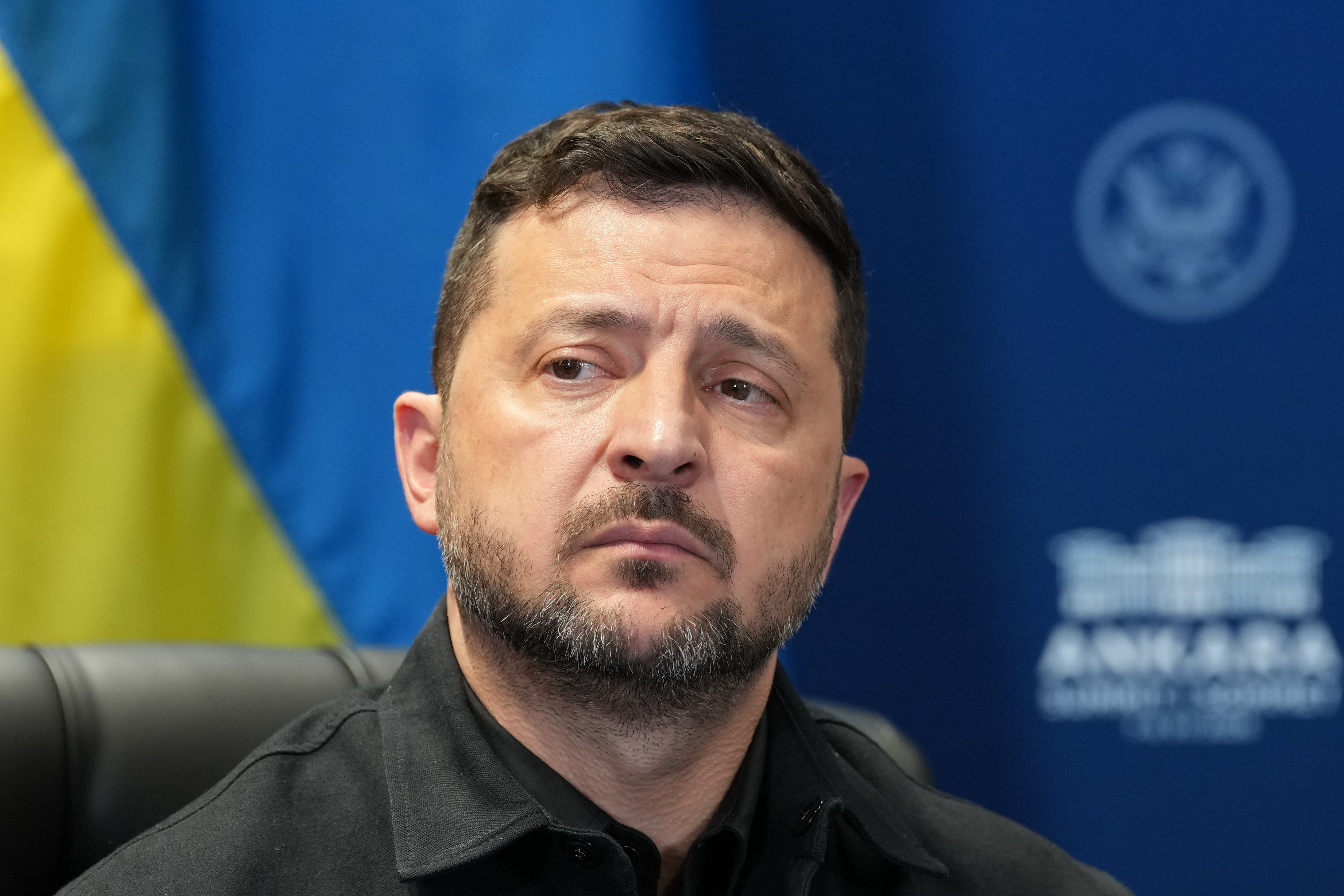
    KYIV, Ukraine — European leaders joined President Volodymyr Zelensky in Kyiv on Monday to celebrate the 35th anniversary of Ukraine’s independence and boost its long-range missile program as Russia pressed on with its 4-year-old invasion of the country.

    One of President Vladimir Putin’s key goals in starting a war with Russia’s neighbor in February 2022 was to return Kyiv to Moscow’s orbit. Ukrainian lawmakers voted on Aug. 24, 1991, to proclaim the country’s independence, and a nationwide referendum later that year overwhelmingly approved it.

    With no significant changes on the front line for months and no apparent progress after more than a year of U.S.-led peace efforts, both countries are locked in a spiral of escalating aerial attacks that are killing civilians and smashing infrastructure.

    Europe rallies around Ukraine

    U.K. Prime Minister Andy Burnham, on his first overseas trip since taking office last month, joined almost a dozen other European leaders, as well as other dignitaries, in Kyiv on Monday.

    “For Ukraine, independence is not an abstract idea. We defended it against all odds,” Ukrainian Foreign Minister Andrii Sybiha said on social media. “In times like these, nations learn how important it is to have allies by your side.”

    Burnham co-chaired a meeting of what’s been dubbed the Coalition of the Willing — a group of over two dozen countries helping Ukraine resist Russia’s onslaught.

    Burnham said he is pushing British industry to help a Ukrainian project that is working on a low-cost alternative to the U.S.-made Patriot air defense systems that are desperately needed but are in short supply. He urged other countries to encourage Washington to adopt stiffer sanctions on Russia and press Moscow to accept U.S. attempts to secure an unconditional ceasefire.

    Zelensky said in a speech at Kyiv’s St. Sophia Square that the presence of European leaders reflected continental fears about Russia’s wider ambitions.

    “We all understand that in this Russian war against us — against Ukraine — far more is being decided than the future of Ukraine and Eastern Europe,” he said.

    “No nation in a war like this could rely solely on its own weapons,” Zelensky said. ”No nation could withstand attacks of such intensity without the world’s help.”

    Ukraine eyes local production of Anglo-French missile

    The leaders brought pledges of further military and financial support. Burnham announced his government has agreed to allow defense company MBDA to release classified information relating to British components used in the SCALP long-range missile. That paves the way for France and Ukraine to advance plans for the weapon’s production in Ukraine.

    SCALP is the French version of the U.K.’s Storm Shadow missile, with both systems incorporating shared technology.

    “Ukraine has been Europe’s protector, not a drain on our security, but the front line of keeping Europe safe,” Burnham said, adding that Kyiv and its partners “must keep up the pressure on Moscow.”

    Kremlin spokesperson Dmitry Peskov said the Kremlin views the plan “extremely negatively.” He accused the U.K. of “taking part in this war” on Kyiv’s side.

    Ukraine has leaned heavily on NATO countries for help fighting Russia’s bigger army, although relations with the United States have been cooler under President Donald Trump.

    Russia, meanwhile, is getting help from North Korea and China.

    Ukraine displays its drones in a parade

    Ukraine’s swift development of innovative drone technology has enabled it to blunt Moscow’s battlefield progress as well as hit targets deep inside Russia, as far as 1,200 miles from their border. The speeches in St. Sophia Square were accompanied by a parade of domestically produced weapons.

    Both Russia and Ukraine are trying through long-range strikes to inflict economic pain, disrupt military supplies, and erode public morale.

    Ukraine’s long-range drones have repeatedly hit facilities in Russia’s vital oil industry, causing fuel shortages, and have also engaged in a campaign against Russia’s largest online retailer, Wildberries.

    But foreign suppliers also have to take into account their own needs, weapon production levels, and the depth of stockpiles.

    As the air war has intensified, Ukraine’s stocks of Patriot interceptors to counter Russia’s ballistic missiles have dwindled. Kyiv urgently needs more interceptors before winter, when Russia routinely bombards its power grid, but the demands of the Iran war and slow output of the sophisticated interceptors have left Ukraine short and vulnerable.

    Finnish President Alexander Stubb said he believed that striking Russian targets like Wildberries was a “sensible military strategy” that would hasten peace negotiations.

    Ukrainian strikes kill 3 teenagers

    Three teenagers were killed and six children were wounded in the southern Russian city of Krasnodar, Russia’s children’s rights ombudsperson Maria Lvova-Belova said, as Ukraine attacked several warehouses of Ozon, another online retailer, for the third straight day, according to officials and the company.

    Ozon said a large fire raged at its logistics facility in the suburbs of Krasnodar following the overnight attack.

    A drone also hit the grounds of an Ozon logistics center in the southern Russian region of Adygeya, said regional Gov. Murat Kumpilov, although the company said its warehouse wasn’t damaged.

    In all, four Ozon premises appeared to have been targeted.

    Meanwhile, Ukraine’s General Staff said its forces struck the Russian state-owned Kamenetsky Combine defense company in the Rostov region overnight, starting a fire. The plant produces rocket and missile fuel, it said.

    Russia’s Defense Ministry said its air defenses overnight intercepted and destroyed 351 Ukrainian drones over eight Russian regions, the Crimean Peninsula, and the Azov and Black seas. Moscow illegally annexed Crimea in 2014.

    The ministry also said its forces overnight struck Ukrainian ports and vessels delivering military cargo.

    Russia has also turned its sights on Ukrainian shopping malls, supermarkets, and gas stations in recent months. Russian drones struck a shopping center in central Ukraine in a daytime attack Friday, killing 16 people and wounding 130, Ukrainian officials said.

    Ukraine’s southern Odesa region came under a large-scale Russian missile and drone attack Monday, with food storage facilities and energy infrastructure among the targets, regional authorities reported.

    Eighteen people, including two children, were injured in a Russian drone strike on Chernihiv in northern Ukraine, according to Ukraine’s Emergency Service.

    It was not possible to independently verify each side’s reports.

  • Shelley Fabares, ‘Johnny Angel’ singer and actor in ‘The Donna Reed Show’ and ‘Coach,’ dies at 82

    Shelley Fabares, ‘Johnny Angel’ singer and actor in ‘The Donna Reed Show’ and ‘Coach,’ dies at 82

    Shelley Fabares, an actor who was a fixture on television for decades from her days as a young teenager on The Donna Reed Show, through One Day at a Time and Coach, has died. She was 82.

    She died Saturday in Los Angeles, her family said in a statement to the Associated Press. No cause was given.

    “To her family and friends, Shelley was a source of love, strength, laughter, and comfort,” her family wrote. “She had a remarkable ability to make people feel welcomed, valued, and cared for.”

    Ms. Fabares was born in Santa Monica, Calif., in 1944, and started acting as a young child. Her first television credit came at age 10 when she appeared on The Loretta Young Show. Many movies and television shows followed: She acted with Paul Newman, Frank Sinatra, and Eva Marie Saint in a Producers Showcase production of Our Town; was in the Rosalind Russell movie The Girl Rush and the Rock Hudson drama Never Say Goodbye. Other early credits include Annette, Captain Midnight and the “Black Leather Jackets” episode of The Twilight Zone.

    Her biggest break came when she was cast as Mary Stone on The Donna Reed Show, where she was a regular from 1958 through 1963. During that time she also got a recording contract and had two Top 40 hits including “Johnny Angel.” In the early 1960s, she also co-starred in three movies with Elvis Presley: Girl Happy, Spinout and Clambake.

    “I think the years on The Donna Reed Show, the years from 14 to 19, were so incredibly important,” Ms. Fabares told the Los Angeles Times in 1993. “Donna Reed was simply an extraordinary woman, a woman of great strength, kindness, integrity, and compassion. I am not trying to make her sound like a saint, but she had the most profound influence on me. I carry her with me today.”

    In the late 1970s, Ms. Fabares made an impression as Francine Webster on the CBS sitcom One Day at a Time. She also played James Caan’s wife in Brian’s Song. One of her biggest roles came when she was cast as Christine Armstrong in Coach, although the show took a minute to find its audience.

    “I did always feel from the very beginning if they could find the right spot for us, this was a show that would last,” she said in the 1993 Los Angeles Times interview.

    Ms. Fabares married twice, first to producer Lou Adler in 1964. She had been married to M*A*S*H actor Mike Farrell since 1984. She was also a devoted advocate for awareness of Alzheimer’s, which affected her mother.

    In early 1999, a visit to the emergency room for an esophageal bleed revealed that she had progressive liver failure. After spending 22 months on a waiting list, she had liver transplant surgery in October 2000.

    In an interview with Cedars-Sinai Medical Center in Los Angeles three years after the transplant, she said she’d been “changed by the experience” and was eternally grateful to Farrell, who was with her “every step of the way.”

    Her family, in their statement, said, “We will remember Shelley for her kindness, loyalty, wit, courage, and beautiful spirit. We will miss her deeply — not only as a celebrated performer, but as the loving and extraordinary person she was in our everyday lives.”

  • Enes Kanter Freedom ejected from Fever-Sky game after he was confronted by Sky’s Cloud

    Enes Kanter Freedom ejected from Fever-Sky game after he was confronted by Sky’s Cloud

    CHICAGO — Former NBA center Enes Kanter Freedom was ejected from Sunday night’s Indiana-Chicago WNBA game after Sky guard Natasha Cloud yelled and pointed in his direction late in the third quarter.

    Freedom was sitting along the baseline. He had on a black shirt that read “WOMAN noun. adult human female.”

    The Fever called for a timeout after Cloud scored inside with 1:22 left in the third. Cloud then went to confront Kanter, who held his arms and took one step on the court. Security and a handful of Sky players stepped in between the two before the dispute escalated.

    Freedom was then escorted from the court area. He displayed his shirt as he walked toward the lobby. He had a conversation with a group of police officers before departing Wintrust Arena.

    Freedom and Royce White, another former NBA player, declared themselves eligible for the WNBA draft this month, saying they identify as women.

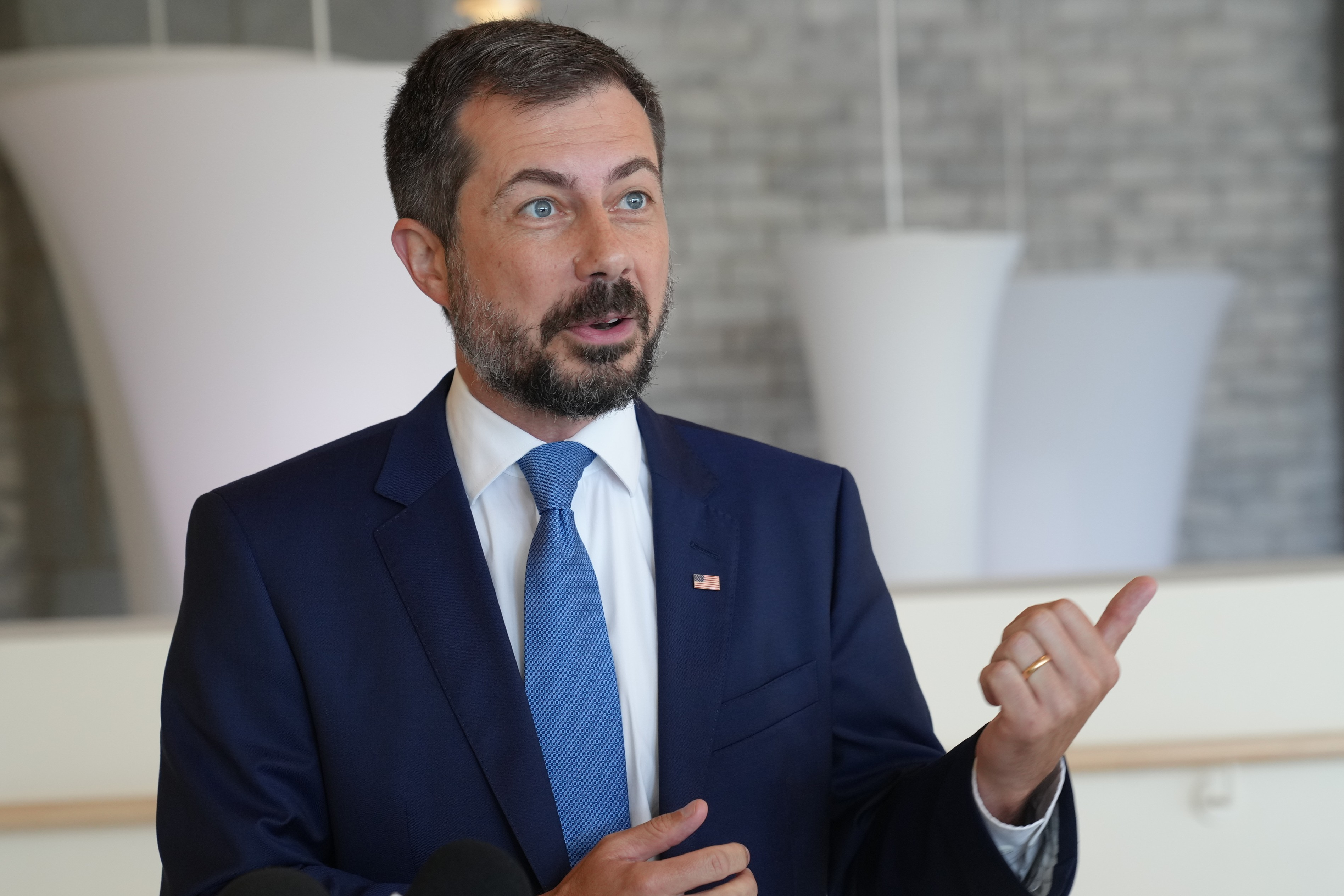
  • Pete Buttigieg returns to South Carolina as he weighs another White House run

    Pete Buttigieg returns to South Carolina as he weighs another White House run

    ORANGEBURG, S.C. — The last time Pete Buttigieg was giving a political speech in South Carolina, it was to mark a distant finish in the state’s primary that effectively ended his campaign for president.

    Returning this weekend as he mulls a second run for the White House, Buttigieg set out to reintroduce himself to the state and the Black voters he struggled to win in 2020. The results were encouraging.

    There was a standing ovation in a Black church in South Carolina when Buttigieg was credited for helping bring millions of federal dollars to the area for a project as President Joe Biden’s transportation secretary. A second ovation came as Buttigieg gave a speech warning of a country in “big trouble” while laying out his own vision for what should come next.

    “There is no such thing as again in real life. The only way out is through,” Buttigieg told the crowd of more than 200 people at an NAACP Freedom Fund Dinner. “If we recognize and embrace a future that is different from the past, we will do better.”

    The warm applause was a markedly different reception than six years ago, when a fourth-place showing in South Carolina helped derail Buttigieg’s presidential campaign while exposing his failure to connect with Black voters. The state is likely to have an even greater say in his political future as the first contest in the Democratic presidential primary in 2028.

    Starting the election calendar in South Carolina is intended in part to give Black voters a greater voice at the outset of the nominating process. For Buttigieg and other potential contenders, winning the support of this group that makes up a majority of South Carolina’s Democratic electorate is essential.

    “You need to demonstrate that you can win Black voters,” said Jaime Harrison, a former Democratic National Committee chairperson and South Carolina Democratic Party chairperson. “If you can’t win Black voters, you can’t be the nominee of our party.”

    2028 campaign is already coming to South Carolina

    Buttigieg insists he has made no final decision about whether to run for president again.

    “Right now, I’m totally focused on 2026,” he told reporters Saturday.

    But his South Carolina trip — a week after visiting another early-voting state, Nevada — had all the trappings of a potential presidential bid.

    He raised money Friday in Charleston with Nancy Lacore, a U.S. House candidate trying to flip a Republican-held seat. On Saturday morning, he spoke at a policy conference before traveling to Claflin University, a historically Black university in Orangeburg.

    Davina Perry, a third-year student at Claflin, said she came away from Buttigieg’s visit thinking he would be a “good candidate” if he ran.

    “Secretary Pete has definitely put himself on my radar for 2028 now, for sure,” Perry said. But, she added, “I do want to see more representation from people who look like me.”

    That evening, Buttigieg attended a dinner at a church in Orangeburg, a nearly three-quarters Black city with a deep history in the Civil Rights Movement. The crowd included local NAACP leaders, ministers, and elected officials. Buttigieg worked the room, giving hugs and taking photos.

    “He is responsible for the Railroad Corner,” said Orangeburg Mayor Michael Butler, referencing a project aimed at revitalizing the city’s downtown that received a $22.7 million federal grant. “Do I need to say any more? We need to stand and welcome the former secretary.”

    Buttigieg used the speech that followed to make a broader case about the direction of the country, arguing that Democrats cannot separate Americans’ economic frustrations from a political system he described as increasingly broken.

    “I have come to believe that the kitchen table cannot be improved unless we are also reforming the institutional and political floor on which that kitchen table sits.”

    Black voters will have the first say for Democrats in 2028

    For Buttigieg, the weekend offered signs of how much has changed since he came to South Carolina in 2020 as a 38-year-old Indiana mayor asking voters to take a chance on him. He points to what he delivered during four years in Biden’s cabinet, including specific projects in the state.

    But Buttigieg said he also came to South Carolina “to propose something” about the country’s future. Butler, Orangeburg’s mayor, liked what he heard.

    “His speech was what you talk about at the kitchen table. How America is going to survive all of this?” Butler said. “He brought hope to us.”

    South Carolina Democratic leaders say the close, personal engagement with candidates is exactly what they hoped for. Those involved in the push to make South Carolina first envisioned the living-room conversations and retail politics long associated with Iowa and New Hampshire.

    “You got to go listen. You got to go all over the place,” Harrison said. “You have to make meaningful investments. That’s how you win South Carolina.”

    Buttigieg is hardly alone in his early trip to the state.

    Other potential 2028 contenders, including California Gov. Gavin Newsom, Kentucky Gov. Andy Beshear, U.S. Rep. Ro Khanna of California, and U.S. Sen. Cory Booker of New Jersey have made trips to the state as what is expected to be a large Democratic field begins to take shape. Former Vice President Kamala Harris already has deep ties in the state.

    The electorate they will encounter has changed from 2020, when Biden’s victory in the state resurrected his presidential campaign and put him on a path to ousting Republican President Donald Trump.

    Four years later, Trump defeated Harris and returned to the White House, which Black leaders say has significantly hurt their community. Earlier this year, a Supreme Court decision weakened a core provision of the Voting Rights Act, threatening Black political representation across the South.

    “We must start our process where democracy must still be fought for, in the full view of the nation,” former interim DNC chairperson Donna Brazile said in a speech this year advocating for South Carolina to go first.

    Buttigieg addressed that anxiety directly Saturday night, describing efforts to weaken the Voting Rights Act as the culmination of a “multidecade effort.” He warned of a broader push “to demolish African American political power.”

    Harrison said Buttigieg’s trip this weekend was a “good start,” but that Buttigieg and all the other potential 2028 candidates have a long road ahead to prove themselves to the state’s voters.

    “It has to be a good start and then you got to continue,” Harrison said. “It can’t just be, ‘Oh, pop in and then I’m going to pop back out.’”

  • Zelensky details rift with Ukraine’s dismissed defense minister Fedorov

    Zelensky details rift with Ukraine’s dismissed defense minister Fedorov

    KYIV, Ukraine — Ukrainian President Volodymyr Zelensky said that he believes actions taken by dismissed Defense Minister Mykhailo Fedorov, including his involvement in mass protests and calls for an election, were misguided, as he publicly detailed their dispute for the first time.

    Zelensky also alluded to problematic decisions over defense spending and said that inaccurate information provided by the Defense Ministry contributed to an awkward encounter with U.S. President Donald Trump over the use of Starlink in Russia.

    Zelensky disclosed figures showing Ukraine’s growing shortage of Patriot air-defense missiles needed to counter Russian ballistic attacks, with deliveries from Western allies declining in the past three years even as Russian missile strikes intensified.

    He highlighted battlefield gains, however, saying Ukrainian forces have almost completely recaptured the Dnipropetrovsk region, with only about 4 square miles remaining under Russian control.

    The Ukrainian president made the remarks during a two-hour off-the-record meeting with reporters on Saturday, with a transcript released publicly on Sunday.

    Zelensky’s first public comments on Fedorov dismissal

    His comments ranged widely, covering the latest battlefield developments, efforts to counter Russian ballistic attacks, the state of peace negotiations, Ukraine’s budgetary challenges, and the political turmoil surrounding Fedorov’s dismissal.

    “I really had and still have a very positive attitude toward Mykhailo. We have been through a lot together. But I believe that he himself goes, or is pushed, into the wrong things,” he said.

    Fedorov, a popular minister credited with modernizing Ukraine’s armed forces and accelerating the military’s embrace of technology and drone warfare, was dismissed last month after reportedly falling out with the country’s top military commander. His removal triggered mass protests that lasted for weeks, but ultimately failed to force a reversal of the decision. Fedorov later called for an election.

    Zelensky said that he had offered Fedorov four different options to continue working in the government. Fedorov, he said, rejected all of them.

    The Ukrainian leader told journalists that he believes holding an election during the war would be a huge risk with the potential to “split Ukraine apart.”

    “I believe elections during a war like this would generally pose enormous risks. Holding elections right now would be a tsunami for the state that would split Ukraine apart,” he said.

    Zelensky said he had previously faced pressure to hold an election during the war, but no partners had come up with a plan for how a poll could be held safely, legitimately, and democratically.

    Inaccurate information led to uncomfortable White House encounter

    Zelensky appeared to link Fedorov to an awkward episode involving Starlink and Elon Musk. Zelensky said that earlier this year, the Defense Ministry had told him that SpaceX had agreed to allow Ukraine to use Starlink over Russian territory to carry out deep strike operations, subject to political approval.

    Acting on that, Zelensky said, he raised the issue directly with U.S. President Donald Trump. He told Trump that Musk had confirmed the proposed use. Zelensky said the two sides subsequently sought Musk’s confirmation and discussed financing for the project.

    But at a later meeting, Zelensky said, Trump told him that Musk had rejected the proposal and accused him of having misled the U.S. president. Musk considered the move a dangerous escalation, according to Zelensky.

    “He said that I had supposedly deceived him, because Musk had denied Ukraine the use of Starlink on Russian territory. I went back to our Ministry of Defense and they said that maybe it was so,” he said.

    Zelensky didn’t explicitly accuse Fedorov of lying. He said that the situation was among the reasons behind “some of the steps.”

    Zelensky also pushed back against protesters’ vilification of former army chief Gen. Oleksandr Syrskyi, who he dismissed, and current Defense Minister Maj. Gen. Yevhen Khmara, saying they had gone too far.

    “Maybe someone doesn’t like Syrskyi for one reason or another. But the slogans ‘Syrskyi is the devil, Khmara is the devil,’” he said. “Listen, this is too much. Do you understand? In principle, you can’t treat the military like this and tolerate it, especially when it was the military that made it possible for any peaceful protests to take place in the Ukrainian capital at all.”

    Pressure on defense budget but military successes

    Zelensky also described severe financial pressure on Ukraine’s defense effort. He said that the Defense Ministry faced a $27 billion budget shortfall after spending decisions earlier in the year brought forward funds originally intended for the second half of this year.

    Touching on a corruption inquiry that led Zelensky to fire one of his most senior officials this week, he said that anti-corruption investigators don’t believe that the president was involved. The investigators had named a deputy head of the presidential office among the suspects in a money-laundering case.

    “The heads of anti-corruption agencies have zero questions for me. They understand perfectly well that I am not involved in anything like that. And this is important to me,” he said.

    On the battlefield, Zelensky was optimistic. In addition to Ukraine almost completely regaining control of the Dnipropetrovsk region, he said that another operation was underway elsewhere and that its results were expected by the end of August.

    He also predicted that by the end of the year, Ukraine could reach parity between the territory occupied by Russia since the beginning of the year and the territory retaken by Ukrainian forces. Zelensky said that Russia had occupied about 380 square miles since the start of the year, while Ukraine had restored control over roughly 315 square miles.

    The president said that Russia’s principal objective remained the Konstantynivka-Sloviansk-Kramatorsk axis, and that Moscow was still demanding that Ukraine withdraw from the Donbas region as a condition for a settlement.

    Still struggling for access to Patriot missiles

    Zelensky said that Ukraine was receiving substantially fewer Patriot interceptor missiles even as Russian ballistic attacks are increasing.

    He said that Ukraine received 675 Patriot missiles in 2023, compared with 364 in 2025 and an expected 264 this year. Zelensky said that he wanted to secure 300 additional Patriot missiles for the coming winter, while Ukraine’s air force had requested 360.

    The shortfall is particularly serious, because the United States and European partners are struggling to expand production. Zelensky said that he hoped Ukraine could obtain even 5% or 10% of U.S. reserves and was able to pay for them.

    Zelensky said that Russia could eventually produce up to 1,300 ballistic missiles a year, compared with an estimated current capacity of 600.

    He said that Ukraine was also preparing alternatives to Starlink, including a European communications project, as Russia and China work on their own competing system.

    Other developments

    Debris from a Ukrainian drone hit two industrial facilities including a warehouse belonging to online retailer Ozon, local officials in Russia’s Orenburg region said Sunday.

    As well as shifting the war onto Russian soil through long-range drone strikes on oil facilities that have caused fuel shortages across Russia, Ukraine has unsettled the Russian public by striking warehouses of online retailers, including Russia’s biggest one, Wildberries, and competitors such as Ozon.

    One person was killed and six wounded in Ukrainian drone attacks on Russia’s Belgorod border region, local authorities said Sunday. A woman also died in a drone attack in the Tula region.

    Two women were killed and five other people were wounded when a Russian drone hit an electric train in Ukraine’s Kharkiv region, the Ukrainian national police said Sunday.

    Leaders from Nordic and Baltic nations arrived in Kyiv on Sunday, the eve of Ukraine’s Independence Day, in a show of solidarity from some of Ukraine’s closest partners before a larger “coalition of the willing” meeting.

    Leaders from Denmark, Estonia, Finland, Latvia, Lithuania, and Norway attended a flag-raising ceremony, as Ukraine marked Ukraine’s National Flag Day.

    “We feel we are not alone. Our allies are with us,” Ukrainian Foreign Minister Andrii Sybiha wrote on X on Sunday, noting that the leaders would hold bilateral and multilateral talks with Zelensky.

  • He was waiting for his son to return from the USS Lincoln. Then Border Patrol arrested him.

    He was waiting for his son to return from the USS Lincoln. Then Border Patrol arrested him.

    When Luis Manuel Aviles was arrested by immigration authorities, his son was entering his ninth month with the Navy on the USS Abraham Lincoln — a vessel that set a U.S. military record for uninterrupted time at sea, stirring concerns about supply shortages and deteriorating mental health among soldiers.

    Luis Manuel Aviles, 48, was arrested after leaving his house to take his car to the mechanic, according to his wife, Argelia Aviles. She said her husband, a repairperson in Key West, Fla., has a permit to work in the United States. Originally from Nicaragua, he has lived in the U.S. for 19 years.

    “He dedicates himself only to work so he can put food on the table at home. He is a good father. He loves his children with all his soul,” said Argelia, 47.

    Aviles’ arrest comes as the Trump administration rolls back immigration protections for military families to pursue its mass deportation agenda, detaining at least dozens of parents and spouses of active-duty U.S. troops.

    At least six family members have been deported and one self-deported, the AP found in the first accounting of such detentions, which the government does not track. One spouse, the wife of a U.S. soldier who spent more than a month in federal immigration detention, was removed from a deportation flight to Brazil after the AP’s reporting.

    One of the military’s most highly advertised immigration benefits is “military parole-in-place,” which allows the spouses, children, and parents of active-duty service members and veterans to obtain legal immigration status from within the country. Not everyone qualifies: those who overstayed visas or who already applied for legal status at the border, for example.

    The Department of Homeland Security said in a statement that Border Patrol agents arrested Luis Aviles on Saturday in Key West and that he will remain in ICE custody while the government seeks to deport him.

    “Having a family member in the military is not a free pass to violate our nation’s laws,” the department said Sunday, adding that the Trump administration “does not pick and choose which laws to enforce.”

    Aviles’ son, Joshua Aviles, said he has been working 12-hour shifts for more than 250 days without a break on the USS Lincoln, which has been deployed in the Middle East. The deployment has raised widespread concerns about the impact on service members who are away from land for long periods and about food shortages, as well as the increasing strain on the ship and its equipment.

    The Pentagon referred all questions to the Navy. The Navy didn’t immediately respond to an emailed request for comment on Sunday afternoon. Defense Secretary Pete Hegseth previously called conditions aboard the Lincoln “completely misrepresented.”

    Joshua Aviles wrote in a Facebook post Saturday that he was still on the USS Lincoln “fighting for a country that has given me everything” when he got a call about his father’s detention on Saturday morning.

    “This is heartbreaking for me. I don’t know how I can mentally continue working 12+ hour days knowing that my dad is somewhere, possibly treated like a criminal,” Joshua Aviles wrote.

    Katherine Delgado, 28, Joshua Aviles’ sister, said that Joshua joined the military in part because he thought it would improve his father’s chances of getting citizenship and so that he would “no longer be living in fear of being arrested.”

    She said being apart from Joshua, who she calls her “best friend” and her “ride-or-die,” has been devastating.

    “I spent weeks without knowing where he was,” Delgado said. Once she heard from him, and was told that he wasn’t getting enough food, she said, she has spent hundreds of dollars to send him care packages with food and hygiene products — some of which never arrived.

    Joshua is “supposed to come home soon,” Delgado said, referring to news that the ship her brother is on will soon be brought out of service in the Middle East. “And he’s going to come home without his father.”

    The son’s lengthy deployment has been challenging for Luis Aviles, according to his wife. He told her that he was looking forward to the deployment finally coming to an end. When six months passed and his son didn’t come back, Aviles was distraught, she said.

    “He was excited,” she said. “He wanted to hug his son, as he hadn’t seen him for nine months.”

  • Iran official says support for new sanctions would be an ‘act of war’

    Iran official says support for new sanctions would be an ‘act of war’

    The new head of Iran’s top security body warned Sunday that Tehran will see any country’s support for new U.S. economic measures against the Islamic Republic as an “act of war,” while Iran’s president defended a memorandum of understanding with the United States as the best way out of the stalled conflict.

    Treasury Secretary Scott Bessent on Monday is expected to announce the new measures after the U.S. vowed to impose an “unprecedented” level of economic warfare and isolation on a country that has lived for decades under sanctions. Also Monday, Pakistan’s army chief is expected to visit Iran as mediators try to revive talks.

    Meanwhile, attacks calmed on the Strait of Hormuz but posturing did not, as a recently created Iranian authority listed dozens of vessels it said will face restrictions on future transits.

    Iran’s security chief sharpens warning to neighbors

    The hard-line leader of Iran’s Supreme National Security Council, Mohsen Rezaei, issued his latest warning on X, with the comments quickly shared by Iranian state media.

    It came a day after Rezaei’s most extensive public comments since being named to the post this month.

    “If (Trump) wants to do something, we will retaliate in a seismic manner,” he had told the state broadcaster in an interview that aired late Saturday. He said Iran would target other oil-shipping routes from the Persian Gulf — alternatives to the Strait of Hormuz.

    Rezaei, a former Revolutionary Guard commander and military adviser to Supreme Leader Ayatollah Mojtaba Khamenei, was part of senior appointments widely seen as hardening Tehran’s political and military stance.

    Iranian president wants to move past ‘neither war nor peace’

    Iranian President Masoud Pezeshkian earlier Sunday said the memorandum of understanding signed in mid-June was the best way to move beyond a situation of “neither war nor peace,” adding that Tehran can’t attract investment nearly six months after the war began.

    “There is not a single provision in this agreement that amounts to capitulation,” Pezeshkian said in a speech published by state-run IRNA. “The supreme leader sets the policies, and we will follow that path.”

    The interim deal opened a 60-day period for talks aimed at ending the war and reaching an accord on Iran’s nuclear program. That period ended last week with no signs of compromise or extension.

    No attacks confirmed on the strait, but new restrictions

    There were no confirmed attacks in the Strait of Hormuz over the past 48 hours, a multinational coalition overseen by the U.S. Navy said Sunday, with shipping traffic still at reduced levels. The U.S. military said its blockade of Iranian ports had redirected 70 commercial ships and disabled three as of Sunday.

    Iran’s recently created Persian Gulf Strait Authority, sanctioned by the U.S., published a list of dozens of ships it said had violated arrangements for transiting the strait and would face future restrictions like fines or seizures. The strait had been considered an international waterway before the U.S. and Israel attacked Iran on Feb. 28.

    Iran and Oman, on the strait’s other side, are now discussing management of the waterway, which likely will include ships paying fees.

    Pakistan’s army chief will visit Tehran

    Pakistani Field Marshal Asim Munir will lead a delegation to Tehran on Monday, Iranian state television reported, citing Iran’s Foreign Ministry spokesperson, Esmail Baghaei.

    Two regional officials said the visit was part of Islamabad’s efforts to de-escalate tensions between the United States and Iran and urge them to return to the negotiating table. The officials spoke on condition of anonymity because they were not authorized to discuss the matter publicly.

    Iran executes man arrested during January protests

    The Iranian judiciary’s Mizan news agency reported the latest execution connected to nationwide protests early this year, saying Majid Adineh was arrested Jan. 9 in Mohammadshahr, west of Tehran.

    The judiciary said forensic examinations indicated the handgun found on him had been fired on Jan. 8 and 9. Mizan said Adineh had joined the unrest following calls by groups opposed to Iran’s government and alleged that he had received training from groups outside the country. He was convicted under Iran’s law imposing harsher penalties for espionage and cooperation with hostile states.

    Israeli settler arrested in beating of Palestinian amputee

    Police arrested a 16-year-old boy from the Israeli settlement of Avigayil in the beating of a 61-year-old Palestinian, Saeed Muhammad Ibrahim Rabah, outside his home in the occupied West Bank, a year after he lost a leg after being shot by a settler.

    Rabah told the Associated Press that the violence at his home in Khirbet al-Rakeez on Saturday was an effort to make families leave, but “we will remain, no matter what happens.”

    Separately, the West Bank Health Ministry said a 14-year-old in the Askar refugee camp in Nablus was shot dead by Israeli forces, who did not immediately comment. The uncle of Islam Maher Ajouri, Nehad Ajouri, called the shooting indiscriminate.

    And Israel’s military said it detained a suspect in a stabbing attack that wounded a 24-year-old Israeli man in the area of al-Auja in the West Bank. Israel’s emergency services said the man was in moderate condition.

    Airstrike in Gaza kills a 4-year-old child

    Four-year-old Mohammed Taha died after an Israeli airstrike hit a central Gaza house on Sunday and wounded at least five others, according to the Al-Aqsa Martyrs Hospital, which received the casualties.

    Israel’s military later said it struck and killed a Hamas commander in central Gaza. The hospital confirmed that the man named, Ismail Abu Ful, was killed.

    An Israeli strike in southern Gaza wounded at least seven people, including three children, according to health officials at Nasser Hospital. The military did not immediately comment.

    Defense Minister Israel Katz in a statement said he instructed the military to “act immediately and forcefully” to prevent launches of balloons, kites, or drones from Gaza toward nearby Israeli communities.

    Before the Oct. 7, 2023, attack by Hamas-led militants on Israel — when 1,200 people were killed and 251 taken hostage — burning kites and balloons were sent from Gaza into southern Israel, causing fires and other damage.

    Hamas in a statement Sunday accused Israel of “using children’s toys as a pretext” for attacks and further displacement of Gaza residents.

  • Wildfire started by humans approaches Reno, Nevada, forcing thousands of evacuations

    Wildfire started by humans approaches Reno, Nevada, forcing thousands of evacuations

    The fast-growing Hawk Fire that was spreading toward neighborhoods and consumed some homes in northwest Reno, Nev., was caused by humans and was 0% contained Sunday, authorities said. At least six people were injured.

    Officials said at a news conference Sunday afternoon that 42,000 residents have been ordered evacuated, and the “GO NOW” zone reached the edge of the University of Nevada campus. An additional 45,000 people were in the evacuation warning zone, and encouraged to leave now and be prepared to stay away for several days to clear the roads for first responders.

    The fire had grown to 13,000 acres and was moving in different directions as the winds changed, complicating the fight.

    Authorities confirmed several structures have been destroyed in the fire and were assessing the totals.

    The injured included three civilians and three first responders, officials said.

    The fire has been burning across a rugged section of the Humboldt — Toiyabe National Forest where Peavine Mountain is ringed by homes and businesses on the Nevada side of the California state line, and some of these homes were consumed by the flames.

    Nevada Gov. Joe Lombardo declared a state of emergency in Washoe County and mobilized the Nevada National Guard to support aerial firefighting with two helicopter crews as well as 60 troops to help police safeguard evacuated neighborhoods.

    Nearly 10,000 customers were without power in Washoe County on Sunday. Portions of U.S. Route 395, a major north-south highway, were closed due to the fire. Reno has a population of more than 280,000 residents.

    Washoe County emergency officials opened the Reno-Sparks Convention Center to evacuees, but said they couldn’t bring their pets — small animals and large animals were to be left at two other locations.

    A family raced to grab possessions but lost their home

    Cari Kieffer said a video posted on social media showed her house entirely burned down, with only a scorched basketball hoop still standing.

    “I woke up this morning and just started crying — all my kids, they lost everything,” Kieffer said Sunday. “We lost all our stuff. Everything we own is gone.”

    Kieffer had been watching her son’s football game Saturday when she learned that their home on the outskirts of Reno was in the evacuation zone. An application the family used to track the fire’s progress had been lagging significantly behind its actual location, she said, so they thought firefighters had kept the blaze from their neighborhood.

    Instead, Kieffer, her husband, and their four children ages 3 to 16 raced to save their dogs and whatever possessions they could retrieve. Ash rained down and the wind blew like an oven blast from a wall of flames advancing down the hillside toward their neighborhood, she said.

    “I kept looking outside and the flames just kept getting closer and closer every time I looked,” Kieffer said. “I was like, we got to go like now.”

    Eyes watering and throat burning, Kieffer grabbed a handful of clothes, a Bible, her wedding photos, and her mother’s ashes. In the frenzy, as firefighters yelled at her family to leave immediately, she said she forgot her family’s birth certificates and was unable to salvage her childhood photos.

    The family drove to a friend’s home but had to evacuate again. They learned later Saturday evening that their own home was gone.

    A mountaintop home goes up in flames

    Jaida Hargrove’s grandfather, Rick Arrate, lived alone on Peavine Mountain, which overlooks Reno and Sparks. Firefighters used a bulldozer, cut down trees, and applied fire retardant in their attempt to contain the flames, Hargrove said.

    “They all thought it would be OK,” she said. “And then, in about 30 minutes, the winds just changed and it came way too fast.”

    Arrate and the firefighters were quickly forced off the mountain. “All he was able to take with him was his two golden retrievers,” Hargrove said.

    Arrate spent Saturday night with Hargrove’s parents, his next steps unknown.

    Separate GoFundMe crowdfunding campaigns were set up to assist Arrate and the Kieffer family.

    The fire wasn’t troubling to some at first

    The fire was so small Saturday morning that it wasn’t even a concern, said Tyler Duvall, who went camping over the weekend. By the next day, his house was in the evacuation zone and he couldn’t get back.

    “The wind really blew it up,” Duvall said, adding that he knows of some homes that burned about a mile from his place.

    Strong, gusty winds, low humidity, and dry vegetation are fueling its growth, according to Truckee Meadows Fire & Rescue in Reno.

    “Approximately 400 personnel are currently working on the incident, with resources coming together from local, state, and federal agencies, including ground crews and air resources,” the Truckee Meadows statement said.

    A Nevada transplant gets a rude welcome to Reno

    Retired police officer and firefighter Ted Melden has seen his share of Mother Nature’s fury since moving to Reno with his wife earlier this month from Chapin, S.C. So far, he’s experienced a hailstorm with flash flooding, two different power outages, and, now, the second wildfire incident in the region in two weeks.

    “Just another natural disaster,” Melden said.

    In the two years he lived in South Carolina, Melden said, Hurricane Helene knocked over trees in his yard, while a tornado did some damage in his neighborhood.

    For now, Melden hasn’t been ordered to leave his home, but he has his bags packed just in case.

    “This thing kicked off yesterday, and it just went,” Melden said in describing the wildfire’s fast movement. “I’m hoping they’ll get a good handle on it. You just have to roll with the flow and be ready. Always be prepared and have a full tank of gas.”

    Places just outside the evacuation zone are warned

    The University of Nevada’s Reno campus was just outside the evacuation zone Sunday morning. The university had an enrollment of about 24,000 students in fall 2025. University officials said they have established an emergency response plan should conditions change.

    The Reno-Tahoe International Airport also was outside the evacuation zone. Commercial flights at the airport were unaffected Sunday. The smaller Reno-Stead Airport was closed to general aviation traffic due to the Hawk Fire, but remained open to firefighting aircraft.

    Casinos in Reno offered discounts on hotel rooms to evacuees.

    “If you have been told to evacuate, please don’t wait!” Reno Mayor Hillary Schieve said in a statement posted on social media late Saturday night. “Structures have already been burned in this fire and your life is more important than a building.”

    Authorities also were keeping watch on a county detention facility that was several blocks from the outer edge of the evacuation warning area.

    Earlier this month, three wildfires fueled by hot, dry, and windy conditions north of Reno forced more than 13,000 residents from their homes, according to the Nevada National Guard. The largest of the three, the Bug Fire, burned nearly 150 square miles but now is almost fully contained.