Mike Gansey’s tenure in Philadelphia isn’t off to a great start, but it has nothing to do with the 76ers.
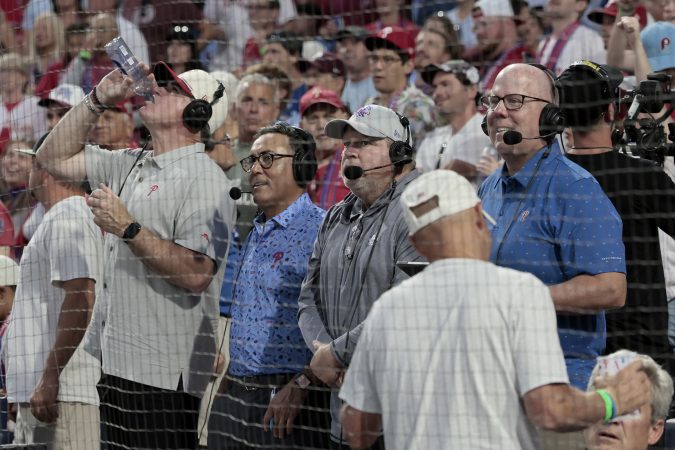
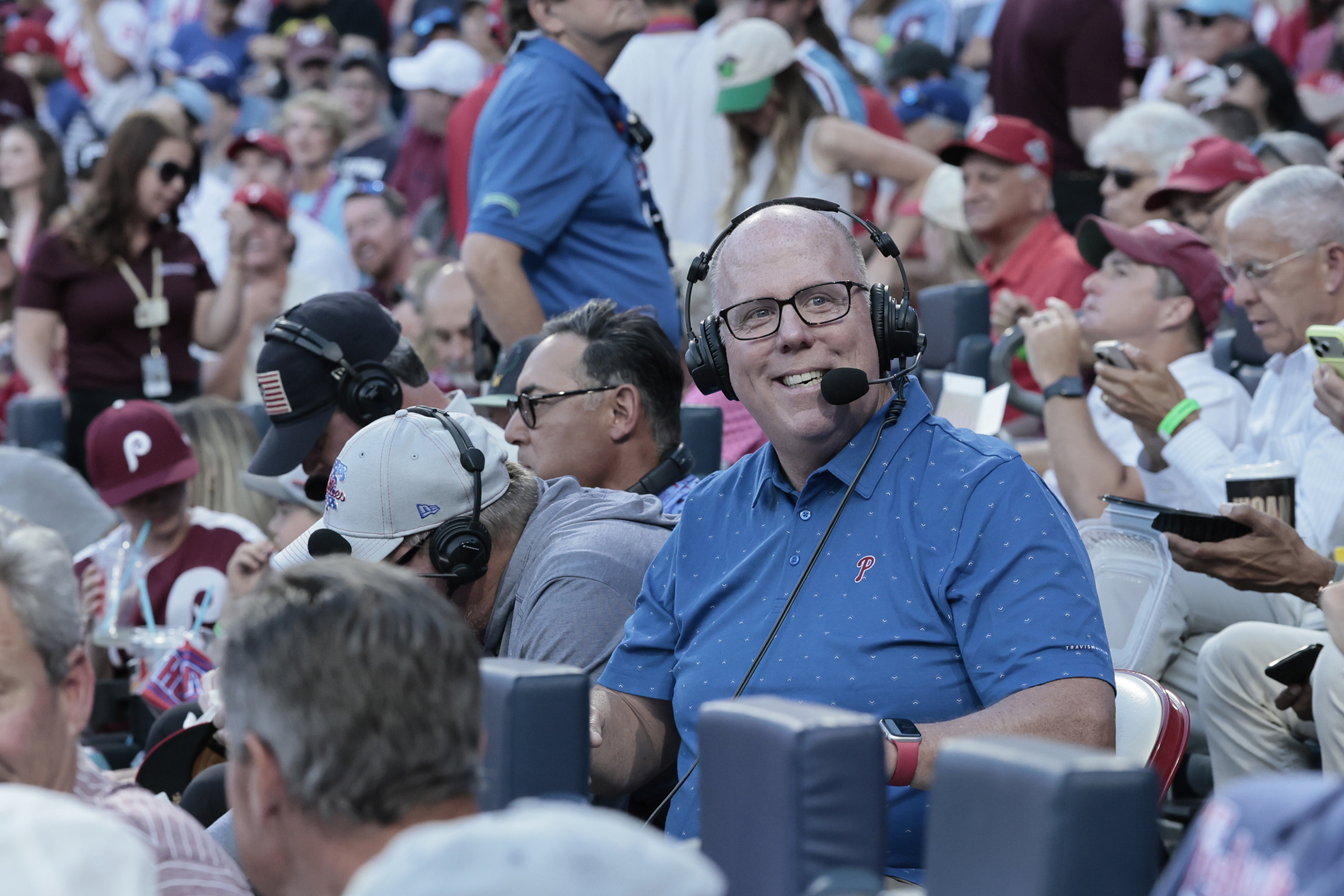
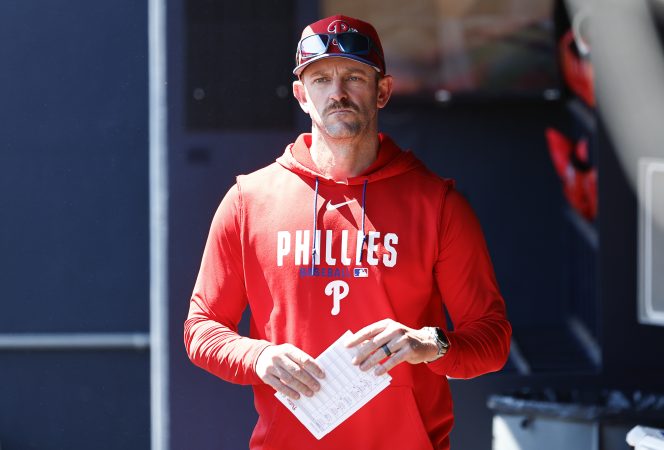
The Sixers’ new president of basketball operations joined NBC Sports Philadelphia’s annual broadcast from the stands Tuesday night alongside coach Nick Nurse, with Phillies pitcher Jesús Luzardo cruising through four innings.
“No hitter’s still intact,” Gansey said, immediately drawing a groan from Phillies announcer John Kruk.
“Oh boy,” Kruk moaned.
The very next pitch, Miami Marlins third baseman Javier Sanoja hit a single to left field, ending Luzardo’s no-hitter.
While Tom McCarthy quickly moved on to discussing what’s going on with the Sixers, Kruk sat silently annoyed, a knowing grin on his face as he quietly chewed his gum.
Sixers new president of basketball operations Mike Gansey just jinxed Jesus Luzardo's no hit bid on the Phillies broadcast💀 pic.twitter.com/bMnsPFBg2K
Kruk and Gansey share a West Virginia connection. Kruk grew up in Keyser, W.Va., while Gansey finished his college basketball career with the Mountaineers.
“I lived in Morgantown for two years,” Gansey said.
“And your liver’s still intact?” Kruk shot back.
Kruk and the rest of the NBC Sports Philadelphia crew — McCarthy, Ruben Amaro Jr., and Ben Davis — had prime seats right behind home plate at Citizens Bank Park Tuesday to watch the Phillies blowout the Miami Marlins 8-2.
Tom McCarthy is in his 20th season as the TV voice of the Phillies. Elizabeth Robertson / Staff Photographer
It was the 11th time the broadcast waded out into the stands, an annual tradition (with a break for COVID) dating back to 2014. And no offense to everyone else, but Kruk is easily the star of the show, consistently tossing out a well-timed joke or unvarnished opinion just when the broadcast needs it.
“How do I say this politically … sometimes these umpires aren’t really great,” Kruk said when asked about the Automated Ball-Strike Challenge System.
His best line of the night came when he told Nurse his poster was hanging in an office at Florida Gulf Coast University when they were recruiting Kruk’s daughter, Keira (who ended up attending Berry College in Georgia).
“My wife played volleyball there,” Nurse said, noting she was sitting elsewhere in the stands.
“I didn’t want to bring it up, because 50% of people get divorced,” Kruk joked.
There was also Kruk’s deadpan response to a pop-up that came down just to the left of the broadcast crew in the stands.
Sitting behind home plate was a first for NBC Sports Philadelphia, but announcers have previously called games for the network from above the bullpen, behind the Phillies’ on-deck circle, from Harry the K’s restaurant, behind the dugout, and from the outfield, where McCarthy actually snagged a home run hit by Atlanta Braves slugger Freddie Freeman.
The station also brought its studio show into the stadium, with Amy Fadool and Ricky Bottalico set up in Section 109 during Phillies Pregame Live. And it took the opportunity to ding Kruk when highlighting Citizen Bank Park’s best food and drink options.
— Phillies Fan in Montréal (@Montreal_Hohhot) June 16, 2026
The broadcast also featured a brief interview with Flyers head coach Rick Tocchet, which led to a side trip down memory lane.
“Do you remember, probably in the late ’80s, doing a signing in Aston, Pennsylvania at a bank?” Davis said. “I rode there on my bike … I went in and you had the long hair and a black and white photo. You signed it for me, and I still have it at my parent’s house.”
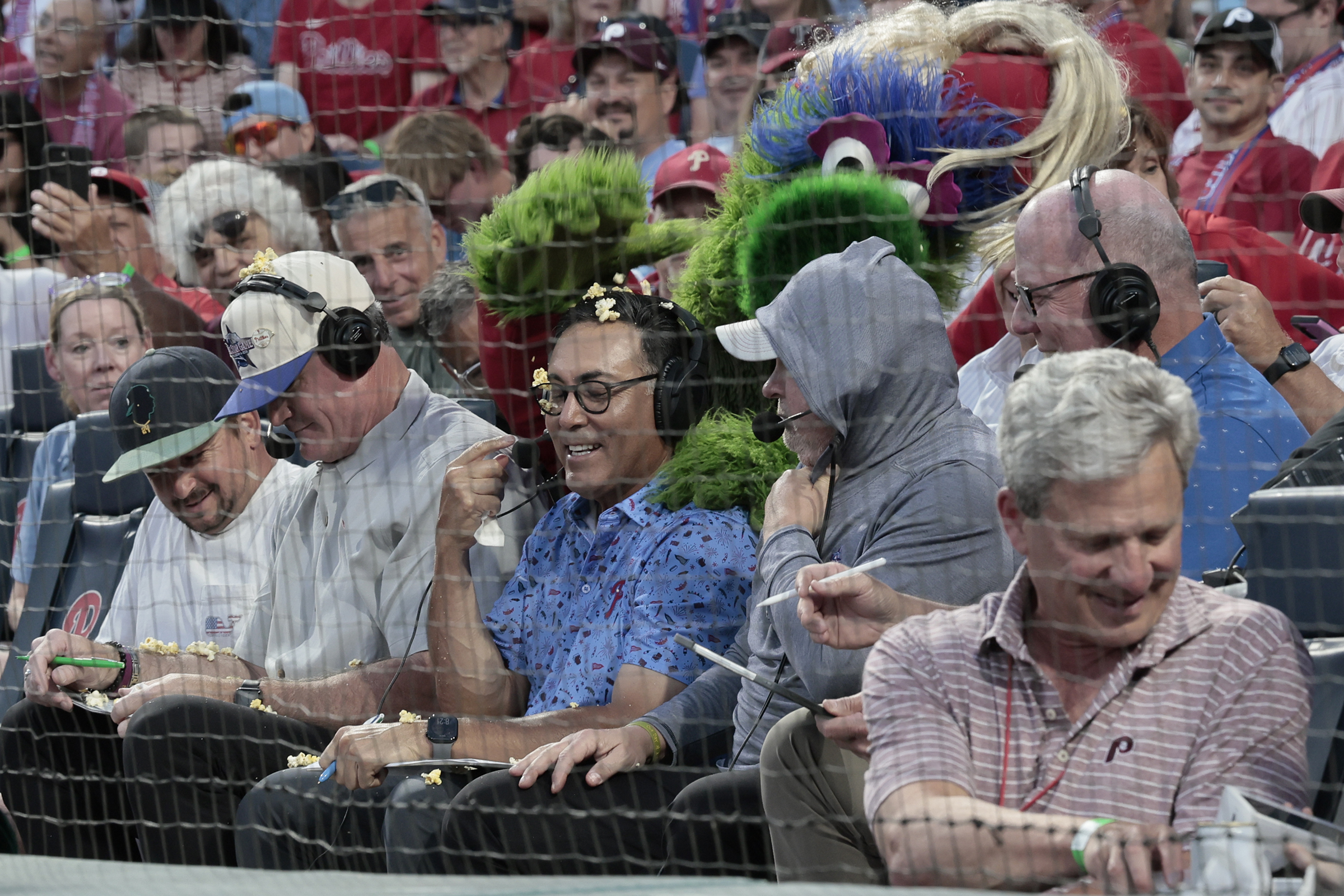
The night wouldn’t have been complete without the Phillie Phanatic tormenting Kruk. But the veteran broadcaster quickly put his hoodie on in the sixth inning when the mascot came tumbling by holding a giant bag of popcorn, which he dumped all over Amaro.
The Phillie Phanatic roughs up the Phillies announcers during the Miami Marlins at Philadelphia Phillies MLB baseball game at Citizens Bank Park in Philadelphia on Tuesday, June 16, 2026.Elizabeth Robertson / Staff Photographer
“Does anybody want any popcorn?” Amaro said.
“I see where you’re reaching to get it. Absolutely not,” Kruk responded.
Considering the lack of action by the Marlins, it’s no surprise the Phanatic and his antics with the Phillies announcers snuck into the Marlins’ TV broadcast.
The Phillies will go for the sweep Wednesday at 1:05 p.m., with McCarthy and Kruk in the booth. The pair will be back to call the first of a three-game series against the New York Mets Thursday night before handing the weekend games off to Fox on Saturday and NBC for Sunday Night Baseball.
The good news is NBC is bringing Kruk back to call Sunday’s game, pairing him up with former Mets reliever John Franco and play-by-play announcer Jason Benetti.
Nearly 9,000 miles from home, Gianna Vadino’s Philly presence could still be spotted in the middle of the ring.
Last month, Rajadamnern Stadium in Bangkok, one of Thailand’s oldest and most famous Muay Thai arenas with a capacity of 8,000, was full of mostly Thai fans rooting for their nation’s fighter, Petchmai Sor. Pracha.
But from the crowd, a few Americans cheered for the underdog Vadino, a 35-year-old Philly resident making her professional debut.
“It was very comforting because I was waiting to walk out, and I was getting super nervous,” said Vadino, who was born in Washington Township but has lived in Philly since 2009. “I’m not from here. I’m from America. Everybody’s betting against me. And then random Americans would walk by and tap me on the shoulder like, ‘You got this.’ And as silly as it is, I was way more comfortable knowing that there were actually people who were rooting for me.”
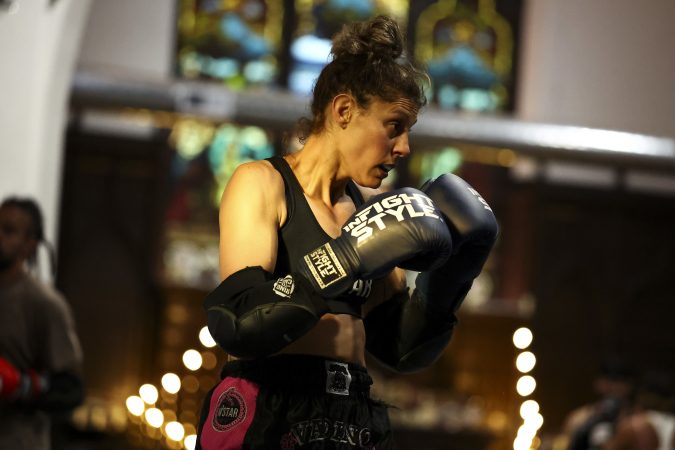
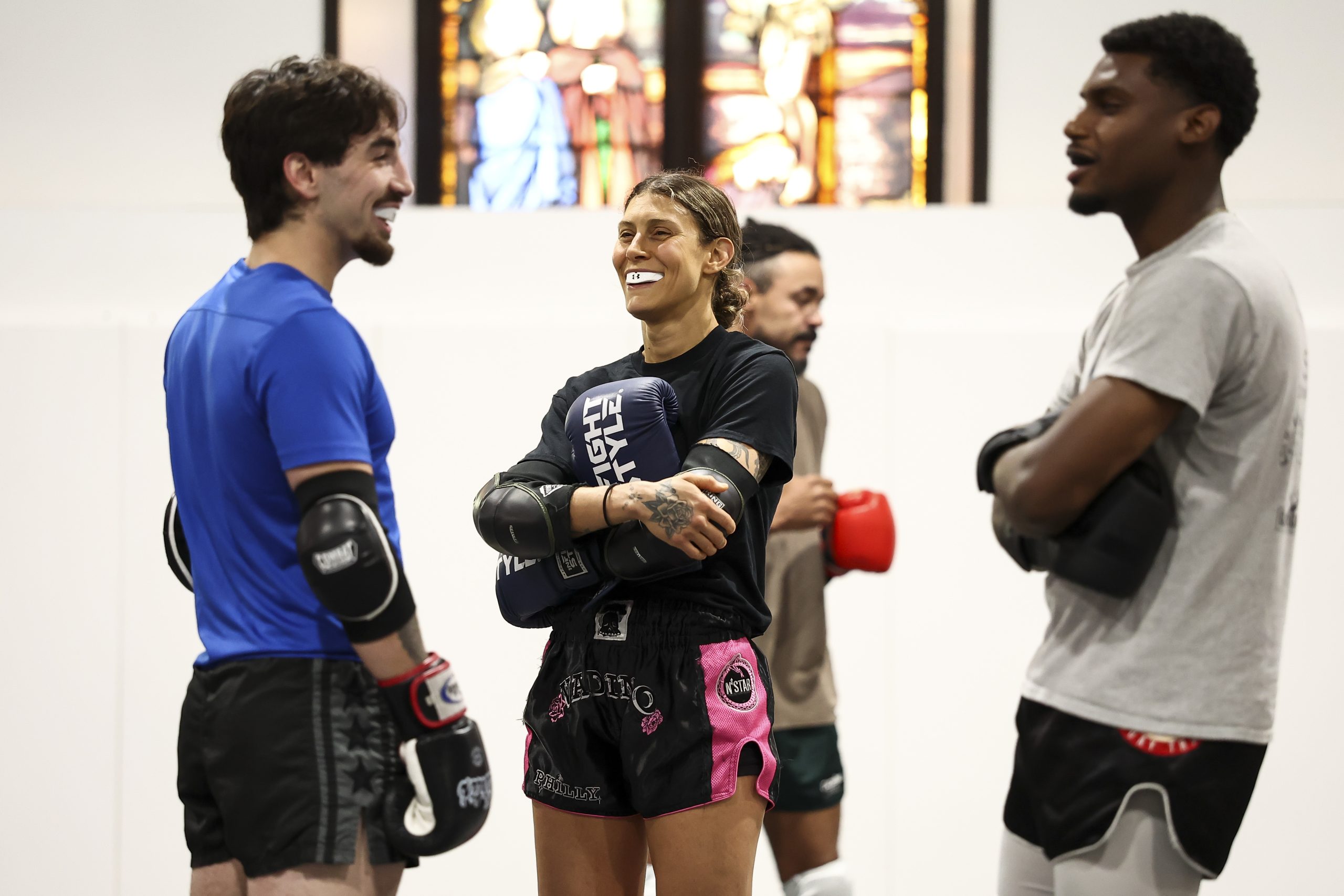
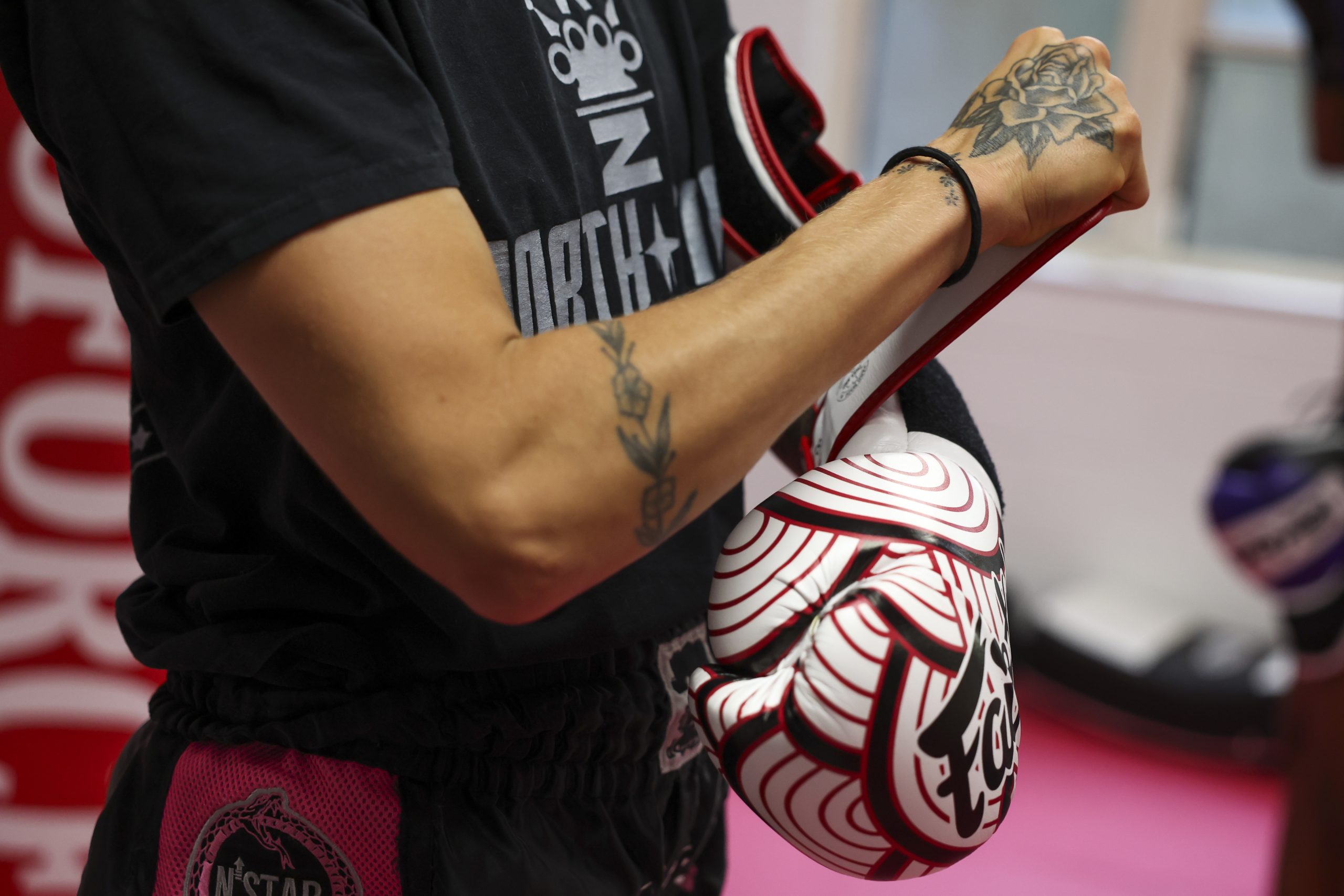
Muay Thai fighter Gianna Vadino (center) laughs during a workout Tuesday at the North Star Academy.Monica Herndon / Staff Photographer
Vadino ended the night with a win, improving to a 26-2 overall record — and, more importantly, 1-0 as a professional — after defeating Petchmai by decision. Following her win, some of the American fans who were cheering for Vadino made their way over to congratulate the Philly underdog.
“I was standing outside of the stadium after I fought, and this family was like, ‘Are you from Philly?’ And I was like, ‘Yeah, why?’” said Vadino, who now lives in Roxborough after 15 years in South Philly. “They were like, ‘We’re from South Philly.’ I was like, ‘That is so weird. Like, why are you guys here?’”
Apparently, it’s not hard for Philly to spot its own — especially when it comes to fighting.
“The way that I fight is very — I’m kind of like a bully,” Vadino said. “I put a lot of pressure on people. I brute-force my way through things if technique isn’t working. … It’s not always the best idea. But that’s what I do. So I do feel like there’s some South Philly in that for sure.
“I’m not going to deal with people’s s—. I’m just going to get the job done no matter what I need to do.”
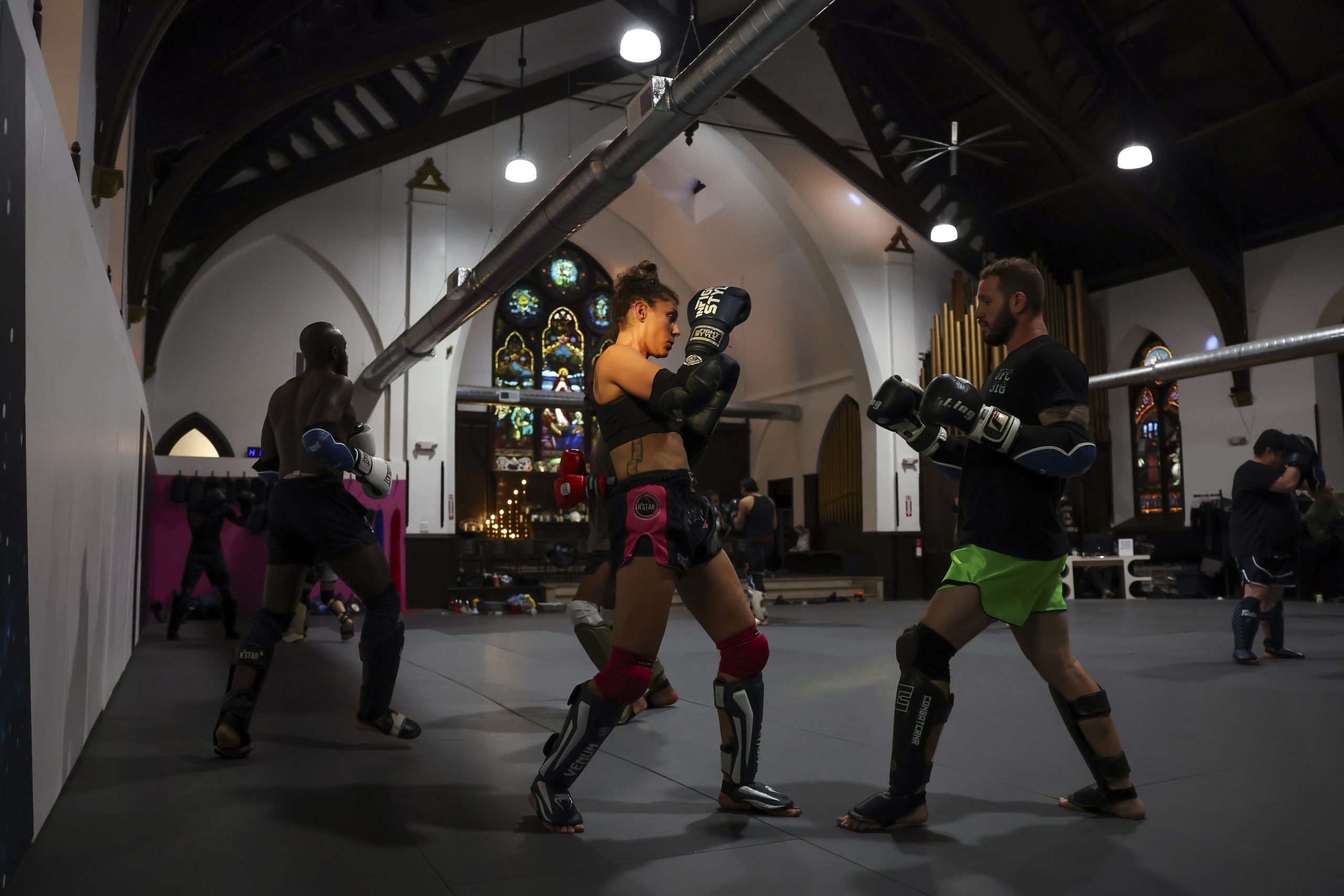
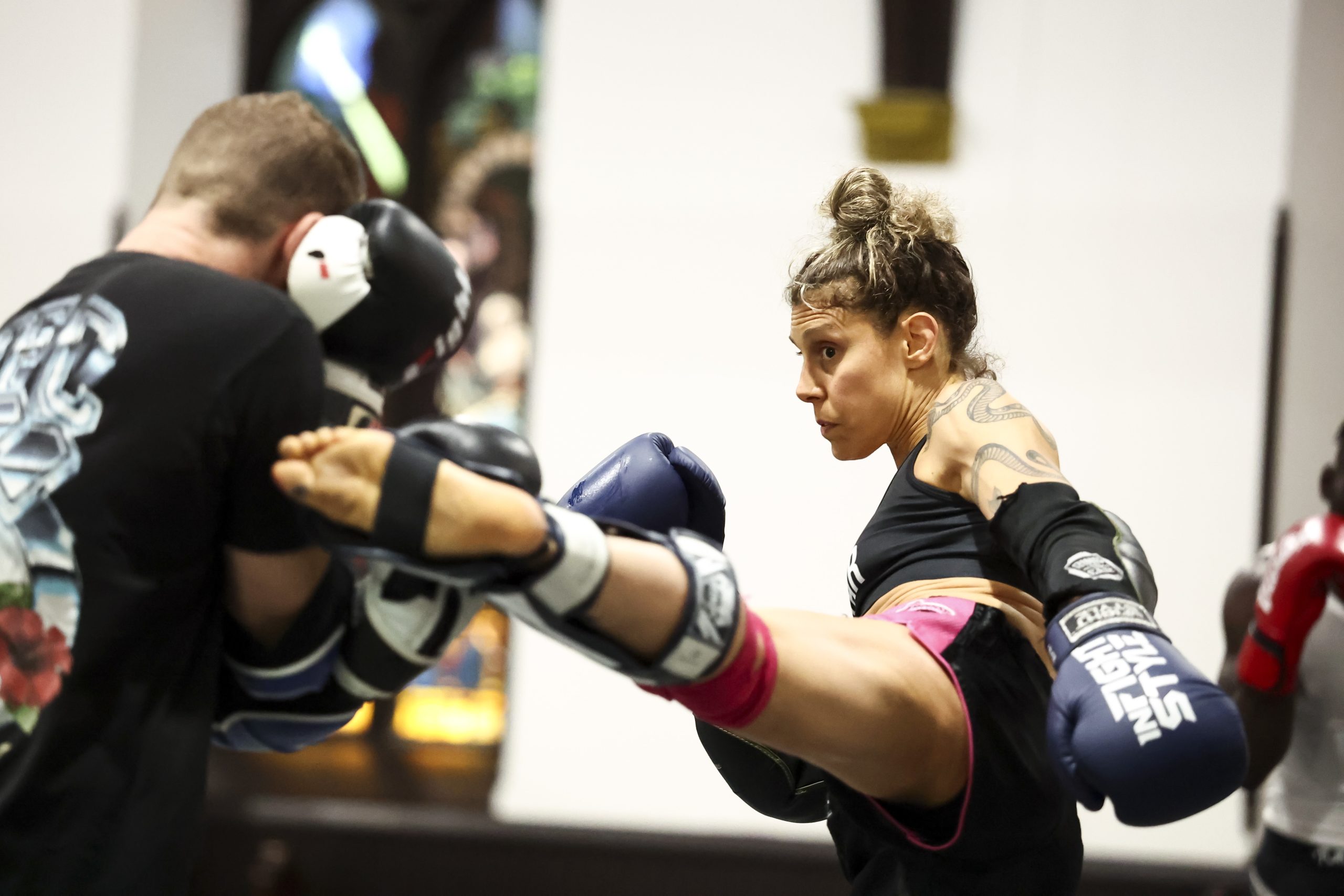
Muay Thai fighter Gianna Vadino spars with Timmy Green (right) at the North Star Academy.Monica Herndon / Staff Photographer
‘Unbreakable consistency’
That mindset has stayed with Vadino since her days playing soccer, basketball, and lacrosse as a child. But once she enrolled in the University of Arts, her active side took a bit of a backseat.
“I was like, ‘I guess I’ll start running,’” Vadino said. “And then I just subconsciously craved that team aspect, and I didn’t really know it. And then once I started doing Muay Thai, I kind of got that fix.”
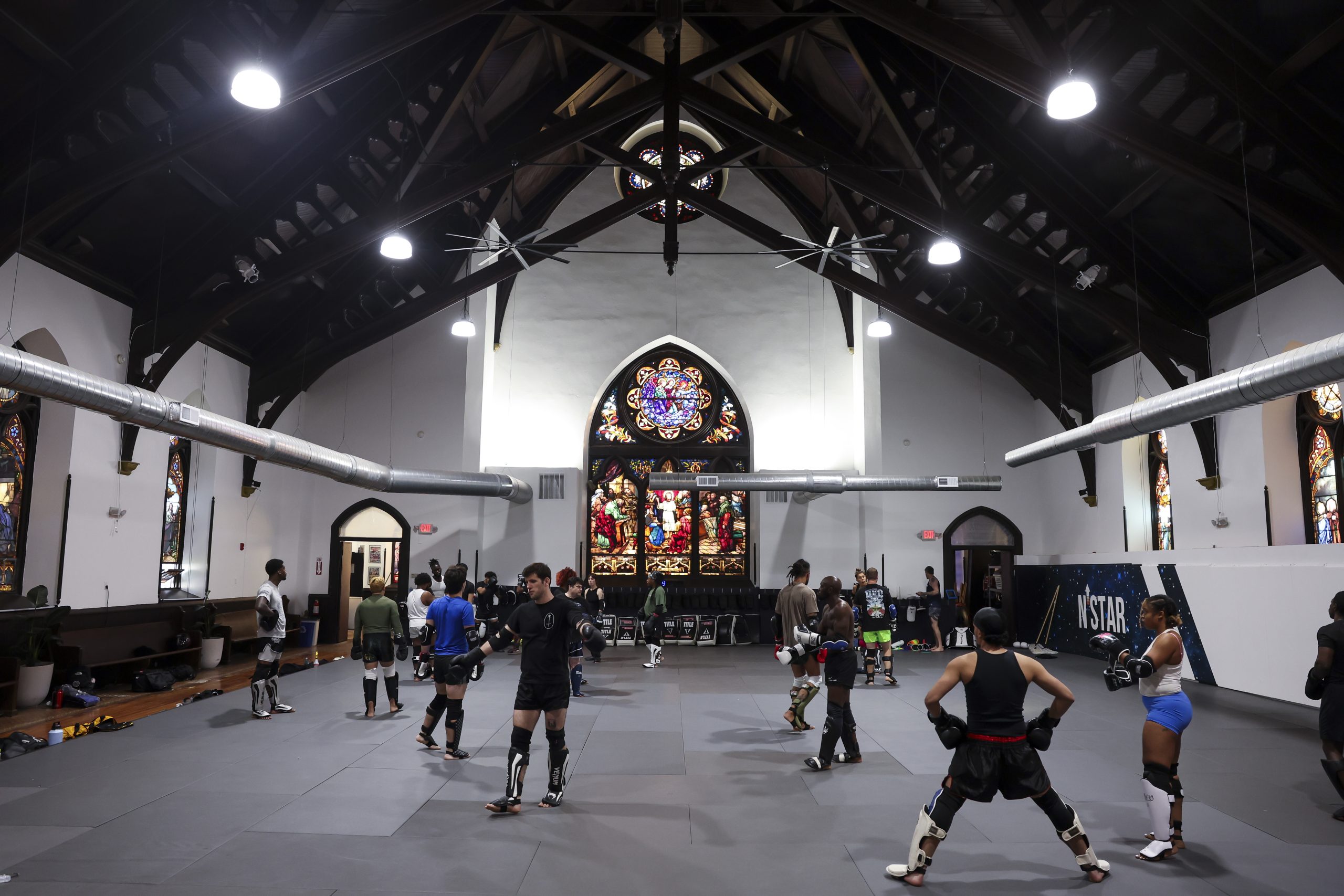
Vadino started practicing Muay Thai in 2017 at 27 years old. Four years later, she began to compete, fighting out of Germantown’s North Star Academy. From the gym run out of the former St. Michael’s Evangelical Lutheran Church, she has gone on to become a five-time international champion and a 13-time national champion as an amateur.
“The one thing that makes her exceptional is that she just normalizes things that are pretty extreme,” said Jackson Galka, her Muay Thai coach and the owner of North Star Academy. “And I think that’s the secret to her success. It’s just a solid routine and unbreakable consistency.”
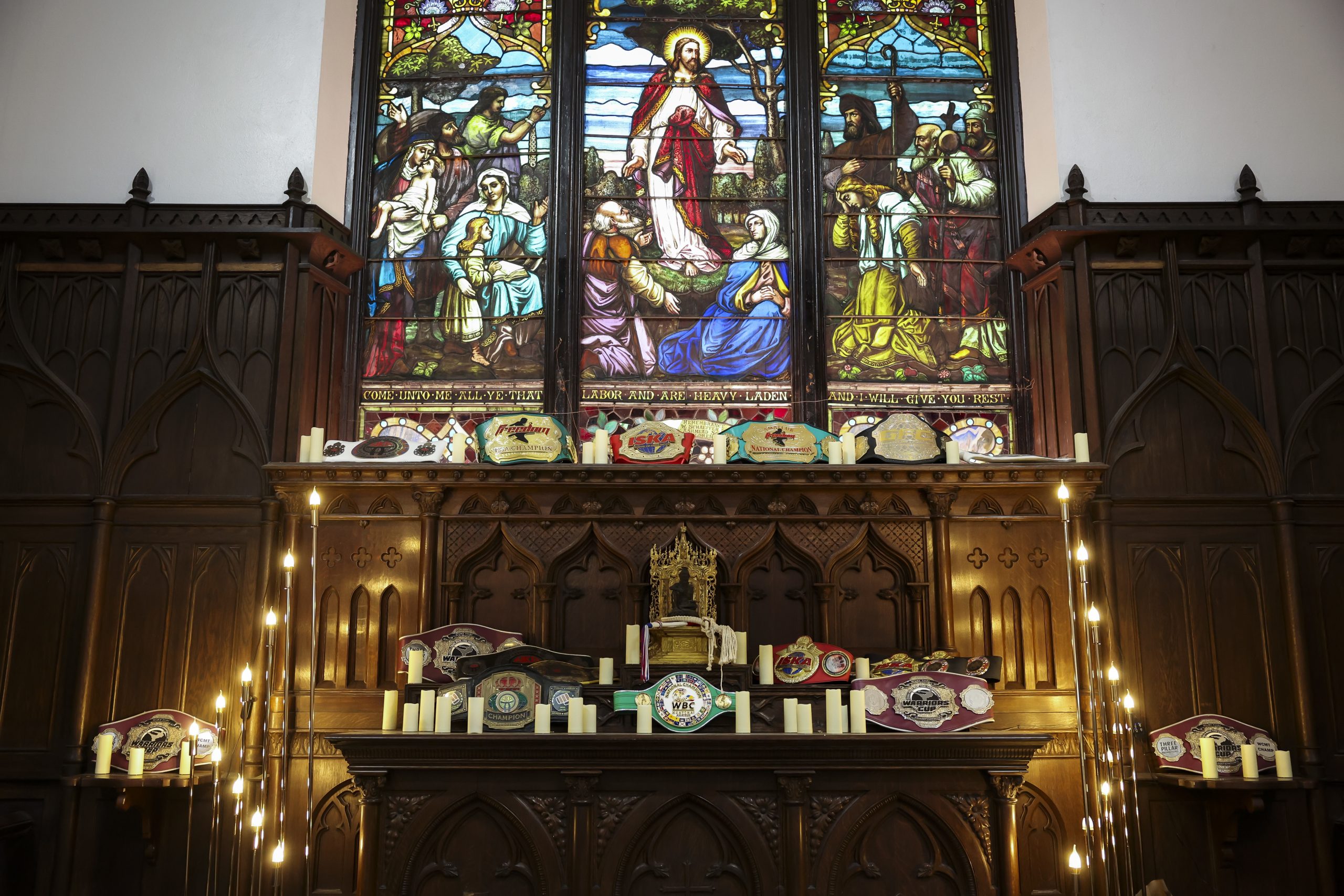
Some of Muay Thai fighter Gianna Vadino’s championship belts on display at the North Star Academy on Tuesday.Monica Herndon / Staff Photographer
Despite her success, a defining moment in another discipline shaped Vadino into the fighter she is today. Before devoting herself full-time to Muay Thai, Vadino made her MMA debut in 2024. After suffering a knockout loss, she reevaluated her career.
“I think that was the biggest [setback],” Vadino said. “A lot of people were hopeful that MMA was the path for me. It was just a s— experience. I felt depressed. And I decided MMA wasn’t for me. It wasn’t just because of the knockout. It was the environment and the air around it and the culture. It’s very cutthroat. It’s more mean and showy. And Muay Thai is just a very respectful sport. You look at your opponent as if you’re thankful for them. There’s just an incredible level of respect.”
But competing strictly in Muay Thai came with its own issues. For one, Vadino had a hard time finding pro fights in the U.S.
“I’ve been trying to get a professional fight for a couple years in the U.S.,” Vadino said. “And it’s really tough because there’s not a lot of women doing it in general. And there’s not a lot of women doing it at a professional level. So it tends to be that you have to just go abroad in order to fight professionally.”
Muay Thai fighter Gianna Vadino wants to fight a pro bout in the U.S. but her discipline isn’t very common here.Monica Herndon / Staff Photographer
‘She hunted the competition to extinction’
As Vadino continued to search for a pro fight in the United States, Galka recommended that she return to Thailand. She briefly competed there nearly two years ago, following her MMA debut, in an International Sports Kickboxing Association tournament.
“There’s not a huge pool of women at her weight and experience in the United States,” Galka said. “So she kind of like mounted the heads of everyone on her wall. She’s hunted the competition to extinction in the United States. So it’s like, ‘All right, well, what are we going to do?’”
To help with the booking, Derek Kenney, the owner and head coach of Burning Spirits, a gym in Fishtown, put her in contact with a coach from Sityodtong Muay Thai Camp in Thailand. Eventually, they booked her first pro fight.
She trained in Thailand for two weeks, taking a break from her job as a creative studio manager at Ollie.
“Thailand is like a whole other level,” Vadino said. “The main difference is the structure of classes and conditioning. In Thailand, they do much more conditioning, and everything is outdoors. It’s like 100 degrees, you’re running miles, and you’re drenched in sweat.
“But Thailand has the best fighting culture. They just have a different outlook on fighting. In America, people worry about their records, they say no to fights, or hear, ‘We need eight weeks to prepare’ for something. But, in Thailand, they’re like, ‘Whatever. I just fought; I’ll fight again in two weeks.’ The attitude is different.”
After two sessions a day, training nearly six hours for six days a week, Vadino was ready for her fight at the Rajadamnern Stadium.
“It’s the biggest stadium in Thailand, and I feel like it’s just a dream for anybody to be able to fight there,” Vadino said. “So the fact they got me on a card that was in that stadium was just like nuts in itself. So I think I was more excited and nervous over that aspect vs. the pro aspect of it.”
Muay Thai fighter Gianna Vadino trained in Thailand for two weeks before her first pro fight.Monica Herndon / Staff Photographer
‘Muay Thai is an art’
Ahead of her win in Thailand, Vadino decided to add some new ink to her collection: a bamboo tattoo of two tigers on her back.
“I find myself always wanting or getting something new after I’ve had a fight,” Vadino said. “I feel like there’s something there, some sort of transformation that I go through both mentally and physically. And getting a tattoo is a bit of an outlet. It signals the end of that fight journey. It’s just like a collection of art on my body.”
Vadino has 20-30 tattoos, including a snake, designed by her husband Dan Kelso, a tattoo artist, on her upper arm. As an alumna of the University of Arts, which abruptly closed in 2024, and former photography intern at The Inquirer (2011), Vadino has always stayed in touch with her artistic side.
“Before I started doing martial arts on the side, I would do photoshoots for myself or I was into bookbinding stuff,” Vadino said. “And once I started fighting, I didn’t feel the need to do it. And I feel like that’s because Muay Thai is an art. It’s a martial art; there’s a creative outlet in there and I feel like that’s kind of scratching that itch for me.”
Vadino isn’t alone in making the transition from art school to professional fighter. Former UFC lightweight and current commentator Paul Felder is a 2008 UArts graduate who replaced his love of the theater with an octagonal stage. Later in his career, however, the South Philly native returned to acting, including a cameo in It’s Always Sunny in Philadelphia and, more recently, a recurring role on HBO’s Hacks, in which he brought his UFC skills to the screen.
What’s next for Muay Thai fighter Gianna Vadino? Here, she spars with Timmy Green (left).Monica Herndon / Staff Photographer
What’s next?
Typically in Thailand, most fighters are ending their Muay Thai career at around 27 years old. But for Vadino, 27 was just the start. Now, nearly 10 years later, she’s won her first professional fight and plans to continue her journey.
“I want to fight for as long as I can,” Vadino said. “As long as my body will allow me to. I feel great right now, so, hopefully, that keeps going. I’ve technically fought pro and probably shouldn’t fight any amateur fights anymore. But Freedom [Fighter] Promotions asked me to defend my belt in Philly in September. So I might do that. Ideally, the goal is to only fight pro. But I just don’t know how realistic that is.”
Vadino defeated Jordan Smelker by TKO in December 2025 to win the promotion’s lightweight USA championship. September would be Vadino’s first time defending that title.
“To be honest, I’ve gone further than I ever thought that I would in this sport,” Vadino said. “I had no idea that I would even be able to call myself a professional Muay Thai fighter. That’s insane. So I should just be happy with where I’m at.”
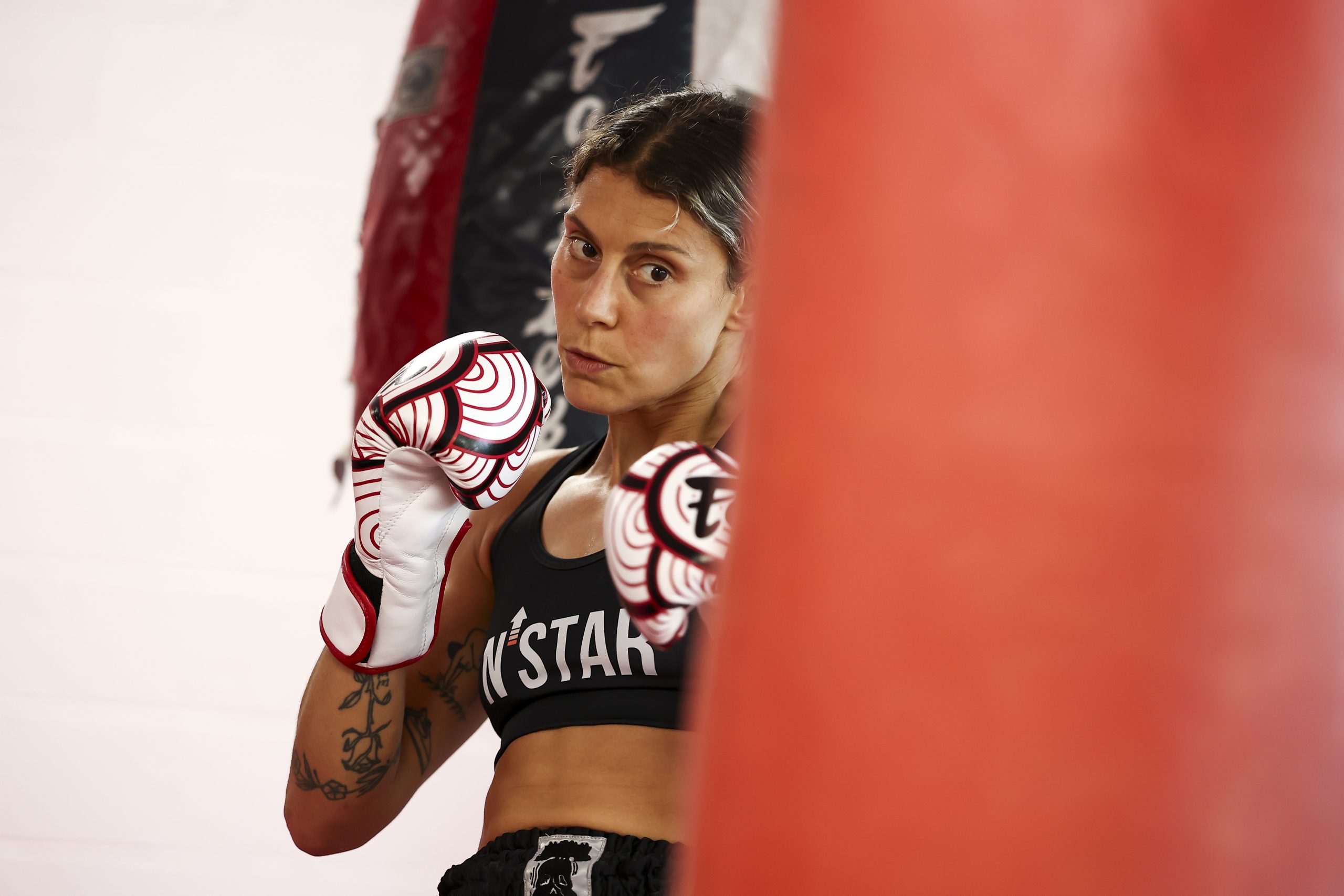
Gianna Vadino sees Muay Thai as a creative outlet.Monica Herndon / Staff Photographer
Say this for the Phillies: They are, more or less, who we thought they were.
It wasn’t the path that everyone expected. But after a 9-19 start that got the manager fired, they are back in possession of a wild-card spot in the National League with a relatively soft schedule until the All-Star break.
And they’ve done it on the strength of their pitching.
Caleb Cotham is in his sixth season as pitching coach. He recently joined Phillies Extra, The Inquirer’s baseball podcast, to discuss Cristopher Sánchez’s emergence as the best lefty in the National League, Zack Wheeler’s wildly successful return from thoracic outlet syndrome, Andrew Painter’s rookie-year struggles, and more.
Watch the full interview below and subscribe to the Phillies Extra podcaston Spotify or Apple Podcasts.
Q: Cristopher Sánchez recently went 50⅔ innings without allowing a run, the longest streak by a left-handed pitcher since at least 1893. How much did you actually talk about the scoreless streak with him? And what was it like going through it with him?
A: Yeah, we never talked about it. I think that probably sums him up as good as anything. I never noticed a difference [in him] from my perspective. Because it’s so good in his work; it’s so good in catch play; it’s so good in how he interacts with his teammates, how he shows up on non-start days in the dugout — he’s engaged in the game; how he treats his bullpens; how he treats his pregame; the routine on the table in the training room, the weight room. I never noticed a difference.
So, I think that it was kind of ho-hum for me. It was business as usual. And in the back of my head you know that that’s something, especially once it becomes pretty real. But I think the most impressive part of that for me — obviously not giving up runs for that length is the most impressive thing — but from a process standpoint, not even sniffing out a difference. Yeah, there’s a little bit [of a difference], just kind of [how] he fought to finish innings here and there. OK, that’s a little different for a third inning in this game. But for the most part, it was just kind of Sánchy doing Sánchy, and it got to a point where I didn’t know if he’ll ever give up a run.
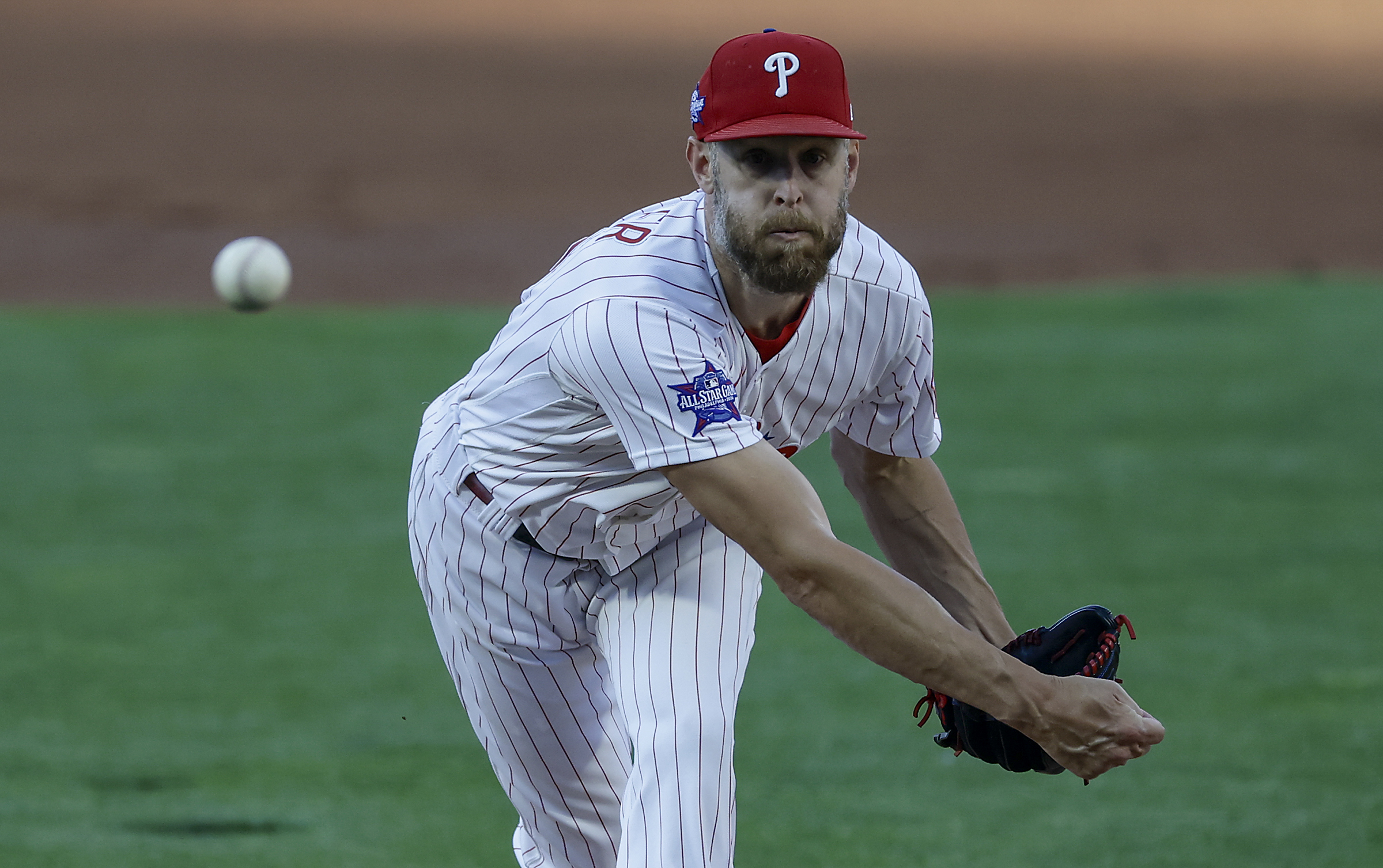
Zack Wheeler has a 2.01 ERA through his first 10 starts of the season.Yong Kim / Staff Photographer
Q: If I told you in the offseason that we’d be sitting here in the second week of June and Zack Wheeler would be pitching like this after what he went through last season with the thoracic outlet syndrome and the surgery and everything else, what would your reaction have been?
A: I’d be pretty thrilled. Zack knows himself so well, and he knows his game, he knows what his kind of shortcomings are, what his strengths are. He’s got [catcher] J.T. [Realmuto] back there. I think there’s now six years where I know Zack, and there’s a catalog of cues and feels and things we’ve talked about and worked on. So, I think you know that’s all thrown into kind of the cauldron. But Zack’s the linchpin.
It doesn’t surprise me that he’s back to kind of the [pre-surgery] competition level. It is very impressive that the stuff is where it’s at. I think the velocity is one thing, but also just the pitch shapes, like the splitters. The splitter is arguably as good as it’s ever been, movement-wise. The sweeper has been very good. He’s thrown last couple starts some of the better curveballs he’s thrown. The cutter was kind of a pitch he didn’t quite have early in the year; it’s gotten better lately, even though he threw a really good one [last week in Toronto] that a guy put a good swing on. But just the skill of the pitch shapes and controlling movement, I think that, to me, is incredibly impressive because the feel aspect and him not walking guys. His walk rate right now is as low as it’s been. Last year was a really good year, and it’s low again.
I still think there’s another level for him. I think he has another level he can go to, which happens every year anyways. But I think the people around him and his dedication — he has a very high desire to be really, really good; it bothers him to not be good. So, from that aspect, I’m not surprised. But it’s still very, very impressive, and it’s not easy. He makes it look very easy, and it’s not.
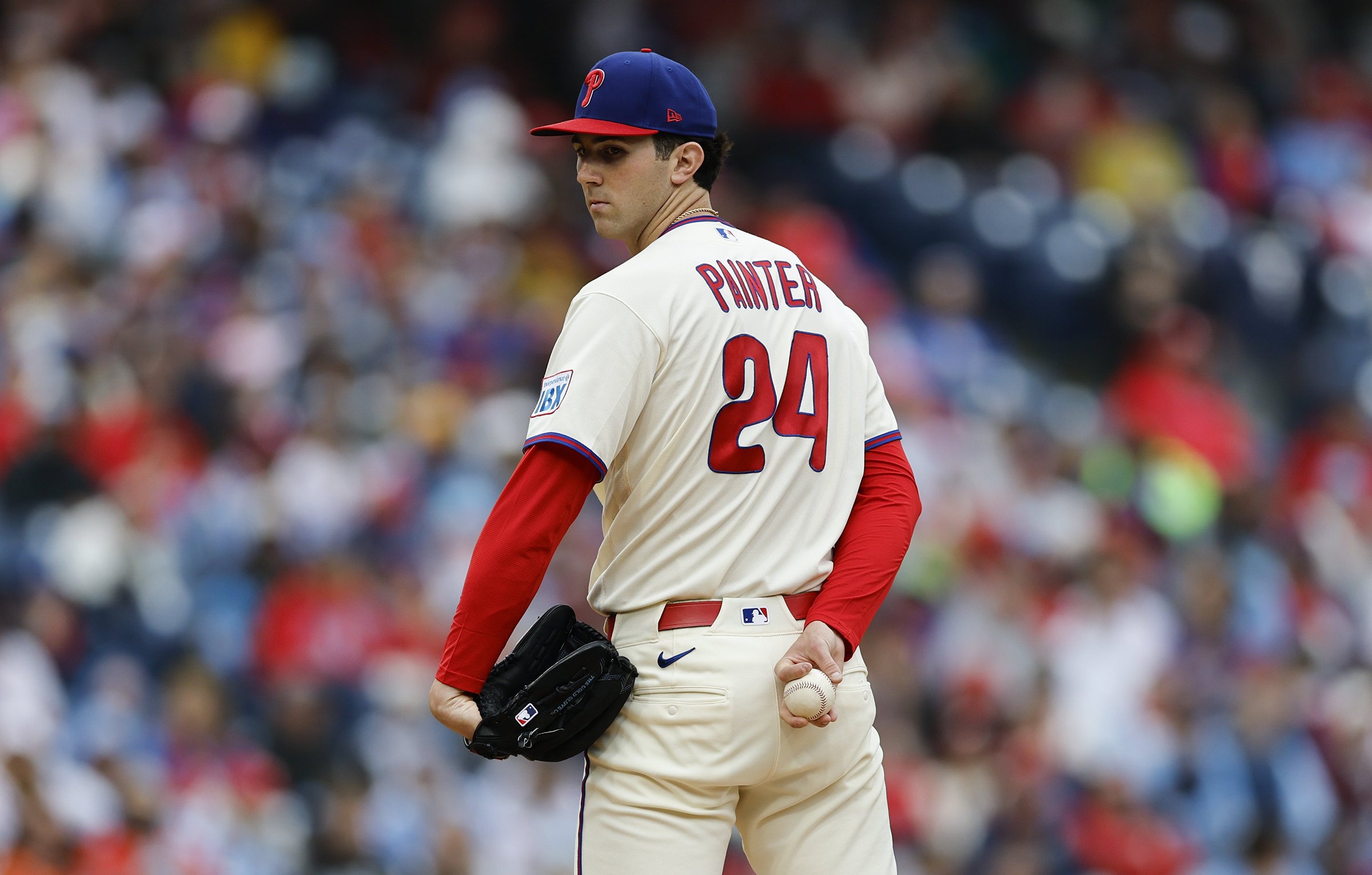
Caleb Cotham says he’s impressed with Andrew Painter’s ability to throw strikes as a rookie.Yong Kim / Staff Photographer
Q: What’s the message to Andrew Painter right now? Because it sounds like the focus with him is really just on throwing strikes.
A: It might not feel that way, but he has thrown strikes. I think he’s 80th-percentile [in] walk rate, breaking into the big leagues this year with ABS [the automated ball-strike system]. To me that’s very impressive. It would be way easier to walk more guys … it’s easier now than it ever has been to throw balls. The zone’s very small. There’s a way hitters can turn those borderline pitches that are called [strikes] into balls, so I think from that perspective he’s done pretty good. He’s held the zone.
His superpower is he can land a bunch of offspeed for strikes, but it’s kind of just inside that, what’s the level 1.5? I think being out of the zone with two strikes is something we’ve talked about a lot. That speaks to the K-rate. I think he’s getting a lot of opportunities at striking guys out, he’s just not quite finishing them. And it’s not always about the swing and miss on the heater. Sometimes it’s just bouncing a breaking ball when you need to. I think if you do that, you pose a little bit bigger problem to the hitter. Then, they’re a little more apt to miss the first fastball. But I think, specifically to the fastball, his ability to pitch down in the zone, throw strikes at the bottom, to not show them the up [above the zone] quite as much will maximize his chance to get a swing and miss when he needs to go up.
… if you throw the fastball up, up, up, up, up, their eyes have seen it, the foul ball turns maybe into a ball in play, and kind of cascades up the damage hierarchy. And that foul ball might turn into whiff if it’s the first time they saw it. So, I think just a little bit of hiding the ball from the hitter, not showing them the best location, and to me that’s control of the zone and control of height. But I think he has thrown strikes, he’s not walking them, but he’s not [striking them out] as much as we think he can, and I think he will. That just comes from a little bit of experience.
I think he’s held his own. There’s been games where he’s lost his zone, and the feeling on the mound where you don’t quite know where it’s going a little bit at times. That’s a pretty lonely feeling. And what I know about Paint is that he has fought through those outings. He threw 40-42 pitches in the first inning the other day [in Toronto], and he found a way to get into the fifth. That’s impressive to me, and that’s going to be something that’s going to help him long term.
We’ve written plenty about what might be next for Emil Andrae and Sam Ersson.
Well, now we know.
The Flyers on Tuesday dealt the defenseman and goaltender to the Toronto Maple Leafs for … a goaltender and a defenseman.
OK, hear us out.
Ersson and Andrae’s days in Philly were numbered. Both restricted free agents, they were blocked by talent in front of them or had failed to perform consistently. A change of scenery might be what’s best. As for the new guys, goalie Joseph Woll and defenseman Simon Benoît, they represent upgrades at a bargain. That’s just part of why trade got high marks from Flyers beat writer Jackie Spiegel.
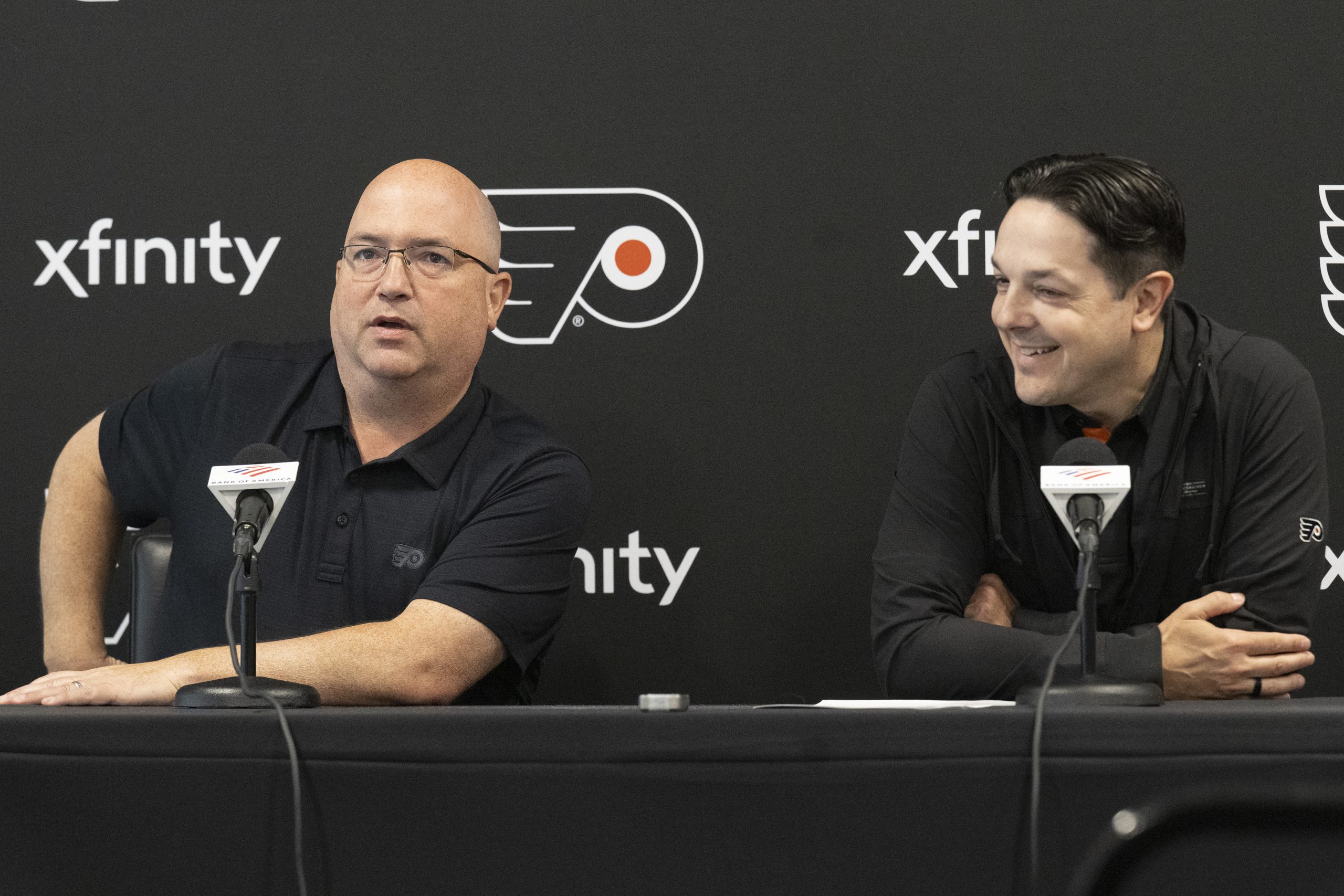
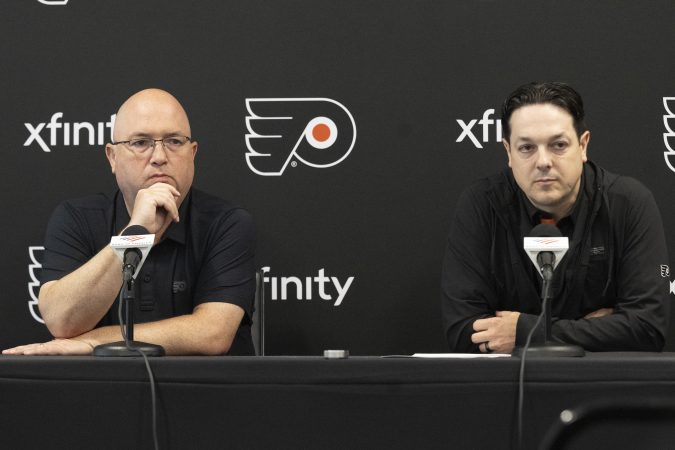
Flyers general manager Danny Brière (right) and assistant general manager Brent Flahr offered some intel on their draft strategy on Tuesday.Jose F. Moreno / Staff Photographer
The trade wasn’t the only news the Flyers made on Tuesday. The NHL draft is fast approaching, and Brière and assistant general manager Brent Flahr offered some insight into their strategy.
So what did we learn?
The Flyers don’t have a ton of picks, but the brass is open to shipping those off in exchange for a young, polished player. Those don’t fall to No. 21, where the Flyers will pick first, Flahr said. But this year, there are plenty of centers — a well-known Flyers need — and some of whom could fall into the team’s range.
Next: The Toronto Maple Leafs have the first pick in the NHL draft, which begins June 26 (7 p.m., ESPN) and runs through June 27.
Sunday’s FIFA World Cup opener in Philly was electric, but Friday’s highly anticipated match between Brazil and Haiti might eclipse it.
How do we know? Because we made the trek up north to MetLife Stadium last Saturday for the Group C match between the Brazilians and African giants Morocco for a match that didn’t disappoint and an atmosphere that was hard to forget. Many of those fans now plan to come down and create another sea of yellow-clad fervor in South Philly.
Kerith Gabriel writes that if Philly gets even a fraction of what Brazil’s support brought to MetLife, then Philly is in for a real treat.
Over on the West Coast, the U.S. men’s national team is riding high, too, after a historic win over Paraguay. But history offers a reminder: It was just one game.
Next: The USMNT’s second group-stage game is Friday vs. Australia in Seattle (3 p.m., Fox29, Telemundo). Closer to home, Brazil will face Haiti on Friday (7:30 p.m., Fox29, Telemundo) at (checks notes) Philadelphia Stadium.
Phillies pitcher Brad Keller was placed on the injured list, the team announced Tuesday.Yong Kim / Staff Photographer
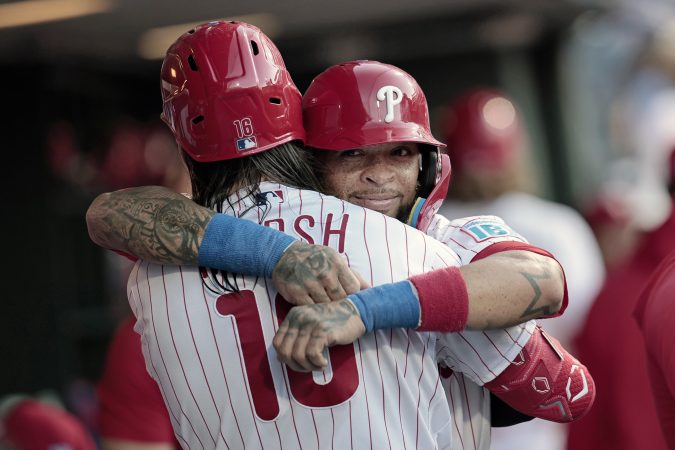
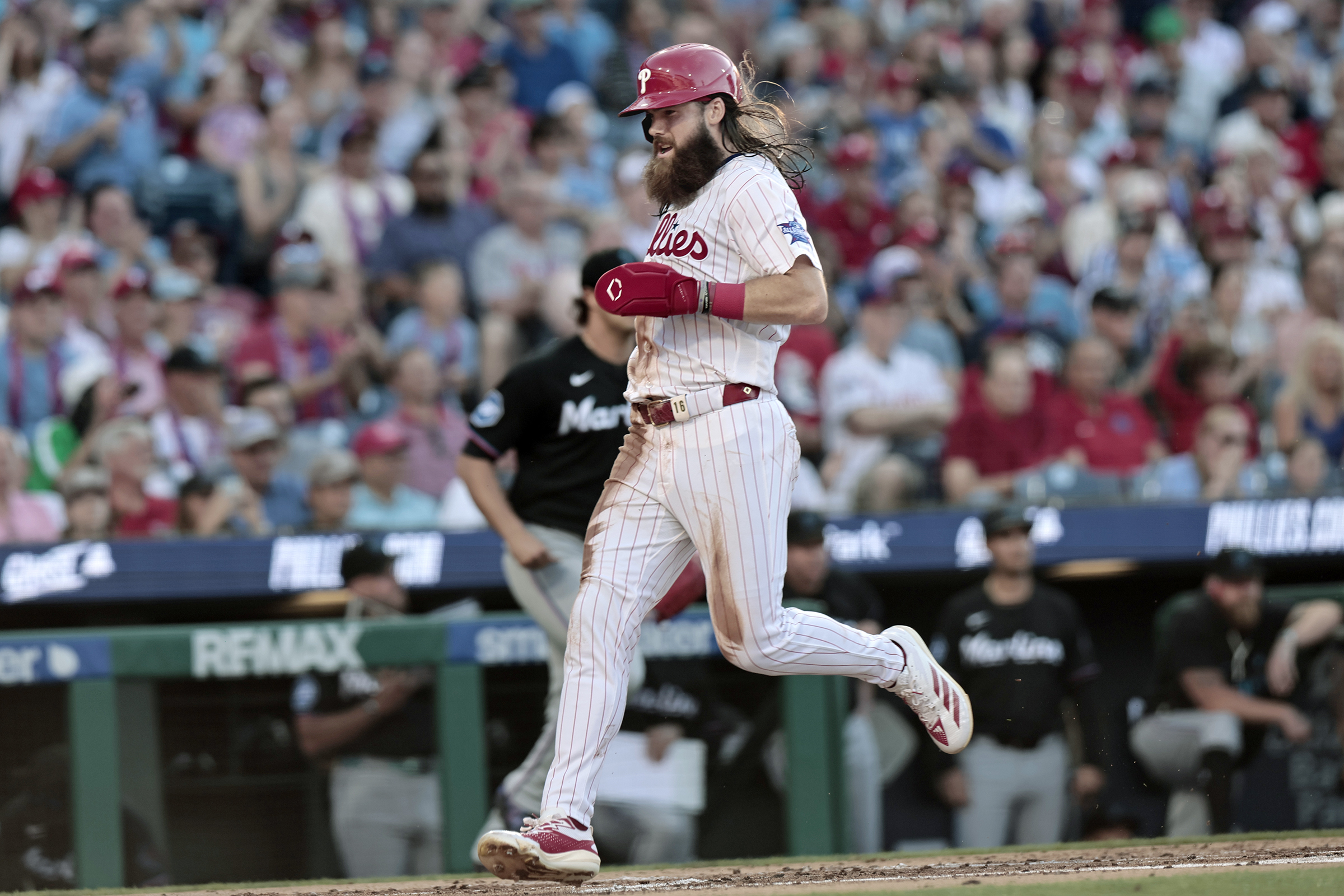
In the leadoff spot for the first time since 2022, Brandon Marsh homered as the Phillies crushed the Marlins, 8-2. Kyle Schwarber and Alec Bohm also hit homers off former Phillie Tyler Phillips.
In the latest edition of Phillies Extra, The Inquirer’s baseball podcast, pitching coach Caleb Cotham sat down with our Scott Lauber to chat about the Phillies rotation, including Cristopher Sánchez (and The Streak), Zack Wheeler, and Andrew Painter.
Meanwhile in the bullpen, Brad Keller was placed on the injured list with right forearm tendinitis. Keller, who has a 4.15 ERA in 31 appearances, largely had been used as a setup man this season.
Next: The Phillies’ series vs. the Marlins concludes with a matinee today (1:05 p.m., NBC 10). Andrew Painter (1-7, 6.43 ERA) is the Phillies’ scheduled starter, while Sandy Alcantara (6-4, 4.25) is slated to go for Miami.
Could Houston center Chris Cenac Jr. be on the Sixers’ draft board?Ashley Landis
The NBA draft is coming up soon, too, and the Sixers’ first pick will be at No. 22 overall. So who might new president of basketball operations Mike Gansey be eyeing in about a week?
Many experts are predicting a big man or forward joining the fold, and our Sixers beat writer, Gina Mizell, breaks down the possibilities.
Next: The Washington Wizards have the first pick in this year’s draft, which is June 23-24 (8 p.m., 6abc, ESPN).
Sports snapshot
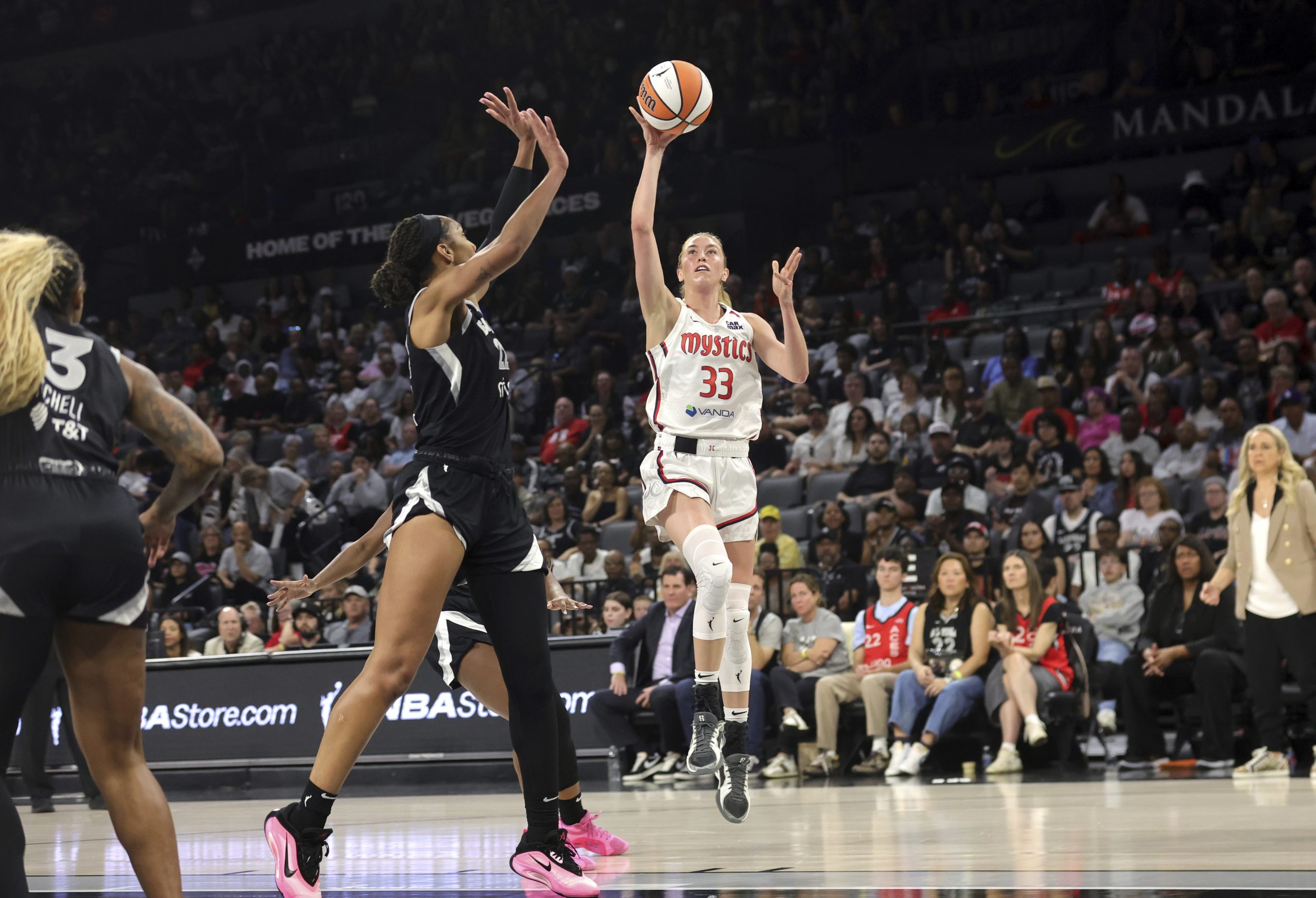
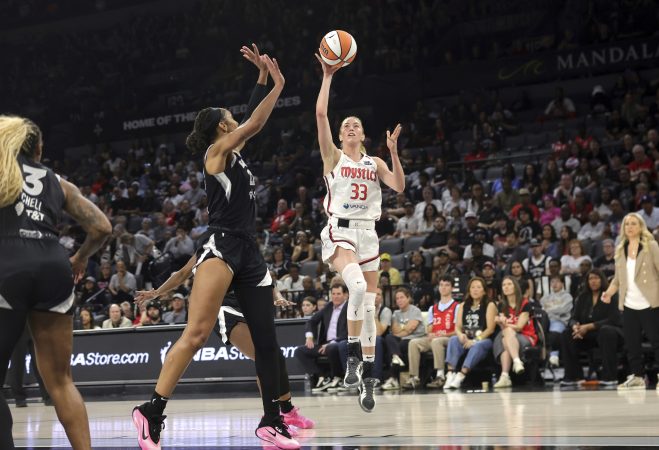
Lucy Olsen (33) is in her second season with the Mystics, averaging 3.0 points per game in a reserve role. Steve Marcus
Learning curve: Collegeville native and former Villanova star Lucy Olsen is working to find her niche with the WNBA’s Washington Mystics.
Goldfish mentality: How an unconventional mindset helped West Chester Henderson to a PIAA girls’ lacrosse title.
On this date
Fun fact: Tennis’ U.S. Open — at least the women’s portion — has roots at the Philadelphia Cricket Club, specifically its St. Martins clubhouse. On this day in 1911, Hazel Hotchkiss Wightman beat Florence Sutton, 8-10, 6-1, 9-7, for her third straight title. The Cricket Club hosted the U.S. women’s championships from 1887 to 1921, when it was moved to New York. The tournaments evolved into the U.S. Open in 1968, but the USTA recognizes the champions from the Cricket Club era.
🧠 Trivia time answer
Question: Philadelphia hosted its first men’s World Cup match, but it’s not the first FIFA World Cup game at Lincoln Financial Field, as there have been women’s matches played there as well. Today’s question: What year was it?
Answer: Trivia answer: In 2003, Philadelphia rallied to hold matches of the women’s World Cup that were scheduled to be in China following the SARS outbreak in that country.
What you’re saying about teachers
We asked: Pause sports. Want to give a shoutout to an influential teacher?
Nice note this morning. Sam was my coach for just a week at soccer camp when I was a kid in Delco in the early ’90s(?), but I remember him while I couldn’t tell you another name—staff or fellow camper—who was also there. He was a great presence. —Dan P.
A shout out to my daughter Beth Fotch who is this years Vista Del Mar K8 Teacher of the Year in San Clemente California. — Everett S.
We compiled today’s newsletter using reporting from Jackie Spiegel, Mia Messina, Kerith Gabriel, Jonathan Tannenwald, Scott Lauber, Lochlahn March, Gina Mizell, Gabriela Carroll, and Conor Smith.
By submitting your written, visual, and/or audio contributions, you agree to The Inquirer’s Terms of Use, including the grant of rights in Section 10.
Thanks for reading along! I’ll be back in your inboxes tomorrow morning. — Maria
Julian Lurie wanted to push the Eagles beyond their normalities. Two years into his nebulously titled role in “business and football operations strategy,” the owner’s son had immersed himself in all facets of the team, but he had taken particular interest in — and authority over — original content and social media.
For NFL teams’ multimedia departments, schedule release day is their Super Bowl, and the Eagles’ creators had come up with a concept that was off-color by team standards. There would be censored curse words and jokes made at the expense of opponents.
Lurie loved the idea — which called for passionate Eagles fans to undergo psychological evaluations — and saw it as cutting edge. But a few senior leaders weren’t comfortable with the swearing and ridicule and liked it even less after watching the first cut. Lurie still advocated for the video, but he listened to counterarguments, and edits were made.
“There was a compromise,” a senior leader told The Inquirer.
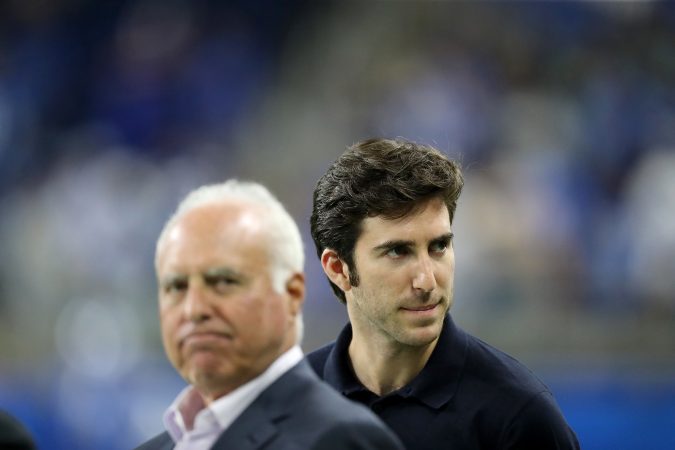
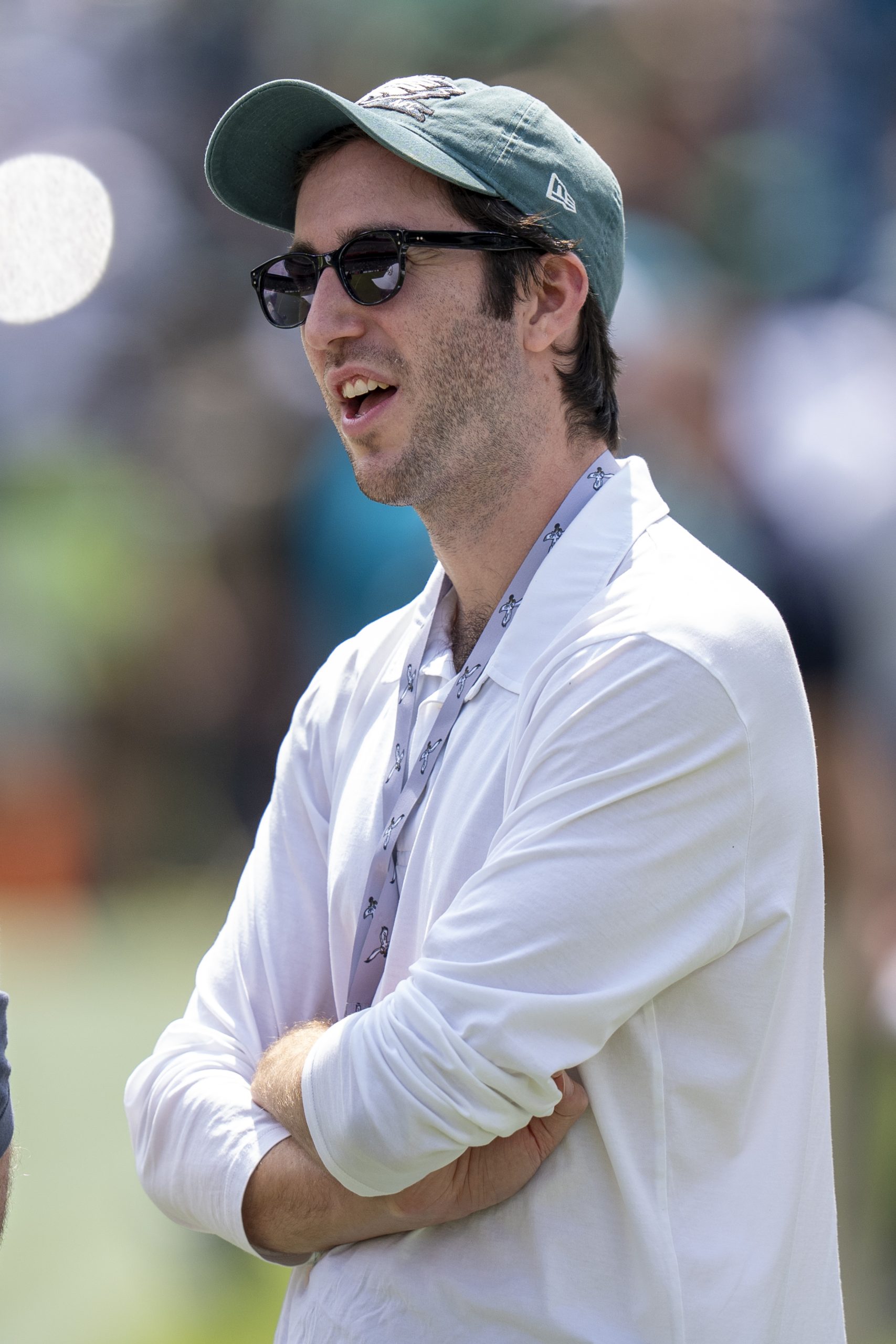
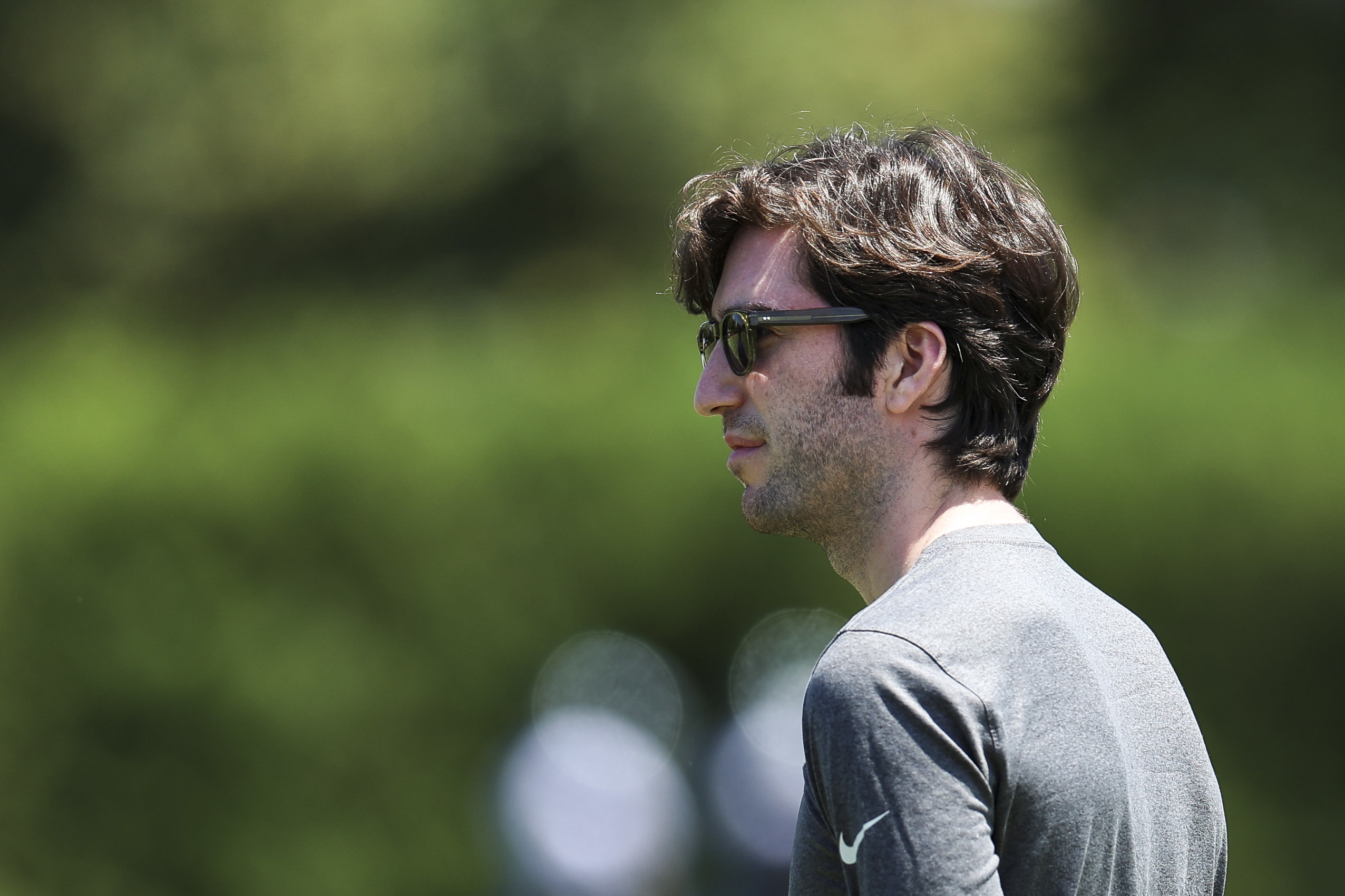
Julian Lurie’s title with the Eagles is “business and football operations strategy.”Chris Szagola
Obscenities and insults were taken out — but not all of them. Asked how Lurie could hold that much sway without having an official executive role, a high-ranking team source gave the following explanation:
“His last name.”
Lurie is not just Eagles owner Jeffrey Lurie’s only son, he is his successor. And while that reality has caused occasional challenges since he took a formal role in the family business four years ago — and as management navigates his increasing influence — many key figures within the organization believe the younger Lurie already has been an asset.
“He is really smart. He’s very creative. He’s very empathetic,” an Eagles source said. “He’s really good at putting himself in other people’s shoes. He’s fair, and he listens and is making a real attempt to understand everything about the organization.”
The Inquirer spent the last several months talking with nearly two dozen Eagles sources, past and present, as well as other NFL sources familiar with the team’s inner workings, about the 31-year-old Lurie. Many sources requested and were granted anonymity because they were not authorized to speak publicly on the subject or felt they couldn’t speak freely if named.
The Eagles declined interview requests for the Luries and other key members of the organization for this story.
The interviews with sources revealed Julian’s already considerable prominence. They also depicted an intense but thoughtful young man who was born not only into great privilege, but with a shared civic passion for the football team his father bought in 1994, the year before Julian was born.
“If I lived in Philadelphia and I was an Eagles fan, I would feel really good about him as a steward of the franchise in the future,” a team source said. “I really do think he cares about the team and the city and the players.”
To prepare for his eventual birthright, Julian has delved into the nuts and bolts of operations. From affairs as expansive as spending on the business and football sides to matters as minute as the strains of grass on the practice fields, he has asked the “why” behind the “what.”
His 74-year-old father remains chairman and CEO and has said he has no plans of ceding control, even if he now spends less time in Philadelphia than previously. But Julian has been a part of decision-making for some time now, which may come as a surprise to outsiders who know next to nothing about the Eagles’ future owner.
Inside the Jefferson Health Training Complex, his standing — if not his title — is clear.
“I didn’t even know he had one,” an Eagles staffer said about the younger Lurie’s job description. “To everyone here, he’s an owner.”
And as an owner, Julian can sit in on every high-level meeting. On the business side, it might be about the exploration of a new stadium concept or corporate sponsorships. On the football side, he may be present for team meetings or sit-downs on free agency and the draft. And he’s often in the building.
Jeffrey Lurie has final say and still exerts control when it comes to major decisions. But he has longtime direct reports in team president Don Smolenski and general manager Howie Roseman, whom he has empowered. The same applies to sixth-year coach Nick Sirianni.
In his first few years with the Eagles, Julian might have sat in the corner and said nothing. But as his understanding of the team has grown, so has his voice. Like his father, he is a questioner.
“He likes to ask the opinions of people,” a high-ranking team source said of the younger Lurie. “Some people here don’t like to be questioned. But he’s a smart guy, and he doesn’t think he has all the answers. He’s willing to change his mind.
“He says, ‘I’m not right all the time, but I want people to be real and be honest with me.’”
The initial ambiguity about his role and his relatively speedy inclusion into decision-making, however, led to an adjustment period and occasional bumps in the road. The biggest sticking point, according to several sources close to the situation, was over the budget.
“When you add another dynamic to that, there’s always growing pains,” a team source said, “but not to the point where relationships have suffered.”
The Eagles have been one of the most successful NFL franchises over the last decade, having won two Super Bowls and gone to the playoffs in eight of the last 10 seasons. Smolenski, who has overseen business operations since 2012, and Roseman, who was given full authority over football in 2016, have built a robust enterprise.
That growth has mirrored the increase in wins. But there has been some bloat, and Julian took it upon himself to examine the Eagles’ expenditures. Some of that was for his own knowledge in preparation for when he succeeds his father.
But the Harvard graduate also wanted to explore more efficient ways to allocate spending, team sources said. “Honest conversations” were had, according to one source close to the situation, and Julian eventually came to appreciate much of the existing process. He also was credited with making suggestions that contributed to on-field success.
“From where he’s started to now,” a team source said, “it’s like night and day.”
His more significant contributions have come in presiding over fan-facing parts of the franchise, like original content and image and likeness. Julian spent two years working for Overtime, a sports media company based in New York, before joining the Eagles. And before that, he was a member of the NFL’s Junior Rotational Program, a two-year undergraduate internship.
His bosses at both outlets said Julian was serious-minded, hardworking, and brought zero entitlement to the job.
“He’s quiet, but he has a sense of humor and he laughs, and he’s willing to use that constructively,” former Overtime CEO Dan Porter said. “It’s not like he fits hardcore into some archetype like that. He’s honestly just a young person wanting to add value and learn in the world.
“And he also just happens to, a) be really smart, and, b) his dad owns the Eagles.”
Jeffrey Lurie is widely considered one of the NFL’s best owners after his three-plus decades in the league. His son will have big shoes to fill when the time comes. Julian is an outside-the-box thinker like his father, but he also wants to bring a younger sensibility to the Eagles — as he did with the schedule release video — sources close to him said.
He’s also become the more visible Lurie at team headquarters. But the elder Lurie, who spends most of his time at his West Palm Beach, Fla., estate, said his absences aren’t representative of a loosening of the reins.
“Maybe I still have a lot of gray hair, but I am probably more involved than ever, ironically,” Jeffrey Lurie said in March. He added, “It’s not that it’s behind the scenes. It’s very overt. But I will talk to my executives more often and probably with more intensity because I have a son that’s growing and learning everything.
“And, so, he can both watch how focused and intense I am still and yet, at the same time, learn from all the executives we have.”
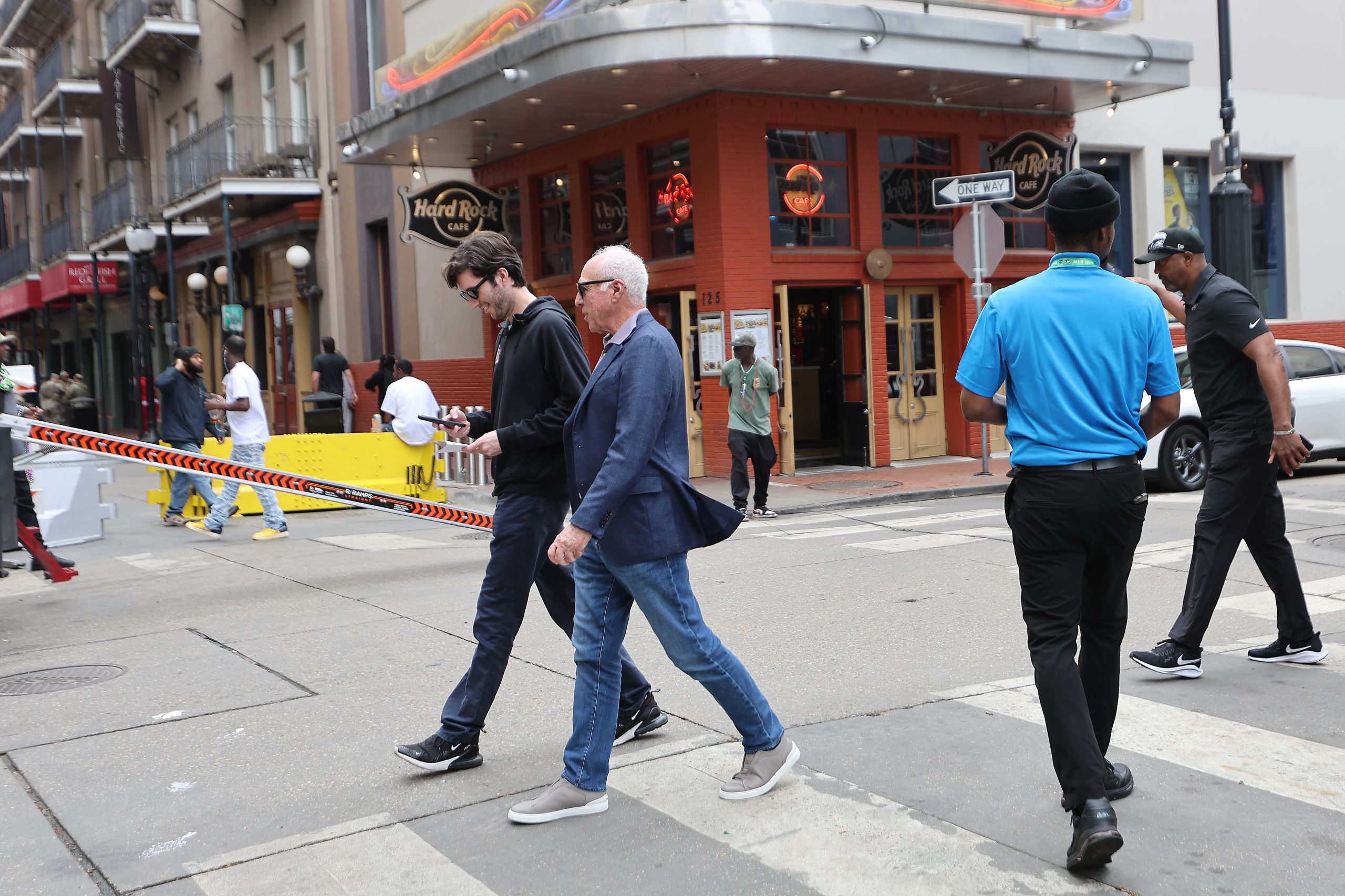
Julian Lurie (left) and his father, Eagles owner Jeffrey Lurie (right), walk across Bourbon Street during Super Bowl week in 2025.David Maialetti / Staff Photographer
Be a learner
Jeffrey said he has no plans to retire soon. When he talks about his good health in private, he often mentions his mother, Nancy Lurie Marks, who recently turned 99. But that hasn’t stopped some team leaders from wondering about a timeline regarding Julian’s succession.
“There’s no timeline, but I love the way it’s been going,” Lurie said three months ago at the league meetings in Phoenix. “He’s quite involved in the business operations, the football operations, philanthropic operations, marketing. He’s getting a great, great sort of feel for everything, and that’s the best way to do it.
“It’s not to speed it up.”
NFL owners recently approved succession plans for two teams. Last year, the Colts transferred Jim Irsay’s ownership to his three daughters following his death. And in March, the league affirmed the plan for Raiders owner Mark Davis, who doesn’t have children, to give a minority owner, Michael Meldman, the option to purchase a majority stake.
NFL ownership has long been a family enterprise. More than half the league’s 32 teams remain under family control, with prominent last names like the Rooneys, Maras, and Hunts having owned prosperous franchises for 60-plus years.
There also have been family-run teams that haven’t thrived or experienced generational decline.
The 49ers have not been one of them. Team owner Jed York, like Julian Lurie, was brought into the fold of his family’s franchise in his mid-20s. As “special projects manager,” he worked in every department of the 49ers and recalled that one of his first stints was in the equipment room, where he helped sew players’ names on jerseys.
By age 30, York had become CEO. While his Ohio-based parents, John and Denise York, remained principal owners until 2024, he effectively ran the organization.
“It was Undercover Boss without the undercover part,” York said.
He said his transition to power happened organically.
“I think the organization sort of accepted it and sort of dictated when it was going to happen more so than me or my parents,” York said in an interview with The Inquirer. “Like, it just became clear when people started coming to me for answers and not necessarily waiting until my parents came out from Ohio to be able to make decisions and move forward.”
Jeffrey may not be in Philadelphia as often, but he still returns for games, favorite events like the draft, and various other days. He was present for most of the workouts that were open to reporters this spring — at a much higher rate than last season.
Either way, team employees still look at the elder Lurie as being the boss.
“Julian is here every day, so we do see him more,” a team source said. “But Jeffrey is still viewed as the owner.”
Julian’s office at “the Jeff” is situated near his father’s and Smolenski’s. That is by design. Among senior leaders, he spends most of his time with Smolenski. But he has conversations with many staff members, even if he is described as naturally introverted.
He’ll drop into any office, not necessarily with a purpose, but just to chat, often about every staffer’s favorite team. Some sources consider his way with people one of his strengths.
“You got to be a learner,” said Porter, who recently stepped down as Overtime’s CEO. “You have to understand that as soon as I am the CEO, I’m in a bubble. I only know what the people who talk to me tell me, right? You [have to] make people feel seen and heard because you want them to give their all to an organization.
“But you also don’t want your experience of the company to be in a very small echo chamber.”
So while Smolenski continues to make final decisions on the nonfootball side, Julian will gather intel on his own. That might include talking to facility manager Chris DeBellis about operations at Lincoln Financial Field or vice president of grounds Tony Leonard about how to install heaters under the practice surfaces so they no longer freeze.
The Eagles’ practice facility, previously known as the NovaCare Complex, is undergoing renovations with an expansion of the training room and eventually the locker room. Julian has been a part of planning, but he’s also explored other possible changes like a full-length indoor field.
Many of his inquiries have been about the Eagles’ expenses.
“I don’t see what he’s been doing as any different to anyone whose dad said, ‘Here are the keys. Go in there. See what you think,’” a team source said. “This is going to be his team someday. He wants to understand how it works from a fundamental level.”
Julian Lurie has a way with people, some of his colleagues say.Monica Herndon / Staff Photographer
Productive conversations
While it’s unclear if Julian’s budget analysis was a Jeffrey directive or not, some staffers felt the team’s accounting could have benefited from a fresh set of eyes. In some cases, spending was cut. It could have been something sizable like the budget for food and beverage or something less significant like the number of hats ordered for employees.
The money often was then redistributed into other resources, such as the facility expansion. But other sources for revenue were explored as well, like selling naming rights to the cafeteria.
“I don’t think the goal was necessarily to cut costs. I think it was to understand what we’re spending on,” a team source said. “NFL teams — we’re not perfect in our spending. Things can get distorted over time. They can get out of whack. I think it’s healthy to evaluate that.”
The Eagles are always looking to be prudent. Jeffrey has long entrusted his lieutenants with fiscal responsibilities. But his son’s increased involvement and “probably being more into the bottom line,” according to one source, faced resistance from some staffers.
“The easiest way to impact the bottom line is by cutting expenses. And that is great in the short term, and you definitely improve margin,” an NFL source familiar with the Eagles said. “But if you have unlimited resources and the business is successful on the field, off the field, is that really a common-sense approach?”
Some of the excess could have been people. For instance, why have X number of full-time employees in the ticket office when it’s mostly a seasonal job? Did the Eagles really need to send as many staffers to the Senior Bowl and the NFL combine as they had for years?
On the football side, the Eagles have had considerable growth. That’s not exclusive to them among teams in the booming and hypercompetitive NFL. But Roseman has constructed a multifaceted operation that has depth in many departments.
Julian’s new oversight meant that staffing and salaries were questioned, like having three highly paid senior advisers in personnel when the Eagles brought back former Jets general manager Joe Douglas last year.
But Roseman’s modus operandi has been to have a deep bench in case there are departures. When former senior adviser Dave Caldwell left for the University of Florida in December, Douglas already was in the fold. Just recently, he was promoted to senior vice president of player personnel.
Last month, assistant general manager Alec Halaby stepped away from the Eagles, and the well-regarded Adam Berry was promoted into his position. Two years prior, vice president of football administration Jake Rosenberg left the Eagles, and Roseman had Bryce Johnston waiting in the wings to manage the salary cap.
Rosenberg sought other opportunities after seemingly reaching his ceiling with the team, but some Eagles sources wondered if his exit was precipitated by Julian’s deconstruction. The Atlanta Falcons poached Johnston in May. His replacement, Grant Reiter, is a relative unknown with far less experience.
Two sources compared staff reductions to playing Jenga.
“If there’s a high headcount, it’s hard to pull it apart and say, ‘This is responsible for this, this is responsible for that,’” one of the sources said. “You never know which thing you pull is going to be the thing that causes it to fall down.”
Rosenberg declined to comment. Johnston didn’t respond to an interview request.
It’s hard to argue with Roseman’s approach, considering the Eagles’ success, which has come with multiple head coaches and starting quarterbacks. Roseman hasn’t been perfect, of course, but Jeffrey Lurie has given him ample room to take big swings and make corrections when there are misses.
Julian made inquiries based partly on the Eagles’ staffing vs. other organizations. There was an acclimation phase with some give and take, and ultimately an understanding of Roseman’s process that has improved over time, team sources said.
“I think they have a productive relationship,” one source said. “I think they can walk into each other’s office and have productive conversations.”
The Eagles’ largest expense is on player contracts. There’s a salary cap, but no team has spent more on their roster over the last decade. According to Jeffrey Lurie, that aggressive mindset won’t change.
“This is where the emotional part probably gets in the way. I can’t help myself,” Lurie said in March. “Try to have every edge you can and willing to spend the cash. And I think we have a chance to win multiple more Super Bowls. There’s nothing I want more than that third Lombardi.”
Jeffrey remains integral to Roseman’s major roster decisions. After years together, the two can communicate in shorthand. The general manager still has his direct line to the owner, and their process is “overall, similar,” a team source said. There’s just now an additional layer.
“When it comes down to final decisions, I still feel like that’s totally Jeffrey,” a team source said. “But Julian has been a part of all of it.”
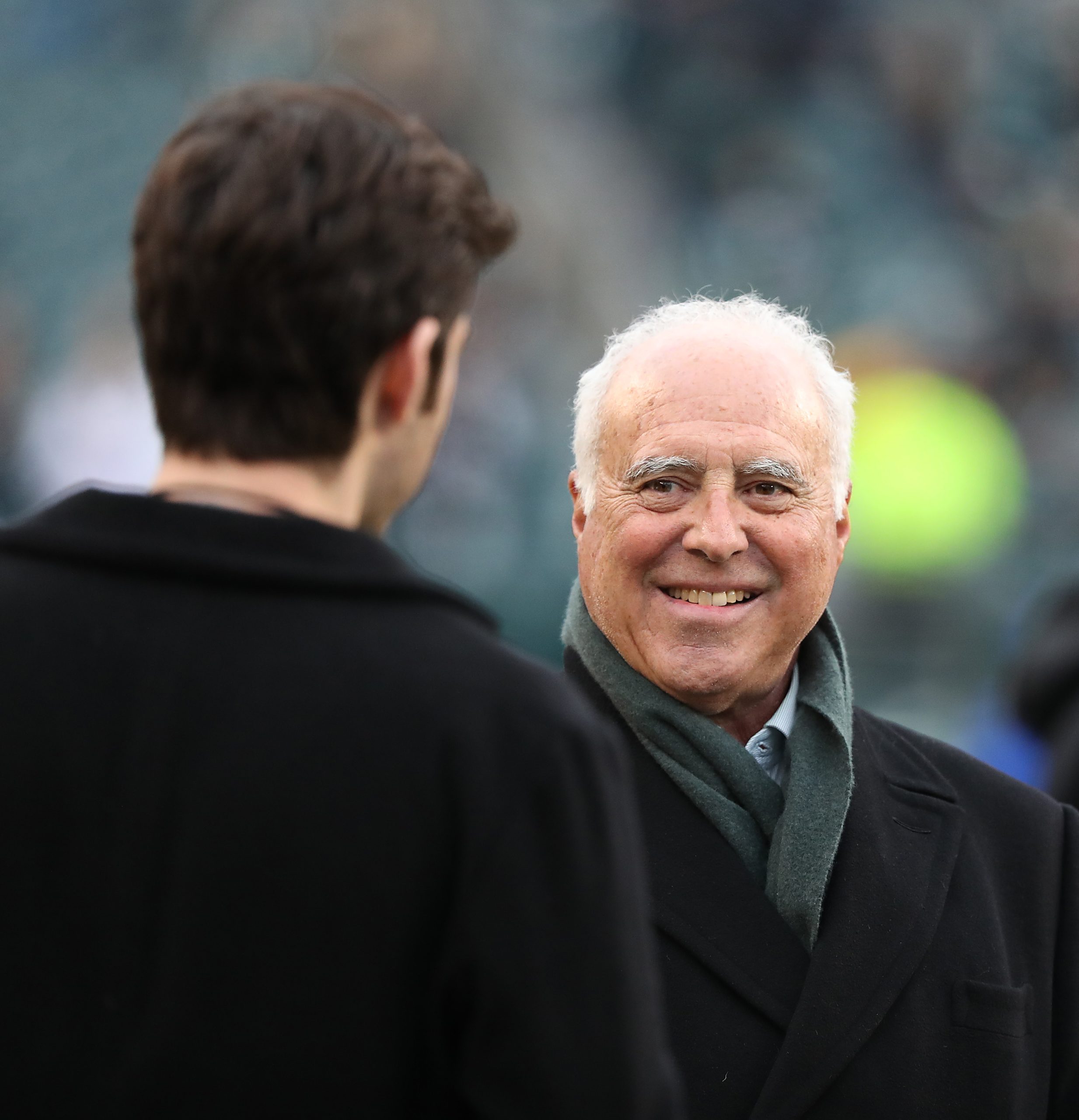
“Julian is here every day, so we do see him more,” a team source said. “But Jeffrey is still viewed as the owner.”David Maialetti / Staff Photographer
Roll up sleeves
When Jeffrey Lurie purchased the Eagles in May 1994, he was 42 and a longtime New England Patriots fan. He had tried to buy his boyhood team just the year before. But the Hollywood executive, who had worked for his family’s movie theater company, shifted his attention to the franchise located roughly 300 miles south of his native Boston.
Jeffrey and then-wife Christina Weiss Lurie, married for two years, arrived in Philly with daughter Milena when he bought the team. Julian was born the following year. When Jeffrey was first publicly asked about his son in March 2022, he focused on Julian’s inherited passion for the Eagles.
“Obviously, he grew up in the family that owns the team,” Jeffrey said then. “He’s an avid Philadelphia sports fan. He loves the Eagles, loves the NFL. He really has a great feel for many aspects of the sport.
“He’s going to have so much more going into it than I ever did if he chooses to want to someday own and run the team.”
Jeffrey had exposed his son to various aspects of the family business for years, but in January 2021, he had him participate in interviews for a new head coach. Julian handled questions related to analytics.
While it might have seemed peculiar at the time that he would be involved despite not having a formal role with the Eagles, associates describe Julian as an “analytical thinker.” At the league’s junior program, he rotated through four groups focused on strategy and development.
Grace Senko, currently vice president of media strategy and business development at the NFL, was one of Julian’s managers. They worked closely on the league’s licensing of media rights and spent time tracking performance in the burgeoning digital streaming of games. It sometimes was menial work.
“There was a lot of nights the two of us were here, the only people working to pull together very large amounts of data,” Senko said. “Because of how much we were pulling in together, we made a lot of mistakes. And Julian — he has a lot of integrity. If something is wrong or he makes a mistake, he owns it. … He is willing to roll up his sleeves.”
After the completion of the two-year rotation, Julian went to Overtime, a media company that says it “builds disruptive” content “at the next generation of sports fans and athletes.” The company is perhaps best known for Overtime Elite, its developmental basketball league for high school-age players. Porter, the former Overtime CEO and a Philly native, heard through an intermediary that Lurie was interested in his startup.
“Julian’s very intense, but he’s also very reserved,” Porter said. “He’s just very deliberate. And so, in our first conversation, I was like, ‘Oh, he’s clearly extremely smart and very, very focused, but he’s not that kind of person in an interview who’s going to, like, talk for 10 minutes straight.’”
Julian reported to Porter as senior manager of business strategy. He focused on analytics and helped create, for instance, a free-to-play app that took aspects of betting apps and was designed for consumers under 21, Porter said.
All told, Julian spent four years working in New York. Senko, who also had gone through the NFL’s junior program, said she worked with other family heirs and that Julian, like many who had connections, overcompensated to avoid claims of nepotism.
Porter said Julian was unassuming at Overtime’s Brooklyn office.
“He’s got a different burden, maybe, than most people,” Porter said. “He’s a serious guy, but he’s not unfriendly. Smiles. He’s just serious about his job. He was integrated in the culture. He wasn’t like some weird guy in the corner. He was a part of the company.”
Julian was in some ways shielded by his protective parents. When The Inquirer did a feature on Weiss Lurie in 2010, the names of her children were withheld from the story at her request.
Milena and Julian attended the Shipley School in Bryn Mawr. One teacher, in a school website post, recalled a junior-senior football rivalry game in which Julian and other seniors wore fake bushy mustaches like then-Eagles coach Andy Reid as Jeffrey watched from the sideline.
When Julian attended Harvard to study philosophy, he watched Eagles games at the Baseball Tavern, a local bar whose owner had been a fan of new coach Chip Kelly. Julian might have been among the progeny of one-percenters who went to the elite university, but he didn’t carry himself that way, a fellow student said.
“You’re around a lot of kids from billionaire families that are out of touch and act like their s— don’t stink,” a former Harvard classmate, who asked not to be named, said. “That wasn’t Julian. That card never got played.”
Dan Porter, Julian Lurie’s supervisor at Overtime, said: “He’s a serious guy, but he’s not unfriendly. Smiles. He’s just serious about his job.”David Maialetti / Staff Photographer
Going to the Eagles
Julian’s destiny was different from most, though. In early 2022, he decided to leave Overtime for an official post in the family business.
“One day he just called me and he said, ‘Thanks, it’s been amazing. It’s time to move on. I’m going to the Eagles,’” Porter said. “And I was like, ‘Yeah, of course.’”
Julian already had been spotted at offseason NFL events like the Senior Bowl in Mobile, Ala., that January, but the Eagles didn’t announce his role until June of that year. His listed title, which reads more like a department — “business and football operations strategy” — reflected the duality of his position as he went about learning both arms of the organization.
It took Julian some time to find his footing, team sources said. He initially latched onto the decade-older Halaby, a fellow Harvard graduate who oversaw the analytics department at the time. It was a natural entry point considering his mindset and experience.
But Julian also took an active interest and lead in Eagles media content. He began to flourish.
“He’d come in, sit in the corner, not say anything, so a few people felt uncomfortable,” a team source said. “But the more that he got comfortable, the more he got involved, he started to throw out ideas and people saw it.”
Julian oversaw promotional videos that captured the local zeitgeist. He heard quarterback Jalen Hurts use the phrase, “It’s a Philly thing,” and made that a rallying cry for the 2023 playoffs. And he was behind the “Yo” hype video ahead of the 2024 opener in Brazil.
He has become, in some ways, the point person for the Eagles’ social media team.
“He wants it to be a really good fan experience. He wants people to enjoy using the Eagles app or seeing their posts on Instagram,” a source close to Lurie said. “Social media is a big part of an NFL footprint these days. It’s how a lot of fans connect with the team.”
He is, after all, one of them. Porter, also an Eagles fan, said he knows not to text Julian after losses. Like his father, Julian also has a passion for football. Last season when the Eagles played the Packers at historic Lambeau Field, he opted to watch from the bleachers rather than in a suite with team executives.
“He wanted to experience the game from that vantage point,” a team source said.
Julian watches a lot of games and has an interest in all its intricacies. He’s a part of strategic meetings when it comes to personnel and scheme. He might ask why a certain draft prospect has a red flag for character concerns, for example, or why the Eagles have made certain schematic choices, sources who have been in those meetings said.
Julian has a keen eye for X’s and O’s and he will query coaches. He often does his own research and he comes prepared, a team source said.
“It’s never like, ‘I have answers,’” a coach said. “It’s like, ‘I want to understand this.’”
During interviews with offensive coordinator candidates this offseason, Julian handled questions pertaining to player performance. His father has allowed him to sit in on head coach interviews dating back to 2016, knowing how important that responsibility is for an owner.
But for some in the organization who have been around since Julian was young and may have viewed him through that lens, there was apprehension about his presence. Although most have appreciated his development, a few believe he’s overstepped at times.
“There’s growth that still needs to occur,” a source said.
Not only does Julian have to balance his increasing involvement with any perception that he’s meddlesome, but he also has to walk the delicate line between his long-term goals and the shorter-term thinking of current leaders.
There is a generational strain that can exist in succession plans. York said he had a mentor in Patriots president Jonathan Kraft, son of owner Robert Kraft, who has been his father’s right-hand man since 1994. York said he has spoken to Julian on occasion and wants to be a sounding board for him, like Kraft was for him.
“I know there aren’t many people in these positions that can help you think through, ‘Well, how do you tell your dad or your mom that you want to do something a little different than they did, and do it in a way that’s respectful?’” York, 46, said. “How do you handle those things?
“How do you see something as a younger person in the NFL that you want to take the league in a different direction than … a bunch of guys that are in their 60s or 70s or 80s?”
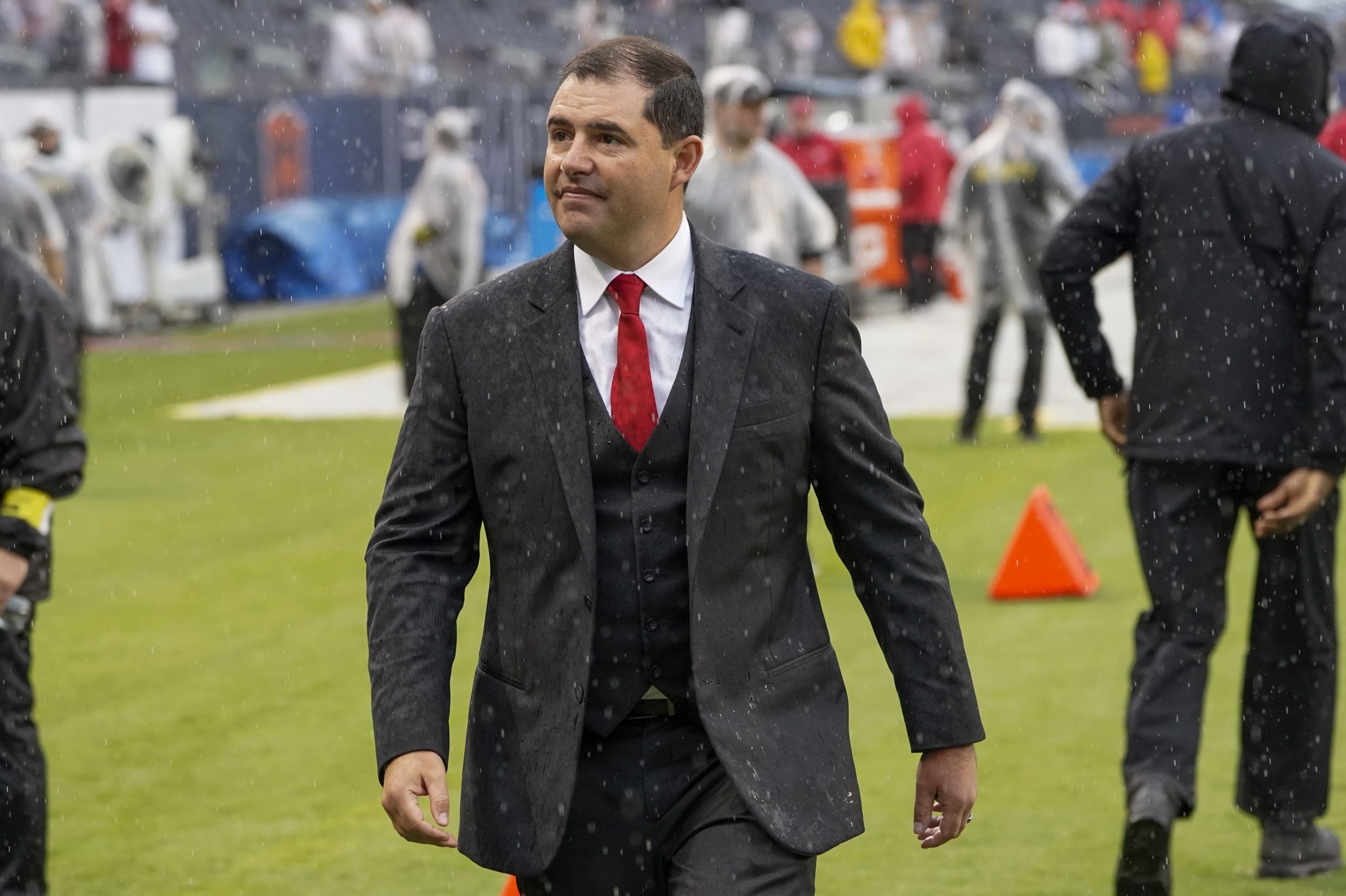
San Francisco 49ers owner Jed York, an example of a family generational transfer of power that has succeeded, already has a good relationship with Julian Lurie. Charles Rex Arbogast / AP
Own path
Julian, like his father, is willing to push boundaries to gain advantages. Jeffrey likes having different perspectives in a senior leadership team that now includes his son. Jeffrey still mostly defers to Smolenski and Roseman in major decisions. He often just wants to see the finished product.
But Julian has been more hands-on than his father when it comes to details, for instance examining the blueprints of the practice facility expansion into the former NovaCare rehab center.
“He has a mindset for how he wants to lead and that’s going to be different in some ways,” a team source said. “He’s not trying to be exactly like his father because that’s not entirely his personality. He is his own person.”
Julian is a foodie and avid golfer like his father, but he does not flout his privilege, those who have observed him say. He might have the second-best parking spot at the “Jeff,” but he doesn’t ask for police escorts or special accommodations on game days, sources said.
He may engage in “casual conversation” with players before or after games, a veteran said, but he isn’t overly chummy. That is in part deliberate. He knows his limitations. But it’s also Julian being true to himself. He’s not as outgoing as his father.
“You can’t read Julian as well,” a team source said.
That can make more unsure members of the organization at times uneasy. Many value his brevity.
“I think he has a very kind of quiet confidence around him and when he says things they have a lot of weight to them,” Senko said, “because he’s not one of those people that just like speaks to be heard. He speaks when he has something important to say.”
His voice carries weight because he’s viewed as an owner, even if he’s not yet the Eagles’ principal owner. Some senior leaders expect Julian to eventually have an executive role in the front office.
The 59-year-old Smolenski could stay aboard until the next stadium deal is in place. There are other internal candidates to succeed him, like former Eagles player Connor Barwin, who currently is head of football development and strategy.
It doesn’t matter what title Julian is given. He already is involved at a senior level. And while the Eagles have absorbed his inclusion — and won a Super Bowl in the process — there is some question of the future as Julian advances.
“It remains to be seen how that goes,” a team source said.
If he were to become president, would he, like Smolenski, stay exclusively on the business side? Would he cross over into football, like predecessor Joe Banner did during his roughly 20-year tenure? Would the title matter?
Jeffrey signs off on all major football decisions. He has, on rare occasion, pushed for his preferences in the draft, sometimes with great results (e.g. Hurts), sometimes not (J.J. Arcega-Whiteside). But he has by and large delegated to Roseman.
For years, Jeffrey and his general manager standing together on the sideline before games or at practices conveyed their abiding partnership. They still strike that image, but Julian might also be in the picture, or alone with his father.
Few Eagles sources expect the dynamic at the top to change as long as the Eagles keep winning. Jeffrey has given the 50-year-old Roseman as much autonomy as any general manager. But if that power were to be curtailed, the two-time NFL executive of the year would have obvious options elsewhere if he wanted to leave.
“We’ve been successful. We’ve done things the right way. Sometimes maybe not in the most traditional way,” a team source said. “But as long as Jeffrey’s in charge and likes the direction of the team, he’s going to think, ‘If it’s not broke, we don’t need to fix it.’”
And Jeffrey has no apparent plans of abdicating his power. There may be some uncertainty about how often he’ll be in Philly once work is completed on a yacht he is having built near his Florida home, but he has been more present this spring, team sources said.
“If you want to live a long time, I was always told don’t ever retire and keep that intensity going,” Lurie said in March. “I love owning the Eagles. I love trying to make us even better in every way and that’s what I’m focused on.
“That’s why my energy’s high.”
But Julian, as the NFL-approved heir, remains only a heartbeat away from the throne.
There will be no Succession-like maneuvering for future control among family members. Weiss Lurie stepped down as director of the Eagles Charitable Foundation in 2019 — seven years after the Luries’ divorce — although she remains a minority owner. Jeffrey married Tina Lurie in 2013, but she has no official role in the organization, nor does the 32-year-old Milena.
Few, if any, within the franchise believe it will suffer the decline that can occur when families bequeath assets. Julian himself is unmarried and without children.
His devotion, for the time being, is to the Eagles.
“I respect the way he’s grinding and going about it,” York said. “It is not easy to be in his position, in his situation, especially with how successful his father has been. He’s trying to make his own path, and he’s working as hard as he can, and I respect the heck out of that.”
His ownership is written, if not his future. But Julian continues to show maturation. In the Eagles’ most recent schedule release, senior leaders again didn’t like the direction of the video. Alternative ideas were offered, one of which Lurie agreed was better.
“He is open to listening,” a team source said, “open to evolving.”
There was cursing from players in the video that wasn’t bleeped out, but it generally was wholesome entertainment. It wasn’t as inoffensive as the 2023 version that predated the controversial psych evaluation concept, though.
The 2023 video featured an Eagles employee listed directly above Julian, deep into the staff directory, and the only one other than the leader of “business and football operations strategy” to work in his own department:
“Director of joy” — mini goldendoodle and team pet — Reggie White Lurie.
Former Villanova star and current Washington Mystics guard Lucy Olsen has picked up a lot of experience with different teams.
Moving around so much means she’s learned numerous systems during her years in college and the pros, which is keeping her adaptable as her role shifts in the WNBA.
“Going from Villanova to Iowa, that was a big jump, system-wise, trying to learn how to fit the system, but also keep your own game,” Olsen said. “That was pretty hard, and then I got another chance at it, coming to the Mystics. Then I feel like just going to another team, you just learn how to adapt faster.”
In college, Olsen was the primary ballhandler at point guard and took on most of the scoring responsibility. But in the pros, she often has come off the bench and plays as an off-ball guard, shifting her focus away from scoring to the other things she can do on the floor.
“Run the play, but also keep looking for the different avenues so that you can be aggressive and then dish it off to someone else,” Olsen said. “I’m reading the defense a little more, and I think [playing in] Australia [in 2025-26] helped with that, being able to see different types of defenses and work on just getting more reps of pick-and-rolls, and how the pros play.”
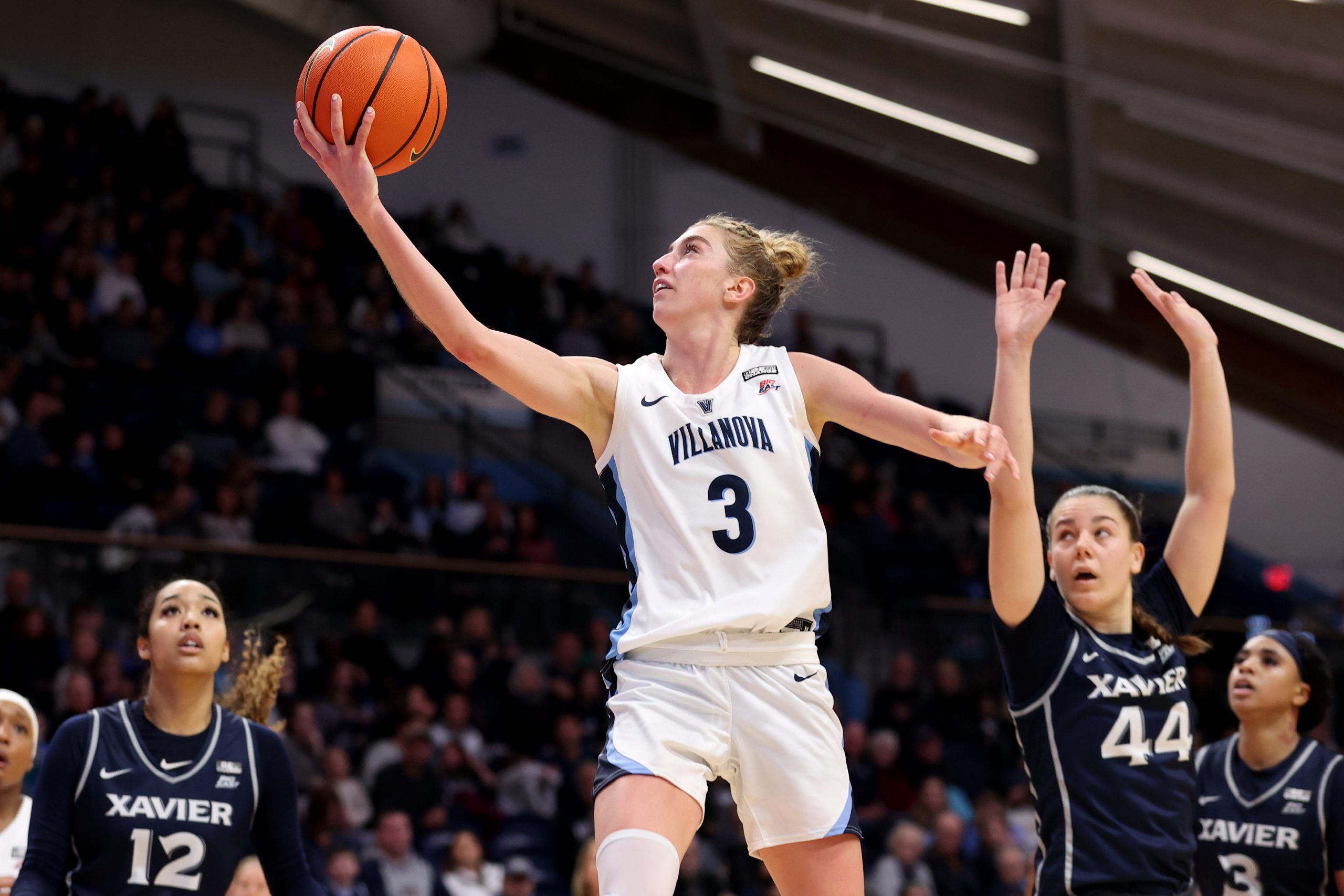
Lucy Olsen (center) averaged 23.3 points per game in her final season at Villanova before transferring to Iowa in 2024-25.Charles Fox / Staff Photographer
After three years at Villanova, the Collegeville native and Spring-Ford alumna transferred to Iowa for her final season. Shortly after her lone season with the Hawkeyes, Olsen was drafted in the second round by the Mystics.
After her rookie season in Washington, she moved to Australia to play in the Women’s National Basketball League, where she won Sixth Woman of the Year and a WNBL championship with the Townsville Fire.
Now, she’s back with the Mystics for her sophomore season, and even with just one year of experience, she’s something of a grizzled vet on a roster with eight rookies.
“Everyone’s so young and eager, and they want to learn,” Olsen said. “I think that helps with the environment and getting better.”
Olsen is working to find her role in Washington and mostly comes off the bench in late-game situations.
But there’s never been a better time for development in the WNBA. Previously, players had to come to the league fully formed. With extremely limited roster space — entering this season, the maximum number of players hadn’t been higher than 12 per team since 2008 — only a few draft picks each year would make a WNBA roster. Second-round picks like Olsen rarely got a chance.
Between 2009 and 2024, when the Golden State Valkyries tipped off, there were 12 teams in the WNBA. The league then added the Portland Fire and Toronto Tempo this year. With three more teams entering the WNBA in the next four years — including the Philadelphia team set to begin play in 2030 — that’s six more full teams’ worth of roster spots as compared to the league in 2024. The roster maximum remains at 12 players, but the new collective bargaining agreement created two optional “developmental” roster spots per team.
“How young our team is, I feel like that doesn’t happen a lot,” Olsen said. “There is so much opportunity, and there’s so much room for growth. There are more roster spots, so you can learn and actually build your game around the team.”
KANSAS CITY, Mo. — Lionel Messi delivered his first World Cup hat trick while matching Miroslav Klose’s career tournament scoring record Tuesday night, giving thousands of Argentina fans packed inside of Arrowhead Stadium for a match against Algeria a moment they will never forget.
Messi scored his first goal in the opening minutes off a nifty feed from Inter Miami teammate Rodrigo De Paul, the second early in the second half, and the third moments before subbing out to a standing ovation.
The goals came 20 years to the day that Messi made his World Cup debut for Argentina in a match against Serbia and Montenegro — he scored in that one, too — and made him only the second player to score in five editions of the tournament.
Messi has 16 goals in his six World Cup appearances, and it seems inevitable that Klose’s record will fall in the coming weeks. The hat trick was the 61st of his career and his 11th while playing with the national team.
It was the fifth straight World Cup game in which Messi has scored.
The hat trick also upstaged two of soccer’s other big stars — Kylian Mbappé of France and Erling Haaland of Norway — who had big games Tuesday. Mbappé scored twice in France’s 3-1 win over Senegal earlier in the day and is tied for fourth on the World Cup scoring list with 14, while Haaland scored twice for Norway in its 4-1 win over Iraq.
Messi, who turns 39 next week, had been dealing with a minor hamstring injury with Inter Miami that slowed him in the lead-up to the World Cup. But the eight-time winner of the Ballon d’Or, which honors global soccer’s best player, had no problems in a tuneup last week with Iceland, scoring on a penalty kick while playing 20 minutes.
Messi’s appearance against Algeria was the 200th of his international career, which began in 2005 at the age of 18. The only players with more are Portugal’s Ronaldo, who will play in his 229th on Wednesday, and Bader al-Mutawa, who played in 202 for Kuwait.
Argentina is among four teams making their base camp in the Kansas City metro, and much as it has the rest of the world, Messi-mania has swept through the area ever since La Albiceleste’s arrival about two weeks ago.
On match day, thousands of fans wearing his No. 10 jersey trekked into the home of the NFL’s Chiefs on the outskirts of Kansas City, singing odes to their hero from Rosario. Meanwhile, during a watch party at the downtown Power & Light District, a goat accompanied by former NFL quarterback-turned Fox broadcaster Jameis Winston came on stage wearing an Argentina jersey.
The humorous moment seemed to have foreshadowed a big night for Messi when he scored an hour later, and the argument that he is soccer’s GOAT — the greatest of all time — is becoming no argument at all with every World Cup goal he scores.
Brandon Marsh took to his new spot in the Phillies batting order right away.
The left fielder, whose .324 average is fourth-highest in baseball, has been hitting well no matter where he’s been in the lineup. But Tuesday was his first time starting a game in the leadoff spot since 2022, when he was with the Angels.
First, Marsh worked a four-pitch walk from Marlins starter and South Jersey native Tyler Phillips. Then, in classic leadoff hitter fashion, he stole second base, so that he was in scoring position when Alec Bohm dropped a ball just inside the right field line for a single.
“It was fun,” Marsh said. “I didn’t really think too much of it. Guys told me just to take the same at-bats, same approach. I didn’t really get one to hit in the first at-bat, so that made it easy for me.”
It sparked a three-run first inning for the Phillies that put them ahead for the 8-2 win. Jesús Luzardo posted a quality start to help secure the series victory over Miami.
Marsh’s move to the top of the order is a temporary one, as interim manager Don Mattingly tried something different with his top three spots since Trea Turner was out of the lineup with a bruised wrist. Mattingly said postgame he will go back to his usual order with Turner set to return Wednesday, because he wants to have consistency with his lineup.
“Brandon’s been good everywhere we put him, so we’ll get back to what we do,” Mattingly said.
Marsh kept it going in the second inning, when he and Bohm both hit two-run homers. The Phillies continued to run up the score against Phillips, whose ERA ballooned from 1.86 to 3.10 when his night ended after four innings.
Brandon Marsh is hitting .324 this season.Elizabeth Robertson / Staff Photographer
“He’s a guy that usually works the ball down,” Mattingly said of Phillips. “If you chase him down, you’re going to be in trouble. We pushed him up. I felt like we pushed him up enough in the zone to get pitches we could do something with.”
Kyle Schwarber, who was batting second and started at first base for the first time since 2021, bashed a solo home run in the fourth for good measure. On defense, Schwarber wasn’t tested much as he didn’t have a ball hit in his direction.
In Monday’s series opener, the bottom half of the Phillies lineup came through in the 7-0 win. On Tuesday, it was largely the top half. Harper drew a key walk and then scored in the first inning on a two-RBI triple from Bryson Stott, who hit fifth.
“It’s just a testament to the guys we have in this clubhouse, and the way we feed off each other,” Marsh said. “It’s not going to be everyone’s night every night. Other guys are gonna have to step up when others don’t.”
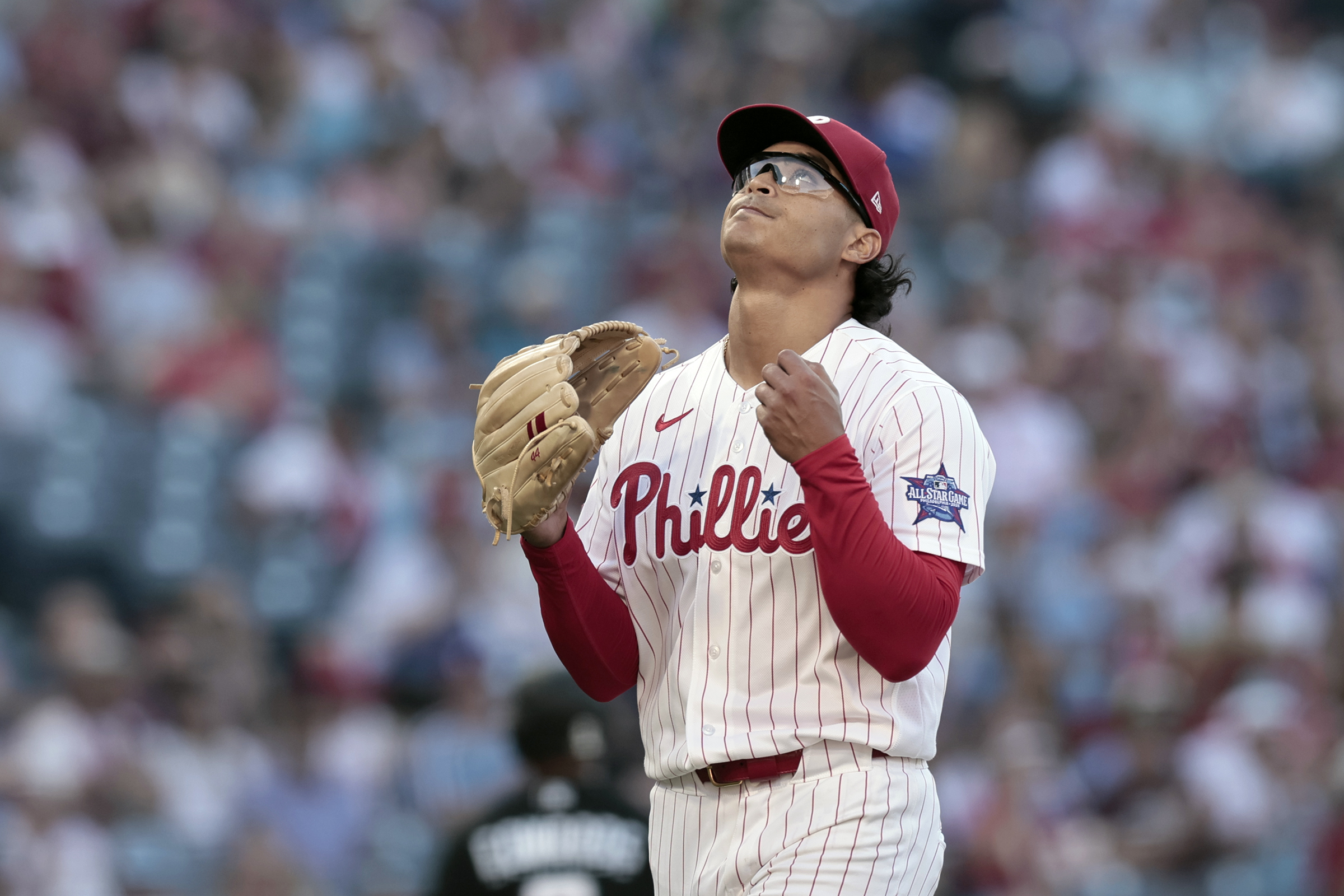
Luzardo, meanwhile, shut down Miami for six innings. After a leadoff walk to start the game, Luzardo retired 12 consecutive Marlins until Javier Sanoja singled in the fifth.
“After the first, I feel like I really found a groove, getting back in the zone,” Luzardo said. “Kind of lost it at the beginning, and then made some adjustments, and felt way better.”
After a leadoff walk to start the game, Jesús Luzardo retired 12 consecutive Marlins until Javier Sanoja singled in the fifth. Elizabeth Robertson / Staff Photographer
He allowed another single and a walk to load the bases, but wriggled out of the jam by getting Xavier Edwards to ground out. Luzardo also escaped trouble in the sixth after giving up a leadoff double, retiring three straight. Catcher J.T. Realmuto helped him out by successfully challenging a ball call that turned into a strikeout.
Luzardo got ahead in the count often, throwing first-pitch strikes 21 out of 28 times.
“When our offense is rolling like that, it gives, you know, the pitchers a little bit more freedom to attack the zone,” Luzardo said.
Miami finally got to him in the seventh, spoiling the shutout with a two-run home run on a sweeper in the bottom of the zone. Luzardo rebounded with a groundout and consecutive strikeouts to end his outing on a high note.
Tanner Banks and Max Lazar each pitched a scoreless inning in relief. Lazar had been recalled earlier on Tuesday when Brad Keller was placed on the injured list. He allowed a two-out single but then induced a groundout back to the mound, which he tossed over to Schwarber at first to seal it.
Then, for the first time, Schwarber joined the Phillies’ victory handshake line as an infielder.
“I was like, ‘Man, I wonder what they do out here,’” Schwarber said jokingly. “I usually just stroll out there and get J.T. and the pitcher with a nice little high five and things like that. But it was fun. It was nice to be out there.”
IRVINE, Calif. — Sebastian Berhalter was just over a year old when he went to South Korea to see his father, Gregg, play in the 2002 World Cup. But he knows a lesson from back then applies today.
The U.S. men’s soccer team opened that tournament with its biggest win on the biggest stage since 1950, a 3-2 upset of Luis Figo’s Portugal. It stunned the world, even if it only made a limited impact back home.
It also was just one game. The Americans followed it with a 1-1 tie vs. co-host South Korea, then a 3-1 loss to Poland in the group stage finale. They backdoored their way into the round of 16 only because South Korea edged Portugal at the same time as the U.S.-Poland game, which allowed the Americans to finish second.
Longtime U.S. fans will remember their shredded nerves of that morning, as Portugal hammered away in the final minutes but could not find the net. An equalizer would have put the Americans out on goal difference, since Portugal had routed Poland, 4-0.
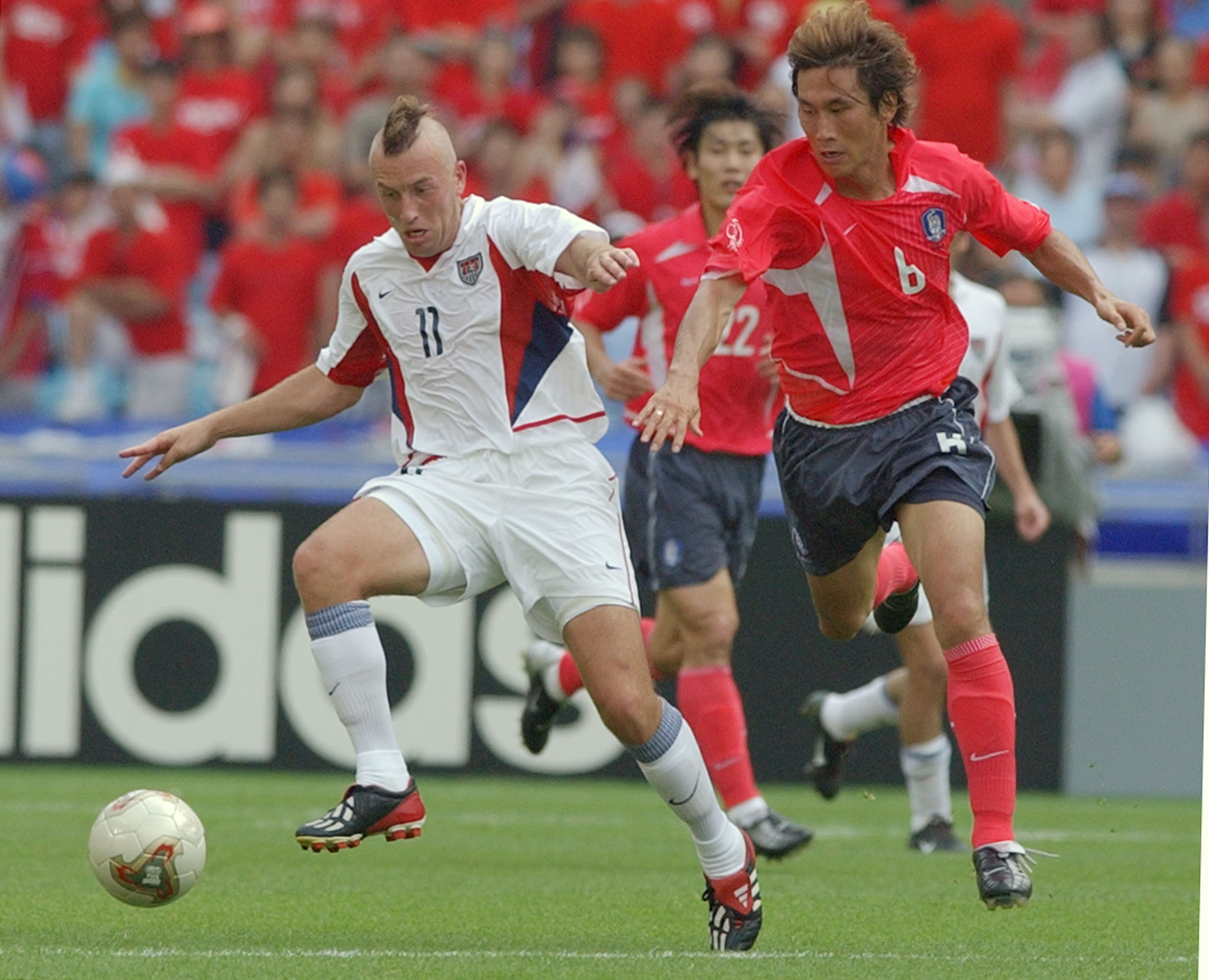
Clint Mathis (left), one of the stars of the 2002 U.S. World Cup team, on the ball against South Korea.Beth A. Keiser
The odds of that scenario repeating are lower now, not least because the U.S. is the co-host. The caldron on Friday in Seattle will be theirs this time, instead of the opponent’s.
Still, it’s worth turning to that page of the history book to bring some perspective to the upcoming U.S.-Australia showdown for first place in Group D (3 p.m., Fox29, Telemundo 62).
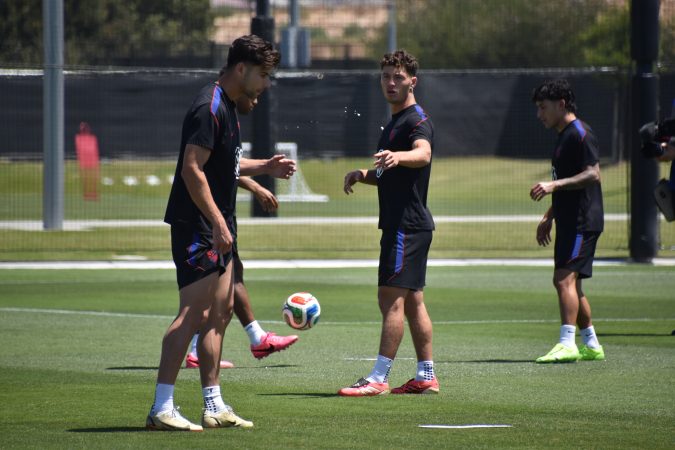
“Yeah, it is one game, and we know we have tough teams coming up, and they’re all going to present different challenges,” the now-25-year-old Berhalter said after Tuesday’s practice. “But for us, it’s just taking it one moment at a time, one game at a time, and we’ll be good.”
Winger Tim Weah has had his own moments of fandom lately, as a Brooklyn native and New York Knicks diehard. But when he put on his work clothes, his focus was clear.
Tim Weah on the ball during Tuesday’s practice.Jonathan Tannenwald
“From a fan standpoint, I think it’s amazing to celebrate it,” he said. “But for us, we want to not get too high. We want to make sure that we’re focused on what we need to focus on. I think staying humble is the key. As a group, we just have to prepare for our next game and be ready to fight.
The familiarity between these teams extends beyond their friendly meeting in suburban Denver last October, a 2-1 comeback U.S. win. Australia midfielder Aiden O’Neill and defender Kai Trewin play for New York City FC, highly regarded defender Lucas Herrington plays for the Colorado Rapids, and veteran defender Miloš Degenek used to play for the Columbus Crew.
If it becomes the kind of physical contest that friendly was or the defense-first game Australia played in upsetting Turkey, Berhalter said the U.S. will be ready.
“I love the way they defend,” he said. “You like teams that have that brotherhood. You like teams that when you go against them, you can see they’re hungry and that they want to fight, because it makes you raise your level that much more.”
He also had the line of the day when he praised manager Mauricio Pochettino’s influence on the team’s intensity.
“I think one is that we’re American, we don’t take s—, and I think that’s something that he really put in,” Berhalter said, drawing laughs with his turn of phrase. ”Even though he’s [Argentine], he has that mindset of, ‘Look, this is what we do, and this is who we are, and this is what America’s about.’ Even from an outside perspective, he showed us Americans what we’re about, and he really drilled that into us, and I think that’s something that has helped us this last cycle.”
With the NHL draft 10 days away, Flyers general manager Danny Brière and assistant general manager Brent Flahr, who runs the draft, met with the media.
But this press conference was set up to chat about the draft. Here are three questions may have been answered on Tuesday.
Flyers general manager Danny Brière acknowledged Tuesday that he would prefer to have more draft picks. Jose F. Moreno / Staff Photographer
Could the Flyers trade away or acquire more picks?
Maybe?
Brière did say he was OK with having only four picks now in the upcoming draft — one each in the first, second, sixth, and seventh rounds — and he did call the first- and second-round picks “the key.” But he also said everything is on the table.
“We’ve drafted so much the last few years [so] it might not be quite a bad thing to not have as many this year,” he said. “But, if I had the choice, yeah, I would rather have more picks.”
Fair, because who doesn’t want to keep stocking the cupboard? But what if it meant trading a first-rounder for a young player who could fit into the lineup today?
“Yeah, we’re getting closer to that. I don’t know that we’re quite there yet, but we’re certainly willing to listen on different ideas,” he said. “I’m not too keen on trading future first-round picks, because you never know where it can go, and we’re not at [where] Colorado or Carolina [are] at this point, where you know we’re going to be finishing [high] and picking late first [round]. I don’t think we’re quite there yet.”
Assistant general manager Brent Flahr noted Tuesday that small defensemen must be dynamic. Jose F. Moreno / Staff Photographer
Would they be open to drafting a small defenseman?
With Andrae, a small, puck-moving defenseman, now shipped north, could the Flyers be open to drafting someone to step into that role in a few years? There are several high-end offensive-minded blueliners available in the draft like Xavier Villeneuve, Tommy Bleyl, and Ryan Lin.
“If you’re drafting a small defenseman, they need to be dynamic, and there are a couple who could go into mid-to-later first round this year, but they are in the mix,” Flahr said, noting that not every small defenseman can be on the power play, which, to be frank, the Flyers’ power play needs help now.
Added Brière: “And that’s a big part of it too when you draft. Right now you might have some needs, but in four years, five years, that need might be different. So, especially in the first round, I think we try to be careful, try to go with the best player in this case, and keep developing, because we have a pretty decent pool of prospects coming. It’s not like we’re depleted; we still have some really good ones at almost every position.”
This is true, especially on defense with Oliver Bonk, David Jiříček, Ty Murchison and Hunter McDonald on the edge of making the main roster, and Carter Amico, Luke Vlooswyk and Spencer Gill working their way through the system.
But Flahr did point out that they could use some more depth on the left side — “not necessarily being the first round,” he was quick to add.
Ilia Morozov could be a target for the Flyers because of one important historical indicator: his grip strength. Liv Kakabeeke/Miami Athletics
Any insight on the 21st pick?
Of course, moving up or down is always on the table for the Flyers as the draft starts to pick up speed. But with them picking at 21, Flahr has now set the expectation for fans that, “Anytime you’re drafting in the 20s, you’re not getting the perfect player that’s completely polished and finished.“
The Flyers do look for certain traits — i.e., when they took Tyson Foerster at 23rd overall in 2020 because of his body type and hockey sense, despite him needing to work on his skating. And the Flyers certainly do like projects, but those are usually in the later rounds.
“We’re not drafting mature football players that they’re ready to go next year,” Flahr said when asked if they skew toward a certain type of project. “So these kids are sometimes three, four years away and have a long, long road ahead. But there are some players that are fundamentally flawed skating, and that’s our scout’s job to say, ‘I don’t know if this can ever improve.’
“ … But there are certain traits, whether it’s hockey sense, competitiveness, skill level. You can overcome size if you’ve got the great motor, big heart, and you’re smart, and certainly when you’re small, you’ve got to have some speed, quickness. … So, there’s different types of players you want to take a chance on, but there’s certain traits you have to have.”
The interesting aspect for the Flyers is that at 21, there could be several high-end centers available. However, they are projected as middle-six pivots and, while the Flyers need a 1C, as Brière mentioned, that’s probably not going to happen where they’re picking.
But Brière and Flahr each mentioned that they will continue to target centers, with the GM adding, “I don’t feel like you can have too many centers, because it’s much easier to move a center to the wing.”
With that, players like Jack Hextall, Ilia Morozov, Alexander Command, and Maddox Dagenais potentially being available when it’s time for the Flyers’ pick.
Jack Hextall fits the profile of player who could be available for the Flyers at No. 21. Scott R. Galvin
And two names to keep an eye on are Morozov and center Ryder Cali. Why? It seems the Flyers tend to draft players who finish among the leaders in grip strength at the scouting combine’s fitness testing, like Jett Luchanko and Shane Vansaghi. Cali finished tied with defenseman Lincoln Kuehne in right-hand grip strength, and Morozov, who tied with defenseman Charlie Morrison for third, was atop the leaderboard for the left-hand grip strength.
Breakaways
One nugget on the current squad from Brière regarding Dan Vladař, who can sign an extension on July 1: “As far as the contract talks, we’re working on it. He said he was interested; obviously, the team is interested. We’re working toward something that we hope can get done eventually, but it’s not over the finish line yet.” … Gill and Carson Bjarnason were on the ice at the Flyers Training Center before the press conference started.