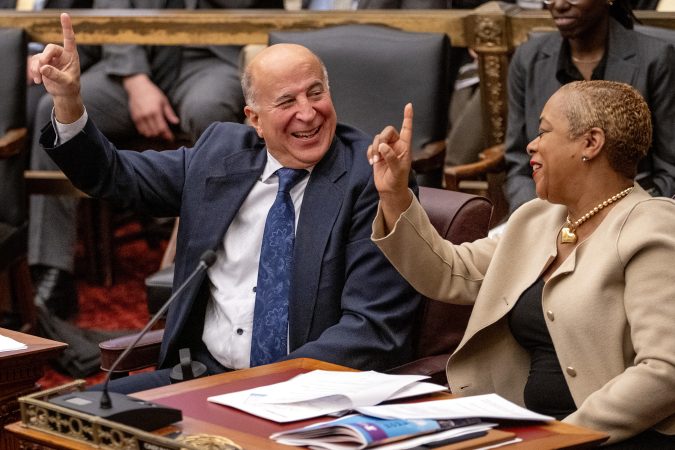
Members of Philadelphia City Council say they are concerned that the city’s recently released property reassessments will mean tax hikes for thousands of residents, and they are demanding to know more about the methodology used to determine property values.
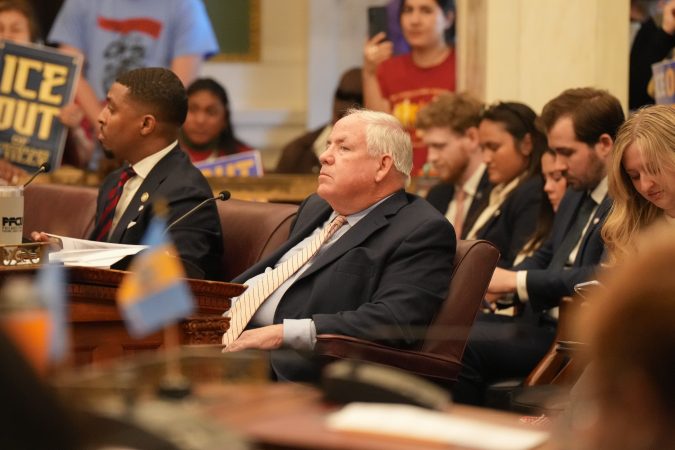
Councilmember Mike Driscoll, a Democrat who represents the Lower Northeast, authored aletter sent Monday to Chief Assessment Officer James Aros Jr. and other top officials in Mayor Cherelle L. Parker’s administration, expressing concerns on behalf of a half dozen Council members.
He wrote that his office has received “numerous” calls from constituents whose homes will see sharp increases in valuation, the measure that is used to calculate property tax bills.
“Many residents are struggling to grasp how their assessments were calculated. Others are worried about what these increases will mean for their property tax bills,” Driscoll wrote. “At a time when families are already facing higher costs for housing, utilities, groceries, and other daily expenses, these concerns need clear answers.”
He outlined six questions for the Philadelphia Office of Property Assessment related to its process and methodology, and set an Aug. 15 deadline for the administration to reply, saying “property owners deserve answers now as they review their assessments and consider whether to file an appeal.”
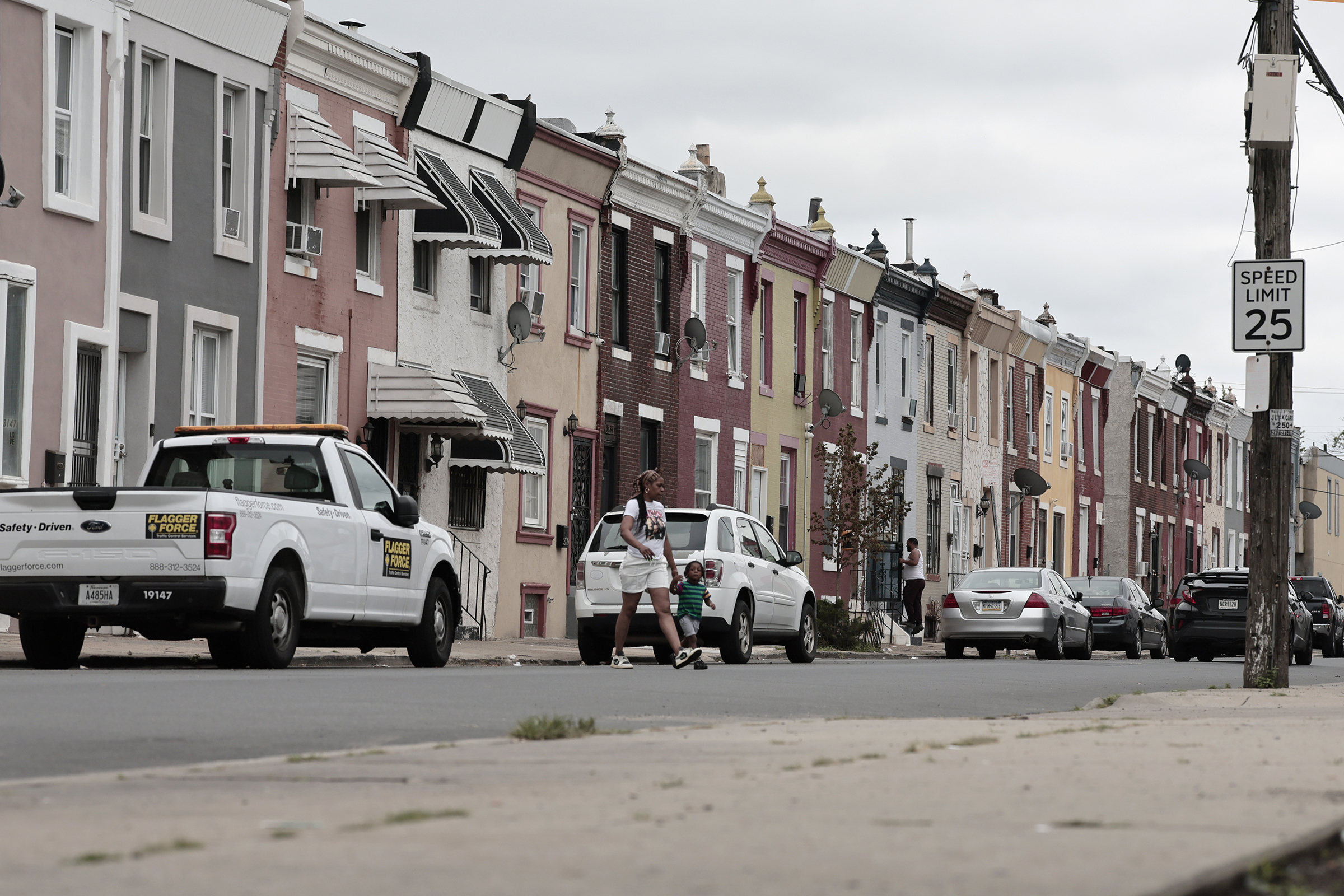
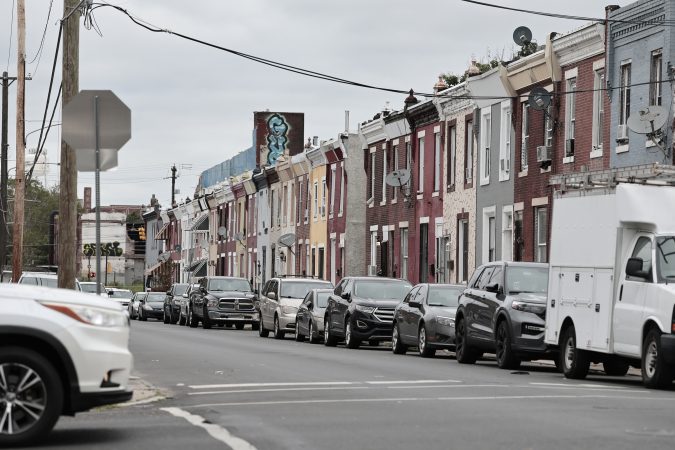
The 3100 block of C Street in Philadelphia on Tuesday, July 7, 2026. Property values sharply increased on this Kensington block.Elizabeth Robertson / Staff Photographer
The letter — which was signed by six Council members who are cosponsors of previously introduced legislation to probe the city’s property assessment process — is one of the first formal steps that lawmakers have taken to challenge the citywide revaluation since last month, when property owners received notices of their new assessments.
Citywide, there was a 3% median change in valuations from the 2025 tax year, the last time there was a mass reassessment, according to an Inquirer analysis of assessments of single-family homes.
But some neighborhoods saw much steeper increases. The biggest jump was in Kensington, where median values increased 15.3%. Driscoll represents part of the neighborhood, which has been long beleaguered by the open-air drug market there and where the city has made a concerted effort to improve the quality of life.
There was also a 15% median increase in property assessments in Mantua and a 12% rise in Kingsessing, both of which are in West Philadelphia and border University City.
Parker administration officials have said that the city offers a variety of property tax relief programs, including the popular homestead exemption, which erases the first $100,000 in valuation from being taxed for owners who live in their home as their primary residence. Property owners must sign up for the free program.
But for years, dating back long before Parker took office in 2024, Council members have criticized the city’s property reassessment process, saying its methodology is opaque and its results have a disproportionate impact on low-income homeowners.
Multiple reviews are already underway.
In addition to a yet-to-be-scheduled Council hearing, the city controller is conducting a performance audit of the property assessment office and the city’s appeal process, according to Driscoll’s letter. Controller Christy Brady’s office has sought feedback from residents and left flyers in neighborhoods where property values are rising.
The Parker administration convened a task force in 2024 to develop recommendations for how the city can improve its appraisal practices.
And the city is in the process of hiring an outside consultant to examine the fairness of its reassessments. According to city records, that analyst will be expected to draft a report by the end of this year.
Data reporters Yaelle Tang and Lizzie Mulvey contributed to this article.
In 2025, Pennsylvania updated its license plate design to feature the Liberty Bell, a prescient move for this year’s Semiquincentennial, where the Liberty Bell continues to play a central role—not as a relic of revolutionary history, but as a surface on which Americans have inscribed their ideals, disappointments, demands, and dreams.
The Liberty Bell’s provenance is unique: by 1751, the Pennsylvania State House needed a bell to summon lawmakers to session, gather citizens for announcements and town meetings, and signal special commemorations and events by ringing through the air. Tolling bells could also serve as warnings of fire or other dangers. To be a fully functioning statehouse, a bell was ordered from the famous Whitechapel Bell Foundry in London, which finally closed shop in 2017, after 450 years of business. The bell famously sailed into Philadelphia in one piece, only to crack significantly upon its first ring.
In response, artisans John Pass and John Stow melted down the original bell and recast a new one. This bell remained intact for almost 100 years, until sometime in the early 1840s, when it cracked again. This time, instead of melting the bell down, foundry workers tried to repair the crack by widening it to prevent further spread. Instead, a second crack appeared, and the bell was silenced forever.
One would think a bell without a ring was a literal death knell. Instead, and rather miraculously, the bell took on another life, and another, and another after that in historical memory.
In 1755, Benjamin Franklin mentioned the bell in correspondence with Catharine Ray, writing, “Adieu. The Bell rings, and I must go among the Grave ones and talk Politicks.” Like many others, he did not consider the bell’s association with liberty during the Revolution, perhaps because Philadelphia was under British control for nearly nine months and, for most of the war, he was across the Atlantic, working for freedom in another way.
As far as we know, the bell was not rung when the Declaration of Independence was read. But throughout the long 19th century that followed the Revolution, political activists of all stripes rallied around the words inscribed on the bell: “Proclaim Liberty Throughout All the Land Unto All the Inhabitants Thereof” (Leviticus 25:10).
The Biblical phrase, perhaps commemorating William Penn’s 1701 Charter of Privileges, which granted broad religious freedom and representative government to (some) of the people of Pennsylvania, was adopted, for example, as a symbol of freedom to end slavery. The bell was given the name “Liberty” in the sense of liberation—striving for self-rule in the most basic and humane sense by promoting abolition.
In other words, it was not the Revolution that gave the bell its lasting significance, but the Americans who, thereafter, kept the pursuit of freedom ringing in our ears. Women seeking suffrage. Civil Rights campaigners invoking its biblical call for equality. Cities pursuing community, memory, and history. Its transformation continues today, 250 years beyond the revolution.
Given this history, we understand why the Liberty Bell is visible again during the Semiquincentennial—on our license plates, in commemorative materials and public celebrations, and even as a giant inflatable balloon at the No King’s Rally on the steps of the Pennsylvania State Capitol Building in Harrisburg on March 28. Despite the blustery, cold day filled with flags and a large, grounded eagle puppet, the Liberty Bell remained firmly in place at the top of the steps, where people below gave speeches and rallied for freedom. Of course, nylon ropes secured the inflatable to the ground, but the massive yoke’s symbolic presence, attached to the bell, felt strong and unrelenting.
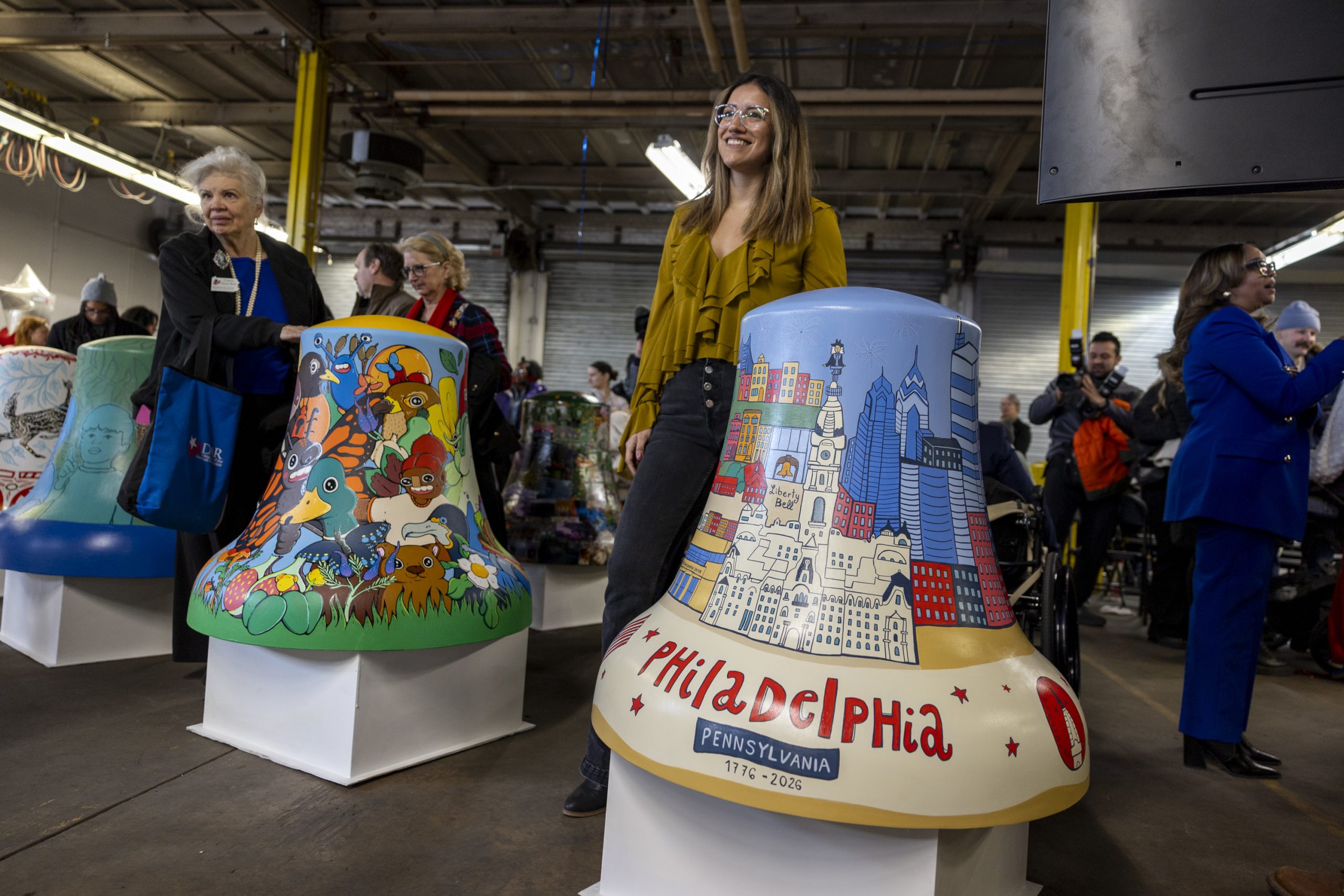
Ana Thorne, of Center City, 37, is next to the bell they made during the Bells Across PA event in celebration of America’s 250th Birthday in Philadelphia earlier this year.Tyger Williams / Staff Photographer
The Liberty Bell also appears in the Commonwealth’s Semiquincentennial public art initiatives. In Bells Across PA, fiberglass bells decorated by communities across the state appear in each of Pennsylvania’s 67 counties. This kind of collective work, common in community-made public art, remains popular because the project’s scale is manageable and the local scenes painted on the bells carry meaning for those who decorate them. In this case, it is not monumental art by trained artists, but rather youth and adults who hope to create something everyone can recognize and enjoy.
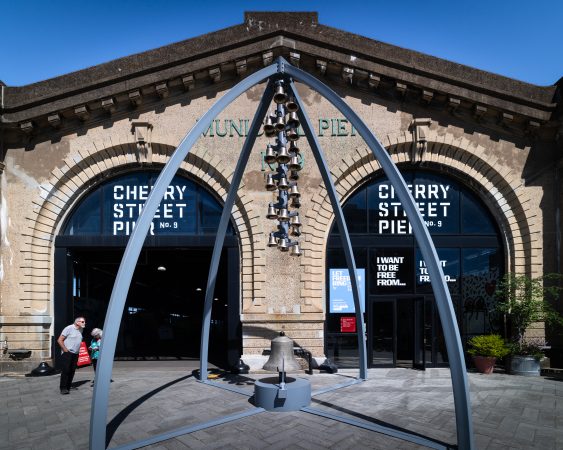
Philadelphia’s most compelling contribution to this conversation may be the public artwork Let Freedom Ring by artist Paul Ramírez Jonas. Originally commissioned by Monument Lab in August 2023 for the National Mall in Washington, D.C., the reinstallation of Let Freedom Ring by the Association for Public Art is on view at the Cherry Street Pier through Sept. 27. The monumental bell tower plays “America (My Country, ‘Tis of Thee)” but intentionally omits the final note. Visitors must ring a Liberty Bell-inspired bell to complete the song. The work poses a deceptively simple question: for whom does freedom ring? The answer is left unfinished and requires public participation.
Made By History sponsors. FOR USE ON MADE BY HISTORY STORIES ONLY.Inquirer Staff
Public art succeeds where monuments sometimes fail by fostering participation rather than passive observation. Rather than presenting history as settled and complete, it invites people to join a conversation across time. The Liberty Bell has always functioned this way. Its inscription is not a statement but a challenge. Its crack is a visual reminder that we must work to close the distance between us.
Today, that challenge and the distance feel especially urgent. The words “Proclaim Liberty Throughout All the Land Unto All the Inhabitants thereof” prompt Americans to consider who is included in that promise and who remains excluded. Each generation has answered differently and struggled to reconcile the nation’s aspirations with its realities.
The stories of the Liberty Bell’s creation, its cracking, its inscription, and its use as a symbol across generations remind us that public art and history can commemorate, criticize, and build community. They can also transform a historical artifact into a forum where each generation redefines liberty. In this Semiquincentennial year, everyone pursuing happiness can make the Liberty Bell their own.
Editor’s note: This story has been updated to clarify that Let Freedom Ring was reinstalled by the Association for Public Art during the semiquincentennial.
The “Road to 250” series is an initiative of Historians for 2026, a group of early American academics, public historians, archivists, and educators devoted to shaping an accurate, inclusive, and just public memory of the American Founding for the 250th anniversary.
Made by History takes readers beyond the headlines with articles written and edited by professional historians. Opinions expressed do not necessarily reflect the views of The Inquirer.
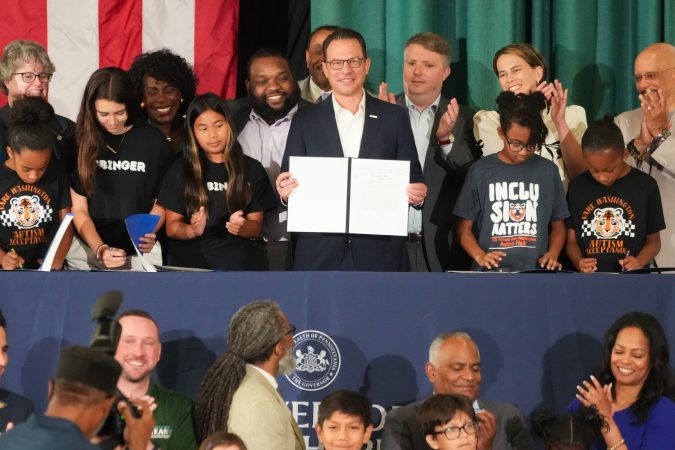
Gov. Josh Shapiro on Tuesday visited Vare-Washington Elementary School in South Philadelphia to tout the $678 million in new education funding included in the state budget deal finalized over the weekend.
The new education funding — including $565 million in “adequacy funding” to aid poorer districts — represented one of the most significant victories the first-term Democratic governor took home from the $50.8 billion state budget deal, which did not address lingering issues such as taxing so-called skill games and long-term funding for SEPTA and other public transit agencies.
The Philadelphia School District will receive $137 million in adequacy funding and $20 million in other new funding. The district will also be able to compete for a share of $125 million set aside for school facilities projects.
Philadelphia’s cash-strapped district, which entered this year with a $300 million structural budget deficit, still faces deep challenges. The school board this year approved a facilities plan to close 17 school buildings and renovate 169 more.
“We’re driving this money out to the schools that need it most — school districts like Philadelphia, Norristown, Pottstown, and Allentown, and others in our region,” Shapiro said. “They were getting shortchanged, and now they’re getting the lion’s share of this new funding.”
While it broke little new ground, this year’s state budget deal helped avoid another prolonged impasse involving Shapiro, the Democratic House, and the Republican Senate. Last year, lawmakers failed to reach a compromise until 135 days after the July 1 budget deadline, leaving school districts and local governments across the state in limbo for months.
“I‘m one of the only governors in the country with a divided legislature, one of the only legislatures that has to negotiate with people on the other side who really have a very different view, who don’t think the way we do about investing in public education,” said Shapiro, who was joined by Mayor Cherelle L. Parker and numerous Philadelphia Democratic lawmakers. “We have all been clear that we would not get up from the table in Harrisburg until we fully funded public education, and we’ve done that.”
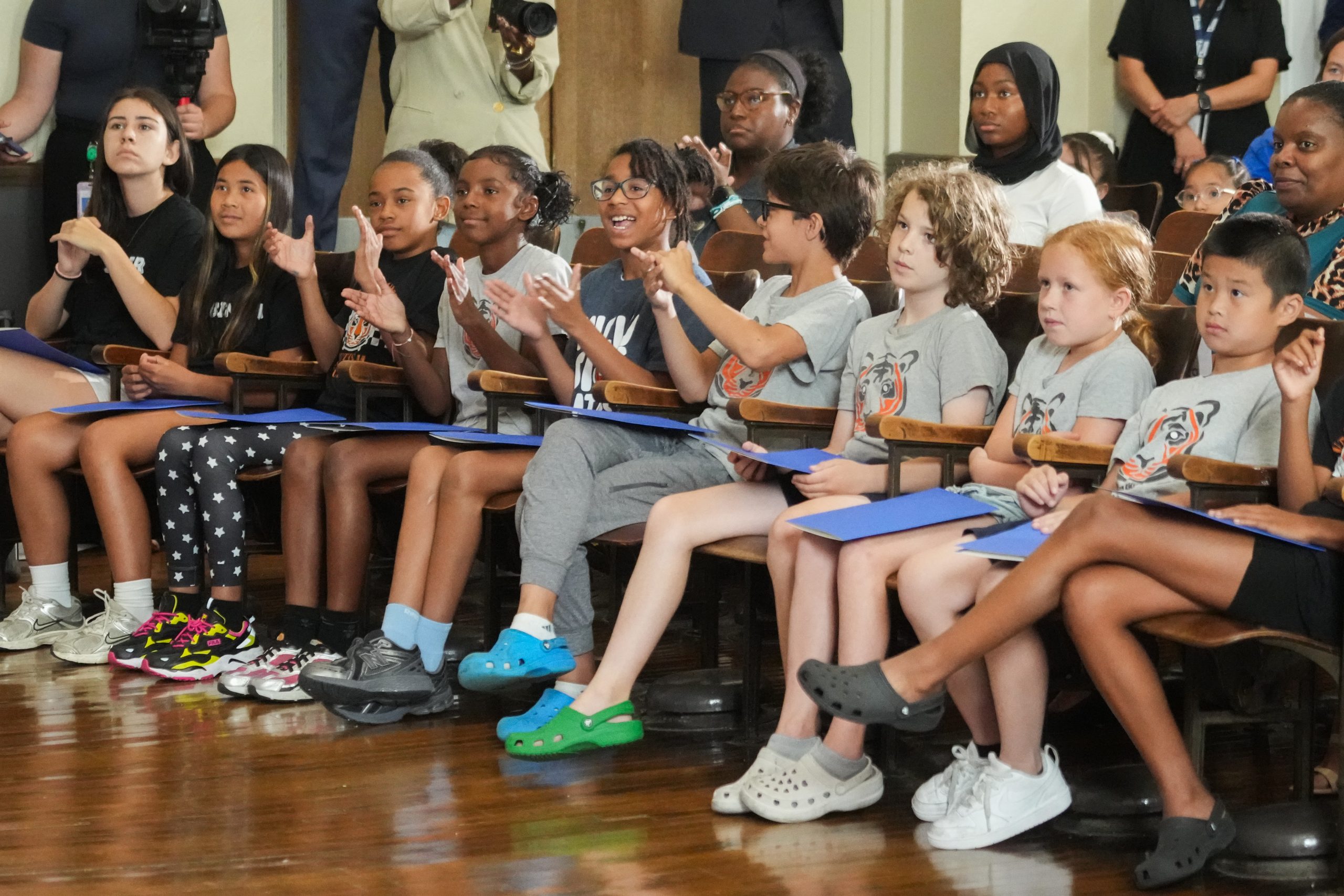
Students applaud speakers at Vare-Washington Elementary School during an assembly highlighting the education investments included in the 2026-27 state budget in Philadelphia, Pa. on July 14, 2026.Jessica Griffin / Staff Photographer
The formula calculated that a majority of Pennsylvania schools were underfunded, by a total of $4.5 billion. For the last three years, the state has given those schools an extra $565 million a year, filling about one-third of the gap. The state plans to fullyaddress the shortfall by 2032.
Advocates for underfunded districts, like Philadelphia’s, have credited the state for sticking with the plan, but have also said the money is flowing too slowly for struggling districts. Meanwhile, Republican lawmakers have challenged the increased funding for poorer districts, saying others are getting shortchanged by the new system.
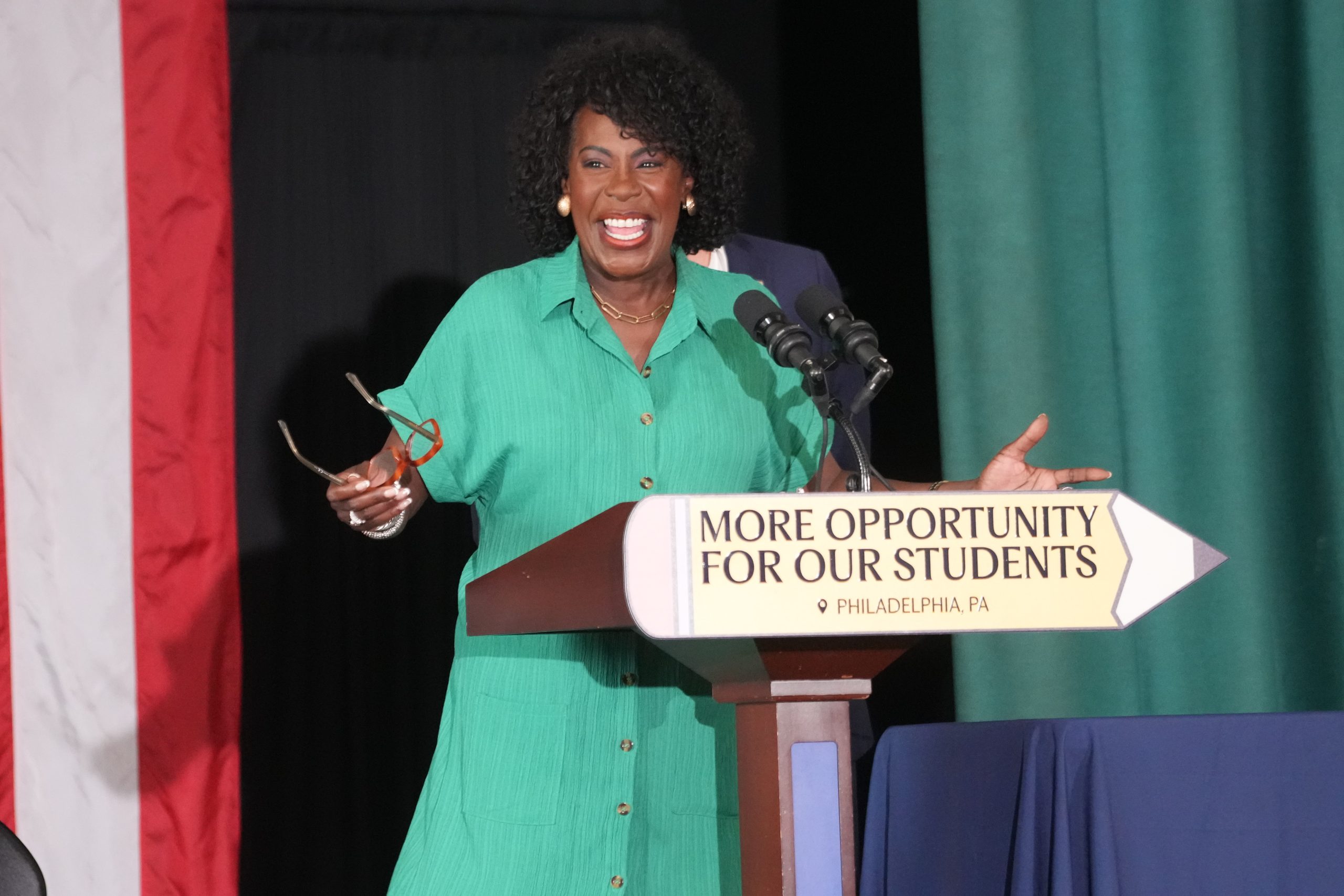
Mayor Cherelle L. Parker speaks at Vare-Washington Elementary School to highlight the historic education investments included in the 2026-27 state budget, in Philadelphia, Pa. on July 14, 2026.Jessica Griffin / Staff Photographer
Philadelphia’s school district, the only one in the state prohibited from raising its own revenue, relies on city and state lawmakers for its funding.
“We have limited revenue-generating capacity in the city of Philadelphia,” Parker said Tuesday. “I wish I could tell you, as mayor, that we had all of the money that we needed to address problems, but that is not the case. Our city can’t be successful without a strong partnership from Harrisburg.”
Parker thanked Shapiro and the city’s delegation to Harrisburg for “keeping your word” and delivering more education funding to Philadelphia from the state.
During her remarks, Parker led the students assembled at the event in several call-and-response chants, including, “Excellence matters — at Vare-Washington!”
“I want to hear you say, ‘Thank you — Gov. Shapiro!’” Parker said in another chant. “‘Thank you — Harrisburg legislators!’”
Philadelphia City Council is already looking to 2027. And with all 17 seats on the ballot next spring, the elections are shaping up to be a pivotal test of whether the city’s established politicians can withstand a rising tide of frustration with the party among Democratic voters.
All of the incumbents have said they intend to run for reelection, and several are likely to face serious challenges from new candidates focused on grassroots organizing and progressive groups — hoping to seize the opportunity presented by a nationwide leftward shift amid President Donald Trump’s second term.
Three districts have emerged as key battlegrounds.
And the city’s progressive organizations, emboldened by a series of wins locally and nationally, are targeting two other districts: the 1st, which stretches from South Philadelphia to Fishtown and is represented by Councilmember Mark Squilla, and the 8th, which includes parts of North and Northwest Philadelphia and is represented by Councilmember Cindy Bass.
“We’re definitely feeling confident,” said Robert Saleem Holbrook, executive director of the progressive advocacy group Straight Ahead. “Anyone who is going to be running under a progressive banner or a progressive movement is going to have to be running against the establishment, not toward it.”
A competitive race also appears to be taking shape for the seven Council seats that represent the city at-large.
Five of those seats are all but certain to be won by Democrats, making the May 2027 primary the key election in deep-blue Philadelphia.
The other two at-large seats — set aside for Council members outside the majority party under the city’s Home Rule Charter — will be decided in the November 2027 general election. Currently, the two minority party seats are held by Councilmembers Kendra Brooks and Nicolas O’Rourke of the left-leaning Working Families Party.
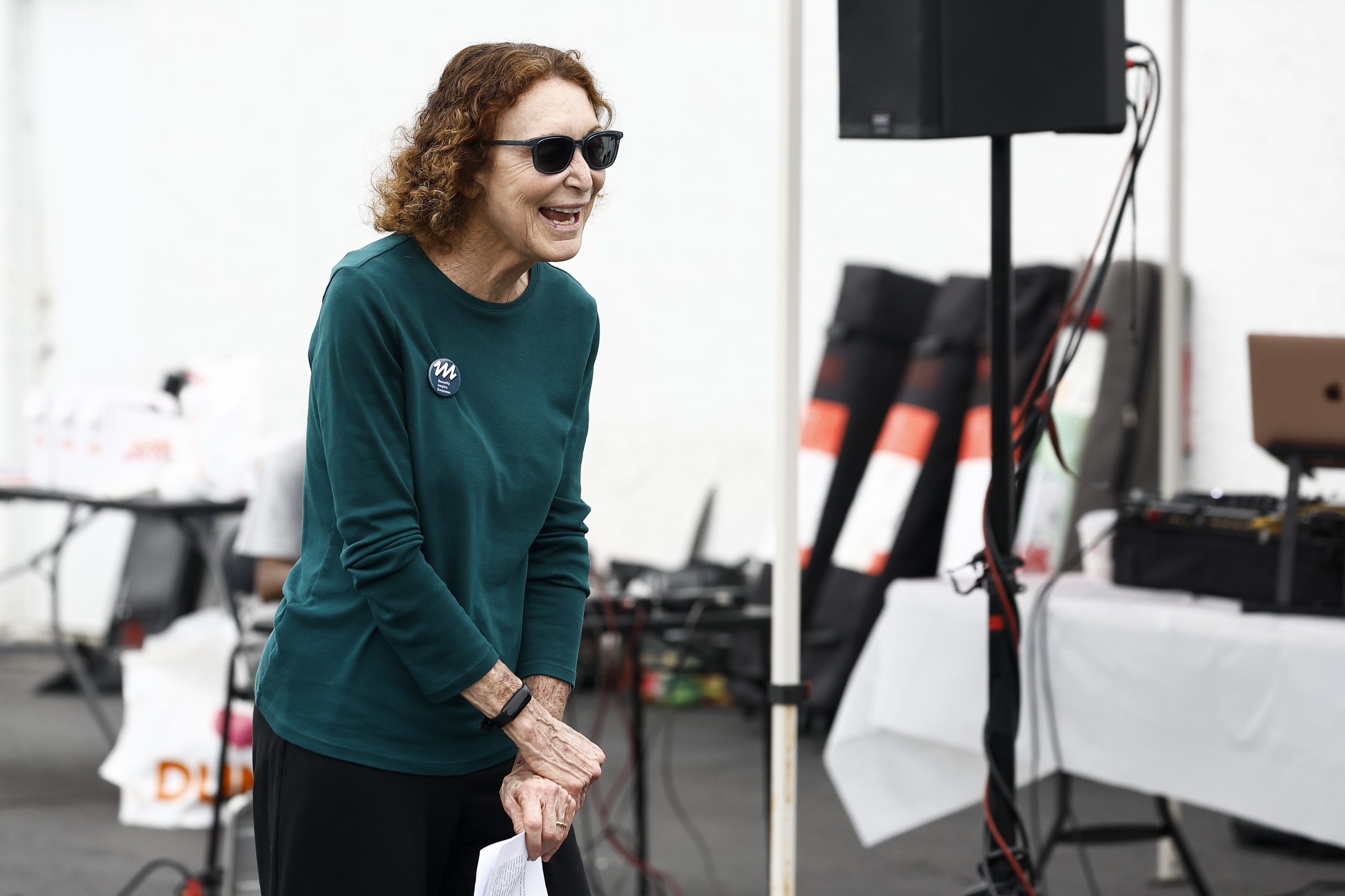
Jane Golden, founder and executive director of Mural Arts Philadelphia, takes the stage during the dedication of the Super Bowl LIX mural at Spike’s Trophies on June 17, 2025 in Philadelphia.Monica Herndon / Staff Photographer
Golden, 73, said last week that she is not currently running for Council, but acknowledged she has thought about it for years.
“It’s always something that is tempting to me, because I just love the city so much,” she said. “I feel honored that people even think of me.”
Progressives eye Bass’ North Philly seat
Philadelphia’s progressive activists this year see two key opportunities to expand the loosely organized left-leaning bloc on Council, which currently consists of four members. Winning additional seats could also grow their influence by enticing more moderate members to vote alongside them if they believe primary voters are moving left.
Leftists have notched high-profile wins in Democratic primaries across the country this year, including in Philadelphia, where democratic socialist State Rep. Chris Rabb (D., Philadelphia) bested more moderate candidates for a seat in Congress representing about half of the city. The district is one of the most Democratic in the nation.
Anderson-Oberman, 55, the executive director of the progressive group Reclaim Philadelphia, said last week that he is “leaning” toward taking another swing.
“We’re in a moment in this country and this city where people have had enough,” he said. “People are looking for new answers. … Cindy represents the old way of doing things.”
Union organizer Seth Anderson-Oberman, running for 8th District City Council, joins in a small rally with community and Happy Hollow Advisory Board members along Wayne Avenue at Happy Hollow Playground in Philadelphia on April 2, 2023.Tyger Williams / Staff Photographer
Another Council run by Anderson-Oberman may test how far progressive momentum can go in Philadelphia. He was a member of the Communist Party USA in his 20s, and has said he is proud of that experience.
Bass, 58, said she is ready for the race no matter who her opponent is.
In June, she survived a contentious fight for another four-year term as Democratic leader of Mount Airy’s 22nd Ward. She was criticized for her handling of the process, and the party ordered a redo of the election.
She and her progressive opponent, Octavius Price, tied, then struck a power-sharing agreement. Through it all, Bass said, longtime residents stuck by her — and she is confident voters will do the same next year.
“My voters are people who are based in this community, committed to this community, intend to stay in the communities that they are in,” she said.
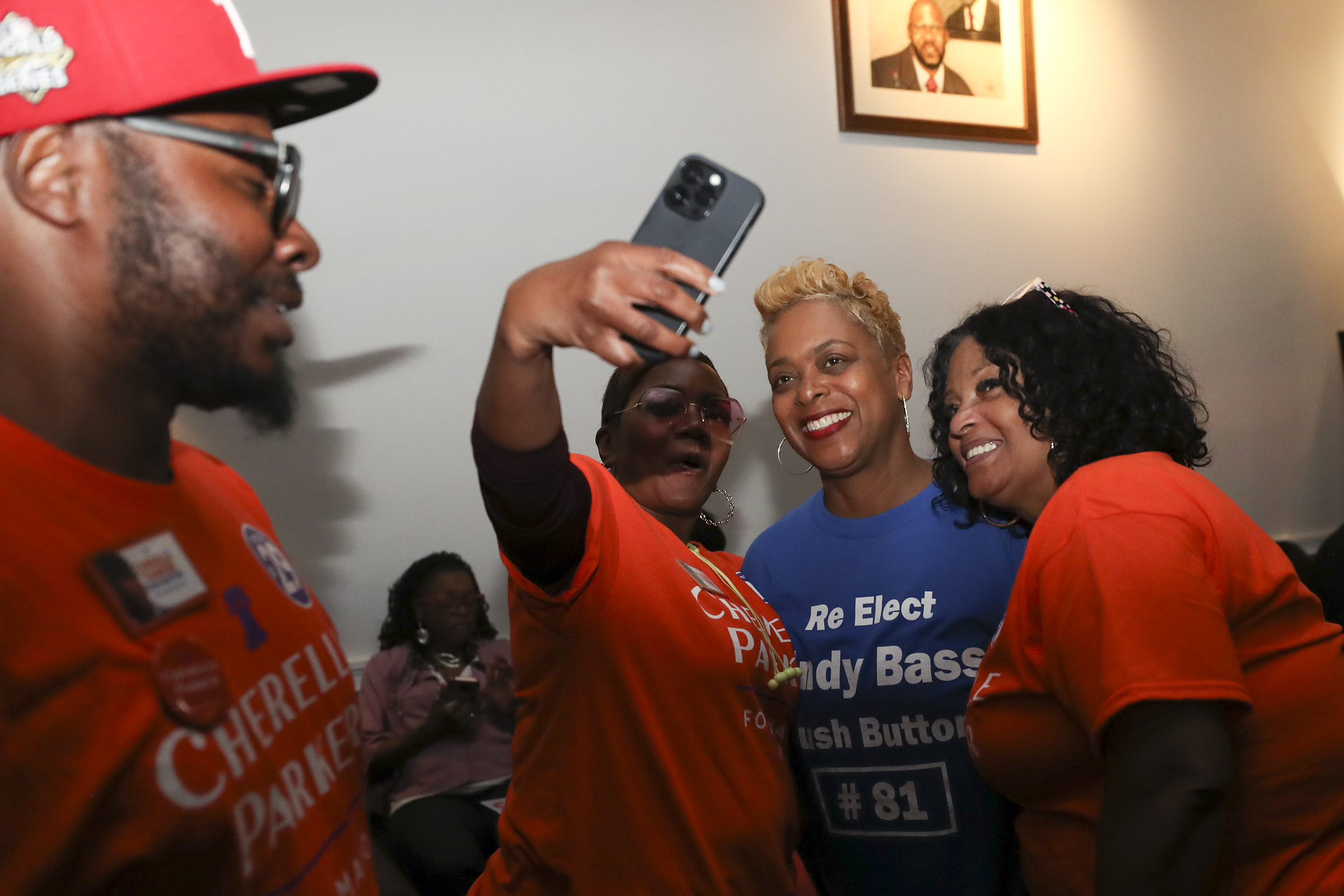
City Councilmember Cindy Bass (center) attends the watch party for Democratic candidate for mayor Cherelle L. Parker at Laborers 332 in Philadelphia on May 16, 2023.Heather Khalifa / Staff Photographer
Jeff Jones, a community leader and social justice advocate from Germantown, has also said he intends to run in the 8th District.
“I want to bring that new vision and a new voice to the 8th District, where residents and children and families can know that their voice matters, their concerns will be heard, and their challenges will be met,” said Jones, 61, a first-time political candidate.
Squilla could see a lefty challenger
Leftists are also eying Squilla’s seat, which represents the area along the Delaware River from Pennsport to Kensington. Since Squilla took office in 2012, the district has transformed from a bastion of working-class white voters to one of the most progressive swaths of the city.
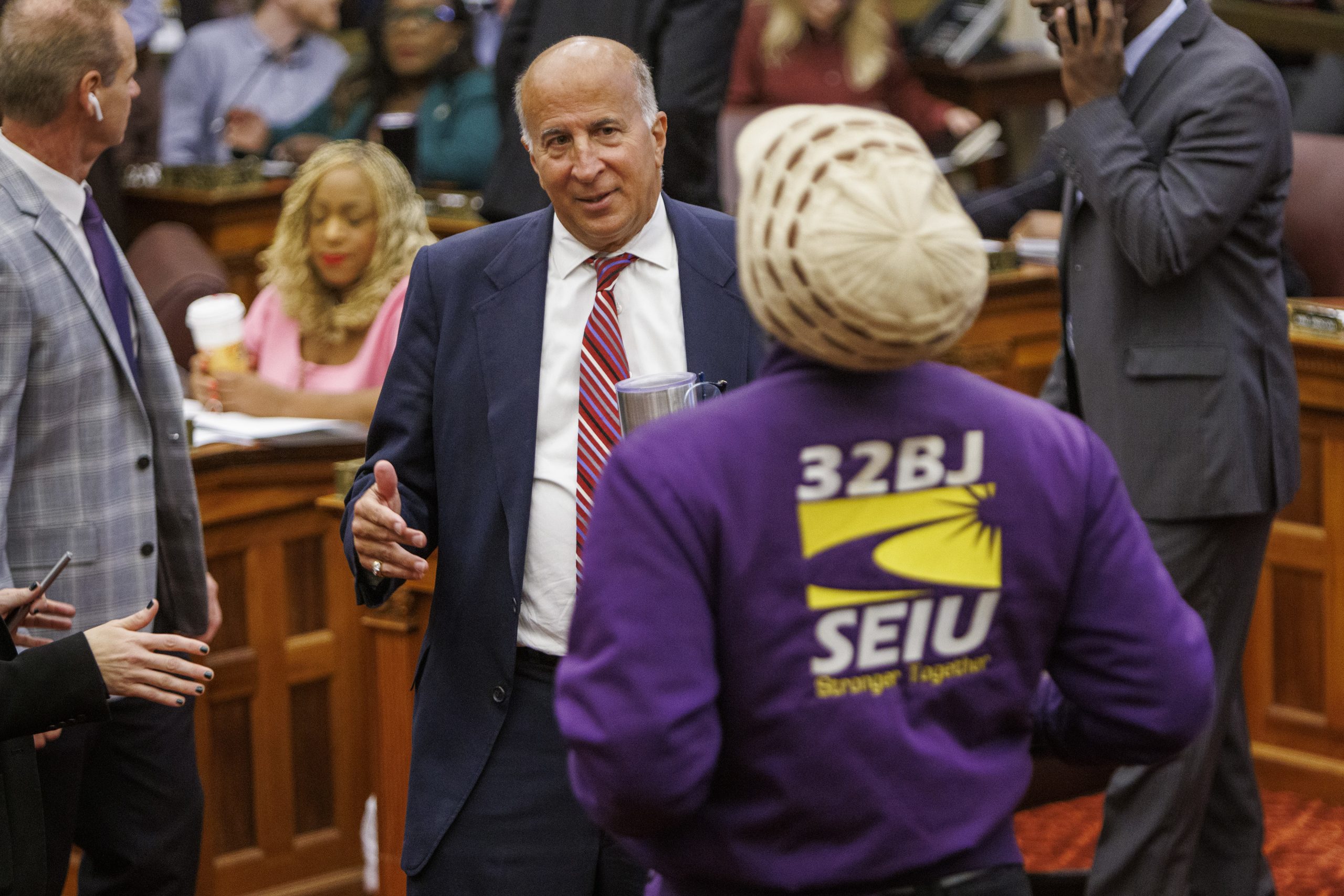
Squilla, 63, who has strong labor ties and is one of the most pro-development district Council members, said being a centrist has likely put a target on his back in the 2027 election.
Another contributing factor may be Squilla’s support for controversial legislation in 2024 to approve the 76ers’ since-abandoned plan to build a new arena in Center City. The project, which would have been in Squilla’s 1st District, was opposed by advocates for Chinatown, which the arena would havebordered.
Councilmember Mark Squilla arrives in Council chambers on Nov. 12, 2024, before the start of a public hearing on a proposed Sixers arena.Alejandro A. Alvarez / Staff Photographer
Despite the fierce objections, Council approved the project with Mayor Cherelle L. Parker’s support in December 2024. Weeks later, the basketball team announced it was abandoning its Center City plan and would instead build its next arena in South Philly.
Squilla said he is prepared to defend his actions, noting that he worked to ensure any arena deal would benefit his district and that many of those promises are moving forward despite the 76ers withdrawing their proposal.
“The goal as an elected official, and also as a leader, is not always to make the popular decision,” he said. “The goal is to have a process to make the decision that would be best for the people around it.”
One prominent opponent of the Center City arena plan was Will Gross, the owner of Ox Coffee in Queen Village and a progressive who is the Democratic leader of the 2nd Ward. He is seen by political insiders and progressive organizations as the most likely candidate to take on Squilla.
Gross declined to comment.
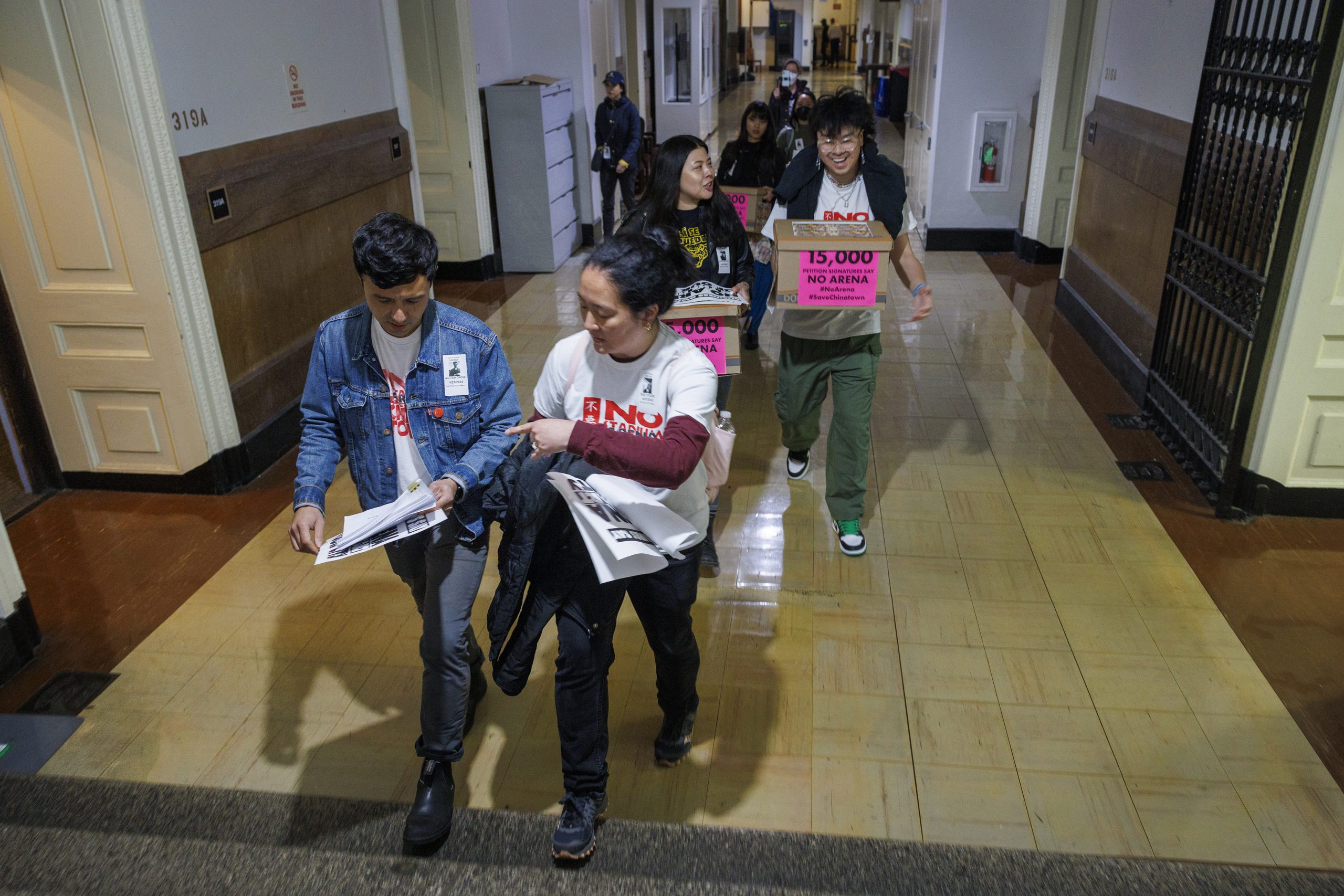
In this 2023 file photo, Will Gross and Kay Yoon, of the No Arena in Chinatown group, deliver petitions to Councilmember Mark Squilla. Alejandro A. Alvarez / Staff Photographer
A progressive challenger may also emerge in the North Philly and Kensington-based 7th District, which is represented by Councilmember Quetcy Lozada.
Some insiders have speculated that Celin may run again. He declined to comment.
Lozada, 55, said she “can’t focus” on potential challengers.
“If I spend my time listening to the buzz about who is running,” she said, “we won’t get any work done.”
A battle takes shape in the 5th District
In the 5th District, a seat that represents parts of North Philadelphia and Center City, a handful of Democratic challengers are lining up to take on Young, 40, who is seen as one of Council’s most vulnerable members.
That is in part because of the unusual way in which he was elected in 2023. He ended up being the only Democrat on the ballot after several others, including party officials’ preferred candidates, were removed amid legal challenges.
Councilmember Jeffery Young Jr. in chambers as City Council meets Dec. 11, 2025.Tom Gralish / Staff Photographer
One of those candidates was Curtis Wilkerson, who was chief of staff to former City Council President Darrell L. Clarke. Two sources, who spoke on condition of anonymity because they were not authorized to discuss the campaign dynamics, said Wilkerson is considering running for the seat again next year.He did not respond to a request for comment.
Also likely to run is Jalon Alexander, an attorney who unsuccessfully ran for an at-large seat on Council in 2023. Alexander, 33, formed an exploratory committee last year and is expected to formally declare his candidacy later this summer.
Two others are also considering running.
Dustin Dove, a lawyer and the president of the Fairmount Civic Association, said neighbors and community leaders have encouraged him to get in the Council race, and he is “taking the possibility of running seriously.”
“I think our city government should work for everyone by keeping our neighborhoods safe and streets walkable, making housing affordable, and ensuring fairness and access in public services,” Dove, 38, said last week.
Jalon Alexander, an attorney and community advocate, speaks to attendees at a meeting about potential SEPTA budget cuts hosted at Garden of Prayer Church in Strawberry Mansion on June 9, 2025.Erin Blewett / For The Inquirer
And Max Tuttleman, 37, a philanthropist who unsuccessfully ran for an at-large seat in 2023, said he “cares deeply about the 5th District and would never close the door to serving Philadelphia.”
He added that “Center City and the neighborhoods around it should be growing faster than they are.”
Young said in an interview last weekthat he intends to run for reelection, but that challengers are not his focus.
“I‘m focused on serving my constituency, serving my community,” he said. “The work that we’ve been doing will hopefully earn the support of the residents of the 5th District.”
A smaller, but competitive, at-large field
Over the last several election cycles, dozens of candidates lined up to run for at-large seats during a time of immense turnover in Council.
But with seven incumbents all looking toward reelection in 2027, there may be fewer challengers who line up to take them on. So far, only Golden and a handful of others have emerged as possible contenders.
David Alexander Jenkins, a cultural strategist known for delivering impassioned speeches during Council’s public comment section, said he is considering a run, encouraged by fellow community members.
“When the community that is around you constantly pushes you to intercede on their behalf, then it’s because they have trusted you to do what it is that you do best,” Jenkins, 39, said. “I think it would be incredibly unwise to ignore that.”
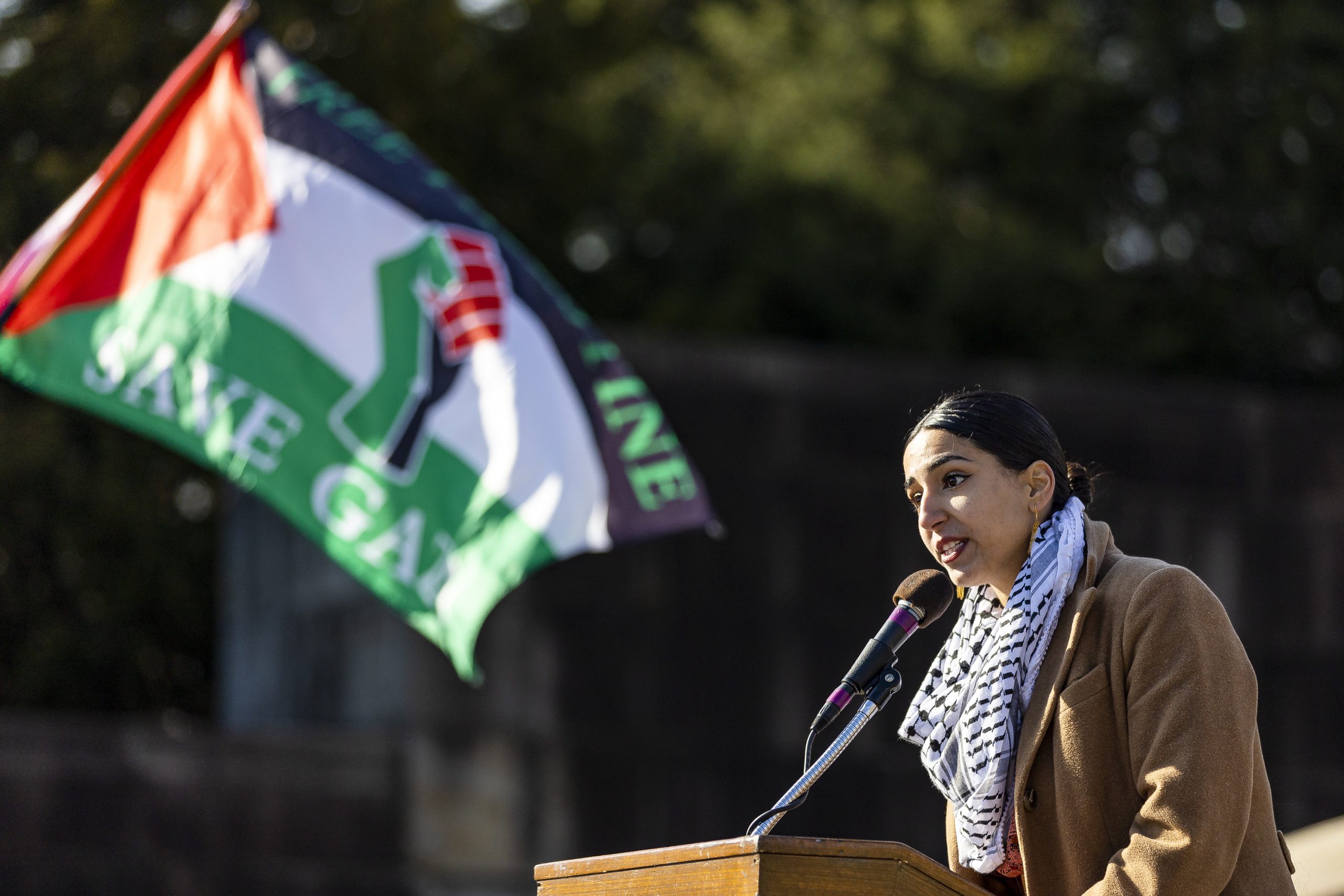
And Jude Husein, 28, a Palestinian-born community activist who was raised in North Philly, has already launched her campaign. If her bid is successful, Husein, a former staffer for State Sen. Art Haywood, would be the first member of Gen Z on Council.
In this 2023 file photo, Jude Husein, of North Philadelphia, speaks at a rally for a Day of Solidarity event at the Art Museum steps.Tyger Williams / Staff Photographer
Leaders of progressive organizations said they are closely watching her candidacy. However, Husein is not exactly running as a leftist. She said that her policy positions are varied and that she will seek endorsements from any institution that is “values-aligned.”
“I’m running because I think government should work for the people who pay for it, and should make neighborhoods affordable and safer,” she said.
Also in the running for Council at-large seats are Billy McCann, 46, a former teacher who lives in Port Richmond, and Isaiah T. Martin, 26, who lives in West Philly and leads a community development nonprofit. The pair, who both said they are progressive, have established something of a slate with Jones, who is challenging Bass in the 8th District.
They said they would prioritize public education, affordability, housing assistance, and government accountability, and they argued that establishment Democrats are failing to connect with voters.
“A new day is coming,” said Martin, another member of Gen Z who would make history on Council if elected. “It’s time we get people who are going to do the actual work and not just sit here and talk about it.”
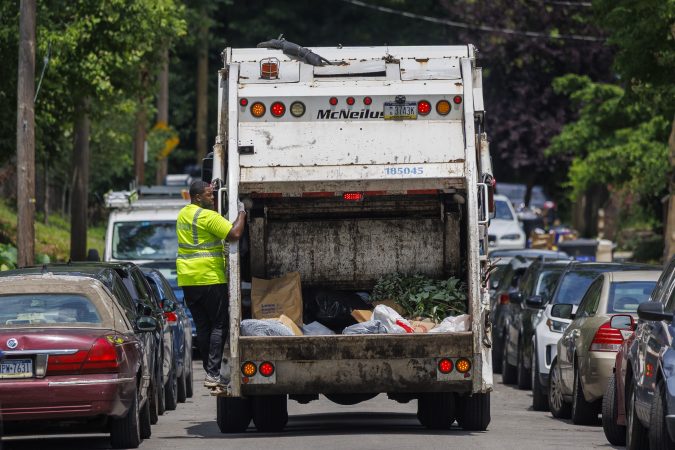
Philadelphia last week took a step toward renewing its contract with a controversial Chester trash incinerator after a high-profile bill to ban the city from doing so failed to garner enough support in City Council.
Mayor Cherelle L. Parker’s administrationissued a notice on Friday that it intends to enter into a new four-year contract for waste processing and disposal with Reworld, which operates a waste-to-energy facility in Chester. The city sends about a third of its garbage to the incinerator, the Delaware Valley Resource Recovery Facility.
Carlton Williams, who leads Parker’s Office of Clean and Green Initiatives, said in a statement that the city’s contracting process resulted in a deal that is “financially sound, environmentally safe, and includes the best option for the city to explore alternative methods for disposal.”
But advocates, local officials in Chester, and some City Council members have accused the company of severe pollution and environmental racism, saying it releases toxic chemicals into the air that cause adverse health effects in the majority-Black city that’s about 15 miles south of Philadelphia.
The amount of money the city intends to pay Reworld was not immediately clear on Monday. Parker administration officials issued a notice that they intend to renew the city’s existing contract with the company, but did not publish the contract itself.
Reworld was one of three companies selected to process and dispose of the city’s waste. The other two, Republic Services and Waste Management, operate landfills.
Council will need to approve legislation to greenlight the new contract with Reworld. The next scheduled meeting is in September.
It’s unclear what fate the bill might meet in Council. Last year, Councilmember Jamie Gauthier, a Democrat who represents parts of West Philadelphia, introduced the Stop Trashing Our Air act, which would have banned the city from entering into contracts with companies that burn trash or recyclables.
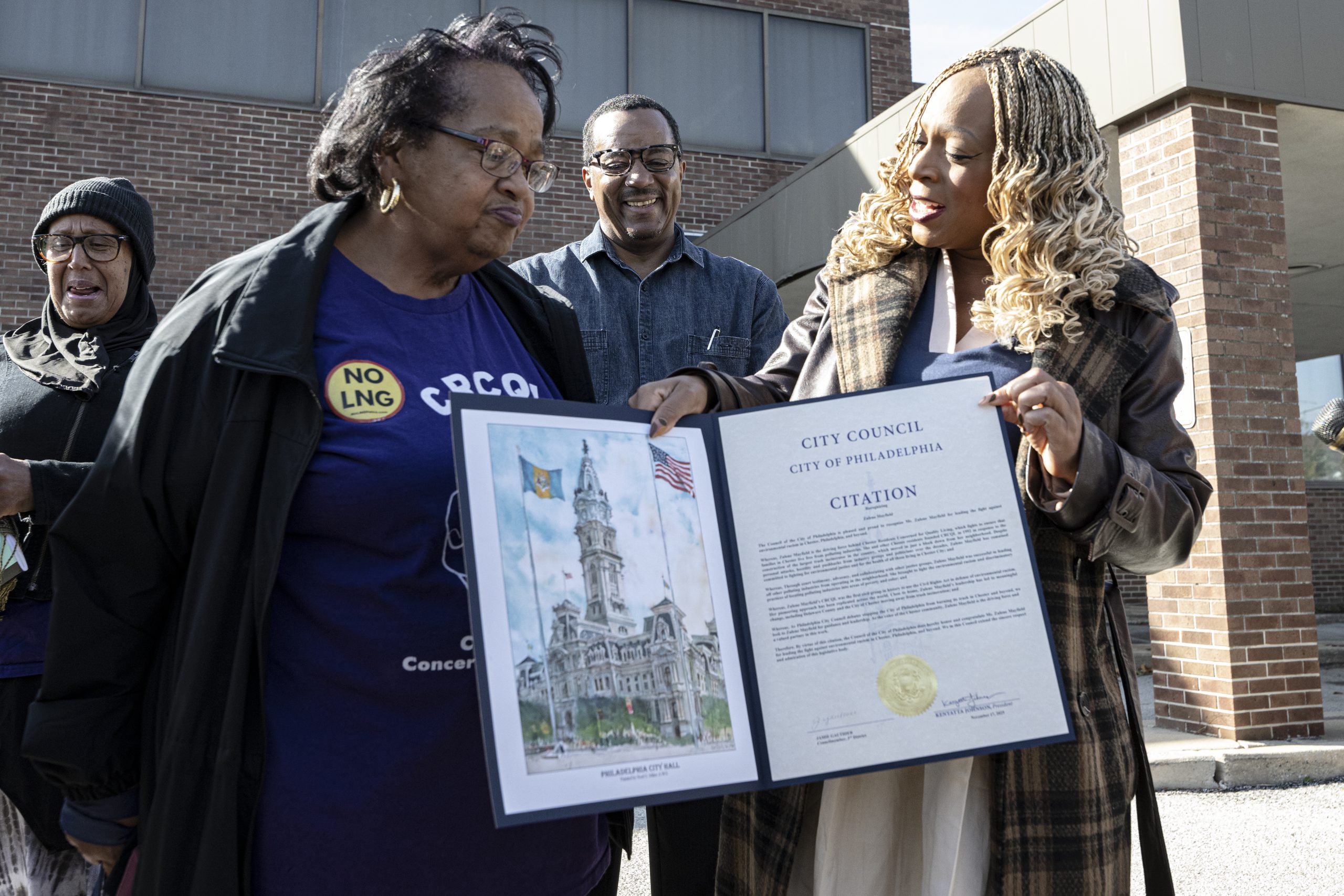
Chester resident Zulene Mayfield (left), Philadelphia Councilmember Jamie Gauthier (right), and Chester Mayor Stefan Roots meet to discuss Gauthier’s “Stop Trashing Our Air Act,” which would ban the city from incinerating waste, during a visit with lawmakers and staff in Chester on Nov. 7, 2025.Jose F. Moreno / Staff Photographer
But she never called the bill up for a vote, and ultimately put it on hold after it failed to garner support from a majority of the 17-member body.
Gauthier said in a statement Monday that dirty air causes asthma and cancer, and that Parker’s administration is “condemning Philly and Chester to at least four more years of toxic air and ash.”
“This is a choice. A choice that breaks Mayor Parker’s own campaign promise,” Gauthier said. “A choice that disproportionately harms Black and brown communities. A choice that makes every Philadelphian and Chester resident sicker.”
Parker, who ran on a platform of making the city “safer, cleaner, and greener” seized on it and told Brown: “That response is the same way you treat the Black and brown community.”
But Parker’s administration opposed Gauthier’s legislation, saying it would hamstring the city from being able to choose the best value waste disposal contractor through its typical competitive bidding process.
That process, city officials said in a news release Friday, included considerations of cost, as well as impacts on transportation in the region and the environment. The administration hired two independent firms to conduct environmental impact analyses.
The city previously held a seven-year contract with Reworld, which expired in June. Parker’s administration extended it for six months, ahead of selecting the company for a four-year renewal with the potential for three additional one-year extensions.
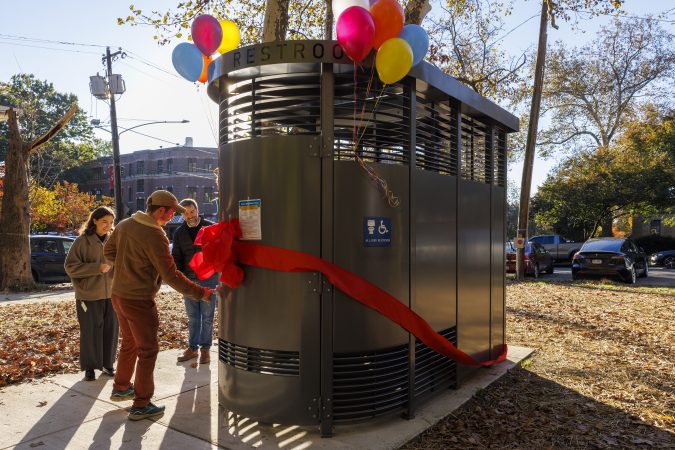
I am a toilet scholar, and I live in West Philly. No surprise, then, that my interest was piqued when I read about, Philly Phlush, the city’s cheekily named new public bathroom program. Starting in 2023, the city promised to build six stand-alone, single-user “Portland Loos.” I was even more interested the next year when I heard that one of these new public toilets would be opened near my house in Clark Park.
By that time, I had been looking into the history of public bathrooms in the United States for more than five years, digging through archives and pouring over digital records, including countless Philadelphia Inquirer articlesfrom over the past century.
My research revealed that public bathrooms in Philly (and everywhere else) mattered because they were a prerequisite for making the city accessible. That meant where city leaders placed these facilities was critical and reflected which residents and communities they cared about the most.
But also, I knew that the state of public bathrooms is a kind of real-time test of how far governments are willing to go, or not go, in the service of the most basic needs of their citizens. Really, public bathrooms uncover who is included and excluded at a given moment. These same dynamics made clear why that Portland Loo in my neighborhood said something about what Philly is currently doing right, and what other cities can learn from it.
The story of public bathrooms, toilets built and maintained by local governments and generally open to all, started 150 years ago as the United States was set to celebrate another milestone, its 100th birthday. Like other cities, Philadelphia was getting bigger and denser as the 19th century ended. Bricklayers heading to a ball game or a job, the faithful in search of a charismatic preacher, and nickelodeon patrons went further from home each day for work, worship and fun. As they did, they needed bathrooms. But many quickly realized that the existing network of privately-operated toilets in restaurants, department stores, hotels and saloons were not extensive enough, or clean enough, to support the growth of the city. Temperance groups, ethnic clubs, women’s organizations and business associations in Philadelphia, as in other cities, pressed for municipal leaders to filled in the gaps with new, publicly-financed “comfort stations,” as the first public bathrooms were called.
Cities responded, and not begrudgingly. Local officials held ribbon-cutting ceremonies and bragged to reporters about the marble countertops and hand-crafted mahogany doors in the new facilities.
Few of these comfort stations reached into working-class, immigrant or Black neighborhoods. The sparkling new facilities were meant for salesmen, bankers and bakers, train travelers and female shoppers. These people comprised “the public” that turn-of-the-century city officials had in mind when they allocated funds for well-appointed, away-from-home toilets.
But they weren’t the only people who showed up at the stall doors and urinals of newly-built public bathrooms. As early as 1905, police officers and civil servants complained that the costly new comfort stations attracted an unanticipated crowd of drinkers, smokers, slackers, vagrants and sex-seekers. They pushed for more surveillance and more arrests, and they learned, without openly admitting it, what officials would learn again at the end of the 20th century: it is difficult to arrest your way out of a problem. In the face of failure, municipal leaders shifted gears; they pulled back funding and cut back on maintenance for public bathrooms, making these places unacceptable to the middle-classes.
Eventually, they took a final, drastic step to keep the unwanted away. City officials across the country closed public bathrooms to stop men and LGBTQ people from having sex in the relative privacy of stalls and out-of-the-way facilities. They closed them to prevent angry teens and drunken adults from also taking advantage of the privacy of these places and smashing sinks and pulling down towel dispensers. By the 1980s, as Reagan-era budget cuts ripped holes into the social safety net and drained the coffers for public housing, cities closed even more public bathrooms to try to “disappear” the unhoused, and bathroom-less, from downtown streets and up-and-coming financial districts.
But in the drive to edit the public, municipal leaders made the city inaccessible for workers, students, families and shoppers, as well as those deemed undesirable.
With no public bathrooms near Independence Mall or Rittenhouse Square, the private sector that had failed decades before once again took over. But only to the advantage of some. Those who could paid for bathrooms, first with coins slipped into lock boxes drilled onto toilet stall doors, and later with credit cards for lattes and iced coffees for a “free” trip to the bathroom. Those who couldn’t afford the “latte tax” or lived in an area without a Starbucks or a Bass Pro Shop had only the street, bushes and the spaces between cars “to go.”
Toward the end of the 20th century, American cities experienced something that they hadn’t dealt with since before the American Revolution: open defecation and public urination, all day long and not just when the bars emptied in the early morning hours. This forced the hand of policymakers. They once again had to fund public bathrooms or face capital and population flight. But they didn’t put funds into public toilets to make the city more open or accessible; they did it, largely, to contain the unhoused and their bodies and to clean up central business districts and keep commerce flowing.
That’s what Los Angeles did. That’s what Albuquerque, N.M., and Cambridge, Mass., did. They built new public bathrooms—not the ornate facilities of the past, but functional ones, like Portland Loos with steel toilets, or hard plastic porta potties. These new toilets, unlike their early 20th century predecessors, weren’t meant for middle-class tourists visiting the Constitution Center, suburban lawyers in town for a trial, or even for Walnut Street shoppers. They weren’t there to solve the housing crisis or to deal with the problems of addiction or cuts in spending on mental health—some of the key factors leading to jumps in homelessness. They were there to contain the failures of the system and the bodies of the poor and unhoused, and to make the city look and smell better for everyone else.
Philly joined in this trend but with a twist.
The first Philly Phlush toilet opened in Fotterall Square, a revitalized park with basketball courts, walking trails and movie nights on 11th Street in North Philadelphia. The second was located at 15th and Arch Streets in Center City across from Love Park, not far from bustling Suburban Station. The third was the one in my neighborhood, just north of the corner of 43rd Street and Woodland Avenue.
Made By History sponsors. FOR USE ON MADE BY HISTORY STORIES ONLY.Inquirer Staff
By placing public toilets in North and West Philly, Philadelphia did something markedly different from most other cities. It sited its bathrooms not just so they could control people considered problematic, but to meet the needs of city residents in their neighborhoods. These toilets outside of Center City promised to make parks and squares available to parents and kids; they made it easier to stroll through a farmer’s market, watch a film on a summer’s night and play basketball all day long without the risk of discomfort, embarrassment or even arrest.
Philly, and every other city, should fund and maintain public bathrooms. The more the better. They should put them where people are and where they live. They should maintain them, because infrastructure needs ongoing care, and everyone needs clean spaces to attend to their bodies away from home.
Public bathrooms can’t solve every problem created by decades of government neglect, and they shouldn’t be expected to. But they can address the health and safety of city residents right now. Even more, away-from-home toilets, situated both in business districts and neighborhoods, are fundamental building blocks to a city open and equal to all, to a Philadelphia that shows through investment and maintenance that it cares about the people who visit and live here.
Made by History takes readers beyond the headlines with articles written and edited by professional historians. Opinions expressed do not necessarily reflect the views of The Inquirer.
As Democrats grapple with the fallout from Graham Platner’s scandal-plagued and ultimately canceled bid for U.S. Senate in Maine, a political consulting firm that worked on his race and that’s been heavily involved in Pennsylvania politics is at the center of many of the party’s frustrations.
Members of the firm weren’t the only ones advising Platner’s campaign. National operatives such as Daniel Moraff, who has also worked in Pennsylvania, have also fielded criticism for recruiting and not thoroughly vetting Platner, an unknown political outsider.
But both before and after the allegations of sexual assault that led to Platner’s exit from the race this week, other Democratic consultants and political observers blamed FIGHT for continuing to support him through multiple public setbacks.
Platner’s issues have also reignited anger about and drawn parallels to Fetterman, another candidate who ran as a working-class progressive. The Pennsylvania Democrat has lost much of the support from the base that elected him as he’s more frequently sided with Republicans in ways that some have described as a betrayal. He has not been accused of the same types of issues that plagued Platner’s run.
“I supported Graham at the beginning, despite the nagging voice in my head that kept saying ‘this feels familiar,’” Adam Jentleson, Fetterman’s first chief of staff who has become a staunch critic of the Pennsylvania Democrat, wrote on social media.
Jentleson was among those who questioned the FIGHT agency and the rest of the Platner team’s work and its handling of the collapse.
When Morris Katz, the FIGHT strategist on Platner’s campaign, said on social media that his team advised to end the campaign immediately after hearing the allegations Platner had raped a former girlfriend, Jentleson replied that the argument “strains credulity.” Platner and his team had continued to deny the allegations, Jentleson and others noted.
“Shading a narrative toward the positive is standard, lying is not,” Jentleson wrote, comparing the experience to working with Fetterman.
Fetterman, for his part, has heavily criticized Platner in recent months and celebrated his downfall this week.
“You will only be remembered as the accused rapist that got pushed out of your election. … Go back under the rock that you came from,” Fetterman said Wednesday on Fox News.
The Democratic Socialists of America, in a letter that mentioned the FIGHT staff’s work for Fetterman, called on candidates to refuse to work with Katz, The Intercept reported Friday.
FIGHT declined to comment for this story.
As Democrats look to regain their footing in this year’s midterm elections, the Platner saga and FIGHT’s role has also touched on the party’s broader goals of cultivating candidates who can win over the kinds of working-class voters President Donald Trump captured in recent years.
Platner, an oyster farmer and former bartender who suffered PTSD after serving in the U.S. Marines, pitched himself as deeply in-tune with working class voters in Maine. It was the type of profile, many Democrats hoped, would lead to a victory over longtime Republican incumbent U.S. Sen. Susan Collins and help the party win control of the U.S. Senate.
Democrats in Pennsylvania have taken a similar approach.
In a Lehigh Valley-based congressional district considered one of the likeliest seats in the country to flip from Republican to Democrat, the party has rallied behind Bob Brooks, a union leader and retired firefighter who coaches high school baseball and drives a snowplow.
“When you look at Brooks, one of the reasons he was recruited into this race and why Democrats have rallied around him is that there’s a belief that he might capture some of the [working-class Democratic] energy,” said Chris Borick, an adjunct professor of politics at Lehigh University.
The FIGHT agency, which primarily makes candidates’ television ads, has worked on Brooks’ campaign as well as the campaign of Paige Cognetti, the Scranton mayor and Democratic nominee in the Scranton-based 8th Congressional District.
There are no signs that Brooks or Cognetti are being advised by Katz, who has primarily worked on Platner’s campaign. In response to requests for comment Friday, Brooks’ campaign only confirmed that FIGHT makes its ads, and Cognetti’s campaign said, “Paige is glad Platner dropped out of the race.”
The Pennsylvania candidateshave not faced the same type of intense criticism for parts of their personal histories as Platner did throughout his 10-month campaign.
Brooks’ opponents in the 7th Congressional District primary criticized him for old social media posts that, for instance, downplayed the role of guns in a mass shooting. Brooks said the posts were “silly, maybe stupid.” He, like Platner, also faced accusations that he could be “another John Fetterman,” given his background and similar appearance.
Mike Mikus, a Pittsburgh-based Democratic strategist who has long opposed Fetterman, said Brooks was “the real deal” at a time when Democrats are “desperate” to correct their problem with white, working-class voters. Platner, on the other hand, appeared to be an “overcorrection” that involved consultants dismissing “obvious red flags,” Mikus said.
He said FIGHT may lose some future clients because of the misstep, which he largely blamed on Moraff, a consultant who does not work for FIGHT and has also been widely criticized for recruiting Platner.
“Everybody’s looking for authenticity,” Mikus said. “And you can’t workshop somebody into something they’re not.”
Created after Trump and the Republican Party’s sweeping victories in 2024, the FIGHT agency’s pitch since its launch has focused on authenticity. Its candidates have reflected not just voters’ desires for candidates outside the traditional political establishment, but campaigns intent on fighting Trump and advancing economic populism. Zohran Mamdani, the Democratic socialist who won New York’s mayoral race in 2025, has marked their largest success to date.
“Among progressives there’s a sense that the party has not been effective in trying to counter Trump … and we have to fight this battle internally in order to resist Trump,” said Stephen Medvic, an associate professor of government at Franklin and Marshall College. “So you’re getting groups in the last couple of years, like FIGHT Agency, being put together to try to tip the balance in their direction.”
But their approach — finding someone who meets the profile and aligns with their ideology — may not necessarily always produce a winning formula. Limitations may depend on the type of assessment and vetting that goes into recruitment, he said.
“You might get an AOC, but … you might get a Platner,” Medvic said. “A lot of Democrats are now regretting that they were so excited about Fetterman because he turned out to be something so different.”
The union that represents more than 2,000 Philadelphia firefighters and paramedics says its members will, for the first time in two decades, receive a wage increase lower than police officers did — a contract provision they see as the end of years of pay parity among the city’s first responders.
Mayor Cherelle L. Parker’s administration announced Wednesday that a panel of arbitrators had issued a two-year contract award for Local 22 of the International Association of Fire Fighters after its members had gone more than a year without a contract.
Local 22 was the last of the city’s four major municipal unions to reach a multiyear agreement with the Parker administration. The other unions agreed to their contracts last year.
Parker said in a statement that the contract award recognizes the contributions of the city’s firefighters and emergency medical personnel “while supporting the city’s efforts to remain fiscally responsible.”
The contract award was issued by a three-member arbitration panel, a process governed by state law because emergency workers do not have the right to strike. The deal includes 3% raises annually for the next two years, plus a 1% wage increase in recognition of mandatory physical evaluations that members must receive biannually.
Those raises total a 7% pay increase over two years for union firefighters, paramedics, and emergency medical personnel. In the city’s contract with police inked about a year ago, members of the Fraternal Order of Police Lodge 5 received a 9% wage increase in total over the same time period, plus a $3,000 signing bonus.
Local 22 president Mike Bresnan said Parker’s administration did not adequately advocate for pay parity between police and firefighters. He said he is lobbying members of City Council to consider legislation that would require Council approval for the mayor to appeal firefighters’ contracts in the future.
“Mayor Parker likes to run around putting her one index finger up as ‘we’re all one,’” Bresnan said. “Well, she just put her middle finger up to every firefighter and paramedic in the city.”
He added: “If there’s somebody out there that’s thinking about running for mayor, we’d like to have a conversation with them.”
The firefighters union has historically played a relatively minimal role in city elections compared with more politically active labor groups like those that represent construction workers. The union did not back a candidate in the 2023 mayor’s race, which Parker won.
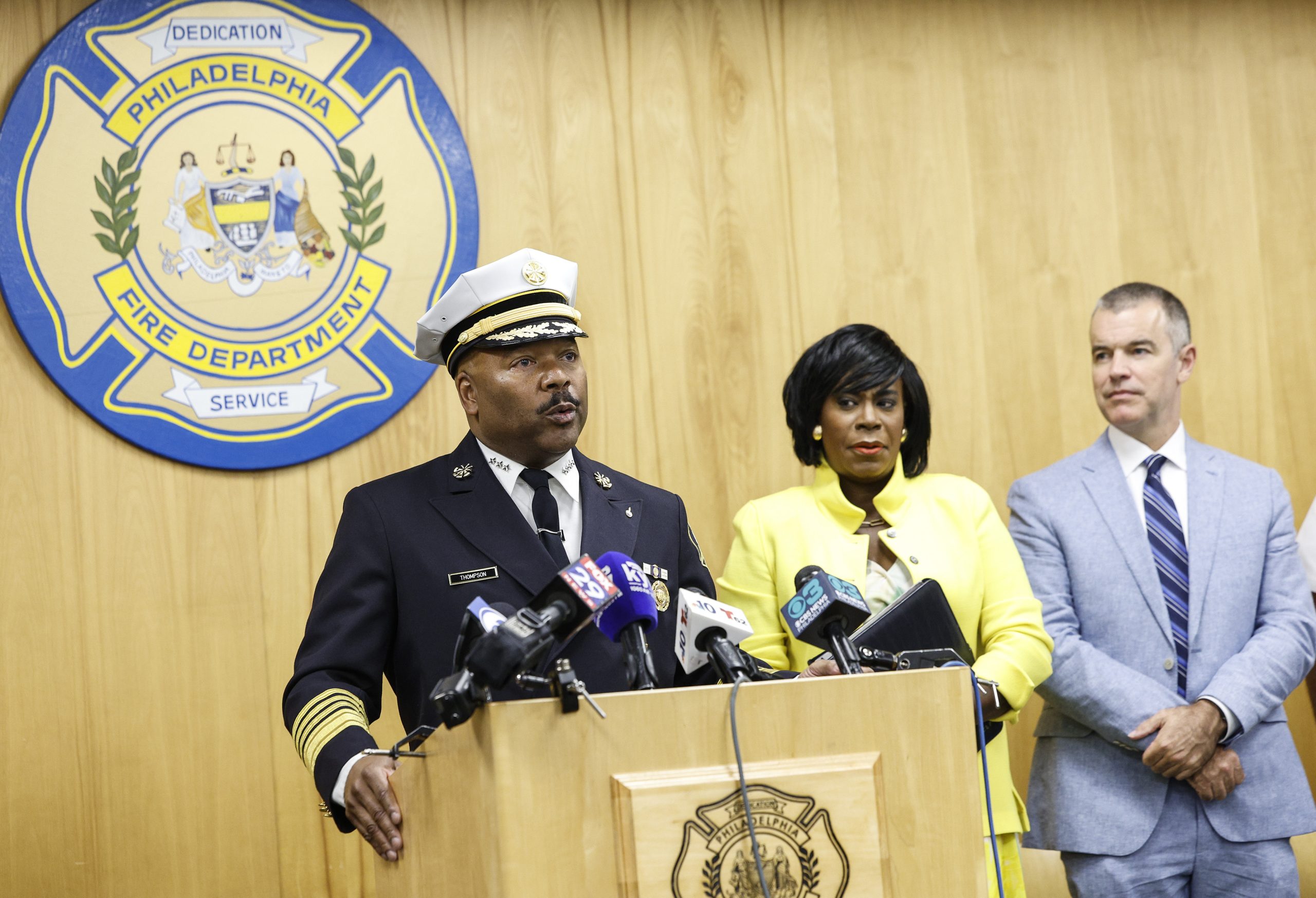
In this 2024 file photo, Fire Commissioner Jeffrey W. Thompson stands, at left, with Mayor Cherelle L. Parker with Managing Director Adam Thiel at the fire administration building in Spring Garden.Steven M. Falk / Staff Photographer
The FOP contract, similar to the firefighters’, included 3% annual raises. The difference was that police received an additional 1.5% annual wage increase because their union agreed to a process called “civilianization,” meaning some roles held by uniformed officers would be transitioned to ones held by civilians.
The raise, according to the contract, was in recognition of the “operational flexibility” that the civilianization process would achieve. It did not identify the number of positions that would be civilianized or if the effort would save the city money.
The arbitration panel that drafted the firefighters’ contract is made up of one appointee each from the city and the union, plus a neutral arbitrator. The panel wrote that while there has, in general, been pay parity in raises for police and firefighters, that “has never meant identical awards.”
In this case, the panel reasoned, the civilianization-related raise was unique to the police department and the city did not need to match it for the firefighters.
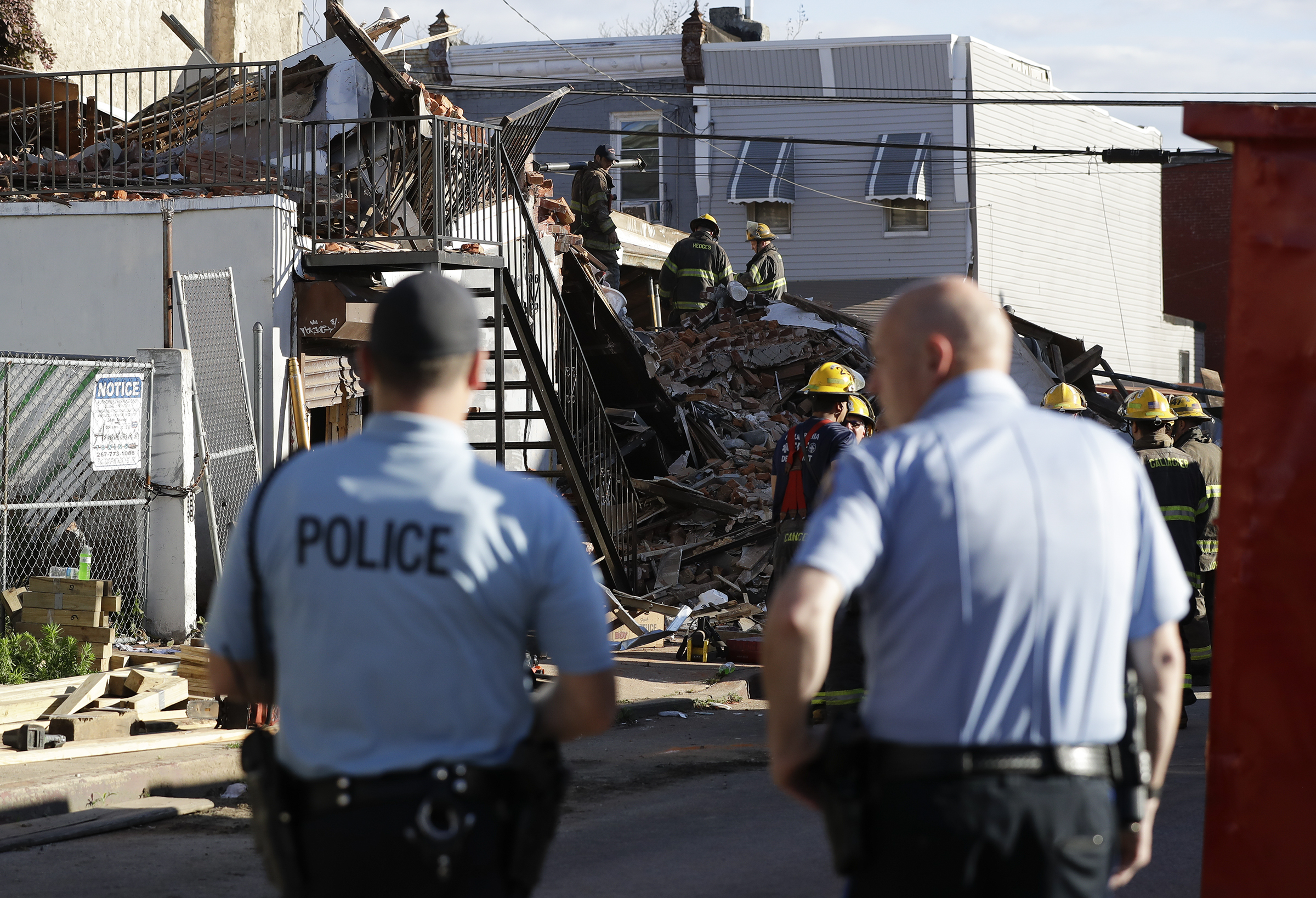
In this 2022 file photo, Philadelphia firefighters examine the remains of a collapsed building along the 300 block of West Indiana Street in the Fairhill section of Philadelphia as Philadelphia police officers look on.YONG KIM / Staff Photographer
Marc Gelman, the union’s appointed arbitrator, issued a scathing dissent, writing that the contract award was ultimately a “rubber-stamp to the city’s desired economic wishlist” and provided firefighters with “a dramatically lower wage increase than the police.”
He argued that the city could afford a higher wage increase for firefighters because it is operating from a place of fiscal strength, citing its substantial surplus in this year’s budget.
However, the city will have to tap into reserves or make adjustments to its existing five-year budget plan to cover the firefighters’ contract. That is because the administration already exhausted its $550 million labor reserve to cover contracts with the city’s other major municipal unions.
The Parker administration did not estimate how much money the firefighters’ contract award will cost.
Gelman wrote that the labor reserve was exhausted through the city’s “mismanagement and inability to plan.”
“The city now cries poor,” he wrote, “and expects the members of Local 22 to suffer for its ineptitude.”
Bresnan said pay parity is critical because the police and firefighters unions are unique in that “members can leave for work in the morning and not come home at night to their family.”
“We’re out there shoulder-to-shoulder on these emergencies in the city,” he said. “Every mayor prior recognized this and kept the peace. Now they’ve created a fracture between the first responders in the city.”
In late April, Ken Martin, chair of the Democratic National Committee (DNC), visited Philadelphia to assess the possibility of the city hosting the 2028 Democratic National Convention. He toured Xfinity Mobile Arena and met with Mayor Cherelle L. Parker and business leaders, who rolled out a “blue carpet” aimed at charming him.
It seemed natural to see business leaders working with local politicians to try to convince the DNC to choose Philadelphia, as well as helping to raise the funds required for the city to be eligible to host the convention. Democrats dominate the city’s politics, and its elected officials tend to share local business executives’ visions for economic development.
But these groups weren’t always aligned. In 1936, when Philadelphia made a similar push to host the Democratic Convention, the effort aroused skepticism in a city that had been a Republican stronghold for decades. Much of the skepticism was centered in the business community — where many vehemently opposed the policies of President Franklin D. Roosevelt.
It took a push by coalition builders like Albert Greenfield, a powerful business leader, to win over skeptics. Greenfield sold his fellow businessmen by framing the pursuit not as something partisan or political, but as a venture in civic boosterism. This argument proved compelling, and business support helped land the convention for Philadelphia. Today, Greenfield’s efforts provide a model for how to bring diverse interests together to boost a city, even in times of polarization.
Before the 1930s, Philadelphia was firmly a Republican city. In this era, the national party’s platform was dominated by pro-business politics, aligned around policies aimed at enhancing economic growth and competition.
A thoroughly corrupt political machine led by William Vare dictated the city’s politics. Each ward had Republican committee people who purchased individual votes at a going rate of one dollar. Loyal to the Vare machine, they also ensured voters headed to the polls on Election Day. In exchange, many of these committee people were rewarded with spots on the city payroll.
The flow of money linked voters and committee people alike to Vare and the GOP. The machine’s dominance meant that the Republicans won most local elections, and the city gave its votes to their party in federal and state contests, including in every presidential election dating back to 1856. That even included in 1932 when Roosevelt was first elected by a large margin nationally.
The Democratic Party — which, in other cities, drew power from local machines — remained weak and made little headway because Democrats, too, relied upon patronage favors from the dominant Republicans. That made them hesitant to rock the boat or wage an assault on the Vare machine and the status quo.
At the beginning of Roosevelt’s first term, however, the city’s politics began to shift thanks to the new president and his New Deal. Struggling Philadelphians started to feel the tangible effects of New Deal policies at precisely the same moment that changes began to occur in both parties’ leadership locally. The result was a restoration of genuine two-party competition.
The same Depression-era pressures loosening working-class loyalty to the Republican machine also began to pull Greenfield — who had once been a staunch Republican, but had soured on Herbert Hoover — toward the Democratic Party. The businessman benefited from several million dollars in funding from the Reconstruction Finance Corporation, the governmental lender of last resort, to prop up his business enterprises. Experiencing the benefits from New Deal policies firsthand, Greenfield started to express cautious support of Roosevelt.
From his position as chairman of the Philadelphia Chamber of Commerce Convention and Tourist Committee, Greenfield also launched an effort to recruit the Democratic Convention to Philadelphia.
His colleagues in the Chamber of Commerce shared Greenfield’s vision of landing a party convention in 1936 — but they didn’t care which party. Greenfield himself, however, remained focused on the Democrats in part because of his friendship with the liberal newspaper publisher J. David Stern.
In December 1935, he began soliciting donations from the city’s business leaders with the goal of raising $150,000 (more than $3.6 million in 2026 dollars) to help lure the Democrats. He framed the convention not only as an opportunity to increase business activity, but also as a means of enhancing the city’s national reputation.
Greenfield appealed to a wide range of constituencies, at times striking an unrelenting tone in his correspondence with business leaders. In one letter, Greenfield wrote that members of the Chamber, “feel that each individual enterprise has a moral obligation and responsibility with respect to the financial requisites for securing the convention.”
Made By History sponsors. FOR USE ON MADE BY HISTORY STORIES ONLY.Inquirer Staff
Greenfield’s efforts quickly bore fruit. Ledgers show contributions from both businesses and individual donors in sectors ranging from dentistry to distilling and hospitality. He also sold his fellow businessmen on their contributions being a non-partisan investment that would be “returned manyfold” to those who donated. This framing made it easier for many of his still staunchly Republican peers to support the bid.
In January 1936, after the Chamber formally invited the Democratic National Committee to hold its convention in Philadelphia, news headlines reflected the importance of the incentive package organized by Greenfield. When Philadelphia won the bid — with a financial package that ended up totaling $200,000 — The New York Times characterized the proceedings as an “auction and now a poker game.” The money Greenfield raised ultimately compelled national Democrats to shift their preference from Chicago to Philadelphia as their host city.
Greenfield soon became the chair of the city’s convention planning committee. In that role, he assembled a cohort of other prominent business and financial figures to orchestrate the programming surrounding the convention. He promised them pomp and circumstance — which he delivered.
When the convention finally arrived in Philadelphia in June, flags bearing the names of U.S. states and festive decorations lined Broad Street; ceremonial stamps depicted a triumphant, sun-illuminated city; press photographers documented a ceremony in which city officials registered a donkey that was part of the New York delegation to vote. The city even suspended its blue laws to allow Sunday drinking.
In bringing the convention to Philadelphia, Greenfield constructed his own alliance that worked to replace the system long sustained by Vare and the Republican machine. While he did not offer jobs and cash to individuals in exchange for loyalty like Vare did, he created a mechanism by which the success of the convention became materially valuable to the city’s business establishment.
If members of the city’s business community sought to access the economic benefits of this national political event, they had to do so through Greenfield, further aligning Philadelphia’s commercial interests with an individual who wanted the convention to succeed not only financially but politically as well.
What may have begun as tentative, pragmatic support for hosting the convention evolved into a more explicit embrace of the Democratic Party, with many businesses ultimately associating themselves with Democratic messaging. One newspaper advertisement praised the efforts of Roosevelt as a force behind Philadelphia’s economic revitalization. That message received endorsements from more than a dozen small businesses, whose names were featured alongside the message of support for the president.
At the close of the convention, Greenfield told delegates that their enthusiasm might one day lead historians to view the city as a Democratic stronghold — a prediction that ultimately proved correct. By constructing a new network of support within Philadelphia’s business community, Greenfield helped rally backing for a convention that proved to be far more than an economic boost or mere “convention fireworks.” Instead, the gathering would serve as an engine for a realignment that would hold the city for the Democratic Party through the next two decades.
The day after the 1936 election, the city of Philadelphia awoke to stunning results. Roosevelt had carried 43 of the city’s 50 wards and the city that the Philadelphia Bulletin had confidently described as unlikely to depart from “its long tradition” as a Republican stronghold had broken sharply with it. In 1940, when the city again explored hosting either the Republican or Democratic convention, the same committee which had led fundraising in 1936 initiated both efforts. Reflecting the changes in Philadelphia politics, however, the fundraising effort to attract the Democratic convention was far more successful than efforts to court its GOP counterpart. The business community in a city that had voted reliably Republican just four years earlier now raised three and half times as much money for potentially hosting the Democratic convention as the Republican one.
As business leaders in Philadelphia work to bring the convention back to the city, they are drawing from Greenfield’s playbook 90 years ago that brought together a new alliance of business leaders in support of a convention that proved to be a political inflection point.
Ethan Young is a rising senior at the University of Pennsylvania studying history and political science.
Made by History takes readers beyond the headlines with articles written and edited by professional historians. Opinions expressed do not necessarily reflect the views of The Inquirer.
The biggest jump in Philadelphia’s property assessments this year occurred in Kensington, a measure that means many homeowners in the long-struggling neighborhood are likely to see higher taxes amid a concerted effort by the city to clean up the area.
That is according to an Inquirer analysis of recently released property assessments of single-family homes, which found that, citywide, there was a 3% median change in valuations from the 2025 tax year, the last time there was a mass reassessment.
That increase is far more modest than the widespread jump in valuations that homeowners saw two years ago, which captured multiple years of real estate growth and the volatile post-pandemic market.
What remains the same: who will be most affected.
The Inquirer’s analysis of this year’s property assessment data shows that low-income neighborhoods near gentrifying areas saw the sharpest jumps in valuations compared with the rest of the city.
The four areas that saw the largest percentage increases in median assessments — Kensington, Mantua, Grays Ferry, and Kingsessing — all border more gentrified neighborhoods like Fishtown, University City, and Point Breeze. The results of the analysis are a further sign that market pressures in higher-income areas are pushing into pockets of the city that have long been primarily home to Black and brown working-class residents.
Of the eight neighborhoods that saw the largest increases between the 2025 and 2027 tax years, five have median annual household incomes around $40,000 or less, according to an analysis of U.S. Census data. The federal poverty level is $33,000 for a family of four.
(function(){function e(){window.addEventListener(`message`,function(e){if(e.data[`datawrapper-height`]!==void 0){var t=document.querySelectorAll(`iframe`);for(var n in e.data[`datawrapper-height`])for(var r=0,i;i=t[r];r++)if(i.contentWindow===e.source){var a=e.data[`datawrapper-height`][n]+`px`;i.style.height=a}}})}e()})();
In a statement, officials with Mayor Cherelle L. Parker’s administration noted that many homeowners in those five neighborhoods are benefiting from a popular city tax break. The city said that the median 2027 value in those five neighborhoods is $123,600, so for many homeowners in those areas, the median taxable assessed value is just $23,600.
That is because of the homestead exemption, a tax break for homeowners who live in their house as their primary residence that exempts the first $100,000 in home value from property taxes. Homeowners must sign up to be included in the free program.
At least 60% of homeowners in those neighborhoods have signed up for property tax relief programs, according to the city.
James Aros Jr., the chief assessor of the Philadelphia Office of Property Assessment, and Revenue Commissioner Kathleen McColgan said enrollment rates in property tax relief, including the homestead exemption and multiple tax freeze programs, are “encouraging.”
They said the city will “build on this progress through extensive targeted outreach, community partnerships, and efforts to make enrollment as simple and accessible as possible.”
The current property tax rate is 1.3998% of assessed value, which has not changed for nearly a decade. The revenue is split between the city and the Philadelphia School District.
Rising home values in Kensington
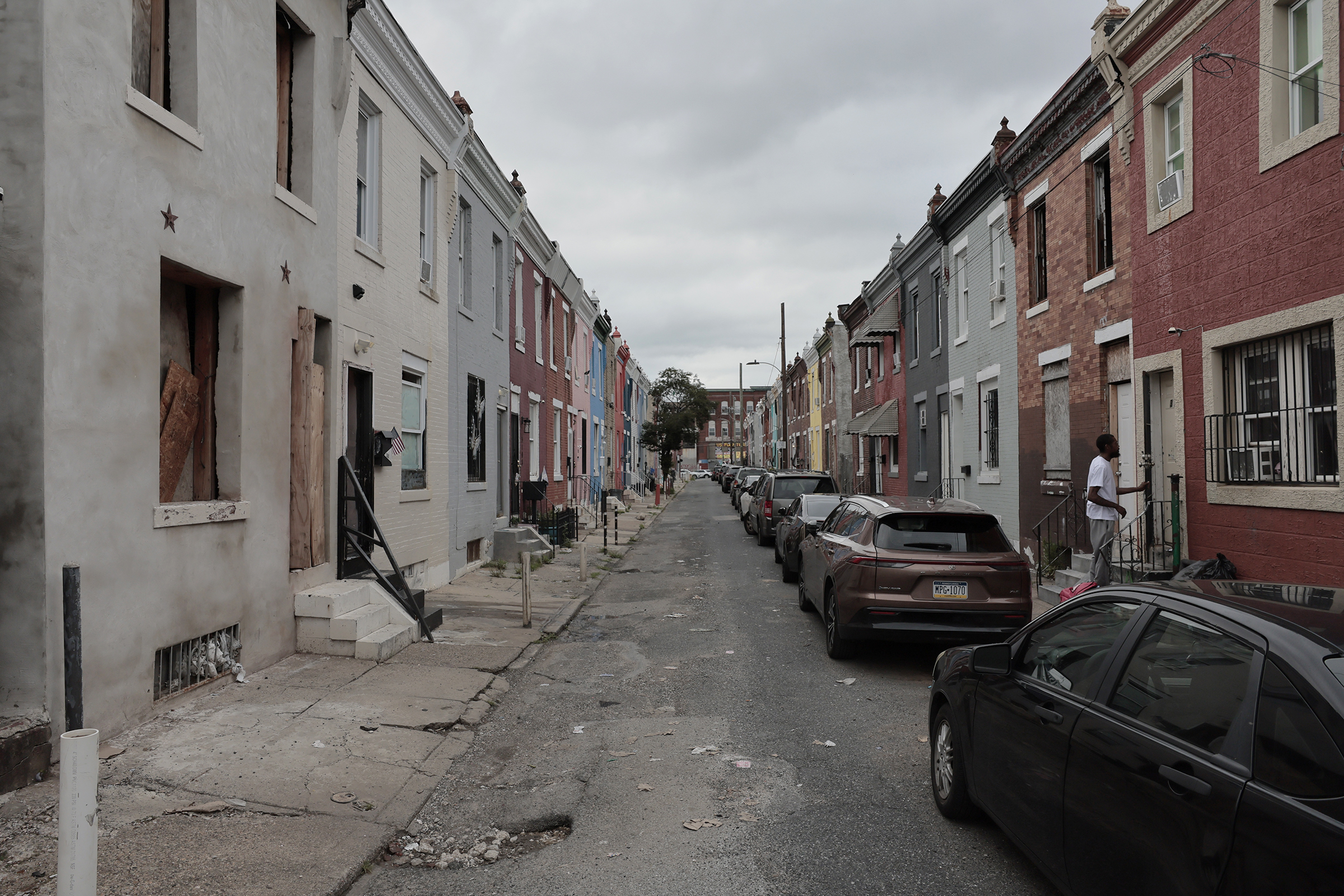
Citywide, the steepest increase in valuations was in Kensington, where the median property value jumped 15.3%, from $115,700 in the 2025 tax year to $133,400 now. That median increase would translate to a roughly $250 annual property tax hike.
That comes after Parker’s administration in 2024 launched a multipronged effort to address the long-entrenched open-air drug market in Kensington, which is the epicenter of the city’s opioid crisis and a site of sprawling homelessness.
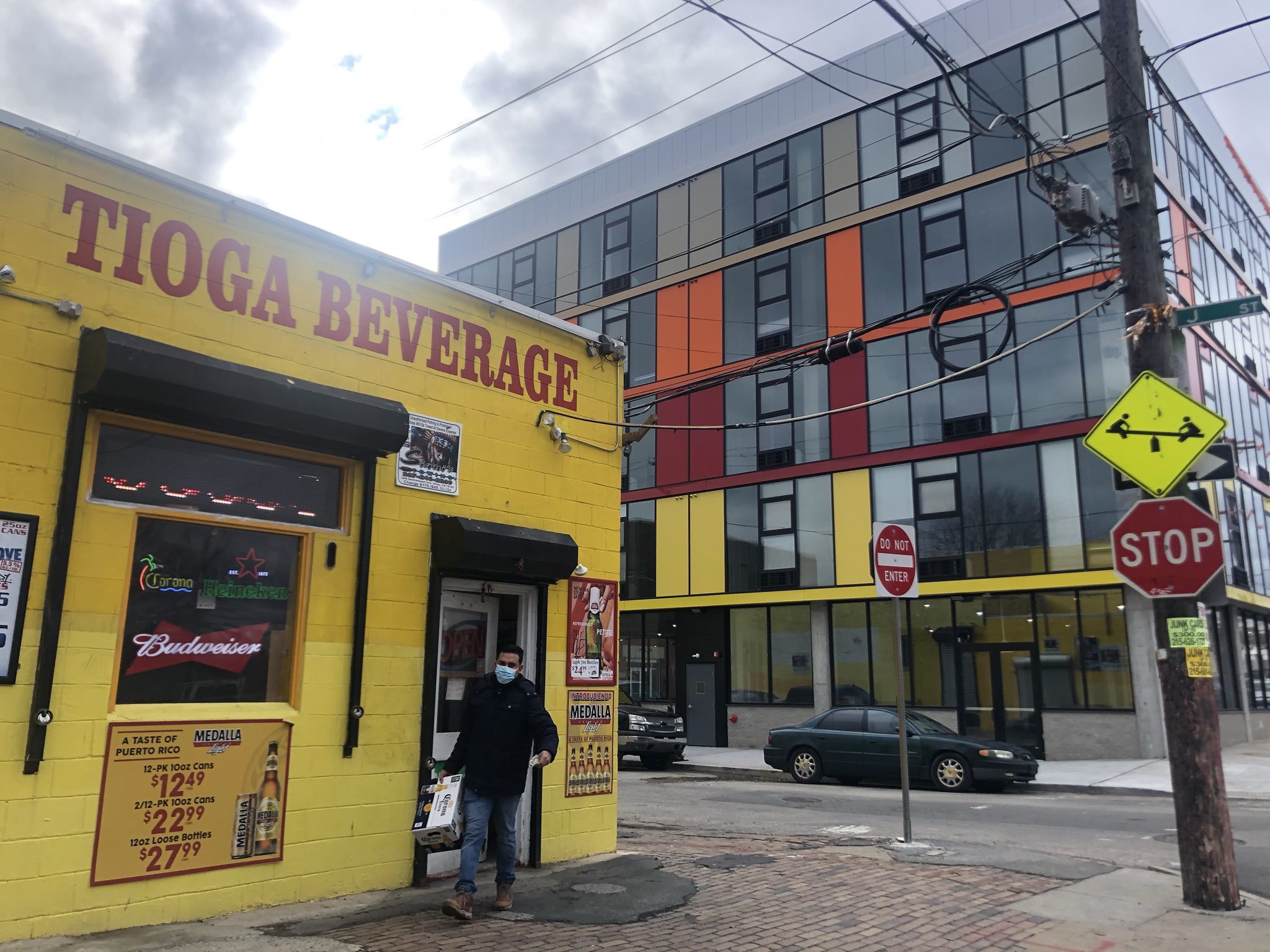
In this 2021 file photo, a glass building at J and Tioga sits near a beer store in Kensington.Inga Saffron
Some neighborhood leaders have watched with anxiety as luxury housing developers and out-of-town investors gobbled up properties in the neighborhood, fearing that poorer residents and middle-class homebuyers may be priced out.
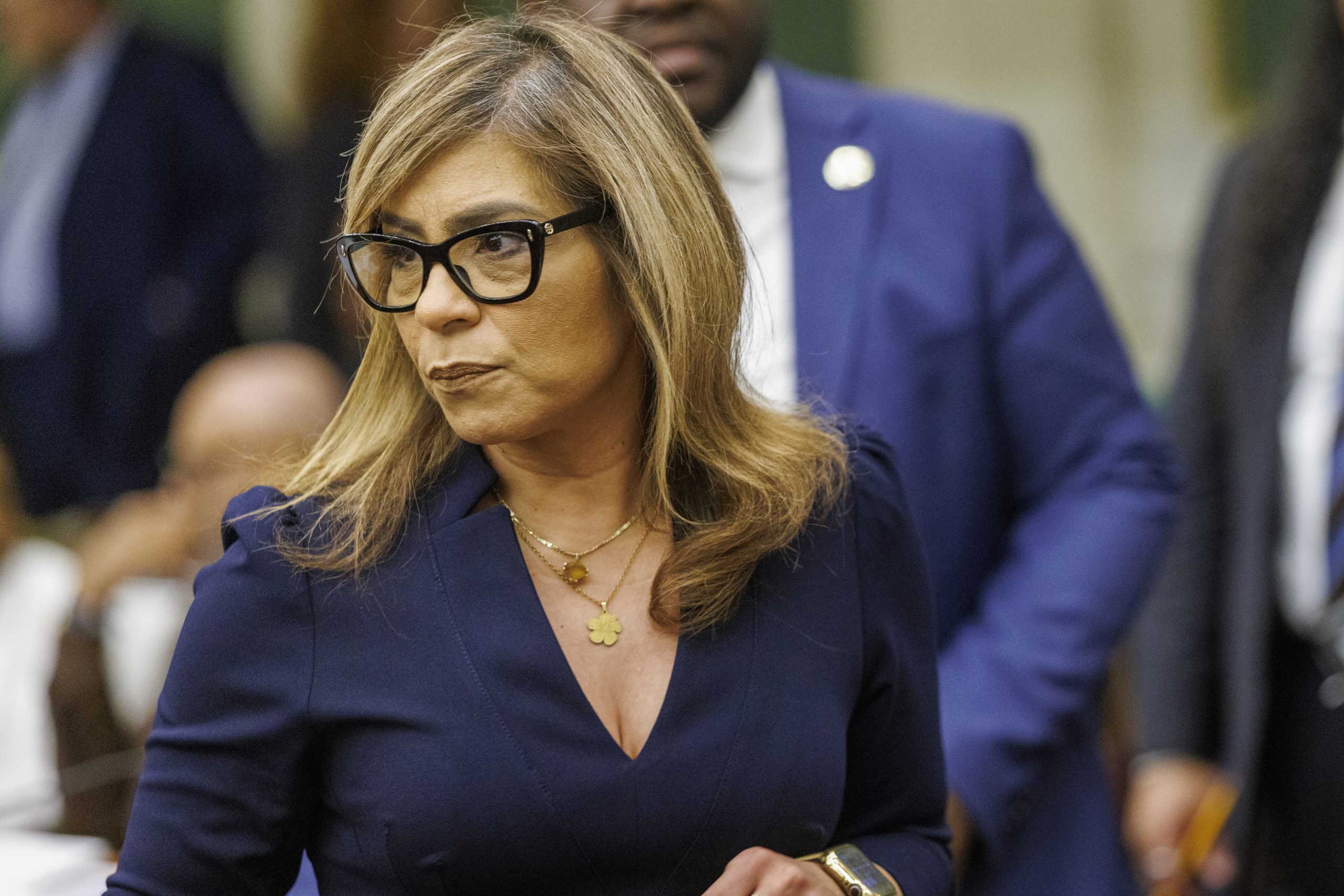
City Councilmember Quetcy Lozada, a Democrat who represents the 7th Council District, which includes parts of Kensington, said she knew speculators from outside the area would want to make it “the next gentrified neighborhood” once the city changed its strategy to more aggressively clean up trash and improve public safety.
But Lozada said there are not enough programs specific to Kensington aimed at preventing displacement as a result of rising property values, especially as the city is investing millions of dollars a year to improve the neighborhood. She said her office is exploring additional tax relief measures.
“I’m going to do whatever I have to do to make sure that residents who have lived in that community can stay there, can raise their families there,” Lozada said. “We have witnessed what has happened on the southern end of the district, where there has been rapid gentrification.”
In this March file photo, City Councilmember Quetcy Lozada stands in Council chambers during Mayor Cherelle L. Parker’s budget address.Alejandro A. Alvarez / Staff Photographer
Lozada also said rising property values in Kensington are part of why she has been “so careful with projects presented to me” and has prioritized what she sees as equitable development in the neighborhood — at times to the chagrin of developers who think she has been too restrictive.
“I’m all about people making a return,” she said, “but you can’t continue to do it on the backs of poor people.”
The 3100 block of Arbor Street in Philadelphia on Tuesday, July 7, 2026.Elizabeth Robertson / Staff Photographer
Continuing change in pockets of West Philly
There were also significant property value increases in parts of West Philadelphia.
The median increase in Mantua, the neighborhood north of University City, was the second highest in the city, at 15%, according to The Inquirer’s analysis. The median increase was 12% in Kingsessing, the neighborhood south of University City that in 2025 saw the largest jump of any neighborhood in Philadelphia.
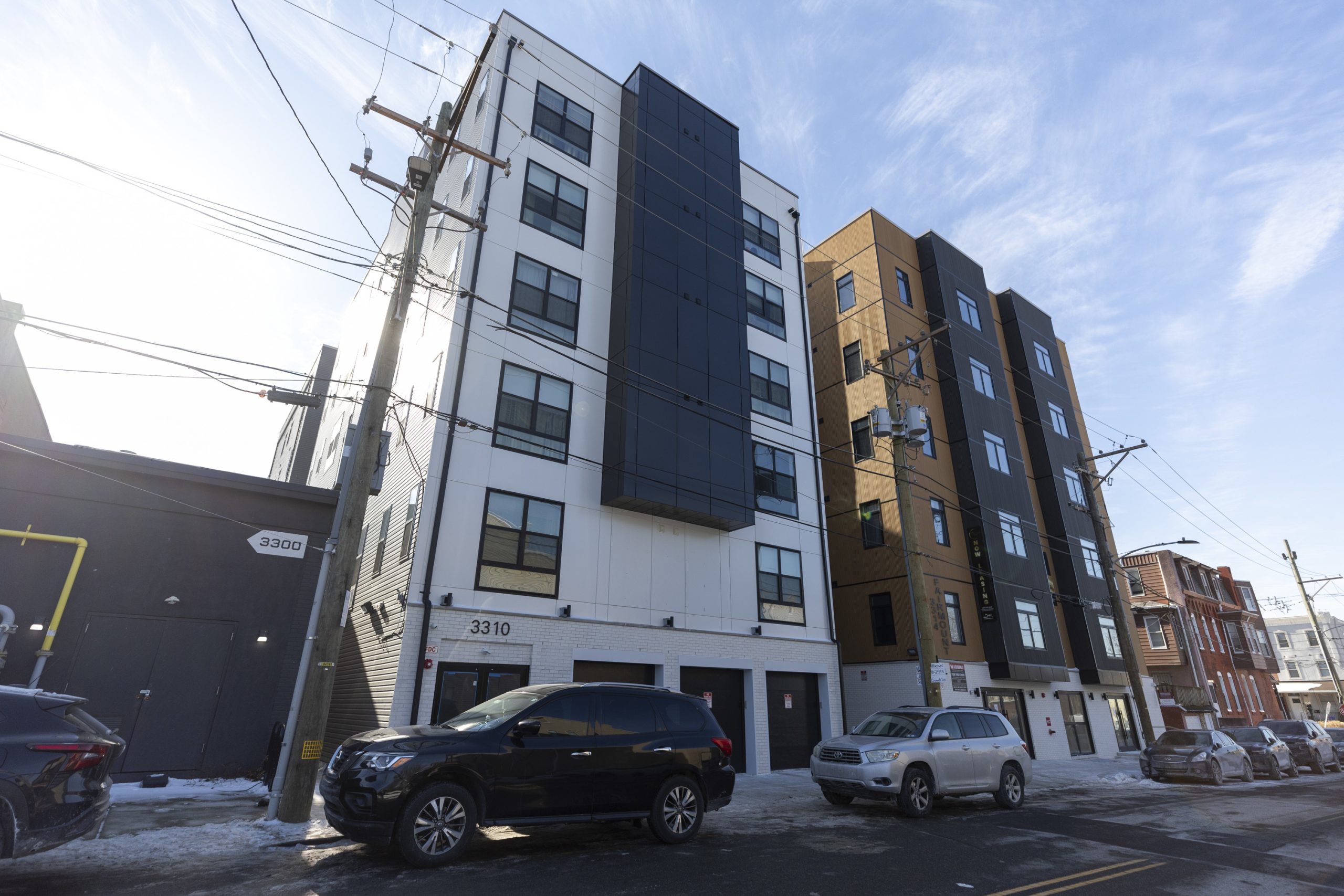
Newly developed buildings along Fairmount Avenue in the neighborhood of Mantua in Philadelphia, Pa., on Thursday, Jan. 23, 2025.Tyger Williams / Staff Photographer
Councilmember Jamie Gauthier, a Democrat who represents West Philadelphia and has made preventing displacement a key initiative, said that there has long been racial bias in the city’s property assessments and that the city must “get serious” about protecting low-income homeowners by revamping its system.
“There has to be a higher level of urgency in making sure that the city doesn’t have a hand in pushing out all of these homeowners that make Philadelphia what it is,” Gauthier said. “It’s unconscionable for us to destabilize our neighborhoods and the longtime homeowners who live there because we didn’t take enough care to make sure that our process was fair and equitable.”
For too long, she said, city officials have said they intended to examine the property assessment practices and identify improvements. In 2024, Parker convened a task force to study the process.
Aros told Council in April that the task force’s report was “being finalized.” He said OPA would look to implement recommendations from the report, including conducting more regular reassessments and improving property-level data such as property condition.
The city is also planning to hire an outside consultant to examine its mass appraisal practices, according to city records. The analyst will be responsible for drafting a report by the end of this year.
Deputy creative director John Duchneskie contributed to this article.