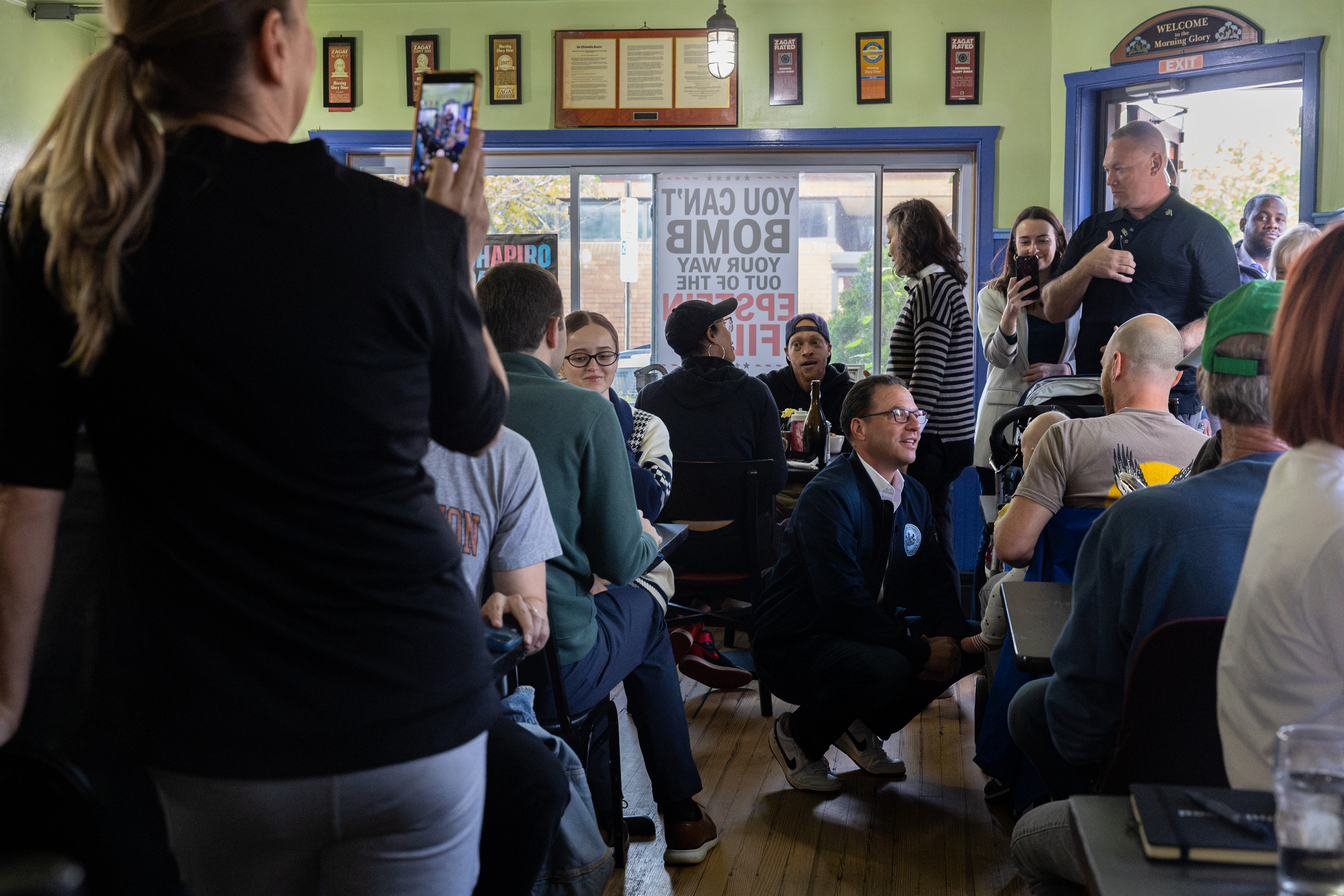
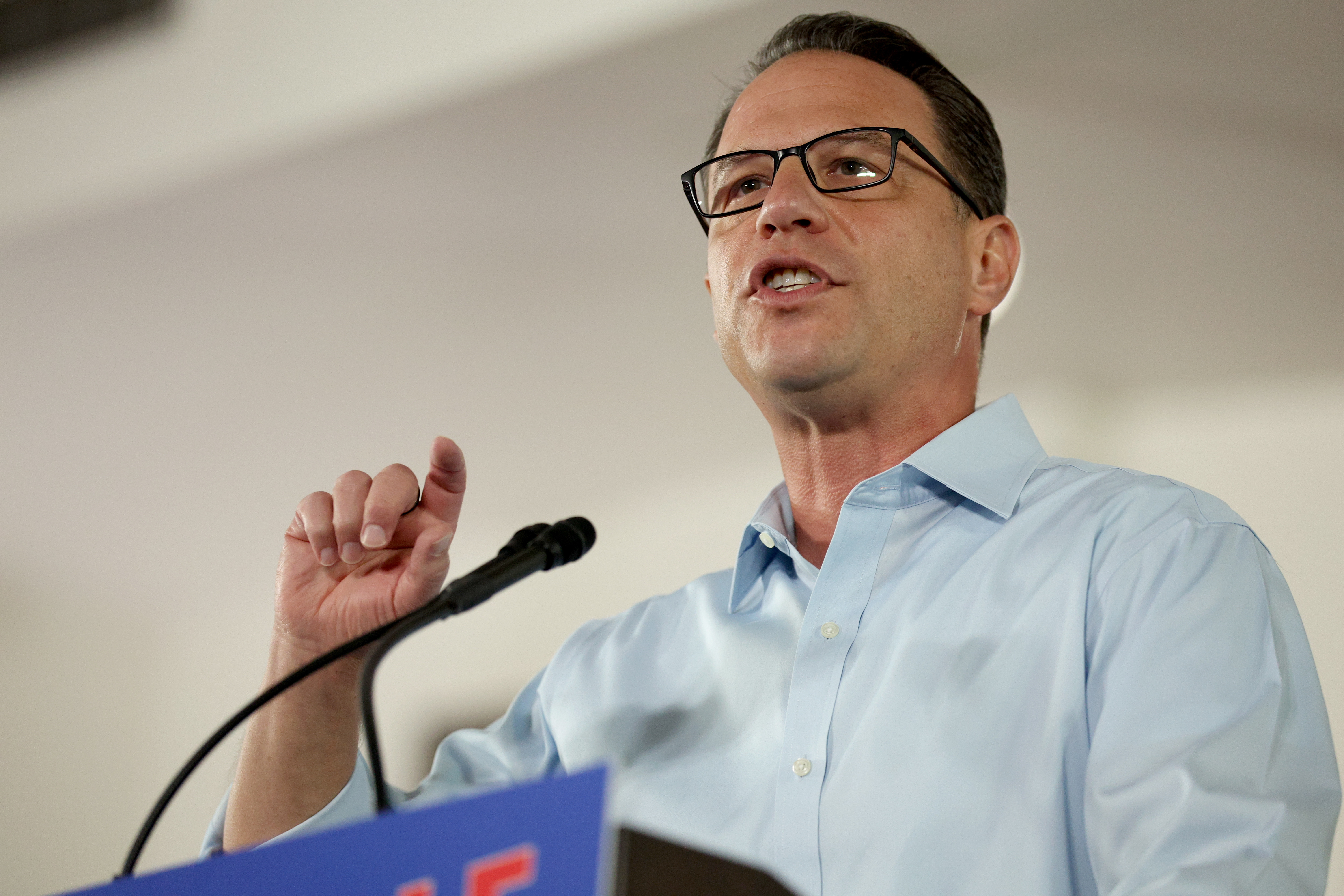
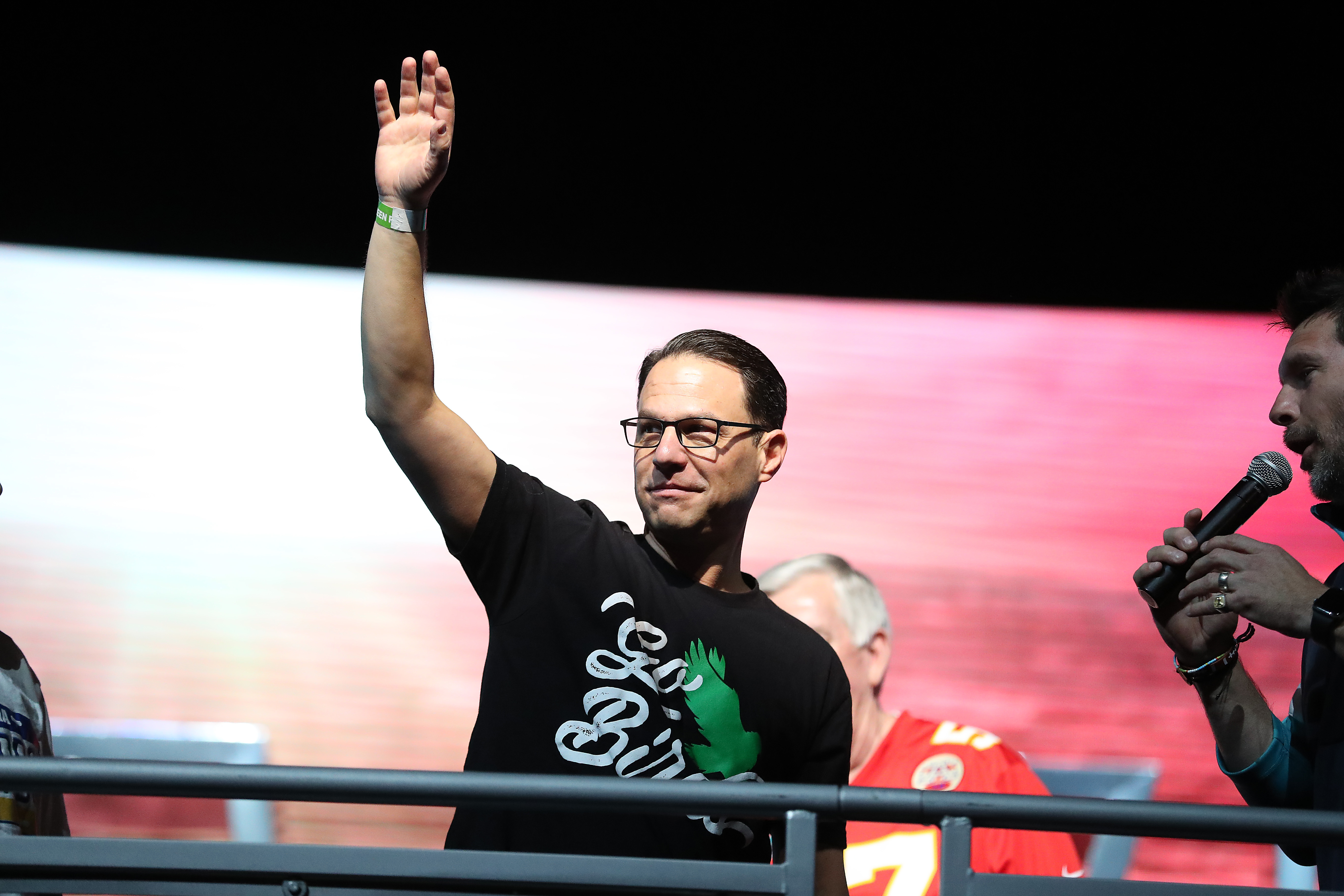
Pennsylvania Gov. Josh Shapiro and Michigan Gov. Gretchen Whitmer, stopped by a Bella Vista diner on Friday morning to pump up Democratic volunteers to turn out voters, with less than six weeks until the high-stakes midterm elections in both of their swing states.
On the menu: Electing Democratic candidates to Pennsylvania’s four nationally-watched U.S. House seats that could determine control of Congress, and flipping the state Senate to Democratic control for the first time in more than 30 years.
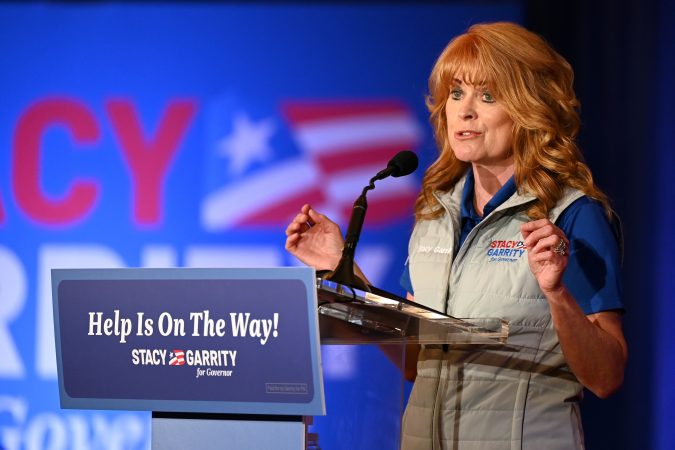
Shapiro is also seeking a second term as Pennsylvania’s Democratic governor this November, and maintains a sizable polling and fundraising advantage over his Republican opponent, state Treasurer Stacy Garrity.
“I know we’re in a moment of tumult right now, where chaos and cruelty and corruption is just enveloping our lives. The good news is in 39 days, you’ve got the power to change that,” Shapiro told the group of a couple dozen volunteers from voter protection groups. Servers at Sam’s Morning Glory Diner, wearing T-shirts with messages condemning President Donald Trump and supporting former Vice President Kamala Harris, whisked by with plates of omelettes and pancake stacks.
Gov. Josh Shapiro talks to patrons alongside Michigan Gov. Gretchen Whitmer out in the back patio of Sam’s Morning Glory Diner in South Philadelphia on Friday, Sept. 25, 2026. Shapiro is canvassing to get Pennsylvania Democrats elected up and down the ballot as the midterms are upcoming in November. He wants to flip the state Senate for Democrats to take back control. Whitmer is present to support Shapiro’s re-election campaign.Aidan T. Gallo / Staff Photographer
Shapiro also assured voters that elections in Pennsylvania will be conducted fairly and accurately, following a CNN report that Trump’s Department of Justice is sending a surge of election monitors to oversee polling locations.
“We’re prepared again in court, and we’re also prepared should they try and bring personnel into certain communities, particularly minority communities, to try and intimidate people, make it harder for people to vote, or make them worried about showing up to vote,” he said.
State election officials are coordinating with the Pennsylvania National Guard, the Pennsylvania State Police and local law enforcement to protect voting access, he said.
“We will do everything in our power to stop Donald Trump from interfering with this election and ensure, whether you vote by mail or you vote in person, you will have access to the ballot box, and it will be protected,” he said.
Gov. Josh Shapiro meets with patrons alongside Michigan Gov. Gretchen Whitmer inside Sam’s Morning Glory Diner in South Philadelphia on Friday, Sept. 25, 2026. Shapiro is canvassing to get Pennsylvania Democrats elected up and down the ballot as the midterms are upcoming in November. He wants to flip the state Senate for Democrats to take back control. Whitmer is present to support Shapiro’s re-election campaign.Aidan T. Gallo / Staff Photographer
Whitmer is nearing the end of her second term as Michigan’s governor, and like Shapiro, has been floated as a contender in the 2028 Democratic presidential primary.
The two have been coy about any future pursuits. Shapiro has demurred on his ambitions for higher office, saying he’s focused on his reelection, though he’s also said he will “be a part of that conversation” about who Democrats should nominate for president. Whitmer previously said she had no plans to run in the Democratic presidential primary in 2028 but later walked it back, saying “never say never.”
But on Friday in South Philadelphia, there were no signs of rivalry. Whitmer said she was in town to help support Shapiro’s reelection effort. Shapiro praised Whitmer, saying she has been a guiding light for the kind of governor he wanted to emulate.
Whitmer, Shapiro said, is ”someone I have looked up to, someone who knows how to get stuff done in her state, and someone who I think leads with integrity, with purpose, with drive and determination.”
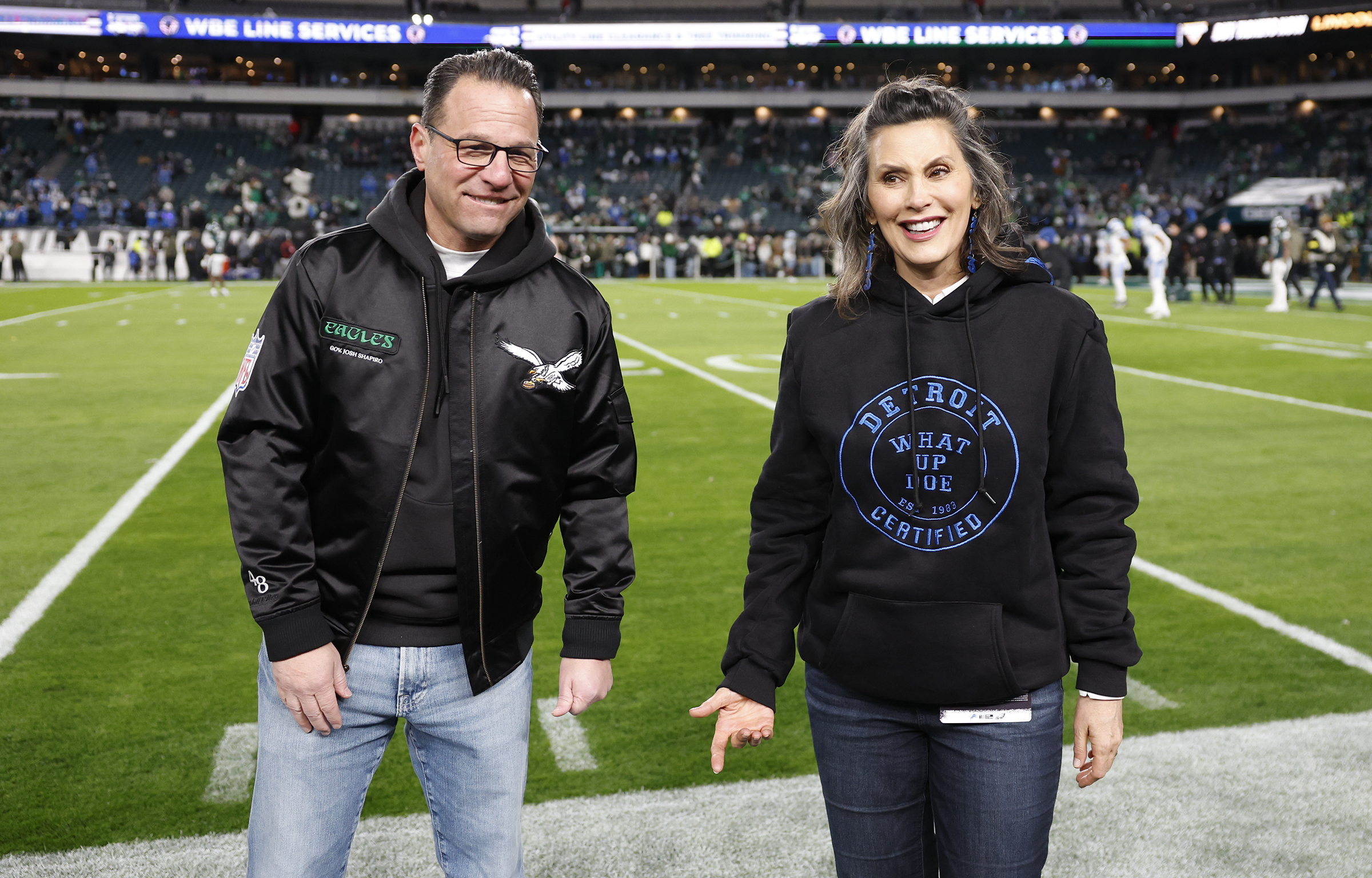
The two appeared together publicly last year at an Eagles-Lions football game at Lincoln Financial Field, as part of what Whitmer called a friendly rivalry between the NFC championship contenders.
Pennsylvania Governor Josh Shapiro (right) and Michigan Governor Gretchen Whitmer before the Eagles played the Detroit Lions at Lincoln Financial Field on Sunday, Nov. 16, 2025, in Philadelphia, PA.Yong Kim / Staff Photographer
During the 2024 presidential election, Shapiro also visited Michigan to stump alongside Whitmer for Harris’ campaign.
On Friday, Whitmer called Shapiro a “good friend and colleague.”
“When Washington, D.C. is making life harder — whether it’s through tariffs or a war in Iran that’s jacking up the price of everything — it’s the governors that are protecting our rights, that are making sure we keep more money in our pockets. It’s the governors who are solving problems,” she said. “You got one of the best in the country.”
After talking with patrons, Shapiro said he planned to sit down with Whitmer to eat something at the restaurant. Featured on Sam’s Morning Glory Diner menu on Friday: “Shapiro 2026″ and “2028 sausage, eggs and gravy.”
Pennsylvania is — once again — at the center of the political universe, and our team is set to bring you the latest as we cover the final stretch of the campaigns from Philadelphia to Washington, D.C. and across Pennsylvania. We’re focusing on the competitive U.S. House races, the battle for the governor’s mansion, and legislative districts across the Keystone State as Democrats fight for control in Harrisburg and in Congress.
🎤 I’m Sam Janesch, The Inquirer’s national political reporter. I’ll be your host this week as we dig into how Pennsylvania’s always-newsworthy Democratic senator is inserting himself into a campaign season where he’s not even on the ballot. We also have a first look at an unusual new spending effort on behalf of U.S. Rep. Brian Fitzpatrick, who is fighting to keep his seat as the last Republican representing the region in Congress, and new insight into Gov. Josh Shapiro’s polling and money advantages.
🗳️ Close to home: Fitzpatrick is the least loyal House Republican to President Donald Trump, but he’s still overwhelmingly aligned with the president and his party.
— Sam Janesch, Michelle Baruchman, Fallon Roth, Gillian McGoldrick (pa2026@inquirer.com)
The latest
Pennsylvania voters are giving President Donald Trumpworse grades on economic issues as the midterms near. And as gas prices hit $4.55 in Philadelphia, even his 2024 supporters are unhappy.
Shapiro has raised $60 million for his reelection, but any leftover money can’t be directly transferred to a 2028 presidential campaign — not that he has declared his candidacy for one, anyway.
Only one Pennsylvania Republican received a video shoutout from Trump in his Truth Social endorsement dump last week — and it’s the candidate with perhaps the longest shot of winning. Trump called Garrity “really special,” while slamming Shapiro as a governor who “does not have what it takes.” Meanwhile, U.S. Rep. Ryan Mackenzie is still counting on Trump’s support to help him win in the Lehigh Valley.
Outside the midterm elections, another type of political campaign was underway to free convicted former Philadelphia labor leader John Dougherty, widely known as Johnny Doc, from prison. But it was a group of Republicans, including Trump, who ultimately aided the longtime Democratic power broker’s release.
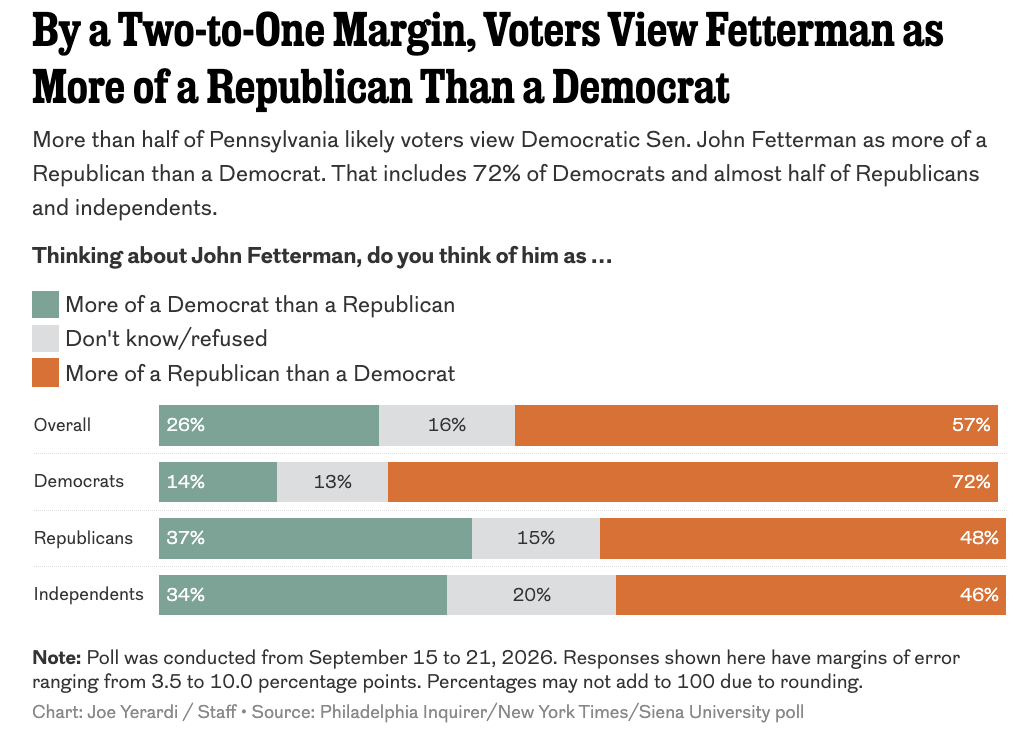
📊 U.S. Sen. John Fetterman has come a long way from the Bernie Sanders-loving, progressive populist that made him a political sensation starting about a decade ago — at least according to the Pennsylvania voters who elevated him to national prominence.
Four years after his election to the U.S. Senate, a majority of the state’s likely voters think of him as a Republican, according to a new poll conducted by Siena University on behalf of The Inquirer and the New York Times.
Our polling data shows nearly three-quarters of Democrats think of Fetterman as a Republican. About half of Republicans feel the same way.
Even though Fetterman has said he will not change parties, that perception could have major implications. Democrats need to net at least four seats to capture the Senate majority starting in January. If they win a slim majority, Fetterman’s wildcard nature could be a roadblock as the party looks to act as a check on Trump in the final two years of his term.
Democrats in Washington aren’t sweating it. Well, at least not publicly.
“No,” U.S. Sen. Kirsten Gillibrand, a New York Democrat and chair of the Democratic Senatorial Campaign Committee, said quickly when The Inquirer asked her this week if she or her colleagues are concerned about Fetterman’s role in a narrow majority.
“I’m very grateful that Sen. Fetterman is serving in the U.S. Senate as a Democrat, and I think he will continue to do so,” Gillibrand said.
Campaign scrapple
📺 Exclusive: A top environmental organization is throwing $250,000 toward new digital ads and a mail program supporting Fitzpatrick as he fends off a challenge from Democrat Bob Harvie in the swingy Bucks County-based congressional district that could prove key to flipping party control of the House this fall.
Fitzpatrick is the only House GOP candidate currently receiving ad support from EDF Action Votes, a super PAC that supports the goals of the Environmental Defense Action Fund.
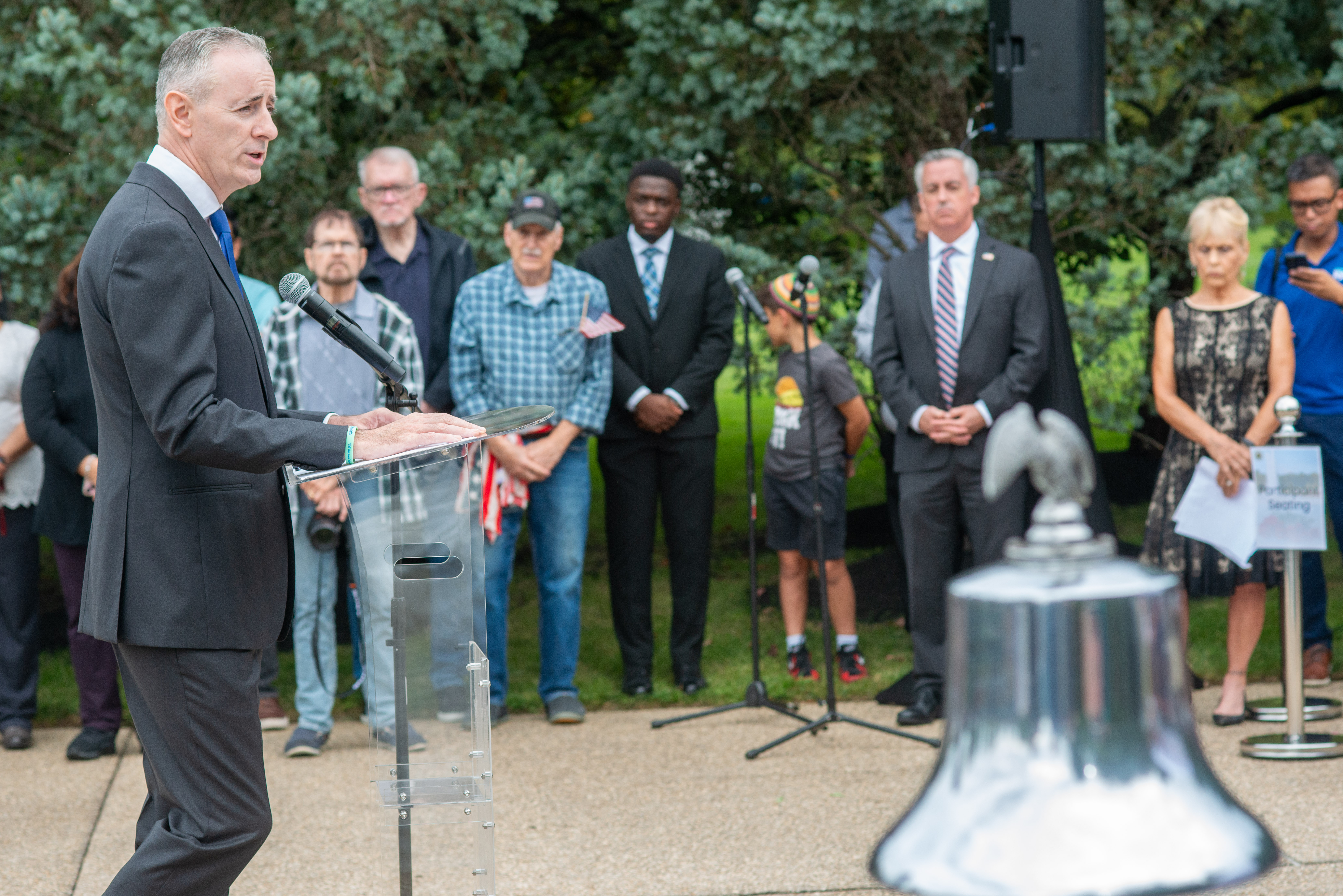
US Rep Brian Fitzpatrick speaks during the Garden of Reflection remembrance ceremonies as his opponent, Bob Harvie (3rd from right) listens Friday, September 11, 2026 at Garden of Reflection in Yardley, Pennsylvania.William Thomas Cain / For The Inquirer
Historically Democratic-aligned groups, like environmental orgs and labor unions, have felt comfortable continuing — or offering new — support for Fitzpatrick despite a national political landscape that has become increasingly unfavorable for Republicans. The Bucks County lawmaker has been known to separate himself from his conference and is the least loyal House Republican to Trump and his party.
🔴 The Pennsylvania Republican Party’s state committee will meet in Pittsburgh this weekend. The committee cleared the field for Garrity as the party’s nominee by endorsing her last September. But since then, she’s struggled across the board — with fundraising, in polls, and more. Politics reporter Michelle Baruchman will be there, hoping to hear from attendees about the party’s outlook heading into November.
📩 Mail ballots have already begun hitting mailboxes across Pennsylvania, with nearly 14,000 already returned.
📬 A total of 999,280 mail or absentee ballots have been requested as of Thursday, Sept. 24, according to Pennsylvania Department of State data.
Shapiro, Pennsylvania’s incumbent Democratic governor, is up 21 points over Garrity, according to a new poll conducted by The Inquirer, the New York Times, and Siena University. He also announced a $13.3 million haul this summer and $31 million spent — far outpacing Garrity’s $1.8 million total raised and $1.5 million spent since June.
👋 All this election news, and can you believe we still have more than a month to go? You can follow The Inquirer politics team’s coverage here, and we’ll see you in your inbox next Friday.
By submitting your written, visual, and/or audio contributions, you agree to The Inquirer’s Terms of Use, including the grant of rights in Section 10.
Bucks County Republican State Sen. Frank Farry’s campaign this week demanded his Democratic challenger take down an advertisement attacking Farry for his position on data centers and air an apology instead, calling the commercial “defamatory” and “demonstrably false.”
Shohin H. Vance, an attorney representing Farry’s campaign, called for Democrat Eileen Hartnett Albillar to remove the ad and issue a 30-second retraction advertisement, according to an eight-page letter sent Wednesday and reviewed by The Inquirer.
Harnett Albillar’s ad calls Farry a “data senator” and says he is “the data center industry’s number one fan.” The ad also accuses the Republican lawmaker of voting for data center tax breaks in Harrisburg and notes that Farry’s law firm represents NorthPoint, a real estate company which redeveloped the Keystone Trade Center in Falls Township — the soon to be home of an Amazon data center.
“The Advertisement, which accuses my client of abusing his public office for his own pecuniary interest, is not only misleading — it is demonstrably false,” Vance wrote in the letter.
The dispute signifies how AI data centers have become a politically toxic issue as candidates from both parties distance themselves from supporting their development.
Farry’s 6th State Senate District is one of a handful of competitive seats being targeted by Pennsylvania Democrats in hopes of flipping the state Senate and delivering a Democratic trifecta in Harrisburg.
Hartnett Albillar’s campaign said Fridayit has no plans to stop running the ad.
“His temper tantrum won’t silence this campaign or stop Eileen from fighting to make Bucks County more affordable,” campaign manager Leigh Stafford said in a statement.
The Farry campaign, in the letter, rejected the notion that Farry or any clients at his law firm — including NorthPoint — benefitted or profited from Farry’s vote in 2021 to support Act 25. The legislation allows computer data center equipment to be exempt from Pennsylvania’s sales and use tax if it’s being used or sold to a certified data center by a valid owner, operator, or tenant.
“The vote did not, and could not, benefit the client, and none of it put a dollar in Senator Farry’s pocket,” Vance wrote.
Farry was serving in the state House at the time and did not raise a conflict of interest on the floor. When asked about this, he said in a statement: “I didn’t raise a conflict on the House floor in 2021 BECAUSE I DO NOT REPRESENT DATA CENTERS.”
The campaign emphasized in its letter that Farry’s law firm, Begley, Carlin & Mandio, has not represented a data center operator in at least 20 years.
“To be sure, the Keystone Trade Center is now also the site of a data center, and its developer, NorthPoint, is a client of Begley Carlin. But NorthPoint is not a data center, and the fact that it leases a portion of its 1,800-acre site to a data center operator does not make it one,” Vance wrote.Begley Carlin has represented NorthPoint since July 2020.
Farry has been with Begley Carlin since 2011, but he said in a statement that he has “not done much work at all” for the firm “as my time is filled with being a State Senator, our local volunteer fire chief, a dad to two young kids, and a husband who among other things recently supported my wife through a two year battle with breast cancer.”
Adam C. Bonin, an attorney representing Hartnett Albillar’s campaign, wrote in a response to Vance Friday that: “We will neither cease nor desist from engaging in this truthful, accurate speech.”
Bonin highlighted NorthPoint’s close proximity to the Bucks County data center project, including mentions of the company in Falls Township press releases and in news articles. Bonin also argued that the 2021 state House bill, which Farry supported “made this an attractive deal for NorthPoint and Amazon to make. Without them, perhaps Amazon would have stayed out of Bucks County altogether.”
“While Senator Farry might not like seeing the truth displayed in such an unflattering way, the advertisement’s statements are amply supported by Farry’s legislative record, his law firm’s own website, official Falls Township records and copious news reporting,” Bonin wrote.
This is not the first legal dustup to happen in a Bucks County race this election cycle. Last month, Democrat Bob Harvie, a county commissioner challenging GOP U.S. Rep. Brian Fitzpatrick in the 1st Congressional District, filed a defamation lawsuit against a super PAC supporting the Republican. The suit argued that the PAC falsely claimed Harvie was under FBI investigation.
A large majority of likely Pennsylvania voters dislike Health and Human Services Secretary Robert F. Kennedy Jr., according to a poll conducted in the wake of his clash with Gov. Josh Shapiro over the state’s measles outbreak.
The poll, released Thursday, found that 61% of respondents have an unfavorable view of Kennedy, while only 33% said they hold a favorable one of him.
Kennedy,who has a history of anti-vaccine activism, has been embroiled in a heated debate with Shapiro, the state’s popular governor, over measles-associated deaths in Pennsylvania.
“The poll shows that people see RFK Jr. for what he is: the single worst person to be HHS secretary during a massive measles epidemic,” said Paul Offit, director of the Vaccine Education Center at Children’s Hospital of Philadelphiaand a longtime critic of Kennedy.
(function(){function e(){window.addEventListener(`message`,function(e){if(e.data[`datawrapper-height`]!==void 0){var t=document.querySelectorAll(`iframe`);for(var n in e.data[`datawrapper-height`])for(var r=0,i;i=t[r];r++)if(i.contentWindow===e.source){var a=e.data[`datawrapper-height`][n]+`px`;i.style.height=a}}})}e()})();
State health officials have been responding to a measles outbreak of more than 800 cases, as of Wednesday, that included four deaths, two of them infants.
The survey of likely voters was conducted between Sept. 15 and 21, a period that overlaps the war of words between the Democratic governor and Trump’s health secretary.
“This serious situation continues to be made worse by RFK Jr. playing games with public health and safety,” Shapiro said on X last week. “It’s long past time for [Kennedy] to stop stoking vaccine skepticism and misinformation and compromising the serious mission of the nation’s public health agencies.”
For his part, Kennedy, in a post on X last month, accused Shapiro of choosing “to politicize this outbreak instead of implementing a unified public health response.” He also contended in that post that he has promoted vaccination as the “most effective way to prevent measles infection.”
But Kennedy has explicitly stated that vaccines cause autism, Offitnoted, and late last year, Kennedy orderedthe CDC to change its website to say its long established position that vaccines don’t cause autism is not an evidence-based claim.
Kennedy has also said that the measles vaccine was never fully tested and that it wanes over time, both of which have been disputed by medical authorities with decades of evidence backing its safety and efficacy.
Lesa Yeager, a 63-year-old independent voter from State College who participated in the survey, said she was concerned about the spread of measles in Central Pennsylvania, and she wished Kennedy would “encourage people to the get the vaccines.”
She wasn’t familiar with his back-and-forth with the governor, but said her frustration with Kennedy is longstanding.
“I have a kid with special needs, and [Kennedy]is going on about how the vaccines cause autism, and everybody knows that’s not true,” she said. “He has spread such misinformation, and he’s wackadoodle.”
For weeks, the CDC did not publicly list Pennsylvania’s measles-associated deaths, reportedly at Kennedy’s order, a charge his agency denied. “It looks as though RFK is ignoring measles deaths here,” Offit said.
On Wednesday, the CDC acknowledged that a measles-associated death had occurred in 2026, without saying where it happened. The CDC said the number is “subject to change.” Pennsylvania is the only state where a measles death has been widely reported.
In a statement, Emily Hilliard, HHS press secretary, declined to address the poll, but said that the public’s trust in vaccines was eroded significantly during the pandemic, caused by “mismanagement, overreach, misinformation, and mandates.”
“Attributing the measles resurgence to the Trump administration fundamentally misrepresents when and why the resurgence began,” Hilliard said, adding that Kennedy has “been clear that vaccination remains the most effective way to prevent measles.”
Kennedy and Shapiro have repeatedly battled over vaccine policy during the Trump administration. Shapiro joined a lawsuit earlier this year over federal changes to the childhood vaccine schedule.
Trump last month signed an executive order that saidthe MMR vaccine — a combination vaccine that protects against measles, mumps and rubella — “should be administered in three separate single-disease shots” during three separate doctor’s visits. Immunologists have disparaged the idea, saying there’s no medical reason to do so.
Shapiro has said Pennsylvania won’t alter immunization guidelines in response to Trump’s order.
(function(){function e(){window.addEventListener(`message`,function(e){if(e.data[`datawrapper-height`]!==void 0){var t=document.querySelectorAll(`iframe`);for(var n in e.data[`datawrapper-height`])for(var r=0,i;i=t[r];r++)if(i.contentWindow===e.source){var a=e.data[`datawrapper-height`][n]+`px`;i.style.height=a}}})}e()})();
The poll found that 53% of likely voters trust Shapiro to do a better job on vaccine policy than his Republican opponent Stacy Garrity, a Trump-backed candidate who participated in Kennedy’s “Make American Healthy Again” event in Harrisburg earlier this year.
Staff writers Michelle Baruchman and Gillian McGoldrick contributed to this article.
State Rep. Chris Rabb, the Philadelphia progressive running as a Democrat for Congress, called Benjamin Netanyahu a “war criminal” at a protest in New York on Thursday, as the Israeli prime minister gave a speech to the United Nations.
“I’m here in solidarity with all these brave souls who want their country to be on the right side of history and who acknowledge that Benjamin Netanyahu is a war criminal and should be in the Hague,” Rabb said at the protest, captured in a video posted on social media, referring to the Netherlands-based International Criminal Court.
“We have to make a decision about where our taxpayer dollar goes. We should not be funding atrocities overseas,” said Rabb, who is running to replace U.S. Rep. Dwight Evans.
In his speech, Netanyahu called allegations of Israeli genocide in Gaza not only false, but “the biggest lie of the century,” the Associated Press reported.
As he arrived for his speech, scores of delegates trooped out before he started speaking.
Zohran Mamdani, New York’s first Muslim mayor and an outspoken supporter of Palestinian rights, has urged Netyanhau’s arrest, asserting that the U.S. should honor a war crimeswarrant for Netanyahu issued by the International Criminal Court.
Netanyahu released a video earlier this week directed against Mamdani, saying he was coming to the U.N. “to tell the truth about our heroic soldiers” and “to tell the truth about you.”
The U.S. is not a party to the International Criminal Court, and New York City does not have the authority to arrest the prime minister. Israel denies that its actions in Gaza amount to genocide, saying that they are a military response targeting Hamas for the Oct. 7, 2023, attacks that killed about 1,200 Israelis, including hundreds at a music festival. More than 73,000 Palestinians have died in the war in Gaza, according to the Gaza health authority.
Among the other participants in the New York protest was Hannah Einbinder, the Emmy-winning actress whose father was born in Doylestown. She famously shouted “Go Birds, f— ICE, and free Palestine!” during her Emmy acceptance speech last year.
Rabb was recorded standing next to two other Democratic congressional candidates, Adam Hamawy of New Jersey and Melat Kiros of Colorado.
Another congressional candidate, New York Democrat Darializa Avila Chevalier, was arrested at the protest, according to reports.
Rabb posted to Instagram Thursday evening to let supporters know he was not after misinformation spread on social media.
“I wasn’t arrested, but Netanyahu should be!” Rabb said in one post.
Correction: This article has been updated to correctly reflect the year Einbinder made her Emmy acceptance speech.
Chris Rabb, Dr. Adam Hamawy, and Melat Kiros interviewed at @jvplive NYC protest of Benjamin Netanyahu
Rabb: "Benjamin Netanyahu is a war criminal and should be in the Hague.
We're sending money to support a genocide, and bombing in Iran and Lebanon and so forth, when that… pic.twitter.com/scJxs3ODQ7
One in four likely Pennsylvania GOP voters has not heard of the state’s Republican candidate for governor, as Gov. Josh Shapiro continues to pull ahead with less than six weeks remaining until Election Day, according to a new poll.
According to the poll, Shapiro’s lead has now expanded beyond the advantage he held the month before the 2022 election against State Sen. Doug Mastriano (R., Franklin). Shapiro went on to beat Mastriano in that election by nearly 15 percentage points, or 800,000 votes — a drubbing that the GOP vowed not to repeat.
(function(){function e(){window.addEventListener(`message`,function(e){if(e.data[`datawrapper-height`]!==void 0){var t=document.querySelectorAll(`iframe`);for(var n in e.data[`datawrapper-height`])for(var r=0,i;i=t[r];r++)if(i.contentWindow===e.source){var a=e.data[`datawrapper-height`][n]+`px`;i.style.height=a}}})}e()})();
Pennsylvania Republicans endorsed Garrity in September 2025 — an unprecedented early nod to unify behind her in an effort to put up a stronger fight against Shapiro after the party largely withheld its support for far-right Mastriano. Garrity has won statewide twice and received the most votes in Pennsylvania history for a statewide office, a record previously held by Shapiro. In January, President Donald Trump endorsed Garrity, calling her “an America First Patriot.”
But building on that early enthusiasm has proven to be a challenge for Garrity, who for months has struggled to raise money, compete with Shapiro’s $60 million war chest, and gain name recognition in the critical battleground state where registered Democratic voters narrowly outnumber Republicans.
Garrity, 63, who entered politics in 2020 after a long career in the U.S. Army Reserve, raised only $1.8 million this summer and spent $1.5 million, according to her latest campaign finance filing, posted Tuesday. Shapiro raised $13.3 million during that time and spent $31 million.
Gov. Josh Shapiro addresses the audience during a rally for congressional candidate Bob Brooks at the United Steelworkers Union Hall in Bethlehem, Pa. on Sunday, July 26, 2026.David Maialetti / Staff Photographer
And while Shapiro has dramatically increased his advertising spending on TV and streaming services to top $27 million this year, Garrity has spent a total of $744,000 on ads so far, according to media tracking firm AdImpact.
Both Shapiro and Garrity have released ads attacking each other for their past support for data center development, an increasingly unpopular issue among both Republicans and Democrats. Garrity’s ad criticizing Shapiro has been viewed about 802,000 times in the Philadelphia media market, according to AdImpact. Shapiro’s commercial labeling Garrity as “Pennsylvania’s number one fan of data centers” has been viewed 416 million times.
(function(){function e(){window.addEventListener(`message`,function(e){if(e.data[`datawrapper-height`]!==void 0){var t=document.querySelectorAll(`iframe`);for(var n in e.data[`datawrapper-height`])for(var r=0,i;i=t[r];r++)if(i.contentWindow===e.source){var a=e.data[`datawrapper-height`][n]+`px`;i.style.height=a}}})}e()})();
“Within the data right now, Josh Shapiro is a favorite son in the state of Pennsylvania, and they see him as doing a fantastic job,” said Don Levy, the director of the Siena Research Institute, which conducted the poll of 615 likely Pennsylvania voters from Sept. 15 to 21. “Barring double lightning bolts or a triple rainbow, he’s going to win.”
Garrity’s lack of campaign spending has allowed Shapiro to define her in the race, experts have said.
George Stanton, 77, a registered Republican from Lebanon County who participated in the poll, said he will support Garrity in November. He said Shapiro’s attack ad about Garrity’s past support for data centers, which he said he agrees with, helped him learn more about her positions.
Voters trust Shapiro more than Garrity on all of the top issues facing them, the poll found, including the state’s economy, the cost of living, data centers and artificial intelligence companies, and vaccine policy. In recent weeks, Shapiro has been embroiled in a battle with U.S. Health and Human Services Secretary Robert F. Kennedy Jr., whom he has blamed for spreading misinformation as Pennsylvania experienced a deadly measles outbreak. And at a summit in Pittsburgh last week, Shapiro called for more regulation of AI companies but said innovation of the technology should still be harnessed.
(function(){function e(){window.addEventListener(`message`,function(e){if(e.data[`datawrapper-height`]!==void 0){var t=document.querySelectorAll(`iframe`);for(var n in e.data[`datawrapper-height`])for(var r=0,i;i=t[r];r++)if(i.contentWindow===e.source){var a=e.data[`datawrapper-height`][n]+`px`;i.style.height=a}}})}e()})();
Scott Byers, 79, a Republican from Westmoreland County who supported Trump in 2024, is planning to vote for Shapiro this fall because “he just seems to be more in line with the public, with the feelings of his constituents.”
That includes Shapiro’s position on AI and data centers, which Byers believes should be more difficult to build. All he knows about Garrity’s views is what he catches on commercials — but it does not feel comprehensive, said Byers, who participated in the poll.
“I think technology in itself is going a bit beyond what is necessary. I feel that it’s hard to pinpoint, but I just feel that there’s too much emphasis on technology,” Byers said.
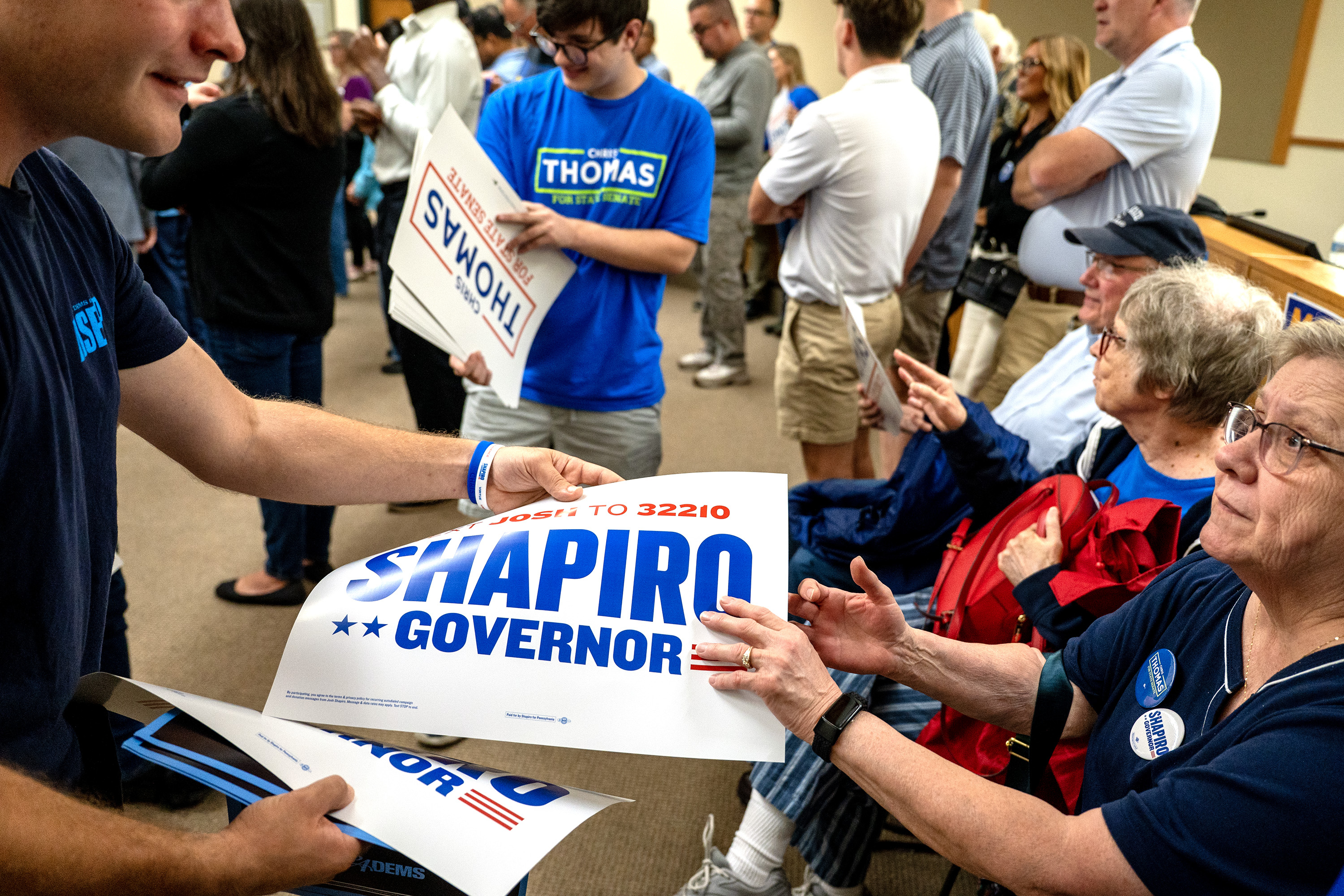
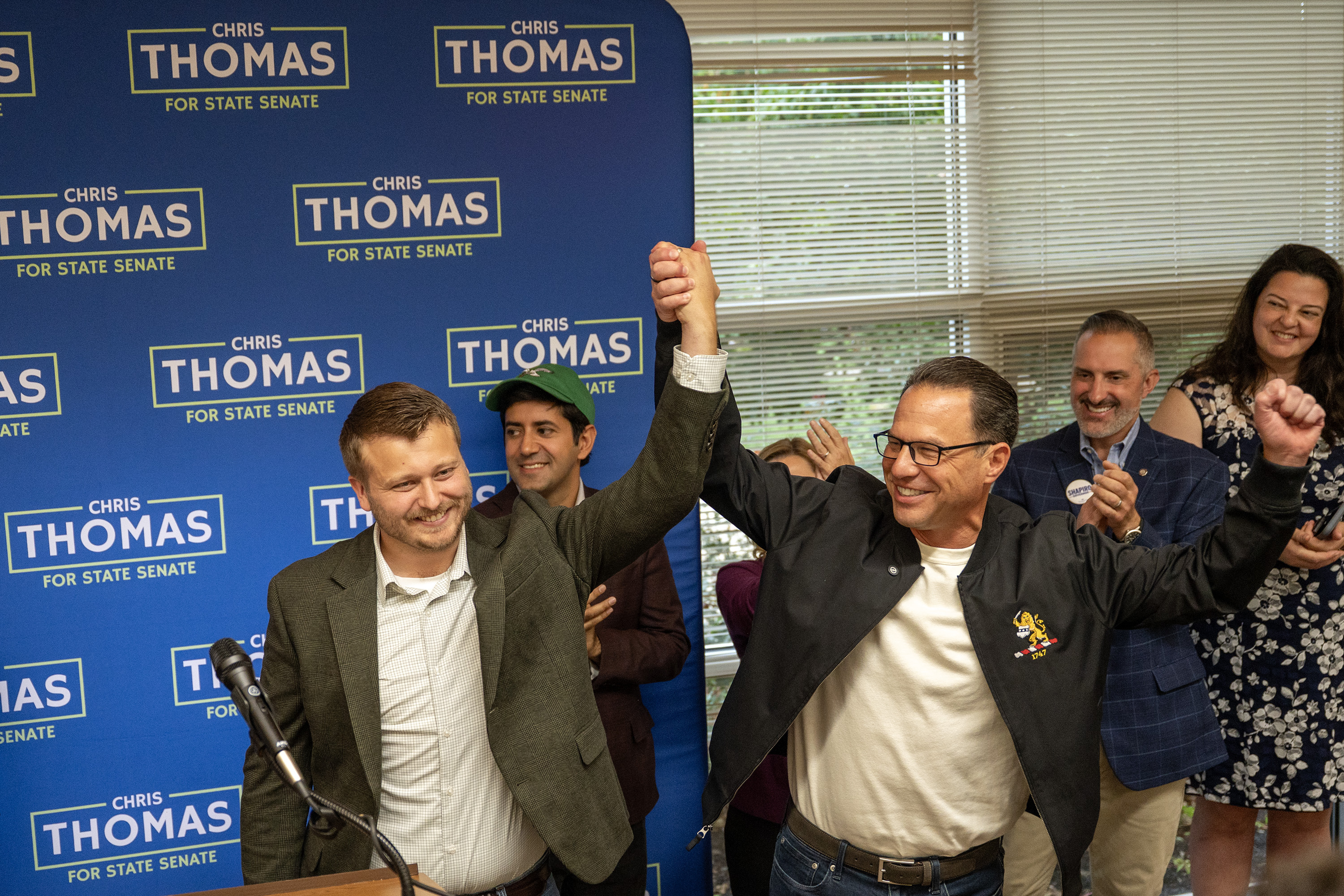
Campaign volunteers hand out signs to supporters of Gov. Josh Shapiro and Democratic Pa. Senate candidate Chris Thomas at a rally in Towamencin, Montgomery County before heading out to canvass on Sunday, Sept. 29, 2026.Tom Gralish / Staff Photographer
Approximately 60% of likely voters strongly approve or somewhat approve of the job Shapiro is doing as governor, according to the poll. That includes 30% of Republican voters, 89% of Democratic voters, and 59% of independents in the critical swing state where Shapiro maintains high popularity.
As a moderate politician, Shapiro has been able to capture most independent voters and even win over some Republicans, according to the poll.
Lesa Yeager, 63, considers herself an independent voter with centrist views who voted for a third-party candidate in the 2024 presidential election. She is an ardent union supporter and also thinks the nation should have a strong border. She said she trusts Garrity, as the state’s treasurer, to do a better job handling Pennsylvania’s economy.
But she is supporting Shapiro this November, in large part, because of his work on schools.
“I like that he’s very pro-education,” she said. “I am a fan of charter schools because I sent my kids to charter schools.”
Two of her children, now 35 and 37, benefited from smaller classroom sizes and adjustable curriculums, she said.
Yeager said she has also reached her limits with Trump’s behavior during his second term and believes Shapiro would continue to represent the state positively.
“I just think Trump is such a bully and so mean and just does whatever he wants, and I just want someone who isn’t that,” Yeager said.
She appreciates the Republicans who distance themselves from Trump. “But it’s tough to tell who is and who isn’t, a lot of times, and I would rather vote for someone I know isn’t going to support Trump on a lot of the things that he does,” she added.
Still, Garrity has found some backing among Pennsylvania’s electorate, though even some of those supporters say they don’t know much about her.
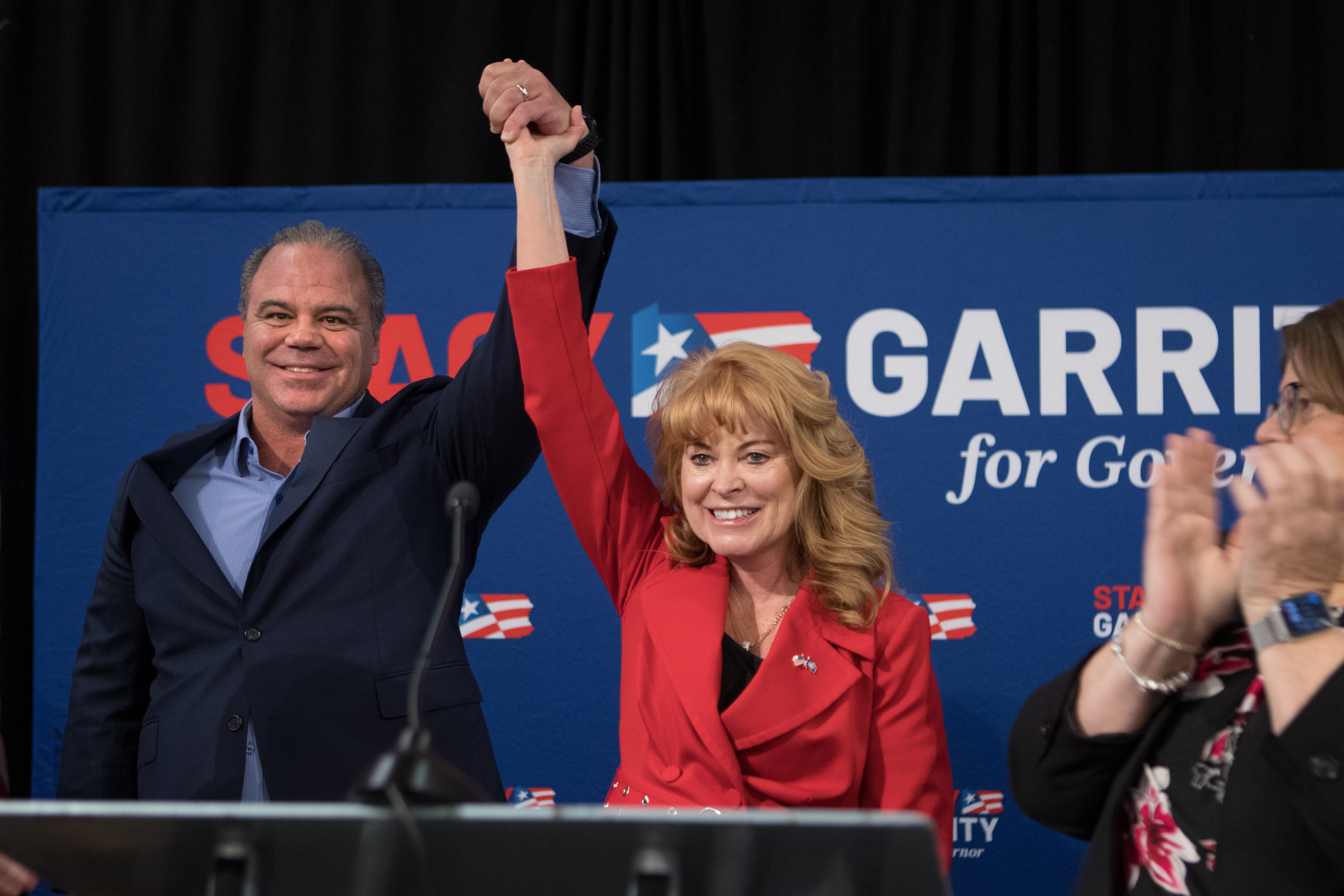
GOP gubernatorial nominee Stacy Garrity and her running mate Jason Richey hold up their arms in Harrisburg, Pa., Saturday, February 7, 2026. Kalim A. Bhatti / For The Inquirer
Susan Roller of Lancaster said she plans to vote for Garrity this fall because “she’s more responsible and will protect our freedoms.” Roller, who is retired, said she is particularly distressed about Shapiro’s positions supporting access to abortion and encouraging vaccines.
But as far as getting to know more about Garrity, Roller, 72, said she has not “seen a lot” of messaging on television about her.
In 2022, Shapiro did not participate in any debates while he maintained a double-digit lead over Mastriano, declining the Republican’s requests as an “unserious stunt.” Shapiro held a 13-percentage-point lead over Mastriano in a New York Times/Siena poll conducted that October — a closer margin than Shapiro’s lead over Garrity this year.
(function(){function e(){window.addEventListener(`message`,function(e){if(e.data[`datawrapper-height`]!==void 0){var t=document.querySelectorAll(`iframe`);for(var n in e.data[`datawrapper-height`])for(var r=0,i;i=t[r];r++)if(i.contentWindow===e.source){var a=e.data[`datawrapper-height`][n]+`px`;i.style.height=a}}})}e()})();
The 2022 midterm election was a much different political moment for Democrats, said Levy of the Siena Research Institute.
“That was a point in time when the Democratic star was on the decline,” he added. “Everything was a bit of a referendum on Democrats, on the job that [former President Joe] Biden was doing, how we were coming out of the pandemic.
“The overall political climate in which the ’26 election is taking place vs. ’22 is really kind of night and day,” Levy said.
Staff writers Joe Yerardi and Fallon Roth contributed to this article.
A whistleblower lawsuit accuses Gov. Josh Shapiro’s administration of bypassing procurement requirements meant to safeguard the use of taxpayer dollars, including during renovations to the governor’s mansion, and firing a staffer who had raised concerns.
The administration waived competitive bid requirements after purchases were made, split transactions to bypass the threshold requiring a bidding process, and kept paying a security contractor who no longer provided service, the suit says — claims that a spokesperson for Shapiro rejected.
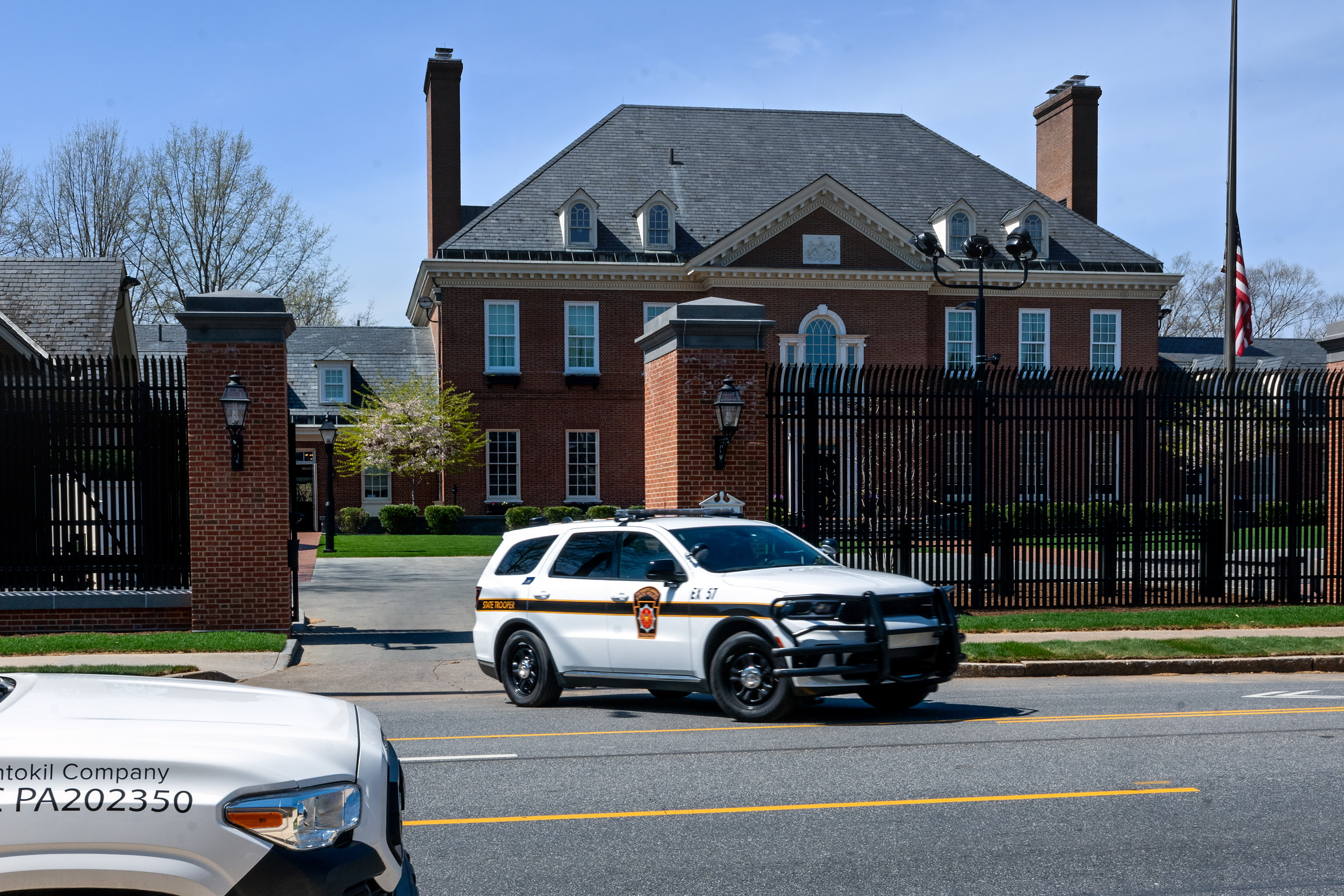
The federal lawsuit is the latest in the controversy surrounding the security upgrades and renovations to the state-owned governor’s residence in Harrisburg and Shapiro’s personal home in Abington Township, after a man firebombed the mansion on the first night of Passover in 2025 while the governor and his extended family were asleep inside.
This work was largely done through the state’s emergency procurement process that allows agencies to the skip lengthy bid protocols, as officials took quick action to strengthen security.
But the overall cost and questions over whether the correct processes were followed led to scrutiny by Republican lawmakers. The project at Shapiro’s Abington residence also led to a property dispute with his neighbors, who filed a federal suit against him that led the Shapiros to sue in return. Those lawsuits are ongoing.
Nicole Moyer, a procurement specialist with the Pennsylvania Department of General Services, claims in the federal lawsuit filed last week that after she repeatedly raised concerns about the “waste and wrongdoing” by the agency, she was fired.
Moyer, 49, has been working in procurement since 1995, first in the Army and later at the Pennsylvania State Police and various state agencies, according to the complaint. She joined the Pennsylvania Department of General Services in 2023.
Rosie Lapowsky, Shapiro’s press secretary, said in a statement that the allegations “by a disgruntled former employee who was dismissed from her position” are “totally and completely false.”
The suit, filed in the Middle District of Pennsylvania against the state, also names the Pennsylvania Department of General Services and former General Services Secretary Reggie McNeil, along with other officials from the agency that oversees the state’s purchasing, construction, and facilities. Shapiro is not a named defendant.
Mark Schwartz, a Delaware County attorney representing Moyer, said he hoped Shapiro will be deposed as part of the litigation.
“The question is how involved, if at all, was the governor in terms of the residence procurement process,” Schwarz said.
In her role as a procurement specialist, Moyer would not have beenaware of details about the emergency procurements for the governor’s residence project, Lapowsky added. Shapiro’s administration complied with “all relevant procurement policies,” she said.
“PSP identified necessary security improvements based on its assessment and issued an emergency declaration consistent with the procurement code in the fastest, most efficient, and most cost-effective way to complete the work and ensure the safety of the governor and his family,” Lapowsky said.
The whistleblower lawsuit claims the administration flouted bidding requirements and made purchases outside of existing contracts, often to meet specifications provided by Shapiro’s interior designer, de la Torre Design Studio.
The firm had been quietly hired to renovate the official residence by Team Pennsylvania, a Harrisburg-basednonprofit that operates the public-private partnership between the state and private businesses. Shapiro has come under scrutiny previously for utilizing the group to watch the Philadelphia Eagles lose to the Kansas City Chiefs in the 2023 Super Bowl and for other trips, Spotlight PA reported.
Josh Shapiro, governor of Pennsylvania, waves before meeting with Mike Parson, governor of Missouri, at the NFL Experience to make a friendly wager on the Super Bowl outcome. The governors met at the Lombardi Trophy on Saturday, Feb. 11, 2023, in Phoenix, Ariz. .David Maialetti / Staff Photographer
De la Torre had been working on the governor’s mansion before the fire, and asked for a specific brand of lighting fixture for the design.
The Pennsylvania Department of General Services deemed the $456,000 purchase too expensive, the suit says, and did not budge when the supplier revised the cost to $380,000.
But after the fire, the costly lighting fixtures were installed without any competitive bid or paper trail that would allow the purchase to be audited, according to the complaint.
Similarly, a $17,000 carpet was purchased and partially installed before procurement’s approval and outside existing contracts for carpets and floorings, the suit says.
Time and again, through other examples detailed in the lawsuit between the April 2025 fire and her March termination, the general services department had to issue waivers after the fact to “clean things up,” the suit says.
Moyer also questioned overlapping payments for the security monitoring companies for Shapiro’s residences, the home of Lt. Gov. Austin Davis, and regional offices, with one company not providing services for months, the suit says.
“Nonetheless, the proposed emergency job order contract that included provision for private residences was processed under the same umbrella as state facilities without bidding,” the complaint says.
The residences are not the only place Moyer says the administration fell short of the procurement requirement.
Earlier this year, the suit says, general services approved a $20,000 lactation pod for the Capitol even though a $4,950 option was available under an existing contract. The only difference between the pods was “outer fake ‘woodgrain’ decal,” according to the complaint.
“Plaintiff questioned the rationale for paying substantially more for a minimal aesthetic modification,” the suit says. “Plaintiff was overruled.”
Moyer was terminated in March after repeatedly reporting concerns, including on whether the department couldlegally make purchases for private residencies, the suit says.
Moyer, a registered Republican from York County, filed her suit just weeks ahead of the forthcoming midterm elections, in which Shapiro, a Democrat, is seeking a second term.
Lapowsky said the suit was “clearly timed” to hurt Shapiro politically.
McNeil left his post as secretary of the general services department in August. Shapiro appointed executive deputy secretary Sandra Aguilera to serve as acting secretary.
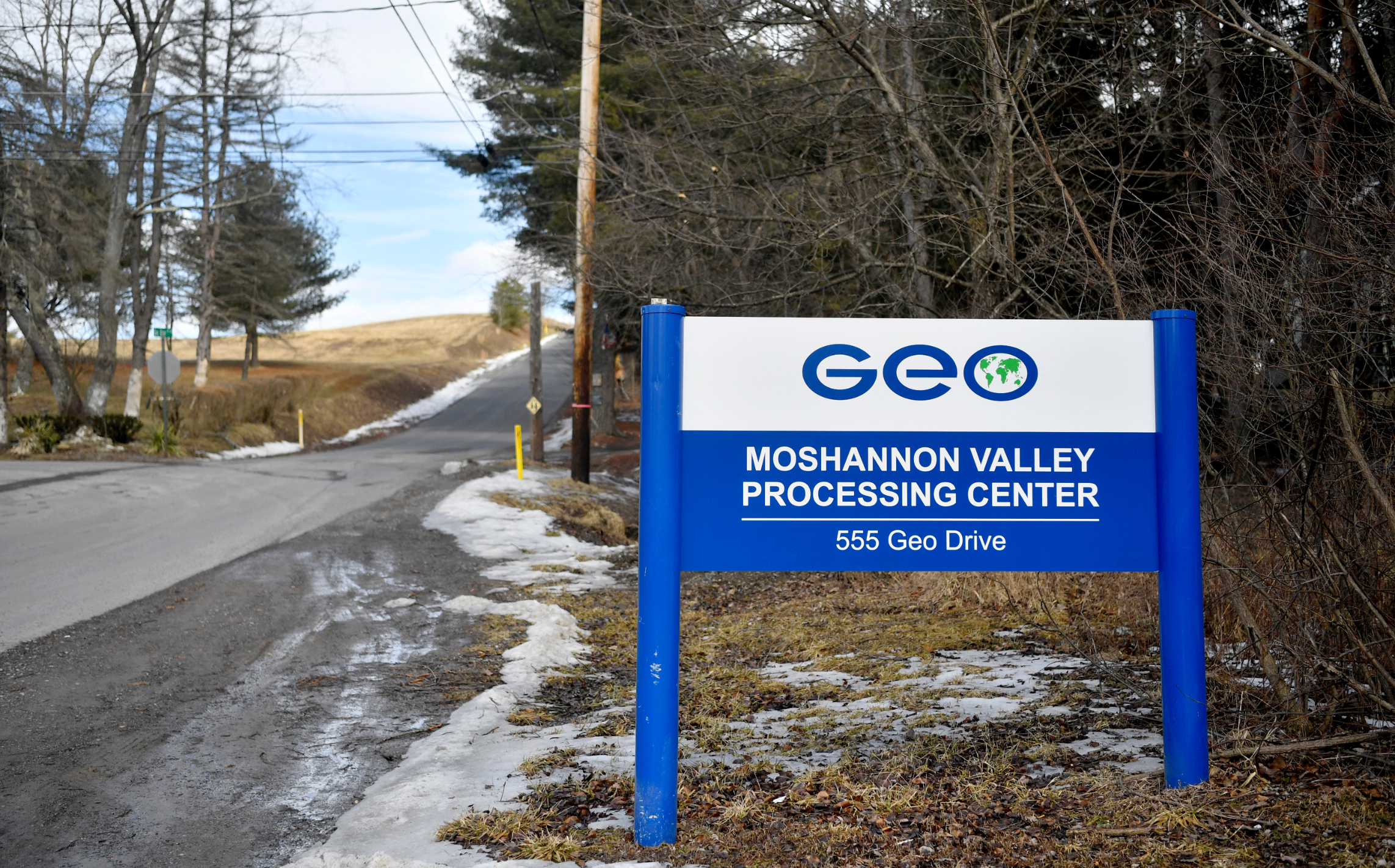
There are signs the Moshannon Valley Processing Center could end up being sold to the federal government, a move critics fear could insulate the center from some state regulation.
In the meantime, county officials approved a controversial extension of the current operating contract Tuesday, ensuring the largest detention center in the northeastern United States can run unimpeded for at least the next six months.
The contract between Clearfield County and Florida-based GEO Group, the for-profit owner of the 1,876-bed facility, was set to expire at the end of September. But Republican Commissioners Tim Winters and John Sobel voted 2-1 against Democratic Commissioner Dave Glass to extend GEO Group and ICE’s contract to operate the Moshannon center.
The vote came at a contentious meeting at which speakers from the audience mostly voiced opposition, questioning why the county had become entangled in federal immigration policy and doubting the true worth and use of the $100,000 payment.
“Blood money!” one person shouted after the vote.
Clearfield’s vote took place as President Donald Trump’s administration quietly mounts a takeover of private detention centers like Moshannon, as it is called, to expand bed capacity to support its mass-deportation goals.
Some local officials and immigration advocates think Moshannon may be next to be sold. In a statement, the Department of Homeland Security said ICE does not discuss potential facility acquisitions.
“The long-term solicitation process remains ongoing,” a spokesperson said.
Federal ownership could insulate the properties from compliance with certain local and state laws, important to the Trump administration when other expansion plans, like turning empty warehouses into detention centers, bogged down amid community and legal opposition.
Moshannon is a common destination of those arrested for immigration violations in Pennsylvania. An unannounced congressional oversight visit in May found that of the 1,417 adults detained there, roughly 78% lacked serious criminal charges or convictions of violent behavior — a contrast to Trump and his allies’ arguments for increased detention.
ICE agents outside the Delaney Hall migrant detention center in Newark, N.J., in June.LEXI PARRA
Trump’s push for mass detention and deportation
Congress voted in July 2025 to allocate $45 billion to the Department of Homeland Security for immigration detention, more than a decade’s worth of typical funding. At the time, Trump immigration officials touted the funding as a way to treat deportation “like a business,” with acting ICE director Todd Lyons saying he wants to see the deportation system run “like [Amazon] Prime, but with human beings.”
However, in June, ICE made plans to offload seven of those warehouses, totaling $700 million, by giving them to other agencies or selling them outright, according to the New York Times.
A warehouse purchased by DHS to house an ICE detention center in Surprise. Caitlin O'Hara
GEO Group’s founder and executive chairman, George Foley, said in a May earnings call that the private prison company was “engaged in an active process for the sale” of several facilities to ICE. Foley acknowledged Democratic-led states were considering more active oversight in detention centers, saying, “I think the logical solution to much of that is federal ownership of the facilities.”
GEO Group did not respond to a request for comment.
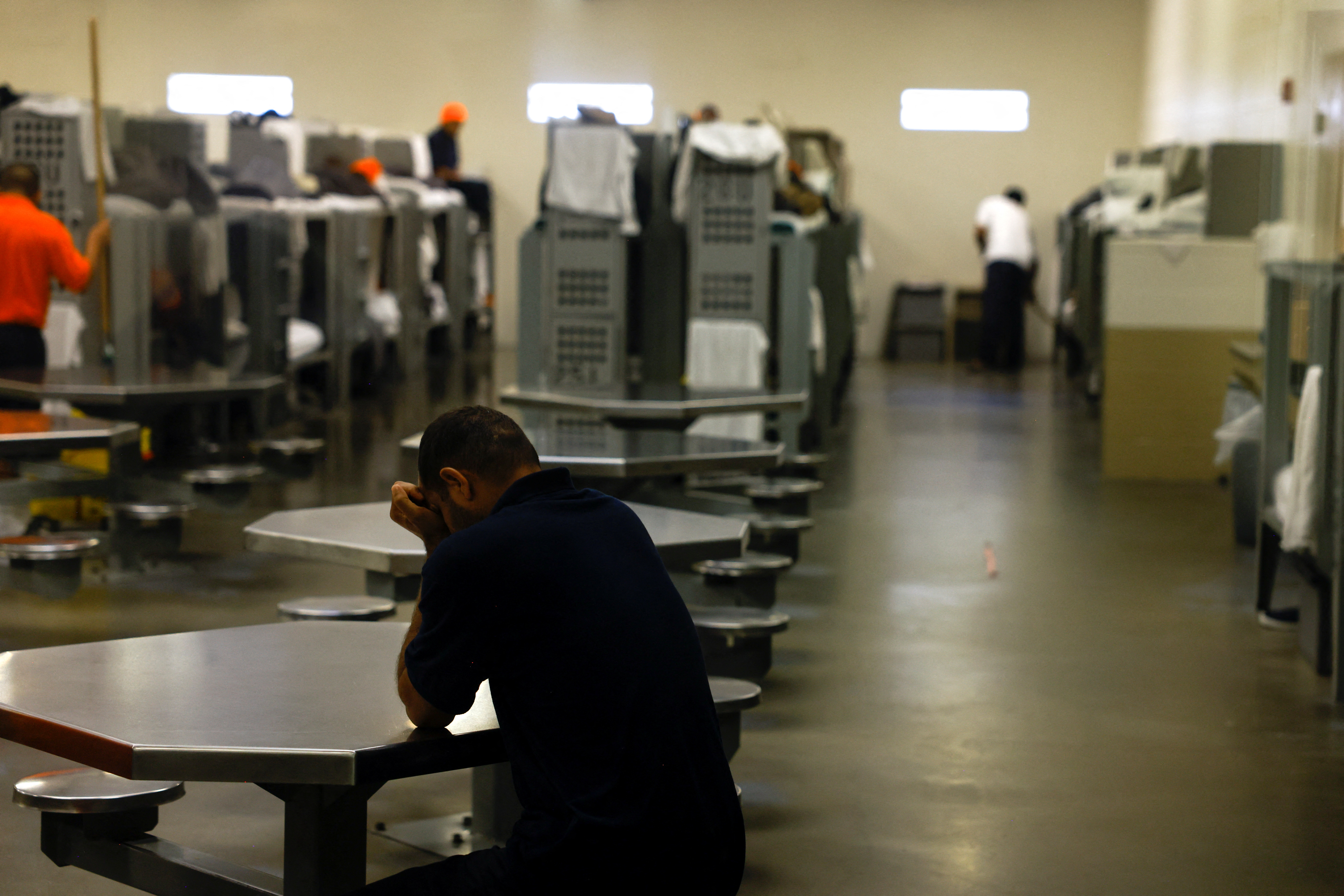
A detainee sits behind glass in a common area at the Moshannon Valley Processing Center in 2023.REUTERS / Quinn Glabicki
The potential sale of Moshannon to ICE
GEO Group has not officially stated its intention to sell Moshannon to ICE. But recent ICE contract bid requests and local dealings with the center’s warden are leading local officials and immigration advocates to suspect a sale.
Earlier this month, ICE requested 10-year contract bids for “turnkey” detention facilities across the country, including in the Philadelphia area. Moshannon is the only private facility in the region that fits that criteria, said Jasmine Rivera, executive director of the Pennsylvania Immigration Coalition, which had called on county commissioners to deny a contract extension.
Rivera said the proposal requests include provisions that could lead to the sale of private detention centers to ICE, similar to its dealings with CoreCivic. GEO Group and ICE’s contract extension “is a stopgap measure” so the parties have “the time to finish the land assessment in the sale of Moshannon,” Rivera said.
In a Sept. 8 Clearfield County commissioners meeting, Glass told the public he directly asked Moshannon warden Leonard Oddo earlier this year whether the Clearfield detention center could be sold to ICE. Oddo said no, according to Glass. In the first week of September, the commissioner e-mailed Oddo the same question, to which Oddo responded, “‘I’ll have to refer you to GEO corporate on that,’” Glass said.
“I took that as kind of a red flag that there may be some kind of a sale,” Glass said at the meeting.
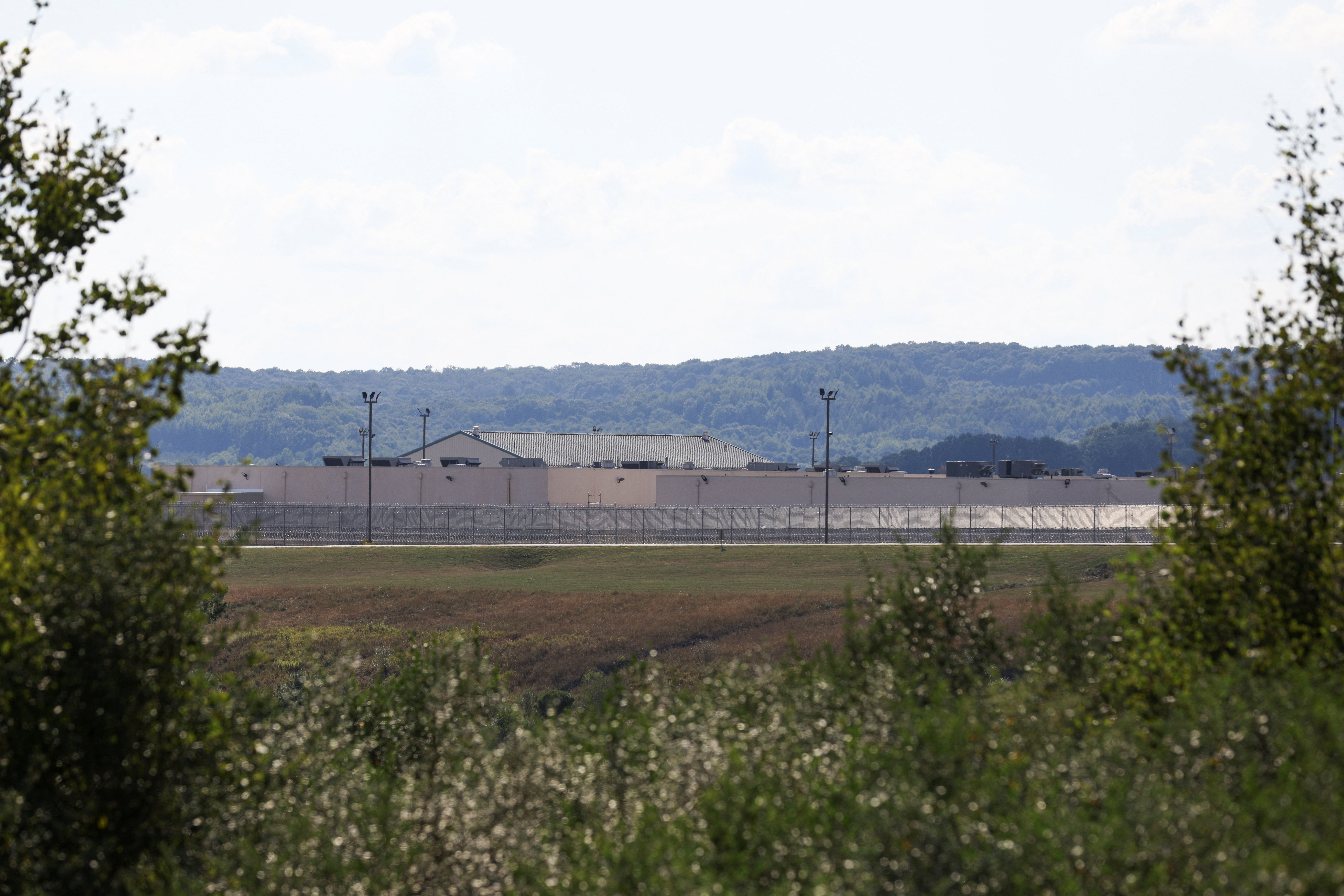
Moshannon Valley Processing Center, an ICE detention facility operated by the Geo Group, where migrants are housed, in Philipsburg, Pennsylvania, U.S., August 24, 2025. REUTERS/Quinn GlabickiREUTERS
What it means for Pennsylvania residents
Having Moshannon fall under federal ownership would mean many of the tax benefits Clearfield County receives for serving as a middleman would cease, Glass said.
“Whatever you think about the facility, having that facility sold to the federal government and losing the tax base on that would be a huge blow,” he said.
Clearfield commissioners have no say in approving the sale if GEO Group and ICE agree to terms.
Due to a now-reversed order that banned federal agencies from contracting with private prisons, GEO Group is contracted through Clearfield County, meaning ICE funding — around $5 million monthly — flows through Clearfield to GEO Group for operating the detention center. Clearfield collects a $200,000 administration fee for its intermediary role.
Winters, who voted to extend the contract, said that current federal immigration policy was “not working,” but that losing a seat at the table with ICE and GEO would leave Clearfield County worse off.
Voting “no” on the contract extension would have eliminated “our communication and our ability to investigate claims,” he said. “Our oversight ability is very small, but we still have it.”
For Rivera, any sale is concerning because ICE could ignore Pennsylvania lawmakers’ attempts to protect public health, environmental and zoning standards, and the safety of those detained, she said.
The newly extended contract will allow ICE to continue paying GEO Group for operating Moshannon through Clearfield County until mid-March 2027. At that point, GEO Group and ICE could approach the county with a new contract, or, as advocates and some local officials fear, federal ownership could come into play.
Gov. Josh Shapiro has raised more than $60 million toward his reelection effort since he took office, his campaign said Tuesday.
According to the campaign, those preliminary figures mean that the first-term Democratic governor has added $13.3 million to his war chest since June, as he maintains a significant fundraising edge over his Republican opponent Stacy Garrity.
Filings on Tuesday showed Garrity had raised around $1.8 million this cycle, with her campaign coffers nearing $3 million. After spending $1.5 million, she will enter October with roughly $1.4 million cash on hand.
So with a massive cash advantage, where will Shapiro’s campaign money go? And could anyone else benefit from his spending?
Even as he pulls ahead in polls, Shapiro has spent heavily on advertising. His campaign has promised he’s keeping his foot on the gas through Election Day in efforts to secure his own victory andelect Pennsylvania Democrats up and down the ballot in hopes of flipping the state Senate and electing Democrats in four battleground congressional districts. He’s donated roughly $5.7 million in total to the state party to fuel theeffort, an additional $2.5 million since June, according to his campaign.
Beyond the November election, he’s widely expected to launch another campaign as a 2028 presidential prospect. Although the law prevents him from transferring his gubernatorial campaign money into a political action committee that funds a run for president, that doesn’t mean he’ll spend all his fundraised money before this year’s election, experts said.
In the governor’s race, the first checks he owes are paying for campaign staff salaries, spending money on advertising, and renting leases for field offices, among other costs, according to campaign experts. As a careful politician, he’d likely also want to reserve a fair amount of cash for surprise developments in the race, they said.
But after all of Shapiro’s receipts are accounted for, experts said, a potentially large stock could remain available, presenting him with options for how to spend it — if at all.
Daniel Weiner, the director of elections and government at the Brennan Center for Justice, said Shapiro has several options available.
“It is incredibly common for candidates who are not facing an especially competitive race to still try to raise money hand over fist and amass a war chest,” Weiner said. “It can be used to fund a future run for office of one sort or another. It can also be used, increasingly in this era of very deregulated money in politics to just build a general political machine.”
Keeping it in the party
Shapiro, who has maintained high favorability among both Democrats and Republicans, has established himself as a formidable fundraiser, bringing in dollars from across the commonwealth and the nation. Donors can give him as much as they’d like, since there is no limit on political contributions in Pennsylvania, said Matthew Foster, a professor of political science at American University.
“There’s a lot of ways for politicians to use political cash to help their allies and to help their team,” said Michael Beckel, an expert on money in politics at Issue One, a Washington, D.C.-based bipartisan nonprofit. “They can spread that money around to help people who need it. And there’s certainly a lot of people who might potentially want help from a big name like Governor Shapiro.”
Pennsylvania law allows Shapiro to transfer endless amounts of money from his campaign account to other state candidates. His campaign said he had not given any money directly to state candidates,but that he has supported them in other ways.
He is also not allowed to transfer money from his gubernatorial campaign to any congressional candidates.
Instead, he has poured money into the state party.
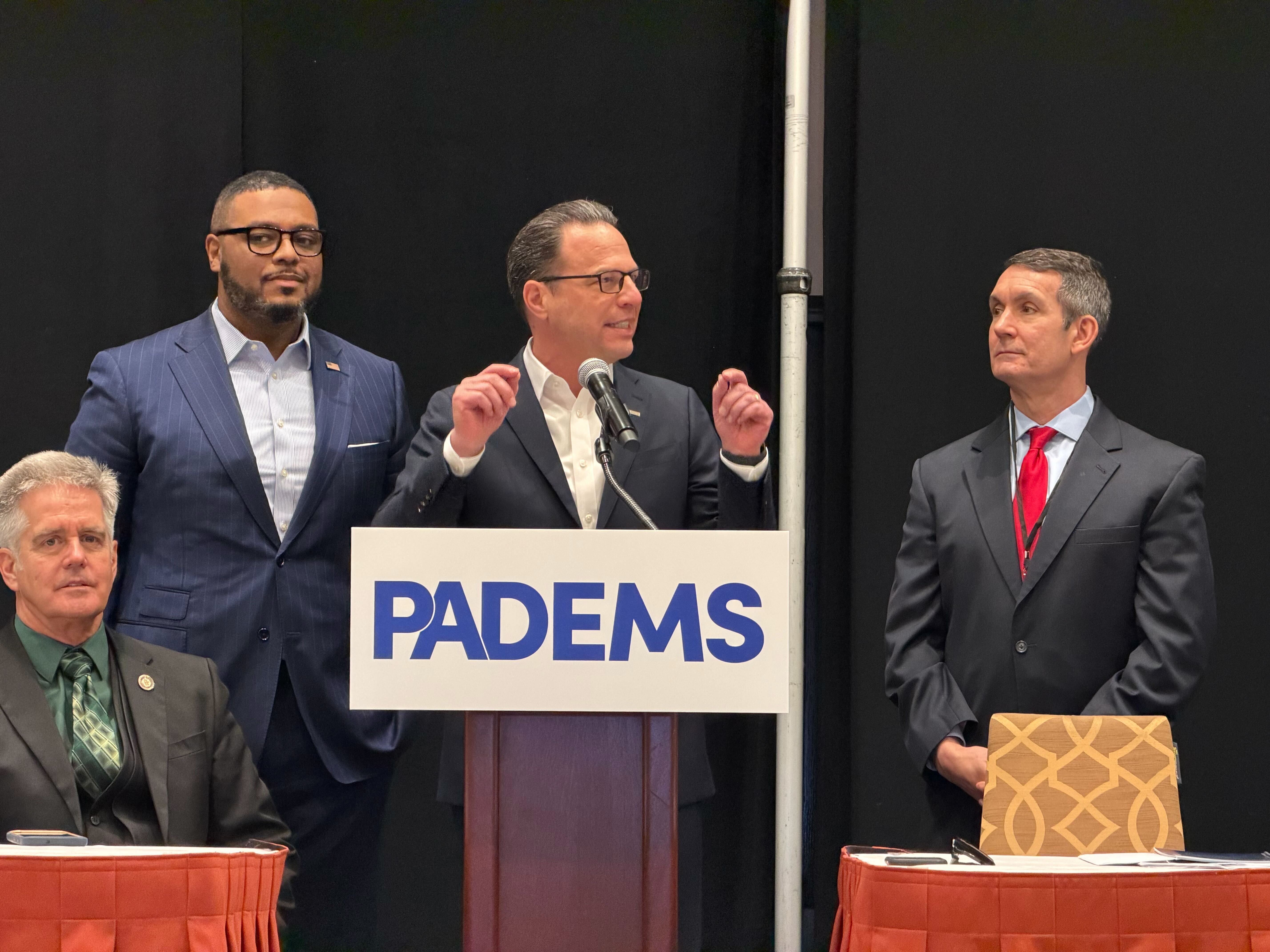
Pennsylvania Gov. Josh Shapiro accepts the endorsement for a second term as governor at the state Democratic Party’s winter meeting in Harrisburg on Feb. 7, 2026.Gillian McGoldrick
Since last fall, Shapiro has given $5.7 million to the state Democratic Party and its election effort. That money is used to benefit Shapiro as well as state Senate and congressional candidates by pooling funds for their field offices, signage and volunteers.
“A donation to the state party historically has helped get the vote out statewide,” said Philadelphia-based Democratic strategist Adam Erickson.
Plus, donating to the state party versus national groups helps to ensure the money is spent on Pennsylvania races, Weiner added.
Pennsylvania Republicans have held on to the state Senate for more than 30 years, even as the House chamber and governor’s mansion have swapped partisan control and are currently both occupied by Democrats.
This year, Democrats have “a strong opportunity to flip the state Senate,” Erickson said, but that the effort will take “an unprecedented amount of spending” from Shapiro and the state party.
Often, Shapiro has appeared alongside candidates at campaign events, rather than donating to them. On Sunday, Shapiro joined Democrats in Chester and Montgomery Counties to kick off door-knocking and phone-banking efforts benefitting several legislative candidates, such as state House candidate Elizabeth Moro in Chadds Ford and state Senate candidate Chris Thomas in Harleysville.
“Under Governor Shapiro’s leadership, the Party is rallying support all across the Commonwealth and putting Democrats in a strong position to win everywhere this November,” said Manuel Bonder, a spokesperson for Shapiro’s campaign.
Campaign volunteers hand out sign to supporters of Gov. Josh Shapiro and Democratic Pa. Senate candidate Chris Thomas at a rally in Towamencin, Montgomery County before heading out to canvass Sunday, Sept. 29, 2026. Tom Gralish / Staff Photographer
Tim Ford, an attorney who handles legal concerns for Democratic campaigns in Pennsylvania, said Shapiro’s sizable bank account is “also a flex to show he’s capable of raising this kind of money,” and another clue that he may be eyeing a higher office.
If Shapiro does choose to run for president, he’s not allowed to legally transfer his state-level campaign fundraising to a federal political action committee associated with his campaign.
“One thing that I think people get wrong is they believe that he’s raising money for his next office,” Erickson said.
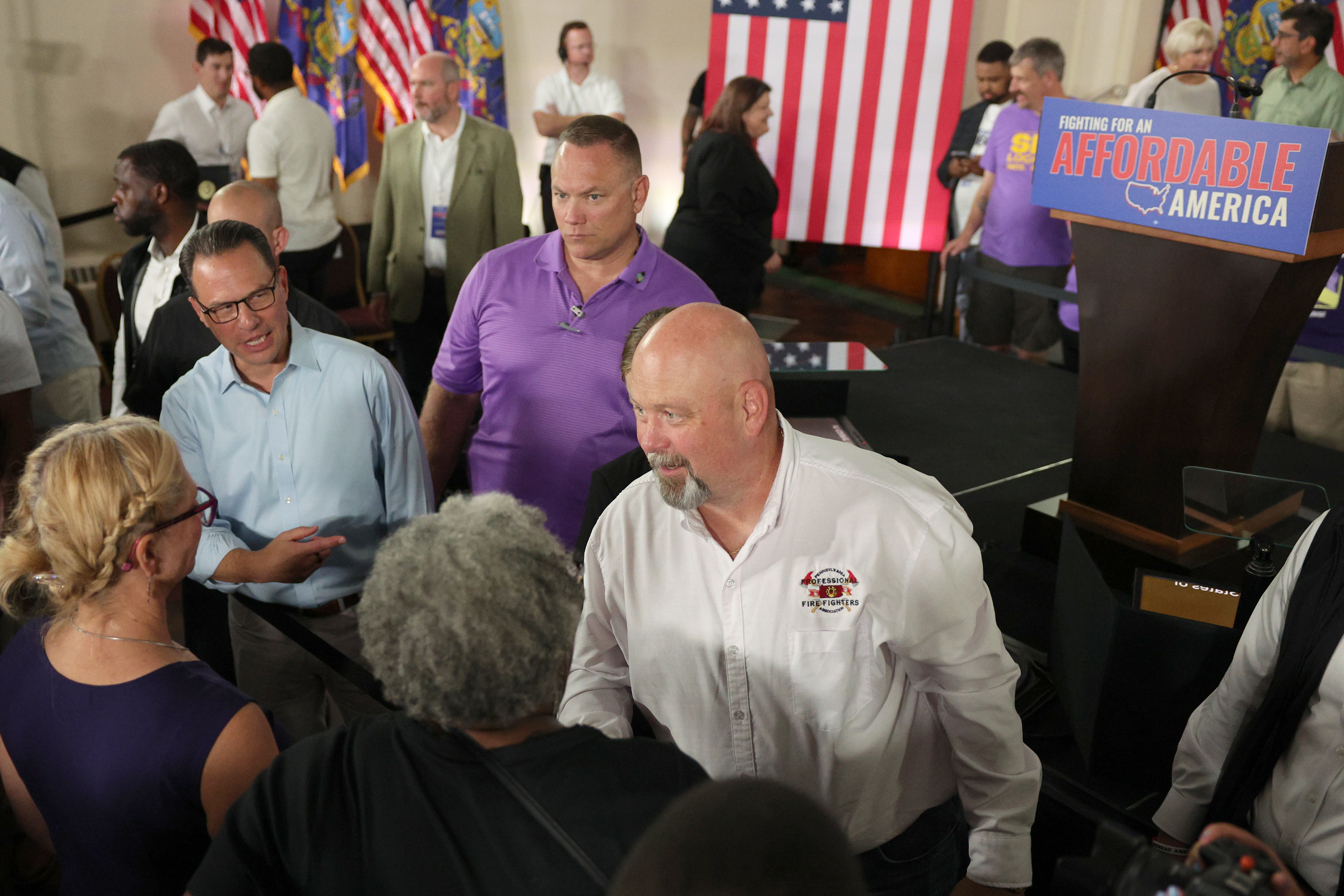
Governor Shapiro (left) and Democratic congressional candidate Bob Brooks (right) greet supporters during a campaign event at the United Steelworkers Union Hall in Bethlehem on July 26, 2026.David Maialetti / Staff Photographer
That would put him at a slight disadvantage compared to any sitting federal elected officials who can spend their campaign funds on a presidential run and who are also speculated 2028 presidential contenders, including U.S. Rep. Alexandria Ocasio-Cortez and U.S. Sens. Mark Kelly and Jon Ossoff, who has been the top fundraiser this midterm cycle.
Still, Shapiro’s cash stockpile “sends a message that he’s been a successful fundraiser,” Beckel said. “While past performance doesn’t guarantee future results, he certainly would try to [leverage] that to his advantage to say, ‘I’ve been a successful fundraiser in the past, I will be a successful fundraiser in the future’.”
Former staff or associates could create a federal super PAC, a type of political action committee that can take in and spend unlimited contributions but must do so independently of a candidate and without directly coordinating with the campaign. Shapiro could repurpose his state campaign account into that super PAC, Weiner said, but he would have no say on the messaging in ads or how money is spent.
While this practice of loose coordination skirts the spirit of the law, Weiner said it often goes unenforced.
“In theory, super PACs are supposed to be independent from candidates, but in practice, they work hand-in-glove with them,” he said.
Former staffers of Maryland Democratic Gov. Wes Moore, another potential 2028 contender, have established the Unity First PAC. Moore has headlined fundraisers for the group, but is not technically in control of the PAC.
California Democratic Gov. Gavin Newsom, who may also run for president, launched a super PAC called Campaign for Democracy. The PAC has poured $1.7 million into state party and legislative committee races, mostly in South Carolina, where Democrats will hold the first contest of the presidential primary race in 2028.
There are no official records that Shapiro, or those associated with him, have created a super PAC, according to FEC filings.
Super PACs have earned a negative reputation in some circles, particularly among Democrats who view them as a means to give wealthy donors outsized influence on elections. But in 2028, Shapiro and other Democrats will be under pressure to use all the tools available to them, Weiner said.
It’s a difficult bind, said Faith Williams, who works on anti-corruption and accountability efforts at Common Cause, a democracy-focused nonprofit.
“Our system is not good,” she said. “But at the moment everyone is playing in it, and that I think that makes it even harder to reform it because it’s hard to have the genuine desire to reform a system that currently benefits you.”
Shapiro could also develop a nonprofit organization with his campaign funds. The 501(c)(4) groups, which can spend on political ads but cannot make electoral activity their primary focus, are under no legal obligation to disclose their donors. In some cases, this opens the door to donations from so-called “dark money” groups, or those that obscure the role of their funders.
Experts pointed out that he could also use his leftover money for his second gubernatorial inauguration or donate it to charity. And, in an unlikely maneuver, Williams said Shapiro could refund his donors and ask everyone to donate again to a federal campaign.
But the best way to get from Pennsylvania to Pennsylvania Avenue, Erickson said, would be to ensure success in the statewide elections this year.
“Playing a large role in flipping the state Senate will put him in the best position going into 2027 and beyond for any larger aspirations,” he said.
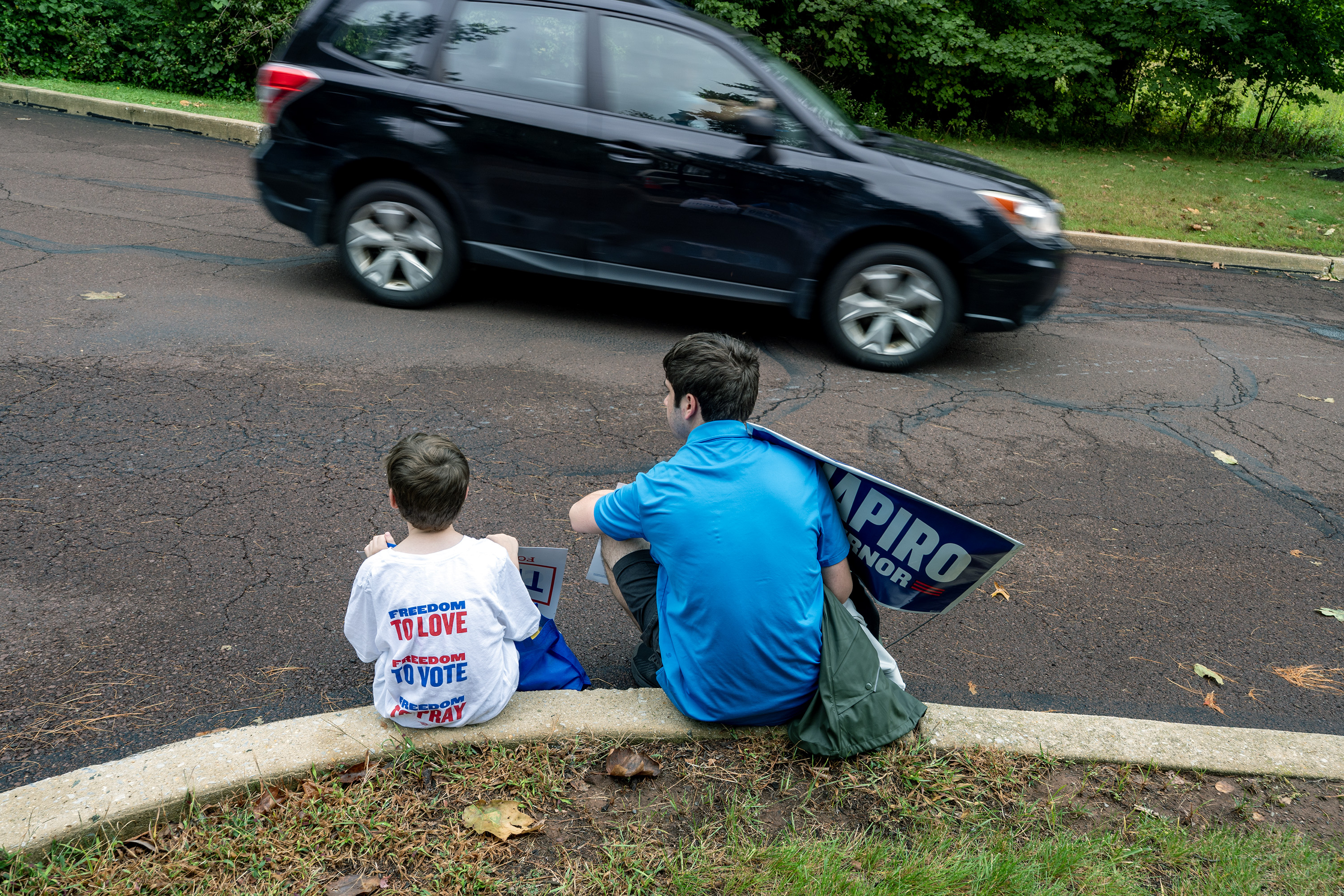
Brothers Desmond DeBaun, 5, and David Hayman, 16, after a rally with Gov. Shapiro and Democratic Pa. Senate candidate Chris Thomas in Montgomery County Sunday, Sept. 29, 2026. Tom Gralish / Staff Photographer
The Trump administration will be overhauling the SNAP program in two major steps, forcing Pennsylvania to pay more for the federal food program and jeopardizing those in need, according to Gov. Josh Shapiro’s office.
The first phase begins Oct. 1, when states will have to pay for 75% of the expense of administering the Supplemental Nutrition Assistance Program, an end to the 50-50 cost-sharing relationship between the federal government and the states that existed for decades.
The second and more dramatic change is scheduled to commence a year from now, when the Trump administration demands that states pay for a portion of SNAP benefits — an unprecedented arrangement that could put Pennsylvania on the hook for as much as $400 million of the approximately $4 billion the state receives in SNAP benefits annually.
That’s a price the state is not ready to pay.
“Pennsylvania’s state budget cannot make up for huge cuts to federal SNAP funding that will shift these costs onto states,” Shapiro spokesperson Rosie Lapowsky said in a statement. “And those cuts risk leaving hungry Pennsylvanians without food assistance.”
The Trump administration plan, part of President Donald Trump’s One Big Beautiful Bill Act, is roiling Democrats and SNAP advocates who view it as an effort to weaken the food benefits program by saddling Pennsylvania and other states with the responsibility of paying for something they cannot afford.
In anticipation of the first new rule going into effect in two weeks, Shapiro earmarked $87 million in the state budget to administer the SNAP program in the state, which includes paying for operating expenses.
Burdening states with increased financial demands is “catastrophic,” said St. Joseph’s University sociologist Maria Kefalas.
Kefalas said it will force states to make drastic moves to make up for lost dollars, including making eligibility rules harder and shrinking benefits.
“The pressure on states to push people off SNAP will be tremendous,” she said. “The Trump act was written to shift blame for cuts to safety-net programs from the federal government to the states. Now, the states will be seen as the bad guys.”
The original even split for administrative costshad the state and the federal government each paying $250 million in SNAP administrative costs, according to the Pennsylvania Independent Fiscal Office (IFO), anonpartisanlegislative agency that analyzes budgetary issues.But after Sept. 30, the state could be looking at as much as a $125 million increase in payments annually, IFO figures show.
Shapiro’s $87 million budget infusion covers that increase for a portion of the state fiscal year, said Brandon Cwalina, press secretary for the Pennsylvania Department of Human Services, which oversees SNAP.
The Trump administration says that by forcing states to put skin in the game, it is incentivizing them to cut waste, fraud, and abuse in the program.
“President Trump is strengthening SNAP for the Americans who need it by ensuring these programs are sustainable for future generations,” White House spokesperson Anna Kelly said in a statement.
She added that the One Big Beautiful Bill Act implements “reasonable” cost-sharing measures with states.
Kelly also said that by signing the bill into law, Trump is “uplifting every American’s financial situation by passing the largest tax cut in history.”
But concern is growing that by compensating for SNAP shortfalls, states will pull funds from other sources.
“Does this mean money will be taken from police, courts, and other critical functions to pay for SNAP?”asked State Sen. Art Haywood, the top Democrat on the Health and Human Services Committee, who represents part of Philadelphia and Montgomery County.
Error rates
How much the state will have to pay in SNAP benefits in October 2027 depends on its payment error rate, a measure of overpayments and underpayments of benefits.
Error rates are largely unintentional and are not fraud, according to the Food and Nutrition Administration of the U.S. Department of Agriculture, which runs the SNAP program.
“It’s like doing your taxes and accidentally switching numbers,” said Ann Sanders, director of public benefits policy and programs for Just Harvest, a Pittsburgh-based anti-hunger nonprofit. “Not a crime, just a mistake.”
In fiscal 2025, Pennsylvania’s error rate was 9.2%, mostly representing overpayments, said IFO director Matt Knittel.
Even though it is below the national error rate of 10.6%, if the 9.2% level holds, Pennsylvania could be made to pay as much as $400 million a year when the new rule takes effect, IFO figures show.
“These are costs Gov. Shapiro has made clear we cannot backfill,” Cwalina said. The Shapiro administration, which has had some success lowering error rates, has introduced new technology that helps flag potential errors before incorrect payments are made.
The reorganization of SNAP’s functions and financing comes during an ongoing affordability crisis, said George Matysik, executive director of the Share Food Program, which supplies many food pantries in the Philadelphia area.
“Instead of the federal government helping to solve it, it’s just passing the buck onto the consumer,” he said. “Prices are going up, while Washington punches down on the working class.”
While the new changes have yet to kick in, Trump’s One Big Beautiful Bill Act has already altered SNAP to help pay for his tax cut.
The administration has expanded work and documentation requirements for SNAP recipients, resulting in millions of people seeing their benefits lowered or eliminated.
Nationwide, between July 2025 and May, SNAP rolls have decreased by more than 5 million people, or 12%, according to the Center on Budget and Policy Priorities, a left-leaning Washington-based think tank.
As of July, the latest Pennsylvania DHS estimates show that 94,200 people have lost benefitssince Trump’s law took effect.
The changing contours of the SNAP program worry legislators accustomed to its normally steady rhythms.
“There was a 60-year-long partnership between the federal government and the states on SNAP, without problems,” Haywood said.
“SNAP worked well since it got its start in 1964.But now, unfortunately, the current administration is dramatically changing it.”