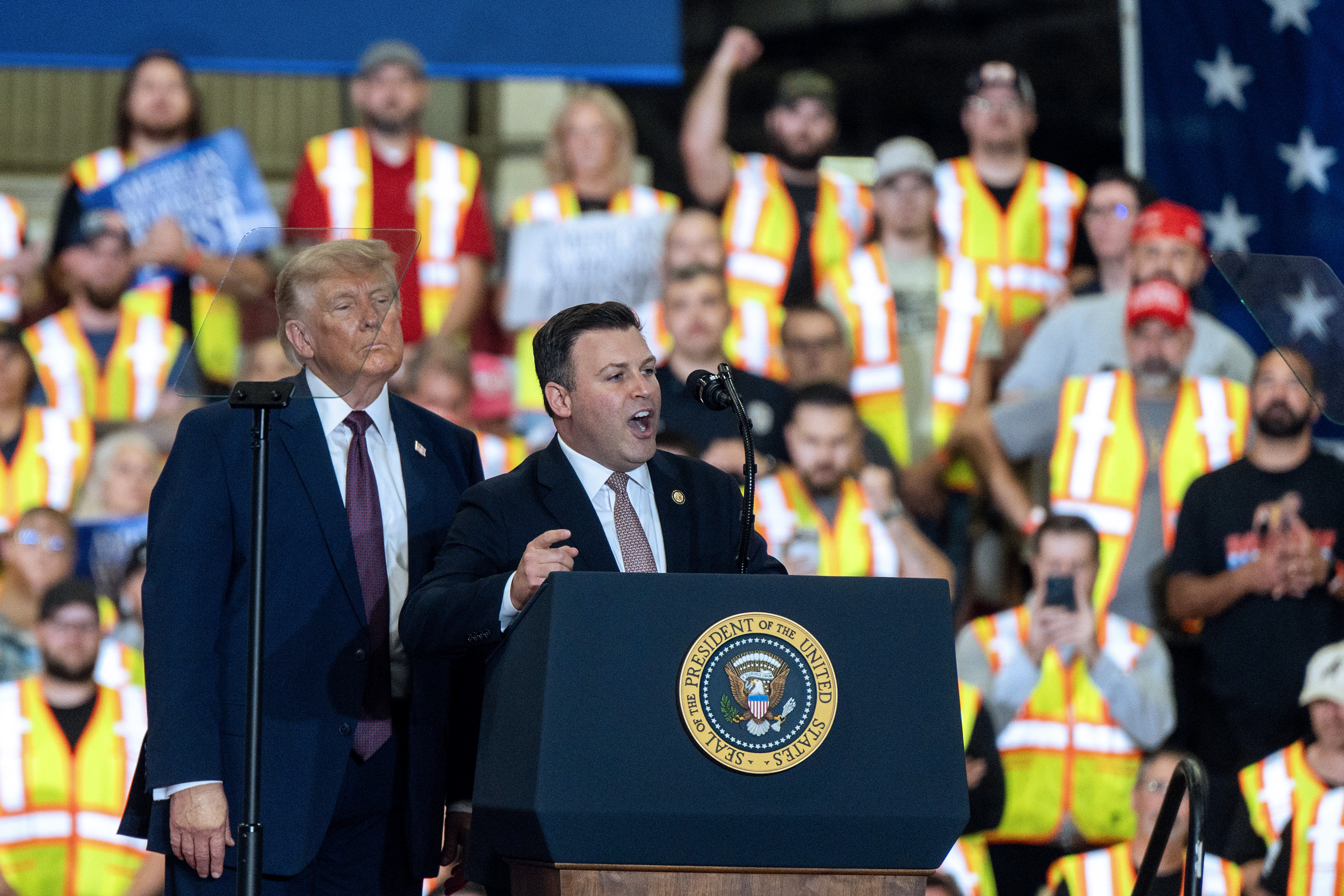
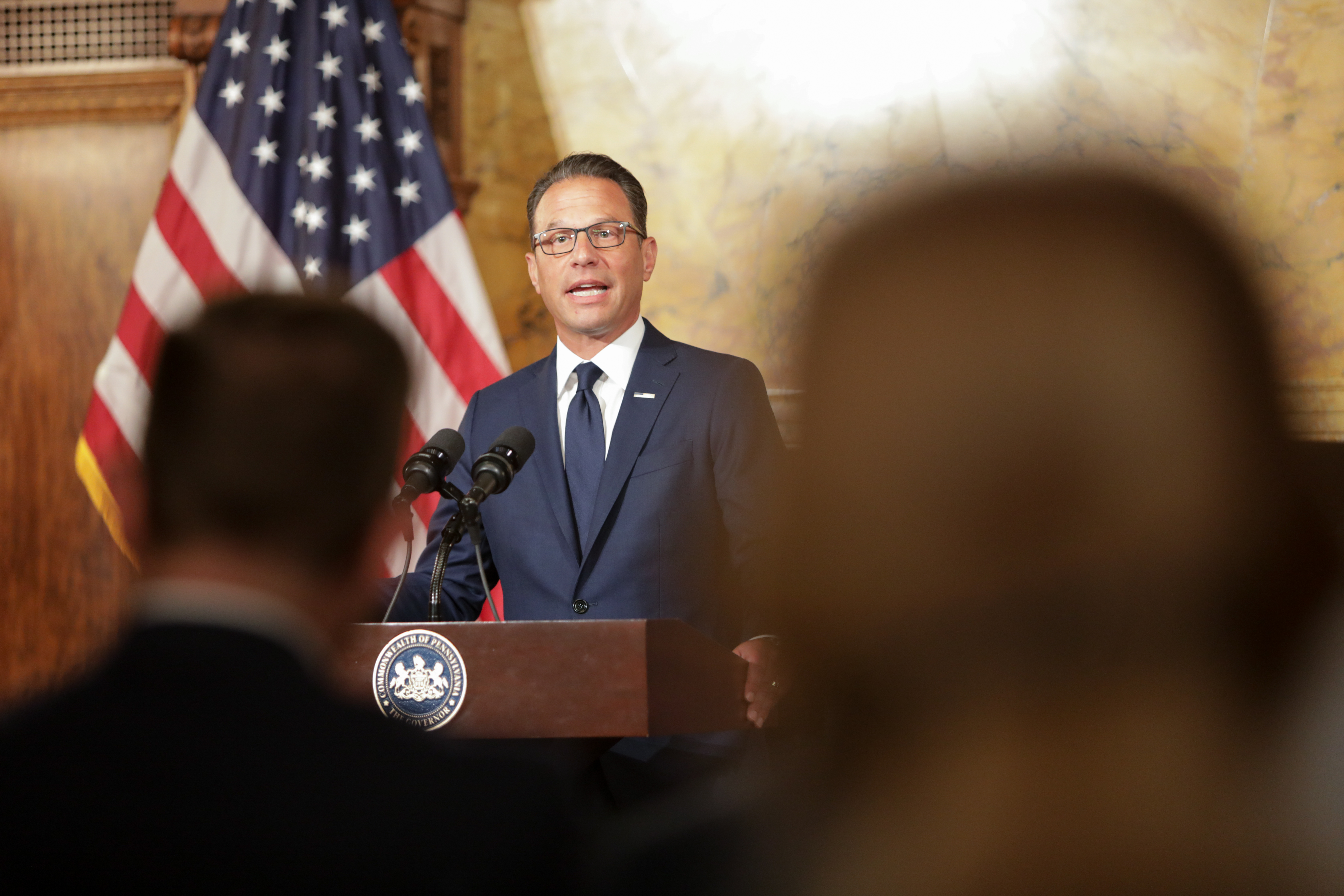
HARRISBURG — For more than two decades, Gov. Josh Shapiro has worn it almost every day.
The small, thin accessory affixed to his lapel — a compressed version of the 50 stars and 13 stripes — may require one to squint to see. But it carries significant meaning to the Democratic governor, with an origin story that began on Sept. 11, 2001, when Shapiro was a young staffer on Capitol Hill.
Shapiro was working in Washington when he experienced the pain and confusion of the deadliest terrorist attack in the nation’s history, he said in a June interview.
He was just steps away from the U.S. Capitol building in then-U.S. Rep. Joe Hoeffel’s office, where he served as chief of staff, when he watched as the Today show anchors announced a plane had hit the World Trade Center. And then another.
He realized, like thousands of Americans, that the nation was under attack — with Washington as a potential target. Less than an hour later, Shapiro said, he saw the smoke coming from the Pentagon. Staff were given mixed signals on whether to evacuate before ultimately being told to hunker down in legislative buildings until the situation was clear, he said.
When Shapiro arrived on Capitol Hill the next day, a woman who worked in the Capitol gift shop was giving out American flag pins to anyone who passed by — the “typical gift shop” pin depicting a waving flag that President George W. Bush and other politicians began to wear in the aftermath of the 9/11 attacks, he said.
The pin became a part of Shapiro’s daily business uniform. He wore it every day, even after he left D.C. and began working at a law firm in Montgomery County while preparing to run for state representative — his first foray into elected office and the start of a decades-long career.
When Shapiro was knocking on doors for his 2004 run for the state House, a veteran in Glenside told him his gift shop pin wasn’t cutting it. The veteran gave Shapiro a nicer one: an image of the American flag in a thin, metal bar.
“And I’ve worn it basically every day since,” Shapiro said in June ahead of his appearance at a special session of the U.S. House at Independence Hall to commemorate America’s founding 250 years ago. Widely rumored to be a future presidential contender, Shapiro often talks about his pride in America and its ideals, and his fears that the country is becoming too divided and straying from the founders’ aspirations.
“I am a proud, patriotic American,” he said, referencing his pin. “I don’t think patriotism belongs to one party. I don’t think it should ever be partisan.”
Over the years, Shapiro has made slight changes to the flag accessory; he shaved down the pin stem and made it into a magnet.
“It was destroying my suits,” he added.
He said he once lost the pin when it fell off a jacket that he had hung up on a plane.
“I freaked out. I literally freaked out,” he said.
He said he and the flight attendant were on their hands and knees trying to find it in the plane’s closet. They found the pin, but never found the backing, which was replaced much more easily.
“I found the most important thing, and I just got another magnet,” he said.
Shapiro will appear at the Flight 93 Memorial near Shanksville, Pa., alongside members of President Donald Trump’s administration, includingU.S. Interior Secretary Doug Burgum, for a service on Friday to commemorate the 25th anniversary of the attacks, in which more than 2,900 people were killed.
United Airlines Flight 93, a San Francisco-bound passenger plane flying out of Newark, was hijacked on Sept. 11, 2001. It was believed to be headed to the White House or U.S. Capitol, near where Shapiro was working at the time — before its 40 passengers attempted to retake control and crashed the aircraft in a field near Shanksville.
DALLAS, Texas — As Republicans look to keep their narrow control of Congress by defending the seats they flipped in 2024, there aren’t many places where they can afford to lose fewer votes than in U.S. Rep. Ryan Mackenzie’s district covering the Lehigh Valley and Poconos.
Mackenzie’s takedown of a three-term Democrat by a mere 4,000 votes two years agowas the narrowest congressional race in Pennsylvania — his 1% margin of victory was the seventh smallest out of 435 House districts across the country.
Standing Thursday on the Republican Party’s biggest stage of the year — and likely staring down another razor-thin result this fall — Mackenzie didn’t hold back when laying out the potential stakes.
“I’m running in one of the top races again, and it will determine the future direction for our nation,” Mackenzie said on the second day of the first-ever Republican midterm convention. “Now we must get to work, we must go out and win in November, and we must save America.”
In an interview after a brief speech that focused on the president’s signature tax cuts, Mackenzie said Democrats’ threats to repeal those cuts and other Trump policies meant the president is, in a sense, on the ballot — so it makes sense to campaign in that way.
“We know the history of American politics is the party who has the White House, their voters end up being less energized in midterm elections, and so I think it was a smart idea to try something like this, a midterm convention, to energize our voters,” Mackenzie said.
Generating enthusiasm for the Republican ticket could be a tough task for Mackenzie and other incumbents, with polling in Pennsylvania showing widespread frustration with Trump’s handling of key issues, including the cost of living.
“Everybody is getting gouged,” said Ron Jones, 79, an Allentown Democratic voter and Navy veteran who said he feels stretched relying on his Social Security and pension checks. “You just can’t afford to live. Period.”
Jones said he hasn’t been following the congressional race closely, but said he plans to help “get rid of all incumbents.”
President Donald Trump onstage during the Republican Party’s unusual midterm convention in Dallas on Wednesday, Sept. 9, 2026. (Haiyun Jiang/The New York Times)HAIYUN JIANG
Going after Brooks on a national stage
Mackenzie told The Inquirer his phone started blowing up with text messages immediately after his speech. The lawmaker said he welcomed the opportunity to have a national audience to talk about his work, and his opponent.
Mackenzie didn’t just applaud Trump’s policies during his speech, he also imitated the president’s ferocious style of politics by blasting his Democratic challenger Bob Brooks as a scandal-ridden, “far-left nutjob.”
Brooks, he contended, was “handpicked by the Democratic establishment,” and has spoken critically about nonunion firefighters. He also accused Brooks of stealing money from his own family, a claim based on a lawsuit brought by Brooks’ former mother-in-law and involving a decades-old debt she says that he owes.
“That’s what crazy looks like,” Mackenzie said.
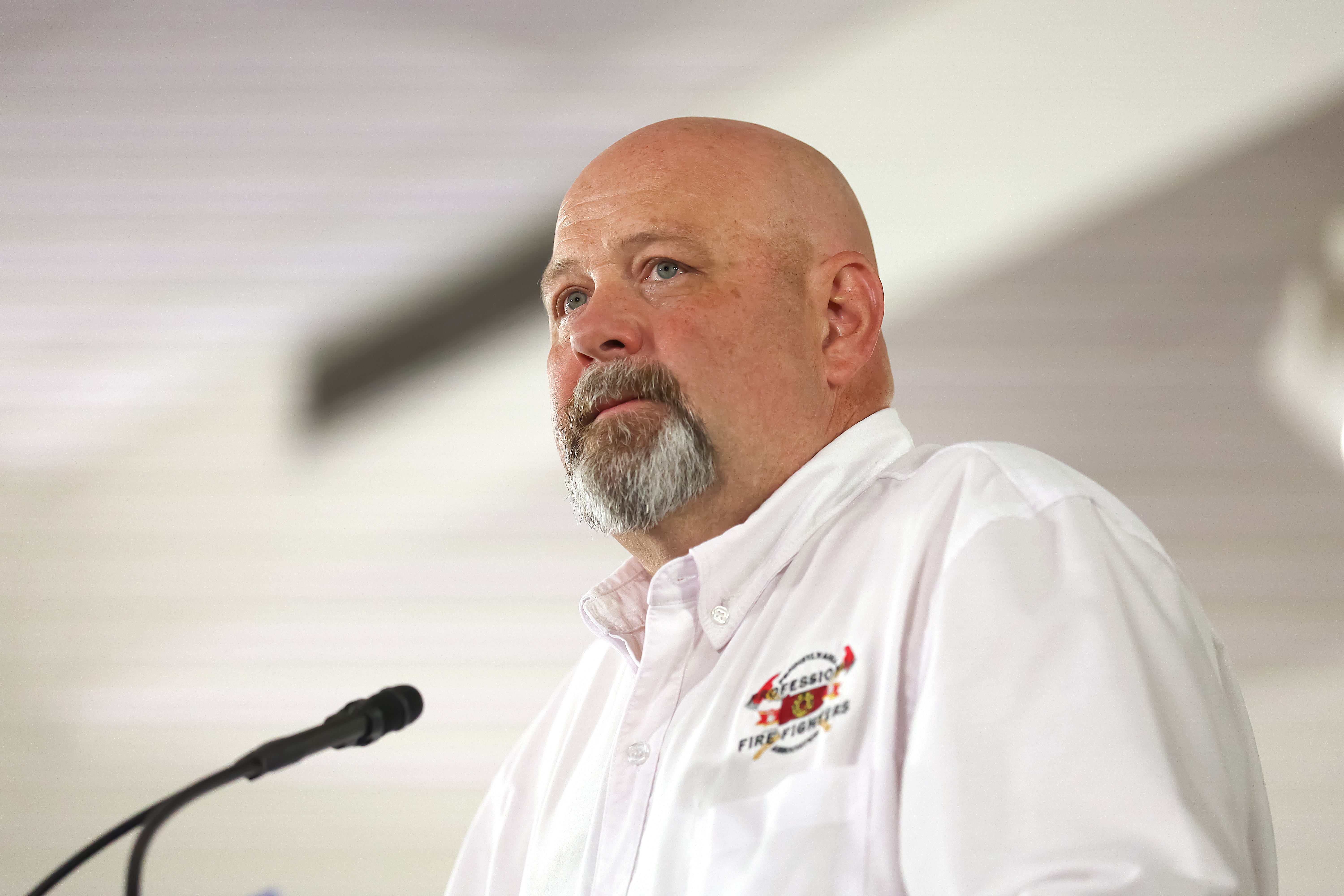
Brooks, a retired firefighter in Bethlehem and the Pennsylvania Professional Fire Fighters Association president, was recruited last year by prominent Democrats, including Gov. Josh Shapiro and U.S. Rep. Chris Deluzio. He quickly got a groundswell of support from moderates and progressives alike, including U.S. Sen. Bernie Sanders and former Transportation Secretary Pete Buttigieg.
Those high-profile supporters, and Brooks himself, leaned into his working-class image — highlighting his history of working multiple jobs and his insistence, even as he ran for Congress, on continuing to drive a snowplow and coach high school baseball.
Mackenzie and national Republicans who’ve invested resources into his campaign have repeatedly targeted Brooks for the lawsuit involving his family and for old social media comments.
In one post, Brooks lambasted volunteer firefighters working in areas where other union firefighters operate as “scabs” and other pejoratives.
Brooks has dismissed those and other attacks on his old posts, saying he never thought he would be a candidate for office when he made them.
The Democrat did not directly address those issues in a comment after Mackenzie broadcast them to a national audience.
“Ryan Mackenzie got his wish today: a big boy speaking slot on stage at Trump’s party in Dallas,” Brooks said in a statement that blamed Mackenzie for rising costs and voting against restricting Trump’s attacks in Iran, the two areas that polls show Trump performing the worst among both Republicans and Democrats.
“Mackenzie’s trip to Dallas is a reminder of who he is: a lap dog for Donald Trump, for his party bosses, and for anyone with power and money,” Brooks said.
Bob Brooks, who is running for Pennsylvania’s 7th Congressional District, addresses the audience during a rally at the United Steelworkers Union Hall in Bethlehem, Pa., on Sunday, July 26, 2026.David Maialetti / Staff Photographer
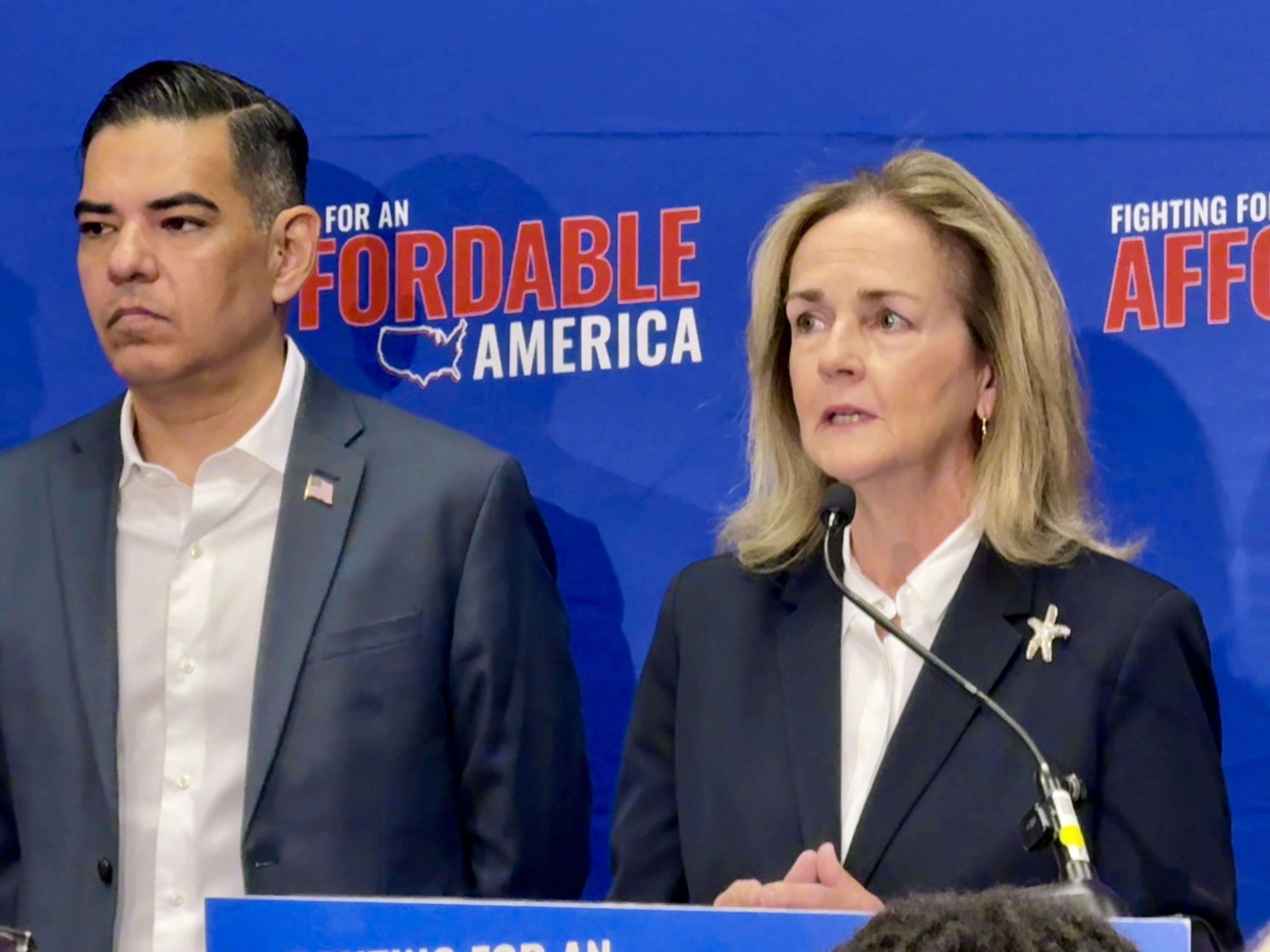
Just steps from the convention location earlier in the day, a small group of House Democrats that included U.S. Rep. Madeleine Dean (D., Montgomery) protested by, mainly, hitting Republicans on affordability.
“If you listen to what’s being said across the street, you might feel like you’re living in some separate reality. Here’s the reality check,” Dean said as she rattled off the higher cost of groceries, electricity and gasoline since Trump took office.
Dean targeted Mackenzie as well as U.S. Rep. Rob Bresnahan (R., Luzerne) and U.S. Sen. Dave McCormick (R., Pa.) — who each spoke at the convention on Wednesday — specifically, saying they were among the Republicans “happy to coddle a president who is unfit and unwell.”
“Here at the heel of Donald Trump, I don’t know what they think they’re doing,” Dean said behind a podium with a sign reading, “Fighting for an affordable America.”
Both Bresnahan, who is running in a competitive race against Democratic Scranton Mayor Paige Cognetti, and Mackenzie focused on an economic message during their speeches.
They did not directly address concerns about inflation, or the Iran war’s effects on the rising cost of gas.
U.S. Rep. Jason Smith, a Missouri Republican who joined Mackenzie onstage, contended the GOP majority had focused its agenda on the working class. He pointed to the tax exemptions for tips and overtime pay.
“If you don’t believe me, just ask yourself, how many billionaires do you know that are tipped employees?” said Smith, the House Ways and Means Commitee chair.
But neither he nor Mackenzie addressed the cuts to Medicaid and food assistance that were included in the same legislation to help pay for the tax cuts they repeatedly touted.
“We delivered tax relief for every American by locking in lower rates and expanding the standard deduction,” Mackenzie said.
Staff writer Alfred Lubrano contributed reporting.
Two New Jersey Congress members appeared alongside EMR’sCEO on Thursday to call for more oversight on lithium-ion batteries, which the company blames for causing fires at its Camden scrap metal site.
U.S. Rep. Donald Norcross, a Camden Democrat, introduced the Battery Fire Prevention Act nearly a year ago, inspired by fires at the Camden facility. But it hasn’t made progress in the Republican-dominated Congress. He toured the EMR site Thursday with U.S. Rep. Frank Pallone Jr., of Monmouth County, the top Democrat on the House Energy and Commerce Committee.
“Today it’s Camden. Yesterday was North Carolina and Minnesota. It’s literally all 50 states and quite frankly, a global problem,” Norcross said of lithium-ion battery fires.
“The United States Congress has failed in this,” he added. “When we understand that China is more progressive in finding batteries in their waste streams, you know we have a big problem.”
Standing in front of gigantic piles of old household appliances, damaged cars, and other kinds of scrap metal with a view of the Philadelphia skyline, Norcross said his bill will advance once Pallone becomes committee chair in the coming months — if Democrats win back the House in this year’s midterm elections.
The bill would create a 30% tax credit for waste and recycling companies to purchase technology to help identify lithium-ion batteries and a 5% tax on the sale of lithium-ion batteries. It would also direct the Department of Energy and the Environmental Protection Agency to develop a battery buyback program. Using money from the battery tax, the program would award grants to facilities — like schools, local governments, or recycling plants — to collect batteries from consumers, who would get paid for returning their batteries. Those batteries would then be properly disposed of or recycled.
EMR’s machinery separates and shreds large pieces of metal and spits them out into new piles of knuckle-sized scrap. Lithium-ion batteries, which are found in everyday technology like phones, watches, and e-bikes, aren’t supposed to land at the site but end up in the waste streams anyway.
A crane at the EMR scrap metal shredding site in Camden on Thursday.Aliya Schneider / Staff
Joe Balzano, the CEO of EMR Metal Recycling USA, said that the company has mechanisms to detect batteries that are about to burst, but the technology that identifies the batteries in the first place that he could apply at his site hasn’t been invented yet. Instead, employees sort through objects and set aside items that could have the batteries, which are prone to catching on fire if they become damaged or overheated. Those fires can spew out of control when hidden in a giant pile of metal.
Norcross said research to solve this problem is currently underway.
“Necessity is the mother of invention, so I’m hoping that invention comes quick,” Balzano said in an interview.
While suppliers and workers have gotten better at detecting items with the batteries, “things that didn’t have a battery yesterday have a battery today,” he said.
Part of the issue is there isn’t an obvious way for consumers to easily dispose of these batteries, so they end up in the trash or on the curbs, he said.
“They get picked up by peddler scrappers, or they enter into the municipality waste streams, and then they make themselves through the recycling process, and they come here,” Balzano said.
Frustrated residents who have suffered the impacts of repeated fires at the site have called for the closing of EMR in Camden. The facility temporarily shuttered earlier this summer and the company entered a legal battle with the city before a judge allowed the site to reopen.
Norcross, who appeared alongside Balzano on Thursday, said shutting down EMR in Camden won’t solve the core problem.
“If this disappears tomorrow, it goes to the next community, and then they’ll be fighting the same thing,” Norcross said in an interview. “So we want to fix the problem before it turns into a fire.”
Pallone said another bill in his committee that would create federal waste rules for recycling lithium-ion batteries has bipartisan support. He said seeing the site firsthand helped him understand the issue.
“The batteries come here, they’re essentially coming in secret,” he said.
Norcross pointed a finger at the corporations that manufacture the batteries for not taking a proactive role in preventing improper disposal.
“The manufacturers of batteries can’t walk away from the problem of just selling their product, and it ends up wherever it does, causing fires,” the lawmaker said.
Democrat Bob Harvie released his first general election TV ad Thursday morning, calling for a moratorium on artificial intelligence data center development and attacking U.S. Rep. Brian Fitzpatrick (R., Bucks) for his stance on the issue.
“I don’t want any more data centers. I want a moratorium. Big tech owns enough; they shouldn’t own our congressman, too,” Harvie says in the 30-second ad.
The ad marks the first timethe congressional candidate and Bucks County commissioner has called for a moratorium and signifies a shift in his position.
Previously, in an interview with The Inquirer last week and on his website, Harvie had calledonly for strict regulations on development. To focus his first major television ad on the topic shows how the projects are becoming a top issue for voters in Bucks County’s swingy 1st Congressional District amid a national backlash against data centers.
In Bucks County, both Harvie and Fitzpatrick have to grapple with the development of an Amazon data center in Falls Township, which is nearing completion.
Harvie, who lives just miles from the project, voted in December 2020 to approve acounty tax break for NorthPoint Development, the property owner of the Falls Township site.
Last year, Harvie celebrated Amazon’s investment in the data center and Fitzpatrick called it “one of the most transformative investments Bucks County has seen in decades.” More recently, they both supported Shapiro’s executive order.
In Harvie’s television ad, images of Elon Musk and Mark Zuckerberg flash on the screen. “Big tech is taking over our lives,” the candidate says in the ad. “And they want more. Grabbing our land, water, electricity, and sticking us with the bill.”
Heather Roberts, a spokesperson for Fitzpatrick’scampaign, said in a statement that the Bucks County Republican has always been supportive of “uniform federal regulations” and “100% control by local residents who could be impacted.”
She also pointed tohis cosponsorship of two bills aimed at regulating the effects of data centers: the Ratepayer Protection Act and the Data Center Transparency Act.
“Bob Harvie literally created this problem in our community — and he is now well aware of the massive albatross that this is around his neck. Hence, his latest lie in this ad,” Roberts said.
In an interview about data centers last week, Harvie did not call for a moratorium on the projects, but rather for strict regulations — as is also reflected on his campaign website. He also touted tasking the county planning commission with developing guidelines for municipalities facing potential data center proposals.
When asked last week why he had not called for a moratorium, Harvie said: “I think there’s probably areas in the country where data centers can make sense, where the energy grid can handle it, where there’s limits to it on the impact it could have on other people who might live in the area.”
“But I do think certainly we need to have a lot of cause for concern about how rapidly this is happening and making sure we can put some kind of handle on it,” he added.
He also echoed residents’ environmental concerns related to data centers and said that the developments need the increased oversight outlined in Shapiro’s executive order and that projects should not continue if the local community opposes.
Nine days later, Harvie said Thursday in another interview with The Inquirer that the decision for a moratorium did not come “out of left field for me” but was the product of many conversations amid what he says is a “complete failure of leadership” by Trump and Republicans, including Fitzpatrick, on the issue.
Of his 2020 vote to give NorthPoint a tax break, he said there was not an indication that the property was going to be used for data centers, but rather for e-commerce distribution.
He said that he is not set on one particular time frame for the moratorium but that “setting up guardrails” is most important, and he hopes a Democratic-controlled Congress would further hold hearings on imposing a moratorium.
“As we’ve seen more and more of what’s going on around the country with data centers just trying to gobble up space and build, build, build without any regulation, I’ve come to the point now where we have to do something to slow down this genie getting out of the bottle,” Harvie said.
DALLAS, Texas — Just steps away from a Republican midterm convention that she slammed as a “farce,” U.S. Rep. Madeleine Dean (D., Montgomery) said Thursday she was “gravely disappointed” with Democratic U.S. Sen. John Fetterman’s participation in the event — as well as a range of other issues that she said indicate his abandonment of democratic values.
“What I wish he was doing was — back home in Pennsylvania — making sure, like I am, that Pennsylvania will see more Democratic members of the House to uphold the values that he originally ran on,” Dean said after Fetterman appeared in a video at the convention Wednesday night that praised President Donald Trump.
Fetterman’s appearance was a remarkable and rare turn for a Democratic lawmaker, even one who has frequently crossed the aisle to support the opposing party like he’s done since Trump returned to office.
In a video that served as an introduction to a speech by U.S. Sen. Dave McCormick (R., Pa.), Fetterman said he and McCormick are able to “work with President Trump to fight and defend the steel way of life” in Pennsylvania.
As he’s done repeatedly, he also denounced socialism and what he considers the “anti-American way of life” that the leftist wing of his party represents. That message fit nicely into some of Republicans’ most prominent attacks on Wednesday as they tried to motivate their base to turn out for GOP candidates in the midterm elections — including in several Pennsylvania key races.
On Thursday, a web page soliciting donations to Fetterman’s campaign committee included a link to the video and said Fetterman would “keep standing his ground, speaking his mind, and putting Pennsylvania first.”
Fetterman said in a statement later that he made the video to support McCormick, who has become a staunch ally and one of his biggest defenders. He also said, as he has for months, that would not switch parties.
“That’s entirely on John,” Dean said Thursday when asked by a reporter if Fetterman should remain in the Democratic Party. “I will tell you, from the ground, from suburban Philadelphia, my constituents are livid. Those who went out and knocked doors for him, they are absolutely livid.”
Dean was in town on the second and final day of the convention alongside four other House Democrats who blasted what they were hearing from the gathering, which has largely been a celebration of Trump.
But Dean was quickly asked by reporters about the convention’s most surprising turn so far — the appearance of Pennsylvania’s controversial Democratic senator.
Dean has, historically, had a closer relationship with Fetterman compared to some of the other Democratic members of Pennsylvania’s U.S. House delegation. The pair briefly ran against each other in the 2018 lieutenant governor primary, which Fetterman won. Dean said it was then that she grew to “really like him and his family, and his values.”
Those values, she said, have taken a turn in more ways than one. She criticized his convention video as a “stunt” while saying she was mostly disappointed by his work ethic, his decisions to back Trump policies, and his “blind support” of Israeli Prime Minister Benjamin Netanyahu’s attacks in Gaza.
“All I want is for his good health, his well being. And that has been my worry,” Dean said in an interview after the press conference, referring to Fetterman’s well-documented health struggles.
“But I think you have to look at his record, and his record of not working, of not participating, and not caucusing with Democrats, of not being active in his committees — alongside what he is active on, [which] is voting alongside Mr. Trump, and enabling this corruption of chaos,” she said.
Dean is one of several Pennsylvania Democrats who have ramped up their public concerns about Fetterman, with some essentially promising to oust him if he runs for reelection in 2028.
“He’s not going to be a senator after 2028 — mark my words,” U.S. Rep. Chris Deluzio, an Allegheny County Democrat who is a potential candidate for the seat, after the video.
Dean did not comment on the next election other than saying “voters will have to decide whether that is appropriate” for Fetterman to conduct himself the way he has, including associating closely with Israeli leadership.
Democratic Gov. Josh Shapiro, who has clashed with Fetterman but hasn’t heavily criticized his job performance as a senator, said Thursday he did not see the video. The governor said at an event in Chester he was “not going to get distracted” from his duties as governor and his reelection campaign.
Two major Latino civil rights groups, a voting rights organization, and the city of Denver sued the Trump administration on Thursday to keep armed immigration enforcement agents away from polling places, invoking a Civil War-era criminal law that generally prohibits federal officials from bringing “troops or armed men” to places where elections are held.
The lawsuit, filed in federal court in Washington, D.C., comes eight days before in-person early voting begins in some states, such as Minnesota and South Dakota. It asks a judge to declare it unlawful for the administration to send armed agents to polling sites.
Homeland Security Secretary Markwayne Mullin said at a Sept. 1 news conference in New York that ICE agents would not patrol polling places, but that they would go to one if there were a threat there or if they were serving a warrant on someone they had been tracking. “If we’re serving a warrant, we will be where we need to be,” he said.
DHS has said in statements to media following Mullin’s comments that it “is not planning operations targeting polling locations,” but added that people could be arrested at a polling place if an active public safety threat arose there.
Democratic lawmakers and election officials have grown increasingly worried in recent months that armed federal officers or troops could be sent to polling sites. Local officials in states such as Arizona and Minnesota have gone as far as preparing emergency court filings and training personnel on how to respond.
Those fears have been fueled by calls among some allies of President Donald Trump — including at least three Republican gubernatorial candidates in different states — for sending armed federal agents and the National Guard to voting sites.
The lawsuit cites a year of public comments by Trump administration officials and allies. In February, former Trump adviser Stephen K. Bannon said, “We’re going to have ICE surround the polls come November.” Days later, White House press secretary Karoline Leavitt told reporters she “can’t guarantee that an ICE agent won’t be around a polling location.” And in March, then-Deputy Attorney General Todd Blanche, who is now attorney general, asked at a conservative gathering, “Why is there objection to sending ICE officers to polling places?”
The plaintiffs argue that pattern, capped by Mullin’s recent remarks, amount to a policy and plan by the administration.
The lawsuit Thursday was filed on behalf of the League of United Latin American Citizens, UnidosUS, Common Cause, and the city and county of Denver.
It relies on an 1865 law that makes it a felony for any federal official to order “troops or armed men” to places where an election is held, unless the force is needed to “repel armed enemies of the United States.” Violators face up to five years in prison and disqualification from holding federal office. In 1909, Congress removed the law’s other exception — allowing armed men to “keep the peace at the polls.”
The plaintiffs argue that armed federal agents at polling places would intimidate voters — particularly Latinos and naturalized U.S. citizens — and could turn voting sites into places of confrontation.
“The right to vote is foundational to our democracy and yet this administration continues in its endless attempts to weaken the very institutions it is entrusted to protect,” said Juan Proaño, CEO of LULAC. “The outcomes of elections define the future for all of us, and in America, voters should be able to cast their ballots without fear of intimidation by armed ICE officers at polling places.”
DHS did not immediately respond to a request for comment.
The military has drawn a clearer line. Gen. Dan Caine, chairman of the Joint Chiefs of Staff, told Sen. Elissa Slotkin (D, Mich.) in an Aug. 28 letter that the Joint Force “has no plans” to send federal troops or federalized National Guard members to polling places, or to use them to seize ballots or voting machines.
“I have neither received nor anticipate receiving any unlawful order concerning the role of the Joint Force in the upcoming November 2026 midterm elections,” Caine wrote.
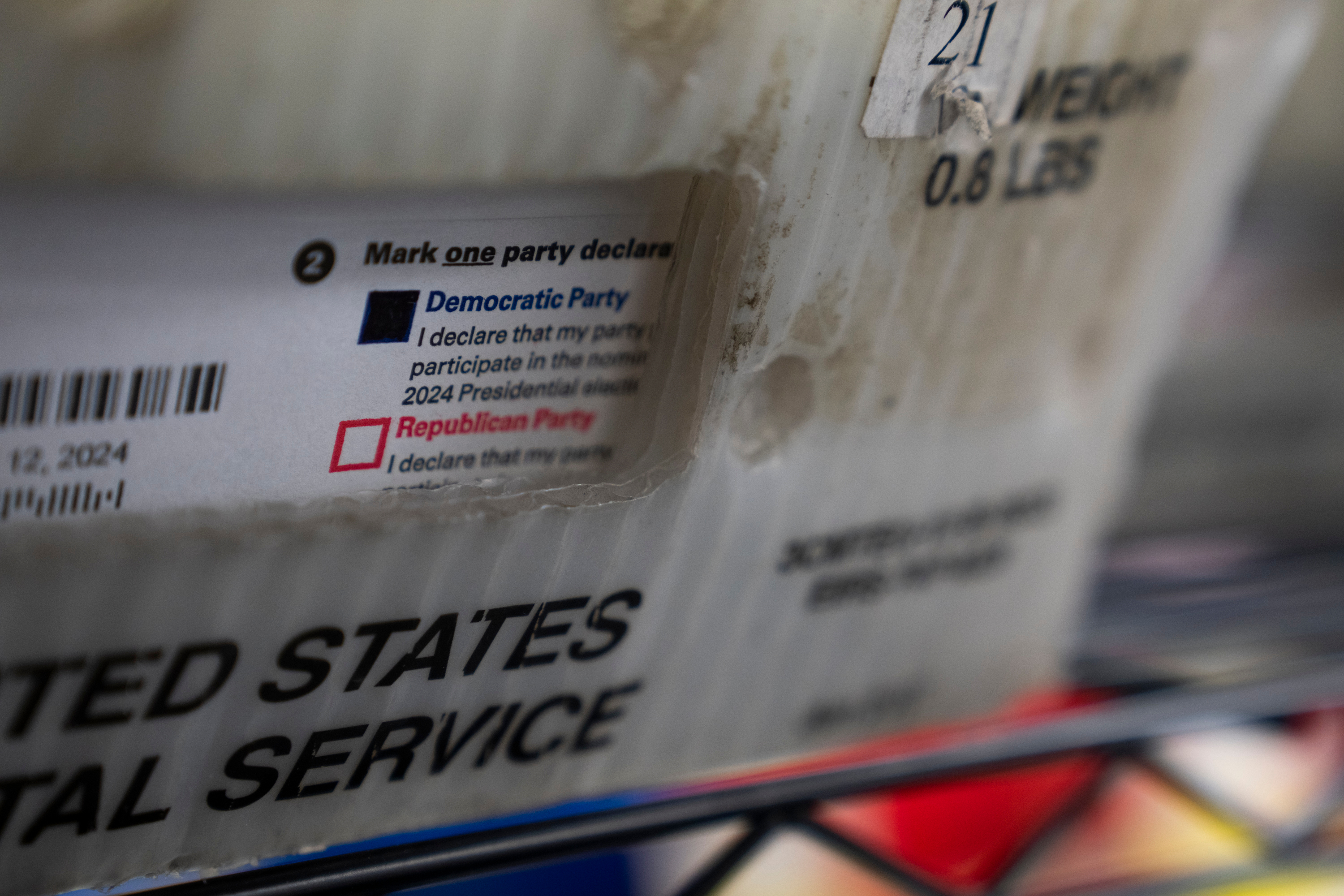
Trump has made sweeping claims of election fraud without evidence, alleging that large numbers of unauthorized immigrants will vote in November absent federal intervention. In March he signed an executive order directing the U.S. Postal Service to restrict how mail ballots are handled and instructing DHS to build lists of U.S. citizens and share them with states. The Supreme Court allowed parts of the order to move forward last month, and the administration returned to the Supreme Court this week for a third time after a federal judge in Boston blocked the Postal Service rule.
The lawsuit invoked an 1865 law advanced by then-Democratic lawmakers angered by the Lincoln administration’s deployment of Union troops interfering in presidential elections in Kentucky, Maryland, and Delaware, according to legal historians.
That statute has never been tested, said University of Houston law school professor Chris Mirasola. No court has interpreted what counts as a place where an election is held, according to a Brennan Center for Justice analysis published in July, leaving unanswered whether the law reaches ballot drop boxes, election offices, and counting facilities as well as polling sites.
“The statute is incredibly old, and there is no case law about it, so all of this is going to be before the courts for the first time,” he said. “That always leaves questions about how it’s going to be interpreted.”
The plaintiffs, represented by attorneys with Democracy Forward, argue Congress explicitly banned armed federal officers from election sites to “provide and preserve free and fair elections, the rule of law, the right to vote, and Americans’ confidence in the sanctity of the ballot box.”
DHS’s “disregard for that statutory framework threatens our upcoming election,” the complaint said.
Mirasola said the law was a reaction to multiple instances of Union soldiers detaining Confederate-aligned candidates and blocking voters with ballots favoring those candidates during the wartime election in border states. Though the bill authors at the time were in the throes of a specific armed conflict, the rhetoric of the congressional debates were just as contemporary then as they are now, Marisola said. Lawmakers were hyper-focused on preserving the integrity of the electoral system.
“This lawsuit is alleging that what we are seeing in the lead-up to the midterms is the same kind of election interference because the administration has been dangling the possibility that there might be a deployment of armed federal agents,” Mirasola said.
The only exception for armed officers that has withstood time is in order to “repel armed enemies” of the United States. Lawmakers in the 1860s imagined those being Confederate soldiers. But the Trump administration could try to make a narrow argument identifying a different enemy, Mirasola said.
Plaintiffs will face another obstacle, according to Mirasola. The U.S. Supreme Court has significantly narrowed the avenues for the federal courts to issue prospective nationwide injunctions.
The complaint cited Justice Department actions to remove a manual explicitly stating the long-standing position of the government that armed federal agents are prohibited from election sites. They also pointed to the gutting of the department’s public integrity section, which wrote the document and advised law enforcement on legal matters during elections.
The complaint also points to three encounters involving immigration officers at voting sites during this year’s primaries: ICE officers converging on a traffic stop outside a San Antonio early voting site, where the county sheriff told them to leave; ICE vehicles outside a vote center in Simi Valley, California; and two federal agents entering a Syracuse, New York, library to warn a poll worker about an Instagram post naming the ICE agent who fatally shot Renée Good in Minneapolis.
LULAC, the nation’s oldest Latino civil rights organization, has registered and mobilized Hispanic communities to the polls for nearly a century. Its hundreds of thousands of members have communicated worries that any federal presence could dampen turnout and fuel fears of racial profiling.
LULAC pointed to reporting by ProPublica, which found that immigration agents had detained more than 170 U.S. citizens, including more than 50 — nearly all of them Latino — who were held after agents questioned their citizenship.
Election workers across the country have been preparing for months. Some are being trained on de-escalation techniques in case of run-ins with federal agents and what hotlines to call to report potential disturbances.
In Denver, the clerk and recorder is already preparing to retrain the election judges who check in voters and empty the city’s 48 ballot drop boxes. The training covers how to de-escalate an encounter with federal agents, how to document what they do, and how to identify agents who are in plainclothes, according to the complaint. Election officials are also drawing up contingency plans to move voters to alternative polling sites.
The election judges are temporary workers, and Denver says it struggles to recruit enough of them for every election. Some, the city told the court, may now decline the job altogether.
“Stationing ICE agents near polling places is only meant to scare people and suppress votes,” Denver Mayor Mike Johnston said in a statement. “We’ll fight tooth and nail to prevent it.”
WASHINGTON — An appeals court on Thursday upheld a block on President Donald Trump’s executive order limiting mail voting, a decision that comes as the Supreme Court considers the same case and states have already started sending out ballots for the high-stakes midterm elections.
The three-judge panel refused to lift a preliminary injunction against the order issued last week by U.S. District Court Judge Indira Talwani. It prohibits the U.S. Postal Service from implementing Trump’s directive. The Postal Service has said it would not deliver ballots from states that did not pre-clear their envelope design with the federal government and submit a list of voters to an online portal, which has yet to be activated.
Election officials warn that it’s impossible to comply with those terms, especially with the first mail ballots already being sent out in Alabama, North Carolina, and Wisconsin.
The panel of three judges nominated by former President Joe Biden agreed with the plaintiffs that the president does not have the power to regulate states’ election policy.
“Appellants have not made a strong showing that the district court erred in determining that the Final Rule is likely unlawful,” they wrote, a reference to a rule published by the Postal Service to implement Trump’s order.
The panel wrote that the Trump administration had done little to dispel arguments by many election officials that the changes would bring “chaos and widespread disenfranchisement.”
“Indeed, appellants have not even seriously challenged this aspect of the district court’s ruling, much less demonstrated why it is clearly erroneous,” the order states.
The government also hasn’t shown evidence of past fraud to justify the restrictions, the judges said.
A request for comment from the White House was not immediately returned.
The panel’s decision comes even as the Supreme Court is already considering the same case, which is part of a frenzied legal rush as states are beginning to send out mail ballots for this fall’s midterm elections. Democrats and civil rights groups in a separate lawsuit in Washington, D.C., also are trying to halt the executive order.
The 1st Circuit also had upheld a previous hold Talwani placed on the executive order. But that ruling was lifted by the Supreme Court in a procedural decision that did not determine whether the plan was constitutional.
Late-night talk-show host Jimmy Kimmel said Wednesday that he would not broadcast an interview he conducted with Texas Democratic Senate candidate James Talarico because of pressure from the Trump administration.
Kimmel did not specify what that pressure was but said the Federal Communications Commission had “threatened” him, Jimmy Kimmel Live!, the ABC network, and ABC’s affiliate and local stations “based on simple traditional editorial decisions, guest bookings it would seem they don’t like.”
Kimmel also suggested the pressure was politically motivated. Polls show a close race between Talarico and his Republican opponent, Texas Attorney General Ken Paxton.
“They’re very nervous about the midterms, and rightly so. … They’re in danger of losing a Senate seat in Texas, of all places,” Kimmel said on his show Wednesday.
ABC has been in a monthslong feud with the FCC and its chair, Trump appointee Brendan Carr. Last year, the FCC successfully pressured ABC to briefly suspend Kimmel because of comments he made about the death of conservative activist Charlie Kirk.
In April, President Donald Trump and first lady Melania Trump again called on ABC to punish Kimmel for a joke he made about the first lady. Shortly afterward, the FCC formally ordered an early review of the eight broadcast licenses owned by Disney — which include ABC stations in major cities such as New York and Philadelphia — because of concerns about diversity policies.
Last month, ABC sued the FCC, alleging that the commission’s early review of its broadcast licenses is unconstitutional under the First Amendment.
Kimmel on Wednesday noted that he had interviewed several candidates for public office on his show in the past — including Trump himself when he was a presidential candidate in 2015 in 2016.
“And at that time, when he was the one sitting next to me, he seemed to have no problem with the idea of a talk-show host interviewing candidates. … But for some reason — and I can’t seem to figure out what that reason is — something has changed,” Kimmel quipped.
Representatives for the FCC did not immediately respond to a request for comment Wednesday. Representatives with Disney, ABC’s parent company, declined to comment.
FCC Commissioner Anna M. Gomez, the only Democrat on the commission, accused the Trump administration of waging a “campaign of censorship and control” and said the government agency does not have lawful authority to threaten broadcast licenses over guest bookings or editorial decisions.
“I urge broadcasters everywhere to keep resisting this pressure, and I hope courts will soon make clear that the FCC has no place dictating editorial choices or what viewers are allowed to see,” Gomez said in a statement Thursday.
Kimmel said he decided not to air his interview with Talarico during his broadcast in part so that ABC affiliates and local stations, especially those in Texas, would not “have to deal with this nonsense.” His interview with Talarico would instead be posted in its entirety on his YouTube channel on Thursday, he said.
“And thank goodness we have that, because in the America we live in right now, that is the best that we can do until November,” he said.
And the insurance company with the biggest piece of that business in Pennsylvania is making its voice heard in Harrisburg, Washington, and across the political landscape.
Newtown Square-based AmeriHealth Caritas, an affiliate of the Philadelphia-based healthcare giant IBX, contributed $500,000 total last year to national Democratic and Republican groups that work to elect governors and state legislators, more than double what it gave those entities in 2020.
As the GOP-led Congress passed legislation making deep cuts to Medicaid spending last year, AmeriHealth spent $1.7 million on federal lobbying, the most since at least 2008. And the company made charitable contributions aligned with causes promoted by political leaders in states where it does business — including a $5 million donation to food banks announced by North Carolina’s Democratic governor and 250 book bags for schoolchildren as a gift to the Democratic speaker of the Pennsylvania House.
It all adds up to a growing influence operation run by a company in a competitive industry that relies on government for revenue. Last year, AmeriHealth generated almost $16 billion from Pennsylvania contracts — more than half its total revenue.
Medicaid — a joint state-federal program that funds healthcare for low-income people, children, seniors, and individuals with disabilities — is also the single biggest cost driver in Pennsylvania’s budget. Almost three million Pennsylvanians, or more than one-fifth of the population, are covered by Medicaid.
AmeriHealth’s corporate political giving has drawn criticism from some Republican state lawmakers, who call it an inappropriate use of taxpayer dollars.
“That’s money that’s supposed to be going out to our hospitals, pharmacies, and disabled service providers,” said State Sen. Cris Dush (R., Jefferson).
State Sen. Cris Dush (R., Jefferson) in 2021.Matt Rourke / AP
AmeriHealth’s increased political activity has come during a volatile period for Medicaid. Enrollment surged during the COVID-19 pandemic as a federal emergency declaration meant people didn’t have to reapply for benefits, even if they no longer qualified. Once states resumed verifying eligibility, insurers including AmeriHealth saw membership decline — and those most likely to maintain coverage were sicker than average.
Now insurers are grappling with the biggest cuts to federal healthcare spending in history — $1 trillion over the next decade, mostly to Medicaid — in President Donald Trump’s big domestic policy legislation last summer. They are set to take effect next year.
Lee Drutman, a senior fellow at New America, a Washington, D.C.-based think tank, said AmeriHealth’s political activity is part of a “tried-and-true playbook” in corporate America.
“If you do business with the government or have contracts or regulatory interests, you want to make sure the people who are making the decisions have a nice warm feeling when they think about your company,” said Drutman, author of The Business of America is Lobbying. “The best way to give them that nice warm feeling is to contribute to their campaigns and their causes.”
AmeriHealth said in a statement that it reviews all political contributions to ensure compliance with applicable laws and regulations and that the company does not make contributions “from legal entities that have state or federal contracts.”
AmeriHealth did not say what revenue source it uses to fund its corporate political contributions and did not answer questions about whether it had any revenue streams that were not tied to tax dollars.
“Our participation in the public policy process focuses on healthcare issues affecting our members and the communities we serve,” AmeriHealth said, adding that it supports organizations across the political spectrum.
Donations to DGA and RGA
Like most states, Pennsylvania contracts with private insurers — also known as managed care organizations (MCOs) — to manage Medicaid beneficiaries’ benefits.
Federal law sets broad coverage requirements, but states have flexibility in determining which populations are eligible and which services to include.
And every year, they set monthly rates they pay insurers for Medicaid enrollees. Federal regulators review the rates.
“That all has a huge impact on the financial health, the success of the Medicaid managed care plan,” said Edwin Park, research professor at the McCourt School of Public Policy at Georgetown University.
It is not surprising, then, that insurers like AmeriHealth donate to political groups that elect governors and state legislators.
Among the groups that have benefited from AmeriHealth’s giving is the Democratic Governors Association, which in 2022 gave $7.2 million to then-Pennsylvania Attorney General Josh Shapiro’s successful gubernatorial campaign and which has given $750,000 to his reelection bid.
From 2021 through last year, AmeriHealth gave $250,000 to the DGA annually, up from $100,000 in 2020. It gave $250,000 to the Republican Governors Association in 2025, up from $100,000 each of the previous two years.
The donations put AmeriHealth in the top 10% of donors to each group in 2025, according to an Inquirer analysis of Internal Revenue Service data compiled by ProPublica.
(function(){function e(){window.addEventListener(`message`,function(e){if(e.data[`datawrapper-height`]!==void 0){var t=document.querySelectorAll(`iframe`);for(var n in e.data[`datawrapper-height`])for(var r=0,i;i=t[r];r++)if(i.contentWindow===e.source){var a=e.data[`datawrapper-height`][n]+`px`;i.style.height=a}}})}e()})();
The RGA has not invested in Pennsylvania’s gubernatorial election this year, in which Shapiro is favored against Republican state Treasurer Stacy Garrity.
Pennsylvania law prohibits corporations and labor unions from making direct contributions to state campaigns, though those groups can form political action committees. PACs can raise funds from their employees or members and use that money to donate to candidates. AmeriHealth started a Pennsylvania PAC in 2022.
However, corporations and unions can use their treasury funds — drawn directly from profits or member dues — to give unlimited amounts of money to groups such as the DGA and RGA. Those groups can donate to campaigns that may otherwise face restrictions on receiving corporate money, as in Pennsylvania.
In response to written questions, neither AmeriHealth nor Shapiro’s campaign would say whether the governor or his representatives had solicited contributions from the company on the DGA’s behalf.
AmeriHealth did not answer a question as to whether it had asked the DGA to designate some or all of its contributions to Shapiro’s race. Izzi Levy, a spokesperson for the DGA, said, “As a policy, DGA does not accept funds earmarked for any race or state.”
Gov. Josh Shapiro in August.Kalim A. Bhatti / For The Inquirer
“Corporations, labor unions, wealthy individuals want to have a powerful ally in a governor,” said Michael Beckel, an expert on money in politics at Washington, D.C.-based Issue One, a group that advocates for campaign finance restrictions.
“Being able to give through a group like the DGA or an RGA is a way to help secure your position as a friend and ally, who then in turn might be somebody that [governors] listen to on policy matters,” he said.
Many companies donate to these groups, but AmeriHealth’s corporate contributions have caught the attention of Pennsylvania lawmakers, including Senate President Pro Tempore Kim Ward (R., Westmoreland).
“The money should be used as appropriated for Medicaid because we are struggling with the increased funding needs for the program,” she said, adding that it doesn’t matter which party benefits from the donations.
Pennsylvania Senate President Pro Tempore Kim Ward in Harrisburg in February.Tom Gralish / Staff Photographer
Ward said AmeriHealth has suggested that one of its contributions to the DGA “was comprised of the interest made off the principal of the Medicaid money.”
“To be clear, no matter if the political contribution is made up from the principal or the interest from Medicaid funds, it is all government money and shouldn’t be used for political purposes,” Ward said in a statement.
Under federal regulations, insurers are required to spend at least 85% of Medicaid funds on services for beneficiaries, leaving 15% for plan administration and profits. A spokesperson for the Pennsylvania Department of Human Services said AmeriHealth has complied with those rules.
AmeriHealth isn’t the only Medicaid insurer that donates to the DGA, RGA, Democratic Legislative Campaign Committee, and Republican State Leadership Committee — the latter two of which work to elect state legislators across the country.
The University of Pittsburgh Medical Center (UPMC), the No. 2 Medicaid insurer in Pennsylvania, has given three of the four groups a total of $330,000 since 2013, the year AmeriHealth significantly increased its giving. AmeriHealth gave $3.3 million over that period of time.
By contrast, St. Louis-based Centene Corp. has far outspent AmeriHealth, giving a total of nearly $18.8 million to the groups since 2013. Centene is the No. 3 Medicaid insurer in Pennsylvania and the largest in the country, operating in 30 states.
Neither UPMC nor Centene responded to requests for comment. Centene says on its website that its political activity is grounded in the company’s public policy positions “and the best interests of our business, our employees, and the members we serve, without regard to political party affiliation.”
From West Philly to 13 states
For-profit AmeriHealth is owned by nonprofits Independence Health Group and Blue Cross Blue Shield of Michigan.
Formerly known as AmeriHealth Mercy, the company started as a pilot program in the early 1980s at a West Philadelphia hospital. It now operates in 13 states and Washington, D.C., and employs almost 10,000 people.
AmeriHealth covered about 771,000 Pennsylvania residents enrolled for physical health — including for services such as medical visits, pregnancy and newborn care, and dental — and 176,000 for community services, including nursing homes, at the end of 2025. The company also manages benefits for behavioral health services.
In addition to its Medicaid business, AmeriHealth also offers Medicare Advantage plans for people eligible for both Medicare and Medicaid, as well as Affordable Care Act health insurance marketplace plans.
AmeriHealth had net income of $138 million last year after reporting a loss in 2024, though Independence Health — which includes insurer Independence Blue Cross — has continued to struggle financially.
Pennsylvania’s Medicaid program cost $49.3 billion in state and federal funds for the fiscal year that ended in July 2025, according to the Independent Fiscal Office. The state share of Medicaid expenditures, $14.4 billion, accounted for 31% of total general fund spending, among the highest ratios in the country, according to health research nonprofit KFF.
State spending on Medicaid was on track to increase 7.8% for the fiscal year that ended July 1, according to a June analysis by the IFO.
AmeriHealth’s $15.7 billion in revenue last year from contracts with the Pennsylvania Department of Human Services and county governments was up from $14.2 billion the prior year and $11.4 billion in 2021 — a 38% increase over the four year-period.
UPMC saw a 50% increase over that period, for $12.6 billion in revenue last year.
(function(){function e(){window.addEventListener(`message`,function(e){if(e.data[`datawrapper-height`]!==void 0){var t=document.querySelectorAll(`iframe`);for(var n in e.data[`datawrapper-height`])for(var r=0,i;i=t[r];r++)if(i.contentWindow===e.source){var a=e.data[`datawrapper-height`][n]+`px`;i.style.height=a}}})}e()})();
AmeriHealth has attributed its financial success last year — when it swung back to a profit a year after reporting losses in 2024 — in part to higher Medicaid rates as well as “work with state partners to support reliable access to high-quality care for the members we serve.”
Ali Fogarty, spokesperson for the Pennsylvania Department of Human Services, said rate increases are necessitated by costs that insurers incur administering the Medicaid program.
A big driver has been higher costs for GLP-1s, the drugs that manage Type 2 diabetes and obesity. Pennsylvania in 2023 started covering GLP-1s in Medicaid for weight loss only. Medicaid spending on the drugs in Pennsylvania increased from $223 million in 2022 to more than $1 billion last year, Fogarty said. The state stopped covering GLP-1s for weight loss this year.
“Realities like this can drive rate increases to ensure stability of our Medicaid program and solvency of MCOs that coordinate care, in addition to typical year-over-year increases in costs of care and operations,” she said.
AmeriHealth increased its lobbying, too
AmeriHealth spent $1.7 million on federal lobbying last year, up from $970,000 in 2024 and $400,000 in 2023, according to data compiled by OpenSecrets, a group that tracks money in politics.
The bill mentioned the most on the company’s lobbying reports in 2025 was H.R. 1, or the One Big Beautiful Bill Act. The sweeping domestic policy legislation — passed by the GOP-controlled Congress and signed into law by Trump — included $900 billion in cuts to federal Medicaid spending over the next decade.
(function(){function e(){window.addEventListener(`message`,function(e){if(e.data[`datawrapper-height`]!==void 0){var t=document.querySelectorAll(`iframe`);for(var n in e.data[`datawrapper-height`])for(var r=0,i;i=t[r];r++)if(i.contentWindow===e.source){var a=e.data[`datawrapper-height`][n]+`px`;i.style.height=a}}})}e()})();
The law reduces spending in part by imposing new work requirements on adults who are eligible for Medicaid under the Affordable Care Act, the 2010 law that sought to expand healthcare coverage. Pennsylvania expanded Medicaid in 2015.
Those requirements take effect Jan. 1. The new law also includes provisions requiring more frequent eligibility checks and cost-sharing requirements for enrollees in the so-called Medicaid expansion group.
The law’s Medicaid provisions are projected to increase the number of uninsured in 2034 by 7.5 million people, according to estimates from the Congressional Budget Office. About 300,000 Pennsylvanians could lose coverage due to the Medicaid restrictions, according to Shapiro’s administration.
Medicaid insurers opposed the cuts. After the House passed its initial version of H.R. 1 in May 2025, Medicaid Health Plans of America — a trade group that represents AmeriHealth and other insurers — cautioned Senate leaders against legislative provisions “that have been found to increase churn, set up additional barriers to receiving coverage, disincentivize essential care, hamstring states in financing the program, and that will likely cause disruption that radiates across the health care system.”
Republicans say the law will strengthen the integrity of programs like Medicaid and help ensure that able-bodied adults on public assistance are contributing to society. Democrats voted against the measure, accusing the GOP of cutting the safety net to finance tax cuts for the wealthy.
The One Big Beautiful Bill Act has big implications for state budgets. Starting in October, states including Pennsylvania will be restricted in their ability to finance Medicaid through taxes on healthcare providers such as hospitals, nursing homes, and insurers. States have traditionally used that financing mechanism to help draw federal matching funds.
Management consulting firm Oliver Wyman wrote that as states adjust their financing strategies, “plans may face more volatile rate-setting processes, delayed approvals, and growing tension between providers seeking to preserve revenue and payers managing constrained margins.”
As H.R. 1 is implemented, insurers like AmeriHealth are maintaining a strong presence in Washington. Records show AmeriHealth spent $1.5 million on federal lobbying through June — almost as much as it spent all of last year.
But as insurers seek to influence policymakers, they are facing increasing criticism from conservatives who say they have failed to improve patient outcomes, lower costs, or deter fraud. More broadly, Trump last year directed Health and Human Services Secretary Robert F. Kennedy Jr. to “take appropriate action to eliminate waste, fraud, and abuse in Medicaid.”
“Medicaid managed care creates strong incentives to maximize enrollment, as plans are generally paid a fixed amount for each enrollee,” Brian Blase, a former Trump White House official and president of the Paragon Health Institute, wrote in June. “Improper enrollment, duplicate enrollment, and phantom enrollment increase payments flowing to MCOs.”
The plans say they have taken action against fraud and abuse. The Medicaid Health Plans of America in a February report pointed to an inspector general report showing that insurers in recent years had steadily increased their fraud referrals to state law enforcement agencies.
Pennsylvania’s GOP-led Senate in July passed a resolution, largely along party lines, directing the Legislative Budget and Finance Committee (LBFC) to audit the state’s Medicaid program. The resolution calls for a review of the “standards used in Pennsylvania to evaluate Medicaid managed care program contracts.”
Democrats said they wanted to limit the scope of the audit, saying the state’s Medicaid program is already subject to federal reviews.
The resolution does not carry the force of law, but its lead sponsor, Dush, said he hopes the bipartisan LBFC — a committee that consists of 12 legislators from both chambers of the General Assembly — agrees to take up the cause.
Charitable giving
When the federal government shut down last fall amid a congressional spending impasse, the Trump administration paused the disbursement of food assistance, known as SNAP benefits, which help low-income families pay for groceries.
Within days of that announcement, North Carolina Gov. Josh Stein said the state would grant $10 million to local food banks — and that AmeriHealth Caritas and other private donors had also chipped in.
AmeriHealth, which had won a Medicaid contract with the state in 2019, gave $5 million, according to Stein’s announcement. “With the help of generous partners, North Carolina is taking action to keep families fed,” Stein, a Democrat, said in a news release at the time.
It’s an example of how AmeriHealth has made philanthropic gifts in line with causes promoted by political leaders in states where the company does business. Drutman, the lobbying expert, said supporting such causes can be seen as part of a company’s broader political strategy.
“As long as government is an important player in an industry, either as a regulator or purchaser of services, companies can have a strong interest in making sure that people in power have a positive opinion of the company,” he said. “Usually, the positive opinion of a company is not free.”
Stein’s office didn’t respond to a request for comment.
AmeriHealth told The Inquirer that the company and its foundation invest in community organizations “to improve access to care and address needs such as maternal health and food insecurity.”
“We invest in healthcare policy that is aligned with the needs of the nation’s most vulnerable populations,” the company said.
Another organization it partnered with was the Hope Florida Fund, a charity founded by Casey DeSantis, wife of Republican Gov. Ron DeSantis. The Governor’s Office announced in March 2023 that AmeriHealth had contributed $100,000 to reduce reliance on public assistance and make grants to local nonprofits.
The next month, the state started the bidding process for new Medicaid contracts. AmeriHealth ultimately lost its bid to remain in Florida, where it had operated since 2012. Gov. DeSantis’ office didn’t respond to a request for comment.
Sometimes AmeriHealth’s gifts are smaller.
Pennsylvania House Speaker Joanna McClinton, a Democrat who represents parts of West Philadelphia and Delaware County, reported on her 2025 financial disclosure form that AmeriHealth had donated 250 book bags at resource fairs in her district. She valued the gift at $2,500. A spokesperson for McClinton confirmed the gift but otherwise had no comment.
Other companies including insurers Highmark Wholecare and Independence Blue Cross gave similar gifts, according to the disclosure.
House Speaker Joanna McClinton during a Feb. 3 news conference at the Capitol in Harrisburg.Tom Gralish / Staff Photographer
AmeriHealth has won praise for some of its giving.
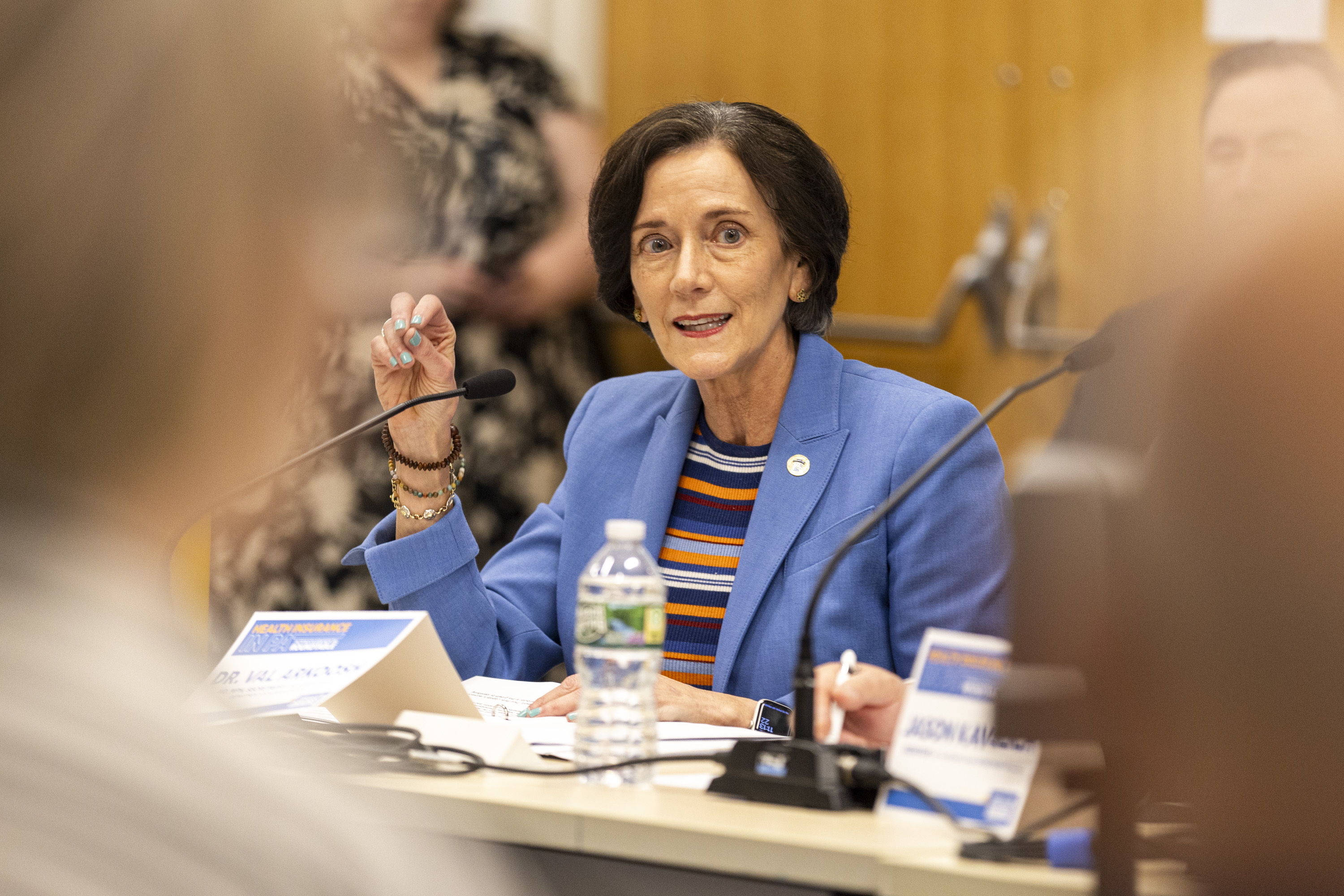
In May, Val Arkoosh, secretary of the Pennsylvania Department of Human Services, visited the Greater Philadelphia YMCA’s Willow Grove branch to highlight a maternal health initiative that provides a free membership and programming for expectant moms.
Arkoosh’s office said in a news release that the initiative “aligns perfectly” with the Shapiro administration’s “Healthy Moms, Vibrant Futures” strategic plan.
DHS Secretary Val Arkoosh in 2025.Tyger Williams / Staff Photographer
Fogarty, the DHS spokesperson, noted that the U.S. maternal mortality rate outpaces all other high-income countries and said Arkoosh, an obstetric anesthesiologist, is passionate about the issue. “We appreciate the many partners who work to address maternal mortality and are stepping up to support mothers and children in their community,” Fogarty said.
AmeriHealth’s foundation said in a news release that “providing children with healthy beginnings will help them avoid adverse experiences later in childhood.”
The release featured a photo of Arkoosh standing next to a YMCA executive and Steve Fera, an IBX executive and AmeriHealth Caritas Foundation board member.
President Donald Trump’s low approval ratings and widespread economic discontent, along with historical trends, point to a clear Democratic advantage come November and the midterm elections. But Republicans also see reasons for optimism, and it’s not just about gerrymandering.
Six factors working in Democrats’ favor:
Out-of-power parties typically pick up seats in the midterms
The Democrats’ most basic advantage is the fundamental pattern of midterm elections: The party that controls the White House usually loses seats.
In midterms from 1934 to 2018, the president’s party bled an average of 28 seats in the House and four in the Senate, according to the American Presidency Project at the University of California, Santa Barbara.
If Democrats added 28 House and four Senate seats this cycle, they would win majorities in both chambers. The House, in particular, is seen as a promising target for Democrats this cycle, in part because Republicans are clinging to a razor-thin advantage in that chamber.
Trump is deeply unpopular
Parties have occasionally defied the historical trend and won seats in the midterms on the strength of popular presidents.
But this year, Trump is widely expected to hurt Republicans’ chances. His approval rating, dampened by voter disenchantment with the war in Iran and stubbornly high inflation, has recently sunk to the lowest level of his second term. The New York Times polling average currently shows that 58% of Americans disapprove of the president’s job performance, while only 38% approve.
Voters are dissatisfied with his handling of immigration and the war with Iran. Trump is also losing ground with white working-class voters on the economy. And he is deeply unpopular with voters of color without college degrees.
House races in particular tend to follow the national mood closely, and analysts see Democrats as favorites to win the House.
The Iran war has driven up prices, and voters are focused on inflation
Polls consistently show that the economy and inflation are the top issues for voters. And voters say they are unhappy with the economy under Trump.
His war with Iran, now in its seventh month, has driven up the price of oil, fertilizer, healthcare and other goods and services, as well as mortgage rates. Gas costs more than $4 a gallon, and the AAA motor club reported that drivers over Labor Day weekend were facing “the highest gas prices ever for this time of year.”
By July, consumer prices were up 3.7% from a year earlier, according to the Federal Reserve’s preferred inflation gauge, far above the Fed’s target rate of 2%. The cost of diesel, which powers the farming economies of key midterm battlegrounds, hit a record high Friday.
Senate Minority Leader Chuck Schumer, D-N.Y., said his party’s candidates were competing in challenging territory by keeping their campaigns focused squarely on costs.
“Americans see what’s happened,” Schumer said in an interview. “They’re paying more, and getting less.”
Democratic candidates are outraising their rivals
In five of the six most closely watched Senate contests, Democrats had outraised Republicans through the first half of the year, according to campaign finance filings. In some races, such as those in Texas, Ohio and Alaska, the gap was vast.
Democrats’ fundraising advantage in two other states, North Carolina and Georgia, has helped to transform races once seen as toss-ups. Analysts with the Cook Political Report, a nonpartisan election forecaster, now say both races lean toward Democrats.
The large hauls suggest enthusiasm for individual Democratic candidates. But Republican groups still have a huge money advantage over Democratic ones.
Several Democrats have shown strength in states Trump carried
Two popular, moderate Democratic Senate candidates in the South, Sen. Jon Ossoff of Georgia and former Gov. Roy Cooper of North Carolina, appear to have maneuvered into particularly strong positions. Both have vast fundraising advantages and clear polling leads.
Democrats are also bullish about the chances of former Rep. Mary Peltola, a Democrat, to flip a Senate seat in Alaska. She is running on “fish, family and freedom.” Her Republican opponent, Sen. Dan Sullivan, must contend with two other Republicans on the ballot, including one with the same name.
Peltola, the lone Democrat on the ballot, led Sullivan by more than eight percentage points in a nonpartisan primary in August.
Democratic primaries have set turnout records
One clear reflection of Democratic energy going into the fall: the huge turnout the party has recorded in primary after primary. Some primaries, including ones in Michigan and Texas, set midterm records for the party.
Strong turnout in primaries is not necessarily predictive of a strong performance in the general election. But Republicans acknowledge that there has been a significant enthusiasm gap between the two parties this primary season and describe it as one of their starkest challenges heading into the fall.
Six factors working in Republicans’ favor:
Republicans won the gerrymandering war
In a burst of rare mid-decade redistricting, Republicans were able to give themselves a structural advantage in House races by redrawing maps to carve out more safe red seats.
Congressional maps are typically drawn just once a decade to reflect population shifts after the census. But after Trump urged lawmakers in Texas to draw new maps favoring Republicans, Democrats and Republicans across the country engaged in an intense, cross-country redistricting tug of war to try to shift the House map in their favor.
Aided by favorable rulings in state and federal courts, Republicans emerged with a national map that tilts in their favor and could help them counter a difficult political environment. Seven Republican-led states had redrawn their maps while only two Democratic-led states did so.
The new maps could position the Republican Party to net roughly five to 10 additional House seats. Still, despite that edge, the House battle is still seen as tilting toward Democrats because of the political climate.
The GOP is sitting on a mountain of cash
The main Republican groups have a large overall financial advantage — totaling hundreds of millions of dollars — over the main Democratic ones, and the Democratic National Committee is in debt.
Republican advertising spending has eclipsed Democrats’ ad spending in all the top six Senate races except for the contest in Texas, according to the ad-tracking firm AdImpact.
Trump’s super political action committee, MAGA Inc., which has raised hundreds of millions of dollars and had long resisted tapping its war chest to help the party in the midterms, recently made its first general-election investment, a $10 million ad buy in Texas.
Still, it is not yet clear how much the group will spend overall and which races it will target. Trump said Friday that he planned to spend “probably” $400 million to $500 million on the midterms, but that he also expected “to have money left over.”
The Democratic brand is weak
Trump may be deeply unpopular. Yet Democrats might eagerly trade their approval ratings for his.
One Quinnipiac poll in July pegged Trump’s approval rating at 32%, worse than usual for him. But it measured congressional Democrats’ approval rating even lower — at 23%.
Still, the same poll suggested that voters were eager for Democrats to win back Congress. It also indicated that Democratic voters were far more motivated than Republican voters to go to the polls. But Republicans have seized on a series of recent Democratic primary victories by left-wing candidates and democratic socialists to try to paint the party as out of step with many voters.
The Senate map tilts to Republicans’ advantage
Republicans hold 53 Senate seats. For Democrats to win back the chamber, they need to flip seats in four states while defending their own most vulnerable ones. Five of the six most competitive Senate races are in states Trump won in 2024. Four are in states he carried by double digits.
And even among three other relatively competitive Senate battlegrounds where Democrats are seen as having an advantage — Georgia, New Hampshire and North Carolina — two are states that Trump captured two years ago.
Democratic divisions could complicate their paths in two key states
In Maine, where Sen. Susan Collins has been seen as one of the most vulnerable Republican incumbents, the Democrats’ initial nominee, Graham Platner, was accused of rape in early July. Platner denied the allegation but eventually dropped out of the race, requiring his party to scramble to find a new nominee outside the usual primary process.
The candidate that the Maine Democratic Party settled on, Troy Jackson, had finished third this year in Maine’s primary for governor. Some Maine Democrats were dissatisfied by the rushed convention process and many are anxious about Jackson’s chances in a short campaign he had not planned for.
In Michigan, where Democrats hope to keep a seat that is being vacated by a retiring senator, Democrats are still trying to heal the wounds after a tense, expensive primary race that centered on disagreements about Israel. Some Jewish Democrats in Michigan have declined to immediately support the candidate who won the nomination, Abdul El-Sayed, a progressive who has been a forceful critic of the Israeli government.
The stock market is strong, and crime is down
Wall Street has been on a remarkable, three-year run of gains. There have been some signs that inflation is cooling, too. And the Labor Department reported that hiring was unexpectedly strong in August, with the unemployment rate steady at 4.1%.
Republicans can also point to positive trends on crime, an issue that has often swayed elections over the years. Today, violent crime rates are extremely low by historical standards.
“Republicans have a real chance at defying history in November because of our candidates, massive war chest, and enthusiasm behind President Trump’s agenda,” Joe Gruters, chair of the Republican National Committee, said in a statement.
Still, voters say that the economy is their No. 1 issue — and polls suggest that they don’t approve of how Trump is handling it.